Palestine and the New University Order
From the editors of MER issue 318
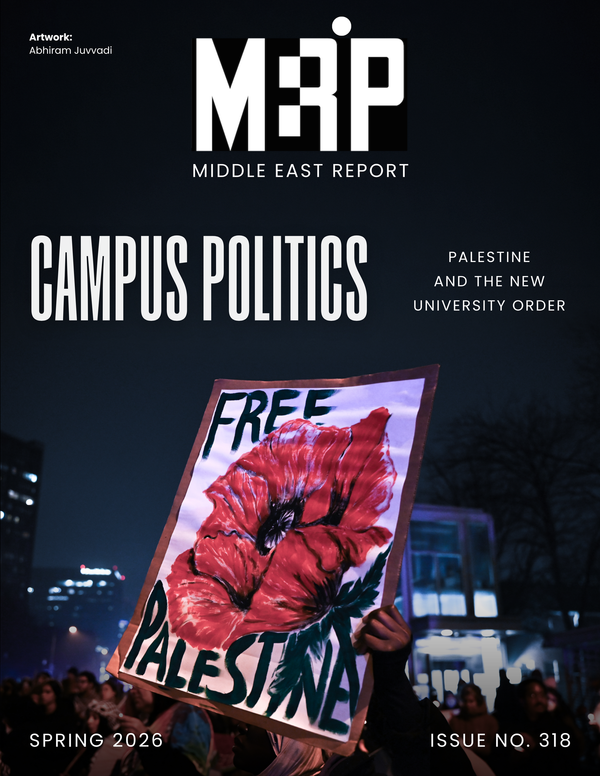

October 2023 marked a turning point for campus politics. The scale and intensity of the crackdowns in response to mass mobilizations following the genocide in Gaza have pitted diverse coalitions of students, faculty and activists against powerful pro-Israel stakeholders: Government officials, corporate donors, university administrators and institutional trustees have responded with tools of surveillance, censorship and repression. In the United States and parts of Europe, such restrictions have unfolded against a backdrop of democratic backsliding. What began as a sustained campaign against Palestine-related advocacy has expanded into a wider assault on higher education intersecting with challenges to diversity initiatives, faculty governance and the conditions of knowledge production more broadly.
The repression of pro-Palestinian protests and speech goes against not only the ideal that universities should foster critical inquiry but also the presumption that, at minimum, they should tolerate it. As the essays and roundtables of this issue demonstrate, US colleges and universities have taken unprecedented administrative and legal actions, often in coordination with the government and increasingly through expansive technological means. Solidarity with Palestinians—including encampments, demonstrations, group meetings, petitions, social media posts and even newspaper editorials—have been exploited for spurious allegations of antisemitism and leveraged as justification for discipline. Programs have lost funding and faculty have lost jobs. Students have been doxed, expelled and deported. On occasion, academic denizens have fought back successfully, as with the AAUP v. Rubio case, to block US President Donald Trump’s administration from engaging in arrests, detentions and deportations of foreign students—a rare vindication, at least in court, for free speech proponents.
Academic voices being under siege is not a new phenomenon, or one unique to the United States. German universities are waging their own campaigns to quash pro-Palestine advocacy by canceling events and punishing activists, which have been met with concerted pushback by students, scholars and allies. In Germany, discussions of Israel are charged by history and public memory, and campus spaces have given rise to uncomfortable confrontations between state and society with implications for the country’s democratic self-understanding.
In parts of the Middle East, where the apparatus of authoritarianism more bluntly guides the infrastructure of research and scholarship, universities have faced severe pressures for far longer. Colonialism, foreign interventions, revolutionary paroxysms like the Arab uprisings and regional conflict have all reshaped higher education across the region. The impact of these shocks has not been the same everywhere. But across different contexts, they have weakened institutions, interrupted careers, scattered scholars, derailed students and narrowed the conditions for knowledge production.
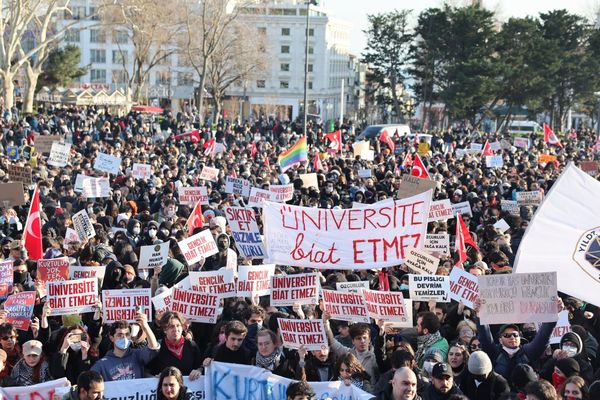
In Egypt, protests for Palestine are occasionally permitted but perpetually contained, reflecting the state’s attempt to manage a widely shared political sentiment that resists suppression but remains too destabilizing to permit freely. President Abd al-Fattah al-Sisi’s regime knows how easily student mobilization has historically morphed into mass contention. Nonetheless, Egyptian campus activists have fought back, linking the Palestinian plight with their resistance to domestic authoritarianism. In Turkey, as the last two decades have made especially clear, universities do not merely react to political regimes; they are also used to build them. The incredible expansion of higher education, the restructuring of governance and the disciplining of academics and students are instruments that create state power as much as they are effects of it.
The differences among these cases matter. Yet as this issue shows, thinking about campus politics in comparative perspective conveys a point obscured by both the liberal ideal of universities as sacred intellectual spaces and the conservative rhetoric that demonizes them. Today’s populists rail against universities for political purposes, portraying them as detached “ivory towers” that embody elite privilege and smug radicalism. Liberals defend them as quintessential bastions of human inquiry that should remain insulated from political intervention. In reality, universities are inherently political, not because their inhabitants expound controversial ideas, but because they are enmeshed in state imperatives, financial exigencies, legal constraints and social pressures. Universities are part-and-parcel of public order, which is why authorities strive to shape and discipline them. Their institutional position—and the forms of labor, organizing and dissent they make possible—remain an ineluctable site of struggle.