How German Media Failed Gaza
A new German book uses extensive data to show how Germany’s Gaza coverage tracked state doctrine and a compliant media system.
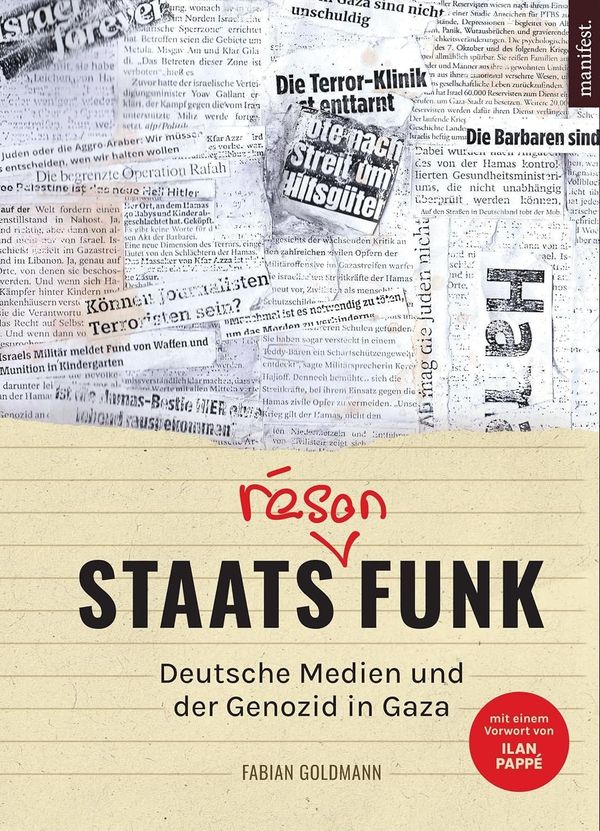

A Review of Fabian Goldmann, Staatsräsonfunk. Deutsche Medien und der Genozid in Gaza (Manifest Verlag, 2026).
Germany’s media sphere was profoundly ruptured by the events of October 7, 2023. The media treated Hamas’s surprise attack on Israeli communities near Gaza’s border as a spectacle of extreme, irrational violence, while largely obfuscating the violence Israel immediately began exacting on Palestinians. Newspapers and broadcasts defended Israel’s indiscriminate bombings as necessary, using language that uncritically echoed Israeli military communiqués and insinuated the collective responsibility of Palestinians, all to justify what so blatantly violated espoused notions of international law and universal human rights. The level of distortion exceeded the biases and omissions that previously characterized coverage of Palestine.
I experienced the editorial gatekeeping of Germany’s left-liberal media firsthand: A pitch to review Rashid Khalidi’s The Hundred Years’ War on Palestine remained unanswered. I later learned that a subsequently published scathing review had been commissioned in response to my initial pitch. In a piece calling on Germany’s government to reinstate its UNRWA funding, a copyeditor inserted unauthorized last-minute edits to defang all criticism of Israeli and German policy. An article providing historical background on Lebanon was returned too factually flawed and analytically gutted to publish.
During Israel’s war on Gaza substantial sections of the German public clung tightly to two beliefs: The world’s most moral army could not possibly commit the crimes Israel stood accused of, most prominently genocide, and Germany’s popular, pluralistic and well-trusted public broadcasting and private legacy media would never conceal such a reality. Over time, while the state increased its domestic repression of dissenting protestors, artists and academics, public opinion slowly shifted. By mid-2024, half the German population had little to no trust in Germany’s Middle East coverage. In the years since, Israel has devastated Gaza, signed and broken ceasefires and started another consequential war on Iran with the United States. With few exceptions, Germany’s political and media establishment has effectively backed all of these initiatives, including the goals of the war in Iran; even as its illegality has sparked occasional reservations, there has been no serious debate about reconsidering the country’s alliances.
Distorted coverage of Palestine has long exposed global patterns of political and media bias. The case of German media provides a drastic—if somewhat familiar—example. Journalist Fabian Goldmann offers a comprehensive account of these dynamics in his recently published book, Staatsräsonfunk. Deutsche Medien und der Genozid in Gaza (Broadcasting the Reason of State. German Media and the Genocide in Gaza). Its provocative title is a witty portmanteau. Staatsräson (Reason of State) denotes Germany’s doctrine of unconditional support for Israel, while Staatsfunk is a pejorative, right-coded term for “state-controlled media.” The mashup implies that German media is beholden to the state’s support for Israel.
After October 7, Goldmann extensively documented the German media’s distortions on his social media accounts, his blog and in left-leaning publications. His new book constitutes the sum of his research. Its undoubted strength is the quantitative analyses of 11,125 news items published between Oct 7, 2023 and January 19, 2025, in five leading journalistic outlets: the flagship public broadcaster’s nightly news program, Tagesschau (the day’s news); the investigative newsmagazine, Der Spiegel; the left-liberal weekly, Die Zeit; the tabloid paper, BILD and the self-described leftist daily, taz. Supplementing this analysis are a foreword by Ilan Pappé, a narrative chronology, statistics and data visualizations.
The book’s main contribution is its meticulous documentation of how German media abandoned its own journalistic standards. Instead of impartially covering Israel’s actions in Gaza, the media actively concealed, obscured, downplayed, legitimized and outright justified the violence. Taking up UN Secretary General Antonio Guterres’s dictum of Gaza’s devastation as a “failure of humanity itself,” Goldmann argues that, outside of Israel, this failure was most consequential in Germany, where it compromised political parties, institutions and the media sphere at large.[1] Few observers called out the media’s biases, and criticism rarely came from within. Lacking alternative German-language coverage of the Middle East, Germans switched to social media or the foreign press for accurate assessments of what was happening in Gaza. Although he highlights a few positive exceptions, Goldmann focuses on providing a concise anatomy of the structural conditions for what he calls the German media’s “systemic failure”—a failure that raises fundamental questions about the relationship of media to power and the status quo.
Sketching out a harrowing chronology of media failures, Chapter 2 shows how Germany’s journalists quickly abandoned the professional ethics of fact checking, non-stigmatization, impartiality, contextualization and the presentation of multiple perspectives. Immediately debunked fake news like Hamas’s supposed beheading of 40 babies was published without verification across German media, rarely eliciting corrections or consequences. Three people distributing baklava in Berlin’s Arab Neukölln district to celebrate the October 7 attacks was covered in over 500 news items, prompting domestic demonization of Muslims, Arabs, Palestinians and Neukölln itself as antisemitic. Leading journalists openly declared their solidarity with and loyalty to Israel, and efforts to provide historical and political context were misconstrued as legitimizing terrorism.
In 15 months, tagesschau—watched ritually by millions every day—featured Israeli representatives 136 times, while Palestinian representatives appeared only four times. When Palestinians featured, they did so as “perfect victims”—aggrieved civilians or doctors—not as political subjects or analysts.[2] Instead, the Palestinian perspective was represented by UN statements in a false equivalence to Israel’s. Moreover, UNRWA’s Philippe Lazzarini and Francesca Albanese were each featured only once, as were Amnesty International, Human Rights Watch and independent NGOs active in Gaza.
Chapters 3 and 4 chronicle German journalism’s overreliance on official Israeli statements and public relations materials as its main, and frequently only, source. All five news outlets repeated Israeli claims that Hamas’s command centers were placed within or below civilian infrastructure hundreds of times, without providing any source aside from Israel’s military. Goldmann traces the use of “Hamas-led” as a discrediting qualifier for Palestinian institutions like the health ministry across a broader sample of newspapers, noting its upsurge from 352 usages in the 35 years prior to October 7, 2023, to 826 usages within the ensuing three months. In a total of 4,856 headlines, Israeli sources were represented in 43 percent, Palestinian sources in 5 percent, supranational institutions in 8 percent and Gaza-based NGOs in just 1 percent. Palestinian and Arab media and journalists barely featured. German journalists, who cast Gaza as a so-called inaccessible black box, willfully blinded themselves by not seeking out additional sources. These patterns have repeated in recent coverage of Lebanon and Iran.
Instead of interrogating Israeli government sources, journalists adopted their unverified statements, rendering the German media complicit, Goldmann argues, in dismantling protective measures for civilians and in Gaza’s ultimate mass destruction (Chapter 4).
Instead of interrogating Israeli government sources, journalists adopted their unverified statements, rendering the German media complicit, Goldmann argues, in dismantling protective measures for civilians and in Gaza’s ultimate mass destruction (Chapter 4). For example, they parroted unsubstantiated Israeli allegations that hospitals acted as “terror clinics”—from the largest in Gaza, Al-Shifa Hospital, to all the others—largely ignoring objections by the UN, World Health Organization and many international news outlets. German Chancellor Olaf Scholz and leading journalists went from denouncing ceasefire appeals as beneficial to Hamas even after 4,500 children had been killed to declaring that Hamas was blocking the ceasefire, echoing shifting Israeli claims. A fabricated news leak by the tabloid BILD to help Israeli Prime Minister Benjamin Netanyahu torpedo ceasefire negotiations triggered no domestic media scandal or major protests, nor did Israel’s systematic assassination of Gaza’s journalists. Despite no credible evidence, Hamas’s alleged use of human shields remains a constant trope, while Israel’s extensive, well-documented use of the practice is barely mentioned.
Chapters 5 and 6 turn to how the German press framed violent actions and which victims it presented as ones to be grieved. The media’s framing was determined not by an attack’s magnitude or resulting casualty numbers, but by who perpetrated it. Israeli actions were persistently glossed as counterattacks, while the phrase “massive attacks” described nearly 80 percent of Hamas actions, as opposed to only 4.2 percent of Israel’s. According to Goldmann’s survey, German media never once adopted the term “massacre” when describing Israeli violence. Unsurprisingly, Israelis and Palestinians received unequal attention in life as well as in death. Israeli victims were 37 times more likely to be featured in headlines. A German-Israeli woman killed on October 7, for example, was the subject of 26 reports, while a German-Palestinian family of six killed in Gaza featured in just one segment.
The book’s seventh chapter tracks how the media establishment ignored, refuted and denied the warnings, court cases and expert statements about the genocidal character of Israel’s warfare. It also offers concise frameworks for understanding the Occupied Territories, Arab diplomatic efforts and the right to resistance, intended as useful background knowledge.
Staatsräsonfunk’s painstaking diagnosis of how German media systemically failed brings up the question of why. Goldmann offers no universal explanations to account for German media’s abysmal role. Instead, he outlines seven influential factors.
First, perhaps expectedly, Germany’s solidarity with Israel due to its history of perpetrating the Holocaust manifests in journalistic bias toward Israel and has produced an increasingly repressive state bureaucracy that expansively defines and polices perceived antisemitism. A second factor is the way racism and orientalist stereotypes have merged with this post-October 7 Staatsräson on overdrive. Discrimination against Palestinians, Muslims and Arabs—formerly frowned upon or primarily associated with the right—are now propagated openly, paving the way for their dehumanization across the political spectrum. A third arena where Goldmann casts blame is German journalism’s proximity to power. He describes the revolving door that provides leading journalists with jobs as governmental spokespersons. Much journalism centers around disseminating press releases that lay out government positions and advance their public relations. Politically influential elites also dominate public broadcasting’s oversight councils. The limits of acceptable political discourse on Israel and Palestine are narrowed by these constraints. For example, proposed diplomatic measures against Israel never extended beyond temporary arms sale freezes, which was echoed in journalists’ conformist coverage.
Germany’s ostensibly diverse media landscape is distorted by the pervasive influence of news agencies and by oligopolies that dominate the newspaper, magazine and TV market and generate profits for their billionaire owners, whose business might be disrupted by journalism that is too critical.
Germany’s ostensibly diverse media landscape is distorted by the pervasive influence of news agencies and by oligopolies that dominate the newspaper, magazine and TV market and generate profits for their billionaire owners, whose business might be disrupted by journalism that is too critical. This fourth factor—market consolidation that limits critique and dissent—is also visible in the United States where the billionaire Ellison family recently acquired CBS News. Several media conglomerates, like BILD’s holding company Axel Springer, dominate the German market. Axel Springer, which recently acquired US website Politico and Britain’s The Telegraph, explicitly mandates Zionist news coverage. Regarding news agencies, dpa (Germany’s AP equivalent) enjoys a near monopolistic market share of 95 percent, translating into immense power over public opinion. Smaller German newsrooms, understaffed and in financial straits, adopt and reproduce vast amounts of dpa’s coverage, including entire Middle East news tickers with their biases, distorted framings and omissions. Incidentally, dpa’s headquarters in Berlin directly border Axel Springer’s. The company holds shares in dpa and had previously employed their editor-in-chief in senior political editorial posts.
Fifth, the country’s journalism lacks diversity when it comes to its journalists’ backgrounds, viewpoints and identities. A sixth, related, factor is that a successful slew of defamation campaigns raised after October 7 by a range of actors, including Israel’s ambassador to Germany, IDF spokesmen, the German-Israeli Society and center-to-right media outlets, prompted layoffs of Palestinian and non-white journalists. These campaigns, combined with rigid editorial guidelines and internal pressures, created a stifling atmosphere of intimidation and fear among staff, freelancers and editors of being accused of the potentially career-ending charge of antisemitism.
Lastly, existing mechanisms to protect the integrity of the press failed. Institutions designed to scrutinize media, like Germany’s two dozen broadcasting oversight bodies, left citizen complaints against misinformation unaddressed. Worse, the German press council affirmed BILD’s right to use fake news about Hamas’s supposed beheading of babies in its headline. News organizations repeatedly refrained from joining their European counterparts in condemning Israel’s assassinations of Palestinian journalists. When journalists did level even cautious critique, it came mostly from freelancers who lacked newsroom backing and leverage.
Most of the factors Goldmann cites as contributing to the dismal German media coverage of Gaza already existed before October 7. The attacks and ensuing genocidal war turbocharged them, turning cracks into ruptures. Staatsräsonfunk captures these warped new dimensions in striking, analytical detail and has the potential to become a key work of reference—even as it fails to penetrate the German media bubble it chronicles. In its first six weeks, only left-leaning outlets reviewed the book. An English translation and further research, including on other national contexts, would be welcome, particularly given the overlaps between biases across national media cultures. For all its specificity, the German case remains an extreme articulation of a global phenomenon.
By situating its analysis in the chronology of Gaza’s destruction, Staatsräsonfunk foregrounds the genocide’s contingency: At any point, political leaders and journalists could have acted differently and held decision makers accountable.
[Jan Altaner is a PhD candidate in history at St John's College, University of Cambridge.]
From April 1 to May 7, 2026, MERIP is participating in Delco Gives. During this time, every donation of $10 or more helps unlock additional funding. Donate today to support rigorous, grounded analysis that remains freely accessible to all.
[1] António Guterres, “A Statement from the UN Secretary-General António Guterres on the Famine in Gaza,” UNHCR Nordic and Baltic Countries, August 25, 2025.
[2] Mohammed El-Kurd. Perfect Victims: And the Politics of Appeal (Haymarket Books, 2025).