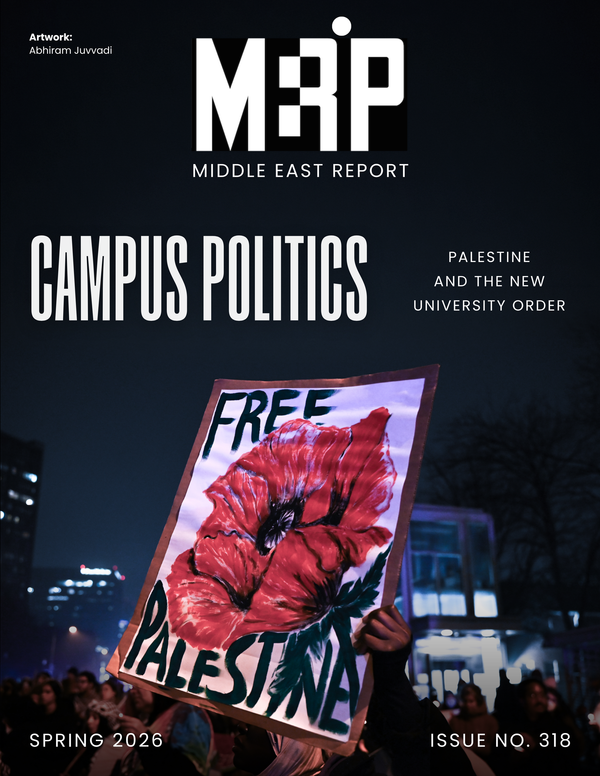
MER 318: Campus Politics–Palestine and the New University Order

Dear Friends and Comrades,
Today, we published our spring 2026 issue of Middle East Report, “Campus Politics—Palestine and the New University Order.” Its publication comes on the second anniversary of the university encampments, the high point of campus mobilizations against the Gaza genocide that ignited faculty, student and labor organizing for the Palestinian cause in a new generation. The issue examines the student protests since October 7, 2023, and the transnational nature of campus politics in the United States, Europe and the Middle East. It also follows the federal government’s assault on universities, which escalated in the first year of US President Donald Trump’s second term and was often characterized as a reprisal for the failure of university administrations to punish their students and faculty even more severely than they already had. The outbreak of the US-Israeli war on Iran in late February only intensified this assault, as at least two colleagues in Iranian studies have faced sanction and dismissal for their criticism of the war.
This attack on expressions of Palestinian solidarity and on Middle East Studies in the university has spread to other areas of life in the United States and beyond. As Torin Monahan details, university campuses in the United States have caved to a web of surveillance, censorship and securitization that began as attempts to quash Palestine organizing and have accelerated under the Trump administration to a much wider remit. Aslı Bâli, in her piece on MESA’s lawsuit against the administration, and two roundtables—one featuring student activists, the other faculty organizers—chronicle both the increasingly repressive university order as it spills beyond the campus and the ongoing modes of resistance.
These dynamics are not limited to the United States. Readers of this issue will learn how the fight in the United States for free expression, against authoritarianism and for a free Palestine has echoes within campus movements in Europe, Turkey and Egypt. As Sean Lee and Mostafa Hefny point out, three quarters of pro-Palestine protests worldwide, many of which took place or originated on campus, were concentrated in the Arab world, Turkey, Iran, the United States, France, Italy, Spain and Australia, but in Arab autocracies that have normalized with Israel, the stakes of these protests are even higher. Across these geographies, the university remains, as Andrew Ross puts it, “a site of struggle.”
I hope you find this issue enriching. Please share it and let us know what you think by responding to this email. Thanks for being with us and, as always, for your support that keeps us going.
In Solidarity,
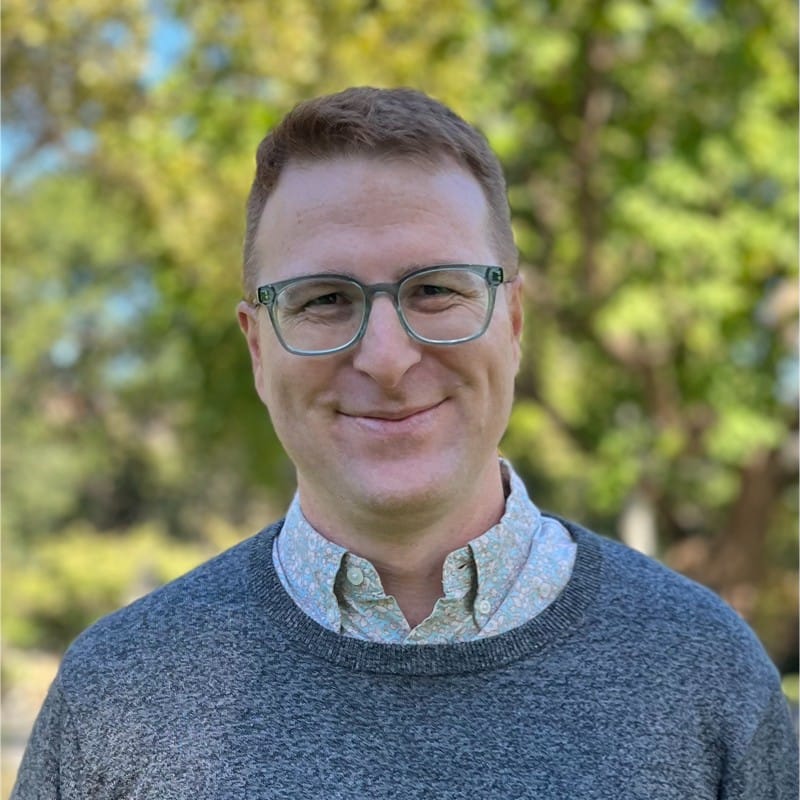
James Ryan
Executive Director
Your gift to MERIP goes farther during Delco Gives! Every donation of $10 or more before May 7 unlocks more bonus funds from the Foundation for Delaware County. Give today!