‘The University Is a Site of Struggle’—A Roundtable with Faculty Organizers on Repression and Resistance on US Campuses
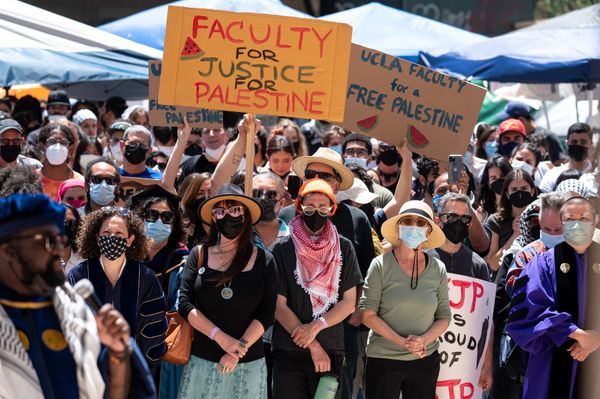
As part of MER issue 318, Campus Politics—Palestine and the New University Order, MERIP editor Lisa Hajjar organized a roundtable with faculty organizers and a legal advocate. Lara Deeb is professor of Anthropology and Middle East Studies at Scripps College and serves as co-chair of the Middle East Studies Association (MESA) Task Force on Civil and Human Rights. Darryl Li is associate professor of Anthropology and an associate member of the law school at the University of Chicago. He also co-chairs the MESA Task Force and co-authored the 2025 report, Discriminating Against Dissent: The Weaponization of Civil Rights Law to Repress Campus Speech on Palestine, by MESA and the American Association of University Professors (AAUP). Andrew Ross is professor of Social and Cultural Analysis at New York University, serves as secretary of the National Network for Faculty and Staff for Justice in Palestine (FSJP) and is a long-time activist with AAUP. Meera Shah is the legal network director at Palestine Legal, a legal advocacy organization whose mission is to bolster the Palestine movement in the United States by challenging efforts to threaten, harass and legally intimidate activists for their support for Palestinian freedom. Their conversation, which took place on April 13, 2026, has been edited for length and clarity.
Let’s start by focusing on the simultaneity of repression and resistance in the academy. How would you describe the contemporary fault lines in terms of both how students and academic workers are being discriminated against and punished for speech and activism and the heightened levels of solidarity work and effective forms of resistance?
Andrew Ross: Let me begin on a personal note. My employer, when it's not calling the NYPD to arrest me and my colleagues and students, is always actively encouraging me to retire. Last summer, NYU offered a sweet retirement package, and I thought long and hard about taking it. Everyone was saying it's a good time to get out of higher education, especially younger faculty of color who have wondered what they're getting themselves into over the last two and a half years. After some agonizing, I realized it's also a very good time to stay in higher education because, if there's one thing I've learned in 43 years of full-time teaching, the university is not a site of truth but a site of struggle. Everything that we build, everything that we value, everything that we build of value has come about as a result of struggle, and that requires constant vigilance and maintenance work to preserve. So I decided to stay in the struggle, largely because of the upsurge of campus-based organizing over the last two and a half years.
Membership in the AAUP—the newly proactive AAUP—has skyrocketed. The FSJP national network came together very rapidly [after October 2023], with more than 130 chapters registered after only a few months. Nothing like it existed before, and there have emerged other networks against campus repression, like the Coalition for Action in Higher Education (CAHE), Scholars for Social Justice and, I would also mention, the formation of Higher Education Labor United (HELU). There are some overlapping constituencies among those networks and some scholar-activists have been doing double and triple duty. But I feel that the strength and depth of this kind of campus organizing is really impressive. In many ways, faculty, for the first time in higher ed, have been at the forefront, albeit with the thinnest participation from the senior tenured ranks.
Lara Deeb: Andrew, I really appreciate how you describe the university as a site of struggle. I think one way to think about the alliances that we're seeing, as well as the forms of repression, is to remind ourselves that the United States and Israel are settler-colonial states grounded in white supremacy (in the US) and Jewish supremacy (in Israel) and that institutions of higher education in both places are colonial institutions invested in repressing criticism of those colonial roots. We see that in all of the long-standing efforts in the US university to suppress, at different historical moments, discussion of the genocide of Native Americans, anti-Black racism and also gender and sexuality, which often gets left out because we forget that heteronormative binaries are one of the structures put into place by the settler state on this continent. So one way to think about the struggle is that it's about controlling the narrative of the settler state. In the United States, these institutions have been trying to do that with different pressure points throughout their history, and now we're seeing the Zionist pressure point come to the foreground.
I also think the increased repression we’re seeing right now is a response to their failure to control the narrative. We see this in the history of US institutions every time there is a social movement. The moment when Ethnic Studies was born was a failure for the colonial institution. The moment when Gender Studies was born was a failure for the colonial institution. Over the last several decades, there has been an intense generational shift around discussions of Palestine that really came to the foreground with the encampments [in 2024] and that we see in the alliances that have been built with colleagues across departments that do not just do interdisciplinary research but that work in areas and think about methodologies that are critical of a more traditional European canon. The fact that the repression is so intense right now is because those alliances and those encampments and the accompanying shift in educational paradigms is a symptom of the university’s failure to control faculty and students.
Darryl Li: I think it's important to recognize the pivotal place of Zionism in the struggles over higher education, and that stems from Zionism's special place in the post-Civil Rights Movement racial order of this country. It was the confluence of the 1967 War—which resulted in Zionist conquest of all of Palestine as well as territories of neighboring countries and which demonstrated Israel’s indispensability to American imperialism—that led to the tight alignment between the two states. But at the same time, and I think this gets overlooked, the 1967 war and conquest coincided with the high point of Black freedom struggles, including the reformist strand that we now call the Civil Rights Movement, which led to a reconfiguration of the American racial order. In that racial order, the place of Jews of European origin transformed. On the one hand, the success of Zionism and the alignment of Zionism with US imperialism basically eliminated the political space for the question of dual loyalty, the antisemitic charge that Jews can't be good Americans and be Zionists. If you were an American and a committed Zionist, you could now position yourself as a kind of super citizen of both countries, a living embodiment of the special relationship. That's why, for example, when Israeli soldiers, who are also American citizens, are captured or killed in Palestine, they are treated in public discourse as American victims of terrorism in a way that's completely normalized.
At the same time, because of the Civil Rights Movement, having hyphenated or hybrid identities became more acceptable in American mainstream discourse. A multiracial-liberal ideology emerged that allowed people to celebrate being both American and something else. For American Jews who are also Zionists, Israel could be reconfigured as a kind of “old country” in the way that other immigrants, European immigrants in particular, are understood to have a benign and affective relationship with their ancestral country—like Italian Americans, Greek Americans and so on. Within this racial order, Jews of European origin have this special place where, on one hand because of middle-class assimilation and geopolitics, they cement their place in American whiteness, but at the same time, they're able to mobilize the language of minoritized grievance. Through the institutionalization of Holocaust memory and the ideology of anti-antisemitism, they're able to position themselves within people-of-color coalitional spaces, spaces of multiracial diversity, and to effectively police those communities, especially through weaponized allegations of antisemitism.
The liberalism which defines higher ed is what the post October 7 world has rent asunder, and we're all dealing with the fallout from that.
US higher education more or less committed itself to this post-civil rights vision of racial liberalism, and we saw these fault lines early on in the debates about affirmative action in the late 1970s and early ‘80s. Policing red lines around Zionism is another consistent feature of this landscape and has been since the 1960s. The people I call “baby boomer Zionists” have positioned themselves as both liberals and Zionists—and through their Zionism as upholders of US foreign policy orthodoxy, basically US imperialism. That unspoken deal structures American liberalism. The liberalism which defines higher ed is what the post October 7 world has rent asunder, and we're all dealing with the fallout from that. These fault lines are, of course, conditioned by all of the other forces that Lara and Andrew alluded to, like the racial ideologies of American settler colonialism as well as the way neoliberalism has restructured higher ed. I think Zionism is where all these things come together in the most virulent way.
Palestine Legal has played such a crucial role and been at the forefront of aiding people who've been the victims of repression and targeting for pro-Palestine speech and activism. Meera, could you describe how the organization is dealing with the fault lines as they've been evolving in recent years?
Meera Shah: I think that the current moment really needs to be understood as an outgrowth of the institutional response to campus protests against the genocide over the past two and a half years. We saw unprecedented mass protests in support of Palestinian rights, calling for an end to Israel's genocidal campaign in Gaza and the complicity of US institutions, many of which took place on college campuses. This mass mobilization of students across the country was met with extreme levels of repression from school administrations, police and the federal government, with students and faculty of color facing the harshest consequences. In response to the mass mobilization that materialized as encampments around the country in 2024, universities implemented new draconian policies and Kafkaesque disciplinary proceedings aimed at suppressing Palestine protests, but with significant consequences for all forms of expression or dissent. This ranged from imposing overly broad restrictions on how and where protests can take place, suspending student organizations, creating a whole host of conduct rules and policies that subject students to lengthy disciplinary investigations and punishing students with campus bans and interim suspensions even before investigations are concluded. As both Darryl and Lara noted, this isn't new. The term “Palestine exception” in reference to free speech was coined more than ten years ago. But there has been a massive escalation in repression over the past couple of years across all walks of life, and much of it centered on student activism and universities. The vast majority of requests for legal support coming to Palestine Legal are coming out of the campus context, and this includes increasing reports from faculty and staff who are being targeted or disciplined for their advocacy or teaching on Palestine.
Universities’ responses to Palestine protests paved the way for the current rightwing attacks on higher education, which encompass attacks against DEI [diversity, equity, and inclusion] programs and language, against trans rights and against academic freedom more broadly. The Trump administration’s attacks on education really began with Palestine—similar to the attacks on immigrant communities, which began with targeted attacks on Palestine protesters and student activists, including Leqaa Kordia, who was recently released after being detained for over a year. We have seen Palestine used as a wedge issue to undermine academic freedom and attack other disfavored groups. Universities have opened the door to these broader attacks by capitulating to the administration’s demands to further punish Palestine activism in an effort to keep their federal funding, to appease anti-Palestinian trustees and donors and to avoid costly litigation. Several universities have made agreements with federal agencies and settled lawsuits with Zionist legal-advocacy organizations that require further policing of campus speech, that punish or restrict teaching on Palestine and a whole host of other issues or that impose a distorted definition of antisemitism that treats pro-Palestine expression or teaching about Palestine as prima facie hostile to Jewish students. We’re also starting to see the limits of this strategy, with several courts blocking federal funding cuts and efforts to punish disfavored political expression.
What are your thoughts about the relationship between the “anti-woke” agenda being pushed by federal and state governments to completely de-liberalize and remake the academy and the weaponization of antisemitism? Florida, for example, is the canary in the coal mine of the “stop woke” attack on education, where censorious efforts are now being leveled against sociology, one of the traditional disciplines.
Darryl: Defense of Zionism is the issue where a significant number of liberals agree with the anti-woke crowd. It's the area of strongest overlap.
Lara: I don't know the degree to which this translates outside liberal arts contexts, but in the academy there's the anti-woke crowd and Zionists as we’ve been discussing, and there also is another fault line between faculty who hold to a more traditional view of the humanities, which often reads as a focus on Europe, and those who teach in interdisciplinary ways or disciplines like anthropology, sociology or comparative literature where the critiques presented by ethnic studies and gender studies are taken seriously. Differences around the curriculum, on some campuses at least, mask a political divide with an allegedly disciplinary or ideological one. We're finding some colleagues on that traditional humanities side aligning themselves with anti-woke, right-wing Republicans and with Zionists. This other fault line has existed for several decades and it is related to the decades of financial pressures on institutions and faculty who are told that we're always in crisis, we're obligated to adopt austerity measures, there are fewer resources and therefore you have to fight amongst yourself about where those resources go.
Andrew: I also take the long view on anti-woke. What we're witnessing right now is a difference in degree, not a difference in kind. I see anti-woke as a very long front of antagonism going back to the 1960s when the student left made the decision to “make a long march through the institutions” and establish counter-power in all precincts of higher education. You can look back to the culture wars in the 1990s, which the right mostly lost, at least in the academy. Then 9/11 provided a racially driven vehicle for a renaissance in the form of Islamophobia. Then we saw the anti-Black backlash come in a series of waves after Ferguson [Missouri, where 18-year-old Michael Brown was killed by police] and BLM [Black Lives Matter], and then, especially after [the police killing of] George Floyd [in May 2020], when some kind of reckoning with racial justice appeared to work its way into the nation's leading institutions.
The other part of anti-woke is directed against advances in gender and sexuality, especially heightened by transphobia, since gender fluidity seems to be the most destabilizing of all social tendencies for the “Moral Majority.” And we can't forget that the ongoing financial restructuring of higher education makes everything we do particularly vulnerable. Of course, there are big distinctions between public and private institutions. Public institutions, especially in red states, are vulnerable to right-wing legislatures, and private institutions are vulnerable to pressure from donors, who can amplify their complaints up to Washington.
There's been a hardening of lines between management and workforce as a result, and...the outcome has been the near complete abdication of independent leadership over the genocide in Gaza.
What's also very important is the ongoing restructuring of governance within institutions, which involves the upward centralization of power in the hands of a high-salaried executive class who have much more in common with the trustees and donors than with us working stiffs. There's been a hardening of lines between management and workforce as a result, and, as others have mentioned, the outcome has been the near complete abdication of independent leadership over the genocide in Gaza. University presidents scrambled to serve what C. Wright Mills called “the power elite,” who have all but declared class war on the intelligentsia within institutions like ours.
One of the obvious places where these fault lines are playing out is in academic associations around boycott resolutions. The first association to adopt a boycott resolution was the Asian American Studies Association, then the American Studies Association. MESA and the American Anthropology Association (AAA) were successful. Now the American Sociological Association is in a self-imposed crisis because the leadership is refusing to allow a membership vote on a boycott resolution, despite that the petition had the necessary support. How are the battles within academic associations illustrative of these broader trends?
Andrew: One thing we discover very quickly when we do BDS [boycott, divestment, sanction] work is that we're not really confronting the Israeli state, we're confronting our own state and the institutions that seek to exercise civil authority over us. For those of us who’ve been doing BDS work for a long time, we are facing off against our employers, opinion makers, media gatekeepers, lawfare warriors and elected officials in our own backyard, very far from IDF command centers in Tel Aviv and the killing fields of Gaza and Lebanon.
Lara: Thinking about the AAA in particular, we had two votes. We lost the first and won the second. The campaign started around 2013. In that first decade, a generational shift had not yet fully taken place in anthropology. As Jessica Winegar and I wrote about in our book, Anthropology’s Politics, the 1990s was a moment of growing awareness of representation that affected the field in different ways. There was a generational shift away from the idea that anthropology is a science and towards the idea that it is the kind of humanistic social science that's allowed to have political stances. That's where the fault lines align with these allegedly intellectual battles that are really political battles.
More recently, the site of confrontation has shifted to governmental administrations and legislatures. In the AAA, for example, my interpretation is that the executive director and the governing body are functioning in a kind of survival mode, where they're scared to do or say anything that might bring federal attention or jeopardize the organization fiscally. This goes back to what Jessica and I wrote about in our 2024 article, “Resistance to Repression and Back Again: The Movement for Palestinian Liberation in US Academia:” Pressures on individual faculty failed because that pressure didn't stop people from talking. Canary Mission blacklists didn't stop anyone from talking. If anything, it contributed to more awareness, and as a result, the targets and tools of repression have shifted to a higher, more administrative and legal level.
The genocide also shifted the terrain decisively. Debates around BDS among colleagues right now are radically different than they were prior to October 2023. Today no one—unless they’ve never looked at any media ever—can say, “I didn't know.”
Meera: Connecting to points that Lara and Andrew are making, opponents of BDS are losing on the substance. Invoking procedure is the only or last means to delegitimize or stave off what has been, in many cases, a large outpouring of support for Palestinian freedom and against institutional complicity in Israel's crimes. That was at the heart of campus protests. People mobilized to call attention to the genocide and to raise awareness of what Palestinians are experiencing but also to call attention to their own institutions' complicity in these crimes. These demands to end complicity were overshadowed, to some extent, because of the way the protests were policed and suppressed. The focus shifted, again, to institutional procedures around protests and what is acceptable, rather than engaging with the demands of the protesters themselves.
Given the simultaneity of genocide and repression, and resistance and activism, how do you see people navigating the moral imperative to speak out versus the impulse to self-censor as a means of self-preservation?
Meera: We have seen an entire generation of students who have been really activated and educated in the context of the encampments and over the past few years of protests against the genocide in Gaza. I think that the policies and actions of the Trump administration in the past year around immigration, in particular, have imposed a huge cost on non-citizen students and faculty. We can't underestimate the calculus that people are making in terms of the relationship between protesting and self-preservation because there are real consequences. At the same time, we continue to see people speaking out against genocide on campus and beyond, with freedom for Palestinians a common demand in this past year’s mobilizations against US authoritarianism and militarism.
Andrew: I agree with Meera that while we are seeing a falling off of advocacy or activism on campuses—which is not untypical of movement temporality—it’s undeniable that Palestine is now firmly in the minds and hearts of at least two generations of young people. We've also seen the taboo of criticizing Israel eroded somewhat among the electoral class. But public opinion is fickle. We can't forget that Israel and its allies are very good at taking advantage of vulnerabilities and consolidating their influence accordingly. We also can't forget the increasing pressure of Christian Zionism or the influence of religious belief. We're not talking about ultra-religious settlers in the West Bank. There are very powerful forces and constituencies within the Christian Zionist movement for whom any military conflict in the Middle East is a preface to the end-times war. That's the messianic lens through which they see the Middle East. That said, I feel that the war over ideas that served to legitimize Zionism is all but over. All that is left, as Gramsci taught us, is coercion: bullying, brute force and barbarism, which we've seen over the last two and a half years; the complete destruction of heritage and built environment, forcible annexation and mass displacement and so on and so forth. All that Israel is left with at this point is the tendentious claim that “this land has always belonged to us, because we say it has.” And the strongest echo chambers are not Zionist Jews but Christian Zionists. That's a vital component of the picture that we tend to leave out or discount.
Lara: I have been thinking a lot about control of the narrative when I teach about Palestine and about the violence of Israeli settler colonialism as non-exceptional and as part of a global system of power predicated on the idea that certain peoples or resources can be exploited or eliminated. The tactics of power deployed to control the narrative about the Zionist settler state take different forms depending on the context and legal constraints. Under conditions of occupation in Palestine and genocide in Gaza and now also war in Iran and Lebanon, we see assassinations of journalists and academics. We see scholasticide. The same efforts to control the narrative about the settler state is what we're seeing play out under very different conditions in the United States. For people who are citizens, I think making this connection is reducing self-censorship because connecting the dots has the effect of contextualizing the repression here and raising the stakes of the fight. I see that for many of my students. I think the reason we don't see it more publicly is because of the multi-pronged assault: it's Palestine, but it's also transphobia, it's also anti-Black racism, it's also ICE attacks on non-citizens. I think they're trying to figure out: Where do I put my energy? How do I link these things? There aren't enough hours in the day, and it's about trying to figure out how to take the kinds of alliances we've built in Signal groups and in FSJPs and among students in classrooms—how do we actually mobilize those alliances more broadly outside our institutions? That's the step that hasn't happened yet, but I feel like that's where things are being figured out or stalled right now.
The massive increase in critiques of Zionism is coexisting with coercive traction to impose the International Holocaust Remembrance Alliance (IHRA) definition of antisemitism as a way to punish and censor speech and teaching critical of Israel. Given this paradoxical battle for control of the narrative, what are effective modes of resistance against the imposition of IHRA in various institutions of higher learning in this moment? How can people push back against university administrators who are persuaded or pressured to adopt IHRA?
Darryl: What the IHRA definition accomplishes is to put people in a corner and force them to make a choice between self-censorship and articulating a stance on something very important, which is the relationship between Zionism and antisemitism. Let's recognize this IHRA definition for what it is: It is an intentional tactic of cluttering up discursive space. IHRA itself, as far as I can tell, exists as an astroturf entity for the sole purpose of getting people to say: Hey, have you heard of the IHRA definition? This is actually quite brilliant. They have managed to force everyone to respond to and define themselves in relation to, essentially, a mantra attached to an organization that doesn't even seem to do anything in real life. The definition of antisemitism is very, very vague, but it has several examples attached to it, and one of those is to say that denying the Jewish people's right to self-determination is antisemitic. What they're saying is that anti-Zionism is antisemitism. It's horrible that this is being legislated, but the silver lining is that it really puts people in a corner. We no longer have the luxury of defaulting to a particular line of argument that has not served our interests, which is to say that criticizing Israel is not necessarily antisemitic. This is what people have been saying to defend themselves when attacked for criticizing Israel. It’s so vague, it’s so expansive that even the most right-wing Zionists who criticize Israel will say this—by which they usually mean “it’s permissible to criticize the Israeli government for not being violent enough.”
In fact, you could flip it around and ask, “what are the conditions under which Zionism could be not racist or colonialist?”
What is at stake is not the ability to criticize Israel in non-antisemitic ways, but who has the ability to define what counts as antisemitic and, specifically, whether anti-Zionism should be conflated with and outlawed as antisemitism. Lots of people are trapped in this kind of defensive crouch, begging for some margin through which you can criticize Israel and have it be okay, instead of appreciating that this is an opportunity to educate people. When people say, “the Jewish people have a right to self-determination,” what does that mean? Let's break that down and explain why that statement can be quite problematic. In fact, you could flip it around and ask, “what are the conditions under which Zionism could be not racist or colonialist?” Put it on Zionists to come up with a version of their project that does not require dispossessing some other people, and maybe then we could talk about a non-racist form of Zionism. I think that's the conversation we should be moving towards, not whether or not there's an acceptable form of criticizing Israel or Zionism.
Meera: I would say that the impact of IHRA is more than discursive. It's important to call out how the conflation of anti-Zionism with antisemitism that is at the heart of IHRA is used to muddy the waters and is both a marker of compliance and justification for further censorship or punishment. Universities and other institutions are relying on this definition to silence expression in support of Palestinian freedom in the hopes of preventing the denial of federal funding or lawsuits claiming a hostile environment. So, the definition is doing work that has an impact. But along the lines of what Darryl and Lara are saying, I think this presents an opportunity to push back because it really clarifies that the work that's being done to punish and suppress Palestine advocacy and the ability to talk about Palestine is of a piece with efforts to prevent the teaching of Black history and to upend core principles of antidiscrimination law. It opens up space to connect with indigenous and Black and LGBTQ movements, and to really see—and challenge—these right-wing attacks as one.
Andrew: One of the things that IHRA highlights is that when people talk about the “Palestine exception,” it's a bit of a misnomer because what we're really talking about is the “Israel exception.” It's Israel, after all, that singles itself out for exceptionality, for immunity to criticism for its violations of international law and crimes against humanity. That claim to be exceptional is at the root of the issue, and IHRA highlights that.
I want to wrap up by asking you to offer some thoughts on one or more major achievements, whether legal or political, in terms of solidarity work and resistance to repression in recent years.
Meera: I'm going to focus on the legal victories. In recent months, we’ve seen a string of court rulings in favor of Palestine protesters, affirming that these protests are protected by the First Amendment and dismissing complaints by Zionist plaintiffs who claimed that universities violated their civil rights by not doing enough to punish protesters or stop speech that was critical of Israel on campus. We've also seen courts examining popular protest phrases like "from the river to the sea" or "globalize the Intifada" and finding them to be constitutionally protected speech—rejecting efforts to paint them as inherently hostile or threatening to Jewish students. To highlight a couple of Columbia-specific wins, a court allowed a lawsuit against doxxing trucks by some former Columbia students to move forward, which is an opportunity to seek some accountability for the harassment and fear experienced by thousands of individuals who've been doxxed after speaking out against the genocide. A court rejected Columbia's punishment of protesters over the Hind's Hall occupation, finding that the university meted out punishment without any individualized finding of wrongdoing. And we've seen a court allow a lawsuit to go forward against Columbia and federal agencies, finding that the university’s punishment of Palestine protests in the wake of federal government threats may violate the First Amendment. It’s critical to emphasize that the courts alone are not going to stem the authoritarian tide. But it’s important to call attention to legal victories and to use the language, the analysis and the fact of these successes to push back in other cases and contexts, including to defend academic freedom and to resist universities’ attempts to punish or sanction protected expression, whether it's for faculty or students.
Andrew: I would say the biggest achievement in higher education has been the building of this network of organizing that stretches from labor strongholds all the way to the more strident voice of the institutional intelligentsia. Academic labor unions have been at the heart of the pushback against higher ed restructuring and casualization for some time now. But unions don't always use a political voice that might be available to them. Their contracts often restrict political activity. I served on Committee A of the national AAUP for six years (2006–2012), and at the time, there was a very notable gulf between the collective bargaining wing of the organization and the more intellectually inclined policy wing—typified by folks on Committee A—who were accustomed to public debate and political speech. That's changed in recent years, in large part due to the vigor of HELU.
Today, there's much less daylight between that reserved labor mentality and the activist or advocacy voices among us. Of course, nothing works better than an existential threat coming from the state and the tycoon class for pulling people out of the lecture halls and into the struggle and bringing them together at least as some kind of unified front of consciousness, if not action. Even senior tenured colleagues have expressed their disquiet in recent years, if only because their grants got cut off or are threatened. I never thought I'd see the day when we had AAUP chapters at the likes of Yale and Harvard where we see the academic labor aristocracy awakening from its well-cushioned slumber. I think the big challenge in the coming years will be to maintain and further cement this fragile unity between these two wings of academic conscience and action—the labor activists and more independent faculty advocates—while also building on the bridges established with movement groups outside the academy who often look to us for analysis or whatever expertise we have to offer them.
Lara: The generational shift that we've seen is due, in part, to the educational work people teaching on our campuses have done for decades. First those colleagues, mentors and elders who were on the ADL [Anti-Defamation League] blacklist in 1983, then eventually our generations. I think that's a huge political accomplishment. The generation taking the lead now is extraordinary, and for those of us who have seen this sea change, it's a huge shift. The first campus protest I went to against Israeli violence was in 1996, and there were less than 10 people there. We were well outnumbered by the Zionist counter-protesters. With the encampments and mass protests, we can appreciate that this is a very different moment.
I also think we have to point to the extraordinary education and social media and reporting that's come out of Gaza over the past two and a half years and the example set by Palestinians in this moment, which has worked to shift the conversation in the United States. More people are taking seriously the idea, as Sherene Seikaly phrases it, that Palestine is the paradigm, not only for the repression that we're seeing but also for resistance and for persistence and for the theoretical understandings we have and that we're continually developing about how colonial and imperial violence shapes the world we live in. I think that this centering of Palestine counts as an achievement as well.
Discriminating Against Dissent: The Weaponization of Civil Rights Law to Repress Campus Speech on Palestine, MESA Task Force on Civil and Human Rights (2025).
In Landmark Ruling [AAUP v Rubio], Federal Court Says Trump Administration Violated First Amendment By Deporting Foreign Citizens for Pro-Palestinian Advocacy, MESA press release (2025).
The Palestine Exception to Free Speech: A Movement Under Attack in the US, Palestine Legal and the Center for Constitutional Rights (2015).
Expanding the Web of Control: America’s Censored Campuses 2025, PEN America (2026).
Lara Deeb and Jessica Winegar, “Resistance to Repression and Back Again: The Movement for Palestinian Liberation in US Academia,” Middle East Critique vol. 33, issue 3 (2024).
Pressuring schools to crack down, with Darryl Li (podcast), Makdisi Street (2025).
Darryl Li, “The Rising Threat of Antisemitism Investigations,” LPE (2025).
From April 1 to May 7, 2026, MERIP is participating in Delco Gives. During this time, every donation of $10 or more helps unlock additional funding. Donate today to support rigorous, grounded analysis that remains freely accessible to all.