‘Real Revolutionaries Don’t Punch Down’—Remembering Muzan Alneel
In Memoriam.
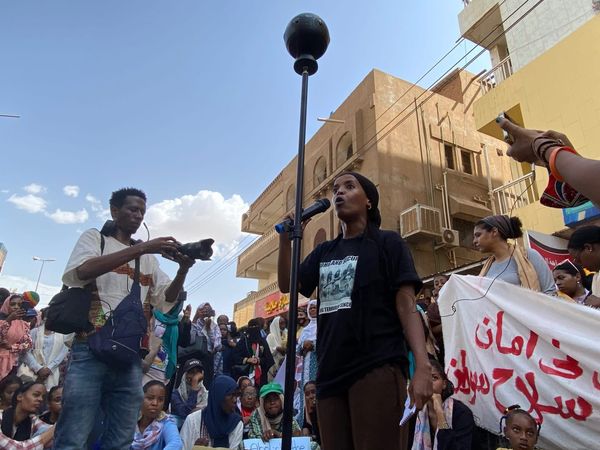

On April 15, 2026, the third anniversary of Sudan’s counterrevolutionary war, we learned of the loss of Muzan Alneel. We have been tasked with commemorating the impossible, walking the memory lane of Muzan’s life journey through the eyes of three women who knew her closely and intimately over the years albeit in different capacities and under varying conditions. We loved and were loved by her in ways that were both personal and political, a condition that also underwrote women’s mobilization in the years after the revolution. Our enduring connection is further shaped by a larger national project of freedom, peace and justice. Like the war itself, Muzan’s loss is an occasion of collective struggle that we must articulate, politically and meaningfully, while we endure.
To understand the significance of Muzan’s contribution to sustaining revolutionary momentum in Sudan, one need look no further than the bold and principled imaginary that underwrote her life’s work and politics. She firmly placed people—not a model, whether developmental, statist or even welfarist—at the center of her advocacy for lasting change. No example illustrates this approach better than her widely cited line: “It is my political position that people not be killed.” In a sea of political opinions, few slogans captured the imaginary of the Sudanese revolutionary struggle quite like this one—what she held as her longest-standing and, ultimately, final position on the dire state of affairs in Sudan.
Muzan was born in Omdurman, Sudan’s social and political precolonial capital. She trained initially as an engineer but found herself drawn to the social sciences, more so after the 2019 revolution. The revolution opened up spaces for organic thinkers like herself, and the time between 2019 and her untimely passing ended up being an opportunity and space that defined and was defined by her unique style of thinking and writing. She never shied away from introducing bold methodologies to otherwise rigid disciplines. A long-running advocate of bringing economics back to the people, Muzan, together with a close group of her revolutionary comrades, set up ISTinaD—an innovation, science and technology policy think tank that prioritizes the wellbeing of people and communities.
Muzan’s passing brings to the fore many memories—each a profound teaching moment about how the Sudanese revolution, through the conviction and bravery of its civic actors, attempted to chart a different path toward democracy. Her lifeworld reflects some of the most significant values of the movement’s call for liberation. We honor her by returning to them here, turning an obituary into a teach-in, as she would have liked.
A pacifist at heart in both her political outlook and organizational ethics, Muzan had an unwavering commitment to the values of long-standing, cumulative resistance. This commitment came through clearly in a remark she made in a public debate forum on “What Is to Be Done” to restore the path toward a civilian transition in the aftermath of the 2021 coup: “I’ve been caught up in the never-ending loop of political organizing since 2006, others contributed decades. We can only carry the lessons of each struggle forward. There is no other or faster way.” Her words offer an implicit warning against the current state of polarization, the seduction of warring narratives and the normalization of violence in the name of expedient endings.
In Sudan, over decades of conflict, peace has often evolved into a death machine, sustained by the whims of those who wield weapons or possess money. In South Sudan and in Darfur, multiple and successive peace projects across Sudan’s postcolonial history shifted patterns of violence rather than bringing them to an end, leading eventually to the full outbreak of war. It was precisely this logic that Muzan and her comrades sought to break from, developing a revolutionary discourse that departed from conventional models of postcolonial state building and put them at odds with so-called peacemakers, statists and proponents of "good governance" agendas. Her position, then, can be understood as a refusal to accept that the price of an order managed through violence—what some would call “peace”—should be exacted at the expense of people’s right to life, again capturing the essence of her immortalized tagline: “It is my political position that people not be killed.”
All of Muzan’s organizing efforts—whether in writing, mobilizing or reimagining public policy—were in service of finding alternatives to centralized, imposed governance by placing people and their many and varying capabilities at the center of national rebuilding. She was a firm advocate of the right to choose, the right for the Sudanese people to make political and economic choices, and she understood how these actions contributed to their sense of self-worth and responsibility in relation to the collective citizenry. For Muzan, this social contract is what induces nation building toward lasting peace, not the social distinctions imposed by a centralized authority as was and continues to be the case in Sudan.
One of her finest pieces, published in 2024 in the third issue of the Sudanese grassroots publication Atar, addresses these dynamics in the context of the current war. There, together with Moez Ali, she redefines mutual aid—Sudan’s largest sociopolitical project surviving the revolution—not as charity but as a communally financed operating system guided by the principles of sustainability and a people-centered philosophy. This formulation builds on extensive organizational work from within the Sudanese political tradition, offering lessons to other movements grappling with devastation. She later extended these reflections in another Atar piece on returning to socialist horizons after immense conflict, a message against mere survivalism in which she urged people to build lasting systems of justice and welfare through, and despite, the struggle.
Muzan’s intellectual contributions extended beyond national sovereignty to reimagining transnational solidarity and internationalism. Her work on the intersecting paths of Sudan and Palestine in politics, organizing and media recalls the principles of an internationalism the left has largely abandoned. In one of her last pieces, written with Gussai H. Sheikheldin, she revisited Julius Nyerere’s vision of self-reliant development to argue that meaningful sovereignty, from Palestine to Africa, depends on collective, people-centered economic and political projects built through South-South collaboration.
Yet perhaps Muzan’s most enduring contribution was to the Sudanese feminist project. Against its liberalization and underrepresentation, she relentlessly advanced analyses grounded in class, region, ethnicity and, more recently, the implications of war‑induced destitution on the most vulnerable, continually refining her tools to bring feminism closer to women’s lives. Like the rest of her intellectual work, her feminist practice went beyond reading and study. It came from a full and deeply engaged life that centered the struggles of others. She listened as intently as she spoke, treating listening not as a courtesy but a political practice, a way of ensuring that thought never outran people or their lived realities.
“Real revolutionaries don’t punch down,” she often said. It was both a political principle and a measure of genuine allyship. She modelled a fierce praxis of care: a patient, loving friend and a force of life and purpose on even the darkest days. Her kindness was not softness but a radical and deliberate refusal of cruelty as political logic. In a context as restrictive to women as that of Sudan, Muzan performed the unspoken work of creating spaces and providing access where there was little or none. She embodied a form of political womanhood that exceeded imposed limitations: kind while still firm and unwavering. She rejected calls for reform—a tactic employed to align political agendas and absorb women’s voices—choosing instead to invest in knowledge creation and trusting people, women especially, to arrive at their own choices and positions.
Muzan laughed loudly, danced freely, sang openly and loved deeply and wholeheartedly, insisting that a life devoted to justice must also be fully lived. Joy was central to who she was, as it was to sustaining the revolutionary struggle. She brought together intellect and humanity in a way that was unforgettable—rigorous in thought, generous in spirit and vibrant in life. We remember and carry forward her radicality in resistance, her joy and her unwavering hope for tomorrow.
Muzan is survived by her husband Ahmed Mahmoud, her three loving sisters Marine, Misdar and Malab, her mother Enaam Elyas and her father Abu Obedia Alnile.
[Walaa Salah is a human rights lawyer from Sudan. Rania Aziz is a Sudanese researcher and a pro-democracy activist. Raga Makawi is a Sudanese editor and researcher.]