Student Protest and the Politics of Palestine in Egypt
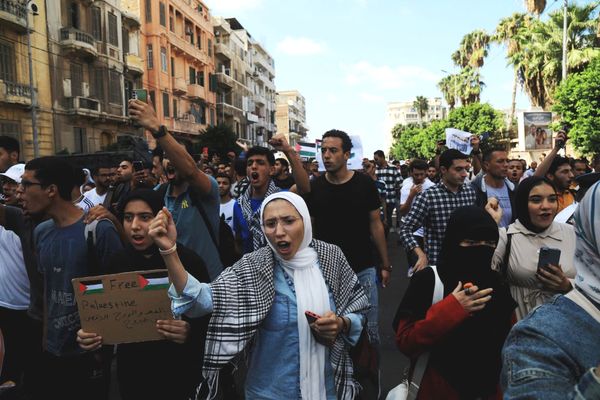

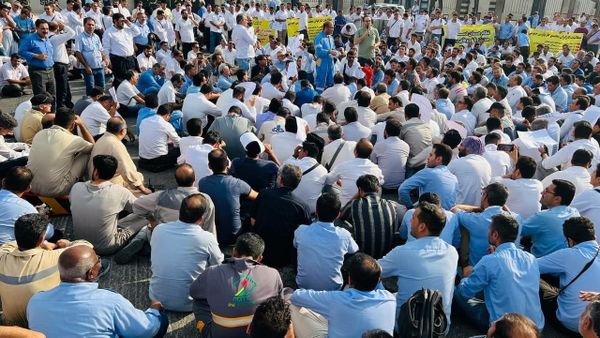
In October 2023, two weeks after Israel launched a brutal assault on Gaza, the Egyptian government permitted the first sizable protests in support of Palestine. At Benha University, about 30 miles north of Cairo in the Nile Delta, students and university administrators joined together in what the university described in a press release as a “major stand in solidarity with the Egyptian state and the Palestinian people”—in that order. After a minute of silence, the president of the university affirmed the participants’ “full support for all measures and decisions taken by the Egyptian state and political leadership in support of the Palestinian cause and to halt the plan to displace Palestinians from the Gaza Strip to the Sinai Peninsula.” He also praised Egyptian President Abd al-Fattah al-Sisi for the “historic and heroic stance that the Egyptian state has consistently taken.”
During the first two years after the start of the Gaza genocide, the monitoring organization Armed Conflict Location and Event Data (ACLED) counted nearly 48,000 demonstrations in 137 countries in support of Palestine. Three-quarters were in only ten countries: Yemen, Morocco, the United States, Turkey, Iran, Pakistan, France, Italy, Spain and Australia. Many of these protests were on university campuses. Egypt, notably, did not make the list despite being the largest Arab majority country, resounding popular support for Palestine and a shared border with Gaza. ACLED recorded 234 protest events in Egypt between October 7, 2023 and November 12, 2024.[1] The category of protester most frequently classified as instigating a demonstration was students, representing about a quarter of the recorded demonstrations.[2] Many of these student-led protests were held on campuses and, like the October 2023 protest at Benha University, they were often tightly controlled.
Egyptians ostensibly have the right to free assembly. After the 2013 military coup led by al-Sisi against elected president Muhammad Mursi, the regime drafted a new constitution, passed in 2014, stating, “Citizens shall have the right to organize public meetings, marches, demonstrations and all forms of peaceful protests, without carrying arms of any kind, by serving a notification as regulated by law.” Nevertheless, protests have been severely curtailed, and the Egyptian state’s massacre of nearly 1,000 Mursi supporters at Rabaa al-Adawiyya square in August 2013 still serves as a material example of the state’s willingness to repress protest violently. The default position today is a total, if unstated, ban on protest. This approach has arguably been too successful. In the wake of October 7, 2023, Egypt has stuck out with its glaring discrepancy between popular sentiment and public expression over the ongoing genocidal violence in neighboring Gaza.
Government authorities are well aware of the depth of support for Palestine and fear the possibility of real mass mobilization. Even the most repressive regimes know that such sentiments cannot be ignored, leading to their attempts—with varying degrees of success—to suppress political expression when possible or channel it into more controllable avenues like the Benha University demonstration. Egyptian governments have historically paid close attention to such public sentiment in general and among student activists in particular.
Universities have long served as important sites of political mobilization in Egypt. Student activism played a visible role in the anti-colonial struggle in the decades before the 1952 Free Officers revolution, and successive regimes have treated campuses as politically sensitive spaces ever since. In the wake of the revolution, President Gamal Abdul Nasser’s new government curtailed independent political activity. Student energies were largely co-opted by the state, leaving little to no room for students to engage in campus or national politics despite their history of engagement in the anti-colonial struggle against the British.[3]
In the aftermath of Egypt’s defeat by Israel in the 1967 War, however, things changed. The light sentences handed out in military trials to the leaders of the Egyptian Air Force sparked protests in February 1968 in the working-class Cairo suburb of Helwan that quickly spread to Cairo, Alexandria and elsewhere. Student protesters at Cairo University joined the fray to protest not only the Air Force trials but also what they saw as a general lack of democracy in the country and specifically the absence of democracy on campus.[4] This history is recounted by Ahmed Abdalla Rozza, the late Egyptian scholar and former student organizer, in his book The Student Movement and National Politics in Egypt.
Student activism continued under President Anwar Sadat, giving rise to a dynamic student protest movement representing both leftists and Islamists and producing two revolutionary presidential candidates: Hamdeen al-Sabahi and Abdel Moneim Aboul Fotouh. Both ran in the 2012 elections (the nation’s first, and until now last, democratic presidential elections). Though they lost in the first round, together they outperformed both the Muslim Brotherhood candidate, Mohammad Mursi, and Ahmed Shafiq, who represented the previous regime. Their credibility was largely based on their past as leaders of the student movement in the 1970s. In the case of Aboul Fotouh, recordings of his rowdy confrontation with Sadat at Cairo University in 1977, when he was head of the student union, were circulated online in the run-up to the 2012 elections as an illustration of his authenticity and revolutionary credibility.
After the bread riots of 1977, which Sadat referred to as “intifiadat al-haramiya” (the uprising of thieves), his regime cracked down on all activism, especially that of the left. Moreover, Sadat blamed student activists for the unrest, despite their relatively minor role in the uprising, and suppressed student activism on campus. The 1978 Camp David Accords between Israel and Egypt, and the subsequent peace treaty, were opposed by broad sectors of society, including intellectuals and artists, leftists and even some within the government. While the president’s men prepared to bus in supporters of Sadat upon his return from signing the treaty, the police were investigating anti-treaty leaflets distributed by Islamist students at Cairo University. But post-1977 political repression and the breakdown of nascent political coalitions meant that such discontent did not lead to mass protests. When Sadat was assassinated in 1981, the clampdown on campus politics, especially the Islamists, became even stricter.[5]
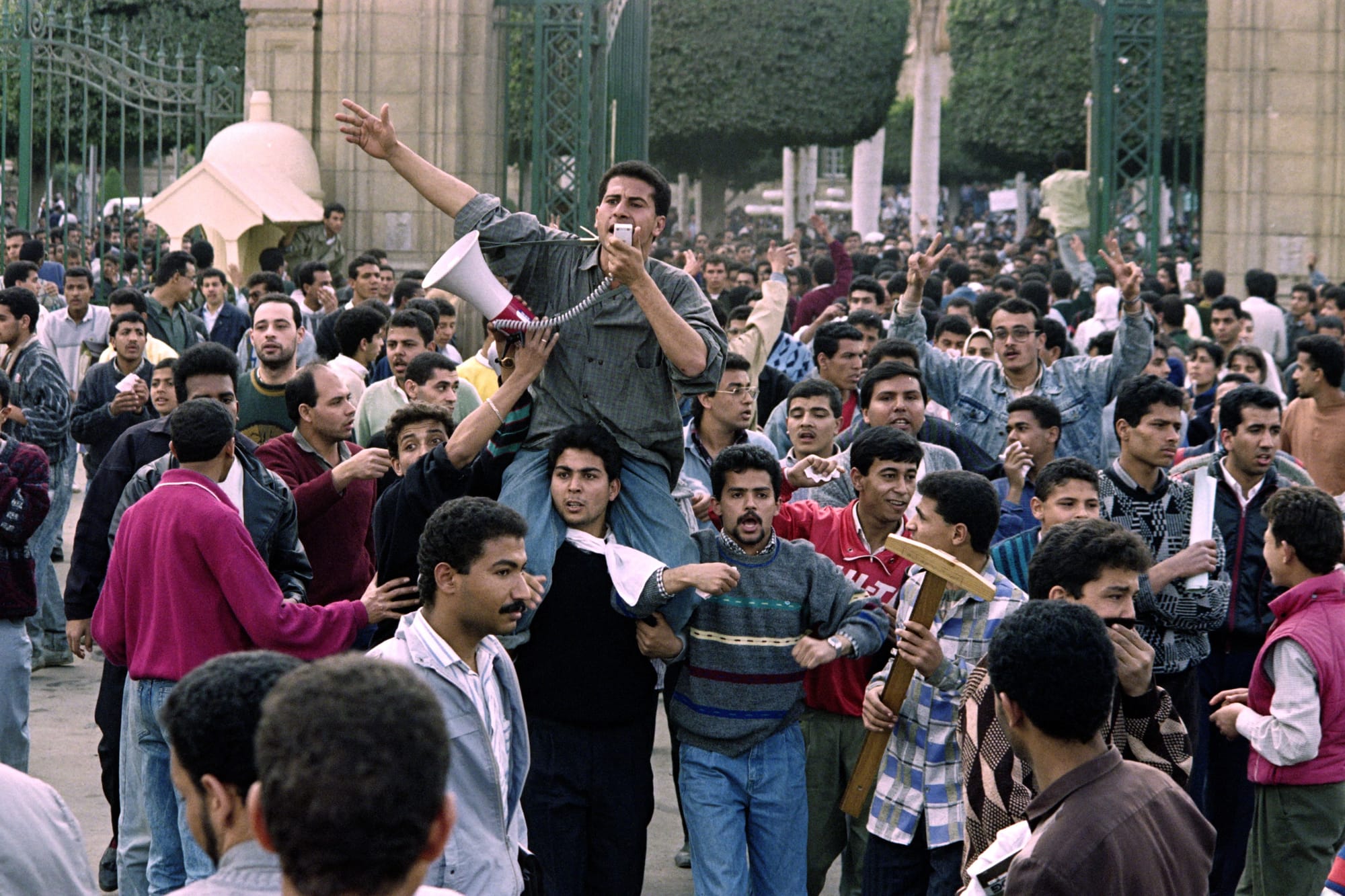
Under Hosni Mubarak, Sadat’s successor, political activism was severely limited, including student protests. There were some exceptions to the rule, however, such as mobilizations against international events like the US-led invasion of Iraq in 2003 and around cultural issues like depictions of the Prophet perceived as blasphemous and Islamophobic films produced in the 2000s. Mubarak tolerated some protests in support of Palestine that broke out during the first (1987–1993) and second (2000–2005) intifadas as well as at times of high tension, such as in the aftermath of the Hebron massacre in 1994.
The regime’s acceptance of these protests stemmed from a desire to contain and better control popular sentiment that was bubbling under the surface of political life. The targets were seen to be Cairo’s US and Israeli allies to the exclusion of the regime itself. There were even attempts to channel public outrage into state-sanctioned, and thus controlled, demonstrations. For instance, on January 1, 1988, there was a major protest outside of al-Azhar University. In April of 2002, Cairo University witnessed a week of student protests, and some 15,000 students came out at Benha University against Israeli violence in Ramallah and the siege of Palestinian president Yasser Arafat. The students from Cairo University had to be physically prevented from approaching the nearby Israeli embassy. The national, state-run newspaper Al-Ahram reported on these protests, providing province-by-province breakdowns of the pro-Palestinian demonstrations taking place at universities and schools throughout the country without any hint of condemnation as Cairo suspended relations with Israel.
The multisectoral protest networks that formed around these two issues, Palestine and Iraq, led over time to a more organized movement, in which students were involved, that would later form the backbone of the early protests that broke out in 2010 and 2011, leading to Mubarak’s ouster.
In February 2003, the Mubarak regime, despite arresting protesters at smaller demonstrations, sponsored its own protest against the impending US invasion of Iraq, busing in tens of thousands of people to the Cairo International Stadium. As soon as the invasion began, a massive two-day protest took over Tahrir Square, bringing together “stylish AUC students, hardened activists, Islamists and passersby,” who ended up chanting anti-Mubarak slogans, overwhelming riot police and even torching a water truck stationed to refill the state’s water cannons. These events caught the regime off guard, and it felt the need to follow up the next week with a state-sanctioned protest at al-Azhar Mosque, where the protest logistics were subcontracted out to the Muslim Brotherhood and protesters refrained from anti-Mubarak chants. The multisectoral protest networks that formed around these two issues, Palestine and Iraq, led over time to a more organized movement, in which students were involved, that would later form the backbone of the early protests that broke out in 2010 and 2011, leading to Mubarak’s ouster.[6]
The revolutionary interregnum between the ouster of Mubarak by popular uprising in 2011 and the military coup of 2013 was a time when students became involved in competitive politics through their student organizations, operating both on and off campus. Under Mubarak, universities had remained politically sensitive places where activism—often led by Islamists—was closely monitored and frequently suppressed, even as the regime also cracked down on the targets of Islamist ire. Mubarak’s fall in January 2011 upended this system. The collapse of the regime led to calls to dissolve the student unions tainted by the regime's electoral meddling. With the start of the new semester in February, the interim government heeded these calls, leading to an unprecedented level of competition, cooperation and collective action by students. First there was the resuscitation of the long defunct national-level student union, the National Student Union (NSU), which represents Egypt’s many public and private institutions of higher education. Student representatives from 20 public institutions and 12 private institutions met first at the German University in Cairo and later at the American University in Cairo (AUC) for the founding conference of the new but short-lived Egyptian Students’ Union in August of 2011.
With the collapse of the public sphere in the initial years after the coup, universities became heavily securitized spaces with a moat of armed personnel (including private security contractors) restricting access to campuses.
In the months that followed, student elections were held, and by 2013, after two electoral cycles, the leadership of the NSU had gone from control by the politically dominant Muslim Brotherhood to a coalition of anti-Brotherhood forces. On the eve of the military coup in July of 2013, union leadership was split on the impending removal of President Mursi. The head of the union, Mohamed Badran, expressed support for the June 30 mobilization against Mursi, while his deputies emphasized the sanctity of the electoral process—the shar’iya’ (legitimacy) slogan that animated opponents of the coup in the months that followed. The polarization that captured Egyptian politics at large was mirrored in the universities. With the collapse of the public sphere in the initial years after the coup, universities became heavily securitized spaces with a moat of armed personnel (including private security contractors) restricting access to campuses.
As the new military-backed regime cracked down on opposition, the one major election it lost was the 2014 NSU elections. In the same year, a new constitution was passed through referendum and a new president (al-Sisi) and parliament were elected in plebiscites that were widely decried as unfair. For a brief period, universities were sites of frequent mobilization, peaking with a wave of protests over the handing over of two islands, Tiran and Sanafir, to regime patron Saudi Arabia in 2016. But that was short-lived. A blunt crackdown on campus mobilization, which included mass arrests, disciplinary proceedings and expulsions, escalated when the state annulled the NSU election results in 2015. In 2017, it was made final with the forced dissolution of the NSU, in effect fragmenting what had been coalescing into a national-level representative body.
A dozen years after the coup, student politics have been subjected to a similar level of deinstitutionalization that characterized much of civil society under the new regime, with fragmented bodies of students across the country's more than 100 public and private institutions of higher education. Public universities in Egypt have become arguably more inaccessible than private universities: Rules and procedures govern entry that belie their ostensibly public status. For instance, Cairo University has been fortified through surveillance cameras, iron slabs narrowing points of entry, rapid deployment forces, electronic gates and private security contractors. Entrance by visitors is severely restricted and permission requires a lengthy, uncertain process. The degree to which these spaces have been securitized betrays a fear of universities as potential sites for mobilization—fears that have been exacerbated in light of the Gaza genocide and the popular support for Palestine among Egyptian students.
Authoritarian regimes’ repressive repertoires are at least in part explained by their level of perceived security.[7] More established regimes are more likely to tolerate public protest channeled into spaces negotiated over many iterations with opposition and civil society groups. In places like Jordan, for example, routinized protest both maintains the boundaries set by the regime and safeguards a space for public expression.[8] By contrast, the counterrevolutionary nature of the current Egyptian regime pulls its administrators toward a repertoire of unprecedented violence and domination, which has led to the collapse of a once lively public sphere.[9]
As such, the absence of mobilization around key issues—political freedoms, economic and labor rights, sectoral privileges and international affairs—are the product of the severity and ubiquity of state violence, including forced disappearances as well as lengthy prison sentences. Alongside largely uncalibrated violence, elite defections have also been limited by fear of unrest—what the political scientist Dan Slater describes as a “protection pact,” in which authoritarian rule is justified as a bulwark against revolutionary upheaval.[10]
Yet the question of Palestine sits somewhat outside of these dynamics. Across the political spectrum, a multi-class constituency has held a baseline pro-Palestinian position. The polarization of political views that marked the collapse of Egypt’s short democratic period in 2013 does not extend to the question of Palestine: nearly all Egyptians (92 percent) see the issue as concerning them equally.
The politics around Palestine as well as in the arena of student activism are considered so productively volatile as to require a modification of the blanket suppression to which the new regime has subjected all politics in its first decade.
The politics around Palestine as well as in the arena of student activism are considered so productively volatile as to require a modification of the blanket suppression to which the new regime has subjected all politics in its first decade. In a distant echo of the engagement that brought the remote (in more ways than one) worlds of students at the AUC to revolutionary politics with the renewal of the NSU in 2012, AUC’s New Cairo campus has also been the site of the relatively few student-led protests against the ongoing genocide in Gaza. This potential for mobilization is also the reason why regime officials decided to allow protests at public universities like the one at Benha University.
But just like the Iraq war protests 20 years earlier, calibrating approved events was difficult within an otherwise acutely authoritarian politics. When the Egyptian government finally responded to rising domestic anger at the rapidly escalating mass violence in Gaza after October 7, it did so through organized protests whose locations had been pre-approved and with participants bused in by security forces. Resuscitating the Mubarak-era tactic, these staged protests were designed to exonerate Egyptian political leadership as a precondition for expressing solidarity with Gaza. Some of these events, like the demonstration at Benha University, went off as planned, praising the “historic and heroic stance of the Egyptian state.” Others, however, did not. Tahrir Square was not one of the approved locations, but protesters who had coalesced at al-Azhar marched there nonetheless, chanting slogans like “Apologies, oh Palestine, but we are also occupied!” (Asafin ya Filisteen, ehna kaman muhtalin). The demonstration led to an immediate crackdown by the security forces, who beat and arrested dozens of protesters.
All these events point toward a sort of politics that are known but not expressed. The preferences of the population on the issue of Palestine are not a mystery, even if they are channeled through alternative means like boycotts, which do not appear in protest event datasets.[11] In Egypt, the boycott movement has become sufficiently serious that pro-government figures have weighed in, calling on consumers to support local businesses, even if they belong to foreign-owned franchises. At the same time, sales of locally produced alternatives to Western products have reportedly boomed. What is unknown is the extent to which the regime feels the need to allow the expression of pro-Palestine sentiments and produce a pale shadow of the politics it seeks to contain. Explicit politics have, for all intents and purposes, been essentially banished from public life, but the issue of Palestine resonates with young Egyptians who recognize the same feelings in others. While the regime’s overwhelming focus on suppression is not likely to abate anytime soon, should other factors change, the question of Palestine could potentially serve as a spark for politics again.
[Mostafa Hefny is an assistant professor of political science at the American University in Cairo. Sean Lee is an assistant professor of political science at the American University in Cairo.]
From April 1 to May 7, 2026, MERIP is participating in Delco Gives. During this time, every donation of $10 or more helps unlock additional funding. Donate today to support rigorous, grounded analysis that remains freely accessible to all.
[1] Access to disaggregated data from ACLED is lagged by one year.
[2] The largest category is unclassified, often described as “residents.”
[3] Ahmed Abdalla, The Student Movement and National Politics in Egypt (Al Saqi Books, 2008).
[4] Ibid.
[5] Ibid.
[6] Manar Shorbagy, "The Egyptian Movement for Change—Kefaya: Redefining Politics in Egypt," Public Culture 19/1 (2007); Rabab El-Mahdi, "Enough! Egypt's Quest for Democracy," Comparative Political Studies 42/8 (2009); Reem Abou-El-Fadl, "The Road to Jerusalem through Tahrir Square: Anti-Zionism and Palestine in the 2011 Egyptian Revolution," Journal of Palestine Studies 41/2 (2012).
[7] Nadine Sika, Civil Society and Activism in the Middle East: Regime Breakdown vs. Regime Continuity (Oxford University Press, 2024).
[8] Jillian Schwedler, "Routines and Ruptures in Anti-Israeli Protests in Jordan," Microfoundations of the Arab Uprisings (Routledge, 2018).
[9] Joshua Stacher, Watermelon Democracy: Egypt’s Turbulent Transition (Syracuse University Press, 2020).
[10] Dan Slater, Ordering Power: Contentious Politics and Authoritarian Leviathans in Southeast Asia (Cambridge University Press, 2010).
[11] Amytess Girgis, Neil Ketchley and Sean Lee, “Boycotts and Pro-Palestinian Activism,” MENA Politics 7/1 (2024).