After the Encampments—A Roundtable with Student Organizers on Palestine, the University and What Comes Next
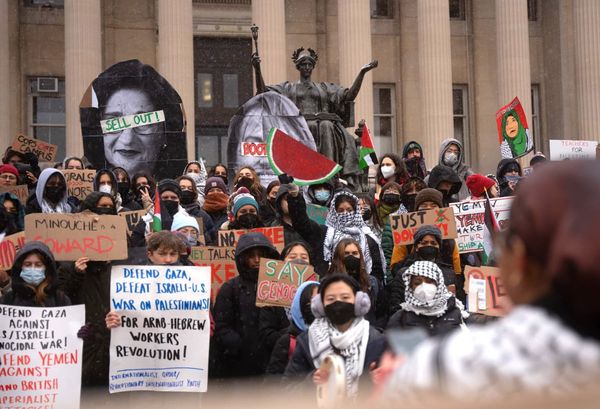
For issue 318, Campus Politics—Palestine and the New University Order, MERIP editorial committee member Maya Wind organized a roundtable with six student activists representing five student collectives from Europe and the United States: Marilù with Collettivi Autorganizzati Universitari (Italy); Marie with Stop Academic Complicity Collective (France); Aesop with KCL Stands for Justice (United Kingdom); Khirad with the University of California Irvine UCI Rank and File (USA); and Nabil and Toto with Academic Opposition (Germany). Aesop and Toto are pseudonyms; other participants are identified by first name only in light of the disciplinary, legal and political risks facing student organizers. In their conversation, which took place in April 2026, they reflect on their organizing during and since the spring 2024 encampments and discuss the current terrain of university-based mobilization for Palestinian and collective liberation. This roundtable has been edited for length and clarity.
Can you tell us about the core demands of your encampments and other escalations in the spring of 2024?
Marilù: During the mobilization in solidarity with Palestine, universities were a place of visibility. Everyone was watching students rising up against the complicity that our institutions had, and currently have, with the genocide. So we demanded that our government cut every tie with Israel, and we were also pressuring Italy to get out of the NATO alliance.
Marie: Some of the main demands across encampments in France were: official university support for Palestinians and Palestinian scholars; official condemnation of Israeli war crimes, colonization and genocide; and the boycott of, and cutting ties to, Israeli universities and complicit companies, specifically weapons companies.
Khirad: There are ten University of California campuses, and the demands differed between them. But across the campuses the main three were to disclose, delink and divest. At UC Irvine, we also demanded amnesty post encampment. Graduate students were also pushing the union and the UC to abolish campus policing.
Aesop: The main demands of the 2024 encampment at Kings College London (KCL) were for the university to condemn the genocide, academic boycott, divestment, rebuilding higher education in Gaza and to safeguard the right to protest.
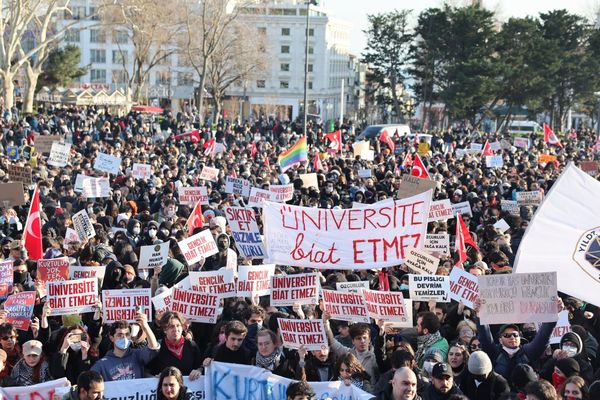
Toto: The first occupation in the Free University (Freie Universität) in Berlin was actually in late 2023. The idea was to just hold the space the entire day with teach-ins and talks about Palestine. The occupation wasn’t really centered around demands. We were trying to break the isolation that had set in among politically active students, and there was this sense of being in a political vacuum. Later we had an encampment at the Humboldt University which had five demands: 1) recognize Palestinian as a category of citizenship and student enrollment, 2) offer scholarships for Palestinian students, 3) drop the IHRA definition of antisemitism as it has been used to criminalize organizing in Germany, 4) disclose ties to Israeli institutions and 5) acknowledge Germany’s own colonial history. We were connecting the dots between the Herero and Nama genocide—the first of the twentieth century for which Germany was responsible—and the creation of the State of Israel as a result of Germany's crimes.
Two years after the encampments, we’re trying to assess where we are. What have we won? What do we still have to win? What new directions has your organizing taken, building on the energy and power from the encampments?
Marilù: We ended the last encampment in Naples after a public meeting with the chief of our university, which was a public discussion where we put our demands on display and asked for accountability and for a space to discuss them fully. Fast forward to one year later: We currently have a motion, that we are bringing along with PhD students and professors, to cut all ties with Israeli universities and with military companies and for our university to recognize the genocide. Our motion will be discussed at the Academic Senate assembly, which is the board that controls our university, and the chief of the university will be present there.
This year we also decided to take part in the university elections to represent our struggle as students inside university bodies. Thanks to that, we have managed to discuss our motion to cut ties with Israeli universities and with military companies. As of now we are monitoring them, because they have promised us that they will do it, and there are professors that are working on it, but we are doing a “students’ control” [a form of collective oversight drawing on the Soviet concept of “People’s Control”] because we fear that they might stop doing this work as soon as we let our guard down.[1]
One campaign that we have launched is called “Yankee Go Home.” This is a national student campaign against imperialism and Trump’s war and economic politics. This is very important because the mobilization has shifted: It’s not just about Palestine alone anymore. Right now, people, students especially, are taking to the streets against war in general and against what’s happening in the world because of US war politics. “Yankee Go Home” is a way to create theoretical and practical continuity that allows us to organize people and students in the different territories. Because Palestine for us is the starting point to build power and leverage to strike imperialism.
Marie: The negotiations at French universities came to a dead end. The universities kept blaming the government in private and instrumentalizing academic freedom in public. We decided to bring a lawsuit against French universities for maintaining ties with companies and Israeli academic institutions complicit in violations of international law. Two weeks ago, we sued eight French universities and the ministers of Foreign Affairs and Higher Education. The applicants are a coalition of students and teachers and 20 organizations (student and teachers unions, French Jewish Union for Peace, and Nidal, an association of Palestinian lawyers). We argue that university partnerships violate the International Court of Justice rulings of 2024 about prevention of genocide because you're not allowed to be allied in any way with an institution actively participating in war crimes.
...for once, the questions that were asked were “are you breaking international law?” not “how do you support academic freedom?” So that was the win.
The goal was to use strategic litigation and to make noise about it. Beforehand, we published academiccomplicty.fr—the French version of academiccomplicity.eu—to publicly map the ties between French and Israeli universities. Most of our database covers the partnerships from Horizon Europe (the European Union’s €95.5 billion research funding program, which includes Israel), but we added some bilateral partnerships. Then we produced a report with all the arguments used for the lawsuit to explain it to the faculty who weren't involved in mobilizations and the heads of administration and the public. We managed to get coverage in the French press, and it wasn't that bad. They were kind of objective in reporting on what we said, and they asked the heads of administration for answers. The universities had to answer five to six journalists a week about their ties to Israeli institutions. But for once, the questions that were asked were “are you breaking international law?” not “how do you support academic freedom?” So that was the win.
Now we're planning on pushing this strategic litigation. The whole point is to get bigger and bigger because the student mobilizations came to a dead end. In the long run, we see this as a very useful strategy because it raises the cost of maintaining these partnerships and of renewing them and puts them up for public debate. We don't think we're going to obtain the cut of partnerships right now, but what's going to happen is that the administrations will say it's not worth it. Let's not renew these ties. It's going to be in one year or two years or three years, but it's going to be very beneficial to the academic boycott and the movement.
Khirad: Like others have said, the UC encampment negotiations ended in kind of a dead end. There was a tremendous period of real demobilization afterwards. It was just very devastating. The sheer scale of people who were criminalized and couldn't participate in future actions was really difficult. In our case, divestment was trickier because we’re one of ten UC campuses, and so in negotiations we were constantly told that all of these financial decisions rest with the UC Regents, and it's a system that has an operating budget that's larger than the GDP of some countries. At UCLA, groups like Graduate Students for Justice in Palestine and the Rank and File for a Democratic Union caucus have done really important and comprehensive work digging into the UC’s investment portfolio. On our campus, we found ourselves in a similar place and identified a deep need for specific research.
Over the course of the encampment, we ended up learning a lot about the history of UCI that we didn't really know that well. UCI was founded in 1965, at the very beginning of a period of student movement organizing. And when the UC Regents were deciding where to put this new campus, they chose Orange County, which is a place with history structured by the aerospace industry, white flight out of Los Angeles (especially after the 1965 Watts rebellion) and has historically been a crucible of the conservative movement nationally. And there's a kind of counterinsurgent architecture built into our campus. With the Global War on Terror, there were a lot of flash points. We also had a very vocal student movement for Palestine that faced early criminalization—for example, the Irvine 11 in 2010, students who were criminally prosecuted for interrupting a speech by Michael Oren (at the time, the Israeli ambassador to the United States). This was one of the earliest moments prefiguring what was to come.
We decided to write a series of three reports on our campus’s past, the present of the encampment and then thinking towards the future based on what's currently unfolding. The first report is on the Global War on Terror history of UCI, including the very first Department of Education civil rights investigation into alleged antisemitism, which focused on the Muslim Student Union. The second is a report of oral histories from the UCI encampment. And the third is a timeline for all ten UC campuses, tracking major institutional shifts in the aftermath of the encampments (such as federal Title VI investigations, private litigation from actors like the Brandeis Center and new policies introduced by the California Legislative Jewish Caucus). Tracking all this has been very helpful. I think we forgo thinking about some of these institutional developments at our own risk. So much is going on in the domain of private litigation, and the university is being reshaped so significantly as a result. Failing to compile all of this in a comprehensive way—so that we can all understand it—leaves our movements kind of unmoored. So, we've shifted our energy now into deep research.
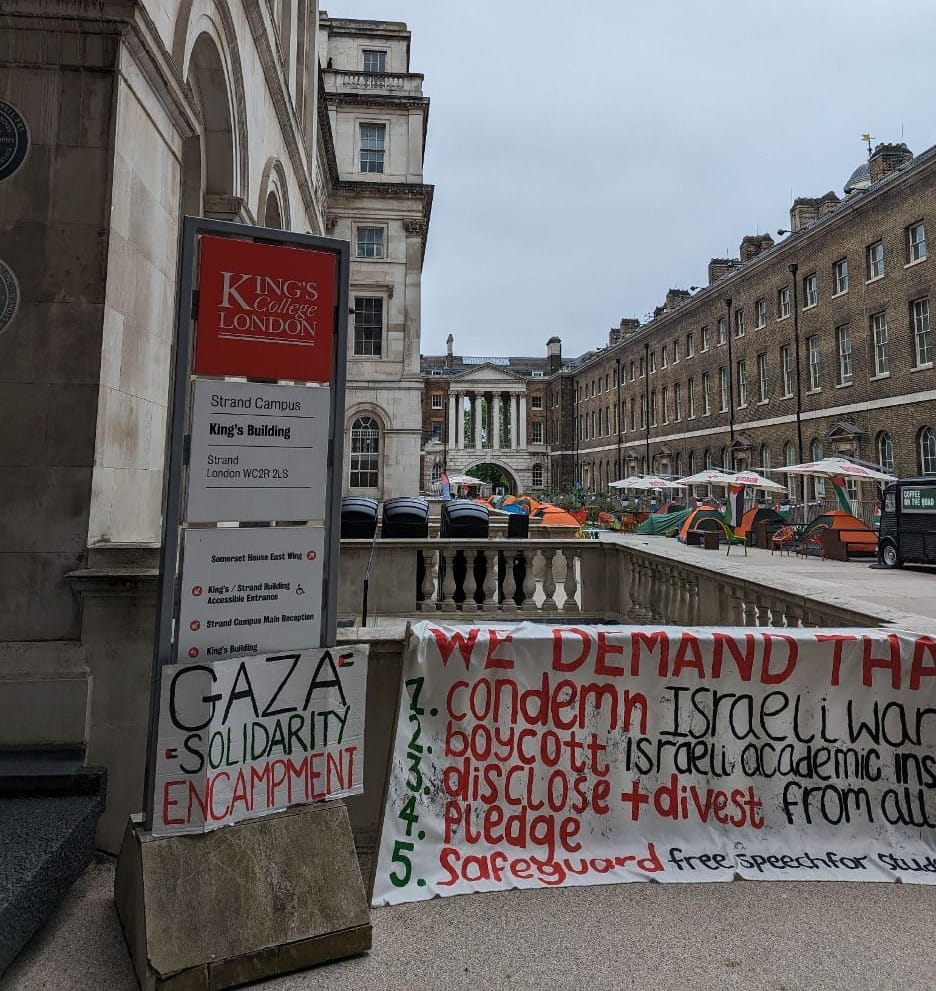
Aesop: At KCL, our negotiations began in the first encampment. Three weeks after we launched, we began to negotiate on the five demands. On the first demand of condemning the genocide, the university had just recently introduced a “values-based impartiality” policy and committed to hide behind it. On the academic boycott, the university shared they didn’t have any active academic partnerships with Israeli universities. On divestment, management said: “bring us the numbers, show our complicity and then we’ll talk about it.” Though we were due to negotiate further, the administration gave us an eviction notice on day 60, and we ended the encampment on day 68. After that the administration said they were no longer going to negotiate with the student movement directly, only with the representatives of the University and College Union (UCU) and the Student Union on divestment and rebuilding.
The rebuilding of Gaza higher education, one of our key demands, was formulated following a visit from the Emergency Committee of Universities in Gaza to the encampment. We went through an arduous process of trying to materialize the framework that the university management gave for support in the short, medium and long term based on the principles of the committee—from supporting Gazan students now, to working with Palestinian partners to increase access to higher education and engaging in future research collaborations.
I don't know where the university management was getting their assessment about what was needed. The university did not have any direct communication with the Emergency Committee of Universities in Gaza and categorically refused to speak to them directly, though we tried to arrange for a meeting. Nevertheless, they did offer some material support such as the Dr. Maisara Alrayyes Scholarship and online access to some modules and teaching content.
On divestment, thanks to collaborations between staff and multiple student groups, we researched and published a report documenting every penny that the university had invested that supports Israeli occupation and apartheid and is used for weapons development as well as documenting its academic complicity. Then, once we negotiated on divestment with these numbers, they told us they can’t pull out as these were not in direct investment funds. We pushed them to move to a direct investment model so they can control those funds and to institute an ethical investment policy that excludes companies involved in human rights violations and war crimes. Meanwhile the KCL Student Union officers organized a student body vote on divestment and the motion passed at 89.3 percent. To add escalatory pressure, we launched the second encampment in April 2025. During this second encampment, we pared demands down to £300,000 of investments in UN-blacklisted companies. We thought there's no way they can wriggle out of this one, right? But it turned out they didn't want to divest from those either, fearing it would set a precedent. After that, it really became clear we would need significantly more leverage.
The UCU have continued to negotiate on divestment and academic freedom and were balloting for industrial action in November 2025 but fell seven votes short. Given how close the results were, they consulted the members, redeveloped their demands and they're now preparing to ballot again. Additionally, we won the presidency of the Student Union campaigning on rebuilding and divestment. So, we are trying to leverage the Student Union with a sizable mandate, the UCU and the student body, to organize properly to focus on those demands.
We now have a unified nationwide academic boycott campaign in Germany. It actually shortens very nicely to Academic Boycott Campaign DE (Deutschland). So, there's also our motto of “learn your ABCs.”
Nabil: One project I want to talk about is our academic boycott conference. In January more than 30 student collectives from all across Germany gathered in Berlin for three days to talk about the academic boycott. We had public facing panels, but also an internal portion where we had these long assemblies with different student groups and worked through a manifesto with all the student collectives. We went through all these amendments, but at the end of the conference we came out with a unified manifesto and a campaign plan for 30 groups, which has grown to 40 groups. We now have a unified nationwide academic boycott campaign in Germany. It actually shortens very nicely to Academic Boycott Campaign DE (Deutschland). So, there's also our motto of “learn your ABCs.”
We've set up a nationwide structure where there's a steering committee, but there are also working groups within the campaign, in which members from collectives across Germany work together. In the big cities, like Berlin, where we have many international academics, international organizations, people passing through, it’s a better context for organizing. But collectives in small cities are very isolated, both in their university and in their city. The nationwide campaign aims to collect and centralize a lot of resources in one space to then distribute to collectives that need it most. We’re also training collectives and organizing workshops with international organizations to get insights from them. We also have commissions, for example, that focus on just research or negotiations, where we bring collectives together, or delegates, that have experience in one thing to teach it to others. We also keep up monthly calls just to get every group on board.
The campaign also has a public facing side, which is to present a unified front to both the universities and the state, to signal that the student movement isn’t dead yet, there's more than enough energy left within it. The first thing we're organizing is the first nationwide Israeli Apartheid week in Germany, which is at the end of April. I think the campaign has brought a lot of energy back into student collectives.
In your current campaigns and mobilizations, where do you see new openings and points of leverage to intervene in our own imperial universities?
Marilù: We are concerned with the broad fight against imperialism. With all that is happening in Iran, in Cuba, in Lebanon, in Palestine, we think it's time to address the biggest enemy that we have. That's why we launched our “Yankee Go Home” campaign because we see in this new Trump era and its strategies an opportunity to expose the contradictions of our imperialist society.
This is our main focus, and we think that it is the most important point of leverage we can use to build connections and to move forward with our struggle. In Italy, young people, and students especially, have a sensibility against war and all that is happening in the world. Also, they recognize our government is responsible for supporting the US administration and all the states that are actually exporting war to all the corners of the world. Taking a stance against this rhetoric and type of behavior allows us to build different strategies to “weaken” the enemies ––US and western governments––that are part of this project that puts profits before the life of people. A campaign around the role of our government and the US and western governments in this imperialist strategy is the biggest thing that we can use to build support around our ideas and to organize the political response to go forward in our struggle.
We are also planning to go around different cities in Italy to present the campaign and share our organizing experience and what we have done with students. People need tools to build strategy and address the real cause of all that is happening. The academic struggle in solidarity with Palestine means underlining the cause which we want to destroy, which is imperialism, which is colonization, and to think of another way of living together. We also want to defend the examples of resistance like in Palestine that show us every day that building another world is possible. Defending those experiences, those acts of resistance, is very important.
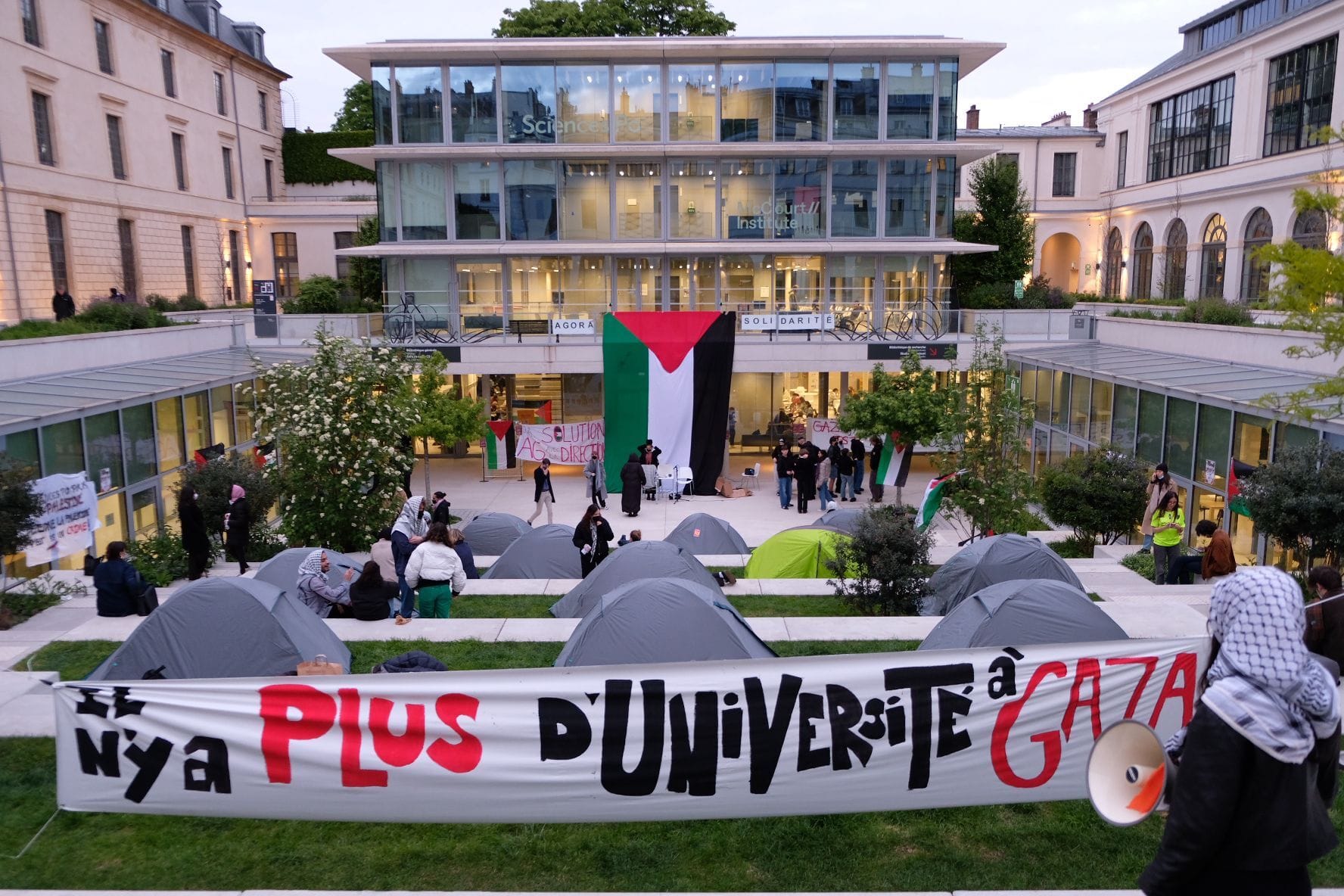
Marie: I would say an opening is forcing the heads of administrations to publicly confront their contradictions because negotiation behind closed doors doesn't work. The student work to document and write reports was a very interesting practice, and it helped us convince a lot of unions to join the lawsuit. There are a lot of convergences in France between the movement for Palestine and other movements. We are building bridges between those different areas of the struggle, specifically with mobilizations against militarism and privatization. Looking towards the coming year, we need to think beyond France to organize around the Horizon program and to kick Israel out of the program. This could trigger a domino effect with the EU-Israel Trade Association.
Khirad: I think one of the openings is in the domain of labor law. That has been a really interesting place where people have been able to win pretty significant concessions from the university and both protect space for organizing within their universities from hostile administrators, as well as blocking a lot of the federal encroachment. United Auto Workers (UAW), which represents grad students across the UC system, and the Council for UC Faculty Associations (CUCFA), which is the unofficial faculty union, have pressed unfair labor practice charges. I think it's interesting that they have shifted into that terrain because so much civil rights litigation and other areas of the law have been shaped by pro-Israel actors. That has been a really significant lesson, that it was union organizing that brought the proposed settlement—in which the Trump administration was pressuring UCLA into a billion-dollar settlement to adopt extreme measures against DEI and free speech—into public view. And eventually CUCFA pushed to block it.
One of the lessons I’ve learned from the history of prison organizing is the importance of not ignoring certain tactics just because they’re imperfect.
One of the lessons I’ve learned from the history of prison organizing is the importance of not ignoring certain tactics just because they’re imperfect. As part of the rank-and-file movement during the 2022 strike, I learned about the UAW’s pretty rough history with demands for Palestinian liberation. Even back in the 1970s there were strikes of Arab auto workers in Michigan protesting the UAW purchasing Israeli bonds, and as recently as 2016, UAW leadership nullified a democratic motion for BDS amongst UC workers. But it’s a testament to the power of the continued agitation amongst rank-and-file membership that the UAW was one of the only major unions to launch a solidarity strike for the encampments in 2024 and, more recently, that both the UAW and the CUCFA have managed to restrain some of the most intense federal encroachment into the University of California.
It is also powerful to see demands move back and forth between domains. “Cops off campus” originated from rank-and-file unionism and then became one of the central demands of our encampment. And now some demands from the encampment are traveling back into sites of labor organizing, where there's space to negotiate directly with the university. Similar to what others have said, I think you have more leverage in direct negotiation, which is a right that union officials have. That has been my big lesson.
Aesop: I think the point of leverage we identified was trying to cultivate a symbiotic ecosystem within the university and then going across universities. This is hugely important if you want to become ungovernable and force the university to listen. The university does not care about four or five activists. If you can place yourselves in positions of bureaucratic influence such as the student union or the major staff unions and organize the wider student body, then that becomes an impossible equation for the university, so that's what we tried to do. Fortunately, we had the KCL UCU branch on our side, which represents 1,800 staff members within the university. So that's undeniable. The Student Union (SU) is one of the oldest in the UK and represents 47,000 students at KCL. We had the SU, the UCU and the student movement—the encampment movement as well as the support of many societies across King’s. That became really difficult for the university. It's about being slightly Machiavellian, knowing that you have to cultivate power in those institutions, so that even if the administration tries to wriggle out with one group, the other group can act as a pressure valve, or one group can get away with what the other group cannot if they are bound by certain things. The SU is bound by charity law, but the student body can apply pressure in ways the student and staff unions can’t. Meanwhile the staff of the UCU bring their own credibility, experience and pressure and offer support in ways that no other group can. Working together, that's what worked for us at KCL.
Another point of leverage was that because the university was negotiating, I found that the threat of escalation was more effective than the escalation itself, just because once you’ve played your cards with an escalation, subsequently 95 percent of the time you would waste dealing with the consequences (i.e. investigations, doxxing, media)—the monopoly of power almost always rests with the institution and they have no problem using it. But with the leverage and potential of escalation, management would go home and just be staying up at night thinking about what the students might do and often that would result in an outcome.
Nabil: In Germany, we're in a very depoliticized, specific context. So, the question has been less which leverage do we currently have, but more how do we set up the conditions to organize better in the coming years. We don't even have proper student unions nor independent workers’ unions on campus, and the university is not set up for organizing. One opening is that academia really relies on collaboration, especially in Germany. When we think about the boycott of Israeli institutions, a strength that we have as international students is keeping track of professors or academics at our own institutions who are complicit and warmongering as well as academics who uphold the structures that keep Israeli universities as part of German and Western academia. We can make these academics personally responsible.
We are almost three years into the genocide now, and over a year into organizing, and these student bodies have only solidified and become stronger. I am Palestinian, and it is so heartening to see the Palestinian struggle inspire so many people to become organized. I'm very optimistic about where we're going. I think, ultimately, we'll see the downfall of Israeli academia and of Israel as a whole. Israeli academia will never be seen in universities in the same way and that is because of this type of organizing. It's not if it is going to happen, it is inevitable. We're just making it quicker. I'm so inspired by everyone here. And I hope that's a high note we can end on.
From April 1 to May 7, 2026, MERIP is participating in Delco Gives. During this time, every donation of $10 or more helps unlock additional funding. Donate today to support rigorous, grounded analysis that remains freely accessible to all.
[1] Elena Kochetkova, "People's Control and the Morality Quest of the Late Soviet Economy," Journal of Social History (2025).