The Capture of Turkey’s Universities Under the AKP
How the AKP transformed an expanded university system into a terrain of political control.

How the AKP transformed an expanded university system into a terrain of political control.
On March 18, 2025, Istanbul University’s executive board made an unusual decision: It moved to revoke the diplomas of roughly 30 alumni who had graduated more than three decades ago. The retroactive reach of the decision was striking and its political implications hard to ignore. Among those affected was Ekrem İmamoğlu, Istanbul’s mayor, the main opposition’s presidential candidate and President Recep Tayyip Erdoğan’s leading challenger. The move was especially notable in a political context long shadowed by unresolved controversies over Erdoğan’s own educational credentials and recurring plagiarism allegations among senior officials.
The university defended its decision by alleging that there was an irregularity in İmamoğlu’s 1990 transfer to Istanbul University from Girne American University in Northern Cyprus. Legal scholars responded that the retroactive application of new regulations is prohibited. Whatever the courts ultimately rule, the episode reflects a familiar governing logic in Erdoğan’s Turkey: When confronted with open political challenges—the Gezi protests in 2013, the inconclusive June 2015 elections followed by renewed violence and polarization, the July 2016 coup attempt or the opposition’s sweeping municipal victories in 2024—the government does not rely solely on police repression, judicial intervention or compliant media to counter them. It also activates the routine administrative capacities of public institutions, turning ordinary regulatory authority into an instrument of political containment.
Universities stand at the center of this dynamic. They remain embattled spaces of dissent, yet they have also become strategic arenas in which the regime confronts and contains opposition, at times openly and punitively and at other times through the quiet exercise of administrative authority. Turkish higher education has long operated under centralized state supervision, especially since the establishment of the Council of Higher Education following the 1980 military coup. After over two decades of Erdoğan’s rule, that state capacity has been deployed more systematically than ever through investigations and dismissals, politicized appointments and promotions and the expansion of surveillance and reporting mechanisms that punish critics and reward loyalty. Although access to institutions of higher education has expanded greatly, academic freedom has been steadily eroded through the combined force of ordinary administrative authority and extraordinary instruments such as emergency decrees, which together reoriented universities toward political compliance.
Universities have always possessed a dual nature: They are places where young people learn to see themselves as rights bearing citizens and, in the process, become less tolerant of authoritarian rule. But they are also instruments of state formation and nationalist mythmaking that often reproduce rather than soften class hierarchies. Today, this dualism is increasingly being resolved in favor of the state. Across the Middle East and the United States, executive interventions and regulatory interference are drawing higher education deeper into the orbit of the security state, repurposing campus governance to contain dissent rather than enable it.
While some political scientists once argued that authoritarian rulers have incentives to restrict university access to prevent the coordination of dissent, many of today’s regimes have learned that repression can proceed alongside the mass expansion of universities and student enrollment.[1] In China, India and Russia, massification of higher education has gone hand in hand with tightening political control, ideological supervision and the vetting of rectors.
What appeared to be a democratization of access to education unfolded alongside an autocratization of governance.
Turkey fits this global pattern on a striking scale, pairing rapid expansion with intensified political control and coercion. Under Justice and Development Party (AKP) rule, the growth of campuses and enrollment did not dilute political oversight; it extended it. What appeared to be a democratization of access to education unfolded alongside an autocratization of governance, tightening executive leverage over university appointments and resources while binding higher education more closely to the ruling project.
Since the AKP came to power in 2002, Turkey has pursued one of the most ambitious expansions of higher education in its history, culminating in Erdoğan’s pledge to open a university in every city. New public universities proliferated, especially in smaller provincial cities and towns, while the overall number of institutions rose sharply and enrollment surged. In 2002, Turkey had 76 universities (53 public and 23 private). By 2020, that number had increased to 206 (130 public and 76 private), and the student population rose from 1.7 million to 8 million, more than tripling in less than two decades. This expansion brought Turkey, a member of the Organisation for Economic Co-operation and Development (OECD), closer to its more developed fellow member countries in terms of the share of the population completing post-secondary education. While much of this growth was concentrated in distance education programs and short cycle vocational schools, enrollment has increased more rapidly than institutional capacity.
Expanding the university system became an AKP governing strategy that intertwined regional economic development with the expansion of political patronage. The post-2006 proliferation of campuses generated construction, public employment, student consumption and steady flows of public resources into small cities and districts, extending the regime’s distributive reach. The jobs and administrative posts created by these institutions could be routed through local brokerage networks, turning universities into centers of influence where political loyalty is cultivated. Framed through a populist narrative of breaking the monopoly of a narrow urban elite, expansion linked material inclusion to a broader moral and political realignment.
This expansion also functioned as a cultural project. Erdoğan’s call to raise “pious generations” casts higher education not only as a pathway to mobility but as a site for reshaping youth culture and political belonging. Scholarships, dormitories and publicly funded career pathways became instruments through which a politically aligned generation could be rewarded, while staffing decisions and institutional priorities enabled the projection of cultural hegemony within campus life.
The widening of access, however, did not translate into academic strengthening. Quantity surged while quality lagged. Rapid institutional growth outpaced investments in research capacity, and hiring processes increasingly lost credibility. Job advertisements were at times written with highly specific criteria that appeared tailored to particular candidates, and reports of university leaders appointing relatives and close associates to coveted posts reinforced perceptions that loyalty outweighed merit. Students and faculty were increasingly monitored through administrative investigations, police presence and routine surveillance. Ultimately, the AKP’s expansion of higher education widened access while tightening political control over how universities are governed.
The AKP did not need to invent new instruments to refashion higher education. It inherited and repurposed a system defined by decades of centralized control, most notably through the Council of Higher Education (YÖK), established by the 1980 military regime to centralize appointments and enforce ideological conformity. Historically, Turkish universities served as both instruments of state building and sites of intense social contestation, from the 1933 dissolution of the Darülfünun as part of a broader effort to modernize and produce a new national identity to the radical student mobilizations of the 1960s and 1970s around rival visions of social justice and economic transformation. Subsequent military interventions and a neoliberal reorientation toward “academic capitalism,” which recast higher education as an economic enterprise governed by the language of efficiency, accountability and profitability, further hollowed out the university’s public mission.[2] These developments ensured that the institutional ground for academic freedom was already thinned before the recent authoritarian turn.
Consequently, the erosion of academic freedoms under the AKP did not occur as a singular rupture but unfolded in successive waves, each normalizing forms of interference that eventually came to feel routine. Witness based accounts by affected scholars, together with a growing body of scholarship on the transformation of Turkish higher education, help reconstruct this process from within. The archive of letters issued by the Middle East Studies Association’s Committee on Academic Freedom (CAF) offers a valuable external record of this process. Since 2005, more than 80 CAF letters concerning Turkey have documented the shifting repertoire of coercion, showing how the state’s presence within higher education has progressively thickened.
As an archive, these letters have certain inherent limits since the attention of the committee tends to follow cases reported through Turkish media and academic channels. As a result, the record often clusters around high profile metropolitan campuses—such as Boğaziçi and ODTÜ—where academics and students maintain stronger connections to media and international networks. Routine violations in smaller Anatolian universities may therefore remain less visible to CAF.[3] Even so, the archive offers a vital record of the changing patterns of campus policing, legal and administrative harassment and dismissals. When read across time, they offer a clear periodization of how coercion in higher education increased under the AKP.
The first cluster of letters centers on cases shaped by Article 301 of the penal code, introduced in 2005, which criminalizes the “denigration of Turkishness.” They capture an early form of oppression that was already taking shape by the late 2000s, well before commentators began to describe the AKP as authoritarian. Prosecutors used Article 301 selectively against people in the fields of literature, journalism, publishing and academia for publicly addressing state violence and mass atrocities against Armenians and Kurds, including Orhan Pamuk, Hrant Dink, Ragıp Zarakolu, Murat Belge, Hasan Cemal, İbrahim Kaboğlu and Baskın Oran, among many others whose cases received less international attention.
Over time, the government’s repertoire widened: Similar speech and research was increasingly punished under the Anti-Terror Law. The targeting was not ubiquitous, but it was chilling. Investigations, stigma and occasional imprisonment signaled that certain histories, and the scholarship that made them legible, could trigger a security response. Universities that made room for these conversations came under pressure. An incipient nationalist-security logic guiding the AKP was already visible in practice.
A second, more forceful, wave of repression followed the failed coup attempt of July 15–16, 2016 and unfolded through a series of emergency decrees issued under the state of emergency declared on July 20. These decrees authorized sweeping interventions across the higher education sector. The government held the Gülen movement, once a political ally of the AKP, responsible for the coup. It swiftly moved against institutions affiliated with the movement by closing 15 foundation universities with an emergency decree and transferring their assets to the treasury. But the intervention extended far beyond those institutions.
In an August 2016 letter to US Secretary of State John Kerry, sent ahead of his visit to Turkey, the Middle East Studies Association (MESA) urged Washington to press Ankara on the scope of the post-coup purge. The letter reported that more than 27,000 Ministry of Education employees had been dismissed, 5,342 university faculty and staff suspended and all 1,576 university deans nationwide compelled to resign; figures intended to demonstrate that the measures extended far beyond a narrowly tailored prosecution. Travel bans were imposed on academics, and investigations frequently rested on alleged institutional or financial ties to networks associated with Fethullah Gülen.
This restructuring also widened the state’s capacity to discipline dissent within universities. One particularly consequential target became the Academics for Peace signatories, who had called in 2016 for an end to state violence in Kurdish towns and cities in the southeast. Universities opened disciplinary investigations en masse, prosecutors pursued terrorism charges and some academics faced pretrial detention. In July 2019, Turkey’s Constitutional Court ruled that the prosecution of the petition’s signatories violated freedom of expression. Yet the ruling did not repair the institutional damage already done. Many signatories had been dismissed by emergency decree, barred from public employment or forced into early retirement. As of December 2025, the vast majority of the lawsuits remained unresolved and a large majority of the signatories had not been returned to their former positions.
While the previous wave relied on the shock of emergency decrees, this phase shifted toward a permanent institutional model, moving control and coercion into the everyday governance of the university.
The third wave of intervention was characterized by the legal and administrative normalization of state control. While the previous wave relied on the shock of emergency decrees, this phase shifted toward a permanent institutional model, moving control and coercion into the everyday governance of the university. It was defined by the targeting of private academic autonomy outside of the 2016 emergency context, the codification of draconian disciplinary powers and the centralization of university leadership.
In April 2020, Law No. 7243 amended the Higher Education Law and related statutes in ways that expanded YÖK’s disciplinary authority and introduced new grounds for sanction and closure. In its June 2020 letter, CAF highlighted how faculty could be disciplined for “verbally disrespectful” speech toward superiors or for conduct deemed incompatible with “public morality and decency.” Provisions tied to “terror” also risked criminalizing protected scholarly activity in an environment where dissent could be easily cast as terrorism. The letter also flagged closure related clauses as a mechanism through which private universities could be threatened or shuttered, alongside trusteeship and asset freezes, thereby extending political leverage across the sector through multiple instruments. The amendment provided the legal architecture to finalize the closure of Şehir University in 2020 after a state bank asset freeze and a swift administrative takeover by a government aligned trustee.
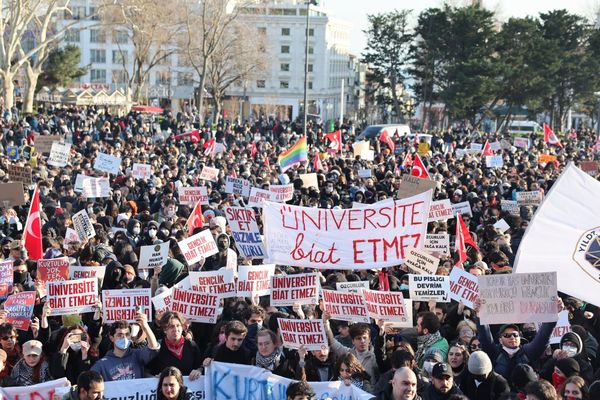
The Boğaziçi University crisis, beginning in 2021, made the consequences of this consolidation visible within the public sector. The appointment of a rector by presidential decree, without consultation with university stakeholders, sparked sustained protests from students and faculty. The state’s response—marked by police raids and the closure of the campus LGBTI+ club—signaled that the university was now managed primarily through a security lens. What followed was a deeper institutional reordering. Decision making became centralized, surveillance intensified and what Boğaziçi students and faculty called "parachute appointments”—the top-down placement of politically loyal outsiders into senior posts, bypassing institutional norms of promotion and merit based hiring—became increasingly common. In parallel, the government bypassed academic governance to create entirely new faculties and institutes, opening additional channels for loyalist administrative consolidation.
This wave culminated in the legalization of direct presidential control over university leadership. In 2024 the Constitutional Court ruled that the presidential appointment of rectors under emergency laws was unconstitutional, with the decision to take effect in June 2025. Through a subsequent omnibus law in July 2025, however, the government reinstated the president’s sole authority to name rectors, preserving the removal of academic and professional requirements for the post. This move converted an emergency era arrangement into ordinary law, securing presidential control as the normalized condition of university governance.
These waves represent the leapfrog moments in the expansion of state control over universities. As Yektan Türkyılmaz argues, Turkey’s autocratization over the last 15 years has moved through these sudden bursts, but it has also been linear and cumulative. While the post-2016 emergency decrees provided the leaps, the quieter control and coercion that proceeded through the everyday governance of the university represent the incremental work that turns past restrictions into a new baseline. A primary mechanism was the routinization of citizen reporting via CİMER (the Presidency’s Online Communication Center), where complaints skyrocketed from 130,000 in 2006 to nearly 6 million by 2020.[4] Within universities, faculty became frequent targets of these opaque but consequential reports. University administrators, aware that CİMER was centrally monitored, began treating academic disputes as security matters to signal their own compliance. While spectacular purges demonstrated the state’s capacity for sudden force, this infrastructure of reporting ensured that surveillance became a constant, cumulative presence in academic life.
Ultimately, the erosion of academic freedom was driven by a combination of top-down executive leaps and their diffusion into daily practice. While emergency decrees and presidential appointments restructured the university from above, routine administrative tools extended that control into daily academic life. This process has left the university system formally intact but substantively subordinated to state executive power, effectively normalizing the absence of freedom as the permanent condition of governance.
The revocation of the Istanbul mayor’s diploma by his alma mater is less an aberration than a crystallization of a longer transformation. Under Erdoğan, access to higher education expanded dramatically, but that expansion unfolded alongside the consolidation of coercive governance, confounding the liberal expectation that universities reliably deepen democracy. Over two decades, state interventions, emergency rule and routine administrative compliance have thinned academic freedom and repositioned universities as institutions that sort loyalty and manage dissent.
Universities do not merely reflect Turkey’s authoritarian turn; they are part of its infrastructure, helping to produce its political, economic and cultural conditions. At a time when universities in the United States are increasingly drawn into culture wars, the Turkish case offers a cautionary tale: It is possible to keep universities open while quietly draining the autonomy that makes them democratically consequential. When institutions meant to sustain critical inquiry and generational transmission are refashioned to enforce conformity, elections may remain competitive, but the ground on which democratic contestation is reproduced begins to shrink.
From April 1 to May 7, 2026, MERIP is participating in Delco Gives. During this time, every donation of $10 or more helps unlock additional funding. Donate today to support rigorous, grounded analysis that remains freely accessible to all.
[1] Elizabeth J. Perry, “Higher Education and Authoritarian Resilience: The Case of China, Past and Present,” (Harvard-Yenching Institute Working Paper Series, 2015).
[2] Sheila Slaughter and Gary Rhoades, Academic Capitalism and the New Economy: Markets, State, and Higher Education (Baltimore: Johns Hopkins University Press, 2004).
[3] Tuğba Tekerek, Taşra Üniversiteleri (Istanbul: İletişim Yayınları, 2023).
[4] Ayşen Uysal. “Muhbirliğin Kurumsallaşması ve Korku Rejiminin İnşası,” Toplum ve Billim 158 (2021).