The Palestine Test for German Universities

In February 2025, Freie Universität Berlin (FUB) cancelled a planned lecture by Francesca Albanese, the UN Special Rapporteur on human rights in the Palestinian territories occupied since 1967. The university cited polarization and security risks after intense political pressure from Berlin’s governing mayor and several pro-Israel advocacy groups. To the astonishment of many students and scholars, FUB justified the cancellation as a protection of academic freedom, implying, in a statement that the “polarization surrounding the event and concerns regarding security” are threats to the universities’ commitment to facilitate “objective exchange.”
In late summer 2025, Albanese was invited back to the university. This time, interest groups of the European Society of International Law (ESIL) asked her to be the keynote speaker at a pre-conference workshop at FUB to discuss mass violence in Gaza and the potential of spatial forensics for international legal accountability processes. Again, the invitation triggered sharp protests, including from the German Network of Jewish Scholars and several student groups, who questioned the workshop’s scientific merit, rejected the characterization of Israeli violence in Gaza as genocidal and branded Albanese antisemitic. The Jewish Student Union cast the entire event as “another antisemitic chapter in the history of FUB.” Unexpectedly, however, FUB let the event proceed, restating a fundamental rule: Article 5(3) of Germany’s Basic Law protects academic freedom, including scholars’ authority to choose topics and speakers and universities exist to work through difficult arguments in public.
FUB’s change in stance did not reflect a return to standard institutional policy. Rather, it was the outcome of intense conflict and sustained pressure by students and critical faculty. Since October 2023, Palestine-related speech has been subject to increasing restrictions and surveillance across all sectors of German higher education. Event cancellations, police interventions and legal proceedings against students and academics have become routine tools of campus governance. In Berlin and other cities, protest bans and disinvitations were combined with so-called safety protocols that have gradually turned programming into risk management. Administrations added hurdles for booking rooms and holding rallies, tightened vetting rules and routed political disputes through police and prosecutors. Students and staff describe a climate increasingly governed by carceral logics: the expansion of punitive approaches to governing campus politics, where suspicion, pre-emption and disciplinary control have displaced political engagement and dialogue. Within this climate, Palestine solidarity is positioned as a security threat, while institutional language singles out Jewish life for protection, flattening the diversity of Jewish positions and erasing the existence of anti-Zionist Jewish students organizing alongside Palestinian peers.
But the university’s mechanisms of securitization has not succeeded in quelling student dissent or opposition by faculty, nor has it diminished controversies on campus. Instead, as the case of Albanese shows, collective efforts of students and faculty to resist the expansion of control on campus have effectively defended spaces of critical inquiry. Simultaneously, campus politics has become a harbinger for broader authoritarian shifts, with the normalization of surveillance and curtailed dissent on campus foreshadowing democratic erosion beyond the university.
Rooted in a long local lineage of campus anti-war protest, German student mobilization in solidarity with Palestinians materialized soon after October 7, 2023. These protests only drew attention when students occupied a lecture hall at Freie Universität Berlin in November 2023, prompting university administrators to call the police on campus. Otherwise, they remained widely outside the public spotlight. In the first weeks of campus activism, university administrators tended to respond through a mixed repertoire of combined forbearance and episodic policing. Their reactions were decided largely ad hoc and campus protests were not treated initially as a standing security problem.
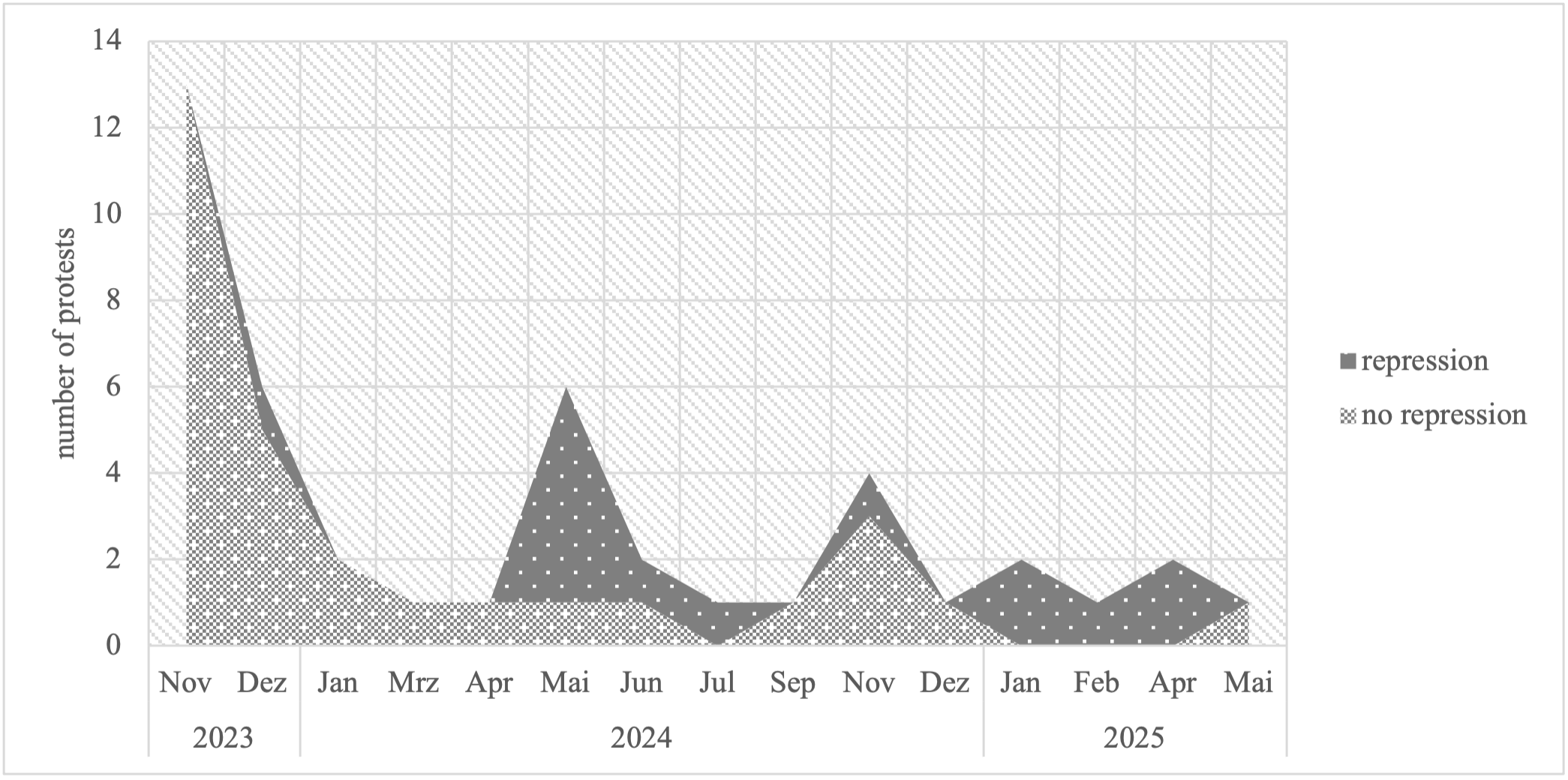
By spring 2024, students were increasingly using their campuses as stages to take a stand against Israeli warfare in Gaza and educate their peers on the condition of Palestinians rather than relying on faculty members to publicly address and call out Israel’s occupation politics. Between October 7, 2023, and May 2025, we recorded 44 student-led campus actions in Berlin alone. In their rhetoric, students linked Berlin directly to Columbia, NYU, Yale, McGill and later to encampments globally. Their framing positioned Palestine as a node in an interconnected decolonial struggle, demanding from universities to “recognize Germany’s colonial legacy as the root of its present collaboration with the ongoing genocide."
Ultimately, it was a series of occupations in May 2024 that set campus protest governance onto a punitive pathway. On May 3, 2024, students occupied FUB’s theater courtyard, explicitly framing their sit in as both an act of solidarity with Palestinians and an indictment of institutional silence. Soon after, on May 22, students occupied Humboldt University’s (HU) Institute of Social Sciences. They renamed it the Jabaliya Institute after the besieged refugee camp in the Gaza strip, collapsing the border between campus and the violence in Gaza. These twin actions catalyzed student participation and produced viral images that echoed the US encampment wave.
The FUB and HU student occupations marked a decisive shift in how Berlin universities responded to campus protest, converting what had previously been handled in an uneven, situational manner into a model of routine suppression. For the first time, both FUB and HU called the police onto campus to forcefully evict student protesters. At FUB, police forces arrested 79 protesters and violently clashed with students within the hallways of the university buildings. At HU, more than 20 were arrested and dozens injured, while riot police impeded the access of legal observers and journalists to the protesters.
Coercive policing became the default reaction to campus protest. Berlin universities filed hundreds of lawsuits against their own students.
Rather than condemning the police raids, both universities charged dozens of students with trespassing, irrespective of whether individuals were part of the direct actions, present in support or had merely been caught up in the police operation. The university’s broad targeting of students effectively conditioned future interactions between administrators and students, creating grievances that would forestall dialogue in the following months. Coercive policing became the default reaction to campus protest. Berlin universities filed hundreds of lawsuits against their own students. The May 2024 raids did not merely escalate a single episode. They reset the baseline for what universities considered legitimate campus politics and normalized police intervention as a standard response to contention.
Students describe how this routinization of repression reordered campus life. For many white students, the campus crackdown was their first encounter with the punitive arm of the state, a shock that altered their relationship to the university. Racialized students, in turn, linked their repressive experiences on campus to prior experiences of racism and discrimination in their interactions with authorities. Across different groups, students we interviewed largely shared the impression that police behavior communicated a racialized hierarchy of worth, targeting predominantly those read as Arab or migrant, while reprieving those read as white or European. As one Jewish student noted:
“I see constantly how Palestinians are being detained and arrested and how much violence they experience […] You can see this actually. Just look at the footage of, say, demonstrators choked by police officers in Berlin. I believe you would see many more Palestinians or people of color than white people. Also the fact that my footage of when police arrested me, you know with a Kippa, circulates so widely. It give me also this sense of my body apparently being more worthy than that of Palestinians, who are being murdered in masses over there and arrested in masses over here.”[1]
Differential treatment by universities, police and media ultimately strengthened protesters’ resolve. Rather than dividing the student body, it drew a sharp antagonistic frontier between students and university administrators and fundamentally shattering the bases of trust between them.
Since October 7, 2023, university administrators have increasingly viewed Palestine-related speech through the lens of risk management rather than public debate, justifying harsh repressive tactics. The resulting pressure on students and faculty has generated counter-practices, including off-campus programming, mutual aid and legal support infrastructures as well as selective refusals to comply with punitive governance measures.
This dynamic is shaped by the German state’s default stance in support of Israel, anchored in a political culture of historical responsibility for the Holocaust—a culture institutionalized in the concept of German “Staatsräson” (reason of the state), famously invoked by former Chancellor Merkel before the Knesset in 2008. In practice, this paradigm has translated into an expansive mandate to defend Israel unequivocally in the public sphere. Within this framework, opposition to Zionism and critique of Israel’s occupation policies are routinely treated as potential forms of antisemitism. Universities have operationalized that logic through the “protection of Jewish life” as a governance priority stressed by the German Rectors' Conference and frequently invoked in ways that conflate Jewish safety with the suppression of Palestine solidarity in all facets of the university, not only protests. The result is a policy environment in which also teaching, research and public speech on Palestine are assessed primarily as security relevant conduct.
The shrinking space for Palestine solidarity is measurable. Along with other colleagues, we have conducted over two years of fieldwork demonstrating how an already repressive environment contracted further after October 7. In a recent survey of Germany-based scholars working on the Middle East, nearly 85 percent said threats to academic freedom have increased since October 7—among those in post-doctoral positions it rises to roughly 90.5 percent.[2] One in four scholars often feel unable to speak freely and three quarters report self-censoring, especially regarding Israeli politics and especially in public appearances. Their top reasons for self-censoring are public hostility and the fear of being misunderstood. By contrast, in the United States, academics worry primarily about hard repression and material fallout, such as hostile state legislation, donor or trustee pressure and formal threats to jobs or visas.
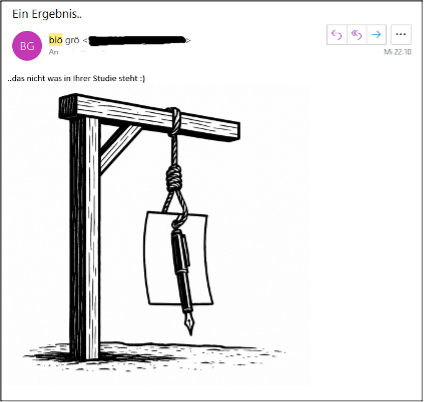
Scholars in Germany who speak about war crimes in Gaza often brace more for social blacklisting than an official sanction. In addition to hate mail (Figure 2) and defamation (Figure 3), scholars fear being quietly avoided by colleagues, screened out of panels and committees, dropped from citation networks or left off shortlists without explanation. Their fears notably reflect the parameters of German public debate. Inside and outside the campus walls, being labeled as antisemitic in public can render someone as permanently suspect, by extension making any association with them a potential liability. Precarious researchers feel this fear most strongly because their careers run on informal endorsements and short contracts, but even seasoned professors describe the same ambient pressure.
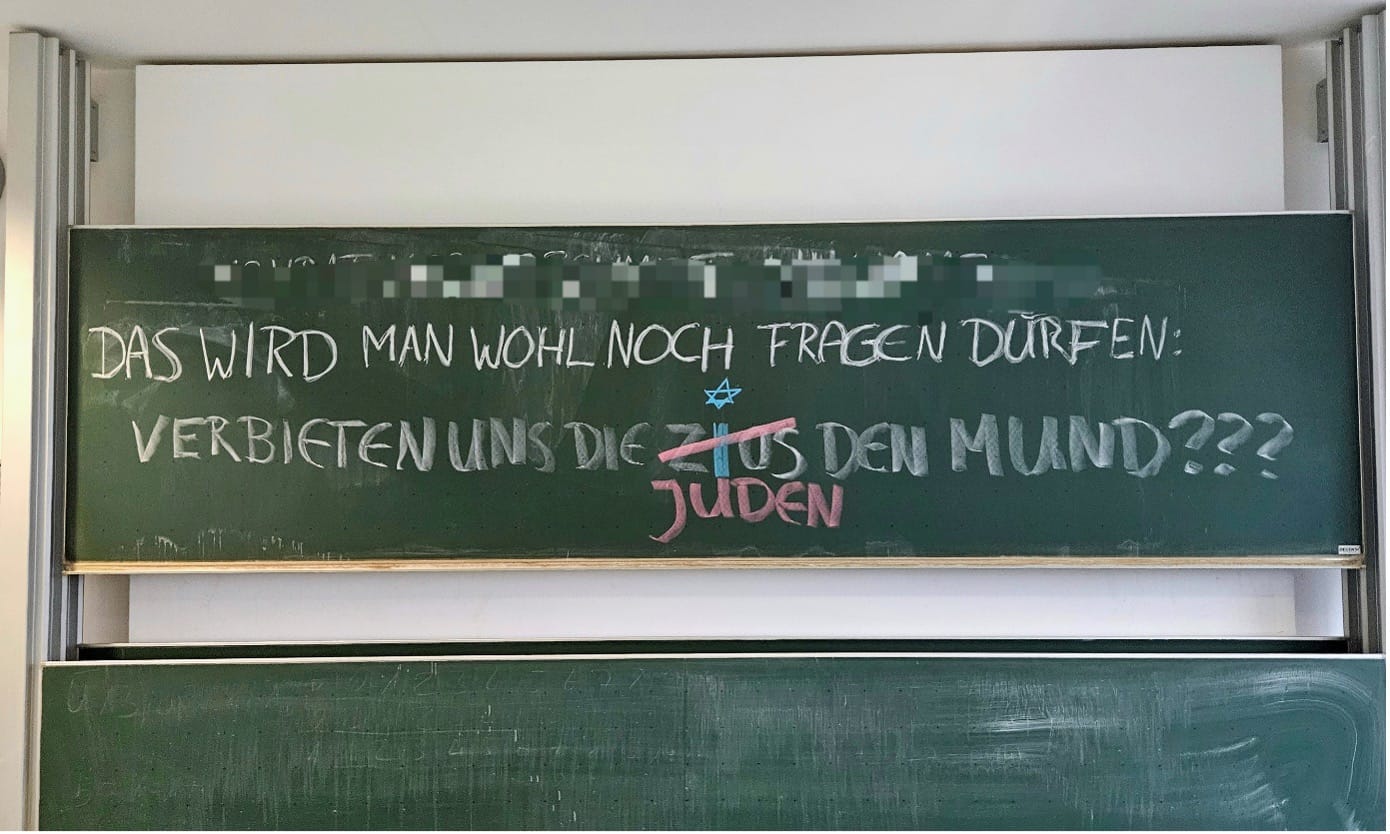
While social stigma has decreased the space for talking about Palestine and Israel, securitization on German campuses around Palestine solidarity has had a clear bureaucratic effect. As a result of student protest occupations, the FUB administration has added restrictions on room bookings, creating bottlenecks. To avoid accusations of political bias, the university insists on a discourse of neutrality in its programming, framing this stance as necessary to maintain institutional impartiality. Students also report a double standard; Palestine organizers face doxing, discrimination and intimidation with little institutional support, while administrative messaging essentializes Jewish students as a vulnerable group and casts students in solidarity with Palestine as the primary threat to their safety, contrary to existing evidence and entrenching a hierarchy of empathy.[3]
During the Cold War, particularly in West Germany, the so-called Radikalenerlass (radicals decree) barred members of many leftist organizations from public service. A similar logic has reappeared around the topic of Palestine, where the campus version of what political scientist Donatella Della Porta has referred to as a “moral panic” has taken hold of German society, inviting comparisons to the Red Scare and its impact on higher education.[4] Harsh policing is only the most visible symptom of this panic. Politicians from both the conservative and the social democratic parties now question whether teacher trainees who join Palestine solidarity protests should be employable in Germany’s public school system. Conservative politicians and the Jewish Student Union have also called for the expulsion of so-called radical students, namely those participating in disruptive collective action. For international students and other precarious residents, cooperation between universities and law enforcement authorities has turned protest risks into immigration risks, as when Berlin immigration officials ordered four foreign residents to leave the country over alleged involvement in an FUB building occupation. Some politicians now openly propose subjecting universities to oversight by domestic intelligence services. The Alternative for Germany (AfD), a reactionary opposition party that leads national polls, has demanded that parliament establish a new official body to screen academic publications and public funding applications for their “independence from political influence.”
But it is not only the fascist far right that has supported the securitization of higher education. The German coalition government of the conservative Christian Democratic Union/Christian Social Union (CDU/CSU) and Social Democratic Party (SPD) recently published a timetable for the establishment of a National Service Agency for Research Security that would institutionalize risk governance as a routine layer of academic decision making. The platform is explicitly designed to coordinate state and academic actors and to produce standardized risk assessments of research activities and collaborations. It draws on information and assessments from security authorities with the ostensible goal of protecting Germany’s “security and economic interests” in both their national and international dimensions. In practice, this infrastructure risks normalizing anticipatory suspicion and creating new channels through which political controversy on campus can be recoded as a security risk.
This securitization turn has not remained uncontested. In several cases, faculty members, staff and student groups have treated bureaucratic risk governance itself as an object of contention, challenging room denials, documenting procedural arbitrariness and pressuring leadership to justify safety claims publicly rather than administratively. Some departments and individual professors have continued to convene events on Palestine, shifted events off campus when necessary and built informal networks to protect targeted students and colleagues. These practices of pushing back have not reversed the overall trend of repression, but they have complicated it. They show that governance oriented toward risk management and so-called safety comes at the cost of deepening internal fractures within the university and that the campus remains a site where repression and resistance are coproduced.
The feedback loop of repression and resistance has created contradictions for university administrators. In Berlin, it was university leaders who first called police to the FUB and HUB campuses. University leaders also backed criminal complaints including against precariously situated students. Yet, some administrators have begun to backtrack in light of resistance by students and faculty as well as unprecedented infringements on university autonomy by third parties. For instance, some university officials now quietly advise students in the Erasmus program for studying abroad within the European Union to finalize enrollment before joining any protest, as an official student status offers some protection from the threat of deportation. Other administrators have deliberately done little to make charges stick by missing court dates in trials against students or by failing to provide information required for prosecution. Universities are thus caught in the position of constraining academic freedom on political grounds and thereby contributing to the normalization of securitized logics on campus, while simultaneously trying to fend off academic freedom infringements from third parties.
Student organizers are now calling out these contradictions. Repression directed at students validates a longstanding critique that German higher education reproduces colonial hierarchies. After the police crackdowns on their encampments of spring 2024, students framed their actions as an indictment. They named the beneficiaries of violence—from weapons exports to research partnerships with universities in Israeli occupied territories—and called on universities to account for their own entanglements. As argued by one student protester in his deposition to the Berlin Tiergarten district court:
What we are doing is not an attack on the university; it is a defense of what it should be: a place of critical thinking, open debate, and social responsibility. A university that is involved in supporting war crimes forfeits its claim to be such a place.[5]
Teach-ins, off campus learning circles, legal and mental health support, collective mourning and mutual aid networks recast the university as a place where grief and knowledge-making could coexist when official spaces would not allow it.
The students redeployed the university’s own claims to legality, critical inquiry and public responsibility as resources for their critiques. Through resistance students effectively prefigured the university they wanted. They positioned protest as a collective alternative to the carceral institution they were encountering. In a hostile social setting, appearing together in these activities gradually gave rise to a whole student infrastructure of care. Teach-ins, off campus learning circles, legal and mental health support, collective mourning and mutual aid networks recast the university as a place where grief and knowledge-making could coexist when official spaces would not allow it. A generation of students and scholars have learned more about law, violence and power in two years than any classroom could offer, and these infrastructures ultimately provided a base to link Palestinian, migrant, queer, antiracist and Jewish student actors and sustain the student movement ever since.
In Germany, as elsewhere in Europe, spaces for critical inquiry in higher education are shrinking. In Gaza, these spaces have been obliterated alongside the scholarly communities that animated them. The predicament in Europe is, of course, qualitatively different from Israeli scholasticide in Gaza, as it involves constrained speech, surveillance and policing rather than annihilation and the systematic destruction of universities, libraries and archives. Yet, the two trajectories are connected through the epistemic violence that marginalizes Palestinian suffering. Silence and the silencing of scholars have helped ensure that Israel’s genocidal violence against Palestinians is insufficiently recognized and sanctioned. Against this asymmetrical backdrop, the challenge is not only to rebuild universities as institutions that protect plural inquiry but to transform them into sites that resist the erasure of knowledge.
Universities, across history, have functioned as canaries in the coal mine for autocratic drift while also serving as early sites where resistance movements first take shape. The Palestine student protests have put these tensions into relief. Through them, students have developed an emancipative understanding of academic freedom not as a norm politely upheld by authority but as a practice that needs to be defended, enacted and seized in the face of tightening controls.
Students have shone a light on the carceral logics dominating campus politics and highlighted ways of contesting them. In that sense, the approval of the late-summer 2025 workshop with Francesca Albanese was not simply a sudden return to principle by the university administration. It was the outcome of sustained pressure from below that made further retreat more costly than controversy and made it harder to maintain the fiction that disinvitation is a neutral act of governance.Just as importantly, many universities now confront a second order effect of the course they charted after October 7. By normalizing coercive governance, they opened the door for external actors to treat higher education as an object of oversight and discipline. Gaza has become a catalyst for a much larger struggle over university autonomy. Whether the university emerges as a site that resists carceral logics or as an institution that helps normalize them will depend on the ability and the will of scholars and students to keep holding the line.
[Jannis Julien Grimm is the director of the research group “Radical Spaces” at the INTERACT Center for Interdisciplinary Peace and Conflict Research at Freie Universität Berlin (FUB). Lilian Mauthofer is a doctoral researcher in the DFG Research Unit 5870 “The Promise of Security in Catastrophic Times” at the University of Hamburg and an associate researcher at FUB’s INTERACT Center.]
From April 1 to May 7, 2026, MERIP is participating in Delco Gives. During this time, every donation of $10 or more helps unlock additional funding. Donate today to support rigorous, grounded analysis that remains freely accessible to all.
[1] Interview with Jewish student and member of the association Jüdische Stimme für gerechten Frieden in Nahost, February 12, 2025.
[2] Jannis Julien Grimm et al., “German Academia after October 7: Self-Censorship and Restrictions of Academic Freedom among MENA Scholars,” Working Papers in Peace & Conflict Research, 2025 (Freie Universität Berlin, 2025).
[3] Marc Helbling and Richard Traunmueller, “Pro-Palästina Proteste, Antizionismus Und Antisemitismus in Deutschland,“ Wie tickt Deutschland? Zahlen, Fakten und Analysen aus dem German Internet Panel 2 (Universität Mannheim, 2024).
[4] Donatella Della Porta, “Moral Panic and Repression: The Contentious Politics of Anti-Semitism in Germany,” Participazione e Conflitto. An International Journal 17/2 (2024).
[5] Deposition of student protester at the Berlin Tiergarten District Court, March 18, 2025.