A Note on the Cover Image
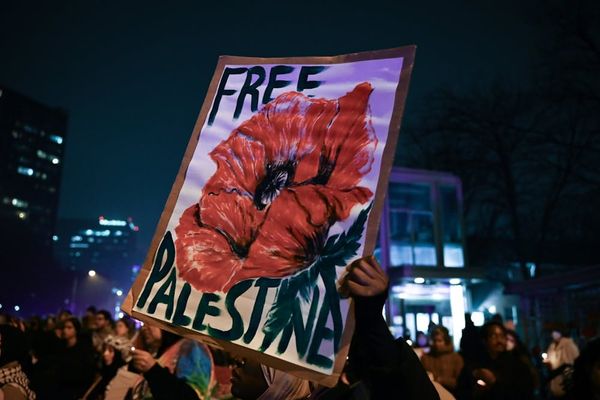
The cover image for MER issue 318, Campus Politics—Palestine and the New University Order, is a photograph of a demonstration held in Philadelphia on December 3, 2023, co-hosted by Penn Students Against the Occupation and four other organizations. The picture was taken by Abhiram Juvvadi for the Daily Pennsylvanian, the University of Pennsylvania’s student newspaper, and centers a poster with a painted poppy, a longtime symbol of Palestinian resistance that has proliferated in the mass movement for Palestine post October 7, 2023.
It is a fitting cover for the spring issue, which comes on the two year anniversary of the university encampments: the apogee of the mass student mobilizations that took place in the United States, and across Europe, against Israel’s genocidal war in Gaza. As the issue makes clear, October 7 was neither the beginning of strong Palestine organizing on campuses—in large part through Students for Justice in Palestine and the Boycott, Divestment, Sanctions movement—nor of concerted attempts to repress that activism, often driven by outside organizations, donor pressure and coordinated political campaigns. October 7 was, however, an inflection point. It accelerated dynamics and tensions that have been unfolding in higher education: between the ideals of the so-called liberal university and these institutions’ entanglements with donors, federal oversight and private industry, including endowments tied to weapons manufacturers and military research partnerships. Students and faculty became some of the loudest voices pushing back against these contradictions.
As the issue also makes clear, the university has been a key site through which federal overreach has been asserted. Administrations have censored Palestine activism, complied with demands from federal and state legislatures to review curricula or discipline faculty and, in some cases, facilitated the presence of law enforcement or federal agencies on campus, including US Immigration and Customs Enforcement. While this new university order is bleak, the degree of repression speaks to the scale and impact of campus activism in the past three years. Even where the visible energy of encampments has waned, the contradictions they exposed—and the political consciousness they helped produce—have pushed organizers in new directions and left university administrators on the defensive.
Much of what we know about these confrontations and the forms of repression that accompanied them has been documented in real time. Student newspapers were on the frontlines, recording protests and heavy-handed institutional responses, from calling the police on their own students to allowing federal authorities onto campus. In doing so, they have produced a critical archive of this moment, often capturing details and perspectives absent from national media coverage. Several articles in this issue draw on that reporting. The role of these papers remains under acknowledged, even as they underpin the analysis that follows.