The Business of Culture
A Review of Beth Derderian's ‘Art Capital: Museum Politics and the Making of the Louvre Abu Dhabi'
A Review of Beth Derderian's ‘Art Capital: Museum Politics and the Making of the Louvre Abu Dhabi'
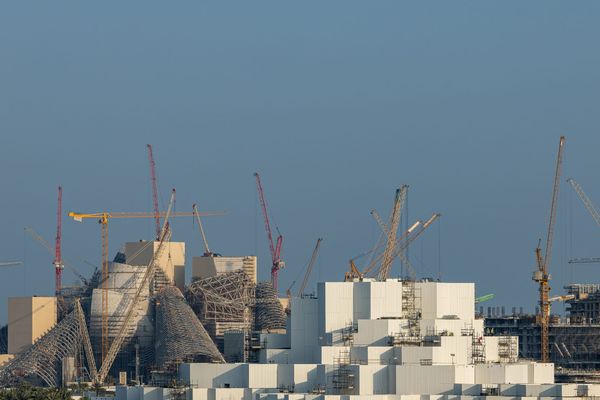
In 2007, Abu Dhabi’s newly established Tourism Development and Investment Company revealed the master plan for an ambitious and expansive cultural district on Saadiyat Island. The plan’s guiding principle seemed to be: Import the biggest and the best. Branches of the Louvre and Guggenheim museums were to open in iconic, glossy buildings alongside a national museum, a performing arts center and a maritime museum, all designed by a roster of the world’s most renowned starchitects. The previous year, Abu Dhabi—the capital of the United Arab Emirates—had declared its intention to turn Saadiyat into a global tourism destination with the art and culture infrastructure as an essential part of its approximately $27 billion real estate development project. While the majority of media coverage and ensuing debates (and controversies) focused on the big museum franchises, little was said about other parts of the plan, which included a Creative Campus and a Graduate School in Fine Arts. Placed alongside the crowd-drawing museums, the aim of these institutions was to manufacture a local art scene, both its producers and its consumers, joining numerous new art organizations and spaces across the UAE.
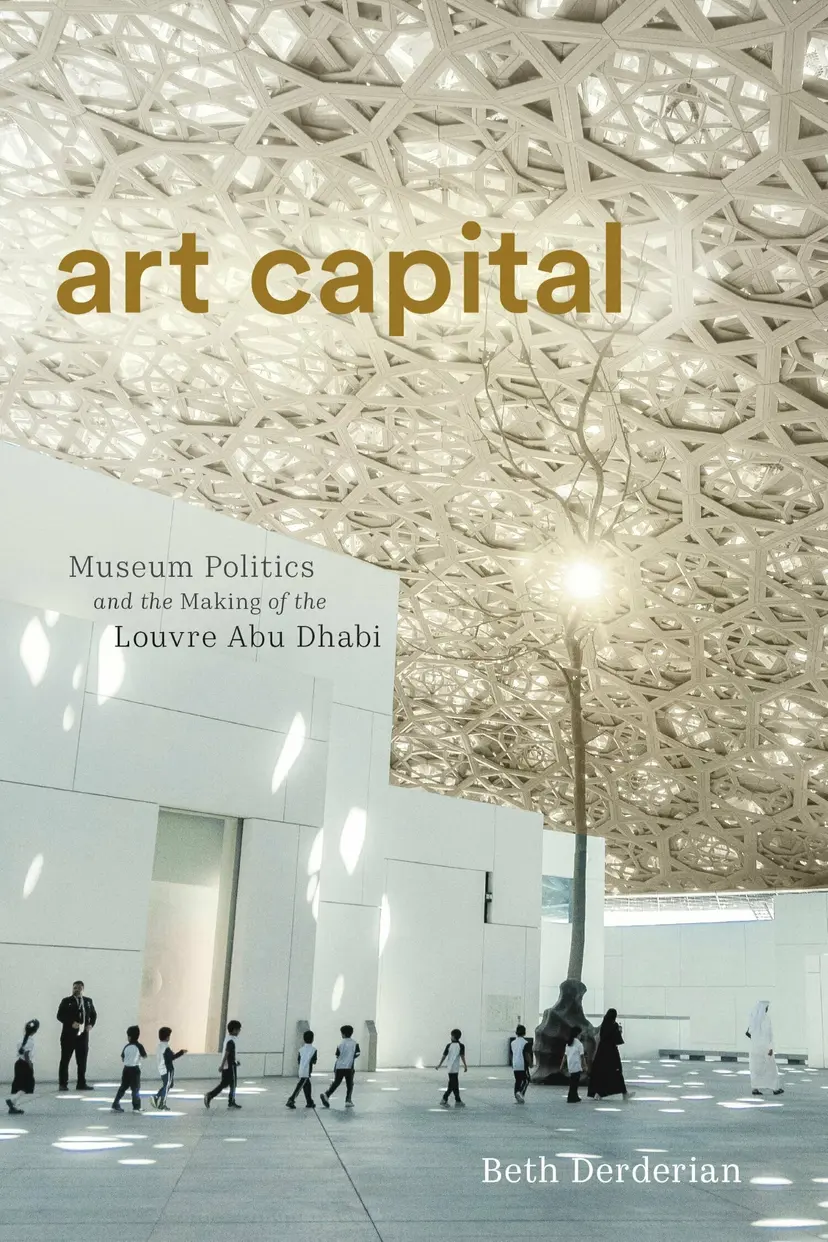
Despite its title, Beth Derderian’s Art Capital: Museum Politics and the Making of the Louvre Abu Dhabi is only peripherally about the making of the Gulf outpost of that renowned French institution. There are a number of prosaic but telling reasons for this misalignment. Derderian originally intended to conduct research among workers of the developing museum initiative, but after some preliminary research her requests for collaboration were denied by the UAE cultural authority. Furthermore, while the museum was slated to launch in 2012, it eventually opened its doors only in 2017, after Derderian had already completed her primary field work. Unable to research the actual making of the much-anticipated museum, Derderian’s research turned, fortunately, to a much broader project: an ethnography of the ecology of institutions, culture workers, bureaucrats and investors that emerged around this massive state-driven project to create a local art scene embedded in international circuits and markets.
Art Capital charts the changes in the UAE’s art scene after the initial announcement of plans to build the Saadiyat Cultural District, focusing on the experience of artists, curators, and cultural agents. Derderian conducted dozens of interviews with individuals who worked across the Emirati art world from 2006 to 2017, was embedded in several local art projects and visited numerous local exhibitions, art institutions and archives both official and private. The book’s main argument, however, is far reaching, aiming to identify new paradigms of exhibition worldwide. Museums have long been recognized as institutions used by states to forge a sense of national and imperial identity through careful choices of what to include and exclude and through their hierarchical presentations. Yet Derderian claims that states are no longer the locus of power shaping exhibition practices. In the twenty-first century museum, “a transnational neoliberal capitalist market has eclipsed the state as the primary nexus of power” (3). If the museum as an organ of the state addressed an audience of citizens, the museum as an organ of the market presumes an audience of consumers. Derderian calls this new formation the “market exhibitionary complex” (3-4).
In the twenty-first century museum, “a transnational neoliberal capitalist market has eclipsed the state as the primary nexus of power.”
This argument initially appears incomplete since the flourishing of art infrastructure in the UAE—both the wooing of international institutions like the Louvre or Sotheby’s and the establishment of local ventures like Dubai Art—is the result of spectacular state expenditure. Projects like those on Saadiyat Island are nothing if not state-driven, part of a broader shift away from an oil-extraction based economy and toward diversified knowledge economies. The government is involved practically everywhere, albeit in ways that prove difficult to trace. Many of the institutions surveyed here are what Ahmed Kanna identifies as parastate entities, hybrid collaborations with commercial bodies or semi-private development firms.
Chapter One traces the blurring of boundaries between commercial and non-commercial spaces prevalent across the Emirati art world, which often obfuscates state involvement. Even institutions that appear to be independent, like the Sharjah Art Foundation, are run by members of the royal family. On the other hand, some explicitly commercial spaces, such as privately owned galleries, take on non-commercial educational and auxiliary activities usually associated with state-run museums or nonprofits. Culture workers regularly work across both commercial and non-commercial spaces. Derderian sees these continuous crossovers as evidence of market logics “taking over” previous models of state-led art sponsorship, but the opposite can be deduced as well. The state sees the development of a commercial art market as its business and wants to have a hand in it.
The significance of the arts sector for the state has clearly shifted, suggesting that the state may be more concerned with global and local brand-building that attracts investment than with ideological nation-building. This change aligns with other neoliberal trends. Neoliberalism, after all, does not entail the diminishment of the state, but rather a redefinition of its imagined constituents and the state’s responsibility to them. “Abu Dhabi today stands among the world’s most compelling destinations for long-term capital,” states a recent PR communique about another development project in Saadiyat. Art infrastructure is part of the state’s investment portfolio, generating both cultural capital and financial profit.
In its most interesting chapters, Art Capital moves beyond the consultant-driven visions to explore how the interests of the international art market shapes art making and exhibition through a learned lexicon of professionalism. The visual language of international art circuits favors minimalism: crisp fonts, uncluttered slide decks, a set of data points (title, artist, date, materials) associated with each work of art. Inherent to this seemingly neutral and functional language, however, are particular notions of what art is and what makes it good. Chapter Four addresses these issues by detailing the ways that artists are trained to make their art legible to an international market of tastemakers: gallerists, curators and critics. The white cube, as the default mode of exhibition across both commercial and non-commercial spaces, here becomes emblematic of the ideal of frictionless circulation. The empty, blank exhibition space facilitates global consumption and translatability across sites and scales.
But it is not just visual aesthetics at stake, it is also a particular understanding of what a contemporary artist does—a professional one, as opposed to those ridiculed expat “housewives” who dab at art as a pastime. Derderian attends a professionalization workshop for aspiring artists taught by a famous curator. She watches several panicked participants furtively squirrel away their draft artist statements as the curator singles out the phrase “I am passionate about art” as a telltale sign of amateurism. “When I see statements like that,” he adds, “I just delete the email” (129–130). Artists in the workshop were taught to think of art making as a practice and their discrete creations as “explorations” of particular themes or ideas. An artist, in this model, is first a socio-political thinker or commentator and second a producer of aesthetic objects. Accordingly, the focus of the workshop was the students’ conceptual and discursive practices rather than their formal or technical skill. “Themes” like migration, identity or femininity could be easily communicated across different audiences, while still signaling a unique, individual mode of engagement and reflection.
Hanan Toukan, in her book The Politics of Art: Dissent and Cultural Diplomacy in Lebanon, Palestine, and Jordan, argues that international art funding has contributed to the conflation of contemporary art with a conceptual practice engaged in what she calls “post-ideological subversion.” International organizations favor art that is critical of hegemonic structures or accepted norms in its local Middle Eastern context. Derderian notices similar perceived imperatives among her Emirati-based interlocutors, but their ability to directly comment on local politics and social dynamics is circumscribed. Criticizing the state, the royal families or Islam is illegal in the UAE and can lead to imprisonment, deportation or revocation of visas. For many UAE-based artists with precarious residency statuses these laws are a tangible threat. In Chapter Two, Derderian argues that local artists who were born and raised in the UAE yet unable to obtain citizenship are often embraced as tokens of Emirati tolerance and multiculturalism, even though their inclusion remains contingent and temporary.
The stakes become glaringly apparent in Chapter Three, which asks how artists navigate the limits on explicit critique while still adhering to the convention that art should adopt a critical posture. Derderian groups their various approaches under the term “conspicuous omission”—strategic gaps that make the dissenting content decipherable only to a “circumscribed audience.” At times, this means that the underlying meaning of the piece is circulated only by word of mouth, as in the work of the artist who sat in the gallery quietly copying the Quran using his left hand, a tacit reference to repressive uses of Islamic textualism that condemn natural tendencies, from left-handedness to homosexuality. At other times, it means that only a hyperlocal audience “in the know” could sense the satirical or counterhegemonic reference, as in the work of the artist who purposefully used a color scheme employed in a recent series of government surveys.
The result initially appears to be a paradox: works of art that remain largely indecipherable to outsiders precisely because they attempt to incorporate the professional imperative of criticality. Yet this is a misreading, since the ambivalence seems to be favored by everyone. As Toukan explains, the mode of criticality preferred by transnational organizations (and in this context one should add, corporations) is not one of explicit resistance or protest, of the kind prevalent in the Arab world in the 1960s, but rather a conceptual, even theoretical, “consensually dissenting” practice whose effect rarely extends beyond the walls of the gallery. Professionalization, which is to say integration into the neoliberal structures of contemporary art and the adoption of its grammars, has a depoliticizing effect, even when the subject of art remains political. Likewise, the UAE grants contemporary art a certain autonomy as a circumscribed space of social or political exploration and reflection, proving its liberal credentials.
When the Louvre Abu Dhabi eventually opened in 2017, its stated aspirations were a far cry from these spaces of coded political commentary, ambiguity or ambivalence. Celebratory affirmations of inclusivity and universal humanism trumped any hint of disagreement, discontent or historical violence. The main innovation of the “first universal museum in the Arab world” is to present Western and non-Western artifacts side by side. Whereas in the Parisian Louvre, Western art is displayed in the above-ground main halls, while the non-Western world is relegated to an ethnographic ghetto in the basement, the Louvre Abu Dhabi presents the West and the Rest together, in a singular narrative of the development of human creativity. The museum is organized along a linear timeline of civilizational progress, starting from the emergence of Homo Sapiens and “The First Villages,” through the rise and fall of “Civilizations and Empires,” all the way to the emergence of states and the effects of globalization. Racism, slavery, mass violence and ethnic cleansing are generally absent from this story. Works are staged together based on their formal and aesthetic affinities, in what comes together as an argument for the expression of the “one human civilization” (a favorite phrase of founding UAE president Sheikh Zayed bin Sultan Al Nahyan).
The Louvre Abu Dhabi presents the West and the Rest together, in a singular narrative of the development of human creativity.
Both the Louvre and the other contemporary art institutions mentioned in the book appeal to discourses of inclusivity, as a historical corrective or a supposed reflection of the tolerance of Emirati society. But while contemporary art is expected to be conceptual and critical and to reflect on particularity, in the universal museum model every work of art becomes an affirmation of humanity and its supposedly common values. Differences are merely formal and aesthetic. The place of such a museum in relation to the constellation of institutions exhibiting and trading in contemporary art, which form Art Capital’s primary subject matter, is unresolved. Is the local Louvre considered pedagogically significant? Naively or cynically ideological? What is its role within this evolving ecology?
Prosaic reasons aside, the most provocative reason for the Louvre’s sidelining in the book appears in its very last sentence. Given the massive expansion of infrastructure for art production, exhibition and trade emerging in the aftermath of the museum’s original announcement, Derderian concludes that it probably “does not matter if the Louvre had ever opened” (184). It does seem that the museum’s actual opening generated far less discussion than the prospect of its construction. If we are to view the Louvre Abu Dhabi, and the Emirati art scene more broadly, within the state-sponsored futurecasting that Rahel Aima has called “the Khaleeji ideology,” then the significance of such spectacular projects turns out to be their audacious projections rather than their more prosaic real-life functioning. In the UAE, art and futurity are never too far apart. The important contribution of Art Capital is that it moves away from these speculative realms to explore the tensions and frictions that animate art making in the present.
[Shir Alon is an associate professor in the Department of Asian and Middle Eastern Studies, University of Minnesota.]
All of MERIP's analysis is provided without paywalls! Make a donation now to help us keep it that way.