‘Women at Work’—Challenging the Art/Craft Divide
A review of the Dalloul Art Foundation’s 2025 exhibition.
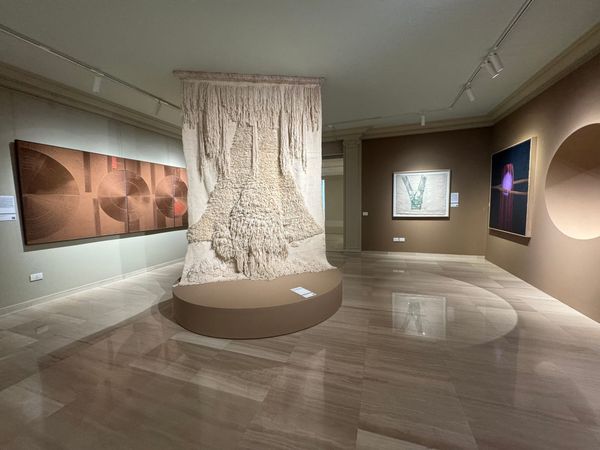

A large wool tapestry with a textured, tasseled surface suspended from the ceiling greeted visitors entering the exhibit Women at Work: Intersection of Fine Art and Craft at the Dalloul Art Foundation’s gallery in Beirut. Untitled (1972) by Moroccan artist Esther Cécile Bendaoud Boccara, appeared more like a structure, refusing the conventional functions of a rug meant to lie passively underfoot. The piece worked as a sort of portal between past and present with traditional weaving techniques and North African textile aesthetics abstracted into a contemporary art form. Boccara’s material knowledge and skill were evident in the tapestry’s intricate details and laborious craftsmanship: long and irregular hand-tied fringes draped over a geometric shape of plush fabric sprouting from its surface like grass in a field. The work is described as “the heart of the exhibition, affirming craftsmanship not as background labor but as an artistic force in its own right.” In conversation with Wafa Roz, exhibition curator and former director of the Dalloul Art Foundation (DAF), she characterized the piece as anchoring the show and guiding the viewer through the layered temporalities and material experimentations that thread through the artworks on display.
A relative newcomer to the Beirut art scene, the DAF was established by technology entrepreneur Basel Dalloul in 2016 to house and preserve his art collection, much of it inherited from his parents, Ramzi Dalloul and Saeda Al-Husseini. Dalloul continues to buy and sell modern and contemporary art from across the region, promoting its visibility across local and international contexts. The foundation currently holds more than 3,000 pieces from which all of its exhibitions are exclusively drawn.
On view at DAF from May to August 2025 and now available to view online, Women at Work featured contemporary art by women from across the Arab world. Building on the previous exhibition, Women’s Agency in Arab Art, which examined women’s creative productions through the lenses of education and kinship networks, Women at Work shifted the focus to the labor of art making itself, highlighting the various ways that these artists are engaging in technical and creative experimentations with a wide range of mediums and materials. Many of the featured artists eschew modern art’s narrow hierarchies around the division between art and craft in favor of work that presents a material dialogue between diverse creative practices. They use traditional craft materials and methods like textiles, ceramics, metalwork and glassblowing, mixed with fine art mediums such as painting, photography and drawing. In doing so, they innovate modes of making and contribute to recovering handmaking from the margins of the industrial, the decorative, the domestic.
Many of the featured artists eschew modern art’s narrow hierarchies around the division between art and craft in favor of work that presents a material dialogue between diverse creative practices.
With materiality and temporality as its core themes, Women at Work traces how inherited techniques and embodied forms of knowledge are mobilized in the present, where they are reworked across innovative contemporary artistic practices. Rather than treating the divide between art and craft as its central concern, the exhibition uses these limited categories as a point of departure for the more pressing interrogation of labor and the unresolved tensions surrounding what constitutes so-called “women’s work,” and even “Arab art.”
The 1960s and 1970s witnessed a growing enthusiasm for crafts driven by the rise of the fiber art and feminist art movements, as well as the earlier studio craft movement, all of which challenged the norms of the conventional art world that characterized fine art as masculine and craft as feminine. But it was not until the past two decades that museums have more fully embraced craft in fine art spaces. Women at Work takes part in this growing trend and makes a strong case for expanding the geographical lens on the history of the art/craft divide, and the artistic practices that have challenged it, beyond the Euro-American art scene.
Lebanese artist Iman Toufaily’s series titled System (2021) is an example of the experimental interplay between diverse techniques and materials that complicate these rigid categorizations. Her 52-piece project (three of which appear in Women at Work) combines photography, collage and textile work. Diaphanous fabric is stitched onto images of rigid concrete apartment buildings, sheathing the walls in a translucent layer that draws attention to the porous boundaries between public and private. A veiled female figure appears in each piece. Enclosed between the buildings or looking onto them, Toufaily describes her as devoid of any defining identity beyond her womanhood. Jagged stitches trace each figure and the surrounding architecture, piercing the surface of the image to create a second layer, almost like a reconstructed blueprint exposing the invisible social and spatial boundaries of the environment. In a televised interview, the artist situates her work within her own experiences as a widowed hijabi woman navigating a patriarchal society and within her relationship to her social and urban contexts.
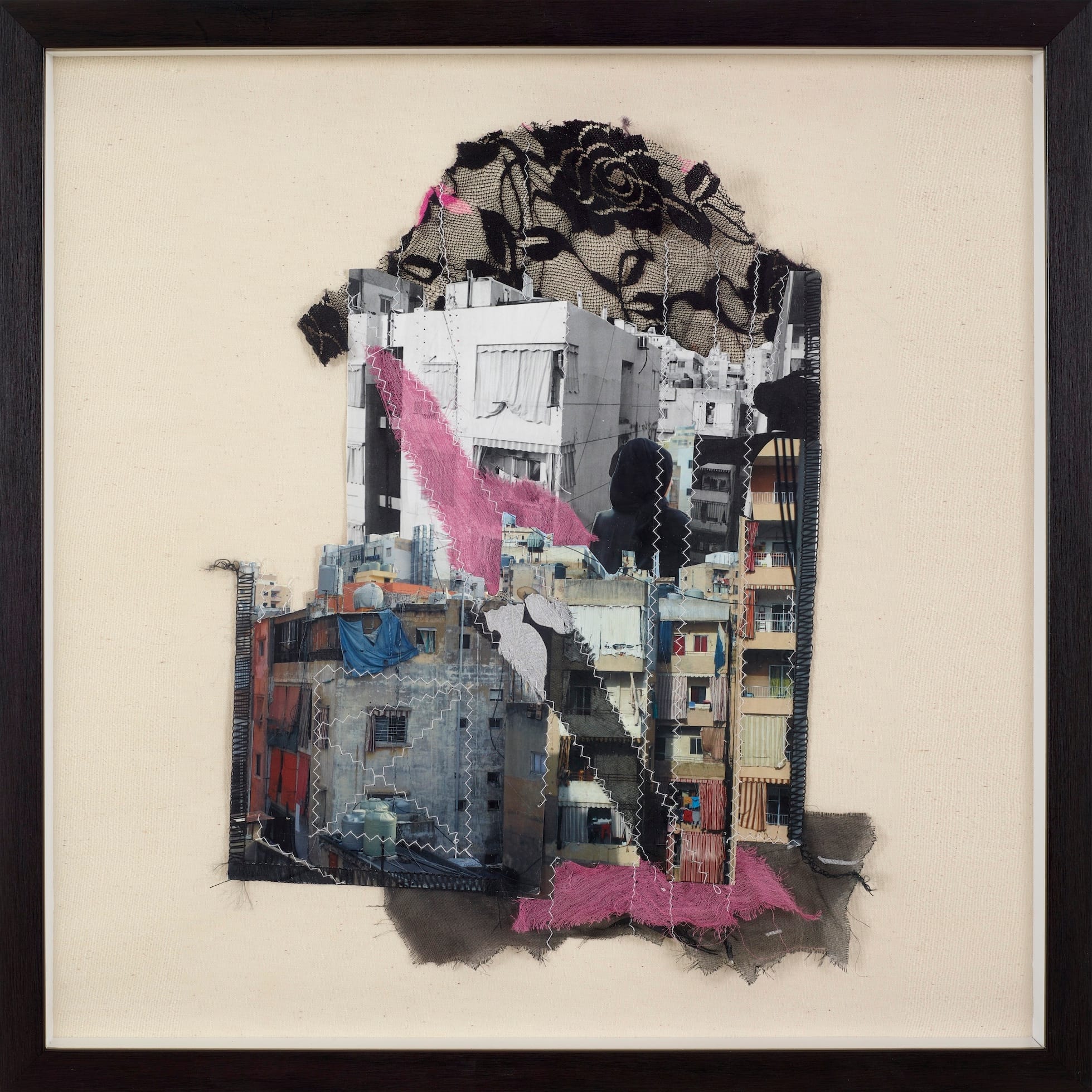
Toufaily, who learned to stitch for this project, carefully pierced the images with precision to avoid ripping the pictures. A practice historically tethered to feminine domesticity, needlework was a metaphor in patriarchal depictions of the ideal housewife and a mechanism of control: the disciplined and repeated passage of needle through delicate cloth cultivated patience and restraint as the ultimate feminine virtues. The embodied practice of stitching, however, also carries within it a latent defiance as the needle punctures the surface to pass through it. Each stitch in Toufaily’s work is a deliberate act of incision that not only breaches the fabric’s integrity, but also symbolically penetrates the cemented boundaries of domestic and social enclosure. The delicacy and light color of the silk and chiffon fabric represent fragility, yet they do not soften the hardness of the urban landscape so much as expose its constraints. The resulting distortions and sewn fragments create an imagined space that wavers between freedom and confinement.
Despite its legacy as unpaid domestic labor, embroidery is a culturally significant practice led by women that cultivates a sense of pride rooted in tradition and connection between generations. For Palestinian women, for example, tatreez (traditional Palestinian embroidery) is a skill passed down from mother to daughter. After the Nakba it became a subversive practice, capturing Palestinian history, national identity and enduring connections to the land. This artisanship is evident inبئر السبع ١ | Beer el Sabeh 1 by Palestinian embroiderer Mountaha Chahrour who stitched the large panel by hand while living in the Mar Elias refugee camp in Lebanon. The piece was commissioned by Inaash Association, the cultural enterprise co-founded in 1969 by Lebanese contemporary artist Huguette Bechara El Khoury in collaboration with local Lebanese and Palestinian women.
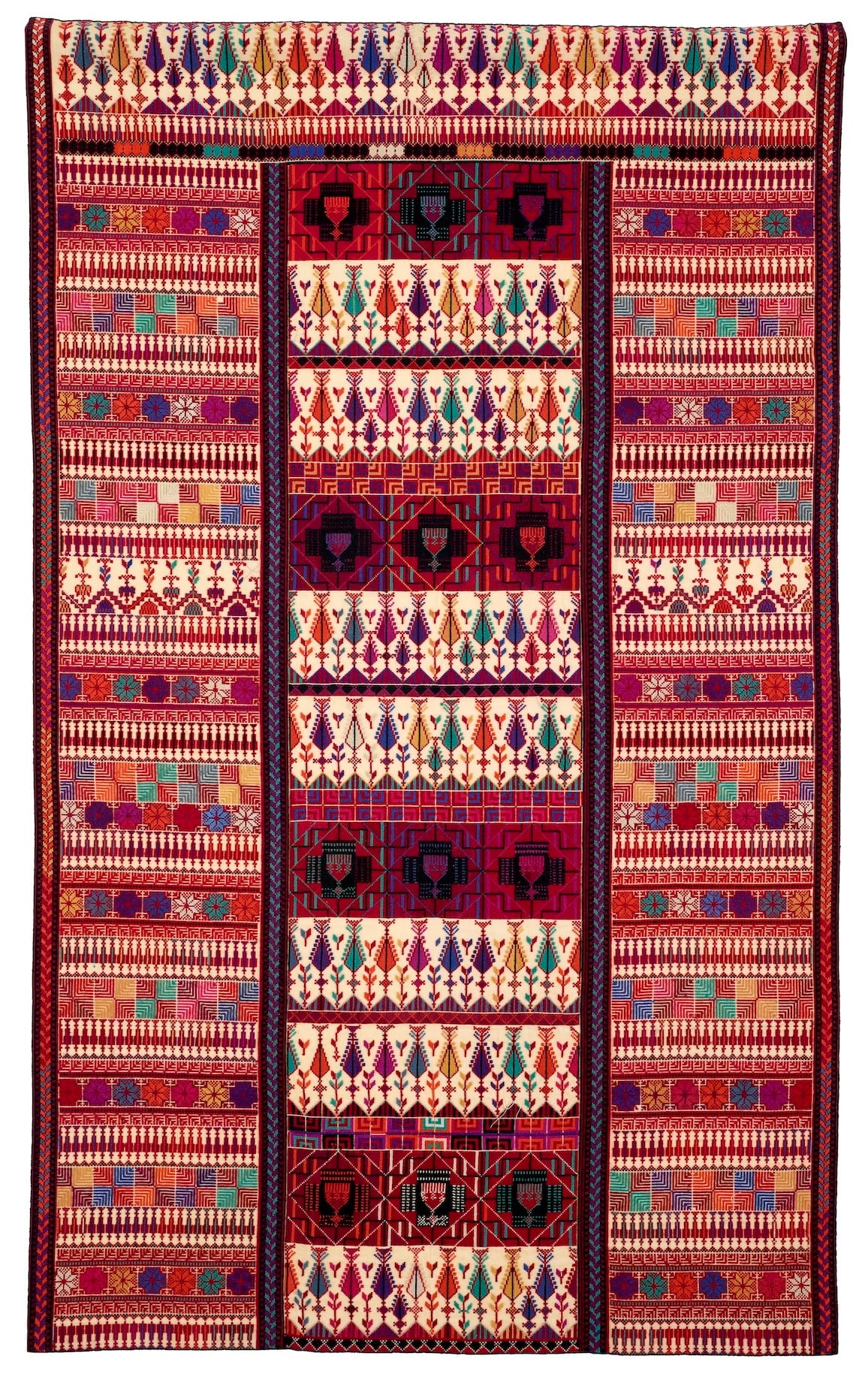
As a tradition recognized on UNESCO’s list of intangible cultural heritage practices and fostered by local and international NGOs like Inaash, these embroidery commissions sustain heritage while also providing a modest income to Palestinian refugees who continue to face legal restrictions on employment in Lebanon. As a form of paid work, however, it rarely allows Palestinian women to escape their situations of financial precarity. Further, as tatreez shifts from being a labor of tradition to a highly commodified and underpaid labor of survival, embroiderers often have little creative agency over their work and instead execute the designs shared by their patrons.[1] These material realities of exile and labor, concealed within the intricate threadwork, are eclipsed by the exhibition’s focus on creativity and collaboration rather than on the conditions under which the work is produced. The show therefore raises, without fully resolving, questions about what counts as “work,” how value is assigned to different forms of making and how the persistent distinction between artist and artisan shapes the recognition of creative labor.
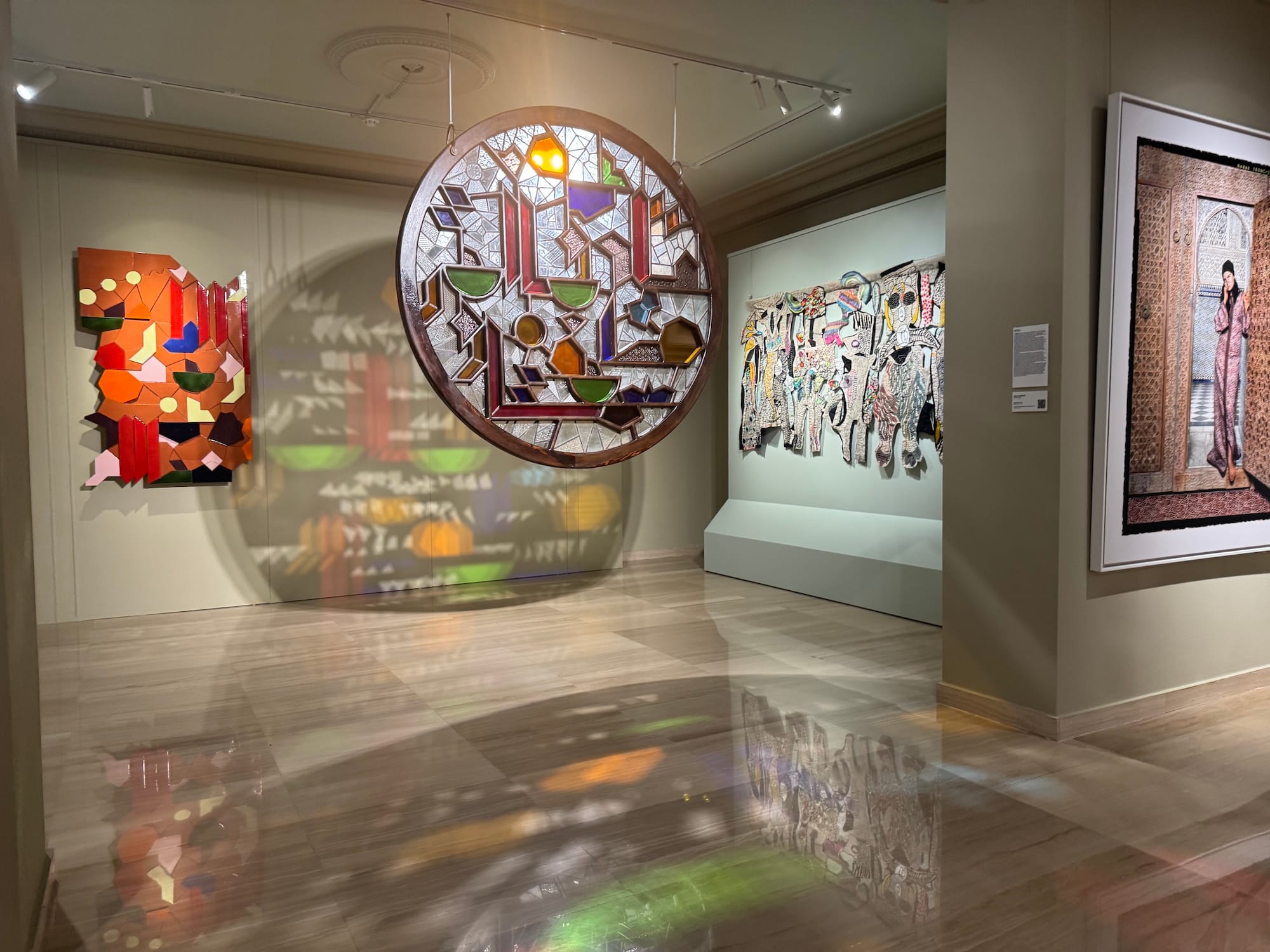
These questions reappear in other collaborative works featured in the show, including Moroccan-French artist Sara Ouhaddou’s Bahija Idriss – Atchana (2023). The large circular stained-glass structure is contoured with cedar wood that traces the geometric and calligraphic details of the piece. Particularly striking in this artwork is the way it engages with light, animating the structural surface by casting the patterns as shadows on the wall behind it. Through these prismatic reflections and the blend of shapes and colors, the work is reminiscent of rose windows found in gothic cathedrals. Yet in its abstraction of Moroccan architecture and calligraphy, together with its use of local materials like cedar and inherited hand-painting practices, traditional artisanship is translated into contemporary art form.
Integrating creative production with fieldwork, Ouhaddou’s artistic process is grounded in long-term partnerships with ceramicists in the Ourika Valley and glassmakers in Morocco’s urban centers. The exhibition does well in presenting this partnership as a thread through time, where cultural labor and embodied knowledge are valued in the reconfiguration of techniques within the artist's own contemporary explorations. Indeed, contemporary art can often depend on these forms of technical and collaborative hybridities. Yet the work on display also reveals the limits of recognition at the institutional level as authorship ultimately remains singular, with Ouhaddou alone receiving attribution by name. While collaborative works are celebrated throughout the exhibition, tensions between labor, value and authorship remain, which risks reproducing the very hierarchical categorizations that the show sets out to challenge.
While collaborative works are celebrated throughout the exhibition, tensions between labor, value and authorship remain, which risks reproducing the very hierarchical categorizations that the show sets out to challenge.
In the years following Morocco’s independence in 1956, the Casablanca Art School led an avant-garde movement that fused Western modernist art with pre-colonial Indigenous craft traditions. In a similar vein, art historians like Afif Bahnassi have argued that art from the region encompasses everything from architecture to ceramics, textiles and calligraphy, without rigid hierarchical distinctions based on material or functional value. The artworks featured in Women at Work follow this critical impulse, not only by unsettling the art/craft divide but also by disrupting conventional Western assumptions that art from the Arab world is primarily folk art or Islamic art.
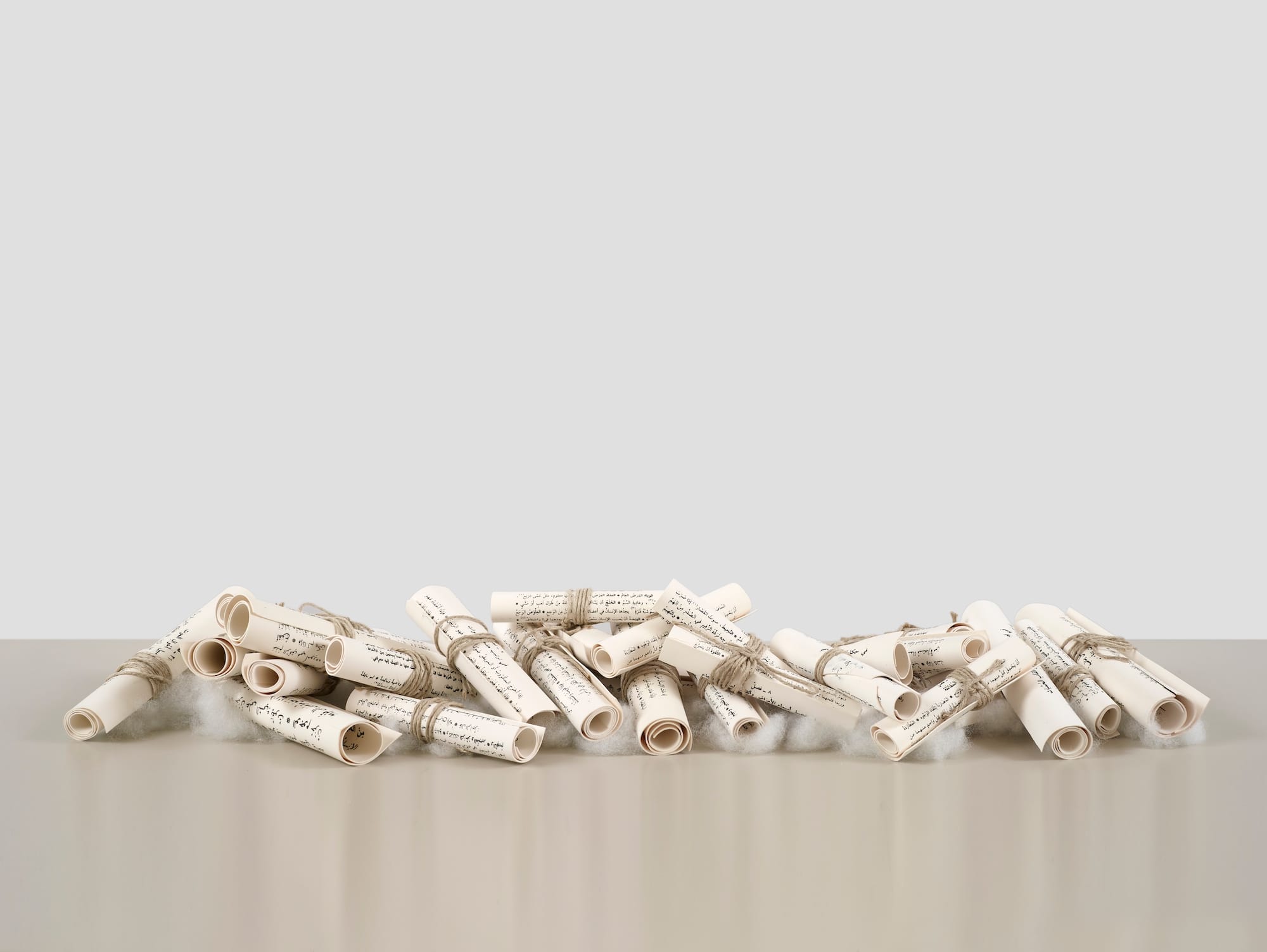
Just Paper - Group XV (2022) by Saudi artist Manal Al Dowayan takes part in this refusal by contributing to the diversity of topics addressed in art from the region through her own creative articulations of personal experiences with domestic politics. The installation is composed of 30 porcelain scrolls tied with jute string, some of which are tightly bound and others wrapped loosely, each individual piece lying against one another. This contrast in binding produces a tension between permanence and fragility where the tightly bound scrolls are stabilized and contained, while the loosely wrapped ones are vulnerable to coming undone. Yet the material brittleness of porcelain makes both susceptible to rupture. Using silkscreen printing, each scroll is inscribed with excerpts drawn from religious and government texts that dictated how women should behave. As the artist describes, these manuals depicted women as “translucent mute silhouettes” and were meant to guide their actions in public spaces reserved for men.
Speaking from her own perspective as a woman in Saudi Arabia in the post-1979 period of increased state religiosity following the Islamic Revolution in Iran, her artwork pushes back against the imposition of patriarchal social norms rooted in religion. In the DAF gallery, the artist invites visitors to confront the tensions between the materials’ durability and fragility by encouraging them to transgress conventional museum etiquette and pick up, rearrange and risk shattering the delicate work. This physical intervention prompts viewers to consider the possibilities of their own action in challenging or disrupting the projected immutability of dominant structures.
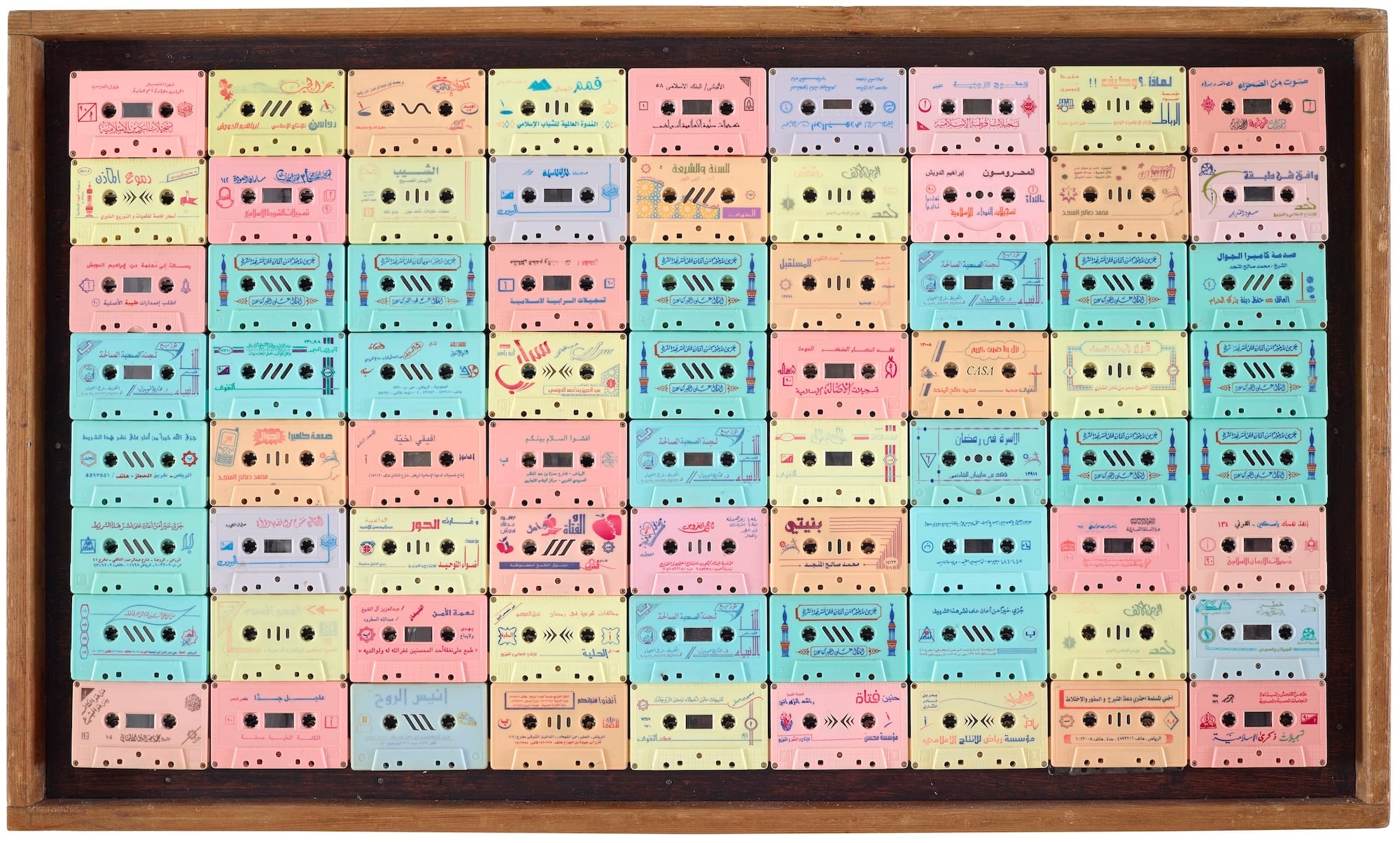
Saudi artist Maha Malluh’s artwork Food for Thought "Haram" (2012) also raises questions about the ways in which hegemonic powers have targeted women. The installation arranges 72 vintage audio cassettes on a wooden baking tray, all sourced from local flea markets and vintage shops. The colorful tapes, widely distributed in the 1980s, contain recordings of religious lectures meant to align the thoughts and behaviors of women with the ideologies of the Islamic political movement of its time. As viewers step away from the installation, the vibrant blue tapes come into focus, spelling haram in Arabic, referring to that which is forbidden and considered unlawful or sinful in Islam. Beyond the work's commentary on the influence of religious systems of control, it also depicts a moment of heightened consumerism where media played a central role in shaping individual and collective perceptions of the world.
Both works demonstrate how art from the region can emerge as subversive practices with the capacity to contest systems of power and dominant representations of women, their work and art from the Arab world. In dialogue with the other artworks on display, they contribute to the exhibition’s broader success in staging the reconfiguration of artistic practices historically relegated to crafts as intellectual and innovative political engagements in their own right, challenging the homogenization of art from the region.
Wafa Roz explained that her curation is an investigative practice nurtured by curiosity and an attentiveness to the pressing questions shaping the Arab world. While moving through the exhibition myself, I reflected on the role of art institutions in curating a space of dialogue connected to broader issues. Women at Work was on view during Israel’s ongoing genocide in Gaza and assault on Lebanon. Although the exhibition did not explicitly situate the artworks within this political context, the works on display are emblematic of the need for artistic production in times of struggle.
In AG04 (2023) by Egyptian artist Aliaa Elgready, a bright patchwork canvas covered with vibrant embroidered flora is overtaken by darkness. Produced in the aftermath of the COVID-19 pandemic and amid the ongoing devastations in Gaza and Sudan, the work speaks to the moral bankruptcy of political elites and presents their violence as a contagion that infects the land and slowly consumes its people. In Power Outage (2024), Lebanese artist Yasmina Alexandra Nysten paints landscapes of ruin and depicts the material conditions of genocide in Gaza by capturing both Palestinians’ struggle for survival and their resilience. When the Season Returns IV (2023), one of the 22 paintings in Lebanese artist Dalia Baassiri’s series The Harvest, was inspired by the trees that remained standing amid the devastation of the Mar Mikhael neighborhood following the August 4, 2020, port explosion in Beirut. Baassiri collected fragments of buildings and remnants of prayer candles to create textured surfaces that speak to the material realities of political instability and the traces of ruin.
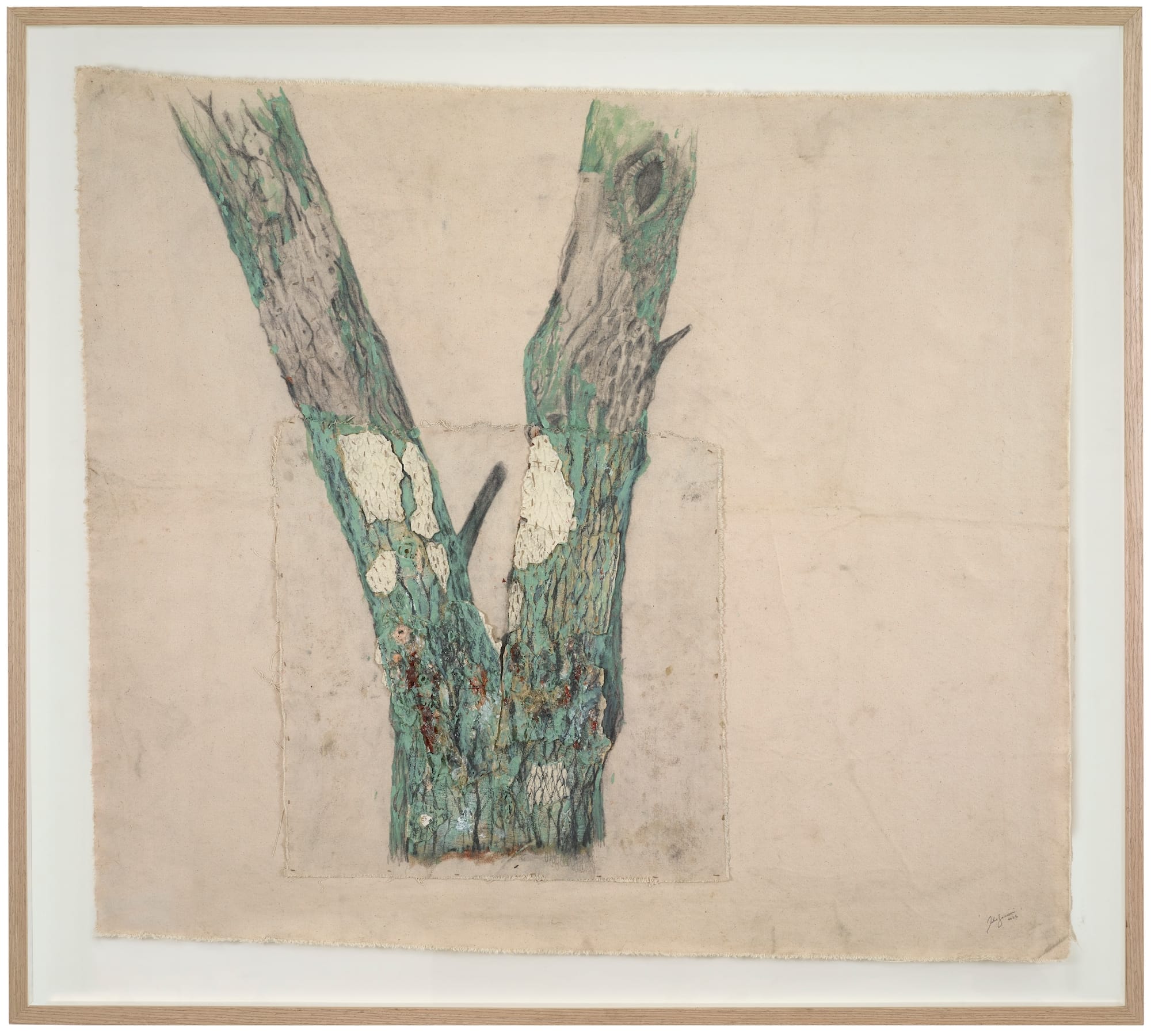
The works on view evoke both personal and collective experiences without collapsing differences into a universalizing abstraction. Instead, the exhibition reveals how the artists express shared experiences around common themes of dispossession, belonging, discovery and emancipation while remaining intimately connected to their own subjectivity and artistic uniqueness.
The exhibition reveals how the artists express shared experiences around common themes of dispossession, belonging, discovery and emancipation while remaining intimately connected to their own subjectivity and artistic uniqueness.
Women at Work also contributes to a larger curatorial shift over the last few decades of moving crafts into prominent positions in art exhibitions—from several installations at the 61st International Art Exhibition of the La Biennale di Venezia, to the increased visibility of Palestinian embroidery in museums across the globe, notably exhibitions at The Metropolitan Museum of Art, Museo Textil de Oaxaca, The Victoria and Albert Museum in Dundee or the Palestine Museum US’s official collateral event of the 2026 Biennale at Palazzo Mora.
Crucially, in foregrounding innovation and creativity at the intersection of fine art and craft, Women at Work renders that divide inadequate and ultimately obsolete as a framework for understanding art from the region. Indeed, the exhibition’s more significant intervention lies in its refusal of these categories in the first place. Instead, the show prompts further discussion on how artistic value is produced, whose labor is visible and what assumptions continue to shape the ways artistic practices from the region are perceived and categorized.
[Marybelle Issa is a doctoral student in anthropology at the University of Massachusetts, Amherst.]
All of MERIP's analysis is provided without paywalls! Make a donation now to help us keep it that way.
[1] Rachel Dedman. Stitching the Intifada: Embroidery and Resistance in Palestine. Common Threads Press. 2024.