The Grandmothers’ Anger—Theater at the Margins of Occupation
Playwright Lekaa Sharaf speaks with anthropologist Maria Kastrinou about theater in the Golan and the art of listening amid ongoing occupation and genocide.
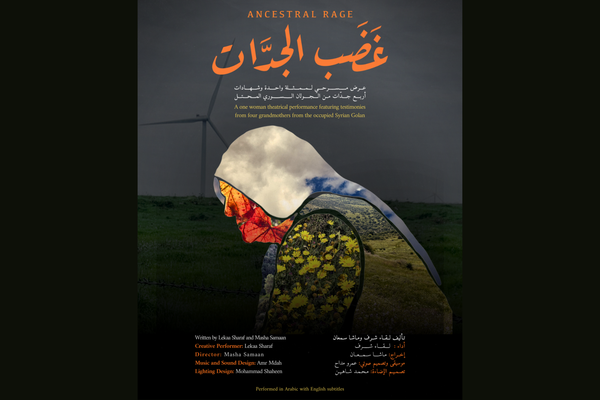

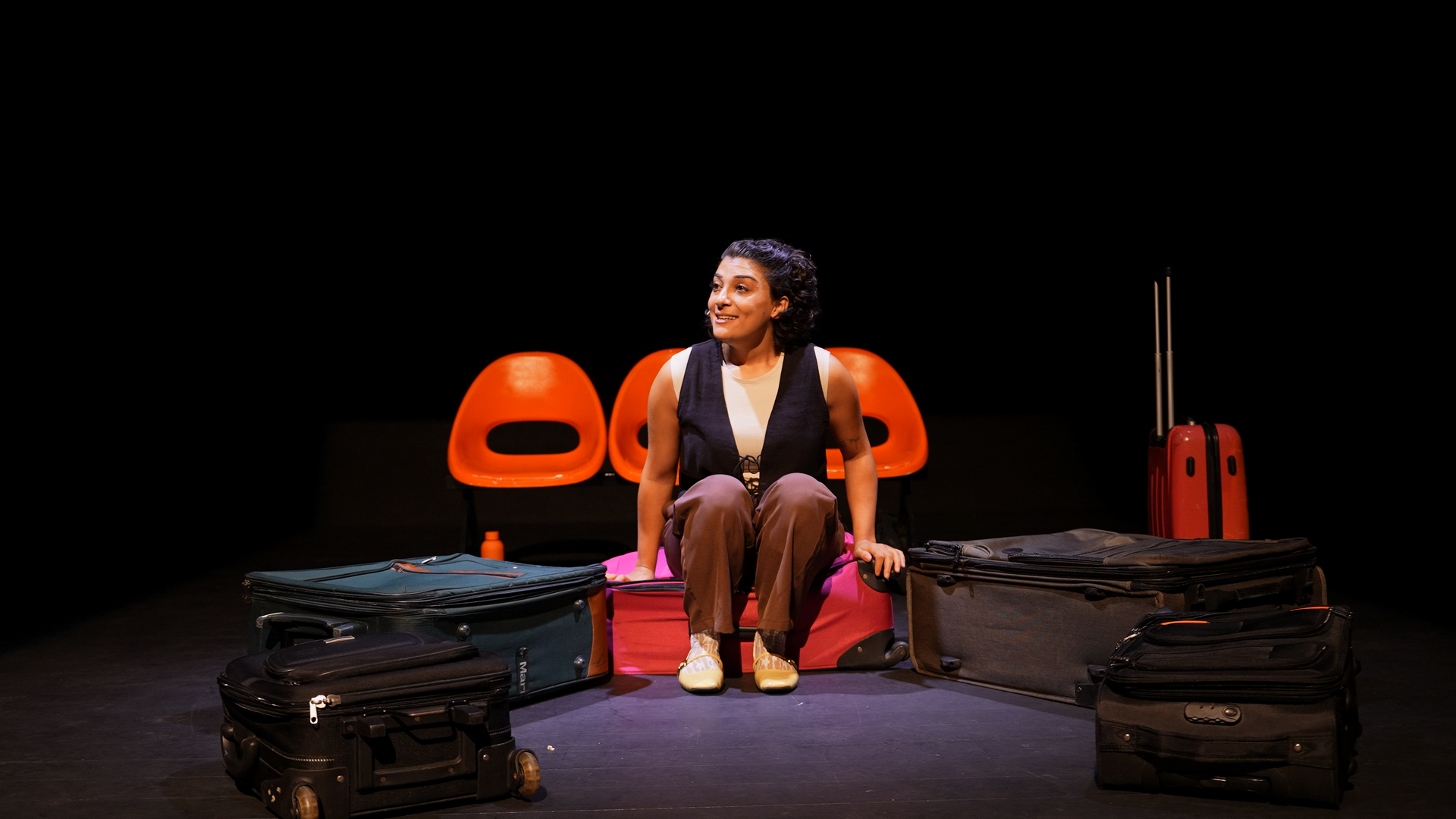
“Tell me, grandmother. Should I stay, or should I go?” This question pervades Gadabb al-Jaddat (Ancestral Rage, 2025), a one-woman performance by Lekaa Sharaf. Co-written with Masha Seman, who also directed the performance, the play follows an aspiring actress from the Israeli-occupied Syrian Golan as she waits in limbo for her laissez-passer travel document in a modern-day border purgatory. Set in an airport transit zone, the performance unfolds among oversized suitcases that become border checkpoints, interview rooms and family tables, as she reflects on the land she is leaving, the dream she is pursuing and the labneh wrap that her grandmothers urged her to take but that she left behind.
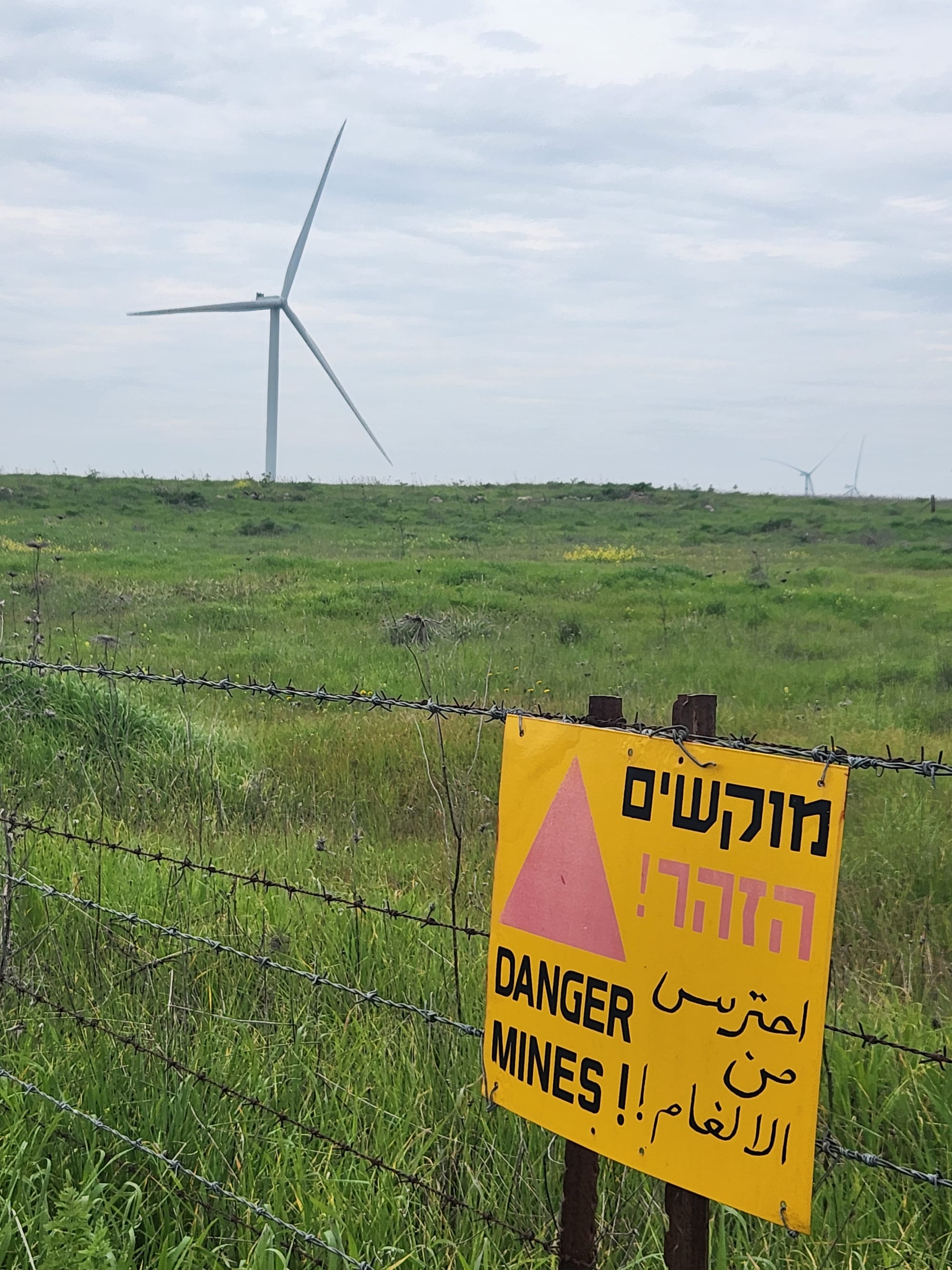
Often described as Israel’s “forgotten occupation,” the Golan (Jawlan) is home to around 28,000 stateless Syrians who have been living under Israeli occupation since the 1967 Arab-Israeli War. When Israel occupied the territory and forcibly dispossessed the majority of its population, many became internally displaced inside Syria. A small number of mostly Druze villages remained, including Majdal Shams, Mas‘ade, Buq‘ata, Ein Qiniyye and Ghajar. In 1981, the Israeli Knesset passed a law formally annexing the Golan, a move rejected by the Syrian population in a six-month general strike in 1982. Around 70 percent of the population continue to refuse Israeli citizenship, resulting in their political disenfranchisement and restricted freedom of movement. These barriers, alongside ongoing struggles over orchards, water, recent wind-turbine projects and minefields left over from the 1973 war, form the backdrop against which Ancestral Rage takes place.
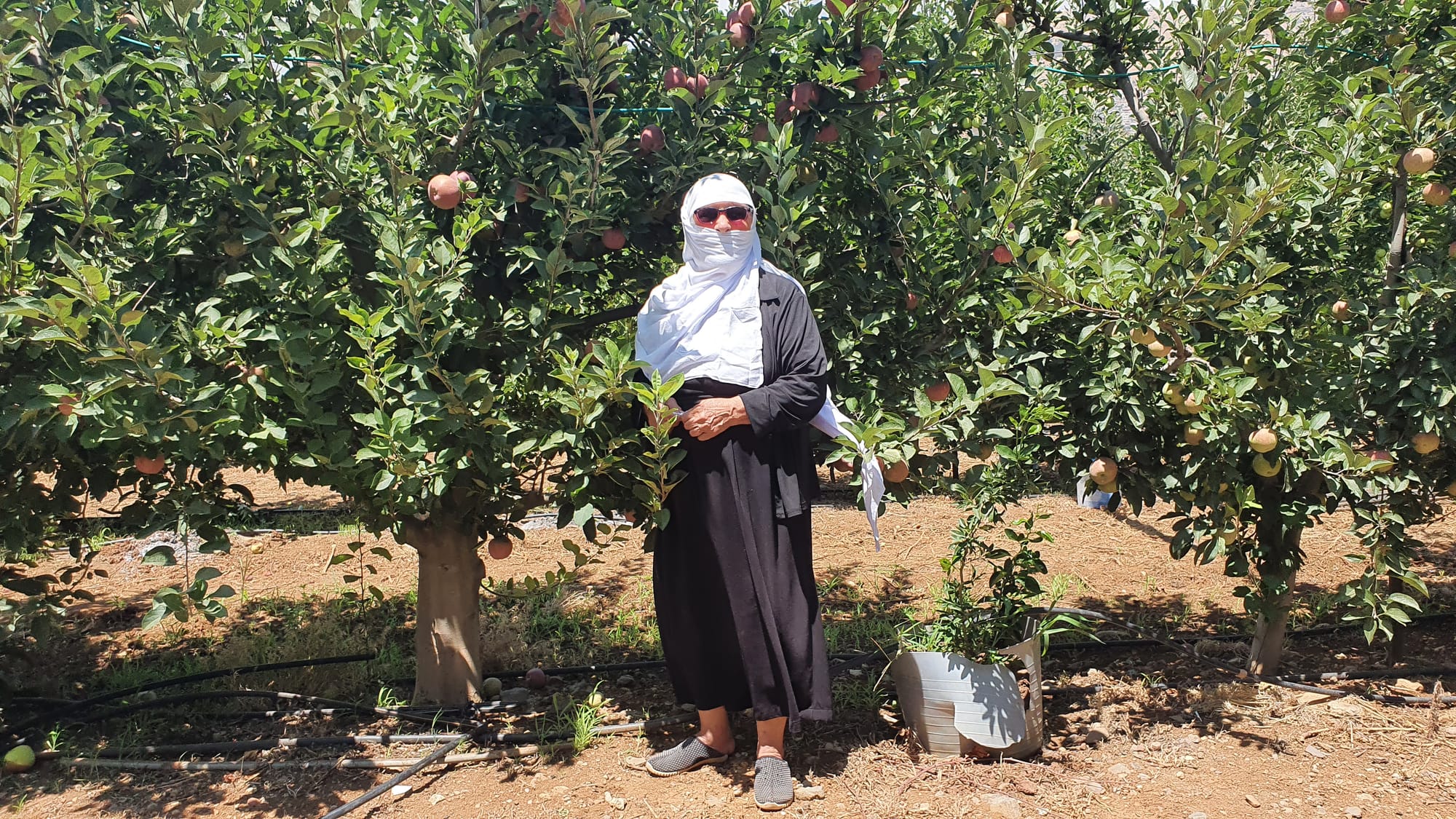
The play foregrounds voices that are often absent from accounts of life and resistance in the occupied Golan: those of women, and particularly grandmothers, who insisted they would never leave their land and mocked and berated their occupiers. It is based on interviews with Sharaf’s grandmothers and other older women from the area.
The production, which includes music and sound design by Amr Mdah and lighting design by Muhammed Shaheen, first premiered in the Golan in November 2025 as part of the Golan Cultural Days Festival, before touring Palestine and Jordan, with performances in Haifa, Jaffa, Jerusalem, Ramallah and Amman, where it won the Jury’s Award at The International Festival of Liberal Theater. The performance is in Arabic with English subtitles.
What follows is a conversation between Lekaa Sharaf and Maria Kastrinou, an anthropologist whose research has engaged the occupied Golan for almost two decades. Although the two have never met in person, they have spent the past three years discussing theater and exchanging writing online. The interview draws on conversations and written exchanges between March and July 2026 and has been edited for length and clarity.
Maria: It feels like another lifetime when I first approached you, in May 2023, with my anthropological research and a theatrical performance that had emerged from it, hoping we might explore ways of bringing this work to the community. Then the genocide in Gaza began, and that work became impossible. As you told me, the time was “too dark.” And yet, out of that darkness, you wrote Ancestral Rage. What made you write it?
Lekaa: I began this work after the genocidal war on Gaza started. When the war began, I found myself in a deep pit of despair, especially after we witnessed the bombing of Al-Maamadani Hospital in Gaza. It felt like the world was collapsing and there was no hope left after that moment.
Then one day I was in the car with my grandmother Fatima, and we passed near a checkpoint. Before we arrived, I warned her: “The soldier will ask us where we’re going. We’ll just answer the question and move on, we don’t want any confrontation.” She just nodded. When we reached the checkpoint, the (female) soldier asked us in Hebrew where we were going. My grandmother doesn’t speak Hebrew, but she understood the question and answered sharply, with anger: “We’re going to Damascus! Where else are we supposed to go? You’ve put the border on the mountain—there’s nowhere for us except Majdal Shams.”
“We’re going to Damascus! Where else are we supposed to go? You’ve put the border on the mountain—there’s nowhere for us except Majdal Shams.”
The soldier stepped back and looked at me. Both of us were afraid: I was afraid of the soldier’s reaction, and she was afraid of my grandmother’s. I gave her an awkward smile and said, “My grandmother is joking,” then quickly closed the window and drove on. On the way, my grandmother scolded me. She told me that we should never smile at soldiers and that we must always answer them with sharpness and anger. They should never see fear in our eyes. I nodded in agreement and wished I could be like her.
This moment shaped my entire theatrical work, starting from the existential question “Do we leave, or do we stay?” to my relationship with my grandmothers and my desire to reclaim their anger and become like them, greater than the occupation.
I also wanted the whole world to hear my grandmother and her friends. I wanted to hear their voices, their laughter, their political and ethical positions and their capacity for critical thinking. I wanted researchers, artists, friends and anyone else to listen.
After the first interview with my grandmother, I wondered whether it was just her, or whether other women of her generation were alike. I conducted interviews with five women who came from a village in the Jawlan. This was the first time anyone had recorded them and asked them questions about what they know best: their homeland. All were deeply moved that someone from my generation cared enough to listen. I felt as if I were talking to seasoned storytellers.
Most importantly, [I wrote this because] I wanted to be proud of where I come from, even if I decide to leave for the other side of the world.
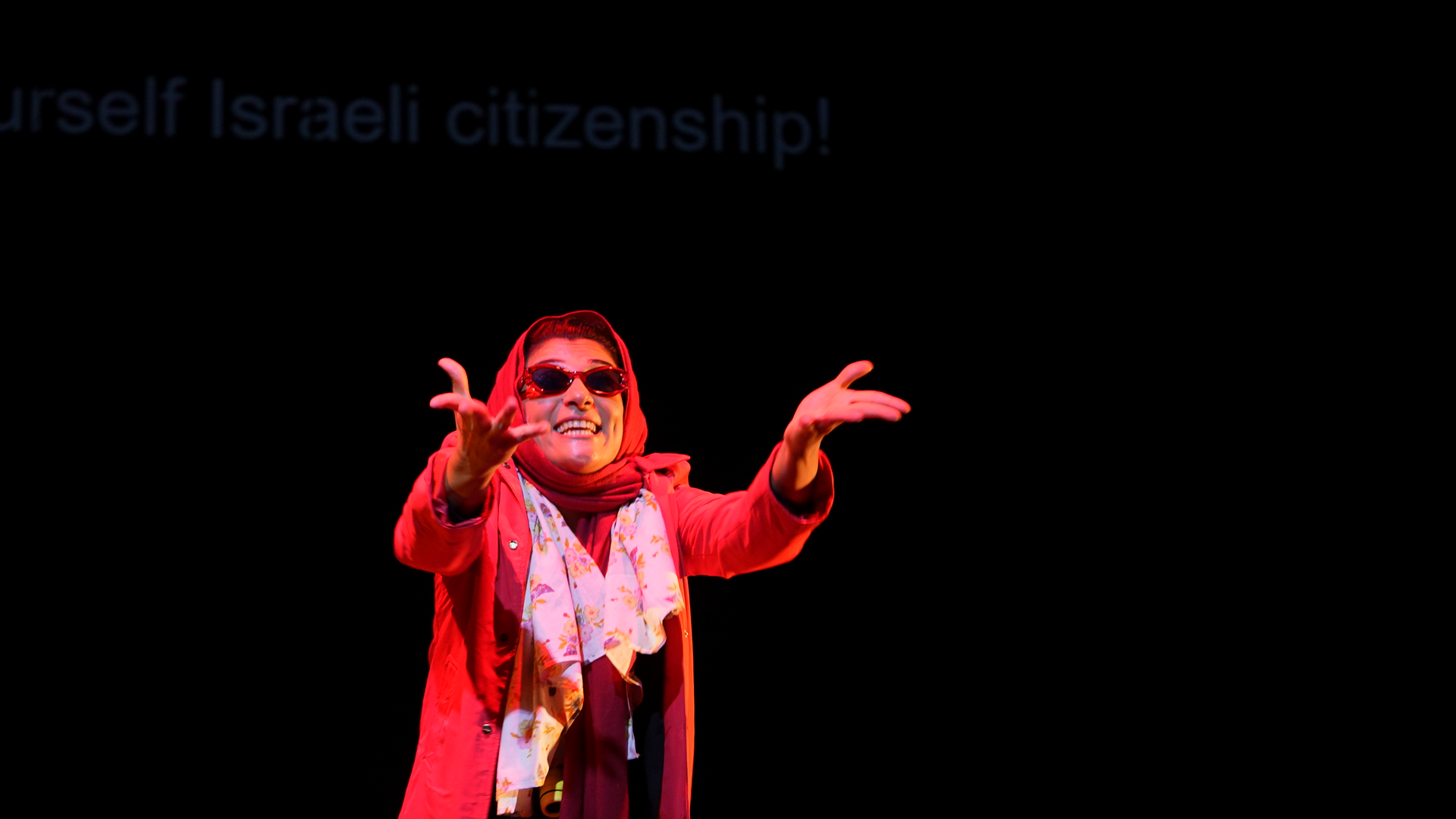
Maria: One of the striking moments in the play comes after you introduce the four main grandmothers. Their recorded voices are warm, funny and full of character, but they also refuse to do what they are asked. When you ask about their childhoods, none of them answers the question. Instead, they all begin with the war of 1967, as if their lives begin in that political moment. They acknowledge that they, too, once thought about leaving, but insist that “A person's home is his homeland; where else could he go?” At that moment, the recordings stop and the spotlight shifts to the Red Lekaa: a larger-than-life, almost drag-like alter ego in red glasses who seductively urges you to leave, take Israeli citizenship and “live your life.” Through her, the question that runs through the play—whether to stay or leave—becomes embodied. Who is the Red Lekaa? Is she evil, a devil as you call her, or something more complicated?
Lekaa: Not at all. If we move beyond the good and the evil and approach Red Lekaa as a genuine voice that exists and communicates with our desires, then the feeling of guilt around leaving begins to soften, and the desire for survival takes on a different shape. I think this voice is extremely important and necessary to bring to the surface because it is real. It is something I think about all the time, and I believe it exists within all of us. Wearing the red glasses is like wearing a mask that allows the expression of desires that are difficult to admit. For this reason, the Red Lekaa is not separate from the self that loves the grandmothers and the place. She is part of the same self, but one that is usually harder to voice.
Maria: Your play is very funny. At the airport, Lekaa talks about starring in a Pilates program with Jumana Murad. Even encounters with bureaucracy become absurd. Why did you choose humor? Is humor like anger?
Lekaa: Sarcasm, dark humor and what we call tamaskhur—playfully mocking or making jokes—are ways many women cope with the difficult realities they live through. Masha, my co-writer, and I both see the world in this way. Our anger often comes wrapped in humor. It is also a way of keeping ourselves safe and finding a way to speak about difficult realities and express our opinions in a context where doing so can carry consequences. Palestinian artists are condemned for a Facebook post. Humor softens the sharp edges of what is being said, while preserving its spirit.
Our anger often comes wrapped in humor.
Maria: References to food and hunger run through the play. Waiting in transit, your character grows hungry and regrets leaving behind the labneh wrap her grandmothers insisted she take. Recalling their repeated pleas, she lets slip: "They started calling it Pita Druzeit. I can't stand it anymore, bedi fiil—I want to leave!" The reference is to the Israeli cultural appropriation of the 'arous al-labneh, the traditional labneh wrap. It evokes the sense that the occupation has taken over not only the land but also cultural symbols, transforming something nourishing into something unpalatable. By the final scene, she is still hungry, searching for food as she watches a gazelle forage along the mined border. Hunger is both ordinary and deeply political in the play. Why did it become such an important thread?
Lekaa: During the period when we were working on the play, famine in Gaza was at its peak. I noticed that I kept saying I was hungry, constantly, even after I had eaten. As if hunger was contagious. As if this was my way of protecting myself from famine or maybe a form of guilt when we see hungry children and can do nothing.
Masha, my co-writer and the director of the play, noticed this pattern: “Lekaa, you’re hungry all the time.” That’s how we decided to begin the performance. And that’s how we would end it. We would search for food, and we would search for others who were hungry like us. But my grandmother refused hunger and would always try to feed me until I was more than full and then talk about the war. Meanwhile, I would sit in front of the television, counting the dead, following the names, my stomach aching. I couldn’t tell, was this hunger, or was it anxiety?
Maria: Can you talk a bit more about what the voices of the grandmothers capture and bring to the stage?
Lekaa: Bringing the grandmothers’ voices to the stage came from my desire for them to have a living presence rather than becoming retold stories.
The four women bring different ways of imagining the Jawlan: the deep commanding voice, the gentle and caring one, the angry voice and the grieving one. Their accents, rhythms of speech, humor, political opinions and descriptions of the village carry an entire world. These voices are precious, yet they have mostly remained within intimate gatherings between women. Bringing them into the theater also brings the Jawlan itself onto the stage—not only its memories, but its everyday life in all its contradictions.
Bringing the grandmothers into the theater also brings the Jawlan itself onto the stage—not only its memories, but its everyday life in all its contradictions.
Maria: As you’ve noted, your theater comes out of the specificities of the Jawlani landscape and occupation—an occupation at the margins of a greater occupation, genocide and regional war. How did audiences outside of the Golan receive it?
Lekaa: Despite the specificity of these stories and their roots in a particular history and place, audiences from different backgrounds found ways to connect with the work.
One example of this was the performance in Jerusalem. People in Jerusalem share a political reality very similar to ours, and the performance at Al-Hakawati Theater carried a sense of sadness and heaviness, while also creating a deep connection between the work and the audience. Despite the fact that Al-Hakawati is constantly under pressure from the right-wing Israeli government and there is an ongoing atmosphere of fear and uncertainty around performing there, the audience arrived without expectations and often without prior knowledge of the Jawlan or its context. Yet they found a way to connect with the stories and emotions carried by the performance.
In Amman, the context was different. After the recent events in Syria and amid sensitivities around religious identity and sectarian belonging, particularly in relation to the Druze community, the festival director was concerned about how the work would be received and what conversations it might open. He remained anxious throughout the process, but he respected our position. In a way, his concern gave me more freedom to create; I felt that if he was already carrying this anxiety on my behalf, there was no need for me to carry it as well.
During the performance, the audience responded with great emotional presence. When I said, “I’m hungry,” I heard audience members whispering, “habibti.” When I asked my grandmothers, “Do you love me?” the audience answered together before the recorded voices replied, “Of course.” The technical crew was initially confused, unable to tell whether the voices came from the recording or from the audience itself.
Maria: What is the theater scene in the Jawlan like today, and how do you think the ongoing realities of occupation, war and displacement across the region are affecting cultural production now and in the future?
Lekaa: Although theater in the Golan develops under the political and material constraints of occupation, it remains a vibrant and resilient artistic scene. Dozens of Jawlani theater artists continue to work locally and internationally, creating performances despite limited resources and increasing restrictions on cultural expression. Theater has long played an important role in the cultural life of the Jawlan. The theater group Masrah Oyoun (Eyes Theater), for example, involved dozens of students and produced many performances every year before cultural spaces came under growing pressure. Beyond theater, Jawlani artists work across music, visual arts and other creative practices. Groups such as Toot Ard and Hawa Dafi, alongside many visual artists, reflect the diversity of artistic expression emerging from the Jawlan.
Although theater in the Golan develops under the political and material constraints of occupation, it remains a vibrant and resilient artistic scene.
Since the genocide in Gaza, and with the continued occupation and military escalation across the region, making theater has become even more fragile. Many artistic projects have been cancelled, postponed or forced to adapt to a changing reality. Because of the occupation, Palestine has become our connection to a wider cultural landscape. This relationship is complex and shaped by borders and political realities, but it has also allowed artists from the Jawlan to build connections, exchange knowledge and participate in broader artistic conversations.
Lekaa: Let me ask you a question in return. You have been doing ethnographic research in the Jawlan for many years and have written about our lives and struggles. Is there anything that surprised you in Ancestral Rage? Did it affect how you think about your own research?
Maria: From the first time you mentioned the idea, I was hooked. I think you said something about “sitting down with a cup of matte and listening to my grandmothers.” I thought, yes, this is what anthropologists do. How wonderful to put that on stage.
What surprised me the most was not the grandmothers but your character. I must admit here my own limitation, that I have found it more difficult to connect and interview the younger generations. Older people, usually, have more time to talk about their life stories and the history of the place. And they have a different relation to Israeli occupation, since many of the older people have served time as political hostages in Israeli jails. But what your character revealed to me was the complexity of an emerging new identity. Your character’s love for the grandmothers was a deep love for the ancestors, those who come before us and those who cultivate the land so that we may root within it. And the grandmothers are not authoritative or haunting presences, but embodiments of nourishment and care (hence the labneh sandwich). Moreover, their insistence to stay on their land and to fight, shout and trick the occupiers—in a word, the collective resistance that they represent (even if they are often underrepresented within it)—is what gives your character the tools, ambitions and freedom to have dreams that are different, that are otherwise and out-there.
So, your character, like the youth in Jawlan, has grown up with safety and nourishment as a result of the sacrifices and political struggles that the generations before them offered. It is this lovely connection and closeness that defines them, and by the end of the play I felt that even if our Red Lekaa decided to leave, this relationship would not finish, and she’d always return to it. By the way, yours is a more nuanced characterization than many academic accounts of the youth, and certainly much better than the ongoing debates on whether Jawlani youth are becoming “Israelized.” I think you really show the internal conflict of identity, and you lead us to question “normalization” even within the context of acquiring citizenship.
Maria: What does theater bring that other genres do not?
Lekaa: Theater offers me a liminal space between reality and imagination, where multiple worlds can exist at once. I have spent my life inhabiting liminal spaces: between Palestine and Syria, occupation and freedom, belonging and displacement, love and anger. Theater offers a language that can hold this complexity. Ancestral Rage also emerges from such a space. The grandmothers exist between past and present, memory and erasure, the village they knew and the reality of occupation. Through the stage, their stories are not only remembered but become a living encounter, inviting the audience to imagine the Jawlan through their eyes.
I have spent my life inhabiting liminal spaces: between Palestine and Syria, occupation and freedom, belonging and displacement, love and anger. Theater offers a language that can hold this complexity.
I’m curious, as an anthropologist who also makes and uses theatre in your own work, what does it make possible for you?
Maria: Often, I have to leave material out of my academic writing because it is too long or does not fit the argument I am making. This cutting and pasting can feel like a form of violence: to the people whose stories I have collected, but also to myself, because it is their stories that remain with me. I started experimenting with theater a few years ago for this reason, with interviews that did not make into a paper. Theater has given me a space to share how these voices have shaped me. It is an act of liberation, for the stories as well as for me.
Theater also requires physical labor and collective effort. Anthropology is much the same. Both hold and carry humanity’s messiness, which is why they are such natural partners. Perhaps for this reason, both theater and anthropology—and, more broadly, the arts and social sciences—are under attack. You know this well, Lekaa. War and genocide target cultural reproduction. But the attack is wider than that. Across the UK and Europe, arts and social science teaching and research are being steadily defunded. Ultimately, this is an attack on what makes us human and on our capacity to think critically.
[Lekaa Sharaf is a playwright, theatre artist and group facilitator. Maria Kastrinou is a senior lecturer in social anthropology at Brunel University.]
All of MERIP's analysis is provided without paywalls! Make a donation now to help us keep it that way.