Exhibiting the Gulf—Kuwait’s Overlooked Role in Regional Art

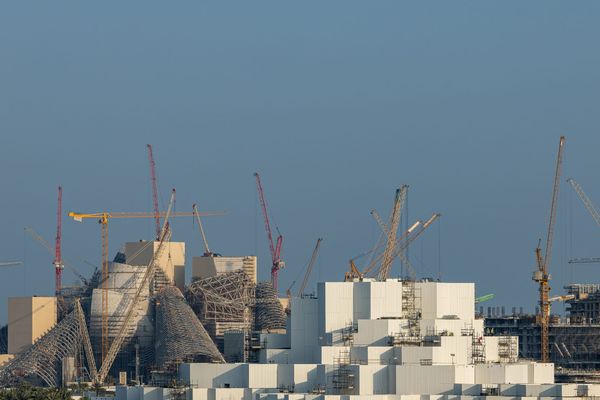
In February 2026, the international Art Basel festival was held for the first time in Qatar and is scheduled to return in January 2027. In November 2026, London’s Frieze art fair is due to launch Frieze Abu Dhabi. The festivals mark a growing trend—mirrored in construction of the Louvre and Guggenheim museums in Abu Dhabi—of Gulf governments collaborating with Western art institutions to deliver streamlined, world-class cultural programming. The pace, scale and cost of these developments have prompted unease among artists and workers, particularly over the increasing reliance on Western consultancies in the development of local cultural projects.
At the same time, these collaborative ventures are not without precedent. They belong to a longer history of exhibition-making in the Gulf, where a steady stream of art fairs and biennials have repeatedly attempted to take up the mantle of Arab artistic representation. Before the rise of globally branded art events, there were older homegrown exhibitions, like the Baghdad Biennial (1974) or its lesser-known predecessor the Kuwait Biennial (1969).
Kuwait is a particularly revealing place from which to revisit this history. Among the countries of the GCC, Kuwait witnessed the earliest development of formal art infrastructure with the founding of the Free Art Atelier (FAA) in 1960, the Kuwait Society for Formative Art (KSFA) in 1967 and the National Council for Culture, Arts and Letters (NCCAL) in 1973. Yet, despite this precedent, the cultural output of the country, or at least that of its sanctioned institutions, has been markedly subdued in recent years compared to the highly ambitious programming of Qatar, the United Arab Emirates and Saudi Arabia.
This apparent reversal raises a different set of questions from those usually asked of the Gulf’s current cultural boom. Rather than looking only at how Western institutions and consultants have entered the region, Kuwait’s history asks what happens when artist-led initiatives become absorbed into state structures and how the rupture of the Gulf wars impacted the regional art scene. The archive of pioneering Kuwaiti artist Khalifa Al-Qattan—who played a role in founding the FAA, the KSFA and the arts hall of the NCCAL—offers a rare view of that transformation. Through his correspondence, personal papers and collected materials, it becomes possible to trace Kuwait's transition from semi-independent art programming to formal representation through officially sanctioned art institutions.
Kuwait’s history asks what happens when artist-led initiatives become absorbed into state structures and how the rupture of the Gulf wars impacted the regional art scene.
While his exact date of birth is unknown, Khalifa Al-Qattan was born sometime between late December and early January around the time of the Al-Haddamah, or “The Destroyer.” This historic storm was reported to have occurred in late 1934 and resulted in the devastation of a large portion of Kuwait’s old city, leaving many of its inhabitants displaced. At 15, he began working at the Al Najah school in the Sharq neighborhood of Kuwait City, where his family lived and where he would eventually present his first solo show as part of a student arts festival in 1953. Soon after, he applied for a government scholarship to study art abroad through Kuwait’s Ministry of Education, only to be informed that the ministry did not consider art a worthwhile field of study. He was able to convince them to fund a more technical creative degree, woodworking, at Britain’s Leicester College of Art and Technology. There he met Lidia Scagnolari, an Italian nursing student, who he would eventually marry. After graduating in 1958, he returned to Kuwait to work as a technical instructor at Shuweikh High School, now part of the Kuwait University campus, before moving on to work as a foreman for the Ministry of General Works.
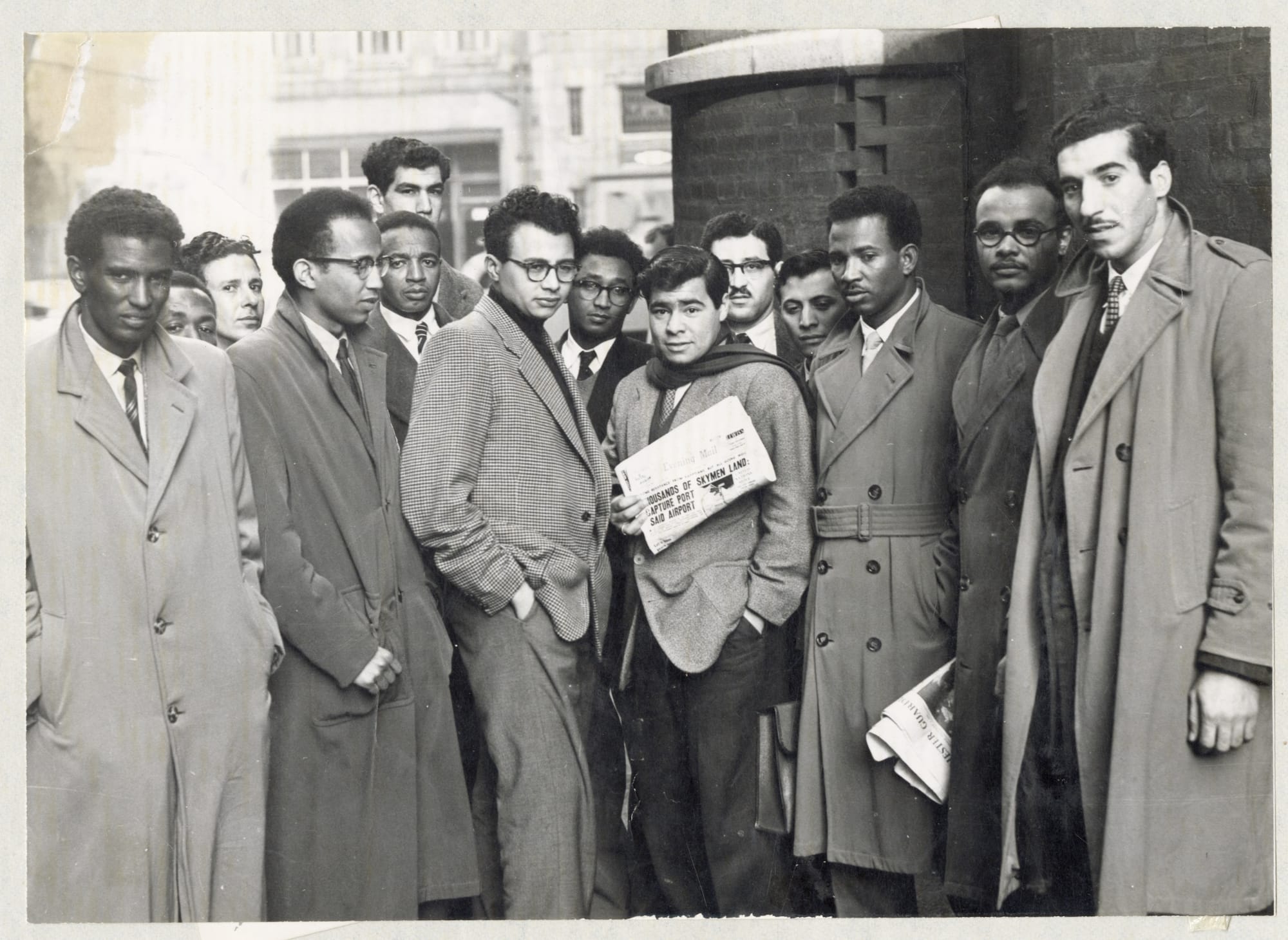
In 1962, in recognition of his efforts as an artist, particularly his continued participation in the highly regarded Spring Exhibition series organized by the Ministry of Education, Qattan became the second full-time artist to be sponsored by the ministry to work at their newly established Marsam Al-Hurr, otherwise known as the Free Art Atelier. It essentially functioned as a long-term sabbatical program that provided artists with a studio, art materials and technical instruction in painting and sculpture to help develop their skills. That same year, he established a style of art that he and his wife dubbed “Circlism,” inspired by intuitive, subconscious painting and understood as an expression of the universal concept of eternal return through recurring cycles. Soon after, he embarked on a number of international trips with a collection of his works in order to independently set up exhibitions that introduced his style to audiences in Cairo, Ferrara, Rome, London and Beirut.
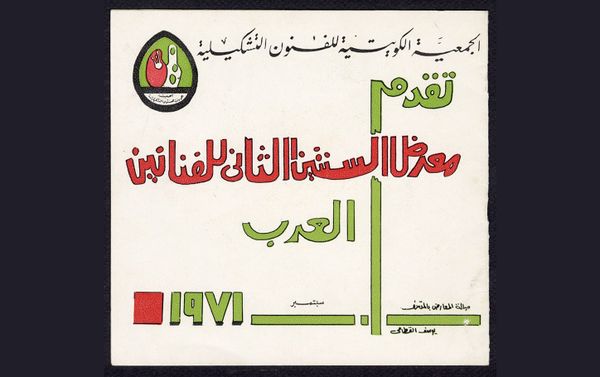
In 1967, alongside his colleagues at the FAA, Qattan helped establish the Kuwait Society for Formative Arts (KSFA), now known as the Kuwait Arts Association, where he served as the first president. As a formal entity—registered as a public benefit association under the Ministry of Social Affairs and Labor—the society was a space where FAA artists could freely conceptualize their own exhibition frameworks and execute these ideas themselves. One of the earliest ideas to be implemented was to establish a large-scale exhibition in the style of international biennials, like the Alexandria Biennale for Mediterranean Countries, that would solely focus on the production of Arab artists. The KSFA thus launched the Kuwait Biennial in 1969, originally titled The Arab Artist Biennial, with its inaugural edition taking place at the Al-Mubarakiya School.
One of the earliest ideas to be implemented [by Kuwaiti artists in the late 1960s] was to establish a large-scale exhibition in the style of international biennials ... that would solely focus on the production of Arab artists.
The Kuwaiti artists studying in Cairo were surely inspired by the exhibition example set in Alexandria, given that they directly cite it in the KSFA biennial materials. But the founding of the KSFA, and the emphasis on the biennial format, was a deliberate attempt to make Kuwaiti artists eligible to participate in, as well as host, international showcases. In 1962, Qattan had attended the Venice Biennale as part of his travels and penned an article for Al-Hadaf newspaper upon his return to Kuwait in which he recounted his experience. He ended the article with a broad appeal to the public for the increased support of local artists so that his country could “take its global place among the nations.”[1]
Some years later, speaking on behalf of the KSFA in a 1970 newspaper interview with Akhbar al-Kuwait, Qattan stated that he and the society members had sent a proposal to the League of Arab States in 1966 suggesting the League adopt an Arab biennial. Since the proposal ultimately did not lead anywhere, the artists took action themselves and established the Arab Artist Biennial after they founded the KSFA.[2]
Qattan’s personal collection of documents complicate the conventional history of Arab biennials. The standard story suggests that the 1970s was the period when Arab artists who had previously worked in isolation felt compelled, at the height of pan-Arabism, to combine their efforts through cultural meetings and joint exhibitions under the centralized leadership of a regional artist union. Their goal was to explore and define the role of the plastic, or visual, arts in shaping the future of Arab culture.[3] In this narrative, art had become a means of countering cultural erasure and the false and simplistic representations of native populations as backward and artistically reductive. This movement culminated in the Biennale of Arab Art, funded by the Iraqi government and inaugurated in Baghdad in 1974 under the auspices of the regional General Union of Arab Plastic Artists (GUAPA) before travelling to Rabat in 1976 and, reportedly, Libya in 1978.[4]
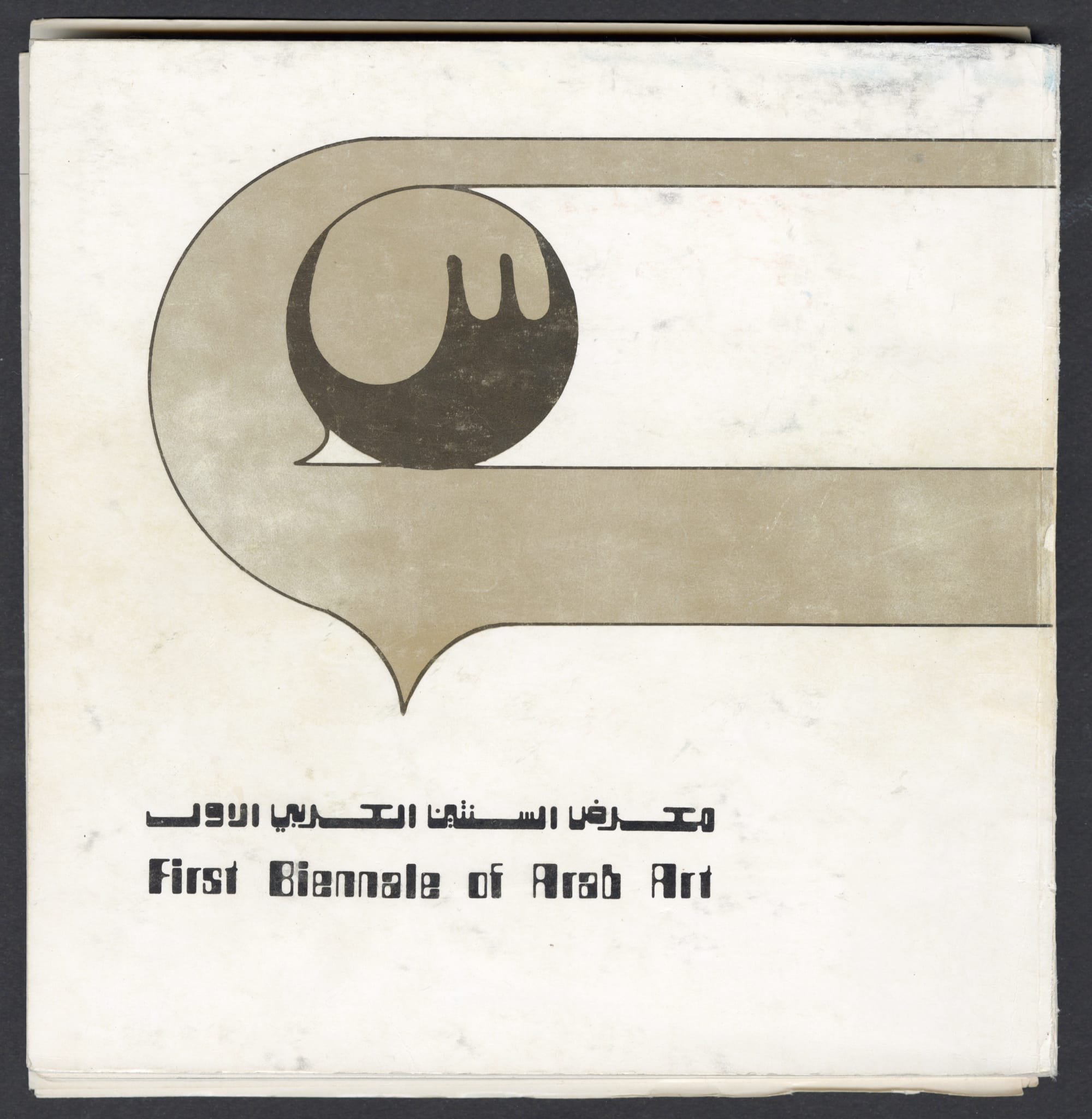
What that standard narrative leaves out is that the Kuwait Biennial of 1969 preceded GUAPA’s by five years and it approached art in the region from a somewhat different perspective. The GUAPA’s exhibition name, The Biennale of Arab Art, differs slightly from the title of the Kuwaiti iteration, The Arab Artist Biennial, with its emphasis on art instead of artists. The Kuwaiti organizers foregrounded Arab artists while the union implied the existence of a distinct category of “Arab art.” Given that GUAPA's conference materials acknowledge the Kuwaiti exhibition series—and Qattan himself recalled proposing an Arab biennial eight years earlier—the coexistence of the two projects raises the possibility that they represented competing institutional visions rather than successive stages of the same one.[5]
Coverage of the initial editions of the Arab Artist Biennial in Kuwait are scarce, but from an examination of the materials currently available in private archives it becomes clear that low attendance at formal exhibitions was exceedingly common, especially after the opening, and that there was a growing consensus in the press about what art, specifically Arab art, should represent.
In the 1960s and 1970s, many of the art critics reviewing exhibitions for Kuwaiti publications came from other parts of the Arab world, most commonly Egypt, Iraq and the countries of the Levant. While their writing was often insightful, they frequently pitted the local development of art against that of the era’s more established centers of Arab culture, like Cairo, Damascus and Baghdad, often blurring art criticism with politically tinged statements. For example, in Syrian historian Muafaq Bani Marja’s review of the First Arab Artist Biennial, subtitled “Arab Art in the Absence of Our Major Cause,” he criticized the exhibition for lacking enough works about the Six-Day War, citing only a few examples by artists from Jordan, Palestine and Qatar.[6] “It appears art here is for the sake of art,” he wrote. “It is entertainment, pursued to satisfy a hobby and not to serve a particular cause.” He may have exaggerated the scarcity of artworks taking up the Six-Day War: There was at least one other somewhat abstract work by Bahraini artist Abdullah Al-Muharraqi, and a portion of the sales of the biennial went toward wartime causes in Palestine, a common fundraising strategy that was utilized by various cultural associations in Kuwait at that time.
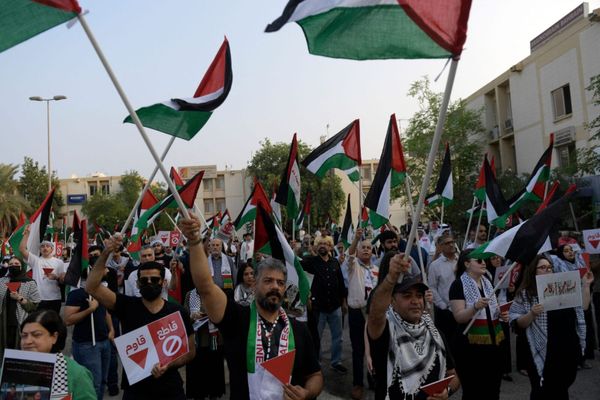
But the condescending tone of his review also reflects a more widely held dismissive sentiment in the region toward the efforts of Gulf artists to engage with art production in general, let alone who gets to define the term “Arab art.” [7] Instead of attempting to understand local realities and the ways in which Gulf artists were engaging with them creatively, Arab art critics pushed for a particular style (primarily social realism) and subject matter (the Palestinian cause). They promoted a united and instrumentalized form of art production that essentially commodified atrocity under the banner of solidarity, making it easier for Ba’athist governments to co-opt art for their political purposes.
Instead of attempting to understand local realities and the ways in which Gulf artists were engaging with them creatively, Arab art critics pushed for a particular style (primarily social realism) and subject matter (the Palestinian cause).
By the early 1970s, the term Arab art had come to denote more than art produced by Arab artists, it also carried concerns about authenticity. It was associated with efforts like those of the Baghdad Modern Art Group, whose concept of istilham al-turath was an attempt to re-establish a continuity between artistic traditions of the past and the present. Artists sought inspiration from antiquities or the output of historical figures like that of thirteenth-century Abbasid illustrator Yahya al-Wasiti.[8] Additionally, the aftermath of the Six-Day War led many Arab art groups and associations, including GUAPA, to center the subject of resistance in their manifestos and in their understanding of Arab art. As the 1970s progressed, the call for authenticity, which can be read in the self-imposed boundaries of what was considered Arab art, limited the freedom of Arab artists to experiment as their governments began to take control of art's future direction.[9]
The centering of an identitarian framework in the understanding of artistic and cultural authenticity proved useful in shaping public opinion as political tensions began to rise between Iraq and Iran. While GUAPA’s biennial project had failed by 1978—a result, reportedly, of internal disagreement relating to thematic adherence—the Iraqi government had already embarked on a new soft-power venture with a series of cultural weeks set to take place in Kuwait, Qatar and Bahrain in 1977.
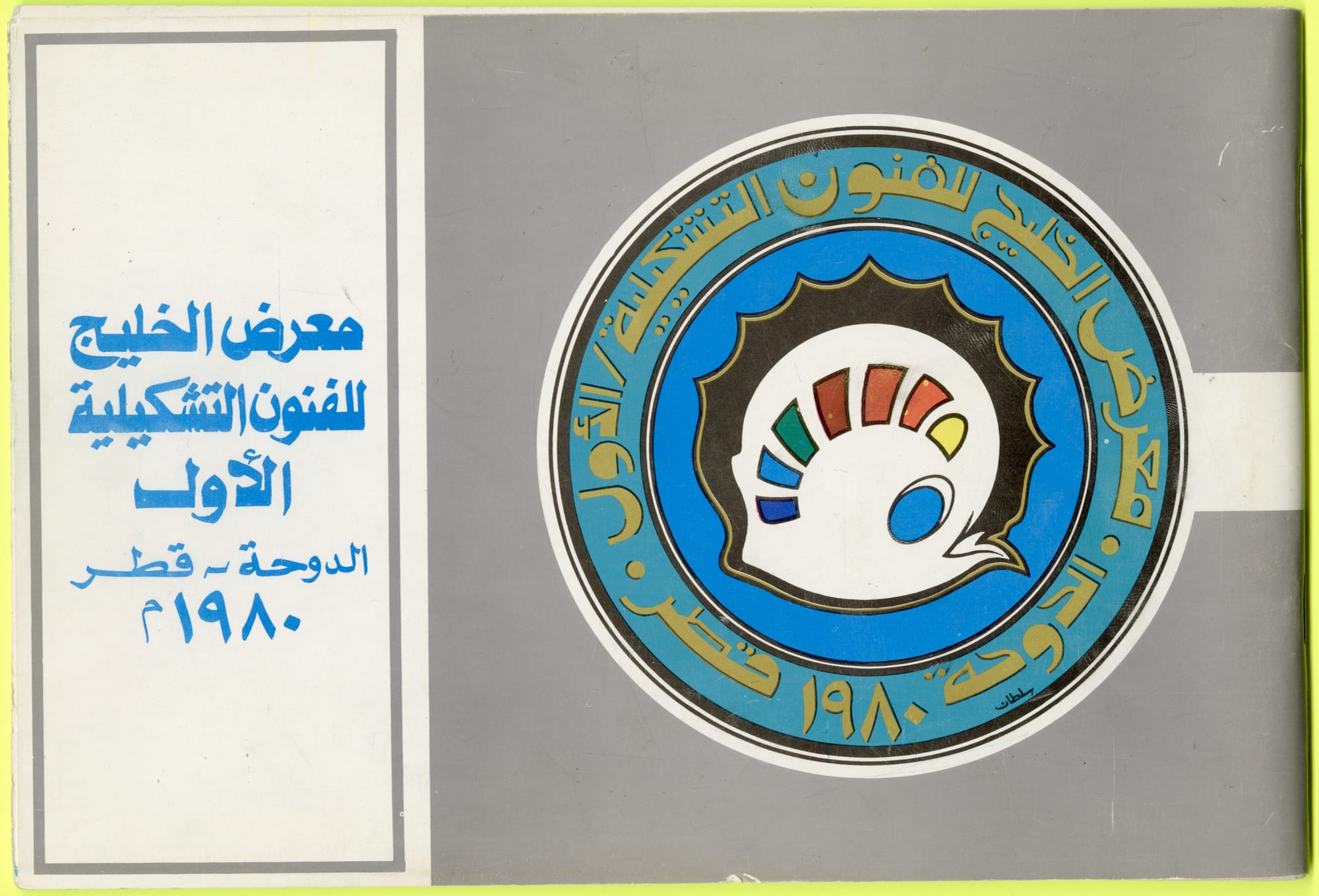
Soon after, in 1980, the Qatari Ministry of Information hosted the first Gulf Exhibition for Plastic Arts, originally envisioned as a biennial and one of the earliest uses of the term “Gulf” in an exhibition framework.[10] The exhibition showcased the latest work produced in the Gulf Arab states, including Iraq, and presented it in a context of unity and solidarity that emphasized Gulf Arab identity. A little over a year later, after the onset of the Iran-Iraq war, the second edition of the Gulf exhibition took place in Baghdad, featuring many of the same artists. It also launched a new series of publications by the Iraqi Ministry of Information that began with a special edition penned by esteemed Iraqi art historian Shawkat al-Rubai titled “Plastic Art in the Arabian Gulf.”
Heading into the 1980s, the category of Arab art had begun to lose its cultural cachet in the region as a result of wider political shifts and alliances, including the onset of the Iran-Iraq war and the formation of the GCC. The Arab Artist Biennial in Kuwait, however, continued steadily under its second name, the Kuwait Biennial for Arab Artists, for approximately two decades. Although derided in its earlier editions, it gained new prominence as an arbiter of Arab artistic development. In one of its last editions, Iraqi artist and the director of the Saddam Art Center, Layla Al-Attar praised the biennial for carrying on the mission of Arab artistic unity by continuing to exclusively showcase Arab artists. After all, as she states in an interview, it was in fact the first Arab biennial and “there was no other like it.”[11]
It is possible that the loss of Arab art’s political utility for regional governments allowed Iraqi, as well as other Arab artists, to more freely partake in—and promote—Kuwait’s biennial, as there no longer appeared to be any competition or desire to lead the helm of Arab artistic representation. Within Kuwait, increased bureaucracy in art institutions led some pioneering artists, including Khalifa Al-Qattan, to distance themselves from the institutions they helped found. The FAA’s move from the auspices of the Ministry of Education to the Ministry of Information in the early 1970s was significant and emblematic of the core disconnect between artists’ understanding of art and its function to the government. This move was accompanied by a pervasive understanding that art could promote a burgeoning touristic enterprise, reinforced by arbitrary evaluation rubrics set by non-artist employees at the ministry. It is worth noting that the KSFA was founded the same year as Kuwait declared the year of tourism, and around the same time as the conference of Arab tourism ministers.
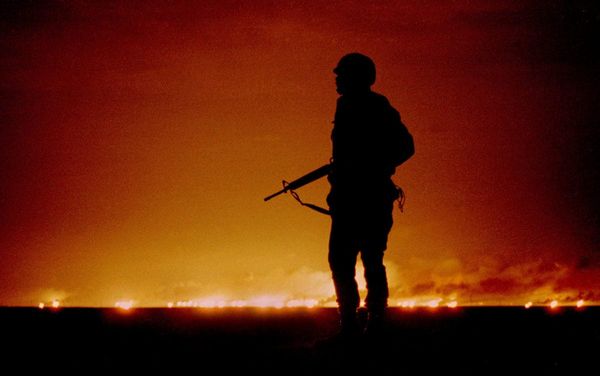
The confluence of these events reinforced the view of art as an exercise in national identity building rather than free artistic expression. This conception of art was compounded by the formation of the GCC in the early 1980s, when Gulf art shifted toward formal national representation that grew out of the pan-Arabist influence emphasizing heritage. While this consistent cultural activity was building toward Kuwait’s rise as an artistic hub, the invasion of the country by Iraq under President Saddam Hussein in 1990 that started the first Gulf War resulted in the complete halting of all cultural activities in the country for the foreseeable future.
The confluence of these events reinforced the view of art as an exercise in national identity building rather than free artistic expression.
In 1996, under new management, the KSFA brought back the biennial for what would become its twelfth and final edition, under yet another name, the Kuwait International Biennial, which gestured toward the coalition forces that had helped free Kuwait from the invasion. This reconceptualization of what was once the Arab Artist Biennial to include Western artists received mixed responses, evidenced by the halting of the project thereafter. For some, who like Qattan were disillusioned with the increased bureaucracy of local art institutions, the Gulf War was the final blow. Their approach to art making and organizing had been originally envisioned as an idyllic path toward a united front that would stand against the encroachment of Western culture and its economic interests in the region. After the shock of the invasion, that mission no longer made sense despite institutional efforts to carry on.
The first Gulf War shattered what remained of Arab brotherly cooperation in the regional cultural sector, putting an end to a variety of initiatives that had grown out of the pan-Arab moment. In the war’s wake, newer cultural projects filled the gap. In 1993, the Sharjah Biennial held its inaugural edition in which Khalifa Al-Qattan, among other Arab artists, was honored for his contribution to the history of art in the region.
The onset of the Second Gulf War and the invasion of Iraq by US-led forces in 2003 revived interest in the category of Arab art, which emerged alongside a rapidly globalizing art market. The opening of Christie’s first permanent Middle East headquarters in Dubai in 2005—the first international auction house in the region—signaled a new phase of international investment in the Gulf's cultural sector that has continued to the present.
Yet while the Gulf’s contemporary cultural landscape has largely been defined by the construction of ambitious new museums and an influx of high-profile biennials and international partnerships, the same period has also witnessed a parallel effort to recover the region’s artistic past through archival projects. One notable example of this new work was prompted by the ransacking of the National Museum of Modern Art in Baghdad—a direct consequence of the US-led invasion of Iraq. Thousands of modern and contemporary works from its vast collection were looted and many soon appeared in street markets amid countless forgeries. With museum records destroyed, and the longstanding problem of incomplete documentation of artworks in regional collections, art scholar Nada Shabbout founded the Modern Art Iraq Archive (MAIA) as an open-source initiative “to trace, share, and enable community enrichment of the modern art heritage of Iraq.”
While the Gulf’s contemporary cultural landscape has largely been defined by the construction of ambitious new museums and an influx of high-profile biennials and international partnerships, the same period has also witnessed a parallel effort to recover the region’s artistic past through archival projects.
After spending years collecting and digitizing all available information on the looted works through meetings with artists, gallery owners and art educators, she concluded that the richest source of information was within the personal collections of individuals. MAIA was developed to enable the public to share their knowledge of the missing artworks.
Another example of an archival initiative is the al Mawrid Arab Center for the Study of Art at NYU Abu Dhabi, an open-access research center founded by scholar Salwa Mikdadi that is dedicated to the interdisciplinary study of the visual arts in the Arab world. The center revolves around the mission of the Arab Art Archive, which digitizes primary source materials by working with artists and custodians in the region.
Al-Qattan’s personal archive is one of those collections that the center is currently working to make available to researchers. It represents a vital link connecting the development of Arab art from the modern to the contemporary era and the emergence of the GCC as a cultural and economic powerhouse. As part of only the first batch of artist collections set to be digitized, the center is building the foundation for a more definitive study of the history of modern art in the Gulf. It remains to be seen in what other ways Gulf artists have been overlooked besides the founding of the first Arab biennial.
[Abdullah Al-Mutairi is an external engagement researcher at al Mawrid Arab Center for the Study of Art, NYU Abu Dhabi.]
All of MERIP's analysis is provided without paywalls! Make a donation now to help us keep it that way.
[1] Khalifa Al-Qattan, “Al-Kuwayt Wa Ma’rad al-Bunduqiyya al-Duwali,” Al-Hadaf, December 5, 1962.
[2] Shawqi Diyab, “Jawlah Fi Dimagh Fannan,” Akhbar al-Kuwait, August 18, 1970.
[3] Nada Shabout, Modern Arab Art: Formation of Arab Aesthetics (Gainesville: University of Florida Press, 2007).
[4] Nada Shabout, “Transregional Solidarity,” Mezosfera, May 2018.
[5] “Al-Fannan Khalifa al-Qattan Yattahim Wizarat al-Tarbiya,” Al-Ayyam, January 6, 1972.
[6] Muafaq Bani Marja, “Maʿrad al-Sanatayn al-Awwal lil-Fannanin al-ʿArab li-ʿAm 1969,” Adwa al-Kuwait, 1969.
[7] “al-Rassam al-Baḥrayni ʿAbdallah al-Muḥarraqi–Bayn al-Klasikiyya wa al-Tajrid,” Sawt al-Khaleej.
[8] Nada Shabout, Modern Arab Art: Formation of Arab Aesthetics (Gainesville: University of Florida Press, 2007).
[9] Ibid
[10] “Liqa Ma Mudir Idarat Al-Thaqafa Wa-Al-Funun Bi-Dawlat Qatar, Al-Ustadh Nasir Al-Uthman,” Aalem Al-Fen 381, May 13, 1979.
[11] “Fi Biyannali al-Kuwait,” Akhir Sa’a, April 12, 1989.