'Closed Until Further Notice'—Keeping a Tehran Art Institution Alive During Wartime
Artist Parham Ghalamdar interviews Hamidreza Pejman on the shifting role of cultural institutions during crisis.
Artist Parham Ghalamdar interviews Hamidreza Pejman on the shifting role of cultural institutions during crisis.
Iran’s cultural infrastructure has come under new levels of strain since the US-Israeli war began in February of 2026. Institutions that depend on public gathering, transnational exchange and long-term planning are increasingly forced to operate amid uncertainty and interruption. These pressures—which build on years of economic crisis, sanctions, state restrictions and recurring waves of political unrest—raise questions about the meaning of cultural work in contemporary Iran: How do independent institutions endure when the conditions that sustain them are repeatedly undermined and what forms of continuity remain possible when everyday life is reshaped by cycles of crisis? To discuss these questions, Manchester-based artist and writer Parham Ghalamdar spoke to Hamidreza Pejman in Tehran. Pejman is the founder and director of Pejman Foundation, a private non-profit contemporary art foundation that opened in Tehran in 2015.
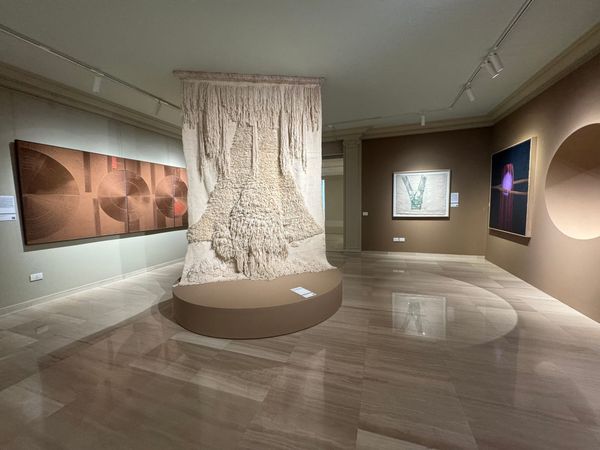
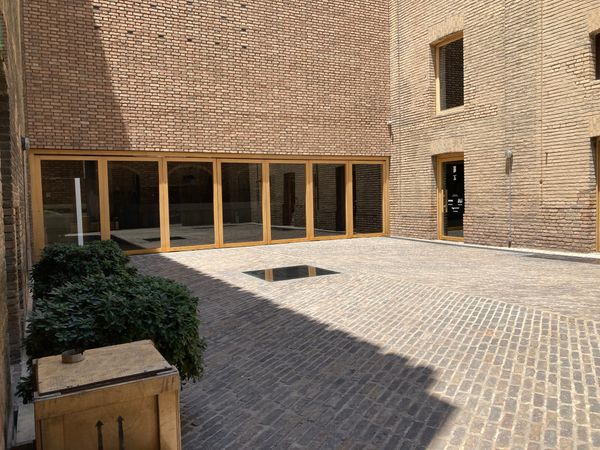
The Pejman foundation works across the Iranian and international art scenes through exhibitions, talks, workshops, publications, research support and cultural exchange. Its main public site, Argo Factory, is a former drink manufacturing factory in central Tehran, first constructed in the early 1920s. After decades of abandonment, the foundation acquired and renovated the building in 2016. Argo has since become one of the city’s most visible independent art spaces, with a scale unusual for the private cultural sector: a reconstructed industrial building with multiple exhibition spaces, a library, event areas and room for large-scale installations. In June 2026, Ghalamdar and Tehran-based artist Abolfazl Harouni presented Rotanomicon, an exhibition of paintings, prints, 3D-printed toys, collected objects and moving image at Kandovan Projects, one of the Pejman Foundation’s exhibition spaces. The exhibition explored how images operate today under the pressures of war and technological systems.
The following interview took place over voice and text messages between March and May 2026 amid the ongoing war. The conversation, which was conducted in Persian and translated into English, has been edited for length and clarity.
Parham Ghalamdar: Take me back to the last day Argo was open in its usual public form, from the moment you arrived to the moment you understood the space could no longer continue as before.
Hamidreza Pejman: I remember exactly the moment when there was no room left for doubt: February 28, 2026, 9:30 in the morning. I was on my way to work. I heard a fighter jet directly overhead and right after it, an explosion. That is how war introduced itself. Without preface. That morning, what was heavier than the explosion itself was not knowing. One week? One year? In the end it lasted 40 days, but on that first day it could have been infinite.
But the last “normal” day was much earlier. What we saw in December 2025 [the mass protests] was not the cause. It was a sign. Inequality accumulated over years produces one thing: a large mass of people who no longer see any share for themselves in the existing order. And when a person sees nothing left to lose, their logic of calculation changes. Desperation by itself does not end in war. Someone has to direct it. That is where outside actors entered. Media outlets and currents that, from a distance, invested in this ready-to-explode energy and pushed it in a direction aligned with their own interests, not with the interests of the very people whose names they were shouting. And on the other side, a government that, instead of responding to the root, reacted to the symptom, and through that reaction sped up the cycle.
Parham: How did you decide that this was the moment to close? I’m interested in the timing: why not sooner, why not later? Was there disagreement inside the team, or did the situation become so compressed that there was no real room left for disagreement?
Hamidreza: Disagreement? There was none. And the fact that there was none was itself the worst news, not the best. In ordinary times, a team is always busy arguing over something: money, dates, whether this or that work should go on the wall. We liked to think those arguments were signs of health. Then that morning came, the sound of a fighter jet over your head, and human life suddenly became the only thing on the table. When that happens, everything else evaporates. “Should we stay open a bit longer?” or “Should we close sooner?” are no longer two sides of a discussion. There is no discussion. As a team, we had always wished to be united over the most important thing. That day we were, and the price was that we no longer had any choice. Disagreement is a luxury. It belongs to someone who has several paths. We had one path.
Parham: That answer cuts against the usual institutional language of consensus. Consensus here is not health; it is pressure. Can you say what thresholds now make public programming impossible for you: movement in the city, internet instability, danger for staff, insurance, legal advice, fear among audiences or something else? At what point does a concern become a red line?
Hamidreza: I have to laugh, because the question assumes there is a line that, once crossed, makes you say, “Right, now it can’t continue.” But that is not the reality of the past year or two. There has been no single red line. We are under pressure from several directions at once, and the pressures are not even aligned with one another. Each comes from a different place, but all of them converge on the same point: the impossibility of standing on any solid ground.
Let me begin with the nearest layer. In April 2026, we were in the middle of a ceasefire–at exactly the moment when, in theory, you should be able to breathe. The Cinematheque, Argo Factory’s in-house film-screening program, which we had forced into existence through sheer effort and which is now in its third year, was holding screenings. At the third screening during the ceasefire, an unknown institution shut it down under the pretext of permits. You think danger belongs to wartime. But no, it was during the ceasefire that they shut the door. The outside threat had receded, and pressure came from inside. It became clear that war was only one pressure among others, not their source.
Look at the paradox: One side wants to suffocate us for staying, the other wants the place in which we stayed to be destroyed altogether. Both, from opposite ends, seem to want the same thing: that Argo should not exist.
The second layer comes from outside, and it is the bitterest one. The diaspora is deeply angry with us that we continue to breathe and work under the supervision of this same government. And the opposition? They are not even that polite; they simply want you dead. The supporters of war and the monarchists do not even hide it: They want Iran to become a scorched land, unlivable, so that their argument can be proven right. Look at the paradox: One side wants to suffocate us for staying, the other wants the place in which we stayed to be destroyed altogether. Both, from opposite ends, seem to want the same thing: that Argo should not exist.
And then there is the third layer, the one with no slogan that simply devours: the economy. A museum, a non-profit foundation, stays alive through wages, rent and bills, not through statements. The marketing budget has been cut. Sponsors have left. Resources have shrunk to the point that even paying salaries is difficult never mind running an ambitious curatorial program. And this is the most ruthless pressure of all, because it is not ethical; it is simply mathematical. You can possess all the courage in the world and still, at the end of the month, the numbers don’t add up.
So where is my red line? It is not one line. Each of these pressures has a different nature. Movement in the city and the internet are operational and can be worked around logistically. Permits and closure belong to the order of power and can only be endured. The economy is more fundamental than all the others because it does not even enter the logic of dialogue. Each of these can be managed on its own. The red line is where all three are active at once, and the remedy for one makes another worse. To get around one obstacle you need to spend money, but there is no money. To compensate for that lack of money, you need to program something, but power will not allow it. The red line is not a point; it is a condition: that moment when you realize no movement is possible anymore without damaging another movement.
Parham: Your website currently has a notice that you are “closed until further notice,” which can sound like an administrative phrase. In your account, it sits inside a much wider collapse of movement, money, permission and trust. So, let me ask it more bluntly: What does closure actually mean at Argo now?
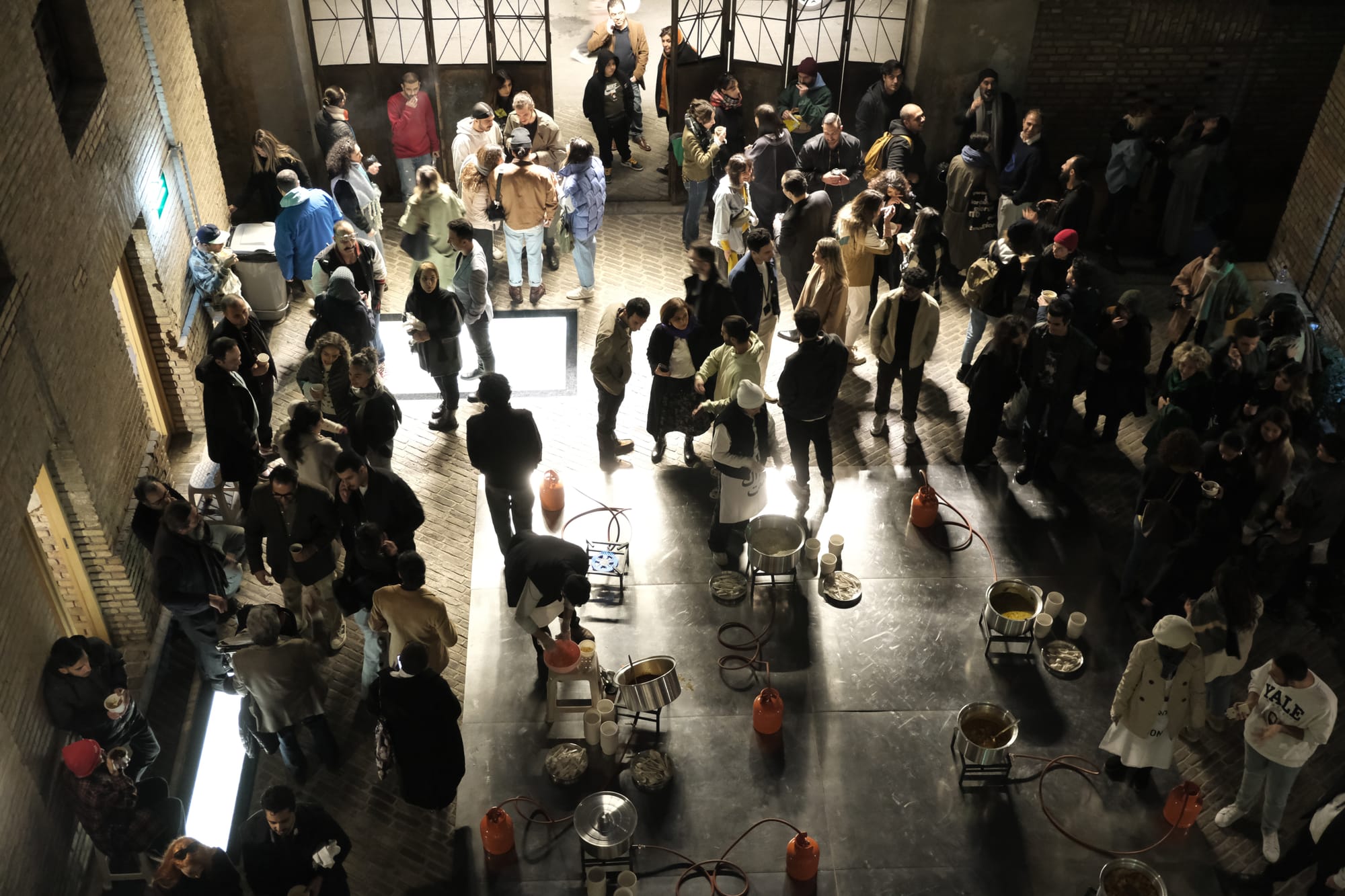
Hamidreza: For us, “closed” means less a stoppage than a change of form. We decided that under conditions that could harm people or increase distances between them we should remain present in a different way. The reality is that in this period, even keeping a space open is no longer merely a practical decision—it can have unintended consequences. That's why this closure is more a matter of caution and responsibility than retreat. We are still working, just not in a way that can be seen from outside. We keep our connections alive, we monitor the situation constantly and we try, as much as possible, not to lose this continuity.
Parham: What continues when the public program stops? What work still happens, and what work cannot happen?
Hamidreza: Naturally, whatever depends on physical presence and a stable situation stops, such as exhibitions and public programs. Our focus is more on preserving the community, taking people’s safety into account and trying to ensure that the team can endure under these unstable social and economic conditions. At the same time, when society as a whole is under this pressure and these internet restrictions, the form of communication simply cannot continue as before. Some connections are cut, some become slower or more limited and that affects the quality and continuity of relationships. The truth is that war and instability do not only disrupt infrastructures. Over time they erode relationships too and distance people from one another. For that reason, we try to preserve that connection wherever possible, even if it becomes smaller, quieter or less visible. Perhaps one could say that in such moments, the institution’s main work is no longer producing programs but preserving a minimum continuity and the possibility of carrying on.
Parham: That is a strong claim: The work becomes the preservation of a minimum continuity. But under blackout conditions, communication is never innocent. It can protect, expose, distort or attract attention. How do you communicate when the internet is unstable or unsafe?
Hamidreza: In such conditions, communication is no longer something immediate or self-evident. It becomes slower, more limited and more dependent on trust. Instead of relying on public spaces, we turn toward smaller, safer circles. At the same time, we try to keep those closest to us within a reliable cycle of news and information. That means sharing what we know more directly and with greater care so that some continuity of awareness about the situation can be preserved. Communication may become less frequent but it also becomes more precise and more deliberate.
On the other hand, the digital space itself is not neutral in such conditions. The pressure of propaganda, both from outside and from within, as well as algorithmic systems, often simplify reality or even rewrite it. What becomes visible is not necessarily an accurate reflection of reality but the result of mechanisms that do not always serve society’s interests. In such a condition, communication is not only a matter of conveying a message but also of discerning, filtering and sometimes even withholding. And perhaps most important of all is knowing what to say, where to say it and when to say it, since that itself becomes a sensitive decision. Sometimes silence is chosen not out of passivity but as a form of care for people and relationships.
Parham: You have talked about how works can be moved or protected. What steps did you take to do so?
Hamidreza: In some cases, we had to move works to safer locations or store the archive digitally so that the information would not be lost if the physical material disappeared. Sensitive equipment was also moved to safe places, and important documents were kept in several different locations.
Parham: Can you give me one specific example of a work, exhibition, meeting or relationship with an artist that the war changed? What was supposed to happen? What changed and who paid the price for that change?
Hamidreza: You want one example, but I cannot give one example. Because war did not ruin one work, it broke a rhythm, and that changes everything.
After the exhibition “Phony Wars” (10 October to 19 December 2025) we had a very important exhibition: “Scenarios” by Jean-Luc Godard. This was not an ordinary item in the calendar; it was the result of everything we had done with Godard over 12 years. The work was supposed to gather everything together. It was meant to open on January 8, 2026. And exactly at that point came the sequence of the January 8 and 9 protests, their aftermath and then the 40-day war. The opening was pushed forward into the first weeks of the ceasefire. This was not the first time one of our schedules had slipped. Delay has always been part of our work. But this time was different. Previously, delay meant the calendar shifted. This time, delay meant you did not know whether Argo itself would ever reopen. Twelve years of work, and it was unclear whether there would even be a place to set down its endpoint. That is no longer delay. It is another kind of thing.
After Godard we had scheduled a rare exhibition of Chris Marker, the late French filmmaker, which still has not opened. At Kandovan, Pejman Foundation’s project and exhibition space separate from Argo Factory, an exhibition by the Tehran-based painter Nava Sabetimani was delayed for a full year because of the same sequence of protest aftermath, war and institutional uncertainty, and has only just opened. None of these has been cancelled. All of them remain in a state of “not yet.” And “not yet” is more exhausting than any cancellation. The foundation’s projects outside of Iran were also shelved entirely because of the economy.
You imagine that the cost of war is the thing that gets destroyed, the work that burned, the door that closed forever. No. The real cost is more hidden: the works that have not died, only remained in limbo. A dead work can be buried and left behind. A suspended work lets you do neither. It doesn’t let you move forward, and it doesn’t let you let go. It keeps you alive on something that is not itself alive.
Who paid the price? Look, I could sit here and say the artist paid the price, the institution paid the price. But the words do not sit right in my mouth. The real price was paid by the soldiers. By the mothers. And then by all those who suffered direct loss, financial or bodily. An exhibition postponed will eventually open one day; a person who is gone does not come back. Those two things cannot be set beside each other, and I will not set them there.
Parham: What has this period changed in your understanding of what Pejman Foundation is meant to preserve?
Hamidreza: More than ever we have understood that what must be preserved is relationships and dialogue. Works and spaces matter, but without a community to make them meaningful, their value diminishes. An institution is not merely a building or a collection of works. It is a network of people, ideas and memories. In a time of crisis, preserving that network becomes more important than anything else. When we cannot mount exhibitions, perhaps our main task becomes preserving memory and relationships. A museum can become a place for recording and preserving collective experience.
Parham: What has become urgent to show, and what has become impossible?
Hamidreza: Works connected to current issues and collective experiences have gained urgency. By contrast, large, long-term projects that depend on infrastructure and stability have, for now, been set aside. At times like these, smaller, lower-risk and more immediately responsive works can have a greater impact.
Parham: What is one thing about the way Argo operates now that you still cannot say publicly? And does that silence protect people, the institution or both?
Hamidreza: I need to stop first at the word “silence.” You assume there is something I am not saying. But let me turn the matter around. What you call silence is, for me, the position itself. Its form is simply different from what you expect.
Look at where the problem lies. You have a society whose civic body is thin, weak, monophonic. And in such a place, everyone finds or builds a platform for themselves and begins to protest. Why? Not because everyone is essentially oppositional but because they do not see another route to agency. Direct protest is the only verb they know because it is the only verb society has left room for, and this is where most people confuse one thing for another: They think the only form of effectiveness is shouting.
...instead of adding one more platform to all those platforms, I want to build a ground on which people can find another route to agency beyond shouting.
I do not accept that. The duty of an art institution is not constant position-taking. In fact, the very reason for a private art institution to exist, at least as I understand it, is to strengthen that same weak civic body, which means that instead of adding one more platform to all those platforms, I want to build a ground on which people can find another route to agency beyond shouting. That is itself a position, perhaps the most radical position one can take in this atmosphere. So, if no direct voice is heard from us that is not silence. It means that we have defined our agency within a non-violent, civic framework. This choice has a cost: We are struck from both sides. Authority pressures us, the opposition slanders us and both ask the same question: Why do you not take a position? My answer is: I have taken one. My position is simply not to shout loudly. My position is to keep that ground alive. And however hard both sides strike, I try to remain committed to that. The moment Argo turns into just another platform, it is no longer Argo; it becomes one of those thousand voices shouting into the void.
Parham: When this period ends, what must the institution do differently?
Hamidreza: We will have to be more flexible and more prepared. Perhaps we will need to build new structures for communication and support, strengthen the archives and create different ways of engaging with society. This period has shown that one cannot rely on a single fixed method.
Parham: Imagine twenty years from now. What do you want Argo to have preserved from this period, and what do you fear will be lost if no one protects it?
Hamidreza: I would want this institution to have preserved the memory and experience of solidarity and resistance. I do not want this time to be forgotten as merely an interruption or a crisis. I fear that if attention is not paid to these experiences, the lessons and human values that took shape under this pressure will be lost. Preserving collective memory and passing it on to future generations is our greatest responsibility.
All of MERIP's analysis is provided without paywalls! Make a donation now to help us keep it that way.