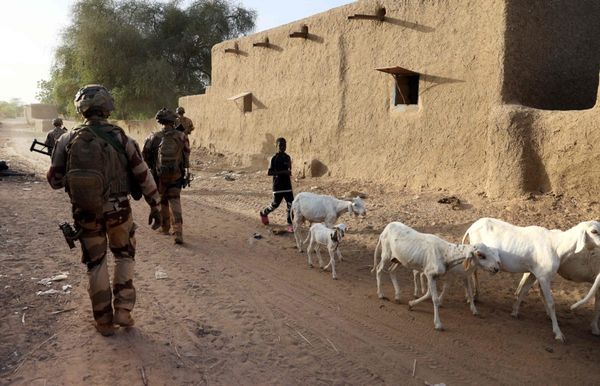

French soldiers patrol the streets of the village of Guintou near Gao on December 4, 2021. Thomas Coex/AFP via Getty Images MER Article Exit France—The Influence of External Actors in the Sahel Region Where France went wrong in Mali. Hannah Rae Armstrong • 11 min read
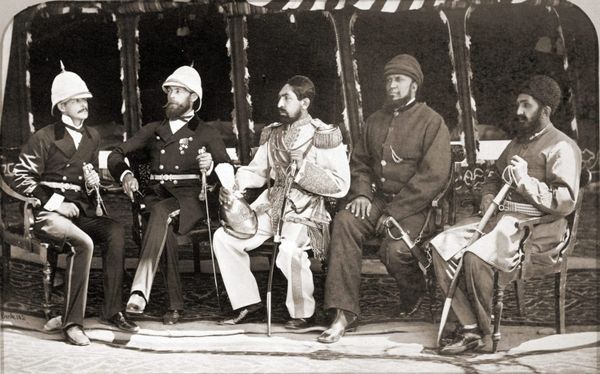
British and Afghan officials at the signing of the Treaty of Gandamak (Major Cavagnari second from left, Amir Yakub Khan in the center), May 1879. Photo by John Burke, public domain, British Library. Current Analysis Afghanistan’s Present Failure Lies in its Past Design Providing a vital historical perspective, Benjamin Hopkins explains how the failure of the American project in Afghanistan had little to do with Afghan corruption or lack of national unity as understood in Washington. While today the problems of the Afghan state—its dependence on foreign aid, lack o Benjamin D Hopkins • 13 min read
Egypt’s Post-2011 Embrace of Russian-Style Misinformation Campaigns Since the 2013 coup, Egypt’s posture vis à vis information and cyber warfare has evolved from a defensive one—geared toward domestic surveillance and blocking—to an offensive one also focused on influence operations abroad. This shift has pulled Egypt further into an open embrace of Russia. Nathaniel Greenberg • 14 min read
libya isis lion Current Analysis Russia Opens Digital Interference Front in Libya The Middle East is increasingly awash with fake news and misinformation campaigns. Russia has become a major vector of these disinformation campaigns, affecting virtually every major flashpoint in the Arab world. It just opened a new info-war front in Libya. Nathaniel Greenberg • 13 min read
Current Analysis Did Russian Intervention Break the Syrian Stalemate? It is now a cliché to say that the Syrian conflict is complicated, and has multiple regional and international drivers [http://merip.org/mer/mer262/new-arab-cold-war-struggle-syria]. Samer Abboud • 4 min read
Current Analysis Notes on Low Oil Prices and Their Implications After about three years of hovering around $110 per barrel, with highs of $125 and lows of $90, oil prices began a precipitous decline in the summer of 2014, reaching a low of $48 per barrel in mid-August 2015 before plummeting to just under $30 per barrel five months later. While investors are no d Miriam R. Lowi • 5 min read
MER Article Regional Responses to the Rise of ISIS Regional responses to the rise of the Islamic State in Iraq and Syria, or ISIS, have varied depending on regime perceptions of threat, not only from ISIS itself, but also from other potential rivals, challengers or enemies. Despite the jihadi group’s extensive use of violence in Syria and Iraq and i Curtis Ryan • 14 min read
Current Analysis To Save Syria, Work with Russia and Iran As the violence intensifies in Syria, external powers, including the United States, are embracing increasingly belligerent positions. Indeed, in recent days the United States and Turkey have announced plans to study a no-fly zone after calls by many American commentators for a more direct military r Aziz Rana, Aslı Bâli • 3 min read
MER Article The Privatization of Russian Middle East Studies The Institute for Oriental Studies in Moscow, once headed by the current Russian foreign minister, Yevgenii Primakov, [1] used to be the premier research establishment for modem history and Soviet policy making concerning the Arab world, Africa and Asia. Like other state-funded academic institutions Garay Menicucci • 7 min read
MER Article New Soviet Thinking on the Middle East Grigorii Grigorevich Kosach teaches at the Academy of Social Sciences in Moscow. Some of his works translated into English include The Comintern and the East (Moscow, 1981), and “Formation of Communist Movements in Egypt, Syria and Lebanon in the 1920s and 1930s, ” in The Revolutionary Process in th Garay Menicucci • 6 min read
MER Article Continuity and Change in Soviet Policy The day after Iraq’s invasion of Kuwait, Soviet Foreign Minister Eduard Shevardnadze and US Secretary of State James Baker announced what they termed “an unusual step.” They issued a communique “jointly urging the international community to join them and suspend all supplies of arms to Iraq on an in Alain Gresh • 18 min read
MER Article Halliday, From Kabul to Managua Fred Halliday, From Kabul to Managua: Soviet-American Relations in the 1980s (Pantheon, 1989). To give an account, in a mere 163 pages, of Soviet-American competition in the Third World is no mean feat. After all, this rivalry has lasted nearly half a century and its form has varied considerably. M Rajan Menon • 2 min read