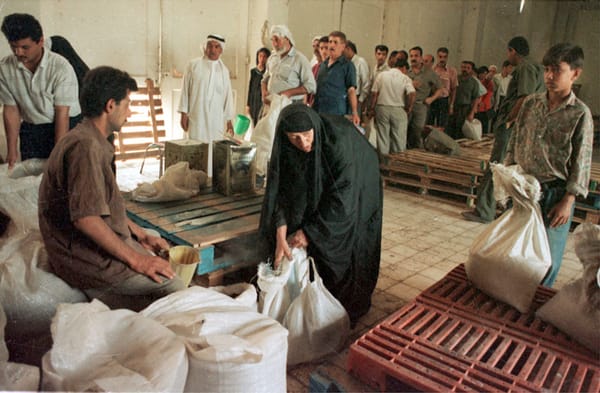

Iraqis receive food rations in Baghdad, June 2000. Faleh Kheiber/Reuters MER Article The Enduring Lessons of the Iraq Sanctions The economic sanctions imposed on Iraq by the United Nations Security Council, from 1990 to 2003, may well lay claim to be the worst humanitarian catastrophe ever imposed in the name of global governance. The unconscionable human damage done by those sanctions is routinely dismissed as the unintended consequence of Joy Gordon • 14 min read
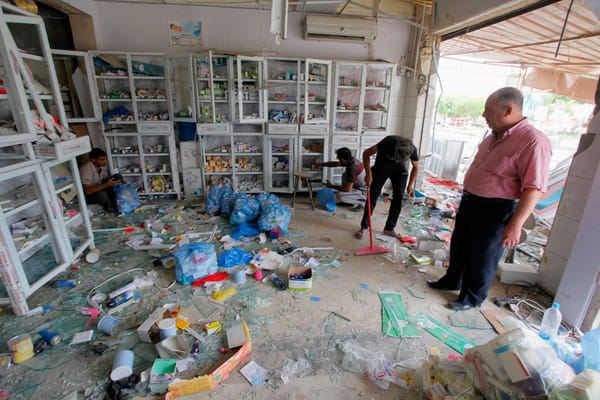
Men sweep debris from a damaged pharmacy, located near the site of a car bomb attack, in the city of Hilla, 2014. Alaa Al-Marjani/Reuters Current Analysis From the Archive: Iraqibacter and the Pathologies of Intervention As Iraq now confronts the arrival of COVID-19, its war-damaged medical infrastructure and degraded environment will make it harder to combat the virus. In 2019, Omar Dewachi explained how these same conditions transformed innocuous bacteria into dangerous drug-resistant strains. Omar Dewachi • 14 min read
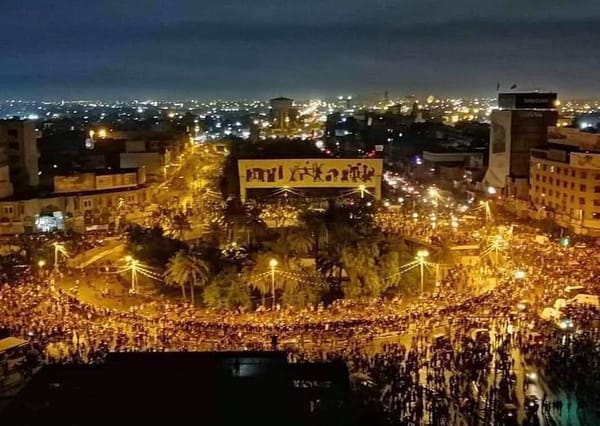
Iraqi_protests_in_October_2019_(Liberation_square) Current Analysis Iraqi Protesters Thwarted by Trump's Iran Policy The recent US assassination of Iranian Maj. Gen. Soleimani has had dire consequences for the Iraqi protest movement and its calls for substantive changes in the Iraqi political system. Yousef K. Baker • 10 min read
Iraqis Demand a Country Chanting “We want a country,” the youth-led protesters of Iraq are demanding nothing less than a new country as the uprising goes beyond narrowly defined political demands concerning electoral politics and legal reforms. Zahra Ali • 10 min read
MER Article Weaponizing Iraq’s Archives The Bush Administration’s exploitation of Iraqi state archives for atrocity material to justify its failing 2003 invasion of Iraq was based on precedent. The genealogy of exploiting Iraqi archives for political ends serves as a warning for how the self-evidently virtuous notion of human rights can b Wisam H. Alshaibi • 19 min read
MER Article Humanitarian Crisis Research as Intervention Sarah Parkinson describes the growing popularity of extreme research—scholarly research conducted in crises zones amongst conflict-affected populations in the Middle East and North Africa—and shows how this research is a mode of intervention that can impose serious harm on individuals, communities, Sarah Parkinson • 15 min read
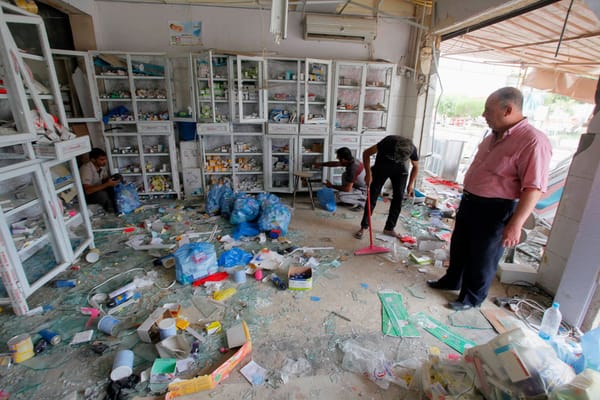
Men sweep debris from a damaged pharmacy, located near the site of a car bomb attack, in the city of Hilla, 2014. Alaa Al-Marjani/Reuters MER Article Iraqibacter and the Pathologies of Intervention Omar Dewachi traces the rise of antibiotic resistant bacteria in war-related wounds—which US military doctors labelled Iraqibacter—to the biological legacy of decades of sanctions, war and intervention in Iraq. Omar Dewachi • 14 min read
Current Analysis Preservation or Plunder? The ISIS Files and a History of Heritage Removal in Iraq The removal of the ISIS files from Iraq is only the latest episode in a long history of seizures of Iraqi archives and artifacts by Europeans and Americans. Rather than dismiss Iraqi critics as unreasonable, everyone with a stake in the study of Iraq—including all journalists, historians, and archiv Arbella Bet-Shlimon • 18 min read
MER Article Iraq Dispatch I have been conducting research in Iraq—in Basra and the outskirts of Tikrit—for roughly the last six months. Since Donald Trump’s election as US president in November 2016, when someone discovers that I live and work in the US, I am usually asked, “That friend of yours [Trump], what’s wrong with hi Hayder al-Mohammad • 4 min read
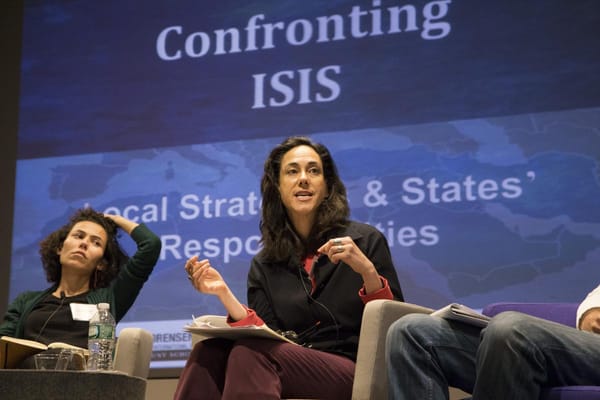
276_schwedler MER Article “ISIS Is One Piece of the Puzzle” Yifat Susskind is executive director of MADRE, an international women’s human rights organization based in New York. Jillian Schwedler spoke with her on October 28, 2015, the week after Yanar Mohammed, head of MADRE’s partner group the Organization of Women’s Freedom in Iraq (OWFI), testified before the Jillian Schwedler • 12 min read
MER Article Regional Responses to the Rise of ISIS Regional responses to the rise of the Islamic State in Iraq and Syria, or ISIS, have varied depending on regime perceptions of threat, not only from ISIS itself, but also from other potential rivals, challengers or enemies. Despite the jihadi group’s extensive use of violence in Syria and Iraq and i Curtis Ryan • 14 min read
Current Analysis Another Benghazi “We didn’t want another Benghazi.” Oh no, is that really why the Obama administration decided to bomb Iraq [http://www.nytimes.com/2014/08/09/world/middleeast/fear-of-another-benghazi-drove-white-house-to-airstrikes-in-iraq.html?hp&action=click&pgtype=Homepage&version=LedeSum&module=a-lede-package-r Chris Toensing • 5 min read