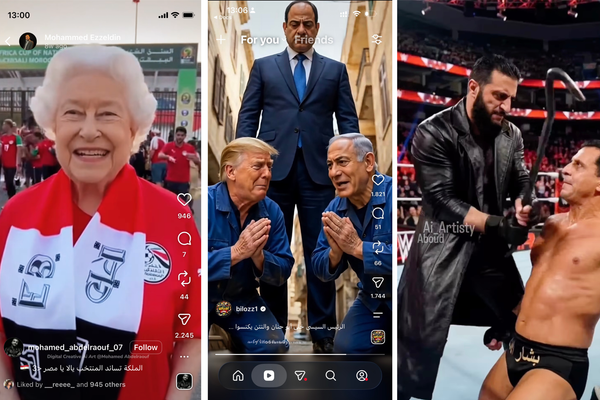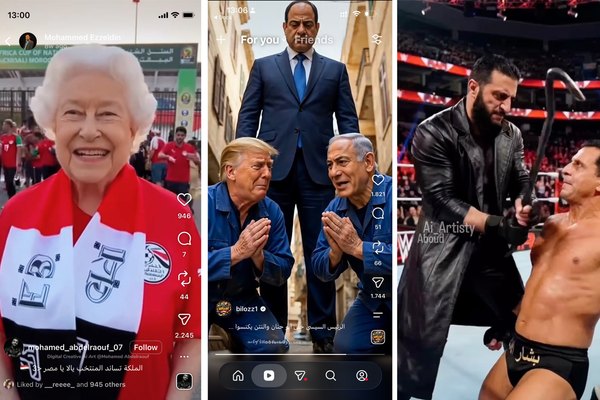
In April 2026, a 15-second Instagram reel depicting US President Donald Trump and Israeli Prime Minister Benjamin Netanyahu as janitors cleaning a dirty men’s room went viral. Netanyahu says in broken Egyptian Arabic: “Clean the toilet properly, you Trump boy, before the Protector of Egypt, President Sisi comes [sic].” President Abd al-Fattah al-Sisi then appears in a well-fitted suit, shouting, “Why isn’t the toilet clean, you dogs?” He hits Trump in the face, sending him and Netanyahu to the ground crying. A few weeks later, the same creator, bilozz1, uploaded a second version with an almost identical script that achieved less virality, in which Trump and Netanyahu are cleaning dishes in a kitchen, trying to finish their job faster to avoid Sisi’s retaliation. Days later, the creator published a third version set in a fictional Egyptian alley, with Trump and Netanyahu both dressed as street cleaners. Sisi has longer lines: “You guys are completely useless. You don’t get anything done; you’re good for nothing.” The camera moves to a lower angle, depicting Sisi as a towering figure while the two other politicians on the ground respond: “We apologize to you, savior of Egypt. Forgive us!” He kicks them in the face.

Screenshots from an AI-generated reel by bilozz1.

These reels exemplify a peculiar form of what is loosely referred to as AI slop: cheaply produced, AI-generated content designed for rapid circulation. Over the past year, many sub-genres of AI slop have appeared and disappeared: from “Italian Brainrot to anthropomorphized cats to the talking vegetables and fruits who get married, cheat and fight over custody of their children in simplistic, sensationalist and misogynistic plots. Some of this slop takes the form of political commentary, used by everyone from the president of the United States to dispersed networks of gig workers on the fringes of the internet.

Despite their hyperrealist rendering, these videos have a tacky aesthetic. Their voice-over occasionally breaks, and the lip-sync glitches as the AI voice fails to articulate convincing accents. The stories often play on raw, heightened emotions of fear, anger and regret. Yet, on the Arabic-speaking internet amid Israel’s ongoing genocide in Gaza and the subsequent US and Israeli-led regional war, a specific unnamed political subgenre has emerged, particularly in Egypt and Syria. It is centered around recycling conservative gendered stereotypes in absurdist forms that play on humiliating Western leaders while exaggerating local nationalist masculinity and sovereignty. These spectacles appear in the social media feeds of users exhausted from doomscrolling their way through reels of human suffering in Gaza, Lebanon and Iran.

This new cultural form of short AI-generated videos does not sit neatly within the categories of propaganda or satire. They center banality rather than offer a political argument. Their length is optimized to engage the largest number of viewers, and successful plots are turned into reproducible formulas with the hope that the next version will garner even more attention. These reels become the smallest atomic unit of the internet; they slide into users’ direct messages as trivia and appear in their stories, only to be quickly forgotten. Their comment sections are loaded with memes, emojis and mentions, but rarely any substantial conversation. Despite its intriguing aesthetics, Arab AI political slop cannot be understood through its representations alone. The visualization and circulation of these political fantasies is emerging at the intersection of authoritarian rule, platform capitalism and the rapid diffusion of generative AI tools during a period of genocidal violence in Palestine and broader regional war.

Arab AI political slop cannot be understood through its representations alone.

Spectacles of Humiliation, Fantasies of Sovereignty

Arab political AI slop is a messy genre of short reels that cannot yet be easily divided into categories, mainly because as a new phenomenon it is still unfolding. Like most viral online content, these videos travel beyond their creators to the point that their origin may become impossible to detect. AI slop gets downloaded, uploaded and edited to acquire new meanings. Yet masculinity structures many of the genre’s recurring narratives, from the humiliation and emasculation of male enemies to the domestication and banalization of female leaders, all while cultivating fantasies of hyper-sovereignty.

The fantasy of sovereignty often takes the form of the Arab leader appearing taller, stronger and more physically dominant than his Western counterparts, as seen in the depiction of Sisi across the three iterations of the same reel. Sometimes, old propagandistic images are simply animated. The famous images of Sisi paired with a lion or an eagle during his 2013 presidential campaign, for example, reappear in a variety of AI-generated animations that circulate across platforms and are claimed by pro-state media outlets and aspiring supporters. In other instances, real news footage of Sisi and Netanyahu at a press conference is edited to show the former violently beating up the latter. A video that appeared only a few days into the US and Israeli bombardment of Iran shows Trump wiping Sisi's shoes while crying and begging, “Please rid us of Iran. We are about to die. You can annihilate the world.” Sisi replies: “This is your problem, solve it yourself. I am only in service to my people.”

There is something staggering about these depictions of Sisi, which exaggerate state propaganda to the point of absurdity. Even committed supporters of the Egyptian regime might cringe at such imagery, fully aware of Egypt's political and economic dependence on the United States. Yet this absurdity allows the creators to achieve the virality they need to monetize content without political risks. Since the government passed Egypt's Anti-IT Crimes Act and Media Law No. 180 of 2018, political commentators on social media and even ostensibly apolitical TikTok influencers have been arrested in recurring waves on charges ranging from "publishing offensive content" to “violating family values." Few aspiring AI creators are willing to take the risk of publishing critical content, so they instead push official narratives to such exaggerated extremes that they become banal, nonsensical and strangely catchy.

While local leaders are elevated into towering figures, Western leaders are subjected to the opposite treatment. They are beaten, slapped, made to clean toilets, cry, beg and kneel. One Instagram reel depicts Netanyahu and Trump locked inside a mental asylum. As they attempt to escape, they are caught by Iran’s former supreme leader, Ayatollah Ali Khamenei, and Korean dictator, Kim Jong Un, who laugh while beating them up. Another reel depicts Kim as a teacher in a classroom spanking Netanyahu and Trump while Khamenei laughs. Unlike traditional political satire, these videos rarely rely on irony, parody or critique. Instead, they present emotionally satisfying spectacles of revenge.

Unlike traditional political satire, these videos rarely rely on irony, parody or critique. Instead, they present emotionally satisfying spectacles of revenge.

Humiliation is also bestowed on former Arab leaders like Syrian President Bashar al-Asad. In December 2025, days after the first anniversary of his fall, an Instagram reel went viral depicting him wrestling the current Syrian president, Ahmed al-Sharaa, in a dramatic WWE match. Asad enters the ring wearing tight black trunks like The Rock, accompanied by one of the most recognizable songs of his former propaganda campaigns. Sharaa enters as The Undertaker. He beats Asad, whose body glitches awkwardly and at one point appears to have two left hands. When Sharaa wins the championship belt, now reading "Syria Is Free," the voice-over calls Takbir, and a crowd erupts, “Allah.” Here, the visual errors of AI generation form part of the spectacle.

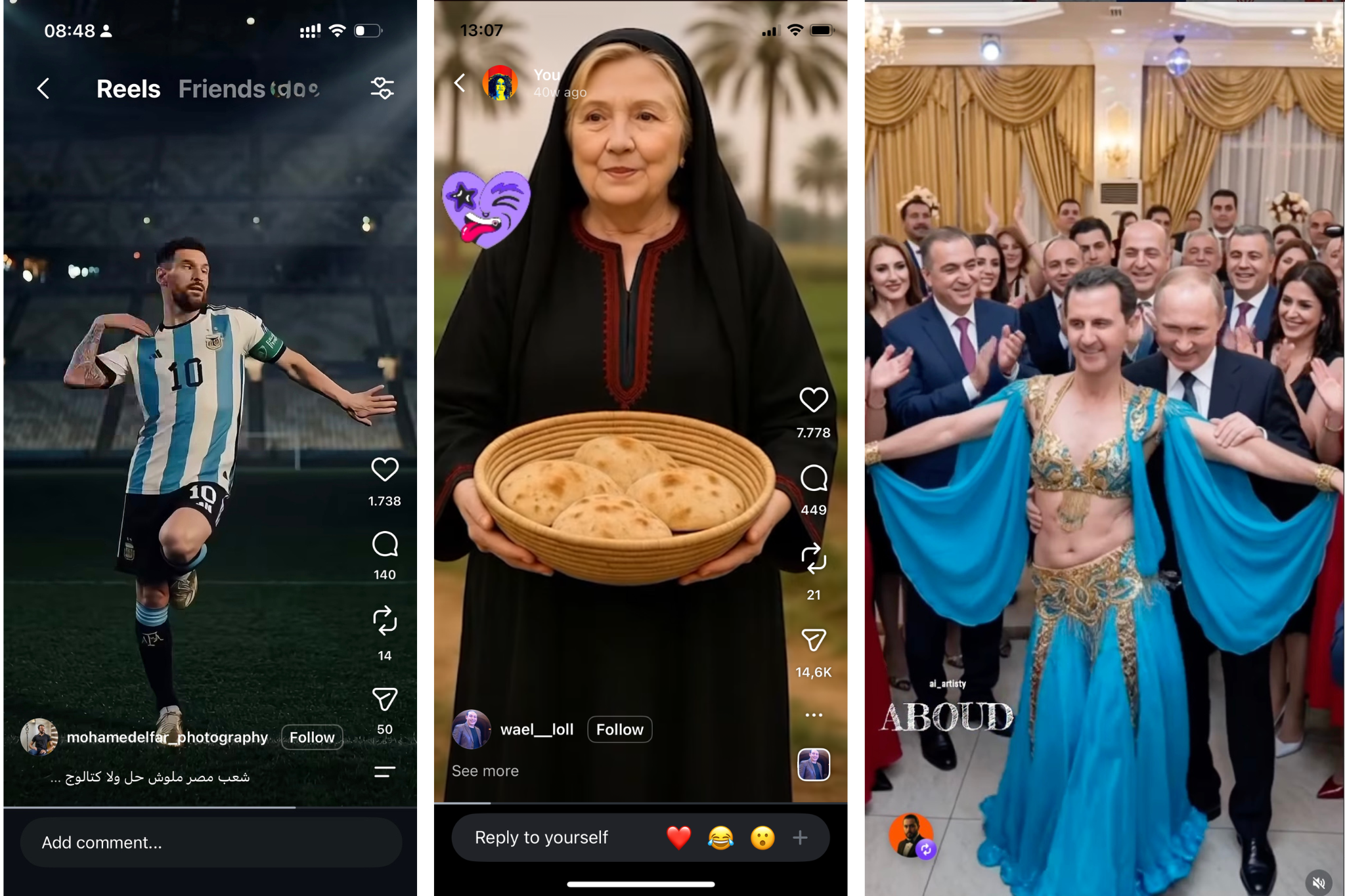
The ultimate form of humiliation in this genre of AI slop is emasculating male figures by feminizing them. Bashar al-Asad became the primary target of such efforts after he was no longer a threat to Syrians. In one reel, he appears as a belly dancer alongside members of his family, paraded by Vladimir Putin in an Arab wedding procession. In another, he dances beneath banners reading "Don't follow me, I am engaged" and "Circumcision for boys." The release of the Jeffrey Epstein files, in late 2025, prompted a wave of Arab AI reels that feminized Trump. Similar patterns emerged after Egypt's match against Argentina in the 2026 World Cup. Conspiracy theories alleging FIFA had rigged the tournament coalesced with Argentinian football star Lionel Messi's long history of support from Israeli politicians and the Egyptian coach's very public support for Palestine. AI reels responded by depicting Messi, FIFA president Gianni Infantino and the match referee as belly dancers or pole dancers—as if humiliation reaches its peak when masculine authority is stripped away.

Screenshots of AI slop featuring Messi, Hillary Clinton and Bashar al-Asad.

Female public figures undergo a different transformation. Rather than being cast as political enemies, they are relocated into familiar domestic roles. Former US Secretary of State Hillary Clinton and the famous twentieth-century Egyptian singer Umm Kulthum appear as peasant women baking kahk for Eid. Britain’s Queen Elizabeth becomes an endearing grandma supporting Egypt’s Al Ahly football club, a food blogger reviewing a Koshari cart and a kebab restaurant or even a local Tradwife sharing her morning routine and strolling the streets of Cairo. As their political identities are dissolved into recognizable archetypes of domestic femininity, these female figures are rendered ordinary and unthreatening. Some of the reels circulate around particular annual festivities to function as digital greeting cards; others are low-key advertisements for local small businesses.

Across these different narratives, politics is replaced with caricatures of familiar gendered hierarchies that offer little critical insight into the conflicts they depict. This cultural form’s recurring aesthetic choices, along with its glitches (by-products of poor AI rendering and inexperienced creators), are characterized by emotional excess, exaggeration, sentimentality, repetition and bad imitation that echo a much longer history of mass-produced visual culture.

The Return of Kitsch

Kitsch is an aesthetic that refers to tacky or gaudy art objects. It emerged in the nineteenth century against the backdrop of the Industrial Revolution to meet the demands of a rising petit-bourgeois class that sought to mimic aristocratic taste through cheaply mass-produced artifacts. Some critics dismiss it as vulgar imitation. Others see it as a transgressive aesthetic capable of unsettling cultural hierarchies.[1] Yet, to read kitsch as simply a matter of good or bad taste would be an oversimplification. Kitsch, like AI slop, is a cultural form born of commodification, mass production and class aspiration.

Kitsch, like AI slop, is a cultural form born of commodification, mass production and class aspiration.

Digital kitsch is simply a new phase in the long history of kitsch. Whereas the Industrial Revolution facilitated the production of cheap mechanical objects, the generative AI boom has dramatically intensified the scale through which digital copies can be produced and circulated. As its name suggests, generative (or Gen) AI claims the ability to automatically generate texts, images, voices and animations in enormous quantities, with tremendous speed and at minimal costs. In recent years, multiple lawsuits have been filed against AI companies for training their large language and image-generation models on copyrighted materials by artists and writers, often scraped from the internet by web-crawling companies and data brokers. The generative in Gen AI thus depends on remixing and extracting human labor. Moreover, the business model of these platforms ensures immense profits for their shareholders while incurring staggering environmental costs.

Historically, the relationship between kitsch and fascism has troubled cultural scholars. The twentieth-century German philosopher Theodor Adorno warned against its capacity to manipulate and falsify mass consciousness, describing it as evoking “fictional feelings in which no one is actually participating, and thus [leads to] the neutralization of these feelings.”[2] To Adorno, kitsch was the antithesis of art. The latter challenges the audience, while the former pacifies and demobilizes viewers by offering the illusion of participation. Around the same time, the German cultural critic Walter Benjamin reflected on how industrial capitalism transformed the conditions of artistic reproduction. It stripped artworks of their aura while enabling their mass circulation, whether as part of revolutionary or fascist projects.[3]

Today’s Arab political AI slop is an algorithmically optimized form of digital kitsch, different from propaganda that aims to convince and mobilize the masses. The creators of contemporary reels rarely seek to persuade, instead they aim to capture attention. Their success depends on interruption. They must stop the user’s scroll, hold attention for a few more seconds and satisfy the opaque demands of platform algorithms. Because algorithms reward repetition, this genre endlessly recycles familiar imagery, successful plots and emotional fantasies. Like the industrial kitsch that concerned Adorno, AI slop is a product that offers emotional release and circulates through systems of mass reproduction. Yet its politics remain open. As Benjamin observes, the same infrastructures that can reproduce fascist fantasies can also circulate images that exceed or undermine them.

The Lumpen Proletariats of the Digital Age

Although the content they produce is often dismissed as AI slop, it remains deeply dependent on human labor and requires a wide range of artistic, technical and entrepreneurial skills. Indeed, behind Arab AI slop reels lie a growing workforce of aspiring creators trying to make a living on platforms that promise far more than they ultimately provide. By observing dozens of Egyptian and Syrian AI slop accounts, their tutorials, discussions on freelancer forums and exchanges on Reddit, a clearer picture of this labor begins to appear. Some creators are highly skilled animators and editors experimenting with new tools. Others simply churn out content in the hope that one video might go viral, thus increasing their earnings by either establishing a direct relationship with small businesses in search of advertising or via the monetization schemes of the platforms themselves that remain murky, inconsistent and hard to understand. 

Behind Arab AI slop reels lie a growing workforce of aspiring creators trying to make a living on platforms that promise far more than they ultimately provide.

Many of these content creators are young men aspiring to enter the media, animation and advertising industries, which have long been dominated by established elite networks. They use AI-generated reels to showcase their animation, editing and voice-over skills as well as to generate income. A scroll through their Instagram or TikTok accounts reveals profiles that resemble creative portfolios, often devoid of a clear political point of view. Some openly advertise AI-generated commercial content and invite potential clients to collaborate. Others began as online gamers, streaming their gameplay or selling gaming-related merchandise before moving into AI production. Many supplement their income by selling online courses, often priced around $90, that promise aspiring creators insider knowledge about AI tools, content strategies and monetization schemes for Meta and TikTok.

Yet it is difficult to find out who these creators actually are. In the world of Arab AI slop, real identities are often concealed behind pseudonyms such as bilozz1, the creator of the three variations of the Sisi reel, or generic usernames such as yassa70000. Since communication is typically restricted to business inquiries rather than the curiosity of journalists or researchers, I was unable to talk to them directly. Unlike influencers who cultivate public personas, many AI slop creators deliberately remain faceless, allowing the content rather than the creator to circulate. Some who gain confidence in their skills, like Refaat Rashed, reveal their identities and become influencers whose content centers on teaching their followers how to perfect AI-generated videos.

These tutorials reveal how quickly AI production has become a learnable craft. Ever since social media platforms introduced monetization schemes that reward viral short-form videos, aspiring content creators have been in what journalist Taylor Lorenz has called a digital “gold rush” to learn AI tools that make production faster and cheaper. They use ChatGPT to write plots, Nanno Banana to generate images, Google Vids and CapCut to edit videos. The arsenal of these AI tools changes rapidly, but so do the learned skills. Thousands of online tutorials teach aspiring creators how to optimize hooks, run faceless accounts, manipulate algorithms and scale up from nano- to mega-influencers. In the end, it is an attention economy, and these are aspiring gig workers. According to a report by Al Jazeera, while AI slop circulates globally, it is mainly produced in the Global South, in economically devastated countries where currency exchange rates and lower costs of living can turn the modest payouts from platforms into a lucrative opportunity.

Discussions on Arabic Reddit's freelancer forums reveal an even broader social world behind these videos. Many aspiring creators cannot afford paid courses, and they struggle with the English-language interfaces of AI tools. They rely on crowd-sourced libraries of translated prompts and instructions shared through Google Docs, Reddit threads and lengthy Facebook posts. These informal knowledge archives circulate through personal networks, allowing newcomers to teach themselves rapidly evolving AI workflows. Some creators arrive after years in other precarious digital jobs, such as call-center work, while others are still in high school and simply looking to earn extra income. Most cannot afford paid subscriptions and instead work within the limits of free trial versions.

Producing AI slop is not completely effortless. An experienced user can generate a ten-second reel in around five minutes, but creators relying on free accounts are limited to only a handful of experiments each day. Arab content creators on Reddit repeatedly complain about the opaque and inconsistent payment rates that vary based on engagement metrics, hashtag optimization, posting frequency, geography and invitation-only monetization programs. They share links to revenue calculators to help predict their income and YouTube tutorials on how to better monetize in a local Arab context. Yet, despite these tools, many express on Reddit and online forums that they have failed to achieve the promised goals. Uncertainties about how the monetization schemes actually work and what content will go viral push creators to churn out as much as possible to enhance their chances of success. They become trapped on these platforms as both workers producing content and consumers seeking tools and instruction.

These aspiring workers at the margins of platform capitalism resemble what Karl Marx and Fredric Engels described as the lumpen proletariat of the Industrial Revolution.[4] These were workers who operated outside stable wage labor and survived through informal, precarious means.[5] Yet with the AI technological revolution, these conditions have become pervasive. AI content creators belong to different social strata and enjoy varying degrees of privilege and social capital, but they do not own the infrastructure on which they depend, nor are they guaranteed wages for their labor. Instead, they continually speculate with their time and skills, hoping that one reel might break through and transform their lives. The political possibilities of Arab AI slop—whether it serves fascist or revolutionary ends—is equally unsettled. For the tech companies that profit off of the labor of AI slop workers, the politics is beside the point; whoever captures attention and cracks the algorithmic codes wins.

[Nermin Elsharif is an assistant professor in the department of Media and Culture, Utrecht University.]

SUPPORT MERIP

All of MERIP's analysis is provided without paywalls! Make a donation now to help us keep it that way.

DONATE NOW!

[1] Susan Sontag, “Notes on ‘Camp,’” in Against Interpretation and Other Essays (New York: Penguin, 1964). Andrew Ross, No Respect: Intellectuals and Popular Culture (Abingdon, UK: Routledge, 2014).

[2] Theodor Adorno, Aesthetic Theory, Gretel Adorno and Rolf Tiedemann, eds. Robert Hullot-Kentor, trans. (London: Continuum, 2002), p. 239.

[3] Walter Benjamin, “The Work of Art in the Age of Its Technological Reproducibility,” in The Work of Art in the Age of Its Technological Reproducibility and Other Writings on Media, Michael Jennings et al., eds. (Cambridge, MA: Harvard University Press, 2008).

[4] I am grateful for discussions with Mohamed Said Ezz El-din on the laborers of AI Slop and to the members of the Humanistic Inquiry and Theory group (HIT) of the Institute for Advanced Studies in the Global South, NWU-Qatar for their prolonged and profound engagement with my examination of kitsch and fascism.

[5] Clyde Barrow, The Dangerous Class: The Concept of the Lumpenproletariat (Ann Arbor: University of Michigan Press, 2020).

Share this post

Written by

Nermin Elsherif is an assistant professor in the department of Media and Culture, Utrecht University.

Yemen After the Saudi-Emirati Split

Susanne Dahlgren 11 min read

Rethinking Political Change in Iran from Protest to War

Mohammad Ali Kadivar 11 min read

NEW: ‘Closed Until Further Notice’ – Keeping a Tehran Art Institution Alive During Wartime

NEW: Yemen After the Saudi-Emirati Split

James Ryan, Susanne Dahlgren 1 min read

Yemen After the Saudi-Emirati Split

Susanne Dahlgren 11 min read