NEW: ‘Closed Until Further Notice’ – Keeping a Tehran Art Institution Alive During Wartime
Dear Friends and Comrades,
The US and Israeli war has altered daily life in Iran. Between airstrikes that have destroyed basic infrastructure across the country and a regime bent on repressing political expression, the institutions that sustain cultural life have had to navigate some perilous straits.
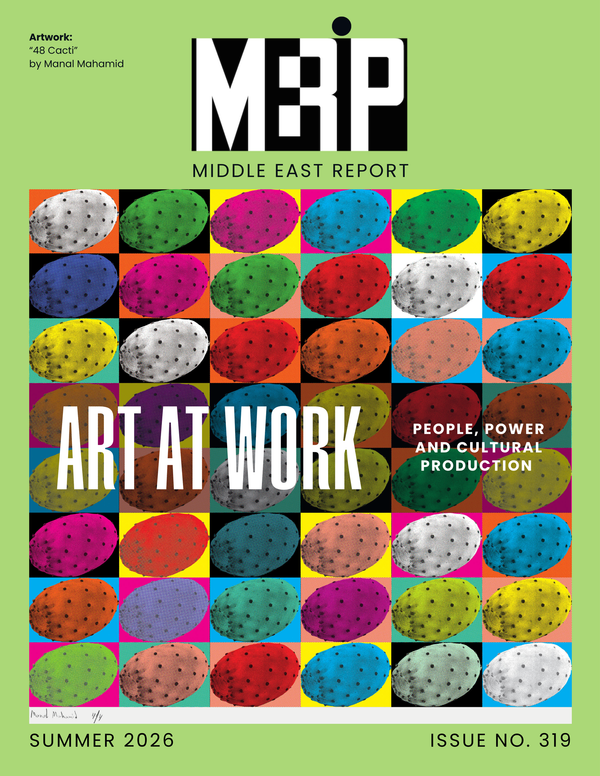
Today we are sharing a preview of our upcoming summer issue of Middle East Report, Art at Work. "‘Closed Until Further Notice’–Keeping a Tehran Art Institution Alive During Wartime" is an interview with Hamidreza Pejman, the founder and director of the Pejman Foundation, a non-profit contemporary art foundation that has been operating in Tehran since 2015. In his conversation with Manchester-based artist Parham Ghalandar, Pejman discusses the multiple pressures that led to the decision to temporarily close the Foundation’s main gallery space, Argo Factory. As Pejman recounts, it is not only the war that has affected the gallery’s relationships with artists and the arts community. The crumbling economy, diaspora pressures and regime restrictions all shape the role cultural institutions play in Iranian society and lead to painstaking and difficult decisions.
“In ordinary times, a team is always busy arguing over something: money, dates, whether this or that work should go on the wall. We liked to think those arguments were signs of health. Then that morning came, the sound of a fighter jet over your head, and Human life suddenly became the only thing on the table. When that happens, everything else evaporates. ‘Should we stay open a bit longer?’ or ‘Should we close sooner?’ are no longer two sides of a discussion. There is no discussion. As a team, we had always wished to be united over the most important thing. That day we were, and the price was that we no longer had any choice. Disagreement is a luxury. It belongs to someone who has several paths. We had one path.”
You can read a longer excerpt of this piece below, and the full piece on our website.
We look forward to sharing more previews of Art at Work as we lead up to the release later in August. We are thankful for the support of our readers–we rely on donations to continue to produce Middle East Report as a resource for all. Please consider chipping in today.
In Solidarity,
James Ryan
Executive Director
MERIP relies on support from our readers to publish, edit and host articles like this one. Become a supporter today!
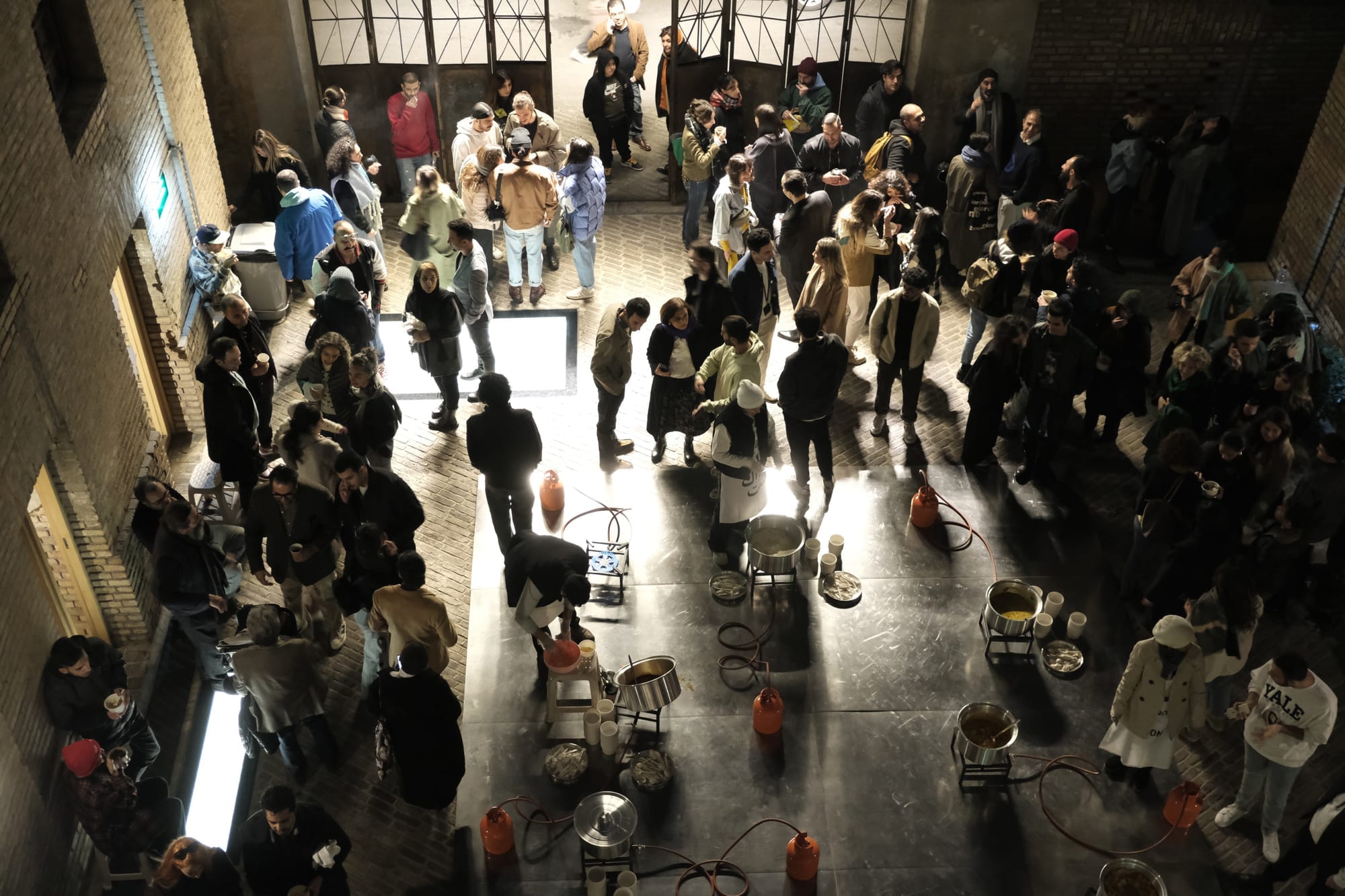
The following interview took place over voice and text messages between March and May 2026 amid the ongoing war. The conversation, which was conducted in Persian and translated into English, has been edited for length and clarity.
Parham Ghalamdar: Take me back to the last day Argo was open in its usual public form, from the moment you arrived to the moment you understood the space could no longer continue as before.
Hamidreza Pejman: I remember exactly the moment when there was no room left for doubt: February 28, 2026, 9:30 in the morning. I was on my way to work. I heard a fighter jet directly overhead and right after it, an explosion. That is how war introduced itself. Without preface. That morning, what was heavier than the explosion itself was not knowing. One week? One year? In the end it lasted 40 days, but on that first day it could have been infinite.
But the last “normal” day was much earlier. What we saw in December 2025 [the mass protests] was not the cause. It was a sign. Inequality accumulated over years produces one thing: a large mass of people who no longer see any share for themselves in the existing order. And when a person sees nothing left to lose, their logic of calculation changes. Desperation by itself does not end in war. Someone has to direct it. That is where outside actors entered. Media outlets and currents that, from a distance, invested in this ready-to-explode energy and pushed it in a direction aligned with their own interests, not with the interests of the very people whose names they were shouting. And on the other side, a government that, instead of responding to the root, reacted to the symptom, and through that reaction sped up the cycle.
Parham: How did you decide that this was the moment to close? I’m interested in the timing: why not sooner, why not later? Was there disagreement inside the team, or did the situation become so compressed that there was no real room left for disagreement?
Hamidreza: Disagreement? There was none. And the fact that there was none was itself the worst news, not the best. In ordinary times, a team is always busy arguing over something: money, dates, whether this or that work should go on the wall. We liked to think those arguments were signs of health. Then that morning came, the sound of a fighter jet over your head, and Human life suddenly became the only thing on the table. When that happens, everything else evaporates. “Should we stay open a bit longer?” or “Should we close sooner?” are no longer two sides of a discussion. There is no discussion. As a team, we had always wished to be united over the most important thing. That day we were, and the price was that we no longer had any choice. Disagreement is a luxury. It belongs to someone who has several paths. We had one path.
Parham: That answer cuts against the usual institutional language of consensus. Consensus here is not health; it is pressure. Can you say what thresholds now make public programming impossible for you: movement in the city, internet instability, danger for staff, insurance, legal advice, fear among audiences or something else? At what point does a concern become a red line?
Hamidreza: I have to laugh, because the question assumes there is a line that, once crossed, makes you say, “Right, now it can’t continue.” But that is not the reality of the past year or two. There has been no single red line. We are under pressure from several directions at once, and the pressures are not even aligned with one another. Each comes from a different place, but all of them converge on the same point: the impossibility of standing on any solid ground.
Let me begin with the nearest layer. In April 2026, we were in the middle of a ceasefire–at exactly the moment when, in theory, you should be able to breathe. The Cinematheque, Argo Factory’s in-house film-screening program, which we had forced into existence through sheer effort and which is now in its third year, was holding screenings. At the third screening during the ceasefire, an unknown institution shut it down under the pretext of permits. You think danger belongs to wartime. But no, it was during the ceasefire that they shut the door. The outside threat had receded, and pressure came from inside. It became clear that war was only one pressure among others, not their source.
The second layer comes from outside, and it is the bitterest one. The diaspora is deeply angry with us that we continue to breathe and work under the supervision of this same government. And the opposition? They are not even that polite; they simply want you dead. The supporters of war and the monarchists do not even hide it: They want Iran to become a scorched land, unlivable, so that their argument can be proven right. Look at the paradox: One side wants to suffocate us for staying, the other wants the place in which we stayed to be destroyed altogether. Both, from opposite ends, seem to want the same thing: that Argo should not exist.
And then there is the third layer, the one with no slogan that simply devours: the economy. A museum, a non-profit foundation, stays alive through wages, rent and bills, not through statements. The marketing budget has been cut. Sponsors have left. Resources have shrunk to the point that even paying salaries is difficult never mind running an ambitious curatorial program. And this is the most ruthless pressure of all, because it is not ethical; it is simply mathematical. You can possess all the courage in the world and still, at the end of the month, the numbers don’t add up.
So where is my red line? It is not one line. Each of these pressures has a different nature. Movement in the city and the internet are operational and can be worked around logistically. Permits and closure belong to the order of power and can only be endured. The economy is more fundamental than all the others because it does not even enter the logic of dialogue. Each of these can be managed on its own. The red line is where all three are active at once, and the remedy for one makes another worse. To get around one obstacle you need to spend money, but there is no money. To compensate for that lack of money, you need to program something, but power will not allow it. The red line is not a point; it is a condition: that moment when you realize no movement is possible anymore without damaging another movement.
Parham: Your website currently has a notice that you are “closed until further notice,” which can sound like an administrative phrase. In your account, it sits inside a much wider collapse of movement, money, permission and trust. So, let me ask it more bluntly: What does closure actually mean at Argo now?
Hamidreza: For us, “closed” means less a stoppage than a change of form. We decided that under conditions that could harm people or increase distances between them we should remain present in a different way. The reality is that in this period, even keeping a space open is no longer merely a practical decision—it can have unintended consequences. That's why this closure is more a matter of caution and responsibility than retreat. We are still working, just not in a way that can be seen from outside. We keep our connections alive, we monitor the situation constantly and we try, as much as possible, not to lose this continuity.