Listening to the Jazira—Songs as Counter Archives in Northeast Syria

Local shaabi music legend Khader al Nasser calls himself the “master” as he professes to teach a group of young women about love while plucking chickens in an old music video circulating on YouTube. Eventually a group of women elders kick him out for his mischievousness. It is ridiculous, endearing and catchy. His video engages multiple layers of daily rural life in Syria’s northeast: the community negotiations over love arrangements, residents coming and going and the textures of a deeply ingrained agrarian culture. It is the kind of seemingly lighthearted song heard at a wedding. But for those at the scene, or watching the video from a distance, generations of history come alive.
An old music video of Khader al Nasser.
From city to city and village to village, the diverse music of the Jazira region of Syria narrates sorrows and hopes, communicates traditions and grievances and has helped communities to survive political and social marginalization. Separated from the rest of Syria by the Euphrates River and bordered by the Tigris River at its northeastern edge, al-Jazira itself means “the island.” A debris field of colonial and state violence, the region’s history is audible in its music.
International audiences may have encountered Jazrawi music through the fast-paced wedding and now club tunes of Omar Souleyman. In the early 2000s, Souleyman’s music could be heard around Syria, mostly in the underground casinos and in cabs driven by Jazrawis. His shaabi—Arabic for folk or popular—tracks would eventually carry him to concert halls in London and Paris. At home, though, the national cultural establishment heard his sound the way it saw the region it came from: unrefined, unintelligible, not quite Syrian.
Souleyman’s music is only one small slice of the wide range of sounds that come from the Jazira. There are also genres built from Armenian elegies of genocide, Assyrian folk songs, Kurdish feminist anthems, mawwals and atabas that lament love and loss and agricultural songs that add rhythm to wheat harvesting and cotton picking. Jazrawi songs operate as archives, counter maps and repositories of overlapping historical memories. They carry stories of land, labor, migration and sorrow built over generations. These sounds reveal the Jazira’s layered political history and its marginalization, despite its important role as Syria’s agricultural heartland and home to energy resources.
Jazrawi songs operate as archives, counter maps and repositories of overlapping historical memories.
The region’s vibrant music culture continues to sustain a channel for communal connection. Online projects like the Syrian Cassette Archives, founded in 2018, and the efforts of Syrians from the Jazira to share clips on YouTube are key grassroots efforts that are helping to keep the music alive and relevant—for those in Syria, the diaspora and exile.
Long before Souleyman reached European stages, cassette tapes were carrying Jazrawi music beyond state borders to the various diasporas. Cassettes had changed the game for Jazwari music, making it economically viable to record and distribute all types of content. Without the need for an infrastructure of studios, music could be recorded directly as it was performed and improvised.
It was through Syrian cassettes found in the Arab diaspora neighborhoods of Detroit that Mark Gergis, the Assyrian-Iraqi American producer, artist and audio-visual archivist, first began paying attention to locally produced music. Gergis spent considerable time in the 1990s and 2000s traveling around Syria and the Jazira. He connected with other Assyrians and eventually was the one responsible for bringing Omar Souleyman to global audiences. Gergis filled a major gap by producing numerous albums with Souleyman, including his debut collection turned Jazrawi classic, the 2007 “Highway to Hassakeh.” Damascus-centric tastemakers and music industry folks had no interest in producing Souleyman’s work, preferring to promote classical Arabic music genres.
The music video for an early 2000’s hit by Omar Souleyman, “Khattaba,” narrates the cultural significance of getting approval for a wedding proposal and teases at the difficulty of the process. The strong-willed bride-to-be, Noura, dances at the center of the discussions, exhibiting the less conservative culture of the Jazira that was seen as crude by Syrians in other regions.
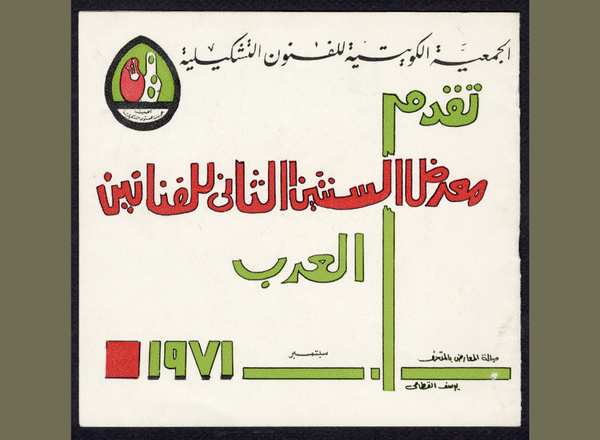
During his trips to Syria, Gergis visited every cassette shop in the Jazira looking for Assyrian, Kurdish, Shaabi and other “alternative” tapes. He also dug into shops across the country, looking on bottom shelves for “low-demand” music. His collecting trips ceased when the Syrian regime violently suppressed popular protests against President Bashar al-Asad in 2011, beginning the war that devasted the country until 2024. With his trove of recordings safely out of the country, Gergis co-founded the Syrian Cassette Archives in 2018 with Yamen Mekdad, a Syrian artist, filmmaker and programmer.
While cultural institutions were centralized in Damascus, the music and especially cassette industry were based in Aleppo. As Syria's largest city and the closest metropolis to the Jazira, Aleppo shares much of the unique demographic mix of the Jazira, making them somewhat friendly neighbors. Responding to the popularity of certain genres in this mixed region, Aleppo cassette shops were not only producing Kurdish and Assyrian and shaabi tapes, they had agents out scouting for the next hits, too. The northern Syrian cassette industry helped artists circumvent Damascus’ national monopoly of culture by providing the technology for cheap, accessible and quick circulation.
The northern Syrian cassette industry helped artists circumvent Damascus’ national monopoly of culture by providing the technology for cheap, accessible and quick circulation.
The Syrian Cassette Archives is a tremendous resource for the culture writ large, but it plays a special role for Jazrawi music in particular. Through its wide collection and deep dives into specialized genres, it grants long-overdue legitimacy to ignored sonic histories and the people making them, placing them inside the broader regional context. The Archives’s curatorial choices are a political act. By shelving Kurdish, Assyrian and shaabi tunes together, it re-stages the layered coexistence that a century of state politics has tried to erase.
For the millions of Syrians dispersed regionally and globally after 2011, the internet has provided the space to build crowd-sourced archives of their own.
Known as the YouTube Revolution, the Syrian Revolution of 2011 now has more hours of footage online than its actual duration. The platform became a critical site for sharing citizen sourced documentation and evidence of state violence, international interference, chaos and resistance movements. Additionally, given the continuous forces of displacement and exile faced by people in Syria’s northeast and the country generally, the internet has become a main stage for connection between families, communities and places that may no longer be accessible. This space for communal connection has also become a grassroots home for sharing, preserving and continuing the musical heritage of the region.
This mawwal sung by a Raqqa woman and her friend in a field, bemoans the painful passage of time and has left listeners haunted for nearly two decades. Although uploaded in 2013, commenters exchange memories of the video circulating on Nokia phones in 2008 and share their own laments over time and exile. The wrapping around her face strongly suggests she was an agricultural laborer.
Early in 2026, I began digging around on YouTube for Armenian folk music in the Jazira. I was inspired by the Houshamadyan digital song archives, a project founded in 2010 that reconstructs and preserves the memory of Ottoman Armenian life, with a digital archive that includes recipes, maps, testimonies, photography, dialect and dance tutorials. I was also curious about the work of a family friend, Ibrahim Keivo, a musician and fellow Armenian-Syrian whose decades-long practice includes songs in Kurdish, Mardin Arabic, Bedouin Arabic, Yazidi, Syriac and Assyrian. So far, I have collected 209 videos (and counting).
One video contains a photo montage of drying rivers with a soundtrack expressing loss and pain. In another, archival footage of a wedding shows people alternating between holding hands to dance together and smoking, then passing the microphone to an elder with duq (tattoos) on her chin to sing.
A wedding video from Raqqa featuring women on the microphone.
Other videos include archival Ba’ath television propaganda annotated by viewers’ comments about ruling class domination over the oil fields and condemnation of the US occupation of Hassakeh. A vocals-only field song with common themes of love and longing now includes lyrics rejecting the Islamic State, compiled with images of women working and smiling in fields. Early 2000s music videos show regional legends serenading listeners in the natural landscape and alongside the Euphrates, like the one of Khader al Nasser plucking a chicken while he flirts and another featuring trippy green-screen effects alongside centuries-old dome houses in the background.
An archival Ba’ath television song titled “In the Expanse of al-Jazira,” showcasing the region’s agricultural and oil resources that were tapped by the regime.
Viewers of these videos are active participants. They request other recordings from the same wedding or singer, correct dialects, name the town or family a video came from, leave a greeting, thank each other by name. Syrians inside and outside of the country are actively building—in real time, across exile—the same kind of ad hoc, cross-ethnic infrastructure that is characteristic of the region's music and local politics.
Syrians inside and outside of the country are actively building—in real time, across exile—the same kind of ad hoc, cross-ethnic infrastructure that is characteristic of the region's music and local politics.
Between the Syrian Cassette Archives, my own YouTube research and other projects like The Syria Music Map and Notah, the internet has become an invaluable repository for the diverse musical genres and styles that make up the Jazira’s rich and layered soundscape. Arab, tribal and semi-nomadic sonic traditions carry influences from the Arabian Peninsula, bringing with them more secular folk genres with roots in Islamic history. In Raqqa, mawwals, the most common folk music of the Levant, carry extended improvisational vocal laments about grief, separation, the passage of time and longing. Up and down the Euphrates, casual gatherings of musicians, singers and locals especially center the rabab (a single-string instrument), the nay (flute) and a hand drum core to Bedouin traditions, backed by attendees clapping the tempo and singing along.
This video shows the casual gatherings that people often call “sessions,” which can be mixed-gender, mixed-age, and mixed-community. This one seems to be based in Raqqa and uploaded in 2014, but the date of its recording is unknown.
The region’s modern history includes the Armenian (1915–1923) and Assyrian (1914–1923) genocides by the Ottomans, mass violence and dispossession directed toward Kurdish communities, national Syrian and Turkish dam projects, the subsequent droughts of the 2000s, the rise of the Islamic State and the formation of the multiethnic Kurdish-led autonomous administration in Rojava. All these events are reflected in tracks available through the online repositories.
The Syrian Cassette Archives, for example, contains a collection of Assyrian and Syriac music. As artist and culture writer Christina Hazboun notes, songs like “Tel Tamer” exemplify the transformation of Syriac liturgical chants into popular folk songs about Assyrian national pride and the ups and downs of daily life.
This song by Malfonitho Evlin Dawud, considered the first Syriac woman to sing in Syriac in 1951 and based in Qamishli, Syria, shows the liturgical influence on the growing music scene.
Within 20 years, Assyrian and Syriac music had caught up with the musical trends of the region but maintained a loyalty to its roots, as seen in Juliana Jendo’s ode to her hometown and heritage in “Tel Tamer.”
The Houshamadyan song archive features historic Armenian folk songs celebrating rolling and cooking stuffed grape leaves alongside memories of genocide from western Armenia. The Syrian Cassette Archives hosts contemporary and popular tracks by Armenian Syrians, some sung in both Arabic and Armenian. General repression of Armenian communities and their public traditions and events increased after the 1998 Adana Agreement between Syria and Turkey. The Syrian regime increasingly repressed Armenian genocide commemorative practices in Deir ez-Zor as it normalized relations with the Turkish state, whose official position continues to deny both the Armenian and Assyrian genocides. The need for political alternatives fed directly into how music was being made and circulated among and between Jazrawis. Amid ongoing racialized, nationalist and economic repression, sharing music in their spoken language at celebrations was a form of survival in their post-genocide settlements along the Euphrates.
Kurds have also been subject to successive discrimination policies beginning in the early 1960s that aimed to effectively position them as non-Syrian, including criminalization of the Kurdish language and culture, stripping citizenship from roughly 20 percent of the Kurdish population and mass displacement within the Jazira with the 1968–1973 construction of the Tabqa dam and its complementary “Arab belt” demographic engineering that separated Kurds in Syria from those in Turkey. In the face of this repression, Kurdish music has been surprisingly commercially vibrant. Songs like "Jin Jiyan Azadî" invoke mountains, land, exile and liberation, transferring mythology to political visions to catchy beats.
Hunergeha Welat is a Qamishli-based Kurdish cultural production agency. Jin Jiyan Azadî (Woman, Life, Freedom) is a central Kurdish rallying cry for women-led resistance and liberation movements, also popular in Iran.
While nomadic and small settlement lands were forcibly turned into a productive breadbasket for first the Ottoman state and then the Syrian one, the landscape has remained central to people in the Jazira. Agricultural life echoes with sound. Notah, the musical program of Turkey-based Douzan Arts and Culture, preserves and archives Syria’s musical heritage and aims to help Syrians in Turkey build a contemporary cultural identity. As part of its “field songs project,” Notah shares the music that accompanies women’s work on the land, such as “Irrigating the Cotton Infested with Worms.” Harvests are given tempo by the cultivators’ voices and the strike of their tools, women singers build from lyrics passed down from earlier generations about the crops, lovers and home. Ancient Assyrian and Mesopotamian mythologies of Ishtar, the goddess of fertility, and her power over storms persist alongside children’s songs calling for Umm al-Ghaith (mother of rain) to bring relief to arid soil.
The women singing this song, “Irrigating the Cotton Infested with Worms,” weave together lyrics about aversion to machinery, brides, weddings and the best cotton tilling techniques.
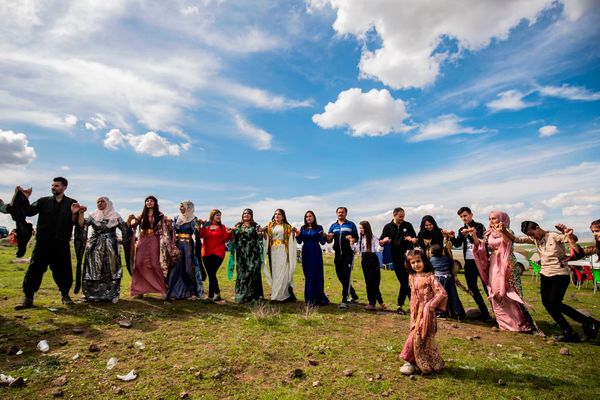
These sounds move from the fields to social gatherings through the vehicle of shaabi tracks, which bring together agricultural, communal celebrations and village life, and is the most audible genre in Syria’s rural regions. Blaring through wedding halls, lyrics compare women to flowers, desire to cultivation and broken hearts to abandoned homes. Omar Suleyman’s early work in the wedding circuit of the northeast, for example, included a poet following him around the dance floor, feeding him lines in real time, such as “Whoever’s got a girl should preserve her like pickles in vinegar,” or “you who prayed on the rug with looks like a beautiful gazelle wearing a necklace / I’ll turn my arm into a pillow for you to sleep on.”
Given the region’s economic and social marginalization, digitized sounds were late to reach the Jazira. The transition from flute instrumentation into synthesizers, pioneered by artists like Rizan Said, Souleyman’s keyboardist, reinvented the shaabi genre in Syria in the 1990s. The synth was cheaper for both performing and recording, sonically marking a shift from traditional instruments toward digitized sounds. Nay players soon became synth players. Elders often criticized the instrument as too rigid, restricting the back and forth between singer, audience, musicians and dancers. Unsurprisingly, synths inspired the emergence of energetic forms of dabke in order to keep up with the electronic turn, as seen in the video below.
This video contains iconic footage of a wedding where Omar Souleyman performed in Hassakah in the 2000s. Note the party goers’ ecstatic head banging to the track’s beat and the obligatory shout-out for the Asad family at 2:22.
These songs and their repositories signal that the Jazira refuses to be a periphery
The future of these videos, like the future of the Jazira, is unpredictable. Digital platforms are fickle and fragile archives dependent on commercial entities, and political censorship in Syria has a way of regularly rearing its head. The impertinence of the videos does not diminish their pertinence nor the hundreds of years of history they carry. These songs and their repositories signal that the Jazira refuses to be a periphery, and is instead a central frontier where memory, political alternatives and the boundaries of identity continue to be reshaped through sound.
[Heidi Sarah Affi is a PhD student and artist-researcher.]
All of MERIP's analysis is provided without paywalls! Make a donation now to help us keep it that way.