
US Policy
From the Editor (Winter 2014)
Midway through Barack Obama’s second term as president, there are two Establishment-approved metanarratives about his foreign policy. One, emanating mainly from the right, but resonating with several liberal internationalists, holds that Obama is unequal to the task of running an empire. The presideBurying the Hatchet with Iran
Don’t tell anyone, but the United States and Iran are getting closer -- perhaps closer than ever -- to letting go of 35 years of enmity. No, Washington and Tehran aren’t going to be BFFs or anything. But they do share a common interest in rolling back the so-called Islamic State, whose well-armedThe Cold Realities of US Policy in Israel-Palestine
During the summertime war in Gaza, the two most progressive members of the US Senate stirred up controversy among their backers with expressions of uncritical support for Israel. At a town hall meeting, Bernie Sanders of Vermont, the lone Senate independent, responded to a questioner that Israel had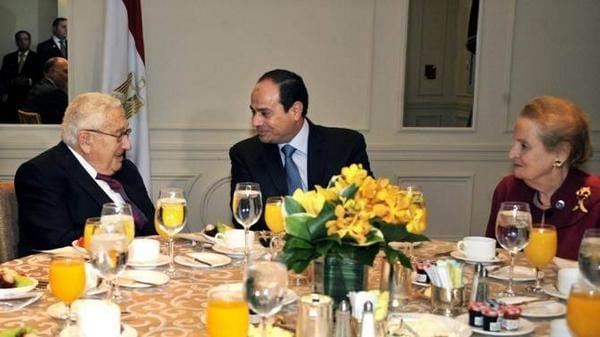
Sisi at the UN
This week ‘Abd al-Fattah al-Sisi paid his inaugural visit to the United States as president of Egypt. The occasion was the annual meetings of the UN General Assembly. We asked some veteran Egypt watchers and MERIP authors for their reactions. Mona El-Ghobashy [http://www.merip.org/author/mona-el-ghState Department Taking Passports Away from Yemeni-Americans
Over the past year, dozens of Yemeni-Americans visiting their ancestral homeland have had their US passports summarily revoked or confiscated by the embassy in Sanaa without any clear legal basis, effectively stranding them outside the United States. Last month, a coalition of US civil rights groupsAnother Benghazi
“We didn’t want another Benghazi.” Oh no, is that really why the Obama administration decided to bomb Iraq [http://www.nytimes.com/2014/08/09/world/middleeast/fear-of-another-benghazi-drove-white-house-to-airstrikes-in-iraq.html?hp&action=click&pgtype=Homepage&version=LedeSum&module=a-lede-package-rNot Much Better Than Bush
President Barack Obama got it right [http://www.cnn.com/2014/06/19/politics/obama-iraq-transcript/index.html] when he declared: "There's no military solution inside of Iraq, certainly not one that is led by the United States." But his Iraq track record doesn’t mark much of an improvement over the mMatthew Huber, Lifeblood
Matthew Huber, Lifeblood: Oil, Freedom and the Forces of Capital (Minneapolis: University of Minnesota Press, 2013). “The American way of life” -- is there another phrase that sounds so innocuous yet is so fraught? To most Americans, and admirers of the United States abroad, the four words evoke naThree Pawns in the “Great Game”
Hugh Wilford, America’s Great Game: The CIA’s Secret Arabists and the Shaping of the Modern Middle East (New York: Basic Books, 2013). Middle East scholars have long been aware of the CIA’s power and swagger in the region, yet their studies rarely mention the Agency beyond passing references, and t"Energy Security"
Over the last few decades, the phrase “energy security” has spread like an oil spot from specialized literature outward into the standard lexicon of reporters and politicians. Like “security” itself, it is a term whose meaning seems transparent but resists precise definition, in part because the meaCatastrophe and Consequence
What is happening in Iraq is a catastrophe, but not a sudden one. The violence in Iraq has been worsening steadily over the last few years. And more to the point, today’s crisis is the consequence of failed policies and failed politics -- national, regional and international -- years and even decade
•
3 min read