
MER Article Pakistan After Reagan Before they died in a suspicious plane crash on August 16, President/General Zia ul-Haq and his officer cohorts were looking with dismay at the prospect of a new administration in Washington. Pakistan forged the closest ties ever with the United States during the eight years of Ronald Reagan’s admin Ahmed Rashid • 7 min read
MER Article US-Arab Economic Trends in the Reagan Period US economic relations with the Arab states have entered a new phase in the last two years, one that reproduces many of the features that characterized the end of the Carter administration. US exports to the region rose by about 13 percent from 1986 to 1987 with shipments to Iraq, Egypt and the Unite Fred H. Lawson • 7 min read
MER Article NATO Goes to the Persian Gulf In the last half of 1987, some 75 US, French, British, Italian, Belgian and Dutch warships steamed into the Persian Gulf in what became the largest peacetime naval operation since World War II. Six NATO countries had joined efforts specifically to police the Gulf, considerably increasing the longsta Jochen Hippler • 10 min read
MER Article Saudi Arabia and the Reagan Doctrine President Reagan came to office with a bold commitment to roll back Soviet gains in the Third World without risking the trauma or cost of another Vietnam-style intervention. The “Reagan Doctrine,” as his policy came to be known, ironically took its cue from Soviet support in the 1970s for leftist in Jonathan Marshall • 18 min read
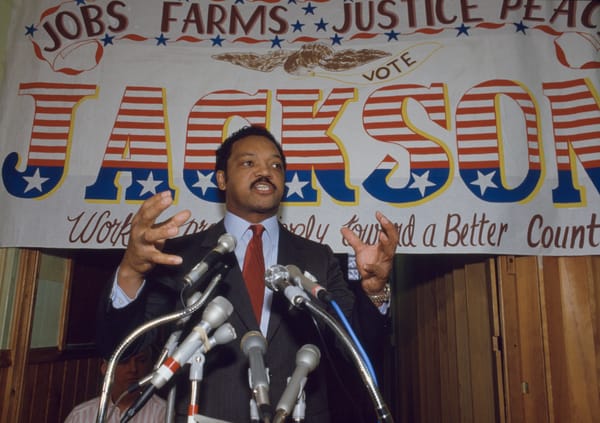
Jesse Jackson campaigning in Winterset, Iowa, February 3, 1988. Jean-Louis Atlan/Sygma via Getty Images MER Article Jesse and the Jews Throughout the first half of 1988, at every level of the political process in the United States, the longstanding consensus governing policy towards Israel, the Palestinians and the Arab-Israeli conflict was in flux. The explosion of Palestinian resistance to Israeli occupation and Israeli repression generated sharp questions about American and Micah Sifry • 23 min read
MER Article From the Editors (November/December 1988) “The wars are winding down. The streets are heating up.” This was how Baltimore radio commentator Sean Connolly led off his “minimalist news” broadcast one day in mid-September. It is hard to find a more succinct way to describe the state of the world, the Middle East included, on the cusp of transi The Editors • 5 min read
MER Article Dorman and Farhang, The US Press and Iran William Dorman and Mansour Farhang, The US Press and Iran: Foreign Policy and the Journalism of Deference (Berkeley and Los Angeles: University of California Press, 1987). Ervand Abrahamian • 4 min read
MER Article Young, Missed Opportunities for Peace Ronald J. Young, Missed Opportunities for Peace (Philadelphia: American Friends Service Committee, 1987). Joe Stork • 1 min read
MER Article Rubenberg, Israel and the American National Interest Cheryl A. Rubenberg, Israel and the American National Interest: A Critical Examination, (Urbana and Chicago: University of Illinois Press, 1986.) Imagine a planet which two superstates dominate after global wars have crippled other contenders. Then assume their rivalry delimits a decisive zone w Edward Danforth • 3 min read
MER Article Cover-up and Blowback The House Select Committee to Investigate Covert Arms Transactions with Iran and Senate Select Committee on Secret Military Assistance to Iran and the Nicaraguan Opposition. Report of the Congressional Committees Investigating the Iran-Contra Affair. (Washington, DC: US Government Printing Office, 1 Jonathan Marshall • 10 min read
MER Article Reagan's Iran Despite its reputation for having inflexible ideological positions on all foreign policy issues, the Reagan administration actually came to office in January 1981 without a coherent policy for dealing with Iran. At first the new administration was content to let Iran fade from the spotlight of natio Eric Hooglund • 8 min read
MER Article North-South vs. East-West The new US-Soviet agreement banning intermediate-range nuclear forces (INF) in Europe appears to signal a new period of dialogue and cooperation between the two superpowers. It seems that the intense hostilities of the early Reagan era have given way to a more relaxed and constructive relationship b Michael Klare • 11 min read