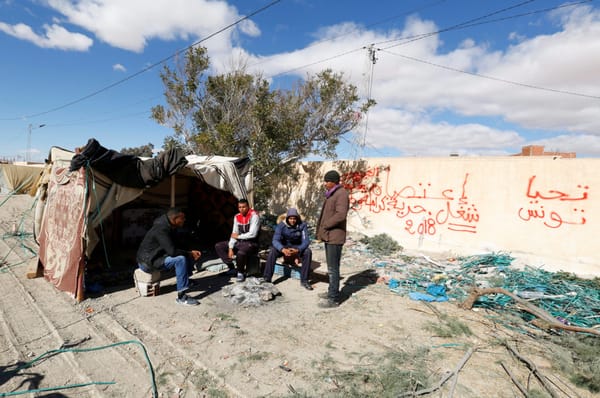

Protesters sit outside a tent near the entrance of the phosphate mine in Umm al-Arais, Tunisia, on February 15, 2018. Zoubeir Souissi/Reuters MER Article Tunisia’s Marginalized Redefine the Political Marginalized populations in Tunisia, who have little access to economic and political resources, sparked the 2011 protests that ousted the Ben Ali regime. In the following ten years, marginalized people, especially in rural areas, have continued to push for more jobs, better services and social just Sami Zemni • 11 min read
MER Article Maghreb From the Margins This issue of Middle East Report on “Maghreb From the Margins” addresses the evolving challenges that the peripheries are posing to power structures in Algeria, Libya, Mauritania, Morocco, Tunisia and the Western Sahara. The Editors of Issue #298 • 6 min read
Protesters sit outside a tent near the entrance of the phosphate mine in Umm al-Arais, Tunisia, on February 15, 2018. Zoubeir Souissi/Reuters Current Analysis Tunisia’s Marginalized Redefine the Political Marginalized populations in Tunisia, who have little access to economic and political resources, sparked the 2011 protests that ousted the Ben Ali regime. In the following ten years, marginalized people, especially in rural areas, have continued to push for more jobs, better services and social just Sami Zemni • 11 min read
Sarah Hegazy at a protest in Canada. Photo courtesy of HuMENA. [Creative Commons license CC BY-SA 4.0.] Current Analysis Sarah Hegazy and the Struggle for Freedom Responses to the tragic death of the Egyptian leftist and queer activist Sarah Hegazy reflect a significant transformation in the desire of individuals in the Middle East to claim queer identities. Zeina Zaatari places this moment in the historical context of decades of activism and struggle for fre Zeina Zaatari • 14 min read
Cracks in Tunisia’s Democratic Miracle Less than a decade after the 2011 uprising that ousted a dictator, the election of an anti-establishment president amidst popular turmoil indicates that many Tunisians reject the narrative that all is well with Tunisia’s new liberal democracy. Laryssa Chomiak • 9 min read
MER Article Refusing to Forgive In 2015, Tunisia’s President Beji Caid Essebsi proposed a draft economic reconciliation law to forgive graft and other corrupt acts committed by civil servants and businessmen under the regime of ousted president Zine El Abidine Ben Ali in exchange for closed-door confessions and return of ill-gotte Lana Salman, Laryssa Chomiak • 15 min read
MER Article The Invisible Alienation of Tunisian Youth The mood in Tunisia was tense after Ramadan, a month after 38 tourists were killed in the beach resort of Sousse at the end of June. Key buildings on the capital’s main boulevard, Habib Bourguiba Avenue, including the Ministry of Interior, were surrounded with barbed wire and conspicuous police prot Benoît Challand • 5 min read
Current Analysis Nobel Nota Bene From Little League banquets to honorary doctorates, it may well be in the nature of award committees to tilt toward hyperbole. Elevating the legacy of the recipient is, among other things, an affirmation of the importance of those who can recognize importance when they see it. The committee that sel Stacey Philbrick Yadav • 3 min read
Current Analysis Tunisia's Rotten Compromise Since the 2011 Arab uprisings gave way to the dreadful combination of civil war and terrorism that has spread from Syria to Libya and Yemen, analysts and political actors from both the Arab world and West have felt an acute need for at least one success story in the region. Tunisia has provided such Nadia Marzouki • 18 min read
MER Article Rebels, Reformers and Empire For 20 years leading up to the uprisings of 2010-2011, Egypt and Tunisia suffered the ill effects of neoliberal economic reform, even as the international financial institutions and most economists hailed them as beacons of progress in the Arab world. For ten years preceding the revolts, workers and Karen Pfeifer • 21 min read
MER Article Potholes in the Road to Revolution Nearly four years later, the dusty road between Sidi Bouzid’s main thoroughfare and the humble residential quarter where Mohamed Bouazizi grew up is still blemished with the same potholes. He was not known in his hometown by that name. Though international media outlets immortalized this moniker aft Michael Marcusa • 7 min read
MER Article Small Farmer Uprisings and Rural Neglect in Egypt and Tunisia “We should make it up to the peasants,” Muhsin al-Batran, erstwhile head of the economic affairs unit in Egypt’s Ministry of Agriculture, told the official daily al-Ahram two months after the toppling of Husni Mubarak in 2011. “Make it up” -- why? And what is it that needs to be made up? Habib Ayeb, Ray Bush • 14 min read