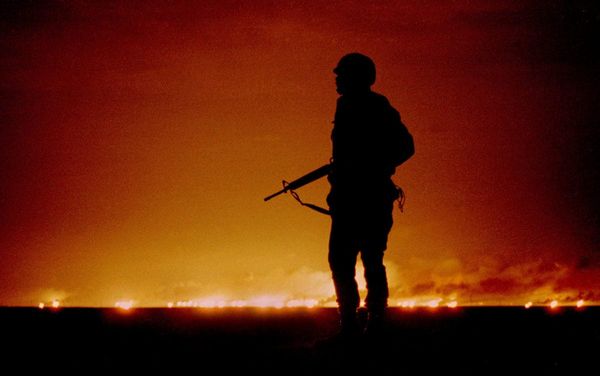
A US soldier standing guard as oil wells burn in the distance in Kuwait on the last night of the Gulf War, February 26, 1991. Andy Clark/Reuters Current Analysis Revisiting MERIP Coverage 30 Years After the First Gulf War MERIP’s coverage of the First Gulf War sought to understand the crisis beyond the battlefield kinetics: from Iraq’s August 1990 invasion of Kuwait to the US-led Desert Storm military operation liberating Kuwait and looking beyond to the regional aftermath. Our authors and editors offered historicall The Editors • 6 min read
MER Article What About the Incubators? It feels oddly like being at a wake in a funeral home. Our Fellowship of Reconciliation delegation members speak very quietly with one another as we wait for a hospital official to brief us about conditions at the al-Mansour Children's wing of the Saddam City Medical Center. Dr. Mekki, the director, Kathy Kelly • 4 min read
MER Article The Gulf War Battlefield: Still “Hot” with Depleted Uranium The men guarding the ruins of the remote Kharanj oil pumping station near Iraq’s border with Saudi Arabia don’t wander around much. Parts of this facility, destroyed by American air raids during the 1991 Gulf war, remain “hot” -- radioactive. The guards confine themselves to one small building, avoi Scott Peterson • 10 min read
MER Article Arcs of Crises Between the confrontations with Iraq in February and November, and the Cruise missile salvos directed at Afghanistan and Sudan in August, 1998 has been rather busy for the gunboat section of the US diplomatic corps. Twice, the UN secretary-general averted US military action by securing promises that The Editors • 6 min read
MER Article The Closing of the Arabian Frontier and the Future of Saudi-American Relations In 1893, the University of Wisconsin historian Frederick Jackson Turner traveled to the Chicago world’s fair to deliver the most famous paper in the annals of the US historical profession. “The Significance of the Frontier in American History” turned “the fact of conquest” into the myth of pioneers settling Robert Vitalis • 20 min read
MER Article The Destruction of Iraqi Kurdistan Less than five years ago, the US-led coalition against Saddam Hussein established a “safe haven” in Iraqi Kurdistan following Iraq’s brutal suppression of an uprising against the regime during March-April 1991. The mood among the majority of Iraqi Kurds was highly optimistic: A certain measure of se Joost Hiltermann • 13 min read
MER Article Revisiting the New World Order Fran Hazelton, ed. Iraq Since the Gulf War: Prospects for Democracy (London: Zed Books, 1994). Phyllis Bennis and Michel Moushabeck, eds. Altered States: A Reader in the New World Order (New York: Olive Branch Press, 1993). John O’Loughlin, Tom Mayer and Edward S. Greenberg, eds. War and Its Conse Simon Bromley • 6 min read
MER Article Hidden Death There may be more landmines deployed per person in Kurdish Iraq (population around 3.5 million) than in any other region in the world. A 1993 State Department report estimates that the Iraqi army laid 3 to 5 million mines there during the Iran-Iraq war and in the months leading up to the 1991 Gulf w Joe Stork • 1 min read
MER Article The Kurdish Experience Numbering over 22 million, the Kurds are one of the largest non-state nations in the world. Their homeland, Kurdistan, has been forcibly divided and lies mostly within the present-day borders of Turkey, Iraq and Iran, with smaller parts in Syria, Armenia and Azerbaijan. The greatest number of Kurds Amir Hassanpour • 20 min read
A Republic of Statelessness For nearly three years, Iraqi Kurdistan has been in a state of de facto self-rule. At first glance, it appears that the international engagement in Iraq on the basis of UN Security Council Resolution 688 (Operation Provide Comfort) provided this opportunity. Ronald Ofteringer, Ralf Backer • 12 min read
MER Article Gulf War Journalism John J. Fialka, Hotel Warriors: Covering the Gulf War (Woodrow Wilson Center, 1991). John R. MacArthur, Second Front: Censorship and Propaganda in the Gulf War (Hill and Wang, 1992). Jacqueline Sharkey, Under Fire: US Military Restrictions on the Media from Grenada to the Persian Gulf (Center for Barbara Harlow • 4 min read
MER Article The Media and the Polls In the relationship between public opinion and government decision-making, the trajectory of influence goes from top to bottom. Policymakers try to mold public opinion to suit their needs, not mold policies to suit the public. On many controversial foreign policy issues, there is often a gap between informed public (Author not identified) • 8 min read