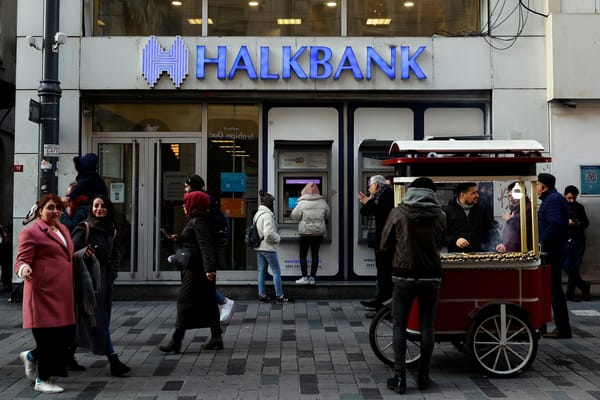
People walk past by a branch of the Turkish Halkbank in central Istanbul, 2020. Murad Sezer/Reuters MER Article The Shifting Politics of Debt in Turkey State-sponsored credit campaigns are not a new strategy for Turkish governments but the low-interest consumer loans that were extended to almost 7 million people in the first months of the Covid-19 pandemic surpassed all earlier financial inclusion programs. Inviting masses into the financial sector Ali Rıza Güngen • 13 min read
People walk past by a branch of the Turkish Halkbank in central Istanbul, 2020. Murad Sezer/Reuters Current Analysis The Shifting Politics of Debt in Turkey State-sponsored credit campaigns are not a new strategy for Turkish governments but the low-interest consumer loans that were extended to almost 7 million people in the first months of the Covid-19 pandemic surpassed all earlier financial inclusion programs. Inviting masses into the financial sector Ali Rıza Güngen • 13 min read
MER Article Financial Citizenship and the Hidden Crisis of the Working Class in the "New Turkey" Substantial political, economic and social changes have taken place in Turkey since the early 2000s. Much of this transformation has happened on the watch of the Justice and Development Party (best known by its Turkish acronym, AKP), which has been in power since 2002. Recep Tayyip Erdoğan, founder of the Basak Kus • 12 min read
MER Article A Clean Slate in Iraq Iraq has the world’s second largest oil reserves, but before the 2003 war its human development indicators placed it only just ahead of Sudan and Bangladesh. [1] The war and its ongoing aftermath have left Iraq further shattered. At the most basic level, diseases of poverty are again sweeping Colin Rowat, Justin Alexander • 14 min read
MER Article No Jubilee for the Middle East? The website of Jubilee 2000-United Kingdom lists 57 countries that have Jubilee 2000 campaigns for the cancellation of the unpayable debt of the poorest countries by the year 2000. [1] No country from the Middle East and North Africa (MENA) appears on this list. [2] Robert Naiman • 8 min read
MER Article From the Editors (September/October 1994) The question of population and development needs to be framed first and foremost as a question of equity. The articles in this issue address explicitly the matter of gender equity in families and societies, in ways that challenge the notion that Middle Eastern birth and fertility rates can be neatly The Editors • 2 min read
MER Article Scuds versus Butter Contrary to the common wisdom in Washington, most Arabs are poor, rational and interested in arms control. Declining oil prices, rising population, economic mismanagement and foreign policy adventurism have wreaked havoc with the economies of the Middle East, while local arms races have steadily raised the price of providing for Yahya Sadowski • 34 min read
MER Article Editor's Bookshelf Egypt has been central to providing an Arab cover for the US-led military expedition to the Persian Gulf, in addition to Saudi Arabia. As of December 1990, Egypt’s 15-20,000 troops constituted the third largest force confronting Iraq, after the United States and Saudi Arabia itself. Joint military e Joel Beinin • 4 min read
MER Article Sadat's Legacy, Mubarak's Dilemma For most countries in the Arab oil economy, the years 1982 and 1983 have marked an important moment of truth. The most obvious reason for this has been the decline in oil revenues as a result of falling world demand, cuts in production and the failure to hold the OPEC base price at $34 a barrel. As Roger Owen • 25 min read
MER Article International Finance and the Third World The foreign debt of the less developed countries (LDCs) of the Third World now stands at around $600 billion. More than half of this—about $350 billion—is owed to private international banks. Events like the strikes and demonstrations in Brazil this summer, or the labor unrest that triggered the mil Jeff Frieden • 20 min read
MER Article Egypt's Debt Problem Egypt’s external debt—the sums owed to other governments, private multinational banks and multilateral agencies like the World Bank—increased on an average of 28 percent per year under Anwar al-Sadat, compared to 13 percent over the previous ten years. Sadat’s decade also witnessed important shifts Joe Stork • 4 min read