Alternative Amman—Making Counterculture in the Jordanian Capital
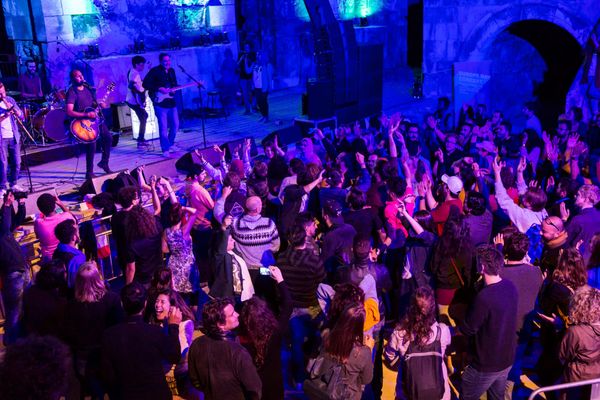

On a balmy April night in Amman’s Jabal Al-Weibdeh, a DJ was perched on the roof of Zawyeh Space, leaning over a battered mixer as a small crowd of mostly twenty-somethings chatted under the sky. A short walk away at The Village in Jabal Amman, the city’s only metal festival, Rock On, was celebrating its fourth installment in two years. Punctuating this revelry, another layer of sound cut through the din, the now ubiquitous wail of an air-raid siren signaling another Iranian drone or missile crossing Jordanian airspace. It served as a stark reminder that this subcultural oasis operates in the midst of an ongoing regional war, one that has escalated following the US-Israeli attacks on Iran that began in February of 2026.
Undeterred, after the last distorted crescendo of the self-described “Groove Metal” band Ebrazus had faded away, a short way down the neighborhood’s winding streets at Masnaa’—an old theater from the 1950s now converted into an arts venue—DJs and electronic artists kept a different crowd dancing, swaying and flirting late into the night. The artistic diversity and density of this night is emblematic of a recent boom in Amman’s cultural scenes.
The artistic diversity and density of this night is emblematic of a recent boom in Amman’s cultural scenes.
Yet, for many of the city’s counterculture veterans, there is a palpable concern that this flourishing is only another turn in the Jordanian capital’s familiar boom and bust cycles. Since the 1990s, each successive political and economic rupture—from the 2011 Arab uprisings and Syria’s refugee crises to today’s genocide in Palestine and the ongoing regional war—has reshaped the conditions under which Amman’s artists create and perform their work, leaving many to build careers on unstable foundations that can change rapidly. “When the beautiful wave comes, like now, everyone is excited,” observed Yousef, a hip-hop cultural pioneer and breakdancer. “Then the bad wind comes, and we all fall together,” he lamented.
Yousef’s remarks capture the fleeting nature of Amman’s counterculture scene, which he dates to the 1990s when young Jordanians increasingly accessed novel forms of media and culture arriving in Amman from abroad through relatives returning with cassettes, videotapes and new ideas. Anyone from that generation remembers radio DJ Mohanad Al-Jazaira, whose variety hours included an eclectic range of imported music styles—not just pop, but rock and metal. Media was often shared from person to person, spreading through word of mouth.
“I learned two moves from a DVD that I had gotten ahold of from a cousin who had returned to the country. Then I went out and showed it to my neighbors. No one had seen anything like it,” Youssef recalls. The effect was contagious. Soon neighborhood kids came knocking at his door asking him to show them his moves, and a small community was born.[1]
For Amman’s urban precariat—many of whom, like Yousef, were second-generation displaced Palestinians growing up in the shadow of Jordan’s normalization with Israel, through the 1994 Wadi Araba peace treaty—alternative music provided a vocabulary for systemic frustration. As Yousef explains: “Imagine growing up in a refugee camp, constantly told your land was taken, and the state you live in has signed a peace treaty with Israel… Movement gave me something to do about it.”
As hip-hop, rap and their attendant dance scenes grew, with crews popping up, shifting members and holding battles, so did a burgeoning metal scene. By the mid-2000s, specialized rock shops and venues spanned the urbanizing districts of Abdoun and Shmeisani. As Zayn, a vocalist for several local metal acts puts it, the rise of metal was in large part driven by a rejection of formulaic traditional genres and the values they embodied: “everyone just got tired of hearing people singing about habibi all the time.”
While hip-hop was generally tolerated by authorities and local cultural commentators, who often framed the genre’s reliance on Arabic lyricism as a modern extension of regional poetic traditions, the rapid expansion of Amman’s metal scene triggered heavy-handed state intervention by Jordan’s security services. Some were detained for weeks under the pretext of satanism, following Egypt’s designation of the genre as “satanic” in 1997 and an ensuing crackdown. “The first show I ever played [in 2003] got broken up by security services arriving in a bus,” Zayn notes. He was 16 at the time. Several other members of the scene describe being picked up at home by security services, having been flagged due to their long hair and attendance at metal shows. The young detainees were taken to a cell and kept without communication with their families for over a week.
The pressures on the metal musicians escalated in tandem with broader restrictions on freedom of expression and assembly imposed by the Jordanian government in the 2000s—shaped by multiple forces, including an attempt to appease Islamist groups like the Muslim Brotherhood, growing anxiety about a radicalized youth culture and a state apparatus already inclined to treat long hair, black clothes and loud music as symptom of social disorder. “Whenever the scene got too big, the state would swoop in and shut things down,” said Zayn. The crackdown culminated in a now notorious April 2009 police raid on a Dragon Rider concert of around 400 people. “Needless to say, no one in the scene or at that show was or is an actual satanist,” Zayn added. Stalwarts of the scene generally agree that the successive crackdowns effectively drove musicians underground.
“Whenever the scene got too big, the state would swoop in and shut things down.”
If the alternative music scene of the 90s and early 2000s was marked by precarity and independence, the late 2000s and 2010s was a period of professionalization that fostered new forms of dependency. A less politically contentious but deeply creative coterie of guitar and synth-based bands—including El Morabba3, Autostrad and Jadal—came to the fore, catching regional and international attention. At the same time, a flurry of post-Arab Spring cultural funding led by international non-governmental organizations saw Western embassies, European cultural institutes and other state-backed development programs pouring money into hip-hop workshops, public art and dance and music festivals.
Jordanian authorities saw this programming not only as a politically safe pressure valve for youth frustration, but as a highly lucrative pillar of the state’s broader economic strategy. By projecting an image of Amman, and Jordan more broadly, as a tolerant, cosmopolitan oasis open to the arts, the state actively courted larger packages of foreign humanitarian aid and bolstered its tourism sector. This massive influx of international capital also materially reshaped the city’s urban landscape. The burgeoning NGO industry produced a new, reliable patron class of foreign aid workers and expatriates who congregated in cultural hubs like Jabal Amman and Jabal Al-Weibdeh, providing the audiences and disposable income that sustained this donor-driven alternative arts economy.
This funding apparatus hit its peak as Syria’s refugee crisis mounted—an estimated 1.3 million refugees fled to Jordan—and brought a historic surge in international aid to the country, topping $3.3 billion by 2018.[2] While arts funding comprised only a small portion of this total, it was enough to radically reshape the cultural political economy of Amman’s arts scene. Foreign culture funding over the 2010s came mainly from donors like the British Council, the European Union and UNESCO. These institutions—alongside other cultural NGOs working under their aegis—supported grants, festivals, digital training and creative projects. For example, the Amman Jazz Festival, launched in 2012, continues to be funded by the EU and is supported by the Goethe-Institut and European embassies. USAID’s YouthPower Jordan program, which ran from 2017 to 2022, tied youth empowerment to community engagement and opportunity-building.
Crucially, this top-down funding landscape operated in tandem with regional and local cultural capital. The Arab Fund for Arts and Culture (AFAC), founded in 2012, is the principal regional source for arts grants, while the Abdul Hameed Shoman Foundation, founded in 1978, remains an influential local patron of Amman’s public and cultural life. Together they have provided the platforms and financing necessary for art to survive in a market too unstable to sustain cultural work on its own.
Yet, even when the funding was Arab rather than Western, it remained bound to the same institutional imperatives. These funding bodies relied on systems of bureaucratic management which forced artists to translate their practices into professionalized categories such as civic engagement, capacity building or social cohesion. Rather than supporting creative experimentation for its own sake, the global grant economy demanded conformity to its narratives, preferring art that was legible as a measurable social service or a therapeutic tool for marginalized or victimized groups. Because this funding relied on mastering dense, bureaucratic grant language, it privileged institutional in-groups at the expense of grassroots creatives. As Jamal, a cultural consultant noted, “someone comes with connections, knows how to write proposals, gets money, gets funded, [and] hires the younger generation to do the work.”
Rather than supporting creative experimentation for its own sake, the global grant economy demanded conformity to its narratives.
Jamal was referring to the shifting landscape of cultural capital that saw a new professionalized cultural elite emerge in the 2010s, populated by upper-class Jordanian tastemakers with wasta, strong government contacts, alongside another class of diaspora or foreign-born programmers—derisively called “academics” by Yousef. The latter explained that these cultural professionals, who typically arrived in the region with degrees from Western institutions, possessed the technical expertise to navigate complex grant proposals. They were often accused by my interlocuters in the countercultural music and performance worlds of acting as gatekeepers, securing funding without meaningful buy-in from the diverse scenes they claimed to represent, paying local artists a pittance and, as one participant complained, “getting an impressive line on their CV before leaving the country.” These institutional hierarchies occasionally triggered open resistance. Several interviewees recounted a story where local dancers staged a last-minute mutiny during the 2014 EU-funded Zakhareef in Motion dance festival. Upon discovering an organizer had allegedly pocketed the bulk of the grant, the performers successfully forced a cash-in-hand redistribution of the budget only moments before taking the stage.
The funding boom throughout the 2010s also came with new aesthetic criteria. Embassy culture officers and elite tastemakers, regardless of national origin, often held culturalist and traditionalist assumptions about what Arab expression should look like, favoring projects that were easily legible within familiar frameworks such as traditional Dabke, folkloric theater or so-called Arab hip-hop. Amman's long-harassed metal scene was conspicuously excluded. “We’re not authentic enough, I would imagine,” suggested Adnan, a local metal musician.
This influx of donor capital, however, would ultimately prove fleeting. As the immediate urgency of the Syrian refugee crisis faded from global headlines and international donors shifted their focus, cultural funding in Jordan steadily slipped down the priority lists. Moreover, the abrupt suspension in January 2025 of USAID under the administration of US President Donald Trump triggered an almost overnight exodus of foreign aid workers from cultural hubs like Jabal Amman and Jabal Al-Weibdeh, instantly draining large expatriate audiences that had in part sustained the city's alternative arts economy. The immediate funding collapse also stranded Jordan’s aspirational, Westernized precariat—the socioeconomically diverse class of young local creatives and professionals whose livelihoods, aesthetic output and upward mobility were structurally dependent on an NGO grant ecosystem.
Today, Amman’s alternative music scene is unfolding amid the Israeli genocide and US-sponsored regional wars that have brought the Jordanian state’s normalization with Israel and questions of funding and complicity to the fore.
“I know some out there would criticize me for taking German funding,” noted Yousef on the topic of his recently opened art center, made possible in part by a Goethe-Institut grant. He acknowledges that institutional alignment with any state backing Israel could be viewed by others in the community as a betrayal of his Palestinian identity. But he views navigating these ethical landmines as a condition of survival. “I’m taking money to open a place for everyone, and many of them will be Palestinian,” he argues. “Would they rather we didn’t have that space?”
While some high-profile regional artists have directly challenged Western complicity in Israel’s genocide, such as the Palestinian-Algerian Saint Levant and the Egyptian rock band Cairokee, most Jordanian artists I spoke to did not feel they had the same liberty. Several musicians referenced Cairokee’s song Telk Qadeye, released shortly after October 7, 2023, which condemns suffering in Gaza and Western double standards, as an example of politically committed work, though others are skeptical.
“I don’t buy it,” said one musician who asked not to be named. “It’s hard to think they didn’t do it in order to get the hype, which they got.” By contrast, Tareq, a rock guitarist in a rotating set of bands, thought the song in its abstraction was a profound encapsulation of what many in the Arab world feel regarding Gaza. Still, he said, “I could never bring myself to write the same kind of song.” His reluctance to turn tragedy into visibility was echoed by another musician: “I’m Gazan myself, but I’ve never written a song about Gaza…for me it goes beyond something you can express. Maybe one day, but it’s still too painful.”
"Palestinian solidarity has become a market."
Following three years of what has been called a “live-streamed genocide” in Gaza, Amman’s creatives often describe burnout, a sense that they are being pushed to narrate their struggles for foreign audiences or sympathetic diaspora elites. “Palestinian solidarity has become a market,” Zayn observed. While seeing his own Palestinian identity as fundamental, he also pointed to a widening chasm between regional realities and Western activist spaces and solidarity narratives. Artists also feel that the topic of Gaza since October 7, particularly on social media, has become comparable to a cultural fad largely populated by diaspora voices. Maha, a Palestinian visual artist, lamented that her work may be ignored until she produces explicitly identitarian or political work, at which point curators and broader audiences suddenly take interest. “Politics is a privilege,” she said, laughing at what she sees as the irony.
"Politics is a privilege."
Their fatigue sits on years of frustration with the NGO-driven art sector. The single most consistent refrain among those interviewed for this piece is that they “hate politics.” Hassan, a photographer pushed against the apolitical in one conversation, saying that “everything is political,” but he recognized that, at its core, the commonplace rejection of the political reflects an exhaustion with the demands of identitarian framings of so-called Arab art. As Tareq explains: “After a couple of decades of making music, and especially now, I realized that I should make the music that I love, in my own slang, in my own language, but that hopefully will add up to my own story.”
Embittered by the conditional attention of foreign and regional arts funding, as well as what they perceive to be the judgement of diasporic elites, and disgusted by Western states claiming to be arbiters of cultural freedom as they facilitate genocide in Gaza, many of Jordan’s alternative musicians and dancers have turned to staging events that bring people together and reclaim physical space.
Some critics accuse Amman’s club-goers of “enjoying the fruits” of a security state built on regional violence, but the reality is more complex. Many operate under the radar of the state, which has cracked down on dissent in recent years. “Of course, we want to talk about it, but there are limits set by the state,” explained Nizar, a guitarist in a local rock band. At the same time, he added, “a lot of us are anxious not to exploit Palestine for likes or attention.” Jordan’s 2023 Cybercrimes Law has sharply expanded the state’s ambit to criminalize online speech for offenses such as “threatening societal peace” and “contempt for religion.” Civil rights groups, and several artists interviewed for this piece, say the shift has deepened an already palpable climate of fear and creative self-censorship. During a recent dance performance referencing Palestine, gallery owners anxiously called the creative director to clarify that the word “them” in the title did not refer to Hamas, desperate to avoid uncomfortable state scrutiny.
While one veteran of the hip-hop and curatorial scenes suggested that “you can play it so that the state leaves you to do what you do,” in practice, government surveillance of cultural events remains. Murad, a Sufi-inspired guitarist and singer, recounted the experience of the mukhabarat appearing at two of his recent shows to warn him against political speech after he encouraged the audience to reflect on the reality of human suffering in the region. “I didn’t even mention Gaza,” he complained. When security officials instructed him to cut his set short, Murad refused. Rather than provoke a confrontation, the officers relented. As a Gazan holding only a Palestinian Authority identity card that grants little more rights than entry to Jordan, the stakes of Murad’s defiance were existential: “Let them kick me out, there’s no future here anyways,” he said.
New metal and alternative scenes have also emerged, as seen in Rock On’s successful staging of regular festivals. This growth is in part driven by the social media generation, many of whom discovered metal, hardcore, gothic and alternative cultures online rather than inheriting practices from an established older generation. “I blame [the TV show] Wednesday,” said Zayn, half tongue-in-cheek. “When was the last time people in Jordan were listening to The Cramps before Wednesday? Who was listening to Kate Bush before Stranger Things?”
But those involved in Amman’s creative renaissance also self-consciously reject what they see as superficial replication of Western internet trends. Instead, these ongoing countercultural movements strive to claim local spaces of creativity and autonomy. Much like the electronic and indie scenes pivoting toward Arabic lyrics and regional slang, today’s alternative music scenes increasingly blend non-traditional instrumentation with local identity, carving out space for communal release and creativity away from the rigid expectations of family, foreigners, the state, society and the broader culture.
At the same time, the ability to make space for collective expression exists precisely because the gaze of both the state and foreign-funded agencies has shifted. When asked if he was concerned that another crackdown by the state could push the metal scene underground again, one owner of a second-hand rock shop appeared unworried: “Not at all,” he said. His confidence reflects a changing political reality: With the state’s security apparatus now aggressively focused on policing and criminalizing dissent related to Palestine and curtailing explicitly political agitation, the regime’s motivation to orchestrate moral panics over youth degradation appears to have largely evaporated.
By grounding their work in aggressively local spaces, experimental improvisation and avant-garde Arabic-led or instrumental performances, many are reclaiming their right to aesthetic ambiguity. This conscious indeterminacy allows both artists and audiences to resist being easily deciphered, instrumentalized as a trauma narrative or neatly packaged as fodder for someone else’s grant application. Honest critique for some may require self-implication, a reckoning with the fact that even those who claim purity have applied for grants funded by the very states managing their social, political and economic dispossession. Such a reckoning opens thornier questions about the complex ethics of making art and being joyful in proximity to genocide. “This is the question, and it’s on everyone’s mind,” Yousef said, “and I don’t have an answer.”
[Arran Walshe is an Amman-based researcher and writer.]
All of MERIP's analysis is provided without paywalls! Make a donation now to help us keep it that way.
[1] All interviews were conducted by the author in Amman, Jordan between April and June of 2026. All names have been anonymized.
[2]UNHCR, External Statistical Report on UNHCR Registered Refugees and Asylum-Seekers in Jordan (Geneva: UNHCR, 2024).