The MERIP Podcast Episode 16: Iman Ali

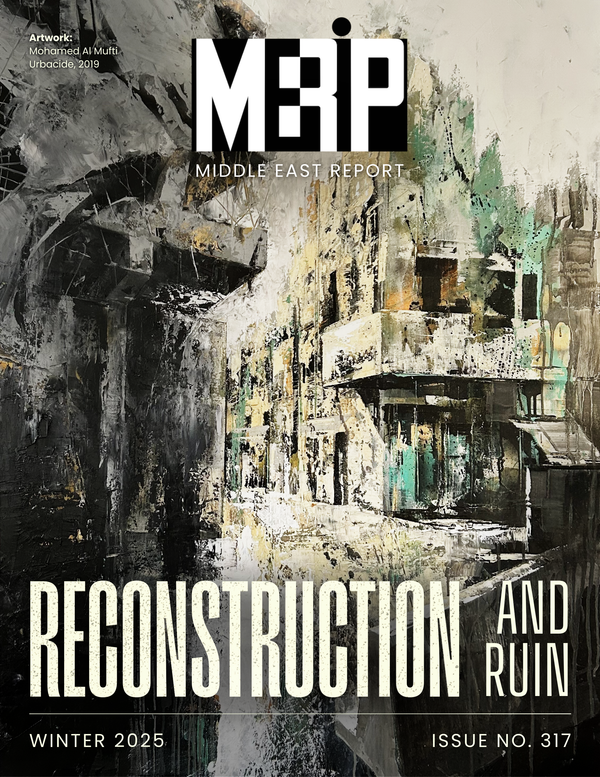
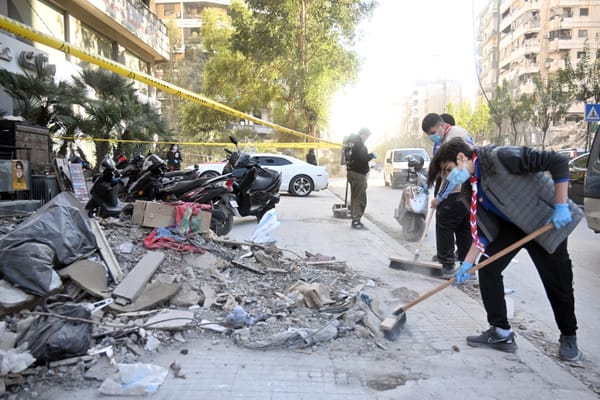
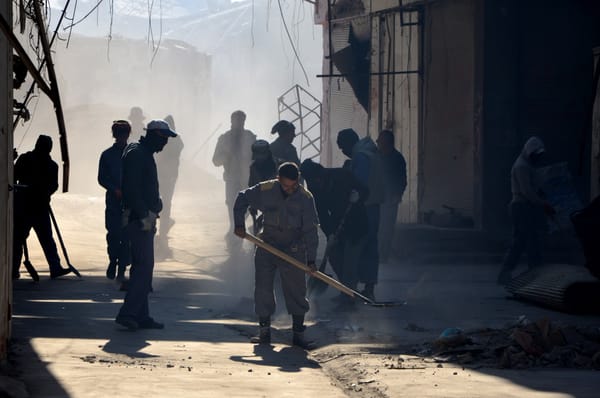
In today’s episode Iman Ali talks about her recently published article, “Repair Amid Ongoing Ruination—Rebuilding Dahiyeh Once More,” which appeared in our Winter 2025 issue, “Reconstruction and Ruin.” Iman Ali, a doctoral candidate in anthropology at Cornell University, has been conducting fieldwork in Lebanon to investigate the impacts of Israel’s war in the fall of 2024 and the ongoing, almost daily, Israeli drone and missile attacks since the November 2024 ceasefire agreement. Her article closely examines the immense material and political challenges faced by Lebanon’s Shi’i community in the last year and a half. She also compares the current struggles to rebuild Beirut’s southern district of Dahiyeh with the vastly different political, funding and leadership landscape following the 2006 war between Hizballah and Israel. After that 2006 campaign, Hizballah was successful in rebuilding the neighborhoods of the Dahiyeh with the aid of funding from several regional and global partners, and under the leadership of Hizballah’s secretary general Hassan Nasrallah. Today, the challenge of rebuilding could not be more different—the financing is not forthcoming, Hizballah’s leadership is decimated and the spectre of continued or renewed Israeli aggression is pervasive.
For this conversation, MERIP’s executive director James Ryan was joined by Najib Hourani, a member of the editorial team for “Reconstruction and Ruin,” as co-host. Hourani is an associate professor of anthropology and global urban studies at Michigan State University and now an emeritus member of MERIP’s editorial committee. We spoke with Iman Ali about her piece, the longer history of the Dahiyeh and the intense burden that resistance to Israeli aggression has placed on Lebanon’s Shi’i communities.
This episode was recorded on February 25, 2026.
Read Iman Ali’s piece here:
Iman Ali, “Repair Amid Ongoing Ruination–Rebuilding Dahiyeh Once More” Middle East Report 317, Reconstruction and Ruin Winter 2025
This podcast comes without paywalls or ads. Help us keep it that way by making a donation today!
Further Reading:
Hiba Bou Akar, “Urban Interventions for the Wars Yet to Come” MERO, July 2019
Tamara Chalabi, The Shi ‘is of Jabal ‘Amil and the New Lebanon: Community and Nation-State, 1918–1943 Springer, 2006
Lara Deeb, An enchanted modern: Gender and public piety in Shi'i Lebanon Princeton University Press, 2006
Mona Fawaz "Hezbollah as urban planner? Questions to and from planning theory" Planning Theory 8.4 (2009): 323-334
Mona Harb and Lara Deeb "Culture as history and landscape: Hizballah’s efforts to shape an Islamic milieu in Lebanon" Arab Studies Journal 19.1 (2011): 12-45
Najib B. Hourani "People or profit? Two post-conflict reconstructions in Beirut" Human Organization 74.2 (2015): 174-184
Munira Khayyat "Dispatch from South Lebanon—Life as Resistance at the End of the World" Middle East Report 313 (Winter 2024)
Salim Nasr, “The Roots of the Shi’i Movement” Middle East Report June 24, 1985
Salim Nasr, “Backdrop to Civil War: The Crisis of Lebanese Capitalism” Middle East Report No. 73 Winter 1978