Palestine 36 and the Hard Facts of History
Annemarie Jacir’s epic portrayal of the revolt that never ended.

Representing the brutality of life lived under Israeli domination in Palestine—Palestinians trying to get to work marched through metal cages like cattle in a chute, public praise for Israeli soldiers raping Palestinian prisoners, legal frameworks regularizing dictatorship and apartheid, terrorizing arrests of young children by soldiers, a genocide, Israelis’ denial of a genocide—poses a challenge for any artist or scholar trying to explain those conditions. The perversity of these conditions can seem to surpass what reality could contain, requiring unique representational forms to capture their extremity. Academic writers tend to double down on the facts, as if the weight of footnotes and granular detail could grab readers by the wrist tightly enough to force them into understanding. Artists, in contrast, often play with form and aesthetics, deploying parody and pastiche in an attempt to outpace and transform the unbelievable experiences of Palestinian life—to make them comprehensible in a different way. The floaty tones of Adania Shibli’s storytelling of horror are one example. The burlesque and satire in Elia Suleiman’s films is another. Such artistic translations of reality can provide a distance from the bloody ground, offering a different perspective and clarity, like the turn of a kaleidoscope. By disturbing established frameworks, their phantasmagoria unsettles audiences, shaking them free from some of the obfuscations of propaganda and ideology that shroud public understanding of Palestine, especially in the west.
Annemarie Jacir’s 2025 film Palestine 36 doesn’t do this. Instead, it digs its heels into the hard facts of history. Drawing on the conventions of epic cinema and narrative, the film tells the interwoven stories of a diverse cast of characters engaged in a mass political revolt. With great battle scenes, explosions and panoramic shots of Palestinian crowds demonstrating, the film is awash in nationalist symbols. The land becomes a character itself, as Jacir has described it. Fields of cotton are tended to by peasants reciting poetry, the mountains hide rebels and other secrets, orchards embrace conversations between daughter and mother. Colorized archival footage and stills—of fields, Jerusalem’s Old City, the sea—look like vintage postcards brought to life. These elements carry the viewer along within their genre-informed expectations to plant them in the heart of the realities of the Great Arab Revolt of 1936–1939, when Palestinians tried to free themselves of the British occupation that had been in place since 1917 and end the Zionist settler-colonial takeover of their homeland.
The British government’s commitment to supporting the development of a Jewish national home in Palestine—manifest in their awarding 90 percent of government concessions to the Zionists, among many other advantages—built what historian Rashid Khalidi has called an “iron cage” around Palestinians’ efforts to achieve independence in their ancestral homeland.[1] In his analysis, Palestinians barely had a chance, as the Zionists took over the land and the economy with the full-throttle military, economic and political support of the British Mandate government that controlled Palestine after World War I and the end of the Ottoman Empire. The film shows how hard they tried, nonetheless. With strikes and boycotts, protests, revolutionary courts and the sabotaging of trains and government infrastructure, Palestinians and supporters from throughout the Arab region fought what Palestinian Marxist political thinker and novelist Ghassan Kanafani called the “‘enemy’ triumvirate:” “reactionary Palestinian leaders, Arab regimes surrounding Palestine, and the alliance between Zionism and imperialism.”[2]
Like Kanafani’s analysis of this period, the film starts with the concrete conditions of people and stays with them throughout. Among these concrete conditions, the abuse of peasant farmers (more than two-thirds of the indigenous Arab population who were the drivers of the rebellion) and workers exploited by Arab landlords and other capitalists feature centrally.[3] This “policy of rank discrimination against the Palestinian Arab majority” that Khalidi has so thoroughly analyzed was initially enshrined in the 1917 Balfour Declaration. In that 67-word statement released by British Foreign Secretary Arthur Balfour, the British government declared its commitment to the Zionist project of building “a national home for the Jewish people” and signalled its disregard for the political, collective rights of 94 percent of the population that was Palestine’s Arabs.[4]
Under the aegis of the League of Nations (precursor to the UN), British Mandate control led to a cycle of poverty so intense that, according to one 1930 estimate from Haifa, 64 percent of peasant families contained one member who had been served a warrant of arrest or confiscation on account of their debts.[5] This history is now well documented, but not so generally well known, particularly among audiences in London where the film has been released in theaters. (Its US theatrical release is anticipated for early 2026). In interviews with British actors and viewers of Palestine 36, they remark on their own ignorance of this history and the need for better education about the shameful role of the British in these events. The problem is one that the film confronts directly.
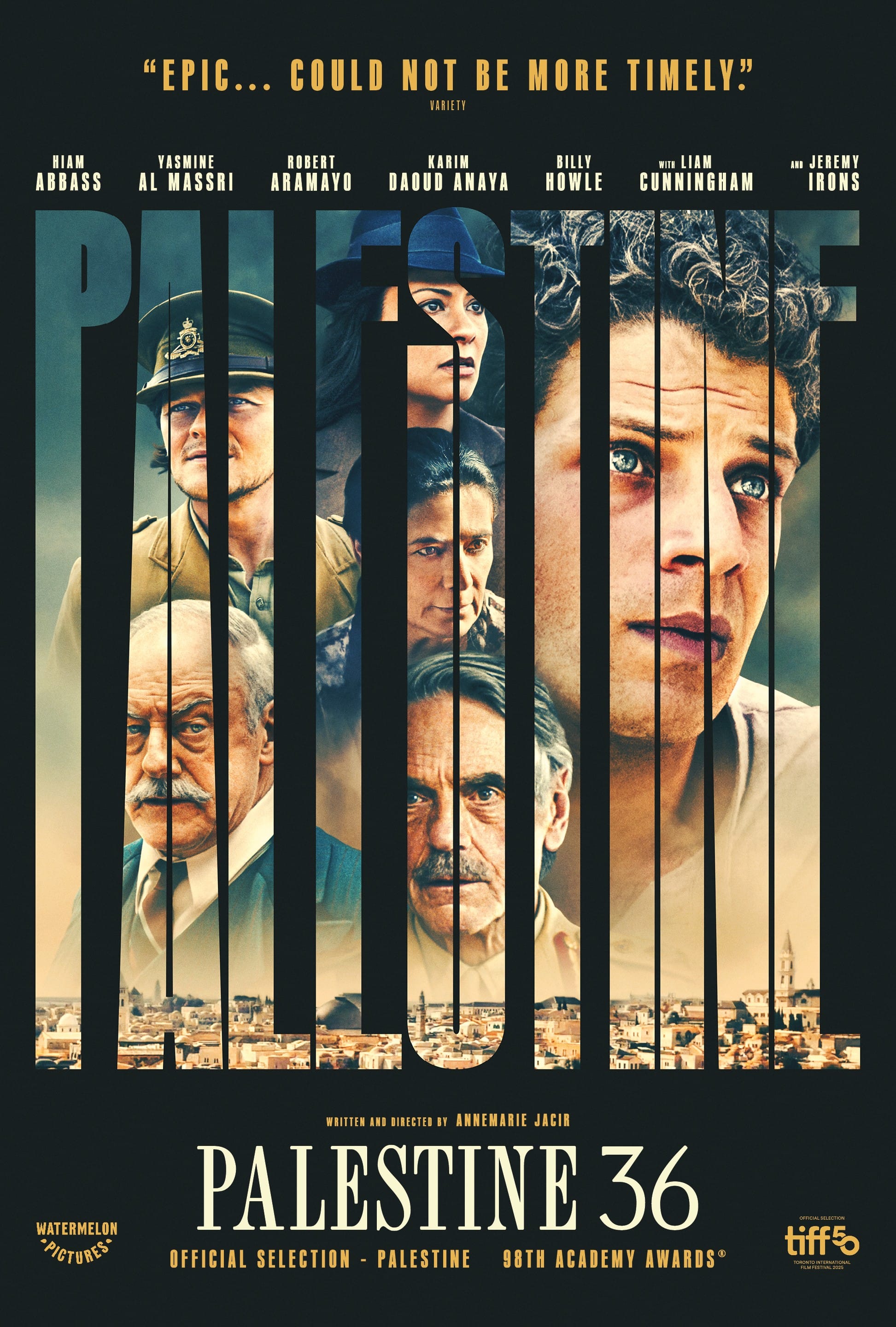
The film loosely centers around Yusuf, a young man from the fictional village of al-Basma, played by Qalqilya-born actor, Karim Anaya. The village has become a target of the British occupiers who are trying to stamp out the rebellion simmering into being after two decades of British rule. Hired as a chauffeur and dogsbody by the rich Palestinian businessman Amir (Dhafer L’Abidine), Yusuf initially gets recruited into the shady anti-nationalist Muslim Association. The organization had been set up by the Zionist Commission to serve as a counterweight to the Muslim-Christian Association, which initially led the fight against the Zionist takeover of Palestine.
Yusuf matures into political certainty as he navigates the awkwardness of trying to traverse class boundaries. He alternates between the keffiyeh headwear typical of peasants to the iconic red tarbush of the upper-class urbanites, suffers the indignity of his boss pushing money into his hand to buy nicer clothes and observes the upper-class Palestinians who dismiss the existential concerns of the dispossessed farmers. Yusuf’s work in the city for Amir raises the ire of his father who wants him closer to home to help tend the family fields and protect their lands as the Zionists encroach ever closer. When tragedy hits his family in the shape of a Zionist settler’s bullet followed by the British imprisonment of his younger brother, the compulsions of injustice push Yusuf into the fight. His story shows one individual’s path to political mobilization in a way that resonates with other characters in the film and those of so many Palestinians.
A similar story unfolds around Khalid (Saleh Bakri), a worker who just wants to support his family, but is drawn into the fight when even that humble aspiration is blocked. In one early scene, Khalid is among a group of dockworkers unloading a foreigner’s ship in Jaffa. They are eager to volunteer for extra work, desperate to make some money in an economy grinding ever more Palestinians into poverty, only to be denied their overtime pay by an unscrupulous employer. This injustice and a rousing political speech by a rebel recruiting fighters convinces Khalid to join the struggle.
The film educates viewers in more and less subtle ways about how the British were not impartial arbiters in the contest for sovereignty over Palestine. They were partisans driven by Christian Zionism (incarnated in the most compact way in the Bible-referencing Orde Wingate), Orientalist hubris and a penchant for brutality.
An added insult to the Palestinian workers being deprived of pay is their discovery that the barrels they unloaded carried smuggled weapons brought in by the Zionists to be used against the Arabs. It is a dramatization of “the cement incident” that occurred in 1935, when hundreds of guns and hundreds of thousands of rounds of ammunition were found in drums of cement on a Belgian ship. The fictional workers reflect the historical reality when they predict that the British will not punish those responsible for this major crime. (They never did.) The film educates viewers in more and less subtle ways about how the British were not impartial arbiters in the contest for sovereignty over Palestine. They were partisans driven by Christian Zionism (incarnated in the most compact way in the Bible-referencing Orde Wingate), Orientalist hubris and a penchant for brutality. Their priority was to build the settler-colonial state that became Israel and preserve the Empire’s influence and reputation.
Unlike the written word, so easy to skim over when the facts are tough, the great power of movies is the way they can make viewers feel—not just understand—how individuals experienced political policies and lived through grand historical events, enabling a deeper comprehension and sympathy for what drove them to respond in the ways they did. Palestine 36 achieves this remarkably. It shows the “intimate moments,” as Jacir describes them, through which Palestinians lived, resisted and sometimes succumbed to the pincer pressures of British colonial rule, Zionist settler incursions on their land and Arab landlord exploitation.
The film also brings to life the British government’s violent repression of Palestinian resistance to colonial rule. Eyewitnesses and scholars have revealed a litany of British atrocities that were routine, encouraged and legalized in their efforts to quell the Arab uprising: the use of hot iron rods to scorch the bodies of prisoners, sexual torture and rape, looting, beatings, concentration camps, home demolition on a mass scale.[6] It’s clear that the makers of this film have done their research. As the archives prove, so many real historical actors engaged in truly vile and inhumane behavior; and those resisting required heroic courage and determination. Avoiding the good versus evil stereotypes is thus a challenge for anyone trying to describe imperial domination. Yet, the film rarely indulges in black-and-white tropes, and Jacir mostly resists the moral extremes. Viewers get a sense of liberal Britain in the character of Thomas Hopkins (Billie Howle playing the private secretary to the High Commissioner), who is outraged by the censorship and violence used to quell the revolt. In the case of Orde Wingate, however, the British military commander who led a “dirty war” counterinsurgency carried out by joint British-Jewish “Special Night Squads,” Game of Thrones’ star Robert Aramayo’s unshaven portrayal of what almost seems like a caricature doesn’t capture the extent of Wingate’s actual brutality.[7]
The film is equally honest in its portrayal of the complex nature of Palestinian society and politics, which included people who opposed the rebellion, who colluded with the Zionists and who collaborated with the British. The romantic scenes of Palestinian nationalist fervor—the crowds shouting their unity and support for the rebels—are balanced by moments of internal division: a hooded collaborator identifies rebels to be shot and the stresses of British raids are admitted as resolve weakens among the people. In a wonderfully ambiguous scene, keffiyeh-clad rebels raid a train ferrying Palestinians; they stride among the passengers requesting but really demanding donations to support the uprising—especially from the bejeweled rich—that are offered not necessarily voluntarily. Jacir’s appreciation of Palestine’s diversity and class distinctions is manifest also in the strong fellahi (rural) accent of the actors playing villagers, revealed in, among other traces, the tell-tale pronunciation of the letter kaf with “ch.”

For a film that deploys many elements of a historical epic, Palestine 36 contains much that goes against that grain. The centrality of families, the strength of women and the importance of children bring a depth to the relationships and political dynamics in a way not always found in mainstream historical and political films. Syrian actor Jalal Altawil plays Father Boulos, a Greek Orthodox priest, emanating a serene love and determined equanimity with an intensity that helps explain the difficult choices he makes throughout the film. A fleeting scene in which he soothes an infant in his arms encapsulates so much of this beautiful character and of the power of family. Father Boulos also brings attention to the coexistence of Christians and Muslims in Palestine. The fact of Christian Palestinian nationalists riles the British, who would like to make everything crack along religious fissures but are foiled.
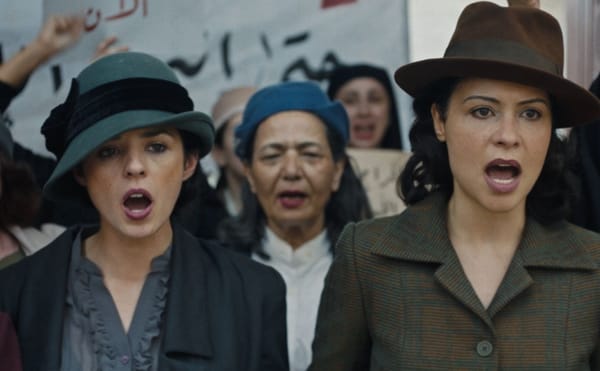
As the film shows, women were an active part of the rebellion and supported the male fighters and the stamina of their society in many ways.
In this big cast of characters there are numerous central women. A most powerful protagonist is Khuloud Atef (Yasmine al Massri), Amir’s wife and a fiery journalist who must write under a male pseudonym to be taken seriously. Her fashionable hats and occasional cross-dressing convey her independence of mind and spirit. Khuloud’s appearance with a crowd of women trying to petition the High Commissioner reflects the many actual women who tried to lobby the British government and publicize their people’s grievances. As the film shows, women were an active part of the rebellion and supported the male fighters and the stamina of their society in many ways.[8]
Another strong performance is delivered by Hiam Abbas (well known among audiences of Palestinian cinema and of the TV series Succession), as Hanan. Her steeliness and gentle wisdom come through powerfully in a scene in which Hanan tells her granddaughter, Afra (Wardi Eilaboun), of her people’s connectedness to the land, reflecting the importance of oral history as a font of Palestinian national history. Abbas has said in interviews that she felt she was channeling her own grandmother. Afra’s mother, Rabab (Yafa Bakri), is a young widow whose accidental possession of a 19th-century firearm drives a lot of the action. Bakri plays Rabab’s commitment to the struggle and to her daughter and parents with an understated strength that seems to flow organically from the grim determination of Abbas’s Hanan. The strength, courage and determination of these female characters is echoed in scenes of women physically fighting British soldiers, which recall images from the First Intifada (1986–1993), another major Palestinian uprising against oppression in which women were central.
Children are another important part of this vast ensemble cast. They are receptacles of their elders’ wisdom and bear the responsibility of carrying the defense of Palestine into the future. Viewers follow the political education and emotional scarring of Afra’s playmate, Kareem, the son of Father Boulos. Played in an intense performance by Ward Helou, Kareem suffers tragedies that drive the cycle of resistance forward. As in When I Saw You, Jacir’s 2012 film that follows a stubborn refugee boy’s insistence on returning to Palestine, Afra has a similar kind of stubbornness, borne of an adventuresome curiosity and tough joy. Early in the film she is shown keeping abreast of the Empire’s gossip as she explains to Kareem the abdication of King Edward VIII because he wanted to marry a divorced woman. Afra’s stamp collection with the King’s profile across the empire’s many countries reveals something of that story of political engulfment, but it also carries Afra’s imagination into wider horizons. These moments of sweetness and humor nurture the film, infusing it with a kind of storytelling helium.
The film wraps up as the rebellion is crushed—its leaders were exiled, fighters were killed, the people’s fortitude ground down by violence and unendurable material deprivations. Also echoing the final scene of When I Saw You, Palestine 36 ends with a running child lifting the audience into an unknown future. The image of hopeful uncertainty—the film’s one nod to unreality—leaves open an imaginative space for a liberated future.
Palestine 36 is not a film that Zionists will like, not least because they barely feature. The settler-colonials appear marginally and mostly as a group at a distance, planting facts on the ground, setting fire to Palestinians’ crops, receiving the gift of Palestinian land from British hands and assassinating civilians from the shadows. As Jacir told The Guardian, “This film is for Palestinians. It’s our story that hasn’t been told.”[9]
As Jacir told The Guardian, “This film is for Palestinians. It’s our story that hasn’t been told.”
Anyone who’s been paying attention will recognize the parallels between the methods and attitudes of the occupiers portrayed in the film and more recent history. It is no surprise, since the British Empire laid the legal foundations on which Israeli repression was built, a point that Jacir wants audiences to understand. The film dramatizes with great historical accuracy the ruthless cascades of violent repression and dictatorial power wielded by the British—most banally by young British soldiers demanding to see Palestinians’ identity papers, stealing Palestinians’ money at checkpoints, harassing women and most extravagantly in the collective punishment wrought through concentration camp detentions and home demolitions. It depicts what historian Caroline Elkins calls the “legalized lawlessness” that determined the broad permissions provided to British repressive forces.[10] Every tactic of repression depicted in the film has a modern-day shadow in Israeli methods—murderous settler violence, the use of “human shields,” chaotic house raids and imprisonment without trial are just a few examples—as well as in international methods of mollification. When Jeremy Irons as arrogant British High Commissioner Wauchope fobs off a delegation of women by offering them yet another investigative commission (the Royal Peel Commission) in saccharine tones promising that “together we can create united and peaceful Holy Land,” the hypocrisies of today’s venal politicians echo loudly.
The movie operates on multiple levels: as a period drama replete with luscious costumes, a historical epic with famous actors and a political exposé revealing the brutality of British rule in Palestine. For those who know this history, it is deeply satisfying to see it brought to life on the screen by big names, some of whom have been speaking out in support of Palestinians. (Irish actor Liam Cunningham of Game of Thrones renown plays the evil Charles Tegart and has been a vocal supporter of the Freedom Flotilla trying to deliver humanitarian aid to Gaza, and Jeremy Irons has been calling for an end to the blockade of Gaza at least since 2017.)
Palestine official submission for the Best International Feature Film category at the 98th Academy Awards (for which it has just been shortlisted), Palestine 36 has already garnered many awards: Grand Prize at the Tokyo International Film Festival, an Audience Award at the São Paulo International Film Festival, a Best Screenplay nomination at the Asia Pacific Screen Awards and it was shortlisted for the 38th European Film Awards. Its first screening in front of a live audience at the Toronto International Film Festival was met with a 20-minute ovation, evidence, as actress Hiam Abbas told Mehdi Hasan, that Palestinians’ stories “correspond to the hearts of people.”
No doubt critics and audiences are reacting both to the film as a moving story of individuals navigating epic political shifts, and to the resonance it has with today. On November 17, 2025, the Security Council passed Security Resolution 2803. With it, the great powers drove “the last nail in the coffin of UN legitimacy” (one more time) as it blessed the handing over of Gaza to yet another conglomeration of foreigners.[11] As Jacir has said in interviews: The period of the 1936–39 Revolt never ended, and the long struggle for freedom continues.
[Lori Allen is a writer and editor based in London and the author, most recently, of A History of False Hope: Investigative Commissions in Palestine.]
Support MERIP during our year-end campaign! Make a one-time or monthly donation today!
[1] Ghassan Kanafani, The Revolution of 1936-1939 in Palestine: Background, Details, & Analysis, translated by Hazem Jamjoum (1804 Books, 2023), pp. 6–7.
[2] Ibid, p. 1
[3] Mahmoud Yazbak, “From Poverty to Revolt: Economic Factors in the Outbreak of the 1936 Rebellion in Palestine,” Middle Eastern Studies 36/3 (July 2000), p.94.
[4] Rashid Khalidi, The Iron Cage: The Story of the Palestinian Struggle for Statehood (Boston: Beacon Press, 2006), p. 37
[5] Mahmoud Yazbak, “From Poverty to Revolt: Economic Factors in the Outbreak of the 1936 Rebellion in Palestine,” Middle Eastern Studies 36/3 (July 2000), pp. 93–113, p. 99.
[6] Caroline Elkins, Legacy of Violence: A History of the British Empire. Penguin Random House, UK, 2023, pp.194–95.
[7] Matthew Hughes, M. “Terror in Galilee: British-Jewish Collaboration and the Special Night Squads in Palestine during the Arab Revolt, 1938–39.” The Journal of Imperial and Commonwealth History, 43/4 (2015), 590–610.
[8] Matthew Hughes, “Women, Violence, and the Arab Revolt in Palestine, 1936–39.” Journal of Military History, 83/2 (2019), pp. 487–507.
[9] Geneva Abdul, "Palestine 36 director Annemarie Jacir: ‘We don’t want a state, we just want to live’," The Guardian, October, 17, 2025.
[10] Caroline Elkins, Legacy of Violence: A History of the British Empire (Penguin Random House, UK, 2023), pp.129–62.