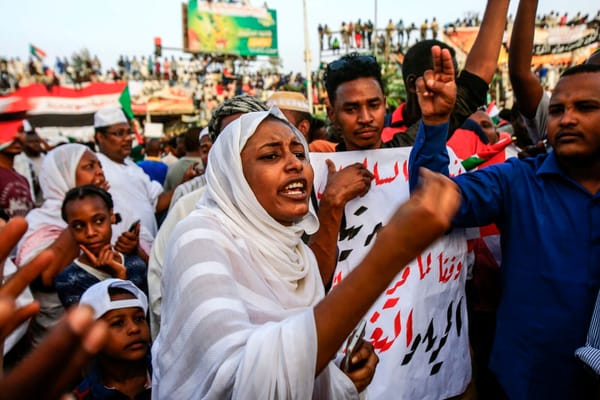
A Sudanese woman chants slogans during a demonstration demanding a civilian body to lead the transition to democracy, outside the army headquarters in Khartoum on April 12, 2019. Ahsraf Shazly/AFP via Getty Images. Primers The Struggle for Sudan An introduction to the basic dynamics of the political landscape in Sudan since the 2019 revolution. Khalid Mustafa Medani • 21 min read
MER Article The Responsibilities of the Cartoonist Khalid Albaih is a political cartoonist “from the two countries of Sudan,” in his words, who is now based in Qatar. His drawings appear at his Facebook page, entitled Khartoon! in a play on the name of the Sudanese capital. Katy Kalemkerian and Khalid Medani spoke with him in Montreal on November 9, Katy Kalemkerian, Khalid Mustafa Medani • 22 min read
MER Article China and the Sudans It wasn’t supposed to be like this. South Sudan and Sudan had agreed to share oil revenue, oil was flowing again and, despite considerable problems, relations appeared headed in a slightly better direction. Both governments were drawn to China as a key provider and practical enabler of economic assi Daniel Large • 13 min read
MER Article "Open for Business" The Republic of South Sudan is undergoing its most devastating round of violence since declaring its independence in July 2011. The fighting broke out in mid-December 2013, some five months after President Salva Kiir fired his vice president, Riek Machar, along with the entire cabinet. At a December Khalid Mustafa Medani • 12 min read
Current Analysis New Alliances and Schisms in Sudan The ten days of protests in Sudan beginning September 23, 2013 were the largest in the country since the installation of the military government of Omar al-Bashir in 1989. As Middle East Report editor Khalid Mustafa Medani explains in an interview with KPFA, unlike the youth-led protests of 2011 and Amanda Ufheil-Somers • 1 min read
MER Article A Tale of Two Secessions in the Sahara The March 2001 destruction of the Buddhas of Bamyan, Afghanistan, introduced a new loanword into the Euro-American political vocabulary. The Taliban’s new explosion into world consciousness catalyzed, until September of that year, more hand wringing than substantive investigation of their social ori George R. Trumbull • 9 min read
Current Analysis War Returns to the Two Sudans After weeks of escalating border violence and heated rhetoric, war has returned to the Sudans. The 2005 Comprehensive Peace Agreement (CPA) formally ended 40 years of civil war between north and south Sudan, and paved the way for the creation of the Republic of South Sudan, Africa’s newest independe Amanda Ufheil-Somers • 11 min read
Current Analysis No Clean Break Renewed conflict along the border between Sudan and South Sudan follows a predictable pattern, says MERIP editorial committee member Khalid Medani in an interview with KPFA radio. Amanda Ufheil-Somers • 1 min read
Current Analysis Clooney's Arrest Dwarfs Sudan Agreement The casual Sudan observer might conclude from recent news stories that George Clooney's arrest at the Sudanese embassy in Washington on March 16 has been the most significant event of the past week. It takes some digging to find any coverage of the preliminary agreement [http://www.sudantribune.com/ Amanda Ufheil-Somers • 1 min read
Featured The Sudan Split On July 9, 2011, tens of thousands of South Sudanese gathered in the capital city of Juba at the mausoleum of rebel leader John Garang to celebrate the creation of their new state. Six months earlier, these jubilant crowds had voted in a referendum for independence from northern Sudan; more than 98 Mimi Kirk • 18 min read
MER Article A Journey of a Thousand Steps On July 9, 2011, South Sudan will officially become independent. When southern Sudanese voted in the January 9 referendum on independence, they sought to affirm their African identity and shed the Arab identity that they felt had been imposed upon them by successive regimes in Khartoum. They also si Marie-Joëlle Zahar • 13 min read
MER Article Sudan's Referendum Amidst Revolution On February 7, 2011, the Southern Sudan Referendum Commission presented President Omar al-Bashir and First Vice President Salva Kiir with the results of the January 2011 vote on southern self-determination. It was a formality: During the three-week voting tabulation process, both presidents had publ Edward Thomas • 13 min read