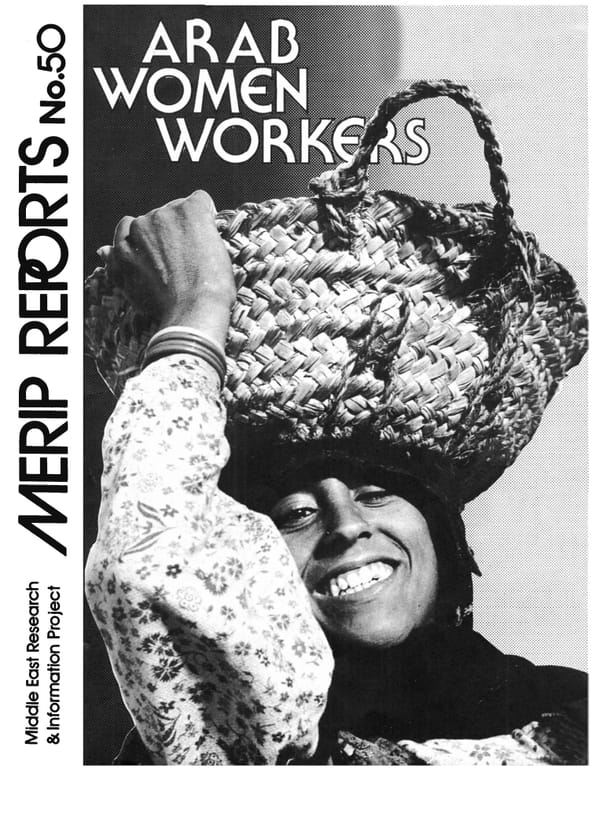
MERIP Reports issue number 50, August 1976.Middle East Report number 138, January-Febraury 1986. Cover photo by Hannes Wallrafen.Inside Middle East Report 268, “Gender Front Lines,” Fall 2013. MER Article Shifting Approaches to Women and Gender in Labor, Politics and Society It took MERIP some five years and 50 issues before it finally addressed women and gender in its pages. In August 1976, the two feature articles explored questions about working women, my own “Egyptian Women in the Work Force” and “The Proletarianization of Palestinian Women in Israel” by Najwa Makhoul Judith Tucker • 6 min read
Sarah Hegazy at a protest in Canada. Photo courtesy of HuMENA. [Creative Commons license CC BY-SA 4.0.] Current Analysis Sarah Hegazy and the Struggle for Freedom Responses to the tragic death of the Egyptian leftist and queer activist Sarah Hegazy reflect a significant transformation in the desire of individuals in the Middle East to claim queer identities. Zeina Zaatari places this moment in the historical context of decades of activism and struggle for fre Zeina Zaatari • 14 min read
Current Analysis LGBT Rights in Iran Over the last two decades, issues relating to sexual orientation and gender identity have gained significant visibility and attention across the globe. The case of Iran is particularly fraught, and has received plenty of coverage due to the work of international non-profits. Shima Houshyar • 6 min read
MER Article Turkey's Woman in the Red Dress On June 1, the day after the brutal police attack to disperse the occupation of Gezi Park, thousands more protesters descended upon Taksim Square in central Istanbul. By the end of the week, demonstrators filled the plaza completely, with those in the park itself behind barricades should the police Neslihan Sen • 7 min read
Current Analysis Another Struggle: Sexual Identity Politics in Unsettled Turkey What happens when almost 3,000 men, women and transgender people march down the main street of a major Muslim metropolis, chanting against patriarchy, the military and restrictive public morals, waving the rainbow flag and hoisting banners decrying homophobia and demanding an end to discrimination? Alyssa Bivins • 14 min read
Current Analysis Another Struggle What happens when almost 3,000 men, women and transgender people march down the main street of a major Muslim metropolis, chanting against patriarchy, the military and restrictive public morals, waving the rainbow flag and hoisting banners decrying homophobia and demanding an end to discrimination? Kerem Öktem • 14 min read
MER Article Massad, Desiring Arabs Joseph Massad, Desiring Arabs (Chicago: University of Chicago Press, 2007). Khaled El-Rouayheb • 3 min read
MER Article Sanctioned Pleasures Beirut is known internationally for a youthful jet set that likes to be identified with the world clubbing circuit, including such stops as B018, an underground nocturnal haunt reminiscent of a coffin built by Lebanese architect Bernard Khoury upon the remains of a war crime. Lara Deeb, Mona Harb • 23 min read
MER Article "We Invite People to Think the Unthinkable" What prompted you to found Hurriyyat Khassa, and what are its goals? Sara Scalenghe • 10 min read
MER Article Disavowed Homosexualities in Beirut Beirut can be perceived as a social body, with all the complexities of such an organism. Lebanon's capital provides, in fact, the stage for a panoply of moods and dispositions which are a dynamic result of particular histories and larger socio-cultural circumstances. As a body, Beirut is, of Sofian Merabet • 11 min read
MER Article Transgender Bolero I remember seeing her. What I can’t remember is not seeing her. For the moment I saw her she was everywhere. Perhaps, unlike the rest of us, she was made of fluid and did not fit into any corporeal frame meant for the solidified. Or perhaps it was her Elif Shafak • 11 min read
MER Article Egypt's Virtual Protection of Morality Action by states to impose excessive regulations on the use of...the Internet, on the grounds that control, regulation and denial of access are necessary to preserve the moral fabric and cultural identity of societies, is paternalistic. These regulations presume to protect people from themselves and Hossam Bahgat • 11 min read