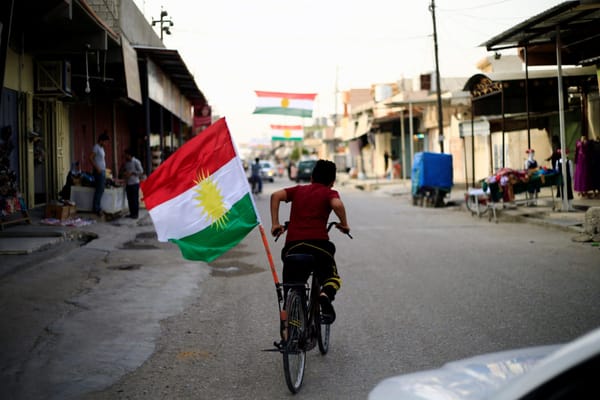
A boy rides a bicycle with the flag of Kurdistan in Tuz Khurmato, Iraq, September 24, 2017. Thaier Al-Sudani/Reuters Current Analysis The Elusive Quest for a Kurdish State Kurdish communities in the Middle East have been struggling for independence, autonomy and civil rights since at least the 1880s. While Kurdish movements across the region have suffered from fragmentation, the more formidable obstacle to fulfilling Kurdish aspirations are regional and global geopoli Djene Rhys Bajalan • 18 min read
Current Analysis A New Normal for Iraqi Kurds? At first glance, the Kurdistan Regional Government (KRG) seems to have come out ahead from the takeover of Mosul, Iraq’s second-largest city, by the Islamic State of Iraq and al-Sham (ISIS). Taking advantage of the power vacuum left by the flight of the Iraqi security forces from Mosul and its envir Denise Natali • 8 min read
Current Analysis Syrian Kurds on the Verge of Crisis With the civil war in Syria past the point of no return, the country’s economy is undergoing unprecedented shrinkage. Inflation is running rampant. Purchasing power is plummeting as the value of the Syrian pound falls against the US dollar. Damascus and Aleppo, the main economic hubs, are badly aff Sirwan Kajjo • 2 min read
Current Analysis Syrian Kurdish Cards Upheaval in Syria has given Kurdish groups new opportunities to advance their nationalist agendas while serving as proxies for neighboring states. In Turkey, the Kurdistan Workers’ Party or PKK has taken advantage of the rift between the regime of Bashar al-Asad and the Turkish government by turning Denise Natali • 12 min read
MER Article A Kurdish-American in Mosul Herro Kader Mustafa is a Kurdish-American, originally from Iraq, who has built an impressive portfolio of responsibilities in the course of her career at the State Department and the National Security Council of the United States. She is currently the acting chief of staff for the undersecretary for Herro Kader Mustafa • 5 min read
Current Analysis The Ceasefire This Time “The aim of the Turkish armed forces is to ensure that the separatist terrorist organization bows down to the law and the mercy of the nation.” Thus did the Turkish chief of staff, Gen. Hilmi Ozkok, brusquely dismiss the one-month ceasefire announced on August 19, 2005 by the Kurdistan People’s Cong Evren Balta • 12 min read
Current Analysis Kurdish Green Line, Turkish Red Line Election day on January 30 was a day of celebration for the Kurds in Kirkuk, an ethnically mixed city just below the Zagros Mountains in northern Iraq. Despite the threat of car bombs, Kurds stood in long lines for hours awaiting their chance to cast a vote. A teenager was Quil Lawrence • 10 min read
Current Analysis Turkey's Ecevit When Turkish Prime Minister Bulent Ecevit arrives in Washington, DC this week to meet with President George W. Bush he will come bearing a symbolic gift: a replica of a 16th century Koran, beautifully embroidered and written with real gold lettering. The original of this Koran comes from the Topkapi Ertugrul Kurkcu • 7 min read
Current Analysis Almost Unnoticed When Turkey sent 10,000 soldiers into northern Iraq in late December 2000, the event passed almost unnoticed by the international media. For the majority of ordinary Kurds, Turkish incursions into Iraqi Kurdistan have become routine. As on previous occasions, Turkish special troops crossed the border to hunt fighters of Isam al-Khafaji • 6 min read
MER Article The Destruction of Iraqi Kurdistan Less than five years ago, the US-led coalition against Saddam Hussein established a “safe haven” in Iraqi Kurdistan following Iraq’s brutal suppression of an uprising against the regime during March-April 1991. The mood among the majority of Iraqi Kurds was highly optimistic: A certain measure of se Joost Hiltermann • 13 min read
MER Article Hidden Death There may be more landmines deployed per person in Kurdish Iraq (population around 3.5 million) than in any other region in the world. A 1993 State Department report estimates that the Iraqi army laid 3 to 5 million mines there during the Iran-Iraq war and in the months leading up to the 1991 Gulf w Joe Stork • 1 min read
MER Article Intervention, Sovereignty and Responsibility Four years after Operation Desert Storm, and the mass uprisings that followed in the southern and northern parts of Iraq against Saddam Hussein’s regime, the country’s economic and social fabric is in tatters. Economic sanctions, following a destructive war and compounded by the Iraqi government’s a Sarah J Graham-Brown • 32 min read