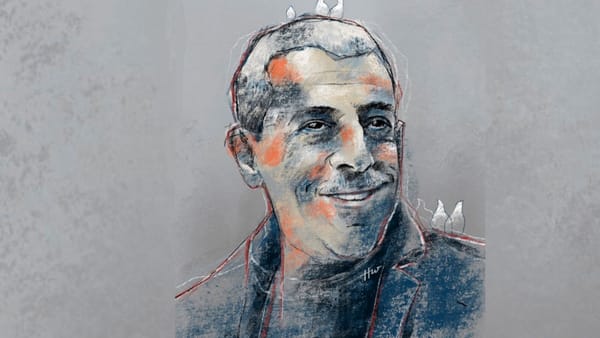

Portrait of Walid Daqqah by artist and architect Hazem Abutawila.Protesters gather to hold a demonstration demanding the release of Walid Daqqa in Bethlehem, West Bank on June 7, 2023. His wife and daughter appear in the poster behind him. Wisam Hashlamoun/Anadolu Agency via Getty Images
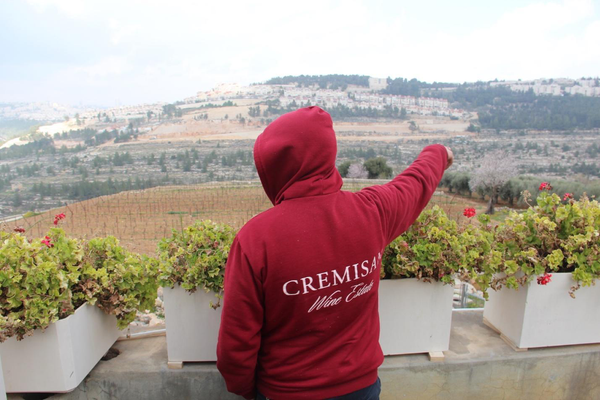
The trilingual Marawi label on the Recanati Winery’s “ancient wines” series. Daniel Monterescu, 2018.Elyashiv Drori walks across his research vineyard at Ariel University. The signpost acknowledges the financial support of Ariel University, the Jewish National Fund, the Samaria Region and the Jordan Valley Research and Development Center for his “Israeli grapevine varieties.” Daniel Monterescu 2018Elyashiv Drori (left), a molecular biologist, at work in his research winery at Ariel University in the West Bank. An assistant winemaker removes a tasting sample from a barrel. Daniel Monterescu, 2018.In the northern hills of the West Bank, winemaker Fadi Batarseh points across the Cremisan Valley at the Israeli settlement Har Gilo, south of Jerusalem and close to Bethlehem. Daniel Monterescu, 2017.The Israeli separation barrier cuts through the Cremisan monastery’s fields in the West Bank. Daniel Monterescu, 2017.Under the banner “We live and exist here,” Bethlehem-area Christians and solidarity activists celebrate Mass to protest the Israeli separation wall that will cut off the Cremisan monastery and winery from nearby Palestinian communities. Ryan Rodrick Beiler, 2011.
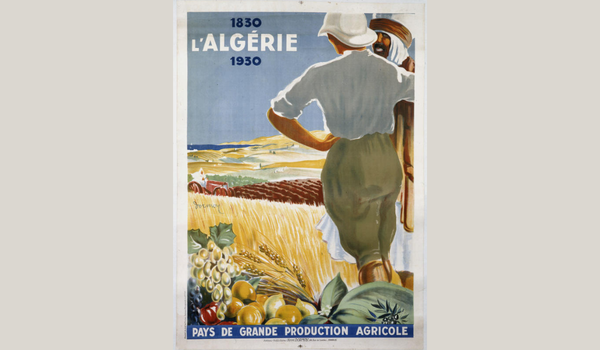
Poster by Henri Dormoy in 1930 for the centennial anniversary of French colonization of Algeria. Credit Coll. Galdoc-Grob/Kharbine-Tapabor.French government map depicting the similarities between California and Algeria featured in a study on fruit production published in 1933. Bibliothèque Nationale de France (BNF)Cartoon by the Algerian artist Dilem, December 6, 2021. Algerian President Abdelmajid Tebboune walks alongside Palestinian President Mahmoud Abbas who asks, “What is it like living next to an Israeli colony,” with the Moroccan flag flying prominently in the background. The heading reads: “The Palestinian President on an official visit to Algeria.” Available on the artist’s Facebook page.
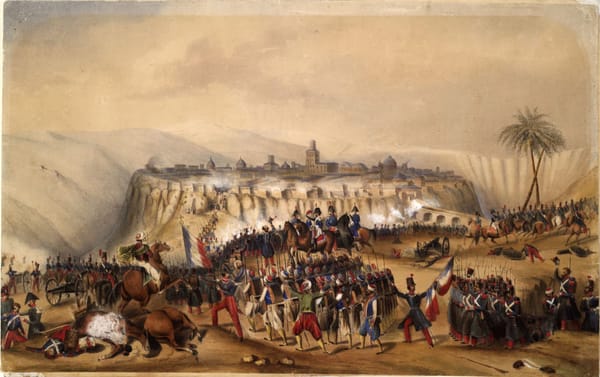
An 1837 watercolor depicts French forces advancing across cliffs and through a breach in the wall of the fortified city of Constantine in Algeria. Artist possibly Jean-Louis Gaspard of the 31st Regiment of Infantry. Anne S.K. Brown Military Collection at the Brown University Library/Library of CongressThe governor of Italian Libya, Italo Balbo, welcomes arriving Italian colonists in Tripoli in 1938. Courtesy of State Treasury of Poland, image in the public domain.
Poster by Henri Dormoy in 1930 for the centennial anniversary of French colonization of Algeria. Credit Coll. Galdoc-Grob/Kharbine-Tapabor.French government map depicting the similarities between California and Algeria featured in a study on fruit production published in 1933. Bibliothèque Nationale de France (BNF)Cartoon by the Algerian artist Dilem, December 6, 2021. Algerian President Abdelmajid Tebboune walks alongside Palestinian President Mahmoud Abbas who asks, “What is it like living next to an Israeli colony,” with the Moroccan flag flying prominently in the background. The heading reads: “The Palestinian President on an official visit to Algeria.” Available on the artist’s Facebook page.
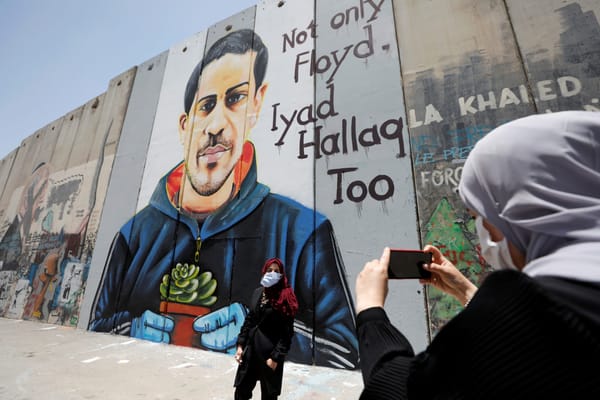
A woman takes pictures of her friend in front of the Israeli separation wall with a mural depicting Iyad al-Halaq, an unarmed Palestinian who was shot dead by Israeli police and referenceing George Floyd who was killed by police in the United States in May 2020. Bethlehem, West Bank. Mussa Qawasma/ReutersWorkers in the Athlit quarry during the construction of the Haifa harbor in the 1920s where the British proposed dividing Arab and Jewish workers into different skill categories along racial lines. Library of Congress, G. Eric and Edith Matson Photograph Collection.
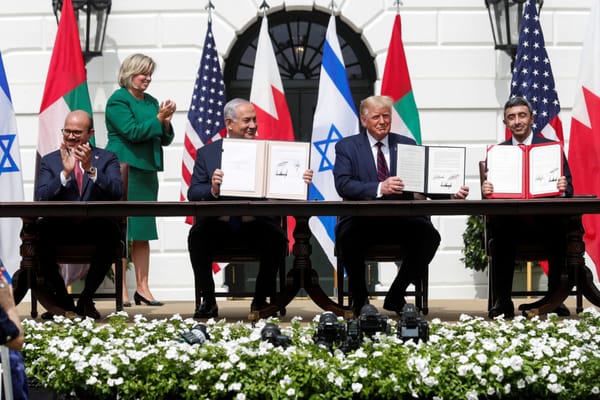
Bahrain’s Foreign Minister Abdullatif Al Zayani, Israel’s Prime Minister Benjamin Netanyahu, US President Donald Trump and United Arab Emirates (UAE) Foreign Minister Abdullah bin Zayed participate in the signing of the Abraham Accords, September 15, 2020. Tom Brenner/Reuters
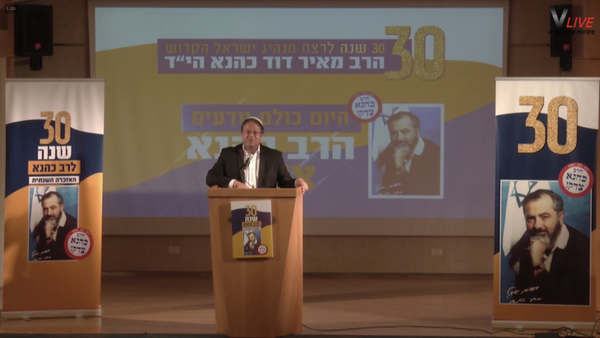
The Jewish Power party leader Itamar Ben-Gvir speaking at the 30th annual memorial to Meir Kahane on the anniversary of his murder, November 2020. Screenshot of the live stream of the event.
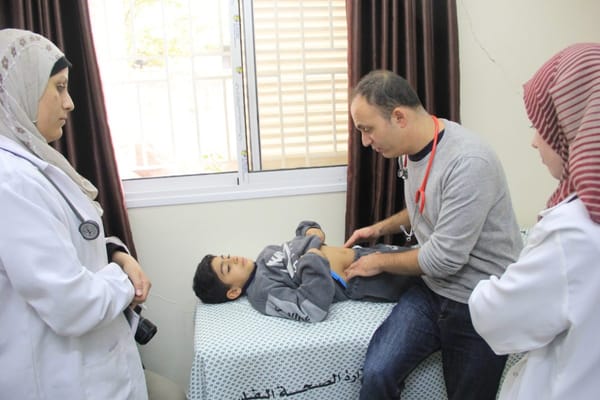
Osama Tanous examining patients and training physicians in Gaza while on a humanitarian medical aid trip in January 2020. Courtesy of the Palestinian Center for Human Rights.
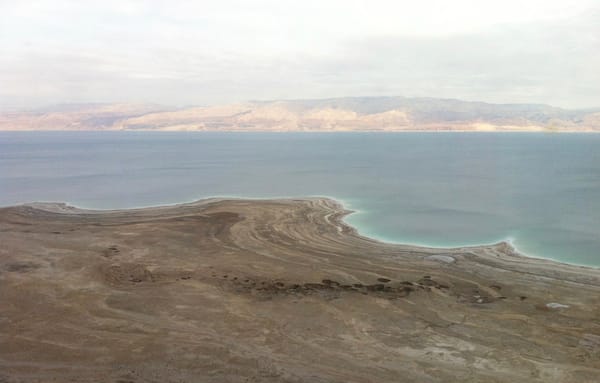
The Occupied Territories. A string of Dead Sea sinkholes in the West Bank are seen just north of the 1949 Armistice Line but south of the Israeli military checkpoint that Palestinians cannot cross without visas, Israeli or international passports or laissez-passer documents. The linear pattern of the sinkholes, which began appearing in the area in the 1980s, gave a clue to their origin. The lines of sinkholes parallel underground faults, where deposits of salt left over from the ancient Lake Lisan were dissolving as hypersaline Dead Sea water receded and fresh groundwater saturated the salt deposits.Israel. This sinkhole looks very different. Underneath the sun baked, uneven pavement of what was Route 90, the north-south highway that runs the length of the Jordan River Valley from the Red Sea to the Golan Heights, a large cavern has appeared. Though the highway runs through the West Bank, it is one of many highways in Palestine that are off limits to Palestinian cars. The road surface above this sinkhole near Kibbutz Ein Gedi never collapsed because of an iron plate installed under it, which was itself compromised when the Israeli government cut a hole in the plate to investigate the sinkhole. The sinkhole’s presence underground has crippled the flow of traffic along Route 90, as freight, tourists, scientists, settlers and employees of Dead Sea industries wait their turn to be escorted by a lead car along a narrow side road through an archaeological site, hiking trail, date grove and water bottling plant to get around this compromised stretch of road.The Occupied Territories. This sinkhole is one of many near a tourist beach that was owned and operated by the West Bank Israeli settlement Mitzpe Shalem until sinkhole activity forced the beach to close. Here, an American student studying in Tel Aviv has come to visit the sinkholes with his professor and the rest of the class. For him and for most members of the class, this was the first time they were knowingly in the West Bank.The Occupied Territories. These sinkholes, part of the same cluster as the one above, took out much of the infrastructure to the settlement-operated tourist beach, including electricity. With the tourist beach closed for good, these sinkholes have inhibited a kind of extraction on occupied land.The Occupied Territories. Once the settlement-owned tourist beach in the West Bank was closed to tourists, the sinkhole problem escalated. Six months into the closure, a sinkhole swallowed these buildings once used for expensive spa treatments. The Bedouin man hired by the settlement to keep tourists out of the beach says this sinkhole opened with a loud crash.The Occupied Territories. The edge of the sea at the settlement-owned tourist beach in the West Bank looks different after six months without tourists. The red flag buoy once marked the edge of the area lifeguards patrolled as a warning to swimmers. The salt crust seen here is delicate. It cannot form when the stones are constantly disturbed by the feet of tourists. Though it is a quintessential image in Dead Sea brochures and on Dead Sea cosmetics packaging, almost no tourist ever gets to see it in person. Thanks to the sinkholes at Mineral Beach, this tourist site now features the famous and elusive salt crust.The Occupied Territories. At the very north end of the Dead Sea (taken from the West Bank looking across to Jordan) lies manufacturing detritus of the only Palestinian-owned Dead Sea business, a table salt factory. The factory is hemmed in by Israeli military installations, including land mines, a small military base and barbed wire. On the other side of the barbed wire are the rickety remains of a pier, sun-bleached pylons now comically out of place hundreds of meters away from the water’s edge. The Dead Sea’s recession is strikingly obvious here, and it is that same movement of water that has catalyzed the sinkholes elsewhere along the shore.The Occupied Territories. Little remains of the Jordan River right before it flows into the Dead Sea, revealing one cause of the Dead Sea sinkhole problem. With most of the river water diverted upstream, what now feeds the Dead Sea is largely agricultural runoff and a small fraction of the river water that used to flow into the sea. The reduced water flow greatly exacerbates the depletion of the Dead Sea’s waters and accelerates the sinkhole problem. This photograph shows one of two sites speculated to be the place where Saint John baptized Jesus. On both sides of the river (itself an international border though it is now only a few feet wide), tourists and pilgrims can come dip themselves into the polluted water. On the West Bank side, the Israeli government has carved out a section of its Oslo Accords-negotiated closed military zone as a national park, one of several Israeli national parks in the Occupied Territories. Young Israeli Defense Force soldiers rotate through this site, guarding the border. They take photos with star-struck tourists, smiling next to their weapons.Israel. This image of the Dead Sea shows one of the causes of the sinkhole problem. The top and bottom lobes of the Dead Sea are connected only by narrow canals, which are used by mineral extraction companies to control the flow of sea waters from the northern section into large evaporation pools that make up the southern part of the sea. These canals are south of the 1949 Armistice Line. This photo was taken from Israel looking toward Jordan.Ghor al-Haditha, Jordan. These sinkholes have destroyed some of the famous tomato fields of the Jordanian town of Ghor al-Haditha. People still work the tomato fields in spite of the sinkholes. Residents began calling the holes hufur al-njoom, or star holes, when they started appearing in the 1980s. They looked like craters left by something that fell from the sky. In Ghor al-Haditha, the sinkholes were not blocked off, though the Jordanian government has tried to persuade residents to leave the area. One family told me they were forcibly settled here once by the government, and they are not keen to leave.