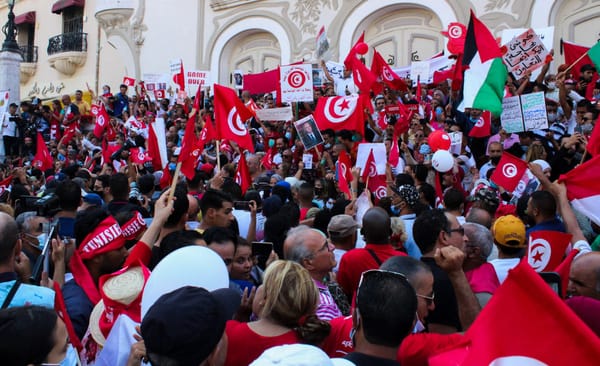

Demonstrators supporting President Kais Saied in Tunis on October 3, 2021. Chahd Lina Belhadj/Meshkal Current Analysis Populist Passions or Democratic Aspirations? Tunisia’s Liberal Democracy in Crisis Tunisia's political system is in crisis after President Kais Saied concentrated power in his office in July 2021. Robert P. Parks and Tarek Kahlaoui delve into the reasons why so many citizens support his moves and explain why they have become so disenchanted with Tunisia's democratic system. The au Robert P. Parks, Tarek Kahlaoui • 15 min read
Iran 2021 Issue - cover opt 1 Current Analysis Revisiting MERIP Coverage of Iran and Its Elections As Iran’s elections approach (June 18, 2021), MERIP revisits recent articles that provide a deeper context for understanding politics in Iran today. The pieces gathered here include a forum re-thinking US-Iranian relations as well as articles examining key elections in Iran over the last 20 years, f The Editors • 4 min read
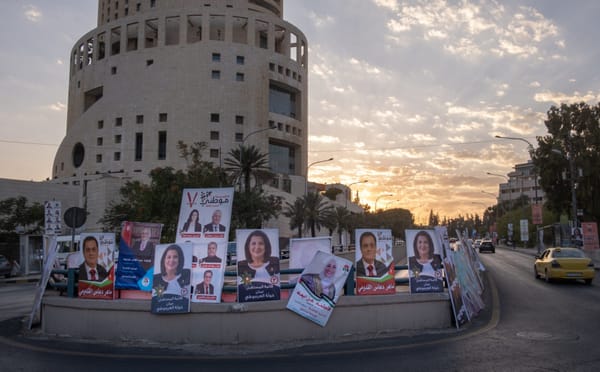
Political posters in Amman, Jordan in the run up to the November 2020 parliamentary election. Photo by the author. Current Analysis Jordan’s 2020 Election Shifts from Landmark Poll to Business as Usual November 2020 is election season not only in the United States, but also in Jordan where the prospects for a shakeup in parliament are quickly receding. Based on interviews with Jordanian political leaders, E.J. Karmel explains the shifting dynamics among candidates, lists, parties and currents that E.J. Karmel • 12 min read
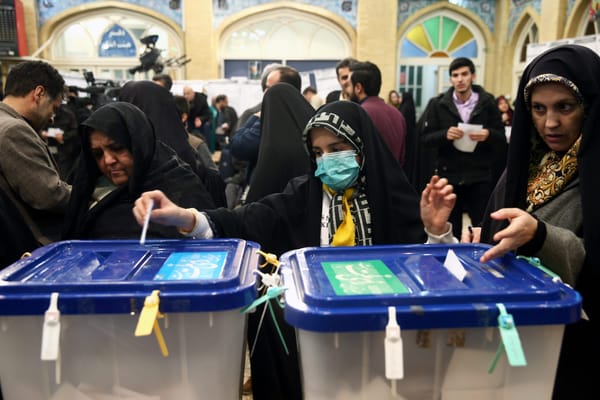
Woman wears a face mask as she casts her vote during parliamentary elections at a polling station in Tehran Current Analysis The Making of a "Resistance Parliament" in Iran and the Challenges Ahead Iran's parliamentary elections in February handed the conservative supporters of the Supreme Leader a major victory. Abedini and Armin explain how and lay out why the regime is poorly positioned to deal with popular discontent, crushing US sanctions and the spreading coronavirus. Vahid Abedini, Razieh Armin • 11 min read
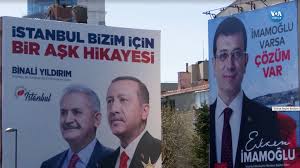
Istanbul elections Current Analysis Autopsy of Erdoǧan’s Istanbul Defeat Turkey's authoritarian President Erdoǧan’s attempt to manipulate Istanbul's recent mayoral election led to a humiliating defeat. Despite the tight grip Erdoǧan and the AKP appear to have over Turkish politics, Turkey's population is much more fractious and agitated by the regime than previously kno Steve Niva • 14 min read
Current Analysis Turkish Voters Upset Erdoǧan’s Competitive Authoritarianism Turkish voters sent a strong message to its long-standing ruling party and its leader on March 31, 2019 that the government’s authoritarian turn has not fully succeeded. In nationwide municipal elections, for the first time in a quarter century, the political movement largely associated with Turkey’ Steve Niva • 13 min read
Current Analysis The Lebanese Elections and Their Consequences Nine years since the last national parliamentary election, many in the country expected the emerging civil society groups to challenge the tradition sectarian-based parties. Despite the rumblings for change, the status quo prevailed. Rayan El-Amine • 10 min read
Current Analysis The United States’ Recognition of Jerusalem as the Capital of Israel and the Challenge to the International Consensus On December 6, 2017, US President Donald Trump announced that the US was recognizing Jerusalem as the capital of Israel and would be moving its embassy there from Tel Aviv in fulfillment of the 1995 Jerusalem Embassy Act (henceforth Embassy Act). In one fell swoop, the US has seriously challenged 70 Mahmud Muna, Mandy Turner • 17 min read
Current Analysis Sisi’s Plebiscitary Election From day one of his July 3 coup, al-Sisi has directed a relentless campaign to depoliticize and incapacitate the population, riveting the old relations of deference and subordination between those who rule and those coerced to obey. But plebiscitary elections are part of a different type of autocrat Mona El-Ghobashy • 15 min read
Current Analysis Lessons Learned (and Ignored) On May 23, 1997, Mohammad Khatami, who had spent most of the 1990s as head of the National Library, defeated Ali Akbar Nateq Nouri, the speaker of Parliament, to become president of the Islamic Republic of Iran. The election was a turning point in post-revolutionary history—the underdog beat the Naghmeh Sohrabi, Arang Keshavarzian • 19 min read
MER Article Oman’s Consultative Council Elections The scant international coverage of Oman’s 2015 Consultative Council elections is not surprising. An absolute monarchy widely perceived as a bastion of political stability, Oman rarely features in world news. The sultanate’s strong ties with both Iran and the Arab Gulf monarchies allow it to play an (Author not identified) • 8 min read
Current Analysis The Day Tehran Shook Speaking to a journalist days after the February 26 elections in Iran, leading reformist Mohammad Reza Aref stated, “When I saw the results for Tehran coming in, I was shocked.” Aref had expected the top of the list he headed to do well in the contest for Tehran’s 30 seats in the Tenth Majles, or Pa Farideh Farhi • 11 min read