# Middle East Research and Information Project
> Critical Coverage of the Middle East Since 1971
Public Ghost content for AI and LLM tooling. This file includes a bounded export of public pages first, then recent public posts.
Append `.md` to any post or page URL to get the content in Markdown (for example, `/example-post.md`).
## Pages
### Special Tenth Anniversary Issue
URL: https://www.merip.org/issue-100/
Last updated: 2025-08-25T16:07:10.000Z
## October-December 1981
### Islam and Politics
URL: https://www.merip.org/issue-102/
Last updated: 2025-08-25T16:07:09.000Z
## January/February 1982
### Khomeini and the Opposition
URL: https://www.merip.org/issue-104/
Last updated: 2025-08-25T16:07:08.000Z
## March/April 1982
### The Horn of Africa
URL: https://www.merip.org/issue-106/
Last updated: 2025-08-25T16:07:07.000Z
## June 1982
### Egypt in the New Middle East
URL: https://www.merip.org/issue-107/
Last updated: 2025-08-25T16:07:06.000Z
## July/August 1982
### War in Lebanon
URL: https://www.merip.org/issue-108/
Last updated: 2025-08-25T16:07:05.000Z
## September/October 1982
### Syria's Troubles
URL: https://www.merip.org/issue-110/
Last updated: 2025-08-25T16:07:04.000Z
## November/December 1982
### Rapid Deployment and Nuclear War
URL: https://www.merip.org/issue-111/
Last updated: 2025-08-25T16:07:04.000Z
## January 1983
### The Arms Race in the Middle East
URL: https://www.merip.org/issue-112/
Last updated: 2025-08-25T16:07:03.000Z
## February 1983
### Iran Since the Revolution
URL: https://www.merip.org/issue-113/
Last updated: 2025-08-25T16:07:02.000Z
## March/April 1983
### Israel Divided
URL: https://www.merip.org/issue-114/
Last updated: 2025-08-25T16:07:01.000Z
## May 1983
### The Palestinian Dilemma
URL: https://www.merip.org/issue-115/
Last updated: 2025-08-25T16:07:00.000Z
## June 1983
### Israel's Strategy of Occupation
URL: https://www.merip.org/issue-116/
Last updated: 2025-08-25T16:06:59.000Z
## July/August 1983
### Debt and Development
URL: https://www.merip.org/issue-117/
Last updated: 2025-08-25T16:06:58.000Z
## September 1983
### Lebanon in Crisis
URL: https://www.merip.org/issue-118/
Last updated: 2025-08-25T16:06:58.000Z
## October 1983
### The PLO Split
URL: https://www.merip.org/issue-119/
Last updated: 2025-08-25T16:06:57.000Z
## November/December 1983
### The Middle East After OPEC
URL: https://www.merip.org/issue-120/
Last updated: 2025-08-25T16:06:56.000Z
## January/February 1984
### State Terror in Turkey
URL: https://www.merip.org/issue-121/
Last updated: 2025-08-25T16:06:55.000Z
## January/February 1984
### Turkey Under Military Rule
URL: https://www.merip.org/issue-122/
Last updated: 2025-08-25T16:06:54.000Z
## March/April 1984
### Migrant Workers
URL: https://www.merip.org/issue-123/
Last updated: 2025-08-25T16:06:53.000Z
## May 1984
## Posts
### Sabiha Allouche Joins MERIP Board of Directors
URL: https://www.merip.org/2026/10/sabiha-allouche-joins-merip-board-of-directors/
Last updated: 2026-10-15T13:00:54.000Z
Dear Friends and Comrades,
Today I am happy to announce that Sabiha Allouche, a longtime MERIP contributor and editor, and Senior Lecturer in Middle East Politics at the Institute for Arab and Islamic Studies at the University of Exeter has been elected to MERIP’s Board of Directors. Her work encompasses gender and sexuality studies, critical security studies, migration and social mobility. She has a long record of service to MERIP, including serving as an issue editor for our latest issue, [Art at Work–People, Power and Cultural Production](https://www.merip.org/issue-319/), and our Spring 2025 issue, [New Gender Frontlines](https://www.merip.org/issue-314/). She has been an active participant and organizer in our events series, including our recent [Iran in Context](https://www.merip.org/event/iran-in-context-part-ii-politics-and-counter-politics-in-contemporary-iran/) web [events](https://www.merip.org/event/iran-in-context-part-i-gender-and-revolution/). She also recently served on the board of the British Society for Middle East Studies, and is an Associate Editor at the *British Journal of Middle East Studies.*

Sabiha Allouche
I am thrilled to have Sabiha Allouche’s wisdom and guidance through the Board of Directors as we steer MERIP into an exciting, [sustainable future](https://www.merip.org/2026/09/building-a-sustainable-future-for-merip/). I also want to thank Kaveh Ehsani for his long service to MERIP as he cycles off our board. Kaveh has been a valued contributor to the direction MERIP has taken the last several years, in addition to being a staunch advocate for our mission and an engaging podcast guest. The organization is better off for having him with us the last few years.
In Solidarity,
James Ryan
Executive Director
SUPPORT MERIP
MERIP is committed to returning to print! Help us make that a reality with a monthly donation today!
[DONATE NOW ](https://www.merip.org/donate/)
### The MERIP Podcast Episode 30: Nafiseh Sharifi
URL: https://www.merip.org/2026/10/the-merip-podcast-episode-30-nafiseh-sharifi/
Last updated: 2026-10-01T16:40:17.000Z
Today on the MERIP Podcast we’re sharing an interview with Nafiseh Sharifi about her recent article in *Middle East Report*, [“Soundtrack of Dissent–Protest Music in Iran.”](https://www.merip.org/2026/08/soundtrack-of-dissent-the-music-of-protest-in-iran/) Sharifi is an Iranian anthropologist and an Honorary Research Fellow at the Institute of Arab and Islamic Studies at the University of Exeter. She has written extensively on gender and sexuality politics in Iran, including her 2018 book, [*Female Bodies and Sexuality in Iran and the Search for Defiance*](https://link.springer.com/book/10.1007/978-3-319-60976-8) (Palgrave Macmillan).
In “Soundtrack of Dissent” Sharifi provides a fascinating short history of protest music in Iran since the 1979 revolution drawn from her own experiences in student protests, the 2009 Green Movement and the more recent wave of protests that culminated in this January’s “Dey Protests.” In this interview with James Ryan, Sharifi discusses how protest music under the Islamic Republic connects to earlier protest movements under the regime of the Shah and how massive changes in media and technology have altered both the mood and the prevalence of Iranian protest music. Sharifi and Ryan also discussed her recent visit to Iran and how politics and music have been playing out on the streets and in homes there since the recent war began in February 2026\.
[Listen on Apple Music](https://podcasts.apple.com/us/podcast/episode-30-nafiseh-sharifi/id1823259361?i=1000792552533)
[Listen on Spotify](https://open.spotify.com/episode/3PNOsSF1f33KWzRGhuO4ZL)
[Listen on Amazon Music](https://music.amazon.com/podcasts/d73ad16e-0e22-4ca4-80f1-cf61dade333e/episodes/4651f7c6-6484-4fde-adf2-19f37c6a9d42/the-merip-podcast-episode-30-nafiseh-sharifi)
SUPPORT MERIP
Join MERIP's campaign to bring Middle East Report back into print! Make a $10 monthly gift today!
[Learn more ](https://www.merip.org/donate/)
Further Reading:
Nafiseh Sharifi, [“Soundtrack of Dissent–Protest Music in Iran”](https://www.merip.org/2026/08/soundtrack-of-dissent-the-music-of-protest-in-iran/) *Middle East Report* Issue 319, August 2026
[“Taraneh: A Documentary”](https://www.youtube.com/watch?v=8916WaTvWIc) Pegah Ahangarani, dir. BBC Persian, December 25, 2025
### Building a Sustainable Future for MERIP
URL: https://www.merip.org/2026/09/building-a-sustainable-future-for-merip/
Last updated: 2026-09-30T13:00:17.000Z
Dear Friends and Comrades,
When I came on board at MERIP in 2024 the task at hand was clear: find ways to engage our audience and our supporters more deeply and remain accessible to a wide audience. We’ve come a long way in accomplishing that goal. Our new website, almost a year old, is easier to use and read. [The MERIP Podcast](https://www.merip.org/tag/the-merip-podcast/) is averaging 1,000 downloads a month. We are organizing live and online [events](https://www.merip.org/events/) with partners in the US and UK. All of this development is happening while [*Middle East Report*](https://www.merip.org/magazine/)and our [Current Analysis](https://www.merip.org/blog/) articles remain some of the most critical, accessible and trusted sources of information on the region in a moment of profound crisis.
All of this work has been with an eye toward shoring up our organization in a perilous time for publications across the industry. Now, thanks to the [support](https://www.merip.org/donate) of our readers and partners, MERIP is in a position to build for the future. We are kicking off our fall fundraising campaign with one goal, to **bring *Middle East Report* back into print for the first time since 2020.**
Here's how it will work:
**First, this is not a paywall**. All of our articles will appear online first and remain free for all to read. Making MERIP an accessible resource for education and understanding is a bedrock commitment. We won't back down on that.
**Second, this is a gift, not a subscription.** When we come back to print, copies will be mailed directly, on a quarterly basis, to all of our donors whose monthly recurring gifts are at the $10 level, or higher. Our ability to bring MER back into print hinges on driving up our monthly recurring donors from its current level to about 250.
If you can [become a recurring donor today](https://www.merip.org/donate), here is our promise:
**All monthly donors at the $10 level** will receive a MERIP tote bag with our classic logo designed by Palestinian artist Kamal Boullata.
**All monthly donors at the $20 level** will receive their choice of poster from our recent covers (as seen [here](https://www.merip.org/merchandise/), while supplies last).
**All monthly donors at the $30 level (and above)** will receive a poster AND a tote bag!
**Last thing:** If we reach our goal of 250 recurring donors by the end of this campaign, we will deliver a special print volume featuring the best essays from *Middle East Report* since 2020 to all our monthly donors in the fall of 2027.
The future of MERIP depends on building a community of readers who support the work we’re doing to bring accessible and critical research, analysis and reporting on the region to the world, without paywalls. I hope you’ll join us.
In Solidarity,
James Ryan
Executive Director
SUPPORT MERIP
Become a recurring donor and help us bring **Middle East Report* back into print!
[DONATE NOW ](https://www.merip.org/donate/)
### The MERIP Podcast Episode 29: 25 Years Since 9/11 And Still No Justice--Here's Why
URL: https://www.merip.org/2026/09/the-merip-podcast-episode-29-25-years-since-9-11-and-still-no-justice-heres-why/
Last updated: 2026-09-24T17:03:30.000Z
Today on the MERIP Podcast we’re sharing a recording of a live event featuring Lisa Hajjar and John Ryan discussing their last two decades of reporting, researching and writing from Guantánamo Bay. This event, which took place in Washington, DC, at Busboys and Poets on September 13th, marked the 25th anniversary of the September 11, 2001, terrorist attacks and the opening of the Guantanamo Bay facility that has housed those captured and imprisoned in the course of the so-called war on terror. Hajjar and Ryan discussed the continued injustice of the indefinite detention of prisoners at this US military compound, the obstacles to accountability put in place by the US Department of Defense and the present and future prospects of the facility and those who remain detained there.
Lisa Hajjar is a longtime MERIP contributor and editor, as well as a professor of sociology at the University of California-Santa Barbara, and the author of [*The War in Court: Inside the Long Fight Against Torture*](https://www.ucpress.edu/books/the-war-in-court/hardcover), which chronicles her observations of trials at Guantánamo and was published in 2022 by the University of California Press. John Ryan is a co-founder of Lawdragon Inc. and has won numerous accolades as a legal affairs journalist over the past 25 years. Since 2015, John has been one of just two reporters to report regularly on the military tribunals from Guantánamo Bay, earning three New York Press Club Awards for his work. His book, [*America’s Trial: Torture and the 9/11 Case on Guantanmo Bay*](https://www.amazon.com/dp/1510778918?lv=shuf&channelId=500&plpRedirect=mhFallback) was published by Skyhorse in 2025\.
The event was moderated by Alka Pradhan, an expert on the application of human rights and humanitarian law to counterterrorism situations, and the impact of torture on fair trials. She is currently Human Rights Counsel at the Guantánamo Bay Military Commissions, representing one of the defendants in the capital case of *United States v. Khalid Sheikh Mohammad* (the “9/11 case”).
Further Reading:
Lisa Hajjar, [*The War in Court: Inside the Long Fight Against Torture*](https://www.ucpress.edu/books/the-war-in-court/hardcover) (Berkeley, University of California Press, 2022)
John Ryan, [*America’s Trial: Torture and the 9/11 Case on Guantanmo Bay*](https://www.amazon.com/dp/1510778918?lv=shuf&channelId=500&plpRedirect=mhFallback)(New York, Skyhorse, 2025)
[Listen on Apple Podcasts](https://podcasts.apple.com/us/podcast/episode-29-25-years-since-9-11-and-still-no-justice-heres-why/id1823259361?i=1000791449669)
[Listen on Spotify](https://open.spotify.com/episode/7CSKvbB4I8hteXGOjzN119)
[Listen on Amazon Music](https://music.amazon.com/podcasts/d73ad16e-0e22-4ca4-80f1-cf61dade333e/episodes/a91eb0c1-58c2-4d51-8584-56a9cbf3a108/the-merip-podcast-episode-29-25-years-since-9-11-and-still-no-justice--here's-why)
SUPPORT MERIP
Become a sustaining monthly donor today and support our fall campaign!
[DONATE NOW ](https://www.merip.org/donate/)
### NEW: Remittances at Risk–War, Sanctions and Financial Insecurity in Yemen
URL: https://www.merip.org/2026/09/new-remittances-at-risk-war-sanctions-and-financial-insecurity-in-yemen/
Last updated: 2026-09-16T13:00:52.000Z
Dear Friends and Comrades,
With the conflict in Yemen taking a dramatic turn this week, we are sharing a new article that examines how the sanctions regime imposed on Houthi territory has impacted households across the country. In [“Remittances at Risk–War, Sanctions and Informal Finance in Yemen,”](https://www.merip.org/2026/09/remittances-at-risk-sanctions-war-and-informal-finance-in-yemen/) Oshin Pandey and Narayani Sritharan, two researchers for [AidData](https://www.aiddata.org/), detail the hurdles faced by Yemeni migrant workers when it comes to sending remittance payments home to their families and relations.
International banking institutions have become increasingly wary of transfers into Yemen given a central banking system split between Aden and Sanaa, the ripple effects of a tightening regime of US-imposed sanctions and the threat of widening regional war. At the same time, deepening poverty as a result of the war and declining wages and social services mean ordinary Yemenis are using remittance funds for daily survival expenses at higher and higher levels. Pandey and Sritharan explain how Yemenis now increasingly rely on informal channels, like the hawala system, to avoid the risks of canceled transactions, uncertain exchange rates or steep fees.
Ordinary Yemenis find themselves in a perilous situation. Tens of millions are facing food insecurity, and more face multidimensional poverty. We will continue to cover the developments in this conflict as events unfold and if you’re looking for more on Yemen, you’ll find all of our coverage on [this page](https://www.merip.org/tag/yemen/).
In Solidarity,
James Ryan
Executive Director
SUPPORT MERIP
All Current Analysis articles are free to read without paywalls! Help us keep it that way with a one-time or monthly donation today!
[DONATE NOW ](https://www.merip.org/donate/)
### Remittances at Risk—Sanctions, War and Informal Finance in Yemen
URL: https://www.merip.org/2026/09/remittances-at-risk-sanctions-war-and-informal-finance-in-yemen/
Last updated: 2026-09-16T11:00:41.000Z
Yemeni migrant workers abroad send [billions of dollars](https://www.yemenmonitor.com/en/Details/ArtMID/908/ArticleID/156563) to Yemen every year, making remittances one of the country’s largest and most consistent sources of foreign currency. The primary corridor runs through Saudi Arabia, which accounts for an estimated[ 61 percent of Yemen's](https://www.aiddata.org/publications/from-cash-to-capital-leveraging-remittances-for-yemens-economic-future) formally recorded remittance inflows, with many Yemeni migrants employed in low-wage and informal sectors. For the households in Yemen that receive them, remittances are rarely used as savings or investment capital. They are [survival income](https://thediplomat.com/2025/01/the-hidden-lifeline-for-afghans-remittances/), the cash that sustains families in a country where wages, public salaries and state services have steadily eroded over the course of war and economic crisis.
Since the Houthi takeover of Sana’a in 2014, the subsequent Saudi-led intervention and the relocation of the Internationally Recognized Government (IRG) to Aden, Yemen’s financial system has become increasingly fragmented. Rival authorities compete over monetary governance and the country is growing more isolated from global banking networks.
As a result, Yemen’s remittance ecosystem has been steadily disrupted. Formal banking services remain limited outside major cities, and access often breaks down entirely in conflict-affected or rural areas. At the same time, Yemen-linked transfers are screened under sanctions and counterterrorism financing rules, making even routine remittances appear high risk to foreign banks. Yemeni banks are subject to the same screening rules and face similar complications. Sending money home has become a calculation not only of cost but of whether a transfer will clear compliance checks at all. As relationships between international and local banks have weakened and transactions face repeated screening or rejection, confidence in the banking system has eroded. As one Yemeni migrant worker in the United Arab Emirates told us in an interview in 2024, “If \[Yemen’s\] Central Bank itself has lost the confidence of commercial banks, how can we expect expatriates to have confidence in the banking sector?”[\[1\]](#%5Fedn1)
That erosion of trust has reshaped how international banks, financial institutions and migrants themselves approach Yemen-linked transfers, leaving many families uncertain about the income they depend on for daily survival.
## Fragmentation, Risk and De-risking
In 2016, the IRG moved the Central Bank of Yemen from Sana’a to Aden, accusing Houthi authorities of using state reserves to finance the war. Rival monetary authorities began issuing separate directives, independently managing the amount of cash available to meet expenses and overseeing financial institutions in different territories.
As a result, Yemen now operates with two central bank authorities: one in Aden aligned with the IRG and another in Sana’a operating under Houthicontrol. One of the impacts of this separation can be seen in dual exchange rates across the two regions, creating stark differences. A Yemeni worker we spoke to in the UAE explained, “In the south, if you send 230,000 riyals (about $100), the recipient in Sana’a will only receive 57,000 riyals.” The exact figures shift by day and channel, but they illustrate Yemen’s bifurcated monetary system in which the same amount of foreign currency converts into dramatically different nominal amounts of riyals across territories. Fees, exchange-rate distortions and differences in purchasing power can then reduce the real value of what recipients ultimately receive.
But Yemen’s financial fragmentation alone does not explain the difficulties facing remittance transfers. As confidence in Yemen’s financial institutions eroded, foreign banks increasingly treated Yemen-linked transactions as high risk. In banking, the decision to avoid transactions that could trigger sanction exposure or compliance trouble is known as de-risking. Rather than risk regulatory penalties for violating sanctions, banks may simply decline to process payments associated with jurisdictions perceived as high risk. Yemen has increasingly fallen into that category.
> Rather than risk regulatory penalties for violating sanctions, banks may simply decline to process payments associated with jurisdictions perceived as high risk. Yemen has increasingly fallen into that category.
Several overlapping sanctions frameworks contribute to the perception of Yemen’s risk. The UN Security Council established a [Yemen sanctions regime](https://main.un.org/securitycouncil/en/sanctions/2140#current%20sanctions%20measures) in February 2014\. The regime authorized targeted travel bans and asset freezes against individuals and entities deemed to threaten the country’s stability or obstruct its political transition [following the 2011 uprising](https://dppa.un.org/en/yemen) and the negotiated departure of longtime president Ali Abdullah Saleh. In April 2015, [Resolution 2216](https://main.un.org/securitycouncil/en/s/res/2216-%282015%29-0) expanded the regime to include a targeted arms embargo and additional designation criteria. The United States has maintained a separate [Yemen-related sanctions program](https://ofac.treasury.gov/sanctions-programs-and-country-information/yemen-related-sanctions) since 2012, using targeted financial measures against individuals and entities accused of destabilizing the country.
Additionally, US counterterrorism measures against the Houthis have intensified. In January 2024, amid Houthi attacks on commercial shipping in the Red Sea and Gulf of Aden, the State Department labeled the group as a Specially Designated Global Terrorist. The Houthis said their Red Sea campaign was linked to the war in Gaza and that they were targeting [Israeli-linked shipping](https://digitallibrary.un.org/record/4079905/files/S%5F2024%5F731-EN.pdf). In March 2025, the United States went further, redesignating the Houthis as a [Foreign Terrorist Organization](https://ofac.treasury.gov/faqs/1219). For banks processing international payments, these overlapping sanctions and counterterrorism frameworks increase the perceived risk of handling Yemen-linked transactions, even when those payments are legal.
The consequences are practical and immediate. Transfers are more frequently rejected, and even routine remittances face long delays. For many dollar-denominated transactions, such as wire transfers, import payments and letters of credit, Yemeni banks rely on correspondent banks—foreign banks that process cross-border payments on behalf of Yemeni institutions—based in regional financial hubs like [Bahrain](https://www.sbyb.net/en/about) and the [UAE](https://www.tadhamonbank.com/upfiles/reports/TIIB1673.docx). When those relationships tighten or end, transfers that once moved predictably begin to fail. These ties have thinned in stages. International banks began reassessing their exposure to Yemen as early as the 2011 Arab uprisings, and that retreat accelerated sharply after the war in Yemen escalated in 2014.
Sanctions decisions affecting individual institutions can also ripple outward across the entire system. A Yemeni banker, speaking at a February 2025 roundtable convened by government bodies in Aden to discuss Yemen’s remittance economy, described sanctions as “contagious.” “They impact the reputation of the entire system,” he said, making foreign banks more cautious about any Yemen-linked payment, even when the institution involved is not one that is directly sanctioned.[\[2\]](#%5Fedn2)
For example, on January 17, 2025, the [US Treasury](https://home.treasury.gov/news/press-releases/jy2794) imposed sanctions on Yemen Kuwait Bank for Trade and Investment, alleging it provides financial support to the Houthis and enables illicit activity through Yemen’s banking system, including money laundering and fund transfers. The treasury issued an authorization, [General License 32](https://ofac.treasury.gov/recent-actions/20250117), to allow certain transactions to be wound down through February 16, 2025\. After this episode, transactions from other banks that were not sanctioned began to be rejected by foreign banks. In this environment, a single enforcement action can raise the perceived risk of nearly any Yemen-related payment, regardless of its purpose.
## Informal Channels and the Search for Reliability
When banks step back, the effects extend beyond whether a transfer clears sanctions compliance checks. Even transfers that succeed can lose value once they reach recipients in Yemen, particularly if they must be converted at unfavorable exchange rates or routed through additional intermediaries. Faced with this uncertainty, households and migrants seek ways to protect the value of their transfers.
Many families rely on hawala, a broker-based transfer system operating outside formal banking channels. A sender gives cash to a hawalaagent abroad, and a partner agent pays the recipient in Yemen, often within hours. Hawala’s structure shields it from some of the pressures facing formal banks. Because settlements do not rely on direct cross-border wire transfers, they are less immediately vulnerable to correspondent banking breakdowns or compliance-related delays. The same features that make hawaladifficult to monitor also make it resilient when formal financial channels narrow. But Hawala is not risk-free. It depends on trust between agents rather than formal deposit guarantees, so customers have little recourse if money is delayed, lost or withheld.
Many migrants describe adopting a “send dollars, receive dollars” strategy. The idea is simple. Migrants send funds in dollars through hawala networks and exchange houses, and families receive dollars in Yemen rather than riyals that may lose value overnight. Exchange houses—licensed money transfer businesses that sit between formal banks and informal brokers—offer foreign currency and transfer services while still relying on banking relationships to move money internationally. They can provide dollar liquidity, but many households rely on brokered networks like hawala instead because they are more likely to deliver US dollars consistently when banking connections are weak. Receiving hard currency can help households avoid sudden losses when conversion rates differ across territories or when cash shortages force unfavorable exchange terms. That uncertainty also shapes how migrants decide when and how to send money. In [our broader study](https://www.theigc.org/publications/cash-capital-leveraging-remittances-yemens-economic-future) of Yemen’s remittance economy, 90 percent of surveyed migrants said ease of procedure influenced their choice of transfer channel, while 40 percent said their choice depended on whether the recipient would have immediate access to cash, particularly in rural areas.
Regulations in sending countries can also drive migrants to use informal channels. In Saudi Arabia, [transfer activity](https://fa.gov.sa/ar/Documents/MoneyExchangeandTransferFinal20231214.pdf) is governed by customer due diligence requirements and income-based limits set out in regulatory guidance. These requirements set restrictions on how much or how often money can be sent or require documentation such as a valid residency permit, an employment contract or a salary certificate that many Yemeni migrants cannot easily provide.
Women frequently face higher documentation requirements, often because financial and administrative systems assume a male guarantor or applicant is involved. In some areas, particularly those under Houthi control in northern Yemen, women must rely on a male relative to complete transactions.
> Women frequently face higher documentation requirements, often because financial and administrative systems assume a male guarantor or applicant is involved.
In the end, decisions are not only about exchange rates or regulations. They reflect a deeper question of trust: whether people believe the financial system will deliver their money safely and on time. Mistrust is reinforced by a persistent cash crunch. Liquidity shortages mean that even when transfers arrive on paper, funds may not be available for withdrawal. As one interviewee told us, “even if money is sent to the bank—\[they\] don’t have enough cash to distribute the remittances.” When people fear their money may become stuck in the banking system, they avoid depositing it in the first place. As a participant at the February 2025 roundtable in Aden warned, “The danger is imminent for everyone. There is an urgent need to facilitate cash flow, both domestically and internationally.”[\[3\]](#%5Fedn3)
## Obstacles to Reform
In February 2025, the Central Bank of Yemen, the Executive Bureau for the Acceleration of Aid Absorption and Support for Policy Reforms and the International Growth Centre convened a roundtable discussion in Aden, bringing together participants from banks, exchange companies and government institutions. Several participants expressed concerns over how current conditions are discouraging expatriates from sending money through formal channels for savings or investments. Instead, they lamented, remittances are largely spent on day-to-day needs. Rather than tightening restrictions, they urged policymakers to create dedicated investment opportunities, including expatriate-targeted investment funds and special economic zones, intended to help migrants preserve the value of their remittances against inflation and exchange rate losses.[\[4\]](#%5Fedn4)
Discussions of mechanisms and incentives for investment, however, are overshadowed by the current realities of Yemen’s struggling economy and its human impact. In a country with high inflation, [17.1 million people](https://reliefweb.int/report/yemen/yemen-who-health-emergency-appeal-2026) are food insecure while 37.4 percent of Yemenis were [multidimensionally poor](https://hdr.undp.org/sites/default/files/Country-Profiles/MPI2024/YEM.pdf) in 2022 (measured by access to a range of basic necessities), with another [22.5 percent considered vulnerable](https://hdr.undp.org/sites/default/files/Country-Profiles/MPI2024/YEM.pdf). Remittances that might once have been saved or invested are now used almost entirely for daily consumption. [Our study](https://www.aiddata.org/publications/from-cash-to-capital-leveraging-remittances-for-yemens-economic-future) estimates that roughly 75 percent of remittances are spent on food, rent and healthcare, reflecting how little room many households have to treat these transfers as savings or investment capital.
> Our study estimates that roughly 75 percent of remittances are spent on food, rent and healthcare, reflecting how little room many households have to treat these transfers as savings or investment capital.
The roundtable participants discussed a range of practical measures for strengthening formal transfer channels, such as lowering costs and expanding access beyond major cities. Some also discussed how greater integration with regional payment platforms like [Buna](https://one.buna.co/the-organization?utm) could facilitate these goals and reduce reliance on informal channels. Buna is a cross-border payment platform owned by the Arab Monetary Fund that [links banks](https://www.gib.com/en/gib-saudi-arabia-enhances-payment-solutions-joining-buna-platform?utm) across the Arab region, allowing them to settle payments more directly and in multiple currencies.
For Yemen, the [appeal](https://www.theasianbanker.com/updates-and-articles/cross-border-payments-in-the-middle-east-become-more-inclusive) of greater integration with Buna is clear. Fewer intermediaries can mean lower fees, faster settlement and fewer points where transfers are delayed or rejected. Yemen-linked payments routed through such systems would still be subject to sanctions screening, anti-money laundering checks and counterterrorism financing requirements, while participating banks would remain responsible for compliance. New payment infrastructure might streamline transactions, but it cannot solve the broader political and financial conditions that make Yemen-linked payments risky.
Other proposals by roundtable participants focused on institutional reforms within Yemen itself, including simplifying bank procedures, clarifying financial regulations across territories and improving transparency around fees and exchange rates. Participants acknowledged that competing monetary authorities and ongoing conflict make such measures difficult to implement consistently across Yemen’s fragmented territories. Without these steps, however, even improved regional payment links may struggle to gain traction for everyday use. At the same time, participants recognized the central role of informal networks to Yemen’s financial system.
Across these debates, one theme consistently emerged: Migrants and their families will not use formal channels unless they are fast, predictable and trusted. A migrant we spoke to in the UAE sends home smaller amounts more frequently because he does not trust the system to deliver on time. But that mistrust is not simply a function of how institutions operate. It is produced by a financial landscape shaped by ongoing war, competing sovereignties, regional interventions by actors such as Saudi Arabia and the UAE and international sanctions and compliance regimes.
That uncertainty is again intensifying. In August 2026, the [UN Special Envoy for Yemen warned](https://osesgy.unmissions.org/en/node/136496) that the country faces its most serious risk of returning to large-scale conflict since the 2022 truce. Renewed fighting between the Houthis and Saudi Arabia as well as Houthi attacks on regional shipping threaten to draw Yemen further into a wider regional confrontation. In this context, informal channels have become not a temporary stopgap but an embedded response to persistent political and financial uncertainty.
\[**Oshin Pandey** is a program manager at AidData working on migration, development finance and international financial flows, and was a researcher on an IGC/AidData project examining Yemen’s remittance economy.\]
\[**Narayani Sritharan** is a development economist at AidData whose research focuses on forced displacement, remittances and development finance in conflict-affected settings. She led the IGC/AidData project examining Yemen’s remittance economy.\]
SUPPORT MERIP
All of MERIP's analysis is provided without paywalls! Make a donation now to help us keep it that way.
[DONATE NOW! ](https://www.merip.org/donate/)
---
[\[1\]](#%5Fednref1) The authors conducted virtual interviews with Yemeni migrant workers in fall 2024, including with workers based in the United Arab Emirates. The interviews were conducted under an IRB-approved human subjects protocol, and participants are not identified by name in order to protect confidentiality.
[\[2\]](#%5Fednref2) Yemeni banker, remarks at “The Role of Remittances in the Yemen Economy: Challenges and Opportunities for Economic Recovery,” a roundtable convened by the Executive Bureau for the Acceleration of Aid Absorption and Support for Policy Reforms, the International Growth Centre and the Central Bank of Yemen, Aden, February 26, 2025\. Authors’ notes.
[\[3\]](#%5Fednref3) Roundtable participant, remarks at “The Role of Remittances in the Yemen Economy: Challenges and Opportunities for Economic Recovery,” February 26, 2025\. Authors’ notes.
[\[4\]](#%5Fednref4) “The Role of Remittances in the Yemen Economy: Challenges and Opportunities for Economic Recovery,” Aden, February 26, 2025, roundtable summary and authors’ notes.
### The MERIP Podcast Episode 28: Arran Walshe
URL: https://www.merip.org/2026/09/the-merip-podcast-episode-28-arran-walshe/
Last updated: 2026-09-10T13:00:17.000Z
Today on the MERIP Podcast James Ryan talks with Arran Walshe, a journalist and researcher based in Amman. Walshe is the author of [“Alternative Amman–Making Counterculture in the Jordanian Capital,”](https://www.merip.org/2026/08/alternative-amman-making-counterculture-in-the-jordanian-capital/) which appeared in our summer issue of *Middle East Report*, [Art at Work–People, Power and Cultural Production.](https://www.merip.org/issue-319/) This issue digs into the forces that shape art making across the region in a time of social and political upheaval. Walshe’s article explains how heavy metal and hip hop musicians, and other performance artists, have grappled with regional and domestic political shifts over the last several decades. Walshe interviewed musicians and participants in Amman’s countercultural scene about the changing pressures they face amid the ebbs and flows of support for the arts. He also investigates how they have struggled with Jordan’s unique place in recent regional catastrophes. In their discussion, Ryan and Walshe get into what “politics” has meant for Jordan’s countercultural music scene and how its artists have positioned themselves vis-a-vis the Jordanian state, geopolitics and the Arab diaspora.
Further reading:
Arran Walshe, [“Alternative Amman–Making Counterculture in the Jordanian Capital”](https://www.merip.org/2026/08/alternative-amman-making-counterculture-in-the-jordanian-capital/) in *Middle East Report* Issue 319 [“Art at Work–People, Power and Cultural Production”](https://www.merip.org/issue-319/) (Summer 2026)
[Rolling Stone MENA](https://mena.rollingstone.com/)
Ebrazus ([Instagram](https://www.instagram.com/ebrazus.official/))
[Listen on Apple Podcasts](https://podcasts.apple.com/us/podcast/episode-28-arran-walshe/id1823259361?i=1000788840798)
[Listen on Spotify](https://open.spotify.com/episode/4j2EiGi2KQxU08fjkYbjt5)
[Listen on Amazon Music](https://music.amazon.com/podcasts/d73ad16e-0e22-4ca4-80f1-cf61dade333e/episodes/dffb5dcb-2c45-4492-b417-085f19dff683/the-merip-podcast-episode-28-arran-walshe)
SUPPORT MERIP
The MERIP Podcast is produced without paywalls or ads. Please consider a one-time or monthly donation to help us keep it that way!
[DONATE NOW ](https://www.merip.org/donate/)
### Mahmoud Khalil: No Land to Stand On
URL: https://www.merip.org/event/mahmoud-khalil-no-land-to-stand-on/
Last updated: 2026-09-02T12:27:36.000Z
MERIP is proud to co-sponsor a conversation with Mahmoud Khalil and poet Leena Jawdat live in Philadelphia on September 25th. This event is co-organized by [CAIR-Philadelphia](https://pa.cair.com/) and [Mavey Books](https://www.maveybooks.com/) and celebrates the release of Khalil's book, [*No Land to Stand On: Notes From Detention*](https://us.macmillan.com/books/9781250462008/nolandtostandon/).
[Get Tickets](https://www.eventbrite.com/e/mahmoud-khalil-author-talk-tickets-1998989414149?aff=oddtdtcreator&keep%5Ftld=true)
**A revelatory testament of protest, courage, and imprisonment in America's deportation regime, Mavey Books proudly presents *No Land to Stand On: Notes From Detention* by Mahmoud Khalil.**
"I began this book while in detention and I finished it fighting a deportation order that may take me from my family. This is what it has cost me to tell this story. I wrote it anyway because I believe testimony is one of the few things that can make injustice visible before it becomes inevitable. My hope is that anyone who reads this understands that Palestine is not the exception, it is the warning. The rights we are losing were never only ours to lose."
Mahmoud Khalil is a Palestinian activist, writer, and graduate of the School of International and Public Affairs at Columbia University. He has previously worked in development and international affairs with the United Nations, the British government, and several non-profit organizations in the Middle East.
In March 2025, the Trump administration unlawfully arrested Khalil, transported him thousands of miles away to an ICE detention center in Louisiana, and attempted to deport him—all in retaliation for his advocacy in support of Palestinian rights. *No Land to Stand On* is Khalil's revelatory and powerful testament of protest, courage, and imprisonment in America's deportation regime.
Mavey Books and CAIR Philadelphia welcome Mahmoud Khalil for the release of his book with poetry by Lenna Jawdat (70,000: Poems).
**Event**: This author event will be hosted at The Friends Center, 1501 Cherry St., Philadelphia, PA 19102, on September 25th at 7 pm. Tickets are required for this program and include a pre-signed copy of *No Land to Stand On*. **Doors will open at 6 pm and close at 6:50 pm. No late entry admitted.**
**Reception**: A separate reception will be held 5:30-6:30 pm with add-on ticketing. Reception features a personal meet and greet with Mahmoud Khalil and bites of Palestinian cuisine. Reception ticket holders may include personalized signing requests at checkout for a personalized copy of *No Land to Stand On*. Reception does not include live signings. Reception tickets include reserved seating to the author event.
**Mavey Books will donate 10% of all online sales from tickets and books to** [**ANERA**](https://www.anera.org/)**, supporting orphans and families in Palestine.**
*To request accommodations for this event or to inquire about accessibility please email hello@maveybooks.com. This venue is wheelchair accessible. We will make an effort to accommodate all requests.*
*All tickets are nontransferable and nonrefundable.*
SUPPORT MERIP
Help us continue to grow our program of live events with a one-time or recurring donation today!
[DONATE NOW ](https://www.merip.org/donate/)
### MER 319: Art at Work–People, Power and Cultural Production
URL: https://www.merip.org/2026/08/mer-319-art-at-work-people-power-and-cultural-production/
Last updated: 2026-08-20T14:28:41.000Z
Dear Friends and Comrades,
We’re thrilled to share Issue 319 of *Middle East Report*, [“Art at Work–People, Power and Cultural Production.”](https://www.merip.org/issue-319/) Across the region today, art is being made, redefined and reimagined under extreme conditions of war, political upheaval and the interplay of state and market capital. Through articles, visual essays, interviews and reviews, “Art at Work” examines how artists struggle with the powerful forces of colonialism, imperialism and neoliberalism and seek to chart their own paths.
At the beginning of this issue are two visual essays—a rare format for MERIP—that center Palestinian and Lebanese art in a time of genocide. Jana Traboulsi provides [a moving tour](https://www.merip.org/2026/08/on-drawing-the-act-of-looking/) through her recent work, as well as the art of Mazen Kerbaj and Bahij Jaroudi, to reflect on what it means to look at and to draw war and genocide as witnessed through social media. Curator Rana Anani provides a visual walk through of Mahmoud Alhaj’s 2024 exhibition [“Control Anatomy”](https://www.merip.org/2026/08/gazing-into-gaza-with-mahmoud-alhaj/) that spans decades of work under occupation, war and surveillance in Gaza.
Two pieces consider the politics of culture in Iran past and present. Parham Ghalamdar’s [interview with Hamidreza Pejman](https://www.merip.org/2026/08/closed-until-further-notice-keeping-a-tehran-art-institution-alive-during-wartime/), which we previewed two weeks ago, grapples with how art and culture institutions have navigated the ongoing US and Israeli war on Iran. Nafiseh Sharifi provides us with a [history of the soundtrack](https://www.merip.org/2026/08/soundtrack-of-dissent-the-music-of-protest-in-iran/) of protest in Iran over the last 30 years—from the student anthems of the reformist 1990s to the viral songs of Woman, Life, Freedom and the Dey protests earlier this year.
Massive state-sponsored and capital-intensive projects in the UAE and Qatar over the past few decades have resulted in enormous new museums and the arrival of prestigious international festivals. [Abdullah al-Mutairi](https://www.merip.org/2026/08/exhibiting-the-gulf-kuwaits-overlooked-role-in-regional-art/) and [Shir Alon](https://www.merip.org/2026/08/the-business-of-culture/) each explore new perspectives on how states, markets and neoliberal logics have reshaped the practice and politics of art exhibition in the region.
Looking at a very different market, Nermin Elsherif’s exposé on the [Arab AI slop industry](https://www.merip.org/2026/08/the-kitsch-machine-the-precarious-polti-behind-arab-ai-slop/), which we previewed last week, examines the visual aesthetics, politics and precarious labor in less traditional creative work that is filling social media feeds.
In a similar vein, the Amman-based researcher Arran Walshe reports on the ebbs and flows of [the heavy metal, alternative and dance music scenes](https://www.merip.org/2026/08/alternative-amman-making-counterculture-in-the-jordanian-capital/) in the Jordanian capital. Through interviews with local artists, he examines the impact that international aid and state control have on creative projects and reveals the struggles artists face as a result.
Since the fall of Bashar al-Asad in late 2024, politics in Syria’s liminal spaces have become particularly fraught as Ahmad al-Sharaa’s new government has sought to re-incorporate them into a unified Syria. In this issue, [an interview with the playwright Lekaa Sharaf](https://www.merip.org/2026/08/the-grandmothers-anger-theater-at-the-margins-of-occupation/) about her 2025 production “Ancestral Rage” considers the role of theater in the Golan Heights as Israel’s occupation has deepened over the last two years. And, MERIP’s editorial assistant Heidi Affi dives into [a detailed exploration](https://www.merip.org/2026/08/listening-to-the-jazira-songs-as-counter-archives-in-northeast-syria/) of the wide range of music found among the peoples of the Jazira—the region between the Tigris and Euphrates rivers–complete with embedded music videos.
[READ THE ISSUE](https://www.merip.org/issue-319/)
This issue is the product of an overwhelming response to our call for pitches earlier this year. “Art at Work” is a testament to the community MERIP serves and the [support](https://www.merip.org/donate/) of our readers. We encourage you to share these articles in your networks and, as always, let us know what you think by responding to this email.
In Solidarity,
James Ryan
Executive Director
SUPPORT MERIP
Every issue of Middle East Report is published without paywalls. We rely on donations from our readers to keep it that way. Make a one-time or monthly donation today!
[DONATE NOW ](https://www.merip.org/donate/)
### The Business of Culture
URL: https://www.merip.org/2026/08/the-business-of-culture/
Last updated: 2026-08-20T18:24:37.000Z
In 2007, Abu Dhabi’s newly established Tourism Development and Investment Company revealed the master plan for an ambitious and expansive cultural district on Saadiyat Island. The plan’s guiding principle seemed to be: Import the biggest and the best. Branches of the Louvre and Guggenheim museums were to open in iconic, glossy buildings alongside a national museum, a performing arts center and a maritime museum, all designed by a roster of the world’s most renowned [starchitects](https://www.merip.org/2008/09/the-uaes-space-race/). The previous year, Abu Dhabi—the capital of the United Arab Emirates—had declared its intention to turn Saadiyat into a global tourism destination with the art and culture infrastructure as an essential part of its approximately $27 billion real estate development project. While the majority of media coverage and ensuing debates (and controversies) focused on the big museum franchises, little was said about other parts of the plan, which included a Creative Campus and a Graduate School in Fine Arts. Placed alongside the crowd-drawing museums, the aim of these institutions was to manufacture a local art scene, both its producers and its consumers, joining numerous new art organizations and spaces across the UAE.
Despite its title, Beth Derderian’s *Art Capital: Museum Politics and the Making of the Louvre Abu Dhabi* is only peripherally about the making of the Gulf outpost of that renowned French institution. There are a number of prosaic but telling reasons for this misalignment. Derderian originally intended to conduct research among workers of the developing museum initiative, but after some preliminary research her requests for collaboration were denied by the UAE cultural authority. Furthermore, while the museum was slated to launch in 2012, it eventually opened its doors only in 2017, after Derderian had already completed her primary field work. Unable to research the actual making of the much-anticipated museum, Derderian’s research turned, fortunately, to a much broader project: an ethnography of the ecology of institutions, culture workers, bureaucrats and investors that emerged around this massive state-driven project to create a local art scene embedded in international circuits and markets.
## From State to Market
*Art Capital* charts the changes in the UAE’s art scene after the initial announcement of plans to build the Saadiyat Cultural District, focusing on the experience of artists, curators, and cultural agents. Derderian conducted dozens of interviews with individuals who worked across the Emirati art world from 2006 to 2017, was embedded in several local art projects and visited numerous local exhibitions, art institutions and archives both official and private. The book’s main argument, however, is far reaching, aiming to identify new paradigms of exhibition worldwide. Museums have long been recognized as institutions used by states to forge a sense of national and imperial identity through careful choices of what to include and exclude and through their hierarchical presentations. Yet Derderian claims that states are no longer the locus of power shaping exhibition practices. In the twenty-first century museum, “a transnational neoliberal capitalist market has eclipsed the state as the primary nexus of power” (3). If the museum as an organ of the state addressed an audience of citizens, the museum as an organ of the market presumes an audience of consumers. Derderian calls this new formation the “market exhibitionary complex” (3-4).
> In the twenty-first century museum, “a transnational neoliberal capitalist market has eclipsed the state as the primary nexus of power.”
This argument initially appears incomplete since the flourishing of art infrastructure in the UAE—both the wooing of international institutions like the Louvre or Sotheby’s and the establishment of local ventures like Dubai Art—is the result of spectacular state expenditure. Projects like those on Saadiyat Island are nothing if not state-driven, part of a broader shift away from an oil-extraction based economy and toward diversified knowledge economies. The government is involved practically everywhere, albeit in ways that prove difficult to trace. Many of the institutions surveyed here are what Ahmed Kanna identifies as [parastate entities](https://www.upress.umn.edu/9780816656318/dubai-the-city-as-corporation/), hybrid collaborations with commercial bodies or semi-private development firms.
Chapter One traces the blurring of boundaries between commercial and non-commercial spaces prevalent across the Emirati art world, which often obfuscates state involvement. Even institutions that appear to be independent, like the Sharjah Art Foundation, are run by members of the royal family. On the other hand, some explicitly commercial spaces, such as privately owned galleries, take on non-commercial educational and auxiliary activities usually associated with state-run museums or nonprofits. Culture workers regularly work across both commercial and non-commercial spaces. Derderian sees these continuous crossovers as evidence of market logics “taking over” previous models of state-led art sponsorship, but the opposite can be deduced as well. The state sees the development of a commercial art market as its business and wants to have a hand in it.
The significance of the arts sector for the state has clearly shifted, suggesting that the state may be more concerned with global and local brand-building that attracts investment than with ideological nation-building. This change aligns with other neoliberal trends. Neoliberalism, after all, does not entail the diminishment of the state, but rather a redefinition of its imagined constituents and the state’s responsibility to them. “Abu Dhabi today stands among the world’s most compelling destinations for long-term capital,” states a [recent PR communique](https://www.mediaoffice.abudhabi/en/crown-prince-news/khaled-bin-mohamed-bin-zayed-witnesses-launch-of-marsa-al-saadiyat-development-project-spanning-64m-sqm-with-investment-value-of-aed100bn/) about another development project in Saadiyat. Art infrastructure is part of the state’s investment portfolio, generating both cultural capital and financial profit.
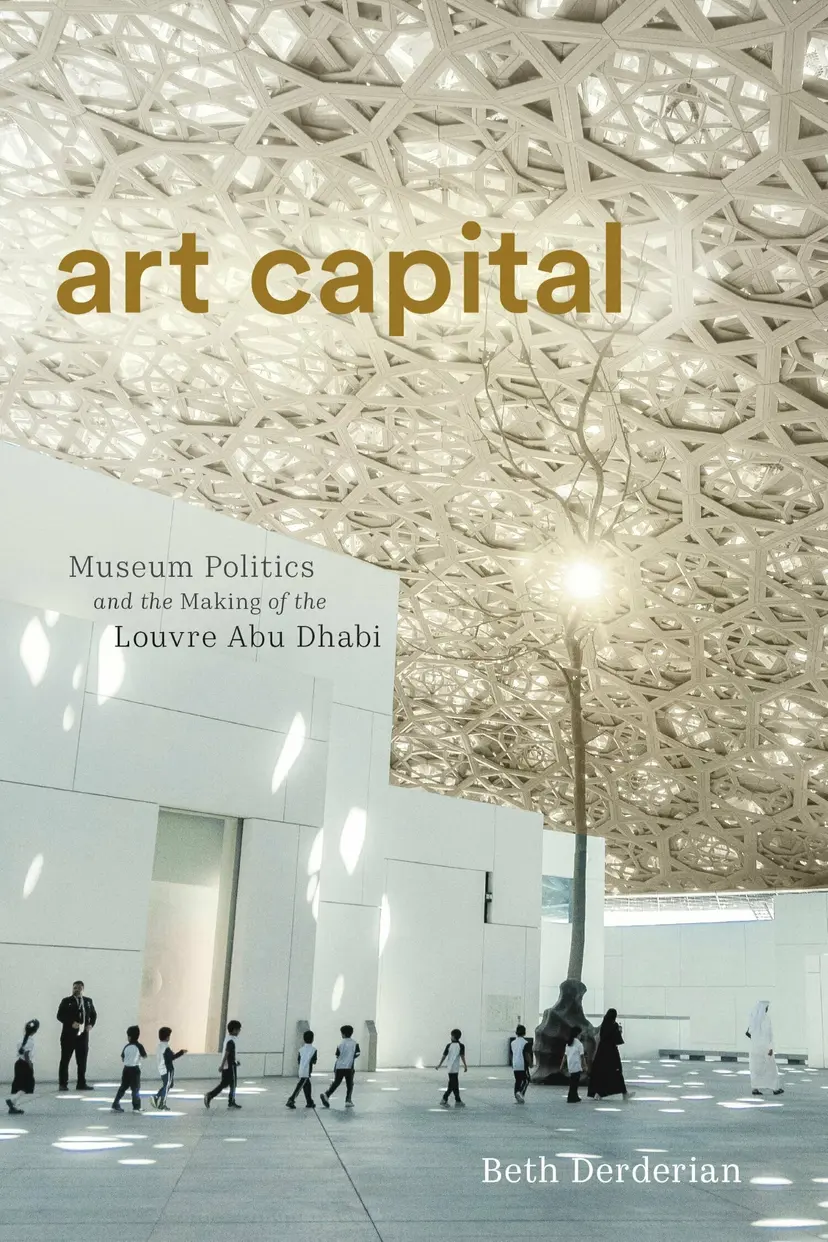
The cover of Beth Derderian's book, "Art Capital: Museum Politics and the Making of the Louvre Abu Dhabi," Stanford University Press, 2026.
## **Artists and Housewives**
In its most interesting chapters, *Art Capital* moves beyond the consultant-driven visions to explore how the interests of the international art market shapes art making and exhibition through a learned lexicon of professionalism. The visual language of international art circuits favors minimalism: crisp fonts, uncluttered slide decks, a set of data points (title, artist, date, materials) associated with each work of art. Inherent to this seemingly neutral and functional language, however, are particular notions of what art *is* and what makes it *good*. Chapter Four addresses these issues by detailing the ways that artists are trained to make their art legible to an international market of tastemakers: gallerists, curators and critics. The white cube, as the default mode of exhibition across both commercial and non-commercial spaces, here becomes emblematic of the ideal of frictionless circulation. The empty, blank exhibition space facilitates global consumption and translatability across sites and scales.
But it is not just visual aesthetics at stake, it is also a particular understanding of what a contemporary artist does—a professional one, as opposed to those ridiculed expat “housewives” who dab at art as a pastime. Derderian attends a professionalization workshop for aspiring artists taught by a famous curator. She watches several panicked participants furtively squirrel away their draft artist statements as the curator singles out the phrase “I am passionate about art” as a telltale sign of amateurism. “When I see statements like that,” he adds, “I just delete the email” (129–130). Artists in the workshop were taught to think of art making as a practice and their discrete creations as “explorations” of particular themes or ideas. An artist, in this model, is first a socio-political thinker or commentator and second a producer of aesthetic objects. Accordingly, the focus of the workshop was the students’ conceptual and discursive practices rather than their formal or technical skill. “Themes” like migration, identity or femininity could be easily communicated across different audiences, while still signaling a unique, individual mode of engagement and reflection.
Hanan Toukan, in her book [*The Politics of Art*](https://www.sup.org/books/middle-east-studies/politics-art)*: Dissent and Cultural Diplomacy in Lebanon, Palestine, and Jordan*, argues that international art funding has contributed to the conflation of contemporary art with a conceptual practice engaged in what she calls “post-ideological subversion.” International organizations favor art that is critical of hegemonic structures or accepted norms in its local Middle Eastern context. Derderian notices similar perceived imperatives among her Emirati-based interlocutors, but their ability to directly comment on local politics and social dynamics is circumscribed. Criticizing the state, the royal families or Islam is illegal in the UAE and can lead to imprisonment, deportation or revocation of visas. For many UAE-based artists with precarious residency statuses these laws are a tangible threat. In Chapter Two, Derderian argues that local artists who were born and raised in the UAE yet unable to obtain citizenship are often embraced as tokens of Emirati tolerance and multiculturalism, even though their inclusion remains contingent and temporary.
The stakes become glaringly apparent in Chapter Three, which asks how artists navigate the limits on explicit critique while still adhering to the convention that art should adopt a critical posture. Derderian groups their various approaches under the term “conspicuous omission”—strategic gaps that make the dissenting content decipherable only to a “circumscribed audience.” At times, this means that the underlying meaning of the piece is circulated only by word of mouth, as in the work of the artist who sat in the gallery quietly copying the Quran using his left hand, a tacit reference to repressive uses of Islamic textualism that condemn natural tendencies, from left-handedness to homosexuality. At other times, it means that only a hyperlocal audience “in the know” could sense the satirical or counterhegemonic reference, as in the work of the artist who purposefully used a color scheme employed in a recent series of government surveys.
The result initially appears to be a paradox: works of art that remain largely indecipherable to outsiders precisely because they attempt to incorporate the professional imperative of criticality. Yet this is a misreading, since the ambivalence seems to be favored by everyone. As Toukan explains, the mode of criticality preferred by transnational organizations (and in this context one should add, corporations) is not one of explicit resistance or protest, of the kind prevalent in the Arab world in the 1960s, but rather a conceptual, even theoretical, “consensually dissenting” practice whose effect rarely extends beyond the walls of the gallery. Professionalization, which is to say integration into the neoliberal structures of contemporary art and the adoption of its grammars, has a depoliticizing effect, even when the subject of art remains political. Likewise, the UAE grants contemporary art a certain autonomy as a circumscribed space of social or political exploration and reflection, proving its liberal credentials.
## **A Universal Museum**
When the Louvre Abu Dhabi eventually opened in 2017, its stated aspirations were a far cry from these spaces of coded political commentary, ambiguity or ambivalence. Celebratory affirmations of inclusivity and universal humanism trumped any hint of disagreement, discontent or historical violence. The main innovation of the “first universal museum in the Arab world” is to present Western and non-Western artifacts side by side. Whereas in the Parisian Louvre, Western art is displayed in the above-ground main halls, while the non-Western world is relegated to an ethnographic ghetto in the basement, the Louvre Abu Dhabi presents the West and the Rest together, in a singular narrative of the development of human creativity. The museum is organized along a linear timeline of civilizational progress, starting from the emergence of Homo Sapiens and “The First Villages,” through the rise and fall of “Civilizations and Empires,” all the way to the emergence of states and the effects of globalization. Racism, slavery, mass violence and ethnic cleansing are generally absent from this story. Works are staged together based on their formal and aesthetic affinities, in what comes together as an argument for the expression of the “one human civilization” (a favorite phrase of founding UAE president Sheikh Zayed bin Sultan Al Nahyan).
> The Louvre Abu Dhabi presents the West and the Rest together, in a singular narrative of the development of human creativity.
Both the Louvre and the other contemporary art institutions mentioned in the book appeal to discourses of inclusivity, as a historical corrective or a supposed reflection of the tolerance of Emirati society. But while contemporary art is expected to be conceptual and critical and to reflect on particularity, in the universal museum model every work of art becomes an affirmation of humanity and its supposedly common values. Differences are merely formal and aesthetic. The place of such a museum in relation to the constellation of institutions exhibiting and trading in contemporary art, which form *Art Capital*’s primary subject matter, is unresolved. Is the local Louvre considered pedagogically significant? Naively or cynically ideological? What is its role within this evolving ecology?
Prosaic reasons aside, the most provocative reason for the Louvre’s sidelining in the book appears in its very last sentence. Given the massive expansion of infrastructure for art production, exhibition and trade emerging in the aftermath of the museum’s original announcement, Derderian concludes that it probably “does not matter if the Louvre had ever opened” (184). It does seem that the museum’s actual opening generated far less discussion than the prospect of its construction. If we are to view the Louvre Abu Dhabi, and the Emirati art scene more broadly, within the state-sponsored futurecasting that Rahel Aima has called “[the Khaleeji ideology](https://www.e-flux.com/architecture/horizons/498319/the-khaleeji-ideology?ref=themorningnews.org),” then the significance of such spectacular projects turns out to be their audacious projections rather than their more prosaic real-life functioning. In the UAE, [art and futurity](https://www.theartnewspaper.com/2025/05/18/shaping-the-future-through-culture-and-connection) are never [too far apart](https://www.artdubai.ae/blog/global-art-forum-the-new-new-normal/). The important contribution of *Art Capital* is that it moves away from these speculative realms to explore the tensions and frictions that animate art making in the present.
\[**Shir Alon** is an associate professor in the Department of Asian and Middle Eastern Studies, University of Minnesota.\]
SUPPORT MERIP
All of MERIP's analysis is provided without paywalls! Make a donation now to help us keep it that way.
[DONATE NOW! ](https://www.merip.org/donate/)
### ‘Women at Work’—Challenging the Art/Craft Divide
URL: https://www.merip.org/2026/08/women-at-work-challenging-the-art-craft-divide/
Last updated: 2026-09-03T18:53:16.000Z
A large wool tapestry with a textured, tasseled surface suspended from the ceiling greeted visitors entering the exhibit *Women at Work: Intersection of Fine Art and Craft* at the Dalloul Art Foundation’s gallery in Beirut. [*Untitled*](https://dafbeirut.org/collection/esther-cecile-bendaoud-boccara/untitled) (1972) by Moroccan artist Esther Cécile Bendaoud Boccara, appeared more like a structure, refusing the conventional functions of a rug meant to lie passively underfoot. The piece worked as a sort of portal between past and present with traditional weaving techniques and North African textile aesthetics abstracted into a contemporary art form. Boccara’s material knowledge and skill were evident in the tapestry’s intricate details and laborious craftsmanship: long and irregular hand-tied fringes draped over a geometric shape of plush fabric sprouting from its surface like grass in a field. The work is [described](https://dafbeirut.org/collection/esther-cecile-bendaoud-boccara/untitled) as “the heart of the exhibition, affirming craftsmanship not as background labor but as an artistic force in its own right.” In conversation with Wafa Roz, exhibition curator and former director of the Dalloul Art Foundation (DAF), she characterized the piece as anchoring the show and guiding the viewer through the layered temporalities and material experimentations that thread through the artworks on display.
A relative newcomer to the Beirut art scene, the DAF was established by technology entrepreneur Basel Dalloul in 2016 to house and preserve his art collection, much of it inherited from his parents, Ramzi Dalloul and Saeda Al-Husseini. Dalloul continues to buy and sell modern and contemporary art from across the region, promoting its visibility across local and international contexts. The foundation currently holds more than 3,000 pieces from which all of its exhibitions are exclusively drawn.
On view at DAF from May to August 2025 and now available to view online, [*Women at Work*](http://dafbeirut.org/exhibitions/women-work-intersection-fine-art-and-craft)featured contemporary art by women from across the Arab world. Building on the previous exhibition, [*Women’s Agency in Arab Art*](https://dafbeirut.org/exhibitions/womens-agency-arab-art-kinship-education-political-activism-extended)*,* which examined women’s creative productions through the lenses of education and kinship networks, *Women at Work* shifted the focus to the labor of art making itself, highlighting the various ways that these artists are engaging in technical and creative experimentations with a wide range of mediums and materials. Many of the featured artists eschew modern art’s narrow hierarchies around the division between art and craft in favor of work that presents a material dialogue between diverse creative practices. They use traditional craft materials and methods like textiles, ceramics, metalwork and glassblowing, mixed with fine art mediums such as painting, photography and drawing. In doing so, they innovate modes of making and contribute to recovering handmaking from the margins of the industrial, the decorative, the domestic.
> Many of the featured artists eschew modern art’s narrow hierarchies around the division between art and craft in favor of work that presents a material dialogue between diverse creative practices.
With materiality and temporality as its core themes, *Women at Work* traces how inherited techniques and embodied forms of knowledge are mobilized in the present, where they are reworked across innovative contemporary artistic practices. Rather than treating the divide between art and craft as its central concern, the exhibition uses these limited categories as a point of departure for the more pressing interrogation of labor and the unresolved tensions surrounding what constitutes so-called “women’s work,” and even “Arab art.”
## Critical Ruptures
The 1960s and 1970s witnessed a growing enthusiasm for crafts driven by the rise of the fiber art and feminist art movements, as well as the earlier studio craft movement, all of which challenged the norms of the conventional art world that characterized fine art as masculine and craft as feminine. But it was not until the past two decades that museums have more fully embraced craft in fine art spaces. *Women at Work* takes part in this growing trend and makes a strong case for expanding the geographical lens on the history of the art/craft divide, and the artistic practices that have challenged it, beyond the Euro-American art scene.
Lebanese artist Iman Toufaily’s series titled [*System*](https://dafbeirut.org/artists/iman-toufaily) (2021) is an example of the experimental interplay between diverse techniques and materials that complicate these rigid categorizations. Her 52-piece project (three of which appear in *Women at Work*) combines photography, collage and textile work. Diaphanous fabric is stitched onto images of rigid concrete apartment buildings, sheathing the walls in a translucent layer that draws attention to the porous boundaries between public and private. A veiled female figure appears in each piece. Enclosed between the buildings or looking onto them, Toufaily describes her as devoid of any defining identity beyond her womanhood. Jagged stitches trace each figure and the surrounding architecture, piercing the surface of the image to create a second layer, almost like a reconstructed blueprint exposing the invisible social and spatial boundaries of the environment. In a televised [interview](https://www.youtube.com/watch?app=desktop&v=fAZyiPPoVfw), the artist situates her work within her own experiences as a widowed hijabi woman navigating a patriarchal society and within her relationship to her social and urban contexts.
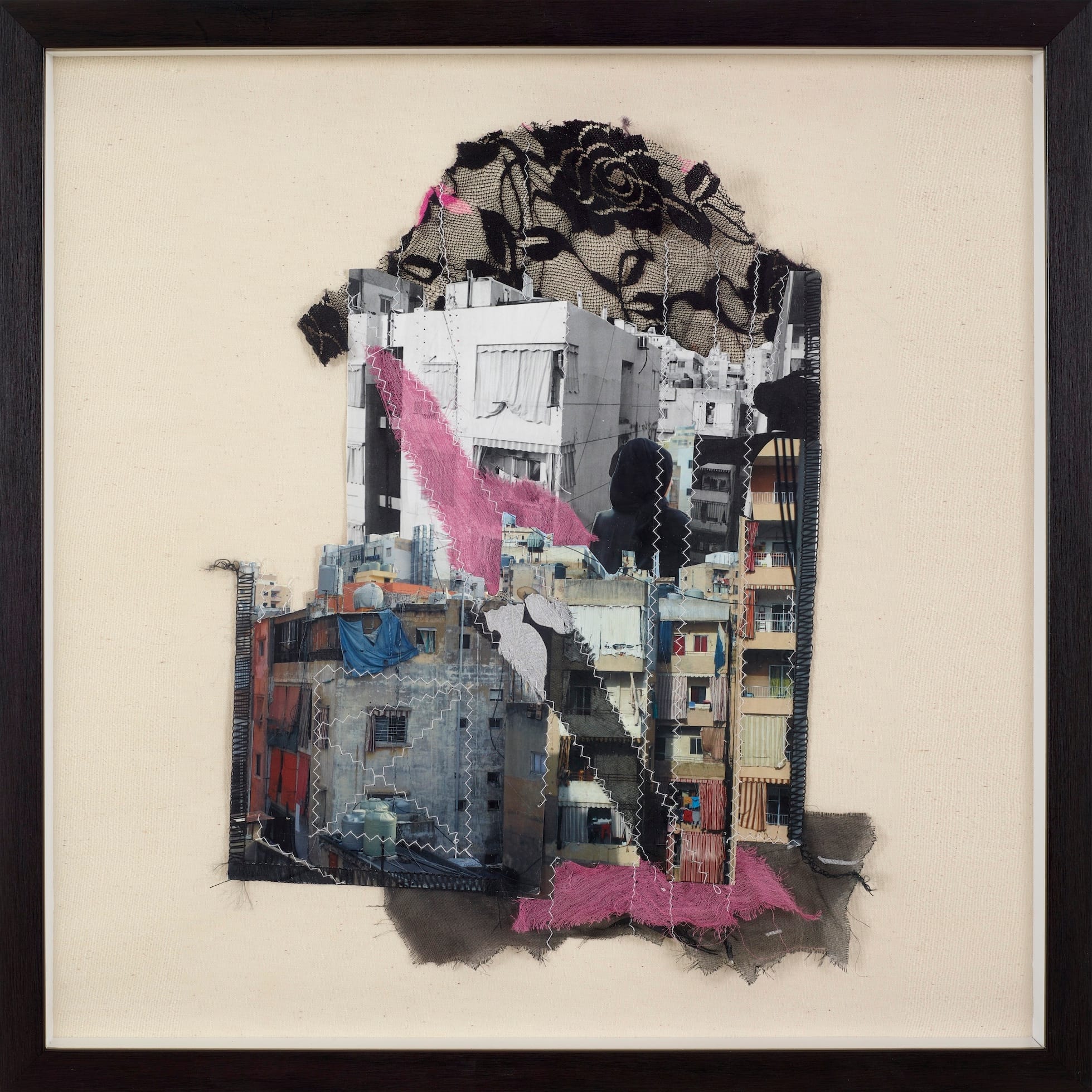
**Systems 19 (2021).* Iman Toufaily. Mixed media. 40 x 40cm. Courtesy of the artist and the Ramzi and Saeda Dalloul Art Foundation (DAF), Beirut.
Toufaily, who learned to stitch for this project, carefully pierced the images with precision to avoid ripping the pictures. A practice historically tethered to feminine domesticity, needlework was a metaphor in patriarchal depictions of the ideal housewife and a mechanism of control: the disciplined and repeated passage of needle through delicate cloth cultivated patience and restraint as the ultimate feminine virtues. The embodied practice of stitching, however, also carries within it a latent defiance as the needle punctures the surface to pass through it. Each stitch in Toufaily’s work is a deliberate act of incision that not only breaches the fabric’s integrity, but also symbolically penetrates the cemented boundaries of domestic and social enclosure. The delicacy and light color of the silk and chiffon fabric represent fragility, yet they do not soften the hardness of the urban landscape so much as expose its constraints. The resulting distortions and sewn fragments create an imagined space that wavers between freedom and confinement.
Despite its legacy as unpaid domestic labor, embroidery is a culturally significant practice led by women that cultivates a sense of pride rooted in tradition and connection between generations. For Palestinian women, for example, tatreez (traditional Palestinian embroidery) is a skill passed down from mother to daughter. After the Nakba it became a subversive practice, capturing Palestinian history, national identity and enduring connections to the land. This artisanship is evident in[*بئر*](https://dafbeirut.org/collection/mountaha-chahrour-inaash-association/byr-alsb-1-l-beer-el-sabeh-1-embroider-mountaha)[](https://dafbeirut.org/collection/mountaha-chahrour-inaash-association/byr-alsb-1-l-beer-el-sabeh-1-embroider-mountaha)[*السبع*](https://dafbeirut.org/collection/mountaha-chahrour-inaash-association/byr-alsb-1-l-beer-el-sabeh-1-embroider-mountaha)[](https://dafbeirut.org/collection/mountaha-chahrour-inaash-association/byr-alsb-1-l-beer-el-sabeh-1-embroider-mountaha)[*١ |* ](https://dafbeirut.org/collection/mountaha-chahrour-inaash-association/byr-alsb-1-l-beer-el-sabeh-1-embroider-mountaha)[*Beer*](https://dafbeirut.org/collection/mountaha-chahrour-inaash-association/byr-alsb-1-l-beer-el-sabeh-1-embroider-mountaha)[](https://dafbeirut.org/collection/mountaha-chahrour-inaash-association/byr-alsb-1-l-beer-el-sabeh-1-embroider-mountaha)[*el*](https://dafbeirut.org/collection/mountaha-chahrour-inaash-association/byr-alsb-1-l-beer-el-sabeh-1-embroider-mountaha)[](https://dafbeirut.org/collection/mountaha-chahrour-inaash-association/byr-alsb-1-l-beer-el-sabeh-1-embroider-mountaha)[*Sabeh*](https://dafbeirut.org/collection/mountaha-chahrour-inaash-association/byr-alsb-1-l-beer-el-sabeh-1-embroider-mountaha)[ *1*](https://dafbeirut.org/collection/mountaha-chahrour-inaash-association/byr-alsb-1-l-beer-el-sabeh-1-embroider-mountaha) by Palestinian embroiderer Mountaha Chahrour who stitched the large panel by hand while living in the Mar Elias refugee camp in Lebanon. The piece was commissioned by [Inaash Association](https://www.inaash.org/en-lb/pages/about-us), the cultural enterprise co-founded in 1969 by Lebanese contemporary artist Huguette Bechara El Khoury in collaboration with local Lebanese and Palestinian women.
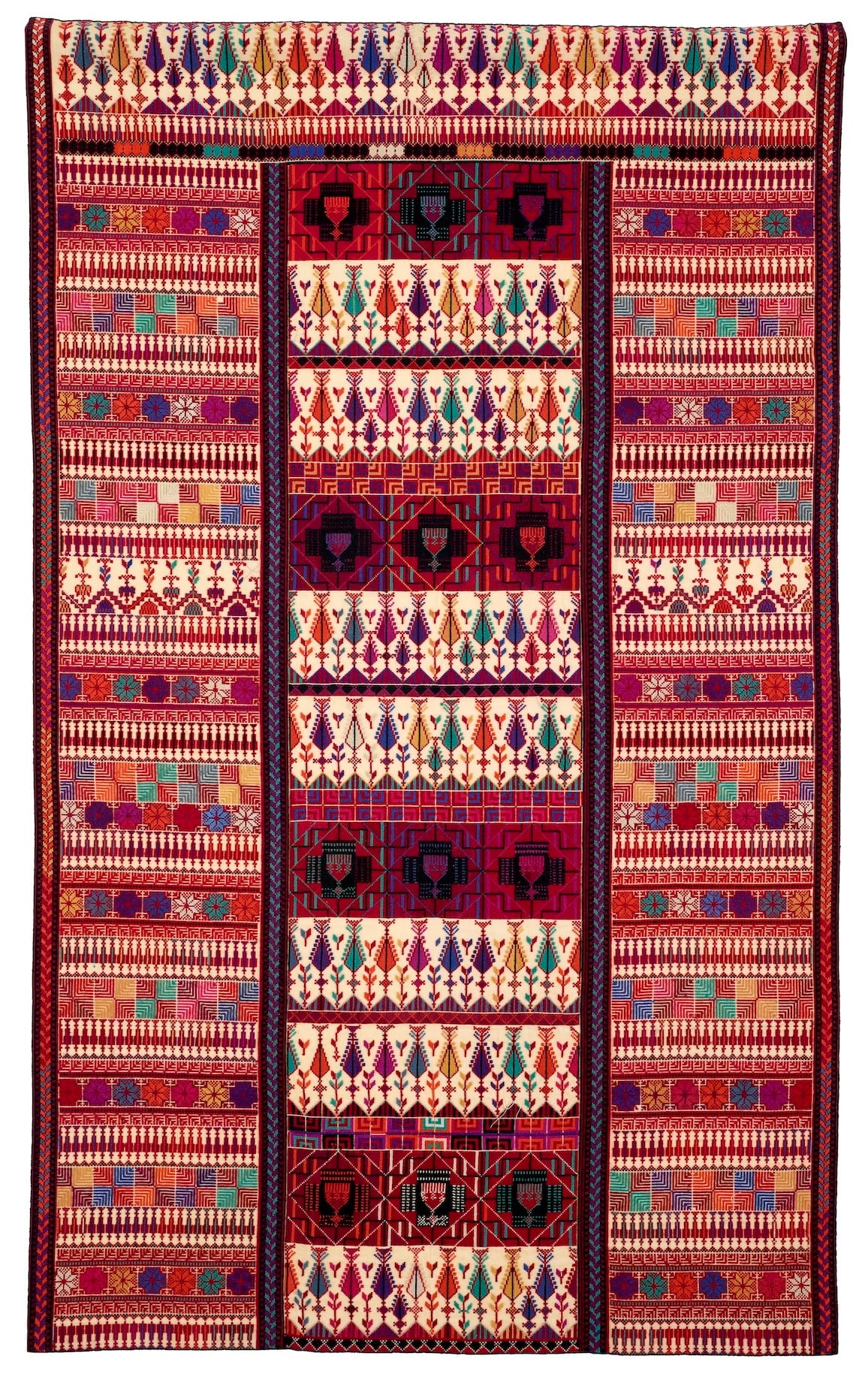
**Beer el Sabeh 1* | بئرالسبع١ (Embroiderer: Mountaha Chahrour from Inaash Association), 2014\. Canvas, Kham, Tella, 95 DMC spool cotton. 146 x 87.5 cm. Courtesy of Inaash Association and the Ramzi and Saeda Dalloul Art Foundation (DAF), Beirut.
As a tradition recognized on UNESCO’s list of intangible cultural heritage practices and fostered by local and international NGOs like Inaash, these embroidery commissions sustain heritage while also providing a modest income to Palestinian refugees who continue to face legal restrictions on employment in Lebanon. As a form of paid work, however, it rarely allows Palestinian women to escape their situations of financial precarity. Further, as tatreez shifts from being a labor of tradition to a highly commodified and underpaid labor of survival, embroiderers often have little creative agency over their work and instead execute the designs shared by their patrons.[\[1\]](#%5Fedn1) These material realities of exile and labor, concealed within the intricate threadwork, are eclipsed by the exhibition’s focus on creativity and collaboration rather than on the conditions under which the work is produced. The show therefore raises, without fully resolving, questions about what counts as “work,” how value is assigned to different forms of making and how the persistent distinction between artist and artisan shapes the recognition of creative labor.
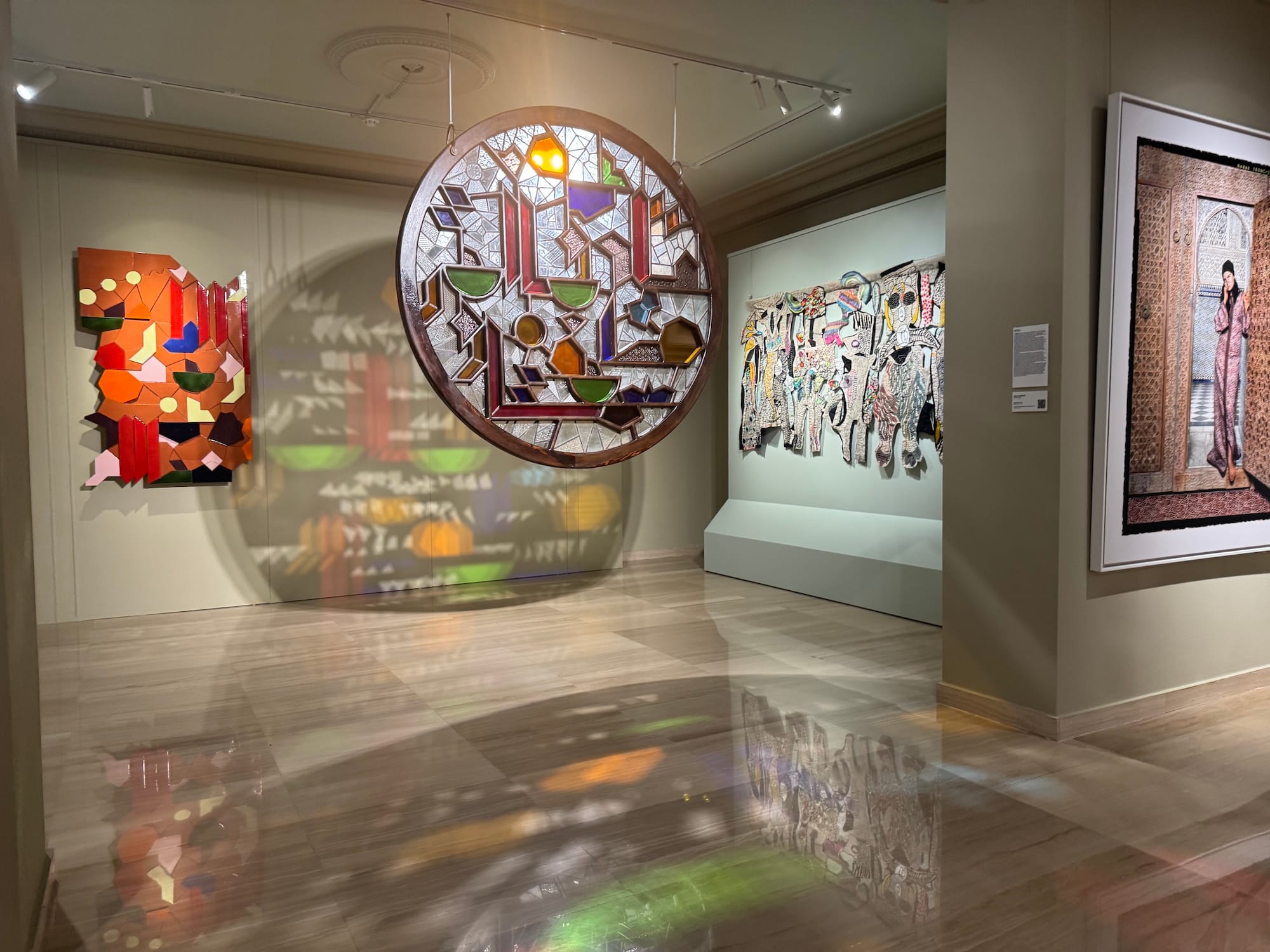
Installation view, **Women at Work*, courtesy of the Ramzi and Saeda Dalloul Art Foundation (DAF), Beirut. Referenced artwork: **Bahija Idriss–Atchana* (2023). Sara Ouhaddou. Cedar wood, Iraqi glass, Moorish glass, transparent glass, brass, and copper. 165 x 165 x 6.5cm. Courtesy of the artist and Comptoire des Mines Galerie in Marrakesh.
These questions reappear in other collaborative works featured in the show, including Moroccan-French artist Sara Ouhaddou’s [*Bahija Idriss – Atchana*](https://dafbeirut.org/collection/sara-ouhaddou/bahija-idriss-atchana) (2023). The large circular stained-glass structure is contoured with cedar wood that traces the geometric and calligraphic details of the piece. Particularly striking in this artwork is the way it engages with light, animating the structural surface by casting the patterns as shadows on the wall behind it. Through these prismatic reflections and the blend of shapes and colors, the work is reminiscent of rose windows found in gothic cathedrals. Yet in its abstraction of Moroccan architecture and calligraphy, together with its use of local materials like cedar and inherited hand-painting practices, traditional artisanship is translated into contemporary art form.
Integrating creative production with fieldwork, Ouhaddou’s artistic process is grounded in long-term partnerships with ceramicists in the Ourika Valley and glassmakers in Morocco’s urban centers. The exhibition does well in presenting this partnership as a thread through time, where cultural labor and embodied knowledge are valued in the reconfiguration of techniques within the artist's own contemporary explorations. Indeed, contemporary art can often depend on these forms of technical and collaborative hybridities. Yet the work on display also reveals the limits of recognition at the institutional level as authorship ultimately remains singular, with Ouhaddou alone receiving attribution by name. While collaborative works are celebrated throughout the exhibition, tensions between labor, value and authorship remain, which risks reproducing the very hierarchical categorizations that the show sets out to challenge.
> While collaborative works are celebrated throughout the exhibition, tensions between labor, value and authorship remain, which risks reproducing the very hierarchical categorizations that the show sets out to challenge.
## Subversive Practices
In the years following Morocco’s independence in 1956, the Casablanca Art School led an avant-garde movement that fused Western modernist art with pre-colonial Indigenous craft traditions. In a similar vein, art historians like Afif Bahnassi have argued that art from the region encompasses everything from architecture to ceramics, textiles and calligraphy, without rigid hierarchical distinctions based on material or functional value. The artworks featured in *Women at Work* follow this critical impulse, not only by unsettling the art/craft divide but also by disrupting conventional Western assumptions that art from the Arab world is primarily folk art or Islamic art.

**Just Paper - Group XV* (2022). Manal Al Dowayan. Silkscreen on porcelain and jute string. 3 x 15 x 3cm. Courtesy of the artist and the Ramzi and Saeda Dalloul Art Foundation (DAF), Beirut.
[*Just Paper - Group XV*](https://dafbeirut.org/collection/manal-al-dowayan/just-paper-group-xv) (2022) by Saudi artist Manal Al Dowayan takes part in this refusal by contributing to the diversity of topics addressed in art from the region through her own creative articulations of personal experiences with domestic politics. The installation is composed of 30 porcelain scrolls tied with jute string, some of which are tightly bound and others wrapped loosely, each individual piece lying against one another. This contrast in binding produces a tension between permanence and fragility where the tightly bound scrolls are stabilized and contained, while the loosely wrapped ones are vulnerable to coming undone. Yet the material brittleness of porcelain makes both susceptible to rupture. Using silkscreen printing, each scroll is inscribed with excerpts drawn from religious and government texts that dictated how women should behave. As the artist [describes](https://www.manaldowayan.com/artworks/25-watch-before-you-fall-collection/), these manuals depicted women as “translucent mute silhouettes” and were meant to guide their actions in public spaces reserved for men.
Speaking from her own perspective as a woman in Saudi Arabia in the post-1979 period of increased state religiosity following the Islamic Revolution in Iran, her artwork pushes back against the imposition of patriarchal social norms rooted in religion. In the DAF gallery, the artist invites visitors to confront the tensions between the materials’ durability and fragility by encouraging them to transgress conventional museum etiquette and pick up, rearrange and risk shattering the delicate work. This physical intervention prompts viewers to consider the possibilities of their own action in challenging or disrupting the projected immutability of dominant structures.
**Food for Thought “Haram”* (2012). Maha Malluh. Vintage audio tapes and wood bread baking trays. 60 x 100 x 8cm. Courtesy of the artist and the Ramzi and Saeda Dalloul Art Foundation (DAF), Beirut.
Saudi artist Maha Malluh’s artwork [*Food for Thought "Haram"*](https://dafbeirut.org/collection/maha-malluh/food-thought-haram)(2012) also raises questions about the ways in which hegemonic powers have targeted women. The installation arranges 72 vintage audio cassettes on a wooden baking tray, all sourced from local flea markets and vintage shops. The colorful tapes, widely distributed in the 1980s, contain recordings of religious lectures meant to align the thoughts and behaviors of women with the ideologies of the Islamic political movement of its time. As viewers step away from the installation, the vibrant blue tapes come into focus, spelling *haram* in Arabic, referring to that which is forbidden and considered unlawful or sinful in Islam. Beyond the work's commentary on the influence of religious systems of control, it also depicts a moment of heightened consumerism where media played a central role in shaping individual and collective perceptions of the world.
Both works demonstrate how art from the region can emerge as subversive practices with the capacity to contest systems of power and dominant representations of women, their work and art from the Arab world. In dialogue with the other artworks on display, they contribute to the exhibition’s broader success in staging the reconfiguration of artistic practices historically relegated to crafts as intellectual and innovative political engagements in their own right, challenging the homogenization of art from the region.
## Art in Times of Struggle
Wafa Roz explained that her curation is an investigative practice nurtured by curiosity and an attentiveness to the pressing questions shaping the Arab world. While moving through the exhibition myself, I reflected on the role of art institutions in curating a space of dialogue connected to broader issues. *Women at Work* was on view during Israel’s ongoing genocide in Gaza and assault on Lebanon. Although the exhibition did not explicitly situate the artworks within this political context, the works on display are emblematic of the need for artistic production in times of struggle.
In [*AG04*](https://dafbeirut.org/collection/aliaa-elgready/ag04) (2023) by Egyptian artist Aliaa Elgready, a bright patchwork canvas covered with vibrant embroidered flora is overtaken by darkness. Produced in the aftermath of the COVID-19 pandemic and amid the ongoing devastations in Gaza and Sudan, the work speaks to the moral bankruptcy of political elites and presents their violence as a contagion that infects the land and slowly consumes its people. In [*Power Outage*](https://dafbeirut.org/collection/yasmina-alexandra-nysten/power-outage) (2024), Lebanese artist Yasmina Alexandra Nysten paints landscapes of ruin and depicts the material conditions of genocide in Gaza by capturing both Palestinians’ struggle for survival and their resilience.[ ](https://dafbeirut.org/collection/dalia-baassiri/when-season-returns-iv)[*When the Season Returns IV*](https://dafbeirut.org/collection/dalia-baassiri/when-season-returns-iv) (2023), one of the 22 paintings in Lebanese artist Dalia Baassiri’s series *The Harvest*, was inspired by the trees that remained standing amid the devastation of the Mar Mikhael neighborhood following the August 4, 2020, port explosion in Beirut. Baassiri collected fragments of buildings and remnants of prayer candles to create textured surfaces that speak to the material realities of political instability and the traces of ruin.
**When the Season Returns IV* (2023). Dalia Baassiri. Wall paint collected after marfa’ explosion, graphite, threads, hot glue sticks, archival glue and varnish on canvas. 86 x 98 cm. Courtesy of the artist and the Ramzi and Saeda Dalloul Art Foundation (DAF), Beirut.
The works on view evoke both personal and collective experiences without collapsing differences into a universalizing abstraction. Instead, the exhibition reveals how the artists express shared experiences around common themes of dispossession, belonging, discovery and emancipation while remaining intimately connected to their own subjectivity and artistic uniqueness.
> The exhibition reveals how the artists express shared experiences around common themes of dispossession, belonging, discovery and emancipation while remaining intimately connected to their own subjectivity and artistic uniqueness.
*Women at Work* also contributes to a larger curatorial shift over the last few decades of moving crafts into prominent positions in art exhibitions—from several installations at the 61st International Art Exhibition of the [La Biennale di Venezia](https://www.labiennale.org/en/art/2026), to the increased visibility of Palestinian embroidery in museums across the globe, notably exhibitions at The [Metropolitan Museum of Art](https://www.metmuseum.org/perspectives/tatreez-in-time), [Museo Textil de Oaxaca](https://museotextildeoaxaca.org/gazapermanece/), The [Victoria and Albert Museum in Dundee](https://www.vam.ac.uk/dundee/whatson/exhibitions/thread-memory-embroidery-from-palestine?srsltid=AfmBOor%5FetDgWchVkvq655hBj%5F00Mk7t1%5FpQNVhP9ujs5SM27wm8HHIt) or the Palestine Museum US’s official collateral event of the 2026 Biennale at [Palazzo Mora](https://www.labiennale.org/en/art/2026/collateral-events/%E2%80%9C-%E2%80%9D-gaza-no-words-see-exhibit).
Crucially, in foregrounding innovation and creativity at the intersection of fine art and craft, *Women at Work* renders that divide inadequate and ultimately obsolete as a framework for understanding art from the region. Indeed, the exhibition’s more significant intervention lies in its refusal of these categories in the first place. Instead, the show prompts further discussion on how artistic value is produced, whose labor is visible and what assumptions continue to shape the ways artistic practices from the region are perceived and categorized.
\[**Marybelle Issa** is a doctoral student in anthropology at the University of Massachusetts, Amherst.\]
SUPPORT MERIP
All of MERIP's analysis is provided without paywalls! Make a donation now to help us keep it that way.
[DONATE NOW! ](https://www.merip.org/donate/)
---
## Endnotes
[\[1\]](#%5Fednref1) Rachel Dedman. [Stitching the Intifada: Embroidery and Resistance in Palestine](https://www.commonthreadspress.co.uk/products/stitching-the-intifada-embroidery-and-resistance-in-palestine). *Common Threads Press*. 2024.
### The Grandmothers’ Anger—Theater at the Margins of Occupation
URL: https://www.merip.org/2026/08/the-grandmothers-anger-theater-at-the-margins-of-occupation/
Last updated: 2026-08-20T13:06:32.000Z
“Tell me, grandmother. Should I stay, or should I go?” This question pervades *Gadabb al-Jaddat* (*Ancestral Rage*, 2025), a one-woman performance by Lekaa Sharaf. Co-written with Masha Seman, who also directed the performance, the play follows an aspiring actress from the Israeli-occupied Syrian Golan as she waits in limbo for her laissez-passer travel document in a modern-day border purgatory. Set in an airport transit zone, the performance unfolds among oversized suitcases that become border checkpoints, interview rooms and family tables, as she reflects on the land she is leaving, the dream she is pursuing and the labneh wrap that her grandmothers urged her to take but that she left behind.
Often described as Israel’s “forgotten occupation,” the Golan (Jawlan) is home to around 28,000 stateless Syrians who have been living under Israeli occupation since the 1967 Arab-Israeli War. When Israel occupied the territory and forcibly dispossessed the majority of its population, many became internally displaced inside Syria. A small number of mostly Druze villages remained, including Majdal Shams, Mas‘ade, Buq‘ata, Ein Qiniyye and Ghajar. In 1981, the Israeli Knesset passed a law formally annexing the Golan, a move rejected by the Syrian population in a six-month general strike in 1982\. Around [70 percent](https://jawlany.com/2863-%D8%B4%D8%AE%D8%B5%D8%A7%D9%8B-%D8%AA%D9%82%D8%AF%D9%85%D9%88%D8%A7-%D8%A8%D8%B7%D9%84%D8%A8-%D8%A7%D9%84%D8%AD%D8%B5%D9%88%D9%84-%D8%B9%D9%84%D9%89-%D8%A7%D9%84%D8%AC%D9%86%D8%B3%D9%8A%D8%A9/) of the population continue to refuse Israeli citizenship, resulting in their political disenfranchisement and restricted freedom of movement. These barriers, alongside ongoing struggles over orchards, water, recent wind-turbine projects and minefields left over from the 1973 war, form the backdrop against which *Ancestral Rage* takes place.
Minefields and wind turbines, southern Golan Heights. Photograph by Lekaa Sharaf.
The play foregrounds voices that are often absent from accounts of life and resistance in the occupied Golan: those of women, and particularly grandmothers, who insisted they would never leave their land and mocked and berated their occupiers. It is based on interviews with Sharaf’s grandmothers and other older women from the area.
The production, which includes music and sound design by Amr Mdah and lighting design by Muhammed Shaheen, first premiered in the Golan in November 2025 as part of the Golan Cultural Days Festival, before touring Palestine and Jordan, with performances in Haifa, Jaffa, Jerusalem, Ramallah and Amman, where it won the Jury’s Award at The International Festival of Liberal Theater. The [performance](https://www.youtube.com/shorts/UxOCzYM4wGo?si=8cu9377CX23c89p4) is in Arabic with English subtitles.
What follows is a conversation between Lekaa Sharaf and Maria Kastrinou, an anthropologist whose research has engaged the occupied Golan for almost two decades. Although the two have never met in person, they have spent the past three years discussing theater and exchanging writing online. The interview draws on conversations and written exchanges between March and July 2026 and has been edited for length and clarity.
**Maria:** It feels like another lifetime when I first approached you, in May 2023, with my anthropological research and a theatrical performance that had emerged from it, hoping we might explore ways of bringing this work to the community. Then the genocide in Gaza began, and that work became impossible. As you told me, the time was “too dark.” And yet, out of that darkness, you wrote *Ancestral Rage*. What made you write it?
**Lekaa:** I began this work after the genocidal war on Gaza started. When the war began, I found myself in a deep pit of despair, especially after we witnessed the bombing of Al-Maamadani Hospital in Gaza. It felt like the world was collapsing and there was no hope left after that moment.
Then one day I was in the car with my grandmother Fatima, and we passed near a checkpoint. Before we arrived, I warned her: “The soldier will ask us where we’re going. We’ll just answer the question and move on, we don’t want any confrontation.” She just nodded. When we reached the checkpoint, the (female) soldier asked us in Hebrew where we were going. My grandmother doesn’t speak Hebrew, but she understood the question and answered sharply, with anger: “We’re going to Damascus! Where else are we supposed to go? You’ve put the border on the mountain—there’s nowhere for us except Majdal Shams.”
> “We’re going to Damascus! Where else are we supposed to go? You’ve put the border on the mountain—there’s nowhere for us except Majdal Shams.”
The soldier stepped back and looked at me. Both of us were afraid: I was afraid of the soldier’s reaction, and she was afraid of my grandmother’s. I gave her an awkward smile and said, “My grandmother is joking,” then quickly closed the window and drove on. On the way, my grandmother scolded me. She told me that we should never smile at soldiers and that we must always answer them with sharpness and anger. They should never see fear in our eyes. I nodded in agreement and wished I could be like her.
This moment shaped my entire theatrical work, starting from the existential question “Do we leave, or do we stay?” to my relationship with my grandmothers and my desire to reclaim their anger and become like them, greater than the occupation.
I also wanted the whole world to hear my grandmother and her friends. I wanted to hear their voices, their laughter, their political and ethical positions and their capacity for critical thinking. I wanted researchers, artists, friends and anyone else to listen.
After the first interview with my grandmother, I wondered whether it was just her, or whether other women of her generation were alike. I conducted interviews with five women who came from a village in the Jawlan. This was the first time anyone had recorded them and asked them questions about what they know best: their homeland. All were deeply moved that someone from my generation cared enough to listen. I felt as if I were talking to seasoned storytellers.
Most importantly, \[I wrote this because\] I wanted to be proud of where I come from, even if I decide to leave for the other side of the world.
Grandmother Fatima in the apple orchard. Photograph by Lekaa Sharaf.
**Maria:** One of the striking moments in the play comes after you introduce the four main grandmothers. Their recorded voices are warm, funny and full of character, but they also refuse to do what they are asked. When you ask about their childhoods, none of them answers the question. Instead, they all begin with the war of 1967, as if their lives begin in that political moment. They acknowledge that they, too, once thought about leaving, but insist that “A person's home is his homeland; where else could he go?” At that moment, the recordings stop and the spotlight shifts to the Red Lekaa: a larger-than-life, almost drag-like alter ego in red glasses who seductively urges you to leave, take Israeli citizenship and “live your life.” Through her, the question that runs through the play—whether to stay or leave—becomes embodied. Who is the Red Lekaa? Is she evil, a devil as you call her, or something more complicated?
**Lekaa:** Not at all. If we move beyond the good and the evil and approach Red Lekaa as a genuine voice that exists and communicates with our desires, then the feeling of guilt around leaving begins to soften, and the desire for survival takes on a different shape. I think this voice is extremely important and necessary to bring to the surface because it is real. It is something I think about all the time, and I believe it exists within all of us. Wearing the red glasses is like wearing a mask that allows the expression of desires that are difficult to admit. For this reason, the Red Lekaa is not separate from the self that loves the grandmothers and the place. She is part of the same self, but one that is usually harder to voice.
Red Lekaa in 'Ancestral Rage.' Photograph by Taymor Salama.
**Maria:** Your play is very funny. At the airport, Lekaa talks about starring in a Pilates program with Jumana Murad. Even encounters with bureaucracy become absurd. Why did you choose humor? Is humor like anger?
**Lekaa:** Sarcasm, dark humor and what we call *tamaskhur*—playfully mocking or making jokes—are ways many women cope with the difficult realities they live through. Masha, my co-writer, and I both see the world in this way. Our anger often comes wrapped in humor. It is also a way of keeping ourselves safe and finding a way to speak about difficult realities and express our opinions in a context where doing so can carry consequences. Palestinian artists are condemned for a Facebook post. Humor softens the sharp edges of what is being said, while preserving its spirit.
> Our anger often comes wrapped in humor.
**Maria:** References to food and hunger run through the play. Waiting in transit, your character grows hungry and regrets leaving behind the labneh wrap her grandmothers insisted she take. Recalling their repeated pleas, she lets slip: "They started calling it *Pita Druzeit*. I can't stand it anymore, *bedi fiil*—I want to leave!" The reference is to the Israeli cultural appropriation of the *'arous al-labneh*, the traditional *labneh* wrap. It evokes the sense that the occupation has taken over not only the land but also cultural symbols, transforming something nourishing into something unpalatable. By the final scene, she is still hungry, searching for food as she watches a gazelle forage along the mined border. Hunger is both ordinary and deeply political in the play. Why did it become such an important thread?
**Lekaa:** During the period when we were working on the play, famine in Gaza was at its peak. I noticed that I kept saying I was hungry, constantly, even after I had eaten. As if hunger was contagious. As if this was my way of protecting myself from famine or maybe a form of guilt when we see hungry children and can do nothing.
Masha, my co-writer and the director of the play, noticed this pattern: “Lekaa, you’re hungry all the time.” That’s how we decided to begin the performance. And that’s how we would end it. We would search for food, and we would search for others who were hungry like us. But my grandmother refused hunger and would always try to feed me until I was more than full and then talk about the war. Meanwhile, I would sit in front of the television, counting the dead, following the names, my stomach aching. I couldn’t tell, was this hunger, or was it anxiety?
**Maria:** Can you talk a bit more about what the voices of the grandmothers capture and bring to the stage?
**Lekaa:** Bringing the grandmothers’ voices to the stage came from my desire for them to have a living presence rather than becoming retold stories.
The four women bring different ways of imagining the Jawlan: the deep commanding voice, the gentle and caring one, the angry voice and the grieving one. Their accents, rhythms of speech, humor, political opinions and descriptions of the village carry an entire world. These voices are precious, yet they have mostly remained within intimate gatherings between women. Bringing them into the theater also brings the Jawlan itself onto the stage—not only its memories, but its everyday life in all its contradictions.
> Bringing the grandmothers into the theater also brings the Jawlan itself onto the stage—not only its memories, but its everyday life in all its contradictions.
**Maria:** As you’ve noted, your theater comes out of the specificities of the Jawlani landscape and occupation—an occupation at the margins of a greater occupation, genocide and regional war. How did audiences outside of the Golan receive it?
**Lekaa:** Despite the specificity of these stories and their roots in a particular history and place, audiences from different backgrounds found ways to connect with the work.
One example of this was the performance in Jerusalem. People in Jerusalem share a political reality very similar to ours, and the performance at Al-Hakawati Theater carried a sense of sadness and heaviness, while also creating a deep connection between the work and the audience. Despite the fact that Al-Hakawati is constantly under pressure from the right-wing Israeli government and there is an ongoing atmosphere of fear and uncertainty around performing there, the audience arrived without expectations and often without prior knowledge of the Jawlan or its context. Yet they found a way to connect with the stories and emotions carried by the performance.
In Amman, the context was different. After the recent events in Syria and amid sensitivities around religious identity and sectarian belonging, particularly in relation to the Druze community, the festival director was concerned about how the work would be received and what conversations it might open. He remained anxious throughout the process, but he respected our position. In a way, his concern gave me more freedom to create; I felt that if he was already carrying this anxiety on my behalf, there was no need for me to carry it as well.
During the performance, the audience responded with great emotional presence. When I said, “I’m hungry,” I heard audience members whispering, “*habibti*.” When I asked my grandmothers, “Do you love me?” the audience answered together before the recorded voices replied, “Of course.” The technical crew was initially confused, unable to tell whether the voices came from the recording or from the audience itself.

The opening interview with the grandmothers, **Ancestral Rage*. Photograph by Taymor Salama.
**Maria:** What is the theater scene in the Jawlan like today, and how do you think the ongoing realities of occupation, war and displacement across the region are affecting cultural production now and in the future?
**Lekaa:** Although theater in the Golan develops under the political and material constraints of occupation, it remains a vibrant and resilient artistic scene. Dozens of Jawlani theater artists continue to work locally and internationally, creating performances despite limited resources and increasing restrictions on cultural expression. Theater has long played an important role in the cultural life of the Jawlan. The theater group Masrah Oyoun (Eyes Theater), for example, involved dozens of students and produced many performances every year before cultural spaces came under growing pressure. Beyond theater, Jawlani artists work across music, visual arts and other creative practices. Groups such as Toot Ard and Hawa Dafi, alongside many visual artists, reflect the diversity of artistic expression emerging from the Jawlan.
> Although theater in the Golan develops under the political and material constraints of occupation, it remains a vibrant and resilient artistic scene.
Since the genocide in Gaza, and with the continued occupation and military escalation across the region, making theater has become even more fragile. Many artistic projects have been cancelled, postponed or forced to adapt to a changing reality. Because of the occupation, Palestine has become our connection to a wider cultural landscape. This relationship is complex and shaped by borders and political realities, but it has also allowed artists from the Jawlan to build connections, exchange knowledge and participate in broader artistic conversations.
**Lekaa:** Let me ask you a question in return. You have been doing ethnographic research in the Jawlan for many years and have written about our lives and struggles. Is there anything that surprised you in *Ancestral Rage*? Did it affect how you think about your own research?
**Maria:** From the first time you mentioned the idea, I was hooked. I think you said something about “sitting down with a cup of matte and listening to my grandmothers.” I thought, yes, this is what anthropologists do. How wonderful to put that on stage.
What surprised me the most was not the grandmothers but your character. I must admit here my own limitation, that I have found it more difficult to connect and interview the younger generations. Older people, usually, have more time to talk about their life stories and the history of the place. And they have a different relation to Israeli occupation, since many of the older people have served time as political hostages in Israeli jails. But what your character revealed to me was the complexity of an emerging new identity. Your character’s love for the grandmothers was a deep love for the ancestors, those who come before us and those who cultivate the land so that we may root within it. And the grandmothers are not authoritative or haunting presences, but embodiments of nourishment and care (hence the labneh sandwich). Moreover, their insistence to stay on their land and to fight, shout and trick the occupiers—in a word, the collective resistance that they represent (even if they are often underrepresented within it)—is what gives your character the tools, ambitions and freedom to have dreams that are different, that are otherwise and out-there.
So, your character, like the youth in Jawlan, has grown up with safety and nourishment as a result of the sacrifices and political struggles that the generations before them offered. It is this lovely connection and closeness that defines them, and by the end of the play I felt that even if our Red Lekaa decided to leave, this relationship would not finish, and she’d always return to it. By the way, yours is a more nuanced characterization than many academic accounts of the youth, and certainly much better than the ongoing debates on whether Jawlani youth are becoming “Israelized.” I think you really show the internal conflict of identity, and you lead us to question “normalization” even within the context of acquiring citizenship.
**Maria:** What does theater bring that other genres do not?
**Lekaa:** Theater offers me a liminal space between reality and imagination, where multiple worlds can exist at once. I have spent my life inhabiting liminal spaces: between Palestine and Syria, occupation and freedom, belonging and displacement, love and anger. Theater offers a language that can hold this complexity. *Ancestral Rage* also emerges from such a space. The grandmothers exist between past and present, memory and erasure, the village they knew and the reality of occupation. Through the stage, their stories are not only remembered but become a living encounter, inviting the audience to imagine the Jawlan through their eyes.
> I have spent my life inhabiting liminal spaces: between Palestine and Syria, occupation and freedom, belonging and displacement, love and anger. Theater offers a language that can hold this complexity.
I’m curious, as an anthropologist who also makes and uses theatre in your own work, what does it make possible for you?
**Maria:** Often, I have to leave material out of my academic writing because it is too long or does not fit the argument I am making. This cutting and pasting can feel like a form of violence: to the people whose stories I have collected, but also to myself, because it is their stories that remain with me. I started experimenting with theater a few years ago for this reason, with interviews that did not make into a paper. Theater has given me a space to share how these voices have shaped me. It is an act of liberation, for the stories as well as for me.
Theater also requires physical labor and collective effort. Anthropology is much the same. Both hold and carry humanity’s messiness, which is why they are such natural partners. Perhaps for this reason, both theater and anthropology—and, more broadly, the arts and social sciences—are under attack. You know this well, Lekaa. War and genocide target cultural reproduction. But the attack is wider than that. Across the UK and Europe, arts and social science teaching and research are being steadily defunded. Ultimately, this is an attack on what makes us human and on our capacity to think critically.
\[**Lekaa Sharaf** is a playwright, theatre artist and group facilitator. **Maria Kastrinou** is a senior lecturer in social anthropology at Brunel University.\]
SUPPORT MERIP
All of MERIP's analysis is provided without paywalls! Make a donation now to help us keep it that way.
[DONATE NOW! ](https://www.merip.org/donate/)
### Listening to the Jazira—Songs as Counter Archives in Northeast Syria
URL: https://www.merip.org/2026/08/listening-to-the-jazira-songs-as-counter-archives-in-northeast-syria/
Last updated: 2026-08-20T13:06:12.000Z
Local shaabi music legend Khader al Nasser calls himself the “master” as he professes to teach a group of young women about love while plucking chickens in an old music video circulating on YouTube. Eventually a group of women elders kick him out for his mischievousness. It is ridiculous, endearing and catchy. His video engages multiple layers of daily rural life in Syria’s northeast: the community negotiations over love arrangements, residents coming and going and the textures of a deeply ingrained agrarian culture. It is the kind of seemingly lighthearted song heard at a wedding. But for those at the scene, or watching the video from a distance, generations of history come alive.
An old music video of Khader al Nasser.
From city to city and village to village, the diverse music of the Jazira region of Syria narrates sorrows and hopes, communicates traditions and grievances and has helped communities to survive political and social marginalization. Separated from the rest of Syria by the Euphrates River and bordered by the Tigris River at its northeastern edge, al-Jazira itself means “the island.” A debris field of colonial and state violence, the region’s history is audible in its music.
International audiences may have encountered Jazrawi music through the fast-paced wedding and now club tunes of Omar Souleyman. In the early 2000s, Souleyman’s music could be heard around Syria, mostly in the underground casinos and in cabs driven by Jazrawis. His shaabi—Arabic for folk or popular—tracks would eventually carry him to concert halls in London and Paris. At home, though, the national cultural establishment heard his sound the way it saw the region it came from: unrefined, unintelligible, not quite Syrian.
Souleyman’s music is only one small slice of the wide range of sounds that come from the Jazira. There are also genres built from Armenian elegies of genocide, Assyrian folk songs, Kurdish feminist anthems, *mawwals* and *atabas* that lament love and loss and agricultural songs that add rhythm to wheat harvesting and cotton picking. Jazrawi songs operate as archives, counter maps and repositories of overlapping historical memories. They carry stories of land, labor, migration and sorrow built over generations. These sounds reveal the Jazira’s layered political history and its marginalization, despite its important role as Syria’s agricultural heartland and home to energy resources.
> Jazrawi songs operate as archives, counter maps and repositories of overlapping historical memories.
The region’s vibrant music culture continues to sustain a channel for communal connection. Online projects like the Syrian Cassette Archives, founded in 2018, and the efforts of Syrians from the Jazira to share clips on YouTube are key grassroots efforts that are helping to keep the music alive and relevant—for those in Syria, the diaspora and exile.
## Circulation from Below – Cassette Tapes to the Internet
Long before Souleyman reached European stages, cassette tapes were carrying Jazrawi music beyond state borders to the various diasporas. Cassettes had changed the game for Jazwari music, making it economically viable to record and distribute all types of content. Without the need for an infrastructure of studios, music could be recorded directly as it was performed and improvised.
It was through Syrian cassettes found in the Arab diaspora neighborhoods of [Detroit](https://www.newarab.com/features/syrian-cassette-archives-preserve-lost-era-music-and-memory) that Mark Gergis, the Assyrian-Iraqi American producer, artist and audio-visual archivist, first began paying attention to locally produced music. Gergis spent considerable time in the 1990s and 2000s traveling around Syria and the Jazira. He connected with other Assyrians and eventually was the one responsible for bringing Omar Souleyman to global audiences. Gergis filled a major gap by producing numerous albums with Souleyman, including his debut collection turned Jazrawi classic, the 2007 “Highway to Hassakeh.” Damascus-centric tastemakers and music industry folks had no interest in producing Souleyman’s work, preferring to promote classical Arabic music genres.
The music video for an early 2000’s hit by Omar Souleyman, “Khattaba,” narrates the cultural significance of getting approval for a wedding proposal and teases at the difficulty of the process. The strong-willed bride-to-be, Noura, dances at the center of the discussions, exhibiting the less conservative culture of the Jazira that was seen as crude by Syrians in other regions.
During his trips to Syria, Gergis visited every cassette shop in the Jazira looking for Assyrian, Kurdish, Shaabi and other “alternative” tapes. He also dug into shops across the country, looking on bottom shelves for “low-demand” music. His collecting trips ceased when the Syrian regime violently suppressed popular protests against President Bashar al-Asad in 2011, beginning the war that devasted the country until 2024\. With his trove of recordings safely out of the country, Gergis co-founded the Syrian Cassette Archives in 2018 with Yamen Mekdad, a Syrian artist, filmmaker and programmer.
While cultural institutions were centralized in Damascus, the music and especially cassette industry were based in Aleppo. As Syria's largest city and the closest metropolis to the Jazira, Aleppo shares much of the unique demographic mix of the Jazira, making them somewhat friendly neighbors. Responding to the popularity of certain genres in this mixed region, Aleppo cassette shops were not only producing Kurdish and Assyrian and shaabi tapes, they had agents out scouting for the next hits, too. The northern Syrian cassette industry helped artists [circumvent](https://newlinesmag.com/argument/how-rural-music-in-the-middle-east-bypassed-cultural-gatekeepers-using-tech-and-weddings/) Damascus’ national monopoly of culture by providing the technology for cheap, accessible and quick circulation.
> The northern Syrian cassette industry helped artists circumvent Damascus’ national monopoly of culture by providing the technology for cheap, accessible and quick circulation.
The Syrian Cassette Archives is a tremendous resource for the culture writ large, but it plays a special role for [Jazrawi music](https://syriancassettearchives.org/features/FEAT%5F0035?lang=en) in particular. Through its wide collection and deep dives into specialized genres, it grants long-overdue legitimacy to ignored sonic histories and the people making them, placing them inside the broader regional context. The Archives’s curatorial choices are a political act. By shelving Kurdish, Assyrian and shaabi tunes together, it re-stages the layered coexistence that a century of state politics has tried to erase.
## YouTube as a Living Counter Archive
For the millions of Syrians dispersed regionally and globally after 2011, the internet has provided the space to build crowd-sourced archives of their own.
Known as the YouTube Revolution, the Syrian Revolution of 2011 now has more hours of footage online than its actual duration. The platform became a critical site for sharing citizen sourced documentation and evidence of state violence, international interference, chaos and resistance movements. Additionally, given the continuous forces of displacement and exile faced by people in Syria’s northeast and the country generally, the internet has become a main stage for connection between families, communities and places that may no longer be accessible. This space for communal connection has also become a grassroots home for sharing, preserving and continuing the musical heritage of the region.
This **mawwal* sung by a Raqqa woman and her friend in a field, bemoans the painful passage of time and has left listeners haunted for nearly two decades. Although uploaded in 2013, commenters exchange memories of the video circulating on Nokia phones in 2008 and share their own laments over time and exile. The wrapping around her face strongly suggests she was an agricultural laborer.
Early in 2026, I began digging around on YouTube for Armenian folk music in the Jazira. I was inspired by the [Houshamadyan](https://www.houshamadyan.org/mapottomanempire/vilayetdiyarbekir/cityofdiyarbekir/local-characteristics/song-alahaidoyan-collection1.html) digital song archives, a project founded in 2010 that reconstructs and preserves the memory of Ottoman Armenian life, with a digital archive that includes recipes, maps, testimonies, photography, dialect and dance tutorials. I was also curious about the work of a family friend, Ibrahim Keivo, a musician and fellow Armenian-Syrian whose decades-long practice includes songs in Kurdish, Mardin Arabic, Bedouin Arabic, Yazidi, Syriac and [Assyrian](https://www.ressources-mcm.com/s/Ibn%5FBattuta/item/1806). So far, I have collected [209 videos](https://www.youtube.com/playlist?list=PLOjumnztv6BGY2lc8KZBlcqif2vghyNsr) (and counting).
One video contains a photo montage of drying rivers with a soundtrack expressing loss and pain. In another, archival footage of a wedding shows people alternating between holding hands to dance together and smoking, then passing the microphone to an elder with *duq* (tattoos) on her chin to sing.
A wedding video from Raqqa featuring women on the microphone.
Other videos include archival Ba’ath television propaganda annotated by viewers’ comments about ruling class domination over the oil fields and condemnation of the US occupation of Hassakeh. A vocals-only field song with common themes of love and longing now includes lyrics rejecting the Islamic State, compiled with images of women working and smiling in fields. Early 2000s music videos show regional legends serenading listeners in the natural landscape and alongside the Euphrates, like the one of Khader al Nasser plucking a chicken while he flirts and another featuring trippy green-screen effects alongside centuries-old dome houses in the background.
An archival Ba’ath television song titled “In the Expanse of al-Jazira,” showcasing the region’s agricultural and oil resources that were tapped by the regime.
Viewers of these videos are active participants. They request other recordings from the same wedding or singer, correct dialects, name the town or family a video came from, leave a greeting, thank each other by name. Syrians inside and outside of the country are actively building—in real time, across exile—the same kind of ad hoc, cross-ethnic infrastructure that is characteristic of the region's music and local politics.
> Syrians inside and outside of the country are actively building—in real time, across exile—the same kind of ad hoc, cross-ethnic infrastructure that is characteristic of the region's music and local politics.
## Songs of the Jazira
Between the Syrian Cassette Archives, my own YouTube research and other projects like The[ Syria Music Map](https://www.syriamusicmap.org/en/home) and [Notah](https://www.notah.net/video-archive), the internet has become an invaluable repository for the diverse musical genres and styles that make up the Jazira’s rich and layered soundscape. Arab, tribal and semi-nomadic sonic traditions carry influences from the Arabian Peninsula, bringing with them more secular folkgenres with roots in Islamic history. In Raqqa, *mawwals,* the most common folk music of the Levant, carry extended improvisational vocal laments about grief, separation, the passage of time and longing. Up and down the Euphrates, casual gatherings of musicians, singers and locals especially center the *rabab* (a single-string instrument), the *nay* (flute) and a hand drum core to Bedouin traditions, backed by attendees clapping the tempo and singing along.
This video shows the casual gatherings that people often call “sessions,” which can be mixed-gender, mixed-age, and mixed-community. This one seems to be based in Raqqa and uploaded in 2014, but the date of its recording is unknown.
The region’s modern history includes the Armenian (1915–1923) and Assyrian (1914–1923) genocides by the Ottomans, mass violence and dispossession directed toward Kurdish communities, national Syrian and Turkish dam projects,the subsequent droughts of the 2000s, the rise of the Islamic State and the formation of the multiethnic Kurdish-led autonomous administration in Rojava. All these events are reflected in tracks available through the online repositories.
The Syrian Cassette Archives, for example, contains a collection of Assyrian and Syriac music. As artist and culture writer Christina Hazboun [notes](https://syriancassettearchives.org/features/FEAT%5F0035?lang=en), songs like “Tel Tamer” exemplify the transformation of Syriac liturgical chants into popular folk songs about Assyrian national pride and the ups and downs of daily life.
This song by Malfonitho Evlin Dawud, considered the first Syriac woman to sing in Syriac in 1951 and based in Qamishli, Syria, shows the liturgical influence on the growing music scene.
Within 20 years, Assyrian and Syriac music had caught up with the musical trends of the region but maintained a loyalty to its roots, as seen in Juliana Jendo’s ode to her hometown and heritage in “Tel Tamer.”
The Houshamadyan song archive features historic Armenian folk songs celebrating rolling and cooking stuffed [grape leaves](https://www.houshamadyan.org/mapottomanempire/vilayetdiyarbekir/cityofdiyarbekir/local-characteristics/song-alahaidoyan-collection2.html) alongside memories of genocide from western Armenia. The Syrian Cassette Archives hosts contemporary and popular tracks by Armenian Syrians, some sung in both Arabic and Armenian. General repression of Armenian communities and their public traditions and events increased after the 1998 Adana Agreement between Syria and Turkey. The Syrian regime increasingly repressed Armenian genocide commemorative practices in Deir ez-Zor as it normalized relations with the Turkish state, whose official position continues to deny both the Armenian and Assyrian genocides. The need for political alternatives fed directly into how music was being made and circulated among and between Jazrawis. Amid ongoing racialized, nationalist and economic repression, sharing music in their spoken language at celebrations was a form of survival in their post-genocide settlements along the Euphrates.
Kurds have also been subject to successive discrimination policies beginning in the early 1960s that aimed to effectively position them as non-Syrian, including criminalization of the Kurdish language and culture, stripping citizenship from roughly 20 percent of the Kurdish population and mass displacement within the Jazira with the 1968–1973 construction of the Tabqa dam and its complementary “Arab belt” demographic engineering that separated Kurds in Syria from those in Turkey. In the face of this repression, Kurdish music has been surprisingly commercially vibrant. Songs like "Jin Jiyan Azadî" invoke mountains, land, exile and liberation, transferring mythology to political visions to catchy beats.
Hunergeha Welat is a Qamishli-based Kurdish cultural production agency. Jin Jiyan Azadî (Woman, Life, Freedom) is a central Kurdish rallying cry for women-led resistance and liberation movements, also popular in Iran.
While nomadic and small settlement lands were forcibly turned into a productive breadbasket for first the Ottoman state and then the Syrian one, the landscape has remained central to people in the Jazira. Agricultural life echoes with sound. Notah, the musical program of Turkey-based Douzan Arts and Culture, preserves and archives Syria’s musical heritage and aims to help Syrians in Turkey build a contemporary cultural identity. As part of its “field songs project,” Notah shares the music that accompanies women’s work on the land, such as “Irrigating the Cotton Infested with Worms.” Harvests are given tempo by the cultivators’ voices and the strike of their tools, women singers build from lyrics passed down from earlier generations about the crops, lovers and home. Ancient Assyrian and Mesopotamian mythologies of Ishtar, the goddess of fertility, and her power over storms persist alongside children’s songs calling for Umm al-Ghaith (mother of rain) to bring relief to arid soil.
The women singing this song, “Irrigating the Cotton Infested with Worms,” weave together lyrics about aversion to machinery, brides, weddings and the best cotton tilling techniques.
These sounds move from the fields to social gatherings through the vehicle of shaabi tracks, which bring together agricultural, communal celebrations and village life, and is the most audible genre in Syria’s rural regions. Blaring through wedding halls, lyrics compare women to flowers, desire to cultivation and broken hearts to abandoned homes. Omar Suleyman’s early work in the wedding circuit of the northeast, for example, included a poet following him around the dance floor, feeding him lines in real time, such as “Whoever’s got a girl should preserve her like pickles in vinegar,” or “you who prayed on the rug with looks like a beautiful gazelle wearing a necklace / I’ll turn my arm into a pillow for you to sleep on.”
Given the region’s economic and social marginalization, digitized sounds were late to reach the Jazira. The transition from flute instrumentation into synthesizers, pioneered by artists like Rizan Said, Souleyman’s keyboardist, reinvented the shaabi genre in Syria in the 1990s. The synth was cheaper for both performing and recording, sonically marking a shift from traditional instruments toward digitized sounds. *Nay* players soon became synth players. Elders often criticized the instrument as too rigid, restricting the back and forth between singer, audience, musicians and dancers. Unsurprisingly, synths inspired the emergence of energetic forms of dabke in order to keep up with the electronic turn, as seen in the video below.
This video contains iconic footage of a wedding where Omar Souleyman performed in Hassakah in the 2000s. Note the party goers’ ecstatic head banging to the track’s beat and the obligatory shout-out for the Asad family at 2:22.
> These songs and their repositories signal that the Jazira refuses to be a periphery
The future of these videos, like the future of the Jazira, is unpredictable. Digital platforms are fickle and fragile archives dependent on commercial entities, and political censorship in Syria has a way of regularly rearing its head. The impertinence of the videos does not diminish their pertinence nor the hundreds of years of history they carry. These songs and their repositories signal that the Jazira refuses to be a periphery, and is instead a central frontier where memory, political alternatives and the boundaries of identity continue to be reshaped through sound.
\[**Heidi Sarah Affi** is a PhD student and artist-researcher.\]
SUPPORT MERIP
All of MERIP's analysis is provided without paywalls! Make a donation now to help us keep it that way.
[DONATE NOW! ](https://www.merip.org/donate/)
### Soundtrack of Dissent—The Music of Protest in Iran
URL: https://www.merip.org/2026/08/soundtrack-of-dissent-the-music-of-protest-in-iran/
Last updated: 2026-10-08T22:01:24.000Z
In February 2026, one month after mass protests in Iran led to a government crackdown killing thousands, Shervin Hajipour released a new song from inside the country. Hajipour had become internationally known during the Woman, Life, Freedom protests of 2022, when his song “Baraye” went viral before he was arrested by the authorities. His new song, “[Iranam](https://www.youtube.com/watch?v=EinWf%5F5B8sQ)” (I Am Iran), was dedicated to the victims of what he called “the bloody month of Dey,” referring to the state violence of the previous month.
Published on Hajipour’s [Instagram](https://www.instagram.com/p/DUbMbqIDAti/?hl=en) and [YouTube channel](https://www.youtube.com/watch?v=EinWf%5F5B8sQ), the video is short, about two minutes. It begins with him in his room, singing:
YouTube video of "Iranam" by Shervin Hajipour, February 2026.
*The boot is on my throat*
*The noose is round my neck*
*Lash marks scar my skin*
*Yet still, I speak up*
The music swells, and the screen fills with black-and-white images of the young men and women killed by the state. The video ends with a long list of their names. The lyrics insist that even death cannot stop resistance: “my lifeless body will still speak up,” he sings. In the video, he is careful to note that the song was produced entirely alone and that no one other than himself bears responsibility for its release, a precaution intended to protect others from possible prosecution.
The song was responding directly to the events of January 2026, when, after years of rising inflation and economic deterioration, a sharp currency devaluation pushed millions over the edge. The protests that erupted across the country were the largest since 2022\.
Iran has a long history of employing music within protest movements, with many songs enduring across generations, from student activism in the reform era to the Green Movement in 2009\. While in prior decades protestors often turned to existing songs with layered, covert meanings, since 2022, movements have seen songs like *“*Iranam*”* that name repression and grievances more openlyand circulate through digital platforms that allow this music to reach new audiences and levels of virality.
> While in prior decades protestors often turned to existing songs with layered, covert meanings, since 2022, movements have seen songs like *“*Iranam*”* that name repression and grievances more openly.
## My Schoolmate, My Comrade
In 2000, the student movement in Iran was at its peak. Campus mobilizing had begun in July 1999, when university students, who had been central to Mohammad Khatami’s presidential election in 1997 and the rise of the reform government in Iran, protested the closure of the reformist newspaper *Salam*.[\[1\]](#%5Fedn1) In response, security forces along with Ansar-e Hezbollah*,* a plainclothes paramilitary organization, raided Tehran University dormitories, beating and killing students.
In December of 2000, students at universities across Tehran skipped classes and gathered in Tarbiat Modarres University to hear President Khatami speak on Student Day, which commemorates the killing of three university students by the Shah’s forces in 1953\. Khatami was the first president to go to university campuses on that day to speak and hear students. I was among the students at the December gatherings, where a song—“[Yar-e Dabestani-ye Man](https://www.youtube.com/watch?v=1GpSKN%5FZTj4)” (My Schoolmate)—was played on speakers as the crowd sang along:
YouTube video of “Yar-e Dabestani-ye Man” (My Schoolmate).
*My schoolmate, you are with me and alongside me*
*The rod of teacher strikes us*
*You are my held-back tears and my sighs*
*Your name and mine are carved on this blackboard*
*The wand of injustice and oppression still marks our bodies*
The lyrics were simple, repetitive and easy to chant. They spoke of sharing the same fate before an oppressive authority, of a power that marks their bodies. There were no direct political references, but the language of collective endurance resonated with students:
*Your hands and mine must tear down these curtains*
*Who but you and I can come to our aid?*
The song’s political meaning was rooted in its history.It had originally been sung by Iranian singer and composer Fereydoun Foroughi for the film *Az Faryad ta Teror* (From Cry to Assassination), about three school friends whose lives take different paths in pre-revolutionary Iran. One of them was drawn into an underground group plotting an assassination. The film, which came out in 1980, one year after the revolution that put the Islamic government into power, was banned within a month of its release. Foroughi’s voice was also censored; the authorities ordered it removed from the film, and the director was forced to have another singer, Jamshid Jam, re-record the song. Foroughi, though not officially banned at the time the film was made, was a well-known and politically active singer whose music had been restricted under the government of Mohammad Reza Shah Pahlavi. After the revolution, his association with pre-revolutionary popular culture made him unacceptable to the new authorities.
> The song’s political meaning was rooted in its history.
This censorship was part of a larger effort by the government under the supreme leader, Ayatollah Ruhollah Khomeini, to control music in the wake of the revolution. A new Ministry of Culture and Islamic Guidance, known as Ershad, issued permits of approval for every album, song lyric and concert. Western and pre-revolutionary pop music, like that of Fereydoun Foroughi, was banned, and women were prohibited from singing in public. For years Persian classical and traditional music was [the only music](https://iranwire.com/en/society/71169/) that remained within the bounds of the permissible. When Ali Khamenei became supreme leader, he issued fatwas(religious opinions) declaring music incompatible with Islamic values and in 1996 ruled that music education in schools was “contrary to the goals and teachings of Islam.”[\[2\]](#%5Fedn2) Under Khatami’s reform government, which lasted from 1997 to 2005, some of these restrictions were eased. Ershad began granting permits more freely and a popular music scene reemerged.
It was in this context that Jamshid Jam’s “Yar-e Dabestani-ye Man” formed the soundtrack of the student rallies of the early 2000s. In 2002, the song took on an additional significance. After the landslide victory of reformists in the February 2000 parliamentary elections, the conservative-controlled judiciary responded by closing down more than 60 publications—in what became known as the “great newspaper massacre”—and bringing charges of apostasy against intellectuals who questioned clerical authority.[\[3\]](#%5Fedn3) While students had been mobilizing since 1999 against the assault on free expression, mass student protests broke out across the country in 2002 after Hashem Aghajari, a history professor at Tarbiat Modarres University, was sentenced to death. Aghajari had called for “Islamic Protestantism” in a public lecture, declaring that followers of Islam ought to respect human rights rather than serve the absolute authority of a religious establishment.[\[4\]](#%5Fedn4)
Students at Tehran University marched in November 2002 from the Faculty of Social Sciences in the Gisha neighborhood toward the main campus on Enghelab Street, holding hands and singing “Yar-e Dabestani-ye Man.” Police forces, along with members of Ansar-e Hezbollah, trapped students inside the main campus and arrested organizers. It was one of the biggest protests since 1999\. In late November, Khamenei ordered a judicial review of Aghajari’s sentence.
“Yar-e Dabestani-ye Man,” which had come to prominence at Khatami’s rallies, became the song of a movement that went on to criticize the government it had helped elect. To this day, it remains tied to universities and students, sung by anti-government and pro-government groups alike. During the recent war on Iran, it appeared in AI-generated, Lego-style propaganda animations released by Iranian media groups, set to footage of a university lecturer teaching his students online from the ruins of his bombed [classroom](https://www.instagram.com/reel/DXFIiKZDB1S/?igsh=MWZkZTM5djdnbGV0Zw==).
## The Winter that Never Ended
During the 2009 presidential election contesting then-President Mahmoud Ahmadinejad’s hardline government, another song became an anthem. During the campaign of reformist candidate Mir-Hossein Mousavi, the song “Aftab Karan-e Jangal,” also known as “Sar Umad Zemestun”(Winter Has Ended), was played at rallies and served as the theme song for his campaign film.
The song had radical origins. It belonged to the Organization of Iranian People’s Fadai Guerrillas, a leftist armed group active before and during the revolution, whose members were later persecuted by the Islamic Republic. The song referred to the Siahkal incident in 1971, during which members of the group were brutally crushed by the Pahlavi regime.
*Winter has ended*
*Spring has blossomed*
*The mountains are fields of tulips*
*The tulips are awake*
*In the mountains they are planting sunshine, flower by flower*
Like “Yar-e Dabestani-ye Man,” the language is coded. Winter stands for oppression and spring for its end. The tulips are the martyrs, and the “they” who plant sunshine in the mountains are the guerrillas.
The revolutionary generation have their own memories of this song. It circulated on cassettes among both Islamist and leftist student groups. My mother remembers singing it loudly and freely as a university student while hiking in the Alborz mountains north of Tehran in the 1970s.
In 2009, the song’s meaning was transposed onto another place and time. Winter now stood for Ahmadinejad and his government; spring for Mousavi and the hope for another reform era. That a song born from the leftist guerrilla movement became the anthem of Mousavi, a former prime minister in the Islamist camp, demonstrates how the covert messages embedded in music could be repurposed across very different political positions.
> That a song born from the leftist guerrilla movement became the anthem of Mousavi... demonstrates how the covert messages embedded in music could be repurposed across very different political positions.
The main organizers of his campaign’s youth branch belonged to the generation that had entered universities during the student movement and had seen firsthand how “Yar-e Dabestani-ye Man” had become an anthem of unity and collective identity. Singing this older song at Mousavi's rallies, a song that his own generation remembered, was a way of building solidarity around their cause.
When Ahmadinejad was declared the winner in results widely seen as fraudulent, millions came out to the streets in what became known as the Green Movement. The government responded by suppressing the protests and arresting people. The song, which continues to recall the Green Movement, became a backdrop to protest videos and reels that have circulated online in the years since.
The mid-2000s through to the Green Movement marked a political and technological turning point. Under Ahmadinejad, many musicians were forced to stop performing or leave the country, leading to the emergence of an underground music scene in Iran that used the new tools of the internet.[\[5\]](#%5Fedn5) For example, when the rapper Hichkas was refused a permit for his album *Jangal-e Asfalt* (Asphalt Jungle), he released it in 2006 for free on Iranian websites. It spread rapidly through the Persian blogosphere. Other musicians followed, distributing their work online and sharing it by Bluetooth from phone to phone, a practice that continues today, expedited by Telegram channels and social media.
In the subsequent decade, social media became the main space where Iranians documented and shared content the state tried to suppress. The authorities responded with arrests, internet shutdowns and censorship. Facebook, Twitter and YouTube were blocked during the Green Movement, and in 2011 the state established a cyber police unit, FATA, to monitor online content. In 2018, Telegram was added to the list. With the Woman, Life, Freedom uprisings of 2022, Instagram was blocked. The repeated efforts to block these platforms testified to their power and potential. Iranians reached blocked platforms through VPNs, even as what they produced and shared there was subject to surveillance.
## For Woman, Life, Freedom
In September 2022, when Mahsa Amini—a 22-year-old Kurdish woman—was killed in the custody of the morality police in Tehran, her death sparked the Woman, Life, Freedom movement. The mass protests were led by a generation of Iranians who had grown up with social media. Many of them were children during the Green Movement. Some were born in its aftermath.
At the start of the protests, people set images and videos of protesters to existing songs. Reels of women burning their hijabs and cutting their hair were accompanied by Tom Odell’s “Another Love.” The 2012 song by the British singer-songwriter had [gone viral](https://www.dw.com/en/tom-odells-another-love-reenters-charts-as-protest-song/a-63922553) in 2022 in TikTok videos supporting Ukraine in the Russian war before being picked up by Iranian activists. But as the movement progressed, original songs also emerged from the protests. Unlike the soundtracks of previous uprisings, they were not borrowed or repurposed but came directly from the movement.
> Unlike the soundtracks of previous uprisings, they were not borrowed or repurposed but came directly from the movement.
Hajipour’s “Baraye” was emblematic. At the start of the protests, a trend emerged on X under the hashtag *baraye* (for the sake of), where users shared why they were protesting. Hajipour gathered these tweets and turned them [into lyrics](https://www.merip.org/2022/10/an-anthem-from-the-iranian-protests/). He released the resulting song on Instagram on September 27, 2022, singing from his bedroom:
YouTube video of Shervin Hajipour’s “Baraye,” September 2022\.
*For dancing in the street*
*For the fear of kissing your beloved in public*
*For my sister, your sister, our sisters*
*For changing these rusted brains*
*For shame of poverty*
*For yearning for an ordinary life*
In two days, the song gained 40 million views online. It spoke to economic hardship, forced religious regulations, air pollution, the impossibility of imagining a future. It resonated across generations, classes and ethnicities but especially with the young, who had grown up with soaring inflation, mass youth unemployment and the constant erosion of their living standards. By 2020, around a quarter of young men and over 40 percent of young women aged 15 to 24 were out of work despite their education. Inflation passed 42 percent by 2022 as the economy contracted under renewed US sanctions.[\[6\]](#%5Fedn6) Listening to the song then, and even now, is emotional for Iranians—as those demands remain unfulfilled.
The song’s reach extended beyond social media. It could be heard in cars, supermarkets and shops across Tehran. While passing anti-riot forces positioned at roundabouts, we would turn up the volume in our car. Playing it loudly became a form of solidarity and collective defiance. When we heard it from another car, we showed victory signs or honked. For people too afraid to join the street demonstrations, playing “Baraye” became an alternative means of protest.
Another song shared online around the same time was “[Sorud-e Zan](https://www.youtube.com/watch?v=y9Wd0tdM-rU)” (Woman’s Anthem), sung by Mehdi Yarrahi backed by a choir of men and women. The song was released on social media in October 2022\. Like “Baraye,” it differed from the anthems of earlier movements in its directness, though its language was more revolutionary in its call to action:
YouTube video of “Sorud-e Zan” (Woman’s Anthem), sung by Mehdi Yarrahi backed by a choir of men and women, October 2022.
*Woman, Life, Freedom*
*Sing!*
*So that the city be filled with the anthem, so grand*
*So that this homeland grows into the homeland,*
*At night,*
*They dance along the streets, knocking on doors, shouting ‘Now, it’s your turn’*
The song tells of a woman warrior in the street without hijab, hair tied above her head, and a man with broad shoulders ready to fight. She asks to kiss him in blood for the last time. The imagery drew directly from the protests. The woman tying her hair echoed footage of Hadis Najafi, a young protester filmed putting her hair in a ponytail moments before she was killed. As in “Baraye,” with its reference to the fear of kissing in public, these songs captured the movement’s emphasis on freedom of bodily expression in public as political demands. For Iranian youth the struggle was about reclaiming their bodies and their desires from a theocracy that had disciplined both. Both Hajipour and Yarrahi were arrested and released on bail.
In late 2022, the US-based Iranian composer Adib Ghorbani created “[Sorud-e Rah-e Kuche](https://www.youtube.com/watch?v=Kvl-cL7bEq4),” (The Way to the Alley), with a choir of female and male voices set to images of the protests. The song went viral in the form of a performance published on the Rastyad Collective’s YouTube channel that was recorded by what they called an “anonymous group of music students” in their classroom. One is at the piano and the others are arranged standing with the young women at the front. They uploaded the song on YouTube under the English-language title, “The Liberatory Path.” The lyrics encourage people to “come, come, to the alley”in the name of freedom. Female voices dominate, backed by male ones, a significant departure from the male-led anthems of earlier movements [\[7\]](#%5Fedn7).
“Sorud-e Rah-e Kuche,” (The Way to the Alley) composed by Adib Ghorbani. This performance published on the Rastyad Collective’s YouTube channel was recorded by what they called an “anonymous group of music students” in their classroom, 2022.
Two years after the movement began, in December 2024, 25-year-old Iranian singer Parastoo Ahmadi performed publicly without hijab accompanied by her band in an empty historical *karvansara*. She streamed the [concert](https://www.google.com/search?q=Parastoo+ahamdi+concert&oq=Parastoo+ahamdi+concert&gs%5Flcrp=EgZjaHJvbWUyBggAEEUYOTIJCAEQABgNGIAEMggIAhAAGBYYHjIKCAMQABgIGA0YHjIKCAQQABgIGA0YHjIKCAUQABgIGA0YHjINCAYQABiGAxiABBiKBTIHCAcQABjvBTIHCAgQABjvBTIHCAkQABjvBdIBCDk2NzhqMGo5qAIGsAIB8QW3DYgJW5x4IQ&sourceid=chrome&ie=UTF-8#fpstate=ive&vld=cid:3879af56,vid:oYcaDHEnhbU,st:0) live on YouTube, calling it an “imaginary concert” and writing: “I am Parastoo, a girl who wants to sing for the people she loves. Hear my voice and imagine this beautiful homeland.” She was arrested within days. Although Ahmadi was released and went on to write more songs, in June 2026, a court [sentenced her to 74 lashes](https://www.theguardian.com/world/2026/jun/18/iran-parastoo-ahmadi-74-lashes-singing-without-hijab) for her 2024 concert, banning her and her band from any musical activity and from leaving the country for two years.
YouTube video of Parastoo Ahmadi performing publicly without hijab accompanied by her band in an empty historical **karvansara*, 2024.
Woman, Life, Freedom was a turning point in the forms of protest music it generated. It sparked the online circulation of musical performance in defiance of state restrictions. As with the increasingly visible refusal of compulsory hijab on the streets of Iran today, these acts show that despite efforts to punish dissent the state has been unable to reverse the cultural shifts.
## "I Am Still Alive"
With the uprisings that began in January 2026, a new wave of songs emerged, many by the same creators who came to prominence in 2022, again directly confronting current events and drawing on material emerging from the protests.
Hajipour’s “Iranam,” with its black-and-white photos of the dead, is one example. Another is [“Man Zendeam Hanooz”](https://www.youtube.com/shorts/eV3CndUV3P4) (I Am Still Alive), sung by the same anonymous group of music students who recorded “Sorud-e Rah-e Kucheh.” Released in February 2026, the song was again composed by Adib Ghorbani, with lyrics by the Austria-based Iranian poet Pouyan Moghadassi. As with “Iranam,” the video featured footage from the January killings, including images of protesters and the dead, which only entered into circulation nearly two weeks later because of the internet blackout. The lyrics talk about the burning and killing of protesters and the executions carried out in the name of religion, and yet they insist that the revolution still continues, as long as their voices do:
“Man Zendeam Hanooz” (I Am Still Alive), sung by the anonymous group of music students, composed by Adib Ghorbani, with lyrics by Pouyan Moghadassi, February 2026.
*In the name of religion, they send us to the gallows,*
*they burn, they slaughter.*
*\[…\]*
*But someone still cries out,*
*from the depth of catastrophe in this terrible silence.*
*This voice echoes at the height of anxiety.*
*I am still alive, with the pulse of the revolution.*
Yarrahi also released a new song in February 2026\. The song, “Auschwitz,” was shared on [YouTube shorts](https://www.youtube.com/shorts/bWMz-4XMuBA). Its lyrics—written by Hossein Shanbehzadeh, an imprisoned writer and social media activist—mourn lost loved ones, while the title draws a parallel between the Islamic Republic and Nazi Germany. “I come from Auschwitz of night transfers,” Yarrahi sings, “I come from a killing field of youth.” Like “Iranam”and “[Man Zendeam Hanooz](https://www.youtube.com/shorts/41s2tyKG9Kk),” the video documents protesters attacked in the streets and the faces of those killed.
As he sings “behind us, bitter memories, deaths,” the video reaches back beyond January 2026, through images of those killed in the Woman, Life, Freedom protests, the Green Movement and the years between. Like the songs that came before it, “Auschwitz” carries those memories into the present, linking one generation of protest with another.
> These songs, and the ones not yet written, insist that the voices behind them are still alive, circulating despite the blackouts and censorship meant to silence them.
The destruction wrought by the US-Israeli war on Iran and the ongoing state executions of political prisoners from the Woman, Life, Freedom movement and recent protests, carry more uncertainty for Iranians caught between externally and internally imposed violence. For 88 days, they were cut off from the global internet, the same channel through which the songs in these years have travelled. But despite the feeling of a future suspended shared by many**,** these songs, and the ones not yet written, insist that the voices behind them are still alive, circulating despite the blackouts and censorship meant to silence them.
*Editors' Note: This article has been updated to reinsert an endnote citing the work of Nahid Siamdoust, which the editors deleted in error during the editing process.*
\[**Nafiseh Sharifi** is an Honorary Research Fellow at the University of Exeter.\]
SUPPORT MERIP
All of MERIP's analysis is provided without paywalls! Make a donation now to help us keep it that way.
[DONATE NOW! ](https://www.merip.org/donate/)
---
## Endnotes
[\[1\]](#%5Fednref1) Paola Rivetti and Francesco Cavatorta, “‘The Importance of Being Civil Society:’ Student Politics and the Reformist Movement in Khatami’s Iran,” *Middle Eastern Studies* 49/4 (July 2013).
[\[2\]](#%5Fednref2) Ali Khamenei, “[Singing, Musical Instruments, and Dance](file:///Users/user/Documents/All%20my%20stuff/MERIP%20/All%20MER%20Issues/319%20-%20Art/farsi.khamenei.ir/news-content%3fid=27823),” khamenei.ir*,* July 14, 2014.
[\[3\]](#%5Fednref3) Ervand Abrahamian, *A History of Modern Iran* (Cambridge University Press, 2008).
[\[4\]](#%5Fednref4) Ibid, p. 251.
[\[5\]](#%5Fednref5) Mehdi Semati, “Sounds Like Iran: On Popular Music of Iran,” *Popular Communication* 15/3 (July 2017).
[\[6\]](#%5Fednref6) Mona Tajali, “Women and Politics in Post-Jina Iran,” *Middle East Report*, no. 315 (Summer 2025).
[\[7\]](#%5Fednref7) Nahid Siamdoust, “Women Reclaiming Their Voices for Life and Freedom,” *Iranian Studies* (Cambridge University Press, 2023).
### Exhibiting the Gulf—Kuwait’s Overlooked Role in Regional Art
URL: https://www.merip.org/2026/08/exhibiting-the-gulf-kuwaits-overlooked-role-in-regional-art/
Last updated: 2026-08-20T19:28:07.000Z
In February 2026, the international Art Basel festival was held for the first time in Qatar and is scheduled to return in January 2027\. In November 2026, London’s Frieze art fair is due to launch Frieze Abu Dhabi. The festivals mark a growing trend—mirrored in construction of the Louvre and Guggenheim museums in Abu Dhabi—of Gulf governments collaborating with Western art institutions to deliver streamlined, world-class cultural programming. The pace, scale and cost of these developments have prompted unease among artists and workers, particularly over the increasing reliance on [Western consultancies](https://www.theartnewspaper.com/2025/12/09/saudi-art-world-questions-widespread-use-of-consultancies-in-shaping-culture-landscape) in the development of local cultural projects.
At the same time, these collaborative ventures are not without precedent. They belong to a longer history of exhibition-making in the Gulf, where a steady stream of art fairs and biennials have repeatedly attempted to take up the mantle of Arab artistic representation. Before the rise of globally branded art events, there were older homegrown exhibitions, like the Baghdad Biennial (1974) or its lesser-known predecessor the Kuwait Biennial (1969).
Kuwait is a particularly revealing place from which to revisit this history. Among the countries of the GCC, Kuwait witnessed the earliest development of formal art infrastructure with the founding of the Free Art Atelier (FAA) in 1960, the Kuwait Society for Formative Art (KSFA) in 1967 and the National Council for Culture, Arts and Letters (NCCAL) in 1973\. Yet, despite this precedent, the cultural output of the country, or at least that of its sanctioned institutions, has been markedly subdued in recent years compared to the highly ambitious programming of Qatar, the United Arab Emirates and Saudi Arabia.
This apparent reversal raises a different set of questions from those usually asked of the Gulf’s current cultural boom. Rather than looking only at how Western institutions and consultants have entered the region, Kuwait’s history asks what happens when artist-led initiatives become absorbed into state structures and how the rupture of the Gulf wars impacted the regional art scene. The archive of pioneering Kuwaiti artist Khalifa Al-Qattan—who played a role in founding the FAA, the KSFA and the arts hall of the NCCAL—offers a rare view of that transformation. Through his correspondence, personal papers and collected materials, it becomes possible to trace Kuwait's transition from semi-independent art programming to formal representation through officially sanctioned art institutions.
> Kuwait’s history asks what happens when artist-led initiatives become absorbed into state structures and how the rupture of the Gulf wars impacted the regional art scene.
## From Independent to Institutional Artist
While his exact date of birth is unknown, Khalifa Al-Qattan was born sometime between late December and early January around the time of the Al-Haddamah, or “The Destroyer.” This historic storm was reported to have occurred in late 1934 and resulted in the devastation of a large portion of Kuwait’s old city, leaving many of its inhabitants displaced. At 15, he began working at the Al Najah school in the Sharq neighborhood of Kuwait City, where his family lived and where he would eventually present his first solo show as part of a student arts festival in 1953\. Soon after, he applied for a government scholarship to study art abroad through Kuwait’s Ministry of Education, only to be informed that the ministry did not consider art a worthwhile field of study. He was able to convince them to fund a more technical creative degree, woodworking, at Britain’s Leicester College of Art and Technology. There he met Lidia Scagnolari, an Italian nursing student, who he would eventually marry. After graduating in 1958, he returned to Kuwait to work as a technical instructor at Shuweikh High School, now part of the Kuwait University campus, before moving on to work as a foreman for the Ministry of General Works.
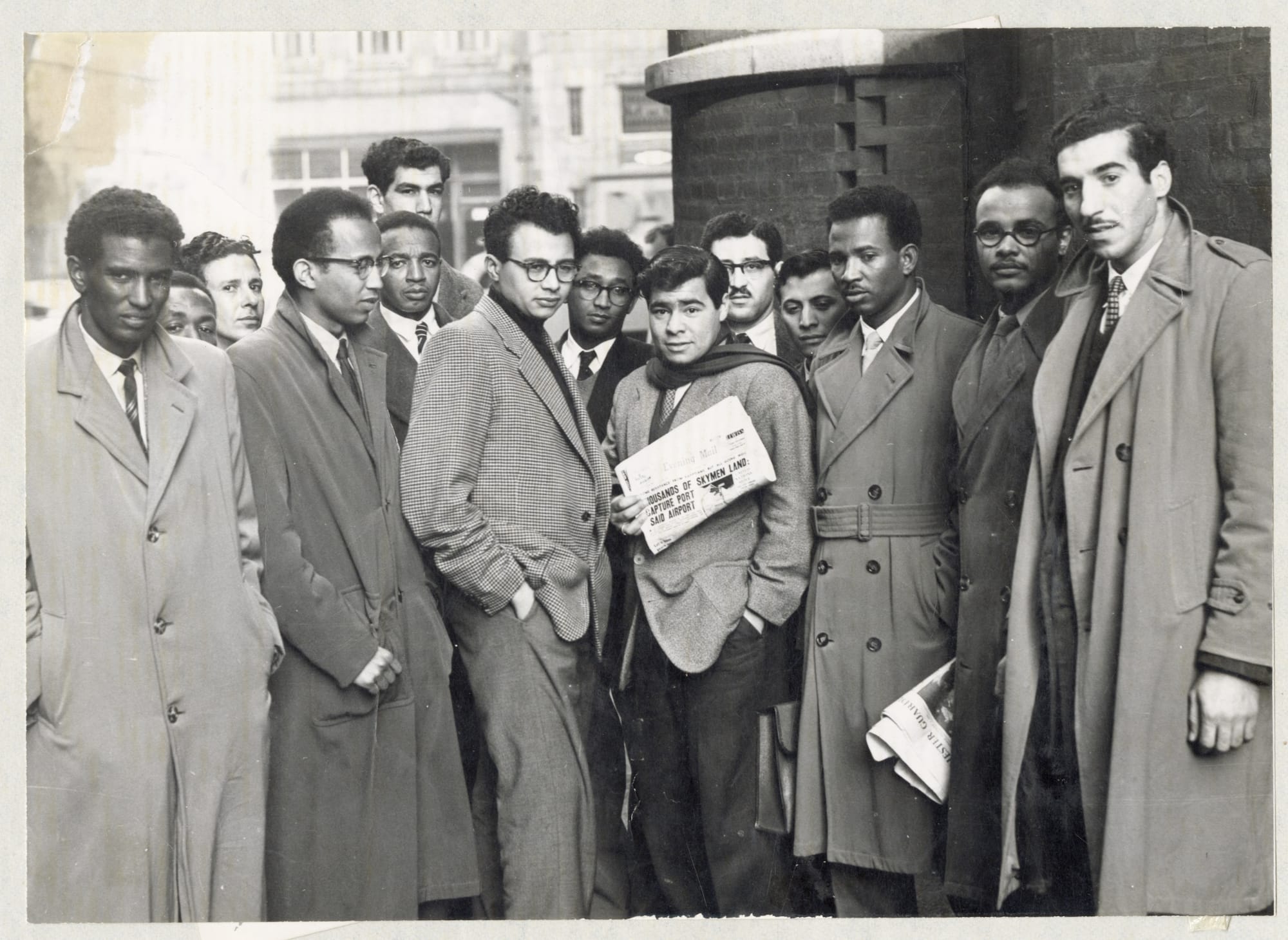
Khalifa Al-Qattan (holding newspaper) at an Arab student strike responding to the Suez Crisis of 1956 in Leicester, UK. Courtesy of the Khalifa & Lidia Qattan Art Museum.
In 1962, in recognition of his efforts as an artist, particularly his continued participation in the highly regarded Spring Exhibition series organized by the Ministry of Education, Qattan became the second full-time artist to be sponsored by the ministry to work at their newly established Marsam Al-Hurr, otherwise known as the Free Art Atelier. It essentially functioned as a long-term sabbatical program that provided artists with a studio, art materials and technical instruction in painting and sculpture to help develop their skills. That same year, he established a style of art that he and his wife dubbed “Circlism,” inspired by intuitive, subconscious painting and understood as an expression of the universal concept of eternal return through recurring cycles. Soon after, he embarked on a number of international trips with a collection of his works in order to independently set up exhibitions that introduced his style to audiences in Cairo, Ferrara, Rome, London and Beirut.
In 1967, alongside his colleagues at the FAA, Qattan helped establish the Kuwait Society for Formative Arts (KSFA), now known as the Kuwait Arts Association, where he served as the first president. As a formal entity—registered as a public benefit association under the Ministry of Social Affairs and Labor—the society was a space where FAA artists could freely conceptualize their own exhibition frameworks and execute these ideas themselves. One of the earliest ideas to be implemented was to establish a large-scale exhibition in the style of international biennials, like the Alexandria Biennale for Mediterranean Countries, that would solely focus on the production of Arab artists. The KSFA thus launched the Kuwait Biennial in 1969, originally titled The Arab Artist Biennial, with its inaugural edition taking place at the Al-Mubarakiya School.
> One of the earliest ideas to be implemented \[by Kuwaiti artists in the late 1960s\] was to establish a large-scale exhibition in the style of international biennials ... that would solely focus on the production of Arab artists.
The Kuwaiti artists studying in Cairo were surely inspired by the exhibition example set in Alexandria, given that they directly cite it in the KSFA biennial materials. But the founding of the KSFA, and the emphasis on the biennial format, was a deliberate attempt to make Kuwaiti artists eligible to participate in, as well as host, international showcases. In 1962, Qattan had attended the Venice Biennale as part of his travels and penned an article for *Al-Hadaf* newspaper upon his return to Kuwait in which he recounted his experience. He ended the article with a broad appeal to the public for the increased support of local artists so that his country could “take its global place among the nations.”[\[1\]](#%5Fedn1)
Some years later, speaking on behalf of the KSFA in a 1970 newspaper interview with *Akhbar al-Kuwait*, Qattan stated that he and the society members had sent a proposal to the League of Arab States in 1966 suggesting the League adopt an Arab biennial. Since the proposal ultimately did not lead anywhere, the artists took action themselves and established the Arab Artist Biennial after they founded the KSFA.[\[2\]](#%5Fedn2)
## Competing Visions of ‘Arab Art’
Qattan’s personal collection of documents complicate the conventional history of Arab biennials. The standard story suggests that the 1970s was the period when Arab artists who had previously worked in isolation felt compelled, at the height of pan-Arabism, to combine their efforts through cultural meetings and joint exhibitions under the centralized leadership of a regional artist union. Their goal was to explore and define the role of the plastic, or visual, arts in shaping the future of Arab culture.[\[3\]](#%5Fedn3) In this narrative, art had become a means of countering cultural erasure and the false and simplistic representations of native populations as backward and artistically reductive. This movement culminated in the Biennale of Arab Art, funded by the Iraqi government and inaugurated in Baghdad in 1974 under the auspices of the regional General Union of Arab Plastic Artists (GUAPA) before travelling to Rabat in 1976 and, reportedly, Libya in 1978.[\[4\]](#%5Fedn4)
Exhibition catalog from the First Biennale of Arab Art in Baghdad, 1974, under the auspices of the General Union of Arab Plastic Artists (GUAPA). Courtesy of the Khalifa & Lidia Qattan Art Museum.
What that standard narrative leaves out is that the Kuwait Biennial of 1969 preceded GUAPA’s by five years and it approached art in the region from a somewhat different perspective. The GUAPA’s exhibition name, The Biennale of Arab Art, differs slightly from the title of the Kuwaiti iteration, The Arab Artist Biennial, with its emphasis on art instead of artists. The Kuwaiti organizers foregrounded Arab artists while the union implied the existence of a distinct category of “Arab art.” Given that GUAPA's conference materials acknowledge the Kuwaiti exhibition series—and Qattan himself recalled proposing an Arab biennial eight years earlier—the coexistence of the two projects raises the possibility that they represented competing institutional visions rather than successive stages of the same one.[\[5\]](#%5Fedn5)
Coverage of the initial editions of the Arab Artist Biennial in Kuwait are scarce, but from an examination of the materials currently available in private archives it becomes clear that low attendance at formal exhibitions was exceedingly common, especially after the opening, and that there was a growing consensus in the press about what art, specifically Arab art, should represent.
In the 1960s and 1970s, many of the art critics reviewing exhibitions for Kuwaiti publications came from other parts of the Arab world, most commonly Egypt, Iraq and the countries of the Levant. While their writing was often insightful, they frequently pitted the local development of art against that of the era’s more established centers of Arab culture, like Cairo, Damascus and Baghdad, often blurring art criticism with politically tinged statements. For example, in Syrian historian Muafaq Bani Marja’s review of the First Arab Artist Biennial, subtitled “Arab Art in the Absence of Our Major Cause,” he criticized the exhibition for lacking enough works about the Six-Day War, citing only a few examples by artists from Jordan, Palestine and Qatar.[\[6\]](#%5Fedn6) “It appears art here is for the sake of art,” he wrote. “It is entertainment, pursued to satisfy a hobby and not to serve a particular cause.” He may have exaggerated the scarcity of artworks taking up the Six-Day War: There was at least one other somewhat abstract work by Bahraini artist Abdullah Al-Muharraqi, and a portion of the sales of the biennial went toward wartime causes in Palestine, a common fundraising strategy that was utilized by various cultural associations in Kuwait at that time.
But the condescending tone of his review also reflects a more widely held dismissive sentiment in the region toward the efforts of Gulf artists to engage with art production in general, let alone who gets to define the term “Arab art.” [\[7\]](#%5Fedn7) Instead of attempting to understand local realities and the ways in which Gulf artists were engaging with them creatively, Arab art critics pushed for a particular style (primarily social realism) and subject matter (the Palestinian cause). They promoted a united and instrumentalized form of art production that essentially commodified atrocity under the banner of solidarity, making it easier for Ba’athist governments to co-opt art for their political purposes.
> Instead of attempting to understand local realities and the ways in which Gulf artists were engaging with them creatively, Arab art critics pushed for a particular style (primarily social realism) and subject matter (the Palestinian cause).
By the early 1970s, the term Arab art had come to denote more than art produced by Arab artists, it also carried concerns about authenticity. It was associated with efforts like those of the Baghdad Modern Art Group, whose concept of *istilham al-turath* was an attempt to re-establish a continuity between artistic traditions of the past and the present. Artists sought inspiration from antiquities or the output of historical figures like that of thirteenth-century Abbasid illustrator Yahya al-Wasiti.[\[8\]](#%5Fedn8) Additionally, the aftermath of the Six-Day War led many Arab art groups and associations, including GUAPA, to center the subject of resistance in their manifestos and in their understanding of Arab art. As the 1970s progressed, the call for authenticity, which can be read in the self-imposed boundaries of what was considered Arab art, limited the freedom of Arab artists to experiment as their governments began to take control of art's future direction.[\[9\]](#%5Fedn9)
Exhibition catalog from Qatar's first Gulf Exhibition for Plastic Arts, 1980\. Courtesy of the Khalifa & Lidia Qattan Art Museum.
The centering of an identitarian framework in the understanding of artistic and cultural authenticity proved useful in shaping public opinion as political tensions began to rise between Iraq and Iran. While GUAPA’s biennial project had failed by 1978—a result, reportedly, of [internal disagreement](https://www.tandfonline.com/doi/full/10.1080/09528822.2018.1538035) relating to thematic adherence—the Iraqi government had already embarked on a new soft-power venture with a series of cultural weeks set to take place in Kuwait, Qatar and Bahrain in 1977\.
Soon after, in 1980, the Qatari Ministry of Information hosted the first Gulf Exhibition for Plastic Arts, originally envisioned as a biennial and one of the earliest uses of the term “Gulf” in an exhibition framework.[\[10\]](#%5Fedn10) The exhibition showcased the latest work produced in the Gulf Arab states, including Iraq, and presented it in a context of unity and solidarity that emphasized Gulf Arab identity. A little over a year later, after the onset of the Iran-Iraq war, the second edition of the Gulf exhibition took place in Baghdad, featuring many of the same artists. It also launched a new series of publications by the Iraqi Ministry of Information that began with a special edition penned by esteemed Iraqi art historian Shawkat al-Rubai titled “Plastic Art in the Arabian Gulf.”
## Regional Art and the GCC
Heading into the 1980s, the category of Arab art had begun to lose its cultural cachet in the region as a result of wider political shifts and alliances, including the onset of the Iran-Iraq war and the formation of the GCC. The Arab Artist Biennial in Kuwait, however, continued steadily under its second name, the Kuwait Biennial for Arab Artists, for approximately two decades. Although derided in its earlier editions, it gained new prominence as an arbiter of Arab artistic development. In one of its last editions, Iraqi artist and the director of the Saddam Art Center, Layla Al-Attar praised the biennial for carrying on the mission of Arab artistic unity by continuing to exclusively showcase Arab artists. After all, as she states in an interview, it was in fact the first Arab biennial and “there was no other like it.”[\[11\]](#%5Fedn11)
It is possible that the loss of Arab art’s political utility for regional governments allowed Iraqi, as well as other Arab artists, to more freely partake in—and promote—Kuwait’s biennial, as there no longer appeared to be any competition or desire to lead the helm of Arab artistic representation. Within Kuwait, increased bureaucracy in art institutions led some pioneering artists, including Khalifa Al-Qattan, to distance themselves from the institutions they helped found. The FAA’s move from the auspices of the Ministry of Education to the Ministry of Information in the early 1970s was significant and emblematic of the core disconnect between artists’ understanding of art and its function to the government. This move was accompanied by a pervasive understanding that art could promote a burgeoning touristic enterprise, reinforced by arbitrary evaluation rubrics set by non-artist employees at the ministry. It is worth noting that the KSFA was founded the same year as Kuwait declared the year of tourism, and around the same time as the conference of Arab tourism ministers.
The confluence of these events reinforced the view of art as an exercise in national identity building rather than free artistic expression. This conception of art was compounded by the formation of the GCC in the early 1980s, when Gulf art shifted toward formal national representation that grew out of the pan-Arabist influence emphasizing heritage. While this consistent cultural activity was building toward Kuwait’s rise as an artistic hub, the invasion of the country by Iraq under President Saddam Hussein in 1990 that started the first Gulf War resulted in the complete halting of all cultural activities in the country for the foreseeable future.
> The confluence of these events reinforced the view of art as an exercise in national identity building rather than free artistic expression.
In 1996, under new management, the KSFA brought back the biennial for what would become its twelfth and final edition, under yet another name, the Kuwait International Biennial, which gestured toward the coalition forces that had helped free Kuwait from the invasion. This reconceptualization of what was once the Arab Artist Biennial to include Western artists received mixed responses, evidenced by the halting of the project thereafter. For some, who like Qattan were disillusioned with the increased bureaucracy of local art institutions, the Gulf War was the final blow. Their approach to art making and organizing had been originally envisioned as an idyllic path toward a united front that would stand against the encroachment of Western culture and its economic interests in the region. After the shock of the invasion, that mission no longer made sense despite institutional efforts to carry on.
## New Cultural Infrastructure
The first Gulf War shattered what remained of Arab brotherly cooperation in the regional cultural sector, putting an end to a variety of initiatives that had grown out of the pan-Arab moment. In the war’s wake, newer cultural projects filled the gap. In 1993, the Sharjah Biennial held its inaugural edition in which Khalifa Al-Qattan, among other Arab artists, was honored for his contribution to the history of art in the region.
The onset of the Second Gulf War and the invasion of Iraq by US-led forces in 2003 revived interest in the category of Arab art, which emerged alongside a rapidly globalizing art market. The opening of Christie’s first permanent Middle East headquarters in Dubai in 2005—the first international auction house in the region—signaled a new phase of international investment in the Gulf's cultural sector that has continued to the present.
Yet while the Gulf’s contemporary cultural landscape has largely been defined by the construction of ambitious new museums and an influx of high-profile biennials and international partnerships, the same period has also witnessed a parallel effort to recover the region’s artistic past through archival projects. One notable example of this new work was prompted by the ransacking of the National Museum of Modern Art in Baghdad—a direct consequence of the US-led invasion of Iraq. Thousands of modern and contemporary works from its vast collection were [looted](https://www.theartnewspaper.com/2014/12/01/looting-in-the-middle-east-encourages-fakes-and-forgeries) and many soon appeared in street markets amid countless forgeries. With museum records destroyed, and the longstanding problem of incomplete documentation of artworks in regional collections, art scholar Nada Shabbout founded the [Modern Art Iraq Archive](https://artiraq.org/maia/) (MAIA) as an open-source initiative “to trace, share, and enable community enrichment of the modern art heritage of Iraq.”
> While the Gulf’s contemporary cultural landscape has largely been defined by the construction of ambitious new museums and an influx of high-profile biennials and international partnerships, the same period has also witnessed a parallel effort to recover the region’s artistic past through archival projects.
After spending years collecting and digitizing all available information on the looted works through meetings with artists, gallery owners and art educators, she concluded that the richest source of information was within the personal collections of individuals. MAIA was developed to enable the public to [share their knowledge](https://dh2010.cch.kcl.ac.uk/academic-programme/abstracts/papers/html/ab-754.html) of the missing artworks.
Another example of an archival initiative is the [al Mawrid Arab Center for the Study of Art](https://nyuad.nyu.edu/en/research/faculty-labs-and-projects/al-mawrid.html) at NYU Abu Dhabi, an open-access research center founded by scholar Salwa Mikdadi that is dedicated to the interdisciplinary study of the visual arts in the Arab world. The center revolves around the mission of the Arab Art Archive, which digitizes primary source materials by working with artists and custodians in the region.
Al-Qattan’s personal archive is one of those collections that the center is currently working to make available to researchers. It represents a vital link connecting the development of Arab art from the modern to the contemporary era and the emergence of the GCC as a cultural and economic powerhouse. As part of only the first batch of artist collections set to be digitized, the center is building the foundation for a more definitive study of the history of modern art in the Gulf. It remains to be seen in what other ways Gulf artists have been overlooked besides the founding of the first Arab biennial.
\[**Abdullah Al-Mutairi** is an external engagement researcher at al Mawrid Arab Center for the Study of Art, NYU Abu Dhabi.\]
SUPPORT MERIP
All of MERIP's analysis is provided without paywalls! Make a donation now to help us keep it that way.
[DONATE NOW! ](https://www.merip.org/donate/)
---
## Endnotes
[\[1\]](#%5Fednref1) Khalifa Al-Qattan, “Al-Kuwayt Wa Ma’rad al-Bunduqiyya al-Duwali,” *Al-Hadaf,* December 5, 1962.
[\[2\]](#%5Fednref2) Shawqi Diyab, “Jawlah Fi Dimagh Fannan,” *Akhbar al-Kuwait*, August 18, 1970.
[\[3\]](#%5Fednref3) Nada Shabout, *Modern Arab Art: Formation of Arab Aesthetics* (Gainesville: University of Florida Press, 2007).
[\[4\]](#%5Fednref4) Nada Shabout, “[Transregional Solidarity](https://mezosfera.org/transregional-solidarity/),” *Mezosfera*, May 2018.
[\[5\]](#%5Fednref5) “Al-Fannan Khalifa al-Qattan Yattahim Wizarat al-Tarbiya,” *Al-Ayyam*, January 6, 1972.
[\[6\]](#%5Fednref6) Muafaq Bani Marja, “Maʿrad al-Sanatayn al-Awwal lil-Fannanin al-ʿArab li-ʿAm 1969,” *Adwa al-Kuwait*, 1969.
[\[7\]](#%5Fednref7) “al-Rassam al-Baḥrayni ʿAbdallah al-Muḥarraqi–Bayn al-Klasikiyya wa al-Tajrid,” *Sawt al-Khaleej*.
[\[8\]](#%5Fednref8) Nada Shabout, *Modern Arab Art: Formation of Arab Aesthetics* (Gainesville: University of Florida Press, 2007).
[\[9\]](#%5Fednref9) Ibid
[\[10\]](#%5Fednref10) “Liqa Ma Mudir Idarat Al-Thaqafa Wa-Al-Funun Bi-Dawlat Qatar, Al-Ustadh Nasir Al-Uthman,” *Aalem Al-Fen* 381, May 13, 1979.
[\[11\]](#%5Fednref11) “Fi Biyannali al-Kuwait,” *Akhir Sa’a*, April 12, 1989.
### 'Closed Until Further Notice'—Keeping a Tehran Art Institution Alive During Wartime
URL: https://www.merip.org/2026/08/closed-until-further-notice-keeping-a-tehran-art-institution-alive-during-wartime/
Last updated: 2026-08-20T14:19:18.000Z
*Iran’s cultural infrastructure has come under new levels of strain since the US-Israeli war began in February of 2026\. Institutions that depend on public gathering, transnational exchange and long-term planning are increasingly forced to operate amid uncertainty and interruption. These pressures—which build on years of economic crisis, sanctions, state restrictions and recurring waves of political unrest—raise questions about the meaning of cultural work in contemporary Iran: How do independent institutions endure when the conditions that sustain them are repeatedly undermined and what forms of continuity remain possible when everyday life is reshaped by cycles of crisis? To discuss these questions, Manchester-based artist and writer Parham Ghalamdar spoke to Hamidreza Pejman in Tehran. Pejman is the founder and director of* [*Pejman Foundation*](https://pejman.foundation/index/)*, a private non-profit contemporary art foundation that opened in Tehran in 2015\.*
*The Pejman foundation works across the Iranian and international art scenes through exhibitions, talks, workshops, publications, research support and cultural exchange. Its main public site, Argo Factory, is a former drink manufacturing factory in central Tehran, first constructed in the early 1920s. After decades of abandonment, the foundation acquired and renovated the building in 2016\. Argo has since become one of the city’s most visible independent art spaces, with a scale unusual for the private cultural sector: a reconstructed industrial building with multiple exhibition spaces, a library, event areas and room for large-scale installations. In June 2026, Ghalamdar and Tehran-based artist Abolfazl Harouni presented* [*Rotanomicon*](https://www.instagram.com/p/DaFooQMjB1K/?img%5Findex=1)*, an exhibition of paintings, prints, 3D-printed toys, collected objects and moving image at Kandovan Projects, one of the Pejman Foundation’s exhibition spaces. The exhibition explored how images operate today under the pressures of war and technological systems.*
*The following interview took place over voice and text messages between March and May 2026 amid the ongoing war. The conversation, which was conducted in Persian and translated into English, has been edited for length and clarity.*
**Parham Ghalamdar:** Take me back to the last day Argo was open in its usual public form, from the moment you arrived to the moment you understood the space could no longer continue as before.
**Hamidreza Pejman:** I remember exactly the moment when there was no room left for doubt: February 28, 2026, 9:30 in the morning. I was on my way to work. I heard a fighter jet directly overhead and right after it, an explosion. That is how war introduced itself. Without preface. That morning, what was heavier than the explosion itself was not knowing. One week? One year? In the end it lasted 40 days, but on that first day it could have been infinite.
But the last “normal” day was much earlier. What we saw in December 2025 \[the mass protests\] was not the cause. It was a sign. Inequality accumulated over years produces one thing: a large mass of people who no longer see any share for themselves in the existing order. And when a person sees nothing left to lose, their logic of calculation changes. Desperation by itself does not end in war. Someone has to direct it. That is where outside actors entered. Media outlets and currents that, from a distance, invested in this ready-to-explode energy and pushed it in a direction aligned with their own interests, not with the interests of the very people whose names they were shouting. And on the other side, a government that, instead of responding to the root, reacted to the symptom, and through that reaction sped up the cycle.
**Parham:** How did you decide that this was the moment to close? I’m interested in the timing: why not sooner, why not later? Was there disagreement inside the team, or did the situation become so compressed that there was no real room left for disagreement?
**Hamidreza:** Disagreement? There was none. And the fact that there was none was itself the worst news, not the best. In ordinary times, a team is always busy arguing over something: money, dates, whether this or that work should go on the wall. We liked to think those arguments were signs of health. Then that morning came, the sound of a fighter jet over your head, and human life suddenly became the only thing on the table. When that happens, everything else evaporates. “Should we stay open a bit longer?” or “Should we close sooner?” are no longer two sides of a discussion. There is no discussion. As a team, we had always wished to be united over the most important thing. That day we were, and the price was that we no longer had any choice. Disagreement is a luxury. It belongs to someone who has several paths. We had one path.
**Parham:** That answer cuts against the usual institutional language of consensus. Consensus here is not health; it is pressure. Can you say what thresholds now make public programming impossible for you: movement in the city, internet instability, danger for staff, insurance, legal advice, fear among audiences or something else? At what point does a concern become a red line?
**Hamidreza:** I have to laugh, because the question assumes there is a line that, once crossed, makes you say, “Right, now it can’t continue.” But that is not the reality of the past year or two. There has been no single red line. We are under pressure from several directions at once, and the pressures are not even aligned with one another. Each comes from a different place, but all of them converge on the same point: the impossibility of standing on any solid ground.
Let me begin with the nearest layer. In April 2026, we were in the middle of a ceasefire–at exactly the moment when, in theory, you should be able to breathe. The Cinematheque, Argo Factory’s in-house film-screening program, which we had forced into existence through sheer effort and which is now in its third year, was holding screenings. At the third screening during the ceasefire, an unknown institution shut it down under the pretext of permits. You think danger belongs to wartime. But no, it was during the ceasefire that they shut the door. The outside threat had receded, and pressure came from inside. It became clear that war was only one pressure among others, not their source.
> Look at the paradox: One side wants to suffocate us for staying, the other wants the place in which we stayed to be destroyed altogether. Both, from opposite ends, seem to want the same thing: that Argo should not exist.
The second layer comes from outside, and it is the bitterest one. The diaspora is deeply angry with us that we continue to breathe and work under the supervision of this same government. And the opposition? They are not even that polite; they simply want you dead. The supporters of war and the monarchists do not even hide it: They want Iran to become a scorched land, unlivable, so that their argument can be proven right. Look at the paradox: One side wants to suffocate us for staying, the other wants the place in which we stayed to be destroyed altogether. Both, from opposite ends, seem to want the same thing: that Argo should not exist.
And then there is the third layer, the one with no slogan that simply devours: the economy. A museum, a non-profit foundation, stays alive through wages, rent and bills, not through statements. The marketing budget has been cut. Sponsors have left. Resources have shrunk to the point that even paying salaries is difficult never mind running an ambitious curatorial program. And this is the most ruthless pressure of all, because it is not ethical; it is simply mathematical. You can possess all the courage in the world and still, at the end of the month, the numbers don’t add up.
So where is my red line? It is not one line. Each of these pressures has a different nature. Movement in the city and the internet are operational and can be worked around logistically. Permits and closure belong to the order of power and can only be endured. The economy is more fundamental than all the others because it does not even enter the logic of dialogue. Each of these can be managed on its own. The red line is where all three are active at once, and the remedy for one makes another worse. To get around one obstacle you need to spend money, but there is no money. To compensate for that lack of money, you need to program something, but power will not allow it. The red line is not a point; it is a condition: that moment when you realize no movement is possible anymore without damaging another movement.
**Parham:** Your website currently has a notice that you are “closed until further notice,” which can sound like an administrative phrase. In your account, it sits inside a much wider collapse of movement, money, permission and trust. So, let me ask it more bluntly: What does closure actually mean at Argo now?
**Hamidreza:** For us, “closed” means less a stoppage than a change of form. We decided that under conditions that could harm people or increase distances between them we should remain present in a different way. The reality is that in this period, even keeping a space open is no longer merely a practical decision—it can have unintended consequences. That's why this closure is more a matter of caution and responsibility than retreat. We are still working, just not in a way that can be seen from outside. We keep our connections alive, we monitor the situation constantly and we try, as much as possible, not to lose this continuity.
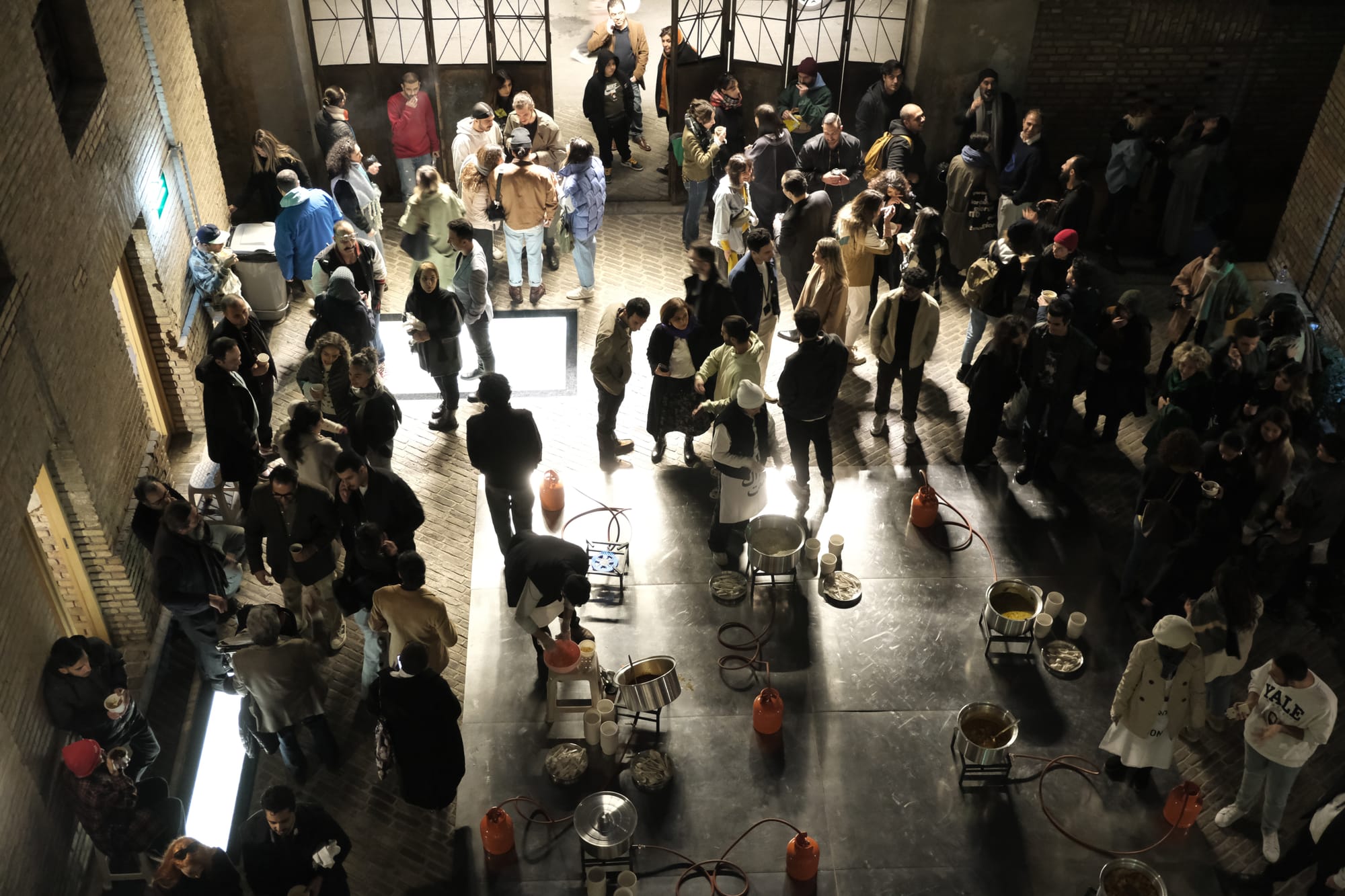
Rirkrit Tiravanija, **Tomorrow Is the Question*, Argo Factory, Tehran, Iran, December 15, 2023–April 12, 2024\. Photograph by Arya Tabandehpoor. Courtesy of Pejman Foundation.
**Parham:** What continues when the public program stops? What work still happens, and what work cannot happen?
**Hamidreza:** Naturally, whatever depends on physical presence and a stable situation stops, such as exhibitions and public programs. Our focus is more on preserving the community, taking people’s safety into account and trying to ensure that the team can endure under these unstable social and economic conditions. At the same time, when society as a whole is under this pressure and these internet restrictions, the form of communication simply cannot continue as before. Some connections are cut, some become slower or more limited and that affects the quality and continuity of relationships. The truth is that war and instability do not only disrupt infrastructures. Over time they erode relationships too and distance people from one another. For that reason, we try to preserve that connection wherever possible, even if it becomes smaller, quieter or less visible. Perhaps one could say that in such moments, the institution’s main work is no longer producing programs but preserving a minimum continuity and the possibility of carrying on.
**Parham:** That is a strong claim: The work becomes the preservation of a minimum continuity. But under blackout conditions, communication is never innocent. It can protect, expose, distort or attract attention. How do you communicate when the internet is unstable or unsafe?
**Hamidreza:** In such conditions, communication is no longer something immediate or self-evident. It becomes slower, more limited and more dependent on trust. Instead of relying on public spaces, we turn toward smaller, safer circles. At the same time, we try to keep those closest to us within a reliable cycle of news and information. That means sharing what we know more directly and with greater care so that some continuity of awareness about the situation can be preserved. Communication may become less frequent but it also becomes more precise and more deliberate.
On the other hand, the digital space itself is not neutral in such conditions. The pressure of propaganda, both from outside and from within, as well as algorithmic systems, often simplify reality or even rewrite it. What becomes visible is not necessarily an accurate reflection of reality but the result of mechanisms that do not always serve society’s interests. In such a condition, communication is not only a matter of conveying a message but also of discerning, filtering and sometimes even withholding. And perhaps most important of all is knowing what to say, where to say it and when to say it, since that itself becomes a sensitive decision. Sometimes silence is chosen not out of passivity but as a form of care for people and relationships.
**Parham:** You have talked about how works can be moved or protected. What steps did you take to do so?
**Hamidreza:** In some cases, we had to move works to safer locations or store the archive digitally so that the information would not be lost if the physical material disappeared. Sensitive equipment was also moved to safe places, and important documents were kept in several different locations.
**Parham:** Can you give me one specific example of a work, exhibition, meeting or relationship with an artist that the war changed? What was supposed to happen? What changed and who paid the price for that change?
**Hamidreza:** You want one example, but I cannot give one example. Because war did not ruin one work, it broke a rhythm, and that changes everything.
After the exhibition “Phony Wars” (10 October to 19 December 2025) we had a very important exhibition: “Scenarios” by Jean-Luc Godard. This was not an ordinary item in the calendar; it was the result of everything we had done with Godard over 12 years. The work was supposed to gather everything together. It was meant to open on January 8, 2026\. And exactly at that point came the sequence of the January 8 and 9 protests, their aftermath and then the 40-day war. The opening was pushed forward into the first weeks of the ceasefire. This was not the first time one of our schedules had slipped. Delay has always been part of our work. But this time was different. Previously, delay meant the calendar shifted. This time, delay meant you did not know whether Argo itself would ever reopen. Twelve years of work, and it was unclear whether there would even be a place to set down its endpoint. That is no longer delay. It is another kind of thing.
After Godard we had scheduled a rare exhibition of Chris Marker, the late French filmmaker, which still has not opened. At Kandovan, Pejman Foundation’s project and exhibition space separate from Argo Factory, an exhibition by the Tehran-based painter Nava Sabetimani was delayed for a full year because of the same sequence of protest aftermath, war and institutional uncertainty, and has only just opened. None of these has been cancelled. All of them remain in a state of “not yet.” And “not yet” is more exhausting than any cancellation. The foundation’s projects outside of Iran were also shelved entirely because of the economy.
You imagine that the cost of war is the thing that gets destroyed, the work that burned, the door that closed forever. No. The real cost is more hidden: the works that have not died, only remained in limbo. A dead work can be buried and left behind. A suspended work lets you do neither. It doesn’t let you move forward, and it doesn’t let you let go. It keeps you alive on something that is not itself alive.
Who paid the price? Look, I could sit here and say the artist paid the price, the institution paid the price. But the words do not sit right in my mouth. The real price was paid by the soldiers. By the mothers. And then by all those who suffered direct loss, financial or bodily. An exhibition postponed will eventually open one day; a person who is gone does not come back. Those two things cannot be set beside each other, and I will not set them there.
**Parham:** What has this period changed in your understanding of what Pejman Foundation is meant to preserve?
**Hamidreza:** More than ever we have understood that what must be preserved is relationships and dialogue. Works and spaces matter, but without a community to make them meaningful, their value diminishes. An institution is not merely a building or a collection of works. It is a network of people, ideas and memories. In a time of crisis, preserving that network becomes more important than anything else. When we cannot mount exhibitions, perhaps our main task becomes preserving memory and relationships. A museum can become a place for recording and preserving collective experience.
**Parham:** What has become urgent to show, and what has become impossible?
**Hamidreza:** Works connected to current issues and collective experiences have gained urgency. By contrast, large, long-term projects that depend on infrastructure and stability have, for now, been set aside. At times like these, smaller, lower-risk and more immediately responsive works can have a greater impact.
**Parham:** What is one thing about the way Argo operates now that you still cannot say publicly? And does that silence protect people, the institution or both?
**Hamidreza:** I need to stop first at the word “silence.” You assume there is something I am not saying. But let me turn the matter around. What you call silence is, for me, the position itself. Its form is simply different from what you expect.
Look at where the problem lies. You have a society whose civic body is thin, weak, monophonic. And in such a place, everyone finds or builds a platform for themselves and begins to protest. Why? Not because everyone is essentially oppositional but because they do not see another route to agency. Direct protest is the only verb they know because it is the only verb society has left room for, and this is where most people confuse one thing for another: They think the only form of effectiveness is shouting.
> ...instead of adding one more platform to all those platforms, I want to build a ground on which people can find another route to agency beyond shouting.
I do not accept that. The duty of an art institution is not constant position-taking. In fact, the very reason for a private art institution to exist, at least as I understand it, is to strengthen that same weak civic body, which means that instead of adding one more platform to all those platforms, I want to build a ground on which people can find another route to agency beyond shouting. That is itself a position, perhaps the most radical position one can take in this atmosphere. So, if no direct voice is heard from us that is not silence. It means that we have defined our agency within a non-violent, civic framework. This choice has a cost: We are struck from both sides. Authority pressures us, the opposition slanders us and both ask the same question: Why do you not take a position? My answer is: I have taken one. My position is simply not to shout loudly. My position is to keep that ground alive. And however hard both sides strike, I try to remain committed to that. The moment Argo turns into just another platform, it is no longer Argo; it becomes one of those thousand voices shouting into the void.
**Parham:** When this period ends, what must the institution do differently?
**Hamidreza:** We will have to be more flexible and more prepared. Perhaps we will need to build new structures for communication and support, strengthen the archives and create different ways of engaging with society. This period has shown that one cannot rely on a single fixed method.
**Parham:** Imagine twenty years from now. What do you want Argo to have preserved from this period, and what do you fear will be lost if no one protects it?
**Hamidreza:** I would want this institution to have preserved the memory and experience of solidarity and resistance. I do not want this time to be forgotten as merely an interruption or a crisis. I fear that if attention is not paid to these experiences, the lessons and human values that took shape under this pressure will be lost. Preserving collective memory and passing it on to future generations is our greatest responsibility.
SUPPORT MERIP
All of MERIP's analysis is provided without paywalls! Make a donation now to help us keep it that way.
[DONATE NOW! ](https://www.merip.org/donate/)
### Arab AI Slop and the Precarious Politics of Digital Kitsch
URL: https://www.merip.org/2026/08/the-kitsch-machine-the-precarious-polti-behind-arab-ai-slop/
Last updated: 2026-08-20T15:14:37.000Z
In April 2026, a 15-second [Instagram reel](https://www.instagram.com/p/DXomRFADa8P/) depicting US President Donald Trump and Israeli Prime Minister Benjamin Netanyahu as janitors cleaning a dirty men’s room went viral. Netanyahu says in broken Egyptian Arabic: “Clean the toilet properly, you Trump boy, before the Protector of Egypt, President Sisi comes \[sic\].” President Abd al-Fattah al-Sisi then appears in a well-fitted suit, shouting, “Why isn’t the toilet clean, you dogs?” He hits Trump in the face, sending him and Netanyahu to the ground crying. A few weeks later, the same creator, bilozz1, uploaded [a second version](https://www.instagram.com/reel/DYExpgbtHnU/?utm%5Fsource=ig%5Fweb%5Fcopy%5Flink&igsh=MzRlODBiNWFlZA==) with an almost identical script that achieved less virality, in which Trump and Netanyahu are cleaning dishes in a kitchen, trying to finish their job faster to avoid Sisi’s retaliation. Days later, the creator published [a third version](https://www.instagram.com/reel/DYcDLfkNKFV/?utm%5Fsource=ig%5Fweb%5Fcopy%5Flink&igsh=MzRlODBiNWFlZA==) set in a fictional Egyptian alley, with Trump and Netanyahu both dressed as street cleaners. Sisi has longer lines: “You guys are completely useless. You don’t get anything done; you’re good for nothing.” The camera moves to a lower angle, depicting Sisi as a towering figure while the two other politicians on the ground respond: “We apologize to you, savior of Egypt. Forgive us!” He kicks them in the face.
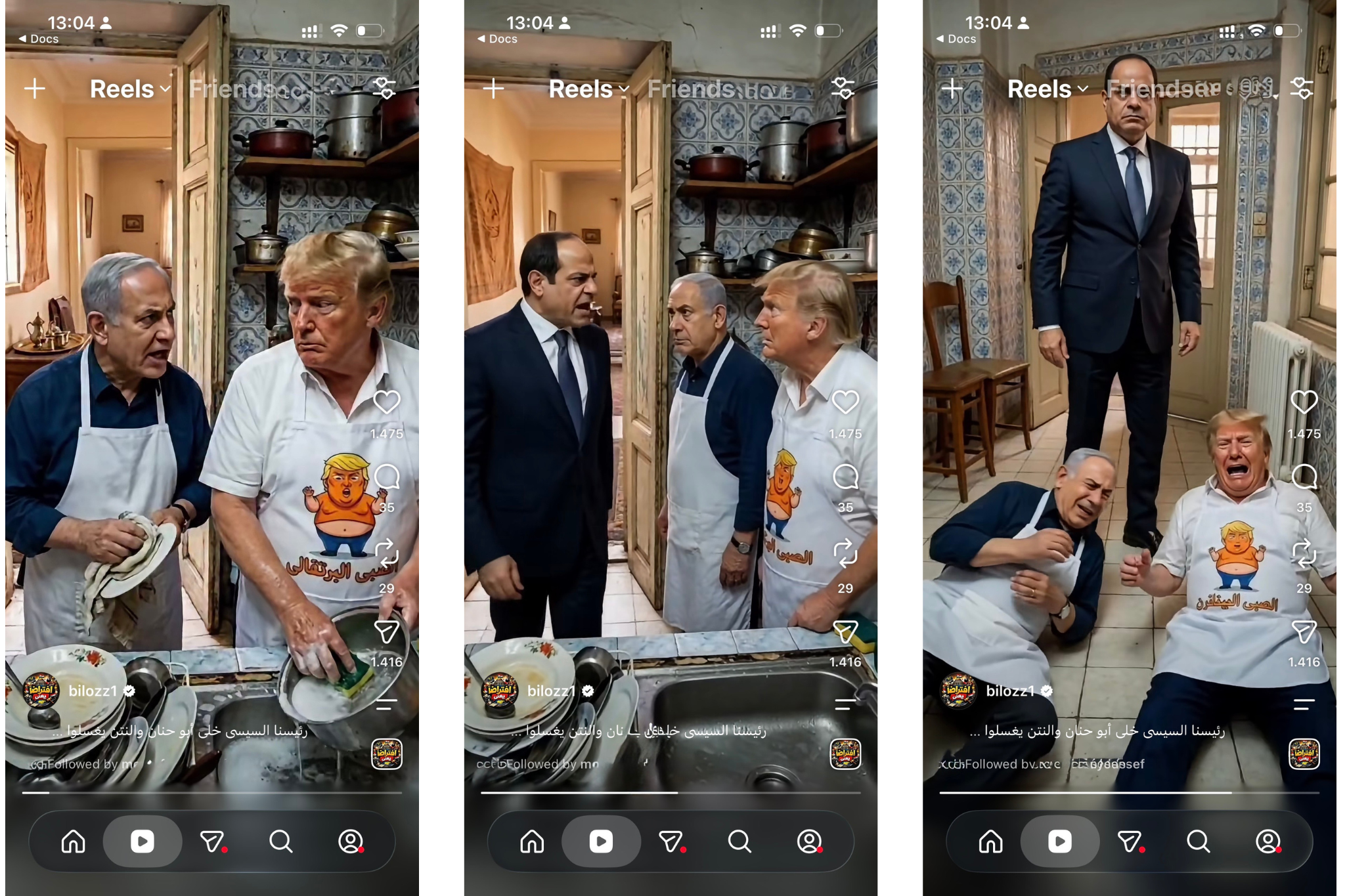
Screenshots from an AI-generated [reel](https://www.instagram.com/reels/DYExpgbtHnU/) by bilozz1.
These reels exemplify a peculiar form of what is loosely referred to as AI slop: cheaply produced, AI-generated content designed for rapid circulation. Over the past year, many sub-genres of AI slop have appeared and disappeared: from “[Italian Brainrot](https://www.forbes.com/sites/lesliekatz/2025/05/03/what-is-italian-brain-rot-the-surreal-tiktok-obsession-explained/)” to [anthropomorphized cats](https://www.washingtonpost.com/technology/2024/08/03/ai-cats-video-tikok-instagram-youtube/)[ ](https://www.washingtonpost.com/technology/2024/08/03/ai-cats-video-tikok-instagram-youtube/)to the talking [vegetables and fruits](https://www.cbc.ca/news/entertainment/ai-fruit-slop-videos-instagram-tiktok-9.7142568) who get married, cheat and fight over custody of their children in simplistic, sensationalist and [misogynistic plots](https://www.wired.com/story/theres-something-very-dark-about-a-lot-of-those-viral-ai-fruit-videos/). Some of this slop takes the [form of political commentary](https://newlinesmag.com/spotlight/slopaganda-comes-of-age/), used by everyone from the president of the United States to dispersed networks of gig workers on the fringes of the internet.
Despite their hyperrealist rendering, these videos have a tacky aesthetic. Their voice-over occasionally breaks, and the lip-sync glitches as the AI voice fails to articulate convincing accents. The stories often play on raw, heightened emotions of fear, anger and regret. Yet, on the Arabic-speaking internet amid Israel’s ongoing genocide in Gaza and the subsequent US and Israeli-led regional war, a specific unnamed political subgenre has emerged, particularly in Egypt and Syria. It is centered around recycling conservative gendered stereotypes in absurdist forms that play on humiliating Western leaders while exaggerating local nationalist masculinity and sovereignty. These spectacles appear in the social media feeds of users exhausted from doomscrolling their way through reels of human suffering in Gaza, Lebanon and Iran.
This new cultural form of short AI-generated videos does not sit neatly within the categories of propaganda or satire. They center banality rather than offer a political argument. Their length is optimized to engage the largest number of viewers, and successful plots are turned into reproducible formulas with the hope that the next version will garner even more attention. These reels become the smallest atomic unit of the internet; they slide into users’ direct messages as trivia and appear in their stories, only to be quickly forgotten. Their comment sections are loaded with memes, emojis and mentions, but rarely any substantial conversation. Despite its intriguing aesthetics, Arab AI political slop cannot be understood through its representations alone. The visualization and circulation of these political fantasies is emerging at the intersection of authoritarian rule, platform capitalism and the rapid diffusion of generative AI tools during a period of genocidal violence in Palestine and broader regional war.
> Arab AI political slop cannot be understood through its representations alone.
## **Spectacles of Humiliation, Fantasies of Sovereignty**
Arab political AI slop is a messy genre of short reels that cannot yet be easily divided into categories, mainly because as a new phenomenon it is still unfolding. Like most viral online content, these videos travel beyond their creators to the point that their origin may become impossible to detect. AI slop gets downloaded, uploaded and edited to acquire new meanings. Yet masculinity structures many of the genre’s recurring narratives, from the humiliation and emasculation of male enemies to the domestication and banalization of female leaders, all while cultivating fantasies of hyper-sovereignty.
The fantasy of sovereignty often takes the form of the Arab leader appearing taller, stronger and more physically dominant than his Western counterparts, as seen in the depiction of Sisi across the three iterations of the same reel. Sometimes, [old propagandistic images](https://www.opendemocracy.net/en/from-strongman-to-superman-sisi-saviour-of-egypt/) are simply animated. The famous images of Sisi paired with a lion or an eagle during his 2013 presidential campaign, for example, reappear in a variety of AI-generated animations that circulate across platforms and are claimed by [pro-state media outlets](https://www.instagram.com/reel/DP0vV4clQ7I/?utm%5Fsource=ig%5Fweb%5Fcopy%5Flink&igsh=MzRlODBiNWFlZA==) and [aspiring supporters](https://www.instagram.com/reel/DNW5QyMoKjy/?utm%5Fsource=ig%5Fweb%5Fcopy%5Flink&igsh=MzRlODBiNWFlZA==). In other instances, real news footage of Sisi and Netanyahu at a press conference is edited to show the former violently beating up the latter. A video that appeared only a few days into the US and Israeli bombardment of Iran shows [Trump wiping Sisi's shoes](https://www.instagram.com/reel/DVgxXwTDM10/?utm%5Fsource=ig%5Fweb%5Fcopy%5Flink&igsh=MzRlODBiNWFlZA==) while crying and begging, “Please rid us of Iran. We are about to die. You can annihilate the world.” Sisi replies: “This is your problem, solve it yourself. I am only in service to my people.”
There is something staggering about these depictions of Sisi, which exaggerate state propaganda to the point of absurdity. Even committed supporters of the Egyptian regime might cringe at such imagery, fully aware of Egypt's political and economic dependence on the United States. Yet this absurdity allows the creators to achieve the virality they need to monetize content without political risks. Since the government passed [Egypt's Anti-IT Crimes Act](https://afteegypt.org/en/legislations-en/legislative-analysis-en/2018/09/04/15717-afteegypt.html) and Media Law No. 180 of 2018, political commentators on social media and even ostensibly apolitical TikTok influencers have been arrested in recurring waves on charges ranging from "[publishing offensive content](https://ldsf.info/blog/2026/05/22/following-saudi-arabia-and-the-uae-egypt-expands-blocking-to-personal-social-media-accounts/)" to “[violating family values](https://nwrcegypt.org/%D8%AA%D8%A3%D9%85%D9%84%D8%A7%D8%AA-%D9%88%D9%85%D8%B9%D8%A7%D9%86%D9%8A-%D9%81%D9%8A-%D8%AF%D9%84%D9%8A%D9%84-%D8%A7%D9%84%D8%A8%D9%84%D9%88%D8%AC%D8%B1-%D8%A7%D9%84%D9%85%D8%AB%D8%A7%D9%84%D9%8A/)." Few aspiring AI creators are willing to take the risk of publishing critical content, so they instead push official narratives to such exaggerated extremes that they become banal, nonsensical and strangely catchy.
While local leaders are elevated into towering figures, Western leaders are subjected to the opposite treatment. They are beaten, slapped, made to clean toilets, cry, beg and kneel. One Instagram reel depicts [Netanyahu and Trump locked inside a mental asylum](https://www.instagram.com/reel/DXwQAxaNVUW/?utm%5Fsource=ig%5Fweb%5Fcopy%5Flink&igsh=NTc4MTIwNjQ2YQ==). As they attempt to escape, they are caught by Iran’s former supreme leader, Ayatollah Ali Khamenei, and Korean dictator, Kim Jong Un, who laugh while beating them up. Another reel depicts Kim as a teacher in a classroom [spanking Netanyahu and Trump](https://www.instagram.com/reel/DYMa%5FGNtLGx/?utm%5Fsource=ig%5Fweb%5Fcopy%5Flink&igsh=MzRlODBiNWFlZA==) while Khamenei laughs. Unlike traditional political satire, these videos rarely rely on irony, parody or critique. Instead, they present emotionally satisfying spectacles of revenge.
> Unlike traditional political satire, these videos rarely rely on irony, parody or critique. Instead, they present emotionally satisfying spectacles of revenge.
Humiliation is also bestowed on former Arab leaders like Syrian President Bashar al-Asad. In December 2025, days after the first anniversary of his fall, an Instagram reel went viral depicting him [wrestling](https://www.instagram.com/reel/DSu8wTQjGkU/?utm%5Fsource=ig%5Fweb%5Fcopy%5Flink&igsh=NTc4MTIwNjQ2YQ==) the current Syrian president, Ahmed al-Sharaa, in a dramatic WWE match. Asad enters the ring wearing tight black trunks like The Rock, accompanied by one of the most recognizable songs of his former propaganda campaigns. Sharaa enters as The Undertaker. He beats Asad, whose body glitches awkwardly and at one point appears to have two left hands. When Sharaa wins the championship belt, now reading "Syria Is Free," the voice-over calls Takbir, and a crowd erupts, “Allah.” Here, the visual errors of AI generation form part of the spectacle.
The ultimate form of humiliation in this genre of AI slop is emasculating male figures by feminizing them. Bashar al-Asad became the primary target of such efforts after he was no longer a threat to Syrians. In one reel, he appears as a belly dancer alongside members of his family, paraded by Vladimir Putin in an Arab wedding procession. In another, he dances beneath banners reading "[Don't follow me, I am engaged](https://www.instagram.com/p/DU3cYMPjEtf/)" and "[Circumcision for boys](https://www.instagram.com/reel/DU53peIjKGH/?utm%5Fsource=ig%5Fweb%5Fcopy%5Flink&igsh=NTc4MTIwNjQ2YQ==)." The release of the Jeffrey Epstein files, in late 2025, prompted a wave of Arab AI reels that feminized Trump. Similar patterns emerged after Egypt's match against Argentina in the 2026 World Cup. Conspiracy theories alleging FIFA had rigged the tournament coalesced with Argentinian football star Lionel Messi's long history of support from Israeli politicians and the Egyptian coach's very public support for Palestine. AI reels responded by depicting [Messi](https://www.instagram.com/reel/DapJNA0omie/?utm%5Fsource=ig%5Fweb%5Fcopy%5Flink&igsh=MzRlODBiNWFlZA==), FIFA president Gianni Infantino and the match referee as [belly dancers](https://www.instagram.com/reel/DaoBE7qxQqz/?utm%5Fsource=ig%5Fweb%5Fcopy%5Flink&igsh=MzRlODBiNWFlZA==) or [pole dancers](https://www.instagram.com/p/Dak44qyie2v/)—as if humiliation reaches its peak when masculine authority is stripped away.
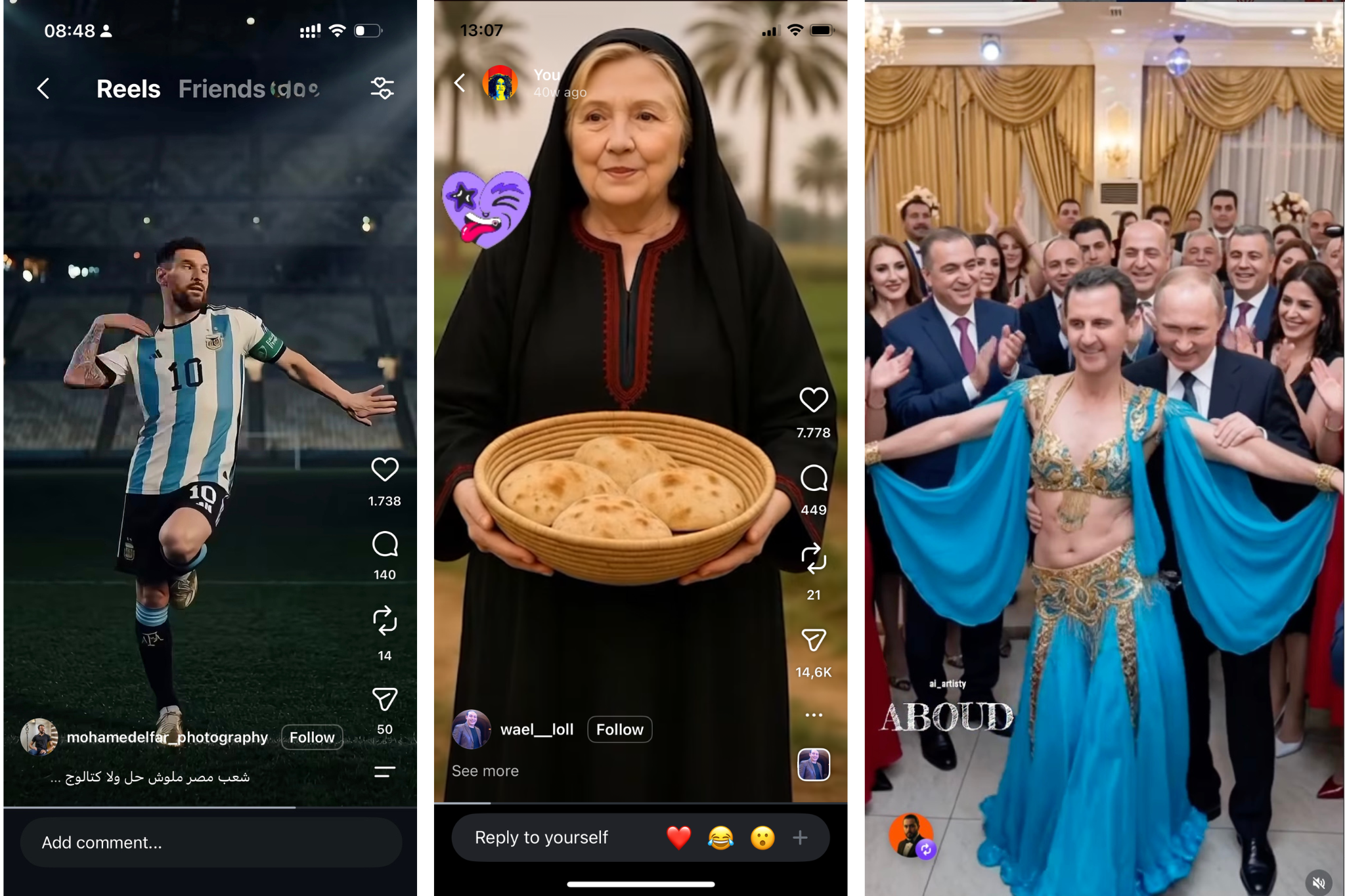
Screenshots of AI slop featuring Messi, Hillary Clinton and Bashar al-Asad.
Female public figures undergo a different transformation. Rather than being cast as political enemies, they are relocated into familiar domestic roles. Former US Secretary of State Hillary Clinton and the famous twentieth-century Egyptian singer Umm Kulthum appear as peasant women baking kahk for Eid. Britain’s Queen Elizabeth becomes an endearing grandma supporting Egypt’s Al Ahly football club, a food blogger reviewing a [Koshari cart](https://www.instagram.com/reel/DPwyF7QAO%5FQ/?utm%5Fsource=ig%5Fweb%5Fcopy%5Flink&igsh=MzRlODBiNWFlZA==) and a [kebab restaurant](https://www.instagram.com/reel/DQHOdpJCBoQ/?utm%5Fsource=ig%5Fweb%5Fcopy%5Flink&igsh=MzRlODBiNWFlZA==) or even a local [Tradwife](https://www.instagram.com/reel/DP1m1l-kYOn/?utm%5Fsource=ig%5Fweb%5Fcopy%5Flink&igsh=MzRlODBiNWFlZA==) sharing her morning routine and strolling the streets of Cairo. As their political identities are dissolved into recognizable archetypes of domestic femininity, these female figures are rendered ordinary and unthreatening. Some of the reels circulate around particular annual festivities to function as digital greeting cards; others are low-key advertisements for local small businesses.
Across these different narratives, politics is replaced with caricatures of familiar gendered hierarchies that offer little critical insight into the conflicts they depict. This cultural form’s recurring aesthetic choices, along with its glitches (by-products of poor AI rendering and inexperienced creators), are characterized by emotional excess, exaggeration, sentimentality, repetition and bad imitation that echo a much longer history of mass-produced visual culture.
## **The Return of Kitsch**
Kitsch is an aesthetic that refers to tacky or gaudy art objects. It emerged in the nineteenth century against the backdrop of the Industrial Revolution to meet the demands of a rising petit-bourgeois class that sought to mimic aristocratic taste through cheaply mass-produced artifacts. Some critics dismiss it as vulgar imitation. Others see it as a transgressive aesthetic capable of unsettling cultural hierarchies.[\[1\]](#%5Fedn1) Yet, to read kitsch as simply a matter of good or bad taste would be an oversimplification. Kitsch, like AI slop, is a cultural form born of commodification, mass production and class aspiration.
> Kitsch, like AI slop, is a cultural form born of commodification, mass production and class aspiration.
Digital kitsch is simply a new phase in the long history of kitsch. Whereas the Industrial Revolution facilitated the production of cheap mechanical objects, the generative AI boom has dramatically intensified the scale through which digital copies can be produced and circulated. As its name suggests, generative (or Gen) AI claims the ability to automatically generate texts, images, voices and animations in enormous quantities, with tremendous speed and at minimal costs. In recent years, [multiple lawsuits](https://www.wired.com/story/ai-copyright-case-tracker/) have been filed against AI companies for training their large language and image-generation models [on copyrighted materials](https://www.theatlantic.com/technology/archive/2025/03/libgen-meta-openai/682093/) by artists and writers, often scraped from the internet by [web-crawling companies](https://www.theatlantic.com/technology/2025/11/common-crawl-ai-training-data/684567/) and data brokers. The generative in Gen AI thus depends on remixing and extracting human labor. Moreover, the business model of these platforms ensures immense [profits](https://jacobin.com/2025/10/artificial-intelligence-big-tech-labor) for their shareholders while incurring staggering environmental costs.
Historically, the relationship between kitsch and fascism has troubled cultural scholars. The twentieth-century German philosopher Theodor Adorno warned against its capacity to manipulate and falsify mass consciousness, describing it as evoking “fictional feelings in which no one is actually participating, and thus \[leads to\] the neutralization of these feelings.”[\[2\]](#%5Fedn2) To Adorno, kitsch was the antithesis of art. The latter challenges the audience, while the former pacifies and demobilizes viewers by offering the illusion of participation. Around the same time, the German cultural critic Walter Benjamin reflected on how industrial capitalism transformed the conditions of artistic reproduction. It stripped artworks of their aura while enabling their mass circulation, whether as part of revolutionary or fascist projects.[\[3\]](#%5Fedn3)
Today’s Arab political AI slop is an algorithmically optimized form of digital kitsch, different from propaganda that aims to convince and mobilize the masses. The creators of contemporary reels rarely seek to persuade, instead they aim to capture attention. Their success depends on interruption. They must stop the user’s scroll, hold attention for a few more seconds and satisfy the opaque demands of platform algorithms. Because algorithms reward repetition, this genre endlessly recycles familiar imagery, successful plots and emotional fantasies. Like the industrial kitsch that concerned Adorno, AI slop is a product that offers emotional release and circulates through systems of mass reproduction. Yet its politics remain open. As Benjamin observes, the same infrastructures that can reproduce fascist fantasies can also circulate images that exceed or undermine them.
## **The Lumpen Proletariats of the Digital Age**
Although the content they produce is often dismissed as AI slop, it remains deeply dependent on human labor and requires a wide range of artistic, technical and entrepreneurial skills. Indeed, behind Arab AI slop reels lie a growing workforce of aspiring creators trying to make a living on platforms that promise far more than they ultimately provide. By observing dozens of Egyptian and Syrian AI slop accounts, their tutorials, discussions on freelancer forums and exchanges on Reddit, a clearer picture of this labor begins to appear. Some creators are highly skilled animators and editors experimenting with new tools. Others simply churn out content in the hope that one video might go viral, thus increasing their earnings by either establishing a direct relationship with small businesses in search of advertising or via the monetization schemes of the platforms themselves that remain murky, inconsistent and hard to understand.
> Behind Arab AI slop reels lie a growing workforce of aspiring creators trying to make a living on platforms that promise far more than they ultimately provide.
Many of these content creators are young men aspiring to enter the media, animation and advertising industries, which have long been dominated by established elite networks. They use AI-generated reels to showcase their animation, editing and voice-over skills as well as to generate income. A scroll through their Instagram or TikTok accounts reveals profiles that resemble creative portfolios, often devoid of a clear political point of view. Some openly advertise AI-generated commercial content and invite potential clients to collaborate. Others began as online gamers, streaming their gameplay or selling gaming-related merchandise before moving into AI production. Many supplement their income by [selling online courses](https://abdullrhman.nzmly.com/l/AsDSFWkCWh?utm%5Fsource=ig&utm%5Fmedium=social&utm%5Fcontent=link%5Fin%5Fbio&fbclid=PAZXh0bgNhZW0CMTEAc3J0YwZhcHBfaWQMMjU2MjgxMDQwNTU4AAGnXi5XOxkak%5F69eSf4gNQ79l6tQBN2XTlWMJY0o0RUJwDQ0s-PMdd4UpJG2Jk%5Faem%5FVB36qhBlngwQ6wKG4kTy3g), often priced around $90, that promise aspiring creators insider knowledge about AI tools, content strategies and monetization schemes for Meta and TikTok.
Yet it is difficult to find out who these creators actually are. In the world of Arab AI slop, real identities are often concealed behind pseudonyms such as [bilozz1](https://www.instagram.com/bilozz1/), the creator of the three variations of the Sisi reel, or generic usernames such as [yassa70000](https://www.instagram.com/yassa70000/). Since communication is typically restricted to business inquiries rather than the curiosity of journalists or researchers, I was unable to talk to them directly. Unlike influencers who cultivate public personas, many AI slop creators deliberately remain faceless, allowing the content rather than the creator to circulate. Some who gain confidence in their skills, like Refaat Rashed, reveal their identities and [become influencers](https://www.instagram.com/rafat%5F%5Frashed/) whose content centers on teaching their followers how to perfect AI-generated videos.
These tutorials reveal how quickly AI production has become a learnable craft. Ever since social media platforms introduced monetization schemes that reward [viral short-form videos](https://www.theatlantic.com/podcasts/2026/04/how-short-form-clips-took-over-the-internet/686922/), aspiring content creators have been in what journalist Taylor Lorenz has called a digital “[gold rush](https://www.youtube.com/watch?v=rKRiclCbtUU&t=5s)” to learn AI tools that make production faster and cheaper. They use ChatGPT to write plots, Nanno Banana to generate images, Google Vids and CapCut to edit videos. The arsenal of these AI tools [changes rapidly](https://www.nytimes.com/2025/10/09/world/artificial-intelligence-slop.html), but so do the learned skills. Thousands of online tutorials teach aspiring creators how to optimize hooks, run faceless accounts, manipulate algorithms and scale up from nano- to mega-influencers. In the end, it is an attention economy, and these are aspiring gig workers. According to a [report by Al Jazeera](https://www.youtube.com/watch?v=uqcoTwPUSn4&t=57s), while AI slop circulates globally, it is mainly produced in the Global South, in economically devastated countries where currency exchange rates and lower costs of living can turn the modest payouts from platforms into a lucrative opportunity.
Discussions on Arabic Reddit's freelancer forums reveal an even broader social world behind these videos. Many aspiring creators cannot afford paid courses, and they struggle with the English-language interfaces of AI tools. They rely on crowd-sourced libraries of translated prompts and instructions shared through Google Docs, Reddit threads and lengthy Facebook posts. These informal knowledge archives circulate through personal networks, allowing newcomers to teach themselves rapidly evolving AI workflows. Some creators arrive after years in other precarious digital jobs, such as call-center work, while others are still in high school and simply looking to earn extra income. Most cannot afford paid subscriptions and instead work within the limits of free trial versions.
Producing AI slop is not completely effortless. An experienced user can generate a ten-second reel in around five minutes, but creators relying on free accounts are limited to only a handful of experiments each day. Arab content creators on Reddit repeatedly complain about the [opaque ](https://www.wired.com/story/tiktok-platforms-cory-doctorow/)[and inconsistent](https://www.wired.com/story/tiktok-platforms-cory-doctorow/) payment rates that vary based on engagement metrics, hashtag optimization, posting frequency, geography and invitation-only monetization programs. They share links to [revenue calculators](https://influencermarketinghub.com/instagram-money-calculator/) to help predict their income and [YouTube tutorials](https://www.youtube.com/watch?v=rUeC-HF6LTk) on how to better monetize in a local Arab context. Yet, despite these tools, many express on Reddit and online forums that they have failed to achieve the promised goals. Uncertainties about how the monetization schemes actually work and what content will go viral push creators to churn out as much as possible to enhance their chances of success. They become trapped on these platforms as both workers producing content and consumers seeking tools and instruction.
These aspiring workers at the margins of platform capitalism resemble what Karl Marx and Fredric Engels described as the lumpen proletariat of the Industrial Revolution.[\[4\]](#%5Fedn4) These were workers who operated outside stable wage labor and survived through informal, precarious means.[\[5\]](#%5Fedn5) Yet with the AI technological revolution, these conditions have become pervasive. AI content creators belong to different social strata and enjoy varying degrees of privilege and social capital, but they do not own the infrastructure on which they depend, nor are they guaranteed wages for their labor. Instead, they continually speculate with their time and skills, hoping that one reel might break through and transform their lives. The political possibilities of Arab AI slop—whether it serves fascist or revolutionary ends—is equally unsettled. For the tech companies that profit off of the labor of AI slop workers, the politics is beside the point; whoever captures attention and cracks the algorithmic codes wins.
\[**Nermin Elsharif** is an assistant professor in the department of Media and Culture, Utrecht University.\]
SUPPORT MERIP
All of MERIP's analysis is provided without paywalls! Make a donation now to help us keep it that way.
[DONATE NOW! ](https://www.merip.org/donate/)
---
[\[1\]](#%5Fednref1) Susan Sontag, “Notes on ‘Camp,’” in *Against Interpretation and Other Essays* (New York: Penguin, 1964). Andrew Ross, *No Respect: Intellectuals and Popular Culture* (Abingdon, UK: Routledge, 2014).
[\[2\]](#%5Fednref2) Theodor Adorno, *Aesthetic Theory*, Gretel Adorno and Rolf Tiedemann, eds. Robert Hullot-Kentor, trans. (London: Continuum, 2002), p. 239.
[\[3\]](#%5Fednref3) Walter Benjamin, “The Work of Art in the Age of Its Technological Reproducibility,” in *The Work of Art in the Age of Its Technological Reproducibility and Other Writings on Media*, Michael Jennings et al., eds. (Cambridge, MA: Harvard University Press, 2008).
[\[4\]](#%5Fednref4) I am grateful for discussions with Mohamed Said Ezz El-din on the laborers of AI Slop and to the members of the Humanistic Inquiry and Theory group (HIT) of the Institute for Advanced Studies in the Global South, NWU-Qatar for their prolonged and profound engagement with my examination of kitsch and fascism.
[\[5\]](#%5Fednref5) Clyde Barrow, *The Dangerous Class: The Concept of the Lumpenproletariat* (Ann Arbor: University of Michigan Press, 2020).
### Alternative Amman—Making Counterculture in the Jordanian Capital
URL: https://www.merip.org/2026/08/alternative-amman-making-counterculture-in-the-jordanian-capital/
Last updated: 2026-08-20T16:46:49.000Z
On a balmy April night in Amman’s Jabal Al-Weibdeh, a DJ was perched on the roof of [Zawyeh Space](https://www.instagram.com/zawyeh.space/), leaning over a battered mixer as a small crowd of mostly twenty-somethings chatted under the sky. A short walk away at The Village in Jabal Amman, the city’s only metal festival, Rock On, was[ celebrating](https://www.instagram.com/rockon.jo/) its fourth installment in two years. Punctuating this revelry, another layer of sound cut through the din, the now ubiquitous wail of an air-raid siren signaling another Iranian drone or missile crossing Jordanian airspace. It served as a stark reminder that this subcultural oasis operates in the midst of an ongoing regional war, one that has escalated following the US-Israeli attacks on Iran that began in February of 2026\.
Undeterred, after the last distorted crescendo of the self-described “Groove Metal” band [Ebrazus](https://www.instagram.com/ebrazus.official/) had faded away, a short way down the neighborhood’s winding streets at Masnaa’—an old theater from the 1950s now converted into an arts venue—DJs and electronic artists kept a different crowd dancing, swaying and flirting late into the night. The artistic diversity and density of this night is emblematic of a recent boom in Amman’s cultural scenes.
> The artistic diversity and density of this night is emblematic of a recent boom in Amman’s cultural scenes.
Yet, for many of the city’s counterculture veterans, there is a palpable concern that this flourishing is only another turn in the Jordanian capital’s familiar boom and bust cycles. Since the 1990s, each successive political and economic rupture—from the 2011 Arab uprisings and Syria’s refugee crises to today’s genocide in Palestine and the ongoing regional war—has reshaped the conditions under which Amman’s artists create and perform their work, leaving many to build careers on unstable foundations that can change rapidly. “When the beautiful wave comes, like now, everyone is excited,” observed Yousef, a hip-hop cultural pioneer and breakdancer. “Then the bad wind comes, and we all fall together,” he lamented.
## The Underground Years
Yousef’s remarks capture the fleeting nature of Amman’s counterculture scene, which he dates to the 1990s when young Jordanians increasingly accessed novel forms of media and culture arriving in Amman from abroad through relatives returning with cassettes, videotapes and new ideas. Anyone from that generation remembers radio DJ Mohanad Al-Jazaira, whose variety hours included an eclectic range of imported music styles—not just pop, but rock and metal. Media was often shared from person to person, spreading through word of mouth.
“I learned two moves from a DVD that I had gotten ahold of from a cousin who had returned to the country. Then I went out and showed it to my neighbors. No one had seen anything like it,” Youssef recalls. The effect was contagious. Soon neighborhood kids came knocking at his door asking him to show them his moves, and a small community was born.[\[1\]](applewebdata://C9DB0982-B287-4D06-A75A-D60001421783#%5Fedn1)
For Amman’s urban precariat—many of whom, like Yousef, were second-generation displaced Palestinians growing up in the shadow of Jordan’s normalization with Israel, through the 1994 Wadi Araba peace treaty—alternative music provided a vocabulary for systemic frustration. As Yousef explains: “Imagine growing up in a refugee camp, constantly told your land was taken, and the state you live in has signed a peace treaty with Israel… Movement gave me something to do about it.”
As hip-hop, rap and their attendant dance scenes grew, with crews popping up, shifting members and holding battles, so did a burgeoning metal scene. By the mid-2000s, specialized rock shops and venues spanned the urbanizing districts of Abdoun and Shmeisani. As Zayn, a vocalist for several local metal acts puts it, the rise of metal was in large part driven by a rejection of formulaic traditional genres and the values they embodied: “everyone just got tired of hearing people singing about *habibi* all the time.”
While hip-hop was generally [tolerated](https://csalateral.org/issue/5-1/hip-hop-blackwashing-el-zein/) by authorities and local cultural commentators, who often [framed](https://journals.openedition.org/arabianhumanities/6285?lang=en) the genre’s reliance on Arabic lyricism as a modern extension of regional poetic traditions, the rapid expansion of Amman’s metal scene triggered heavy-handed state intervention by Jordan’s security services. Some were detained for weeks under the pretext of satanism, following Egypt’s [designation](https://www.popmatters.com/158667-the-heavy-metal-witch-hunt-lives-on-2495851143.html) of the genre as “satanic” in 1997 and an ensuing crackdown. “The first show I ever played \[in 2003\] got broken up by security services arriving in a bus,” Zayn notes. He was 16 at the time. Several other members of the scene describe being picked up at home by security services, having been flagged due to their long hair and attendance at metal shows. The young detainees were taken to a cell and kept without communication with their families for over a week.
The pressures on the metal musicians escalated in tandem with [broader restrictions](https://www.merip.org/2002/12/occupied-maan/) on freedom of expression and assembly imposed by the Jordanian government in the 2000s—shaped by multiple forces, including an attempt to appease Islamist groups like the Muslim Brotherhood, growing anxiety about a radicalized youth culture and a state apparatus already [inclined](https://www.esodic.com/about) to treat long hair, black clothes and loud music as symptom of social disorder. “Whenever the scene got too big, the state would swoop in and shut things down,” said Zayn. The crackdown [culminated](https://www.thenationalnews.com/world/mena/heavy-metal-band-on-the-run-in-jordan-1.501056) in a now notorious April 2009 police raid on a Dragon Rider concert of around 400 people. “Needless to say, no one in the scene or at that show was or is an actual satanist,” Zayn added. Stalwarts of the scene generally agree that the successive crackdowns effectively drove musicians underground.
> “Whenever the scene got too big, the state would swoop in and shut things down.”
## The Donor Years
If the alternative music scene of the 90s and early 2000s was marked by precarity and independence, the late 2000s and 2010s was a period of professionalization that fostered new forms of dependency. A less politically contentious but deeply creative coterie of guitar and synth-based bands—including El Morabba3, Autostrad and Jadal—came to the fore, catching regional and international attention. At the same time, a flurry of post-Arab Spring cultural funding led by international non-governmental organizations saw Western embassies, European cultural institutes and other state-backed development programs pouring money into hip-hop workshops, public art and dance and music festivals.
Jordanian authorities saw this programming not only as a politically safe pressure valve for youth frustration, but as a highly lucrative pillar of the state’s broader economic strategy. By projecting an image of Amman, and Jordan more broadly, as a tolerant, cosmopolitan oasis open to the arts, the state actively courted larger packages of foreign humanitarian aid and bolstered its tourism sector. This massive influx of international capital also materially reshaped the city’s urban landscape. The burgeoning NGO industry produced a new, reliable patron class of foreign aid workers and expatriates who congregated in cultural hubs like Jabal Amman and Jabal Al-Weibdeh, providing the audiences and disposable income that sustained this donor-driven alternative arts economy.
This funding apparatus hit its peak as Syria’s refugee crisis mounted—an estimated 1.3 million refugees fled to Jordan—and brought a historic surge in international aid to the country, topping [$3.3 billion](https://jordantimes.com/news/local/aid-received-2018-reaches-33-billion) by 2018.[\[2\]](applewebdata://1A10C3BD-4105-40EF-83F8-A1645EF08533#%5Fedn1) While arts funding comprised only a small portion of this total, it was enough to radically reshape the cultural political economy of Amman’s arts scene. Foreign culture funding over the 2010s came mainly from donors like the British Council, the European Union and UNESCO. These institutions—alongside other cultural NGOs working under their aegis—supported grants, festivals, digital training and creative projects. For example, the Amman Jazz Festival, launched in 2012, continues to be funded by the EU and is supported by the Goethe-Institut and European embassies. USAID’s YouthPower Jordan program, which ran from 2017 to 2022, tied youth empowerment to community engagement and opportunity-building.
Crucially, this top-down funding landscape operated in tandem with regional and local cultural capital. The Arab Fund for Arts and Culture (AFAC), founded in 2012, is the principal regional source for arts grants, while the Abdul Hameed Shoman Foundation, founded in 1978, remains an influential local patron of Amman’s public and cultural life. Together they have provided the platforms and financing necessary for art to survive in a market too unstable to sustain cultural work on its own.
Yet, even when the funding was Arab rather than Western, it remained bound to the same institutional imperatives. These funding bodies relied on systems of bureaucratic management which forced artists to translate their practices into professionalized categories such as civic engagement, capacity building or social cohesion. Rather than supporting creative experimentation for its own sake, the global grant economy demanded conformity to its narratives, preferring art that was legible as a measurable social service or a therapeutic tool for marginalized or victimized groups. Because this funding relied on mastering dense, bureaucratic grant language, it privileged institutional in-groups at the expense of grassroots creatives. As Jamal, a cultural consultant noted, “someone comes with connections, knows how to write proposals, gets money, gets funded, \[and\] hires the younger generation to do the work.”
> Rather than supporting creative experimentation for its own sake, the global grant economy demanded conformity to its narratives.
Jamal was referring to the shifting landscape of cultural capital that saw a new professionalized cultural elite emerge in the 2010s, populated by upper-class Jordanian tastemakers with *wasta,* strong government contacts, alongside another class of diaspora or foreign-born programmers—derisively called “academics” by Yousef. The latter explained that these cultural professionals, who typically arrived in the region with degrees from Western institutions, possessed the technical expertise to navigate complex grant proposals. They were often accused by my interlocuters in the countercultural music and performance worlds of acting as gatekeepers, securing funding without meaningful buy-in from the diverse scenes they claimed to represent, paying local artists a pittance and, as one participant complained, “getting an impressive line on their CV before leaving the country.” These institutional hierarchies occasionally triggered open resistance. Several interviewees recounted a story where local dancers staged a last-minute mutiny during the 2014 EU-funded Zakhareef in Motion dance festival. Upon discovering an organizer had allegedly pocketed the bulk of the grant, the performers successfully forced a cash-in-hand redistribution of the budget only moments before taking the stage.
The funding boom throughout the 2010s also came with new aesthetic criteria. Embassy culture officers and elite tastemakers, regardless of national origin, often held culturalist and traditionalist assumptions about what Arab expression should look like, favoring projects that were easily legible within familiar frameworks such as traditional Dabke, folkloric theater or so-called Arab hip-hop. Amman's long-harassed metal scene was conspicuously excluded. “We’re not authentic enough, I would imagine,” suggested Adnan, a local metal musician.
This influx of donor capital, however, would ultimately prove fleeting. As the immediate urgency of the Syrian refugee crisis faded from global headlines and international donors shifted their focus, cultural funding in Jordan steadily slipped down the priority lists. Moreover, the abrupt suspension in January 2025 of USAID under the administration of US President Donald Trump triggered an almost overnight exodus of foreign aid workers from cultural hubs like Jabal Amman and Jabal Al-Weibdeh, instantly draining large expatriate audiences that had in part sustained the city's alternative arts economy. The immediate funding collapse also stranded Jordan’s aspirational, Westernized precariat—the socioeconomically diverse class of young local creatives and professionals whose livelihoods, aesthetic output and upward mobility were structurally dependent on an NGO grant ecosystem.
## After October 2023
Today, Amman’s alternative music scene is unfolding amid the Israeli genocide and US-sponsored regional wars that have brought the Jordanian state’s normalization with Israel and questions of funding and complicity to the fore.
“I know some out there would criticize me for taking German funding,” noted Yousef on the topic of his recently opened art center, made possible in part by a Goethe-Institut grant. He acknowledges that institutional alignment with any state backing Israel could be viewed by others in the community as a betrayal of his Palestinian identity. But he views navigating these ethical landmines as a condition of survival. “I’m taking money to open a place for everyone, and many of them will be Palestinian,” he argues. “Would they rather we didn’t have that space?”
While some high-profile regional artists have directly challenged Western complicity in Israel’s genocide, such as the Palestinian-Algerian Saint Levant and the Egyptian rock band Cairokee, most Jordanian artists I spoke to did not feel they had the same liberty. Several musicians referenced Cairokee’s song *Telk Qadeye*, released shortly after October 7, 2023, which condemns suffering in Gaza and Western double standards, as an example of politically committed work, though others are skeptical.
“I don’t buy it,” said one musician who asked not to be named. “It’s hard to think they didn’t do it in order to get the hype, which they got.” By contrast, Tareq, a rock guitarist in a rotating set of bands, thought the song in its abstraction was a profound encapsulation of what many in the Arab world feel regarding Gaza. Still, he said, “I could never bring myself to write the same kind of song.” His reluctance to turn tragedy into visibility was echoed by another musician: “I’m Gazan myself, but I’ve never written a song about Gaza…for me it goes beyond something you can express. Maybe one day, but it’s still too painful.”
> "Palestinian solidarity has become a market."
Following three years of what has been called a “live-streamed genocide” in Gaza, Amman’s creatives often describe burnout, a sense that they are being pushed to narrate their struggles for foreign audiences or sympathetic diaspora elites. “Palestinian solidarity has become a market,” Zayn observed. While seeing his own Palestinian identity as fundamental, he also pointed to a widening chasm between regional realities and Western activist spaces and solidarity narratives. Artists also feel that the topic of Gaza since October 7, particularly on social media, has become comparable to a cultural fad largely populated by diaspora voices. Maha, a Palestinian visual artist, lamented that her work may be ignored until she produces explicitly identitarian or political work, at which point curators and broader audiences suddenly take interest. “Politics is a privilege,” she said, laughing at what she sees as the irony.
> "Politics is a privilege."
Their fatigue sits on years of frustration with the NGO-driven art sector. The single most consistent refrain among those interviewed for this piece is that they “hate politics.” Hassan, a photographer pushed against the apolitical in one conversation, saying that “everything is political,” but he recognized that, at its core, the commonplace rejection of the political reflects an exhaustion with the demands of identitarian framings of so-called Arab art. As Tareq explains: “After a couple of decades of making music, and especially now, I realized that I should make the music that I love, in my own slang, in my own language, but that hopefully will add up to my own story.”
Embittered by the conditional attention of foreign and regional arts funding, as well as what they perceive to be the judgement of diasporic elites, and disgusted by Western states claiming to be arbiters of cultural freedom as they facilitate genocide in Gaza, many of Jordan’s alternative musicians and dancers have turned to staging events that bring people together and reclaim physical space.
Some critics accuse Amman’s club-goers of “enjoying the fruits” of a security state built on regional violence, but the reality is more complex. Many operate under the radar of the state, which has cracked down on dissent in recent years. “Of course, we want to talk about it, but there are limits set by the state,” explained Nizar, a guitarist in a local rock band. At the same time, he added, “a lot of us are anxious not to exploit Palestine for likes or attention.” Jordan’s 2023 Cybercrimes Law has [sharply](https://jp.reuters.com/article/jordan-internet-censorship/jordan-adopts-cybercrime-law-seen-as-threat-to-free-speech-idINL8N39D8W3/) expanded the state’s ambit to criminalize online speech for offenses such as “threatening societal peace” and “contempt for religion.” Civil rights groups, and several artists interviewed for this piece, say the shift has deepened an already palpable climate of fear and creative self-censorship. During a recent dance performance referencing Palestine, gallery owners anxiously called the creative director to clarify that the word “them” in the title did not refer to Hamas, desperate to avoid uncomfortable state scrutiny.
While one veteran of the hip-hop and curatorial scenes suggested that “you can play it so that the state leaves you to do what you do,” in practice, government surveillance of cultural events remains. Murad, a Sufi-inspired guitarist and singer, recounted the experience of the *mukhabarat* appearing at two of his recent shows to warn him against political speech after he encouraged the audience to reflect on the reality of human suffering in the region. “I didn’t even mention Gaza,” he complained. When security officials instructed him to cut his set short, Murad refused. Rather than provoke a confrontation, the officers relented. As a Gazan holding only a Palestinian Authority identity card that grants little more rights than entry to Jordan, the stakes of Murad’s defiance were existential: “Let them kick me out, there’s no future here anyways,” he said.
New metal and alternative scenes have also emerged, as seen in Rock On’s successful staging of regular festivals. This growth is in part driven by the social media generation, many of whom discovered metal, hardcore, gothic and alternative cultures online rather than inheriting practices from an established older generation. “I blame \[the TV show\] *Wednesday*,” said Zayn, half tongue-in-cheek. “When was the last time people in Jordan were listening to The Cramps before *Wednesday*? Who was listening to Kate Bush before *Stranger Things*?”
But those involved in Amman’s creative renaissance also self-consciously reject what they see as superficial replication of Western internet trends. Instead, these ongoing countercultural movements strive to claim local spaces of creativity and autonomy. Much like the electronic and indie scenes pivoting toward Arabic lyrics and regional slang, today’s alternative music scenes increasingly blend non-traditional instrumentation with local identity, carving out space for communal release and creativity away from the rigid expectations of family, foreigners, the state, society and the broader culture.
At the same time, the ability to make space for collective expression exists precisely because the gaze of both the state and foreign-funded agencies has shifted. When asked if he was concerned that another crackdown by the state could push the metal scene underground again, one owner of a second-hand rock shop appeared unworried: “Not at all,” he said. His confidence reflects a changing political reality: With the state’s security apparatus now aggressively focused on policing and criminalizing dissent related to Palestine and curtailing explicitly political agitation, the regime’s motivation to orchestrate moral panics over youth degradation appears to have largely evaporated.
By grounding their work in aggressively local spaces, experimental improvisation and avant-garde Arabic-led or instrumental performances, many are reclaiming their right to aesthetic ambiguity. This conscious indeterminacy allows both artists and audiences to resist being easily deciphered, instrumentalized as a trauma narrative or neatly packaged as fodder for someone else’s grant application. Honest critique for some may require self-implication, a reckoning with the fact that even those who claim purity have applied for grants funded by the very states managing their social, political and economic dispossession. Such a reckoning opens thornier questions about the complex ethics of making art and being joyful in proximity to genocide. “This is the question, and it’s on everyone’s mind,” Yousef said, “and I don’t have an answer.”
\[**Arran Walshe** is an Amman-based researcher and writer.\]
SUPPORT MERIP
All of MERIP's analysis is provided without paywalls! Make a donation now to help us keep it that way.
[DONATE NOW! ](https://www.merip.org/donate/)
[](applewebdata://C9DB0982-B287-4D06-A75A-D60001421783#%5Fedn1)
---
## Endnotes
[\[1\]](applewebdata://C9DB0982-B287-4D06-A75A-D60001421783#%5Fednref1) All interviews were conducted by the author in Amman, Jordan between April and June of 2026\. All names have been anonymized.
[\[2\]](applewebdata://1A10C3BD-4105-40EF-83F8-A1645EF08533#%5Fednref1)UNHCR, *External Statistical Report on UNHCR Registered Refugees and Asylum-Seekers in Jordan* (Geneva: UNHCR, 2024).
### On Drawing the Act of Looking
URL: https://www.merip.org/2026/08/on-drawing-the-act-of-looking/
Last updated: 2026-08-20T12:54:50.000Z
*Lebanese artists Jana Traboulsi, Mazen Kerbaj and Bahij Jaroudi have long grappled with how to draw the violence inflicted by Israel in Palestine and Lebanon, questions that have taken on new urgency since the destruction of Gaza began in October 2023\. In this visual essay, Traboulsi brings together elements of their work created over the last three years to explore how drawing can help interrogate the act of looking at images and what it means for their subjects, viewers and themselves.*
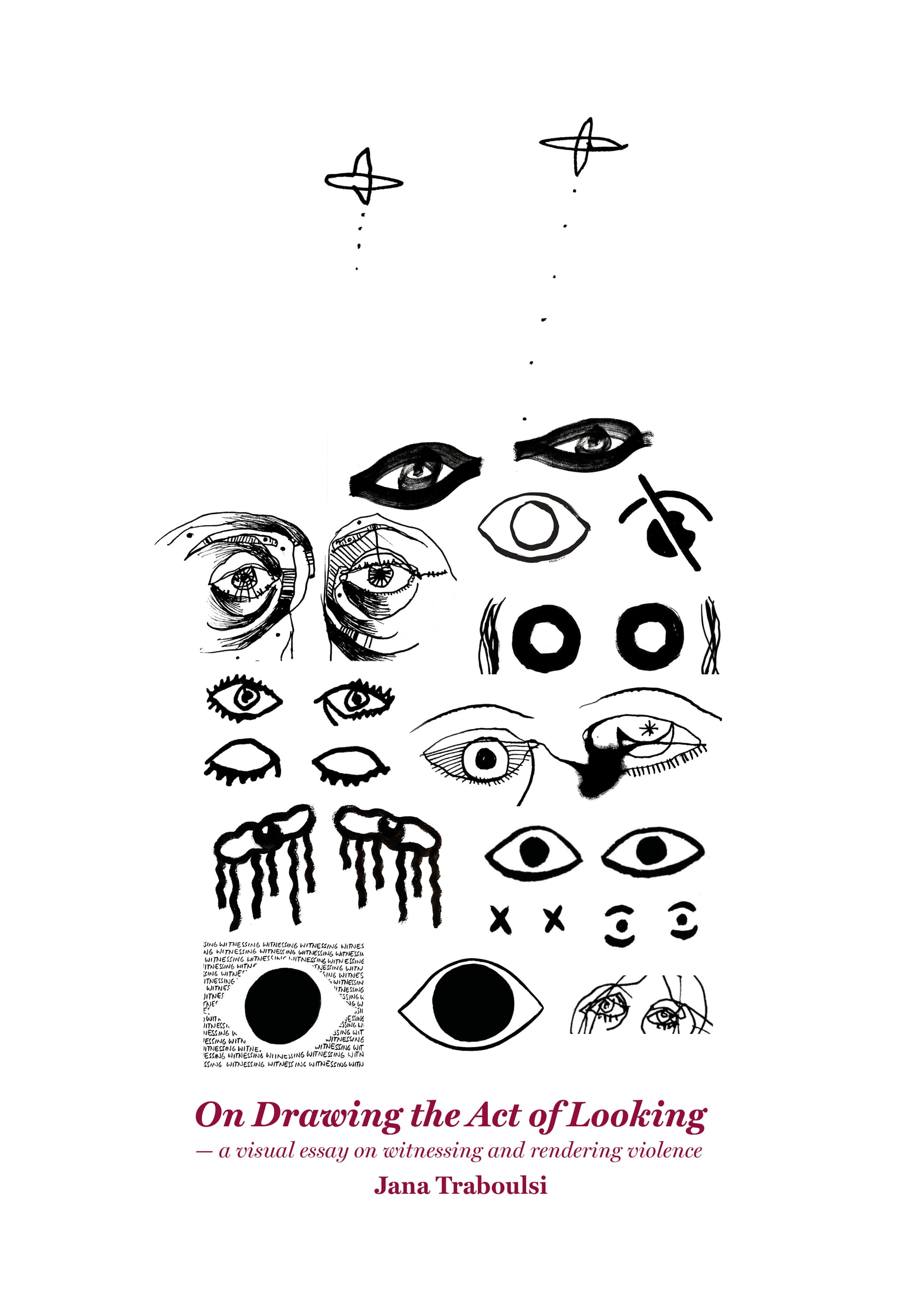
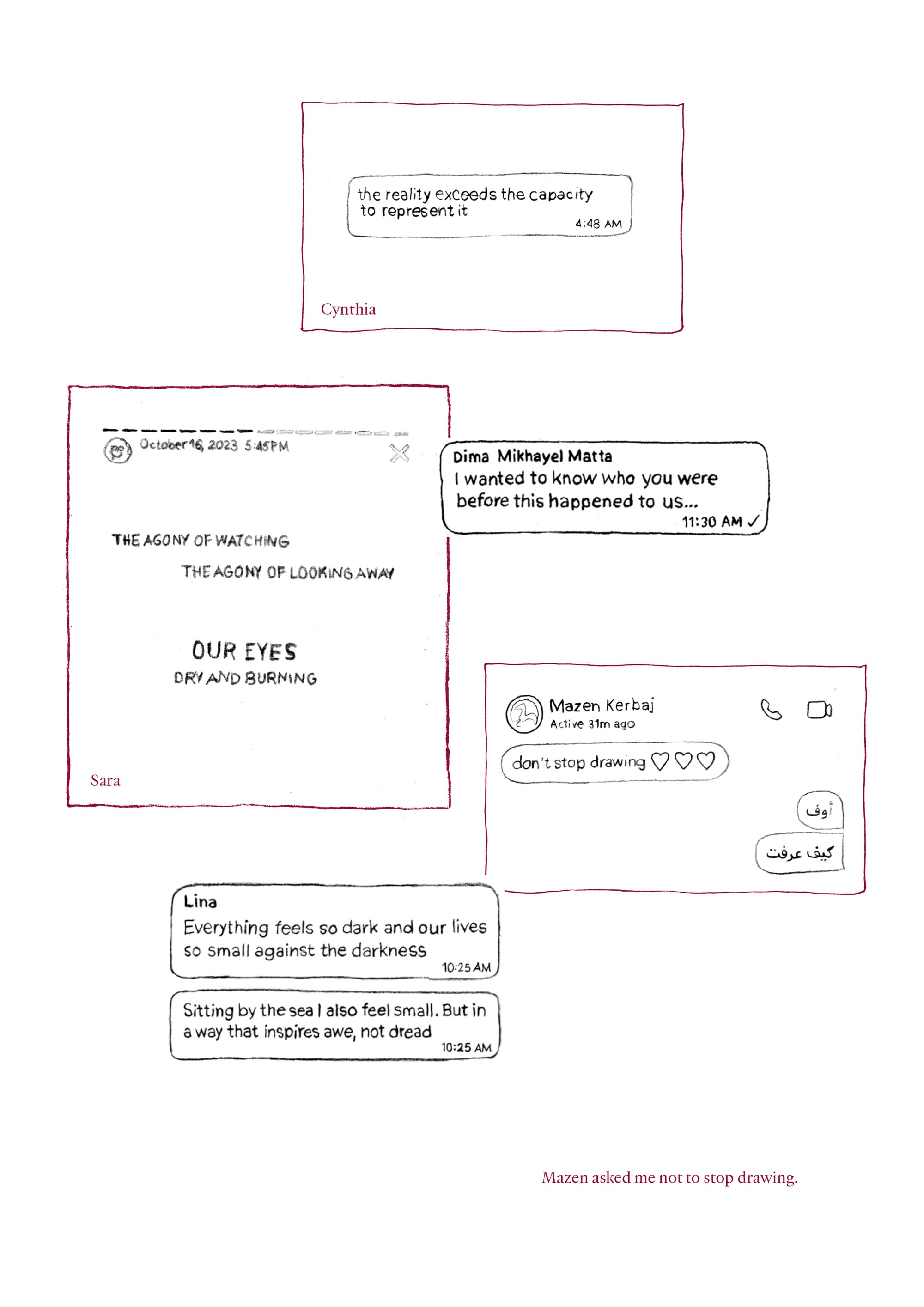
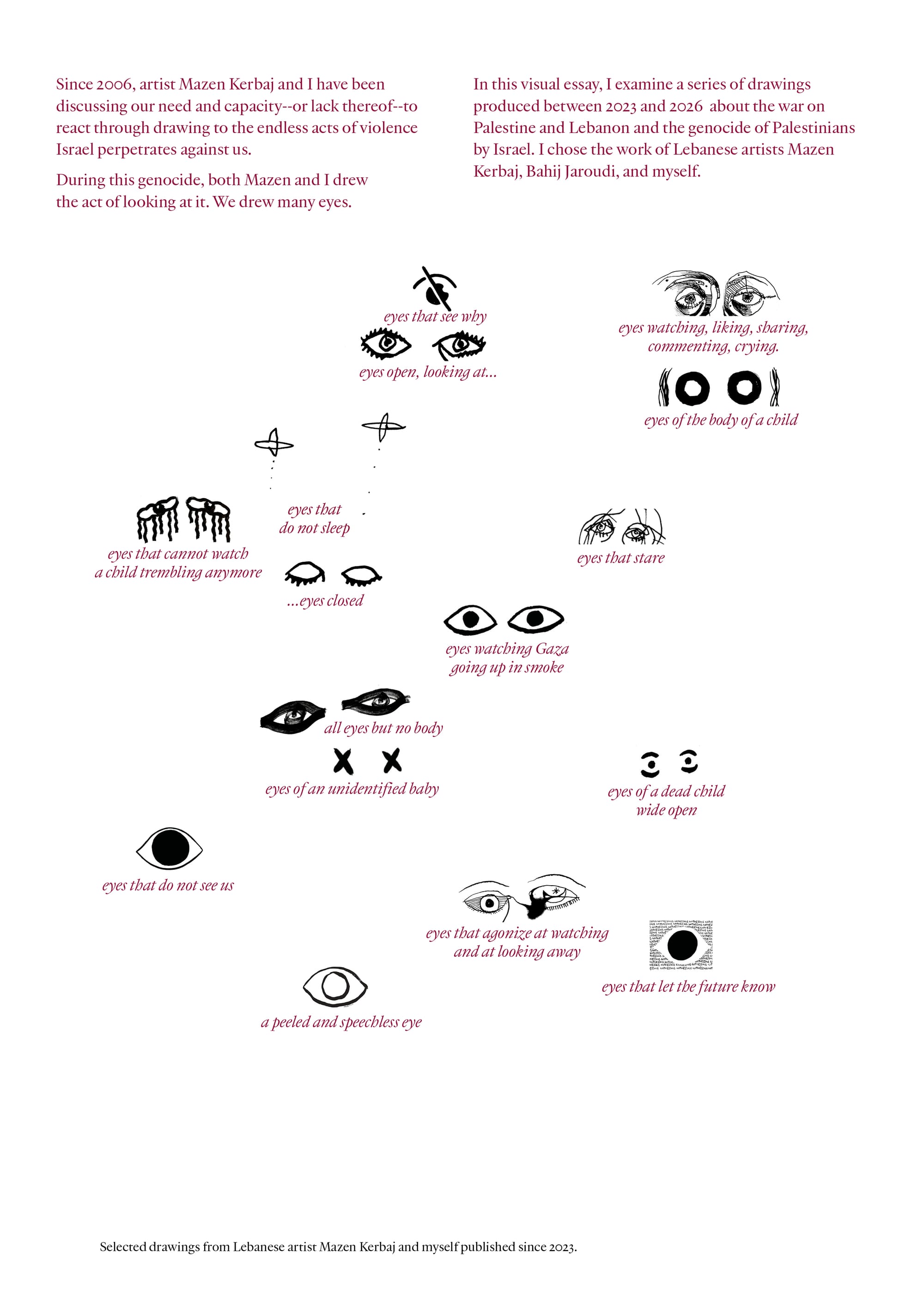
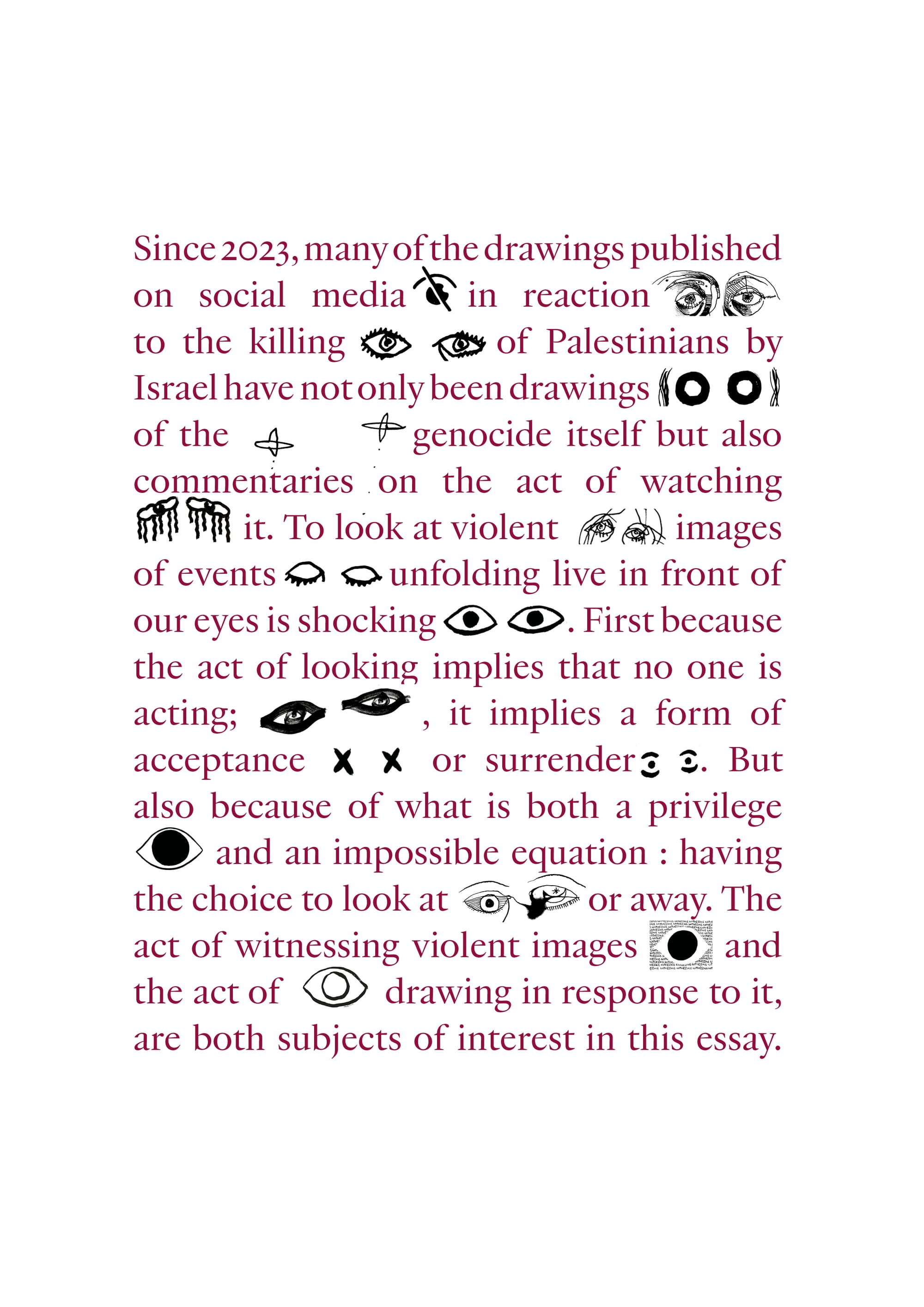
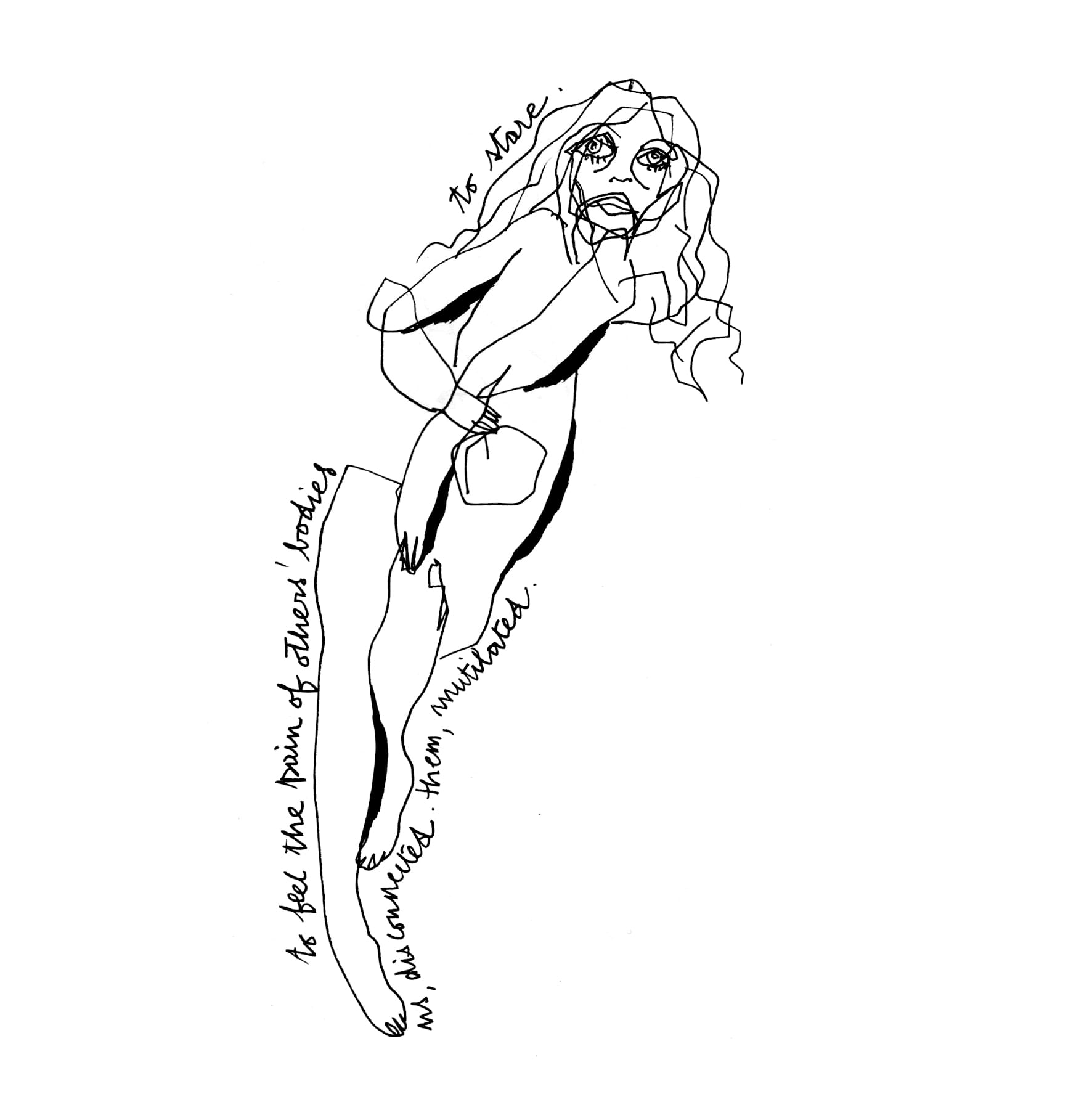
Jana Traboulsi, 2023
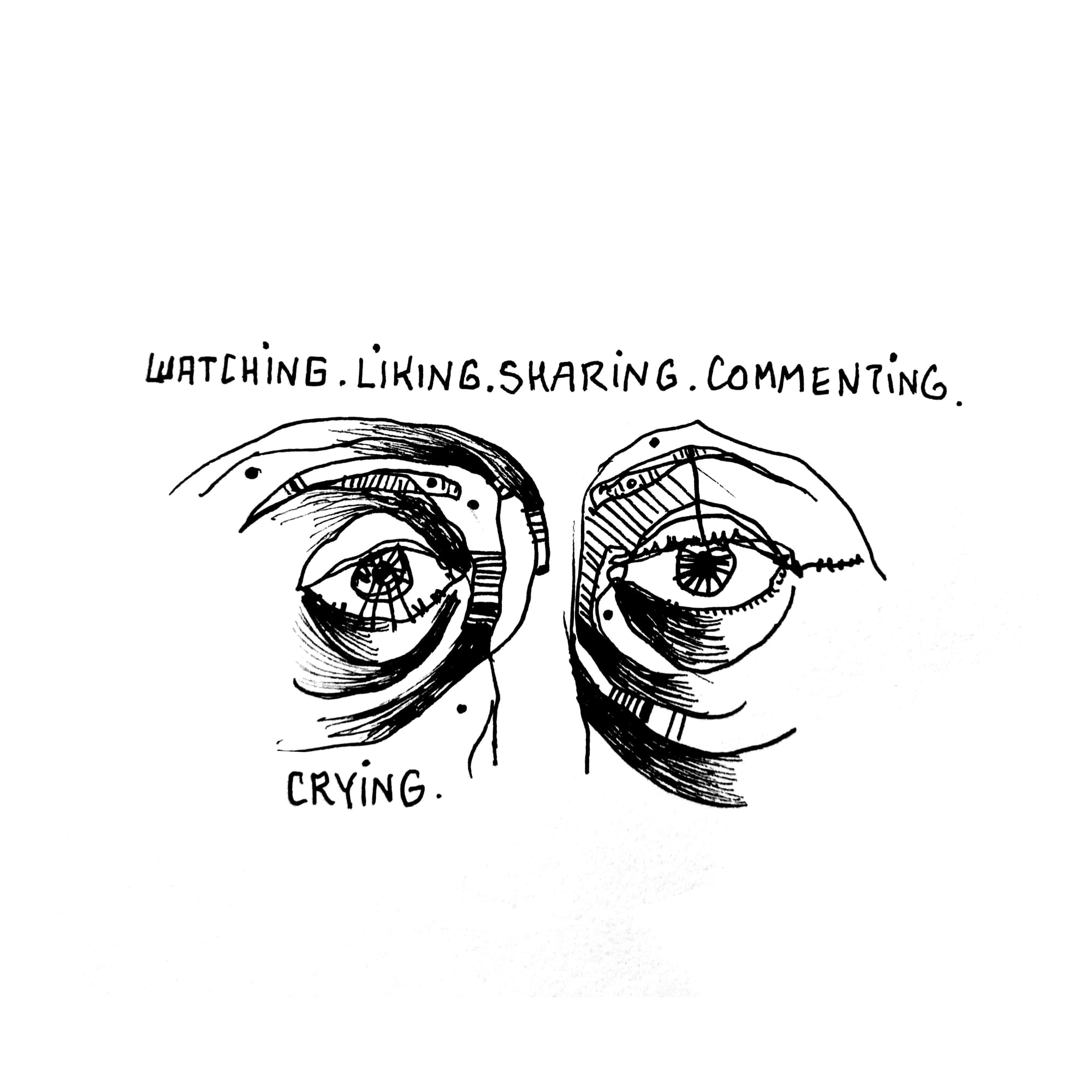
Jana Traboulsi, 2024
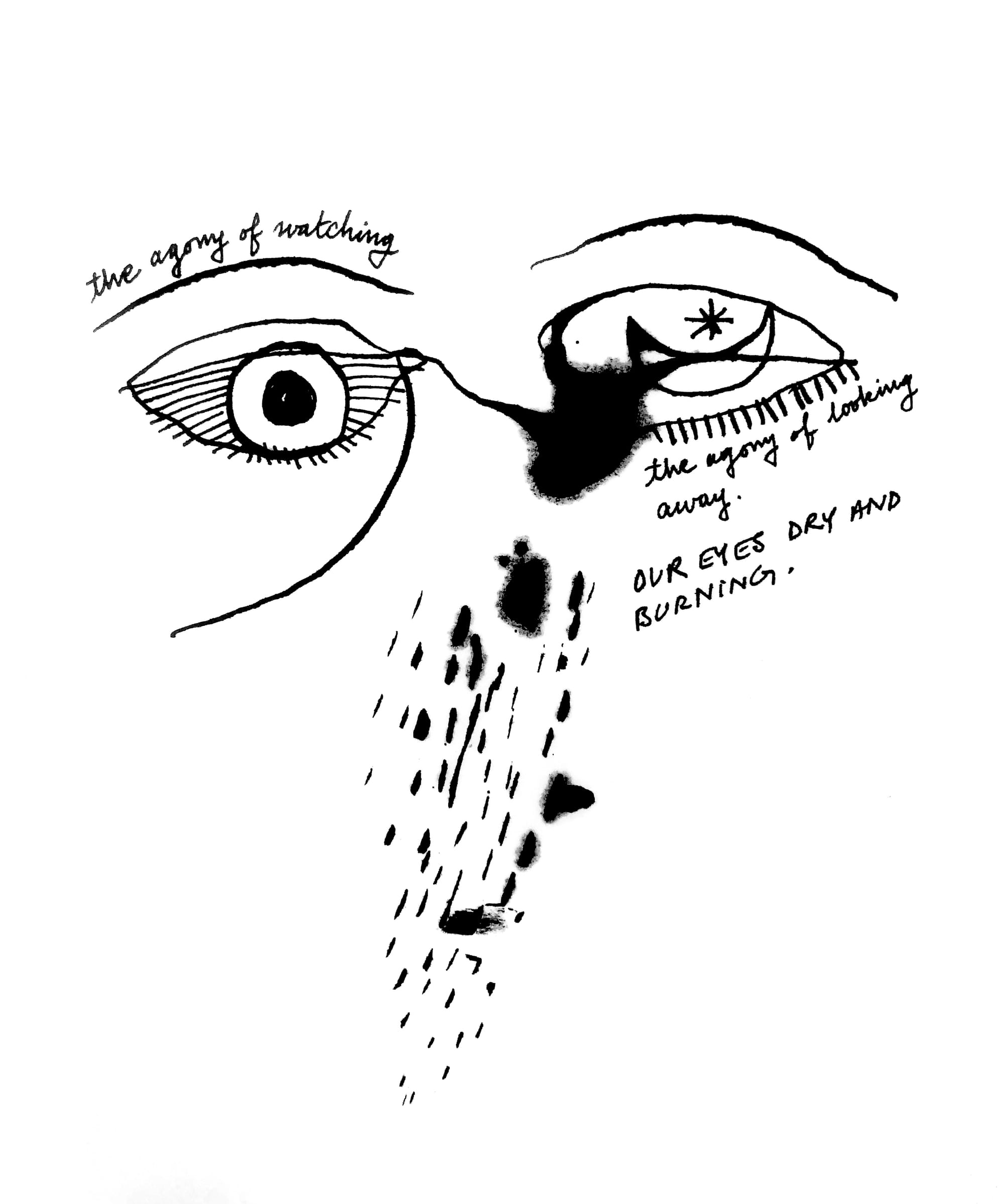
Jana Traboulsi, October 17, 2023
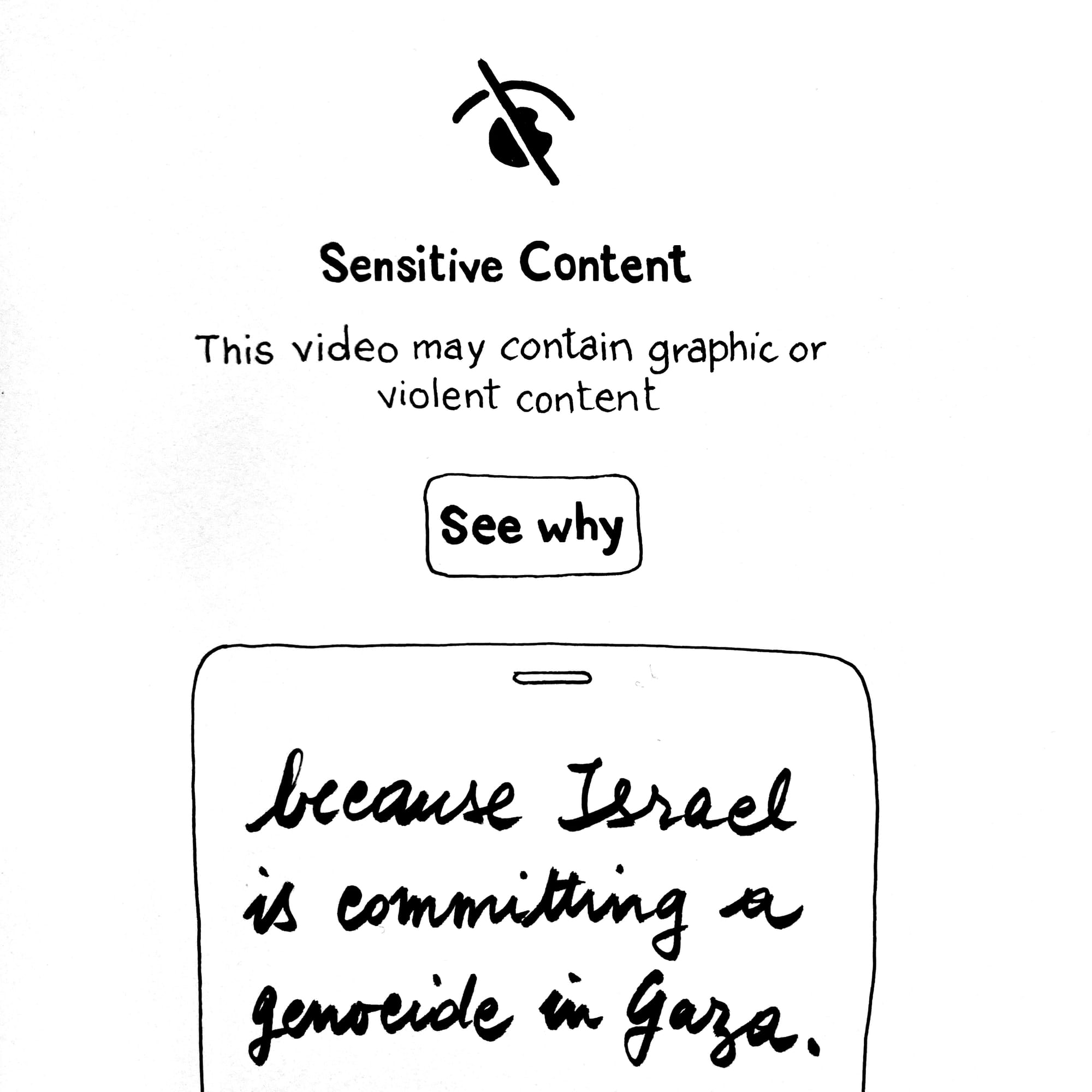
Jana Traboulsi, December 17, 2023
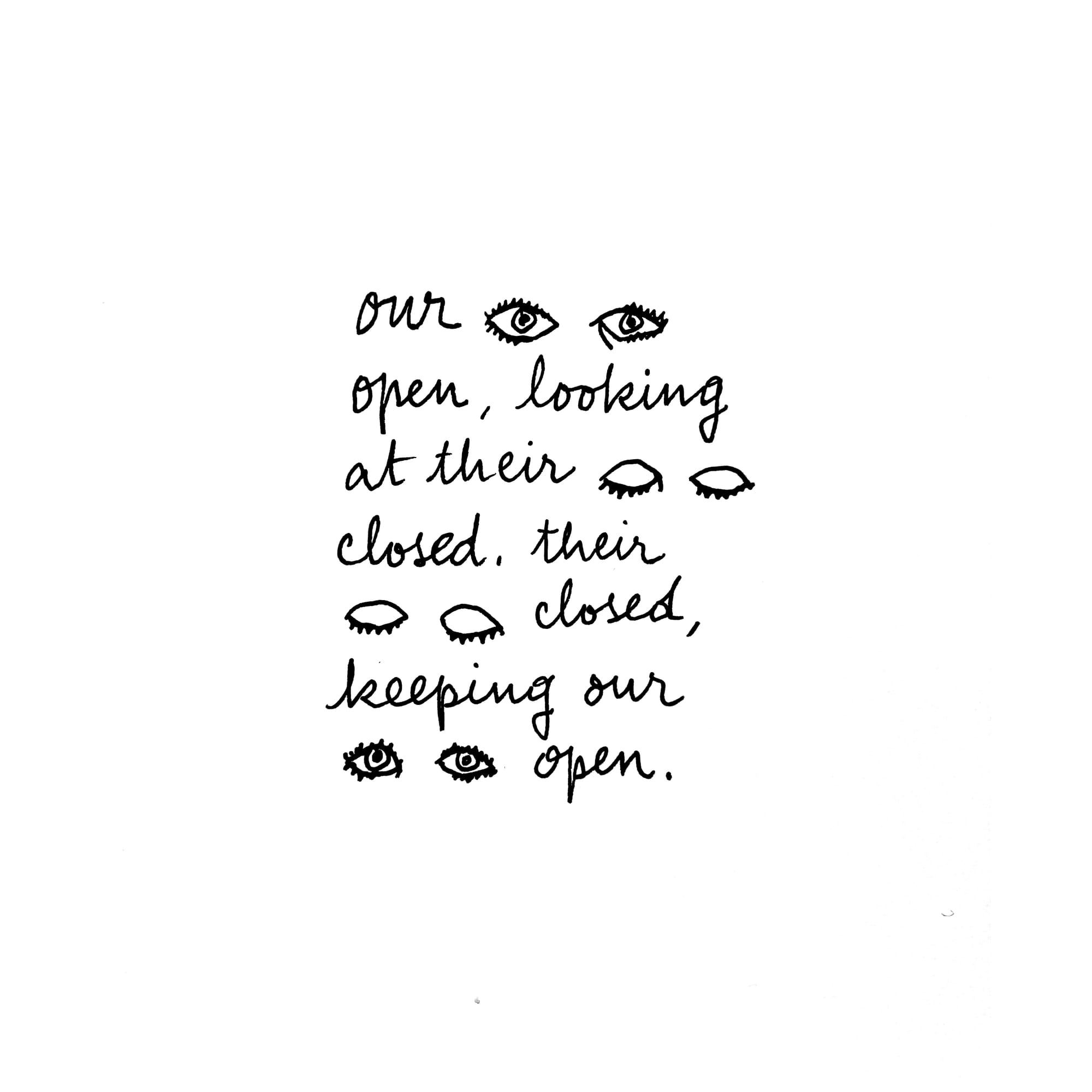
Jana Traboulsi, May 9, 2024

Jana Traboulsi
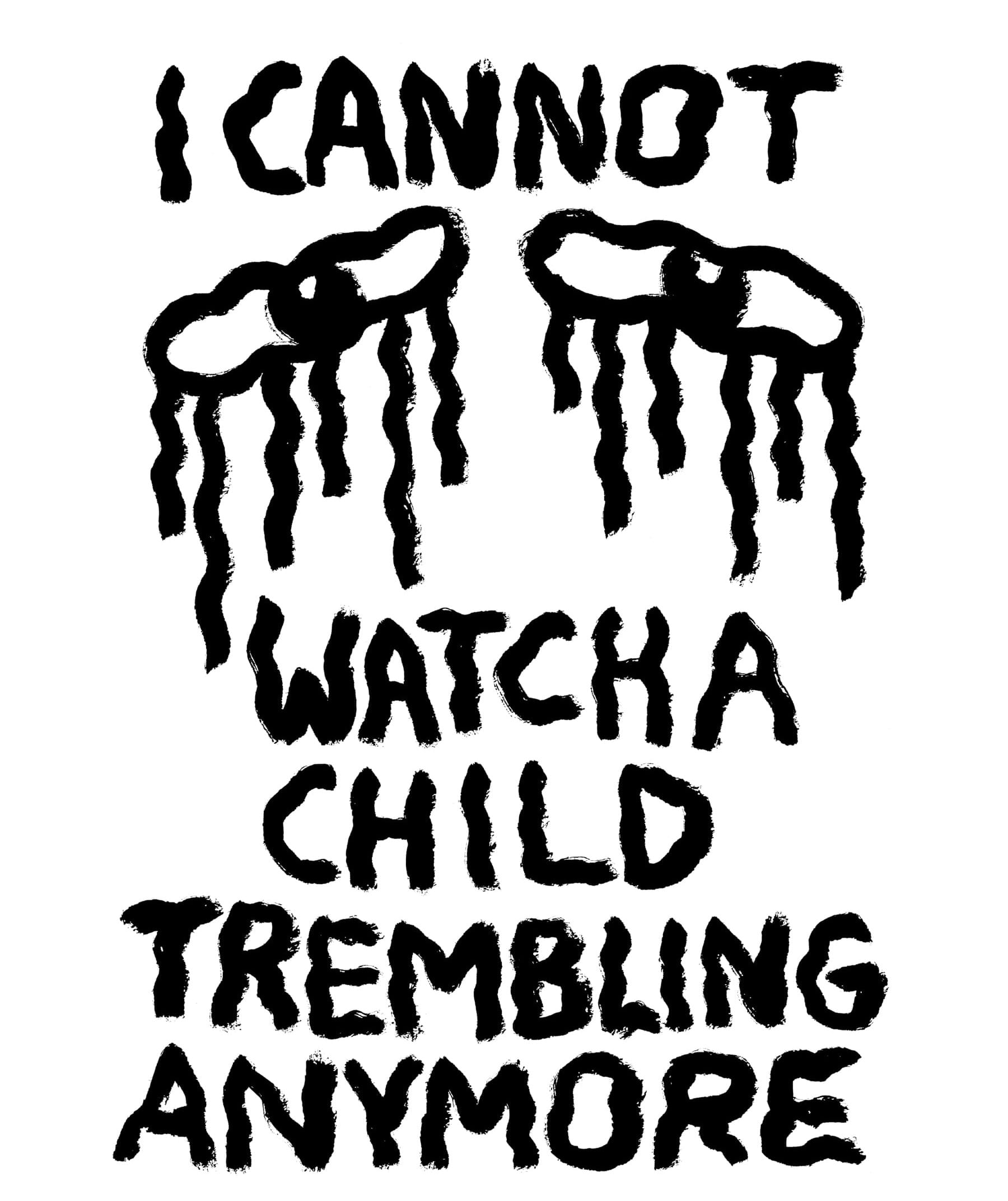
Mazen Kerbaj, 2023
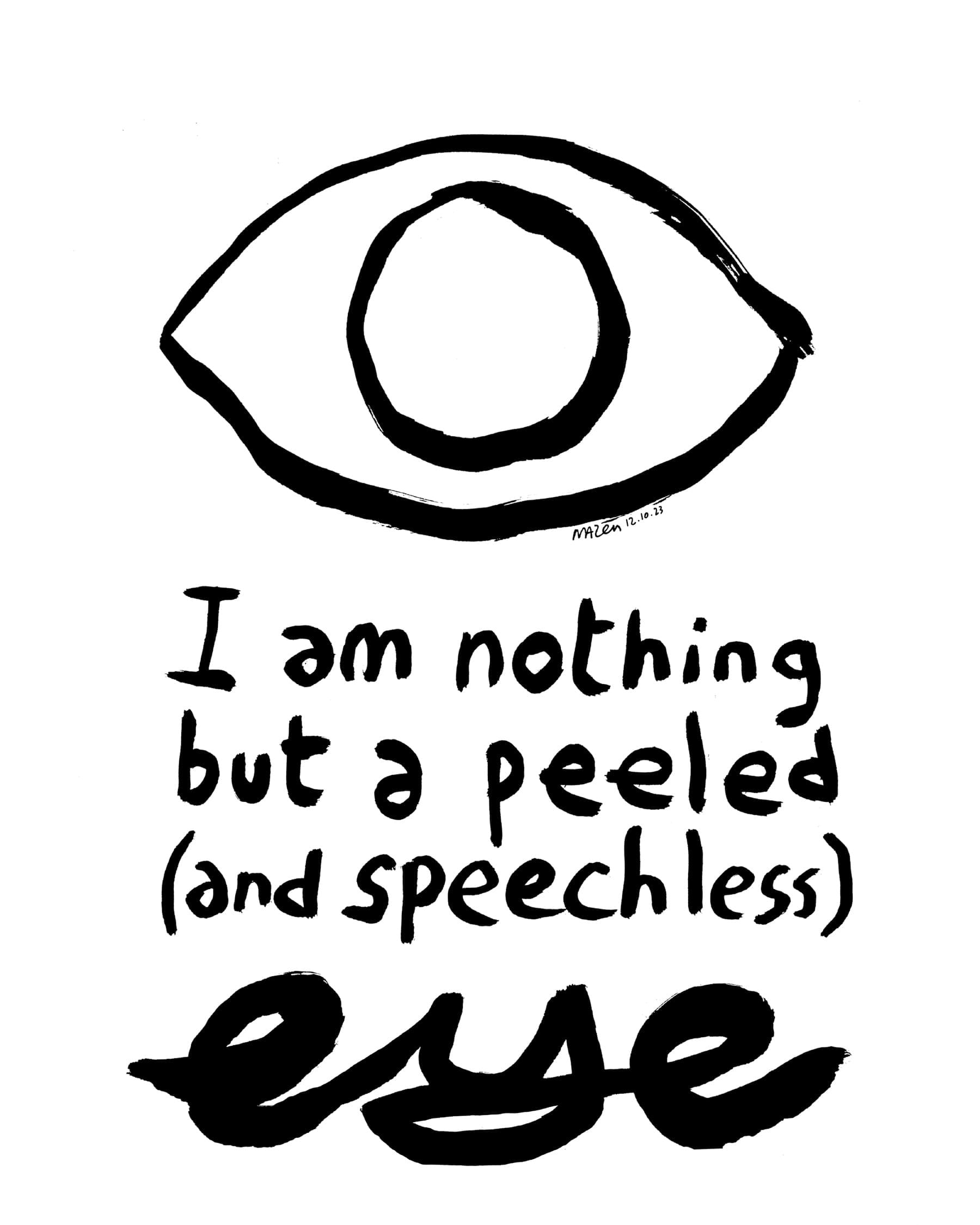
Mazen Kerbaj, October 12, 2023

Mazen Kerbaj, November 4, 2023
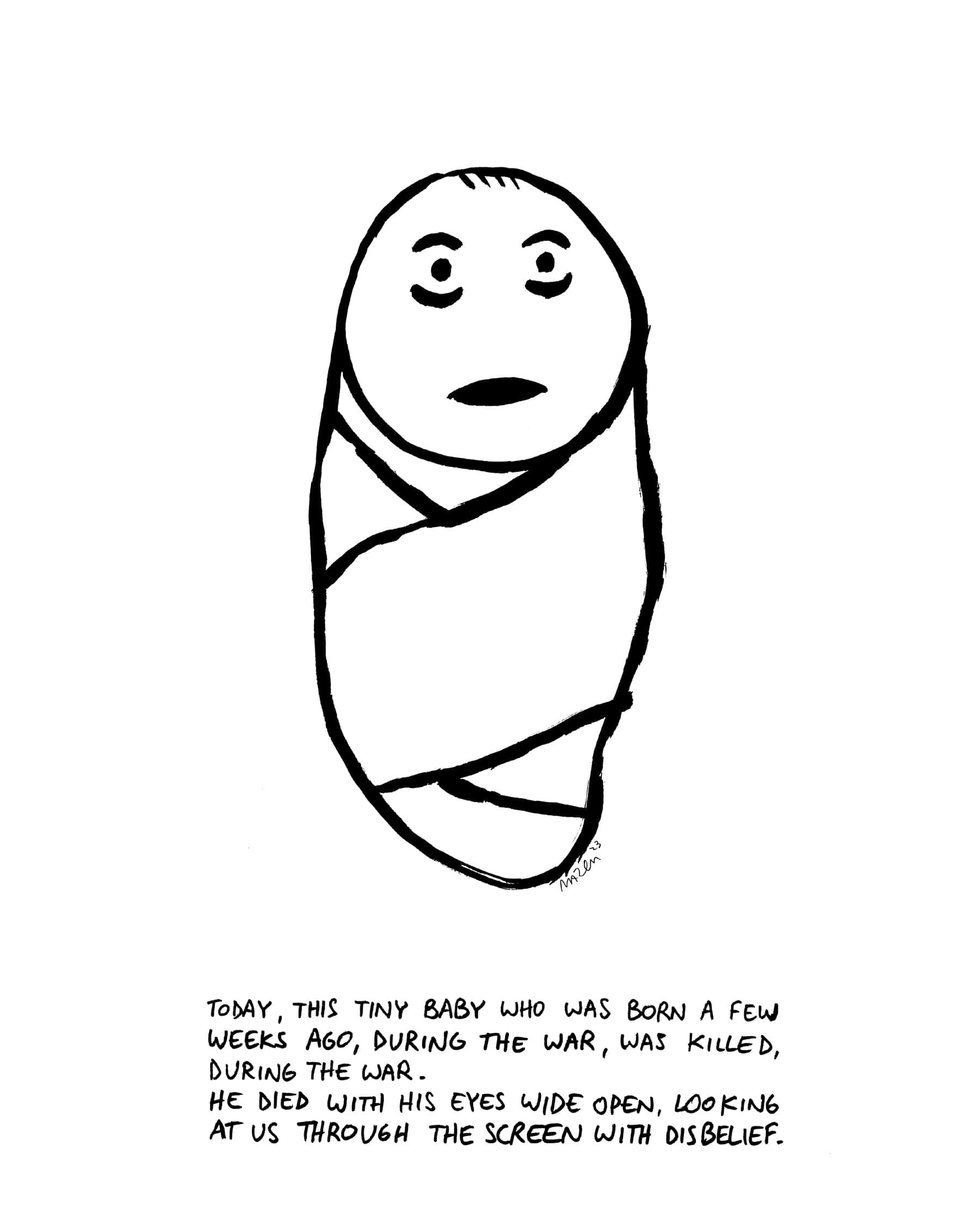
Mazen Kerbaj, July 7, 2025

Mazen Kerbaj, November 7, 2023
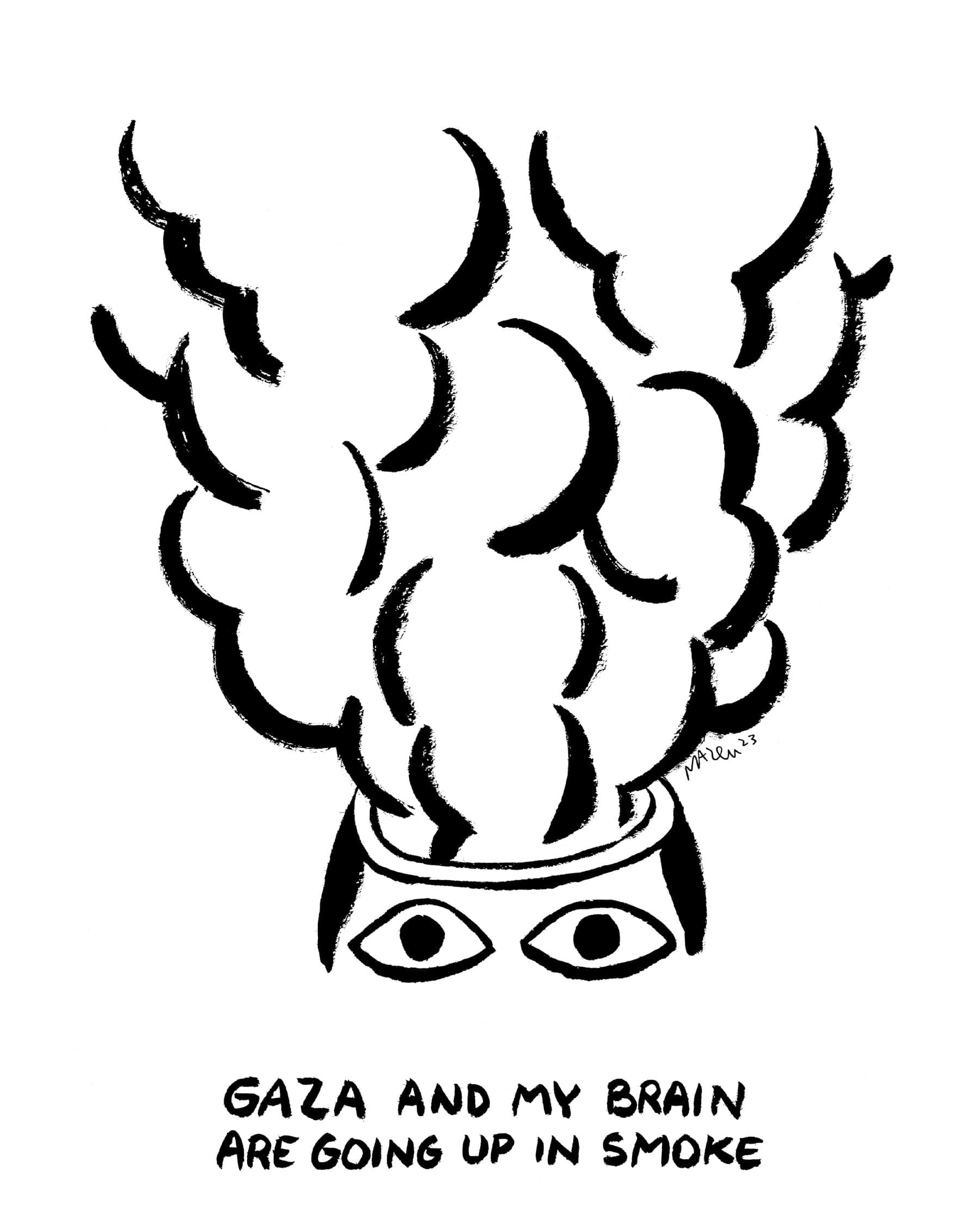
Mazen Kerbaj, November 11, 2023
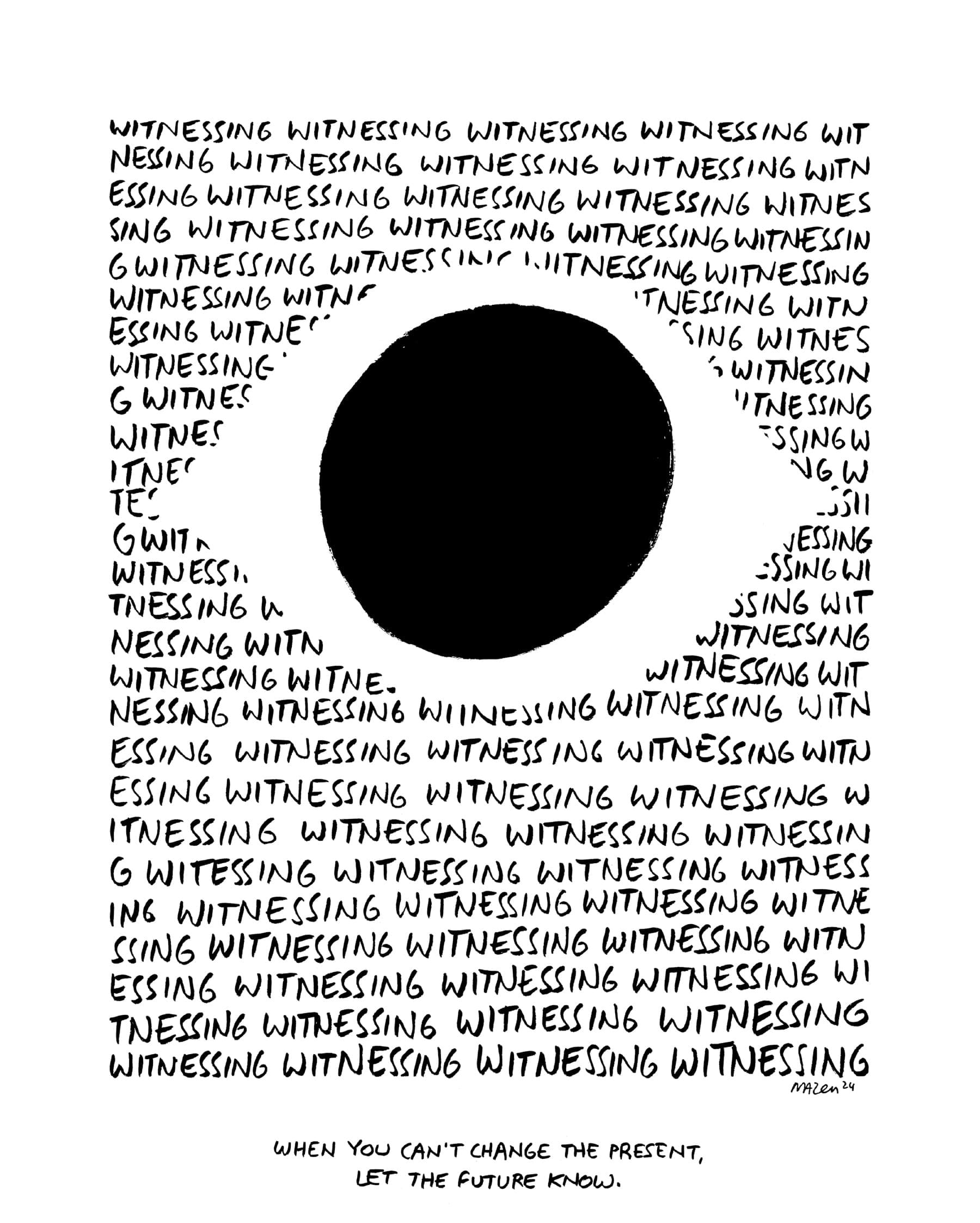
Mazen Kerbaj, February 19, 2024
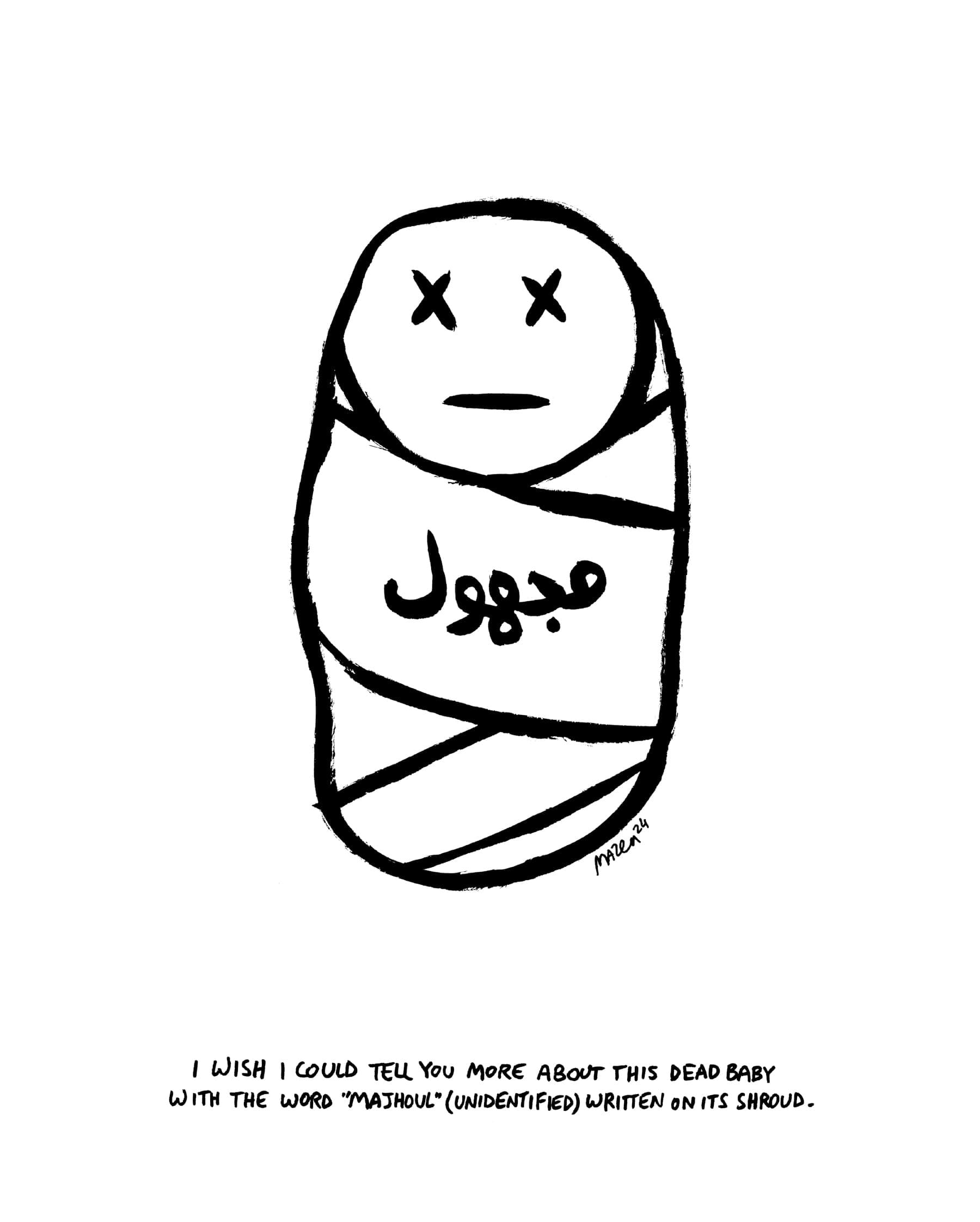
Mazen Kerbaj, January 23, 2024
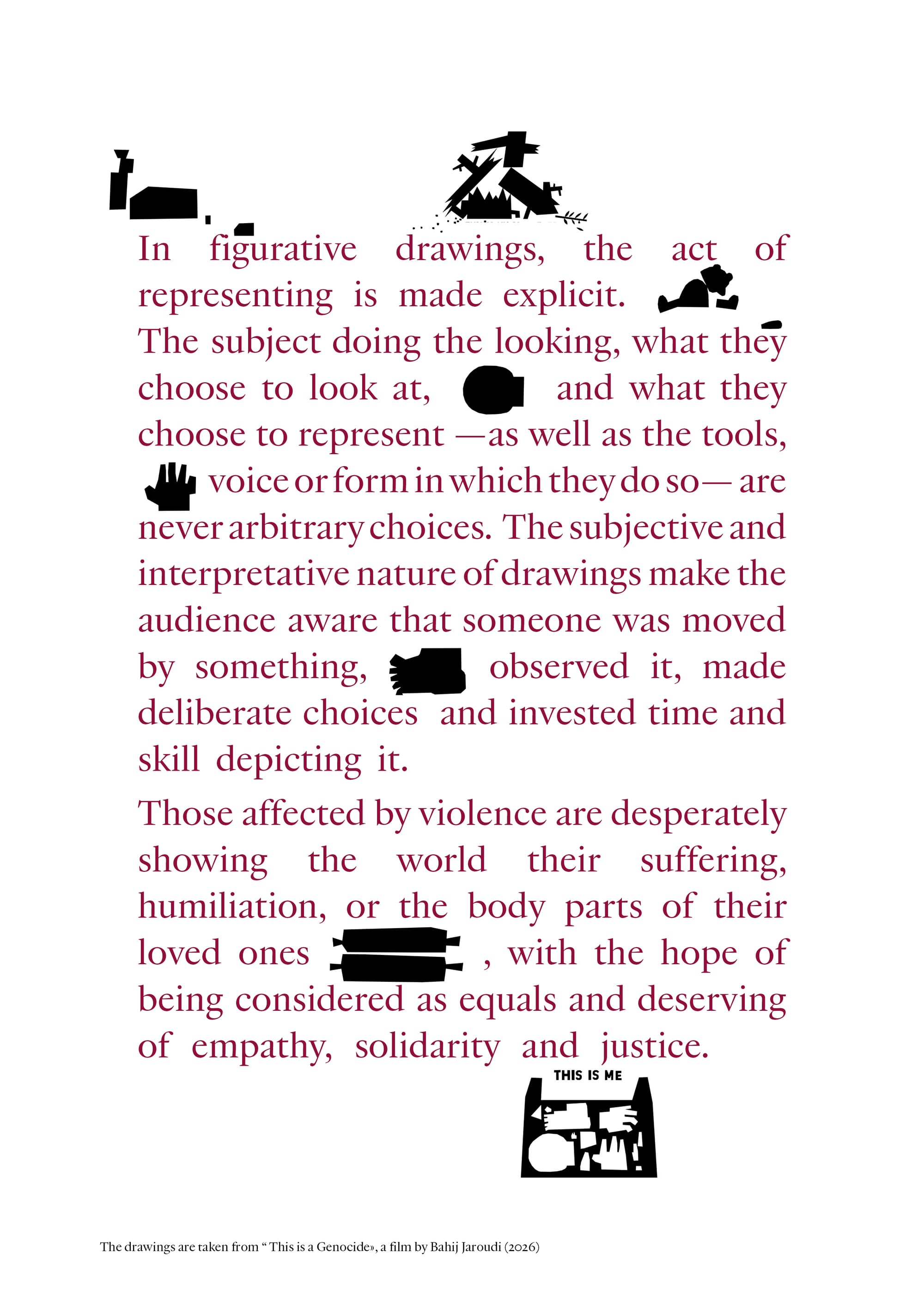
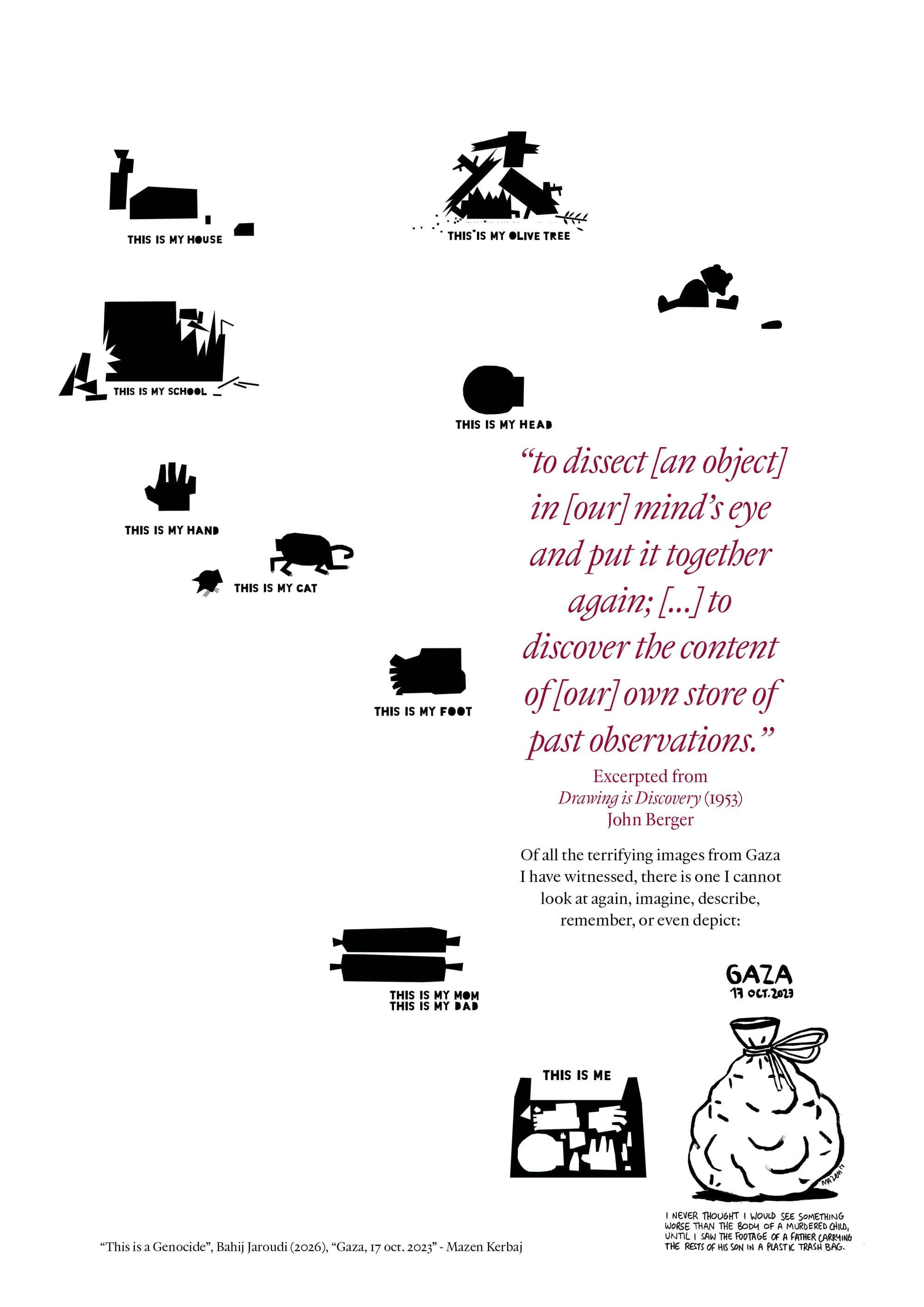
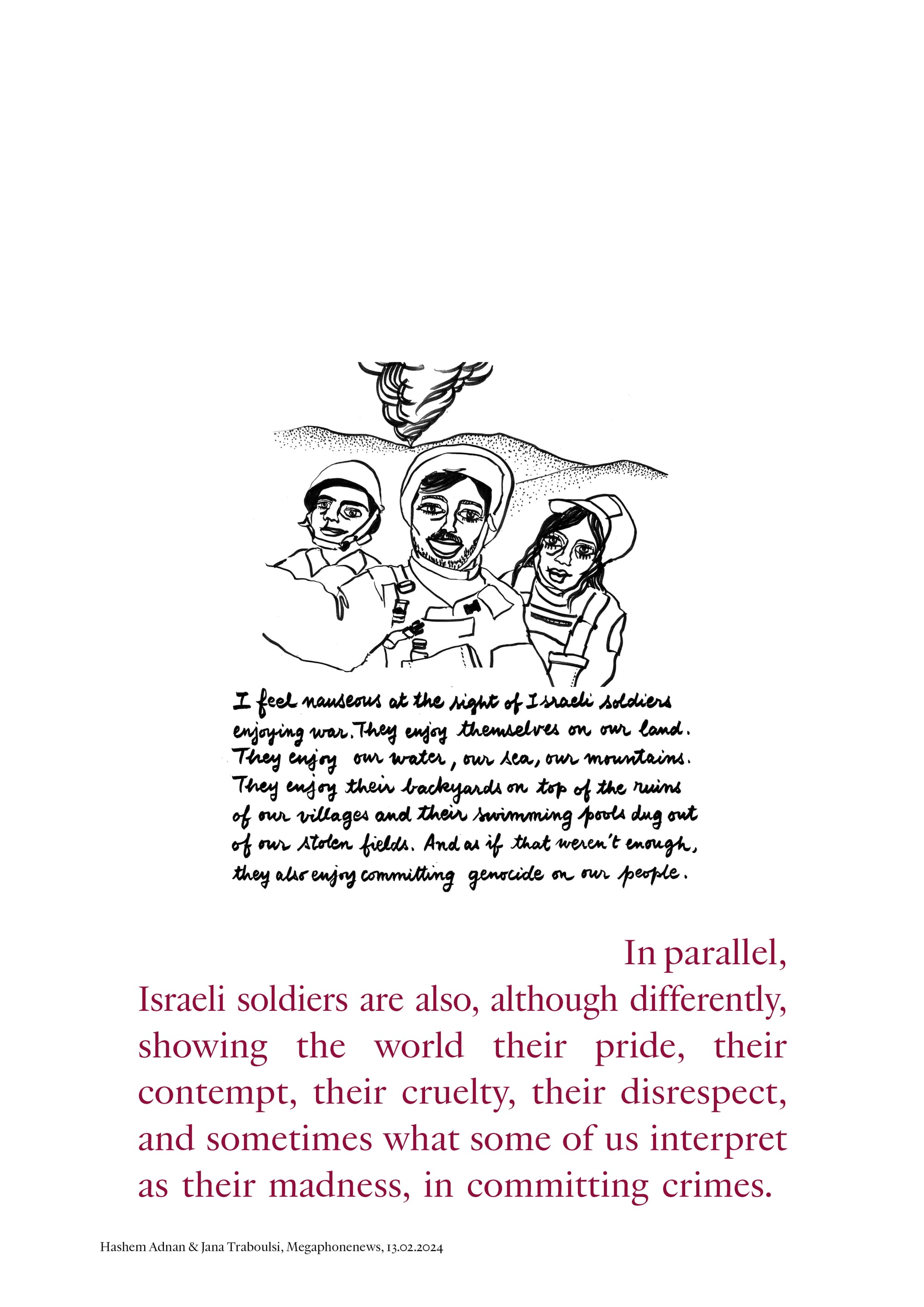
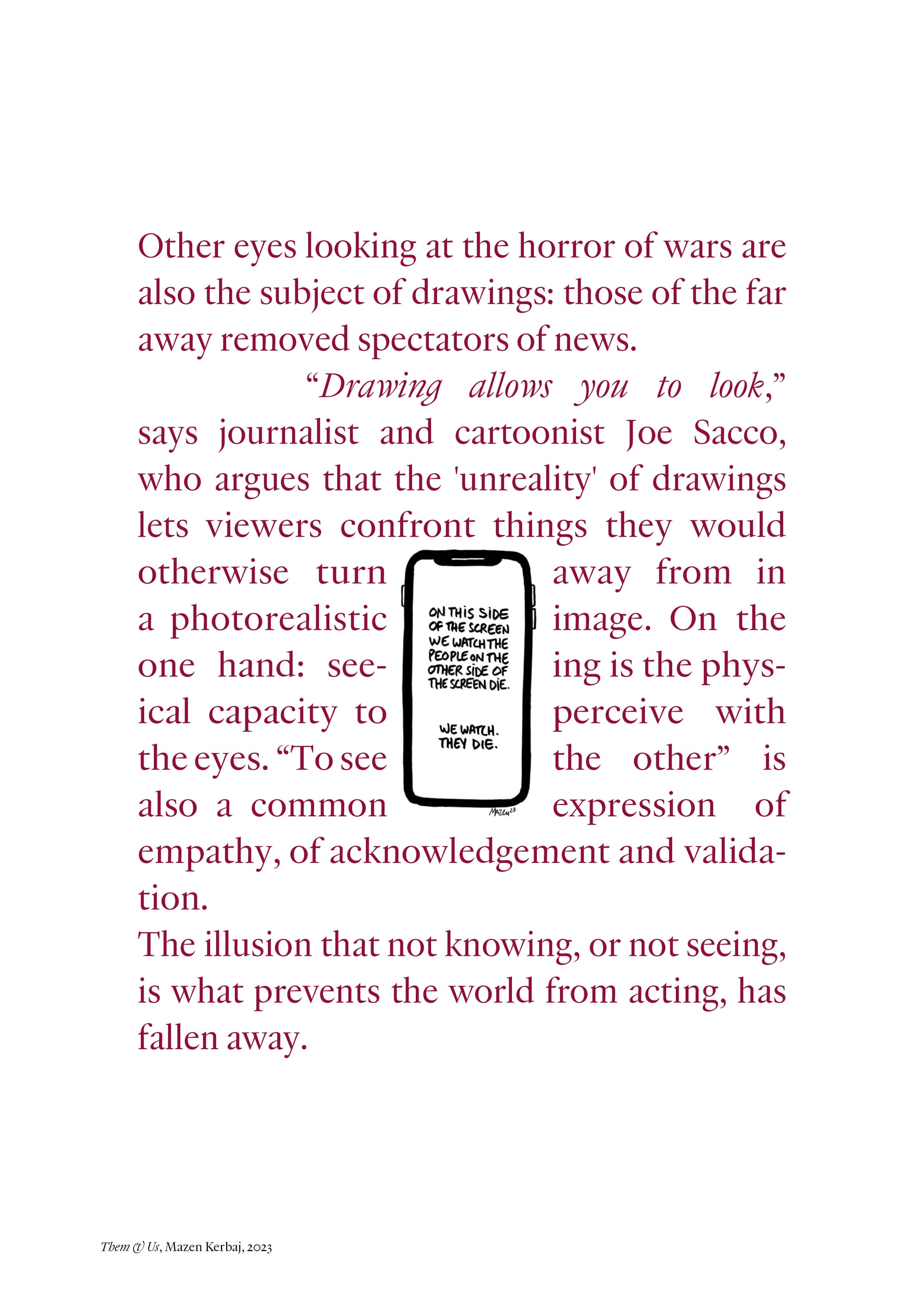
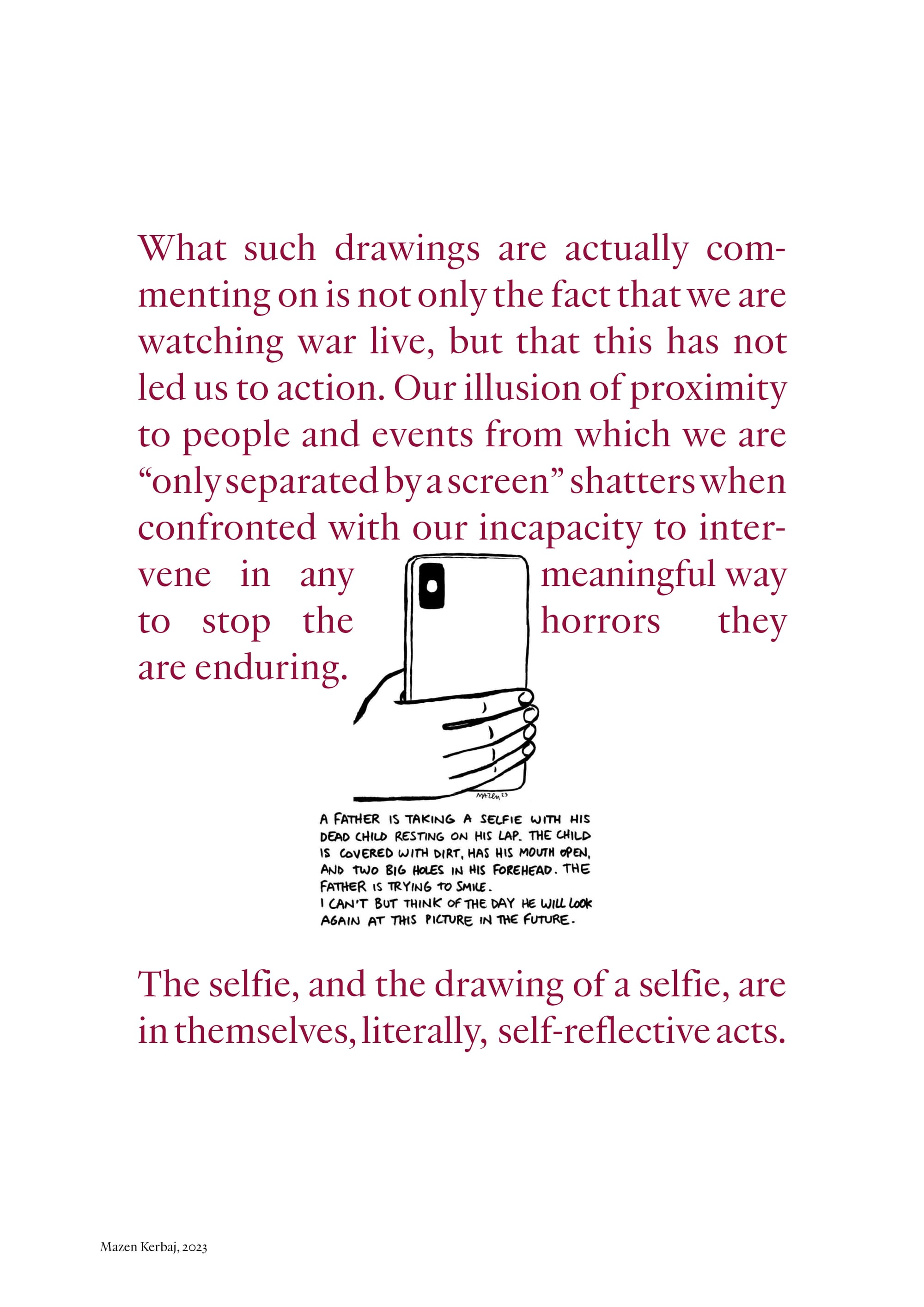
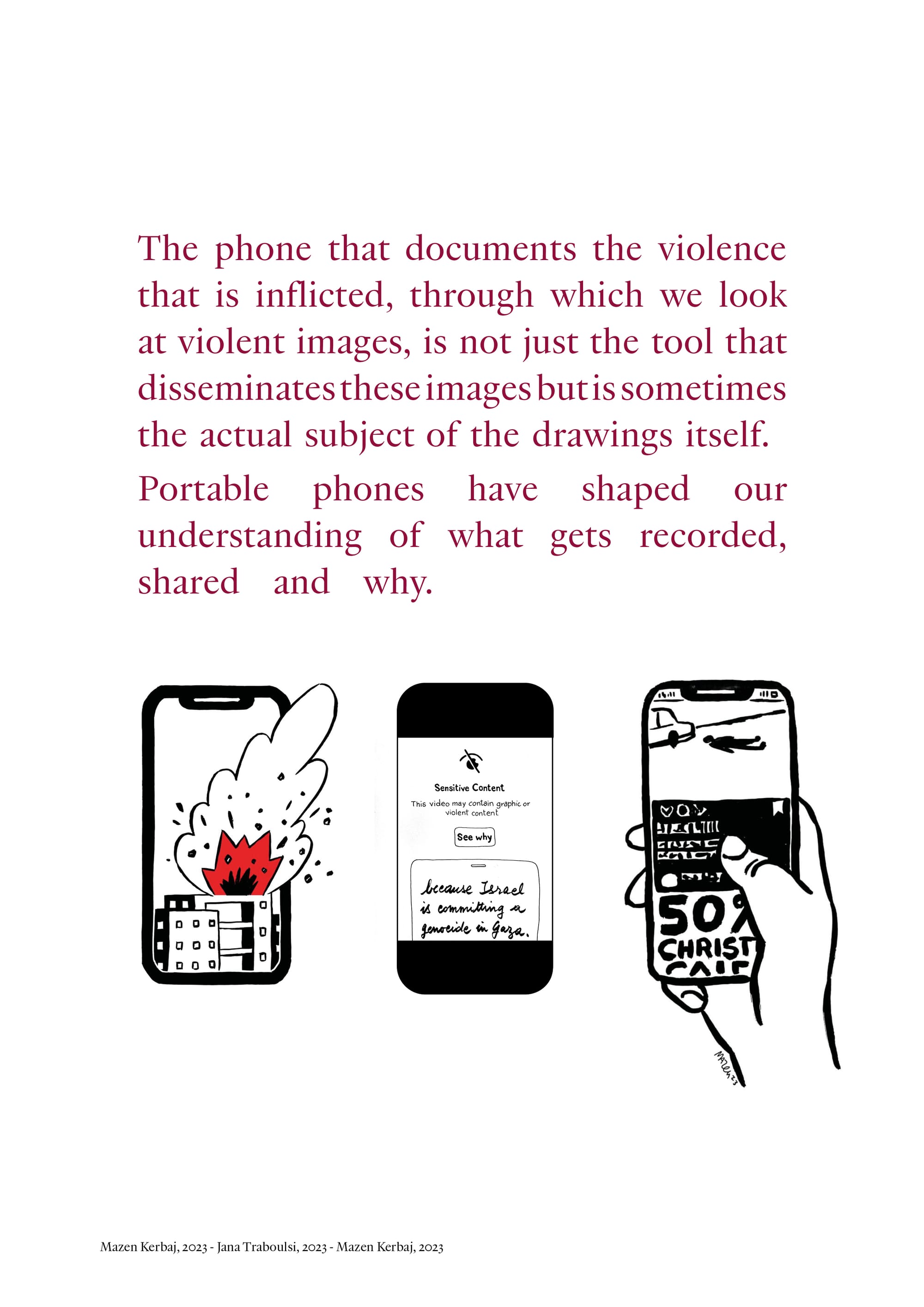
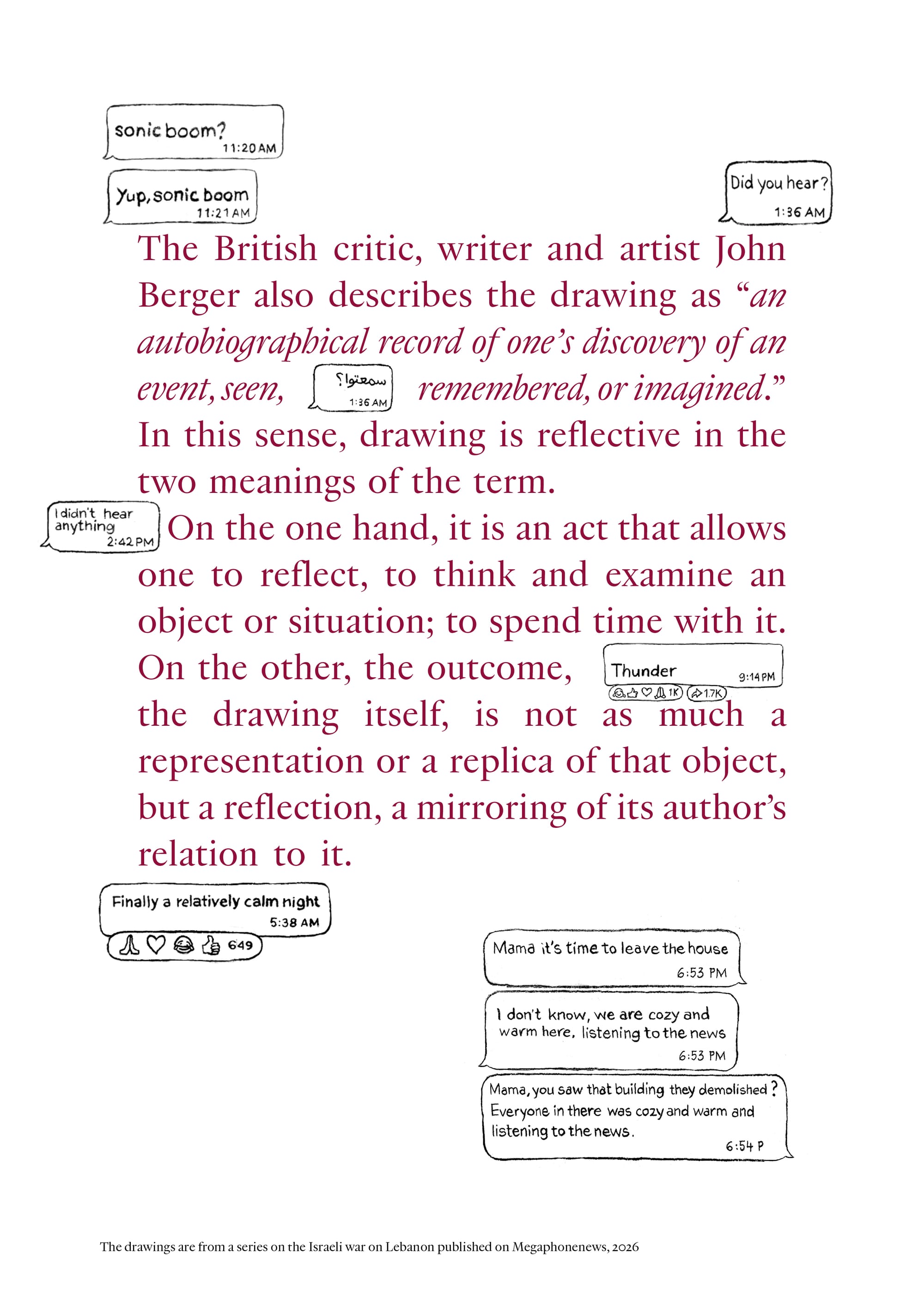
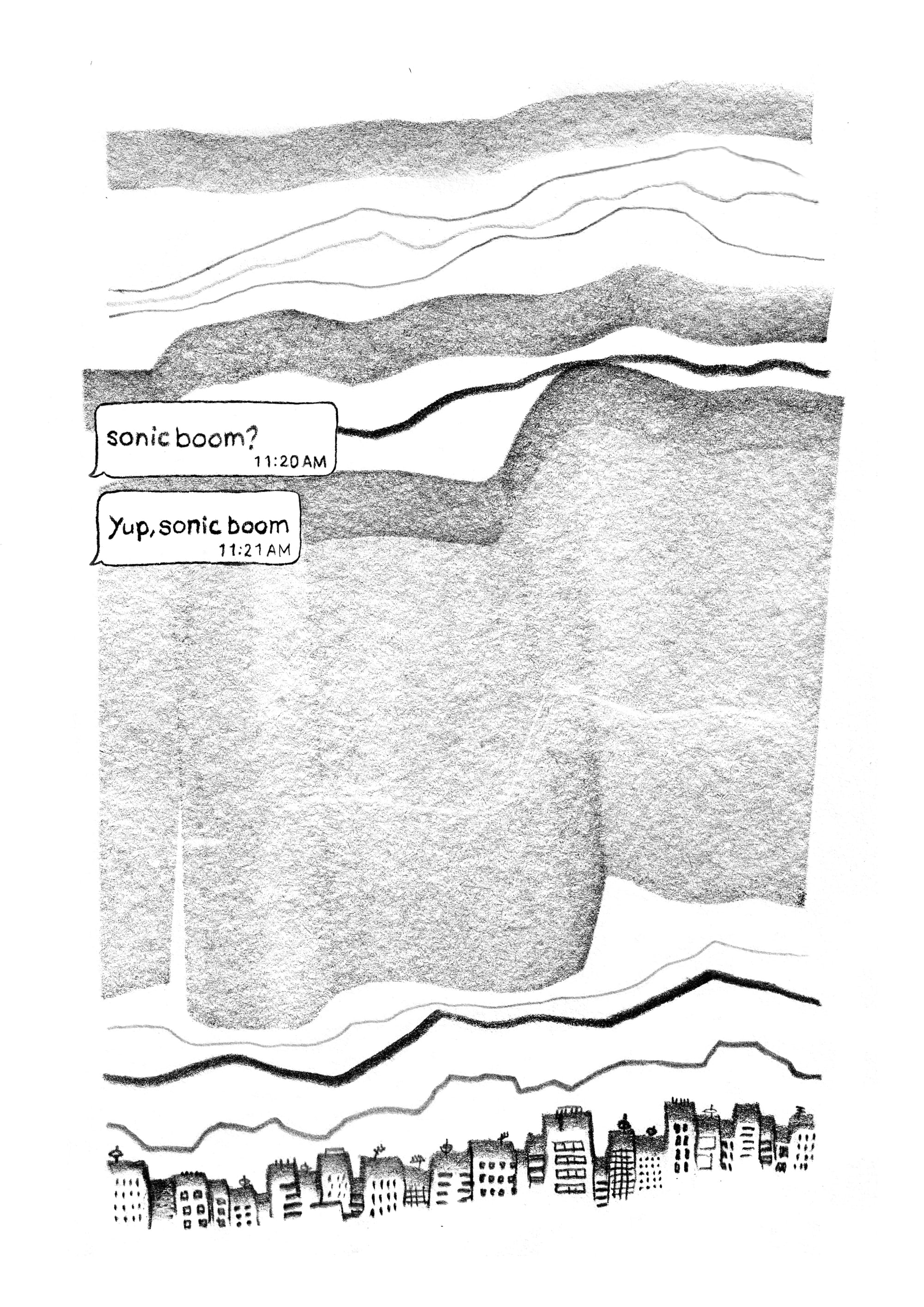
All images Jana Traboulsi, March-April 2026
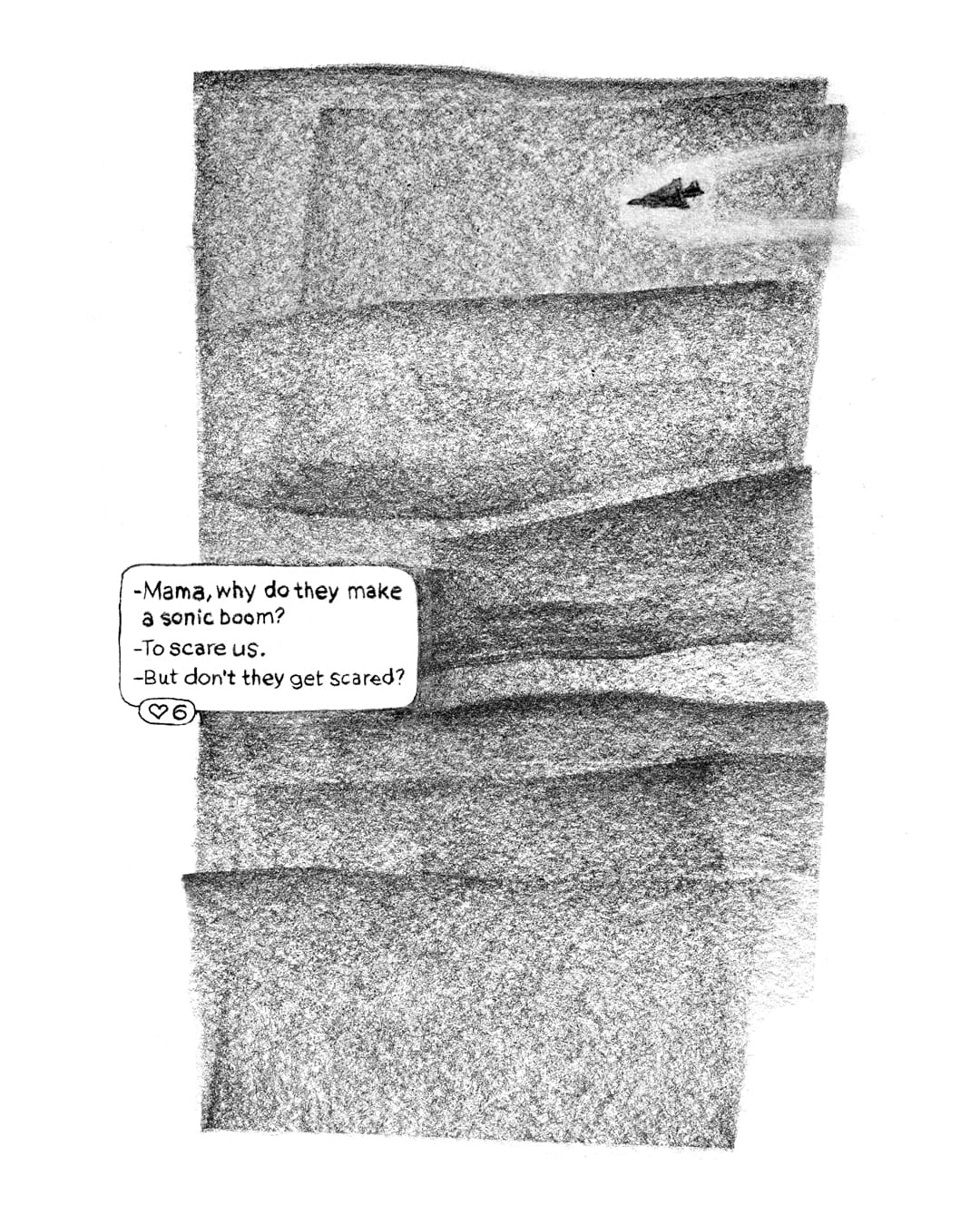
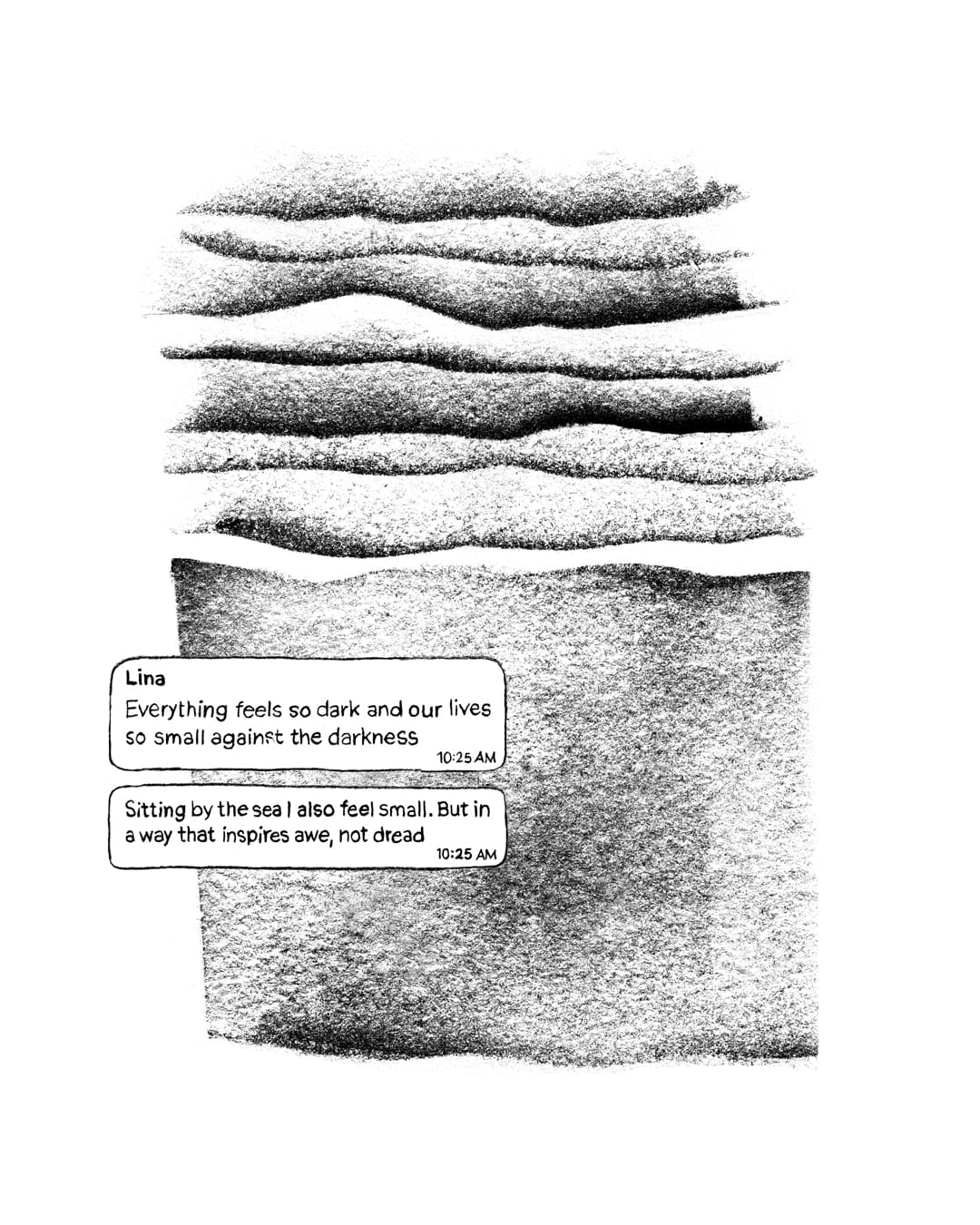
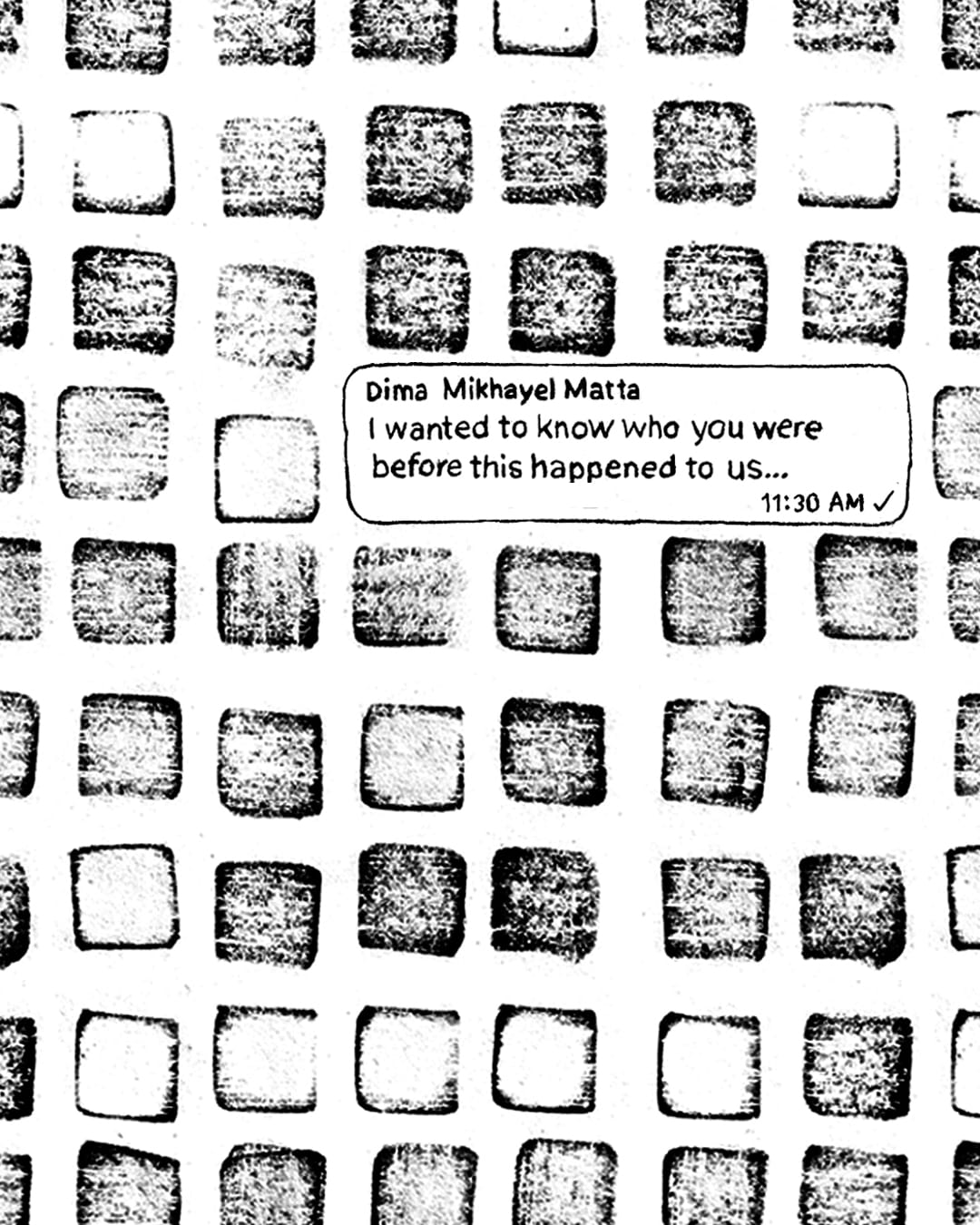
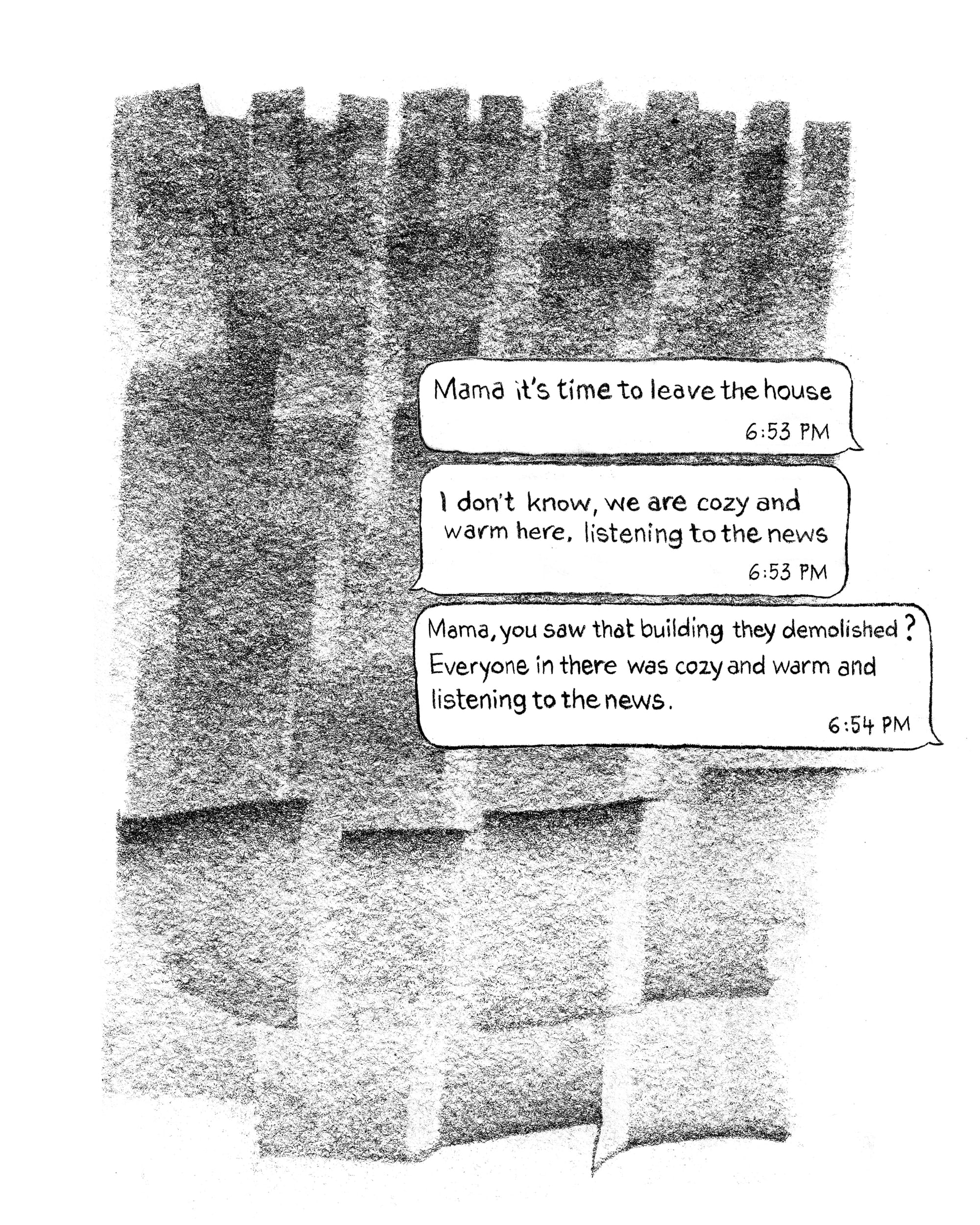
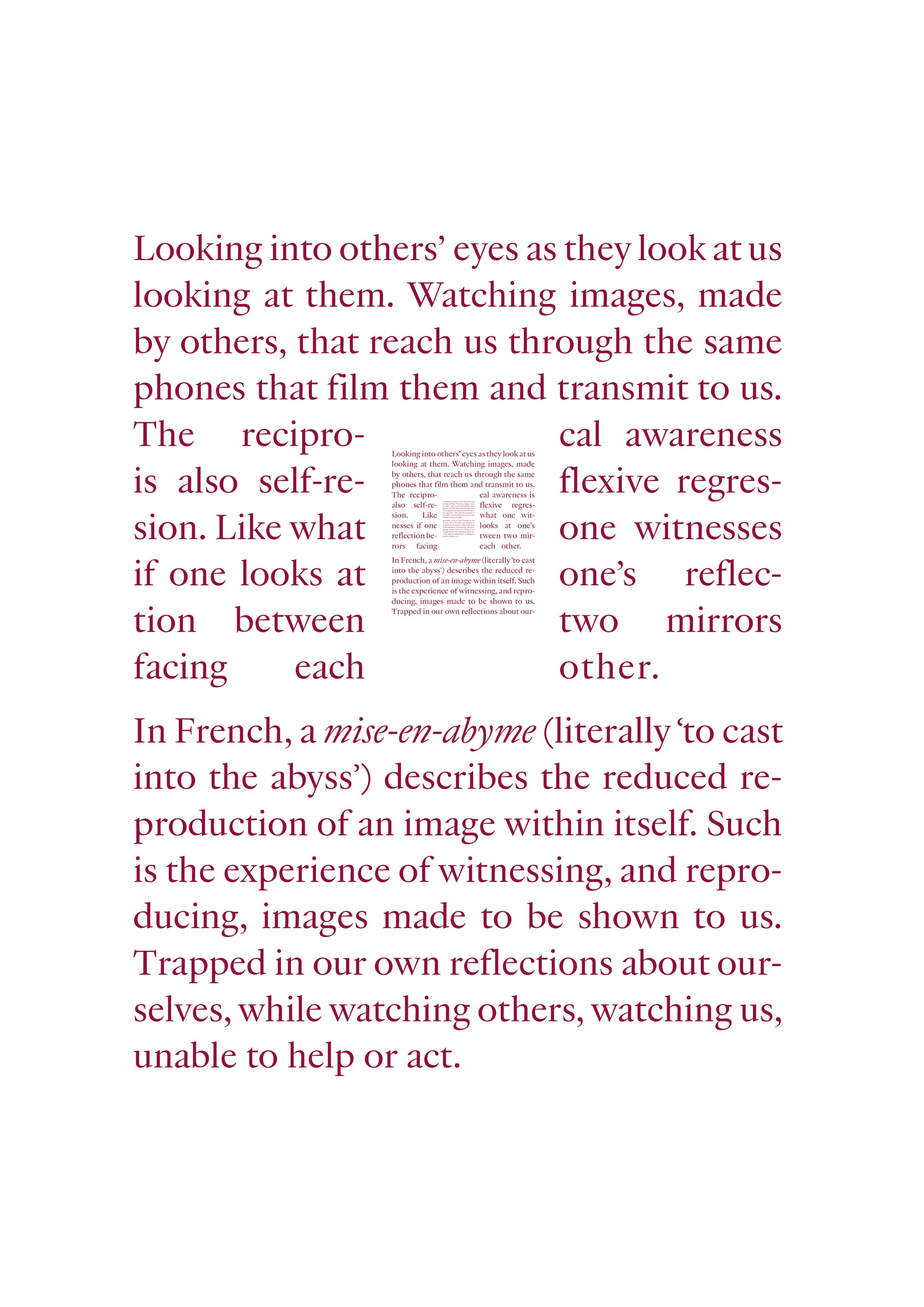
### Gazing into Gaza with Mahmoud Alhaj
URL: https://www.merip.org/2026/08/gazing-into-gaza-with-mahmoud-alhaj/
Last updated: 2026-08-20T14:24:52.000Z
*In June 2024, Zawyeh Gallery in Ramallah presented* Control Anatomy*, the first solo exhibition of Palestinian artist Mahmoud Alhaj. Organized as Israel’s genocidal assault on Gaza continued and as military raids and restrictions intensified across the West Bank, the exhibition brought together digital works that explore how surveillance technologies have shaped Palestinian life under Israeli occupation.*
*Since October 2023, artists in Gaza have* [*lost their lives*](https://www.theguardian.com/world/2023/nov/13/a-painter-a-poet-a-novelist-the-artists-being-killed-in-gaza)*, or their life’s works, amid the* [*Israeli destruction*](https://librarianswithpalestine.org/gaza-report-2024/) *of cultural institutions, archives, museums, universities and artists’ studios alongside homes and other civilian infrastructure. Among the losses were Eltiqa and* [*Shababeek for Contemporary Art*](https://www.smithsonianmag.com/smart-news/arts-center-in-gaza-destroyed-180984142/)*, both located near Al-Shifa Hospital and destroyed during Israel’s March 2024 assault on the hospital complex. Shababeek housed more than 15,000 artworks and had served for 15 years as one of Gaza's principal spaces for contemporary artists.*
*Alhaj’s digital artworks survived because his laptop did. Alhaj—who was born in Gaza in 1990 to a family displaced from the village of Bashshit during the Nakba and raised in Khan Younis—has, from the start of his career, consciously chosen to practice digital art. His decision stemmed from the realities of producing art under siege, where the movement of physical artworks into and out of Gaza is constrained by Israeli border restrictions. His artistic practice centers around memory and the architectures of violence, drawing on photography, collage, video, digital archives and online maps.*
> Alhaj’s digital artworks survived because his laptop did.
*During the first eight months of the genocide, he remained in Khan Younis. In the spring of 2024, he managed to leave Gaza for Egypt, ahead of his wife and child. When Israel invaded Rafah in May of 2024, the border closed and the family was separated for months. As these events unfolded,* Control Anatomy *was being prepared for exhibition in Ramallah. Unable to travel, Alhaj oversaw the exhibition remotely from Cairo, guiding every stage of the printing and installation through calls, emails and shared digital files.*
*In the following visual essay, curator Rana Anani explains how Alhaj’s work connects personal memory to broader systems of surveillance, spatial control and erasure, illustrating how the technologies shaping everyday life in Gaza are also integral to the longer history of Israeli settler colonialism and the violence continuing today.*
## ControlAnatomy
The first time I engaged Alhaj’s work was when he participated in the Spring Exhibition at Khalil Sakakini Cultural Center in Ramallah in June 2023, which I curated.
I was fascinated by the aesthetics and proficiency on display, the delicate and subtle manipulation of images on the canvas. His work portrayed Gaza from an unusual perspective, one that did not enforce victimhood but drew attention to the agency of Palestinians under occupation. I was captivated by his attempts to look at Gaza from the perspective of the Israeli military. From that first interaction with his work, I knew I wanted to stage a solo exhibition by him in Ramallah.
As a curator, I decided during the genocide to focus my exhibition program on artists from Gaza. It felt like the least I could do under these circumstances. Yet, like many artists from Gaza I have worked with over the past 15 years, Alhaj and I had never met in person. Israel's restrictions mean that artists in Gaza cannot come to Ramallah, and Palestinians from the West Bank cannot travel to Gaza. Our collaboration, like so many others, existed entirely through technology. We spoke by phone and video call, exchanged emails and digital files and worked together across enforced separation. When the exhibition opened, I called him from the gallery so he could experience the opening remotely from Cairo.
## The Guards of Roses
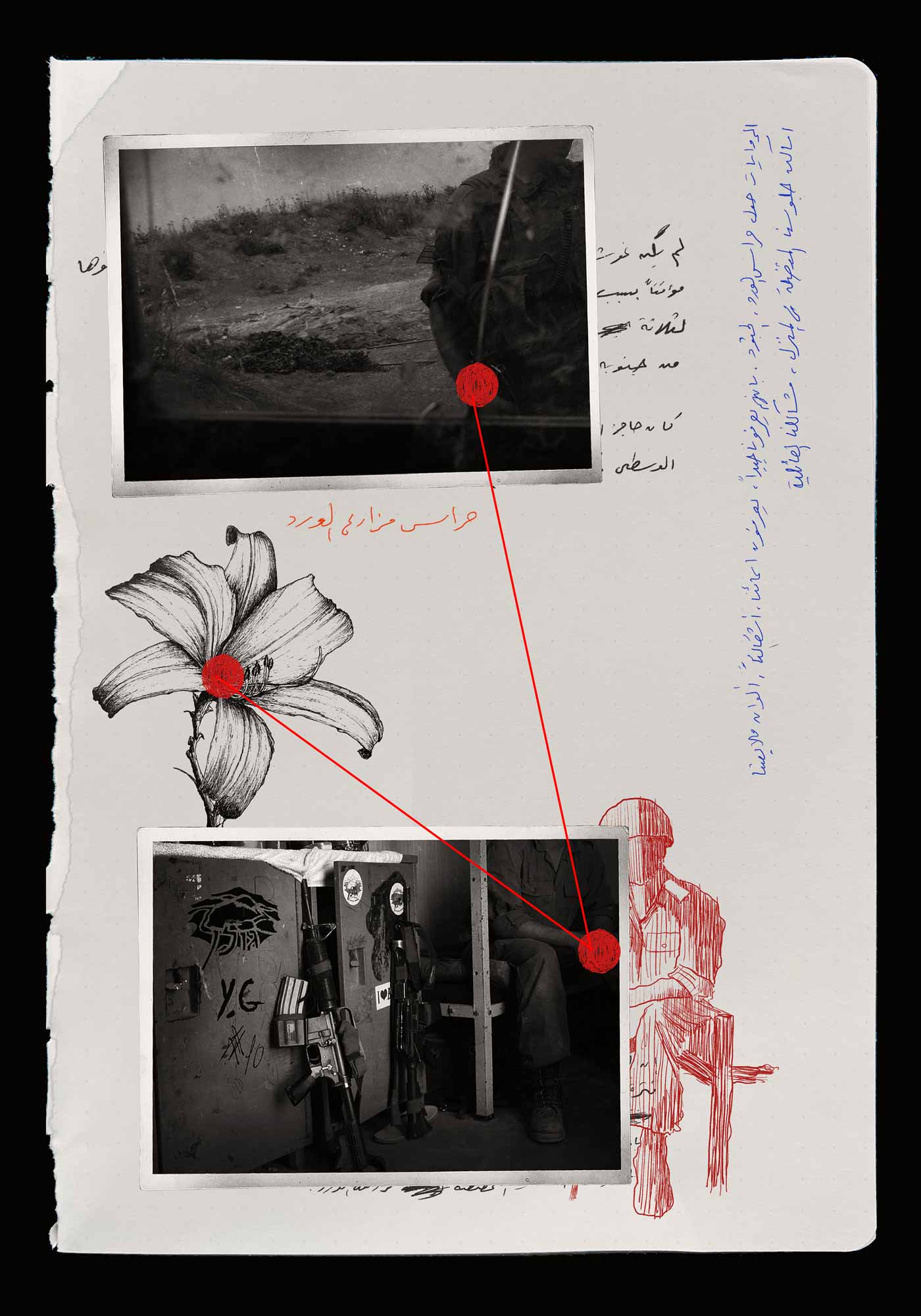
**Control Anatomy,* Study No. 11, 2022, Mahmoud Alhaj, digitized sketch.
In the work titled *Control Anatomy*, which we also used as the title of the exhibit, Alhaj uses images found on the internet along with his own sketches and handwritten notes to tell the story of the Gush Katif settlement bloc in Gaza.
As a child, Alhaj moved with his family to a house 15 minutes away from Khan Younis refugee camp. There, he witnessed the persistent expansion of the Israeli settlement Ganei Tal until it reached his doorstep. Ganei Tal, which translates from Hebrew to “Gardens of Dew,” belonged to the larger Gush Katif bloc that included 21 settlements and over 3,000 greenhouses, famous for growing roses and carnations for export to Europe. These settlements, home to around 8,000 settlers, were deliberately designed to split the Gaza Strip into three separate areas, blocking Palestinians from moving freely.
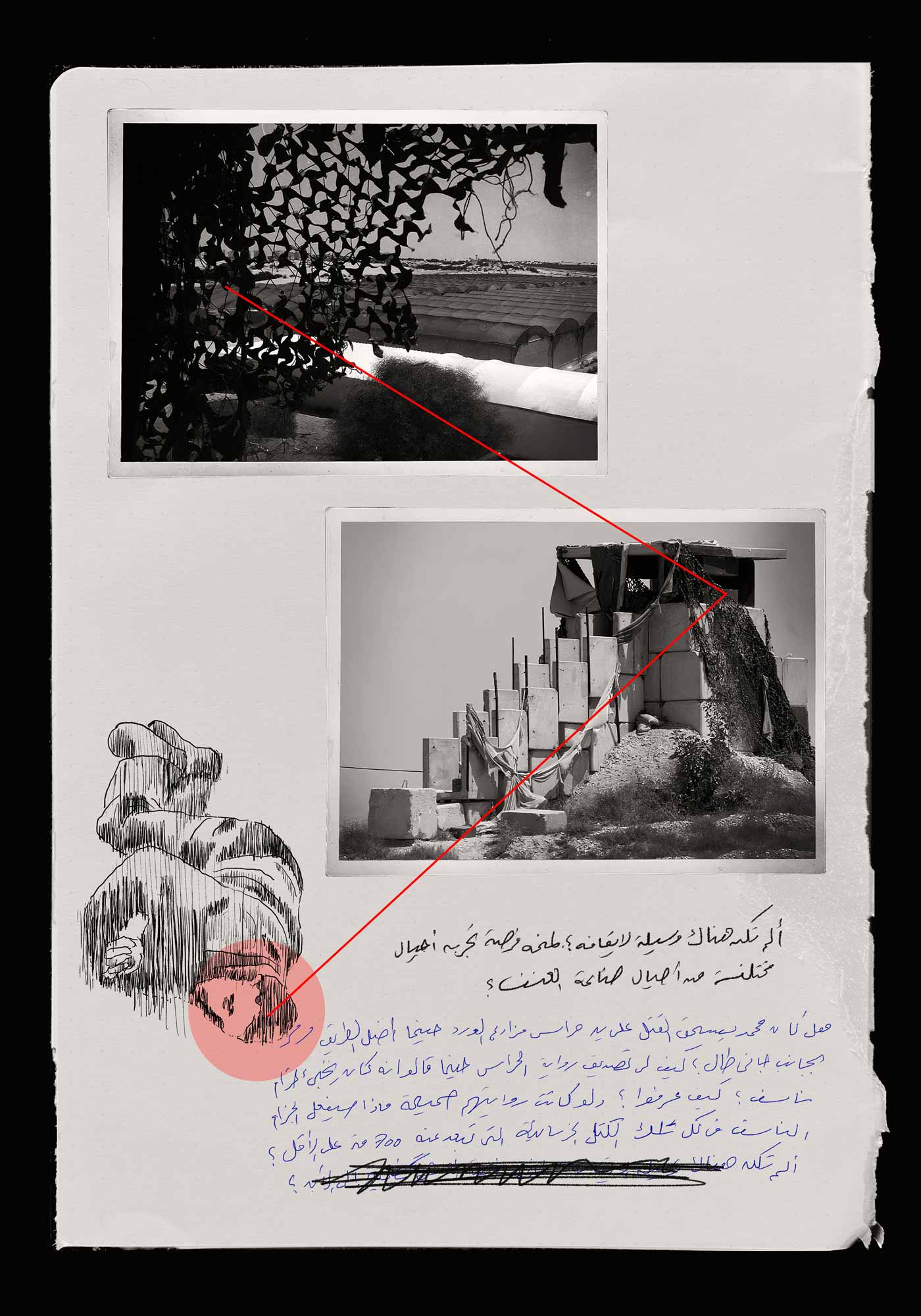
**Control Anatomy,* Study No. 10, 2022, Mahmoud Alhaj, digitized sketch.
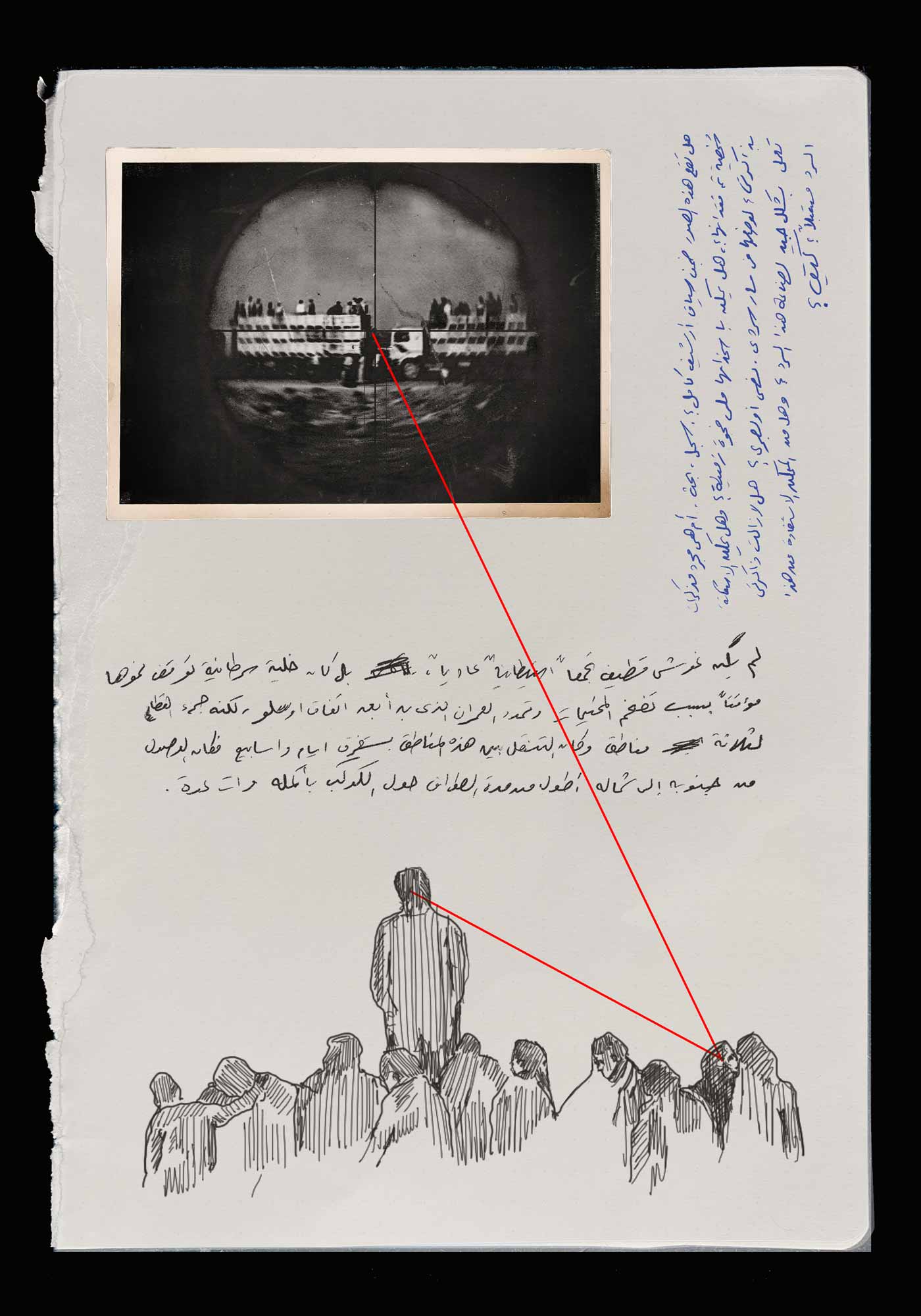
**Control Anatomy,* Study No. 7, 2022, Mahmoud Alhaj, digitized sketch.
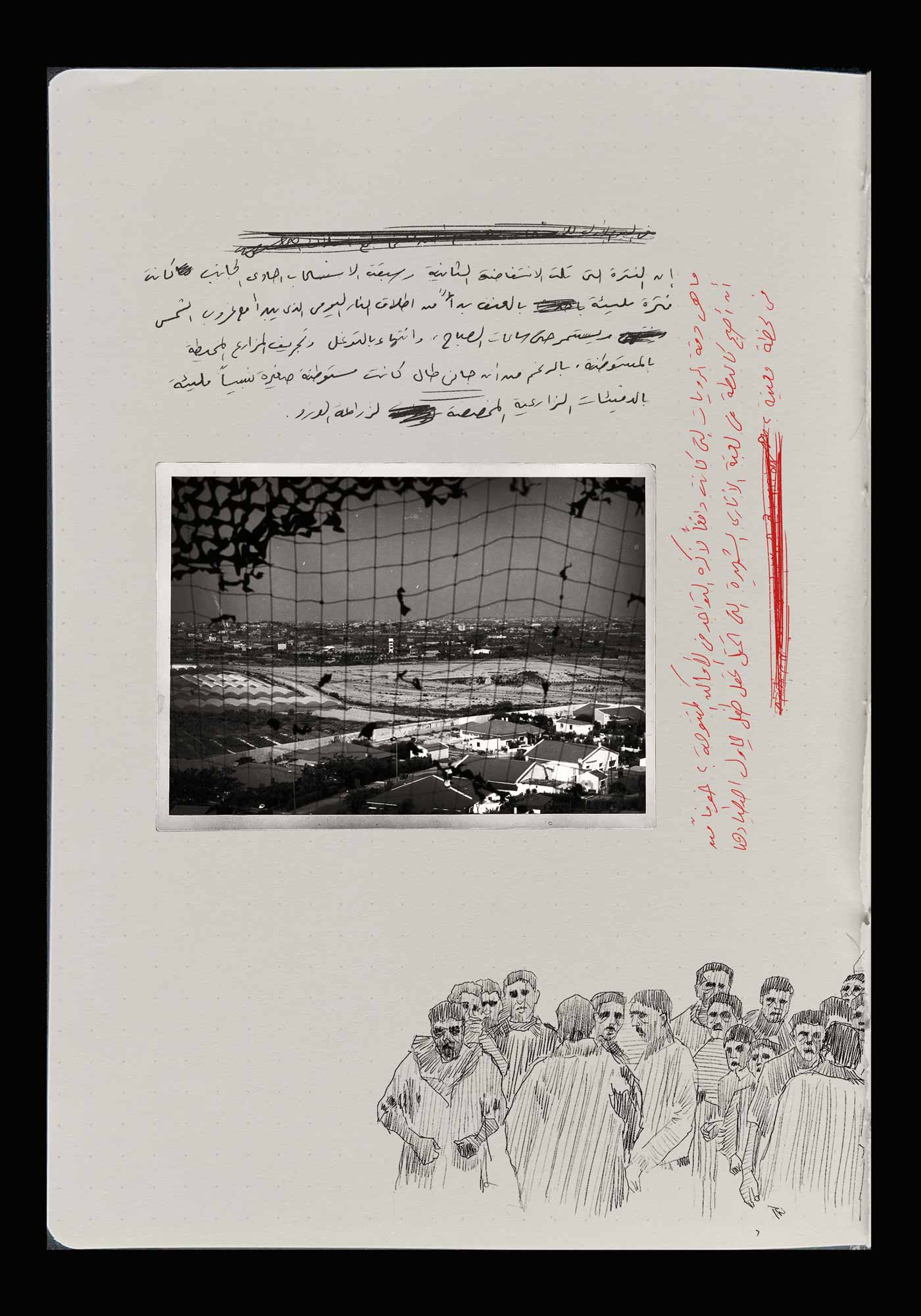
**Control Anatomy,* Study No. 9, 2022, Mahmoud Alhaj, digitized sketch.
Alhaj grew up aware of this expanding military structure imposed on his neighborhood. It implanted in him a fear of open spaces and a constant sense of being under surveillance and threat. He recalls how “the guards of the roses” positioned in the watchtowers instantly killed a Palestinian man who lost his way near the settlement. They claimed that he was hiding a suicide belt underneath his clothes.
> It implanted in him a fear of open spaces and a constant sense of being under surveillance and threat.
This event was engraved in Alhaj’s memory, leaving him with haunting questions: “How could the military guards tell from 700 meters away that the man was wearing a suicide belt? Why did they kill him when he posed no threat to this invincible fortress?” Yet even more persistent questions plagued him: “How did the guards see him, his family and his home across the road? Would he one day suffer the same fate as that unlucky man?” [\[1\]](applewebdata://5ACAA1B6-D0B5-4307-B4FF-8CC43469BB25#%5Fedn1)
In this series, Alhaj explores the colonial gaze by presenting the Israeli military personnel in an abstract, almost invisible way—devoid of human faces—as it is experienced by Palestinians in Gaza. At the same time, he traces connections between the present machinery of war and its very visible effects: the human toll of death, displacement and daily control. Indeed, he describes his childhood as a “pilot for what is happening today; a pilot for the efficiency of tools of violence intended to become, in the future, a systematic and deliberate act of erasure.”
## Surveillance

**Unnatural Landscape 3*, 2022, Mahmoud Alhaj, digital photography, surveillance drone footage frames and archival material.
In his series *Unnatural Landscape*, Alhaj tackles surveillance through imaginative maps of Gaza City with traces of drones in the skies and between the high-rise buildings.
Alhaj witnessed the Israeli withdrawal from the settlements in Gaza in 2005 as part of what Israel called the “disengagement” plan. Shortly after, he realized that the surveillance of Palestinians in Gaza had not stopped; instead, it had taken on a different shape. Drones became a familiar feature in Gaza’s skies. Human rights organizations have criticized Israel’s extensive use of surveillance drones in Gaza and the disruptive effects of their visible and audible presence in the lives of 2 million Palestinians, producing a constant state of fear and anxiety. Drones have also been used to carry out extrajudicial killings of Palestinians. Between 2000 and 2022, Israel killed around 2,146 Palestinians (349 inside their homes), including 378 children, [with weaponized drones](https://www.mezan.org/public/en/post/33747).
> Shortly after, he realized that the surveillance of Palestinians in Gaza had not stopped; instead, it had taken on a different shape.
In *Unnatural Landscape*, Alhaj layers archival photographs as an exercise in imagining how much information these drones have been able to store from their daily missions. He wonders if there are servers big enough to store all this data.[\[2\]](applewebdata://5ACAA1B6-D0B5-4307-B4FF-8CC43469BB25#%5Fedn2)
The answer to this question is yes: Following the 2021 Project Nimbus deal, Amazon and Google provided Israeli military and intelligence units with the necessary infrastructure for storing massive amounts of surveillance data from both Gaza and the West Bank. The information stored on these cloud-based servers has fed the AI tools used by Israel to generate targets in what has been called the world’s “[first AI-assisted genocide](https://www.palestine-studies.org/en/node/1656285)."
## Erasure

**Roofs Knocking,* No. 2, 2022, Mahmoud Alhaj, digital photography, frames from drone footage and archival images.
During the First Intifada in 1987, Palestinians threw stones at the Israeli military and hid in the narrow alleys of refugee camps, out of the army’s reach. In response, Israel dropped stones from helicopters onto the camps’ asbestos roofs, causing deafening roars and injuries. Alhaj depicts these events in his series *Roofs Knocking*. Like his other works from 2022, it is dominated by black and gray and incorporates digital photography and drone imagery. The series tackles the escalating methods of Israeli war-making against Palestinians by exploring what the Israeli army calls “roof knocking,” the warnings sometimes given before striking civilian homes. In his work, Alhaj imagines the view from the binoculars of an Israeli pilot (No. 2), who can only see the asbestos roofs of the impoverished refugee camp. From this bird’s eye view, the cramped and densely populated camp appears devoid of life—an easy, video game-like target for sophisticated missiles.
**Roofs Knocking,* No. 1, 2022, Mahmoud Alhaj, digital photography, frames from drone footage and archival images.
*Roofs Knocking* No. 1 shows the refugee camp from a Palestinian on-the-ground perspective, where simple houses exist for regular people. Here, innocent lives are lost as residents are unable to flee during the short window of time given by an Israeli warning missile.
Alhaj avoids using human figures in his art, refusing to be seen as a victim, and instead focuses on maps, buildings and architecture. In *Shooting Range 365*, also from 2022, homes appear compressed in vertical concrete blocks against an arid landscape, the sea in the background, like a scene from science fiction.
**Shooting Range 365*, No. 1, 2022, Mahmoud Alhaj, digital photography, 3-D models and archival materials.
**Shooting Range 365*, No. 4, 2022, Mahmoud Alhaj, digital photography, 3-D models and archival materials.
His imaginative rendering of Gaza reflects the political reality. Israel has long restricted Palestinians in Gaza and the West Bank from horizontal expansion, forcing vertical growth that squeezes Palestinians into small spaces while reserving land for Israeli settlements. Looking at this series in light of recent events also evokes US President Donald Trump’s 2025 so-called peace plan that would confine Gazans to restricted hinterlands and turn the seafront into resorts for the wealthy.
> Alhaj avoids using human figures in his art, refusing to be seen as a victim, and instead focuses on maps, buildings and architecture.
## Confinement
The grey color of Israeli walls and military structures designed for siege has long preoccupied Alhaj. In his series*Fifth Dimension*(2020), he links the 503-mile-long West Bank apartheid wall that splits towns and disrupts ecosystems to parallel systems besieging Gaza. In 2003, Israel cut off dozens of communities in the West Bank from their surroundings, including Qalqilya in the north and the Shu’fat refugee camp in East Jerusalem, seized their lands and confined their people, creating a concrete labyrinth with no escape. Alhaj depicts the wall of the West Bank surrounding city blocks, showing how it isolates Palestinian neighborhoods like prison cells. He draws a powerful parallel between the two separated halves of the homeland—Gaza and the West Bank—exposing siege as an instrument of occupation and control in both areas.
**Fifth Dimension*, No. 1, 2020, Mahmoud Alhaj, digital photography, Google Maps and internet archives.
In *Fifth Dimension*, No. 1, Alhaj uses the technique of collage to depict Palestinian West Bank neighborhoods—seen from above in drone images—as hemmed in by the separation wall. This series, as a whole, communicates the same feeling of suffocation that Alhaj experienced growing up, unable to leave Gaza. When Israel imposed its siege in 2006, he was 16 and longed to see the world, but this was not possible.
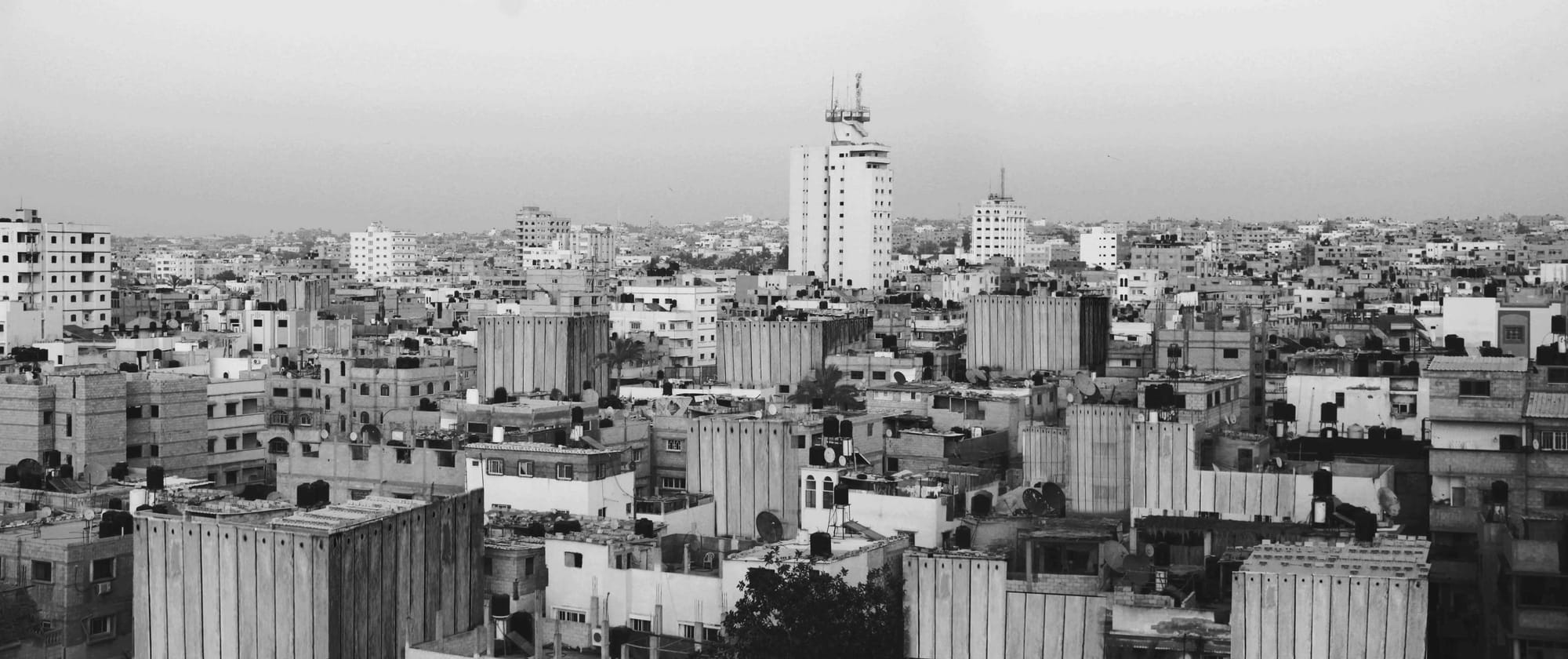
**Fifth Dimension*, No. 3, 2020, Mahmoud Alhaj, digital photography, Google Maps and internet archives.
Over the past two decades, this strangulation of Gaza has only grown more absolute, while the occupation has also become more entrenched in the West Bank, with major sections of the wall separating communities and families from each other and farmers from their lands.
> This series, as a whole, communicates the same feeling of suffocation that Alhaj experienced growing up, unable to leave Gaza.
## Memory
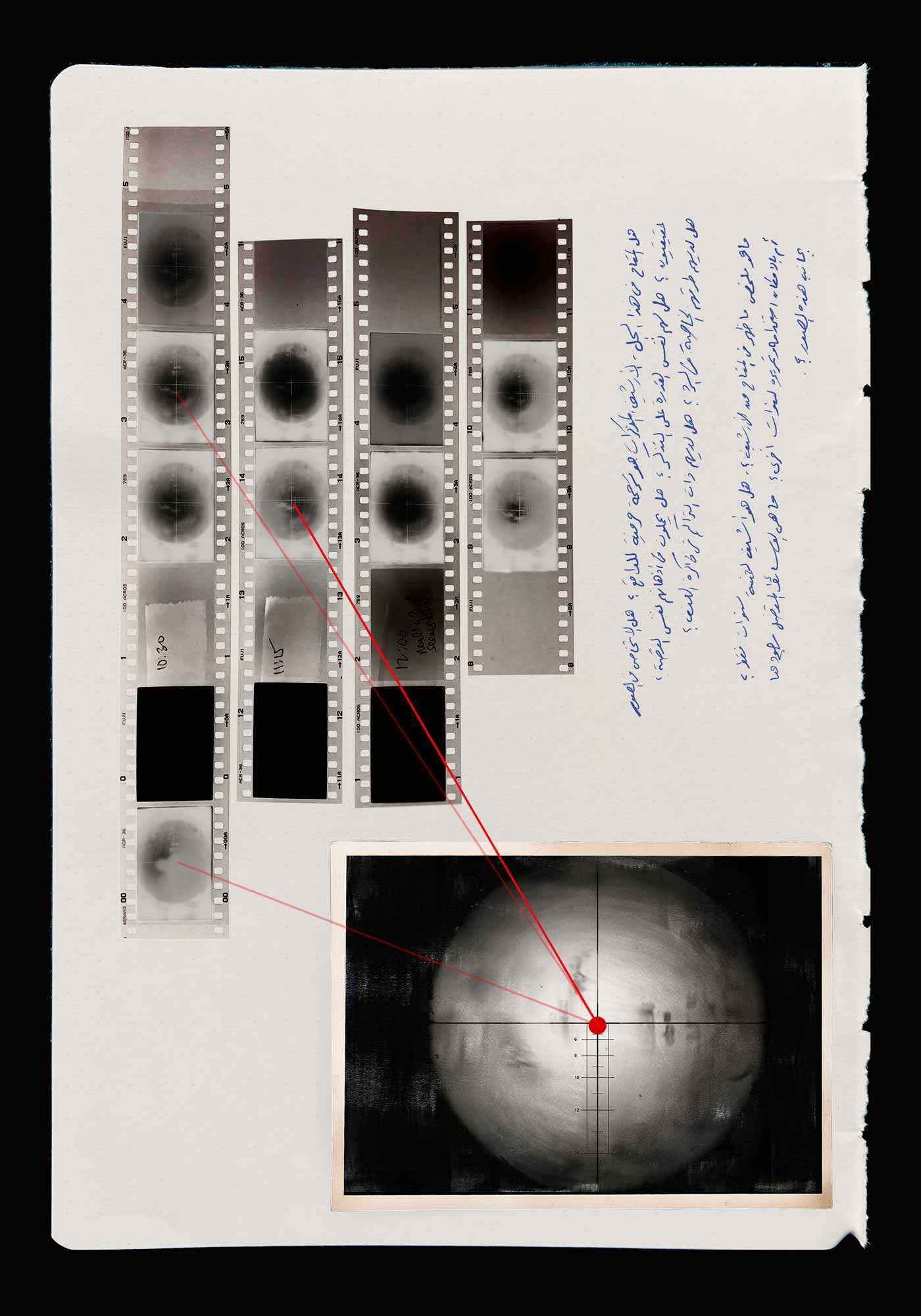
**Control Anatomy*, No. 6, 2022, Mahmoud Alhaj, digitized sketches.
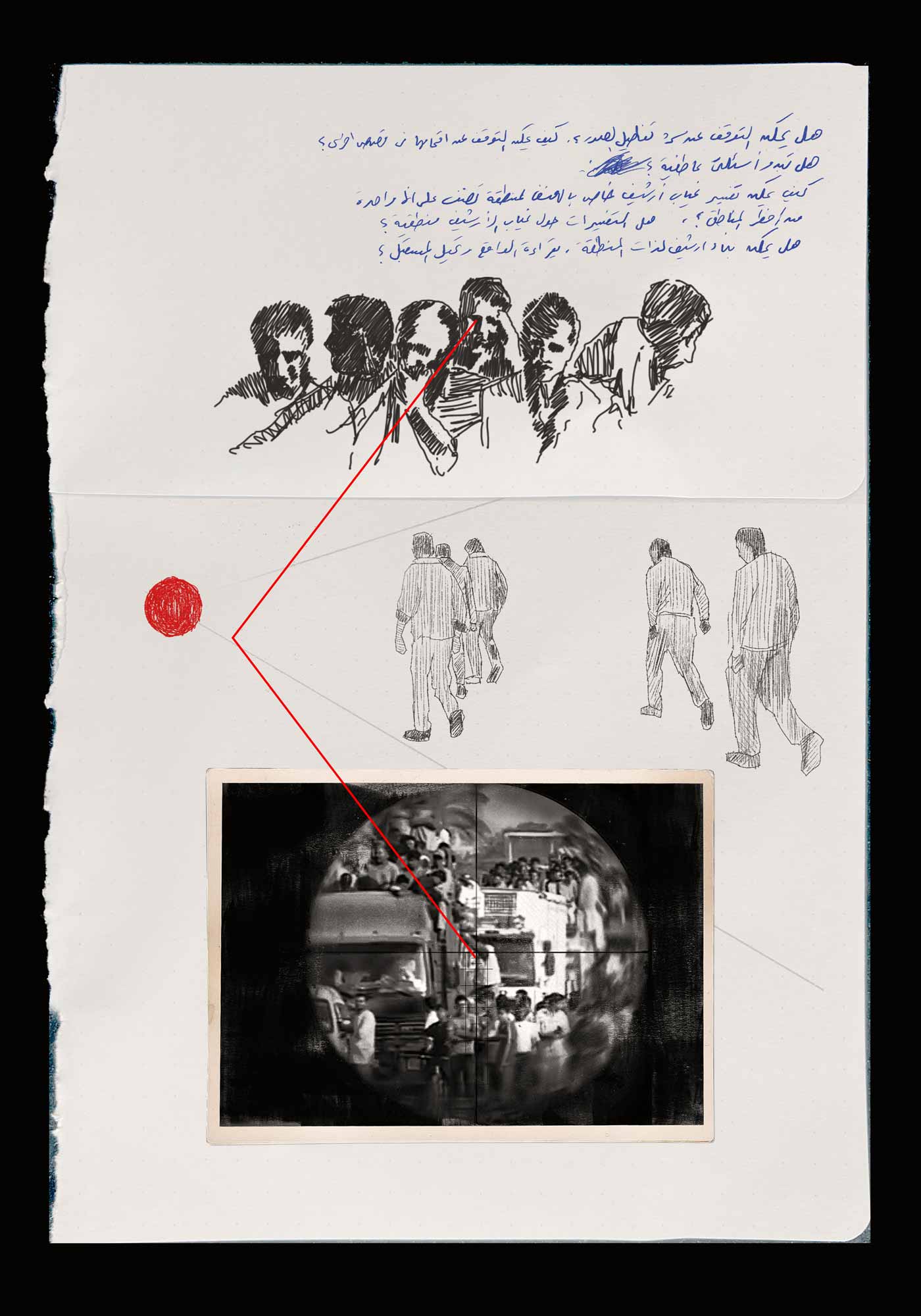
**Control Anatomy*, No. 5, 2022, Mahmoud Alhaj, digitized sketches.
Israel has [long controlled](https://www.palestine-studies.org/en/node/202338) visual access in Palestine, from early cartography that helped erase 500 villages during the Nakba, to modern drones, satellite images and digital maps. Through multiple generations of technology, the goal has remained the same: to maintain dominance over space, while at the same time stripping the colonized of the right to look by building a massive wall that blocks the view, preventing the use of the skies by drones or airplanes and restricting access to sites on the internet.
Alhaj turned to digital archives and Google Maps to construct his own narrative but found little information available to him as a Palestinian. For example, when five children in his neighborhood were killed by an Israeli landmine during the second Intifada, the incident vanished from record along with the children’s bodies. Footage from television reports that captured the incident disappeared when Israel bombed Al-Jalaa Tower in 2021, which housed press offices, footage and archives. In 1997, the United States enacted a law restricting detailed maps of occupied Palestine, by placing limits on satellite imagery resolution, to address Israeli security concerns. Although the law was repealed under the Trump presidency, Israel's ties with Google, Apple and Microsoft prevented these companies from [updating](https://www.vice.com/en/article/google-maps-gaza-israel/) images of Gaza for some time.
> Alhaj turned to digital archives and Google Maps to construct his own narrative but found little information available to him as a Palestinian.
In his film *The Right to See*,Alhaj confronts these erasures, illustrating the limitations he faces even through Google Earth: “I am practicing my right to see, even though these maps have nothing to do with the reality where I live, neither their components nor their colors resemble our reality \[since they are\] devoid of details. I cannot see what I see over Washington, Madrid, Paris. I see what the general allowed me to see, 25 times less details…I don’t see walls on maps...despite their enormous mass and distortion of their surroundings.”[\[3\]](applewebdata://5ACAA1B6-D0B5-4307-B4FF-8CC43469BB25#%5Fedn3)
Instead, Alhaj looked for archives of Israeli military activity in Gaza during the Second Intifada. He started to collect images and stories from people in Gaza but found the process futile. He decided to take a different approach and turned to Israeli sources by searching for Gush Katif in Hebrew online. Eventually the results started appearing from settlers who lived in Gaza before 2006 and were publishing their memories from that time. Through this practice he fell into the archive of the other side and began to forge his own work based on this collection. He also found some photographs taken by soldiers on the internet, which he eventually used in this body of work.
Throughout the exhibition, Alhaj not only presented his collected material, he constructed an alternative archive, using the very tools that have been implicated in oppression to build instead a counter-archive that reclaims memory and visibility. By turning the colonizer’s gaze back upon itself, Alhaj exposes the biases of the available archives and reclaims the narrative of life in Gaza on his own terms.
\[**Rana Anani** is an independent writer and curator.\]
SUPPORT MERIP
All of MERIP's analysis is provided without paywalls! Make a donation now to help us keep it that way.
[DONATE NOW! ](https://www.merip.org/donate/)
---
## Endnotes
[\[1\]](applewebdata://5ACAA1B6-D0B5-4307-B4FF-8CC43469BB25#%5Fednref1) Mahmoud Alhaj, Zoom interview by Rana Anani, June 20, 2024\.
[\[2\]](applewebdata://5ACAA1B6-D0B5-4307-B4FF-8CC43469BB25#%5Fednref2) Mahmoud Alhaj, *Control Anatomy*, 2021, video, 17 min.
[\[3\]](applewebdata://5ACAA1B6-D0B5-4307-B4FF-8CC43469BB25#%5Fednref3) Mahmoud Alhaj, *The Right to See*, 2021, video work, 6.42 min.
### Issue 319 (Summer 2026) Masthead
URL: https://www.merip.org/2026/08/issue-319-summer-2026-masthead/
Last updated: 2026-08-20T12:54:17.000Z
## ***Middle East Report*, “Art at Work—People, Power and Cultural Production,” Summer 2026, No. 319, Vol. 55 No. 2**
##
### **Executive Director**
**James Ryan** jamesryan@merip.org
### **Executive Editor**
**Billie Jeanne Brownlee** bbrownlee@merip.org
### **Managing Editor**
**Marya Hannun** maryahannun@merip.org
### **Senior Staff Editor & Photo Editor**
**Michelle Woodward** mwoodward@merip.org
### **Editorial Assistants**
**Heidi Affi** heidi@merip.org
**Lillian Tolman-Bronski** lillian@merip.org
### **Cover Designer**
**John Lee**
### **Board of Directors**
**Paul Silverstein** **(Board Chair)** *Reed College*
**Mona Atia** *George Washington University*
**Kaveh Ehsani** *DePaul University*
**Michael Hanna** *International Crisis Group*
**Adam Hanieh** *University of Exeter*
**James Ketterer** *Bard College*
**Vickie Langohr** *College of the Holy Cross*
**James Ryan** *MERIP Executive Director (ex officio)*
**Hesham Sallam (Co-chair of the Editorial Committee)** *Stanford University*
**Jillian Schwedler (Co-chair of the Editorial Committee)** *The City University of New York’s Hunter College and The Graduate Center*
###
### **Editorial Committee**
**Hesham Sallam (Co-chair of the Editorial Committee)** *Stanford University*
**Jillian Schwedler (Co-chair of the Editorial Committee)** *The City University of New York’s Hunter College and The Graduate Center*
**Sinem Adar** *German Institute for International and Security Affairs*
**Samar Al-Bulushi** *University of California Irvine*
**Sabiha Allouche** *University of Exeter*
**Lisa Bhungalia** *University of Wisconsin, Madison*
**Stephen Gasteyer** *Michigan State University*
**Maziyar Ghiabi** *University of Exeter*
**Katharina Grueneisl** *University of Nottingham*
**Kanwal Hameed** *University of Oxford*
**Hatim El-Hibri** *George Mason University*
**Toby Jones** *Rutgers University*
**Kendra Kintzi** *New York University*
**Rima Majed** *American University of Beirut*
**Pascal Menoret** *Brandeis University*
**Ali Musleh** *University of California, Davis*
**Kevin L. Schwartz** *Oriental Institute of the Czech Academy of Sciences*
**Omar Sirri** *University of Toronto*
**Deen Sharp** *London School of Economics*
**Maya Wind** *University of California, Riverside*
**Sean Yom** *Temple University*
### **Format: Online**
### **ISSN 3065-744X**
### A Note on the Cover Image
URL: https://www.merip.org/2026/08/a-note-on-the-cover-image-12/
Last updated: 2026-08-20T13:54:02.000Z
Manal Mahamid’s silkscreen print, *48 Cacti, 2024,* boldly introduces the themes of our summer 2026 issue, “Art at Work—People, Power and Cultural Production.” The fruit of the *sabr* cactus, or prickly pear, is repeated 48 times in a colorful grid. Each element is meaningful: the number 48, this particular plant and the Pop Art style.
Mahamid, a Palestinian artist living and working outside her homeland, explains, “The number 48 inevitably evokes 1948, the Nakba, but it also refers to the generation and community of Palestinians who remained on their land after that historical rupture.”
Due to the historical use of the cactus as a living barrier around villages and its current existence in the landscape, she describes the *sabr* plant as “both a living witness and a natural archive” that holds different meanings. “It has become associated with Palestinian attachment to the land because it continues to grow where villages once stood, silently marking places that have otherwise disappeared. At the same time, the cactus embodies resilience, not as a romantic notion of suffering, but as the quiet persistence of life despite violence, erasure and displacement."
On her choice of visual style, Mahamid explains that Pop Art “historically transformed familiar and repeated images into powerful cultural symbols. By repeating the cactus in bold colors and graphic forms, I wanted to shift it from being simply a botanical image into an icon that invites viewers to question how symbols are constructed, circulated and politically understood.”
For Mahamid, and as many articles in this issue also reveal, art is “a space where personal memory, collective history and contemporary political realities can intersect without becoming fixed or closed.”
### 25 Years Since 9/11 And Still No Justice—Here's Why
URL: https://www.merip.org/event/25-years-since-9-11-and-still-no-justice-heres-why/
Last updated: 2026-08-19T14:52:37.000Z
The September 11 terror attacks occurred 25 years ago. Yet there has been no justice for the 2,977 people killed on that day, or for the five Guantánamo detainees the US government accuses of responsibility for this crime. The 9/11 case in the military commissions system, which started in 2008 and restarted in 2012, has not moved past the pre-trial phase. Rather than closure and answers, the case has exposed facts about the CIA’s past torture of the defendants that challenge any hopes for legal justice.
MERIP is thrilled to be co-sponsoring this live event with Busboys and Poets featuring **John Ryan**, author of *America’s Trial: Torture and the 9/11 Case on Guantánamo Bay*, and **Lisa Hajjar**, author of *The War in Court: Inside the Long Fight against Torture,* who have covered the military commissions for over a decade. They will discuss the 9/11 case and its broader implications for the war on terror and Guantánamo’s future.
This event is free and open to all, and will take place at Busboys and Poets' 14th and V location in Washington, DC. Doors open to guests at 4:30pm. The program begins at 5:00 pm, and will be followed by an audience Q&A. Copies of *America’s Trial: Torture and the 9/11 Case on Guantánamo Bay* and *The War in Court: Inside the Long Fight against Torture* will be available for purchase before and during the event. Please note that this event is in person. We ask that guests [RSVP](https://www.busboysandpoets.com/events/25-years-since-9-11-and-still-no-justice-heres-why/) in order to receive direct updates about the event from Busboys and Poets Books.
[RSVP and More Info!](https://www.busboysandpoets.com/events/25-years-since-9-11-and-still-no-justice-heres-why/)
**John Ryan** is a co-founder of Lawdragon Inc. and has won numerous accolades as a legal affairs journalist over the past twenty-five years. Since 2015, John has been one of just two reporters in the world to report regularly on the military tribunals from Guantanamo Bay, earning three New York Press Club Awards for his work.
**Lisa Hajjar** is Professor of Sociology at the University of California, Santa Barbara, whose work focuses on the relationship between law and conflict. She is the author of *Courting Conflict and Torture: A Sociology of Violence and Human Rights*, and a longtime editor and contributor to MERIP.
SUPPORT MERIP
All of MERIP's events are free and open to the public. Please consider a donation today to support our work!
[DONATE NOW ](https://www.merip.org/donate/)
### NEW: Arab AI Slop and the Precarious Politics of Digital Kitsch
URL: https://www.merip.org/2026/08/new-arab-ai-slop-and-the-precarious-politics-of-digital-kitsch/
Last updated: 2026-08-12T13:12:21.000Z
Dear Friends and Comrades,
If you spend any time on social media, you’ve seen the uncannily rendered videos and memes known colloquially as AI slop, crudely generated videos playing on stereotypes meant to generate viral outrage. In our upcoming summer issue of *Middle East Report*, Nermin Elsherif looks at the consumption and production of these kitschy and provocative images and videos in the Arab world.
In [“Arab AI Slop and the Precarious Politics of Digital Kitsch,”](https://www.merip.org/2026/08/the-kitsch-machine-the-precarious-polti-behind-arab-ai-slop/) which we’re sharing today, Elsherif examines the circulation of slop that features Arab leaders—among them Egyptian President Abd al-Fattah al-Sisi and Syria’s former President Bashar al-Asad. These attention-grabbing reels, which the piece describes in vivid detail, rely on exaggerated demonstrations of masculinity and nationalism and often include humiliating depictions of US President Donald Trump and Israeli Prime Minister Benjamin Netanyahu. Elsherif suggests they offer a kind of antidote to the live-streamed genocide in Gaza and regional wars that have dominated the feeds of Arab publics over the last few years.
Digging deeper, the article also offers a window into who is producing these videos. Especially in Egypt, a cottage industry of content creators have pinned their economic hopes on the AI slop economy. Offering some early insight into a newly developing and precarious labor sector, Elsherif [tells us](https://www.merip.org/2026/08/the-kitsch-machine-the-precarious-polti-behind-arab-ai-slop/), “Producing AI slop is not completely effortless. An experienced user can generate a ten-second reel in around five minutes, but creators relying on free accounts are limited to only a handful of experiments each day… They become trapped on these platforms as both workers producing content and consumers seeking tools and instruction.”
[READ NOW](https://www.merip.org/2026/08/the-kitsch-machine-the-precarious-polti-behind-arab-ai-slop/)
This article is the second preview we’re sharing from our upcoming issue, **Art at Work**. We hope you find this piece, and last week’s [interview ](https://www.merip.org/2026/08/closed-until-further-notice-keeping-a-tehran-art-institution-alive-during-wartime/)with Hamidreza Pejman on the art scene in Tehran during wartime, enlightening. As always, you can let us know what you think by responding to this email. We are grateful to have the [support](https://www.merip.org/donate/) of our readers.
In solidarity,
James Ryan
Executive Director
SUPPORT MERIP
All of MERIP's content is brought to you without paywalls. Make a donation today to help keep it that way!
[DONATE NOW ](https://www.merip.org/donate/)
---
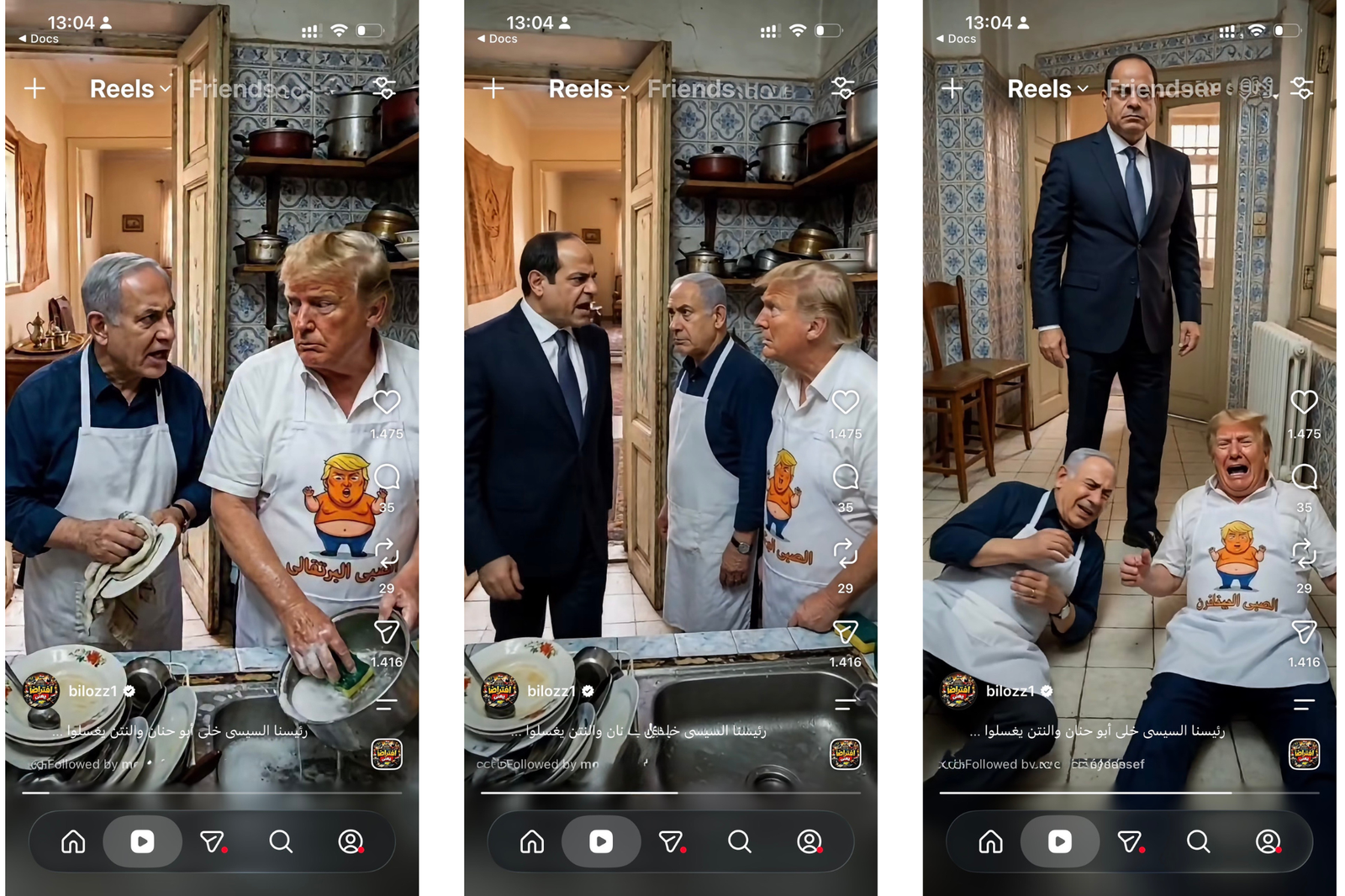
Screenshots from an AI-generated [reel](https://www.instagram.com/reels/DYExpgbtHnU/) by bilozz1.
## Arab AI Slop and the Precarious Politics of Digital Kitsch
### By Nermin Elsherif
In April 2026, a 15-second[ Instagram reel](https://www.instagram.com/p/DXomRFADa8P/) depicting US President Donald Trump and Israeli Prime Minister Benjamin Netanyahu as janitors cleaning a dirty men’s room went viral. Netanyahu says in broken Egyptian Arabic: “Clean the toilet properly, you Trump boy, before the Protector of Egypt, President Sisi comes \[sic\].” President Abd al-Fattah al-Sisi then appears in a well-fitted suit, shouting, “Why isn’t the toilet clean, you dogs?” He hits Trump in the face, sending him and Netanyahu to the ground crying. A few weeks later, the same creator, bilozz1, uploaded[ a second version](https://www.instagram.com/reel/DYExpgbtHnU/?utm%5Fsource=ig%5Fweb%5Fcopy%5Flink&igsh=MzRlODBiNWFlZA==) with an almost identical script that achieved less virality, in which Trump and Netanyahu are cleaning dishes in a kitchen, trying to finish their job faster to avoid Sisi’s retaliation. Days later, the creator published[ a third version](https://www.instagram.com/reel/DYcDLfkNKFV/?utm%5Fsource=ig%5Fweb%5Fcopy%5Flink&igsh=MzRlODBiNWFlZA==) set in a fictional Egyptian alley, with Trump and Netanyahu both dressed as street cleaners. Sisi has longer lines: “You guys are completely useless. You don’t get anything done; you’re good for nothing.” The camera moves to a lower angle, depicting Sisi as a towering figure while the two other politicians on the ground respond: “We apologize to you, savior of Egypt. Forgive us!” He kicks them in the face.
These reels exemplify a peculiar form of what is loosely referred to as AI slop: cheaply produced, AI-generated content designed for rapid circulation. Over the past year, many sub-genres of AI slop have appeared and disappeared: from “[Italian Brainrot](https://www.forbes.com/sites/lesliekatz/2025/05/03/what-is-italian-brain-rot-the-surreal-tiktok-obsession-explained/)” to[ anthropomorphized cats](https://www.washingtonpost.com/technology/2024/08/03/ai-cats-video-tikok-instagram-youtube/) to the talking[ vegetables and fruits](https://www.cbc.ca/news/entertainment/ai-fruit-slop-videos-instagram-tiktok-9.7142568) who get married, cheat and fight over custody of their children in simplistic, sensationalist and[ misogynistic plots](https://www.wired.com/story/theres-something-very-dark-about-a-lot-of-those-viral-ai-fruit-videos/). Some of this slop takes the[ form of political commentary](https://newlinesmag.com/spotlight/slopaganda-comes-of-age/), used by everyone from the president of the United States to dispersed networks of gig workers on the fringes of the internet.
Despite their hyperrealist rendering, these videos have a tacky aesthetic. Their voice-over occasionally breaks, and the lip-sync glitches as the AI voice fails to articulate convincing accents. The stories often play on raw, heightened emotions of fear, anger and regret. Yet, on the Arabic-speaking internet amid Israel’s ongoing genocide in Gaza and the subsequent US and Israeli-led regional war, a specific unnamed political subgenre has emerged, particularly in Egypt and Syria. It is centered around recycling conservative gendered stereotypes in absurdist forms that play on humiliating Western leaders while exaggerating local nationalist masculinity and sovereignty. These spectacles appear in the social media feeds of users exhausted from doomscrolling their way through reels of human suffering in Gaza, Lebanon and Iran.
This new cultural form of short AI-generated videos does not sit neatly within the categories of propaganda or satire. They center banality rather than offer a political argument. Their length is optimized to engage the largest number of viewers, and successful plots are turned into reproducible formulas with the hope that the next version will garner even more attention. These reels become the smallest atomic unit of the internet; they slide into users’ direct messages as trivia and appear in their stories, only to be quickly forgotten. Their comment sections are loaded with memes, emojis and mentions, but rarely any substantial conversation. Despite their intriguing aesthetics, Arab AI political slop cannot be understood through their representations alone. The visualization and circulation of these political fantasies is emerging at the intersection of authoritarian rule, platform capitalism and the rapid diffusion of generative AI tools during a period of genocidal violence in Palestine and broader regional war.
[READ NOW](https://www.merip.org/2026/08/the-kitsch-machine-the-precarious-polti-behind-arab-ai-slop/)
### NEW: ‘Closed Until Further Notice’ – Keeping a Tehran Art Institution Alive During Wartime
URL: https://www.merip.org/2026/08/new-closed-until-further-notice-keeping-a-tehran-art-institution-alive-during-wartime/
Last updated: 2026-08-05T12:55:34.000Z
Dear Friends and Comrades,
The US and Israeli war has altered daily life in Iran. Between airstrikes that have destroyed basic infrastructure across the country and a regime bent on repressing political expression, the institutions that sustain cultural life have had to navigate some perilous straits.
Today we are sharing a preview of our upcoming summer issue of *Middle East Report*, **Art at Work.** ["‘Closed Until Further Notice’–Keeping a Tehran Art Institution Alive During Wartime"](https://www.merip.org/2026/08/closed-until-further-notice-keeping-a-tehran-art-institution-alive-during-wartime/) is an interview with Hamidreza Pejman, the founder and director of the Pejman Foundation, a non-profit contemporary art foundation that has been operating in Tehran since 2015\. In his conversation with Manchester-based artist Parham Ghalandar, Pejman discusses the multiple pressures that led to the decision to temporarily close the Foundation’s main gallery space, Argo Factory. As Pejman recounts, it is not only the war that has affected the gallery’s relationships with artists and the arts community. The crumbling economy, diaspora pressures and regime restrictions all shape the role cultural institutions play in Iranian society and lead to painstaking and difficult decisions.
“In ordinary times, a team is always busy arguing over something: money, dates, whether this or that work should go on the wall. We liked to think those arguments were signs of health. Then that morning came, the sound of a fighter jet over your head, and Human life suddenly became the only thing on the table. When that happens, everything else evaporates. ‘Should we stay open a bit longer?’ or ‘Should we close sooner?’ are no longer two sides of a discussion. There is no discussion. As a team, we had always wished to be united over the most important thing. That day we were, and the price was that we no longer had any choice. Disagreement is a luxury. It belongs to someone who has several paths. We had one path.”
You can read a longer excerpt of this piece below, and the full piece on our website.
[READ NOW](https://www.merip.org/2026/08/closed-until-further-notice-keeping-a-tehran-art-institution-alive-during-wartime/)
We look forward to sharing more previews of **Art at Work** as we lead up to the release later in August. We are thankful for the support of our readers–we rely on [donations](https://www.merip.org/donate) to continue to produce *Middle East Report* as a resource for all. Please consider chipping in today.
In Solidarity,
James Ryan
Executive Director
SUPPORT MERIP
MERIP relies on support from our readers to publish, edit and host articles like this one. Become a supporter today!
[DONATE NOW ](https://www.merip.org/donate/)
---
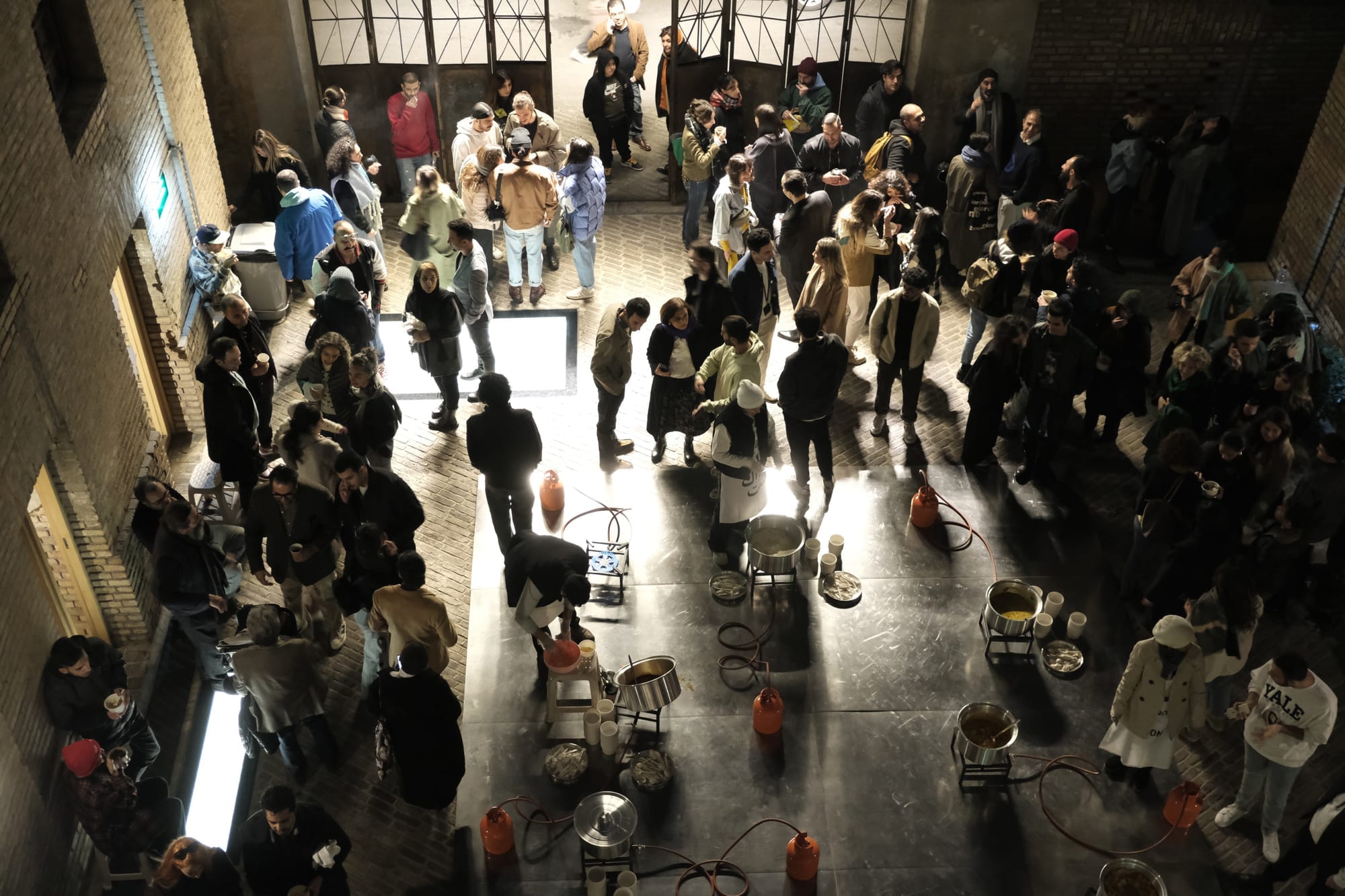
Rirkrit Tiravanija, **Tomorrow Is the Question*, Argo Factory, Tehran, Iran, December 15, 2023–April 12, 2024\. Photograph by Arya Tabandehpoor. Courtesy of Pejman Foundation.
## 'Closed Until Further Notice’ – Keeping a Tehran Art Institution Alive During Wartime
### Hamidreza Pejman in conversation with Parham Ghalandar
*The following interview took place over voice and text messages between March and May 2026 amid the ongoing war. The conversation, which was conducted in Persian and translated into English, has been edited for length and clarity.*
**Parham Ghalamdar:** Take me back to the last day Argo was open in its usual public form, from the moment you arrived to the moment you understood the space could no longer continue as before.
**Hamidreza Pejman:** I remember exactly the moment when there was no room left for doubt: February 28, 2026, 9:30 in the morning. I was on my way to work. I heard a fighter jet directly overhead and right after it, an explosion. That is how war introduced itself. Without preface. That morning, what was heavier than the explosion itself was not knowing. One week? One year? In the end it lasted 40 days, but on that first day it could have been infinite.
But the last “normal” day was much earlier. What we saw in December 2025 \[the mass protests\] was not the cause. It was a sign. Inequality accumulated over years produces one thing: a large mass of people who no longer see any share for themselves in the existing order. And when a person sees nothing left to lose, their logic of calculation changes. Desperation by itself does not end in war. Someone has to direct it. That is where outside actors entered. Media outlets and currents that, from a distance, invested in this ready-to-explode energy and pushed it in a direction aligned with their own interests, not with the interests of the very people whose names they were shouting. And on the other side, a government that, instead of responding to the root, reacted to the symptom, and through that reaction sped up the cycle.
**Parham:** How did you decide that this was the moment to close? I’m interested in the timing: why not sooner, why not later? Was there disagreement inside the team, or did the situation become so compressed that there was no real room left for disagreement?
**Hamidreza:** Disagreement? There was none. And the fact that there was none was itself the worst news, not the best. In ordinary times, a team is always busy arguing over something: money, dates, whether this or that work should go on the wall. We liked to think those arguments were signs of health. Then that morning came, the sound of a fighter jet over your head, and Human life suddenly became the only thing on the table. When that happens, everything else evaporates. “Should we stay open a bit longer?” or “Should we close sooner?” are no longer two sides of a discussion. There is no discussion. As a team, we had always wished to be united over the most important thing. That day we were, and the price was that we no longer had any choice. Disagreement is a luxury. It belongs to someone who has several paths. We had one path.
**Parham:** That answer cuts against the usual institutional language of consensus. Consensus here is not health; it is pressure. Can you say what thresholds now make public programming impossible for you: movement in the city, internet instability, danger for staff, insurance, legal advice, fear among audiences or something else? At what point does a concern become a red line?
**Hamidreza:** I have to laugh, because the question assumes there is a line that, once crossed, makes you say, “Right, now it can’t continue.” But that is not the reality of the past year or two. There has been no single red line. We are under pressure from several directions at once, and the pressures are not even aligned with one another. Each comes from a different place, but all of them converge on the same point: the impossibility of standing on any solid ground.
Let me begin with the nearest layer. In April 2026, we were in the middle of a ceasefire–at exactly the moment when, in theory, you should be able to breathe. The Cinematheque, Argo Factory’s in-house film-screening program, which we had forced into existence through sheer effort and which is now in its third year, was holding screenings. At the third screening during the ceasefire, an unknown institution shut it down under the pretext of permits. You think danger belongs to wartime. But no, it was during the ceasefire that they shut the door. The outside threat had receded, and pressure came from inside. It became clear that war was only one pressure among others, not their source.
The second layer comes from outside, and it is the bitterest one. The diaspora is deeply angry with us that we continue to breathe and work under the supervision of this same government. And the opposition? They are not even that polite; they simply want you dead. The supporters of war and the monarchists do not even hide it: They want Iran to become a scorched land, unlivable, so that their argument can be proven right. Look at the paradox: One side wants to suffocate us for staying, the other wants the place in which we stayed to be destroyed altogether. Both, from opposite ends, seem to want the same thing: that Argo should not exist.
And then there is the third layer, the one with no slogan that simply devours: the economy. A museum, a non-profit foundation, stays alive through wages, rent and bills, not through statements. The marketing budget has been cut. Sponsors have left. Resources have shrunk to the point that even paying salaries is difficult never mind running an ambitious curatorial program. And this is the most ruthless pressure of all, because it is not ethical; it is simply mathematical. You can possess all the courage in the world and still, at the end of the month, the numbers don’t add up.
So where is my red line? It is not one line. Each of these pressures has a different nature. Movement in the city and the internet are operational and can be worked around logistically. Permits and closure belong to the order of power and can only be endured. The economy is more fundamental than all the others because it does not even enter the logic of dialogue. Each of these can be managed on its own. The red line is where all three are active at once, and the remedy for one makes another worse. To get around one obstacle you need to spend money, but there is no money. To compensate for that lack of money, you need to program something, but power will not allow it. The red line is not a point; it is a condition: that moment when you realize no movement is possible anymore without damaging another movement.
**Parham:** Your website currently has a notice that you are “closed until further notice,” which can sound like an administrative phrase. In your account, it sits inside a much wider collapse of movement, money, permission and trust. So, let me ask it more bluntly: What does closure actually mean at Argo now?
**Hamidreza:** For us, “closed” means less a stoppage than a change of form. We decided that under conditions that could harm people or increase distances between them we should remain present in a different way. The reality is that in this period, even keeping a space open is no longer merely a practical decision—it can have unintended consequences. That's why this closure is more a matter of caution and responsibility than retreat. We are still working, just not in a way that can be seen from outside. We keep our connections alive, we monitor the situation constantly and we try, as much as possible, not to lose this continuity.
[KEEP READING](https://www.merip.org/2026/08/closed-until-further-notice-keeping-a-tehran-art-institution-alive-during-wartime/)
### The MERIP Podcast Episode 27: Susanne Dahlgren
URL: https://www.merip.org/2026/07/the-merip-podcast-episode-27-susanne-dahlgren/
Last updated: 2026-07-29T12:41:37.000Z
Today’s episode of the MERIP Podcast features a conversation between MERIP executive director James Ryan and Susanne Dahlgren, a longtime MERIP contributor and analyst focused on Yemen whose recent essay, [“Yemen After the Saudi-Emirati Split”](https://www.merip.org/2026/07/yemen-after-the-saudi-emirati-split/) appeared in our Current Analysis section on July 8, 2026\.
Last December, the Emirati-backed Southern Transitional Council in Yemen briefly expelled Saudi and Saudi-backed militias from the Hadhramaut region, only to retreat in the face of Saudi counteroffensives. The result of this skirmish was the dramatic exit of the UAE from Yemen’s civil war, after over 10 years of involvement.
Since December, Saudi Arabia has been working to consolidate its control and influence over the varied groups vying for power in the territory of the former South Yemen, on the one hand, and holding secret talks with the Houthis, who hold territory that includes the capital Sana’a, on the other. In her piece, Dahlgren reads these maneuvers as an attempt by the Saudis to establish a modus operandi for managing the conflict from Riyadh and protecting its interests in oil production and shipping.
Then, on July 13, the Houthis launched a ballistic missile attack on Saudi Arabia, which has been followed by drone attacks on oil facilities and attempts to limit shipping through the Bab al-Mandab Strait. What appeared to be a cooling conflict has heated up again. James Ryan and Susanne Dahlgren discussed why the Houthis re-opened hostilities, what this turn in the saga has meant to Yemenis who are facing an extraordinary food insecurity crisis and what the future holds for a conflict that has yet to find a political path forward.
[Listen on Apple Podcasts](https://podcasts.apple.com/us/podcast/episode-26-susanne-dahlgren/id1823259361?i=1000778891482)
[Listen on Spotify](https://open.spotify.com/episode/71jXdvqkyt1Hhcc6rN0n2y)
[Listen on Amazon Music](https://music.amazon.com/podcasts/d73ad16e-0e22-4ca4-80f1-cf61dade333e/episodes/28d8aced-cc3b-4a84-8d47-bc2858daf7d8/the-merip-podcast-episode-26-susanne-dahlgren)
Further Reading:
Susanne Dahlgren, [“Yemen After the Saudi-Emirati Split”](https://www.merip.org/2026/07/yemen-after-the-saudi-emirati-split/) *Current Analysis*,July 8, 2026
[*Al Ayyam* Newspaper](https://www.alayyam.info/)
[*Yemen Online* ](https://www.yemenonline.info/)
[*Yemen Monitor* ](https://www.yemenmonitor.com/en/en)
SUPORT MERIP
The MERIP Podcast is presented without ads or paywalls. Help us keep it that way!
[DONATE NOW ](https://www.merip.org/donate/)
### The MERIP Podcast Episode 26: The MERIP Roundtable, On the World Cup 2026
URL: https://www.merip.org/2026/07/the-merip-podcast-episode-26-the-merip-roundtable-on-the-world-cup-2026/
Last updated: 2026-07-16T13:09:53.000Z
On today’s program we have another installment of our MERIP Roundtable, where MERIP’s executive director, James Ryan is joined by past and present members of our editorial committee, along with recent contributors, to discuss current events. This edition focuses on the 2026 World Cup, now in its final stages. Like most iterations of the tournament, this year’s has provided a drama-filled month both on and off the pitch. Thanks to the expanded field of participation, ten nations from the Middle East and North Africa were represented, with Morocco following its exciting 2022 performance in Qatar with another deep run. Our guests discuss what participation has meant for several countries in the region, and what their prospects might be going forward. They also touch on the colonial and diasporic dynamics that have been central to the dominance of the traditional powerhouses–including the final four teams of France, Spain, Argentina and England. And of course, there are the implications of this World Cup being hosted by the United States, along with Mexico and Canada, at a time when the United States and Israel are engaged in a disastrous war on Iran that has entangled its allies in the region as well as Lebanon and Yemen.
Joining James Ryan for this conversation were Sabiha Allouche, a member of MERIP’s editorial committee and a senior lecturer in politics at the University of Exeter’s Institute for Arab and Islamic Studies, Paul Silverstein, the chair of MERIP’s board of directors and professor of anthropology at Reed College, and Nabil al-Tikriti, a former member of MERIP’s editorial committee, long-time contributor and professor of history at the University of Mary Washington.
[Listen on Apple Podcasts](https://podcasts.apple.com/us/podcast/episode-26-the-merip-roundtable-on-the-world-cup-2026/id1823259361?i=1000777054784)
[Listen on Spotify](https://open.spotify.com/episode/56lM2wAkDX3YbmFKpRi7R0)
[Listen on Amazon Music](https://music.amazon.com/podcasts/d73ad16e-0e22-4ca4-80f1-cf61dade333e/episodes/9b7fd53e-17af-4abe-b3c6-f0adcaf1570b/the-merip-podcast-episode-26-the-merip-roundtable-on-the-world-cup-2026https://music.amazon.com/podcasts/d73ad16e-0e22-4ca4-80f1-cf61dade333e/episodes/9b7fd53e-17af-4abe-b3c6-f0adcaf1570b/the-merip-podcast-episode-26-the-merip-roundtable-on-the-world-cup-2026)
SUPPORT MERIP
All of MERIP's podcasts are presented without ads or paywalls. Please consider a monthly or one-time donation today to help us keep it that way!
[DONATE NOW ](https://www.merip.org/donate/)
### Further Reading:
*Middle East Report* Issue 304, [Football–Politics and Passion](https://www.merip.org/issue-304/), Fall 2022
Clive Chijioke Nwonka and Matthew Harle eds., [*Black Arsenal: Club, Culture, Identity*](https://www.weidenfeldandnicolson.co.uk/titles/clive-chijioke-nwonka/black-arsenal/9781399613736/) (London, W&N 2025)
John McManus, [*Welcome to Hell? In Search of the Real Turkish Football*](https://www.weidenfeldandnicolson.co.uk/titles/john-mcmanus/welcome-to-hell/9781474604772/) (London, W&N 2019)
Fatou Diome, [*In the Belly of the Atlantic*](https://www.amazon.com/Belly-Atlantic-Fatou-Diome/dp/1852429038) (London, Serpent’s Tail 2008)
Mickaël Correia, [*A People’s History of Football*](https://www.plutobooks.com/product/a-peoples-history-of-football/) (London, Pluto Press 2023)
Simon Kuper, [*World Cup Fever: A Soccer Journey in Nine Tournaments*](https://www.simonandschuster.com/books/World-Cup-Fever/Simon-Kuper/9798897100644) (New York, Simon and Schuster 2026)
### The MERIP Podcast Episode 25: Iran in Context Part II
URL: https://www.merip.org/2026/07/the-merip-podcast-episode-25-iran-in-context-part-ii/
Last updated: 2026-07-16T01:40:54.000Z
On today’s program, we have a special release of the audio from the second installment of our summer event series “Iran in Context,” featuring conversations with scholars in the field about the deeper dynamics behind the political and military convulsions in Iran over the last year. The latest installment, available here, is on the “Politics and Counter Politics in Contemporary Iran” and includes three recent MERIP contributors, Naghmeh Sohrabi, the Charles (Corky) Goodman chair of Middle East History and Director of the Crown Center for Middle East Studies at Brandeis University, Mohammad Ali Kadivar, associate professor of sociology and international studies at Boston College and Paniz Musawi Natanzi, a research associate at the University of Bern and affiliate scholar of the South Asia Center at the University of Pennsylvania. The discussion was co-moderated by James Ryan, MERIP’s executive director and Rosanna Tufaro, a Curie Postdoctoral Fellow at La Sapienza University in Rome and a member of the precarity working group at SeSaMO. Their conversation explores the ways Iranian politics have been misunderstood and misrepresented outside of Iran, the major factors that have driven political change in the country over the last few decades and some thoughts on what lies ahead for a country that is clearly being reshaped in important ways. The series, which takes place on zoom, is co-produced by BRISMES (the British Society for Middle East Studies) and SeSaMO (the Italian Society for Middle East Studies).
[Listen on Apple Podcasts](https://podcasts.apple.com/us/podcast/episode-25-iran-in-context-part-ii-politics-and/id1823259361?i=1000776112916)
[Listen on Spotify](https://open.spotify.com/episode/4bM5lVgSTEuPMqih90grmi)
[Listen on Amazon Music](https://music.amazon.com/podcasts/d73ad16e-0e22-4ca4-80f1-cf61dade333e/episodes/639aacdb-ff96-4bec-a8c9-b20413e87b05/the-merip-podcast-episode-25-iran-in-context-part-ii--politics-and-counter-politics-in-contemporary-iran)
Further Reading:
Mohammad Ali Kadivar, [“Rethinking Political Change in Iran From Protest to War”](https://www.merip.org/2026/06/rethinking-political-change-in-iran-from-protest-to-war/) *Current Analysis*, MERIP June 3, 2026
Paniz Musawi Natanzi, “Courts of Exclusion–Working Class Masculinity and Anti-Afghan Racism in Iran” *Middle East Report* Issue 314, June 17, 2025
Daniel Tavana, Kevan Harris, Gary Fong and Amir Farmanesh,[ “Who Overreports? Regime Support and Preference Falsification in Iran”](http://osf.io/preprints/socarxiv/2mqud%5Fv1) (article preprint) June 15, 2026
Naghmeh Sohrabi, Toby Craig Jones, Kaveh Ehsani and James Ryan, [“The MERIP Podcast: The MERIP Roundtable–On the Iran War Part II”](https://www.merip.org/2026/03/the-merip-podcast-episode-19-the-merip-roundtable-on-the-iran-war-part-ii/) Episode 19, March 19, 2026
SUPPORT MERIP
All of MERIP's podcasts and events are paywall free! Please make a donation today to help us keep it that way!
[DONATE NOW ](https://www.merip.org/donate/)
### NEW: Yemen After the Saudi-Emirati Split
URL: https://www.merip.org/2026/07/new-yemen-after-the-saudi-emirati-split/
Last updated: 2026-07-08T13:26:32.000Z
Dear Friends and Comrades,
In the midst of the war on Iran and the ongoing Israeli attacks on Lebanon, Gaza and the West Bank, the protracted conflict for Yemen’s future has slid out of view for many. Today we are sharing with you a critical assessment of some important developments there, courtesy of longtime Yemen analyst Susanne Dahlgren, in [“Yemen After the Saudi-Emirati Split.”](https://www.merip.org/2026/07/yemen-after-the-saudi-emirati-split/) Following the exit of militias sponsored by the United Arab Emirates last year, Saudi Arabia’s influence outside of the Houthi-controlled areas in the south of the country has grown considerably.
Reading the movements of the Southern Transitional Council and the internationally recognized Presidential Leadership Council, Dahlgren astutely explains how Saudi energies have been overwhelmingly focused on consolidating their influence across the south rather than direct conflict with the Houthis. The nature of this strategic decision suggests to Dahlgren that Saudi Arabia may be acting in tacit coordination with the Houthis to manage a divided Yemen.
As Dahlgren writes, while “these changes are redrawing Yemen's political landscape” Saudi management of the Yemen file figures to be a major obstacle to unity and independence for the majority of Yemenis who desire it. The conflict may be entering a frozen period, to the benefit of Saudi strategic interests in the Bab al Mandab Strait, but likely not to any advantage for ordinary Yemenis.
[Read the Article](https://www.merip.org/2026/07/yemen-after-the-saudi-emirati-split/)
We hope you find this essay enlightening, along with our [continued coverage of Yemen](https://www.merip.org/tag/yemen/). And as always, we welcome your thoughts and reactions by responding to this email.
In solidarity,
James Ryan
Executive Director
SUPPORT MERIP
All of MERIP's articles are published without paywalls! Please consider a donation today to make sure it stays that way.
[DONATE NOW ](https://www.merip.org/donate/)
### Yemen After the Saudi-Emirati Split
URL: https://www.merip.org/2026/07/yemen-after-the-saudi-emirati-split/
Last updated: 2026-07-08T15:57:43.000Z
In early December 2025, Yemen’s Southern Transitional Council (STC) took many by surprise when it seized control of the country’s oil-rich Hadhramaut governorate, a region that had been under the control of Saudi-backed forces. After its eastern neighbor al-Mahra declared allegiance to the STC, the Emirati-supported group effectively established control over the territory of the former South Yemen.
Large crowds of celebrating southerners called on STC leader Aidrus al-Zubaydi to declare independence as Saudi Arabia and the military forces it sponsors retreated, even vacating the presidential palace in Aden.
Within days, Saudi Arabia reversed its withdrawal, launched airstrikes on STC militias and redeployed its own troops, previously stationed along the border with Houthi-controlled areas, to expel STC-allied forces. After consultations in Riyadh, Rashad al-Alimi—the leader of the internationally recognized government’s Presidential Leadership Council (PLC)—announced on December 30, 2025, that the UAE must withdraw from all of Yemen within 24 hours. The UAE complied and removed its military forces, although it maintains commercial and political interests in Yemen.
With the Saudi border area unsecured and Yemen’s Red Sea islands vacated by Emirati troops, one might have expected the Houthis to take advantage of the situation and expand their territorial control. Yet no such advance occurred, suggesting that Riyadh may have reached an understanding with them to rearrange its military control of the rest of Yemen. This turn of events reinforced fears among some observers that Saudi Arabia has been coordinating with the Houthis [behind the back of its Yemeni coalition](https://www.yemenonline.info/others/6983) partners who are fighting the Houthis, including the PLC, the STC and Tariq Saleh, the nephew of the late president Ali Abdullah Saleh and commander of one of the militias successful in deterring the Houthi advance alongside the STC troops. Notably, before the December takeover of Hadhramaut, Saleh and STC leader al-Zubaydi had announced plans to launch a new military front to push the Houthis from the governorates of al-Baydha and Ta’izz in central Yemen. The operation was cancelled.
These developments point to a larger transformation in Yemen’s war as well as in the regional coalitions that have shaped it since 2014\. Saudi Arabia seems to have succeeded in tightening its grip on areas outside Houthi control with the silent approval of the latter, even as it sidelines the Emiratis. Together, these changes are redrawing Yemen's political landscape along with the alliances that have sustained the war.
## Saudi-Emirati Competition over Yemen
Saudi Arabia’s original intervention in Yemen followed the ouster of President Abd Rabbu Mansour Hadi’s government from the capital Sana’a in 2014 by the Houthi movement, also known as Ansar Allah. The subsequent Houthi advance into the south drew southern regions into a conflict many local actors viewed as a northern struggle. Southern militias evicted the Houthis in a rapid fight, but chaos prevailed with the internationally recognized government (IRG) attempting to rule in areas outside those controlled by Ansar Allah.[\[1\]](#%5Fedn1)
In southern territories, the IRG became known for its inability to provide basic services, despite billions of Saudi riyals spent to sustain the government. These failures included limited electricity, irregular public-sector salaries and economic instability. Inflation [soared](https://americancentersy.org/2023/11/a-precarious-partnership-navigating-the-saudi-stc-relations-amidst-shifting-dynamics-and-complex-challenges.html). Living largely in Riyadh, government officials appeared detached from realities on the ground, while the STC and local administrations outside Aden effectively governed. Although occasionally [clashing](https://www.merip.org/2019/12/the-battle-for-south-yemen/) with IRG-controlled troops, the STC joined the IRG after a deal was made in 2019 under Saudi patronage in Riyadh. The STC was then seen as responsible for the mismanagement and poor services that were emblematic of IRG rule in Aden.
As the war entered a new decade, Saudi Arabia appeared increasingly stuck in an unproductive partnership with the IRG in Aden. Emirati-backed actors—southerners united around the loose agenda of the Southern Cause (that included independence from northern Yemen) as well as forces affiliated with Tariq Saleh—were gaining popular support. Meanwhile, the Saudi-backed government struggled both to confront the Houthis and to build a domestic base in Yemen.
> The Saudi-Emirati rivalry, which extends far beyond Yemen, has intensified in recent years as the two states compete for regional influence, investment and control over strategic trade routes.
The Saudi-Emirati rivalry, which extends far beyond Yemen, has intensified in recent years as the two states compete for regional influence, investment and [control over strategic trade routes](https://www.newarab.com/analysis/battle-control-yemens-ports). The current US-Israeli war on Iran has accelerated these rifts, especially after the [UAE declared](https://www.bbc.co.uk/news/articles/cj4pxwlr52yo) its withdrawal from OPEC in April 2026\. In Yemen, the UAE advanced its maritime strategy of gaining dominance of logistics along global sea routes, including controlling key coastal ports and building airstrips in the strategic islands of Socotra’s Abd al-Kūrī and the Perim island, near the Bab al-Mandab Strait. (Emirati engagement in Socotra had initially centered on ambitious [tourism development projects](https://pomeps.org/popular-revolution-advances-towards-state-building-in-southern-yemen), including proposals to distribute property to Emirati nationals and expatriate elites, but these plans were halted following popular protests.) Saudi Arabia’s development ambitions in Yemen, meanwhile, were linked to the government’s Vision 2030 plan but made limited progress. Riyadh’s involvement instead attracted Houthi missile attacks that exposed Saudi vulnerabilities, including strikes during the Formula One Grand Prix in 2022\.
Abu Dhabi has also pursued a campaign to curb Jihadist and Islamist tendencies in the south. These efforts were welcomed by local people, but they have also drawn criticism due to the existence of secret [detention centers](https://www.hrw.org/news/2017/06/22/yemen-uae-backs-abusive-local-forces) operating outside the purview of the Yemeni judiciary and maintained by, among others, the STC. Some detainees had no links to Jihadist groups but were merely opponents of the militia in charge of the area.
Although its contract to operate Aden port was [cancelled in 2012](https://www.ft.com/content/flOea7f6-00aa-Ile2-9dfc-00144feabdcO) following public criticism, Abu Dhabi expanded its influence through other means with [several lucrative deals](https://www.almodon.com/arabworld/2026/01/22/%D9%85%D8%A7%D8%B0%D8%A7-%D8%AE%D8%B3%D8%B1%D8%AA-%D8%A7%D9%84%D8%A5%D9%85%D8%A7%D8%B1%D8%A7%D8%AA-%D8%A8%D8%B9%D8%AF-%D9%85%D8%BA%D8%A7%D8%AF%D8%B1%D8%AA%D9%87%D8%A7-%D8%A7%D9%84%D9%8A%D9%85%D9%86) that brought it into the center of the Yemeni economy. In 2022, it signed a deal to [build a 120 MW solar park](https://renewablesnow.com/news/masdar-to-build-120-mw-solar-park-in-yemen-809077/) in Aden, and in 2023 it attempted to take control of Yemen’s [telecommunication services](https://sanaacenter.org/the-yemen-review/august-2023/20835). The latter initiative was eventually halted after public backlash over the prospect of foreign dominance in a sensitive sector. At the same time, the UAE had long shown interest in Yemen’s underexplored mineral resources. Historically known for its gold deposits, Yemen also possesses rare minerals valuable to the global electric vehicle industry. The UAE’s aspiration to become the global center of the gold trade made it a [party to the Sudan civil war](https://www.swissinfo.ch/eng/international-geneva/sudan-war-uae-gold-trade-geneva/90284839), among other conflicts, while the Dubai-based Thani Mining company has [explored Houthi-controlled Hajja](https://gulfnews.com/business/markets/uae-firm-explores-for-gold-in-yemen-1.681688) and Hadhramaut since the 2010s.
In late 2025, Yemen’s geological authority announced the discovery of platinum-group metals in Hadhramaut. This announcement came only weeks before the Saudi-allied Hadhramaut Tribal Alliance and its [recently formed](https://www.yemenmonitor.com/en/Details/ArtMID/908/ArticleID/152418) Hadhramaut Protection Forces [took over areas](https://www.atalayar.com/en/articulo/politics/yemen-hadramaut-lays-out-carpet-of-blood-over-oil-fields/20251130222228221026.html) where the state-owned Petro-Masila company was extracting oil. The STC responded by expelling these forces, triggering the December 2025 conflict and the eventual takeover of the Hadhramaut valley by STC-affiliated militias.
> With the Saudi-led expulsion of the Emirati presence from Yemen, concerns have emerged that these valuable resources of minerals and oil may now fall into Riyadh’s hands, likely mediated through loyal local elites.
With the Saudi-led expulsion of the Emirati presence from Yemen, concerns have emerged that these valuable resources of minerals and oil may now fall into [Riyadh’s hands](https://shabwaah-press.info/news/104412), likely mediated through loyal local elites. In a move that supports these fears, Riyadh announced immediately after its takeover that it would begin [direct flights](https://www.arabnews.pk/node/2628532/saudi-arabia) from Jeddah to Hadibu, the capital of Socotra island. In March 2026, [news leaked](https://www.alaraby.co.uk/economy/%D8%A3%D9%86%D8%A8%D9%88%D8%A8-%D8%A7%D9%84%D9%86%D9%81%D8%B7-%D8%A7%D9%84%D8%B3%D8%B9%D9%88%D8%AF%D9%8A-%D8%B9%D8%A8%D8%B1-%D8%A7%D9%84%D9%8A%D9%85%D9%86-%D9%8A%D8%B9%D9%88%D8%AF-%D8%A5%D9%84%D9%89-%D8%A7%D9%84%D9%88%D8%A7%D8%AC%D9%87%D8%A9) about “technical and legal committees” set to build a Saudi oil pipeline through Yemeni territory, a [decades-old dream](https://www.merip.org/2019/03/the-saudis-bring-war-to-yemens-east/) of Riyadh that had earlier been rejected by Yemeni governments but that is now gaining ground under the PLC.
In parallel, Saudi Arabia has [made a series of moves in recent years toward](https://apnews.com/article/saudi-arabia-yemen-war-peace-talks-d2a9ad9efe1ab0b4f5d51597098f46a2) its enemy Ansar Allah to advance its own interests in the Yemen war. [Saudi-Houthi negotiations](https://www.yemenonline.info/others/6983) in 2022, hosted by Oman, notably excluded Saudi coalition partners in Yemen, indicating that Saudi goals in a peace deal differ from those of its Yemeni partners and the UN-led peace mediating process. Following these discussions, Houthi attacks on Saudi territory ceased, with the last major incident occurring in April of that year.
As Saudi Crown Prince Mohammed bin Salman continues to consolidate power domestically, [strengthening his authoritarianism](https://www.swp-berlin.org/en/publication/a-fourth-saudi-state) and positioning himself as a leading regional actor, a decisive move against Emirati influence in Yemen became increasingly likely. By late 2025, developments such as prisoner exchanges with Ansar Allah suggested that Saudi Arabia was preparing to exit the conflict while leaving the Houthis in control of Sana’a. The largest prisoner exchange [deal yet, which occurred in May 2026](https://www.aljazeera.com/news/2026/5/14/yemen-govt-houthis-to-release-more-than-1600-pows-in-largest-swap), makes this fear more credible. If realized, it would effectively divide Yemen, with the north under Houthi authority and the south under Saudi dominance, a fact Riyadh is not ready to admit in public considering the UN-led peace process that aims to oust the Houthis from the capital Sana’a.
## Taking Over the Yemen File
Since expelling Emirati forces, Saudi Arabia has moved quickly to consolidate control over non-Houthi controlled Yemen, both militarily and politically. While the IRG ministers have returned to Aden, consultations on Yemen’s internal affairs take place in Riyadh, not in the IRG capital Aden.
> Demands for independence cannot be dismissed as merely an STC initiative; they reflect broader popular sentiment as evidenced in rallies organized in many parts of the south on a regular basis, which attract tens of thousands of people.
But large-scale mobilization by those who support the Southern Cause and independence is presenting a challenge. Demands for independence cannot be dismissed as merely an STC initiative; they reflect broader popular sentiment as evidenced in rallies organized in many parts of the south on a regular basis, which attract tens of thousands of people. Riyadh responded in early 2026 by proposing a “[South-South Dialogue](https://south24.net/news/news.php?nid=5298)” aimed at addressing southern grievances. Delegations of southern politicians and activists have since been invited to Riyadh for consultations.
The process raised immediate concerns that Saudi Arabia was attempting to coopt the initiative in order to sideline the STC and other advocates of the Southern Cause. In early January, an STC delegation that had been flown into Riyadh reportedly lost contact with the outside world for several days. Meanwhile, it became apparent that the main target of the Saudi invitation, STC leader al-Zubaydi, had not traveled with the group. It seems that Abu Dhabi alerted him about what to expect: a potential kidnapping as happened to Lebanese Prime Minister [Saad Hariri](https://www.reuters.com/article/world/lebanon-pm-under-house-arrest-in-saudi-arabia-pro-hezbollah-paper-idUSKBN1D71SU/) in 2017 or something worse. Reports later suggested that Saudi authorities had divided the delegation and secured cooperation from certain members, who subsequently issued a statement announcing the “[full dissolution of the STC](https://www.alayyam.info/news/AHARZFYL-LDATDH-D237),” a claim that the leadership of the STC dismissed. Only days earlier, the STC had announced the beginning of a two-year transitional period leading to independence for the south. The PLC accused Al-Zubaydi of treason and stripped STC affiliates of their role within the leadership body. While rival political actors in Aden welcomed the development, crowds gathered in Aden’s Aroudh square and elsewhere to press their demands for independence and al-Zubaydi’s leadership. [In Socotra](https://www.alraiasocotry.com/archives/48281) large gatherings reaffirmed [their support for Emirati](https://www.alraiasocotry.com/archives/48281) economic assistance.
A date has [yet to be set](https://www.securitycouncilreport.org/whatsinblue/2026/06/yemen-briefing-and-consultations-45.php) for the proposed dialogue conference. For many observers, this approach reflects a long-standing strategy. For decades, Saudi Arabia has maintained influence in Yemen by financially supporting tribal leaders and political figures. This system has ensured a network of loyal actors capable of shaping domestic political outcomes. Today, a new generation of southern figures appears to be entering this system. Many southern politicians and activists have declared their enthusiasm, genuine or not, for the Saudi dialogue while others remain hesitant. A [meeting to form a unified agenda](https://www.adngad.net/news/836793) for the Riyadh conference was supposed to take place in Aden in early February with about 30 activists from a variety of southern initiatives only [to be prevented](https://www.adngad.net/news/836885) by “security authorities.” No explanation was given by the government, while activists raised concerns about limitations on free speech and gathering. As the Saudi promise to resolve the southern questionremains vague, southerners eager to move forward and reclaim a state of their own continue to gather in southern squares. The largest [*milliyuniyya* ("million-person") rally](https://www.merip.org/2014/04/southern-yemeni-activists-prepare-for-nationwide-rally/) yet was held in Aden on [January 16, 2026](https://www.alayyam.info/news/AHKRPXWL-2LA99H-6B94). It was called for by the STC two weeks after its alleged dissolution.
As I have [suggested elsewhere](https://www.merip.org/2014/12/a-poor-peoples-revolution/), the Southern Cause is also a class issue. The masses who gather in the nationwide rallies represent the urban and rural poor, people who never were incorporated into elitist schemes, typical of former president Ali Abdullah Saleh, where state property was distributed among loyalists of the regime. Over the past decades, much political activity has been channeled through non-governmental organizations dependent on foreign funding, thus creating a new political elite.[\[2\]](#%5Fedn2) Under the auspices of the UN-led peace process, the elite gathers abroad in 5-star hotels for consultations that yield little actual progress toward easing the stalled political and military situation in the country. For the poor masses in the square, these efforts represent nothing more than corruption. The STC’s attempt in early 2026 to break from this system and establish a new political order was a significant departure, but its approach—particularly the centralized nature of its transitional plan under al-Zubaydi—raised concerns among its rivals.
## A Frozen Conflict?
Officially, Saudi Arabia continues to [affirm its commitment ](https://www.mofa-ye.org/Pages/36148/)to [Yemeni unity](https://www.adngad.net/news/836897). At the same time, its actions suggest a more pragmatic approach focused on controlling non-Houthi areas. Choosing the dialogue platform for its alleged support to the Southern Cause, Riyadh plays on familiar slippery ground. Since the 1990s, several committees, meetings and [dialogue processes](https://south24.net/news/news.php?tags=%D9%85%D9%86%D8%B8%D9%88%D8%B1-%D8%AE%D8%A7%D8%B5-%D8%AD%D9%88%D8%A7%D8%B1-%D8%A7%D9%84%D8%B1%D9%8A%D8%A7%D8%B6-%D8%A7%D8%B3%D8%AA%D8%AD%D9%82%D8%A7%D9%82-%D8%A7%D9%84%D8%AF%D9%88%D9%84%D8%A9-%D8%A7%D9%84%D8%AC%D9%86%D9%88%D8%A8%D9%8A%D8%A9-%D8%A3%D9%85-%D8%A5%D8%AF%D8%A7%D8%B1%D8%A9-%D8%A7%D9%84%D8%A7%D9%86%D9%87%D9%8A%D8%A7%D8%B1&nid=5236) have been used to address southern grievances. While some of these committees have issued recommendations on financial compensation, little has materialized. The main problem is that for southerners it is not a question of monetary compensation for what they have lost under the unity arrangement. It is a question of national identity and exercising their political will to reclaim their rights.
Right after the Saudi takeover, a new government was formed under PLC leadership with ministers now working in Aden. At the same time, improvements in basic services—such as increased electricity provision in Aden following Saudi intervention—have been presented as evidence of effective governance. But these improvements also raise questions. For years, Saudi financial support failed to translate into tangible benefits for ordinary Yemenis. Whether current efforts to improve living conditions reflect a genuine shift or are a strategy to win public support remains unclear. Demonstrations demanding steady power supply have continued throughout the south.
> With an apparent understanding in place with Ansar Allah and firm control over non-Houthi territories, Saudi Arabia may be positioning itself for a managed exit from the war.
With an apparent understanding in place with Ansar Allah and firm control over non-Houthi territories, Saudi Arabia may be positioning itself for a managed exit from the war. Strategically, this would allow Riyadh to pursue long-term objectives, including access to the Indian Ocean through Yemeni territory: an ambition shaped by concerns over vulnerability at key maritime chokepoints such as the Strait of Hormuz and Bab al-Mandab.
At the same time, Saudi Arabia appears to be relying on long-standing local allies, particularly in Hadhramaut, to counterbalance southern unity efforts. These dynamics risk fragmenting the southern political landscape and complicating prospects for independence.
Still, Yemen’s history suggests that external control is rarely uncontested. For many southerners, the war remains a northern conflict into which they were drawn. Increasingly, they see independence as the only viable path out of prolonged instability, corruption and ineffective governance. As tribal leader and activist from the southern Shabwah governorate, Sa’id Nasir al-Awlaqi [wrote](https://shabwaah-press.info/news/104412) following the Saudi intervention in December 2025:
"The South is neither an arena for settling scores nor a card to protect the interests of individuals or (outside) powerful forces… Southerners are tired of shouting… and will no longer accept somebody to speak on their behalf or use their governorates where safety prevails as pretexts to protect (their) wealth and influence that have nothing to do with the interests of the people."[\[3\]](#%5Fedn3)
SUPPORT MERIP
All of MERIP's analysis is provided without paywalls! Make a donation now to help us keep it that way.
[DONATE NOW! ](https://www.merip.org/donate/)
---
## Endnotes
[\[1\]](#%5Fednref1) Michael Knights, *25 Days to Aden. The Unknown Story of the Arab Elite Forces at War* (London: Profile Editions, 2023).
[\[2\]](#%5Fednref2) Sheila Carapico, *Political Aid and Arab Activism: Democracy Promotion, Justice, and Representation (*Cambridge: Cambridge University Press, 2013).
[\[3\]](#%5Fednref3) Saeed Nasser Mujalla bin Farid al-Awlaqi. “When Our Voices Grew Hoarse, Who Listens Today,” [*Shabwaah Press*](https://shabwaah-press.info/news/104412), December 31, 2025.
### The MERIP Podcast Episode 24: Iran in Context Part I
URL: https://www.merip.org/2026/06/the-merip-podcast-episode-24-iran-in-context-part-i/
Last updated: 2026-06-25T13:03:49.000Z
Today’s episode of the MERIP Podcast is an audio recording from the first event in our Iran in Context series. This series is co-produced by MERIP, BRISMES, the British Society for Middle East Studies, and SeSaMO, the Italian Society for Middle East Studies. Each event features conversations with scholars about the deeper context behind the political and military convulsions in Iran over the last year.
For the first installment, we took up the topic of gender and revolution in conversation with Manijeh Moradian, assistant professor of Women, Gender and Sexuality Studies at Barnard College and author of the book, *This Flame Within: Iranian Revolutionaries in the United States* (Duke University Press, 2022), and Nazanin Shahrokni, associate professor of International Studies at Simon Fraser University and author of the book, *Women in Place: The Politics of Gender Segregation in Iran* (University of California Press, 2020).
This conversation was recorded on June 18, 2026.
[Listen on Apple Podcasts](https://podcasts.apple.com/us/podcast/episode-24-iran-in-context-part-i-gender-and-revolution/id1823259361?i=1000774182071)
[Listen on Spotify](https://open.spotify.com/episode/6Ro1ZEOMR21O8HrJnGdENX)
[Listen on Amazon Music](https://music.amazon.com/podcasts/d73ad16e-0e22-4ca4-80f1-cf61dade333e/episodes/22488e19-c098-473c-a3da-df6c425230a4/the-merip-podcast-episode-24-iran-in-context-part-i--gender-and-revolution)
Further Reading:
Manijeh Moradian, [*This Flame Within Iranian Revolutionaries in the United States*](https://www.dukeupress.edu/this-flame-within) (Duke University Press, 2022)
Manijeh Moradian, ["Feminist Uprising in Iran and the Politics of Solidarity,"](https://sites.smith.edu/meridians/on-the-line/volume-25-number-1/) *Meridians* (April 2026)
Manijeh Moradian ["Decolonial Diasporas: Iranian Feminist Solidarity in Global Context"](https://www.cambridge.org/core/journals/iranian-studies/article/decolonial-diasporas-iranian-feminist-solidarity-in-global-context/BE7FC118244C06668327B26073CD8D5C) *Iranian Studies.* (October 2025)
Manijeh Moradian, ["Embodying Revolution: Situating Iran within Transnational Feminist Solidarities,"](https://read.dukeupress.edu/radical-history-review/article-abstract/2024/148/164/384734/Embodying-RevolutionSituating-Iran-within?redirectedFrom=PDF) *Radical History Review* (January 2024)
[Feminists for Jina](https://feminists4jina.net/)
Nazanin Shahrokni, [*Women in Place: The Politics of Gender Segregation in Iran*](https://www.ucpress.edu/books/women-in-place/paper) (University of California Press 2020)
Nazanin Shahrokni, [“Who Speaks for Iran?–and From Where? Geopolitics, Representation and Solidarity,”](https://spectrejournal.com/who-speaks-for-iran-and-from-where/) SPECTRE: A Marxist Journal, March 2, 2026
SUPPORT MERIP
The MERIP Podcast is brought to you without ads or paywalls. Help us keep it that way with a donation today!
[DONATE ](https://www.merip.org/donate/)
### Iran in Context Part II: Politics and Counter Politics in Contemporary Iran
URL: https://www.merip.org/event/iran-in-context-part-ii-politics-and-counter-politics-in-contemporary-iran/
Last updated: 2026-07-09T14:50:28.000Z
For summer 2026, MERIP will be hosting a multi-part event series, *Iran in Context,* in collaboration with BRISMES and SeSaMO. This series will feature leading experts on Iran in conversation with MERIP's Executive Director, James Ryan, MERIP editorial committee member and BRISMES board member Sabiha Allouche, and SeSaMO Secretary Paola Rivetti.
For our next event, titled *Iran in Context Part II: Politics and Counter-Politics in Contemporary Iran*, we explore the politics of people’s mobilization and the political cleavages that characterize Iranian society to find out how ordinary people in Iran relate to big and small questions alike. We ask, for instance: can we talk about cultures of the Right and cultures of the Left in Iran? If so, what do they look like, and how do they manifest not only in relation to nationalism/nation, religion, migration, or democracy/fascism, but also to the question of solidarity with Palestine? While examining the lines of divisions that cut across Iranian society, we will ask how different forms of mobilization have shaped contemporary Iran. How have bottom-up protest, reform, and civic activism, transformed political subjectivities and produced democratic horizons, even without regime collapse? And how has the state mobilized supporters through institutions, ideology, nationalism, and with what consequences?
We will be joined by speakers [Naghmeh Sohrabi](https://www.merip.org/author/naghmeh-sohrabi/), [Mohammad Ali Kadivar](https://www.merip.org/author/mohammad/), and [Paniz Musawi Natanzi](https://www.merip.org/author/paniz-musawi-natanzi/) who will help us read competing political narratives, mobilizations, and counter-mobilizations in Iran.
For more information and to register, click the link below.
[INFO AND REGISTRATION](https://www.brismes.ac.uk/events/outreach-and-pedagogy/merip-brismes-sesamo-iran-event-series-2)
You can listen to a recording of this event below or in [the MERIP Podcast](https://www.merip.org/2026/07/the-merip-podcast-episode-25-iran-in-context-part-ii/) feed on your preferred service.
SUPPORT MERIP
All of MERIP's online events are free to attend! Help us keep it that way with a donation today!
[DONATE NOW ](https://www.merip.org/donate/)
### The MERIP Podcast Episode 23: Ayça Alemdaroğlu
URL: https://www.merip.org/2026/06/the-merip-podcast-episode-23-ayca-alemdaroglu/
Last updated: 2026-06-10T13:00:14.000Z
Today’s episode of the MERIP Podcast features an interview with Ayça Alemdaroğlu about her article, [“The Capture of Turkey’s Universities Under the AKP,”](https://www.merip.org/2026/04/the-cumulative-capture-of-turkeys-universities-under-the-akp/) in our Spring 2026 issue, [“Campus Politics–Palestine and the New University Order.”](https://www.merip.org/issue-318/) MERIP executive director James Ryan spoke with Alemdaroğlu about the efforts of President Recep Tayyip Erdoğan’s Justice and Development Party to co-opt university administrations and contain campus dissent over the last 25 years. While attempting to coerce and repress the strongest and most outspoken voices on prestigious campuses like Boğaziçi or Middle East Technical University the state has also invested heavily in constructing and opening new universities, often in more provincial settings, in order to build its own hegemonic institutions. As Alemdaroğlu explains in her piece, "Although access to institutions of higher education has expanded greatly, academic freedom has been steadily eroded through the combined force of ordinary administrative authority and extraordinary instruments such as emergency decrees, which together reoriented universities toward political compliance." The conversation also covered the abrupt closure and swift re-opening of Istanbul Bilgi University in May, one of Turkey’s leading private universities and an avant-garde institution for liberal and progressive academics.
This conversation was recorded on June 8, 2026
[Listen on Apple Podcasts](https://podcasts.apple.com/us/podcast/episode-23-ay%C3%A7a-alemdaro%C4%9Flu/id1823259361?i=1000772024984)
[Listen on Spotify](https://open.spotify.com/episode/0XgQ4Hv3xpThWjTqTk7nmv)
[Listen on Amazon Music](https://music.amazon.com/podcasts/d73ad16e-0e22-4ca4-80f1-cf61dade333e/episodes/d9317a30-fe6c-4d65-94ab-6b985c6fcecf/the-merip-podcast-episode-23-ay%C3%A7a-alemdaro%C4%9Flu)
Support merip
Help us keep the MERIP Podcast paywall free! Make a donation today!
[DONATE ](https://www.merip.org/donate/)
Further reading:
Ayça Alemdaroğlu, [“The Capture of Turkey’s Universities Under the AKP”](https://www.merip.org/2026/04/the-cumulative-capture-of-turkeys-universities-under-the-akp/), *Middle East Report*, Issue 318, Spring 2026
Ayça Alemdaroğlu and Elif Babül, [“Boğaziçi Resists Authoritarian Control of the Academy in Turkey”](https://www.merip.org/2021/02/bogazici-resists-authoritarian-control-of-the-academy-in-turkey/) Middle East Report Online, February 23, 2021
Ayça Alemdaroğlu [“The University in the Making of Authoritarian Turkey”](https://journals.openedition.org/ejts/8114) *European Journal of Turkish Studies* Issue 34, 2022
Ayça Alemdaroğlu, [“Tek İmza Cumhuriyetinde Üniversite: İstanbul Bilgi Üniversite”](https://birikimdergisi.com/guncel/12461/tek-imza-cumhuriyetinde-universite-istanbul-bilgi-universitesi) (“The University in the Single-Signature Republic: Istanbul Bilgi University”), *Birikim Dergisi* May 26, 2026
[“Yellow Letters”](https://www.imdb.com/title/tt32888226/) (Sarı Zarflar) \[Film\]
MESA Committee on Academic Freedom,[ Letters on Turkey ](https://mesana.org/advocacy/committee-on-academic-freedom/-/-/turkey)
### NEW: Rethinking Political Change in Iran From Protest to War
URL: https://www.merip.org/2026/06/new-rethinking-political-change-in-iran-from-protest-to-war/
Last updated: 2026-06-03T13:00:56.000Z
Dear Friends and Comrades,
As the US and Israeli war on Iran enters its fourth month, the bombast and intensity of its initial waves have given way to a war of attrition over the status of the Strait of Hormuz with far-reaching effects on the global economy, on the one hand, and Israel’s aggressively expanded campaign to occupy southern Lebanon, on the other. What has faded from global attention, even as the internet has returned for most Iranians, is the popular politics, protests and massive mobilization of ordinary Iranians that preceded the war and will shape the country’s future.
Today we are sharing a new article, "[Rethinking Political Change in Iran from Protest to War](https://www.merip.org/2026/06/rethinking-political-change-in-iran-from-protest-to-war/)" by Mohammad Ali Kadivar, a sociologist and former MERIP editor who has closely followed protest movements in Iran. Kadivar examines one of the central arguments for the war forwarded by the Trump administration and supported by some Iranian diaspora groups: that decades of popular mobilization in opposition to the regime and its policies have all failed and only outside intervention can bring stronger democracy to the Iranian people. Contrary to this short-term thinking, Kadivar argues that repeated and successive waves of protest by myriad groups within Iran have “reshaped social norms, altered political calculations and expanded the terrain on which future struggles unfold.” The current war may be altering the trajectory of popular politics in Iran, but a post-war reckoning with both the regime’s repressive tactics and the imperialist assault on the country is not a distant concern.
[READ NOW](https://www.merip.org/2026/06/rethinking-political-change-in-iran-from-protest-to-war/)
In addition to this article, MERIP is also pleased to announce a new series of online events this summer–“Iran in Context”–in collaboration with the British Society for Middle East Studies (BRISMES) and the Italian Association of Middle East Studies (SeSaMO). This series will include conversations with leading scholars on Iran that will explain the deeper context behind the current war. The first conversation, on “Gender and Revolution,” will take place on June 18, 2026 at 10AM EST and feature Manijeh Moradian and Nazanin Shahrokni . You can read more about the event below and register on BRISMES’ website.
[Event Registation](https://www.brismes.ac.uk/events/outreach-and-pedagogy/merip-brismes-sesamo-iran-event-series)
Lastly, I want to thank those of you who were able to make a donation during our Delco Gives fundraiser, which concluded one month ago. We raised over $17,000 from more than 120 individual donors during that campaign and are expecting several thousand more in bonus funds from the Foundation for Delaware County. It’s truly a testament to the dedication of our readers without whom we would simply not exist. Thank you!
In Solidarity,
James Ryan
Executive Director
---
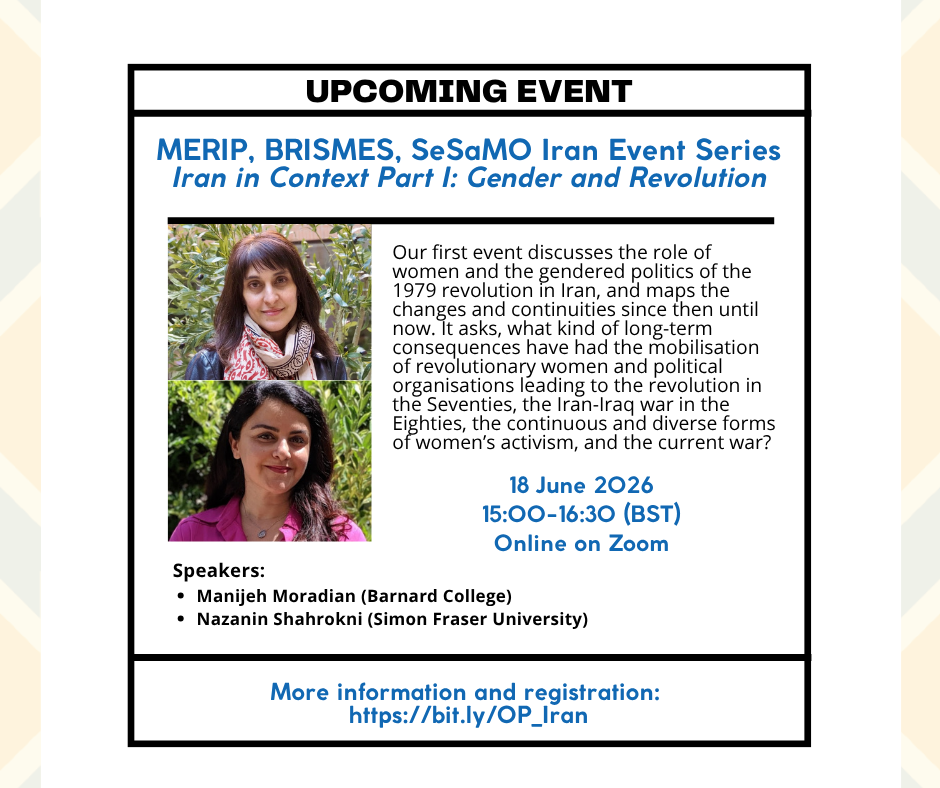
## EVENT: Iran in Context Part I: Gender and Revolution
For summer 2026, MERIP will be hosting a multi-part event series, “Iran in Context,” in collaboration with BRISMES and SeSaMO. This series will feature leading experts on Iran in conversation with MERIP's executive director, James Ryan, MERIP editorial committee member and BRISMES board member Sabiha Allouche and SeSaMO secretary Paola Rivetti.
The first event in this series features Manijeh Moradian (Barnard College) and Nazanin Shahrokni (Simon Fraser University) and will examine the role of women beginning with the gendered politics of the 1979 revolution in Iran up to the present. The discussion will explore the long-term consequences of women's political mobilization in key historical moments: from the 1970s, through the Iran-Iraq war, the reform period and more recent movements. For more information and to register visit the BRISMES site below.
[Event Registation](https://www.brismes.ac.uk/events/outreach-and-pedagogy/merip-brismes-sesamo-iran-event-series)
SUPPORT MERIP
MERIP comes to you free, without paywalls. Make a donation today to help us keep it that way!
[DONATE ](https://www.merip.org/donate/)
### Rethinking Political Change in Iran from Protest to War
URL: https://www.merip.org/2026/06/rethinking-political-change-in-iran-from-protest-to-war/
Last updated: 2026-06-04T09:18:18.000Z
One month before the United States and Israel began the current war against Iran on February 28, 2026, mass uprisings within the country resulted in the severest government crackdown in its modern history. Protests and repression were accompanied by calls for outside intervention. US President Donald Trump declared on January 2 that the United States was “locked and loaded and ready to go” should Iran kill its protesters.[\[1\]](#%5Fedn1) Reza Pahlavi, son of the deposed shah and the most prominent opposition figure outside Iran, stated that “In conditions where the people of Iran are being mowed down in the most brutal manner possible, I do not consider assistance for the liberation of a nation to be aggression.”[\[2\]](#%5Fedn2) On January 10, a group of prominent Iranian intellectuals and opposition figures—including Nobel Peace Prize laureate Shirin Ebadi and filmmaker Mohsen Makhmalbaf—[wrote to Trump directly](https://www.instagram.com/p/DTVg9z0iEUn/?hl=en-gb), declaring that "all avenues for curbing the repression and saving the lives of our compatriots have reached a dead end" and that "an exit from this situation requires international assistance."
These appeals are symptomatic of a broader shift in political prognosis: Both inside and outside of Iran, there is an [increasing perception](https://x.com/HajizadehMoloud/status/2037120355509084643) that efforts by Iranian society to bring about political change have all failed. Protest has failed. Reform has failed. Civic activism has failed. This claim has [circulated widely](https://www.thenation.com/article/world/iran-regime-change-fantasy/) among regime-change opposition activists (*barandazan*) and was significantly amplified in the diaspora through satellite channels like *Iran International* and *Manoto* and prominent figures like Pahlavi, finding resonance inside Iran through social media and Persian-language online spaces. In the latter, the sentiment coalesced in a common refrain: “We have traveled all the roads.”[\[3\]](#%5Fedn3) Defending the US-Israeli war on Iran, US Secretary of State Marco Rubio invoked the same logic, [arguing](https://www.state.gov/releases/office-of-the-spokesperson/2026/03/secretary-of-state-marco-rubio-remarks-to-press-6) that the world had witnessed “successive waves of protests” met only with slaughter.
The claim that nothing has worked draws its force from a history of repression. The Islamic Republic has repeatedly suppressed mass protest through arrest, imprisonment and lethal violence. The uprisings of [2017–2018](https://www.amnesty.org/en/latest/news/2019/01/irans-year-of-shame-more-than-7000-arrested-in-chilling-crackdown-on-dissent-during-2018/), [2019](https://www.hra-news.org/periodical/a-70/), [2022](https://www.hra-news.org/wp-content/uploads/2022/12/Mahsa-Amini-82-Days-Protest-HRA.pdf) and, most recently, [January 2026](https://www.hra-news.org/periodical/a-208/) were all violently suppressed. But the conclusion often drawn from these events—that collective action in Iran has failed—conflates short-term defeat with failure and ignores the traces these defeats leave behind in individuals radicalized, social relations altered and the boundaries of what states can and cannot do. Recent protest movements in Iran have not brought down the Islamic Republic. They have, however, reshaped social norms, altered political calculations and expanded the terrain on which future struggles unfold.
## Woman, Life, Freedom
In 2022, the uprising known globally as the “Woman, Life, Freedom” movement was triggered by the death of Mahsa Jina Amini, a young Kurdish Sunni woman whose killing resonated far beyond the immediate circumstances of her arrest for not wearing the veil properly. The protests spread nationally, lasting several weeks, and were met with intense repression: Hundreds were killed during the protests, thousands were arrested and the months that followed saw a wave of execution sentences.[\[4\]](#%5Fedn4)
> The movement was simultaneously an anti-regime protest, a women's movement and an ethnic and minority rights mobilization.
The protests of 2022 differed from earlier episodes not just in scale and duration but in the convergence of different forms of collective action. The movement was simultaneously an anti-regime protest, a women's movement and an ethnic and minority rights mobilization.[\[5\]](#%5Fedn5) As an anti-regime protest, its political character was unmistakable. The dominant [slogans](https://iranwire.com/en/society/107735-guide-to-the-slogans-heard-at-protests-in-iran/)—"Death to the Dictator" and "Death to Khamenei”—targeted the entire system and its leadership, condensed in the figure of Supreme Leader Ali Khamenei, rather than a specific policy or grievance. As a women's movement, it produced some of its most visceral and widely circulated imagery: women [cutting their hair and burning their hijabs](https://www.euronews.com/culture/2022/10/06/iran-protests-why-is-cutting-hair-an-act-of-rebellion) in public. These acts represented a rejection of state control over their bodies and an assertion of autonomy that resonated globally. As an ethnic and minority rights mobilization, Amini's identity as a Kurdish Sunni woman elicited especially intense mobilization in Kurdish and Sunni regions.[\[6\]](#%5Fedn6)
These protests were also an extension of what sociologist Asef Bayat has referred to as “non-movements:” diffuse, uncoordinated forms of collective action.[\[7\]](#%5Fedn7) Even before 2022, Iranian women had been engaged in years of everyday defiance that quietly accumulated before erupting into the streets. Millions resisted compulsory hijab through everyday practices, wearing their headscarves loose with visible hair and makeup.
Over time, these incremental acts of defiance were punctuated by more organized forms of activism. For example, the [One Million Signatures Campaign](https://merip.org/2025/06/women-and-politics-in-post-jina-iran/) launched by feminist activists in 2006 to reform gender-discriminatory family laws involved coalition building between secular and religious women and successfully blocked regressive legislation. In another instance, Vida Movahed’s public unveiling on Tehran's Revolution Street in 2017 inspired a wave of similar acts across the country. The 2022 uprising came in the context of these decades of struggle and resulted in a shift from partial noncompliance to the widespread removal of the hijab altogether in many urban spaces.
The scale of this transformation has been empirically documented. Research tracking women's appearances on social media [found](https://www.dropbox.com/scl/fi/1d9olc75o9maea65u2mvk/Avenia%5FJMP.pdf?rlkey=5m12egf0wryr3qtxcaux1549z&e=2&st=g8ddstxj&dl=0) that immediately following the Woman, Life, Freedom movement protests, the number of women who appeared without the headscarf increased by 24 percent.[\[8\]](#%5Fedn8) Despite the intransigence of the law, this popular shift persisted in the following years. The same research also found that protest exposure altered dynamics within households: In areas with higher protest activity, household spending shifted away from men and toward women and children—a measure of changing bargaining power within the family—suggesting that the movement's consequences reached not only into public space but into the domestic arrangements that govern everyday life.
Protests have also shaped dynamics within the political elite, although not through a straight line from protest to concession. In May 2024, the unexpected death of Iran’s president Ebrahim Raisi in a helicopter crash triggered a snap election, creating a window that the protests alone could not have done. [Masoud Pezeshkian](https://www.britannica.com/biography/Masoud-Pezeshkian)—a former health minister under President Khatami and long-serving representative of Tabriz, who is himself of Azerbaijani and Kurdish descent—had been disqualified by the Guardian Council from running in the March 2024 parliamentary elections, only to be permitted to run for president just months later. This reversal was itself significant. The gatekeeping body recalibrated in the wake of the protests and Raisi's death, allowing the only reformist candidate on the ballot to compete.
While the election evinced the populace’s disillusionment—the first round recorded [the lowest turnout](https://iranprimer.usip.org/blog/2024/jul/01/june-28-results-irans-2024-presidential-election) in the history of the Islamic Republic, as prominent figures from across the political spectrum, including Nobel Peace Prize laureate Narges Mohammadi, [called for a boycott](https://www.merip.org/2025/06/women-and-politics-in-post-jina-iran/)—Pezeshkian advanced to a runoff against the hardline candidate Saeed Jalili. Turnout rose slightly in the second round to just under 50 percent, as some who had boycotted the first round showed up at the polls in order to avoid a Jalili presidency.[\[9\]](#%5Fedn9) Pezeshkian won with 54 percent of the vote.[\[10\]](#%5Fedn10) His campaign had directly voiced support for the Woman, Life, Freedom protests and pledged to stand against mandatory hijab patrols, the forces responsible for Amini's arrest and death. The protest movement shaped the political terrain on which the election was fought, even if it could not fully determine the outcome.
Pezeshkian appointed a Sunni Kurdish politician as governor of Kurdistan province—the [first Sunni governor](https://english.alarabiya.net/News/middle-east/2024/09/18/iran-s-president-names-first-sunni-governor-in-45-years) since the earliest days of the Islamic Republic—and nominated Abdolkarim Hosseinzadeh as deputy president for rural development, [the first Sunni](https://www.rudaw.net/english/middleeast/iran/18092024) ever appointed to such a position in the history of the Islamic Republic. In an unprecedented move that had never been used against a resigning lawmaker before, the hardline-dominated parliament [voted to reject](https://iranwire.com/en/news/134333-irans-parliament-blocks-abdul-karim-hosseinzadehs-resignation/) Hosseinzadeh's resignation from his parliamentary seat, a procedural requirement for him to take up the executive post. But Pezeshkian persisted, and in October the parliament relented. These were not smooth, top-down concessions. They were incremental gains extracted through political pressure and contested at every step. While they did not dismantle the system of exclusion, they altered its boundaries, establishing new precedents that future governments would not be easily able to ignore.
In 2023–2024, the conservative parliament passed new legislation to intensify penalties for violations of compulsory hijab—an attempt to reassert control in the face of women’s widespread noncompliance. Yet in a telling moment of internal recalibration, Pezeshkian [refused to sign](https://www.tabnak.ir/fa/news/1292538/%D9%BE%D8%B2%D8%B4%DA%A9%DB%8C%D8%A7%D9%86-%D9%82%D8%A7%D9%86%D9%88%D9%86-%D8%B9%D9%81%D8%A7%D9%81-%D9%88-%D8%AD%D8%AC%D8%A7%D8%A8-%D8%B1%D8%A7-%D9%86%D9%85%DB%8C%E2%80%8C%D8%AA%D9%88%D8%A7%D9%86%D9%85-%D8%A7%D8%AC%D8%B1%D8%A7-%DA%A9%D9%86%D9%85) the bill into law, warning that its enforcement would generate social tensions that could endanger national stability. In practice, the regime has retreated: Compulsory hijab remains formally in place, but enforcement has become uneven, selective and in many contexts—such as restaurants and even some progovernment rallies—effectively suspended.
It was precisely the overlap of episodic uprising, electoral mobilization within the system, organized and semi-organized movements and diffuse everyday defiance that generated pressure across multiple fronts, forcing the regime to adjust in ways that no single form of action could have achieved on its own. Moreover, Raisi's death, which had removed not only a sitting president but one of the leading candidates to succeed Khamenei, reshuffled the balance of power among competing factions at a moment when the question of succession was already sharpening internal rivalries and making the adjustments of 2024 possible.
## Routine Collective Action
A similar pattern appears in more routine forms of collective action. Across Iran, [workers](https://www.merip.org/2021/08/labor-organizing-on-the-rise-among-iranian-oil-workers/), [teachers](https://www.merip.org/2017/11/another-brick-in-the-wall/), retirees and nurses have, for decades, engaged in sustained, often weekly sectoral protests, sometimes coordinated across multiple cities. These actions rarely escalate into direct confrontation with the regime’s core institutions, and they are typically met with lower levels of repression: arrests, harassment, occasional violence but not the systematic use of lethal force seen in [nationwide uprisings](https://www.merip.org/2026/01/governing-crisis-sanctions-austerity-and-social-unrest-in-iran/). Precisely because they operate below the threshold of existential threat, they create space, however constrained, for organizing and establishing networks, routines and repertoires of action that can diffuse across localities, building capacity over time. Research shows that districts with higher levels of prior sectoral protest were more likely to participate in subsequent anti-regime mobilizations in 2018, 2019 and 2022.[\[11\]](#%5Fedn11) The finding is not that sectoral movements convert into anti-regime protest but that prior protest activity in a district is associated with higher subsequent mobilization when broader uprisings occur.
> Sectoral protesters—workers, teachers, retirees—have largely continued to pursue their specific economic and professional demands rather than joining anti-regime uprisings as organized blocs...
These findings illustrate that different forms of protest can reinforce one another despite tensions and differences in their goals and strategies. Sectoral protesters—workers, teachers, retirees—have largely continued to pursue their specific economic and professional demands rather than joining anti-regime uprisings as organized blocs; [the 2022 oil contract workers' strikes](https://menasolidaritynetwork.com/2022/12/16/the-uprising-has-entered-a-revolutionary-dynamic-peyman-jafari-on-the-revolt-in-iran/) in solidarity with Mahsa Amini protests were a notable exception rather than the rule, which has held even for the 2026 uprisings. These protesters operate through what political theorist Steven Klein and sociologist Cheol-Sung Lee call a “politics of influence:” pressing for concrete, winnable demands—wages, pensions, freedom of association, an end to executions—and deliberately avoiding provoking security forces or escalating into direct confrontation with the state.[\[12\]](#%5Fedn12) Even their more radical demands stop short of calling for the regime's immediate downfall.
The regime-change opposition, by contrast, understands its own practice through what Klein and Lee call a “politics of occupation,” that is, a mode of action oriented toward escalation, mass street presence and direct confrontation, premised on the belief that change requires seizing and transforming the political space rather than pressuring it from within civil society.[\[13\]](#%5Fedn13) These are different tactics that reflect fundamentally different theories of how social change happens. Sectoral protesters may seek to avoid exposing themselves and their movements to harsher repression by openly calling for regime overthrow. Yet they have remained consistent in criticizing regime brutality, demanding expanded liberties and opposing both repression at home and foreign intervention and war.
## Reconsidering Failure
In Poland in the 1980s, which provides an interesting historical precedent, the Solidarity movement did not initially demand the collapse of the communist regime, not because it accepted the system but because it recognized the limits imposed by the balance of power. Its central demand in 1980 was the legalization of independent trade unions: an unprecedented concession that opened space for millions to organize and practice collective self-governance. Although these gains were later reversed, the capacities developed during that period endured. When strikes returned in 1989, negotiated reforms led to elections that produced a decisive victory, clearing the way for broader transformation. Judged in the short term, Solidarity might have appeared a failure. Over time, it became a central force in democratic transition.
> When strategies based on immediate escalation—foreign wars chief among them—are likely to provoke repression, de-escalation as a way of preserving and extending the resources of collective action becomes an essential component of any viable approach.
The lesson is that achievements short of regime collapse can be both radical and consequential. In the case of Iran, political change might be more achievable through the gradual expansion of social capacity. When strategies based on immediate escalation—foreign wars chief among them—are likely to provoke repression, de-escalation as a way of preserving and extending the resources of collective action becomes an essential component of any viable approach. Here, de-escalation is not demobilization but advancing measured demands, maintaining nonviolent discipline and relying on persuasion instead of coercion. Sectoral activists have adopted this approach: pressing for consequential demands—freedom of speech, free internet, freedom of assembly in universities and public spaces—without escalating into direct confrontation with the state. Instead of demanding the regime's immediate collapse, these movements chip away at the conditions that make authoritarianism sustainable.
Moreover, the Polish example illustrates why movements should not be assessed solely by their immediate outcomes. As both the uprisings of 2022 and sectoral protests suggest, the claim that nothing has worked is unfounded. Defining success exclusively as immediate regime collapse renders other forms of political change invisible, foreclosing important conversations about strategy. Any strategy for political change must begin from a clear-eyed assessment of the regime it confronts. The Islamic Republic is not a fragile system on the verge of collapse. It is a resilient one with [the capacity to mobilize supporters](https://www.journalofdemocracy.org/online-exclusive/why-the-iranian-regime-owns-the-streets/) and coordinate response in moments of crisis, marked by relatively high elite cohesion and a multilayered coercive apparatus.[\[14\]](#%5Fedn14) These features shape how it responds to pressure. In such a context, rapid escalation, especially one that is highly exclusionary, is more likely to produce consolidation rather than fragmentation, and the current war on Iran is [unlikely](https://alikadivar.substack.com/p/the-fantasy-of-liberation-by-war) to be an exception. If anything, the scale of destruction produced by the ongoing US-Israeli war, and the forms of militarization war tends to generate, make it unlikely that postwar Iranian politics will resemble its prewar trajectory. Institutional balances, social alignments and the scope for collective action may all be reshaped, likely in more constrained ways.
And yet the past trajectories of protest, social movements and everyday resistance examined here remain analytically and politically relevant. The mechanisms through which sustained collective action reshapes incentives, shifts boundaries and accumulates capacity will not disappear with changed conditions. However constrained the postwar terrain, the question of how Iranian society organizes and builds toward democratic change will remain central. The answer will not come from outside.
\[**Mohammad Ali Kadivar** is an associate professor of sociology and international studies at Boston College.\]
SUPPORT MERIP
Support MERIP in providing critical, grounded reporting and analysis. Make a one-time or monthly donation today!
[DONATE NOW! ](https://www.merip.org/donate/)
---
[\[1\]](#%5Fednref1) Shola Lawal, “[Has Trump confirmed Iran’s claim that protesters were US-armed?](https://www.aljazeera.com/news/2026/4/6/has-trump-confirmed-irans-claim-that-protesters-were-us-armed),” *Al Jazeera,* April 6, 2026.
[\[2\]](#%5Fednref2)Claire Keenan, “[Trump warning over Iran protests 'reckless' says foreign minister](https://www.bbc.co.uk/news/articles/c2057md3gvro),” BBC, January 3, 2026.
[\[3\]](#%5Fednref3) Hossein Razzaq, "Az 'Hame Rahha ra Raftim' ta 'Faghat Jang Mande': Royafurushi-ye Opozisyon-e Bi-Rahbord," *Radio Zamaneh*, April 25, 2026\. \[In Persian\]
[\[4\]](#%5Fednref4) Human Rights Activists News Agency, [*Iran Protests 2022—Detailed Report of 82 Days of Nationwide Protests in Iran*](https://www.en-hrana.org/wp-content/uploads/2022/12/82-Day-WLF-Protest-in-Iran-2022-English.pdf) (2022).
[\[5\]](#%5Fednref5) Mahbubeh Moqadam, “Fractal Scaling of Feminist Politics and the Emergence of Woman Life Freedom Movement in Iran,” *Social Forces* 104/2 (December 2005).
[\[6\]](#%5Fednref6) Mohammad Ali Kadivar et al., “Contingency of Structures: Triggers and the Social Geography of Revolutionary Episodes in Iran 2017-2022,” *SSRN Electronic Journal.*
[\[7\]](#%5Fednref7) Asef Bayat. *Life as Politics: How Ordinary People Change the Middle East* (Stanford: Stanford University Press, 2013).
[\[8\]](#%5Fednref8) Avenia Ghazarian, “Veils of Change: The Anatomy of Social Transformation in Post-Protest Iran,” Working paper.
[\[9\]](#%5Fednref9) Farnaz Fassihi, “[Reformist Candidate Wins Iran’s Presidential Election](https://www.nytimes.com/2024/07/05/world/middleeast/iran-election-reformist-wins.html),” *The New York Times*, July 5, 2024.
[\[10\]](#%5Fednref10) Ibid.
[\[11\]](#%5Fednref11) Mohammad Ali Kadivar et al., “Contingency of Structures: Triggers and the Social Geography of Revolutionary Episodes in Iran 2017-2022,” *SSRN Electronic* Journal (December 2025)*.*
[\[12\]](#%5Fednref12) Steven Klein and Cheol-Sung Lee, “Towards a Dynamic Theory of Civil Society: The Politics of Forward and Backward Infiltration,” *Sociological Theory* 37/1 (March 2019).
[\[13\]](#%5Fednref13) Ibid.
[\[14\]](#%5Fednref14) Steven Levitsky and Lucan Way, *Revolution and Dictatorship: The Violent Origins of Durable Authoritarianism* (Princeton: Princeton University Press, 2022).
### Iran in Context Part I: Gender and Revolution
URL: https://www.merip.org/event/iran-in-context-part-i-gender-and-revolution/
Last updated: 2026-07-01T13:19:44.000Z
For summer 2026, MERIP will be hosting a multi-part event series, *Iran in Context,* in collaboration with BRISMES and SeSaMO. This series will feature leading experts on Iran in conversation with MERIP's Executive Director, James Ryan, MERIP editorial committee member and BRISMES board member Sabiha Allouche, and SeSaMO Secretary Paola Rivetti.
The first event in this series features Manijeh Moradian (Barnard College) and Nazanin Shahrokni (Simon Fraser University) and will examine the role of women the gendered politics of the 1979 revolution in Iran, mapping changes and continuities up to the present. We will discuss the long-term consequences of the women's political mobilization in the 1970s, through the Iran-Iraq war, and beyond. For more information and to register, visit the BRISMES site below.
[INFO AND REGISTRATION](https://www.brismes.ac.uk/events/outreach-and-pedagogy/merip-brismes-sesamo-iran-event-series)
**Manijeh Moradian** is associate professor of Women’s, Gender and Sexuality Studies at Barnard College, Columbia University. Her book, *This Flame Within: Iranian Revolutionaries in the United States* (Duke University Press, 2022) won the 2024 Hamid Naficy Book Award for the best book in Iranian Diaspora Studies from the Association of Iranian Studies and the Center for Iranian Diaspora Studies. The book also received an Honorable Mention for the 2023 Middle East Studies Association Nikki Keddie Book Award. She has published widely including in *American Quarterly,* *Meridians, Journal of Asian American Studies, Radical History Review, Scholar & Feminist online,* [*jadaliyya.com*](http://jadaliyya.com/) and *Meridians.* She is a founding member of the Raha Iranian Feminist Collective and a member of Feminists for Jina, a global network which formed in fall 2022 to support the women, life, freedom uprising in Iran.
**Nazanin Shahrokni** is a sociologist and Associate Professor in the School for International Studies at Simon Fraser University in Vancouver, Canada. Her scholarship sits at the intersection of the global politics of gender, embodiment, mobility, state power, and transnational political formations, with a particular focus on Iran and the Middle East. She is the author of the award-winning *Women in Place: The Politics of Gender Segregation in Iran* (University of California Press, 2020), and has co-edited several scholarly volumes and special issues. Her scholarship has appeared in various public-facing venues including *Middle East Report*, *Jadaliyya*, *Spectre Journal*, and *Truthout*. Her 2024 article in*Humanity Journal*, “Depleted Households: Domesticating Economic Sanctions,” received Honorable Mention for the Arlene Kaplan Daniels Paper Award from the Society for the Study of Social Problems. She currently serves on the Executive Committee of the International Sociological Association, where she chairs the Statutes Committee.
You listen to the recording of this event on The MERIP Podcast below, or wherever you get your podcasts.
---
SUPPORT MERIP
Help us continue to bring events, analysis and podcasts to the world without paywalls! Donate today!
[DONATE ](https://www.merip.org/donate/)
### The MERIP Podcast Episode 22: Aslı Bâli and Darryl Li
URL: https://www.merip.org/2026/05/the-merip-podcast-episode-22-asli-bali-and-darryl-li/
Last updated: 2026-05-07T13:00:37.000Z
Today's episode of the MERIP Podcast features an interview with two contributors to the spring issue of *Middle East Report*, [“Campus Politics—Palestine and the New University Order.”](https://www.merip.org/issue-318/) Since the beginning of world-wide campus protests in the wake of October 7, 2023, there has been a tremendous upswell of organizing and support for Palestinian liberation and activism against US militarism. In response, a wave of repression against students, staff and faculty on campus began in 2023 and accelerated after Donald Trump took office. Our latest issue takes stock of these dynamics and the stakes of political action on campus in the United States, Europe and the Middle East.
To discuss campus politics in our present moment, MERIP’s executive director, James Ryan, was joined by Aslı Bâli and Darryl Li. Aslı Bâli is the Howard M. Holtzmann Professor of Law at Yale Law School and the former president of the Middle East Studies Association. Her article in this issue, [“Fighting the Campus Crackdown–Why the Middle East Studies Association Took the Trump Administration to Court,”](https://www.merip.org/2026/04/fighting-the-campus-crackdown-why-the-middle-east-studies-association-took-the-trump-administration-to-court/) is a reflection on MESA’s lawsuit, with the American Association of University Professors and the Knight First Amendment Institute, against Secretary of State Marco Rubio and the Trump Administration over the free speech rights of noncitizens, like Rümeysa Öztürk and others, who spoke up about Israel’s genocide in Gaza. Darryl Li is an associate professor of Anthropology and Social Sciences at the University of Chicago, and a contributor, along with Andrew Ross, Lara Deeb, Meera Shah and Lisa Hajjar to [“The University is a Site of Struggle—A Roundtable with Faculty Organizers on Repression and Resistance on US Campuses.”](https://www.merip.org/2026/04/the-university-is-a-site-of-struggle-a-roundtable-on-repression-and-resistance-on-us-campuses/)
This interview was recorded on May 5, 2026.
[Listen on Apple Podcasts](https://podcasts.apple.com/us/podcast/episode-22-asl%C4%B1-b%C3%A2li-and-darryl-li/id1823259361?i=1000766614461)
[Listen on Spotify](https://open.spotify.com/episode/53kaf6Kr4Ufhbb25UbTQp6)
[Listen on Amazon Music](https://music.amazon.com/podcasts/d73ad16e-0e22-4ca4-80f1-cf61dade333e/episodes/138236fd-9a32-464c-930a-30d9b6700549/the-merip-podcast-episode-22-asl%C4%B1-b%C3%A2li-and-darryl-li)
SUPPORT MERIP DURING DELCO GIVES
Every donation of $10 or more before 7PM EST on May 7 helps MERIP unlock bonus funds from the Foundation for Delaware County. Give now!
[DONATE NOW ](https://www.merip.org/donate/)
Further Reading:
Aslı Bâli,[ “Fighting the Campus Crackdown](https://www.merip.org/2026/04/fighting-the-campus-crackdown-why-the-middle-east-studies-association-took-the-trump-administration-to-court/)[—](https://www.merip.org/2026/04/the-university-is-a-site-of-struggle-a-roundtable-on-repression-and-resistance-on-us-campuses/)[Why the Middle East Studies Association Took the Trump Administration to Court”](https://www.merip.org/2026/04/fighting-the-campus-crackdown-why-the-middle-east-studies-association-took-the-trump-administration-to-court/) *Middle East Report,* no. 318 (Spring 2026).
Lisa Hajjar, Lara Deeb, Darryl Li, Andrew Ross and Meera Shah, [“‘The University is a Site of Struggle—A Roundtable with Faculty Organizers on Repression and Resistance on US Campuses”](https://www.merip.org/2026/04/the-university-is-a-site-of-struggle-a-roundtable-on-repression-and-resistance-on-us-campuses/) *Middle East Report*, no. 318 (Spring 2026).
[The MESA Academic Freedom Initiative](https://afi.mesana.org/)
MESA and AAUP, “[Discriminating Against Dissent: The Weaponization of Civil Rights Law to Repress Campus Speech on Palestine](https://mesana.org/advocacy/task-force-on-civil-and-human-rights/2025/11/05/discriminating-against-dissent-the-weaponization-of-civil-rights-law-to-repress-campus-speech-on-palestine),” November 5, 2025.
[Palestine Legal 2025 Report](https://palestinelegal.org/news/palestine-legal-2025-report)
[The Knight First Amendment Institute](https://knightcolumbia.org/)
PEN America, [“Expanding the Web of Control–America’s Censored Campuses 2025,”](https://pen.org/report/americas-censored-campuses-25-web-of-control/) January 15, 2025\.
### MER 318: Campus Politics–Palestine and the New University Order
URL: https://www.merip.org/2026/04/mer-318-campus-politics-palestine-and-the-new-university-order/
Last updated: 2026-04-29T13:00:52.000Z
Dear Friends and Comrades,
Today, we published our spring 2026 issue of *Middle East Report*, [“Campus Politics—Palestine and the New University Order.”](https://www.merip.org/issue-318/) Its publication comes on the second anniversary of the university encampments, the high point of campus mobilizations against the Gaza genocide that ignited faculty, student and labor organizing for the Palestinian cause in a new generation. The issue examines the student protests since October 7, 2023, and the transnational nature of campus politics in the United States, Europe and the Middle East. It also follows the federal government’s assault on universities, which escalated in the first year of US President Donald Trump’s second term and was often characterized as a reprisal for the failure of university administrations to punish their students and faculty even more severely than they already had. The outbreak of the US-Israeli war on Iran in late February only intensified this assault, as [at least](https://www.theguardian.com/us-news/2026/apr/03/washington-college-professor-fired-iran-war-criticism) [two](https://www.5newsonline.com/article/news/local/u-of-a-president-fire-tenured-professor-reported-anti-israel/527-b25f6f82-b334-4b5b-bebd-fed8880aec6c) colleagues in Iranian studies have faced sanction and dismissal for their criticism of the war.
[READ THE ISSUE](https://www.merip.org/issue-318/)
This attack on expressions of Palestinian solidarity and on Middle East Studies in the university has spread to other areas of life in the United States and beyond. As Torin Monahan [details](https://www.merip.org/2026/04/censorship-and-surveillance-at-us-universities/), university campuses in the United States have caved to a web of surveillance, censorship and securitization that began as attempts to quash Palestine organizing and have accelerated under the Trump administration to a much wider remit. Aslı Bâli, in her piece on [MESA’s lawsuit](https://www.merip.org/2026/04/fighting-the-campus-crackdown-why-the-middle-east-studies-association-took-the-trump-administration-to-court/) against the administration, and two roundtables—one featuring [student activists](https://www.merip.org/2026/04/after-the-encampments-a-roundtable-with-student-organizers-on-palestine-the-university-and-what-comes-next/), the other [faculty organizers](https://www.merip.org/2026/04/the-university-is-a-site-of-struggle-a-roundtable-on-repression-and-resistance-on-us-campuses/)—chronicle both the increasingly repressive university order as it spills beyond the campus and the ongoing modes of resistance.
These dynamics are not limited to the United States. Readers of this issue will learn how the fight in the United States for free expression, against authoritarianism and for a free Palestine has echoes within campus movements in Europe, Turkey and Egypt. As Sean Lee and Mostafa Hefny [point out](https://www.merip.org/2026/04/student-protest-and-the-politics-of-palestine-in-egypt/), three quarters of pro-Palestine protests worldwide, many of which took place or originated on campus, were concentrated in the Arab world, Turkey, Iran, the United States, France, Italy, Spain and Australia, but in Arab autocracies that have normalized with Israel, the stakes of these protests are even higher. Across these geographies, the university remains, as Andrew Ross puts it, [“a site of struggle.”](https://www.merip.org/2026/04/the-university-is-a-site-of-struggle-a-roundtable-on-repression-and-resistance-on-us-campuses/)
I hope you find this issue enriching. Please share it and let us know what you think by responding to this email. Thanks for being with us and, as always, for your [support](https://www.merip.org/donate/) that keeps us going.
In Solidarity,
James Ryan
Executive Director
SUPPORT MERIP
Your gift to MERIP goes farther during Delco Gives! Every donation of $10 or more before May 7 unlocks more bonus funds from the Foundation for Delaware County. Give today!
[Learn more ](https://www.merip.org/donate/)
### ‘Real Revolutionaries Don’t Punch Down’—Remembering Muzan Alneel
URL: https://www.merip.org/2026/04/real-revolutionaries-dont-punch-down-remembering-muzan-alneel/
Last updated: 2026-04-29T16:15:53.000Z
On April 15, 2026, the third anniversary of Sudan’s counterrevolutionary war, we learned of the loss of Muzan Alneel. We have been tasked with commemorating the impossible, walking the memory lane of Muzan’s life journey through the eyes of three women who knew her closely and intimately over the years albeit in different capacities and under varying conditions. We loved and were loved by her in ways that were both personal and political, a condition that also underwrote women’s mobilization in the years after the revolution. Our enduring connection is further shaped by a larger national project of freedom, peace and justice. Like the war itself, Muzan’s loss is an occasion of collective struggle that we must articulate, politically and meaningfully, while we endure.
To understand the significance of Muzan’s contribution to sustaining revolutionary momentum in Sudan, one need look no further than the bold and principled imaginary that underwrote her life’s work and politics. She firmly placed people—not a model, whether developmental, statist or even welfarist—at the center of her advocacy for lasting change. No example illustrates this approach better than her widely [cited](https://www.instagram.com/reels/DXKsRFwAT8k/) line: “It is my political position that people not be killed.” In a sea of political opinions, few slogans captured the imaginary of the Sudanese revolutionary struggle quite like this one—what she held as her longest-standing and, ultimately, final position on the dire state of affairs in Sudan.
Muzan was born in Omdurman, Sudan’s social and political precolonial capital. She trained initially as an engineer but found herself drawn to the social sciences, more so after the 2019 revolution. The revolution opened up spaces for organic thinkers like herself, and the time between 2019 and her untimely passing ended up being an opportunity and space that defined and was defined by her unique [style of thinking and writing](https://www.merip.org/2021/12/the-evolution-of-sudans-popular-political-forces/). She never shied away from introducing bold methodologies to otherwise rigid disciplines. A long-running advocate of bringing economics back to the people, Muzan, together with a close group of her revolutionary comrades, set up [ISTinaD](https://istinad.org/?fbclid=IwZXh0bgNhZW0CMTEAc3J0YwZhcHBfaWQKNjYyODU2ODM3OQABHm62BrlSLcRwAeeIbSjXD7m9OTP1QCg7eN2i0vygDHsVLgkPkMXA77pyZW7s%5Faem%5Ftwriew4EF2nS2RDECnm97g)—an innovation, science and technology policy think tank that prioritizes the wellbeing of people and communities.
Muzan’s passing brings to the fore many memories—each a profound teaching moment about how the Sudanese revolution, through the conviction and bravery of its civic actors, attempted to chart a different path toward democracy. Her lifeworld reflects some of the most significant values of the movement’s call for liberation. We honor her by returning to them here, turning an obituary into a teach-in, as she would have liked.
A pacifist at heart in both her political outlook and organizational ethics, Muzan had an unwavering commitment to the values of long-standing, cumulative resistance. This commitment came through clearly in a remark she made in a public debate forum on “What Is to Be Done” to restore the path toward a civilian transition in the aftermath of the 2021 coup: “I’ve been caught up in the never-ending loop of political organizing since 2006, others contributed decades. We can only carry the lessons of each struggle forward. There is no other or faster way.” Her words offer an implicit warning against the current state of polarization, the seduction of warring narratives and the normalization of violence in the name of expedient endings.
In Sudan, over decades of conflict, peace has often evolved into a death machine, sustained by the whims of those who wield weapons or possess money. In South Sudan and in Darfur, multiple and successive peace projects across Sudan’s postcolonial history [shifted patterns of violence](https://www.merip.org/2024/04/land-livestock-and-darfurs-culture-wars-310/) rather than bringing them to an end, leading eventually to the full outbreak of war. It was precisely this logic that Muzan and her comrades sought to break from, developing a revolutionary discourse that departed from conventional models of postcolonial state building and put them at odds with so-called peacemakers, statists and proponents of "good governance" agendas. Her position, then, can be understood as a refusal to accept that the price of an order managed through violence—what some would call “peace”—should be exacted at the expense of people’s right to life, again capturing the essence of her immortalized tagline: “It is my political position that people not be killed.”
All of Muzan’s organizing efforts—whether in writing, mobilizing or reimagining public policy—were in service of finding alternatives to centralized, imposed governance by placing people and their many and varying capabilities at the center of national rebuilding. She was a firm advocate of the right to choose, the right for the Sudanese people to make political and economic choices, and she understood how these actions contributed to their sense of self-worth and responsibility in relation to the collective citizenry. For Muzan, this social contract is what induces nation building toward lasting peace, not the social distinctions imposed by a centralized authority as was and continues to be the case in Sudan.
One of her [finest pieces](https://atarnetwork.com/wp-content/uploads/2024/04/ATAR-English-Issue-3.pdf), published in 2024 in the third issue of the Sudanese grassroots publication *Atar,* addresses these dynamics in the context of the current war. There, together with Moez Ali, she redefines mutual aid—Sudan’s largest sociopolitical project surviving the revolution—not as charity but as a communally financed operating system guided by the principles of sustainability and a people-centered philosophy. This formulation builds on extensive organizational work from within the Sudanese political tradition, offering lessons to other movements grappling with devastation. She later extended these reflections in another *Atar* piece on returning to [socialist horizons after immense conflict](https://atarnetwork.com/wp-content/uploads/2024/12/ATAR-English-Issue-18-Opinion-Clarifying-our-path-towards-socialist-answers-from-for-Sudan.pdf), a message against mere survivalism in which she urged people to build lasting systems of justice and welfare through, and despite, the struggle.
Muzan’s intellectual contributions extended beyond national sovereignty to reimagining transnational solidarity and internationalism. Her work on the intersecting paths of [Sudan and Palestine](https://www.tni.org/en/article/failing-palestine-by-failing-the-sudanese-revolution) in politics, organizing and media recalls the principles of an internationalism the left has largely abandoned. In one of her [last pieces](https://www.tni.org/en/article/back-to-the-future), written with Gussai H. Sheikheldin, she revisited Julius Nyerere’s vision of self-reliant development to argue that meaningful sovereignty, from Palestine to Africa, depends on collective, people-centered economic and political projects built through South-South collaboration.
Yet perhaps Muzan’s most enduring contribution was to the Sudanese feminist project. Against its liberalization and underrepresentation, she relentlessly advanced analyses grounded in class, region, ethnicity and, more recently, the implications of war‑induced destitution on the most vulnerable, continually refining her tools to bring feminism closer to women’s lives. Like the rest of her intellectual work, her feminist practice went beyond reading and study. It came from a full and deeply engaged life that centered the struggles of others. She listened as intently as she spoke, treating listening not as a courtesy but a political practice, a way of ensuring that thought never outran people or their lived realities.
“Real revolutionaries don’t punch down,” she often said. It was both a political principle and a measure of genuine allyship. She modelled a fierce praxis of care: a patient, loving friend and a force of life and purpose on even the darkest days. Her kindness was not softness but a radical and deliberate refusal of cruelty as political logic. In a context as restrictive to women as that of Sudan, Muzan performed the unspoken work of creating spaces and providing access where there was little or none. She embodied a form of political womanhood that exceeded imposed limitations: kind while still firm and unwavering. She rejected calls for reform—a tactic employed to align political agendas and absorb women’s voices—choosing instead to invest in knowledge creation and trusting people, women especially, to arrive at their own choices and positions.
Muzan laughed loudly, danced freely, sang openly and loved deeply and wholeheartedly, insisting that a life devoted to justice must also be fully lived. Joy was central to who she was, as it was to sustaining the revolutionary struggle. She brought together intellect and humanity in a way that was unforgettable—rigorous in thought, generous in spirit and vibrant in life. We remember and carry forward her radicality in resistance, her joy and her unwavering hope for tomorrow.
Muzan is survived by her husband Ahmed Mahmoud, her three loving sisters Marine, Misdar and Malab, her mother Enaam Elyas and her father Abu Obedia Alnile.
\[**Walaa Salah** is a human rights lawyer from Sudan. **Rania Aziz** is a Sudanese researcher and a pro-democracy activist. **Raga Makawi** is a Sudanese editor and researcher.\]
### How German Media Failed Gaza
URL: https://www.merip.org/2026/04/how-german-media-failed-gaza/
Last updated: 2026-04-29T12:38:41.000Z
**A Review of Fabian Goldmann, *Staatsräsonfunk. Deutsche Medien und der Genozid* *in Gaza* (Manifest Verlag, 2026).**
Germany’s media sphere was profoundly ruptured by the events of October 7, 2023\. The media treated Hamas’s surprise attack on Israeli communities near Gaza’s border as a spectacle of extreme, irrational violence, while largely obfuscating the violence Israel immediately began exacting on Palestinians. Newspapers and broadcasts defended Israel’s indiscriminate bombings as necessary, using language that uncritically echoed Israeli military communiqués and insinuated the collective responsibility of Palestinians, all to justify what so blatantly violated espoused notions of international law and universal human rights. The level of distortion exceeded the biases and omissions that previously characterized coverage of Palestine.
I experienced the editorial gatekeeping of Germany’s left-liberal media firsthand: A pitch to review Rashid Khalidi’s *The Hundred Years’ War on Palestine* remained unanswered. I later learned that a subsequently published scathing review had been commissioned in response to my initial pitch. In a piece calling on Germany’s government to reinstate its UNRWA funding, a copyeditor inserted unauthorized last-minute edits to defang all criticism of Israeli and German policy. An article providing historical background on Lebanon was returned too factually flawed and analytically gutted to publish.
During Israel’s war on Gaza substantial sections of the German public clung tightly to two beliefs: The world’s most moral army could not possibly commit the crimes Israel stood accused of, most prominently genocide, and Germany’s popular, pluralistic and well-trusted public broadcasting and private legacy media would never conceal such a reality. Over time, while the state [increased its domestic repression](https://www.ohchr.org/en/press-releases/2026/02/germany-un-expert-warns-space-freedom-expression-shrinking-amidst-growing) of dissenting protestors, artists and academics, public opinion slowly shifted. By mid-2024, [half the German population](https://www.infratest-dimap.de/umfragen-analysen/bundesweit/umfragen/aktuell/umfrage-zu-vertrauen-in-deutsche-gaza-berichterstattung/) had little to no trust in Germany’s Middle East coverage. In the years since, Israel has devastated Gaza, signed and broken ceasefires and started another consequential war on Iran with the United States. With few exceptions, Germany’s political and media establishment has effectively backed all of these initiatives, including the goals of the war in Iran; even as its illegality has sparked occasional reservations, there has been no serious debate about reconsidering the country’s alliances.
Distorted coverage of Palestine has long exposed global patterns of political and media bias. The case of German media provides a drastic—if somewhat familiar—example. Journalist Fabian Goldmann offers a comprehensive account of these dynamics in his recently published book, *Staatsräsonfunk. Deutsche Medien und der Genozid in Gaza* (*Broadcasting the Reason of State.* *German Media and the Genocide in Gaza*). Its provocative title is a witty portmanteau. *Staatsräson* (Reason of State) denotes Germany’s doctrine of unconditional support for Israel, while *Staatsfunk* is a pejorative, right-coded term for “state-controlled media.” The mashup implies that German media is beholden to the state’s support for Israel.
After October 7, Goldmann extensively documented the German media’s distortions on [his](https://www.facebook.com/goldmannfabian/) [social](https://www.instagram.com/fabian%5Fgoldmann/) [media](https://x.com/goldi) [accounts](https://bsky.app/profile/goldi.bsky.social), his [blog](https://www.schantall-und-scharia.de/) and in left-leaning publications. His new book constitutes the sum of his research. Its undoubted strength is the quantitative analyses of 11,125 news items published between Oct 7, 2023 and January 19, 2025, in five leading journalistic outlets: the flagship public broadcaster’s nightly news program, *Tagesschau* (the day’s news); the investigative newsmagazine, *Der Spiegel*; the left-liberal weekly, *Die Zeit*; the tabloid paper, *BILD* and the self-described leftist daily, *taz*. Supplementing this analysis are a foreword by Ilan Pappé, a narrative chronology, statistics and data visualizations.
The book’s main contribution is its meticulous documentation of how German media abandoned its own journalistic standards. Instead of impartially covering Israel’s actions in Gaza, the media actively concealed, obscured, downplayed, legitimized and outright justified the violence. Taking up UN Secretary General Antonio Guterres’s dictum of Gaza’s devastation as a “failure of humanity itself,” Goldmann argues that, outside of Israel, this failure was most consequential in Germany, where it compromised political parties, institutions and the media sphere at large.[\[1\]](applewebdata://C7529B95-D08A-425C-861E-49FB79A8B4CD#%5Fedn1) Few observers called out the media’s biases, and criticism rarely came from within. Lacking alternative German-language coverage of the Middle East, Germans switched to social media or the foreign press for accurate assessments of what was happening in Gaza. Although he highlights a few positive exceptions, Goldmann focuses on providing a concise anatomy of the structural conditions for what he calls the German media’s “systemic failure”—a failure that raises fundamental questions about the relationship of media to power and the status quo.
## Deviating from Journalistic Standards
Sketching out a harrowing chronology of media failures, Chapter 2 shows how Germany’s journalists quickly abandoned the professional ethics of fact checking, non-stigmatization, impartiality, contextualization and the presentation of multiple perspectives. Immediately debunked fake news like Hamas’s supposed beheading of 40 babies was published without verification across German media, rarely eliciting corrections or consequences. Three people distributing baklava in Berlin’s Arab Neukölln district to celebrate the October 7 attacks was covered in over 500 news items, prompting domestic demonization of Muslims, Arabs, Palestinians and Neukölln itself as antisemitic. Leading journalists openly declared their solidarity with and loyalty to Israel, and efforts to provide historical and political context were misconstrued as legitimizing terrorism.
In 15 months, *tagesschau*—watched ritually by millions every day—featured Israeli representatives 136 times, while Palestinian representatives appeared only four times. When Palestinians featured, they did so as “perfect victims”—aggrieved civilians or doctors—not as political subjects or analysts.[\[2\]](applewebdata://C7529B95-D08A-425C-861E-49FB79A8B4CD#%5Fedn2) Instead, the Palestinian perspective was represented by UN statements in a false equivalence to Israel’s. Moreover, UNRWA’s Philippe Lazzarini and Francesca Albanese were each featured only once, as were Amnesty International, Human Rights Watch and independent NGOs active in Gaza.
Chapters 3 and 4 chronicle German journalism’s overreliance on official Israeli statements and public relations materials as its main, and frequently only, source. All five news outlets repeated Israeli claims that Hamas’s command centers were placed within or below civilian infrastructure hundreds of times, without providing any source aside from Israel’s military. Goldmann traces the use of “Hamas-led” as a discrediting qualifier for Palestinian institutions like the health ministry across a broader sample of newspapers, noting its upsurge from 352 usages in the 35 years prior to October 7, 2023, to 826 usages within the ensuing three months. In a total of 4,856 headlines, Israeli sources were represented in 43 percent, Palestinian sources in 5 percent, supranational institutions in 8 percent and Gaza-based NGOs in just 1 percent. Palestinian and Arab media and journalists barely featured. German journalists, who cast Gaza as a so-called inaccessible black box, willfully blinded themselves by not seeking out additional sources. These patterns have repeated in recent coverage of Lebanon and Iran.
> Instead of interrogating Israeli government sources, journalists adopted their unverified statements, rendering the German media complicit, Goldmann argues, in dismantling protective measures for civilians and in Gaza’s ultimate mass destruction (Chapter 4).
Instead of interrogating Israeli government sources, journalists adopted their unverified statements, rendering the German media complicit, Goldmann argues, in dismantling protective measures for civilians and in Gaza’s ultimate mass destruction (Chapter 4). For example, they parroted unsubstantiated Israeli allegations that hospitals acted as “terror clinics”—from the largest in Gaza, Al-Shifa Hospital, to all the others—largely ignoring objections by the UN, World Health Organization and many international news outlets. German Chancellor Olaf Scholz and leading journalists went from denouncing ceasefire appeals as beneficial to Hamas even after 4,500 children had been killed to declaring that Hamas was blocking the ceasefire, echoing shifting Israeli claims. A [fabricated news leak](https://www.dropsitenews.com/p/new-york-times-ignored-doubts-hamas-iran-october-7-documents) by the tabloid *BILD* to help Israeli Prime Minister Benjamin Netanyahu torpedo ceasefire negotiations triggered no domestic media scandal or major protests, nor did Israel’s [systematic assassination](https://cpj.org/issue/israel-gaza-war/) of Gaza’s journalists. Despite no credible evidence, Hamas’s alleged use of human shields remains a constant trope, while Israel’s extensive, [well-documented](https://www.democracynow.org/2025/5/29/israeli%5Fsoldiers%5Fusing%5Fpalestinians%5Fhuman%5Fshields) [use](https://apnews.com/article/israel-palestinians-hamas-war-army-human-shields-80f358dd2c87a1123f26ffada159701c) of [the practice](https://www.btselem.org/topic/human%5Fshields) is barely mentioned.
Chapters 5 and 6 turn to how the German press framed violent actions and which victims it presented as ones to be grieved. The media’s framing was determined not by an attack’s magnitude or resulting casualty numbers, but by who perpetrated it. Israeli actions were persistently glossed as counterattacks, while the phrase “massive attacks” described nearly 80 percent of Hamas actions, as opposed to only 4.2 percent of Israel’s. According to Goldmann’s survey, German media never once adopted the term “massacre” when describing Israeli violence. Unsurprisingly, Israelis and Palestinians received unequal attention in life as well as in death. Israeli victims were 37 times more likely to be featured in headlines. A German-Israeli woman killed on October 7, for example, was the subject of 26 reports, while a German-Palestinian family of six killed in Gaza featured in just one segment.
The book’s seventh chapter tracks how the media establishment ignored, refuted and denied the warnings, court cases and expert statements about the genocidal character of Israel’s warfare. It also offers concise frameworks for understanding the Occupied Territories, Arab diplomatic efforts and the right to resistance, intended as useful background knowledge.
## Making Sense of the Coverage
*Staatsräsonfunk’s* painstaking diagnosis of how German media systemically failed brings up the question of why. Goldmann offers no universal explanations to account for German media’s abysmal role. Instead, he outlines seven influential factors.
First, perhaps expectedly, Germany’s solidarity with Israel due to its history of perpetrating the Holocaust manifests in journalistic bias toward Israel and has produced an increasingly repressive state bureaucracy that expansively defines and polices perceived antisemitism. A second factor is the way racism and orientalist stereotypes have merged with this post-October 7 *Staatsräson* on overdrive. Discrimination against Palestinians, Muslims and Arabs—formerly frowned upon or primarily associated with the right—are now propagated openly, paving the way for their dehumanization across the political spectrum. A third arena where Goldmann casts blame is German journalism’s proximity to power. He describes the revolving door that provides leading journalists with jobs as governmental spokespersons. Much journalism centers around disseminating press releases that lay out government positions and advance their public relations. Politically influential elites also dominate public broadcasting’s oversight councils. The limits of acceptable political discourse on Israel and Palestine are narrowed by these constraints. For example, proposed diplomatic measures against Israel never extended beyond temporary arms sale freezes, which was echoed in journalists’ conformist coverage.
> Germany’s ostensibly diverse media landscape is distorted by the pervasive influence of news agencies and by oligopolies that dominate the newspaper, magazine and TV market and generate profits for their [billionaire owners](https://kress.de/news/beitrag/151422-das-sind-deutschlands-reichste-verleger.html), whose business might be disrupted by journalism that is too critical.
Germany’s ostensibly diverse media landscape is distorted by the pervasive influence of news agencies and by oligopolies that dominate the newspaper, magazine and TV market and generate profits for their [billionaire owners](https://kress.de/news/beitrag/151422-das-sind-deutschlands-reichste-verleger.html), whose business might be disrupted by journalism that is too critical. This fourth factor—market consolidation that limits critique and dissent—is also visible in the United States where the billionaire Ellison family recently acquired CBS News. Several media conglomerates, like *BILD’s* holding company Axel Springer, dominate the German market. Axel Springer, which recently [acquired](https://www.owenjones.news/p/at-the-telegraph-support-for-israel) US website *Politico* and Britain’s *The* *Telegraph*, explicitly [mandates Zionist news coverage](https://dissentmagazine.org/online%5Farticles/zionism-uber-alles/). Regarding news agencies, dpa (Germany’s AP equivalent) enjoys a near monopolistic market share of 95 percent, translating into immense power over public opinion. Smaller German newsrooms, understaffed and in financial straits, adopt and reproduce vast amounts of dpa’s coverage, including entire Middle East news tickers with their biases, distorted framings and omissions. Incidentally, dpa’s headquarters in Berlin directly border Axel Springer’s. The company holds shares in dpa and had previously employed their editor-in-chief in senior political editorial posts.
Fifth, the country’s journalism lacks diversity when it comes to its journalists’ backgrounds, viewpoints and identities. A sixth, related, factor is that a successful slew of defamation campaigns raised after October 7 by a range of actors, including Israel’s ambassador to Germany, IDF spokesmen, the German-Israeli Society and center-to-right media outlets, prompted layoffs of Palestinian and non-white journalists. These campaigns, combined with rigid editorial guidelines and internal pressures, created a stifling atmosphere of intimidation and fear among staff, freelancers and editors of being accused of the potentially career-ending charge of antisemitism.
Lastly, existing mechanisms to protect the integrity of the press failed. Institutions designed to scrutinize media, like Germany’s two dozen broadcasting oversight bodies, left citizen complaints against misinformation unaddressed. Worse, the German press council affirmed *BILD’s* right to use fake news about Hamas’s supposed beheading of babies in its headline. News organizations repeatedly refrained from joining their European counterparts in condemning Israel’s assassinations of Palestinian journalists. When journalists did level even cautious critique, it came mostly from freelancers who lacked newsroom backing and leverage.
Most of the factors Goldmann cites as contributing to the dismal German media coverage of Gaza already existed before October 7\. The attacks and ensuing genocidal war turbocharged them, turning cracks into ruptures. *Staatsräsonfunk* captures these warped new dimensions in striking, analytical detail and has the potential to become a key work of reference—even as it fails to penetrate the German media bubble it chronicles. In its first six weeks, only left-leaning outlets reviewed the book. An English translation and further research, including on other national contexts, would be welcome, particularly given the overlaps between biases across national media cultures. For all its specificity, the German case remains an extreme articulation of a global phenomenon.
By situating its analysis in the chronology of Gaza’s destruction, *Staatsräsonfunk* foregrounds the genocide’s contingency: At any point, political leaders and journalists could have acted differently and held decision makers accountable.
\[**Jan Altaner** is a PhD candidate in history at St John's College, University of Cambridge.\]
SUPPORT MERIP This month
From April 1 to May 7, 2026, MERIP is participating in Delco Gives. During this time, every donation of $10 or more helps unlock additional funding. Donate today to support rigorous, grounded analysis that remains freely accessible to all.
[DONATE NOW! ](https://www.merip.org/donate/)
---
## Endnotes
[\[1\]](applewebdata://C7529B95-D08A-425C-861E-49FB79A8B4CD#%5Fednref1) António Guterres, “[A Statement from the UN Secretary-General António Guterres on the Famine in Gaza](https://www.unhcr.org/nordic-and-),” *UNHCR Nordic and Baltic Countries*, August 25, 2025.
[\[2\]](applewebdata://C7529B95-D08A-425C-861E-49FB79A8B4CD#%5Fednref2) Mohammed El-Kurd. *Perfect Victims: And the Politics of Appeal* (Haymarket Books, 2025).
### The Capture of Turkey’s Universities Under the AKP
URL: https://www.merip.org/2026/04/the-cumulative-capture-of-turkeys-universities-under-the-akp/
Last updated: 2026-04-29T16:00:30.000Z
On March 18, 2025, Istanbul University’s executive board made an unusual decision: It moved to revoke the diplomas of roughly 30 alumni who had graduated more than three decades ago. The retroactive reach of the decision was striking and its political implications hard to ignore. Among those affected was Ekrem İmamoğlu, Istanbul’s mayor, the main opposition’s presidential candidate and President Recep Tayyip Erdoğan’s leading challenger. The move was especially notable in a political context long shadowed by unresolved controversies over Erdoğan’s own educational credentials and recurring plagiarism allegations among senior officials.
The university defended its decision by alleging that there was an irregularity in İmamoğlu’s 1990 transfer to Istanbul University from Girne American University in Northern Cyprus. Legal scholars responded that the retroactive application of new regulations is prohibited. Whatever the courts ultimately rule, the episode reflects a familiar governing logic in Erdoğan’s Turkey: When confronted with open political challenges—the Gezi protests in 2013, the inconclusive June 2015 elections followed by renewed violence and polarization, the July 2016 coup attempt or the opposition’s sweeping municipal victories in 2024—the government does not rely solely on police repression, judicial intervention or compliant media to counter them. It also activates the routine administrative capacities of public institutions, turning ordinary regulatory authority into an instrument of political containment.
Universities stand at the center of this dynamic. They remain embattled spaces of dissent, yet they have also become strategic arenas in which the regime confronts and contains opposition, at times openly and punitively and at other times through the quiet exercise of administrative authority. Turkish higher education has long operated under centralized state supervision, especially since the establishment of the Council of Higher Education following the 1980 military coup. After over two decades of Erdoğan’s rule, that state capacity has been deployed more systematically than ever through investigations and dismissals, politicized appointments and promotions and the expansion of surveillance and reporting mechanisms that punish critics and reward loyalty. Although access to institutions of higher education has expanded greatly, academic freedom has been steadily eroded through the combined force of ordinary administrative authority and extraordinary instruments such as emergency decrees, which together reoriented universities toward political compliance.
## More Access, More Control
Universities have always possessed a dual nature: They are places where young people learn to see themselves as rights bearing citizens and, in the process, become less tolerant of authoritarian rule. But they are also instruments of state formation and nationalist mythmaking that often reproduce rather than soften class hierarchies. Today, this dualism is increasingly being resolved in favor of the state.Across the Middle East and the United States, executive interventions and regulatory interference are drawing higher education deeper into the orbit of the security state, repurposing campus governance to contain dissent rather than enable it.
While some political scientists once argued that authoritarian rulers have incentives to restrict university access to prevent the coordination of dissent, many of today’s regimes have learned that repression can proceed alongside the mass expansion of universities and student enrollment.[\[1\]](applewebdata://9DDDDA4C-45C1-433A-859A-8389CF30BE03#%5Fedn1) In China, India and Russia, massification of higher education has gone hand in hand with tightening political control, ideological supervision and the vetting of rectors.
> What appeared to be a democratization of access to education unfolded alongside an autocratization of governance.
Turkey fits this global pattern on a striking scale, pairing rapid expansion with intensified political control and coercion. Under Justice and Development Party (AKP) rule, the growth of campuses and enrollment did not dilute political oversight; it extended it. What appeared to be a democratization of access to education unfolded alongside an autocratization of governance, tightening executive leverage over university appointments and resources while binding higher education more closely to the ruling project.
Since the AKP came to power in 2002, Turkey has pursued one of the most ambitious expansions of higher education in its history, culminating in Erdoğan’s pledge to open a university in every city. New public universities proliferated, especially in smaller provincial cities and towns, while the overall number of institutions rose sharply and enrollment surged. In 2002, Turkey had 76 universities (53 public and 23 private). By 2020, that number had increased to 206 (130 public and 76 private), and the student population rose from 1.7 million to 8 million, more than tripling in less than two decades. This expansion brought Turkey, a member of the Organisation for Economic Co-operation and Development (OECD), closer to its more developed fellow member countries in terms of the share of the population completing post-secondary education. While much of this growth was concentrated in distance education programs and short cycle vocational schools, enrollment has increased more rapidly than institutional capacity.
Expanding the university system became an AKP governing strategy that intertwined regional economic development with the expansion of political patronage. The post-2006 proliferation of campuses generated construction, public employment, student consumption and steady flows of public resources into small cities and districts, extending the regime’s distributive reach. The jobs and administrative posts created by these institutions could be routed through local brokerage networks, turning universities into centers of influence where political loyalty is cultivated. Framed through a populist narrative of breaking the monopoly of a narrow urban elite, expansion linked material inclusion to a broader moral and political realignment.
This expansion also functioned as a cultural project. Erdoğan’s call to raise “pious generations” casts higher education not only as a pathway to mobility but as a site for reshaping youth culture and political belonging. Scholarships, dormitories and publicly funded career pathways became instruments through which a politically aligned generation could be rewarded, while staffing decisions and institutional priorities enabled the projection of cultural hegemony within campus life.
The widening of access, however, did not translate into academic strengthening. Quantity surged while quality lagged. Rapid institutional growth outpaced investments in research capacity, and hiring processes increasingly lost credibility. Job advertisements were at times written with highly specific criteria that appeared tailored to particular candidates, and reports of university leaders appointing relatives and close associates to coveted posts reinforced perceptions that loyalty outweighed merit. Students and faculty were increasingly monitored through administrative investigations, police presence and routine surveillance.Ultimately, the AKP’s expansion of higher education widened access while tightening political control over how universities are governed.
## Waves of Coercion
The AKP did not need to invent new instruments to refashion higher education. It inherited and repurposed a system defined by decades of centralized control, most notably through the Council of Higher Education (YÖK), established by the 1980 military regime to centralize appointments and enforce ideological conformity. Historically, Turkish universities served as both instruments of state building and sites of intense social contestation, from the 1933 dissolution of the Darülfünun as part of a broader effort to modernize and produce a new national identity to the radical student mobilizations of the 1960s and 1970s around rival visions of social justice and economic transformation. Subsequent military interventions and a neoliberal reorientation toward “academic capitalism,” which recast higher education as an economic enterprise governed by the language of efficiency, accountability and profitability, further hollowed out the university’s public mission.[\[2\]](applewebdata://9DDDDA4C-45C1-433A-859A-8389CF30BE03#%5Fedn2) These developments ensured that the institutional ground for academic freedom was already thinned before the recent authoritarian turn.
Consequently, the erosion of academic freedoms under the AKP did not occur as a singular rupture but unfolded in successive waves, each normalizing forms of interference that eventually came to feel routine. Witness based accounts by [affected scholars](https://www.merip.org/2021/06/intellectual-traditions-and-the-academy-in-turkey-an-interview-with-evren-altinkas/), together with a growing body of [scholarship](https://journals.openedition.org/ejts/8114?utm%5Fsource=chatgpt.com) on the transformation of Turkish higher education, help reconstruct this process from within. The archive of letters issued by the[ Middle East Studies Association’s Committee on Academic Freedom (CAF)](https://mesana.org/advocacy/committee-on-academic-freedom/-/-/turkey) offers a valuable external record of this process. Since 2005, more than 80 CAF letters concerning Turkey have documented the shifting repertoire of coercion, showing how the state’s presence within higher education has progressively thickened.
As an archive, these letters have certain inherent limits since the attention of the committee tends to follow cases reported through Turkish media and academic channels. As a result, the record often clusters around high profile metropolitan campuses—such as Boğaziçi and ODTÜ—where academics and students maintain stronger connections to media and international networks. Routine violations in smaller Anatolian universities may therefore remain less visible to CAF.[\[3\]](applewebdata://9DDDDA4C-45C1-433A-859A-8389CF30BE03#%5Fedn3) Even so, the archive offers a vital record of the changing patterns of campus policing, legal and administrative harassment and dismissals. When read across time, they offer a clear periodization of how coercion in higher education increased under the AKP.
The first cluster of letters centers on cases shaped by Article 301 of the penal code, introduced in 2005, which criminalizes the “denigration of Turkishness.” They capture an early form of oppression that was already taking shape by the late 2000s, well before commentators began to describe the AKP as authoritarian. Prosecutors used Article 301 selectively against people in the fields of literature, journalism, publishing and academia for publicly addressing state violence and mass atrocities against Armenians and Kurds, including Orhan Pamuk, Hrant Dink, Ragıp Zarakolu, Murat Belge, Hasan Cemal, İbrahim Kaboğlu and Baskın Oran, among many others whose cases received less international attention.
Over time, the government’s repertoire widened: Similar speech and research was increasingly punished under the Anti-Terror Law. The targeting was not ubiquitous, but it was chilling. Investigations, stigma and occasional imprisonment signaled that certain histories, and the scholarship that made them legible, could trigger a security response.Universities that made room for these conversations came under pressure. An incipient nationalist-security logic guiding the AKP was already visible in practice.
A second, more forceful, wave of repression followed the failed coup attempt of July 15–16, 2016 and unfolded through a series of emergency decrees issued under the state of emergency declared on July 20\. These decrees authorized sweeping interventions across the higher education sector. The government held the Gülen movement, once a political ally of the AKP, responsible for the coup. It swiftly moved against institutions affiliated with the movement by closing 15 foundation universities with an emergency decree and transferring their assets to the treasury. But the intervention extended far beyond those institutions.
In an August 2016 [letter](https://mesana.org/advocacy/letters-from-the-board/2016/08/19/letter-to-john-kerry-requesting-intervention-regarding-turkish-government-actions-against-universities-and-academics) to US Secretary of State John Kerry, sent ahead of his visit to Turkey, the Middle East Studies Association (MESA) urged Washington to press Ankara on the scope of the post-coup purge. The letter reported that more than 27,000 Ministry of Education employees had been dismissed, 5,342 university faculty and staff suspended and all 1,576 university deans nationwide compelled to resign; figures intended to demonstrate that the measures extended far beyond a narrowly tailored prosecution. Travel bans were imposed on academics, and investigations frequently rested on alleged institutional or financial ties to networks associated with Fethullah Gülen.
This restructuring also widened the state’s capacity to discipline dissent within universities. One particularly consequential target became the Academics for Peace signatories, who had called in 2016 for an end to state violence in Kurdish towns and cities in the southeast. Universities opened disciplinary investigations en masse, prosecutors pursued terrorism charges and some academics faced pretrial detention. In July 2019, Turkey’s Constitutional Court ruled that the prosecution of the petition’s signatories violated freedom of expression. Yet the ruling did not repair the institutional damage already done. Many signatories had been dismissed by emergency decree, barred from public employment or forced into early retirement. As of [December 2025](https://medyascope.tv/2025/12/30/baris-akademisyenlerinin-2025i-400-akademisyenden-sadece-dordunun-ise-iadesi-kesinlesti/), the vast majority of the lawsuits remained unresolved and a large majority of the signatories had not been returned to their former positions.
> While the previous wave relied on the shock of emergency decrees, this phase shifted toward a permanent institutional model, moving control and coercion into the everyday governance of the university.
The third wave of intervention was characterized by the legal and administrative normalization of state control. While the previous wave relied on the shock of emergency decrees, this phase shifted toward a permanent institutional model, moving control and coercion into the everyday governance of the university. It was defined by the targeting of private academic autonomy outside of the 2016 emergency context, the codification of draconian disciplinary powers and the centralization of university leadership.
In April 2020, Law No. 7243 amended the Higher Education Law and related statutes in ways that expanded YÖK’s disciplinary authority and introduced new grounds for sanction and closure. In its June 2020 letter, CAF highlighted how faculty could be disciplined for “verbally disrespectful” speech toward superiors or for conduct deemed incompatible with “public morality and decency.” Provisions tied to “terror” also risked criminalizing protected scholarly activity in an environment where dissent could be easily cast as terrorism. The letter also flagged closure related clauses as a mechanism through which private universities could be threatened or shuttered, alongside trusteeship and asset freezes, thereby extending political leverage across the sector through multiple instruments. The amendment provided the legal architecture to finalize the closure of Şehir University in 2020 after a state bank asset freeze and a swift administrative takeover by a government aligned trustee.
The [Boğaziçi University](https://www.merip.org/2021/02/bogazici-resists-authoritarian-control-of-the-academy-in-turkey/) crisis, beginning in 2021, made the consequences of this consolidation visible within the public sector. The appointment of a rector by presidential decree, without consultation with university stakeholders, sparked sustained protests from students and faculty. The state’s response—marked by police raids and the closure of the campus LGBTI+ club—signaled that the university was now managed primarily through a security lens. What followed was a deeper institutional reordering. Decision making became centralized, surveillance intensified and what Boğaziçi students and faculty called "parachute appointments”—the top-down placement of politically loyal outsiders into senior posts, bypassing institutional norms of promotion and merit based hiring—became increasingly common. In parallel, the government bypassed academic governance to create entirely new faculties and institutes, opening additional channels for loyalist administrative consolidation.
This wave culminated in the legalization of direct presidential control over university leadership. In 2024 the Constitutional Court ruled that the presidential appointment of rectors under emergency laws was unconstitutional, with the decision to take effect in June 2025\. Through a subsequent omnibus law in July 2025, however, the government reinstated the president’s sole authority to name rectors, preserving the removal of academic and professional requirements for the post. This move converted an emergency era arrangement into ordinary law, securing presidential control as the normalized condition of university governance.
## A Cautionary Tale
These waves represent the leapfrog moments in the expansion of state control over universities. As [Yektan Türkyılmaz](https://www.kovaradilop.net/2025/05/30/dr-yektan-turkyilmaz-kurt-hareketini-rejim-cizgisine-getirme-fantezisi/) argues, Turkey’s autocratization over the last 15 years has moved through these sudden bursts, but it has also been linear and cumulative. While the post-2016 emergency decrees provided the leaps, the quieter control and coercion that proceeded through the everyday governance of the university represent the incremental work that turns past restrictions into a new baseline. A primary mechanism was the routinization of citizen reporting via CİMER (the Presidency’s Online Communication Center), where complaints skyrocketed from 130,000 in 2006 to nearly 6 million by 2020.[\[4\]](applewebdata://9DDDDA4C-45C1-433A-859A-8389CF30BE03#%5Fedn4) Within universities, faculty became frequent targets of these opaque but consequential reports. University administrators, aware that CİMER was centrally monitored, began treating academic disputes as security matters to signal their own compliance. While spectacular purges demonstrated the state’s capacity for sudden force, this infrastructure of reporting ensured that surveillance became a constant, cumulative presence in academic life.
Ultimately, the erosion of academic freedom was driven by a combination of top-down executive leaps and their diffusion into daily practice. While emergency decrees and presidential appointments restructured the university from above, routine administrative tools extended that control into daily academic life.This process has left the university system formally intact but substantively subordinated to state executive power, effectively normalizing the absence of freedom as the permanent condition of governance.
The revocation of the Istanbul mayor’s diploma by his alma mater is less an aberration than a crystallization of a longer transformation. Under Erdoğan, access to higher education expanded dramatically, but that expansion unfolded alongside the consolidation of coercive governance, confounding the liberal expectation that universities reliably deepen democracy. Over two decades, state interventions, emergency rule and routine administrative compliance have thinned academic freedom and repositioned universities as institutions that sort loyalty and manage dissent.
Universities do not merely reflect Turkey’s authoritarian turn; they are part of its infrastructure, helping to produce its political, economic and cultural conditions. At a time when universities in the United States are increasingly drawn into culture wars, the Turkish case offers a cautionary tale: It is possible to keep universities open while quietly draining the autonomy that makes them democratically consequential. When institutions meant to sustain critical inquiry and generational transmission are refashioned to enforce conformity, elections may remain competitive, but the ground on which democratic contestation is reproduced begins to shrink.
SUPPORT MERIP This month
From April 1 to May 7, 2026, MERIP is participating in Delco Gives. During this time, every donation of $10 or more helps unlock additional funding. Donate today to support rigorous, grounded analysis that remains freely accessible to all.
[DONATE NOW! ](https://www.merip.org/donate/)
---
## Endnotes
[\[1\]](applewebdata://9DDDDA4C-45C1-433A-859A-8389CF30BE03#%5Fednref1) Elizabeth J. Perry, “Higher Education and Authoritarian Resilience: The Case of China, Past and Present,” (Harvard-Yenching Institute Working Paper Series, 2015).
[\[2\]](applewebdata://9DDDDA4C-45C1-433A-859A-8389CF30BE03#%5Fednref2) Sheila Slaughter and Gary Rhoades, *Academic Capitalism and the New Economy: Markets, State, and Higher Education* (Baltimore: Johns Hopkins University Press, 2004).
[\[3\]](applewebdata://9DDDDA4C-45C1-433A-859A-8389CF30BE03#%5Fednref3) Tuğba Tekerek, *Taşra Üniversiteleri* (Istanbul: İletişim Yayınları, 2023).
[\[4\]](applewebdata://9DDDDA4C-45C1-433A-859A-8389CF30BE03#%5Fednref4) Ayşen Uysal. “Muhbirliğin Kurumsallaşması ve Korku Rejiminin İnşası,” *Toplum ve Billim* 158 (2021).
### Student Protest and the Politics of Palestine in Egypt
URL: https://www.merip.org/2026/04/student-protest-and-the-politics-of-palestine-in-egypt/
Last updated: 2026-04-29T12:50:15.000Z
In October 2023, two weeks after Israel launched a brutal assault on Gaza, the Egyptian government permitted the first sizable protests in support of Palestine. At Benha University, about 30 miles north of Cairo in the Nile Delta, students and university administrators joined together in what the university described in [a press release](https://bu.edu.eg/BUNews/26751) as a “major stand in solidarity with the Egyptian state and the Palestinian people”—in that order. After a minute of silence, the president of the university affirmed the participants’ “full support for all measures and decisions taken by the Egyptian state and political leadership in support of the Palestinian cause and to halt the plan to displace Palestinians from the Gaza Strip to the Sinai Peninsula.” He also praised Egyptian President Abd al-Fattah al-Sisi for the “historic and heroic stance that the Egyptian state has consistently taken.”
During the first two years after the start of the Gaza genocide, the monitoring organization Armed Conflict Location and Event Data (ACLED) counted nearly [48,000 demonstrations in 137 countries in support of Palestine](https://acleddata.com/infographic/two-years-global-demonstrations-support-palestine). Three-quarters were in only ten countries: Yemen, Morocco, the United States, Turkey, Iran, Pakistan, France, Italy, Spain and Australia. Many of these protests were on university campuses. Egypt, notably, did not make the list despite being the largest Arab majority country, resounding popular support for Palestine and a shared border with Gaza. ACLED recorded 234 protest events in Egypt between October 7, 2023 and November 12, 2024.[\[1\]](applewebdata://A1B2044B-1CD9-4800-8230-7CC53D316346#%5Fedn1) The category of protester most frequently classified as instigating a demonstration was students, representing about a quarter of the recorded demonstrations.[\[2\]](applewebdata://A1B2044B-1CD9-4800-8230-7CC53D316346#%5Fedn2) Many of these student-led protests were held on campuses and, like the October 2023 protest at Benha University, they were often tightly controlled.
Egyptians ostensibly have the right to free assembly. After the 2013 military coup led by al-Sisi against elected president Muhammad Mursi, the regime drafted a new constitution, passed in 2014, [stating](https://sis.gov.eg/media/67726/dustor-eng.pdf), “Citizens shall have the right to organize public meetings, marches, demonstrations and all forms of peaceful protests, without carrying arms of any kind, by serving a notification as regulated by law.” Nevertheless, protests have been severely curtailed, and the Egyptian state’s massacre of nearly 1,000 Mursi supporters at [Rabaa al-Adawiyya](https://www.merip.org/2022/08/the-lasting-significance-of-egypts-rabaa-massacre/) square in August 2013 still serves as a material example of the state’s willingness to repress protest violently. The default position today is a total, if unstated, ban on protest. This approach has arguably been too successful. In the wake of October 7, 2023, Egypt has stuck out with its glaring discrepancy between popular sentiment and public expression over the ongoing genocidal violence in neighboring Gaza.
Government authorities are well aware of the depth of support for Palestine and fear the possibility of real mass mobilization. Even the most repressive regimes know that such sentiments cannot be ignored, leading to their attempts—with varying degrees of success—to suppress political expression when possible or channel it into more controllable avenues like the Benha University demonstration. Egyptian governments have historically paid close attention to such public sentiment in general and among student activists in particular.
## Student Protest in Postcolonial Egypt
Universities have long served as important sites of political mobilization in Egypt. Student activism played a visible role in the anti-colonial struggle in the decades before the 1952 Free Officers revolution, and successive regimes have treated campuses as politically sensitive spaces ever since. In the wake of the revolution, President Gamal Abdul Nasser’s new government curtailed independent political activity. Student energies were largely co-opted by the state, leaving little to no room for students to engage in campus or national politics despite their history of engagement in the anti-colonial struggle against the British.[\[3\]](applewebdata://A1B2044B-1CD9-4800-8230-7CC53D316346#%5Fedn3)
In the aftermath of Egypt’s defeat by Israel in the 1967 War, however, things changed. The light sentences handed out in military trials to the leaders of the Egyptian Air Force sparked protests in February 1968 in the working-class Cairo suburb of Helwan that quickly spread to Cairo, Alexandria and elsewhere. Student protesters at Cairo University joined the fray to protest not only the Air Force trials but also what they saw as a general lack of democracy in the country and specifically the absence of democracy on campus.[\[4\]](applewebdata://A1B2044B-1CD9-4800-8230-7CC53D316346#%5Fedn4) This history is recounted by [Ahmed Abdalla Rozza](https://www.merip.org/2006/09/ahmed-abdalla-rozza/), the late Egyptian scholar and former student organizer, in his book *The Student Movement and National Politics in Egypt*.
Student activism continued under President Anwar Sadat, giving rise to a dynamic student protest movement representing both leftists and Islamists and producing two revolutionary presidential candidates: [Hamdeen al-Sabahi](https://english.ahram.org.eg/NewsContent/1/64/97746/Egypt/Politics-/Miniprofile-of-Hamdeen-Sabahi.aspx) and [Abdel Moneim Aboul Fotouh](https://english.ahram.org.eg/NewsContent/36/124/36854/Presidential-elections-/Meet-the-candidates/AbdelMoneim-AbulFotouh.aspx). Both ran in the 2012 elections (the nation’s first, and until now last, democratic presidential elections). Though they lost in the first round, together they outperformed both the Muslim Brotherhood candidate, Mohammad Mursi, and Ahmed Shafiq, who represented the previous regime. Their credibility was largely based on their past as leaders of the student movement in the 1970s. In the case of Aboul Fotouh, recordings of his [rowdy confrontation ](https://www.youtube.com/watch?v=ZNcmcawDUYI)with Sadat at Cairo University in 1977, when he was [head of the student union](https://www.bbc.com/news/world-middle-east-17356253), were circulated online in the run-up to the 2012 elections as an illustration of his authenticity and revolutionary credibility.
After the bread riots of 1977, which Sadat referred to as “*intifiadat al-haramiya*” (the uprising of thieves), his regime cracked down on all activism, especially that of the left. Moreover, Sadat blamed student activists for the unrest, despite their relatively minor role in the uprising, and suppressed student activism on campus. The 1978 Camp David Accords between Israel and Egypt, and the subsequent peace treaty, were opposed by broad sectors of society, including [intellectuals and artists](https://www.merip.org/2002/09/solidarity-in-the-time-of-anti-normalization/), [leftists](https://www.palestine-studies.org/en/node/38499) and even some [within the government](https://www.thecairoreview.com/essays/no-peace-solution). While the president’s men prepared to bus in supporters of Sadat upon his return from signing the treaty, the police were [investigating anti-treaty leaflets distributed by Islamist students at Cairo University](https://www.nytimes.com/1979/03/31/archives/a-defiant-mood-grows-in-egypt-in-reaction-to-criticism-by-arabs.html). But post-1977 political repression and the breakdown of nascent political coalitions meant that such discontent did not lead to mass protests. When Sadat was assassinated in 1981, the clampdown on campus politics, especially the Islamists, became even stricter.[\[5\]](applewebdata://A1B2044B-1CD9-4800-8230-7CC53D316346#%5Fedn5)
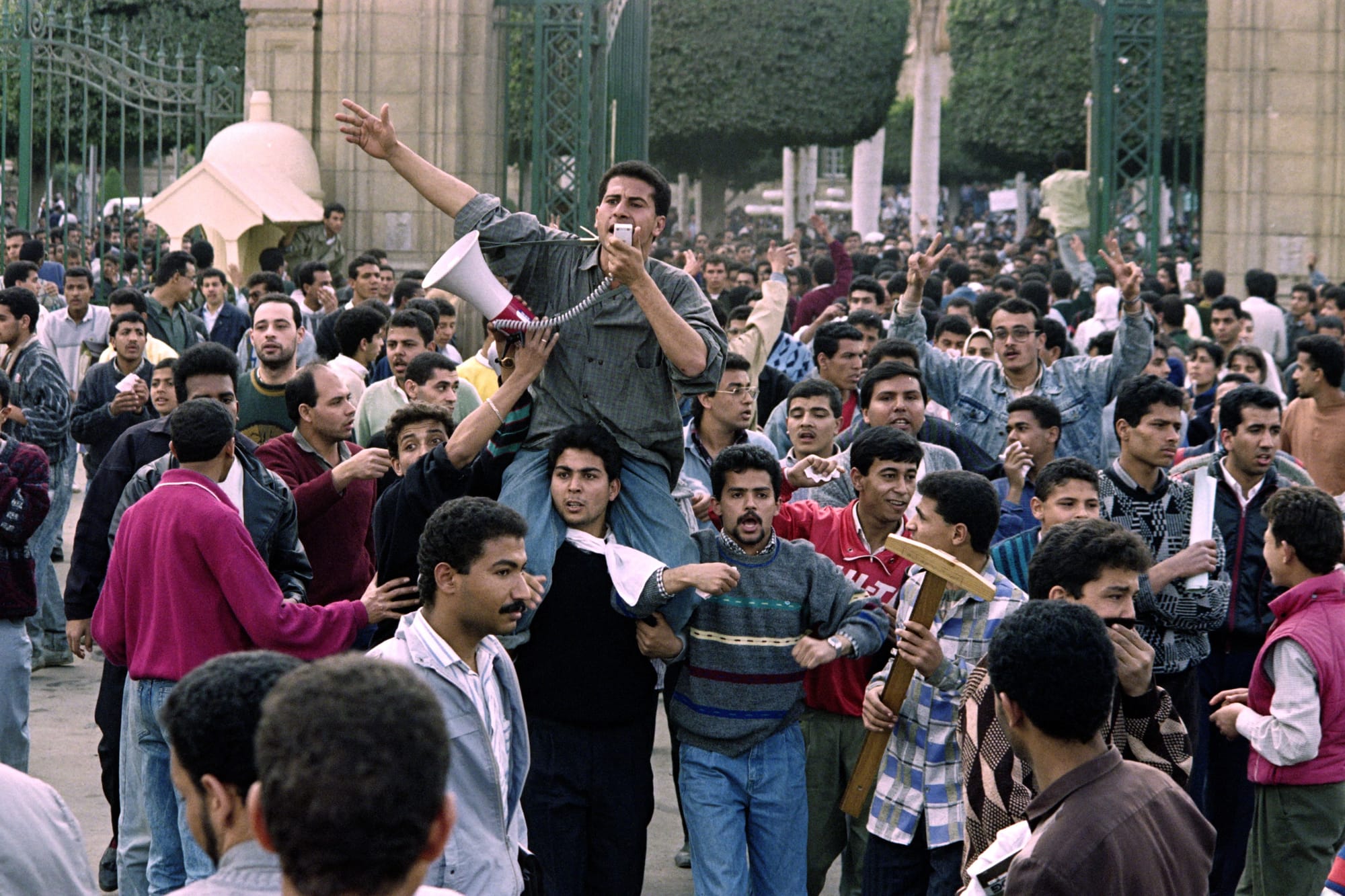
Cairo University students shout anti-government slogans, February 26, 1991, in response to the police killing of two students in the previous day's protest against Egypt's support for war against Iraq. Mona Sharaf/AFP via Getty Images
Under Hosni Mubarak, Sadat’s successor, political activism was severely limited, including student protests. There were some exceptions to the rule, however, such as mobilizations against international events like the US-led invasion of Iraq in 2003 and around [cultural issues](https://english.ahram.org.eg/NewsContent/1/64/120307/Egypt/Politics-/Timeline-of-Egyptian-reactions-to-blasphemy-and-in.aspx) like depictions of the Prophet perceived as blasphemous and Islamophobic films produced in the 2000s. Mubarak tolerated some protests in support of Palestine that broke out during the first (1987–1993) and second (2000–2005) *intifadas* as well as at times of high tension, such as in the [aftermath](https://digitalcollections.aucegypt.edu/digital/collection/p15795coll26/id/9253/rec/3) of the Hebron massacre in 1994\.
The regime’s acceptance of these protests stemmed from a desire to contain and better control popular sentiment that was bubbling under the surface of political life. The targets were seen to be Cairo’s US and Israeli allies to the exclusion of the regime itself. There were even attempts to channel public outrage into state-sanctioned, and thus controlled, demonstrations. For instance, on January 1, 1988, there was a major protest outside of al-Azhar University. In April of 2002, Cairo University witnessed a week of student protests, and some 15,000 students [came out at Benha University](https://www.nytimes.com/2002/04/04/world/mideast-turmoil-cairo-swamped-by-protests-egypt-cuts-nearly-all-ties-to-israel.html) against Israeli violence in Ramallah and the siege of Palestinian president Yasser Arafat. The students from Cairo University had to be physically prevented from approaching the nearby Israeli embassy. The national, state-run newspaper *Al-Ahram* reported on these protests, providing province-by-province breakdowns of the pro-Palestinian demonstrations taking place at universities and schools throughout the country without any hint of condemnation as Cairo suspended relations with Israel.
> The multisectoral protest networks that formed around these two issues, Palestine and Iraq, led over time to a more organized movement, in which students were involved, that would later form the backbone of the early protests that broke out in 2010 and 2011, leading to Mubarak’s ouster.
In February 2003, the Mubarak regime, despite arresting protesters at smaller demonstrations, [sponsored its own protest](https://www.nytimes.com/2003/02/28/world/threats-responses-demonstrations-thousands-egyptians-fill-cairo-stadium-for.html) against the impending US invasion of Iraq, busing in tens of thousands of people to the Cairo International Stadium. As soon as the invasion began, a massive two-day protest took over Tahrir Square, bringing together “[stylish AUC students, hardened activists, Islamists and passersby](https://www.merip.org/2003/03/egypt-struggles-to-control-anti-war-protests/),” who ended up chanting anti-Mubarak slogans, overwhelming riot police and even torching a water truck stationed to refill the state’s water cannons. These events caught the regime off guard, and it felt the need to follow up the next week with a state-sanctioned protest at al-Azhar Mosque, where the protest logistics were subcontracted out to the Muslim Brotherhood and protesters refrained from anti-Mubarak chants. The multisectoral protest networks that formed around these two issues, Palestine and Iraq, led over time to a more organized movement, in which students were involved, that would later form the backbone of the early protests that broke out in 2010 and 2011, leading to Mubarak’s ouster.[\[6\]](applewebdata://A1B2044B-1CD9-4800-8230-7CC53D316346#%5Fedn6)
## Student Movements After Tahrir
The revolutionary interregnum between the ouster of Mubarak by popular uprising in 2011 and the military coup of 2013 was a time when students became involved in competitive politics through their student organizations, operating both on and off campus*.* Under Mubarak, universities had remained politically sensitive places where activism—often led by Islamists—was closely monitored and frequently suppressed, even as the regime also cracked down on the targets of Islamist ire. Mubarak’s fall in January 2011 upended this system. The collapse of the regime led to calls to [dissolve the student unions](https://afteegypt.org/en/research-en/research-papers-en/2021/04/26/21690-afteegypt.html) tainted by the regime's electoral meddling. With the start of the new semester in February, the interim government heeded these calls, leading to an unprecedented level of competition, cooperation and collective action by students. First there was the resuscitation of the long defunct national-level student union, the National Student Union (NSU), which represents Egypt’s many public and private institutions of higher education. Student representatives from 20 public institutions and 12 private institutions met first at the German University in Cairo and later at the American University in Cairo (AUC) for the founding conference of the new but short-lived Egyptian Students’ Union in August of 2011\.
> With the collapse of the public sphere in the initial years after the coup, universities became heavily securitized spaces with a moat of armed personnel (including private security contractors) restricting access to campuses.
In the months that followed, student elections were held, and by 2013, after two electoral cycles, the leadership of the NSU had gone from control by the politically dominant Muslim Brotherhood to a coalition of anti-Brotherhood forces. On the eve of the military coup in July of 2013, union leadership was split on the impending removal of President Mursi. The head of the union, Mohamed Badran, expressed support for the June 30 mobilization against Mursi, while his deputies emphasized the sanctity of the electoral process—the *shar’iya’* (legitimacy) slogan that animated opponents of the coup in the months that followed. The polarization that captured Egyptian politics at large was mirrored in the universities. With the collapse of the public sphere in the initial years after the coup, universities became heavily securitized spaces with a moat of armed personnel (including [private security contractors](https://www.aljazeera.com/features/2017/3/7/egypt-campus-the-students-versus-the-regime)) restricting access to campuses.
As the new military-backed regime cracked down on opposition, the one major election it lost was the 2014 NSU elections. In the same year, a new constitution was passed through referendum and a new president (al-Sisi) and parliament were elected in plebiscites that were widely decried as [unfair](https://www.nytimes.com/2014/05/30/world/middleeast/international-observers-find-fault-with-egypt-vote.html). For a brief period, universities were sites of frequent mobilization, peaking with a wave of protests over the handing over of two islands, Tiran and Sanafir, to regime patron Saudi Arabia in 2016\. But that was short-lived. A blunt crackdown on campus mobilization, which included mass arrests, disciplinary proceedings and expulsions, escalated when the state annulled the NSU election results in 2015\. In 2017, it was made final with the forced dissolution of the NSU, in effect fragmenting what had been coalescing into a national-level representative body.
A dozen years after the coup, student politics have been subjected to a similar level of deinstitutionalization that characterized much of civil society under the new regime, with fragmented bodies of students across the country's more than 100 public and private institutions of higher education. Public universities in Egypt have become arguably more inaccessible than private universities: Rules and procedures govern entry that belie their ostensibly public status. For instance, Cairo University has been [fortified](https://cu.edu.eg/old/Cairo-University-News-8991.html) through surveillance cameras, iron slabs narrowing points of entry, rapid deployment forces, electronic gates and private security contractors**.** Entrance by visitors is severely restricted and permission requires a lengthy, uncertain process. The degree to which these spaces have been securitized betrays a fear of universities as potential sites for mobilization—fears that have been exacerbated in light of the Gaza genocide and the popular support for Palestine among Egyptian students.
## Politics Suppressed and Expressed
Authoritarian regimes’ repressive repertoires are at least in part explained by their level of perceived security.[\[7\]](applewebdata://A1B2044B-1CD9-4800-8230-7CC53D316346#%5Fedn7) More established regimes are more likely to tolerate public protest channeled into spaces negotiated over many iterations with opposition and civil society groups. In places like Jordan, for example, routinized protest both maintains the boundaries set by the regime and safeguards a space for public expression.[\[8\]](applewebdata://A1B2044B-1CD9-4800-8230-7CC53D316346#%5Fedn8) By contrast, the counterrevolutionary nature of the current Egyptian regime pulls its administrators toward a repertoire of unprecedented violence and domination, which has led to the collapse of a once lively public sphere.[\[9\]](applewebdata://A1B2044B-1CD9-4800-8230-7CC53D316346#%5Fedn9)
As such, the absence of mobilization around key issues—political freedoms, economic and labor rights, sectoral privileges and international affairs—are the product of the severity and ubiquity of state violence, including [forced disappearances](https://www.amnesty.org/ar/wp-content/uploads/2021/05/MDE1243312016ENGLISH.pdf) as well as lengthy prison sentences. Alongside largely uncalibrated violence, elite defections have also been limited by fear of unrest—what the political scientist Dan Slater describes as a “protection pact,” in which authoritarian rule is justified as a bulwark against revolutionary upheaval.[\[10\]](applewebdata://A1B2044B-1CD9-4800-8230-7CC53D316346#%5Fedn10)
Yet the question of Palestine sits somewhat outside of these dynamics. Across the political spectrum, a multi-class constituency has held a baseline pro-Palestinian position. The polarization of political views that marked the collapse of Egypt’s short democratic period in 2013 does not extend to the question of Palestine: [nearly all Egyptians](https://www.dohainstitute.org/en/News/Pages/arab-public-opinion-about-the-israeli-war-on-gaza.aspx) (92 percent) see the issue as concerning them equally.
> The politics around Palestine as well as in the arena of student activism are considered so productively volatile as to require a modification of the blanket suppression to which the new regime has subjected all politics in its first decade.
The politics around Palestine as well as in the arena of student activism are considered so productively volatile as to require a modification of the blanket suppression to which the new regime has subjected all politics in its first decade. In a distant echo of the engagement that brought the remote (in more ways than one) worlds of students at the AUC to revolutionary politics with the renewal of the NSU in 2012, AUC’s New Cairo campus has also been the site of the relatively [few](https://www.instagram.com/reel/DPytO0nDQsL/) [student-led](https://www.madamasr.com/en/2024/04/22/news/u/student-protest-calls-on-auc-to-divest-from-corporations-tied-to-occupation/) [protests](https://www.madamasr.com/en/2024/10/09/news/politics/dozens-of-auc-students-hold-campus-demonstration-supporting-palestinians/) against the ongoing genocide in Gaza. This potential for mobilization is also the reason why regime officials decided to allow protests at public universities like the one at Benha University.
But just like the Iraq war protests 20 years earlier, calibrating approved events was difficult within an otherwise acutely authoritarian politics. When the Egyptian government finally responded to rising domestic anger at the rapidly escalating mass violence in Gaza after October 7, it did so through organized protests whose locations had been [pre-approved](https://manassa.news/news/14071) and with participants bused in by security forces. Resuscitating the Mubarak-era tactic, these staged protests were designed to exonerate Egyptian political leadership as a precondition for expressing solidarity with Gaza. Some of these events, like the demonstration at Benha University, went off as planned, praising the “historic and [heroic](https://bu.edu.eg/BUNews/26751) stance of the Egyptian state.” Others, however, did not. Tahrir Square was not one of the approved locations, but protesters who had coalesced at al-Azhar marched there nonetheless, chanting slogans like “Apologies, oh Palestine, but we are also occupied!” (*Asafin ya Filisteen, ehna kaman muhtalin*). The demonstration led to an immediate crackdown by the security forces, who [beat and arrested](https://www.hrw.org/news/2023/11/01/egypt-dozens-peaceful-protesters-detained) dozens of protesters.
All these events point toward a sort of politics that are known but not expressed. The preferences of the population on the issue of Palestine are not a mystery, even if they are channeled through alternative means like boycotts, which do not appear in protest event datasets.[\[11\]](applewebdata://A1B2044B-1CD9-4800-8230-7CC53D316346#%5Fedn11) In Egypt, the boycott movement has become sufficiently serious that pro-government figures have [weighed in](https://www.elwatannews.com/news/de-tails/6909532), calling on consumers to support local businesses, even if they belong to foreign-owned franchises. At the same time, sales of locally produced alternatives to Western products have reportedly [boomed](https://www.alarabiya.net/aswaq/special-stories/2023/11/01/%D8%B4%D8%B1%D9%83%D8%A7%D8%AA-%D9%85%D8%B5%D8%B1%D9%8A%D8%A9-%D8%AA%D8%AA%D9%88%D8%B3%D8%B9-%D9%81%D9%8A-%D8%A7%D8%B3%D8%AA%D8%BA%D9%84%D8%A7%D9%84-%D9%85%D9%82%D8%A7%D8%B7%D8%B9%D8%A9-%D8%A7%D9%84%D9%85%D9%86%D8%AA%D8%AC%D8%A7%D8%AA-%D8%A7%D9%84%D8%A3%D8%AC%D9%86%D8%A8%D9%8A%D8%A9). What is unknown is the extent to which the regime feels the need to allow the expression of pro-Palestine sentiments and produce a pale shadow of the politics it seeks to contain. Explicit politics have, for all intents and purposes, been essentially banished from public life, but the issue of Palestine resonates with young Egyptians who recognize the same feelings in others. While the regime’s overwhelming focus on suppression is not likely to abate anytime soon, should other factors change, the question of Palestine could potentially serve as a spark for politics again.
\[**Mostafa Hefny** is an assistant professor of political science at the American University in Cairo. **Sean Lee** is an assistant professor of political science at the American University in Cairo.\]
SUPPORT MERIP This month
From April 1 to May 7, 2026, MERIP is participating in Delco Gives. During this time, every donation of $10 or more helps unlock additional funding. Donate today to support rigorous, grounded analysis that remains freely accessible to all.
[DONATE NOW! ](https://www.merip.org/donate/)
---
## Endnotes
[\[1\]](applewebdata://A1B2044B-1CD9-4800-8230-7CC53D316346#%5Fednref1) Access to disaggregated data from ACLED is lagged by one year.
[\[2\]](applewebdata://A1B2044B-1CD9-4800-8230-7CC53D316346#%5Fednref2) The largest category is unclassified, often described as “residents.”
[\[3\]](applewebdata://A1B2044B-1CD9-4800-8230-7CC53D316346#%5Fednref3) Ahmed Abdalla, *The Student Movement and National Politics in Egypt* (Al Saqi Books, 2008).
[\[4\]](applewebdata://A1B2044B-1CD9-4800-8230-7CC53D316346#%5Fednref4) Ibid.
[\[5\]](applewebdata://A1B2044B-1CD9-4800-8230-7CC53D316346#%5Fednref5) Ibid.
[\[6\]](applewebdata://A1B2044B-1CD9-4800-8230-7CC53D316346#%5Fednref6) Manar Shorbagy, "The Egyptian Movement for Change—Kefaya: Redefining Politics in Egypt," *Public Culture* 19/1 (2007); Rabab El-Mahdi, "Enough! Egypt's Quest for Democracy," *Comparative Political Studies* 42/8 (2009); Reem Abou-El-Fadl, "The Road to Jerusalem through Tahrir Square: Anti-Zionism and Palestine in the 2011 Egyptian Revolution," *Journal of Palestine Studies* 41/2 (2012).
[\[7\]](applewebdata://A1B2044B-1CD9-4800-8230-7CC53D316346#%5Fednref7) Nadine Sika, *Civil Society and Activism in the Middle East: Regime Breakdown vs. Regime Continuity* (Oxford University Press, 2024).
[\[8\]](applewebdata://A1B2044B-1CD9-4800-8230-7CC53D316346#%5Fednref8) Jillian Schwedler, "Routines and Ruptures in Anti-Israeli Protests in Jordan," *Microfoundations of the Arab Uprisings* (Routledge, 2018).
[\[9\]](applewebdata://A1B2044B-1CD9-4800-8230-7CC53D316346#%5Fednref9) Joshua Stacher, *Watermelon Democracy: Egypt’s Turbulent Transition* (Syracuse University Press, 2020).
[\[10\]](applewebdata://A1B2044B-1CD9-4800-8230-7CC53D316346#%5Fednref10) Dan Slater, *Ordering Power: Contentious Politics and Authoritarian Leviathans in Southeast Asia* (Cambridge University Press, 2010).
[\[11\]](applewebdata://A1B2044B-1CD9-4800-8230-7CC53D316346#%5Fednref11) Amytess Girgis, Neil Ketchley and Sean Lee, “Boycotts and Pro-Palestinian Activism,” *MENA Politics* 7/1 (2024).
### The Palestine Test for German Universities
URL: https://www.merip.org/2026/04/the-palestine-test-for-german-universities/
Last updated: 2026-05-01T13:14:54.000Z
In February 2025, Freie Universität Berlin (FUB) cancelled a planned lecture by Francesca Albanese, the UN Special Rapporteur on human rights in the Palestinian territories occupied since 1967\. The university cited polarization and security risks after intense political pressure from Berlin’s governing mayor and several pro-Israel advocacy groups. To the astonishment of many students and scholars, FUB [justified](https://www.fu-berlin.de/en/presse/informationen/fup/faq/nahost/wissenschaftliche-veranstaltung/index.html) the cancellation as a protection of academic freedom, implying, in a statement that the “polarization surrounding the event and concerns regarding security” are threats to the universities’ commitment to facilitate “objective exchange.”
In late summer 2025, Albanese was invited back to the university. This time, interest groups of the European Society of International Law (ESIL) asked her to be the keynote speaker at a pre-conference workshop at FUB to discuss mass violence in Gaza and the potential of spatial forensics for international legal accountability processes. Again, the invitation triggered sharp protests, including from the German Network of Jewish Scholars and several student groups, who questioned the workshop’s scientific merit, rejected the characterization of Israeli violence in Gaza as genocidal and branded Albanese antisemitic. The Jewish Student Union [cast](https://www.instagram.com/p/DOWHskoDJhN/?img%5Findex=1) the entire event as “another antisemitic chapter in the history of FUB.” Unexpectedly, however, FUB let the event proceed, restating a fundamental rule: Article 5(3) of Germany’s Basic Law protects academic freedom, including scholars’ authority to choose topics and speakers and universities exist to work through difficult arguments in public.
FUB’s change in stance did not reflect a return to standard institutional policy. Rather, it was the outcome of intense conflict and sustained pressure by students and critical faculty. Since October 2023, Palestine-related speech has been subject to increasing restrictions and surveillance across all sectors of German higher education. Event [cancellations](https://www.index-of-repression.org/de/platform), [police interventions](https://www.tni.org/en/article/the-pillars-of-repression) and [legal proceedings](https://untoldmag.org/germany-trials-palestine-students/) against students and academics have become routine tools of campus governance. In Berlin and other cities, protest bans and disinvitations were combined with so-called safety protocols that have gradually turned programming into risk management. Administrations added hurdles for booking rooms and holding rallies, tightened vetting rules and routed political disputes through police and prosecutors. Students and staff describe a climate increasingly governed by carceral logics: the expansion of punitive approaches to governing campus politics, where suspicion, pre-emption and disciplinary control have displaced political engagement and dialogue. Within this climate, Palestine solidarity is positioned as a security threat, while institutional language singles out Jewish life for protection, flattening the diversity of Jewish positions and erasing the existence of anti-Zionist Jewish students organizing alongside Palestinian peers.
But the university’s mechanisms of securitization has not succeeded in quelling student dissent or opposition by faculty, nor has it diminished controversies on campus. Instead, as the case of Albanese shows, collective efforts of students and faculty to resist the expansion of control on campus have effectively defended spaces of critical inquiry. Simultaneously, campus politics has become a harbinger for broader authoritarian shifts, with the normalization of surveillance and curtailed dissent on campus foreshadowing democratic erosion beyond the university.
## Campus Solidarity with Palestine in Berlin
Rooted in a long local lineage of campus anti-war protest, German student mobilization in solidarity with Palestinians materialized soon after October 7, 2023\. These protests only drew attention when students occupied a lecture hall at Freie Universität Berlin in November 2023, prompting university administrators to call the police on campus. Otherwise, they remained widely outside the public spotlight. In the first weeks of campus activism, university administrators tended to respond through a mixed repertoire of combined forbearance and episodic policing. Their reactions were decided largely ad hoc and campus protests were not treated initially as a standing security problem.
By spring 2024, students were increasingly using their campuses as stages to take a stand against Israeli warfare in Gaza and educate their peers on the condition of Palestinians rather than relying on faculty members to publicly address and call out Israel’s occupation politics. Between October 7, 2023, and May 2025, we recorded 44 student-led campus actions in Berlin alone. In their rhetoric, students linked Berlin directly to Columbia, NYU, Yale, McGill and later to encampments globally**.** Their framing positioned Palestine as a node in an interconnected decolonial struggle, demanding from universities to “recognize Germany’s colonial legacy as the root of its present collaboration with the ongoing genocide."
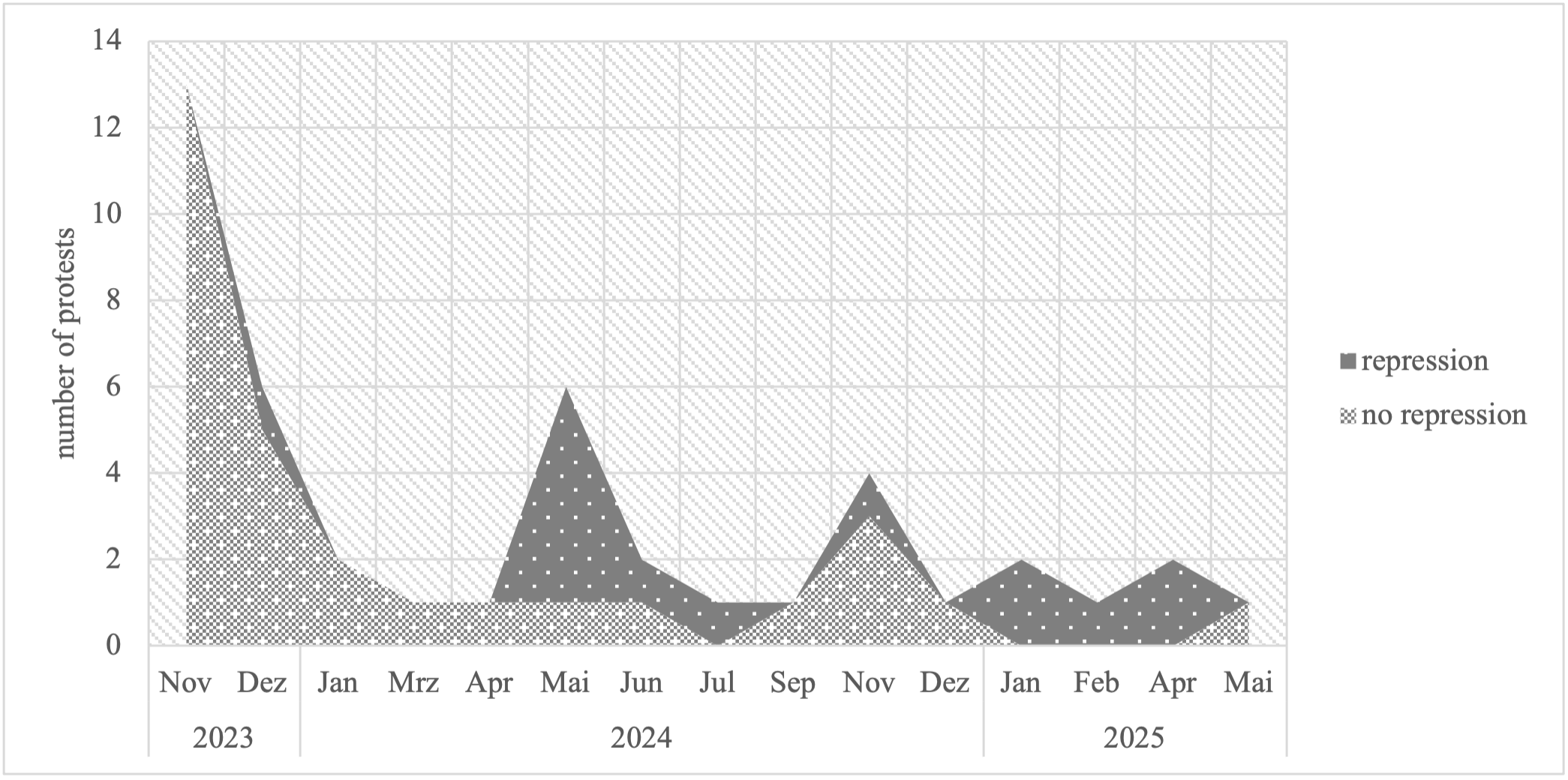
Figure 1\. Trajectory of Palestine solidarity mobilization and repression in Berlin between October 2023 and May 2025\. Original event data by Lilian Mauthofer / Jannis Julien Grimm
Ultimately, it was a series of occupations in May 2024 that set campus protest governance onto a punitive pathway. On May 3, 2024, students occupied FUB’s theater courtyard, explicitly framing their sit in as both an act of solidarity with Palestinians and an indictment of institutional silence. Soon after, on May 22, students occupied Humboldt University’s (HU) Institute of Social Sciences. They renamed it the Jabaliya Institute after the besieged refugee camp in the Gaza strip, collapsing the border between campus and the violence in Gaza. These twin actions catalyzed student participation and produced viral images that echoed the US encampment wave.
The FUB and HU student occupations marked a decisive shift in how Berlin universities responded to campus protest, converting what had previously been handled in an uneven, situational manner into a model of routine suppression. For the first time, both FUB and HU called the police onto campus to forcefully evict student protesters. At FUB, police forces arrested 79 protesters and violently clashed with students within the hallways of the university buildings. At HU, more than 20 were arrested and dozens injured, while riot police impeded the access of legal observers and journalists to the protesters.
> Coercive policing became the default reaction to campus protest. Berlin universities filed hundreds of lawsuits against their own students.
Rather than condemning the police raids, both universities charged dozens of students with trespassing, irrespective of whether individuals were part of the direct actions, present in support or had merely been caught up in the police operation. The university’s broad targeting of students effectively conditioned future interactions between administrators and students, creating grievances that would forestall dialogue in the following months. Coercive policing became the default reaction to campus protest. Berlin universities filed hundreds of lawsuits against their own students. The May 2024 raids did not merely escalate a single episode. They reset the baseline for what universities considered legitimate campus politics and normalized police intervention as a standard response to contention.
Students describe how this routinization of repression reordered campus life. For many white students, the campus crackdown was their first encounter with the punitive arm of the state, a shock that altered their relationship to the university. Racialized students, in turn, linked their repressive experiences on campus to prior experiences of racism and discrimination in their interactions with authorities. Across different groups, students we interviewed largely shared the impression that police behavior communicated a racialized hierarchy of worth, targeting predominantly those read as Arab or migrant, while reprieving those read as white or European. As one Jewish student noted:
“I see constantly how Palestinians are being detained and arrested and how much violence they experience \[…\] You can see this actually. Just look at the footage of, say, demonstrators choked by police officers in Berlin. I believe you would see many more Palestinians or people of color than white people. Also the fact that my footage of when police arrested me, you know with a Kippa, circulates so widely. It give me also this sense of my body apparently being more worthy than that of Palestinians, who are being murdered in masses over there and arrested in masses over here.”[\[1\]](applewebdata://9CAEBFC4-5237-465A-8553-CCF353424199#%5Fedn1)
Differential treatment by universities, police and media ultimately strengthened protesters’ resolve. Rather than dividing the student body, it drew a sharp antagonistic frontier between students and university administrators and fundamentally shattering the bases of trust between them.
## Shrinking Spaces for Debate
Since October 7, 2023, university administrators have increasingly viewed Palestine-related speech through the lens of risk management rather than public debate, justifying harsh repressive tactics. The resulting pressure on students and faculty has generated counter-practices, including off-campus programming, mutual aid and legal support infrastructures as well as selective refusals to comply with punitive governance measures.
This dynamic is shaped by the German state’s default stance in support of Israel, anchored in a political culture of historical responsibility for the Holocaust—a culture institutionalized in the [concept of German “Staatsräson”](https://verfassungsblog.de/staatsrson-empty-signifier-or-meaningful-norm/) (reason of the state), famously invoked by former Chancellor Merkel before the Knesset in 2008\. In practice, this paradigm has translated into an expansive mandate to defend Israel unequivocally in the public sphere. Within this framework, opposition to Zionism and critique of Israel’s occupation policies are routinely treated as potential forms of antisemitism. Universities have operationalized that logic through the “protection of Jewish life” as a governance priority stressed by the German Rectors' Conference and frequently invoked in ways that conflate Jewish safety with the suppression of Palestine solidarity in all facets of the university, not only protests. The result is a policy environment in which also teaching, research and public speech on Palestine are assessed primarily as security relevant conduct.
The shrinking space for Palestine solidarity is measurable. Along with other colleagues, we have conducted over two years of fieldwork demonstrating how an already repressive environment contracted further after October 7\. In a recent [survey](https://doi.org/10.17169/refubium-49164) of Germany-based scholars working on the Middle East, nearly 85 percent said threats to academic freedom have increased since October 7—among those in post-doctoral positions it rises to roughly 90.5 percent.[**\[2\]**](applewebdata://9CAEBFC4-5237-465A-8553-CCF353424199#%5Fedn2) One in four scholars often feel unable to speak freely and three quarters report self-censoring, especially regarding Israeli politics and especially in public appearances. Their top reasons for self-censoring are public hostility and the fear of being misunderstood. By contrast, in the United States, academics worry primarily about hard repression and material fallout, such as hostile state legislation, donor or trustee pressure and formal threats to jobs or visas.
Figure 2\. “A result … that is not in your study :)” Email received by a survey participant in response to a publication about Palestine solidarity.
Scholars in Germany who speak about war crimes in Gaza often brace more for social blacklisting than an official sanction. In addition to hate mail (Figure 2) and defamation (Figure 3), scholars fear being quietly avoided by colleagues, screened out of panels and committees, dropped from citation networks or left off shortlists without explanation. Their fears notably reflect the parameters of German public debate. Inside and outside the campus walls, being labeled as antisemitic in public can render someone as permanently suspect, by extension making any association with them a potential liability. Precarious researchers feel this fear most strongly because their careers run on informal endorsements and short contracts, but even seasoned professors describe the same ambient pressure.
Figure 3\. “Are the ~~Zios~~ Jews forbidding us to speak???” Comment framing several researchers (names blurred out) as antisemitic at an event concerning shrinking academic spaces.
While social stigma has decreased the space for talking about Palestine and Israel, securitization on German campuses around Palestine solidarity has had a clear bureaucratic effect. As a result of student protest occupations, the FUB administration has added restrictions on room bookings, creating bottlenecks. To avoid accusations of political bias, the university insists on a discourse of neutrality in its programming, framing this stance as necessary to maintain institutional impartiality. Students also report a double standard; Palestine organizers face doxing, discrimination and intimidation with little institutional support, while administrative messaging essentializes Jewish students as a vulnerable group and casts students in solidarity with Palestine as the primary threat to their safety, contrary to existing evidence and entrenching a hierarchy of empathy.[\[3\]](applewebdata://9CAEBFC4-5237-465A-8553-CCF353424199#%5Fedn3)
## ‘Moral Panic’ and Modes of Resistance
During the Cold War, particularly in West Germany, the so-called Radikalenerlass (radicals decree) barred members of many leftist organizations from public service. A similar logic has reappeared around the topic of Palestine, where the campus version of what political scientist Donatella Della Porta has referred to as a “moral panic” has taken hold of German society, inviting comparisons to the Red Scare and its impact on higher education.[\[4\]](applewebdata://9CAEBFC4-5237-465A-8553-CCF353424199#%5Fedn4) Harsh policing is only the most visible symptom of this panic. Politicians from both the conservative and the social democratic parties now question whether teacher trainees who join Palestine solidarity protests should be employable in Germany’s public school system. Conservative politicians and the Jewish Student Union have also called for the expulsion of so-called radical students, namely those participating in disruptive collective action. For international students and other precarious residents, cooperation between universities and law enforcement authorities has turned protest risks into immigration risks, as when Berlin immigration officials[ ordered four foreign residents ](https://theintercept.com/2025/03/31/germany-gaza-protesters-deport/)to leave the country over alleged involvement in an FUB building occupation. Some politicians now openly propose subjecting universities to oversight by domestic intelligence services. The Alternative for Germany (AfD), a reactionary opposition party that leads national polls, has [demanded](https://dip.bundestag.de/drucksache/organisierten-wissenschaftsbetrug-unterbinden-qualit%C3%A4t-und-transparenz-in-der-forschung/282315?f.typ=Dokument&f.herausgeber%5Fdokumentart=Bundestag-Drucksache&f.vorgangstyp%5Fp=01Antr%C3%A4ge&rows=25&pos=15&ctx=d) that parliament establish a new official body to screen academic publications and public funding applications for their “independence from political influence.”
But it is not only the fascist far right that has supported the securitization of higher education. The German coalition government of the conservative Christian Democratic Union/Christian Social Union (CDU/CSU) and Social Democratic Party (SPD) recently published a timetable for the [establishment](https://www.bmftr.bund.de/SharedDocs/Downloads/DE/2025/25-eckpunkte-forschungssicherheit.pdf?%5F%5Fblob=publicationFile&v=1) of a National Service Agency for Research Security that would institutionalize risk governance as a routine layer of academic decision making. The platform is explicitly designed to coordinate state and academic actors and to produce standardized risk assessments of research activities and collaborations. It draws on information and assessments from security authorities with the ostensible goal of protecting Germany’s “security and economic interests” in both their national and international dimensions. In practice, this infrastructure risks normalizing anticipatory suspicion and creating new channels through which political controversy on campus can be recoded as a security risk.
This securitization turn has not remained uncontested. In several cases, faculty members, staff and student groups have treated bureaucratic risk governance itself as an object of contention, challenging room denials, documenting procedural arbitrariness and pressuring leadership to justify safety claims publicly rather than administratively. Some departments and individual professors have continued to convene events on Palestine, shifted events off campus when necessary and built informal networks to protect targeted students and colleagues. These practices of pushing back have not reversed the overall trend of repression, but they have complicated it. They show that governance oriented toward risk management and so-called safety comes at the cost of deepening internal fractures within the university and that the campus remains a site where repression and resistance are coproduced.
The feedback loop of repression and resistance has created contradictions for university administrators. In Berlin, it was university leaders who first called police to the FUB and HUB campuses. University leaders also backed criminal complaints including against precariously situated students. Yet, some administrators have begun to backtrack in light of resistance by students and faculty as well as unprecedented infringements on university autonomy by third parties. For instance, some university officials now quietly advise students in the Erasmus program for studying abroad within the European Union to finalize enrollment before joining any protest, as an official student status offers some protection from the threat of deportation. Other administrators have deliberately done little to make charges stick by missing court dates in trials against students or by failing to provide information required for prosecution. Universities are thus caught in the position of constraining academic freedom on political grounds and thereby contributing to the normalization of securitized logics on campus, while simultaneously trying to fend off academic freedom infringements from third parties.
Student organizers are now calling out these contradictions. Repression directed at students validates a longstanding critique that German higher education reproduces colonial hierarchies. After the police crackdowns on their encampments of spring 2024, students framed their actions as an indictment. They named the beneficiaries of violence—from weapons exports to research partnerships with universities in Israeli occupied territories—and called on universities to account for their own entanglements. As argued by one student protester in his deposition to the Berlin Tiergarten district court:
What we are doing is not an attack on the university; it is a defense of what it should be: a place of critical thinking, open debate, and social responsibility. A university that is involved in supporting war crimes forfeits its claim to be such a place.[\[5\]](applewebdata://9CAEBFC4-5237-465A-8553-CCF353424199#%5Fedn5)
> Teach-ins, off campus learning circles, legal and mental health support, collective mourning and mutual aid networks recast the university as a place where grief and knowledge-making could coexist when official spaces would not allow it.
The students redeployed the university’s own claims to legality, critical inquiry and public responsibility as resources for their critiques. Through resistance students effectively prefigured the university they wanted. They positioned protest as a collective alternative to the carceral institution they were encountering. In a hostile social setting, appearing together in these activities gradually gave rise to a whole student infrastructure of care. Teach-ins, off campus learning circles, legal and mental health support, collective mourning and mutual aid networks recast the university as a place where grief and knowledge-making could coexist when official spaces would not allow it. A generation of students and scholars have learned more about law, violence and power in two years than any classroom could offer, and these infrastructures ultimately provided a base to link Palestinian, migrant, queer, antiracist and Jewish student actors and sustain the student movement ever since.
In Germany, as elsewhere in Europe, spaces for critical inquiry in higher education are shrinking. In Gaza, these spaces have been obliterated alongside the [scholarly communities](https://rememberinggazascholars.org/) that animated them. The predicament in Europe is, of course, qualitatively different from Israeli scholasticide in Gaza, as it involves constrained speech, surveillance and policing rather than annihilation and the systematic destruction of universities, libraries and archives. Yet, the two trajectories are connected through the epistemic violence that marginalizes Palestinian suffering. Silence and the silencing of scholars have helped ensure that Israel’s genocidal violence against Palestinians is insufficiently recognized and sanctioned. Against this asymmetrical backdrop, the challenge is not only to rebuild universities as institutions that protect plural inquiry but to transform them into sites that resist the erasure of knowledge.
Universities, across history, have functioned as canaries in the coal mine for autocratic drift while also serving as early sites where resistance movements first take shape. The Palestine student protests have put these tensions into relief. Through them, students have developed an emancipative understanding of academic freedom not as a norm politely upheld by authority but as a practice that needs to be defended, enacted and seized in the face of tightening controls.
Students have shone a light on the carceral logics dominating campus politics and highlighted ways of contesting them. In that sense, the approval of the late-summer 2025 workshop with Francesca Albanese was not simply a sudden return to principle by the university administration. It was the outcome of sustained pressure from below that made further retreat more costly than controversy and made it harder to maintain the fiction that disinvitation is a neutral act of governance.Just as importantly, many universities now confront a second order effect of the course they charted after October 7\. By normalizing coercive governance, they opened the door for external actors to treat higher education as an object of oversight and discipline. Gaza has become a catalyst for a much larger struggle over university autonomy. Whether the university emerges as a site that resists carceral logics or as an institution that helps normalize them will depend on the ability and the will of scholars and students to keep holding the line.
\[**Jannis Julien Grimm** is the director of the research group “Radical Spaces” at the INTERACT Center for Interdisciplinary Peace and Conflict Research at Freie Universität Berlin (FUB). **Lilian Mauthofer** is a doctoral researcher in the DFG Research Unit 5870 “The Promise of Security in Catastrophic Times” at the University of Hamburg and an associate researcher at FUB’s INTERACT Center.\]
SUPPORT MERIP This month
From April 1 to May 7, 2026, MERIP is participating in Delco Gives. During this time, every donation of $10 or more helps unlock additional funding. Donate today to support rigorous, grounded analysis that remains freely accessible to all.
[DONATE NOW! ](https://www.merip.org/donate/)
---
## **Endnotes**
[\[1\]](applewebdata://9CAEBFC4-5237-465A-8553-CCF353424199#%5Fednref1) Interview with Jewish student and member of the association Jüdische Stimme für gerechten Frieden in Nahost, February 12, 2025.
[\[2\]](applewebdata://9CAEBFC4-5237-465A-8553-CCF353424199#%5Fednref2) Jannis Julien Grimm et al.,[ “German Academia after October 7: Self-Censorship and Restrictions of Academic Freedom among MENA Scholars](https://refubium.fu-berlin.de/handle/fub188/49442),” *Working Papers in Peace & Conflict Research*, 2025 (Freie Universität Berlin, 2025).
[\[3\]](applewebdata://9CAEBFC4-5237-465A-8553-CCF353424199#%5Fednref3) Marc Helbling and Richard Traunmueller, “[Pro-Palästina Proteste, Antizionismus Und Antisemitismus in Deutschland](https://www.uni-mannheim.de/media/Einrichtungen/gip/Bilder/Dokumente/GIP%5FWie%5Ftickt%5FDeutschland%5F2%5FAntisemitismus.pdf),“ *Wie tickt Deutschland? Zahlen, Fakten und Analysen aus dem German Internet Panel* *2* (Universität Mannheim, 2024).
[\[4\]](applewebdata://9CAEBFC4-5237-465A-8553-CCF353424199#%5Fednref4) Donatella Della Porta, “Moral Panic and Repression: The Contentious Politics of Anti-Semitism in Germany,” *Participazione e Conflitto. An International Journal* 17/2 (2024).
[\[5\]](applewebdata://9CAEBFC4-5237-465A-8553-CCF353424199#%5Fednref5) Deposition of student protester at the Berlin Tiergarten District Court, March 18, 2025.
### Fighting the Campus Crackdown
URL: https://www.merip.org/2026/04/fighting-the-campus-crackdown-why-the-middle-east-studies-association-took-the-trump-administration-to-court/
Last updated: 2026-04-29T16:31:57.000Z
On March 25, 2025, the Middle East Studies Association (MESA), together with the American Association of University Professors (AAUP) and represented by the Knight First Amendment Institute, sued the Trump administration for its policy of targeting noncitizen students and scholars for their pro-Palestinian speech. MESA is the largest scholarly association devoted to the study of the Middle East and North Africa with thousands of members across the world, including faculty, researchers and students. In the nearly 60 years since MESA was founded, it has fostered rigorous scholarship, responsible teaching, academic freedom and public understanding of a region that is often misunderstood beyond its borders, particularly in the United States.[\[1\]](#%5Fedn1)
The field of Middle East studies has long been buffeted by external political pressures. In the era following the attacks on the United States of September 11, 2001, the government has sought expertise about the Middle East in connection with everything from military planning to counterinsurgency policies to interrogation strategies. A [cottage industry](https://www.americanprogress.org/article/fear-inc/) of [terrorism experts](https://www.opensocietyfoundations.org/voices/911-10-lessons-learned-anti-muslim-haters) with little academic expertise on the region emerged to take up these positions. [Scholarly concerns](https://americananthro.org/about/policies/aaa-opposes-us-militarys-human-terrain-system-project/) about ethics and professional responsibility in teaching and research were met with political scrutiny. Surveillance sometimes intruded on university and college campuses, whether in [monitoring](https://www.ap.org/media-center/ap-in-the-news/2012/nypd-monitored-muslim-students-all-over-northeast/) the activities of affinity-based student organizations associated with the Middle East or investigating faculty whose research raised red flags. In the same period, pro-Israel organizations in the United States increasingly turned their attention to campus politics, targeting [students](https://www.jta.org/archive/group-files-civil-rights-complaint-against-the-university-of-california) and [faculty](https://www.loevy.com/settlement-reached-in-case-of-professor-fired-for-uncivil-tweets/) for speech or activities expressing criticism of Israel or dissent from US government policies in the so-called War on Terror. Organizations like [Campus Watch](https://www.aaup.org/reports-publications/aaup-policies-reports/topical-reports/academic-freedom-tenure-and-due-3) and later [Canary Mission](https://www.nytimes.com/2025/04/01/us/israel-gaza-student-protests-canary-mission.html) proliferated, producing reports and websites focusing on faculty, students, departments and programs in Middle East Studies.
By the 2010s, these organizations were also innovating [new legal strategies](https://sites.utexas.edu/tjclcr/wp-content/uploads/sites/3748/2025/02/02-Efforts-to-Weaponize-Title-VI-pp.-52-88.pdf) to bring federal complaints and lawsuits against universities and departments arguing that their curricula, programs and events reflected discriminatory biases. For example, in the mid-2000s, the Zionist Organization of America began filing Title VI (civil rights) [complaints against universities](https://forward.com/news/335723/after-push-by-pro-palestinian-activists-cuny-probes-anti-semitism-cries/) alleging that campus events or speech related to the Middle East were producing a hostile environment for Jewish students. While those early complaints did not result in formal findings, they became the precursor for [similar complaints](https://www.jpost.com/opinion/op-ed-contributors/standing-up-for-jewish-students-325648) that eventually contributed to a permanent [change of federal policy](https://ccrjustice.org/letter-civil-rights-groups-demand-doe-assistant-secretary-marcus-end-attacks-free-speech) in 2018 about how to define antisemitism for the purposes of civil rights law. Meanwhile, another organization—the Brandeis Center, founded in 2011—brought [lawsuits](https://brandeiscenter.com/cases/) on similar grounds against multiple universities, including Harvard, MIT, the University of California, Berkeley and Stanford. Even when these complaints or lawsuits failed, campuses were put on notice that speech about Israel-Palestine, and the Middle East Studies programs where these issues are studied, might become a source of costly legal challenges. The attendant pressure to avoid controversy in curricula and programming about the Middle East, and even individual scholarly research agendas, has long cast a [chill](https://www.theguardian.com/us-news/2025/sep/11/campus-investigations-professors-gaza-antisemitism) over the field. The broader [politicization of research funding](https://www.newyorker.com/magazine/2026/03/16/the-unmaking-of-the-american-university) and the retreat in support for the social sciences and humanities has exacerbated this sense of siege in a higher education climate that measures the worth of universities in terms of their returns-on-investment and compliance with government priorities.
The erosion of space on campuses for critical debate about Israel and Palestine intensified after the Hamas attacks against Israel of October 7, 2023, and Israel’s subsequent genocidal war on Gaza. Censorial pressure from outside advocacy groups also increased following October 2023, and alumni networks and donors were mobilized to influence college and university administrators to silence pro-Palestinian voices and block activism on campuses. [Congressional hearings](https://www.npr.org/2023/12/08/1218314691/after-a-disastrous-testimony-three-college-presidents-face-calls-to-resign) following October 7, with bipartisan support during President Joseph Biden’s administration, further escalated public and private pressure on universities and colleges, with [university presidents](https://www.nytimes.com/2023/12/09/us/university-of-pennsylvania-president-resigns.html) forced out over their testimony.
The start of President Donald Trump’s second term in January 2025 exacerbated the risks to the field of Middle East Studies by orders of magnitude. His administration declared across-the-board investigations of universities and colleges, accelerating the dynamics of the preceding year. Once his administration announced a government-wide, multi-agency federal [task force on antisemitism](https://www.justice.gov/opa/pr/justice-department-announces-formation-task-force-combat-anti-semitism), the pressure to directly regulate and constrain teaching, research and scholarship about the Middle East, and especially about Israel-Palestine, reached a fever pitch.
The [blueprint](https://www.politico.com/news/2025/04/06/project-2025-project-esther-university-crackdown-plans-00272750) for the government’s approach had been prepared in advance—in October 2024—by pro-Israel activists and published under the title “[Project Esther](https://www.heritage.org/progressivism/report/project-esther-national-strategy-combat-antisemitism).” With the plan set in motion, the government made clear in February 2025 that it would [use immigration authorities](https://immpolicytracking.org/policies/reported-state-department-plans-to-use-ai-to-revoke-visas-of-students-engaged-in-pro-hamas-activity/) to engage in heightened scrutiny of foreign students and scholars, visa revocations, detentions and ultimately removal proceedings to deport noncitizens who had engaged in pro-Palestinian protest activity. MESA understood that this posture would disproportionately damage Middle East studies, as the field already operates under heightened political scrutiny. By early 2025, MESA was hearing from members across the country expressing unprecedented levels of fear. International graduate students stopped attending conferences and even classes. Faculty withdrew from panels, declined media interviews or erased years of public commentary from their social media accounts. Invitations to speak at teach-ins went unanswered. Collaborative projects stalled. The [chill](https://pen.org/report/americas-censored-campuses-25-web-of-control/) was not theoretical. It was [palpable](https://carnegieendowment.org/emissary/2025/03/columbia-arrest-funding-cuts-mahmoud-khalil-chilling-effect?utm%5Fsource=chatgpt.com), [measurable](https://www.theguardian.com/us-news/2025/nov/05/university-anitisemitism-investigations) and [pervasive](https://criticalissues.umd.edu/news/marc-lynch-and-shibley-telhami-middle-east-scholar-barometer-findings-scholars-who-study), as MESA has [documented](https://mesana.org/advocacy/task-force-on-civil-and-human-rights/2025/11/05/discriminating-against-dissent-the-weaponization-of-civil-rights-law-to-repress-campus-speech-on-palestine).
Under these conditions, MESA concluded that the ordinary tools of academic self-governance were no longer sufficient responses. University statements, faculty resolutions and disciplinary norms could not counter a federal policy that threatened arrest, detention and deportation for protected speech. When immigration and antidiscrimination law is used as a weapon to suppress a viewpoint, academic freedom cannot be defended from within the academy alone. In a moment of crisis with the law being weaponized, MESA decided to meet the threat by exploring its own litigation strategy, based on the speech protections enshrined in the First Amendment and long held by the US Supreme Court to extend to [academic freedom](https://yalebooks.yale.edu/book/9780300192490/democracy-expertise-and-academic-freedom/).
## MESA Sues
Building on precedents from the Biden administration and a long history of campaigns against campus pro-Palestinian advocacy, the Trump administration’s policy blurred and then erased the line between unlawful activity and disfavored speech. Pro-Palestinian protest, criticism of Israel and advocacy for ceasefire or divestment were recast as indicators of antisemitism or support for terrorism. The government began monitoring student protests, teach-ins and campus events, reviewing social media and public statements and flagging individuals for immigration scrutiny based on pro-Palestinian advocacy. In one notable case, of Tufts University student Rümeysa Öztürk, a visa revocation was based exclusively on having co-authored an [op-ed](https://www.tuftsdaily.com/article/2024/03/4ftk27sm6jkj) in a campus newspaper that criticized the university administration’s policies in response to student calls for divestment from Israel. Öztürk was captured by Immigration and Customs Enforcement (ICE) agents and detained for over six weeks. For international students and scholars, the message was unmistakable: Participation in these debates in any form could cost you your visa, your residency or your freedom. Once speech becomes a trigger for eliminating research funds and conducting deportations, academic freedom collapses into a privilege enjoyed only by citizens, and even then [only conditionally](https://www.aaup.org/news/muhlenberg-college-violated-academic-freedom-dismissing-finkelstein).
> Few at MESA could have anticipated that within a few years new immigration policies would target its members who were lawfully present in the United States.
MESA’s lawsuit was brought to stop the Trump administration from targeting noncitizens on the basis of constitutionally protected speech. It was not the first time MESA pursued litigation as an avenue to protect the interests of its members. During the first Trump presidency, MESA was one of a group of plaintiffs that [sued the administration](https://mesana.org/advocacy/task-force-on-civil-and-human-rights/2018/07/20/memo-on-us-supreme-court-decision-on-irap-v.-trump-upholding-september-24-2017-presidential-proclamation-of-travel-ban) for adopting discriminatory travel restrictions under what was then termed the “Muslim Ban.” The unfair targeting of Muslim communities for immigration restrictions disrupted travel, research and free exchange of ideas by undermining academic collaborations in countries affected by the ban, many of them countries where MESA members reside or travel for research. MESA, represented by the American Civil Liberties Union, litigated that case to the Supreme Court, where the travel ban was eventually upheld. Few at MESA could have anticipated that within a few years new immigration policies would target its members who were lawfully present in the United States.
MESA’s decision to litigate was the product of careful consideration rooted in institutional obligation. As the largest scholarly association dedicated to Middle East studies, MESA exists to protect the conditions under which its members can work. Initially MESA was alone among scholarly associations in raising the alarm as it contemplated how to respond to the first reports of students and scholars being detained in early March 2025\. It was easy to present the problem as one limited to those studying the Middle East; other scholarly associations might avoid drawing the ire of the administration by staying out of the fray. Yet once MESA decided to litigate, the AAUP soon joined as a co-plaintiff, and the legal team at the Knight First Amendment Institute represented both associations together with trial attorneys from Sher Tremonte LLP.
Unlike most public interest cases, the case was not decided by the judge based exclusively on legal briefing. The judge presiding over the case, Judge William G. Young, decided that he would hold a bench trial, a full trial conducted without a jury, in which the judge hears live testimony, reviews exhibits and makes findings of fact under oath. Bench trials are relatively rare in constitutional litigation, but they are uniquely powerful: They create an evidentiary record grounded in sworn testimony and cross-examination, allowing the court to assess intent, credibility and real-world effects in a way that relying only on legal briefs cannot. MESA and its co-plaintiffs argued that the government was pursuing a coordinated policy that targeted people because of their constitutionally protected speech under the guise of antisemitism enforcement. Since these claims required proof of actual policies and facts, the judge concluded that developing a real evidentiary record was crucial to deciding the case. That record now permanently documents how the policy operated [in practice](https://abcnews.go.com/US/dhs-investigated-5000-student-protesters-listed-doxxing-website/story?id=123619284), not just how it was defended in theory.
The litigation record in *AAUP v. Rubio* confirmed what MESA had been hearing anecdotally about the chilling effects of US government policy on students and faculty at US institutions. The evidence showed that government agencies had been tracking public statements, social media posts and participation in campus protests and using speech in these contexts as the sole trigger for government scrutiny. Speech critical of Israel or supportive of Palestinian causes was classified by the government as antisemitic without any further inquiry. Once an individual was flagged based on their speech, their case file would be directed into a pipeline for visa revocation and removal proceedings. Moreover, lists of individuals to be flagged for scrutiny were shown to have been provided, in part, by third parties outside of government.
The trial itself involved witness testimony from government officials as well as from MESA and AAUP members. In some of the most [shocking testimony](https://www.newyorker.com/news/the-lede/a-federal-trial-reveals-the-sprawling-plan-behind-trumps-attacks-on-pro-palestinian-students), government officials confirmed their reliance on lists of close to 5,000 tips provided by Canary Mission and [Betar US](https://betarus.org/), another pro-Israel group, that had compiled thousands of profiles of pro-Palestinian students. Peter Hatch, an assistant director of intelligence at ICE Homeland Security Investigations, [testified](https://www.insidehighered.com/news/global/international-students-us/2025/07/21/aaup-v-rubio-reveals-details-deportation-efforts) that “most” of the names flagged for scrutiny came from Canary Mission.
Faculty testimony at the trial was deeply moving. Non-citizen academics described the fear they felt even when deciding to participate. They recounted avoiding publishing on topics that could be construed as controversial and declining conference invitations. They described their students stepping back from political organizations. Faculty themselves attested to withdrawing from public engagements, choosing not to sign letters or publish opinion pieces based on the chilling effect of Trump administration deportation policies. Scholars described self-censorship extending even to private communications. These effects are not marginal. They strike at the core of scholarly life.
Middle East studies depends on public engagement. Scholarship in the field intersects with ongoing conflicts, human rights crises and foreign policy debates. When scholars cannot speak openly without fear of state reprisal, the damage does not stop at the university. The public conversation is impoverished and policymaking becomes less informed.
## Judge Young Decides
In his September 2025 findings, Judge Young clearly articulated what was at stake. [His ruling](https://knightcolumbia.org/documents/ahmr9jfap2) is worth reading in its entirety. He rejected the administration’s claim that non-citizens inside the United States enjoy diminished First Amendment protection. He wrote a forthright defense of the free speech principle and made clear that constitutional guarantees do not hinge on passport status. That holding alone vindicated a central concern of MESA’s members, many of whom are non-citizens whose work sustains US universities.
> Judge Young recognized that criticism of Israel, even in harsh terms, is protected political speech. Conflating it with terrorism or antisemitism was not a neutral mistake but rather a mechanism of government repression designed to “chill speech across campuses.”
Equally important was the court’s factual determination that senior officials acted intentionally and in concert to chill protected speech. The opinion did not accept the government’s characterization of its actions as routine immigration enforcement. It examined the evidence and concluded that viewpoint discrimination was the point, not the byproduct. In coming to this conclusion, Judge Young stated plainly: “This might be the most important case I have ever been called upon to decide.” In finding that the government “targeted individuals based on their speech,” he stated that officials at the highest levels had “misused the sweeping powers of their offices**.”** Judge Young recognized that criticism of Israel, even in harsh terms, is protected political speech. Conflating it with terrorism or antisemitism was not a neutral mistake but rather a mechanism of government repression designed to “chill speech across campuses.” Finally, he used categorical language about the scope of constitutional protections: “no law means no law,” quoting from the text of the First Amendment that “Congress shall make no law…abridging the freedom of speech.”
The factual determinations that officials had abused their powers showed that antisemitism was being invoked pretextually in the service of repression. These findings created an authoritative public record. They named the harm. They validated what scholars had been experiencing in isolation. In creating this record, the court restored a measure of dignity to those who had been told, implicitly and explicitly, that their fear was exaggerated or their silence prudent.
Judge Young’s decision offered a measure of relief for those still facing immigration consequences for having engaged in constitutionally-protected speech, as well as broader protections for the tens of thousands of noncitizen scholars and students in the United States. Scholars in removal proceedings on the basis of their speech have been able to use the evidence revealed at trial to defend against removal. Rümeysa Öztürk, for example, [drew on Judge Young’s opinion](https://www.aclum.org/press-releases/immigration-judge-terminates-removal-proceedings-against-child-development-scholar-rumeysa-ozturk/) to challenge her detention and the legal basis for her removal. Beyond declaring that the government conduct was unconstitutional, the decision also offered injunctive relief, placing forward-looking constraints on the government’s use of immigration authority to target protected speech (in this case, pro-Palestinian advocacy). An appeal by the government is currently being litigated.
## What Was Gained
Litigation is never a perfect instrument. It is slow, adversarial and limited to the parties involved and the constraints of existing law. MESA did not pursue this case because courts are ideal guardians of academic freedom but because the usual avenues for protecting academic freedom had been foreclosed as speech protections eroded on campuses across the country.
Measured against that reality, the strategy has served members’ interests in several concrete ways. First, it established that the Constitution protects non-citizen scholars and students against viewpoint-based immigration retaliation. That principle now stands in a detailed judicial opinion, not a press release. Second, trial testimony exposed the intricate machinery of repression. These findings are now legally recognized facts, part of a judicial record with legal and institutional weight. Third, the litigation created space for scholars to speak again. While fear has not evaporated, the existence of a judicial finding in favor of the rights of students and scholars now changes the calculus of risk.
Finally, in his [remedial order](https://knightcolumbia.org/cases/aaup-v-rubio) on January 22, 2026, Judge Young declared the administration’s ideological deportation policy to be unconstitutional and imposed a sanction to allow individuals targeted based on protected speech to quickly challenge any adverse changes to their immigration status as presumptively retaliatory. While somewhat narrower than the relief plaintiffs sought, the order imposed a meaningful procedural barrier on future abuses and makes clear that constitutional violations carry consequences.
> By illuminating the connection between immigration policy and academic freedom, the coverage reframed the issue from a niche dispute to a democratic concern.
The case, through the [media attention](https://www.nytimes.com/2026/01/22/us/politics/trump-rubio-student-speech.html) it generated, also brought [national](https://www.cnn.com/2025/09/30/politics/first-amendment-judge-young-donald-trump-deportation-pro-palestinian-protesters) and [international](https://www.theguardian.com/commentisfree/2025/oct/04/trump-judge-william-young-immigration-ruling) focus to a [phenomenon](https://www.nbcnews.com/news/us-news/dhs-used-anonymous-israel-site-target-activists-deportation-agency-say-rcna217814) that had been unfolding quietly on campuses. Reporters documented not only the arrests and [court rulings](https://www.washingtonpost.com/nation/2026/01/15/protesters-trump-administration-free-speech-violations/) but the wider academic chill: students who stopped attending class discussions, faculty who declined invitations and departments struggling to reassure international colleagues. Government repression thrives when it is hidden. By illuminating the connection between immigration policy and academic freedom, the coverage reframed the issue from a niche dispute to a democratic concern.
Litigation alone, however, cannot resolve the challenges facing students and scholars, nor the broader threats to political freedom. Fear persists, and some damage cannot be undone. Universities across the country have been complicit in the chill on pro-Palestinian advocacy and by extension on the field of Middle East studies. Even with Judge Young’s order, many college and university administrators may continue to [capitulate to unlawful demands](https://knightcolumbia.org/blog/what-the-columbia-settlement-really-means) by the Trump administration, whether to [end investigations or settle lawsuits](https://www.npr.org/2025/11/29/nx-s1-5624964/northwestern-trump-funding-settlement). And it is still possible that this or future administrations may pursue similar strategies through immigration measures, perhaps with greater subtlety.
Still, this case offers lessons worth carrying forward. One is the importance of collective action: Individual scholars, especially non-citizens, are poorly positioned to challenge state power alone. Associations can aggregate risk, resources and expertise. Another is the value of documentation. The evidentiary record assembled in *AAUP v. Rubio* was built through testimony, exhibits and the willingness of affected individuals to speak, even at personal cost. More broadly, the case highlights that academic freedom is not self-executing. When political authorities test the limits of their powers to overstep constitutional bounds and infringe on freedom of speech, silence invites impunity and an inevitable erosion of rights.
In this sense, MESA’s struggle is also a reminder to colleagues across higher education that government or private repression of speech related to the Middle East is not a parochial concern. It is a barometer of how seriously the First Amendment is taken in defending politically disfavored speech and protecting the academic freedoms that are essential to the scholarly endeavor. The challenge facing US higher education is whether the academy remains a place where ideas can be contested without fear and whether constitutional guarantees will be meaningfully enforced. For MESA and the organizations that partnered with it—AAUP and the Knight First Amendment Institute—rising to that challenge required suing the Trump administration. The case will likely continue to wind its way through the courts on appeal. For those wishing to follow it, the [Knight Institute](https://knightcolumbia.org/cases/aaup-v-rubio), MESA and the AAUP are issuing regular updates. The ultimate outcome in the case will depend on high-stakes choices made by the appellate court and perhaps even the Supreme Court. But MESA’s decision to raise its voice in solidarity with its members has already been vindicated.
\[**Aslı Bâli** is the Howard M. Holtzmann Professor of Law at Yale Law School and the former president of the Middle East Studies Association.\]
SUPPORT MERIP This month
From April 1 to May 7, 2026, MERIP is participating in Delco Gives. During this time, every donation of $10 or more helps unlock additional funding. Donate today to support rigorous, grounded analysis that remains freely accessible to all.
[DONATE NOW! ](https://www.merip.org/donate/)
---
## Endnotes
[\[1\]](#%5Fednref1) Thanks to Darryl Li, Ussama Makdisi, Jeff Reger and George Wang for helpful suggestions.
### After the Encampments—A Roundtable with Student Organizers on Palestine, the University and What Comes Next
URL: https://www.merip.org/2026/04/after-the-encampments-a-roundtable-with-student-organizers-on-palestine-the-university-and-what-comes-next/
Last updated: 2026-04-29T12:48:29.000Z
*For issue 318,* Campus Politics—Palestine and the New University Order*, MERIP editorial committee member Maya Wind organized a roundtable with six student activists representing five student collectives from Europe and the United States: *Marilù* with Collettivi Autorganizzati Universitari (Italy); *Marie* with Stop Academic Complicity Collective (France); *Aesop* with KCL Stands for Justice (United Kingdom); *Khirad* with the University of California Irvine UCI Rank and File (USA); and *Nabil* and *Toto* with Academic Opposition (Germany). Aesop and Toto are pseudonyms; other participants are identified by first name only in light of the disciplinary, legal and political risks facing student organizers. In their conversation, which took place in April 2026, they reflect on their organizing during and since the spring 2024 encampments and discuss the current terrain of university-based mobilization for Palestinian and collective liberation. This roundtable has been edited for length and clarity.*
**Can you tell us about the core demands of your encampments and other escalations in the spring of 2024?**
**Marilù:** During the mobilization in solidarity with Palestine, universities were a place of visibility. Everyone was watching students rising up against the complicity that our institutions had, and currently have, with the genocide. So we demanded that our government cut every tie with Israel, and we were also pressuring Italy to get out of the NATO alliance.
**Marie:** Some of the main demands across encampments in France were: official university support for Palestinians and Palestinian scholars; official condemnation of Israeli war crimes, colonization and genocide; and the boycott of, and cutting ties to, Israeli universities and complicit companies, specifically weapons companies.
**Khirad**: There are ten University of California campuses, and the demands differed between them. But across the campuses the main three were to disclose, delink and divest. At UC Irvine, we also demanded amnesty post encampment. Graduate students were also pushing the union and the UC to abolish campus policing.
**Aesop:** The main demands of the 2024 encampment at Kings College London (KCL) were for the university to condemn the genocide, academic boycott, divestment, rebuilding higher education in Gaza and to safeguard the right to protest.
**Toto:** The first occupation in the Free University (Freie Universität) in Berlin was actually in late 2023\. The idea was to just hold the space the entire day with teach-ins and talks about Palestine. The occupation wasn’t really centered around demands. We were trying to break the isolation that had set in among politically active students, and there was this sense of being in a political vacuum. Later we had an encampment at the Humboldt University which had five demands: 1) recognize Palestinian as a category of citizenship and student enrollment, 2) offer scholarships for Palestinian students, 3) drop the [IHRA definition of antisemitism](https://www.972mag.com/elsc-ihra-antisemitism-palestinians-europe/) as it has been used to criminalize organizing in Germany, 4) disclose ties to Israeli institutions and 5) acknowledge Germany’s own colonial history. We were connecting the dots between the Herero and Nama genocide—the first of the twentieth century for which Germany was responsible—and the creation of the State of Israel as a result of Germany's crimes.
**Two years after the encampments, we’re trying to assess where we are. What have we won? What do we still have to win? What new directions has your organizing taken, building on the energy and power from the encampments?**
**Marilù:** We ended the last encampment in Naples after a public meeting with the chief of our university, which was a public discussion where we put our demands on display and asked for accountability and for a space to discuss them fully. Fast forward to one year later: We currently have a motion, that we are bringing along with PhD students and professors, to cut all ties with Israeli universities and with military companies and for our university to recognize the genocide. Our motion will be discussed at the Academic Senate assembly, which is the board that controls our university, and the chief of the university will be present there.
This year we also decided to take part in the university elections to represent our struggle as students inside university bodies. Thanks to that, we have managed to discuss our motion to cut ties with Israeli universities and with military companies. As of now we are monitoring them, because they have promised us that they will do it, and there are professors that are working on it, but we are doing a “students’ control” \[a form of collective oversight drawing on the Soviet concept of “People’s Control”\]because we fear that they might stop doing this work as soon as we let our guard down.[\[1\]](#%5Fedn1)
One campaign that we have launched is called “[Yankee Go Home](https://www.instagram.com/p/DW0w%5FXwDBxJ/?igsh=dWY5bGp6dHl4N3N6).” This is a national student campaign against imperialism and Trump’s war and economic politics. This is very important because the mobilization has shifted: It’s not just about Palestine alone anymore. Right now, people, students especially, are taking to the streets against war in general and against what’s happening in the world because of US war politics. “Yankee Go Home” is a way to create theoretical and practical continuity that allows us to organize people and students in the different territories. Because Palestine for us is the starting point to build power and leverage to strike imperialism.
**Marie:** The negotiations at French universities came to a dead end. The universities kept blaming the government in private and instrumentalizing academic freedom in public. We decided to bring a lawsuit against French universities for maintaining ties with companies and Israeli academic institutions complicit in violations of international law. Two weeks ago, [we sued ](https://solidaires-etudiant-e-s.org/site/wp-content/uploads/2026/03/Press-Kit-Lawsuit-academic-partnerships.pdf)eight French universities and the ministers of Foreign Affairs and Higher Education. The applicants are a coalition of students and teachers and 20 organizations (student and teachers unions, French Jewish Union for Peace, and Nidal, an association of Palestinian lawyers). We argue that university partnerships violate the International Court of Justice rulings of 2024 about prevention of genocide because you're not allowed to be allied in any way with an institution actively participating in war crimes.
> ...for once, the questions that were asked were “are you breaking international law?” not “how do you support academic freedom?” So that was the win.
The goal was to use strategic litigation and to make noise about it. Beforehand, we published [academiccomplicty.fr](http://academiccomplicity.fr/)—the French version of [academiccomplicity.eu](http://academiccomplicity.eu)—to publicly map the ties between French and Israeli universities. Most of our database covers the partnerships from Horizon Europe (the European Union’s €95.5 billion research funding program, which includes Israel), but we added some bilateral partnerships. Then we produced a [report](https://academiccomplicity.fr/pdf/Rapport%20dec%202025.pdf) with all the arguments used for the lawsuit to explain it to the faculty who weren't involved in mobilizations and the heads of administration and the public. We managed to get coverage in the French press, and it wasn't that bad. They were kind of objective in reporting on what we said, and they asked the heads of administration for answers. The universities had to answer five to six journalists a week about their ties to Israeli institutions. But for once, the questions that were asked were “are you breaking international law?” not “how do you support academic freedom?” So that was the win.
Now we're planning on pushing this strategic litigation. The whole point is to get bigger and bigger because the student mobilizations came to a dead end. In the long run, we see this as a very useful strategy because it raises the cost of maintaining these partnerships and of renewing them and puts them up for public debate. We don't think we're going to obtain the cut of partnerships right now, but what's going to happen is that the administrations will say it's not worth it. Let's not renew these ties. It's going to be in one year or two years or three years, but it's going to be very beneficial to the academic boycott and the movement.
**Khirad:** Like others have said, the UC encampment negotiations ended in kind of a dead end. There was a tremendous period of real demobilization afterwards. It was just very devastating. The sheer scale of people who were criminalized and couldn't participate in future actions was really difficult. In our case, divestment was trickier because we’re one of ten UC campuses, and so in negotiations we were constantly told that all of these financial decisions rest with the UC Regents, and it's a system that has an operating budget that's larger than the GDP of some countries. At UCLA, groups like Graduate Students for Justice in Palestine and the Rank and File for a Democratic Union caucus have done really important and comprehensive work digging into the [UC’s investment portfolio.](https://unmaskingucla.org/whitepaper) On our campus, we found ourselves in a similar place and identified a deep need for specific research.
Over the course of the encampment, we ended up learning a lot about the history of UCI that we didn't really know that well. UCI was founded in 1965, at the very beginning of a period of student movement organizing. And when the UC Regents were deciding where to put this new campus, they chose Orange County, which is a place with history structured by the aerospace industry, white flight out of Los Angeles (especially after the [1965 Watts rebellion](https://kinginstitute.stanford.edu/watts-rebellion-los-angeles)) and has historically been a crucible of the conservative movement nationally. And there's a kind of counterinsurgent architecture built into our campus. With the Global War on Terror, there were a lot of flash points. We also had a very vocal student movement for Palestine that faced early criminalization—for example, the Irvine 11 in 2010, students who were criminally prosecuted for interrupting a speech by Michael Oren (at the time, the Israeli ambassador to the United States). This was one of the earliest moments prefiguring what was to come.
We decided to write a series of three reports on our campus’s past, the present of the encampment and then thinking towards the future based on what's currently unfolding. The first report is on the Global War on Terror history of UCI, including the very first Department of Education civil rights investigation into alleged antisemitism, which focused on the Muslim Student Union. The second is a report of oral histories from the UCI encampment. And the third is a timeline for all ten UC campuses, tracking major institutional shifts in the aftermath of the encampments (such as federal Title VI investigations, private litigation from actors like the Brandeis Center and new policies introduced by the California Legislative Jewish Caucus). Tracking all this has been very helpful. I think we forgo thinking about some of these institutional developments at our own risk. So much is going on in the domain of private litigation, and the university is being reshaped so significantly as a result. Failing to compile all of this in a comprehensive way—so that we can all understand it—leaves our movements kind of unmoored. So, we've shifted our energy now into deep research.
King's College London Gaza solidarity encampment, Strand Quad, May 2024\. Photo courtesy of KCL Stands for Justice.
**Aesop:** At KCL, our negotiations began in the first encampment. Three weeks after we launched, we began to negotiate on the five demands. On the first demand of condemning the genocide, the university had just recently introduced a “[values-based impartiality](https://www.kcl.ac.uk/policyhub/values-based-impartiality-guidance)” policy and committed to hide behind it. On the academic boycott, the university shared they didn’t have any active academic partnerships with Israeli universities. On divestment, management said: “bring us the numbers, show our complicity and then we’ll talk about it.” Though we were due to negotiate further, the administration gave us an eviction notice on day 60, and we ended the encampment on day 68\. After that the administration said they were no longer going to negotiate with the student movement directly, only with the representatives of the University and College Union (UCU) and the Student Union on divestment and rebuilding.
The rebuilding of Gaza higher education, one of our key demands, was formulated following a visit from the [Emergency Committee of Universities in Gaza](https://www.gazauniversities.org/) to the encampment. We went through an arduous process of trying to materialize the framework that the university management gave for support in the short, medium and long term based on the principles of the committee—from supporting Gazan students now, to working with Palestinian partners to increase access to higher education and engaging in future research collaborations.
I don't know where the university management was getting their assessment about what was needed. The university did not have any direct communication with the Emergency Committee of Universities in Gaza and categorically refused to speak to them directly, though we tried to arrange for a meeting. Nevertheless, they did offer some material support such as the [Dr. Maisara Alrayyes Scholarship](https://www.kcl.ac.uk/the-dr-maisara-alrayyes-scholarship) and online access to some modules and teaching content.
On divestment, thanks to collaborations between staff and multiple student groups, we researched and published [a report](https://kclbdsforum.wordpress.com/) documenting every penny that the university had invested that supports Israeli occupation and apartheid and is used for weapons development as well as documenting its academic complicity. Then, once we negotiated on divestment with these numbers, they told us they can’t pull out as these were not in direct investment funds. We pushed them to move to a direct investment model so they can control those funds and to institute an ethical investment policy that excludes companies involved in human rights violations and war crimes. Meanwhile the KCL Student Union officers organized a student body vote on divestment and [the motion passed](https://www.kclsu.org/news/article/6015/Members-Meeting-Mar25/) at 89.3 percent. To add escalatory pressure, we launched the second encampment in April 2025\. During this second encampment, we pared demands down to £300,000 of investments in UN-blacklisted companies. We thought there's no way they can wriggle out of this one, right? But it turned out they didn't want to divest from those either, fearing it would set a precedent. After that, it really became clear we would need significantly more leverage.
The UCU have continued to negotiate on divestment and academic freedom and were balloting for industrial action in November 2025 but fell seven votes short. Given how close the results were, they consulted the members, redeveloped their demands and they're now preparing to ballot again. Additionally, we won the presidency of the Student Union campaigning on rebuilding and divestment. So, we are trying to leverage the Student Union with a sizable mandate, the UCU and the student body, to organize properly to focus on those demands.
> We now have a unified nationwide academic boycott campaign in Germany. It actually shortens very nicely to Academic Boycott Campaign DE (Deutschland). So, there's also our motto of “learn your ABCs.”
**Nabil:** One project I want to talk about is our [academic boycott conference](https://academicboycott-confrence.com/en/). In January more than 30 student collectives from all across Germany gathered in Berlin for three days to talk about the academic boycott. We had public facing panels, but also an internal portion where we had these long assemblies with different student groups and worked through a manifesto with all the student collectives. We went through all these amendments, but at the end of the conference we came out with a unified manifesto and a campaign plan for 30 groups, which has grown to 40 groups. We now have a unified nationwide [academic boycott campaign](https://www.instagram.com/academicboycottnow) in Germany. It actually shortens very nicely to Academic Boycott Campaign DE (Deutschland). So, there's also our motto of “learn your ABCs.”
We've set up a nationwide structure where there's a steering committee, but there are also working groups within the campaign, in which members from collectives across Germany work together. In the big cities, like Berlin, where we have many international academics, international organizations, people passing through, it’s a better context for organizing. But collectives in small cities are very isolated, both in their university and in their city. The nationwide campaign aims to collect and centralize a lot of resources in one space to then distribute to collectives that need it most. We’re also training collectives and organizing workshops with international organizations to get insights from them. We also have commissions, for example, that focus on just research or negotiations, where we bring collectives together, or delegates, that have experience in one thing to teach it to others. We also keep up monthly calls just to get every group on board.
The campaign also has a public facing side, which is to present a unified front to both the universities and the state, to signal that the student movement isn’t dead yet, there's more than enough energy left within it. The first thing we're organizing is the first nationwide Israeli Apartheid week in Germany, which is at the end of April. I think the campaign has brought a lot of energy back into student collectives.
**In your current campaigns and mobilizations, where do you see new openings and points of leverage to intervene in our own imperial universities?**
**Marilù:** We are concerned with the broad fight against imperialism. With all that is happening in Iran, in Cuba, in Lebanon, in Palestine, we think it's time to address the biggest enemy that we have. That's why we launched our “Yankee Go Home” campaign because we see in this new Trump era and its strategies an opportunity to expose the contradictions of our imperialist society.
This is our main focus, and we think that it is the most important point of leverage we can use to build connections and to move forward with our struggle. In Italy, young people, and students especially, have a sensibility against war and all that is happening in the world. Also, they recognize our government is responsible for supporting the US administration and all the states that are actually exporting war to all the corners of the world. Taking a stance against this rhetoric and type of behavior allows us to build different strategies to “weaken” the enemies ––US and western governments––that are part of this project that puts profits before the life of people. A campaign around the role of our government and the US and western governments in this imperialist strategy is the biggest thing that we can use to build support around our ideas and to organize the political response to go forward in our struggle.
We are also planning to go around different cities in Italy to present the campaign and [share our organizing experience](https://collettiviautorganizzatiuniversitari.org/oltre-la-riforma-una-critica-delluniversita-presente-per-la-costruzione-di-una-societa-diversa/) and [what we have done](https://collettiviautorganizzatiuniversitari.org/un-milione-non-ci-basta/) with students. People need tools to build strategy and address the real cause of all that is happening. The [academic struggle in solidarity with Palestine](https://collettiviautorganizzatiuniversitari.org/boicottare-per-liberare-la-nostra-prospettiva-sul-boicottaggio-accademico/) means underlining the cause which we want to destroy, which is imperialism, which is colonization, and to think of another way of living together. We also want to defend the examples of resistance like in Palestine that show us every day that building another world is possible. Defending those experiences, those acts of resistance, is very important.
Students gather to show solidarity with Palestinians at Sciences Po University in Paris, April 24, 2024\. Bilge Nesibe Kotan/Anadolu via Getty Images
**Marie:** I would say an opening is forcing the heads of administrations to publicly confront their contradictions because negotiation behind closed doors doesn't work. The student work to document and write reports was a very interesting practice, and it helped us convince a lot of unions to join the lawsuit. There are a lot of convergences in France between the movement for Palestine and other movements. We are building bridges between those different areas of the struggle, specifically with mobilizations against militarism and privatization. Looking towards the coming year, we need to think beyond France to organize around the Horizon program and to kick Israel out of the program. This could trigger a domino effect with the EU-Israel Trade Association.
**Khirad:** I think one of the openings is in the domain of labor law. That has been a really interesting place where people have been able to win pretty significant concessions from the university and both protect space for organizing within their universities from hostile administrators, as well as blocking a lot of the federal encroachment. United Auto Workers (UAW), which represents grad students across the UC system, and the Council for UC Faculty Associations (CUCFA), which is the unofficial faculty union, have pressed unfair labor practice charges. I think it's interesting that they have shifted into that terrain because so much civil rights litigation and other areas of the law have been shaped by pro-Israel actors. That has been a really significant lesson, that it was union organizing that brought the[ ](https://calmatters.org/newsletter/trump-ucla-settlement-proposal/)[proposed settlement](https://calmatters.org/newsletter/trump-ucla-settlement-proposal/)—in which the Trump administration was pressuring UCLA into a billion-dollar settlement to adopt extreme measures against DEI and free speech—into public view. And eventually CUCFA pushed to block it.
> One of the lessons I’ve learned from the history of prison organizing is the importance of not ignoring certain tactics just because they’re imperfect.
One of the lessons I’ve learned from the history of prison organizing is the importance of not ignoring certain tactics just because they’re imperfect. As part of the rank-and-file movement during the 2022 strike, I learned about the UAW’s pretty rough history with demands for Palestinian liberation. Even back in the 1970s there were strikes of Arab auto workers in Michigan [protesting the UAW purchasing Israeli bonds](https://www.jstor.org/stable/3011471), and as recently as 2016, [UAW leadership nullified a democratic motion for BDS](https://palestinelegal.org/news/2016/5/25/union-officials-suppress-member-support-for-bds) amongst UC workers. But it’s a testament to the power of the continued agitation amongst rank-and-file membership that the UAW was one of the only major unions to launch a solidarity strike for the encampments in 2024 and, more recently, that both the UAW and the CUCFA have managed to restrain some of the most intense federal encroachment into the University of California.
It is also powerful to see demands move back and forth between domains. “Cops off campus” originated from rank-and-file unionism and then became one of the central demands of our encampment. And now some demands from the encampment are traveling back into sites of labor organizing, where there's space to negotiate directly with the university. Similar to what others have said, I think you have more leverage in direct negotiation, which is a right that union officials have. That has been my big lesson.
**Aesop:** I think the point of leverage we identified was trying to cultivate a symbiotic ecosystem within the university and then going across universities. This is hugely important if you want to become ungovernable and force the university to listen. The university does not care about four or five activists. If you can place yourselves in positions of bureaucratic influence such as the student union or the major staff unions and organize the wider student body, then that becomes an impossible equation for the university, so that's what we tried to do. Fortunately, we had the KCL UCU branch on our side, which represents 1,800 staff members within the university. So that's undeniable. The Student Union (SU) is one of the oldest in the UK and represents 47,000 students at KCL. We had the SU, the UCU and the student movement—the encampment movement as well as the support of many societies across King’s. That became really difficult for the university. It's about being slightly Machiavellian, knowing that you have to cultivate power in those institutions, so that even if the administration tries to wriggle out with one group, the other group can act as a pressure valve, or one group can get away with what the other group cannot if they are bound by certain things. The SU is bound by charity law, but the student body can apply pressure in ways the student and staff unions can’t. Meanwhile the staff of the UCU bring their own credibility, experience and pressure and offer support in ways that no other group can. Working together, that's what worked for us at KCL.
Another point of leverage was that because the university was negotiating, I found that the threat of escalation was more effective than the escalation itself, just because once you’ve played your cards with an escalation, subsequently 95 percent of the time you would waste dealing with the consequences (i.e. investigations, doxxing, media)—the monopoly of power almost always rests with the institution and they have no problem using it. But with the leverage and potential of escalation, management would go home and just be staying up at night thinking about what the students might do and often that would result in an outcome.
**Nabil:** In Germany, we're in a very depoliticized, specific context. So, the question has been less which leverage do we currently have, but more how do we set up the conditions to organize better in the coming years. We don't even have proper student unions nor independent workers’ unions on campus, and the university is not set up for organizing. One opening is that academia really relies on collaboration, especially in Germany. When we think about the boycott of Israeli institutions, a strength that we have as international students is keeping track of professors or academics at our own institutions who are complicit and warmongering as well as academics who uphold the structures that keep Israeli universities as part of German and Western academia. We can make these academics personally responsible.
We are almost three years into the genocide now, and over a year into organizing, and these student bodies have only solidified and become stronger. I am Palestinian, and it is so heartening to see the Palestinian struggle inspire so many people to become organized. I'm very optimistic about where we're going. I think, ultimately, we'll see the downfall of Israeli academia and of Israel as a whole. Israeli academia will never be seen in universities in the same way and that is because of this type of organizing. It's not if it is going to happen, it is inevitable. We're just making it quicker. I'm so inspired by everyone here. And I hope that's a high note we can end on.
SUPPORT MERIP This month
From April 1 to May 7, 2026, MERIP is participating in Delco Gives. During this time, every donation of $10 or more helps unlock additional funding. Donate today to support rigorous, grounded analysis that remains freely accessible to all.
[DONATE NOW! ](https://www.merip.org/donate/)
---
## Endnotes
[\[1\]](#%5Fednref1) Elena Kochetkova, "People's Control and the Morality Quest of the Late Soviet Economy," *Journal of Social History* (2025).
### ‘The University Is a Site of Struggle’—A Roundtable with Faculty Organizers on Repression and Resistance on US Campuses
URL: https://www.merip.org/2026/04/the-university-is-a-site-of-struggle-a-roundtable-on-repression-and-resistance-on-us-campuses/
Last updated: 2026-04-29T12:47:07.000Z
*As part of MER issue 318,* Campus Politics—Palestine and the New University Order*, MERIP editor Lisa Hajjar organized a roundtable with faculty organizers and a legal advocate. *Lara Deeb* is professor of Anthropology and Middle East Studies at Scripps College and serves as co-chair of the* [*Middle East Studies Association*](https://mesana.org/) *(MESA)* [*Task Force on Civil and Human Rights*](https://mesana.org/advocacy/task-force-on-civil-and-human-rights)*. *Darryl Li* isassociate professor of Anthropology and an associate member of the law school at the University of Chicago. He also co-chairs the MESA Task Force and co-authored the 2025 report,* [*Discriminating Against Dissent: The Weaponization of Civil Rights Law to Repress Campus Speech on Palestine*](https://mesana.org/pdf/Discriminating%5FAgainst%5FDissent%5FReport.pdf)*, by MESA and the* [*American Association of University Professors*](https://www.aaup.org/) *(AAUP). *Andrew Ross* isprofessor of Social and Cultural Analysis at New York University, serves as secretary of the* [*National Network for Faculty and Staff for Justice in Palestine*](https://www.fjp-network.org/) *(FSJP) and is a long-time activist with AAUP. *Meera Shah* is the legal network director at* [*Palestine Legal*](https://palestinelegal.org/)*, a legal advocacy organization whose mission is to bolster the Palestine movement in the United States by challenging efforts to threaten, harass and legally intimidate activists for their support for Palestinian freedom. Their conversation, which took place on April 13, 2026, has been edited for length and clarity.*
**Let’s start by focusing on the simultaneity of repression and resistance in the academy. How would you describe the contemporary fault lines in terms of both how students and academic workers are being discriminated against and punished for speech and activism and the heightened levels of solidarity work and effective forms of resistance?**
**Andrew Ross:** Let me begin on a personal note. My employer, when it's not calling the NYPD to arrest me and my colleagues and students, is always actively encouraging me to retire. Last summer, NYU offered a sweet retirement package, and I thought long and hard about taking it. Everyone was saying it's a good time to get out of higher education, especially younger faculty of color who have wondered what they're getting themselves into over the last two and a half years. After some agonizing, I realized it's also a very good time to stay in higher education because, if there's one thing I've learned in 43 years of full-time teaching, the university is not a site of truth but a site of struggle. Everything that we build, everything that we value, everything that we build of value has come about as a result of struggle, and that requires constant vigilance and maintenance work to preserve. So I decided to stay in the struggle, largely because of the upsurge of campus-based organizing over the last two and a half years.
Membership in the AAUP—[the newly proactive AAUP](https://www.aaup.org/news/aaup-joins-coalition-fighting-latest-trump-anti-dei-order)—has skyrocketed. The FSJP national network came together very rapidly \[after October 2023\], with more than 130 chapters registered after only a few months. Nothing like it existed before, and there have emerged other networks against campus repression, like the [Coalition for Action in Higher Education](https://www.dayofactionforhighered.org/) (CAHE), [Scholars for Social Justice](https://www.scholarsforsocialjustice.com/) and, I would also mention, the formation of [Higher Education Labor United](https://higheredlaborunited.org/) (HELU). There are some overlapping constituencies among those networks and some scholar-activists have been doing double and triple duty. But I feel that the strength and depth of this kind of campus organizing is really impressive. In many ways, faculty, for the first time in higher ed, have been at the forefront, albeit with the thinnest participation from the senior tenured ranks.
**Lara Deeb:** Andrew, I really appreciate how you describe the university as a site of struggle. I think one way to think about the alliances that we're seeing, as well as the forms of repression, is to remind ourselves that the United States and Israel are settler-colonial states grounded in white supremacy (in the US) and Jewish supremacy (in Israel) and that institutions of higher education in both places are colonial institutions invested in repressing criticism of those colonial roots**.** We see that in all of the long-standing efforts in the US university to suppress, at different historical moments, discussion of the genocide of Native Americans, anti-Black racism and also gender and sexuality, which often gets left out because we forget that heteronormative binaries are one of the structures put into place by the settler state on this continent. So one way to think about the struggle is that it's about controlling the narrative of the settler state. In the United States, these institutions have been trying to do that with different pressure points throughout their history, and now we're seeing the Zionist pressure point come to the foreground.
I also think the increased repression we’re seeing right now is a response to their failure to control the narrative. We see this in the history of US institutions every time there is a social movement. The moment when Ethnic Studies was born was a failure for the colonial institution. The moment when Gender Studies was born was a failure for the colonial institution. Over the last several decades, there has been an intense generational shift around discussions of Palestine that really came to the foreground with the encampments \[in 2024\] and that we see in the alliances that have been built with colleagues across departments that do not just do interdisciplinary research but that work in areas and think about methodologies that are critical of a more traditional European canon. The fact that the repression is so intense right now is because those alliances and those encampments and the accompanying shift in educational paradigms is a symptom of the university’s failure to control faculty and students.
**Darryl Li:** I think it's important to recognize the pivotal place of Zionism in the struggles over higher education, and that stems from Zionism's special place in the post-Civil Rights Movement racial order of this country. It was the confluence of the 1967 War—which resulted in Zionist conquest of all of Palestine as well as territories of neighboring countries and which demonstrated Israel’s indispensability to American imperialism—that led to the tight alignment between the two states. But at the same time, and I think this gets overlooked, the 1967 war and conquest coincided with the high point of Black freedom struggles, including the reformist strand that we now call the Civil Rights Movement, which led to a reconfiguration of the American racial order. In that racial order, the place of Jews of European origin transformed. On the one hand, the success of Zionism and the alignment of Zionism with US imperialism basically eliminated the political space for the question of dual loyalty, the antisemitic charge that Jews can't be good Americans and be Zionists. If you were an American and a committed Zionist, you could now position yourself as a kind of super citizen of both countries, a living embodiment of the special relationship. That's why, for example, when Israeli soldiers, who are also American citizens, are captured or killed in Palestine, they are treated in public discourse as American victims of terrorism in a way that's completely normalized.
At the same time, because of the Civil Rights Movement, having hyphenated or hybrid identities became more acceptable in American mainstream discourse. A multiracial-liberal ideology emerged that allowed people to celebrate being both American and something else. For American Jews who are also Zionists, Israel could be reconfigured as a kind of “old country” in the way that other immigrants, European immigrants in particular, are understood to have a benign and affective relationship with their ancestral country—like Italian Americans, Greek Americans and so on. Within this racial order, Jews of European origin have this special place where, on one hand because of middle-class assimilation and geopolitics, they cement their place in American whiteness, but at the same time, they're able to mobilize the language of minoritized grievance. Through the institutionalization of Holocaust memory and the ideology of anti-antisemitism, they're able to position themselves within people-of-color coalitional spaces, spaces of multiracial diversity, and to effectively police those communities, especially through weaponized allegations of antisemitism.
> The liberalism which defines higher ed is what the post October 7 world has rent asunder, and we're all dealing with the fallout from that.
US higher education more or less committed itself to this post-civil rights vision of racial liberalism, and we saw these fault lines early on in the debates about affirmative action in the late 1970s and early ‘80s. Policing red lines around Zionism is another [consistent feature of this landscape](https://www.insidehighered.com/opinion/views/2026/04/15/reinterpretation-title-vi-opinion) and has been since the 1960s. The people I call “[baby boomer Zionists](https://hammerandhope.org/article/boomer-zionism)” have positioned themselves as both liberals and Zionists—and through their Zionism as upholders of US foreign policy orthodoxy, basically US imperialism. That unspoken deal structures American liberalism. The liberalism which defines higher ed is what the post October 7 world has rent asunder, and we're all dealing with the fallout from that. These fault lines are, of course, conditioned by all of the other forces that Lara and Andrew alluded to, like the racial ideologies of American settler colonialism as well as the way neoliberalism has restructured higher ed. I think Zionism is where all these things come together in the most virulent way.
**Palestine Legal has played such a crucial role and been at the forefront of aiding people who've been the victims of repression and targeting for pro-Palestine speech and activism. Meera, could you describe how the organization is dealing with the fault lines as they've been evolving in recent years?**
**Meera Shah:** I think that the current moment really needs to be understood as an outgrowth of the institutional response to campus protests against the genocide over the past two and a half years. We saw unprecedented mass protests in support of Palestinian rights, calling for an end to Israel's genocidal campaign in Gaza and the complicity of US institutions, many of which took place on college campuses. This mass mobilization of students across the country was met with extreme levels of repression from school administrations, police and the federal government, with students and faculty of color facing the [harshest consequences](https://mesana.org/advocacy/committee-on-academic-freedom/2026/04/17/letter-to-the-university-of-arkansas-about-the-dismissal-of-associate-professor-shirin-saeidi). In response to the mass mobilization that materialized as encampments around the country in 2024, [universities implemented new draconian policies](https://mesana.org/advocacy/letters-from-the-board/2025/03/13/mesa-board-statement-on-the-repression-of-academic-freedom-in-the-united-states) and Kafkaesque disciplinary proceedings aimed at suppressing Palestine protests, but with significant consequences for all forms of expression or dissent. This ranged from imposing overly broad restrictions on how and where protests can take place, suspending student organizations, creating a whole host of conduct rules and policies that subject students to lengthy disciplinary investigations and punishing students with campus bans and interim suspensions even before investigations are concluded. As both Darryl and Lara noted, this isn't new. The term [“Palestine exception” in reference to free speech was coined more than ten years ago](https://ccrjustice.org/the-palestine-exception). But there has been a massive escalation in repression over the past couple of years across all walks of life, and much of it centered on student activism and universities. The [vast majority](https://palestinelegal.org/news/palestine-legal-2025-report) of requests for legal support coming to Palestine Legal are coming out of the campus context, and this includes increasing reports from faculty and staff who are being targeted or disciplined for their advocacy or teaching on Palestine.
Universities’ responses to Palestine protests paved the way for the current rightwing attacks on higher education, which encompass attacks against DEI \[diversity, equity, and inclusion\] programs and language, against trans rights and against academic freedom more broadly. The Trump administration’s attacks on education really began with Palestine—similar to the attacks on immigrant communities, which began with targeted attacks on Palestine protesters and student activists, including [Leqaa Kordia](https://www.theguardian.com/us-news/ng-interactive/2026/apr/01/ice-palestinian-immigrant-leqaa-kordia), who was recently released after being detained for over a year. We have seen Palestine used as a wedge issue to undermine academic freedom and attack other disfavored groups. Universities have opened the door to these broader attacks by capitulating to the administration’s demands to further punish Palestine activism in an effort to keep their federal funding, to appease anti-Palestinian trustees and donors and to avoid costly litigation. Several universities have made agreements with federal agencies and [settled lawsuits with Zionist legal-advocacy organizations](https://www.berkeleyside.org/2026/03/26/uc-berkeley-brandeis-center-antisemitism-settlement) that require further policing of campus speech, that punish or restrict teaching on Palestine and a whole host of other issues or that impose a distorted definition of antisemitism that treats pro-Palestine expression or teaching about Palestine as prima facie hostile to Jewish students. We’re also starting to see the limits of this strategy, with several courts blocking federal funding cuts and efforts to punish disfavored political expression.
**What are your thoughts about the relationship between the “anti-woke” agenda being pushed by federal and state governments to completely de-liberalize and remake the academy and the weaponization of antisemitism? Florida, for example, is the canary in the coal mine of the “stop woke” attack on education, where censorious efforts are now being leveled against sociology, one of the traditional disciplines.**
**Darryl:** Defense of Zionism is the issue where a significant number of liberals agree with the anti-woke crowd. It's the area of strongest overlap.
**Lara:** I don't know the degree to which this translates outside liberal arts contexts, but in the academy there's the anti-woke crowd and Zionists as we’ve been discussing, and there also is another fault line between faculty who hold to a more traditional view of the humanities, which often reads as a focus on Europe, and those who teach in interdisciplinary ways or disciplines like anthropology, sociology or comparative literature where the critiques presented by ethnic studies and gender studies are taken seriously. Differences around the curriculum, on some campuses at least, mask a political divide with an allegedly disciplinary or ideological one. We're finding some colleagues on that traditional humanities side aligning themselves with anti-woke, right-wing Republicans and with Zionists. This other fault line has existed for several decades and it is related to the decades of financial pressures on institutions and faculty who are told that we're always in crisis, we're obligated to adopt austerity measures, there are fewer resources and therefore you have to fight amongst yourself about where those resources go.
**Andrew:** I also take the long view on anti-woke. What we're witnessing right now is a difference in degree, not a difference in kind. I see anti-woke as a very long front of antagonism going back to the 1960s when the student left made the decision to “make a long march through the institutions” and establish counter-power in all precincts of higher education. You can look back to the culture wars in the 1990s, which the right mostly lost, at least in the academy. Then 9/11 provided a racially driven vehicle for a renaissance in the form of Islamophobia. Then we saw the anti-Black backlash come in a series of waves after Ferguson \[Missouri, where 18-year-old Michael Brown was killed by police\] and BLM \[Black Lives Matter\], and then, especially after \[the police killing of\] George Floyd \[in May 2020\], when some kind of reckoning with racial justice appeared to work its way into the nation's leading institutions.
The other part of anti-woke is directed against advances in gender and sexuality, especially heightened by transphobia, since gender fluidity seems to be the most destabilizing of all social tendencies for the “Moral Majority.” And we can't forget that the ongoing financial restructuring of higher education makes everything we do particularly vulnerable. Of course, there are big distinctions between public and private institutions. Public institutions, especially in red states, are vulnerable to right-wing legislatures, and private institutions are vulnerable to pressure from donors, who can amplify their complaints up to Washington.
> There's been a hardening of lines between management and workforce as a result, and...the outcome has been the near complete abdication of independent leadership over the genocide in Gaza.
What's also very important is the ongoing restructuring of governance within institutions, which involves the upward centralization of power in the hands of a high-salaried executive class who have much more in common with the trustees and donors than with us working stiffs. There's been a hardening of lines between management and workforce as a result, and, as others have mentioned, the outcome has been the near complete abdication of independent leadership over the genocide in Gaza. University presidents scrambled to serve what C. Wright Mills called “[the power elite](https://global.oup.com/academic/product/the-power-elite-9780195133547),” who have all but declared class war on the intelligentsia within institutions like ours.
**One of the obvious places where these fault lines are playing out is in academic associations around boycott resolutions. The first association to adopt a boycott resolution was the Asian American Studies Association, then the American Studies Association. MESA and the American Anthropology Association (AAA) were successful. Now the American Sociological Association is in a** [**self-imposed crisis**](https://scatter.wordpress.com/2026/04/20/learning-from-the-aaa-boycott/) **because the leadership is refusing to allow a membership vote on a boycott resolution, despite that the petition had the necessary support. How are the battles within academic associations illustrative of these broader trends?**
**Andrew:** One thing we discover very quickly when we do BDS \[boycott, divestment, sanction\] work is that we're not really confronting the Israeli state, we're confronting our own state and the institutions that seek to exercise civil authority over us. For those of us who’ve been doing BDS work for a long time, we are facing off against our employers, opinion makers, media gatekeepers, lawfare warriors and elected officials in our own backyard, very far from IDF command centers in Tel Aviv and the killing fields of Gaza and Lebanon.
**Lara:** Thinking about the AAA in particular, we had two votes. We lost the first and won the second. The campaign started around 2013\. In that first decade, a generational shift had not yet fully taken place in anthropology. As Jessica Winegar and I wrote about in our book, [*Anthropology’s Politics*](https://www.sup.org/books/middle-east-studies/anthropologys-politics)*,* the 1990s was a moment of growing awareness of representation that affected the field in different ways. There was a generational shift away from the idea that anthropology is a science and towards the idea that it is the kind of humanistic social science that's allowed to have political stances. That's where the fault lines align with these allegedly intellectual battles that are really political battles.
More recently, the site of confrontation has shifted to governmental administrations and legislatures. In the AAA, for example, my interpretation is that the executive director and the governing body are functioning in a kind of survival mode, where they're scared to do or say anything that might bring federal attention or jeopardize the organization fiscally. This goes back to what Jessica and I wrote about in our 2024 article, “[Resistance to Repression and Back Again: The Movement for Palestinian Liberation in US Academia](https://www.tandfonline.com/doi/full/10.1080/19436149.2024.2375669):” Pressures on individual faculty failed because that pressure didn't stop people from talking. Canary Mission blacklists didn't stop anyone from talking. If anything, it contributed to more awareness, and as a result, the targets and tools of repression have shifted to a higher, more administrative and legal level.
The genocide also shifted the terrain decisively. Debates around BDS among colleagues right now are radically different than they were prior to October 2023\. Today no one—unless they’ve never looked at any media ever—can say, “I didn't know.”
**Meera:** Connecting to points that Lara and Andrew are making, opponents of BDS are losing on the substance. Invoking procedure is the only or last means to delegitimize or stave off what has been, in many cases, a large outpouring of support for Palestinian freedom and against institutional complicity in Israel's crimes. That was at the heart of campus protests. People mobilized to call attention to the genocide and to raise awareness of what Palestinians are experiencing but also to call attention to their own institutions' complicity in these crimes. These demands to end complicity were overshadowed, to some extent, because of the way the protests were policed and suppressed. The focus shifted, again, to institutional procedures around protests and what is acceptable, rather than engaging with the demands of the protesters themselves.
**Given the simultaneity of genocide and repression, and resistance and activism, how do you see people navigating the moral imperative to speak out versus the impulse to self-censor as a means of self-preservation?**
**Meera:** We have seen an entire generation of students who have been really activated and educated in the context of the encampments and over the past few years of protests against the genocide in Gaza. I think that the policies and actions of the Trump administration in the past year around immigration, in particular, have imposed a huge cost on non-citizen students and faculty. We can't underestimate the calculus that people are making in terms of the relationship between protesting and self-preservation because there are real consequences. At the same time, we continue to see people speaking out against genocide on campus and beyond, with freedom for Palestinians a common demand in this past year’s mobilizations against US authoritarianism and militarism.
**Andrew:** I agree with Meera that while we are seeing a falling off of advocacy or activism on campuses—which is not untypical of movement temporality—it’s undeniable that Palestine is now firmly in the minds and hearts of at least two generations of young people. We've also seen the taboo of criticizing Israel eroded somewhat among the electoral class. But public opinion is fickle. We can't forget that Israel and its allies are very good at taking advantage of vulnerabilities and consolidating their influence accordingly. We also can't forget the increasing pressure of Christian Zionism or the influence of religious belief. We're not talking about ultra-religious settlers in the West Bank. There are very powerful forces and constituencies within the Christian Zionist movement for whom any military conflict in the Middle East is a preface to the end-times war. That's the messianic lens through which they see the Middle East. That said, I feel that the war over ideas that served to legitimize Zionism is all but over. All that is left, as Gramsci taught us, is coercion: bullying, brute force and barbarism, which we've seen over the last two and a half years; the complete destruction of heritage and built environment, forcible annexation and mass displacement and so on and so forth. All that Israel is left with at this point is the tendentious claim that “this land has always belonged to us, because we say it has.” And the strongest echo chambers are not Zionist Jews but Christian Zionists. That's a vital component of the picture that we tend to leave out or discount.
**Lara:** I have been thinking a lot about control of the narrative when I teach about Palestine and about the violence of Israeli settler colonialism as non-exceptional and as part of a global system of power predicated on the idea that certain peoples or resources can be exploited or eliminated. The tactics of power deployed to control the narrative about the Zionist settler state take different forms depending on the context and legal constraints. Under conditions of occupation in Palestine and genocide in Gaza and now also war in Iran and Lebanon, we see assassinations of journalists and academics. We see scholasticide. The same efforts to control the narrative about the settler state is what we're seeing play out under very different conditions in the United States. For people who are citizens, I think making this connection is reducing self-censorship because connecting the dots has the effect of contextualizing the repression here and raising the stakes of the fight. I see that for many of my students. I think the reason we don't see it more publicly is because of the multi-pronged assault: it's Palestine, but it's also transphobia, it's also anti-Black racism, it's also ICE attacks on non-citizens. I think they're trying to figure out: Where do I put my energy? How do I link these things? There aren't enough hours in the day, and it's about trying to figure out how to take the kinds of alliances we've built in Signal groups and in FSJPs and among students in classrooms—how do we actually mobilize those alliances more broadly outside our institutions? That's the step that hasn't happened yet, but I feel like that's where things are being figured out or stalled right now.
**The massive increase in critiques of Zionism is coexisting with coercive traction to impose the** [**International Holocaust Remembrance Alliance**](https://holocaustremembrance.com/) **(IHRA) definition of antisemitism as a way to punish and censor speech and teaching critical of Israel. Given this paradoxical battle for control of the narrative, what are effective modes of resistance against the** [**imposition of IHRA in various institutions of higher learning**](https://communications.news.columbia.edu/news/understanding-how-we-incorporate-ihra-definition-antisemitism) **in this moment? How can people push back against university administrators who are persuaded or pressured to adopt IHRA?**
**Darryl:** What the IHRA definition accomplishes is to put people in a corner and force them to make a choice between self-censorship and articulating a stance on something very important, which is the relationship between Zionism and antisemitism**.** Let's recognize this IHRA definition for what it is: It is an intentional tactic of cluttering up discursive space. IHRA itself, as far as I can tell, exists as an astroturf entity for the sole purpose of getting people to say: Hey, have you heard of the IHRA definition? This is actually quite brilliant. They have managed to force everyone to respond to and define themselves in relation to, essentially, a mantra attached to an organization that doesn't even seem to do anything in real life. The definition of antisemitism is very, very vague, but it has several examples attached to it, and one of those is to say that denying the Jewish people's right to self-determination is antisemitic. What they're saying is that anti-Zionism is antisemitism. It's horrible that this is being legislated, but the silver lining is that it really puts people in a corner. We no longer have the luxury of defaulting to a particular line of argument that has not served our interests, which is to say that criticizing Israel is not necessarily antisemitic. This is what people have been saying to defend themselves when attacked for criticizing Israel. It’s so vague, it’s so expansive that even the most right-wing Zionists who criticize Israel will say this—by which they usually mean “it’s permissible to criticize the Israeli government for not being violent enough.”
> In fact, you could flip it around and ask, “what are the conditions under which Zionism could be not racist or colonialist?”
What is at stake is not the ability to criticize Israel in non-antisemitic ways, but who has the ability to define what counts as antisemitic and, specifically, whether anti-Zionism should be conflated with and outlawed as antisemitism. Lots of people are trapped in this kind of defensive crouch, begging for some margin through which you can criticize Israel and have it be okay, instead of appreciating that this is an opportunity to educate people. When people say, “the Jewish people have a right to self-determination,” what does that mean? Let's break that down and explain why that statement can be quite problematic. In fact, you could flip it around and ask, “what are the conditions under which Zionism could be not racist or colonialist?” Put it on Zionists to come up with a version of their project that does not require dispossessing some other people, and maybe then we could talk about a non-racist form of Zionism. I think that's the conversation we should be moving towards, not whether or not there's an acceptable form of criticizing Israel or Zionism.
**Meera:** I would say that the impact of IHRA is more than discursive. It's important to call out how the conflation of anti-Zionism with antisemitism that is at the heart of IHRA is used to muddy the waters and is both a marker of compliance and justification for further censorship or punishment. Universities and other institutions are relying on this definition to silence expression in support of Palestinian freedom in the hopes of preventing the denial of federal funding or lawsuits claiming a hostile environment. So, the definition is doing work that has an impact. But along the lines of what Darryl and Lara are saying, I think this presents an opportunity to push back because it really clarifies that the work that's being done to punish and suppress Palestine advocacy and the ability to talk about Palestine is of a piece with efforts to prevent the teaching of Black history and to upend core principles of antidiscrimination law. It opens up space to connect with indigenous and Black and LGBTQ movements, and to really see—and challenge—these right-wing attacks as one.
**Andrew:** One of the things that IHRA highlights is that when people talk about the “Palestine exception,” it's a bit of a misnomer because what we're really talking about is the “Israel exception.” It's Israel, after all, that singles itself out for exceptionality, for immunity to criticism for its violations of international law and crimes against humanity. That claim to be exceptional is at the root of the issue, and IHRA highlights that.
**I want to wrap up by asking you to offer some thoughts on one or more major achievements, whether legal or political, in terms of solidarity work and resistance to repression in recent years.**
**Meera:** I'm going to focus on the legal victories. In recent months, we’ve seen a string of court rulings in favor of Palestine protesters, affirming that these protests are protected by the First Amendment and dismissing complaints by Zionist plaintiffs who claimed that universities violated their civil rights by not doing enough to punish protesters or stop speech that was critical of Israel on campus. We've also seen courts examining popular protest phrases like "from the river to the sea" or "globalize the Intifada" and finding them to be constitutionally protected speech—rejecting efforts to paint them as inherently hostile or threatening to Jewish students. To highlight a couple of Columbia-specific wins, a court allowed [a lawsuit against doxxing trucks](https://www.columbiaspectator.com/opinion/2026/04/14/columbia-must-provide-legal-support-to-students-targeted-by-the-doxxing-trucks/) by some former Columbia students to move forward, which is an opportunity to seek some accountability for the harassment and fear experienced by thousands of individuals who've been doxxed after speaking out against the genocide. [A court rejected Columbia's punishment of protesters over the Hind's Hall occupation](https://www.columbiaspectator.com/news/2026/03/04/new-york-judge-dismisses-columbias-expulsions-degree-revocations-and-suspensions-of-hamilton-hall-occupiers/), finding that the university meted out punishment without any individualized finding of wrongdoing. And we've seen [a court allow a lawsuit to go forward against Columbia and federal agencies](https://www.highereddive.com/news/aaup-aft-lawsuit-trump-administration-columbia-university-funding/743507/), finding that the university’s punishment of Palestine protests in the wake of federal government threats may violate the First Amendment. It’s critical to emphasize that the courts alone are not going to stem the authoritarian tide. But it’s important to call attention to legal victories and to use the language, the analysis and the fact of these successes to push back in other cases and contexts, including to defend academic freedom and to resist universities’ attempts to punish or sanction protected expression, whether it's for faculty or students.
**Andrew:** I would say the biggest achievement in higher education has been the building of this network of organizing that stretches from labor strongholds all the way to the more strident voice of the institutional intelligentsia. Academic labor unions have been at the heart of the pushback against higher ed restructuring and casualization for some time now. But unions don't always use a political voice that might be available to them. Their contracts often restrict political activity. I served on Committee A of the national AAUP for six years (2006–2012), and at the time, there was a very notable gulf between the collective bargaining wing of the organization and the more intellectually inclined policy wing—typified by folks on Committee A—who were accustomed to public debate and political speech. That's changed in recent years, in large part due to the vigor of HELU.
Today, there's much less daylight between that reserved labor mentality and the activist or advocacy voices among us. Of course, nothing works better than an existential threat coming from the state and the tycoon class for pulling people out of the lecture halls and into the struggle and bringing them together at least as some kind of unified front of consciousness, if not action. Even senior tenured colleagues have expressed their disquiet in recent years, if only because their grants got cut off or are threatened. I never thought I'd see the day when we had AAUP chapters at the likes of Yale and Harvard where we see the academic labor aristocracy awakening from its well-cushioned slumber. I think the big challenge in the coming years will be to maintain and further cement this fragile unity between these two wings of academic conscience and action—the labor activists and more independent faculty advocates—while also building on the bridges established with movement groups outside the academy who often look to us for analysis or whatever expertise we have to offer them.
**Lara:** The generational shift that we've seen is due, in part, to the educational work people teaching on our campuses have done for decades. First those colleagues, mentors and elders who were on [the ADL \[Anti-Defamation League\] blacklist](https://www.972mag.com/american-jews-israel-hasbara-lebanon/) in 1983, then eventually our generations. I think that's a huge political accomplishment. The generation taking the lead now is extraordinary, and for those of us who have seen this sea change, it's a huge shift. The first campus protest I went to against Israeli violence was in 1996, and there were less than 10 people there. We were well outnumbered by the Zionist counter-protesters. With the encampments and mass protests, we can appreciate that this is a very different moment.
I also think we have to point to the extraordinary education and social media and reporting that's come out of Gaza over the past two and a half years and the example set by Palestinians in this moment, which has worked to shift the conversation in the United States. More people are taking seriously the idea, as Sherene Seikaly phrases it, that Palestine is the paradigm, not only for the repression that we're seeing but also for resistance and for persistence and for the theoretical understandings we have and that we're continually developing about how colonial and imperial violence shapes the world we live in. I think that this centering of Palestine counts as an achievement as well.
Resources and Readings
[Discriminating Against Dissent: The Weaponization of Civil Rights Law to Repress Campus Speech on Palestine](https://mesana.org/advocacy/task-force-on-civil-and-human-rights/2025/11/05/discriminating-against-dissent-the-weaponization-of-civil-rights-law-to-repress-campus-speech-on-palestine), MESA Task Force on Civil and Human Rights (2025).
[In Landmark Ruling \[AAUP v Rubio\], Federal Court Says Trump Administration Violated First Amendment By Deporting Foreign Citizens for Pro-Palestinian Advocacy](https://mesana.org/news/2025/09/30/mesa-aaup-and-knight-institute-lawsuit-ruling), MESA press release (2025).
[The Palestine Exception to Free Speech: A Movement Under Attack in the US](https://palestinelegal.org/the-palestine-exception), Palestine Legal and the Center for Constitutional Rights (2015).
[Expanding the Web of Control: America’s Censored Campuses 2025](https://pen.org/report/americas-censored-campuses-25-web-of-control/), PEN America (2026).
Lara Deeb and Jessica Winegar, [“Resistance to Repression and Back Again: The Movement for Palestinian Liberation in US Academia,”](https://www.tandfonline.com/doi/full/10.1080/19436149.2024.2375669) **Middle East Critique* vol. 33, issue 3 (2024).
[Pressuring schools to crack down, with Darryl Li](https://podcasts.apple.com/us/podcast/pressuring-schools-to-crack-down-w-darryl-li/id1718414647?i=1000741575153) (podcast), Makdisi Street (2025).
Darryl Li, [“The Rising Threat of Antisemitism Investigations,”](https://lpeproject.org/blog/the-rising-threat-of-antisemitism-investigations/) **LPE* (2025).
SUPPORT MERIP This month
From April 1 to May 7, 2026, MERIP is participating in Delco Gives. During this time, every donation of $10 or more helps unlock additional funding. Donate today to support rigorous, grounded analysis that remains freely accessible to all.
[DONATE NOW! ](https://www.merip.org/donate/)
### Issue 318 (Spring 2026) Masthead
URL: https://www.merip.org/2026/04/issue-318-spring-2026-masthead/
Last updated: 2026-04-29T13:25:46.000Z
## ***Middle East Report*, “Campus Politics**—**Palestine and the New University Order,” Spring 2026, No. 318, Vol. 55 No. 1**
### **Executive Director**
**James Ryan** jamesryan@merip.org
### **Executive Editor**
**Billie Jeanne Brownlee** bbrownlee@merip.org
### **Managing Editor**
**Marya Hannun** maryahannun@merip.org
### **Senior Staff Editor & Photo Editor**
**Michelle Woodward** mwoodward@merip.org
### **Editorial Assistants**
**Heidi Affi** Heidi@merip.org
**Lillian Tolman-Bronski** lillian@merip.org
### **Cover Designer**
**John Lee**
### **Board of Directors**
**Paul Silverstein** **(Board Chair)** *Reed College*
**Mona Atia** *George Washington University*
**Kaveh Ehsani** *DePaul University*
**Michael Hanna** *International Crisis Group*
**Adam Hanieh** *University of Exeter*
**James Ketterer** *Bard College*
**Vickie Langohr** *College of the Holy Cross*
**James Ryan** *MERIP Executive Director (ex officio)*
**Hesham Sallam (Co-chair of the Editorial Committee)** *Stanford University*
**Jillian Schwedler (Co-chair of the Editorial Committee)** *The City University of New York’s Hunter College and The Graduate Center*
###
### **Editorial Committee**
**Hesham Sallam (Co-chair of the Editorial Committee)** *Stanford University*
**Jillian Schwedler (Co-chair of the Editorial Committee)** *The City University of New York’s Hunter College and The Graduate Center*
**Sinem Adar** *German Institute for International and Security Affairs*
**Samar Al-Bulushi** *University of California Irvine*
**Sabiha Allouche** *University of Exeter*
**Lisa Bhungalia** *University of Wisconsin, Madison*
**Stephen Gasteyer** *Michigan State University*
**Maziyar Ghiabi** *University of Exeter*
**Katharina Grueneisl** *University of Nottingham*
**Kanwal Hameed** *University of Oxford*
**Hatim El-Hibri** *George Mason University*
**Toby Jones** *Rutgers University*
**Kendra Kintzi** *New York University*
**Reinoud Leenders** *King’s College London*
**Rima Majed** *American University of Beirut*
**Pascal Menoret** *Brandeis University*
**Ali Musleh** *University of California, Davis*
**Kevin L. Schwartz** *Oriental Institute of the Czech Academy of Sciences*
**Omar Sirri** *University of Toronto*
**Deen Sharp** *London School of Economics*
**Maya Wind** *University of California, Riverside*
**Sean Yom** *Temple University*
### **Format: Online**
### **ISSN 3065-744X**
### A Note on the Cover Image
URL: https://www.merip.org/2026/04/a-note-on-the-cover-image-11/
Last updated: 2026-08-19T20:46:42.000Z
The cover image for *MER* issue 318, *Campus Politics—Palestine and the New University Order,* is a photograph of a demonstration held in Philadelphia on December 3, 2023, co-hosted by Penn Students Against the Occupation and four other organizations. The picture was taken by Abhiram Juvvadi for the *Daily Pennsylvanian,* the University of Pennsylvania’s student newspaper, and centers a poster with a painted poppy, a longtime symbol of Palestinian resistance that has proliferated in the mass movement for Palestine post October 7, 2023.
It is a fitting cover for the spring issue, which comes on the two year anniversary of the university encampments: the apogee of the mass student mobilizations that took place in the United States, and across Europe, against Israel’s genocidal war in Gaza. As the issue makes clear, October 7 was neither the beginning of strong Palestine organizing on campuses—in large part through Students for Justice in Palestine and the Boycott, Divestment, Sanctions movement—nor of concerted attempts to repress that activism, often driven by outside organizations, donor pressure and coordinated political campaigns. October 7 was, however, an inflection point. It accelerated dynamics and tensions that have been unfolding in higher education: between the ideals of the so-called liberal university and these institutions’ entanglements with donors, federal oversight and private industry, including endowments tied to weapons manufacturers and military research partnerships. Students and faculty became some of the loudest voices pushing back against these contradictions.
As the issue also makes clear, the university has been a key site through which federal overreach has been asserted. Administrations have censored Palestine activism, complied with demands from federal and state legislatures to review curricula or discipline faculty and, in some cases, facilitated the presence of law enforcement or federal agencies on campus, including US Immigration and Customs Enforcement. While this new university order is bleak, the degree of repression speaks to the scale and impact of campus activism in the past three years. Even where the visible energy of encampments has waned, the contradictions they exposed—and the political consciousness they helped produce—have pushed organizers in new directions and left university administrators on the defensive.
Much of what we know about these confrontations and the forms of repression that accompanied them has been documented in real time. Student newspapers were on the frontlines, recording protests and heavy-handed institutional responses, from calling the police on their own students to allowing federal authorities onto campus. In doing so, they have produced a critical archive of this moment, often capturing details and perspectives absent from national media coverage. Several articles in this issue draw on that reporting. The role of these papers remains under acknowledged, even as they underpin the analysis that follows.
### Palestine and the New University Order
URL: https://www.merip.org/2026/04/palestine-and-the-new-university-order/
Last updated: 2026-04-29T12:56:46.000Z
October 2023 marked a turning point for campus politics. The scale and intensity of the crackdowns in response to mass mobilizations following the genocide in Gaza have pitted diverse coalitions of students, faculty and activists against powerful pro-Israel stakeholders: Government officials, corporate donors, university administrators and institutional trustees have responded with tools of surveillance, censorship and repression. In the United States and parts of Europe, such restrictions have unfolded against a backdrop of democratic backsliding. What began as a sustained campaign against Palestine-related advocacy has expanded into a wider assault on higher education intersecting with challenges to diversity initiatives, faculty governance and the conditions of knowledge production more broadly.
The repression of pro-Palestinian protests and speech goes against not only the ideal that universities should foster critical inquiry but also the presumption that, at minimum, they should tolerate it. As the essays and roundtables of this issue demonstrate, US colleges and universities have taken [unprecedented administrative and legal actions](https://www.merip.org/2026/04/censorship-and-surveillance-at-us-universities/), often in coordination with the government and increasingly through expansive technological means. [Solidarity with Palestinians](https://www.merip.org/2026/04/after-the-encampments-a-roundtable-with-student-organizers-on-palestine-the-university-and-what-comes-next/)—including encampments, demonstrations, group meetings, petitions, social media posts and even newspaper editorials—have been exploited for spurious allegations of antisemitism and leveraged as justification for discipline. Programs have lost funding and faculty have lost jobs. Students have been doxed, expelled and deported. On occasion, academic denizens have [fought back successfully](https://www.merip.org/2026/04/fighting-the-campus-crackdown-why-the-middle-east-studies-association-took-the-trump-administration-to-court/), as with the *AAUP v. Rubio* case, to block US President Donald Trump’s administration from engaging in arrests, detentions and deportations of foreign students—a rare vindication, at least in court, for free speech proponents.
Academic voices being under siege is not a new phenomenon, or one unique to the United States. [German universities](https://www.merip.org/2026/04/the-palestine-test-for-german-universities/) are waging their own campaigns to quash pro-Palestine advocacy by canceling events and punishing activists, which have been met with concerted pushback by students, scholars and allies. In Germany, discussions of Israel are charged by history and public memory, and campus spaces have given rise to uncomfortable confrontations between state and society with implications for the country’s democratic self-understanding.
In parts of the Middle East, where the apparatus of authoritarianism more bluntly guides the infrastructure of research and scholarship, universities have faced severe pressures for far longer. Colonialism, foreign interventions, revolutionary paroxysms like the Arab uprisings and regional conflict have all reshaped higher education across the region. The impact of these shocks has not been the same everywhere. But across different contexts, they have weakened institutions, interrupted careers, scattered scholars, derailed students and narrowed the conditions for knowledge production.
[In Egypt](https://www.merip.org/2026/04/student-protest-and-the-politics-of-palestine-in-egypt/), protests for Palestine are occasionally permitted but perpetually contained, reflecting the state’s attempt to manage a widely shared political sentiment that resists suppression but remains too destabilizing to permit freely. President Abd al-Fattah al-Sisi’s regime knows how easily student mobilization has historically morphed into mass contention. Nonetheless, Egyptian campus activists have fought back, linking the Palestinian plight with their resistance to domestic authoritarianism. [In Turkey](https://www.merip.org/2026/04/the-cumulative-capture-of-turkeys-universities-under-the-akp/), as the last two decades have made especially clear, universities do not merely react to political regimes; they are also used to build them. The incredible expansion of higher education, the restructuring of governance and the disciplining of academics and students are instruments that create state power as much as they are effects of it.
The differences among these cases matter. Yet as this issue shows, thinking about campus politics in comparative perspective conveys a point obscured by both the liberal ideal of universities as sacred intellectual spaces and the conservative rhetoric that demonizes them. Today’s populists rail against universities for political purposes, portraying them as detached “ivory towers” that embody elite privilege and smug radicalism. Liberals defend them as quintessential bastions of human inquiry that should remain insulated from political intervention. In reality, [universities are inherently political](https://www.merip.org/2026/04/the-university-is-a-site-of-struggle-a-roundtable-on-repression-and-resistance-on-us-campuses/), not because their inhabitants expound controversial ideas, but because they are enmeshed in state imperatives, financial exigencies, legal constraints and social pressures. Universities are part-and-parcel of public order, which is why authorities strive to shape and discipline them. Their institutional position—and the forms of labor, organizing and dissent they make possible—remain an ineluctable site of struggle.
### Censorship and Surveillance at US Universities
URL: https://www.merip.org/2026/04/censorship-and-surveillance-at-us-universities/
Last updated: 2026-04-29T12:36:50.000Z
The night before the start of the Fall 2025 semester, facilities workers at the University of North Carolina at Chapel Hill quietly boarded up [a pro-Palestine mural](https://snworksceo.imgix.net/dth/51b3a685-daf6-437f-9555-c6e5539d2710.sized-1000x1000.jpg?format=auto&w=1000&fit=&ar=&fill=&dpr=2). The mural, created by art students, was composed of prints bearing slogans of solidarity such as “We keep us safe.” Its black and white background was punctuated with red and green, together reproducing the colors of the Palestinian flag. The entire piece was bordered with an intricate keffiyeh pattern, and bold white text overlaid the artwork: “I TOLD YOU I LOVED YOU AND I WANTED GENOCIDE TO STOP.”[\[1\]](applewebdata://5FF8FE59-70FE-480A-8DDE-AE2E31603790#%5Fedn1)
Operating on the instructions of the university’s chancellor and interim provost, workers covered the mural with sheets of white plywood, completely obscuring it. Students were quick to satirize this blatant act of censorship: Next to the piece, they affixed a standard [museum placard](https://snworksceo.imgix.net/dth/f738c12d-6476-4a38-ac30-350ce7ed26ba.sized-1000x1000.jpg?format=auto&w=1000&fit=&ar=&fill=&dpr=2) that read, “UNC Chancellor’s Office, a practice in censorship, 2025\. Particle board and screws over student mural.”[\[2\]](applewebdata://5FF8FE59-70FE-480A-8DDE-AE2E31603790#%5Fedn2) By the end of the week, the [mural had been removed and destroyed](https://www.dailytarheel.com/article/2025/08/university-palestine-mural-follow-up) by the university. According to the administration, the piece was damaged too severely to return to students or the art and art history department.
This act exemplifies a broader trend of censorship occurring at institutions of higher education throughout the United States. Whether against pro-Palestinian speech, DEI (diversity, equity and inclusion) programs or courses covering LGBTQ+ issues, many universities have willingly aligned themselves with the Trump administration’s culture-war goals.[\[3\]](applewebdata://5FF8FE59-70FE-480A-8DDE-AE2E31603790#%5Fedn3) This past fall, for example, Northwestern University required that all students complete antisemitism training before being permitted to enroll in courses. Roughly 300 students refused to submit to the [controversial training video](https://www.theguardian.com/us-news/2025/sep/27/northwestern-university-classes), which characterized any criticism of Israel as antisemitic and made tendentious claims about Israel being founded “on British land.” As Salma Moustafa, a Northwestern graduate student, explained: “The training is not just about silencing speech, but achieving consent so that we are complicit.”[\[4\]](applewebdata://5FF8FE59-70FE-480A-8DDE-AE2E31603790#%5Fedn4)
Still grappling with the fallout from the April 2025 freezing of [$790 million of research funding](https://www.nytimes.com/2025/04/08/us/politics/cornell-northwestern-university-funds-trump.html) by the administration of US President Donald Trump, Northwestern foisted this training upon students in an attempt to persuade the administration that it was conforming to the president’s executive order, “[Additional Measures to Combat Anti-Semitism](https://perma.cc/77WQ-LCGN).” In November 2025, the university subsequently agreed to a settlement with the Department of Justice that would allow for the release of frozen funds. In exchange, the university had to pay $75 million and “maintain clear policies and procedures relating to demonstrations, protests, displays, and other expressive activities, as well as implement mandatory antisemitism training for all students, faculty, and staff.”[\[5\]](applewebdata://5FF8FE59-70FE-480A-8DDE-AE2E31603790#%5Fedn5) Ongoing censorship of free speech—and especially of pro-Palestinian speech—was a requirement of the agreement.
Discussions of censorship often focus on the chilling effects of such actions, whereby people self-censor out of fear of reprisal. But universities like Northwestern and UNC are enacting forms of institutional censorship: They are attempting to curtail the free speech of their students, faculty and staff in order to protect themselves. In doing so, they have shown a willingness to act as instruments of repression in the service of a radical conservative agenda.
## Profiling Students
As students across US campuses organized mass movements in opposition to the genocide in Gaza, universities funded intensive surveillance campaigns against them. The University of Michigan, for instance, [spent $3 million](https://www.theguardian.com/us-news/2025/jun/06/michigan-university-gaza-surveillance) on surveillance that included hiring undercover security personnel to follow students, record their conversations and capture video of them both on campus and in the surrounding community. One student activist, Josiah Walker, who was [tailed by at least 30 suspected security personnel](https://www.theguardian.com/us-news/2025/jun/06/michigan-university-gaza-surveillance), turned his arrest for misdemeanor trespassing into an opportunity to obtain details of the university’s surveillance campaign. Through legal discovery, he was able to verify that undercover investigators were [following him](https://www.theguardian.com/us-news/2025/jun/06/michigan-university-gaza-surveillance) and sharing information with University of Michigan Police. The police eventually [dismissed](https://michiganadvance.com/2025/06/09/university-of-michigan-denounced-for-using-private-investigators-to-surveil-student-protesters/) the charges against him.
Universities have also turned to [surveillance](https://ojs.library.queensu.ca/index.php/surveillance-and-society/article/view/18466/12806) technology, deploying video cameras, facial recognition systems, drones, identity-card readers and social media analysis to identify and keep tabs on student demonstrators. Once protest organizers have been identified, universities have hit them with [campus bans](https://www.aclumich.org/news/protecting-protestors-rights-why-were-suing-university-michigan/), [suspensions](https://www.columbiaspectator.com/news/2024/09/12/inside-columbias-surveillance-and-disciplinary-operation-for-student-protesters-3/) and [expulsions](https://www.pbs.org/newshour/nation/columbia-says-it-expelled-some-students-who-occupied-building-in-last-years-protests#:~:text=NEW%20YORK%20%28AP%29%20%E2%80%94%20Columbia,students%20who%20have%20since%20graduated.).
> External Zionist groups like Betar and Canary Mission...have shared files with university administrators, and their “deportation lists” containing thousands of student names have been circulated to government officials.
These actions are not just driven by university administrations under pressure from the Trump administration and conservative donors. External Zionist groups like Betar and Canary Mission have used their longstanding influence on college campuses to profile and encourage the doxing of students and faculty members who have criticized Israel’s war in Gaza. They have shared files with university administrators, and their [“deportation lists” containing thousands of student names](https://www.theguardian.com/us-news/2025/mar/14/israel-betar-deportation-list-trump) have been circulated to government officials.
Such surveillance has culminated in acts of terror against international Arab and Muslim students: On March 8, 2024, plainclothes agents from US Immigration and Customs Enforcement (ICE) arrested Columbia University graduate student [Mahmoud Khalil](https://www.theguardian.com/us-news/2025/mar/10/palestinian-activist-columbia-arrest-ice). On March 25, 2025, masked ICE agents abducted Tufts University student [Rümeysa Öztürk](https://www.theguardian.com/us-news/2025/apr/17/trump-rumeysa-ozturk-tufts-detention), forcing her into an unmarked vehicle. On February 26, 2025, Columbia University student [Elmina Aghayeva](https://www.bbc.com/news/articles/c80j3eg8j7zo) was arrested in her dorm room by ICE agents who entered her residence hall under false pretenses, illegally impersonating NYPD officers. These high-profile cases were clearly intended to serve as a deterrent to pro-Palestinian speech at universities, but many students have suffered less-publicized acts of state reprisal, including the revocation of [at least 300 student visas](https://time.com/7272060/international-students-targeted-trump-ice-detention-deport-campus-palestinian-activism/) due to their participation in campus activism. This trend has contributed to a [55 percent increase](https://palestinelegal.org/news/2025/4/15/trumps-supercharged-attacks-on-student-activism-for-palestine-follows-50-increase-in-suppression-last-year), since 2023, in requests for legal support from Palestine Legal, an organization which renders legal service to those targeted for their advocacy for Palestine.
The Trump administration has also weaponized the student-visa review process to exclude international students who might display what George Orwell called “thoughtcrimes”—views contrary to current state ideology. Under a [State Department policy revision](https://perma.cc/HGD6-JT7M) in June 2025, individuals applying for student visas must now “adjust the privacy settings on all of their social media profiles to ‘public’” so that the content of their previous messages can be vetted for allegedly antisemitic posts or any “conduct that bears a hostile attitude toward U.S. citizens or U.S. culture.”[\[6\]](applewebdata://5FF8FE59-70FE-480A-8DDE-AE2E31603790#%5Fedn6)
The State Department is also using artificial intelligence surveillance tools to scour visa applications for any displays of nonconformity, including criticism of Israel. Anecdotally, I have spoken to international students who were admitted to US universities but refused to submit to such social-media surveillance. As a result, their visas were denied.
Not content with preventing new international students from entering the country, the administration has also launched what it calls a [“catch and revoke” program](https://www.eff.org/deeplinks/2025/04/trump-administrations-targeting-international-students-jeopardizes-free-speech-and) to monitor the online activity of current non-citizen students and revoke their visas for suspected infractions. This policy has contributed to the roughly [8,000 total student visa revocations](https://www.insidehighered.com/news/quick-takes/2026/01/13/trump-admin-says-it-revoked-8000-student-visas) claimed by the Trump administration. Legal challenges have led to the [restoration](https://www.theguardian.com/us-news/2025/apr/25/student-visa-legal-status-restored) of hundreds of these visas, but uncertainty and fear remain for many students. Such policies are clear violations of First Amendment rights protecting political speech, but that has not deterred the administration from using them.
## Surveilling Instructors
In 2025, Eric Cheyfitz, a professor of American Studies at Cornell University, [faced a disruptive student](https://www.chronicle.com/article/the-surveilled-classroom?sra=true) in his graduate seminar, “Gaza, Indigeneity, Resistance.” The student was aggressive and confrontational in his pro-Israel stance, leading a Palestinian student to feel threatened to the point of withdrawing from the course. When the disruptive student began recording the seminars with his mobile phone, Cheyfitz asked him to leave. A few months later, Cheyfitz was informed that the student in question had formerly served in the Israeli military and that he had filed a complaint alleging discrimination based on his ethnic background. The university launched an investigation and concluded that Cheyfitz had “violated federal civil-rights laws and university policy,” for which he was forced into retirement as a condition of the university dropping disciplinary proceedings against him.[\[7\]](applewebdata://5FF8FE59-70FE-480A-8DDE-AE2E31603790#%5Fedn7)
While US media has widely covered efforts to advance conservative curricula and ban material on diversity in states like Florida and Texas, less attention has been given to the increasing surveillance of instructors like Cheyfitz.[\[8\]](applewebdata://5FF8FE59-70FE-480A-8DDE-AE2E31603790#%5Fedn8) There have been numerous reported cases of students non-consensually recording class discussions and lectures of instructors expressing solidarity with Palestine. Conservative groups like Canary Mission and Turning Point USA have generated professor watchlists, emboldening students and others to identify and publicize viewpoints they consider to be anti-Israel or leftist in nature. Once confidential classroom footage is shared widely on social media, instructors and university administrators typically find themselves under attack by donors, politicians and conservative media outlets and on the receiving end of violent threats. The outcome is usually the same: The university disciplines or fires the instructor, with administrators occasionally being forced to resign as well.
In another recent case at Texas A&M University, Melissa McCoul, an instructor of English, was confronted by a student who disagreed with her lesson on gender identity. The student recorded the exchange. The video, which was later circulated on social media by the parent of a student in the course, depicted the student telling McCoul, “I’m not entirely sure this is legal to be teaching because according to our president, there’s only two genders and he said he would be freezing agencies’ funding programs that promote gender ideology.”[\[9\]](applewebdata://5FF8FE59-70FE-480A-8DDE-AE2E31603790#%5Fedn9) Under pressure by a member of the Texas House of Representatives, McCoul [was fired](https://www.highereddive.com/news/texas-am-committee-sides-with-professor-fired-amid-conservative-furor/806322/), and the president of the university, Mark Welsh, was compelled to resign as well, albeit with a $3.5 million settlement. Soon after, the university’s board of regents passed a policy prohibiting any future instruction on “race or gender ideology, or topics related to sexual orientation or gender identity,” unless explicit administrative approval was obtained in advance.[\[10\]](applewebdata://5FF8FE59-70FE-480A-8DDE-AE2E31603790#%5Fedn10) McCoul is now [suing](https://www.texastribune.org/2026/02/04/texas-am-mccoul-lawsuit-gender-identity/) the university for infringing on her free speech and violating due process.
> Under pressure from conservative state legislatures and governing boards, some universities are going a step further by implementing systems that encourage collective surveillance.
Under pressure from conservative state legislatures and governing boards, some universities are going a step further by implementing systems that encourage collective surveillance. Purdue University, for instance, is establishing [a complaint system](https://www.purdueexponent.org/campus/general%5Fnews/purdue-faculty-sea-202-review-intellectual-diversity/article%5F42c39aca-ac24-11ef-a476-bbf5a2a72f7a.html) that allows “students, faculty and staff to file a complaint against any faculty member they believe isn’t ‘fostering a culture of free inquiry.’”[\[11\]](applewebdata://5FF8FE59-70FE-480A-8DDE-AE2E31603790#%5Fedn11) The system is Purdue’s response to a 2024 Indiana law mandating that universities foster “intellectual diversity,” a euphemism for granting voice to fringe conservative positions, which the right views as under attack.[\[12\]](applewebdata://5FF8FE59-70FE-480A-8DDE-AE2E31603790#%5Fedn12) Trump’s “[Compact for Academic Excellence in Higher Education](https://www.insidehighered.com/sites/default/files/2025-10/Compact%20for%20Academic%20Excellence%20in%20Higher%20Education%2010.1%5B97%5D%5B39%5D%5F0.pdf),” circulated in 2025, states that universities should be “transforming or abolishing institutional units that purposefully punish, belittle, and even spark violence against conservative ideas.”[\[13\]](applewebdata://5FF8FE59-70FE-480A-8DDE-AE2E31603790#%5Fedn13)
The University of North Carolina system, meanwhile, is [mandating](https://dailytarheel.com/article/university-required-syllabi-publication-unc-system-20251210) that all course syllabi be made publicly available and searchable on an online platform. The [rationale](https://www.newsobserver.com/opinion/article313599782.html) given for this move is the promotion of transparency and trust in institutions of higher education, but [faculty worry](https://www.aaupnc.org/projects/campaigns/syllabus-repository-petition) that the mandate is really intended to invite scrutiny of course content by hostile outsiders. The American Association for University Professors (AAUP) has flagged this policy as an [attack on academic freedom](https://actionnetwork.org/petitions/protect-academic-freedom-our-faculty-our-communities?source=direct%5Flink&) that will suppress free speech and threaten the safety of university members.
Complaint and syllabi-exposing systems invite crowdsourced policing of critical content at universities. They encourage self-censorship by academics under threat of institutional sanction, harassment and possibly even physical attack. As AAUP representative Belle Boggs has [stated](https://dailytarheel.com/article/university-required-syllabi-publication-unc-system-20251210), “This will make everyone on our campuses less safe.”[\[14\]](applewebdata://5FF8FE59-70FE-480A-8DDE-AE2E31603790#%5Fedn14)
## Refusing to be Silenced
Institutional censorship on university campuses does more than silence speech. It creates a culture of surveillance and generates uncertainty and fear. To determine compliance with censorship dictates, universities monitor their members or invite others to do so. The threat of punishment can exert a chilling effect on students and instructors, shutting down expressions that do not align with the new conservative orthodoxy while encouraging expressions that do. Students are left wondering whether they will be targeted for their artwork, social media posts, classroom comments or activism. Instructors wonder whether hostile parties are recording their courses or scrutinizing their syllabi. Administrators, even those most cooperative with conservative groups, may reasonably worry that the next complaint against students or faculty may end their careers.
While a general climate of fear is damaging to all, non-citizen students and instructors are the most vulnerable. Among those most frequently and immediately targeted are those who exercise their First Amendment rights to protest Israel’s war in Gaza. [Trump’s Compact](https://www.insidehighered.com/sites/default/files/2025-10/Compact%20for%20Academic%20Excellence%20in%20Higher%20Education%2010.1%5B97%5D%5B39%5D%5F0.pdf) seethes with xenophobic opprobrium directed at such groups, which, in the document’s words, are “saturating the campus with noxious values such as anti-Semitism and other anti-American values, creating serious national security risks.”[\[15\]](applewebdata://5FF8FE59-70FE-480A-8DDE-AE2E31603790#%5Fedn15) International students of color have been singled out for the most aggressive ICE abductions, shuttled from one detention center to another without the benefit of full legal due process.
In such circumstances, resistance is vital, be it in the form of students mocking administrators, instructors refusing to avoid controversial topics or legal action on the part of professional societies. These acts highlight cracks in the repressive regime and undermine its legitimacy. Such work is needed now more than ever.
\[**Torin Monahan** is a professor in the Department of Communication at The University of North Carolina at Chapel Hill\]
SUPPORT MERIP This month
From April 1 to May 7, 2026, MERIP is participating in Delco Gives. During this time, every donation of $10 or more helps unlock additional funding. Donate today to support rigorous, grounded analysis that remains freely accessible to all.
[DONATE NOW! ](https://www.merip.org/donate/)
---
## Endnotes
[\[1\]](applewebdata://5FF8FE59-70FE-480A-8DDE-AE2E31603790#%5Fednref1) Caleb Herrera, Alice Scott, and Regan Butler, “[Administration orders Palestinian resilience mural to be boarded up overnight, no prior warning given](https://www.dailytarheel.com/article/2025/08/university-hanes-palestinian-art-exhibit-covered-up),” *The Daily Tar Heel*, August 22, 2025.
[\[2\]](applewebdata://5FF8FE59-70FE-480A-8DDE-AE2E31603790#%5Fednref2)Ibid.
[\[3\]](applewebdata://5FF8FE59-70FE-480A-8DDE-AE2E31603790#%5Fednref3)Torin Monahan, “Surveillance in Trump’s America,” *Surveillance & Society* 23/1 (2025): pp. 1–16\.
[\[4\]](applewebdata://5FF8FE59-70FE-480A-8DDE-AE2E31603790#%5Fednref4) Tom Perkins, “[Northwestern students blocked from enrollment after refusing controversial antisemitism training](https://www.theguardian.com/us-news/2025/sep/27/northwestern-university-classes),” *The Guardian,* September 27, 2025\.
[\[5\]](applewebdata://5FF8FE59-70FE-480A-8DDE-AE2E31603790#%5Fednref5) Alana Wise, “[Northwestern settles with Trump administration in $75M deal to regain federal funding](https://www.npr.org/2025/11/29/nx-s1-5624964/northwestern-trump-funding-settlement),” *National Public Radio,* November 29, 2025.
[\[6\]](applewebdata://5FF8FE59-70FE-480A-8DDE-AE2E31603790#%5Fednref6)Lisa Femia, Sophia Cope and Saira Hussain*,* “[Trump Administration’s Targeting of International Students Jeopardizes Free Speech and Privacy Online](https://www.eff.org/deeplinks/2025/04/trump-administrations-targeting-international-students-jeopardizes-free-speech-and),” *The Electronic Frontier Foundation*, April 25, 2025.
[\[7\]](applewebdata://5FF8FE59-70FE-480A-8DDE-AE2E31603790#%5Fednref7)Gavin Escott*,* “[The Classroom, Caught on Camera](https://www.chronicle.com/article/the-surveilled-classroom),” *The Chronicle of Higher Education,* December 10, 2025.
[\[8\]](applewebdata://5FF8FE59-70FE-480A-8DDE-AE2E31603790#%5Fednref8) Zane Austin Williard, “Ambivalent Surveillance: Teaching in the Times of Anti-Woke,” *Communication and Critical/Cultural Studies* 22/1 (December 2024)
[\[9\]](applewebdata://5FF8FE59-70FE-480A-8DDE-AE2E31603790#%5Fednref9)Emma Whitford*,* “[2 Texas A&M Administrators and Professor Out After Viral Video](https://www.insidehighered.com/news/faculty-issues/academic-freedom/2025/09/10/texas-am-professor-and-administrators-out-after),” *Inside Higher Ed,* September 10, 2025.
[\[10\]](applewebdata://5FF8FE59-70FE-480A-8DDE-AE2E31603790#%5Fednref10) Gavin Escott*,* “[The Classroom, Caught on Camera](https://www.chronicle.com/article/the-surveilled-classroom),” *The Chronicle of Higher Education,* December 10, 2025.
[\[11\]](applewebdata://5FF8FE59-70FE-480A-8DDE-AE2E31603790#%5Fednref11) Seth Nelson*,* “[Purdue to review faculty for 'intellectual diversity' in wake of S.E.A. 202](https://www.purdueexponent.org/campus/general%5Fnews/purdue-faculty-sea-202-review-intellectual-diversity/article%5F42c39aca-ac24-11ef-a476-bbf5a2a72f7a.html),” *The Purdue Exponent,* November 26, 2024\.
[\[12\]](applewebdata://5FF8FE59-70FE-480A-8DDE-AE2E31603790#%5Fednref12) Lindsay Weinberg and Anish Vanaik. “The Invited Eye: University Students and the Digital Complaint," paper presented at Society for Social Studies of Science conference, Seattle, WA, November 5, 2025.
[\[13\]](applewebdata://5FF8FE59-70FE-480A-8DDE-AE2E31603790#%5Fednref13) White House, “[Compact for Academic Excellence in Higher Education,](https://www.washingtonexaminer.com/wp-content/uploads/2025/10/Compact-for-Academic-Excellence-in-Higher-Education-10.1.pdf)” October 1, 2025
[\[14\]](applewebdata://5FF8FE59-70FE-480A-8DDE-AE2E31603790#%5Fednref14) Regan Butler and Aidan Lockhart*,* “[UNC System may require all instructors to publish syllabuses, course materials next academic year,](https://dailytarheel.com/article/university-required-syllabi-publication-unc-system-20251210)” *The Daily Tar Heel*, December 10, 2025.
[\[15\]](applewebdata://5FF8FE59-70FE-480A-8DDE-AE2E31603790#%5Fednref15)White House, “[Compact for Academic Excellence in Higher Education,](https://www.washingtonexaminer.com/wp-content/uploads/2025/10/Compact-for-Academic-Excellence-in-Higher-Education-10.1.pdf)” October 1, 2025
### The MERIP Podcast Episode 21: Susann Kassem, Lara Deeb and Habib Battah
URL: https://www.merip.org/2026/04/the-merip-podcast-episode-21-susann-kassem-lara-deeb-and-habib-battah/
Last updated: 2026-04-23T11:56:07.000Z
Today on the podcast three MERIP contributors discuss Lebanon’s tenuous, one-sided ceasefire with Israel. Even as officials in the Lebanese government have entered into negotiations with Israel, an unprecedented diplomatic move with questionable legal status under Lebanese law, Israel has violated the ceasefire numerous times and has continued its efforts to destroy villages south of its unilaterally declared “yellow line” in preparation for expanded occupation and settlement. Some displaced Lebanese from the south have temporarily returned to assess the damage to their homes and villages, and many Shi’a across Lebanon remain under threat.
Joining MERIP’s executive director James Ryan to discuss this bleak reality and internal Lebanese politics are Susann Kassem, an anthropologist and Marie Skłodowska Curie Global Postdoctoral Fellow between Ca’ Foscari University of Venice and the Geneva Graduate Institute and author of [“‘Our Compass is Broken’—Israel’s Ongoing War in South Lebanon,”](https://www.merip.org/2026/04/our-compass-is-broken-israels-ongoing-war-in-south-lebanon/) published by MERIP on April 2; Lara Deeb, a professor of anthropology and Middle Eastern and North African studies at Scripps College and co-author of MERIP’s [“A Primer on Lebanon–History, Palestine and Resistance to Israeli Violence;”](https://www.merip.org/a-primer-on-lebanon-history-palestine-and-resistance-to-israeli-violence-2/) and Habib Battah, an independent journalist who teaches global studies at St. Lawrence University in New York and whose most recent article for MERIP was [“Beirut and the Birth of the Fortress Embassy.”](https://www.merip.org/2024/04/beirut-and-the-birth-of-the-fortress-embassy/)
This podcast was recorded on April 22, 2026\.
[Listen on Apple Podcasts](https://podcasts.apple.com/us/podcast/episode-21-susann-kassem-lara-deeb-and-habib-battah/id1823259361?i=1000763237294)
[Listen on Spotify](https://open.spotify.com/episode/5KiCroDd4V5IkjZjQiAs1V)
[Listen on Amazon Music](https://music.amazon.com/podcasts/d73ad16e-0e22-4ca4-80f1-cf61dade333e/episodes/589b53a0-266c-418f-afcc-4dc9f67a5cc4/the-merip-podcast-episode-21-susann-kassem-lara-deeb-and-habib-battah)
SUPPORT MERIP For delco gives
Between today at May 7 is the best time to give to MERIP! Every donation of $10 or more helps us unlock bonus funds from Delco Gives!
[DONATE NOW ](www.merip.org/donate)
Further reading:
Habib Battah, [“Beirut and the Birth of the Fortress Embassy”](https://www.merip.org/2024/04/beirut-and-the-birth-of-the-fortress-embassy/) *Middle East Report Online*, April 10, 2024
Lara Deeb, Maya Mikdashi, Tsolin Nalbantian, Nadya Sbaiti,[ “A Primer on Lebanon–History, Palestine and Resistance to Israeli Violence”](https://www.merip.org/a-primer-on-lebanon-history-palestine-and-resistance-to-israeli-violence-2/) *Middle East Report*, Issue 313 Winter 2024
Susann Kassem, [“‘Our Compass is Broken’--Israel’s Ongoing War in South Lebanon”](https://www.merip.org/2026/04/our-compass-is-broken-israels-ongoing-war-in-south-lebanon/) *Middle East Report Online* April 2, 2026
Malek Abisaab and Michelle Hartman, [What the War Left Behind: Women’s Stories of Resistance and Struggle in Lebanon](https://press.syr.edu/supressbooks/6238/what-the-war-left-behind/) Syracuse University Press, 2024
Munira Khayyat, [A Landscape of War: Ecologies of Resistance and Survival in South Lebanon](https://www.ucpress.edu/books/a-landscape-of-war/paper) University of California Press, 2022
Munira Khayyat, [Another Season of War in Lebanon](https://www.culanth.org/fieldsights/series/another-season-of-war-in-lebanon) Society for Cultural Anthropology Editor’s Forum, Hotspots April 11, 2025
Amani Rammal, [“Crossing the ‘Security Belt:’ A History of the Occupied Lebanese Border Strip” ](https://thepublicsource.org/security-belt-history)The Public Source, April 16, 2026
[“The War in Lebanon is Existential with Hala Jaber”](https://podcasts.apple.com/us/podcast/the-war-in-lebanon-is-existential-w-hala-jaber/id1718414647?i=1000755291976) Makdisi Street Podcast, March 14, 2026
Lara Deeb,[ An Enchanted Modern: Gender and Public Piety in Shi’i Lebanon](https://press.princeton.edu/books/paperback/9780691124216/an-enchanted-modern?srsltid=AfmBOopPBk-m4aTwWTDOi9gwdhgQp3W4GKIJP1cM-uxeXWaVAdg9kMhO), Princeton University Press, 2006
Roschanack Shaery-Eisenlohr, [Shi’ite Lebanon: Transnational Religion and the Making of National Identities](https://cup.columbia.edu/book/shiite-lebanon/9780231513135/) Columbia University Press, 2008
[Humans of Dahieh](https://www.instagram.com/humansofdahieh/) (Instagram)
[Glenn Diesen–Greater Eurasia Podcast](https://podcasts.apple.com/us/podcast/glenn-diesen-greater-eurasia-podcast/id1822142909)
Hadley Suter and Tania El Khoury, [“Tania El Khoury’s Soothing ‘Revenge Art’”](https://hyperallergic.com/tania-el-khourys-soothing-revenge-art/) *Hyperallergic*, April 17, 2026
### NEW: Censorship and Surveillance at US Universities
URL: https://www.merip.org/2026/04/new-censorship-and-surveillance-at-us-universities/
Last updated: 2026-04-16T13:00:16.000Z
Dear Friends and Comrades,
Today we’re publishing the first piece from our forthcoming issue on campus activism and repression since October 7, 2023\. In [“Censorship and Surveillance at US Universities,”](https://www.merip.org/2026/04/censorship-and-surveillance-at-us-universities/) Torin Monahan details the expansive apparatus used by university administrations, often following federal or state political pressures, to police pro-Palestine and progressive speech on campuses across the country. By now, the attacks on academic freedom in the United States have encompassed a wide range of conservative grievances, from “gender ideology” to “DEI” to “wokeness.” Monahan reminds us of the centrality of the Palestinian cause to this phenomena. Students and faculty who have stood up for Palestinian liberation since the onset of the genocide in Gaza were the first targets in this campaign, which began before US President Donald Trump’s second term. The easy willingness of academic institutions to concede to those attacks has only led, predictably, to a harsher oppression of speech on other issues.
As Monahan describes, “Such surveillance has culminated in acts of terror against international Arab and Muslim students,” as witnessed in the cases of Mahmoud Khalil, Rümeysa Öztürk and others, which were “clearly intended to serve as a deterrent to pro-Palestinian speech at universities, but many students have suffered less-publicized acts of state reprisal, including the revocation of [at least 300 student visas](https://time.com/7272060/international-students-targeted-trump-ice-detention-deport-campus-palestinian-activism/) due to their participation in campus activism.”
Our forthcoming issue delves deep into the struggle to defend academic freedom from the encampments to the Supreme Court, and from the United States to Turkey, Egypt and Germany. We are eager to release it later this month and hope that you find this preview enlightening.
[READ NOW](https://www.merip.org/2026/04/censorship-and-surveillance-at-us-universities/)
We also hope you will join us in mourning Muzan Al Neel, the Sudanese writer and organizer whose untimely passing is a tragic moment for all of us at MERIP, and around the world, who have followed her groundbreaking work within the revolutionary movement in Sudan. Her 2021 essay, [“The Evolution of Sudan’s Popular Political Forces”](https://www.merip.org/2021/12/the-evolution-of-sudans-popular-political-forces/) is a critical document of the 2019 revolution that we were honored to have published. Muzan remained an important voice throughout our coverage of Sudan’s counterrevolutionary war over the years.
As always, thank you for being with us and for your ongoing [support](https://www.merip.org/donate). Let us know what you think of this and all of our publications by responding to this email.
In Solidarity,
James Ryan
Executive Director
---
### MERIP in Translation: South Lebanon Dispatch in *Contretemps*
Susann Kassem’s [searing dispatch](https://www.merip.org/2026/04/our-compass-is-broken-israels-ongoing-war-in-south-lebanon/) from South Lebanon in the wake of Israel’s renewed invasion and bombing campaign has now appeared in French thanks to our friends at *Contretemps*. Read and share with your francophone comrades!
[Read at Contretemps](https://www.contretemps.eu/israel-guerre-sud-liban/)
---

### Support MERIP during Delco Gives!
MERIP is participating in Delco Gives until May 7 – every donation of $10 or more helps us unlock bonus funds from the Foundation for Delaware County. We’ve raised over $3,000 from more than 45 donors so far! Please consider chipping in part of your tax refund to help us keep MERIP paywall free.
[DONATE NOW](https://www.merip.org/donate)
### NEW: ‘Our Compass is Broken’—Israel’s Ongoing War on South Lebanon
URL: https://www.merip.org/2026/04/new-our-compass-is-broken-israels-ongoing-war-on-south-lebanon/
Last updated: 2026-04-02T15:56:45.000Z
Dear Friends and Comrades,
Amid the escalating US and Israeli war on Iran, the Israeli invasion of South Lebanon is intensifying. In addition to drone and missile attacks in Beirut, Israel is carrying out a combined ground and aerial campaign aimed at creating a so-called buffer zone up to the Litani River. Defense Minister Israel Katz has outlined plans to destroy border infrastructure and block the return of more than 600,000 residents, following approaches in Gaza. While this escalation is often treated as a new development following the 2024 ceasefire, for the residents of the area south of the Litani River the war has never ended. Left defenseless after Hizballah decamped north of the Litani, and without any assistance from the Lebanese national army, the residents of South Lebanon have endured bombings, drone and grenade attacks and ground incursions for the last year and a half.
Today, we are publishing an article that chronicles the experience of ordinary families from Lebanon’s south in the face of the current wave of Israeli aggression. In “[‘Our Compass is Broken’–Israel’s Ongoing War on South Lebanon,”](https://www.merip.org/2026/04/our-compass-is-broken-israels-ongoing-war-in-south-lebanon/) Susann Kassem tells of the struggles her extended family has faced as their homes and villages in the south and in Dahiyeh have been destroyed and terrorized by the IDF. She writes of family members whose homes have been vandalized with lewd graffiti and waste, who have had to bury their dead in relative solitude and who live in constant terror of being subjected to an IDF attack. She also chronicles the de facto occupation that had taken place in the south following the 2024 escalation.
[READ THE ARTICLE](https://www.merip.org/2026/04/our-compass-is-broken-israels-ongoing-war-in-south-lebanon/)
For more on the dynamics of Israel’s assault on South Lebanon, the latest episode of [the MERIP Podcast](https://www.merip.org/2026/03/the-merip-podcast-episode-20-the-merip-roundtable-on-the-iran-war-part-iii/) as well as Maya Mikdashi and Rima Majed’s entries in [our recent collection](https://www.merip.org/2026/03/war-across-boundaries-perspectives-on-iran-and-a-region-under-siege/) on the war cover the political dynamics that have left South Lebanon defenseless against Israeli attacks. Munira Khayyat’s [dispatch from South Lebanon](https://www.merip.org/2025/01/dispatch-from-south-lebanon/) in the immediate wake of the fall 2024 ceasefire details how residents of southern villages attempted to persist in their lives in the face of ongoing conditions of war. Our [primer on Lebanon](https://www.merip.org/a-primer-on-lebanon-history-palestine-and-resistance-to-israeli-violence-2/) and its history of resistance against Israeli violence provides a thorough account of the long history of Israeli designs on South Lebanon and its connections to wider Lebanese politics.
We hope you’ll find Susann Kassem’s article illuminating and that you’ll [help us continue](https://www.merip.org/donate/) shedding light on underreported stories from the region.
In Solidarity
James Ryan
Executive Director
SUPPORT MERIP FOR DELCO GIVES!
From April 1 to May 7, 2026 MERIP is participating in Delco Gives. Every donation of $10 or more unlocks bonus funds from the Foundation for Delaware County. Your donation counts extra today!
[DONATE NOW ](https://www.merip.org/donate/)
### 'Our Compass is Broken'—Israel's Ongoing War in South Lebanon
URL: https://www.merip.org/2026/04/our-compass-is-broken-israels-ongoing-war-in-south-lebanon/
Last updated: 2026-04-02T16:00:51.000Z
Every day since the beginning of Israel’s war on Gaza in 2023, my father, like many other villagers from Lebanon’s south, has listened to the news in the hope of hearing that he can return to our village along the border of South Lebanon and rebuild our house. In their 2024 invasion Israeli soldiers occupied the home, heavily damaging and vandalizing it. Only part of the house remained standing. The kitchen was completely blown out. In the rest of the house, soldiers had written racist, sectarian and sexist insults as well as threatening messages on the walls in both Hebrew and English. They tore out doors and wardrobes, emptied the closets, fractured the walls, destroyed electronics and looted personal items. Rooms were strewn with waste: water bottles, leftover food, urine and feces.
South Lebanon was drawn into the war from the outset, on October 8, 2023, when Hizballah [entered](https://www.reuters.com/world/middle-east/israel-strikes-lebanon-after-hezbollah-hits-shebaa-farms-2023-10-08/) the battle in support of Gaza. The Israeli cabinet deliberated offensives against Lebanon at the [earliest stages](https://www.haaretz.com/israel-news/2023-12-23/ty-article/sources-netanyahu-stopped-preemptive-strike-on-hezbollah-by-establishing-war-cabinet/0000018c-981d-d9e3-a5be-fe7d1e370000?utm%5Fsource=chatgpt.com) of planning its response to the October 7 Hamas operation. For many outside of Hizballah’s constituency, however, the latest Israeli wars seemed to unfold in waves. Outside of the period of [escalation](https://www.hrw.org/news/2024/09/25/lebanon-israeli-strikes-kill-hundreds-hostilities-escalate) from mid-September to late-November 2024, the government in Beirut often studiously ignored the south. After the November 27 ceasefire, many experienced some measure of peace—interrupted only by Israel’s renewed escalation following the start of the US-Israeli war on Iran on February 27, 2026, and Hizballah’s long-threatened retaliation for the Israeli ceasefire violations and the assassination of Iran’s Supreme Leader, Ayatollah Khamenei, on March 2, 2026\. As a result, many in Lebanon blame Hizballah, and some, by extension, the Shi’a as a whole, for dragging Lebanon into another war. But for those with ties to the south, the war had never ended. Before, and in the 15 months after the 2024 ceasefire, southern Lebanese lived under regular Israeli threats and attacks during what was effectively a one-sided cessation of hostilities, as Israel became—for the first time since 2000—the de facto military power south of the Litani River.
Our village is one of about [37 villages](https://www.aa.com.tr/en/middle-east/israel-destroys-37-towns-over-40-000-houses-in-deadly-onslaught-on-lebanon/3384737#:~:text=Israel%20destroys%2037%20towns%2C%20over%2040%2C000%20houses%20in%20deadly%20onslaught%20on%20Lebanon) and towns that Israel heavily [destroyed](https://www.amnesty.org/en/latest/research/2025/08/israel-lebanon-extensive-destruction/#:~:text=Amnesty%20international's%20research%20reveals%20that,ceasefire%20agreement%20was%20in%20effect.) during and after the 2024 invasion, detonating and bulldozing houses and key infrastructure. Israeli airstrikes and demolitions wiped out its old village center, including its historic [mosque](https://www.osint.nawa.media/en/targeting-and-bulldozing-the-ancient-blida-mosque-systematic-erasure-of-lebanese-heritage) of the Prophet Shuaib (Jethro), a structure that some trace back over 1,000 years, making it one of the oldest in Lebanon’s Jabal Amil region, and other [markers](https://legal-agenda.com/بليدا-من-التدمير-إلى-محاولة-المحو-قرية/) of the village’s social, historical and cultural life. Vast swathes of its land were burned and trees uprooted. Of its 1,050 buildings, 750 were either completely or partially destroyed. Life-sustaining village infrastructure was dismantled: electricity (both state-supplied and private diesel generators and solar panels), water storage tanks and pipes, telecommunication lines, three schools, cemeteries, civil defense units, streets, two *husayniyyas* (Shi’i congregation halls), other places of worship, private shops and gas stations as well as small factories and farms.
After the ceasefire, life elsewhere seemed to resume, but ours remained frozen. Lebanon’s new prime minister, Nawaf Salam, repeatedly [vowed](https://www.facebook.com/reel/898259506411258) the safe return of displaced people to their homes, but the state has been unable to fulfill this promise. Israel’s continued violation of the ceasefire, specifically attacks on reconstruction efforts and [equipment](https://www.hrw.org/news/2025/12/15/lebanon-israel-unlawfully-destroying-reconstruction-equipment), has made it impossible. The recent escalation has triggered a new wave of mass displacement, with more than one million people forced from their homes (almost a fifth of Lebanon’s population), while the widespread destruction, including bridges across the Litani River, has further severed the south from the rest of the country. But this renewed Israeli offensive builds on a status quo that took shape in the interregnum between the two escalations—marked by ongoing attacks, restricted return and Israel’s attempt to consolidate control in the south.
## Waiting for Return
The first time I visited Beirut after the 2024 invasion and ceasefire was in May of 2025\. My maternal uncles and aunts who live in the city were in the process of moving back to their apartments in several areas of Dahiyeh—the southern suburbs that have been heavily targeted by Israel. They each had put time, money and effort into fixing their homes that had been damaged from Israeli bombardment. For many, it was not clear whether their buildings were structurally [safe](https://english.aawsat.com/features/5250697-will-ahmadinejad-return-political-scene-iran) enough to be inhabited. A few days into the ceasefire, a building across the street from one of my uncles collapsed, killing a family inside. Hesitant to return to the neighborhood, my uncle and his family spent over a year outside of Dahiyeh, first in a hotel north of the capital, then in a rented apartment on the fringes of the southern suburbs. Despite being better off than any other members of my extended family, they couldn’t afford to pay rent indefinitely, so he fixed his two linked apartments and moved back in.
During my visit, my family and I—unable to stay in our village home in the south—first stayed at a hotel, then in rented accommodation in Beirut. On the second day, looking outside the courtyard of the hotel during breakfast, my child, who was four at the time, said, “I don’t want to come to this Lebanon, I want to go to *beit jiddo* (grandpa’s house).” I had to explain to him that it was not yet safe to return to the south because there was still war in the village. I wanted to tell him that beit jiddo was partially destroyed by an army, not even wanting to name the occupier specifically, but I stopped myself. From then on, he grasped that South Lebanon was living a different reality than the rest of Lebanon. Months later, he asked me, “did the armies also destroy my Legos in the house?” “No,” I reassured him. “Your Legos are ok.” I lied to protect him, when in reality the IDF had occupied and trashed the house, including the room that we used to play and read in.
Usually, the entire family would gather at my maternal grandparents’ house in the village. But that was no longer an option. It was thus a strange experience when my grandparents visited our rented accommodation in Beirut one evening. Until that day, I had never seen my grandfather outside our village. He had even declined to attend my wedding in Sour in 2014\. “Our compass is broken,” he said, identifying our disorientation. Nothing was the same, and none of us knew if it would ever be the same again. His village was his identity. In 2010, he had told me, “I don’t like to stay anywhere else than here. Tell me to live anywhere in the world I wouldn’t go anywhere but here.”
Photograph from the author’s family home, taken by a relative in February 2025\. Courtesy of the author. During the fall 2024 invasion, Israeli soldiers occupied the residence and left graffiti on an interior wall, including the phrase “Fuck Shia” in English, puerile remarks in Hebrew, and a feminine hygiene product affixed nearby. Similar markings were present in other areas of the home.
Since October 2023, Israeli actions have disproportionately affected the Shi’a population in Lebanon, contributing to persistent insecurity in which individual fears are closely tied to broader political dynamics. Once during our May visit, my aunt invited us to her house in Dahiyeh for lunch. In the morning a warplane broke the sound barrier over her home before it [attacked](https://www.theguardian.com/world/2025/may/23/israeli-airstrikes-south-lebanon-elections-hezbollah) Toul, a village near the southern city of Nabatiyeh, just days before the municipal elections were to take place in Lebanon. Acknowledging the dangerous situation, the government [moved](https://www.ifes.org/tools-resources/faqs/election-faqs-lebanon#:~:text=On%20March%2024%2C%202025%2C%20Minister,and%20Akkar%20for%20May%2011.) the polling stations for the border villages to Nabatiyeh and other towns north of the border. Israel had used such intimidation tactics during key political moments in the past, for example, right before the elections [in 2009](https://unifil.unmissions.org/sites/default/files/UNSCR%201701%5FJuly2009.b05132bb-78cb-4264-9596-cffaf2f35041.pdf). My aunt was worried something would happen in Dahiyeh while we were there, but luckily it didn't. A week later, on June 5, 2025, Israel [launched](https://www.aljazeera.com/news/2025/6/5/israel-launches-several-attacks-on-beiruts-southern-suburbs) several attacks on Dahiyeh, targeting up to eight buildings and forcing many out into the streets at night.
In a later trip, in November of 2025, I was about to visit my uncles and aunts in Dahiyeh, when my aunt called me in panic. “Do not come now, everyone in Dahiyeh is packing their bags and worried they will have to leave their homes again tonight.” Hizballah had just [stated](https://english.almayadeen.net/news/politics/hezbollah-issues-open-letter-affirming-right-to-resist) that they reserved the right to resist Israeli attacks on Lebanon, and many expected Israel to strike Dahiyeh in response. I decided to go anyway. My cousin was checking Facebook constantly to see if Avichay Adraee, the Arabic-language spokesperson for the IDF, had posted any updates or so-called evacuation orders. These orders—like those used in Gaza—function as forced displacement directives under the guise of concern for civilian life. That afternoon, the IDF had issued similar [orders](https://english.alarabiya.net/News/middle-east/2025/11/06/israel-warns-residents-in-three-southern-lebanon-villages-to-evacuate-designated-areas) for several areas in South Lebanon. Israel did not end up striking Dahiyeh that day, but the terror had been inflicted.
While my cousin was glued to social media, my uncle was watching the news. “I have not left the house all day,” he said. “This is our life now.” His wife added that he no longer saw anyone, even his friends. “We are constantly on our nerves, not knowing when we have to leave again,” my cousin told me, explaining that they had not unpacked their emergency bags containing their valuables and documents. I told them that my father still hopes he can return to rebuild his house soon, “tomorrow,” as he so often says. My uncle was less hopeful. “It is all gone,” he said. He had invested much of his savings into building a large home in the village to accommodate his four children and granddaughter. He had even installed an elevator for their disabled child. The Israelis detonated the three-story home during their invasion. Even the well beneath it was cracked. “Rebuild what?” he asked. “Our comfortable retirement—that’s it….It’s over for our generation.”
## Life in the Village Under De Facto Occupation
Another of my maternal uncles did move back to the village with his family—the only one on both sides of my family to do so. His family had been displaced multiple times in two years—a period when they were constantly at the mercy of their landlords, who often wanted to raise the rent that they already couldn’t afford.
Their house in the village was one of the few left standing, so they cleaned it, fixed it up and moved back in. All village schools were destroyed, so my uncle arranged for his youngest daughter to attend school in the neighboring village. The village was no longer the safe place where they had started their family during the years following liberation from Israeli occupation in 2000\. They now lived under constant Israeli overflights and intrusions, and the nights frequently brought new acts of terror. Their movements in the village became limited.
On October 30, 2025, Israeli soldiers crossed into the village and killed municipality employee [Ibrahim Salameh](https://www.bbc.com/news/articles/cdrz6gkk5p3o) as he lay sleeping in the makeshift municipal building. Salameh had been staying in the building because his own house was destroyed, separated from his family who had taken refuge elsewhere. During the incursion, three soldiers from the [Lebanese army](https://thepublicsource.org/south-lebanon-drone-occupation) who were approaching the scene reportedly fled when they were threatened by the IDF. More recently, on February 11, 2026 another family was [forced out](https://english.almayadeen.net/news/politics/iof-target-inhabited-house-in-blida--force-residents-out--bl) of their home in the middle of the night when it was struck with grenades. Israeli forces later infiltrated and detonated the house. On these and other occasions, Israeli soldiers intruded deep inside residential areas unopposed, as the Lebanese army has been unwilling or unable to counter these aggressions while Hizballah withdrew behind the Litani River. De facto Israeli occupation had once again become a reality along the border.
> On these and other occasions, Israeli soldiers intruded deep inside residential areas unopposed, as the Lebanese army has been unwilling or unable to counter these aggressions while Hizballah withdrew behind the Litani River.
These violations occurred on top of frequent shelling, drone surveillance, targeted assassinations, destruction of key infrastructure, as well as daily patrols in and around nearby [Jal al-Deir](https://www.newarab.com/news/israeli-army-fortifying-positions-south-lebanon), one of the five newly established Israeli military posts in Lebanon. Despite the risks to their safety, some families had no choice but to return. About 300 of the 2,000 people that usually live in the village year-round returned.
Yet again, Israeli occupation has strained the social cohesion of the village. Just days before Israel and the United States launched the unprovoked war of aggression on Iran, my paternal uncle passed away. My father traveled from abroad to attend the funeral in the village. A typical village funeral is an affair attended by the entire village going on for several days. But only 12 people were there besides his immediate family members, and the event was short-lived. Before October 2023, villagers living in Beirut and even from the diaspora would return to pay their condolences. By contrast, my uncle was buried in the intimate presence of his siblings and the few people that had risked returning to live in the village.
## The Absent Lebanese State
For border villagers, the October 2025 olive harvest season was the first time in two years they were able to return to their farmlands. At the time of writing Israel has [blocked](https://www.aljazeera.com/features/2025/11/20/olive-farmers-face-danger-neglect-after-israels-war-in-southern-lebanon) access to the farmlands, which are located directly at the border, through intimidation and frequent attacks on farmers.
The village municipality issued a statement in early October 2025 asking residents to register their intent to harvest ahead of time to coordinate with what it vaguely referred to as “relevant security authorities.” Residents were asked to list the works they intended to undertake, their full names, location of land, the number of workers involved, their phone numbers and a photo of the vehicle that will be used. The fields were only supposed to be accessed on limited days determined by the municipality. The municipal statement caused [uproar](https://www.instagram.com/p/DPj9z15jj1i/?igsh=cmVkdjdqbmY3bjhr) among the villagers. It prohibited them from accessing their lands without prior authorization, for which they had to submit detailed personal information to unspecified “security authorities,” which they understood to be Israeli officials. They saw it as confirmation that their lands were occupied.
Yet the villagers eventually did what was asked and registered. The municipality coordinated visits with the [Lebanese Army and UNIFIL](https://peacekeeping.un.org/en/unifil-and-lebanese-army-secure-olive-harvests-near-blue-line) to ensure villagers’ safety in fields near the border. Despite securing permission, farmers were still subjected to Israeli harassment and [attacks](https://www.aljazeera.com/features/2025/11/20/olive-farmers-face-danger-neglect-after-israels-war-in-southern-lebanon) during the harvest. My uncle visited the groves with members of the municipality at the end of October. It was then that my family learned that Israeli forces had uprooted my grandmother’s entire olive groves and those of many others. When my great aunt, my grandmother’s unmarried sister, found out, she cried as if she had lost a child. Israeli strikes had already destroyed her modest traditional home in the village center. The olives were one of her scarce sources of income and sustenance.
> Such scenes reveal the scale of Israeli violence but also the depth of Lebanese state’s studied neglect.
Such scenes reveal the scale of Israeli violence but also the depth of Lebanese state’s studied neglect. Since the November 2024 ceasefire, the Lebanese government’s response to Israeli breaches of the ceasefire was primarily in the form of diplomatic engagements attempting to prevent the escalation from spreading to [Beirut](https://thecradle.co/articles/lebanon-in-intense-talks-with-washington-paris-to-prevent-new-israeli-strikes-on-beirut). Even though the more than 15,400 recorded[ violations](https://prezly.msf.org.uk/msf-update-southern-lebanon-where-is-the-ceasefire) of the ceasefire were exclusively Israeli violations, there were ministers within the Lebanese [government](https://www.france24.com/en/live-news/20260309-lebanon-president-accuses-hezbollah-of-working-to-collapse-state) who put the [blame](https://apnews.com/article/lebanon-iran-war-israel-hezbollah-ambassador-a0891fa5736b710e990572aff3d73a81) solely on Hizballah and continue to do so. In January 2026, Lebanon’s foreign minister, Youssef Raggi, [said](https://www.thenationalnews.com/news/mena/2026/01/14/lebanese-foreign-minister-claims-israel-has-the-right-to-attack-lebanon-while-hezbollah-retains-arms/) that Israel has the “right to continue its attacks” on South Lebanon. This position—that Hizballah and southern civilians must bear the sole consequences for all that happened after 2023—dismisses the danger of living next to a genocidal, ever-expanding settler colonial state. It ignores both the [past](https://www.culanth.org/fieldsights/the-lebanese-front-of-the-war-for-palestine) and ongoing Israeli [violence](https://timep.org/2024/01/24/death-displacement-and-trauma-the-human-cost-of-war-in-southern-lebanon/) in the region. The state’s attempts to [surrender](https://www.bbc.co.uk/news/articles/cd9g5p3ppxlo) to Israel indicate a willingness to relinquish territorial sovereignty over the south.
As a result of the positions taken by the government, in which Hizballah [justifies](https://x.com/MegaphoneNewsEN/status/2036031462059708528) its minority membership as a means to preserve social and institutional cohesion, many people in southern Lebanon place little trust in government action. Historically, the state has been absent in crucial situations that directly impact their lives. The Lebanese government has not provided sufficient and sustainable support to the internally displaced as a result of the war. Neither has it addressed the subject of reconstruction of South Lebanon. The government has not defended Lebanese civilians from near-daily Israeli attacks and violations. It has not begun to sufficiently address Israel’s unlawful repeated attacks and [destruction](https://www.hrw.org/news/2025/12/15/lebanon-israel-unlawfully-destroying-reconstruction-equipment) of reconstruction equipment. Its main focus, amid [pressure](https://theconversation.com/disarming-hezbollah-is-key-to-lebanons-recovery-but-the-task-is-complicated-by-regional-shifts-ceasefire-violations-255671) from the United States, Israel, the Gulf Cooperation Council and Western Europe, has rather been on Hizballah’s disarmament.
Yet beyond the record of the Lebanese state’s inaction, it is important to underline what it has done, especially since the present government was appointed in February 2025: It actively dismantled Hizballah’s weapons and infrastructure south of the Litani, making sensitive information about military capabilities available to the public, including Israel. Since the recent intensified war, on March 2, 2026, Lebanese prime minister Nawaf Salam officially [banned](https://www.aljazeera.com/news/2026/3/2/lebanese-pm-nawaf-salam-announces-ban-on-hezbollah-military-activities) Hizballah’s military activities, declaring the only active resistance to ongoing Israeli occupation and aggression illegal. On March 24, just after Israel destroyed all bridges to South Lebanon and several Israeli ministers [declared](https://www.jpost.com/israel-news/defense-news/article-891052) intent to annex Lebanese territory up to the Litani River, Lebanon’s foreign ministry declared Iran’s ambassador [persona non grata](https://apnews.com/article/lebanon-iran-war-israel-hezbollah-ambassador-a0891fa5736b710e990572aff3d73a81).
The Lebanese government’s unwillingness and inability to defend life and resources from Israeli destruction or theft was one of the main reasons many southerners—and many from across Lebanon—turned to resistance organizations in the [past.](https://press.syr.edu/supressbooks/314/shi-ites-of-lebanon-the/) Then as now, rather than deterring or repelling Israeli aggression, Lebanese state institutions have blamed and opposed the Lebanese and Palestinian organizations that emerged to resist it. Instead of securing state territory and the rights of the citizens along the frontier, the government and its sponsors have continuously assigned the Lebanese army to police internal discontent. As long as the south continues to be exposed to Israeli occupation uncontested by the Lebanese state, the reasons why so many have taken up the path of resistance become more and more evident.
\[**Susann Kassem** is an anthropologist and Marie Skłodowska Curie Global Postdoctoral Fellow between Ca’ Foscari University of Venice and the Geneva Graduate Institute.\]
SUPPORT MERIP This month
From April 1 to May 7, 2026, MERIP is participating in Delco Gives. During this time, every donation of $10 or more helps unlock additional funding. Donate today to support rigorous, grounded analysis that remains freely accessible to all.
[DONATE NOW! ](https://www.merip.org/donate/)
### Kicking Off Delco Gives 2026-Support Our Work!
URL: https://www.merip.org/2026/04/kicking-off-delco-gives-2026-support-our-work/
Last updated: 2026-04-01T13:00:10.000Z
Dear Friends and Comrades,
Today marks the beginning of [Delco Gives](https://www.delcogives.org/), a fundraising campaign sponsored by the [Foundation for Delaware County](https://delcofoundation.org/) in which MERIP is participating. While much of MERIP’s work is spread out over the country and the globe, we relocated our base of operations as a 501(c)3 nonprofit organization to Delaware Country, Pennsylvania after I became executive director in April of 2024\. The Foundation for Delaware County provides incredible support to non-profits across the county in fields that vary from maternal health to after-school programs for youth. Delco Gives is their annual campaign to drive donations to support over 300 participating nonprofits, including MERIP.
Here’s how the campaign works: Between today and the close of Delco Gives on May 7, the more donors we log, the more support we can win from bonus pools created by the foundation. Any gift of $10 or more during this period counts, and you can make a gift through the form on our [website](https://www.merip.org/donate/), our page on [DelcoGives](https://www.delcogives.org/organization/middle-east-research-and-information-project) or by mailing us a check.
If you happen to live in the Greater Philadelphia area, you could also make a plan to say hello at the [closing celebration](https://www.delcogives.org/p/events) for Delco Gives on May 7, at the WSFS Bank Sportsplex in Chester, Pennsylvania. There will be lots of fun events, food and an opportunity to learn about some of the amazing work our fellow nonprofits are doing in Delaware County.
This campaign is critical for us. Last year we raised over $13,000 from more than 75 donors during Delco Gives. That money allowed us to fund our new website and launch [the MERIP Podcast](https://www.merip.org/tag/the-merip-podcast/)–critical developments that have expanded our reach and deepened our impact as a publication. In 2026, we are looking to expand our capacity to publish more frequent dispatches, critical analyses and podcasts, responding to evolving situations around the region. We can’t do this without your [support](https://www.merip.org/donate/).
If you’re able to give $10 or more, please do so between now and May 7\. Make a plan to give, and tell your friends and comrades too!
In Solidarity,
James Ryan
Executive Director
### The MERIP Podcast Episode 20: The MERIP Roundtable, On the Iran War Part III
URL: https://www.merip.org/2026/03/the-merip-podcast-episode-20-the-merip-roundtable-on-the-iran-war-part-iii/
Last updated: 2026-03-26T13:01:01.000Z
Today’s episode is the third installment of our MERIP Roundtable discussing the war on Iran, instigated by the United States and Israel on February 28, 2026, and its regional reverberations. This episode focuses on Israel’s expanded war on Lebanon. Following the assassination of Ali Khamanei, supreme leader of the Islamic Republic of Iran, Hizballah fired six missiles into Israel, its first offensive move since a ceasefire was signed in the fall of 2024\. Israel, meanwhile, has violated the ceasefire on a near daily basis over the past year and a half through missile and drone strikes. In the past weeks, Israel has issued mass evacuation warnings across the entire area south of the Litani river, in Dahiyeh (the southern neighborhoods of Beirut) and in the Bekaa valley. Invasions by Israel, including a commando raid through Syria into the Bekaa, followed as have frequent barrages of missile and drone attacks. IOver 1 million people have been displaced—representing a quarter of Lebanon’s population.
The renewed assault has raised the stakes of long running issues in Lebanon around national sovereignty and self-defense, and wider questions about how both Lebanese and Palestinian resistance to Israeli aggression in the region can be constituted in the face of its overwhelming military and technological advantages. To discuss these issues, MERIP’s executive director James Ryan was joined by Rima Majed, an associate professor of sociology at the American University of Beirut, whose work has focused on sectarianism, social movements and conflict in Lebanon. She wrote a short essay on the war on Lebanon that appeared as part of our collection “War Across Boundaries–Perspectives on Iran and a Region Under Siege,” published on March 19, 2026\. Also joining the podcast is Ali Musleh, an assistant professor of anthropology at the University of California, Davis, whose research focuses on the effects of automated warscapes on everyday life and resistance in Palestine. Both Rima and Ali are also members of MERIP’s editorial committee.
This conversation was recorded on March 23rd, 2026\.
[Listen on Apple Podcasts](https://podcasts.apple.com/us/podcast/episode-20-the-merip-roundtable-on-the-iran-war-part-iii/id1823259361?i=1000757485695)
[Listen on Spotify](https://open.spotify.com/episode/76QckUWJu4z2ahTKOfry6G)
[Listen on Amazon Music](https://music.amazon.com/podcasts/d73ad16e-0e22-4ca4-80f1-cf61dade333e/episodes/346749a9-a707-4af7-9d85-4f9243c28232/the-merip-podcast-episode-20-the-merip-roundtable-on-the-iran-war-part-iii)
Further Reading:
Laleh Khalili (interview), *Democracy Now,* [“The End of the Petrodollar? How Iran War Is Reshaping the Global Economy: Author Laleh Khalili,”](https://www.democracynow.org/2026/3/19/south%5Fpars%5Fbombed) March 19, 2026.
Joseph Daher, [*Hezbollah: The Political Economy of the Party of God*](https://www.plutobooks.com/product/hezbollah/) (Pluto Press, 2016).
Abdaljawad Omar, [“Gaza Faces the World,”](https://podcasts.apple.com/us/podcast/episode-10-gaza-vs-the-world-w-abdaljawad-omar/id1847060038?i=1000745875700&l=zh-Hans-CN) Turbulence Podcast, Episode 10, January 20, 2026.
Rashid Khalidi, [*The Hundred Years War On Palestine: A History of Settler Colonialism and Resistance, 1917-2017*](https://us.macmillan.com/books/9781627798556/thehundredyearswaronpalestine/)(Macmillan, 2020).
“[The Material Politics of Normalization](https://www.merip.org/issue-315-316/)” *Middle East Report,* Summer/Fall 2025, Issue 315-316.
Munira Khayyat, [“Dispatch from South Lebanon–Life as Resistance at the End of the World,”](https://www.merip.org/2025/01/dispatch-from-south-lebanon/) *Middle East Report,* Winter 2024, Issue 313.
Lara Deeb, Maya Mikdashi, Tsolin Nalbantian and Nadya Sbaiti, [“A Primer on Lebanon–History, Politics and Resistance to Israeli Violence,”](https://www.merip.org/a-primer-on-lebanon-history-palestine-and-resistance-to-israeli-violence-2/) *Middle East Report,* Winter 2024, Issue 313.
SUPPORT MERIP
The MERIP Podcast comes to you without any ads or paywalls. Please consider making a donation today so we can keep it that way!
[DONATE NOW ](https://www.merip.org/donate/)
### War Across Boundaries–Perspectives on Iran and a Region Under Siege
URL: https://www.merip.org/2026/03/war-across-boundaries-perspectives-on-iran-and-a-region-under-siege/
Last updated: 2026-03-19T13:53:34.000Z
*On February 28, 2026, the United States and Israel launched airstrikes on Iran, initiating a war with wide-ranging consequences for Iran and the broader region and devastating effects for their populations. Already, millions have been displaced and thousands killed. But this war is not a sudden rupture. It is the culmination of longer-term forces and its effects extend beyond the headlines. MERIP asked our contributors and editors to reflect on how we got here, where things may be headed and which dynamics, from Christian Zionism to the crisis of Gulf security to the impact on Afghanistan, they think, demand closer attention. These 11 perspectives are not exhaustive, but they offer a critical lens on the present moment.*
## Arang Keshavarzian: The United States’ Geopolitical Gulf
The United States has never solved the central tension within its Persian Gulf policy: Is the region a transmission belt or something to be contained? As Secretary of Defense Casper Weinberger [told Congress in 1981](https://www.nytimes.com/1981/03/05/us/excerpts-from-weinberger-statement-on-military-budget-outlay.html), the shallow waterway is “the umbilical cord of the industrial free world.” Since the start of the US-Israeli war on Iran, similar metaphors have been evoked to express the importance of the Gulf for the fossil fuel exports for what we now call “the global economy.” Astute observers have added that this is not just a story of a key share of globally traded crude oil and liquefied natural gas passing through the Strait of Hormuz. The region’s infrastructure is critical for petrochemical products, such as [fertilizer](https://www.ft.com/content/10543c28-de10-4119-8a2c-8a264dce6539), and its gauntlet of ports and logistics hubs are vital for supply chains and the global factory. It is also not just about flows. The cities and states nestled inside the strait are home to large and internationally pivotal stocks: at least $5 trillion on sovereign wealth funds that fuel AI ventures and attendant data centers, real estate and tourism markets, [humanitarian aid operations](https://www.cfr.org/articles/the-iran-war-is-breaking-global-humanitarian-aid-efforts) and other sectors to diversify their economies away from hydrocarbons. Even if decision-makers in Washington were not attuned to the many threads connecting the Persian Gulf to the outside world, let alone the role of insurance markets in opening and closing the strait, Iran’s [highly](https://www.dropsitenews.com/p/us-israel-iran-foad-izadi-trump-khamenei-protest-regime-change) [telegraphed](https://www.instagram.com/reels/DVziCDeCLsa/) strategy of targeting these assets has become a teaching moment.
But it is not just poor planning that has paved the path to geopolitical flat footedness. Less than two years before the Weinberger comment, US President Jimmy Carter [warned](https://history.state.gov/historicaldocuments/frus1977-80v01/d138) of nefarious motivations and declared, “Let our position be absolutely clear: An attempt by any outside force to gain control of the Persian Gulf region will be regarded as an assault on the vital interests of the United States of America, and such an assault will be repelled by any means necessary, including military force.”
Keep reading
While it emphasized “outside” powers, since the Carter Doctrine was minted, both Democratic and Republican administrations have adopted a policy of containment to primarily target Iran and Iraq, while rendering the US Fifth Fleet and Central Command as the internal guardian of a bounded object. Toby Jones [has described](https://www.jstor.org/stable/41510316) the cycles of combat fought in and around the Persian Gulf waters—the Iran-Iraq war, Tanker war, the 1991 Gulf war and the 2003 invasion and occupation of Iraq—as one single Gulf War to maintain US primacy. These military operations have birthed ports, bases and logistics hubs, others date back to the era when British imperialists liked to imagine the Gulf as their lake. It is some of these sites and arrangements of enclosure that are being targeted by Iran’s drones and missiles.
Here lies the central tension of geopolitical thinking in the past half century or more. If the United States is going to maintain its militarism and align itself with specific states while excluding others from “its security umbrella,” it will necessarily become a target and a destabilizing force in a geography and infrastructural archipelago that is both vital for global capitalism and requires meaningful political multilateralism. The immediate victims of this incoherence are the peoples living in its wake.
Almost 50 years ago and before the United States’ hegemonic decline, [MERIP’s Joe Stork](https://www.merip.org/1980/09/the-carter-doctrine-and-us-bases-in-the-middle-east/) captured the contradiction well: “The US possesses the physical tools for military intervention, but the correlation of political forces in the region and the world does not endow such intervention with much promise of success. The great danger is that technological proficiency might be substituted for a comprehensive appreciation of the situation, especially as the political and economic crisis widens and deepens in this country.”
**Arang Keshavarzian is a professor of Middle Eastern and Islamic studies at New York University and author, most recently, of Making Space for the Gulf: Histories of Regionalism and the Middle East.**
## Kevin Schwartz: Washington’s Long Road to War with Iran
The current US-Israeli war on Iran was more than 20 years in the making. The groundwork for attacking Iran was laid partially by two underlying structural forces that have guided US and Israeli regional outlooks and actions at least since the 2003 US invasion of Iraq. One is the belief in Washington policy circles and the US government that Iran is the primary, destabilizing threat in the region and the other is the intense focus of Israel and Prime Minister Benjamin Netanyahu on eliminating Iran’s nuclear program.
Since 2003 there has been a powerful bi-partisan consensus in Washington that much of the instability and conflict in the Middle East stems from Iran, whether described as Iran’s desire to form a so-called Shia Crescent, to build a land bridge to Israel’s border or to manipulate regional networks to destabilize the region. While mutual enmity has existed between the United States and Iran since the revolution of 1979 and the establishment of the Islamic Republic, consensus was reanimated by President George W. Bush’s Axis of Evil speech after September 11, 2001, that named Iran as a major threat. US failures in Iraq only increased this animosity.
Keep reading
This consensus on the danger of Iran, promoted by[Washington’s Iran policy industry](https://www.aljazeera.com/opinions/2018/3/25/john-bolton-and-washingtons-iran-policy-industry) and amplified by regional actors often advocating to [“cut off the head of the snake”](https://www.reuters.com/article/world/us-politics/cut-off-head-of-snake-saudis-told-us-on-iran-idUSTRE6AS02B/) as the best solution to regional problems, has been an axiom of US Middle East policy, effectively suppressing alternative visions. The 2015 Joint Comprehensive Plan of Action (JCPOA), which limited Iran’s nuclear program in exchange for sanctions relief, was both a short-lived aberration to this trend and a victim to its entrenchment when President Trump withdrew in 2018.
A second structural force paving the way for the current Iran war is Israel’s laser focus on curtailing Iran’s nuclear program. As the only state in the Middle East with nuclear weapons, Israel has long been unwilling to tolerate nuclear parity in the region, not only in Iraq and Iran, but also Syria, as seen in the [little remembered episode from 2007](https://merip.org/2008/06/the-growing-danger-of-a-nuclear-middle-east/) when Israel struck a nuclear reactor it claimed was built by North Korea and could be used to manufacture nuclear weapons.
The Iran war should be seen within this longer arc of attempts by Israel and the United States to limit other states’ nuclear capacities (for energy or weapons) in the region, even if their goals have morphed over time. Netanyahu was already shifting the focus toward Iran during his [2002 testimony](https://www.govinfo.gov/content/pkg/CHRG-107hhrg83514/html/CHRG-107hhrg83514.htm) to the US Congress about weapons of mass destruction in Iraq, although in fact his [fixation with Iran’s nuclear program](https://www.dohainstitute.org/en/PoliticalStudies/Pages/israels-war-on-iran-and-the-role-of-netanyahu.aspx) goes back even further. With the threat from Iraq removed, Netanyahu’s [decades-long claim](https://www.aljazeera.com/gallery/2025/6/18/the-history-of-netanyahus-rhetoric-on-irans-nuclear-ambitions) to Congress, the United Nations and the world that Iran was on the verge of producing a nuclear weapon garnered a greater audience and attention. Despite his lack of concrete evidence, and in the face of assessments by the [US intelligence community](https://apnews.com/article/gabbard-trump-intelligence-iran-nuclear-program-51c8d85d536f8628870c110ac05bb518) and the International Atomic Energy Agency (IAEA) that Iran either was not developing a nuclear weapons program or that [there was no proof](https://consent.yahoo.com/v2/collectConsent?sessionId=3%5Fcc-session%5F743c2115-eadb-4320-ae05-27ba239cb49e), the persistent Israeli assertion helped keep the issue alive in public discourse as an ongoing threat to global security that would eventually need to be confronted through military means.
There are many factors that led the United States and Israel to attack Iran now. But attributing primacy or causation to any of them would be a difficult task. More certain, however, is that there were structural forces that laid the groundwork for the attack over the preceding two decades. Above all else, the US policy establishment, which along with Israel, has primed and pre-conditioned multiple US administrations to view military confrontation with Iran as an inevitable necessity for solving regional ills. Washington has tragically been impervious to attempts to revise its overly simplistic understanding of Iran and the region.
**Kevin L. Schwartz is Deputy Director of the Oriental Institute of the Czech Academy of Sciences in Prague, where he also serves as a research fellow. He is a member of MERIP’s editorial committee.**
## Asma Abdi: Sanctions, Bombs and the myth of Precision Warfare on Iran
Across his many addresses to the Iranian people, Israeli Prime Minister Benjamin Netanyahu has repeatedly staged a binary between the people and the state. This framing draws on a long genealogy in US and Israeli policy toward Iran, where the separation of population from state has functioned as a central device to render harsh, punitive and profoundly collective measures— from decades of sanctions to the current aerial bombing—legitimate, invisible and surgically necessary. Central to sustaining this neat separation is the language of “targetedness:” the insistence that US and Israeli so-called precision warfare strikes only the regime and its assets and that sweeping sanctions harm only “the Ayatollahs.”
This portrayal of imperial warfare as targeted and precise is not unique to the current juncture but reflects deep contradictions within global imperial capitalism. Capital accumulation has historically depended on war and coercion—for profit-making, for expansion and for the conquest and disciplining of new markets—yet its need for stability relies on maintaining the illusion of peace within a deeply hierarchical neo-colonial and neoliberal world order. This central contradiction has given rise to multifaceted efforts to increasingly render war invisible as a condition of global capitalist accumulation.
Keep reading
The myth of “precision” warfare predates contemporary high-tech military targeting and has long been integrated into the legal and discursive landscape of sanctions and economic warfare. Since the post-Cold War era, the reconstruction of sanctions as targeted, precise and smart was achieved alongside their growing normalization and integration into the global security complex. The myth of smart sanctions, in particular, emerged in the 1990s in response to shifts in global capitalism. The globalization of a finance-led accumulation system alongside a neoliberal reorganization of US hegemony demanded a new veneer of peace and a new paradigm of sanitized, high-tech warfare. The rhetoric of precision was arguably pivotal for the United States, securing international support for one of the harshest multi-lateral sanctions regimes on Iran during the 2000s, just a decade after the Iraqi experience had revealed their deadly consequences. In his [2017 book]( https://cup.columbia.edu/book/the-art-of-sanctions/9780231180269/), Richard Nephew, a central architect of Iran sanctions under the Obama administration, explicitly advocated for a “more targeted” sanctions regime as it would be more “sellable to an international audience as well as translatable to an Iranian audience.”
Decades of framing Iran as a site of so-called precise and surgical intervention are now laid bare as bombs fall on cities—targeting life-sustaining and vital infrastructure, including hospitals, electricity grids, water systems, oil refineries, food and medicine production sites, residential neighborhoods schools and sites of cultural heritage. What becomes apparent from the scale and pattern of bombing is that it is the very conditions of life and futurity that are being targeted. In this sense, the war marks a direct continuation of sanctions and economic warfare, which for decades has reshaped Iran’s political economy, deepened classed and gendered inequalities, and collapsed the [means of social reproduction](https://www.jadaliyya.com/Details/47194)—constraining the very possibilities for life and shrinking the horizons of hope and futures. These patterns of targeting also mirror broader Western-backed Israeli operations in West Asia: to maim, to injure, to wage war on social reproduction—or what is famously called “mowing the grass” within Israeli political discourse.
Like decades of sanctions, the current moment of military confrontation has rapidly and violently foreclosed political possibilities and imaginaries cultivated through long histories of grassroots organizing by feminist, student and labor movements against the Iranian state’s repressive apparatus. From the moment bombs began to fall, this history of bottom-up mobilization was rendered politically irrelevant. Iranian society—long engaged in sustained struggle against authoritarianism—is stripped of agency and is reframed in US and Israeli discourse as a population in need of help and protection by arial bombing. At the same time, the harsh material realities of war can further reinscribe the Iranian state as the primary guardian of this population, even as large segments have explicitly rejected its legitimacy, as demonstrated in the January 2026 uprisings and the brutal massacres that followed.
What will come next remains deeply uncertain. What is certain, however, is that the very possibility of life and politics in Iran is being violently and rapidly foreclosed by the US and Israeli attacks, echoing the effects of decades of sanctions and Israeli aggression across the region, all with Western backing.
**Asma Abdi is a postdoctoral fellow at the University of Exeter’s Institute of Arab and Islamic Studies.**
## Elham Fakhro: The Gulf's Reckoning
The US and Israeli attack on Iran that began on February 28, 2026 did not come as a surprise to the Gulf states. They had watched the conditions for it assemble for months. Planning in Israel appeared to begin almost immediately after the ceasefire that followed the first round of strikes on Iran in June 2025\. Most Gulf governments directly urged Washington not to proceed. Oman went furthest and served as the lead mediator between Washington and Tehran in the weeks before the war.
Nor was Iranian retaliation against the Gulf unexpected. Tehran is widely believed to have done so before, directly or through proxies, including in response to US pressure in 2019 . What is different this time is the scale. The conflict has already cost the Gulf billions of dollars in direct economic damage. The United States launched its assault with little regard for the security of its main regional partners. Its interceptor stockpiles were already depleted at the start: Washington burned through roughly a quarter of its THAAD missiles during the 12-day war with Iran in June 2025 yet returned to conflict only eight months later without replenishing these stocks. Even US diplomatic missions were poorly prepared for the fallout.
Keep reading
Washington had failed to appoint ambassadors to four of the six GCC states, leaving key embassies ill-equipped to manage the political consequences of a war their hosts had not wanted. Most Gulf governments were not even given advance warning when the strikes began.
Throughout the conflict, President Trump’s messaging has been erratic. [First,](https://www.theguardian.com/us-news/2026/mar/10/first-thing-trump-iran-war-very-complete-pretty-much-economic-toll) he described the war as “very complete, pretty much.” A few hours later, he insisted that “we haven’t won enough.” [In another instance](https://www.nbcnews.com/news/us-news/trump-calls-iran-war-short-term-excursion-georgias-special-election-mo-rcna262658), he called it “a short-term excursion.” According to the [*Wall Street Journal*](https://www.wsj.com/politics/national-security/white-house-tries-to-build-coalition-on-iran-to-address-energy-crisis-803e2f32), one option under discussion in Washington is to resume military strikes against Iran periodically—up to once a year—in order to keep it weak, a strategy reminiscent of Israel’s “mowing the lawn” doctrine in Gaza. The idea is striking coming from a president who campaigned on ending “forever wars” and whose own national security strategy, published several weeks before the strikes began, declared that the era in which the Middle East dominated US foreign policy was “[thankfully over](https://arabcenterdc.org/resource/us-national-security-strategies-from-carter-to-trump/).” Israel, for its part, has spent much of the conflict misrepresenting Gulf states’ actions to its domestic media, attributing strikes to Qatar and the UAE that never occurred in an apparent attempt to cast them as co-belligerents in a war they opposed.
The war is the latest reminder that heavy reliance on the United States and any expectation that, with normalization, Israel would account for Gulf interests was misplaced. The question now confronting the region is what could replace a security model that has shaped the region for decades. The path that offers the Gulf states the most durable protection will likely require greater cooperation between regional states, with less delegation to external powers whose interests have proven to diverge from their own. Whether the political will exists to build such arrangements before the next crisis arrives remains an open question.
**Elham Fakhro is a research fellow with the Belfer Center for Science and International Affairs at the Harvard Kennedy School and author of The Abraham Accords: The Gulf States, Israel, and the Limits of Normalization.**
## Rima Majed: The War on Lebanon from Inside and Out
The war currently unfolding in Lebanon is being portrayed by many as another “war of others on our soil.” But this framing obscures a deeper reality: This war is also Lebanon’s own. It must be understood in the context of the fragile and deeply flawed ceasefire that followed the devastating 66-day war of 2024\. Although the November 2024 agreement was presented as ending hostilities, it never truly ended the war on the ground. Hizballah halted its military operations under the ceasefire, yet Israel repeatedly violated it. Over the 15 months that followed, Israeli forces reportedly breached the agreement [more than 15,000 times](https://www.aljazeera.com/features/2026/3/12/residents-of-this-beirut-neighbourhood-felt-safe-then-israel-attacked-it), killing and injuring hundreds of Lebanese civilians and gradually expanding their occupation of Lebanese territory. The current escalation emerges from this prolonged period of unresolved violence and continuous Israeli military aggression—despite the ceasefire agreement.
At the same time, this new phase of the war is unfolding within a wider regional imperial war led by the United States and Israel against Iran. This confrontation involves Gulf states hosting major US military bases serving as logistical hubs in the conflict. Within this context, and after remaining largely silent for 15 months, Hizballah decided to retaliate by firing six rockets into Israel in response to the assassination of Iran’s Supreme Leader, Ali Khamenei.
Keep reading
Many Lebanese viewed this as a grave miscalculation, dragging an already exhausted country, still reeling from financial collapse and the devastation of the previous war, into another cycle of escalated violence in order to serve Iranian interests. Others, however, viewed it as a pre-emptive move based on the certainty that Israel was going to expand the regional war into Lebanon.
In the absence of a state and army capable of controling its borders and protecting its citizens, the question of national defense—of who can defend Lebanon from Israel’s expansionist agenda—remains largely unresolved. After the 2024 war, the presidency of Joseph Aoun and the government of Nawaf Salam were widely presented as marking a [“return of the state.”](https://www.thehindu.com/news/international/frances-macron-expresses-support-for-new-leadership-in-lebanon-as-it-recovers-from-crisis/article69111555.ece) The ceasefire agreement of November 2024 put the country under a sort of US tutelage and sought to end Hizballah’s military power, while at the same time, making sure that the Lebanese army (like the Syrian one) cannot act as a deterence force in front of Israel. The state was tasked by the United States with disarming Hizballah and deploying the Lebanese army south of the Litani River—directives that remain largely unfulfilled. The Lebanese army is severely underresourced and underarmed, its soldiers’ salaries sustained through foreign, primarily US, donations and it lacks the capacity to combat Israeli incursions or control Lebanon’s borders, let alone confront even a weakened Hizballah.
The danger now, beyond that of Israeli invasion and largescale devastation, is that this war may not only devastate Lebanon further but also accelerate the collapse of its already obsolete post-civil war political order. The Taif Agreement, which structured Lebanon’s power-sharing system since 1989, has been gradually eroding since 2005\. The present conflict may represent its final blow, opening the door for internal strife that will eventually lead to a renegotiation of political power-sharing, possibly shifting from the current parity between Christians and Muslims toward a tripartite division between Christians, Sunnis and Shiʿa. Such demands have long been advanced by Hizballah and were partially reflected in the 2008 Doha Agreement.
The current war has revealed that Hizballah remains far from the weakened actor many of its opponents had anticipated. Despite the scale of Israeli military pressure, the organization has demonstrated continued access to missiles, drones and manpower, reportedly with the direct involvement of the Iranian Revolutionary Guard on the ground. In this sense, regardless of the military outcome of the confrontation with Israel, Hizballah is unlikely to emerge internally as diminished as many had expected. These realities may ultimately strengthen Hizballah’s leverage in any future renegotiation of Lebanon’s political order. Whether such a transformation can occur peacefully remains uncertain. Much will depend on the outcome of the war itself and on the broader regional balance of power that will emerge from it.
**Rima Majed is an associate professor of sociology at the American University of Beirut and a member of MERIP’s editorial committee.**
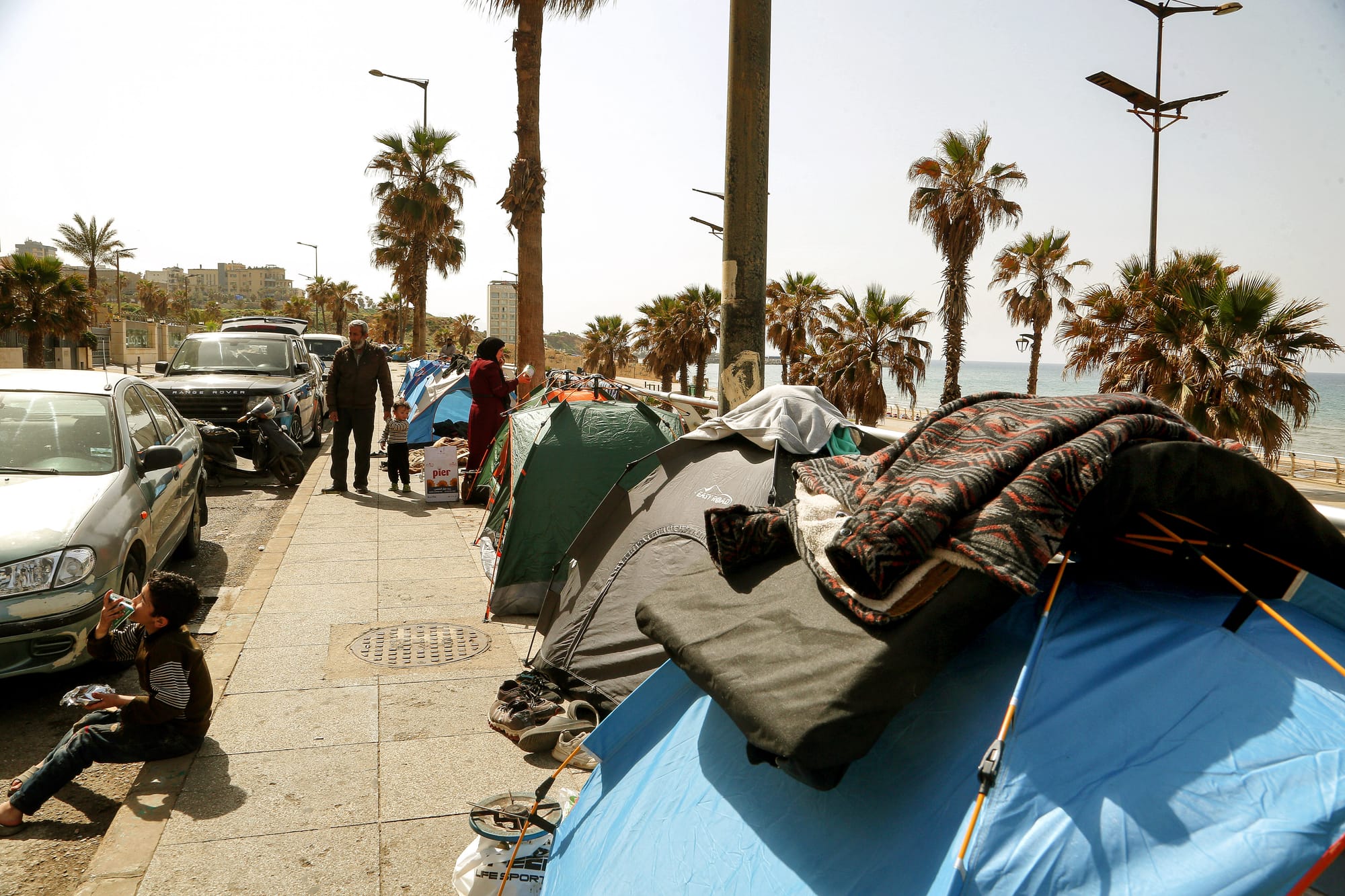
A displaced Lebanese family stands outside their tent near the site of an Israeli drone attack on Beirut's Ramlet al-Baida seafront on March 12, 2026\. The health ministry reports eight people killed and 31 wounded in the strike. The army has since cordoned off the area following the discovery of unexploded Israeli ordnance. Marwan Naamani/picture alliance via Getty Images
## Maryam Alemzadeh: The IRGC Thrives in Chaos
When the Islamic Revolutionary Guards Corps (IRGC) was established in spring of 1979, there was little expectation for it to be a professional military force. Postrevolutionary chaos necessitates a good level of flexibility, independence and direct action, and the nascent IRGC delivered. The zealous young men that joined the new militia in the thousands did not have patience or respect for due procedure. The Revolutionary Guards’ participation in the violent repression of ethnic uprisings around Iran was the first stamp of approval that their chaotic revolutionary method could indeed be beneficial for the government.
The Iran-Iraq war, a conventional battle, was a different story—or at least was supposed to be. When the IRGC entered the war alongside Iran’s regular military, the expectation was that it would have no choice but to professionalize. And to some extend it did. Between 1980 and 1988, the duration of the war, it grew exponentially, adopted conventional military battle order and developed three separate forces: ground force, navy and air force.
Keep reading
Iran was already in possession of a regular army, however. To stay relevant, to remain justified, the IRGC maintained both the organizational structure and the conditions that would give it a raison d'être. Despite the conventional façade, the IRGC ground force continued to operate in a decentralized and semi-formal manner throughout the war. The new air force and the navy never came close to classic, advanced military forces either. But more importantly, the IRGC prolonged the war for eight years when it could arguably have ended in two and a half, when Iran had taken back its lost territory. The chaos of war was a necessary condition for them to present spontaneous, somewhat disorganized action as the only viable option. It was through such argumentation and action that the IRGC rose to unparalleled prominence by the end of the war.
Between then and now, the IRGC’s grip on power was institutionalized in various ways: its connection to the office of supreme leadership was systematized, its meddling in politics became prevalent, its security and repression apparatus expanded. It established an economic empire, and it became the government’s main agent in evading crippling sanctions, while expanding its military presence in the region. As central as the IRGC was, with the chaos of war imposed on Iran once again—this time jointly by the United States and Israel—the IRGC has become more relevant to the government’s future than ever before. It has certainly suffered major blows—refraining from conventional professionalization comes at a price. But it is unquestionably at the helm of the country these days and forms the backbone of the government’s continued resilience.
The urgency of the war has once again justified the IRGC hardliner’s radical, aggressive and hectic approach to war and politics. It has empowered them to have Mojtaba Khamenei, their own man in the eyes of many, appointed as the next supreme leader. His appointment has enabled a continuation of the policy of pushing adversaries far enough in the hopes of ensuring a lasting ceasefire, possibly including sanctions relief. As things stand, with the conclusion of the war, the IRGC will have emerged politically empowered to determine the course of the country’s future in whatever path it may decide to pursue.
**Maryam Alemzadeh is an associate professor in history and politics of Iran at the Oxford School of Global and Area Studies and a Middle East Centre fellow.**
## Peyman Jafari: Bombs Will Not Bring Democracy
Iranians are caught between two fires. In early January, the Iranian state brutally cracked down on large protests, reportedly killing over seven thousand people. And now, Israeli and US bombs have devastated Iran: about 1,500 civilians have been killed, more than three million have been displaced, over fifty thousand homes and economic infrastructures are destroyed and hundreds of schools, hospitals and historical sites are damaged.
Yet there is hope. For more than a century, Iranians have struggled for democracy, social rights and independence. But hope is not enough, because two major obstacles have repeatedly interrupted this long struggle: domestic dictators and imperial powers. Imperial interventions have time and again entrenched autocracy and undermined democratization.
The Constitutional Revolution of 1906 was partly defeated by British and Russian interventions. When Prime Minister Mohammad Mosaddeq nationalized Iran’s oil in 1951 and empowered parliament, the Americans and the British carried out a coup in 1953 that installed the authoritarian rule of Mohammad Reza Pahlavi. The “[blowback](https://www.amazon.com/Blowback-Consequences-American-Empire-Project/dp/0805075593)”—a US policy term denoting the unintended consequences of such coups—returned to Iran 25 years later. In 1979, millions of Iranians rose up for freedom, social justice and independence, but their dreams were crushed when Ayatollah Khomeini and his supporters concentrated all power in their own hands. Their repression of dissidents was enabled in part by the war that Saddam Hussein launched against Iran in August 1980 and continued with [US support](https://foreignpolicy.com/2013/08/26/exclusive-cia-files-prove-america-helped-saddam-as-he-gassed-iran/) in the following decade.
Keep reading
After the end of the war in 1988, the calls for change from a reviving society grew louder as women, students, workers and other groups organized and campaigned. In response to these pressures from below, Mohammad Khatami campaigned for reforms and won the 1997 presidential election. This reform project was undermined by conservatives and the Revolutionary Guards, who perceived the US invasions of Afghanistan in 2001 and Iraq in 2003 as a steppingstone toward an invasion of Iran. To counter this threat, they increased repression and concentrated more power in unelected institutions at home and built the “Axis of Resistance” abroad.
While the Iranian society remained resilient in the following decade, with major protests in 2009 (the Green Movement), the conflict around Iran’s nuclear program increasingly overshadowed the struggles from below. The Nuclear Deal reached in 2015 could have revived Iranian society, but its termination by President Donald Trump in 2018 and the return of crippling economic sanctions turned the tide, as the struggles of Iranians against austerity and authoritarian politics became increasingly overshadowed by Israeli and US attempts at regime change, culminating in the current war on Iran.
In his book [*Catastrophic Success*](https://academic.oup.com/cornell-scholarship-online/book/42282), political scientist Alexander Downes shows that even when military interventions succeed in removing dictators, they increase the likelihood of civil war and violent instability. But there is still hope if domestic activists are not forced to focus on survival but instead are given the chance to organize, develop strategies to divide the ruling elite, unite the population and build coalitions. That path will be difficult and take time, but it is the only path. Bombs certainly do not bring democracy.
**Peyman Jafari is an assistant professor of history and international relations at William & Mary.**
## Toby Jones and Andrew Bruno: A War on Everyday Life
The United States and Israel are destroying the infrastructure that sustains everyday life in Iran and Lebanon. In addition to a rising number of deaths, the war is creating the conditions for long lasting environmental harm. For all the current talk of the worldwide economic shocks that result from energy disruptions and rising prices, the reality is that ordinary Iranians, Lebanese and others in the region are bearing the most pain. They also face the bleakest future.
Israeli and US war making in the Middle East has repeatedly and deliberately sought to destroy the systems that provide basic necessities, such as oil facilities, hospitals, water services and the environment more broadly. This approach was apparent in how the United States waged war on Iraq, from the bombing campaign in 1991 to the invasion and occupation after 2003 that dismantled the state. Sanctions regimes supported by the United States, such as those imposed through the United Nations Security Council against [Iraq](https://www.merip.org/2020/06/the-enduring-lessons-of-the-iraq-sanctions/) from 1990 to 2003, and against Iran in various forms since 1979 have caused extensive misery for average citizens. Israel’s devastating siege of [Gaza](https://www.merip.org/2025/01/power-struggles-energy-as-a-weapon-of-war-domination-and-resistance-in-palestine/) over decades and the genocide after October 7, 2023, also targeted people’s basic needs. The current war in the Gulf and Eastern Mediterranean is a terrible escalation of these forms of war.
Keep reading
The most dramatically visible recent attacks on vital systems have been carried out against Iran’s oil infrastructure. On March 8, 2026, Israel destroyed four large oil storage facilities on the outskirts of Tehran that helped provide 10 million people with basic [services](https://www.amnesty.org.uk/latest/middle-east-millions-at-risk-as-israel-us-and-iran-unlawfully-target-energy-infrastructure/) like electricity, heating and transportation of goods such as food and water. The attacks also have environmental consequences, the extent of which is impossible to fully grasp. As one [resident](https://www.amnesty.org.uk/latest/middle-east-millions-at-risk-as-israel-us-and-iran-unlawfully-target-energy-infrastructure/) put it, “soot is falling from the sky. It is terrifying.” Black rain, infused with carcinogenic hydrocarbons, has spread toxic fallout from the strikes well beyond the city.
The day before the [attack on Tehran’s oil](https://www.nytimes.com/2026/03/08/world/middleeast/desalination-plants-iran-bahrain.html), US forces struck an Iranian water desalination plant on Qeshm Island, terminating the water supply for dozens of villages and potentially thousands of people. Iran followed suit a day later by attacking a desalination facility in Bahrain. That attack suggested Iran was threatening to escalate attacks on similar kinds of precarious environmental systems. So far, though, while Iran has struck commercial targets in the Gulf, it has not pursued the same strategy of destruction as the United States and Israel.
In echoes of the genocide, where Israel destroyed the majority of Gaza’s health care facilities, US and Israeli attacks have hit at least 18 hospitals and health care centers. Israeli forces have also directly targeted [25 health care centers](https://www.reuters.com/business/healthcare-pharmaceuticals/who-confirms-18-attacks-healthcare-sites-iran-2026-03-11/?utm%5Fsource=chatgpt.com) in Lebanon. In fear of similar attacks, 49 primary health care centers and 5 hospitals have been [shuttered](https://www.who.int/samoa/news/detail-global/11-03-2026-conflict-deepens-health-crisis-across-middle-east--who-says?utm%5Fsource=chatgpt.com) in the country following evacuation orders. In addition to direct attacks on [care](https://www.latimes.com/world-nation/story/2026-03-16/in-hunt-for-hezbollah-israel-is-devastating-south-lebanon), UNICEF [reported](https://www.unicef.org/documents/lebanon-humanitarian-flash-update-no3-escalation-hostilities-12-march-2026) Israeli bomb damage to water distribution lines, reservoirs and a pumping station in Southern Lebanon affecting more than 23,000 people.
In addition to the destruction of public services, attacks like these cause hardship through displacement. The United Nations estimates that up to [3.2 million](https://www.reuters.com/world/middle-east/up-32-million-people-displaced-inside-iran-by-conflict-un-says-2026-03-12/) people have been displaced inside Iran, while Israel has displaced over [800,000](https://www.unicef.org/documents/lebanon-humanitarian-flash-update-no3-escalation-hostilities-12-march-2026) in Lebanon, with many forced into overcrowded shelters with scarce access to water, food and care. The new refugee crisis not only creates immediate suffering but also adds to already overburdened systems of care, which are often underfunded and under stress. While this phase of the US and Israeli long war in the region may be limited in duration, these effects will persist long past the formal cessation of hostilities.
US and Israeli militarism has been destroying infrastructure and the material conditions of life for millions in the Middle East for decades. The current war adds spectacularly to the ledger and assures more harm is to come for ordinary people. Tragically much of this everyday suffering will remain invisible to most observers.
**Toby C. Jones teaches Middle East history at Rutgers University, New Brunswick and a member of MERIP’s editorial committee. Andrew Bruno is a PhD student in Middle East history at Rutgers University, New Brunswick.**
## Marya Hannun: The Regional War Through Afghanistan
When the US-Israeli war on Iran began, the war in Afghanistan reappeared in US political discourse almost immediately as a specter. President Trump devoted a long meander to it in a speech in Kentucky on March 11, contrasting the current war that “[we’re going to leave very fast](https://rollcall.com/factbase/trump/transcript/donald-trump-speech-verst-logistics-hebron-kentucky-march-11-2026/),” with the chaotic 2021 withdrawal. Washington insiders have been quick to dust off the word "quagmire.” Afghanistan in this framing is the cautionary tale of military overreach and US-backed regime change, the forever war that recedes into the past tense as yesterday’s war precisely so that the next intervention can be accomplished differently.
This framing is not only historically shallow. It is geographically myopic. Afghanistan shares a nearly 1,000-kilometer border with Iran. The two countries are bound by long circuits of migration, commerce and shared social life. Iran currently claims to host more than 6 million Afghan refugees and migrants. Many of them live and work precariously, are denied basic services and scapegoated for economic grievances. During the June 2025 war, an already active deportation campaign accelerated sharply when the Iranian government [accused undocumented Afghans](https://www.aljazeera.com/news/2025/7/22/inside-irans-crackdown-on-afghan-migrants) of links to Israeli intelligence operations inside the country. Since the US-Israeli attacks began, thousands of Afghans have crossed the border each day from Iran. Afghanistan also depends on Iranian territory for trade access to the sea—both through Bandar Abbas, Iran's largest port, and Chabahar, which became a primary Afghan maritime route in late 2025 when trade was redirected away from Karachi amid escalating conflict with Pakistan. Already weakened by US sanctions, Iran’s port city of Chabahar has been struck at least once in the war. In these ways and more, the conflict is being materially felt in Afghanistan.
Keep reading
Meanwhile, US coverage of the Iran war has entirely ignored the fact that on the same weekend the strikes began, Afghanistan and Pakistan entered day three of what Islamabad's own defense minister called "[open war](https://www.bbc.co.uk/news/articles/cvgjd7pv4y4o)." This conflict is one of the many unresolved afterlives of the US war on Afghanistan, rooted in the legacy of the so-called War on Terror, US drone warfare and a militarized border that fueled insurgencies neither state has resolved. In the past two weeks, Pakistani airstrikes have struck military installations, including Bagram airbase, but also civilian sites across multiple provinces—on March 18 an [attack on a drug rehabilitation center](https://www.bbc.co.uk/news/articles/ckg1kgz6wkgo) in Kabul killed 400 people, according to the Taliban. The Taliban government in Afghanistan has launched drone strikes deep into Pakistani territory. The ongoing fighting is the most serious escalation between the two countries in years, and it follows months of cross-border shelling, mass deportations from Pakistan of Afghan migrants and the disruption of bilateral trade—worth billions annually.
For states and peoples in South and Central Asia, these wars are not playing out as separate events. Both conflicts jeopardize the economic and political connectivity of the regions, imperiling transregional projects, capital flows and diplomatic efforts. The Pakistan-Afghanistan corridor, the main artery of exchange between Central Asia and the Indian Ocean, is [effectively closed](https://www.eurasiareview.com/12032026-war-in-iran-and-afghanistan-threatens-central-asias-gateway-to-global-markets-analysis/), while the proposed Uzbekistan-Afghanistan-Pakistan railway—a $6 billion project intended to cut transit times and open landlocked Central Asia to global markets—is jeopardized. Meanwhile, the simultaneous war on Iran threatens a range of infrastructure projects connecting Central Asian states to the Persian Gulf through Iranian ports. Gulf states, which have cultivated significant diplomatic influence in Afghanistan, are now consumed by the war on their own doorstep. Qatar, which brokered an October 2025 ceasefire between Kabul and Islamabad, now has an uncertain capacity for mediation.
Afghan commentators have not missed the timing of these overlapping wars. The observation that Pakistan is striking Taliban military infrastructure precisely as the United States wages war on its western neighbor is read in some corners as serving US interests—a suspicion that Trump's own quixotic public musings about [reclaiming Bagram airbase](https://www.aljazeera.com/news/2025/9/29/afghanistans-bagram-airbase-why-is-trump-desperate-to-take-it-back) do little to dispel. Conspiratorial though it may be, such popular awareness that these conflicts are connected is almost entirely absent from US coverage of the “[war in the Middle East](https://www.nytimes.com/2026/03/13/world/middleeast/iran-war-middle-east-recap.html).” Afghanistan is assigned to the past tense. The cascading crises of 2026 suggest it belongs firmly in the present.
**Marya Hannun is a postdoctoral fellow at the University of Exeter’s Institute of Arab and Islamic Studies and MERIP’s managing editor.**
## Melani McAlister: Evangelicals, Israel and the War on Iran
At the start of the US-Israeli war against Iran, members of the US military lodged scores of complaints that their commanders were talking to them about the war as “[part of God’s divine plan](https://www.theguardian.com/world/2026/mar/03/us-israel-iran-war-christian-rhetoric).” At the same time, Harvest Christian Fellowship pastor, Greg Laurie, [warned his online audience](https://www.youtube.com/watch?v=Jmu0yhAuw-A) about the dangers of Iran as an Islamic state and suggested that current events reflected biblical prophecy. Such interpretations have long been a hallmark of US evangelical engagement with Israel. Especially since 1967, a significant subset of US evangelicals have analyzed almost every event that involves Israel as a harbinger of the “end times.” But despite these prominent recent examples, this familiar rush of prophecy-talk is actually on the decline.
Evangelicals today are both less interested in prophecy and less uniformly enamored of Israel—particularly younger believers, whose support for Israel had [already begun to wane](https://eppc.org/publication/why-it-matters-that-support-for-israel-among-young-evangelicals-is-falling/) before the brutal destruction of Gaza. Other evangelicals, of all ages, are moving closer to Tucker Carlson’s view that a MAGA agenda means less investment in any other country’s politics. Even among those who continue to back Israel ([51 percent](https://criticalissues.umd.edu/.%20%20%20%20PEW%20study) of evangelicals over 35 say they side with Israelis rather than Palestinians), apocalyptic interpretations appear less central. These shifts reflect broader demographic and theological changes within evangelicalism and are reshaping how evangelicals understand and engage international affairs, including the current war.
Keep reading
One important factor is the rapid rise of charismatic and Pentecostal Christianity, the [fastest growing sector of evangelicalism](https://www.premierchristianity.com/features/inside-the-fastest-growing-religious-movement-on-earth/6009.article), both in the United States and globally. While many of its leaders remain deeply pro-Israel, they are less likely to narrate that support through prophecy talk. Instead, they often rely on more general scriptural claims, such as the promise God makes to Abraham in Genesis: “I will bless those who bless you, and curse those who curse you.” This approach maintains strong support for Israel while shifting its theological ground.
A related development is the rise in recent decades of the New Apostolic Reformation (NAR). This loosely organized but rapidly expanding network of charismatic-Pentecostal churches, organizations and individuals emphasizes pursuing power in worldly arenas such as government, education, business and media. It is one of the most important centers of Christian nationalism in the United States today. Politicians with ties to the group include House speaker Mike Johnson, Texas Republican senator Ted Cruz and Republican House representative Lauren Boebert. Its leaders routinely argue that President Trump was “divinely appointed” in order to increase the power of conservative Christians, and they have strongly supported the war against Iran. The network is pro-Israel, built around the “God blesses those who bless Israel” argument and buttressed by frequent trips to “the Holy Land.” While the NAR is controversial even within conservative circles for its “worldly” investments, there is no question about its influence. This network is reshaping evangelical investments in Middle East politics while retaining a strongly pro-Israel orientation.
At the same time, the category of “evangelical” overall is changing. Since the first Trump presidency, there has been a rise in the number of not-so-religious, predominantly white adults who define themselves as evangelical, as the term becomes more and more synonymous with simply being right-wing and Republican. These new adherents [almost uniformly](https://www.pewresearch.org/short-reads/2021/09/15/more-white-americans-adopted-than-shed-evangelical-label-during-trump-presidency-especially-his-supporters/) had expressed a warm view of Trump in 2016, before they came to call themselves evangelicals. In the same period, the number of self-identified evangelicals who did not attend church rose, particularly among those who identify as conservative. As a result, support for Israel among these newer evangelicals is less likely to be grounded in biblical interpretation than in broader ideological and partisan alignment.
Taken together, these developments suggest that while traditional prophecy-driven Christian Zionism may be weakening, evangelical support for Israel is not disappearing. But it is shifting. And this support continues to influence US policy. Despite their differences, for now, these movements are united in their support for President Trump, and they have created a remarkably effective bloc of right-wing power.
**Melani McAlister is Professor of American Studies and International Affairs at the George Washington University.**
## Maya Mikdashi: From Gaza to Lebanon—A War Without Limits
The seventh Israeli invasion of Lebanon is being waged in both the shadow of genocide in Gaza and within the world that Israel’s permission to commit genocide has created. This is a world where international law has become a punchline, where there are no innocents and where there is no form of degradation—starvation, siege, ethnic cleansing—that is off limits. It is a world where Israel can boast of their [“success in Gaza,”](https://thepublicsource.org/blog/lebanon-war/israel-leaflets-psychological-warfare) where people in Lebanon are asked to choose between the slow asphyxiation of a so-called ceasefire and the catastrophe of a war without limits. In short, it is a world of permanent war, with shifting battlefields but one center: Palestine.
In Lebanon, this war of impunity is being waged against three fronts: the battlefield, the country’s social fabric and its political society. Militarily, Israel is doing what it has done in Gaza and previously in Lebanon: assassinations, the destruction of entire landscapes and indiscriminate bombardment against a people that have no air defenses, no bomb shelters and no air force—in conjunction Israel has launched a ground invasion. It is also trying to break the Lebanese army by calling on it to collaborate in fighting Hizballah. This pressure comes after months of unanswered [Israeli ceasefire violations](https://reliefweb.int/report/lebanon/msf-update-southern-lebanon-where-ceasefire) that preceded the current escalation. But although Hizballah’s decision to launch rockets on March 2 is unpopular and deeply polarizing, the Lebanese army will not confront Hizballah, in part out of concern for its internal cohesion and because it recognizes the threat of cantonization.cantonization.
Keep reading
Israel is intentionally creating a humanitarian disaster that they know the country, including its government and civil society network, cannot absorb. As of March 18, at least 930 people in Lebanon have been killed by the Israeli army, including 111 children and 38 health workers. More than 1,000,000 people have been displaced. Israel has stated that it wants to create a demilitarized and depopulated zone south of the Litani River (about 19 miles into Lebanon) similar to the “yellow line” they drew in Gaza. As Israel is expanding its territory and control into Gaza, the West Bank and Syria, there is good reason to believe that it desires to occupy and perhaps annex this resource and maritime rich territory, a goal often repeated by early Zionist and Israeli leaders and openly spoken of by Israeli politicians today.
Israel is targeting Lebanon’s social fabric, inflicting mass punishment to weaken public support for Hizballah—a strategy it also pursued unsuccessfully during the 2006 war. Through the displacement of primarily Shia Lebanese, Israel is also attempting to foment sectarian violence by continuing to target displaced people in their spaces of refuge. These attacks both kill and are intended to make people from different sects and areas too afraid to help their displaced compatriots. On March 11, they inflicted a double tap strike and massacre on the corniche of Ramlet al Bayda, Beirut’s only public beach, where displaced people were living in cars and tents. The spectacle of Israel’s impunity to commit atrocities is the point.
Before this return to open war, the Lebanese political equation had turned into a precarious balancing act between the government, the army, the Central Bank and Hizballah and its allies. Each element is reliant on different countries (now at war), institutions and actors for support. After the war, no matter its outcome, this political equation will change. But this war will not end soon, even if this episode does. The colonization of historic Palestine has always required the pacification of, or domination over, their kin across different borders. Israel, the only state in the Middle East armed with nuclear weapons, will never allow the formation of a Palestinian state, nor will it willingly change its ethno-sectarian character. This refusal is a declaration of permanent war against Palestinians and their supporters. In pursuit of this permanent war, and while they still have the unconditional support of the US government and its politicians, Israel has decided to be a country buffered by depopulated wastelands, with no people, party or government capable of mounting any modicum of resistance to either their occupation or that of Palestine. Even if Israel occupies South Lebanon, however, and Hizballah is somehow neutralized, resistance will grow like weeds under every boot print in the ground. Eventually, they will be ensnared.
**Maya Mikdashi is an associate professor of Women's, Gender and Sexuality Studies and the director of the Center for Middle Eastern Studies at Rutgers University.**
##
SUPPORT MERIP
55 years of critical coverage of the Middle East--without paywalls! Help us keep it that way by making a donation today!
[DONATE NOW ](https://www.merip.org/donate/)
### The MERIP Podcast Episode 19: The MERIP Roundtable, On the Iran War Part II
URL: https://www.merip.org/2026/03/the-merip-podcast-episode-19-the-merip-roundtable-on-the-iran-war-part-ii/
Last updated: 2026-03-19T12:35:49.000Z
On today’s episode of the MERIP Roundtable our discussion focused on people’s experiences of the war on Iran and throughout the region two and a half weeks in. Much of the discussion of this war in the western media has centered on the strategic calculus of the United States and Israel in deciding to go to war, how long it may endure and what that means for Americans. Despite the fact that Iranians are withstanding a bombardment that is comparable in scale to Israel’s initial assault on Gaza in October 2023, the immense damage being done to the country is less prominent in the discourse. According to official Iranian sources, there have been over 1,400 civilian casualties, 18,000 injuries and 61,000 civilian structures damaged. According to the UN, approximately 3.2 million people have been displaced. Given these facts, MERIP’s executive director James Ryan asked our roundtable how Iranians are dealing with the US and Israeli siege. How are they getting information in and out, and how should those of us outside of Iran contextualize what we’re hearing and seeing? Also, since he was joined by fellow historians, they discussed how we can begin to see this war’s many dimensions in a longer historical trajectory.
This edition of the MERIP Roundtable features Naghmeh Sohrabi, a frequent MERIP contributor, the Charles Corky Goodman Professor of Middle East History at Brandeis University and the director of research at the Crown Center for Middle East Studies; Kaveh Ehsani, associate professor of international studies at DePaul University and a member of MERIP’s Board of Directors and Toby Craig Jones, associate professor of history at Rutgers University and a member of MERIP’s editorial committee.
This discussion was recorded on March 18, 2026
[Listen on Apple Podcasts](https://podcasts.apple.com/us/podcast/episode-19-the-merip-roundtable-on-the-iran-war-part-ii/id1823259361?i=1000756133438)
[Listen on Spotify](https://open.spotify.com/episode/05LqIu93rhJfQjICrvwFR2)
[Listen on Amazon Music](https://music.amazon.com/podcasts/d73ad16e-0e22-4ca4-80f1-cf61dade333e/episodes/aafac849-99be-4bf8-91d0-684389bcf07b/the-merip-podcast-episode-19-the-merip-roundtable-on-the-iran-war-part-ii)
Further Reading
[Nashraasoo](https://aasoo.org/) (@nashraasoo on Instagram)
Roy Mottahedeh, [*The Mantle of the Prophet: Religion and Politics in Iran*](https://www.simonandschuster.com/books/The-Mantle-of-the-Prophet/Roy-P-Mottahedeh/9781851686162) (New York, Simon and Schuster)
Kaveh Ehsani, “[Voices from the Middle East: US Sanctions on Iran Devastate the Health Sector](https://www.merip.org/2020/03/voices-from-the-middle-east-us-sanctions-on-iran-devastate-the-health-sector/)” *Middle East Report Online* March 31, 2020
[Costs of War Project](https://costsofwar.watson.brown.edu/) (Brown University)
Joy Gordon ed., [Economic Sanctions from Havana to Baghdad](https://www.cambridge.org/core/books/economic-sanctions-from-havana-to-baghdad/E77CFB981432A0F8DBD6790740448C51) (Cambridge, 2025)
Joy Gordon, [“The Enduring Lessons of the Iraq Sanctions”](https://www.merip.org/2020/06/the-enduring-lessons-of-the-iraq-sanctions/) *Middle East Report* Spring 2020
Francisco Rodríguez, Silvio Rendón, Mark Weisbrot, [“Effects of international sanctions on age-specific mortality: a cross-national panel data analysis”](https://www.thelancet.com/journals/langlo/article/PIIS2214-109X%2825%2900189-5/fulltext) *The Lancet Global Health*, 13, e1358-e1366
Noura Erakat, Luigi Daniele, Shahd Hammouri, Ata Hindi, Maryam Jamshidi and Darryl Li, [“Roundtable on the War on Iran and International Law”](https://www.jadaliyya.com/Details/47234/Roundtable-on-the-War-on-Iran-and-International-Law) Jadaliyya, March 13, 2026
Firoozeh Kashani Sabet, [“Iranicide: the Genealogy of Hate”](https://the-tempered-view.ghost.io/iranicide-the-genealogy-of-hate-the-haunting-sight-of-thick-black-smoke-suffocating-iranians-seemingly-signals-the-slow-asphyxiation-of-a-proud-country-before-the-worlds-eyes-with-the-i/) *The Tempered View*, March 14, 2026
SUPPORT MERIP
55 years of critical coverage of the Middle East--without paywalls! Help us keep it that way with a donation today!
[DONATE NOW ](https://www.merip.org/donate/)
### The MERIP Podcast Episode 18: The MERIP Roundtable, On The Iran War Part I
URL: https://www.merip.org/2026/03/the-merip-podcast-episode-18-the-merip-roundtable-on-the-iran-war-part-i/
Last updated: 2026-03-12T13:00:21.000Z
On today’s episode we have a new installment of our MERIP Roundtable series, where members of our editorial committee, recent contributors and close comrades discuss current events. In this episode, we centered our discussion on the social dynamics and impacts of the current war on Iran and consider how the regional political order may be shifting as a result.
On February 28, 2026, the United States and Israel began a massive air war against Iran, which has now impacted up to 12 countries in the region. Many of Iran’s political leaders, including the 86-year-old Supreme Leader Ali Khamenei, have been killed and replaced, oil infrastructure in Iran and across the Gulf has been severely damaged or production halted and retaliatory Iranian missile and drone strikes have hit both military and civilian targets in Israel, Jordan, Saudi Arabia, Kuwait, Bahrain, Qatar, the Emirates and Oman. The closing and apparent mining of the Strait of Hormuz has sent oil prices over $100 a barrel, pushing the global economy to the brink of a recession. All of this is happening under the direction of a US administration whose war aims appear opaque and in cooperation with an Israeli government bent on sowing regional chaos, inflicting misery on ordinary Iranians, accelerating devastating attacks on Lebanon, closing Gaza to all aid and severely restricting movement within the West Bank.
Joining Executive Director James Ryan for this roundtable are Ida Nikou, a sociologist and author of a recent MERIP article [“Governing Crisis–Sanctions, Austerity and Social Unrest in Iran”](https://www.merip.org/2026/01/governing-crisis-sanctions-austerity-and-social-unrest-in-iran/); Arang Keshavarzian, professor of Middle East and Islamic Studies at NYU, a long time MERIP contributor and editor and author of [Making Space for the Gulf: Histories of Regionalism and the Middle East](https://www.sup.org/books/middle-east-studies/making-space-gulf), which came out from Stanford University Press in 2024; and Sean Yom, a member of our editorial committee, associate professor of political science at Temple University and author of [Jordan: Politics in an Accidental Crucible](https://global.oup.com/academic/product/jordan-9780190097264?cc=us&lang=en&), which was released just last year from Oxford University Press.
This episode was recorded on March 11, 2026.
[Listen on Apple Podcasts](https://podcasts.apple.com/us/podcast/episode-18-the-merip-roundtable-on-the-iran-war-part-i/id1823259361?i=1000754835000)
[Listen on Spotify](https://open.spotify.com/episode/7mC3EojC2RtPxyDRDix7S4)
[Listen on Amazon Music](https://music.amazon.com/podcasts/d73ad16e-0e22-4ca4-80f1-cf61dade333e/episodes/dffa07ae-597b-4eb5-953f-0bf34e49e78e/the-merip-podcast-episode-18-the-merip-roundtable-on-the-iran-war-part-i)
Further reading:
Ida Nikou and Manijeh Moradian eds., [“Iran in Crisis: Seven Essays on the Obstacles to Freedom,”](https://www.jadaliyya.com/Details/47192) Jadaliyya, February 24, 2026\.
Ida Nikou, [“Governing Crisis–Sanctions, Austerity and Social Unrest in Iran,”](https://www.merip.org/2026/01/governing-crisis-sanctions-austerity-and-social-unrest-in-iran/) MERIP, January 29, 2026.
Adam Hanieh, [*Crude Capitalism: Oil, Corporate Power and the Making of the World Market*](https://www.versobooks.com/products/2760-crude-capitalism?srsltid=AfmBOor0ITk%5FUI7Iidb9vYrgbFede7TB%5FJlKszgl2O9xy5iBkCFfjH9K), (Verso Books, 2024).
Esfandyar Batmanghelidj, [“The Iran War is Jeopardizing the Entire Global Economy”](https://foreignpolicy.com/2026/03/04/iran-war-dubai-saudi-qatar-global-economy-oil-shipping-trade/) *Foreign Policy,* March 4, 2026\.
Andrew J. Bacevich, [*America’s War for the Greater Middle East: A Military History*](https://www.penguinrandomhouse.com/books/241154/americas-war-for-the-greater-middle-east-by-andrew-j-bacevich/)(Penguin, 2017).
Marc Lynch, [*America’s Middle East: The Ruination of a Region*](https://www.hurstpublishers.com/book/americas-middle-east/)(Hurst Publishers, 2025).
Eskandar Sadeghi-Boroujerdi,[ “The Dry and the Wet Burn Together,”](https://www.lrb.co.uk/blog/2026/march/the-dry-and-the-wet-burn-together) *London Review of Books,* March 3, 2026\.
Ervand Abrahamian, [“Iran Under Fire,”](https://newleftreview.org/issues/ii157/articles/ervand-abrahamian-iran-under-fire) *New Left Review* 157, January/February 2026\.
Naghmeh Sohrabi, [“These are the True Things”](https://truethings.naghmehs.com/) (Substack)
Reza Akbari, [“The Guarded Domains”](https://guardeddomains.substack.com/) (Substack)
Toby Craig Jones, [“Iran and America’s Long War in the Middle East,”](https://www.newglobalpolitics.org/iran-and-americas-long-war-in-the-middle-east/) *New Global Politics,* March 4, 2026\.
Arang Keshavarzian,[ “Iran Transformed,”](https://www.nybooks.com/online/2026/03/08/iran-transformed/) *New York Review of Books*, March 8, 2026\.
Mira Al Hussein, [“The Iran War Has Exposed the Gulf’s Bet on US Protections,”](https://www.hidden-cities.com/p/the-iran-war-has-exposed-the-gulfs) *Hidden Cities*, March 9, 2026\.
SUPPORT MERIP
All of MERIP's Podcasts come to you without ads or paywalls. Please make a donation today so we can keep it that way!
[DONATE NOW ](https://www.merip.org/donate/)
### The MERIP Podcast Episode 17: Niema Alhessen
URL: https://www.merip.org/2026/03/the-merip-podcast-episode-17-niema-alhessen/
Last updated: 2026-03-09T15:16:49.000Z
Today’s episode of the MERIP Podcast features an interview with Niema Alhessen, a Sudanese researcher based in Cairo who is focused on urban conflict and displacement. She is the author of “Burri Under Siege—How War Remade Everyday Life in a Sudanese Neighborhood” in our Winter 2025 issue of *Middle East Report*, “Reconstruction and Ruin.” Burri, a neighborhood in central Khartoum that houses key political and military institutions, was under siege by the Rapid Support Forces (RSF) from the beginning of its war with the Sudanese Armed Forces (SAF) in April 2023 until the SAF regained control of the city in March 2025\. Alhessen spoke with residents of Burri about living in their neighborhood during the siege, how they sustained life through makeshift institutions and mutual aid and negotiated with both the RSF and SAF in order to procure aid. Alhessen’s article also delves into the deeper colonial history of Khartoum’s urban fabric, detailing how the militarization of Khartoum’s streets has its roots in the colonization of Sudan under the Anglo-Egyptian condominium in the late nineteenth century.
For this episode, MERIP’s Executive Director James Ryan was joined by co-host Deen Sharp, an LSE Fellow in Human Geography in the department of geography and environment at the London School of Economics, a member of MERIP’s editorial committee and an editor on the issue “Reconstruction and Ruin.”
This interview was recorded on March 4, 2026
[Listen on Apple Podcasts](https://podcasts.apple.com/us/podcast/episode-17-niema-alhessen/id1823259361?i=1000753999622)
[Listen on Spotify](https://open.spotify.com/episode/4889w5EFdeDV1o4PxWSvit)
[Listen on Amazon Music](https://music.amazon.com/podcasts/d73ad16e-0e22-4ca4-80f1-cf61dade333e/episodes/62a10418-9e55-4240-b436-8e19d041990f/the-merip-podcast-episode-17-niema-alhessen)
Niema Alhessen, [“Burri Under Siege–How War Remade Everyday Life in a Sudanese Neighborhood”](https://www.merip.org/2026/02/burri-under-siege-how-war-remade-everyday-life-in-a-sudanese-neighborhood/) *Middle East Report* 317 (Winter 2025).
Further reading:
Ali Al-Arash, [“Bread, Books, and Bombs: Burri’s Spirit of Resistance, Knowledge, and Solidarity,](https://atarnetwork.com/wp-content/uploads/2025/05/ATAR-English-Issue-28-Bread-books-and-bombs-Burri-s-spirit-of-resistance-knowledge-and-solidarity.pdf)” *ATAR Network* 28 (May 19, 2025).
Marina D’Errico, [“The Urban Fabric Between Tradition and Modernity (1885–1956): Omdurman, Khartoum, and the British Master Plan of 1910”](https://doi.org/10.1515/9783110719611-011 ) in Vezzadini, Seri-Hersch, Revilla, Poussier & Abdul Jalil (Eds.), *Ordinary Sudan, 1504–2019: From Social History to Politics from Below* (Berlin, Boston: De Gruyter, 2023).
[Khartoum podcast ](https://soundcloud.com/sudanmoves)by Studio Urban.
Khalid Mustafa Medani, [“The Struggle for Sudan”](https://www.merip.org/the-struggle-for-sudan/) *Middle East Report* 310 (Spring 2024).
SUPPORT MERIP
Be a part of our community of supporters! Make a donation today to make sure all of our writing and podcasts remain free to all!
[DONATE NOW ](https://www.merip.org/donate/)
### The US and Israeli War on the Middle East
URL: https://www.merip.org/2026/03/the-us-and-israeli-war-on-the-middle-east/
Last updated: 2026-03-03T20:26:50.000Z
Dear Friends and Comrades,
On Saturday February 28, the United States and Israel carried out coordinated airstrikes on Iran. The strikes, which followed an inconclusive round of peace talks, were aimed at senior Iranian leaders and commanders, with the stated goal of hitting the regime’s political and military hierarchy. Ayatollah Ali Khamanei, the Supreme Leader of the Islamic Republic, was killed in the attacks, along with several members of the Revolutionary Guard Corps, and this morning the building that houses the Assembly of Experts, responsible for choosing a new supreme leader, was struck by Israeli missiles. Iran’s retaliation has comprised missile and drone strikes across the Gulf, targeting US military assets, oil infrastructure and civilian centers in Bahrain, Qatar, the United Arab Emirates (including in and around Dubai and Abu Dhabi), Kuwait and Saudi Arabia. Iranian missiles and drones also caused damage to nearby civilian infrastructure in major cities and transportation hubs, drawing condemnation from Gulf states and raising fears of broader regional escalation. After more than a year of ceasefire violations by Israel, Hizballah fired missiles into Israel in retaliation for the killing of Iran’s supreme leader. Israel has responded with heavy bombardments across Lebanon. As I write this, US and Israeli strikes are continuing, while casualties, including hundreds of civilians across the region, are rising. Despite President Donald Trump and Secretary of Defense Pete Hegseth’s apparent desire for a “short war,” such a conflict will likely immiserate Iran’s population and undermine the popular will and sovereignty of Iranians for a long time to come.
As our editors and contributors follow events closely, we want to share some key articles and podcast conversations from the past year that might serve as a reference for understanding how we arrived at such a perilous moment for the region.
In Solidarity,
James Ryan
Executive Director
---
[“Governing Crisis—Sanctions, Austerity and Social Unrest in Iran”](https://www.merip.org/2026/01/governing-crisis-sanctions-austerity-and-social-unrest-in-iran/)
Ida Nikou’s recent analysis of the protest waves explains the economic conditions faced by Iranians caught between sanctions and authoritarianism.
---
[The MERIP Podcast Episode 16: Iman Ali](https://www.merip.org/2026/02/the-merip-podcast-episode-16-iman-ali/)
[“Repair Amid Ongoing Ruination—Rebuilding Dahiyeh Once More”](https://www.merip.org/2026/02/repair-amid-ongoing-ruination-rebuilding-dahiyeh-once-more/)
Iman Ali’s recent article and podcast appearance detail the efforts of Lebanese Shi’a to rebuild their communities in the midst of Israeli attacks.
---
[The MERIP Podcast Episode 14: The MERIP Roundtable, On Iran’s Protests](https://www.merip.org/2026/01/the-merip-podcast-episode-14-the-merip-roundtable-on-irans-protests/)
Asma Abdi, Kaveh Ehsani and Maziyar Ghiabi joined James Ryan on the MERIP Roundtable Podcast last month to discuss the protest wave that preceded this weekend’s attacks.
---
[The MERIP Podcast Episode 9: The MERIP Roundtable, On the Regional War](https://www.merip.org/2025/09/the-merip-podcast-episode-nine-the-merip-roundtable-on-the-regional-war/)
Following Israel’s assassination of key Hamas leaders in a bold rocket attack on Qatar in September 2025, Maziyar Ghiabi, Shana Marshall and Kevin Schwartz joined James Ryan on the MERIP Roundtable Podcast to discuss the widening of Israel’s war in the region.
---
[“The Limits of Protection and Profits—Five Years Into the Abraham Accords”](https://www.merip.org/2025/10/the-limits-of-protection-and-profits-five-years-into-the-abraham-accords/)
For our Summer/Fall 2025 double issue on [Material Politics of Normalization](https://www.merip.org/issue-315-316/), Arang Keshavarzian provided an in-depth review essay of Elham Fakhro’s new book on the Abraham Accords.
---
[“Women and Politics in Post-Jina Iran”](https://www.merip.org/2025/06/women-and-politics-in-post-jina-iran/)
[The MERIP Podcast Episode 1: Mona Tajali](https://www.merip.org/2025/09/merip-podcast-episode-one-mona-tajali/)
For our Spring 2025 issue, Mona Tajali penned an essay on the impact of the Woman, Life, Freedom movement on Iranian politics, and joined James Ryan for the first episode of the MERIP Podcast, recorded in the wake of the July 2025 war on Iran.
---
[“The End of the Axis of Resistance?”](https://www.merip.org/2025/01/iran-palestine-axis/)
Our Winter 2024 issue [Resistance–The Axis and Beyond](https://www.merip.org/issue-313/) opened with this short reflection from Kevin Schwartz on the state of resistance to Israeli aggression and Iran’s role.
---
[“Iran, Palestine and the Axis of Resistance”](https://www.merip.org/2025/01/iran-palestine-axis/)
For [Resistance–The Axis and Beyond](https://www.merip.org/issue-313/), Maryam Alemzadeh unpacked the complex politics of Iranian solidarity with Palestinians and its impacts on Iranian domestic politics.
---
[“A Primer on Lebanon—History, Palestine and Resistance to Israeli Violence”](https://www.merip.org/a-primer-on-lebanon-history-palestine-and-resistance-to-israeli-violence-2/)
In the wake of the September 2024 pager attack in Lebanon, Lara Deeb, Maya Mikdashi, Tsolin Nalbantian and Nadya Sbaiti assembled this thorough primer on the history of Lebanon and its role in establishing solidarity with Palestine and resisting Israeli violence.
---
[“Dispatch from South Lebanon—Life as Resistance at the End of the World”](https://www.merip.org/2025/01/dispatch-from-south-lebanon/)
Writing from southern Lebanon in the immediate wake of the 2024 war with Israel, Munira Khayyat surveyed the devastation and how Lebanese are working to continue living and resisting in spite of repeated attacks.
---
[“Narratives of ‘the Oppressed’—The Dialectic of Resistance Behind the Axis”](https://www.merip.org/2025/01/narratives-of-the-oppressed/)
For Resistance–The Axis and Beyond, Ölmö Gölz and Ruth Vollmer helped explain the ideological underpinnings of the Axis of Resistance from the Iranian perspective.
SUPPORT MERIP
All of MERIP's work is paywall free. Help us keep it that way by making a donation today!
[DONATE NOW ](https://www.merip.org/donate/)
### The MERIP Podcast Episode 16: Iman Ali
URL: https://www.merip.org/2026/02/the-merip-podcast-episode-16-iman-ali/
Last updated: 2026-02-26T17:57:47.000Z
In today’s episode Iman Ali talks about her recently published article, “Repair Amid Ongoing Ruination—Rebuilding Dahiyeh Once More,” which appeared in our Winter 2025 issue, “Reconstruction and Ruin.” Iman Ali, a doctoral candidate in anthropology at Cornell University, has been conducting fieldwork in Lebanon to investigate the impacts of Israel’s war in the fall of 2024 and the ongoing, almost daily, Israeli drone and missile attacks since the November 2024 ceasefire agreement. Her article closely examines the immense material and political challenges faced by Lebanon’s Shi’i community in the last year and a half. She also compares the current struggles to rebuild Beirut’s southern district of Dahiyeh with the vastly different political, funding and leadership landscape following the 2006 war between Hizballah and Israel. After that 2006 campaign, Hizballah was successful in rebuilding the neighborhoods of the Dahiyeh with the aid of funding from several regional and global partners, and under the leadership of Hizballah’s secretary general Hassan Nasrallah. Today, the challenge of rebuilding could not be more different—the financing is not forthcoming, Hizballah’s leadership is decimated and the spectre of continued or renewed Israeli aggression is pervasive.
For this conversation, MERIP’s executive director James Ryan was joined by Najib Hourani, a member of the editorial team for “Reconstruction and Ruin,” as co-host. Hourani is an associate professor of anthropology and global urban studies at Michigan State University and now an emeritus member of MERIP’s editorial committee. We spoke with Iman Ali about her piece, the longer history of the Dahiyeh and the intense burden that resistance to Israeli aggression has placed on Lebanon’s Shi’i communities.
This episode was recorded on February 25, 2026.
[Listen on Apple Podcasts](https://podcasts.apple.com/us/podcast/episode-16-iman-ali/id1823259361?i=1000751754225)
[Listen on Spotify](https://open.spotify.com/episode/12669qK5DOTUpy0z7asusf)
[Listen on Amazon Music](https://music.amazon.com/podcasts/d73ad16e-0e22-4ca4-80f1-cf61dade333e/episodes/5639e154-1ff7-487b-9933-a9728df50df9/the-merip-podcast-episode-16-iman-ali)
Read Iman Ali’s piece here:
Iman Ali, [“Repair Amid Ongoing Ruination–Rebuilding Dahiyeh Once More” ](https://www.merip.org/2026/02/repair-amid-ongoing-ruination-rebuilding-dahiyeh-once-more/)Middle East Report 317, *Reconstruction and Ruin* Winter 2025
SUPPORT MERIP
This podcast comes without paywalls or ads. Help us keep it that way by making a donation today!
[DONATE NOW ](www.merip.org/donate)
Further Reading:
Hiba Bou Akar, [“Urban Interventions for the Wars Yet to Come”](https://www.merip.org/2019/07/urban-interventions-for-the-wars-yet-to-come/%C2%A0) MERO, July 2019
Tamara Chalabi, [*The Shi ‘is of Jabal ‘Amil and the New Lebanon: Community and Nation-State*, *1918–1943*](https://link.springer.com/book/10.1057/9781403982940 ) Springer, 2006
Lara Deeb, [*An enchanted modern: Gender and public piety in Shi'i Lebanon*](https://press.princeton.edu/books/paperback/9780691124216/an-enchanted-modern?srsltid=AfmBOoqcTpqKMA4-KFqziKFdTLlEygTlQrSB8axSVs0hrFN0MaUORMZi ) Princeton University Press, 2006
Mona Fawaz ["Hezbollah as urban planner? Questions to and from planning theory"](https://www.jstor.org/stable/26165922 ) *Planning Theory* 8.4 (2009): 323-334
Mona Harb and Lara Deeb ["Culture as history and landscape: Hizballah’s efforts to shape an Islamic milieu in Lebanon"](https://www.jstor.org/stable/23265810) *Arab Studies Journal* 19.1 (2011): 12-45
Najib B. Hourani ["People or profit? Two post-conflict reconstructions in Beirut"](https://www.tandfonline.com/doi/abs/10.17730/0018-7259-74.2.174) *Human Organization* 74.2 (2015): 174-184
Munira Khayyat ["Dispatch from South Lebanon—Life as Resistance at the End of the World"](https://www.merip.org/2025/01/dispatch-from-south-lebanon/) *Middle East Report* 313 (Winter 2024)
Salim Nasr, [“The Roots of the Shi’i Movement”](https://www.merip.org/1985/06/roots-of-the-shii-movement/) *Middle East Report* June 24, 1985
Salim Nasr, [“Backdrop to Civil War: The Crisis of Lebanese Capitalism”](https://www.jstor.org/stable/3012262) *Middle East Report* No. 73 Winter 1978
### The MERIP Podcast Episode 15: In the Archive with Brahim El Guabli
URL: https://www.merip.org/2026/02/the-merip-podcast-episode-15-in-the-archive-with-brahim-el-guabli/
Last updated: 2026-02-19T12:58:02.000Z
On this episode of our *In the Archive* series, MERIP’s Executive Director, James Ryan, speaks with Brahim El Guabli about his essay, “The Sub-Saharan Turn in Moroccan Literature,” which appeared in the Spring 2021 issue of *Middle East Report*, “Maghreb from the Margins.” El Guabli speaks about how migration from sub-Saharan Africa reshaped Moroccan politics and identity over the course of the last 30 years and how he read those changes through recent Moroccan novels. We discussed how the piece has been received and how its ideas contributed to El Guabli’s development of the concept “saharanism”—the subject of his newly published book, *Desert Imaginations: A History of Saharanism and Its Radical Consequences*.
You can check out our earlier In the Archive segment, with Beshara Doumani [here](https://www.merip.org/2025/11/the-merip-podcast-episode-11-in-the-archive-with-beshara-doumani/%C2%A0).
MERIP is accepting pitches for our summer issue on visual art and cultural production in the Middle East and North Africa until February 23rd for more information click [here](https://www.merip.org/2026/02/call-for-pitches-visual-art-cultural-production-in-the-middle-east-and-north-africa/%C2%A0%C2%A0).
This interview was recorded on February 13 2026
[LISTEN ON APPLE PODCASTS](https://podcasts.apple.com/us/podcast/episode-15-in-the-archive-with-brahim-el-guabli/id1823259361?i=1000750478526)
[LISTEN ON SPOTIFY](https://creators.spotify.com/dash/show/37tU1aRoOzjVEsCZoYBdTs/episode/0W5UCJQMIN7W8voG3aOx0T/analytics/overview)
[LISTEN ON AMAZON MUSIC](https://music.amazon.com/podcasts/d73ad16e-0e22-4ca4-80f1-cf61dade333e/episodes/834be7a5-c968-438e-bcc7-09aa0a1456a5/the-merip-podcast-episode-15-in-the-archive-with-brahim-el-guabli)
Brahim El Guabli is an associate professor of comparative thought and literature at Johns Hopkins University.
Further Reading:
Abdel Rahman Munif, [*Cities of Salt*](https://www.penguinrandomhouse.com/books/118591/cities-of-salt-by-abdelrahman-munif/)( New York: Vintage, 1989)
Brahim El Guabli, [“The Sub-Saharan Turn in Moroccan Literature”](https://www.merip.org/2021/04/the-sub-saharan-african-turn-in-moroccan-literature-2/) *Middle East Report* Issue 298 Spring 2021
Brahim El Guabli, [*Desert Imaginations: A History of Saharanism and Its Radical Consequences*](https://www.ucpress.edu/books/desert-imaginations/paper ) (Berkeley, University of California Press, 2025)
Brahim El Guabli, [“Forgettable Black and Amazigh Bodies: Boujemâa Hebaz and the Moroccan Racial Politics of Amnesia”](https://doi.org/10.1215/1089201X-11233072) *Comparative Studies of South Asia, Africa and the Middle East* 44(2) 2024: 303-316
Brahim El Guabli, [“The Idea of Tamazgha: Current Articulations and Scholarly Potential”](https://www.tamazghastudiesjournal.org/articles-fall2023-issue-01-article02) *Tamazgha Studies Journal* Vol 1\. Issue 1\. Fall 2023, 7-22
Ghislaine Lydon [*On Trans-Saharan Trails: Islamic Law, Trade Networks and Cross-Cultural Exchange in Nineteenth Century Western Africa*](https://www.cambridge.org/core/books/on-transsaharan-trails/B6AB08C0940DBAF3370045EA702E84D1 ) (Cambridge: Cambridge University Press, 2009)
Shamil Jeppie, [*Writing Timbuktu: The Book in West African History*](https://press.princeton.edu/books/hardcover/9780691273853/writing-timbuktu?srsltid=AfmBOorqYdHD-ksEASj0rR-5TBFwqVQPM-Rj-sV-o5pO2dHeMGaTdRaD)(Princeton: Princeton University Press, 2026)
SUPPORT MERIP
All of our podcasts are paywall free! Please help us keep us that way with a donation.
[DONATE NOW ](https://www.merip.org/donate/)
### NEW: MER 317, "Reconstruction and Ruin"
URL: https://www.merip.org/2026/02/new-mer-317-reconstruction-and-ruin/
Last updated: 2026-02-11T13:53:53.000Z
Dear Friends and Comrades,
Today we are releasing our Winter 2025 issue of *Middle East Report*, [“Reconstruction and Ruin.”](https://www.merip.org/issue-317/) This issue includes essays, dispatches and interviews that offer a grounded examination of the impact of war and reconstruction efforts (or lack thereof) on everyday people across the region. From Gaza to Mosul to Khartoum and Damascus, reconstruction projects have become the central focus of state-led efforts to resolve conflicts. In truth, these projects often risk paving over the political, social and material issues at the heart of civil and imperial conflict—trading guns, bombs and drones for bulldozers, cranes and concrete to continue rather than rectify the dispossession and division inherent in urban warfare.
Reconstruction projects demand critical attention at this moment for the region because the scale of the tasks at hand are enormous. As Craig Larkin points out in his [reporting from Damascus](https://www.merip.org/2026/02/the-struggle-for-the-city-urban-recovery-and-dispossession-in-mosul-and-damascus/), a year after the fall of the Asad regime, more than half of the Syrian population remains displaced and the estimated costs of reconstruction after 14 years of civil war exceed $216 billion. The political scales of reconstruction projects have grown similarly. In comparing the task of reconstruction in Lebanon’s Dahiya after Israel’s 2024 war with that of 2006, Iman Ali [demonstrates](https://www.merip.org/2026/02/repair-amid-ongoing-ruination-rebuilding-dahiyeh-once-more/) that the weakened political weight of Hizballah, and with it Lebanon’s Shi’i community, has opened the entire community up to a continued dispossession of its property.
Taken together, “Reconstruction and Ruin” demonstrates how the intensification of war in the region over the last decade and a half has fed a dynamic whereby war does not end—bombings continue in Gaza and Lebanon, despite ceasefire agreements and peace is contingent on the continued dispossession of ordinary people across the region.
We’ll be talking more about this issue in the coming weeks. We hope you take the time to read, share and send us your thoughts. As always, we are grateful for your [support](https://www.merip.org/donate/), which helps us bring this publication to the world without paywalls.
In Solidarity,
James Ryan
Executive Director
[Read The Issue Now!](https://www.merip.org/issue-317/)
SUPPORT MERIP
Reconstruction and Ruin comes to you without any paywalls thanks to the support of our readers. Please consider making a one-time or monthly donation today.
[DONATE NOW ](https://www.merip.org/donate/)
### Kenneth L. Brown
URL: https://www.merip.org/2026/02/kenneth-l-brown/
Last updated: 2026-02-11T10:53:21.000Z
On June 7, 2025, the world lost Kenneth (Ken) Brown—an early MERIP contributor, journalist and wayward intellectual—after a long illness.
While the name Kenneth Brown may not ring a bell for the current generation of Middle East Studies scholars, Ken was an extraordinary scholar and individual. A graduate of Hollywood High in Los Angeles in 1954, he received his BA from The University of Chicago in 1958 and his PhD from UCLA in 1969.
He began his graduate studies in an Islamic Studies program headed by Gustave von Grunebaum, where he shifted from classical orientalism to social history and anthropology. After a pause, he moved to Morocco in 1965 and considered his options. He decided to write his dissertation on Salé, a port city across the Bou Regreg river from Rabat, the Moroccan capital. Still a functioning city of the colonial era, Salé turned out to be a wonderful place to conduct a social history of urban Morocco.
In the summer of 1969, the Brown family moved to Agadir, a coastal city in southern Morocco, which, at the time, was struggling with reconstruction after the devastating 1960 earthquake. While there, he wrote a series of essays on Berber texts in *tashelhit* and on the Sous valley.
In 1971, Brown accepted a job in the Social Anthropology department at the University of Manchester. A few years later, he moved to the Sociology Department run by Peter Worsley.
In 1976, he published his first monograph, *People of Salé, Tradition and Change in a Moroccan City* (Harvard University Press). A remarkable work of historical anthropology, it focused upon the artisans and workers of Salé just as they were disappearing at the end of the 1960s. It is backed by capacious notes about the artisans and guilds of Salé drawn from a decade of research. A French translation was published in 2001: *Les gens de Salé: Tradition et changement dans une ville marocaine de 1830 à 1930*.
After retiring from Manchester in 1992, at age 56, Brown moved to Paris, where he launched a bilingual journal, *Mediterraneans* with his friend, journalist Robert Waterhouse. It explored the culture and history of the postcolonial Mediterranean one port city at a time. With no financial angels hovering in the background, each issue depended upon a group of place-specific donors. Schmoozer, recruiter, editor, he would set up shop in each port for months and uncover a new team of contributors, artists, photographers and friends—even food writers from time to time.
*Mediterraneans* culminated its 20 years of existence with a special final issue on Mediterranean mothers that transgressed the geographical boundaries of the previous 14 issues. All 15 issues of *Mediterraneans* can be savored [online](https://cinumed.mmsh.univ-aix.fr/mediterraneans).
An original MERIP subscriber, Brown wrote many essays on Palestine/Israel from the 1980s forward. Those interested in tracing how Israeli policies of occupation and apartheid have shaped Palestinian political and social life should begin with his excellent 1982 essay “Journey through the Labyrinth: A Photographic Essay on Israel/Palestine.” Written prior to the first intifada, it provides a grounded lens into the enduring structures of Israel’s everyday occupation. It was published in *Visual Communication*, (Spring 1982), with the photographs of Jean Mohr. The whole report is [available online](https://onedrive.live.com/?cid=725a39b5a721faf2&id=725A39B5A721FAF2%21s4b87400b50d444eabb1c22426875c67e&resid=725A39B5A721FAF2%21s4b87400b50d444eabb1c22426875c67e&ithint=file%2Cpdf&migratedtospo=true&redeem=aHR0cHM6Ly8xZHJ2Lm1zL2IvYy83MjVhMzliNWE3MjFmYWYyL0VRdEFoMHZVVU9wRXV4d2lRbWgxeG40QnZrbkFOR1VjQzgwUEhFMzFpVzV5N1E&v=validatepermission).
His work relentlessly addressed Israeli power and its abuses—a perspective shaped by time spent in the country, beginning with a semester in 1956\. In the wake of Israel’s 1982 invasion of Lebanon, for example, he published a [pertinent analysis](https://merip.org/1983/05/iron-and-a-king/) rejecting ethnic caricatures of Likud’s rise, showing instead how the party capitalized on Mizrahi marginalization and tracing its structural continuities with Labor in terms of settlement expansion and military aggression. There were many [such](https://www.merip.org/1980/11/sometimes-i-have-a-feeling-of-foreignness/) MERIP essays. Brown also wrote in French about the Palestine question.
Amid a brilliant, expansive and unpredictable career, Brown lived life fully, leaving behind dozens of articles and at least three book manuscripts.
\[**Edmund (“Terry”) Burke III** is research professor of history and professor emeritus at the University of California, Santa Cruz.\]
### Building from Scrap, Building Through Crisis
URL: https://www.merip.org/2026/02/building-from-scrap-building-through-crisis/
Last updated: 2026-02-11T10:52:14.000Z
In March 2024, I sat in a café in Erbil, the capital of Iraqi Kurdistan, watching cranes move across the skyline. An LED screen on the wall cycled through motivational slogans in English: “Take risks.” “Failure is a stepping stone to success.” “The road to success is always under construction.” The last one felt oddly apt in a city furiously rebuilding itself. High-rises were climbing from every corner. The place where I was staying was surrounded by new construction sites. On my way to work I noted the billboards advertising new housing projects: "Living the high life at Erbil's best address" (Tulip Towers), "My life is my message" (Edition Towers), "Welcome to your forever home (London Towers)."
When I commented to a friend about how much the city had grown, he shook his head. “All this is corruption,” he said, gesturing toward the skyline. “Owned by the same people, sold to foreigners. They’re extracting our land in every way, not just what’s under it.” Erbil’s building boom, once a source of pride among locals, now provoked suspicion. On earlier visits, I often heard locals describe Erbil as having once been “a village,” marveling at the city’s quick transformation from a marginalized place into a regional attraction. This juxtaposition stood as a testament to what Kurds believed they had achieved by ruling themselves, and to the new forms of connectivity the city was beginning to enjoy. But by 2024 hope had soured. As I watched the cranes turning, I found myself wondering, what are these buildings made from?
Umut Kuruüzüm’s *Building from Scrap: War, Recycling, and Labor in Iraqi Kurdistan* (Palgrave Macmillan, 2022) begins from this question. For 18 months between 2014 and 2016, as the Islamic State in Iraq and Syria (ISIS) held nearby territories, Kuruüzüm conducted fieldwork at Frontier Steel Mill in the Hiwa district southwest of Erbil. The mill sits roughly ten miles from the Gwer front line, where intense fighting took place between ISIS and Kurdish Peshmerga forces in the summer of 2014\. Kuruüzüm followed war debris, such as rubble, destroyed vehicles and abandoned infrastructure, as it was collected, melted down and recast into the rebar that now holds up Erbil’s skyline. The city’s vertical growth, he shows, is materially tied to destruction elsewhere in Iraq. This transformation from scrap to steel provokes more profound questions: What kind of political order emerges when its infrastructure is built from the remnants of conflict? What forms of sovereignty, what dreams of modernity, can be forged from scrap?
The book’s central intervention is to show that the reconstruction boom in Iraqi Kurdistan, after it gained legal autonomy following Iraq’s 2005 constitution, is not separate from war but materially dependent on it. Decades of conflict in Iraq, from the Iran-Iraq War (1980–1988) through the Gulf War (1990–1991), the 2003 US invasion and subsequent insurgency and sectarian conflict (2003–2011) and the war against the ISIS (2013–2017), produced vast amounts of metal debris. Scrap becomes valuable only when it is processed under conditions of relative security. Kurdistan provides that space, transforming debris and displaced labor into steel for housing, highways and towers. Reconstruction, Kuruüzüm shows, is not the aftermath of destruction but its continuation by other means.
## War, Scrap and the Steel Supply Chain
The Frontier Steel Mill is a privately owned electric arc mini mill that melts scrap into new steel using electric arc furnaces. It was founded in 2006 by a wealthy Kurdish businessman from Turkey, referred to in the book as “Mr. Salih,” with ties to the Kurdistan Democratic Party (KDP), one of the two dominant family-run parties in the Kurdish region of Iraq. The mill expanded following Kurdistan’s post-2005 construction boom and the wars that supplied it with scrap. Its location, close enough to conflict yet within the relative security of the Kurdistan Region, made it an ideal site for tracing how war debris becomes industrial input.
Kuruüzüm’s fieldwork, however, was not limited to the mill. Instead, *he adopted* a relational, materialist ethnography organized around scrap metal and the social worlds it generates (Chapter 1). Rather than assuming a bounded field, this approach follows scrap as a material moving from frontlines and scrap yards to mills, labor camps and high-end residential sites. During fieldwork, Kuruüzüm was also a lecturer at the University of Kurdistan, Hewlêr, commuting daily between luxury housing he was provided by the university and the steel mill. As he details in the book’s first chapter, this roughly 30-minute journey became part of his method, situating him between spaces of reconstruction and the war economy. At the mill, Kuruüzüm taught English, lived periodically in the labor camp and joined everyday routines, paying attention not only to production but also to the boredom, fear, rumors and uncertainty shaping workers’ lives.
In Chapter 3, Kuruüzüm situates Kurdistan’s scrap industry at the intersection of global transformations in steel production and war-shaped local conditions. Globally, steel production has moved from exclusive reliance on large integrated plants to process raw materials toward smaller electric arc mini mills, like Frontier Steel, that rely largely on scrap. Cheaper, less capital-intensive and more flexible, these mills can pause production during shortages without major losses. Because scrap is costly to transport, mills move toward destruction. In this sense, the industry follows war.
> As European states, followed by Turkey and Iran, banned Iraqi and later Syrian scrap over safety concerns...debris was pushed into internal use. Iraqi Kurdistan, with its relative security, weak regulation and a construction boom, became a key processing site.
In Iraq, decades of conflict generated vast quantities of scrap, while post-2003 reconstruction created intense demand for steel. As European states, followed by Turkey and Iran, banned Iraqi and later Syrian scrap over safety concerns, such as the presence of explosive material, debris was pushed into internal use. Iraqi Kurdistan, with its relative security, weak regulation and a construction boom, became a key processing site. By 2016, steel production in the region had grown from virtually nothing in 2006 to roughly 3 million tons annually, with 13 mills in operation. The war against ISIS intensified this pattern, as Mosul, Raqqa and Deir Ezzor became major sources of scrap.
In Chapter 4, Kuruüzüm examines the business model that sustains the scrap industry in Kurdistan, showing how circulation depends on scrap collectors, often Syrian refugees, who occupy “the bottom of the scrap metal trade” (98). These collectors sell scrap to middlemen who move material across frontlines, checkpoints and militarized zones. One such figure is Kak Ali, a Peshmerga soldier and a trader, described by Kuruüzüm as “a patriotic businessman with entrepreneurial spirit” (99). Kak Ali’s wartime credentials, KDP affiliation and official role in security structures enabled him to secure scrap and guarantee delivery despite volatility. Trust here is not an abstract moral value but a practical condition of accumulation. Reputations forged through war substitute for formal regulation.
The business model rests on two conditions: a steady supply of scrap linking zones of destruction to sites of processing and the availability of cheap and disciplined labor produced by displacement, precarity and deregulation. Rather than framing these arrangements as criminal or chaotic, Kuruüzüm shows how the coexistence of “state” and “statelessness” normalizes profiteering as a mode of accumulation. Indeed, departing from what he calls the narratives of “state-based emancipation and ethnic independence” that dominates Kurdish studies, Kuruüzüm draws on anthropologist Anna Tsing’s notion of the frontier to describe Kurdistan as a space of incompleteness, between war and peace, between statehood and autonomy, between the desire for independence and federalism (37).[\[1\]](#%5Fedn1) This halfway condition, he argues, is not a failure to be overcome. It is a condition that enables predatory accumulation through selective governance. The Kurdistan Regional Government (KRG) deregulates labor, dismantles unions and neglects infrastructure for the poor, while tightly regulating oil and investment. In this context, war does not disrupt accumulation, it reorganizes it.
**Labor in the Steel Mill**
Chapters 5–8 turn to life inside and beyond the mill’s labor camp, which was populated by three groups of workers: displaced Yazidis, Indian migrants and Kurdish migrants from Turkey. Their work transforms war debris into rebar, but their precarity is produced through different mechanisms.
Indian migrant workers made up about 70 percent of the workforce and were recruited through a subcontracting firm, India Co. Tours & Travels, under restrictive contracts. Passport confiscation upon arrival, long-term binding contracts and spatial confinement created what Kuruüzüm describes as “extreme forms of attachment between worker and employer,” where legality itself became a source of exploitation (124). Indian workers were often discouraged and at times effectively prevented from leaving the mill, with insecurity and the threats posed by ISIS routinely exaggerated in order to confine these workers to the camp. The Indian labor camp itself became a space of confinement, marked by heavy surveillance, 24/7 camera monitoring and regular patrols by security personnel.
Yezidi workers were employed as noncontract refugee labor. Due to the lack of oversight, they were often assigned the most dangerous tasks and worked long hours. Unlike Indian workers, however, they could leave the site without documents. Their vulnerability was enforced less through immobility than through disposability, discrimination and exposure to risk.
Kurdish workers from Turkey, who mostly came from the border town of Şemdinli, occupied a relatively more secure position, arriving to the mill through kinship networks that formed a dense social world capable of collective action. Rather than class based, this solidarity was organized along ethnic and kin lines and could at times be mobilized against others. For instance, Kuruüzüm recounts how workers from Turkey acted to prevent Yazidi men from staying in their labor camp, reinforcing ethnic and religious boundaries.
> Inside the mill, relations forged in war are reworked into differentiation and exclusion within capitalist production.
What emerges from Kuruüzüm’s immersive ethnography is a sharp contrast between public narratives of solidarity, especially the support offered by the Kurdistan Workers’ Party (PKK) and its affiliates during the 2014 ISIS assault on the mostly Yazidi town of Sinjar, and everyday labor relations. Inside the mill, relations forged in war are reworked into differentiation and exclusion within capitalist production. Nationalism here becomes a way of managing the anxiety of precarity by drawing boundaries elsewhere and reproducing hierarchies internally.
## State Effects and Their Limits
Following Iraq’s adoption of the 2005 constitution, which recognized the KRG as the region’s governing authority, the two dominant family-run parties, the KDP and Patriotic Union of Kurdistan (PUK), unified their separate administrations under the KRG. Oil wealth and foreign investment enabled the development of many attributes of statehood, including a standing army, expanding administration and diplomatic missions. The region was increasingly described as a “de facto state” or “quasi- state,” with institutions of statehood in the absence of international recognition.[\[2\]](#%5Fedn2)
Kuruüzüm departs from other scholars of the region by avoiding the question of whether the Kurds will achieve statehood. Instead, he asks how the KRG comes to appear as a state in the first place. Drawing on the work of political theorist Timothy Mitchell, he treats the state not as a given entity with its unity and distinctiveness but as an effect produced through material practices, infrastructures and everyday relations.[\[3\]](#%5Fedn3) In this way, he links scrap, reconstruction and labor to questions of statehood and nationalism.
Indeed, Chapter 2 examines how scrap-based reconstruction once generated this state effect. Malls, highways and high-rises materialized the promise of independence, making the KRG appear visible, modern and durable. Steel recycled from war elsewhere in Iraq was central to this process. Kuruüzüm captures this dynamic through Memu, a Peshmerga who drives a taxi to supplement his unpaid salary. During an election campaign that heavily focused on Erbil’s urban development, he honked his horn and shouted “*Sarbaxoyi Kurdistan nzika!*” (the independence of Kurdistan is near) (30).
But the belief that reconstruction and development would bring prosperity collapsed after 2014, when budget disputes with Baghdad, falling oil prices and unpaid salaries exposed the limits of the KRG’s authority. Memu reappeared, this time at a protest, his face covered. “I used to like Barzani,” he told Kuruüzüm, referring to Masoud Barzani, long-time leader of the KDP. Most urban development and oil projects in Erbil and Duhok are tied to members of the ruling Barzani family, who controlled these provinces through the KDP. “He was our life, our hope. But things have changed. Maybe he lied to us” (57).
As capital dried up, the KRG no longer appeared as an entity separate from the families who ruled it. Many citizens came to see the government as a network of clans pursuing private gain. “The state works for everyone’s benefit,” one man tells Kuruüzüm. “They are running the state for their own benefit…If the state goes beyond the tribe, then we say we have a state” (55).
As urban development faltered, the mill briefly became a site of nationalist attachment (Chapter 8). Some Kurdish workers from Turkey volunteered to stay when the mill was being evacuated at the height of an ISIS attack. Protecting the mill, keeping production running and defending it against disruption became a patriotic act. One worker, Çeto, explained that by volunteering to defend the mill, he believed he was defending “the future of the Kurdish state” (192).
> Nationalist discourse, as Kuruüzüm vividly shows, had clear limits when it came to stabilizing the state in the face of such visible exploitation.
This nationalist commitment, however, proved fragile. After seeing that volunteers were later laid off, Çeto grew angry and came to see the mill not as a national project but as a private enterprise tied to Barzani’s economic interests. He concluded, “there is no state, no regulation, no rights, no rule of law to protect us here” (194). Nationalist discourse, as Kuruüzüm vividly shows, had clear limits when it came to stabilizing the state in the face of such visible exploitation.
Kuruüzüm reads these disillusionments, whether in the city or at the mill, as reversals of the state effect, when the fiction of the state could no longer hold. It is a compelling argument, but it deserves complication. My own fieldwork in Iraqi Kurdistan suggests that the language of “no state,” “no regulation,” “no rights” does not simply mark the collapse of state effects. It also keeps the expectation of a modern state alive, even in negation.
In 2019, I attended a governance workshop in Erbil. The discussion was dry, focusing on budget reform, transparency and governance efficiency. During the break, an academic involved in civil society told me bluntly that none of these reforms would ever happen: “Parties won’t allow it,” he said. “The KRG has no power.” When I asked why he continued to participate in the discussion, he smiled. “Even if there is no reform,” he said, “the language is important, it keeps pressure on them.”
However silent and veiled, as long as this language remains and as long as the region is considered to be in crisis, the expectation that the state should function, intervene or protect does not disappear. Popular invocations of the state, even in its absence, is a marked difference from the behavior of Kurdish ruling elites. Looking at the current situation, with censorship, economic problems, deepening divisions between the two major parties, recurring budget disputes with Baghdad and recent violence inside the PUK, one hardly sees any attempt by the ruling families to produce a state effect toward its citizens beyond repression and checkpoints. Tribal networks, party patronage and family business empires work perfectly well for maintaining power and extracting wealth. Acting like a state might even *constrain* them because it would raise expectations of neutrality, transparency and rule of law.
This gap between popular and elite deployments of state language may reveal itself more strongly due to Kurdistan’s status between state and statelessness, but it is not unique to the region. The idea of the state as an entity separate from the interests of those who control it is under pressure across the world today. As political rule becomes increasingly personalized and proprietary, political elites use national resources as private assets while sidelining questions of popular will. The state increasingly becomes something people demand rather than experience. And that demand, however frustrated, continues to do political work. It sets a standard against which political authority is measured and found wanting.
In situating Kurdistan within global circuits of war and capital*, Building from Scrap* opens a needed path for Kurdish studies, one that looks not for a state that may arrive in the future, but for the forms of life and labor that persist in its simultaneous absence and presence. It is a thoughtful, quietly devastating work that traces material afterlives of war. It could have offered even stronger conceptual contributions had Kuruüzüm relied more fully on his ethnographic insights about war, labor and political life, rather than returning often to theoretical comparisons with other contexts. But the ethnographic achievement remains. *Building from Scrap* shows how ruin becomes the material of politics.
\[**Mujge Küçükkeleş** is a postdoctoral researcher in the Department of Anthropology and Sociology at SOAS, University of London.\]
SUPPORT MERIP
Support MERIP in providing critical, grounded reporting and analysis without paywalls. Make a one-time or monthly donation today!
[DONATE NOW! ](https://www.merip.org/donate/)
---
### **Endnotes**
[\[1\]](#%5Fednref1) Anna Lowenhaupt Tsing, “Natural Resources and Capitalist Frontiers,” *Economic and Political Weekly* 38/48 (2003).
[\[2\]](#%5Fednref2) See Denise Natali, *The Kurdish Quasi-State: Development and Dependency in Post Gulf War Iraq* (Syracuse, NY: Syracuse University Press, 2010); Yaniv Voller, *The Kurdish Liberation Movement in Iraq: From Insurgency to Statehood* (London: Routledge, 2014).
[\[3\]](#%5Fednref3) Timothy Mitchell, “The Limits of the State: Beyond Statist Approaches and Their Critics,” *American Political Science Review* 85/1 (1991).
### Disarming the Camps—Palestinian Factions and the Limits of Lebanese Sovereignty
URL: https://www.merip.org/2026/02/disarming-the-camps-palestinian-factions-and-the-limits-of-lebanese-sovereignty/
Last updated: 2026-02-11T10:43:52.000Z
In August 2025, the Fatah movement began handing over truckloads of arms stored within Palestinian refugee camps to the Lebanese Army. It marked the first step in an ongoing campaign to disarm Palestinian militia groups in Lebanon.[\[1\]](#%5Fedn1)
The process began after the head of the Palestinian Authority (PA) in the West Bank, Mahmoud Abbas, visited Lebanon the previous May. Together with Lebanese president Joseph Aoun, he made plans to start withdrawing weapons from the country’s Palestinian camps, which have remained outside of state control since 1969\. [In a statement](https://www.aljazeera.net/news/2025/5/23/%D8%A7%D8%AA%D9%81%D8%A7%D9%82-%D9%84%D8%A8%D9%86%D8%A7%D9%86%D9%8A-%D9%81%D9%84%D8%B3%D8%B7%D9%8A%D9%86%D9%8A-%D8%B9%D9%84%D9%89-%D8%B3%D8%AD%D8%A8-%D8%B3%D9%84%D8%A7%D8%AD), the two leaders said they had formed a committee to monitor the affairs of the camps and committed “to intensify joint meetings and communication to make the necessary arrangements to immediately begin implementing these directives at all levels."
Following the partial defeat of Hizballah in 2024, and with significant US and Israeli pressure, the current Lebanese government has worked hard to consolidate sovereignty and end a longstanding era of paramilitary groups operating beyond state control. Israel—which still retains troops in parts of southern Lebanon and continues periodic strikes—[threatened to](https://www.newarab.com/news/berri-stresses-fundamental-principles-lebanon-israel-talks) resume full-scale war unless Lebanon’s leadership “dismantled” Hizballah by the end of 2025\. President Aoun stated in April 2025 that he aimed to transfer Hizballah's arms to the state through dialogue[, insisting that 2025](https://www.newarab.com/news/lebanons-aoun-2025-will-be-year-state-monopoly-arms) “will be the year of state monopoly on all weapons.”
Yet few inside Lebanon expect Hizballah to be disarmed in the near term. The group remains deeply embedded in the country’s social and political system and frames its arsenal as a deterrent against ongoing Israeli aggression. In this context, the disarmament of smaller Palestinian militia groups is an attempt to establish a [“normative precedent”](https://carnegieendowment.org/sada/2025/09/disarming-palestinian-factions-in-lebanon-can-a-security-experiment-evolve-into-sovereign-policy?lang=en) to show that armed actors can be brought under state authority through negotiation rather than force, and without triggering internal conflict.
Despite these aspirations, the initiative remains fraught with tensions, marred by fundamental challenges: Can a disarmament of the Palestinian camps realistically be achieved during extreme external pressure, in the absence of unity between Palestinian exile leadership and without a Lebanese plan to address the basic needs of 200,000 Palestinian refugees living on the margins of the state?
## A Palestinian State in Exile
The country’s 12 present-day Palestinian refugee camps served as the primary base for the Palestine Liberation Organization (PLO) and a springboard for its armed struggle against Israel from the late 1960s until 1982\. In 1969, PLO leader Yasser Arafat signed the so-called Cairo Accordswith Lebanon, which granted the Palestinian guerrilla movements the right to wage their "Palestinian revolution" from Lebanese soil. The accords gave the PLO complete control over the refugee camps, where it continued to build a complex political and military infrastructure resembling a Palestinian state in exile.[\[2\]](#%5Fedn2)
Although the PLO hoped to create a unified Arab front against Israel, Lebanon instead plummeted into civil war (1975–1990). During the war, a host of armed actors targeted the Palestinians, including Israel, which carried out extensive attacks against armed groups and civilian camp dwellers. In 1982, following the Israeli invasion and siege of Beirut, the PLO leadership was expelled to Tunisia and other Arab countries.
The war-ending Ta’if Accords of 1989 and a subsequent Amnesty Law in 1991 gave Lebanese militia leaders a chance to reshape their movements back into political parties. The Lebanese state was put under the custodianship of the Syrian Baath Party, which asserted itself as a guarantor for peace and would remain a significant presence in the country until 2005\. The Cairo Accords that had paved the way for Palestinian autonomy in Lebanon were formally ended as early as 1987\. But their nullification did little to alter the de facto relationship between the Lebanese state and the Palestinian camp leadership as the accords were not replaced by another treaty. Although the militias of the war were banned, Syria let its nascent ally, the Iranian-backed Hizballah, retain an armed presence by virtue of constituting “the resistance”—a useful deterrent to Israel. For the same reason, Syria did not make a priority out of disarming Palestinian groups that remained.
> Because the Lebanese state mostly stuck to its self-imposed policy of not entering them, however, the camps also remained [sites of political possibility](https://pure-oai.bham.ac.uk/ws/portalfiles/portal/40260267/Interventions%5Fin%5FUrban%5FGeopolitics%5F2017%5FPolitical%5FGeography.pdf) and refugee agency...
The way that the camps continued to evolve presents a striking paradox. On the one hand, they emerged as [“extraterritorial entities”](https://horizon.documentation.ird.fr/exl-doc/pleins%5Ftextes/divers20-10/010079598.pdf) subjected to stringent Lebanese restrictions and plunged into abject poverty. [\[3\]](#%5Fedn3) Because the Lebanese state mostly stuck to its self-imposed policy of not entering them, however, the camps also remained [sites of political possibility](https://pure-oai.bham.ac.uk/ws/portalfiles/portal/40260267/Interventions%5Fin%5FUrban%5FGeopolitics%5F2017%5FPolitical%5FGeography.pdf) and refugee agency, where a complex “assemblage of political actors, organizations, agencies, religious leaders and the built environment fill the void abandoned by the state,” as [Adam Ramadan](https://rgs-ibg.onlinelibrary.wiley.com/doi/10.1111/j.1475-5661.2012.00509.x) writes.[\[4\]](#%5Fedn4) The most important actors were the Palestinian factions who retained a key role in camp governance.
At the turn of the millennium, the PLO and its Fatah movement made a substantial effort to widen its presence within the camps of Lebanon, coinciding with the failure of the peace process with Israel. So too did Hamas, which went on to formalize its organization there by establishing a factional framework. To date, the camps remain deeply embedded in the political economy of a range of armed factions and political leaderships that [compete relentlessly](https://merip.org/2017/12/managing-security-webs-in-the-palestinian-refugee-camp-of-ain-al-hilweh/) for hegemony and territorial control.
Whereas many Palestinians in Lebanon see the arms in the camps as symbols of their national liberation struggle and as integral to their self-determination and self-defense, others have come to deeply doubt their purpose in the present era. In the Shatila refugee camp in Beirut, community activist Majdi Majzoub expressed his support for the disarmament process. “If you asked me in the 70s or the 80s, during the days of revolution, my answer would be different,” he said.[\[5\]](#%5Fedn5) In the intervening years, he claimed, things have changed. In his view, some of the factions have come to resemble armed gangs without a clear purpose, who serve mostly their own interests.
Only two weeks before our conversation took place, [clashes between rival drug gangs](https://refugeesps.net/post/30908/%D9%85%D9%82%D8%AA%D9%84-%D9%81%D9%84%D8%B3%D8%B7%D9%8A%D9%86%D9%8A-%D9%81%D9%8A-%D9%85%D8%AE%D9%8A%D9%85-%D8%B4%D8%A7%D8%AA%D9%8A%D9%84%D8%A7-%D8%A5%D8%AB%D8%B1-%D8%A7%D8%B4%D8%AA%D8%A8%D8%A7%D9%83-%D8%B9%D9%84%D9%89-%D8%AE%D9%84%D9%81%D9%8A%D8%A9-%D8%AA%D8%B1%D9%88%D9%8A%D8%AC-%D8%A7%D9%84%D9%85%D8%AE%D8%AF%D8%B1%D8%A7%D8%AA) in his camp left two dead and two injured. Like many other residents of Shatila, Majzoub holds the camp's political leadership responsible for ignoring the local drug economy. “If the factions are not capable of standing up against these thugs, why should they carry weapons? It’s time we gave up the guns. Maybe this way we can mend our relationship with the Lebanese state, and negotiate regarding our civil rights” he said.
## An Earlier Disarmament Push
It is not the first time that Palestinian and Lebanese political elites have discussed the issue of demobilizing camp-based militia groups. After Syria’s departure from Lebanon in 2005, the [Lebanese-Palestinian Dialogue Committee (LPDC)](https://lpdc.gov.lb/) was established to negotiate a solution to contentious issues like the Palestinian refugees’ lack of civil rights on the one hand and the proliferation of illegal arms in and outside of the refugee camps on the other.
As the then-newly elected head of the Palestinian Authority, Mahmoud Abbas announced that Palestinian weapons in Lebanon did not have a political function and threw his support behind [UN Security Council Resolution 1559](https://digitallibrary.un.org/record/529421?ln=en&v=pdf), urging the Lebanese government to establish control over its territory and disarm all militias.[\[6\]](#%5Fedn6)
Not only was the process hampered by Israel’s invasion of Lebanon in 2006 and the Lebanese Army’s destruction of the Nahr al-Barid camp in 2007, Abbas also faced opposition from militia commanders who did their utmost to undermine his authority in the camps, including members of his own Fatah movement. Some went on to form alliances with local militant Islamist groups when they learned that he intended to remove them from their positions of power.[\[7\]](#%5Fedn7) Adding to the complexity of the matter, it gradually emerged that certain Lebanese parties were also funding allied Palestinian armed groups. In 2007, Hizballah began pouring substantial funds into the camps in order to revamp an older militia called Ansar Allah, which proceeded to recruit scores of young Palestinians particularly in the camps of South Lebanon.[\[8\]](#%5Fedn8) The group worked to undermine the influence of Abbas’ Fatah movement and further discourage any discussion about disarmament.
> Eventually, the Lebanese government lost interest in disarming Palestinian factions. In 2012, it instead gave Abbas the green light to bring the camps under the authority of the Palestinian National Security Forces
Eventually, the Lebanese government lost interest in disarming Palestinian factions. In 2012, it instead gave Abbas the green light to bring the camps under the authority of the Palestinian National Security Forces (PNSF): His US-supported security branch in the West Bank. By integrating unruly Fatah commanders into the structures of the PNSF, Abbas was able to quell the most substantial opposition, but he never gained full control. Consequently, the camps became umbilically tied to the PA’s political economy in the West Bank and intertwined with Fatah’s internal power struggles. Abbas’ insistence that Palestinian arms in Lebanon no longer played a political role seemed hollow.
## The Post-October 7 Landscape
Hamas’s October 7, 2023 al-Aqsa Flood attacks against Israel radically altered the Palestinian political landscape, including in Lebanon. Israel’s relentless retaliatory onslaught against the Gaza Strip resulted in a multifaceted reaction by the refugees. As [Marie Kortam observes](https://www.arab-reform.net/publication/operation-al-aqsa-flood-in-lebanons-palestinian-camps-emotion-and-reason-solidarity-and-militancy/?tztc=1), this response manifested as anxious anticipation and fear but also as solidarity with the people of Gaza—shown through marches, demonstrations, sit‑ins and boycott campaigns. The events also created openings for certain armed Palestinian factions to join the military struggle against Israel, thereby breaking a long-standing taboo among Palestinian groups against launching operations from Lebanese soil.
On October 10, 2023, The Hamas-linked Qassam Brigades [claimed responsibility](https://today.lorientlejour.com/article/1359911/how-hamas-transformed-lebanon-into-its-rear-base.html) for having fired rockets against Israel from undisclosed sites in South Lebanon. Hamas also quickly announced that it had established what it called [Vanguards of the al-Aqsa Flood](https://english.almayadeen.net/news/politics/hamas-announces-establishment-of-vanguards-of-al-aqsa-flood), an initiative to recruit young Palestinians in Lebanon to “join the vanguards of the resistance fighters…” as a “continuation of what was achieved in the Al-Aqsa Flood operation.”[\[9\]](#%5Fedn9)
Hamas’s popularity soared, and there appeared to be no shortage of young recruits [willing to join its ranks](https://www.aljazeera.net/politics/2023/11/19/%D9%85%D8%B3%D8%AA%D8%B9%D8%AF%D9%88%D9%86-%D9%84%D9%84%D9%82%D8%AA%D8%A7%D9%84-%D9%88%D9%84%D9%88-%D8%A8%D8%A7%D9%84%D8%B4%D9%88%D9%83%D8%A9-%D9%84%D9%88%D8%AA%D8%A7%D9%86)—some even attempting to cross the Lebanese-Israeli border on foot with [fatal consequences.](https://www.alhourriah.ps/article/96263) But their optimism was short-lived. By November 2024, escalating Israeli attacks by air and ground had killed at least [3,000 Lebanese](https://www.pbs.org/newshour/world/the-death-toll-in-lebanon-crosses-3000-in-israeli-attacks-health-ministry-says) and [displaced more than 1 million.](https://carnegieendowment.org/middle-east/diwan/2024/10/on-the-ground-with-lebanons-displaced?lang=en) During the war, most of Hizballah’s leadership was decimated and central [Hamas leaders assassinated.](https://www.aljazeera.net/blogs/2024/2/18/هل-تكفي-الكلمات-للحديث-عن-صالح) The Iranian-backed Axis of Resistance, which included Hamas and Hizballah, was dealt another blow when Syria’s president Bashar al-Asad was ousted by rebels in December 2024.
While Lebanon’s leadership was hardly in a position to challenge Israel’s renewed occupation of strategic locations in the South, the collapse of the Axis removed important hurdles to its ambition of disarming militia groups. In late 2024, the Lebanese army [took over](https://www.newarab.com/news/lebanese-army-takes-over-three-bases-held-palestinian-groups) three military bases previously manned by pro-Syrian Palestinian militias outside of the camps.
The turn of events shifted the momentum back to Mahmoud Abbas and the Fatah movement. Since the events of October 7, Abbas had attempted to sway the United States to let his Palestinian Authority [assume control of the Gaza Strip after Hamas](https://www.aljazeera.com/news/2025/1/18/palestinian-authority-says-ready-to-govern-gaza-after-ceasefire). Affirming support for the disarmament of the camps in Lebanon represented an opportunity for Abbas to show US President Trump that he is vital for achieving regional stability.[\[10\]](#%5Fedn10)
## Fatah Surrenders Heavy Arms, Hamas stalls
The disarmament plan agreed upon by the Lebanese government and the Abbas leadership took shape under the brokerage of a host of other authorities, ranging from the LPDC and civil society associations to local Palestinian faction officials.
Confusion about who was to be included delayed the process, which originally was set to begin in June 2025\. PLO factions, like the Popular and Democratic Fronts for the Liberation of Palestine, appeared to disregard the calls for disarmament, [lamenting](https://www.tayyar.org/News/Lebanon/686668/الديار--تسليم-السلاح-الفلسطيني-انتهى-عند--فتح--والفصائل-خارجه) that they had not been consulted by the Fatah leadership. Meanwhile, Hamas issued statements criticizing the plan, saying it only [represented](https://www.thenationalnews.com/news/mena/2025/06/02/plo-officials-in-beirut-to-advance-disarmament-of-palestinian-refugee-camps/) the Palestinian Authority. Some opposition leaders accused Abbas of “monopolizing” the process.[\[11\]](#%5Fedn11) As before, similar sentiments were also heard within Fatah itself.
> Certain Fatah leaders in Lebanon felt coerced into the disarmament process by PA officials and Abbas’ envoys flying in from Ramallah.
Certain Fatah leaders in Lebanon felt coerced into the disarmament process by PA officials and Abbas’ envoys flying in from Ramallah. Reportedly, they were especially upset that Abbas had tasked his own son—a person who, according to a source within Fatah, had never “set foot in any of the refugee camps”—with heading the talks with the Lebanese authorities.[\[12\]](#%5Fedn12) The tensions escalated into a public showdown between the Abbas leadership and long-time ambassador to Lebanon, Ashraf Dabbour, who subsequently [was accused of corruption](https://www.al-akhbar.com/lebanon/849710/عباس-يقيل-سفيره-في-بيروت) by the PA and removed from his post. Fatah went on to dismiss several more dissidents within its ranks, actions that did little to resolve the tensions. In the southernmost Rashidiyye refugee camp, suspended members of the organization staged [armed demonstrations](https://refugeesps.net/post/32066/عناصر-من-فتح-تطلق-النار-في-مخيم-الرشيدية-احتجاجا-على-وقف-رواتبهم) against their own leadership, urging it to pay their salaries.
Between August 21 and September 13, 2025, Fatah surrendered close to 20 truckloads of weapons from the refugee camps of Beirut and the city of Tyre, as well as al-Baddawi in the north and Ain al-Hilweh in the south. Notably, what Fatah surrendered consisted primarily of heavy arms such as rockets, shells and landmines. In fact, the Lebanese government had not required the handover of medium and light weapons used in day-to-day security provision, raising questions about whether any actual change has occurred within the refugee camps.[\[13\]](#%5Fedn13) “The whole operation is symbolic,” a resident of the Ain al-Hilweh camp claimed. “This is just a political theater orchestrated to put pressure on Hizballah.”[\[14\]](#%5Fedn14)
Ultimately, the turbulence that followed these first stages of the handover initiative made it difficult for the Lebanese and Abbas leaderships to declare a decisive political victory. Above all, it exposed deep tensions within the Fatah movement. On one side was local leaders who were not committed to the process, some of whom sought to inflate their influence by derailing it. On the other, regional leaders aimed to assert their control by hurrying it along.
Following Fatah’s surrender of its heavy arms, the LPDC, along with Lebanese and Palestinian officials, have found themselves in negotiation with Hamas. Although both Hamas and its Iranian-backed colleagues of Palestinian Islamic Jihad have [reiterated](https://www.al-akhbar.com/lebanon/834349/عبد-الهادي--ملتزمون-سيادة-لبنان-وأمنه----ونجري-حوارا-فلسطيني) their commitment to Lebanese sovereignty, they insist that a disarmament process should not be rushed and can only take place with a strong Palestinian consensus.
Hamas [has also asserted](https://www.akhbaralyawm.com/news/478711/) that it does not have any heavy weapons or military bases to surrender: According to sources familiar with the negotiations, Hamas claims that the artillery it used in the war against Israel belonged to Hizballah and is no longer in its possession.[\[15\]](#%5Fedn15) At the moment, Hamas wants to buy time because it is not eager to lay down its weapons in Lebanon at a point when negotiations about its future armed presence in Gaza remains undecided.
The Lebanese government’s chance of reaching a diplomatic solution with Hamas also finds itself undermined by ongoing Israeli breaches of the ceasefire agreement. On November 18, 2025, an Israeli drone, allegedly targeting Hamas commanders in the Ain al-Hilweh camp, [struck a sports compound](https://www.aljazeera.com/news/2025/11/18/israeli-attack-on-palestinian-refugee-camp-in-lebanon-kills-at-least-13) next to the movement representative’s office, killing 13 including minors. While both the Trump administration and Israel are applying intense pressure on Lebanon to disarm non-state militias, such acts of aggression fundamentally challenge the government’s ability to provide security guarantees to the armed groups with which it negotiates.
## Addressing Palestinian Civilian Rights
As a non-signatory of the [1951 Refugee Convention,](https://www.jus.uio.no/forskning/omrader/folkerett/docs/maja%5Fjanmyr%5Fno%5Fcountry%5Fof%5Fasylum.pdf) Lebanon does not grant its Palestinian refugee population of about 200,000 the right to own property, inherit or join its workforce. Despite the lack of political progress, many are still hopeful that the disarmament plan could pave the way for a wider discussion about the status of the refugees and their place in the Lebanese republic.
Edward Kattoura shares this view. As a leader from the Democratic Reform Currentof Fatah, a group that for well over a decade has operated in opposition to Abbas’s leadership, Kattoura has served as an important broker between Palestinian and Lebanese officials in the ongoing negotiations. In October 2025, he affirmed that he is a proponent of the disarmament initiative but wished the plan to be “bolder, more comprehensive, and to include a social dimension.”[\[16\]](#%5Fedn16) He did not simply mean trading weapons for access to rights, but embarking on a process that feels politically meaningful for the refugees, given that the factions’ arms are connected to a history of national struggle and future aspirations of returning to a Palestinian homeland.
Kattoura has published a strategic document that includes recommendations of how to tackle prickly issues such as camp governance in a scenario where light and medium weapons are also removed from the camps.[\[17\]](#%5Fedn17) One of these recommendations is to seek funding from international donors to purchase the weapons carried by armed individuals in the camps—a gesture that might encourage those operating outside of any established faction framework to comply. He also proposes the establishment of a vocational training program to rehabilitate armed faction members. Furthermore, the document outlines the formation of a Palestinian community police to patrol the camps in coordination with Lebanon’s Ministry of Interior and its Internal Security Forces. “This would ensure the civilian nature of the camps without bringing them under the authority of the army,” Kattoura said.
The last point is vital for many Palestinians, who feel that their host state treats them as a security threat. A stark example is the Nahr al-Barid camp near Tripoli. Since a devastating battle in 2007 that pitted a jihadi group against the Lebanese Armed Forces, the country’s northernmost camp has remained under heavy surveillance by the latter. To avoid a situation where the authoritarian and militarized governance model of Nahr al-Barid becomes the norm for the remaining camps, a holistic plan is needed. Kattoura contends that the handover process represents a “historic opportunity” to build trust and move toward a reconciliation between the Palestinian refugees and the Lebanese state.
The disarmament initiative that began in 2025 could potentially be the starting point of a process that restores Lebanese institutional credibility and reaffirms the state as the sole authority over the monopoly of violence. So far, it has not generated the political momentum the government perhaps had hoped for. Hampered by foreign pressure, fractured faction politics and the absence of a rights‑based program to absorb marginalized communities, the process has exposed systemic weaknesses that the state struggles to remedy. What is clear is that, in the long run, Lebanon cannot treat its search for sovereignty separately from the issue of Palestinian inclusion. Four decades after the nullification of the Cairo Accords, there is a pressing need for a new charter that defines the Palestinians' status as a part of the Lebanese republic, while acknowledging their right of return to their homeland.
\[**Erling Lorentzen Sogge** is a senior lecturer in Middle East studies and Arabic language at the University of Oslo.\]
SUPPORT MERIP
Support MERIP in providing critical, grounded reporting and analysis without paywalls. Make a one-time or monthly donation today!
[DONATE NOW! ](https://www.merip.org/donate/)
---
### **Endnotes**
[\[1\]](#%5Fednref1) I am grateful to Marie Kortam and an anonymous colleague in South Lebanon for thoughtful comments on earlier drafts.
[\[2\]](#%5Fednref2) Erling Lorentzen Sogge, *The Palestinian National Movement in Lebanon: A Political History of the ‘Ayn al-Hilwe Camp* (London: I.B. Tauris, 2021).
[\[3\]](#%5Fednref3) Michel Agier, *Managing the Undesirables* (Cambridge: Polity, 2011), p. 86
[\[4\]](#%5Fednref4) Jonathan Rokem et al., “Interventions in Urban Geopolitics,” Political Geography 61 (November 2017), p. 16\. Adam Ramadan, “Spatialising the Refugee Camp,” *Transactions of the Institute of British Geographers* 38/1 (January 2013), p. 67.
[\[5\]](#%5Fednref5) Author’s interview, June 3, 2025.
[\[6\]](#%5Fednref6) Nasir al-Asʿad, "على أبواب استئناف الحوار اللبناني الفلسطيني وفيما تربط الفصائل الموالية لسوريا سلاحها بالتنظيم لاستمرار الصراع مع إسرائيل," *al-Mustaqbal*, 5 (2005).
[\[7\]](#%5Fednref7) Sogge, *The Palestinian National Movement in Lebanon,* 48.
[\[8\]](#%5Fednref8) Fidaa Tani, *الجهاديون في لبنان من قوات الفجر إلى فتح* الاسلا(Beirut: Dar al-Saqi): 128.
[\[9\]](#%5Fednref9) *Al-Mayadeen English*, “Hamas Announces Establishment of Vanguards of Al-Aqsa Flood in Lebanon,” December 5, 2023.
[\[10\]](#%5Fednref10) Author’s interview with Fatah official in Lebanon, June 6, 2025.
[\[11\]](#%5Fednref11) Author’s phone interview with Palestinian opposition leader, June 15, 2025.
[\[12\]](#%5Fednref12) Author’s interview by phone, June 6, 2025.
[\[13\]](#%5Fednref13) Author’s interview with Edward Kattoura, a leader of Fatah’s Democratic Reform Wing in Lebanon, October 15, 2025.
[\[14\]](#%5Fednref14) Author’s interview by phone, October 23, 2025.
[\[15\]](#%5Fednref15) Author’s interview with Palestinian official in Lebanon, October 10, 2025.
[\[16\]](#%5Fednref16) Author’s interview by phone, October 15, 2025.
[\[17\]](#%5Fednref17) Edward Kattoura, رؤية إستراتيجية شاملة لمعالجة أوضاع اللاجئين الفلسطينيين في لبنان وتعزيز الحوار اللبناني الفلسطيني(Beirut 2025).
### Mapping Destruction—A Conversation with Jamon Van Den Hoek of Conflict Ecology
URL: https://www.merip.org/2026/02/mapping-destruction-a-conversation-with-jamon-van-den-hoek-of-conflict-ecology/
Last updated: 2026-02-11T10:43:41.000Z
*Satellite imagery has become central to documenting destruction in contemporary wars. For* MER’*s winter issue on reconstruction, editor Deen Sharp interviews Jamon Van Den Hoek, associate professor of geography at Oregon State University and director of Conflict Ecology: a research hub that uses satellite imagery and geospatial analysis to track land-use change, forced displacement and conflict damage across the globe. The lab’s work has informed public understanding of the scale and speed of destruction in Gaza, Ukraine, Sudan and beyond. Their conversation, which took place via zoom in December 2025, explores the lab’s methodological toolkit, the politics of satellite access, what can (and cannot) be seen from space and the challenges of interpreting conflict damage in real time. It has been edited for length and clarity.*
**Deen Sharp:** Could you start by introducing your own intellectual background and telling us about Conflict Ecology—where it's situated, and the sorts of work that it does.
**Jamon Van Den Hoek:** I did my PhD in geography, but I came to that discipline via civil engineering and archaeology, so I got involved with GIS and remote sensing during my master's degree. I transitioned into this geographic area of inquiry where we still use large-scale satellite remote sensing approaches and geospatial analysis, but instead of looking at engineering applications, we look at things like long-term landscape change in conflict settings, environmental degradation in refugee settings, climatic risk in refugee settings.
Conflict Ecology has two main programs. First, the sort of acute, immediate damage detection and conflict impact assessment—urban, agriculture, forest ecosystems—and the long-term implications of those damages in conflict settings. But we also have the real long-term work: After people are displaced and then they're living in new settings for generations, what are the conditions there? What are the vulnerabilities, the exposures? What are the policy barriers to having safer livelihoods, more meaningful livelihoods? It's very interdisciplinary work. We work with people from different backgrounds—fieldwork, qualitative data, participatory mapping, satellite image analysis—all of these are used at one time or another. Mainly, though, our bread and butter is satellite imagery and geospatial analysis.
**Deen:** The lab’s work has been widely publicized and has led many of the public-facing analyses of the destruction in Gaza and also Sudan. But before we go into more details, in simple terms for non-experts, can you break down some of the methodological tools, the satellite imagery that you use, how you use it? It's not just looking at high-quality resolution images. You've got a lot of different tools that I don't think non-experts will be very familiar with.
**Jamon:** The reference point is the use of very detailed, sub-meter (50 centimeter, 30 centimeter) high-resolution satellite imagery taken overhead. This is the kind of imagery that serves as the base map on Google Maps or Apple Maps. The analogy often used is that you should be able to see a dinner plate from space with this imagery. In any kind of satellite imagery analysis, you exploit not just the size of things—the small pixels are good— but it's that contrast. You need some sort of spectral differentiation. If everything is camouflaged, you're not going to see anything, no matter the resolution. Optical satellite imagery, the more traditional imagery, uses red, green and blue bands to show an image our eyes can interpret. These images also have other bands, usually a near-infrared and then a mid-infrared. Some systems have thermal sensing, commonly used for wildfire detection. These other bands are sensitive to different regions of the electromagnetic spectrum, particularly to environmental systems like vegetated landscapes, urban settings, water quality and atmospheric conditions. That's one of the mainstays of environmental remote sensing.
We also use radar imagery: synthetic aperture radar, or SAR. With SAR, we're not looking at colors, which are really a result of chemistry, like whether you have chlorophyll in a leaf. Rather, we're looking at the texture, the configuration, the arrangement and the location of features on a landscape. Some of the most commonly seen examples are earthquake damage detection: those maps where you see the rippling effect of the shock wave going out and disturbing the ground. Those are usually radar-derived images. The system is sensitive to movement and elevation of the ground to a sub-centimeter level. We can use these same systems to detect damage to buildings, forest canopies and agriculture. It's not literally 3D mapping—that would be LIDAR, like what self-driving cars use—but it's sensitive to movements and redistributions of features in space. Even leaves moving in a tree canopy can be detected. It's a very different way of looking at the environment and much less intuitive. It's tough to read these images.
And an added challenge now is we cannot just look at a single image. We have wars that last years, so we're not just taking one image after one attack or one earthquake. We're taking images every week for years. We can't do visual interpretation of every single image and every single location. That's impossible. We have to develop automated approaches. For the urban damage work, done in collaboration with Corey Scher, a postdoc in our lab, we use time series methods where we construct long periods of imagery and trace disturbances. We identify anomalous changes, deviations from what we expect that image to look like. All of our methods come down to detecting changes that shouldn't have been there unless some disturbance occurred, like a building being damaged.
**Deen:** Obviously Conflict Ecology doesn't own satellites. You're relying on either government providers or the private sector. How does that access work? How much is open source? How much do you have to purchase? What are the obstacles—not just financial, but presumably security-related as well?
**Jamon:** There are dozens of commercial satellite image providers around the world: in the US, the EU and increasingly outside these two long-standing commercial centers. These systems tend to be higher spatial resolution, very detailed imagery. We've had high-resolution commercial imagery since 1999, but really, it's just the last decade that we've had full coverage. These systems come at a cost: some amount of dollars per square kilometer. They're not usually collecting everywhere every day. You often have to task them, put in an order. And the next time the satellite goes overhead, it gets an image for you. One challenge in conflict settings is you just don't know what you're going to get and when. Do you have an image before the conflict started that you could compare it to? Some of our work now is trying to understand where we even have suitable pre-conflict baselines.
> These restrictions limit not just academics like us but actual real-time humanitarian decision-making.
There are more severe cases of restrictions called embargoes, where someone else has already purchased imagery over a certain location during a certain period. We don't know who's making these orders, but the broad assumption is that defense or intelligence communities have standing purchase orders with providers where they basically say: Whatever image comes out over a conflict area, that's exclusively ours. That's happened in Ukraine, in Gaza and other places. These restrictions limit not just academics like us but actual real-time humanitarian decision-making. When there's a crisis and you need to identify roads that have been washed out or corridors on fire, there can be a chokepoint where you're told, “Sorry, we cannot give you the imagery.”
Palestine and Israel are also unique because for many years there was a US amendment called the [Kyl-Bingaman Amendment](https://www.npr.org/2023/11/16/1212889717/satellite-images-us-israel-gaza), which restricted US commercial providers from selling satellite imagery over Israel and Palestine for security reasons. That amendment was eventually dropped because so many other providers, mainly in the EU, were serving up imagery anyway. But that meant there was a blank spot on the map, very outdated imagery for Gaza, the West Bank and Israel for many years.
Our approach is to use open data from the European Space Agency (ESA) and NASA. We get around a lot of these issues, but really what we want to do is make these products a public good. We want to open up these approaches and the source data so anyone can run them or access the source imagery. That increases transparency and the opportunity to verify and cross-check different approaches. The systems we use have been going around the clock for the last decade, collecting extremely high-quality data everywhere, every week. Even if you're just working with radar or optical systems, there's a lot of value in bringing in contextual imagery to understand not only what was there before the conflict but what conditions affect your ability to detect damage.
**Deen:** Let's get into your work on Gaza. Can you explain the types of data you've been using, the access to data and then the research you've been doing?
**Jamon:** Prior to October 2023, I had worked on the 2014 war with Amnesty International and Forensic Architecture—a totally different era of mapping this. Coming back to Gaza every few years and looking at damage from different satellite perspectives was really beneficial in setting us up to quickly deploy a damage detection approach sensitive to the conditions we saw unfolding after October 2023\. Working with Corey Scher, we have used open Sentinel-1 radar datasets: the workhorse radar system from the European Space Agency. We basically looked for stability in urban settings where buildings have not changed over a long period of time before the war. Then once the war started, we got new images and looked for meaningful change: acute, immediate, sustained changes in buildings and the urban fabric.
> The speed and extent of damage caught us off guard. We had no expectation this would be a more than two-year monitoring effort. We're still mapping post-ceasefire damage in Gaza no
We had the first public release of damage detection in Gaza within seven days of the war starting. We tracked this every week for the first year. Most of the damage occurred in those first three months. By December, every governorate had already had over 50 percent of its damage detected—an extremely rapid war. The use of artificial intelligence to identify targeting sites, the sheer number of bombs dropped every day have been well-documented by other groups. We saw the map of damage grow and grow. Corey has used the term “metastasized” to describe this spatial accretion of visible change. We had to change how we did our mapping approach because the actual map became consumed by damage. Where we had labels for governorate names, those had to be shifted because so much of the region was eventually damaged. The speed and extent of damage caught us off guard. We had no expectation this would be a more than two-year monitoring effort. We're still mapping post-ceasefire damage in Gaza now.
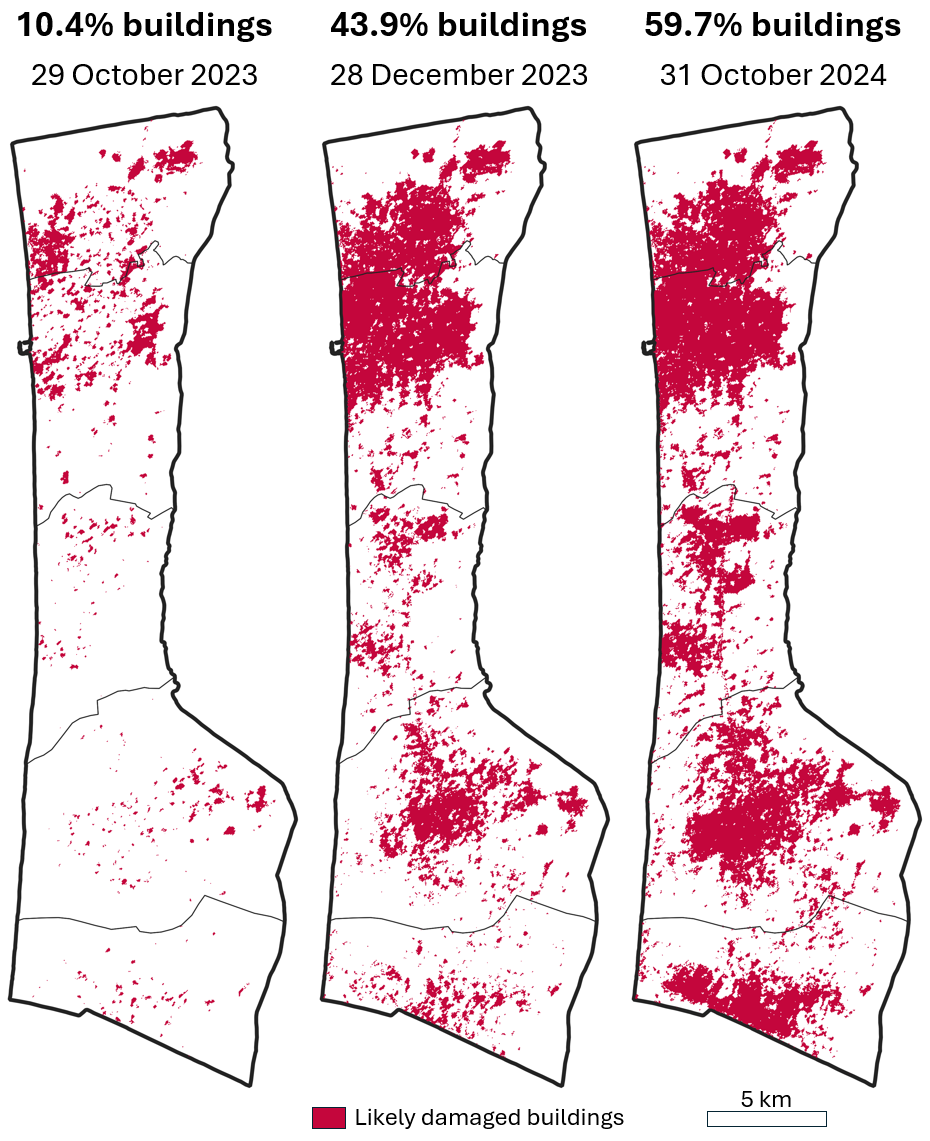
Maps and corresponding percentages of the extent of likely urban damage through the first year of the war in Gaza based on analysis of Sentinel-1 satellite radar images. Analysis by Corey Scher and Jamon Van Den Hoek, Oregon State University. Map by Jamon Van Den Hoek.
We worked a lot in those first two months, kind of night and day, to get the framework set up so we could quickly deploy as soon as an image was available. Our fastest was four hours. We would send updates to a global community of journalists and humanitarians, about 250 people around the world. A lot of those maps made their way into media coverage, humanitarian reports and different high-level UN reporting. We also work with colleagues in the [Decentralized Damage Mapping Group](https://conflict-damage.org/), which we started coincidentally two months before the war in Gaza. Working with people like [He Yin](https://www.kent.edu/profile/he-yin), [Lina Eklund](https://www.nateko.lu.se/lina-eklund) and others, we've developed approaches to map [agricultural damage](https://conflict-damage.org/publication/gaza%5Fag%5Fdamage/), [water, sanitation and hygiene infrastructure damage](https://conflict-damage.org/publication/wash%5Fdamage/) (led by Brian Perlman) and waste management (through Wim Zwijnenburg and Marie Schellens’ work with the peace organization [PAX](https://paxforpeace.nl/)).
Every single facet of life has been affected in Gaza sometimes in ways that are detectable from space. Population movement, tent placement, mobility restrictions, the yellow line, roads constructed by the IDF throughout—it's such a complete transformation of the landscape. A lifetime of academic inquiry could go into these things, and that's not even speaking of all the stuff we can't see from space: the personal impacts, the loss of life and limbs, children not going to school for over two years. We've gotten questions like: Can you find the bakeries that have been destroyed? We never would have thought of that question, but it obviously really matters.
**Deen:** When it comes to Gaza, the validity of data is constantly questioned. On the point of competing damage assessment maps, has there been an issue with people producing other analyses and questioning your data?
**Jamon:** The big issue is that there's a UN group, UNOSAT, that's the de facto damage mapping team and has been for years. They use very detailed imagery and do visual interpretation—not flawless, with known cases of errors, but really good work all the same. It's different from our approach for various reasons. For example, they tend to examine damage in a few cities at one or two points in time, while we conduct nationwide mapping about every week of a conflict, which may last years. There's still deference to the UNOSAT dataset in a lot of end-user communities. But when we have a map that looks similar but different, we have examined those differences for agreement and disagreement. Where we disagree, why? We need to understand what that gap is. The Humanitarian OpenStreetMap team just put out a [very good report](https://reliefweb.int/report/lebanon/lebanon-informing-humanitarian-response-guide-remote-sensing-analyses-conflict-damage-september-2025) looking at damage detection over Lebanon that examines seven different assessments with pretty wildly different results. The truth is probably somewhere in the middle. We must figure out how to communicate the reasons for disagreement.
When the difference is in percentages, that's just relative to the count of buildings. If your reference dataset on buildings that were there pre-war differs, your percentages will differ too. This is the reality in Gaza: We have an exhaustive database from the Humanitarian OpenStreetMap Team with many thousands more buildings. So even though we agree about the number of buildings damaged, the percentages others offer are much higher because they have fewer buildings to begin with. 80 percent versus 60 percent is a big difference. A journalist who wants that headline, which one are they going to use? Humanitarians looking for attention and advocacy, which will they use? We try to be very conservative in our work. Part of that is understanding where the sources of disagreement come from.
**Deen:** I want to point out the contrast in access to satellite imagery between Gaza and Sudan. From what I understand, the Sentinel satellite somehow got knocked out or wasn't available, so the open access data you had for Gaza wasn't available for Sudan.
> It seems that these European system images prioritize collection over Europe. American and Chinese systems do this too, but usually the difference is imperceptible. In this case, we saw very clear gaps over a stretch of Africa, which included Sudan.
**Jamon:** That's exactly right. When the most recent war in Sudan was starting, specifically the intense localization of damage in Khartoum, we were thinking about turning the lens there. Lo and behold, there was basically no pre-war, pre-conflict imagery available from the system we usually use. Our whole framework relies on this deep history of coverage, and that was gone. We don't have a full explanation. The gap was there before the war. It seems that these European system images prioritize collection over Europe. American and Chinese systems do this too, but usually the difference is imperceptible. In this case, we saw very clear gaps over a stretch of Africa, which included Sudan.
It could be that space was being saved on the local hard drives of these satellites to collect over Europe, then they downlink to a ground-receiving station. We've seen similar patterns with 1980s and 1990s coverage by NASA systems: broad blank spots outside of downlink areas. That limited our ability, so we had to pivot to commercial systems. One radar image provider had actually used Khartoum damage as a demo on their company website. We were able to bootstrap other data, but at the cost of not having full coverage over time and space. Our work was really localized on Khartoum.
**Deen:** With El Fasher recently, a lot of evidence came from satellite imagery. But there have been instances of misinformation or misapplication. There were cases where analysts were pointing out areas that clearly had an animal slaughterhouse, mistaking it for a massacre. To what extent is the opening up of satellite imagery and analysis causing confusion?
**Jamon:** Right, understanding the spatial setting can be so difficult to do from satellite imagery alone. We often lack information on how a patch of land is used outside of wartime, and whatever that use is could change dramatically during wartime. In the case of El Fasher, a satellite image recently went viral where the original poster incorrectly suggested that an image showed dozens of human bodies lying on the ground when in fact the image only showed cattle gathering around a tree. The image wasn’t even taken during the war but rather goes back to 2022\. Nonetheless, the social media attention towards the false claims made around this image was probably greater than any other news about the actual massacres in El-Fasher that have been well documented by the [Yale Humanitarian team](https://files-profile.medicine.yale.edu/documents/001a93f9-1c99-4437-a023-bac1294d3d0e) and others.
Some people who look at these images might assume they're truthful and a reasonable stand-in for being at that location, but we all know that's not true. If there's any sacrosanct term in remote sensing, it's “ground truth:” What is actually there when the image was taken. In forest mapping and ecological monitoring, ground truth isn't just going to a place and saying “it's a tree.” You do extensive statistical, spatially explicit analysis. You need to account for context, time of day, what happened before, what seems to still be there. That kind of rigor is usually impossible in conflict settings and also often impossible in post-conflict settings where access is often restricted. People get in, but usually not people who say, “I'm going to do a ground truth survey with a statistical sampling approach.” The satellite view and the ground view are usually siloed, despite often being proxies of one another. We need to better communicate the limitations of these images.
**Deen:** Finally, what are the current frontiers of your work? Looking ahead, are you optimistic about the future of geospatial science?
**Jamon:** One of the frontiers is scaling our damage mapping work across multiple armed conflicts around the globe so that we can have consistent data on the amount, speed and type of war damage. My hope is that this kind of approach will provide greater measures of accountability, especially in cases of civilian harm and in places with little media attention.
I’m extremely optimistic about where the field is going. It’s still driven by technological advancements in many respects, but we’re increasingly seeing deeper collaboration across disciplines and with humanitarian partners and a stronger commitment to centering the questions that matter most to affected communities—not treating local concerns as an afterthought but as a starting point for analysis.
SUPPORT MERIP
Support MERIP in providing critical, grounded reporting and analysis without paywalls. Make a one-time or monthly donation today!
[DONATE NOW! ](https://www.merip.org/donate/)
### Repair Amid Ongoing Ruination—Rebuilding Dahiyeh Once More
URL: https://www.merip.org/2026/02/repair-amid-ongoing-ruination-rebuilding-dahiyeh-once-more/
Last updated: 2026-02-11T18:24:31.000Z
Standing beside a destroyed building in Dahiyeh in September 2025, a fruit seller said to me, “I want to bring Naim Qassem \[Hizballah’s new secretary general\] here. I want to show him the damage. Our people need to do better.” He knew that, like him, I was Shia, and “our people” meant Hizballah. Regardless of whether or not we agreed with Hizballah’s politics, he saw no way to separate our fate from theirs.
The *Dahiyeh Al-Janoubiya* (the Southern Suburbs), or simply al-Dahiyeh in common parlance, is home to more than 700,000 people spread across some 16 primarily Shi’i neighborhoods and includes the Burj al-Barajneh Palestinian refugee camp. Currently, significant portions of the suburb remain in ruins after the devastating Israeli bombing campaign across Lebanon that began one year earlier. War had been simmering since October 8, 2023, when Hizballah and Israel began exchanging fire after the Hamas-led attack on October 7\. In Lebanon, some people refer to this period as *al-Harb al-Isnad*, the war of support, since Hizballah’s stated aim was to back Hamas in rising against Israel to break the nearly twenty-year long siege.
In September 2024, Israel began a full-scale attack on Lebanon that lasted until November and reached deep into Dahiyeh’s residential zones. Those 66 days saw near nightly bombings by Israel, targeting specifically Shi’i neighborhoods under the pretext of striking Hizballah positions. Dahiyeh remained full of residents who could not escape the constant bombardment from the air and sea. Beirut’s divided sectarian geography, [decades in the making](https://www.merip.org/2019/07/urban-interventions-for-the-wars-yet-to-come/), made it difficult for internally displaced Shi’i residents to find shelter. While they were largely not welcome in predominantly Christian neighborhoods, in mixed and Shi’a-friendly neighborhoods rents skyrocketed. Landlords in neighborhoods such as Hamra and Ras Beirut asked double or triple what they would usually charge.
Those who could not afford to leave fled temporarily whenever Israel’s evacuation orders targeted their areas. Sousan, a woman from Chiyah, told me, “My nephew would take me to sit on the beach with thousands of other people at night, all of us waiting to return to our homes.” [\[1\]](#%5Fedn1) Hours later they would return to streets filled with rubble and smoke, “but this was better than sleeping in a school with hundreds of other families.” Chiyah, a mostly Shi’i neighborhood dominated by the Amal party of Nabih Berri, the speaker of the parliament, borders Ain El Rammaneh, a Christian area. They meet but do not touch at Old Saida Road. The Christian neighborhood saw no destruction, no rubble. In contrast, once tall apartment blocks in Chiyah have been reduced to large piles of debris collapsing into layers like cake that threaten to fall further, endangering people who walk and live beside them.
In the aftermath of the war, most Lebanese Shi’a, like the fruit vendor, continue to identify with Hizballah and the resistance against Israeli aggression. Yet many debate whether this was their war to fight. Tensions are exacerbated by the Israeli military’s continued daily presence in the air, its re-occupation of lands in the south and the high death toll and infrastructural damage. According to the Lebanese Health Ministry, as of December 4, 2025, the war claimed the lives of 4,047, including Hizballah fighters and civilians, and wounded 16,638.[\[2\]](#%5Fedn2) The death toll continues to rise due to Israel’s [daily violations](https://www.palestinechronicle.com/school-bus-hit-14-killed-in-refugee-camp-israeli-strikes-intensify-across-lebanon/) of the November 27, 2024, ceasefire agreement, as it carries out drone strikes against Hizballah members and civilians alike. As for infrastructure, the scale of destruction following the war is staggering. It is unknown exactly how many people have lost their homes as the final count remains inconclusive and the destruction continues. In Dahiyeh, it is estimated that at least 361 buildings had been completely demolished by the signing of the ceasefire, and [recent reporting](In%20Dahiyeh,%20it%20is%20estimated%20that%20at%20least%20361%20buildings%20had%20been%20completely%20demolished%20by%20the%20signing%20of%20the%20ceasefire,%20and%20recent%20reporting%20has%20put%20the%20number%20of%20damaged%20buildings%20at%20490.) has put the number of damaged buildings at 490.[\[3\]](#%5Fedn3)
The 2024 war was the most destructive and lethal since the Lebanese civil war (1975–1990), but it was not without precedent. In the summer of 2006, Hizballah captured two Israeli soldiers for use in prisoner exchanges, prompting Israel to attack. During the 33-day war that followed, Israel—aware of the social, political, and economic significance that Dahiyeh holds for Hizballah and its supporters—carried out what it would come to call the “Dahiya Doctrine.” The Doctrine calls for the destruction of an opponent’s military capacity and the use of disproportionate force against the broader population through the destruction of civilian housing and infrastructure, including schools, hospitals and utilities. Despite its name, the Dahiya Doctrine, underpinned Israel’s attacks throughout the country.
In 2006, Israel’s turned Dahiyeh, a crowded and busy civilian suburb into a war frontier. Today it has done the same. But, the political landscape for reconstruction now differs radically from the situation after 2006, making large-scale rebuilding far more difficult.
## **Reconstruction in 2006**
Unlike the current conflict, the war in 2006 had a clear beginning and end. Israel's attacks against Dahiyeh stopped with the ceasefire agreement. Standing in front of the ruins of a destroyed building in the suburb, Hizballah’s then-secretary general, Hassan Nasrallah, promised that Dahiyeh would be rebuilt, “more beautiful than it was before.” Thus began the “more beautiful promise” campaign for reconstruction largely funded by Iran, Hizballah’s main international backer. While Iran provided $200 million for Dahiyeh, many of the Arab Gulf countries provided significant aid to prop up the Lebanese economy and rebuild areas beyond Beirut’s southern suburbs. Saudi Arabia [deposited $1 billion](https://reliefweb.int/report/lebanon/saudi-arabia-reiterates-full-support-lebanon) directly into Lebanese banks and Qatar [provided $300 million](https://reliefweb.int/report/lebanon/lebanon-political-crisis-hampering-post-war-reconstruction) in reconstruction aid for south Lebanon. The United States provided [nearly $1 billion](https://reliefweb.int/report/lebanon/united-states-assistance-lebanon) in aid to Lebanon, $230 million of which was for reconstruction and humanitarian aid conditioned upon its distribution outside of Hizballah institutions and networks.
> The reconstruction process was a display of power not just to Israel and the United States, but to the Lebanese government of Fouad Siniora that sought—in cooperation with the United States—to isolate the party in the wake of the war.
The clean-up and repair work was taken up by a newly created organization Wa’ad (Promise). Wa’ad is part of Jihad al-Bina, a Hizballah-run organization that deals with civilian infrastructure and agriculture in Lebanon. Teams from Jihad al-Bina and other party organizations worked with volunteers from across the sectarian spectrum to remove rubble and clean up the streets. Hizballah invited architects, consultants and contractors to participate in the planning and reconstruction process, albeit in line with its own vision for reconstruction.[\[4\]](#%5Fedn4) The reconstruction process was a display of power not just to Israel and the United States, but to the Lebanese government of Fouad Siniora that sought—in cooperation with the United States—to [isolate the party](https://www.bbc.com/news/world-middle-east-22878198) in the wake of the war. Destroyed buildings were quickly replaced by modernized high rise buildings. Haret Hreik, which before the war had become one of the most affluent neighborhoods within Dahiyeh, remained home to wealthier residents.
[In May 2012](https://today.lorientlejour.com/article/1447743/lebanese-authorities-reportedly-deny-plane-from-tehran-permission-to-land-at-beirut-airport.html), Hizballah held a festival celebrating the completion of reconstruction as the fulfillment of Nasrallah’s promise. In his speech during the festivities, Nasrallah praised the cross-sectarian efforts to restore Dahiyeh. For Nasrallah and Hizballah, reconstruction itself was seen as a victory connected to the larger victory of 2006: It retrieved its captives from Israel, carried out a 33-day war with Israel and remained standing. Ultimately, it took just six years and $400 million to rebuild.
## Reconstruction Today
In November 2024, the postwar conditions in Dahiyeh were starkly different from 2006\. Hassan Nasrallah, a political and spiritual leader who was for many also a father figure, was now a martyr. The Israeli military assassinated him on September 27, 2024, when they dropped ten 2,000-pound bombs on Haret Hreik. The pager attack ten days earlier—a war crime in which Israel detonated booby trapped devices used by Hizballah members including medics, engineers and other civilians—along with other assassinations, had thinned the ranks of its leadership and social services organizations. Hizballah’s military force significantly weakened, the party has grown more politically isolated internally and externally: Internally, the human costs of the war added to those of its involvement in the Syrian civil war on behalf of Bashar al-Asad’s regime, amplifying criticisms of the party’s engagement in wars outside the country. Externally, the fall of al-Asad and US-Israeli attacks on Iran have weakened its key international allies. Israel’s continued attacks on Dahiyeh, the Bekaa Valley and South Lebanon, more than a year after the cease fire agreement, underscore the party’s inability to defend its constituents or the country.
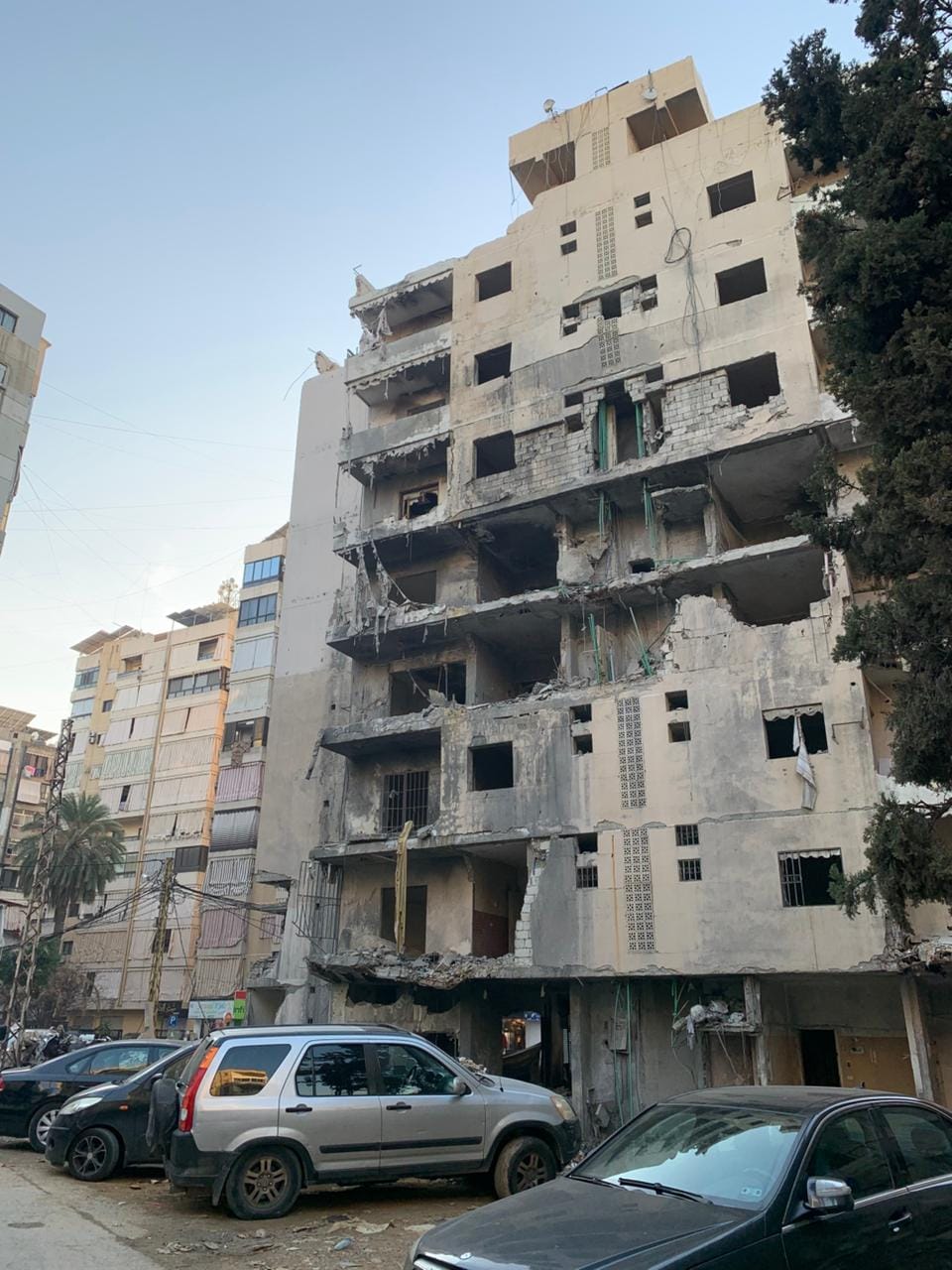
Residents park beside a destroyed building near autostrad Sayyad Hadi. Photograph by the author.
At the time of writing, Jihad al-Bina estimates that [$630 million](https://today.lorientlejour.com/article/1436140/jihad-al-binaa-damages-to-physical-structure-exceed-630-million-in-beiruts-southern-suburbs-alone.html#:~:text=DAMAGE%20CENSUS-,Jihad%20al%2DBinaa:%20Damages%20to%20physical%20structure%20exceed%20$630%20million,27%2C%202024.) is needed to rebuild Dahiyeh. But reconstruction is not simply a matter of money. Major political obstacles are preventing large-scale repair works. After the November 2024 ceasefire, a new Lebanese government was formed. The appointment of Nawaf Salam, a staunch opponent of Hizballah, as prime minister paved the way for a [cabinet agreement](https://www.reuters.com/world/middle-east/lebanese-army-walks-political-tightrope-disarm-hezbollah-2025-10-28/) that the state will gradually take control of all arms in the country. The agreement was passed in September 2025 without Hizballah and Amal ministers, and Hizballah insists that it will not disarm while Israel continues to occupy Lebanese land. The United States, meanwhile, has conditioned its reconstruction aid on the state successfully disarming the party’s militia by the end of 2025—a condition that, needless to say, has not been met.
As did the Siniora government in the wake of 2006, the Salam government has also sought to undermine Hizballah’s ability to rebuild. In January 2025, [Israel claimed](https://today.lorientlejour.com/article/1447743/lebanese-authorities-reportedly-deny-plane-from-tehran-permission-to-land-at-beirut-airport.html) that Iran was shipping aid to Hizballah through *Mahan* flights to Beirut. The following month, the Lebanese government banned any further flights from Iran, sparking large protests on the road to the airport. For Lebanon’s Shi’a communities, this measure was rubbing salt into the wound. Their own government, which could not protect them from the Israeli onslaught, now barred them from acquiring the means to rebuild their homes. In their view, the government would decline crucial reconstruction funding from Iran, as it also did in October 2025 by rejecting $60 million in aid, to avoid displeasing Washington.
In the face of such policies, Shi’i communities increasingly view the state as oriented against them. On the ground, the people with whom I have spoken in Dahiyeh and South Lebanon do not support the disarmament of Hizballah, and I have yet to meet someone who has expressed confidence in the Lebanese government’s ability to protect them against Israel or to rebuild if Hizballah were to disarm. On the southern border, where Israel wiped out entire villages and continues to illegally enter and demolish homes, the Lebanese government is not allowing people to rebuild, [on the pretext](https://today.lorientlejour.com/article/1447743/lebanese-authorities-reportedly-deny-plane-from-tehran-permission-to-land-at-beirut-airport.html) that their previous homes were illegal, in violation of building codes. For example, in Mays Al-Jabal and Kfar Kila, two border villages heavily destroyed by Israeli attacks, residents have been [prevented from rebuilding](https://www.al-akhbar.com/lebanon/825235) because they lack reconstruction permits and have received no compensation. The Lebanese government has neither approved nor expedited border reconstruction permits, leaving many people internally displaced more than one year since the ceasefire, and the reasons for the delay remain unclear.
In September 2025, [a report](https://en.al-akhbar.com/news/Hizballah-steps-in-with--3-billion-reconstruction-plan-as-st) published by the Hizballah-affiliated *Al-Akhbar* news, claimed that the party would rebuild with $3 billion. In the first phase, according to the report, $1 billion would go toward rebuilding the southern suburbs and much of the south, excluding destroyed border villages. But since, there has been no official announcement from the party. In practice, Hizballah has continued to channel limited resources through Wa’ad, which has contracted private companies to clear rubble from damaged areas. These companies have profited from the process: Where possible, rubble has been reused locally to fill the large craters left by airstrikes, and salvaged metal and rubble has also been sold to foreign firms for recycling and resale. Those who have lost their homes have resorted to selling the metal scraps as a means for survival.
In Dahiyeh, those who lost their homes or apartments were promised $14,000 to cover one year of rent elsewhere in the city. Due to delays in obtaining the compensation, however, people have had to resort to their own limited funding to secure housing. There are multiple reasons for these delays. Before compensation can be granted, Jihad al-Bina must carry out damage inspections, but these inspections are often put off due to ongoing Israeli attacks. Compensation also hinges on residents’ ability to prove ownership or occupancy of homes, apartments and shops—a long and tedious process. Residents must provide documents, assuming that they were able to flee with relevant papers. Given the widespread informality of ownership and rental relations in the area, many never had them in the first place. Salma, for example, is part of a multi-generational home. Years ago, her family decided to merge two apartments into one. Despite the investment to purchase and merge the two apartments, Jihad al-Binawould only credit the family for one. Lacking documentary proof of the initial purchases and ownership, Salma’s family, for the time being, are at a loss.
As is often the case in post-conflict environments, such bureaucratic obstacles and delays combine with misinformation to breed suspicion and resentment. Salma suggested that some residents, unfairly advantaged by informal ties to the party and its institutions, have received more compensation than others. Although Salma, still waiting for promised rental support for the coming year, feels indignant for not being compensated for the two apartments she lost, she still identifies with the resistance and continues to align her political and personal beliefs with those of Hizballah.
> If the goal is to distance people from the resistance, the stalled reconstruction has had the opposite effect: making the community feel the party is their only hope.
As I drive from the south into Beirut, I come across billboards that read, “one country united by its people, its army, and in its weapons.” Since the ceasefire agreement, there have been variations of such statements—the promises of unity an attempt to convince party supporters to fall in line with the US-Israeli-backed call to disarm Hizballah. If the goal is to distance people from the resistance, the stalled reconstruction has had the opposite effect: making the community feel the party is their only hope.
## Ruination within Ruins
Ruination, both psychological and material, has become part of everyday life here in Dahiyeh. Since the signing of the ceasefire agreement, Israel continues to violate the terms daily, punctuated by four large-scale attacks on Dahiyeh as of late November 2025, twice with a warning and twice without.
At the time of writing, the Dahiyeh is still in ruins. The rubble that had blocked major arteries in the city was removed to make way for traffic. While some buildings have been completely cleared of their rubble, many others remain in a state of collapse. Still, life in the area continues, and people continue to live and work in the ruins that were once home.
I visited what is left of my own family’s home in Dahiyeh almost a year after the war erupted. As I stood amid the ruins, I saw something moving: a horde of big brown rats, each the size of a small cat, swarming around a discarded box. I shivered in disgust then turned around to see a young man smoking a cigarette outside the shop behind me. “*It’wadana,*” he told me, “We got used to it.” There is a numbness that is needed in living with ruins, a sort of defiant nonchalance that must be adopted to make do within the situation at hand.
If the current Lebanese government continues to block aid unless Hizballah—which many see as their sole protector—disarms, then the densely populated urban suburb of Beirut that is Dahiyeh, will remain in ruins until there is a solution to the larger national questions of if, how and when Hizballah and the Shi’a will be integrated or ousted from the post-conflict Lebanese nation and its increasingly dysfunctional state. The Israeli drones and warplanes that fly over Dahiyeh daily tie these national questions to regional powers and their reluctance to rein in Israel’s military, itself armed and protected by the United States. Without answers, residents wonder where they will go if, and when, war returns.
\[**Iman Ali** is a doctoral candidate in anthropology at Cornell University.\]
*Editor's note: We use* Dahiyeh *when referring to the place itself, reflecting its common pronunciation in Lebanese Arabic, and* Dahiya *when referring to the so-called Dahiya Doctrine, the military strategy named after the area. As with many Arabic terms transliterated into English, spelling varies. Our usage prioritizes clarity and precision rather than rigid standardization.*
SUPPORT MERIP
Support MERIP in providing critical, grounded reporting and analysis without paywalls. Make a one-time or monthly donation today!
[DONATE NOW! ](https://www.merip.org/donate/)
---
### **Endnotes**
[\[1\]](#%5Fednref1) Interview took place over the phone in November 2024.
[\[2\]](#%5Fednref2) Ministry of Public Health (Lebanon), “[Updated Total Toll of the Israeli Aggression: 4,047 Martyrs and 16,638 Injured](https://www.moph.gov.lb/ar/Media/view/77347/4047-%D8%B4%D9%87%D9%8A%D8%AF%D9%8B%D8%A7-%D9%8816638-%D8%AC%D8%B1%D9%8A%D8%AD%D9%8B%D8%A7-%D8%A7%D9%84%D8%AD%D8%B5%D9%8A%D9%84%D8%A9-%D8%A7%D9%84%D8%A5%D8%AC%D9%85%D8%A7%D9%84%D9%8A%D8%A9-%D8%A7%D9%84%D9%85%D8%AD%D8%AF%D8%AB%D8%A9-%D9%84%D9%84%D8%B9%D8%AF%D9%88%D8%A7%D9%86-%D8%A7%D9%84%D8%A5%D8%B3%D8%B1%D8%A7%D8%A6%D9%8A%D9%84%D9%8A-?utm%5Fsource=),” press release, 4 December 2024\. \[In Arabic\]
[\[3\]](#%5Fednref3) Beirut Urban Lab, “[Mapping Israeli Announced Strikes on Lebanon](https://beiruturbanlab.com/en/Details/2011).”
[\[4\]](#%5Fednref4) Mona Fawaz, "Hizballah as urban planner? Questions to and from planning theory," *Planning Theory* 8/4 (2009), pp. 323–334.
### The Struggle for the City—Urban Recovery and Dispossession in Mosul and Damascus
URL: https://www.merip.org/2026/02/the-struggle-for-the-city-urban-recovery-and-dispossession-in-mosul-and-damascus/
Last updated: 2026-02-11T10:43:13.000Z
A walk through the old city of Mosul, Iraq, reveals an urban landscape still scarred by the violence of war and transfigured by ongoing reconstruction. Rubble-lined narrow streets give way to half-rebuilt homes and scaffolded storefronts, as merchants return and daily life resumes amid the heavy hum of generators and construction.The destructive reign of the Islamic State in Iraq and Syria (ISIS) from 2014 to 2017 and the city’s bloody liberation by Iraqi and allied forces left around 1 million inhabitants displaced and 130,000 homes damaged and [destroyed](https://reliefweb.int/report/iraq/hidden-bombs-and-eight-million-tonnes-rubble-keep-people-mosul-returning-home). Mosul’s rebuilding process has been slow and imbalanced, imperiled by corruption scandals, militia control, property ownership forgery and a recovery focused on elite-driven commercial projects and internationally funded cultural heritage projects.[\[1\]](#%5Fedn1) Many displaced Moslawis still remain uncertain about returning to rebuild homes, reclaim land or resurrect former lives.
The problems confronted by Moslawis since 2017 are similarly beginning to unfold in Damascus. The fall of Syrian President Bashar al-Asad in November 2024 and the rapid ascendancy of Ahmed al-Sharaa as the transitional president has resulted in a volatile peace in Syria and new possibilities to rebuild. Yet state-led reconstruction projects remain delayed and disputed. These delays have coincided with [public protests](https://syrianobserver.com/society/protest-erupts-over-eviction-order-in-former-republican-guard-housing-near-damascus.html) over evictions and homelessness. The new government has yet to find a way to settle competing property claims between those who fled during the war and those who sought shelter in their homes and now have nowhere else to go. Al-Sharaa’s transitional government is in part struggling to reverse Asad’s criminal depopulation policies and return rightful property ownership. But they are also continuing the controversial megaprojects of [Marota City, Baramkeh Mall and Damascus Towers](https://www.aljazeera.com/news/2025/8/6/syria-signs-14bn-infrastructure-deals-will-revamp-damascus-airport).
Zain, a young teacher from eastern Syria, describes how the loss of property—whether through violent destruction or coercive rebuilding plans—strips Syrians of their sense of dignity, ownership and belonging. “Is the violation of land and property rights any less serious than the traditional notion of honor tied to women?” he asked me in a conversation in Syria in September 2025.[\[2\]](#%5Fedn2) Zain fled ISIS rule in 2016, surviving life in a makeshift camp along the Turkish border. He then sought shelter among destroyed buildings on the outskirts of Damascus. Now he lives in Deir ez-Zor where multiple factions still vie for power. He remains frustrated at the slow pace of reconstruction. “Syrian people feel their dignity is under constant assault, yet they lack the ability to change the situation.”
Zain’s words echo a sentiment I heard often in Mosul. “They say they are going to build back better, but ultimately who will benefit from Mosul’s reconstruction? The ordinary people?” Hassan, a young student from Mosul University, asked me. His frustrations are reasonable. The disastrous effects of governments or militias intentionally dismantling and reordering urban life to exert control—such as Asad’s bombardment of Damascus’s rebellious eastern suburbs or ISIS’s deliberate targeting of Mosul’s religious sites and minority neighborhoods—are often compounded by postwar strategies of reconstruction.
Between 2022 and 2025, I spoke to over 50 inhabitants of Damascus and Mosul in homes, cafes, streets and offices, as well as in online interviews and telephone calls. Through guided walking tours, locals revealed stories of pain and survival, memories etched in broken walls, looted shops, militia checkpoints, damaged religious sites and restored heritage homes. For Syrians like Zain and Iraqis like Hassan, the destruction of a city is more than a physical loss. It is also the disintegration of urban lifeways and the fragmentation of human existence. As one interviewee from Mosul succinctly explained, “We not only lost our homes, we lost ourselves.”
Given their recent traumatic histories of war, militia violence and destructive international interventions, Mosul and Damascus offer an important comparison. Both cities have suffered [deep internal fracturing of communities](https://www.tandfonline.com/doi/full/10.1080/21647259.2023.2247722) along social, religious, territorial and political lines. Iraq is one decade ahead of Syria in terms of its urban recovery, and Mosul’s experience offers a cautionary tale that effective physical repair must be accompanied by social repair. Reconstruction has not necessarily reversed demographic shifts or encouraged social cohesion. Instead, it continues to be plagued by the same issues of economic corruption, dispossession and social fragmentation. Through the voices of local inhabitants, the challenges and complexity of postwar recovery can be clearly observed.
## Reconstruction as Dispossession
The scale and extent of Syria’s reconstruction needs are difficult to comprehend. Cost estimates by the World Bank in 2025 are in the region of [$216 billion](https://www.worldbank.org/en/news/press-release/2025/10/21/syria-s-post-conflict-reconstruction-costs-estimated-at-216-billion). According to the United Nations, in 2023, half the Syrian population remained displaced, 90 percent of Syrians were living [below the poverty line](https://unhabitat.org/sites/default/files/2023/06/syria%5Fcountry%5Fpackage.pdf) and over 328,000 homes had been destroyed. The economic strategy of al-Sharaa’s transitional government has been to continue the Asad regime’s neoliberal approach to reconstruction by enticing regional and global investment. In first the 10 months following Asad’s ouster, the transitional government signed [$28 billion in investment](https://www.newarab.com/news/syria-attracted-28-bn-investment-assads-fall-sharaa) deals to rebuild Syrian ports, railways, airports, power plants and fund real estate projects. This investment has been coupled with tighter domestic austerity measures, reducing bread and electricity subsidies, while dismissing up to a third of the public sector workforce. Such policies have sparked [street protests](https://thearabweekly.com/public-sector-lay-offs-trigger-renewed-protests-syria) and exacerbated everyday fears that, in the words of activist and academic Joseph Daher, an “exclusive and elite-led reconstruction process will only reproduce social inequalities, impoverishment, a concentration of wealth in the hands of a minority, and the absence of productive development”—the same conditions that led to the popular uprisings in 2011.[\[3\]](#%5Fedn3)
Samira, a middle-aged shopkeeper from Darayya, lost her home and two brothers during the war. Some relatives fled to Lebanon and Jordan, while others were forcibly displaced “to the north in [green buses](https://css.wp.st-andrews.ac.uk/2018/02/19/the-green-buses-and-the-new-syrian-map/),” she says, referring to government relocations of besieged residents to exile in Idlib. During years of intense violence from 2013 to 2017, her family property was confiscated by pro-Asad militias and her shop reduced to rubble in aerial bombardment by state forces. One of her brothers was executed in a field, another disappeared within the bowels of Syria’s notorious prison networks.
> Added to these multiple losses—of home, family and justice—is a growing discontent at Syria’s flawed reconstruction plans: “Our neighbors are displaced, everyone is displaced, yet they are building towers instead of helping us to rebuild homes.”
On December 8, 2024, Samira was one of thousands of Syrians who journeyed to [Sednaya prison](https://www.aljazeera.com/features/2024/12/14/until-my-last-breath-searching-for-relatives-at-syrias-slaughterhouse) in search of disappeared loved ones. Syria’s most notorious prison, dubbed [“the human slaughterhouse,”](https://newlinesmag.com/spotlight/hope-and-despair-at-assads-human-slaughterhouse/) was liberated by opposition fighters the day that Asad fell. Samira’s painful and ultimately futile journey in search of her missing brother and nephew left her disorientated and dejected. Amid the burnt and discarded prison files she felt “a part of justice had also disappeared.” Added to these multiple losses—of home, family and justice—is a growing discontent at Syria’s flawed reconstruction plans: “Our neighbors are displaced, everyone is displaced, yet they are building towers instead of helping us to rebuild homes.”
Samira’s sentiments are echoed by many Syrians. Interviewees across religious, neighborhood and class divides highlighted concerns over the timing and sequencing of rebuilding, the corrupt actors involved, the lack of compensation for property owners and the lack of transparency around land deals and restitution rights. Those I spoke with from the Damascus suburbs of Qaboun and Douma, for example, remain critical of the government’s continuation of the [Marota City development](https://www.merip.org/2023/01/rebuilding-douma/). This mega project—initiated in 2012 with a combination of government and private Syrian capital—displaced thousands of people. In exchange, the government provided limited rent subsidies, undervalued shares and dangled the illusion of future alternative housing. “The authorities are exploiting our weakness and poverty rather than addressing it,” commented one local.
Though the war has ended, fighting over property continues. In the Alawi-majority neighborhood of al-Sumariyeh, a western suburb of Damascus, [forced evictions](https://en.majalla.com/node/327989/opinion/assad%E2%80%99s-legacy-dispossession-still-felt-post-war-syria) have also provoked civil unrest. The neighborhood was deliberately developed in the 1970s under President Hafiz al-Asad as a district combining formal military housing for the elite Fourth Division and Air Force Intelligence with adjacent informal, working-class areas. When the Syrian regime fell in late 2024, many soldiers and their families fled their homes, fearing retaliation. Subsequently, an armed group led by Abu Hudhayfah al-Ansari—originating from Moadamiyet al-Sham and aligned with the transitional government—assumed de facto control of the neighborhood. Its new leaders have carried out evictions of those who enjoyed privileges under the Asad regime, looted property, detained residents, restricted movement and established new security infrastructure under their own control. This [ongoing confrontation](https://hlp.syria-report.com/hlp/excavations-and-armed-groups-pressures-renew-tension-in-al-sumariya/) in al-Sumariyeh highlights how historic sectarian grievances are enflaming contemporary property disputes. Recent months have also seen violent clashes between residents over competing ownership claims in al-Qadam—a municipality in southern Damascus.
Other interviewees highlighted class-based injustices. As Nora, a 40-year-old journalist told me, “the poor are punished and powerful are rehabilitated.” Nora noted how the businessman Mohammad Hamsho was forgiven by the transitional government, despite having financed the Asad regime’s military operations and committed economic crimes. A loyal regime ally, Hamsho’s business empire spanned construction, media and electronics—providing financial fronts for Syria’s war effort. Also known as “the rubble king,” he directly benefitted from housing demolition orders by scavenging metal from destroyed Syrian homes that was then used to fuel his steel factories. For almost a decade, Asad’s Fourth Division plundered Damascus’s outskirts for scrap metal. A sophisticated war economy and smuggling network emerged, turning opposition suburbs into grey wastelands as scrap metal was funneled through [illicit networks and intermediaries](https://www.al-monitor.com/originals/2025/03/wheres-gold-how-assads-sucked-syria-dry?) like Hamsho. Indeed, recent investigations into scrap metal recycling connect Asad’s Fourth Division to smuggling routes through Lebanon and onward to [Turkish scrapyards and steel mills.](https://www-newarab-com.cdn.ampproject.org/c/s/www.newarab.com/investigations/scrap-wars-how-child-labour-and-conflict-feed-turkey-steel-boom?amp)
Despite US sanctions and public notoriety, Hamsho’s sons appeared in Damascus on September 4, 2025, donating $2.1 million at the launch of the Syrian Development Fund, a new national institution established by Presidential Decree No. 112 to finance Syria’s postwar reconstruction and economic recovery. Their presence, along with the return of other controversial US-sanctioned business figures, has heightened suspicions of the opaque economic arrangements surrounding the sell-off of property. As one interviewee, a former lawyer explained, “Currently there is chaos around former regime confiscated assets. For example, 23,000 seized properties were publicly auctioned to only about 20 buyers, but no one knows where the money went.”
Similar apprehensions over corrupt sales and unjust reconstruction plans have been evident in Mosul since the city was liberated. Iraq’s post-ISIS recovery, particularly in the Nineveh province, has been plagued by chronic corruption at all levels of state and society. Real estate in Mosul was not only physically confiscated by victorious militias, 9,000 property sales were [illegally forged](https://nirij.org/en/2023/03/19/the-story-of-the-real-estate-theft-in-mosul/#:~:text=Basma%20Basim%2C%20a%20member%20of,impossible%20to%20hold%20them%20accountable%E2%80%9D.) by brokers and state officials and agricultural land was exploited by cooperative housing associations (dubbed “land mafias”) and resold as residential plots. In 2021, Nawel Hammadi al-Sultan, Nineveh’s former governor, was jailed for [embezzling $3.4 million](https://www.arabnews.com/node/1898451/middle-east) of public funds intended for Mosul’s reconstruction. The [UNDP’s Funding for Stabilization](https://www.theguardian.com/global-development/2024/feb/05/un-to-investigate-claims-of-corruption-in-iraq-aid-project) program is under internal investigation for accepting bribes. At Popular Mobilization Forces (*al-hashd*) checkpoints throughout the province, former fighters profit off so-called taxes they impose on people going about their daily lives and rebuilding their businesses, affecting the flow of goods and materials and ultimately slowing urban reconstruction.
Mosul has recently celebrated some notable restoration achievements, including UNESCO’s [rehabilitation](https://www.unesco.org/en/articles/mosuls-revival-lasting-legacy-built-through-international-cooperation) of al-Nouri Mosque and al-Tahera and al-Saa’a churches and the reopening of Mosul airport. But many continue to have serious misgivings over the potential commercial exploitation of its ancient heritage sites, neighborhoods and waterfronts. A number of interviewees highlighted Mosul’s Qila’yat district with its historic riverside forts and pluralist legacy now endangered by [real estate disputes](https://www.alaraby.co.uk/society/%D9%85%D9%86%D8%B7%D9%82%D8%A9-%D8%A7%D9%84%D9%82%D9%84%D9%8A%D8%B9%D8%A7%D8%AA-%D9%86%D9%85%D9%88%D8%B0%D8%AC-%D8%B5%D8%A7%D8%B1%D8%AE-%D9%84%D8%AA%D8%A3%D8%AE%D8%B1-%D8%A5%D8%B9%D8%A7%D8%AF%D8%A9-%D8%A7%D9%84%D8%A5%D8%B9%D9%85%D8%A7%D8%B1-%D9%81%D9%8A-%D8%A7%D9%84%D9%85%D9%88%D8%B5%D9%84) and unregulated planning.
Nadeem, a local civil society activist, explains that the reconstruction proposals ignore local sensibilities. “These bids are all catastrophic because some of them want to transform the neighborhood into a modern one with skyscrapers like Dubai, others have a vision of turning the neighborhood into a corniche, while other bidders want to open shisha lounges in the area.” He warned, “If Qila’yat disappears, Mosul as a city ends and becomes a soulless city.”
Other Moslawi interviewees raised concerns over fraudulent land sales and the strategic exploitation of displaced communities. Anas, a Mosul native and former office worker, told me, “Corrupt people are buying lands in Mosul and selling them in the hopes of changing the demographics of the city.” Minority communities (Yazidis, Shabak, Christian) who were violently displaced by ISIS are still reluctant to return to their former homes.
In Iraq, as in Syria, the legacy of dispossession and its imprint on the landscape of the city undermines future peace. Writing about Homs, Syrian scholar [Ayham Dalal](https://placesjournal.org/article/mapping-homs-syria-rebuilding-after-war/?cn-reloaded=1&cn-reloaded=1) reflects, “A just and inclusive reconstruction must confront the sectarian and class-based ruptures that the old urban form helped conceal.”[\[4\]](#%5Fedn4)
## Local Rebuilding and Reclaiming
In the first nine months after the fall of Asad’s regime, an estimated [2.8 million Syrians](https://www.unhcr.org/news/press-releases/million-syrians-have-returned-home-more-support-needed-so-millions-more-can#:~:text=GENEVA%20%E2%80%93%20In%20just%20nine%20months,determination%20to%20return%20and%20recover.) (1 million from abroad and 1.8 million internally displaced persons) returned to their homes within Syria. Some are returning to derelict shells, others to collapsed roofs or no water, electricity or basic infrastructure. Others find squatters or occupiers in their homes who claim to have purchased the property. In the absence of effective state-led reconstruction, locals are attempting to reclaim their homes and city.
In Damascus’s devastated Jobar district, for example, residents have taken reconstruction into their own hands. In October 2025, they unveiled a [community-drafted master plan](https://hlp.syria-report.com/hlp/community-drafts-master-plan-for-rebuilding-damascuss-jobar/), which includes a bold attempt to protect residents’ property rights in both licensed and informal housing in one of the city’s largest informal (*ashwaiyyat*) neighborhoods. The plan recognizes the need for a complex process of disarming landmines and debris removal before beginning the reconstruction and rezoning of 300 hectares of land. A youth association, created alongside the master plan designs, has led a series of demonstrations demanding an end to the district’s marginalization and greater respect for Jobar’s wartime sacrifices.
In other eastern and southern suburbs of Damascus, former inhabitants are also trying to rebuild amid the rubble and are seeking to re-establish ownership records through local [Housing, Land and Property](https://stj-sy.org/en/syria-alternative-committees-for-property-and-personal-status-disputes-response-to-power-vacuum-or-judiciary-marginalization/) (HLP) committees. These committees—comprising lawyers, clerics and community leaders—are responsible for resolving unlawful property seizures and adjudicating disputes involving conflicting legal documents. Although established by local authorities, they are not part of a coherent national framework. While the government has assigned [jurisdiction over HLP-related disputes](https://en.majalla.com/node/327989/opinion/assad%E2%80%99s-legacy-dispossession-still-felt-post-war-syria), the coordination with civil courts and enforcement mechanisms remains weak, often leaving Syrians to navigate these challenges on their own.
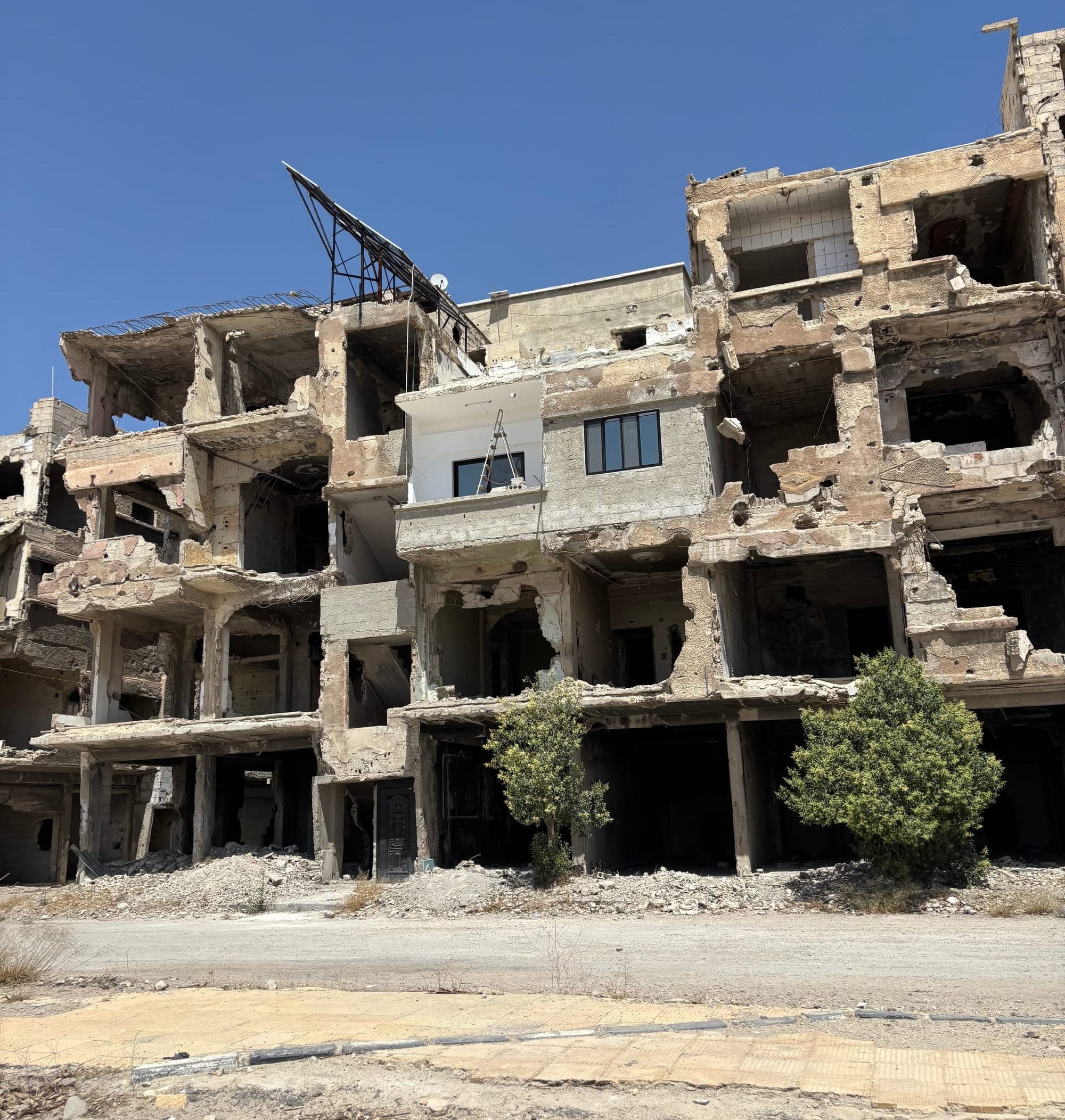
Rebuilding within the ruins, Yarmouk Camp, Jouret Shreibati, Damascus, May 31, 2025\. Craig Larkin
In Yarmouk, the former Palestinian camp shattered by years of bombardment and siege, returnees reconstruct rooms within crumbling apartment blocks, even as the foundations beneath them remain perilously unstable. At least [25,000 residents](https://syriadirect.org/with-little-support-yarmouk-returnees-rebuild-lives-in-little-palestine-photos/) live amid the debris, rebuilding slowly without municipal permits or safety assessments. They mostly lack UNRWA or state support: Although UNRWA reopened [Yarmouk Services Centre](https://www.unrwa.org/sites/default/files/yarmouk%5Fcamp%5Fprofile%5F2025.pdf?) in March 2025, shelter repair is limited and temporary as there are no donor plans for any large-scale reconstruction of the camp.
> Mosul’s urban recovery has likewise depended on local activism. Nearly a decade after the city’s liberation, state compensation schemes remain incomplete and severely delayed.
Mosul’s urban recovery has likewise depended on local activism. Nearly a decade after the city’s liberation, state compensation schemes remain incomplete and severely delayed. Basil, a local in his mid-30s, reflected, “I do not think the Iraqi government was fair or just in providing compensation to its people. Even more, it would take 2 to 3 years to complete an application to claim compensation, and it would take much longer to receive any money.”
Within the old city, residents recounted having to clear their own properties of rubble, unexploded munitions and the remains of the dead. Ahmed, a local teacher, described how youth have mobilized a number of community initiatives, such as rehabilitating schools, planting trees and vertical gardens ([Green Mosul](https://kirkuknow.com/en/news/68116)) and even creating environmental hubs, such as [Mosul Space](https://www.iraq-businessnews.com/2024/12/17/mosul-space-launches-ninevehs-first-youth-led-climate-club/), to tackle pressing climate and sustainability challenges. For Ahmed the ultimate goal remains, in his words, “reconstructing the city and the spirit also.”
## Restoration of Cultural Heritage
“We cannot go back, but I’m not sure how to move forward,” Layla told me. A Christian originally from Mosul, she was initially displaced to Qaraqosh in the Nineveh plains but now remains with her extended family in Erbil, within Iraq’s Kurdish Region. Violence disrupted Layla’s education, her home-life and her plans for the future. Her words capture the liminal stuckness felt by so many Moslawis and Damascenes.
While opinions differ on how Syria and Iraq should rebuild, most people I spoke to agree that reconstruction cannot be separated from the demand for justice and accountability. As a doctor from Raqqa explained, “Justice must be part of reconstruction; it cannot be postponed. Realistically, people need security, jobs and basic services. Therefore, both paths to reconstruction must be integrated.” The road to recovery in both cities will be long and unpredictable. But residents acknowledge that without pairing physical repair with social repair, the same grievances and injustices will continue to erode any hope of lasting peace.
Indeed, those individuals who suffered an intense sense of betrayal by their neighbors or witnessed the death of family members in their homes found it difficult to imagine any form of urban rehabilitation. Their homes and security were desecrated, leaving them displaced and abandoned. Omar, a Mosul activist and scholar, described the feeling among some minority groups of wanting to live in separate neighborhoods. Reintegration and social cohesion remain long-term aspirations. In his words, “bringing back trust is going to be completely difficult, it's a very long and complicated mission. It's not going to happen in one day. They need to feel the trust again. They need to feel they are safe again.”
> “I think this war and all this current situation improved our sense of belonging to this land. Because sometimes we don’t care about the value of things until we are about to lose them.”
Against this backdrop of displacement and mistrust, heritage restoration emerged as a rare arena where repair and belonging could be cautiously integrated. The destruction of Mosul’s historic old city homes has inspired local youthful entrepreneurs to establish restoration projects to safeguard Moslawi traditions and reclaim their own sense of postwar agency. Ali, a photographer and university lecturer I spoke to in the summer of 2023, told me, “I think this war and all this current situation improved our sense of belonging to this land. Because sometimes we don’t care about the value of things until we are about to lose them.”
In 2017 Ayoub Thanoon founded the Mosul Heritage project with the goal of restoring a war-damaged traditional home. Through the support of its legal owners and community fundraising, he turned the space into a heritage museum displaying locally donated artifacts and antiquities and housing workshops around artisan skills and heritage education. As Ayoub explains, “I believe that heritage is one of the things that unite people. These cultural and heritage sites belong to all Muslims, Christians, Yazidis and what unites us. Culture is how we can restore again our city and identity after ISIS deliberately tried to erase it.” Such [grassroots initiatives](https://journals.sagepub.com/doi/full/10.1177/14696053231220908) have the potential to create networking synergies and cross-communal exchanges. The local focus on Moslawi pluralist traditions contrasts with international priorities of restoring symbolic religious sites that may reproduce sectarian logics or lead to commodified and tourist-oriented heritage models that spur urban gentrification and a deepening of postwar inequalities.[\[5\]](#%5Fedn5)
Another revealing heritage project is the Bytna Institution for Culture, Heritage, and Arts founded by Moslawi journalist and cultural entrepreneur Saker al-Zakariya in 2019\. Bytna is a [restored heritage home](https://www.pinkjinn.com/2024/01/17/the-bytna-foundation-culture-community-in-mosul/) that celebrates Mosul’s unique identity through life portraits, artifacts and memorabilia. Supported by residents and international partners (UNESCO, European Union), it has hosted cultural events, art exhibitions and musical performances. For al-Zakariya it provides a space for Moslawis to reconnect with their history and to restore a sense of local pride, “We are engaged in preserving and maintaining our heritage, our identity in Mosul. This foundation became an emblem to revive the city of Mosul.”
Yet Bytna also captures the precarity of postwar nostalgia. In one room—adorned with old maps, photos and vintage cameras, seemingly frozen in a tranquil past—a gaping hole in the ceiling purposefully remains, as if time has been ruptured by the violent intrusion of a stray rocket. The dissonance is jarring and sobering, reflecting the pragmatic reality that those involved in Mosul’s recovery, as in Damascus and other cities across Syria and Iraq, must grapple directly with the brutal legacy of war and prioritize local needs for recovery and repair.
\[**Craig Larkin** is an associate professor (Reader) in Middle East politics and peace and conflict studies at King’s College London.\]
SUPPORT MERIP
Support MERIP in providing critical, grounded reporting and analysis without paywalls. Make a one-time or monthly donation today!
[DONATE NOW! ](https://www.merip.org/donate/)
---
### **Endnotes**
[\[1\]](#%5Fednref1) Craig Larkin and Inna Rudolf, “Memory, Violence and Post-Conflict Reconstruction: Rebuilding and Reimagining Mosul,” *Peacebuilding* 12/3 (2024).
[\[2\]](#%5Fednref2) All interviews were conducted between August 2022 and October 2025\. Pseudonyms have been used to protect anonymity unless explicit permission was granted. Interviews were conducted by Craig Larkin, Inna Rudolf and Siba Madwar as part of the Cross-Border Conflict Evidence, Policy and Trends ([XCEPT](https://www.xcept-research.org/themes/violent-and-peaceful-behavior/)) research programme, funded by UK International Development from the UK government.
[\[3\]](#%5Fednref3) Joseph Daher, “[Three Requisites for Syria’s Reconstruction Process](https://carnegieendowment.org/research/2025/05/three-requisites-for-syrias-reconstruction-process?lang=en),” Carnegie Middle East Center (May 8, 2025).
[\[4\]](#%5Fednref4) Ayham Dalal, "[The City and the City and the City](https://placesjournal.org/article/mapping-homs-syria-rebuilding-after-war/)," *Places Journal* (October 2025).
[\[5\]](#%5Fednref5) Lynn Meskell and Benjamin Isakhan, "[Reconstruction, Repair, and Rehabilitation: A View from Mosul](https://muse.jhu.edu/article/966804/summary)," *Change Over Time* (2025).
### Burri Under Siege—How War Remade Everyday Life in a Sudanese Neighborhood
URL: https://www.merip.org/2026/02/burri-under-siege-how-war-remade-everyday-life-in-a-sudanese-neighborhood/
Last updated: 2026-02-14T20:25:31.000Z
In March 2025, the Sudanese Armed Forces (SAF) [retook key areas](https://www.fdd.org/analysis/op%5Feds/2025/04/01/sudanese-armed-forces-retake-khartoum-from-rapid-support-forces/) of eastern, central and southern Khartoum. Their advance ended the Rapid Support Force’s (RSF) two-year siege of Burri—a neighborhood of eight residential areas in central Khartoum along the Blue Nile River.
As part of the metropolitan core that links the three cities of Sudan’s capital—Khartoum, Bahri (Khartoum North) and Omdurman—Burri lies in the shadow of numerous strategic and military sites: the Sudanese Military General Command headquarters, Khartoum International Airport, the presidential palace complex and a concentration of government buildings. It is also linked to Bahri and Sharq Al-Neel (Eastern Khartoum) through two critical transportation arteries, the Armed Forces Bridge and Al-Manshiya Bridge.
Military forces have long maintained a presence in the heart of the capital from the colonial Anglo-Egyptian period through independence to the present day, allowing successive regimes to impose control and keep a tight grip on the city. These spaces of military and political authority have repeatedly been contested by civilian protesters throughout Sudan’s history, such as during the uprising in 2018–2019 that led to the ouster of President Omar al-Bashir.
But in the current war that began on April 15, 2023, this urban morphology has for the first time transformed the spaces of Khartoum’s central streets and neighborhoods into a landscape of armed conflict. The struggle between the RSF and the SAF for control of the country has turned Burri and other surrounding neighborhoods into frontlines. When the RSF [seized control](https://www.aerotime.aero/articles/airliners-damaged-in-battle-for-khartoum-airport) of Khartoum’s airport in the initial hours of the war, they moved immediately toward the General Command headquarters. Burri, lying directly along this strategic route, became the focus of relentless assault. I spoke with five residents from Burri about their experiences during the two-year siege to understand how those trapped within these militarized and securitized spaces endured the violence and navigated their day-to-day lives.[\[1\]](#%5Fedn1)
## Geography of a Siege
Othman was among the residents who lived under the siege for several months before relocating to Egypt. I connected with him in 2025 through a mutual friend from Burri. He told me that his area, Al-Lamab, located by Al-Manshiya Bridge, was one of the first in Khartoum to be invaded by the RSF, who advanced through this part of the neighborhood around the tenth day of fighting in April 2023.
“They were stationed in all parts of Burri to attack the General Command, and the largest concentration was near us,” he said. The RSF had approached from the south through a wealthier part of the neighborhood, Imtidad Nasir, bringing tanks and heavy artillery that rolled into the inner streets. Many of their troops occupied affluent homes there and in the nearby Al-Riyadh district to the south. From these positions they fired toward the General Command headquarters, while SAF forces returned fire from the west.
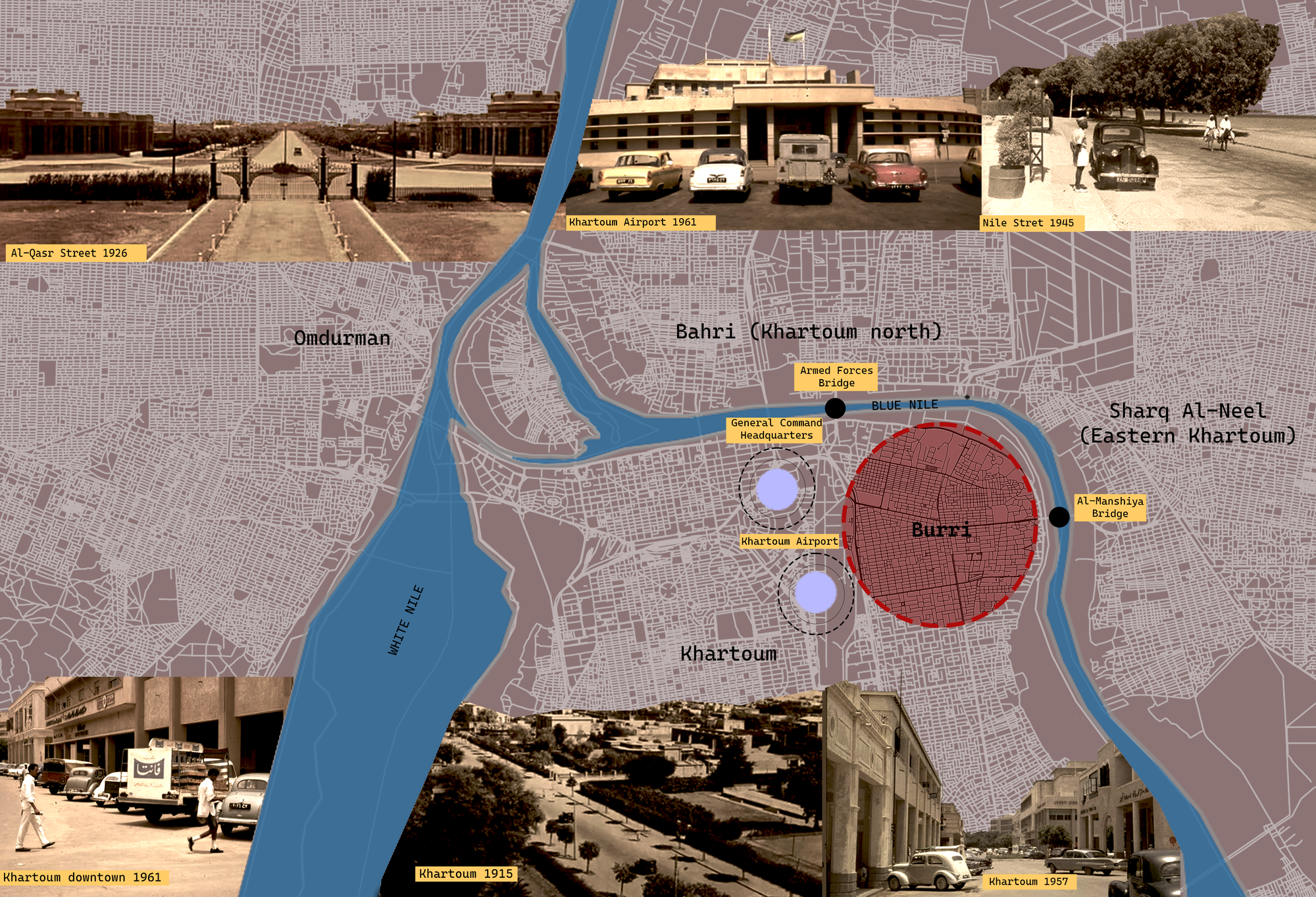
Burri lies near the General Command Headquarters, Khartoum Airport, Armed Forces Bridge and Al-Manshiya Bridge. Illustration by the author.
Caught in the crossfire, many homes and public facilities were destroyed within the first week, setting the scene for urban catastrophe. “Many supermarkets and shops where people could find food were looted or shelled during the first days of fighting,” described Ibrahim, one of the young volunteers who remains in Burri and participated in community aid during the siege. “Burri’s electricity and water stations were also hit.”
This destruction and targeting was part of a calculated military strategy by both RSF and SAF forces to render each section of the neighborhood unlivable, for Burri’s residents and for the troops holding them, clearing the way for the opposing side to advance and take control.
By the end of the first month, the RSF had established military positions within and outside of many buildings. The streets were transformed into military zones filled with checkpoints, security stations and surveillance points. RSF fighters entered Burri in large numbers and, according to one interviewee, their personnel changed over time. Each new group brought its own motives and methods of dealing with residents. Some took the situation as an opportunity to collect money and valuables (knowing no one could argue with them as long as they carried guns). They stormed homes, seized cars, looted shops and forced some families, particularly those living in newer buildings, to leave so they could occupy their houses. Others, however, tried to interact with residents in an attempt to normalize their presence and gain a sense of acceptance, claiming they would be governing Khartoum.
> The new rules imposed by the RSF not only limited mobility but also redrew Burri’s internal boundaries.
The movement of people and goods was restricted and controlled internally through an extensive network of RSF checkpoints*.* The new rules imposed by the RSF not only limited mobility but also redrew Burri’s internal boundaries. Residents who left their homes did so at the risk of harassment or assault, and those who had to be in the streets avoided carrying phones and cash, out of fear of being robbed. The area effectively shrank into a set of sealed corridors. To the east, movement stopped at Dream Specialized Hospital, while to the west a large RSF base was erected at the Bee Petroleum gas station. Al-Safa Street to the south was sealed off, and to the north the furthest point anyone could reach was the Spanish Embassy on Al-Ma’arad Street. Beyond that northern line, and along Nile Street, RSF fighters occupied several government buildings and compounds, including the presidential palace, the Khartoum National Club and the presidential villas.
Nile Street is one of Khartoum’s most vital arteries. It runs parallel to the Blue Nile and connects the urban core to the bridges that link the three cities of the capital: Khartoum, Bahri and Omdurman. Its significance dates back to the British colonial period, when the governor’s palace and elite residences were first established along the river bank. Under Omar al-Bashir’s rule, the army further expanded its presence through new commercial investments and construction projects, including the Khartoum National Club, one of the army’s largest investments in the city. Once the RSF took control of Nile Street during the first two days of fighting, they were able to block all access in and out. For those trapped in Burri, the closure of this route disrupted the entry of essentials and cut evacuation paths.
These chokepoints and zones of securitization did not merely emerge out of the siege. They were the outcome of more than a century of urban planning that has woven military power into the fabric of Khartoum.
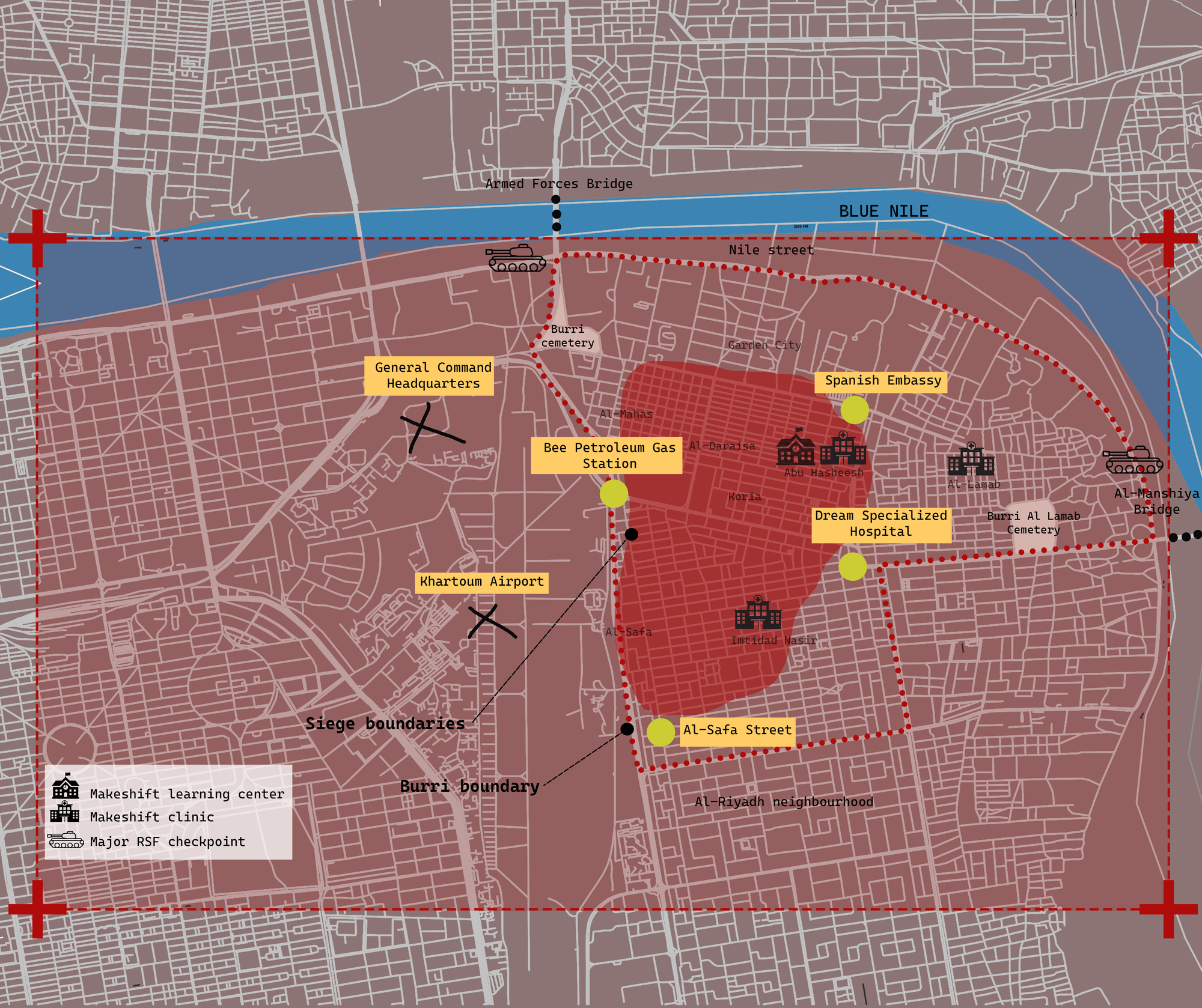
Restricted boundaries and checkpoints in Burri during the siege (2023-2025). Illustration by the author.
## Urban Militarization in Central Khartoum
The military’s presence in Khartoum traces back to the formation of the colonial city in 1899 under Anglo-Egyptian rule. Its layout followed an axial planning that was widely adopted in most colonial cities at the time as it supported the military objectives of maintaining social order and enabling riot control. In Khartoum, a quadrillage of roads intersecting at right angles was created to form a chessboard-like pattern, designed to facilitate army surveillance and troop movements across the city center. Key military and government institutions, as well as houses of the European elite, were placed along the Nile and the main streets, further projecting state control. [\[2\]](#%5Fedn2) The planning and construction of these buildings—including the General Governor’s palace—were carried out by military engineers between 1906 and 1912.[\[3\]](#%5Fedn3) Throughout this period, the colonial authority worked on transforming the city to suit the interests of the military and political elite.
After independence in 1956, successive regimes reinforced this spatial order of concentrating military zones in the heart of the city. When the National Islamic Front, an Islamist party backed by the military, [seized power in 1989](https://www.cmi.no/publications/7062-sudans-popular-uprising-and-the-demise-of-islamism) and ushered in the rule of Omar al-Bashir, the new government deepened urban militarization and expanded state land holdings across the country by expropriating [private properties](https://www.dabangasudan.org/en/all-news/article/laws-legalised-land-grabbing-in-sudan-democracy-first-group). This system was applied to seize strategic community-owned land [in central Khartoum](https://sudantribune.net/article/77956) and its surroundings for the benefit of the state and its allies. The people responded with legal appeals and demonstrations that have continued even after the regime’s fall.
Al-Bashir’s regime entrenched its power not only through land policies but also economically by establishing military investment networks. In 1993, the [Military Industry Corporation (MIC)](https://www.dabangasudan.org/en/all-news/article/sudan-s-military-industry-expanding-small-arms-survey) was founded to oversee equipment production at large-scale military facilities located in Khartoum, including the Yarmouk Industrial Complex, El Shajara Ammunition Plant and El Shahid Ibrahim Shamseldin Complex for Heavy Industries.
Khartoum’s militarization intensified further with the emergence of the RSF as a rival political and military actor. Although the RSF had maintained a close relationship with the military leadership since 2013, its operations were largely concentrated outside the city, in southern and western regions. In 2017, the RSF gained [legal legitimacy](https://www.aljazeera.com/news/2023/4/16/sudan-unrest-what-is-the-rapid-support-forces) as an independent security force. Following this, the RSF began to expand its economic influence in Khartoum through investments and commercial activities.
During the transitional period after the fall of the al-Bashir regime in 2019, the RSF, supported by the SAF, expanded its operational footprint in the capital. It was deployed across Khartoum to guard military installations and secure strategic sites, including bridges, the national television station, the airport, the General Command headquarters and elite residential neighborhoods.
> By the time war erupted in 2023, Khartoum was a city whose central arteries, public squares and riverfront land had been repeatedly reorganized around the protection and enrichment of military institutions.
By the time war erupted in 2023, Khartoum was a city whose central arteries, public squares and riverfront land had been repeatedly reorganized around the protection and enrichment of military institutions. Burri’s proximity to General Command, the airport and Nile-facing power corridors—where both factions of the military were stationed—played a decisive role in bringing the war into the neighborhood and in shaping how the siege unfolded.
## Living Under Siege
The exchange of intense shelling and bombing between the two sides that erupted periodically throughout the siege destroyed much of Burri’s civilian infrastructure. Schools, health centers, pharmacies and stores were damaged or closed. The RSF also shut down several public buildings in the area, converting them into barracks and detention sites.
I met Amal, a friend’s relative, in her apartment in Egypt. She had left Burri after spending nearly two years confined to her home with her younger brother. Amal spoke about the daily struggle of living without electricity or water, with very limited access to food and medicine. A diabetic, she relied on a monthly medical prescription that became almost impossible to get. “I was able to get my medicine from the nearby pharmacy only once before the RSF looted and destroyed it,” she said. After that, it became too dangerous to sell or store medicine openly. A few volunteers collected what was left of medical supplies and hid them inside houses. They went door to door, delivering medicine to those in need without attracting the RSF’s attention.
Amal also recalled how risky it was to reach the only hospital that was still operating in the area. Often, it required makeshift transport, like the use of wheelbarrows, as the RSF prohibited driving cars or motorcycles within the area. Those accompanying the sick often had to engage in delicate negotiations with armed fighters at checkpoints or in random inspections. “The sick were treated at home or taken to Dream Hospital,” she said. The hospital had been taken over by the RSF, who forced the medical staff to work without pay under the threat of arms. “They admitted patients as they pleased, and if they suspected someone was from the army, they executed him,” she told me.
With hospitals weaponized, community volunteers mobilized supplies, enlisted volunteer doctors and established three improvised medical centers inside residential buildings across Burri, in Abu Hasheesh, Al-Lamab and Imtidad Nasir. These makeshift clinics provided first aid to those injured in the fighting. Many times, volunteers had to treat patients under bombardment and in complete darkness, without electricity or adequate medical equipment.
In addition to accessing medical care, the struggle to secure food began within a week of the siege. Shops along the main streets were frequent targets for the RSF, who looted them or took them over for their own use. Some families shared their meals with neighbors, but many low-income families went without food for days.
Mazin, an active community volunteer, stayed in Burri for more than a year before travelling abroad to care for his sick mother. During an online conversation, he described how difficult it became for people in Burri to access food, even when it was available. Some residents found a way to open small mobile stalls selling sugar, tea and bread, but prices were high and stock was limited. Mazin and his neighbors mobilized resources to establish *takaya* (communal kitchens). [*Takaya*](https://www.sslh.online/en/posts/community-food-a-taste-of-togetherness-in-sudan?utm%5Fsource=chatgpt.com) are deeply rooted in Sudan’s culture of collective care. Historically, these kitchens date back to the Ottoman era, often associated with places of worship that provided free food and shelter to travelers, the needy and anyone seeking sustenance.
During the siege, communal kitchens were funded through donations from the Sudanese diaspora and local non-governmental organizations. “We were the first volunteer group in Khartoum to start *takaya*, and later it spread across the capital,” Mazin told me. It was initially intended to support those who could not afford to buy food but later expanded to serve everyone as food became increasingly scarce during the two-year siege. The volunteers managed to open three central kitchens, one in a mosque and two inside residential buildings.
Mazin also recalled the dangers of bringing food into the area. The nearest open markets were in Sharq Al-Neel in Bahri. To reach them required crossing the Blue Nile via the Al-Manshiya Bridge. Traders were only allowed to pass after paying taxes to both RSF units stationed in Burri and SAF members on the opposite side. The situation grew even more difficult when both of the warring parties began [taking over supply routes](https://www.middleeasteye.net/news/sudan-war-army-rsf-profit-smuggling-food-fuel-starlink) to local markets across the country, smuggling goods and food from neighboring countries into the areas they controlled for their own profit. In Burri, the RSF also appropriated humanitarian aid, disrupting the flow of food and medical supplies. “The RSF took control of the markets, seized supplies and even stole volunteers’ subsidy payments,” Mazin said, referring to the money given to *takaya* volunteers to buy supplies. “Sometimes they kidnapped traders and demanded ransoms.”
Mazin and others who worked to provide support are originally members of Burri’s neighborhood resistance committee (a grassroots network established during the revolution, before the war). With their deep knowledge of the area and strong social ties—many were from the same extended families—they took on negotiations with RSF commanders to secure limited movement outside Burri for the volunteers. They organized regular trips to Bahri under conditions set forth by the RSF. Multiple checkpoints were set up along the route where RSF soldiers boarded vans to inspect passengers’ ID cards, verify their residence and occupation and ensure none were affiliated with the SAF. Those who traveled outside had to learn how to negotiate with both RSF and SAF fighters—RSF on the Burri side, and SAF upon entering Bahri—to secure their safe return.
Former resistance committee members and others also stepped in to provide crucial educational support. Most of the neighborhood’s schools had been turned into military barracks, as Burri became a primary site in the capital for RSF arms storage and troop accumulation. Many students were trapped inside their homes, cut off from education and surrounded by a heavily militarized environment. Mazin told me, “We noticed a shift in the children’s mindset towards the reality of war—they were playing games repeating the names of weapons and artillery they hear around them.” The youth volunteers came together to create a [makeshift learning center](https://www.facebook.com/watch/?v=292052603823130) inside a residential building in Abu Hasheesh, a relatively safer area. Teachers from various parts of Burri volunteered to provide lessons based on the UNICEF distance learning curriculum. They converted the apartments into classrooms, playgrounds, storage areas and offices.
Not only the spaces of everyday life but also social relations—and even death—were profoundly restructured under the siege. The RSF sought to undermine people’s trust in the army and their hope for liberation, while simultaneously forming alliances among the residents. They recruited from within the neighborhood, sometimes tempting young men with promises of power, money or protection, and at other times coercing them at gunpoint. “We had to deal with them because they had the power of arms, and some people were threatened with execution if they did not cooperate,” Mazin explained.
> RSF fighters in Burri used skin color as an indicator of ethnic and regional origin with lighter skin attributed to origins in northern states and perceived ties to political elites and SAF officers.
They used their military authority to dictate who could live and who would die. Amal told me that many killings and acts of intimidation were racialized or politically motivated, targeting individuals for their history of activism, family connections or even the color of their skin. RSF fighters in Burri used skin color as an indicator of ethnic and regional origin with lighter skin attributed to origins in northern states and perceived ties to political elites and SAF officers. They also controlled burial processes, reshaping the spaces of cemeteries. All burials required explicit RSF authorization, including approval of the burial site and timing. Amal remembered how, when someone died, RSF leaders would show up at the scene, deciding where and how a family could bury their loved one as a way to humiliate people and remind them who held power.
During the siege, burials that traditionally took place at Burri’s cemetery—at the crossroads of Ebed Khatim Street and Al-Ma’arad Street—or in Al Lamab Cemetery, were pushed into the interior of the neighborhood. Even when cemetery burials were permitted, they eventually became full, and families were left having to bury relatives inside their homes, front yards or along [nearby streets](https://www.newarab.com/news/khartoum-extensive-destruction-tells-horror-war-sudan).
Civilian adaptation to war and the redefinition of space for survival echoes patterns seen in other besieged cities. Omar Ferwati has chronicled how civilians and combatants alike reshaped architecture to sustain the resistance during the Battle of Aleppo (2012–2017) in Syria.[\[4\]](#%5Fedn4) Those trapped in the city, much like the people of Burri, learned how to navigate their transformed surroundings and create new spaces for services and care—implicit acts of resilience against the violence around them. Similar forms of spatial improvisation were documented during the siege of Sarajevo in the 1990s, where residents repurposed both interior and exterior spaces to survive amid constant destruction and military aggression.[\[5\]](#%5Fedn5) Yet, in Burri, survival was not only about reimagining space, it also meant learning how to negotiate coexistence with the enemy.
## After the Siege
The war in Sudan still rages in some parts of the country, but Burri’s siege has been over for nine months as of this writing. By late March 2025, the RSF had launched a final campaign of looting and intimidation against those still trapped in Burri, a last attempt to seize whatever valuables remained before the SAF forced them to [withdraw from the center](https://www.reuters.com/world/africa/sudan-army-surrounds-khartoum-airport-nearby-areas-two-military-sources-tell-2025-03-26/). The news of the army’s recapture of central Khartoum was celebrated by military leaders as one of their greatest victories of the war. They touted breaking the RSF’s hold over the General Command headquarters, airport and the presidential palace as the restoration of national pride and political control over Sudan.
Yet for many residents, these celebrations ring hollow. The city lies in ruins, and it is hard to imagine a promising future at this moment. Meanwhile, the army—now acting as the officially recognized government—has already begun planning and implementing a series of what it calls rehabilitation and reconstruction projects under the motto of restoring life in Khartoum within a few months. This approach echoes the postwar reconstruction of Aleppo between 2016 and 2020, which was also led by the same regime responsible for much of the destruction and violence.[\[6\]](#%5Fedn6) In Aleppo, reconstruction plans under the previous government of President Bashar al-Asad reinforced the state’s economic and spatial dominance over the city by prioritizing regime-backed real estate investments and the interests of its allies rather than the recovery of the city and its people.
On July 12, 2025, the head of the Sudanese army, General Abdel Fattah al-Burhan, announced the creation of the [Higher Committee for Preparing the Environment for Citizens’ Return to Khartoum](https://timep.org/2025/09/22/rebuilding-khartoum-the-same-old-tale-of-power-and-exclusion/), claiming its mission to be restoring normal life and removing what the authorities describe as negative practices. In practice, new security measures have been imposed that displace many of Khartoum’s informal housing dwellers who are accused of supporting the RSF and targeted on racialized grounds—particularly those who are thought to originate from western Sudan, where the RSF draws much of its support. At the same time, reconstruction efforts appear to be expanding SAF-owned institutions and industries under the guise of reviving the city’s economy and services, including the rehabilitation of a [meat processing complex](https://awalalnahar.net/archives/26351) by the Defense Industries System.
The army’s approach to reconstruction seems to reproduce the same colonial and postcolonial logics of securitization that have long shaped Khartoum’s geography and politics, and inspired citizen uprisings. While the plan signals a responsible intention for the city’s reconstruction and recovery, its framing and implementation risks perpetuating inequalities and stoking future conflicts.
For the people of Burri, the siege and armed fighting may have ended, but restoring life to what it once was feels far from reality, as the scars of what they witnessed run deep. Healing will require more than reconstructing roads and buildings through business as usual; it demands investing in trust between authorities and the community, recognizing shared loss and supporting collective recovery.
\[**Niema Alhessen** is an independent researcher focusing on urban conflict and displacement.\]
SUPPORT MERIP
Support MERIP in providing critical, grounded reporting and analysis without paywalls. Make a one-time or monthly donation today!
[DONATE NOW! ](https://www.merip.org/donate/)
---
### **Endnotes**
[\[1\]](#%5Fednref1) The interviews for this article were conducted in Egypt and remotely with people in Sudan in July 2025\. All names have been changed to protect their safety and privacy.
[\[2\]](#%5Fednref2) Marina D’Errico, "The Urban Fabric between Tradition and Modernity (1885–1956): Omdurman, Khartoum, and the British Master Plan of 1910," *Africa in Global History* (July 2023).
[\[3\]](#%5Fednref3) Robin Cormack, “Planning the Colonial Capital: Khartoum and New Delhi,” in Sofia Greaves and Andrew Wallace-Hadrill, eds. *Rome and the Colonial City: Rethinking the Grid* (Oxford and Philadelphia: Oxbow Books, 2022).
[\[4\]](#%5Fednref4) Omar Ferwati, “Fault Traces: Civilian Architectural Responses in the Syrian Civil War,“ Master’s Thesis (University of Waterloo, 2020).
[\[5\]](#%5Fednref5) Armina Pilav, “Before the War, War, After the War: Urban Imageries for Urban Resilience,” *International Journal of Disaster Risk Science* 3/1 (2012).
[\[6\]](#%5Fednref6) Myriam Ferrier, “Rebuilding the City of Aleppo: Do the Syrian Authorities Have a Plan?” (Robert Schuman Centre/European University Institute, 2020).
### Rebuilding Gaza from the Ground Up
URL: https://www.merip.org/2026/02/rebuilding-gaza-from-the-ground-up/
Last updated: 2026-02-11T10:42:46.000Z
*For MERIP’s winter issue, Reconstruction and Ruin, issue editor Hannah Sender spoke with Minerva Fadel, a doctoral researcher at the University of Westminster and a founding volunteer with Architects for Gaza (AFG). Established in November 2023, AFG brings together architects, academics and students working in dialogue with Gaza’s municipalities and Palestinian universities to explore community-led approaches to reconstruction, education and material repair amid ongoing devastation. This interview was conducted in November 2025 and has been edited for length and clarity.*
**Hannah Sender:** Tell us a little about yourself and how you got started with Architects for Gaza.
**Minerva Fadel**: I’m currently a doctoral researcher at the University of Westminster. I work on architecture in relation to conflict and peace, post-conflict terrains and how we deal with fractured landscapes. Before starting my PhD, I founded Re-think Housing Studio, which is an online studio I set up with other researchers and architects from Syria, where we’ve been debating sociopolitical, interdisciplinary and participatory aspects of architecture—particularly housing and everyday architecture—and how these relate to society, conflict and heritage.
I started volunteering with AFG from the very beginning, in November 2023\. I first heard about AFG through Yara Sharif, my PhD supervisor, who, together with Nasser Golzari, set it up. I understood it as an attempt to bring people together and see how we could do something for Gaza. At the very beginning, AFG’s work was mainly reflecting on what could be done \[in response to the genocide\]. Those early discussions, as I remember them, were about exploring what might be possible. We were driven by our desire to do something for Gaza, even if we didn’t yet know exactly what that would be. Over time, those meetings naturally started to shape what AFG could be, what kind of structure it needed and where its focus should be. From there, things gradually settled around two main areas: rebuilding and education, which then became the main clusters we worked through. In the Education cluster, I worked with other volunteers to deliver online sessions for Gazan students, an initiative with An-Najah National University in Nablus. Then I became more involved in the Rebuild cluster, an initiative in partnership with the municipality of Gaza. Within the Rebuild cluster we were working with an understanding of reconstruction and repair that was community-led and rooted in the Gazan context—starting from people’s lived experience and seeing Gazans themselves as central to shaping what the process of rebuilding and repair could and should be.
The first project under the Rebuild cluster was testing and exploring recycled materials and ways of self-help. This is inspired by Gaza’s initiatives to recycle available materials for reconstruction. The outcome was fragments of a mobile clinic that could be used by doctors. The initial design concept was based on earlier work by Yara Sharif and Nasser Golzari on self-help typologies for Gaza that were developed with UN-Habitat and Gazan local partners. The testing and making process brought together students from the University of Westminster alongside design tutors, technicians and other volunteers from AFG who joined at different stages of developing and installing the unit. The work also involved external partners, such as the Mobile International Surgical Teams, who shared insights from the ground about the kinds of spaces and functions they might need—particularly around the idea of the unit operating as a mobile clinic.
The pavilion—*Gaza Off-the-Grid Experimental Lab: A Work in Progress*—was built at the University of Westminster as part of the London Festival of Architecture in June 2024\. A developed version of it was later exhibited as part of *Objects for Repair* at the 19th Venice Architecture Biennale in May 2025.
At the opening of the London Festival of Architecture exhibition, as I recall, the curators were very clear that the pavilion should not be read as a solution or a fixed proposal. Instead, it was presented as an attempt to think through where to begin—to set up a possible scenario working with available materials or a platform for testing ideas and inviting relevant communities to be part of that testing. It was also meant to open up a broader discussion about whether, and to what extent, it is possible to work with communities on the ground and with materials that come from the site itself. If you look at the pavilion, it uses materials that people can realistically find and access locally, such as wires that can be bent and adapted for different purposes. These materials were deliberately chosen as a starting point because they are close to what people have already been using to survive their everyday life and to build a shelter.
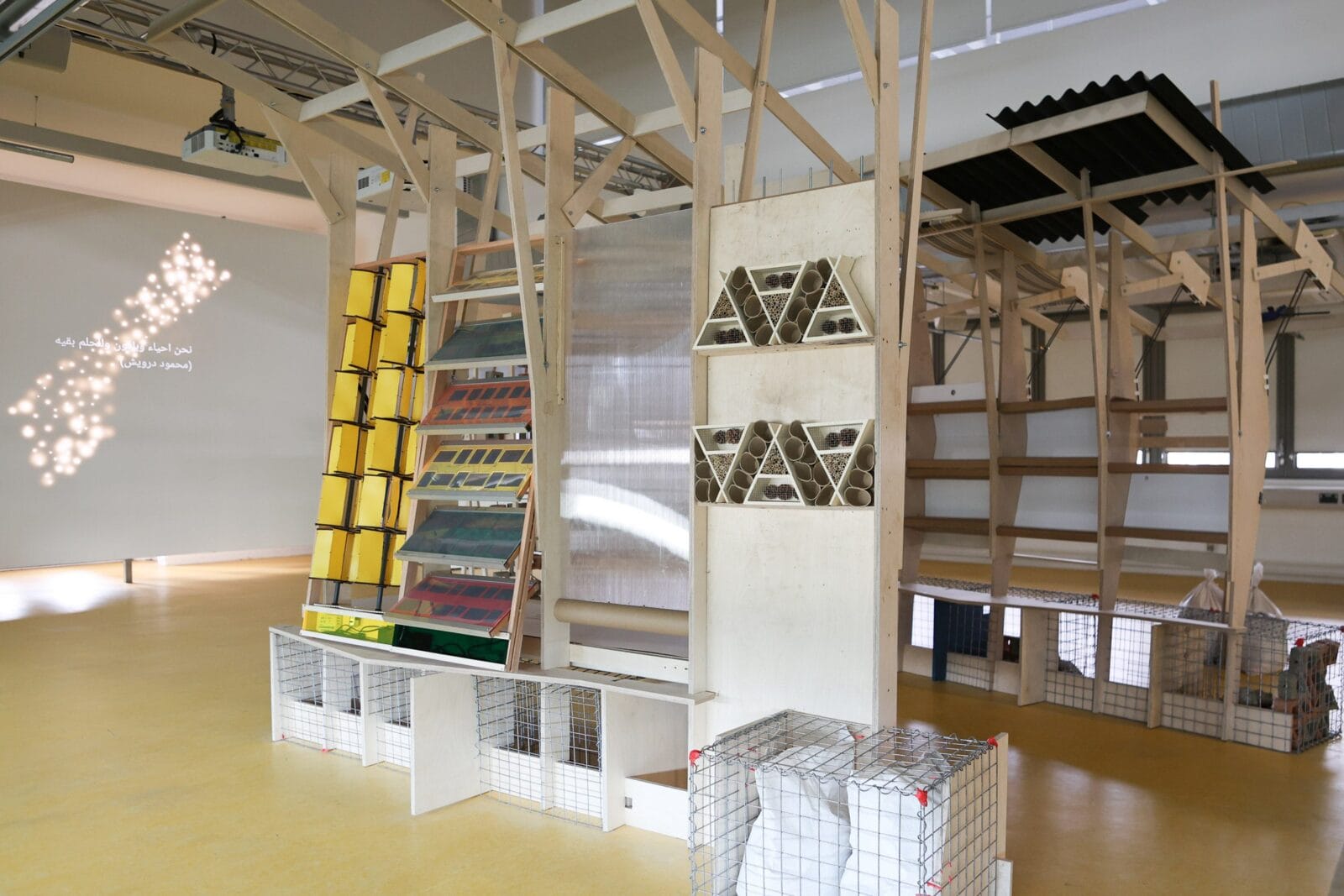
Gaza Off-the-Grid Experimental Lab: A Work in Progress**,* 2024\. Courtesy of Architects for Gaza.
**Hannah:** It sounds like a commentary on what has happened to Gaza. By virtue of saying that these are the materials that people have, you're also saying, “look at the devastation. We're working with rubble and wire.”
**Minerva**: Yes, exactly. The pavilion has four partial walls, and each one works with a different material, things like brick made of crushed concrete and clay, fabric, corrugated metal and reinforcing bars. There was also folding cardboard used for drawers and a bed that could be folded away.
> These kinds of contradictions bring you closer to the reality in Gaza, which, for me, felt like a mix of deep suffering and creativity at the same time—a place and people that you learn from and that remind you, even as a professional, to stay humble.
The design was informed by a series of online research sessions involving a large number of architects. Together with Loay Dieck, an AFG member, I was mapping the situation in Gaza at that time, mainly through online materials, documentation and articles, and we were focusing on two main points. The first was self-help and everyday practices: how people were finding their own solutions to daily needs. There were images that really stayed with me, like desks stacked on top of each other to act as shelves, a child responding to the fear of darkness by creating a simple electrical circuit to light a small bulb or children using a hanging wire to play with. These kinds of contradictions bring you closer to the reality in Gaza, which, for me, felt like a mix of deep suffering and creativity at the same time—a place and people that you learn from and that remind you, even as a professional, to stay humble.
The second focus was what you might call an atlas of materials, looking at what materials were actually available on site or being developed and adapted by Gazans themselves, such as recycled blocks and the Green Cake brick (a sustainable building block developed in 2016 by Gazan engineer Majd Mashharawi made from war rubble and ash to provide a lightweight, low-cost, locally sourced material for rebuilding homes in Gaza). In relation to (re)building, we also mapped how people were fixing tents to the ground, for example, often using sandbags. That idea of grounding then found its way into the design through the use of cages filled with rubble. In essence, the work was really an attempt to bring different ideas together in a creative way but not in any final or resolved sense. It was more about setting up a platform for testing ideas.
And yes, whether intentionally or not, it does also read as a statement about the scale of destruction in Gaza, where rubble has effectively become one of the main building materials. It resembled the memory and history of the place and was explored as a tool to mark home, street and neighborhood.
At the moment, within the Rebuild cluster, AFG is working with the municipality of Gaza on specific sites that have been destroyed and is developing proposals that explore how those places might be rebuilt through a community-led approach.
Proposal for the Yarmouk Cultural Complex, Gaza City, 2025\. Courtesy of Architects for Gaza.
**Hannah:** How did you select those sites? Were they selected by the municipality of Gaza City? And how did that collaboration come about?
**Minerva:** The municipality was part of the conversation from quite early on. AFG was approached by the municipality. A key workshop in October 2024 that brought AFG and the municipality together marked a shift towards starting to work with actual sites. During the workshop, professionals from the municipality shared their own briefs and visions for reconstruction. They were thinking ahead to a moment when repair and reconstruction might become possible, and they identified certain sites that they felt would be important starting points. They nominated around five or six sites. Their work stems from the belief that the process of healing Gaza should not wait. It should start immediately.
From there, AFG began focusing on two of those sites based on their importance and urgency to the city’s recovery. One of them is the Yarmouk Cultural Complex at the heart of Gaza City. It functions as both a cultural and commercial hub. It’s also a very large and complex site, which brings its own challenges. It includes a stadium, a historical mosque, many shops and areas of green space. Since then, there has been ongoing discussion between the AFG team, the mayor and the wider municipal teams. Over the course of about a year, with a high level of commitment from the relevant AFG teams, the proposals have been gradually developed and refined together with the municipality. It’s very much still a work in progress with a number of stakeholders consultations. The work involves an overall concept strategy for the site that is aimed, at a later stage, to be further designed by local Gazan architects.
The second site is the lagoon, Sheikh Radwan Reservoir. It has been used as a point for providing water to the area. Because of the scale of destruction, however, the lagoon has become polluted, and there are significant infrastructural issues associated with it. The project looks at both immediate and longer-term strategies for the site, including approaches to water management, public provision and a building that responds to specific requests from the municipality.
Proposal for the Sheikh Radwan Reservoir, 2025\. Courtesy of Architects for Gaza.
**Hannah:** Do you have a sense of what Gazans are doing now around those sites? Are they rebuilding? Are they coming back?
**Minerva:** Both Rebuild teams have been involved in mapping activities to better understand the context on the ground. And, yes, there are small-scale, emergency attempts to build, consolidate or stitch together destroyed homes and tents at different scales. However, access to materials remains extremely limited, if available at all.
When the AFG team working on the cultural hub carried out the initial mapping in late 2024, the stadium area was full of tents and was functioning almost as an emergency shelter. Part of the challenge has been mapping things that used to be there but are no longer present. This includes key historic monuments and buildings of significant value. These were mapped by local architects in Gaza and carefully identified in order to mark and honor their significance.
**Hannah:** How are you all thinking about heritage? If it's already been destroyed, how are you going back in time and thinking about what was there?
> There was an ongoing attempt to revive some of the rituals and cultural practices that had been part of those sites as a way of engaging with heritage in a more intangible sense.
**Minerva:** The volunteers often had to double-check what they were mapping on the ground against older photographs, for example from newspapers or archived sources. A lot of effort went into piecing together information from different places and moments to identify critical buildings and rituals of importance. There was an ongoing attempt to revive some of the rituals and cultural practices that had been part of those sites as a way of engaging with heritage in a more intangible sense.As I recall, the Yarmouk Cultural Complex team had thoughtful and very careful discussions around what might work and what might not, particularly in relation to the community and to what is understood as heritage.
In the case of Gaza and the Yarmouk Cultural Complex, we mapped culturally significant buildings, sites and daily practices, both tangible and intangible. With the involvement of local architects and members from Gaza and the municipal team, a list of key buildings was identified to be protected and revitalized, as well as an inventory of key plants, trees and species that identify the area.
**Hannah:** Do you see that as a political maneuver? I see it as a form of hope, a way of saying that we know that this will end, and we have a vision for what Gaza will look like and who it will be for when this is over. Is that fair to say?
**Minerva:** Hope does seem to be present. I was actually noticing this recently while going through [AFG’s Instagram page](https://www.instagram.com/architectsforgaza/), where much of the work is documented, the word hope comes up quite often. The work AFG is doing asserts Gazans’ right to rebuild and reconstruct and their right to home. It also seeks to honor Gazans by placing them at the center of the process and challenging colonial forms of erasure.
I’ve also felt it more directly during moments of communication, presentations or events where people from Gaza were able to join us from there. Often, they were connecting from very dark spaces—dark in a literal sense because of the lack of electricity but also dark in relation to the suffering, the violence and the conditions they were living under. In those moments, Gazans were clearly struggling, but there was also a sense that somewhere, someone, like AFG, was trying to act, or push back, on their behalf. So yes, hope is definitely part of what AFG ended up presenting.
And I do think that centering community participation in informing design and planning is, in itself, a basic ethical practice as architects in the profession. It raises fundamental questions: Who gets to rebuild? Who has the right to be involved in the rebuilding process and whose visions and voices are prioritized?
**Hannah:** I assume that you as a team have had conversations about President Donald Trump’s [development plan](https://www.aljazeera.com/news/2026/1/23/imperial-agenda-whats-trumps-gaza-development-plan-unveiled-in-davos) for Gaza. How are you positioning yourself as AFG in relation to these seemingly fantastical, far-fetched plans?
> ...imagining Gaza as an empty site for investment or fantasy while completely ignoring the people who live there, their suffering and their right to shape their own future.
**Minerva:** I think what we are doing, in a way, is confronting that narrative—the narrative where someone else decides, takes ownership over people and determines on their behalf what their future should look like. And this kind of narrative didn’t only appear with the Trump plan. I remember, even in the very first panel discussion we held in March 2024, a couple of months after AFG was initiated *(Gaza Reborn: A Foot on Earth, a Hand in the Sky)*, part of my presentation referred to something I had seen on the news: an advertisement promoting real estate offers for plots on the beach in Gaza, marketed as places where you could build a holiday villa. That was a very clear and disturbing example of the same logic, imagining Gaza as an empty site for investment or fantasy while completely ignoring the people who live there, their suffering and their right to shape their own future.
**Hannah:** Recently Israeli settler groups were selling land in South Lebanon for Israelis to buy. They produced these strange renderings of what the houses would look like and they had renamed all the villages. Compared to what AFG are doing, here are two very different ways of planning and envisioning the city.
**Minerva:** Within AFG, these kinds of conversations often bring us back to a shared understanding that what we are doing is not just about a community-driven approach. It is about recognizing that communities themselves are the owners of the land and that AFG is working for them. AFG strongly underlines that the people of Gaza have the right to their land and their places, no one else. We also focus on who engages with the process of repair and rebuilding and for whose benefit, as well as how closely the local community is involved in shaping these processes. Ultimately the intention is to respond to local needs, instead of imposing a vision from outside. Of course, Gaza carries thousands of years of history—around 5,000 years—so land is deeply valued and passed down through generations. It is an integral part of people’s identity and belonging, not something that can be reimagined, divided, reallocated or be subject to a vision imposed from outside. Gaza is for Gazans.
**Hannah:** We've spoken about two AFG reconstruction projects, but tell us more about the work of the educational strand.
**Minerva:** The educational cluster involved teaching and some workshops with An-Najah National University as mentioned earlier. It focuses on empowering Gazan universities and students and assisting them in completing their education. The universities are back in action despite the destruction, and we continue to provide the support via our volunteers where needed. There has also been some written output coming out of this work. AFG has contributed to a publication focused on education, and there have been a couple of recent articles and publications linked to the education cluster and [Gaza Global University](https://architectsforgaza.com/education/).[\[1\]](#%5Fedn1)
**Hannah:** Things have changed a lot since you first started. What are your priorities now as a group?
**Minerva:** At the moment, a significant amount of energy is going into the two projects in collaboration with the municipality of Gaza, which in themselves require a high level of commitment. This work goes alongside ongoing advocacy efforts. At the same time, AFG has just launched a seed fund to support and empower local Gazan architects, allowing them to further develop designs for specific sites in collaboration with the municipality.
**Hannah:** If people want to get involved, what would you recommend?
**Minerva**: At this stage, the best way is to contribute towards the [seed funding](https://architectsforgaza.com/rebuild/support-gazan-architects-seed-funder-2/) and to [join AFG](http://www.architectsforgaza.com/) as members, helping to amplify the voice of Gaza.
SUPPORT MERIP
Support MERIP in providing critical, grounded reporting and analysis without paywalls. Make a one-time or monthly donation today!
[DONATE NOW! ](https://www.merip.org/donate/)
---
### **Endnotes**
[\[1\]](#%5Fednref1) Mirna Pedalo, “[The Tools at our Disposal: Architectural Pedagogy in the Face of Calamity](https://aaeu.af.unsa.ba/index.php/ojs/issue/view/3/1),” *Acta Architectonica et Urbanistica* 1/1 (2025), pp. 168–177.
### Issue 317 (Winter 2025) Masthead
URL: https://www.merip.org/2026/02/issue-317-winter-2025-masthead/
Last updated: 2026-02-11T10:42:19.000Z
## ***Middle East Report*, “Reconstruction and Ruin,” Winter 2025, No. 317, Vol. 54 No. 4**
### **Executive Director**
**James Ryan** jamesryan@merip.org
### **Executive Editor**
**Billie Jeanne Brownlee** bbrownlee@merip.org
### **Managing Editor**
**Marya Hannun** maryahannun@merip.org
### **Senior Staff Editor & Photo Editor**
**Michelle Woodward** mwoodward@merip.org
### **Cover Designer**
**John Lee**
### **Board of Directors**
**Paul Silverstein** **(Board Chair)** *Reed College*
**Mona Atia** *George Washington University*
**Kaveh Ehsani** *DePaul University*
**Lisa Hajjar (Co-chair of the Editorial Committee)** *University of California, Santa Barbara*
**Muriam Haleh Davis (Co-chair of the Editorial Committee)** *University of California, Santa Cruz*
**Michael Hanna** *International Crisis Group*
**Adam Hanieh** *University of Exeter*
**James Ketterer** *Bard College*
**Vickie Langohr** *College of the Holy Cross*
**James Ryan** *MERIP Executive Director (ex officio)*
###
### **Editorial Committee**
**Lisa Hajjar (Co-chair of the Editorial Committee)** *University of California, Santa Barbara*
**Muriam Haleh Davis (Co-chair of the Editorial Committee)** *University of California, Santa Cruz*
**Ayça Alemdaroğlu** *Stanford University*
**Sabiha Allouche** *University of Exeter*
**Stephen Gasteyer** *Michigan State University*
**Maziyar Ghiabi** *University of Exeter*
**Kanwal Hameed** *University of Exeter*
**Najib Hourani** *Michigan State University*
**Reinoud Leenders** *King’s College London*
**Shana Marshall** *George Washington University*
**Pascal Menoret** *Brandeis University*
**Jacob Mundy** *Colgate University*
**Hesham Sallam** *Stanford University*
**Kevin L. Schwartz** *Oriental Institute of the Czech Academy of Sciences*
**Deen Sharp** *London School of Economics*
**Sean Yom** *Temple University*
### **Format: Online**
### **ISSN 3065-744X**
### A Note on the Cover Image
URL: https://www.merip.org/2026/02/a-note-on-the-cover-image-10/
Last updated: 2026-08-19T18:25:23.000Z
The cover of *MER*’s winter issue features an acrylic and oil on canvas painting by Syrian architect and artist Mohamed Al Mufti, from his series *Urbacide*.
Produced in 2019 during the counter-revolutionary war in Syria, the painting deploys texture and contrast to depict a damaged urban streetscape: A darkened, crumbling concrete building dominates one side, a T-wall barrier the other. Despite these obstacles, between them a brightly lit path leads to a lighter building, its speckled concrete surface flecked with greens and orange to create a focal point that recedes from view. The scene is not tied to a specific place. Instead, Mufti describes *Urbacide* as an exploration of “urban genocide”—“a way of dismantling geography, totally, to make a place unhabitable, unlivable.” Although the series emerged from the Syrian war, he notes that since 2023, the work has taken on a broader resonance: “This is not only in Syria,” he says. “It became dramatically regional. It’s also what’s happening in Palestine, in Yemen, in Lebanon—in Dahiyeh or the South.” The painting is devoid of human figures, an absence Mufti describes as deliberate: Viewers are invited to imagine the lives that once animated these spaces and to confront what it means to return to a city after its social fabric has been violently undone.
It is a fitting cover for *MER*’s winter issue, *Reconstruction and Ruin*, which examines how the intertwined processes of urban destruction and reconstruction have become defining features of conflict across the contemporary Middle East. The issue documents how warfare renders urban space unlivable, and how people navigate return and rebuilding amid ongoing war or its persistent threat. The articles trace how international capital, geopolitical pressure and security regimes constrain and shape reconstruction efforts—from Beirut to Khartoum. Two interviews also reveal the challenges of documenting and chronicling destruction at radically different scales, from the systematic obliteration of Gaza to the devastation of Sudanese cities like El Fasher. At the same time, the issue examines efforts at social repair: grassroots initiatives and heritage projects that seek to sustain life and hope.
Mufti’s painting, by contrast, holds the viewer in a suspended moment before such rebuilding can fully commence. It deliberately confronts the ugliness of destruction rather than softening it, an insistence that, for Mufti, allows the image to provoke sustained attention in ways that breaking news and the fast pace of social media often cannot. He does, however, acknowledge the presence of hope, seen in the recurring light at the center of much of his artistic work: “I don't do it on purpose, but there's always, on the horizon, some source of light coming, a kind of hope.” As an architect, Mufti locates that hope in the possibility of rebuilding socially and materially: in taking what has been destroyed by war and creating projects that draw on collective memory and heritage while also reimagining them in contemporary, durable and sustainable forms. Yet he is explicit about the political conditions that foreclose complete reconstruction. In much of the region, war has not ended and wounds remain open. “We are not in a postwar situation,” he explains. “The wound is still there—and we don’t exhibit it, we live inside it.” As long as Israel’s wars continue, he suggests, rebuilding can only remain provisional. “As long as there is the threat of being bombed again,” he says, “we can only do the minimum.”
### Call for Pitches—Visual Art & Cultural Production in the Middle East and North Africa
URL: https://www.merip.org/2026/02/call-for-pitches-visual-art-cultural-production-in-the-middle-east-and-north-africa/
Last updated: 2026-02-02T17:53:43.000Z
MERIP is seeking pitches for our Summer 2026 issue exploring visual art and cultural production in the Middle East and North Africa. We invite submissions that center artistic practices and cultural histories while attending to the political, social and material conditions in which art is made and experienced. We welcome a range of perspectives and forms, including analytical articles, dispatches, review essays, interviews and visual essays.
Editors are looking for pieces that dig beneath the surface of cultural production to ask questions about its material conditions, its circulation and the political possibilities it enables or expresses. Investigations of visual art, photography, film, music, museums, monuments and architecture and other artistic forms such as folk art, protest art and crafts are all welcome.Pieces might explore the production of art by foregrounding its material politics and economic pathways inside and outside official channels; historical, decolonial, feminist, and socially grounded approaches to artistic practice and circulation; the artistic and aesthetic impulse that genocidal times warrant, notably in relation to Gaza; the changing aesthetics of established cultural productions in tandem with political, social and technological shifts, including AI and open-access content; networks of circulation connecting local and regional dynamics with global consumption and transnational solidarity; grassroots initiatives, independent collectives and avant-garde movements; state-led projects and investments, and many more directions we haven’t thought of.
MERIP’s mandate is to provide critical, alternative and accessible reporting and analysis. To this end, we welcome writers of all backgrounds and experience levels. Our editorial team will work closely with you throughout the process to offer editorial guidance, feedback and support.
To pitch an idea, please send a brief description (1 paragraph) and short biography to cfp@merip.org.
Deadline for pitches: February 23, 2026.
Note: the deadline for submissions will be May 1\. Typically, pieces are between 1,000–3,000 words and go through a review process and several rounds of editing. You can read more about MERIP style [here](https://www.merip.org/write-for-merip/).
We look forward to reading your ideas!
### NEW: Governing Crisis–Sanctions, Austerity and Social Unrest in Iran
URL: https://www.merip.org/2026/01/new-governing-crisis-sanctions-austerity-and-social-unrest-in-iran/
Last updated: 2026-01-29T17:00:06.000Z
Dear Friends and Comrades,
Today we published a new article on the political economy undergirding the recent protests in Iran and the regime’s violent response. Sociologist Ida Nikou’s analysis in [“Governing Crisis–Sanctions, Austerity and Social Unrest in Iran”](https://www.merip.org/2026/01/governing-crisis-sanctions-austerity-and-social-unrest-in-iran/) provides a thorough overview of how the sanctions regime imposed upon Iran has been absorbed into the austerity policies of the Islamic Republic for the benefit of the ruling classes, contributing to the increasingly desperate situation faced by most ordinary Iranians. This context is crucial to understanding the recent wave of demonstrations as well as the interplay between external and internal forces in fueling unrest. As Nikou puts it, “Any serious account of Iran’s crisis must confront both the external sanctions regime and the internal machinery that manages crisis through austerity and repression.”
In case you missed it, earlier this week we also released an episode of [the MERIP Roundtable](https://www.merip.org/2026/01/the-merip-podcast-episode-14-the-merip-roundtable-on-irans-protests/) podcast where I discussed the protests with Iran experts Asma Abdi, Kaveh Ehsani and Maziyar Ghiabi. In that conversation we delved deeper into the geopolitical and economic dynamics of the protests.
We hope you’ll stay with us as we continue to watch developments in Iran, and we are looking forward to sharing our winter issue of *Middle East Report* in the coming weeks.
In Solidarity,
James Ryan
Executive Director
---
SUPPORT MERIP
Help us continue to provide critical coverage of emerging issues in the Middle East without paywalls! Make a donation today!
[DONATE NOW! ](https://www.merip.org/donate/)
## Governing Crisis–Sanctions, Austerity and Social Unrest in Iran
### By Ida Nikou
On December 28, 2025, protests erupted across multiple cities in Iran in response to currency collapse and spiraling living costs. As the exchange rate grew more volatile, sections of Tehran’s Grand Bazaar and commercial centers shuttered. Rapidly shifting prices made[ imports](https://www.reuters.com/world/middle-east/irans-traders-frustrated-by-economic-losses-turn-against-clerics-2026-01-12), pricing and trade impossible.
The state moved quickly to implement an emergency measure embedded in its 2025–2026 fiscal-year budget package: It removed preferential foreign exchange rates for essential goods and key production inputs. Officials presented the move as anti-corruption reform and promised direct compensation through cash transfers and targeted support. In practice, the change accelerated an already rapid rise in prices and further eroded purchasing power, shifting the burden onto households. Official inflation in December was reported to be around[ 42 percent](https://ifpnews.com/irans-headline-inflation-rises-to-42-2-in-december-sci/), but the cost of basic groceries rose much faster at 72 percent compared to a year earlier, pushing staples such as bread and dairy out of reach for large segments of the working class. By early January, the removal of preferential foreign exchange rates had only deepened the squeeze on everyday consumption, and protests escalated into mass demonstrations across the country that lasted for weeks.
It was not the first time Iranian officials have provoked unrest by introducing regressive measures in the name of reform. Over the past decade, successive governments have framed price liberalization and[ currency adjustments](https://www.hriui.com/en/the-removal-of-preferential-exchange-rates-in-iran-a-critical-examination-of-an-inevitable-yet-costly-reform/) as necessary steps to stabilize markets and curb insider profiteering and corruption. In practice, these policies have functioned as austerity measures, transforming service-based welfare programs into cash-based handouts that quickly lose value amid chronic inflation.
The[ 2010](https://www.merip.org/2010/03/the-politics-of-subsidy-reform-in-iran/), and later 2019, fuel price hike are notable earlier examples of this shock politics, with the latter fomenting a mass uprising against deteriorating economic conditions. Both protests were put down with lethal repression. The current moment has followed the same arc at a higher intensity. This time, the masked austerity measures were implemented amid an economic protest. By mid-January the government was estimated to have killed[ thousands](https://www.amnesty.org/en/latest/campaigns/2026/01/what-happened-at-the-protests-in-iran/) and had placed the country under an indefinite communication blackout (internet and phone) in one of the deadliest episodes in the Islamic Republic’s history since the purges of political dissent in the[ 1980s](https://www.hrw.org/news/2022/06/08/irans-1988-mass-executions).
[KEEP READING](https://www.merip.org/2026/01/governing-crisis-sanctions-austerity-and-social-unrest-in-iran/)
### Governing Crisis—Sanctions, Austerity and Social Unrest in Iran
URL: https://www.merip.org/2026/01/governing-crisis-sanctions-austerity-and-social-unrest-in-iran/
Last updated: 2026-06-02T19:38:27.000Z
On December 28, 2025, protests erupted across multiple cities in Iran in response to currency collapse and spiraling living costs. As the exchange rate grew more volatile, sections of Tehran’s Grand Bazaar and commercial centers shuttered. Rapidly shifting prices made [imports](https://www.reuters.com/world/middle-east/irans-traders-frustrated-by-economic-losses-turn-against-clerics-2026-01-12), pricing and trade impossible.
The state moved quickly to implement an emergency measure embedded in its 2025–2026 fiscal-year budget package: It removed preferential foreign exchange rates for essential goods and key production inputs. Officials presented the move as anti-corruption reform and promised direct compensation through cash transfers and targeted support. In practice, the change accelerated an already rapid rise in prices and further eroded purchasing power, shifting the burden onto households. Official inflation in December was reported to be around [42 percent](https://ifpnews.com/irans-headline-inflation-rises-to-42-2-in-december-sci/), but the cost of basic groceries rose much faster at 72 percent compared to a year earlier, pushing staples such as bread and dairy out of reach for large segments of the working class. By early January, the removal of preferential foreign exchange rates had only deepened the squeeze on everyday consumption, and protests escalated into mass demonstrations across the country that lasted for weeks.
It was not the first time Iranian officials have provoked unrest by introducing regressive measures in the name of reform. Over the past decade, successive governments have framed price liberalization and [currency adjustments](https://www.hriui.com/en/the-removal-of-preferential-exchange-rates-in-iran-a-critical-examination-of-an-inevitable-yet-costly-reform/) as necessary steps to stabilize markets and curb insider profiteering and corruption. In practice, these policies have functioned as austerity measures, transforming service-based welfare programs into cash-based handouts that quickly lose value amid chronic inflation.
The [2010](https://www.merip.org/2010/03/the-politics-of-subsidy-reform-in-iran/), and later 2019, fuel price hikes are notable earlier examples of this shock politics, with the latter fomenting a mass uprising against deteriorating economic conditions. Both protests were put down with lethal repression. The current moment has followed the same arc at a higher intensity. This time, the masked austerity measures were implemented amid an economic protest. By mid-January the government was estimated to have killed [thousands](https://www.amnesty.org/en/latest/campaigns/2026/01/what-happened-at-the-protests-in-iran/) and had placed the country under an indefinite communication blackout (internet and phone) in one of the deadliest episodes in the Islamic Republic’s history since the purges of political dissent in the [1980s](https://www.hrw.org/news/2022/06/08/irans-1988-mass-executions).
## The Political Economy of Sanctions
Most commentary on political crisis in Iran oscillates between two convenient, reductive narratives. The problem is either corruption and mismanagement, as if Iran’s economy operates in a vacuum untouched by global capitalism, or, echoing the state’s own narrative, sanctions and imperialist hostility are treated as the singular root of the country’s problems. Both stories flatten a complicated reality. The more useful question is how sanctions have been absorbed into Iran’s political economy in ways that serve the interests of the ruling class. Sanctions have not suspended market-oriented restructuring in Iran. They have reshaped it by widening the state’s discretionary power over who gets access to dollars, permits and contracts, and by generating new opportunities for insider profiteering under the guise of reform. Any serious account of Iran’s crisis must confront both the external sanctions regime and the internal machinery that manages crisis through austerity and repression.
> Any serious account of Iran’s crisis must confront both the external sanctions regime and the internal machinery that manages crisis through austerity and repression.
Sanctions have shaped Iran’s political economy since 1979, with sharp escalations in 2012 targeting oil and finance, in 2018 after the US withdrawal from the nuclear agreement (when [sanctions](https://www.state.gov/iran-sanctions) were [reimposed](https://iranprimer.usip.org/resource/timeline-us-sanctions)) and again in late 2025 with the reinstatement of UN and EU-level “snapback” sanctions. Over the past 15 years, these punitive measures have translated into chronic inflation, collapsing real wages and a deepening crisis of social reproduction. Since late 2017, livelihood struggles have repeatedly spilled into open contention, from the [2017–2018 uprising](https://www.merip.org/2018/01/a-blue-generation-and-protests-in-iran/) to the 2019 fuel protests to recurring, decentralized mobilizations across workplaces and communities. A decade-long wave of [organized labor protest](https://www.merip.org/2021/08/labor-organizing-on-the-rise-among-iranian-oil-workers/) has also persisted with teachers, pensioners and contract oil and petrochemical workers mobilizing over contracts, wages, pensions and basic living costs.
Sanctions did not contribute to the crisis simply by reducing resources. They have also reshaped who gains and how. By creating hard-currency shortages and blocking routine cross-border payments, they pushed trade into opaque channels, weakened the currency and made basic pricing increasingly unstable. One outcome is what many inside Iran call the “trustee economy,” referring to the expansion of intermediaries that keep exports moving, especially[ oil](https://iranwire.com/en/features/147674-did-signals-of-collapse-strand-irans-oil-money-abroad/), by routing payments around banking and SWIFT restrictions. These brokers—often linked to state or quasi-state networks—profit through fees, exchange-rate markups and control over when payments are released, including by delaying or withholding export revenues that are supposed to be brought back into the country. Since 2018, official statements have repeatedly claimed that a significant share of export foreign currency has not been repatriated, with some estimates [as high as 30 percent](https://www.tasnimnews.com/fa/news/1404/06/23/3398611/%DA%86%D8%B1%D8%A7-30%D8%AF%D8%B1%D8%B5%D8%AF-%D8%A7%D8%B1%D8%B2-%D8%B5%D8%A7%D8%AF%D8%B1%D8%A7%D8%AA%DB%8C-%D8%A8%D8%B1%D9%86%D9%85%DB%8C-%DA%AF%D8%B1%D8%AF%D8%AF-%D9%BE%D8%A7%DB%8C-20-%D8%B4%D8%B1%DA%A9%D8%AA-%D8%A8%D8%B2%D8%B1%DA%AF-%D8%B4%D8%A8%D9%87-%D8%AF%D9%88%D9%84%D8%AA%DB%8C-%D8%AF%D8%B1-%D9%85%DB%8C%D8%A7%D9%86-%D8%A7%D8%B3%D8%AA), amounting to tens of billions of dollars.
A related but distinct mechanism operates within the domestic economy. The state has attempted to manage volatility through multiple exchange rates, preferential foreign exchange and discretionary import permissions, turning political access into profit. When hard currency is scarce, the state’s allocation regime channels subsidized dollars and import license through institutional gatekeeping that predictively favors politically connected firms, creating lucrative opportunities for those positioned closest to these bottlenecks.
[The Debsh Tea company scandal](https://www.middleeasteye.net/news/iran-tea-business-brews-record-breaking-corruption-case-press-review) offers one glaring example. Between 2019 and 2022, Debsh Tea, a privately owned importer and producer, received billions of dollars in preferential foreign exchange earmarked for essential imports. In late 2023, Iranian oversight bodies and judiciary-linked reporting alleged that a significant portion of this subsidized currency was not used for the declared imports and was instead diverted into open-market transactions—turning access to cheap dollars into a quick profit by capturing the gap between the preferential and market exchange rates. The sums reported—upwards of $3 billion—was large enough to cover years of national tea demand or finance major [public investment](https://energypress.ir/معادل-فساد-۳-۴-میلیاردی-چای-دبش-در-صنعت).
Not every case becomes a national headline, but the mechanism is familiar. Similar audit controversies have surfaced before, involving preferential access to foreign currency that did not match verified import records or any documented return of the money. One [widely cited](https://www.isna.ir/news/99013118732/%D9%BE%D8%A7%DB%8C-%D8%AA%D8%B9%D8%B2%DB%8C%D8%B1%D8%A7%D8%AA-%D8%A8%D9%87-%D9%85%D8%A7%D8%AC%D8%B1%D8%A7%DB%8C-%DB%B4-%DB%B8-%D9%85%DB%8C%D9%84%DB%8C%D8%A7%D8%B1%D8%AF-%D8%AF%D9%84%D8%A7%D8%B1-%D8%A7%D8%B1%D8%B2-%D8%AF%D9%88%D9%84%D8%AA%DB%8C-%D8%A8%D8%A7%D8%B2-%D8%B4%D8%AF) instance is the Supreme Audit Court dispute over $4.8 billion in preferential foreign exchange reportedly disbursed to importers with no corresponding imports documented.
When the resulting legitimacy crisis becomes intolerable, the state rolls out corrective packages presented as anti-corruption reforms. In practice, these policies entrench austerity and deliver sudden price shocks. Health policy offers a clear example. The [Daroyar reform](https://www.mehrnews.com/news/6711851/پیشنهادی-طلایی-برای-برون-رفت-از-مشکلات-زنجیره-تأمین-مالی-دارو)—a 2022 overhaul of drug subsidies—ended preferential foreign exchange for medicine and shifted the subsidy to an insurance-based reimbursement system. In theory, patients would pay less at the pharmacy while insurers and the state covered the difference. In practice, the financing chain never stabilized: Delayed reimbursements and liquidity shortages increased out-of-pocket costs and produced persistent gaps in access for patients and pharmacies alike. Meanwhile, the government captured fiscal gains from changes in the exchange rate, banks benefited as suppliers and importers relied more heavily on high-cost borrowing. Fuel policy has followed a similar pattern. Price hikes were justified as a way to fund targeted redistribution through cash transfers, but transfers quickly lagged behind high inflation, leaving households to absorb the widening gap between what they received and the real cost of fuel.
The broader state response to the sanctions driven fiscal crisis follows a familiar path. Rather than meeting its obligations through stable public funding, it has leaned on privatization, debt-for-asset swaps and “productive use” (*Movaledsazi*) schemes that transfer public assets into private hands. A notable example is the pension system. Instead of paying down its debt to Social Security in cash, the government has increasingly transferred shares in state-owned firms, effectively forcing the pension system to finance benefits through dividends, asset sales and investment returns. This policy shifts risk onto retirees by tying their livelihoods to market performance and inflation rather than stable entitlements.
The result is a sanctioned political economy in which austerity becomes a governing tool, and scarcity generates profit for those with privileged access. Instead of protecting households through social provision, so-called anti-corruption reforms shift the costs and risks downward through devaluation and subsidy removal while preserving the allocation systems that advantage well-connected elites. This pattern is widely noted in sanctions-era [analyses](https://jacobin.com/2023/08/iran-sanctions-inequality-income-wealth-poor) of inequality and distribution. Recent [official estimates](https://report.mrc.ir/article%5F10467.html) put poverty at roughly a third of the population; similarly, the [World Bank](https://documents1.worldbank.org/curated/en/099110623175541902/pdf/P1777150fa1dcd02108b55086af5f3268f5.pdf) estimates that close to 10 million people fell into poverty over the past decade.
> The result is a sanctioned political economy in which austerity becomes a governing tool, and scarcity generates profit for those with privileged access.
The downward redistribution is visible in how quickly economic shocks travel outward from the commercial core to outlying towns and provinces and in the forms of anger they produce. In western Iran’s long marginalized regions, in towns like Abdanan, the crisis has hit earlier and harder than in many central provinces, leaving deep underinvestment, high unemployment and entrenched poverty. During the recent protest wave, demonstrators stormed a supermarket and tore open bags of rice, scattering the grain across the floor and into the street rather than carrying it away. By late December, a 10kg bag of rice was selling for around [several million toman](https://vista.ir/n/eghtesadonline/4ytcv), roughly equivalent to a month of minimum wage income. The gesture was not theft so much as refusal and a public rejection of a system that turns a basic staple into a luxury while demanding that people accept humiliation as everyday submission.
When crisis is managed through shock transfer rather than redistribution, policy becomes part of the problem, producing a vicious cycle. As economic instability intensifies, the state responds with new rounds of austerity framed as reform. Households do not experience these measures as repair; they experience them as a cost shift that deepens the crisis of everyday survival. The usual channels for complaint and mediation lose credibility. People can petition officials and institutions, but those same institutions are either implementing the damaging reforms or lack the power to reverse them. As that legitimacy erodes, pressure accumulates until a trigger can diffuse economic hardship into a national protest moment. Once dissent spills outside institutional channels, the state increasingly treats it as disorder. With fewer credible mechanisms of incorporation left, repression becomes routine because it is the only tool remaining to retain control.
## External Signaling, Internal Escalation
> When US and Israeli officials cast the protests as a theater of war and regime change, the state can more easily reframe mass dissent as a security threat and respond with counterinsurgency-style repression.
What has made this round of uprisings deadlier is the interplay between external and internal escalation. Iranians did not need outside encouragement to come to the streets: The currency collapse, unmatched wages to inflation and erosion of everyday survival were sufficient conditions for revolt. Rather, external escalation has raised the cost of dissent in a different way—less through material support than through narrative and signaling. When US and Israeli officials cast the protests as a theater of war and regime change, the state can more easily reframe mass dissent as a security threat and respond with counterinsurgency-style repression.
Exiled opposition figures, most prominently the wannabe king, Reza Pahlavi (son of Iran’s deposed Shah in the 1979 revolution) have tried to cast the uprising as a transition movement and have urged escalation, including repeated calls for foreign intervention to facilitate Pahlavi’s return as the national leader. At the same time, US and Israeli officials have publicly gestured at their own involvement, boasting of [assets on the ground](https://www.timesofisrael.com/liveblog%5Fentry/former-trump-official-fetes-iranian-protesters-and-every-mossad-agent-walking-beside-them/), speaking casually of [arming protestors](https://www.timesofisrael.com/right-wing-israeli-tv-report-fuels-rumors-israel-supplying-arms-to-iran-protesters/amp/) and promising “[help is on the way](https://www.reuters.com/world/china/iranian-mp-warns-greater-unrest-urging-government-address-grievances-2026-01-13/).” Their posturing only serves to strengthen the state’s claim that dissent is a foreign operation. Iranian officials have in turn framed the protests as an extension of the 12-day war with Israel in June 2025.
The result is a two-sided narrative that benefits everyone except ordinary Iranians. On one side, external signaling transforms real popular dissent into a proxy battlefield where death becomes collateral damage on the road to regime change. On the other, the Islamic Republic treats all regime change rhetoric as proof that protestors are [terrorists, spies and enemy assets](https://www.presstv.ir/Detail/2026/01/16/762389/Iranian-officials--3,000-members-of-terrorist-groups-arrested-over-riots) rather than citizens with legitimate grievances. In this sense, the response of the Iranian state and the politics of external powers share a core feature: both treat Iranian lives as expendable for the needs of power and profit.
The protests may be suppressed for now, but the conditions that generated them remain unchanged. There is little evidence that the state is able or willing to undertake the structural and welfare reforms needed to fundamentally address the crisis of everyday survival. While it cannot directly lift sanctions, it has shown little interest in reducing household exposure to inflation, curbing precarious living conditions or rebuilding the minimum credibility of welfare and representation. Currency instability and price volatility are increasingly governed as normal conditions, not emergencies to be solved. With each turn of the cycle from austerity to protest, the crisis deepens and heavier force becomes the default method of control. What comes next is uncertain, but the direction is not. As long as crisis is managed through austerity and bullets, and as long as external powers treat Iranian lives as instruments of pressure and regime change, the costs will keep rising and more will die.
\[**Ida Nikou** holds a PhD in sociology from Stony Brook University.\]
*Editor's note: Due to the ongoing internet shutdown in Iran, some Iran-based websites were inaccessible at the time of publication. Links are nonetheless included for reference.*
SUPPORT MERIP
Support MERIP in providing critical, grounded reporting and analysis. Make a one-time or monthly donation today!
[DONATE NOW! ](https://www.merip.org/donate/)
### The MERIP Podcast Episode 14: The MERIP Roundtable, On Iran's Protests
URL: https://www.merip.org/2026/01/the-merip-podcast-episode-14-the-merip-roundtable-on-irans-protests/
Last updated: 2026-01-27T14:17:53.000Z
In this installment of the MERIP Roundtable podcast, we discuss the latest wave of protests in Iran. The protests began on December 28, 2025, as merchants and bazaar workers reacted negatively to new budgetary measures announced by President Masoud Pezeshkian. The protests snowballed in the first week of January, reaching a peak on and shortly after January 8, after which the government instituted an internet blackout. The protests have been widespread and increasingly cross-sectoral. They’ve also been met with harsh repression by the IRGC and its affiliates, with reports of clashes and summary executions resulting in thousands of casualties. The conversation covers the protests, how they compare and contrast with prior waves of unrest and how regional and global politics are influencing both the regime and its opposition. Joining MERIP’s executive director, James Ryan, are Kaveh Ehsani, a member of MERIP’s board of directors and a professor of international studies at DePaul University; Maziyar Ghiabi, a member of MERIP’s editorial committee and an associate professor of Social Sciences and Director of the Centre for Persian and Iranian Studies at the Institute for Arab and Islamic Studies at the University of Exeter; and Asma Abdi, an ESRC Postdoctoral Fellow, also at Exeter’s Institute for Arab and Islamic Studies.
This conversation was recorded on January 21, 2026.
[LISTEN ON APPLE PODCASTS](https://podcasts.apple.com/us/podcast/episode-14-the-merip-roundtable-on-irans-protests/id1823259361?i=1000746851219)
[LISTEN ON SPOTIFY](https://open.spotify.com/episode/4OsXWbGhAjcy8evrmL7r6J)
[LISTEN ON AMAZON MUSIC](https://music.amazon.com/podcasts/d73ad16e-0e22-4ca4-80f1-cf61dade333e/episodes/8fe06adb-c5ba-4128-a489-db11dffec705/the-merip-podcast-episode-14-the-merip-roundtable-on-iran's-protests)
SUPPORT MERIP
This podcast and all of our content is available with no paywalls! Make a donation today to help us keep it that way.
[DONATE NOW ](https://www.merip.org/donate/)
Further Reading:
Setareh Shohadaei, Nazanin Shahrokni, Peyman Jafari, Kaveh Ehsani, Arash Davari and Maziyar Behrooz, “[Echoes of a Short War: Critical Reflections on Israel’s Attack on Iran”](https://www.jadaliyya.com/Details/46907) *Jadaliyya* roundtable, September 23rd, 2025
Arang Keshavarzian, [“An Explosion Long in the Making”](https://www.equator.org/articles/iran-explosion-long-in-the-making ) *Equator* January 17, 2026
Naghmeh Sohrabi, [“We Can’t Live Like This Anymore”](https://www.equator.org/articles/messages-from-iran) *Equator* January 18, 2026
Yassamine Mather, [“Seeds of Revolt: Iran’s Economic Collapse and Inflation”](https://www.counterpunch.org/2026/01/16/economic-collapse-and-inflation/ ) *Counterpunch* January 16, 2026
Gal Beckerman, [“The Silence of the Left on Iran”](https://www.theatlantic.com/culture/2026/01/the-iranians-who-feel-betrayed-by-the-left/685644/) *The Atlantic* January 16, 2026
Asma Abdi, [“A feminist international political economy of sanctions: crises and the shifting gendered regimes of labor and survival in Iran”](https://www.tandfonline.com/doi/full/10.1080/14616742.2025.2454462 ) *International Feminist Journal of Politics* August 15, 2022
Iman Ganji and Bahar Noorizadeh, [“Iran’s Three Body Problem”](https://www.nplusonemag.com/online-only/online-only/irans-three-body-problem/?fbclid=PAdGRleAPY0pBleHRuA2FlbQIxMQBzcnRjBmFwcF9pZA8xMjQwMjQ1NzQyODc0MTQAAaflBX0em6er1z0KbzOClKd6DOApTeHXqHWUwi43cCt9p%5Fj8yZur4Ipw7RGZSQ%5Faem%5F5uz1JbQNzT2KXqezqXAUqw ) *N Plus One* January 16, 2026
Eskandar Sadeghi-Boroujerdi, [“Scylla and Charybdis”](https://newleftreview.org/sidecar/posts/scylla-and-charybdis ) *New Left Review* January 20, 2026
### MERIP's Top 10 of 2025
URL: https://www.merip.org/2025/12/merips-top-10-of-2025/
Last updated: 2025-12-26T14:00:57.000Z
Dear Friends and Comrades,
Today we’re sharing with you the 10 most-viewed articles we published in 2025\. Each of these pieces provides crucial, current analysis of regional dynamics driven by Israel’s ongoing war in Gaza: from the impacts of AI as both a technology of war and tool to manage refugees to the infrastructures that sustain US security architecture to the longer history of Palestinian resistance as explored in the Academy-award nominated film Palestine 36\. These articles engage a range of political actors and sites–from the Houthi movement in Yemen to the new government in Syria. Above all, they document and analyze the scale of devastation Israel has brought about in Gaza over the last two years.
As we enter the end of year break, we hope you’ll take some time to revisit these pieces. We are proud to have brought them to you and, as always, could not have done so without your [support](https://www.merip.org/donate).
In Solidarity,
James Ryan
Executive Director
---
## **MERIP’s Top 10 Most Viewed of 2025**
### Israel’s War on Reproduction in Gaza
By Hala Shoman
Hala Shoman’s chronicle of reprocide in Gaza was our most viewed article of 2025\. It serves as a powerful reminder that Israel’s genocidal campaign not only sought to make Gaza unlivable for present generations, but to make it impossible for new generations of Palestinians in Gaza to be conceived.
[READ NOW](https://www.merip.org/2025/06/israels-war-on-reproduction-in-gaza-2/)
---
### Artificial Humanitarianism–The Data-Driven Future of Refugee Responses
### By Samer Abboud
In a special report for [Resistance–The Axis and Beyond](https://www.merip.org/issue-313/), Samer Abboud laid out how the mass collection of biometric data from refugees, first piloted in Jordan’s Za’atari refugee camp over a decade ago, has completely reshaped the management of refugees in the region and across the world.
[READ NOW](https://www.merip.org/2025/01/artificial-humanitarianism-313/)
---
### Syria’s New Men
By Rahaf Aldoughli
After more than a decade of exile, Rahaf Aldoughli returned to Syria in early 2025, following the fall of Bashar al-Asad in December 2024\. Aldoughli provided her initial reflections to MERIP, including her observations on the changes and continuities in the depiction of masculinity between Asad and his successor, Ahmad Al Sharaa.
[READ NOW](https://www.merip.org/2025/06/syrias-new-men-2/)
SUPPORT MERIP
Support MERIP's critical work by making a one time or recurring donation today!
[DONATE NOW ](https://www.merip.org/donate/)
---
### Yemen’s Ansar Allah
By Helen Lackner
The role of Ansar Allah, also known as the Houthis, in the war in Gaza and resistance to Israeli violence has been poorly understood. Analyst Helen Lackner provided us with this helpful overview of their history and positionality in the ongoing war early in 2025, and followed up with a [podcast interview](https://www.merip.org/2025/09/the-merip-podcast-episode-eight-helen-lackner/) with James Ryan in September.
[READ NOW](https://www.merip.org/2025/01/yemens-ansar-allah/)
---
### Power Struggles–Energy as a Weapon of War, Domination and Resistance in Palestine
By Zachary Cuyler
A critical aspect of Israel’s siege on Gaza was to severely limit the flow of electricity. Israel’s ability to regulate electricity in Gaza has a long history that is completely tied to its colonial domination of Palestinian territory – as historian Zachary Cuyler details in this essay.
[READ NOW](https://www.merip.org/2025/01/power-struggles-energy-as-a-weapon-of-war-domination-and-resistance-in-palestine/)
---
### The Abraham Accords and Sudan’s Global Counterrevolution
By Bayan Abubakr
In 2020, Sudan, represented by a post-revolutionary transitional government, became the third Arab-majority country to sign the Abraham Accords. While the 2021 coup d’etat halted further normalization, “the negotiations and the political bargains the Accords generated were part of the wider web that connects authoritarian regimes across the region” as Bayan Abubakr explains in this essay.
[READ NOW](https://www.merip.org/2025/10/the-abraham-accords-and-sudans-global-counterrevolution/)
---
**Hardwiring Normalization–Infrastructures, Extraction and Gaza’s Future**
**By Rafeef Ziadah**
The lead article in our [Summer/Fall double issue](https://www.merip.org/issue-315-316/), “Hardwiring Normalization” is Rafeef Ziadah’s thorough overview of the infrastructural underpinnings of normalization, and what it portends for eventual reconstruction efforts in Gaza.
[READ NOW](https://www.merip.org/2025/10/hardwiring-normalization-infrastructures-extraction-and-gazas-future/)
---
### The Military-Industrial Backbone of Normalization
By Tariq Dana
The groundwork for Israel’s genocide in Gaza was laid in arms deals. The trade in military technology and ballistics between Abraham Accords countries, as Tariq Dana details in this piece, paved the way for the destruction we’ve witnessed in Gaza, and the relative silence from so many Arab states.
[READ NOW](https://www.merip.org/2025/10/the-military-industrial-backbone-of-normalization/)
---
### Palestine 36 and the Hard Facts of History
By Lori Allen
Annemarie Jacir’s sweeping epic of the 1936 Arab Revolt is an Oscar hopeful in 2026\. Lori Allen’s review highlights how the film makes visceral the personal and political impact of colonialism.
[READ NOW](https://www.merip.org/2025/12/palestine-36-and-the-hard-facts-of-history/)
---
### Fiber Optics and the Hidden Politics of Connectivity
By Ned Leadbeater
In February 2024, after a British flagged cargo ship was hit by two Houthi missiles, its anchor severed three fiber optic cables that cut 25% of the internet traffic between Europe and Asia. This event brought the digital infrastructure of normalization to the surface, and in this essay and our [latest podcast episode](https://www.merip.org/2025/12/the-merip-podcast-episode-13-ned-leadbeater/), Ned Leadbeater helps our readers understand how integral the geography of normalization has impacted how the world connects itself.
[READ NOW](https://www.merip.org/2025/10/fiber-optics-and-the-hidden-politics-of-connectivity/ )
SUPPORT MERIP
Support MERIP's critical work by making a one time or recurring donation today!
[DONATE NOW ](https://www.merip.org/donate/)
### The MERIP Podcast Episode 13: Ned Leadbeater
URL: https://www.merip.org/2025/12/the-merip-podcast-episode-13-ned-leadbeater/
Last updated: 2025-12-22T14:00:41.000Z
Today on the podcast we have an interview with Ned Leadbeater, a researcher and analyst based in Britain who recently wrote an article for our Summer/Fall double issue on the material politics of normalization titled, “Fiber Optics and the Hidden Politics of Connectivity.” His article explores the politics surrounding undersea fiber optic cables in the Red Sea and plans for possible overland cable routes through the Middle East. Currently, the vast majority of internet traffic between Europe and Asia flows through the Red Sea—as much as 90 percent, making it vulnerable to cargo ship accidents and Egypt’s high installation and transit fees. Before October 7, 2023, major tech companies like Google and Meta were developing plans to bypass that Red Sea bottleneck by creating new overland and undersea cable routes from the Mediterranean across Israel and Jordan to the Gulf states that would necessitate new forms of normalization, particularly with Saudi Arabia. James Ryan, MERIP’s executive director, spoke with Ned Leadbeater about the actors involved in fiber optic cable politics, the longer geopolitical history of telecommunications infrastructure in the region and how states and corporations may be rethinking their security strategies in the wake of Israel’s war in Gaza.
This conversation was recorded on December 16, 2025.
SUPPORT MERIP
Please consider making a one-time or monthly donation to support our year-end campaign!
[DONATE NOW ](www.merip.org/donate)
[LISTEN ON APPLE PODCASTS](https://podcasts.apple.com/us/podcast/episode-13-ned-leadbeater/id1823259361?i=1000742315772)
[LISTEN ON SPOTIFY](https://open.spotify.com/episode/4TgUyImDdlavT1wstip8S4)
Further Reading:
Ned Leadbeater, “Fiber Optics and the Hidden Politics of Connectivity” *Middle East Report* Fall/Summer 2025,
Paul Cochrane’s reporting at Middle East Eye:
Submarine Telecoms Forum,
Nicole Starosielski, *The Undersea Network* Duke University Press, 2015
Pauline Lewis, “Wired Ottomans: A Sociotechnical History of the Telegraph and the Modern Ottoman Empire, 1855-1911” Ph.D. Dissertation, UCLA, 2018
### Palestine 36 and the Hard Facts of History
URL: https://www.merip.org/2025/12/palestine-36-and-the-hard-facts-of-history/
Last updated: 2025-12-18T16:51:15.000Z
Representing the brutality of life lived under Israeli domination in Palestine—Palestinians trying to get to work marched through metal cages like cattle in a chute, public praise for Israeli soldiers raping Palestinian prisoners, legal frameworks regularizing dictatorship and apartheid, terrorizing arrests of young children by soldiers, a genocide, Israelis’ denial of a genocide—poses a challenge for any artist or scholar trying to explain those conditions. The perversity of these conditions can seem to surpass what reality could contain, requiring unique representational forms to capture their extremity. Academic writers tend to double down on the facts, as if the weight of footnotes and granular detail could grab readers by the wrist tightly enough to force them into understanding. Artists, in contrast, often play with form and aesthetics, deploying parody and pastiche in an attempt to outpace and transform the unbelievable experiences of Palestinian life—to make them comprehensible in a different way. The floaty tones of Adania Shibli’s storytelling of horror are one example. The burlesque and satire in Elia Suleiman’s films is another. Such artistic translations of reality can provide a distance from the bloody ground, offering a different perspective and clarity, like the turn of a kaleidoscope. By disturbing established frameworks, their phantasmagoria unsettles audiences, shaking them free from some of the obfuscations of propaganda and ideology that shroud public understanding of Palestine, especially in the west.
Annemarie Jacir’s 2025 film *Palestine 36* doesn’t do this. Instead, it digs its heels into the hard facts of history. Drawing on the conventions of epic cinema and narrative, the film tells the interwoven stories of a diverse cast of characters engaged in a mass political revolt. With great battle scenes, explosions and panoramic shots of Palestinian crowds demonstrating, the film is awash in nationalist symbols. The land becomes a character itself, as Jacir has [described it](https://www.youtube.com/watch?v=e7wA%5F%5F%5FWnhI&t=82s). Fields of cotton are tended to by peasants reciting poetry, the mountains hide rebels and other secrets, orchards embrace conversations between daughter and mother. Colorized archival footage and stills—of fields, Jerusalem’s Old City, the sea—look like vintage postcards brought to life. These elements carry the viewer along within their genre-informed expectations to plant them in the heart of the realities of the Great Arab Revolt of 1936–1939, when Palestinians tried to free themselves of the British occupation that had been in place since 1917 and end the Zionist settler-colonial takeover of their homeland.
The British government’s commitment to supporting the development of a Jewish national home in Palestine—manifest in their awarding 90 percent of government concessions to the Zionists, among many other advantages—built what historian Rashid Khalidi has called an [“iron cage”](https://www.penguinrandomhouse.com/books/206000/the-iron-cage-by-rashid-khalidi/) around Palestinians’ efforts to achieve independence in their ancestral homeland.[\[1\]](#%5Fedn1) In his analysis, Palestinians barely had a chance, as the Zionists took over the land and the economy with the full-throttle military, economic and political support of the British Mandate government that controlled Palestine after World War I and the end of the Ottoman Empire. The film shows how hard they tried, nonetheless. With strikes and boycotts, protests, revolutionary courts and the sabotaging of trains and government infrastructure, Palestinians and supporters from throughout the Arab region fought what Palestinian Marxist political thinker and novelist Ghassan Kanafani called the “‘enemy’ triumvirate:” “reactionary Palestinian leaders, Arab regimes surrounding Palestine, and the alliance between Zionism and imperialism.”[\[2\]](#%5Fedn2)
Like Kanafani’s analysis of this period, the film starts with the concrete conditions of people and stays with them throughout. Among these concrete conditions, the abuse of peasant farmers (more than two-thirds of the indigenous Arab population who were the drivers of the rebellion) and workers exploited by Arab landlords and other capitalists feature centrally.[\[3\]](#%5Fedn3) This “policy of rank discrimination against the Palestinian Arab majority” that Khalidi has so thoroughly analyzed was initially enshrined in the 1917 Balfour Declaration. In that 67-word statement released by British Foreign Secretary Arthur Balfour, the British government declared its commitment to the Zionist project of building “a national home for the Jewish people” and [signalled its disregard](https://jacobin.com/2017/11/balfour-declaration-israel-palestine-zionism) for the political, collective rights of 94 percent of the population that was Palestine’s Arabs.[\[4\]](#%5Fedn4)
Under the aegis of the League of Nations (precursor to the UN), British Mandate control led to a cycle of poverty so intense that, according to one 1930 estimate from Haifa, 64 percent of peasant families contained one member who had been served a warrant of arrest or confiscation on account of their debts.[\[5\]](#%5Fedn5) This history is now well documented, but not so generally well known, particularly among audiences in London where the film has been released in theaters. (Its US theatrical release is anticipated for early 2026). In [interviews](https://www.instagram.com/reel/DOed849DgIf/?hl=en) with British [actors](https://www.instagram.com/reel/DQ2IexwDIqk/) and [viewers](https://www.instagram.com/reel/DRM5KUoDIa5/) of *Palestine 36*, they remark on their own ignorance of this history and the need for better education about the shameful role of the British in these events. The problem is one that the film confronts directly.
## **Drawn into the Struggle**
The film loosely centers around Yusuf, a young man from the fictional village of al-Basma, played by Qalqilya-born actor, Karim Anaya. The village has become a target of the British occupiers who are trying to stamp out the rebellion simmering into being after two decades of British rule. Hired as a chauffeur and dogsbody by the rich Palestinian businessman Amir (Dhafer L’Abidine), Yusuf initially gets recruited into the shady anti-nationalist Muslim Association. The organization had been set up by the Zionist Commission to serve as a counterweight to the Muslim-Christian Association, which initially led the fight against the Zionist takeover of Palestine.
Yusuf matures into political certainty as he navigates the awkwardness of trying to traverse class boundaries. He alternates between the keffiyeh headwear typical of peasants to the iconic red tarbush of the upper-class urbanites, suffers the indignity of his boss pushing money into his hand to buy nicer clothes and observes the upper-class Palestinians who dismiss the existential concerns of the dispossessed farmers. Yusuf’s work in the city for Amir raises the ire of his father who wants him closer to home to help tend the family fields and protect their lands as the Zionists encroach ever closer. When tragedy hits his family in the shape of a Zionist settler’s bullet followed by the British imprisonment of his younger brother, the compulsions of injustice push Yusuf into the fight. His story shows one individual’s path to political mobilization in a way that resonates with other characters in the film and those of so many Palestinians.
A similar story unfolds around Khalid (Saleh Bakri), a worker who just wants to support his family, but is drawn into the fight when even that humble aspiration is blocked. In one early scene, Khalid is among a group of dockworkers unloading a foreigner’s ship in Jaffa. They are eager to volunteer for extra work, desperate to make some money in an economy grinding ever more Palestinians into poverty, only to be denied their overtime pay by an unscrupulous employer. This injustice and a rousing political speech by a rebel recruiting fighters convinces Khalid to join the struggle.
> The film educates viewers in more and less subtle ways about how the British were not impartial arbiters in the contest for sovereignty over Palestine. They were partisans driven by Christian Zionism (incarnated in the most compact way in the Bible-referencing Orde Wingate), Orientalist hubris and a penchant for brutality.
An added insult to the Palestinian workers being deprived of pay is their discovery that the barrels they unloaded carried smuggled weapons brought in by the Zionists to be used against the Arabs. It is a dramatization of “the cement incident” that occurred in 1935, when hundreds of guns and hundreds of thousands of rounds of ammunition were found in drums of cement on a Belgian ship. The fictional workers reflect the historical reality when they predict that the British will not punish those responsible for this major crime. (They never did.) The film educates viewers in more and less subtle ways about how the British were not impartial arbiters in the contest for sovereignty over Palestine. They were partisans driven by Christian Zionism (incarnated in the most compact way in the Bible-referencing Orde Wingate), Orientalist hubris and a penchant for brutality. Their priority was to build the settler-colonial state that became Israel and preserve the Empire’s influence and reputation.
Unlike the written word, so easy to skim over when the facts are tough, the great power of movies is the way they can make viewers feel—not just understand—how individuals experienced political policies and lived through grand historical events, enabling a deeper comprehension and sympathy for what drove them to respond in the ways they did. *Palestine 36* achieves this remarkably. It shows the “intimate moments,” as Jacir [describes them](https://www.youtube.com/watch?v=e7wA%5F%5F%5FWnhI&t=82s), through which Palestinians lived, resisted and sometimes succumbed to the pincer pressures of British colonial rule, Zionist settler incursions on their land and Arab landlord exploitation.
The film also brings to life the British government’s violent repression of Palestinian resistance to colonial rule. Eyewitnesses and scholars have revealed a litany of British atrocities that were routine, encouraged and legalized in their efforts to quell the Arab uprising: the use of hot iron rods to scorch the bodies of prisoners, sexual torture and rape, looting, beatings, concentration camps, home demolition on a mass scale.[\[6\]](#%5Fedn6) It’s clear that the makers of this film have done their research. As the archives prove, so many real historical actors engaged in truly vile and inhumane behavior; and those resisting required heroic courage and determination. Avoiding the good versus evil stereotypes is thus a challenge for anyone trying to describe imperial domination. Yet, the film rarely indulges in black-and-white tropes, and Jacir mostly resists the moral extremes. Viewers get a sense of liberal Britain in the character of Thomas Hopkins (Billie Howle playing the private secretary to the High Commissioner), who is outraged by the censorship and violence used to quell the revolt. In the case of Orde Wingate, however, the British military commander who led a “dirty war” counterinsurgency carried out by joint British-Jewish “Special Night Squads,” *Game of Thrones’* star Robert Aramayo’s unshaven portrayal of what almost seems like a caricature doesn’t capture the extent of Wingate’s actual brutality.[\[7\]](#%5Fedn7)
The film is equally honest in its portrayal of the complex nature of Palestinian society and politics, which included people who opposed the rebellion, who colluded with the Zionists and who collaborated with the British. The romantic scenes of Palestinian nationalist fervor—the crowds shouting their unity and support for the rebels—are balanced by moments of internal division: a hooded collaborator identifies rebels to be shot and the stresses of British raids are admitted as resolve weakens among the people. In a wonderfully ambiguous scene, keffiyeh-clad rebels raid a train ferrying Palestinians; they stride among the passengers requesting but really demanding donations to support the uprising—especially from the bejeweled rich—that are offered not necessarily voluntarily. Jacir’s appreciation of Palestine’s diversity and class distinctions is manifest also in the strong *fellahi* (rural) accent of the actors playing villagers, revealed in, among other traces, the tell-tale pronunciation of the letter *kaf* with “ch.”

Karim Anaya as Yusuf. Courtesy of Watermelon Pictures.
## **An Intimate Epic**
For a film that deploys many elements of a historical epic, *Palestine 36* contains much that goes against that grain. The centrality of families, the strength of women and the importance of children bring a depth to the relationships and political dynamics in a way not always found in mainstream historical and political films. Syrian actor Jalal Altawil plays Father Boulos, a Greek Orthodox priest, emanating a serene love and determined equanimity with an intensity that helps explain the difficult choices he makes throughout the film. A fleeting scene in which he soothes an infant in his arms encapsulates so much of this beautiful character and of the power of family. Father Boulos also brings attention to the coexistence of Christians and Muslims in Palestine. The fact of Christian Palestinian nationalists riles the British, who would like to make everything crack along religious fissures but are foiled.
> As the film shows, women were an active part of the rebellion and supported the male fighters and the stamina of their society in many ways.
In this big cast of characters there are numerous central women. A most powerful protagonist is Khuloud Atef (Yasmine al Massri), Amir’s wife and a fiery journalist who must write under a male pseudonym to be taken seriously. Her fashionable hats and occasional cross-dressing convey her independence of mind and spirit. Khuloud’s appearance with a crowd of women trying to petition the High Commissioner reflects the many actual women who tried to lobby the British government and publicize their people’s grievances. As the film shows, women were an active part of the rebellion and supported the male fighters and the stamina of their society in many ways.[\[8\]](#%5Fedn8)
Another strong performance is delivered by Hiam Abbas (well known among audiences of Palestinian cinema and of the TV series *Succession*), as Hanan. Her steeliness and gentle wisdom come through powerfully in a scene in which Hanan tells her granddaughter, Afra (Wardi Eilaboun), of her people’s connectedness to the land, reflecting the importance of oral history as a font of Palestinian national history. Abbas has said [in interviews](https://www.youtube.com/watch?v=e7wA%5F%5F%5FWnhI&t=82s) that she felt she was channeling her own grandmother. Afra’s mother, Rabab (Yafa Bakri), is a young widow whose accidental possession of a 19th\-century firearm drives a lot of the action. Bakri plays Rabab’s commitment to the struggle and to her daughter and parents with an understated strength that seems to flow organically from the grim determination of Abbas’s Hanan. The strength, courage and determination of these female characters is echoed in scenes of women physically fighting British soldiers, which recall images from the First Intifada (1986–1993), another major Palestinian uprising against oppression in which women were central.
Children are another important part of this vast ensemble cast. They are receptacles of their elders’ wisdom and bear the responsibility of carrying the defense of Palestine into the future. Viewers follow the political education and emotional scarring of Afra’s playmate, Kareem, the son of Father Boulos. Played in an intense performance by Ward Helou, Kareem suffers tragedies that drive the cycle of resistance forward. As in *When I Saw You,* Jacir’s 2012 film that follows a stubborn refugee boy’s insistence on returning to Palestine, Afra has a similar kind of stubbornness, borne of an adventuresome curiosity and tough joy. Early in the film she is shown keeping abreast of the Empire’s gossip as she explains to Kareem the abdication of King Edward VIII because he wanted to marry a divorced woman. Afra’s stamp collection with the King’s profile across the empire’s many countries reveals something of that story of political engulfment, but it also carries Afra’s imagination into wider horizons. These moments of sweetness and humor nurture the film, infusing it with a kind of storytelling helium.
The film wraps up as the rebellion is crushed—its leaders were exiled, fighters were killed, the people’s fortitude ground down by violence and unendurable material deprivations. Also echoing the final scene of *When I Saw You, Palestine 36* ends with a running child lifting the audience into an unknown future. The image of hopeful uncertainty—the film’s one nod to unreality—leaves open an imaginative space for a liberated future.
## **The Long Struggle for Freedom Continues**
*Palestine 36* is not a film that Zionists will like, not least because they barely feature. The settler-colonials appear marginally and mostly as a group at a distance, planting facts on the ground, setting fire to Palestinians’ crops, receiving the gift of Palestinian land from British hands and assassinating civilians from the shadows. As Jacir [told *The Guardian*](https://www.theguardian.com/film/2025/oct/17/palestine-36-film-movie-director-annemarie-jacir-interview-toronto-film-festival), “This film is for Palestinians. It’s our story that hasn’t been told.”[\[9\]](#%5Fedn9)
> As Jacir told *The Guardian*, “This film is for Palestinians. It’s our story that hasn’t been told.”
Anyone who’s been paying attention will recognize the parallels between the methods and attitudes of the occupiers portrayed in the film and more recent history. It is no surprise, since the British Empire laid the legal foundations on which Israeli repression was built, a point that Jacir [wants audiences](https://www.youtube.com/watch?v=e7wA%5F%5F%5FWnhI&t=82s) to understand. The film dramatizes with great historical accuracy the ruthless cascades of violent repression and dictatorial power wielded by the British—most banally by young British soldiers demanding to see Palestinians’ identity papers, stealing Palestinians’ money at checkpoints, harassing women and most extravagantly in the collective punishment wrought through concentration camp detentions and home demolitions. It depicts what historian Caroline Elkins calls the “legalized lawlessness” that determined the broad permissions provided to British repressive forces.[\[10\]](#%5Fedn10) Every tactic of repression depicted in the film has a modern-day shadow in Israeli methods—murderous settler violence, the use of “human shields,” chaotic house raids and imprisonment without trial are just a few examples—as well as in international methods of mollification. When Jeremy Irons as arrogant British High Commissioner Wauchope fobs off a delegation of women by offering them yet another investigative commission (the Royal Peel Commission) in saccharine tones promising that “together we can create united and peaceful Holy Land,” the hypocrisies of today’s venal politicians echo loudly.
The movie operates on multiple levels: as a period drama replete with luscious costumes, a historical epic with famous actors and a political exposé revealing the brutality of British rule in Palestine. For those who know this history, it is deeply satisfying to see it brought to life on the screen by big names, some of whom have been speaking out in support of Palestinians. (Irish actor Liam Cunningham of *Game of Thrones* renown plays the evil Charles Tegart and has been a vocal supporter of the Freedom Flotilla trying to deliver humanitarian aid to Gaza, and Jeremy Irons has been calling for an end to the blockade of Gaza at least since 2017.)
Palestine official submission for the Best International Feature Film category at the 98th Academy Awards (for which it has just been shortlisted), *Palestine 36* has already garnered many awards: Grand Prize at the Tokyo International Film Festival, an Audience Award at the São Paulo International Film Festival, a Best Screenplay nomination at the Asia Pacific Screen Awards and it was shortlisted for the 38th European Film Awards. Its first screening in front of a live audience at the Toronto International Film Festival was met with a 20-minute ovation, evidence, as actress Hiam Abbas [told Mehdi Hasan](https://www.youtube.com/watch?v=smbR90q-cFE), that Palestinians’ stories “correspond to the hearts of people.”
No doubt critics and audiences are reacting both to the film as a moving story of individuals navigating epic political shifts, and to the resonance it has with today. On November 17, 2025, the Security Council passed [Security Resolution 2803](https://press.un.org/en/2025/sc16225.doc.htm). With it, the great powers drove “[the last nail in the coffin of UN legitimacy](https://x.com/CraigMokhiber/status/1990421726480531689?s=20)” (one more time) as it blessed the handing over of Gaza to yet another conglomeration of foreigners.[\[11\]](#%5Fedn11) As Jacir has said in [interviews](https://www.youtube.com/watch?v=fniwIrf%5Fj0o): The period of the 1936–39 Revolt never ended, and the long struggle for freedom continues.
\[**Lori Allen** is a writer and editor based in London and the author, most recently, of *A History of False Hope: Investigative Commissions in Palestine*.\]
SPONSORED
Support MERIP during our year-end campaign! Make a one-time or monthly donation today!
[DONATE NOW! ](https://www.merip.org/donate/)
---
### **Endnotes**
[\[1\]](#%5Fednref1) Ghassan Kanafani, *The Revolution of 1936-1939 in Palestine: Background, Details, & Analysis*, translated by Hazem Jamjoum(1804 Books, 2023), pp. 6–7.
[\[2\]](#%5Fednref2) Ibid, p. 1
[\[3\]](#%5Fednref3) Mahmoud Yazbak, “From Poverty to Revolt: Economic Factors in the Outbreak of the 1936 Rebellion in Palestine,” *Middle Eastern Studies* 36/3 (July 2000), p.94.
[\[4\]](#%5Fednref4) Rashid Khalidi, *The Iron Cage: The Story of the Palestinian Struggle for Statehood* (Boston: Beacon Press, 2006), p. 37
[\[5\]](#%5Fednref5) Mahmoud Yazbak, “From Poverty to Revolt: Economic Factors in the Outbreak of the 1936 Rebellion in Palestine,” *Middle Eastern Studies* 36/3 (July 2000), pp. 93–113, p. 99.
[\[6\]](#%5Fednref6) Caroline Elkins, *Legacy of Violence: A History of the British Empire*. Penguin Random House, UK, 2023, pp.194–95.
[\[7\]](#%5Fednref7) Matthew Hughes, M. “Terror in Galilee: British-Jewish Collaboration and the Special Night Squads in Palestine during the Arab Revolt, 1938–39.” *The Journal of Imperial and Commonwealth History*, 43/4 (2015), 590–610.
[\[8\]](#%5Fednref8) Matthew Hughes, “Women, Violence, and the Arab Revolt in Palestine, 1936–39.” *Journal of Military History*, 83/2 (2019), pp. 487–507.
[\[9\]](#%5Fednref9) Geneva Abdul, "[Palestine 36 director Annemarie Jacir: ‘We don’t want a state, we just want to live’](https://www.theguardian.com/film/2025/oct/17/palestine-36-film-movie-director-annemarie-jacir-interview-toronto-film-festival)," *The Guardian*, October, 17, 2025.
[\[10\]](#%5Fednref10) Caroline Elkins, *Legacy of Violence: A History of the British Empire* (Penguin Random House, UK, 2023), pp.129–62.
[\[11\]](#%5Fednref11) Craig Mokiber, [Post on X](https://x.com/CraigMokhiber/status/1990421726480531689?s=20), November 17, 2025.
### NEW: Dirty Work—The Hidden Machinery and Human Toll of Europe’s Broken Recycling Trade
URL: https://www.merip.org/2025/12/new-dirty-work-the-hidden-machinery-and-human-toll-of-europes-broken-recycling-trade/
Last updated: 2025-12-11T14:00:16.000Z
Dear Friends and Comrades,
Today we published a new report from Adnan Khan, [“Dirty Work – The Hidden Machinery and Human Toll of Europe’s Broken Recycling Trade,”](https://www.merip.org/2025/12/dirty-work-the-hidden-machinery-and-human-toll-of-europes-broken-recycling-trade/) that investigates how a dramatically increasing amount of illegal waste from European countries ends up in Turkey’s recycling factories. Khan’s investigation reveals that several major European recycling companies skirt and break rules around the classification of recycled waste in an effort to drive labor costs down and profits up. The end result is a system that recycles much less plastic than it claims, and a widening industry that traps Turkey’s most marginal workers in grinding, unlivable conditions.
This report is a follow up to Khan’s [harrowing exposé](https://www.merip.org/2024/06/a-deadly-trade-refugee-labor-in-turkey-and-europes-plastic-waste/) published with us last year that detailed the waste economy in Turkey and how the industry is degrading life for its workers, most of whom are undocumented Afghan and Syrian migrants. Together, these two reports paint a bleak picture of the failed regulations, systemic corruption and worker exploitation that underpins Europe’s efforts to reduce and recycle plastic waste.
Since the first of these pieces was published, I’ve not been able to see plastic the same way. Khan’s latest provides a closer look at how a corrupt and broken system sustains itself and resists reform. We hope you read, share and let us know what you think.
In Solidarity,
James Ryan
Executive Director
---
SUPPORT MERIP
Support MERIP during our year-end campaign! Make a one-time or monthly donation today!
[DONATE NOW ](https://www.merip.org/donate/)
## Dirty Work—The Hidden Machinery and Human Toll of Europe’s Broken Recycling Trade
Adnan Khan
Death—or at least the manner in which it occurs—is central to Aslı Odman’s understanding of life. For the past decade and a half, the 50-year-old lecturer at Mimar Sinan Fine Arts University’s department of urban and regional planning in Istanbul, Turkey, has spent much of her free time scanning local media reports and talking to her network of informants, tracking down people who have died in workplace accidents.
The list is long. Turkey, despite its inclusion in the G20 and membership in the Organization of Economic Cooperation and Development (OECD),[ ranks among the world’s worst places for such deaths](https://www.equaltimes.org/turkey-one-of-the-world-s-most?lang=en). In 2024, 1,987 people died while engaged in activities related to their work, an average of more than five people per day,[ according to İSİG Meclisi](https://www.isigmeclisi.org/), the Istanbul-based non-governmental organization of which Odman is a founding member. Statistics from the[ International Labour Organization](https://rshiny.ilo.org/dataexplorer18/?lang=en&segment=indicator&id=INJ%5FFATL%5FECO%5FRT%5FA) paint an equally grim picture: 11.2 people died in Turkey for every 100,000 workers in 2024\. In Britain, that number was 0.8.
Few who visit Istanbul see this dark underbelly, though its intimations are all over the city: in the raucous alleyways of the historic Pera district, with its bars, restaurants and boutique shops, where garbage pickers dig through bins for plastic scraps; in the many outlet malls selling discounted name brands cut and stitched in the garment factories scattered around the city; and slightly further afield in the booming suburban outskirts where the landscape bristles with construction cranes erecting shiny new residential towers advertising luxury lifestyles to a mostly international audience.
The recorded number of lives lost to these industries, as shocking as it is, only represents the “tip of the iceberg,” Odman says. The figures are based on what she and her fellow volunteers at İSİG Meclisi can find in public records or glean from their network of contacts. The worst cases sometimes break through into the Turkish media,[ like the 2023 death of Vezir Mohammad Nourtani](https://turkishminute.com/2025/04/15/6-convicted-in-afghan-refugees-death-but-rights-groups-slam-lenient-sentences4/), an undocumented Afghan laborer killed by his boss and five accomplices at an illegal coal mine in Zonguldak, on Turkey’s Black Sea coast. Most, however, go uncounted, especially when it comes to undocumented workers who lack family ties in Turkey, and in some cases even proper identification, like the case of Arifullah Fazli, the undocumented Afghan laborer whose death I stumbled into while[ investigating migrant labor exploitation](https://www.merip.org/2024/06/a-deadly-trade-refugee-labor-in-turkey-and-europes-plastic-waste/) in Turkey’s recycling sector in late 2022\. Fazli died while attempting to dislodge plastic waste that had become stuck in an industrial compactor, and until today there has been no accountability. Deaths like Fazli’s quietly disappear into a legal and bureaucratic maze, their bodies either buried in the many Cemeteries of the Unnamed (Kimsesiz Mezarlığı) scattered around the country or quietly returned to their families back home.
Turkey’s rapid economic growth over the past quarter century under the leadership of the Justice and Development Party (AKP) has relied heavily on labor-intensive industries—mining, construction, textiles, recycling—all of which are top contributors to İSİG Meclisi’s list of workplace deaths. In this constellation, the recycling sector has been particularly deadly, Odman says. Like ship breaking—where she first began looking at such crimes—plastic recycling is a labor-intensive activity that processes highly toxic waste materials, much of them imported, in dangerous work environments. Both industries face tight profit margins and try to widen them by exploiting undocumented labor and bypassing regulations meant to keep humans as well as the environment safe. Unlike ship breaking, though, plastic recycling has enjoyed special treatment in Turkey in recent years.
In 2017, just as China was preparing to exit the global trade in plastic waste, the AKP launched its Zero Waste Project, led by Turkey’s First Lady, Emine Erdoğan. With the goal of making Turkey a world leader in waste management and recycling, the government showered both industries with tax exemptions and cheap loans, among other[ incentives](https://cekadanismanlik.com/Sayfa/724/atik-ve-geri-kazanim-tesisleri-yatirim-tesvikleri). With China’s exit, wealthy nations, including those in Europe, scrambled to find new destinations for their trash. Exports to Turkey[ skyrocketed](https://www.ban.org/plastic-waste-project-hub/trade-data/eu-export-data-annual-summary), jumping from under 100 million kilograms in 2017 to 425 million in 2024\. The Zero Waste Project has been[ lauded](https://sifiratikvakfi.org/en/awards) by the United Nations, the World Bank and the Food and Agriculture Organization, and Turkey’s First Lady now chairs the UN’s High-Level Advisory Board on Zero Waste. In its eighth year, the pro-government newspaper *Daily Sabah* claims the project has helped raise the domestic recycling rate from 13 percent to 36 percent while adding 7.5 billion euros to the Turkish economy.
But behind the accolades are some sobering realities. Regulations to clean up Turkey’s recycling sector have failed. By its nature, the recycling industry is notoriously ineffective and unprofitable. In its entire 40-odd-year history, it has only managed to transform around[ 9 percent](https://bren.ucsb.edu/news/what-percentage-plastic-recycled-globally#:~:text=Overview%20of%20the%20Plastic%20Waste,been%20incinerated%20%2812%20percent%29.) of plastic waste into new plastic products, and even that[ only in degraded forms](https://www.unsw.edu.au/news/2025/03/beyond-the-bin-confronting-the-reality-of-global-plastic-recycling#:~:text=upcycling:%20the%20quality%20question,of%20plastic%20waste%20produced%20globally.), limiting the number of times it can be recycled. Like China before it, Turkey has struggled to bring the illicit trade in plastic waste under control, taking in hundreds of thousands of tons of dirty, often unrecyclable, waste from Europe every year. To turn a profit, the sector has relied on undocumented migrants, who provide a ready supply of cheap, disposable labor to sort, shred, bury and burn much of that waste. Odman’s data shows that starting in 2018, as exports of plastic waste to Turkey increased, so did the proportion of migrant deaths in Turkey’s recycling sector, more than doubling by 2022\.
Each death traces the arc of two converging stories: On one side are the poor and desperate, arriving in Turkey from the east through a gauntlet of border guards, smugglers and criminals; on the other is a growing mountain of trash, the discarded remnants of voracious western lifestyles, slipping unaccounted through ports and past regulators to be bought, reclassified and resold by shady brokers.
[CONTINUE READING](https://www.merip.org/2025/12/dirty-work-the-hidden-machinery-and-human-toll-of-europes-broken-recycling-trade/)
### Dirty Work—The Hidden Machinery and Human Toll of Europe’s Broken Recycling Trade
URL: https://www.merip.org/2025/12/dirty-work-the-hidden-machinery-and-human-toll-of-europes-broken-recycling-trade/
Last updated: 2025-12-18T16:24:48.000Z
Death—or at least the manner in which it occurs—is central to Aslı Odman’s understanding of life. For the past decade and a half, the 50-year-old lecturer at Mimar Sinan Fine Arts University’s department of urban and regional planning in Istanbul, Turkey, has spent much of her free time scanning local media reports and talking to her network of informants, tracking down people who have died in workplace accidents.
The list is long. Turkey, despite its inclusion in the G20 and membership in the Organization of Economic Cooperation and Development (OECD), [ranks among the world’s worst places for such deaths](https://www.equaltimes.org/turkey-one-of-the-world-s-most?lang=en). In 2024, 1,987 people died while engaged in activities related to their work, an average of more than five people per day, [according to İSİG Meclisi](https://www.isigmeclisi.org/), the Istanbul-based non-governmental organization of which Odman is a founding member. Statistics from the [International Labour Organization](https://rshiny.ilo.org/dataexplorer18/?lang=en&segment=indicator&id=INJ%5FFATL%5FECO%5FRT%5FA) paint an equally grim picture: 11.2 people died in Turkey for every 100,000 workers in 2024\. In Britain, that number was 0.8.
Few who visit Istanbul see this dark underbelly, though its intimations are all over the city: in the raucous alleyways of the historic Pera district, with its bars, restaurants and boutique shops, where garbage pickers dig through bins for plastic scraps; in the many outlet malls selling discounted name brands cut and stitched in the garment factories scattered around the city; and slightly further afield in the booming suburban outskirts where the landscape bristles with construction cranes erecting shiny new residential towers advertising luxury lifestyles to a mostly international audience.
The recorded number of lives lost to these industries, as shocking as it is, only represents the “tip of the iceberg,” Odman says. The figures are based on what she and her fellow volunteers at İSİG Meclisi can find in public records or glean from their network of contacts. The worst cases sometimes break through into the Turkish media, [like the 2023 death of Vezir Mohammad Nourtani](https://turkishminute.com/2025/04/15/6-convicted-in-afghan-refugees-death-but-rights-groups-slam-lenient-sentences4/), an undocumented Afghan laborer killed by his boss and five accomplices at an illegal coal mine in Zonguldak, on Turkey’s Black Sea coast. Most, however, go uncounted, especially when it comes to undocumented workers who lack family ties in Turkey, and in some cases even proper identification, like the case of Arifullah Fazli, the undocumented Afghan laborer whose death I stumbled into while [investigating migrant labor exploitation](https://www.merip.org/2024/06/a-deadly-trade-refugee-labor-in-turkey-and-europes-plastic-waste/) in Turkey’s recycling sector in late 2022\. Fazli died while attempting to dislodge plastic waste that had become stuck in an industrial compactor, and until today there has been no accountability. Deaths like Fazli’s quietly disappear into a legal and bureaucratic maze, their bodies either buried in the many Cemeteries of the Unnamed (Kimsesiz Mezarlığı) scattered around the country or quietly returned to their families back home.
Turkey’s rapid economic growth over the past quarter century under the leadership of the Justice and Development Party (AKP) has relied heavily on labor-intensive industries—mining, construction, textiles, recycling—all of which are top contributors to İSİG Meclisi’s list of workplace deaths. In this constellation, the recycling sector has been particularly deadly, Odman says. Like ship breaking—where she first began looking at such crimes—plastic recycling is a labor-intensive activity that processes highly toxic waste materials, much of them imported, in dangerous work environments. Both industries face tight profit margins and try to widen them by exploiting undocumented labor and bypassing regulations meant to keep humans as well as the environment safe. Unlike ship breaking, though, plastic recycling has enjoyed special treatment in Turkey in recent years.
In 2017, just as China was preparing to exit the global trade in plastic waste, the AKP launched its Zero Waste Project, led by Turkey’s First Lady, Emine Erdoğan. With the goal of making Turkey a world leader in waste management and recycling, the government showered both industries with tax exemptions and cheap loans, among other [incentives](https://cekadanismanlik.com/Sayfa/724/atik-ve-geri-kazanim-tesisleri-yatirim-tesvikleri). With China’s exit, wealthy nations, including those in Europe, scrambled to find new destinations for their trash. Exports to Turkey [skyrocketed](https://www.ban.org/plastic-waste-project-hub/trade-data/eu-export-data-annual-summary), jumping from under 100 million kilograms in 2017 to 425 million in 2024\. The Zero Waste Project has been [lauded](https://sifiratikvakfi.org/en/awards) by the United Nations, the World Bank and the Food and Agriculture Organization, and Turkey’s First Lady now chairs the UN’s High-Level Advisory Board on Zero Waste. In its eighth year, the pro-government newspaper *Daily Sabah* claims the project has helped raise the domestic recycling rate from 13 percent to 36 percent while adding 7.5 billion euros to the Turkish economy.
But behind the accolades are some sobering realities. Regulations to clean up Turkey’s recycling sector have failed. By its nature, the recycling industry is notoriously ineffective and unprofitable. In its entire 40-odd-year history, it has only managed to transform around [9 percent](https://bren.ucsb.edu/news/what-percentage-plastic-recycled-globally#:~:text=Overview%20of%20the%20Plastic%20Waste,been%20incinerated%20%2812%20percent%29.) of plastic waste into new plastic products, and even that [only in degraded forms](https://www.unsw.edu.au/news/2025/03/beyond-the-bin-confronting-the-reality-of-global-plastic-recycling#:~:text=upcycling:%20the%20quality%20question,of%20plastic%20waste%20produced%20globally.), limiting the number of times it can be recycled. Like China before it, Turkey has struggled to bring the illicit trade in plastic waste under control, taking in hundreds of thousands of tons of dirty, often unrecyclable, waste from Europe every year. To turn a profit, the sector has relied on undocumented migrants, who provide a ready supply of cheap, disposable labor to sort, shred, bury and burn much of that waste. Odman’s data shows that starting in 2018, as exports of plastic waste to Turkey increased, so did the proportion of migrant deaths in Turkey’s recycling sector, more than doubling by 2022\.
Each death traces the arc of two converging stories: On one side are the poor and desperate, arriving in Turkey from the east through a gauntlet of border guards, smugglers and criminals; on the other is a growing mountain of trash, the discarded remnants of voracious western lifestyles, slipping unaccounted through ports and past regulators to be bought, reclassified and resold by shady brokers.
## **The Rules and How to Break Them**
Before departing a European port, each piece of plastic must be classified into one of two categories: green or amber. The most valuable is uncontaminated, single-polymer plastic (or a specific polymer mixture), known as green-listed waste; less valuable is contaminated and mixed waste, meaning plastic that contains toxic additives or is tainted by household or industrial products. Mixed can also mean unsorted waste, which lowers its value because of the labor costs associated with sorting it. Under European regulatory regimes, all of this waste is amber-listed.
The trade in green-listed waste between EU and OECD countries is, at least for now, relatively free from oversight. When it comes to exports to non-OECD countries, even green-listed waste requires prior notification and consent from the receiving country, an onerous process in which the exporter—mostly waste management and recycling companies—must detail the route the waste will take, the company that will receive it and proof that the receiving company has the capacity to process the waste in an environmentally sound way. Amber-listed waste is currently banned for export to all non-OECD countries while exports to OECD countries require the same complicated and lengthy bureaucratic process non-OECD countries face importing clean waste.
> Recycling companies seeking ways to get rid of unprofitable plastic waste will use tactics like mislabeling waste as green-listed when it is in fact amber and paying companies in the destination country to receive it anyway.
The rules are elaborate and ripe for circumvention. Recycling companies seeking ways to get rid of unprofitable plastic waste will use tactics like mislabeling waste as green-listed when it is in fact amber and paying companies in the destination country to receive it anyway. The latter occurs regularly with waste from Europe, particularly Britain and German waste transiting through the port in Rotterdam: Europe’s logistics hub for the plastic waste trade. Clean waste may also be front-loaded in a shipping container to obscure mixed or contaminated waste hidden behind it.
The bustling illicit trade has spawned a new category of middlemen, often just a single person with a laptop hired by exporters to facilitate the process. These so-called “waste brokers” were supposed to help provide a more integrated approach to managing commodified waste streams like plastic. Instead, they have become an integral part of circumventing the regulations. In 2023, a [report](https://eia-international.org/wp-content/uploads/EIA%5FUK%5FPlastic%5FWaste%5FTrade%5FReport%5FPT2%5F1024%5FFINAL%5FSPREADS.pdf) by the Environmental Investigation Agency (EIA), an independent environmental watchdog based in Britain, found that Dutch middlemen play a key role in facilitating illegal shipments of British plastic waste to Turkey. A year later, the Dutch [Environmental Crime Threat Assessment](https://english.ilent.nl/documents/living-environment-and-housing/waste/waste-and-sea-shipping/publications/environmental-crime-threat-assessment-2024), published annually by the Dutch government department tasked with monitoring waste exports, came to the same conclusion. Its covert investigation into how these brokers operate found that they often buy the lowest quality waste at a discounted price. “The batches are resold by these dubious traders, sometimes several times, passing via other traders or through different countries, making the flow untraceable,” the investigation found. “Ultimately, the waste is exported illegally to Asia and Turkey, for example, where it is not properly processed.”
Not only are the rules easy to circumvent, breaking them comes with minimal costs. When illicit exports are discovered, the brokers claim to be merely facilitators and blame the exporting company for the rule-breaking. Moreover, for every illicit shipment identified, potentially thousands more are slipping through undetected. The waste trade system relies primarily on documentation from the exporter about the nature of the waste and the reliability of the receiving company to process it. The only way to verify the documents is to physically inspect the shipping containers, but in Britain and The Netherlands, whose ports are responsible for the vast majority of European plastic waste exports to Turkey, there are only five and 14 inspectors respectively. Rotterdam port alone handles more than one million shipping containers of European waste every year. “So, you can imagine, we also need the collaboration of other partners,” Enno Christan, one of the Dutch inspectors told me.
It is hard to fault the inspectors for the weak oversight. The resources and tools they have to inspect waste can be paper thin and, frankly, crude, including a smell test where inspectors will open a shipping container and determine by the odor if contaminated waste is being mislabeled as clean. Even advanced sorting guns that use near-infrared (NIR) spectroscopy have limited efficacy: They can only inspect what is directly under the sensor, making it difficult to determine the content of an entire container without the time-consuming work of physically opening and unloading it.
A chemical engineer at a recycling facility in Istanbul’s Bayrampaşa district, requesting anonymity to protect his employer’s reputation, told me he regularly received mixed plastic waste from Vanden. One of Britain’s largest plastic waste exporters to Turkey, last year the company [announced](https://www.vandenrecycling.com/en/2025/09/04/vanden-recycling-announces-strategic-closure-of-uk-reprocessing-facility/) that it would be cutting out the recycling component of its operation entirely, passing on the messiest—and least profitable—stage in the recycled plastics supply chain to its clients around the world. “When you see this,” he said, pointing to shards of plastic in a large polypropylene sack at the recycling facility, “it’s almost the same—the materials, the colors, maybe hardness. Very similar.” It was only by opening the bags of waste and testing the plastic that he was able to confirm that it was, in fact, mixed waste. Once that was done, the shipment should have been flagged and returned to Britain. Instead, the engineer told me, upon such discoveries his company would settle the matter internally with Vanden, negotiating discounts for future shipments. “To send back to UK or Europe,” he said, “is very complicated.”
Neither Vanden’s office in Turkey nor its office in Britain responded to multiple requests for comment, and I was unable to independently verify the chemical engineer's claim. But according to a 2025 investigation I helped produce, in partnership with the British environmental news organization, [ENDS Report](https://www.endsreport.com/article/1932516/listen-boy-wasted-bale-plastic-mystery-body-global-investigation)*,* some of Britain’s top plastic waste exporters to Turkey, including Roydon Resource Recovery and Monoworld, have been caught repeatedly breaking the rules. Amy Youngman, the EIA’s legal and policy specialist, told me these companies are rarely punished in any way that might jeopardize their operations. “Because they’re seen as performing an essential service, helping governments meet the recycling targets they’ve promised the public,” she said, “they’re considered too big to fail.”
The reluctance of governments to hold large companies to account has made tackling the issue much more complicated, a researcher with the Dutch department tasked with monitoring waste exports told me recently at a gathering of waste crime experts in Amsterdam, requesting anonymity. The illicit trade in plastic waste, she said, is “the white-collar environmental crime,” dominated by established companies that rely on fraudulent documentation, unscrupulous middlemen and a lack of oversight in pursuit of higher profits. Its victims are the world’s most marginalized and vulnerable, young men and boys like Arifullah Fazli, caught in the endless churn of plastic waste and the profits it generates.
## **‘These Deaths Happen Every Day’**
On July 1, 2025, I received a video from Aslı Odman on WhatsApp. It depicted a June incident at a major recycling facility in Antalya’s government-sponsored Organized Industrial Zone. A worker, who appeared to be a teenager, had fallen into an industrial shredder while trying to push through plastic waste with his feet and was being removed from the machine by paramedics, still alive, his legs missing. He was from Uzbekistan, the source of a large number of laborers in Turkey, many of them without legal documentation. Unlike Fazli’s death in an obscure factory in a far-off corner of Istanbul’s industrial wastelands, this incident occurred at the symbolic heart of the new, industrialized Turkey, drawing the attention of Turkish media.
Organized Industrial Zones are government-supported districts where key industries receive economic incentives to help them establish Turkish expertise and bring in foreign investment. The Antalya Zone is home to at least seven recycling facilities. Turkish press reports did not identify the one where the incident occurred, nor did any report delve into the employment status of the Uzbek worker.
The lack of details in media reports was not surprising. Recycling’s privileged position, including Emine Erdoğan’s connection to the Zero Waste Project, means many of the owners of major recycling operations boast powerful political allies. “Most of the recyclers—I mean the big ones of course—have a connection with one party or another,” said Sedat Gündoğdu, a marine biologist at Çukurova University and one of Turkey’s leading experts on plastic pollution. “For instance, Adanus Plastic: The owner is the former manager of the ruling party branch in the Yureğir district in Adana. Another is a member of local parliament in a political party. But some importers have strong connections with the opposition party, too, like SASA, which is one of the largest polyester producers, and also importing PET, the waste,” he told me, referring to the common polyester plastic used for drink bottles and food containers. “Now, the CEO of this group is a former opposition party parliamentarian.”
Given the powerful forces behind the industry, those who have a stake in it have little tolerance for critique. Last April, when I confronted the president of Istanbul’s recyclers association, Yuksel Yilmaz, about the deaths in his sector, his categorical denials bordered on the absurd. “There is absolutely no illegal activity in Turkey—no such thing,” he said. “Right now, our sector is actually better than Europe’s with its machinery, equipment, organization and the importance given to workers. Occupational health and safety are at the highest level.”
Industry representatives like Yilmaz say Turkey has solved the Gordian knot of illicit activity in the waste trade and profiteering in the recycling sector, something even a rising superpower like China failed to untangle. They point to the MoTAT system, Turkey’s mobile hazardous waste tracking network, which uses GPS trackers on shipping containers to monitor the movement of imported waste from the moment it enters Turkey until it is delivered to the processing facility. Yilmaz insisted the system ensures waste goes where it is intended and cannot be diverted.
But there is reason to doubt these claims. Assuming hazardous (amber-listed) waste is correctly labeled when it arrives in Turkey, which is often not the case, and makes an uninterrupted journey to the intended importer, once it arrives at that facility oversight comes to an end. Often the importing company will state on paper that it has the capacity to handle the entire recycling process, including cleaning, sorting and shredding, Gündoğdu said, but in fact it will subcontract that work—the most labor intensive—out to another, often unlicensed, facility, like the one where Fazli died. “The waste is removed from the MoTAT-tagged shipping container and loaded onto another truck,” Gündoğdu explained, “at which point it’s no longer tracked in the system. It can then go wherever. I see these trucks full of waste on Turkey’s roads all the time.”
New rules coming into effect in November 2026 will make Turkey even more central to Europe’s waste management strategy. As an OECD country, Turkey will then be one of the few non-EU nations authorized to import waste from European nations. The regulations also attempt to tighten oversight of European plastic waste exports. For instance, even exports of green-listed waste to OECD countries outside the EU will require prior notification and consent from the receiving country. Turkish recyclers will need to be audited by an independent third party before they are allowed to receive imported waste. But that procedure is unlikely to prevent violations, Gündoğdu told me. In fact, these audits have already been adopted in Turkey via a government licensing regime for Turkish importers, but corruption—whether bribes or connections with influential local politicians—makes licenses too easy to obtain.
> Recycling, when it is possible, is dirty and expensive. It requires cheap, disposable bodies to be economically viable. Multiple Turkish recyclers told me it would be impossible to make a profit in the sector without using migrant labor.
The problem, most experts agree, is that the new regulations do not address the overarching issue at play: Recycling, when it is possible, is dirty and expensive. It requires cheap, disposable bodies to be economically viable. Multiple Turkish recyclers told me it would be impossible to make a profit in the sector without using migrant labor. Everyone is doing it, I was told whenever I walked into a recycling facility and found migrant laborers working there, from the small, unlicensed operators in Cebeci to the major players in industrial cities like Gebze, Adana and Antalya.
Meanwhile, the levels of plastic waste are rising quickly. In the absence of laws to massively reduce virgin plastic production and its use in our societies, the pressure to export more waste will only increase, leading to more abuse and more dead workers in Turkey. Such deaths have already become so common that a Taliban official at the Afghan consulate in Istanbul was surprised when I told him I was investigating them. “These deaths happen every day,” he said. “This is not a story.”
## **‘The Most Exploitable Workers in Turkey’**
For Aslı Odman, every death reveals something meaningful. The patchwork narrative of Turkey’s economic rise, she says, is a macabre quilt of tragic tales, feverishly stitched together with little regard for the lives caught up in its growth calculus. Undocumented workers have become an essential resource for Turkey, she says.
“The employers, small ones, but also the big ones, they can afford to let an undocumented migrant worker die,” she says. “We call it blood money. If the family is in Turkey, it gets blood money so it doesn't follow the penal case. They don't run after it. They get the blood money and they’re out. An employer can really calculate how many workers he can let die during the work process and continue to make a profit.”
It is doubtful Arifullah Fazli’s family received any blood money. Despite several attempts I was not able to reach them because of the remoteness of their village in Afghanistan. Three years after his death, the investigation has not made much progress, primarily because there is no family member in Turkey to keep the case moving forward, lawyers in Istanbul told me. A quiet, gentle person who never spoke a bad word about anyone, according to co-workers, his goal was to reach Europe and earn some money to help his family survive the devastating collapse of the Afghan economy after the Taliban takeover of Afghanistan.
> Turkey, because of its geographical location, is destined to be a transit country for people like Fazli, seeking refuge from war, environmental disaster and economic collapse. And its vast pool of refugees—[2.7 million officially registered ](https://www.unhcr.org/refugee-statistics/data-summaries?data%5Fsummaries%5Bregion%5D=7&data%5Fsummaries%5Bcountry%5D=196&data%5Fsummaries%5BwithinFrom%5D=within&data%5Fsummaries%5Bview%5D=population%5Ftotals&data%5Fsummaries%5Byear%5D=2025&data%5Fsummaries%5BpopType%5D=REF&data%5Fsummaries%5B%5Fmode%5D=country&data%5Fsummaries%5B%5Ftoken%5D=3.IELjhNE5kdaLbnIcO-eJABCdczPJGAM1Guh5YXCDzb0.dQax8btq2Pu4KRptFtHYbHywSlf-K2RFQIwyMRzmi814cqTKt03UguRZMw&data%5Fsummaries%5Bsubmit%5D=)as of November 2025—provides an obvious source of cheap labor.
Turkey, because of its geographical location, is destined to be a transit country for people like Fazli, seeking refuge from war, environmental disaster and economic collapse. And its vast pool of refugees—[2.7 million officially registered ](https://www.unhcr.org/refugee-statistics/data-summaries?data%5Fsummaries%5Bregion%5D=7&data%5Fsummaries%5Bcountry%5D=196&data%5Fsummaries%5BwithinFrom%5D=within&data%5Fsummaries%5Bview%5D=population%5Ftotals&data%5Fsummaries%5Byear%5D=2025&data%5Fsummaries%5BpopType%5D=REF&data%5Fsummaries%5B%5Fmode%5D=country&data%5Fsummaries%5B%5Ftoken%5D=3.IELjhNE5kdaLbnIcO-eJABCdczPJGAM1Guh5YXCDzb0.dQax8btq2Pu4KRptFtHYbHywSlf-K2RFQIwyMRzmi814cqTKt03UguRZMw&data%5Fsummaries%5Bsubmit%5D=)as of November 2025—provides an obvious source of cheap labor. Unofficially, the numbers are thought to be even higher. Because of Turkey’s [special status](https://rli.blogs.sas.ac.uk/2021/06/22/on-the-difference-that-turkeys-geographical-limitation-to-the-1951-convention-makes-in-the-protection-of-non-european-refugees/) under the 1951 Refugee Convention whereby most refugees are classified as “conditional,” their treatment is governed less by international norms and more by internal contingencies, often political. Many irregular migrants choose not to register as refugees because the process under Turkish law can be onerous and time consuming, often forcing already traumatized people to live in remote cities in Turkey’s interior. This situation leaves them without a clear path to resettlement or the right to work and with no access to the networks that can help sustain them financially and psychologically.
These undocumented migrants are the most vulnerable and the most in demand in Turkey’s deadliest industries, including recycling. “Afghans are better for the employer than Syrians, for example, because they're more destitute,” Odman tells me. “They are therefore the most exploitable workers in Turkey.”
Ercüment Akdeniz, a journalist and the former chairman of the Labour Party, described to me a hierarchy of migrant value in Turkey. Syrians, because of the 2016 Turkey-EU migration deal, are entitled to some level of government support. Iranians, he said, tend to be better-educated political refugees who work white-collar jobs like teachers, doctors and skilled workers. Sub-Saharan Africans are in demand in the warehousing sector. Uzbek and Turkmen, because of their language skills, work in the entertainment, tourism and restaurant sectors. “When we look at Afghans,” Akdeniz said, “we see them mostly in animal husbandry, agriculture, textile and construction. In the field of waste paper, plastic and recycling, from what I have observed, Pakistanis are the most common workers. Then come Afghans, followed by Syrians and others.”
But things are changing. When I began investigating Turkey’s recycling sector in 2022, Afghans were facing a mass deportation campaign as the AKP tried to calm growing discontent over the numbers of refugees and migrants in Turkey. Many Afghan workers had gone underground, living inside the factories where they worked, under constant fear of arrest. When I returned to Istanbul in the spring of 2025, Afghans were mostly gone from Istanbul’s recycling districts, replaced by Syrians and young men and boys from Sub-Saharan Africa. Pakistanis were still there, struggling and searching desperately for a way to escape to Europe.
Odman believes the reliance on this kind of easily exploitable labor will not end in Turkey any time soon. Despite the deportation campaigns, cheap undocumented labor remains the backbone of many industrial sectors. As Europe continues to fortify its borders, many will find themselves trapped in Turkey, at the mercy of exploitative bosses. And deaths will continue. Odman says she and her colleagues at İSİG Meclisi are prepared to spend the rest of their lives documenting who these people were. For them, it is necessary work.
“We do this, first of all, to say: you exist,” she tells me. “You exist by dying. We keep the data with their names and ages and nationalities, sometimes the hour they die, the conditions under which they die. It's an homage after they die. But we do it in order to defend life.”
*This investigation was developed with the support of Journalismfund Europe. A version of the article is forthcoming, in Dutch, for De Groene Amsterdammer.*
\[**Adnan Khan** is a freelance journalist based between the Netherlands and Turkey.\]
Support MERIP
Support MERIP during our year-end campaign! Make a one-time or monthly donation today!
[DONATE NOW! ](https://www.merip.org/donate/)
### The MERIP Podcast Episode 12: Honoring Joe Stork, Live in DC
URL: https://www.merip.org/2025/12/the-merip-podcast-episode-12-honoring-joe-stork-live-in-dc/
Last updated: 2025-12-08T14:00:20.000Z
On this episode of the MERIP Podcast we're sharing highlights of our live event Honoring Joe Stork, held at Busboys and Poets in Washington, D.C. on November 22, 2025\. The event featured reflections and reminiscences about Joe Stork, our co-founder and longtime editor who passed away October 23, 2024\. Featured speakers included Sarah Leah Whitson, Lisa Hajjar, Mouin Rabbani, Joel Beinin, Zachary Lockman, Rick Reinhard, Andy Shallal and Joan Mandel. The event was MC'd by Joost Hiltermann, a MERIP contributor and analyst at the International Crisis Group. All of the speakers shared stories of their experience working with Joe, from the founding of MERIP in the 1970s through his work with Human Rights Watch later in his career.
MERIP is grateful to the staff at Busboys and Poets for hosting us, and Andy Shallal, the owner of Busboys and Poets, for joining the proceedings to share a few words.
SUPPORT MERIP
Support MERIP during our year-end campaign! Make a one-time or monthly donation today!
[DONATE NOW ](https://www.merip.org/donate/)
[LISTEN ON APPLE PODCASTS](https://podcasts.apple.com/us/podcast/episode-12-honoring-joe-stork-live-in-washington-dc/id1823259361?i=1000740202828)
[LISTEN ON SPOTIFY](https://open.spotify.com/episode/1PaBQmW4LvOh2Lz4X2OE6V)
[LISTEN ON AMAZON](https://music.amazon.com/podcasts/d73ad16e-0e22-4ca4-80f1-cf61dade333e/episodes/b58f9910-62ae-4099-875b-b96c73fd8d86/the-merip-podcast-episode-12-honoring-joe-stork-live-in-washington-dc)
### Support MERIP on Giving Tuesday
URL: https://www.merip.org/2025/12/support-merip-on-giving-tuesday/
Last updated: 2025-12-02T14:00:14.000Z
Dear Friends and Comrades,
Two weekends ago, friends and colleagues gathered in Washington, DC for the annual Middle East Studies Association conference, where we reflected on and honored the memory of our co-founder and longtime editor, Joe Stork, who passed away a little over a year ago. At the conference, and at a lively gathering at Busboys and Poets, our staff, longtime contributors and comrades from across the country spoke about MERIP’s decades long commitment to fostering a space for critical, rigorous analysis, while building a supportive community in which our work can thrive.
It was equal parts inspiring and gratifying to hear about the community that Joe brought together through MERIP and his extraordinary efforts to keep our organization afloat. It reminded me, again, that even though we now do much of our work remotely, none of it is possible without community [support](https://www.merip.org/donate/). Everything we’ve accomplished over the last year—publishing [three](https://www.merip.org/issue-313/) [outstanding](https://www.merip.org/issue-314/) [issues](https://www.merip.org/issue-315-316/), starting a [podcast](https://www.merip.org/tag/the-merip-podcast/), organizing [events](https://www.merip.org/events/) and launching the new website—have been made possible by the support of you, our readers.
All of our development has put the organization in a place where it is poised to do even more great things in 2026\. With new and refined tools at our disposal, we hope to strengthen the organization in the next year so that we can offer more critical perspectives on the current challenges the Middle East and the world are facing at this moment. A year ago Bashar al-Asad’s regime in Syria fell in swift and surprising fashion. Despite the shock of that moment, there are fresh challenges under President Ahmad al-Shara’a: the search for justice and accountability for Asad’s crimes, enduring attacks and expanded land grabs by Israel and the quest for Kurdish autonomy. The last year has seen a continuation of the genocide in Gaza, a rapid escalation in dispossession across Palestine, and the aggressive expansion of Israel’s regional war against Iran with attacks on Lebanon, Yemen and Qatar. At the moment, there is a tenuous, routinely violated ceasefire agreement that has created a cloud of uncertainty as everyday life in Gaza enters a new dystopic reality. We’ve addressed these developments through incisive dispatches and rigorous analysis and have centered voices from dissident and activist movements throughout.
Our ability to produce more work absolutely depends on increased [support](https://www.merip.org/donate/) from our readers. At MERIP we rely on a lot of volunteer labor from our editorial committee, and our entire staff is part-time. The commitment and drive of everyone in our community is what makes it possible for us to produce a leading publication like *Middle East Report* on a fraction of a fraction of the budget our peers enjoy. But, that commitment, like most material things, has its limits.
As we come to the end of the year, we hope you’ll be able to support our work now and in the future. No amount is too small—our average donation is $100\. If you haven’t already this year, please consider [making a donation to MERIP today](https://www.merip.org/donate/). If you already have, thank you, and perhaps consider making a monthly contribution, or giving us one more boost before the close of the year.
In Solidarity,
James Ryan
Executive Director
[DONATE NOW!](https://www.merip.org/donate/)
---
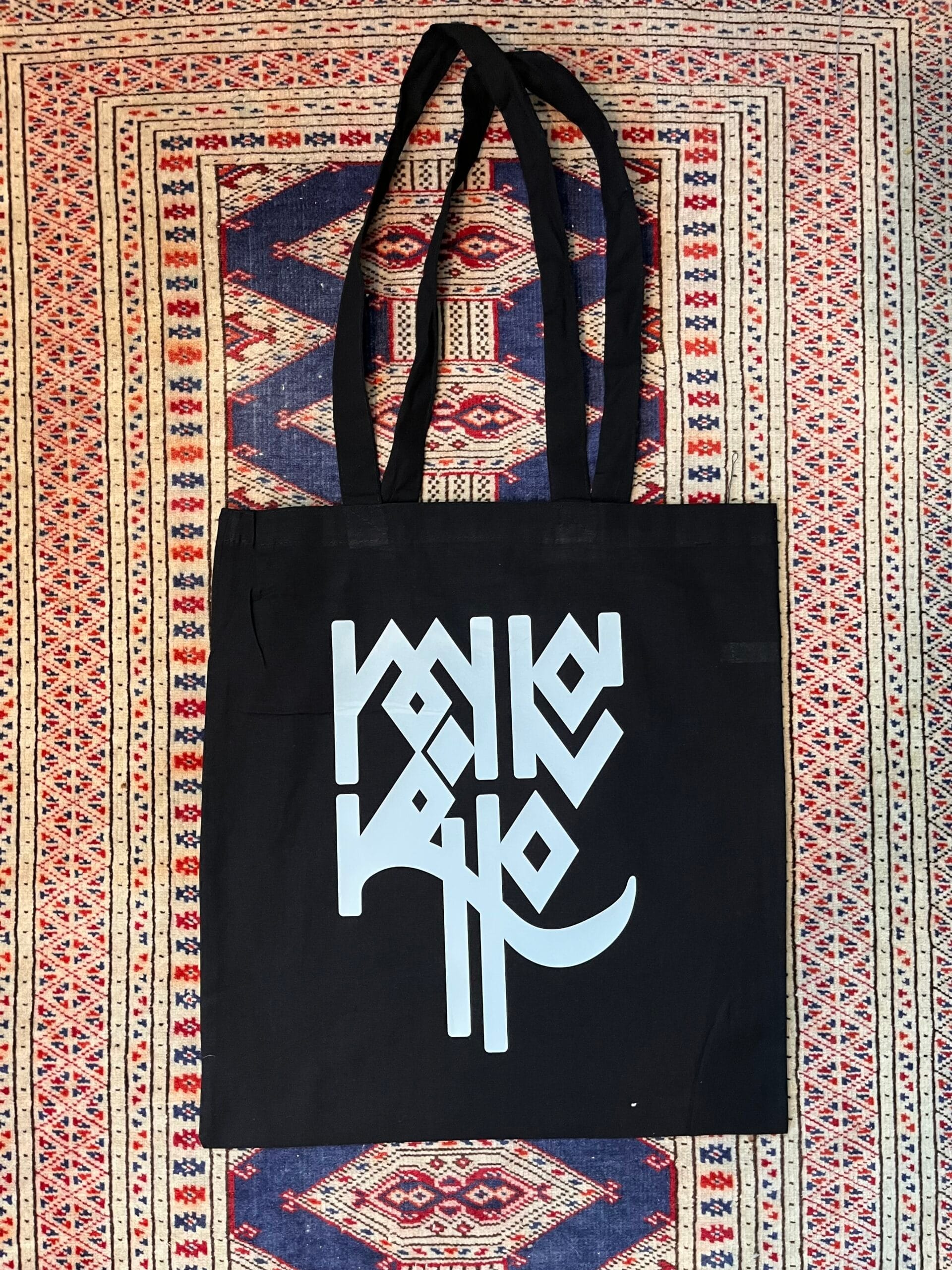
## SHOP OUR MERCH STORE!
A great way to show your support for our work is to pick up a tote bag or poster from our merchandise shop. These items are all made locally and at a union shop, and 100% of the proceeds support MERIP's operations and mission. They make a great gift, too!
[SHOP OUR MERCH NOW!](https://www.merip.org/merchandise/)
### NEW: ‘We Want to Breathe’ – Dispatch from Tunisia
URL: https://www.merip.org/2025/11/new-we-want-to-breathe-dispatch-from-tunisia/
Last updated: 2025-11-13T19:55:44.000Z
Dear Friends and Comrades,
We’re bringing you a new [dispatch](https://www.merip.org/2025/11/we-want-to-breathe-dispatch-from-gabes-tunisia/) today from the frontlines of protests in the Gabes governorate of Tunisia during an environmental and public health crisis. Pollution from a nearby phosphate processing complex operated by the state-owned Tunisian Chemical Group has persistently harmed residents, including children while at school. Dhouha Djerbi, a researcher based in Switzerland, has been in Gabes speaking with families affected by this unfolding catastrophe and observing the growing mobilization of local resistance.
This formerly lush oasis region in Tunisia is bearing the brunt of poorly managed chemical processing–the unusually high rate of respiratory illness and rare cancers emerging in Gabes have turned it into Tunisia’s “cancer capital.” As the conference of parties meets in Brazil this week and next week for the UN climate conference, COP30, MERIP continues to highlight the voices and experiences of those most impacted by industrial pollution and climate change.
In Solidarity,
James Ryan
Executive Director
SUPPORT MERIP
MERIP relies on support from our readers to publish dispatches like this one. Please consider a one-time or monthly donation today!
[DONATE NOW ](https://www.merip.org/donate/)
---
Protesters carry placards and chant slogans as they march in the southern city of Gabes, Tunisia, on October 31, 2025, demanding the dismantling of the state-run phosphate processing plant. (Fethi Belaid/AFP via Getty Images)
## ‘We Want to Breathe’ - Dispatch from Gabes, Tunisia
### By Dhouha Djerbi
A few weeks into the 2025 school year, in a middle school in Chott Essalem, Tunisia, students began to feel dizzy and light-headed and their throats tightened. Within minutes, they began collapsing, one after another. More mass asphyxiation events, as residents describe them, occurred throughout the month of September and into the early days of October. In total over 100 people, predominantly children, were affected. One mother, recalling the[ first incident](https://legal-agenda.com/%D8%A7%D8%AE%D8%AA%D9%86%D8%A7%D9%82-%D8%AA%D9%84%D8%A7%D9%85%D9%8A%D8%B0-%D9%82%D8%A7%D8%A8%D8%B3-%D8%A7%D9%84%D8%B0%D9%8A-%D9%8A%D8%B5%D8%B9%D8%A8-%D8%AD%D8%AC%D8%A8%D9%87-%D8%AD%D8%B1%D8%A7%D9%83/) to a local environmental group, described a harrowing scene of rows of children lying motionless on the ground, their stillness conjuring images she had seen of lifeless Palestinian children in Gaza.
When the students fell ill that September morning, few doubted the culprit. The Gabes governorate’s sprawling phosphate processing complex—run by Tunisian Chemical Group, more commonly known by its French designation Le Groupe Chimique Tunisien or simply Groupe Chimique—boasts a[ record of gas leaks](https://inkyfada.com/fr/2019/11/12/pollution-gabes-lutte-gct/) that have caused similar episodes of poisonings over many years. Alongside severe[ ecological devastation](https://www.reuters.com/sustainability/climate-energy/once-an-idyll-tunisian-protest-hotspot-gabes-now-an-environmental-nightmare-2025-10-20/), the toll most acutely felt by residents has been an[ alarming concentration](https://legal-agenda.com/%D8%A7%D9%84%D8%AF%D9%88%D9%84%D8%A9-%D8%AA%D9%8F%D8%AE%D9%81%D9%8A-%D8%A7%D9%84%D8%AC%D8%B1%D8%A7%D8%A6%D9%85-%D8%A7%D9%84%D8%B5%D8%AD%D9%8A%D8%A9-%D9%84%D9%84%D9%85%D8%AC%D9%85%D8%B9-%D8%A7%D9%84/) in respiratory illnesses and rare cancers found nowhere else in Tunisia. They occur with such frequency that the governorate earned the apt—if grim—moniker of the nation’s “[cancer capital](https://raseef22.net/english/article/1094071-a-poisoned-paradise-tunisias-gabes-suffocating-under-its-phosphate-factories).”
In conversations with Gabes residents, the refrain that all households contain at least one cancer patient is nearly universal. Compounding this public health catastrophe is a medical infrastructure that is both underfunded and ill-equipped to care for an ailing population. When the children of Chott Essalem fell unconscious, desperate parents called for ambulances only to be later turned away at the regional hospital.
People from Gabes will tell you that layering indignity upon injury is part and parcel of life in the shadows of the Groupe Chimique. Yet the rapid pace and scale of the Chott Essalem incidents this year were without precedent. Harrowing images and videos of fainting children spread like wildfire on[ social media](https://www.aljazeera.net/news/2025/10/19/%D9%85%D8%AC%D9%85%D8%B9-%D9%83%D9%8A%D9%85%D9%8A%D8%A7%D8%A6%D9%8A-%D9%8A%D8%AA%D8%AD%D9%88%D9%84-%D9%84%D9%83%D8%A7%D8%B1%D8%AB%D8%A9-%D8%A8%D9%8A%D8%A6%D9%8A%D8%A9-%D9%83%D9%8A%D9%81) and ignited[ public outrage](https://nawaat.org/2025/10/12/%da%a8%d8%a7%d8%a8%d8%b3-%d8%aa%d9%86%d8%aa%d9%81%d8%b6-%d9%81%d9%8a-%d9%88%d8%ac%d9%87-%d8%b3%d8%b1%d8%b7%d8%a7%d9%86-%d8%a7%d9%84%d9%85%d8%ac%d9%85%d8%b9-%d8%a7%d9%84%d9%83%d9%8a%d9%85%d9%8a%d8%a7/).
[KEEP READING](https://www.merip.org/2025/11/we-want-to-breathe-dispatch-from-gabes-tunisia/)
### 'We Want to Breathe'—Dispatch from Gabes, Tunisia
URL: https://www.merip.org/2025/11/we-want-to-breathe-dispatch-from-gabes-tunisia/
Last updated: 2025-11-13T16:12:13.000Z
A few weeks into the 2025 school year, in a middle school in Chott Essalem, Tunisia, students began to feel dizzy and light-headed and their throats tightened. Within minutes, they began collapsing, one after another. More mass asphyxiation events, as residents describe them, occurred throughout the month of September and into the early days of October. In total over 100 people, predominantly children, were affected. One mother, recalling the [first incident](https://legal-agenda.com/%D8%A7%D8%AE%D8%AA%D9%86%D8%A7%D9%82-%D8%AA%D9%84%D8%A7%D9%85%D9%8A%D8%B0-%D9%82%D8%A7%D8%A8%D8%B3-%D8%A7%D9%84%D8%B0%D9%8A-%D9%8A%D8%B5%D8%B9%D8%A8-%D8%AD%D8%AC%D8%A8%D9%87-%D8%AD%D8%B1%D8%A7%D9%83/) to a local environmental group, described a harrowing scene of rows of children lying motionless on the ground, their stillness conjuring images she had seen of lifeless Palestinian children in Gaza.
When the students fell ill that September morning, few doubted the culprit. The Gabes governorate’s sprawling phosphate processing complex—run by Tunisian Chemical Group, more commonly known by its French designation Le Groupe Chimique Tunisien or simply Groupe Chimique—boasts a [record of gas leaks](https://inkyfada.com/fr/2019/11/12/pollution-gabes-lutte-gct/) that have caused similar episodes of poisonings over many years. Alongside severe [ecological devastation](https://www.reuters.com/sustainability/climate-energy/once-an-idyll-tunisian-protest-hotspot-gabes-now-an-environmental-nightmare-2025-10-20/), the toll most acutely felt by residents has been an [alarming concentration](https://legal-agenda.com/%D8%A7%D9%84%D8%AF%D9%88%D9%84%D8%A9-%D8%AA%D9%8F%D8%AE%D9%81%D9%8A-%D8%A7%D9%84%D8%AC%D8%B1%D8%A7%D8%A6%D9%85-%D8%A7%D9%84%D8%B5%D8%AD%D9%8A%D8%A9-%D9%84%D9%84%D9%85%D8%AC%D9%85%D8%B9-%D8%A7%D9%84/) in respiratory illnesses and rare cancers found nowhere else in Tunisia. They occur with such frequency that the governorate earned the apt—if grim—moniker of the nation’s “[cancer capital](https://raseef22.net/english/article/1094071-a-poisoned-paradise-tunisias-gabes-suffocating-under-its-phosphate-factories).”
In conversations with Gabes residents, the refrain that all households contain at least one cancer patient is nearly universal. Compounding this public health catastrophe is a medical infrastructure that is both underfunded and ill-equipped to care for an ailing population. When the children of Chott Essalem fell unconscious, desperate parents called for ambulances only to be later turned away at the regional hospital.
People from Gabes will tell you that layering indignity upon injury is part and parcel of life in the shadows of the Groupe Chimique. Yet the rapid pace and scale of the Chott Essalem incidents this year were without precedent. Harrowing images and videos of fainting children spread like wildfire on [social media](https://www.aljazeera.net/news/2025/10/19/%D9%85%D8%AC%D9%85%D8%B9-%D9%83%D9%8A%D9%85%D9%8A%D8%A7%D8%A6%D9%8A-%D9%8A%D8%AA%D8%AD%D9%88%D9%84-%D9%84%D9%83%D8%A7%D8%B1%D8%AB%D8%A9-%D8%A8%D9%8A%D8%A6%D9%8A%D8%A9-%D9%83%D9%8A%D9%81) and ignited [public outrage.](https://nawaat.org/2025/10/12/%da%a8%d8%a7%d8%a8%d8%b3-%d8%aa%d9%86%d8%aa%d9%81%d8%b6-%d9%81%d9%8a-%d9%88%d8%ac%d9%87-%d8%b3%d8%b1%d8%b7%d8%a7%d9%86-%d8%a7%d9%84%d9%85%d8%ac%d9%85%d8%b9-%d8%a7%d9%84%d9%83%d9%8a%d9%85%d9%8a%d8%a7/)
## **Stopping the Pollution**
On October 8, people in Gabes poured into the streets in protest following calls from local environmental groups, especially the local movement, Stop Pollution. Seasoned environmental activists and rambunctious football Ultras marched peacefully through Gabes city alongside children, mothers and Guwebsia (people from Gabes) from all walks of life. Central to their demands was the call to shut down the Groupe Chimique’s polluting units alongside the more aspirational, if seemingly unattainable, plea for clean air, as heard in the protest chant, “we want to breathe” (*nhebou netnafssou*).
> The state’s answer came swiftly in yet another cloud of [toxic gas](https://www.reuters.com/world/africa/tunisian-protesters-storm-chemicals-complex-over-health-fears-2025-10-11/), this time deployed by security forces to quell the mobilization.
The state’s answer came swiftly in yet another cloud of [toxic gas](https://www.reuters.com/world/africa/tunisian-protesters-storm-chemicals-complex-over-health-fears-2025-10-11/), this time deployed by security forces to quell the mobilization. Meanwhile, during the evening news cycle, the national television broadcaster made no mention of the poisonings or the swelling public anger. It instead reported on Gabes’ bountiful pomegranate harvest this year. Protesters have since adopted the pomegranate as a symbol of their struggle, carrying the fruit alongside the classic Gabes *quffa—*a traditional handwoven basket made of palm leaves*—* while lampooning the silence of authorities and national media about the movement.
Undeterred, public protests have persisted with remarkable regularity since October 8\. Local actions culminated in a general strike called by the Tunisian General Labor Union (UGTT) on October 21, which reported [100 percent participation](https://www.france24.com/fr/afrique/20251021-pollution-en-tunisie-grève-générale-à-gabès-pour-exiger-la-fermeture-d-une-usine-chimique). Stop Pollution estimated a historic turnout of [130,000](https://www.facebook.com/photo/?fbid=1138225631847774&set=a.384884687181876) for the march that took place the same day, which would make it the largest collective mobilization in the governorate's history. On October 9, 18 and 26, [hundreds of protesters](https://www.reuters.com/world/africa/hundreds-protest-tunisias-capital-over-worsening-pollution-crisis-2025-10-25/) also marched on the national headquarters of the Groupe Chimique in downtown Tunis. On October 26, members of the Tunisian diaspora organized a small solidarity rally in [Paris](https://paris-luttes.info/%F0%9F%93%A3-appel-a-rassemblement-paris-20058?lang=fr)’s Place de la République.
The movement’s sustained momentum and its percolation to the capital owes much to the supportive role of Tunis-based civil society associations, which have mobilized for Gabes and helped amplify news of the protests. The outpouring of support comes at a time of heightened repression of Tunisian civic activity under [Law 88](https://www.fidh.org/fr/regions/maghreb-moyen-orient/tunisie/tunisie-le-projet-de-reforme-du-decret-loi-regissant-les-associations) that governs associations. In late October, the activities of prominent organizations and alternative media outlets—including the Tunisian Association for Democratic Women (ATFD), the Tunisian Forum for Economic and Social Rights (FTDES) and the media collective Inkyfada—were [suspended](https://www.arabnews.com/node/2620214/amp) for one month pending investigation.
In a commentary on the crisis earlier in October, President Kaïs Saied blamed what he called criminal policies inherited from past governments and promised an investigation into the poisoning episodes. Labeling the environmental and health conditions in Gabes as “[environmental assassination](https://www.aljazeera.com/gallery/2025/10/22/tunisias-gabes-city-on-general-strike-over-factory-pollution),” his words echoed a speech he delivered in [2021](https://www.facebook.com/Presidence.tn/photos/حل-رئيس-الجمهورية-قيس-سعيد-صباح-الأحد-14-مارس-2021-بقابس-على-إثر-الحادث-الذي-جد-/4062402077151152/) in which he similarly waxed poetic about the region’s threatened oases only months before seizing powers in what has been described as a [constitutional coup](https://www.merip.org/2021/12/whatever-happened-to-dignity-the-politics-of-citizenship-in-post-revolution-tunisia-2/). The context of that earlier speech was a trip by Saied to Gabes following an [explosion](https://www.ugtt.org.tn/2021/03/13/بيان-المكتب-التنفيذي-الوطني-على-إثر-فا/) within the industrial complex that claimed the lives of six workers. He pledged accountability, improved healthcare infrastructure and broader regional development.
Four years later, the unrelenting ferment in Gabes now poses perhaps the most serious challenge to Saied’s rule. Nothing short of shutting down the Groupe Chimique’s polluting units will suffice for many of the Guwebsia who have taken to the streets. Adding to the crisis, under Saied’s leadership the government intends to [quintuple its production](https://www.reuters.com/markets/commodities/tunisia-aims-raise-phosphate-output-14-million-metric-tons-2030-2025-03-05/) of phosphates from 2025 to 2030 to feed the nation’s depleted coffers.
## **Phosphates and Tunisia’s Industrial Renaissance**
Over 50 years ago, in October 1972, President Habib Bourguiba stood on the sandy beaches of Tunisia’s southern coastline and delivered a speech to the residents of Gabes governorate. The father of the modern Tunisian state and self-declared supreme leader in the battle against *takhalof* (backwardness, a bitter legacy of French colonial rule) inaugurated what he called one of the region’s “finest jewels.*”* Known for its storied oases and the [singular coastal Mediterranean agroecology](https://ftdes.net/le-systeme-oasien-de-gabes-un-tresor-agricole-millenaire-menace/) that sustained them, Gabes was the site of the new Maghrib Chemical Industries complex. Later renamed Groupe Chimique, the state-owned chemical company’s plant was the centerpiece of Tunisia’s industrial renaissance. It was built to transform raw phosphate into high-value fertilizers and chemical derivatives, propelling the country into an era of modernist development while leaving legacies of *takhalof* buried deep in its dust.
“Where yesterday there was only desert, steppe, and sand, where yesterday there was only ignorance, illiteracy, and resignation, today there is life,” proclaimed Bourguiba to an audience of Guwebsia eagerly awaiting development two decades into independence.[\[1\]](#%5Fedn1) “This life is called water, irrigating the beautiful oases of Kebili and other oases in your governorate. This life is also the industry that has exploded here.” He celebrated the changing coastline of the region, noting its “smoking chimneys” and multiplying industrial ventures, including phosphoric acid plants, a brickworks factory, a power station, a gas pipeline and an industrial port. Tunisia’s most precious natural resource—phosphates—was extracted from the depths of Gafsa’s mines, refined in the embrace of Gabes’ oases and exported from its port. He concluded by predicting that, in the decades to come, the Gabes coastline would be beyond recognition.
> Bourguiba’s prediction proved eerily accurate. Gabes did become unrecognizable, though not in the way he had promised...For decades, industrial activity in the region has discharged [millions of tons of phosphogypsum](http://www.ods.nat.tn/upload/Rapport%5FFinal.pdf) waste along the coast of Gabes and released toxic fumes into the air.
Bourguiba’s prediction proved eerily accurate. Gabes did become unrecognizable, though not in the way he had promised. Indeed, it would bear little resemblance to the life of the oases stretching across the governorate—a point contemporary residents are quick to impress upon newcomers and one that marked my own initiation into the world of oasis life in 2022\. For decades, industrial activity in the region has discharged [millions of tons of phosphogypsum](http://www.ods.nat.tn/upload/Rapport%5FFinal.pdf) waste along the coast of Gabes and released toxic fumes into the air. Phosphogypsum is the hazardous by-product of phosphate fertilizer production that contains naturally-occurring radioactive material.
The complex’s day-to-day operations also use massive amounts of water that leave neighboring [oases farmers](https://ftdes.net/en/le-systeme-oasien-de-gabes-un-tresor-agricole-millenaire-menace/) in a chronic state of want. Older generations, now the nostalgic custodians of a pre-industrial oasis system once nourished by generous springs and fertile soil, recount stories and preserve faded photographs of an era when life was abundant. With the benefit of hindsight, young people, whose unemployment [places the region third nationally](http://www.ods.nat.tn/upload/files/pdf/CHIFGABES.pdf), lament that an earlier generation was seduced by the vision of progress sold to them in the 1970s*.* Residents believe that they were left intentionally in the dark about the devastation the industry would unleash upon Gabes.
SUPPORT MERIP
This article is made possible through the support of readers like you. Please consider a donation today
[DONATE NOW ](https://www.merip.org/donate/)
## **The Long Struggle to Breathe**
If Gabes is Tunisia’s “cancer capital,” it is also the beating heart of Tunisia’s [environmental activism](https://ftdes.net/ar/pollution-a-gabes-lutte-pour-le-droit-a-une-vie-digne/). The 2010–2011 uprising that toppled President Zine El Abidine Ben Ali and inspired other Arab uprisings opened unprecedented avenues for collective action. A diverse assemblage of social movements and civil society associations rallied behind the cause of defending Gabes’ fragile oasis ecology and stopping the Groupe Chimique’s pollution. From this wave of mobilization emerged Stop Pollution, alongside a host of other associations that wove environmental concerns into broader social and political agendas. Gabes now hosts what is arguably Tunisia’s only football Ultras culture that fuses environmental activism with club fandom.
Anti-pollution graffiti by Gabes football Ultras in Gabes, Tunisia, February 2025\. (Photo by Dhouha Djerbi)
In 2017, organizational efforts targeting the phosphate industry intensified as protesters descended on the industrial zone where the Groupe Chimique is located. The action coincided with broader mobilizations that swept across southern Tunisia, demanding a fair share of phosphate wealth for the country’s most deprived regions. These demonstrations also built upon the more spontaneous protests against the complex that occurred in the few weeks following Ben Ali’s fall. Since the uprising, disruptions have cost the state upward of [$2 billion](https://www.reuters.com/article/us-tunisia-protests-idUSKCN18B0VA/) in lost production. Phosphate output has never returned to pre-2011 levels, and all extraction and processing sites remain designated as military zones.
Years of sustained struggle have yielded a handful of modest victories, namely [limited compensation schemes](https://www.opendemocracy.net/en/north-africa-west-asia/tunisias-legacy-of-pollution-confronts-democratic-politics/) for those officially recognized as affected, a 2017 decision to close the refinery’s most polluting units and the inclusion of phosphogypsum on the national list of hazardous materials. The latter two decisions, in particular, were greeted with celebration in a rare moment of vindication for Gabes.
But elation gave way to bewilderment and anger when both measures were [quietly reversed](https://nawaat.org/2025/07/23/الفوسفوجيبس-الوحل-الذي-يقتل-قابس/) earlier this year. This setback coincided with Tunisia’s launch of a national [green hydrogen](https://africasacountry.com/2025/05/green-hydrogen-old-colonialism) strategy that designates the Groupe Chimique as the pilot site for export-oriented green ammonia production. The mere announcement of this plan was enough to reignite protests in December 2024 and again in the spring of 2025, drawing old and young alike into the streets to resist what they saw as familiar forms of encroachment reinvented under an environmentally green guise. This fall, with children collapsing from toxic exposure at rates unseen in the region’s history, taking to the streets en masse felt almost instinctive for those whose struggles have long targeted the metaphorical and now literal asphyxia borne out of a development strategy blind to human wellbeing.
The foundation of today’s resistance to the new green ammonia plant and to industrial pollution writ large rests on the simple truth that the Groupe Chimique has taken far more from Gabes than it has ever given back. To quote Bourguiba one last time, he painted a picture of Gabes—with its “beautiful date palms and factory chimneys”—as a “landscape of contrasts” that embodied the “genius of the South.” Yet the true genius of Gabes is not in the forced and unsustainable coexistence of oasis and industry but in the stubborn capacity of its people for social mobilization against all odds and the ability to transform despair into organized opposition. For half a century, Guwebsia have borne witness to the slow unmaking of their environment, inhaling the costs of industrialization and exhaling resistance.
\[**Dhouha Djerbi** is a doctoral candidate in international relations and political science at the Geneva Graduate Institute, Switzerland.\]
---
### **Endnotes**
[\[1\]](#%5Fednref1) All Habib Bourguiba quotes are from “*L’industrialisation se poursuit*,” October 6, 1972, in *Habib Bourguiba, Discours*, Tomme 21 (1970-1972), pp. 308–312\. (Tunis: Publications du Ministère de l’Information).
### The MERIP Podcast Episode 11: In the Archive with Beshara Doumani
URL: https://www.merip.org/2025/11/the-merip-podcast-episode-11-in-the-archive-with-beshara-doumani/
Last updated: 2025-11-06T14:22:08.000Z
Today we have a very special episode, part of a new occasional series that will highlight some of the truly great work MERIP has done over the last 50-plus years, all of which is free to read in our archive. In the first of this series, we’re featuring the landmark essay “Abu Farid’s House” written by Beshara Doumani and published in March 1989 as part of Issue 157, “Israel Faces the Uprising.” The essay encapsulates the history of working class struggles in Palestine up to and during the First Intifada through the family of the titular Abu Farid in Salfit, a small village located between Ramallah and Nablus.
The author, Beshara Doumani, went on to become a leading historian of Palestine in the Ottoman era. He served as the President of Bir Zeit University in the West Bank from 2021–2023 and is now the inaugural Mahmoud Darwish Professor of Palestinian Studies at Brown University. This episode features an interview with Doumani by MERIP Executive Director James Ryan recorded on October 30th from the West Bank, where Doumani is currently on sabbatical conducting research in some of the same villages he visited when he wrote “Abu Farid’s House.” The conversation covers his experience in Salfit and its surroundings before and during the First Intifada, as well as how he understands the changes in Salfit and across the Occupied Territories, from the Oslo Accords through the present genocide in Gaza.
Further Reading:
Beshara Doumani, “Abu Farid’s House” Middle East Report 157, March-April 1989
“Israel Faces the Uprising” Middle East Report 157, March-April 1989
Beshara Doumani, *Rediscovering Palestine: Merchants and Peasants in Jabal Nablus, 1700-1900* (Berkeley, University of California Press 1995)
[LISTEN ON APPLE](https://podcasts.apple.com/us/podcast/episode-11-in-the-archive-with-beshara-doumani/id1823259361?i=1000735554933)
[LISTEN ON SPOTIFY](https://open.spotify.com/episode/0lPII5e8cnJKWvu2rT3SKq)
[LISTEN ON AMAZON](https://music.amazon.com/podcasts/d73ad16e-0e22-4ca4-80f1-cf61dade333e/episodes/d5265595-6f50-4bdc-b953-c76c8a572e05/the-merip-podcast-episode-11-in-the-archive-with-beshara-doumani)
support merip
MERIP relies on our readers and listeners to bring you this podcast for free. Make a one time or monthly donation today to support our work!
[DONATE NOW ](https://www.merip.org/donate/)
### Dick Cheney Dead
URL: https://www.merip.org/2025/11/dick-cheney-dead/
Last updated: 2025-11-04T19:21:39.000Z
Dear Friends and Comrades,
Former Vice President Richard Cheney has died at 84 years old. The news broke on a historic election day where many expect to see Zohran Mamdani, a Muslim and a democratic socialist, elected Mayor of New York City. Cheney and his allies were responsible for the lawless executive power of US politics and policy following September 11, 2001 that led to the death of millions in Afghanistan and Iraq, ballooned the profits of military contractors, permitted torture and extralegal domestic spying on Arab and Muslim Americans and disregarded international law in every respect–a permission structure happily accepted by Donald Trump, Benjamin Netanyahu, Vladimir Putin, and the like the world over. Whatever regrets he might have expressed on the eve of Trump’s return to power, the horrors of our present moment count Dick Cheney as an author.
That his death comes on the eve of Mamdani’s presumed victory serves as a reminder of how far the forces of resistance that first gathered in opposition to George W. Bush and Cheney’s wars have come, and how far we have to go. Mamdani’s campaign has shown that a politics of justice and accountability in the face of creeping authoritarianism at home and genocide abroad can win.
At MERIP, we think the best way to mark this occasion is to provide an overview of our coverage of Cheney’s role in the Bush administration. We’ve provided below some highlights from our archive about the American role in the wars in Afghanistan and Iraq and torture at black sites and Guantánamo Bay. We hope you find it illuminating to revisit this coverage, which remains free to read to all, without paywalls.
In Solidarity,
James Ryan
Executive Director
---
SUPPORT MERIP
Help us continue to provide all of this material without paywalls!
[DONATE TODAY ](www.merip.org/donate)
---
[America’s Iraq](https://www.merip.org/issue-227/)
MER Issue 227, Summer 2003
Our issue in the wake of the invasion of Iraq looked squarely at the chaos that had already begun to unfold after the collapse of the Ba’th regime.
---
[Iraq Under Occupation](https://www.merip.org/issue-228/)
MER Issue 228, Fall 2003
Our Fall 2003 issue focused on the plight of Iraqis under US occupation, and included special reports from the ground – including Iraqi novelist Sinan Antoon on [his return to the country](https://www.merip.org/2003/09/monumental-disrespect/) for the first time in over a decade.
---
[The Iraq Impasse](https://www.merip.org/issue-232/)
MER Issue 232 Fall 2004
A year and a half into the occupation of Iraq, MERIP took aim at the struggles of the US’s haphazard political reconstruction project in Iraq, and provided a searing [indictment](https://www.merip.org/2004/09/from-the-editors-fall-2004/) of the 9/11 commission’s initial findings that absolved the Bush administration of its failures.
---
[“The Decline (But Not Fall) of US Hegemony in the Middle East”](https://www.merip.org/2001/09/the-decline-but-not-fall-of-us-hegemony-in-the-middle-east/)
Fareed Mohamaedi and Yahya Sadowski, MER 220 Fall 2001
Published two days after September 11, this overview of the trajectory of US power in the Middle East foregrounded much of what was to come under Bush and Cheney.
---
[“From the Editors”](https://www.merip.org/2003/12/from-the-editors-winter-2003/)
MER 229 Winter 2003
In opening our Winter 2003 issue, our editors highlighted the oil politics at the heart of the push for war in Iraq.
---
[“Washington Makes Its Case For War”](https://www.merip.org/2002/09/washington-makes-its-case-for-war/)
Raad Alkadiri and Fareed Mohamedi, MER 224 Fall 2002
In the run-up to the Iraq war, this article focused on the consolidating neoconservative position in favor of the invasion.
---
[“Difficulties and Dangers of Regime Removal”](https://www.merip.org/2002/12/difficulties-and-dangers-of-regime-removal/)
Faleh Jabar, MER 225 Winter 2002
In this article, Faleh Jabar, Director of the Iraq Institute for Strategic Studies in Beirut, looked at the case of the Taliban’s removal in Afghanistan as a dark precursor for the fate of Iraq.
---
[“The Bush Team Reloaded”](https://www.merip.org/2005/03/the-bush-team-reloaded/)
Jim Lobe MER 234 Spring 2005
For our Spring 2005 issue Jim Lobe overviewed the influence of neo-conservative war hawks in Bush’s first term, and the prospects for deepening their relationship with the administration at the start of the second Bush administration.
---
[“From Nuremberg to Guantánamo”](https://www.merip.org/2003/12/from-nuremberg-to-guantanamo/)
[“Travesty in Progress” ](https://www.merip.org/2010/07/travesty-in-progress/)
[“The Long Shadow of the CIA at Guantánamo”](https://www.merip.org/2014/12/the-long-shadow-of-the-cia-at-guantanamo/)
Lisa Hajjar
Over the years, Lisa Hajjar has provided MERIP with in-depth coverage of the torture regime installed by Cheney and the Bush administration. Her reports from 2003 and on into the Obama administration detail the intense suffering of marginalized victims of the War on Terror, and the criminality at the heart of the Bush-Cheney consensus.
### The MERIP Podcast Episode Ten: Raouf Farrah
URL: https://www.merip.org/2025/10/the-merip-podcast-episode-10-raouf-farrah/
Last updated: 2025-10-30T17:27:30.000Z
On this episode of The MERIP Podcast we are featuring an interview with Raouf Farrah, an Algerian activist and researcher based in Tunis, about his article "On the Road to Rafah -- The Global Sumud Convoy and New Maghrebi Geographies of Resistance" which appears in Middle East Report 315-316 *Material Politics of Normalization* (Summer/Fall 2025). In the interview, Farrah and MERIP Executive Director James Ryan discuss Farah's experience traveling with the Sumud Convoy across North Africa in June and July 2025, and the efforts to reconfigure their mission in the months after being turned back in Sirte by forces allied with Khalifa Haftar. Farrah reflects on the lessons of the Convoy and the later Global Sumud Flotilla in light of the present ceasefire in Gaza, and how those experiences are informing new ways of thinking about Palestinian solidarity, and political activism.
This conversation was recorded October 14, 2025.
Further Reading:
Raouf Farrah "On the Road to Rafah – [The Global Sumud Convoy and New Maghrebi Geographies of Resistance"](https://www.merip.org/2025/10/on-the-road-to-rafah-the-sumud-convoy-and-new-maghrebi-geographies-of-resistance/) in Middle East Report 315-316 *Material Politics of Normalization*
Raouf Farrah and Suraya Dadoo, eds., [*Rising for Palestine: Africans in Solidarity for Decolonization and Liberation*](https://www.plutobooks.com/product/rising-for-palestine/) (Pluto Books, forthcoming 2026):
[The Hague Group](https://thehaguegroup.org/)
Middle East Report 315-316, [*The Material Politics of Normalization*](https://www.merip.org/issue-315-316/), Summer/Fall 2025
[Listen on Apple Podcasts](https://podcasts.apple.com/us/podcast/the-merip-podcast/id1823259361)
[Listen on Spotify](https://open.spotify.com/show/37tU1aRoOzjVEsCZoYBdTs)
[Listen on Amazon Music](https://music.amazon.com/podcasts/d73ad16e-0e22-4ca4-80f1-cf61dade333e/the-merip-podcast)
Support merip
The MERIP Podcast is available without paywalls or ads! Please consider a donation today to support our work!
[DONATE NOW ](https://www.merip.org/donate/)
### Staff Changes at MERIP
URL: https://www.merip.org/2025/10/staff-changes-at-merip/
Last updated: 2025-10-22T13:00:20.000Z
Dear Friends and Comrades,
This week has been full of exciting announcements about our new issue and website, and today I’m writing to share an important change to our masthead. Over the summer, our executive editor Katie Natanel rotated off our editorial team after 3 and a half years. Katie came on board at the beginning of our partnership with Exeter’s Institute for Arab and Islamic Studies and into what was then a new position in our organization. Behind the scenes and throughout our pages, she’s guided our publication alongside managing editor Marya Hannun with care, attentiveness and commitment to our mission. It was a true pleasure working alongside Katie, and I’m glad she will remain part of our intellectual community even as she pursues new projects at Exeter and beyond.
I am also thrilled to introduce you to Katie’s successor, Billie Jeanne Brownlee! Billie Jeanne is a political scientist based at Exeter specializing in media, displacement, social movements and political mobilization across the region. Beyond her research, she has also spent considerable time working with international organizations on migration and refugee issues. It has already been a fruitful partnership, and we at MERIP are glad to continue working with Billie Jeanne and Exeter.
Last, but not least, we want to welcome back Michelle Woodward, who is a former managing editor at MERIP, has served as our photo editor for many years and is now stepping into the role of staff editor. Michelle has been with MERIP in various roles for a long time, and we are excited to benefit from her skill and experience as we curate our magazine and other content on the new website. Simultaneously, we want to thank Alyssa Bivins and Michael Kaplan, two hard-working doctoral students at George Washington University, who assisted our editorial team over the last few years. They have been integral parts to our production process, but had to step back from MERIP duties in the last year. I wish them the best of luck on MERIP’s behalf!
As always, managing these changes relies on the [support](https://www.merip.org/donate/) of our readers, and along with our new and old colleagues we’re looking forward to this new chapter.
In Solidarity,
James Ryan
Executive Director
---
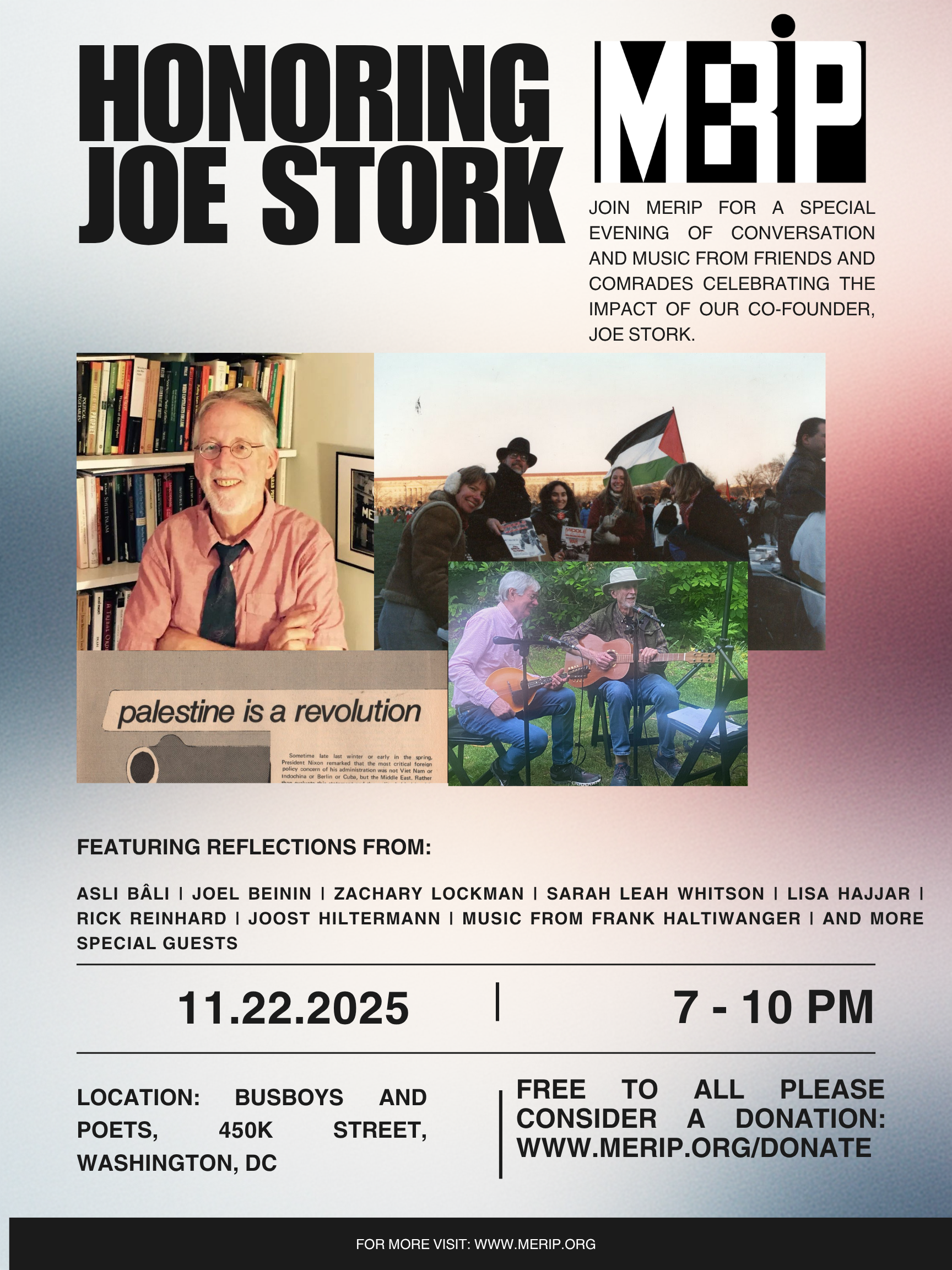
## Honoring Joe Stork, Live in DC
Don't forget to [RSVP](https://www.merip.org/event/honoring-joe-stork-live-in-dc/) for our live event next month at Busboys and Poets 450 K Street Location in Washington, D.C. We'll be remembering our co-founder and longtime editor Joe Stork, who passed away a year ago this week. Longtime contributors and comrades will be offering their thoughts and reflections on Joe's impact on MERIP, the world of Human Rights, and Middle East politics.
SUPPORT MERIP
MERIP is a non-profit, reader-supported publication. We're committed to cutting edge analysis with no paywalls. Please consider a donation to support our mission
[Donate Here ](www.merip.org/donate)
### Our Latest Issue and New Website
URL: https://www.merip.org/2025/10/our-latest-issue-and-new-website/
Last updated: 2025-10-21T16:45:40.000Z
Dear Friends and Comrades,
Today is a big day for MERIP. We are releasing our Summer/Fall double issue of *Middle East Report*, [Material Politics of Normalization](https://www.merip.org/issue-315-316/). This issue brings you hard-hitting [reports](https://www.merip.org/2025/10/hardwiring-normalization-infrastructures-extraction-and-gazas-future/), [interviews](https://www.merip.org/2025/10/refusing-the-new-normal-an-interview-with-the-gulf-coalition-against-normalisation/) and essays on the security, [military](https://www.merip.org/2025/10/the-military-industrial-backbone-of-normalization/), [industrial](https://www.merip.org/2025/10/energy-water-and-the-cost-of-jordans-dependence-on-israel/) and [economic](https://www.merip.org/2025/10/israeli-agribusiness-and-moroccos-green-frontier/) architecture that normalizes Israel’s ongoing occupation and genocide in Palestine.
This issue is coming to you in the wake of the ceasefire between Israel and Hamas brokered by the Trump administration – a tentative but hopefully lasting reprieve from Israel’s campaign of bombing and starvation in Gaza. At this moment, when it appears the tide of global public opinion is turning against Israel, it is essential to look squarely at the myriad ways its dispossession of Palestinian land and destruction of livelihoods has been supported by arms and energy deals, trade agreements and all manner of institutional relationships. As our pieces demonstrate, these material processes have worked to entangle the economies of regional states into the Zionist project, creating facts on the ground that demand new forms of opposition.
We’ll continue the discussion about this issue over the coming weeks. For now we hope you’ll dive in, share it with your networks and let us know what you think.
As you read our latest, you might notice things look a bit different. Along with the issue, we are unveiling MERIP’s new website. MERIP has migrated all our content and our newsletter to a new platform, [Ghost](http://www.ghost.org). This move has modernized our publishing and engagement process immensely, allowing us to update the design of our site for easier consumption across desktops and mobile devices. We will now be able to integrate [podcasts](https://www.merip.org/tag/the-merip-podcast/), video and animation into our articles more readily, and we have added a more efficient search engine to allow for smoother navigation through our online archive.
This redesign and migration is a massive leap forward toward innovation and sustainability for our organization, and I am personally thankful to the folks at Ghost who helped us with the migration and design. Likewise, our editorial staff, Editorial Committee and Board of Directors were instrumental in this process. Even more importantly, I want to thank you, our readers and supporters. Without the success of our fundraising efforts over the last 10 months, this long overdue migration simply would not have been possible.
Thank you all for being with us and for your [support](https://www.merip.org/donate).
In Solidarity,
James Ryan
Executive Director
### Honoring Joe Stork, Live in DC
URL: https://www.merip.org/event/honoring-joe-stork-live-in-dc/
Last updated: 2025-11-19T18:40:58.000Z
JOIN MERIP for a special live event honoring Joe Stork, our co-founder and long-time editor, who passed away nearly a year ago. On November 22 from 7-10pm we’ll gather at the 450 K Street location of Busboys and Poets in Washington, DC for an evening of food, drink and conversation with Joe’s friends and comrades. The event will be MC’d by Joost Hiltermann and feature reflections from frequent MERIP contributors Aslı Bâli, Joel Beinin, Zachary Lockman, Sarah Leah Whitson, Lisa Hajjar, Mouin Rabbani and Rick Reinhard as well as music from Joe’s former bandmates in Fast Flying Vestibule.
This event coincides with the Middle East Studies Association’s annual meeting, so we hope many of you from far and wide will be able to join us. There will be light refreshments provided and the event is free to attend, though we hope many of you will [RSVP](https://form-usa.keela.co/honoring-joe-stork) at this link to help us plan appropriately and consider chipping in a [donation](https://merip.org/donate/) to help us cover the costs.
### The Limits of Protection and Profits—Five Years into the Abraham Accords
URL: https://www.merip.org/2025/10/the-limits-of-protection-and-profits-five-years-into-the-abraham-accords/
Last updated: 2025-10-21T15:19:43.000Z
On September 15, 2020, US President Donald Trump was joined at the White House by Israeli Prime Minister Benjamin Netanyahu and the foreign ministers of Bahrain and the United Arab Emirates to sign the Abraham Accords.
By signing the multilateral agreement, they became the first Arab states to normalize relations with Israel since Egypt in 1979 and Jordan in 1994\. In the five years since, the initial surprise among citizens in the region and international pundits has given way to a sense that the Accords were merely a transactional reflection of regional realignments. Rather than a bold strategy to reshape the region, they are now seen more as a symptom of shifting US power—an arrangement that highlights Washington’s reliance on proxies at a time of enduring militarism but waning global hegemony.
In Elham Fakhro’s meticulous new telling, however, the Abraham Accords are more than a footnote to an inevitable remaking of the Middle East. They offer a powerful lens to decipher geopolitical and economic transformations in the past quarter century that have ushered in a chaotic and violent interregnum dominated by dictators and plutocrats from the shores of the Persian Gulf to the Mediterranean and beyond. While the Accords are often packaged by mainstream media outlets as part of an Israeli-Palestinian peace process, Fakhro dispels this notion by showing that they have little to do with Palestinian lives and are instead a security compact for a narrow slice of political elites and capitalists spanning many countries.
Mining English and Arabic media accounts, WikiLeaks and interviews conducted by Fakhro herself with officials and observers in several countries, [*The Abraham Accords: The Gulf States, Israel, and the Limits of Normalization*](https://cup.columbia.edu/book/the-abraham-accords/9780231212380/)recounts how multilateral backchannels and private actors brought the parties together and have been the initial beneficiaries, despite many frustrations and contradictions. Although Morocco and Sudan subsequently signed onto the Accords, the book is primarily focused on Israeli and US relations over the past decade with the leaders of a troika of families ruling the UAE, Bahrain and Saudi Arabia.
## **‘Waves of Normalization’**
The Abraham Accords were modeled on a long-standing idea held by some Israeli strategists: Bilateral agreements with Arab states would deliver security through trade and economic exchange, while sidelining Palestinians and deferring any reckoning with their demands for self-determination. Indeed, the Accords did not require Israel to relinquish any land, contrary to the principle of land for peace set by the 1967 UN Security Council Resolution 242 and reflected in the 1990s peace process and treaties signed with Egypt and Jordan. Even the UAE’s claim that it had secured a halt to Israel’s planned annexation of the West Bank prior to signing the deal quickly unraveled—undermined by conflicting translations of the agreement’s text and Israel’s unchecked colonial appetite.
Fakhro identifies a concatenation of forces and perceptions that set the stage for normalization. Israeli and Arab Gulf decision makers alike feared Iran’s advances in its nuclear program as well as the US-led Joint Comprehensive Plan of Action (JCPOA)—which aimed to restrain that program and threatened to improve US-Iranian relations. In their view, these developments would undermine Israeli supremacy and the security of neighboring Arab states of the Persian Gulf. Meanwhile, the instability that followed the US toppling of Iraqi President Saddam Hussain in 2003 was compounded by the so-called Arab Spring of 2011\. Both Israel and the Gulf monarchies interpreted the popular uprisings as challenges to their regimes because they endeavored to overthrow dictatorships and bring to power more democratic and Islamist forces. Finally, US policymakers championed greater cooperation between its main regional partners—Israel and the Gulf Cooperation Council (GCC)—as a means to head off threats, including real and imagined challenges from China.
> A quid pro quo thus emerged between Israel and the normalizing Arab states: Israel would gain recognition and access to Middle East markets, and in return the ruling Gulf families would receive protection and profits.
The fact that threat perceptions in Abu Dhabi, Manama and Riyadh aligned with Tel Aviv at this moment was not just due to external factors, Fakhro argues. She also credits the rise of a new cohort of statesmen in the early 2000s. This younger generation was less animated by notions of Arab nationalism. They were more concerned with the geopolitical threats emanating from Islamists and the possibility of realigning their economies toward technological and security ventures that would help transition away from fossil fuel exports and withstand domestic and regional foes. A quid pro quo thus emerged between Israel and the normalizing Arab states: Israel would gain recognition and access to Middle East markets, and in return the ruling Gulf families would receive protection and profits.
Fakhro is careful to contextualize these developments within the longer histories of GCC countries. She devotes the book’s first chapter to recounting how, since the 1930s, the plight of Palestinians has animated political struggles in Eastern Arabia, including labor movements and anti-British sentiments. After the 1967 Arab-Israeli war, official support for the Palestinian cause increased significantly. She includes an informative retelling of the “waves of normalization” that took place after the 1993 Oslo Accords and then again after the 2003 US occupation of Iraq. She also reminds readers that it was Omani and Qatari officials, rather than Bahrain and the UAE, who took the first steps to recognize Israel.
Critically, since the early 2000s, normalization was spearheaded by a generational shift in leadership in the GCC, the subject of Chapter 2\. Younger members of the ruling families, who began managing key political, security and financial portfolios, were enamored by breakthroughs such as the use of information technology to build post-oil economies and as tools to monitor citizens and vulnerable migrant workers. Private and public Israeli ventures played key roles in many of these sectors. Gulf states, especially the UAE, developed diplomatic channels that were brokered not only by government ministries but also by private firms, such as ImageSat International or Asia Global Technologies International (45–6).
Nurtured by McKinsey and other consulting companies, immediately prior to and after the Accords were signed, private and public Israeli and Gulf interests, sometimes involving US firms, clustered around everything from diamonds to defense with particular cross-fertilization in aeronautics, spyware, biotechnology, energy and artificial technology. A question for future study is why some of the first movers of the early waves of détente with Israel, such as Qatar and Oman that share some of the same characteristics as the UAE and Bahrain, have not joined the Accords and are rarely mentioned as imminent signatories.
## **Formalizing the Rapprochement**
In Fakhro’s telling, the presidency of Donald Trump “played a pivotal role in the shift” from covert and isolated ties to the formal pact of the Abraham Accords and full diplomatic relations (71). The book’s third chapter details how, from the very outset, a set of cabinet members and advisors helped forge links between the US administration and Netanyahu and his closest allies. In particular they steered the impressionable Trump toward the long-standing “outside-in” approach that right-wing Israelis advocated: building ties with Arabs states before—or instead of—engaging with Palestinian demands for self-determination. David Friedman, Jason Greenblatt, Jared Kushner, Avi Berkowitz and Mike Pompeo held key roles mediating relations between the Oval Office and Tel Aviv.
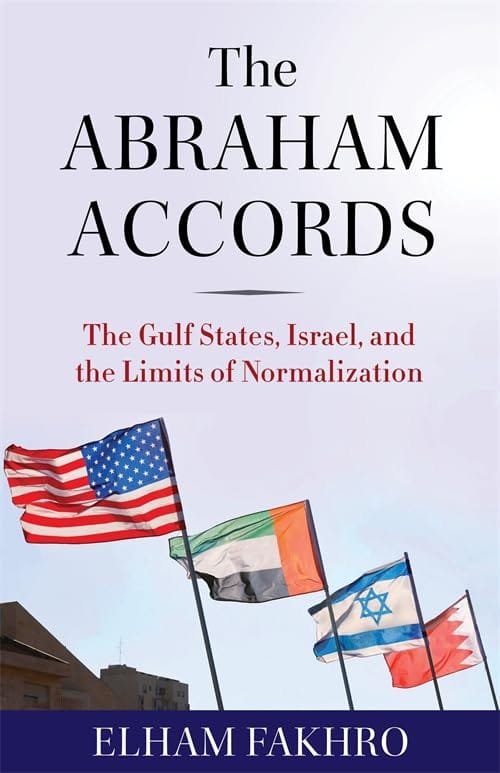
In parallel, a set of officials and Trump’s business confidantes worked to shape US-GCC relations and bind them to Israel. Erik Prince, the former founder of Blackwater and an informal advisor to the president, was central to these efforts. Other key brokers included George Nader, a former consultant for Prince, and Tom Barrack, a real estate investor, friend of and fundraiser for the president. They were hired by the crown prince of Abu Dhabi and served as key channels for other GCC governments. Fakhro also identifies the pivotal role played by UAE’s ambassador to the United States, Yousef al-Otaiba. Together, they convinced the Trump administration to depart from decades of US policy on settlements, UNRWA and sales of advanced weapons and technology to Arab states. Arguably the most consequential step taken by Trump in his first term was withdrawing in 2018 from the JCPOA and imposing a “maximum pressure” campaign on Iran, which only heightened regional conflicts.
Momentum was on the side of bringing all the parties together and initiating the Abraham Accords—even Netanyahu’s last-minute foot dragging and electioneering, which reportedly irritated Trump on more than one occasion, did not ultimately derail the pact. When the United States agreed to recognize Morocco’s claims to Western Sahara and to remove Sudan from the list of state sponsors of terrorism and repay its debts to the World Bank, the two North African Arab states joined the Accords at the end of 2020.
Saudi Arabia, assumed to be the jewel in the crown of this initiative, has yet to join the Accords, but not for lack of effort by the Trump administration or that of his successor US President Joseph Biden. Fakhro shies away from offering a full accounting for Saudi Arabia’s strategy of not signing a version of the Accords, or why the kingdom turned to Iraqi and Chinese mediation in an effort to mend fences with Iran in March 2023\. It is too early to say whether the hellfire response unleashed by Israel on Gaza, Lebanon and Iran after the October 7, 2023 Hamas attacks on Israel will ultimately scuttle the aspirations for broader normalization or merely change the terms of trade for the United States, Israel and would be new partners.
> The immediate and most transparent consequence of the Abraham Accords was military cooperation.
The immediate and most transparent consequence of the Abraham Accords was military cooperation. The Accords integrated Israel into the US Central Command (CENTCOM) to facilitate greater coordination with US and GCC missile systems and logistics operations. This integration likely enhanced Israel’s ability to both wage war on Iran and defend itself from retaliation during the 12-day war in June 2025.
Military coordination also became an impetus for the UAE and Bahrain to purchase more advanced and more expensive military technology from both US and Israeli firms. In 2021 alone, Bahrain and the UAE purchased over $853 million in arms from Israel. As tariffs were lifted and trade agreements penned, the UAE earmarked $10 billion in investments in “Israel’s most strategic sectors, including across energy, manufacturing, and healthcare sectors” (112). Many of these commercial arrangements involved an array of Israeli firms and Emirati sovereign wealth funds, including Mubadala and Abu Dhabi Development Holding Company. To the dismay of many of their own citizens, both Bahrain and the UAE went so far as to extend commercial agreements to firms based in settlements in the West Bank.
An underappreciated dimension of the Abraham Accords, the role it played in “tolerance-washing,” or resuscitating the reputations of Bahrain and the UAE, is the focus of Chapter 5\. Tarnished by the Bahraini state’s violent suppression of a popular uprising in 2011, the GCC war on Yemen, as well as a litany of stories about the dire human rights conditions of guest workers and citizens in their own countries, Emirati and Bahraini rulers recruited the Abraham Accords to extend their public diplomacy campaigns. As the name of the Accords suggests, the idiom of religious kinship and coexistence presents a highly manicured image of these countries as tolerant, modern and cosmopolitan. Crucially, it offers a way to differentiate themselves from the stylized post-9/11 images of the Middle East as a hotbed of Islamic fundamentalism, anti-Western sentiment and xenophobia.
Several social media personalities and high-profile Zionist organizations, such as the Simon Wiesenthal Center and the Middle East Media Research Institute (MEMRI), became spokespersons for this campaign. “Bahrain and the UAE’s tolerance drive,” observes Fakhro, “would come to resemble the *hasbara* strategies that Israel uses to cultivate its image as a liberal haven in a violent neighborhood, or a ‘villa in the jungle’” (180). Among the set of recruited rabbis was US rabbi Marc Schneier, an interfaith advisor to the Bahraini king, who described the Gulf archipelago as “a role model in the Arab world for co-existence and tolerance” (165). Another rabbi commented that under the king’s rule “Bahrain…is a little light in a dark world of racial fundamentalism.” In this and other chapters, Fakhro delves deeply into the case of Bahrain, which has received far less attention in both media and scholarship than the UAE’s normalization or Saudi Arabia’s alignment with Israel.
## **Repression and Resistance**
If Gulf leaders deployed the Accords to target international opinion, they did little to recruit support among their citizenry. Fakhro insightfully explains that the relative lack of appetite for deepening social, cultural and touristic relations—especially from the direction of Gulf Arabs to Israel—stems from a deep popular history of support for the Palestinian cause among societies in the Arabian Peninsula. In Bahrain, the UAE and elsewhere, the rich legacy among civil society and labor organizations of mobilizing around the question of Palestine has not ended with normalization. Fakhro points to public opinion polls and a series of effective boycott campaigns against Starbucks and several other firms and products to argue that the Abraham Accords have little popular support in the GCC. Instead, the Accords actually align with growing authoritarian conditions in Bahrain and the UAE in the past 15 years and the monarchies’ heightened intolerance for dissent.
> …as she concludes, it is not surprising that the Abraham Accords have survived this pro-Palestinian sentiment. ‘\[T\]hey were built, by design, on Palestinians’ continued marginalization and isolation’
Yet, as she concludes, it is not surprising that the Abraham Accords have survived this pro-Palestinian sentiment. “\[T\]hey were built, by design, on Palestinians’ continued marginalization and isolation” (226). Under the cover of shuttle diplomacy and elite euphoria about a new Middle East, Israel accelerated its occupation of Palestinian lands in the West Bank both before and after October 7, 2023\. It is noteworthy that neither the UAE nor Bahrain’s newly minted relationship with Israel has created the leverage or the will to protect Palestinian life or temper Israeli violence. Neither country has recalled its ambassador, though since April 2025, Bahrain has left its ambassador post in Israel vacant.
Instead, the agreement has remained resilient despite Israel’s murder and starvation of Palestinians, siege on Gaza and expansion of Israeli control over the West Bank. In Fakhro’s telling, these developments are entirely consistent with the Abraham Accords: “Instead of forging peace between the conflicting parties, the Trump administration brokered a normalization agreement between Israel and states not directly involved in the conflict while emboldening Netanyahu to continue his expansion of settlements in the West Bank and deepening Israel’s grip over the occupied territories” (109).
By staying close to the sources, Fakhro is able to capture these dynamics and the challenges facing even the strong-willed signatories and their advisors. She parses out the multiple interests and motley set of agendas informing the attempt to build bridges between these polities, security apparatuses and investment portfolios. What is less explored are questions about the possible unstated logics at work. Is Israel’s control of Palestinian populations also a model for these Gulf rulers, whose subjects are divided by gradations of citizenship and human worth? Are there methods, laws and technologies that can travel to and from the Gulf and occupied Palestinian territories to address internal or demographic threats as much as external ones?
As for the shared menace, Iran, Fakhro often recites the vocabulary and logics of state officials but holds back on fully evaluating the allegations that Iran is a military threat or has an imperial appetite. The discussion of Iran in the book remains at the level of perceptions. The opinions of decision-makers in Tel Aviv, Abu Dhabi, Riyadh, Manama and Washington are important and are shaped by the fallout of the 2003 US invasion of Iraq and Hizballah’s military resilience in the 2006 war with Israel. But deterrence and shared-threat assessments can easily become alibis for aggression. As Vali Nasr has argued, Iran’s posture and policies from 2001 to 2020—let alone its actual military capacity—was less akin to hegemonic expansionism and more a product of its defensive response to the US Global War on Terror and the dozens of military bases and tens of thousands of troops deployed in close striking distance.[\[1\]](#%5Fedn1)
*The Abraham Accords* should be read for Elham Fakhro’s compelling and lucid explanation of the origins and immediate outcomes of the agreement. She rightfully directs our attention to the Accords’ political limits and the narrow bases of support for this imagined new regional order. One wonders if, in recent months, kings and their advisors are reevaluating the strategic compromise of recognizing Israel in return for their own security. If the compact was designed to shield Arab Gulf states from external and internal threats, can they be protected from the guardian, namely Israel? The question resonates further after Israel recently violated the sovereignty of GCC-member, Qatar, by bombing a meeting of Hamas negotiators discussing a potential ceasefire in Gaza. Given that Israel—with the unwavering support of the United States—has spent most of the past two years violating sovereignty in the name of self-defense and regionally extending its policy of “mowing the lawn” beyond its original target of Gaza, what kind of security can documents signed in Washington actually bring?
\[**Arang Keshavarzian** is a professor of Middle Eastern and Islamic Studies at NYU.\]
---
### **Endnotes**
[\[1\]](#%5Fednref1) Vali Nasr, *Iran’s Grand Strategy: A Political History* (Princeton: Princeton University Press, 2025).
#### How to cite this article:
Arang Keshavarzian, "The Limits of Protection and Profits—Five Years into the Abraham Accords," *Middle East Report* 315/316 (Summer/Fall 2025).
### On the Road to Rafah—The Sumud Convoy and New Maghrebi Geographies of Resistance
URL: https://www.merip.org/2025/10/on-the-road-to-rafah-the-sumud-convoy-and-new-maghrebi-geographies-of-resistance/
Last updated: 2025-10-21T16:15:58.000Z
When the last bus came to a halt in Sirte, a coastal city in Central Libya, many thought it marked the end of the road.
But it was only a turning point. What began as the Sumud Convoy—a historic act of Maghrebi solidarity with Palestine—had already transformed into something more: a living, popular geography of solidarity, tracing new lines of resistance for Palestine.
The Convoy had first set out on June 9, 2025, carrying more than 1,700 Tunisians, Algerians, Libyans, Mauritanians and Moroccans. Born from the ground up, it brought together activists, organizers, artists, medics, students and ordinary citizens—all prepared to face repression. They mobilized not only to break Israel’s blockade of the enclave but also to challenge their own governments, whose complicity and silence helped normalize the genocidal siege on Gaza. Launched by the [Tunisian Coordination for Joint Action Palestine](https://www.facebook.com/p/%D8%AA%D9%86%D8%B3%D9%8A%D9%82%D9%8A%D8%A9-%D8%A7%D9%84%D8%B9%D9%85%D9%84-%D8%A7%D9%84%D9%85%D8%B4%D8%AA%D8%B1%D9%83-%D9%85%D9%86-%D8%A3%D8%AC%D9%84-%D9%81%D9%84%D8%B3%D8%B7%D9%8A%D9%86-61570562377046/), Algerian and Libyan civil society actors soon joined, lending the initiative a truly regional scope. Its route followed the Tunisian coast south before cutting east across Libya, tracing the shoreline toward Egypt and, ultimately, the Rafah crossing into Gaza.
Inside the buses, chants blended poetry, prayer and protest, weaving familiar refrains with reinvented slogans and spontaneous creations. Participants also spoke through gestures—raised fists, waving flags, keffiyehs wrapped around heads and necks. “The keffiyeh we wear is our banner—woven of earth and blood, it speaks louder than a thousand false speeches by Arab leaders,” said one Tunisian activist in the convoy.
Alongside the Sumud Convoy, the [*Madleen* Flotilla](https://freedomflotilla.org/)—part of the long-standing Freedom Flotilla Coalition that, since 2010, has organized maritime attempts to break the siege of Gaza—had already set sail. And the [Global March for Gaza](https://marchtogaza.net/), a transnational mobilization seeking to converge on Gaza’s borders, prepared to coordinate a collective arrival in Cairo en route to Rafah. Over the summer, Tunis emerged as a key political and coordinating center where these three initiatives met, shifting the center of Palestinian solidarity toward the Global South.
The Sumud Convoy’s journey traced this convergence on the ground. What began as an act of material solidarity through the delivery of vital humanitarian aid quickly became a site of political confrontation with both Israel’s blockade and the complicity of North African states. Libya’s territorial fragmentation functioned as an active instrument of repression. At Sirte, these two competing material geographies—solidarity from below and repression from above—met.
## **From Tunis to Misrata**
The Sumud initiative had been quietly taking shape since the start of 2025\. Volunteers worked out of the spotlight, sorting legal papers, mapping routes, stockpiling supplies and keeping communications alive. Two discreet sites in Tunis became nerve centers stacked with boxes and coiled extension cords, echoing with the shuffle of feet. On the eve of departure, a warm Tunis night, the atmosphere crackled with energy: Chains of humans ferried crates from hand to hand—young and old, women and men, working side by side. Donations had flooded in, including bundles of banknotes, sacks of couscous, piles of blankets. By midnight, the last vans were packed tight ready to carry the convoy toward Gaza.
> The mission was unambiguous: to reach Rafah and to break Gaza’s isolation through the sheer force of our collective physical presence.
At first light on June 9, a column of buses, vans and cars began to roll out of downtown Tunis. Hundreds waited for a seat without tents or chairs. Buses brought in from Algeria were parked in a long line, their drivers patiently ushering in passengers. The mission was unambiguous: to reach Rafah and to break Gaza’s isolation through the sheer force of our collective physical presence. The caravan continued through the Tunisian regions of the Sahel and far coastal south and was welcomed at each stop by visible expressions of support.
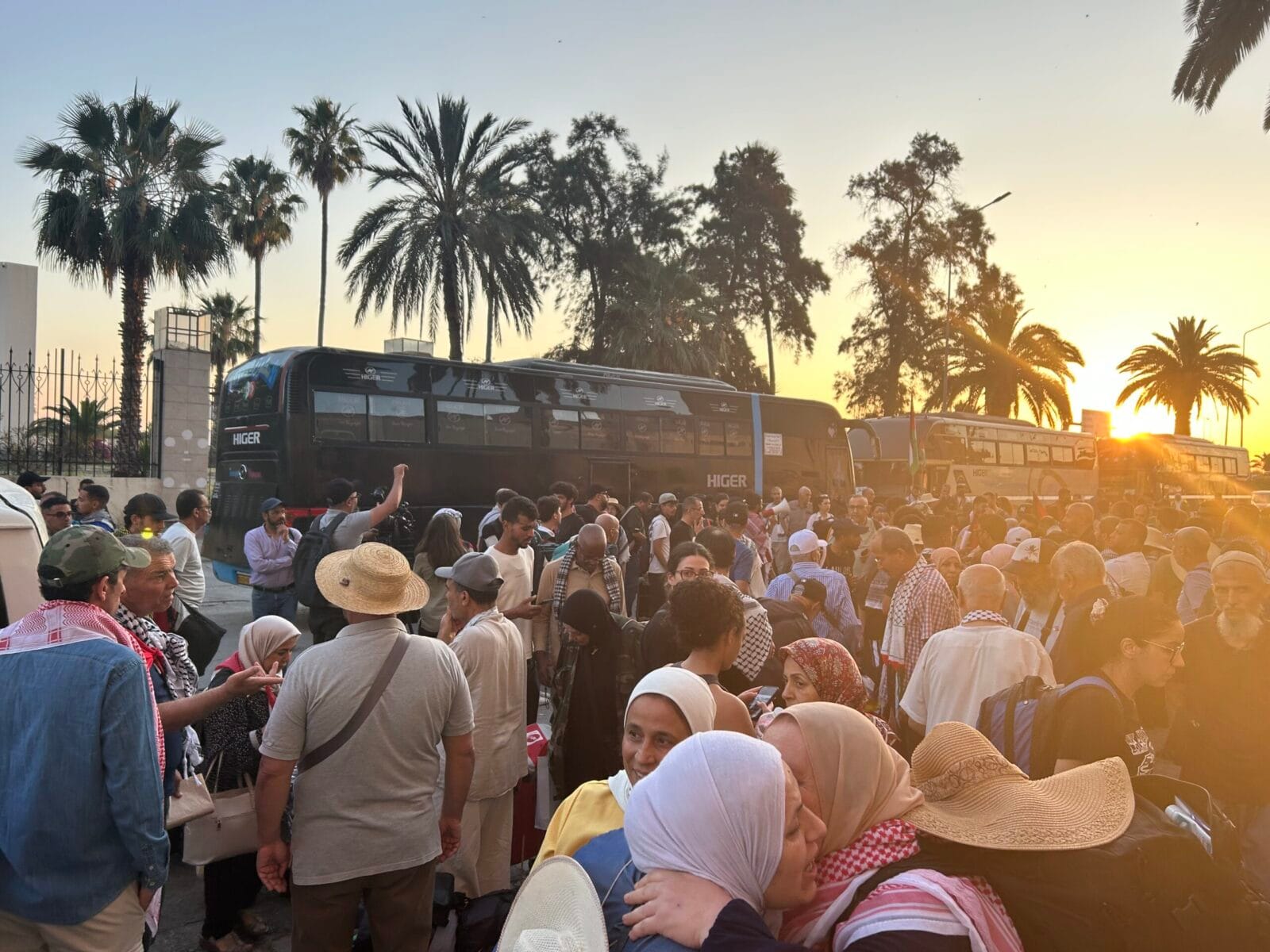
Sunset gathering in Tunis before the departure to Gaza, June 2025\. Photo by Raouf Farrah
In areas of western Libya under the authority of the Government of National Unity, local officials and residents alike received the convoy positively. People gathered along the roadside in Zliten and later Misrata, offering water bottles and, at times, small sums of money to participants.
Despite the persistent political fragmentation in Libya, the hospitality extended to the convoy carried both symbolic and logistical weight. According to participants interviewed, the Libyan delegation in western Libya made significant efforts to ensure the group’s safety and well-being. “Everything was taken care of by the people. This solidarity shows me we are truly brothers. I’ve never seen anything like it,” said Karim, a young Algerian participant.
Local radio and social media publicized the initiative. Schools were opened for lodging while some residents hosted participants in their homes and organized field kitchens. This community-based logistical support allowed the convoy to function independently of formal state structures.
## **Repression in Sirte**
On June 13, however, the warm welcome gave way to hostility as the convoy left Misrata and approached Sirte. The coastal city is under the control of forces loyal to Field Marshal Khalifa Haftar, the Egyptian- and Emirati-backed strongman of eastern and southern Libya. A few kilometers from the city’s entrance, the caravan was halted by armed men affiliated with Haftar. For three days, hundreds of participants were stranded in the desert, exposed to heat and surveillance, cut off from journalists, aid and communication.
Citing “security,” Haftar’s forces interrogated and beat some of the organizers, confiscating supplies. Activists were exposed to targeted harassment, silent pressure and arbitrary arrests. “We were abandoned on the side of a desert road—no trees, no shops, no shade, not even toilets,” recalled Marwen, coordinator of the Algerian delegation. “Older participants lay under the buses to avoid collapsing. Several people could have died.”
This sudden reversal of fortunes exposed not only Libya’s internal divisions but also the regionally coordinated repression sustaining the authoritarian management of transnational mobilizations. Each section of Libyan territory is governed by its own security logic. In Sirte, it was that of Haftar’s camp, which has [developed ties with Israel](https://www.haaretz.com/israel-news/2021-11-08/ty-article/.highlight/libya-khalifa-haftar-son-israel-visit-diplomatic-ties-for-military-aid/0000017f-f889-d460-afff-fbefa5830000) through the mediation of the UAE. According to media reports, Haftar’s sons have held meetings with Israeli officials in Abu Dhabi and there has been [security and surveillance](https://www.dailysabah.com/politics/israel-haftars-behind-the-scenes-backer-in-libya/news) coordination between them.
> Libyan and Maghrebi activists suggest the blockade near Sirte was part of a broader strategy shared by Egypt, the Emirates and Israel, to suppress any initiatives on Palestine outside of their control.
Libyan and Maghrebi activists suggest the blockade near Sirte was part of a broader strategy shared by Egypt, the Emirates and Israel, to suppress any initiatives on Palestine outside of their control. The convoy—by posing a direct challenge to the regional geography of complicity and repression surrounding Gaza—demanded repression. It often took the form of targeting visible activists and movement leaders.
Wael Naouar, a leader of the Sumud Convoy was kidnapped in Sirte and brought to Benghazi, while Saif Abu Keshek, a Palestinian activist and one of the leaders of the Global March to Gaza, was kidnapped and deported out of Egypt. Haftar’s local and anti-terrorist forces arbitrarily arrested at least 15 Algerian, Tunisian and Libyan activists—including social media influencers Ala Ben Amara, Bilal Ourtani and Zidane “Zizou” Nezar—after they had peeled off from the convoy to seek communication access. Separated from the group, they were denied legal recourse and dispossessed of belongings. Some were threatened at gunpoint.
In the face of this repression, the convoy decided to make a tactical retreat to Misrata, where it was again met with hospitality. Regrouping, the Sumud participants held firm to a conscious strategy of confrontation. As one Tunisian participant put it, “Our suffering is nothing compared to what Palestinians are going through.” His words reframed pain from a humanitarian register to an ethical and political one.
Unable to advance physically, the convoy advanced politically. To break through the media blackout, the movement turned to alternative forms of visibility—social media and livestreams—to circulate their testimonies. Their messaging redefined Gaza’s geography not as a distant tragedy but as a frontline of regional contestation: Rafah’s inaccessibility became a spotlight on the wall of impunity and normalization shielding Arab regimes. The convoy’s greatest vulnerability, its immobilization, was transformed into a weapon of accusation and exposure in the hands of Sumud’s activists.
## **Infrastructures of Convergence**
The events of summer 2025 marked the point where more than a decade of parallel activist dynamics began to converge, transforming long-separate efforts into a shared front.
The Sumud Convoy was rooted in North Africa’s post-2011 Hirak civic landscapes: the Tunisian and Libyan uprisings of 2011, Morocco’s February 20 movement and Rif protests and the Algerian Hirak of 2019\. The Freedom Flotilla Coalition, meanwhile, was the product of a decade of international grassroots maritime campaigns to break Israel’s siege on Gaza. And the Global March for Gaza was a mobilization spanning Latin America, South Asia and parts of West Africa. Each carried its own trajectory, logistical culture and political sensibilities. They were united by a shared urgency around Gaza and the conviction that physical presence matters in the face of genocide. While digital visibility through social media amplified the initiatives and helped them to reach global audiences, participants stressed that material presence—buses, boats, marches—carried a political force that could not be replaced by the immateriality of online gestures or “slacktivism.”
This convergence was not forged at international summits or NGO roundtables but through grassroots linkages, improvised coordination and the pressure of shared constraints. Though communication was often unstable, disrupted by geography and surveillance, a flexible coordination system took shape in the months leading up to the convoy. Online platforms, such as Signal, allowed activists to synchronize transregional actions, while shared databases emerged to track routes or accommodation. Local collectives stepped in for translation, legal advice and to protect technological devices from malware intrusions.
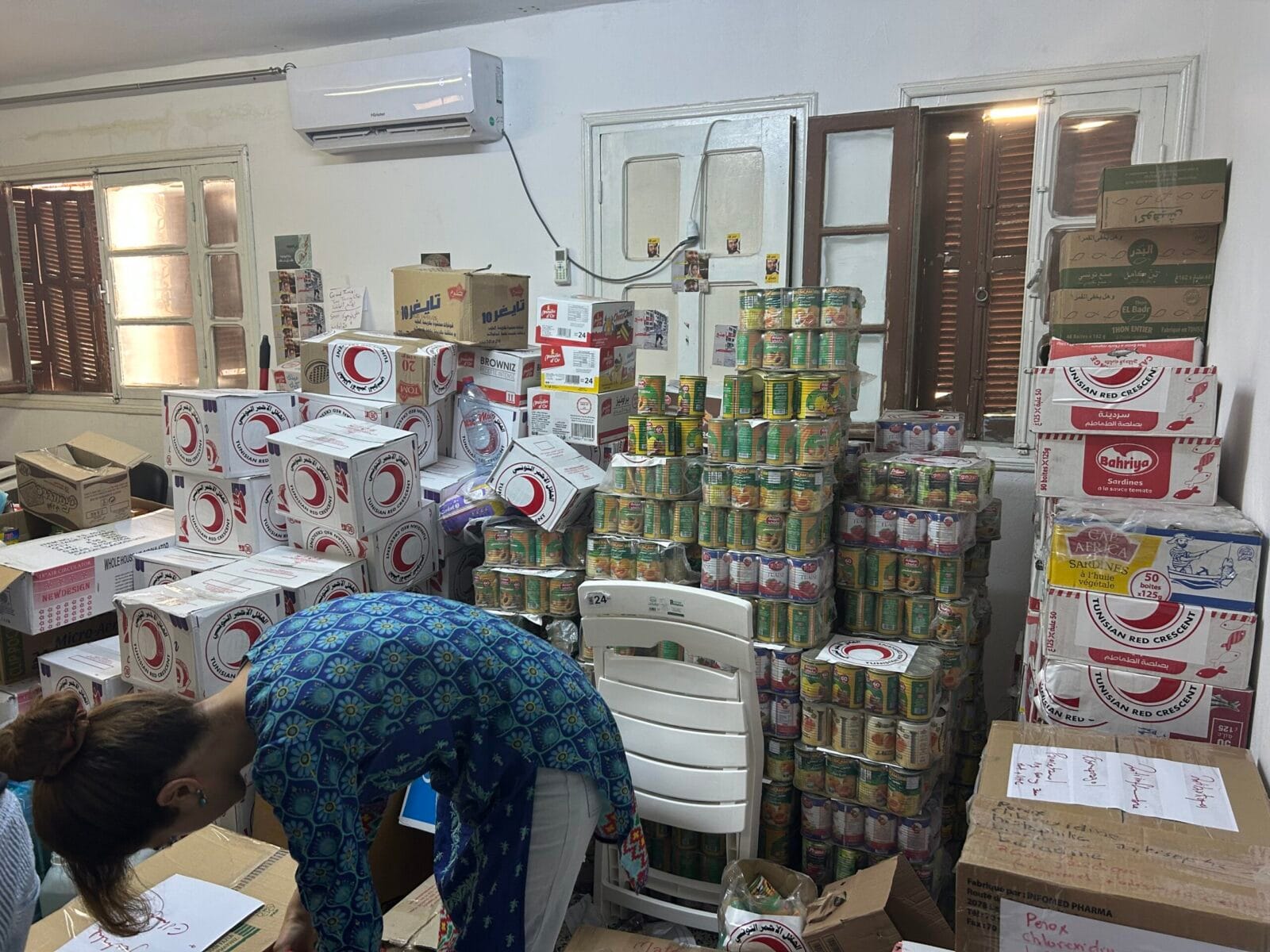
Aid supplies for Gaza prepared for transport by the Sumud Convoy in Tunis, June 2025\. Photo by Raouf Farrah
Material solidarity was not a metaphor. During the mobilizations for Gaza, it meant improvised meals, collective first-aid kits, solar-charged communication devices and overstuffed backpacks carried across checkpoints. It meant people donating their cars, their savings and their time and taking risks, without NGO labels or diplomatic immunity. Each of the three movements revealed how logistical resistance—the capacity to organize, transport, host and sustain—has become the backbone of contemporary solidarity.
The Sumud Convoy was financed almost entirely through fundraising and donations from unions, student groups, mosques and the support of individuals. Many contributions came in cash, collected in boxes passed from hand to hand or during community events. Local mechanics offered car repair services. Pharmacies discreetly provided medication. In southern Tunisia, entire families prepared couscous meals and bottled water for strangers they would never meet. In Tripoli and Misrata, Libyan hosts converted wedding halls and barns into makeshift shelters.
The Flotilla and the Global March each brought distinct strengths that later converged in the Global Sumud Flotilla. From the Flotilla came the discipline of maritime coordination—safety skills, non-violent trainings, navigation planning and press documentation. From the Global March came models of mass mobilization across continents, including coordination skills and multilingual communication. Together, these material solidarities—of transport, sustenance and mutual protection—formed the living infrastructure that made the Sumud Flotilla possible, linking people, roads and ports into a shared geography of resistance.
Yet they also revealed the vulnerabilities of material solidarity. Political repression, particularly in eastern Libya, targeted not only participants but the very means of movement. SIM cards were confiscated, fuel supplies cut off and local Libyan hosts were threatened. To adapt, organizers went underground, relying on alternative messaging apps, burner phones and unmarked supply caches. What looked disorganized from above was, in fact, a decentralized infrastructure of care and resistance.
> The infrastructures of material solidarity forged over the summer inevitably collided with another kind of infrastructure: the border.
The infrastructures of material solidarity forged over the summer inevitably collided with another kind of infrastructure: the border. Not simply a fixed geographic line but an active system of obstruction designed to fragment, delay and contain. Every checkpoint—whether a military outpost, customs station or passport inspection—forms a part of this machinery. Borders, even those thousands of miles from Gaza, are thus embedded in the architecture of the siege.
The convoy itself never reached Rafah. In Egypt, it was stopped before even submitting an entry request. As in Sirte, authorities treated the act of mass solidarity as a destabilizing challenge, blocking it outright. These material geographies of repression rely on collaboration rather than uniform policies: Each authority applies its own methods, yet all converge on the same objective: to prevent popular solidarity from becoming collective action. But what regimes sought to erase through the mesh of territorial and internal borders and the deliberate isolation of activists, instead served as evidence: It is not only Gaza that is besieged, but solidarity itself—and not only by Israel, but by Arab governments against their own people. In the words of one Algerian participant, “The last stop of Sumud will mark the limit of complicity with Israel.”
In this light, the border acted as both a barrier and a theater of indictment. Each halted bus and confiscated document became part of a larger scene where two orders collided: the regime of institutional complicity and a fragile but determined popular internationalism.
## **After the Convoy**
The Sumud Convoy’s immobilization on Libya’s roads did not mark the end of a process but a strategic turning point. A new phase emerged from its direct confrontation with the architecture of complicity. Beginning in August 2025, the Global Sumud Flotilla—an international coalition—set out toward Gaza by sea, seeking to break the siege through a route even harder to contain.
The city of Tunis, which had played a catalytic role in the Sumud Convoy, became the launching ground for the Global Flotilla. In late June, following Israel’s detention of Freedom Flotilla activists, the halt of the Sumud Convoy, and the breakup of the Global March, the three movements convened [a joint press conference](https://www.instagram.com/reel/DLH8qvsofmT/) at the headquarters of the Tunisian General Labour Union, with a keynote by Francesca Albanese. The event formalized their coordination.
The *Café Biblio’thé* in Tunis then hosted several days of debate, including a roundtable by the African Solidarity Group, a Tunis-based collective of activists raising awareness about dynamics across the continent. Participants from different initiatives compared practices, constraints and visions. This local anchoring reinforced Tunis’s role as a hub for Maghrebi solidarity and created a center of gravity for Palestine solidarity in the Global South. By early August, these convergences had set the stage for the Global Sumud Flotilla, announced in Tunis and preparing for its first departures.
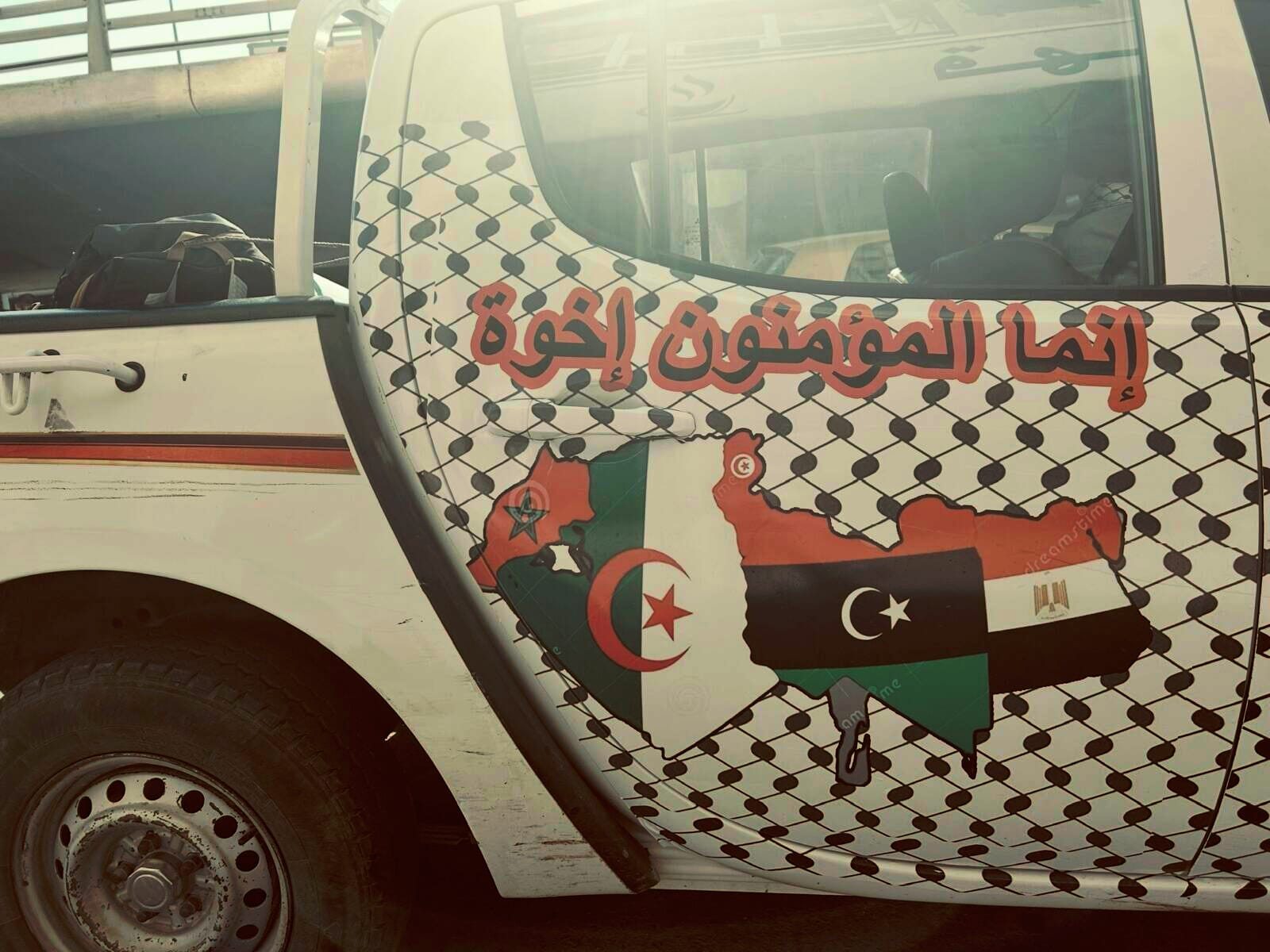
Sumud Convoy vehicle with Maghreb map and solidarity message, June 2025\. Photo by Raouf Farrah
Forged through the lessons of the land journey, this maritime initiative offered a new space of logistical and symbolic confrontation. The new phase was launched from Tunis between August 1–4, 2025, with training sessions, an international press conference and the announcement of sailing dates.
The flotilla docked in Tunisia on September 7, which then became the logistical hub for its Maghrebi and international components. The days that followed were marked by administrative delays, fuel shortages, slow port authorizations and a string of mechanical breakdowns that left more than a dozen locally purchased boats at port. In early September, it was subject to two drone attacks on the [port of Tunis](https://www.theguardian.com/world/2025/sep/10/gaza-aid-flotilla-carrying-greta-thunberg-reports-second-drone-attack-on-boat-at-tunisian-port) that organizers attributed to Israel, and unfavorable weather further slowed preparations. On the nights of September 15–16, around twenty vessels, mainly European ships including the flotilla’s coordinating boat, the Family, finally set sail from Tunisian waters to begin a historic transnational maritime route. Many of the same obstacles persisted through their journey, including constant surveillance, and between October 1 and 3, all 42 boats of the Global Sumud Flotilla were illegally intercepted in international waters while attempting to break Israel’s siege on Gaza. 462 participants were detained by Israel.
Regional power dynamics cannot shift in a matter of months. But the Sumud convoy recentered the geographical gravity of Palestine solidarity: It anchored it in bodies, in buses, in ports, in networks, in mobile phones, in refugee camps and in the streets of Misrata and Zliten. It demonstrated a vision of Palestine no longer reduced to a rallying cry, but reclaimed as a physical site of struggle, one capable of catalyzing new alliances.
> More than sustaining bodies, this material support revived political subjectivities worn down by decades of official discourses on Palestine.
The road to Rafah, even when blocked, opened something else: a model for future mobilizations rooted in endurance and humility. More than sustaining bodies, this material support revived political subjectivities worn down by decades of official discourses on Palestine. Preparing food, mapping routes or lending a generator became political acts. Palestine entered the intimate and the everyday, not as a symbol but as a shared condition. These mobilizations built a solidarity infrastructure that challenged the monopoly of institutional humanitarianism. While international aid remains filtered through states and multilateral organizations, grassroots actors created something else that was improvised, horizontal and embodied. They exposed the gap between the abstract language of solidarity and its concrete practice. This solidarity persists in spite of repression and borders, gradually constructing a counter-geography for breaking the siege on Gaza and halting the genocide.
\[**Raouf Farrah** is a writer, analyst and co-founder of Twala.\]
#### How to cite this article:
Raouf Farrah, "On the Road to Rafah—The Sumud Convoy and New Maghrebi Geographies of Resistance," *Middle East Report* 315/316 (Summer/Fall 2025).
### Refusing the New Normal—An Interview with the Gulf Coalition Against Normalisation
URL: https://www.merip.org/2025/10/refusing-the-new-normal-an-interview-with-the-gulf-coalition-against-normalisation/
Last updated: 2025-10-22T16:50:43.000Z
MER*’s Summer/Fall issue examines the material underpinnings of normalization five years after the Abraham Accords and amid the ongoing genocide in Gaza—developments rejected and contested by peoples across the Gulf.*
*The Gulf Coalition Against Normalisation (Gulf CAN), founded in 2019, unites groups across the region to coordinate campaigns, boycotts and political education against complicity. By linking local initiatives into a shared front for Palestinian liberation, Gulf CAN highlights the material politics of normalization—through universities, trade, infrastructure and everyday consumption—and the forms of contestation against normalisation emerging in response. MER editors interviewed Gulf CAN representatives by email in August 2025.*
**MER:** What is the Gulf Coalition Against Normalisation (CAN)? How and when did it come together? How is it distinct from—or connected to—various anti-normalization efforts across the Gulf?
**Gulf CAN:** Gulf CAN is a coalition of various anti-normalization groups in the region, including BDS Kuwait, Qatar Youth Opposed to Normalization (QAYON, which has since been shut down by the authorities), the Bahraini Society Against Normalization with the Zionist Entity and the Youth for Al-Aqsa-Gulf Committee. In addition to these organizational members, Gulf CAN also accepts individual members from across the region. It was established in 2019, building on the momentum of the anti-normalization conference held in Kuwait in November 2017 in coordination with BDS Arab Region committee. Its leading aim is to build regional solidarities and collaborations in support of the Palestinian struggle for liberation and confront the threat of normalization with the occupying entity in the Gulf states. It is, therefore, more of an umbrella for various anti-normalization efforts across the Gulf, to share experiences, expertise and efforts towards a common cause.
**MER:** How has the genocide in Gaza shifted the landscape for Palestine solidarity in the Gulf?
**Gulf CAN:** The genocide in Gaza has made glaringly clear the extent of complicity of many of our governments—whether through silence or through their continued business dealings with institutions that directly support the genocide. We have always argued that the GCC market offers a strategic space for economic boycott mobilizations. When large companies are forced to choose between the GCC and Israeli markets the GCC market often holds more economic value. Accordingly, most organizations under the coalition have coordinated with BDS on significant campaigns. One notable example is BDS Kuwait’s 2014 campaign against Veolia, the French multinational corporation that helped build and operate the [illegal Jerusalem light rail](https://www.palestine-studies.org/sites/default/files/jq-articles/38%5FDerailing%5FInjustice%5F2%5F0.pdf). The campaign resulted in the company losing a [$750 million contract](https://bdsmovement.net/news/kuwait-authorities-exclude-veolia-750m-contract) and eventually withdrawing from the Israeli market to avoid further losses.
Early in the genocide, people were protesting daily, even in places like Qatar, where getting approval for such protests is impossible. These efforts were grassroots-led with little coordination via local bodies. As time passed, however, more and more restrictions were imposed. For example, QAYON was shut down due to its coverage of these protests. This resulted in more people seeking Gulf CAN as an alternative space to voice their protest. As the governments encroached more on local organizations and outspoken individuals, Gulf CAN’s importance became more evident.
**MER:** Can you tell us about Gulf CAN’s key campaigns? What have been your successes and main challenges or obstacles?
**Gulf CAN:** One of the coalition’s primary roles is to bring together people from the Gulf—activists, scholars and youth—who are seeking ways to resist normalization. When the coalition was first established, we launched a series of lectures and talks aimed at raising awareness and making it clear that citizens across the region, regardless of their governments’ positions, stand united in opposition to the Zionist entity.
> One of the coalition’s primary roles is to bring together people from the Gulf—activists, scholars and youth—who are seeking ways to resist normalization.
In 2022 we began coordinating boycott campaigns across the various Gulf states. For example, five writers from Kuwait and Oman heeded our call to withdraw from the Emirates Airlines Literature Festival in 2022 over the participation of an Israeli author. Another campaign targeted the Bahrain International Show in 2022, which regularly features Israeli arms companies. As a result, an Omani airline pulled out of the event and a Kuwaiti bank removed its name from the list of sponsors. This was especially important at a time when the Gulf crisis (the blockade of Qatar between 2017–2021) had created rifts across the region, and the Palestinian cause was being instrumentalized by different sides. We sought to present a common voice: Regardless of where you are, the struggle is one, and we must learn from one another’s experiences.
Among a set of projects we are running at the moment, the Boycott UK Universities Campaign (BUUK) has recently been given focus. Since September 2025, we have also been cooperating with the [Global Sumud Flotilla GCC](https://www.instagram.com/globalmovementtogaza%5Fgcc) team and started a campaign calling for the [boycott of the Manama Dialogue](https://www.jadaliyya.com/Details/46862) event \[an annual international security summit held in Bahrain and funded by the Bahraini government\] for its continuous inclusion of Zionists.
**MER:** Can you talk us through the UK Universities campaign? What are its targets, goals or demands? What modes of organizing and campaigning are you using? What has the response been?
**Gulf CAN:** Before answering this question, we must acknowledge that MERIP has editorial staff who are based at a university that is complicit in the genocide in Gaza: The University of Exeter is partaking in the ongoing genocide in Gaza by insisting on [maintaining ties](https://news.exeter.ac.uk/faculty-of-humanities-arts-and-social-sciences/cutting-edge-work-by-university-of-exeter-experts-in-defence-and-security-celebrated/) with [companies supplying](https://www.ohchr.org/en/press-releases/2024/06/states-and-companies-must-end-arms-transfers-israel-immediately-or-risk) the Israeli military with weapons. Our participation in this issue should by no means be considered an endorsement of that institution. The University of Exeter is not currently listed among the boycotted universities because the campaign is currently focused on ten universities with high Gulf student enrollment. But that does not mean it will remain excluded. We recommend listening to our seminar “[Gulf Students at the Encampments](https://gulf-can.com/buuk/en/seminars/)” from October 2024 (in Arabic).
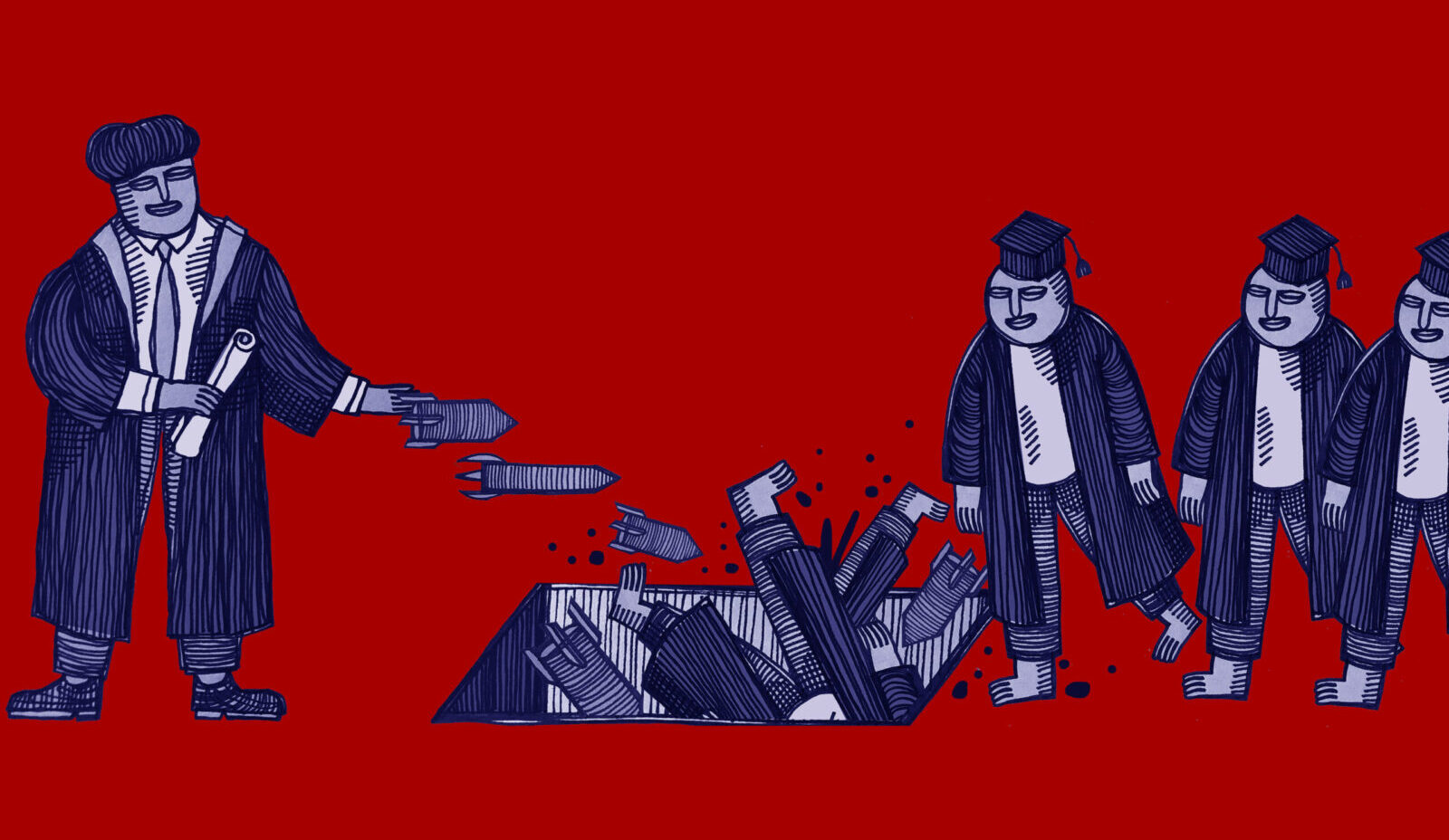
Political cartoon by Sara Qaed.
The broader campaign for boycotting UK universities emerged from the participation of Gulf students in the student encampments across UK campuses. These students felt compelled to act against funnelling money to complicit institutions, realizing that their tuition fees could be invested in the military-industrial complex fuelling the genocide in Gaza. Our research revealed that, in many cases, the revenues UK universities make from the enrollment of GCC students exceeds what they earn from financial partnerships with complicit companies, such as Leonardo S.p.A, BAE Systems, Thales, QiniteQ and the UK Ministry of Defence (MoD) (more evidence can be found [here](https://gulf-can.com/buuk/en/evidence.html)). Therefore, a coordinated boycott of institutions with large GCC student populations could strengthen the stance of the student movement in the UK in its fight for cessation of ties with military actors conducting the genocide.
The universities we focus on in our campaign have partnered with companies and agencies that profit from the genocide. These universities have exercised [violence and punishment](https://gulf-can.com/assets/brutality.mp4) against their own students who protested against the universities’ complicity in protecting their stakes in the genocide. These universities were all listed among the 82 UK universities who were [served a formal alert](https://www.icjpalestine.com/2024/05/01/82-british-universities-alerted-of-potential-criminal-complicity-over-israeli-investments/) by the International Centre for Justice for Palestine (ICJP) about potential criminal liability over investments in arms companies and Israeli settlements.
Based on the above, Gulf CAN issued a notification of boycott to the following ten universities: Newcastle University, University of Manchester, University of Liverpool, Queen Mary University of London, University of Nottingham, Northumbria University, University of Portsmouth, University of Leeds, Manchester Metropolitan University and Coventry University. As part of sustaining and expanding the campaign, we are monitoring other complicit universities. We have already garnered pledges from prospective students, threatening targeted universities with an estimated £24 million in potential revenue loss. This amount could escalate as the campaign continues to spread within local communities in the Gulf. The longer universities insist on maintaining lethal partnerships, the more they risk foregoing a vital source of funding.
In the UK, the campaign has joined forces with—and is guided by—the student movement as well as various actors and coordinators. It has also been mobilized by a wider group of actors. We would particularly like to pay tribute to Palestine Action, who, over the past two years, have organized a series of powerful actions against the University of Liverpool, University of Manchester and others for their complicity in the genocide and occupation of Palestinians. We have watched with great distress as Palestine Action was proscribed as a terrorist organization \[in July of 2025\]—a move international human rights organizations, such as Amnesty International, called “[a disturbing legal overreach](https://www.amnesty.org.uk/press-releases/uk-banning-palestine-action-disturbing-legal-overreach-uk-government-amnesty).” The use of fascist methods by Western governments continues to erode the image of their higher educational spaces as an attractive option for Gulf students.
**MER:** How does the campaign target UK universities in relation to the globalized higher education sector?
**Gulf CAN:** From the outset, it was clear that the UK higher education sector—heavily dependent on international student revenue—was already in a vulnerable position. Many GCC states, however, remain biased in their scholarship and funding schemes toward Global North institutions. An unintended yet significant consequence of this campaign is its challenge to the assumptions underlying these national scholarship programs: What kinds of educational experiences are we offering our youth, and from whom?
> The myth of academic freedom, so often touted by Western institutions, has proven to have clear limits when it comes to Palestine.
The genocide has laid bare the hypocrisy of these so-called liberal institutions—not only through their unethical investments but also through their repression of students and scholars who dare speak out against the genocide. The myth of academic freedom, so often touted by Western institutions, has proven to have clear limits when it comes to Palestine. We hope this campaign will encourage critical reflection among students and parents alike: Where do I want to study, and from whom do I want to receive my education?
**MER:** How does Gulf CAN situate itself within the broader landscape of the Palestinian liberation struggle in the Gulf? What are the key targets or pressure points for the anti-normalization struggle in the region?
**Gulf CAN:** As we mentioned earlier, Gulf CAN emerged from conversations at the 2017 anti-normalization conference in Kuwait. At the time, we believed it to be the first of its kind—only to later discover that a similar conference had taken place in Kuwait in 2000 under the title “The Popular Conference to Resist Normalisation with Israel” (المؤتمر الشعبي لمقاومة التطبيع مع إسرائيل). This is often the case: much of our current work builds on past efforts, whether we’re consciously aware of it or not. Many of the founding groups are rooted in historical spaces. For example, BDS Kuwait is housed within the Women’s Cultural and Social Society, established in 1963, which has historically supported—and now continues to support—the Palestinian liberation struggle.
**MER:** How do you navigate differences across Gulf states in their stance toward normalization and in the political space (or lack thereof) available for organizing?
**Gulf CAN:** We are currently revising our bylaws in light of the normalization agreements signed by Bahrain and the United Arab Emirates in 2020\. In Gulf countries that have signed normalization agreements, our focus is on exposing their dangers and supporting efforts to challenge and end them—see for example this [seminar](https://www.youtube.com/watch?v=o4VcNOXnpj0&t=3636s) we hosted (in Arabic). In countries that have not entered normalization agreements, our focus is on opposing any measures that pave the way for such agreements.
Work on the ground varies from one context to another, and even within the same country conditions can shift overnight. As we have seen in Kuwait with the suspension of parliament, which has impacted civil life in Kuwait, including our founding organization member BDS Kuwait. What is possible in one moment may lead to imprisonment in another. One of the key reasons Gulf CAN was created was to offer a platform for individuals in countries where no local anti-normalization organizations exist due to severe restrictions on civil society. We wanted to ensure that anyone, anywhere in the Gulf, could find a space to express dissent and contribute to coordinated campaigns that could take root in any of the GCC states.
---
#### How to cite this article:
Gulf CAN, "Refusing the New Normal—An Interview with the Gulf Coalition Against Normalisation," *Middle East Report* 315/316 (Summer/Fall 2025).
### Identity and Cultural Diplomacy of the Abraham Accords
URL: https://www.merip.org/2025/10/identity-and-cultural-diplomacy-of-the-abraham-accords/
Last updated: 2025-10-25T10:16:27.000Z
In December 2020, three months after the Abraham Accords were signed enabling the first commercial flights between Israel and the UAE, a [short video](https://x.com/i/status/1335175842905907201) went modestly viral on Israeli twitter.
A man in a white dishdasha and ghutra introduces his friends to the camera as curious bystanders look on. They are standing next to a dark luxury sports car under a Hebrew street sign, identified by the commenters as the Herzliya Marina. “We came here from Dubai!” he declares in Arabic. “Everyone is lining up to take pictures with us.”
These were not Emirati tourists—who remain practically nonexistent, with only 1600 visiting once COVID restrictions were lifted in 2022\. These were Palestinians from Kafr Qasim, about 20 minutes away, playing a practical joke. Viewers immediately recognized the irony: All it took was a dishdasha and a Lamborghini for Arabs to be welcomed warmly rather than with hostility. (Five months later, in May 2021, a [Palestinian man was stabbed](https://www.israelhayom.com/2021/06/10/7-arrested-for-alleged-attack-on-arab-israeli-in-herzliya/) by a Jewish mob just two miles north of this intersection, as violent riots broke out across the country). The impersonation is obvious to anyone familiar with Emirati dialects or dress, but for the Israeli Jewish onlookers, the Palestinian men passed easily as desired guests.
The joke captured an essential tension of the Abraham Accords, whose stated aim was [to establish a “warm peace](https://www.inss.org.il/strategic%5Fassessment/the-many-faces-of-normalization-models-of-arab-israeli-relations/):” cultural and popular person-to-person normalization among the people of the signatory states. This vision of normalization depended not only on diplomacy and dealmaking, but on remaking both Arab and Jewish identities, redefining what kinds of Arabness or Jewishness are welcomed and which remain suspect.
Alongside much publicized financial and security cooperations, the agreement between Israel and the UAE was accompanied by cultural diplomacy projects aimed at rendering the Accords publicly coherent. Sponsored both by state entities and private business interests, a range of cultural initiatives have sprung up, utilizing diverse media to present the deals as an epic ethno-religious reconciliation, not merely a regional strategic alignment.
As Matan Kaminer notes, casting the Accords within the sphere of Abrahamic relations presents them as the conclusion of a family dispute, evoking a “genealogical imagination” that “makes it possible to link nation-states to one another in terms that are at once religious and racial.”[\[1\]](#%5Fedn1) While [future-oriented technological entrepreneurship](https://www.expo2020dubai.com/en/understanding-expo/participants/country-pavilions/israel) was certainly at the forefront of the publicity surrounding the deals, two additional figures have been crucial to making them legible as a peace deal: the observant—or visibly Jewish—Jew and the indigenous Arab-Jew. These figures served to uphold a narrative of the Accords as a nativist reconciliation between Jewish and Muslim Arab kin on the shared path to prosperity.
## **Jewish-Muslim Reconciliation**
In contrast to Israel’s prior normalization agreements with Jordan and Egypt, the text of the Abraham Accords is striking for its religious language. In its [very first paragraph](https://www.state.gov/wp-content/uploads/2020/10/Abraham-Accords-signed-FINAL-15-Sept-2020-508-1.pdf), the Abraham Accords Declaration singles out respect for religious freedom as the basis for strengthening peace in the Middle East. Its signees “encourage efforts to promote interfaith and intercultural dialogue to advance a culture of peace among the three Abrahamic religions and all humanity.” The lines that follow give the distinct impression that normalized relations between states is not the end goal of the agreement but rather a means for achieving interfaith dialogue and coexistence. It is a reconciliation of communities of faith, a peace without politics.
The language of tolerance used in the document has a decade-long precedent in the UAE. Fearing the rise of populist Islamists movements in the wake of the 2011 uprisings and wanting to signal to Western states that the UAE remains a safe and stable site for investment, the UAE has championed a series of state-led tolerance initiatives, among them founding a Ministry of Tolerance in 2016 (later renamed the Ministry of Tolerance and Coexistence) and declaring 2019 as the Year of Tolerance. These ventures positioned the UAE at the forefront of the fight against “[religious extremism](https://www.sciencespo.fr/ceri/en/content/united-arab-emirates-when-religious-tolerance-serves-political-intolerance)” and dovetailed with normalization.
Since 2020, several public projects promoting tolerance and coexistence have been launched by state actors as well as semi-private organizations. The most ambitious of them is the sleek [Abrahamic Family House](https://www.abrahamicfamilyhouse.ae/?lang=en) in Abu Dhabi, an interreligious complex designed by [starchitect](https://merip.org/2008/09/the-uaes-space-race/) David Adjaye and containing a mosque, synagogue, church and research center for interfaith dialogue and public programming. The project grounds its legitimacy in historical precedents. Under the section “Origins” on its website it mentions the few archeological traces attesting to Christian or Jewish presence in the region (a number of eighth-century Christian sanctuaries on islands off the coast, and a Jewish tombstone found in Ras al-Khaima dated to the fifteenth–sixteenth centuries) and presents itself as continuing the historical legacy of coexistence under the benevolent spirit of trade and commerce.
[Religious scholars](https://archive.org/details/20240424%5F20240424%5F0922/page/n23/mode/2up) have criticized the Abrahamic Family House both for fostering normalization and for promoting religious heresy, but its administration has been careful, especially since October 2023, not to associate itself directly with Israel or with the Accords. Other recent projects are more explicit in their political alignments. [Global](https://www.cnn.com/travel/article/crossroads-of-civilizations-museum-dubai) [media](https://www.almayadeen.net/news/politics/1484601/%D8%A7%D9%84%D8%A5%D9%85%D8%A7%D8%B1%D8%A7%D8%AA-%D8%AA%D9%81%D8%AA%D8%AA%D8%AD-%D9%85%D8%AA%D8%AD%D9%81%D8%A7-%D9%81%D9%8A-%D8%AF%D8%A8%D9%8A-%D9%84%D9%80%D8%A7%D9%84%D9%87%D9%88%D9%84%D9%88%D9%83%D9%88%D8%B3%D8%AA) extensively covered the Holocaust memorial exhibition that opened in 2021 at the private Crossroads of Civilizations Museum in Dubai, apparently [at the suggestion of an Israeli visitor](https://www.ynet.co.il/laisha/article/sjc3jmh1k#!/replace), Yael Grafy, who became the exhibition’s curator. The “first Holocaust Museum in the Arab world” illustrates how Holocaust memorialization has become a means to prove moral credibility on the international stage.[\[2\]](#%5Fedn2) While global commemoration efforts often present the Holocaust as a universal lesson linked to the ascendance of human rights and democracy, the Dubai exhibition concludes with the word “Hope” hovering over the Israeli flag.
Another recent private initiative, the [Manara Center for Coexistence](https://manara.ae/), was founded in 2023 as a collaboration between the US Anti-Defamation League and Ali Rashid Al Nuaimi, a member of the UAE Federal National Council and an “international expert in combating extremism.” Al Nuaimi has traveled to Israel several times, meeting both politicians and religious leaders, including, most recently, [Rabbi Shmuel Eliyahu](https://x.com/Dralnoaimi/status/1891966230590071090), the head rabbi of Safed, whose rabid anti-Arab statements and rulings have put him under a rare investigation for incitement (the results of the investigation and the following disciplinary hearing remain confidential).
Tolerance initiatives are both inward and outward facing. What Elham Fakhro calls “tolerance washing” deflects Western criticism of human rights abuses and political repression while generating appealing tourist attractions.[\[3\]](#%5Fedn3) More importantly, it offers a ready framework to legitimize the Accords, obfuscating the fact that they are a de facto military alliance rather than a peace deal: “interreligious exchange,” “the battle against antisemitism” and the shared struggle against “extremism” are regularly invoked as the Accords’ impetus as well as their outcome. As Dana al-Kurd notes, linking normalization to the battle against antisemitism allows for opponents to be cast as intolerant bigots, a move that has become all too familiar in the United States as well.[\[4\]](#%5Fedn4)
> Presenting the Accords as an interfaith reconciliation rather than a political agreement also has the effect of collapsing the distinction between “Jew” and “Israeli,” and identifying Israel as a representative delegate of global Jewry.
Presenting the Accords as an interfaith reconciliation rather than a political agreement also has the effect of collapsing the distinction between “Jew” and “Israeli,” and identifying Israel as a representative delegate of global Jewry. Thus, while the figure of the secular, tech-savvy, Israeli entrepreneur remained central to publicity efforts around the Accords, a parallel publicity trajectory centered the religious, observant or, at the very least, visibly identifiable Jew. In a particularly bizarre manifestation of this logic, Chabad rabbi Levi Duchman, an American from Brooklyn, [was invited to introduce Emiratis to Israeli cuisine](https://www.youtube.com/watch?v=Y4l96vCN%5FWM&ab%5Fchannel=%D8%B4%D8%A4%D9%88%D9%86%D8%A5%D9%85%D8%A7%D8%B1%D8%A7%D8%AA%D9%8A%D8%A9) in a TV interview that was widely criticized for its culinary appropriation of Palestinian dishes.
Duchman is a central figure in the UAE’s “[Jewish revival](https://www.the-independent.com/news/gulf-opens-door-to-public-jewish-life-amid-israel-ties-jewish-persian-gulf-bahrain-saudi-arabia-united-arab-emirates-b1814348.html),” marked by the opening of kosher restaurants and a grocery store, religious services and at least two competing synagogues. The growth of a Jewish expat community in the Emirates is not entirely the product of formal normalization with Israel—Chabad rabbis have been active among US expats since 2014\. Nevertheless, the Accords have placed the small Jewish community at the center of a global PR campaign, allowing for but also mandating their increased visibility. [Israeli and Emirati officials](https://www.wam.ae/en/article/hszrc2nv-dubai-taxi-driver%E2%80%99s-gesture-proves-uae-one-safest) celebrate Abu Dhabi and Dubai as safe havens where Jews can be visibly Jewish in a manner that no longer holds true, they are quick to point out, in the cities of Europe. Fleur Hassan-Nahoum, founding member of the UAE-Israel Business Council, Likud party member and former deputy mayor of Jerusalem, explained in her [promotional podcast](https://open.spotify.com/episode/2IYmUthYkgtQpitMZ5ncuv) that the religious Emiratis in fact respect Jews because of their visible adherence to their faith.
The UAE-Israel Business Council was established by Israeli and American Jewish business leaders just before the signing of the Accords to promote economic cooperation and business partnerships. Much of the public media coverage of the Accords is the result of their collaboration with [Ariella Steinreich](https://scompr.com/2020/12/28/uae-israel-ties-meet-the-woman-who-will-tell-the-abraham-accords-story-to-the-world/) of the US PR firm Steinreich Communications Group. Steinreich, a Modern Orthodox New Yorker who began consulting on the gas and energy sector in Dubai in 2008, was well positioned to create the narratives that would bring together US, Israeli and Emirati investors and business ventures.
Orthodox and observant Jews like the Chabad emissaries have rarely, if ever, appeared so prominently in Israeli diplomatic and promotional campaigns. Israel’s international relations have long been premised on its self-presentation as a Western-style secular democracy rather than as a constitutionally theocratic regime. The Accords, however, have positioned religious rather than political identity as the basis of peacemaking. But while the narrative of religious reconciliation fit into the existing tolerance campaigns in the UAE and was particularly efficient for international publicity, in Israel it had limited traction. Instead, the figure of the religious Jew was supplanted by a story of cultural and ethnic bonds.
## **The Arab-Jew**
The celebrated revival of Jewish life in the UAE is something of a misnomer, since established evidence of Jewish history on the coast is scarce. The Emirates differ in this respect from other Arab states that had thriving Jewish communities and rich Jewish legacies up until the middle of the twentieth century. Normalization with Morocco, for example, exists in complex relation to cultural projects initiated by a Jewish diaspora that maintains close connections with its Moroccan homeland.[\[5\]](#%5Fedn5) In the UAE, however, such connections needed to be forged.
When Amir Hayek’s term as Israel’s first ambassador to the UAE was coming to an end, [he gave an interview](https://www.ynet.co.il/news/article/yokra14191488) illustrating how intimate filial and cultural imaginaries are folded into the new diplomacy of the Accords. “The first thing that came to mind when we arrived in Abu Dhabi,” he says, “were my parents, may they rest in peace, who were born in Iraq \[…\] As a child I was ashamed of my parents who listened to \[Arab music\]. Today I am ashamed of this shame. When I arrived in Abu Dhabi, something made me feel like family. The language, the food, the customs, the music. I discovered a lot about myself.” Hayek speaks of his diplomatic mission as a homecoming and an intimate family reunion. When he first met Emirati President Mohamed bin Zayed Al Nahyan, he recounts, he spoke about his parents, also telling the leader: “I love the Americans, I love the Europeans, but you are my cousin.”
Hayek’s filial attachments may appear personal, but they reiterate central talking points in the [Accords’ PR campaign](https://podcasts.apple.com/us/podcast/ariella-steinreich-svp-steinreich-communications-on/id1538697925?i=1000531361360), which associate the deals with a particular Mizrahi narrative that has been gaining traction in the past decades. (*Mizrahiyut*—literally meaning Orientalness—is a homogenizing identity category forged in Israel, referring to Jews primarily from West Asian and North African countries). The components that make up Hayek’s narrative—Arabic speaking immigrant parents, the second generation’s shame and erasure followed by an eventual reconciliation, even pride, through rediscovery of heritage—are recurring tropes in this narrative. It is one that has become increasingly present in mainstream Israeli media since the 1990s.
Eli Eliyahu’s poem “[Under the Ground](https://www.poetryinternational.com/en/poets-poems/poems/poem/103-27669%5FUNDER-THE-GROUND),” now read in Israeli high-schools, offers one of the most concise variations on the trope: “And how can I help it if for me / the operation succeeded and Baghdad / died, and all that is left / is the music that my father / used to listen to on the stations of shame.” The object of shame varies across different accounts—it may be language, food or family traditions—but music most often appears, as in Eliyahu’s poem and in Hayek’s account, as the shameful marker of otherness which then becomes the gateway to reconciliation and proud reclamation of a Mizrahi or Arab identity.
When the Abraham Accords appeared in Israeli cultural production, it was in Mizrahi popular culture. Rinat Bar’s bilingual song, “[Yalla Bye, I’m Off to Dubai](https://www.youtube.com/watch?v=ohrfBrX0bk0&t=1s&ab%5Fchannel=%D7%A8%D7%99%D7%A0%D7%AA%D7%91%D7%A8-RinatBar)” \[*yalla bye ani nosaʿat le-dubai*\], celebrates the new flight route from Israel to the UAE, mapping a new geography of desire: “Not Miami, not Hawaii” but Dubai gives her that emotional “high.” The chorus is repeated in Arabic, promising the beginning of a love story. The first post-Accords musical collaboration was “[Ahlan Bik](https://www.youtube.com/watch?v=2R0TyCbKaIU&ab%5Fchannel=%D7%90%D7%9C%D7%A7%D7%A0%D7%94%D7%9E%D7%A8%D7%A6%D7%99%D7%90%D7%A0%D7%95-%D7%94%D7%A2%D7%A8%D7%95%D7%A5%D7%94%D7%A8%D7%A9%D7%9E%D7%99)” (“Welcome”) by the Emirati singer Waleed al-Jasim and the Israeli singer Elkana Marziano. The song similarly professes longing for friendship and peace, but this time in three languages: Al-Jasim sings in Arabic, Marziano in Hebrew and some Hebraized Arabic, but to each other they sing in English, as if illustrating the United States’ role in mediating their new friendship. Strangely, the video accompanying the song undermines the message of friendship through a series of enigmatic symbols. The opening image of a plastic Native American figurine in a headdress brings to mind both settler colonial violence and an increasingly prevalent US-Zionist argument for [Jewish Middle Eastern indigeneity](https://www.ajc.org/news/who-are-mizrahi-jews-the-indigenous-jewish-communities-of-the-middle-east-that-shape-israel) that diverges from early Zionist claims to nativism, drawing its [language from global indigenous struggles](https://www.jimena.org/jewish-indigeneity-to-israel/). An ominous snake slithers across the screen between clips of the two singers, a threat lurking below their affirmation of friendship.
Both songs belong squarely in the genre of popular Mizrahi music (*muzika mizrahit* or *pop mizrahi*), a genre that Motti Regev and Edwin Seroussi define as Western-style pop music with Middle Eastern “color.”[\[6\]](#%5Fedn6) For decades it was excluded from mainstream Israeli media, viewed as vulgar and lowbrow, yet over the past twenty years it has become the most visible and successful music genre in Israel, increasingly in conversation with Arab pop from the region as well as with Mizrahi populist politics. As Nadeem Karkabi and Oded Erez argue, mainstream Mizrahi music’s incorporation of Arabic lyrics reflects significant shifts in the Israeli political landscape.[\[7\]](#%5Fedn7)
In the 1990s and early 2000s the appearance of Arabic in popular music was associated with projects promoting “coexistence” between Jews and Palestinians. But in recent years, as Nili Belkind, Nadeem Karkabi and Loab Hammoud, observe “Arab music and culture have become decoupled from their conflictual national registers” and claimed as aspects of Jewish personal heritage and cultural citizenship.[\[8\]](#%5Fedn8) These shifts have made Mizrahi music, in both Hebrew and Arabic, a readymade vessel for celebrating the alliance between Israel and its Arab allies, while bypassing local political hierarchies.
Mizrahi art has been similarly mobilized. Since 2021, the Israeli curator Sharon Toval, who has long held an interest in Mizrahi art and [discourses of Mizrahi shame](https://www.cacticino.net/en/exhibitions/hshuma/), has been curating and displaying works at the Ras al Khaima Fine Arts Festival. Toval established his contacts in the UAE through Israeli [tourism development initiatives](https://israeliart.co.il/%D7%A7%D7%99%D7%91%D7%9C%D7%AA%D7%99-%D7%90%D7%99%D7%A9%D7%95%D7%A8-%D7%A8%D7%A9%D7%9E%D7%99-%D7%9E%D7%94%D7%A9%D7%99%D7%99%D7%97-%D7%9C%D7%94%D7%A6%D7%99%D7%92-%D7%90%D7%9E%D7%A0%D7%95%D7%AA). His 2022 exhibition, “Longing, Be-Longing: On Post-Orientalist Influences in Contemporary Israeli Art,” featured leading Mizrahi artists as well as Palestinian artist Raida Adon and Druze artist Ameera Zyian (both of whom are Israeli citizens). The [curatorial framing](https://themedialine.org/by-region/meet-the-curator-of-the-first-israeli-art-exhibition-in-the-uae/) highlights the artists’ personal relation to a Middle Eastern heritage from which they have been cut off as second or third generation to migration—the Palestinian artists are alluded to obliquely through a reference to the “complexity” of Israeli culture. [Toval’s framing](https://www.sharontoval.com/projects/longing%2C-be-longing-%7C-ras-al-khaimah-art-festival%2C-uae-) highlights the works as expressions of migrant melancholy. Staging the exhibition in the UAE provides a potential overcoming of the identitarian crisis of migration, as in Hayek’s story.
Such cultural mobilizations for geopolitical ends are enabled, ironically, by the depoliticization of the figure of the Arab-Jew and of Jewish Arab culture. In the 1990s, Israeli activists and intellectuals began theorizing Mizrahiyut as a site for political opposition to Ashkenazi hegemony, and scholars such as Ella Shohat, Yehuda Shenhav and Sami Shalom-Shitrit began claiming an [Arab-Jewish identity](https://levantine-journal.org/product/arab-jew-debates-media-culture-politics-history/). For these intellectuals, the “Arab-Jew” was a provocation to Zionist logics separating Jews from Arabs and could be mobilized as an identitarian basis for solidarity with Palestinians. In this framing, Arab-Jews and Palestinians were both [victims of Ashkenazi-led Zionism](https://www.jstor.org/stable/466176). In recent years, however, Arabness has become untethered from oppositional political projects and the Arab-Jew has made its way to Zionist Hasbara. The appeal to Arab culture by Jewish Israelis is no longer coded as a politically subversive project but as affirming an indigenous ethno-cultural identity that does not interfere with Jewishness as a national project and the basis of political superiority.
> Arabic, once posited in Israeli culture as either the language of the enemy or of an oppositional discourse, is now a source of cultural capital and potential financial capital.
Arabic, once posited in Israeli culture as either the language of the enemy or of an oppositional discourse, is now a source of cultural capital and potential financial capital. As a legitimizing token of indigeneity, it can function as the ideological basis for new regional alignments, establishing a cultural-ethnic bond between Emiratis and Israelis. Nevertheless, Arabic as capital is conditional: It must remain non-political, relegated to the intimate aesthetic sphere of culture, origins and family. Palestinian collectivity, politically rather than culturally defined, is excluded from this alignment. Israeli comedian and activist Noam Shuster-Eliasi put it plainly in the satirical song “[Dubai Dubai](https://www.youtube.com/watch?v=UDAI9Yt-Ulw),” “it’s very important to me to send a message of peace and *salam* to every Arab, especially if he is 4000 kilometers away.”
The arts festival in Ras al-Khaima, is a local affair, largely removed from the large and plush international art markets in Dubai, Sharjah or Abu Dhabi. While these state-supported art scenes are important sites for [creating political, cultural and financial capital](https://www-tandfonline-com.ezp1.lib.umn.edu/toc/rjab20/7/sup1), they are less likely venues for cultural normalization initiatives, as their global orientation means they remain coded [as sites of autonomy and critique](https://doi-org.ezp3.lib.umn.edu/10.1111/amet.13272). Especially since October 2023, Palestinian artists and art about Palestine has been displayed prominently in both [commercial](https://www.theartnewspaper.com/2024/03/01/israel-hamas-war-is-front-and-centre-of-art-dubai) and [not-for profit](https://www.theartnewspaper.com/2025/03/12/gazas-eltiqa-collective-holds-show-in-exile-in-dubai) art spaces, where normalization is ignored, albeit not actively protested. Mohammed Al-Hawajri and Dena Mattar, two of the founders of the Gazan art collective Eltiqa, made their way to Sharjah after their home in al-Bureij in the Gaza strip was destroyed, and several UAE venues have displayed the works that they managed to bring with them.
Cultural projects such as those surveyed here have become muted since October 2023, as the UAE attempts a careful balancing act: upholding normalization with Israel while signaling support for the people of Gaza. Furthermore, their efficacy in actually popularizing the accords is questionable: While in Israel the Accords were always seen favorably as a cost-free deal that managed to bypass the Palestinians, polls in the UAE show that their popularity plummeted after Israel’s attack on Gaza in 2021\. After October 2023, as the scale of Israel’s genocide in Gaza and accelerated ethnic cleansing in the West Bank became apparent, even some former advocates of normalization have [voiced their skepticism](https://mecouncil.org/blog%5Fposts/five-years-on-uae-israel-normalization-weathers-the-gaza-storm/).
What these narrativizing projects do reveal is that normalization is not only a set of diplomatic agreements but also a cultural reordering. Narratives of tolerance and identity reshape the terms of Arabness and Jewishness, producing a vision of Middle Eastern society legitimized less by political institutions than by claims of indigenous belonging. In this sense, normalization is not simply a cynical PR campaign—though it is that too—but a shifting grammar of power in the region. It creates new languages of inclusion and exclusion, prosperity and dispossession, through which state violence and regional alliances are made to appear natural, even inevitable.
Meanwhile, the impressive exhibition that Toval put together at the souq during [the Ras Al Khaimah Art Festival in 2024](https://www.rakart.ae/2024-festival)—which included several Israeli artists reflecting on historical and contemporary Middle Eastern imaginaries—was organized under the vague title “Unveiling Human Echoes” and gestured indefinitely toward “the myriad facets of human existence.” The specificity of an Israeli-Emirati encounter was no longer center stage.
\[**Shir Alon** is an assistant professor in the Department of Asian and Middle Eastern Studies, University of Minnesota.\]
---
### **Endnotes**
[\[1\]](#%5Fednref1) Matan Kaminer, “The Abrahamic Ideology: Patrilineal Kinship and the Politics of Peacemaking in the Contemporary Middle East,” *Millennium* 52/2 (2024), p. 200.
[\[2\]](#%5Fednref2) Katrin Antweiler, “The Coloniality of Holocaust Memorialization in Post-Apartheid South Africa,” *International Affairs* 98/1 (2022), p. 263.
[\[3\]](#%5Fednref3) Elham Fakhro, *The Abraham Accords* (Columbia UP, 2024)*,* ch. 5.
[\[4\]](#%5Fednref4) Dana El Kurd, “The Paradox of Peace: The Impact of Normalization with Israel on the Arab World,” *Global Studies Quarterly* 3/3 (2023), pp. 7–9.
[\[5\]](#%5Fednref5) Driss Maghraoui, “The Multiple Layers of Morocco’s Normalization with Israel,” in Yang, G., Zhang, J., Xiong, X., Liu, L. (eds) *Risks, Resilience and Interdependency* (Palgrave Macmillan, 2025), p. 260.
[\[6\]](#%5Fednref6) Motti Regev and Edwin Seroussi, *Popular Music and National Culture in Israel* (Berkeley, CA: California University Press, 2004), p. 191.
[\[7\]](#%5Fednref7) Oded Erez and Nadeem Karkabi, “Sounding Arabic: Postvernacular Modes of Performing the Arabic Language in Popular Music by Israeli Jews,” *Popular music* 38/2 (2019); Oded Erez, “The Regime of Style: Cover Versions, Reality TV, and the Aesthetic Principles of Populism in Israel and Beyond,” *Popular Music* 41/ 3 (2022).
[\[8\]](#%5Fednref8) Nili Belkind, Loab Hammoud and Nadeem Karkabi, “Arab Music and the Changing Political Imaginaries of Cultural Citizenship in Israel: The Musrara School as a Case Study,” *International Journal of Cultural Policy* (2025), p. 4.
#### How to cite this article:
Shir Alon, "Identity and Cultural Diplomacy of the Abraham Accords," *Middle East Report* 315/316 (Summer/Fall 2025).
### The Abraham Accords and Sudan’s Global Counterrevolution
URL: https://www.merip.org/2025/10/the-abraham-accords-and-sudans-global-counterrevolution/
Last updated: 2025-10-21T15:26:12.000Z
**O**n October 23, 2020, Sudan became the third Arab-majority country to normalize relations with Israel under the Abraham Accords.
The deal between Israel and the civilian-military Sudanese Transitional Sovereignty Council (TSC)—formed after the popular revolution ousted President Omar al-Bashir in April 2019—was facilitated by the United Arab Emirates and the United States.
A few weeks before the signing, the Sudanese businessman and former member of parliament Abu Al-Qasim Bortom organized a delegation to travel to Israel and meet with Israeli organizations in order to accelerate the normalization process. Whether the visit happened is unclear, but Bortom [justified](https://www.middleeastmonitor.com/20201017-sudan-businessman-to-visit-israel-to-accelerate-normalisation-process/) his actions by stating that any sentiment Sudanese people had for Palestinian liberation was a result of ideological “brainwashing,” and that normalization with Israel would help Sudan “attract investment and have access to Western technology.”[\[1\]](#%5Fedn1) By securing Sudan’s removal from the US state sponsors of terrorism list, normalization would entice foreign investors. In his remarks, he echoed General Mohamed Hamdan Dagalo, otherwise known as Hemedti, then vice-chairman of the TSC and head of the paramilitary Rapid Support Forces (RSF), who stated that Sudan quite simply [needed Israel](https://www.timesofisrael.com/we-need-israel-top-official-says-sudan-will-have-ties-with-jerusalem/) to achieve prosperity.
Rather than deliver prosperity to the Sudanese people, however, the Abraham Accords planted the seeds for the global co-optation of Sudan’s popular revolution. Only one year after the Accords were signed the dream of an eventual civilian-led, democratic government was deferred by the coup carried out by the military component of the TSC—the Sudanese Armed Forces (SAF) and the RSF—on October 25, 2021, against the civilian side of the transitional government. The eventual collapse of their military alliance on April 15, 2023 led to the outbreak of the ongoing war between the SAF and RSF.
The war halted any prospect of full diplomatic engagement with Israel. Yet, the negotiations and the political bargains the Accords generated were part of the wider web that connects authoritarian regimes across the region, from Israel to the UAE. The Abraham Accords prioritized the interests of transnational elites and ultimately extended the counterrevolutionary government’s monopoly over Sudan’s sovereignty, deepened the marginalization of civilians within the transitional government and reframed the revolution’s demands in transactional terms of aid, sanctions relief and access to global markets.
## **Resistance to Normalization**
The broad-spectrum investment in normalization with Israel among Sudan’s civilian and military elite was unprecedented. In 1958, Sudan’s post-independence government had passed a law banning ties with the Zionist state. Many Sudanese [critiqued](https://www.madamasr.com/en/2020/12/12/opinion/u/this-straw-will-drown-us-on-sudans-normalization-with-israel/) the transitional government’s decision to normalize with Israel as a betrayal of Khartoum’s history as the place where the Arab states declared: “No to peace with Israel, no to recognition of the State of Israel, no to negotiations with Israel” in the wake of the Six Day War of 1967.
In response, the government offered a series of far-ranging justifications, each designed to suggest that Sudan’s future depended on normalization with Israel and cooperation with the West’s state-building project in the greater region. These claims were intended to assuage the outrage of those who [marched in the streets](https://www.aljazeera.com/news/2020/10/24/sudans-political-parties-reject-israeli-normalisation-deal) in defiance of the decision and those who called attention to the indignities of the agreement.
> Not only did opponents consider normalization a betrayal of the ethos of the revolution, but they also objected to the political alchemy that led to the agreement…
Not only did opponents consider normalization a betrayal of the ethos of the revolution, but they also objected to the political alchemy that led to the agreement and the concessions Sudanese people would have to make over their own sovereignty to secure the so-called benefits of the deal. The civilian Prime Minister Abdullah Hamdok [urged](https://www.aljazeera.com/news/2020/8/25/sudan-pm-government-has-no-mandate-to-normalise-israel-ties) the United States not to link Sudan’s removal from the state sponsors of terrorism list to the project of normalization with Israel. His argument was primarily logistical, not ideological, however: He stipulated that the transitional government did not have the authority to make political agreements on behalf of the Sudanese people. Only two months later, the minister of justice, Nasreldeen Abdulbari, an official signee of the Accords, [claimed](https://www.madamasr.com/en/2020/12/12/opinion/u/this-straw-will-drown-us-on-sudans-normalization-with-israel/) that the final decision about normalization did not require a democratic legislative council but could be agreed upon between the Sovereign Council and Hamdok’s cabinet.
In April 2021, Sudan [repealed](https://www.aljazeera.com/news/2021/4/6/sudanese-cabinet-votes-to-repeal-israel-boycott-law) its 1958 law—a legal step intended to pave the way for the deal’s implementation. Still, the case of Sudan in this latest wave of normalization and state-making in the region is unusual. Unlike the other states that have entered the Abraham Accords, Sudan never formally signed or implemented the deal. Yet, the signing of the Abraham Accords in Sudan is critical to understanding how regional and global actors capture the symbols, rhetoric and imagination of local revolution to reorder the state, and the world, in their interests.
## **The Political Economy of Violence**
In a statement made on the day Sudan signed the Abraham Accords, then US Secretary of State Mike Pompeo [confirmed](https://trumpwhitehouse.archives.gov/briefings-statements/remarks-president-trump-announcing-normalization-relations-sudan-israel/) that normalization with Israel would ensure Sudan’s removal from the state sponsors of terrorism list. Framing the deal as the culmination of the revolution, Pompeo, claimed Sudanese leaders had chosen to “build out their economy, to create democratic institutions—to do all the things that the Sudanese people have been demanding.”[\[2\]](#%5Fedn2) His words collapsed the revolutionary impulses of the Sudanese people into the counterrevolutionary logics and grammars of the transitional government. Pompeo equated democratization to the compliance of authoritarian regimes with the Western imperial worldview. This framing was layered onto longer histories that are key to understanding Sudan’s postcolonial traumas.
Under Bashir in the 1990s, [neoliberal economic policies](https://africanarguments.org/2021/11/creatures-of-the-deposed-connecting-sudans-rural-and-urban-struggles/) that were designed to legitimize the Muslim Brotherhood’s capture of Sudan’s financial networks and consolidate the economy under the rule of the military government led to the privatization and outsourcing of state functions to militarized ethnic communities in Sudan’s rural regions. These quasi-state paramilitary forces maintained the political equilibrium that regulated the export of oil, agriculture, livestock and gold. Some of these militias oversaw site security at oilfields at the height of the oil boom, and presently they and the warring parties continue to [safeguard](https://sudantransparency.org/wp-content/uploads/2024/11/LivestockEN2.pdf) the herds that cross the SAF and RSF de facto partition states and are later exported to markets in Libya and Egypt. These SAF-patroned militias maintained the consensus for Bashir’s rule among urban elites, while subjecting rural populations to dispossession and violence.
After the secession of South Sudan in 2011, Sudan’s oil revenues plummeted and gold became the state’s primary revenue source. Unlike other commodities, [gold](https://noria-research.com/mena/black-gold-liquid-metal-the-political-economy-of-gold-in-sudan/) required direct security involvement. Labor-intensive, dispersed and difficult to regulate, it demanded control by armed actors. The SAF and its semi-independent paramilitary forces established private companies and partnered with foreign investors, most notably Russia’s Wagner Group and the United Arab Emirates. They financed the RSF’s expansion in the late 2010s. These fatal exchanges in Sudan’s political economy unfolded alongside the Saudi- and UAE-led campaign in Yemen, which [hired](https://www.aljazeera.com/news/2018/12/29/saudi-arabia-recruited-darfur-children-to-fight-in-yemen-nyt) Sudanese mercenaries, including children. In return, Emirati banks and financial institutions—both governmental and private—[provided channels](https://globalwitness.org/en/campaigns/conflict-resources/exposing-rsfs-secret-financial-network/) that supported the RSF’s ambitions in Sudan and across the wider Saharan region. Soldiers from the Sudanese army also made up a portion of these mercenary corps, but this [period](https://spectrejournal.com/uaes-subimperialism-in-sudan/) was especially formative to the RSF’s later ability to break away from its primary patron: the Sudanese Armed Forces.
By 2017, the RSF [controlled](https://www.ispionline.it/en/publication/the-role-of-gold-in-the-sudanese-war-207364) the majority of gold mines in North Darfur. In that same year, they were officially [incorporated](https://redress.org/storage/2022/09/Rapid-Support-Forces-Act-2017-English.pdf) into the SAF. Nonetheless, the militia maintained its financial and logistical autonomy with international partners and illicit transnational trade networks. In the years leading up to the revolution, and into today, the UAE has served as a critical destination for Sudanese gold exports, providing both markets and financial channels for Sudan’s militarized economy. Presently, Abu Dhabi has become so much a part of the supply chain of violent resource extraction in Sudan that it both reinforces the autonomy of paramilitary actors like the RSF and [simultaneously](https://3ayin.com/en/gold-7/) funds the Sudanese Armed Forces, all the while deepening Sudan’s dependence on extractive, securitized revenue flows.
> The military, however, only conceded to forming a power-sharing government with civilians if they could maintain their monopolies over Sudanese land, labor and the violence that regulates it.
After Bashir’s fall on April 6, 2019, the historical inequalities in Sudan’s economies of governance and capital persisted, despite the efforts of the Resistance Committees (RCs)—the largely non-hierarchical, community-based mutual aid networks and civil society groups that had formed the base of the revolution. In the immediate months of the transitional government between December 2019 and September 2020, the RCs largely advocated for the military’s investments to be under the control of the Ministry of Finance.[\[3\]](#%5Fedn3) This change would have redistributed the power the Bashir regime and its allies had monopolized throughout the oil boom to expand the military state in the private sector. The military, however, only conceded to forming a power-sharing government with civilians if they could maintain their monopolies over Sudanese land, labor and the violence that regulates it.
The transitional government was thus ultimately tasked with priming Sudan for an influx of global investment, sustaining the liberal facade necessary to attract funds and maintaining the extractive economies that propped up the military state. Foundational problems in Sudan’s economy went unaddressed. Instead, the government embraced the International Monetary Fund’s standard program: financial support conditioned upon destabilizing austerity measures. The Abraham Accords formed part of the ideological casing for the new world order taking shape in Sudan through the co-optation of the Sudanese revolution.
## **A New Regional Order**
Sudan’s removal from the US terrorism list—wrapped up as it was in the Abraham Accords and access to the IMF’s vision of economic reconstruction—was lauded as evidence of Sudan’s democratic progress. In reality, it perpetuated the military and civilian counterrevolutionary elite’s firm grasp on power and legitimized their violence as state-making.
The Accords were signed less than a year and a half after the Khartoum Sit-in Massacre of June 3, 2019, when hundreds of citizens protesting the military’s assumption of power after Bashir’s overthrow were killed by security forces. By August of that year, the civilian leadership had signed a power-sharing agreement with the SAF and RSF to govern Sudan together. Yet on the date of the signing, Pompeo made no mention of this violence or its roots in the military and civilian forces that had effectively taken the reins of the revolution from the revolutionaries. To the contrary, responding to a question about the link between normalization and Sudan’s removal from the state sponsor of terrorism list, he [claimed](https://trumpwhitehouse.archives.gov/briefings-statements/remarks-president-trump-announcing-normalization-relations-sudan-israel/) that “these two leaders of Sudan did all the right things. We now have a civilian-led government inside of Sudan, and so the rationale for them being designated a state sponsor no longer made sense.”[\[4\]](#%5Fedn4) Pompeo framed normalization as a solution to the problems raised by the revolution: “This will also be something that will help the Sudanese people and the Sudanese government. And you’ll see trade not only between Israel and Sudan, but between the United States and Sudan, as well.”
In addition to signing the Abraham Accords, to secure their removal from the list and access the benefits of trade, Sudan also had to pay the United States a $335 million settlement for the victims and families of the 1998 bombings at the US embassies in Dar es Salaam and Nairobi. During the 1990s, Sudan had harbored Osama bin Laden, the leader of Al Qaeda, who was accused of orchestrating the attacks. In retaliation for those bombings, the administration of President Bill Clinton had [bombed](https://jacobin.com/2016/10/bill-clinton-al-shifa-sudan-bombing-khartoum) the Al-Shifa pharmaceutical factory in Khartoum, which produced 90 percent of all medicines in Sudan and was the only factory in the country that made veterinary drugs. Unsurprisingly, this history went unmentioned in the fanfare surrounding Sudan’s signing of the Abraham Accords and in the mainstream media coverage of the settlement, as Sudanese civilians once again bore the costs of imperial bargains.
Israel’s growing involvement in Sudan must not only be contextualized in terms of the longer legacies of US hegemony but also newer forms of regional imperialism fostered by [Israeli](https://www.972mag.com/israel-masked-arms-deals/) and Emirati expansion into Africa through their support of authoritarian regimes. Abu Dhabi Ports Group and Dubai Ports World are the UAE’s most lethal arm in the global war economy and counterrevolution in Africa. They have been essential to the UAE’s unchecked growth. Abu Dhabi Developmental Holding Company, the fourth largest Sovereign Wealth Fund in the world, owns AD Ports Group, and the Emirate of Dubai owns DP World. Together, [these companies](https://www.agbi.com/opinion/infrastructure/2024/11/uae-africa-port-assets-irresistible/) are operating or developing more than 22 ports in Africa. In June 2024, [DP World announced](https://www.bloomberg.com/news/articles/2024-06-13/dp-world-plans-3-billion-investment-in-african-ports-by-2029) it would invest over $3 billion to develop ports on the continent. DP World’s reach already includes 13 ports in Egypt, Tanzania, Somalia, Djibouti, Rwanda, Congo, Mozambique, Angola, Senegal and Algeria. As of January 2025, AD Ports Group holds [rights](https://www.mitsui.com/mgssi/en/report/detail/%5F%5FicsFiles/afieldfile/2025/03/09/2501%5Fe%5Fmashino%5Fe.pdf) over nine ports in Egypt, Congo and Guinea as well as contracts to manage the Pointe Noire Port in Congo and improve the Port of Luanda in Angola. It also [previously held](https://www.newarab.com/news/sudan-cancels-6-billion-abu-amama-port-agreement-uae) a contract to build and operate the proposed Port of Abu Amama in Sudan until it was cancelled by the Sudanese government amid the UAE’s involvement with the RSF
> The UAE is ripping a page out of the playbook of nineteenth century imperialism, as it deliberately under-develops and exploits Africa and Africans and empowers authoritarian regimes in the region…
To guard these assets, the UAE has played a direct role in counterrevolutionary interventions in Yemen, Sudan, Ethiopia, Libya, Egypt and Chad, to list but a few. [UAE-sponsored authoritarian regimes guarantee](https://www.ispionline.it/en/publication/the-uaes-rising-military-role-in-africa-defending-interests-advancing-influence-172825) the government and its institutions access to African land and seaports in exchange for weapons, surveillance technologies, coup-proofing mechanisms and debt. The UAE is ripping a page out of the playbook of nineteenth century imperialism, as it deliberately under-develops and exploits Africa and Africans and empowers authoritarian regimes in the region that enable its worldwide profiteering. As both a corporate body and imperial government, the UAE extends itself into the Sahara and coastal Africa, particularly along land and sea routes that lead to the Mediterranean and the Indian Ocean by any means necessary. The state’s involvement in these countries has created a local geography that is made up of an expansive war economy and layered institutions of violence.
Having officially normalized with Israel just weeks before the signing of the Abraham Accords in Sudan, Abu Dhabi positioned itself as a broker and patron, pressuring Sudan to follow suit even in the face of domestic opposition. Emirati officials facilitated a [secret February 2020 meeting](https://www.aljazeera.com/news/2020/2/5/netanyahu-burhan-meeting-slammed-in-sudan-exposes-divides) in Uganda between General Abdel Fattah al-Burhan of the SAF and Israeli Prime Minister Benjamin Netanyahu—conspicuously excluding civilian Prime Minister Hamdok. This sidelining signaled the UAE’s preference for Sudan’s military rulers as the proper conduits for normalization. Just one week after Sudan reached the normalization agreement, the UAE dispatched [more than half a billion dollars](https://www.newarab.com/news/uae-sends-over-550-million-sudan-after-normalisation) of aid to the country.
The Abraham Accords should not be understood as a discrete diplomatic agreement between empires and dictatorships but as a mechanism by which Sudan’s revolution was absorbed into a wider imperial order. The Accords reinforced the historical military state, suppressed the possibilities of the revolutionary moment and deepened Sudan’s entanglement with US, Emirati and Israeli projects of domination. This history is less a story about normalization than about how global powers strategically seize upon revolutionary conjunctures, strip them of their emancipatory potential and recycle them as instruments of authoritarian consolidation and imperial expansion.
\[**Bayan Abubakr** is a PhD candidate in history at Yale University.\]
---
### **Endnotes**
[\[1\]](#%5Fednref1) “[Sudan businessman to visit Israel to accelerate normalisation process](https://www.middleeastmonitor.com/20201017-sudan-businessman-to-visit-israel-to-accelerate-normalisation-process/),” Middle East Monitor, October 17, 2020.
[\[2\]](#%5Fednref2) “[Remarks by President Trump Announcing Normalization of Relations Between Sudan and Israel](https://trumpwhitehouse.archives.gov/briefings-statements/remarks-president-trump-announcing-normalization-relations-sudan-israel/),” Trump White House Archives, October 23, 2020.
[\[3\]](#%5Fednref3) Muez Ali, Muzan Alneel, and Mayada Hassanain. “Conditionality Breeds Contempt: Donor and Multilateral Myopia in Sudan.” *African Studies Review* 67/4 (2024), pp. 863–87.
[\[4\]](#%5Fednref4) “[Remarks by President Trump Announcing Normalization of Relations Between Sudan and Israel](https://trumpwhitehouse.archives.gov/briefings-statements/remarks-president-trump-announcing-normalization-relations-sudan-israel/),” Trump White House Archives, October 23, 2020.
#### How to cite this article:
Bayan Abubakr, "The Abraham Accords and Sudan’s Global Counterrevolution," *Middle East Report* 315/316 (Summer/Fall 2025).
### Israeli Agribusiness and Morocco’s Green Frontier
URL: https://www.merip.org/2025/10/israeli-agribusiness-and-moroccos-green-frontier/
Last updated: 2025-11-07T10:29:51.000Z
**I**n March 2023, the Israeli firm Netafim—a global provider of drip irrigation technology—opened its first Moroccan factory in the city of Kenitra.
The company framed the move as a step to “strengthen the successful implementation of precision irrigation in the kingdom and reinforce its agricultural sector.”[\[1\]](#%5Fedn1) A handful of local agricultural leaders publicly endorsed the venture. In a video posted to the company’s Facebook page, Mohamed Krata, vice president of the Rabat-Salé-Kenitra agricultural chamber, tells viewers, “My secret to success is that I seek out companies that always bring something new. I was the first farmer in the Gharb region to work with Netafim.”[\[2\]](#%5Fedn2) Another farmer, Abdelilah Miftah, adds: “We used to farm haphazardly. But now, with Netafim, the opposite is true.” The clip garnered over one million views and more than a hundred comments, most lauding both the firm and the Moroccan farmers who partnered with it.
A slick, high-quality production, the video recycled a familiar, paternalistic storyline in which backward locals need outside expertise to harness their own resources. Once used to justify colonial rule, this framing has been repurposed to legitimize Morocco’s formal normalization with Israel, particularly in the agricultural sector, following the December 2020 Morocco-Israel agreement, brokered under US sponsorship as part of the Abraham Accords.
In the case of Morocco, “normalization” is something of a misnomer. Morocco was never at war with Israel, and informal ties date back to the early years of Moroccan independence in 1956\. Yet the Accords marked a qualitative shift. Israeli agribusiness previously operated in Morocco indirectly, often through third-country intermediaries. One example is the etrog, a citrus fruit central to Jewish ritual during the Sukkot holiday. For years, Moroccan-grown etrogs reached Israel via Turkey, Spain or Italy. The Accords made such routes unnecessary, shifting cooperation from discreet transshipping arrangements to open partnerships and direct investment.
While firms such as Netafim tout their operations as beneficial to Moroccans, a closer look illustrates how cooperation allows Israeli companies to exploit Morocco’s resources and labor at the expense of local workers and ecosystems. Partnerships with Moroccan companies also ensure Israel greater access to European and African markets.
## **Unequal Trade and the Politics of Phosphates**
Trade between Israel and Morocco has expanded since normalization, with flows moving in both directions. In 2024, Israel [imported](https://tradingeconomics.com/israel/imports/morocco) $141.55 million worth of goods from Morocco, while Morocco imported just under $95 million from Israel. These headline figures suggest relative balance in favor of Morocco, but the pace of change reveals an asymmetry. Israeli purchases from Morocco have grown steadily over the past five years, while Moroccan imports from Israel have surged at a far faster rate, reflecting how normalization has opened Moroccan markets more dramatically to Israeli goods.[\[3\]](#%5Fedn3)
> …this trade follows a familiar North-South divide: Israel sells goods high on the value chain, while Morocco exports lower-profit products.
Moreover, this trade follows a familiar North-South divide: Israel sells goods high on the value chain, while Morocco exports lower-profit products. Between October 2023 and February 2025—amid Israel’s ongoing genocide in Gaza—Morocco’s exports to Israel included clothing and accessories, sugar and confectionery, aircraft and vehicle parts and processed fruits and vegetables. [Israel’s exports to Morocco](https://arabicpost.live/%D8%AA%D8%AD%D9%82%D9%8A%D9%82%D8%A7%D8%AA/2025/04/09/%D8%B9%D8%B1%D8%A8-%D8%A7%D9%84%D9%85%D8%B3%D8%AE%D8%A7%D8%B1-%D8%A7%D9%84%D9%85%D8%BA%D8%B1%D8%A8-%D8%A5%D8%B3%D8%B1%D8%A7%D8%A6%D9%8A%D9%84/) consisted of machinery, electrical equipment, plastics, inorganic chemicals, precious-metal compounds, seeds and cooking-oil plants, fodder and advanced medical and optical instruments. Even Morocco’s aircraft and vehicle parts exports are misleading: They are largely produced by French and US firms that benefit from inexpensive labor in Morocco’s tax-free industrial zones.
Phosphates flip the equation. Morocco controls the world’s largest reserves of this essential ingredient for fertilizers, and the state-owned Office Chérifien des Phosphates (OCP)—converted in 2008 into a joint-stock corporation—has built global reach. Through its subsidiary OCP Africa, it markets itself as empowering African farmers with fertilizer, resources and training, while also securing Morocco’s influence across the continent. For Israel, whose agriculture is highly dependent on fertilizer inputs, phosphate is a critical raw material. Since normalization, some Israeli imports of Moroccan phosphate have taken place, but more important is how Israel views OCP’s footprint in Africa as an opportunity. Collaboration between OCP and Israel Chemicals Ltd. has already begun in research and sustainability initiatives, and Israeli policymakers see Morocco’s phosphate power as a platform to expand influence in African markets.
Africa’s abundant resources and expanding markets have long attracted global investors, and today the continent has become a major arena of rivalry—most prominently between the United States and the European Union, on one side, and China on the other. Morocco positions itself as a conduit for Western capital into the continent. Israeli policy institutes have seized on this role. A 2022 article from the Israeli Institute of National Security Studies presented bilateral relations with Morocco as a “[gateway to Africa](https://www.inss.org.il/publication/morocco-economy/),” arguing that Morocco’s infrastructure and regional ties could help Israel expand into African markets, especially in countries where it lacks diplomatic relations. Similarly, a January 2024 [report](https://jiss.org.il/en/lerman-kerouad-the-moroccan-israeli-relationship/) from the Jerusalem Institute for Strategy and Security called for deepened Morocco-Israel cooperation in Africa, extending beyond trade into security and large-scale development aid for “like-minded” African governments. Such calls for cooperation are thinly veiled efforts by Israeli companies to profit from Morocco’s strategic position on the continent.
These dynamics are not entirely new. King Hassan II’s regime (1961–1999) sought to normalize economic relations with Israel in ways that extended beyond bilateral ties to encompass the wider Maghreb. The [1994 Middle East and North Africa Economic Summit](https://www.fmprc.gov.cn/eng/gjhdq%5F665435/dqzzywt%5F665451/2633%5F665453/2634%5F665455/202406/t20240611%5F11424254.html.) in Casablanca—chaired by Hassan II and attended by high-level diplomats and representatives of International Financial Institutions—linked the 1993 Oslo Accords between Israel and the Palestinians with regional development. The summit’s secretary general, Mustapha Terrab, was later appointed executive director of OCP by the king in 2006\. Nearly three decades after the economic summit, the Policy Centre for the New South—an OCP-affiliated think tank—hosted the [2023 Emerging Markets Forum in Marrakesh](https://www.policycenter.ma/sites/default/files/inline-files/2023%20EMf%20Meeting%20Participants%20Profiles%208%20Oct.pdf), with Israel represented by Jacob Frenkel, former governor of the Bank of Israel.
Rabat’s motivations are as much political as economic. Much of Morocco’s phosphate lies in the disputed Western Sahara. For the [Moroccan state,](https://www.lepoint.fr/monde/au-maroc-les-phosphates-au-service-de-la-diplomatie-04-12-2022-2500356%5F24.php) exporting these resources signals recognition of its sovereignty over the territory. In the past, the Sahrawi nationalist liberation movement and representative body, the Polisario Front, used EU courts to challenge such exports, citing its status as a disputed territory. In December 2016, the EU Court of Justice ruled the EU-Morocco Association Agreement does not apply to Western Sahara. But since the Abraham Accords and Washington’s official recognition of Moroccan sovereignty over Western Sahara, EU states [have defied](https://wsrw.org/en/news/eu-again-defies-its-highest-court) these objections.
## **Israeli Agribusiness and Resource Exploitation**
Formal agricultural cooperation lagged behind the initial diplomatic fanfare of the Abraham Accords. On September 28, 2023, Israeli Agriculture Minister Avi Dichter met his Moroccan counterpart to [formalize a declaration of intent](https://www.gov.il/en/pages/morocco%5Fdeclaration%5Fof%5Fintent) that expressed wide-ranging goals: boosting private agricultural technology companies, improving food supply chains in both countries, promoting rural development, enhancing production under drought conditions, expanding aquaculture and investing in research and development in arid and semi-arid conditions to increase productivity and efficient irrigation techniques.
In addition to Netafim, several Israeli firms were quick to seize on this opening. Mehadrin—a major Israeli agri-food and real estate firm that is one of the country’s largest citrus and avocado producers—has announced a 455-hectare avocado plantation backed by about $8 million, with the goal of exporting 10,000 tons annually. In April 2023, a coalition of four Israeli food-tech startups, led by the investment firm Hellman Doby Technologies, announced a project in Morocco’s desert to develop “sustainable food solutions,” focusing on algae-based fish feed—an advanced aquaculture input aimed at expanding fish farming capacity.
Beyond the trade in raw goods, Israeli agribusiness operations in Morocco have become a visible pillar of cooperation. Official narratives from both governments present these ventures as solutions to Morocco’s food security and water crises, especially in the face of severe droughts and climate change. As *Morocco World News* put it: “At a time when the world faces mounting challenges around food security, water scarcity, and climate change, Morocco and Israel have worked to address these issues and draw on each other’s strengths in agriculture to achieve shared goals.”[\[4\]](#%5Fedn4)
The reality is far less harmonious. For example, numerous studies and reports have raised concerns about the Israeli company Mehadrin and its investment in large-scale avocado cultivation in Morocco, which is highly water intensive. “Avocados, like other high-water-demand fruits, should not be grown in Morocco today,” a Moroccan agricultural engineer told *The New Arab*, noting such choices are political and ultimately made by the king.[\[5\]](#%5Fedn5) The agriculture ministry estimates that drip-irrigating one hectare of avocado trees requires 4,000–8,000 cubic meters of water—meaning Mehadrin’s operations would consume 2.5 to 4 million cubic meters annually, nearly equivalent to the water consumed by Morocco’s largest city, Casablanca, in 134 days. This situation has negative effects on people and the environment in a country suffering from severe water shortages due to a harsh drought. Key reservoirs have diminished so much that many farmers have scaled back the size of plantings and reduced how much water they are using to water crops.
> As in earlier eras of European colonial exploitation, Israel now treats Morocco as a source of cheap natural resources and labor to lower production costs.
As in earlier eras of European colonial exploitation, Israel now treats Morocco as a source of cheap natural resources and labor to lower production costs. Mehadrin CEO Shaul Shelach made this dynamic explicit: “The price of water in Morocco is negligible compared to Israel, and we have to compete with that. Water is our main expense, along with labor.”[\[6\]](#%5Fedn6)
Water use is only part of the picture. Journalist Latifa Babas reports that Mehadrin and its Moroccan partner, Cherdoud, export Moroccan-grown avocados to Europe, but fruit deemed unfit for export is sold at home.[\[7\]](#%5Fedn7) Such examples cut through the rhetoric of partnership and cooperation omnipresent in official Moroccan and Israeli discourse to reveal how Israeli agricultural policy in Morocco echoes older colonial strategies that undermined subsistence agriculture, exploited cheap labor and made territories in the Global South dependent on foreign trade.
Moreover, a foothold in Morocco allows Israeli agribusinesses to dodge European boycott campaigns. Produce grown in Morocco under Israeli management is shipped abroad with a “Made in Morocco” label, tax-free, funneling profits back to Israeli firms and shielding them from boycott efforts. As EU citizens, in response to the genocide, accelerate their demands that supermarkets cease stocking Israeli goods, these measures dull the economic impact of the global Boycott, Divestment, Sanctions (BDS) movement.
## **Academic Partnerships and the Struggle Against Normalization**
In April 2023, during the Meknes Agricultural Exhibition, Israeli Economy Minister Nir Barkat told attendees that, “Moroccan companies will benefit from direct exposure to Israeli technology.” [\[8\]](#%5Fedn8) At the Expo, Barkat met with Moroccan Industry and Trade Minister Ryad Mezzour to discuss expanding agricultural cooperation through joint training programs, academic exchanges and partnerships linking Moroccan and Israeli universities with agricultural research institutes. These initiatives tie normalization directly to the infrastructure of higher education, applied research and on-the-ground farming practices.
> These initiatives tie normalization directly to the infrastructure of higher education, applied research and on-the-ground farming practices.
Critics, however, see a different dynamic at work. Mohamed Naji, a professor at the Hassan II Institute of Agronomy and Veterinary Medicine—and a vocal opponent of normalization—argues that technology transfer in this context rarely builds genuine local capacity. Speaking at a symposium on “Zionist Infiltration in Morocco’s Higher Education Sector,” he pointed to Netafim as an example: farmers who register on its platforms must supply detailed information about their farms, crops, seeds and production methods—data he considers a strategic national asset. Once that information is in Israeli hands, he warned, it can be leveraged for economic and political advantage. Netafim’s model, he said, offers initial free services, then demands payment while maintaining a steady flow of agricultural intelligence to Tel Aviv. “If relations break down tomorrow,” Naji cautioned, “Israel will know more about your farms than you do.”[\[9\]](#%5Fedn9) For Naji, such arrangements amount to state-sanctioned industrial espionage under the guise of agricultural cooperation.
Academic collaboration as a key channel for entrenching normalization began before the meeting at the expo. In October 2022, the Moroccan National Institute of Agricultural Engineering and the Israeli Volcani Center for Agricultural Research [signed an agreement](https://www.aapeaceinstitute.org/latest/morocco-israel-to-step-up-cooperation-in-smart-green-farming) to strengthen cooperation and exchange expertise in farming and agricultural science. A year earlier, Morocco’s state-run phosphate giant, OCP, which has been central to academic outreach, [backed](https://northafricapost.com/53165-moroccos-ocp-israels-icl-group-to-cooperate-on-sustainability.html) a partnership between Ben-Gurion University of the Negev and Mohammed VI Polytechnic University. They pledged to provide scholarships, facilitate faculty exchanges and collaborate across a wide range of sustainability fields—from food security, environmental protection and smart agriculture to water management, climate change mitigation, renewable energy, entrepreneurship and tourism.
The cooperation between the two universities has been heavily criticized, especially by students at Mohammed VI University, more than [1,200 of whom](https://www.aa.com.tr/en/middle-east/hundreds-of-moroccan-students-demand-severing-ties-with-israeli-universities/3259234) signed a petition in June 2024 calling on the university administration to sever ties with Israeli partners involved in war crimes against Palestinians. The petition noted that the university administration had rejected their demand and pointed to its numerous partnerships in Israel, including Bar-Ilan University, Ben-Gurion University, Tel Aviv University, Western Galilee Academic College, Hebrew University of Jerusalem, Technion-Israel Institute of Technology, Reichman University and Sapir Academic College.
Opposition to economic normalization with Israel is not solely a response to the ongoing genocide against the Palestinian people—although that alone is reason enough. Normalization fortifies Israel’s capacity to act with impunity more broadly since the state does not incur economic costs for its actions. Without sustained international economic support—and, more recently, economic normalization with Arab states—Israel could not have pursued a nearly century-long project of occupation and mass violence in Gaza, the West Bank and the region.
Rather than competing to attract Israeli and other Northern capital in a destructive race to the bottom, states in the region could pursue South-South cooperation as a strategy to escape dependency. In North Africa, for example, integration could leverage complementary strengths: Algeria, Libya and Egypt possess significant energy resources, while Morocco and Tunisia have phosphate reserves and agricultural capacity. Algerian oil revenues could be redirected toward regional investment to finance productive projects in Tunisia and Morocco, instead of IMF loans. In turn, Morocco and Tunisia could supply Algeria with food and renewable technologies rather than its relying on costly imports from Europe or Russia. Morocco, a producer of solar energy, could import solar panels from Tunisia, a producer. Such cooperation would not only build productive capacity and enhance food sovereignty but also challenge the region’s subordination to Western capital. Breaking the cycle of dependency requires reorienting economies away from serving the needs of Europe and Israel toward more equitable trade and shared technologies across the Global South.
*Correction: An earlier version of this article misstated that 80 percent of Morocco’s total seed imports have come from Israel since 2008\. That sentence has been removed. The 80 percent figure refers specifically to tomato seeds imported from Israel to Morocco in the mid-2000s.*
\[**Ali Almouzai** is an activist and researcher from Morocco. He is a member of Al Mounadil-a (a revolutionary socialist labour movement), ATTAC-Morocco and Siyada Network.\]
---
### **Endnotes**
[\[1\]](#%5Fednref1) Netafim Morocco, “[In the Second Episode of the Secret of the Craft](https://www.facebook.com/NetafimMorocco/videos/2028377874356451),” Facebook Post, May 9, 2024.
[\[2\]](#%5Fednref2) Ibid.
[\[3\]](#%5Fednref3) The figures are taken from the OEC Morocco/Israel page,
[\[4\]](#%5Fednref4) Sara Zouiten, “[SIAM: Israel to Share Agri Tech, Water Management Expertise with Morocco](https://www.moroccoworldnews.com/2023/05/33857/siam-israel-to-share-agri-tech-water-management-expertise-with-morocco/),” Morocco World News, May 3, 2023.
[\[5\]](#%5Fednref5) Basma El Atti, “[Are Israeli avocados exacerbating Morocco’s drought crisis?](https://www.newarab.com/analysis/are-israeli-avocados-exacerbating-moroccos-drought-crisis),” The New Arab, February 8, 2024.
[\[6\]](#%5Fednref6) Latifa Babas, “[Israel’s largest food exporter Mehadrin to grow avocados in Morocco](https://en.yabiladi.com/articles/details/108873/israel-s-largest-food-exporter-mehadrin.html),” Yabiladi, April 21, 2021.
[\[7\]](#%5Fednref7) Ibid.
[\[8\]](#%5Fednref8) Sara Zouiten, “[SIAM: Israel to Share Agri Tech, Water Management Expertise with Morocco](https://www.moroccoworldnews.com/2023/05/33857/siam-israel-to-share-agri-tech-water-management-expertise-with-morocco/),” Morocco World News, May 3, 2023.
[\[9\]](#%5Fednref9) Howiya Press, “[Unprecedented data: Dr. Muhammad al-Naji reveals Zionist infiltration of the higher education sector in Morocco](https://www.youtube.com/watch?v=t53VKgPMq4g),” YouTube, January 16, 2025\. \[In Arabic\]
#### How to cite this article:
Ali Almouzai, "Israeli Agribusiness and Morocco’s Green Frontier," *Middle East Report* 315/316 (Summer/Fall 2025).
### Energy, Water and the Cost of Jordan’s Dependence on Israel
URL: https://www.merip.org/2025/10/energy-water-and-the-cost-of-jordans-dependence-on-israel/
Last updated: 2025-10-21T15:37:50.000Z
**O**n the morning of June 13, 2025, air-raid sirens [sounded across Amman](https://theoxfordblue.co.uk/amman-the-sound-of-air-raid-sirens/) and other Jordanian cities warning residents to shelter in place. Hours earlier, Israel had launched an unprecedented attack on Iran, triggering 12 days of retaliatory missile and drone strikes.
As Israeli fighter jets and Western air-defense systems used Jordanian airspace to intercept Iranian projectiles, Jordan’s military also played a decisive role in shielding Israeli cities—even as government [officials warned](https://www.timesofisrael.com/caught-in-the-crossfire-jordan-quietly-shields-israel-as-iranian-shrapnel-rains-down/) that Jordan would not become a battleground for adversaries. Over the same tense hours, Israel abruptly [curtailed natural gas](https://www.reuters.com/markets/commodities/israel-iran-war-already-takes-toll-oil-gas-sector-2025-06-17/) supplies to Jordan and Egypt when it shut down two major offshore gas fields in the Mediterranean, the Leviathan and the Karish. The move was preemptive: Israel feared Iranian retaliation after it had targeted one of Iran’s largest gas fields in the Gulf.
The escalation exposed the asymmetrical dynamics of Jordan’s normalization with Israel. On one hand, Jordan is expected to fulfill its obligations, such as facilitating Israel’s defense—whether through direct military coordination or logistical lifelines like the “land bridge,” a trade corridor aiming to connect Israel to the Arabian Peninsula. On the other hand, Jordan has to face the consequences of this position. Since Israel began its genocidal war on Gaza in October 2023, anti-normalization sentiment has intensified, with public outrage growing at the government’s perceived complicity in enabling Israel’s military.
But Jordan’s present bind sits atop a deeper history. In 1994, it became the second Arab state to normalize relations with Israel by signing the Wadi Araba agreement. Initially framed in terms of a shared peacekeeping agenda, this relationship has been marked by Jordan’s growing economic and political dependency on donor states and on Israel itself across a range of sectors, from [security and intelligence](https://www.washingtonpost.com/national-security/2025/10/11/us-israel-arab-military-leaked-documents/) to water, energy, agriculture, manufactured goods, technology and tourism.
Hand in hand with the Oslo Accords of 1993 and 1995 between the Palestine Liberation Organization and Israel, the Wadi Araba treaty marked a decisive shift in the region’s political economy. Oslo created the Palestinian Authority, which fragmented resistance and embedded fiscal and infrastructural dependency on Israel while relieving Israel of the direct costs of occupation. Wadi Araba extended this logic to Jordan, binding its economy into Israel’s orbit and international donor-led neoliberal frameworks. Together, these agreements transformed Israel from a regionally isolated rogue state on the margins of Arab markets into a central node of integration, advancing the Zionist project and expanding its influence under the guise of economic restructuring and so-called peace dividends.
Energy and water, in particular, have become flashpoints in Jordan’s material relationship with and dependance on Israel. These vital sectors tie the kingdom’s economy and daily life to the Zionist state, leaving trade, industry and political stability vulnerable to its leverage. The costs are not just economic: Dependence and deepening normalization, amid an ongoing genocide, fuel social unrest and widen the gap between the government and its people.
## **Energy Insecurity**
Historically, Jordan relied on neighboring Arab states for oil and gas. From the 1960s through the 1980s, supplies came largely from Saudi Arabia and other Gulf states. After the first Gulf War in 1990, dependence shifted to Iraq until the 2003 US invasion. Jordan then turned to Egypt. But upheavals following the revolution in 2011 disrupted supplies. To compensate, Jordan imported crude oil from the global market at a high cost, pushing the National Electric Power Company (NEPCO, a government owned entity) into deep deficit.[\[1\]](#%5Fedn1) As political ecologists Benjamin Schuetze and Hussam Hussein have noted, this trajectory reflects more than regional disruptions. It also marks a deeper structural dependency shaped by geopolitical alignments, economic liberalization and the erosion of energy sovereignty.[\[2\]](#%5Fedn2)
In 2016, in a highly controversial move, NEPCO signed a [purchase agreement](https://merip.org/2019/09/exposing-jordans-gas-deal-with-israel/) with Israel, represented by NBL Jordan Marketing Limited (a subsidiary of Noble Energy, a US-based oil and gas company) to supply Jordan with natural gas. This gas was to be extracted from the Leviathan Gas Field in the Mediterranean, operated by the US oil giant Chevron and controlled by Israel. To date, the government has [refused to](https://www.7iber.com/%D8%A8%D9%86%D9%88%D8%AF-%D8%A7%D8%AA%D9%81%D8%A7%D9%82%D9%8A%D8%A9-%D8%A7%D9%84%D8%BA%D8%A7%D8%B2/) release the full agreement. In the face of criticism, they cite a constitutional court ruling that parliament cannot vote on deals signed between private companies. Yet the government of Jordan is an official party to the deal, having signed supporting agreements with the Israeli government to guarantee the flow of natural gas.
The deal triggered widespread protests from the moment news leaked that the government of Jordan had signed an intent letter to buy gas from Israel. Opposition, which has flared regularly since, has been both symbolic and sustained in the streets. In 2021, for example, the local Boycott, Divestment, Sanctions (BDS) group called upon Jordanians to [“switch off the circuit breaker”](https://www.youtube.com/watch?v=Ni84qiORAtI) and turn off power for one hour.
> Many Jordanians view Leviathan gas through the framework of settler colonialism: as a resource taken from the earth beneath stolen Palestinian land being used to reinforce Israel’s economic power.
Many Jordanians [view Leviathan gas](https://www.7iber.com/%D8%B9%D9%86%D8%AF%D9%85%D8%A7-%D9%8A%D9%83%D9%88%D9%86-%D8%A7%D9%84%D8%B3%D9%84%D8%A7%D9%85-%D8%A3%D8%B4%D8%AF-%D9%88%D8%B7%D8%A3%D8%A9-%D9%85%D9%86-%D8%A7%D9%84%D8%AD%D8%B1%D8%A8/) through the framework of settler colonialism: as a resource taken from the earth beneath stolen Palestinian land being used to reinforce Israel’s economic power. Critics also warn of the risks of tying Jordan’s energy security to a single external supplier. By the end of 2024, natural gas constituted about 58 percent of Jordan’s electricity generation, with domestic production accounting for less than 5 percent.[\[3\]](#%5Fedn3) Almost 74 percent of Jordan’s total energy production comes from imported sources.[\[4\]](#%5Fedn4) This dependence makes Jordan vulnerable to price fluctuations and political coercion. The remaining 26 percent of Jordan’s energy is generated from local sources, primarily renewables and oil shale. Yet even these so-called domestic supplies are entangled in foreign investment schemes that limit national control over pricing and planning.
Leaked clauses from the 2016 deal underscore its inherent imbalance. In the event of war or legal changes that disrupt supply, Israel would not be in default, while legal changes in Jordan would leave Amman liable. According to these documents, the government of Jordan is also a guarantor for NEPCO, backed by the United States, [leading to fears](https://www.middleeasteye.net/news/jordan-government-rocked-legal-challenges-over-secret-gas-deal-israel) that if Jordan fails to fulfill its financial obligations to the deal, the [United States would compensate](https://www.7iber.com/%D8%A8%D9%86%D9%88%D8%AF-%D8%A7%D8%AA%D9%81%D8%A7%D9%82%D9%8A%D8%A9-%D8%A7%D9%84%D8%BA%D8%A7%D8%B2/) Israel from Jordan’s aid allocation. Finally, the penalties for unilateral termination fall more steeply on Jordan. If Jordan were to develop its own natural gas reserves, it is only allowed to decrease its contractual purchase by 20 percent—subject to the approval of the investors.
Israel’s weaponization of water and electricity in Gaza—[as documented in](https://www.icj-cij.org/node/203447) South Africa’s genocide case at the International Court of Justice (ICJ)—has made Jordanians even more wary of their own reliance on Israel for utilities. These fears were born out during the summer’s escalation with Iran. When Israel cut gas supplies in June 2025, the kingdom had to turn to alternative sources for electricity generation at a cost of [$1.4 million per day](https://en.royanews.tv/news/60962) adding strain to NEPCO’s more than [$8.74 billion deficit](https://www.nepco.com.jo/store/DOCS/web/2024%5FAR%5FNEW.pdf).
## **Deepening Dependency**
Jordan’s gas deal with Israel is emblematic of how dependency becomes embedded in normalization. Global financial institutions reinforce these dependencies, using aid and loans to lock a country like Jordan into market frameworks that prioritize the US dollar and external investors over domestic energy autonomy.
> Global financial institutions reinforce these dependencies, using aid and loans to lock a country like Jordan into market frameworks that prioritize the US dollar and external investors over domestic energy autonomy.
This trajectory was clear just two days after hostilities with Iran ended, when the International Monetary Fund (IMF) approved an [additional $700 million](https://www.imf.org/en/News/Articles/2025/06/25/pr25221-jordan-imf-completes-3rd-rev-eff-arrangement-approves-us-700-mill-arrangement-under-rsf) package under its Resilience and Sustainability Facility. Officially aimed at supporting climate-related reforms, especially in water and energy, the timing of the package suggests more than technocratic coincidence. The deal came as Jordan was absorbing the economic costs of regional escalation, including the temporary Israeli cutoff of gas supplies. Rather than condemn the disruption, the IMF [praised Jordan’s commitment](https://www.imf.org/en/News/Articles/2025/06/25/pr25221-jordan-imf-completes-3rd-rev-eff-arrangement-approves-us-700-mill-arrangement-under-rsf) to structural adjustment programs and financial policies. In effect, Washington-backed financial institutions reinforced Amman’s political endurance, rewarding its role in maintaining regional alignment. Caught between geopolitical pressures and international financial constraints, Jordan is thus funneled into energy arrangements that erode autonomy.
Jordan’s renewable energy sector reflects these dynamics. While the country has been active in building solar and wind projects, 84 percent of its Paris Agreement commitments rely on foreign financing.[\[5\]](#%5Fedn5) Jordan’s Green Hydrogen Strategy, [approved by the cabinet](https://jordantimes.com/news/business/cabinet-approves-framework-to-boost-green-hydrogen-projects) in mid-2025, further illustrates this trend. The target is to produce 0.59 million metric tons by 2030, with nearly 85 percent intended for export.[\[6\]](#%5Fedn6) This strategy—developed in partnership with USAID and Germany’s development agency GIZ—exemplifies how renewable energy is restructured by donor-driven agendas, conditional finance and long-term offtake contracts. These efforts work to integrate Jordan into export-oriented supply chains, reinforcing dependency instead of guaranteeing Jordan’s energy sovereignty.
Jordan could, in principle, chart a more independent course. The country discovered [new natural gas reserves](https://www.memr.gov.jo/En/NewsDetails/AlKharabsheh%5FThe%5Fquantities%5Fof%5Fnatural%5Fgas%5Fin%5FAlRisha%5Fcall%5Ffor%5Foptimism%5Fbut%5Fthey%5Fare%5Fread%5Fwith%5Ftheir%5Feconomic%5Ffeasibility) in the east in late 2024\. And given its scarcity of fossil-fuel resources, Jordan has the potential (abundant sunlight for solar generated electricity and technical expertise) to create more renewable energy. By the end of 2024, renewables accounted for about 27 percent of electricity generation. Some Jordanians argue that partnerships with East Asian countries, like China—the world leader in silica production, a key material for solar panels—could leverage Jordan’s rich silica reserves and favorable climate to expand domestic solar capacity. Others have raised social and environmental concerns, including the marginalization of local communities and the ecological toll of land use and PV solar panel disposal. But such alternatives could strengthen Jordan’s energy independence and give policymakers greater strategic flexibility.
## **Water Inequalities**
Normalization has reshaped Jordan’s water sector much as it has electricity. The two utilities are tightly bound together: Electricity makes up more than half of the water sector’s operating costs, meaning problems in the power sector spill directly into water management. Together, the two account for about [a quarter of](https://en.royanews.tv/news/60908) the country’s public debt.
Imbalances between cost and revenue afflict both sectors. The state-owned electricity company, NEPCO, purchases power from producers then sells it to distributors at below-cost, government-regulated rates that guarantee private profits while locking NEPCO into chronic deficits. The water sector faces its own leakage. Nearly half of Jordan’s water is classified as “non-revenue water,” lost to theft, leaks or inefficiency, [compared with around 27 percent](https://www.natureasia.com/en/nmiddleeast/article/10.1038/nmiddleeast.2022.31) in Morocco.[\[7\]](#%5Fedn7)
> Today, with the 2024 collapse of Syrian President Bashar al-Asad’s regime and Israeli military expansion into southern Syria, Israel [controls](https://ammannet.net/english/israels-occupation-yarmouk-basin-and-unity-dam-threats-jordans-water-security#:~:text=Israel's%20control%20over%20the%20Yarmouk,economic%20conditions%20in%20the%20country.) most of the water that flows into the Jordan and Yarmouk river basins.
These financial weaknesses are compounded by a long history of contested water rights. The Wadi Araba agreement’s division of water from the Jordan and Yarmouk rivers was only the latest chapter in long and protracted conflict over water in the region. Since the First Zionist Congress in 1897, Zionist leaders tried to draw borders around water sources, like the Litani River in southern Lebanon. By 1967, Israel’s control of the Golan Heights, including the Banias and Hasbani rivers, shifted the hydro-strategic balance decisively in its favor. Today, with the 2024 collapse of Syrian President Bashar al-Asad’s regime and Israeli military expansion into southern Syria, Israel [controls](https://ammannet.net/english/israels-occupation-yarmouk-basin-and-unity-dam-threats-jordans-water-security#:~:text=Israel's%20control%20over%20the%20Yarmouk,economic%20conditions%20in%20the%20country.) most of the water that flows into the Jordan and Yarmouk river basins. Access to rivers and aquifers to expand settlements and dispossess Palestinians has been central to Israel’s colonial settlement project in Palestine.
Israel has long weaponized this control vis-a-vis Jordan too. In the 1970s, it took three to four times its share from the Yarmouk River—as delineated by the Johnston Plan of 1955—and blocked Jordan from carrying out projects using the river, like the Maqarin (or Wehda) Dam.
After normalization, Jordan’s share of the Yarmouk River fell sharply—from an average of 125 million cubic meters between 1961 and 1999 to just 71.5 million cubic meters between 1999 and 2018\. This decline followed the construction of the Adassiyeh Weir, which [diverted flows](https://www.genevawaterhub.org/sites/default/files/document/Zeitoun%20et%20al%5FWA%202019%5FYarmouk%20infrastructure.pdf) in line with the 1994 treaty’s water annex. The agreement thus became a pivotal mechanism for institutionalizing unequal access to both the Yarmouk and Jordan Rivers. Post-treaty infrastructure, such as the Adassiyeh Weir and canal diversions, consolidated Israel’s upstream control while constraining Jordan’s ability to secure even its allocated shares. As Hussam Hussein argues, this imbalance persists not only due to Israeli dominance, but also due to the treaty’s failure to incorporate equity or environmental safeguards.[\[8\]](#%5Fedn8) These inequalities are now further compounded by climate stress, increased drought frequency and rigid treaty mechanisms that block adaptation.
Severe water scarcity has forced Jordan to seek alternative supplies. Most recently, the IFC along with the European Union and EU Banks, as well as individual states of the United States, France, Italy, Germany, Holland, Spain and Japan have pledged support for financing the Aqaba-Amman Water Desalination and Conveyance Project: an ambitious proposal to use renewable energy to desalinate water from the Red Sea in Aqaba and distribute it nationally through pipelines. The project claims it will provide a third of the country’s water supply by 2030\. But local critics point out that the massive debt, almost 64 percent of the [$3.5 billion](https://www.unescwa.org/sites/default/files/event/materials/Jordan%20-%20Aqaba%20%E2%80%93%20Amman%20Water%20Desalination%20%26%20Conveyance%20Project.pdf) needed to fund this project, further binds Jordan into a dependent relationship to foreign investors, rather than addressing root inequalities in water access linked to normalization and mismanagement.
Against this backdrop, the 2022 water-for-energy memorandum of understanding with Israel and the UAE provoked sharp public opposition. [Under the deal](https://www.middleeasteye.net/news/israel-jordan-sign-uae-brokered-deal-to-swap-solar-energy-and-water), Jordan would build 600 MW of solar capacity to export to Israel, while Israel would supply Jordan with 200 million cubic meters of water annually. The UAE would finance both sides of the project. As with the gas deal, this deal, if enacted, would have deepened Jordan’s political and economic dependence on Israel. Jordan’s former prime minister, Ahmad Obeidat, [questioned the benefit](https://www.youtube.com/watch?v=P8Fn0NhAfyU) of the deal for Jordan by noting it covers 20 percent of Jordan’s water needs and only 3 percent of Israel’s energy needs. His opposition added to the widespread dissent against the deal across Jordan, which forced the Jordanian government to rethink its position.
Although Jordanian Foreign Minister Ayman Safadi cancelled the deal upon the start of Israel’s genocide on Gaza, questions remain about whether it will be revived.
## **Material Resistance to Normalization**
The pause on the water-for-energy deal underscores the balancing act Amman has tried to maintain since the start of Israel’s assault on Gaza. Officially, the government has condemned Israel’s genocidal acts against Palestinians—recalling its ambassador in November 2023, supporting South Africa’s genocide case before the ICJ and calling for peace and de-escalation. In practice, however, Amman has continued security cooperation, energy imports and facilitating overland trade to Israel.
Since October 2023, mass protests in the streets of Jordan have demanded the government take serious action to stop the genocide and end ties with Israel. There have been calls to nullify the Wadi Araba agreement, for the expulsion of western military bases and to take concrete steps toward economic recovery. The government has resisted these demands, while reiterating its support for the Palestinian cause and a [two-state solution](https://petra.gov.jo/Include/InnerPage.jsp?ID=74025&lang=en&name=en%5Fnews).
In this way, its diplomatic stance provides cover for Israel’s ongoing genocide and renders normalization ordinary. Instances that would have been unthinkable a decade ago, such as a prominent academic [praising Israel on national television](https://royanews.tv/video/71225) even as Israel faces ICJ prosecution for genocide and war crimes, reflect the cultural hegemony shaping public discourse. In recent polls, [42 percent of Jordanians](https://www.wilsoncenter.org/article/thirty-years-wadi-araba-there-treaty-no-warm-peace) oppose cancelling the Wadi Araba agreement.
> …while some support normalization, activist movements continue to focus on material politics as a site of disruption—even in the face of growing restrictions.
But while some support normalization, activist movements continue to focus on material politics as a site of disruption—even in the face of growing restrictions. [“The Jordanian National Campaign to Overturn the Gas Agreement with the Zionist Entity”](https://www.facebook.com/story.php?story%5Ffbid=1038133901845973&id=100069481173310) began out of opposition to the gas deal in 2014 and includes a wide range of activists, lawmakers, professionals, party members, MPs, trade unions and youth movements from across the political spectrum. In June 2025, Amman’s governor for the first time denied this group a permit to protest against the gas deal. Later the campaign [stated on Facebook](https://www.facebook.com/story.php?story%5Ffbid=1038133901845973&id=100069481173310.) that the governor’s office had implicitly threatened to detain organizers or participants if the protests actually took place.
Governors—appointed by the prime minister rather than elected—hold broad powers to administratively detain anyone deemed to be a “security threat.” This authority has been used against protestors, journalists and social media influencers. Many contemporary activists were born amid or after the 1989 elimination of martial law and are confronting levels of repression unfamiliar to their generation. Recent detentions have extended to party members like [Issam Khawaja](https://peoplesdispatch.org/2025/06/04/jordanian-authorities-arrest-prominent-left-leader-dr-issam-khawaja/)—a pediatric neurologist and recently elected secretary general of the Jordanian Democratic Popular Unity party. Khawaja was arrested while leaving his workplace at Al-Basheer Hospital for a speech he gave in a protest in downtown Amman. Other recent arrests include students and social media influencers, like Ayman Aballi, [who made a video](https://aohr.org.uk/jordan-the-arrest-of-ayman-abli-highlights-decline-in-freedom-of-expression/) criticizing the government for holding the Jerash music festival during Gaza’s famine, and journalists like [Hiba Abu Taha](https://www.middleeasteye.net/news/jordan-sends-journalist-jail-over-report-exporting-goods-israel), imprisoned for reporting on the movement of goods between the Gulf and Israel through a [land bridge](https://www.aljazeera.net/politics/2024/4/6/%D9%85%D8%A7-%D8%AD%D9%82%D9%8A%D9%82%D8%A9-%D9%88%D8%AC%D9%88%D8%AF-%D8%AC%D8%B3%D8%B1-%D8%A8%D8%B1%D9%8A-%D9%8A%D9%85%D8%B1-%D8%A8%D8%A7%D9%84%D8%A3%D8%B1%D8%AF%D9%86) passing through Jordan.
Her case is telling. By highlighting trade with Israel during the genocide, Abu Taha directly questioned the material infrastructure of normalization. Abu Taha was sentenced under the [widely-criticized](https://www.amnesty.org/en/latest/news/2024/08/jordan-new-cybercrimes-law-stifling-freedom-of-expression-one-year-on/) cybercrime act, which was amended in August 2023\. The law’s broad provisions against “threatening social harmony” serve as a ready tool against any dissent and journalism the state objects to, raising red flags for international human rights groups.
The crackdown on activists and the prevention of Gaza support marches underscore a deeper contradiction. The state’s official narrative on Gaza is at odds with the material reality of its normalization with Israel. On one hand, officials try to narrow this gap through controlled discourse—framing their position in diplomatic language that signals solidarity while avoiding actions that would disrupt economic or security ties. On the other hand, they work to sweep the contradiction under the rug by shaping media narratives and suppressing dissent. But energy, water, trade and security dependencies cannot be resolved by rhetoric alone. If these tensions are not addressed, the quantitative accumulation of contradictions could lead to a qualitative transformation in the form of a sudden social and political rupture.
The promised prosperity of peace with Israel has not materialized. Instead, Jordan’s economy has sunk deeper into debt, its policies increasingly tied to Israel’s security rather than to autonomous national development. Jordan’s experience shows how economic dependency and political entanglement erode both sovereignty and the material quality of life for citizens.
\[**Majd Bargash** has an MA in Conflict Resolution from the University of Jordan and is a practicing engineer with 10 years of experience in the energy sector.\]
---
### **Endnotes**
[\[1\]](#%5Fednref1) Asmaa Mohammad Amin, “The Energy Sector in Jordan: Crises Caused by Dysfunctional and Unjust Policies,” in *Dismantling Green Colonialism: Energy and Climate Justice in the Arab Region*, ed. Hamza Hamouchene and Katie Sandwell (London: Pluto Press, 2023), 175–199.
[\[2\]](#%5Fednref2) Benjamin Schuetze and Hussam Hussein, “The Geopolitical Economy of an Undermined Energy Transition: The Case of Jordan,” Energy Policy 180 (2023): 113655.
[\[3\]](#%5Fednref3) “[Annual Report 2024](https://www.memr.gov.jo/ebv4.0/root%5Fstorage/ar/eb%5Flist%5Fpage/annualreport2024-v2.pdf),” Amman, Ministry of Energy and Mineral Resources, 2024, p. 18.
[\[4\]](#%5Fednref4) “[Energy Balance 2024](https://www.memr.gov.jo/ebv4.0/root%5Fstorage/ar/eb%5Flist%5Fpage/memr%5Ffacts%5F&%5Fnumbers%5F2024%5F-%5F14.8.2025.pdf),” Amman, Ministry of Energy and Mineral Resources, 2024, p. 5.
[\[5\]](#%5Fednref5) Ministry of Environment, [*Updated Submission of Jordan’s 1st Nationally Determined Contribution (NDC): Updated Version*](https://unfccc.int/sites/default/files/NDC/2022-06/UPDATED%20SUBMISSION%20OF%20JORDANS.pdf) (Amman: Government of the Hashemite Kingdom of Jordan, October 2021), p. 26.
[\[6\]](#%5Fednref6) “[Draft National Green Hydrogen Strategy for Jordan](https://www.memr.gov.jo/EBV4.0/Root%5FStorage/AR/EB%5FInfo%5FPage/GH2%5FStrategy.pdf),” (Amman: Ministry of Energy and Mineral Resources, October 2023), p. 23, 50.
[\[7\]](#%5Fednref7) [*Jordan Water Sector: Facts and Figures 2022*](https://www.mwi.gov.jo/ebv4.0/root%5Fstorage/ar/eb%5Flist%5Fpage/jordan%5Fwater%5Fsector%5F-%5Ffacts%5Fand%5Ffigures%5F2022.pdf) (Amman: Ministry of Water and Irrigation, 2022), p. 14\. Iyad Dahiyat, “[Sustaining Jordan’s water sector](https://www.natureasia.com/en/nmiddleeast/article/10.1038/nmiddleeast.2022.31),” nature middle east, June 14, 2022.
[\[8\]](#%5Fednref8) Hussam Hussein, “[Yarmouk Treaty Could Ease Jordan’s Water Crisis](https://doi.org/10.1126/science.ady5453),” *Science*, August 21, 2025.
#### How to cite this article:
Majd Bargash, "Energy, Water and the Cost of Jordan’s Dependence on Israel," *Middle East Report* 315/316 (Summer/Fall 2025).
### From Oslo to Offshore—The Rise of Energy Normalization in the Eastern Mediterranean
URL: https://www.merip.org/2025/10/from-oslo-to-offshore-the-rise-of-energy-normalization-in-the-eastern-mediterranean/
Last updated: 2025-10-21T14:50:39.000Z
When US President Donald Trump’s first administration unveiled its “Peace to Prosperity” plan in January 2020, the glossy document promised Palestinians a share in regional growth.
Part of its vision was an [Eastern Mediterranean Energy Hub](https://trumpwhitehouse.archives.gov/wp-content/uploads/2020/01/Peace-to-Prosperity-0120.pdf) anchored in Egypt, designed to coordinate gas development and boost exports from the region’s recently discovered offshore fields. The language echoed a century of Zionist claims that prosperity would follow economic cooperation and that Palestinians, in particular, would benefit.
The false promise of economic prosperity in exchange for Arab recognition of a Jewish state in Palestine has a long history. In 1919, Haim Weizmann, representing the interests of the World Zionist Organization, signed an agreement with Faisal Ibn Hussein, representative of the newly formed Arab government in Damascus, stating that the Zionist movement would “use its best efforts to assist the Arab State in providing the means for developing the natural resources and economic possibilities.”[\[1\]](#%5Fedn1) Fierce opposition by the Syrian congress (presided over by Faisal) meant the agreement never materialized. But had it survived, and based on later developments, it would have led to political normalization and economic dependency rather than the economic development it promised. In Mandatory Palestine, under British control from 1920, Zionists impoverished and dispossessed Arab peasants and farmers, culminating in the expulsion of over 750,000 Palestinians during the 1948 Nakba. Zionists also sought to control the land and water resources of surrounding Arab territory.
Following the establishment of a Zionist state in 1948, its belligerence—coupled with the rise of Arab socialism and anti-colonial movements across the region—put off any possibility of official normalization, whether political or economic.[\[2\]](#%5Fedn2) Several states enshrined economic boycotts into law after the Arab League issued a trade boycott decree in 1954\. The Camp David Accords between Israel and Egypt in 1978 were a turning point in the opposite direction. But their economic footprint, compared to their geopolitical consequences, remained limited.
It was not until the first Oslo Accords of 1993 that the logic of economic prosperity as a pillar of normalization—and its expansion on a regional and global scale—became widespread. Concluded by Israel and the Palestine Liberation Organization in the wake of Soviet collapse and the apparent triumph of neoliberalism, the Oslo Accords and addenda, as well as the normalization treaty with Jordan signed one year later, included economic promises that aligned with the principles of pax-Americana. The text of the first Oslo Accord’s Declaration of Principles refers explicitly to development of Palestinian and regional economies as a “[Marshall Plan](https://www.un.org/unispal/document/auto-insert-180015/).” Free markets and light industrial production would presumably lift the economies of the Palestinian Occupied Territories from the doldrums and boost the economic growth of Arab normalizing states, namely Jordan and Egypt.
In the two decades that followed, however, not a single infrastructural project possessing a semblance of economic sovereignty—such as air or sea ports—came to fruition in Palestine. Meanwhile, the West Bank economy lost billions of dollars according to World Bank figures, became heavily aid-dependent and served as a source of cheap labor and a commodity market for Israeli goods.[\[3\]](#%5Fedn3)
Regionally, Washington led the establishment of Qualifying Industrial Zones (QIZ) in Jordan and Egypt in 1996 and offered incentives such as duty-free access to US markets to encourage the joint production of materials between Israel and the two Arab states. Ultimately, these zones were largely limited to textile production. They became areas of labor exploitation with little monetary return for the Arab states and eventually lost their incentive when the United States signed free-trade agreements with Jordan and Egypt in the early 2000s. The rise of the Boycott, Divestment, Sanctions (BDS) movement in the same period, coupled with popular disapproval of trade normalization, led to further containment of commodity trading between Israel and Arab markets.
The political and economic pressure on Arab countries to normalize relations with Israel experienced a quantum leap early this century with the discovery of large oil and [gas deposits in the Eastern Mediterranean](https://www.eia.gov/international/analysis/regions-of-interest/Eastern%5FMediterranean). Beginning in the 2010s, large-scale investment in natural gas extraction by consortia of oil corporations (including US, European and Israeli companies), as well as pipeline diplomacy led by US envoys such as Amos Hochstein, worked to fully integrate Israel’s natural gas infrastructure into surrounding Arab states and the larger Mediterranean basin.
## **The Cost of Gas**
The turn to energy integration marked a decisive shift. While past attempts at so-called prosperity-for-peace promised development but delivered dependency, energy normalization represents a deeper structural problem. Energy deals that bind Arab economies to Israel through fuel and infrastructure for indispensable utilities are harder to resist or reverse.
> Energy deals that bind Arab economies to Israel through fuel and infrastructure for indispensable utilities are harder to resist or reverse.
In Jordan, a 2016 bilateral deal worth an estimated $10 billion, locked the country into importing Israeli extracted gas. Jordan’s reliance on gas for power undercut the push toward solar power, despite having the ideal climate for it: Plans for large-scale solar fields were shelved in 2019 under the pretext of avoiding overgeneration. Meanwhile, Jordan’s National Electric Power Company, a public utility, poured billions of dollars into Israeli gas purchases, diverting precious monetary resources from much needed public investment in a country suffering from high levels of unemployment and public debt ([117 percent of GDP in 2025](https://thearabweekly.com/world-bank-approves-11-billion-financing-boost-jordans-economy)).
In Egypt, energy normalization faced an early hiccup. Initially, natural gas flowed from Egypt to Israeli markets in 2008\. In the wake of the 2011 popular uprisings, protests against the cheap export of Egyptian gas to Israel forced it to come to a standstill. But the suspension was short-lived. Following the counter revolution in 2013, President Abdel Fattah al Sisi’s government quickly restored energy links, albeit in reverse. In 2018, Cairo and Tel Aviv signed a treaty to [export Israeli-excavated offshore](https://www.dw.com/en/israel-announces-major-gas-deal-with-egypt/a-42647022) gas to Egypt. The deal—worth $15 billion over ten years—proposed using the Arab Gas Pipeline, which was originally built across Egypt, Jordan and Syria in the early 2000s and celebrated as a means of Arab economic cooperation. It was now being used to pump what is effectively [stolen Palestinian natural gas](https://al-adab.com/article/%D8%A7%D9%84%D8%B7%D8%A7%D9%82%D8%A9-%D9%88%D9%85%D8%B3%D8%A7%D8%B1%D9%8F-%D8%A7%D9%84%D8%AA%D8%B7%D8%A8%D9%8A%D8%B9-%D8%A7%D9%84%D8%A7%D9%82%D8%AA%D8%B5%D8%A7%D8%AF%D9%8A-%D8%AF%D9%88%D9%84%D9%8F-%D8%A7%D9%84%D8%B7%D9%88%D9%82-%D9%87%D9%8A-%D8%A7%D9%84%D8%A3%D8%B3%D8%A7%D8%B3) across historical Palestine’s coastline back into Egypt for export or local consumption.
In Lebanon, the political economy of energy normalization took a more coercive form. After the country’s financial collapse in 2019, Washington pressured Lebanese authorities, promising them an exemption from the sanctions imposed on Syria under the 2019 Caesar Act should they buy electricity from Jordan, which would be routed across Syria. That electricity was at least [partly generated](https://www.atlanticcouncil.org/blogs/menasource/why-israeli-gas-and-syrian-sanctions-relief-may-turn-on-lebanons-lights/) by stolen Palestinian gas expropriated using Israeli infrastructure.
At the same time, the United States pressed Lebanon to meet long-standing Israeli demands: disarm Hizballah and delineate the border. In return, US officials promised to secure agreements with foreign gas corporations willing to drill off Lebanon’s coastline. In 2022, tensions escalated when disputes over gas fields in the south brought Hizballah and Israel to a near military confrontation. The Islamic Resistance responded by threatening Israeli offshore drilling fields, a move intended to strengthen Lebanon’s negotiating position. The standoff led to a compromise: Maritime borders were officially drawn, but the land borders between Lebanon and northern occupied Palestine were left unresolved. Some among Lebanon’s political elites hailed the deal as a breakthrough that would reverse the country’s financial fortunes and help pay its mounting debts. But that relief never materialized. The French energy company TotalEnergies stalled in submitting its reports, and the outbreak of active war after October 7, 2023, halted any hopes of reaping revenue from offshore gas fields.
Notably, the Lebanese maritime deal was brokered by Amos Hochstein. A former Israeli soldier and special envoy to Lebanon in 2024, Hochstein personifies the fusion of private capital and state interests in shaping global energy politics. Previously a member of the lobby group Cassidy and Associates, Hochstein later served as Washington’s special envoy on global energy security under President Barack Obama’s, and later President Joseph Biden’s administrations. His official mandate was “to combat the use of energy resources for political leverage”—doublespeak that in practice meant securing such leverage for the United States to the exclusion of other powers.[\[4\]](#%5Fedn4)
In that position, Hochstein oversaw the implementation of energy-related sanctions on Iran and other so-called rogue states while promoting the Southern Gas Corridor, a pipeline stretching from Baku—capital of Israel’s ally Azerbaijan—to Western Europe via Turkey, Greece and Italy. Prior to the Russian invasion of Ukraine in early 2022, Hochstein explicitly identified the Eastern Mediterranean as a potential alternative source of gas that “[can play a role in freeing](https://www.businessinsider.com/biden-taps-former-oil-gas-lobbyist-oversee-global-energy-policy-2021-8)” central and southeast Europe from excessive dependence on Moscow. Hochstein also [encouraged the energy industry](https://www.youtube.com/watch?v=2CHqrLsuwis) to take advantage of cost-reducing technological innovations in natural gas production in order to sustain its production alongside renewable energy, rather than as part of a transition to renewables.
Energy normalization took on an institutional character with the formation of the [East Mediterranean Gas forum](https://emgf.org/). Established in 2020, the forum includes Egypt, Jordan, Cyprus, Greece, Italy, Israel and the collaborationist Palestinian Authority. Turkey’s exclusion reflects its tension with Israel over economic hegemony in the region. These energy rivalries also partly explain the alignment of regional forces in various conflicts, for example Turkey’s intervention in Libya, which is home to large gas and oil reserves.
## **Energy, Sovereignty and Resistance**
Since 2010, the discovery of fossil fuels in commercial quantities in the Eastern Mediterranean has not only triggered battles over energy resources but accelerated Israel’s economic integration into the region—at the expense of the economic and political interests of the Palestinians and surrounding Arab populations.
Several lessons follow. For one, the dangers of energy normalization may outweigh the normalization of other economic relations. The monetary stakes are higher and energy is a strategic commodity. Unlike consumer goods, it is indispensable for modern living: Power and fuel shortages can paralyze entire communities and shut down production. It is also harder to track. Unlike consumer goods, energy is not visibly traceable to a clearly identified source, such as a manufacturer. It is purchased and provided through infrastructural grids that are not subject to individual boycotts and are hard to replace even at a collective level. And energy imports do not require constant marketing. They are legitimated by a one-time deal that is renewable and, as a result, creates long-term dependency.
Multinational corporations play a role in drilling and extraction, but these deals cannot proceed without legal frameworks, security guarantees and state concessions. Analyses that reduce energy politics to either abstract materiality or the logic of global capitalist interests risk missing the regional political structures of control and regulation that make such deals possible. Normalization and sanctions are not opposites but two sides of the same Western imperialist policy. The violent dynamics of redrawing maps in order to align political geographies with capitalist economic interests is an imprint of colonialism. Yesterday’s railways are today’s pipelines. Sovereignty, therefore, becomes a central facet of resistance.
The political economy of energy normalization also stretches far beyond the Eastern Mediterranean and is tied to energy wars in Eastern Europe and Central Asia. One key motive of the Gas Forum in securing Eastern Mediterranean reserves is to delink Europe from Russian gas. But other initiatives, such as a recently announced supply of [Qatari-funded Azerbaijanian gas](https://www.turkiyetoday.com/region/us-envoy-thanks-qatar-for-funding-azerbaijani-gas-delivery-to-syria-via-turkiye-3204956) to Syria, are also part of the political puzzle. Given Baku’s close alliance with Israel, this project represents yet another attempt to integrate Arab energy infrastructures with Israel and its allies. Gulf capital, in this case Qatar, plays a decisive role, amplifying the large-scale push of normalization, kickstarted with the Abraham Accords and reinforced by Arab media funded by Gulf capital, outlets such as Saudi Arabia’s *Al Arabiya*.
All of these dynamics unfold on the shores of a settler colony. From Weizmann’s 1919 promise of prosperity to Trump’s Peace to Prosperity plan a century later, Zionist colonialism has consistently wielded economic instruments to serve political ends, above all the creation and preservation of a Jewish supremacist state. Israel’s genocide in Gaza offers the most violent reminder of this fact. The attempted extermination of Gaza’s population cannot be solely—or even primarily—explained by the desire to securitize the eastern shores of the Mediterranean for energy extraction purposes, but energy politics form part of the infrastructure that sustains it. Solidarity with Gaza therefore requires centering the struggle for Palestinian national liberation, while confronting the underlying capitalist and imperialist forces that stand in the way.
\[**Hicham Safieddine** is associate professor and Canada Research Chair in History of the Modern Middle East at the University of British Columbia.\]
---
### **Endnotes**
[\[1\]](#%5Fednref1) United Nations, “[The Question of Palestine](https://www.un.org/unispal/document/auto-insert-207006/),” Text of the Faisal-Weizmann Agreement, January 3, 1919.
[\[2\]](#%5Fednref2) Abed el-Razzak Takriti and Hicham Safieddine, “Arab Socialism,” in *The Cambridge History of Socialism* (Cambridge University Press, 2023).
[\[3\]](#%5Fednref3) Tawfiq Haddad, “[How did the Economic Dimensions of ‘Peace’ and Normalization Pave the Way for the Genocide of Gaza?](https://alsifr.org/how-normalization-paved-road-genocide)” *Al-Sifr*, June 17, 2025.
[\[4\]](#%5Fednref4) “[Amos J Hochstein Official Biography](https://2009-2017.state.gov/r/pa/ei/biog/230679.htm.),” US Department of State, Archived Content from 2009–2017.
#### How to cite this article:
Hicham Safieddine, "From Oslo to Offshore—The Rise of Energy Normalization in the Eastern Mediterranean," *Middle East Report* 315/316 (Summer/Fall 2025).
### Fiber Optics and the Hidden Politics of Connectivity
URL: https://www.merip.org/2025/10/fiber-optics-and-the-hidden-politics-of-connectivity/
Last updated: 2025-12-19T21:15:04.000Z
On February 18, 2024, Houthi forces in Yemen fired two ballistic missiles at the MV Rubymar, a Belize flagged, British owned, bulk carrier cargo ship.
The crew dropped anchor and evacuated, but the ship began to drift. Six days later it crossed the path of three intercontinental submarine data cables—the Europe India Gateway, TGN-Eurasia and Asia-Africa-Europe 1\. Moments later, they went dark. Analysis of the internet outages and satellite imagery of the Rubymar’s journey strongly suggest the ship’s trailing anchor severed the [cables](https://www.kentik.com/blog/what-caused-the-red-sea-submarine-cable-cuts/), disrupting 25 to 70 percent of internet traffic between Europe and Asia.
Despite being buried deep in trenches on the seabed, these fiber optic cables became unintended casualties of Israel’s regional war and the struggle for Palestinian liberation. The Houthi movement’s series of attacks on Red Sea commercial shipping traffic began in November 2023 as a direct response to Israel’s bombardment of Gaza.
The rupture of internet traffic briefly exposed what is usually hidden: As a material network circulating information and capital, telecommunications cables are deeply embedded in the political geography of the regions they traverse. Their routes are determined as much by international relations and economic incentives as they are by technical calculations about geospatial features and transmission speeds. In the Middle East they are a site of conflict and collaboration, vulnerable to regional tensions and potential conduits of normalization between Arab states and Israel.
When infrastructure works as intended, it can be hard to detect and indistinguishable from the ambient environment of everyday life. Often it is not until something goes wrong that the systems undergirding our world become visible. Accidental cable cuts are common with roughly 150–200 faults a year, most of which are caused by trailing [anchors](https://www.iscpc.org/publications/icpc-viewpoints/damage-to-submarine-cables-from-dragged-anchors/). These mundane breaks are usually repaired within weeks or even days and rarely reported on outside of the industry press. The Rubymar outage was different. Security concerns in the Red Sea made it too dangerous for a repair vessel to approach the damaged cables, and what might have passed as another routine fault instead raised [new anxieties](https://www.datacenterdynamics.com/en/analysis/the-houthis-and-the-red-sea-a-new-risk-to-subsea-cables/) about the vulnerability of global networks amid an escalating war.
Those anxieties quickly spilled into politics. Following the incident, calls for alternative routes to circumvent potential threats in the Red Sea grew louder. Some alternatives, like Cinturion’s Trans Europe Asia System (TEAS) and Google’s Blue-Raman cable system propose terrestrial routes across the Arabian Peninsula, potentially creating a direct infrastructural bridge between Israel, Saudi Arabia and other Gulf states—projects that would both enable and be enabled by the normalization of relations with Israel. Indeed, the existing plans to secure the network appear to depend on Saudi Arabia establishing economic relations with Israel.
Normalization between Arab states and Israel is broadly understood as a public-facing political rapprochement, intertwined with negotiations for Palestinian statehood, that involves opening borders, exchanging diplomats and activating economic corridors. But it also operates informally through material economic processes, driven by colonial logics and elite incentives at the expense of the rights and freedom of Palestinians. Like infrastructure itself, when informal normalization works as intended, it is often obscure, operating beneath the surface and preceding public pronouncements of collaboration or reconciliation. Through the example of fiber optic cables, it is possible to see how normalization might advance materially even in contexts such as Saudi Arabia, whose leaders continue to insist that formal recognition of Israel depends on Palestinian statehood.
## **Cables in the Middle East**
While it often feels as though the internet is everywhere, its backbone infrastructure can be broken down into material units pinned to a map. The world is strung together by a tangle of cables that determines the routes that internet traffic takes between countries and continents. Fiber optic cables transmit information as light signals, pulsing through glass tendrils across the planet’s surface in a matter of milliseconds. They are the nervous system of global governance, capitalism and war.
Most cables run underwater. To get from the Mediterranean to the Indian Ocean, however, requires taking one of various overland routes through Egypt and then underwater into the busy maritime thoroughfare of the Red Sea. There, 22 cables converge, each no thicker than a garden hose, carrying as much as 90 percent of internet traffic between Europe and Asia. As the most densely cabled place on the planet, estimates claim that roughly 17 percent of the world’s internet runs through this bottleneck.
> Egypt’s monopoly over Red Sea crossings has long been sustained not only by geography but by the refusal of Arab states to use Israel as an alternative pathway.
The physical limitations on this route are costly for operators and constitute a vulnerable point of failure in the global network. While accidental cable cuts are common, the lack of redundancy in the Red Sea means that an incident like the sinking of the Rubymar can have an outsized impact on global communications and economic networks. The route has also created an institutional bottleneck in Egypt. Its National Telecom Regulatory Authority has allowed Telecom Egypt—originally a public utility that continues to be [70 percent](https://www.aljazeera.com/news/2023/5/14/government-sells-9-5-of-state-controlled-telecom-egypt) state-owned—to retain a de facto monopoly, enabling it to charge ever higher tariffs for installation and transit. As a result, routing a cable across the Egyptian isthmus nearly doubles the cost of a connection from Europe to East Asia.
Egypt’s monopoly over Red Sea crossings has long been sustained not only by geography but by the refusal of Arab states to use Israel as an alternative pathway. When Gulf states now explore terrestrial routes that would connect directly to Israel, such as TEAS or Blue-Raman, they are quietly reconfiguring the political and communications geography of the region.
## **Infrastructures of Normalization**
In 2023, British telecommunications consultant Julian Rawle wrote that, “the only thing sustaining Egypt’s stranglehold on the Europe-Asia route for submarine cables was Arab distaste for dealing with Israel as the logical alternative.”[\[1\]](#%5Fedn1) But things are changing. Saudi Arabia’s aims to diversify away from a hydrocarbon dependent economy and its competition with the United Arab Emirates to develop a digital hub—in addition to Egypt’s monopoly and the dangers of the Red Sea route—provide the economic motivation to pursue the alternative path across the Arabian Peninsula, through Saudi Arabia, Jordan and Israel.
Normalization is often depicted as a diplomatic threshold on the horizon, something that can be leveraged in negotiations around regional security. Several Arab states have officially passed this threshold with Israel: Egypt in 1979, Jordan in 1994 and more recently the UAE, Bahrain, Morocco and Sudan under the 2020 Abraham Accords. Even where these formal treaties exist, however, the deeper work of normalization takes place through infrastructure, finance and technology—domains that embed Israel into a regional economy regardless of public opposition.
The UAE presents the most advanced case: Despite public discontent, its government has deepened normalization even during the destruction of Gaza. It has leveraged the Abraham Accords as diplomatic capital in Washington and as an engine to fuel trade and develop the technology sector. Saudi Arabia’s trajectory is more ambivalent. While Crown Prince Mohammed bin Salman has publicly condemned Israel’s war on Gaza as genocide and reaffirmed that recognition of a Palestinian state remains a precondition for normalization, [reports](https://www.middleeasteye.net/news/israel-saudi-arabia-closer-normalisation-deal-report) suggest Riyadh is open to incremental steps if they can be framed as progress toward Palestinian statehood.
Moreover, much of the momentum toward normalization has come from private sector ventures in technology and infrastructure. Israeli start-ups, Gulf sovereign wealth funds and US-based multinationals have already partnered through trilateral investment structures, often using US firms as intermediaries to channel Israeli innovation into Saudi or Emirati projects. Companies like Google and Amazon plan massive regional infrastructure projects that depend on Saudi, Emirati, Jordanian and Israeli cooperation.
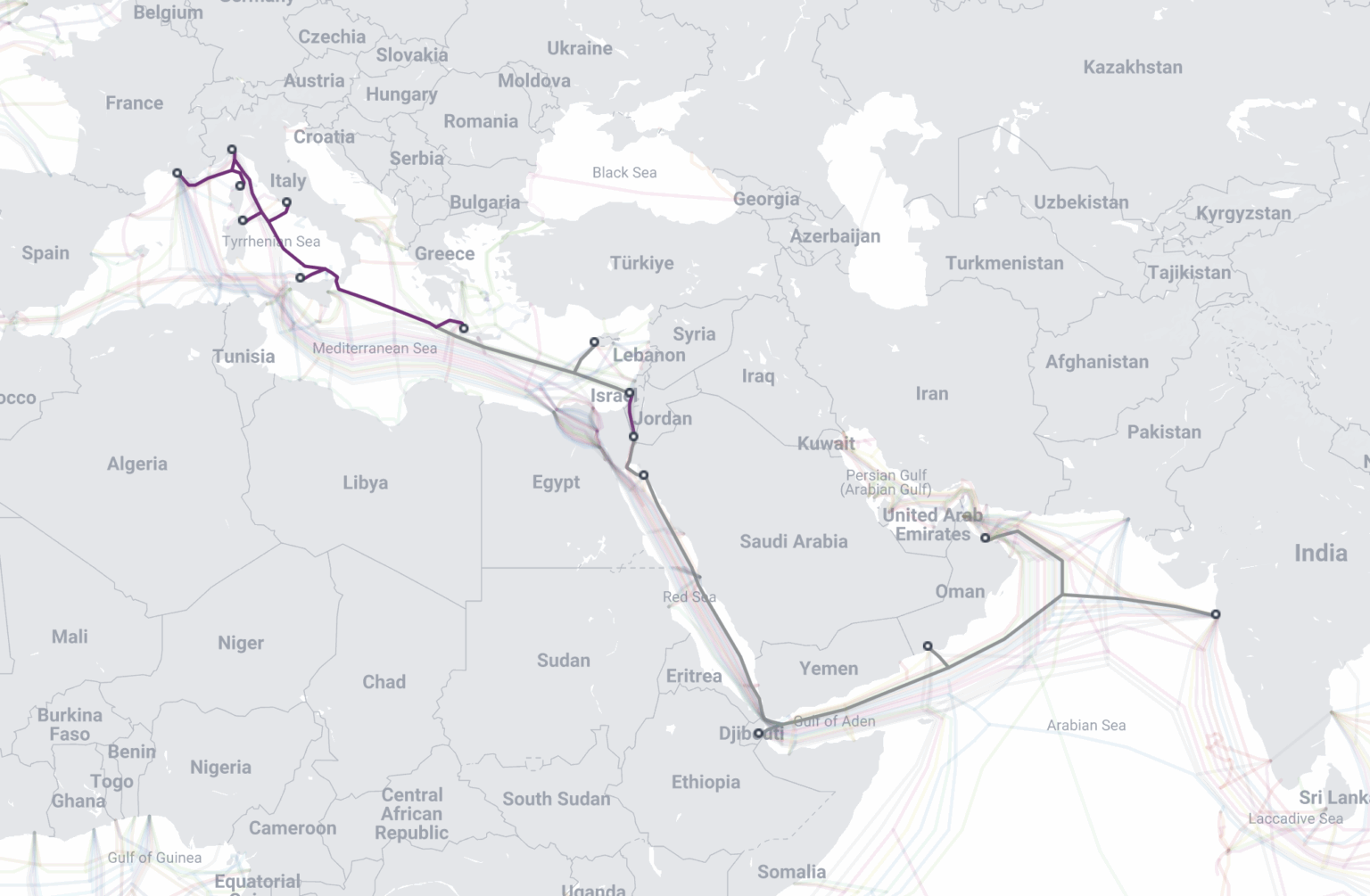
The routes of the Blue and Raman submarine fiber optic cables highlighted on a map of all submarine cables in the region. Blue connects Europe to Israel, then goes overland to Jordan. Raman, not yet completed, is projected to connect India with Oman, Djibouti, Saudi Arabia and Jordan. Courtesy of TeleGeography’s Submarine Cable Map
The TEAS and Blue-Raman systems are examples of this private sector collaboration. Both projects are considered critical components in the India-Middle East-Europe Economic Corridor (IMEC), a proposed trade and infrastructure initiative announced at the 2023 G20 summit, which will link India to Europe via shipping and railway routes through the UAE, Saudi Arabia, Jordan and Israel. The IMEC satisfies dual US foreign policy objectives: to continue building momentum toward normalization following the Abraham Accords and to develop an economic and strategic bloc in the Middle East to deter Iran and China.
TEAS was announced in 2020 as a proposed 20,000 km network linking Mumbai to Marseille via the Middle East. The project is under development by a new provider, Cinturion Group, which signed a mandate letter with the International Finance Corporation, the private sector arm of the World Bank, for a proposed loan to finance the project in 2023\. Cinturion has confirmed landing partners for the system in Jordan, Saudi Arabia, Bahrain, Qatar, UAE and Oman as well as partners in Europe and South Asia. Although the company has not announced a Memorandum of Understanding with an Israeli landing partner, official documentation about its network lists cable landing stations in the Israeli Mediterranean coastal cities of Rishon and Ashkelon. The project is also partially owned by the Israeli investment firm Keystone and is supported by Saudi’s GCC Interconnection Authority. As with many of the IMEC-related projects, there has been little news about TEAS during Israel’s war on Gaza. In September 2024, however, the company presented the advantages of the terrestrial route at an industry conference, indicating that the project is still in development.
The Blue-Raman system is being developed by the Subsea division of Google*,* representing a relatively new industry dynamic where so-called hyperscaling technology companies, like META and Google, fund, construct and operate their own infrastructure. This system breaks from an older model in which financing and design were shared among members of telecoms consortia. Google Subsea’s planned $400 million network will run between India and Italy avoiding Egypt by travelling overland through Israel, Jordan, Saudi Arabia and Oman. The system is split into two segments: Blue, connecting Europe to Israel, and Raman, extending from Jordan to India. Together they span roughly 11,700 km with a design capacity of more than 200 terabits per second. Originally expected to be ready for service in 2024, current projections indicate the cable will be operational by the end of 2025.
> These projects show how normalization is pursued materially through infrastructure even when it is politically contested and before any official agreements are signed.
These projects show how normalization is pursued materially through infrastructure even when it is politically contested and before any official agreements are signed. While these plans to lay fiber optic cables across the region emerge from the private sector, the companies depend on the licensing authority in each country to grant them permission to land and operate. The projects are complex bureaucratic objects that require state oversight to traverse exclusive economic zones, territorial waters and national borders. Cable systems often emerge from public-private multilateral collaboration. In these cases, normalization begins with technical and economic decisions taken by elites in the private sector, which then make political coordination more likely or even unavoidable.
Both TEAS and Blue-Raman have been pursued quietly and without fanfare in the Gulf, especially when compared, for example, to the domestic Saudi Vision cable, connecting Jeddah, Yanbu, Dibba and Haql. The latter was celebrated as a symbol of the kingdom’s bright techno-future and strategy to supplant Egypt as the regional hub of cable infrastructure. While much larger and more ambitious, the terrestrial systems connecting Israel to the Gulf will be difficult to celebrate as symbols of national progress without inviting criticism from a population that still largely opposes cooperation with Israel.
## **The Promises of Connectivity**
Cultural theorist Raymond Williams points out that etymologically “to communicate is to make common.”[\[2\]](#%5Fedn2) Telecommunications infrastructures are machines for manufacturing new commons. The technology of communication cables naturally complements the myths and metaphors of normalization, promising unity and prosperity by intertwining regimes in shared circuits of trade, infrastructure and surveillance.
The fiber optic systems are sold with glossy marketing copy that promise to “strengthen the connection between India, the Middle East and [Europe](https://www.cinturiongroup.com/the-network)” (Cinturion) or to provide “connectivity to power their online lives, and communicate with friends, family and business [partners](https://cloud.google.com/blog/products/infrastructure/announcing-the-blue-and-raman-subsea-cable-systems)” (Google’s vice president and head of Global Networking).[\[3\]](#%5Fedn3) In this discourse, integration is imagined as an inevitable good, connecting populations and dissolving enmity. This rhetoric, however, masks the colonial and capitalist logics of surveillance and control that drive many communication infrastructure projects in the region.
For Google and Cinturion, the incentive to pursue these projects lies in capturing a new segment of the market and providing a more secure route for information traffic from Europe to Asia. For the countries where they would operate, the incentive lies in the promise that this infrastructure will help develop their digital economies.
> While Israel is one of the best-connected places on the planet in terms of intercontinental fiber optic capacity, the state has limited the development of mobile and broadband connectivity in Gaza…
While Israel is one of the best-connected places on the planet in terms of intercontinental fiber optic capacity, the state has limited the development of mobile and broadband connectivity in Gaza and used its control of the material infrastructure to [enforce internet and telephone blackouts](https://www.reuters.com/world/middle-east/gaza-hit-by-telecoms-blackout-israeli-tanks-advance-2025-09-18/) as part of a military strategy. Moreover, Google was [recently named](https://novaramedia.com/2025/07/02/tech-giants-and-british-bank-named-in-francesca-albanese-report-on-gaza-genocide/) in UN Special Rapporteur Francesca Albanese’s report on the economy of genocide for its development of public cloud infrastructure that supports AI systems Lavender, Gospel and Where’s Daddy?, used by the Israeli army to generate lists of civilian targets for murder in Gaza.
The vulnerabilities of the Red Sea bottleneck, Egypt’s monopoly and the search for alternative terrestrial routes all demonstrate how the architecture of the fiber optic cable network is politically contingent and its security depends on regional relationships. Projects like TEAS and Blue-Raman show how normalization can advance quietly—even amid public opposition and as Israel’s control of cables and cloud systems enables strategic internet blackouts and surveillance programs in Gaza. By determining who can transmit, receive and control information across the region, these networks simultaneously empower Gulf and Israeli economic ambitions and constrain Palestinian access, making infrastructure a key instrument in shaping regional power and undermining Arab solidarity and the pursuit of Palestinian sovereignty.
\[**Ned Leadbeater** is a recent graduate of the University of Oxford, where he completed an MPhil in Modern Middle Eastern Studies with research on the material politics of the internet in Egypt.\]
---
### **Endnotes**
[\[1\]](#%5Fednref1) Julian Rawle, “[Out of the Frying Pan and Into the Fire?](https://subtelforum.com/subtel-forum-magazine-128-global-outlook/),” *Submarine Telecoms Forum* 128 (January 2023), p. 49.
[\[2\]](#%5Fednref2) Raymond Williams, “Communication,” *Keywords: A vocabulary of Culture and Society* (London: Fontana Press, 1988), p. 72
[\[3\]](#%5Fednref3) “[Teas—An Open-Access System](https://www.cinturiongroup.com/the-network),” Cinturion Group website; Bikash Koley, “[Announcing the Blue and Raman subsea cable systems](https://cloud.google.com/blog/products/infrastructure/announcing-the-blue-and-raman-subsea-cable-systems),” Google Cloud Blog, July 29, 2021.
#### How to cite this article:
Ned Leadbeater, "Fiber Optics and the Hidden Politics of Connectivity," *Middle East Report* 315/316 (Summer/Fall 2025).
### The Military-Industrial Backbone of Normalization
URL: https://www.merip.org/2025/10/the-military-industrial-backbone-of-normalization/
Last updated: 2025-10-21T15:32:52.000Z
In February 2025, as international condemnation of Israel’s genocidal war on Gaza reached new heights, Abu Dhabi hosted the [International Defence Exhibition and Conference](https://www.cnbc.com/2025/02/21/idex-2025-israeli-weapons-firms-out-in-force-at-abu-dhabi-defense-expo.html).
Over five days a record 34 Israeli arms companies, including giants like Israel Aerospace Industries and Rafael Advanced Defense Systems, showcased their latest wares alongside their Emirati partners. The event, billed as a milestone in regional cooperation, featured joint displays of advanced unmanned systems and cyber tools. Since the start of Israel’s genocide, business has been booming. Bilateral trade between Israel and the UAE soared to $3.24 billion in 2024, marking an [11 percent increase](https://www.timesofisrael.com/money-talks-trade-keeps-israel-uae-relations-afloat-despite-oct-7-and-gaza-war/) from the year prior.
The expo was made possible by the UAE’s entry into the Abraham Accords: the deal to normalize relations between Israel and several Arab countries brokered during President Donald Trump’s first term. The administration framed the Accords as historic breakthroughs, “[establishing a legacy of peace and prosperity](https://www.aapeaceinstitute.org/)”—as glossy brochures circulated by the Abraham Accords Peace Institute proclaim. The Washington DC‑based nonprofit, founded in 2021, promotes and tracks normalization and publishes annual “scorecards” of trade, tourism and security cooperation that paint the “[New Middle East](https://www.aapeaceinstitute.org/latest/israel-at-the-dubai-air-show-symbolizes-new-middle-east-analysis)” in optimistic hues: open trade routes, flights between Tel Aviv and Dubai and gleaming technology hubs promising regional innovation.
Behind this veneer lies a far grimmer reality. The most dynamic areas of Arab-Israeli cooperation are not cultural exchange or conflict resolution, but weapons sales, intelligence and surveillance collaboration and digital repression. Since signing the accords, the UAE, Morocco and Bahrain have poured capital into Israel’s military-industrial complex, effectively financing the infrastructure of Palestinian dispossession. Israel, meanwhile, exports its occupation-tested technologies to help these states entrench domestic autocracy. This mutual exchange of repressive capabilities is central to the normalization project.
At its core, the material politics of normalization reveals an alliance of convenience. Arab regimes secure Israeli arms and surveillance tools to control their populations, Israel expands its customer base and strategic reach and the United States engineers a framework that shores up its imperial grip on the region. In the process, the counterrevolutionary forces that have been resurgent since the crushing of the 2011 Arab uprisings grow more entrenched. It marks the consolidation of an anti-democratic axis, where elites trade power and impose it from above, often at the expense of Palestinian and regional self-determination.
## **From Handshakes to Hardware**
Normalization cracked open Arab arms markets that were historically sealed off to Israel, transforming the region into a lucrative export frontier for Tel Aviv’s military-industrial complex.[\[1\]](#%5Fedn1) Since the signing of the Abraham Accords in 2020, Israel’s military sector has surged into overdrive. Between 2020 and 2022, Israeli defense exports rose more than 55 percent, with Gulf states [accounting for](https://www.newarab.com/features/palestine-israels-laboratory-industry-occupation) a growing slice. In 2021 alone, Israel exported $11.3 billion in arms—a 30 percent jump from the previous year—with Arab countries making up 7 percent of that figure.[\[2\]](#%5Fedn2) By 2024, Israeli arms exports hit a [historic high](https://www.defensenews.com/global/mideast-africa/2025/06/05/israel-announces-defense-export-record-15-billion-in-2024/) of $14.79 billion, up 13 percent from the previous year. The Arab share had grown to 12 percent, signaling that normalization has matured into a central pillar of Israel’s arms economy.[\[3\]](#%5Fedn3) These sales include drone systems, cyber tools, missile defense platforms and AI-powered technologies.
> The UAE, in particular, has rapidly scaled up its military partnership with Israel. By 2022, Israel’s largest military manufacturer, Elbit Systems, had opened a UAE-based subsidiary and landed a $53 million contract to supply advanced avionics to the Emirati air force.
The UAE, in particular, has rapidly scaled up its military partnership with Israel.[\[4\]](#%5Fedn4) By 2022, Israel’s largest military manufacturer, Elbit Systems, had opened a UAE-based subsidiary and landed a $53 million [contract](https://www.elbitsystems.com/news/elbit-systems-emirates-awarded-53-million-contract-supply-dircm-and-airborne-ew-self) to supply advanced avionics to the Emirati air force. Satellite imagery around the same time revealed the quiet [deployment](https://breakingdefense.com/2022/10/first-israeli-barak-air-defense-system-deploys-to-uae-bigger-deals-expected-sources/) of Israel’s Barak missile interceptor system in the Emirates, designed to counter Iranian influence. One year later, Israeli and Emirati companies jointly [unveiled](https://thearabweekly.com/uae-israel-unveil-joint-unmanned-naval-vessel-military-ties-grow) an unmanned naval vessel at the annual Naval Defence and Maritime Security Exhibition in Abu Dhabi, developed by Israel Aerospace Industries and funded by the UAE’s state-owned military conglomerate, EDGE group. This level of military co-production is normally reserved for NATO or longstanding US allies such as the EU and Israel.
Morocco, too, has moved fast. After signing a security memorandum with Israel in 2021, Rabat began purchasing Israeli drones and air defense systems and held talks to acquire Merkava tanks. In June 2023, Israel’s infamous Golani Brigade, whose [war crimes](https://www.theguardian.com/world/2025/apr/12/idf-unit-killing-palestinian-paramedics-golani-brigade) in Gaza are well [documented](https://www.theguardian.com/world/2025/apr/12/idf-unit-killing-palestinian-paramedics-golani-brigade), joined US-led exercises on [Moroccan soil](https://www.timesofisrael.com/in-first-idf-sends-troops-to-participate-in-major-us-led-drill-in-morocco/), an unprecedented development that reflects the extent to which normalization is institutionalizing a new regional security architecture.
Driving this militarization are a common set of perceptions about the region and a shared patron, the United States. The Gulf members of the Abraham Accords are aligned in hostility toward Iran and regional resistance movements, while the Moroccan government’s goal is to counter neighboring Algeria’s military spending and to use Israeli counterinsurgency expertise in its war against Saharan nationalists. The United States has been central to knitting these ties together. In 2021, Washington shifted Israel from US European Command (EUCOM) into the US Central Command (CENTCOM) area of operations, enabling direct military coordination with Arab states. General Kenneth McKenzie, then CENTCOM commander, stated that the move would “put an operational perspective” on the accords and “open up corridors and opportunities between Israel and Arab countries in the region.”[\[5\]](#%5Fedn5)
US officials have since prioritized building [integrated air and missile defense networks](https://jinsa.org/wp-content/uploads/2023/04/JINSA-DEFEND-Act-Report.pdf), envisioning shared early warning systems and coordinated intercept capabilities between Israel and the Gulf. These ambitions took partial form during the 12-day military clash between Israel and Iran in June 2025, which served as a trial for real-time regional security coordination.
For Israel, the strategic benefits are immense. It gains formal entry into Arab security spheres without altering its colonial policies toward Palestinians. Normalization not only enhances its regional legitimacy but also erodes diplomatic pressure to end the occupation. For Arab states, the accords unlock public access to Israeli security technology, battle tested on the Palestinians.[\[6\]](#%5Fedn6) What used to happen behind closed doors now takes place openly, dressed in the language of peace and modernization.
## **The Business of Repression**
While fighter jets and missile batteries dominate headlines, an equally consequential aspect of normalization is unfolding in cyberspace and the surveillance domain. Long before the Abraham Accords were signed, the UAE, Bahrain and Morocco—alongside others yet to formalize ties— were already entrenched clients of Israel’s private spyware industry. Companies like [NSO Group](https://arabcenterdc.org/resource/the-full-story-behind-the-nso-hack-the-israeli-military-allied-surveillance-industry-and-transnational-repression/), infamous for their [Pegasus software](https://www.aljazeera.com/news/2022/2/8/what-you-need-to-know-about-israeli-spyware-pegasus), supplied these regimes with tools to spy on journalists, dissidents and activists. Normalization did not initiate these ties. It institutionalized them.
> Within months of signing the accords, Israel, the UAE, Bahrain and Morocco formalized cybersecurity partnerships, embedding digital repression into the region’s new security infrastructure.
Within months of signing the accords, Israel, the UAE, Bahrain and Morocco formalized cybersecurity partnerships, embedding digital repression into the region’s new security infrastructure. At a 2023 cyber technology conference in Tel Aviv, a US Department of Homeland Security official from the Biden administration lauded the emerging cyber alliance as “a piece of cybersecurity history” and “a wonderful opportunity to deepen security partnerships.”[\[7\]](#%5Fedn7) For regimes already entrenched in [digital authoritarianism](https://www.hurstpublishers.com/book/digital-authoritarianism-in-the-middle-east/), eliminating barriers to acquiring Israeli spyware was indeed historic.
This cooperation quickly developed into profit driven ventures. Israeli firms specializing in surveillance and cyber warfare technologies aggressively expanded into Gulf markets. In 2021, Israel’s Rafael defence firm established a consortium of Israeli cybersecurity companies to pursue contracts in Dubai. Elbit Systems, which in addition to arms provides cyber and digital products, opened an office in the UAE and, shortly after, secured a multimillion dollar deal. Gulf capital reciprocated: Abu Dhabi’s sovereign wealth fund, Mubadala, [invested](https://en.globes.co.il/en/article-uaes-mubadala-invests-100m-in-israeli-vc-firms-report-1001398762) over $100 million in Israeli tech startups, including those whose technologies are tested on occupied Palestinians.
Group 42, the Emirati firm linked to the 2019 [ToTok](https://medium.com/@billmarczak/how-tahnoon-bin-zayed-hid-totok-in-plain-sight-group-42-breej-4e6c06c93ba6) scandal (where the social media app was revealed to function as a mass surveillance tool) [proudly became](https://www.g42.ai/resources/news/g42-to-open-international-office-in-israel) the first to open an office in Israel after the Accords. With its focus on AI and biometric surveillance, Group 42 is positioned to be a key conduit for Israeli repression technology, suggesting not just commercial interests but also likely strategic adoption of Israel’s digital policing model.
In parallel, companies like [Black Wall Global](https://merip.org/2023/09/the-abraham-accords-cybersecurity/), a joint Israeli-Emirati venture, have emerged as intermediaries to facilitate the flow of sensitive technologies to countries without official ties to Israel. Unveiled immediately after the signing of the Abraham Accords, Black Wall Global brokers cyber weapon and spyware deals for clients seeking to avoid political controversy. Staffed by former Israeli intelligence officers and Emirati financiers, the company openly describes its role in laundering Israeli surveillance technology through UAE partnerships. “They can always come to the UAE, partner with a UAE company, and basically be sold as an Emirati company,” explained the firm’s Emirati co-director.[\[8\]](#%5Fedn8)
These developments contribute directly to deepening autocratic rule. The UAE, Bahrain and Morocco are already highly securitized states. Importing Israeli spyware and training enhances their ability to police, monitor and silence domestic opposition. Observers like Marwa Fatafta, writing [in these pages](https://merip.org/2023/09/the-abraham-accords-cybersecurity/) in 2023, have warned that a joint foray into cybersecurity will usher in “a new wave of tech-enabled transnational repression.”[\[9\]](#%5Fedn9) Bahraini and Emirati police have invited Israeli officials to modernize their security forces: Israel’s police commissioner has made high-profile visits to the UAE and even stationed a [permanent liaison officer](https://www.telegraph.co.uk/world-news/2021/09/23/israeli-police-permanently-based-uae-historic-first/) in Abu Dhabi.
## **AI and High-Tech Militarization**
Israel has earned a global reputation—built through decades of occupation and war—for its expertise in weaponized drones and AI-driven systems. In line with this record, its devastation of Gaza is the first [AI-assisted genocide](https://www.aljazeera.com/news/2024/4/4/ai-assisted-genocide-israel-reportedly-used-database-for-gaza-kill-lists) in history. By employing programs such as Gospel and Lavender, Israel has created a “[mass assassination factory](https://www.972mag.com/mass-assassination-factory-israel-calculated-bombing-gaza/)” that has killed thousands of civilians and destroyed infrastructure on a massive scale. Arab states are now eager to tap into this technology to bolster their own security and control infrastructures.
One prominent example is the [partnership](https://edgegroup.ae/news/edge-announces-strategic-agreement-israel-aerospace-industries-develop-advanced-counter-uas), established in March 2021, between Israel’s Aerospace Industries and the UAE’s EDGE group to develop AI-driven, unmanned naval vessels. These systems represent the frontier of AI militarization, utilizing advanced robotics, real-time data processing and autonomous threat-detection capabilities. The UAE also partnered with Israel to create a joint “[Cyber Academy](https://merip.org/2023/09/the-abraham-accords-cybersecurity/)” between Emirati intelligence and Israeli veterans of Unit 8200, Israel’s elite cyber warfare division. The project aimed to train Emirati personnel in offensive and defensive cyber techniques and has been one of multiple such initiatives announced since 2020.
> The dual-use nature of AI blurs lines between military and civilian applications, and here, too, normalization gives Israeli companies access to new markets.
AI also underpins many of the smart surveillance systems being rolled out in cities from the Gulf to North Africa. The dual-use nature of AI blurs lines between military and civilian applications, and here, too, normalization gives Israeli companies access to new markets. In 2016 Abu Dhabi deployed a mass surveillance system called [Falcon Eye](https://www.opendemocracy.net/en/north-africa-west-asia/abu-dhabi-announces-launch-of-israeli-installed-mass-surveillance-system/). What it did not advertise was that the project was steered by an Israeli security contractor who flew Israeli engineers into the UAE on private jets to install surveillance cameras.[\[10\]](#%5Fedn10) That was before formal ties. Nowadays such partnerships are public.
In the wake of the Accords, Mubadala, Abu Dhabi’s sovereign wealth fund, announced a plan to invest [$10 billion](https://www.mofa.gov.ae/en/missions/tel-aviv/media-hub/embassy-news/uae-announces-$10-billion-fund-for-investments-in-israel) in multiple sectors in Israel over the next few years. By January 2022, Mubadala had allocated [$100 million](https://www.aapeaceinstitute.org/latest/u.a.e-just-invested-100-million-in-israels-tech-sector-as-both-countries-get-closer) to several Israeli venture capital firms, such as Viola Ventures, Pitango, Entrée Capital, Aleph Capital, Mangrove Capital Partners and MizMaa. Most of these firms directly support companies that develop militarized security technologies tested and used by the Israeli military against Palestinians. Dubai’s [Oyoon program](https://www.adhrb.org/2025/04/the-rise-of-ai-surveillance-in-the-uae-implications-for-human-rights/), launched after the Abraham Accords, is a citywide platform using more than 300,000 cameras with facial recognition, resembling Israel’s AnyVision (later rebranded [Oosto](https://www.whoprofits.org/companies/company/6872/ar)), whose large‑scale facial recognition system is known as “[Facebook for Palestinians](https://theweek.com/news/world-news/middle-east/954723/palestinian-facebook-inside-facial-recognition-system-israeli-surveillance).”[\[11\]](#%5Fedn11) As these security industries collaborate, the exchange of facial recognition, predictive policing and autonomous border tools will only deepen.
When Israeli and Emirati officials promote their new partnerships, they speak not only of deterring Iran, but of turning their region into a hub for “innovation” in security technology. That innovation, however, is grounded in decades of Israeli colonization. It means more lethal autonomous drones in the skies and more repressive algorithms tracking social media for dissent.
## **Asymmetry, Dependency and Control**
The military and security dimensions of the Abraham Accords reveal a deeply hierarchical architecture that reinforces existing power asymmetries rather than building equitable partnerships. Israel retains its technological edge and operational freedom, while Arab signatories receive limited defensive capabilities that intensify their dependence on Israeli and US support. For example, the UAE was promised a $23 billion arms package, including 50 F-35 fighter jets and 18 MQ-9 Reaper drones, in what was framed as a reward for recognizing Israel. But the agreement [collapsed](https://www.reuters.com/business/aerospace-defense/uae-does-not-plan-re-open-f-35-fighter-jet-talks-with-us-uae-official-2024-09-14/) when Washington imposed operational restrictions to preserve Israel’s Qualitative Military Edge—a core US policy in the Middle East to maintain Israel’s regional superiority and dominance.
Further entrenching this asymmetry, the flow of military technology operates almost entirely in one direction. Israel is the principal supplier of security and military products, while Arab states serve primarily as financiers and customers. The selective nature of Israeli technology sharing ensures that recipient states cannot develop autonomous capabilities that might alter the regional balance of power or diminish Israel’s military advantage. The economic beneficiary of this model is clear. Israel has gained new arms markets and expanded its regional influence in critical sectors within recipient countries. Arab states, in contrast, remain passive customers, unable to build parallel domestic industries or capabilities.
Moreover, these arrangements are built to sustain dependency. Israeli systems require ongoing support such as maintenance, spare parts, software upgrades and operational guidance, creating enduring channels of control. This technological umbilical cord gives Israel leverage that extends well beyond the point of sale and mimics the decades-long strategy the US military industrial complex has employed to yoke its own allies to a system of intensified militarization and imperial collaboration.
> Israeli and Arab militaries are increasingly integrated into US command structures, aligning their policies with Washington’s regional vision rather than developing independent or nationally driven security architectures.
The entire security framework of the accords operates under US strategic oversight, particularly through CENTCOM. Israeli and Arab militaries are increasingly integrated into US command structures, aligning their policies with Washington’s regional vision rather than developing independent or nationally driven security architectures. Indeed, the Abraham Accords cannot be separated from the strategic imperatives of the United States in maintaining imperial hegemony.
Normalization fits within Washington’s broader strategy, consistent across administrations, of offshore balancing through the delegation of regional policing to trusted allies while maintaining hegemony through arms sales, intelligence sharing and economic integration. As talk of bringing [Saudi Arabia](https://al-shabaka.org/policy-memos/the-perils-of-a-looming-saudi-israeli-normalization-deal/) into the fold grows—with security guarantees on offer in exchange for token gestures on Palestine—the United States aims to cement an axis of power uniting Israel with conservative Arab states. This plan is not a deviation from past policy, but its logical extension: replacing the defunct “peace process” with an overt security and investment alliance that entrenches settler-colonialism and insulates Israel from accountability.
\[**Tariq Dana** is associate professor of Conflict and Humanitarian Studies at the Doha Institute for Graduate Studies, Qatar.\]
---
### **Endnotes**
[\[1\]](#%5Fednref1) Tariq Dana, “Death dealers: Dynamics of Israel’s permanent war economy,” *Capital & Class* (2024).
[\[2\]](#%5Fednref2) Emanuel Fabian, “[Israeli arms sales hit new record of $11.3 billion in 2021—with 7 % to Gulf,](https://www.timesofisrael.com/israeli-arms-sales-hit-new-record-of-11-3-billion-in-2021/)” *The Times of Israel*, April 12, 2022.
[\[3\]](#%5Fednref3) Tzally Greenberg, “[Israel announces defense export record: $15 billion in 2024](https://www.defensenews.com/global/mideast-africa/2025/06/05/israel-announces-defense-export-record-15-billion-in-2024/),” *Defense News*, June 5, 2025.
[\[4\]](#%5Fednref4) Tariq Dana, “The new (dis) order: The evolving UAE-Israel security alliance,” *Journal of Palestine Studies* 52/3 (2023), pp. 62–68.
[\[5\]](#%5Fednref5) Kenneth F. McKenzie Jr., “[Keynote Address: Gen. Kenneth F. McKenzie Jr.](https://www.mei.edu/multimedia/video/keynote-address-gen-kenneth-f-mckenzie-jr),” *Middle East Institute,* February 8, 2022.
[\[6\]](#%5Fednref6) Samer Abdelnour. “Making a killing: Israel’s military-innovation ecosystem and the globalization of violence.” *Organization Studies* 44, no. 2 (2023): 333-337.
[\[7\]](#%5Fednref7) Tim Starks and Ellen Nakashima, “[The Abraham Accords expand with cybersecurity collaboration](https://www.washingtonpost.com/politics/2023/01/31/abraham-accords-expand-with-cybersecurity-collaboration/),” *The Washington Post*, January 31, 2023.
[\[8\]](#%5Fednref8) Jonathan H. Ferziger,“[UAE-Israel Cyber Intelligence Firm Grows with its Perch in the Gulf](https://circuit.news/2022/09/04/uae-israel-cyber-intelligence-firm-grows-with-its-perch-in-the-gulf/),” *The Circuit*, September 4, 2022**.**
[\[9\]](#%5Fednref9) Marwa Fatafta, “[Normalizing the Surveillance State—Cybersecurity Cooperation and the Abraham Accords](https://merip.org/2023/09/the-abraham-accords-cybersecurity/),” *Middle East Report* 307/308 (Summer/Fall 2023).
[\[10\]](#%5Fednref10) Rafeef Ziadah, “Surveillance, race, and social sorting in the United Arab Emirates,” *Politics* 44/4 (2024), pp. 605–620.
[\[11\]](#%5Fednref11) Tariq Dana, “The new (dis) order: The evolving UAE-Israel security alliance.” *Journal of Palestine Studies* 52, no. 3 (2023): 62-68.
#### How to cite this article:
Tariq Dana, "The Military-Industrial Backbone of Normalization," *Middle East Report* 315/316 (Summer/Fall 2025).
### Hardwiring Normalization—Infrastructures, Extraction and Gaza’s Future
URL: https://www.merip.org/2025/10/hardwiring-normalization-infrastructures-extraction-and-gazas-future/
Last updated: 2025-10-24T16:51:07.000Z
In the summer of 2025, a 38-page blueprint circulating inside the Trump administration was leaked to the press: [the Gaza Reconstitution, Economic Acceleration and Transformation (GREAT) Trust](https://www.washingtonpost.com/documents/f86dd56a-de7f-4943-af4a-84819111b727.pdf).
At first glance, it resembled countless other speculative development schemes, renderings of luxury resorts, free-trade zones and smart cities. Gaza, the plan insisted, could be remade as part of an “Abrahamic fabric” and a new “pro-American regional architecture.”
The proposal imagined Gaza not as a territory with a people and political rights, but as a logistics hub folded into the [India–Middle East–Europe Economic Corridor (IMEC)](https://bidenwhitehouse.archives.gov/briefing-room/statements-releases/2023/09/09/memorandum-of-understanding-on-the-principles-of-an-india-middle-east-europe-economic-corridor/), the transport, energy and data corridor linking South Asia, the Gulf and Europe, via Israel, launched in 2023\. In the plan’s diagrams, Gaza was to become a node of this east–west trade artery, its coastline and land rezoned for ports, pipelines and digital cables.
The leaked document was less a plan to rebuild Gaza than an add-on to the [Abraham Accords](https://www.state.gov/wp-content/uploads/2020/09/UAE%5FIsrael-treaty-signed-FINAL-15-Sept-2020-508.pdf), the US-brokered normalization deals struck in 2020 between Israel, the UAE and Bahrain, and later joined by Morocco and, to a varying degree, Sudan. Marketed as a diplomatic breakthrough, the Accords pushed the idea of “economic peace,” that trade, investment and infrastructure could stand in for political resolution. In practice, it meant connecting Israel into Gulf supply chains while sidelining Palestinian rights and sovereignty. IMEC takes that logic further, turning the promises of the Accords into concrete form: railways, pipelines and data cables that tie Israel even more tightly to Gulf and European economies.
The document even names Gulf rulers directly. In addition to an “Abraham Gateway” logistics hub at Rafah, it proposed an “MBS Ring” highway (after Crown Prince Mohammed bin Salman of Saudi Arabia) and an “MBZ Central Highway” (after Emirati president Mohamed bin Zayed Al Nahyan). This vision seeks to fold Gaza into Israeli, Egyptian and Gulf networks under US trusteeship, merging Gulf capital and Israeli technology while reducing Palestinians to obstacles to be displaced or bypassed.
## **IMEC and the New Regional Architecture**
The IMEC was launched with great fanfare at the G20 summit in New Delhi in September 2023\. The memorandum of understanding, signed by the United States, India, the European Union, France, Germany, Italy, Saudi Arabia and the UAE, promised nothing less than a new trade and energy artery. Its eastern leg would connect Indian ports to the Gulf. Its northern leg would run from the Gulf across the Arabian Peninsula and Israel to Europe. Railways, hydrogen pipelines, electricity interconnectors and data cables would build a “green and digital bridge across continents and civilisations,” in the words of [European Commission President Ursula von der Leyen.](https://ec.europa.eu/commission/presscorner/api/files/document/print/en/statement%5F23%5F4420/STATEMENT%5F23%5F4420%5FEN.pdf?)[\[1\]](#%5Fedn1)
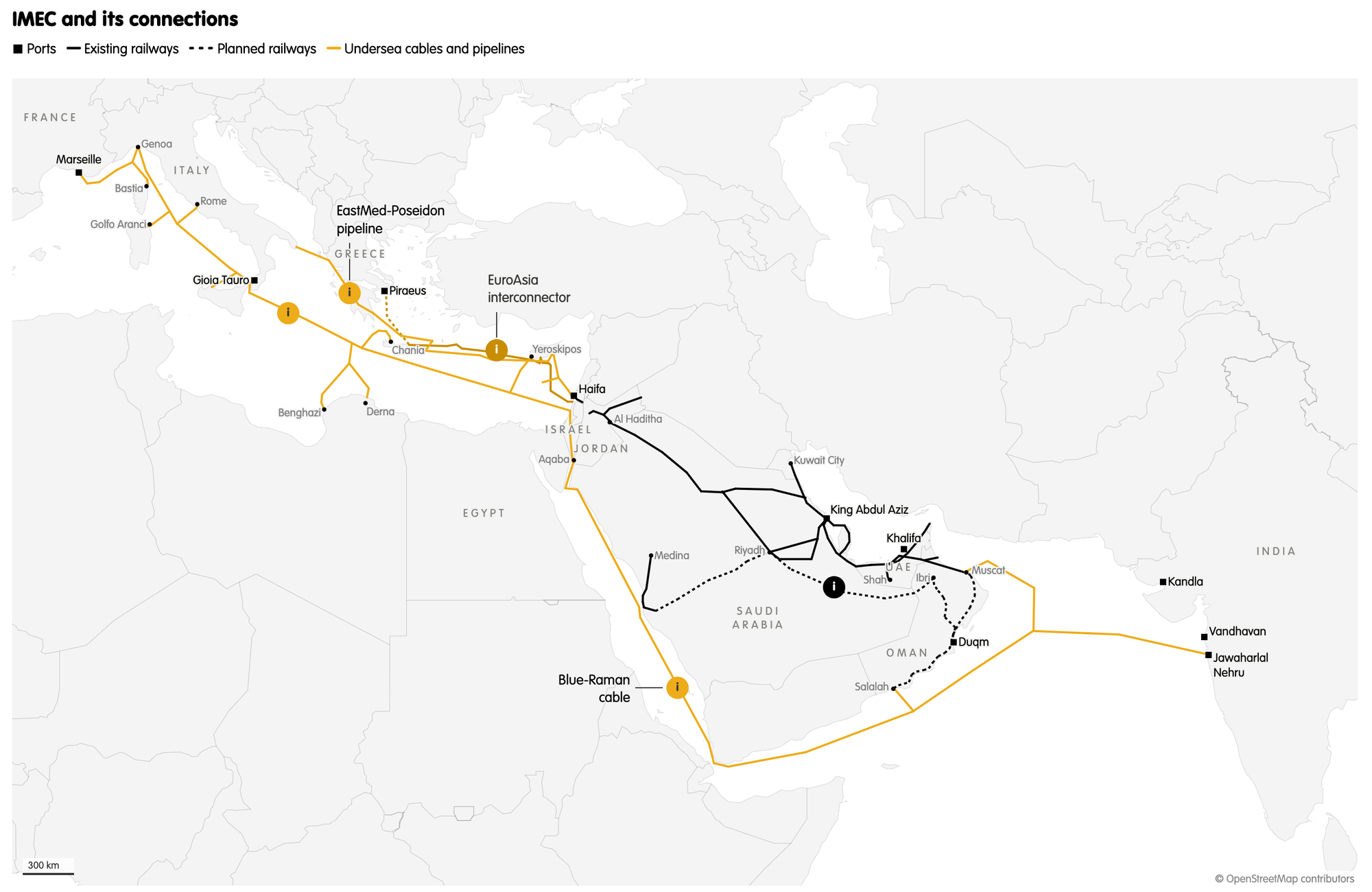
Illustration of the IMEC and its connections, courtesy of [ECFR](https://ecfr.eu/publication/the-infinite-connection-how-to-make-the-india-middle-east-europe-economic-corridor-happen/). Sources: TeleGeography, Edison, RailFreight. ECFR.
For Washington, IMEC was never just a logistics project. It was a geopolitical anchor designed to counterbalance China’s Belt and Road Initiative by keeping India and the Gulf tethered to the transatlantic camp. European leaders, meanwhile, seized on it as a way to reduce their own vulnerabilities, both to Houthi disruptions in the Red Sea and to the Suez Canal chokepoint. They presented it as part of their [Global Gateway strategy](https://commission.europa.eu/topics/international-partnerships/global-gateway%5Fen)—a €300 billion plan to fund infrastructure, energy and digital projects abroad—launched in 2021 as the EU’s answer to China’s Belt and Road.
For India, IMEC aligned with [Delhi’s ambitions](https://economictimes.indiatimes.com/news/economy/foreign-trade/imec-a-catalyst-towards-vision-of-viksit-bharat-dammu-ravi/articleshow/121627933.cms?from=mdr) to reposition itself as a global manufacturing and transport hub, moving its goods westward on faster, more secure routes. For the Gulf monarchies, especially the UAE and Saudi Arabia, the corridor dovetailed with their long-running strategy of transforming oil wealth into logistical centrality, positioning themselves as indispensable gateways for energy exports, container traffic and digital flows.
> From the beginning, Israel was integral to IMEC’s design. The corridor’s northern route runs through its Mediterranean ports, with Haifa…now majority-owned by India’s Adani Ports & SEZ…positioned as the key gateway between Gulf terminals and Europe.
From the beginning, Israel was integral to IMEC’s design. The corridor’s northern route runs through its Mediterranean ports, with Haifa—[privatized for $1.15 billion](https://www.reuters.com/markets/commodities/adani-led-group-completes-purchase-israels-haifa-port-2023-01-10/) and now majority-owned by India’s Adani Ports & SEZ—positioned as the key gateway between Gulf terminals and Europe. Adani’s role ties the project back to India as well: Its ports on the country’s western coast, including Mundra, India’s largest container terminal, are slated to serve as IMEC’s entry point from South Asia. With Adani’s network of ports anchoring both ends of the corridor, IMEC has clearly been structured around major corporate players, not only state sponsors.
IMEC’s momentum has slowed since its launch, as Israel’s genocide in Gaza forced public celebrations of normalization to quiet amid widespread protests, but it has not stopped. India and European governments have renewed consultations and feasibility work to push it forward, and the leaked GREAT Trust proposal for Gaza brings it back centrally in US policy circles.
## **Rerouting Through Genocide**
As public celebrations of normalization grew quieter, the underlying architecture, [gas investments](https://www.reuters.com/world/middle-east/israels-delek-says-finalised-deal-sell-tamar-gas-stake-uaes-mubadala-2021-09-02/), [arms contracts](https://www.defensenews.com/global/mideast-africa/2025/06/05/israel-announces-defense-export-record-15-billion-in-2024/), [trade agreements](https://www.reuters.com/world/middle-east/israel-uae-sign-free-trade-deal-ambassador-2022-05-31/) and [digital cables](https://cloud.google.com/blog/products/infrastructure/announcing-the-blue-and-raman-subsea-cable-systems), for the most part, continued to advance.
The [Red Sea disruptions](https://www.reuters.com/markets/europe/what-does-red-sea-disruption-mean-europes-economy-2024-01-19/) of late 2023 were a turning point. As Houthi strikes on shipping forced vessels to avoid the Bab Al-Mandeb strait, Israeli startup Trucknet Enterprise promoted a “land bridge” concept. The company announced agreements with firms including Puretrans FZCO, in the UAE, and DP World to move cargo overland from Gulf ports through Saudi Arabia and Jordan into Israel, presenting it as a way to bypass the maritime chokepoint.
[Israeli officials touted the experiment](https://www.voanews.com/a/red-sea-attacks-foster-arab-israeli-trade-link-by-land/7487827.html) as a faster route, but evidence of actual shipments remains hazy. Wary of appearing complicit in normalization during the war on Gaza, [Jordan publicly denied that shipments were taking place](https://www.middleeastmonitor.com/20240226-jordan-pm-denies-land-bridge-for-passage-of-goods-to-israel/). The sensitivity was underscored in May 2024, when Jordanian-Palestinian journalist Hiba Abu Taha was arrested and later sentenced to a year in prison after reporting on overland shipments through Jordan, charged under Jordan’s new Cybercrimes Law with incitement and spreading false news.[\[2\]](#%5Fedn2) Official press releases and media briefings, however, have been less vehemently denied by the states involved. Whatever its status, the initiative offers an important glimpse of the kinds of connectivity schemes regional powers hope to advance.
If the land bridge previewed IMEC’s terrestrial leg, the [Blue-Raman subsea cable](https://cloud.google.com/blog/products/infrastructure/announcing-the-blue-and-raman-subsea-cable-systems) (discussed [in this issue](https://www.merip.org/2025/10/fiber-optics-and-the-hidden-politics-of-connectivity/) by Ned Ledbeater) illustrates its digital backbone. Launched by Google with Sparkle (Italy’s telecom carrier) and Omantel, the system aims to link India directly to Europe through Israel. The Blue cable runs from Israel across the Mediterranean to Italy. The Raman cable stretches from India through Oman, Saudi Arabia and Jordan to Israel. When fully active, they will bypass Egypt’s long-standing monopoly on Asian-European internet traffic through the Suez corridor.
For Europe, the cable has become a flagship of its Global Gateway initiative, promising diversified data flows. For Israel, it marks a leap in regional integration, not only a land bridge for goods, but a switch point in the digital networks tying Asia to Europe. These projects show how IMEC’s promise of connectivity is advancing in practice, despite political denials.
## **The Extractive Core of Normalization**
If IMEC crystallizes normalization in the language of corridors and connectivity, its logic is not new. Earlier gas deals and energy contracts stitched Israel into regional networks long before the corridor was announced.
Much commentary on normalization has focused on the increasingly public arms trade between Israel and the UAE (the subject of [Tariq Dana’s piece](https://merip.org/2025/10/the-military-industrial-backbone-of-normalization) in this issue). Israel’s defense exports hit a record [$14.79 billion in 2024](https://www.defensenews.com/global/mideast-africa/2025/06/05/israel-announces-defense-export-record-15-billion-in-2024/), with about 12 percent of that going to Abraham Accords partners, the UAE, Bahrain and Morocco. Yet if weapons are working to bind security establishments, it is energy that now tethers entire economies together.
The most visible Emirati move came in September 2021, when the UAE’s Mubadala Energy (a subsidiary of its sovereign wealth fund), acquired a [22 percent stake](https://www.thenationalnews.com/business/2021/09/02/mubadala-petroleum-finalises-1bn-deal-for-22-stake-in-israels-tamar-gas-field/) in Israel’s Tamar offshore field from Delek for just over $1 billion. Tamar supplies much of Israel’s domestic demand and underpins exports to Jordan and Egypt. The investment marked the first time Emirati capital was directly embedded in Israel’s upstream gas sector.
Two years later, in March 2023, Abu Dhabi’s ADNOC joined with BP in [a $2 billion bid for 50 percent of NewMed Energy](https://www.reuters.com/markets/deals/adnoc-bp-bids-interest-israels-newmed-energy-2023-03-28/), the Israeli company holding a 45 percent stake in the Leviathan megafield. The deal would have created a joint venture spanning Israeli and Egyptian gas assets, placing ADNOC at the heart of Eastern Mediterranean supply. Although talks were suspended in early 2024 amid the Gaza war and regional instability, the pause was tactical, not a cancellation.
Egypt and Jordan have also been bound tighter into this architecture. Both signed multi-billion-dollar import contracts for Israeli gas in the mid-2010s, and those flows have only intensified, a dynamic [Hicham Safieddine chronicles](https://merip.org/2025/10/the-rise-of-energy-normalization-in-the-eastern-mediterranean) in these pages. Indeed, in August 2025, Israel announced its largest ever export deal, a $35 billion contract to ship [130 billion cubic meters](https://worldoil.com/news/2025/8/8/israel-egypt-reach-35-billion-deal-for-natural-gas-supply/) of Leviathan gas to Egypt between 2026 and 2040\. The gas will feed Egypt’s Idku and Damietta Liquified National Gas plants, which then re-export to Europe, making Cairo dependent on Israeli supply even as it is bypassed by overland and digital corridors like IMEC.
Jordan, for its part, has relied on gas imports from Israel under a [15-year contract with Noble Energy (now Chevron).](https://merip.org/2019/09/exposing-jordans-gas-deal-with-israel/) The arrangement has been politically toxic, triggering public protests in Amman, even as governments have consistently defended it as unavoidable for energy security. Yet, as [Majd Bargash notes](https://merip.org/2025/10/energy-water-and-the-cost-of-jordans-dependence-on-israel) in his contribution to this issue, those claims were undermined this past summer, when Israel paused natural gas provision during its June war with Iran, underscoring the risks of Jordan’s energy dependency.
> These deals show how normalization works through the nuts and bolts of extraction…Even when regional leaders rail against occupation or genocide, the gas keeps flowing.
These deals show how normalization works through the nuts and bolts of extraction. Emirati capital now sits in Israel’s upstream fields; Egyptian LNG plants depend on Israeli feedstock; Jordanian grids are powered by Israeli imports. Even when regional leaders rail against occupation or genocide, the gas keeps flowing.
Behind the headline deals lies a more uncomfortable fact, Israel’s offshore gas boom is built on unresolved jurisdictional claims. The Gaza Marine field, discovered in 1999 in waters allocated to the Palestinians under Oslo, has been kept off limits for decades, even as Israel has pressed ahead with extraction in nearby blocks. A 2019 [UNCTAD report](https://unctad.org/system/files/official-document/gdsapp2019d1%5Fen.pdf) called this a systematic denial of Palestinian sovereign rights over their natural resources. Lebanon’s maritime disputes with Israel underline the same point: Much of the Eastern Mediterranean’s gas map remains unsettled. Normalization, in this context, cements an extractive order that lets Israel claim contested resources and shut out future alternatives.
This reality also undercuts the rhetoric of a so-called green transition. European leaders present IMEC as a future corridor for hydrogen and renewable energy, while Gulf states promote themselves as clean energy champions. Since the Abraham Accords, Israel and the UAE have highlighted joint projects on solar power, desalination plans and climate innovation as signs that normalization could deliver a regional green transition. In practice, however, these announcements remain secondary to the hard infrastructure of fossil fuels: billions invested in offshore gas fields, long-term export contracts and new liquified natural gas (LNG) routes to Europe. Rather than phasing out extraction, normalization has locked it in more deeply, with renewable rhetoric functioning more as diplomatic branding than structural change.
## **Gaza in the Regional Frame**
As Washington doubles down on its alliance with Israel while Brussels floats recognition of a Palestinian state, much commentary in recent weeks has contrasted US and European approaches to Gaza. But the difference is more a matter of degree than direction. The leaked US administration plan made Washington’s orientation clear: Gaza’s future imagined not in terms of sovereignty but as a logistics hub within IMEC—a project designed to deepen the Abraham Accords and hardwire Israel into regional trade, energy and digital flows.
Gestures like recognition of statehood allow Europe to position itself differently. Yet it has been an eager partner in the same US architecture, folding IMEC into its Global Gateway strategy, lobbying for EU financing and competing over which [European ports will anchor the corridor.](https://www.atlanticcouncil.org/blogs/new-atlanticist/it-is-europes-time-to-shine-on-imec/) Recognition talk may sustain the illusion of action, but what matters is what gets built, the pipelines, ports and cables that entrench the status quo.
Saudi Arabia is often cast as the great holdout, reluctant to normalize until Palestinian demands are addressed. But here too, the difference is rhetorical more than real. Riyadh signed the IMEC memorandum in 2023, placing itself at the heart of a project that relies on Israel as its Mediterranean hinge. Saudi officials have repeatedly promoted the corridor as a future route for exporting hydrogen to Europe. As with Europe’s recognition talk, these gestures obscure the deeper reality, Saudi Arabia is already underwriting the infrastructures that embed Israel in the region.
Egypt and Jordan underscore the same paradox. Cairo voices unease about being bypassed by IMEC’s land and data routes, yet its liquified natural gas plants are locked into long-term contracts re-exporting Israeli gas to Europe, including the recent record $35 billion Leviathan deal announced in 2025\. In Jordan, despite local protests, the Leviathan supply contract still binds Jordan’s grids to Israeli fields. Both Egypt and Jordan may signal solidarity with Palestinians in public, but their infrastructures tell a different story.
None of this makes the new US-led “[regional architecture](https://uk.finance.yahoo.com/news/gaza-riviera-fantasy-plan-relies-121347391.html)” seamless or inevitable. IMEC is riddled with contradictions. India has championed the project as part of its *Viksit Bharat* vision of becoming a global manufacturing and logistics hub, but relations with Washington are strained over recent Trump tariffs and protectionist policies.
At the same time, Gulf states that have signed onto IMEC as a US-backed corridor remain deeply tied to China. Saudi Arabia and the UAE send much of their [oil eastward](https://tradingeconomics.com/china/imports/saudi-arabia/crude-oil-petroleum-bituminous-minerals), making China their single largest trading partner.[\[3\]](#%5Fedn3) Both have experimented with [yuan-based settlements for oil and gas](https://eastasiaforum.org/2024/01/17/chinese-yuan-gains-currency-in-the-gulf-states/) and continue to host Chinese firms in energy and logistics zones, even as they position themselves as key nodes in Washington’s alternative corridor.
Regional powers outside IMEC highlight the same contradictions. For Turkey, the corridor undercuts its long-standing role as the primary land bridge between Asia and Europe. Ankara has built its identity around being the indispensable transit hub, but a Gulf-to-Haifa-to-Europe route bypasses that position. The question for Turkey is how to adapt—whether by finding ways to plug into the corridor or by doubling down on alternative routes that preserve its relevance.
For Iran, IMEC is a project designed to exclude it altogether, binding the Gulf monarchies more tightly to Washington and Delhi while containing Tehran. The overall result is an architecture still in flux, celebrated by the United States and European Union, but riven with unresolved tensions over whether key regional players are to be incorporated or completely side-lined.
> Beneath the fanfare of plans and announcements, it is these material ties that reveal where the new regional order is taking shape. Tracing these infrastructures—and contesting the visions they embody—matters now more than ever.
In the emergent US visions of connection and prosperity, Palestinians are cast as an obstacle rather than a people with rights, their dispossession treated as a technical problem to be managed away. But they have not accepted this erasure. They continue to resist projects of a so-called economic peace built on dispossession and ethnic cleansing. In that sense, the leaked document only makes explicit what the region’s unfolding infrastructure already shows: Normalization is being assembled piece by piece, through concrete, contracts and cables. Beneath the fanfare of plans and announcements, it is these material ties that reveal where the new regional order is taking shape. Tracing these infrastructures—and contesting the visions they embody—matters now more than ever.
The recent ceasefire agreement, mediated under Trump’s 20-point plan, retains many of the tenants of the GREAT Trust. It packages Israel’s military withdrawal and prisoner exchanges into a pause, without resolving the underlying problem of ongoing military occupation or Palestinian rights. In practice, its first phase mandates a ceasefire, phased Israeli redeployment and prisoner exchanges but leaves open who governs Gaza, who monitors security and who controls reconstruction. If such moments are understood as continuations of violence in another register, the question then becomes: How will the infrastructures of normalization deepen under this ceasefire? Which actors will control crossings, —cables, pipelines and funds—and at whose expense?
\[**Rafeef Ziadah** is senior lecturer in Politics and Public Policy at King’s College London.\]
---
### **Endnotes**
[\[1\]](#%5Fednref1) European Commission Statement 23/4420, “[Statement by President von der Leyen at the Partnership for Global Infrastructure and Investment event in the framework of the G20 Summit,](https://ec.europa.eu/commission/presscorner/api/files/document/print/en/statement%5F23%5F4420/STATEMENT%5F23%5F4420%5FEN.pdf?)” September 9, 2023.
[\[2\]](#%5Fednref2) Elia El-Khazen, “ Truck Drivers at a Crossroads: On the Relevance of Trucking Communities to Regional and Global Anti-Normalization Movements,” in *Disruptive Geographies and the War on Gaza: Infrastructure and Global Solidarity*. *Geopolitics*, eds. Rafeef Ziadah, Christian Henderson, Omar Jabary Salamanca, Sharri Plonski, Charmaine Chua, Riya Al Sanah and Elia El Khazen, pp.1–39.
[\[3\]](#%5Fednref3) Adam Hanieh, “[Greening the Gulf? Renewables, Fossil Capitalism and the ‘East–East’Axis of World Energy,](https://onlinelibrary.wiley.com/doi/10.1111/dech.70006)” *Development and Change*, August 6, 2025.
### How to cite this article:
Rafeef Ziadah, "Hardwiring Normalization—Infrastructures, Extraction and Gaza’s Future," *Middle East Report* 315/316 (Summer/Fall 2025).
### Issue 315/316 (Summer/Fall 2025) Masthead
URL: https://www.merip.org/2025/10/issue-315-316-summer-fall-2025-masthead/
Last updated: 2025-10-20T17:43:49.000Z
## ***Middle East Report*, “The Material Politics of Normalization,” Summer/Fall 2025, No. 315/316, Vol. 54 No. 2–3**
### **Executive Director**
**James Ryan** jamesryan@merip.org
### **Executive Editor**
**Billie Jeanne Brownlee** bbrownlee@merip.org
### **Managing Editor**
**Marya Hannun** maryahannun@merip.org
### **Senior Staff Editor & Photo Editor**
**Michelle Woodward** mwoodward@merip.org
### **Cover Designer**
**John Lee**
### **Board of Directors**
**Paul Silverstein** **(Board Chair)** *Reed College*
**Mona Atia** *George Washington University*
**Kaveh Ehsani** *DePaul University*
**Lisa Hajjar (Co-chair of the Editorial Committee)** *University of California, Santa Barbara*
**Muriam Haleh Davis (Co-chair of the Editorial Committee)** *University of California, Santa Cruz*
**Michael Hanna** *International Crisis Group*
**Adam Hanieh** *University of Exeter*
**James Ketterer** *Bard College*
**Vickie Langohr** *College of the Holy Cross*
**James Ryan** *MERIP Executive Director (ex officio)*
###
### **Editorial Committee**
**Lisa Hajjar (Co-chair of the Editorial Committee)** *University of California, Santa Barbara*
**Muriam Haleh Davis (Co-chair of the Editorial Committee)** *University of California, Santa Cruz*
**Ayça Alemdaroğlu** *Stanford University*
**Sabiha Allouche** *University of Exeter*
**Stephen Gasteyer** *Michigan State University*
**Maziyar Ghiabi** *University of Exeter*
**Kanwal Hameed** *University of Exeter*
**Najib Hourani** *Michigan State University*
**Reinoud Leenders** *King’s College London*
**Shana Marshall** *George Washington University*
**Pascal Menoret** *Brandeis University*
**Jacob Mundy** *Colgate University*
**Hesham Sallam** *Stanford University*
**Kevin L. Schwartz** *Oriental Institute of the Czech Academy of Sciences*
**Deen Sharp** *London School of Economics*
**Sean Yom** *Temple University*
### **Format: Online**
### **ISSN 3065-744X**
#### How to cite this article:
"Issue 315/316 (Summer/Fall 2025) Masthead," *Middle East Report* 315/316 (Summer/Fall 2025).
### A Note on the Masthead
URL: https://www.merip.org/2025/10/a-note-on-the-masthead/
Last updated: 2025-10-20T17:20:43.000Z
Over the summer, MERIP’s executive editor Katie Natanel rotated off the editorial team after three and a half years. Katie joined at the beginning of MERIP’s partnership with Exeter’s Institute for Arab and Islamic Studies, stepping into what was then a new position within the organization. Behind the scenes and throughout MERIP’s pages, she guided the publication through ten issues—beginning with the [Politics and Passions](https://merip.org/magazine/304/) of football surrounding the 2022 World Cup in Qatar and ending with the spring 2025 issue, [New Gender Frontlines](https://merip.org/magazine/314/). Alongside managing editor Marya Hannun, she brought care, attentiveness and deep commitment to MERIP’s mission. It was a true pleasure working with Katie, and MERIP is glad she will remain part of the intellectual community even as she pursues new projects at Exeter and beyond.
MERIP is also thrilled to introduce Katie’s successor, Billie Jeanne Brownlee. Billie Jeanne is a political scientist based at Exeter specializing in media, displacement, social movements and political mobilization across the region. Beyond her research, she has spent considerable time working with international organizations on migration and refugee issues. It has already been a fruitful partnership, and MERIP looks forward to continuing to collaborate with Billie Jeanne and Exeter.
Last but not least, MERIP warmly welcomes back Michelle Woodward, a former managing editor who has served as MERIP’s photo editor for many years and is now stepping into the role of staff editor. Michelle has been part of MERIP in various capacities for a long time, and the publication is eager to benefit from her skill and experience as it curates the magazine and other content on the new website. Simultaneously, MERIP extends sincere thanks to Alyssa Bivins and Michael Kaplan, two hard-working doctoral students at George Washington University, who assisted the editorial team over the past few years. They have been integral to MERIP’s production process and will be missed as they step back from editorial duties. MERIP wishes them the best of luck in their future endeavors.
#### How to cite this article:
"A Note on the Masthead," *Middle East Report* 315/316 (Summer/Fall 2025).
### A Note on the Cover Image
URL: https://www.merip.org/2025/10/a-note-on-the-cover-image-9/
Last updated: 2025-10-20T16:57:50.000Z
The cover of *MER’s* Summer/Fall double issue, “The Material Politics of Normalization,” features a 2020 illustration by Bahraini artist Sara Qaed. The image—a pair of scissors bent into the Arabic word for “no” (*la*)—was published on [Qaed’s Instagram](https://www.instagram.com/saraqaed/p/CFFwQNln1Wy/?hl=en) two days before the signing of the Abraham Accords on September 15, 2020\. Qaed captioned the image in Arabic with the words “No, No, No,” and the hashtags *#NoToNormalization*, *#NoToSilencing,* *#BahrainisAgainstNormalization* and #*GulfPeopleAgainstNormalization.* The work captured the tide of popular dissent and refusal as Bahrain joined other Arab states in formalizing ties with Israel.
The scissors turn the word “no” into a tool that can slice through the political and economic infrastructures that sustain normalization. But Qaed’s design also invokes an earlier political grammar: the “Three No’s” of the 1967 Khartoum Declaration—no peace with Israel, no recognition of Israel, no negotiations with Israel—issued in the aftermath of the Arab defeat in June 1967\. More than half a century later, her image reanimates that gesture of defiance in a different register, reflecting the sustained effort among regional activists to refuse normalization even as, in the decades since Khartoum, Arab states have become enmeshed in US and Israeli-led architectures of economic and military dominance.
As this issue explores, normalization today is not a diplomatic event but a [material process](https://merip.org/2025/10/hardwiring-normalization-infrastructures-extraction-and-gazas-future): It reorganizes [trade](https://merip.org/2025/10/energy-water-and-the-cost-of-jordans-dependence-on-israel), [energy](https://merip.org/2025/10/the-rise-of-energy-normalization-in-the-eastern-mediterranean), [surveillance and defense](https://merip.org/2025/10/the-military-industrial-backbone-of-normalization) networks. It is [rooted in the soil](https://merip.org/2025/10/israeli-agribusiness-and-moroccos-green-frontier), in agribusiness ventures that extend Israeli capital and technology across the region. It is [embedded in the cables](https://merip.org/2025/10/fiber-optics-and-the-hidden-politics-of-connection) that run beneath the seabed and in the [popular music](https://merip.org/2025/10/identity-and-cultural-diplomacy-of-the-abraham-accords) that travels those same circuits of transmission. It binds regional economies to Israel’s military-industrial complex and [redraws the political geography](https://merip.org/2025/10/the-sumud-convoy-and-new-maghrebi-geographies-of-resistance) of the Middle East. Yet this web of connectivity also creates [space for disruption](https://merip.org/2025/10/an-interview-with-gulf-can/)—fissures through which artists and activists might intervene, much like the snip of Qaed’s scissors, to cut through the glossy surfaces of normalization and expose its seams.
#### How to cite this article:
"A Note on the Cover Image," *Middle East Report* 315/316 (Summer/Fall 2025).
### The MERIP Podcast Episode Nine: The MERIP Roundtable, "On The Regional War"
URL: https://www.merip.org/2025/09/the-merip-podcast-episode-nine-the-merip-roundtable-on-the-regional-war/
Last updated: 2025-09-26T15:15:13.000Z
On today's episode we are providing another installment of our MERIP Roundtable, where members of our Editorial Committee discuss recent developments in the region. Today's roundtable, "On the Regional War" focuses on the fallout from Israel's September 9th strike on Qatar, a failed assassination attempt targeting the Hamas delegation that is involved in negotiations over a ceasefire and hostage release deal. The panel also discusses the Iran-Israel War, which has been frozen since June but is approaching a period where tensions seem to be quietly ratcheting towards more conflict. Joining the panel are Kevin Schwartz, Deputy Director of the Oriental Institute at the Czech Academy of Sciences, Maziyar Ghiabi, Associate Professor of Political Science at the Institute for Arab and Islamic Studies at the University of Exeter, Shana Marshall, Assistant Research Professor and Associate Director of the Institute for Middle East Studies at the George Washington University, and James Ryan, MERIP's Executive Director.
This conversation was recorded on September 23, 2025.
The panel provided the following further reading recommendations:
Maziyar Ghiabi -- Trita Parsi's 2008 book *Treacherous Alliance: The Secret Dealings of Israel, Iran and the United States* https://yalebooks.yale.edu/book/9780300143119/treacherous-alliance/
Kevin Schwartz -- "Echoes of a Short War: Critical Reflections on Israel's Attack on Iran" (edited by Nazanin Shahrokhni and Arash Davari) at *Jadaliyya* https://www.jadaliyya.com/Details/46907/Echoes-of-a-Short-War-Critical-Reflections-on-Israel%E2%80%99s-Attack-on-Iran
Shana Marshall – The American Prestige Podcast (https://americanprestige.supportingcast.fm/listen) and Adam Hanieh's collected works (latest book here: https://www.versobooks.com/products/2760-crude-capitalism?srsltid=AfmBOoryMbUuLhOyieEStgex70POT89GPm-pCOv57EOU269THYdNYhbd)
James Ryan -- Arang Keshavarzian's review of Elham Fakhro's *The Abraham Accords* at MERIP, "The Limits of Protections and Profits, Five Years Into the Abraham Accords"
The MERIP Podcast features exclusive interviews with contributors to the Middle East Research and Information Project from the present and past about their work for MERIP, as well as audio from events we've conducted online and in-person that examine contemporary issues in the politics, economy, society and culture of the Middle East. Hosted by James Ryan, MERIP's Executive Director. Visit our website, www.merip.org, to read all of our work without paywalls.
### Syria at the Crossroads: Regional Politics and the Movement for Palestine
URL: https://www.merip.org/event/syria-at-the-crossroads-regional-politics-and-the-movement-for-palestine/
Last updated: 2025-09-17T16:45:41.000Z
Join MERIP and SPECTRE Journal for the second online conversation in our series on the unfolding events in Syria. This conversation will center on regional political dimensions, geopolitics, sanctions and the intersections between popular movements in Syria and Palestine.
Speakers:
Joseph Daher, Swiss-Syrian academic and author of several books
Ramah Kudaimi. Syrian-American activist based in DC, longtime BDS campaigner, and a former member of the National Committee of the War Resisters League.
Yasmeen Mobayed, History PhD student at the University of Chicago. She previously worked as the managing editor of The Syria Report and as a translator for the Local Coordination Committees and other Syrian grassroots organizations during the 2011 uprising.
Moderated by Shireen Akram-Boshar (SPECTRE) and James Ryan (MERIP).
Watch this event on YouTube below:
Watch the [first conversation on YouTube](https://youtu.be/pZo5ebaQ8aM?si=-XIOclxhARlYoqcr).
### The MERIP Podcast Episode Eight: Helen Lackner
URL: https://www.merip.org/2025/09/the-merip-podcast-episode-eight-helen-lackner/
Last updated: 2025-09-16T01:48:44.000Z
This episode of the MERIP podcast features an interview with longtime MERIP contributor and noted journalist Helen Lackner on the state of Yemen's Houthi movement. The conversation with MERIP Executive Director James Ryan follows up on her essay, "Yemen's Ansar Allah" that was published in our Winter 2024 Issue of Middle East Report on "Resistance: The Axis and Beyond." We discussed the increasingly aggressive posture of the United States and Israel against the Houthis since the Trump administration took office, the unfolding humanitarian disaster in Yemen following the dismantling of USAID, and the status the Houthis now occupy following the fall of Bashar al-Asad and the recent attacks by the US and Israel against Iran.
Listen on [Apple Podcasts](https://podcasts.apple.com/us/podcast/episode-8-helen-lackner/id1823259361?i=1000725142828)
Listen on [Spotify](https://open.spotify.com/episode/1zMj6MCOa4Nokiuo5uXM5x)
Listen on [Amazon Music](https://music.amazon.com/podcasts/d73ad16e-0e22-4ca4-80f1-cf61dade333e/episodes/1a2f9bd8-e267-464b-8e86-80f6781ec28f/the-merip-podcast-episode-8-helen-lackner)
For more reading, check out:
Helen Lackner, "Yemen's Ansar Allah" Middle East Report Issue 313 Winter 2024: https://merip.org/2025/01/yemens-ansar-allah/
Helen Lackner, Yemen in Crisis (Verso Books): https://www.versobooks.com/products/914-yemen-in-crisis?srsltid=AfmBOoolUV-kV830hOECamRpfgkWhQJBq06JU2YzV9wT8Z5lAGXv28mi
Stacey Philbrick Yadav, "The Houthi's 'Sovereign Solidarity' with Palestine" Middle East Report Issue 309 Winter 2023: https://merip.org/2024/01/the-houthis-sovereign-solidarity-with-palestine-2/
To support MERIP please visit www.merip.org/donate
The MERIP Podcast features exclusive interviews with contributors to the Middle East Research and Information Project from the present and past about their work for MERIP, as well as audio from events we've conducted online and in-person that examine contemporary issues in the politics, economy, society and culture of the Middle East. Hosted by James Ryan, MERIP's Executive Director. Visit our website, www.merip.org, to read all of our work without paywalls.
### The MERIP Podcast Episode Seven: Syria at the Crossroads III
URL: https://www.merip.org/2025/09/the-merip-podcast-episode-seven-syria-at-the-crossroads-iii/
Last updated: 2025-09-16T01:45:13.000Z
This week in the feed we have the audio from our August 14th, 2025 event "Syria at the Crossroads: Unpacking Sectarianism and the Crisis in Suweida." The conversation features perspectives from Syrian journalists, scholars, and activists Sara Ajlyakin, Sana Mustafa, and Yasser Munif, and was co-moderated by James Ryan (MERIP) and Shireen Akram-Boshar (SPECTRE). This is the third event in our series on Syria since the fall of Bashar al-Asad, and is co-produced with SPECTRE: A Marxist Journal.
Listen on [Apple Podcasts](https://podcasts.apple.com/us/podcast/episode-7-syria-at-the-crossroads-iii/id1823259361?i=1000722676447)
Listen on [Spotify](https://open.spotify.com/episode/1SAYfItFJwbv03a1Giu6Yt)
Listen on [Amazon Music](https://music.amazon.com/podcasts/d73ad16e-0e22-4ca4-80f1-cf61dade333e/episodes/0378c5ed-4973-42d4-ac52-ddfa537fb6c0/the-merip-podcast-episode-7-syria-at-the-crossroads-iii)
The MERIP Podcast features exclusive interviews with contributors to the Middle East Research and Information Project from the present and past about their work for MERIP, as well as audio from events we've conducted online and in-person that examine contemporary issues in the politics, economy, society and culture of the Middle East. Hosted by James Ryan, MERIP's Executive Director. Visit our website, www.merip.org, to read all of our work without paywalls.
### The MERIP Podcast Episode 6: The MERIP Roundtable, "On Recognition"
URL: https://www.merip.org/2025/09/the-merip-podcast-episode-6-the-merip-roundtable-on-recognition/
Last updated: 2025-09-16T01:42:15.000Z
The MERIP Roundtable is a new format for the MERIP podcast featuring conversation on urgent issues in the Middle East with members of MERIP's Editorial Committee. The theme of this episode's conversation is "Recognition" -- both the widening circle of Israeli, diaspora, and Jewish figures and institutions that are belatedly recognizing the facts of the genocide in Gaza and the recent wave of G7 states who have committed to recognizing the State of Palestine. On the podcast are MERIP Editorial Committee members Lisa Hajjar, Jacob Mundy, and Sean Yom, and the conversation is led by MERIP's Executive Director, James Ryan.
Listen on [Apple Podcasts](https://podcasts.apple.com/us/podcast/episode-6-the-merip-roundtable-on-recognition/id1823259361?i=1000721829045)
Listen on [Spotify](https://open.spotify.com/episode/4zEtPJphTma94G9clkRs0s)
Listen on [Amazon Music](https://music.amazon.com/podcasts/d73ad16e-0e22-4ca4-80f1-cf61dade333e/episodes/f616c107-1e1f-4d68-a08d-e7e8f6db19fd/the-merip-podcast-episode-6-the-merip-roundtable-on-recognition)
Further reading recommended by the panel:
Jacob Mundy recommends Benjamin Claude Brower's [*A Desert Named Peace: The Violence of France's Empire in the Algerian Sahara, 1844-1902*](https://cup.columbia.edu/book/a-desert-named-peace/9780231154925/)
Lisa Hajjar recommends Noura Erakat and Shahd Hammouri ["The Statehood Trap"](https://www.jadaliyya.com/Details/46838) on Jadaliyya, Rabea Eghbariah ["Toward Nakba as Legal Concept" ](https://columbialawreview.org/content/toward-nakba-as-a-legal-concept/)in the Columbia Law Review, Mouin Rabbani's [Substack](https://mouinrabbani.substack.com/) and Sherene Seikaly's [Editor's Note ](https://www.tandfonline.com/doi/full/10.1080/0377919X.2025.2536445)in the latest issue of the Journal of Palestine Studies.
James Ryan recommends Esmat Elhalaby, ["Nakba Denial: On the Politics and History of Genocide" ](https://www.parapraxismagazine.com/articles/nakba-denial)in Parapraxis Magazine
The MERIP Podcast features exclusive interviews with contributors to the Middle East Research and Information Project from the present and past about their work for MERIP, as well as audio from events we've conducted online and in-person that examine contemporary issues in the politics, economy, society and culture of the Middle East. Hosted by James Ryan, MERIP's Executive Director. Visit our website, www.merip.org, to read all of our work without paywalls.
### The MERIP Podcast Episode Five: Syria at the Crossroads II
URL: https://www.merip.org/2025/09/the-merip-podcast-episode-five-syria-at-the-crossroads-ii/
Last updated: 2025-09-16T01:37:07.000Z
This week on the MERIP Podcast Feed we have the audio recording of our June 23rd event "Syria at the Crossroads: Regional Politics and the Movement for Palestine." This conversation was the second in our series jointly produced with SPECTRE: A Marxist Journal. It featured a discussion of the wider regional politics shaping the dynamics of the transitional regime in Syria – including the early efforts at normalization with Israel, and the long history of solidarity between Syrian and Palestinian popular movements. Joining the conversation were Joseph Daher, Ramah Kudaimi, and Yasmeen Mobayed. The conversation was moderated by Shireen Akram-Boshar (SPECTRE) and James Ryan (MERIP).
Listen on [Apple Podcasts](https://podcasts.apple.com/us/podcast/episode-5-syria-at-the-crossroads-ii/id1823259361?i=1000719786294)
Listen on [Spotify](https://open.spotify.com/episode/4eDvbPtlNb75MnPBqDHyBL)
Listen on [Amazon Music](https://music.amazon.com/podcasts/d73ad16e-0e22-4ca4-80f1-cf61dade333e/episodes/9f096215-8983-4f30-83ca-252bf1e3c2be/the-merip-podcast-episode-5-syria-at-the-crossroads-ii)
The MERIP Podcast features exclusive interviews with contributors to the Middle East Research and Information Project from the present and past about their work for MERIP, as well as audio from events we've conducted online and in-person that examine contemporary issues in the politics, economy, society and culture of the Middle East. Hosted by James Ryan, MERIP's Executive Director. Visit our website, www.merip.org, to read all of our work without paywalls.
### The MERIP Podcast Episode Four: Syria at the Crossroads I
URL: https://www.merip.org/2025/09/the-merip-podcast-episode-four-syria-at-the-crossroads-i/
Last updated: 2025-09-16T01:30:59.000Z
This week on the feed is the audio recording of our zoom event "Syria at the Crossroads: Popular Revolt, Counterrevolution, and Regional Transformation" featuring Leila Al-Shami, Wafa Mustafa, and Djene Bajalan. Syria at the Crossroads is a special event series co-produced by MERIP and SPECTRE: A Marxist Journal. This event took place May 7, 2025 and was co-moderated by James Ryan (MERIP) and Shireen Akram-Boshar (SPECTRE).
Listen on [Apple Podcasts](https://podcasts.apple.com/us/podcast/episode-4-syria-at-the-crossroads-i/id1823259361?i=1000718672614)
Listen on [Spotify](https://open.spotify.com/episode/00KVQUPSgVrHP3r3oBP6Ba)
Listen on [Amazon Music](https://music.amazon.com/podcasts/d73ad16e-0e22-4ca4-80f1-cf61dade333e/episodes/639868fc-6f30-4a42-80bc-2f8250d362f8/the-merip-podcast-episode-4-syria-at-the-crossroads-i)
The MERIP Podcast features exclusive interviews with contributors to the Middle East Research and Information Project from the present and past about their work for MERIP, as well as audio from events we've conducted online and in-person that examine contemporary issues in the politics, economy, society and culture of the Middle East. Hosted by James Ryan, MERIP's Executive Director. Visit our website, www.merip.org, to read all of our work without paywalls.
### The MERIP Podcast Episode Three: Habib Battah
URL: https://www.merip.org/2025/09/the-merip-podcast-episode-three-habib-battah/
Last updated: 2025-09-16T01:32:26.000Z
This week on the MERIP Podcast we're featuring an interview with the Lebanese journalist Habib Battah, author of "Beirut and the Birth of the Fortress Embassy" which was published in Middle East Report Online in April 2024\. Battah has recently returned to Lebanon for the first time since we published his investigation, and he spoke with MERIP Executive Director James Ryan about the role of the US Embassy in Lebanese political, cultural, and social life in the wake of Israel's ongoing war on Lebanon and in the light of the second Trump administration. This interview was recorded July 15, 2025.
Listen on [Apple Podcasts](https://podcasts.apple.com/us/podcast/episode-3-habib-battah/id1823259361?i=1000717742241)
Listen on [Spotify](https://open.spotify.com/episode/78jAYbQ7virgBhEDodvN2R)
Listen on [Amazon Music](https://music.amazon.com/podcasts/d73ad16e-0e22-4ca4-80f1-cf61dade333e/episodes/f9ac2c6a-1753-42a4-9edd-1acc49d61f92/the-merip-podcast-episode-3-habib-battah)
Read "Beirut and the Birth of the Fortress Embassy here: https://merip.org/2024/04/beirut-and-the-birth-of-the-fortress-embassy/
The MERIP Podcast features exclusive interviews with contributors to the Middle East Research and Information Project from the present and past about their work for MERIP, as well as audio from events we've conducted online and in-person that examine contemporary issues in the politics, economy, society and culture of the Middle East. Hosted by James Ryan, MERIP's Executive Director. Visit our website, www.merip.org, to read all of our work without paywalls.
### The MERIP Podcast Episode Two: New Gender Frontlines Launch
URL: https://www.merip.org/2025/09/the-merip-podcast-episode-two-new-gender-frontlines-launch/
Last updated: 2025-09-16T01:22:33.000Z
This week in the MERIP Podcast feed we have the audio recording of our launch event for the latest issue of Middle East Report, New Gender Frontlines. Hosted by MERIP Executive Director, James Ryan, and featuring a panel with MERIP Editorial Committee member and issue editor Sabiha Allouche (University of Exeter), Rahaf Aldoughli (University of Lancaster), Paniz Musawi Natanzi (University of Pennsylvania, and Hala Shoman (University of Newcastle). The event was originally recorded on June 26, 2025\. The conversation covers gender dynamics in Syria after the fall of Bashar al Asad, Afghan workers in Iranian tennis clubs, and the struggle of ordinary Gazans to conceive and bear children in the midst of Israel's genocidal war. Links to the relevant articles below:
Listen on [Apple Podcasts](https://podcasts.apple.com/us/podcast/episode-2-new-gender-frontlines-launch/id1823259361?i=1000716668093)
Listen on [Spotify](https://open.spotify.com/episode/15ZfTxe9DLOI670mlfYYww)
Listen on [Amazon Music](https://music.amazon.com/podcasts/d73ad16e-0e22-4ca4-80f1-cf61dade333e/episodes/13554154-fd72-4322-b65b-59d038cbdff1/the-merip-podcast-episode-2-new-gender-frontlines-launch)
New Gender Frontlines: https://merip.org/magazine/314/
Rahaf Aldoughli, "Syria's New Men": https://merip.org/2025/06/syrias-new-men-2/
Paniz Musawi Natanzi: "Courts of Exclusion: Working Class Masculinity and Anti-Afghan Racism in Iran" https://merip.org/2025/06/banned-from-the-game-working-class-masculinity-and-anti-afghan-racism-in-iran/
Hala Shoman: "Israel's War on Reproduction in Gaza": https://merip.org/2025/06/israels-war-on-reproduction-in-gaza-2/
The MERIP Podcast features exclusive interviews with contributors to the Middle East Research and Information Project from the present and past about their work for MERIP, as well as audio from events we've conducted online and in-person that examine contemporary issues in the politics, economy, society and culture of the Middle East. Hosted by James Ryan, MERIP's Executive Director. Visit our website, www.merip.org, to read all of our work without paywalls.
### The MERIP Podcast Episode One: Mona Tajali
URL: https://www.merip.org/2025/09/merip-podcast-episode-one-mona-tajali/
Last updated: 2025-09-16T01:17:30.000Z
The first episode of the MERIP Podcast features an interview with Mona Tajali, a Visiting Scholar at Stanford University's Center on Democracy, Development and the Rule of Law about her piece, “Women and Politics in Post-Jina Iran” which was published in our latest issue “New Gender Frontlines.” Interview was recorded June 24, 2025\. The MERIP Podcast is hosted by James Ryan, Executive Director of the Middle East Research and Information Project. Production assistance provided by Jacob Mundy, and editorial work on MERIP's latest issue provided by Sabiha Allouche, Fida Adely, Hesham Sellam, Katie Natanel and Marya Hannun.
[Listen on Apple Podcasts](https://podcasts.apple.com/us/podcast/episode-1-mona-tajali/id1823259361?i=1000715591651)
[Listen on Spotify](https://open.spotify.com/episode/5BcoHb0kTJ7q3R27jPiM6i)
[Listen on Amazon Music](https://music.amazon.com/podcasts/d73ad16e-0e22-4ca4-80f1-cf61dade333e/episodes/0985cb6b-e11c-4773-94e0-f829fd74099c/the-merip-podcast-episode-1-mona-tajali)
You can read Mona Tajali's piece here: https://merip.org/2025/06/women-and-politics-in-post-jina-iran/
You can find the latest issue of Middle East Report here: https://merip.org/magazine/314/
To support our work please visit: https://merip.org/support/
The MERIP Podcast features exclusive interviews with contributors to the Middle East Research and Information Project from the present and past about their work for MERIP, as well as audio from events we've conducted online and in-person that examine contemporary issues in the politics, economy, society and culture of the Middle East. Hosted by James Ryan, MERIP's Executive Director. Visit our website, www.merip.org, to read all of our work without paywalls.
### Syria at the Crossroads: Unpacking Sectarianism and the Crisis in Suweida
URL: https://www.merip.org/event/syria-at-the-crossroads-unpacking-sectarianism-and-the-crisis-in-suweida/
Last updated: 2025-09-16T16:44:14.000Z
Join MERIP and Spectre Journal in the third installment of our Syria at the Crossroads conversation series. This conversation will center on the recent sectarian clashes in Suweida and further Israeli incursions in Syria, and ongoing efforts at transitional justice for the victims of the Assad regime. The conversation will feature scholars and activists Sara Ajlyakin, Sana Mustafa and Yasser Munif, and will be moderated by Shireen Akram-Boshar (Spectre) and James Ryan (MERIP).
Watch this event on YouTube:
### Sami Zubaida
URL: https://www.merip.org/2025/06/sami-zubaida/
Last updated: 2025-07-31T20:46:26.000Z
Sami Zubaida, an exceptional scholar of Middle Eastern political sociology, law and culinary culture, passed away in London on April 6, 2025\. Born to an Iraqi Jewish family, Sami left Iraq to pursue higher education in the United Kingdom. He received his BA degree from the University of Hull and his MA degree from the University of Leicester. In 1972, he co-founded the Department of Politics and Sociology at Birkbeck, University of London, where he served as a Reader and later Emeritus Professor. His courses, including, Political Sociology and Religion, Culture and Politics were loved by his students, who have continued to teach versions of his course syllabuses.
Sami supervised many PhD students and was incredibly generous with his knowledge and time. He had a subtle and incisive mind—able to spot patterns, make counterintuitive connections and discern subterranean social and political processes in ways which made him a luminary amongst his students, colleagues and friends. He was also a refreshingly sane and down to earth intellectual, skeptical of some of the obscurantism creeping into the social sciences and humanities. In contrast, his own writings displayed an elegance, sophistication and accessibility, which made them very popular amongst students, academics and ordinary readers. Sami's academic work ranged across the sociology of Islam, nationalism, Iraqi politics and food cultures. Consistently challenging Orientalist narratives, his essays on the sociology of Islamic movements, the state and society and cosmopolitanism were published in two volumes [*Islam, the People and the State* ](https://archive.org/details/islampeoplestate0000zuba)(1989) and [*Beyond Islam* ](https://www.bloomsbury.com/us/beyond-islam-9780857718648/)(2010), both of which were widely read and have become state-of-the-art textbooks in the field of the sociology of Islam.
Beyond this work, he had a profound interest in food culture. He co-edited [*A Taste of Thyme: Culinary Cultures of the Middle East*](https://www.kitchenartsandletters.com/products/taste-of-thyme?srsltid=AfmBOopjGJTY%5Fc81ts2Homqz8PcojLjr5OuOOAmQAVzJa2FxPK1Di3yC) (1994) and [*Food, Politics, and Society: Social Theory and the Modern Food System*](https://www.ucpress.edu/books/food-politics-and-society/paper) (2018), exploring how food cultures reflect the region's diverse identities, economies and histories. He had a deep appreciation of food around the world, especially the cuisine of southwest France, where he spent summers with his family. He knew every local market in the region, carefully selecting each ingredient to create delicious meals for his loved ones.
He was co-founder, along with Fred Halliday, Talal Asad and Roger Owen, of the Middle East Study Group (MESG), an informal circle of academics, journalists and students who meet regularly to discuss the issues of the day—both political and theoretical. These meetings were often followed by parties at his beautiful home in North London where Sami would spoil the guests with his considerable culinary talents. A wonderful host and a *bon vivant*, he was in his element at these social occasions, where he would sometimes recite poetry and sing old Iraqi songs, often finishing with his iconic hearty laughter, which was so infectious. The MESG still meet regularly and is one of the multiple legacies left behind by Sami.
Sami was a regular contributor to publications like *Economy and Society*, *Middle East Report* and *Open Democracy* and held visiting positions at universities around the world, including the American University of Beirut, American University of Cairo and New York University.
Sami Zubaida's legacy endures through his significant body of work, which continues to influence scholars and students interested in the Middle East's political and sociological dynamics. His memory is also carried on by his wife Connie, and his daughter, Jess. He was an exceptional person and cherished friend, and he will be profoundly missed.
*This obituary was* [*originally published*](https://www.brismes.ac.uk/news/obituary-brismes-member-sami-zubaida) *by the British Society for Middle Eastern Studies on April 28, 2025*.
**Read the** [**previous**](https://www.merip.org/deportation-as-punishment-2/) **article in** [**MER issue 314**](https://merip.org/magazine/314/) **“New Gender Frontlines.”**
### Deportation as Punishment and the Everyday War on Migrants from Turkey to the United States
URL: https://www.merip.org/2025/06/deportation-as-punishment-2/
Last updated: 2025-10-28T17:51:40.000Z
At dawn on [December 9, 2024](https://www.middleeastmonitor.com/20241217-syrians-in-turkiye-continue-to-return-home-through-border-crossings/), hundreds of Syrian refugees gathered at Turkey's Cilvegözü and Öncüpınar border crossings into northern Syria to return home following the fall of Bashar al-Assad's government.
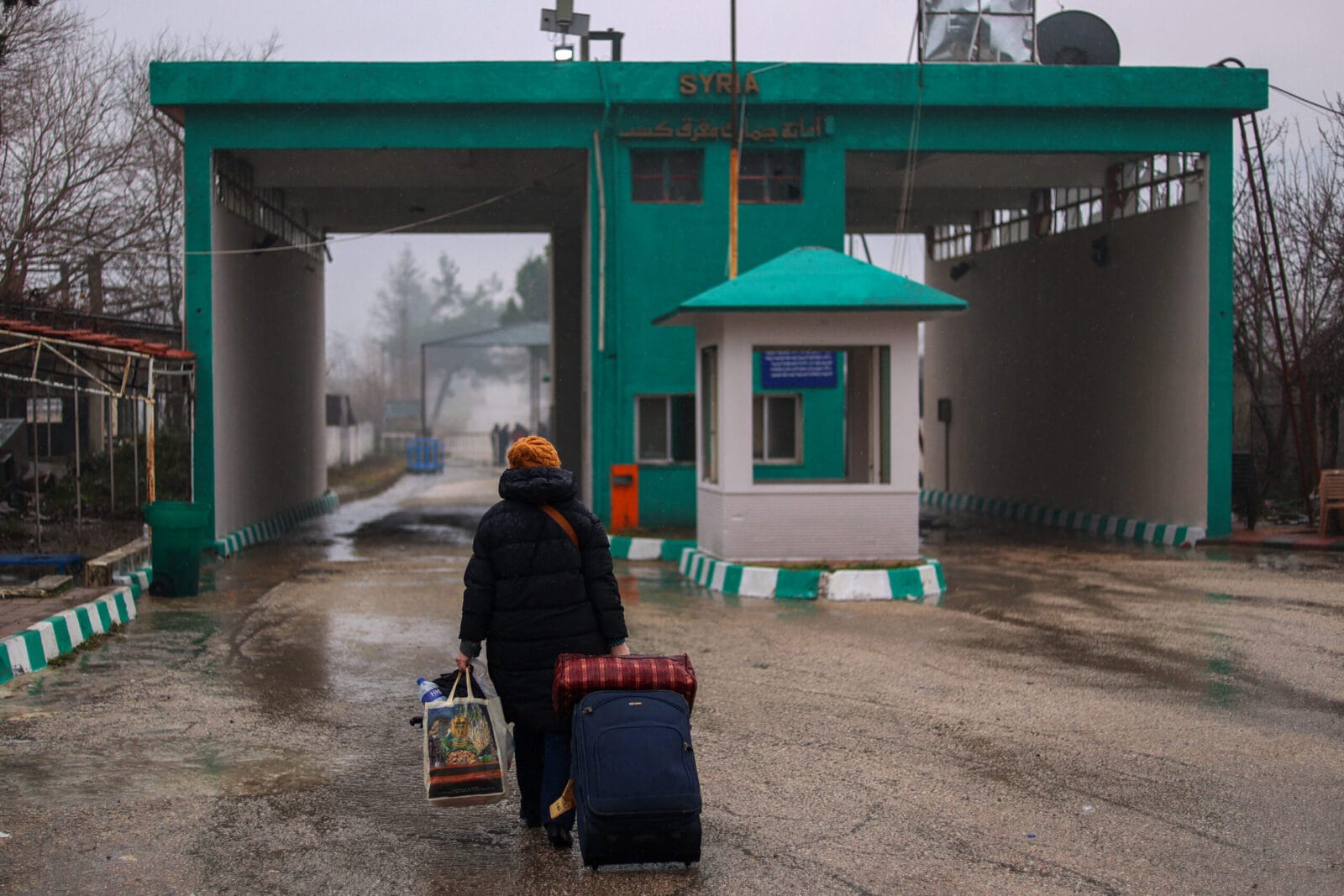
A woman crosses into Syria from Turkey through the Kassab crossing on December 27, 2024\. Aaref Watad/AFP via Getty Images
Wrapped in blankets and clutching their children and possessions, they waited in anticipation, some having camped overnight by the barriers.
Turkish government and pro-government media quickly hailed these scenes as a humanitarian milestone after a 13-year war. Interior Minister [Ali Yerlikaya announced](https://www.turkiyetoday.com/turkiye/turkiye-facilitates-voluntary-return-of-over-52000-syrians-in-december-2024-103393/) at the border that over 52,000 Syrians had “voluntarily, safely, and honorably” returned—his words reflecting the official narrative of dignified return. President [Recep Tayyip Erdoğan, addressing](https://apnews.com/article/turkey-syrian-refugees-return-border-crossing-b0559be5103a7ef505e7206477f9db04) the nation, added, "As Syria gains more stability, God willing, voluntary, safe and honorable returns will increase."
On the surface, the occasion appeared to mark a celebratory end to displacement, a final tableau of relief and resolution. Yet, behind this carefully staged tableau lies a [coercive infrastructure](https://tcf.org/content/commentary/turkey-welcomed-syrian-refugees-now-deporting-war-zone/) of refugee deportations that has been years in the making, legally codified, digitally surveilled and internationally subsidized.
Migrant deportation in Turkey is not a deviation from legal order but one of its core functions: a mode of governance that binds domestic authoritarianism to transnational systems of migration control. Through the Law on Foreigners and International Protection (LFIP) and the Temporary Protection Regulation (TPR), Turkey has constructed a legal regime that mimics humanitarian norms while enabling mass removals based on vague criteria like “public order” or “morality.” Following the 2016 coup attempt and the ensuing legal reforms, migrant removal has become an executive tool wielded with minimal oversight.
Today, it is clear that these practices are not confined to Turkey. Across [Europe](https://www.merip.org/content/files/media/1321/deportation-union.pdf), the [Gulf](https://www.hrw.org/news/2023/03/15/uae-arbitrarily-detained-afghans-stuck-limbo) and increasingly the United States, migration law is being redeployed to manage migrants through coercive forms of return. This shift effectively transforms return—one of the [durable solutions](https://www.unhcr.org/us/sites/en-us/files/legacy-pdf/5846d10e7.pdf) to displacement outlined by the United Nations High Commissioner for Refugees (UNHCR) since the 1951 Refugee Convention—into a mechanism of punishment, containment and geopolitical leverage. What unites these regimes is the normalization of removability (through the threat of deportation) as a condition of life, especially for those who are [Arab](https://www.hrw.org/report/2021/10/20/our-lives-are-death/syrian-refugee-returns-lebanon-and-jordan), [Muslim](https://www.amnesty.org/en/documents/asa11/6866/2017/en/) or from the [Global South](https://www.merip.org/content/files/wp-content/uploads/2025/02/346%5Freturn%5Fmigration%5Fand%5Freintegration%5Fkey%5Fmessages5.pdf). Legality in this context is neither static nor neutral but a racialized and politicized condition: Its very revocability reveals that it is contingent on state decisions on whether certain migrants are desirable or not.
## **Expanding Infrastructures of Deportation**
The expansion of Turkey’s deportation infrastructure is an outcome of intertwined national reforms and international incentives. Following the passage of the Law on Foreigners and International Protection ([LFIP](https://www.merip.org/content/files/mevzuatmetin/1-5-6458.pdf)) in 2013 and the Temporary Protection Regulation ([TPR](https://www.merip.org/content/files/MevzuatMetin/21-5-20146883.pdf)) in 2014, Turkey established an asylum framework that, unlike most states in Southwest Asia, formally codified rights to asylum and international protection. The LFIP outlines procedures for refugees, asylum seekers and undocumented migrants, while the TPR introduces a collective protection regime specifically for Syrians arriving after 2011.
These laws were widely celebrated by EU institutions as signs of Turkey’s progress toward entering the European Union. But in practice, they also established a vast discretionary enforcement regime. The LFIP authorizes deportation for a wide range of administrative violations, including overstaying a visa or failing to maintain valid residence documentation.[\[1\]](#%5Fedn1) Deportation can be initiated not on the basis of a criminal conviction, but for broadly defined threats to “public order,” “public morality” or “national security.”[\[2\]](#%5Fedn2) Articles 33–35 and 50 of the TPR impose strict reporting duties on Syrians, including address registration, income disclosure and the collection and international sharing of personal and biometric data. Non-compliance can lead to legal sanctions, loss of protection and forced relocation.
> **In the years following the 2016 coup attempt, Turkey systematically expanded executive authority over migration governance, eroding legal safeguards and redefining conditions of migrant removal through a series of legal and institutional reforms**.
In the years following the 2016 coup attempt, Turkey systematically expanded executive authority over migration governance, eroding legal safeguards and redefining conditions of migrant removal through a series of legal and institutional reforms. President Erdoğan issued [an emergency decree](https://www.resmigazete.gov.tr/eskiler/2016/10/20161029-5.htm), which amended the LFIP to remove the automatic suspension of deportation during appeals for individuals deemed threats to public order or national security.
After the 2017 constitutional referendum, the Presidency of Migration Management (PMM), formerly the Directorate of Migration Management, was placed directly under the president’s office, consolidating executive control over migrant registration, detention and deportation. In 2018, the Turkish Grand National Assembly passed a [law](https://normkararlarbilgibankasi.anayasa.gov.tr/ND/2018/63) further amending the LFIP to permit deportations based on alleged links to terrorism and restrict legal safeguards, including lawyer access and attorney-client confidentiality.
These reforms directly undermined protections formally codified in LFIP Article 55 and TPR Article 6\. Both articles had enshrined the principle of non-refoulement (prohibiting forcible return to a country deemed unsafe) in line with Turkey’s international obligations according to the UN Refugee Convention and European Convention on and Human Rights. Removal decisions are easily issued by provincial directorates of migration management under the Ministry of the Interior, often in coordination with centrally appointed governors.
While deportation orders can still be appealed in administrative court, judicial independence has been severely weakened since the post-coup purges of thousands of judges and prosecutors, and courts often defer to executive priorities. As a result, these legal protections are routinely bypassed by provincial migration authorities and security forces, with courts rarely intervening even in cases involving clear violations.
This domestic legal apparatus cannot be divorced from Turkey’s evolving entanglement with European migration and border control policies. Since Turkey’s EU candidacy was granted in 1999, Turkey has faced sustained pressure to align its asylum and border governance with European priorities. Between 2011 and 2023, the European Union disbursed nearly €10 billion to Turkey for migration governance, with the [2016 EU–Turkey Statement](https://eur-lex.europa.eu/legal-content/EN/TXT/?uri=celex%3A22014A0507%2801%29) marking a pivotal shift in this alignment: In exchange for €6 billion in aid, Turkey agreed to contain Syrian refugees within its territory, accept returns from the European Union and expand its deportation and detention infrastructure.
By 2021, European institutions had officially designated Turkey as a [safe third country](https://asylumineurope.org/reports/country/greece/asylum-procedure/the-safe-country-concepts/safe-third-country/), allowing the European Union to send asylum seekers back to Turkey, despite mounting evidence of coercive returns. [Meanwhile](https://www.lighthousereports.com/investigation/turkeys-eu-funded-deportation-machine/), nearly €1 billion was given to Turkey specifically to help manage the flow of people across its borders, with over €213 million allocated for the construction and maintenance of removal centers.
In the ensuing years, biometric surveillance has intensified. In 2022, Turkey launched a [National Biometric Data Management System](https://www.biometricupdate.com/202201/turkeys-domestically-developed-biometric-data-system-becomes-operational) that stores fingerprints, iris scans and facial recognition data for both citizens and non-citizens. Migration Control teams now conduct routine ID checks in metro stations, bus terminals and markets. These records feed into [GöçNet, an EU-supported digital surveillance system](https://newlinesmag.com/reportage/inside-turkeys-eu-funded-deportation-machine/), that provides real-time access to field enforcement units. In 2023 alone, over 286,000 people were subjected to [on-the-spot checks](https://fluchtforschung.net/gatekeeping-for-europe-tuerkiyes-tech-driven-migration-management); more than 61,000 were funneled into deportation proceedings, often without access to legal counsel or interpretation.
Removal centers have become the backbone of this system. In 2015, Turkey operated a dozen facilities with [2,980 beds](https://www.merip.org/content/files/sites/default/files/migrated/project%5Freport%5Ffinal%5Fcopy.pdf). [By 2022](https://dtm.iom.int/sites/g/files/tmzbdl1461/files/reports/MPM%5FTUR%5FAnnual%5FReport%5F2023.pdf), there were over 30 centers across 13 provinces, with[ 20,540 beds](https://bianet.org/haber/turkiye-records-highest-number-of-deportations-in-2022-271979#google%5Fvignette), surpassing the combined detention capacity of the entire European Union. These centers not only process deportations, but function as [legal gray zones](https://asylumineurope.org/reports/country/turkiye/detention-asylum-seekers/detention-conditions/conditions-detention-facilities/)**.** [Human rights groups](https://www.hrw.org/news/2022/10/24/turkey-hundreds-refugees-deported-syria) and the [Turkish Bar Association](https://www.merip.org/content/files/2024/20240810g%5Fc3%5Fb6cveiltica.pdf) report routine coercion, especially forced signatures on voluntary return forms under threat of violence or separation.
In 2022, the [PMM reported](https://www.goc.gov.tr/sinir-disi-119817) 119,817 deportations and boasted a 70 percent deportation-to-apprehension “success rate,” claiming it was seven times higher than the EU average.[\[3\]](#%5Fedn3) In 2025, Interior Minister [Ali Yerlikaya declared](https://www.goc.gov.tr/icisleri-bakani-yerlikaya-turkiye-goc-yonetiminde-dunyaya-model-ulke) that no other country matched Turkey’s biometric infrastructure or “deportation efficiency,” praising mobile fingerprinting vans and centralized digital registries as emblems of national “security leadership.”[\[4\]](#%5Fedn4)
Together, these developments reveal that Turkey’s deportation regime is neither accidental nor exceptional; it is the outcome of deliberate legal engineering, institutional centralization and transnational incentives. Built on the scaffolding of the LFIP and TPR, the system grants sweeping discretionary powers to governors, migration authorities and law enforcement, enabling removal not only for administrative violations but for vaguely defined threats to public order or morality. From biometric surveillance and mass ID checks to the expansion of removal centers, deportation has become both a bureaucratic routine and a spectacle of state power, legitimized by the very legal and humanitarian frameworks once celebrated as progress.
## **The Everyday Life of Removability**
During my ethnographic fieldwork between 2017 and 2023 in migrant-led community centers and human rights organizations in Istanbul and border towns across southeastern and northwestern Turkey, I observed how Turkey’s increasingly centralized and discretionary deportation regime was routinely leveraged by migration officials, police and provincial governors to justify the targeting of [urban poor](https://www.theguardian.com/world/2019/jul/29/syrian-refugees-in-beirut-and-istanbul-detained-and-deported), [LGBTQ+ individuals](https://guardiansgem.org/deportation-of-syrian-lgbtqia-refugees-from-turkey-go-to-syria-and-die-there/) and [politically active](https://tsosrefugees.org/stories/lgbtq-activist-risks-arrest-and-deportation-to-help-other-refugees) [refugees](https://iranhumanrights.org/2023/12/activists-seeking-refuge-in-turkey-face-deportation-severe-persecution-in-iran/).
In 2019, Istanbul’s then-governor Ali Yerlikaya (now Minister of Interior) [announced](http://www.istanbul.gov.tr/duzensiz-goc-kayitsiz-suriyeliler-kayit-disi-istihdam-basin-aciklamasi) that all Syrians unregistered in the city would be expelled. Police launched sweeping operations in working-class neighborhoods, detaining over [6,000 refugees](https://www.aljazeera.com/news/2019/7/24/turkey-6000-refugees-arrested-in-istanbul-crackdown) within 12 days. While official statements referred to “repatriation centers,” many were [quietly deported](https://www.amnesty.org/en/documents/eur44/1102/2019/en/) across the border. Human rights organizations [documented](https://www.hrw.org/news/2019/10/24/turkey-syrians-being-deported-danger) forced signatures on “voluntary return forms.” Some were denied the chance to read the forms they were coerced into signing. Others were beaten or threatened with never seeing their families again if they refused to comply.
This system of punitive mobility intensified in early 2020\. Amid escalating tensions with the European Union and domestic outrage over Turkish military casualties in Idlib, President Erdoğan [declared](https://www.theguardian.com/global-development/2020/may/08/erdogan-turkey-refugees-pawns-game) Turkey’s land border with Greece open. In the midst of the COVID-19 pandemic, thousands were bused to Edirne, a border city in northwestern Turkey, bordering Greece and Bulgaria, often without clear consent or [information](https://www.gazeteduvar.com.tr/gundem/2020/03/04/ankara-barosu-avukatlari-multeciler-zorla-sinira-tasiniyor). In an effort to pressure Europe into security and aid concessions, migrants were forced into movement and then corralled by riot police, detained in isolated quarantine camps or involuntarily transferred to removal centers. Journalists, academics and NGOs attempting to document and assist migrants at the border [reported](https://www.thenewhumanitarian.org/analysis/2020/03/04/refugees-greece-turkey-border) harassment and obstruction from authorities, hindering their efforts to provide humanitarian assistance.
> **Under the Interior Ministry’s so-called Operation Kalkan, over 141,000 deportations were** [**executed**](https://www.turkeyrecap.com/p/taking-a-harder-stance-on-migration) **in one year, more than 100,000 of them Syrian nationals.**
These spectacular moments were not anomalies. By 2023, public deportations had become institutionalized. Under the Interior Ministry’s so-called Operation Kalkan, over 141,000 deportations were [executed](https://www.turkeyrecap.com/p/taking-a-harder-stance-on-migration) in one year, more than 100,000 of them Syrian nationals. Removals were often choreographed in public: ID checks at bus terminals, raids on apartment buildings, sudden police sweeps in markets. Such acts destabilize migrants’ daily lives, keeping them in a state of constant uncertainty and forced hyper-vigilance, mobility and adaptation.
But the public spectacle is only one form of control. Turkish migration authorities and security forces have also enacted more insidious mechanisms to entrap migrants in legal and territorial limbo. Nadira, a Syrian woman I met in Istanbul, recounted how her brother-in-law was detained while commuting from Istanbul to his job, despite having a valid registration appointment in Bursa, a city just a couple of hours away. Under the TPR, such inter-provincial movement without permission violates legal conditions. He was denied legal counsel, pressured to sign a voluntary return form and deported. “He’s gone,” Nadira texted me. “His wife and children are left without a breadwinner.” In subsequent failed attempts to return to his family, he faced extortion by smugglers and arrests in Syria. As Elana Zilberg writes in the context of Central American migrants, such spiraling cycles of removal and return represent “forced transnationality”—where return is not a resolution but a recursive violence.[\[5\]](#%5Fedn5)
Moreover, these tactics do not only target Syrians. In 2022, over 66,000 Afghans were [deported](https://www.goc.gov.tr/sinir-disi-119817), often without due process. Afghan men were [beaten](https://www.hrw.org/report/2022/11/18/no-one-asked-me-why-i-left-afghanistan/pushbacks-and-deportations-afghans-turkey) until they signed voluntary return forms. A former special forces commander was deported overland through Iran in 2023 and [executed](https://www.politico.eu/article/the-eu-is-helping-turkey-forcibly-deport-migrants-to-syria-and-afghanistan/) by the Taliban.
For these refugees who should be legally protected from forced return deportation is a renewed act of violence. For others who remain, it governs the architecture of daily life. Migrants learn to self-regulate by avoiding certain buses, staying indoors or keeping ID documents taped inside clothing, knowing that deportation may come not with a raid, but from a landlord’s or employer’s tip-off, a mismatch in address registration or a missing biometric update.
In Istanbul neighborhoods like Sultanbeyli and Esenyurt, I observed how displaced communities from Syria, Afghanistan, Iraq, Palestine and Yemen adapted to these conditions: shaving beards, adopting local hairstyles, suppressing native language in public and avoiding hospitals unless critically ill. One Afghan woman explained that she feared her undocumented husband would be detained at the hospital entrance if she went into labor there. A Syrian woman, fearing moral judgment and bureaucratic scrutiny that might have led to her deportation, chose to have an abortion at an unlicensed refugee-initiated clinic. Their fears were not unfounded: In one case, [a Syrian trans woman](https://www.theguardian.com/global-development/2019/aug/23/its-not-legal-un-stands-by-as-turkey-deports-vulnerable-syrians) was deported after seeking hospital care for her undocumented partner.
Today, as Turkish authorities and pro-government media revive the language of “voluntary return” following Asad’s downfall, the fear of removal persists. It is embedded in municipal databases, digital surveillance and everyday encounters with the state.
## **From Istanbul to Boston**
On March 25, 2025, Rümeysa Öztürk, a Turkish doctoral student on an F-1 visa, was en route to an iftar dinner in Boston when masked ICE agents apprehended her. Her alleged offense was not criminal but ideological: co-authoring a campus op-ed criticizing US foreign policy and her university’s financial ties to the Israeli military. Within hours, she was transported to a remote detention center in Louisiana.
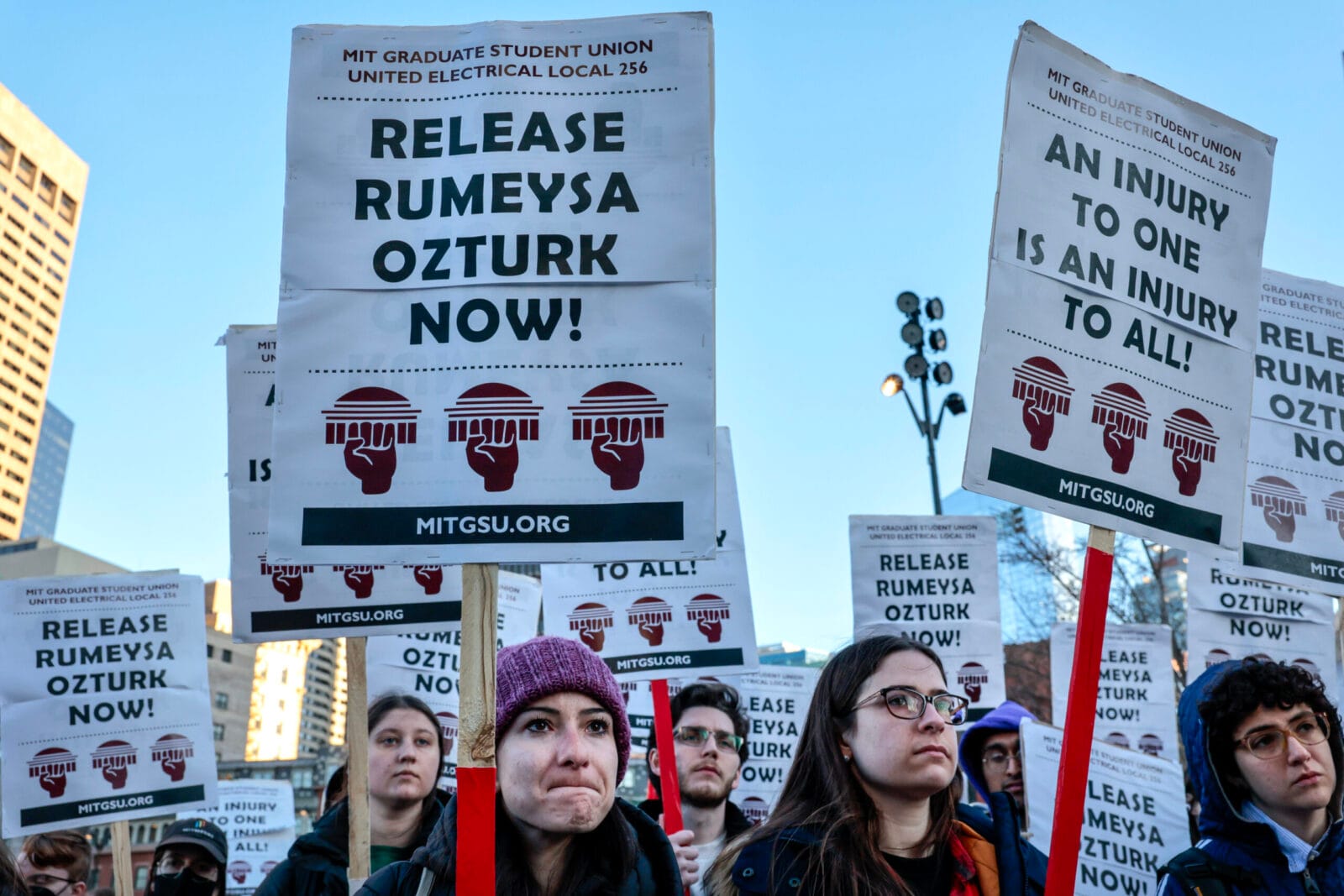
Members of the MIT Graduate Student Union demonstrate outside the John F. Kennedy Federal Building on April 1, 2025 to demand the Trump administration cease attacks on the 1st Amendment and immediately release union members, including Tufts graduate student Rumeysa Ozturk. Craig F. Walker/The Boston Globe via Getty Images
Over the next six weeks, Öztürk’s case sparked an outcry, not only among activists but across Turkish state-aligned media outlets, which framed her as a heroic victim of US repression. The irony was striking. [*Yeni Şafak*](https://www.yenisafak.com/dunya/hacli-rubio-rumeysayi-hedef-aldi-4689626), a pro-government newspaper condemned the US government for targeting students and academics participating in campus intifadas, citing Canadian human rights lawyer Amina Sherazee who wrote that the United States’ mask of freedom has fallen. Another pro-government newspaper [*Sabah*](https://www.sabah.com.tr/dunya/abdde-gozaltina-alinan-turk-ogrenci-rumeysa-ozturk-davasinda-yeni-gelisme-hicbir-gerekce-sunamadilar-7347912) condemned ICE for detaining a student “without a shred of evidence.”[\[6\]](#%5Fedn6) Yet another one, [*Türkiye*](https://www.turkiyegazetesi.com.tr/dunya/rumeysa-ozturke-gozaltinda-iskence-gibi-muamele-fareli-kogusta-tutuluyor-astim-krizine-ragmen-temiz-hava-verilmiyor-1113615), critiqued the inhumane detention conditions of Öztürk especially referring to her severe asthma attacks.
Meanwhile, since the 2013 Gezi Park protests, Turkey has repressed dissent by [deporting foreign protesters](https://www.hurriyetdailynews.com/7-foreign-nationals-detained-for-alleged-role-in-gezi-park-protests-48313) and quietly [removing Uyghur refugees](https://www.merip.org/content/files/sites/default/files/2022-06/transnationalrepressionreport2022%5Fcasestudy%5Fturkey%5Fv2.pdf) under pressure from China. It has also purged academics who signed the “[Academics for Peace](https://t24.com.tr/haber/baris-icin-akademisyenlerin-1128-imzayla-acikladigi-bildirinin-tam-metni,324471)” petition, routinely targeted protesting students and faculty at universities like Boğaziçi and detained demonstrators following Istanbul Mayor Ekrem İmamoğlu’s arrest in March 2025—including chronically ill student [Esila Ayık](https://www.birgun.net/haber/esila-ayik-ve-2-ogrenci-hakkinda-tahliye-karari-623098) for holding a protest sign that read “Dictator Erdoğan.” These targets, like Öztürk, were non-criminal and yet faced serious consequences for being merely politically inconvenient.
A Vermont federal judge eventually ordered Öztürk’s release, citing both medical harm and constitutional violations. “Her continued detention potentially chills the speech of the millions and millions of individuals in the country who, like Öztürk, are not U.S. citizens,” [said](https://www.aol.com/news/judge-orders-tufts-grad-student-191709736.html) Judge William K. Sessions III.[\[7\]](#%5Fedn7) But Öztürk’s ordeal is far from over. Her visa remains revoked. She still faces removal. For now, she has returned to Massachusetts under community supervision, uncertain if she will be allowed to complete her PhD.
> **Similar to the Turkish context, Öztürk’s case underscores a deeper truth about US immigration law: Legality is provisional, politically contingent and revocable...**
Similar to the Turkish context, Öztürk’s case underscores a deeper truth about US immigration law: Legality is provisional, politically contingent and revocable, shaped by administrative discretion and geopolitical priorities. Critical legal scholar Daniel Kanstroom has described it as “post-entry social control:” a mode of governance whereby lawful entry offers no guarantee of durable membership.[\[8\]](#%5Fedn8) Migrants remain subject to bureaucratic review, ideological vetting and targeted removal.
The legal architecture of post-entry social control has a long and ever-expanding history based on retroactive and indefinite scrutiny of beliefs, associations and presumed loyalties depending on ideological priorities of the United States at a given time. For example, the Alien Enemies Act of 1798—originally authorizing wartime removals based on national origin—helped codify removals grounded not in individual conduct but in collective suspicion and presumed allegiance, a logic the [Trump administration has recently attempted to revive](https://www.whitehouse.gov/presidential-actions/2025/03/invocation-of-the-alien-enemies-act-regarding-the-invasion-of-the-united-states-by-tren-de-aragua/). Later, the [Immigration Act of 1918](https://www.merip.org/content/files/storage-services/service/gdc/gdclccn/22/01/90/16/22019016/22019016.pdf) enabled the detention and deportation of foreign-born people not for specific actions but for political affiliations or speech, a practice expanded during the McCarthy era to target communists and other ideological threats.[\[9\]](#%5Fedn9) After the September 11 attacks in 2001, the USA PATRIOT Act (2001) and the REAL ID Act (2005) amended the Immigration and Nationality Act to allow deportation not for criminal conviction but on the government’s “reasonable ground to believe” that a person has endorsed or associated with terrorism.[\[10\]](#%5Fedn10) These provisions created a regime of permanent revocability, allowing removal for beliefs or affiliations that may be illusory, decades old or formed under coercion.
More recently, Trump-era officials have wielded immigration law to discipline dissent through vague claims of foreign policy harm. In March 2025, Mahmoud Khalil—a Palestinian-born US green card holder—was detained on the rarely used grounds of activities presenting “potentially serious adverse foreign policy consequences.”[\[11\]](#%5Fedn11) An immigration judge [upheld the deportation order](https://www.cbsnews.com/news/mahmoud-khalil-immigration-judge-deportation-columbia-protester/) based solely on this determination, despite the absence of any criminal charges. Khalil secured a temporary stay through a [federal court](https://www.aclu-nj.org/en/press-releases/mahmoud-khalils-lawsuit-can-move-forward-federal-court-judge-finds).
These dynamics mirror those in Turkey, where vague legal terms like “public order,” “foreign policy harm” and “reasonable belief” are similarly used to police dissent and normalize deportation. Deportation thus becomes a tool of governance to target migrants based on shifting ideological priorities. As Nyki Duda [has observed](https://jacobin.com/2025/04/far-right-history-trump-self-deportation), far-right and nationalist regimes increasingly rely not only on mass removals, but also on the production of unlivable conditions that compel migrants to either constantly adapt or leave. In both contexts, deportation functions less as a discrete act than as the slow attrition of rights, protections and dignity, governing not only those expelled but also those who remain.
Originally envisioned as a legal promise of restoration, from Istanbul to Boston, migrant return has been stripped of its protective function and recast as a bureaucratic choreography of removal. It is administered precisely where return remains unsafe and denied to those who have waited generations. Meanwhile, Palestinians, who have endured decades of exile under the unfulfilled promise of United Nations Resolution 194, are denied return. Their claims are not only dismissed but actively ridiculed, as in the dystopian spectacle of AI-generated “[Trump Gaza](https://www.theguardian.com/technology/2025/mar/06/trump-gaza-ai-video-intended-as-political-satire-says-creator)” that President Trump circulated on social media.
What distinguishes the United States from Turkey, for now, is the persistence of institutional friction. Despite its flaws, the United States retains procedural layers like immigration courts, federal judicial review, media scrutiny and occasional congressional oversight. These mechanisms do not prevent the use of immigration law to punish dissent, but they can delay it, challenge it and, at times, make it visible.
> **Read the** [**previous**](https://merip.org/2025/06/unpacking-the-gender-paradox-behind-arab-women-in-tech) **article.**
> **Read the** [**next**](https://www.merip.org/sami-zubaida/) **article.**
**This article appears in** [**MER issue 314**](https://merip.org/magazine/314/) **“New Gender Frontlines.”**
\[**Fulya Pınar** is an assistant professor of Anthropology at Middlebury College.\]
---
### **Endnotes**
[\[1\]](#%5Fednref1)[LFIP](https://www.mevzuat.gov.tr/mevzuat?MevzuatNo=6458&MevzuatTur=1&MevzuatTertip=5) Articles 54(1)(d), (h), and (i))
[\[2\]](#%5Fednref2) Ibid, (LFIP Article 54(1)(d-f); [TPR](https://www.merip.org/content/files/kurumlar/goc-gov-tr/evraklar/mevzuat/gecici-koruma.pdf) Article 8(1)(e)).
[\[3\]](#%5Fednref3) "[Sınır Dışı Sayısında Artış Devam Ediyor: 119.817 Düzensiz Göçmen Sınır Dışı Edildi](https://www.goc.gov.tr/sinir-disi-119817)," Göç İdaresi Başkanlığı, December 12, 2022.
[\[4\]](#%5Fednref4) "[İçişleri Bakanı Ali Yerlikaya: 'Türkiye, Göç Yönetiminde Dünyaya Model Ülke,'](https://www.goc.gov.tr/icisleri-bakani-yerlikaya-turkiye-goc-yonetiminde-dunyaya-model-ulke)" Göç İdaresi Başkanlığı, April 16, 2025.
[\[5\]](#%5Fednref5) Elana Zilberg, “Fools Banished from the Kingdom: Remapping Geographies of Gang Violence between the Americas (Los Angeles and San Salvador),” *American Quarterly* 56/3 (September 2004), pp. 759–779, at 762.
[\[6\]](#%5Fednref6) "[ABD'de, Filistin'e destek verdiği gerekçesiyle gözaltında tutulan Tufts Üniversitesi doktora öğrencisi Rümeysa Öztürk'ün temyiz davasında, hükümetin avukatları gözaltı için herhangi bir gerekçe sunamadı](https://www.sabah.com.tr/dunya/abdde-gozaltina-alinan-turk-ogrenci-rumeysa-ozturk-davasinda-yeni-gelisme-hicbir-gerekce-sunamadilar-7347912),” *Sabah,* May 6, 2025.
[\[7\]](#%5Fednref7) C. J. Ciaramella, "[Judge Orders Tufts Grad Student Rumeysa Ozturk Be Released on Bail from Immigration Detention](https://www.aol.com/news/judge-orders-tufts-grad-student-191709736.html)," *AOL News*, May 9, 2025.
[\[8\]](#%5Fednref8) Daniel Kanstroom, *Deportation Nation: Outsiders in American History* (Cambridge, MA: Harvard University Press, 2007), p. 6.
[\[9\]](#%5Fednref9) [Internal Security Act of 1950, §22, 64 Stat. 987](https://www.merip.org/content/files/content/pkg/STATUTE-64/statute-64-pg987.pdf).
[\[10\]](#%5Fednref10) [INA §212(a)(3)(B)](https://www.law.cornell.edu/uscode/text/8/1182), codified at 8 U.S.C. § 1182; [INA §237(a)(4)(B),](https://www.law.cornell.edu/uscode/text/8/1227) codified at 8 U.S.C. § 1227.
[\[11\]](#%5Fednref11) Ibid. [INA § 237(a)(4)(C)(i).](https://www.law.cornell.edu/uscode/text/8/1227)
### Unpacking the Gender 'Paradox’ Behind Arab Women in Tech
URL: https://www.merip.org/2025/06/unpacking-the-gender-paradox-behind-arab-women-in-tech/
Last updated: 2025-10-21T21:33:05.000Z
Compared to women in the United States and most European countries, Arab women are highly represented in Information and Communication Technology (ICT) and related computing fields.
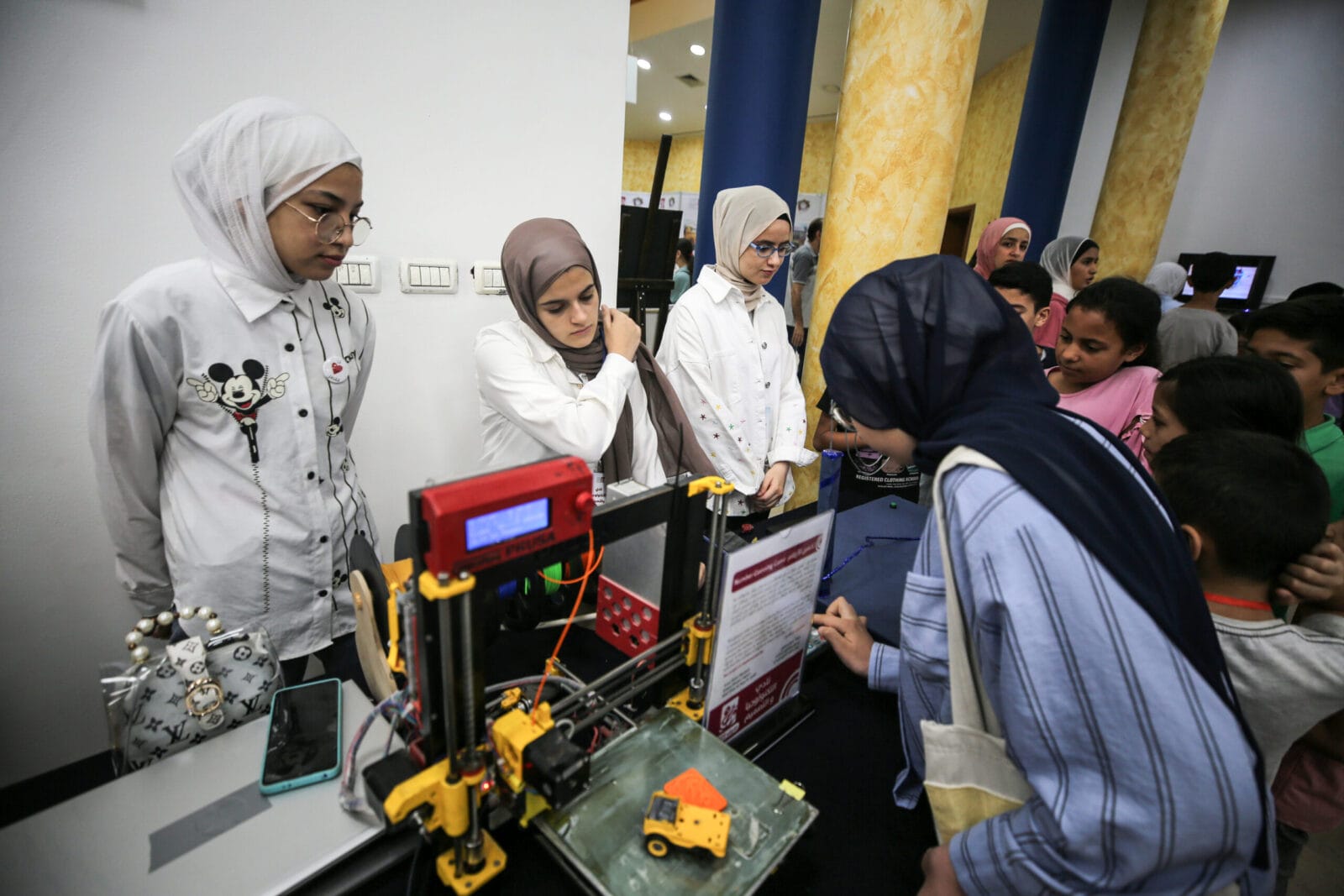
Palestinian students take part in Science Days Palestine at Al-Qattan Cultural Center in Gaza City on August 21, 2023\. (Majdi Fathi/NurPhoto via Getty Images)
In fact, six of the ten countries with the highest rates of women studying ICT are in the Arab world, according to [UNESCO data](https://www.merip.org/content/files/reports/science/2021/sites/default/files/medias/fichiers/2022/08/chapter-3%5Ftable-3-1.pdf).
This disparity has not gone unnoticed by researchers, specifically in the field of psychology, who have labeled it a “gender-equality paradox.” That was the phrase used in a 2018 study published in *Psychological Science*, which attempted to explain why women pursue STEM fields in greater numbers in countries with less “gender equality,” according to measures like the [World Economic Forum’s Gender Gap Index](https://www.weforum.org/publications/global-gender-gap-report-2024/).[\[1\]](#%5Fedn1) The author’s conclusion: “low prospects for a satisfied life may be an incentive for girls to focus more on science in school and, as adults, choose a career in a relatively higher paid STEM field.”[\[2\]](#%5Fedn2) In other words, women only pursue STEM careers because the odds are stacked against them.
Setting aside the issues with gender equality measures used in these studies—which often overemphasize paid employment and indirectly devalue female-dominated fields—framing the outcome as a paradox obscures women's agency and the diversity of their experiences across both global South and global North contexts.
Curious about the relative success of Arab women in pursuing computer degrees, in 2017 we put together an interdisciplinary team of researchers to design and carry out a targeted survey of members of the organization [Arab Women in Computing](https://arabwic.org/). 521 students, academics and practitioners working in the computing and tech fields, representing 17 Arab nationalities, responded. The study was supplemented by in-depth, open-ended interviews with 27 women at various stages in their careers.
Rather than starting with flawed metrics of gender inequality, centering Arab women’s own experiences and trajectories in computing and technology reveals a wide range of reasons for their participation in these fields. While economic opportunity mattered, more important were a desire for personal growth, independence and, above all, a desire to improve their societies. This richer and more positive set of motivations challenges reductive explanations that focus solely on economic factors and reproduce Orientalist assumptions about the condition of women in the region.
## **Global Trends in Education**
For the past two decades, female students in the Arab world have outperformed their male counterparts on global standardized tests of math and science abilities.
Two prominent exams are used to track global rankings in STEM at the K-12 level: the Trends in International Mathematics and Science Study (TIMSS, a standardized test first administered in 1995 to fourth and eighth graders in more than 40 countries) and the Programme for International Student Assessment (PISA, a test of math, reading and science literacy for 15-year-olds first administered in 2000 by the OECD). For decades, these tests and their global rankings have functioned as a measure of educational progress around the world, especially in math and science, in what some have termed the educational [“race to the top.”](https://www.sciencedirect.com/science/article/abs/pii/S0738059323002407) Like all standardized tests, these assessments have their ideological baggage and unintended effects. But their power has become so pervasive in educational policy circles that some countries have organized their curricular timelines and educational goals around the goal of achieving higher national rankings.[\[3\]](#%5Fedn3)
> **In the Middle East, these tests have become a proxy for educational quality...Since they were first administered in the region, girls have outperformed boys in math and science in the overwhelming majority of Arab countries.**
In the Middle East, these tests have become a proxy for educational quality, and the gendered patterns in math and science have surprised researchers. Since they were first administered in the region, girls have outperformed boys in math and science in the overwhelming majority of Arab countries. For example, in 2019 the [TIMSS test ](https://timss2019.org/reports/achievement/index.html)was administered in 68 countries. In eighth grade science, girls outperformed boys in only 15 countries—eight of them were Arab, and the list also included Turkey and Iran. In math, girls outperformed boys in seven countries, five of them Arab with Iran included again.
Beyond K-12 testing, Arab women also pursue post-secondary STEM degrees at some of the highest rates globally. In OECD countries, women, on average, represent [slightly less than a third](https://world-education-blog.org/2024/04/25/new-uis-data-show-that-the-share-of-women-in-stem-graduates-stagnant-for-10-years/) of those who enter STEM fields.[\[4\]](#%5Fedn4) And when it comes to specific fields, these discrepancies become even more pronounced.[\[5\]](#%5Fedn5) For example, Europe has the lowest numbers of female graduates in ICT (compared to the Middle East and North Africa, which leads globally).
Computer science and information sciences saw the share of female graduates in the United States rise to around a third in the 1980s with a high of 37.1 in 1983–1984\. Subsequently, the rate declined for over two decades, to a low of 17.6 in the early 2000s. This trend has been slow to reverse in the 2010s, despite over two decades of interventions aimed at increasing the numbers. By 2021–2022 the rate had crept up slightly to 22.6 percent.[\[6\]](#%5Fedn6) The underrepresentation of women computer scientists in the United States is particularly notable given that tech has dominated the country’s economic landscape over the past two decades, leading to an explosion in jobs.
Western European countries do not fare better. Europe has some of the lowest rates of female achievement in ICT globally. According to data gathered by the OECD in 2014, European women on average earned less than 20 percent of the bachelor’s degrees in computer science in ten of the 12 European countries for which data was gathered. The only exceptions were Portugal and Sweden.[\[7\]](#%5Fedn7)
In the Arab world, the picture is strikingly different. According to our data, women represented at least a third of undergraduates enrolled in computer science across a range of fields, including computing, applied computing, artificial intelligence, computer application development and software development—and the numbers were typically higher. While their participation did vary from year to year, countries as diverse as Egypt, Jordan, Saudi Arabia and the UAE had relatively high rates of enrollment across multiple years.
## **Beyond Deficit Thinking**
The gender equality paradox imposes deficit thinking to explain why the disparities and inequalities in the Global North are not found elsewhere in the world. But understanding Arab women’s participation in STEM fields in terms of what is lacking in their societies erases their perspectives and reinforces stereotypes of women in the region as passive and oppressed. Instead, a number of structural and individual factors drive women’s participation.
One of these factors is tracking. A number of Arab countries have some kind of tracking system in place that creates a pipeline through which students who have strong quantitative skills are tracked into STEM fields. Though rates of tracking vary by country, the majority of women in our sample were tracked into math and science for secondary education.
But tracking doesn't explain the high prevalence of women in ICT and computing, specifically. Students with strong quantitative skills have many choices when it comes to completing secondary degrees in math and/or science. As such, to assume that tracking fully explains why Arab women are more likely to end up studying computing or ICT ignores the degree of personal agency that many women articulated: 81.5 percent of our survey respondents said their own preferences was the most important factor shaping their enrollment in an ICT or computing program.
While individual choice was an overwhelming factor explaining their decisions, many women also discussed the positive roles that families, teachers and mentors played in encouraging them to pursue computing and ICT. Amira, a tech entrepreneur from Saudi Arabia, who started in pre-med but then decided to transition into computing, for example, explained, “While I was pre-med \[my father\] encouraged me to take computer science classes, because he said it was the wave of the future.”
When women recounted situations where their family members discouraged them from studying computing, often this hesitance was because individuals were less familiar with the field and hoped that their daughters would pursue other careers in STEM such as medicine or pharmacology. Rania, an entrepreneur from Lebanon laughed when she explained that her father regretted that she was studying engineering rather than medicine. “I told my father I could not look at blood,” she said. Later in the interview she went on to explain the supportive role he had played vis-a-vis her entrepreneurial ambitions.
## **Transitioning from School to Work**
The Arab region has among the lowest rates of paid female employment globally. But the data show a very different pattern for women with high levels of education. While the overall labor force participation rate of Arab women is only 18 percent, among those with post-secondary education, the rates range from a low of 24 percent in Sudan to a high of 74 percent in Tunisia, with many countries clustered around 60 percent—just a few percentage points below the US rate of 68 percent.[\[8\]](#%5Fedn8) Certainly employment was a major aim of most if not all of our interviewees.
In a region where youth unemployment rates are unfortunately quite high, having technical skills can provide an employment edge. Among those we interviewed, a love of computing and an interest in finding paid work were both important motivators. Reham, a network engineer we spoke with in Bahrain, described struggling to find a job in the 1990s with a bachelor’s degree in business. "I tried to fill my time and do something, so I started to study A++, which is a technical course related to the computer itself," she said. In 2000, she began to study computer science, before shifting to network engineering, a path which led to her current role in that field.
Aside from the challenge of unemployment, our interviewees recounted experiencing a range of other work-related difficulties: co-workers who doubted their abilities or instances where they faced openly sexist bosses or clients. One woman recalled a client refusing to participate in a training that she was conducting, preferring “a less qualified colleague because he was a man.”
Women also pointed to gendered socialization as an issue. One interviewee explained that for much of her career, she was passive about negotiating her salary, which she saw as a function of gender norms. She explained that she only started negotiating her salary when she became CEO of a manufacturing company based in Lebanon. “Part of the problem with women is the way they are raised,” she said. At the same time, she is optimistic that things are changing: “I see the younger generation is raised differently.” It should be noted, however, that women's hesitation when it comes to negotiating salaries is not unique to the Middle East. Researchers have documented this problem across a range of countries and professions. And [recent studies](https://www.merip.org/content/files/system/files/working%5Fpapers/w28183/w28183.pdf) suggest that even when women are more likely to negotiate, they are less successful.
The academic literature indicates that a lack of role models and mentors is another factor limiting women’s careers—one that may also contribute to women struggling to negotiate salaries and other work-related demands as effectively as men. Certainly, a number of those we interviewed expressed their desire for more and better mentors. At the same time, many of our older interviewees were proud of the role they had played in mentoring the next generation of computing professionals. Renad, a Palestinian software engineer working in Lebanon, discussed the absence of sufficient mentorship in her own experience and why it is important to her to mentor younger women. “They can help you with harassment issues," she told us. “Men may think it’s a joke. Only women know what it feels like.”
The challenges and gendered biases women encountered in the workplace and during their educational journey were not specific to STEM or computing, nor were they geographically limited to the Middle East and North Africa. In fact, many recalled experiences they had in Europe, the United Sates and other more so-called gender equal societies, where they experienced not only gender discrimination but were also subject to anti-Arab or anti-Muslim stereotypes. The latter was particularly the case for women wearing the hijab.
> **For some women, their first encounter with gender stereotypes around computing was when they left the region.**
For some women, their first encounter with gender stereotypes around computing was when they left the region. As one woman from the UAE explained, “It was not until MIT that I first experienced discrimination.” Another woman, Nour, who works as a systems manager for a major transportation hub, remembers first becoming aware of gender stereotypes related to her expertise when she traveled abroad for a conference and was treated as an exciting novelty. She was frequently approached to be interviewed and everyone wanted to talk about Arab women in computing. It made her realize, in her words, that when it comes to the field, “the Arab world was unique.”
While many women have faced challenges throughout their careers, the path has also been rewarding, and many of our interviewees reinforced that the technical aspects of the job are a part of what they relish. Manal—a computer science graduate from Jordan who started her own company—for example, complained about how her day-to-day tasks had shifted to sales and meetings when she transitioned to owning her own company taking away her time to program. “I don’t find the time to write anything, but I still love it," she said. "I wouldn’t be upset if I gave up the company to someone else and I just wrote code.”
Indeed, the vast majority of the women we spoke to emphasized non-monetary factors as particularly important. Rawan, for example, is a software engineer from Jordan. She described a project she was involved in focused on creating more internet content in Arabic. The project was responding to the dearth of Arabic language material that provides, in her words, “in-depth, critical articles or content pieces covering different aspects of technology and how we use technology to communicate, or the intersections of technology and politics.” Her reasons for participating were simple, “I want to be part of it.”
The experiences recounted by these women—like the data on STEM more broadly—highlight patterns that challenge conventional understandings of gender and professional trajectories in supposedly male-dominated fields. Rather than viewing Arab women’s entry into and success in these fields as paradoxical, researchers would do well to reverse their gaze and ask what can be learned about educational and employment outcomes—both in the global South and global North—by examining the exeriences and motivations of Arab women who choose to study and work in STEM professions.
> **Read the** [**previous**](https://www.merip.org/banned-from-the-game-working-class-masculinity-and-anti-afghan-racism-in-iran/) **article.**
> **Read the** [**next**](https://www.merip.org/deportation-as-punishment-2/) **article.**
**This article appears in** [**MER issue 314**](https://merip.org/magazine/314/) **“New Gender Frontlines.”**
\[**Fida Adely** is an associate professor at Georgetown University and the Clovis and Hala Maksoud Chair in Arab Studies. **Jennifer C. Olmsted** is a professor of economics and the director of Middle East Studies at Drew University. **Sana Odeh** is a clinical professor of computer science at New York University. She played a major role in establishing the Computer Science Department at NYU Abu Dhabi and founded the organization [Arab Women in Computing](https://arabwic.org/) (ArabWIC).\]
---
### **Endnotes**
[\[1\]](#%5Fednref1) Gijsbert Stoet and David C. Geary, "The Gender-Equality Paradox in Science, Technology, Engineering, and Mathematics Education," *Psychological Science* 29/4 (2018), p. 591.
[\[2\]](#%5Fednref2) Ibid.
[\[3\]](#%5Fednref3) Clara Morgan, "The spectacle of global tests in the Arabian Gulf: a comparison of Qatar and the United Arab Emirates," *Comparative Education* 54/3 (2018), pp. 285–308.
[\[4\]](#%5Fednref4) Silvia Montoya, “[New UIS Data Show That the Share of Women in STEM Graduates Stagnant for 10 Years](https://world-education-blog.org/2024/04/25/new-uis-data-show-that-the-share-of-women-in-stem-graduates-stagnant-for-10-years/),” *World Education Blog*, April 25, 2024.
[\[5\]](#%5Fednref5) Susan Schneegans, Tiffany Straza and Jake Lewis, “[To Be Smart, the Digital Revolution Will Need to Be Inclusive](https://unesdoc.unesco.org/ark:/48223/pf0000377250),” In *UNESCO Science Report: The Race against Time for Smarter Development* (2021), pp. 118–19.
[\[6\]](#%5Fednref6) Digest of Education Statistics, “[Degrees in Computer and Information Sciences Conferred by Postsecondary Institutions, by Level of Degree and Sex of Student](https://nces.ed.gov/programs/digest/d23/tables/dt23%5F325.35.asp),” NCES, November 2023.
[\[7\]](#%5Fednref7) Kathleen J. Lehman, et al., “Global Participation in Undergraduate Computing: A Review and Agenda for Research,” *The Wiley Handbook of Gender Equity in Higher Education*, eds. Nancy S. Niemi and Marcus B. Weaver‐Hightower (Wiley, 2020), pp. 289–313\. Wiley, 2020.
[\[8\]](#%5Fednref8) World Bank, “[Labor force participation rate, female (% of female population ages 15+) (modeled ILO estimate)](https://data.worldbank.org/indicator/SL.TLF.CACT.FE.ZS),” Accessed May 10, 2025; World Bank Gender Data Portal, “[Labor Force by Level of Education (%)](https://genderdata.worldbank.org/en/indicator/sl-tlf-zs),” Accessed January 31, 2025.
### Courts of Exclusion—Working-Class Masculinity and Anti-Afghan Racism in Iran
URL: https://www.merip.org/2025/06/banned-from-the-game-working-class-masculinity-and-anti-afghan-racism-in-iran/
Last updated: 2025-10-28T17:49:26.000Z
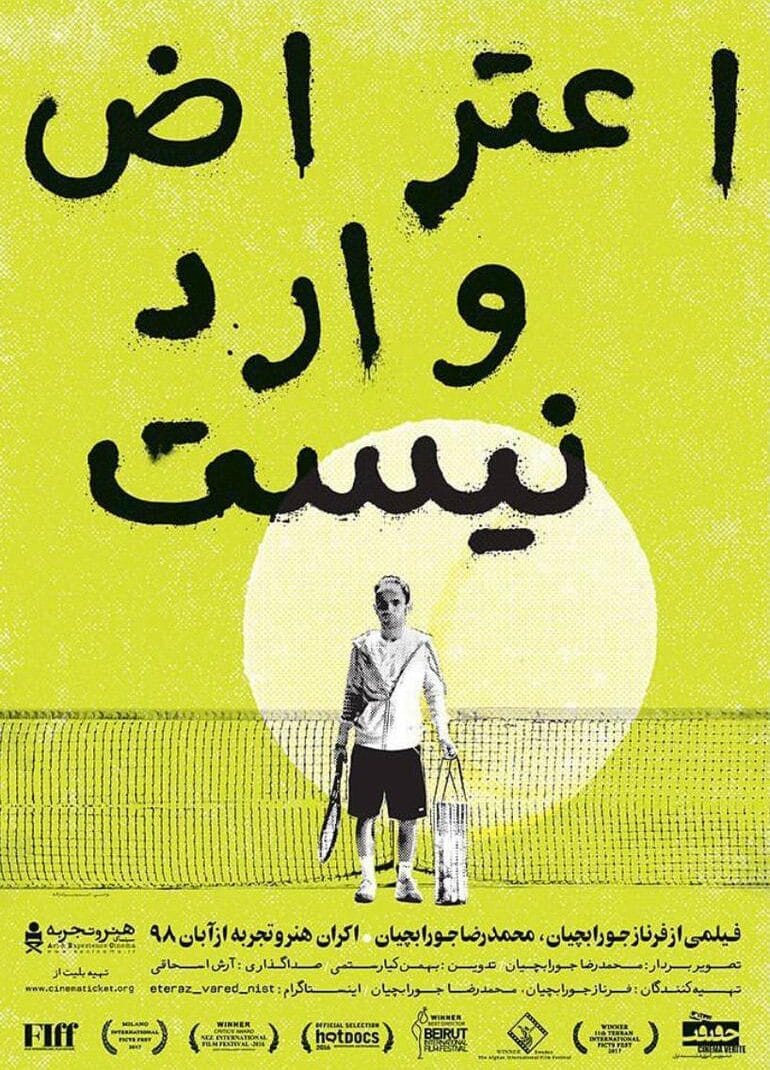
The poster for the 2016 documentary film "Overruled" by Farnaz and Mohammad Reza Jurabchian. The original title in Persian is "Eteraz Vared Nist."
In 2016, Gol Agha, a ball boy and worker at a private tennis club in Tajrish—an affluent neighborhood in northern Tehran—went to an administrative office in Karaj to receive a headcount slip.
There, Gol Agha was told by employees at the registration desk that the headcount slip could open avenues for permanent residency and work permits. Like thousands of other Afghans (a word I use to reflect the global legal and political category, despite the contested designation of the term), he complied with official instructions and was formally registered by the state.
These opportunities, however, never materialized. Instead, [in March 2025](https://help.unhcr.org/iran/en/2025/03/12/cafia-announcemnt-on-the-decision-for-headcount-slip-holders/), authorities announced that all Afghans holding headcount slips must report to a registration center as its validity would expire on March 20\. This move was the culmination of a broader crackdown on Afghans in Iran driven by demographic anxieties crafted and circulated via posts on social media and narratives in the Iranian press that emphasize the uncertainty surrounding the number of Afghans in the country.
The order came in the context of Iranian officials [forging ties](https://www.tehrantimes.com/news/501643/Iran-envoy-ICMPD-director-discuss-cooperation) with institutions like the International Center for Migration Policy Development, headquartered in Vienna, not only to strengthen borders but also to standardize and manage labor migration across nation states. The movement of men between Iran and Afghanistan has been ongoing over recent decades. Border crossings without papers across mountain ranges and fields, hidden under tracks and in the back of vans, expose them to the violence of organized crime and states competing with each other for territorial control over the movement of humans and commodities. Now, this coordinated and international development in migration policy has resulted in the rationalization of coercive means targeting poor and often male Afghans.[\[1\]](#%5Fedn1)
When Gol Agha appeared for his appointment, he was told to return on May 19, when he would receive his exit papers. He would then have to leave Iran within 13 days. In order to avoid being blacklisted—and lose the option to legally return to Iran on a visa—Gol Agha followed the authorities’ instructions. In late May, he was among hundreds of Afghans who were placed for days in the sweltering heat of a camp on the outskirts of Tehran, waiting for a car that would take them to Mashhad and then to the border with Afghanistan. In early June, he, his wife and their child were forced from the country, arriving in Kabul via Herat.
Gol Agha had first come to Iran as a teenager, a journey he shared in the 2016 documentary film, *Overruled* (original title in Persian: *Eteraz Vared Nist*). The 53-minute film by siblings Farnaz and Mohammad Reza Jurabchian follows the lives and aspirations of men from Afghanistan working on the tennis courts in northern Tehran. Many of them, like Gol Agha, came to Iran as children and teenagers and speak Tehrani Persian.
The film is important in offering a lens on working-class male masculinity (the masculinity of bodies assigned the gender male at birth) of laborers from Afghanistan to Iran, as well as for documenting their experiences of anti-Afghan racism. In popular accounts of Afghans in Iran, including in media and cinema, men are often depicted, one-dimensionally, as workers on construction sites or servants. While the film focuses on the men’s labor and the daily discrimination they face, it also shows their passion for and expertise in tennis. In doing so, it unsettles the figure of the “*kargar Afghani*” (the Afghan worker)—a trope that naturalizes the status of Afghans as workers whose physical labor exists to serve states and other employers. It deciphers what obstructs Gol Agha and his peers from opportunities to advance in athletics or other arenas of work.
Ten years later, the documentary continues to resonate, as Afghans like Gol Agha have no path to naturalization except for marriages between male citizens and women with Afghan passports. There are also cases of preferential treatment by the state for service and martyrdom in militias like the *Tip-e Fatemiyyun.*[\[2\]](#%5Fedn2) While the film does not engage directly with national and global migration politics related to Afghans, it does capture the dynamics produced in the everyday lives of Afghans as a result of these systems. In so doing, it provides a necessary close-up on power relations and the dreams and aspirations of working Afghan men caught in legal situations that are politically fueled by popular and systematic racism.
## **‘Ball Boys’**
Ismael Khodaei, another of the film's protagonists, began working as a ball boy as a child after migrating from Afghanistan in the early 2000s.
Speaking to his talents on the court, the former captain of the Iran Davis Cup Team (who is not named in the film) tells viewers that Ismael is the most promising player from Afghanistan in Iran. In the film, Ismael recalls how, at age 11, his uncle brought him to the Enghelab tennis complex, a publicly funded sports arena, in an effort to spare him from the physically demanding labor of construction work. Several years after his arrival in Iran, during Mahmoud Ahmadinejad’s presidency, Ismael had to leave the Enghelab complex for a job in construction after the club ceased allowing Afghans to work there. His brother eventually sent him back to tennis, and Ismael found work in a private tennis club.
In earlier decades, Iranian tennis players had also often started out as ball boys, learning the sport as early as age six, by spending their days and nights on the court. In an interview sequence, the former captain explains that all members of the Iranian national team used to be from the working class and worked at some point as ball boys, until the Islamic Revolution, after which the new head of the Iranian tennis federation prohibited Iranian children from serving as ball boys. Afghan boys, like Ismael, stepped in.
Ismael Khodaei, seen in a still from the film.
In their late teens and twenties at the time of filming, the men run the daily routines and maintenance work on the tennis courts. Though they are given the titles of “ball boys,” their work is much more expansive—ranging from domestic tasks, such as cooking and cleaning, to maintaining and running the daily work routines on the tennis courts. In one scene, the camera follows Gol Agha as he prepares the court in the morning: He turns on the electricity, walks with a drag mat (a broom made of metal chains) across the clay to smooth its surface, brushes the white chalk lines and waters the court to settle the dust before practice. In winter, he clears snow from the court’s covering. The boundaries between work and domestic place are blurred. Some of the men live in close proximity to the courts so they can respond to work demands as quickly as possible but also because it saves expenses.
Like Iranian ball boys, children from Afghanistan grew up on the tennis court, where they learned to play. In contrast to Iranians, however, there is a limit to how far they can ascend no matter their skill in the sport. In one illustrative scene the camera follows Gol Agha and Ismael to a match where they greet other players and are warmly welcomed. Realizing their names are not on the schedule, they ask an organizer why. He explains that the organizers tried their best, but the federation representative told them, "Afghans are not allowed to play." Gol Agha doesn’t say a word, but all the excitement of preparing for the game dissolves into thin air. When Ismael mentions that he recently played at the Azadi Complex, the organizer responds that the stance on whether Afghans can be present in tournaments is "a matter of personal taste.”
The spatial segregation between Afghan and Iranian men is a throughline of the film. In one segment, the filmmakers follow Mohammad, an Afghan who works as a ball boy and in the cafeteria at a larger court. He is shown cleaning the outside seating area and collecting balls during practice. When there is no practice, we see Gol Agha washing large carpets and polishing a car in the yard. Ismael, on the other hand, due to his tennis skills, holds a degree of authority within the club: He collects fees from club members and delegates tasks to younger ball boys when more support is needed on the court. But he still performs maintenance work, like stringing tennis rackets or fixing the lights.
> **Although many were born and raised in Iran, Afghans cannot become naturalized citizens, making higher education and the obtaining of specialized certificates, such as that of a tennis coach, inaccessible for most, regardless of gender.**
Indeed, despite his skill at the game, Ismael can only serve as an unofficial trainer. In one scene, he explains to the filmmakers that when training Iranians, he is referred to as a “partner” due to official labor restrictions for Afghans in Iran. As an Afghan he cannot be certified as a tennis coach, as he would need specific identification papers for that. Just to work in privately run tennis clubs required an Iranian guarantor (as does purchasing a SIM card, renting an apartment or running a small business.) Although many were born and raised in Iran, Afghans cannot become naturalized citizens, making higher education and the obtaining of specialized certificates, such as that of a tennis coach, inaccessible for most, regardless of gender. While some public schools, for example, allow Afghan children to study, many do not, requiring them to run their own schools. At the level of university, they are treated as international students and charged higher fees. Although the Islamic Revolution formally reorganized access to resources in an effort to cater to the poor, Afghans marked the limit where national belonging superseded shared markers such as Muslimness or Persian language.
In the film, a few Iranian interviewees acknowledge the injustice of a condition that normalizes the social stratification between Afghans and Iranians: Iranian men—ranging from working-class trainers to managers, CEOs and tennis complex owners—shape the conditions under which Afghans can find employment both on and off the tennis court to varying degrees. One tennis complex manager remarks that a player like Ismael would certainly advance if he had the necessary papers. Others like the captain of the Iran Davis Cup team dismisses the idea that the “*kargar-e Afghani*” (Afghan worker) could compete at the national level. “We can help them to a certain degree,” he states, “but from the outset, the whole thing is illegal. You can’t help them much.”
## **Reading Faces**
In one segment of the documentary, the protagonists share with the filmmakers what being an “Afghani” in Iran means to them. Mariam, Kashmir’s wife, tells the story of a gathering where she passes as Iranian. Iranians, she says, associate Afghans with filthiness. Such racist tropes have, in her words “made a monster out of Afghans”—even among “the good \[Iranians\].”
An Afghan broom maker in the Iranian city of Mashhad. Broom making (Jarubafi) is a profession predominantly taken up by Afghans in the city. Reza Heidari Shahbidak.
In 2016, while doing research in Golshahr—a neighborhood in Mashhad with many residents from Afghanistan—I interviewed photographer Reza Heidari Shahbidak, who had started a social media channel, [*Everyday Golshahr*](https://www.instagram.com/everydaygolshahr/). Heidari and his family identified as Hazaras, but within his family he was the only one who, he explained, “does not look like a Hazara.” His looks allowed him to pass as Iranian in public life and avoid harassment and discrimination, unless identification was required.
In the documentary, Mohammad, Ismael and Mojtaba, who are ethnically Hazara, describe being identified as “Afghani” for their facial features in Iran and experiencing everyday racism as a result. For instance, Ismael shares with the filmmakers that on Facebook and in daily life, Iranians compare him to Jackie Chan and Bruce Lee.
In another scene, Mojtaba grows visibly emotional when recalling being called names in Kerman, a city and province in southern Iran: “They say, ‘is he Afghani, a Korean, Chinese.’ They say mockingly ‘what is your relation to Jumong?’” The reference to Jumong, a character in a Korean TV series that is popular in Iran—much like Bruce Lee and Jackie Chan—relies on and recirculates racist tropes within Asia.
But the film also reveals an imagined line of racial proximity that links Hazaras with people and places in East Asia. At one point, Mojtaba articulates a sense of connection to the region. He explains that his favorite tennis player—after Roger Federer—is the Japanese tennis player, Kei Nishikori, because he feels their “*nejad*” (race) is shared. For Mojtaba, Nishikori serves as an aspirational figure, an East Asian role model in a sport where Afghans are typically excluded from visibility.
Practices of reading faces manifest differently across Afghanistan’s diaspora populations in Asia. In Iran and the Pakistani province of Quetta, with its large refugee population from Afghanistan, Hazaras are perceived as refugees from Afghanistan. In contrast, in Lahore, where Afghans are predominantly associated with Pashtuns, Hazaras I interviewed described people assuming they are either Chinese or from Gilgit-Baltistan.
Narratives of proximity to people in East Asia among younger generations of Hazara is also visible among social media influencers like [Surry](https://www.instagram.com/p/CxbII4dNmb7/?hl=en&img%5Findex=1)—an Instagrammer whose family is from Afghanistan and who was born and raised in Iran. In a series of social media posts in 2023, she appears with Japanese script written across her face. In [one image](https://www.instagram.com/p/CxbII4dNmb7/?hl=en&img%5Findex=1), she poses with a sword drawn halfway from its sheath: The accompanying caption cites dramatic words attributed to Prince Ōtsu before his death by *seppuku*.
> **In the film, all of the men, regardless of their ethnic group, navigate forms of everyday racism in Iran. Vahid describes how the term “Afghani” is used as an insult—a reality, in his words, to be “endured.”.**
In the film, all of the men, regardless of their ethnic group, navigate forms of everyday racism in Iran. Vahid describes how the term “Afghani” is used as an insult—a reality, in his words, to be “endured.” Kashmir, his peer, adds, “No matter how good we are, we still seem as aliens, as Afghani. I do not understand what their issue with being Afghani is.”
Notably, the term Afghani is grammatically correct and widely used in Iran, Arabic-speaking contexts and beyond. (In Afghanistan, it is the name of the national currency.) Afghan, meanwhile, is a modern political and legal category that encompasses people across ethnic groups who, prior to the emergence and consolidation of border regimes in the early twentieth century were not categorized in this way. In the late nineteenth and early twentieth centuries, colonial and Qajar registers associated the category of Afghan explicitly with Pashtuns. In that era, Afghans—read Pashtuns—were considered an ethnic group alongside Baluchis, Arabs, Afshars, Kurds and Nowshirvanis in the southeastern provinces.[\[3\]](#%5Fedn3) Importantly, however, social belonging in this era was not soley generated along ethnic lines but also through religious and spiritual affiliations, as well as military service. A notable example is the Qizilbash from present-day Afghanistan, who hold a distinct place compared to Pashtuns in today’s Iran due to records of their service as Shi’as during the Safavid Empire.
Today, the term Afghanistani is becoming more frequent in Iran—not only among Afghans but also Iranian journalists, authors and scholars. With more recent migration cycles, it is increasingly adopted globally to include all ethnic groups that are citizens of present-day Afghanistan.
## **The Eternal ‘Afghani’**
In recent months, public debate in Iran has intensified around the hashtag “*Ekhraj-e Afghani motalabeh melli ast*” (“The deportation of Afghanis is a national demand”). Questions about where the hashtag originated, who initiated it and how it gained viral traction remain subject to countless discussions in public debates, articles and video clips, drawing attention to an issue that has persisted but remained largely unaddressed: racism in Iran and its diasporas.
Iranians in Iran often rationalize racism by associating it with the conditions they face, including a carceral state that polices social and political life and the political-economic ramifications of sanctions on their everyday existence. In this context, the figure of the “Afghani” is persistently framed as a threat to the Iranian population.
Journalists such as Marziar Khosravi—who publicly supports reformist politician Mir-Hossein Mousavi and opposes the criminalization of journalists—have, much like Germany’s AfD and right-wing leaders elsewhere—instrumentalized examples from the everyday life of Iranian workers and small business owners to target migrants. In a recent roundtable hosted by *Ensaf News*, for example, Khosravi was asked about his views on the hashtag’s direct targeting of migrants rather than policymakers. He responded: “Do not reduce the situation to online places. If you go to Yazd, shops have been taken over by foreign non-citizens. In the southern parts of the city, people do not even know what Twitter is. The situation is becoming critical and the policies need to change.”[\[4\]](#%5Fedn4)
> **Central to these reactionary narratives are anxieties over demographics and the alleged threat posed by the presence of Afghans in Iran to the integrity of small-scale businesses, schools, public spaces and other essential infrastructures.**
Central to these reactionary narratives are anxieties over demographics and the alleged threat posed by the presence of Afghans in Iran to the integrity of small-scale businesses, schools, public spaces and other essential infrastructures. Popular accounts—both online in response to the hashtag and as it plays out in daily life—blame Afghans for everything from rising egg prices and overflowing trash in cities to water shortages and human trafficking. I asked one Persian man in his early 30s living in a town in central Iran what people in Iran say about Afghans. He emphasized the illegality of Afghan laborers and their perceived strain on Iran’s infrastructure: “In Tehran, among every 10 people I see, two or three are Afghan. This huge number of Afghans in Iran is a big economic burden for the country. This illegal labor force is using the resources of a country that is suffering from many shortages.”
For public figures like Khosravi, any charge that their language is Afghanophobic (*Afghan setizi*) is itself considered hostile: He perceives expressions surrounding the “flood of Afghan migration to Iran” as accurate. [\[5\]](#%5Fedn5) Any criticism, in his view, thus contributes to the normalization of migration without formal papers, threatening Iran’s integrity. In parallel to reactionary, anti-migrant rhetoric across the world, the securitization of borders and the claim to protect Iranian resources for Iranians are rationalized as urgent concerns, effectively detached from the question of racism.
## **Cinema and the Carceral Present**
*Overruled* is careful in introducing audiences to anti-Afghan racism in Iran without naming it as such and without demonizing or romanticizing any of the involved. The film reveals how Afghans, particularly the working class—many of whom consider Tehran home—are excluded from full participation in society even as their physical labor has, quite literally, contributed to building urban landscapes and catering to Iranian households.
When it first premiered at the Hot Docs Festival in Canada in 2016, the film garnered global support and attention. In Iran, its first screening took place at the Iran International Documentary Film Festival, also known as Cinema Verité, where demand was so high that many invited guests could not enter the packed theatre. The filmmakers received numerous screening invitations, including from the Museum of Contemporary Art—where, as Farnaz remembers, “people were sitting on the floor or standing”—and Khaneh Cinema (House of Cinema).
In 2019, before the Covid-19 pandemic led to the closure of cinemas, *Hunar va Tajrobeh Cinema* (Art and Experience Cinema), a program overseen by the Ministry of Culture and Islamic Guidance, invited the Jurabchians to screen the film. Farnaz Jurabchian recalled in a recent conversation that when *Overruled* appeared, it prompted offers from policymakers to meet with the directors to discuss political and legal responses to the systemic discrimination of Afghans in Iran. These meetings, however, never materialized.
> **Today, Afghans face a carceral present marked by detention, coercive returns and deportations from** [**Germany**](https://www.aljazeera.com/news/2024/8/30/germany-deports-28-afghans-for-first-time-since-2021-taliban-takeover)**,** [**Pakistan**](https://news.un.org/en/story/2025/04/1162706) **and Iran, with the United States poised to follow...**
Today, Afghans face a carceral present marked by detention, coercive returns and deportations from [Germany](https://www.aljazeera.com/news/2024/8/30/germany-deports-28-afghans-for-first-time-since-2021-taliban-takeover), [Pakistan](https://news.un.org/en/story/2025/04/1162706) and Iran, with the United States poised to follow as the Trump administration recently announced it will not renew the Temporary Protected Status of Afghan migrants. Amid these developments, *Overruled* opens a space to grapple with the tensions surrounding Afghan labor across global sites.
For Gol Agha, however, these conversations will not make an immediate difference. Like tens of thousands of Afghans, under the current order he will only be eligible to apply for tourist visas to Iran in Kabul. At the moment, no visa currently allows Afghan workers to formally migrate to Iran for employment. Strengthening ties between Afghanistan, Iran and EU member states such as Germany and Austria may eventually lead to formal labor migration agreements. But for now, Gol Agha and his family have been forced to leave a place they have long called home. In Kabul, he must once again focus on selling his physical labor, while his dream of working as a professional tennis trainer remains on hold.
*Author's note: This piece was finalized before the unprovoked Israeli aggression on Iran that began on June 13, 2025\. Amid the escalating violence, Islam Qala-Dogharoon, a key border crossing between Afghanistan and Iran, has been closed and dozens of Afghans are reportedly stranded near the border. For hundreds of others, their future remains even more uncertain than it did before.*
> **Read the** [**previous**](https://merip.org/2025/06/women-and-politics-in-post-jina-iran) **article.**
> **Read the** [**next**](https://merip.org/2025/06/unpacking-the-gender-paradox-behind-arab-women-in-tech) **article.**
**This article appears in** [**MER issue 314**](https://merip.org/magazine/314/) **“New Gender Frontlines.”**
\[**Paniz Musawi Natanz**i is a postdoctoral fellow at the University of Pennsylvania's Wolf Center for the Humanities.\]
---
### **Endnotes**
[\[1\]](#%5Fednref1) Paniz Musawi Natanzi, “German Perversions of Mental Health Care Male Afghan Refugees, Deportation, and Carceral Systems during NATO’s War in Afghanistan,” in Laura Kromják and Ajlina Karamehić-Muratović eds. *Intergenerational Trauma in Refugee Communities* (Routledge, 2024), pp. 184–198.
[\[2\]](#%5Fednref2) Kevin L. Schwartz, “‘Citizen Martyrs’: The Afghan Fatemiyoun Brigade in Iran,” Afghanistan 5/1 (2022), pp. 93–121.
[\[3\]](#%5Fednref3) Ervand Abrahamian, *Iran Between Two Revolutions* (Princeton University Press, 1982), p. 15.
[\[4\]](#%5Fednref4) Ensafnews, “[Mizgerd daq Iran va muhajeran Afghan \[Hot Roundtable Iran and Afghan Migrants\]](https://ensafnews.com/590617/%D9%85%DB%8C%D8%B2%DA%AF%D8%B1%D8%AF-%D8%AF%D8%A7%D8%BA-%D8%A7%DB%8C%D8%B1%D8%A7%D9%86-%D9%88-%D9%85%D9%87%D8%A7%D8%AC%D8%B1%D8%A7%D9%86-%D8%A7%D9%81%D8%BA%D8%A7%D9%86-%DB%B1-%D8%A8%D8%AA%D9%88/)” (Part 1), May 2025.
[\[5\]](#%5Fednref5) Ensafnews, “[Mizgerd daq Iran va muhajeran Afghan \[Hot Roundtable Iran and Afghan Migrants\]](https://ensafnews.com/590821/%D9%85%DB%8C%D8%B2%DA%AF%D8%B1%D8%AF-%D8%AF%D8%A7%D8%BA-%D8%A7%DB%8C%D8%B1%D8%A7%D9%86-%D9%88-%D9%85%D9%87%D8%A7%D8%AC%D8%B1%D8%A7%D9%86-%D8%A7%D9%81%D8%BA%D8%A7%D9%86-%DB%B2-%D9%88%D8%A7%D8%B9/)” (Part 2), May 2025.
### Women and Politics in Post-Jina Iran
URL: https://www.merip.org/2025/06/women-and-politics-in-post-jina-iran/
Last updated: 2025-10-28T17:47:34.000Z
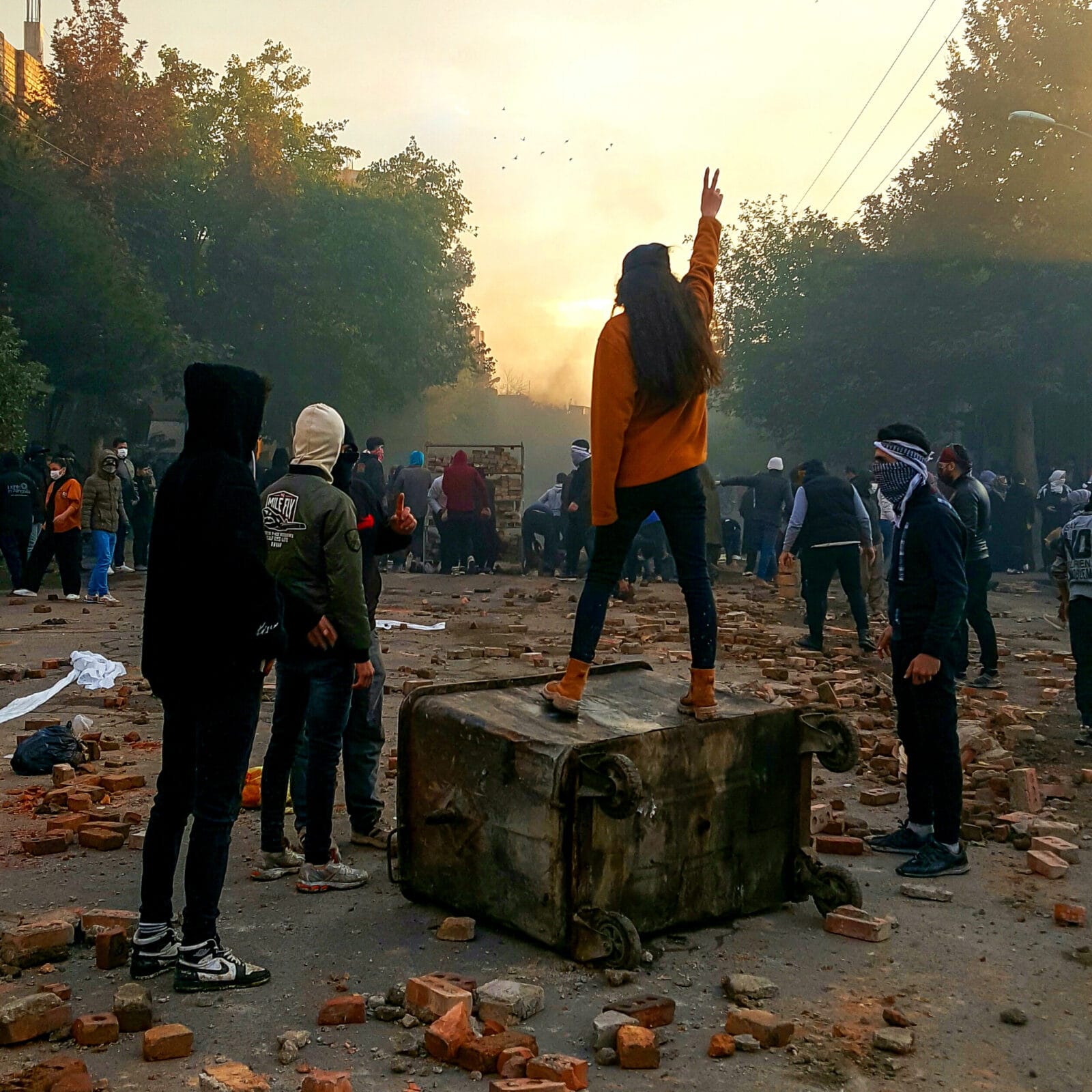
A young woman not wearing a hijab flashes a victory sign in Bukan, Iran on November 17, 2022, during a protest after the death of Mahsa (Jina) Amini. (Anonymous/Middle East Images/via AFP via Getty Images)
Nearly a year after the eruption of the Woman, Life, Freedom protests across Iran in September 2022, Sedigheh Vasmaghi, a renowned theologian, former politician and poet, publicly removed her hijab in a self-published video.The act was a forceful symbol of her support for the movement and condemnation of the Iranian regime. “We cannot remain silent against the killing of women and girls like Mahsa (Jina Amini) or Armita (Geravand) who were killed merely because of their hijab,” she says.
Other prominent women, including [celebrities](https://www.iranintl.com/en/202211118006), had removed their hijabs in public acts of defiance against Iran’s mandatory hijab laws during the protests. But Vasmaghi’s unveiling held particular significance. Until then, her public persona was that of a deeply pious scholar who consistently observed the hijab in a strict sense without showing any hair—even while lecturing in Europe on her expertise in Islamic *fiqh* (jurisprudence). What Vasmaghi clearly opposed was not veiling itself but its compulsory nature: Just months before her public unveiling, she had drafted an open letter to the Supreme Leader challenging the Islamic justification for forcing women to cover their hair. In it, she asked pointedly: “How can the Islamic Republic justify such strict enforcement of mandatory veiling when even the Quran does not explicitly require women to cover their hair?”[\[1\]](#%5Fedn1)
Vasmaghi’s outspokenness and expression of solidarity ultimately resulted in her imprisonment in early 2024\. After public outcry and amid her rapidly deteriorating health, the Iranian authorities released her. But she has remained outspoken. In April 2025 she published an open-access book titled [*Why I Rebelled Against the Hijab*](https://www.instagram.com/p/DIX24HYx0yD/?locale=pt%5FPT&hl=en) that outlined her intellectual evolution on the question of hijab, drawing from her seminary studies, academic research and life experiences from coming of age during the 1979 revolution to today. In publicizing the book, Vasmaghi stated, “I wrote this book so that future generations and children will cherish the achievements born of our suffering and will be able to confront discrimination and injustice with clear understanding.”[\[2\]](#%5Fedn2)
Given her deep religious knowledge, personal piety and experience as a former reformist politician, Vasmaghi’s protests carried particular weight in exposing the regime's politicization of the veil and its use as a tool to oppress and control women. Her direct confrontations with the authorities reflect a deeper loss of faith in the possibility of reform through formal state institutions, including its clerical justifications. Her emphasis on the future, meanwhile, highlights the need for radical change that has been long demanded and imagined by women of Iran and was made unequivocally clear within the Woman, Life, Freedom movement.
## **Popular Demands for Change**
In the lead-up to the September 2022 protests, Iran faced mounting political and economic crises that disproportionately affected the country’s youth—the result of crippling international sanctions, inflation and the state’s inability to address them.
[In 2020](https://www.economicsobservatory.com/what-are-the-big-economic-challenges-facing-the-government-in-iran), at least 25 percent of men ages 15–24 and 42 percent of women were unemployed, despite their high levels of education. Inflation soared to [42.4 percent](https://www.economicsobservatory.com/what-are-the-big-economic-challenges-facing-the-government-in-iran) by 2022, reflecting the continued decline in the country’s GDP following President Trump’s reimposition of US sanctions in 2018\. These economic pressures fueled the devaluation of the Iranian rial, deepening market instability and corruption in both public and private sectors. Corruption has been a [feature of Iran’s political economy](https://www.brookings.edu/articles/four-decades-later-did-the-iranian-revolution-fulfill-its-promises/) that favors regime loyalists and is marked by mismanagement, cronyism and nepotism, while the state neglects critical structural reforms. Tragic instances of such mismanagement include the [2017 collapse of Tehran’s Plasco Building](https://irannewsupdate.com/news/general/from-plasco-to-rajaee-port-how-mismanagement-and-cover-ups-keep-costing-iranian-lives/), an aging 17-story commercial center, after a prolonged fire, killing 21 people and injuring hundreds. Both municipal authorities and building owners had repeatedly ignored all warnings about the building’s deteriorating conditions. The collapse destroyed 560 garment workshops, displacing nearly 3,000 workers.
These overlapping crises have decreased public confidence in the state’s capacity for reform and pushed many, especially the youth, to imagine and actively pursue alternative futures beyond the confines of the current theocratic system. As such, youth were at the forefront of mass protests in 2017 and 2019.
> **Her death highlighted the intersecting forms of oppression embedded within Iran’s political, economic and social structures and galvanized a diverse cross section of dissatisfied groups around a shared demand for radical democratic transformation.**
This growing desire for change came into sharp focus during the Woman, Life, Freedom protests, which exposed deep-rooted tensions, widespread anger and mounting disillusionment among large segments of the population. The public outcry over the state-sanctioned killing of Jina (Mahsa) Amini marked a watershed moment. Jina was a young Kurdish woman from a historically marginalized ethnic and religious minority. Her death highlighted the intersecting forms of oppression embedded within Iran’s political, economic and social structures and galvanized a diverse cross section of dissatisfied groups around a shared demand for radical democratic transformation.
The moment unified disparate voices across gender, ethnic, class, religious and other identities. Urban sociologist Azam Khatam estimates that at least two million people across 160 cities in Iran took part in the protests, most of them young individuals born in the 2000s.[\[3\]](#%5Fedn3) Khatam also notes that, due to heavy security surveillance on main streets in major cities, protest leaders called for demonstrations in local neighborhoods. This strategy allowed young protesters greater maneuverability in case of threats, but it also limited the visibility of the movement’s broad support. The centrality of the issue of women’s bodily autonomy following the state’s strict dress code enforcement meant that women, especially young women, acted as key agents within the uprisings.
## **“A Big No!”**
Despite [harsh state backlash](https://www.ohchr.org/en/hr-bodies/hrc/ffm-iran/index), post-Jina Iran (as it is widely referred to by [feminist forces inside the country](https://www.instagram.com/ethno.anthro/p/DG-99zatpKN/?img%5Findex=1)), has witnessed a new level of collective consciousness. This shift in awareness is rooted in anti-authoritarian values and a rejection of all forms of control and domination, including singular religious authority—as exemplified by Vasmaghi’s faith-based critiques. While it may be gradual and uneven, it has transformative potential.
> **Everyday acts of resistance against state restrictions, which preceded the protests, are becoming more** [**widespread**](https://turningpointmag.org/2025/03/26/bodies-in-revolt-the-everyday-resistance-of-iranian-women-to-state-oppression/)**, prompting new individuals to reevaluate their relationship to the state and reconsider personal choices, including how they dress.**
It now extends beyond traditional activist circles—such as feminists, labor unions and student groups—to include broader segments of society. Everyday acts of resistance against state restrictions, which preceded the protests, are becoming more [widespread](https://turningpointmag.org/2025/03/26/bodies-in-revolt-the-everyday-resistance-of-iranian-women-to-state-oppression/), prompting new individuals to reevaluate their relationship to the state and reconsider personal choices, including how they dress. A growing body of reports, podcasts and analyses by independent journalists and civil society actors is documenting these transformations.
One such platform is [*Zanan-e Emrooz*](https://zananemrooz.com/about) (Today’s Women), a Persian-language monthly magazine that, despite ongoing state pressure, has been [publishing on critical issues](https://link.springer.com/chapter/10.1007/978-3-031-11980-4%5F12) affecting women for the past decades. Offering in-depth reporting and analysis of local, regional and global sociopolitical developments through a gendered lens, the magazine has become a vital voice in Iran’s feminist landscape. It is edited by Shahla Sherkat, who has spent decades advancing feminist discourse within the constraints of the theocratic state. *Zanan-e Emrooz* recently published a special open-access issue for International Women’s Day (March 8, 2025), spotlighting key societal developments and transformations in the post-Jina era.
In one article featuring interviews with young women on hijab observance and street harassment, 23-year-old Neda—a resident of Qom, one of Iran’s most religious and conservative cities—described her personal transformation, or internal “revolution,” in the wake of the protests. “I always believed in the hijab, but when the Jina (protests) began, I recognized I am full of anger. Angry of the constant policing over my dress whether by family, university, or the society at large. Suddenly a revolution occurred within me, driving me to resist oppression. I changed the form of my hijab, symbolizing a big No!”[\[4\]](#%5Fedn4)
Neda went on to describe the broader transformations that were taking place in society as a result of the space opened up by the protests and the discussions they engendered. “Sedigheh Vasmaghi’s removal of her veil and stating that this practice has no basis in religion, instigated an important debate in Qom,” she noted. A new [Hijab and Chastity Law](https://www.hrw.org/news/2024/10/14/iran-new-hijab-law-adds-restrictions-and-punishments) introduced in the wake of the protests fueled even more discussion. “When the regime doubled down by adopting the Hijab and Chastity Law, many of my seminary friends also shared that there is no explicit text (in Islam) about compulsory hijab,” Neda said. “These debates among the public and religious scholars gave me the courage to resist and took away my shame to dress according to a certain expectation in the holy city of Qom.”
Neda is not alone. Millions of Iranian women, especially young women in their teens and twenties are defying the hijab laws in unprecedented numbers despite risks to their freedom or lives, as apparent from [viral images of unveiled women](https://www.telegraph.co.uk/world-news/2022/09/30/woman-arrested-image-without-headscarf-iran-restaurant-goes/) in public settings spread on social media, independent [media coverage](https://www.nytimes.com/2022/10/04/world/asia/iran-protest-video-analysis.html) and personal accounts. Such defiance is occurring as [spontaneous acts of everyday resistance](https://untoldmag.org/revolution-can-happen-even-if-people-dont-think-about-it-a-conversation-with-asef-bayat/) by ordinary individuals, rather than activists, who are embodying their aspirations despite state threats.
The [Hijab and Chastity Law](https://www.hrw.org/news/2024/10/14/iran-new-hijab-law-adds-restrictions-and-punishments) Neda referred to as an inciting moment among her friends was passed by the Iranian parliament in November 2024\. It authorizes the government to impose heightened penalties on women and businesses who failed to comply with the hijab mandates. The law’s penalties range from heavy fines to up to 10 years in prison for repeated violations by women with so-called bad hijab. The law also authorizes use of surveillance and artificial intelligence to identify and punish those who defy the hijab laws, including while in personal vehicles.
Widespread condemnation of the law—from domestic voices like [Vasmaghi](https://iranwire.com/en/women/136666-iranian-activists-condemn-hijab-and-chastity-law-as-medieval/) to international bodies such as the [United Nations](https://www.ohchr.org/en/press-releases/2024/12/iran-un-experts-call-hijab-and-chastity-law-be-repealed)—prompted the recently elected president Masoud Pezeshkian to halt its enforcement, warning that implementing it could further alienate an already discontented population. Pezeshkian’s campaign of moderation and a general critique of Iran’s hardliners, including violent enforcement of mandatory veiling, helped him get elected in 2024 over his more conservative counterparts. During the presidential debates, Pezeshkian openly expressed [his opposition](https://www.newarab.com/analysis/women-life-freedom-irans-protest-movement-two-years) to mandatory hijab patrols, the same forces that violently arrested Mahsa Jina Amini and contributed to her tragic death in 2022.
While Pezeshkian’s campaign promises resonated with many, his presidential victory came amid [historically low](https://www.idea.int/democracytracker/report/iran/july-2024) voter turnout. Women were among the most disillusioned, with key figures in the Iranian feminist movement [calling for a boycott](https://www.wilsoncenter.org/blog-post/boycott-or-participate-explaining-women-irans-and-turkeys-recent-elections) of the elections.
## **Mobilizing Beyond the State**
The recent electoral boycotts, like the notable increase in civil disobedience against mandatory hijab, emerged after decades of women’s formal political engagement and attempts at reform from within state institutions.
From the late 1990s through the mid-2010s in particular, women across Iran’s ideological spectrum, from secular feminists to religious women, successfully built coalitions that evolved into a robust women’s rights movement. The main approach of this movement was to make explicit demands from the state.
The [One Million Signature Campaign](https://www.merip.org/content/files/sites/default/files/resourcess/one-million-signatures-campaign-english%5F0.pdf), launched in 2006, was one prominent initiative. It aimed at reform of gender discriminatory family laws through public awareness-raising and pressuring key state institutions, particularly the parliament. Although the campaign ultimately fell short of reforming Iran’s gender-discriminatory family laws, its impact was evident in the powerful networks and coalitions it fostered among diverse women’s rights groups, some of whom belonged to reformist parties and even served in political decision-making roles in the parliament or cabinet. The timely alliance forged between secular and religious women enabled them to successfully pressure the legislative branch to block the passage of a regressive Family Protection Act in 2008, which, among other provisions, aimed to ease restrictions on polygamy for men.
Ahead of the 2009 presidential elections, the Iranian women’s movement adopted a similar strategy by forming the Forum for Dialogue Among Women (*Ham-andishi Zanan*)—a coalition of ideologically diverse women activists to draft and present a list of demands to the presidential candidates under a Charter for Women’s Rights. Their demands included women’s greater access to positions of political authority, a gender egalitarian family law and enhanced access to educational and employment opportunities. While the disputed reelection of Conservative president Mahmoud Ahmadinejad in these elections was ultimately accompanied by a harsh crackdown on the women’s movement and its leaders, the subsequent Green Movement protests nonetheless reflected hope for reform within the framework of the Islamic Republic. The central slogan, “Where is my vote?” questioned the integrity of the election process rather than directly challenging the theocratic system or authority of the Supreme Leader.
Building on earlier campaign strategies, key members of the Iranian women’s rights movement, including pioneers of the One Million Signatures campaign, considered the 2016 parliamentary elections yet another opportunity to address their concerns in parliament. They launched the “Change the Male-Dominated Image of Parliament” campaign. The campaign leveraged both virtual and in-person platforms to train and support women pursuing office on a women’s rights agenda, while also collaborating with reformist parties to ensure that women made up at least 30 percent of reformist-backed candidates in multi-member districts across Iran.[\[5\]](#%5Fedn5)
The campaign contributed to the election of several women parliamentarians in 2016 with links to the women’s movement. Key legislative gains followed, including Iranian mothers gaining the right to pass citizenship to their children under certain conditions. But even these victories proved short-lived. The competing conservative groups, including the hardliner Islamic Revolutionary Guard Corps, harassed and attacked leaders of the Iranian women’s rights movement, including reformist women in office like [Shahindokht Molaverdi](https://foreignpolicy.com/2016/08/29/the-islamic-republics-war-on-women-iran-feminism/), who served as vice president for Women and Family Affairs from 2013 until her [forced removal in 2017](https://www.jadaliyya.com/Details/40788/Women-Politicians-of-Iran-on-Women%E2%80%99s-Rights-Critical-Actors-or-Futile-Figureheads-40788). Conservatives also delayed the implementation of women-friendly laws that the 2016 parliament had championed, including the women’s citizenship law, which has yet to be fully implemented.
The state’s crackdown on Iran’s women’s movement and its leaders gradually transformed the nature of women’s organizing and feminist advocacy. The hostile political environment for mass organizing resulted in increasingly sporadic, unorganized and leaderless forms of claim making and resistance on behalf of women. Central to this type of protests were public acts of unveiling. Routinely broadcasted on [online spaces](https://www.mystealthyfreedom.org/whitewednesdays-movement-fights-for-womens-rights-in-iran/), they were aimed at highlighting women’s disapproval of mandatory hijab laws for both local and global audiences.
> **Over the past decade, women’s organizing has continued to range from prominent activists to ordinary women mobilizing around shared demands in ways that are often interwoven and mutually reinforcing..**
One of the most iconic examples was the 2017 public unveiling of Vida Movahed on Tehran’s Revolution Street—an act that inspired a wave of similar actions and gave rise to the “[Girls of Revolution Street](https://iranhumanrights.org/2018/01/girls-of-revolution-st-protest-ignites-debate-on-irans-compulsory-hijab/)” protests. These spontaneous displays of defiance, often initiated by ordinary women rather than organized activists, underscored a growing grassroots force that rejected state-imposed dress codes. Over the past decade, women’s organizing has continued to range from prominent activists to ordinary women mobilizing around shared demands in ways that are often interwoven and mutually reinforcing, with varying levels of communication or collaboration between them.[\[6\]](#%5Fedn6)
The final straw for the women’s movement came in 2020 when the conservative-backed Guardian Council—an unelected body that vets candidates for elections—disqualified all outspoken female parliamentarians from running for reelection. With the closure of this limited path of change, prominent feminists like [Narges Mohammadi](https://www.radiofarda.com/a/30416992.html) urged the public to boycott the election. She emphasized that people’s support for the so-called reformist and moderate governments had only furthered “crises and repression.”[\[7\]](#%5Fedn7) Thanks to these efforts, led prominently by women, [voter turnout](https://irandataportal.syr.edu/2020-parliamentary-election) dropped to just 42 percent—down from 61 percent in the previous election in 2016.
Women’s calls for [boycott](https://www.wilsoncenter.org/blog-post/boycott-or-participate-explaining-women-irans-and-turkeys-recent-elections) have been growing with every election in Iran since 2020\. Public statements from leading women’s rights advocates released ahead of each election reflect a deepening loss of faith in the institution’s ability to deliver meaningful egalitarian change. Notably, even renowned reformist party women, including some of those [who served in the parliament](https://www.instagram.com/iranintltv/p/CPXcMcuD2q1/), are among those advocating boycotts. Iran’s Green Movement leaders, the married couple Mir-Hossein Mousavi and Zahra Rahnavard—under house arrest since 2011—have also called for [boycott of the elections](https://www.iranintl.com/en/202406288133). Mousavi has gone further, calling for a [new constitution](https://www.iranintl.com/en/202302049934) to be drafted by “the real representatives of the nation” and rooted in the principles of the Woman, Life, Freedom movement to bring about fundamental change in Iran.[\[8\]](#%5Fedn8)
## **Imaginative Politics and Transforming Consciousness**
Since the 2022 uprisings, large sections of the Iranian population, particularly women and youth, have continued their calls for radical change. Rather than waiting for reform, elections or even a revolution, protesting Iranians are organizing around their desired ideals and freedoms, sidelining the current structures of the state.
Notably, many protesters saw the Woman, Life, Freedom movement as a chance to reimagine their political condition, expressing their demands through [charters and bills of rights](https://theconversation.com/iranian-protesters-are-making-demands-in-charters-and-bills-of-rights-201543) as a starting point. In February 2023, 20 civil society groups across Iran—including labor unions, student organizations and women’s and human rights groups—collectively publicized a [ joint charter outlining their minimum demands](https://iranwire.com/en/politics/113866-iranian-trade-unions-civic-groups-issue-charter-of-minimum-demands/) for a “new, modern, and humane society.”[\[9\]](#%5Fedn9) The 12-point list of demands were drastically different from anything proposed by the state, including its reformist politicians, signaling a radical shift from the status quo. In an [unprecedented move](https://www.lgbtqnation.com/2023/05/the-paradoxical-queer-history-of-iran/), for instance, these independent civil society groups endorsed “the immediate and unquestionable removal of all forms of the discriminatory structure against sexual minorities and people with gender-nonconforming identities.”[\[10\]](#%5Fedn10)
In March 2023, in an effort to translate the progressive slogan “Woman, Life, Freedom” into practice, a group of feminist advocates—primarily based in the diaspora and including members of the core team behind the 2009 Charter for Women’s Rights—published the first draft of the [Iran Women’s Bill of Rights](https://www.iwbr.org/copy-of-persian-home). Framed as a living document, it is, is in effect, a “wish-list” (*list-e arezuha*)—a term adopted by women to popularize their demands to the general public and one that continues to be used. It outlines key gender-egalitarian demands for inclusion in a future Iranian constitution. They include legal equality and non-discrimination in a secular state, as well as the establishment of institutional mechanisms, such as national-level women’s commissions and policy agencies, to ensure effective implementation.
> **The discussions and debates that feminists of Iran are leading largely in informal settings are important practices for democratic politics that most Iranians were denied for decades.**
Although seemingly far-fetched for the current context, articulating these future aspirations and wish lists fosters an imaginative politics that can be transformative. The discussions and debates that feminists of Iran are leading largely in informal settings are important practices for democratic politics that most Iranians were denied for decades. Many Iranians are taking matters into their own hands, forming structures and forums that diverge significantly from the regime’s status quo. Civil society groups—such as labor unions, academic associations and teachers’ organizations—have become increasingly attentive to gender representation, actively promoting diversity within their membership and leadership. In the absence of open physical spaces, online platforms like Clubhouse have been hosting webinars and discussions that foster democratic engagement. These spaces enable intentional inclusion of historically marginalized populations, facilitating dialogues around various cross-cutting political and social problems.
In this context, the broad spectrum of civil disobedience—from women’s public unveiling to the drafting of charters and statements of solidarity in the post-Jina era—reflects a significant shift in public consciousness and a growing commitment to radical democratic change, despite an unyielding state. Many protesters hope that these cumulative acts of resistance will continue to gain momentum, ultimately paving the way for transformative change.
*Author's note: This piece was completed on June 10, 2025\. On June 13, amid an ongoing genocidal war in Gaza, Israel initiated a major attack on Iran's military infrastructure and civilian sites in its capital of Tehran and various other parts of the country. Iran responded with drone and missile attacks, indefinitely suspending any nuclear negotiations. As of this writing, an unprecedented war is unfolding between the two countries, resulting in the killing and injuring of mostly civilians, many of whom are women and children.*
*Many Iranian women’s rights advocates and civil society groups had long feared such an escalation and its potential negative consequences—particularly for the grassroots-driven demands for radical change discussed in this MERIP article. Within hours of the onset of the war,* [*Iranian Feminist and Equality Activists issued a statement*](https://www.daadkhast.org/en/petition/5780/) *in Persian titled, “No to War, No to the Islamic Republic,” publicly condemning all violence and conflict, and “calling on all Iranians to recommit to the principles of Woman, Life, Freedom.” On June 16, the* [*Iran Writers Association*](https://www.facebook.com/photo?fbid=1294298402055169&set=a.258257122325974) *similarly issued a statement, condemning “Israel, which has been killing the people of Gaza for months and forcing the survivors to die of famine and starvation,” and “has now extended its war-mongering and aggression to the people of Iran.” The statement warns that the achievements of the post-Jina movement risk being erased in the wake of this aggression and that, in its aftermath, extreme nationalism, radicalism and neo-fascism could take root. As they write, “The world’s silence in the face of this aggression, under the pretext of the recklessness and tyranny of the Iranian regime, will only magnify the dimensions of the disaster.” Iran’s civil society groups are not silent in their condemnation of war-mongering forces and call for the amplification of the country’s freedom-seeking movements, recognizing that real democratic change must come from within.*
> **Read the** [**previous**](https://www.merip.org/syrias-new-men-2/) **article.**
> **Read the** [**next**](https://www.merip.org/banned-from-the-game-working-class-masculinity-and-anti-afghan-racism-in-iran/) **article.**
**This article appears in** [**MER issue 314**](https://merip.org/magazine/314/) **“New Gender Frontlines.”**
\[**Mona Tajali** is a visiting scholar at Stanford University's Center for Democracy, Development and the Rule of Law.\]
---
### **Endnotes**
[\[1\]](#%5Fednref1) Committee on Academic Freedom, “[Letter protesting the arrest of Prof. Sedigheh Vasmaghi in Iran,](https://mesana.org/advocacy/committee-on-academic-freedom/2024/04/11/letter-protesting-the-arrest-of-prof.-sedigheh-vasmaghi-in-iran)” *Middle East Studies Association* April 11, 2024.
[\[2\]](#%5Fednref2) Sedigheh Vasmaghi, *Why I Rebelled Against the Hijab* (Santa Monica, California: Aasoo Books, 2025), foreword. \[In Persian\]
[\[3\]](#%5Fednref3) Azam Khatam, “Mahsa Amini’s Killing, state violence, and moral policing in Iran,” *Human Geography* 1/8 (2023).
[\[4\]](#%5Fednref4) Ferdos Sheikholislam, “Pull-back and stay there: Street Harassment after Jina,” *Zanan Emrooz* (March 2025): pp. 50–67\. \[In Persian\]
[\[5\]](#%5Fednref5) Mona Tajali, *Women’s Political Representation in Iran and Turkey: Demanding a Seat at the Table* (Edinburgh University Press, 2022), pp. 265-66.
[\[6\]](#%5Fednref6) Maryam Foumani, “[The New Map of the Women’s Movement in Iran,](https://iranacademia.com/agora/multimedia/video/speech/activism/?lang=en)” *Iran Academia: New Dynamics in Iranian Women’s Activism Panel,* February 23, 2024\. \[In Persian\]
[\[7\]](#%5Fednref7) “[Narges Mohammadi demands boycott of the elections](https://www.radiofarda.com/a/30416992.html),” *RadioFarda,* 4 February 2020\. \[In Persian\]
[\[8\]](#%5Fednref8) Mardo Soghom, “[Opposition Figure in Iran Calls For Fundamental Change, New Constitution](https://www.iranintl.com/en/202302049934),” *IranInternational* February 4, 2023.
[\[9\]](#%5Fednref9) “[Trade Unions Issue Charter of Minimum Demands](https://iranwire.com/en/politics/113866-iranian-trade-unions-civic-groups-issue-charter-of-minimum-demands/),” *IranWire* February 16, 2023.
[\[10\]](#%5Fednref10) Ibid.
### Syria's New Men
URL: https://www.merip.org/2025/06/syrias-new-men-2/
Last updated: 2025-09-15T16:46:35.000Z
In January, I returned to Damascus after 14 years in exile. The last time I had stood in the city's streets, towering statues of Hafez al-Asad and Bashar al-Asad loomed over the squares. Following the collapse of Bashar Al-Asad’s rule in December of 2024, those statues now lay in fragments—some torn down, others left to decay.
Turning a corner, I caught sight of a new Ministry of Defense recruitment banner hanging in the Umayyad Square. It featured a group of faceless soldiers dressed in black, rifles slung across their chests. Beneath the image, read the words: "To be Part of Syria Security: Enlist Now." Further down, another poster from the Interior Ministry issued a similar call: "Protect your homeland. Enlist now."
Gone were the [omnipresent images of Asad](https://www.tandfonline.com/doi/abs/10.1080/20581831.2018.1554233). In their place stood a new kind of masculine authority—collective, masked and omnipotent. The streets that once celebrated Baathist militarism—[parades, victory speeches, statues of the eternal leader](https://brill.com/view/journals/mjcc/15/4/article-p427%5F10.xml)—are now filled with anonymous enforcers: Security forces associated with the new transitional government's administration are present in all main city squares in Syria.
In my book, [*Romanticizing Masculinity in Baathist Syria: Gender, Identity, and Ideology*](https://manchesteruniversitypress.co.uk/9781526147622/), I wrote about the hegemonic masculinity of Asad’s Syria. Hegemonic masculinity is a term coined by R. W. Connell to describe the dominant form of masculinity that sustains patriarchal power by positioning certain masculinities as culturally ideal while subordinating both women and other men who do not conform to this ideal. In the Syrian context, this masculinity was deeply entwined with [Baathist hyper-militarism](https://manchesteruniversitypress.co.uk/9781526147622/), state violence and the performance of national loyalty.
During the rule of Hafez al-Asad, beginning in 1971, the leader sculpted the Syrian nation in his own image—a father-commander whose authority was both intimate and absolute. Masculinity became synonymous with obedience, endurance and self-sacrifice, with the Syrian male body imagined as the site of martyrdom and duty. His son, Bashar al-Asad, inherited this militarized vision of manhood, rebranding it through the affective aesthetics of [romanticized leadership](https://onlinelibrary.wiley.com/doi/abs/10.1111/nana.12786)—less austere, but no less rooted in patriarchal power. In both cases, submission to the ruler was framed as an extension of the national body itself: To be a man was to serve, suffer and die for the homeland.
The book also explored how alternative or subordinate masculinities—queer, dissident or cowardly men—were systematically erased or punished. Through visual culture, military training and the cult of martyrdom, the Baathist regime produced not just soldiers, but gendered political subjects. This hegemonic masculinity shaped everything from school textbooks to military parades, encoding the Asad family’s rule into the very fabric of male identity in Syria.
Revisiting this work and questions of how masculinity is performed in light of the regime’s collapse helps illustrate how state authority is constructed and maintained in post-Asad Syria. Today, the Baathist hegemonic masculinity has fractured. New masculinities are visible and contested—some emerging from the ruins of the old order, others forged in the heat of revolutionary struggle. The collapse of Baathist structures, however, has not led to a rupture in gendered power. Rather it has led to the emergence of a Sunni-centric masculine order—one in which sect and masculinity become mutually reinforcing pillars of political authority, particularly within the transitional government led by interim President Ahmed al-Sharaa.
## **From Emasculation to Militarized Survival**
For many opposition fighters who took part in the war that began following the Syrian uprisings in 2011 joining an armed group was more than an act of resistance—it was an act of reclamation. [Personal loss, trauma and humiliation](https://www.tandfonline.com/doi/full/10.1080/09592318.2024.2374036) had driven them to take up arms. This emotional terrain gave rise to what I term grievous masculinity: a masculinity forged through wounded honor and the pursuit of redemption.
In recent interviews with fighters reflecting on their experiences in the war, they explicitly described humiliation as a key driver behind their decision to take up arms. Fighters expressed that their masculinity had been ruptured by events such as the arrest of a father, the assault or public shaming of a sister or mother or their own perceived failure to act in moments of threat. For many, joining an armed group became a way to reclaim honor and restore manhood. As one fighter told me: “They arrested my father. They humiliated my mother. When I stood there, unable to protect them, I was not a man. I swore I would never feel that weakness again.” Another, who joined the Free Syrian Army in 2013, recalled: “I had never held a weapon before the war. But the first time I fired, the first time I saw the body fall… something changed. I knew I could never go back. I had become a fighter.”
> **These experiences of emasculation—failing to shield one’s family, witnessing women being dragged from homes in nightgowns or being publicly beaten by police—formed recurring motifs in the narratives of those who joined the armed struggle.**
Another described the shame of hiding while regime forces slapped his sister and threatened to take her as punishment for his absence. “I felt like a coward. I felt I had no right to be called a man,” he told me. These experiences of emasculation—failing to shield one’s family, witnessing women being dragged from homes in nightgowns or being publicly beaten by police—formed recurring motifs in the narratives of those who joined the armed struggle.
After Asad’s fall, this sense of humiliation and grievance has played out in the actions of former resistance fighters in their dealings with the former regime. Following the collapse of Asad’s forces, for example, victorious opposition factions celebrated their triumph by ridiculing their former oppressors. The regime’s army, once perceived as an unbreakable force, was mocked with new names: “*Jaysh Abu Shihata*” (The Army of Sandals), and “*Jaysh Abu Kulthun*” (The Army of Underwear), both references meant to emasculate and degrade Asad’s soldiers. These nicknames were more than insults. They were an assertion of dominance, a symbolic stripping away of the power once held by the Baathist military machine. The forces that had long enforced submission now found themselves publicly ridiculed, their masculinity questioned and diminished.
On my recent visit to Damascus, I met [former regime commanders](https://newlinesmag.com/reportage/syrias-new-rulers-are-working-to-unify-military-power/)—men who had once stood at the pinnacle of Assad’s masculine hierarchy. Uniformed, armed, unquestioned, they had embodied the Baathist model of power. After the regime's fall, the new leadership announced a nationwide reconciliation process, opening reconciliation centers across major Syrian cities. Former regime officers were instructed to surrender their weapons and hand over their military IDs. They were told they would be contacted later to receive new documents formalizing their defection status—though no clear information was provided about whether they would be reinstated, monitored or abandoned. This process left many in a state of limbo: neither enemies nor fully integrated citizens.
Not all former regime officers accepted their defeat with resignation. Some, deeply complicit in the regime’s most brutal operations, knew they had no future in a reconciled Syria. [On March 6, 2025](https://aawsat.com/%D8%A7%D9%84%D8%B9%D8%A7%D9%84%D9%85-%D8%A7%D9%84%D8%B9%D8%B1%D8%A8%D9%8A/%D8%A7%D9%84%D9%85%D8%B4%D8%B1%D9%82-%D8%A7%D9%84%D8%B9%D8%B1%D8%A8%D9%8A/5119840-%D8%B3%D9%88%D8%B1%D9%8A%D8%A7-%D9%85%D9%82%D8%AA%D9%84-%D8%A3%D8%AD%D8%AF-%D8%B9%D9%86%D8%A7%D8%B5%D8%B1-%D8%A5%D8%AF%D8%A7%D8%B1%D8%A9-%D8%A7%D9%84%D8%A3%D9%85%D9%86-%D8%A7%D9%84%D8%B9%D8%A7%D9%85-%D8%A8%D9%83%D9%85%D9%8A%D9%86-%D9%84%D9%80%D9%81%D9%84%D9%88%D9%84-%D8%A7%D9%84%D8%A3%D8%B3%D8%AF-%D9%81%D9%8A), remnants of Assad’s security apparatus—referred to as the *fulul*—initiated a series of coordinated attacks in Syria's coastal regions, including Latakia, Tartus and Hama.
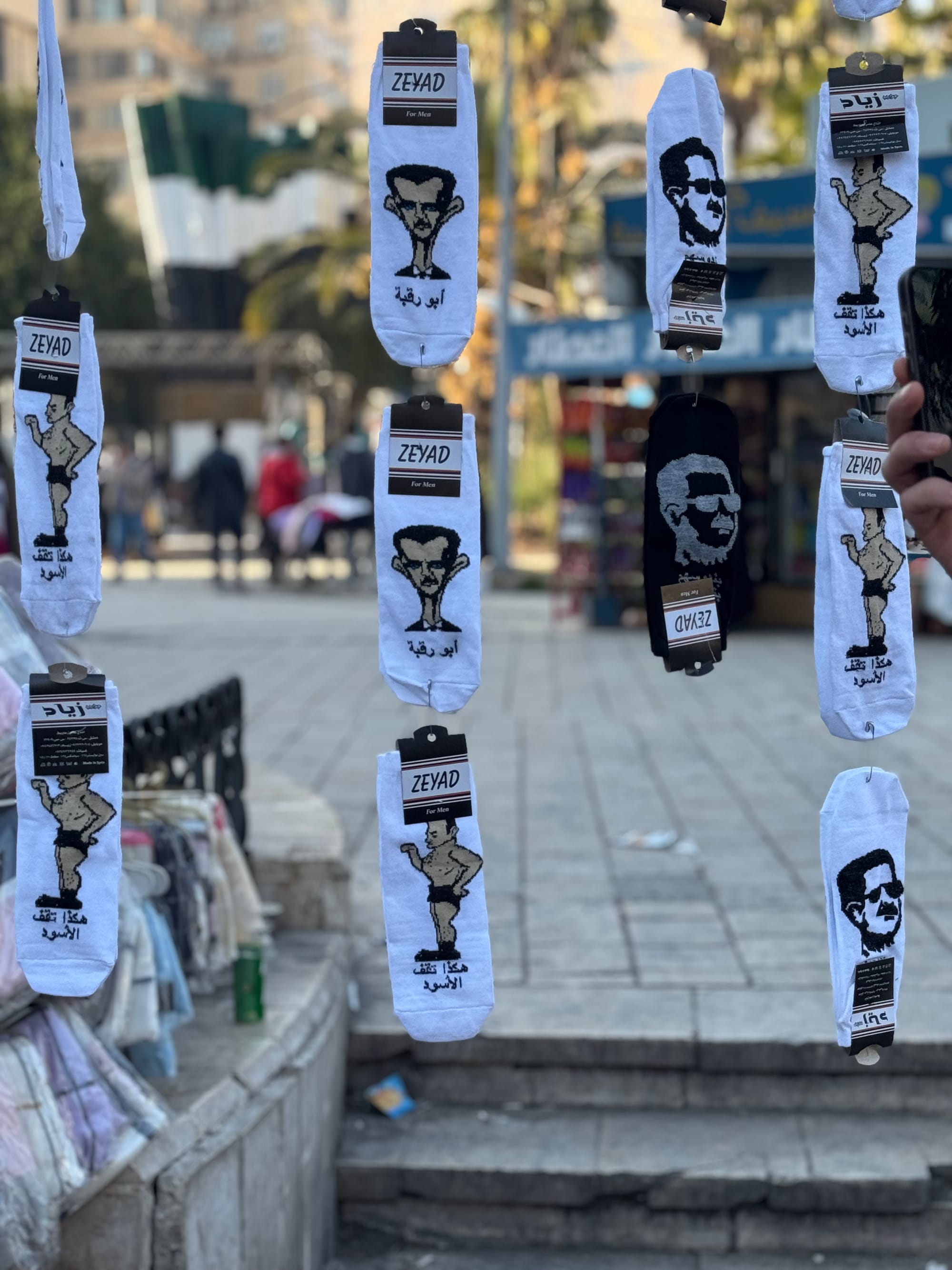
Socks mocking former president Bashar al-Asad and the regime forces for sale in Salhiyya, Damascus on January 29, 2025\. Rahaf Aldoughli.
The attack sent shockwaves through Damascus, triggering immediate calls for retaliation. Mosques and city squares became platforms for mass mobilization, with fiery speeches urging people to rise against the remnants of the fulul. The term [fulul,](https://www.bbc.com/arabic/articles/cvge1gedem7o) borrowed from the Egyptian post-Mubarak lexicon to describe the old regime, is new to Syria’s political discourse. It emerged after the fall of Asad to describe former regime commanders with histories of atrocities who had repositioned themselves in the war’s shifting power dynamics. More than mere remnants of the old order, the fulul had embedded themselves in illicit economies, leveraging smuggling, extortion and war profiteering to maintain influence.
In the days that followed the attack, undisciplined armed groups, some claiming affiliation with the new leadership, launched a wave of revenge-driven assaults, killing up to 1,169 civilians, among them 103 women and 52 children. 218 public security personnel were also killed during these events, [according to the Syrian Observatory for Human Rights](https://www.alhurra.com/syria/2025/04/01/%D8%A8%D8%A7%D9%84%D8%A3%D8%B3%D9%85%D8%A7%D8%A1-%D9%85%D8%B1%D9%83%D8%B2-%D8%AD%D9%82%D9%88%D9%82%D9%8A-%D9%8A%D9%88%D8%AB%D9%82-%D9%85%D9%82%D8%AA%D9%84-1169-%D9%85%D8%AF%D9%86%D9%8A%D8%A7-%D9%81%D9%8A-%D8%A3%D8%AD%D8%AF%D8%A7%D8%AB-%D8%A7%D9%84%D8%B3%D8%A7%D8%AD%D9%84-%D8%A7%D9%84%D8%B3%D9%88%D8%B1%D9%8A). Just as the remnants of Asad’s forces framed their resistance in terms of survival, these opposition militias framed their actions as necessary for securing Syria’s future. The logic of [militarized masculinity](https://fpc.org.uk/the-securitisation-of-the-masculinist-other-in-the-syrian-conflict/) has not disappeared. It has shifted actors, giving rise to new cycles of sectarian violence.
## **Revolutionary Masculinity**
If the collapse of the Baathist order shattered the hegemonic masculinity of the state, the victors of the revolution did not merely dismantle the old structures of power, they replaced them with a new vision of masculinity forged during the years of armed revolutionary struggle. In this emerging order, the revolutionary fighter is the archetype of manhood. His authority is not inherited like that of the Baathist officer. It is earned through endurance, combat and ideological commitment. As one central commander in the new ruling security forces put it after interim president, Ahmed Al-Sharaa, announced the integration of armed groups in his victory speech on January 27, 2024, “We did not take power; we earned it. This is not just a government. It is our revolution. Our struggle. To be a man in Syria today is to be a revolutionary. There is no separation.”
This sentiment encapsulates how hegemonic masculinity in post-Asad Syria is now fused with the revolution itself. Unlike the old model, where hegemonic masculinity was demonstrated through submission to the state, the new masculinity must be proven through acts of resistance, participation in battle and a willingness to die for the cause. One opposition fighter expressed this sentiment in stark terms: “This rifle is not just a weapon. It is me. It is my dignity, my revolution. Without it, I am nothing.” Through the revolutionary struggle, masculinity was defined by these fighters, not by the hierarchical structures of a rigid state. Masculinity was rather synonymous with survival, with the ability to endure suffering and with the willingness to make the ultimate sacrifice.
This revolutionary masculinity is not only about individual valor, it is deeply embedded in the collective experience of fighters. The shared suffering of war has fostered a new kind of masculine kinship, one that can supersede tribal, ideological or even personal ambitions. Fighters refer to one another as *ikhwa fi al-dam* (brothers in blood), reinforcing a sense of belonging that is both emotional and existential. Drawing from my interviews with fighters in northern Syria, it became clear that many see themselves as more than just political actors. They are guardians of the revolution, its protectors and in some cases, its only remaining legitimacy. One commander reflected on this role: “The revolution is not over. We may have won Damascus, but our war is not finished. We are here to make sure it is never betrayed.”
This conviction highlights how revolutionary masculinity extends beyond the battlefield into governance, justice and everyday interactions. Those who fought and bled for the revolution see themselves as its rightful stewards.
But this model of masculinity—built on competition, personal sacrifice and armed legitimacy—carries its own risks. Fighters who once operated in loosely coordinated factions, driven by battlefield brotherhood and ideological fervor, now struggle to navigate a system where political survival depends on allegiance to a single faction. Upon becoming interim president, Al-Sharaa, formerly the leader of Hayat Tahrir al-Sham (HTS), sought to consolidate control by [integrating various armed factions](https://www.chathamhouse.org/publications/the-world-today/2025-03/syria-needs-security-can-al-sharaa-build-united-army-provide) into the Ministry of Defense. While full-scale clashes have not yet erupted between former rivals, deep-seated grievances persist among fighters—particularly those from the Syrian National Army (SNA), who now find themselves under the authority of HTS figures they once distrusted. The process of military integration has been characterized by a lack of professionalism, an opaque chain of command and the prioritization of loyalty over competence.
> **Fighters who once operated in loosely coordinated factions, driven by battlefield brotherhood and ideological fervor, now struggle to navigate a system where political survival depends on allegiance to a single faction.**
A former SNA fighter, now serving in the Ministry of Defense, voiced his unease in an interview in February 2025: “We fought together against Asad. But some of us fought for Syria, and others fought for their own power. HTS took control by force, and now they tell us to trust them? How can we forget what they did?” Another rebel-turned-administrator in Damascus described this tension, “We fought together, but now we are fighting for influence. Everyone believes they deserve to lead because they sacrificed the most. But war does not teach you how to govern.”
The process of military integration has been marked by opacity and favoritism, reinforcing a [militarized hierarchy of trust.](https://newlinesmag.com/reportage/syrias-new-rulers-are-working-to-unify-military-power/) Positions within the new security apparatus have been allocated based on loyalty to HTS rather than professional expertise, [with senior military positions even being given to non-Syrians](https://newlinesmag.com/reportage/syrias-new-rulers-are-working-to-unify-military-power/), exacerbating resentment among former opposition fighters who had envisioned a more pluralistic military command. Many fighters still view their weapons as personal guarantees of security in an unstable order. One Ministry of Defense official admitted in an interview, “My rifle is my only guarantee of safety, and its price has been paid in blood. I’ll serve under the new government, but I will never give up my weapon. After 14 years of revolution, I won’t accept being sidelined or betrayed.” These interviews suggest that Syria’s transition remains precarious.
This broader crisis of trust and legitimacy is also a crisis of masculinity. In the evolving choreography of Syrian power, al-Sharaa’s own performance of masculinity operates through layered and shifting codes—military, religious and civic. His staged entrance into the [Aleppo Citadel after the fall of the regime in December 2024, clad in military dress](https://www.alarabiya.net/arab-and-world/syria/2024/12/04/%D8%B2%D8%B9%D9%8A%D9%85-%D9%87%D9%8A%D8%A6%D8%A9-%D8%AA%D8%AD%D8%B1%D9%8A%D8%B1-%D8%A7%D9%84%D8%B4%D8%A7%D9%85-%D8%A3%D8%A8%D9%88-%D9%85%D8%AD%D9%85%D8%AF-%D8%A7%D9%84%D8%AC%D9%88%D9%84%D8%A7%D9%86%D9%8A-%D9%8A%D8%B8%D9%87%D8%B1-%D9%81%D9%8A-%D9%82%D9%84%D8%B9%D8%A9-%D8%AD%D9%84%D8%A8-%D8%A8%D8%B9%D8%AF-%D8%B3%D9%8A%D8%B7%D8%B1%D8%A9-%D9%82%D9%88%D8%A7%D8%AA%D9%87-%D8%B9%D9%84%D9%89-%D8%A7%D9%84%D9%85%D8%AF%D9%8A%D9%86%D8%A9-), drew from both historical and cinematic imagery of the “conquering man”—a masculinist iconography evoking Baathist aesthetics and Islamic conquests. The adoption of the [title al-Fātiḥ (the Conqueror)](https://www.annahar.com/Lebanon/Society/184488/%D8%B5%D9%88%D8%B1-%D8%A7%D9%84%D8%AC%D9%88%D9%84%D8%A7%D9%86%D9%8A-%D9%81%D8%A7%D8%AA%D8%AD-%D8%A7%D9%84%D8%B4%D8%A7%D9%85-%D8%AA%D8%B1%D8%AA%D9%81%D8%B9-%D9%81%D9%8A-%D8%B7%D8%B1%D8%A7%D8%A8%D9%84%D8%B3), in addition to referencing territorial victory, invoked a symbolic dominance over fragmented masculine claims to power.
This performance extended into Damascus, where on January 27, [al-Sharaa](https://arabic.cnn.com/middle-east/article/2024/12/09/analysis-syrian-rebel-leaders-victory-speech-held-a-message-for-iran-trump-and-israel) stood before armed factions—including Baathist-affiliated ones—to theatrically announce their dissolution. That moment re-centered legitimacy not in a party or ideology but in his singular male body. The optics of this event—his language, his attire, his posture—did more than project authority; they redefined sovereignty through gender. The ruler became the man who could disarm other men, absorb their legitimacy and overwrite past masculinities with his own.
This rebranding continued through high-profile [international interviews](https://podcasts.apple.com/gb/podcast/the-new-president-of-syria-trump-palestine-and/id1665265193?i=1000690612974), where al-Sharaa presented himself as a moderate Damascene Sunni—calm, technocratic, suit-clad and clean-shaven. In a domestication of his past as a Jihadist leader, in these interviews he exhibits a strategic moderation. His masculinity remains anchored in public religiosity—mosque-building, Quranic recitation in universities and, most strikingly, the March 31 Eid prayer held in the Square of the Unknown Soldier—a space once synonymous with Baathist-military nationalism. This act reclaimed a former regime icon, embedding it in a new religiously coded, Sunni-centric sovereignty.
Al-Sharaa’s hybrid masculinity—militant yet diplomatic, pious yet modern, Sunni but not Salafi—is not merely stylistic. It is a calculated reterritorialization of masculinity itself, designed to address multiple audiences at once: global, domestic, civilian and military. Like the post-revolutionary Cuban archetype of *el hombre nuevo*, he fuses ideology, image and affect to stage a break with the past—while selectively inheriting its power.
## **Masked Masculinity**
This changing masculine order has also played out in the everyday realm of the city.
During my recent visit, I saw men clad in black, masked and fully armed, standing like shadows in the main squares of Syria’s cities. These men belong to the new *al-Amn al-‘Amm* (general security forces). But they are more than security enforcers—they are the manifestation of a new spatial order, one where power is exercised through the anonymity of force. The Syrian regime was once reliant on the spectacle of heroic, militarized masculinity—where officers and soldiers stood as visible embodiments of state strength. Syria’s new rulers assert control through a hyper-visible faceless, dispersed presence.
Fighters in SNA groups during operation Deterrence of Aggression against Bashar al-Asad. Northern Syria, December 3, 2024\. Fieldwork photo by the author's research fixer. Shared courtesy of the author.
By enforcing its presence through the anonymous security figures, the new leadership fosters an environment of controlled unpredictability. The silent, masked figures embody the potential for violence at any moment. This masked masculinity thrives on ambiguity. The covered faces erase individuality, creating an army of indistinguishable enforcers who represent the state without being identifiable as individuals.
A central commander in the new security apparatus described this new all-encompassing authority: “We do not rule through speeches or images. We rule through presence. The mask reminds people that we are everywhere, that we do not need to show our faces to control the streets.”
The widespread use of masks is not only a psychological tool to instill fear but a response to a fundamental weakness: the acute shortage of security personnel. According to a commander in the Ministry of Defense, the new leadership lacks the manpower to maintain its grip through sheer numbers, forcing it to rely on masked enforcement to amplify the perception of omnipresence.
In April 2025, Syria’s General Security Forces issued[ a new directive](https://www.alaraby.co.uk/politics/%D8%A7%D9%84%D8%A3%D9%85%D9%86-%D8%A7%D9%84%D8%B9%D8%A7%D9%85-%D8%A7%D9%84%D8%B3%D9%88%D8%B1%D9%8A-%D9%8A%D9%82%D8%B1%D8%B1-%D9%85%D9%86%D8%B9-%D8%B9%D9%86%D8%A7%D8%B5%D8%B1%D9%87-%D9%85%D9%86-%D8%A7%D8%B1%D8%AA%D8%AF%D8%A7%D8%A1-%D8%A7%D9%84%D9%84%D8%AB%D8%A7%D9%85) banning its operatives from wearing masks in public unless on special assignment. This ban appears to mark an attempt to professionalize the appearance of the state, perhaps under pressure from international observers and internal demands for legitimacy. The enforcement of this rule, however, has been selective. In practice, the mask persists—but now it is hierarchized. High-ranking or elite units, especially those tasked with counterinsurgency or political enforcement, continue to wear masks. The visual shift signals an emerging division between everyday security personnel (visible, accountable) and specialized forces (anonymous, exceptional).
Even as the mask becomes less visible in official street patrols, its symbolic and cultural life continues. In markets across Damascus, Idlib and Aleppo, the mask has been repurposed and commodified—sold in shops alongside military-style clothing, tactical vests and headbands bearing revolutionary slogans. It circulates in social media images, poster art and street fashion, especially among young men who see in it a legacy of both resistance and rule. On Telegram channels and platforms like X, [Eid greetings](https://x.com/m%5Fahr%5F8ar%5F/status/1904280928488206599?s=46) are often circulated in the form of posters featuring masked men—typically dressed in black, holding Qur’ans or standing before mosques. The masked figure, once associated primarily with insurgency or rebellion, is now reframed as a righteous guardian of order and faith. Such imagery sustains the symbolic life of the mask beyond the battlefield. Moreover, it encodes a vision of postwar masculinity anchored in religiosity, surveillance and moral rectitude. What began as a tool of anonymity has become an aesthetic of power—one that merges revolutionary iconography with postwar authority.
## **Women and the New Masculine Order**
The masculinization of political space is visible in Syria’s Political Transition, where despite the rhetoric of a "new Syria" under [Ahmad al-Sharaa’s](https://aawsat.com/%D8%A7%D9%84%D8%B9%D8%A7%D9%84%D9%85-%D8%A7%D9%84%D8%B9%D8%B1%D8%A8%D9%8A/%D8%A7%D9%84%D9%85%D8%B4%D8%B1%D9%82-%D8%A7%D9%84%D8%B9%D8%B1%D8%A8%D9%8A/5093022-%D8%AA%D8%B5%D8%B1%D9%8A%D8%AD%D8%A7%D8%AA-%D9%85%D8%B3%D8%A7%D8%B9%D8%AF-%D9%84%D9%84%D8%B4%D8%B1%D8%B9-%D8%B9%D9%86-%D8%A7%D9%84%D9%86%D8%B3%D8%A7%D8%A1-%D8%AA%D8%AB%D9%8A%D8%B1-%D8%A7%D9%86%D8%AA%D9%82%D8%A7%D8%AF%D8%A7%D8%AA-%D9%81%D9%8A-%D8%B3%D9%88%D8%B1%D9%8A%D8%A7) interim leadership, the inclusion of women in the political process remains more symbolic than structural. Al-Sharaa’s government has made some gestures toward gender inclusivity, such as meeting with Syrian-American women’s delegations and acknowledging women’s sacrifices in his speeches. But there is no systematic plan to engage women politically. Instead, women’s participation in governance remains marginal.
One glaring example is the [National Dialogue Conference](https://www.rozana.fm/article/124066-%D9%85%D8%A4%D8%AA%D9%85%D8%B1-%D8%A7%D9%84%D8%AD%D9%88%D8%A7%D8%B1-%D8%A7%D9%84%D9%88%D8%B7%D9%86%D9%8A-%D8%A7%D9%84%D8%B3%D9%88%D8%B1%D9%8A-%D9%88-%D9%85%D8%B4%D8%A7%D8%B1%D9%83%D8%A9-%D8%A7%D9%84%D9%86%D8%B3%D8%A7%D8%A1-%D9%81%D9%8A%D9%87)—a congregation of almost 1,000 participants held in February 2025 that was tasked with shaping Syria’s transitional roadmap. Women’s representation in these discussions never exceeded 20 percent, often falling below [that mark](https://daraj.media/%D9%88%D8%A7%D9%82%D8%B9-%D8%A7%D9%84%D8%B3%D9%88%D8%B1%D9%8A%D8%A7%D8%AA-%D9%81%D9%8A-%D8%B8%D9%84-%D8%AA%D8%AD%D9%88%D9%84-%D8%A3%D8%A8%D9%88-%D9%85%D8%AD%D9%85%D8%AF-%D8%A7%D9%84%D8%AC%D9%88%D9%84/). In various legislative and security committees, their presence has been even more negligible, reinforcing the perception that governance remains a male-dominated sphere.
Part of this reluctance to integrate women into leadership stems from the composition of Syria’s new ruling elite. HTS’s militant hierarchy, deeply embedded in the security sector, creates a political environment where overt initiatives for women’s political leadership risk backlash. Many appointments within the Ministry of Defense and key government positions have prioritized loyalty to HTS’s leadership circle, ensuring that institutional control remains tightly within the hands of former revolutionaries rather than opening space for diverse governance.
In various legislative and security committees, their presence has been even more negligible. The cabinet announced in March 2025 reflected this imbalance starkly: Only one woman was appointed among 23 ministers, reinforcing the perception that political power remains a male preserve.
Indeed, while revolutionary masculinity—built on sacrifice, armed legitimacy and battlefield loyalty—continues to dominate the security apparatus, it is now paralleled by the rise of technocratic masculinity. This new form of masculine authority draws on the aesthetics of professionalism: men in suits, soft-spoken administrators and policy-focused experts, who project an image of calm, competence and rational governance. Yet even this technocratic veneer is gendered. It functions as a legitimizing frame that maintains elite male control while appearing modern, inclusive and efficient. It enables men like al-Sharaa to perform distance from jihadist or militarized pasts, even as their power is rooted in those very networks.
> **Women, by contrast, remain on the political periphery—not because they lack capacity, but because neither revolutionary nor technocratic masculinity requires their inclusion to legitimize itself.**
This dual performance—the fighter and the reformer, the conqueror and the administrator—expands rather than displaces hegemonic masculinity. It creates a flexible model of power that can circulate across ministries, television interviews, mosque inaugurations and security checkpoints. Women, by contrast, remain on the political periphery—not because they lack capacity, but because neither revolutionary nor technocratic masculinity requires their inclusion to legitimize itself.
The exclusion of women from the political process is not unique to Syria. As studies on post-conflict transitions have shown, societies emerging from war frequently default to masculinist structures of governance, where political legitimacy is tied to battlefield experience or institutional continuity rather than than [democratic representation](https://scholarship.law.gwu.edu/cgi/viewcontent.cgi?article=1373&context=faculty%5Fpublications). In such contexts, women—who often played critical roles in sustaining wartime resistance—find themselves pushed to the margins once governance structures solidify. Syria’s current trajectory suggests that its transition will follow this same exclusionary pattern.
Thus, while al-Sharaa’s leadership claims to mark a break from the authoritarian past, its gendered foundations remain entrenched in the very structures the revolution once sought to dismantle. The challenge ahead is not just about rebuilding Syria, it is about redefining who gets to participate in that rebuilding.
### Shifting Feminist Narratives in Sudan—A Conversation with Raga Makawi
URL: https://www.merip.org/2025/06/shifting-feminist-narratives-in-sudan-a-conversation-with-raga-makawi/
Last updated: 2025-10-28T17:41:58.000Z
Women hold a banner reading in Arabic “Sudanese Feminist Union—No to war, we will not be ruled by a partnership of blood,” in Khartoum on December 19, 2022, protesting the agreement signed by military and civilian leaders, which critics dismissed as vague. (Photo by -/AFP via Getty Images)
MER *issue 314 examines gender in a present shaped by transnational war-making, displacement and the violent reassertion of borders, from Turkey to Palestine to Sudan.*
*In Sudan, the war between the Sudanese Armed Forces and the Rapid Support Forces entered its third year in April 2025\. The conflict—which has triggered the world’s worst displacement crisis, nearly 13 million people—has its roots in the failed political transition following the overthrow of long-time dictator Omar al-Bashir in 2019\. Marya Hannun, MERIP’s managing editor, interviewed Raga Makawi, a Sudanese editor and researcher studying the intersections of revolution, materiality and identity in post Bashir Sudan, to discuss the longer history of feminist and gender-based organizing in the country, how gender was mobilized within the revolution and what the ongoing war has meant for women. Their conversation took place on May 30, 2025 and has been edited for length and clarity.*
**Marya Hannun:** To start can you tell me a bit about your background—whether in researching women’s movements, feminist politics or your experience thinking about gender in Sudan?
**Raga Makawi:** I grew up in Sudan in the 1990s, right after the Islamist regime under Omar al-Bashir came to power. People of my generation came to, politically and socially, when the regime was at its height, so there was a clamp down, both ideological and physical: Government policies restricted women’s presence in public spaces, and the violence meted out by the state against the public prompted women’s further isolation. It was a double effect that undid decades of women’s political participation and mobilization in Sudan. Sudan has a long history of resistance and social mobilization that always included women: on the worker front, on the union front, in anti-colonial movements. The 1990s reversed much of that legacy. But the regime didn’t leave a void—it built an alternative women’s project. The idea was to present a gender project for the Sudanese nation that consolidated a uniform image of a proper Sudani woman, as pious, her contribution recognized and glorified as long as it can be harnessed in the service of a collective nationalist identity. State gender and social control policies—like the Public Order Act of 1992 developed to police women’s dress and behavior—were one of the state’s structural approaches to manage the women’s question in the Bashir era. This was part of a longer state project to force a single national identity in a country that is incredibly diverse—ethnically, religiously, and linguistically. If you didn’t meet it, you were treated as an outsider to be punished. The consequences of that were quite severe and problematic.
**Marya:** What did that mean for Sudan’s women’s movement and its ability to make political claims?
> **The Sudanese women’s movement has long reflected the broader opposition’s weaknesses—fragmentation, elite co-optation, political trade-offs.**
**Raga:** The Sudanese women’s movement has long reflected the broader opposition’s weaknesses—fragmentation, elite co-optation, political trade-offs. There’s a significant grassroots presence, but much of that emerged during Nimeiri’s nationalization project in the late 1960s and 1970s, when state institutions were devolved to the district level. People were encouraged to trade ethnic or tribal identities for a national one, which opened some space for women’s political involvement. Whether that shift was meant to build grassroots democracy or simply consolidate authoritarian power is another question. Sudan shares a broader postcolonial crisis prevalent in the Global South: strong grassroots mobilization rarely translates into political representation. The Sudanese Women’s Union, which was founded in the 1950s, is one of Sudan’s oldest anticolonial and post-colonial women-led organization structures, and it was also subject to state co-optation in the service of an elite decades long power project.
A clear example is the family law. It’s a rigid and problematic law that is biased in favor of male authority. It reinforces guardianship. Parts of the family law have been on the table for reform since the 1990s, yet there’s been little to no change in over three decades. The only logic to this is that women don’t have the political leverage to compel the state to act, nor do they have the social or economic leverage to influence society towards change. Nation states are not in the business of giving people rights. That's not how it works. But even at heightened moments of social upheaval—Sudan has had three revolutions, and these revolutions did create some sort of social and political progress—the women's agenda was never a substantial part of it, even though women’s representation in organizational resistance has been prominent. It begs the question: what are Sudanese women working towards, and why have we failed to compel the state or the political establishment to take women's demands more seriously?
**Marya:** What role did international organizations play in shaping the women’s rights agenda during this period?
**Raga:** In the 1980s, Sudan (like many states in the global South) was subject to liberalization through its encounter with international financial institutions, like the IMF, who made economic policies and loans conditional on political and economic liberalization: With IMF conditionalities came a new civil society, heavily funded by international donors. It led to a situation of more civil society, but less representation—compared to the sort of grass roots civil society, which is something that had existed throughout Sudan’s history. I’m thinking here of the *Jamiat Ahliyah*, which were communal projects, where people self-funded and were self-reliant in investing in community initiatives they deemed necessary with very little intervention either from the outside or from the state. This ensured values that universal systems claim to espouse but fail to demonstrate such as accountability, transparency and resilience. Even Sudan's only women's university, the Ahfad Women’s University had roots as a community project to educate women. With liberalization, the focus shifted firmly to a western idea of a women’s empowerment agenda, which enforced the vertical elevation of women through professionalization towards upward social mobility. This resulted in a small circle of elite women. They became professionalized in the technocracy of humanitarian or universal rights language and politics, which is very sanitized. It doesn't really deal with the people or with the politics of everyday life in Sudan. If you do a survey of civil society work from the 80s on, there's very little engagement with socioeconomic issues. Civil society and the women rights agenda had little to no politics in its post 1980s iteration.
By the 2000s, [Liberal Peace](—) became the dominant framework. Funding poured into projects aligned with the Women, Peace and Security agenda ([as set forth by the 2000 UN security council resolution](https://www.un.org/womenwatch/osagi/wps/)). The irony is for all the talk on women, peace and security, at the first test, which is this current war in Sudan, if you map the terrain, you find very little presence of all these institutions and processes that were invested in for decades. Ultimately these systems isolated the general public from their own control over whatever peace is and civil society’s interventions in it. Worse still they created parallel and siloed political tracks for groups depending on their geographical and ethnic background. Peace in Darfur, as it was in South Sudan, assumes an approach and process as well as tools and a language that is separate from mainstream politics. Peace fragmented the Sudanese polity at the level of regions and communities, weakening the national sense of identity. Yet, when it all unraveled, when the real conflict happened, everything we've been told was set up to stop a moment like this is nowhere to be found. And it's the everyday, average Sudani people, who were marginalized from civil society, who are now left to deal with the consequences.
**Marya:** I have more questions about the present war, but I first wanted to pick up on on your earlier description of women's roles in multiple revolutions in Sudan, and how you both see women as very active political participants, and, at the same time, how the women’s movement’s claims have been marginalized within broader movements. How did this play out in the revolution that began in December of 2018 and that, in many ways, prefigured the current war?
> **...when the revolution happened what we saw is people refusing to allow the traditional systems or approaches to represent them, and this included women.**
**Raga:** I think the December revolution has been a really important and interesting moment for Sudanese women, not because they were present in it, which wasn’t new, but because during the December revolution, they opened up a space to represent themselves in a real way. There were no constraints on what type of grass roots bodies and initiatives were emerging. The collapse of the regime and, with it, the political discourse meant that women had the right to fashion agendas and weave them as they saw fit with little oversight from those ostensibly in charge. The December Revolution’s anti-statist and decentralized approach allowed for the imaginary of a civic identity liberated from the shackles of culture and law. Young women organized themselves in small and evolving political initiatives that spoke to the issues of the day, from the right to shape political discourse to what form representation took. Previously, and in general, political representation was very controlled in Sudan. You either had to join a party, or you did it through civil society, but then it's also constrained because it's more of a professional job, which only a few could access depending on educational opportunities and social networks. There were no real avenues for people to express political identities or associations away from the established systems. The December revolution came at an important moment in the sense that the national project and central authority system that manages it had failed in terms of delivering on the promises of development for the people. People had really suffered and struggled for a long time. (I think this crisis of nation-state politics extends beyond Sudan even if we are at a more extreme juncture than others. The nation state has become a hyper-militarized, hyper-securitized project that takes and doesn’t give.) But also, the fact that the opposition failed to deliver proper pushback against the state. If anything, it was very complicit.
As a result, when the revolution happened what we saw is people refusing to allow the traditional systems or approaches to represent them, and this included women. They didn’t fall in line to allow leaders of political parties to speak on their behalf and decide what a political roadmap would be. It was great, but it was also confusing. We were at a very sensitive juncture after Bashir fell, where the focus was on a time-bound model transition. But people didn't necessarily view the transition as the panacea to Sudan’s crisis. They didn’t want to end up being stuck in another project that takes 30 years to unravel. So, they found themselves resisting Bashir’s system after he fell, which included a cabal of civic actors tied to the militarized state project. Sudan’s most foregrounded political slogan continues to be #JustFall, which denotes the persistence of the crisis regardless of the leadership. It is against the establishment, which is the political elite both civil and military.
Women were very central and prominent in pushing back against the prescribed process towards change or transition, not only in the sense that they were present with their bodies and with their voices and with their ideas, but their struggle was multi-pronged in the sense that they fought the system—the security state that tried to silence them—but they also sometimes fought their fellow protesters, those who didn’t think that women should protest to begin with, or who believed women should protest, but only in a very particular way. Women were told directly and indirectly that their presence in streets was supposed to reinforce the main movement's agenda, which was a change in the regime, or “democracy,” but not to make political demands that reflected their specific needs: protection laws, gender sensitive policies that promote equality in the workplace or in the household. We also have the term *kandaka*. It's associated with the Sudanese woman protester, but Sudani women don't call themselves that. It's a term bestowed by Sudani men on women whose politics remain within the confines of what is approved of socially. I for one am not a kandaka. Sudanese women who deviate from the main political line and start to ask for other kinds of rights are not kandakas. The slogan, “the public is private,” emerged from this tension. It was women’s way of rejecting the prioritization of so-called public political demands over other issues. Women said: our democracy begins with our right to exist without violence. These “private” issues are public, and they are political.
**Marya:** Can you speak more about how gender dynamics played out within the revolution’s resistance committees and the tensions that emerged around women’s political participation during the transition?
**Raga:** The transition at the state level took place in parallel to the ongoing social and political revolutionary mobilization on the ground, which was much more progressive and politically viable. In the case of this particular revolution, because it came, as I said before, after 30 years of restrictive Islamic rule, the sudden openings of all these spaces occupied by both men and women did create a lot of tensions. But I still think the Sudanese people were able to manage it well. What it means to transition towards a democracy, what it means to govern ourselves through a civic framework, what it means to be a civil society… Sudanese people learned this on the ground through interaction and experience between 2019 until the coup in 2021\. Of course, contestation is going to come out of this.
At some point, because the resistance committees were the central mechanism through which these new civic formations were being negotiated, Sudanese women realized they needed to secure their membership within them, so a call was published to formally join the committees: #khoshi\_al\_lajana. The initiative encouraged women to register as members in their neighborhood resistance committees. There was recognition that it wasn’t enough to protest every day. Protesting was a form of political expression, but becoming a member in the resistance committees safeguards one’s political identity and their right to a say in where these new political formations are heading. In a country where, historically, it was only the elite who were able to shape policy or political action—to have the general public organizing politically in these grassroots bodies en masse, that's a really impressive form of right to politics that we've not seen in decades. It was a resistance against the authoritarian project in Sudan but also the authoritarian project globally that favors controlled representation through voting and traditional electoral politics.
**Marya:** How did these two planes, the more formal or state-level transition and the popular mobilizations, intersect or diverge when it comes to women’s political claim making?
**Raga:** I can answer that question by referring to two examples of women’s mobilizing that existed in parallel and within different political processes. In March of 2019, women protestors called for a women's march. The call was in itself emblematic of the accumulation of collective mobilizations at the level of the resistance committees, where women had been associating amongst themselves and developing new ideas as to what women's rights are and what a grassroots women's movement is. During the transitional process, some revolutionary manifestos and constitutional documents that had been produced became written into popular law, and women wanted to emulate the process through institutionalizing their political rights into the emergent discourse. They developed a manifesto explaining their demands: universal health care, improved maternal care, equal pay and addressing the violence of guardianship systems to women and children. The transitional government had by then been in power for months already, and there was an expectation that they would push policies that considered women’s urgent needs. The march that was organized around International Women’s Day was a show of feminist power in the streets. They were signaling to the revolution that we might walk with you every day; we might protest with you every day towards a grand democratic project, but within that, we carve a space for ourselves to reinforce that women's rights need to be a priority.
The second mobilization, Campaign 50 percent, was about representation at the state level—the international community’s preferred model of political action. Unlike with the previous example, this form of organizing for rights, as expressed by one member of the campaign who I spoke with, was extremely successful. We both found it absurdly funny. According to her, the campaign from the get go received so much traction and funding as well as political backing that was lacking elsewhere. She felt that overnight, they went from being activists to bona fide civil society members because they chose to do politics through representation. Some of the women involved in Campaign 50 were also members of grassroots bodies whose activism extended to equally if not more important issues that failed to gain as much traction because they were not of interest to the international community. The issue here is that not all political agendas were created equal. Yes, representation is important, but a lot has to happen on the ground level for representation to actually make sense.
This is one of the under-acknowledged reasons why the 2021 coup that brought an end to the transition was successful. Because the transitional government lost its connection to the popular movement. It replaced popular backing with international interests and legitimacy. No amount of money that comes from the West, or meetings in external metropoles, is going to stop state violence or bring about social change, only a grass roots based political project with the organizational means and institutional investment can provide long lasting change in Sudan.
**Marya:** The failure to build a check on this violence has manifested in what has been variously described as a “counterrevolutionary war,” a “proxy war” or “the general’s war.” How has this affected women's political mobilization as you see it? And maybe that raises a question too about which women.
> **The new civic formations that could have mobilized in support of an anti-war agenda, in which the crisis of women was central, were torn apart and displaced as well. All we have left is the existing hierarchal structures in which class and gender are key.**
**Raga:** Yes, we should start with "which women." The war has managed to entrench the divisions between the haves and the have nots, which is what conflict usually does. When you think about the revolution, and perhaps this is both a weakness and a strength, it operated at the local level, like physically at the neighborhood level. When the war happened all across Sudan, the local shifted or ceased to exist because people were displaced, so these community bonds that are also innately political were ripped apart. People were displaced in different states, or moved to be with family, or even exited the country. The new civic formations that could have mobilized in support of an anti-war agenda, in which the crisis of women was central, were torn apart and displaced as well. All we have left is the existing hierarchal structures in which class and gender are key. These continue to induce social fragmentation. The upper classes, both men and women, were able to leave the country into the safety of a neighboring country, whether in the Gulf or in Cairo or those who went to the west. The people who couldn’t leave are bearing the brunt of the conflict with all its extremes.
When it comes to women, the long history of dispossession, whether financial, legal or economic, created more vulnerabilities. When I was leaving Sudan after the war started, I met a lot of women who had to stay because the male guardians in the family would not give them the permission to leave or because they don’t have the means to exit. Access and exit are two major issues for disempowered women wherever they are in Sudan. Those who were prevented from exiting also suffer limited access to life saving needs. Insecurity limits their mobility in general. They can’t access markets to secure their daily food intake, travel to escape conflict or move within or across cities to seek medical help. Even at the level of the household, as people huddle in a few displaced locations, women have to share limited infrastructure with men, which in turn affects their ability to care for themselves and their bodies. One woman told me the worst days were when she got her period. She could only use the bathroom once and late at night. Water is scarce, and she was constantly exposed to the male gaze without the necessary amenities to care for her bodily hygiene. Similar stories are coming out of Gaza. There are these everyday challenges. Then there is also the gendered violence of the war itself, for example, the [RSF’s use of rape as a weapon of war](https://www.amnesty.org/en/latest/news/2025/04/sudan-rapid-support-forces-horrific-and-widespread-use-of-sexual-violence-leaves-lives-in-tatters/).
**Marya:** Last year, we published a piece by Nada Ali about Khartoum’s [women-led street vendor collectives](https://www.merip.org/khartoums-women-street-vendor-cooperatives-and-the-politics-of-care/) and how they have had to navigate the gendered violence of war, which connects with what you’re saying here. In her piece she describes the sexual violence and deprivation that women face, but also how women, specifically and as women, have mobilized a politics of care through their networks. And in some cases, the women she writes about really managed to push back against the international efforts to control women and how they use resources. In the absence of any analysis, there's something really significant about the work being done by women who have no choice but to stay, and this speaks to the point you have been making throughout the conversation about the importance of these kind of social and political formations that exist beyond the state and international community.
**Raga:** I do know that a lot of Sudanese women activists are taking on so much work to try and protect, secure and provide for women in need. And this is obviously done through extended kinship systems but also through political networks that have emerged out of the revolution. I’ll quote Arendt and say that politics happen everywhere, in every interaction. Every human interaction is a political interaction. It doesn't just happen at the state level—even though both the mainstream war discourse and the anti-war discourse, on some level, want us to believe that war and peace are happening at the level of the state or state politics only. I think in every interaction across Sudan, in every place, in every neighborhood, in every state, women who are neighbors or working on the street or huddled together waiting the conflict out, they don't have to give each other anything, just by being together, just by communicating their fears, their ideas…I mean, every action and act is gendered politics. What will emerge from that in terms of charting a future for Sudan post war, perhaps this requires a little bit more reflection. But I think at every moment, Sudanese women are helping each other in different ways, even with the very little resources that they have.
> **Read the** [**previous**](https://merip.org/2025/06/israels-war-on-reproduction-in-gaza-2) **article.**
> **Read the** [**next**](https://www.merip.org/syrias-new-men-2/) **article.**
**This article appears in** [**MER issue 314**](https://merip.org/magazine/314/) **“New Gender Frontlines.”**
### Israel’s War on Reproduction in Gaza
URL: https://www.merip.org/2025/06/israels-war-on-reproduction-in-gaza-2/
Last updated: 2025-10-28T17:33:29.000Z
Palestinian women sew diapers at a workshop in Rafah in the southern Gaza Strip, on February 18, 2024, amid severe shortages of basic necessities. (Mohammed Abed/AFP via Getty Images)
In December 2023, an Israeli missile struck Gaza’s largest fertility clinic, Al Basma IVF Centre. The single explosion destroyed more than 4,000 embryos and over 1,000 vials of sperm and unfertilized eggs. Dr Bahaeldeen Ghalayini, the obstetrician who established the clinic, summed up the implications of the attack in an interview with Reuters: “5,000 lives in one shell.”[\[1\]](#%5Fedn1)
The strike was an act of reprocide: the systematic targeting of a community’s reproductive health with the intention of eliminating their future. In the context of Israel’s ongoing genocidal war in Gaza, reprocide serves as a tactic. Indeed, genocide includes its definition, “imposing measures intended to prevent births” within a particular national, ethnic or religious group.
The bombing of the IVF clinic was one spectacular example, but as a Palestinian women’s rights activist from Gaza, I have lived and witnessed how Israel uses reprocide within a settler colonial framework that seeks not only territorial domination but demographic erasure—a process that began long before October 7, 2023.
When I was 15 years old, following the Israeli assault on Gaza in 2008–2009, Israeli soldiers began wearing and distributing t-shirts that depicted a pregnant woman in crosshairs above the slogan “1 Shot 2 Kills.”[\[2\]](#%5Fedn2) I recall the fear felt by the pregnant women I knew. The t-shirts prompted people around me to recount stories of pregnant women being killed or wounded during other moments of extreme violence in Palestinian history, from the start of the Nakba in 1948 to the Sabra and Shatila massacres in 1982\. Underscoring the eliminationist nature of this violence, Israel remains among the world’s leaders in assisted reproduction technology, actively encouraging birth rates among Jewish citizens.
In an effort to trace the effects of reprocide amid Israel’s ongoing genocidal war, between October 2023 and October 2024, I collected ethnographic evidence—voice notes, text messages, emails and phone calls—from those enduring or witnessing reproductive violence. Analyzing their accounts alongside official reports from Gaza reveals the many ways Israel has weaponized reproduction, some more obvious than others: from the direct assaults on reproductive health and infrastructure to the conditions it forces women and men to reproduce under to sexual violence and its role in reproductive erasure.
## **Targeting the Future**
By March 2025, the official death toll in Gaza since October 7, 2023 had surpassed 50,000.[\[3\]](#%5Fedn3) More than 17,000 of the dead were children, including at least 2,100 infants and toddlers.[\[4\]](#%5Fedn4) At least [970 extended families](https://www.newarab.com/news/gaza-families-wiped-out-entirely-israels-war-machine) were wiped out entirely. Although the exact number of widows in Gaza is unknown, as early as January 2024, UN Women reported that there were at least [3,000 widows](https://arabstates.unwomen.org/en/what-we-do/peace-and-security-2/facts-and-figures-women-and-girls-during-the-war-in-gaza) and an uncounted number of widowers. Illustrating the scale, in my own circle of friends, nine have become widows and 13 widowers.
Beyond the staggering death toll, which has prevented countless potential lives and future generations, the genocide has explicitly targeted Gaza’s capacity to reproduce. Even before the genocide, Gaza was a difficult place to be pregnant: A study on maternal mortality conducted in 2018, for example, suggests that, among other factors, the illegal Israeli blockade beginning in 2006 has impacted maternal mortality rates.[\[5\]](#%5Fedn5) The siege reduced the availability of drugs, disposables and medical equipment. It also affected women's ability to get referrals and [exit Gaza for emergency treatments](https://www.map.org.uk/news/archive/post/607-six-months-alone-how-israelas-blockade-kept-a-gaza-mother-and-her-new-born-daughter-apart), as their exit was subject to Israeli approval.
Since October 2023, the situation has become catastrophic. Between October and November of that year, around 180 women gave birth in Gaza each day, and at least 15 percent of them faced complications.[\[6\]](#%5Fedn6) By 2024, more than 177,000 women experienced life-threatening health risks such as non-communicable diseases, hunger and malnutrition during their pregnancies, and the miscarriage rate had increased by up to 300 percent.[\[7\]](#%5Fedn7)
Intensive Care Units have been repeatedly bombed and lack the life-saving electricity needed to supply incubators for premature babies. In November 2023, a harrowing example of the consequences of such attacks came when the Israeli army [forced the abandonment](https://edition.cnn.com/2023/12/08/middleeast/babies-al-nasr-gaza-hospital-what-we-know-intl/index.html) of five premature babies at Al Naser Children’s Hospital. Soldiers ordered hospital staff to evacuate and leave the premature babies, where they died without support.
In addition to systematically destroying hospitals, fertility clinics and maternity wards, Israel has maintained an ongoing blockade of Gaza, which includes the obstruction of aid and medical supplies necessary to reproductive health. Since October 2023, hundreds of Palestinian women have endured C-sections without anesthetics, while doctors have had to remove entirely healthy uteruses to protect women’s lives amid the absence of hemorrhage controlling materials for postpartum bleeding.
> **In addition to systematically destroying hospitals, fertility clinics and maternity wards, Israel’s ongoing blockade of Gaza includes the obstruction of aid and medical supplies necessary to reproductive health.**
In December 2023, I spoke to Dana, a 34-year-old woman who had spent ten years trying to conceive. When the Israeli military forced her and her husband to evacuate Gaza City, she was several months pregnant. At a checkpoint, female Israeli soldiers forced her to squat repeatedly, causing her to bleed and lose consciousness. Her husband carried her to a hospital, where the baby was born in poor health, and Dana hemorrhaged. With no access to medicine, doctors had to perform a hysterectomy. Dana survived, but her reproductive future did not. As with many of my friends and informants, I lost contact with her a long time ago and do not know whether she is still living.
While there is no precise number available, many pregnant women have not survived such attacks. In November of 2023, [*NBC News* documented the story](https://www.hrw.org/report/2025/01/28/five-babies-one-incubator/violations-pregnant-womens-rights-amid-israels-assault) of Hind Shamlakh, a pregnant women who was buried under the rubble after an Israeli airstrike hit the home she was sheltering in. After being rescued, she was given an emergency c-section. The baby was born with a broken arm. My brother-in-law, an obstetrician, recounted that he performed ten postmortem C-sections in a single week in 2023, rescuing babies from the wombs of mothers who had died. When rescued, these infants struggle to survive without incubators, adequate formula or parental care.
Israel’s relentless bombardment of Gaza, particularly between October 2023 and the temporary ceasefire in January of 2025, has made the conditions of delivery traumatic and difficult, even for women with healthy pregnancies. Many women shared accounts with me of how they had to deliver in their sheltered areas as they were caged in by Israeli tanks and quadcopters. Some recounted how their husbands had to deliver them as they were unable to move or seek help amid the Israeli ground invasion. One friend described giving birth in a house surrounded by Israeli tanks. She was not able to cut the umbilical cord. Soon after the Israeli tanks withdrew, she decided to walk to the nearest hospital. Out of fear of indiscriminate attacks on civilians, she opted to go alone with her newly born baby, leaving her husband. If she was killed, then the rest of their children would have at least one parent left.
## **‘Bomb Now, Die Later’**
Since October 2023, Israeli attacks have damaged or destroyed [nearly 70 percent of Gaza’s structures, including 92 percent of its housing units](https://www.doctorswithoutborders.org/latest/destruction-homes-leaves-palestinians-unable-safely-return-rafah#:~:text=After%20more%20than%2015%20months,scale%2Dup%20of%20humanitarian%20aid.). Stephen Graham has referred to this kind of military tactic as “switching off cities.”[\[8\]](#%5Fedn8) It leads to a situation he describes as “bomb now, die later.”[\[9\]](#%5Fedn9) In other words, the systematic destruction of infrastructure and housing, combined with the obstruction of nutrition and medication, may not kill immediately, but it ensures a slow death. It also precludes the possibility of new life.
> **...the systematic destruction of infrastructure and housing, combined with the obstruction of nutrition and medication, may not kill immediately, but it ensures a slow death. It also precludes the possibility of new life.**
The consequences of this infrastructural destruction are vast when it comes to reproductive health. For example, Israel’s destruction of Gaza has created a toxic physical environment. Bombing, rubble, white phosphorus and other chemical debris resulting from the Israeli bombardment ([85,000 tons of bombs](https://www.newarab.com/news/israels-munitions-and-attacks-have-poisoned-gazas-soil) in the first 13 months) has led to severe environmental hazards for pregnant women and children and a sharp rise in the rate of fetal abnormalities. According to Mohammed Abu Afesh, the director of Medical Relief in Gaza city and the Northern Governorate, as many as [one in four newborns](https://www.thenationalnews.com/news/mena/2025/05/08/gazas-children-face-rising-deaths-malnutrition-and-birth-defects-amid-israeli-siege/?utm%5Fsource=chatgpt.com) is affected. Polluting agents from munitions and debris increase pregnancy complications, including infections, anemia, preeclampsia and stillbirths. They also lead to children’s medical issues, [including wounds that won’t heal and early osteoarthritis](https://www.savethechildren.net/news/gaza-explosive-weapons-left-15-children-day-potentially-lifelong-disabilities-2024), not to mention [the severe psychological toll](https://www.warchild.net/news/new-study-gaza-children-psychological-toll/), ensuring that the new generation, if born, will continue to suffer.
Combined with this pollution, Gaza faces conditions of extreme hunger and inadequate sanitation due to the absence of supplies, aid and electricity to treat wastewater. Women report being unable to breastfeed or to find formula. In Rafah, a sewing factory began [manufacturing diapers](https://www.youtube.com/watch?v=LeUo0IFtJHE) out of lab coats, medical cotton and gauze, due to their scarcity following the complete blockade.
Amir, a friend of mine who is 30 years old, described the devastating effect this lack of basic supplies had on his family. Four months into the genocide, Amir and his wife had a baby girl, Amira. For six months, they fought to keep her healthy. When she was ready to switch to solid food, Amir struggled to find it. Soon after, she caught an infectious disease, but they could not access an ICU: The nearby hospital was at capacity, and the family was unable to cross to the South due to Israeli closures and a blockade over the northern part of the Strip. Without access to care, Amira died in front of her parents at only 6 months old, before having the chance to eat chicken or meat or to taste fruits or any food that was not from a can. This trauma will affect the couple’s reproductive choices in the future. They struggle to imagine having another child, especially during the genocide, and they are not alone. Many mothers I spoke to expressed wishing to have their babies back in their wombs.
Beyond the marked environmental health impacts, the complete disruption to Gaza's social fabric and built environment also affects everyday intimacies that enable reproductive futures. Israa Saleh is a doctor in Gaza who specializes in sexual and reproductive health. She currently works with Doctors of the World. In a wide-ranging interview in September 2024, she explained how difficult intimacy has become for couples in the Gaza Strip, especially at shelters, where the forced displacement of 90 percent of Gaza’s population and the absence of adequate shelter and overcrowding has led to a lack of privacy that deeply impacts intimate relationships and sexual experiences.[\[10\]](#%5Fedn10) In the interview, Saleh describes the improvised solutions for privacy and how they run up against overcrowding and community traditions around intimacy. “There is a classroom which is for couples if they want to live the reproductive or sexual experience,” she says.
## **Detention and Sexual Violence**
Following October 7, Israel enacted near daily detentions of Palestinians across the West Bank and East Jerusalem. By the end of 2024, nearly 10,000 Palestinians were being held in Israeli prisons on “security grounds,” including more than 2,000 from Gaza.[\[11\]](#%5Fedn11) Palestinians from Gaza [have been abducted](https://www.trtworld.com/middle-east/israel-reveals-locations-of-64-gaza-prisoners-after-months-of-disappearance-18266866) by Israeli forces and held without communication in military facilities.
The indefinite detention of Palestinian political prisoners, without due process and under conditions of sexual abuse and torture, also has reproductive consequences. While conditions for Palestinian prisoners raised significant concerns before October 7, reports since have indicated a dramatic worsening. In a report released in July 2024, the United Nations Office of the High Commissioner of Human Rights (OHCHR) documented sometimes daily raids of prison cells, where basic hygiene items, including menstrual pads, are confiscated.[\[12\]](#%5Fedn12) Prisoners have been denied access to lawyers and their families, barring them from contact with the outside world.
> **Also Read:** [**"Israel Is Waging War on Palestinian Prisoners,"**](https://www.merip.org/israel-is-waging-war-on-palestinian-prisoners-2/) **MER issue 312, Fall 2024.**
Palestinian men and women prisoners, as well as male and female children in detention, have reported sexual and gender-based violence at the hands of male and female Israeli soldiers. These reports have included the forced nudity of both men and women, beatings and electrocutions to the genitals, humiliating strip searches, sexual slurs, threats of rape and sexual assault.[\[13\]](#%5Fedn13)
In military detention centers like Sde Teiman, prisoners [have reported](https://www.spiegel.de/international/world/fists-boots-rifle-butts-and-clubs-abuse-of-palestinian-prisoners-in-israeli-detention-facilities-a-724d3f70-2175-4ced-a23d-4452cd81024f) extreme acts of torture and sexual violence: Israeli male and female soldiers have raped Palestinian male detainees with metal rods, beaten their genitals and urinated on them. [Surveillance footage from the prison](https://www.cnn.com/2024/08/09/world/video/israel-sde-teiman-alleged-prisoner-abuse-footage-diamond-tsr-digvid) has corroborated this testimony. Ibrahim Salem, a 36-year-old Palestinian man at the center of a viral depiction of prisoner abuse in Sde Teiman, described the experience in an interview with *Middle East Eye* in August 2024\. “Nothing was more humiliating than when they made me take off my clothes, or when they inserted this object into my butt, or when a young female soldier kept \[touching my penis\],” he said.[\[14\]](#%5Fedn14) His words underscore how the targeting of men, and their humiliation by female soldiers in particular, is an act intended to crush Palestinian dignity and stamp out all traces of resistant masculinity.
Palestinian female prisoners in Sde Teiman, as well as those detained elsewhere, also report sexual violence, [including filmed, forced nudity and rape](https://www.youtube.com/watch?v=lmuIltymwMg), sometimes by multiple soldiers. The same OHCHR report documented a case of a pregnant Palestinian woman who was threatened with rape while in detention.[\[15\]](#%5Fedn15) It further includes a detailed series of allegations of sexual violence enacted against women in detention. Like male prisoners, women report being sexually violated in the course of strip searches, beaten while naked and filmed in an effort to humiliate them.
> **This carceral violence cannot be separated from reproductive genocide: It involves a direct attack against women's and men's sexual and reproductive health.**
This carceral violence cannot be separated from reproductive genocide: It involves a direct attack against women's and men's sexual and reproductive health. Victims and survivors of sexual abuse and rape suffer from mental health challenges—post-traumatic stress disorder, anxiety, depression and dissociation—that can have long term effects on their sexual relationships and ability to engage in intimacy. Torture targeting their genitalia can also result in physical health issues that impact their ability to perform sexually.
Sexual violence, moreover, carries consequences beyond the individual: It scars entire communities. Survivors may be ostracized, some may face forced pregnancies, while others may decide never to have children.
## **‘Existence is Resistance’**
In late August 2024, Dr Mohammed Saqr, media spokesperson for Nasser Medical Complex in Khan Younis, addressed a statement to the international community on the shortage of medical supplies and aid. "With the scarcity of medical supplies in emergency departments, we are now focusing on saving children and women to preserve the Palestinian lineage in Gaza,” he said.[\[16\]](#%5Fedn16)
His comment highlights that Palestinians are aware of reprocide and grappling with how to counter it. It also reveals an effort to resist, through a focus on women and children, the ongoing eliminationist violence that targets these groups, specifically, in order to target social reproduction. As Layal Ftouni has written: “Not only are Palestinians as a wholesale racialized population deemed enemies of the state; the figure of the woman and the child are particular signifiers of the ‘enemy's’ reproductive capacity to live on, to mutate.”[\[17\]](#%5Fedn17)
In the same interview mentioned above, Dr. Saleh describes a man in Gaza visiting her clinic. “I want to have a child before being killed,” he told her. Such accounts are coming from a community acutely living through a reproductive genocide, who are suffering from a collective fear of extermination and elimination. In 2024, a video went viral depicting a father after losing his six children in a strike. “They kill our children, so we do not survive,” he told the camera, going on to vow that they would have more children so they would never be annihilated. These actions can be summed up by the slogan, popular in English and Arabic, “existence is resistance” (*al-sumud muqawama*).
> **Some of those I have spoken to are equally explicit in their desire to continue producing as an act of resistance and life affirmation in the face even of their own deaths.**
Indeed, just as Israel’s targeting of Palestinians’ reproductive capacities is not new, efforts, like the above, of Palestinians to counter reprocide precede the current genocide. Take the [increasing practice of smuggling](https://www.trtworld.com/magazine/how-palestinians-are-smuggling-sperm-out-of-israeli-prisons-to-have-babies-16513403) the sperm of Palestinian prisoners from Israeli prisons to their wives on the outside; some IVF clinics will inseminate free of charge. Children born from sperm smuggling are considered illegal by Israel, and Israeli authorities deny them any identification documents. Conversely, following October 7, 2023, Israeli courts have removed legal barriers to obtaining and freezing semen from dead Jewish Israelis, including allowing parents to consent to this sperm being used on behalf of the deceased. According to the [Israeli health ministry](https://www.bbc.com/news/articles/c978m6pl99go), as of July 2024, sperm had been retrieved from almost 170 men—both civilians and soldiers and including those without legal partners.
Other Palestinians I have spoken to have reached the opposite conclusion. Although they wish to have children, they cannot imagine doing so in these conditions. On August 6, 2024, I myself posted a message on social media urging newly married couples in Gaza to delay pregnancy if they could. It was a plea wrapped in love and fear:
"May God bring them happiness, but they should be careful about having children right now. Pregnant women, mothers, and infants are suffering the most in the ongoing genocide. The miscarriage rate has increased by 300%, and the rates of infant and maternal deaths/stillbirths during childbirth, or mothers losing their uterus due to pregnancy complications and lack of medical resources, make pregnancy extremely dangerous at this time. Additionally, there is a shortage of milk, high levels of pollution, and numerous diseases. Please take care and use protection. May God protect and bless everyone."
I thought a lot before writing the post. I wavered between the right of parents to have children and the reality that their pregnancy, amid Israel’s campaign of reproductive violence, could lead to harm for the mother and the infant. I wrote on behalf of the mothers writing to me in desperation to ask other parents to postpone pregnancy and save themselves and their babies from this imminent fear and suffering. At the same time, I wanted to avoid inadvertently echoing the logic of Israel’s ongoing reprocide on Palestinians. But in conditions of reproductive genocide, countering this violence does not only involve physically reproducing. It involves making the conditions of life possible, something Palestinians in Gaza, whether they choose to have children now or delay, are continuing to do in the face of unprecedented and seemingly unchecked eliminationist violence.
**Read the** [**previous**](https://merip.org/2025/06/gender-politics-and-scholarship-a-roundtable) **article. Read the** [**next**](https://merip.org/2025/06/shifting-feminist-narratives-in-sudan) **article.**
**This article appears in** [**MER issue 314**](https://merip.org/magazine/314/) **“New Gender Frontlines.”**
\[**Hala Shoman** is a PhD researcher in politics and sociology at Newcastle University.\]
---
### **Endnotes**
[\[1\]](#%5Fednref1) Reuters, “[‘5,000 lives with one shell’: when Israel hit an IVF unit](https://www.youtube.com/watch?v=9Pe4w90Cv-g),” YouTube, April 17, 2024.
[\[2\]](#%5Fednref2) “[Israeli T-Shirts Joke About Killing Arabs](https://www.cbsnews.com/news/israeli-t-shirts-joke-about-killing-arabs/),” *CBS News*, March 23, 2009.
[\[3\]](#%5Fednref3) "[Israel’s war on Gaza has killed 50,000 Palestinians since October 2023](https://www.aljazeera.com/news/2025/3/23/israeli-offensive-in-gaza-has-killed-50000-palestinians-since-october-2023)," *Al Jazeera*, March 23, 2025.
[\[4\]](#%5Fednref4) "[The bloodiest face of its genocide: Israel has killed 2,100 Palestinian infants and toddlers in Gaza](https://euromedmonitor.org/en/article/6437/The-bloodiest-face-of-its-genocide:-Israel-has-killed-2,100-Palestinian-infants-and-toddlers-in-Gaza#:~:text=Palestinian%20Territory%20%2D%20The%20Israeli%20army,genocide%20on%207%20October%202023)," EuroMed Monitor for Human Rights, August 14, 2024.
[\[5\]](#%5Fednref5) B. Böttcher, N. Abu-El-Noor, B. Aldabbour, F. N. Naim and Y. Aljeesh, "Maternal mortality in the Gaza strip: a look at causes and solutions," *BMC pregnancy and childbirth* 18 (2018) pp., 1–8.
[\[6\]](#%5Fednref6) “[Women and newborns bearing the brunt of the conflict in Gaza, UN agencies warn](https://www.who.int/news/item/03-11-2023-women-and-newborns-bearing-the-brunt-of-the-conflict-in-gaza-un-agencies-warn),” World Health Organization, November 3, 2023.
[\[7\]](#%5Fednref7) UN Women, "[Gender Alert: Gaza: A War on Women's Health](https://www.merip.org/content/files/sites/default/files/2024-09/en-gender-alerthealthsep%5F24.pdf)," September 2024; Report: “[Five Babies in One Incubator](https://www.hrw.org/report/2025/01/28/five-babies-one-incubator/violations-pregnant-womens-rights-amid-israels-assault)," Human Rights Watch, January 28, 2025.
[\[8\]](#%5Fednref8) Stephen Graham, *Cities Under Siege: The New Military Urbanism* (Verso, 2010).
[\[9\]](#%5Fednref9) Ibid, p. 265.
[\[10\]](#%5Fednref10) Ahmad Biqawi (with Israa Saleh), “[How Do Women in Gaza Give Birth Under the Rockets?](https://www.youtube.com/watch?v=nHTteQ0goig&t=89s)” YouTube, September 5, 2024.
[\[11\]](#%5Fednref11) "[Statistics on Palestinians in Israeli custody](https://www.btselem.org/statistics/detainees%5Fand%5Fprisoners)," B’Tselem, March 3, 2025.
[\[12\]](#%5Fednref12) "[Thematic Report: Detention in the context of the escalation of hostilities in Gaza (October 2023-June 2024)](https://www.merip.org/content/files/unispal/wp-content/uploads/2024/07/20240731-thematic-report-detention-context-gaza-hostilities.pdf),” UN Human Rights OHCR Report, July 31, 2024, p. 9.
[\[13\]](#%5Fednref13) Ibid, pp. 12–13.
[\[14\]](#%5Fednref14) Mohammed al-Hajjar and Nader Durgham, “[‘Raped by female soldiers’: Palestinian in leaked Sde Teiman photo speaks out](https://www.middleeasteye.net/news/raped-female-soldiers-palestinian-leaked-sde-teiman-photo-speaks-out)," *Middle East Eye*, August 8, 2024.
[\[15\]](#%5Fednref15) "[Thematic Report: Detention in the context of the escalation of hostilities in Gaza (October 2023-June 2024)](https://www.merip.org/content/files/unispal/wp-content/uploads/2024/07/20240731-thematic-report-detention-context-gaza-hostilities.pdf),” UN Human Rights OHCR Report, July 31, 2024, p. 13.
[\[16\]](#%5Fednref16) Mohammad Sio, "[Gaza hospital prioritizes women, children amid medical supply shortage](https://www.aa.com.tr/en/middle-east/gaza-hospital-prioritizes-women-children-amid-medical-supply-shortage/3310747)," *Anadolu Agency*, August 23, 2024.
[\[17\]](#%5Fednref17) Layal Ftouni, "'They Make Death, and I'm the Labor of Life' Palestinian Prisoners' Sperm Smuggling as an Affirmation of Life," *Critical Times* 7/1 (April 2024), p. 97.
### Gender, Politics and Scholarship—A Roundtable
URL: https://www.merip.org/2025/06/gender-politics-and-scholarship-a-roundtable/
Last updated: 2025-10-28T17:01:14.000Z
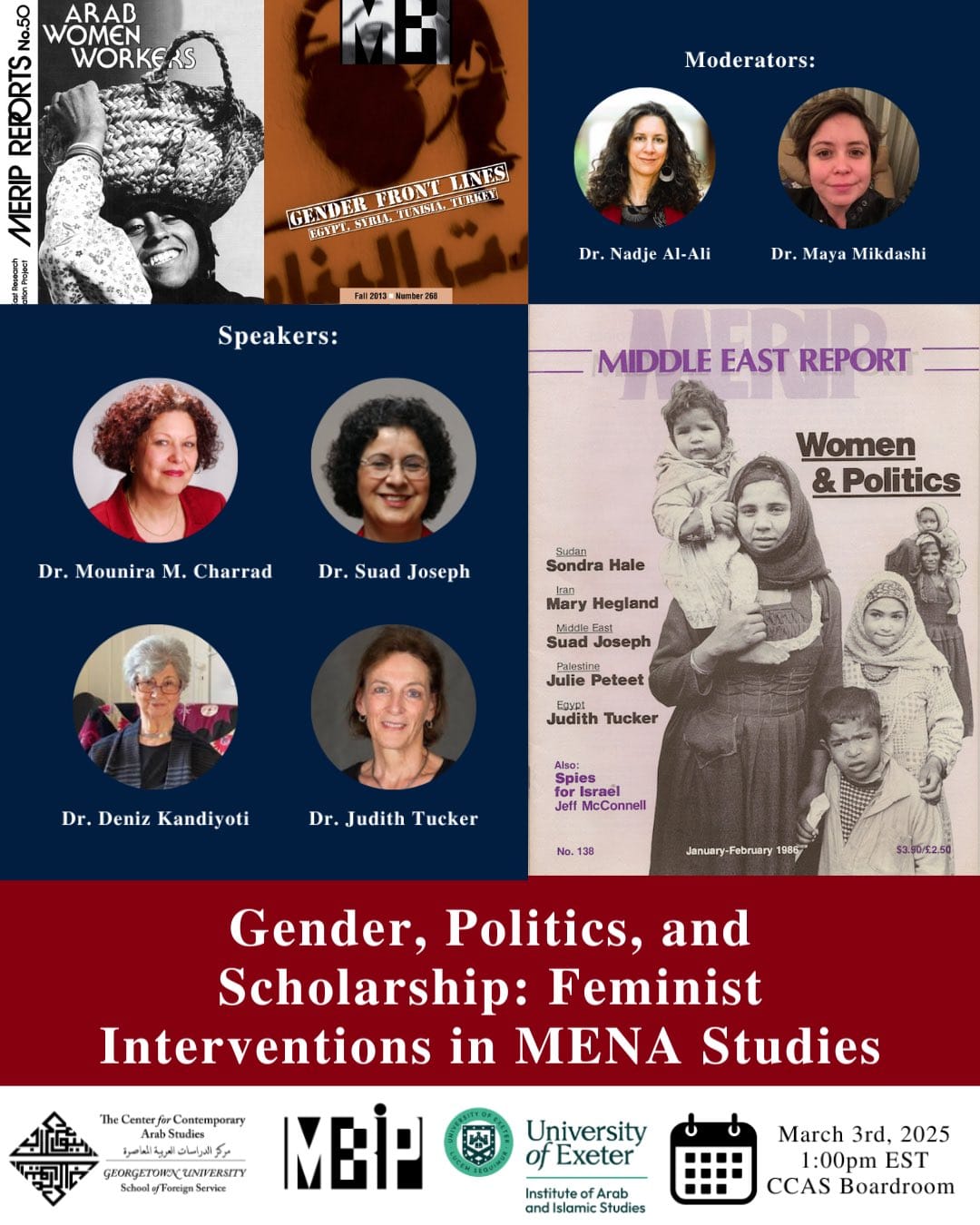
The poster for the roundtable discussion.
**O*n March 3, 2025, MERIP and the University of Exeter's Institute of Arab and Islamic Studies partnered with Georgetown University’s Center for Contemporary Arab Studies to host a roundtable on the past, present and future of feminist approaches to Middle East and North African Studies. The event brought together scholars and former MERIP contributors who have played pivotal roles in shaping the multi-disciplinary field of women's and gender studies within studies of the region. The discussion featured *Deniz Kandiyoti* (professor emeritus in development studies at SOAS), *Judith Tucker* (professor emeritus in history at Georgetown University), *Mounira Charrad* (associate professor of sociology at University of Texas, Austin) and *Suad Joseph* (distinguished research professor of anthropology and gender, sexuality and women’s studies at University of California Berkeley). They shared their experiences of how scholarship, organizing networks and areas of inquiry have taken shape over the past 50 years. In doing so, they also addressed a question at the heart of this issue: why gender matters now.*
*The roundtable was moderated by *Nadje Al-Ali* and *Maya Mikdashi*. It has been edited for length and clarity. The full video can be accessed in its original form* [*here*](https://youtu.be/v6wzdB7Tpes?si=ymYA14pVDRH%5FAkOr)*.*
**Nadje Al-Ali:** I want to ask you all about the trajectory of the field of gender studies with reference to the Middle East and North Africa over the last 50 years. Can you speak about the kinds of challenges the field, or you personally, have encountered vis-a-vis the broader fields of gender, Middle East Studies and traditional disciplines? This links to bigger questions: What does a gendered lens contribute to our understanding of the Middle East and North Africa and does gender matter?
> **Also Read:** [**"Shifting Approaches to Women and Gender in Labor, Politics and Society,"**](https://www.merip.org/shifting-approaches-to-women-and-gender-in-labor-politics-and-society/) **MER issue 300, Fall 2021.**
**Deniz Kandiyoti:** I think it would be fair to say that many of us on this roundtable had our formative experiences at a point in time when gender studies did not exist. There was a focus on women, which was very narrow. You might remember the first volume that came out in 1978, [*Women in the Muslim World*](https://www.fulcrum.org/concern/monographs/m326m2036), edited by Nikki Keddie and Lois Beck, which was trying to put together the scholarship at the time. The problem then was that the approach was mired in what we later called "Orientalism," a sense of Islamic exceptionalism, whereby we were frozen in a debate where women's rights were being read off of the foundational texts of the religion. This was happening at a time of interesting debates in the rest of the world about the effects of colonialism, spearheaded by Latin American Dependency Theory, which had barely made inroads into the Middle East. Judith Tucker's [*Women in Nineteenth Century Egypt*](https://www.cambridge.org/core/books/women-in-nineteenthcentury-egypt/6141A0B31234C7F4A8CF1D100208F65E) (1985) and the first issues of MERIP were so important because they broke with that trend and brought a fresh political-economy perspective to the field for the first time.
There is much more to say, but we must remember that the way in which gender studies came into the Middle East field was shaped by at least three sets of influences that were in constant interaction with one another: social movements, the changing (international) governance structures around gender and academia.
It is clear that the way in which gender studies, and indeed Black Studies, developed in the Euro-Atlantic region and in the United States was as a direct response to social movements such as second wave feminism and the Civil Rights Movement. This is a different genealogy from developments in the Middle East. To understand these, you need to look at the events following the first International Conference on Women in 1975 in Mexico City—in which many of us participated. From that point on, the issue of women's rights and gender was shaped and appropriated by the UN system. In 1995, gender was incorporated into official policy documents with an infrastructure of gender training, gender planning and gender mainstreaming. Alongside national bureaucracies that monitored gender equality, the entire teaching and research infrastructure of women's studies, which later became gender studies, started in the Middle East and the Global South after the impetus of the 1975 conference. The third institutional leg of these developments is to be found in academia and the growth of scholarship with distinctive preoccupations. Although the Western academic canon was widely disseminated throughout the world, studies of gender remained context-specific and responsive to regional crises and geopolitical flashpoints.
In North America, many people associate gender studies with post-structuralism and discourses about the fluidity of gender. In fact, the study of gender also has another genealogy in terms of its relation to global governance institutions: Women-targeted projects were not yielding the results expected, and gender was proposed as a relational concept that targeted the entirety of relations between men, women and generations. This social relations approach was more materialistically grounded. The idea that institutions themselves were gendered—whether we're talking about the state, the market, communities or households—eventually took hold, but it lost its salience with the shift to more dispersed sites such as bodies, sexualities and gendered identities.
When we ask, "Why does gender matter?" I think we need to qualify this by different understandings of gender which have shifted through time. Scholarship has been buffeted by and responded to events. After the 1979 Iranian revolution, we had a long-lasting wave of Islamic feminism asking: Is it possible to find feminist voice within Islam? From the 1980s onwards, with the *Infitah* \[“opening up,” or liberalization\], we had a burst of civil society activism which foregrounded Muslim actors and influenced the scholarship. After 9/11, we had the revival of the colonialism debate and the issue of “feminism as imperialism.” Indeed, with contributions from Nadje Al-Ali and Nicola Pratt looking at Iraq and Lila Abu-Lughod looking at, more broadly, the Muslim world and Afghanistan, it seemed that we'd come full circle to the original debates that Leila Ahmed had put on the agenda in the early 90s. Finally, the Arab Spring influenced so much of our scholarship, and now this dire moment of catastrophe which is unfolding in the region—these elements form the backbone of the contexts in which we operate.
> **But early on, we had this political economy push and it was very much in reaction to or in denial of an Orientalist reductionism of women to “what Islam says about them.”**
**Judith Tucker:** I will add a few things that might apply more directly to the discipline of history, which shares many of the characteristics that Deniz has raised. So much has happened in the region during the last decades and our scholarship has been very affected by the political developments that we have lived through. In part, this is a result of what we usually term in history the "presentist orientation" of many of us in the field—because most, if not all of us, are very connected and concerned with what is going on in the region.
Having said that, like all scholars we are also part of an intellectual world and influenced by broader intellectual trends. As Deniz mentioned, early on it was political economy and material history. For me the Neo-Marxist trends were extremely important. Deniz kindly referred to my work as being important, but I was not alone. There were towering figures, women, who were working on other regions at the time, if not as much on the Middle East. I learned and borrowed from them. But early on, we had this political economy push, and it was very much in reaction to—or in denial of—an Orientalist reductionism of women to “what Islam says about them.” But I do think that we threw the baby out with the bath water, in retrospect. For a while, there was a studied refusal to deal with culture and religious culture in particular.
As Deniz said, certain events—like the Iranian Revolution, or the power of Islamist political movements—refocused our attention on coming to terms with a certain local tradition and sense of identity that we would find among many women of the region. Personally, I was quite influenced by Fatema Mernissi, the Moroccan sociologist, who raised this call, urging us to think about revisiting the Islamic tradition and understand better what happened on a material basis—but also how texts were variously interpreted over time. That influenced my work in my post-political economy period, when I was more focused on Islamic texts, particularly juristic texts.
**Suad Joseph:** Anthropology is probably among the disciplines which have contributed most to the study of women in the Middle East. But there was hardly anything in anthropology in the 1970s, which is my generation and Deniz's generation, and Judith was just a couple of years behind us.
If we take 1970 as our starting point, until the 1990s most of the work was very ethnographic: on the ground, local, descriptive, with very little analysis. This came after the 1967 War, which generated a general sense of defeat—the defeat of Pan-Arab nationalism, the defeat of the states and, in some sense, the defeat of the student movements. That was formative for me because I was at Columbia in 1968 with the student uprising. Even though the student movement was oddly not so gendered, the women's movement side-by-side with the student movement and the Civil Rights Movement brought a global perspective that seeped into Middle East Studies. An important shift came with Edward Said's *Orientalism*, published in 1978\. While it had very little to say about gender, Orientalism itself was gendered, and feminists were able to intervene in that conversation.
I agree with Deniz that the 1975 Mexico meeting was a herald of things to come, with the UN Decade for Women (1976–1985), followed by 1985 Nairobi \[the third World Conference on Women\], and 1995 Beijing \[the fourth World Conference\]. And, remember, there was also CEDAW \[the Convention on the Elimination of All Forms of Discrimination Against Women, a UN treaty\] in 1979 and a whole series of conventions, including later the Convention on the Rights of the Child.
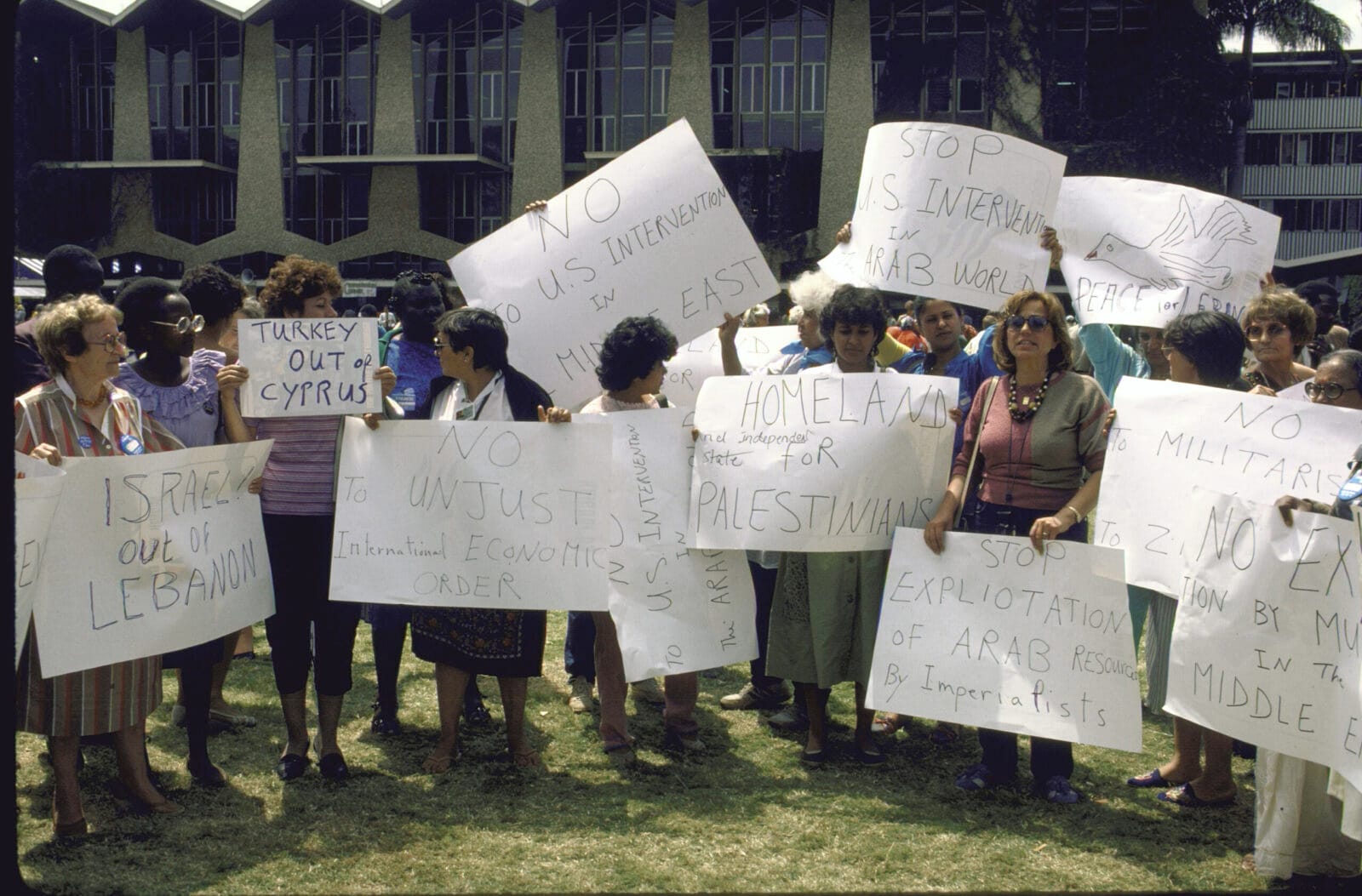
A demonstration at the Third World Conference on Women, in Nairobi, Kenya, July 1985\. (William F. Campbell/Getty Images)
The Islamic revolution in 1979 triggered an interest in the veil. Women's clothing became the topic of so much of the conversation, but it was very difficult to have conversations with scholars because very few outside the Middle East read our work. We were not well-read outside of our own community. If you were teaching feminist courses, which I began doing in the 70s, there was very little literature to use. When Lila Abu-Lughod's *Veiled Sentiments* came out in 1986, it was one of the few books that was being used ethnographically. Rosemary Sayigh's work, [*The Palestinians: From Peasants to Revolutionaries*](https://lighthousebookshop.com/book/9781842779644) (1979), came and then in 1994, [*Too Many Enemies*](https://www.palestine-studies.org/en/node/430055), focusing specifically on women. In 2005, [*Voices: Palestinian Women Narrate Displacement*](https://www.w4.org/en/wowwire/palestinian-women-narrate-displacement-rosemary-sayigh/)*,* illustrated the importance of oral histories, documenting women where they were located. Because if you look at the gendered lens as a lens about power—where are women located in relationship to power? What keeps them there? What are the structures of society, the structures of labor, the structures of representational discourses and where are women located in relationship to these? Where is resistance?—then understanding women's voices and the oral history tradition that Rosemary led is very important.
By the late 1990s, an important turn prompted us to begin looking more at global factors and the state. Scholarship became more analytical, more theoretical. Yes, we imported many of the theoretical frameworks from feminism in the West, but we also recognized the need for indigenous frameworks to emerge. Islamic feminism was one, but many of us had concerns and dedicated significant time to addressing them. The period from the 1990s into the early twenty first century was pivotal in terms of theoretical and critical analytical work and the production of phenomenal new generations of scholars.
Another fascinating turn was research on sexualities and bodies. The publication of journals like *Kohl* in Lebanon marks a shift from the very particularistic research that had been a characteristic of the 1970s to the 1990s and creates an interface on a global stage.
To summarize, a periodization I like for understanding women and gender research within Middle East Studies begins with the initial wave of research in the 1970s to 1990s; followed by the 1990s to the early 2000s as a bracketed period of research on the state and on citizenship and on women's rights, in part generated by the UN Decade for Women; and then post-2000, an emerging emphasis on the body and sexuality. \[Reinforcing the breadth of this scholarship and the periodization mentioned here, a transnational research team, [Mapping the Production of Knowledge on Women and Gender in the Arab Region](https://mpkgender-arabregion.org/mpk-database/) recently launched a database cataloguing this literature between 1975 and 2022, more than 20,000 references.\]
> **It has been a period of chronic warfare, chronic violence, chronic dislocation of peoples…We need to more clearly understand the politics of knowledge production amid global dislocation in the region...**
I also want to put in the backdrop that what was happening on the ground in the Middle East, especially in the Arab region, was traumatic, violent, chronic warfare: the Lebanese civil war from 1975 to 1990, the Iran-Iraq War from 1980 to 1988, the chronic wars in Yemen, the occupation of Lebanon for 20 years, the 2006 Israeli invasion in Lebanon, the First intifada, the Second Intifada, the 2011 revolutions, which were largely defeated. It has been a period of chronic warfare, chronic violence, chronic dislocation of peoples…We need to more clearly understand the politics of knowledge production amid global dislocation in the region, caused both by internal forces as well as regional and global forces.
**Mounira Charrad:** To my mind, the answer to the question of why a gendered lens matters and what it contributes to the study of the region is very simple. The study of gender contributes to the study of any region in the world, including ours, and the issue for us is more that Middle Eastern studies scholars have looked at institutions without paying attention to gender. But all institutions are gendered everywhere, including in our region.
To the question of the trajectory of the field, I will add a couple of points from the perspective of my discipline, sociology, which is the latecomer to the study of gender in the region. It is also a field that remains much less represented than anthropology, history and political science.
In addition to the challenges already discussed, scholars in my generation were facing an approach to gender in sociology that made two claims that many of us then had to confront. One claim concerned feminist agendas needing to be the same or very similar throughout the world. Those of us who looked at Latin America, the Middle East or Asia were asserting that this imposed a feminist agenda onto the global world in a way that didn't make sense to us. We were aware that our agendas could be different and that they could be feminist while being different, so the issue of agenda was key. A second dominant issue at the time concerned the relationship between state and gender—the claim that the state is patriarchal was a blanket statement. Some of us agreed that states are patriarchal, extremely so in some parts of the Middle East and North Africa, but we also were aware that not all states are equally patriarchal or patriarchal in the same ways. In sociology, we needed to confront and debunk these two main claims.
**Maya Mikdashi:** You have spoken a bit about how our work is in constant dialogue with a region in turmoil, but can you speak about how your work has developed throughout your careers? Who has influenced your thinking? What are the key questions that you have been interested in and how have they shifted over time?
> **I was not a feminist when I started field work. What made me into a feminist was my field work...**
**Suad:** I think about these questions a lot because I am puzzled by my own history, by how I got to where I am—nothing would have predicted this. When I began graduate school, I was very unformed theoretically. To the degree that I had any theoretical grounding, it was mainly Durkheimian and Marxian, but I was at Columbia during the 1968 strike and that was an incredibly transformative moment. So, it was not any person, it was the events, and it was being a part of that student movement. I was part of SDS (Students for a Democratic Society) and then the falling out of the madness that the SDS became. But the key variables were always class and the state. I took the commitment to understanding the state and class to the field with me.
I was not a feminist when I started field work. What made me into a feminist was my field work because when I came back from the field, I realized that my data was overwhelmingly about women, and I had to understand it. I started asking people, “Who do I talk to? How do I understand this data?” I was simultaneously asked to teach a course on what was then called “sex roles.” I was at Hofstra University at the time, and I was led to Rayna Reiter, now better known as Rayna Rapp, and she introduced me to a group of Marxist feminists—people like Gayle Rubin, Louise Lamphere, Karen Sacks. I was already a Marxist, so that was an easy transition. We were reading together, we were writing data, we were thinking together, and none of them were of the Middle East. That was the vacuum for me. Apart from Deniz in England, there were very few people in anthropology who were doing this kind of work at that time. Later, when I came to University of California-Davis, no one was working on the Middle East here. I was literally the only one regularly teaching on the Middle East, so there were very few people to talk with. I would go to the Bay Area where there was a Middle East seminar, but there weren't feminists among those. I decided that if I couldn't find people to talk with about Marxism and feminism, about women in the Middle East, about the Middle East at all, then I had to create organizations to do that. Several decades followed in which every time a question came up, and I wanted to find people to work with, I created an organization to do that.
I started the Middle East section of the American Anthropological Association (AAA) when I was still a graduate student at Columbia because there was no one to talk to within anthropology, and a panel that we had suggested was rejected. Then came the Association for Middle East Women's Studies (AMEWS). We started the Women's Studies program at UC Davis in the 1980s. There was no one to talk with about families, which is an area that I was increasingly interested in, so I created the Arab families working group. Then, I wanted to get scholars on Lebanon talking with scholars here, so I created a consortium called the [University of California Davis Arab Region Consortium](https://globalaffairs.ucdavis.edu/ucdar) that included the AUB, AUC, LAU and Birzeit (co-founded with the Arab American Studies Association), and on and on. As a result, I never published a book because I was spending my time creating these organizations that provided enormous gratification and networks. The latest organization is the Middle East South Asian Studies program at UC Davis.
What ran through all of that work was class and state. No matter which issue I took up, I always looked back to connecting with class and the state. I was born in a country (Lebanon) with a very weak state, then I grew up in a country (the US) that had a very strong state, and going back and forth between the two always struck me. I studied women, then women's networks, then family and then citizenship, which led me to the study of looking at relational rights and the self—and they produced a bundle of concepts that continue to loop back to the state and class.
Now, the violence I mentioned earlier and the genocide in Palestine has led me to look at the concept of trauma and question how we can develop a concept that is useful, appropriate and relevant given the conditions in Palestine, in Lebanon, in Syria. We need to have a different understanding in places where the framework of post-traumatic stress is not relevant. There is no "post." The trauma is ongoing. It is generational. It is not individual. It is societal. We need a different approach. And somehow all these pieces are connected, leading from the initial work on politicization of religion in the state to looking at how women acted, to looking at the family, to looking at notions of relationality—all connected with *wasta* \[the use of personal connections and influential relationships to gain advantages\] and networks. Somehow that bundle produced itself. I did not go out to study any of this. I didn't have a framework in mind other than class and state. In my case, the field led me; I don't think I led the field. It was what was emerging that I felt I had to address in some way.
> **One of the reasons that I became a historian, and what has really shaped the field of Middle East women's and gender history, is the recognition of the importance of the imperial and the colonial in the modern period...**
**Judith:** Like Suad, I was active in the anti-war movement on campus in 1968–1969\. But that wasn't really what propelled me. After I finished college, I went to Beirut for two years. It was at the time when the Palestinian revolution was fully ensconced there and in flower. I remember being so struck by women and a certain rhetoric about how important women were in this revolutionary movement. I'm not saying that the reality always lived up to the posters and the discussion, but coming from the US Left, I thought, “wow, this is so much better than what I'm used to in terms of how the left deals with issues of women's participation, etc.” I became very interested in women's history and women's history in the Middle East as a result largely of that experience. In those days “gender” was not a word we used. I did my original work in Egypt and the journey was really one that, as I mentioned before, started very squarely based in political economy.
One of the reasons that I became a historian, and what has really shaped the field of Middle East women's and gender history, is the recognition of the importance of the imperial and the colonial in the modern period, how much that has shaped everyone and everything from the individual right up to the state and our need to study that process very carefully. Many historical studies of the various ways in which Empire deployed gender are still so relevant to what happens today.
I kind of fell into my subsequent projects because I worked in the Islamic court records. They became such an important source for studies of women and gender, particularly during Ottoman times in the region. In the beginning, I worked in them very uncritically, just mining them for data. Then I became curious, ultimately, about what was really going on here. Why Islamic law? Why the courts? What lies behind this? Then I grew interested in a much broader study of Islamic law itself: Islamic law and gender issues, Islamic law and society. What was that historical trajectory? How do we understand the epistemological break that we see with the emergence of the modern state, taking control, codifying the law and so forth? I got in through the back door into issues of state as well.
In reflection, I would add one more thing about how much we are influenced by what happens on the ground. As Suad pointed out, it has been a very violent time. That encouraged me to look at the issue of piracy in the eighteenth century and ask questions about gendered violence. What did it look like in an earlier time in the region? Those are some of the major influences for me.
> **Kinship seemed central because there were groups that were resisting the state, or, on the contrary, aligning themselves with state, that were based on kinship, and since these groups were patriarchal, it informed how women's rights developed.**
**Mounira:** I see two things that influence my thinking. First, I'm from Tunisia. I grew up in Tunisia. I went to college at the Sorbonne in Paris and then graduate school in the US. Wherever I was, women from other parts of the Middle East and North Africa would come to me and say, “Oh, how lucky you are to be from Tunisia. Women in Tunisia have rights that no other country has.” In graduate school, I was plunged into the study of comparative historical sociology. I was in a department where you could do quantitative work or you could do comparative historical work. Basically, there was very little ethnography at the time in that department. I was drawn to comparative historical sociology, and I think, because I'm a woman from Tunisia, several people on the faculty and elsewhere expected me to do a study illustrating women's subordination somewhere in a community or in families in Tunisia as my dissertation. As stubborn as I was, and as interested as I was in comparative historical sociology, I wanted to understand big developments in the region, and the methodology that I learned had been applied to issues of wars, revolution, political systems, democracy, dictatorship and so on. I thought, well, how about gender? How about women? How about women's rights? How do those long term, broad developments impact women's rights? So that's what I wanted to study. The reaction I got was, “wow, you're using a big gun to shoot a small bird.” My reaction was, “no, women's rights, that is not a small bird, that is a big bird!” I am using big guns to understand big birds.
That's how I got into the study of the development of states. Then I found another challenge concerning how states in the region are studied. Growing up in a colonial/post-colonial situation where elite schools were teaching French, I learned French history and very little history of Tunisia. But when I looked at the history of Tunisia, Algeria and Morocco, I found that the development of states had to do not only with the relationships between state and class, governance and class, rulers and class, but also with how states related to what I have called “kin-based solidarities:” groups organized along kinship lines and held together by a sense of belonging to a common kinship line, a common ancestor, and not necessarily by social class. That's how my work developed step by step: First looking at women's rights in my dissertation and later developing an analysis of how states emerged and change historically from the pre-colonial period to the post-colonial period. Kinship seemed central because there were groups that were resisting the state, or, on the contrary, aligning themselves with state, that were based on kinship, and since these groups were patriarchal, it informed how women's rights developed. Just two days ago, I read an article about how Hamas relates to and organizes the population. Not surprisingly, kin groupings come into play. Kinship shapes how groups are held together. Hamas is totally aware of the significance of what brings and holds people together, particularly in situations of violence, trauma and destruction.
Now, my interests have changed. I went from wanting to study structures, states and broad institutions to a focus on agency in my current work. I want to understand how women's movements, feminist movements, develop and survive in situations where it's not easy to survive: what strategies they use to survive and to find a voice when conditions permit. My shift really has been from structure to agency.
> **My own experiences of being on the ground and seeing how women were actually coping day-to-day with living in patriarchal structures led me to “bargaining with patriarchy.”**
**Deniz:** I think it will seem very unacademic to say that my formative experience was growing up in Istanbul as a girl. It may seem strange that you can have a nine-year-old proto-feminist, but that's exactly what happened. The inspiration for my work on patriarchy was formed when I was in primary school, basically. My work took off in the 1980s when I left Turkey and came to London, and I was confronted by two sets of scholarship that gave rise to great dissatisfaction. One was feminist scholarship itself, which was dominated by big debates about capitalism and patriarchy. You had radical feminists, socialist feminists, liberal feminists battling it out, trying to decide whether these were independent systems of oppression or whether they work together. My own experiences of being on the ground and seeing how women were actually coping day-to-day with living in patriarchal structures led me to “bargaining with patriarchy.” I was arguing that each system of male dominance creates its own areas of wiggle room and different forms of consciousness, including conservative consciousness. This is much more relevant today than I imagined because the particular patriarchal bargain I was talking about—based on women's obedience and submission for male protection—seems to have quite a few buyers among Trump-supporting women as we saw in the latest election. But in relation to feminist theory, the patriarchal bargain was my main contribution.
In relation to the Middle East, I was extremely frustrated by what seemed a very sterile approach to women's rights in the region. This motivated me to contribute [*Women, Islam, and the State*](https://link.springer.com/book/10.1007/978-1-349-21178-4) because I was quite interested in how histories of state formation and nationalism inflected the ways in which Islam came into the picture. Maya \[Mounira Charrad\] was doing her PhD at that point, and I also drew on her work with the comparative study of Tunisia, Algeria and Morocco. As I became more involved in scholarship in the United States, I started feeling rather desperate about the sterility of the field. We seemed to be stuck in a groove. We were back discussing Islamic feminism as if the state moment had never happened. Also, the Zionist/anti-Zionist axis in politics, which was much sharper in the United States, drove me to despair, and I simply made a cowardly exit from the field. I started working in Central Asia, and from 1995 to 2000 I worked on Uzbekistan. Then I started working on Afghanistan between 2002–2204.
The Arab uprisings drew me back to the field. At that point, I was already retired. I was working for a webzine called [*Open Democracy*](https://www.opendemocracy.net/en/), where I was monitoring the gender effects of the Arab uprisings. This gave me an opportunity to provide a platform for my friends in the region to write about that moment from Cairo, from Tunisia and from the environing countries like Saudi Arabia and Iran. I realized that my model of patriarchy was outdated, that it needed urgent revision, because I was seeing new patterns on the ground with respect to the sorts of violence being deployed: politically motivated gender-based violence. Whereas I had been talking about the kind of violence that takes place in families, in communities, in tribes where everything is hushed up, this violence was public, anonymous and state-sanctioned in many places. So, I moved away from patriarchy and coined the term "masculinist restoration," which refers to the will to reassert male domination and privilege, through coercion if necessary, at a point where patriarchy is no longer hegemonic and you have new forms of mobilization and political consciousness.
> **The rise of right-wing movements across Europe, in the United States and further afield has both vindicated and challenged my concept of masculinist restoration.**
I was very influenced by what was happening in the Middle East—in Tahrir in Cairo and in Istanbul during the Gezi uprisings in 2013\. I saw the newer generation who were aware that gender issues were actually about governance itself. It was about the desire for a pluralistic, democratic society vis-a-vis the patriarchal pretensions of autocracies. My assumption at the time was that there would be new cross-gender alliances—groups of men and women fighting for democracy, for pluralism, for inclusivity, versus men and women fighting against it. The rise of right-wing movements across Europe, in the United States and further afield has both vindicated and challenged my concept of masculinist restoration. For instance, in the 2024 election campaign in the United States, constituencies of young men with violently misogynistic views, such as the so-called incels, were being openly courted as the issue of male privilege was put on the agenda. My expectations concerning the role of youth as a bulwark against autocracy, on the other hand, were challenged. Statistics showed a growing gender gap in political preferences with more young men than women voting for right-wing movements both in the United States with Trump and in Germany among supporters of the far-right Alternative für Deutschland. Youth could apparently be divided by their gender interests.
Yet, I refuse to resort to the concept of “backlash” to explain these outcomes: the idea from political science that when \[newly\] empowered groups start affecting policies on the ground, aggrieved majorities who feel disempowered try to claw back whatever rights and spaces they may have acquired. I think reliance on this concept prevents us from looking at feminism and feminist approaches more critically. First, I was very critical about the way in which gender was incorporated through governance tools: Instruments, such as gender mainstreaming, have been co-opted and appropriated especially in the countries of the Middle East and North Africa, where they became a fig leaf for autocratic governments simply gesturing towards inclusivity of women. I also expressed unease about how the Western canon, which continued to be influenced by local social movements around sexual liberties and LBGTQ platforms in the West, was being disseminated globally in mechanical and unproductive ways. This came home to me most forcefully during gender training sessions in Kabul where Afghan women who had been unable to leave their homes without a related male chaperone (*mahram*) under the Taliban were being taught about gender a fluidity in a context where gender relations were coerced and subject to direct policing—as they still are.
I am now interested in revising my concept of masculinist restoration because I believe we have reached a moment of unprecedented global crisis in gender relations. It is superficial to dismiss the moral panic about the demise of the heterosexual family fueled by the conservative right—although their scapegoating of gay and trans communities is totally off the mark. The fact is that birth rates are declining sharply globally and family formation is delayed or altogether bypassed in a context where the commodification of care and diminishing public access to support for social reproduction (in the areas of education, health and shelter) creates new pressures and obstacles. It is quite significant that the lowest birth rates and ratios of women choosing to remain single are highest among the most patriarchal societies of east Asia such as South Korea and Japan. The crisis of social reproduction is most dire in the Middle East where the fragmentation of states and escalating conflict put even conditions for bare life under threat—as is most evident in Palestine—and make the development of a gender agenda even more complex.
This brings me back to Nadje's first question: why does a gender lens matter? A gender lens now is not merely about gender identities and rights. Gender has become a key mobilizing issue in politics. Think of Iran, and the “Woman, Life, Freedom" demonstrations that started in 2022\. The authorities were barely able to put them down a year later, using massive repression. Protesters knew that this wasn't about women veiling or unveiling but about the sort of regime they were unwilling to live under. Although this may be an extreme example, mobilizations around gender are at the heart of battles around the nature of polities and the vital struggle for democracy.
What I would like to explore is whether we really understand this moment. Are there elements of hope? How can we form an agenda to mobilize the forces that are able to act as a counterweight to the various forms of autocracy that are germinating everywhere in their own way? And how do we understand the global alliances that form around gender, which are now much broader?
> **Read the** [**previous**](https://www.merip.org/a-note-on-the-cover-image-8/) **article.**
> **Read the** [**next**](https://merip.org/2025/06/israels-war-on-reproduction-in-gaza-2) **article.**
**This article appears in** [**MER issue 314**](https://merip.org/magazine/314/) **“New Gender Frontlines.”**
### Issue 314 (Spring 2025) Masthead
URL: https://www.merip.org/2025/06/issue-314-spring-2025-masthead/
Last updated: 2025-07-31T20:45:24.000Z
## ***Middle East Report*, “New Gender Frontlines,” Spring 2025, No. 314, Vol. 54 No. 1**
### **Executive Director**
**James Ryan** jamesryan@merip.org
### **Executive Editor**
**Katie Natanel** katienatanel@merip.org
### **Managing Editor**
**Marya Hannun** maryahannun@merip.org
### **Photo Editor**
**Michelle Woodward** mwoodward@merip.org
### **Staff Editor**
**Alyssa Bivins** bivins@gwu.edu
### **Issue Editors**
Sabiha Allouche
Fida Adely
Hesham Sallam
### **Board of Directors**
**Paul Silverstein(Board Chair)** *Reed College*
**Mona Atia** *George Washington University*
**Kaveh Ehsani** *DePaul University*
**Michael Hanna** International Crisis Group
**Adam Hanieh** *University of Exeter*
**James Ketterer** *Bard College*
**Vickie Langohr** *College of the Holy Cross*
**James Ryan** *MERIP Executive Director (ex officio)*
### **Editorial Committee**
**Lisa Hajjar (Co-chair of the Editorial Committee)** *University of California, Santa Barbara*
**Muriam Haleh Davis (Co-chair of the Editorial Committee)** *University of California, Santa Cruz*
**Ayça Alemdaroğlu** *Stanford University*
**Sabiha Allouche** *University of Exeter*
**Stephen Gasteyer** *Michigan State University*
**Maziyar Ghiabi** *University of Exeter*
**Kanwal Hameed** *University of Exeter*
**Najib Hourani** *Michigan State University*
**Laleh Khalili** *University of Exeter*
**Reinoud Leenders** *King's College London*
**Shana Marshall** *George Washington University*
**Pascal Menoret** *Brandeis University*
**Jacob Mundy** *Colgate University*
**Hesham Sallam** *Stanford University*
**Kevin L. Schwartz** *Oriental Institute of the Czech Academy of Sciences*
**Deen Sharp** *London School of Economics*
**Sean Yom** *Temple University*
### **Format: Online**
### **ISSN 3065-744X**
### A Note on the Cover Image
URL: https://www.merip.org/2025/06/a-note-on-the-cover-image-8/
Last updated: 2025-07-31T20:46:01.000Z
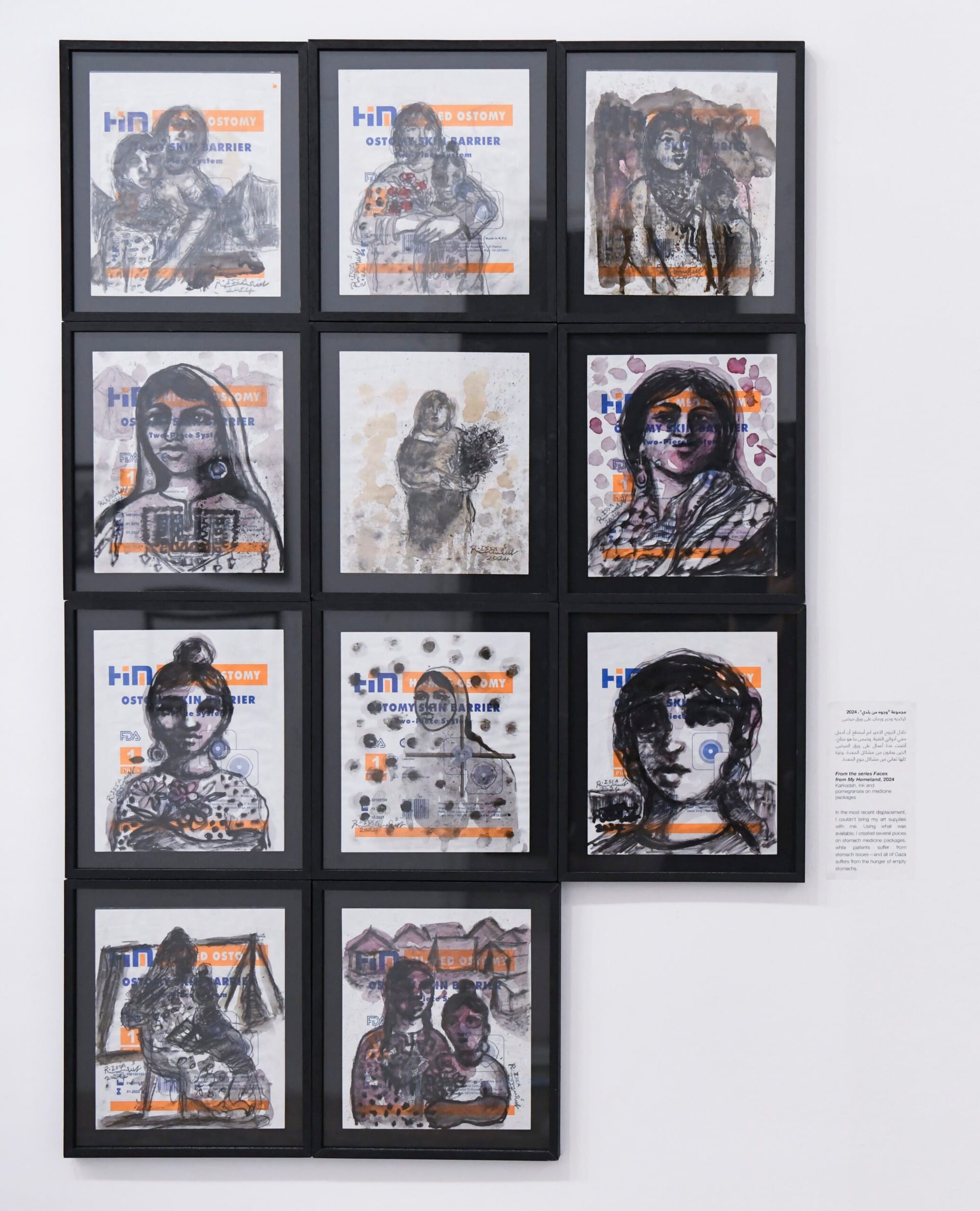
Installation view of Raed Issa's Faces From My Homeland, 2024, at Darat al Funun, Amman, Jordan. Photograph courtesy of Darat al Funun.
Raed Issa’s 2024 series, *Faces from My Homeland*, illuminates the cover of MER issue 314 “New Gender Frontlines.” The work—a mix of charcoal, coffee, pomegranate and hibiscus painted on repurposed medicine packages from Gaza—depicts a grid of women’s faces, spanning generations and conditions: from martyr, to mother, to child. Their gazes are brought to life by these everyday materials repurposed as tools of artistic expression.
The paintings highlight the gendered impacts of Israel’s ongoing genocide, now spanning more than 600 days, a seemingly inexhaustible attempt to devastate and eliminate Palestinian life. Women in Gaza fight to protect their children, provide for their families, care for the injured and mourn the loss of loved ones. The ordinary materiality of the medical packets emphasizes this common struggle in a war that has deliberately demolished the lines between home and battleground. Here packaging for stomach medicine becomes a canvas, and drinks once shared among friends become paint.
Yet it is the individuality of each figure in the grid—her age, posture, style, gaze, circumstances—that draws the eye. Issa’s artwork speaks of steadfastness: how people survive, bear witness and create. Like [Hala Shoman’s article](https://merip.org/2025/06/israels-war-on-reproduction-in-gaza-2) in this issue, which documents in harrowing detail, Israel’s reproductive genocide on Gaza, his paintings underscore Palestinian women’s determination, and their labor, to make life possible in conditions of death, displacement, homelessness and hunger. Their faces communicate strength and presence, sustaining family and community.
In Issa’s words, *Faces from My Homeland* witnesses and honors “the women of Gaza who endured and were patient in the face of all this harm, killing and displacement—and are still struggling to live with dignity, freedom and peace.” It is a fitting cover for MERIP’s spring issue, which asks the question of why gender matters now.
**Read the** [**first**](https://merip.org/2025/06/gender-politics-and-scholarship-a-roundtable) **article in** [**MER issue 314**](https://merip.org/magazine/314/) **“New Gender Frontlines."**
### Israel’s War on Reproduction in Gaza
URL: https://www.merip.org/2025/06/israels-war-on-reproduction-in-gaza/
Last updated: 2025-08-22T18:35:54.000Z
In December 2023, an Israeli missile struck Gaza’s largest fertility clinic, Al Basma IVF Centre.
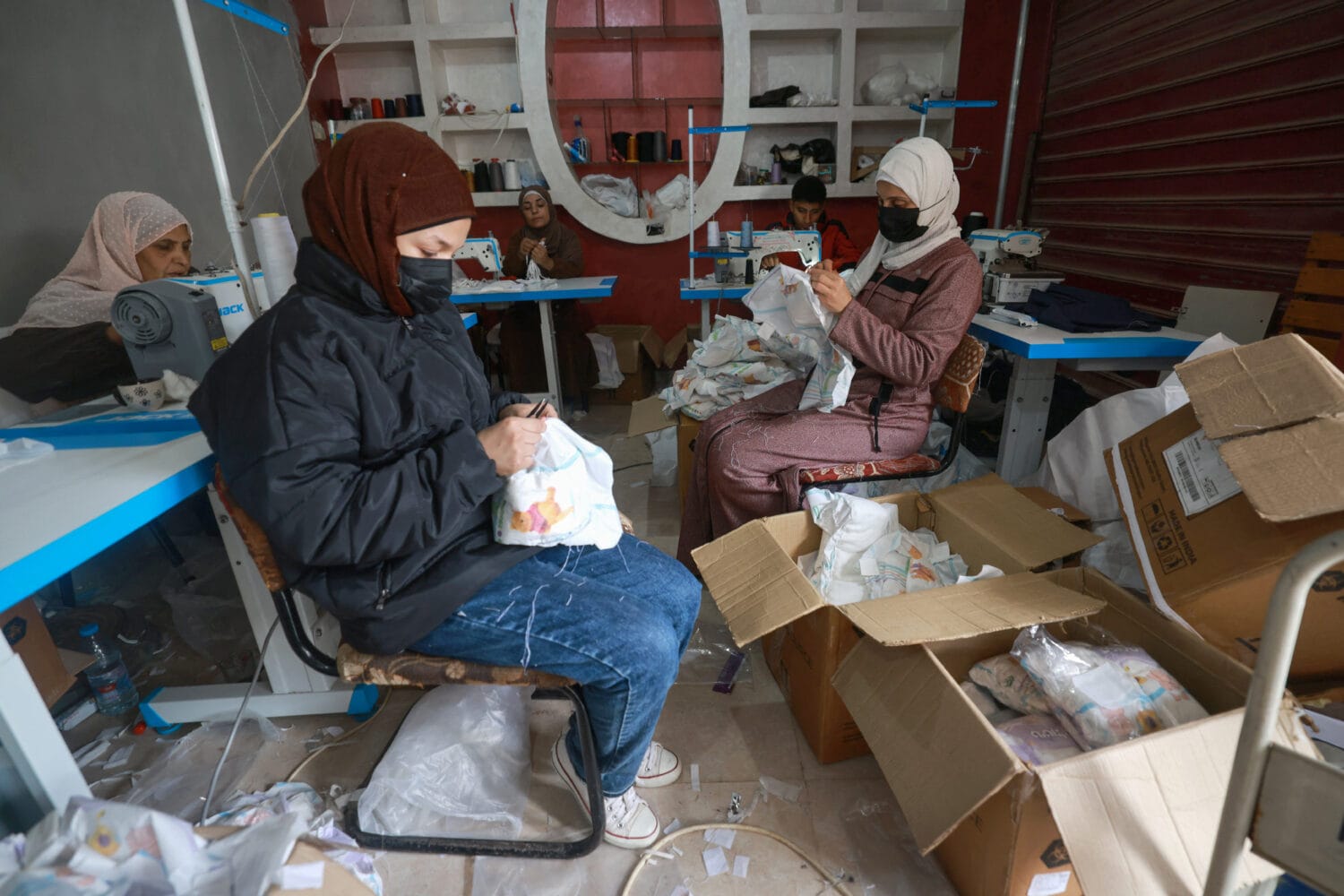
Palestinian women sew diapers at a workshop in Rafah in the southern Gaza Strip, on February 18, 2024, amid severe shortages of basic necessities. (Mohammed Abed/AFP via Getty Images)
The single explosion destroyed more than 4,000 embryos and over 1,000 vials of sperm and unfertilized eggs. Dr Bahaeldeen Ghalayini, the obstetrician who established the clinic, summed up the implications of the attack in an interview with Reuters: “5,000 lives in one shell.”[\[1\]](#%5Fedn1)
The strike was an act of reprocide: the systematic targeting of a community’s reproductive health with the intention of eliminating their future. In the context of Israel’s ongoing genocidal war in Gaza, reprocide serves as a tactic. Indeed, genocide includes its definition, “imposing measures intended to prevent births” within a particular national, ethnic or religious group.
The bombing of the IVF clinic was one spectacular example, but as a Palestinian women’s rights activist from Gaza, I have lived and witnessed how Israel uses reprocide within a settler colonial framework that seeks not only territorial domination but demographic erasure—a process that began long before October 7, 2023.
When I was 15 years old, following the Israeli assault on Gaza in 2008–2009, Israeli soldiers began wearing and distributing t-shirts that depicted a pregnant woman in crosshairs above the slogan “1 Shot 2 Kills.”[\[2\]](#%5Fedn2) I recall the fear felt by the pregnant women I knew. The t-shirts prompted people around me to recount stories of pregnant women being killed or wounded during other moments of extreme violence in Palestinian history, from the start of the Nakba in 1948 to the Sabra and Shatila massacres in 1982\. Underscoring the eliminationist nature of this violence, Israel remains among the world’s leaders in assisted reproduction technology, actively encouraging birth rates among Jewish citizens.
In an effort to trace the effects of reprocide amid Israel’s ongoing genocidal war, between October 2023 and October 2024, I collected ethnographic evidence—voice notes, text messages, emails and phone calls—from those enduring or witnessing reproductive violence. Analyzing their accounts alongside official reports from Gaza reveals the many ways Israel has weaponized reproduction, some more obvious than others: from the direct assaults on reproductive health and infrastructure to the conditions it forces women and men to reproduce under to sexual violence and its role in reproductive erasure.
## **Targeting the Future**
By March 2025, the official death toll in Gaza since October 7, 2023 had surpassed 50,000.[\[3\]](#%5Fedn3) More than 17,000 of the dead were children, including at least 2,100 infants and toddlers.[\[4\]](#%5Fedn4) At least [970 extended families](https://www.newarab.com/news/gaza-families-wiped-out-entirely-israels-war-machine) were wiped out entirely. Although the exact number of widows in Gaza is unknown, as early as January 2024, UN Women reported that there were at least [3,000 widows](https://arabstates.unwomen.org/en/what-we-do/peace-and-security-2/facts-and-figures-women-and-girls-during-the-war-in-gaza) and an uncounted number of widowers. Illustrating the scale, in my own circle of friends, nine have become widows and 13 widowers.
Beyond the staggering death toll, which has prevented countless potential lives and future generations, the genocide has explicitly targeted Gaza’s capacity to reproduce. Even before the genocide, Gaza was a difficult place to be pregnant: A study on maternal mortality conducted in 2018, for example, suggests that, among other factors, the illegal Israeli blockade beginning in 2006 has impacted maternal mortality rates.[\[5\]](#%5Fedn5) The siege reduced the availability of drugs, disposables and medical equipment. It also affected women's ability to get referrals and [exit Gaza for emergency treatments](https://www.map.org.uk/news/archive/post/607-six-months-alone-how-israelas-blockade-kept-a-gaza-mother-and-her-new-born-daughter-apart), as their exit was subject to Israeli approval.
Since October 2023, the situation has become catastrophic. Between October and November of that year, around 180 women gave birth in Gaza each day, and at least 15 percent of them faced complications.[\[6\]](#%5Fedn6) By 2024, more than 177,000 women experienced life-threatening health risks such as non-communicable diseases, hunger and malnutrition during their pregnancies, and the miscarriage rate had increased by up to 300 percent.[\[7\]](#%5Fedn7)
Intensive Care Units have been repeatedly bombed and lack the life-saving electricity needed to supply incubators for premature babies. In November 2023, a harrowing example of the consequences of such attacks came when the Israeli army [forced the abandonment](https://edition.cnn.com/2023/12/08/middleeast/babies-al-nasr-gaza-hospital-what-we-know-intl/index.html) of five premature babies at Al Naser Children’s Hospital. Soldiers ordered hospital staff to evacuate and leave the premature babies, where they died without support.
In addition to systematically destroying hospitals, fertility clinics and maternity wards, Israel has maintained an ongoing blockade of Gaza, which includes the obstruction of aid and medical supplies necessary to reproductive health. Since October 2023, hundreds of Palestinian women have endured C-sections without anesthetics, while doctors have had to remove entirely healthy uteruses to protect women’s lives amid the absence of hemorrhage controlling materials for postpartum bleeding.
> **In addition to systematically destroying hospitals, fertility clinics and maternity wards, Israel’s ongoing blockade of Gaza includes the obstruction of aid and medical supplies necessary to reproductive health.**
In December 2023, I spoke to Dana, a 34-year-old woman who had spent ten years trying to conceive. When the Israeli military forced her and her husband to evacuate Gaza City, she was several months pregnant. At a checkpoint, female Israeli soldiers forced her to squat repeatedly, causing her to bleed and lose consciousness. Her husband carried her to a hospital, where the baby was born in poor health, and Dana hemorrhaged. With no access to medicine, doctors had to perform a hysterectomy. Dana survived, but her reproductive future did not. As with many of my friends and informants, I lost contact with her a long time ago and do not know whether she is still living.
While there is no precise number available, many pregnant women have not survived such attacks. In November of 2023, [*NBC News* documented the story](https://www.hrw.org/report/2025/01/28/five-babies-one-incubator/violations-pregnant-womens-rights-amid-israels-assault) of Hind Shamlakh, a pregnant women who was buried under the rubble after an Israeli airstrike hit the home she was sheltering in. After being rescued, she was given an emergency c-section. The baby was born with a broken arm. My brother-in-law, an obstetrician, recounted that he performed ten postmortem C-sections in a single week in 2023, rescuing babies from the wombs of mothers who had died. When rescued, these infants struggle to survive without incubators, adequate formula or parental care.
Israel’s relentless bombardment of Gaza, particularly between October 2023 and the temporary ceasefire in January of 2025, has made the conditions of delivery traumatic and difficult, even for women with healthy pregnancies. Many women shared accounts with me of how they had to deliver in their sheltered areas as they were caged in by Israeli tanks and quadcopters. Some recounted how their husbands had to deliver them as they were unable to move or seek help amid the Israeli ground invasion. One friend described giving birth in a house surrounded by Israeli tanks. She was not able to cut the umbilical cord. Soon after the Israeli tanks withdrew, she decided to walk to the nearest hospital. Out of fear of indiscriminate attacks on civilians, she opted to go alone with her newly born baby, leaving her husband. If she was killed, then the rest of their children would have at least one parent left.
## **‘Bomb Now, Die Later’**
Since October 2023, Israeli attacks have damaged or destroyed [nearly 70 percent of Gaza’s structures, including 92 percent of its housing units](https://www.doctorswithoutborders.org/latest/destruction-homes-leaves-palestinians-unable-safely-return-rafah#:~:text=After%20more%20than%2015%20months,scale%2Dup%20of%20humanitarian%20aid.). Stephen Graham has referred to this kind of military tactic as “switching off cities.”[\[8\]](#%5Fedn8) It leads to a situation he describes as “bomb now, die later.”[\[9\]](#%5Fedn9) In other words, the systematic destruction of infrastructure and housing, combined with the obstruction of nutrition and medication, may not kill immediately, but it ensures a slow death. It also precludes the possibility of new life.
> **...the systematic destruction of infrastructure and housing, combined with the obstruction of nutrition and medication, may not kill immediately, but it ensures a slow death. It also precludes the possibility of new life.**
The consequences of this infrastructural destruction are vast when it comes to reproductive health. For example, Israel’s destruction of Gaza has created a toxic physical environment. Bombing, rubble, white phosphorus and other chemical debris resulting from the Israeli bombardment ([85,000 tons of bombs](https://www.newarab.com/news/israels-munitions-and-attacks-have-poisoned-gazas-soil) in the first 13 months) has led to severe environmental hazards for pregnant women and children and a sharp rise in the rate of fetal abnormalities. According to Mohammed Abu Afesh, the director of Medical Relief in Gaza city and the Northern Governorate, as many as [one in four newborns](https://www.thenationalnews.com/news/mena/2025/05/08/gazas-children-face-rising-deaths-malnutrition-and-birth-defects-amid-israeli-siege/?utm%5Fsource=chatgpt.com) is affected. Polluting agents from munitions and debris increase pregnancy complications, including infections, anemia, preeclampsia and stillbirths. They also lead to children’s medical issues, [including wounds that won’t heal and early osteoarthritis](https://www.savethechildren.net/news/gaza-explosive-weapons-left-15-children-day-potentially-lifelong-disabilities-2024), not to mention [the severe psychological toll](https://www.warchild.net/news/new-study-gaza-children-psychological-toll/), ensuring that the new generation, if born, will continue to suffer.
Combined with this pollution, Gaza faces conditions of extreme hunger and inadequate sanitation due to the absence of supplies, aid and electricity to treat wastewater. Women report being unable to breastfeed or to find formula. In Rafah, a sewing factory began [manufacturing diapers](https://www.youtube.com/watch?v=LeUo0IFtJHE) out of lab coats, medical cotton and gauze, due to their scarcity following the complete blockade.
Amir, a friend of mine who is 30 years old, described the devastating effect this lack of basic supplies had on his family. Four months into the genocide, Amir and his wife had a baby girl, Amira. For six months, they fought to keep her healthy. When she was ready to switch to solid food, Amir struggled to find it. Soon after, she caught an infectious disease, but they could not access an ICU: The nearby hospital was at capacity, and the family was unable to cross to the South due to Israeli closures and a blockade over the northern part of the Strip. Without access to care, Amira died in front of her parents at only 6 months old, before having the chance to eat chicken or meat or to taste fruits or any food that was not from a can. This trauma will affect the couple’s reproductive choices in the future. They struggle to imagine having another child, especially during the genocide, and they are not alone. Many mothers I spoke to expressed wishing to have their babies back in their wombs.
Beyond the marked environmental health impacts, the complete disruption to Gaza's social fabric and built environment also affects everyday intimacies that enable reproductive futures. Israa Saleh is a doctor in Gaza who specializes in sexual and reproductive health. She currently works with Doctors of the World. In a wide-ranging interview in September 2024, she explained how difficult intimacy has become for couples in the Gaza Strip, especially at shelters, where the forced displacement of 90 percent of Gaza’s population and the absence of adequate shelter and overcrowding has led to a lack of privacy that deeply impacts intimate relationships and sexual experiences.[\[10\]](#%5Fedn10) In the interview, Saleh describes the improvised solutions for privacy and how they run up against overcrowding and community traditions around intimacy. “There is a classroom which is for couples if they want to live the reproductive or sexual experience,” she says.
## **Detention and Sexual Violence**
Following October 7, Israel enacted near daily detentions of Palestinians across the West Bank and East Jerusalem. By the end of 2024, nearly 10,000 Palestinians were being held in Israeli prisons on “security grounds,” including more than 2,000 from Gaza.[\[11\]](#%5Fedn11) Palestinians from Gaza [have been abducted](https://www.trtworld.com/middle-east/israel-reveals-locations-of-64-gaza-prisoners-after-months-of-disappearance-18266866) by Israeli forces and held without communication in military facilities.
The indefinite detention of Palestinian political prisoners, without due process and under conditions of sexual abuse and torture, also has reproductive consequences. While conditions for Palestinian prisoners raised significant concerns before October 7, reports since have indicated a dramatic worsening. In a report released in July 2024, the United Nations Office of the High Commissioner of Human Rights (OHCHR) documented sometimes daily raids of prison cells, where basic hygiene items, including menstrual pads, are confiscated.[\[12\]](#%5Fedn12) Prisoners have been denied access to lawyers and their families, barring them from contact with the outside world.
> **Also Read:** [**"Israel Is Waging War on Palestinian Prisoners,"**](https://www.merip.org/israel-is-waging-war-on-palestinian-prisoners-2/) **MER issue 312, Fall 2024.**
Palestinian men and women prisoners, as well as male and female children in detention, have reported sexual and gender-based violence at the hands of male and female Israeli soldiers. These reports have included the forced nudity of both men and women, beatings and electrocutions to the genitals, humiliating strip searches, sexual slurs, threats of rape and sexual assault.[\[13\]](#%5Fedn13)
In military detention centers like Sde Teiman, prisoners [have reported](https://www.spiegel.de/international/world/fists-boots-rifle-butts-and-clubs-abuse-of-palestinian-prisoners-in-israeli-detention-facilities-a-724d3f70-2175-4ced-a23d-4452cd81024f) extreme acts of torture and sexual violence: Israeli male and female soldiers have raped Palestinian male detainees with metal rods, beaten their genitals and urinated on them. [Surveillance footage from the prison](https://www.cnn.com/2024/08/09/world/video/israel-sde-teiman-alleged-prisoner-abuse-footage-diamond-tsr-digvid) has corroborated this testimony. Ibrahim Salem, a 36-year-old Palestinian man at the center of a viral depiction of prisoner abuse in Sde Teiman, described the experience in an interview with *Middle East Eye* in August 2024\. “Nothing was more humiliating than when they made me take off my clothes, or when they inserted this object into my butt, or when a young female soldier kept \[touching my penis\],” he said.[\[14\]](#%5Fedn14) His words underscore how the targeting of men, and their humiliation by female soldiers in particular, is an act intended to crush Palestinian dignity and stamp out all traces of resistant masculinity.
Palestinian female prisoners in Sde Teiman, as well as those detained elsewhere, also report sexual violence, [including filmed, forced nudity and rape](https://www.youtube.com/watch?v=lmuIltymwMg), sometimes by multiple soldiers. The same OHCHR report documented a case of a pregnant Palestinian woman who was threatened with rape while in detention.[\[15\]](#%5Fedn15) It further includes a detailed series of allegations of sexual violence enacted against women in detention. Like male prisoners, women report being sexually violated in the course of strip searches, beaten while naked and filmed in an effort to humiliate them.
> **This carceral violence cannot be separated from reproductive genocide: It involves a direct attack against women's and men's sexual and reproductive health.**
This carceral violence cannot be separated from reproductive genocide: It involves a direct attack against women's and men's sexual and reproductive health. Victims and survivors of sexual abuse and rape suffer from mental health challenges—post-traumatic stress disorder, anxiety, depression and dissociation—that can have long term effects on their sexual relationships and ability to engage in intimacy. Torture targeting their genitalia can also result in physical health issues that impact their ability to perform sexually.
Sexual violence, moreover, carries consequences beyond the individual: It scars entire communities. Survivors may be ostracized, some may face forced pregnancies, while others may decide never to have children.
## **‘Existence is Resistance’**
In late August 2024, Dr Mohammed Saqr, media spokesperson for Nasser Medical Complex in Khan Younis, addressed a statement to the international community on the shortage of medical supplies and aid. "With the scarcity of medical supplies in emergency departments, we are now focusing on saving children and women to preserve the Palestinian lineage in Gaza,” he said.[\[16\]](#%5Fedn16)
His comment highlights that Palestinians are aware of reprocide and grappling with how to counter it. It also reveals an effort to resist, through a focus on women and children, the ongoing eliminationist violence that targets these groups, specifically, in order to target social reproduction. As Layal Ftouni has written: “Not only are Palestinians as a wholesale racialized population deemed enemies of the state; the figure of the woman and the child are particular signifiers of the ‘enemy's’ reproductive capacity to live on, to mutate.”[\[17\]](#%5Fedn17)
Some of those I have spoken to are equally explicit in their desire to continue producing as an act of resistance and life affirmation in the face even of their own deaths.
In the same interview mentioned above, Dr. Saleh describes a man in Gaza visiting her clinic. “I want to have a child before being killed,” he told her. Such accounts are coming from a community acutely living through a reproductive genocide, who are suffering from a collective fear of extermination and elimination. In 2024, a video went viral depicting a father after losing his six children in a strike. “They kill our children, so we do not survive,” he told the camera, going on to vow that they would have more children so they would never be annihilated. These actions can be summed up by the slogan, popular in English and Arabic, “existence is resistance” (*al-sumud muqawama*).
>
>
Indeed, just as Israel’s targeting of Palestinians’ reproductive capacities is not new, efforts, like the above, of Palestinians to counter reprocide precede the current genocide. Take the [increasing practice of smuggling](https://www.trtworld.com/magazine/how-palestinians-are-smuggling-sperm-out-of-israeli-prisons-to-have-babies-16513403) the sperm of Palestinian prisoners from Israeli prisons to their wives on the outside; some IVF clinics will inseminate free of charge. Children born from sperm smuggling are considered illegal by Israel, and Israeli authorities deny them any identification documents. Conversely, following October 7, 2023, Israeli courts have removed legal barriers to obtaining and freezing semen from dead Jewish Israelis, including allowing parents to consent to this sperm being used on behalf of the deceased. According to the [Israeli health ministry](https://www.bbc.com/news/articles/c978m6pl99go), as of July 2024, sperm had been retrieved from almost 170 men—both civilians and soldiers and including those without legal partners.
Other Palestinians I have spoken to have reached the opposite conclusion. Although they wish to have children, they cannot imagine doing so in these conditions. On August 6, 2024, I myself posted a message on social media urging newly married couples in Gaza to delay pregnancy if they could. It was a plea wrapped in love and fear:
> May God bring them happiness, but they should be careful about having children right now. Pregnant women, mothers, and infants are suffering the most in the ongoing genocide. The miscarriage rate has increased by 300%, and the rates of infant and maternal deaths/stillbirths during childbirth, or mothers losing their uterus due to pregnancy complications and lack of medical resources, make pregnancy extremely dangerous at this time. Additionally, there is a shortage of milk, high levels of pollution, and numerous diseases. Please take care and use protection. May God protect and bless everyone.
I thought a lot before writing the post. I wavered between the right of parents to have children and the reality that their pregnancy, amid Israel’s campaign of reproductive violence, could lead to harm for the mother and the infant. I wrote on behalf of the mothers writing to me in desperation to ask other parents to postpone pregnancy and save themselves and their babies from this imminent fear and suffering. At the same time, I wanted to avoid inadvertently echoing the logic of Israel’s ongoing reprocide on Palestinians. But in conditions of reproductive genocide, countering this violence does not only involve physically reproducing. It involves making the conditions of life possible, something Palestinians in Gaza, whether they choose to have children now or delay, are continuing to do in the face of unprecedented and seemingly unchecked eliminationist violence.
\[**Hala Shoman** is a PhD researcher in politics and sociology at Newcastle University.\]
---
### **Endnotes**
[\[1\]](#%5Fednref1) Reuters, “[‘5,000 lives with one shell’: when Israel hit an IVF unit](https://www.youtube.com/watch?v=9Pe4w90Cv-g),” YouTube, April 17, 2024.
[\[2\]](#%5Fednref2) “[Israeli T-Shirts Joke About Killing Arabs](https://www.cbsnews.com/news/israeli-t-shirts-joke-about-killing-arabs/),” *CBS News*, March 23, 2009.
[\[3\]](#%5Fednref3) "[Israel’s war on Gaza has killed 50,000 Palestinians since October 2023](https://www.aljazeera.com/news/2025/3/23/israeli-offensive-in-gaza-has-killed-50000-palestinians-since-october-2023)," *Al Jazeera*, March 23, 2025.
[\[4\]](#%5Fednref4) "[The bloodiest face of its genocide: Israel has killed 2,100 Palestinian infants and toddlers in Gaza](https://euromedmonitor.org/en/article/6437/The-bloodiest-face-of-its-genocide:-Israel-has-killed-2,100-Palestinian-infants-and-toddlers-in-Gaza#:~:text=Palestinian%20Territory%20%2D%20The%20Israeli%20army,genocide%20on%207%20October%202023)," EuroMed Monitor for Human Rights, August 14, 2024.
[\[5\]](#%5Fednref5) B. Böttcher, N. Abu-El-Noor, B. Aldabbour, F. N. Naim and Y. Aljeesh, "Maternal mortality in the Gaza strip: a look at causes and solutions," *BMC pregnancy and childbirth* 18 (2018) pp., 1–8.
[\[6\]](#%5Fednref6) “[Women and newborns bearing the brunt of the conflict in Gaza, UN agencies warn](https://www.who.int/news/item/03-11-2023-women-and-newborns-bearing-the-brunt-of-the-conflict-in-gaza-un-agencies-warn),” World Health Organization, November 3, 2023.
[\[7\]](#%5Fednref7) UN Women, "[Gender Alert: Gaza: A War on Women's Health](https://www.merip.org/content/files/sites/default/files/2024-09/en-gender-alerthealthsep%5F24.pdf)," September 2024; Report: “[Five Babies in One Incubator](https://www.hrw.org/report/2025/01/28/five-babies-one-incubator/violations-pregnant-womens-rights-amid-israels-assault)," Human Rights Watch, January 28, 2025.
[\[8\]](#%5Fednref8) Stephen Graham, *Cities Under Siege: The New Military Urbanism* (Verso, 2010).
[\[9\]](#%5Fednref9) Ibid, p. 265.
[\[10\]](#%5Fednref10) Ahmad Biqawi (with Israa Saleh), “[How Do Women in Gaza Give Birth Under the Rockets?](https://www.youtube.com/watch?v=nHTteQ0goig&t=89s)” YouTube, September 5, 2024.
[\[11\]](#%5Fednref11) "[Statistics on Palestinians in Israeli custody](https://www.btselem.org/statistics/detainees%5Fand%5Fprisoners)," B’Tselem, March 3, 2025.
[\[12\]](#%5Fednref12) "[Thematic Report: Detention in the context of the escalation of hostilities in Gaza (October 2023-June 2024)](https://www.merip.org/content/files/unispal/wp-content/uploads/2024/07/20240731-thematic-report-detention-context-gaza-hostilities.pdf),” UN Human Rights OHCR Report, July 31, 2024, p. 9.
[\[13\]](#%5Fednref13) Ibid, pp. 12–13.
[\[14\]](#%5Fednref14) Mohammed al-Hajjar and Nader Durgham, “[‘Raped by female soldiers’: Palestinian in leaked Sde Teiman photo speaks out](https://www.middleeasteye.net/news/raped-female-soldiers-palestinian-leaked-sde-teiman-photo-speaks-out)," *Middle East Eye*, August 8, 2024.
[\[15\]](#%5Fednref15) "[Thematic Report: Detention in the context of the escalation of hostilities in Gaza (October 2023-June 2024)](https://www.merip.org/content/files/unispal/wp-content/uploads/2024/07/20240731-thematic-report-detention-context-gaza-hostilities.pdf),” UN Human Rights OHCR Report, July 31, 2024, p. 13.
[\[16\]](#%5Fednref16) Mohammad Sio, "[Gaza hospital prioritizes women, children amid medical supply shortage](https://www.aa.com.tr/en/middle-east/gaza-hospital-prioritizes-women-children-amid-medical-supply-shortage/3310747)," *Anadolu Agency*, August 23, 2024.
[\[17\]](#%5Fednref17) Layal Ftouni, "'They Make Death, and I'm the Labor of Life' Palestinian Prisoners' Sperm Smuggling as an Affirmation of Life," *Critical Times* 7/1 (April 2024), p. 97.
### ISSUE LAUNCH: New Gender Frontlines
URL: https://www.merip.org/event/issue-launch-new-gender-frontlines/
Last updated: 2025-09-17T16:47:14.000Z
Join MERIP for an online launch event highlighting our latest issue, [New Gender Frontlines.](https://merip.org/magazine/314/)
The event will feature a conversation with issue editor Sabiha Allouche, and contributors Rahaf Aldoughli, Paniz Musawi Natanzi, and Hala Shoman moderated by MERIP Executive Director, James Ryan.
If you haven’t already read our latest issue, links to the participant’s contributions are below:
Rahaf Aldoughli [“Syria’s New Men”](https://merip.org/2025/06/syrias-new-men-2/)
Paniz Musawi Natanzi, [“Courts of Exclusion — Working Class Masculinity and Anti-Afghan Racism in Iran”](https://merip.org/2025/06/banned-from-the-game-working-class-masculinity-and-anti-afghan-racism-in-iran/)
Hala Shoman, [“Israel’s War on Reproduction in Gaza”](https://merip.org/2025/06/israels-war-on-reproduction-in-gaza-2/)
Watch this event on YouTube below:
### Syria's New Men
URL: https://www.merip.org/2025/04/syrias-new-men/
Last updated: 2025-11-06T22:01:05.000Z
In January, I returned to Damascus after 14 years in exile. The last time I had stood in the city's streets, towering statues of Hafez al-Asad and Bashar al-Asad loomed over the squares. Following the collapse of Bashar Al-Asad’s rule in December of 2024, those statues now lay in fragments—some torn down, others left to decay.
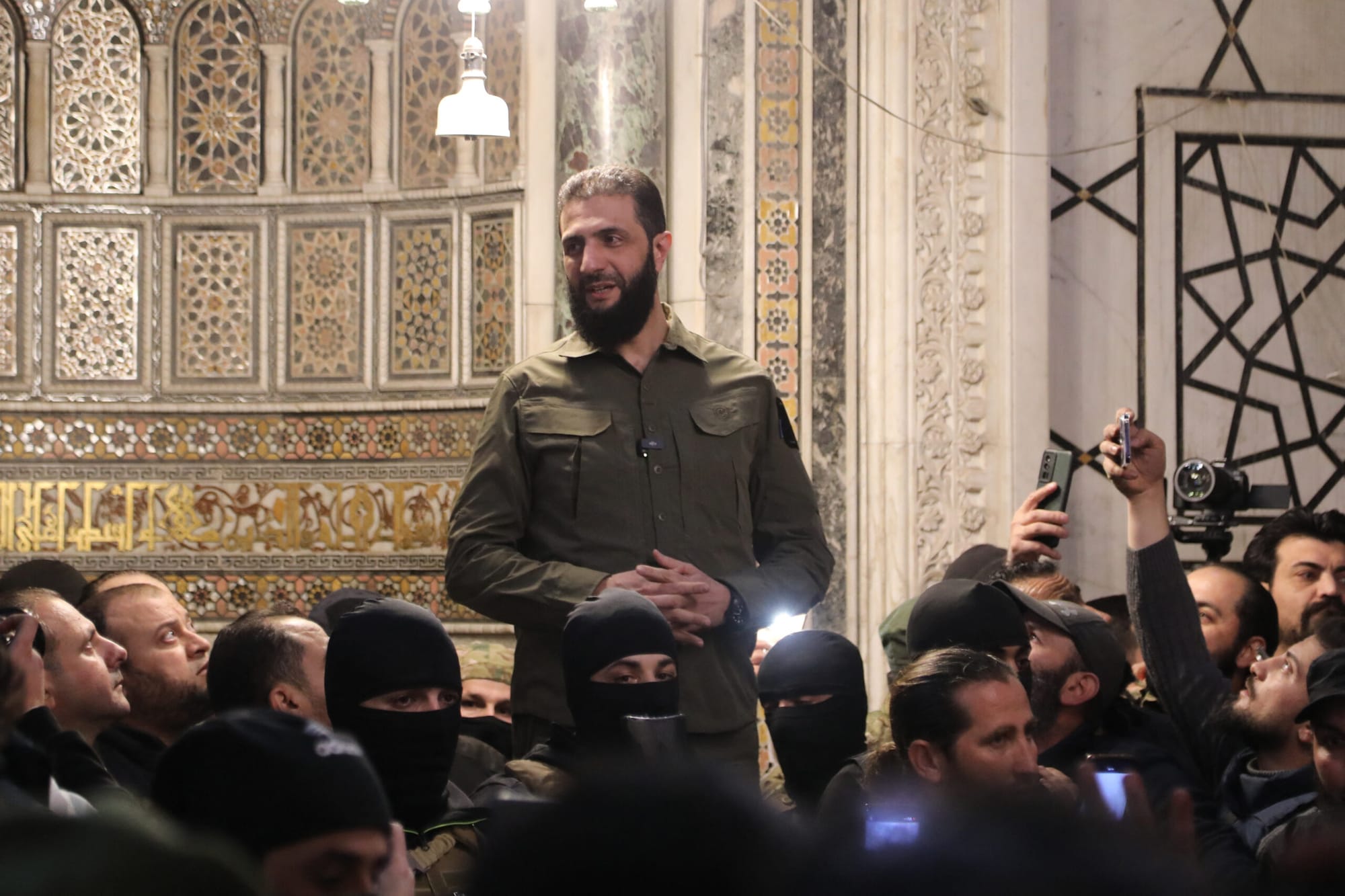
The leader of Syria's Hayat Tahrir al-Sham (HTS), Ahmed al-Sharaa, addresses a crowd at the Umayyad Mosque in Damascus on December 8, 2024\. Abdulaziz Ketaz/AFP via Getty Images
Turning a corner, I caught sight of a new Ministry of Defense recruitment banner hanging in the Umayyad Square. It featured a group of faceless soldiers dressed in black, rifles slung across their chests. Beneath the image, read the words: "To be Part of Syria Security: Enlist Now." Further down, another poster from the Interior Ministry issued a similar call: "Protect your homeland. Enlist now."
Gone were the [omnipresent images of Asad](https://www.tandfonline.com/doi/abs/10.1080/20581831.2018.1554233). In their place stood a new kind of masculine authority—collective, masked and omnipotent. The streets that once celebrated Baathist militarism—[parades, victory speeches, statues of the eternal leader](https://brill.com/view/journals/mjcc/15/4/article-p427%5F10.xml)—are now filled with anonymous enforcers: Security forces associated with the new transitional government's administration are present in all main city squares in Syria.
In my book, [*Romanticizing Masculinity in Baathist Syria: Gender, Identity, and Ideology*](https://manchesteruniversitypress.co.uk/9781526147622/), I wrote about the hegemonic masculinity of Asad’s Syria. Hegemonic masculinity is a term coined by R. W. Connell to describe the dominant form of masculinity that sustains patriarchal power by positioning certain masculinities as culturally ideal while subordinating both women and other men who do not conform to this ideal. In the Syrian context, this masculinity was deeply entwined with [Baathist hyper-militarism](https://manchesteruniversitypress.co.uk/9781526147622/), state violence and the performance of national loyalty.
During the rule of Hafez al-Asad, beginning in 1971, the leader sculpted the Syrian nation in his own image—a father-commander whose authority was both intimate and absolute. Masculinity became synonymous with obedience, endurance and self-sacrifice, with the Syrian male body imagined as the site of martyrdom and duty. His son, Bashar al-Asad, inherited this militarized vision of manhood, rebranding it through the affective aesthetics of [romanticized leadership](https://onlinelibrary.wiley.com/doi/abs/10.1111/nana.12786)—less austere, but no less rooted in patriarchal power. In both cases, submission to the ruler was framed as an extension of the national body itself: To be a man was to serve, suffer and die for the homeland.
The book also explored how alternative or subordinate masculinities—queer, dissident or cowardly men—were systematically erased or punished. Through visual culture, military training and the cult of martyrdom, the Baathist regime produced not just soldiers, but gendered political subjects. This hegemonic masculinity shaped everything from school textbooks to military parades, encoding the Asad family’s rule into the very fabric of male identity in Syria.
Revisiting this work and questions of how masculinity is performed in light of the regime’s collapse helps illustrate how state authority is constructed and maintained in post-Asad Syria. Today, the Baathist hegemonic masculinity has fractured. New masculinities are visible and contested—some emerging from the ruins of the old order, others forged in the heat of revolutionary struggle. The collapse of Baathist structures, however, has not led to a rupture in gendered power. Rather it has led to the emergence of a Sunni-centric masculine order—one in which sect and masculinity become mutually reinforcing pillars of political authority, particularly within the transitional government led by interim President Ahmed al-Sharaa.
## **From Emasculation to Militarized Survival**
For many opposition fighters who took part in the war that began following the Syrian uprisings in 2011 joining an armed group was more than an act of resistance—it was an act of reclamation. [Personal loss, trauma and humiliation](https://www.tandfonline.com/doi/full/10.1080/09592318.2024.2374036) had driven them to take up arms. This emotional terrain gave rise to what I term grievous masculinity: a masculinity forged through wounded honor and the pursuit of redemption.
In recent interviews with fighters reflecting on their experiences in the war, they explicitly described humiliation as a key driver behind their decision to take up arms. Fighters expressed that their masculinity had been ruptured by events such as the arrest of a father, the assault or public shaming of a sister or mother or their own perceived failure to act in moments of threat. For many, joining an armed group became a way to reclaim honor and restore manhood. As one fighter told me: “They arrested my father. They humiliated my mother. When I stood there, unable to protect them, I was not a man. I swore I would never feel that weakness again.” Another, who joined the Free Syrian Army in 2013, recalled: “I had never held a weapon before the war. But the first time I fired, the first time I saw the body fall… something changed. I knew I could never go back. I had become a fighter.”
> **These experiences of emasculation—failing to shield one’s family, witnessing women being dragged from homes in nightgowns or being publicly beaten by police—formed recurring motifs in the narratives of those who joined the armed struggle.**
Another described the shame of hiding while regime forces slapped his sister and threatened to take her as punishment for his absence. “I felt like a coward. I felt I had no right to be called a man,” he told me. These experiences of emasculation—failing to shield one’s family, witnessing women being dragged from homes in nightgowns or being publicly beaten by police—formed recurring motifs in the narratives of those who joined the armed struggle.
After Asad’s fall, this sense of humiliation and grievance has played out in the actions of former resistance fighters in their dealings with the former regime. Following the collapse of Asad’s forces, for example, victorious opposition factions celebrated their triumph by ridiculing their former oppressors. The regime’s army, once perceived as an unbreakable force, was mocked with new names: “*Jaysh Abu Shihata*” (The Army of Sandals), and “*Jaysh Abu Kulthun*” (The Army of Underwear), both references meant to emasculate and degrade Asad’s soldiers. These nicknames were more than insults. They were an assertion of dominance, a symbolic stripping away of the power once held by the Baathist military machine. The forces that had long enforced submission now found themselves publicly ridiculed, their masculinity questioned and diminished.
On my recent visit to Damascus, I met [former regime commanders](https://newlinesmag.com/reportage/syrias-new-rulers-are-working-to-unify-military-power/)—men who had once stood at the pinnacle of Assad’s masculine hierarchy. Uniformed, armed, unquestioned, they had embodied the Baathist model of power. After the regime's fall, the new leadership announced a nationwide reconciliation process, opening reconciliation centers across major Syrian cities. Former regime officers were instructed to surrender their weapons and hand over their military IDs. They were told they would be contacted later to receive new documents formalizing their defection status—though no clear information was provided about whether they would be reinstated, monitored or abandoned. This process left many in a state of limbo: neither enemies nor fully integrated citizens.
Not all former regime officers accepted their defeat with resignation. Some, deeply complicit in the regime’s most brutal operations, knew they had no future in a reconciled Syria. [On March 6, 2025](https://aawsat.com/%D8%A7%D9%84%D8%B9%D8%A7%D9%84%D9%85-%D8%A7%D9%84%D8%B9%D8%B1%D8%A8%D9%8A/%D8%A7%D9%84%D9%85%D8%B4%D8%B1%D9%82-%D8%A7%D9%84%D8%B9%D8%B1%D8%A8%D9%8A/5119840-%D8%B3%D9%88%D8%B1%D9%8A%D8%A7-%D9%85%D9%82%D8%AA%D9%84-%D8%A3%D8%AD%D8%AF-%D8%B9%D9%86%D8%A7%D8%B5%D8%B1-%D8%A5%D8%AF%D8%A7%D8%B1%D8%A9-%D8%A7%D9%84%D8%A3%D9%85%D9%86-%D8%A7%D9%84%D8%B9%D8%A7%D9%85-%D8%A8%D9%83%D9%85%D9%8A%D9%86-%D9%84%D9%80%D9%81%D9%84%D9%88%D9%84-%D8%A7%D9%84%D8%A3%D8%B3%D8%AF-%D9%81%D9%8A), remnants of Assad’s security apparatus—referred to as the *fulul*—initiated a series of coordinated attacks in Syria's coastal regions, including Latakia, Tartus and Hama.

Socks mocking former president Bashar al-Asad and the regime forces for sale in Salhiyya, Damascus on January 29, 2025\. Rahaf Aldoughli.
The attack sent shockwaves through Damascus, triggering immediate calls for retaliation. Mosques and city squares became platforms for mass mobilization, with fiery speeches urging people to rise against the remnants of the fulul. The term [fulul,](https://www.bbc.com/arabic/articles/cvge1gedem7o) borrowed from the Egyptian post-Mubarak lexicon to describe the old regime, is new to Syria’s political discourse. It emerged after the fall of Asad to describe former regime commanders with histories of atrocities who had repositioned themselves in the war’s shifting power dynamics. More than mere remnants of the old order, the fulul had embedded themselves in illicit economies, leveraging smuggling, extortion and war profiteering to maintain influence.
In the days that followed the attack, undisciplined armed groups, some claiming affiliation with the new leadership, launched a wave of revenge-driven assaults, killing up to 1,169 civilians, among them 103 women and 52 children. 218 public security personnel were also killed during these events, [according to the Syrian Observatory for Human Rights](https://www.alhurra.com/syria/2025/04/01/%D8%A8%D8%A7%D9%84%D8%A3%D8%B3%D9%85%D8%A7%D8%A1-%D9%85%D8%B1%D9%83%D8%B2-%D8%AD%D9%82%D9%88%D9%82%D9%8A-%D9%8A%D9%88%D8%AB%D9%82-%D9%85%D9%82%D8%AA%D9%84-1169-%D9%85%D8%AF%D9%86%D9%8A%D8%A7-%D9%81%D9%8A-%D8%A3%D8%AD%D8%AF%D8%A7%D8%AB-%D8%A7%D9%84%D8%B3%D8%A7%D8%AD%D9%84-%D8%A7%D9%84%D8%B3%D9%88%D8%B1%D9%8A). Just as the remnants of Asad’s forces framed their resistance in terms of survival, these opposition militias framed their actions as necessary for securing Syria’s future. The logic of [militarized masculinity](https://fpc.org.uk/the-securitisation-of-the-masculinist-other-in-the-syrian-conflict/) has not disappeared. It has shifted actors, giving rise to new cycles of sectarian violence.
## **Revolutionary Masculinity**
If the collapse of the Baathist order shattered the hegemonic masculinity of the state, the victors of the revolution did not merely dismantle the old structures of power, they replaced them with a new vision of masculinity forged during the years of armed revolutionary struggle. In this emerging order, the revolutionary fighter is the archetype of manhood. His authority is not inherited like that of the Baathist officer. It is earned through endurance, combat and ideological commitment. As one central commander in the new ruling security forces put it after interim president, Ahmed Al-Sharaa, announced the integration of armed groups in his victory speech on January 27, 2024, “We did not take power; we earned it. This is not just a government. It is our revolution. Our struggle. To be a man in Syria today is to be a revolutionary. There is no separation.”
This sentiment encapsulates how hegemonic masculinity in post-Asad Syria is now fused with the revolution itself. Unlike the old model, where hegemonic masculinity was demonstrated through submission to the state, the new masculinity must be proven through acts of resistance, participation in battle and a willingness to die for the cause. One opposition fighter expressed this sentiment in stark terms: “This rifle is not just a weapon. It is me. It is my dignity, my revolution. Without it, I am nothing.” Through the revolutionary struggle, masculinity was defined by these fighters, not by the hierarchical structures of a rigid state. Masculinity was rather synonymous with survival, with the ability to endure suffering and with the willingness to make the ultimate sacrifice.
This revolutionary masculinity is not only about individual valor, it is deeply embedded in the collective experience of fighters. The shared suffering of war has fostered a new kind of masculine kinship, one that can supersede tribal, ideological or even personal ambitions. Fighters refer to one another as *ikhwa fi al-dam* (brothers in blood), reinforcing a sense of belonging that is both emotional and existential. Drawing from my interviews with fighters in northern Syria, it became clear that many see themselves as more than just political actors. They are guardians of the revolution, its protectors and in some cases, its only remaining legitimacy. One commander reflected on this role: “The revolution is not over. We may have won Damascus, but our war is not finished. We are here to make sure it is never betrayed.”
This conviction highlights how revolutionary masculinity extends beyond the battlefield into governance, justice and everyday interactions. Those who fought and bled for the revolution see themselves as its rightful stewards.
But this model of masculinity—built on competition, personal sacrifice and armed legitimacy—carries its own risks. Fighters who once operated in loosely coordinated factions, driven by battlefield brotherhood and ideological fervor, now struggle to navigate a system where political survival depends on allegiance to a single faction. Upon becoming interim president, Al-Sharaa, formerly the leader of Hayat Tahrir al-Sham (HTS), sought to consolidate control by [integrating various armed factions](https://www.chathamhouse.org/publications/the-world-today/2025-03/syria-needs-security-can-al-sharaa-build-united-army-provide) into the Ministry of Defense. While full-scale clashes have not yet erupted between former rivals, deep-seated grievances persist among fighters—particularly those from the Syrian National Army (SNA), who now find themselves under the authority of HTS figures they once distrusted. The process of military integration has been characterized by a lack of professionalism, an opaque chain of command and the prioritization of loyalty over competence.
> **Fighters who once operated in loosely coordinated factions, driven by battlefield brotherhood and ideological fervor, now struggle to navigate a system where political survival depends on allegiance to a single faction.**
A former SNA fighter, now serving in the Ministry of Defense, voiced his unease in an interview in February 2025: “We fought together against Asad. But some of us fought for Syria, and others fought for their own power. HTS took control by force, and now they tell us to trust them? How can we forget what they did?” Another rebel-turned-administrator in Damascus described this tension, “We fought together, but now we are fighting for influence. Everyone believes they deserve to lead because they sacrificed the most. But war does not teach you how to govern.”
The process of military integration has been marked by opacity and favoritism, reinforcing a [militarized hierarchy of trust.](https://newlinesmag.com/reportage/syrias-new-rulers-are-working-to-unify-military-power/) Positions within the new security apparatus have been allocated based on loyalty to HTS rather than professional expertise, [with senior military positions even being given to non-Syrians](https://newlinesmag.com/reportage/syrias-new-rulers-are-working-to-unify-military-power/), exacerbating resentment among former opposition fighters who had envisioned a more pluralistic military command. Many fighters still view their weapons as personal guarantees of security in an unstable order. One Ministry of Defense official admitted in an interview, “My rifle is my only guarantee of safety, and its price has been paid in blood. I’ll serve under the new government, but I will never give up my weapon. After 14 years of revolution, I won’t accept being sidelined or betrayed.” These interviews suggest that Syria’s transition remains precarious.
This broader crisis of trust and legitimacy is also a crisis of masculinity. In the evolving choreography of Syrian power, al-Sharaa’s own performance of masculinity operates through layered and shifting codes—military, religious and civic. His staged entrance into the [Aleppo Citadel after the fall of the regime in December 2024, clad in military dress](https://www.alarabiya.net/arab-and-world/syria/2024/12/04/%D8%B2%D8%B9%D9%8A%D9%85-%D9%87%D9%8A%D8%A6%D8%A9-%D8%AA%D8%AD%D8%B1%D9%8A%D8%B1-%D8%A7%D9%84%D8%B4%D8%A7%D9%85-%D8%A3%D8%A8%D9%88-%D9%85%D8%AD%D9%85%D8%AF-%D8%A7%D9%84%D8%AC%D9%88%D9%84%D8%A7%D9%86%D9%8A-%D9%8A%D8%B8%D9%87%D8%B1-%D9%81%D9%8A-%D9%82%D9%84%D8%B9%D8%A9-%D8%AD%D9%84%D8%A8-%D8%A8%D8%B9%D8%AF-%D8%B3%D9%8A%D8%B7%D8%B1%D8%A9-%D9%82%D9%88%D8%A7%D8%AA%D9%87-%D8%B9%D9%84%D9%89-%D8%A7%D9%84%D9%85%D8%AF%D9%8A%D9%86%D8%A9-), drew from both historical and cinematic imagery of the “conquering man”—a masculinist iconography evoking Baathist aesthetics and Islamic conquests. The adoption of the [title al-Fātiḥ (the Conqueror)](https://www.annahar.com/Lebanon/Society/184488/%D8%B5%D9%88%D8%B1-%D8%A7%D9%84%D8%AC%D9%88%D9%84%D8%A7%D9%86%D9%8A-%D9%81%D8%A7%D8%AA%D8%AD-%D8%A7%D9%84%D8%B4%D8%A7%D9%85-%D8%AA%D8%B1%D8%AA%D9%81%D8%B9-%D9%81%D9%8A-%D8%B7%D8%B1%D8%A7%D8%A8%D9%84%D8%B3), in addition to referencing territorial victory, invoked a symbolic dominance over fragmented masculine claims to power.
This performance extended into Damascus, where on January 27, [al-Sharaa](https://arabic.cnn.com/middle-east/article/2024/12/09/analysis-syrian-rebel-leaders-victory-speech-held-a-message-for-iran-trump-and-israel) stood before armed factions—including Baathist-affiliated ones—to theatrically announce their dissolution. That moment re-centered legitimacy not in a party or ideology but in his singular male body. The optics of this event—his language, his attire, his posture—did more than project authority; they redefined sovereignty through gender. The ruler became the man who could disarm other men, absorb their legitimacy and overwrite past masculinities with his own.
This rebranding continued through high-profile [international interviews](https://podcasts.apple.com/gb/podcast/the-new-president-of-syria-trump-palestine-and/id1665265193?i=1000690612974), where al-Sharaa presented himself as a moderate Damascene Sunni—calm, technocratic, suit-clad and clean-shaven. In a domestication of his past as a Jihadist leader, in these interviews he exhibits a strategic moderation. His masculinity remains anchored in public religiosity—mosque-building, Quranic recitation in universities and, most strikingly, the March 31 Eid prayer held in the Square of the Unknown Soldier—a space once synonymous with Baathist-military nationalism. This act reclaimed a former regime icon, embedding it in a new religiously coded, Sunni-centric sovereignty.
Al-Sharaa’s hybrid masculinity—militant yet diplomatic, pious yet modern, Sunni but not Salafi—is not merely stylistic. It is a calculated reterritorialization of masculinity itself, designed to address multiple audiences at once: global, domestic, civilian and military. Like the post-revolutionary Cuban archetype of *el hombre nuevo*, he fuses ideology, image and affect to stage a break with the past—while selectively inheriting its power.
## **Masked Masculinity**
This changing masculine order has also played out in the everyday realm of the city.
During my recent visit, I saw men clad in black, masked and fully armed, standing like shadows in the main squares of Syria’s cities. These men belong to the new *al-Amn al-‘Amm* (general security forces). But they are more than security enforcers—they are the manifestation of a new spatial order, one where power is exercised through the anonymity of force. The Syrian regime was once reliant on the spectacle of heroic, militarized masculinity—where officers and soldiers stood as visible embodiments of state strength. Syria’s new rulers assert control through a hyper-visible faceless, dispersed presence.

Fighters in SNA groups during operation Deterrence of Aggression against Bashar al-Asad. Northern Syria, December 3, 2024\. Fieldwork photo by the author's research fixer. Shared courtesy of the author.
By enforcing its presence through the anonymous security figures, the new leadership fosters an environment of controlled unpredictability. The silent, masked figures embody the potential for violence at any moment. This masked masculinity thrives on ambiguity. The covered faces erase individuality, creating an army of indistinguishable enforcers who represent the state without being identifiable as individuals.
A central commander in the new security apparatus described this new all-encompassing authority: “We do not rule through speeches or images. We rule through presence. The mask reminds people that we are everywhere, that we do not need to show our faces to control the streets.”
The widespread use of masks is not only a psychological tool to instill fear but a response to a fundamental weakness: the acute shortage of security personnel. According to a commander in the Ministry of Defense, the new leadership lacks the manpower to maintain its grip through sheer numbers, forcing it to rely on masked enforcement to amplify the perception of omnipresence.
In April 2025, Syria’s General Security Forces issued[ a new directive](https://www.alaraby.co.uk/politics/%D8%A7%D9%84%D8%A3%D9%85%D9%86-%D8%A7%D9%84%D8%B9%D8%A7%D9%85-%D8%A7%D9%84%D8%B3%D9%88%D8%B1%D9%8A-%D9%8A%D9%82%D8%B1%D8%B1-%D9%85%D9%86%D8%B9-%D8%B9%D9%86%D8%A7%D8%B5%D8%B1%D9%87-%D9%85%D9%86-%D8%A7%D8%B1%D8%AA%D8%AF%D8%A7%D8%A1-%D8%A7%D9%84%D9%84%D8%AB%D8%A7%D9%85) banning its operatives from wearing masks in public unless on special assignment. This ban appears to mark an attempt to professionalize the appearance of the state, perhaps under pressure from international observers and internal demands for legitimacy. The enforcement of this rule, however, has been selective. In practice, the mask persists—but now it is hierarchized. High-ranking or elite units, especially those tasked with counterinsurgency or political enforcement, continue to wear masks. The visual shift signals an emerging division between everyday security personnel (visible, accountable) and specialized forces (anonymous, exceptional).
Even as the mask becomes less visible in official street patrols, its symbolic and cultural life continues. In markets across Damascus, Idlib and Aleppo, the mask has been repurposed and commodified—sold in shops alongside military-style clothing, tactical vests and headbands bearing revolutionary slogans. It circulates in social media images, poster art and street fashion, especially among young men who see in it a legacy of both resistance and rule. On Telegram channels and platforms like X, [Eid greetings](https://x.com/m%5Fahr%5F8ar%5F/status/1904280928488206599?s=46) are often circulated in the form of posters featuring masked men—typically dressed in black, holding Qur’ans or standing before mosques. The masked figure, once associated primarily with insurgency or rebellion, is now reframed as a righteous guardian of order and faith. Such imagery sustains the symbolic life of the mask beyond the battlefield. Moreover, it encodes a vision of postwar masculinity anchored in religiosity, surveillance and moral rectitude. What began as a tool of anonymity has become an aesthetic of power—one that merges revolutionary iconography with postwar authority.
## **Women and the New Masculine Order**
The masculinization of political space is visible in Syria’s Political Transition, where despite the rhetoric of a "new Syria" under [Ahmad al-Sharaa’s](https://aawsat.com/%D8%A7%D9%84%D8%B9%D8%A7%D9%84%D9%85-%D8%A7%D9%84%D8%B9%D8%B1%D8%A8%D9%8A/%D8%A7%D9%84%D9%85%D8%B4%D8%B1%D9%82-%D8%A7%D9%84%D8%B9%D8%B1%D8%A8%D9%8A/5093022-%D8%AA%D8%B5%D8%B1%D9%8A%D8%AD%D8%A7%D8%AA-%D9%85%D8%B3%D8%A7%D8%B9%D8%AF-%D9%84%D9%84%D8%B4%D8%B1%D8%B9-%D8%B9%D9%86-%D8%A7%D9%84%D9%86%D8%B3%D8%A7%D8%A1-%D8%AA%D8%AB%D9%8A%D8%B1-%D8%A7%D9%86%D8%AA%D9%82%D8%A7%D8%AF%D8%A7%D8%AA-%D9%81%D9%8A-%D8%B3%D9%88%D8%B1%D9%8A%D8%A7) interim leadership, the inclusion of women in the political process remains more symbolic than structural. Al-Sharaa’s government has made some gestures toward gender inclusivity, such as meeting with Syrian-American women’s delegations and acknowledging women’s sacrifices in his speeches. But there is no systematic plan to engage women politically. Instead, women’s participation in governance remains marginal.
One glaring example is the [National Dialogue Conference](https://www.rozana.fm/article/124066-%D9%85%D8%A4%D8%AA%D9%85%D8%B1-%D8%A7%D9%84%D8%AD%D9%88%D8%A7%D8%B1-%D8%A7%D9%84%D9%88%D8%B7%D9%86%D9%8A-%D8%A7%D9%84%D8%B3%D9%88%D8%B1%D9%8A-%D9%88-%D9%85%D8%B4%D8%A7%D8%B1%D9%83%D8%A9-%D8%A7%D9%84%D9%86%D8%B3%D8%A7%D8%A1-%D9%81%D9%8A%D9%87)—a congregation of almost 1,000 participants held in February 2025 that was tasked with shaping Syria’s transitional roadmap. Women’s representation in these discussions never exceeded 20 percent, often falling below [that mark](https://daraj.media/%D9%88%D8%A7%D9%82%D8%B9-%D8%A7%D9%84%D8%B3%D9%88%D8%B1%D9%8A%D8%A7%D8%AA-%D9%81%D9%8A-%D8%B8%D9%84-%D8%AA%D8%AD%D9%88%D9%84-%D8%A3%D8%A8%D9%88-%D9%85%D8%AD%D9%85%D8%AF-%D8%A7%D9%84%D8%AC%D9%88%D9%84/). In various legislative and security committees, their presence has been even more negligible, reinforcing the perception that governance remains a male-dominated sphere.
Part of this reluctance to integrate women into leadership stems from the composition of Syria’s new ruling elite. HTS’s militant hierarchy, deeply embedded in the security sector, creates a political environment where overt initiatives for women’s political leadership risk backlash. Many appointments within the Ministry of Defense and key government positions have prioritized loyalty to HTS’s leadership circle, ensuring that institutional control remains tightly within the hands of former revolutionaries rather than opening space for diverse governance.
In various legislative and security committees, their presence has been even more negligible. The cabinet announced in March 2025 reflected this imbalance starkly: Only one woman was appointed among 23 ministers, reinforcing the perception that political power remains a male preserve.
Indeed, while revolutionary masculinity—built on sacrifice, armed legitimacy and battlefield loyalty—continues to dominate the security apparatus, it is now paralleled by the rise of technocratic masculinity. This new form of masculine authority draws on the aesthetics of professionalism: men in suits, soft-spoken administrators and policy-focused experts, who project an image of calm, competence and rational governance. Yet even this technocratic veneer is gendered. It functions as a legitimizing frame that maintains elite male control while appearing modern, inclusive and efficient. It enables men like al-Sharaa to perform distance from jihadist or militarized pasts, even as their power is rooted in those very networks.
> **Women, by contrast, remain on the political periphery—not because they lack capacity, but because neither revolutionary nor technocratic masculinity requires their inclusion to legitimize itself.**
This dual performance—the fighter and the reformer, the conqueror and the administrator—expands rather than displaces hegemonic masculinity. It creates a flexible model of power that can circulate across ministries, television interviews, mosque inaugurations and security checkpoints. Women, by contrast, remain on the political periphery—not because they lack capacity, but because neither revolutionary nor technocratic masculinity requires their inclusion to legitimize itself.
The exclusion of women from the political process is not unique to Syria. As studies on post-conflict transitions have shown, societies emerging from war frequently default to masculinist structures of governance, where political legitimacy is tied to battlefield experience or institutional continuity rather than than [democratic representation](https://scholarship.law.gwu.edu/cgi/viewcontent.cgi?article=1373&context=faculty%5Fpublications). In such contexts, women—who often played critical roles in sustaining wartime resistance—find themselves pushed to the margins once governance structures solidify. Syria’s current trajectory suggests that its transition will follow this same exclusionary pattern.
Thus, while al-Sharaa’s leadership claims to mark a break from the authoritarian past, its gendered foundations remain entrenched in the very structures the revolution once sought to dismantle. The challenge ahead is not just about rebuilding Syria, it is about redefining who gets to participate in that rebuilding.
\[**Rahaf Aldoughli** is a lecturer in Middle East and North African Studies at Lancaster University.\]
### Palestine and Israel—A Primer
URL: https://www.merip.org/palestine-israel-primer-2/
Last updated: 2026-02-07T23:15:37.000Z
This primer provides an overview of key actors, organizations, historic events, political developments and diplomatic initiatives that have shaped the status and fate of Palestinians and the State of Israel from the late nineteenth century to the present. It is divided into topical sections and organized roughly chronologically—although some topics cannot be neatly contained in a chronological frame. It offers a basic understanding and an entry point. Readers may explore the website of the Middle East Research and Information Project ([www.merip.org/search](https://www.merip.org/search)) for materials that examine issues more deeply and address topics treated only briefly or omitted here.
## The Land, Peoples and Ideologies
The conflict between Palestinian Arabs and Zionist (now Israeli) Jews is a modern phenomenon, originating at the end of the nineteenth century. Although the two groups have different religions (Palestinians include Muslims, Christians and Druze), the cause of the contention is ethno-national rather than religious differences. The conflict began as a struggle between Jewish immigrant settlers and local Arab inhabitants over land, labor markets and eventually political control of Palestine. Before World War I, Palestine was a territory with indefinite boundaries long known by the three monotheistic religions as the Holy Land. From the end of World War I until 1948, the area was governed by Britain under a Mandate from the League of Nations. Following the 1948 Arab-Israeli War, this land was divided into three parts: the State of Israel, the West Bank (of the Jordan River) and the Gaza Strip. The city of Jerusalem was divided with the eastern half adjoined to the West Bank and the western half becoming part of Israel.
It is a small area—approximately 10,000 square miles, or about the size of Belgium or the US state of Maryland. Jewish claims to this land are based on God’s promise to Abraham and his descendants narrated in the biblical Book of Genesis, on the history of the land as the site of the ancient Israelite kingdoms and temples in Jerusalem and on European Jews’ need for a haven from antisemitism. Palestinian Arab claims to the land are based on their long-term continuous residence in the country and the fact that they constituted the demographic majority until 1948\. Palestinians reject the notion that a biblical-era kingdom constitutes the basis for a valid modern claim. They do not believe that they should forfeit their land or compromise their political rights to compensate Jews for Europe’s crimes against the Jewish people, culminating in the Holocaust (or Shoah).
Until World War I, Palestine was part of the Ottoman Empire, but it did not constitute a single political unit. The northern districts of Acre and Nablus were part of the province of Beirut. The district of Jerusalem was under the direct authority of the Ottoman capital of Istanbul because of the international significance of the cities of Jerusalem and Bethlehem as religious centers for Muslims, Christians and Jews. According to the 1878 Ottoman census, the Jerusalem, Nablus and Acre districts had a population of 472,465 subjects: 403,795 Muslims (including Druze), 43,659 Christians and 15,011 Jews. In addition, there were perhaps 10,000 Jews with foreign citizenship (recent immigrants to the country) and several thousand nomadic and semi-sedentary Arabs (Bedouin) who were not counted in Ottoman-era demographic data. The great majority of the Arabs (Muslims, Christians and Druze) lived in several hundred rural villages. Jaffa and Nablus were the largest and economically most important towns with majority-Arab populations.
In the nineteenth century, following a trend that emerged earlier in Europe, people around the world began to identify themselves as nations and to demand national rights, foremost the right to self-rule in a state of their own (self-determination and sovereignty). Jews and Palestinian Arabs both started to develop a national consciousness and mobilized to achieve national goals. Some European Jewish nationalists considered the regions of Eastern Europe, where Jews spoke Yiddish, as their homeland. In contrast, Zionists sought to identify a place outside Europe where Jews could become territorially concentrated through immigration and settlement. As Zionist ideology and organizations were being formulated, millions of Jews emigrated from Europe to other locations (mostly the Americas).
Palestinian Arabs were always conscious of themselves as living in the Holy Land. The 1908 Ottoman Constitutional Revolution, which restored the parliament, freedom of the press and political expression, provided the intelligentsia with platforms to articulate their opposition to Zionist settlement. In its wake, conflict with Zionist settlers over access to agricultural land intensified, accelerating the processes that contributed to the formation of a modern Palestinian Arab national identity. That identity and a nationalist movement in opposition to Zionism crystallized during and in the immediate aftermath of World War I.
Until the beginning of the twentieth century, most Jews living in Palestine were concentrated in four cities with religious significance: Jerusalem, Hebron, Safed and Tiberias. Many of them observed traditional (orthodox) religious practices and spent their time studying religious texts. They depended on the charity of world Jewry for survival. Their attachment to the land was religious rather than national, and they were not involved in—or supportive of—the Zionist movement that began in Europe and was brought to Palestine by immigrants. In these four cities and in Jaffa there was also a significant Arabic-speaking Spanish (Sephardic) Jewish population who had resided in Palestine and the Ottoman Empire following their expulsion from Spain in 1492.
The most prominent leader of the nascent Zionist movement was Theodor Herzl, who promoted the national project in his book *Der Judenstaat* (The Jews’ State) and founded the World Zionist Organization. Although Herzl and other Zionists considered other locations (Herzl preferred Argentina), over time Palestine seemed the logical and optimal place because of its historical and religious significance for Jews.
Herzl and his successor as the head of the World Zionist Organization, Chaim Weizmann, focused their efforts on gaining support for the Zionist project from European imperial powers. Labor Zionists, of whom the most prominent was Israel’s first prime minister, David Ben-Gurion, adapted socialist or social democratic ideas to the Zionist project. Vladimir Jabotinsky led the Revisionist Zionists, the forerunners of today’s Likud. Revisionists advocated that the Zionist movement should make the creation of a Jewish state on both sides of the Jordan River its unequivocal goal and that it would be necessary to build up a military force to defend the Zionist settlement project from Palestinian Arabs who would never accept it. They admired Italian fascist leader Benito Mussolini until he allied with Hitler in 1936 and broke strikes of Jewish workers. Cultural Zionists, like Ahad ha-‘Am, prioritized the revival of Hebrew culture and opposed focusing on mass settlement and a state.
The first wave of European Jewish immigration to Palestine (termed *‘aliyah*, in Zionist parlance, from the Hebrew for “going up”) began in 1881\. Only with the second *‘aliyah* (1904–1914), however, did significant numbers of ideologically committed Zionists come to Palestine. Most of the Jews who emigrated from Europe beginning in the late nineteenth century lived a secular lifestyle and were committed to the goals of creating a modern Jewish nation-state. At the outbreak of World War I (1914), the population of Jews in Palestine had risen to about 60,000 (about 8 percent of the population). Some 36,000 were recent immigrants, about half of whom resided in agricultural settlements. The Arab population at the time was 683,000.
## Settler Colonialism
Palestinian Arabs have long regarded Zionism as a colonial project promoted by Britain since 1917 and, after the establishment of the State of Israel, by other Western powers. This view is exemplified by Fayez Sayegh’s 1965 book, *Zionist Colonialism in Palestine*. In the 1990s many scholars, most prominently the late Patrick Wolfe, came to understand settler colonialism as a distinct form of European overseas expansion. In settler colonies Europeans did not seek only to extract mineral or agricultural resources, establish a military base or commercial entrepot, or impose unequal terms of trade, as in British India, the British Crown Colony of Aden, the British protectorates of the Persian Gulf, French Indochina or Belgian Congo. Rather, European settlers sought to displace or entirely eliminate previously existing local populations. Examples of settler colonialism include the former British colonies in North America, Australia, New Zealand and Kenya, the former French colonies of Algeria and Tunisia and the short-lived Italian conquest of Libya.
Herzl and other early Zionist leaders adopted the strategy of colonial settlement as the only way to establish a large, primarily European, Jewish community in Palestine. Until the post-World War II era of accelerating decolonization, Zionists of all political tendencies commonly used the terms “settlement” and “colonization” for their project and described their settlements in Palestine as colonies. The Jewish Colonial Trust (1898) and the Colonization Commission (1898) were early Zionist organizations. These terms were uncontroversial in an era when Europeans and North Americans presumed that they had a right, and even a duty, to conquer and settle lands beyond their borders and impose their rule on the indigenous inhabitants.
The social structures, cultures and trajectories of settler colonial projects vary. Many Northern Europeans who settled in the 13 American colonies in the seventeenth to eighteenth centuries were escaping religious persecution. As white populations increased in North America and Australia, settlers carried out large-scale genocides against indigenous populations. In Algeria and South Africa settlers seized the lands of Muslims and Black Africans, respectively, but did not eliminate them. Rather, they employed the indigenous populations as cheap labor in agricultural and mining enterprises. Afrikaners who descended from seventeenth-century Dutch settlers believed that South Africa was their promised land. Italian settlers in Libya believed they were restoring the heritage of ancient Rome. After Algeria and Tunisia achieved independence from colonial rule, the vast majority of European settlers resettled in metropolitan France. Zionist settlers in the late nineteenth and twentieth centuries sought to escape antisemitism in Europe and believed that they were returning to their ancient homeland and reclaiming their birthright in Palestine. There is no contradiction in understanding Zionism as simultaneously a nationalist movement and a settler colonial project.
Gaza, circa 1920s. American Colony Photo Department, Matson Collection, Library of Congress. https://www.loc.gov/item/2019712823/
## The British Mandate in Palestine
Over the course of the nineteenth century, the Ottoman Empire was weakened by wars with European powers and the spread of nationalism throughout its regions. Its Arab areas emerged as sites of competing European territorial claims and interests. By the early twentieth century, European powers were competing to occupy or extend their influence over areas along the eastern Mediterranean (known as the Levant), including Palestine. These efforts were dramatically accelerated by World War I in which the Ottoman Empire was aligned with Germany and the Central Powers against the Allied Powers of Britain, France, Russia (until the 1917 revolution) and, later, Italy and the United States.
During 1915–1916, as World War I was underway, the British high commissioner in Egypt, Sir Henry McMahon, secretly corresponded with Husayn ibn ‘Ali, the patriarch of the Hashemite family and Ottoman governor of Mecca and Medina. McMahon convinced Husayn to lead an Arab uprising against the Ottoman Empire by promising that if the Arabs supported Britain in the war, the British government would support the establishment of an independent Arab state under Hashemite rule in the Arab provinces of the Ottoman Empire, including Palestine. The Arab Revolt began in June 1916 and was led by Husayn’s son Faysal. In the West it is popularly identified with the British officer T. E. Lawrence (also known as Lawrence of Arabia). The revolt distracted and weakened the Ottoman war effort from within and thus contributed to the defeat of the Central Powers.
Britain made other promises during the war that conflicted with the Husayn-McMahon correspondence. In May 1916 Britain and France secretly negotiated the Sykes-Picot Agreement to carve up the Arab provinces of the Ottoman Empire and divide control of the region between themselves. And in November 1917, British Foreign Minister Arthur Balfour, at the behest of Prime Minister David Lloyd George and in coordination with Zionist leaders in Britain, issued the Balfour Declaration announcing his government’s support for the establishment “in Palestine of a national home for the Jewish people.” As with Britain’s instigation of the Arab Revolt, Lloyd George hoped to change the dynamics of the war. He and other British officials believed that a pro-Zionist statement would rally Jews in Germany, Russia and the United States to help the British war effort. These three contradictory promises—Husayn-McMahon Correspondence, Sykes-Picot Agreement and Balfour Declaration—were primarily intended to benefit British imperial and military interests, not Arabs or Jews.
After the Allies’ victory in World War I, Britain and France, which effectively controlled the new League of Nations (precursor to the United Nations), granted themselves mandates, a form of neo-colonial rule, over the former Ottoman Arab territories. France obtained a mandate over Syria and carved out Lebanon as a separate state with a (slight) Christian majority. Britain obtained one mandate over Iraq and another over Palestine, which included the area that now comprises Israel, the West Bank, the Gaza Strip and Jordan.
In 1921, Britain divided its Palestine mandate into two territories. The territory to the east of the Jordan River became the Emirate of Transjordan, to be ruled by Faysal’s brother Abdullah. The territory to the west of the Jordan River became British Mandate Palestine. Britain envisioned that its commitment to promote a Jewish national home would be restricted to that region (but importantly, that not all of Palestine would become a Jewish state). For the first time in modern history, Palestine became a geographically bounded political entity. British Mandate Palestine between the Jordan River and the Mediterranean Sea is often referred to as historic Palestine, although its political borders were established in 1919–1922.
Throughout the region, Arabs were angered by Britain’s failure to fulfill its promise to create an independent Arab state, and many opposed the British and French mandates as a violation of Arabs’ right to self-determination. The rising tide of mainly European Jewish immigration, land purchases and settlement in Palestine generated increasing resistance by indigenous Palestinians. They opposed the influx of Jews because they feared it would threaten their position in the country and lead eventually to the establishment of a Jewish state that would thwart their aspirations for self-determination.
In the 1920s, the Jewish National Fund (a Zionist land-purchasing agency) bought lands from absentee Arab landowners, many of whom lived in Beirut, Damascus or Jaffa. Since the goal was to settle Jewish immigrants on those lands, the Zionist authorities required that Palestinian tenant farmers who had worked and lived on them be evicted. These displacements led to increasing tensions and violent confrontations between Jewish settlers and uprooted peasant tenants. In 1920 and 1921, clashes broke out between Arabs and Jews in which roughly equal numbers from both communities were killed.
Tensions intensified in 1928 when Muslims and Jews in Jerusalem began to clash over their respective communal religious rights at Jerusalem’s holy sites. The Western Wall, the sole remnant of the second Jewish Temple, is the holiest site in the Jewish religious tradition. Above the Wall is a large plaza revered by Jews as the Temple Mount—the location of the two ancient Israelite temples. The Muslim connection to Jerusalem dates to the origins of the faith. It was the first direction of prayer (*qibla*). Abraham, David, Solomon and Jesus, who are all associated with Jerusalem, are prophets in the Muslim tradition. The plaza, which hosts al-Aqsa Mosque and the Dome of the Rock, is called the Noble Sanctuary (al-Haram al-Sharif). Muslims believe that the Prophet Muhammad tethered his winged horse, al-Buraq, to the Western Wall, which bears the horse’s name in the Muslim tradition, before ascending to heaven from the Dome of the Rock.
On August 15, 1929, supporters of the Betar Revisionist Zionist youth movement marched to the Western Wall chanting “the Wall is ours” and raised the Zionist flag over it. Fearing that the Noble Sanctuary was in danger, Muslims responded by attacking Jews in Jerusalem, Hebron and Safed. Among the dead were 64 Jews in Hebron. Their Muslim neighbors saved many others. The Jewish community of Hebron ceased to exist when its surviving members left for Jerusalem. During a week of communal violence, 133 Jews and 115 Arabs were killed and many more were wounded.
European Jewish immigration to Palestine increased dramatically after Adolf Hitler’s rise to power in Germany in 1933, leading to new land purchases and bolstering the Jewish community (known as the *yishuv*). Palestinian Zionist leaders concluded the “transfer” (*ha-‘avarah*) agreement with Nazi Germany to permit German Jews to immigrate to Palestine with a portion of their capital in exchange for Zionist purchases of German manufactured goods. Palestinian resistance to British control and Zionist settlement climaxed with the Arab Revolt of 1936–1939, which involved not only Palestinians but also Arabs from across the region. Britain violently suppressed the revolt with the help of Zionist militias and the complicity of neighboring Arab regimes.
After crushing the Arab Revolt, the British reconsidered their policies in an effort to maintain order and to try to secure Arab support as a new war in Europe loomed. In 1939, Britain issued a White Paper (a statement of government policy) limiting future Jewish immigration and land purchases and promising independence in ten years, which—had it been fulfilled—would have resulted in a majority-Arab Palestinian state. The Zionists regarded this policy shift as a betrayal of the Balfour Declaration.
The 1939 White Paper marked a major disruption of the British-Zionist alliance. With the start of World War II, the main Zionist parties helped the British war effort while the small right-wing LEHI (Fighters for the Freedom of Israel) initiated a decade-long militant insurgency against British rule. At the same time, the British-Zionist defeat of the Arab Revolt and arrest, killing or exile of the Palestinian political leadership left Palestinians politically disorganized during the crucial decade in which the future of Palestine was decided.
## The United Nations Partition Plan
After World War II, hostilities escalated between the Zionist militias and the British colonial administration. Britain was unable to prevent the many bloody attacks, bombings, kidnappings and assassinations of its military and civilian personnel by Zionist groups or to staunch the instability in the countryside. In 1947 Britain relinquished its mandate over Palestine and requested that the recently established United Nations determine the future of the country. The British government hoped that the UN would be unable to arrive at a workable solution and would turn Palestine back to its control as a UN trusteeship.
At the time, 1,269,000 Arabs and 608,000 Jews resided within the borders of Mandate Palestine. Through land purchases, Jews had acquired 6–7 percent of the total land area, amounting to about 20 percent of the arable land. Arabs owned about 48 percent of the land. Another 46 percent was classified as state-owned lands, a designation dating to the era when the Ottoman sultan formally held the title to most agricultural lands and the Naqab/Negev desert.
A UN-appointed committee of representatives from various countries went to Palestine to investigate the situation. Committee members disagreed on the form that a political resolution should take. But the majority concluded that the country should be divided (partitioned) to satisfy the needs and demands of both Jews and Palestinian Arabs.
On November 29, 1947, the UN General Assembly voted to partition Palestine into a Jewish and an Arab state. The UN Partition Plan envisioned that each state would have a majority of its own population. Although Jews comprised one-third of the population, the UN Partition Plan designated 43 percent of the land of Palestine for the Arab state and 56 percent, including most of the fertile coastline, for the Jewish state on the assumption that large numbers of Jews would immigrate there. Few Jewish settlements were located in the proposed Arab state, but hundreds of thousands of Palestinian Arabs were to become part of the proposed Jewish state. The area of Jerusalem and Bethlehem was to become an internationally administered zone.
Publicly, most of the Zionist leadership accepted the UN Partition Plan, although some, notably David Ben-Gurion (the future first prime minister of Israel), hoped to expand the borders assigned to the Jewish state in the event of a war. The Palestinian Arabs and the surrounding Arab states rejected the UN plan and regarded the General Assembly vote as an unacceptable violation of the Palestinian right to self-determination. Some argued that the UN plan allotted too much territory to the Jews.
Most Arabs regarded the proposed Jewish state as a settler colony. They argued that it was only because the British had (until the 1939 White Paper) sponsored extensive Zionist settlement in Palestine against the wishes of the Arab majority that the question of Jewish statehood was on the international agenda at all.
##
Haganah fighters expel Palestinians from Haifa. May 12, 1948\. (AFP/Getty Images)
## The 1948 Arab-Israeli War
Fighting between the Arab and Jewish-Zionist residents of Palestine began immediately after the adoption of the UN Partition Plan. The Palestinian Arab military forces were poorly organized, trained and armed. In contrast, Zionist military forces had built strength during the Mandate and were well organized, trained and, eventually, well-armed.
On May 15, 1948, the British completed their planned evacuation of Palestine. Zionist leaders proclaimed the State of Israel on May 14, the eve of the British evacuation. That event is commemorated according to the date on Hebrew calendar, the 5th of Iyar. By that time, the Zionist military forces had secured control over much of the territory allotted to the Jewish state in the UN plan except for the Negev/Naqab desert. By late April 1948 they began to go on the offensive, conquering territory beyond the partition borders in several sectors. For Palestinians, May 15 is commemorated as Nakba (catastrophe) Day because it marks a profound political loss and the acceleration of mass exodus and expulsions from their homeland.
Military forces from neighboring Arab states (Egypt, Syria, Jordan and Iraq) entered Palestine to prevent the establishment of a Jewish state. Some Arab rulers were no more anxious than the Zionists to see an independent Palestinian state. King Abdullah of Transjordan, who had territorial designs of his own on Palestine, had been engaging in secret negotiations with Zionist leaders to divide Palestine between them. Consequently, Jordanian troops played only a limited role in the war in the Jerusalem sector and held their positions in the hills (areas that became the West Bank). During May and June 1948, when the fighting was most intense, the outcome of the war was in doubt. But after Soviet-approved arms shipments from Czechoslovakia reached Israel, Israeli armed forces conquered additional territories beyond the borders that had been designated by the UN Partition Plan.
In 1949, the first war between Israel and the Arab states ended with the signing of armistice agreements, signifying “no war, no peace.” The territory of British Mandate Palestine was now divided into three parts, each under a different political regime. The boundaries between them were the 1949 armistice lines (the Green Line). The State of Israel encompassed over 77 percent of the territory. Jordan occupied East Jerusalem and the hill country of central Palestine (henceforth designated as the West Bank and annexed by Jordan in 1950). Egypt administered the coastal plain around the city of Gaza (the Gaza Strip) but did not annex it. The Palestinian Arab state envisioned by the UN plan was never established.
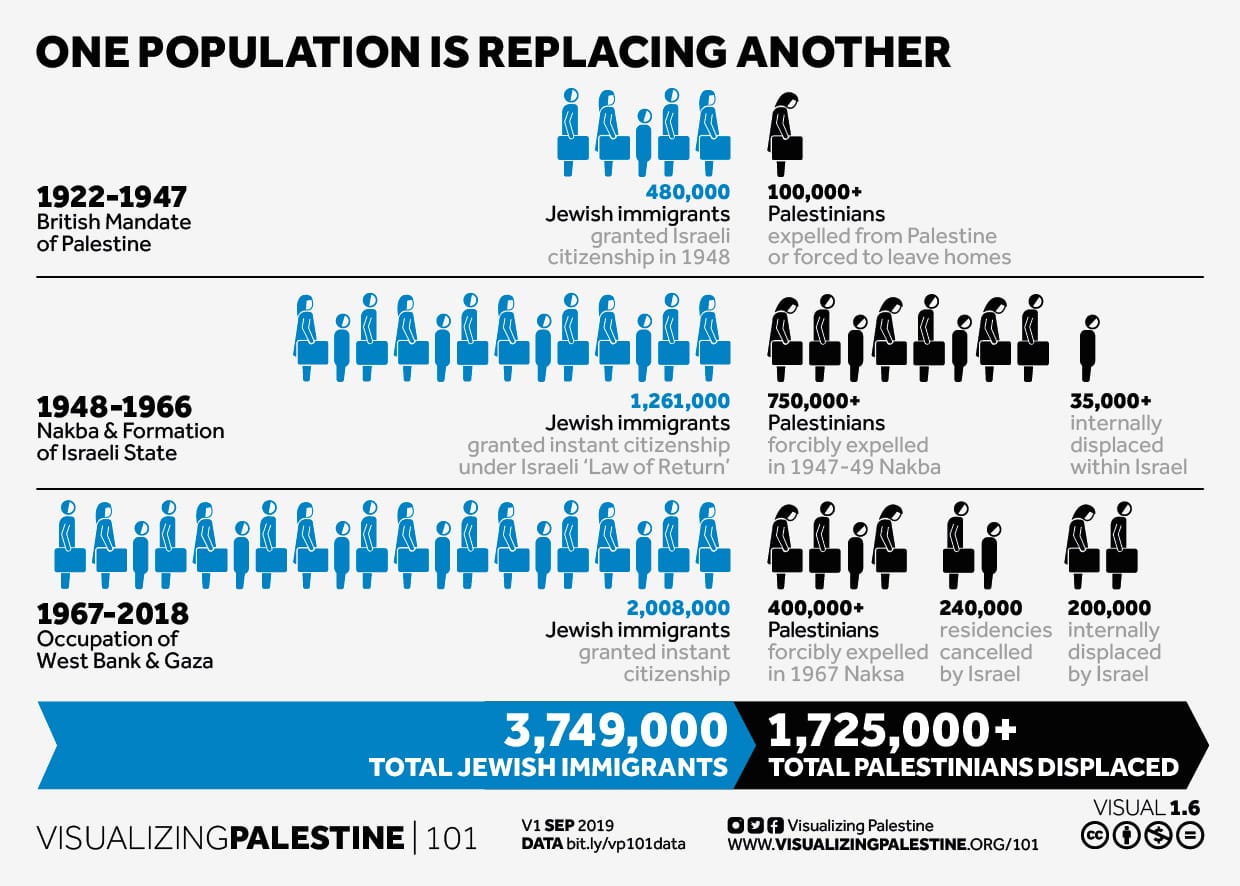
One population is replacing another. Visualizing Palestine. Creative Commons BY-NC-ND 4.0 license
## The Palestinian People Today
Some 750,000 Palestinians became refugees between 1947 and 1949\. Their precise number and who bore the responsibility for their exodus are still disputed despite the abundant evidence that a majority fled or were driven out by Zionist/Israeli violence. One Zionist militia intelligence document estimates that as of June 1948 at least 75 percent of the Palestinians fled due to Zionist/Israeli military actions, psychological campaigns aimed at frightening Arabs into leaving and dozens of direct expulsions. The total proportion of expellees is likely higher since the largest single expulsion of the war—50,000 from Lydda and Ramle—occurred later, in mid-July.
There are several well-documented cases of massacres that led to large-scale Arab flight. The most infamous atrocity occurred in April 1948 (prior to the creation of Israel) at Deir Yassin, a village near Jerusalem, where about 110 Arab residents were massacred by right-wing Zionist militias, frightening as many as 50,000 Palestinians into fleeing from the area within days.
Today the global Palestinian population is 14–15 million. About 7 million live inside the borders of what was British Mandate Palestine. They include about 1.6 million citizens of Israel and 372,000 inhabitants of Israeli-annexed East Jerusalem, most of whom are permanent residents but not Israeli citizens. About 3 million Palestinians live in the West Bank and 2.2 million in the Gaza Strip (before October 7, 2023). An estimated 7 million live in diaspora outside the country they claim as their national homeland. (In addition, about 20 percent of the 24,000 Syrian Druze population in the Golan Heights, which Israel occupied in 1967 and annexed in 1981, have taken Israeli citizenship; the others are permanent residents with a status similar to Palestinians of East Jerusalem.)
The largest Palestinian diaspora community, approximately 3 million, is in Jordan. Many still live in the refugee camps that were established in 1949, although several camps have become urban neighborhoods. Lebanon and Syria also have large Palestinian populations, many of whom still live in refugee camps. About one-fifth of the half million Palestinians in Syria became refugees for a second time during the 2011 popular uprising and ensuing civil war; some were internally displaced inside Syria and others fled to Lebanon, Turkey and Europe. After 1948, many Palestinians seeking work moved to Saudi Arabia and other Gulf countries. Others live elsewhere in the Middle East or further afield.
Jordan is the only Arab state to grant citizenship to its Palestinian residents. Syria grants Palestinian refugees most rights except citizenship. In other Arab states, Palestinians generally do not enjoy the same rights as citizens. The situation of the refugees in Lebanon is especially dire; many Lebanese blame Palestinians for provoking Israeli military assaults on the country as well as triggering the civil war that wracked Lebanon from 1975 to 1990 and demand that they be resettled elsewhere. Some elements of Lebanon’s Christian population are particularly anxious to rid the country of the mainly Muslim Palestinians because of their fear that Palestinians threaten the delicate sectarian system created in the French colonial period, in which Maronite Christians retain disproportionate political power.
Although many Palestinians still live precariously in refugee camps and urban slums, others have become economically successful. Palestinians have the highest per capita rate of university graduates in the Arab world. Their diaspora experiences and continued national disenfranchisement contributed to a high level of politicization and solidarity among all sectors of the Palestinian people. From the late 1960s through the 1990s, the great majority of Palestinians considered the Palestine Liberation Organization (PLO) as their political representative (see below). Many identified with one or another of its secular factions. In the 1980s, the regional Islamic revival led to the formation of Palestinian Islamist organizations (Hamas and Palestinian Islamic Jihad) that opposed the PLO.
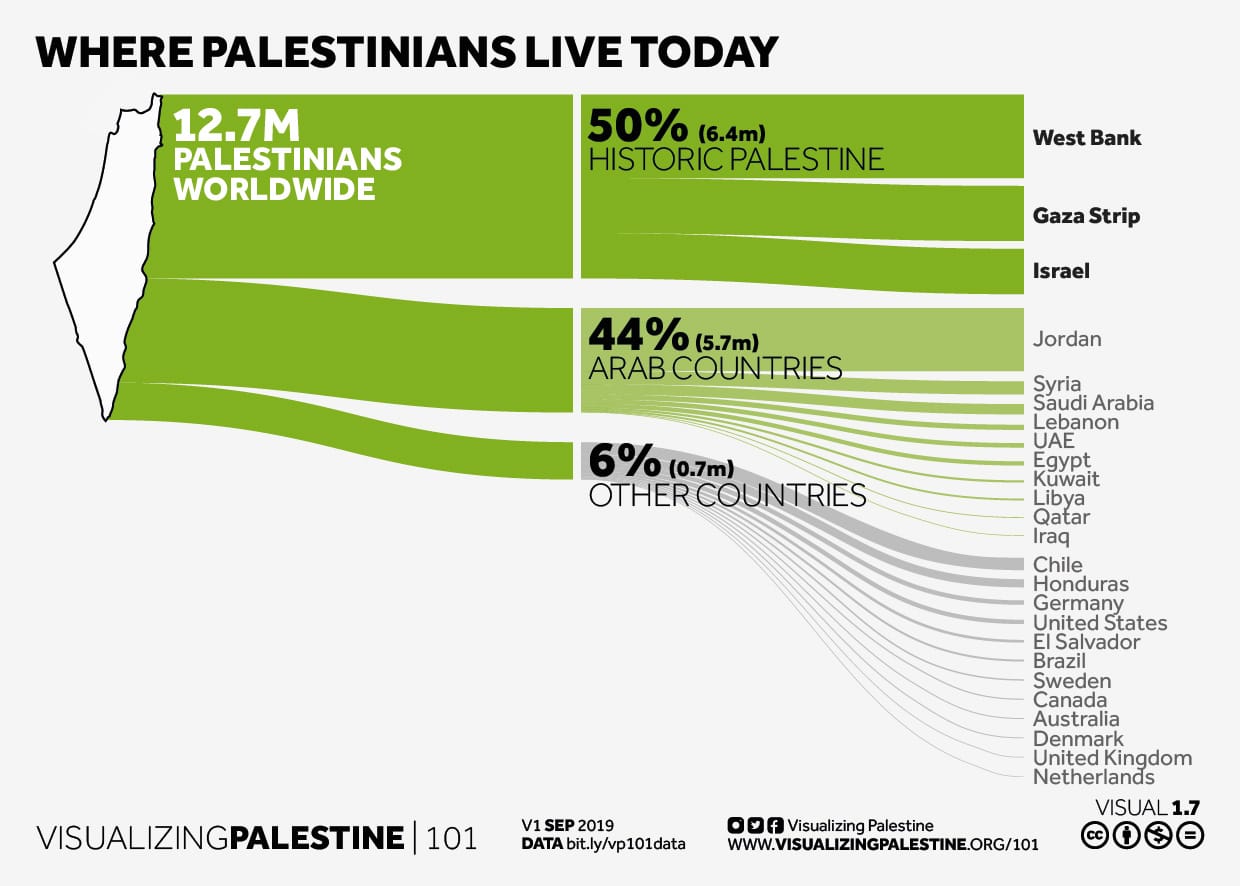
Where Palestinians live today. Visualizing Palestine. Creative Commons BY-NC-ND 4.0 license
## Palestinian Citizens of Israel
At the end of the 1948 War, approximately 156,000 Palestinians remained in the area that became the State of Israel. They were granted Israeli citizenship and the right to vote. But, because Israel defines itself as a Jewish state and the state of the Jewish people, in many respects Palestinian citizens—as non-Jews—were and remain second-class citizens. The Israeli government distinguishes between Muslim and Christian citizens, who it refers to as Israeli Arabs, and Druze citizens who it considers a separate minority group. There are also about 4,000 to 5,000 Circassian Israeli citizens.
Until 1966 Palestinian citizens were subject to a military government that restricted their movement and other rights (such as to work and political expression). They were not permitted to become full members of the Israeli trade union federation, the Histadrut, until 1965\. At least 40 percent of their lands were confiscated by the state and used for development projects that benefited Jews primarily or exclusively. They were entirely isolated from the Arab world and often were regarded by other Arabs as traitors for living in Israel.
Every Israeli government has discriminated against its Palestinian citizens by allocating far fewer resources to their sector for education, health care, public works, municipal government and economic development. Starting in 1950 with the passage of the Law of Return, which grants any Jew who arrives in the country immediate citizenship, and the Law of Absentee Property, which enabled the state to expropriate lands owned by Palestinian refugees, dozens of laws entrench Palestinian citizens’ second-class status and reinforce structural inequality between Jews and non-Jews.
The Israeli state considers expressions of Palestinian or Arab national sentiment as subversive. For example, Palestinian citizens of Israel organized a general strike on March 30, 1976, which they designated as Land Day to protest the continuing confiscation of their lands. Israeli security forces killed six unarmed Palestinian citizens that day and injured more than 100 others. Palestinians have since commemorated Land Day as a national event.
In 2011, Israel passed the Nakba Law, which authorizes the Minister of Finance to withhold state funds from any government-funded body, such as a school or theater, that marks “Israel’s Independence Day … as a day of mourning” or that denies Israel’s character as a “Jewish and democratic state.” The 2018 Basic Law: Israel as the Nation-State of the Jewish People asserts: “The right to exercise national self-determination in the State of Israel is unique to the Jewish people” and declares Jewish settlement throughout the land a national priority. Israel’s Supreme Court has upheld many laws and policies that discriminate against Palestinian citizens.
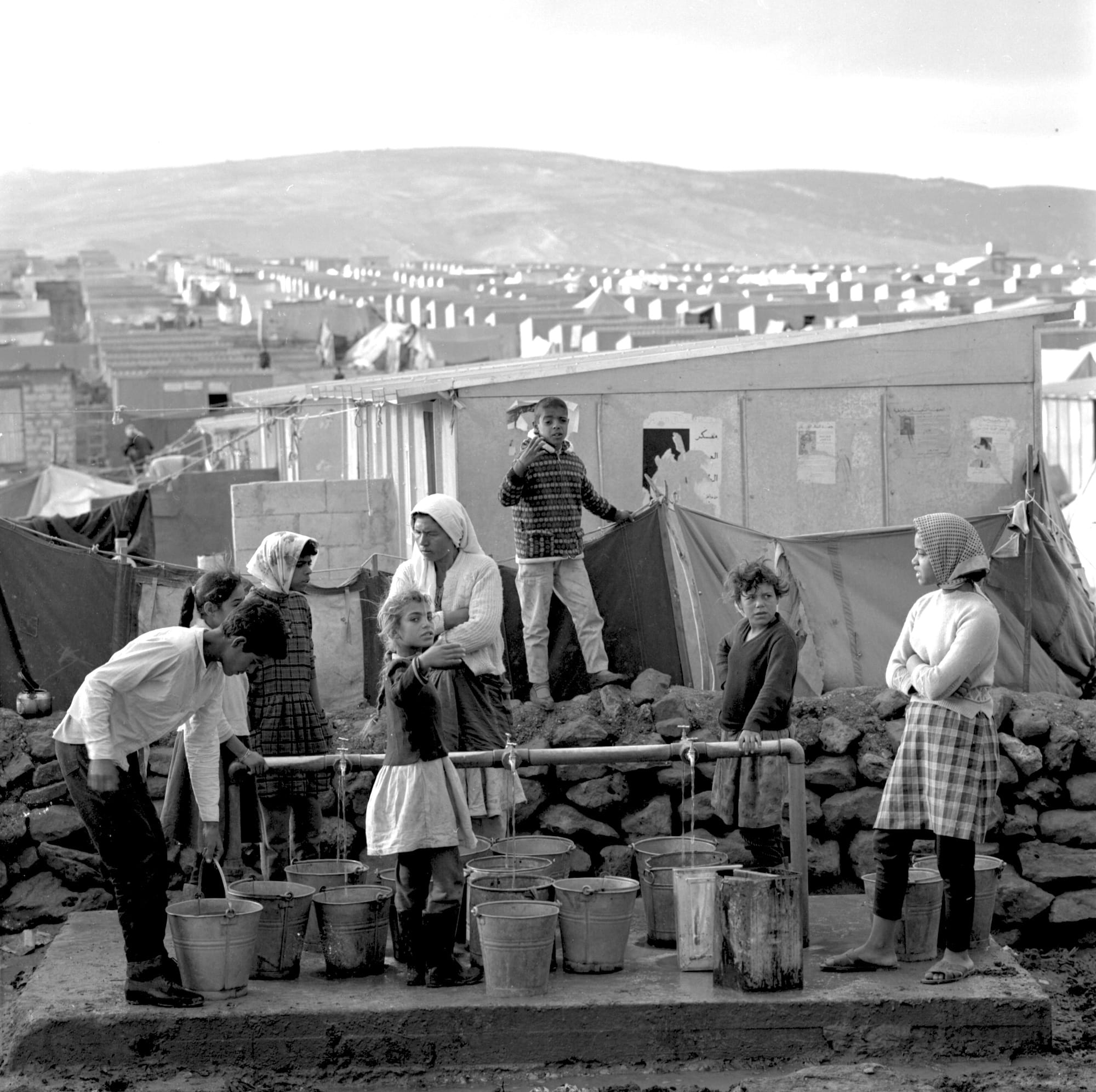
Palestinian refugee women and children fetch water in Irbid Camp, Jordan, 1969\. Photographer unknown. UNRWA Archive
## Israel and the Arab States
The 1948 War ended in 1949 with the signing of armistice agreements between Israel and Egypt, Jordan, Lebanon and Syria. Because Palestinians had no state, and as a people they were scattered throughout the various states of the region and beyond, the Palestinian-Zionist conflict was transposed to a conflict between Israel and its neighboring Arab states. In the 1950s, however, Palestinians outside of Israel began to reconstitute themselves as national actors, including through the formation of armed organizations intent on fighting for liberation. Fatah (a reverse Arabic acronym for Palestine Liberation Movement), which became the largest and most popular Palestinian armed organization, was formed by Palestinian refugees in Kuwait in 1959.
In the early 1950s, the Middle East was becoming a hot spot of Cold War rivalry as western states and the Soviet Union competed for regional power and influence. France became Israel’s major arms supplier and provided technological assistance to start its nuclear weapons program. The Soviet bloc was the main arms supplier for Egypt, Syria and, after the ouster of the monarchy in 1958, Iraq. Consequently, the region remained imperiled by the prospect of another war. The sense of crisis was fueled by a spiraling arms race as countries built up their militaries and prepared their forces (and their populations) for a future showdown.
In 1956, Israel joined with Britain and France to attack Egypt. The European powers sought to reverse Egyptian President Gamal Abdel Nasser’s nationalization of the Suez Canal Company, a multinational corporation registered in France in which the British government held 44 percent of the shares. Israel had two additional aims: to neutralize Palestinian commando attacks on Israel from the Egyptian-administered Gaza Strip and to strike a blow against the Egyptian army before it could absorb arms it was set to receive as the result of a deal with Czechoslovakia the previous year. During the war, Israel conquered the Gaza Strip and the Sinai Peninsula and declared its intention to annex those territories. But Israel was forced to retreat to the 1949 armistice lines due to international pressure led by the United States and the Soviet Union (an uncharacteristic alignment during the Cold War era). UN troops then were placed on the Egyptian side of the Egypt-Israel border.
## The June 1967 War
In May 1967, the Soviet Union misinformed the Syrian government that Israeli forces were massing in northern Israel to attack. There was no such Israeli mobilization. But clashes between Israel and Syria had been escalating for about a year, and Israeli leaders had publicly declared that it might be necessary to bring down the Syrian government if it failed to end Palestinian guerrilla attacks from Syrian territory, which Fatah (the militant organization led by Yasser Arafat) had started launching in 1965.
Egypt activated its defense treaty with Syria by sending troops into the Sinai Peninsula. A few days later, Egypt asked the UN observer forces stationed between Israel and Egypt to redeploy and proclaimed a blockade of the Gulf of Aqaba, arguing that access to the Israeli port of Eilat passed through Egyptian territorial waters, the Straits of Tiran. Nasser was playing a dangerous game of brinksmanship, hoping to benefit politically from a crisis but not desiring a war, especially since Egypt’s best military forces were occupied with fighting in Yemen during its civil war. These developments shocked and frightened the Israeli public who became worried that a multi-front war was imminent. In contrast to the public panic, Israel’s military high command was confident that it would prevail in a war with Egypt and Syria and urged the political leadership to authorize it.
On June 5, 1967, Israel preemptively attacked Egypt and Syria, destroying their air forces on the ground within a few hours. After Jordan joined in the fighting, Israel attacked it as well. The Egyptian, Syrian and Jordanian armies were decisively defeated within six days. Israel captured the West Bank, including East Jerusalem, from Jordan and the Gaza Strip and the Sinai Peninsula from Egypt. Israel also captured the Golan Heights from Syria and forcibly expelled 96 percent of the region’s population.
The June 1967 War established Israel as the dominant regional military power, with strong US backing. The speed and thoroughness of Israel’s victory discredited the rhetoric and supposed military readiness of the various Arab governments. Before the war, many Palestinians and other Arabs hoped that a united Arab world led by Egypt would confront Israel and liberate Palestine. After the war, the Palestine Liberation Organization (PLO), which had been established by the Arab League in 1964 to manage Palestinian national activities, was taken over by Fatah and other militant political groups such as the Democratic Front for the Liberation of Palestine (DFLP, al-Jabha al-Dimuqratiyya li-Tahrir Filastin) and the Popular Front for the Liberation of Palestine (PFLP, al-Jabha al-Sha‘abiyya li-Tahrir Filastin). After 1967, the PLO emerged as a major regional actor, the principal representative of the Palestinian people and the embodiment of its aspirations for liberation.
## UN Security Council Resolution 242
On November 22, 1967, the UN Security Council adopted Resolution 242 affirming the “inadmissibility of the acquisition of territory by force,” which would require Israeli withdrawal from all the lands it seized in the war and “acknowledgment of the sovereignty, territorial integrity and political independence of every State in the area and their right to live in peace within secure and recognized boundaries.” The grammatical construction of the French version of Resolution 242 says Israel should withdraw from “the territories” (*les territoires*), whereas the English version calls for withdrawal from “territories.” (Both English and French are official UN languages.) Israel and the United States use the English version to argue that Israeli withdrawal from some, but not all, territory occupied in the 1967 War would satisfy the requirements of this resolution. By calling for recognition of every state in the area, Resolution 242 affirmed Israel’s status as a recognized state without recognizing Palestinian national rights.
For many years the PLO rejected Resolution 242 because it frames the question of Palestine solely as a humanitarian issue and does not acknowledge Palestinian people’s right to national self-determination or to return to their homeland. It calls only for a “just settlement of the refugee problem,” without specifying what that phrase means.
## The Occupied Territories
As a result of the 1967 War, the political map underwent a major transformation. From 1949 to 1967, the West Bank, including East Jerusalem, was ruled by Jordan, which annexed the area in 1950 and extended citizenship to Palestinians living there. In the same period, the Gaza Strip was under Egyptian military administration. After conquering these areas during the 1967 War, Israel established a military government to rule the Palestinian residents of the occupied West Bank and Gaza. The military government denied Palestinians basic political rights and civil liberties, including freedoms of expression, press and political association. Palestinian nationalism was criminalized as a threat to Israeli security, and displaying the Palestinian national colors was a punishable act. All aspects of Palestinian life were regulated and often severely restricted. Even something as innocuous as the gathering of wild thyme (*za‘tar*), a basic element of Palestinian cuisine, was outlawed by Israeli military orders. The State of Israel regards all forms of Palestinian opposition to the occupation as threats to its national security, including nonviolent methods like calling for boycotts, divestment and sanctions.
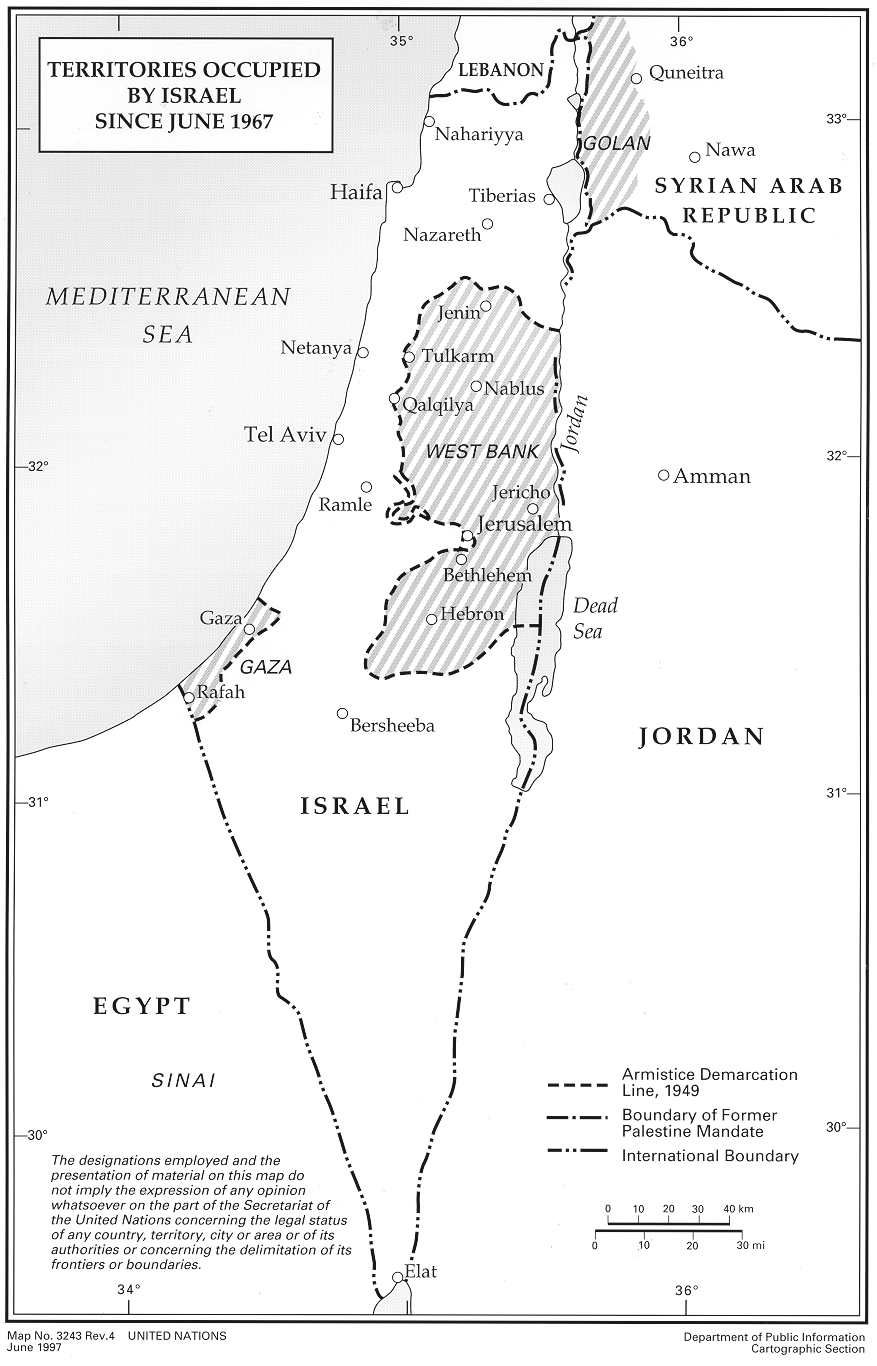
Territories occupied by Israel since June 1967\. United Nations Department of Public Information, Cartographic Section, 1997
The Israeli army governs occupied Palestinians through policies of surveillance and punishment, relying on arrest, prosecution and imprisonment to control and deter Palestinian resistance to the occupation. The military administration uses collective punishments such as curfews, house demolitions and closure of roads, schools and community institutions. It has deported hundreds of Palestinian political activists to Jordan or Lebanon or transferred them from the West Bank to Gaza as well as confiscated tens of thousands of acres of Palestinian land and uprooted thousands of trees. In 1981 Israel established a Civil Administration to carry out the bureaucratic tasks of the occupation; it is subordinate to the military authorities.
At least 800,000 Palestinians have been incarcerated by Israel since 1967, many of them under administrative detention (imprisonment without trial). More than 40 percent of the Palestinian male population has been imprisoned at least once. Defense for Children International-Palestine calculated that since 2000, the Israeli military has detained some 13,000 Palestinian children, almost all boys between the ages of 12 and 17\. Hundreds of them have been held without charges.
Israeli torture of Palestinian prisoners has been a common practice since at least 1971\. Military judges rarely exclude statements elicited through interrogation that defense lawyers allege were coerced. Israeli officials have claimed that harsh measures and high rates of incarceration are necessary to thwart terrorism. Dozens of people have died in detention from abuse or neglect.
Israel argues that the Fourth Geneva Convention and other international laws governing military occupation of foreign territory do not apply to the West Bank and the Gaza Strip. It asserts that these territories are not occupied because they were never part of the sovereign territory of any state, as Jordan’s 1950 annexation of the West Bank was not widely recognized and Egypt never asserted sovereignty over Gaza. Officially, the Israeli government declares its role as the “administrator” of territory whose status remains to be determined. In contrast, Israeli religious and secular right-wing nationalists assert that the territories are an integral part of their historical heritage. The international community has rejected these Israeli positions. In July 2024 the International Court of Justice ruled that Israel’s governance and conduct in the West Bank and the Gaza Strip is illegal according to international law. But little effort has been mounted to enforce international law or hold Israel accountable for violations.
Every Israeli government has facilitated and subsidized Jewish settlement in East Jerusalem and throughout the West Bank in breach of the Fourth Geneva Convention. As a result, as much as 40 percent of the West Bank has been de facto annexed. Many settlements are built on expropriated, privately owned Palestinian lands. According to the Israeli NGO Peace Now, in 2024 there were 146 official Jewish settlements (legally acknowledged by the Israeli government) and about 191 unofficial settlement outposts and farms. In recent years Israel has been granting legal status to increasing numbers of those outposts. By 2023 there were 236,000 settlers in 12 East Jerusalem neighborhoods (settlements) and 478,600 settlers in the rest of the West Bank.
Critics of Israel’s occupation—Palestinians as well as international human rights NGOs like Human Rights Watch and Amnesty International and Israeli NGOs like B’Tselem and Yesh Din—contend that Israel’s systematic discrimination and oppression of Palestinians constitutes apartheid. (Apartheid means apartness in Afrikaans, the language of Dutch settlers in South Africa, where this system and term were first institutionalized.) Human Rights Watch and Yesh Din contend that apartheid pertains to the OPT but not to the pre-1967 borders of Israel. Amnesty International and B’Tselem argue that apartheid prevails in all the territories governed by Israel because Israeli rule privileges Jews over Palestinians, from the river to the sea. The evidence of apartheid in the OPT includes the lack of legal rights for Palestinians, the system of separate identity cards and laws, military checkpoints, the exploitation of Palestinians as cheap labor, the massive expropriation of Palestinian land and water and exclusively Jewish settlements and separate roads for Israelis and Palestinians.
## Jerusalem
The 1947 UN Partition Plan designated Jerusalem (and Bethlehem) as an internationally administered zone. In the 1948 Arab-Israeli War, Israel took control of the western part of Jerusalem, while Jordan took the eastern part, including the old walled city containing important Muslim, Christian and Jewish religious sites. The 1949 armistice line cut the city in two. In 1950, Israel declared (West) Jerusalem its capital.
On June 22, 1967, soon after capturing the West Bank (including East Jerusalem), Gaza Strip, Sinai Peninsula and Golan Heights in the 1967 War, Israel expanded the municipal boundaries of East Jerusalem to include 70 square kilometers and 28 villages, most of which was never part of the city at any time in its history; this territory constitutes about 2 percent of the West Bank. Because of this annexation, most Palestinians living in East Jerusalem became residents of the State of Israel. Only a small number accepted Israeli citizenship.
Israel annexed East Jerusalem in 1980, proclaiming all of Jerusalem as its “eternal capital.” The UN Security Council responded with Resolution 476 (14-0 with the United States abstaining), which declared that “all legislative and administrative measures and actions taken by Israel, the occupying Power, which purport to alter the character and status of the Holy City of Jerusalem have no legal validity and constitute a flagrant violation of the Fourth Geneva Convention.”
In 1995, the US Congress—in a bipartisan show of support for Israeli unilateralism—legislated that the United States should recognize Jerusalem as Israel’s capital. Every subsequent president avoided implementing the law by certifying that US national security would be harmed by doing so. Disregarding this precedent, in December 2017, President Donald Trump recognized Jerusalem as Israel’s capital. Most of the international community continue to consider East Jerusalem part of the occupied West Bank. A new US embassy in Jerusalem was opened on May 15, 2018, on property situated between West Jerusalem and former no-man’s land between West and East Jerusalem—land Israel seized from the prominent Palestinian al-Khalidi family and a dozen other families.
## The Palestine Liberation Organization
The Arab League established the PLO in 1964 to control Palestinian nationalism while appearing to champion the cause. The Arab defeat in the 1967 War enabled younger, more militant Palestinians to take over the PLO. In 1974, the Arab governments recognized the PLO as the sole legitimate representative of all Palestinians.
The PLO is comprised of groups that represent a range of ideological orientations and administer various sectors, including women’s associations, student unions and other civil society and social service organizations. It also has a military apparatus. Its leading bodies are the Palestinian National Council (PNC) and the PLO Executive Committee. PNC members were selected from among diaspora Palestinians according to a formula that reflected the relative size of the PLO’s constituent organizations. In their heyday, the armed factions of the PLO sought to wage an armed struggle to defeat Israel and liberate Palestine.
Yasser Arafat was PLO chairman from 1968 until his death in 2004\. He also led Fatah, the largest party in the PLO. The other major groups are the Popular Front for the Liberation of Palestine (PFLP), the Democratic Front for the Liberation of Palestine (DFLP) and, in the Occupied Territories, the Palestine People’s Party (formerly the Communist Party). Despite these factional differences, the majority of Palestinians regarded the PLO as their representative until it began to lose significance after the 1993 Oslo Accords and the establishment of the Palestinian Authority (PA) in 1994\. The PNC has met only twice since the Oslo Accords, in 1996 and 2018\. Hamas, an Islamist group established in 1987, is not a component of the PLO. The rise of Hamas, especially in the 2000s, further diminished the authority of the PLO (see below).
After the 1967 War, the PLO’s primary base of armed operations was Jordan. In 1970–1971, PLO armed factions fought and lost a civil war with the Jordanian army, which is known as Black September. The PLO leadership was compelled to leave the country and relocate to Lebanon. When the Lebanese civil war started in 1975, the PLO became a party to the conflict. After the Israeli invasion of Lebanon in 1982, the PLO leadership was expelled from the country, relocating to Tunisia.
Until 1993, Israel did not acknowledge Palestinian national rights or recognize the Palestinians as an independent party to the conflict. Israel refused to negotiate with the PLO, arguing that it was nothing but a terrorist organization and insisted on dealing only with Jordan or other Arab states. It rejected the establishment of a Palestinian state, demanding that Palestinians be incorporated into the existing Arab states. Israel modified its opposition when its representatives entered into secret negotiations with the PLO, which led to the 1993 Oslo Declaration of Principles (see below).
## The October 1973 War and the Role of Egypt
In 1971, Egyptian President Anwar al-Sadat indicated to UN envoy Gunnar Jarring that he was willing to sign a peace agreement with Israel in exchange for the return of the Egyptian Sinai Peninsula, occupied by Israel in the 1967 War. Israel and the United States ignored this overture. Egypt and Syria decided to break the political stalemate by attacking Israeli forces in the occupied Sinai and Golan Heights on the Jewish holy day of Yom Kippur, October 6, 1973\.
The attack caught Israel off guard. The Arab militaries achieved some early victories, prompting US political intervention along with sharply increased military aid to Israel. The war ended with Israeli forces occupying a beachhead on the west bank of the Suez Canal, Egyptian forces with a beachhead on its east bank and Israeli forces occupying an additional swathe of Syrian territory. A diplomatic intervention was required.
US Secretary of State Henry Kissinger pursued a strategy of limited bilateral agreements to secure partial Israeli withdrawals from the Sinai Peninsula and the Golan Heights. Negotiations on the fate of the West Bank and Gaza could be avoided because Jordan had not participated in the war and Egypt did not seek the return of the Gaza Strip. Kissinger’s strategy positioned the United States as the sole mediator and most significant external actor in the conflict, a position it has sought to maintain ever since.
Israel was unwilling to negotiate for a full return of Egyptian territory, and Kissinger accepted this refusal. Sadat decided to initiate a separate overture to Israel. On November 19, 1977, he traveled to Jerusalem and addressed the Knesset, a powerful symbol of recognition that Israel hoped other Arab heads of state would emulate.
In September 1978, President Jimmy Carter invited Sadat and Israeli Prime Minister Menachem Begin to the Camp David presidential retreat in Maryland. They negotiated two agreements: a framework for peace between Egypt and Israel and a general framework for resolution of the Middle East crisis—in other words, the Palestine question.
The first agreement formed the basis of the Egyptian-Israeli peace treaty signed in 1979\. The second agreement proposed to grant autonomy to the Palestinians in the West Bank and the Gaza Strip for a five-year interim period, after which the final status of the territories would be negotiated.
Only the Egyptian-Israeli part of the Camp David accords was implemented. The Palestinians and other Arab states rejected the autonomy concept because it did not guarantee full Israeli withdrawal from areas captured in 1967 or the establishment of an independent Palestinian state. Israel sabotaged negotiations by continuing to confiscate Palestinian lands in the West Bank and Gaza Strip and build new settlements in violation of the commitments Begin made to Carter at Camp David.
Palestinian children throw stones toward Israeli soldiers in the Amari refugee camp near Ramallah, in the West Bank, in February 1988 to protest against Israeli occupation. Eric Feferberg/AFP via Getty Images
## The First Intifada
On December 9, 1987, the Palestinian population in the West Bank and Gaza began a mass uprising against the Israeli occupation. This uprising, or intifada (which means shaking off in Arabic), began in the Jabaliya refugee camp in Gaza after an Israeli truck hit a car and killed four Palestinians returning home from work. The uprising was not orchestrated by the PLO leadership in Tunis. Rather, it was a popular mobilization that drew on the organizations and institutions that had developed under Israeli occupation.
Hundreds of thousands of Palestinians participated in the Intifada*,* many with no previous resistance experience, including children and teenagers. For the first few years, the uprising involved many forms of nonviolent civil disobedience, including massive demonstrations, general strikes, refusal to pay taxes, boycotts of Israeli products, political graffiti and the establishment of underground “freedom schools.” (Israel closed regular schools as reprisals.) It also included stone throwing, Molotov cocktails and the erection of barricades to impede the movement of Israeli military forces.
Intifada activism was organized through popular committees under the umbrella of the United National Leadership of the Uprising. This broad-based resistance challenged the occupation as never before and drew unprecedented international attention to the situation facing Palestinians in the West Bank and Gaza. Palestinian human rights organizations like Al-Haq, one of the first human rights organizations in the Arab world (established in 1979), prominently reported on Israeli violence and wide-scale violations of Palestinians’ human rights.
Israeli Defense Minister Yitzhak Rabin tried to smash the Intifada*,* ordering the military to use “force, power and beatings.” Army commanders instructed troops to break the bones of demonstrators, with the justification that broken arms cannot throw stones and broken legs cannot run away. From 1987 to 1991, Israeli forces killed over 1,000 Palestinians, including over 200 under the age of 16\. Palestinian militants killed about 100 Israelis during this period as well as over 250 Palestinians suspected of collaborating with the occupation authorities. In 1988, Israel began a secret policy of extra-judicial execution (termed targeted killing) in the OPT. These operations are conducted by undercover units who disguise themselves as Arabs to approach and execute their targets at close range or by snipers who kill from a distance.
Israel also engaged in a massive arrest campaign in an attempt to crush the uprising. During this period, Israel had the highest per capita prison population in the world. By 1990, most of the Palestinian leaders of the uprising were in jail and the Intifada lost its cohesive force, although it continued for several more years.
## Hamas and Palestinian Islamic Jihad
In December 1987, in response to the First Intifada, Sheikh Ahmed Yassin formed Hamas (the Arabic acronym for Islamic Resistance Movement, Harakat al-Muqawama al-Islamiyya) a Palestinian Islamist group not affiliated with the PLO. Hamas grew out of the Gaza Strip branch of the Egyptian Muslim Brotherhood. In 1973 Sheikh Yassin established the Mujamma‘ al-Islami (Islamic Center) as a charitable and service association. In 1979 the Israeli military governor of Gaza recognized the group, thinking it posed no security threat and would draw support away from PLO factions. Hamas continued to provide social services to Palestinians while developing as a militia and political organization.
Palestinian Islamic Jihad (Harakat al-Jihad al-Islami fi Filastin*)* was established in 1981\. Unlike Hamas, it argued that armed struggle to liberate Palestine should begin immediately, rather than waiting until Palestinian society was sufficiently Islamized to begin the struggle.
Hamas’s 1987 announcement of its creation and later statements released during the Intifada utilized a language of revenge for Israeli actions and policies and an anti-imperialism framed with Islamist justification. The August 1988 Hamas Charter includes standard antisemitic tropes. Hamas’s revised 2017 Document of General Principles and Policies eliminates that language, defines the conflict as “with the Zionist project, not with the Jews because of their religion” and declares that establishing “a fully sovereign and independent Palestinian state, with Jerusalem as its capital along the lines of the 4th of June 1967, with the return of the refugees and the displaced to their homes from which they were expelled” is “a formula of national consensus.”
The rise of Hamas and Palestinian Islamic Jihad challenged the authority of the PLO. Political divisions and violence within the Palestinian community escalated during the First Intifada, driven by the growing rivalry between the various secular PLO factions and the Islamist organizations.
## Palestinian Declaration of Independence and Recognition of Israel
The Intifada made clear that the status quo was untenable. The center of gravity of Palestinian national and political initiatives shifted from the PLO leadership in Tunis to the OPT. Palestinian activists in the OPT demanded that the PLO adopt a clear political program to guide the struggle for independence. In response, the PNC convened in Algeria in November 1988\. It renounced terrorism and proclaimed an independent Palestinian state in the West Bank and the Gaza Strip, thereby implicitly recognizing the State of Israel.
The Israeli government did not respond to these gestures, claiming that nothing had changed and that the PLO remained a terrorist organization with which it would never negotiate. The United States did acknowledge that the PLO’s policies had changed but did not exert pressure on Israel to follow suit.
Because of US and Israeli failure to respond meaningfully to PLO moderation, the PLO opposed the 1991 US-led attack on Iraq after the regime of Saddam Hussein invaded and occupied Kuwait. Kuwait and Saudi Arabia cut off financial support to the PLO and expelled hundreds of thousands of Palestinians who had been living and working in those countries. After the 1991 Gulf War, the PLO was diplomatically isolated.
## The 1991–1992 Negotiation Process
In return for Arab states’ support of the 1991 US-led Gulf War against Iraq, the administration of President George H. W. Bush pressed Israeli Prime Minister Yitzhak Shamir to open negotiations with Palestinians and the Arab states at a multilateral conference convened in Madrid, Spain, in October 1991\. Shamir, a former leader of the militant right-wing pre-state group LEHI, was reluctant to negotiate and imposed conditions, which the US accepted: exclusion of the PLO from the talks, Palestinian representation only as part of the Jordanian delegation and no discussion of Palestinian independence and statehood.
The Madrid conference was largely ceremonial. At subsequent negotiating sessions in Washington, Palestinians were represented by a delegation from the OPT and diaspora Palestinians. However, Israel barred residents of East Jerusalem from participating on the grounds that the city is part of Israel (by virtue of annexation). Although the PLO was formally excluded, its leaders regularly advised and consulted with the Palestinian delegation. These negotiations achieved little progress. After leaving office in 1992, Shamir acknowledged, “I would have carried on autonomy talks for ten years and meanwhile we would have reached half a million people \[settlers\] in Judea and Samaria \[the official Israeli name for the West Bank\].”
After Yitzhak Rabin succeeded Shamir as prime minister, human rights and economic conditions in the West Bank and the Gaza Strip deteriorated dramatically, and Israeli land confiscation and settlement building escalated. Several Palestinian delegates to the Washington talks resigned in protest.
As the negotiations floundered, the popularity of Islamists grew and challenged the diplomatic strategy of the PLO. Violent attacks against Israeli military and civilian targets by Hamas and Islamic Jihad further exacerbated tensions. Eventually Rabin came to believe that Hamas and Islamic Jihad posed more of a threat to Israel than the PLO.
## The Oslo Accords and the Palestinian Authority
Israeli fear of “radical Islam” and the insistence of the Palestinian delegates to put self-determination and statehood on the table at the Washington talks led the Rabin government to reverse Israel’s long-standing refusal to negotiate with the PLO. Israel initiated a secret track of negotiations directly with PLO representatives in Oslo, Norway. These talks produced the Israel-PLO Declaration of Principles (DOP), which was signed in Washington in September 1993 by Rabin and Arafat and witnessed by President Bill Clinton whose administration was not involved in its negotiation.
The DOP stipulated mutual recognition of Israel and the PLO. Israel committed to withdrawing from the Gaza Strip and Jericho and to additional unspecified areas of the West Bank during a five-year interim period. The document does not mention a Palestinian state or the right of Palestinian self-determination, which Israel continued to oppose. The key issues—the extent of the territories to be ceded by Israel, the nature of the Palestinian entity to be established, the future of Israeli settlements and settlers, water rights, the resolution of the refugee problem and the status of Jerusalem—were to be discussed only in “final status” talks. The PLO accepted this deeply flawed agreement because it was weak and had little diplomatic support in the Arab world. Islamists and some leaders of PLO factions other than Fatah challenged Arafat’s leadership and rejected the negotiated concessions. The Palestinian poet laureate Mahmoud Darwish, who had authored the Palestinian Declaration of Independence in 1988, resigned from the PLO Executive Committee, and Edward Said, who had translated the declaration into English, did likewise from the PNC.
Hamas and Palestinian Islamic Jihad also opposed the Oslo Accords and began armed resistance to thwart them. Hamas carried out the first suicide bombing inside Israel in April 1994 in response to Israeli settler Baruch Goldstein’s massacre of worshippers in the al-Haram al-Ibrahimi Mosque in Hebron on February 25, 1994.
In 1994, in partial fulfillment of the DOP, the PLO formed a Palestinian Authority (PA) with limited self-governing powers in occupied areas from which Israeli forces were redeployed. In January 1996, elections were held for the Palestinian Legislative Council and for the presidency of the PA, which were won by Fatah and Arafat, respectively.
The Oslo Accords set up a negotiating process without specifying an outcome. The process was supposed to be completed by May 1999\. During the protracted interim period, Israel dramatically escalated settlement building and land confiscations in the OPT and constructed a network of bypass roads to enable Jewish settlers to travel from their settlements to Israel without passing through Palestinian-inhabited areas. These projects were widely understood as marking out territory Israel sought to annex in the final status agreement. Although the Oslo accords barred both parties from changing the status quo on the ground in these ways, it contained no mechanism to block Israel’s unilateral actions or violations of Palestinian human and civil rights. Settlers also undermined the negotiated agreements, escalating their attacks and flexing their electoral strength to bring more anti-Oslo politicians into office.
The Oslo process divided the OPT into three categories. In Palestinian cities and towns in the West Bank that Israeli forces had vacated—designated Area A—the PA was in charge of internal security and municipal services. In other Palestinian towns and villages—designated Area B—the PA and the Israeli military were jointly responsible for internal security. In all other areas including Jewish settlements and the Jordan Valley—designated Area C—Israel maintained exclusive control. A similar division was imposed on the Gaza Strip. By 2000, the PA only held direct or partial control over approximately 40 percent of the West Bank and 65 percent of the Gaza Strip. Areas A and B were fragmented and surrounded by Area C with checkpoints to control and restrict Palestinians’ entry and exit.
In July 2000, Clinton invited Arafat (as PA president) and Israeli Prime Minister Ehud Barak to Camp David to conclude negotiations on the overdue final status agreement. Before they met, Barak proclaimed his red lines: Israel would not return to its pre-1967 borders, East Jerusalem would remain under permanent Israeli sovereignty, Israel would annex settlement blocs in the West Bank containing some 80 percent of the 190,000 (now about 478,600) Jewish settlers and Israel would not accept legal or moral responsibility for creating the Palestinian refugee problem. The Palestinians, in accordance with their understanding of UN Security Council Resolution 242 and the spirit (but not the letter) of the Oslo DOP, sought Israeli withdrawal from the vast majority of the West Bank and the Gaza Strip, including East Jerusalem, and recognition of an independent Palestinian state in those territories.
The distance between the two parties, especially on the issues of East Jerusalem and refugees, made it impossible to reach an agreement at Camp David. Although Barak offered Israeli withdrawal from more of the West Bank than any other Israeli leader had publicly considered, he insisted that an agreement must include Israeli control of the Jordan Valley and exclusive Israeli sovereignty in East Jerusalem.
When the negotiations collapsed, Arafat left Camp David with enhanced stature among his constituents because he did not yield to US and Israeli pressure. Barak returned home to face a political crisis. Even before departing for Camp David, he had lost his Knesset majority when coalition partners quit his government on the grounds that he was willing to offer the Palestinians too much.
## The Second (al-Aqsa) Intifada
The inherent flaws in the so-called peace process initiated at Oslo, combined with the daily frustrations and humiliations inflicted upon Palestinians, continuing Israeli settlement in the OPT and corruption in the Palestinian Authority, set the stage for a second intifada*.* Like the First Intifada, the Second Intifada (also called al-Aqsa Intifada) was a protest against Israeli occupation. On September 28, 2000, Ariel Sharon, a hardline opponent of any Israeli territorial withdrawal who was challenging Benjamin Netanyahu for leadership of the Likud party in upcoming elections, went to Jerusalem’s Temple Mount/Noble Sanctuary accompanied by 1,000 armed guards. This aggressive spectacle provoked large Palestinian protests. The following day, Palestinians threw rocks at Jews praying at the Western Wall. Israeli police then stormed the Temple Mount and killed at least four and wounded 200 unarmed protesters. By the end of the day Israeli forces had killed three more Palestinians in Jerusalem.
These killings prompted demonstrations and clashes across the West Bank and the Gaza Strip. In October there were widespread solidarity demonstrations and a general strike by Palestinian Arab citizens of Israel. Police killed 12 unarmed Palestinian citizens of Israel and one West Bank resident.
The Second Intifada was much bloodier than the first. During the first three weeks, Israeli forces shot 1 million live bullets at Palestinian demonstrators. The Israeli military escalated its use of force to avert a protracted civil uprising like the First Intifada, which had garnered international sympathy for Palestinians. On some occasions, PA police, usually positioned at the rear of unarmed demonstrators, returned fire.
Israel expanded its armed violence against the protests, deploying tanks, helicopter gunships and even F-16 fighter planes. The Israeli army attacked PA offices in Ramallah, Gaza and elsewhere. Civilian neighborhoods were subjected to shelling and aerial bombardment. In November 2000, Israel acknowledged for the first time its policy of targeted killing after a suspected Palestinian militant was assassinated by a missile strike along with two women bystanders.
Israeli officials justified waging full-scale war on Palestinians in the OPT by arguing that the law enforcement model (policing and riot control) was no longer viable because Israel’s military had withdrawn from Area A and because Palestinians possessed (small) arms and thus constituted a foreign “armed adversary.” They described the Second Intifada as an “armed conflict short of war” and claimed that Israel had the right of self-defense against an “enemy entity,” while denying that those stateless enemies had any right to use force, even in self-defense. Israeli forces killed at least 3,000 Palestinians during the Second Intifada*.* Israel likened its unprecedented use of force against occupied Palestinians to the US War on Terror, launched in 2001 after the September 11 terrorist attacks, and compared Palestinian militants to al-Qaeda.
Hamas and Islamic Jihad, and later some units of the PFLP and the Fatah-affiliated al-Aqsa Martyrs Brigade, retaliated with suicide bombings and other armed operations. There were over 150 such attacks between 2000 and 2005, which killed as many as 1,000 Israelis, compared to the 22 suicide attacks from 1993 to 1999 by opponents of the Oslo process.
In January 2001, direct Palestinian-Israeli negotiations resumed briefly at Taba (in the Sinai), with no US presence. The lead negotiators claimed that they came “painfully close” to a final agreement before talks were called off by Barak in advance of the early elections that he had called because he no longer had a majority in the Knesset. With intense support from settlers and those Israelis who viewed the peace process as threatening their security, Ariel Sharon handily defeated Barak in the February 6 election.
Sharon’s first term as prime minister coincided with the most violent period of the Second Intifada. On March 27, 2002, a suicide bombing in Netanya during the Passover holiday killed 30 Israelis and injured 140\. In retaliation, Israel launched Operation Defensive Shield, a full-scale invasion of the West Bank that lasted for several weeks and was Israel’s largest military operation since the 1982 invasion of Lebanon. It signaled Israel’s willingness to inflict more intensely punishing levels of violence and destruction with the aim of debilitating Palestinian capacities, deterring future attacks against Israel and targeting not only militants but the broader Palestinian society.
During Operation Defensive Shield, Israeli forces re-entered many parts of Area A and laid waste to the infrastructures of the PA. The Battle of Jenin Refugee Camp was the emblematic confrontation of the campaign. While many refugee camp residents fled before the fighting began on April 2, Palestinian fighters from several factions prepared for the Israeli army’s incursion and killed 13 Israeli soldiers in an ambush on April 9\. This incident generated intense political pressure within Israel to take the camp quickly with minimal military casualties. Consequently, instead of sending soldiers into buildings to capture or kill fighters, the army shelled some buildings first and commandeered Palestinian civilians as human shields to precede and protect soldiers. To finish the Jenin operation, the military deployed armored bulldozers that flattened everything in their path. Human Rights Watch documented 52 Palestinians killed in the Jenin refugee camp and concluded that Israeli forces committed war crimes and other serious violations of international humanitarian law.
On July 22, 2002, an Israeli F-16 dropped a one-ton bomb on the densely populated Gaza City neighborhood of al-Daraj in order to assassinate Hamas military commander Salah Shehadeh. The bomb destroyed Shehadeh’s apartment building and eight nearby buildings, partially destroying nine others. In addition to Shehadeh and his guard, the bombing killed 14 Palestinians, including eight children, and injured more than 150 people. The Israeli military responded to public outcry about the size of the bomb, the targeting of a residential neighborhood and the high number of casualties with an investigation. It concluded that there had been “shortcomings in the information available,” namely the presence of “innocent civilians” in the vicinity of what was claimed to be Shehadeh’s “operational hideout.” Although Moshe Ya‘alon, Israel’s chief of staff at the time of the bombing, cancelled a trip to Britain in 2009 because he feared an arrest on war crimes charges, no one was ever held accountable.
## Ascendancy of the Israeli Right Wing
The Likud and parties to its right have dominated Israeli politics in the twenty-first century. The Likud is the direct heir to the Revisionist Zionist ideology of territorial maximalism and aggressive deployment of indiscriminate armed force to suppress Palestinian resistance to the Zionist project. Right wing religious Zionism is rooted in the theology of Rabbi Abraham Isaac Kook, the first Ashkenazi chief rabbi of Mandate Palestine. He rejected the 1947 UN Partition Plan and taught that settling the Land of Israel (on both banks of the Jordan River) is the most important of the 613 commandments in the Torah. Messianist religious Zionists believe that Israeli control of East Jerusalem heralds the coming of the Messianic Era. Some believe that constructing a third Temple to replace the Muslim structures on the Noble Sanctuary/Temple Mount would hasten the coming of the Messiah. The only substantial peace talks that took place in this political environment were in 2007–2008, when Palestinian President Mahmoud Abbas and Sharon’s successor, Israeli Prime Minister Ehud Olmert, came close to agreeing on a peace deal. Talks broke down when Olmert announced his resignation in advance of his incarceration on corruption charges.
The ascendancy of the Israeli right marked the end of the Oslo peace process since the Likud and all the parties of the right unequivocally opposed establishing a Palestinian state or making any so-called territorial concessions whatsoever. Many Palestinians also came to reject the limitations of the Oslo process for failing to come close to delivering peace or a Palestinian state. Today, the term “peace process” is most often used as a *pro forma* endorsement of the increasingly unlikely two-state solution.
Palestinians pass through the checkpoint separating Bethlehem and Jerusalem, to attend the last Friday prayers of holy month of Ramadan at the Al-Aqsa Mosque, 2023\. Wisam Hashlamoun/Anadolu Agency via Getty Images
## The Separation Barrier
In 2002 the Israeli government authorized the construction of a barrier to separate Israel and Jewish settlements close to the Green Line (marking the pre-1967 border) from other parts of the West Bank. Sharon initially opposed such a separation because he sought to annex the entire West Bank. But the combination of security pressures and the realization that full annexation would make it demographically impossible for Israel to remain a majority Jewish state led him to approve the barrier.
The separation barrier is built on confiscated Palestinian lands and runs mostly to the east of the Green Line. About 95 percent of the barrier consists of an elaborate system of electronic fences, patrol roads and observation towers constructed on a path as much as 300 meters wide. About 5 percent, mostly around Qalqilya and Jerusalem, consists of an 8-meter-high concrete wall. The area between the Green Line and the barrier—about 9.5 percent of the West Bank—is known as the “seam zone” and has been a closed military area since 2003; it is functionally detached from the West Bank and de facto annexed to Israel.
Israeli officials call the barrier a “security fence” to highlight their argument that it is essential for Israeli security. Palestinians refer to it as the “apartheid wall” because it isolates and encloses them in areas that resemble the Black Bantustans in apartheid South Africa. The barrier divides Palestinian communities, blocks routes of travel even within towns and villages and reconfigures the geography of the West Bank.
In 2004, Palestinians submitted a request to the International Court of Justice for an advisory opinion on the legality of the barrier. In a 14 to one vote, with the US justice dissenting, the ICJ ruled that “the construction of the wall, and its associated régime, are contrary to international law.”
## Israel’s Withdrawal from the Gaza Strip
In early 2004 Sharon announced his intention to unilaterally withdraw Israeli forces from the Gaza Strip. The objective was to relinquish direct control of an impoverished and densely populated territory in order to concentrate Israeli territorial ambitions more squarely on the West Bank and to ease diplomatic pressures on Israel to negotiate for a Palestinian state.
To accomplish this withdrawal from Gaza in the face of opposition within his Likud party, Sharon formed a new party, Kadima (Forward), with defectors from the Likud and Labor parties in 2005\. In August and September of that year, the Israeli military was redeployed out of the Gaza Strip, all Jewish settlements were evacuated and demolished and the Strip was sealed by a wall adhering closely to the Green Line.
Contrary to official Israeli claims, neither those changes nor anything that has transpired since have ended Israel’s occupation of Gaza. Israel continues to exercise effective control over Gaza. The only entry and exit for Palestinians and goods is through Israeli checkpoints. Israel controls the air space and coastal waters, the supply of electricity and the Palestinian Population Registry, which determines who is a legal resident of Gaza. Israeli forces never ceased incursions into Gaza to attack or arrest Palestinians who are prosecuted and imprisoned inside Israel. UN bodies and the international diplomatic consensus affirm that Israel remains the occupying power in the Gaza Strip.
## The 2006 Palestinian Elections and the Rise of Hamas
In January 2005, following the death of Arafat, Mahmoud Abbas was elected president of the Palestinian Authority with the backing of his Fatah party. In January 2006, Palestinians held elections for the Palestinian Legislative Council. Hamas candidates ran on the Change and Reform electoral list, emphasizing local governance issues rather than its ideology of jihad. Due to deep dissatisfaction with the weak and corrupt PA under Fatah leadership and the failure of the Oslo process to achieve Palestinian statehood, and to the surprise of most observers, Hamas won a majority of 77 out of 122 seats. Its victory over second-place Fatah in the popular vote was a much narrower 44.45 to 41.43 percent.
After winning the election, Hamas said it was willing to extend a ceasefire with Israel. A senior Hamas figure said the party “did not oppose” the idea of recognizing the State of Israel but that such recognition would be contingent on Israel recognizing “the rights of the Palestinian people.” Israel was uninterested in exploring the possibility of negotiations with Hamas. In response to the Hamas victory and the formation of a coalition Hamas-Fatah government, the United States, European Union and other Western powers cut off financial support for the PA. Israel began withholding the tax revenue it collects on behalf of the PA, which makes up over half its budget, including the salaries of more than 150,000 West Bank Palestinians. These measures further weakened the Palestinian economy. Since 2006, the PA frequently has been unable to pay salaries on time or in full.
The United States and Israel rejected the legitimacy of the Hamas victory in what were indisputably free elections. In June 2007, with US backing, Fatah moved to carry out a coup to oust Hamas from the Gaza Strip. Hamas preempted the move and after a pitched battle routed Fatah. Since then, governance of the OPT has been divided between the Fatah-controlled PA in the West Bank and Hamas control in the Gaza Strip. There has not been another Palestinian election.
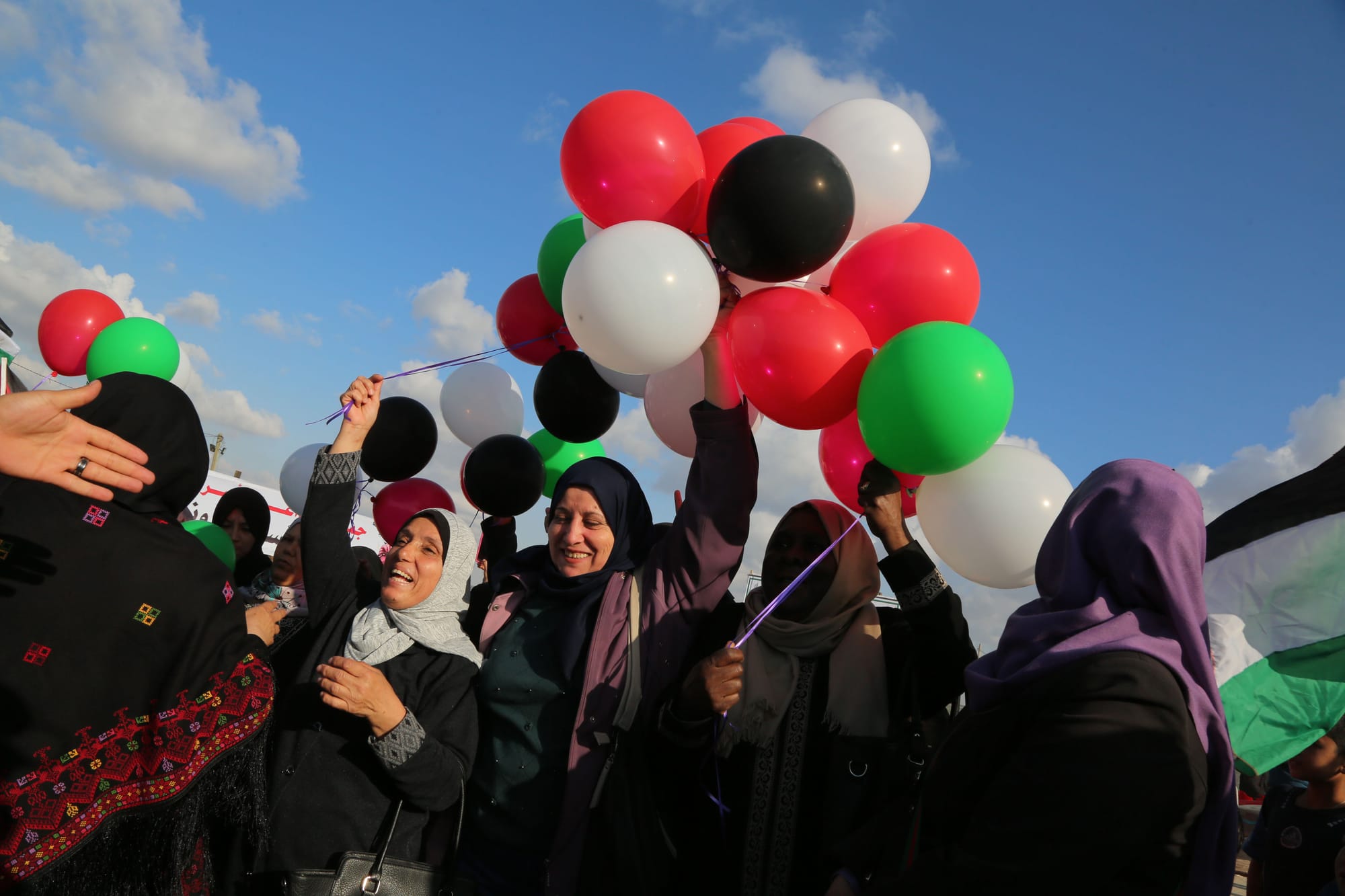
Palestinian women holds balloons during a tent city protest at the Israel-Gaza border, in the southern Gaza Strip April 10, 2018\. Majdi Fathi/NurPhoto via Getty Images
## Israel’s Siege and Assaults on Gaza
On September 19, 2007, Israel declared Gaza a “hostile territory” and tightened its blockade with power cuts, border closures and heavy restrictions on the import of food, fuel and other essential supplies. As Dov Weissglas, senior advisor to Prime Minister Ehud Olmert, explained, the policy was “to put the Palestinians on a diet, but not to make them die of hunger.”
In January 2008, after Israel intensified its blockade, Hamas militants successfully breached the wall that Israel had constructed on the Gaza-Egypt border. For nearly two weeks, Egypt allowed the border to remain open and over a million Palestinians from Gaza crossed into northern Sinai to purchase food, fuel and other supplies. After the breach was repaired, Hamas and Israel exchanged intense fire and Israel invaded several times, until they concluded a six-month ceasefire on June 18.
The ceasefire ended on November 4, 2008, when Israeli forces raided the town of Deir al-Balah and killed several Hamas militants, claiming they were destroying a tunnel intended to be used to abduct Israeli soldiers. Hamas responded with rocket fire into Israel. On December 27, Israel began Operation Cast Lead with the stated aim of stopping rocket fire. Israel tightened its siege and initiated aerial bombardments and then launched a ground invasion on January 3, 2009\. Hamas dubbed its defense against Israel the Battle of Furqan (“separating right from wrong,” a reference to Surat al-Furqan in the Qur’an).
Israeli forces killed 1,440 Palestinians (half of them civilians), and bombings rendered tens of thousands homeless. Palestinian forces killed nine Israeli soldiers and four civilians. Israel bombed many non-military targets, claiming that they were part of the Hamas support network—including police stations, ministries, university buildings, schools, factories and homes of political leaders and military commanders. Hamas indiscriminately fired rockets and mortar shells into Israel, striking many civilian targets.
The high number of Palestinian civilian deaths and the extent of the destruction in the Gaza Strip prompted the UN Human Rights Council to establish a Fact-Finding Mission on the Gaza Conflict in January 2009 headed by the renowned South African Jewish jurist, Richard Goldstone. Israel did not allow the Goldstone Commission to enter the Gaza Strip and refused to cooperate with it.
The Goldstone Commission concluded that both Israel and Hamas had violated the laws of war: Israel had used disproportionate force, targeted Palestinian civilians and used them as human shields and destroyed civilian infrastructure, while Hamas and other armed Palestinian groups deliberately targeted Israeli civilians and indiscriminately fired rockets into Israel. Israel vehemently rejected the Goldstone Report and encouraged an international campaign vilifying it as antisemitic. Under enormous personal pressure, Goldstone renounced the report’s finding that Israel had intentionally targeted civilians. The three other authors reaffirmed all the report’s conclusions.
Benjamin Netanyahu, who served as prime minister from 1996 to 1999, returned to office in March 2009\. Under Netanyahu Israel ceased any pretext of seeking peace with the Palestinians. He continued the siege of Gaza and waged several assaults intended to punish Hamas and degrade its military capabilities. Operation Pillar of Defense, an aerial bombing campaign that began with a targeted killing operation, lasted eight days in November 2012.
The assault on Gaza in the summer of 2014 was by far the most violent and destructive until that point. Israel claimed Operation Protective Edge was a response to rocket fire from Gaza. It was more plausibly motivated by a desire to foil the Hamas-PA rapprochement announced in April of that year. During this 51-day onslaught, Israel used indiscriminate violence in attempting to destroy not only existing Hamas capacities but also the organization’s very existence and the possibility of a future recuperation. The bombing campaign included more than 6,000 air attacks and about 50,000 artillery and tank shells, a total of 21 kilotons of high explosives. The weapons included drones and US-made Apache helicopters firing Hellfire missiles and F-16s carrying 2,000-pound bombs. Israel bombed desalination plants, the electrical grid, hospitals, schools and universities. Toward the end of the military campaign, Israel bombed and flattened several of Gaza’s few high-rise apartment buildings and shopping centers. More than 2,100 Palestinians were killed and more than 11,000 injured, the vast majority of them civilians.
On March 30, 2018, commemorated as Land Day by Palestinians, some 30,000 Palestinians in Gaza went to the Gaza-Israel border to protest Israel’s continuing siege on the Strip and US recognition of Jerusalem as Israel’s capital and to demand refugees’ right of return. Ahmed Abu Artema and other politically independent activists initiated the call for these demonstrations. Hamas soon endorsed the initiative. These protests, named the Great March of Return, continued weekly on Fridays until December 27, 2019\. They were largely nonviolent and took place in encampments near the border. Small groups of protesters, however, breached the border barrier, threw Molotov cocktails and launched incendiary kites onto agricultural fields. Israeli forces responded to the protests with tear gas and live ammunition. Snipers shot to maim, wounding over 9,000 Palestinians and killing 223.
In May 2021 Israeli forces precipitated another major escalation of violence by invading al-Aqsa Mosque during Ramadan, beating worshipers and destroying priceless artifacts. Hamas retaliated with rocket fire into Israel. These actions coincided with protests earlier that month against the eviction of six Palestinian families from their homes in the Sheikh Jarrah neighborhood of Jerusalem. On May 10, Israel launched an assault on Gaza that lasted for 11 days and killed 256 people, including 66 children. Protests erupted in the West Bank, Gaza and Israel, including a general strike on May 18.
This upsurge of Palestinian resistance was named the Unity Intifada because it inspired participation from all the geographic sectors of Palestinian society from the Jordan River to the Mediterranean Sea.
## Palestinian Statehood and the UN
Mahmoud Abbas, in his capacity as chairman of the PLO, twice petitioned the United Nations to accept Palestine as a member state. In September 2011 the Security Council rejected the petition. On November 29, 2012, coinciding with the 65th anniversary of UN General Assembly Resolution 181 partitioning Palestine, Abbas asked the General Assembly to accept Palestine as a non-member observer state, the same status enjoyed by the Vatican (and Switzerland before it joined the UN). This request was overwhelmingly approved with 138 votes in favor, 41 abstentions and nine no votes from Israel, the United States, Canada, the Czech Republic, Panama, the Marshall Islands, Micronesia, Nauru and Palau.
While this diplomatic achievement did not advance Palestinian aspirations for sovereignty, it gave Palestine the standing to accede to the Rome Statute and become a party to the International Criminal Court (ICC) on January 1, 2015\. Later that month, the ICC prosecutor opened a preliminary inquiry into international law violations during Israel’s 2014 assault on Gaza.
International diplomatic opinion remains committed—at least at the rhetorical level—to a two-state solution as the only means to resolve the Palestinian-Israeli conflict and fulfill Palestinians’ right to self-determination. Many are skeptical, however, that applying international law could produce a solution to the question of Palestine that is even minimally just. One obstacle is the seismic rightward shift in the opinions of Israeli Jews since the Second Intifada and the ardent belief of many that no peace is possible with the Palestinians.
Since 2009 Israeli governments have been categorically opposed to the two-state solution. Support for annexation of at least Area C of the West Bank (which contains all the settlements and the Jordan Valley) has surged. A second obstacle is the enduring split between Fatah and Hamas and their supporters in the Palestinian body politic. Palestinian citizens of Israel and refugees in the diaspora are adamant that, in contrast to the Oslo process that addressed only the territories Israel occupied in 1967, a comprehensive peace must include their demands: equality and the right of return. Most versions of a proposed two-state solution do not address these issues. A third obstacle is that no US administration has been willing to exert pressure on recalcitrant Israeli governments or reduce massive US aid to Israel to bring about a two-state solution.
## The Abraham Accords and the Politics of Normalization
The election of Donald Trump to the US presidency in 2016 intensified the right-wing alliance between the Republican Party, with its base of evangelical Protestant Christian Zionists, and Israel’s Likud Party and its quasi-fascist, messianist allies who champion West Bank settlers and maximalist territorial ambitions. In 2017, Trump broke with US presidential precedent by recognizing Jerusalem as Israel’s capital and moving the US embassy there from Tel Aviv.
In 2018, the Trump administration announced that it was ending US aid to the Palestinian Authority, cutting off US funding for the United Nations Relief and Works Agency for Palestine Refugees in the Near East (UNRWA) and closing the PLO’s office in Washington. In November 2019, Secretary of State Mike Pompeo reversed a 1978 State Department legal opinion (and went against prevailing international diplomatic opinion) by declaring that West Bank settlements do not violate international law.
Trump delegated his son-in-law Jared Kushner, whose family foundation has funded a religious seminary with a right-wing radio station in the West Bank settlement of Beit El, to negotiate an agreement to resolve the Israeli-Palestinian conflict and to promote the normalization of relations between Arab governments and Israel.
In September 2020, a deal, termed the Abraham Accords, was signed in Washington. The United Arab Emirates (UAE) and Bahrain agreed to formalize their already existing ties with Israel by establishing full diplomatic and economic relations. The Trump administration also successfully pressured Sudan and Morocco to establish diplomatic relations with Israel. The payoffs consisted of recognizing Morocco’s sovereignty over Western Sahara and removing Sudan from the US List of State Sponsors of Terrorism.
The strategic dimension of the Abraham Accords became apparent when the UAE agreed, without Israeli objection, to purchase up to 50 F-35 fighter jets and other US weaponry worth $23 billion. However, in 2021 President Joe Biden’s administration froze the deal because of concerns about the UAE-China relationship, including construction of a Chinese military base near Abu Dhabi.
By design, the Abraham Accords threatened to permanently erase the question of Palestine from the political equation of inter-governmental relations and to cement Palestinians in a permanent condition of occupation and apartheid. This prospect was reinforced when Netanyahu, after being ousted as prime minister in 2021, was reelected in 2022\. The government he formed included the quasi-fascist Religious Zionism (Mafdal-Tzionut Datit) and Jewish Power (Otzma Yehudit) parties. With the support of his coalition partners Netanyahu moved to weaken the independence of the judiciary to shield himself from three indictments on corruption charges and to facilitate the right’s takeover of state institutions. A weakened judiciary would also diminish legal obstacles to implementing a harder line on Palestinians.
## The Hamas Attack on October 7, 2023
On October 7, 2023, Hamas disabled Israel’s surveillance capacities for Gaza by launching a coordinated attack of missiles, rockets, drones and power gliders. Then some 2,000 Hamas and Islamic Jihad fighters broke through the barrier encircling the Strip and raided nearby military bases, kibbutzim and towns as well as a rave being held three miles from Gaza’s southern barrier. Thousands of other Palestinians took the opportunity to exit Gaza—aptly branded the world’s largest open-air prison–through the breached wall.
The attack was the worst security-intelligence failure in Israel’s history. A United Nations investigation reported “numerous violations of international law,” including deliberate, indiscriminate attacks against civilians and civilian objects, sexual violence and hostage-taking. At the time of this writing, while no definitive evidence is available to determine the precise objective of the attack, it seems likely that an important aspect of the mission was to kidnap Israelis to exchange for Palestinian political prisoners held by Israel. Before October 7, 2023, more than 4,500 Palestinians were held in Israeli prisons, including women and children, more than 1,000 of them on administrative detention (indefinite incarceration without charge).
When Israeli forces reached areas under attack, orders were given to implement violent counter-measures (the “Hannibal doctrine”) to prevent anyone from returning or being taken to Gaza. At this time, it is unknown whether or how many civilians and soldiers were hit due to these procedures, but many of those taken hostage were exposed to Israeli gunfire. By the end of the day, 1,139 people—including 373 Israeli soldiers and 695 civilians, of whom 38 were children and 71 foreigners, mainly Thai agricultural workers—were killed and 8,700 were wounded. Approximately 250 people—including children and the elderly—were taken hostage and transported into Gaza.
The October 7 attack was the highest single-day death toll of Jews since the 1948 War. In the immediate aftermath, there was an abrupt end to the previous months of Israeli mass demonstrations protesting the Netanyahu government. The great majority of the Israeli Jewish public rallied to demand extreme retribution against Palestinians.
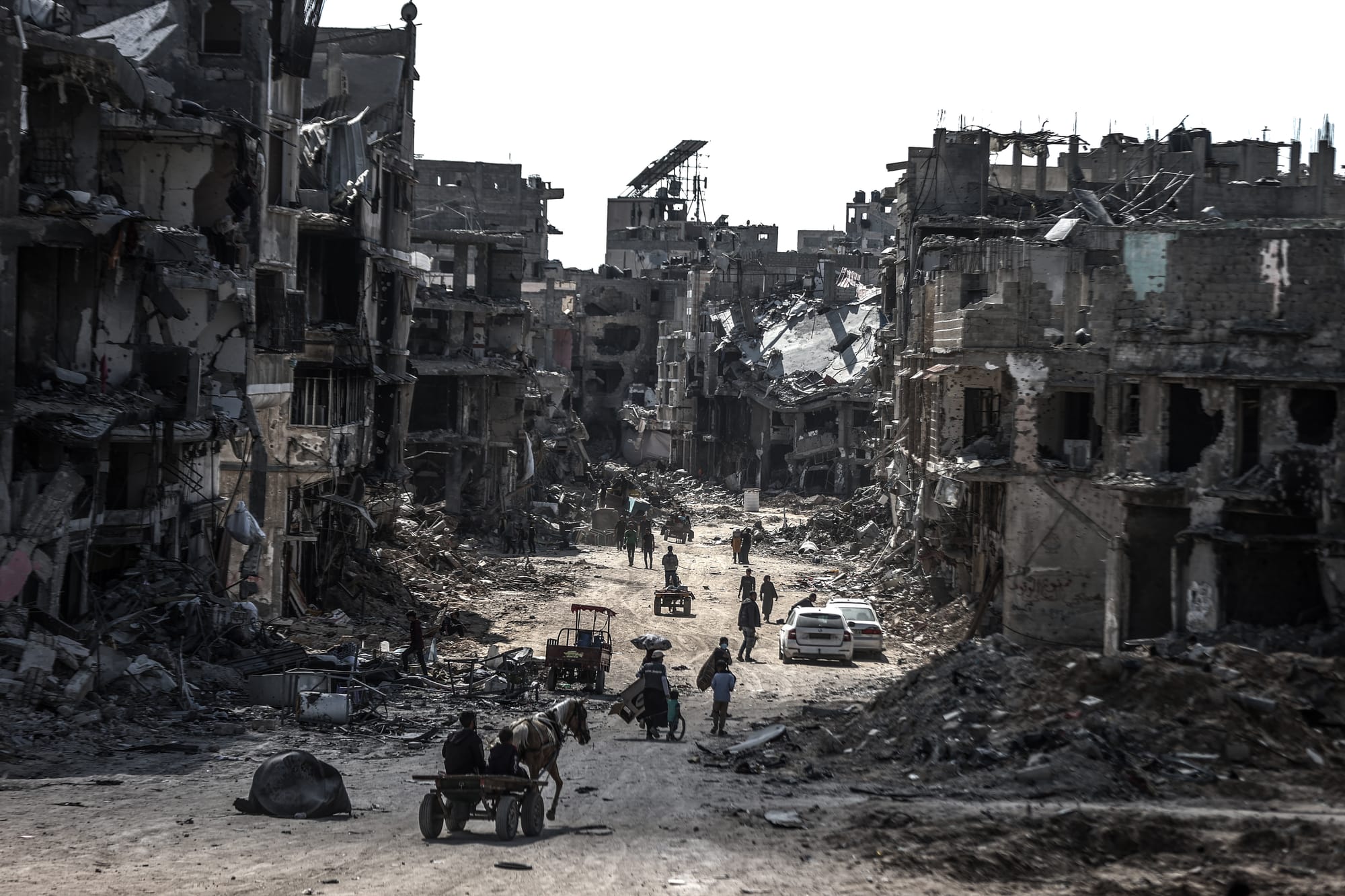
Some Palestinian residents attempt to return to their homes in Khan Yunis, Gaza, on April 7, 2024\. Ali Jadallah/Anadolu via Getty Images
## Genocide in Gaza
Israel responded to the October 7 attack with an intense aerial bombardment of the Gaza Strip. According to Airwars, a British nonprofit organization that has tracked civilian casualties in the Middle East since 2014, “the harm to civilians from the first month of the Israeli campaign in Gaza is…by far the most intense, destructive, and fatal conflict for civilians that Airwars has ever documented.”
Israeli cabinet members and military commanders publicly announced a total war to destroy Hamas and their intention to decimate Gaza. On October 9, Defense Minister Yoav Gallant announced a “complete siege,” cutting off all food, electricity and fuel. “We are fighting human animals and we are acting accordingly,” he said. Israeli President Chaim Herzog proclaimed that there are no “innocent civilians” among the 2.2 million Palestinians of Gaza, half of whom are children. Others accused Hamas of using civilians as human shields and blamed the group for all deaths in Gaza.
On October 13, Israel issued the first round of evacuation orders. Over a million people living in northern areas of the Strip were directed to flee. Hundreds of thousands heeded the call, relocating to areas the military claimed would be safe. But the so-called safe corridors, which people were instructed to use, and the designated safe zones, where displaced people concentrated, were subsequently bombed.
Israel’s ground invasion on October 27 accelerated the death and destruction. Cities, refugee camps and villages were laid to waste. Hospitals, clinics and ambulances were repeatedly attacked. The military targeted doctors, humanitarian workers, artists, scientists and professors, along with their families. More journalists have been killed in Gaza since October 2023 (at least 165 as of January 15, 2025, according to the Committee to Protect Journalists) than during any other modern war. Entire family lines were obliterated. A new acronym entered the lexicon: WCNSF—wounded child, no surviving family. According to the UN’s Office for the Coordination of Humanitarian Affairs (OCHA), “Gaza is home to the largest cohort of child amputees in modern history.”
As a result of ceaseless indiscriminate bombing, inhabitants from large portions of the 141-square-mile Gaza Strip were forced to flee to other areas. By December 2023, almost 85 percent of the population—1,955,000 people—was displaced. Over a quarter million homes were totally or partially destroyed. Israel destroyed schools (326), hospitals and clinics (208), mosques (247), churches (3), heritage sites (199), factories (1,690), libraries, archives and cultural centers. All of Gaza’s universities were leveled. Military bulldozers destroyed cemeteries and soldiers desecrated graves.
During Israel’s ground invasion, thousands—including humanitarian workers, women, children, disabled and elderly people—were swept up in indiscriminate capture operations and transferred out of the occupied Gaza Strip. The military simultaneously engaged in mass arrest campaigns in the West Bank. Within months, the number of Palestinian prisoners in Israeli custody had more than doubled. Conditions in Israeli prisons deteriorated as prisoners’ access to water and electricity was drastically reduced and food allocations were cut to a “minimal menu.” Torture and severe abuse, rampant in every Israeli prison and detention facility, reached unprecedented levels after October 7\. At least 60 Palestinians died or were killed in Israeli custody.
At the end of December 2023, the United Nations reported that one quarter of Gaza’s population was on the brink of starvation. The situation continued to worsen in 2024 as Israel impeded the transfer of food and other humanitarian aid by restricting the number of convoys permitted to enter the Strip. At the Rafah crossing with Egypt, miles of trucks were stalled as they waited to be inspected. If the cargo included a single forbidden item—an arbitrary designation that included certain medical supplies, oxygen cylinders, gas generators and tents—the truck was turned away. By mid-2024, the entire Gaza Strip population was facing catastrophic famine conditions.
The Gaza death toll is impossible to calculate with accuracy because thousands of people are buried under rubble. According to the Gaza Ministry of Health, by mid-February 2025 the Israeli assault had killed at least 48,219 Palestinians and injured 111,665\. The UN Children’s Fund, UNICEF, reported that the fatalities include over 14,500 children. The total number of deaths from infectious diseases due to the decimation of water sources and health facilities, malnutrition and starvation may reach 186,000 or 7.9 percent of the population, according to the British medical journal *The* *Lancet.*
On December 29, 2023, the government of South Africa filed an application with the ICJ against Israel for violating the Genocide Convention in Gaza, alleging the deliberate infliction of “conditions of life calculated to bring about the… destruction” of Palestinians living there. South Africa requested provisional measures, including an order for the immediate cessation of military operations. In January, while the ICJ did not order a ceasefire, it found the genocide allegation “plausible.”
In May 2024, the chief prosecutor of the ICC applied for arrest warrants for Netanyahu and Gallant for war crimes and crimes against humanity, mainly related to the Israeli policy of starvation and intentionally directing attacks against a civilian population. The ICC prosecutor also applied for arrest warrants for Hamas leaders Yahya Sinwar, Mohammed Deif and Ismail Haniyeh on charges including the crimes against humanity of extermination, murder, torture and sexual violence. The warrants against them, however, were withdrawn after Israel assassinated Haniyeh in Tehran and killed Sinwar and Deif in Gaza. The Pre-Trial Chamber of the ICC authorized arrest warrants for Netanyahu and Gallant on November 21, 2024.
## The United States and Israel’s War on Gaza
Immediately after October 7, 2023, Biden announced his unequivocal support for Israel’s unfettered right to defend itself. He repeated Israeli propaganda talking points including the false assertion that he saw photos of babies beheaded by Hamas during the October 7 attack. There are no such photos as it did not happen.
Biden’s hasty trip to Israel on October 16 to embrace Netanyahu was more than an expression of his personal commitment to Zionism or the influence of the Israel lobby in Washington. For his entire career Biden was a prominent exponent of a militaristic foreign policy. He (like other so-called liberal hawks) readily transposed Cold War-era anti-Soviet views to the Global War on Terror launched in 2001, support for the 2003 US invasion of Iraq and most recently US and allied countries’ military assaults on Iran and its regional allies, Lebanon’s Hizballah and Yemen’s Ansar Allah (the Houthis). The Biden administration provided unrestricted political and diplomatic support for Israel’s expanding military operations, including repeatedly vetoing Gaza ceasefire resolutions in the UN Security Council and loudly condemning the South African genocide case against Israel in the ICJ as well as the ICC’s issuance of arrest warrants for Netanyahu and Gallant.
Since October 2023 the United States has supplied Israel with at least $17.9 billion in military aid. The total cost of aid to Israel and US operations in the region is at least $22.76 billion, according to Brown University’s Costs of War Project. The United States participated in Israel’s air defenses against Iranian missile attacks in April and October 2024 and dispatched American soldiers to staff the THAAD ballistic missile defense system. Despite periodic statements of concern for the “excessive” level of civilian casualties from Biden and members of his administration, rather than applying pressure to diminish the ferocity of Israel’s assault on the Gaza Strip or to forestall its October 2024 invasion of Lebanon, additional high-end weaponry continued to flow to Israel.
The Biden administration’s role in Israel’s genocide in Gaza violated federal law prohibiting the sale of arms to “any country the government of which engages in a consistent pattern of gross violations of internationally recognized human rights.”
In the 2024 US presidential election, these violations and the lackadaisical response to Israeli military assaults and settler violence against Palestinians in the West Bank drew down support for the Democratic nominee, Vice President Kamala Harris, who promised to continue Biden’s policies. During the campaign, Republican nominee Donald Trump capitalized on that weakness with vague promises to end the war while simultaneously accepting vast sums from Zionist donors interested in securing US support for a future Israeli annexation of all or part of the territories occupied in 1967\.
In January 2025 President-elect Trump put his thumb on the scale to conclude a three-stage Israeli-Palestinian ceasefire and exchange of captives that had been on the table since May 2024.
In the West Bank, Israeli military and settler assaults on Palestinians have escalated since the signing of the Gaza ceasefire. The death toll is at least 864 militants and civilians since October 7, 2023\. In the same period, Palestinian militants have killed at least 16 Israeli civilians and soldiers.
At a February 5 White House press conference with Netanyahu, President Trump asserted that the entire Palestinian population in Gaza could be expelled permanently to Jordan and Egypt and the United States would take control of the Strip and develop it into “the Riviera of the Middle East.” Trump administration officials proceeded to treat the president’s off-the-cuff comments (which he subsequently repeated several times) as the new official US position. To counter Trump’s threat to ethnically cleanse Palestinians from Gaza, Arab League members pledged to develop a plan for rebuilding the decimated Strip while protecting Palestinians’ right to remain.
As of this writing, the Hamas-Israel ceasefire has not advanced beyond its first stage. Israel violated the terms of the agreement by refusing to withdraw its military forces from the Philadelphi Corridor, the road that runs along the border between the Gaza Strip and Egypt. Instead, Israel proposed to extend phase one of the ceasefire for an additional seven weeks, during which Hamas would return all the remaining 59 living and dead hostages in exchange for an undetermined number of Palestinians imprisoned in Israel, while Israel would reserve the right to resume fighting at the end of the extension period. Predictably, Hamas rejected this offer and insisted that Israel uphold the terms of the original ceasefire agreement.
## Note from the Authors
As this revised Primer goes to press in March 2025, the situation facing Palestinians in Gaza and the West Bank is at a nadir. Conditions may deteriorate even further in the months and years to come. There is no prospect on the horizon for any movement to resolve any aspect of the Palestinian-Israeli conflict by diplomatic or political means. At the same time, however, the horrors and suffering inflicted by Israel have galvanized a global movement of solidarity with the Palestinian people. We hope that the next time we revise this Primer, the conditions and prospects will be less bleak.
Editors note: *An earlier version of this primer stated that during the attacks on October 7, 2023 “numerous atrocities were committed, including rapes, summary killings of civilians and the incineration of people in their homes.” That section has been updated to more accurately reflect the verified record of events. The title of the primer has been changed from “Palestine, Israel and the Arab-Israeli Conflict,” to “Palestine and Israel—A Primer.”*
*This primer is the most recent update to MERIP’s Palestine primer. The first iteration was published in 1988\. The previous version, published in 2014, can be found* [*here*](https://merip.org/palestine-israel-primer-2014)*.*
##### How to Cite:
Beinin, Joel and Lisa Hajjar, “Palestine and Israel—A Primer.” (Middle East Research and Information Project, 2025).
### Breaking the Fourth Wall—Reading Sadallah Wannous in a Time of Genocide
URL: https://www.merip.org/2025/01/breaking-the-fourth-wall-reading-sadallah-wannous-in-a-time-of-genocide/
Last updated: 2025-08-22T18:35:56.000Z
**Robert Myers and Nada Saab, *Sentence to Hope: A Sa’dallah Wannous Reader*, Yale University Press, 2019.**
At the end of Sadallah Wannous’ 1970 play, *The Adventures of the Mamlouk Jabir’s Head*, the action takes an abrupt, dark but entirely predictable turn.
Sentence to Hope: A Sa'dallah Wannous Reader, by Sa'dallah Wannous, Robert Myers (Translation), Nada Saab (Translation)
Wannous—a Syrian playwright who was born in 1941 and died in 1997—wrote the play as a story within a story. It begins at a café, where a *hakawati* (story teller) arrives each night, book in arm, to provide the patrons with an evening of entertainment. Each night, they beg the hakawati for an epic tale, one with a happy ending “about truth triumphing over deception” and “justice overcoming injustice.” The hakawati, however, is adamant: They must hear the stories in chronological order. Currently, they are stuck in “the age of unrest and anarchy” (129). It’s a sentiment that feels familiar in today’s world of doom-scrolling and perpetual crisis.
On the night in question, the tale is of the Mamlouk Jabir, a slave living in medieval Baghdad, plagued by a war between the caliph and an enemy king. (In the stage directions, these figures are to be played by the same actor.) A duplicitous vizier wants to smuggle a letter out of Baghdad to forge an alliance with the enemy king, but the city is under siege, its gates guarded by soldiers. Jabir comes up with an ingenious ploy. He will shave his head, have the message tattooed on it and then grow out his hair. In exchange for smuggling the message out, he will be rewarded handsomely.
But things don’t go according to Jabir’s plan. When the king receives the message, he disposes of the mamlouk’s head and invades Baghdad. Carnage ensues. “They thought doomsday had arrived. Gates to the city were flung open, troops invaded the souks.” According to the stage directions, actors should silently mime the violence as the hakawati narrates: “Grief pervaded every corner, death spread like air. Dozens died without a clue of what was going on around them. Streets were piled with corpses, the wounded, the rubble of crumbling houses” (205).
Reading these lines today, it is hard not to hear echoes of Israel’s genocidal war on Gaza in the apocalyptic description of death and destruction. Wannous wrote *Mamlouk Jabir*, following an earlier moment of crisis for Palestinians, the Naksa: Israel’s defeat of the Egyptian, Jordanian and Syrian armies in June of 1967, displacement of some 300,000 Palestinians and occupation of the West Bank, East Jerusalem, Gaza, Sinai Peninsula and Golan Heights.
At the time of the June War, Wannous was in Paris, where he had moved from Damascus one year earlier to study theater at the Sorbonne. While there, he encountered the work of Bertolt Brecht, who had challenged the conventions of theater by breaking the fourth wall between audience and performer. He also came into contact with other anti-imperialist, Marxist playwrights. Influenced by Brecht, they explored the revolutionary potential of theatrical performance. One of them, Peter Weiss, had staged an influential experimental theatrical production about the Vietnam War in 1966 with the [provocative, if lengthy, title](https://www.merip.org/content/files/readingroom/docs/cia-rdp88-01365r000300060024-5.pdf): *Discourse on the Progress of the Prolonged War of Liberation in Viet Nam and the Events Leading Up to It as Illustration for the Necessity for Armed Resistance against Oppression and on the Attempts of the United States of America to Destroy the Foundations of Revolution.*
Wannous’s biography is detailed by Robert Myers and Nada Saab in the introduction to the only English language anthology of his works: [*Sentence to Hope: A Sa’dallah Wannous Reader* (Yale, 2019)](https://yalebooks.yale.edu/book/9780300221343/sentence-to-hope/). The entire volume includes their translation of *The Adventures of the Mamlouk Jabir’s Head* and three other plays as well as selected writings. It is worth revisiting in full in the context of the war on Gaza, the social movement that has exploded since October 2023 and the reflections it has prompted on the longer history of resistance to US imperial and Israeli violence in the region.
## **‘Theater of Politicization’**
*Mamlouk Jabir* was the second play Wannous wrote following the Naksa. The first, *An Evening’s Entertainment for the Fifth of June*, was published in the Arabic literary magazine *Muwaqif* in 1969 and first performed in Lebanon and Sudan in 1970\. *An Evening’s Entertainment* was a more direct response to the events of the June War and the political circumstances that engendered it. Also a play within a play, it satirized the oppressive Ba’athist state in Syria, featuring a government official for a director who hires a playwright to help stage a propagandic retelling of the war. Throughout the course of the play, actors placed among the audience interrupt the action to critique the dialogue and the director’s spin on events. In one exchange, “a loud, sharp voice is heard in the middle of the auditorium”:
>
>
> SPECTATORS.
>
> —That’s no way to talk.
>
> —Good God, what kind of evening is this?
>
>
>
> DIRECTOR. (*He looks toward the audience*) Watch your mouth, sir, if you please. You’re not in a café (21).
For Wannous, theater was not just political in the sense that it offered an unapologetic critique of those in power. The theatrical experience could also be politicizing, what he called a “theater of politicization” (122). Wannous recognized that social relations, like theater, tend to follow a script—one in which an individual’s fear of authority and adherence to norms can inspire dangerous levels of conformity among the collective. Scenes like the above, which punctured the fourth wall between audience and performer, were key to breaking this conformity.
In *An Evening’s Entertainment,* stage directions also instruct that the play commence at least half an hour late, and the actors seated among the audience should begin to shift in their seats impatiently and start asking questions. What made theater politicizing was its ability to jar the audience into breaking “the wall of silence” that kept them quietly glued to their seats (122).
> **What made theater politicizing was its ability to jar the audience into breaking “the wall of silence” that kept them quietly glued to their seats...**
This approach to theater recalls the [countless](https://www.instagram.com/trtworld/reel/C4RVyEFiYeB/) [viral](https://www.youtube.com/watch?v=wyZ2GK8nGfo) [videos](https://www.instagram.com/ampalestine/reel/C1DLyGLApTk/) of the past 15 months, featuring activists interrupting politicians and board members in large auditoriums and gala dinners over their stance on Israel's war on Gaza and US complicity through weapons transfers, aerial and naval support. These videos tend to follow a script not unlike the scene above: An activist, or group of them, get out of their seats and sharply break the fourth wall to voice their disagreement with the narrative being presented. ([Recently,](https://truthout.org/articles/secretary-of-genocide-blinken-speech-interrupted-by-pro-palestine-protesters/) protestors interrupted an address by then-Secretary of State Anthony Blinken, delivered at the Atlantic Council as part of his goodbye tour, with shouts of “Secretary of Genocide.") Without fail, the surrounding audience members show discomfort at the disruptor rather than the prevaricating political figure. On one level, it is this discomfort that makes the disruptions such effective political actions. On another, the refusal of the audience to sit idly by and fulfill their role as mere spectators to political theater demonstrates an activist potential Wannous understood. He dreamed that his plays would incite such unscripted rebellions among the audience. Of *An Evening’s Entertainment*, Myers and Saab write, "he hoped that the play, which ends with a literal call to arms, would spill into the streets and spark an insurrection" (xvii).
In a similar vein, *Mamlouk Jabir* was to be staged at a café, or some other space of communal gathering, in order to, as the playwright wrote in the preface, “break the rigid circular and ritualistic boundaries of theatrical performance” (122). Actors should sit among the audience, so everyone is implicated in the drama. Whereas *An Evening’s Entertainment* was instructed to start late, allowing the audience to grow agitated, *Mamlouk Jabir* should begin at an unspecified time: after the initial awkward rigidity of sitting in a formal space with strangers subsides. All of these efforts were intended to “encourage the spectator to speak, improvise, and engage in dialogue” (124).
Throughout the play, Jabir’s entertaining schemes and machinations are punctuated with interjections from the actors playing café-goers, ideally seated among the audience, as well as the townspeople of Baghdad. They periodically speak among themselves, lamenting the dire political and economic circumstances they find themselves in but keeping their heads down to survive. When one man attempts to question the war, he is swiftly shut down: “Better to turn a blind eye and remain with our families than turn blind in the darkness of a prison cell” (148).
## **From Stage to Encampment**
I read *Mamlouk Jabir* with a group of students and workers on our own evening of entertainment in late May of 2024—at the Exeter Liberation Encampment for Palestine, erected by University of Exeter students earlier that month. As was the case at encampments across universities in the United States and Britain, Exeter students were demanding that the university disclose and divest, ending its research partnerships with companies that supply weapons to Israel as well as its partnerships with Israeli institutions in line with the academic boycott. In making [these demands](https://x.com/Ele4Pal/status/1790249066451927155), students organized a series of escalating [disruptions](https://www.instagram.com/reel/C7Pls6fOnkk/?igsh=MW1hbjdwMzB1a3FzdQ==) from [shouting down university leadership meetings](https://www.instagram.com/reel/C7RcEFTsVnd/?igsh=MTZuMmp3YTJ4OXNnbA==) to [“die-ins” at administrative buildings](https://www.instagram.com/reel/C7TkyAJMulW/?igsh=MTh5b2Y2ZTgxMXhoYg==).
What made meaningful theater, for Wannous, was its translatability to a particular moment in time and the political concerns of that moment. *Mamlouk Jabir*—first performed in 1971—was banned in Syria under Hafez al-Asad, who became president that year. Reflecting on a staging at the Weimar National Theater in Germany in 1973, the playwright described the performance as “skillful but fossilized” because it did not connect to the political environment there (397). A 1990 run in Moscow, conversely, played with the form while adhering to the text. It confirmed for the playwright that in order for a performance to “create the circumstances for dialogue” it must “speak to the elements of its time and place” (397).
The place of the encampment and the time of genocide and unprecedented mobilizing at western institutions to end complicity in Israel’s war allowed for a new dialogue to emerge from the material. By the end of our reading, the sun had set over the Devon hills, and we took out our flashlights and cell phones to read the final pages:
>
>
> MAN #4\. If you’re devoured by hunger and find yourself living on the street . . .
>
>
>
> ZUMURRUD. If heads begin to roll and you find yourself being welcomed at the dawn of a miserable day by death . . .
>
>
>
> HAKAWATI, ZUMURRUD, AND MAN #4\. (*Together*) If a night thick with horror rains down upon you, don’t forget that you yourself said, “It’s not my concern. Whoever marries my mother, I call uncle.” From the dark night of Baghdad we speak to you. From the night of death and sorrow, strewn with cadavers (206).
The play ends with a forceful argument that the cause of tragedy is not the oppressive regime but the absence of resistance to it: the individual apathy born from the fear the state engenders in its citizenry.
> **For those of us reading together at the encampment, Wannous’s tale served as a reminder that the opposite is also true: Failure to stem the forces that have enabled the genocide, out of fear or apathy or a sense of defeat, will lead to widening oppression.**
A common refrain across the student encampments for Palestine was that “Palestine will liberate us all.”[\[1\]](#%5Fedn1) For those of us reading together at the encampment, Wannous’s tale served as a reminder that the opposite is also true: Failure to stem the forces that have enabled the genocide, out of fear or apathy or a sense of defeat, will lead to widening oppression.
This reminder is visible in Israel’s continued violations of international law across historic Palestine, Lebanon and Syria as it expands it occupation in late 2024 and into 2025\. It is visible in the US government’s targeting of free speech around Palestine: for example, the [anti-BDS legislation adopted by several states](https://www.hrw.org/news/2019/04/23/us-states-use-anti-boycott-laws-punish-responsible-businesses) or resolution 9495, [passed by the House of Representatives in November](https://www.congress.gov/bill/118th-congress/house-bill/9495), allowing the White House to unilaterally remove the tax-exempt status of NGOs alleged to support “terrorism.” Under the second Trump administration, these and other measures will likely be used to target not only Palestine but other, related, causes: from [fossil fuel divestment](https://jewishcurrents.org/what-the-fossil-fuel-industry-learned-from-anti-bds-laws) to [abolitionist movements](https://www.18millionrising.org/actions/stop-hr9495/). It is visible in the normalization agreements through the Abraham Accords, which have enabled authoritarian states in the Middle East to [invest fossil capital into dangerous surveillance technologies](https://www.merip.org/the-abraham-accords-cybersecurity/) that further [depoliticize their own citizenry](https://www.merip.org/exiled-women/). Incidentally, for Wannous, the true moment of despair was not the military defeat of the Naksa but the beginnings of normalization with Anwar Sadat’s 1977 visit to the Israeli Knesset and subsequent signing of the Camp David Accords. The moment led to a nervous breakdown and a suicide attempt, after which he stopped writing theater for more than ten years (xxi).
While Wannous did go on to write a number of experimental plays in the 1990s, his post-Naksa period resonates most today. In 1996, one year before his death to cancer, in a speech for World Theater Day, he hearkened to the days when theater could cause such “explosions of dialogue” and lamented its eroding space in cultural production.[\[2\]](#%5Fedn2) Gaza, it seems, has temporarily jarred people into breaking the fourth wall, causing an explosion he would approve of, despite the ongoing and overlapping crises. The conclusion he offered then, and words often associated with his name today, bear repeating: “Our lot is to hope, and what happens today cannot be the end of time.”[\[3\]](#%5Fedn3)
**Read the** [**previous**](https://www.merip.org/artificial-humanitarianism-313/) **article in** [**MER issue 313**](https://merip.org/magazine/313/) **“Resistance—The Axis and Beyond.”**
---
### **Endnotes**
[\[1\]](#%5Fednref1) Amir Marshi, "[Liberation Pedagogy at the People's University for Gaza](https://sites.lsa.umich.edu/mqr/2024/09/liberation-pedagogy-at-the-peoples-university-for-gaza/)," *MQR*, September 2024.
[\[2\]](#%5Fednref2) Saadallah Wannous "[Theater and the Thirst for Dialogue](https://www.merip.org/theater-and-the-thirst-for-dialogue/)*,*" *Middle East Report* 203 (Summer 1997).
[\[3\]](#%5Fednref3) Ibid. A translation of this speech is also included in Myers and Saab, *Sentence to Hope.*
### Artificial Humanitarianism—The Data-Driven Future of Refugee Responses
URL: https://www.merip.org/2025/01/artificial-humanitarianism-313/
Last updated: 2025-08-22T18:35:56.000Z
In Jordan’s Za’atari refugee camp, to pay for food at one of the World Food Programme (WFP)’s distribution centers, Syrian refugees must lean into an iris scanner that registers their biometrics.
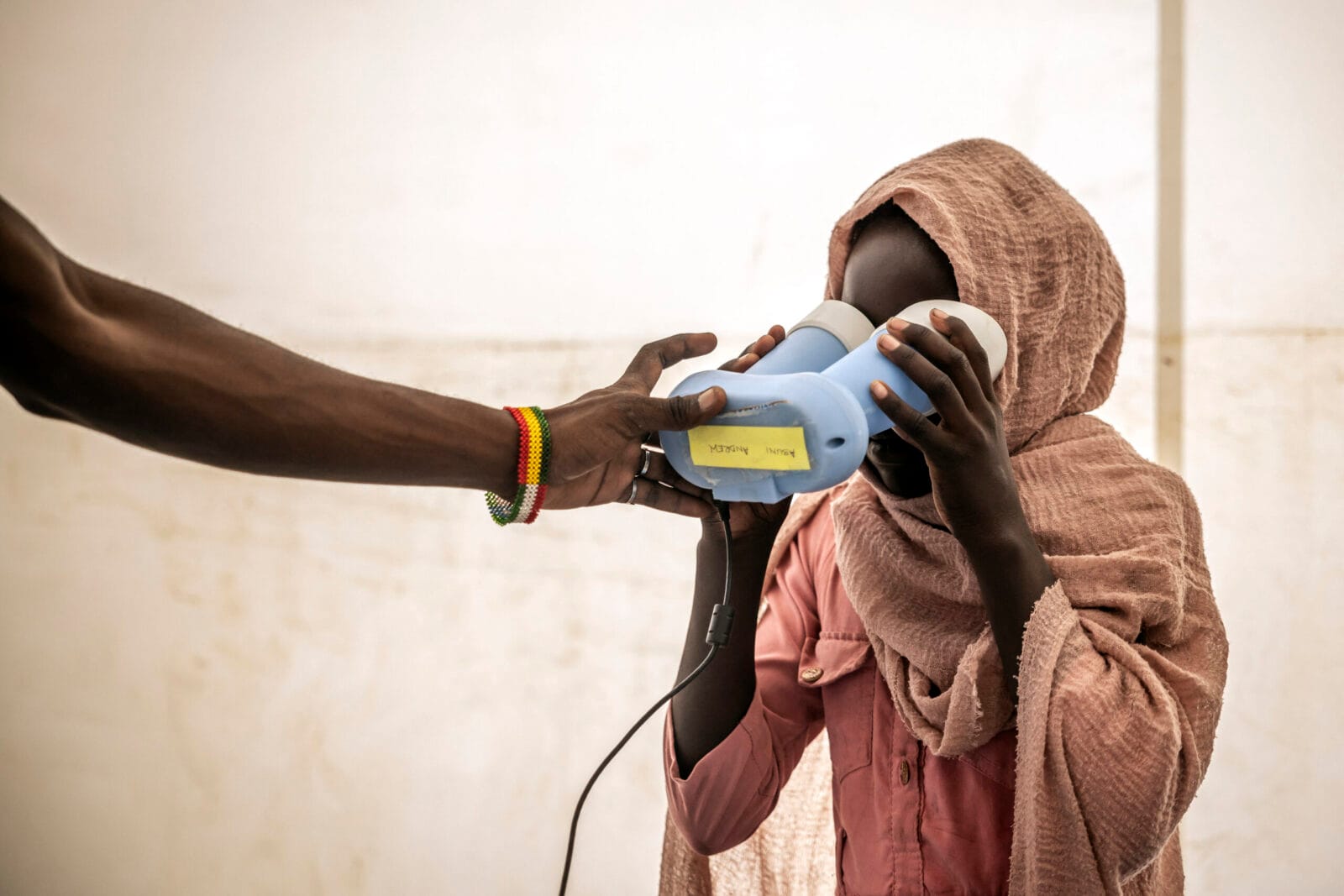
A Sudanese girl who fled the war in Sudan gets her iris scanned using a biometric registration machine at a Transit Centre for refugees in Renk, South Sudan, on February 13, 2024\. Luis Tato/AFP via Getty Images
The scanner then logs their transaction onto the program’s blockchain network: Building Blocks.
Za’atari is the site of the world’s first comprehensive biometrics system for refugees. Unveiled in 2013 by the United Nations High Commissioner for Refugees (UNHCR), it included the large-scale digitization of refugee registration through the Biometric Identity Management System (BIMS). The UNHCR started using BIMS after a nearly 100-person trial of Afghan refugees in Pakistan in 2002.
The system works by creating a unique biometric identifier for each registered refugee. That identifier is then stored in a blockchain called the Population Registration and Identity Management Ecosystem (PRIMES). Initially pitched by the UNHCR as a way to easily track refugee registration and residency, the biometrics model has morphed into an all-encompassing surveillance system. BIMS registers every refugee life event: from marriage, to education, to death. More than 90 percent of Syrians residing in Za’tari have been forcibly registered into the system as a precondition for receiving aid.
As a laboratory for large-scale digital registration, the [Za’atari model](https://www.merip.org/refugee-rights-hit-the-wall/) has now become the norm in UNHCR operations. Registration in BIMS is a prerequisite for refugee registration and thus the ability to apply for asylum or resettlement as well as for the receipt of humanitarian aid. By 2020, more than 37 million refugees around the world had given their biometric information and were registered through BIMS into PRIMES. Many of these refugees now receive aid payments with digital wallets, communicate to the UNHCR through chatbots and, in some rare cases, receive aid from drones.
Robotics, biometrics, drones, artificial intelligence, computational software and blockchain are not usually associated with humanitarianism but that is changing rapidly. Today, the humanitarian sector is imbued with a digital logic that is reshaping the delivery of aid and the conception of care. The overlapping catastrophes in the Middle East and North Africa—from the Syrian civil war of the past decade to the ongoing mass violence in Sudan and Palestine—are a key laboratory for testing these new practices.
As refugees are transformed into digital subjects, various technologies mediate their interactions with humanitarian organizations. The explicit goals of these intermediation technologies are to enhance the efficiency of humanitarian care, but they are also shaping the predictive, autonomous capabilities of technologies to meet humanitarian needs. To do so, they need a specific fuel: data.
## **‘Data Is the New Oil’**
Many technology observers have latched on to the expression that “data is the new oil” to reflect the growing importance of data-driven digital technologies in the economies of the Middle East.[\[1\]](#%5Fedn1) The region’s commercial appetite for data extends into the humanitarian sector. Local companies have a hand in developing everything from mobile payment applications to biometric registration systems—like the Zayn wallets used for digital cash transfers, developed by an Iraqi company, or the EyePay systems used to collect iris and fingerprint data in Za’atari, developed by a Jordanian-British company. An entire network of commercial interests now exists to feed into the humanitarian sector’s desire to digitize everything from refugee registration to aid delivery.
States are getting in on the action too. The United Arab Emirates has become a hub for networks of government bodies, commercial interests, international consultants and local start-ups that deepen the overlapping circuits of war, surveillance, logistics, humanitarianism and digitization. For example, the [International Humanitarian City](https://www.merip.org/the-uae-and-the-infrastructure-of-intervention/) in Dubai is a logistics project created in 2003 to connect aid to conflict and disaster zones in the Horn of Africa, Red Sea and the Indian Ocean region—part of a broader effort to expand influence and logistics infrastructure in Africa and Asia. Recently, the UAE created a parallel “[digital response platform](https://techxmedia.com/uae-to-launch-advanced-disaster-relief-digital-platform/)” that aims to provide a digital corollary to these logistics capacities. This platform brings together machine learning, artificial intelligence and geospatial technologies to facilitate information sharing among Humanitarian City’s partners.
The involvement of tech companies and their products in state-led and international humanitarian work raises serious concerns about how their profit motive might compromise humanitarian principles. In particular, the absence of strong data protection laws renders data a profitable commodity to be bought and sold. Any commercial company holding a contract with the UNHCR or WFP can access anonymized refugee data. The more data available to companies, the wider range of possible technological applications can be adapted to humanitarian use. But this data is rarely protected and can be circulated among humanitarian and commercial actors long after an individual is no longer receiving humanitarian support. Humanitarian emergencies thus become opportunities for companies to profit as both service providers and data hoarders.
The adoption of digital technologies also changes the nature of the humanitarian problems that actors are trying to address. One example is predictive analytics: a type of artificial intelligence in which the timing, cause and duration of anything—from an environmental catastrophe to a violent conflict— can be anticipated and prepared for. Using predictive analytics, the WFP has created a modelling platform called SHAPES (Shock and Assistance Platform for Economic Simulations) to forecast food security outcomes in the event of severe crisis. It has already deployed SHAPES in both Yemen and Lebanon, reducing the average food security assessment time from six months to three. It also uses the “[Hunger Map Live](https://hungermap.wfp.org/)” to model caloric needs depending on the location of the disaster. The United Nations Office for the Coordination of Humanitarian Affairs created the Humanitarian Data Exchange (HDE) to provide data and datasets to organizations like the WFP that feed into their predictive analytics. These programs all cast data and associated problems differently but share a commitment to forecasting how to deal with humanitarian emergencies.
> **As a result, knowledge about emergencies and those affected by them is no longer being produced in context but rather through machines and artificial intelligence that dictate how humanitarians should intervene in crisis situations.**
In this incarnation of contemporary humanitarianism, each emergency produces data that feeds into the responses of humanitarian organizations anticipating the next emergency. The data is not only circulated through PRIMES, SHAPES, HDE and other similar platforms. It also becomes the source feeding predictive humanitarianism. As a result, knowledge about emergencies and those affected by them is no longer being produced in context but rather through machines and artificial intelligence that dictate how humanitarians should intervene in crisis situations. By producing predictive visions that can be acted upon by humanitarian organizations, these technologies shift the whole terrain of humanitarian action from reactive to anticipatory. The cascading crises in the Middle East and North Africa provide a veritable data mine for humanitarian organizations to hone these predictive analytics.
Anticipating a crisis and acting upon one are very different things, however. Predictive analytics will always rely on incomplete data. They will also include algorithmic biases, which have already been called into question in the [case of predictive policing](https://naacp.org/resources/artificial-intelligence-predictive-policing-issue-brief) that overwhelmingly targets racialized and poor communities for police interventions. Furthermore, the data fed into these predictive algorithms has often been extracted from people in humanitarian emergencies that may have not understood or consented to the future uses of their data.
## **Humanitarian Robots**
In 2013, the US Defense Department’s Defense Advanced Research Projects Agency (DARPA) created a [Robotics Challenge](https://www.darpa.mil/news/2013/robotics-challenge-trials-conclude) to incentivize commercial and academic research into the potential for these technologies to support humanitarian and disaster relief operations. Teams submitted everything from robotic snakes capable of capturing images under rubble, to humanoid robots that could drive cars, use power tools and transform into moving vehicles. The robots might have been clunky, their movements slow and awkward, but they showcased a new way of being humanitarian.
Many of DARPA’s publicly known projects are the stuff of dystopian science fiction, but the robotics envisioned in the 2013 challenge were not from the realm of fantasy or techno-futurism. [A robot named Sophia](https://social.desa.un.org/sdn/meet-the-robots-who-are-making-the-world-a-better-place) is the first United Nations Development Programme’s (UNDP) Innovation Ambassador. Notably, she is also the first robot to receive legal personhood, after Saudi Arabia granted her [citizenship in 2017](https://www.wired.com/story/sophia-robot-citizen-womens-rights-detriot-become-human-hanson-robotics/). Sophia mingles with dignitaries and diplomats at various UNDP events. At an [“AI for Good”](https://aiforgood.itu.int/speaker/sophia/) summit in July of 2023, Sophia was joined by eight other humanitarian robot prototypes that can do everything from prepare food, heal wounds or simply socialize with someone who needs a friend. A future in which robots are an integrated part of the landscape of refugee camps, serving as soccer players, companion dogs or cleaners, may not be far off.
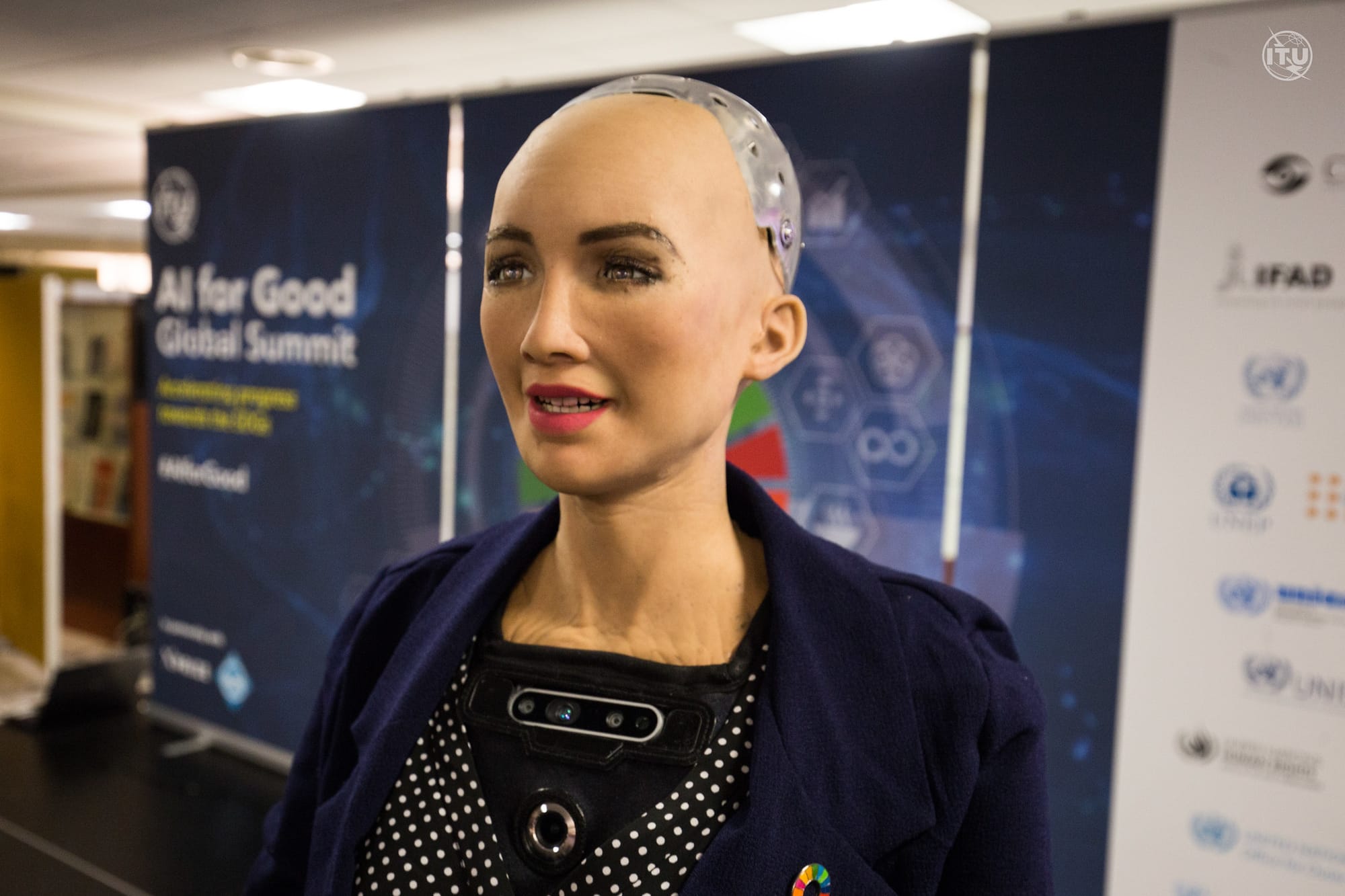
Sophia at the AI for Good Global Summit 2018, Geneva. Photo courtesy of the UN's ITU ((International Telecommunication Union). Creative Commons license CC BY-NC-ND.
But humanitarian robots can do much more than socialize. Robotic technologies are justified as being able to move aid the so-called last mile, usually conceived as up to 50 kilometers, when it is too dangerous for humans to physically move aid into war or disaster zones. According to the head of the WFP’s innovation department, Bernhard Kowatsch, the [idea for robotic vehicles as aid deliverers was conceived](https://www.yahoo.com/tech/un-food-aid-deliveries-ai-123508135.html) during the brutal four-year battle of Aleppo between 2012–2016, when it was virtually impossible to move aid into the city. A decade later, Project A.H.E.A.D (Autonomous Humanitarian Emergency Aid Devices) was born out of the WFP’s Business Accelerator and launched in Germany for its first use case in South Sudan. This pilot project involves remotely operating aid delivery into South Sudan using a Ukrainian built amphibious truck with an unassumingly playful name: [Herbert the Sherp](https://www.wfp.org/support-us/stories/herbert-sherp).
Herbert is one cog in a material structure linking several digital technologies and applications: Drones and satellites produce information about the terrain, that data is then transmitted to an operating center far from the afflicted area to determine what aid and supplies Herbert needs before the Sherp is loaded up and sent to the zone through remote operation. Humanitarian workers, by which I mean humans, are only one part of a mostly non-human, networked structure in which drones, satellites, communications towers and Herbert the Sherp are collecting the information needed to deliver humanitarian aid.
> **Although humanitarian dilemmas about how to deliver aid and to whom have always existed, humanitarian robots change these calculations and potentially absolve humanitarian actors of the ethical considerations required to meet people’s needs in moments of emergency.**
There are good reasons to believe that the Herberts of the humanitarian world will save lives and protect humanitarian workers in dangerous situations. But they also represent a new form of robotic intermediation that threatens to render life-and-death decisions, like who gets food and who does not, up to machine learning. Although humanitarian dilemmas about how to deliver aid and to whom have always existed, humanitarian robots change these calculations and potentially absolve humanitarian actors of the ethical considerations required to meet people’s needs in moments of emergency.
Moreover, these technologies are mirror images of those deployed in contemporary warfare—responsible for creating some of today’s most devastating humanitarian crises. Indeed, Israel has used [remotely operated](https://www.newyorker.com/magazine/2024/11/04/the-perilous-reality-of-aid-work-in-gaza) drones to surveil and target aid workers in Gaza and obstruct the delivery of aid. Cyber warfare targeting key infrastructures has become routine. Suicide drones are regularly deployed by Israel, Hizballah and other actors, and there is increasing evidence of [underwater drones](https://www.reuters.com/business/aerospace-defense/sea-drone-warfare-has-arrived-us-is-floundering-2024-05-06/) and land robots deployed on the battlefield.
The same technologies that network data, algorithms, machines and drones to recast humanitarian possibilities are thus similarly reshaping warfare. Israel’s “[Lavender](https://972mag.com/lavender-ai-israeli-army-gaza/)” and “[the Gospel](https://972mag.com/lavender-ai-israeli-army-gaza/)” are the most spectacular examples. Both systems are AI and machine learning programs that have identified more than [37,000 individual Palestinian targets](https://www.theguardian.com/world/2024/apr/03/israel-gaza-ai-database-hamas-airstrikes) that were subsequently targeted by Israeli drones. These systems function mostly independently of human oversight. Much like Project A.H.E.A.D, Lavender and the Gospel bring together data and machines to make decisions about life and death.
## **Circuits of Humanitarianism and Warfare**
Za’atari demonstrated that large-scale digitization of registration and surveillance of everyday life by the UNHCR was possible. Its success meant that the model has been transported to other [protracted refugee situations](https://interagencystandingcommittee.org/sites/default/files/migrated/2020-01/UNHCR%20-%20WFP%20joint%20update%20on%20use%20of%20biometrics%20-%20January%202020.pdf), including the Dadaab camp in Kenya, the Osire camp in Namibia and the Tongogara refugee camp in Zimbabwe.
Alongside the circulation of these technologies and practices are the ideas at the core of contemporary humanitarianism: accountability, transparency and efficiency. Humanitarian technophilia is rationalized as facilitating better forms of intermediation to meet people’s needs. But these rationalizations mask a complex system of power oriented toward data extraction and commodification. The immediate and long-term effects of crisis and emergency are rendered into a series of digitally legible data points that feed into systems of computational analytics.
> **...many of the same companies at the forefront of digital humanitarianism are implicated in digitized warfare and other forms of surveillance and violence.**
Moreover, many of the same companies at the forefront of digital humanitarianism are implicated in digitized warfare and other forms of surveillance and violence. Palantir, for example, a company whose original funding came partly from CIA-linked venture capital firm Q-Tel, has contracts with such diverse customers as the Los Angeles Police Department and Immigration and Customs Enforcement in the United States to provide data analytics. Palantir is also a major WFP partner. Clearview AI is another company that provides surveillance technologies to police departments around the world and also provided facial recognition services to the Ukrainian government in the aftermath of the Russian invasion. The Israeli company Cellebrite exports border technologies around the world while also receiving contracts to service United Nations agencies with their software. Examples, such as these, that blur the lines between warfare, surveillance and humanitarianism abound.
Such overlaps aggravate concerns over how digital companies are recasting humanitarianism norms and principles. The large-scale destruction in Gaza, Lebanon and Sudan poses generational challenges for humanitarian actors who will certainly turn to digital humanitarian tools for solutions. For better and worse, each new crisis provides new opportunities for the deployment and refinement of these technologies.
> **Read the** [**previous**](https://www.merip.org/narratives-of-the-oppressed/) **article.**
> **Read the** [**next**](https://merip.org/2025/01/breaking-the-fourth-wall-reading-sadallah-wannous-in-a-time-of-genocide) **article.**
**This article appears in** [**MER issue 313**](https://merip.org/magazine/313/) **“Resistance—The Axis and Beyond.”**
\[**Samer Abboud** is associate professor of global interdisciplinary studies at Villanova University.\]
---
### **Endnotes**
[\[1\]](#%5Fednref1) Patrick Sisson, “[Desert Data Boom,](https://sherwood.news/business/middle-east-data-centers-infrastructure-spending-demand/)” *Sherwood News*, June 27, 2024.
### Narratives of 'the Oppressed'—The Dialectic of Resistance Behind the Axis
URL: https://www.merip.org/2025/01/narratives-of-the-oppressed/
Last updated: 2025-10-21T16:25:22.000Z
**S**ince its formation, the Axis of Resistance has embodied a defiant stance against imperialism and Zionism.
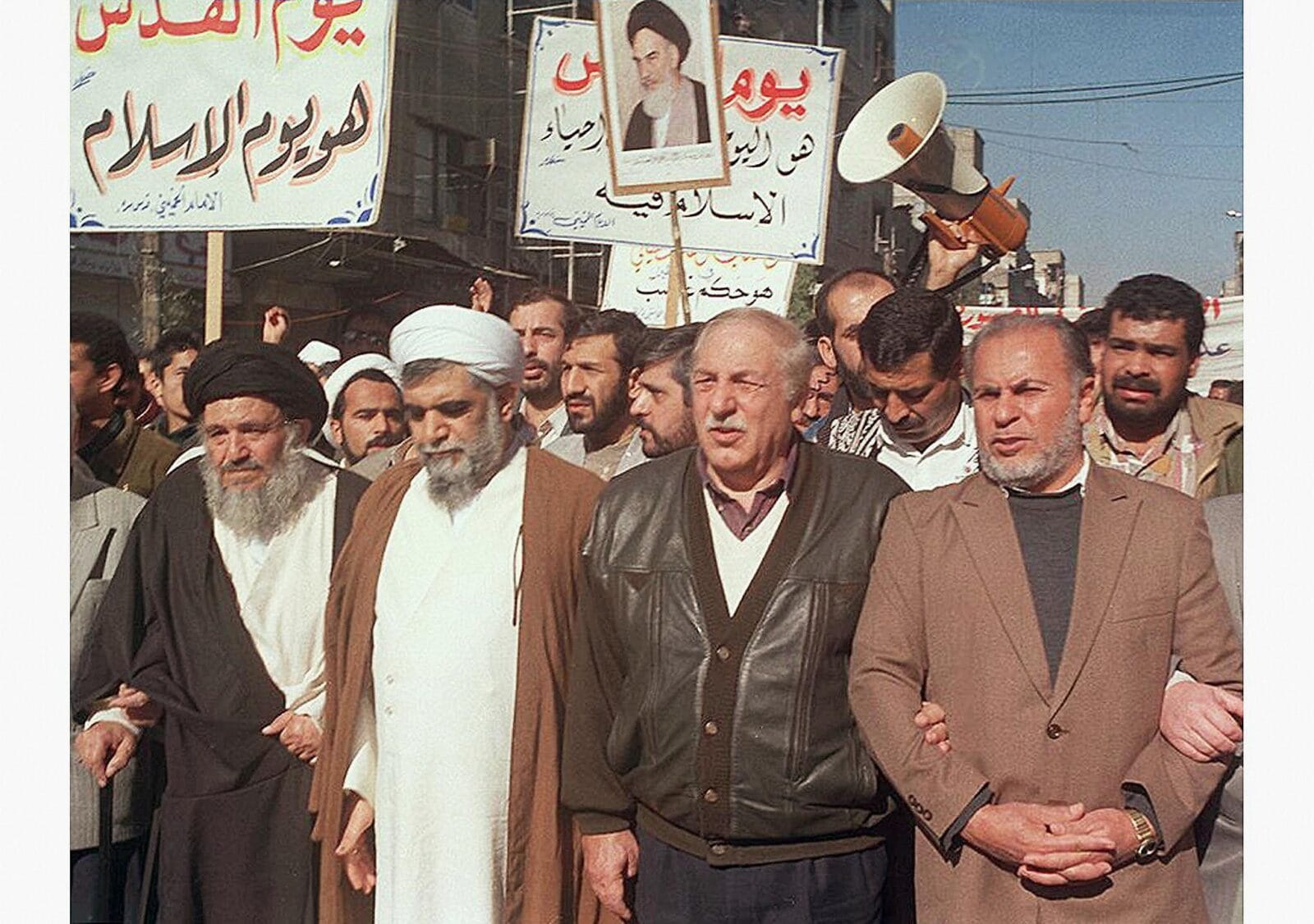
Iranian Ambassador in Syria Mohammad Hassan Akhtari (2nd L) and Ahmed Jibril (2nd R), the leader of the Popular Front for the Liberation of Palestine-General Command (PFLP-GC), lead a demonstration January 23, 1998, at the Yarmouk Palestinian camp, near Damascus to mark International Quds Day in solidarity with the Palestinian people. Louai Behsara/AFP via Getty Images
The phrase itself first circulated in the English-language media, in the early 2000s—a response to then-President George W. Bush’s [ominous talk](https://www.npr.org/2023/10/26/1208456496/iran-hamas-axis-of-resistance-hezbollah-israel) of the “axis of evil.” By 2010, at the latest, the [coalition had adopted the phrase as its self-designation](https://www.cbsnews.com/news/iran-were-in-axis-of-resistance-with-syria/). The Axis has served a strategic purpose for Iran, functioning as a tool of deterrence in the wake of the 2003 Iraq invasion. By uniting regional actors in opposition to Israeli and US dominance, Iran sought to counterbalance the threat of military intervention. But this once-cohesive alliance is at a moment of uncertainty.
Contrary to the assumption that Israel’s war in Gaza, undertaken with full US backing, would [strengthen the Axis of Resistance](https://www.foreignaffairs.com/united-states/how-war-gaza-revived-axis-resistance), it has partially unraveled in the face of war and wider regional aggression. Syria’s departure from the Axis after the fall of Bashar al-Asad, in December 2024, along with [growing domestic challenges to Iran’s foreign policy](https://www.nytimes.com/2024/12/13/world/middleeast/iran-syria-assad.html?searchResultPosition=10), raise questions about its future unity. Hizballah, embroiled in an enduring conflict with Israel, has been significantly weakened. Hamas has faced 15 months of ongoing Israeli efforts at its eradication, while other movements within the Axis contend with their own internal and external challenges.
Through its peak, the Axis of Resistance has long been united by a shared binary logic that framed the world as divided between the oppressed and the oppressors. [At the heart of this framework is Palestine](https://hamasinfo.info/2024/05/17/1870/), where Palestinians serve as the archetype of the oppressed and their liberation as the coalition’s central moral cause. This narrative weaves diverse struggles—political, economic and spiritual—into a unified tale of defiance and justice.
Most actors within the Axis, frame their resistance not as conventional statecraft but as part of a broader moral struggle. Under Iran’s leadership, these struggles transcend geography and lived realities, binding disparate movements to a shared vision. Recently, the spokesman of the Yemeni Ansar Allah (or Houthi movement), Muhammad Abdulsalam, described the Palestinian cause as Yemen's main concern because, in his opinion, true peace can only be achieved [by defeating the “Zionist entity.”](https://www.ansarollah.com.ye/archives/758983) This framing divides the world into two opposing forces: US imperialism and its Zionist offshoot, as the oppressors, and Palestine as the ultimate symbol of resistance.
## **An Evolving Vision of Resistance**
The revolutionary discourse that unifies the Axis predates its actual formulation in the 2000s.
Ayatollah Khomeini’s declaration that “[Islam belongs to the oppressed, not the oppressors](https://www.merip.org/why-the-islamic-republic-has-survived/),” encapsulated a vision that transcended Iran’s borders, offering a moral framework for resistance rooted in Islamic tradition and modern anti-colonial thought.[\[1\]](#%5Fedn1) Shaped by Quranic principles, as well as thinkers like Ali Shariati and Morteza Motahhari, this vision framed the Iranian Revolution as more than a quest for political sovereignty. It was a call to arms for the oppressed everywhere. By invoking the concept of *mostazafin*, or the oppressed, Khomeini transformed Iran’s revolution into a universal narrative of justice and defiance, aligning it with global struggles against colonialism and disenfranchisement.
> **By invoking the concept of *mostazafin*, or the oppressed, Khomeini transformed Iran’s revolution into a universal narrative of justice and defiance, aligning it with global struggles against colonialism and disenfranchisement.**
This pan-Islamic framing had its first major test during the Iran-Iraq War (1980–88). While the conflict is often revisited through the lens of sectarian and ethnic divides—Shi'a versus Sunni, Persian versus Arab—Iran’s rhetoric sought to transcend these boundaries. The war was framed not as a sectarian or national conflict but as a moral struggle of justice against tyranny. Official discourse portrayed Saddam Hussein’s regime as a small gang of infidels serving imperialist interests, while Iran positioned itself as the vanguard of Islamic resistance. Though this narrative failed to resonate with most Iraqis, it revealed the potential of Iran’s broader resistance narrative. This ability to frame conflicts as part of a global struggle against oppression would later underpin Iran’s leadership within the Axis of Resistance and demonstrate the adaptability of this narrative to extend beyond its borders.
The binary logic and vision of dividing the world into oppressed (*mostazafin*) and oppressors (*mostakberin*) found resonance across the region. In 1985, Hizballah explicitly adopted this narrative, embedding it within its local resistance to Israeli occupation in Lebanon. Through its *Open Letter to the Oppressed in Lebanon and the World*, Hizballah reimagined its struggle as part of a global fight against imperialism.[\[2\]](#%5Fedn2) By invoking the plight of the oppressed, Hizballah not only aligned itself with Iran’s conceptualization of the *mostazafin* but also amplified the narrative’s regional reach.
Khomeini’s vision, which he had partly adopted from leftist thinkers and organizations in order to respond to their demands, resonated powerfully because it transcended the material deprivation on which left-wing discourses remained fixated. Championing the plight of the *mostazafin* was not merely about economic hardship but about the deeper human struggle for recognition. In Hegelian terms, this was a fight for identity and dignity—not just material gain—where true freedom emerges through the willingness to risk one’s life to defy the oppressor. This dynamic is central to the Iranian narrative, which frames the struggle as both a fight for survival and a quest for moral and spiritual recognition.
In this conceptualization, the *mostazafin* seek to reclaim their right to exist as well as their right to be seen and recognized. Martyrdom is a key component of this fight—not only because self-sacrifice is central to asymmetric resistancet—but also because martyrdom is the foundational myth of Shi'a Islam. In embracing the potential of self-sacrifice, the oppressed can turn martyrdom into a powerful act of defiance, affirming that they have nothing to lose and everything to gain in this world or the next. This framing expands the *mostazafin* narrative, transforming it from one rooted in material struggle into a profound moral and spiritual battle that unites those seeking justice across different levels of oppression and identity.
As the *mostazafin* narrative evolved, it required a symbol that could unify and amplify its message across ethnic, geopolitical and religious divides. This symbol was Palestine. Initially, the connection to Palestine was political: Iranian revolutionaries had trained in PLO camps, while the Shah maintained discrete, but close ties with the Israeli government. Palestine transcended its origins, however, to become the embodiment of the *mostazafin’s* collective plight—a visceral and universally recognizable example of oppression. The occupation of Palestine and the displacement of its people offered a stark and undeniable image of the struggle for justice.
> **For Khomeini and his successors, the choice of Palestine as the centerpiece of the *mostazafin* narrative was also strategic.**
For Khomeini and his successors, the choice of Palestine as the centerpiece of the *mostazafin* narrative was also strategic. The repeated failures of Arab regimes, from the humiliation of the 1967 War to the compromises of the Camp David Accords in 1978, left a void in leadership over the Palestinian cause. By championing Palestine, Iran, in the wake of the 1979 revolution, positioned itself as the defender of the oppressed while simultaneously challenging Arab states that had abandoned the rhetoric of resistance.
Two key elements further bolster Palestine’s centrality to the narrative of resistance. First, the territory of Palestine—particularly Jerusalem and the Al-Aqsa Mosque—operates as a universal symbol of justice, belonging not just to Palestinians but to all Muslims since it is considered inalienable religious endowment land (*waqf*).[\[3\]](#%5Fedn3) This framing fosters a collective identification with Palestine across sectarian and national divides, positioning it as a cause that transcends boundaries. Second, Israel, framed as both a US-backed imperialist and explicitly Jewish state, epitomizes oppression in regional narratives. This portrayal (which in Iranian media and elsewhere can often be tied to antisemitic tropes) simplifies the construction of the enemy and strips Israel of legitimacy. By framing the struggle for Palestine as a fight against occupation and dispossession, Iran casts resistance as a moral imperative, uniting diverse actors under a shared vision of justice and defiance.
## **Ansar Allah and the Narrative of Resistance**
The framework of resistance against oppression continues to shape the rhetoric and strategies of the various actors in the Axis, though for many, explicit references to the *mostazafin* have been less prominent—or absent entirely. Hizballah has flirted with the term since its founding, partly due to its ideological and organizational proximity to Iran. The term, however, is not as salient within Hamas or Palestine Islamic Jihad discourses, perhaps because the lived realities of occupation, displacement and conflict are not best framed by a concept forged in the days of the Iranian Revolution. Among others, like state leadership in Iran and—until recently—Syria, Palestine serves primarily as a mobilizing force, one capable of harnessing extraordinary power as a unifying narrative far removed from the day-to-day experiences in the West Bank and Gaza. For Yemen’s Ansar Allah, the discourse of the oppressed and its amalgamation with Palestine has been woven into its ideological core. The movement has adopted the *mostazafin* narrative to align its local struggle with a transnational cause. Examining this case provides insight into the ongoing influence and adaptation of Iran’s revolutionary narrative as it moves to other contexts.
> **Also in this Issue: Helen Lackner,** ['**On the Houthi Movement's Roots, Governance and Resistance.'**](https://www.merip.org/yemens-ansar-allah/)
If Iran’s *mostazafin* narrative emerged from the fires of revolution, Ansar Allah’s adoption of it was born out of decades of marginalization. Known more commonly as the Houthis, after the family name of its key leaders, this Zaydi movement originally responded to the growing influence of Salafi ideology in Yemen. What began as a local effort to preserve the religious and cultural identity of the Zaydi *sada* families and resist the Yemeni government’s encroachment on their political privileges [gradually transformed into a broader political movement](https://www.crisisgroup.org/middle-east-north-africa/gulf-and-arabian-peninsula/yemen/huthis-saada-sanaa). Over time, Ansar Allah has positioned itself less as a sectarian group and more as a pan-Islamic force of resistance.
Central to this evolution was Ansar Allah’s embrace of Palestine, a cause that allows the movement to transcend its narrow sectarian roots and align with the larger narrative of resistance against global oppression. Given its Zaydi identity, which places Ansar Allah outside both Sunni and Twelver Shi'a orthodoxy, Palestine serves as a potent tool for political legitimacy.
Moreover, given Yemen’s [long history of solidarity with Palestine](https://www.merip.org/the-houthis-sovereign-solidarity-with-palestine/), championing the oppressed in Palestine presents an opportunity for Ansar Allah to pivot away from addressing local concerns—from skepticism of the *sada*’s claim to power to dissatisfaction with the nature of their governance—allowing the movement to gain legitimacy within Yemen and internationally. Their affiliation with a transnational network united under the banner of the *mostazafin* opens doors in alliance politics: Through membership in the Axis of Resistance, Ansar Allah gains international recognition and has access to financial and material resources that would otherwise be denied to them.
Iran’s influence is unmistakable in both the rhetoric and actions of Ansar Allah. Adopting the *mostazafin/mostakberin* dichotomy championed by Iran, Ansar Allah casts Yemen’s internationally recognized government as a puppet of imperialist forces, with Saudi Arabia as the enforcer of oppression. This revolutionary rhetoric—echoed in slogans like “[Death to America, Death to Israel, Curse on the Jews](https://onlinelibrary.wiley.com/doi/10.1111/j.1478-1913.2011.01352.x)”—powerfully mirrors Iran’s ideological stance (though the latter part of the phrase is notably absent in the Iranian context, reflecting Ansar Allah’s local adaptation). Iran’s influence is further evident in the structural parallels between groups like Ansar Allah and Hizballah and the Iranian Revolutionary Guards, highlighting a shared organizational and strategic framework.
Likewise, the [introduction of Iran's Ashura Memorial Day and “Al-Quds International Day”](https://sanaacenter.org/publications/analysis/9050) in Yemen attest to this influence. But the real strength of this narrative lies in Ansar Allah’s self-presentation. On its media platform, [*Al-Masirah*](https://www.masirahtv.net/), the Palestinian cause is front and center. Ansar Allah uses the term *mustada‘fin*—the Arabic equivalent of the Persian *mostazafin*—and gestures toward the idea of *mostakberin* (the arrogant oppressors) by [referencing *quwa* *al-istikbar* ("powers of pride")](https://www.masirahtv.net/post/264650/%D9%85%D8%AD%D8%A7%D9%81%D8%B8%D8%A9-%D8%B5%D9%86%D8%B9%D8%A7%D8%A1-%D8%AA%D8%AF%D8%B4%D9%86-%D9%81%D8%B9%D8%A7%D9%84%D9%8A%D8%A7%D8%AA-%D8%A7%D9%84%D8%A7%D8%AD%D8%AA%D9%81%D8%A7%D8%A1-%D8%A8%D8%A7%D9%84%D8%B0%D9%83%D8%B1%D9%89-%D8%A7%D9%84%D8%B3%D9%86%D9%88%D9%8A%D8%A9-%D9%84%D9%84%D8%B4%D9%87%D9%8A%D8%AF-%D8%A7%D9%84%D9%82%D8%A7%D8%A6%D8%AF).
Ansar Allah is continuing this rhetoric amid the latest developments in Syria and Iran's retreat from the country. In January 2025, *Al-Masirah* [reported on a march by militiamen](https://www.masirahtv.net/post/264610/%D8%B5%D9%86%D8%B9%D8%A7%D8%A1..-%D8%A7%D8%B3%D8%AA%D9%82%D8%A8%D8%A7%D9%84-%D9%85%D8%B3%D9%8A%D8%B1-%D8%B1%D8%A7%D8%AC%D9%84-%D9%81%D9%8A-%D9%85%D8%AF%D9%8A%D8%B1%D9%8A%D8%A9-%D8%B5%D8%B9%D9%81%D8%A7%D9%86) in which support for Palestine was described as both a religious and national duty, framed in the binary world-view of oppressed and oppressors:
> *mustada‘fin*[\[4\]](#%5Fedn4)
### **The Cost of Power**
The strength and resilience of the resistance narrative for the Axis lie in its remarkable adaptability, allowing it to resonate across vastly different contexts over time. The fundamental dichotomy between oppressors and oppressed has proven flexible, enabling Iran, Ansar Allah and other actors to tailor it to their specific needs while preserving its ideological core.
> **Since October 7, 2023, the centrality of Palestine to this narrative has only deepened...But October 7 has also revealed the limits...**
Since October 7, 2023, the centrality of Palestine to this narrative has only deepened. With its vocal support of Palestinian resistance, Iranian leadership can continue positioning the state as the defender of the oppressed while challenging Arab regimes and asserting authority in the region.
But October 7 has also revealed the limits of this narrative: The Iranian government’s calculation not to join Hamas in an open war against Israel and its inability to support its allies within the Axis with more vigor—personified in the ousting of Bashar al-Asad in Syria and the assassinations of Hizballah's Hassan Nasrallah and Hamas's Ismail Haniyeh—has exposed the fragility of Iran’s claims to moral and strategic leadership on behalf of the oppressed. While these tensions are not all new—they were prevalent in Iran’s intervention to support Asad’s regime during the Syrian civil war and in the “Woman, Life, Freedom” uprisings in 2022—the country’s unwillingness to sacrifice its own existence, and its recognition by many across the region as a hegemon and oppressor in its own right, points to faultiness permeating the narrative of resistance.
The dialectic of resistance, built on defiance and sacrifice, might struggle to endure when those in power cannot support the principles they championed. On the other hand, the framework of resistance, rooted in justice and defiance, continues to resonate with movements across the region.
> **Read the** [**previous**](https://www.merip.org/hanging-by-a-thread/) **article.**
> **Read the** [**next**](https://www.merip.org/artificial-humanitarianism-313/) **article.**
**This article appears in** [**MER issue 313**](https://merip.org/magazine/313/) **“Resistance—The Axis and Beyond.”**
\[**Olmo Gölz** is a senior lecturer in Islamic and Iranian Studies in the department for Oriental Studies, University of Freiburg. **Ruth Vollmer** is a graduate student in Islamic and Arab World Studies at the department for Oriental Studies, University of Freiburg.\]
---
### **Endnotes**
[\[1\]](#%5Fednref1) Ervand Abrahamian, *Khomeinism* (Berkeley: University of California Press, 1993), p. 31.
[\[2\]](#%5Fednref2) Joseph Elie Alagha, *Hizbullah's Documents: From the 1985 Open Letter to the 2009 Manifesto* (Amsterdam: Pallas Publications, 2011), p. 41.
[\[3\]](#%5Fednref3) Gudrun Krämer, *A History of Palestine: From the Ottoman Conquest to the Founding of the State of Israel* (Princeton University Press, 2008), p. 32.
[\[4\]](#%5Fednref4) “[Sana'a.. Receiving a Procession in the Sa'fan District](https://www.masirahtv.net/post/264610/%D8%B5%D9%86%D8%B9%D8%A7%D8%A1..-%D8%A7%D8%B3%D8%AA%D9%82%D8%A8%D8%A7%D9%84-%D9%85%D8%B3%D9%8A%D8%B1-%D8%B1%D8%A7%D8%AC%D9%84-%D9%81%D9%8A-%D9%85%D8%AF%D9%8A%D8%B1%D9%8A%D8%A9-%D8%B5%D8%B9%D9%81%D8%A7%D9%86),” *Al-Masirah*, January 2025.
[\[5\]](#%5Fednref5) Kevin L. Schwartz and Olmo Gölz, “Visual Propaganda at a Crossroads: New Techniques at Iran's Vali Asr Billboard,” *Visual Studies* 36/3-4 (2021), pp. 476–90.
### Hanging by a Thread—The Red Sea Blockade and Jordan's Fragile Garment Industry
URL: https://www.merip.org/2025/01/hanging-by-a-thread/
Last updated: 2025-10-21T16:26:06.000Z
On a Tuesday morning, Farnaz and her Bangladeshi female colleagues crouched in a line against the crumbling back wall of their worker dormitory in Ad-Dhulayl—the sprawling town adjacent to one of Jordan’s largest industrial zones for export-oriented clothing production.
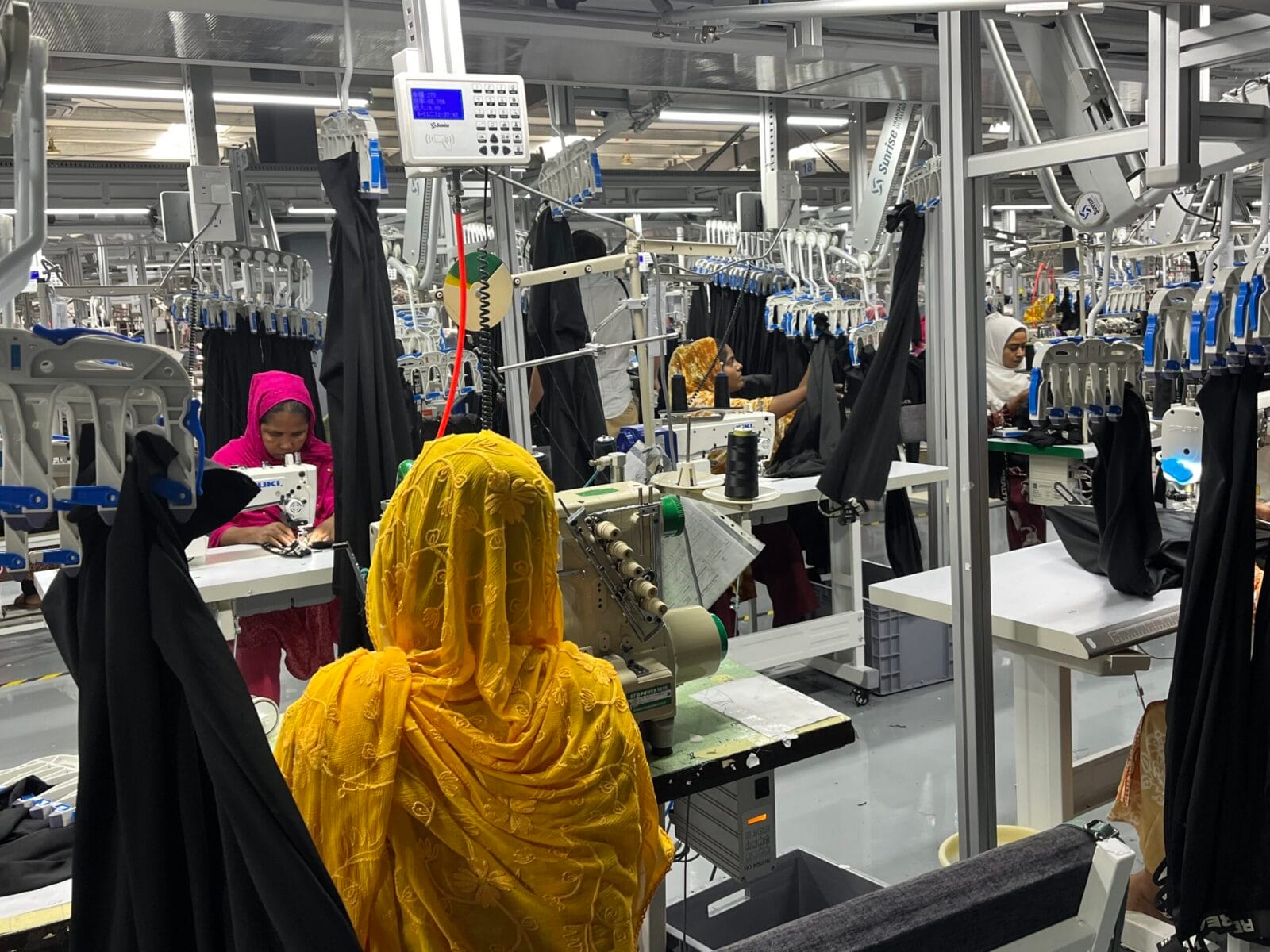
Bangladeshi women at work in a Chinese-owned garment factory in Jordan, 2024\. Katharina Grüeneisl
It was April 2024, and the women should have been at work in the two-story factory across the road where they sew sports and outdoor clothing for large US brands like Timberland and The North Face. Instead, they were forced to take annual leave because their factory’s warehouses were empty.
Similar scenes played out across Jordan’s industrial zones during the winter and spring of 2024\. Ongoing [attacks on military](https://interactive.aljazeera.com/aje/2024/mapping-red-sea-shipping-attacks/) and merchant vessels, first launched by the Yemeni Ansar Allah (Houthi) movement on November 19, 2023 in response to Israel’s brutal onslaught on Gaza following the Hamas attacks of October 7, had hampered the transit of raw materials needed for the garment industry. As vessels were [hijacked](https://www.bbc.com/future/article/20231215-red-sea-cargo-ship-hijack-how-to-keep-merchant-vessels-safe-from-attack) or [damaged](https://www.aljazeera.com/news/2024/3/15/vessel-struck-in-red-sea-as-houthis-vow-attacks-on-more-shipping-lanes) by missile attacks in the Bab Al-Mandeb Strait (the maritime gateway to the Suez Canal) many shipping companies rerouted their vessels around the Cape of Good Hope. Their rerouting isolated Aqaba—Jordan’s only sea port, which sits on the Red Sea—from key international trade routes, resulting in supply chain disruptions. Jordan’s clothing industry, the country’s largest industrial export sector besides phosphates and potash, was particularly hard-hit due to its precarious positioning in the global garment value chain.
Indeed, the regional conflict has exposed the underlying problems with an industrial garment sector that was created through preferential trade agreements granted by the United States in the wake of the 1994 peace accords between Jordan and Israel. While Jordan’s export-oriented garment industry has since been heralded as a success story, the sector remains structurally vulnerable to supply chain shocks. Garment producers located in Jordan are not only dependent on the import of raw materials and migrant labor to ensure profitable production, they also rely on orders by large US clothing brands that rapidly switch suppliers if the Jordanian factories fail to deliver in time.
But while the garment sector is a fragile geopolitical creation, kept afloat by powerful alliances of political and economic interest, it has nonetheless come to play a pivotal role in neoliberal visions of transforming Jordan’s economy. Beyond the initial project of promoting political normalization with Israel, today the garment sector assumes crucial importance in Jordan’s performances of economic stability and global competitiveness.
## **Vulnerable from the Start**
Since its inception, Jordan's garment industry has been wholly dependent upon fragile trade networks tying local producers to markets halfway across the globe. On one end, the industry is structurally dependent on importing the materials needed to produce garments, including fabric, accessories and machinery. These inputs are mainly sourced from China but also come from India, Pakistan and Taiwan. On the other end, the sector is completely dependent on the United States as an export market, where a few powerful US clothing brands are its core buyers.
> **The sector owes its existence to the Qualified Industrial Zones (QIZ) agreement, a preferential trade deal offered by the United States to foster regional economic integration in the wake of the 1994 Jordan-Israel peace accords.**
The sector owes its existence to the Qualified Industrial Zones (QIZ) agreement, a preferential trade deal offered by the United States to foster regional economic integration in the wake of the 1994 Jordan-Israel peace accords. The 1996 QIZ scheme was an add-on to the US-Israeli Free Trade Agreement from 1985\. It extended quota- and duty-free access to the US market to products manufactured in designated industrial zones, under the condition that at least 8 percent of the value added was derived from Israeli inputs.[\[1\]](#%5Fedn1) To satisfy this condition, most garment producers in Jordan imported packaging material like cardboard and plastics from Israel.
In 2001, the United States signed a full Free Trade Agreement with Jordan, JUSFTA, which entered into force in 2010\. The new agreement dropped the requirement for Israeli inputs, allowing all “Made in Jordan” garments to enter the US market duty-free. Synthetic fabric (used for sports and outdoor clothing), in particular, is heavily taxed upon entry to the United States. JUSFTA thus provided a crucial incentive for Asian garment producers of these goods to relocate parts of their production facilities to Jordan. Since the mid-2000s, the majority of garment factories in Jordan are part of transnational companies headquartered in East Asia, often Hong Kong and Taiwan, which also operate production facilities across South Asia, most prominently in Bangladesh and Vietnam.[\[2\]](#%5Fedn2) Until today, around 90 percent of garments “Made in Jordan” are exported to the United States.[\[3\]](#%5Fedn3) Attempts to diversify export destinations, especially to Europe, have so far largely failed.
The agreements were signed in the name of promoting prosperity and stability in Jordan. But the export-oriented garment industry that emerged as a result remains dominated by foreign capital, migrant labor and the decision-making of powerful supplier firms and clothing brands. Even before the Red Sea blockade, the industry’s over-dependence on global supply chains and acute susceptibility to external shocks was apparent. During the COVID-19 pandemic, lockdowns in China along with container shortages deprived Jordanian factories of vital production inputs, while US buyers cancelled orders in anticipation of a sudden drop in consumer demand.
## **The Red Sea Blockade**
In November of 2023, Houthi missile attacks began to deter shipping companies from sending their vessels into the Red Sea to reach the Israeli Red Sea port Eilat or to access Israel’s ports on the Mediterranean through the Suez Canal. The blockade also isolated Jordan’s only sea port in Aqaba, resulting in the delay or non-delivery of production inputs, most importantly fabrics and accessories ordered from East and South Asia.
At first, garment producers in Jordan relied on emergency stocks. By the first quarter of 2024, however, many factories were forced to interrupt production. Production managers and logistics officers recount how they sought to cope with these supply chain disruptions by sourcing production materials locally, mainly from Egypt and Turkey. But without access to high-quality accessories and synthetic fabrics and constrained by strict quality criteria of US buyers, most producers were unable to replace inputs.
Producers in Jordan also tried to diversify import routes from Asia. Some factories resorted to air freight, particularly for small accessories like buttons, zippers or printed labels. They also re-routed imports through the Emirati sea port Jebel Ali and then by truck through Saudi Arabia. But congestion at Jebel Ali, a shortage of trucks and the Saudi forwarding rule—which obliges transporters to unload and reload the contents of shipping containers before crossing the border—caused transport time and costs to spiral. Incidentally, not only production input materials, but also food imports for the over 58,000, mostly South-Asian migrant workers employed in the factories, have been rechanneled through Jebel Ali.
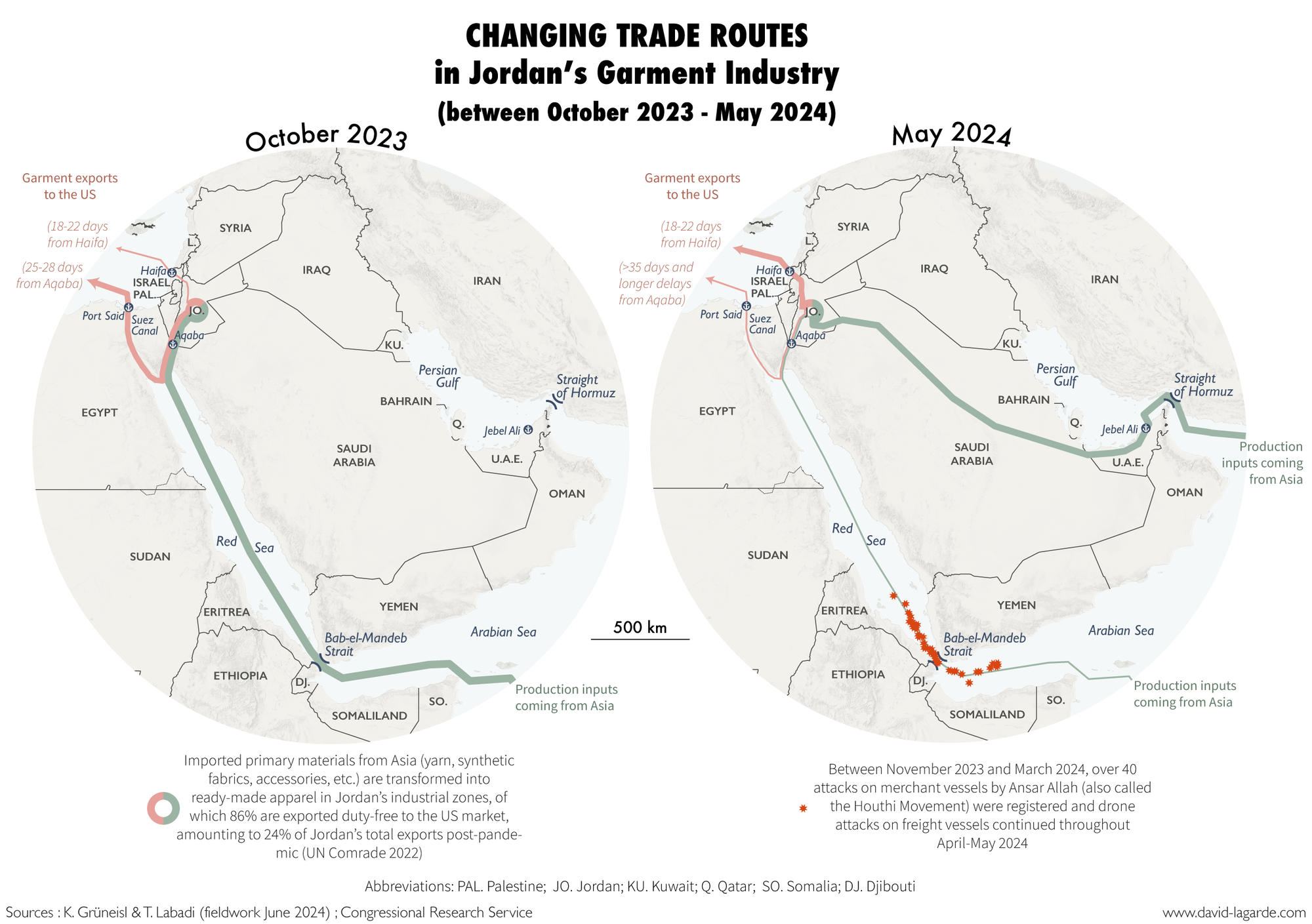
Fig.1 Changing import and export routes in Jordan’s garment sector in reaction to the Red Sea blockade. (Source: Lagarde, Grüeneisl and Labadi 2024)
News of the Red Sea blockade prompted some US brands to pre-emptively shift orders from Jordan to other production locations in Asia. Adidas cancelled orders before their supplying factory in Jordan had even failed to meet the agreed production deadlines. “It was so frustrating,” Asma, a young Jordanian logistics officer of a Taiwan-owned sportswear factory explained. “We had received the fabric but were forced to shred it entirely because Adidas felt it was too risky to let us go forward with the production and gave the order to our group’s factory in Cambodia instead.”
> **While the Red Sea blockade pushed large producers to shift production volumes back to Asia, those limited to production facilities in Jordan continued manufacturing at a loss, negotiating extra leeway with their US buyers or using air freight to get their shipments to the United States in time.**
While the Red Sea blockade pushed large producers to shift production volumes back to Asia, those limited to production facilities in Jordan continued manufacturing at a loss, negotiating extra leeway with their US buyers or using air freight to get their shipments to the United States in time. Suresh, a South-Indian manager of a factory in Ad-Dhulayl, recounted using air freight twice in the spring of 2024 to avoid delays in shipments to his US clients. Justifying his decision, he stressed, “just-in-time delivery is crucial to the sports brands we work with, and the penalties they impose on us for delays are much worse than the loss we make through the increased transport costs.”
Some smaller factories subcontracting for larger clothing exporters have started to produce for the local market despite reduced profit margins. Others have closed down temporarily. Many of the workers in these subcontracting workshops are migrants who have overstayed their visa and thus work informally and are paid at piece rate. With the suspension of production, they were simply let go without prior warning or compensation.
As spring turned to summer and Houthi drone boat attacks on vessels [continued](https://www.reuters.com/world/middle-east/houthi-explosive-drone-boat-attacks-escalate-red-sea-danger-2024-07-03/) to pose security risks for shipping, inflating insurance costs for entering the Red Sea, a growing disquiet took hold of the garment industry. Jordan’s only competitive advantage as a global garment production location, namely duty-free market access to the United States, was now eclipsed by a connectivity problem. But this problem predated the Red Sea blockade.
## **Re-routing ‘Made in Jordan’ from Haifa to Aqaba**
In the spring of 2023, less than one year before major shipping lines suspended their service to Aqaba in light of the Houthi Red Sea blockade, Jordan celebrated the inauguration of a faster shipping service to the United States.
The launch event was proudly hosted by the American Chamber of Commerce. The new connection cut sailing times between Aqaba and the east coast of the United States to 25 days. Instead of sending a feeder vessel into the Red Sea to Aqaba that would then reload merchandise onto a larger vessel in another Red Sea port, like Jeddah, Hapag-Lloyd had agreed to send a mother vessel continuing directly for transshipment to the Mediterranean and then on to the United States. The introduction of this faster shipping service was the hard-won result of years of diplomatic efforts, aimed not only at promoting exports to the United States, but also at convincing garment producers to export from Aqaba rather than Israel’s port of Haifa.
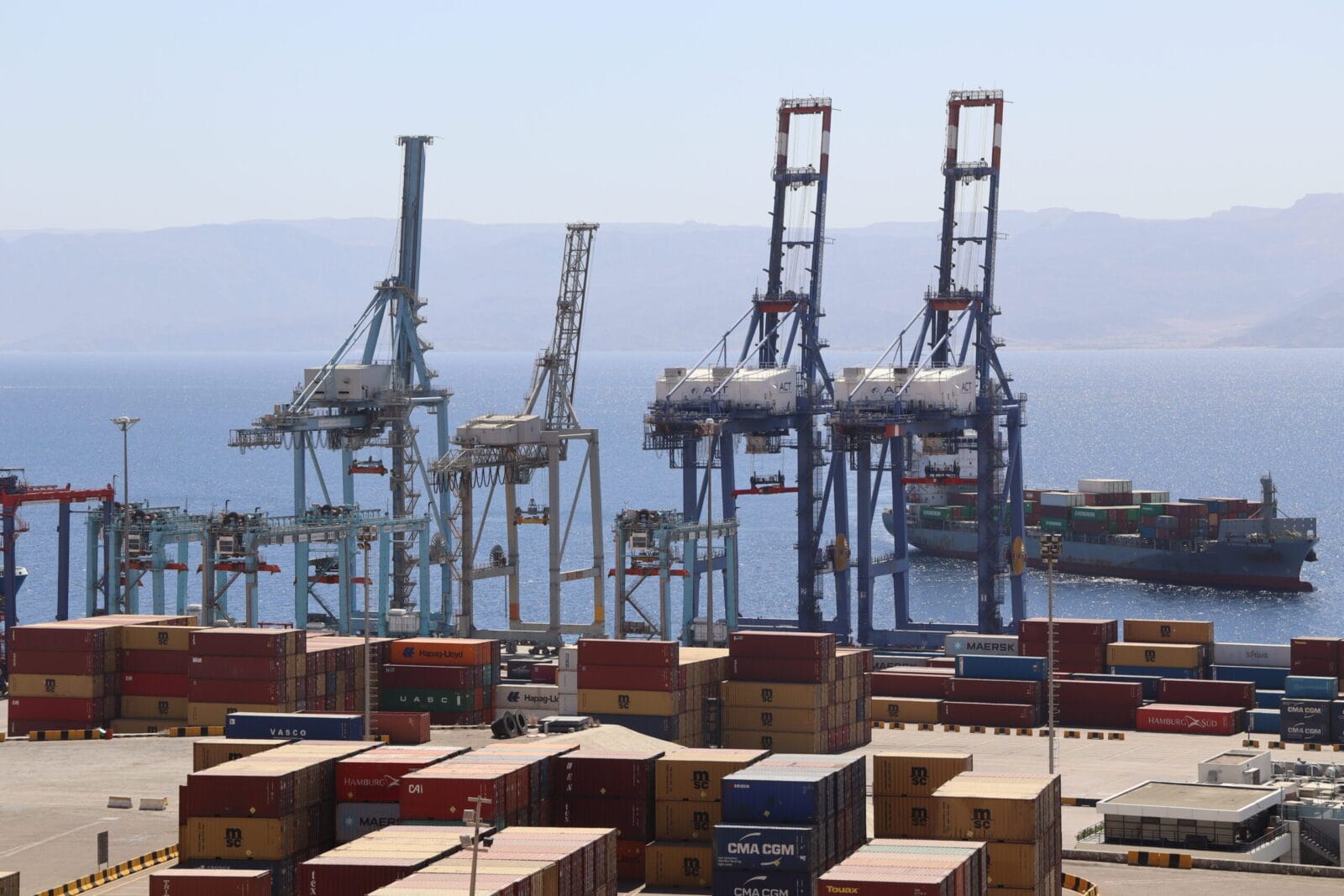
View over the Aqaba Container Terminal (ACT) in June 2024\. Katharina Grüeneisl
The celebrations, however, proved ephemeral. In June 2024, port employees of the Aqaba container port testified to a drastic reduction in trading volumes since the onset of the Red Sea blockade.[\[4\]](#%5Fedn4) An employee of the Danish company APM Terminals that manages the Aqaba Container Terminal (itself a subsidiary of the multi-national shipping and logistics giant A.P. Moller-Maersk), told us we were lucky to see a container ship on the day we interviewed him. “We often go for days now without a single one coming in,” he said, pointing across the piers from the port’s viewing platform. Indeed, the neighboring Israeli sea port in Eilat, just a stone's throw away across the gulf, declared [bankruptcy](https://www.middleeastmonitor.com/20240719-eilat-port-declares-bankruptcy-what-awaits-the-occupying-state/) less than a month later, in July 2024, as a direct result of the blockade imposed by the Houthis.
But while the managers of different transport and logistics companies agree that the blockade has caused import volumes to drop, they also underline the structural under-utilization of Aqaba’s port capacities that long predated the regional war.
“The good thing about a crisis is that it gets the blame for all pre-existing problems,” the owner of a large Jordanian logistics company told us. “But the truth is that Aqaba was struggling before the Houthis, ever since it lost the transit trade to Iraq and Syria, because Jordan’s market alone provides an insufficient hinterland for a major container port.” Transit trade to and from Iraq had made up more than a third of Aqaba port’s trading volumes after the 2003 US invasion. But repeated border closures beginning in 2013, when violence escalated in Iraq and [armed groups](https://www.reuters.com/article/2014/06/23/us-iraq-security-border-idUSKBN0EY2SC20140623/) seized control of the border crossing, abruptly interrupted this transit trade. It has never fully recovered, in part because Iraq has developed its own [port infrastructures](https://ti-insight.com/briefs/the-grand-faw-port-project-transforming-the-global-trade-landscape/) and alternative logistics routes with [links to Turkey](https://www.middleeasteye.net/news/turkey-iraq-qatar-and-uae-sign-transportation-deal-would-connect-gulf-europe).
Both the Jordanian and US governments had been lobbying for years to reroute garment exports from Haifa to Aqaba. But industry representatives confided that Haifa had remained their sea port of choice. “Ask anyone in the industry,” Bilel, a Jordanian factory manager told us as he readied a shipment of Timberland shorts in a factory on the outskirts of Amman in April 2024\. “Since the war everything has shifted back to Haifa port. But in fact, Haifa has been the garment industry’s open secret from the outset, though many people refuse to discuss this openly.”
Haifa’s direct access to the Mediterranean reduced sailing times to an average 18–22 days instead of around 32–36 days from Aqaba. Since cross-border transport and export from Haifa had been an implicit part of the QIZ agreement from the start, transport from the Israeli port continued even when Jordanian-Israeli cooperation dwindled and Asian producers moved in, as faster delivery times outweighed the slightly higher handling costs in the Israeli sea port.
> **But while the managers of different transport and logistics companies agree that the blockade has caused import volumes to drop, they also underline the structural under-utilization of Aqaba’s port capacities that long predated the regional war.**
This calculus was destined to change with the 2023 launch of the faster shipping service. The current CEO of the American Chamber of Commerce, Raghad Al Khojah, narrates how, together with the garment employers’ association JGATE, they lobbied US brands sourcing from Jordan to pressure large shipping companies to offer more direct connections from Aqaba to the United States. “The Jordanian producers don’t have the commercial weight to ask for a better service,” she explained. “But if a massive client like Walmart does it, the shipping companies are more likely to listen.” In parallel, the Jordanian Ministry of Trade and Investment secured assurances from Jordanian garment producers that they would shift exports from Haifa to Aqaba. “When the new shipping service was proposed to us, we were ready to reconsider,” Bilel said, “for us this is about a simple economic calculus, not patriotism (*wataniya*).”
Indeed, a major rationale for bringing “Made in Jordan” garments to Aqaba was to better utilize the port’s capacities and thus establish more lucrative maritime trade opportunities for Jordan’s stagnant economy. Even before the blockade, bombastic visions for the neoliberal transformation of the port city of Aqaba into a global hub for both tourism and trade had largely failed. The city’s governance as a special economic zone had facilitated massive privatization and weakened local political oversight, producing a fragmented urban landscape of unfinished mega-projects.[\[5\]](#%5Fedn5) Rerouting clothing exports through Aqaba port was considered a political and economic priority in order “to increase movement in a structurally under-utilized port,” as one of the managers of the Aqaba container terminal told us. “Increasing trading volumes is key to attract shipping lines,” he explained, and “to mitigate the problem of empty containers piling up due to a lack of exports.”
Several ministry officials interviewed for this piece elaborated that, in addition to being of economic value, rerouting over 70 percent of “Made in Jordan” garments from an Israeli sea port was considered to be of great symbolic importance by the Hashemite monarchy, whose interests dominate the policy agenda of the Jordanian government.
A number of ministries—including those of Investment, Industry & Trade and Transport—conducted feasibility studies and undertook lobbying efforts to re-route exports to Aqaba. These moves took place in the context of a wider Jordanization strategy launched by the government in 2009–2010 to increase the political legitimacy of an industry that has remained largely external to the domestic economy. Both the dominance of foreign investors and the sector’s reliance on migrant workers had become increasingly contentious in a context of skyrocketing [unemployment](https://dosweb.dos.gov.jo/category/unemployment-rate/), prompting the government to introduce new policies. In 2012, for example, the Ministry of Labor limited the maximum percentage of foreign workers to 75 percent and encouraged producers to create heavily subsidized “satellite garment factories” in deprived regions, with the aim of fostering local female employment.[\[6\]](#%5Fedn6) The government has also offered preferential access to citizenship for foreign investors, allowing them to claim that large flagship companies like [Classic Fashion](https://www.classicfashion.com/)—the single biggest clothing producer in the Middle East and North Africa—are “Jordanian” since their Indian Founding Chairman and Managing Director Sanal Kumar was naturalized.
A senior employee of the Ministry of Investment echoed the centrality of garment exports through Aqaba to performances of a healthy economy, not just in the port, but also at the level of the national economy: “Objectively, our clothing industry does not provide for much local employment and most of its profits are repatriated to Asia. But if you look at it differently, the sector helps Jordan produce macro-economic figures that demonstrate a stable balance of trade and make us eligible for loans.”
Eligibility for loans by the World Bank and the International Monetary Fund is tied to monetary stability, which is in turn closely entangled with Jordan’s capacity to export to the United States. Moreover, powerful backers like the United States have long promoted industrial development and employment, in part to reduce Jordan’s domestic over-dependence on the service sector.
## **Disruptions and Contradictions**
Behind closed doors, US and Jordanian government and business associations are once again working hand in hand, this time to reassure US brands about the future of garment production in Jordan.
During Ramadan 2024, the US embassy in Jordan organized a meeting with prominent clothing brands in an attempt to demonstrate the garment producers’ resilience to ongoing supply chain disruptions. The French embassy in Jordan invited representatives from transport and logistics companies to discuss risks related to disruptions on the Jordanian-Israeli border crossing and to explore possibilities for alternative trade routes with foreign investors. Meanwhile, the [inauguration](https://www.jordannews.jo/Section-109/News/Royal-support-stimulates-Jordan-s-textile-sector-Stakeholder-35340) of Jordan’s first synthetic textile mill, BIA Textile Company, by King Abdullah II in April 2024 was deliberately staged to send an optimistic message of progress in a moment of crisis. The King’s speech was broadcast live on radio and TV from the Mafraq industrial zone. It portrayed the massive investment of the garment flagship company, Classic Fashion, as a crucial achievement for enhancing supply chain autonomy in the Jordanian garment industry. These political efforts portray the Red Sea blockade as a “moment of crisis”—one detached from past and future trajectories of growth and development that place the garment sector at the heart of Jordan’s [Economic Modernisation Vision 2033](https://www.jordanvision.jo/en).
> **While most investors in Jordan have managed to resume production, almost all have slowed down or suspended expansion plans and many testify to new investors cancelling or postponing plans of coming to Jordan.**
In the autumn of 2024, however, worries were palpable among stakeholders in the garment sector. One of their fears is that brands will shift sourcing more permanently from Jordan to Egypt, which also benefits from the QIZ agreement and thus duty-free access to the US market. While most investors in Jordan have managed to resume production, almost all have slowed down or suspended expansion plans and many testify to new investors cancelling or postponing plans of coming to Jordan.
“The longer this war lasts, the more critical the situation gets for the garment sector,” one staff member of the Better Work Jordan program (part of the International Labour Organisation) told us in November 2024\. “The producers say the present crisis is worse than what they experienced during the COVID-19 pandemic, and the heightened pressure on producers takes a toll on workers. We see it in our 2024 worker survey results.” Indeed, garment sector representatives and the Jordanian Chamber of Industry utilize the crisis to argue for preserving the industry’s exemption from Jordan’s minimum wage regulations.
Workers in Jordan’s garment factories meanwhile testify to deteriorating working conditions since the onset of the blockade. While Farnaz and her Bangladeshi colleagues in the Ad-Dhulayl industrial zone have returned to their sewing machines and production lines since spring 2024, they recount the severe mental and physical stress they have suffered due to extremely volatile production rhythms. “We are used to irregular working times, between peak and low season,” Farnaz explained, “but now there are no more seasons. Everything has become completely unpredictable.” At times, they are sent home at 3 pm without overtime working hours for weeks due to a lack of orders, reducing their salaries to a meager 110 JD ($155), the amount that remains of their monthly wage after accommodation, food and social security are deducted. At other times, orders must be met in record time, so that the workers are forced to accomplish extreme overtime, up to 12 or 14 hours a day including on their only weekly holiday.
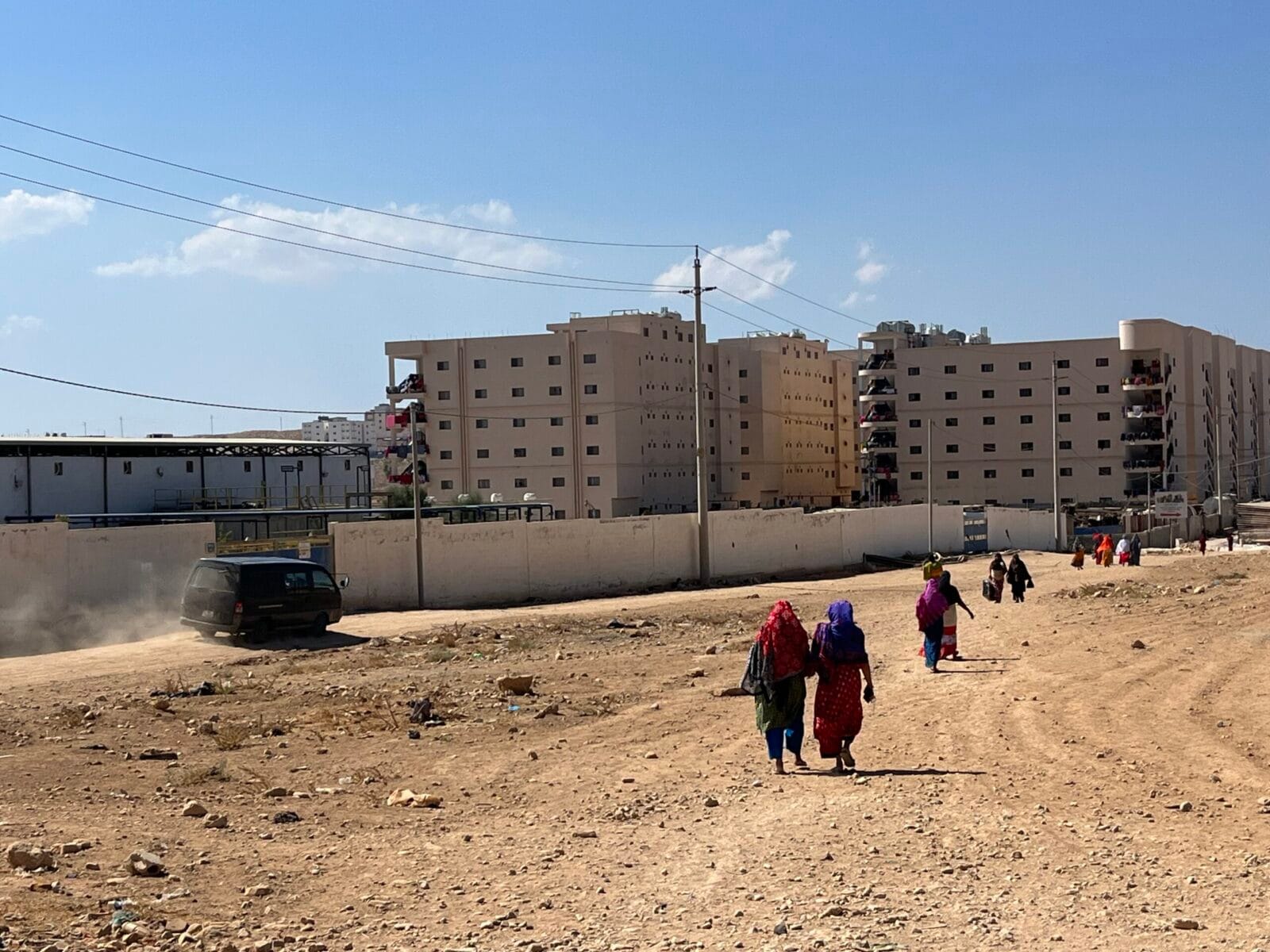
Migrant workers walk back to their dormitories in the Al-Hassan (Irbid) industrial zone, 2024\. Katharina Grüeneisl
Protesting working conditions, meanwhile, has become more difficult than ever as the Red Sea blockade has further shifted power relations on Jordanian shopfloors in favor of employers.
Speaking to us after a long day of unloading trucks and stacking imported fabric rolls in a warehouse in the Al-Hassan industrial zone, Jalal, a Jordanian worker in his early thirties, confided, “a lot of us have been forced to work unpaid overtime hours lately, and no one dares to complain because the managers say they risk bankruptcy, and everyone is scared to lose work, both the locals and foreigners who would simply be sent home.”
Jalal, whose parents were forcibly displaced to Jordan from Palestine during the 1967 war and who grew up in the Palestinian refugee camp in Zarqa, underlines the absurdity of his own position. “I feel completely schizophrenic. I mean imagine my situation. My family members are killed in Palestine, and here I am, just across the border, fearing for my job because my salary depends on an open border and trade with Israel.” His words capture a larger contradiction. The same US geopolitical interests that initially drove the Jordanian garment sector with the goal of generating a “peace dividend” are causing an existential threat to this industry by enabling and fueling Israel’s region-wide aggression.
> **Read the**[**previous**](https://merip.org/2025/01/power-struggles-energy-as-a-weapon-of-war-domination-and-resistance-in-palestine) **article.**
> **Read the**[**next**](https://www.merip.org/narratives-of-the-oppressed/) **article.**
**This article appears in** [**MER issue 313**](https://merip.org/magazine/313/) **“Resistance—The Axis and Beyond.”**
\[**Katharina Grüneisl** is a geographer and postdoctoral research fellow at the University of Nottingham and associated researcher at the Institut des Recherches sur le Maghreb Contemporain (IRMC). **Taher Labadi** is an economist and a researcher at the Institut Français du Proche Orient (IFPO) in Jerusalem.\]
---
### **Endnotes**
[\[1\]](#%5Fednref1) Shamel Azmeh, “Trade Regimes and Global Production Networks: The Case of the Qualifying Industrial Zones (QIZs) in Egypt and Jordan,” *Geoforum* 57 (2014), pp. 57–66.
[\[2\]](#%5Fednref2) Shamel Azmeh and Khalid Nadvi, “‘Greater Chinese’ Global Production Networks in the Middle East: The Rise of the Jordanian Garment Industry,” *Development and Change* 44/6 (2013), pp. 1317–40.
[\[3\]](#%5Fednref3) UN Comtrade Data for HS61 and HS62 (Apparel and clothing accessories; knitted), 1998–2022, accessed and analysed between March 2–7, 2023.
[\[4\]](#%5Fednref4) “[Attacks on Red Sea Ships Disrupt Jordan’s Commercial Sector,”](https://english.aawsat.com/business/4766676-attacks-red-sea-ships-disrupt-jordan%E2%80%99s-commercial-sector) *AsharqAlawsat*, January 3, 2024.
[\[5\]](#%5Fednref5) Matthieu Alaime, ‘Le Paradoxe Extraterritorial Au Cœur Des Territoires Mondialisés. Le Cas de La Zone Économique Spéciale d’Aqaba, Jordanie,’ *Annales de Géographie* 705/5 (2015), pp. 498–522.
[\[6\]](#%5Fednref6) Better Work Jordan, “[Advancing Jordan’s Satellite Garment Factories](https://betterwork.org/wp-content/uploads/2020/01/BW-Jordan-Policy-Brief.pdf),” Policy Brief, Amman, Jordan: International Labour Organization (2019).
### Power Struggles—Energy as a Weapon of War, Domination and Resistance in Palestine
URL: https://www.merip.org/2025/01/power-struggles-energy-as-a-weapon-of-war-domination-and-resistance-in-palestine/
Last updated: 2025-08-22T18:35:58.000Z
On October 8, 2024 less than 24 hours after Hamas carried out the October 7 attacks, Israel halted the flow of power to Gaza, instantly [cutting the availability of electricity](https://www.ochaopt.org/page/gaza-strip-electricity-supply) from 14 to four hours per day.
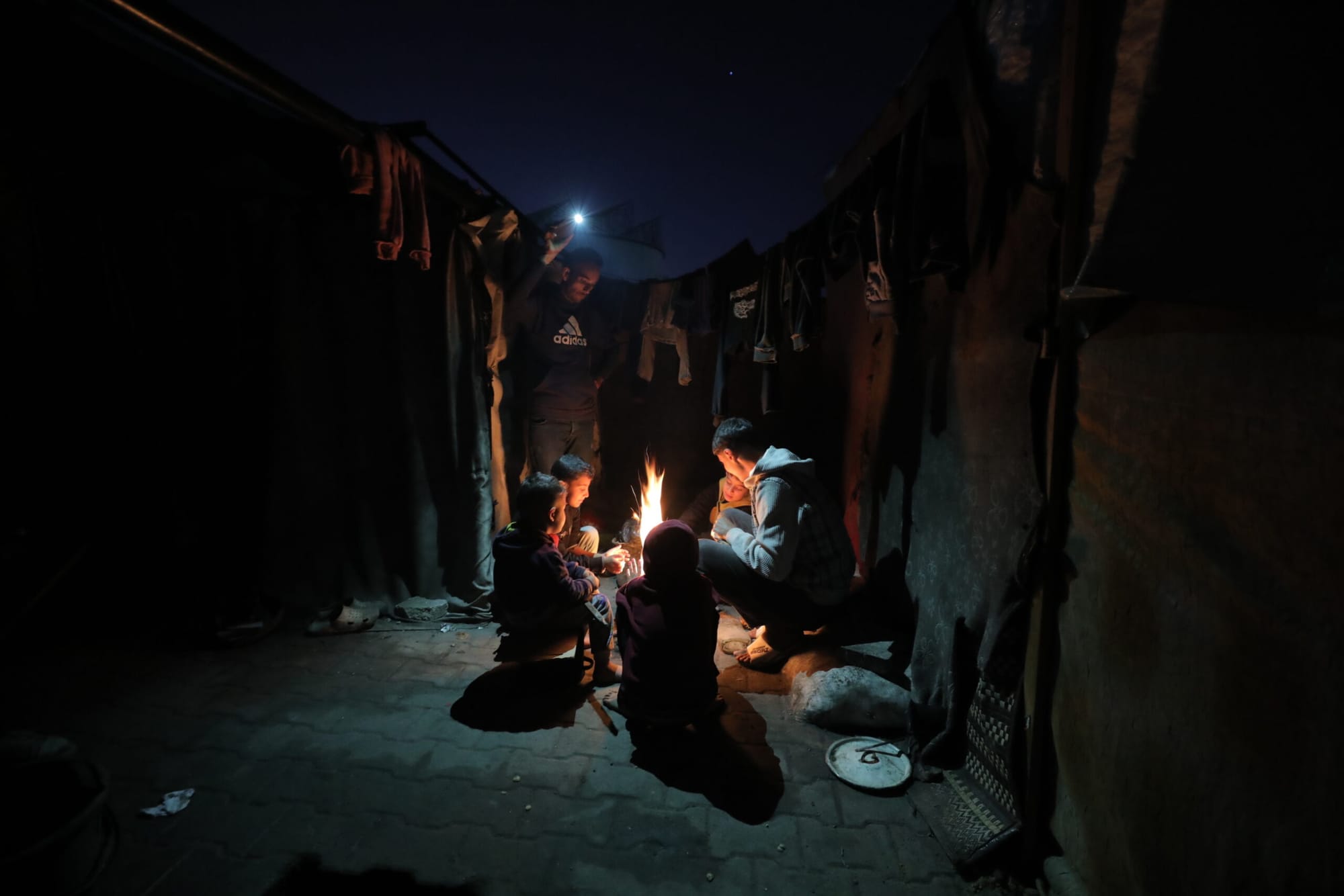
Palestinians living with limited electricity in Nuseirat Refugee Camp in the central Gaza Strip, December 24, 2024\. Hassan Jedi/Anadolu via Getty Images
The following day, Israeli Defense Minister Yoav Gallant declared a [“complete siege”](https://www.merip.org/content/files/crs/mideast/r47754.pdf) on Gaza, including electricity and fuel alongside food and water. By October 11, Gaza’s power plant had run out of fuel and [stopped producing electricity](https://www.ochaopt.org/page/gaza-strip-electricity-supply) altogether. On October 12, Minister of National Infrastructure, Energy and Water, Israel Katz, [declared the denial of fuel, water and power would continue](https://www.merip.org/content/files/crs/mideast/r47754.pdf) until Hamas released its hostages.
This war on infrastructure has led to unprecedented catastrophe due to energy’s critical role in the provision of other essential services: Desalination plants exhausted their fuel supply within a week, cutting off Gaza’s access to clean water—an outcome that [Human Rights Watch has characterized](https://www.hrw.org/report/2024/12/19/extermination-and-acts-genocide/israel-deliberately-depriving-palestinians-gaza) as deliberate and genocidal. Hospitals lacked the electricity to adequately treat the thousands of casualties they received. The sewage system ground to a halt within a month.
But Israel’s capacity to almost instantaneously cut power to the 2.2 million people living in the Gaza Strip is not unprecedented. It is the result of a century of policy and the construction of a centralized, fossil-fueled, Israeli-controlled energy system. Palestinian energy dependence is integral to Israel’s domination of Palestinian life. It constitutes a key tool for the practices of exploitation, expropriation, siege, colonization and removal to which Palestinians have long been subjected. As Omar Jabary Salamanca has argued, through its control over electricity and other essential services, “the State of Israel is able to create the possibilities for life, but also to induce failure and death.” [\[1\]](#%5Fedn1)
In the post-October 7 war on Gaza, the denial of energy supplies and targeting of energy infrastructure by Israeli forces occurred as part of a broader campaign to render the strip uninhabitable. If it holds, the current cease-fire will ostensibly require that Israeli authorities allow large quantities of fuel into the strip alongside other aid. But this provision is precisely the problem: Israel will likely retain control over the flow of energy into Gaza, and Palestinians in Gaza will therefore remain dependent and vulnerable to punishing siege tactics. Even if the end of this war brings a return to the two-state formula, rather than formal annexation, it is impossible to imagine meaningful Palestinian statehood under such conditions.
## **Electricity and Uneven Development in Mandate Palestine**
Electricity’s central role in the colonization and uneven development of Palestine extends back to the Mandate period.
In the early 1920s, British authorities awarded the Palestine Electric Company (PEC), run by the Russian Zionist engineer Pinhas Rutenberg, a 70-year monopoly concession on electricity provision throughout the Mandate territory. Jerusalem was served by a separate, British-owned concession originally granted by the Ottomans. With British support, the PEC built generating plants and assembled a network of power lines that connected military installations and areas of dense Jewish settlement to the grid, establishing an enduring relationship between energy infrastructure, occupation and colonization.
The PEC invested heavily in majority-Jewish areas on the assumption that they would enjoy greater economic growth and thus make better customers. This investment facilitated additional settlement, which in turn encouraged the PEC’s further expansion. The PEC also [purchased land](https://granta.com/as-they-laid-down-their-cables) around sites designated for planned hydroelectric dams and power lines, including the fertile Jordan and ‘Auja river valleys. It allowed the construction of Jewish colonies to serve as defensive bulwarks around PEC infrastructure. These investments [reinforced the familiar N-shaped pattern](https://www.ucpress.edu/books/electrical-palestine/paper) of Jewish settlement, with high-voltage wires and new villages extending from Tel Aviv in the south to Haifa in the north and the Jordan River in the east.
The PEC fought to maintain their exclusive right to electrification, preventing Arab municipalities from establishing their own local grid systems, even in locales the company viewed as unprofitable—as Fredrik Meiton has shown.[\[2\]](#%5Fedn2) Palestinian communities seeking to connect to the PEC grid often faced resistance and exploitative terms. The PEC initially refused to connect the Arab town of Nazareth to the grid, for example, determining that it would be unprofitable. The company only began providing Nazareth with electricity under a novel arrangement under which the municipality, rather than the company itself, would pay the interest on the capital raised for the project.
Moreover, many Arab communities refused connection to the grid for fear of adding momentum to the colonization of Palestine. Some who opposed the PEC’s expansion and British imperial policy carried out acts of sabotage against the grid, damaging power lines and generators to cause major blackouts. But by the mid-1930s, the PEC had reduced the effectiveness of sabotage by adding redundancy to the grid. The company also made agreements with local elites to connect key Arab communities, like Tulkarem and Jenin, rendering more Palestinians dependent on PEC electricity. Though rebels regularly sabotaged PEC infrastructure during the 1936–9 Great Arab Revolt, the grid was by that time resilient enough to withstand such tactics.
Throughout the 1930s, the PEC’s tendency to invest more extensively in infrastructure that served the rapidly industrializing Yishuv [produced distinct and unequal](https://www.ucpress.edu/books/electrical-palestine/paper), though interconnected, Jewish and Arab economies. By the end of the Mandate, the Yishuv constituted only about a third of the population but [consumed as much as 90 percent of the power generated](https://granta.com/as-they-laid-down-their-cables). This disparity in electricity access reflected, and helped produce, the foundational inequality between Arab and Jewish communities that developed across the Mandate period. It also helped create the appearance of Arab underdevelopment that was in turn used to justify further colonization.
## **Enforced Dependence and Resistance After 1948**
The basic infrastructural inequality that emerged across the Mandate persisted within the new State of Israel in 1948\. Israel’s gradual extension of the grid across newly acquired territories fostered Palestinian dependence on Israeli power.
Palestinians lagged behind in electricity access while new Jewish settlements were connected to the grid from their inception. The successor to the PEC, the Israel Electric Company (IEC), held the monopoly on power generation within Israel, making it impossible for Palestinians to establish independent grids. In Gaza, the Egyptian authorities allowed municipalities to purchase generators and provide electricity to their populations. In the West Bank, annexed to Jordan, nearly a dozen power companies were established. The largest was the privately owned Jerusalem District Electricity Company (JDECO), based on the city’s Ottoman-era concession, which served Jerusalem, Ramallah, Bethlehem and neighboring towns and villages. The rest of the West Bank was served by village-level cooperatives or municipal companies in cities like Nablus, Jenin and Hebron.
Following Israel’s conquest of the West Bank, Gaza, Sinai and Golan Heights in the 1967 War, the Israeli state, the Jewish Agency and international development organizations, like USAID, [invested heavily in infrastructure](https://www.jstor.org/stable/2536527) for new settlements. Palestinian villages that desired access to the IEC or West Bank grids, on the other hand, often [had to raise the requisite capital themselves](https://www.jstor.org/stable/3011505?seq=1).
> **By the mid-1970s, around a quarter of Palestinians living in Israel’s pre-1967 borders, two-thirds of Palestinians in the West Bank and three-quarters of Palestinians in Gaza still lacked power.**
The period after 1967 saw an increase in overall electricity consumption by Palestinians living in historic Palestine. But profound inequality persisted. By the mid-1970s, around a quarter of Palestinians living in Israel’s pre-1967 borders, two-thirds of Palestinians in the West Bank and three-quarters of Palestinians in Gaza still lacked power.[\[3\]](#%5Fedn3)
Moreover, electricity came at a price. As Laleh Khalili has observed, “after 1967, the occupied territories were made deliberately reliant on Israeli infrastructures that could be switched off at a flick of a switch…”[\[4\]](#%5Fedn4) In November of that year, Israel implemented Military Order 159, placing electricity infrastructure in the occupied territories under Israeli control. Israel required Palestinian power companies to sell their electricity at low rates fixed by the government. Unlike the IEC, these companies lacked the state subsidies and economies of scale to sell electricity at fixed prices profitably. Moreover, Israeli occupation authorities frequently prevented Palestinian companies from expanding their facilities. For example, military orders barred Palestinians from assembling new electrical infrastructure without IDF approval. [In most cases, approval was not forthcoming](https://www.jstor.org/stable/2536246) unless it connected to the IEC grid. Such policies rendered Palestinian power companies unprofitable and prevented new investment, facilitating the IEC’s takeover of electricity provision throughout the West Bank.
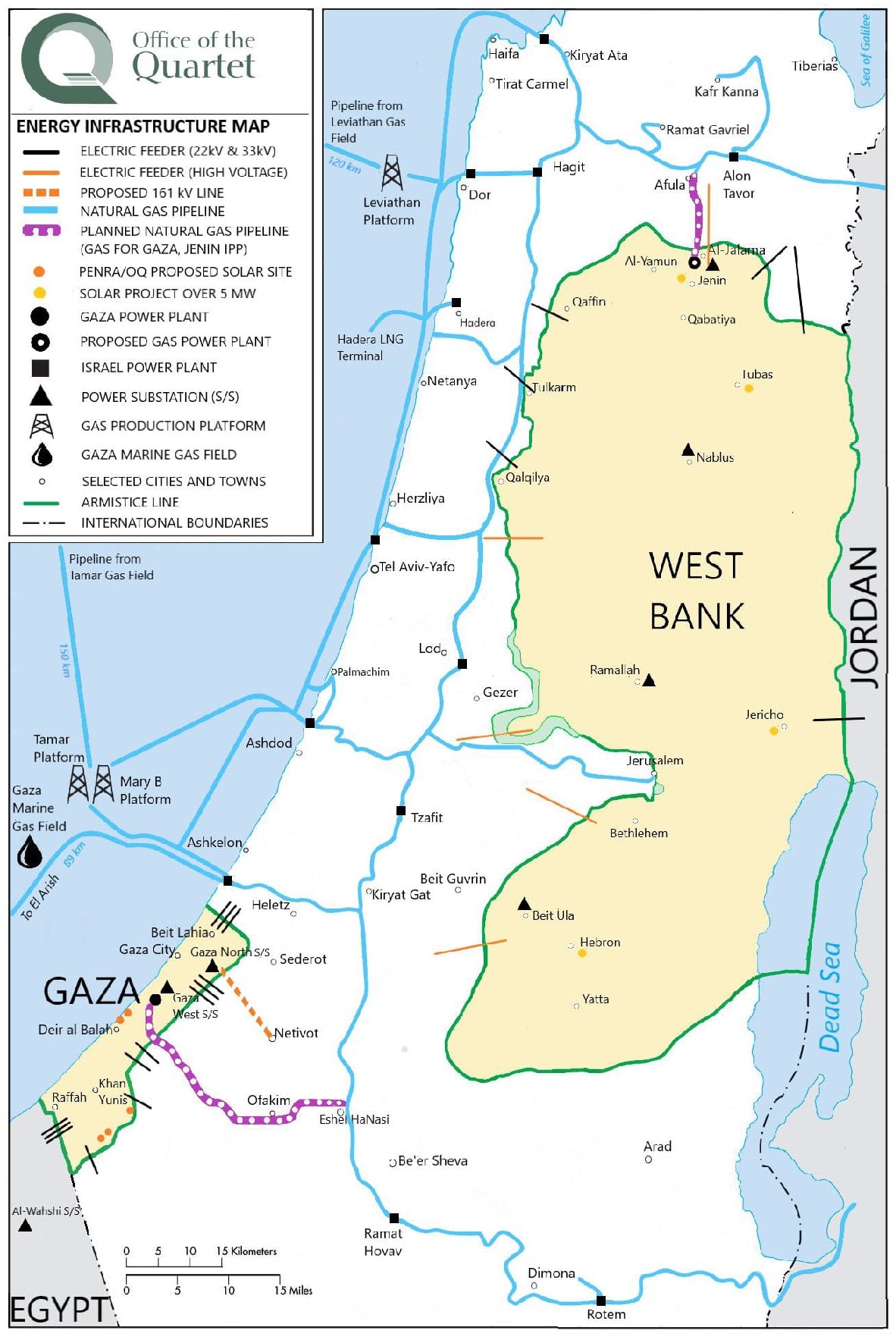
Office of the Quartet Energy Infrastructure Map, from Office of the Quartet Report to the Ad Hoc Liaison Committee, November 17, 2021.
In Gaza, electrification sustained the post-1967 occupation in multiple ways. The Israeli state required the IEC to serve new Jewish settlements and bases in the enclave, paving the way for the company to begin selling power to its Palestinian municipalities. New electricity infrastructure powered military facilities, lit streets to increase visibility (and surveillance) and locked in a pattern of limited and dependent development.
By the late 1970s, only a few larger Palestinian cities like Jerusalem, Nablus and Jenin remained in control of their own power supplies. The Israeli government required that JDECO serve new settlements and IDF military facilities in the West Bank alongside growing numbers of Palestinians—part of a broader deal that granted the company new customers but required it lower its prices to Israeli standards. Moreover, the company was denied permission to sufficiently expand its generating capacity, forcing it to purchase most of its electricity from the IEC for resale at fixed low rates. This arrangement eliminated JDECO’s profits, disrupted service by impeding essential maintenance and repairs and burdened it with debt to the IEC. The company was pushed toward bankruptcy and forced to subsist on loans from Arab states.
In the early 1980s, when Israel’s Likud-run government attempted (unsuccessfully) to take over JDECO on behalf of the IEC, it spurred a [wave of protests and strikes](https://www.jstor.org/stable/i323169). JDECO ultimately won an Israeli Supreme Court case rejecting the IEC’s claim. But by 1986, the company only generated around 3 percent of its electricity, buying the remainder from the IEC—a massive drop-off from 60 percent a decade earlier. [\[5\]](#%5Fedn5) In the same year, the IEC absorbed Nablus and Jenin’s municipal systems and took over JDECO’s service provision to IDF bases and Jewish neighborhoods and settlements. These acts further eroded the company’s revenues and deepened Israeli control over East Jerusalem—contributing to the outbreak of the First Intifada.
In a 1983 interview, Palestinian lawyer and activist Jonathan Kuttab noted that “water and electricity are regularly cut off as a form of punishment” in the West Bank.[\[6\]](#%5Fedn6) When the Palestine Liberation Organization declared the establishment of a Palestinian state in 1988, Israeli authorities retaliated by imposing a curfew and cutting off electricity throughout the occupied territories overnight. Throughout the First Intifada, Israeli commanders halted the supply of electricity and fuel to Palestinian communities for hours or days at a time.
> **Fostering Palestinian energy dependence enabled Israeli authorities to deny energy access as a core counterinsurgency tactic.**
Palestinians responded to energy poverty and dependence in a variety of ways. Some secured their own energy supply at a very local level. Palestinians in Gaza, for instance, [adopted solar power](https://al-shabaka.org/briefs/confronting-energy-poverty-in-gaza/) in the 1970s. Others used more confrontational and militant tactics. In 1969, the Popular Front for the Liberation of Palestine destroyed power lines linking new settlements in the Naqab/Negev to a generating plant in Ashdod, recalling earlier disruptive actions during the nakba. During the First Intifada, Palestinians refused to pay electricity bills and sabotaged IEC infrastructure. Palestinians correctly perceived these long-running battles over energy as a critical component of the overall struggle for sovereignty.
## **Oslo and a New Architecture of Power**
Despite rhetoric at the time about Palestinian energy independence and cooperation between energy sectors, the Oslo process worked to consolidate and deepen Palestinian energy dependence on Israel.
Annex III of the 1993 Oslo Accords provided for “Cooperation in the field\[s\] of electricity… \[and\] energy,” including “joint exploitation of… energy resources.”[\[7\]](#%5Fedn7) But as Lior Herman and Itay Fischhendler have noted, during the Oslo process “Israel saw electricity as a future foreign policy instrument and wanted to control the production and transmission processes in order to preserve Palestinian dependence on Israel, even after its independence.”[\[8\]](#%5Fedn8) Though they overstate Israel’s willingness to accept eventual Palestinian sovereignty—and are therefore incorrect in describing this as a matter of foreign policy rather than [an aspect of continued occupation](https://www.amnesty.org/en/documents/mde15/8668/2024/en/)—Herman and Fischhendler nonetheless correctly identify how Oslo-era infrastructural and institutional arrangements were designed to maintain and intensify Palestinian subordination.
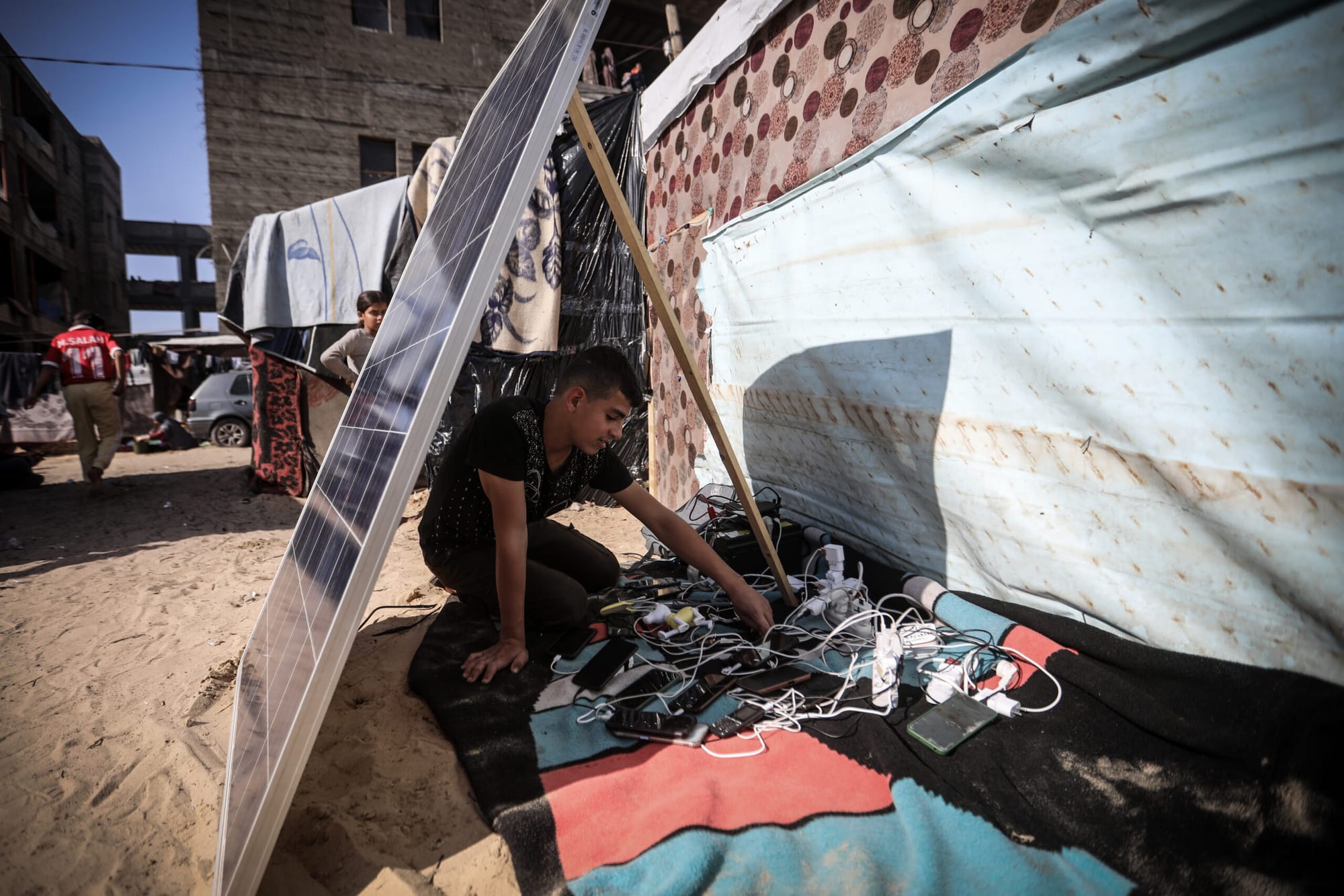
A Palestinian man charges phones at a station fed by a solar panel in a refugee camp in Rafah, January 2024\. Due to worsening economic conditions and the lack of electricity, some young men who have solar panels are using them to run small businesses. Mohammed Talatene/dpa via Getty Images
The Oslo process created multiple chokepoints that gave Israel control over Palestinian energy, financial and other critical flows. Under Oslo, the IEC remained responsible for most electricity production and transmission throughout Gaza and the West Bank. Fearing the IEC would be unable to collect on Palestinian electricity debt, Israeli negotiators created a mechanism to withhold Palestinian customs revenues and taxes on Palestinian migrant workers collected by Israel. Municipalities were frequently unable to repay the IEC for the power they purchased, accumulating significant debt for which the new Palestinian Authority (PA) was ultimately responsible. The PA has attempted to use prepaid electricity meters to pass this debt on to Palestinian consumers, especially in refugee camps where consumers frequently refuse to pay for electricity.
The PA made some efforts to secure a limited degree of energy independence in the Oslo era. Planning for a power plant in Gaza, for instance, began in 1994\. Gaza’s power plant—[completed in 2002](https://spectrum.ieee.org/gaza-power-strip) and powered by expensive imported Israeli diesel—provided around two-thirds of the strip’s electricity.[\[9\]](#%5Fedn9) But as Adam Hanieh notes, the 1994 Paris Protocol, which regulated the PA’s relationship with Israel, put Israel in “complete control over all external borders.”[\[10\]](#%5Fedn10) Israel controlled the importation of fuel destined for Gaza’s power plant and the rest of the occupied territories. According to the World Bank, the terminals where the West Bank and Gaza received fuel lacked storage facilities, rendering “Palestinians dependent on a day-to-day supply from Israeli companies” and therefore extremely vulnerable to fuel cutoffs.[\[11\]](#%5Fedn11)
In 1999, natural gas was discovered off Gaza’s coast. This field, called Gaza Marine, might have provided inexpensive electricity from a Palestinian-controlled fuel source. But while Israeli authorities entertained the possibility of allowing British Gas to develop Gaza Marine—and even of purchasing natural gas from this Palestinian-controlled field—Israel ultimately never permitted this resource to be developed.
> **Instead, the post-Oslo period consolidated deep energy dependence on Israel that aligned with a broader strategy of fostering overall Palestinian economic dependence while circumscribing Palestinian sovereignty.**
Instead, the post-Oslo period consolidated deep energy dependence on Israel that aligned with a broader strategy of fostering overall Palestinian economic dependence while circumscribing Palestinian sovereignty. By the year 2000, more than 99 percent of Palestinians in the West Bank and Gaza had access to fundamentally Israeli-controlled electricity, and Israel continued to weaponize this dependence.[\[12\]](#%5Fedn12)
Throughout the Second Intifada, Israel routinely [stopped the entry of fuel into Gaza](https://www.sciencedirect.com/science/article/pii/S0301421506002795) for use by its power plant. Israeli forces also directly targeted Palestinian energy infrastructures. During raids, Israeli forces regularly shot out streetlights and [cut off electricity](https://www.hrw.org/report/2002/04/18/dark-hour/use-civilians-during-idf-arrest-operations) to Palestinian neighborhoods so they could operate under cover of darkness. Attacks on medical facilities damaged generators, [disrupting medical care](https://www.jstor.org/stable/pdf/29768136.pdf). According to a 2002 World Bank report, in Hebron “Electricity transformers \[were\] shot out, in large numbers and repeatedly, causing frequent disruptions...”[\[13\]](#%5Fedn13) The Palestinian Energy Authority estimated that Israeli forces were directly responsible for the destruction of $15 million worth of power infrastructure between 2000 and 2003, though this figure likely understates the true toll of such tactics, given energy’s centrality to economic life.[\[14\]](#%5Fedn14)
## **‘Remote Control’ Occupation**
Since Oslo and the 2005 evacuation of Gaza, control over energy and other critical infrastructures, alongside the use of airpower, has allowed Israel to engage in what Salamanca has called a “remote control” occupation.[\[15\]](#%5Fedn15)
After Hamas’ victory in Palestinian parliamentary elections, its seizure of control in Gaza and the capture of IDF soldier Gilad Shalit in 2006, Israeli forces bombed Gaza’s power plant, thereby [impeding medical care](https://www.btselem.org/publications/summaries/200609%5Fact%5Fof%5Fvengeance) throughout the territory. The plant was repaired in 2007, but Israeli authorities declared Gaza a “hostile territory” and began employing the [restriction of fuel supplies](https://spectrum.ieee.org/gaza-power-strip) into Gaza as a siege tactic, providing only enough fuel, electricity, water, food and other essential goods to meet a purported humanitarian minimum.[\[16\]](#%5Fedn16)
[During fighting between Israel and Hamas in 2008](https://spectrum.ieee.org/gaza-power-strip), Israel cut off Gaza’s fuel supply entirely, damaged power lines extending into Gaza from both Israel and Egypt and restricted the entry of spare parts required to maintain and repair the power plant. The plant’s fuel storage tanks [were targeted again](https://www.merip.org/content/files/documents/268421/4261447/Gaza+Electricity+Reform+and+Restoration+-+Fast+Track+Approach+to+Economic+Revival-pdf/c48ad970-59ba-160b-b593-b52d055cc16a.pdf) in the 2014 assault on Gaza. In 2021’s brief war, Israeli authorities [restricted the supply of electricity](https://al-shabaka.org/briefs/confronting-energy-poverty-in-gaza/) from the IEC to Gaza, and the IDF [bombed a recently constructed solar facility](https://www.middleeastmonitor.com/20210610-gaza-to-rebuild-industrial-zone-to-ease-unemployment/). Israel again [reduced the flow of fuel](https://www.newarab.com/news/gaza-plant-shuts-over-lack-fuel-amid-israel-blockade) into Gaza in late 2021 and 2022, restricting the power plant’s ability to generate electricity.
The West Bank’s energy supply, while subjected to fewer sieges and bombardments than Gaza’s, has also been targeted by Israeli authorities. For example, the [IEC cut power to Nablus and Jenin](https://mondoweiss.net/2015/02/hundreds-thousands-palestinians/) when these municipalities failed to pay their power bills after Israel withheld tax revenues from the PA in retaliation for Palestine’s accession to the International Criminal Court in 2015.
> **Before October 7, 2023, Gaza spent more than a fifth of its GDP on energy imported directly from Israel and received an average of only 10 hours of electricity per day.**
Palestinians in the West Bank and Gaza have responded creatively. Some established informal connections to the grid in the West Bank, expropriating electricity from the IEC while adding to the PA’s debt burden. Small diesel generators [have insulated those who can afford them](https://www.btselem.org/publications/summaries/200609%5Fact%5Fof%5Fvengeance) from power disruptions. Outside of the reach of Israeli authorities, who frequently confiscate or destroy solar panels in the West Bank, Palestinians in Gaza widely adopted solar power from the 2010s onward, with solar panel coverage [growing from 115 to 20,000 square meters](https://al-shabaka.org/briefs/confronting-energy-poverty-in-gaza/) between 2012 and 2019 and solar energy providing as much as 12 percent of the strip’s power supply.[\[17\]](#%5Fedn17)
But despite these local solutions, Palestinians consume the least energy per capita in the Middle East, while [paying the highest price for it](https://al-shabaka.org/briefs/confronting-energy-poverty-in-gaza/). As with so many other aspects of Palestinian life, [energy poverty](https://www.merip.org/content/files/podcast/confronting-energy-poverty-in-gaza-with-asmaa-abu-mezied.pdf) is the result of a fundamentally extractive relationship: Before October 7, 2023, Gaza [spent more than a fifth of its GDP](https://al-shabaka.org/briefs/confronting-energy-poverty-in-gaza/) on energy imported directly from Israel and received an average of [only 10 hours of electricity](https://www.ochaopt.org/page/gaza-strip-electricity-supply) per day.
## **The Assault on Palestinian Power Since October 7**
Whereas Israeli authorities carefully modulated the denial of energy in their post-1967 and post-Oslo counterinsurgency campaigns, the eliminationist war that followed October 7, 2023 witnessed the near-absolute blockade of Gaza’s energy supply and wholesale targeting of energy infrastructure. Israeli authorities [cut off the flow of electricity and fuel almost entirely](https://www.amnesty.org/en/documents/mde15/8668/2024/en/), only intermittently allowing miniscule amounts of fuel to trickle in under international pressure.
[Israeli forces have also damaged equipment](https://www.worldbank.org/en/news/press-release/2024/05/23/world-bank-issues-new-update-on-the-palestinian-economy) ranging from cranes used by the Gaza Electricity Distribution Company to the high voltage electricity connection points that enable the import of Israeli electricity. By March 2024, the World Bank conservatively estimated that Israel had [destroyed more than 60 percent](https://www.merip.org/content/files/en/doc/14e309cd34e04e40b90eb19afa7b5d15-0280012024/original/gaza-interim-damage-assessment-032924-final.pdf) of Gaza’s power distribution network.[\[18\]](#%5Fedn18) Around the same time, [Gaza’s energy authority estimated](https://attaqa.net/2024/04/11/%D8%AE%D8%B3%D8%A7%D8%A6%D8%B1-%D9%82%D8%B7%D8%A7%D8%B9-%D8%A7%D9%84%D8%B7%D8%A7%D9%82%D8%A9-%D9%81%D9%8A-%D8%BA%D8%B2%D8%A9-%D8%AA%D8%AA%D8%AC%D8%A7%D9%88%D8%B2-500-%D9%85%D9%84%D9%8A%D9%88%D9%86/) $500 million in damage to energy infrastructure and suggested that around 90 percent of the strip’s solar panels had been damaged.[\[19\]](#%5Fedn19) Amnesty International asserts that 11 of Gaza’s 17 largest solar plants have been damaged or destroyed, and Human Rights Watch has [documented the intentional bulldozing](https://www.hrw.org/report/2024/12/19/extermination-and-acts-genocide/israel-deliberately-depriving-palestinians-gaza) of solar panels powering wastewater treatment plants.
The impact of the rapid, near-total disruption to Gaza’s energy supply has been catastrophic. Hospitals—which have themselves been routine IDF targets—have struggled to secure fuel for their generators in the absence of electricity. As a result, the [dwindling number of functioning medical facilities](https://www.france24.com/en/live-news/20240304-in-gaza-hospitals-power-means-life-or-death-amid-severe-shortages) have been forced to provide care for the tens of thousands of wounded civilians without power.
> **Still, Palestinians have found innovative workarounds to these dire conditions, establishing communal charging stations using the few remaining solar panels and even improvising small-scale wind turbines mounted on tents and rooftops.**
In February 2024, satellite imagery analysis by Care International revealed that [70 percent of Gaza’s hospitals lacked lighting at night](https://www.care-international.org/news/84-gazas-lights-extinguished-people-left-sick-and-starving), even as they operated at more than three times their capacity. The lack of energy has [exacerbated famine conditions](https://www.crisisgroup.org/middle-east-north-africa/east-mediterranean-mena/israelpalestine/244-stopping-famine-gaza) and inhibited already intentionally constrained relief efforts. Without power, for example, Palestinians in Gaza struggle to turn flour delivered as humanitarian aid into edible bread. The lack of fuel and electricity has also [halted the work of desalination plants](https://www.haaretz.com/israel-news/2024-08-10/ty-article-magazine/.premium/the-palestinian-water-crisis-is-everybodys-problem-including-israel/00000191-363c-dcc7-a5fb-f6fc04fb0000), reducing the availability of water to less than a third of the amount required per capita. It has likewise disrupted the sanitation system and thus contributed to the [outbreak of polio](https://www.nbcnews.com/news/world/polio-vaccinations-gaza-sanitation-crisis-rcna169085). It has [disrupted telecommunications](https://www.amnesty.org/en/documents/mde15/8668/2024/en/), denying Palestinians in Gaza access to the macabre maps meant to direct them to so-called safe zones and—together with the repeated, intentional killing of journalists—cutting off links to the outside world. Still, Palestinians have found innovative workarounds to these dire conditions, [establishing communal charging stations](https://www.youtube.com/watch?v=Qsj2VZvjngE) using the few remaining solar panels and even [improvising small-scale wind turbines](https://www.youtube.com/watch?v=S7QrpSKxEis) mounted on tents and rooftops.
In the West Bank, since October 7, 2023, the Israeli government has used electricity debt as a pretext to [withhold large amounts of tax revenue](https://www.worldbank.org/en/news/press-release/2024/05/23/world-bank-issues-new-update-on-the-palestinian-economy) from the PA. The maintenance of Palestinian electricity dependence, and the set of institutional arrangements developed under Oslo that put Palestinian fiscal channels under Israeli control, has created a mechanism for collective punishment and a means by which Israel [has brought the PA to the brink of collapse](https://al-shabaka.org/policy-memos/palestinian-clearance-revenues-israels-tool-to-collapse-the-pa/) amid an apparent push to annex the West Bank.
Finally, Israel has used the opening created by this war to expropriate Palestinian energy resources. In 2019, the State of Palestine [formally declared its maritime boundaries](https://www.merip.org/content/files/Depts/los/LEGISLATIONANDTREATIES/PDFFILES/pse%5Fdeposit%5F09-2019.pdf) in accordance with the United Nations Convention on the Law of the Sea, claiming maritime areas off the Gazan coast. Israel has [disputed these boundaries](https://www.merip.org/content/files/depts/los/LEGISLATIONANDTREATIES/PDFFILES/communications/isr%5Fpse.pdf) on the basis of its non-recognition of Palestine as a sovereign state. On October 29, 2023, Israel’s Ministry of Energy [awarded licenses for Israeli and international energy companies](https://www.adalah.org/en/content/view/11036) to explore for natural gas in a zone off Gaza that overlaps substantially with [the maritime area claimed by Palestine](https://www.merip.org/content/files/Depts/los/LEGISLATIONANDTREATIES/PDFFILES/pse%5Fdeposit%5F09-2019.pdf). This move undermines the basis for future Palestinian energy sovereignty and parallels the accelerated colonization of the West Bank.
Across this genocidal war, US and European leaders have consistently promised Palestinians a path to statehood following the conclusion of a cease-fire agreement. But as Rashid Khalidi has argued, the two-state formula is an illusion: “Palestinian statehood and sovereignty… have *never* been on the table, ever, anywhere, at any stage, from any party, the United States or Israel or anybody else.”[\[20\]](#%5Fedn20) The long-term fostering and exploitation of Palestinian energy dependence underlines this point.
Any meaningful end to the occupation and colonization of Palestine must include Palestinian control over energy supplies, whether in the form of a centralized, fossil-fueled grid based around the development of Palestine’s offshore natural gas resources or a more durable and decentralized grid based around locally controlled solar energy. It must be up to Palestinians to determine what substantive energy sovereignty—and a livable future—[will](https://www.palestine-studies.org/en/node/1654826) [look](https://ps.boell.org/en/2013/01/27/while-israeli-occupation-controls-energy-production-palestine-%E2%80%9Cenergy-independence-first%E2%80%9D) [like](https://al-shabaka.org/briefs/how-israel-uses-gas-to-enforce-palestinian-dependency-and-promote-normalization/).
> **Read the[previous](https://www.merip.org/dispatch-from-south-lebanon/) article.**
> **Read the[next](https://www.merip.org/hanging-by-a-thread/) article.**
**This article appears in** [**MER issue 313**](https://merip.org/magazine/313/) **“Resistance—The Axis and Beyond.”**
\[**Zachary Davis Cuyler** is an assistant professor at the University of Illinois at Chicago and a fellow with Century International.\]
---
### **Endnotes**
[\[1\]](#%5Fednref1) Omar Jabary Salamanca, “Unplug and Play: Manufacturing Collapse in Gaza,” *Human Geography* 4/1 (March 2011).
[\[2\]](#%5Fednref2) Fredrik Meiton, *Electrical Palestine: Capital and Technology from Empire to Nation* (University of California Press, 2019), pp. 56–7, 74–5, 80–94, 153–155, 164–166, 182–187.
[\[3\]](#%5Fednref3) Sabri Jiryis, “The Arabs in Israel, 1973-79,” *Journal of Palestine Studies* 8/4 (1979), p. 54\. Jamil Hilal, "Class Transformation in the West Bank and Gaza," *Journal of Palestine Studies* 6/2 (1977), p. 170.
[\[4\]](#%5Fednref4) Laleh Khalili, “[As They Laid Down Their Cables](https://granta.com/as-they-laid-down-their-cables),” *Granta*, April 25, 2024.
[\[5\]](#%5Fednref5) Jawdat Abu ‘Awn, “Electrical Energy in the West Bank and Gaza,” *Samid al-Iqtisadi* 15/92 (April-June 1993), p. 20.
[\[6\]](#%5Fednref6) Jonathan Kuttab and John Egan, “An Autonomous Palestinian Presence on the West Bank Conflicts with the Goal of Judaization,” *Journal of Palestine Studies* 12/ 4 (1983), pp. 64–70.
[\[7\]](#%5Fednref7) “[Declaration of Principles on Interim Self-Government Arrangements (Oslo Accords)](https://peacemaker.un.org/node/9432),” United Nations: Peacemaker.
[\[8\]](#%5Fednref8) Lior Herman and Itay Fischhendler, “Energy as a Rewarding and Punitive Foreign Policy Instrument: The Case of Israeli–Palestinian Relations,” *Studies in Conflict and Terrorism* 44/6 (2021), p. 505.
[\[9\]](#%5Fednref9) World Bank, Report No. 39695-GZ: “[West Bank and Gaza Energy Sector Review,](https://documents1.worldbank.org/curated/pt/731521468137110533/pdf/396950GZ0Energ1white0cover01PUBLIC1.pdf)” May 2007, p. 3.
[\[10\]](#%5Fednref10) Adam Hanieh, “[The Oslo Illusion](https://jacobin.com/2013/04/the-oslo-illusion),” *Jacobin*, April 2013.
[\[11\]](#%5Fednref11) World Bank, Report No. 39695-GZ: “[West Bank and Gaza Energy Sector Review,](https://documents1.worldbank.org/curated/pt/731521468137110533/pdf/396950GZ0Energ1white0cover01PUBLIC1.pdf)” May 2007, p. 12.
[\[12\]](#%5Fednref12) Ayman Abualkhair, "Electricity sector in the Palestinian territories: Which priorities for development and peace?,” *Energy Policy* 35/4 (2007), p. 2209–2230.
[\[13\]](#%5Fednref13) World Bank, “Fifteen Months—Intifada, Closures, and Palestinian Economic Crisis: An Assessment,” 2002, 56–7.
[\[14\]](#%5Fednref14) Ayman Abualkhair, "Electricity sector in the Palestinian territories: Which priorities for development and peace?,” *Energy Policy* 35/4 (2007), p. 2209–2230.
[\[15\]](#%5Fednref15) Omar Jabary Salamanca, “Unplug and Play: Manufacturing Collapse in Gaza,” *Human Geography* 4/1 (2011), p. 25.
[\[16\]](#%5Fednref16) Ibid, p. 29.
[\[17\]](#%5Fednref17) Asmaa Abu Mezeid, “[Confronting Energy Poverty in Gaza](https://al-shabaka.org/briefs/confronting-energy-poverty-in-gaza/),” Al-Shabaka, March 29, 2023.
[\[18\]](#%5Fednref18) World Bank, “[Gaza Interim Damage Assessment](https://www.merip.org/content/files/en/doc/14e309cd34e04e40b90eb19afa7b5d15-0280012024/original/gaza-interim-damage-assessment-032924-final.pdf),” March 29, 2024, p. 10.
[\[19\]](#%5Fednref19) “[Gaza energy sector losses exceed $500 million](https://attaqa.net/2024/04/11/%D8%AE%D8%B3%D8%A7%D8%A6%D8%B1-%D9%82%D8%B7%D8%A7%D8%B9-%D8%A7%D9%84%D8%B7%D8%A7%D9%82%D8%A9-%D9%81%D9%8A-%D8%BA%D8%B2%D8%A9-%D8%AA%D8%AA%D8%AC%D8%A7%D9%88%D8%B2-500-%D9%85%D9%84%D9%8A%D9%88%D9%86/),” Attaqa, April 11, 2024\. \[Arabic\]
[\[20\]](#%5Fednref20) Rashid Khalidi, “[The Neck and the Sword,”](https://newleftreview.org/issues/ii147/articles/the-neck-and-the-sword) *New Left Review* 147 (May/June 2024).
### Dispatch from South Lebanon—Life as Resistance at the End of the World
URL: https://www.merip.org/2025/01/dispatch-from-south-lebanon/
Last updated: 2025-09-16T21:04:32.000Z
On the morning of October 20, 2024—a little over a month after the Israeli pager attacks in Lebanon and Syria—Israeli soldiers detonated explosives they had wired throughout a frontline village in South Lebanon.
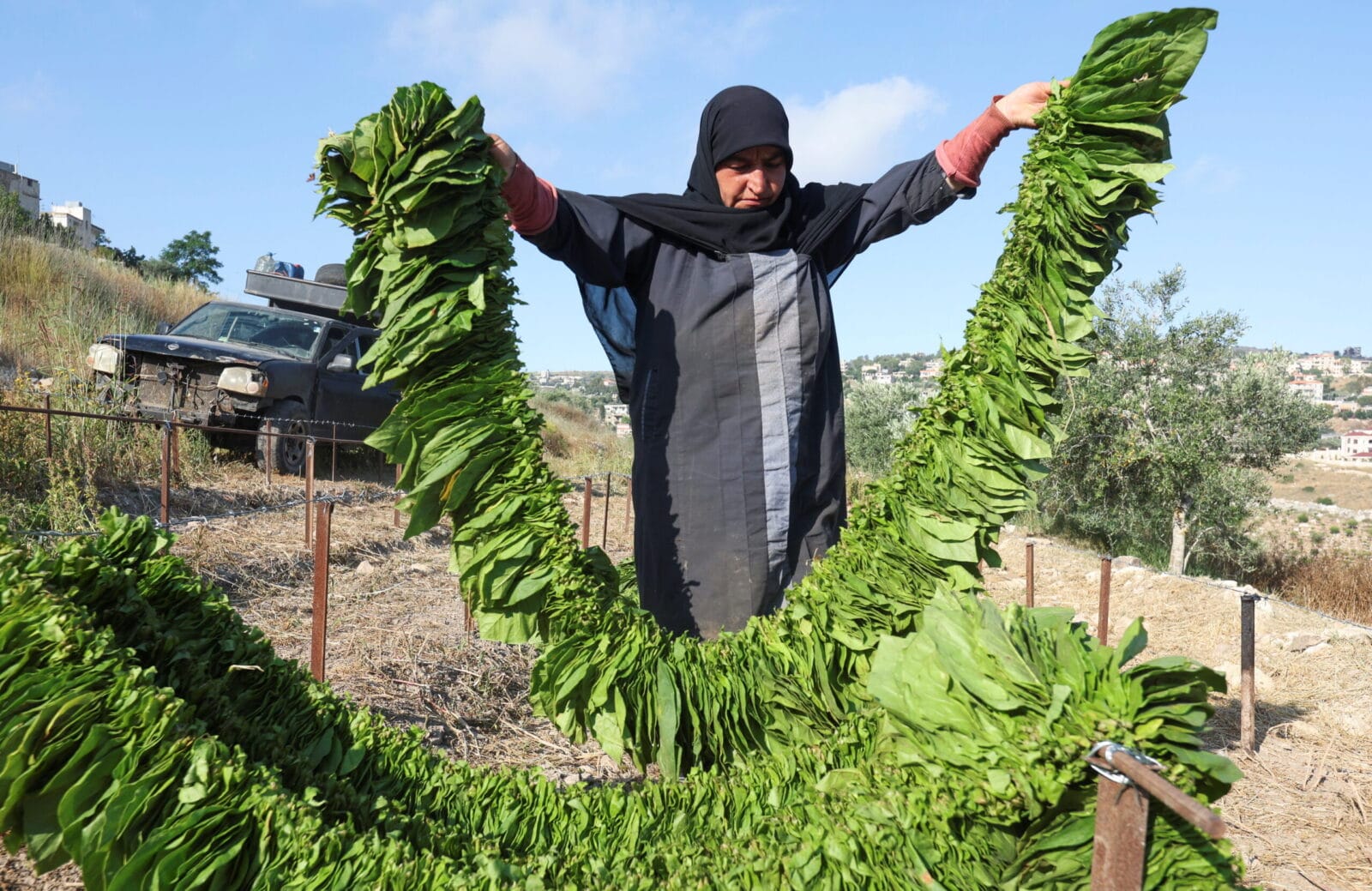
A farmer prepares tobacco leaves for drying in Houla village, near the border with Israel, southern Lebanon June 22, 2023\. Aziz Taher/Reuters
The village, where I have conducted extensive fieldwork over the years, hugs the border with occupied Palestine. Since October 2023, it had been forcibly and gradually emptied of life since. The October 2024 attack completely obliterated it.
Videos by the Israeli soldiers of their acts of destruction circulated on social media. In them, the olive-green clad soldiers count down in Hebrew, then break out in laughter and hoots of machismo in the wake of the explosion. An image of the village disappearing into a pink pillow of smoke under an iridescent early morning moon was shared on the village’s WhatsApp group. Members of the group responded with crying, angry and broken-heart emojis. They expressed disbelief, praising the heavens.
The haunting image of the village’s destruction contrasts sharply with a photo I took during fieldwork in 2008 after the village’s defiant reemergence from the previous punishing war of July 2006: Then, the intimate huddle of houses crowning the hill were all newly rebuilt and freshly painted in a rainbow of pastels.
Trying to fathom the world-ending loss of the place that centered my ethnography of life and war in South Lebanon, I sent a voice-note to my close friend Ghida asking how she felt about the erasure of her beloved village. She responded, “I don’t know. It is as if we have become numb.”
The recent bombardment of Lebanon is by no means the first Israeli effort to annihilate life on the Lebanese side of the border. But it is the most intentional, brazen and unfettered. During this round, Hizballah—the homegrown Lebanese armed resistance that [emerged in the wake of the 1982 Israeli invasion and occupation of Lebanon](https://merip.org/2025/01/a-primer-on-lebanon-history-palestine-and-resistance-to-israeli-violence-2) and honed its skills over decades of guerrilla warfare in south Lebanon—suffered a major blow. Through bombing campaigns in residential areas across Lebanon that utilized massive amounts of bunker-blaster bombs, and through incessant drone attacks, Israel managed to systematically assassinate all of Hizballah’s top leadership—including the much-loved and revered face of the Resistance, Hassan Nasrallah, who led Hizballah for 32 years. Nonetheless, Hizballah fighters remained tenacious on the ground in the South, repelling the Israeli Army’s advances until the ceasefire came into effect.
As of this writing, Israel has breached the ceasefire [hundreds of times](https://english.ahram.org.eg/NewsContentP/2/539086/World/Israel-army-violently-attacks-southern-Lebanon-day.aspx), by some estimations, and continues to occupy south Lebanon, past the initial negotiated date of their withdrawal. Israeli forces are systematically destroying agricultural and residential landscapes as well as extensive road networks in the frontline villages—home to all kinds of resistant life and deep layers of history. [Images recently shared](https://x.com/GreenSoutherns/status/1881655916338221322) on social media by the NGO, Green Southerners, illustrate the extent of this ecocide in the border villages of Yaroun: Before-and-after satellite images show the widespread destruction of pine forests and orchards. In Alma al-Shaab their famous groves of ancient olives were uprooted.
The occupation and obliteration of the borderland is not only a political and social problem but an environmental one. Just like the war in Palestine, South Lebanon is the target of a campaign of annihilation and destruction, which includes all those beings living on the land and the land itself. Shifting the analysis to the actual grounds of life in these landscapes of war offers perspectives and lessons about survival and ecologies of resistance at the end of the world.
## **Harvesting Under the Bombs**
The latest and ongoing season of war in South Lebanon resumed on October 8, 2023, after 17 years of relative calm. Beginning on October 7, Hizballah fired a salvo of mortars across a dormant frontline in solidarity with Gaza under attack. Even as all kinds of life resurged along it, this borderland had remained in a state of expectant preparedness since the last war in July of 2006.
> **As in Gaza, the target of this assault was ostensibly military, but in practice, what was being destroyed were the vital ecologies underwriting life.**
Israel dropped bombs at a daily rate on Lebanese Galilee, Jabal ‘Amil, destroying villages and lighting fires in the olives, laurels, woodlands and fields, killing and wounding civilians and animals, alongside fighters for the Lebanese Resistance. As in Gaza, the target of this assault was ostensibly military, but in practice, what was being destroyed were the vital ecologies underwriting life.
For more than two decades, I have researched life and war in South Lebanon: since the liberation of the South in 2000 (when I witnessed the collapse of the 22-year Israeli occupation) to the July 2006 war and its aftermath (when I did fieldwork in now-destroyed villages on life in a landscape of seasonal war and destruction).
In October and November of 2023, friends, who are farmers in frontline villages and who depend on the agricultural seasons of tobacco, olives and subsistence crops as well as on livestock such as goats, told me that they were being intentionally targeted by the Israeli military across the nearby borderline. One said: “They see us tending to our livelihoods, and they shoot at us because we are out in [our](https://www.bbc.com/news/articles/cn9dz0p943zo) orchards harvesting our olives and living our lives, while they cower in shelters.” As has been extensively [documented](https://www.euronews.com/green/2024/12/15/scorched-olive-trees-and-poisoned-water-what-is-the-environmental-cost-of-war-in-lebanon), the Israeli army used [white phosphorous](https://whitephosphorus.info/) and incendiary bombs along the border—attacking olive harvesters, setting trees on fire and targeting firefighters who came to the rescue.
Harvesting under the bombs is a defiant posture. Yet in the first year of the war, more than 100,000 villagers fled the borderland, seeking greater safety in the villages and cities outside the line of fire. For those who stayed, the regular bombardment across the South prevented the profitable seasons of harvest for tobacco and olives as well as the subsistence farming that eases the cost of living for most villagers. For many, there were also no winter crops, no foraging of wild herbs in the spring, no fresh bounty of the seasonal kitchen gardens appended to every village home, no hectic and rhythmic summer tobacco harvest. As the war entered its second year and, in late September 2024, precipitously escalated into a war of annihilation, the olive crop went unharvested again. The orchards were incinerated again. In just one year, 2,192 hectares of land were burned.[\[1\]](#%5Fedn1)
## **Resistant Ecologies**
My book, [*A Landscape of War: Ecologies of Resistance and Survival in South Lebanon*](https://www.ucpress.edu/book/9780520389991/a-landscape-of-war) (2022), illuminated some of the ecologies that have sprouted in the war-torn landscape of South Lebanon, making life possible through many cycles and seasons of war. I describe these ecologies as resistant because they have actively taken root in this war-seasoned region, where invasions, bombardments, minefields and white phosphorous have become everyday challenges, inescapable like the weather. The book highlights the lessons of war and survival on a deadly planet from those who must face the end of the world time and again while pursuing their daily bread.
Take tobacco, a cash crop that was introduced to South Lebanon during the Ottoman Empire and then taken over by the French colonizers during the mandate period. In 1960, it became a Lebanese state monopoly under the Regie Libanaise des Tabacs et Tombac (a public company under the ministry of finance). Flexible, fleeting and hardy, it thrives in adverse conditions such as poverty and war. Growing in the arid highlands of the Lebanese borderland, tobacco needs no irrigation. Its lifespan in the fields is brief: planted in February, transplanted in March and April and harvested in June, July and August. It requires no storage facilities apart from the village home. It is worked by the many hands of village households—those who have not left the village to earn a living elsewhere or to fight: women, children and the elderly. Through their cultivation of tobacco and the income it brings, inhabitants of the frontline villages hold onto home and land.
The long-suffering villagers of this borderland have always relied on the profit guaranteed by tobacco as a key supplemental income. And although it has a difficult history—they also call it *al-nabti al murra*, “the bitter crop”—tobacco is a lifeline to those who steadfastly remain in their villages through ever-returning seasons of war and devastation. This fact is known to everyone, including Israelis who target tobacco fields and harvests in every war. In South Lebanon, tobacco is lionized as *nabtit al-muqawama*, "the crop of resistance." Underwriting life in war and occupation, tobacco vividly exemplifies a resistant ecology.
> **Resistant ecologies then, are the life-making practices that grow in such landscapes: creative multi-species responses to systems designed to kill and destroy life.**
In war and in survival, the landscape is not a bystander. It is an active participant, a partisan in resistance and an ally to resistant life. Inhabitants of landscapes plagued by seasonal war understand this notion in practical terms. Because they must, they find ways to survive and even thrive in deadly conditions, navigating a landscape that is both the source of life and the place of war. Resistant ecologies then, are the life-making practices that grow in such landscapes: creative multi-species responses to systems designed to kill and destroy life.
Goats are another example. While scenes of starving horses stumbling through the streets of southern villages circulated on social media throughout 2024, and [cats and dogs](https://today.lorientlejour.com/article/1424824/starving-and-sometimes-injured-animals-too-suffer-the-toll-of-war-in-south-lebanon.html) in borderland villages were reduced to skin and bones, goats are known for their abilities to thrive in adversity. They nimbly browse across the hills and valleys of the borderland, defying the explosives mined in the ground because they are too light to spring them. It is not a failsafe strategy, but it has allowed goats and their human companions, who make a living alongside them, to continue to thrive in a deadly landscape and resistantly re-occupy land that has been made deadly by US-made and Israeli-planted mines.
In the summer of 2024, an Israeli attack on a farm in Jezzine [killed 700 goats](https://www.middleeastmonitor.com/20240708-700-goats-killed-in-israel-raids-in-southern-lebanon/) and ruined the livelihood of a livestock farmer. This pattern is repeated across the South, as in Palestine: The Israeli war-machine targets those resistant ecologies that have, until now, enabled life to continue in a land it wants to empty of life—and resistance.
## **After the End**
When the ceasefire went into effect at 4 am on November 27, 2024, the roads heading South were already jammed with traffic. People rushed back to the rubble of their homes, their fields and trees and livestock. The inhabitants of the frontline villages, however, were not allowed to return until January 26, 2025—the date the ceasefire was set to end and on which Israel was supposed to withdraw, handing over the occupied South to the Lebanese Army. At the time of publication, on January 29, Israeli forces continue to occupy the South, [shooting and killing residents](https://www.middleeasteye.net/news/israeli-forces-shoot-kill-lebanese-people-returning-south) who have tried to return.
On the morning of the ceasefire, however, someone who remained in the South throughout the war, defiantly drove to the village and filmed a video on his phone that he shared on the village WhatsApp group: “This is the village guys, there is not a single house standing,” he says in the video as the car bumps along a broken road, brown earth and rubble on either side. He slows down as he drives past a destroyed home, stopping briefly beside a dead tree slumped on its side: “look at that poor plum,” and a few meters further, “look at this chestnut, poor wretched thing,” he sighs. “This is the village, there is not a single house left standing,” he says again as if to deliver an incomprehensible message to his fellow villagers. The sky is washed-out gray and the landscape on all sides unfolds in jagged, warped textures and shades of cement, rubble and dust.
In the video, he drives past a charred van flipped on its side outside of a crumbled structure. “This is your van,” he says naming someone. As he continues past accordioned houses, he names their owners: “this is your house… this is your house...” The windshield wipers of the car scrape against the dry glass, adding a grating staccato to the depressing reportage, while a smiley-face air freshener sways back-and-forth in the camera frame, at stark odds with the scene of devastation. Finally, he arrives to the entrance of the village, to the home of Bou and Im Sahel, on the southern edge of the village, near the road closest to the border. “This is the entrance to the village, but you wouldn’t know it,” he says. “I believe this is where Bou Sahel’s house was.” Twisted rebar, a few standing pillars, the root stump of a tree and beige nothingness is all that remains. “This is the village… to be honest there is not a single house left. They did not leave a single house in the village.” The video ends.
Two weeks into the 60-day ceasefire, in December 2024, I gathered in my family’s garden on a hill south of Beirut with Hajji Im Sahel, her daughters, her son, Sahel, and his wife and their children and grandchildren. The many generations of this family had been staying with my family since the war’s escalation. Only the Hajj Bou Sahel was missing. He had died in the spring of 2021 at the age of 90, taking with him, like all those who die, the many stories he lived, the wisdom he gathered, including his idiosyncratic and level-headed views and rooted responses to endless seasons of war. He is buried in the village. The Hajji and her daughters recall him fondly: stalwart in the southern village he loved, in the home he built, the trees he planted, the animals he cared for, resisting until the end.
> **As Sahel, once told me at the close of another war in 2006: “My love for this land is not ideological. It is *ihsass waqi’i* (a real, practiced, present, placed feeling). This is why I fight for it.”**
In the wintery garden, we sat in an awkward moment: suspended in a space of limn, a time of ceasefire, after two months of hell unleashed, after more than one year of ecocidal devastation in South Lebanon and genocide in Gaza. Every conversation in this momentary respite from the incessant destruction and loss of this past year of war addresses this stupefying existential predicament: What is now? And, where do we go from here? In the aftermath of the massive blows to the leadership and capabilities of Hizballah, the military resistance in Lebanon, Southerners realize more than ever that their very lives are resistance. This formulation is not ideological but very prosaic.
As Sahel, once told me at the close of another war in 2006: “My love for this land is not ideological. It is *ihsass waqi’i* (a real, practiced, present, placed feeling). This is why I fight for it.” This sentiment is key to resistant life in the South, and it is what the war-machine cannot comprehend. In an asymmetrical battlefield, even when all hope appears to be lost, it is not. Because life remains.
> **Read the[previous](https://www.merip.org/yemens-ansar-allah/) article.**
> **Read the[next](https://merip.org/2025/01/power-struggles-energy-as-a-weapon-of-war-domination-and-resistance-in-palestine) article.**
**This article appears in** [**MER issue 313**](https://merip.org/magazine/313/) **“Resistance—The Axis and Beyond.”**
\[**Munira Khayyat** is clinical associate professor at New York University Abu Dhabi.\]
---
### **Endnotes**
[\[1\]](#%5Fednref1) National Council for Scientific Research (CNRS): "[CNRS-L report on Israeli Offensive against Lebanon 2023-2024 English](https://www.cnrs.edu.lb/english/publication/cnrsbooks/war-report-2023-2024)," Beirut, October 12, 2024, p. 26.
### Yemen’s Ansar Allah
URL: https://www.merip.org/2025/01/yemens-ansar-allah/
Last updated: 2026-07-07T12:02:00.000Z
Until it fired missiles and drones against Israel in October 2023, the Yemeni Houthi movement, officially known as Ansar Allah, remained largely unknown in the Global North.
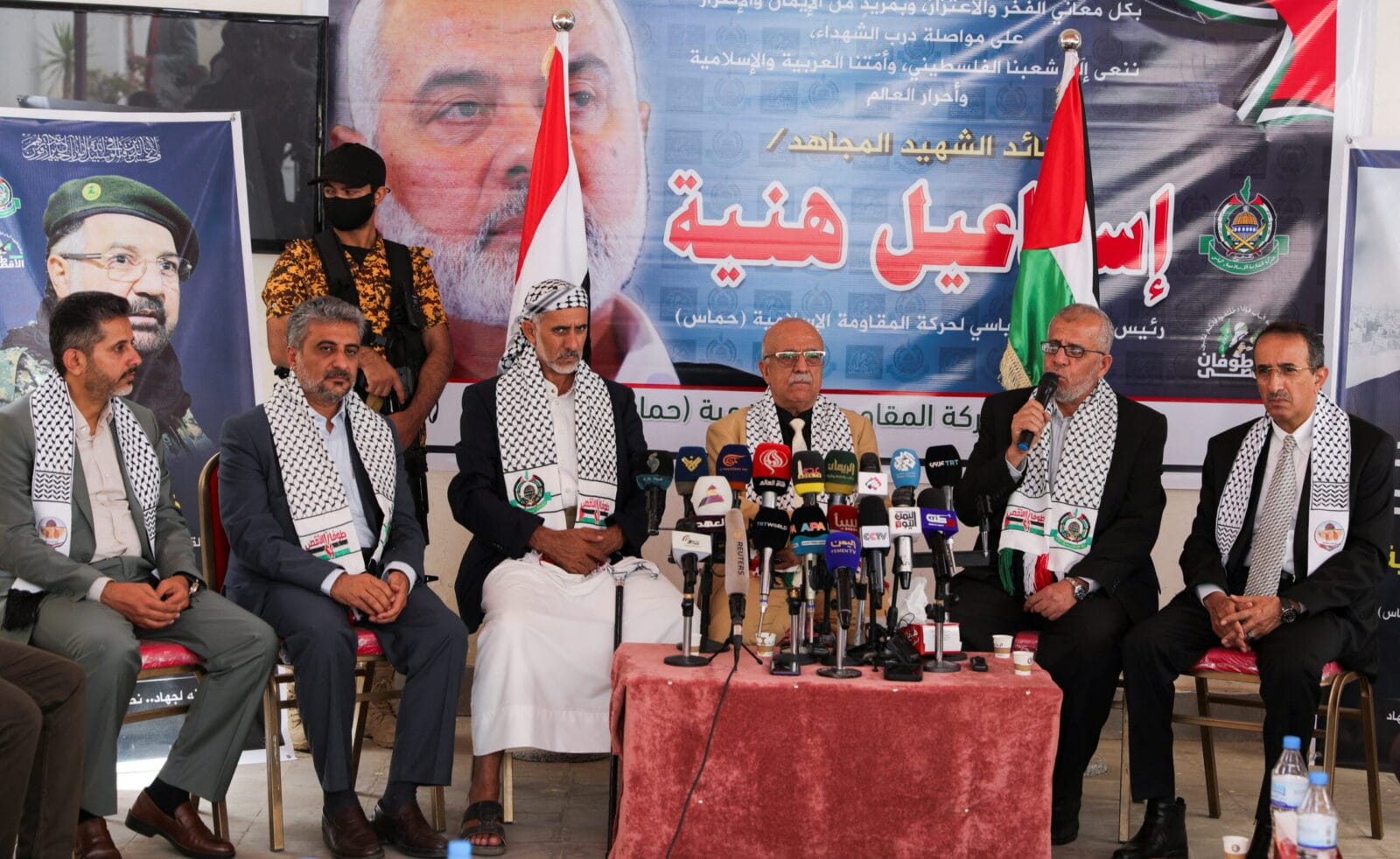
Head of the Houthi-led government Ahmad al-Rahawi (3rd from right) and members of his government listen to the representative of Hamas in Yemen, Muadh Abu Shammalah, during their visit to the Hamas office in Sanaa, Yemen on August 19, 2024\. Khaled Abdullah/Reuters
In the year since, in support of the Palestinians under siege and genocide in Gaza, Ansar Allah have fired multiple projectiles against Israel, one of which successfully evaded Israeli air defenses in July 2024 and reached [Tel Aviv](https://www.theguardian.com/world/article/2024/jul/19/yemen-houthis-claim-deadly-drone-attack-on-tel-aviv-israel), killing one person. Later attacks wounded some and damaged infrastructure, including Ben Gurion airport [on September 15](https://www.aljazeera.com/news/2024/9/15/missile-fired-from-yemen-lands-in-israel-setting-off-sirens-military-says). The majority of their attacks have been on maritime trade in the Gulf and the Red Sea, significantly impacting international trade through the Suez Canal as well as traffic in Israel’s ports: Eilat has almost ceased operations, and in July 2024, the port declared bankruptcy.
Their actions contrast sharply with the passivity, not to say complicity, of the Arab states in the Arabian Peninsula and beyond, which, although making various tepid statements about Israel’s war, are helping get imports to Israel by facilitating overland transit from UAE ports through Saudi Arabia, Egypt and Jordan.
The Houthi movement has achieved worldwide prominence (and significant global popularity) as a key actor in the resistance to Israeli aggression and a member of the Axis of Resistance. Ansar Allah’s relationship with Iran, meanwhile, has been subject to widespread disinformation by international media and US and British policymakers, who tend to deny Houthi agency by describing them as mere Iranian proxies, in the narrowest sense of that word.
Both international support for and opposition to Houthi interventions in the Red Sea are largely based on ignorance of the nature of their rule in Yemen. Writing in these pages in 2023, [Stacey Philbrick Yadav noted](https://www.merip.org/the-houthis-sovereign-solidarity-with-palestine-2/) this tendency toward oversimplification in discussions of the Houthis and offered a short analysis of Ansar Allah’s relationship to Palestine. Below is a more detailed outline of the movement’s roots, the nature of their governance over millions of Yemenis and an analysis of Ansar Allah’s developing role in the Resistance Axis in light of shifting regional dynamics over the last year.
## **The Houthi Movement’s Oppositional Roots**
Ansar Allah has its roots in the Sa‘ada governorate in the northwest of Yemen.
The region is the heartland of the Zaydi branch of Shi’a Islam, which historically dominated politics in northern Yemen. Until the 1962 revolution that created the Yemen Arab Republic, the ruling imams were Zaydis, who claimed descent from the Prophet and are part of the social group that Yemenis call *sada*. After the revolution, tribesmen dominated, and the *sada*—though retaining social status and influence—were politically marginalized.
When President Ali Abdullah Salih came to power in July 1978, one of the mechanisms he used to control the country was to encourage social and political conflict at the local level. In Sa’ada, these efforts took the form of allowing the rise of Sunni Salafism. Muqbil al-Wadi’i, a Zaydi who converted to Salafism during his years in Saudi Arabia, established the *Dar al-Hadith* (House of Hadith) religious community in the early 1980s in a village close to Sa’ada city, the regional capital.[\[1\]](#%5Fedn1) The community attracted thousands of Yemenis and foreigners who lived there and proselytized, building a strong Salafi movement which remains politically significant throughout Yemen today.
> **Al-Houthi’s movement was a “catalyst which could unite the interests of all those in Sa‘ada and beyond who felt economically neglected, politically ostracized and religiously marginalized.”**
In response to this threat, Hussain al-Houthi started the Zaydi *al-Shabab al-Mu’min* (Believing Youth) movement in 1992\. Al-Houthi’s movement was a “catalyst which could unite the interests of all those in Sa‘ada and beyond who felt economically neglected, politically ostracized and religiously marginalized.”[\[2\]](#%5Fedn2) In the following decade, the revivalist movement grew, forming an active opposition to the rising Salafi movement in the same area. While Hussain al-Houthi was a member of the Yemeni Parliament from 1993 to 1997, later disagreements with the Salih government led to the first military uprising in 2004.
The Believing Youth formed the core of the movement opposing the Salih government. It increased in strength and membership during the six wars that followed between Salih and the opposition—in part due to Salih’s indiscriminate destructive tactics and generalized aggression against the northwest, which alienated thousands of tribesmen and others who did not necessarily support Houthi ideology but were infuriated by the exactions of the regime. By the time a shaky ceasefire was reached in early 2010, the Houthis controlled an area well beyond the original heartland around Sa‘ada. The fighting would probably have resumed had the 2011 uprisings not taken place at the national level.
The Houthis joined the 2011 uprisings, though they acted largely independently, maintaining tents in Sana’a’s Change Square for two years, even when most others had left. They were not a party to the 2011 GCC Agreement that created a two-year transitional government, prompting them to begin cooperating with former president Salih to undermine the transition.
In September 2014—as a result of the weakness of the transitional regime and their earlier expansion of territorial control southwards—the Houthis were able to take over the national capital, Sana’a. By early 2015 the transitional government was on the run. Over the following two years, the Houthi movement, which had gradually gained strength at the expense of its alliance with Salih, assassinated him in December 2017, thus achieving full control of about a third of the country’s land and two-thirds of its population.
From 2015 to 2022, the civil war was aggravated by the involvement of a Saudi-led coalition of nine states, including all GCC states except Oman. The key decision-makers in this coalition were Saudi Arabia and the UAE, and their increasing rivalry and support for competing factions within the internationally recognized government of Yemen (IRG) contributed to its weakness and inability to effectively confront Houthi forces.
With the 2022 UN mediated truce, lasting from April to October of that year, Saudi Arabia and the UAE stopped their airstrikes, which had caused massive destruction throughout the country. Since then, small-scale fighting between the different Yemeni forces has taken place on most fronts, though clashes increased in significance in 2024.
## **Houthi Governance**
Politically, the Houthis exercise a highly authoritarian and oppressive rule. Their control of the capital has enabled them to take over all government ministries, where they have ensured that Ansar Allah loyalists determine decision making and control funds. Ansar Allah claims not to want to re-instate the Imamate, but its political actions suggest a vision close to that prevailing in Iran, with a religious leader dominating a government that claims to be democratic. The *sada* currently hold the majority of senior positions in all institutions.
> **Ansar Allah claims not to want to re-instate the Imamate, but its political actions suggest a vision close to that prevailing in Iran, with a religious leader dominating a government that claims to be democratic.**
Although the Ansar Allah government formally includes sections of the General People’s Congress (GPC)—Salih’s former ruling organization—as well as other smaller parties, signs of dissent or of alternative positions have been met with imprisonment and torture. Journalists and civil society activists [have been heavily targeted](https://cpj.org/2021/06/a-slow-death-for-yemens-media-the-countrys-journalists-report-through-displacement-and-exile/). In June 2024, the Houthis arrested and imprisoned more than 60 humanitarian workers,[ including 13 United Nations](https://press.un.org/en/2024/sc15972.doc.htm) staff, accusing them of being US and Israeli spies. The movement has been particularly combative toward the UN Office of the High Commissioner for Human Rights, briefly occupying its Sana’a office [in early August](https://news.un.org/en/story/2024/08/1153121) 2024 after having held a senior staff member in detention since 2021.
Socially, the Houthi government has instituted policies severely restricting women’s mobility and other freedoms, forcing them to be escorted by a *mahram* (a male relative) when moving within and outside of the country and imposing strict conservative dress codes.
Among Ansar Allah’s problems when it comes to governance is finance. Before the war, Yemen was dependent on two primary sources of income: hydrocarbon exports and international assistance. The first has completely dried up since October 2022, when the Houthis prevented oil and gas exports by attacking the relevant ports. Meanwhile, limited international development aid has been replaced by far larger amounts of humanitarian aid, which is a major source of friction: On the one hand, humanitarian agencies try to prevent Ansar Allah’s influence over distribution mechanisms and the selection of beneficiaries. On the other, the Houthis impose restrictive rules governing the activities of international and national humanitarian organizations. This tug of war between Ansar Allah and the UN unfolds in the absence of representatives of the funding states, as most embassies closed in 2015.
Houthi finances also depend on taxation, port fees and customs duties on imports. Given that most basic commodities—wheat and other staples, medication, etc.—are imported, Houthi success in diverting most shipping to the Red Sea ports under its authority in 2023 was significant. Recently, however, this success has been partly undermined by the reduction in Red Sea maritime traffic since their intervention in Israel’s war.
Moreover, the reduction of humanitarian aid since the blockade began has also affected Houthi finances. The World Food Programme ceased its distributions in the areas under Houthi control in December 2023, with only two minor exceptional distributions in some areas benefiting 1.4 million people—a drastic reduction when compared with the 9.5 million who received regular support up to that time. In addition, the UN’s annual Humanitarian Response Plan in 2024 was 60 percent smaller than the previous year and, by the end of the year, had only been financed at 50 percent—worsening the humanitarian crisis throughout the country.
## **Houthi Foreign Policy**
The Houthi’s basic slogan, “al-Sarkha” (the Scream), points to how issues beyond Yemen are at the core of Ansar Allah’s ideology. “Death to America, Death to Israel, Curse on the Jews” are three of its five points, the other two being “God is the greatest” and “Victory to Islam.” Palestine is mentioned frequently at all levels, with the movement’s opposition to Israel, at times, taking the form of antisemitic slogans and chants. But until Israel's war on Gaza started in October 2023, the scream was an ideological assertion without much practical implementation. Even the signing of the Abraham Accords in 2020 provoked little response beyond accusations of betrayal of the Palestinian cause.
The current war in Gaza has given the Houthis an opportunity to live up to their slogan by engaging in direct military action against Israel. Within Yemen, their prestige has risen dramatically as the overwhelming majority of Yemenis, whether under IRG or Houthi rule, are sympathetic to Palestinians, horrified by the ongoing genocide and willing to tolerate the consequences of this support, at least up to now. In Houthi-controlled areas, their actions against Israel have boosted the movement’s popularity, which was deteriorating as their oppressive rule had alienated the majority, who were frustrated by the exactions and other demands on their household finances.
> **...their actions against Israel have boosted the movement’s popularity, which was deteriorating as their oppressive rule had alienated the majority, who were frustrated by the exactions and other demands on their household finances.**
The maritime war has also increased Ansar Allah’s public image worldwide, in particular in majority Arab and Muslim states, where most of the population supports the Palestinian people and deplores what they see as their own leaders’ shameful inaction. In the Global North, Houthi actions in support of Palestinians have given them a positive image among many, particularly on the left.
Moreover, as a result of the US and British attacks on Yemen this past year, Houthis can now claim to be directly fighting the United States, the main imperialist enemy. To date, while these strikes have been limited and have [degraded Houthi ability](https://www.janes.com/osint-insights/defence-news/sea/us-navy-5th-fleet-commander-says-houthi-operations-are-degraded) to attack shipping, they have not had a significant impact. Between the launch of Operation Poseidon Archer in January and November 2024, the United States and Britain have used 601[ munitions](https://navigator-bs.gmx.com/mail?sid=bbbb7999f2f43c9b72445fe254664a9757e796676c315d63e6a0f59428a8d906934d594f8468196caffef1a92821aabc) in 279 air strikes to minimal effect. In that period the Houthis successfully sunk two ships and [damaged more than 80 others](https://www.washingtonpost.com/world/2024/08/21/yemen-houthi-rebels-red-sea-ship-attacks/46287ec4-5f94-11ef-ae22-cef4d8785d67%5Fstory.html).
## **Relationship with Iran and the Axis of Resistance**
Houthis have had meaningful relations with Iranian religious leaders for decades, with many members of Ansar Allah having spent time studying in Iranian religious institutions.[\[3\]](#%5Fedn3) Badr al-Din al Houthi, father of Hussain al-Houthi and the current leader, Abdul Malik al-Houthi, studied in Iran’s Qom. He was deeply influenced by Ayatollah Khomeini—an influence evident in the Scream. He returned home with political ambitions and reforms intended to create a body of followers distinct from mainstream Zaydism. Though the movement remains Zaydi, it has institutionalized a number of religious and secular [ritual celebrations](https://sanaacenter.org/publications/analysis/22797), which were previously largely ignored in Yemen, including Scream Day, Popular Revolution Day, Resilience Day, Martyr’s Day and the Prophet’s birthday.
> **...since 2015, with the internationalization of the civil war, Iranian practical support for the Houthis has become more active and increased.**
Salih accused Iran of supporting the Houthis as early as the Sa’ada wars (2004–2010), a claim the United States dismissed at the time as a “disingenuous attempt to garner Western and Sunni Arab support.”[\[4\]](#%5Fedn4) But since 2015, with the internationalization of the civil war, Iranian practical support for the Houthis has become more active and increased. It now includes political and financial support in the form of free fuel deliveries to the Houthis.
Militarily, in recent years the Houthis have exhibited a greater competence, in terms of strategy, tactics and equipment. Much of the latter is now manufactured locally. In [September 2022](https://www.presstv.ir/Detail/2022/09/23/689678/Yemen-Revolution-anniv), for instance, they held a three hour military parade in Sana’a, with tens of thousands of soldiers and a wide variety of missiles and other weapons.
The most sophisticated drone and missile components undoubtedly come from Iran, either directly or indirectly. Most smuggled items land in the far east of Yemen, in al-Mahra governorate, and then must cross more than a thousand kilometers of IRG-controlled territory before reaching Houthi territory across multiple checkpoints that cover the country (indicating either incompetence, corruption or both among the internationally recognized government). Some components also arrive by sea, thanks to assistance from smugglers and others in the Horn of Africa, who access the Yemeni Red Sea coast, despite the vast deployment of naval forces in the area. There have also been rumors of a few advisors from the Iranian Islamic Revolutionary Guard Corps and from Lebanon’s Hizballah helping to train Ansar Allah’s armed forces. But reliable publicly available evidence for these claims is largely absent.
With its numerous successful interventions in the Red Sea and attacks on Israel, Ansar Allah, over the past 15 months, has become a leading member of the Axis of Resistance, whose main participants are Hamas and Hizballah. Its other members, various Iraqi and Syrian militias, play a lesser role. In June 2024, Houthi military spokesperson, Yahya Saree, claimed the first [joint operation with the Islamic Resistance of Iraq](https://www.aljazeera.com/news/2024/6/23/yemens-houthis-claim-joint-raid-on-israeli-ships-with-iraqi-militia), which hit two cement tankers and two cargo ships in Israel’s Haifa port. Other attacks have followed.
## **Looking Ahead**
Ansar Allah has been clear that its attacks on Israel and shipping are in support of Gazan, Palestinian and now Lebanese resistance and would stop when Israel ceases its genocide and opens Gaza to humanitarian aid. Following the implementation of the first phase of the ceasefire between Israel and Hamas, agreed to in January 2025, [the Houthis have released](https://www.aljazeera.com/news/2025/1/22/yemens-houthis-release-crew-of-seized-ship-after-gaza-ceasefire-deal) the crew of a siezed ship and halted their campaign. But they have been clear that they will resume their actions if Israel reneges on the ceasefire.
At the same time, however, support for the Houthis in Yemen over their domestic policy is dwindling, as living conditions continue to deteriorate.
The impact of Houthi actions on the Arabian Peninsula is particularly notable, evidenced by the deafening Saudi silence: In the face of its population’s support for Palestinians, and as a side-effect of Houthi actions, the Saudi regime has bowed to Houthi demands in its financial war against Yemen’s internationally recognized government. In July 2024, Saudi Arabia pressured the IRG to withdraw its attempt to cut off Sana’a based banks from the international SWIFT system. This step further weakened an already weak and divided entity. These developments are unwelcome for many Yemenis, for whom a stronger Houthi rule means increased repression of the population and a closing down of civil society and dissent.
\[**Helen Lackner** is the author of *Yemen in Crisis* (Saqi Books, 2023).\]
---
### **Endnotes**
[\[1\]](#%5Fednref1) Laurent Bonnefoy, *Salafism in Yemen, Transnationalism and Religious Identity* (London: Hurst, 2011).
[\[2\]](#%5Fednref2) Marieke Brandt, *Tribes and Politics in Yemen, a History of the Houthi Conflict* (London: Hurst, 2017), p. 37.
[\[3\]](#%5Fednref3) Walter Posch, “Iran’s relations with Yemen; Ideological and strategic aspects,” in Stephan Reiner, Alexander Weissenburger, eds., *Yemen at a crossroads, What remains of Arabia Felix?* (Vienna: National Defence Academy, 2024), pp. 90–91.
[\[4\]](#%5Fednref4) Quoted in Helen Lackner, *Yemen in Crisis, Devastating Conflict, Fragile Hope* (London: Saqi Books, 2023), p. 188.
### Iran, Palestine and the Axis of Resistance
URL: https://www.merip.org/2025/01/iran-palestine-axis/
Last updated: 2026-03-02T15:50:34.000Z
Tehran's *meydan-e Felestin*—Palestine Square—is a historic site when it comes to the country's relations with Israel and Palestine.
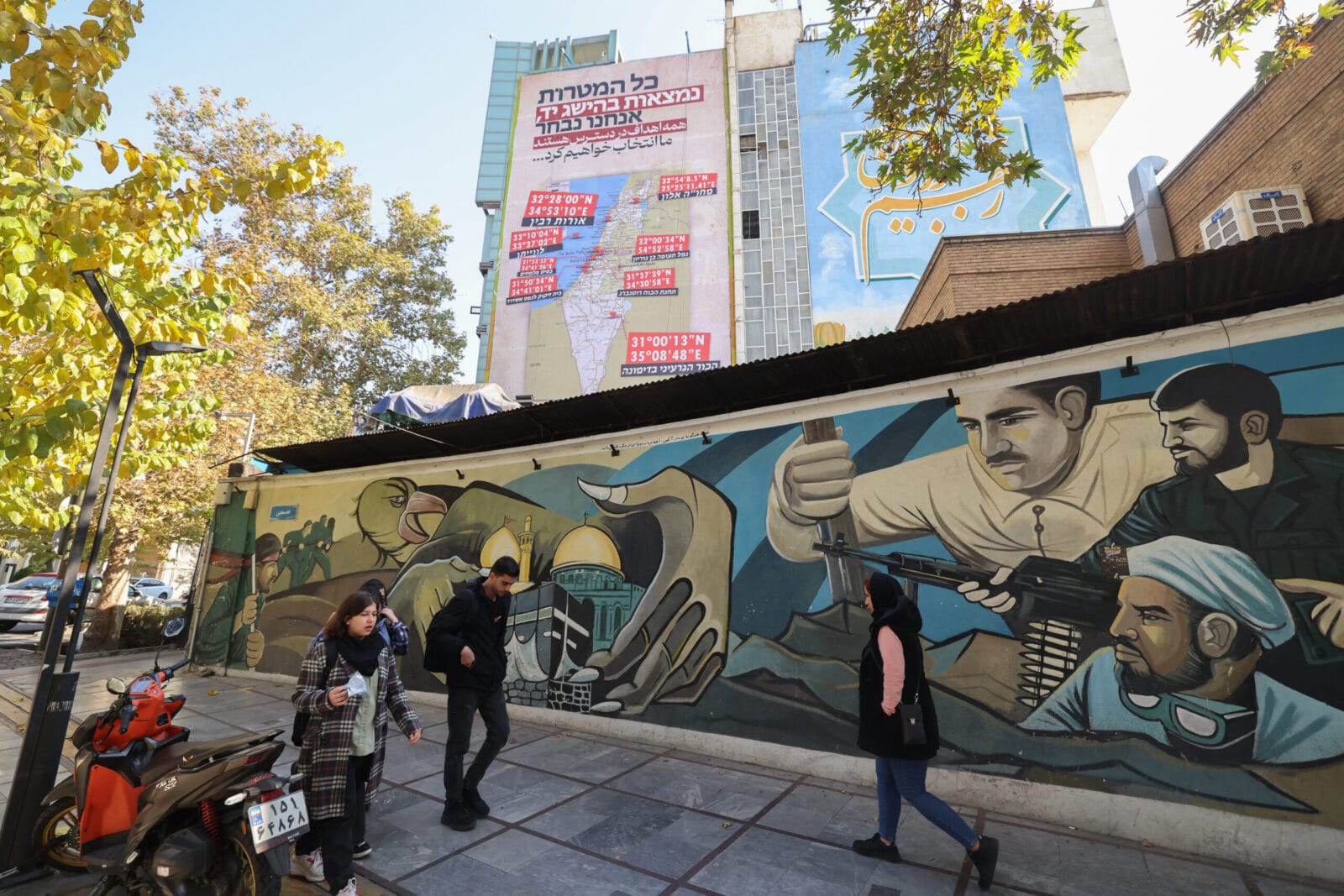
In Tehran's Palestine Square the far mural on the tall building displays slogans on a map pointing at Israeli cities that read in Hebrew: "All targets are within reach, we choose" (top) and in Farsi: "All the targets are available, we will choose" on December 4, 2024\. Atta Kenare/AFP via Getty Images
Before the 1979 revolution, it hosted Israel’s embassy and went by a different name: *Kakh* (Palace) Square. In February of 1979, days after the revolution's victory, the new government hosted a friendly reception of Yasser Arafat and his team. The building was handed over to the PLO as the Palestinian embassy, and the square was renamed.
Today, a large billboard stands on the perimeter of the square, with a built-in electronic counter projecting giant red numbers that count down the days until the demise of “the Zionist Regime”—the official term used by Iran to refer to Israel as it does not recognize the state.
The billboard was erected by the Basij office of Tehran City in 2015, following the signing of the Joint Comprehensive Plan of Action, also known as the Iran Nuclear Deal. At the time, Ayatollah Ali Khamenei, Iran’s Supreme Leader, claimed on his Twitter account that Israeli officials had announced they “have no more concern about Iran for the next 25 years.” Khamenei reacted by announcing “God willing, there will be nothing as Zionist Regime by next 25 years.”[\[1\]](#%5Fedn1) The counter, which started at about 9,125 days (or 25 years) is embedded within the words, “only \[X\] days remaining to the annihilation of Israel” in Persian, English and Arabic iterations. There is no time-sensitive action planned in parallel to the counting, which is itself faulty. Every so often, the screen malfunctions and pauses.
The messaging of the billboard clock reflects the nature of Iran’s support for Palestinian liberation, even before the events of October 7, 2023 and the recent series of blows to the Axis of Resistance. Since the 1979 Revolution, despite exaggerated discursive aggression, Iran has hesitated to engage with Israel directly. Palestine has rarely been a central agenda item of Iran's foreign policy due to both a steadfast Iran-first policy and to the country's lack of conventional political and military capacity to resolve the conflict in the way it promises in its propaganda.
Iran's support for its non-state allies in the region, including Hizballah, Hamas and the Houthis, justified in terms of pro-Palestinian resistance, works in large part to expand its own political and military influence in the region within the Islamic Republic’s ideological boundaries. Iran's policies around Palestine must align with its geostrategic interests—an approach that has raised problems for the state amid the latest regional war.
## **Propaganda and Practice**
From the first post-revolutionary days, Iran’s religious leaders have faced a dilemma when it comes to supporting Palestine. All strands of Iranian revolutionaries wanted to demonstrate their solidarity with the globally prominent plight of Palestinians. But while Muslim-Marxist groups boasted their ties with the Palestine Liberation Organization (PLO), Islamist clerics were uneasy endorsing the secular, left-leaning flag bearers of the Palestinian liberation movement. Conservative newspapers at the time, for instance, adopted the language of being anti-Israel, rather than pro-Palestinian, in order to avoid any mention of the PLO.[\[2\]](#%5Fedn2)
In general, the dominant post-revolutionary agenda among clerics close to Ayatollah Khomeini was focused more on establishing Iran’s Islamist, anti-imperial identity, while support for Palestine was limited in practice. The Liberation Movements branch of the newly formed Islamic Revolutionary Guards Corps (IRGC) was involved in anti-Israeli military activism in collaboration with international groups including the PLO. Activists in charge of this branch had cooperated with the PLO in Syria and Lebanon before the 1979 revolution and trained a few Iranian guerrillas for the fight against the Shah. After the revolution, they insisted on continuing their cooperation with liberation fighters outside of Iran, most prominently the PLO. But the branch was marginalized from the beginning and disbanded by mainstream proponents of an Iran-focused IRGC by 1982.
During Israel’s 1982 invasion of Lebanon, a group of Iranian military and political elite sent forces to Lebanon to fight against the invasion. Exact numbers are unclear, but as many as two battalions of infantry forces were transported to Syria for this purpose along with a few young IRGC commanders who had already become prominent figures in Iran’s ongoing fight against Iraq. Another strata of the political elite, however, including Ayatollah Khomeini, disagreed with the move, emphasizing the need to keep Iranian forces engaged with Iraq instead. The IRGC Commander in Chief at the time, Mohsen Rezaei, said in a speech: “As long as the Ba’ath Regime is in power in Iraq, there is nothing we can do with Israel.”[\[3\]](#%5Fedn3) This stance was a precedent to the slogan that dominated Iran’s campaign in later years of the Iran-Iraq war, "the road to Jerusalem goes through Karbala.”
> **The perceived capitulations of the Palestinian leadership to US and Israeli interests—and the ultimate failures of Oslo to grant Palestinians sovereignty—opened new space for Iran to assume the mantle of resistance to Israel in the region.**
Distancing itself from the PLO, Iran gradually started to reach out to other, nascent, Palestinian groups such as the Palestinian Islamic Jihad and Hamas. The 1993 Oslo Accords, and Iran’s decision not to endorse them, provided a decisive break with the PLO. The perceived capitulations of the Palestinian leadership to US and Israeli interests—and the ultimate failures of Oslo to grant Palestinians sovereignty—opened new space for Iran to assume the mantle of resistance to Israel in the region. Refusing to endorse the Oslo Accords, Iran touted its anti-imperialist ideology: a stance that at least one Arab ally had previously called "being more Palestinian than Palestinians themselves."[\[4\]](#%5Fedn4)
Iranian statesmen found a key ally in Hamas since the group advocated for political Islam and was not content with a two-state solution that could potentially—albeit unjustly and temporarily—end the conflict. Indeed, the failures of Oslo served Iranian interests in so far as Oslo undermined any real prospects for peace and shifted the framework for resistance, especially with the rise of Hizballah both as a vanguard of anti-Israeli resistance and a staunch Iranian ally. When the Syrian civil war began in 2011, Iran’s geostrategic priorities took precedence over its relationship with its Palestinian non-state allies: While Hamas sided with the opposition to bring down Asad’s dictatorship, Iran joined forces with Hizballah and Russia to make sure its oldest state ally remained in power.
From the start of Israel’s genocidal war on Gaza, the Iranian government has been vocal against Israeli aggression, while remaining restrained when it comes to action. Shortly after Israel began its bombardment of Gaza, for instance, Iranian governmental agencies created a portal for citizens to register to be dispatched to Gaza to fight alongside Palestinians. The campaign—advertised with the slogan “I am your match \[*harifat manam*\]”—was directed at the Israeli state and army. In January 2024, the counter on the portal claimed that more than 10 million Iranians had signed up. Even if the number were to be trusted, officials did not have an actual program for sending fighters to Gaza. The campaign was a symbolic one. In fact, while pro-Palestine marches erupted across the world bringing hundreds of thousands to the streets week after week, the Iranian government, experienced in mobilizing supporters and mercenaries for pro-government demonstrations, produced nothing of the sort.
Iran’s two direct attacks on Israel during 2024—on April 13 and October 1—represented an escalation compared to previous indirect encounters between the two countries. Both were in response to Israeli attacks: the first to Israel’s strike on Iran’s consulate in Syria and the second to the assassination of Hasan Nasrallah (in Lebanon) and Ismail Haniyeh (in Iran). The attacks were carefully calculated so as not to risk a full-blown confrontation with Israel. While the depth of the damage caused by the attacks is unclear due to a lack of transparent reporting from within Israel, they did not slow down the onslaught in Gaza.
After Israel's latest aerial offensive on Iran in October 2024, which reportedly targeted military bases and killed at least one civilian and four soldiers, in conjunction with Hizballah’s weakening and Bashar al-Asad’s demise, it is unclear what the next level of escalation between Iran and Israel might be. Significantly clearer, however, is that even the hardliners in the Iranian government are aware how dire a full-scale confrontation with Israel would be in practice, despite 45 years of threatening propaganda. Asad’s fall and, with it, the severance of Iran’s main supply route for Hizballah, has thus widened the gap between Iran’s propaganda and the probability of its action.
## **The Axis and Palestine**
Members of the Axis of Resistance, like Hizballah, Hamas, Iraq's Hashd al-Sha’bi (Popular Mobilization Forces) and Yemen's Ansar Allah (the Houthis), rely heavily on Iranian political, financial and military support. Their activities against Israel, however, are not necessarily planned and conducted in coordination with Iran. Indeed, what is neglected when evaluating these entities as anti-Israeli "Iran proxies" is both their independence of action from Iran and their general geostrategic significance for Iran aside from the issue of Palestine.
> **...what is neglected when evaluating these entities as anti-Israeli "Iran proxies" is both their independence of action from Iran and their general geostrategic significance for Iran aside from the issue of Palestine.**
Common wisdom among Global North politicians is heavily shaped by the Israeli narrative, which portrays these militias as a [network of Iran-controlled nodes](https://www.thetimes.com/comment/columnists/article/the-times-view-iran-proxy-wars-tehran-tentacles-9lvrwwgf7) across the Middle East with the common goal of posing a threat to Israel. This picture has served Israel’s hawkish aims in the region, but it does not accurately reflect Iran’s role.
First, not all these proxies have similarly close ties to Iran. Hizballah has had the most consistent relationship with Iran and has been the most congruent in terms of sectarian identity and ideological goals. The group was created with significant help from Iran, in the image of Iran's Islamic Revolutionary Guards Corps and in the context of a variety of active Iran-backed groups in Lebanon. These entanglements have enabled Hizballah and Iran to maintain close ties over the past four decades. Even with this level of affinity, however, Hizballah’s resistance to Israel, including the occasional rockets fired into northern Israel after October 7, were likely decided independently from Tehran. Likewise, while groups like Hamas and Ansar Allah have conducted operations in support of the Palestinian cause, which were—at least partially—enabled by the financial, strategic and military assistance provided by Iran over the years, these actions were not necessarily initiated by Iran.
Second, the relationship between Iran and the militias it sponsors is not always stable. Hamas’s history with Iran, for instance, has been tumultuous at times. In addition to the group distancing itself from Iran when Iran and Hizballah backed Asad’s repressive campaign in Syria after the 2011 uprising, the attack of October 7 was itself a prominent example of Hamas acting independently of Iran. Iran was caught by surprise, [according to US intelligence](https://edition.cnn.com/2023/10/11/politics/us-intelligence-iran-hamas-doubt/index.html). Moreover, the October 7 attack has not served Iran’s interests: Not only has it increased the threat of conflict escalation between Iran and Israel, but the timing was detrimental for Iran as the state was approaching mild normalization with both the United States and Saudi Arabia in search of some relief from suffocating economic sanctions. Iran nonetheless tried to claim an indirect part in the attacks: [On December 27, 2023](https://english.alarabiya.net/News/middle-east/2023/12/27/Iran-s-IRGC-says-Oct-7-attacks-on-Israel-were-revenge-for-Soleimani-Hamas-denies), an IRGC spokesperson claimed that Operation Tufan Al-Aqsa was in part a retaliation for the US assassination of IRGC commander Qassem Soleimani in 2020—a claim Hamas swiftly denied.
Third, even when allegiances are solid, these militias still act independently of Iran. For example, the Iraqi Hashd al-Sha’bi receives generous aid from Iran, to which it is generally loyal. But [researchers have shown](https://icsr.info/2018/05/30/battlefield-ballot-box-contextualising-rise-evolution-iraqs-popular-mobilisation-units/) that their everyday conduct is fairly independent: It is mainly Iraq's internal dynamics, and not Iranian interests, that preoccupy Iran-affiliated militias in their day-to-day business.
Of course, it is not the case that Iran has held no influence over the events that transpired around Israel’s genocidal campaign in Gaza: Hizballah's exchange of fire with Israel in Southern Lebanon and the Houthi's targeting of cargo ships have been enabled by Iranian support. Given Iran's general calculus in favor of keeping military confrontation minimal and the militias' history of independent strategizing in the past, however, it is likely they were not coordinated with Iran.
The damage inflicted upon Hamas and Hizballah by Israel, followed by the fall of Bashar al-Asad in December 2024, has severely undermined Iran’s unconventional alliance network in the Middle East. Not only was Asad Iran’s oldest and strongest ally in the region, but his government also guaranteed a sustained supply route to Hizballah. As a result, Iran has limited foreign policy choices to pick from today.
For decades, Iran has facilitated the material conditions for armed resistance to Israel in line with its own ideological and geopolitical ends, while the United States and Israel have used Iran’s exaggerated propaganda and its support of pro-Palestinian resistance to justify their aggressive, imperialist policies in the Middle East. As the terrain shifts in light of the ceasefire agreement (which may or may not hold) and the new Trump administration, Iran will continue to prioritize its own strategic interests. What this will mean for Palestine, or for the groups that rely on Iranian support, remains to be seen. Resistance, however, does not end with the Axis.
> **Read the** [**previous**](https://merip.org/2025/01/a-primer-on-lebanon-history-palestine-and-resistance-to-israeli-violence-2) **article. Read the** [**next**](https://www.merip.org/yemens-ansar-allah/) **article.**
**This article appears in** [**MER issue 313**](https://merip.org/magazine/313/) **“Resistance—The Axis and Beyond.”**
\[**Maryam Alemzadeh** is associate professor at the Oxford School of Global and Area Studies (OSGA) and a Middle East Centre Fellow.\]
---
### **Endnotes**
[\[1\]](#%5Fednref1) [Post by @khamenei\_ir](https://x.com/khamenei%5Fir/status/641520641724780544), X, September 9, 2015.
[\[2\]](#%5Fednref2) Maryam Alemzadeh, “The Islamic Republic Party and the Palestinian Cause, 1979-1980: A Discursive Transformation of the Third-Worldist Agenda,” in Rasmus C. Elling and Sune Haugbolle, eds., *The Fate of Third Worldism in the Middle East: Iran, Palestine and Beyond* (Oneworld Academic, 2024).
[\[3\]](#%5Fednref3) Alireza Lutfullahzadegan, et al., *Ruz'shumar-i jang-i Iran va ʿIraq : ʿubūr az marz, taʿqib-i mutajaviz* (Tehran: Markaz-i Asnad-i Taḥqiqat-i Difaʿ Muqaddas, 2010), p. 217 (translated by the author).
[\[4\]](#%5Fednref4) Diary entry from March 2, 1983 attributed to Algeria’s speaker of the parliament in: Fatemeh Rafsanjani and Ali-Akbar Rafsanjani, *Hashimi Rafsanjani: karnamah va khatirat-i 1361: pas az buhran* (Tehran, 2001). (Translated by the author).
### A Primer on Lebanon—History, Palestine and Resistance to Israeli Violence
URL: https://www.merip.org/a-primer-on-lebanon-history-palestine-and-resistance-to-israeli-violence-2/
Last updated: 2026-03-30T16:14:27.000Z
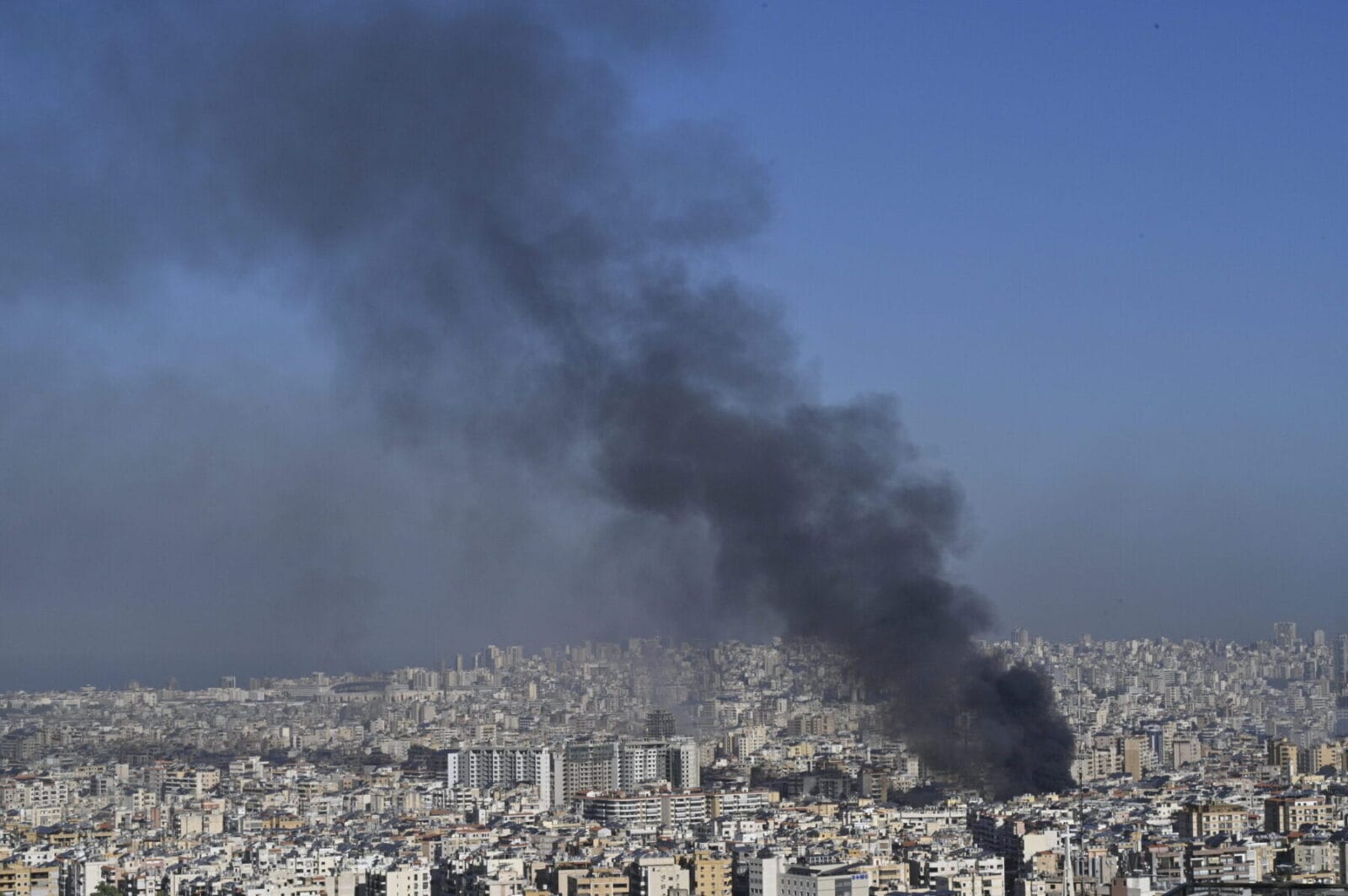
Smoke rises after an Israeli airstrike on Beirut, Lebanon on October 3, 2024\. Houssam Shbaro/Anadolu via Getty Images
On September 17, 2024, pagers exploded across Lebanon, indiscriminately killing at least 32 people and blinding or otherwise maiming thousands. The next day, walkie-talkies exploded, again killing and maiming indiscriminately. In the days that followed, Israeli warplanes continued to bombard Lebanese towns, villages, apartment buildings and infrastructure. One of the largest attacks, on Friday, September 27, saw Israeli airstrikes dropping 80 tons of bunker busting explosives on Haret Hreik, flattening several buildings and assassinating the secretary general of Hizballah, Sayyid Hassan Nasrallah, along with two of his advisors. These strikes began a dramatic escalation of aerial and sea bombardment, primarily of the southern suburbs of Beirut, the Beqaa Valley and the south. Israeli attacks further widened to include the Jbeil district north of Beirut, the Bashoura neighborhood in central Beirut and the Cola area—one of the major arteries into and out of Beirut and a significant transportation hub. The strikes, some of which targeted densely populated areas, were, to date, the most destructive in Lebanon’s history. On September 30, the Israeli military began a ground invasion of Lebanon. The ensuing Israeli attacks killed thousands, wounded thousands more and displaced over one million people in Lebanon.
These attacks were part of an expanded Israeli war machine that has carried out a 15-month long genocide in Gaza, in the process targeting Syria, Yemen, Egypt and Iran and threatening a wider regional war. They are also the latest in a long history of Israeli violence in, and on, Lebanon, justified by the Israeli state as being [“targeted”](https://www.reuters.com/world/middle-east/israel-continue-ceasefire-discussions-lebanon-netanyahu-says-2024-09-27/) toward groups it considers terrorist. In the past it was the Palestine Liberation Organization (PLO) and the leftist Lebanese National Movement. Currently, it is Hizballah.
For Lebanon, the 2024 assault marked the country’s deadliest days since the civil war’s end in 1990\. It also took place in the context of a sequence of crises that began with the popular uprising in 2019, and its subsequent repression, and continued through the Covid pandemic, Beirut port explosion, a power vacuum and an economic collapse from which Lebanon had only just begun to recover. These crises are indelibly linked to Lebanon’s positioning vis-a-vis multiple powers in the region and beyond. In its relatively short history since 1920, Lebanon has been the object of avaricious interests driving various interventions that have been both a boon and a detriment to the tiny country. It has also been plagued by a corrupt and nepotistic political class. Since World War II, Beirut—and Lebanon more broadly—has served as a political, cultural and social refuge for Arab populations and ignominious political figures alike. Lebanon has long had a freer press than any other Arab country, and its constitution guarantees the freedom of religion, expression, assembly and association. Different universities in Lebanon have curricula in English, French, Armenian and Arabic and are not subject to government censorship. These factors have made Lebanon an important publishing and arts center, as well as a popular higher education destination for the entire region.
Because Lebanon’s ports and overall economy were relatively well developed, it served as an economic gateway for and to Syria. Oil interests also came into play, as the country was used by US military and civilian planners to ensure access to petroleum, military bases, air transportation and commercial expansion in the region.[\[1\]](#%5Fedn1) Meanwhile, elite families in Lebanon used British, French and US-led commercial contracts to grow their fortunes. With the oil boom in the 1970s, Gulf oil producers and other investors poured funds into Lebanon’s banking industry, which has boasted banking secrecy laws since the 1950s (slightly amended in 2022). Lebanon’s tourist and service sectors expanded in the 1960s, in part due to Gulf interests, and employed not only working-class Lebanese, but Palestinian, Syrian and other migrant labor. The United States has also intervened to support the Israeli state, which has regularly inflicted violence on civilians in Lebanon. Even before the Israeli state’s establishment, Zionist visions for its borders included southern Lebanon and the waters of the Litani River.
Regardless of who is in power in Lebanon or who is leading the resistance, the country’s strategic interests vis-a-vis the Israeli state have remained relatively consistent since 1948\. They are: the Right of Return for Palestinian refugees in Lebanon, liberating Lebanese land occupied by the Israeli state, securing natural resources like water and gas and ending the Israeli military’s violations of Lebanon’s land, sea and air space.
This primer situates the latest Israeli war on Lebanon and resistance to it within the broader context of Lebanon’s political development and its relationship to Palestine. The primer begins by offering a historical overview of Lebanon’s formation that describes the role of external and internal forces in shaping the country throughout the twentieth century ([Part I](#part-one) and [Part II](#part-two)). It then details how regular Israeli violence as well as Palestinian and Lebanese resistance movements and political parties fit into this trajectory ([Part III](#part-three)). The primer ends with an explanation of the series of recent crises that have exacerbated the devastating effects of the latest Israeli attacks on Lebanon and its ongoing ceasefire violations ([Part IV](#part-four)).
# **I. Creating New States and New Centers—Ottoman to Mandate Period**
### **Ottoman Empire**
There was no “Lebanon” during the Ottoman period. What often gets discussed by pundits and in some scholarly corners as “Ottoman Lebanon” largely centers around Mount Lebanon, which became the geographical-ideological locus of the post-World War I mandatory state. Instead, in the eighteenth and nineteenth centuries, the cities and towns that would later constitute Lebanon were part of the same Ottoman administrative districts that would be separated into the mandates of Palestine, Lebanon and Syria. As a result, the communities of what would comprise northern Palestine and southern Lebanon were deeply enmeshed with one another and would remain so into the first half of the twentieth century.
During the Ottoman reform period called the Tanzimat (1839–1876), the empire reorganized its administrative districts into *vilayets* (governorates). For example, the vilayet of Syria (al-Sham) came to include the area from Aleppo south to Aqaba and from the Mediterranean east to the Syrian desert, with the exception of Mount Lebanon, which was governed as a semi-autonomous province, or *mutasarrifiyya,* after 1861\. During this period, the Ottoman state also separated Jerusalem, Jaffa, Hebron and Gaza from the vilayet and governed this area directly, leaving Nablus, Acre, Haifa and the Galilee in the vilayet of Syria.[\[2\]](#%5Fedn2)
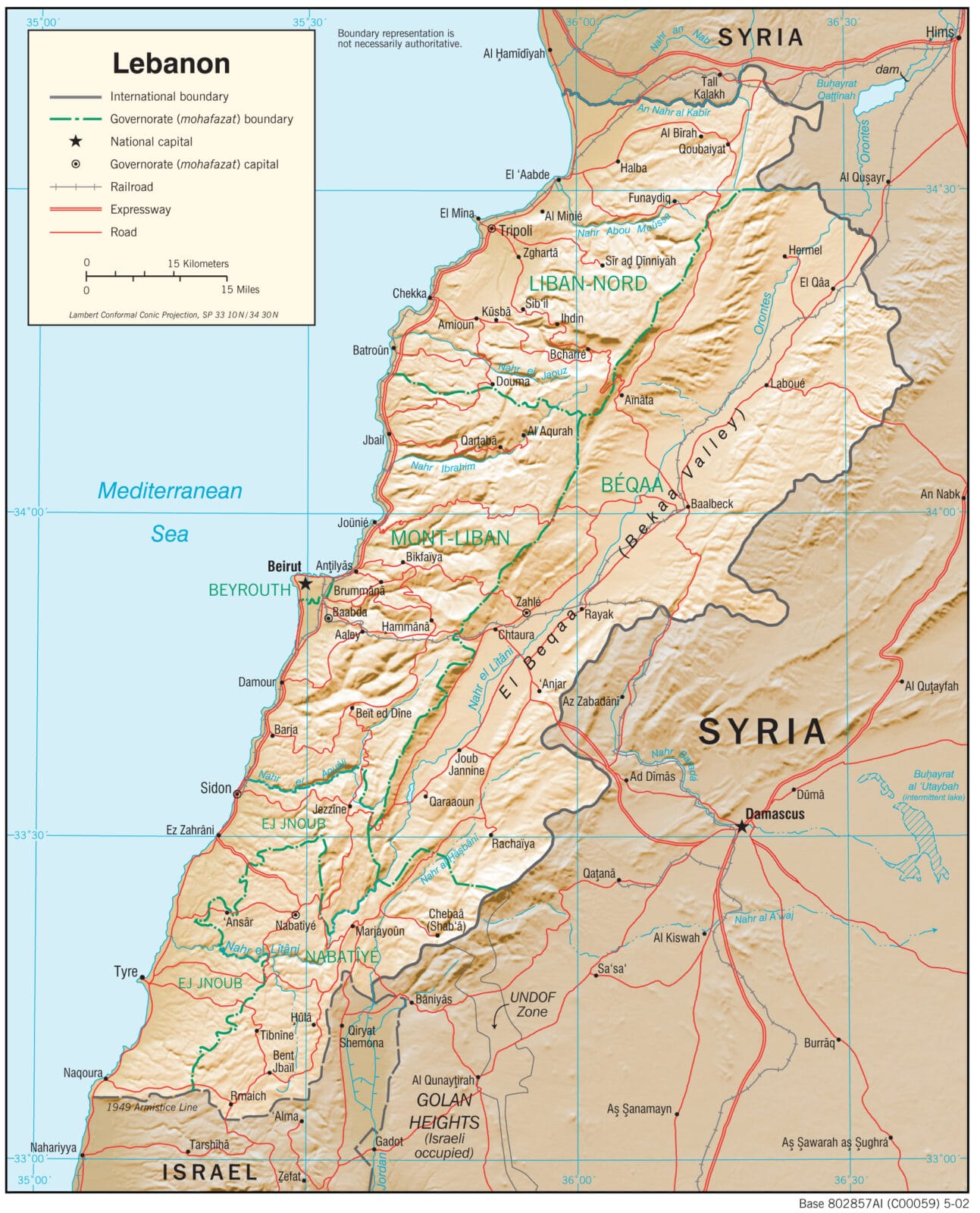
Map of Lebanon, 2002, CIA.
Shortly thereafter, the Ottoman state further separated the northern and central parts of Palestine from the vilayet of Syria, attaching them to the newly established vilayet of Beirut, which included Acre, Nazareth, Nablus, Tripoli, the Beqaa and Latakia—areas that would constitute post-World War I Palestine, Syria and Lebanon. Before it became the capital of this new province, Beirut had been a small port town, whose economic significance paled in comparison to the major port cities of Tripoli, Sidon and Haifa.
At the outbreak of World War I, the Ottoman Empire joined the Central Powers. A combination of Ottoman food requisitioning, an allied naval blockade and local war profiteering triggered a devastating famine in Ottoman Syria that led to the death of one in six civilians and carried repercussions for Lebanon’s postwar boundaries.[\[3\]](#%5Fedn3)
### **French Mandate and Independence**
Following World War I, the Allied victory meant the dismantling of what remained of the Ottoman Empire. The 1916 Sykes Picot agreement that divided the Ottoman Arab provinces between France and Great Britain was enshrined, with some changes, by the League of Nations as postwar mandatory states.[\[4\]](#%5Fedn4) Britain received the mandate over Iraq and Palestine, and the latter was split into the mandates of Palestine and Transjordan in 1922\. France received the mandate over Syria. In 1920, France carved Greater Lebanon out of Syria, combining Mount Lebanon with Tripoli, Beirut, Sidon, Tyre, ‘Akkar and the Beqaa Valley. The French had included the latter territory to prevent future famines, despite opposition in Syria and among many Lebanese communities and political parties.[\[5\]](#%5Fedn5)
Many in these new mandates deemed the borders illegitimate. Not only were they imposed by western powers that were, from early on, recognized as imperialist, they also severed longstanding social, economic and religio-political networks that traversed these now-divided territories.[\[6\]](#%5Fedn6) Meanwhile, Zionists unsuccessfully lobbied Great Britain and France to include the Litani River, now in South Lebanon, in the mandate for Palestine.[\[7\]](#%5Fedn7) Disputes continue over seven Lebanese villages that were included in the Palestine Mandate and later ethnically cleansed by Zionist militias, whose residents and their descendents remain registered as Lebanese citizens.
Over the next two decades, Mandate authorities and local elites cultivated sectarian differences, enmeshing them into Lebanon’s political, economic, bureaucratic and social institutions—and, by extension, into daily life. Lebanon would eventually recognize 18 sects: Alawite, Armenian Catholic, Armenian Orthodox, Assyrian, Chaldean Catholic, Coptic Orthodox, Druze, Greek Catholic, Greek Orthodox, Isma‘ili, Jewish, Roman Catholic, Maronite, Protestant, Sunni, Shi‘i, Syriac Catholic and Syriac Orthodox. Many of the various ways sect shapes Lebanese life have grown out of this institutionalization.
For example, Lebanon’s political-sectarian government system was partly imagined in the National Pact, a 1943 tacit agreement between Maronite and Sunni leaders meant to maintain sectarian political balance. Despite never being formalized, by custom the prime minister has always been Sunni, the president Maronite and the speaker of parliament Shi‘i. Moreover, nearly every position, from member of parliament to mayor to public university professor, has been distributed by sect. Until the 1990 Taif Accord ([see below](#civil-war)), the ratio of Christians to Muslims in Parliament was six to five. Central to the sectarian distribution of power are Lebanon’s 15 personal status laws (corresponding to 15 of the 18 sects) and their role in census registries and bureaucracy: The state assigns each citizen their father’s sect at birth and denies women the right to pass on citizenship to their children under the guise that it would threaten the supposed demographic equilibrium between religions and sects.[\[8\]](#%5Fedn8)
Lebanese Shi’a were underrepresented in this political-sectarian system, in part due to the flawed nature of the 1932 census on which the initial distribution was based.[\[9\]](#%5Fedn9) Over time, the unequal distribution of power and opportunity became more pronounced as the system failed to take into consideration demographic changes. As sect became a means to channel state resources into communities, rural Shi’i areas experienced disproportionate poverty, a problem aggravated by feudal landowning Shi’i elites.
Despite the imposition of these new political borders, people continued to move through them as they fought to maintain their pre-war networks, albeit with increasing difficulty. Merchants in Beirut continued trading with Haifa. Pilgrims of various religious denominations from across the region adamantly crossed borders to visit shrines.
### **Continuities with Palestine**
The territorial—and topographical—contiguity between northern Palestine and southern Lebanon was a visual reminder of just how closely their fates were tied. Verdant yet rocky terrain, olive groves and important waterways connected these spaces, as did peasants who worked tracts of agricultural land from Acre to Tyre. Historically, Jabal Amil—an area that comprises much of southern Lebaon—was a key node in regional socioeconomic and cultural life, with people, goods and ideas traversing northern Palestine to present day Syria. Many Amili families had relatives in what became Palestine and Syria. Haifa, not Beirut, was the center of their economic activities. Bint Jbeil tobacco merchants sold their goods in Palestinian cities as did shoemakers in Mashghara. The Palestinian pound was a far more common sight in southern Lebanon than the Lebanese one.
Southern Lebanon and northern Palestine also had intertwined anti-colonial trajectories. The 1936 Palestine revolt had a more immediate and profound impact on southern Lebanon than did the Syrian Druze revolt one decade earlier. Bint Jbeil became a center for multiple anti-colonial resistance movements, including its own against the French mandate. Palestinians purchased arms in southern Lebanon in the months leading to the 1936 revolt.[\[10\]](#%5Fedn10)
During the 1948 Nakba ([see below](#nakba)), which brought over 100,000 Palestinian refugees to Lebanon, residents of southern Lebanon witnessed firsthand the violence visited upon the Palestinians by Zionist militias. Zionist designs on the waters of the Litani River brought that violence north of the mandate border on at least one occasion. And the ripple effects of the Nakba’s massive population displacements has had profound effects on Lebanon’s subsequent years. Palestinian revolutionary[ ideals of the 1950s](https://learnpalestine.qeh.ox.ac.uk/teach/week/4) grew into concrete action throughout the 1960s and 70s. While Jordan would be the primary base for [resistance activities until 1970](https://learnpalestine.qeh.ox.ac.uk/teach/week/5), Lebanon's border was never fully quiet, and the country became a hub for revolutionary activity.
# **II. 'No Victor, No Vanquished'—Civil Conflict in the Second Half of the Twentieth Century**
### **1958 Civil Conflict**
The 1958 civil conflict in Lebanon was linked to the Cold War as well as to a persistent division between those who understood Lebanon to be part and parcel of the region and those who developed a chauvinistic Lebanese nationalism based on the French-drawn borders. While multiple allegations of corruption and bribery plagued Lebanese President Camille Chamoun (in office between 1952–1958), it was his pro-US stance in the wake of the rising crest of Arab nationalism, inspired by Egyptian President Gamal Abdel Nasser, that triggered this conflict. In 1957, Chamoun endorsed the US Eisenhower Doctrine (a directive against the USSR and the presumably pro-Soviet Arab nationalist regimes). Others in Lebanon’s government opposed it. In the ensuing weeks, the conflict coalesced around two poles: a pro-western flank aiming to keep Chamoun in power and a pro-Nasser, Arab nationalist flank whose calls for Chamoun’s removal were also rooted in the socioeconomic inequalities engendered by the sectarian system he upheld.
In 1958, violence broke out in parts of Beirut, Tripoli and the Chouf. On July 18, motivated by the Arab nationalist coup d’etat in Iraq and the creation of the United Arab Republic between Syria and Egypt, the US ambassador to Lebanon activated the Eisenhower Doctrine. The US Navy’s 6th fleet arrived 24 hours later. The United States eventually brokered an agreement whereby Chamoun left office as scheduled and General Fouad Shihab became president, after which US troops departed. The Lebanese cabinet remained divided between loyalists and opponents of the status quo in a stalemate Shihab dubbed “no victor, no vanquished.” Yet despite these transitions, the 1958 episode of civil conflict did not end for months, until December 1958, when all warring parties finally agreed to a ceasefire.[\[11\]](#%5Fedn11)
US intervention ensured that the 1958 crisis in Lebanon would be seen as a regional and international Cold War affair, yet it failed to mask the ongoing local tensions between Maronite and Sunni political elites at the expense of the rest of the country. The continuation of sectarianism without reform fueled ongoing political rivalries in which leaders scapegoated marginalized regions and groups, rather than the uneven development that privileged finance, trade and services based in Beirut at the expense of the country.
This period was also marked by rapid urbanization and internal migration, which led to the formation of a ring of impoverished and densely populated suburbs around Beirut. Communities including the Armenians in Beirut and the Shi\`a from the south and Beqaa who settled in these new suburbs struggled with poverty born of the lack of economic opportunities and government services.
### **1975–1990 Civil War**
With the growth of this so-called misery belt Lebanese elites increasingly painted poor migrants to the city—especially Palestinian refugees—as not only bothersome but also a nefarious, destabilizing presence. On April 13, 1975, militants from the right-wing, Maronite Christian Phalangist party attacked a bus of Palestinian refugees heading to the Tel al-Zaatar refugee camp in northeastern Beirut. In January 1976, another Maronite militia, led by former President Chamoun’s son, massacred hundreds of Palestinians and Lebanese Muslims in the Karantina area, in pursuit of a purely Christian “East Beirut.” The Palestine Liberation Organization (PLO) and its allies retaliated with a massacre in the Maronite Christian town of Damour. Throughout the war, politicians and militia leaders would identify different regions of Lebanon, both urban and rural, as lawless slums and their inhabitants as foreign transgressors and/or insurgents to legitimize often horrific violence against them.
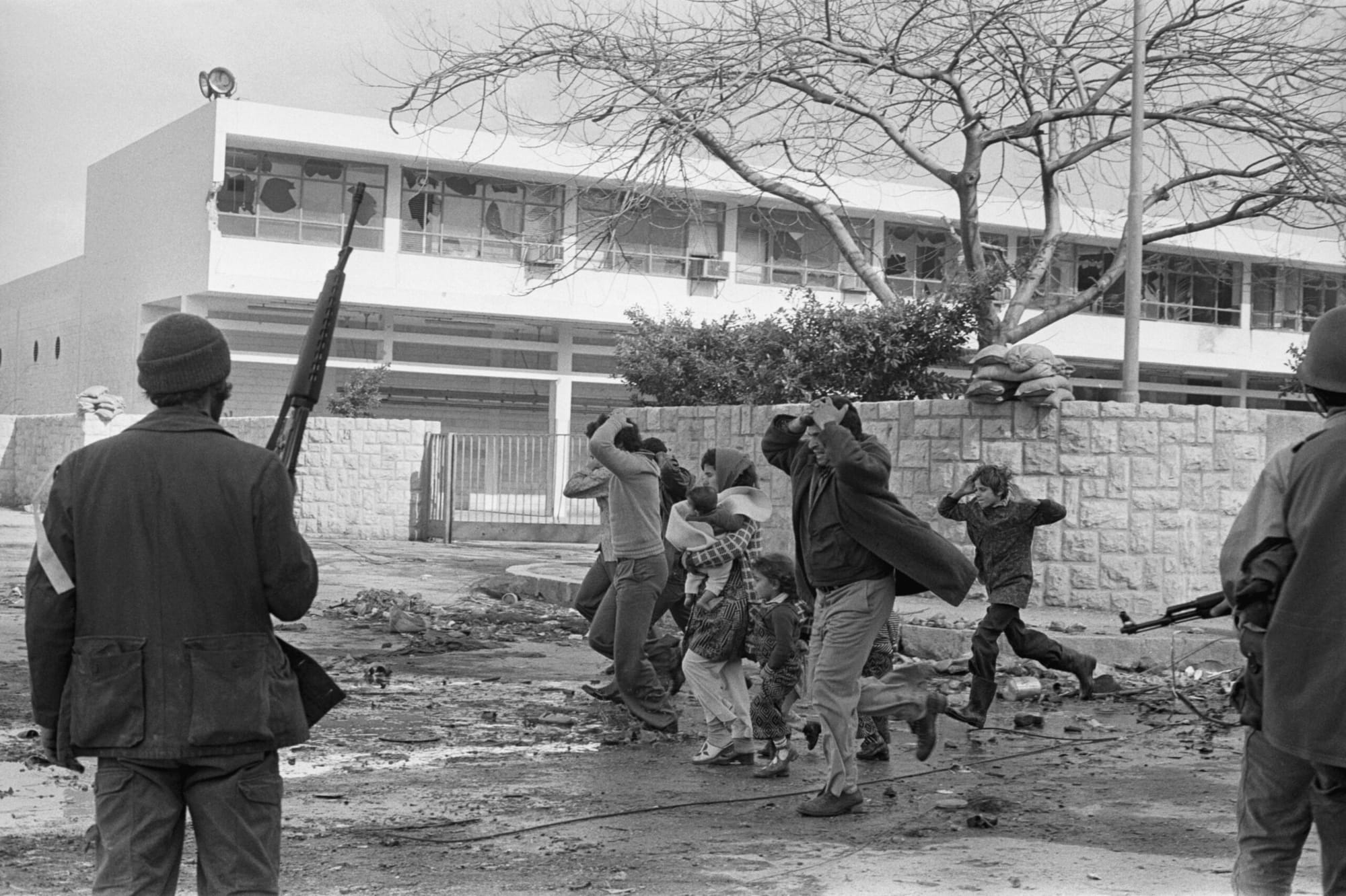
Phalangists invade the neighborhood of Karantina while civilians flee, 1976\. Claude Salhani/Sygma via Getty Images
Maronite militias invited foreign intervention—first, the Syrian military and, later, the Israeli—into the country in an attempt to prevent their defeat. The Syrian army participated in the 1976 siege and shelling of the Tel al-Zaatar refugee camp to thwart Palestinian factions. The camp was later razed, and its inhabitants were massacred by the rightwing Lebanese Front: a coalition of competing, largely Maronite militias, which included the Lebanese Forces (the military wing of the Phalange). The Lebanese Front coalesced around a Christian supremacist ideology, Lebanese chauvinism and an opposition to the PLO presence in Lebanon. Over the course of the war, this combination transformed into a narrative that scapegoated Palestinians as squarely to blame for the conflict.
The leftist Lebanese National Movement under the leadership of Kamal Jumblatt formed the other main coalition of militias in the early years of the war. This group was allied with the PLO. In 1982, the same year as the large-scale Israeli invasion ([see below](#israeli-invasion)), the war expanded to the mountains east of Beirut, where a militia of the mainly Druze Progressive Socialist Party, led by Jumblatt’s son after his assassination in 1977 and assisted by the Syrian military (whose alliances had shifted) plus some PLO factions, fought against the Lebanese Forces. In addition to forced displacement and massacres, this “Mountain War” (1982–1984) also resulted in the military defeat of the Lebanese Forces and their retreat from the area.
Some of the worst fighting during the civil war was between militias of the same sect, often over control of a region, economic resources or positions of power. For example, in 1988 tensions between the two primary Shi’i militias, Amal and Hizballah, escalated to such an extent that Iran and Syria stepped in to broker an agreement with the parties that essentially ceded control of the southern suburbs of Beirut to Hizballah. The late 1970s and early 1980s were also characterized by Maronite militias massacring rival Maronite leaders and their families, as the Lebanese Forces under Bashir Gemayel consolidated their power. The final battles of the war were likewise between two Maronite forces, each led by a man who would later become president: Elias Hrawi (in office 1989–1998) and Michel Aoun (in office 2016–2022).
The 1990 Taif Accord that ended the violence of the civil war held firm to the “no victor, no vanquished” slogan. At the same time, Syria maintained its presence and control of Lebanon’s military and security apparatus, which it used to manipulate Lebanese politics to privilege Syrian interests. 25 militias and at least six foreign militaries and intelligence agencies had participated in the civil war, killing over 150,000 people and maiming thousands more. The General Amnesty Law retroactively exempted most protagonists from any legal liability for crimes committed before 1991, allowing most, if not all, to continue holding onto power. Parliament was expanded and divided equally between Christians and Muslims. The Taif Accord was incorporated into the Lebanese constitution, but its structural roadmap for phasing out of political sectarianism [has never been implemented](https://www.jadaliyya.com/Details/40134).
### **Post-1990 Stalemate**
The civil war entrenched sectarianism in new ways in Beirut’s neighborhoods as well as outside of the capital. While the Taif Accord gave the displaced the right to return to their houses and the right to live anywhere in the country, it did not include non-Lebanese residents. Moreover, many Lebanese who had been displaced did not return to their original neighborhoods. Population displacements between the eastern and southern suburbs of the capital persisted, creating the predominantly Shi’a southern suburb, known as Dahiya. The wartime movement of many of Beirut’s Christians from the western part of the city (what became referred to as “West Beirut”) to the eastern part (referred to as “East Beirut”) consolidated the latter as Christian-identified. These and other wartime displacements, both forced and voluntary, led to the almost complete sectarian segregation of much of the country.
Following the war, the Lebanese Armed Forces (LAF) underwent significant reforms to restore its legitimacy and ensure its cohesion after its sectarian fracturing during the war. Conscription was reinstated in 1992 (and ended in 2007) and sectarian balance and mixing was pursued across ranks. Support from the Syrian Arab Army increased along with Syrian influence across state institutions.
Militia groups that had grown out of political parties reverted to their political party status and participated in the 1992 elections. Hizballah, which had formed during the war ([see below](#hizballah)), joined this constellation of political parties but kept its weapons to maintain its resistance against the Israeli occupation in the south—a resistance that, according to some, the Taif Accords allow for. Hizballah’s decision to work within the Lebanese state was taken under the leadership of the recently-assassinated Sayyid Hassan Nasrallah, who became the party’s secretary general in 1992 after the Israeli military assassinated his predecessor.
Over time, Hizballah won increasing numbers of seats in municipal and parliamentary elections and developed a reputation—even among its ideological opponents—as a capable and less corrupt party, due to the lack of inherited political positions among its members and the lack of ostentatious displays of wealth among its political class. The party also built a vast network of charitable associations, centers for the disabled, hospitals, mosques and schools. Like other political parties in Lebanon, Hizballah is an inextricable part of society. The party consistently received the most votes and the most cross-sectarian votes in parliamentary elections. People support them for a range of reasons including their record of resistance, their religious ideology, their approach to political-economic support, their municipal-level policies and their personal connections. Its popularity skyrocketed in 2000, after the longstanding Hizballah-led resistance forced the Israeli military to withdraw from the parts of southern Lebanon it had occupied since 1978 ([see below](#occupation)).
Beginning in 2005, Hizballah and the Syrian regime were implicated in a series of political assassinations aimed at maintaining their influence in the Lebanese government and state institutions. These assassinations changed the trajectory of Lebanese politics. For the first time, Sunni-Shi’i sectarian tensions came to the foreground, stoked by the regional environment created in the wake of the 2003 US invasion of Iraq. On February 14, 2005, former Prime Minister Rafiq al-Hariri, a billionaire real estate developer turned politician who was at the center of post-war reconstruction, was assassinated in the middle of downtown Beirut by a car bomb that also killed 21 others and wounded more than 200\. Hariri’s assassination galvanized the country and led to two competing protest movements in March 2005\. One side was led by the Sunni Future Movement, headed by Hariri’s son Saad, which demanded the military, economic and political withdrawal of Syria from Lebanon. In response, Hizballah and its allies came to Syria’s defense in a counter protest. By the end of April, Syrian troops had withdrawn from the country. Following their withdrawal, and especially after Syria’s further disengagement from Lebanon post-2011, the United States became a main patron of the Lebanese Armed Forces.
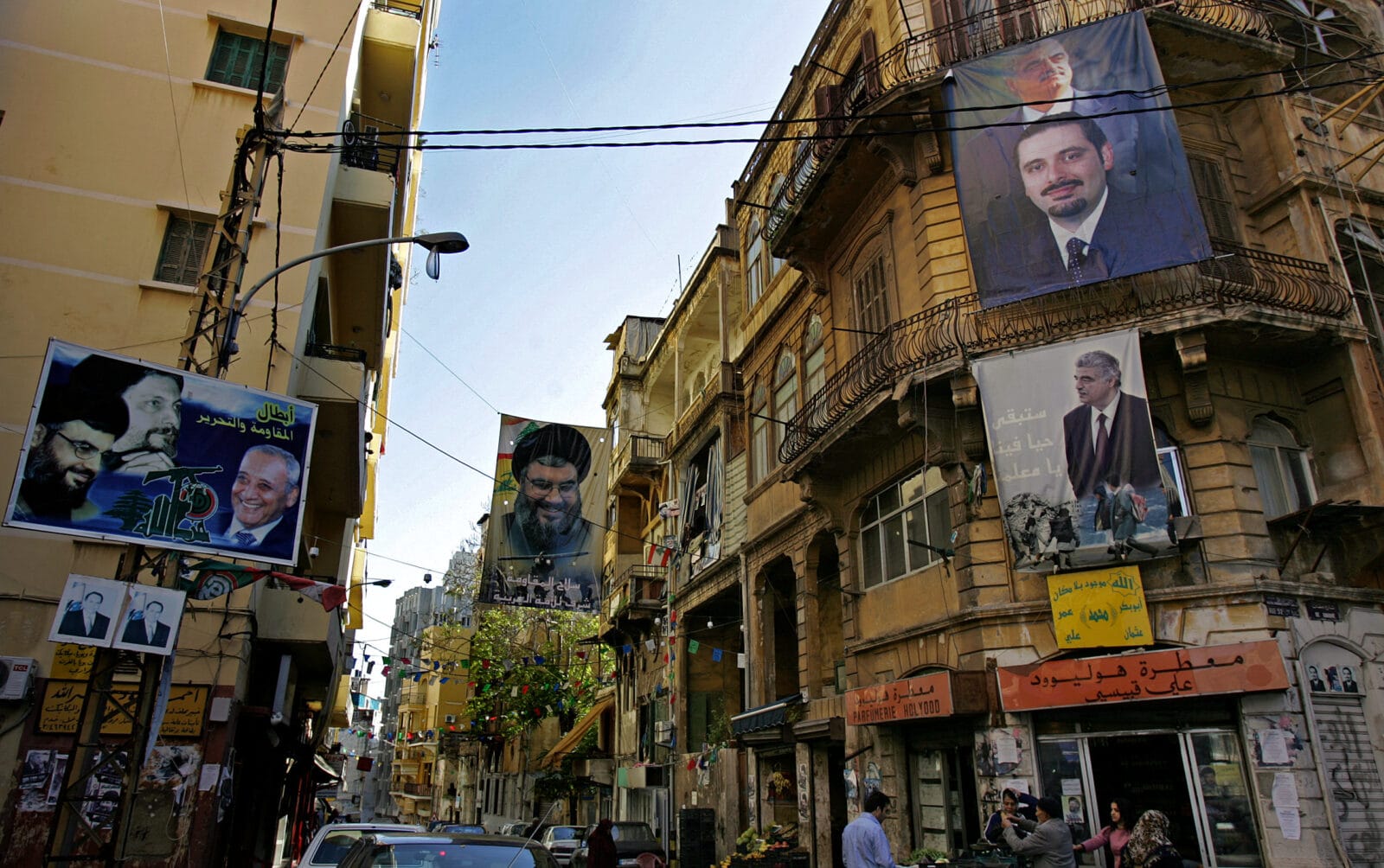
In late 2006, posters of Hezbollah chief Hassan Nasrallah and Shiite Amal leader and Speaker of the Parliament Nabih Berri (L) hung over a Beirut street across from posters of late Lebanese Prime Minister Rafiq Hariri and his son Saad (R), leader of the Parliament majority. Hassan Ammar/AFP via Getty Images
That same year, Hizballah increased its parliamentary seats and participated in the cabinet for the first time. In early 2006, the Free Patriotic Union, at the time the largest and most popular, predominantly Christian party, and the Armenian Tashnag Party formed a coalition with Hizballah. While the party’s popularity rose when it fought the Israeli military to a stalemate in 2006 ([see below](#dahiya)), that boost was short-lived. The rift between Hizballah and its allies and the Future Movement and its allies widened. Political assassinations continued. A Hizballah-led sit-in took over downtown Beirut for nearly a year and a half. And a general strike was enacted to protest the Future Movement prime minister’s neoliberal economic reform plan.
In 2008, friction led to fire when, in response to government threats to shut down their communication network, Hizballah and its allies took military control of the Sunni-majority area of Ras Beirut and aimed their weapons at Lebanese across sectarian lines for the first time since the end of the civil war. Armed Future Movement cadres appeared in response, and caches of hidden weapons materialized across the city. Several people were killed on both sides during armed street skirmishes. Qatar stepped in to mediate, and the subsequent Doha Agreement gave Lebanon a new president, a new election law and a distribution of cabinet posts that granted Hizballah and its allies veto power. While Lebanon has not seen this sort of inter-party political violence since 2008, tensions between the groups regularly manifest in dramatic government resignations and long periods of political paralysis, including presidential vacancies and governments working in a caretaker capacity.
# **III. Lebanon in Relation to Palestine, the Israeli State and the United States**
### **The Nakba**
In 1947–1948, Zionist colonial militias primarily made up of European Jewish settlers ethnically cleansed over 500 villages in Palestine, killing at least 15,000 Palestinians and displacing over 700,000 more. This violence continued after the Israeli state unilaterally declared its independence in May 1948 and deeply impacted Lebanon on several levels. While the Lebanese army never entered mandate Palestine and hardly aided the Arab League’s Arab Liberation Army, at the time of armistice negotiations the Israeli military occupied 14 villages in Lebanon.[\[12\]](#%5Fedn12)In October 1948, during Operation Hiram, Israeli forces perpetrated 14 massacres in one week on both sides of the border, including in Hula, in a bid to cleanse the area of its population.[\[13\]](#%5Fedn13) While Israeli troops withdrew from those 14 villages under armistice, one of the still disputed areas near Lebanon’s southern border includes seven villages that, during the Nakba, were violently depopulated by Zionist militias, plus at least [three additional villages](https://www.middleeastmonitor.com/20240522-why-dont-we-demand-the-return-of-the-14-lebanese-villages-occupied-by-israel/) that Zionist settlers depopulated and converted to Israeli settlements.
More than 100,000 Palestinians were pushed into Lebanon during the 1948 Nakba. At the time, these Palestinian refugees constituted an estimated tenth of the resident population. Eventually the United Nations established 16 official Palestinian refugee camps in Lebanon. At its peak, the number of Palestinian refugees likely exceeded 450,000 people, more than ten percent of the total resident population in Lebanon, although currently UNRWA [estimates it](https://www.unrwa.org/where-we-work/lebanon) to be around 250,000\. While some Christian refugees were granted Lebanese citizenship, Muslim refugees were not, and all Palestinian refugees experience structural discrimination and oppression, including lack of access to government services like healthcare, prohibitions on property ownership and proscriptions on working in most professional fields.
Lebanon was also impacted by the continuation of the Nakba with the 1967 war, when the Israeli military defeated the Egyptian, Syrian and Jordanian armies and occupied East Jerusalem, the West Bank, Gaza, the Golan Heights and the Sinai Peninsula. Israeli troops withdrew from Sinai in 1982 but continued to occupy the other regions, including the Golan, which includes an area called Shebaa Farms that both Lebanon and Syria claim is Lebanese territory. The defeat in 1967 also led to disillusionment with Arab nationalist and leftist movements, creating an ideological void for resistance against Israeli colonialism and state violence.
### **Israeli Invasions and Siege of Beirut**
In 1969 the Palestine Liberation Organization (PLO) and the Lebanese military, among other signatories, signed the Cairo Agreement, which allowed the former to operate from south Lebanon and placed the refugee camps under PLO control. Following the violence between the Jordanian military and the PLO and its allies in September 1970, known as Black September, the PLO moved the majority of its forces to Lebanon. In April 1973, Israeli fighters invaded Beirut by sea and assassinated three PLO leaders in Beirut in an assault that also killed a number of Lebanese and Palestinian civilians. During the Lebanese civil war ([see above](#civil-war)), which began two years later, the Israeli state invaded Lebanon twice.
On March 14, 1978 Israeli forces invaded south Lebanon, purportedly to dislodge the PLO and stop rocket fire and cross-border operations. They named their invasion “Operation Litani,” and true to its name, Israeli forces occupied territory up until the Litani River, killing close to 2,000 Lebanese and Palestinians over the course of one week and displacing 250,000 people. UN Security Council Resolution 425 called for the immediate withdrawal of Israeli troops from south Lebanon. The United Nations Interim Force in Lebanon (UNIFIL) was created and deployed to southern Lebanon. Israeli troops withdrew in April of that year, leaving the South Lebanon Army (SLA) as its proxy militia in charge of its occupation. The Israeli state’s main ally during this phase of the war was the Phalangist Lebanese Forces, led by Bashir Gemeyel. The Lebanese Forces were committed to expelling the PLO from Lebanon and maintaining Christian dominance in the state apparatus.
When the Israeli military and its Maronite allies failed to destroy the Palestinian presence in the country, Israeli troops reinvaded Lebanon in June 1982\. This time, Israel extended its occupation to Beirut and killed approximately 20,000 people, mainly civilians, at least 5,500 of whom were in the western part of the city. For three months, Israeli forces placed West Beirut under a devastating siege, cutting off electricity, water and access to food. During the siege, the Israeli military also regularly conducted air raids and saturation bombing of Beirut, killing hundreds of Lebanese and Palestinian civilians, often under the guise of a targeted assassination of a PLO leader or the destruction of PLO infrastructure.[\[14\]](#%5Fedn14) In August, the United States brokered an agreement whereby the PLO agreed to evacuate from Lebanon to Tunis and move many of its cadres to other Arab countries. The United States (and other countries, including France) sent marines to Beirut to supervise the evacuation and became embroiled in the war as an active participant in support of the Israeli state's ally, the Phalangists. Gemeyel was elected president of Lebanon but was assassinated on September 14 before he could take office.
Following his assassination, the Israeli army surrounded the Sabra and Shatila refugee camps. In addition to thousands of Palestinians, the camps housed Shi‘i Muslims displaced from the south and other impoverished Lebanese. Between September 16–18, under the protection of the Israeli military and then-Israeli Defense Minister Ariel Sharon, a Lebanese Forces militia unit entered the camps and raped, killed and maimed thousands of defenseless civilian refugees.
### **Formation of Hizballah and the Islamic Resistance**
Until the late 1960s, Shi’i Muslims made up much of the membership of the Lebanese Communist Party. At that time, charismatic cleric Sayyid Musa al-Sadr drew on Shi’i cosmology to mobilize people with the goal of obtaining greater political and economic rights for Shi’i Muslims within the structures of the Lebanese state. When the civil war began in 1975, this movement formed an armed wing called Amal, the first Shi’i militia in the country.
Three events propelled this movement forward and led to Hizballah’s [founding](https://www.merip.org/hizballah-a-primer/). First, in 1978, al-Sadr disappeared while on a trip to Libya, leaving a leadership vacuum. Second, the 1979 Iranian revolution which brought about the Islamic Republic provided an ideological alternative to western capitalism for those who had previously turned to communism. Most significantly, the Israeli invasions of Lebanon and the 1982 siege and massacres at Sabra and Shatila catalyzed a resistance. Small groups of armed young Shi’i men began fighting the Israeli invaders and were joined by many Amal leaders. In 1984, Iran orchestrated a meeting bringing these groups together, which led to the establishment of Hizballah and its armed wing, the Islamic Resistance. In February 1985, Hizballah [announced its existence](“Open%20Letter%20to%20the%20Downtrodden%20in%20Lebanon%20and%20the%20World.”) in an “Open Letter to the Downtrodden in Lebanon and the World,” declaring the removal of the Israeli occupiers from Lebanon, Palestine and Jerusalem as its raison d’etre. The manifesto was revised in 2009 to remove language calling for an Islamic state and to affirm Hizballah’s commitment to working within the framework of a multi-sectarian Lebanese state.
### **1983 US Involvement and Marine Bombing**
In the United States, Hizballah is considered the “[A-Team of terrorists](https://www.cbsnews.com/news/hezbollah-a-team-of-terrorists/)” due to associations between the group and attacks on the US marine barracks and embassy in Beirut in [1983](https://www.merip.org/hizballah-a-primer/). That year, the United States had increased its military presence in Lebanon to support the right-wing, Christian, Lebanese Forces and the Phalange party, a presence that many saw as a foreign occupation. A car bombing at the US embassy in April killed 17 US personnel and tens of Lebanese who worked there. In the summer of 1983, US warships began shelling Beirut and the surrounding mountains from the sea, making them active participants in the conflict. The United States also exchanged direct artillery fire with various militias and, on at least one occasion, used F-14 fighter planes.
In October of 1983, Shi’i fighters drove trucks full of explosives into the US army barracks in Beirut and blew it up, killing 241 US soldiers. A group called Islamic Jihad, which the United States claims is a branch of Hizballah, took responsibility for the bombings. Although it targeted soldiers involved in a war, the United States labelled it a terrorist attack. Following the barracks attack, the US military continued to participate in the war, with both air and naval power, until the Lebanese army collapsed along sectarian lines in 1984.
### **Israeli Occupation of the South, 1978–2000**
In 1985, the Israeli military withdrew from most of Lebanon but continued to occupy around ten percent of south Lebanon, including part of the Litani River—the importance of which Israeli prime minister David Ben Gurion had reiterated in [1956](https://users.ox.ac.uk/~ssfc0005/The%20Protocol%20of%20Sevres%201956%20Anatomy%20of%20a%20War%20Plot.html). Hizballah’s Islamic Resistance took the lead in fighting that occupation along with multiple other resistance contingents.
Villages in the occupied south were cut off from the rest of the country, with many of their displaced residents unable to return. Those who stayed often faced impossible choices, like having to participate in an Israeli occupation economy in order to survive. The Israeli military continued to grow its proxy Lebanese militia, the SLA ([see above](#israeli-invasion)), drawing leaders and cadres from the same right-wing Maronite militias and movement, though the militia included Druze and some Shi’i fighters as well.
Levels of national support for the resistance rose with each Israeli attack on Lebanese civilians and infrastructure, both within and beyond the occupied zone. In 1993, more than one hundred Lebanese civilians were killed in Israeli attacks over seven days. Israeli warplanes destroyed power plants in Beirut in 1996, 1999 and 2000\. On April 18, 1996, in a campaign it called “Grapes of Wrath,” the Israeli military bombed a United Nations bunker in Qana in south Lebanon, where 800 civilians had taken refuge, killing 106 Lebanese civilians and injuring 116 Lebanese and 4 Fijian UNIFIL soldiers.
The occupation forces also maintained a notorious detention center in the occupied Lebanese village of Khiam, where both male and female Lebanese civilians and resistance fighters were held, interrogated and tortured by Israeli troops and their Lebanese collaborators.
By the late 1990s, the occupation of south Lebanon had grown financially and politically costly. In his 1999 bid to become the Israeli prime minister, Ehud Barak made withdrawal a campaign promise and, when he won, said it would take place by July 2000\. An increase in desertions from the SLA sped up the timeline, and on May 23, Israeli troops began a chaotic withdrawal along with a few thousand SLA fighters and their families, who fled across the border. By May 25, 2000, Lebanon was liberated from the 22-year Israeli occupation.
Fears that lawlessness and sectarian violence would accompany liberation proved unfounded, as Hizballah maintained order in the border region and prevented its members from taking informal revenge on those who had collaborated with the occupation.
There remained a territorial dispute over the Shebaa Farms, however. The 15 square miles along the border remained under Israeli occupation. Lebanon and Syria both assert that Shebaa Farms is part of Lebanon. The Israeli state asserts it is part of the Golan Heights and therefore part of Israeli-occupied Syria.
### **2006 War and the Israeli 'Dahiya Doctrine'**
After the liberation of south Lebanon, both the Israeli state and Hizballah followed unstated rules of the game that limited attacks to military sites and personnel. From 2000–2006, Hizballah made no deliberate attacks on Israeli civilian targets and only maintained an active contingent of approximately 500 fighters. UN observer reports document ten times the number of Israeli violations of the border than Hizballah violations. Israeli forces kidnapped shepherds and fishermen. Hizballah kidnapped an Israeli businessman in 2000, and four years later, negotiated a deal via German mediators to exchange the businessman and the bodies of three Israeli soldiers for hundreds of Lebanese and Palestinian prisoners. It seemed as though these negotiations had set a new precedent for prisoner exchanges via a European third party [mediator](https://www.merip.org/hizballah-a-primer/).
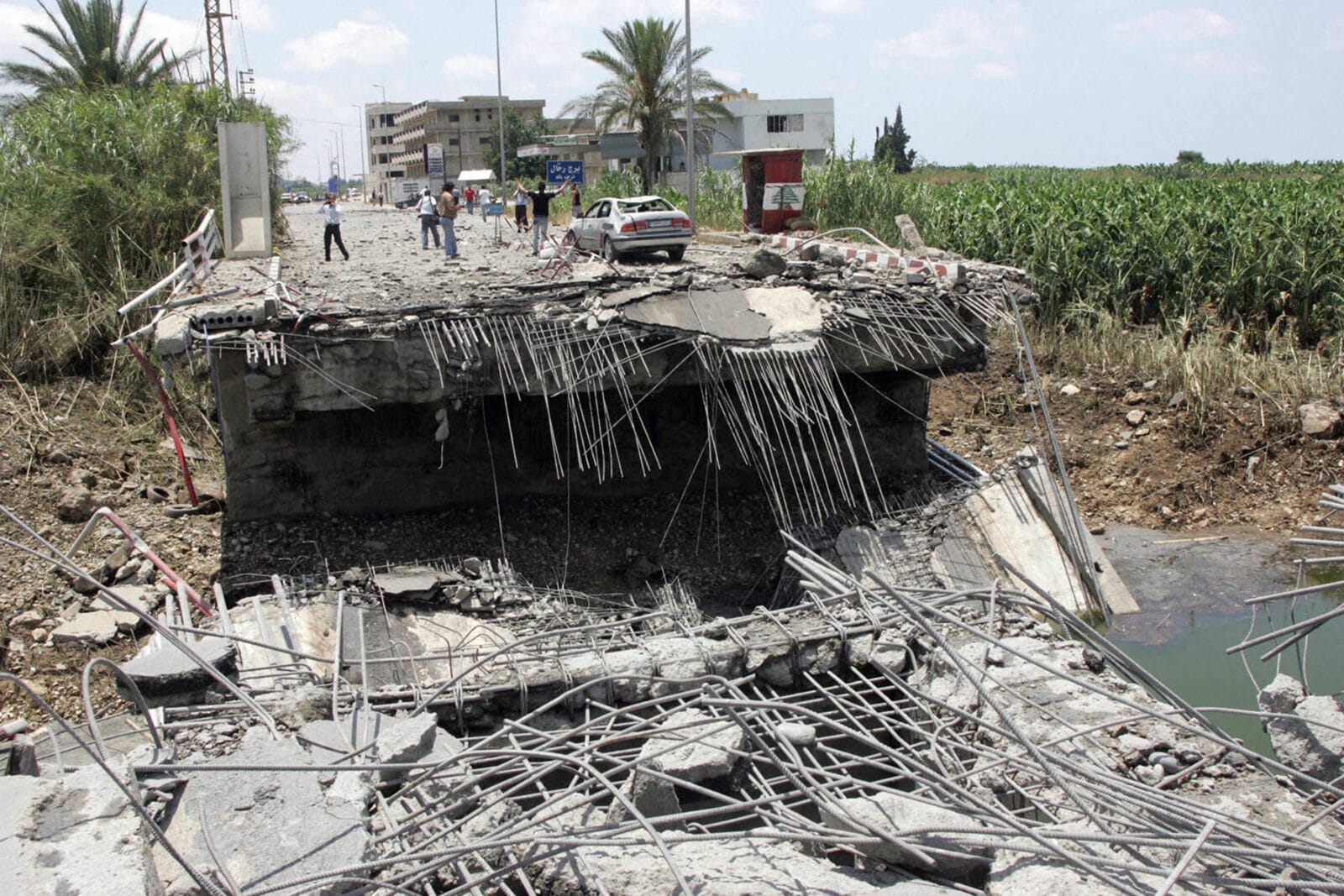
People stand on the ruins of Qassimiya bridge, outside the city of Tyre after it was bombed by Israeli war planes, July 12, 2006, in south Lebanon. Joseph Barrak/AFP via Getty Images
Working on that assumption, on July 12, 2006, Hizballah fighters captured two Israeli soldiers and stated that they had done so in order to begin another round of negotiations for the release of three Lebanese who remained in Israeli detention. This time, however, the Israeli state launched a 33-day war on Lebanon on a scale unseen since the 1982 invasion, their stated goal: to disarm and remove Hizballah from South Lebanon. Leaked testimony from Israeli Prime Minister Ehud Olmert’s statements to the Winograd Commission (an Israeli investigation into the perceived failures of the 2006 war) would later reveal that the Israeli state had planned a war on Lebanon months before the two soldiers were [captured](https://www.theguardian.com/world/2007/mar/09/syria.israelandthepalestinians). And reports suggest that US diplomats had seen these plans in [advance](https://www.newyorker.com/magazine/2006/08/21/watching-lebanon).
Israeli air power was accompanied by a naval blockade and ground invasion. Hizballah again led the resistance. Over the course of 33 days, Israeli attacks killed 1,191 people in Lebanon, mostly civilians, and wounded thousands. The Israeli state reported 158 deaths, most of whom were soldiers. Half a million people were displaced in Lebanon, nearly one eighth of the country’s population. Israeli warplanes also inflicted 3 billion dollars of infrastructural damage on the country, flattening entire villages in South Lebanon and destroying runways, roads, bridges, power plants, sewage treatment facilities, ports, gas stations, cell phone towers, factories and wheat silos across the country. The bombing also destroyed evidence of past Israeli atrocities, including the Khiam detention center, which Hizballah, along with former detainees, had converted into a memorial archiving sites and mechanisms of torture inflicted on Lebanese resistance fighters and civilians from the south.[\[15\]](#%5Fedn15) Israeli airstrikes destroyed whole neighborhoods in Dahiya, which by 2006 had become an integral part of Beirut: a vibrant, densely populated part of the city with homes, schools, businesses and cafés.[\[16\]](#%5Fedn16) In just one of these neighborhoods, Haret Hreik, Israeli bombardment destroyed 250 residential buildings, holding 3,000 apartments. The Israeli general in charge of the northern command, Gadi Eisenkot, dubbed this level of destruction, developed and implemented in the 2006 war, “[The Dahiya Doctrine](https://imeu.org/article/the-dahiya-doctrine-and-israels-use-of-disproportionate-force).”
Reflecting on the war, General Eisenkot summarized the doctrine: “What happened in the Dahiya quarter of Beirut in 2006 will happen in every village from which Israel is fired on… We will apply disproportionate force on it (village) and cause great damage and destruction there. From our standpoint, these are not civilian villages, they are military bases… This is not a recommendation. This is a plan. And it has been approved.”[\[17\]](#%5Fedn17) The Dahiya Doctrine, which explicitly calls for the use of disproportionate force and the targeting of civilian infrastructure, has [governed the multiple, devastating, Israeli attacks on Gaza](https://www.merip.org/israel-as-innovator-in-the-mainstreaming-of-extreme-violence/) since 2008.
The adoption of UN Security Council Resolution 1701 accompanied a ceasefire, but, like UNSC 425, it was never been fully implemented. Key among its [provisions](https://news.un.org/en/story/2024/10/1155221) were the full implementation of “the relevant provisions of the Taif Accord,” which, depending on how one interprets them, includes the disarmament of Hizballah and all non-state military groups, the deployment of the Lebanese army to the south, the transfer of a map of Israeli-planted landmines to the Lebanese authorities and full respect for the Lebanon-Israel border (the Blue Line) by both the Lebanese and Israeli militaries. The Israeli government and the United States regularly demanded that Lebanon implement its side of 1701, withdrawing professional Hizballah fighters behind the Litani river—even as the Israeli state did not abide by the resolution, for example, by repeatedly violating Lebanon’s airspace.
Within Lebanon, despite disagreements about the degree of blame Hizballah should carry, the war was characterized by the active engagement of both sectarian and non-sectarian civil society organizations that coordinated aid and housing for the displaced. For example, most schools, regardless of sectarian and religious affiliation, became temporary shelters for the internally displaced. Popular support grew for Hizballah and its leader, Sayyid Hassan Nasrallah.
Rebuilding efforts led by Hizballah-affiliated organizations began the day the ceasefire went into effect, but in some ways, Lebanon never fully recovered from the July War’s fallout. In addition to lingering distrust between Hizballah and the Future Movement, unexploded ordnance from the millions of cluster bomblets (submunitions) dropped by Israeli [planes](https://www.hrw.org/reports/2008/lebanon0208/6.htm#:~:text=MACC%20SL%20has%20estimated%20that,four%20million%20submunitions%20in%20Lebanon.&text=It%20arrived%20at%20that%20estimate%20in%20the%20following%20fashion.) along with white phosphorus residue made much of the arable land in the south unusable and dangerous. These environmental effects significantly impacted the livelihoods of people there even after they were able to return to their homes and rebuild.[\[18\]](#%5Fedn18)
# **IV. Sequential Crises—Syrian Civil War to the War on Gaza**
### **Syrian Civil War and Refugees**
The Syrian uprisings and subsequent civil war opened a new chapter for Lebanon. Hizballah sent fighters to intervene militarily in the Syrian civil war on the side of Bashar al-Asad’s government in 2012\. Since then, Hizballah has been the most polarizing political party in Lebanon. Their involvement likely led to the series of devastating car bombings in Dahiya—claimed by Sunni extremist groups opposed to the Syrian regime—that killed tens of civilians in 2013 and 2014\. This decision sent ripples through the party, with intense disagreements among its leadership and supporters. It also exposed the party’s intelligence and security networks in new ways. It is possible that hindsight will point to this 2012 decision as the most significant factor in eroding popular support for Hizballah, paving the way for future vulnerabilities and allowing for Israeli assassinations of much of its top leadership in September of 2024.
Before the Syrian war, hundreds of thousands of Syrians lived and worked in Lebanon—mostly as semi- and unskilled laborers in the construction and agricultural sectors. The violence in Syria led to the influx of about one and a half million Syrian refugees into Lebanon. Approximately one million were officially registered with the UNHCR by 2016, and approximately another million unofficially resided in the country at the highest point, effectively growing the total resident population of Lebanon by 30 percent. This rapid change in population put enormous strain on the already meager services provided by the state and has led to rising violence, anger and bigotry against Syrian refugees. Following the overthrow of Asad in December 2024 and the end of his family’s near 55-year rule of the country, a number of Syrian refugees have returned to Syria. It remains to be seen if Lebanon will force additional refugees to return, though the freezing of Syrian asylum applications in Germany, Austria, Belgium, Greece, Italy, Sweden, Denmark and Britain does not bode well.
### **Popular Uprisings and 2019**
The second decade of the twenty-first century saw multiple mobilizations of Lebanese protesting against government corruption and its facilitation by the sectarian power sharing system.
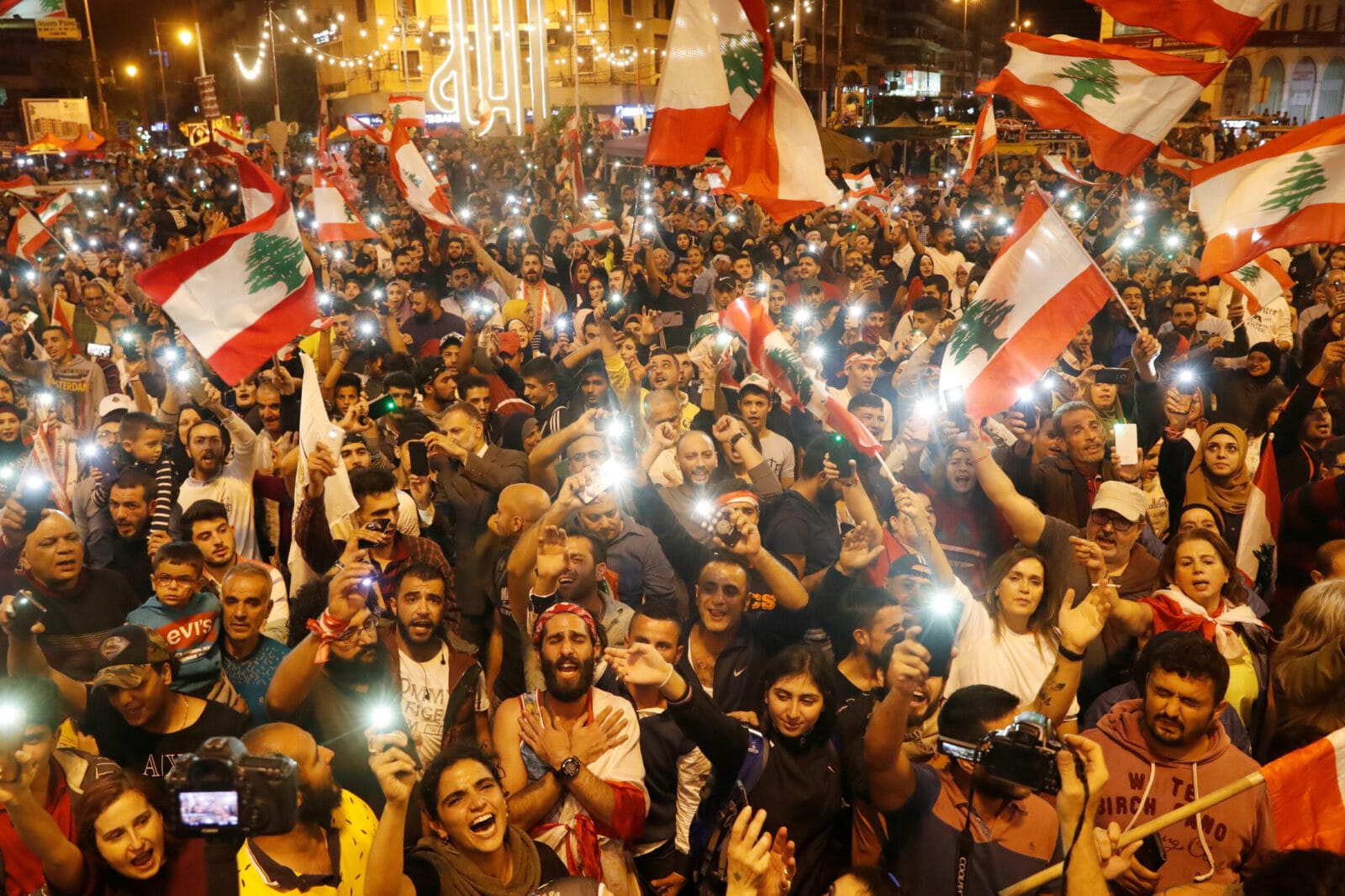
Demonstrators shout during a protest in Tripoli, Lebanon, November 2, 2019\. Goran Tomasevic/Reuters
In 2011, during the wave of uprisings across the Arab world, a short-lived anti-sectarian and anti-regime protest movement spread across Lebanon but faded within months. 2015 saw a widespread and sustained protest movement against corruption and its manifestation in a countrywide waste-management crisis. Protesters skirmished with police, who blocked their access to parliament and tried to disperse them.
In 2019, the Lebanese Central Bank’s financial engineering scheme—which had since 1997 pegged the Lebanese pound to the US dollar at the rate of 1,507 to one—collapsed. What had been a gradual financial decline accelerated as the black-market exchange rate between the US dollar and the Lebanese pound dropped in comparison to the official rate. By summer 2019, the black-market rate was 15,000 to one. In July, a proposed law that would require “non-citizens” to pay for their own work permits triggered [a wave of protests](https://mondoweiss.net/2019/08/lebanons-minister-crackdown/) and boycotts by Palestinians in Lebanon. In early fall, the government began to implement planned austerity measures, imposing new taxes on a population that was already suffering financially. Then in October, over 100 wildfires, among the worst the country had ever seen, broke out and spread uncontrollably throughout the Chouf mountains causing residents to flee their homes. The Lebanese government had failed to maintain the scant fire-fighting equipment it had. Many believed government officials had pocketed funds donated for that purpose.
On October 17, hundreds of thousands of people in Lebanon took to the streets, declaring a revolution against political corruption and the sectarian system. The immediate triggers were a new monthly tax on the widely-used communications application, WhatsApp, the austerity measures and the spectacle of the government’s failure to suppress the wildfires. But this moment had been building for at least a decade. Hundreds of thousands of people took to the streets, went on strike, blocked roads and effectively paralyzed the country. The protests were regional, expressly cross- and anti-sectarian, multigenerational and, in certain actions, involved the cooperation of different socioeconomic classes. Lebanese state security forces as well as groups of armed men from different sectarian parties attempted to suppress the protests, which were further weakened by growing polarization among protesters. In February 2020, the start of the Covid-19 pandemic put an effective end to lingering mobilization. The already suffering economy ground to a halt.
### **Port Explosion**
Against this backdrop, one of the largest ever non-nuclear explosions rocked Lebanon on August 4, 2020, when some 3,000 tons of ammonium nitrate stored in a warehouse at the Beirut port exploded, killing 219 people and injuring thousands. It caused extensive damage to multiple Beirut neighborhoods and rendered hundreds of thousands of people homeless. The destruction of the grain silos at the port contributed to bread shortages and widespread hunger.
In the face of this catastrophe, the governing authorities failed to take effective action. A government investigation into the cause of the explosion rapidly became mired in political tensions. Hizballah and other political groups and politicians sought to block the investigation to hide their different and overlapping responsibilities for the disaster—from storage to corruption to criminal negligence. To date, nobody has been held accountable.
### **Economic collapse**
In the wake of the revolution, pandemic and port explosion, Lebanon’s financial collapse accelerated rapidly, exacerbated by corruption in the banking sector and the state. Banks illegally cut off access to checking and savings accounts as inflation soared, and the Lebanese pound devalued by 98 percent. The World Bank warned in June 2021 that Lebanon’s economic crisis risked being one of the worst in modern [history.](https://www.nytimes.com/2021/07/05/world/middleeast/lebanon-economic-crisis.html) A few months later, the government ended fuel subsidies, power plants ran out of fuel and public utility electricity across the country—already inconsistent with regular daily power cuts for decades—began providing only a few hours of electricity per day at best. Some parts of the country experienced [total blackouts](https://www.merip.org/off-the-grid-why-solar-wont-solve-lebanons-electricity-crisis/). Widespread shortages of basic necessities including fuel and medicine, skyrocketing inflation and a spike in unemployment followed. In February 2023, the Lebanese state unpegged the pound from the dollar, devaluing the official exchange rate, but it still did not approach the black-market rates. As of this writing, the pound has stabilized on the black market at around 89,000 pounds to the dollar.
Facing inflation of over 200 percent and massive unemployment, most people in Lebanon now struggle to survive. Incomes, effectively slashed by 95 percent, have been slow to recover. Emigration rates and reliance on remittances have increased. The cumulative impact of this series of spiraling crises has led to an extraordinary rise in multidimensional poverty for both Lebanese and non-citizen residents including Syrian refugees, with eighty percent of all people in Lebanon estimated to be living in [poverty](https://www.hrw.org/news/2024/08/08/lebanons-poverty-crisis-dire-need-universal-social-security#:~:text=Published%20in%20May%202024%2C%20the,rights%20such%20as%20access%20to). In October 2022 the Lebanese state and the Israeli state resolved their long running maritime border dispute in an agreement meant to facilitate gas exploration and extraction that was backed by the United States. US involvement increased again in 2023 when, in response to the spiraling economic crisis, the United States began supplementing the salaries of Lebanese soldiers and the internal security forces.
### **From Dahiya Doctrine to Gaza Doctrine**
In the days following the Hamas attacks of October 7, 2023, Hizballah and the Israeli state began exchanging fire, initially in Israeli-occupied Lebanese territory and then more broadly across the border, as the party sought to support anti-colonial resistance in Gaza and intervene against the attacks on Palestinians. The Israeli military had carried out around [82 percent](https://www.aljazeera.com/news/2024/9/11/mapping-11-months-if-israel-lebanon-cross-border-attacks) of these attacks, which, until September 6, 2024, had killed at least 646 people in Lebanon, while Hizballah attacks killed at least 32 people. Moments of escalation followed the Israeli assassination of Hizballah commander Fuad Shukr in Lebanon and Hamas leader Ismail Haniyeh in Iran in late July.
On September 17, 2024, the indiscriminate killing of people carrying [pagers](https://www.washingtonpost.com/world/2024/10/05/israel-mossad-hezbollah-pagers-nasrallah/) from a shipment associated with Hizballah marked the start of the Israeli state’s full-scale attack on Lebanon. Israeli officials celebrated the attacks for killing Hizballah members, lauding their intelligence services’ capacity to target the [party](https://mobile.mako.co.il/news-military/2024%5Fq3/Article-664e7436e571291026.htm). But a Hizballah member could be a politician, bureaucrat, administrative assistant, janitor, driver, doctor or nurse, teacher or person who votes for the party in elections. As in Gaza, claims to eradicate a political party and movement that has a network of civil institutions and deep support among a defined population has genocidal implications. The pagers that exploded on September 17 were also used by people not associated with the party and exploded around, injured and killed others, including children.
Three days after the assassination of Hizballah secretary general, Sayyid Hassan Nasrallah, on September 27, his deputy, Shaikh Naim Qassem, addressed the public, stating that the resistance would continue and that Hizballah was in the process of determining Nasrallah’s successor. Israeli forces began a ground invasion on September 30 and were fought back by Hizballah forces at the border. Iran entered the fray on October 1, sending hundreds of ballistic missiles into Israeli territory.
Between October 8, 2023 and November 28, 2024, Israeli attacks killed [nearly 4,000](https://www.unocha.org/publications/report/lebanon/lebanon-flash-update-48-escalation-hostilities-lebanon-28-november-2024) people in Lebanon, including at least 266 children, and injured over 16,000\. Israeli bombardment also displaced over one million people, one fifth of Lebanon’s population. In early 2025, over [178,000](https://reliefweb.int/report/lebanon/lebanon-situation-report-5-december-2024) remained displaced, as the Israeli army continued to block people from returning to 60 Lebanese villages. Many returnees were sheltering in damaged [buildings](https://reliefweb.int/report/lebanon/lebanon-flash-update-52-escalation-hostilities-lebanon-26-december-2024). During this latest war on Lebanon, the Israeli military specifically targeted and killed [journalists](https://www.hrw.org/news/2024/11/25/lebanon-us-arms-used-israeli-strike-journalists), [doctors, nurses](https://www.reuters.com/world/middle-east/who-says-28-health-workers-killed-lebanon-over-24-hours-2024-10-03/), first aid respondents and firefighters. It flattened entire villages, including [Mheibeb, Blida and Mais al-Jabal](https://www.nzz.ch/english/in-some-lebanese-villages-piles-of-rubble-are-all-that-remains-ld.1860052), destroyed homes in places like Qana for the third time since the 1990s and destroyed or damaged sites of material culture. These sites include the [Mamluk-era souks](https://today.lorientlejour.com/article/1431198/apocalyptic-scene-in-nabatieh-israeli-aviation-destroys-several-centuries-old-souks.html) of Nabatieh, the [11th-century Crusader Castle](https://www.npr.org/2024/12/23/nx-s1-5213230/lebanon-cultural-heritage-israel-war-hezbollah) in Tibnin, the [2,000-year-old shrine](https://www.newarab.com/news/israel-dynamites-historic-lebanese-village-mhaibib-rubble) dedicated to the prophet Benjamin, the [Bachoura cemetery](https://thepublicsource.org/blog/lebanon-front/israeli-strike-damages-bachoura-cemetery) in Beirut and memorials dedicated to victims of past Israeli atrocities, including the [Hula](https://today.lorientlejour.com/article/1436394/did-israeli-soldiers-vandalize-a-monument-in-memory-of-the-houla-massacre-victims.html) memorial. On several occasions, Israeli troops attacked [UNIFIL](https://news.un.org/en/story/2024/10/1155801) and [Lebanese army](https://www.npr.org/2024/10/11/nx-s1-5150126/israel-lebanon-strikes-un-peacekeepers-lebanese-soldiers) positions. Israeli planes dropped bombs across Lebanon. But areas with primarily (though not exclusively) Shi’i Muslim populations were specifically targeted, in order to harm Hizballah’s support base. Heavily bombarded areas included the southern suburb of Beirut, the Beqaa Valley and especially the south, a region that had rebuilt and grown significantly in population since liberation in 2000 and the 2006 war.
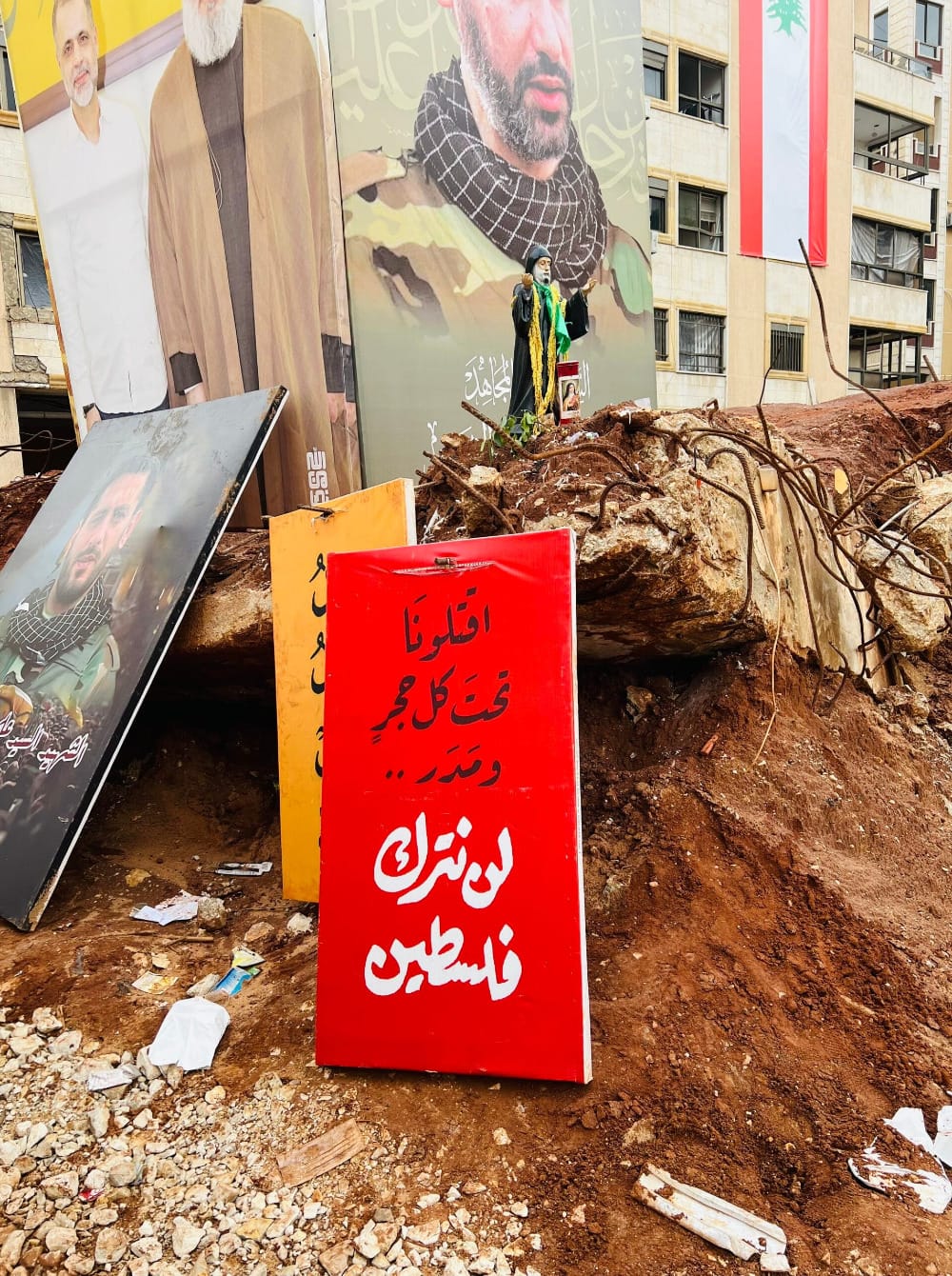
Dahiya, Beirut in December 2024, following the two-month Israeli bombardment of October-November. The sign reads: “Kill us under every stone and mortar… We will not abandon Palestine.” The statue is of Saint Charbel. Photo by Nisrine Chaer.
Israeli bombardment and fighting between Israeli troops and Hizballah inside Lebanon formally ended with a ceasefire agreement that went into effect on November 27, 2024\. The terms of this agreement are essentially a return to the terms of UNSC 1701, with an emphasis on the disarmament of Hizballah and the deployment of the Lebanese Armed Forces (LAF) south of the Litani river, as well as on maintaining calm at the border. Unlike for UNSC 1701, however, the United States is leading the international committee charged with monitoring the ceasefire and its violations, bringing US involvement in Lebanon to the foreground in ways unseen since the civil war.
The ceasefire’s reliance on the LAF has been complicated by several factors. While the LAF is the most popular national institution in Lebanon, its popularity hinges on people’s investment in its authority and not on its power or capacity. Although it has been strengthened by internal reform and foreign, including US, support, the LAF remains chronically underfunded and understaffed and is insufficiently armed and equipped to protect Lebanon from Israeli aggression or defend its national interests. Under these conditions, many see the demand to disarm Hizballah and turn over national self-defense responsibilities to the LAF as a recipe for Israeli impunity in Lebanon. Furthermore, neither the LAF nor Hizballah are publically adversarial toward one another. Finally, the post of Commander of the LAF—reserved for Maronite Christians—has, in the past, served as a main pathway to the presidency, ensuring that the LAF will not overtly undermine any major sectarian group in Lebanon. Indeed, on January 9, 2025 General Joseph Aoun was elected president via a parliamentary consensus that included Hizballah MPs, after more than two years of presidential vacancy and a government working in caretaker capacity.
Between November 27, 2024 and January 4, 2025, the Israeli military was accused of 353 ceasefire violations, mainly in South Lebanon through ground incursions. In this period, Israeli troops killed at least [12 civilians](https://reliefweb.int/report/lebanon/lebanon-situation-report-5-december-2024), bombed villages, destroyed roads and bulldozed agricultural plots. They have also continued to fly drones over Beirut. As of early 2025, these violations were unaddressed and continued to occur on a near daily basis.
Relatedly, renewed Zionist calls for the settlement of South Lebanon have [escalated](https://jewishcurrents.org/inside-the-movement-to-settle-southern-lebanon-uri-tzafon-israel). At minimum, the continued Israeli destruction of infrastructure in the south, flattening of many villages and polluting of arable land in the area with [white phosphorus](https://www.arabnews.com/node/2578937/middle-east) suggest that the Israeli state is attempting to recreate a so-called buffer zone in violation of Lebanese territorial sovereignty. In effect, the ceasefire is yet another redefinition of Israeli violence as falling outside the framework of war and a re-containment of that violence to Lebanon’s south and its primarily Shi’i population. It is yet another instance of the Israeli state’s ability, with US support, to act with impunity under the guise of security, with little regard for the lives and livelihoods of the peoples of neighboring countries or those states’ sovereignty. Most recently, the Israeli state lobbied the United States for permission to remain in south Lebanon beyond the 60-day ceasefire deadline of January 26 and has violated that deadline by killing civilians returning to their homes in the south and maintaining armed forces there in a de facto occupation. Similarly, Israeli military incursions into the Golan Heights and beyond have expanded following the fall of the Asad regime in Syria in December 2024, and the Israeli state has approved plans to [expand settlement](https://www.bbc.com/news/articles/cz6lgln128xo) of the Golan.
Since October 2023, in its aggression on Lebanon and its genocide on Palestinians in Gaza, the Israeli military’s war plan has expanded from the Dahiya Doctrine to what some have called a “[Gaza Doctrine](https://www.thepolisproject.com/read/gaza-doctrine-israel-lebanon-invasion/).” Not only do Israeli attacks target civilian infrastructure, but they now deliberately target civilians themselves. The US-provided munitions used by the Israeli military to target civilians are significantly more powerful than those used in the 2006 war on Lebanon and in earlier attacks on Gaza. Not just Lebanese civilians, but those among the more than two million Syrians and Palestinians as well as migrant workers and refugees from other countries living and working in Lebanon, have been injured, killed and displaced. The Israeli government's claim that its goal in Lebanon is to eliminate Hizballah is tantamount to its claim that the goal in Gaza is to eliminate Hamas. As with the Israeli genocide in Gaza and ongoing violence in the West Bank, the United States maintained its support for escalating Israeli aggression in Lebanon and the broader region. Through the course of attacks by Israeli forces on Lebanon, Gaza, the West Bank, Syria, Iran and Yemen over the past 15 months, it is civilians in the region who continue to suffer. Despite ceasefires in both Gaza and Lebanon at the time of writing, Israeli forces continue their campaigns of killing and displacement in both places, and many around the world continue to wonder if any line exists that the Israeli state—with full US backing—will not cross.
*Editor's note: An earlier version of this article described Elias Hrawi and Michel Aoun as generals. Only Aoun held that rank.*
> **Read the** [**previous**](https://www.merip.org/the-end-of-the-axis-of-resistance/) **article.**
> **Read the** [**next**](https://www.merip.org/iran-palestine-axis/) **article.**
**This article appears in** [**MER issue 313**](https://merip.org/magazine/313/) **“Resistance—The Axis and Beyond.”**
---
### **Endnotes**
[\[1\]](#%5Fednref1) Irene L Gendzier, *Notes from the Minefield: United States Intervention in Lebanon and the Middle East, 1945-1958* (New York: Columbia University Press, 1997), p. 7.
[\[2\]](#%5Fednref2) Mahmoud Yazbak, "The Birth of the Jerusalem Sanjak 1864-1914: Administrative and Social Impacts," *Bulletin of Palestine Studies*, Issue: 2 (2017), pp. 40–41.
[\[3\]](#%5Fednref3) Cyrus Schayegh, *The Middle East and the Making of the Modern World*, (Cambridge, MA: Harvard University Press, 2018), p. 97.
[\[4\] ](#%5Fednref4)Sara Pursley, “Lines Drawn on an Empty Map,” ([Parts 1](https://www.jadaliyya.com/Details/32140) and [2](https://www.jadaliyya.com/Details/32153)) *Jadaliyya* (June 2–3, 2015).
[\[5\]](#%5Fednref5) Graham Auman Pitts, “Make Them Hated in All of the Arab Countries: France, Famine, and the Creation of Lebanon,” in *Environmental Histories of the First World War*, eds. Richer P. Tucker, Tait Keller, John Robert McNeill, and Martin Schmid (Cambridge: Cambridge University Press, 2018), p. 189.
[\[6\]](#%5Fednref6) Nadya Sbaiti, “Governing Summer in Mount Lebanon: *Istiyaf*, Tourism, and Mobility in the Interwar Arab East,” *Journal of Tourism History* 16/2 (2024), pp. 151–169.
[\[7\]](#%5Fednref7) Laura Zittrain Eisenberg, *My enemy's enemy: Lebanon in the early Zionist imagination, 1900-1948* (Detroit: Wayne State University Press, 1994), pp. 40–41.
[\[8\]](#%5Fednref8) Maya Mikdashi, *Sextarianism: Sovereignty, Secularism, and the State in Lebanon* (Stanford University Press, 2022).
[\[9\]](#%5Fednref9) Rania Maktabi, “The Lebanese census of 1932 revisited: Who are the Lebanese?” *British Journal of Middle Eastern Studies* 26 (1999), pp. 219–41.
[\[10\]](#%5Fednref10) Malek Abi Saab, **"**Shiite Peasants and a New Nation in Colonial Lebanon: The Intifada of Bint Jubayl, 1936,” *Comparative Studies of South Asia, Africa and the Middle East* 29/3 (2009), pp. 483–501.
[\[11\]](#%5Fednref11) Tsolin Nalbantian, A*rmenians beyond Diaspora: Making Lebanon Their Own* (Edinburgh: Edinburgh University Press, 2020), pp. 187–188.
[\[12\] ](#%5Fednref12)Matthew Hughes, “Lebanon’s Armed Forces and the Arab-Israeli War, 1948–49,” *Journal of Palestine Studie*s 34/2 (2005), pp. 24–41.
[\[13\]](#%5Fednref13) Adel Manna, “Resistance and Survival in Central Galilee, July 1948–July 1951.” *Jerusalem Quarterly* 79 (Autumn 2019), pp. 28–38.
[\[14\]](#%5Fednref14) Mahmoud Darwish, *Memory for Forgetfulness: August, Beirut 1982*, trans. Ibrahim Muhawi (Berkeley: University of California Press, 1995).
[\[15\]](#%5Fednref15) Lara Deeb, “Exhibiting the ‘Just-Lived Past’: Hizbullah’s Nationalist Narratives in Transnational Political Context. *Comparative Studies in Society and History* 50/2 (2008), pp. 369–399.
[\[16\]](#%5Fednref16) Lara Deeb and Mona Harb, *Leisurely Islam: Negotiating Geography and Morality in Shi’i South Beirut* (Princeton University Press, 2013).
[\[17\]](#%5Fednref17) "[Israel warns Hezbollah war would invite destruction](https://www.reuters.com/article/world/israel-warns-hezbollah-war-would-invite-destruction-idUSTRE4923I0/)," Reuters, October 3, 2008.
[\[18\]](#%5Fednref18) Munira Khayyat, *A Landscape of War: Ecologies of Survival and Resistance in South Lebanon* (University of California Press, 2022).
### The End of the Axis of Resistance?
URL: https://www.merip.org/2025/01/the-end-of-the-axis-of-resistance/
Last updated: 2025-10-25T10:34:43.000Z
Analysts have been quick to view the swift collapse of Bashar al-Asad’s regime in Syria as a [fatal and final blow](https://www.nytimes.com/2024/12/08/world/middleeast/irans-syria-axis-of-resistance.html) to the so-called Axis of Resistance: the network of Iranian proxies spanning from Lebanon to Yemen. But such premature post-mortems underestimate what the Axis of Resistance achieved, misrepresent what it is and misdiagnose the implications for the future actions of its members. Even if their capabilities are now diminished because a notable patron has fled to Russia and Iran is weakened, the various factions of the Axis will not simply evaporate or drastically change their outlook or conduct.
The Axis of Resistance (as the pieces in this issue illustrate) is not a tightly structured hierarchical network of proxies always following direct marching orders from Tehran. It is a consortium of actors that rely on Iranian ideological, financial, military and technological support to different degrees in order to bolster their domestic agendas and, at times, their international standing. The level of direct support and allegiance varies, from Hizballah in Lebanon at one end of the spectrum to the Houthis in Yemen at the other.
With the fall of the Asad regime, the prospects of its members will change. A key thoroughfare for weapons transfers and a potential staging ground for any military training and facilities is likely lost. It also spells the end of a stalwart ally that allowed Iran to practice [forward defense](https://carnegieendowment.org/emissary/2024/10/iran-israel-missile-attack-nuclear-strategy-what-now?lang=en) in its clash with Israel on the country’s northern border. But this security doctrine was already faltering due to Israel’s incursion into Lebanon and the recent decapitation of Hizballah's leadership.
The resulting reputational damage to Iran's image within the Axis of Resistance will be immense as the country proved incapable of adequately protecting its allies and assets. The Axis might also prove less useful as a valued rhetorical device and framing mechanism championed by the Islamic Republic in light of Iran's acute internal security threats after October 7, 2023 and the depleted strategic and military options to counter Israel.
But these crucial setbacks are unlikely to fully change the motivations and actions of the groups belonging to the Axis of Resistance. To believe otherwise is to nullify their agency and agendas and misread some of the deeper underpinnings capable of loosely uniting such a diverse group of actors, beyond Iranian support and patronage.
> **To believe otherwise is to nullify their agency and agendas and misread some of the deeper underpinnings capable of loosely uniting such a diverse group of actors, beyond Iranian support and patronage.**
The Iranian-aligned elements of the Popular Mobilization Forces (PMF) in Iraq are unlikely to end their displeasure—often backed by military actions—with US infringements on Iraq’s territorial sovereignty. Indeed, in their stance they are aligned with some non-Shi'a militias, government officials and segments of the population in Iraq. The Houthis are unlikely to end their support for the Palestinian people, even if their [disruptions to shipping and sea lanes end](https://www.reuters.com/world/middle-east/yemens-houthis-continue-attacks-if-gaza-ceasefire-breached-2025-01-16/) because of a ceasefire in Gaza, to say nothing of the [long history of Yemeni solidarity with Palestine](https://www.merip.org/the-houthis-sovereign-solidarity-with-palestine/). The sense of precarity among the region’s Shi'a population, which led Afghans and Pakistanis to travel to Syria to fight ISIS—not only due to recruitment, enforcement and false financial promises from Iran but for [religious motivations as well](https://www.euppublishing.com/doi/full/10.3366/afg.2022.0085)—might be heightened with the rise of Hayat Tahrir al-Sham (HTS) in Syria and the unknown future sway of Sunni militant groups there. Even in Tehran, where government expenditures on foreign policy has come at the expense of the population—who have never been bashful in expressing their displeasure with it—the situation is not so clear-cut. As an [October 2024 survey of Iranian public opinion](https://mei.edu/publications/new-polling-highlights-iranians-views-irans-foreign-policy-and-regional-role) highlighted, while nearly half the respondents disapproved of Iran’s financing of regional proxies, 61 percent approved of supporting these groups militarily.[\[1\]](#%5Fedn1)
Axis of Resistance or not, these attitudes, concerns and outlooks will not disappear overnight. Nor will groups like Hizballah, Iranian-backed militias in Iraq, the Houthis or Hamas cease to challenge the regional status quo of a US-led security architecture with unrelenting support for Israel at its center—just because Iranian money and weapons may now prove harder to acquire.
Apprentices, if members of the Axis can be considered as such, are always meant to outlast the instruction of their masters and persist beyond the years of training, tutelage and support. Whatever these groups may now stand to lose, they have gained over the years in capacity building, military training, weapons use and technology transfer. Whatever ideological commitment to Iran and its geostrategic interests they may hold does not compare to the pursuit of their own, which would always outlive Iranian support anyway.
The Axis of Resistance may no longer prove to be what it once was following Asad’s fall in Syria, but its long-term success as a strategy and the benefits provided to Iran and its members will be measured and determined in the years, not days, to come.
> **Read the**[**previous**](https://www.merip.org/joseph-joe-stork-a-tribute/) **article.**
> **Read the**[**next**](https://merip.org/2025/01/a-primer-on-lebanon-history-palestine-and-resistance-to-israeli-violence-2) **article.**
**This article appears in** [**MER issue 313**](https://merip.org/magazine/313/) **“Resistance—The Axis and Beyond.”**
\[**Kevin L. Schwartz** is Deputy Director of the Oriental Institute of the Czech Academy of Sciences in Prague, Czech Republic, where he also serves as a research fellow.\]
---
### **Endnotes**
[\[1\]](#%5Fednref1) Arash Ghafouri, "[New polling highlights Iranians’ views on Iran’s foreign policy and regional role](https://mei.edu/publications/new-polling-highlights-iranians-views-irans-foreign-policy-and-regional-role)," Middle East Institute, October 17, 2024.
### Joseph (Joe) Stork—A Tribute
URL: https://www.merip.org/2025/01/joseph-joe-stork-a-tribute/
Last updated: 2025-10-28T17:53:13.000Z
For much of the first 25 years of his professional life, Joe Stork and MERIP (the Middle East Research and Information Project) were virtual synonyms.
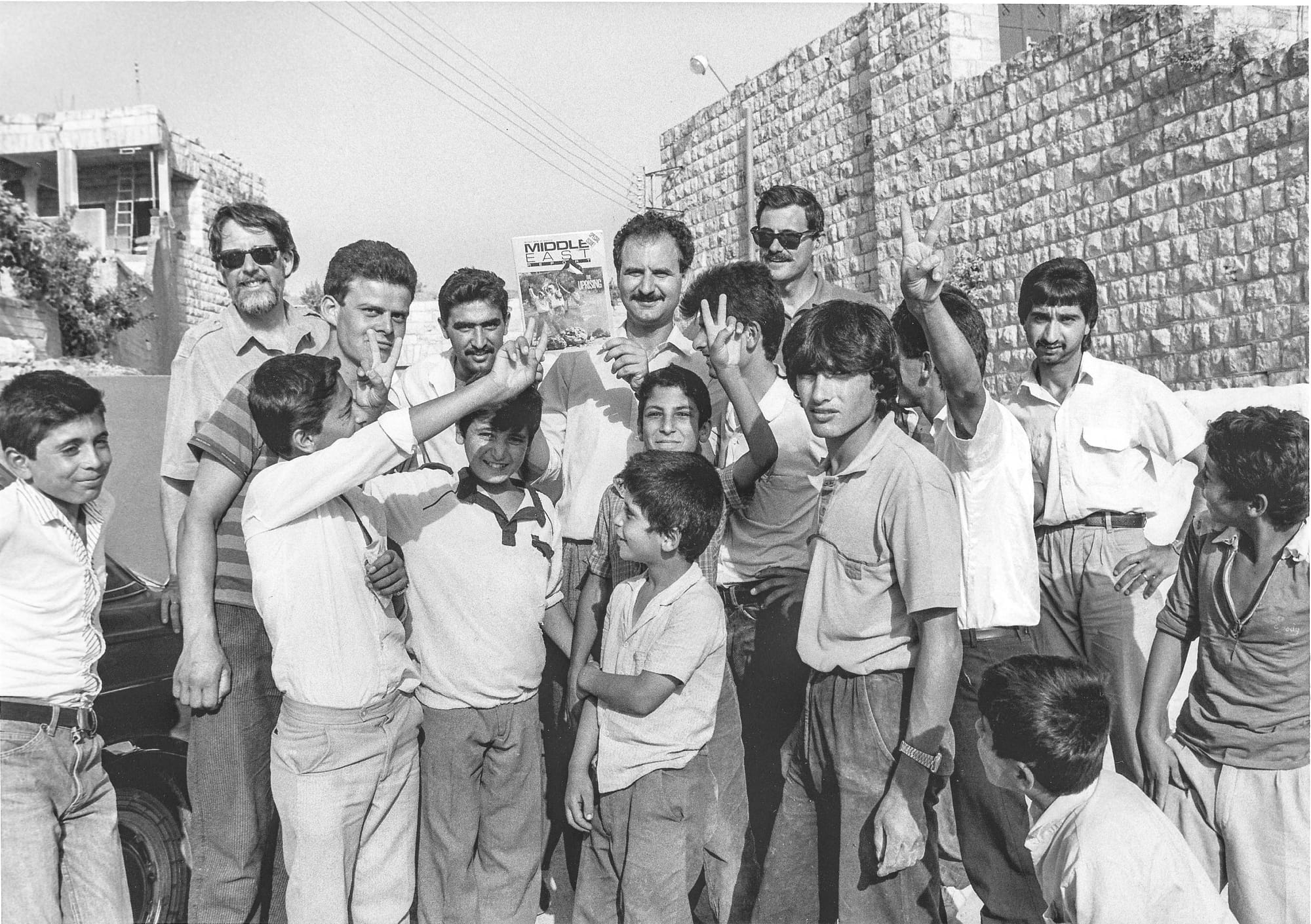
Joe Stork (L), Beshara Doumani (holding MER) and Jim Paul (top right) visiting Beita village in June 1988\. The cover image of issue number 152, held up by Doumani, was taken in Beita earlier in the year. Photo by Rick Reinhard.
He co-founded the organization in 1970 and dedicated himself to its development until he stepped down in 1995\. He shaped MERIP as a journal and as a community, serving as Editor of what came to be *Middle East Report* (*MER*) and running the MERIP office in Washington, DC. Its remarkable history of longevity, journalistic quality, comradeship and adherence to principle owes much to Joe. He was the warp and the weft of MERIP.
Joe first engaged with the Middle East region as a member of the inaugural contingent of Peace Corps volunteers in 1964\. Like many idealistic college graduates of the time, he hoped to make a positive difference in the US global reach. He was sent to Tokay, Turkey, where he spent a formative two years teaching English. After his return, he studied at Columbia University, earning an MA in International Relations and Middle East Studies. He also connected with the Committee of Returned Volunteers (CRV): a group of people who had served in the Peace Corps or in other volunteer positions across Asia, Africa and Latin America and had developed an anti-imperialist critique of US foreign policy.
In 1970, he published an article in the first issue of the CRV’s magazine, *Two…Three…Many*, titled “Palestine is a Revolution.” In the piece, Joe confronted the silence of US peace activists when it came to Palestine. He provided a brief history of the Palestinian national movement and shared his own observations of its activities on the ground in Lebanon and Jordan. His analysis placed Israel and Zionism in the context of western imperialism and argued that US and Israeli interests converged in their attacks on movements challenging US hegemony in the region. In brief, he offered a vision of the Palestinian liberation struggle as part of a global anti-imperialist movement. It is hard to overstate how revelatory this analysis was for almost everyone on the US Left. Joe had started out on his path to call their attention to Palestine and the Middle East region.
> **In brief, he offered a vision of the Palestinian liberation struggle as part of a global anti-imperialist movement.**
Around the same time, in October of 1970, Joe and six others with shared interests in the Middle East and similar backgrounds of standing against the US war in Indochina met in a cabin in New Hampshire. United by the desire to confront the avoidance of Palestine on the part of the US Left, they decided to found MERIP. As Peter Johnson, one of the original seven, observed: “When we started, the words ‘Palestine’ and ‘Palestinian’ could hardly be used in political discourse. And look where we are today—Joe, and MERIP, certainly had something important to do with that change.” It soon became clear to the group that MERIP needed to look at the broader context, to take up the task of analyzing US policy and strategies in the Middle East region as a whole, to provide the research and information that would encourage activists to work toward changing US policy.
MERIP began in 1970, as an occasional two-page newsletter. By 1973 it was being produced on a regular basis by the MERIP collective, comprised of two “clusters” of people in Washington and Boston, who took turns producing the magazine. Periodically, they met together in either city, meetings playfully called “intergalactics.” It was at one of these meetings when I first met Joe.
There was a certain level of studied anarchy in those years—the eschewing of hierarchies meant that there was no division of labor. Members of the collective were jacks of all trades: They researched, wrote, edited, typeset, marketed and budgeted for the publication. Joe embraced this model until it became clear that we could not continue to produce a magazine this way. He then led the painful process of rethinking MERIP’s structure and persuading the collective’s members that we would not survive unless we moved in the direction of staff specialization, systematic budgeting and organized fundraising.
After considerable discussion, sometimes heated, MERIP was consolidated in the Washington office in 1975, and Joe took the lead in stabilizing the organization. Joe’s ability to rethink MERIP’s structure and to make tough decisions, as well as his willingness to make personal sacrifices to stick with the project, were central to MERIP’s fortunes over time. As Zach Lockman, former editorial committee member, noted: “Many such initiatives and organizations do not survive the departure of their founder, and it is to Joe's credit that MERIP continued after he moved on and has been able to reinvent itself and survive in a very different environment.”
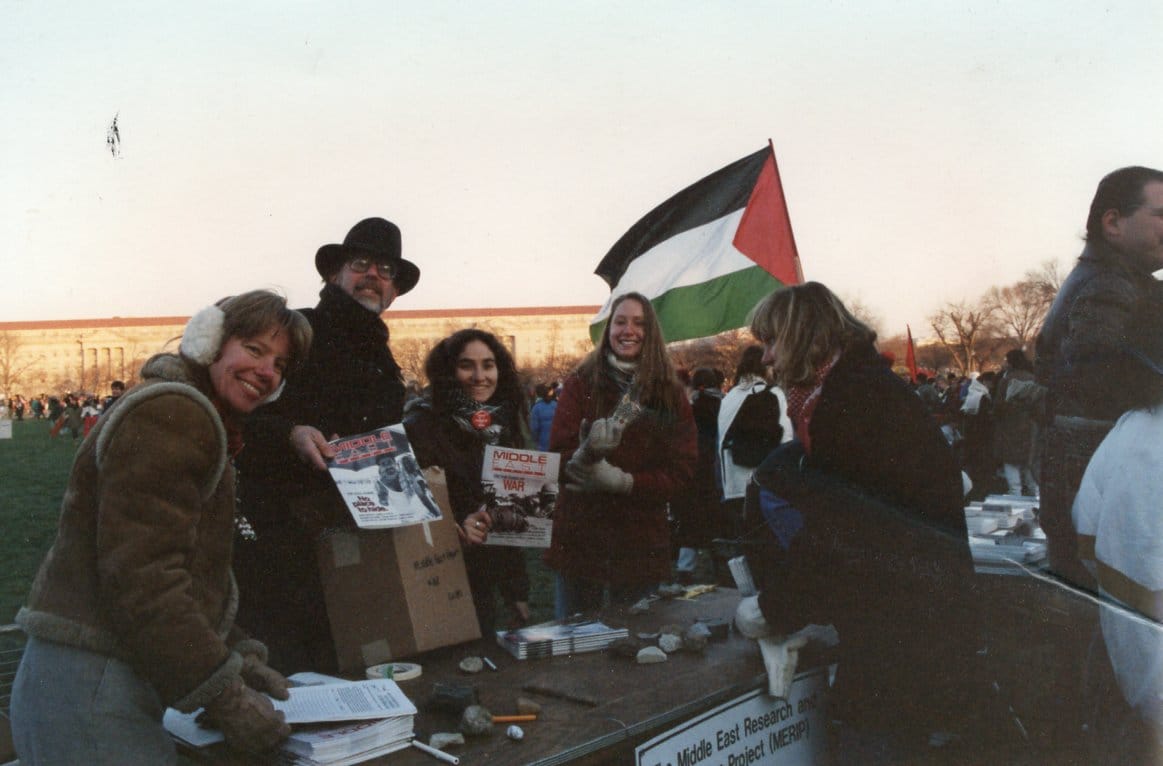
Joe Stork (second from left) with MERIP comrades Priscilla Norris (L), Esther Merves (R of Joe), and MERIP interns at a demonstration in the 1990s. Photo courtesy of Esther Merves.
It is important to note that the reorganization of the staff did not blunt Joe’s egalitarian and inclusive inclinations. Joan Mandell, early staff and long-time editorial committee member, recalls: “It was amazing to me that Joe was by far the most prolific editor and much better connected, but in our office he worked alongside much less experienced staff, dividing labor equitably and collecting the same minimalist salary.” He also took his place in the rotation for cleaning the MERIP offices and the bathroom (although rumor has it that following after him in the schedule was not a prized assignment). Many visitors—contributors with Middle East expertise from all over the country, the Middle East and Europe—came by to meet with him, and he scheduled staff lunches so everyone could gather and exchange views. The people on staff he worked with over the years remained close and loyal friends and were changed by working with him. Esther Merves, a long-time staff member and then close friend until the end of his life, reflected on this impact: “Joe's work at MERIP inspired in me a lifelong interest and commitment to the region.”
Joe was a man of parts. He was a writer of clear and fluid prose and an indefatigable researcher who left no stone unturned. His book, [*Middle East Oil and the Energy Crisis*](https://merip.org/books/middle-east-oil-and-the-energy-crisis/), published in 1975, was a master work of political economy, linking the rise and expansion of oil production in the region to political developments, chief among them the expansion of US empire. The work proved to be all too prescient when it came to future US interventions—even if the disastrous years that followed have outstripped all predictions.
Joe’s intellectual work put MERIP on the map in those early years. As I look over the books he wrote and edited, and the 100 or so pieces he penned for MERIP over time, I am struck by the breadth of his knowledge—US Middle East policy across the region as well as political and social movements in Egypt, Palestine, Iraq, the Gulf and elsewhere. In addition to his clear-eyed analysis, the causes of justice and equality for the people of the region inflected virtually everything he wrote.
Joe also put his talents as superlative editor, researcher and writer in the service of so many. He mentored, encouraged and whipped many of us into shape. Staff, editorial committee members and contributing writers all learned from him: how to write accessible prose, how to sharpen our analysis, how to cut out the fluff. It was not always easy for academics, in particular, to accept Joe’s notoriously thorough edits, but he always held his ground, and we invariably surrendered ours. As Lisa Hajjar, former intern, staff and editorial committee member, recalls: “Joe was like a wizard with his red pen…. His ability to reshape articles to make them more clear, compelling and ‘MERIP-y’ was magical.” Joe was a teacher, and many of the graduates of his MERIP workshop went on to become key players in universities and other institutions connected to Middle East studies.
MERIP grew and changed over the years, always responding to the key political events of the day but also becoming a forum for academics on the left in Middle East Studies and a resource for the classroom. Through 25 years of evolution, it was Joe who stayed the course and prepared MERIP for the next 25\. Jim Paul, who worked in partnership with Joe from 1977 to 1989, observed: “There was one person who held things together and inspired the collective spirit and political commitment … and that was Joe. People came and went but he was the steadying force and the person most committed to the project for the long term.”
> **Joe had woven together a community of activists and writers from across the country, the region and the globe, who wanted to place their time and their scholarship in the service of justice in the region.**
At a party marking the occasion of his stepping down from MERIP after 25 years, Joe insisted in his typical fashion that his work with MERIP over the long years of many challenges had been a privilege, not a sacrifice. He told us how much he relished the people—the staff, the members of the editorial committee, the writers—whom he had been fortunate enough to come to know; how lucky he felt to have been the thread of MERIP while also insisting that it was never an individual achievement. Joe had woven together a community of activists and writers from across the country, the region and the globe, who wanted to place their time and their scholarship in the service of justice in the region. Many found a home in MERIP and they also found each other. As Joel Beinin, former editorial committee member, put it: “MERIP was the constellation that informed a huge proportion of whatever I accomplished, and Joe was the brightest star in the constellation.”
After his time at MERIP, Joe went on to work at Human Rights Watch, where he spent nearly three more decades as advocacy director and then deputy-director of the Middle East and North Africa division. He wrote reports tracking rights abuses in Israel/Palestine, Egypt, Iraq and the Gulf states. He advocated for political prisoners across the region, developing personal loyalties as he grew close to many of them and their families and stood by them year after year. “I mourn a mentor, a teacher and a great friend,” said Nabeel Rajab, president of the Bahrain Center for Human Rights. “Joe was also a close family friend, and during the seven long years I spent in prison, he stayed in contact with my family, offering them comfort and support. His presence, even from afar, gave me hope and strength in those difficult times.” Joe was on the Advisory Board of the Gulf Centre for Human Rights (GCHR) from 2011 up to his death and served as chair from 2019 to 2022.
Joe loved many people and many things: He adored his late wife Priscilla Norris, his compañera of 37 years, his three daughters and his four grandchildren. He celebrated Irish music and often played it as an accomplished musician who had mastered many string instruments and also did vocals. In the 1970s, he played acoustic bass and sang with the Fast Flying Vestibules, an old-time string band of considerable regional reputation. Later, Joe and Frank Haltiwanger formed the Crooked Jack duo, playing American roots and Irish music together in many local venues. Over the years he shared his impeccable taste in music with family and friends by gifting them CDs he compiled, always with a theme that resonated with the receiver. My personal favorite was “Women Do Dylan,” a collection of Dylan covers recorded by various women musicians. He was an avid and erudite reader of English literature, including poetry from the classics to the contemporary.
The house on Delafield Place in Washington, DC that Joe shared with his beloved Priscilla was the site for many, many gatherings over the years. MERIP comrades, activists and scholars connected to the Middle East and North Africa and the wider world of human rights, fellow musicians, members of the far-flung Stork and Norris families and numerous friends came together to eat delicious food, converse, listen to music and relax in each other’s company. Joe and Priscilla, master hosts and weavers that they were, provided the space and the grace that knit and nurtured our community.
> **Read the** [**previous**](https://www.merip.org/a-note-on-the-cover-image-7/) **article.**
> **Read the** [**next**](https://www.merip.org/the-end-of-the-axis-of-resistance/) **article.**
**This article appears in** [**MER issue 313**](https://merip.org/magazine/313/) **“Resistance—The Axis and Beyond.”**
\[**Judith E. Tucker** is a former member of the MERIP collective and a professor emeritus in history at Georgetown University.\]
### Issue 313 (Winter 2024) Masthead
URL: https://www.merip.org/2025/01/issue-313-winter-2024-masthead/
Last updated: 2025-07-29T13:08:23.000Z
## ***Middle East Report*, “Resistance—The Axis and Beyond,” Winter 2024, No. 313, Vol. 53 No. 4**
### **Executive Director**
**James Ryan** jamesryan@merip.org
### **Executive Editor**
**Katie Natanel** katienatanel@merip.org
### **Managing Editor**
**Marya Hannun** maryahannun@merip.org
### **Photo Editor**
**Michelle Woodward** mwoodward@merip.org
### **Staff Editor**
**Alyssa Bivins** bivins@gwu.edu
### **Issue Editors**
Kevin Schwartz
Stephen Gasteyer
Pascal Menoret
### **Board of Directors**
**Paul Silverstein(Board Chair)** *Reed College*
**Mona Atia** *George Washington University*
**Kaveh Ehsani** *DePaul University*
**Michael Hanna** International Crisis Group
**Adam Hanieh** *University of Exeter*
**James Ketterer** *Bard College*
**Vickie Langohr** *College of the Holy Cross*
**James Ryan** *MERIP Executive Director (ex officio)*
### **Editorial Committee**
**Lisa Hajjar (Co-chair of the Editorial Committee)** *University of California, Santa Barbara*
**Muriam Haleh Davis (Co-chair of the Editorial Committee)** *University of California, Santa Cruz*
**Ayça Alemdaroğlu** *Stanford University*
**Sabiha Allouche** *University of Exeter*
**Gregory Brew** *Analyst at Eurasia*
**Stephen Gasteyer** *Michigan State University*
**Maziyar Ghiabi** *University of Exeter*
**Kanwal Hameed** *University of Exeter*
**Najib Hourani** *Michigan State University*
**Laleh Khalili** *University of Exeter*
**Reinoud Leenders** *King's College London*
**Shana Marshall** *George Washington University*
**Pascal Menoret** *Brandeis University*
**Jacob Mundy** *Colgate University*
**Maha Nassar** *University of Arizona*
**Hesham Sallam** *Stanford University*
**Kevin L. Schwartz** *Oriental Institute of the Czech Academy of Sciences*
**Deen Sharp** *London School of Economics*
**Sean Yom** *Temple University*
### **Format: Online**
### **ISSN 3065-744X**
### A Note on the Cover Image
URL: https://www.merip.org/2025/01/a-note-on-the-cover-image-7/
Last updated: 2025-07-30T04:05:37.000Z
While *MER* issue 313 grapples with the question of resistance to Israeli-US domination in light of a weakened regional axis, its cover centers the intimate, everyday textures of life that continue to animate the struggle for liberation.
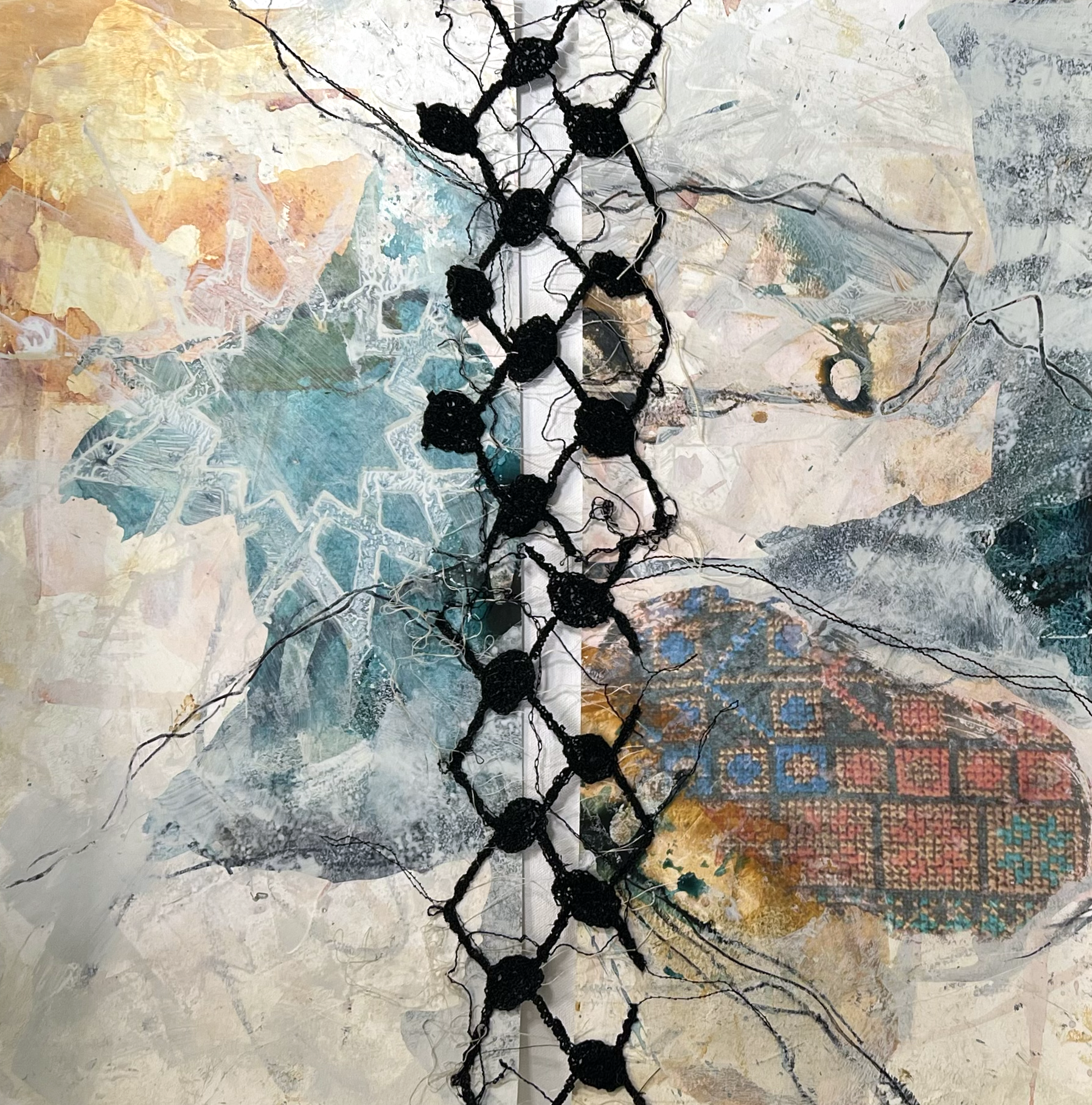
"Inherited Memories," by Samar Hussaini.
Samar Hussaini’s “Inherited Memories” works through media of acrylic, ink, graphite, image transfer and embroidery to draw forward themes of heritage, identity and resistance. Hussaini, a first-generation Palestinian American artist, uses free-hand machine embroidery, multimedia painting and sculptural forms to explore the strength of cultural memory amid displacement and loss.
Family, identity and heritage color the threads of Hussaini’s artwork, in which two halves are connected by the pattern of a keffiyeh. As Hussaini explains,
> At the heart of the piece is free-hand machine embroidery, stitched on water-soluble fabric. Once the fabric dissolves, only the intricate embroidery remains—a metaphor for the enduring strength of Palestinian culture despite efforts at erasure. The embroidery’s design is inspired by the fishing nets of Gaza, a symbolic element from the keffiyeh that represents resilience, sustenance and the enduring connection to the land and sea.
Worn by Palestinians and supporters of the liberation movement around the globe, the keffiyeh is an enduring symbol of Palestinian identity and a material marker of the struggle that moves millions to action. A patch of embroidery (*tatreez*) on the right, stitched by the artist’s grandmother, tells stories of land, resistance and belonging that can be worn upon the body, carrying messages across generations, borders and communities. Finally, the geometric star pattern, seen in the upper left, appears in various ornamental incarnations in architecture, pottery and tiles around the Middle East and North Africa, as well as in Spain, gesturing to a deeper shared history across the Mediterranean. These cultural forms connect people across space and time in ways that resist erasure.
By reconstructing them, Hussaini “invites viewers to consider the stories embedded in cultural artifacts and how they survive through creative reimagining.” The work reminds readers of *MER* that resistance is multi-faceted and ongoing, never defined by the forces that seek to constrain and destroy it.
**Read the [first](https://www.merip.org/joseph-joe-stork-a-tribute/) article** **in [MER issue 313](https://merip.org/magazine/313/) “Resistance—The Axis and Beyond.”**
### Artificial Humanitarianism—The Data-Driven Future of Refugee Responses
URL: https://www.merip.org/2025/01/artificial-humanitarianism/
Last updated: 2025-08-22T18:36:02.000Z
In Jordan’s Za’atari refugee camp, to pay for food at one of the World Food Programme (WFP)’s distribution centers, Syrian refugees must lean into an iris scanner that registers their biometrics.

A Sudanese girl who fled the war in Sudan gets her iris scanned using a biometric registration machine at a Transit Centre for refugees in Renk, South Sudan, on February 13, 2024\. Luis Tato/AFP via Getty Images
The scanner then logs their transaction onto the program’s blockchain network: Building Blocks.
Za’atari is the site of the world’s first comprehensive biometrics system for refugees. Unveiled in 2013 by the United Nations High Commissioner for Refugees (UNHCR), it included the large-scale digitization of refugee registration through the Biometric Identity Management System (BIMS). The UNHCR started using BIMS after a nearly 100-person trial of Afghan refugees in Pakistan in 2002.
The system works by creating a unique biometric identifier for each registered refugee. That identifier is then stored in a blockchain called the Population Registration and Identity Management Ecosystem (PRIMES). Initially pitched by the UNHCR as a way to easily track refugee registration and residency, the biometrics model has morphed into an all-encompassing surveillance system. BIMS registers every refugee life event: from marriage, to education, to death. More than 90 percent of Syrians residing in Za’tari have been forcibly registered into the system as a precondition for receiving aid.
As a laboratory for large-scale digital registration, the [Za’atari model](https://www.merip.org/refugee-rights-hit-the-wall/) has now become the norm in UNHCR operations. Registration in BIMS is a prerequisite for refugee registration and thus the ability to apply for asylum or resettlement as well as for the receipt of humanitarian aid. By 2020, more than 37 million refugees around the world had given their biometric information and were registered through BIMS into PRIMES. Many of these refugees now receive aid payments with digital wallets, communicate to the UNHCR through chatbots and, in some rare cases, receive aid from drones.
Robotics, biometrics, drones, artificial intelligence, computational software and blockchain are not usually associated with humanitarianism but that is changing rapidly. Today, the humanitarian sector is imbued with a digital logic that is reshaping the delivery of aid and the conception of care. The overlapping catastrophes in the Middle East and North Africa—from the Syrian civil war of the past decade to the ongoing mass violence in Sudan and Palestine—are a key laboratory for testing these new practices.
As refugees are transformed into digital subjects, various technologies mediate their interactions with humanitarian organizations. The explicit goals of these intermediation technologies are to enhance the efficiency of humanitarian care, but they are also shaping the predictive, autonomous capabilities of technologies to meet humanitarian needs. To do so, they need a specific fuel: data.
## **‘Data Is the New Oil’**
Many technology observers have latched on to the expression that “data is the new oil” to reflect the growing importance of data-driven digital technologies in the economies of the Middle East.[\[1\]](#%5Fedn1) The region’s commercial appetite for data extends into the humanitarian sector. Local companies have a hand in developing everything from mobile payment applications to biometric registration systems—like the Zayn wallets used for digital cash transfers, developed by an Iraqi company, or the EyePay systems used to collect iris and fingerprint data in Za’atari, developed by a Jordanian-British company. An entire network of commercial interests now exists to feed into the humanitarian sector’s desire to digitize everything from refugee registration to aid delivery.
States are getting in on the action too. The United Arab Emirates has become a hub for networks of government bodies, commercial interests, international consultants and local start-ups that deepen the overlapping circuits of war, surveillance, logistics, humanitarianism and digitization. For example, the [International Humanitarian City](https://www.merip.org/the-uae-and-the-infrastructure-of-intervention/) in Dubai is a logistics project created in 2003 to connect aid to conflict and disaster zones in the Horn of Africa, Red Sea and the Indian Ocean region—part of a broader effort to expand influence and logistics infrastructure in Africa and Asia. Recently, the UAE created a parallel “[digital response platform](https://techxmedia.com/uae-to-launch-advanced-disaster-relief-digital-platform/)” that aims to provide a digital corollary to these logistics capacities. This platform brings together machine learning, artificial intelligence and geospatial technologies to facilitate information sharing among Humanitarian City’s partners.
The involvement of tech companies and their products in state-led and international humanitarian work raises serious concerns about how their profit motive might compromise humanitarian principles. In particular, the absence of strong data protection laws renders data a profitable commodity to be bought and sold. Any commercial company holding a contract with the UNHCR or WFP can access anonymized refugee data. The more data available to companies, the wider range of possible technological applications can be adapted to humanitarian use. But this data is rarely protected and can be circulated among humanitarian and commercial actors long after an individual is no longer receiving humanitarian support. Humanitarian emergencies thus become opportunities for companies to profit as both service providers and data hoarders.
The adoption of digital technologies also changes the nature of the humanitarian problems that actors are trying to address. One example is predictive analytics: a type of artificial intelligence in which the timing, cause and duration of anything—from an environmental catastrophe to a violent conflict— can be anticipated and prepared for. Using predictive analytics, the WFP has created a modelling platform called SHAPES (Shock and Assistance Platform for Economic Simulations) to forecast food security outcomes in the event of severe crisis. It has already deployed SHAPES in both Yemen and Lebanon, reducing the average food security assessment time from six months to three. It also uses the “[Hunger Map Live](https://hungermap.wfp.org/)” to model caloric needs depending on the location of the disaster. The United Nations Office for the Coordination of Humanitarian Affairs created the Humanitarian Data Exchange (HDE) to provide data and datasets to organizations like the WFP that feed into their predictive analytics. These programs all cast data and associated problems differently but share a commitment to forecasting how to deal with humanitarian emergencies.
> **As a result, knowledge about emergencies and those affected by them is no longer being produced in context but rather through machines and artificial intelligence that dictate how humanitarians should intervene in crisis situations.**
In this incarnation of contemporary humanitarianism, each emergency produces data that feeds into the responses of humanitarian organizations anticipating the next emergency. The data is not only circulated through PRIMES, SHAPES, HDE and other similar platforms. It also becomes the source feeding predictive humanitarianism. As a result, knowledge about emergencies and those affected by them is no longer being produced in context but rather through machines and artificial intelligence that dictate how humanitarians should intervene in crisis situations. By producing predictive visions that can be acted upon by humanitarian organizations, these technologies shift the whole terrain of humanitarian action from reactive to anticipatory. The cascading crises in the Middle East and North Africa provide a veritable data mine for humanitarian organizations to hone these predictive analytics.
Anticipating a crisis and acting upon one are very different things, however. Predictive analytics will always rely on incomplete data. They will also include algorithmic biases, which have already been called into question in the [case of predictive policing](https://naacp.org/resources/artificial-intelligence-predictive-policing-issue-brief) that overwhelmingly targets racialized and poor communities for police interventions. Furthermore, the data fed into these predictive algorithms has often been extracted from people in humanitarian emergencies that may have not understood or consented to the future uses of their data.
## **Humanitarian Robots**
In 2013, the US Defense Department’s Defense Advanced Research Projects Agency (DARPA) created a [Robotics Challenge](https://www.darpa.mil/news/2013/robotics-challenge-trials-conclude) to incentivize commercial and academic research into the potential for these technologies to support humanitarian and disaster relief operations. Teams submitted everything from robotic snakes capable of capturing images under rubble, to humanoid robots that could drive cars, use power tools and transform into moving vehicles. The robots might have been clunky, their movements slow and awkward, but they showcased a new way of being humanitarian.
Many of DARPA’s publicly known projects are the stuff of dystopian science fiction, but the robotics envisioned in the 2013 challenge were not from the realm of fantasy or techno-futurism. [A robot named Sophia](https://social.desa.un.org/sdn/meet-the-robots-who-are-making-the-world-a-better-place) is the first United Nations Development Programme’s (UNDP) Innovation Ambassador. Notably, she is also the first robot to receive legal personhood, after Saudi Arabia granted her [citizenship in 2017](https://www.wired.com/story/sophia-robot-citizen-womens-rights-detriot-become-human-hanson-robotics/). Sophia mingles with dignitaries and diplomats at various UNDP events. At an [“AI for Good”](https://aiforgood.itu.int/speaker/sophia/) summit in July of 2023, Sophia was joined by eight other humanitarian robot prototypes that can do everything from prepare food, heal wounds or simply socialize with someone who needs a friend. A future in which robots are an integrated part of the landscape of refugee camps, serving as soccer players, companion dogs or cleaners, may not be far off.

Sophia at the AI for Good Global Summit 2018, Geneva. Photo courtesy of the UN's ITU ((International Telecommunication Union). Creative Commons license CC BY-NC-ND.
But humanitarian robots can do much more than socialize. Robotic technologies are justified as being able to move aid the so-called last mile, usually conceived as up to 50 kilometers, when it is too dangerous for humans to physically move aid into war or disaster zones. According to the head of the WFP’s innovation department, Bernhard Kowatsch, the [idea for robotic vehicles as aid deliverers was conceived](https://www.yahoo.com/tech/un-food-aid-deliveries-ai-123508135.html) during the brutal four-year battle of Aleppo between 2012–2016, when it was virtually impossible to move aid into the city. A decade later, Project A.H.E.A.D (Autonomous Humanitarian Emergency Aid Devices) was born out of the WFP’s Business Accelerator and launched in Germany for its first use case in South Sudan. This pilot project involves remotely operating aid delivery into South Sudan using a Ukrainian built amphibious truck with an unassumingly playful name: [Herbert the Sherp](https://www.wfp.org/support-us/stories/herbert-sherp).
Herbert is one cog in a material structure linking several digital technologies and applications: Drones and satellites produce information about the terrain, that data is then transmitted to an operating center far from the afflicted area to determine what aid and supplies Herbert needs before the Sherp is loaded up and sent to the zone through remote operation. Humanitarian workers, by which I mean humans, are only one part of a mostly non-human, networked structure in which drones, satellites, communications towers and Herbert the Sherp are collecting the information needed to deliver humanitarian aid.
> **Although humanitarian dilemmas about how to deliver aid and to whom have always existed, humanitarian robots change these calculations and potentially absolve humanitarian actors of the ethical considerations required to meet people’s needs in moments of emergency.**
There are good reasons to believe that the Herberts of the humanitarian world will save lives and protect humanitarian workers in dangerous situations. But they also represent a new form of robotic intermediation that threatens to render life-and-death decisions, like who gets food and who does not, up to machine learning. Although humanitarian dilemmas about how to deliver aid and to whom have always existed, humanitarian robots change these calculations and potentially absolve humanitarian actors of the ethical considerations required to meet people’s needs in moments of emergency.
Moreover, these technologies are mirror images of those deployed in contemporary warfare—responsible for creating some of today’s most devastating humanitarian crises. Indeed, Israel has used [remotely operated](https://www.newyorker.com/magazine/2024/11/04/the-perilous-reality-of-aid-work-in-gaza) drones to surveil and target aid workers in Gaza and obstruct the delivery of aid. Cyber warfare targeting key infrastructures has become routine. Suicide drones are regularly deployed by Israel, Hizballah and other actors, and there is increasing evidence of [underwater drones](https://www.reuters.com/business/aerospace-defense/sea-drone-warfare-has-arrived-us-is-floundering-2024-05-06/) and land robots deployed on the battlefield.
The same technologies that network data, algorithms, machines and drones to recast humanitarian possibilities are thus similarly reshaping warfare. Israel’s “[Lavender](https://972mag.com/lavender-ai-israeli-army-gaza/)” and “[the Gospel](https://972mag.com/lavender-ai-israeli-army-gaza/)” are the most spectacular examples. Both systems are AI and machine learning programs that have identified more than [37,000 individual Palestinian targets](https://www.theguardian.com/world/2024/apr/03/israel-gaza-ai-database-hamas-airstrikes) that were subsequently targeted by Israeli drones. These systems function mostly independently of human oversight. Much like Project A.H.E.A.D, Lavender and the Gospel bring together data and machines to make decisions about life and death.
## **Circuits of Humanitarianism and Warfare**
Za’atari demonstrated that large-scale digitization of registration and surveillance of everyday life by the UNHCR was possible. Its success meant that the model has been transported to other [protracted refugee situations](https://interagencystandingcommittee.org/sites/default/files/migrated/2020-01/UNHCR%20-%20WFP%20joint%20update%20on%20use%20of%20biometrics%20-%20January%202020.pdf), including the Dadaab camp in Kenya, the Osire camp in Namibia and the Tongogara refugee camp in Zimbabwe.
Alongside the circulation of these technologies and practices are the ideas at the core of contemporary humanitarianism: accountability, transparency and efficiency. Humanitarian technophilia is rationalized as facilitating better forms of intermediation to meet people’s needs. But these rationalizations mask a complex system of power oriented toward data extraction and commodification. The immediate and long-term effects of crisis and emergency are rendered into a series of digitally legible data points that feed into systems of computational analytics.
> **...many of the same companies at the forefront of digital humanitarianism are implicated in digitized warfare and other forms of surveillance and violence.**
Moreover, many of the same companies at the forefront of digital humanitarianism are implicated in digitized warfare and other forms of surveillance and violence. Palantir, for example, a company whose original funding came partly from CIA-linked venture capital firm Q-Tel, has contracts with such diverse customers as the Los Angeles Police Department and Immigration and Customs Enforcement in the United States to provide data analytics. Palantir is also a major WFP partner. Clearview AI is another company that provides surveillance technologies to police departments around the world and also provided facial recognition services to the Ukrainian government in the aftermath of the Russian invasion. The Israeli company Cellebrite exports border technologies around the world while also receiving contracts to service United Nations agencies with their software. Examples, such as these, that blur the lines between warfare, surveillance and humanitarianism abound.
Such overlaps aggravate concerns over how digital companies are recasting humanitarianism norms and principles. The large-scale destruction in Gaza, Lebanon and Sudan poses generational challenges for humanitarian actors who will certainly turn to digital humanitarian tools for solutions. For better and worse, each new crisis provides new opportunities for the deployment and refinement of these technologies.
\[
Samer Abboud is associate professor of global interdisciplinary studies at Villanova University.\]
---
### **Endnotes**
[\[1\]](#%5Fednref1) Patrick Sisson, “[Desert Data Boom,](https://sherwood.news/business/middle-east-data-centers-infrastructure-spending-demand/)” *Sherwood News*, June 27, 2024.
### Issue 301 (Winter 2021) Masthead
URL: https://www.merip.org/2024/11/issue-301-winter-2021-masthead/
Last updated: 2025-07-29T13:06:28.000Z
## ***Middle East Report*, “Revolutionary Afterlives,” Winter 2021, No. 301, Vol. 5 No. 4**
### **Executive Director**
**Mandy Terc** mandyterc@merip.org
### **Managing Editor & Photo Editor**
**Michelle Woodward** mwoodward@merip.org
### **Issue Editors**
**Arang Keshavarzian**
**Stacey Philbrick Yadav**
**Atef Said**
**Pete Moore**
### **Format: Online**
### **ISSN 3065-744X**
### Issue 300 (Fall 2021) Masthead
URL: https://www.merip.org/2024/11/issue-300-fall-2021-masthead/
Last updated: 2025-07-29T13:06:12.000Z
## ***Middle East Report*, “MERIP at 50,” Fall 2021, No. 300, Vol. 5 No. 3**
### **Executive Director**
**Mandy Terc** mandyterc@merip.org
### **Managing Editor & Photo Editor**
**Michelle Woodward** mwoodward@merip.org
### **Issue Editors**
**Waleed Hazbun**
**Najib Hourani**
**Lisa Hajjar**
**Chris Toensing**
### **Format: Online**
### **ISSN 3065-744X**
### Issue 299 (Summer 2021) Masthead
URL: https://www.merip.org/2024/11/issue-299-summer-2021-masthead/
Last updated: 2025-07-29T13:06:00.000Z
## ***Middle East Report*, “Race—Legacies and Challenges,” Summer 2021, No. 299, Vol. 51 No. 2**
### **Executive Director**
**Mandy Terc** mandyterc@merip.org
### **Managing Editor & Photo Editor**
**Michelle Woodward** mwoodward@merip.org
### **Issue Editors**
**Elif Babül**
**Muriam Haleh Davis**
**Jessica Barnes**
**Alex Lubin**
### **Format: Online**
### **ISSN 3065-744X**
### Issue 298 (Spring 2021) Masthead
URL: https://www.merip.org/2024/11/issue-298-spring-2021-masthead/
Last updated: 2025-07-29T13:05:49.000Z
## ***Middle East Report*, “Maghreb from the Margins,” Spring 2021, No. 298, Vol. 51 No. 1**
### **Executive Director**
**Mandy Terc** mandyterc@merip.org
### **Managing Editor & Photo Editor**
**Michelle Woodward** mwoodward@merip.org
### **Issue Editors**
**Zakia Salime**
**Mona Atia**
**Jacob Mundy**
**Paul Silverstein**
### **Format: Online**
### **ISSN 3065-744X**
### Issue 297 (Winter 2020) Masthead
URL: https://www.merip.org/2024/11/issue-297-winter-2020-masthead/
Last updated: 2025-07-29T13:05:39.000Z
## ***Middle East Report*, “Health and the Body Politic,” Winter 2020, No. 297, Vol. 50 No. 4**
### **Executive Director**
**Mandy Terc** mandyterc@merip.org
### **Managing Editor & Photo Editor**
**Michelle Woodward** mwoodward@merip.org
### **Issue Editors**
**Nabil Al-Tikriti** *University of Mary Washington*
**Kevan Harris** *UCLA*
**Graham Cornwell** *George Washington University*
**Omar Dewachi** *guest editor*
### **Format: Online**
### **ISSN 3065-744X**
### Issue 296 (Fall 2020) Masthead
URL: https://www.merip.org/2024/11/issue-296-fall-2020-masthead/
Last updated: 2025-07-29T13:05:25.000Z
## ***Middle East Report*, “Nature & Politics,” Fall 2020, No. 296, Vol. 50 No. 3**
### **Executive Director**
**Mandy Terc** mandyterc@merip.org
### **Managing Editor & Photo Editor**
**Michelle Woodward** mwoodward@merip.org
### **Issue Editors**
**Jessica Barnes** *University of South Carolina*
**Muriam Haleh Davis** *UC Santa Cruz*
**Sophia Stamatopoulou-Robbins** *guest editor*
### **Format: Online**
### **ISSN 3065-744X**
### Issue 295 (Summer 2020) Masthead
URL: https://www.merip.org/2024/11/issue-295-summer-2020-masthead/
Last updated: 2025-07-29T13:05:11.000Z
## ***Middle East Report*, “Kurdistan, One and Many,” Summer 2020, No. 295, Vol. 50 No. 2**
### **Executive Director**
**Mandy Terc** mandyterc@merip.org
### **Managing Editor & Photo Editor**
**Michelle Woodward** mwoodward@merip.org
### **Issue Editors**
**Ayça Alemdaroğlu** *Stanford University*
**Elif Babül** *Mount Holyoke College*
**Arang Keshavarzian** *New York University*
**Nabil Al-Tikriti** *University of Mary Washington*
### **Format: Online**
### **ISSN 3065-744X**
### Issue 294 (Spring 2020) Masthead
URL: https://www.merip.org/2024/11/issue-294-spring-2020-masthead/
Last updated: 2025-07-29T13:04:56.000Z
## ***Middle East Report*, “Exit Empire—Imagining New Paths for US Policy,” Spring 2020, No. 294, Vol. 50 No. 1**
### **Executive Director**
**Mandy Terc** mandyterc@merip.org
### **Managing Editor & Photo Editor**
**Michelle Woodward** mwoodward@merip.org
### **Issue Editors**
**Waleed Hazbun** *University of Alabama*
**Shana Marshall (Chair of the Editorial Committee)** *George Washington University*
**Pete Moore** *Case Western Reserve University*
**Jacob Mundy** *Colgate University*
### **Format: Online**
### **ISSN 3065-744X**
### Joe Stork and MERIP
URL: https://www.merip.org/2024/11/joe-stork-and-merip/
Last updated: 2025-08-25T14:28:46.000Z
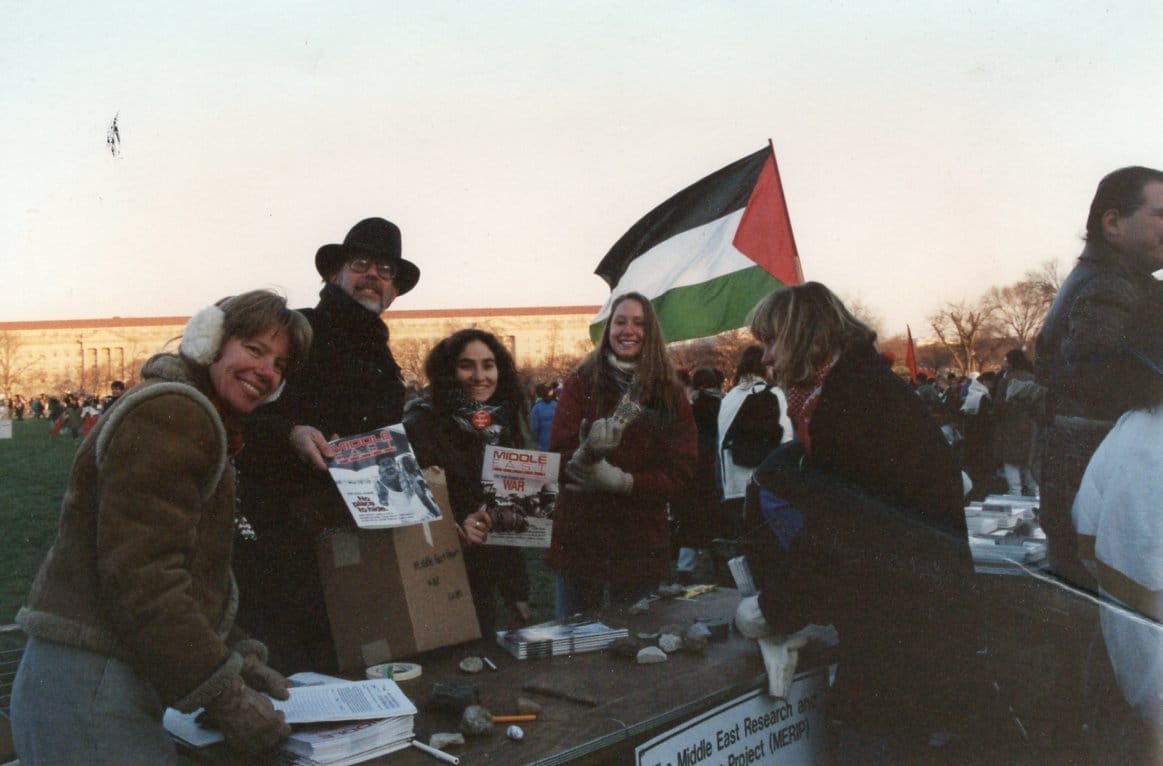
Joe Stork (second from left) with MERIP comrades Priscilla Norris, Esther Merves, and MERIP interns at a demonstration in the 1990s. Photo courtesy of Esther Merves.
**S*ince the news of Joe Stork’s passing on October 22, I have been in touch with many long-time MERIP contributors, editors and close friends and comrades of Joe and of our organization. In the spirit of remembering his massive contributions to the publication and beyond, we’ve compiled a brief guide to his writing and to his broader analysis. Throughout, his commitment to a just future for Palestine and the region is evident. I thank those who helped assemble the list below—especially Lisa Hajjar, Waleed Hazbun, Ted Swedenburg, Esther Merves and Mouin Rabbani. We will have further reflection and remembrances to share in our pages and over our newsletter in the new year and hope this short guide is enlightening in the meantime.*
*\-*James Ryan, MERIP Executive Director
[**Palestine Is A Revolution**](https://www.jstor.org/stable/community.28031958?seq=3)
*2…3…Many,* Winter 1970
A year before Joe Stork established MERIP, and not long after returning from the peace corps in Turkey, he spent several weeks visiting Palestinian refugee camps in Jordan. As fate would have it, Joe was observing Fatah activities in the Wahdat camp as the Jordanian Army opened fire on Palestinian refugees and commandos, triggering a series of US-supported Jordanian assaults on PLO positions across Jordan now known as “Black September.” Joe’s report from this time is noteworthy not only as a historical account of the events but for his crystal clear analysis of the state of the Palestinian struggle, its internationalist character and its deeply-rooted anti-imperialism.
—
[**MERIP: The First Decade**](https://www.merip.org/merip-the-first-decade/)
Issue 100, October-December 1981
After returning from Jordan, Joe Stork met with six fellow anti-war activists and peace corps veterans in a cabin in New Hampshire to discuss their recent experience in the Middle East and what they could do to further the cause of anti-imperialism in the region. This meeting became MERIP’s founding moment, which is recounted in this essay by Joe and co-founder Peter Johnson for the 100th Issue of *Middle East Report*. It details not only the organization’s growth but the continued broadening of the struggle to include the entrenchment of conservatism in the Arab regimes and the fate of Iran after the revolution.
—
[**Middle East Oil and the Energy Crisis**](https://merip.org/books/middle-east-oil-and-the-energy-crisis/)
Monthly Review Press, 1975
Growing out of his work with MERIP, Joe Stork published an in-depth analysis of the Energy Crisis in 1975 with the Monthly Review Press. This book remained an influential overview of the political dynamics of oil in the region, a topic Joe would return to often in the pages of MERIP.
—
[**Ten Years After**](https://www.merip.org/ten-years-after/)
Issue 120, January-February 1984
Reflecting on the decade following the Yom Kippur War of 1973, Joe Stork overviewed politics in the region for MERIP’s winter issue. This piece provides a comprehensive, if brief, analysis of the alignment of conservative and reactionary forces in the region during a decade that saw the assassinations of Anwar Sadat in Egypt and King Faysal in Saudi Arabia, the outbreak of war between Iran and Iraq and the invasion of Lebanon by Israel. It was in many ways a point of desperation for the causes MERIP stood for, as Joe wrote, “In many respects, the contrasting spectacles of October 1973 and the summer of 1982 delimit an era where the regimes survived but the Arab nationalist ethos, and the allegiance it provided both to states and oppositions, disintegrated.”
—
[**Constructing an International Criminal Court**](https://www.merip.org/constructing-an-international-criminal-court/)
Issue 207, Summer 1998
After formally leaving his post as Editor in 1995, Joe Stork became particularly interested in the development of international legal institutions such as the ICC and the defense of human rights through his work at Human Rights Watch and the Gulf Centre For Human Rights. He continued to stay in touch with and contribute to MERIP in these years, and this report on the developments that would lead to the Rome Statute in 1998 clearly delineates how internationalist commitments were and weren’t reflected in the negotiations and, ultimately, in the treaty itself.
—
[**Reflections on MERIP’s First 25 Years**](https://www.merip.org/reflections-on-merips-first-25-years/)
[**MERIP’s Place in the Political and Media Landscape**](https://www.merip.org/merips-place-in-the-political-and-media-landscape-an-interview-with-joe-stork-and-chris-toensing/)
Issue 300, Fall 2021
Our 50th anniversary issue featured Joe Stork’s reflections on the first 25 years of MERIP and an interview conducted by Lisa Hajjar with Joe and Chris Toensing, Joe’s successor as Editor. Across these two pieces, one gets a palpable sense of the history of our organization and the challenges posed by the waxing and waning of interest in the region across the media landscape.
—
[**MERIP’s Impact On Middle East Studies: Showcasing a MESA Roundtable**](https://www.cambridge.org/core/journals/review-of-middle-east-studies/article/merips-impact-on-middle-east-studies-showcasing-a-mesa-roundtable/07599655B5459E65E09292E88F156A8A)
*Review of Middle East Studies*, Volume 55 No. 2, 2022
To mark MERIP’s 50th anniversary Joe Stork was gathered into a group for a MESA roundtable with current and former editorial committee members*—*Waleed Hazbun, Zachary Lockman, Ted Swedenburg, Judith Tucker, Stacey Philbrick Yadav, Jacob Mundy and Norma Claire Moruzzi*—*to discuss the legacy of MERIP after 50 years. It’s an insightful conversation on the role of MERIP vis-à-vis the academy and reflective of how far we have come as an institutional space for the discussion of struggles that might otherwise not find a purchase in academic spaces.
—
[**The Fast Flying Vestibule**](https://thebestamericanpoetry.typepad.com/the%5Fbest%5Famerican%5Fpoetry/2009/07/the-fast-flying-vestibule-im-glad-im-prepared-for-the-recession-terence-winch.html)
The Best American Poetry Blog, July 11, 2009
Ted Swedenburg has reminded us that no remembrance of Joe Stork would be complete without mention of his musical side. Joe was a talented folk musician, and at the same time he established MERIP, he formed a well-regarded folk band, The Fast Flying Vestibule, a short history of which is given in this blog post. The post also has recordings of several of their songs, including Joe’s lead vocal on “I’m Glad I’m Prepared for the Recession.”
—
*Thank you, Joe.*
### Editors’ Picks—Reading and Watching the Prison in North Africa and the Middle East
URL: https://www.merip.org/2024/10/editors-picks-reading-and-watching-the-prison-in-north-africa-and-the-middle-east/
Last updated: 2025-07-30T03:54:09.000Z
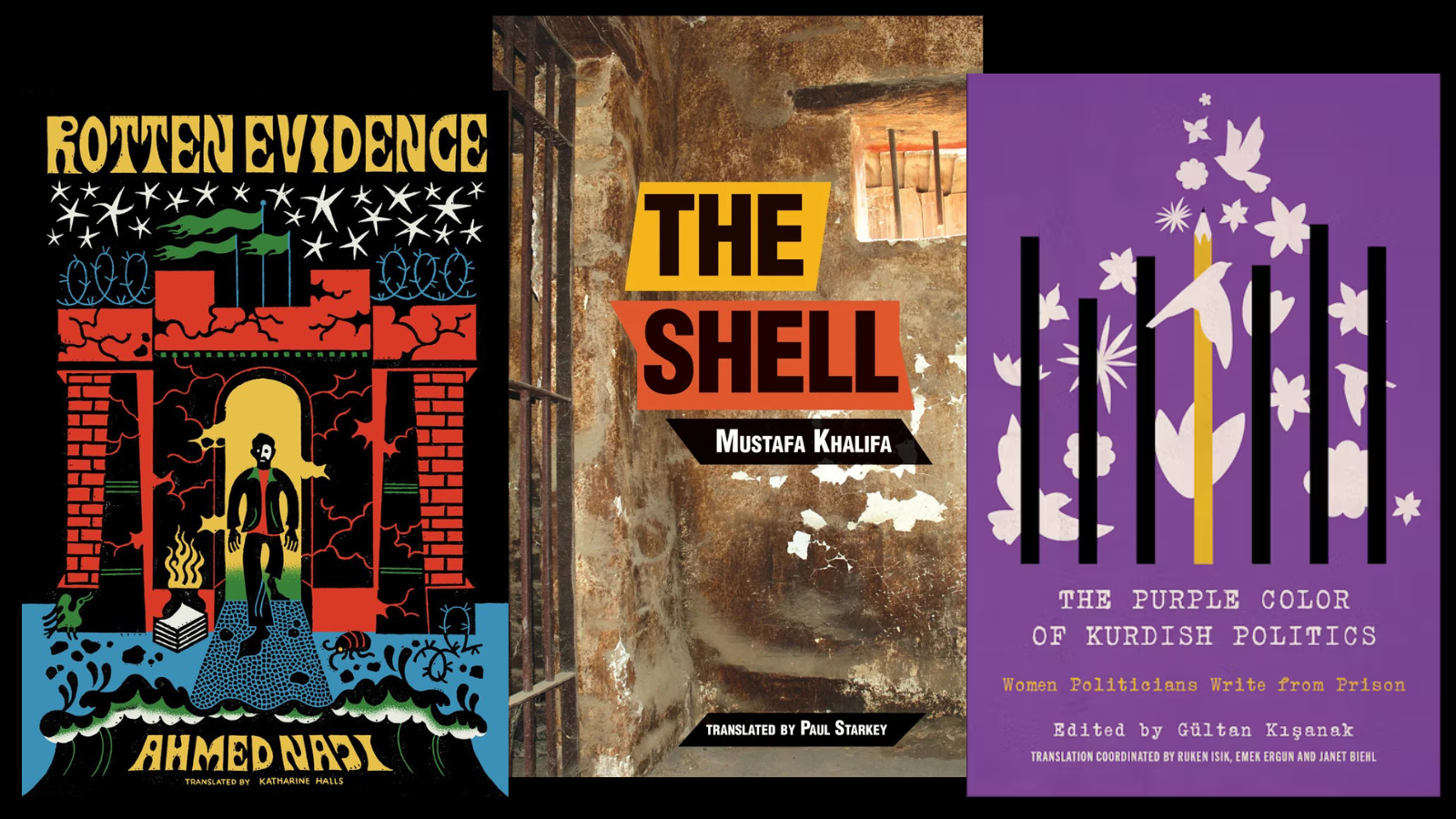
The book covers of Rotten Evidence: Reading and Writing in an Egyptian Prison by Ahmed Naji, The Shell: Memoirs of a Hidden Observer by Mustafa Khalifa, and The Purple Color of Kurdish Politics: Women Politicians Write from Prison Edited by Gültan Kışanak.
T*he editors of MER issue 312, “Carceral Realities and Freedom Dreams,” assembled a list of literary works and films (available in English) that take up the prison across space and time. These works capture the themes of the issue: carceralism—that is, forms of un-freedom—and organized resistance against it. For decades, literature and film have been integral mediums through which activists, artists and writers in and from the Middle East and North Africa explore un-freedom and imagine liberation. From political memoirs to darkly humorous short films, the below provides a window into a wide-ranging and enduring genre.*
## **Books**
### ***The Prison Papers of Bozorg Alavi: A Literary Odyssey* (Iran)**
*[The Prison Papers](https://press.syr.edu/supressbooks/1827/prison-papers-of-bozorg-alavi/)*, by Donné Raffat, recounts the life and literary works of Iranian Marxist intellectual Bozorg Alavi, who—along with a group of dissidents—was imprisoned in 1937 for four years. The book features short stories and other written works penned by Alavi during his incarceration, works that are [credited with influencing](https://pulitzercenter.org/stories/jailbirds-summer-reading-list) a new genre of prison literature in Iran.
### ***Resistance: My Life for Lebanon*, Souha Bechara (Lebanon)**
*[Resistance: My Life for Lebanon](https://www.abebooks.co.uk/9781887128803/Resistance-Life-Lebanon-Soucha-Bechara-1887128808/plp)* is the 2003 memoir of Souha Bechara, a Lebanese woman who was imprisoned in the infamous Israeli-controlled Khiam prison in Southern Lebanon. In 1988, Souha Bechara attempted to assassinate Antoine Lahad, collaborator with Israel and leader of the South Lebanon Army. She was immediately arrested and released in 1998 following an extensive Lebanese and international campaign.
### ***Undesirables,* Aomar Boum and Nadjib Berber (North Africa)**
[This graphic novel](https://www.sup.org/books/jewish-studies/undesirables)—published in 2023 by Stanford University Press—chronicles [the lesser-known events](https://www.merip.org/undesirables-and-the-mediterranean-graphic-novel/) surrounding the internment of political opponents and Jews in seven camps throughout Vichy North Africa during World War II. To bring this historical ethnography to life, Aomar Boum, a historical anthropologist at UCLA, collaborated with Nadjib Berber (Nad), a well-known cartoonist from Algeria.
### ***Consciousness Molded or the Re-identificatin of Torture,* Walid Dakka (Palestine)**
Written by [Palestinian prisoner](https://www.merip.org/a-place-without-a-door-and-uncle-give-me-a-cigarette-two-essays-by-palestinian-political-prisoner-walid-daqqah/) Walid Dakka—who died in Israeli prison in 2024 after being [denied adequate medical treatment](https://www.amnesty.org/en/latest/news/2024/04/israel-opt-death-in-custody-of-walid-daqqah-is-cruel-reminder-of-israels-disregard-for-palestinians-right-to-life/) for terminal cancer—"Consciousness Molded or the Re-identification of Torture," analyzes the purpose of Israeli torture. It argues that the Israeli regime intends not only to inflict pain on Palestinians but also to remold their consciousness and alter their political subjectivities. It was published in English in 2011 as part of the edited volume, *[Threat—Palestinian Political Prisoners in Israel](https://www.plutobooks.com/9780745330204/threat/).*
### ***Dawn,* Selahattin Demirtaş (Turkey)**
Selahattin Demirtaş, an imprisoned leader of the pro-Kurdish HDP (People’s Democratic Party), wrote [this book of short stories](https://www.penguin.co.uk/books/438208/dawn-by-selahattin-demirtas/9781473559905), published in 2019, while in a maximum security jail in Turkey. In the work, Demirtaş, who in 2017 ran for president from behind bars, examines life in a carceral state. Some of the stories deal directly with the prison: the underrage kids who build jails, or a committee reading the notes of inmates. Others focus on people on “the outside”: refugees, political protestors or workers.
### ***That Smell*, Sonallah Ibrahim (Egypt)**
Egyptian novelist Sonallah Ibrahim composed this semi-autobiographical work after serving a five-year prison sentence. The novel, published in 1966, follows a recently released political prisoner adrift in Cairo. The [2013 English-language edition](https://www.ndbooks.com/book/that-smell-notes-from-prison/) includes a selection from Ibrahim’s prison diary—“a personal archive comprising hundreds of handwritten notes scribbled on Bafra-brand cigarette papers”—annotated by translator Robyn Creswell.
### ***This Blinding Absence of Light*, Tahar Ben Jelloun (Morocco)**
[*This Blinding Absence of Light*](https://thenewpress.com/books/this-blinding-absence-of-light) by Tahar Ben Jelloun (translated from the French by Linda Coverdale and published in 2002) recounts the inhumane and insufferable treatment of “disappeared” political prisoners held in Morocco’s most infamous prison, Tazmamart. Though based on the personal account of a former detainee, Ben Jelloun came under intense criticism from other released prisoners who felt that Ben Jelloun was profiting from their suffering while the Moroccan government continued to ignore their demands for reparations and accountability.
### ***The Shell: Memoirs of a Hidden Observer* by Mustafa Khalifa (Syria)**
Mustafa Khalifa’s *[The Shell: Memoirs of a Hidden Observer](https://interlink-publishing.square.site/product/the-shell-memoirs-of-a-hidden-observer/65)* (translated by Paul Starkey and published in English in 2007) is a novel narrating the violence and torture perpetuated against political prisoners by the Syrian regime. Set in Tadmur prison, the novel is the story of a Syrian political prisoner who was imprisoned for 14 years and subjected to brutal forms of torture while maintaining his defiance.
### ***The Purple Color of Kurdish Politics: Women Politicians Write from Prison,* ed. Gültan Kışanak (Kurdistan)**
Two years after being elected co-mayor of Diyarbakır, Kurdish journalist and politician, Gültan Kışanak, was arrested by the Turkish state. While imprisoned, she documented her own struggles and gathered writings from over 20 Kurdish women political prisoners. *[The Purple Color of Kurdish Politics](https://www.plutobooks.com/9780745347080/the-purple-color-of-kurdish-politics/)* (published in 2022 by Pluto press) is the collection of these prison writings, which serve also as a set of reflections on anti-capitalist and anti-patriarchal movement building.
### ***In the Country of Men,* Hisham Matar (Libya)**
Hisham Matar’s [breakthrough debut novel](https://www.penguin.co.uk/books/55814/in-the-country-of-men-by-hisham-matar/9780241973622) (published in 2006) examines life in Libya’s Jamahiriyyah, where secret police, kafkaesque bureaucratic processes and anti-regime conspiracies abound. Told from the perspective of a young boy witnessing the consolidation of an increasingly suspicious and unforgiving state, Matar examines the lives of those who live in the shadow of disappearance, torture and executions.
### ***Rotten Evidence: Reading and Writing in an Egyptian Prison*, Ahmed Naji (Egypt)**
Egyptian novelist Ahmed Naji was sentenced to two years in prison in 2016 for his novel [*Using Life*](https://utpress.utexas.edu/9781477314807/). In *[Rotten Evidence](https://store.mcsweeneys.net/products/rotten-evidence-reading-and-writing-in-an-egyptian-prison),* he chronicles the ten months he spent in Cairo’s Tora Prison. The work, translated to English by Katharine Halls and published in 2020, illuminates the innerworkings of incarceration, from the mundane—securing fresh vegetables—to the existential—making “[sense of a senseless oppression](https://store.mcsweeneys.net/products/rotten-evidence-reading-and-writing-in-an-egyptian-prison).”
### ***Stolen Lives: Twenty Years in a Desert Jail,* Malika Oufkir (Morocco) with Michèle Fitoussi**
Originally published in French as *[La Prisonnière](https://www.grasset.fr/livre/la-prisonniere-9782246528319/)* in 1999, this book—made famous in the United States by its inclusion in the Oprah Book Club—recounts the viciousness with which the Moroccan regime of Hassan II treated its enemies, elites and working-class alike, along with their families. The daughter of a general behind a failed coup, Malika Oufkir spent much of her youth in secret prisons as one of Morocco’s thousands of “disappeared.”
### ***The Trinity of Fundamentals*, Wisam Rafeedie (Palestine)**
Published in 2024, [*The Trinity of Fundamentals*](https://1804books.com/products/the-trinity-of-fundamentals) narrates the story of a 22-year-old Palestinian man who goes into nine years of hiding from the Israeli occupation. Inspired by the author’s own experience, the novel discusses carcerality, captivity and resistance in the Palestinian context.
### ***Prison Notebook*, Ibrahim el Salahi (Sudan)**
The*[ Prison Notebook](https://mosaicrooms.org/product/prison-notebook/)* is Sudanese painter Ibrahim el Salahi’s chronicle of his experience of imprisonment without trial for six months in 1975, while serving as Sudan’s undersecretary of culture. The work, made immediately after his release was acquired by the Museum of Modern Art in New York and featured prominently in its reopening exhibition after the refurbishment. MOMA and the Sharjah Art Foundation published a facsimile of the book in 2018: a bilingual English-Arabic volume, which combines powerful prose with intricate pen-and-ink drawings that includes contemporary insights from the artist.
### ***Ghosts of Revolution: Rekindled Memories of Imprisonment in Iran*, Shahla Talebi (Iran)**
In [this memoir](https://www.sup.org/books/middle-east-studies/ghosts-revolution), published by Stanford University Press in 2011, Shahla Talebi recounts her nearly decade-long imprisonment in Iran, where she and her husband faced torture and confinement under both the shah and the Islamic Republic. Through her personal experiences and the stories of her fellow inmates, Talebi explores the harsh realities of prison life while providing an insight into a significant era of social and political change in Iran.
### ***Keys to the Syrian Prison: Words From Behind the Bars* (Syria)**
In 2012, an Arabic [glossary of prison jargon](https://www.umam-dr.org/publication%5Fdetail/3/) was produced by UMAM D&R based on published memoirs and writings of former detainees in Syrian prisons. In the context of their incarceration, a new language emerged: Terms and phrases were repurposed or used in ways that did not exist outside of the prison walls. An English translation of terms from the glossary is available at [MENA Prison Forum](https://www.menaprisonforum.org/lingo/2/). Their website also includes lists and archives of prison-related material, including [books](https://www.menaprisonforum.org/books/), [films](https://www.menaprisonforum.org/films/), [podcasts](https://www.menaprisonforum.org/sounds/) and [visual arts](https://www.menaprisonforum.org/arts/).
## **Films**
### ***3000 Nights*, dir. May Masri (Palestine, 2015)**
Layal is a young newlywed schoolteacher from Bethlehem. When a speeding Israeli military patrol gravely injures one of her students, her teenage brother responds by throwing a Molotov cocktail at the vehicle. Accused of helping him escape, she is incarcerated in an Israeli prison where she discovers that she is pregnant. [The film](https://www.youtube.com/watch?v=40qOOIAzLXI) follows her fight to keep her daughter and the struggle of her fellow comrades against the carceral system, as they embark on a hunger strike to demand their rights.
### ***Bonboné,* dir. Rakan Mayasi (Palestine, 2017)**
An imprisoned Palestinian man yearning to have a child contrives a plot with the help of his spouse. Will his attempt pan out as planned? [This short film](https://vimeo.com/ondemand/bonboneshortfilm) is a darkly humorous look at the smuggling of sperm by Palestinian prisoners, a practice with a history in Palestine.
### ***The Circle*, dir. Jafar Panahi (Iran, 2000)**
Similar to popular Western films of the late 1990s and early 2000s (*Pulp Fiction*, *Magnolia*, *Amores Perros*), [*The Circle*](https://www.youtube.com/watch?v=M6FahWs%5Fctg) follows several stories of women in contemporary Iran seeking variously to survive, resist or accommodate the masculine order around them. Though seemingly connected only through coincidence, we find their lives interlocked, literally and figuratively, through the prison.
### ***Crayons of Asqalan*, dir. Layla Hotait Salas (Palestine, 2012)**
During his 15 years as a prisoner, Zuhdi Al Adawi transformed his longing for his homeland and family into drawings done in secrecy. In solidarity, his cellmates and their families smuggled crayons for this young artist and later smuggled out more than 70 of his drawings drawn on pillowcases. These colorful images come to life in surreal animation sequences integrated throughout [this documentary](https://mubi.com/en/gb/films/crayons-of-askalan). The film’s dramatized prison scenes are re-enacted by the relatives of the imprisoned men, including Zuhdi’s former cellmate.
### ***Don’t Let Them Shoot the Kite,* dir. Tunç Başaran (Turkey, 1989)**
In [Tunç Başaran's film](https://mubi.com/en/gb/films/ucurtmayi-vurmasinlar), a woman is imprisoned for drug smuggling and brings her young son, Barış, with her to the all-women's prison. Inside, Barış seeks connection and finds it with Inci, a political prisoner, leading to a touching bond to form between them. The story, adapted from Feride Çiçekoğlu's 1986 novella, contrasts the harsh realities of prison life—marked by discipline and violence—with the intimate world that Inci and Barış create together.
### ***Ghost Hunting*, dir. Raed Andoni (Palestine, 2016)**
Being jailed in Israel’s al-Mosccobiya interrogation center at the age of 18 left director Raed Andoni with fragments of memories; he cannot determine if they are real or imagined. To confront the ghosts that haunt him, Andoni rebuilds the interrogation center for this [experimental documentary](https://www.akkafilms.ch/en/ghost-hunting-3/). Responding to a job announcement seeking former prisoners who were interrogated at al-Masccobiya, a large group gathers in an empty yard near Ramallah and re-enacts a story that took place inside the center’s walls.
### ***Hunger Strike*, dir. Ashraf Al-Mashharawi (Palestine, 2014)**
[This Al Jazeera documentary](https://remix.aljazeera.com/aje/PalestineRemix/hunger-strike.html#/16) focuses on hunger strikes by Palestinian political prisoners. By reconstructing Ayman Al Sharawna’s time in an Israeli jail, the film examines the strategic use of individual or group-initiated hunger strikes, what motivates hunger strikers, their survival under sustained pressure and the mistreatment of detainees by carceral authorities. The documentary also includes interviews with the 1980s Irish hunger strikers Pat Shean and Brendan McFarlin, Palestinian prisoners like Samer Al Issawi and doctors, lawyers and researchers specializing in human rights and prisoners’ conditions.
### ***Insiders,* dir. Hüseyin Karabey (Turkey, 2018)**
[This Turkish drama](https://mubi.com/en/gb/films/insiders), based on Melih Cevdet Anday’s 1965 play, follows a teacher who has been imprisoned for six months without reason. Despite conjugal visits being prohibited, one day he learns he will be allowed to see his wife. The visit spurs an unexpected ethical dilemma. *Insiders* is not director Hüseyin Karabey’s first attempt to explore the psychology of incarceration. His 2001 documentary, [*Silent Death*](https://www.cultureunplugged.com/documentary/watch-online/play/10882/silent-death), looked at the innerworkings and effects of European prison systems, particularly, isolation.
### ***Khiam 2000–2007*, dir. Joana Hadjithomas and Khalil Joreige (Lebanon, 2007)**
In 1999, while South Lebanon was still occupied and no images of the detention camp in Khiam were available, Hadjithomas and Joreige met six prisoners to discuss their experience of detention and the relation they developed to art. In May of 2000, Khiam was liberated and turned into a museum (it was later destroyed by Israeli occupation forces during the July 2006 war). Eight years later, for this documentary, Hadjithomas and Joreige met again with the same six prisoners to talk through the liberation and subsequent destruction of the camp. [Their documentary](http://hadjithomasjoreige.com/khiam-2000-2007-the-film/) chronicles this story.
### ***The Mauritanian,* dir. Kevin Macdonald (United States, 2021)**
[This movie](https://www.youtube.com/watch?v=7tmxxzZXLEM) is based on the true story of Mohamedou Ould Slahi’s fight for freedom after being detained and imprisoned without charge by the US Government for years. Slahi finds allies in defense attorney Nancy Hollander and her associate Teri Duncan who battle the US government for justice. Their advocacy, along with evidence uncovered by a military prosecutor, uncovers truths and ultimately proves that human spirit cannot be locked up.
### ***Silent*, Rezan Yeşilbaş (Turkey, 2012)**
[This award-winning short film](https://mubi.com/en/gb/films/silent), set in 1984, follows a Kurdish woman, Zeynep, on a visit to her husband, who has been imprisoned. During the visit, she is only allowed to speak Turkish. Despite not knowing the language, they find a way to communicate.
### ***Shouting in the Dark,* dir. May Ying Welsh (Bahrain, 2011) and *Breaking the Silence,* dir. Mais Albayaa (Bahrain, 2020)**
Produced by Al Jazeera English, [*Shouting in the Dark* ](https://www.youtube.com/watch?v=xaTKDMYOBOU)covers the 2011 uprisings in Bahrain in their immediate aftermath. First screened on August 4, 2011, the film includes protest footage, police crackdowns and interviews with activists and medical professionals, alongside clips from Bahraini state television. In 2020, BBC produced another documentary about the uprisings and imprisonment that followed, *[Breaking the Silence](https://www.bbc.co.uk/programmes/m000hh9x)* (directed by Mais Albayaa). The latter film, follows women who participated in the uprisings but were not arrested until 2017, during a crackdown on activists. The women describe their experience of incarceration, including torture and rape. The film also explores US and British complicity in Bahrain’s abuses against prisoners.
### ***The Warden,* dir. Nima Javidi (2019, Iran)**
This [2019 Iranian mystery drama](https://mubi.com/en/films/the-warden/trailer), directed and written by Nima Javidi, stars Navid Mohammadzadeh and Parinaz Izadyar. Set in 1967, the film follows Major Nemat Jahed, the warden of a prison facing evacuation due to a development project—the construction of an airport—that is encroaching on the space of the prison. Amid the transfer of inmates, he discovers that one of the prisoners is missing.
### ***Waynon,* dir. Tarek Korkomaz, Zeina Makki, Jad Beyrouthy, Christelle Ighniades, Salim Habr, Maria Abdel Karim, Naji Bechara (Lebanon, 2013)**
Thousands of people who disappeared during the civil war in Lebanon and its aftermath are still missing today. *[Waynon](https://www.youtube.com/watch?v=omddAsgB64c)* follows six Lebanese women, representing three generations, who are still waiting for the disappeared. They begin a protest campaign to revive their cause.
——–
CORRECTION: The initial version of this list misstated the dates around Ibrahim El-Salahi’s *Prison Notebook*. The work was originally produced immediately after his release from prison, in 1976, and was published, in a bilingual format, by the Museum of Modern Art and Sharjah Art Foundation in 2018.
**This issue of Middle East Report, *Carceral Realities and Freedom Dreams*, has been produced in partnership with the [Orfalea Center for Global and International Studies](https://www.orfaleacenter.ucsb.edu/) at the University of California, Santa Barbara, and [Security in Context](https://www.securityincontext.com/).**
**Read the [previous](https://merip.org/2024/10/the-genocide-will-be-automated-israel-ai-and-the-future-of-war) article in** [**MER issue 312**](https://merip.org/magazine/312/) **“Carceral Realities & Freedom Dreams.”**
### The Genocide Will Be Automated—Israel, AI and the Future of War
URL: https://www.merip.org/2024/10/the-genocide-will-be-automated-israel-ai-and-the-future-of-war/
Last updated: 2025-08-22T18:36:03.000Z
"We are here on the Gaza border," said [Shalev Hulio](https://theintercept.com/2024/01/18/israel-nso-group-shalev-hulio-dream-security/), posing with a gun slung over his shoulder.
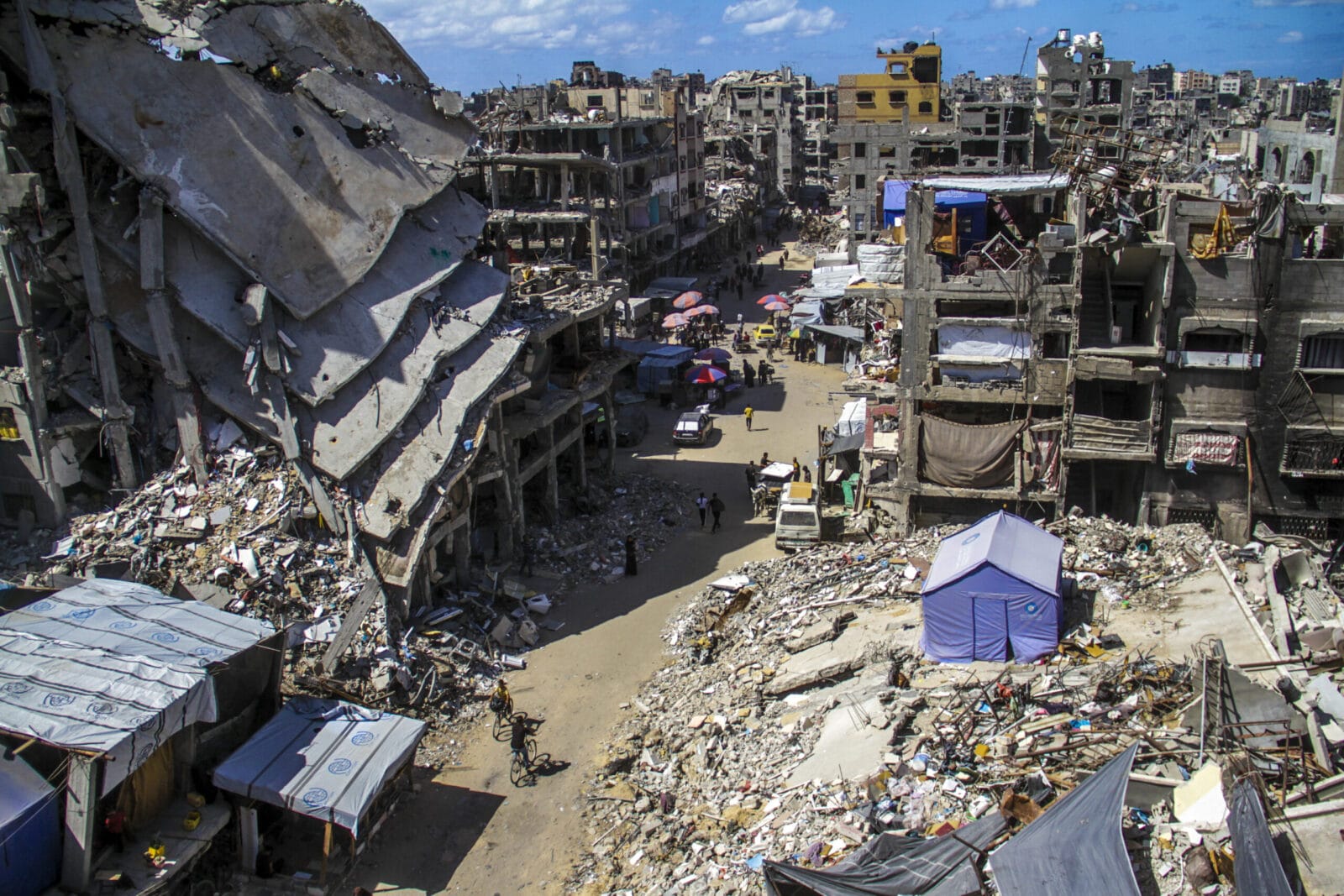
An aerial photo taken on October 3, 2024 shows the destruction of Jabalia refugee camp, and people who have no choice but to live in the ruins, Gaza City, Gaza. Mahmoud ssa/Anadolu via Getty Images
It was November 7, 2023, and he was recording a video to announce the launch of his new cybertechnology start-up, Dream Security.
In 2022, Hulio had stepped down from his position as CEO of NSO Group, the Israeli cyber surveillance company that created the notorious Pegasus spyware. The choice of the video’s setting was a stark reminder that Palestine—and Gaza especially—is a [laboratory for Israeli technology and weapons](https://www.versobooks.com/products/2684-the-palestine-laboratory), which are then marketed globally. The timing—one month to the day following October 7—was a foretelling of Israel’s militarized applications of artificial intelligence (AI) to conduct “the world’s first [AI-assisted genocide](https://www.newarab.com/analysis/israel-carrying-out-ai-assisted-genocide-gaza).”[\[1\]](#%5Fedn1)
Since the start of the war in October 2023, Israel has been [using AI tools](https://www.vox.com/future-perfect/24151437/ai-israel-gaza-war-hamas-artificial-intelligence) to conduct its [massive bombing campaign](https://www.972mag.com/mass-assassination-factory-israel-calculated-bombing-gaza/) in Gaza. The Israeli military’s “[directorate of targets](https://www.idf.il/%D7%90%D7%AA%D7%A8%D7%99-%D7%99%D7%97%D7%99%D7%93%D7%95%D7%AA/%D7%99%D7%95%D7%9E%D7%9F-%D7%94%D7%9E%D7%9C%D7%97%D7%9E%D7%94/%D7%9B%D7%9C-%D7%94%D7%9B%D7%AA%D7%91%D7%95%D7%AA/%D7%94%D7%A4%D7%A6%D7%95%D7%AA/%D7%9E%D7%9C%D7%97%D7%9E%D7%94-%D7%9E%D7%98%D7%A8%D7%95%D7%AA-%D7%A9%D7%94%D7%95%D7%AA%D7%A7%D7%A4%D7%95-%D7%9B%D7%95%D7%97%D7%95%D7%AA-%D7%A6%D7%94-%D7%9C-%D7%90%D7%92%D7%A3-%D7%94%D7%9E%D7%95%D7%93%D7%99%D7%A2%D7%99%D7%9F-%D7%97%D7%99%D7%9C-%D7%94%D7%90%D7%95%D7%95%D7%99%D7%A8-%D7%97%D7%99%D7%9C-%D7%94%D7%99%D7%9D/)” relies on soldiers with decoding, cyber and research capabilities to produce targets on a large scale. Pegasus is used to locate and collect data on individuals. This data is then fed to automated targeting platforms like [Where’s Daddy](https://www.972mag.com/lavender-ai-israeli-army-gaza/), [Gospel](https://www.972mag.com/mass-assassination-factory-israel-calculated-bombing-gaza/) and [Lavender](https://www.972mag.com/lavender-ai-israeli-army-gaza/), which utilize facial recognition, geolocating and cloud computing to generate targets at rapid rates. The spyware can also record and manipulate actions to manufacture fake digital evidence to retroactively justify the execution of civilians.
With the application of these new technologies, Gaza remains Israel’s premier testing ground for advances in the automation of war. These advances can then be marketed and exported on a global scale.
## **From Pegasus to Gaza**
Pegasus is the most malicious spyware on the market.
Unlike other types of malware, which work by deceiving people into clicking a link that then infects their device, Pegasus has a [zero-click capacity](https://www.youtube.com/watch?v=QX7X4Ywuotc). The technology can be installed remotely without any interaction from the user, making it nearly impossible to detect. Attackers can [take control of a phone’s camera and microphone](https://www.youtube.com/watch?v=lfOgm1IcBd0&t=64s), effectively transforming it into a live tracking and recording device; they can extract all data, including messages, emails, photos, recordings, browsing histories, calendars and locations; and they can use Pegasus to plant falsified and incriminating evidence on a target’s mobile device. Pegasus can spread like a virus through communication networks.
> **Also Read:"[Transnational Repression Against Exiled Women Activists](https://www.merip.org/exiled-women/)"MER issue 307/308, Summer/Fall 2023.**
[Citizen Lab](https://citizenlab.ca/tag/pegasus/), a Canadian digital watchdog organization based at the University of Toronto, began publishing [damning and revealing reports](https://citizenlab.ca/tag/nso-group/) about Pegasus in 2016\. In 2019, two Israeli [spies posing as investors](https://www.nytimes.com/2019/01/28/world/black-cube-nso-citizen-lab-intelligence.html) requested meetings with Citizen Lab’s research team in Toronto. Senior researcher John Scott-Railton suspected their request was a ruse to gather information about the Lab’s investigative work and methodology. He took a lunch meeting with a man who described himself as a wealthy Parisian named Michel Lambert. During their conversation the investor pressed for information about the Lab’s reports on NSO Group. As they were eating dessert, a reporter and a photographer from the Associated Press, who had been tipped off about the set-up by Scott-Railton, approached the table. The visitor scrambled to flee the restaurant, taking along two other spies who had been recording the lunch meeting. Lambert was later exposed to be Aharon Almog-Assoulin, a retired Israeli security official.
> **The Forbidden Stories Consortium, a Paris-based international network of journalists dedicated to protecting reporters, discovered that over 50,000 people had been targeted by government customers of NSO Group.**
In 2020, thanks to a [massive data leak](https://www.amnesty.org/en/latest/press-release/2021/07/the-pegasus-project/), the scale of Pegasus’s use became clear. The [Forbidden Stories Consortium](https://forbiddenstories.org/projects%5Fposts/pegasus-project/), a Paris-based international network of journalists dedicated to protecting reporters, discovered that over 50,000 people had been [targeted by government customers](https://www.newyorker.com/magazine/2022/04/25/how-democracies-spy-on-their-citizens) of NSO Group. The targets included journalists, human rights defenders, academics, diplomats, union leaders, politicians and several heads of state. In the wake of the leak and working in coordination with [Amnesty International’s Security Lab](https://securitylab.amnesty.org/case-study-the-pegasus-project/) and Citizen Lab, Forbidden Stories met with victims to conduct forensic analyses of their devices. The [Pegasus Project](https://forbiddenstories.org/the-pegasus-project-a-worldwide-collaboration-to-counter-a-global-crime/) is their investigation into cyber-spying with the aim of countering high-tech threats to journalists and human rights defenders.
Forensic Architecture’s [Digital Violence](https://www.digitalviolence.org/#/) project has mapped every infected phone around the globe, documenting every case in which the spyware has been linked to state violence. Pegasus’s body count includes the assassination of Mexican journalist [Cecilio Pineda](https://www.theguardian.com/news/2021/jul/18/revealed-murdered-journalist-number-selected-mexico-nso-client-cecilio-pineda-birto) on March 2, 2017 and the extrajudicial execution of Saudi journalist [Jamal Khashoggi](https://www.washingtonpost.com/nation/interactive/2021/hanan-elatr-phone-pegasus/) by a Saudi kill squad in Istanbul on October 2, 2018.
The Pegasus scandals triggered some uncommonly strong reactions from governments. In November 2021, the US government [blacklisted NSO Group](https://commerce.gov/news/press-releases/2021/11/commerce-adds-nso-group-and-other-foreign-companies-entity-list) for acting “contrary to the national security or foreign policy interests of the United States.”[\[2\]](#%5Fedn2) This decree barred the company from conducting business with any US-based industry. In February 2022, the [European Union’s data watchdog](https://techcrunch.com/2022/02/15/eu-data-protection-pegasus/) called for Pegasus to be banned throughout the EU. To date, this has [not happened](https://www.euronews.com/next/2024/09/03/commission-urged-to-rein-in-surveillance-spyware).
Victims of Pegasus and rights organizations have brought lawsuits against NSO Group in [multiple jurisdictions](https://www.cjr.org/the%5Fmedia%5Ftoday/pegasus%5Fspyware%5Fcourt%5Fcases.php), including the United States, Spain and Britain. Apple, which produces iPhone technology, and WhatsApp, a widely used text-messaging program owned by Facebook’s parent company Meta, are suing the company because their products were compromised by Pegasus. NSO Group tried to have the WhatsApp case in a California District Court dismissed on the grounds that, as a foreign entity, it is immune from litigation. The US Supreme Court, however, rejected that argument and the case is proceeding. Forbidden Stories discovered that [Israeli officials tried to seize NSO documents](https://www.amnesty.org/en/latest/news/2024/07/israels-attempt-to-sway-whatsapp-case-casts-doubt-on-its-ability-to-deal-with-nso-spyware-cases/) to prevent them from being subject to the discovery process in the WhatsApp case in order to block exposure of the company’s activities and clients.
NSO Group has attempted to exploit the current war on Gaza to reverse these restrictive measures against it. On November 7—the same day that Hulio announced his new startup from the Gaza border—legal representatives of the company sent an [“urgent” letter](https://www.documentcloud.org/documents/24149725-paul-hastings-november-7-2023-urgent-request-for-meeting-with-antony-blinken) to US Secretary of State Antony Blinken asking to be taken off the blacklist. The letter claimed that “NSO cyber intelligence is a critical tool that is used to aid the ongoing fight against terrorists.”[\[3\]](#%5Fedn3)
## **Surveillance for Control and Profit**
For decades, the Israeli military, dubbed a world leader in cybersecurity, has tested new weapons and surveillance technologies on Palestinians.
Indeed, Israel’s control of occupied Palestinians is where a nexus of racialization, securitization and settler-colonialism made the rise and spread of such advanced technologies of control possible. For example, in October 2023 Israeli authorities began using an experimental facial recognition system known as [Red Wolf](https://www.amnesty.org/en/latest/news/2023/05/israel-opt-israeli-authorities-are-using-facial-recognition-technology-to-entrench-apartheid/) to track Palestinians and automate harsh restrictions on their freedom of movement. When Palestinians step within a range of surveillance cameras, their [faces are scanned, and an AI program checks them against a wanted list](https://www.nytimes.com/2024/03/27/technology/israel-facial-recognition-gaza.html). This program is run by the cyber-surveillance Unit 8200 using technology developed by the private Israeli company Corsight and Google photos.
To develop its [surveillance capacities](https://www.academia.edu/12118612/The%5FPolitical%5FEconomy%5Fof%5FIsrael%5Fs%5FHomeland%5FSecurity%5FSurveillance%5FIndustry), the Israel government relies heavily on its private tech sector. These companies, often launched and run by former intelligence officers, leverage their relationships within the military to deploy their technologies on Palestinians before they are marketed as [“field-tested.”](https://visualizingpalestine.org/visual/field-tested-elbit-systems-2024-update/)
> **Governments seeking to enhance their control through technology with invasive capacities are eager consumers of Israeli products, which, in turn, gives Israel diplomatic leverage over those governments.**
Israel’s surveillance industry is thoroughly integrated within the global market. Governments seeking to enhance their control through technology with invasive capacities are eager consumers of Israeli products, which, in turn, gives Israel diplomatic leverage over those governments. Morocco, for example, is a major client of NSO Group; over 10,000 of the phone numbers identified through the Pegasus leak were sourced to the Moroccan government, including the Spanish and French heads of state. In 2022, Morocco became the third Arab state to agree to normalization with Israel, through the so-called Abraham Accords (the first two, UAE and Bahrain, are also [notable](https://mondediplo.com/2023/01/05uae) [consumers](https://www.amnesty.org/en/latest/news/2022/02/bahrain-devices-of-three-activists-hacked-with-pegasus-spyware/) of Israeli spyware). In June 2024, [Morocco allowed an Israeli warship](https://www.middleeastmonitor.com/20240626-morocco-allows-israeli-warship-to-dock-after-spain-refused/) carrying weapons to dock after Spain refused.
India, too, signed a [two-billion-dollar deal with Israel](https://www.nytimes.com/2022/01/28/magazine/nso-group-israel-spyware.html) in 2017 to acquire missile systems and licensing for Pegasus. In exchange, India voted in Israel’s favor in 2019 at the UN’s Economic and Social Council to deny observer status to a Palestinian human rights organization. The Modi government has used [Pegasus to fabricate evidence](https://www.washingtonpost.com/world/2021/12/17/india-pegasus-bhima-koregaon/) against journalists on charges of terrorism.
> **Also Read: "[India, Israel and the Coordination of Control](https://www.merip.org/india-israel-and-the-coordination-of-control-2/)" MER issue 307/308, Summer/Fall 2023**
AI targeting systems are the logical outgrowth of human rights-abusing products like Pegasus. They also mirror another AI system used worldwide: predictive policing through “[data-driven systems](https://www.accessnow.org/publication/artificial-genocidal-intelligence-israel-gaza/#:~:text=As%20recent%20media%20investigations%20have,destruction%20across%20the%20Gaza%20Strip),” which uses surveillance technology to [quantify, track and predict human behavior](https://edri.org/our-work/optimising-injustice-ai-used-to-predict-crime-will-increase-discrimination-and-surveillance/). In the case of Gaza, this technology is applied to allegedly identify who may be a member of Hamas or Palestinian Islamic Jihad (PIJ). Like predictive human-based racial-profile in policing, data-based systems are inherently flawed and discriminatory as they reduce human beings to statistical data points. For example, the Lavender machine used in Gaza has [mistakenly flagged](https://www.972mag.com/lavender-ai-israeli-army-gaza/) individuals like police, civil defense workers, relatives of militants and residents who happen to have an identical name or nickname to a combatant, as Hamas or PIJ operatives and subsequently placed them on kill lists.
This AI killing machine also relies on the support of foreign tech companies, including cloud computing from [Google](https://time.com/6966102/google-contract-israel-defense-ministry-gaza-war/), [Amazon](https://www.wired.com/story/amazon-google-project-nimbus-israel-idf/), [Meta](https://www.middleeastmonitor.com/20240418-israel-using-metas-whatsapp-to-kill-palestinians-in-gaza-through-ai-system/) and [Microsoft](https://www.notechforapartheid.com/). Through [Project Nimbus](https://www.aljazeera.com/news/2024/4/23/what-is-project-nimbus-and-why-are-google-workers-protesting-israel-deal), a $1.2 billion contract with the Israeli government, Google and Amazon Web Services provide cloud computing infrastructure and machine learning services to Israel. Google is also offering [advanced AI tools](https://theintercept.com/2022/07/24/google-israel-artificial-intelligence-project-nimbus/) to Israel to be used for data harvesting for facial recognition and object tracking as part of Project Nimbus. It has also been suggested that metadata from WhatsApp, owned by Meta, has been used to provide data for the Lavender targeting system. For example, one input into the AI is whether someone is in a [WhatsApp](https://blog.paulbiggar.com/meta-and-lavender/) group chat with a suspected Hamas or PIJ militant.
## **Learning from Pegasus**
Israel’s technologically sophisticated weaponry is sold worldwide, to at least [130 countries](https://www.youtube.com/watch?v=6eYVjWwOVC4). Over the last five years, Israel’s arms exports have more than doubled, rendering it the world’s [biggest weapons exporter per capita](https://www.businessinsider.com/sweden-and-switzerland-are-among-top-arms-exporters-in-the-world-2014-5).
Since the start of the war on Gaza, [weapons exports have reached an all-time high](https://www.ynet.co.il/news/article/b1rtmvabr). The director general of Israel’s Ministry of Defense, Major General (Ret.) Eyal Zamir, [explained](https://finance.walla.co.il/item/3671361), “Many countries in the world are following the successes of the Israeli combat systems in the war, in all dimensions, and are purchasing Israeli weapons to protect their citizens.”[\[4\]](#%5Fedn4)
> **Israeli intelligence officers deploying Lavender describe it as having “errors” in about 10 percent of cases and of marking individuals with little to no connection with militants as targets.**
The shiny new product being field tested in Gaza is AI-powered targeting machines. Indeed, coupled with an all-time high in Israeli weapons exports, the future of warfare is undergoing a major transformation. In the 2000s, contemporary warfare expanded from human combat to [technology-enabled killing](https://thenewpress.com/books/theory-of-drone) with the US-led [rise and diffusion of drones](https://www.jadaliyya.com/Details/32500), which eliminated much of the risk for soldiers. Like drone warfare, cyber warfare involves the participation of combatants who are so far removed from the carnage that they may as well be playing a video game. The AI revolution in choosing targets removes humans even further from the process, since automated machines can do most of the work. Moreover, both drone warfare and cyber warfare share the myth of precision. In Gaza, this myth is especially evident, with loosened restrictions on the permissible number of killed civilians in the assassination of a suspected operative and the use of AI technology like Lavender to generate kill lists. Israeli intelligence officers deploying Lavender describe it as having “[errors](https://www.972mag.com/lavender-ai-israeli-army-gaza/)” in about 10 percent of cases and of marking individuals with little to no connection with militants as targets. Moreover, when a target is named, their entire family is marked for death, since the technology, Where’s Daddy, is used to bomb the home as opposed to a site of militant activity. (Bombings often take place at night, when combatants are sleeping at home with their family, hence the sordid name.) As a result, thousands of Palestinians, mostly women, children and non-combatants, have been wiped out by Israeli airstrikes.
If the Pegasus scandals are any indication, Israel’s latest AI-powered weaponry is bound to be exported for profit and used on other vulnerable populations. But the journalists and organizations involved in the Pegasus Project have also learned lessons about how technology can be used to improve rather than destroy human life and dignity. Targeted journalists have learned the importance of limiting their use of technology and protecting themselves with encryption programs. They also have learned to manipulate technology to their advantage by creating new ways to communicate with sources and report on events. [Access Now](https://www.accessnow.org/profile/access-now-helpline-team/), a digital rights organization, offers an around-the-clock Digital Security help hotline to at-risk populations. [Reporters Without Borders](https://rsf.org/en/rsf-s-recommendations-those-who-could-be-spied-pegasus) offers scholarships to journalists working in war zones to take a digital security training program in Berlin.
The greatest challenge remains a lack of international regulation or oversight for malicious technologies. So far, the international outcry in response to Pegasus has proved to be an exception. The ongoing lawsuits against NSO Group may make a dent, but there is nothing in place to halt or deter Israeli companies from developing and selling other repressive and deadly technologies.
As the AI-powered genocide in Gaza demonstrates, the costs and risks associated with these technologies are not distributed equally. This era of mass surveillance and automated war is facilitated by Big Tech, global trade networks and a lack of international oversight. But the global reach of predatory technologies gives broad urgency to fighting back. The counter-cyber resistance is being waged by journalists, human rights organizations, legislators, tech employees and aggrieved members of the public. The horrors Israel is perpetrating on the people of Gaza and the globalized marketing for the instruments of their death are evidence that such resistance is imperative.
\[**Leila Katibah** is a recent graduate of the University of California, Santa Barbara, where she researched the connections between surveillance, settler-colonialism and press freedom.\]
**This issue of Middle East Report, *Carceral Realities and Freedom Dreams*, has been produced in partnership with the [Orfalea Center for Global and International Studies](https://www.orfaleacenter.ucsb.edu/) at the University of California, Santa Barbara, and [Security in Context](https://www.securityincontext.com/).**
> **Read the[previous](https://merip.org/2024/10/cairos-incarcerated-geographies) article.**
> **Read the[next](https://merip.org/2024/10/editors-picks-reading-and-watching-the-prison-in-north-africa-and-the-middle-east) article.**
**This article appears in** [**MER issue 312**](https://merip.org/magazine/312/) **“Carceral Realities & Freedom Dreams.”**
---
### **Endnotes**
[\[1\]](#%5Fednref1) Marc Owen Jones, "[In Gaza, we are watching the world's first AI-assisted genocide](https://www.newarab.com/analysis/israel-carrying-out-ai-assisted-genocide-gaza)," The New Arab, April 10, 2024.
[\[2\]](#%5Fednref2) "[Commerce Adds NSO Group and Other Foreign Companies to Entity List for Malicious Cyber Activities,](https://www.commerce.gov/news/press-releases/2021/11/commerce-adds-nso-group-and-other-foreign-companies-entity-list)" U.S. Department of Commerce, November 3, 2021.
[\[3\]](#%5Fednref3) "[Paul Hastings November 7, 2023, 'Urgent' Request for Meeting With Anthony Blinken](https://www.documentcloud.org/documents/24149725-paul-hastings-november-7-2023-urgent-request-for-meeting-with-antony-blinken),” Available on Document Cloud (contributed by the Intercept).
[\[4\]](#%5Fednref4) Udi Etzion, “[A new record in defense exports: over 13 billion dollars, but there are warning signs](https://finance.walla.co.il/item/3671361),” Walla, June 17, 2024\. \[Hebrew\]
### Cairo's Incarcerated Geographies
URL: https://www.merip.org/2024/10/cairos-incarcerated-geographies/
Last updated: 2025-08-22T18:36:03.000Z
In 2015, the Egyptian government announced a series of urban development plans, a schema that included having a [city free of slums](https://www.egypttoday.com/Article/1/106907/Basic-info-about-how-Cairo-will-be-free-of-slums#:~:text=CAIRO%20%E2%80%93%2015%20August%202021%3A%20There,dangerous%20conditions%20and%20lack%20infrastructure.).
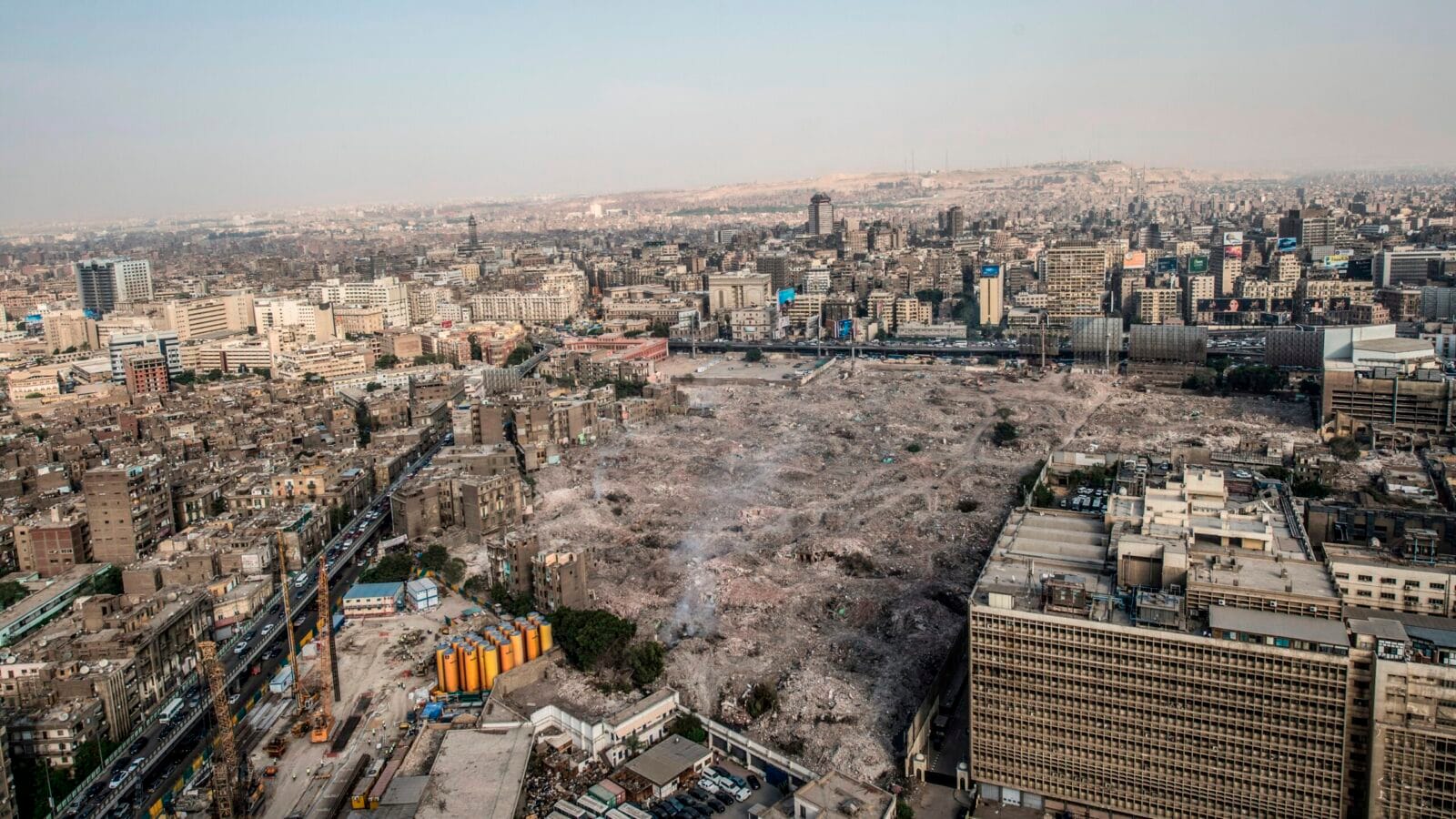
A general view on April 29, 2018 of a government-demolished slum that existed behind the state television and radio headquarters (R) in the Maspero Triangle area in the center of Cairo. Khaled Desouki/AFP via Getty Images
As part of this plan, the state implemented a policy to relocate residents of so-called unsafe areas to new neighborhoods and redevelop existing neighborhoods using a combination of government investments and private capital. The designation of these neighborhoods as unsafe had been applied in 2008 by the Informal Settlements Development Fund (ISDF).
The policy was one of a number intended to legalize urban destruction in the name, not just of development, but also security. Other policies included the establishment of a committee in 2016 to reclaim state owned lands, like [al-Warraq Island](https://timep.org/2017/08/03/visions-or-illusions-state-development-plans-and-violence-in-al-warraq/), and the destruction of units that had been built without a license. More [recently](https://www.dailynewsegypt.com/2024/04/04/egyptian-cabinet-approves-executive-regulations-for-building-reconciliation-law/), a [Building Reconciliation Law](https://english.ahram.org.eg/News/512567.aspx) mandated that millions of residents must pay fines in order to legalize their housing units and keep their property.
> **Also Read: "[The Urbanization of Power and the Struggle for the City](https://www.merip.org/the-urbanization-of-power-and-the-struggle-for-the-city/)" MER issue 287, Summer 2018.**
Maspero Triangle, a neighborhood of 5,000 inhabitants, was the first neighborhood to be impacted by the wave of changes. It was exceptional, however, in that residents were compensated. The compensations were both in kind, for example, a resident would receive social housing or have the option to return to the same neighborhood after the urban redevelopment, where they would have to pay mortgage for 20 years to own the apartment. They could otherwise opt to receive money as compensation, which many families did.
In other neighborhoods, thousands of families got nothing in return for their eviction. In Al-Madabegh in Old Cairo, only one third of the families received apartments in the social housing project. The other two thirds were evicted without relocation or compensation. An estimated [2.8 million](https://english.legal-agenda.com/urban-justice-and-control-over-the-people/) inhabitants were evicted from 2018 to 2022\. Meanwhile, social housing provided by the state amounted to [only 30,000 apartments, ](https://legal-agenda.com/العدالة-العمرانية-وضبط-الشعب-2-هل-تمّ-ت/)enough to house about 150,000 residents. Anyone who objected to the relocation or destruction of their home was imprisoned for up to a few weeks.
These evictions are part of a broader effort to securitize Cairo’s urban geography. Under the presidency of Abd al-Fattah al-Sisi, incarceration has become a mode of governance. [Hundreds of thousands](https://www.amnesty.org/en/latest/press-release/2021/01/egypt-abused-and-denied-heath-care-prisoners-lives-at-risk/#:~:text=The%20Egyptian%20authorities%20refuse%20to,al%2DSisi%20in%20December%202020.) have been imprisoned without cause and without fair trials. But space has also become carceralized in the years following the 2011 revolution and 2013 coup.
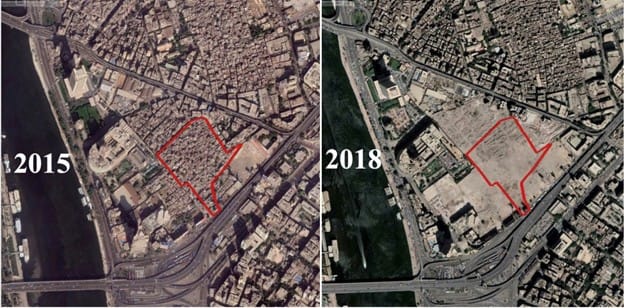
Maspero Triangle, before and after destruction. Source: Google Earth.
The 2011 uprising had ushered in a new sense of belonging to the city. Committees were formed in neighborhoods to tackle local challenges, like the scarcity of sanitary services and building deterioration. One month after the coup that overthrew Mohamed Morsi’s government, on August 14, 2013, a four-hour massacre against the Muslim brotherhood resulted in 800 deaths. The Rabaa Massacre was the beginning of what could be called the incarceration of space, when the surveillance of places became a normal feature of urban life. Tahrir Square was closed, and military tanks and personnel stood on constant guard. Most of the smaller squares in Cairo’s downtown, including Talaat Harb Square and Mostafa Kamel Square were also heavily policed.
The surveillance extended from Tahrir and downtown, to other neighborhoods across Cairo. A curfew was announced from August 2013 until December. In addition to the everyday presence of military tanks in the streets, security forces established hundreds of checkpoints. Expired national ID cards were rejected and groups of more than five people were not allowed to pass through.
> **The majority of residents who were affected by the wave of evictions that began in 2018...were the same people who had participated in the 2011 revolution and in the subsequent uprisings in 2013.**
The massive wave of urban construction and destruction, beginning in 2015, has helped extend the effects of this counterrevolutionary state power. The majority of residents who were affected by the wave of evictions that began in 2018, for example, were the same people who had participated in the 2011 revolution and in the subsequent uprisings in 2013.
In 2020, the Ministry of Defense established a new unit in each governorate: the [Spatial Changes Monitor](https://www.youm7.com/story/2020/12/14/مصطفى-مدبولي-تكليفات-من-الرئيس-بتفعيل-منظومة-المتغيرات-المكانية-لضبط/5112138). Nestled within the Military Survey Department, this unit effectively polices construction on a local scale. Every person who does not obtain permission for spatial changes—like adding a room or floor to a building or demolishing part of a house—is now subject to legal punishment and a military trial. The prime minister, Mostafa Madbouly invoked national security when [explaining the policy](https://www.youm7.com/story/2020/8/30/الحكومة-تعلن-إنشاء-وحدة-للتغيرات-المكانية-لرصد-أى-بناء-مخالف/4953659): “We will completely stop attempts to construct illegally, whether on agricultural lands or otherwise, considering that this has become a national security issue, as building violations and their effects threaten national security.”[\[1\]](#%5Fedn1) Without naming these threats to national security, the state nevertheless assumed complete control over development in their name, effectively excluding Egyptian society from taking part in place-making processes.
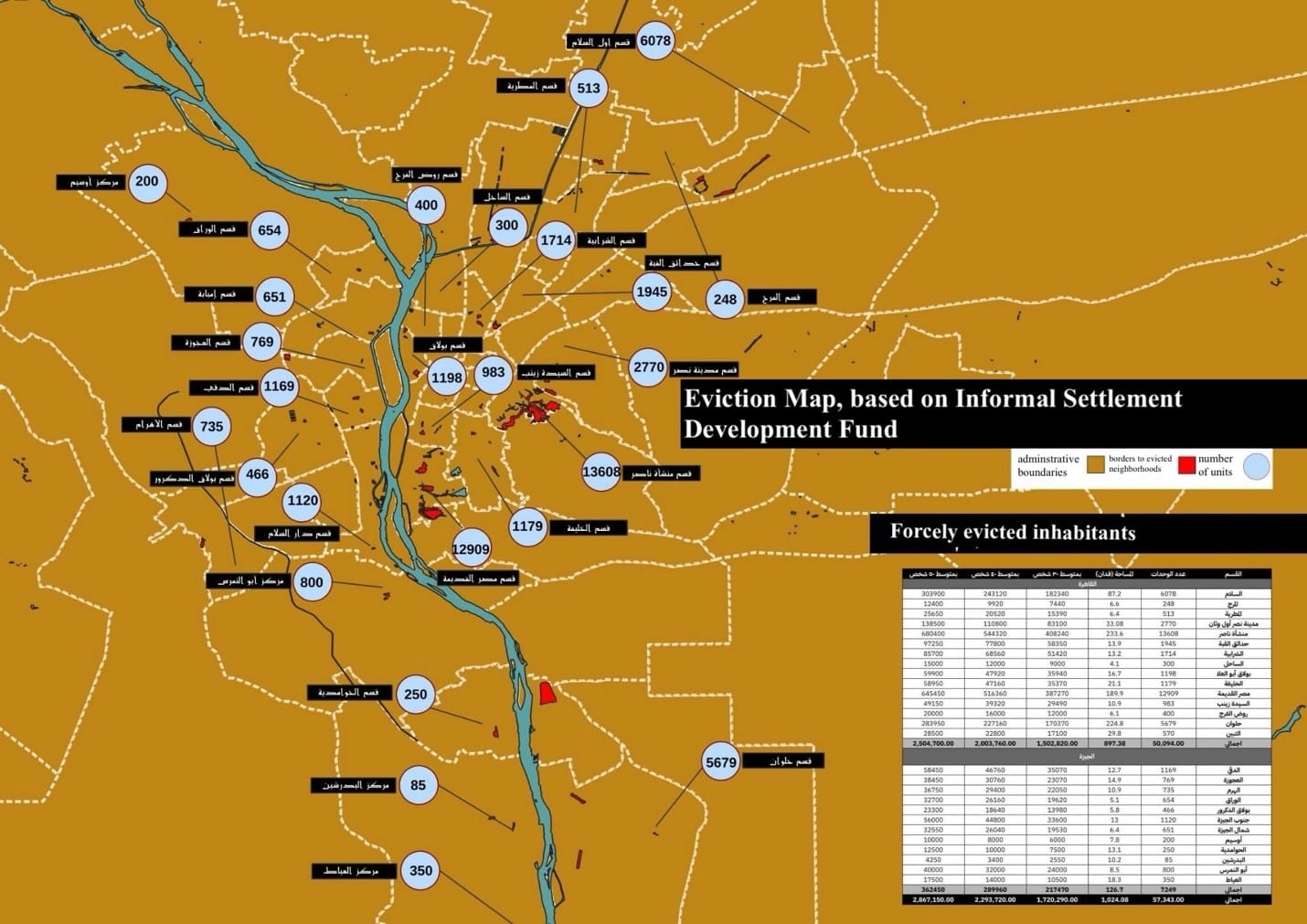
Map by the author and published on May 8th, 2024.
Moreover, the wave of megaprojects currently under construction, including Sisi’s new administrative capital in the eastern desert areas between Cairo and the Suez, are leading to new forms of spatial securitization in the city. The new city is set to include eight residential zones, two governmental zones, entertainment and recreational zones, investment zones, a diplomatic district, a central business district, a presidential palace district and more. According to 2021 figures released by Egypt’s official statistical agency, 40,000 bridges were built in one year across the country in order to accommodate more traffic and elevate roads and highways. In addition, almost 100,000 miles of roads were constructed. On top of destroying green spaces in Cairo’s old middle to upper class neighborhoods, the new road network has expanded the control of the state security apparatus over the city, increasing the capacity for surveillance. Now, on the anniversaries of the 2011 revolution, security personnel can be found standing in a row on flyover bridges, observing the movement of people. Security cameras are mounted in newly constructed elevated places. Additionally, [6,000 CCTV cameras](https://www.reuters.com/article/business/media-telecom/feature-cctv-cameras-will-watch-over-egyptians-in-new-high-tech-capital-idUSL8N33I0DO/) are located in the new capital.
This massive networks of roads and flyover bridges has also segregated communities, isolating many neighborhoods, and making it harder to get around on foot. Walking has become difficult in several neighborhoods: The new roads lack walk signals, making Cairo’s busy streets more dangerous, and pedestrian related traffic deaths [appear to be](https://arij.net/investigations/Cairo-Streets-en/?tztc=1) on the rise.
Not only has people’s movement become circumscribed, their control over space is limited. Residents of Cairo describe the changes to their everyday routes as leading to a feeling of being out of place. Yet they face imprisonment for objecting to the geographical changes. At the time of writing, residents of al-Warraq Island, who are facing evictions due to the state’s 2016 land reclamation, are [continuing to demonstrate](https://www.madamasr.com/en/2024/09/26/news/politics/police-fire-birdshot-teargas-at-warraq-residents-in-most-violent-protest-dispersal-yet-source-says/) against demolitions. Many have faced cycles of arrests and release in the process. Construction and destruction have rendered Cairo’s urban geography—and urban life itself—incarcerated.
\[**Omnia Khalil** is a lecturer in international relations and anthropology at City College New York.\]
**This issue of Middle East Report, *Carceral Realities and Freedom Dreams*, has been produced in partnership with the [Orfalea Center for Global and International Studies](https://www.orfaleacenter.ucsb.edu/) at the University of California, Santa Barbara, and [Security in Context](https://www.securityincontext.com/).**
> **Read the[previous](https://www.merip.org/europes-prison-guard/) article.**
> **Read the[next](https://merip.org/2024/10/the-genocide-will-be-automated-israel-ai-and-the-future-of-war) article.**
**This article appears in** [**MER issue 312**](https://merip.org/magazine/312/) **“Carceral Realities & Freedom Dreams.”**
---
### **Endnotes**
[\[1\]](#%5Fednref1) Hind Mukhtar, “[The government announces the establishment of a unit for spatial changes to monitor any illegal construction immediately](https://www.youm7.com/story/2020/8/30/%D8%A7%D9%84%D8%AD%D9%83%D9%88%D9%85%D8%A9-%D8%AA%D8%B9%D9%84%D9%86-%D8%A5%D9%86%D8%B4%D8%A7%D8%A1-%D9%88%D8%AD%D8%AF%D8%A9-%D9%84%D9%84%D8%AA%D8%BA%D9%8A%D8%B1%D8%A7%D8%AA-%D8%A7%D9%84%D9%85%D9%83%D8%A7%D9%86%D9%8A%D8%A9-%D9%84%D8%B1%D8%B5%D8%AF-%D8%A3%D9%89-%D8%A8%D9%86%D8%A7%D8%A1-%D9%85%D8%AE%D8%A7%D9%84%D9%81/4953659),” Al-Youm Al-Saba’a, August 30, 2020\. \[In Arabic\]
### Europe’s Prison Guard—How the EU Is Integrating Tunisia into Its Violent Anti-Migrant Cordon
URL: https://www.merip.org/2024/10/europes-prison-guard/
Last updated: 2025-08-22T18:36:04.000Z
In July of 2023, the European Union signed a deal with Tunisia that promised the country 100 million euros for restricting migration to Europe.
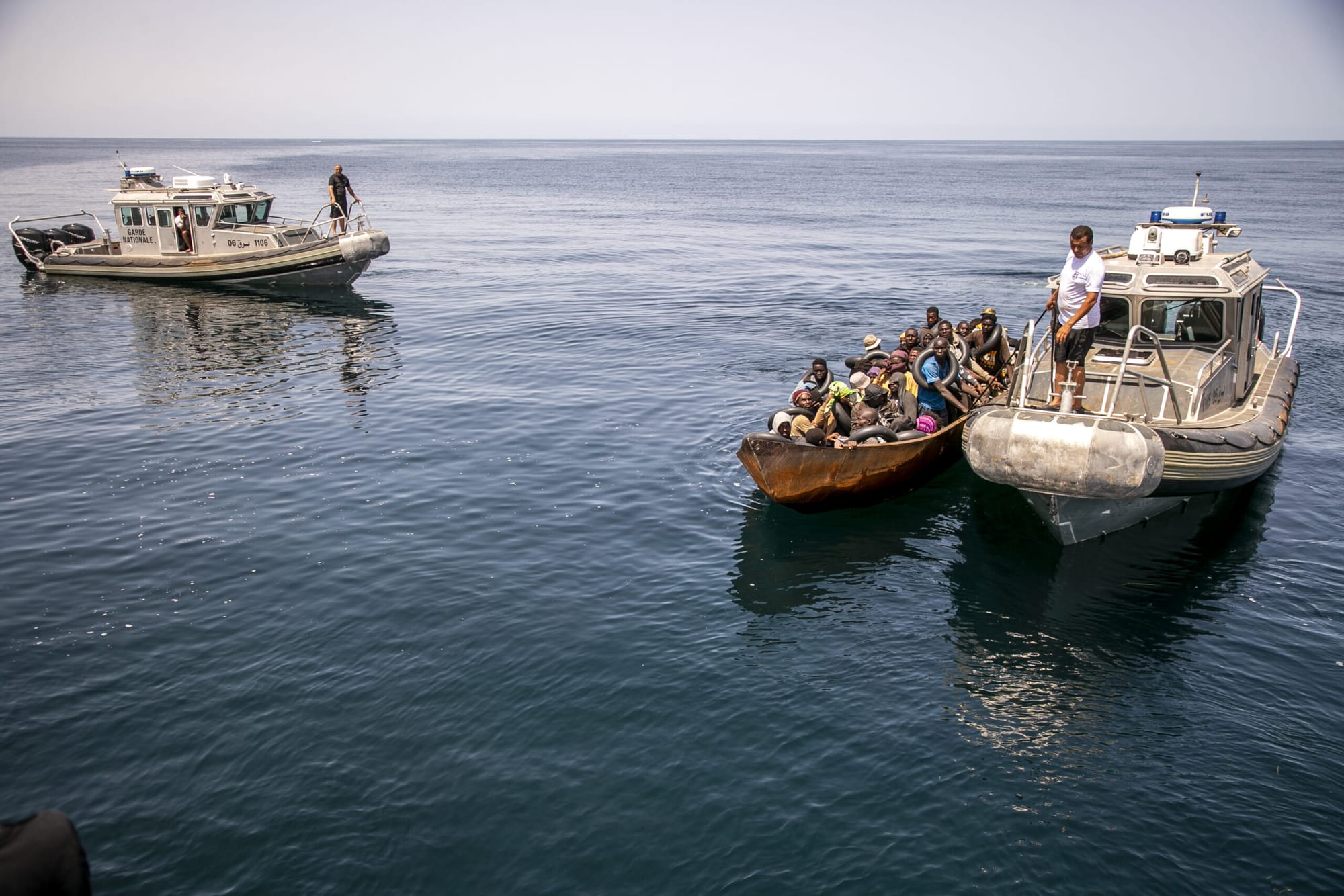
Coastguard teams of the Tunisian National Guard conduct an operation against migrants who want to reach Europe illegally via the Mediterranean Sea, off the city of Sfax in Tunisia on August 12, 2023\. Yassine Gaidi/Anadolu Agency via Getty Images
[EU officials signaled](https://www.reuters.com/world/africa/eu-may-still-loan-tunisia-1-bln-if-it-secures-imf-support-2023-07-17/) another 900 million euros would be provided if Tunisia took a loan from the International Monetary Fund.
CNN’s [coverage](https://edition.cnn.com/2023/04/05/middleeast/tunisia-kais-saied-disappearance-mime-intl/index.html) of the deal clumsily wove together a mythology of a democratic Europe unwillingly or unwittingly empowering “Tunisian dictatorship” by not sufficiently upholding its own democratic values—calling the deal “a major boost for Tunisia’s President Kais Saied.”[\[1\]](#%5Fedn1) The report went on to describe President Saied as “an increasingly authoritarian leader who has spent the past few years dismantling the country’s democracy" and implied that feckless European prime ministers and EU leaders had been hoodwinked into an unequal agreement in favor of Tunisian interests at the expense of European ones. That the EU signed it anyway was "a testament to how desperate some European leaders have become to curb migration.”[\[2\]](#%5Fedn2)
In CNN’s framing, the 27-country EU bloc—which represents the world’s second largest economy and boasts an average per capita GDP over $40,000—is “desperate.” Tunisia, on the other hand—with a per capita GDP of less than $4,000, deeply indebted and suffering frequent food shortages due largely to [austerity conditions](https://meshkal.org/imf-tunisia-food-shortage-credit/) imposed by European and US-dominated creditor institutions—holds enough power to coerce Europeans into forsaking their values. The Washington Institute for Near East Policy struck a similar note, claiming that that President Saied’s “mistreatment of sub-Saharan” Africans is something that Europeans had to “overlook” before signing the deal, rather than a prerequisite political orientation to qualify for the deal and carry out Europe’s anti-migrant policies. [\[3\]](#%5Fedn3)
In these readings, it is not the content of the deal, or the role of European governments in [apparently systematically killing](https://www.bbc.co.uk/programmes/m0020ct1) desperate migrants at sea, that undermines Europe’s supposed democratic values. Rather, the problem is President Saied’s “anti-democratic” and “authoritarian” policies. But authoritarian is an adjective more appropriately applied to the European governments that have assumed authority over the very right to African migrants' lives and their freedom of movement.
The deal with Tunisia externalizes that violent use of authority, moving it further south onto North African shores of departure.
## **The ‘Garden’ and the ‘Jungle’**
Nine months before the EU signed the migrant deal with Tunisia, [in October of 2022](https://www.eeas.europa.eu/eeas/european-diplomatic-academy-opening-remarks-high-representative-josep-borrell-inauguration-pilot%5Fen), its foreign affairs chief, Josep Borrell, gave a speech that seemed to unintentionally explain the logic behind externalizing Europe’s border security.
“Europe is a garden,” Borrell said. “It’s the best combination of political freedom, economic prosperity, and social cohesion that humankind has been able to build…Most of the rest of the world is a jungle and the jungle could invade the garden.”[\[4\]](#%5Fedn4) He went on to say that no wall could be high enough to protect the garden from the jungle’s rapid growth. In order to protect it, the gardeners (Europeans) would “have to go to the jungle.”
In an indication that Borrell had momentarily been overtaken by uncommon candidness, he immediately asked the audience whether his comments would be posted on the internet. Responding to nods, he continued, “So let’s take care because there are things that can be said \[behind\] closed doors…Let’s stay in the garden but be aware that the jungle is listening to us.”
Following public outcry over these comments, Borell issued [a statement](https://www.eeas.europa.eu/eeas/metaphors-and-geo-politics%5Fen) to clarify that he had used the word “jungle” to mean places where the “law of the jungle”—which he defined as an “international order…based on the will of the strongest”—prevailed.[\[5\]](#%5Fedn5) In contrast, Europe had “succeeded by supplanting power calculations with legal procedures.”[\[6\]](#%5Fedn6)
To many in Africa, it might seem the opposite is true. The international order is dominated by Europe and the United States due to their geopolitical strength. The real “law of the jungle” operates on a global scale to the advantage and will of the global North.
> **Today, Europeans’ right to African resources on the cheap is ensured through a global system of ostensibly free trade that keeps nationalization at bay via a complex series of neoliberal mechanisms mandated by international institutions.**
Following the creation of the Schengen area in 1995, which allows free movement within Europe, in 2004, the EU established the European Border and Coast Guard Agency, Frontex, to manage its external borders. The borders “[protected](https://www.frontex.europa.eu/what-we-do/operations/operations/#:~:text=Frontex%2C%20the%20European%20Border%20and,first%20uniformed%20law%20enforcement%20service.)” by Frontex with billions of euros reproduce this garden/jungle binary in material terms. Yet in contrast to the presumption of a strict binary, gardens are built using the resources of the jungle. Today, Europeans’ right to African resources on the cheap is ensured through a global system of ostensibly free trade that keeps nationalization at bay via a complex series of neoliberal mechanisms mandated by international institutions.
The World Trade Organization, the International Monetary Fund and the World Bank construct and reinforce unequal trade relations through financial, judicial and sometimes extrajudicial mechanisms. European countries impose multilateral and bilateral trade tariffs and quotas that clip southern development. At the same time, states like Britain and France [provide tax havens](https://taxjustice.net/2019/06/18/%EF%BB%BFhow-can-africa-take-action-against-corporate-tax-havenry-solutions-from-the-corporate-tax-haven-index-2019/) for private African wealth and even passports for compliant and useful African leaders.
To control migration and borders, the United States and Europe incorporate African security forces into their globe-spanning security architecture. What appears external is in fact deeply integrated.
## **From Neo-liberalization to Irregular Migration**
The violence required to produce or reproduce Europe’s borders—or, in the case of Ukraine, to extend them—has always had an element of externalizing internal conflicts, sometimes with an explicit goal of reducing domestic tensions.
The 2023 immigration deal had its roots in the collapse of the Soviet Union, when the hegemony of a unipolar world system seemingly left southern countries with no viable alternative to Western-led globalization. This period saw the launch of the Barcelona Process in 1995, also known as the Euro-Mediterranean Partnership (EMP). The EMP only addressed mitigating migration to Europe in a passing manner due to push back from Arab countries. Indeed, it has been interpreted as more significant for its (failed) effort to normalize relations between Israel and Arab countries building off the 1991 Madrid conference and the 1993 Oslo accords.[\[7\]](#%5Fedn7) Yet today, despite popular perceptions of declining Western hegemony since the early 2000s, Europeans have seen more success in achieving their objectives of compelling Arab states to mitigate immigration and to normalize relations with Israel than in the 1990s.
Nevertheless, the EMP set the framework for opening North Africa’s markets to Europe in a way that exacerbated inequality between the two shores.
The same year as the Barcelona Declaration, Tunisia signed an association agreement with the EU, which gradually removed all tariffs for trade in industrial products and opened trade in some agricultural products. This agreement [ led to the decimation of Tunisia’s industrial base](https://ftdes.net/10-ans-apres-lechec-du-libre-echange-avec-lue-ne-reproduisons-pas-les-erreurs-du-passe/). A familiar story: The so-called freeing of trade—on the neoliberal premise of improving “resource allocation” or promoting countries’ “comparative advantage”—resulted in the gradual displacement of Tunisian farmers and manufacturing workers, particularly those in interior regions of the country. The agreement built upon the previous decades’ counterrevolutionary trend, which had reversed the early post-colonial nationalization and industrialization efforts: economic liberalization of national markets (*infitah*) in the 1970s, the debt crisis of the 1980s and western-imposed structural adjustment programs of the late 1980s and early 1990s.
Tunisia, like other Global South countries, was pushed into a race-to-the-bottom competition in the export of raw materials and light manufacturing—what international financial institutions call low-value-added sectors. In the case of Tunisia, components were manufactured for French, German and Italian cars, cables and airplanes. The export-led strategy deflated prices of southern commodities and labor while cutting off possibilities for integration among different productive sectors within southern countries domestically or regionally. Many African states became increasingly dependent on exports to earn foreign currency and pay down spiraling foreign debts. This system reinforced the problem of endemic underemployment, which further pushed down wages for workers selling their labor to the European manufacturers that had offshored component manufacturing.
The World Bank and the IMF—organizations that have long touted the positive effects of neoliberal strategies—worked hand-in-hand with European officials in brokering the association agreement with Tunisia.[\[8\]](#%5Fedn8) For example, they assured Tunisia that worker displacement could be counteracted with aid and that these arrangements would improve Tunisia’s trade balance, thereby generating surpluses that could be directed toward productive public spending or job creation in previously undeveloped sectors. But trade flows did not improve; they deteriorated. Tunisian deficits increased after the first round of liberalization in the early 1970s and [accelerated drastically](https://www.economie-tunisie.org/fr/observatoire/analysiseconomics/historique-des-relations-commerciales-tunisie-ue) in the late 1990s after signing the EU association agreement. Increased imports from Europe without significantly increased exports to Europe combined with a loss of tariff revenues to push the Tunisian state toward more foreign borrowing.
> **Since structural adjustment and the association agreement, Tunisians make up a disproportionate share of migration flows northward across the Mediterranean as they follow capital flows in search of employment and better livelihoods.**
Tunisia's borrowing, in turn, led to more austerity conditions imposed by the lenders, meaning worse public services and subsequent brain drain. Some of that out-migration has been useful to Europe, like the highly-trained engineers, scientists and doctors whose educational and social reproduction costs were borne by the Tunisian public. Other migrants, however, have been less welcome. Since structural adjustment and the association agreement, Tunisians make up a disproportionate share of migration flows northward across the Mediterranean as they follow capital flows in search of employment and better livelihoods.[\[9\]](#%5Fedn9)
Libya was excluded from the EMP on the insistence of the United States. An ostensibly European-led NATO intervention in Libya in 2011 effectively shattered state institutions and produced conditions of civil war that have continued to this today. This intervention also increased migration flows. It did so directly in the form of turning Africans who previously depended on Libya for remittances into migrants. But it also worked indirectly by empowering competing militia groups with new incentives: profits from facilitating irregular migration and/or imprisoning migrants on Libyan shores. These two businesses are lucrative because Europe criminalizes irregular migration. The level of state destruction in Libya explains why the latest intensification of the project to externalize Europe’s borders found fertile ground for Frontex to build a “[shadow immigration system](https://www.newyorker.com/magazine/2021/12/06/the-secretive-libyan-prisons-that-keep-migrants-out-of-europe)” in 2015 with Libyan militias that run detention centers rife with torture.
[In 2013,](https://www.fidh.org/en/region/north-africa-middle-east/tunisia/14335-eu-tunisia-mobility-partnership-externalisation-policy-in-disguise) prominent Tunisian civil society organizations denounced an EU-Tunisian ”[Mobility partnership](https://ec.europa.eu/commission/presscorner/detail/en/IP%5F14%5F208)” for its externalization “in disguise” and human rights violations.[\[10\]](#%5Fedn10) Despite the opposition, it was signed in 2014\. In 2017, Tunisia’s then-prime minister, Youssef Chahed publicly rejected the idea of setting up asylum centers in Tunisia to process migrants bound for Europe. But in 2020, the EU launched the [New Pact on Migration and Asylum](https://home-affairs.ec.europa.eu/policies/migration-and-asylum/pact-migration-and-asylum%5Fen#the-four-pillars-of-the-new-migration-and-asylum-policy), which called for “embedding migration in international partnerships” with the goal of “preventing irregular departures.”[\[11\]](#%5Fedn11) In 2021 and 2022, it offered funding of [up to 100 million euros](https://meshkal.org/black-people-attacked-evicted-in-tunisia-after-presidents-racist-stat/) through the EU’s Emergency Trust Fund for Africa, which essentially paid Tunisia to manage Europe-bound immigration within its own borders.
These initiatives form the framework in which the EU's July 2023 [Memorandum of Understanding (MoU)](https://ec.europa.eu/commission/presscorner/detail/en/statement%5F23%5F3870) with Tunisia was birthed. The MoU allocated an additional 100 million euros for “border management” cooperation, in addition to other financial commitments. As a result, in 2024, instead of the formal asylum centers suggested in 2017, there are makeshift, de facto prison camps for migrants in the olive groves outside of Sfax. The camp conditions are desperate, and [Tunisian security forces regularly visit upon them the violence of European-made buckshot and tear gas](https://meshkal.org/economy-of-migrant-camps-in-tunisia/). Some analyses and reporting have characterized the deal as an Italian initiative, but Italy may only be the public face of a broader EU initiative. Notably, conservatives in the United States [have cheered](https://www.heritage.org/europe/commentary/italys-crucial-leadership-the-mediterranean) Italy’s recent “crucial leadership in the Mediterranean” acting on behalf of EU and US interests.[\[12\]](#%5Fedn12)
## **Exporting Security, Importing Racism**
Mitigating migration flows to Europe is a process that requires violence—one that Tunisia carries out at the behest of European leaders using [European-made armaments](https://meshkal.org/economy-of-migrant-camps-in-tunisia/).
European and US actors have a long history of furnishing weapons, equipment and training to Tunisia’s security forces, dating back at least to [French support for](https://meshkal.org/assassination-bourguiba-tunisias-transitional-justice-process-on-trial/) President Habib Bourguiba (1957–1987)'s violent repression of his more radically anti-colonial opposition. Within Tunisia, [there is speculation](https://meshkal.org/children-buried-in-secret-the-shocking-story-of-the-zarzis-shipwreck/) that coastguard units have adopted some of the lethal techniques [used on migrants at sea](https://www.bbc.com/news/articles/c0vv717yvpeo) by European coastguard units.
The framework of the “global war on terror" has also helped facilitate Tunisia's "incorporation into an expansive imperial security architecture,” as [documented by Corinna Mullin and Brahim Rouabah](https://viewpointmag.com/2018/02/01/decolonizing-tunisias-border-violence-moving-beyond-imperial-structures-imaginaries/).[\[13\]](#%5Fedn13) For example, the last decade has seen an increase in Tunisia’s arms purchases from the United States, the [deployment of a US drone base in Tunisia](https://www.washingtonpost.com/world/national-security/us-has-secretly-expanded-its-global-network-of-drone-bases-to-north-africa/2016/10/26/ff19633c-9b7d-11e6-9980-50913d68eacb%5Fstory.html) and Tunisia’s further integration within NATO as a ”[major non-NATO ally.](https://2009-2017.state.gov/r/pa/prs/ps/2015/07/244811.htm)” The full extent of this incorporation remains unclear as many security arrangements are clandestine. [A lack of transparency](https://eu.boell.org/en/secrecy-externalisation-eu-migration) also characterizes the EU’s latest migration deals across Africa.
Regardless of its extent, this security incorporation helps ensure that the priorities of Tunisia’s security forces align with their direct benefactors in Europe and the United States, hence their focus on migration, narrowly-defined terrorism and protecting capital flows to Europe by [repressing labor movements](https://www.mei.edu/publications/revolution-tunisia-continues) or [securitizing oil resources](https://meshkal.org/the-cost-of-oil-in-tunisias-desert/). Indeed, there is a perverse incentive for Tunisia playing the role of Europe’s security guard, keeping migrants out of Europe by detaining them in Tunisia. Tunisia is one of the cheapest prisons Europe can buy: [The cost to Frontex](https://www.statewatch.org/analyses/2023/frontex-and-deportations-2006-21/) of deporting migrants to Tunisia is lower than almost any other country. But the flow of aid earmarked for the so-called migration crisis only continues as long as the crisis does. Tunisian authorities [occasionally expel or release](https://www.france24.com/fr/%C3%A9missions/focus/20230427-tunisie-sfax-plaque-tournante-des-d%C3%A9parts-de-bateaux-de-migrants-vers-l-italie) migrants temporarily, either to siphon off social tensions or consolidate leverage vis-à-vis Europe.
> **As the EU moves its border policing operations, limiting the free movement of African peoples further south from the Mediterranean to inland Africa, the violence entailed through spatial imprisonment operations increasingly produces social tensions expressed through racism.**
As the EU moves its border policing operations, limiting the free movement of African peoples further south from the Mediterranean to inland Africa, the violence entailed through spatial imprisonment operations increasingly produces [social tensions expressed](https://meshkal.org/black-people-attacked-evicted-in-tunisia-after-presidents-racist-stat/) through racism.
What power do ordinary Tunisians have to reorient their own security forces toward a sovereign security project? Seemingly very little at the moment, and moments of apparent powerlessness often lead to the proliferation of reactionary politics against minorities, in Tunisia’s case toward Black migrants. Even in very recent history, however, the [flare up of racist violence](https://meshkal.org/black-people-attacked-evicted-in-tunisia-after-presidents-racist-stat/) in Tunisia against Blacks stands in marked contrast to [the antiracist activism by fishermen of Zarzis](https://meshkal.org/the-heroes-of-zarzis-documentary-follows-fishermen-saving-lives-in-mediterranean/) who have been saving Black migrants at sea, giving them proper burials and fighting European fascist vessels—including the private vigilante vessels like the C-Star that have sunk migrant boats.
Black migrants are not the only population bearing the costs of Europe’s migration policy. Poor Tunisians families have lost their children to the dangerous Mediterranean crossing after [European authorities denied](https://meshkal.org/children-buried-in-secret-the-shocking-story-of-the-zarzis-shipwreck/) them visas multiple times. The families of these lost souls regularly mobilize demonstrations calling for justice. Meanwhile, Europe continues to extract Tunisia's educated and professional elites due to unequal economic relations and austerity conditions that render a decent living inside Tunisia elusive.
One of the important factors behind the EU’s cohesion is that it allows both the free movement for capital but also, albeit to a lesser degree, the free movement for labor. In contrast, Tunisia remains on Europe’s periphery and thus outside of its "garden," condemned to the exploitative terms of “association.” It is excluded from the benefits of the EU’s free movement of labor while, since the 1990s, growing increasingly integrated into the EU’s free movement of capital—on unequal terms. This unequal relationship between the “garden” and the “jungle” continues in the interlocking fields of security and migration. Tunisia’s security apparatus serves prison guard duty for Europe while the social costs are externalized onto migrants’ bodies and Tunisian society.
\[**Fadil Aliriza** is a journalist, teacher and the founder and editor-in-chief of [Meshkal.org.](https://meshkal.org/)\]
**This issue of Middle East Report, *Carceral Realities and Freedom Dreams*, has been produced in partnership with the [Orfalea Center for Global and International Studies](https://www.orfaleacenter.ucsb.edu/) at the University of California, Santa Barbara, and [Security in Context](https://www.securityincontext.com/).**
> **Read the[previous](https://merip.org/2024/10/cell-phones-behind-bars-in-lebanon) article.**
> **Read the[next](https://merip.org/2024/10/cairos-incarcerated-geographies) article.**
**This article appears in** [**MER issue 312**](https://merip.org/magazine/312/) **“Carceral Realities & Freedom Dreams.”**
---
### **Endnotes**
[\[1\]](#%5Fednref1) Ivana Kottasová, "[Tunisia’s president is accused of racism and dictatorship. He’s now getting a billion euros from Europe,](https://www.cnn.com/2023/07/19/middleeast/eu-tunisia-migrant-deal-mime-intl/index.html)" CNN, July 19, 2023.
[\[2\]](#%5Fednref2) Ibid.
[\[3\]](#%5Fednref3) Sabina Henneberg and Ben Fishman, "[Did the EU Bail Out Tunisia’s Kais Saied?](https://www.washingtoninstitute.org/policy-analysis/did-eu-bail-out-tunisias-kais-saied)," The Washington Institute for Near East Policy, July 26, 2023.
[\[4\]](#%5Fednref4) "[European Diplomatic Academy: Opening remarks by High Representative Josep Borrell at the inauguration of the pilot programme](https://www.eeas.europa.eu/eeas/european-diplomatic-academy-opening-remarks-high-representative-josep-borrell-inauguration-pilot%5Fen)," The Diplomatic Service of the European Union, October 13, 2022.
[\[5\]](#%5Fednref5) Josep Borrell, "[On metaphors and geo-politics](https://www.eeas.europa.eu/eeas/metaphors-and-geo-politics%5Fen)," The Diplomatic Service of the European Union, October 18, 2022.
[\[6\]](#%5Fednref6) Ibid.
[\[7\]](#%5Fednref7) Ricardo Gomez, *Negotiating the Euro-Mediterranean Partnership: Strategic Action in EU Foreign Policy?* (Ashgate Publishing Limited, 2003), pp. 69, 70.
[\[8\]](#%5Fednref8) See Fadil Aliriza, "Perpetual Periphery: IFIs and the reproduction of Tunisia’s Economic Dependence” in *The Impact and Influence of International Financial Institutions on the Middle East and North Afric*a (Friedrich Ebert Stiftung, 2020), edited by Tarek Radwan, 32.
[\[9\]](#%5Fednref9) “Mixed Migration Flows in the Mediterranean: Compilation of Available Data and Information” International Organization for Migration (IOM), December 2019, 9.
[\[10\]](#%5Fednref10) Press Release, "[EU-Tunisia Mobility Partnership: Externalisation policy in disguise](https://www.fidh.org/en/region/north-africa-middle-east/tunisia/14335-eu-tunisia-mobility-partnership-externalisation-policy-in-disguise)," International Federation for Human Rights (FIDH), December 3, 2013.
[\[11\]](#%5Fednref11) "[Pact on Migration and Asylum,](https://home-affairs.ec.europa.eu/policies/migration-and-asylum/pact-migration-and-asylum%5Fen#the-four-pillars-of-the-new-migration-and-asylum-policy)" European Commission, May 21, 2024.
[\[12\]](#%5Fednref12) Kiron Skinner, Marco Dreosto and Marco Gombacci, "[Italy’s Crucial Leadership in the Mediterranean,](https://www.heritage.org/europe/commentary/italys-crucial-leadership-the-mediterranean)” The Heritage Foundation, February 27, 2023.
[\[13\]](#%5Fednref13) Corinna Mullin and Brahim Rouabah, "[Decolonizing Tunisia’s Border Violence: Moving Beyond Imperial Structures and Imaginaries](https://viewpointmag.com/2018/02/01/decolonizing-tunisias-border-violence-moving-beyond-imperial-structures-imaginaries/)," February 1, 2018.
### Cell Phones Behind Bars in Lebanon
URL: https://www.merip.org/2024/10/cell-phones-behind-bars-in-lebanon/
Last updated: 2025-08-22T18:36:04.000Z
Inside a Lebanese prison. Photo by Haitham Moussawi.
In 2014, the Lebanese TV station LBCI aired a [video](https://www.youtube.com/watch?v=1XXy757GJNM) recorded by prisoners using a smuggled cellphone. “We are here inside Roumieh prison,” a voice from behind the camera declared. The video documented a group of prisoners with their lips stitched to symbolize the start of a hunger strike in protest of the prison’s dire conditions.[\[1\]](#%5Fedn1)
In 2019, the network Al Jadeed shared a similar [segment](https://www.youtube.com/watch?v=onkxeZDIg2c), featuring images of prisoners with their lips sewn shut. The prisoners held pieces of paper that read, “Until death or general amnesty” with the date “15/2/2019,” when their hunger strike had begun. The segment also featured a phone call with one of the hunger strikers who explained the mobilization and their demands: “We do not have the most basic necessities of life. They’re not taking us to hospitals… We are living in a very difficult situation here.”[\[2\]](#%5Fedn2)
In 2020, at the start of the COVID-19 pandemic, [Al Jazeera](https://www.aljazeera.com/news/2020/3/17/riots-rock-overcrowded-lebanon-prisons-over-coronavirus-fears) reported on riots in at least two overcrowded Lebanese prisons. Prisoners feared the fast spread of the virus and were demanding to be released, even if temporarily. The article referenced videos shot inside of Roumieh Central Prison and Zahle jail that had been circulating on social media. The videos showed prisoners trying to break down the doors of their crowded cells. Some were injured when security forces tried to quell the riot with live fire.
Another COVID-related report by [MTV news](https://www.youtube.com/watch?v=Jw0dt29W7Qc) featured a montage of footage shot by prisoners in Roumieh prison. In the reel, the camera pans to walls that are crumbling, tiny showers covered in mold and bags of garbage heaped in a corridor. Filthy and threadbare bedding is piled up during the day to make space in the densely packed cells. In the clip, an MTV reporter converses by phone with a prisoner who explains that government claims about specialized care for people with COVID are a lie. Rather, they are moved to a separate building with no healthcare, and when sick prisoners ask for medicine, they are beaten by guards. Halfway through their call, the reporter tells the prisoner on the other end that the audience is seeing images that reinforce what he is saying and thanks those who sent them to MTV. The prisoner responds, “We would like to invite the media…to come in and film the reality inside the prisons.”[\[3\]](#%5Fedn3)
In 2022, *TRT World* published an [article](https://www.trtworld.com/magazine/lebanon-s-prisons-a-microcosm-of-disease-sectarianism-and-near-anarchy-53288) on the harrowing and anarchic conditions in Roumieh that incorporated photographs shot and circulated by prisoners. One blurry image of a cell with grime-covered walls and piles of trash was captioned with a quote from the prisoner who sent it: This is “the corridor of the rich.”[\[4\]](#%5Fedn4) The floor below “is where the real filth is.” These unhygienic conditions, as the article notes, are a breeding ground for parasitic mites that burrow into people’s skin. Scabies outbreaks are frequent because bodies are crowded together.
> **While cell phones are considered contraband in Lebanese prisons, in recent years, many such videos and images have surfaced—as the smuggling of this technology has enabled prisoners to communicate with the world beyond bars.**
While cell phones are considered contraband in Lebanese prisons, in recent years, many such videos and images have surfaced—as the smuggling of this technology has enabled prisoners to communicate with the world beyond bars. Prisoners use cell phone cameras to document their daily realities and to expose their conditions of confinement. They also use phones to record testimonies and political statements, coordinate mobilizations and communicate with activists and media personnel.
Smuggled cellphones and clandestine communication strategies are part of a long history of prison resistance in Lebanon and the region. Like texts and audio recordings that are covertly smuggled out of prisons, they allow prisoners vital communication with the world beyond bars. In terms of impact, however, this technology has the capacity to reach even wider audiences through television and social media and offer more powerful testimony given the immediacy of its circulation and its audio-visual dimension.
Moreover, cellphone videos offer forms of political mobilization and practices of media production that are distinctly more collective and audience-oriented than less technological forms of prison communications. Within Lebanon's prisons, cell phones influence how prisoners organize, how they strategize about the objectives of actions like hunger strikes and how they capture and share these with broader audiences.
## **National Collapse and Governmental Neglect**
The deplorable conditions in Lebanon’s detention centers are emblematic of the state’s chronic failures and a testament to systematic neglect. In 2022, the prison population was at [191 percent of capacity](https://www.prison-insider.com/en/countryprofile/liban-2022)—almost double what the facilities were built to hold.
The exact number of prisoners is hard to determine: Calculations vary between figures shared by [the Ministry of Justice](https://pa.justice.gov.lb/pa%5Fstat.php?y=2023) and those shared by [non-governmental](https://www.ldn-lb.org/news/prisons-in-lebanon--needs-assessment) [humanitarian](https://www.prison-insider.com/en/articles/liban-de-mal-en-pis) organizations and [research and policy centers](https://www.prisonstudies.org/country/lebanon). According to a 2023 report by [World Prison Brief](https://www.prisonstudies.org/country/lebanon), the inmate population was 9,254 in a system with [a capacity for 4,760](https://www.hrw.org/news/2023/08/23/lebanon-harrowing-prison-conditions).[\[5\]](#%5Fedn5)
Roumieh Central is Lebanon’s largest detention center. Built during the French Mandate, it is the only facility among the country’s [25 detention centers](https://www.prison-insider.com/en/countryprofile/liban-2022) that was originally designed for incarceration purposes. The others are refurbished governmental buildings, some of which are still considered [inadequate for housing detainees](https://www.lorientlejour.com/article/1300753/le-systeme-judiciaire-nenquete-toujours-pas-de-maniere-adequate-sur-les-allegations-de-torture-selon-un-rapport.html). Roumieh has a 1,200-person capacity, yet it currently holds [around 4,000 people](https://www.hrw.org/news/2023/08/23/lebanon-harrowing-prison-conditions). Due to this extreme overcrowding, civilians convicted by civil courts are held for months in police stations, gendarmeries and even military prisons, [according to the Lebanese Centre for Human Rights](https://www.prison-insider.com/en/articles/liban-de-mal-en-pis). Some facilities, charge prisoners for cell space, and those who can’t pay might sleep on corridor floors.
The country’s unrelenting economic crisis has intensified the scarcity of healthcare, food shortages, lack of sanitation and infrastructural collapse in prisons—a situation that is reflected in a rising mortality rate for prisoners: In 2022, 34 people died in custody due to [lack of medical attention](https://www.amnesty.org/en/latest/news/2023/06/lebanon-sharp-increase-of-deaths-in-custody-must-be-a-wake-up-call-for-authorities/). But the problems within Lebanon’s carceral system are structural and historic. Penal laws retain remnants of French colonial rule and Ottoman-era conventions. Detention centers continue to be governed through a quasi-military administration under the Internal Security Forces, making them susceptible to partisan influences, resistant to organizational reform, lacking transparent systems of checks and balances and prone [to abuse and torture](https://www.lorientlejour.com/article/1300753/le-systeme-judiciaire-nenquete-toujours-pas-de-maniere-adequate-sur-les-allegations-de-torture-selon-un-rapport.html). For decades, officials have made promises to shift control to the Ministry of Justice, but this change has failed to materialize. [Prison authorities](https://alefliban.org/publications/guilty-until-proven-innocent/) still rely on the Ottoman-era *Shaweesh* system for communication and for the implementation of new procedures and regulations. A Shaweesh is a well-connected detainee appointed to oversee a group of prisoners or administer a prison block; they hold significant power within the inner structure of the prison.
Lebanon’s carceral spaces also reflect entrenched sectarian hierarchies and pervasive social, economic and gender discrimination. The groups most susceptible to arbitrary arrest and detention, that is without legal basis or convicted in a sham trial, are [members of migrant communities](https://www.globaldetentionproject.org/countries/middle-east/lebanon), [LGBT+ individuals](https://www.prison-insider.com/en/articles/liban-personnes-lgbtqi-les-oubliees-de-la-prison) and [people from impoverished areas](https://civilsociety-centre.org/content/justice-everyone-arbitrary-detention-and-torture-islamists-lebanon). These groups are also the most at risk of abuse in prison.
> **These multilayered power structures mirror the class inequalities in Lebanese society at large.**
Prisoners rely on personal connections to survive in the face of systematic neglect and deprivation. They seek help from their families or support groups to get basic amenities like clothes, hygiene products, food and even mattresses. Prisoners with strong connections (*wasta*) have a better chance of navigating the system, while detainees from lower socio-economic backgrounds must rely on better-resourced and connected prisoners. These multilayered power structures mirror the class inequalities in Lebanese society at large. They also reinforce and perpetuate a system where clientelism dictates treatment and opportunities within the carceral space.
Moreover, detainees are often segregated along [sectarian lines](https://alefliban.org/publications/guilty-until-proven-innocent/) rather than on the basis of their crimes. Roumieh prison’s infamous [Bloc B](https://www.prison-insider.com/en/articles/liban-indirect-processes-of-radicalization-at-lebanon-s-roumieh) is a case in point. Following armed conflicts between the Lebanese army and armed groups on the northern border with Syria in 2005, authorities initiated a series of sweeping arbitrary arrests, [allegedly targeting Islamists](https://civilsociety-centre.org/content/justice-everyone-arbitrary-detention-and-torture-islamists-lebanon). The arrests were not based on a clear legal framework and primarily affected individuals from lower socio-economic backgrounds in northern Lebanon. Because of their sectarian identity, many of these individuals were placed in Bloc B. The [media portrays Bloc B](https://www.al-monitor.com/originals/2014/08/lebanon-roumieh-prison-terrorists-islamic-state.html) as a facility housing Sunni fundamentalist groups, and prisoners there are vilified as Islamist “terrorists.”[\[6\]](#%5Fedn6) But in reality, because of sectarian segregation, Bloc B hosts individuals with no proven ties to terrorism, who end up there by virtue of their religious identity.
Beyond the dire conditions of systematic neglect and abuse, suffering is integral to the experience of incarceration itself. Prisoners grapple with uncertainty—their lives suspended in a state of perpetual waiting. The inefficiency of the Lebanese judicial system exacerbates this harrowing existence, as protracted pretrial detention has become the norm. Around 80 percent of Lebanon’s current prison population—[approximately 6,600 individuals](https://www.hrw.org/news/2023/08/23/lebanon-harrowing-prison-conditions)—are held in pretrial detention.[\[7\]](#%5Fedn7) Many have spent years awaiting trial.
## **Prison Cellphone Recordings**
In January of 2013, a prisoner, Ghassan al-Qandaqli, was found dead in his cell in Roumieh prison. Citing marks around his neck, the police classified the death as a suicide. But shortly after, a low-quality cellphone image and a video transmitted from the prison found their way to the news. The photo documented bruises and cuts on al-Qandaqli’s back, and the video showed him pleading for help. The content aroused suspicion that he had been murdered, triggering forensic and journalistic investigations into the cause of death. [Reports](https://www.lbcgroup.tv/news/news-bulletin-reports/71488/report-lbci-reveals-details-behind-ghassan-al-qand/en) indicated that the prisoner had been choked to death by three other inmates in Bloc B, who later hanged him in the restroom to disguise the murder as a suicide. Further investigations suggested that the killing was related to a prison escape attempt and was ordered and executed by inmates from the “third floor,” the level of Bloc B allegedly occupied by prisoners with high-level connections and power.
Artwork by Yassin Mohamed.
Lebanese news media relied heavily on photographs, videos and voice recordings from inmates when reporting on developments in the case. Some prisoners relayed the horror imposed by the third-floor inmates while others attempted to sway and influence investigations and public opinion through recorded videos with differing accounts of the cause of death. Many of these recordings have been deleted from social media platforms. [But one that is still available, shared in a report by LBCI news](https://www.youtube.com/watch?v=qwrGagFl9z4), features footage of prisoners attempting to disprove the alleged murder by reenacting the suicide.
Lebanese prisons have frequently been the subject of media attention, given their notoriety. But 2013 marked an inflection point when it comes to prisoners' engagement with digital technologies in Lebanon. Since then, local news outlets as well as international media have frequently incorporated images, videos and voice recordings taken and circulated by prisoners. They also occasionally broadcast calls with prisoners.
News channels in Lebanon often reuse and repackage prisoners’ recordings to fit the outlet’s political partisan positions. Recordings are stripped of their political meanings and inscribed within a partisan narrative that aims to vilify prisoners. One example of such politically calculated sensationalism was [an MTV segment](https://www.youtube.com/watch?v=jaozo0UKmhM) from September 2020, on the spread of COVID in Bloc B. After citing figures of the number of prisoners and guards who had been infected, the reporter stated that officials from the Interior Ministry claimed Bloc B “terrorists” might be infecting themselves deliberately to draw attention to the plight of prisoners. The claim was articulated alongside a recording from the prison showing prisoners congregating in protest of their conditions, therefore creating a visual link between prisoners’ congregation in protest and the inscription of prisoners as COVID self-inflicting “terrorists.” The segment failed to mention the political demands behind such a protest, instead using it as B-roll for the station’s sensationalism.
> **2013 marked an inflection point when it comes to prisoners' engagement with digital technologies in Lebanon. Since then, local news outlets as well as international media have frequently incorporated images, videos and voice recordings taken and circulated by prisoners.**
Social media platforms like YouTube and Facebook are also key venues for the circulation of cellphone recordings. Some [Facebook pages](https://www.facebook.com/sujanalebann2007) use prison recordings to promote particular political or sectarian ideologies, but in general, these platforms allow prisoners greater—often uncensored—control of their material and can foster a more intimate connection with viewers.
Prisoners do not only use social media platforms to circulate images of riots and conflicts but also mundane activities: groups of people eating or conversing or details of the squalid environments of their lives behind bars. While some of this content may appear uneventful, it captures the lived experience of incarceration from the viewpoint of the prisoners themselves, down to the prison bars partially obstructing their view.
## **Carceral Communication Strategies**
Prisons in the Arab world have historically been breeding grounds for revolutionary ideas, literary formations, creative expression and innovative media practices.
There is a vital tradition of [Arab prison literature](https://aljadid.com/content/torture-imprisonment-and-political-assassination-arab-novel). Novels such as *Al-Sijn* (The Prison) by Nabil Suleyman (1972) and *Thuna'iyyat al- Sijn wa al-Ghurba* (The Duet of Prison and Alienation) by Egyptian writer Fathi Abdul Fattah (1995) do not only relay experiences of incarceration under authoritarian regimes but also contribute to political thought and conceptual work on political philosophy and alienation. Other creative expressions emerging from the prison include poems and songs, most notably the extensive body of work of Sheikh Imam and Ahmed Fouad Nagm, who both spent time in Egyptian prisons.
The contemporary extension of these practices through the use of illicit cellphones and internet access has given rise to a new era of prison communication. These recordings are part of a longer history of finding creative strategies to resist carceral systems.
> **Communication strategies have evolved and morphed in relation to the needs of prisoners, their political demands and the broader political context in Lebanon.**
Communication strategies have evolved and morphed in relation to the needs of prisoners, their political demands and the broader political context in Lebanon. Moreover, evolving techniques of filming, documenting and engaging with audiences allow inmates to continuously modify their communication strategies. For instance, instead of just filming riots or recording their dire conditions in testimonials, some mobilizations are purposely planned and staged for the camera. Prisoners might record themselves congregated silently in a semi-circle while a spokesperson in the middle eloquently voices their demands. Rather than pleading into an abyss, the spokesperson directly[ addresses the audience, often naming politicians](https://www.youtube.com/shorts/hALooUzw2Fg) who are to blame for their plight.
Cell phones have a distinctive material value in prison, and the ability to access this technology depends on prisoners’ socio-economic backgrounds. Like other forms of contraband, cell phones are smuggled into prison to be bought and sold. Mobile credits, too, are treated as currency. Given the public impact and reach of prison cellphone recordings, Lebanese authorities have strived to limit prisoners’ access to mobile technologies. In 2013, the government[ invested $650,00 in an internet-jamming system](https://www.middleeasteye.net/opinion/raid-roumieh-lebanons-prison-state). But it was never effectively activated because, aside from corruption and incompetence, halting mobile communications in prison would intercept the internet connection from the suburban residential area of Roumieh surrounding the prison. As such, prisoners have maintained access to cellphones and internet connections, and their recordings continue to be featured on social media and on the news.
Some prisoners use this technology to promote and project sectarian agendas, emphasizing their identity alongside their demands. For instance, [prisoners](https://www.youtube.com/watch?v=J4cJ4fMjfFg) might declare that they are Maronite or Christian before appealing to sectarian leaders. Others address their recordings to Nabih Berri as their Shi’a representative. In this way, prison recordings can both reflect and reinforce sectarian dependencies and the functionality of clientelism in the context of a failed state.
> **Prisoners use their recordings to expose the systemic neglect and abuse perpetuated by the state and the entrenched sectarian and class-based inequalities within the prison system.**
Local and international media outlets often frame prisoners’ use of contraband cell phones and communication practices as either an illicit byproduct of corruption, or else an indulgent luxury with disruptive effects and deserving of harsher punitive measures. But examining the material produced by prisoners shows that cellphones offer a means to project valuable insights into the hidden realities of the Lebanese penal system. Prisoners use their recordings to expose the systemic neglect and abuse perpetuated by the state and the entrenched sectarian and class-based inequalities within the prison system. Instead of viewing contraband cellphones through the lens of criminality or terrorism, these illicit communication strategies represent the resilience, ingenuity and politics of those who, even in the most oppressive circumstances, continue to find ways to resist, communicate and assert their humanity.
\[**Chafic Tony Najem** is a post-doctoral fellow at the Institute of Advanced Study in the Global South at Northwestern University in Qatar. His research explores illicit communication and media practices in carceral spaces.\]
**This issue of Middle East Report, *Carceral Realities and Freedom Dreams*, has been produced in partnership with the [Orfalea Center for Global and International Studies](https://www.orfaleacenter.ucsb.edu/) at the University of California, Santa Barbara, and [Security in Context](https://www.securityincontext.com/).**
> **Read the[previous](https://www.merip.org/moroccos-kingdom-of-police/) article.**
> **Read the[next](https://www.merip.org/europes-prison-guard/) article.**
**This article appears in** [**MER issue 312**](https://merip.org/magazine/312/) **“Carceral Realities & Freedom Dreams.”**
---
### **Endnotes**
[\[1\]](#%5Fednref1) LBCI Lebanon, “[LBCI News-Exclusive: Prisoners in Roumieh sew their mouths shut, announcing the start of a hunger strike](https://www.youtube.com/watch?v=1XXy757GJNM),” YouTube, February 26, 2014\. \[Arabic\]
[\[2\]](#%5Fednref2) Al Jadeed News, “[In Roumieh Prison: Mouths stitched and prisoners transferred to hospital - Rachel Karam](https://www.youtube.com/watch?v=onkxeZDIg2c),” YouTube, February 18, 2019\. \[Arabic\]
[\[3\]](#%5Fednref3) MTV Lebanon News, “[A prisoner in Roumieh tells MTV about the miserable reality inside the prison](https://www.youtube.com/watch?v=Jw0dt29W7Qc),” YouTube, September 26, 2020\. \[Arabic\]
[\[4\]](#%5Fednref4) Priyanka Navani, “[Lebanon's prisons: A microcosm of disease, sectarianism and near-anarchy](https://www.trtworld.com/magazine/lebanon-s-prisons-a-microcosm-of-disease-sectarianism-and-near-anarchy-53288),” TRT World, January 4, 2022.
[\[5\]](#%5Fednref5) "[World Prison Brief Data: Lebanon](https://www.prisonstudies.org/country/lebanon),” World Prison Brief, October 2023.
[\[6\]](#%5Fednref6) Esperance Ghanem, "[Lebanon's main prison a hotbed for terrorists](https://www.al-monitor.com/originals/2014/08/lebanon-roumieh-prison-terrorists-islamic-state.html)," Al-Monitor, August 29, 2014.
[\[7\]](#%5Fednref7) "[Lebanon: Harrowing Prison Conditions,](https://www.hrw.org/news/2023/08/23/lebanon-harrowing-prison-conditions)" Human Rights Watch, August 23, 2023.
### Morocco’s Kingdom of Police
URL: https://www.merip.org/2024/10/moroccos-kingdom-of-police/
Last updated: 2025-08-22T18:36:05.000Z
When conceptualizing the structures of power and governance in Morocco, appearances can be deceiving.
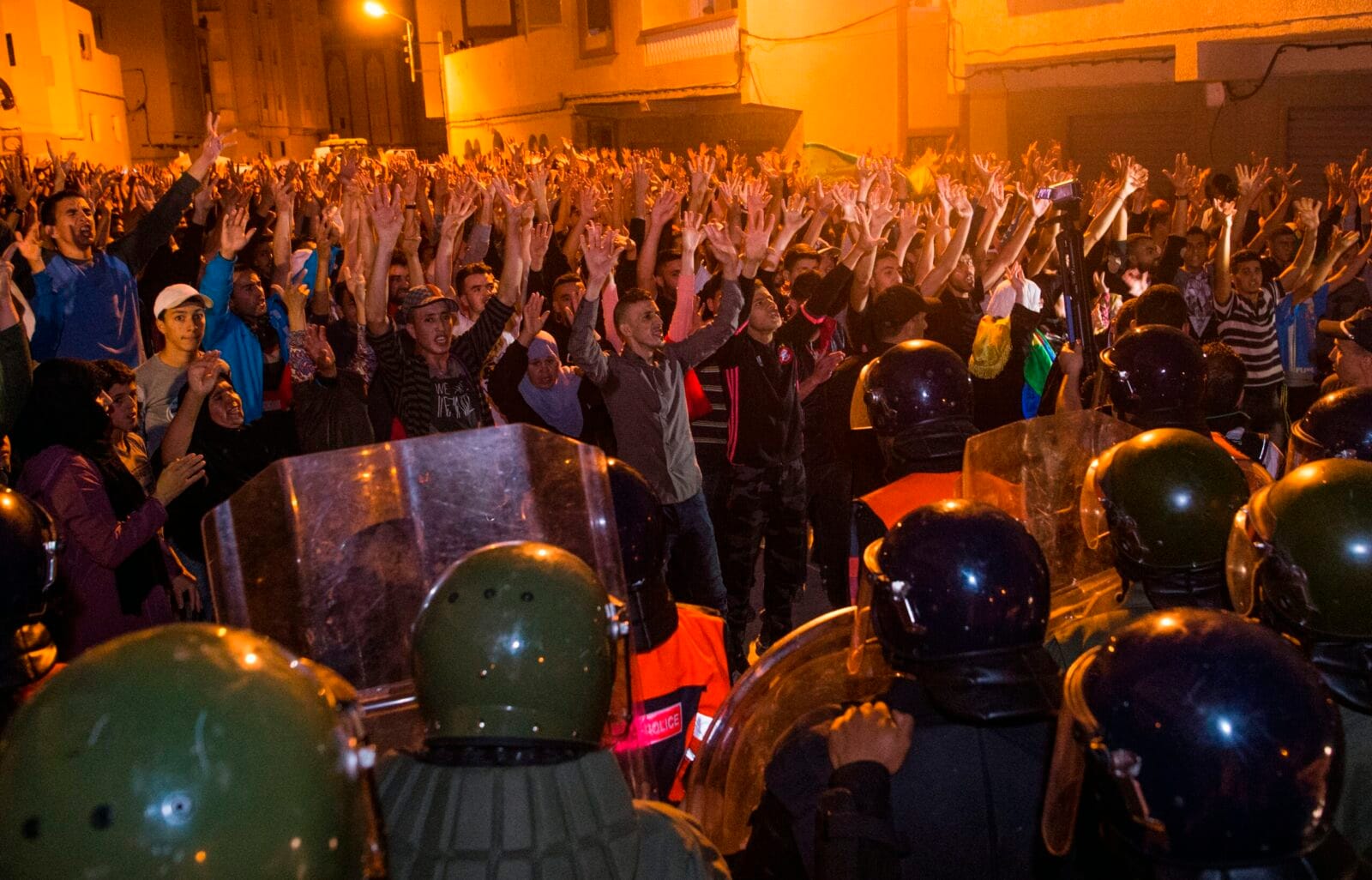
Protesters stand off before police during a demonstration against corruption, repression and unemployment in the northern Moroccan city of al-Hoceima in the early hours of June 10, 2017\. Fadel Senna/AFP via Getty Images
On paper, all of the components of a constitutional parliamentary monarchy are there: a king who rules as head of state, regular parliamentary elections, a recently reformed constitution and a government comprised of a multi-party coalition.
In practice, however, the picture is more opaque. King Mohammed VI has largely withdrawn from the public eye amid prolonged soujourns abroad. Parliament wields little substantial power, and voter turnout remains relatively low. The government has taken few concrete measures to implement the promises of the [2011 constitutional reforms](https://www.merip.org/weighing-moroccos-new-constitution/). Moreover, the governing coalition is led by Aziz Akhannouch, who, on top of recently adding prime minister to his extensive record, is a close personal friend of the king and one of Africa’s richest billionaires.
A deeper look reveals a consistent trend over the past few years: the expansion of the security apparatus and its unchecked power. When Mohammed VI ascended to the throne in 1999, one of his first steps was to remove Driss Basri, longtime interior minister and muscle of his father, King Hassan II. Basri had overseen the worst years of state violence in Morocco, earning him a reputation for brutality. With his removal, many believed that the years of the Moroccan police state were in the past. Events in recent years have proven otherwise.
In terms of domestic policy, state agencies have waged a steady crackdown on journalists, protestors and anyone who expresses views critical of the government. These measures have had a stifling effect on press freedom, freedom of assembly and freedom of expression. With regard to foreign policy, authorities have aggressively enforced border control for the European Union and made its claims to sovereignty over the Western Sahara a litmus test to determine whether countries are deemed friend or foe.
Morocco’s normalization agreement with Israel in 2020 has expanded the country’s arsenal of carceral technology—namely surveillance and intelligence-gathering—into the public sphere. Together, these developments indicate that the security forces have ensured their grip on power, transforming Morocco into a carceral state par excellence.
## **The Police State Strikes Back**
After the 2011 uprisings, Morocco was widely regarded as having weathered the storm, especially in comparison to civil wars and foreign interventions elsewhere in the region. Between constitutional reforms that promised to diffuse executive power and elections that placed a new party in government, propagandists boasted about the country’s “[exceptionalism](https://www.washingtoninstitute.org/policy-analysis/moroccan-exception).”[\[1\]](#%5Fedn1)
Toward the end of 2016, however, the smokescreen began to dissipate. A pivotal event occurred in the northern city of Al-Hoceima—a historical center of resistance in the Rif region—when police confiscated and trashed the produce of a fish vendor, Mohcine Fikri. Desperate to retrieve the source of his livelihood, Fikri jumped into the back of the garbage truck. The police ordered the driver to initiate the compacter, and Fikri died instantly. The consequences recalled the self-immolation of Tunisian fruit vendor, Mohammed Bouazizi, in protest of the police confiscating his wares, which sparked the uprising in that country in December 2010.
What began as a crowd of firsthand eyewitnesses to Fikri’s killing swelled into the biggest protests in Morocco since 2011\. Dubbed the [Hirak Movement](https://www.merip.org/justice-and-or-development/), the mobilizations drew the support and attention of Moroccans throughout the country and in the diaspora. The timing of these protests was especially inopportune for the state, which was hosting dignitaries and foreign media for the United Nations COP22 meeting.
During the initial months of the Hirak protests, authorities reacted with a series of statements aimed at quelling the spread of dissent. Undeterred, the protests grew in numbers and frequency. The protestors implemented a strategic organization that structured the movement around a core leadership and issued explicit demands, including state investments to build a university, a hospital and a cancer treatment facility. The Rif region, historically, has suffered from regime neglect relative to other regions. It currently holds the highest rate of [cancer](https://www.europarl.europa.eu/doceo/document/E-9-2021-004299%5FEN.html) patients in all of Morocco, with heightened incidences stemming from the colonial period when Spain used chemical weapons to subdue anti-colonial resistance there. But despite the fact that an estimated 80 percent of Moroccans who have been diagnosed with cancer are in the Rif, there is no local cancer facility.
> **Also Read:"[Justice and/or Development](https://www.merip.org/justice-and-or-development/)"Middle East Report Online, December 24, 2017.**
Authorities, however, faced an obstacle in addressing these demands: Prime Minister Abdelilah Benkirane, the populist leader of the Islamist Party of Justice and Development (PJD) who had won a second consecutive term in the 2016 elections, had yet to form a coalition. As a result, cabinet seats remained vacant and the public sector risked coming to a standstill.
This confluence of widespread protests and the absence of a ruling government gave the state ammunition to escalate policing under the guise of national security. What followed were a series of measures that marked the beginning of the security forces’ unfettered reign under the patronage of the king.
The first indication that Morocco was entering a new era of policing occurred in mid-March 2017 when Mohammed VI [announced](https://www.dw.com/en/moroccan-king-sacks-pm-to-unblock-impasse/a-37957130) that Prime Minister Benkirane would be sacked over his failure to form a coalition. The move marked a major reversal of the 2011 reforms, which pledged that members of the government would be determined by election results. Benkirane had [reportedly](https://www.dw.com/en/moroccan-king-sacks-pm-to-unblock-impasse/a-37957130) refused to concede key ministerial portfolios to junior coalition partners, namely the ministries of justice, finance and foreign affairs. He had also gained a reputation for openly critiquing those in the king’s inner circle. Contrary to the post-2011 claim that the palace functions above and independent from party politics, the decision to oust Benkirane signalled that the king was heavily embedded in the political landscape.
The second indicator was the king’s July 2017 Throne Day [speech](https://www.mapnews.ma/en/discours-messages-sm-le-roi/full-text-royal-speech-occasion-throne-day), the annual celebration of Mohammed VI’s ascension. On this occasion, he dedicated a significant amount of his remarks to lambast public officials. “Some stakeholders have perverted politics, diverting it away from its lofty objectives,” he said. “If the King of Morocco is not convinced of the way political activity is conducted and if he does not trust a number of politicians, what are the citizens left with?”[\[2\]](#%5Fedn2)
> **The king’s barefaced endorsement of police violence granted the security forces carte blanche just days after peaceful protesters had faced tear gas, live fire and widespread arrests.**
In contrast to the unusually harsh tone of the rest of the speech, the king lavished praise on the security forces. Citing the recent Hirak protests in Al-Hoceima, he [stated](https://moroccoonthemove.com/2017/07/31/full-text-king-mohammed-vis-address-nation-marking-moroccos-throne-day/) that “law enforcement services have…bravely and patiently fulfilled their duty, showing restraint and commitment to the rule of law as they maintained security and stability.” He also countered critiques over the heavy hand of police, asserting that their actions refute “what some have referred to as the ‘security approach,’ as if Morocco were sitting on top of a volcano, or as if each household and each citizen were being watched over by a policeman.”[\[3\]](#%5Fedn3) The king’s barefaced endorsement of police violence granted the security forces carte blanche just [days after](https://www.reuters.com/article/world/moroccan-police-fire-tear-gas-to-disperse-protests-in-north-idUSKBN1A52J0/) peaceful protesters had faced tear gas, live fire and widespread arrests.
In the months that followed, the king [sacked](https://www.aljazeera.com/news/2017/10/25/moroccan-king-fires-ministers-over-development-delays) a number of government ministers and public officials over their mismanagement of development projects, despite the fact that some had only been serving in their ministerial positions for a few months. These dismissals were yet another move that effectively neutralized the PJD from populist bastion to docile pawn. Meanwhile, dozens of protesters who were arrested for their involvement in the Hirak movement faced the beginning of their trials. Many remained in isolated [detention](https://www.amnesty.org/en/latest/news/2017/11/morocco-protesters-activists-and-journalists-detained-over-rif-protests-must-be-released/), some for as along as two hundred days, before being sentenced for up to twenty years. Their convictions were among the first high profile cases following the October 2017 judiciary reforms that [shifted](https://carnegieendowment.org/sada/2017/11/moroccos-pursuit-of-judicial-independence?lang=en¢er=middle-east) the public prosecutor’s office from the Ministry of Justice to the High Judicial Council—a body whose members are appointed and overseen by the monarchy.
Overall, 2017 was a year of major setbacks for elected institutions, civil society and judicial independence. For the security forces, however, it was only the beginning of their ascent.
## **The Domestic Carceral State**
Morocco’s security apparatus is comprised of three main institutions. First is the General Directorate for Territorial Surveillance (DGST), a domestic agency that oversees national intelligence and is directed by Abdellatif Hammouchi. In 2014, two months after the beginning of what became a wave of of ISIS-related attacks throughout Europe and the Middle East, it was announced that the DGST would be overseeing the operations of a new agency: the Central Bureau of Judicial Investigations, dubbed “[Morocco’s FBI](https://www.moroccoworldnews.com/2017/04/214202/al-khayam-outlines-achievements-moroccos-fbi).”[\[4\]](#%5Fedn4)
Second is the General Directorate for National Security (DGSN), which controls the police. In 2015, the king appointed Hammouchi to direct this agency in addition to the DGST, thereby consolidating the two most important policing agencies under one appointed official.
The third institution is the General Directorate for Territorial Surveillance (DGED), which has purview over all foreign intelligence-related matters. Its director is Yassine Mansouri. Hammouchi and Mansouri are high-ranking officials who embody the strong arms of the *makhzen*, the tangled network of public sector power, private sector capital and religious support that upholds the Moroccan state. Both men hold positions with no term limits and manage their respective agencies with no oversight, answering solely to the king.
By 2016, Hammouchi had carried out a major [facelift](https://newlinesinstitute.org/state-resilience-fragility/civil-military-relations/moroccos-security-sector-and-the-erosion-of-rights/) for Morocco’s police force, including the implementation of biometric data, digitization of records, the installation of over 900 security cameras and issuance of new uniforms. Since 2017, Hammouchi has steadily woven the DGSN and DGST into nearly every fabric of Moroccan society.
Part of the reason for this profusion of power stems from the king’s recurring and prolonged absences abroad, beginning in 2018 when he went to France for heart [surgery](https://www.reuters.com/article/world/morocco-s-king-undergoes-successful-heart-surgery-state-news-agency-idUSKCN1GA2X0/#:~:text=RABAT%20%28Reuters%29%20%2D%20Morocco's%20King,with%20an%20%22atrial%20flutter%22.). Since then, foreign media outlets have fixated on the king’s penchant for escaping into reclusion abroad. For example, in October of 2023, Spain’s *El Pais* covered his absence from Morocco under the headline, “[Mohammed VI, a silent king with far-reaching powers](https://english.elpais.com/international/2023-09-18/mohamed-vi-a-silent-king-with-far-reaching-powers.html).”[\[5\]](#%5Fedn5) Earlier that year, Britain’s *The Economist* reported on “[The mystery of Morocco’s missing king](https://www.economist.com/1843/2023/04/14/the-mystery-of-moroccos-missing-king),” and in 2022 Israel’s *Ha’aretz* published an article observing that, “[Morocco’s Economy Is Sinking, but Its King Prefers the Bright Lights of Paris](https://www.haaretz.com/middle-east-news/2022-09-22/ty-article/.premium/moroccos-economy-is-sinking-but-its-king-prefers-the-bright-lights-of-paris/00000183-64e8-dd85-a9f3-66fe7bd20000).”[\[6\]](#%5Fedn6) On the other hand, the story of the king’s protracted sojourns is not widely covered in Moroccan media outlets—a result of the crackdown on press freedom in recent years, which has seen indepentent news outlets [eradicated](https://www.nouvelobs.com/monde/20210401.OBS42208/tribune-la-tragique-saga-d-akhbar-al-yaoum-dernier-journal-independant-au-maroc.html) and many journalists [prosecuted](https://cpj.org/mideast/morocco/page/2/) in flawed trials.
After the king’s 2017 speech bestowing the royal seal of approval on the security forces, it soon became clear that the state’s policing agencies were managing day-to-day affairs in the country. Two major events exemplifying this control were the COVID-19 pandemic and an earthquake in 2023 that devastated rural areas in the High Atlas.
Like many other countries, Morocco swiftly responded to the pandemic by declaring a state of emergency in March 2020\. In addition to curfews, mask mandates and other health-related measures, the government officially criminalized any speech it deemed critical of its pandemic response. The punishment for such an offense could be up to three months in prison and a 1300 dirham ($132 US) fine. According to [Amnesty International](https://www.amnesty.org/en/latest/news/2020/06/morocco-and-western-sahara-end-prosecution-of-activists-under-new-health-emergency-law/), over 90,000 Moroccans were prosecuted for violating the health emergency law, including a number of citizen journalists and social media users.
Then, after a devastating earthquake struck the region of Al-Haouz in early September 2023, the security forces were tasked with the initial emergency response efforts. Survivors [lamented](https://www.washingtonpost.com/world/2023/09/12/morocco-earthquake-response-aid-government/) the country’s selective acceptance of foreign assistance, the sluggish pace of rescue operations and the uneven distribution of aid. On the other hand, there was a quick imposition of checkpoints and bureaucratic restrictions on burials and grassroots aid caravans.
> **By tasking the security forces to oversee the management of these humanitarian crises, the palace implicitly demonstrated that “security” was its primary concern while the immediate human needs of the population were relegated as secondary.**
The pandemic and earthquake were the most disastrous mass casualty events in Morocco’s recent history: Over 16,000 died during the [pandemic](https://coronavirus.jhu.edu/region/morocco) and over 2,900 died from the [earthquake](https://www.reuters.com/world/africa/morocco-earthquake-death-toll-passes-2800-survivors-camp-outdoors-2023-09-11/). By tasking the security forces to oversee the management of these humanitarian crises, the palace implicitly demonstrated that “security” was its primary concern while the immediate human needs of the population were relegated as secondary. Furthermore, these emergencies provided a convenient cover for the expansion of the security forces’ reach under the guise of public health and safety. The swift imposition of restrictions on movement and imprisonment for infractions reinforced and elevated carcerality as the top priority on the agenda and cemented the hold of the police state at the expense of human life.
## **The Foreign Carceral State**
The shift toward privileging “national security” in Morocco’s domestic policy has also permeated its foreign policy. On the one hand, the conflation of domestic and foreign security isn’t new. It largely stems from the Western Saharan conflict that has engulfed Morocco in an ongoing territorial dispute with the pro-independence Polisario Front since 1975\. What is new, however, is the intensification of Morocco’s zealousness with regard to its claims over the territory, souring diplomatic ties with some countries and deepening relations with others. Morocco has also increasingly integrated surveillance and intelligence within its foreign policy approach. But the most important development in Morocco’s carceral foreign policy shift has been normalization with Israel in December 2020.
After Morocco and the Polisario Front consented to a UN-brokered ceasefire in 1991, there was no major armed incident between the two sides—although little to no progress was made toward a lasting resolution. That all began to change in early 2017 when Morocco commenced what it described as a ["road clearing" operation](https://www.reuters.com/article/us-westernsahara-morocco/morocco-says-forces-to-withdraw-in-western-saharas-guerguerat-standoff-idUSKBN1650PV/) in the Guerguerat buffer zone between Western Sahara and Mauritania. In response, the Polisario deployed its troops nearby. With only two yards separating the two sides, this confrontation ushered in the most intense period since the ceasefire in 1991\. In 2020, the Polisario Front [declared](https://www.iiss.org/en/publications/strategic-comments/2021/the-end-of-the-ceasefire-in-western-sahara/) an end to the ceasefire and announced that it would resume its armed campaign against Morocco. Less than a month later, US President Donald Trump officially [recognized](https://trumpwhitehouse.archives.gov/presidential-actions/proclamation-recognizing-sovereignty-kingdom-morocco-western-sahara/#:~:text=TRUMP%2C%20President%20of%20the%20United,of%20the%20Kingdom%20of%20Morocco.) Morocco’s sovereignty over the Western Sahara in exchange for Morocco agreeing to normalize relations with Israel.
The months following the normalization deal were among the most turbulent in Morocco’s diplomatic history. Likely driven by the presumption that other US-allied governments would follow suit in recognizing Morocco’s claim to sovereignty over the Western Sahara, the kingdom became increasingly emboldened—especially toward its European neighbors.
For years, it had been [reported](https://www.europarl.europa.eu/doceo/document/E-9-2022-001080%5FEN.html) that Morocco used migration as a bargaining chip with the European Union to force their hand in decisions that would favor Morocco when it came to the Western Sahara. In mid-2021, this strategy was on full display as a record number of 6,000 migrants crossed into the Spanish enclave of Cueta from Morocco, 1,500 of whom were minors. According to [media](https://www.bbc.com/news/world-europe-57150051) reports, “Moroccan border guards stood by and watched as migrants took to the sea to try to reach the enclave.”[\[7\]](#%5Fedn7) The incident sparked a major domestic crisis in Spain, resulting in the sacking of Spain’s foreign minister. One of the immediate reasons behind Morocco’s decision to weaponize migration against Spain was that Brahim Ghali, leader of the Polisario, was [seeking](https://www.reuters.com/world/western-sahara-leaders-treatment-spain-angers-morocco-2021-05-18/) medical treatment in Spain for COVID-19\. In March 2022, Spain [announced](https://apnews.com/article/europe-africa-spain-morocco-western-sahara-8d5520942af0fff9c316796830c705af) it was changing its position and moving forward with recoginizing Moroccan sovereignty over the Western Sahara. Soon after, both Morocco and Spain jointly carried out a violent [operation](https://www.hrw.org/news/2022/06/29/morocco/spain-horrific-migrant-deaths-melilla-border) aimed at stifling the movement of migrants, resulting in over 20 casualties. The episode epitomized the excesses of state violence and illustrated Morocco’s continued role as the European Union’s border enforcer.
> **In the face of overwhelming public opposition to normalization with Israel, Moroccan authorities have doubled down, incarcerating ordinary Moroccans over social media comments critical of Israel.**
Morocco’s deepening ties to Israel have also hastened its transformation into a modern carceral state. Since 2020, Morocco has been accused of using Israeli-produced spyware to surveil activists, journalists and even world leaders, including Spanish Prime Minister Pedro [Sanchez](https://www.npr.org/2022/05/11/1098368201/a-spying-scandal-and-the-fate-of-western-sahara) and French President Emmanuel [Macron](https://www.reuters.com/technology/french-prosecutor-opens-probe-after-pegasus-spyware-complaint-2021-07-20/). In the summer of 2024, it was announced that Morocco would [acquire](https://www.reuters.com/world/africa/morocco-acquire-israeli-spy-satellite-worth-1-bln-media-2024-07-10/) a $1 billion spy satellite from Israel in a deal that will last for about five years. In the face of overwhelming public opposition to normalization with Israel, Moroccan authorities have doubled down, incarcerating ordinary Moroccans over social media comments critical of Israel. The latest example is the case of Abdul Rahman Zankad, a Moroccan activist who was [sentenced](https://apnews.com/article/morocco-israel-palestinians-zankad-d924b81bb8096f9e593f0efebd30b90d) to five years in prison and fined 50,000 Moroccan dirhams over “incitement” and “insulting a constitutional institution.”[\[8\]](#%5Fedn8)
As more states across the globe veer further toward carcerality, Morocco remains at the forefront of advancing methods and developing policies. Much of the efficacy of this global carceral regime hinges upon the ability of states to cooperate with one another, exchange information and uphold each other’s carceral agendas via transnational repression. Morocco has been central in all of the above and operates with near total impunity. The rise of surveillance technologies, deepening ties between security institutions and companies as well as an alignment of political goals centered around sustaining illegal occupations are just some of the elements of this global carceral system.
Moreover, Morocco serves as a useful case for neighboring and distant countries to observe and glean lessons on the most effective strategies and tactics. Likewise, Morocco has adopted policies by observing allies and foes, both near and far. In the process, what has ensued is an ever-evolving global carceral agenda, in which Morocco continues to serve as an integral node.
\[**Samia Errazzouki** is a Mellon Postdoctoral Fellow in the Humanities at Stanford University and former Morocco-based journalist.\]
**This issue of Middle East Report, *Carceral Realities and Freedom Dreams*, has been produced in partnership with the [Orfalea Center for Global and International Studies](https://www.orfaleacenter.ucsb.edu/) at the University of California, Santa Barbara, and [Security in Context](https://www.securityincontext.com/).**
> **Read the[previous](https://www.merip.org/israel-is-waging-war-on-palestinian-prisoners-2/) article.**
> **Read the[next](https://merip.org/2024/10/cell-phones-behind-bars-in-lebanon) article.**
**This article appears in** [**MER issue 312**](https://merip.org/magazine/312/) **“Carceral Realities & Freedom Dreams.”**
---
### **Endnotes**
[\[1\]](#%5Fednref1) David Pollock, "[A Moroccan Exception?](https://www.washingtoninstitute.org/policy-analysis/moroccan-exception)," The Washington Institute for Near East Policy, December 16, 2023.
[\[2\]](#%5Fednref2) "[Full Text of Royal Speech on the Occasion of the Throne Day,](https://www.mapnews.ma/en/discours-messages-sm-le-roi/full-text-royal-speech-occasion-throne-day)" Agence Marocaine De Presse (MAP), July 29, 2017.
[\[3\]](#%5Fednref3) Ibid.
[\[4\]](#%5Fednref4) Saad Eddine Lamzouwaq, “[El Khiam Outlines Achievements of Morocco’s FBI,](https://www.moroccoworldnews.com/2017/04/214202/al-khayam-outlines-achievements-moroccos-fbi)” Morocco World News, April 16, 2017.
[\[5\]](#%5Fednref5) Juan Carlos Sanz, "[Mohammed VI, a silent king with far-reaching powers](https://english.elpais.com/international/2023-09-18/mohamed-vi-a-silent-king-with-far-reaching-powers.html)," *El Pais*, September 18, 2023.
[\[6\]](#%5Fednref6) Nicolas Pelham, "[The mystery of Morocco’s missing king,"](https://www.economist.com/1843/2023/04/14/the-mystery-of-moroccos-missing-king) *The Economist*, April 13, 2023; Zvi Bar'el, "[Morocco’s Economy Is Sinking, but Its King Prefers the Bright Lights of Paris](https://www.haaretz.com/middle-east-news/2022-09-22/ty-article/.premium/moroccos-economy-is-sinking-but-its-king-prefers-the-bright-lights-of-paris/00000183-64e8-dd85-a9f3-66fe7bd20000)," *Haaretz*, September 22, 2022.
[\[7\]](#%5Fednref7) "[Migrants reach Spain's Ceuta enclave in record numbers](https://www.bbc.com/news/world-europe-57150051)," BBC, May 18, 2021.
[\[8\]](#%5Fednref8) Sam Metz, “[A Moroccan activist was sentenced to 5 years for criticizing the country’s ties to Israel,](https://apnews.com/article/morocco-israel-palestinians-zankad-d924b81bb8096f9e593f0efebd30b90d)” AP, April 9, 2024.
### Israel Is Waging War on Palestinian Prisoners
URL: https://www.merip.org/2024/10/israel-is-waging-war-on-palestinian-prisoners-2/
Last updated: 2025-08-22T18:36:05.000Z
Since October 7, 2023, conditions in Israeli prisons have paralleled the besieging and retaliatory war on the people of Gaza. But the heightened aggression against Palestinian prisoners started almost one year earlier.
Palestinian men are detained by Israeli forces in the streets of Beit Lahiya, in the northern Gaza Strip, December 7, 2023\. Photo taken by Israeli soldiers and widely distributed on social media. Some men in the photo were interviewed by journalists from +972/Local Call.
In December 2022, Itamar Ben-Gvir, the leader of the ultra-nationalist, anti-Arab Otzma Yehudit (Jewish Power), became Minister of National Security, giving him control of the police and the Israel Prison Service (IPS).
“\[O\]ne of the highest goals I have set for myself,” Ben-Gvir [declared](https://x.com/itamarbengvir/status/1808031178277925263), “is to worsen the conditions of the terrorists in the prisons, and to reduce their rights to the minimum required by law.”[\[1\]](#%5Fedn1) He immediately began instituting [numerous](https://www.addameer.org/media/4978) [cruel measures](https://euromedmonitor.org/en/article/5816/Israel%E2%80%99s-tormenting-of-Palestinian-prisoners-is-illegal-and-morally-unjustifiable) [to shrink](https://www.timesofisrael.com/ben-gvir-said-to-order-reduced-shower-time-for-terror-inmates/) Palestinian prisoners’ already scant resources and elevate their suffering. In February 2023, he [set a four-minute limit](https://www.haaretz.com/israel-news/2023-02-21/ty-article-opinion/.premium/a-four-minute-shower-for-palestinian-prisoners-is-ben-gvirs-new-diktat/00000186-6f5d-dc65-a5de-efdd743f0000) on shower time and bragged in a [TikTok post](https://www.tiktok.com/@middleeasteye/video/7197860514968472837) about closing the prisoner-run bakeries in Ketziot and Nafha while he waved a fistful of pita at the camera. In August, over 1,000 prisoners—one-fifth of Palestinians incarcerated at the time—declared [a hunger strike](https://www.aa.com.tr/en/middle-east/hundreds-of-palestinians-held-by-israel-start-indefinite-hunger-strike/2970830) to protest their dire situation. Ben-Gvir retaliated by reducing family visits to one every two months.
When the hot war started in October, the treatment of Palestinian prisoners [deteriorated](https://www.jadaliyya.com/Details/45487) precipitously. Like the siege Israel imposed on Gaza, the IPS drastically reduced access to water and electricity. Food allocations were cut to a “minimal menu,” which, coupled with the shuttering of prison canteens, amounted to a [starvation policy](https://www.english.acri.org.il/post/end-the-policy-of-starving-security-prisoners).[\[2\]](#%5Fedn2) Soldiers and guards rampaged through compounds assaulting prisoners and firing rubber bullets and tear gas. Cell blocks were raided and most items were seized, including letters, books, medicine and radios. Many prisoners were moved to isolation and others were crammed into cells designed for five or six that were now made to hold 12 or more.
The IPS imposed a complete ban on visits by monitors from the International Committee of the Red Cross as well as family members. Phone calls to relatives became impossible and lawyers’ access to clients was halted for months and now remains severely restricted. As a result, Palestinian prisoners were isolated from most contact with the outside world. This combination of brutality, deprivation and communication blackout reproduced conditions of confinement in the first decade of the Israeli occupation of Gaza and the West Bank when prisons were unmonitored legal black holes.
> **This combination of brutality, deprivation and communication blackout reproduced conditions of confinement in the first decade of the Israeli occupation of Gaza and the West Bank when prisons were unmonitored legal black holes.**
Interrogators dispensed with “moderate physical pressure”—the Israeli euphemism for its torture tactics—in favor of the crudest forms of [physical violence](https://www.youtube.com/watch?v=GWqvDYbpbIg), including beatings, protracted shackling in painful positions, suffocation and sexual assault.[\[3\]](#%5Fedn3) Brute violence became endemic throughout every prison and detention center. Since October 7, at least [60 Palestinians](https://www.merip.org/content/files/sites/default/files/publications/202408%5Fwelcome%5Fto%5Fhell%5Feng.pdf) died or were killed in Israeli custody, a figure that does not include an unknown number of Palestinians from Gaza whose reported deaths in military facilities are unconfirmed.
The war inside Israeli prisons has been fueled by [escalating](https://www.addameer.org/sites/default/files/Escalation%20of%20arrest%20campaigns%20since%20the%20beginning%20of%20the%20Israeli%20aggression%20and%20the%20conditions%20of%20the%20prisoners%20in%20the%20prisons.pdf) arrest campaigns across historic Palestine. On October 6, Israeli prisons held [5,200 Palestinians](https://www.addameer.org/statistics/2023/09). In the months since, these numbers have skyrocketed. More than 10,000 Gazan workers and patients who were legally in Israel on October 7 were taken into custody. According to a [July 2024 report](https://www.un.org/unispal/document/thematic-report-detention-gaza-31jul24/) by the UN High Commissioner for Human Rights: “It is estimated that 3,200 of them were released and transferred into Gaza in November 2023, 6,441 were transferred to \[detention facilities in\] the occupied West Bank, while around 1,000 of them remain unaccounted for.”[\[4\]](#%5Fedn4)
In the context of the ground invasion, thousands—including humanitarian workers, women, children, disabled and elderly people—were swept up in indiscriminate capture operations and transferred out of the occupied Gaza Strip. The World Health Organization and other [monitoring agencies](https://www.hrw.org/news/2024/08/26/israel-palestinian-healthcare-workers-tortured) report that at least 310 [healthcare workers](https://theintercept.com/2024/05/24/gaza-palestinian-doctors-hospital-detained-missing-disappeared/), patients and their companions were taken into custody from hospitals and clinics when Israeli forces attacked the facilities. [Adnan al-Bursh](https://www.aljazeera.com/news/2024/5/3/doctor-from-gazas-al-shifa-hospital-dies-in-israeli-prison), the head of orthopedics at al-Shifa Hospital, was detained while working at al-Awda Hospital. He was tortured to death on April 19.
In the West Bank, [more than 9,000 Palestinians](https://cda.gov.ps/index.php/en/51-slider-en/17180-on-the-241st-day-of-genocide-brief-on-detention-campaigns-carried-out-in-the-west-bank-since-october-7-until-june-3-2025) were arrested between October and early June 2024\. Inside the Green Line, [200 Palestinian citizens were arrested](https://www.adalah.org/en/content/view/10925), mostly on suspicions of “incitement to terrorism” and “identifying with terror organizations” for expressing opposition to the war and condemnation of its human toll.[\[5\]](#%5Fedn5)
According to [HaMoked](https://hamoked.org/prisoners-charts.php), an Israeli human rights and legal-aid organization, as of August 2024, 9,881 Palestinians were imprisoned, either as “security prisoners”—those who have been convicted or are under investigation or remanded for trial —or as “security detainees” who are administratively detained without charges. Another 1,584 Palestinians from Gaza are being held incommunicado. Addameer, a Palestinian prisoner support and human rights association, [reports](https://www.addameer.org/statistics) that the prisoner population includes 250 children, 86 women and 12 Palestinian Legislative Council members.
In the current moment—as Israel’s genocidal war on Gaza has killed tens of thousands, and military assaults and state-supported settler pogroms are rampant across the West Bank—the level and scope of violence and dehumanization perpetrated by Israeli soldiers, security agents and IPS staff against detainees and prisoners has extended the hot war into prisons.
## **Testimonies of Torture**
Palestinians who were released from custody in recent months have emerged emaciated, bruised and deeply scarred from tight cuffing. Their [testimonies](https://www.972mag.com/palestinians-abused-israeli-prisons-torture/) provide [glimpses](https://www.merip.org/content/files/sites/default/files/publications/202408%5Fwelcome%5Fto%5Fhell%5Feng.pdf) into [the abyss](https://zeteo.com/p/israel-sde-teiman-prisoners-palestinians-torture).
Omar Assaf, 74, was arrested in Ramallah in October 2023 and administratively detained for six months in Ofer prison in the West Bank. When he was released in April, [before-and-after photos](https://www.middleeasteye.net/news/shocking-pictures-after-release-what-happening-palestinian-prisoners-israeli-jails) were posted on social media; the “after” reveals that he had lost 60 pounds, and his hair had turned white. At a gathering to welcome Assaf home, he described the contrast between what he endured during previous periods of imprisonment over the past four decades and the present. “The conditions inside Israeli prisons today are unprecedented,” he said.[\[6\]](#%5Fedn6)
Moazaz Obayat, 37, was released in July 2024 following nine months of administrative detention. A [video](https://www.youtube.com/watch?v=YYwImF9eSOQ) circulated online shows Obayat—once a muscular bodybuilder—so frail he was unable to walk out of the prison without assistance. His right arm and leg appear paralyzed or broken and his face shows clear signs of starvation. Speaking to the camera, he says, “On December 4, I was subjected to an attempted murder in Ofer prison. Ben-Gvir danced on top of my body. The situation is extremely dire. We are dying every day.”[\[7\]](#%5Fedn7) In another clip recorded in the hospital where Obayat was taken for treatment, he says, “Naqab prison is like Guantánamo. There is killing, beating, starvation, poverty and illness. Two thousand prisoners are suffering from chronic diseases, very chronic diseases, very severe diseases. Their conditions are extremely bad. They only have Allah.” He adds, “I was released, but why didn’t we die together?”[\[8\]](#%5Fedn8)
> **Prisoners requiring medical care—whether for new injuries or chronic diseases—have been denied access to prison clinics and outside hospitals, and those needing prescribed medicines and treatments have been cut off.**
Prisoners requiring medical care—whether for new injuries or chronic diseases—have been denied access to prison clinics and outside hospitals, and those needing prescribed medicines and treatments have been cut off. These developments exacerbate the long-practiced policy of medical negligence by the IPS and complicit medical professionals. A West Bank man released in June from Ramon prison said there appears to be a standing order to “call on the guards only when prisoners die.”[\[9\]](#%5Fedn9) One of many tragic examples of medical negligence was [Arafat Hamdan](https://www.aljazeera.com/features/2023/11/1/he-threw-up-blood-palestinian-detainees-face-abuse-in-israeli-custody), 25, a diabetic whose cellmates pleaded with guards to give him insulin or even a spoonful of sugar to no avail. Two days after his arrest, he was beaten and placed outside, under the sun, with a bag on his head for hours before he died.
Getting details of the prisoners’ conditions is difficult because of the communication blackout. Israeli authorities allow one member of a prisoner’s family to attend court sessions, which prisoners join through video conference. These sessions have become the only way for families to communicate with their loved ones, albeit for a few minutes. At a hearing in the Ofer military court on March 27, 2024, a prisoner started telling the judge that he was severely beaten by the IPS’s Nahshon, the unit in charge of transporting prisoners between prisons and to court. “I just tried to cover my head when they were beating us,” he said before being silenced by a screaming guard. Another described the violent treatment he received while being transported as a “continuation of interrogational torture through other means.”[\[10\]](#%5Fedn10)
Israel’s war inside its prisons is not directed only against those captured since October. Long-term prisoners have been equally affected by the vengeance policy of heightened violence and inhumane deprivations. On December 21, 2023, Thaer Abu Assab, who was imprisoned in Ketziot for 18 years, [asked a guard](https://www.aljazeera.com/news/2024/2/18/systematic-torture-to-be-palestinian-in-an-israeli-prison) whether there was a ceasefire. The guard said, “I’ll show you.”[\[11\]](#%5Fedn11) Then 19 guards entered Abu Assab’s cell and [beat him to death](https://english.wafa.ps/Pages/Details/140225) with iron rods.
Marwan Barghouti, a popular political figure who has spent 24 years in prison, suffered a dislocated shoulder—untreated—when he was dragged with his hands cuffed behind his back to an isolation cell where he was beaten unconscious. According to his [lawyer](https://www.theguardian.com/world/article/2024/may/18/israeli-abuse-of-jailed-palestinian-leader-marwan-barghouti-amounts-to-torture), Igal Dotan, “He’s struggling to see out of his right eye, as a result of one of the assaults.”[\[12\]](#%5Fedn12) Dotan also commented on Barghouti’s dramatic weight loss: “You wouldn’t recognise him if you compare his current appearance with the famous photos of him.” In December, after Barghouti was transferred to Ayalon prison, he was “dragged on the floor naked in front of other prisoners.”[\[13\]](#%5Fedn13)
> **Read: [Two Essays by Palestinian Political Prisoner, Walid Daqqah](https://www.merip.org/a-place-without-a-door-and-uncle-give-me-a-cigarette-two-essays-by-palestinian-political-prisoner-walid-daqqah/).**
Walid Daqqah, a Palestinian citizen widely respected for his literary and social-philosophical [writings](https://www.merip.org/a-place-without-a-door-and-uncle-give-me-a-cigarette-two-essays-by-palestinian-political-prisoner-walid-daqqah/), was incarcerated for 38 years. In 2022, he was diagnosed with a rare form of cancer that would require a bone marrow transfusion. Daqqah died in prison on April 7, 2024, after the IPS [refused](https://www.addameer.org/ar/node/5100.) him medical care and courts rejected petitions from his family for compassionate release in his last days. His body, like [dozens of others who died in custody](https://reliefweb.int/report/occupied-palestinian-territory/intl-committee-must-investigate-israels-holding-dead-bodies-gaza-enar), remains imprisoned by the Israeli authorities for possible use as [bargaining chips](https://www.adalah.org/en/content/view/11130).
Euro-Mediterranean Human Rights Monitor interviewed approximately 100 Palestinians from Gaza who were detained and later released, including 22 women, four children and 17 elderly men. In a [report released in May 2024](https://euromedmonitor.org/en/article/6342/Hostages-of-Israeli-revenge-in-the-Gaza-Strip:-Testimonies-of-100-released-Palestinian-detainees-reveal-crimes-of-torture,-cruel-treatment), Euro-Med identified various forms of cruel, inhumane and degrading treatment and extra-judicial punishments, including strip searches and forced nudity; breaking bones and teeth; being stepped, spit and urinated on; punishment for praying and threats of rape and murder.
B’Tselem issued a [report](https://www.btselem.org/publications/202408%5Fwelcome%5Fto%5Fhell) in August with testimonies from 55 released Palestinians. The litany of horrors match those reported by Euro-Med. B’Tselem concluded that Israeli prisons and detention facilities, “in which every inmate is intentionally condemned to severe, relentless pain and suffering, operate as de-facto torture camps.”[\[14\]](#%5Fedn14)
## **Torture and Consequences**
A deluge of photos and videos shot by Israeli soldiers and circulated on Telegram and other social media sites since October 7 have validated Palestinians’ first-person accounts of torture and abuse.
Image and caption from Human Rights Watch: Dr. Khalid Hamoudeh (far left in the front) and Dr. Wadee Qasem (far right in the front) are detained along with other healthcare workers, internally displaced civilians, and patient’s families near the Kamal Adwan Hospital in northern Gaza. © 2023 Channel 12 via journalist Nir Debori/Telegram
Some of the most horrendous [Israeli-sourced images](https://www.youtube.com/watch?v=JAT9NQ4WkE0) depict shirtless or naked detainees bound and blindfolded, being dragged across gravel and stomped and kicked in their heads and genitals. Soldiers’ decisions to publish images of themselves and their comrades humiliating and brutalizing Palestinians serve to amplify the unfettered violence that defines the present. The [circulation of such images](https://eprints.soas.ac.uk/18371/1/Viterbo%20-%20Seeing%20Torture%20Anew.pdf) also serves [as a form of “terroristic torture,”](https://www.routledge.com/Torture-A-Sociology-of-Violence-and-Human-Rights/Hajjar/p/book/9780415518062) that is, making the torture of some publicly known in order to terrorize the broader targeted society.[\[15\]](#%5Fedn15) In this case, the gruesome images are intended to threaten all Palestinians that resistance is not only futile but punishable by the most extreme measures, including maiming and death.
To manage the messaging about prison conditions while sating domestic Israeli appetites for more evidence of retribution against Palestinians, prison authorities have granted access to some reporters. A segment [broadcast on Israel’s Channel 14](https://www.youtube.com/watch?v=E5m-um-rshA) on February 2, 2024, shows an IPS officer matter-of-factly describing the abusive treatment being meted out in the facility. Panning to rows of prisoners sitting on the concrete floor of a courtyard with their heads bowed, he comments, “There are 150 prisoners here. None of them moves…until the shift supervisor approves it.”[\[16\]](#%5Fedn16) As they tour several cells crammed with bowed and bound prisoners, the reporter comments, “What you see now is their daily routine. The days of summer camp are over.”
A segment [broadcast on Channel 13](https://www.youtube.com/watch?v=jvlIPxxS8Pg) on February 18 begins with a scene of heavily armed guards wearing balaclavas and accompanied by a dog entering a cell as one screams, “Head on the floor!”[\[17\]](#%5Fedn17) Another scene shows what the reporter refers to as a “secret wing” where prisoners are forced to kneel in the fetal position with their hands and feet cuffed at all times. The reporter comments on a nationalist song playing in the background: “This song ‘Am Yisrael Chai’ is heard in the wing, repeatedly, non-stop. The prison authorities claim that it is meant to boost the staff’s morale. But it is clear that this is another part of the psychological warfare against the prisoners.”
Photos and videos of Palestinians being tortured and abused have also been [published](https://www.aljazeera.com/news/2024/1/19/un-says-palestinians-detained-by-israeli-forces-humiliated-beaten) in the [foreign media](https://www.bbc.com/news/av/world-middle-east-67659922). The condemnations and reproaches they have evoked are a source of consternation and concern for [Israeli officials](https://www.timesofisrael.com/idf-sets-up-committee-to-probe-alleged-torture-of-palestinian-terror-suspects/), who may have to contend with the threat that material evidence of torture will pose for them in the future. On June 26, Ronen Bar, director of the Shin Bet (Israel’s domestic intelligence agency), issued a [warning letter](https://www.ynet.co.il/news/article/hj2hgezv0) to Prime Minister Benjamin Netanyahu and Ben-Gvir that the situation in prisons is a “time bomb” that could “endanger senior Israelis abroad and expose them to ‘international tribunals.’”[\[18\]](#%5Fedn18) He elaborated: “Israel is having difficulty repelling claims against it, at least some of which are well founded.”
## **From Bad to Worse**
Prison conditions for Palestinians have always been grueling and severe, and torture is a durable feature of Israel’s carceral regime.
Following the 1967 occupation of the remainder of historic Palestine, torture became a central component in the trifecta of Israeli strategies of control through punishment, the other two being arrest and prosecution or detention without trial. Lacking other forms of evidence, [the Israeli military courts](https://www.ucpress.edu/book/9780520241947/courting-conflict) depend on Palestinians’ confessions to secure convictions. The use of violence and coercion to elicit incriminating statements for legal proceedings has been a mainstay of interrogations and a key element of Israeli carceralism.
> **With the recommendations of the Landau Commission, the Israeli government acquired the ignominious distinction as the first state in the world to publicly proclaim the right to torture, albeit the authorized tactics were euphemized as “a moderate measure of physical pressure."**
For two decades, Israel dismissed allegations of torture as enemy propaganda and lies. That changed in 1987 with the report by the Landau Commission, a state-established inquiry into possible wrongdoings by the Shin Bet. The Landau Commission validated long-denied accusations of systematic abuse while endorsing the Shin Bet’s contention that violent and coercive tactics were a necessary and vital part of the state’s fight against “hostile terrorist activity.”[\[19\]](#%5Fedn19) This activity was broadly defined to include not only acts of violence but any resistance to the occupation—including speech—or assertions of Palestinian national rights. The Commission recommended that the government authorize these tactics to relieve Shin Bet agents from the need to lie to military judges when defense lawyers challenged confessions as coerced. With these recommendations, the Israeli government acquired the ignominious distinction as the first state in the world to publicly proclaim the right to torture, albeit the authorized tactics were euphemized as “a moderate measure of physical pressure.”[\[20\]](#%5Fedn20) (In 2002, the US government emulated Israel’s rationales of necessity in an attempt to legalize its own torture program for the “war on terror.”)
In the early 1990s, responding to increased monitoring and reporting by human rights organizations, the Shin Bet largely shifted from the use of tactics that leave physical marks, like beatings and electric shocks, in favor of so-called [clean techniques](https://press.princeton.edu/books/paperback/9780691143330/torture-and-democracy) like protracted position abuse, isolation, sleep deprivation, shaking and confinement in refrigerated or overheated spaces. Such tactics are no less torturous, but they don’t leave scarring marks, making them easier to deny and thus, avoid accountability. Indeed, Israel has maintained a near-perfect record of impunity for torture. Out of 1,450 complaints of torture [submitted](https://stoptorture.org.il/en/torture-in-israel-today/) to the Ministry of Justice between 2001 and 2022, three resulted in a criminal investigation with zero indictments.[\[21\]](#%5Fedn21)
The Public Committee Against Torture in Israel (PCATI) and other Israeli human rights organizations challenged the government’s authorization of torture through lawsuits in the High Court of Justice (HCJ). In 1999, the HCJ ruled in [*PCATI et al v The State of Israel*](https://hamoked.org/files/2012/115029%5Feng.pdf) that certain interrogation tactics (such as painful shackling and protracted use of stress positions)—which the Court had not prohibited in the past—were illegal under Israeli and international law. The decision barred the routine use of such tactics, but it included a loophole enabling the use of coercion and violence if “security officials believe that a suspect is withholding information that could prevent an impending threat to civilian lives”—the so-called [“ticking bomb" scenario.](https://www.haaretz.com/2004-08-19/ty-article/despite-court-rulings-shin-bet-still-tortures-ticking-bombs/0000017f-f354-d223-a97f-ffdd51c70000)[\[22\]](#%5Fedn22)
The landmark HCJ decision did not end the [use of torture](https://reliefweb.int/report/occupied-palestinian-territory/dci-palestine-submits-14-cases-sexual-assault-and-threats-un) on Palestinians. But other events and developments altered the centrality of interrogation in Israeli control-and-punishment strategies. Soldiers had engaged in targeted killings of Palestinian suspects since at least 1988, but the government denied doing so because it is categorically illegal. The doing-and-denying ended in November 2000 when Israel again acquired the ignominious distinction as the first state in the world to publicly declare its right to extra-legally execute people. (The United States began engaging in targeted killing in 2002 and copied Israel’s reasoning in a [2010 memo ](https://www.justsecurity.org/11986/drone-memo-cometh/)to legally rationalize the practice.) The option to kill rather than capture Palestinian suspects downgraded the importance of arrest, interrogation and prosecution.
In 2002, Israel passed an Unlawful Combatants Law. The concept, [although not new](https://www.cambridge.org/core/books/abs/abc-of-the-opt/export-of-knowledge/7080CA92ADD36CF07EDD6207B8BEB509), had acquired international visibility in November 2001 when US President George W. Bush issued an executive order decreeing that anyone taken into US custody overseas in the context of the “war on terror” was an “unlawful enemy combatant.” This designation contravened the laws of war (i.e., the 1949 Geneva Conventions) in which every person is either a combatant or a civilian. The US objective in deploying this status category was to facilitate secret detention, but the ulterior motive was to enable the use of interrogation techniques that are prohibited and criminalized. According to the 2002 Israeli law, the unlawful combatant label could be applied to anyone who directly or indirectly participated in hostile acts against the State of Israel and was not entitled to prisoner-of-war status (copying US misinterpretations of the Geneva Conventions). The designation was applied mainly to foreign Arabs who already were being [secretly detained (held incommunicado) and tortured in Israel](https://www.jpost.com/israel/report-idf-doctor-says-dirani-was-raped#google%5Fvignette).
On December 18, 2023, [the Knesset amended the Unlawful Combatants Law](https://www.972mag.com/sde-teiman-torture-prisoners/) to expand secret detention by enabling the military to hold people for 45 days without an arrest warrant or any oversight by a court. Under the amended law, detainees can be denied access to a lawyer for up to 75 days on the order of the prison official responsible for implementing the law, and courts can extend detention and denial of access to a lawyer for up to 180 days. As was the case in the[ US “war on terror,"](https://www.researchgate.net/publication/331884125%5FThe%5FCounterterrorism%5FWar%5FParadigm%5Fversus%5FInternational%5FHumanitarian%5FLaw%5FThe%5FLegal%5FContradictions%5Fand%5FGlobal%5FConsequences%5Fof%5Fthe%5FUS%5FWar%5Fon%5FTerror) [for Israel](https://www.newyorker.com/news/q-and-a/the-brutal-conditions-facing-palestinian-prisoners), holding people incommunicado provides cover for torture.
For Palestinians from Gaza, the IPS has made it impossible to meet a lawyer even when they have a right to do so. As Qadura Fares, head of the Palestinian Commission for Detainees and Ex-Detainees Affairs, [explains](https://www.newarab.com/analysis/systematic-torture-gazans-israels-secret-prisons), “Israeli prison authorities demand receiving a hard copy of a direct power of attorney made for the lawyer, and signed by the detainee’s relatives in Gaza, which is impossible: the lawyer will not access Gaza, and the families of the prisoners cannot enter Israel. Having a power of attorney sent by WhatsApp or email is not accepted by Israeli authorities, and so prisoners aren’t allowed legal presentation.”[\[23\]](#%5Fedn23)
## **State Secrets and Crimes**
Sde Teiman, a military camp in the Negev desert, was partially converted into a detention center after the start of the war. It has been characterized as a “black site” because, not only is it inaccessible to independent monitors, but officials regard the identities and treatment of those held there to be a state secret. At least two military bases in the West Bank, Anatot and Ofer, also have had sections repurposed for secret detention.

Image and caption from Human Rights Watch: A leaked photograph of the detention facility at the Sde Teiman military base shows a blindfolded man with his arms above his head. Interviewed healthcare workers described this image as punishment imposed by Israeli soldiers on Palestinian detainees if they speak or move. © 2024 Private
But the veil of secrecy shrouding Sde Teiman was lifted in April when [Ha’aretz reported](https://eur03.safelinks.protection.outlook.com/?url=https%3A%2F%2Fmerip.us15.list-manage.com%2Ftrack%2Fclick%3Fu%3De18284b99bf49578897672d9a%26id%3De39813e7a1%26e%3D993ba8dccc&data=05%7C02%7Ck.natanel%40exeter.ac.uk%7C56dcefa40e024a61500708dcb7aa4067%7C912a5d77fb984eeeaf321334d8f04a53%7C0%7C0%7C638587189478268948%7CUnknown%7CTWFpbGZsb3d8eyJWIjoiMC4wLjAwMDAiLCJQIjoiV2luMzIiLCJBTiI6Ik1haWwiLCJXVCI6Mn0%3D%7C40000%7C%7C%7C&sdata=BXWnIiK77stN128WN4q8Eta8Js7%2Fmor%2FiDqaI13MT%2FQ%3D&reserved=0) on a letter sent to Israeli cabinet members by a doctor working at the facility. “Just this week, two prisoners had their legs amputated due to handcuff injuries, which unfortunately is a routine event," the physician wrote. He added, “I am writing to warn you that the facilities’ operations do not comply with a single section among those dealing with health in the Incarceration of Unlawful Combatants Law."[\[24\]](#%5Fedn24)
One month later, [CNN published an explosive exposé](https://eur03.safelinks.protection.outlook.com/?url=https%3A%2F%2Fmerip.us15.list-manage.com%2Ftrack%2Fclick%3Fu%3De18284b99bf49578897672d9a%26id%3D0ee8025ca9%26e%3D993ba8dccc&data=05%7C02%7Ck.natanel%40exeter.ac.uk%7C56dcefa40e024a61500708dcb7aa4067%7C912a5d77fb984eeeaf321334d8f04a53%7C0%7C0%7C638587189478274605%7CUnknown%7CTWFpbGZsb3d8eyJWIjoiMC4wLjAwMDAiLCJQIjoiV2luMzIiLCJBTiI6Ik1haWwiLCJXVCI6Mn0%3D%7C40000%7C%7C%7C&sdata=S82bl1qFrDhCgr0DtXqNqaMwwXNEChC6lidOFrqAPis%3D&reserved=0) about Sde Teiman based on accounts by three whistleblowing soldiers and 12 Gazans who recently were released. According to the whistleblowers, one section of the detention facility contains a large hangar surrounded by barbed wire where blindfolded Palestinians are shackled in stress positions for up to 16 hours a day. Detainees who talk, fall asleep or even move can be cuffed to the fence in a standing position with hands above their heads. At night, dogs have been released into prisoners’ cells while sound grenades are fired. The other section of the detention facility contains a field hospital where wounded Palestinians are shackled to beds, blindfolded, stripped of their clothes and forced to defecate in diapers. CNN reported that “doctors sometimes amputated prisoners’ limbs due to injuries sustained from constant handcuffing; of medical procedures sometimes performed by underqualified medics earning it a reputation for being ‘a paradise for interns’; and where the air is filled with the smell of neglected wounds left to rot.”[\[25\]](#%5Fedn25)
Decisions by Israeli doctors to perform medical procedures on detainees without anesthesia is not due to shortages, as is the case for doctors in Gaza; it is a choice that comports with the retaliatory and [illegal nature of the broader war](https://eur03.safelinks.protection.outlook.com/?url=https%3A%2F%2Fmerip.us15.list-manage.com%2Ftrack%2Fclick%3Fu%3De18284b99bf49578897672d9a%26id%3D308f247843%26e%3D993ba8dccc&data=05%7C02%7Ck.natanel%40exeter.ac.uk%7C56dcefa40e024a61500708dcb7aa4067%7C912a5d77fb984eeeaf321334d8f04a53%7C0%7C0%7C638587189478280701%7CUnknown%7CTWFpbGZsb3d8eyJWIjoiMC4wLjAwMDAiLCJQIjoiV2luMzIiLCJBTiI6Ik1haWwiLCJXVCI6Mn0%3D%7C40000%7C%7C%7C&sdata=aDMTih9sEL98zAmA7OvZkP2hYsgXQRTZeKV2mY5XdAk%3D&reserved=0). One informant told CNN: “I was asked to learn how to do things on the patients, performing minor medical procedures that are totally outside my expertise.”[\[26\]](#%5Fedn26)
Khaled Mahajneh was the first lawyer the military permitted to visit Sde Teiman. He went to the facility on June 19 to meet with Mohammad Arab, an Al Araby TV journalist who was taken into custody in March while covering the Israeli attack on al-Shifa Hospital. In an [interview with +972](https://eur03.safelinks.protection.outlook.com/?url=https%3A%2F%2Fmerip.us15.list-manage.com%2Ftrack%2Fclick%3Fu%3De18284b99bf49578897672d9a%26id%3De2c148b302%26e%3D993ba8dccc&data=05%7C02%7Ck.natanel%40exeter.ac.uk%7C56dcefa40e024a61500708dcb7aa4067%7C912a5d77fb984eeeaf321334d8f04a53%7C0%7C0%7C638587189478285709%7CUnknown%7CTWFpbGZsb3d8eyJWIjoiMC4wLjAwMDAiLCJQIjoiV2luMzIiLCJBTiI6Ik1haWwiLCJXVCI6Mn0%3D%7C40000%7C%7C%7C&sdata=3kTyjrvKPSFNfZkB1r5KwELsJkHoAywgf9qOzidyC7k%3D&reserved=0), Mahajneh said, “The situation there is more horrific than anything we’ve heard about Abu Ghraib and Guantánamo.”[\[27\]](#%5Fedn27)
## **A Right to Rape?**
Amid plentiful accounts and abundant material evidence of [systematic](https://eur03.safelinks.protection.outlook.com/?url=https%3A%2F%2Fmerip.us15.list-manage.com%2Ftrack%2Fclick%3Fu%3De18284b99bf49578897672d9a%26id%3D0ce0a879f3%26e%3D993ba8dccc&data=05%7C02%7Ck.natanel%40exeter.ac.uk%7C56dcefa40e024a61500708dcb7aa4067%7C912a5d77fb984eeeaf321334d8f04a53%7C0%7C0%7C638587189478295372%7CUnknown%7CTWFpbGZsb3d8eyJWIjoiMC4wLjAwMDAiLCJQIjoiV2luMzIiLCJBTiI6Ik1haWwiLCJXVCI6Mn0%3D%7C40000%7C%7C%7C&sdata=BPhGJmUGpUZ9FPkOJgygVAwPO%2FHcg9AYW%2FReXv8kXSc%3D&reserved=0) [rape, torture and murder](https://eur03.safelinks.protection.outlook.com/?url=https%3A%2F%2Fmerip.us15.list-manage.com%2Ftrack%2Fclick%3Fu%3De18284b99bf49578897672d9a%26id%3D6859c4de7b%26e%3D993ba8dccc&data=05%7C02%7Ck.natanel%40exeter.ac.uk%7C56dcefa40e024a61500708dcb7aa4067%7C912a5d77fb984eeeaf321334d8f04a53%7C0%7C0%7C638587189478300865%7CUnknown%7CTWFpbGZsb3d8eyJWIjoiMC4wLjAwMDAiLCJQIjoiV2luMzIiLCJBTiI6Ik1haWwiLCJXVCI6Mn0%3D%7C40000%7C%7C%7C&sdata=IMa6vWUnqsmYAGcn877%2FfthpJg9r1BdhVxpqGOG49GE%3D&reserved=0) of Palestinian prisoners, in July, Major General Yifat Tomer-Yerushalmi, the military advocate general (MAG), moved forward on an investigation of a gang rape by nine soldiers at Sde Teiman.
Knesset member Limor Son Har-Melech (right) and Yitzhak Kroizer (in white) from the far right-wing Otzma Yehudití party stand with armed and masked reservists from Force 100\. Israeli right-wing activists demonstrated with masked IDF reservists and broke into Beit Lid military police base following the detention of 9 military reservists from the unit today, who were suspected of sexual abuse of a detainee at the Sde Teiman compound. Matan Golan/SOPA Images/LightRocket via Getty Images
A Palestinian from Gaza, who was suspected of being a member of Hamas’s Nukhba unit, was so badly brutalized in the course of being sodomized that he suffered a ruptured bowel, severe damage to his anus, broken ribs and lung damage. (The assault was captured on a [surveillance video](https://www.theguardian.com/world/video/2024/aug/08/israeli-media-alleged-sexual-abuse-palestinian-detainee-video).) He was transferred in critical condition to a nearby hospital where he required surgery. Dr. Yoel Donchin, who treated the raped detainee at Sde Teiman, [told Ha’aretz](https://eur03.safelinks.protection.outlook.com/?url=https%3A%2F%2Fmerip.us15.list-manage.com%2Ftrack%2Fclick%3Fu%3De18284b99bf49578897672d9a%26id%3D3dd3add7ad%26e%3D993ba8dccc&data=05%7C02%7Ck.natanel%40exeter.ac.uk%7C56dcefa40e024a61500708dcb7aa4067%7C912a5d77fb984eeeaf321334d8f04a53%7C0%7C0%7C638587189478308273%7CUnknown%7CTWFpbGZsb3d8eyJWIjoiMC4wLjAwMDAiLCJQIjoiV2luMzIiLCJBTiI6Ik1haWwiLCJXVCI6Mn0%3D%7C40000%7C%7C%7C&sdata=jVI6YODq9D214%2B4Zw5C6IFPh5%2FPJhaeQZMuRoi6YlLk%3D&reserved=0) that he was shocked an Israeli guard could do such a thing. “I was certain this was revenge by Nukhba against Nukhba.”[\[28\]](#%5Fedn28) He added, “If the state and Knesset members think there’s no limit to how much you can abuse prisoners, they should kill them themselves, like the Nazis did, or close the hospitals…If they maintain a hospital only for the sake of defending ourselves at the Hague, that's no good.”[\[29\]](#%5Fedn29)
On July 29, military police were [dispatched to Sde Teiman](https://eur03.safelinks.protection.outlook.com/?url=https%3A%2F%2Fmerip.us15.list-manage.com%2Ftrack%2Fclick%3Fu%3De18284b99bf49578897672d9a%26id%3D9f113c178a%26e%3D993ba8dccc&data=05%7C02%7Ck.natanel%40exeter.ac.uk%7C56dcefa40e024a61500708dcb7aa4067%7C912a5d77fb984eeeaf321334d8f04a53%7C0%7C0%7C638587189478317021%7CUnknown%7CTWFpbGZsb3d8eyJWIjoiMC4wLjAwMDAiLCJQIjoiV2luMzIiLCJBTiI6Ik1haWwiLCJXVCI6Mn0%3D%7C40000%7C%7C%7C&sdata=45ng%2BOZwsgxxyO8fNVDYooXrrFbK3KCxeXy6uCb9G%2FE%3D&reserved=0) to take into custody the nine reservists accused of the gang rape; one of them is a major who commands Force 100, the unit tasked with guarding prisoners at Sde Teiman and other military detention facilities. Another reservist also wanted for multiple acts of aggravated abuse of prisoners was not on the base at the time. Soldiers from Force 100 [resisted the military police](https://eur03.safelinks.protection.outlook.com/?url=https%3A%2F%2Fmerip.us15.list-manage.com%2Ftrack%2Fclick%3Fu%3De18284b99bf49578897672d9a%26id%3D2fb39c030d%26e%3D993ba8dccc&data=05%7C02%7Ck.natanel%40exeter.ac.uk%7C56dcefa40e024a61500708dcb7aa4067%7C912a5d77fb984eeeaf321334d8f04a53%7C0%7C0%7C638587189478325499%7CUnknown%7CTWFpbGZsb3d8eyJWIjoiMC4wLjAwMDAiLCJQIjoiV2luMzIiLCJBTiI6Ik1haWwiLCJXVCI6Mn0%3D%7C40000%7C%7C%7C&sdata=HZE3mBCs64MwsSJql%2B7VxMQkPzbHZbtQOSNqafNNhT0%3D&reserved=0) in an attempt to prevent the arrests. Following shouting and clashes, they barricaded themselves along with the wanted suspects in a show of solidarity. During this standoff, a mob of about 200 Israelis, including some members of the Knesset, stormed the base to support the soldiers.
> **During this standoff, a mob of about 200 Israelis, including some members of the Knesset, stormed the base to support the soldiers.**
As the riot at Sde Teiman was unfolding, there were debates in [the Knesset](https://eur03.safelinks.protection.outlook.com/?url=https%3A%2F%2Fmerip.us15.list-manage.com%2Ftrack%2Fclick%3Fu%3De18284b99bf49578897672d9a%26id%3D52aec5455f%26e%3D993ba8dccc&data=05%7C02%7Ck.natanel%40exeter.ac.uk%7C56dcefa40e024a61500708dcb7aa4067%7C912a5d77fb984eeeaf321334d8f04a53%7C0%7C0%7C638587189478332922%7CUnknown%7CTWFpbGZsb3d8eyJWIjoiMC4wLjAwMDAiLCJQIjoiV2luMzIiLCJBTiI6Ik1haWwiLCJXVCI6Mn0%3D%7C40000%7C%7C%7C&sdata=UXrsX0DJrUouuMudkJ1AQeCkSQmO7Bk6xcpk2dnlg5E%3D&reserved=0) over the MAG's move to investigate soldiers for gang rape. Likud member Yuli Edelstein, who chairs the Foreign Affairs and Defense Committee, said, “A situation where masked military police officers conduct a raid on an IDF base is not acceptable to me and I will not allow it to happen again. Our soldiers are not criminals and this disgraceful persecution of our soldiers is unacceptable to me.”[\[30\]](#%5Fedn30) Ahmad Tibi, a member from Hadash Ta’al who was outraged by comments of other members, asked: “Is inserting an explosive into the rectum of a person legitimate?” Likud member Hanoch Milvetsky retorted, “If he is a Nukhba, everything is legitimate.”[\[31\]](#%5Fedn31) [Ben-Gvir chimed in](https://eur03.safelinks.protection.outlook.com/?url=https%3A%2F%2Fmerip.us15.list-manage.com%2Ftrack%2Fclick%3Fu%3De18284b99bf49578897672d9a%26id%3D47241cae8c%26e%3D993ba8dccc&data=05%7C02%7Ck.natanel%40exeter.ac.uk%7C56dcefa40e024a61500708dcb7aa4067%7C912a5d77fb984eeeaf321334d8f04a53%7C0%7C0%7C638587189478338557%7CUnknown%7CTWFpbGZsb3d8eyJWIjoiMC4wLjAwMDAiLCJQIjoiV2luMzIiLCJBTiI6Ik1haWwiLCJXVCI6Mn0%3D%7C40000%7C%7C%7C&sdata=wIuGVCbo0W5npBKuET7MeImWal2s%2F3QC%2Ft%2FmZkj0IYg%3D&reserved=0) that “the sight of military policemen arriving to arrest our best heroes in Sde Teiman is nothing short of shameful. I advise the Minister of Defense, the Chief of Staff and the army authorities to support the soldiers and to benefit from the Prison Service. The summer camp and tolerance for terrorists are over. Our soldiers must receive full support.”[\[32\]](#%5Fedn32)
When the nine suspects finally were extricated from Sde Teiman, they were transferred to the base at Beit Lid for questioning. There, an even larger mob—including members of Force 100—stormed the base and rampaged to protest the arrest of soldiers accused of rape and aggravated abuse. On July 31, [two of the suspects were released](https://eur03.safelinks.protection.outlook.com/?url=https%3A%2F%2Fmerip.us15.list-manage.com%2Ftrack%2Fclick%3Fu%3De18284b99bf49578897672d9a%26id%3D77951013ee%26e%3D993ba8dccc&data=05%7C02%7Ck.natanel%40exeter.ac.uk%7C56dcefa40e024a61500708dcb7aa4067%7C912a5d77fb984eeeaf321334d8f04a53%7C0%7C0%7C638587189478346506%7CUnknown%7CTWFpbGZsb3d8eyJWIjoiMC4wLjAwMDAiLCJQIjoiV2luMzIiLCJBTiI6Ik1haWwiLCJXVCI6Mn0%3D%7C40000%7C%7C%7C&sdata=qgoslLOTuMqY2Ct0LAq5Kqs6zndk4HLppi9BwiJQ6vc%3D&reserved=0) without charges and three more were [released](https://eur03.safelinks.protection.outlook.com/?url=https%3A%2F%2Fmerip.us15.list-manage.com%2Ftrack%2Fclick%3Fu%3De18284b99bf49578897672d9a%26id%3Dc73b92a825%26e%3D993ba8dccc&data=05%7C02%7Ck.natanel%40exeter.ac.uk%7C56dcefa40e024a61500708dcb7aa4067%7C912a5d77fb984eeeaf321334d8f04a53%7C0%7C0%7C638587189478352685%7CUnknown%7CTWFpbGZsb3d8eyJWIjoiMC4wLjAwMDAiLCJQIjoiV2luMzIiLCJBTiI6Ik1haWwiLCJXVCI6Mn0%3D%7C40000%7C%7C%7C&sdata=WkTJu4oNp6Hv6Vq5S20zt8d0yBKds4dTJdW%2FUWB6JW4%3D&reserved=0) a week later. On August 22, the [military prosecutor asked a court](https://archive.ph/w0vgs) to continue the house arrest of the other five, who are still being investigated. The gang-raped detainee was reportedly [returned to Sde Teiman](https://eur03.safelinks.protection.outlook.com/?url=https%3A%2F%2Fmerip.us15.list-manage.com%2Ftrack%2Fclick%3Fu%3De18284b99bf49578897672d9a%26id%3D44cd4afd91%26e%3D993ba8dccc&data=05%7C02%7Ck.natanel%40exeter.ac.uk%7C56dcefa40e024a61500708dcb7aa4067%7C912a5d77fb984eeeaf321334d8f04a53%7C0%7C0%7C638587189478357700%7CUnknown%7CTWFpbGZsb3d8eyJWIjoiMC4wLjAwMDAiLCJQIjoiV2luMzIiLCJBTiI6Ik1haWwiLCJXVCI6Mn0%3D%7C40000%7C%7C%7C&sdata=ExQZ%2Bf76hiRjNI1OLTD%2Fir4t05QgNo0rFFvSJYIS6qA%3D&reserved=0) on August 1.
## **Law and Retribution**
Israel’s treatment of Palestinians is a decades-long evolving story but one never free of [dehumanization and discrimination](https://eur03.safelinks.protection.outlook.com/?url=https%3A%2F%2Fmerip.us15.list-manage.com%2Ftrack%2Fclick%3Fu%3De18284b99bf49578897672d9a%26id%3Db3ddf021c5%26e%3D993ba8dccc&data=05%7C02%7Ck.natanel%40exeter.ac.uk%7C56dcefa40e024a61500708dcb7aa4067%7C912a5d77fb984eeeaf321334d8f04a53%7C0%7C0%7C638587189478372732%7CUnknown%7CTWFpbGZsb3d8eyJWIjoiMC4wLjAwMDAiLCJQIjoiV2luMzIiLCJBTiI6Ik1haWwiLCJXVCI6Mn0%3D%7C40000%7C%7C%7C&sdata=46etkhQUcD3ljn9VOUWGKQxJ1FvgFuC3AYNk4A%2BxMB0%3D&reserved=0). Endemic torture and abuse of prisoners is only one dimension of the violent and degrading practices present in all spheres of Israeli control that affect Palestinians. Israel’s [carceral project](https://eur03.safelinks.protection.outlook.com/?url=https%3A%2F%2Fmerip.us15.list-manage.com%2Ftrack%2Fclick%3Fu%3De18284b99bf49578897672d9a%26id%3Dc20fe5ac03%26e%3D993ba8dccc&data=05%7C02%7Ck.natanel%40exeter.ac.uk%7C56dcefa40e024a61500708dcb7aa4067%7C912a5d77fb984eeeaf321334d8f04a53%7C0%7C0%7C638587189478382301%7CUnknown%7CTWFpbGZsb3d8eyJWIjoiMC4wLjAwMDAiLCJQIjoiV2luMzIiLCJBTiI6Ik1haWwiLCJXVCI6Mn0%3D%7C40000%7C%7C%7C&sdata=hcT0G3Y1N3mLdSnG0C5dQB42C85czcEZEdbHF%2FYK8pY%3D&reserved=0) has been designed and implemented to eliminate Palestinians’ national-collective existence, to re-engineer the population through fragmentation and repression and to deter people from engaging in resistance or even aspiring to liberation. Indeed, as Walid Daqqah explained, there are the “small prisons,” where at least [800,000 Palestinians](https://eur03.safelinks.protection.outlook.com/?url=https%3A%2F%2Fmerip.us15.list-manage.com%2Ftrack%2Fclick%3Fu%3De18284b99bf49578897672d9a%26id%3D319afdc6ca%26e%3D993ba8dccc&data=05%7C02%7Ck.natanel%40exeter.ac.uk%7C56dcefa40e024a61500708dcb7aa4067%7C912a5d77fb984eeeaf321334d8f04a53%7C0%7C0%7C638587189478388927%7CUnknown%7CTWFpbGZsb3d8eyJWIjoiMC4wLjAwMDAiLCJQIjoiV2luMzIiLCJBTiI6Ik1haWwiLCJXVCI6Mn0%3D%7C40000%7C%7C%7C&sdata=PknqrZv6PR%2F42TkF%2B5ljM3SYCqOCg2%2FeUPXhYqvI0Ag%3D&reserved=0) have been incarcerated over the decades, and the “large prison” of Palestinian society which, despite geographic and political fragmentation, remains unified by experiences of occupation and apartheid.[\[33\]](#%5Fedn33)
Israel has strived in countless ways to permanently extinguish Palestinian dreams for freedom and liberation and has justified every measure in the name of security. For many Israelis, anything that can be framed as a security necessity, no matter [how horrific or illegal](https://www.972mag.com/dehumanization-moral-abyss-israelis/), is acceptable, and for [those on the right](https://www.timesofisrael.com/smotrich-it-may-be-justified-to-starve-2-million-gazans-but-world-wont-let-us/) [the more horrific the better](https://www.middleeasteye.net/live-blog/live-blog-update/israeli-journalist-calls-rape-against-palestinian-be-institutionalised). But the current war is taking its toll on the willingness of many foreign states, [even close allies](https://www.cnn.com/2024/08/07/middleeast/us-israel-sexual-abuse-palestinian-detainees-intl-latam), to accede to Israeli security rationales that everything the government does to Palestinians is justifiable and necessary.
A Palestinian man who was detained by Israeli forces is welcomed by his wife and son (whose hand is holding onto his father's arm) as he arrives for a checkup at Nasser hospital in Khan Yunis after his release alongside others on August 20, 2024\. Bashar Taleb / AFP via Getty Images
The war has triggered moves to bring the retributive power of law to bear on Israel. In December 2023, South Africa submitted [an application](https://www.icj-cij.org/sites/default/files/case-related/192/192-20231228-app-01-00-en.pdf) to the International Court of Justice to institute proceedings against Israel for genocide in Gaza, and in January 2024, the ICJ issued a preliminary order finding the allegations plausible. In May, the chief prosecutor of the International Criminal Court [applied for arrest warrants](https://www.icc-cpi.int/news/statement-icc-prosecutor-karim-aa-khan-kc-applications-arrest-warrants-situation-state) for Prime Minister Netanyahu and Defense Minister Yoav Gallant for various war crimes and crimes against humanity in connection with the war on Gaza. Whatever may come of these international-legal initiatives, they are significant in countering and assailing Israel’s everything-is-justifiable security narrative.
But it is torture specifically that may prove to be the Achille’s heel of Israel’s crimes against Palestinians. Genocide is notoriously difficult to prosecute [because of the](https://opiniojuris.org/2024/08/02/reflecting-on-genocidal-intent-in-the-icj-case/) [onerous intent requirement](https://www.ejiltalk.org/the-attainability-of-the-evidentiary-standard-for-genocidal-intent-in-gaza/) built into its definition. Proving war crimes poses its own challenges because the fog of war can obscure culpability. Crimes against humanity do not require proof of intent, but the scope and scale of what Israel has done to the people of Gaza—including mass killing, starvation, ethnic cleansing and total destruction of every vestige of life and society—may, by its very hugeness, be an impediment to accountability.
> **Compared to all other kinds of political violence and humanitarian violations, the clarity of the crime of torture lies in the fact that it is perpetrated against individuals in custody.**
Compared to all other kinds of political violence and humanitarian violations, the clarity of the crime of torture lies in the fact that it is perpetrated against individuals in custody. International laws enshrine clear and universally binding constraints on a state’s prerogatives in its treatment of people in custodial settings. Moreover, every human being has the right not to be tortured without exception or caveat. And despite the global prevalence of torture, its illegality remains widely accepted. Indeed, the reason the Israeli and US governments have gone to such lengths to try to reinterpret the law to make their abuse of prisoners both legal and perceived as not torture (as evident in official insistence on obfuscating euphemisms like “moderate physical pressure” or “enhanced interrogation techniques”) is because they recognize that torture is a crime for which there is no legal justification, including war, national security or self-defense.
The unprecedented scale of the torture of Palestinians is one way Israel has sought retribution for the Hamas attacks of October 7\. But exacting extra-legal retribution on prisoners is illegal because torture is absolutely prohibited under all circumstances and constitutes a gross crime under international law. Perpetrators can be [subject to prosecution](https://www.justsecurity.org/98501/israel-trans-border-torture/) in international tribunals like the [ICC or in foreign courts on the basis of universal jurisdiction](https://www.justsecurity.org/98221/icc-policy-complementarity-universal-jurisdiction/).
Beyond the legal issues, torture maintains its reputation as an odious and abhorrent practice. As recent events [at Sde Teiman ](https://theintercept.com/2024/08/09/israel-prison-sde-teiman-palestinian-abuse-torture/)laid bare, the exposure and undeniability of torture provoked a debate among Israelis that no other crime perpetrated against Palestinians since October had. The fact that the MAG’s decision to open a criminal investigation into a handful of soldiers accused of gang rape elicited [pro-rape blowback](https://zeteo.com/p/the-legitimization-of-rape-against) offers a particularly stark example of [consensus breakdown](https://www.al-monitor.com/originals/2024/08/allegations-prisoner-abuse-expose-deep-rifts-israeli-military) even [within the military](https://archive.ph/2024.08.16-072554/https:/www.haaretz.com/israel-news/2024-08-16/ty-article-magazine/.highlight/we-served-on-israels-sde-teiman-base-heres-what-we-did-to-gazans-detainees/00000191-5591-d60d-a59b-ff994cb40000) when it comes to torture. If Israel maintains its perfect record of impunity in the current period, those culpable for torture are—or can be made—vulnerable to retributive justice elsewhere.
\[**Lisa Hajjar** is chair of the sociology department at the University of California, Santa Barbara. **Basil Farraj** is an assistant professor at the Department of Philosophy and Cultural studies, Birzeit University and an Arab Council for the Social Sciences (ACSS) Early Career Fellow.\]
**This issue of Middle East Report, *Carceral Realities and Freedom Dreams*, has been produced in partnership with the [Orfalea Center for Global and International Studies](https://www.orfaleacenter.ucsb.edu/) at the University of California, Santa Barbara, and [Security in Context](https://www.securityincontext.com/).**
> **Read the[previous](https://merip.org/2024/10/resisting-carceralism-and-fighting-for-freedom) article.**
> **Read the[next](https://www.merip.org/moroccos-kingdom-of-police/) article.**
**This article appears in** [**MER issue 312**](https://merip.org/magazine/312/) **“Carceral Realities & Freedom Dreams.”**
---
### **Endnotes**
[\[1\]](#%5Fednref1) Post by Itamar Ben-Gvir on X on July 2, 2024: https://x.com/itamarbengvir/status/1808031178277925263.
[\[2\]](#%5Fednref2) Palestine Chronicle Staff, “[‘Death Penalty a Solution’ – Ben-Gvir Adamant On Overcrowding in Israeli Prisons](https://www.palestinechronicle.com/death-penalty-a-solution-ben-gvir-adamant-on-overcrowding-in-israeli-prisons/),” The Palestine Chronicle, July 2, 2024.
[\[3\]](#%5Fednref3) "[Key issues: torture and ill treatment](https://www.addameer.org/key%5Fissues/torture-and-ill-treatment)," Addameer.
[\[4\]](#%5Fednref4) "[Detention in the context of the escalation of hostilities in Gaza (October 2023 – June 2024) – Thematic Report by OHCHR](https://www.un.org/unispal/document/thematic-report-detention-gaza-31jul24/)," United Nations, July 31, 2024.
[\[5\]](#%5Fednref5) "[Crackdown on Freedom of Speech of Palestinian Citizens of Israel](https://www.adalah.org/en/content/view/10925)," Adalah, October 23, 2023.
[\[6\]](#%5Fednref6) Basil Farraj visited Omar Assaf following his release in April 2024.
[\[7\]](#%5Fednref7) Anadolu English, "[Moazaz Obayat released from Israeli prisons after 9 months in a ‘shocking’ health condition](https://www.youtube.com/watch?v=YYwImF9eSOQ)," YouTube, July 10, 2024.
[\[8\]](#%5Fednref8) Ibid.
[\[9\]](#%5Fednref9) This man, who wishes to remain anonymous, was interviewed by Farraj after his release in June 2024.
[\[10\]](#%5Fednref10) Farraj, whose father is imprisoned, was able to attend a session in the Ofer military court on March 27 in which several prisoners appeared on the screen. 7
[\[11\]](#%5Fednref11) Monjed Jadou, "[‘Systematic torture’: To be Palestinian in an Israeli prison](https://www.aljazeera.com/news/2024/2/18/systematic-torture-to-be-palestinian-in-an-israeli-prison)," *Aljazeera*, February 18, 2024.
[\[12\]](#%5Fednref12) Ruth Michaelson, Sufian Taha and Quique Kierszenbaum, "[Israeli abuse of jailed Palestinian leader Marwan Barghouti ‘amounts to torture,'](https://www.theguardian.com/world/article/2024/may/18/israeli-abuse-of-jailed-palestinian-leader-marwan-barghouti-amounts-to-torture)" *The Guardian*, May 18, 2024.
[\[13\]](#%5Fednref13) Ibid.
[\[14\]](#%5Fednref14) B'Tselem report: "[Welcome to Hell: The Israeli Prison System as a Network of Torture Camps](https://www.btselem.org/publications/202408%5Fwelcome%5Fto%5Fhell)," August 2024.
[\[15\]](#%5Fednref15) Lisa Hajjar, *Torture: A Sociology of Violence and Human Rights*, (Routledge, 2013), p.23.
[\[16\]](#%5Fednref16) Middle East Eye, “[A segment from Channel 14 that explores one of Israel’s top security prisons for Palestinians](https://www.youtube.com/watch?v=E5m-um-rshA),” YouTube, February 2, 2024.
[\[17\]](#%5Fednref17) Jonathan Ofir, “[Israel Channel 13 prison tour 18.2.2024](https://www.youtube.com/watch?v=jvlIPxxS8Pg),” YouTube, March 1, 2024.
[\[18\]](#%5Fednref18) Yoav Zitun, "[The full warning document of the head of the Shin Bet: All the dangers of the incarceration crisis](https://www.ynet.co.il/news/article/hj2hgezv0)," YNet, July 2, 2024\. \[Hebrew\]
[\[19\]](#%5Fednref19) State of Israel, "[Commission of Inquiry into the Methods of Investigation of the General Security Service Regarding Hostile Terrorist Activity](https://hamoked.org/files/2012/115020%5Feng.pdf)," (Jersalem, October 1987), p.
[\[20\]](#%5Fednref20) Ibid, p. 80.
[\[21\]](#%5Fednref21) PCATI, "[Torture in Israel: Situation Report 2023](https://stoptorture.org.il/en/torture-in-israel-today/).”
[\[22\]](#%5Fednref22) “[Torture under Occcupation](https://www.addameer.org/publications/al-moscabiyeh-torture-heart-jerusalem),” Addameer, September 19, 2018.
[\[23\]](#%5Fednref23) Mohamed Solaimane, "[The systematic torture of Gazans in Israel's secret prisons](https://www.newarab.com/analysis/systematic-torture-gazans-israels-secret-prisons)," The New Arab, May 22, 2024.
[\[24\]](#%5Fednref24) Hagar Shezaf and Michael Hauser Tov, “[Doctor at Israeli Field Hospital for Detained Gazans: 'We Are All Complicit in Breaking the Law'](https://www.haaretz.com/israel-news/2024-04-04/ty-article/.premium/doctor-at-idf-field-hospital-for-detained-gazans-we-are-all-complicit-in-breaking-law/0000018e-a59c-dfed-ad9f-afdfb5ce0000),” *Haaretz*, April 4, 2024.
[\[25\]](#%5Fednref25) "[Strapped down, blindfolded, held in diapers: Israeli whistleblowers detail abuse of Palestinians in shadowy detention center](https://edition.cnn.com/2024/05/10/middleeast/israel-sde-teiman-detention-whistleblowers-intl-cmd/index.html)," CNN, May 11, 2024.
[\[26\]](#%5Fednref26) Ibid.
[\[27\]](#%5Fednref27) Baker Zoubi, “‘[More horrific than Abu Ghraib’: Lawyer recounts visit to Israeli detention center](https://www.972mag.com/sde-teiman-prisoners-lawyer-mahajneh/),” *+972 Magazine*, June 27, 2024.
[\[28\]](#%5Fednref28) Hagar Shezaf, Bar Peleg and Ran Shimoni, “[Sde Teiman Doctor Who Saw Abused Gazan Detainee: 'I Couldn't Believe an Israeli Prison Guard Could Do Such a Thing'](https://archive.ph/XV5a8#selection-529.0-529.115),” *Haaretz*, July 30, 2024
[\[29\]](#%5Fednref29) Ibid.
[\[30\]](#%5Fednref30) Eliav Breuer, Ministers, “[MKs criticize arrests of soldiers suspected of terrorist prisoner abuse](https://www.jpost.com/israel-news/article-812376),” *The Jerusalem Post*, July 29, 2024.
[\[31\]](#%5Fednref31) Ibid.
[\[32\]](#%5Fednref32) Ibid.
[\[33\]](#%5Fednref33) Basil Farraj and Hashem Abushama, “[‘Parallel Time’: Cultural Productions from the Small Prison to the Large Prison](https://www.jadaliyya.com/Details/43980),” *Jadaliyya*, March 24, 2022.
### Resisting Carceralism and Fighting for Freedom—A Roundtable
URL: https://www.merip.org/2024/10/resisting-carceralism-and-fighting-for-freedom/
Last updated: 2025-08-22T18:36:06.000Z
A*s part of MER issue 312, “Carceral Realities and Freedom Dreams,” MERIP editorial committee co-chair Lisa Hajjar and guest editor Basil Farraj organized a roundtable with four activists:* ***Sahar Francis*** *, Executive Director of the Palestinian organization* [*Addameer*](https://www.addameer.org/) *Prisoner Support and Human Rights Association;* ***Asim Qureshi*** *, Research Director of the UK-based organization* [*CAGE International*](https://www.cage.ngo/)*;* ***Kaouther Ferjani*** *, Tunisian-British activist; and* ***Yara Sallam*** *, Egyptian lawyer, feminist researcher and activist. They discussed their anti-carceral work, perspectives on prison policies, the challenges of life after prison and the importance of building transnational solidarity networks and campaigns. The responses have been edited and organized for clarity.*
An Egyptian policeman near watch towers at Tora prison on the southern outskirts of Cairo. Picture taken during a guided tour organized by Egypt's State Information Service on February 11, 2020, Khalid Desouki/AFP via Getty Images
**Can you tell us about yourself and how you got involved in anti-carceral work?**
**Sahar Francis:** I’m a lawyer by training. I joined Addameer first as a volunteer in 1996, then as a full-time staff lawyer in 1998\. I became the executive director in 2006\. Addameer is a Palestinian non-governmental organization that was established by former prisoners to guarantee free legal aid for political prisoners. The organization’s work has expanded to include the documentation of torture and other war crimes and crimes against humanity, international advocacy and collaboration with global anti-prison movements.
I’m usually embarrassed to talk about my personal experiences, maybe because of the huge suffering of prisoners and their families. In 2001, in the middle of the [second intifada](https://www.merip.org/an-uprising-at-a-crossroads/), I was charged with a very serious offense of supporting a detainee to hide evidence. For the whole period of my trial, which took six years, I was banned from representing detainees under interrogation. Ultimately, I was acquitted, but the Israelis used my case to justify banning lawyer visits, claiming that Palestinian lawyers are supporting terrorists. In 2021, Israel declared Addameer and five other Palestinian NGOs [“terrorist organizations”](https://www.addameer.org/news/4627) as part of a [broader attack on Palestinian civil society](https://www.amnesty.org/en/latest/news/2022/08/israel-opt-the-stifling-of-palestinian-civil-society-organizations-must-end/).
> **Also Read: "[Israel’s Latest Effort to Fragment and Disempower the Palestinians](https://www.merip.org/israels-latest-effort-to-fragment-and-disempower-the-palestinians/)" Middle East Report Online, November 10, 2021.**
**Asim Qureshi**: I’m British-Pakistani from South London. For the last 21 years, the focus of my research and working life has been the continued detention, disappearances and torture of those caught up in the global “war on terror” launched by the United States in response to 9/11\. This journey began in 2002\. I was all set to do a master’s degree in corporate law, but I was radicalized by [images of Muslim men on their knees in orange jumpsuits at Guantánamo Bay](https://www.nytimes.com/2022/01/10/us/politics/guantanamo-photos-prisoners.html). On the first day of my MA program at SOAS, I changed my courses to study international human rights and humanitarian law. That same month, a group of friends initiated a project called Cage Prisoners (now [CAGE](https://www.cage.ngo/))—which they created to support families of detained and released survivors—and asked me to get involved. For the last 15 years, I’ve also worked as a consultant with legal teams who are defending individuals facing trial in the [Guantánamo military commissions](https://www.ucpress.edu/books/the-war-in-court/paper).
Because I consistently refuse to condemn acts of political violence, choosing instead to try and contextualize that violence, in 2015, I was attacked by the British press. The British government and media have been consistently attacking me and my organization. In 2020, I edited a book, [*I Refuse to Condemn: Resisting Racism in Times of National Security*](https://manchesteruniversitypress.co.uk/9781526151476/) \[published by Manchester University Press\], to present and explain this position.
**Kaouther Ferjani**: I was born in Tunisia in the 1980s. During that time, my country was a [so-called success story in the region](https://www.merip.org/authoritarianism-and-civil-society-in-tunisia/) because the population was highly educated and many were middle class. Unemployment didn’t seem to be a pressing issue and women’s rights were seemingly ahead of any other country in the region. But [Islamic religious expression was policed](https://www.merip.org/tunisias-post-ben-ali-challenge/)—for example, wearing hijabs and having beards were prohibited—and political dissent was not tolerated.
In 1987, just after Zine Ben Ali’s coup \[that ousted Habib Bourguiba\], my father, Said Ferjani, was arrested in front of me when I was just three years old. I attended most prison visits with my mother, as well as prison protests and even some meetings where she fiercely advocated for my father and other Islamist prisoners. In 1989, my father escaped and went to the United Kingdom as a political refugee. We joined him a year later. He remained dedicated to advocating for prisoners in Tunisia. I grew up attending weekly protests outside the Tunisian embassy in London demanding the release of political prisoners—some of whom have been tortured to death, forcibly disappeared or extrajudicially killed by the state.
Following the Arab uprisings \[[in 2010–11](https://www.merip.org/tunisia-moves-to-the-next-stage/) in which [Ben Ali was ousted and fled the country](https://www.nytimes.com/2011/01/15/world/africa/15tunis.html)\], my father returned to Tunisia to witness and contribute to a new and unfolding democratic process. Unfortunately, in 2021, Tunisia succumbed to a coup \[elected President [Kais Saied dissolved the parliament](https://www.merip.org/populist-passions-or-democratic-aspirations-tunisias-liberal-democracy-in-crisis/) and assumed [dictatorial powers](https://www.merip.org/the-collapse-of-tunisias-party-system-and-the-rise-of-kais-saied/)\], and the democratic gains made over the last ten years were lost. My father was arrested and imprisoned again in February 2023\. Since then, I have been advocating for my father and on behalf of other political prisoners.
**Yara Sallam**: I was raised with conversations about my grandfather who served seven years in prison during Gamal Abdel-Nasser's presidency for being a communist. It was quite normalized to think that political activities could land you in prison. In 2014, I was imprisoned for participating in a peaceful protest. It was then that I realized that I had never thought critically about this institution before. During the 15 months I spent in prison, I realized that the problem is not only about political prisoners or women who are jailed because of debt, for instance. The prison itself is an inherently patriarchal and unfair institution. During my time in captivity I met sex workers, drug dealers and women who killed because they were forced to marry older men or who were in abusive marriages and couldn't get a divorce. I was detained with six other protesters next to the death penalty ward. For me, the cruelest thing about being in prison was [hearing the women scream](https://www.madamasr.com/en/2017/10/10/opinion/u/blog-how-we-got-used-to-the-screams-of-those-on-death-row/) right before guards took them to be hung. I knew their stories. And I felt like if the underlying reasons they killed people were resolved, these women would not have killed and would not be killed.
> **I realized prison is not a solution but rather an additional harm inflicted on society and individuals.**
I realized prison is not a solution but rather an additional harm inflicted on society and individuals. This thinking made me a prison abolitionist. There isn’t an abolitionist movement in Egypt beyond, traditionally speaking, demands and campaigns to free political prisoners and campaigns on behalf of people who are imprisoned for small debts. I wouldn't even say that there's a conceptualization for why the prison is actually a patriarchal institution and why we should be against it as a matter of principle. There's so much to learn from transformative justice and restorative justice movements elsewhere.
**What are some of the challenges you have faced in your anti-carceral activism?**
**Sahar**: When I started working with prisoners 25 years ago, Israeli interrogators used physical and harsh methods of torture. After the 1999 Israeli High Court of Justice [ruling](https://www.merip.org/content/files/facultyhome/drwcasebook/Documents/Documents/public-committee-against-torture-v--israel.pdf) \[that prohibited the routine use of violent tactics\], I witnessed how torture methods were developed to avoid leaving physical marks. During the second intifada, we witnessed all the violence and killings and the abuses that the detainees faced and continue to face.
But nothing compares to the [period since October 2023](https://www.addameer.org/media/5262). The techniques of torture are more violent than ever, and the level of humiliation Palestinians are subjected to by the Israeli army and police inside prisons, especially Palestinians from the Gaza Strip, is unbelievable. I think it's very important to highlight what is going on now with the genocide in Gaza. Our organization is facing unprecedented challenges because more than 13,000 [people have been arrested](https://www.addameer.org/statistics), including nearly 9,200 from the West Bank and 3,000 to 4,000 from the Gaza Strip, many of whom have been [forcibly disappeared](https://www.addameer.org/media/5376). The main challenge we are facing is the [level of torture and degrading treatment](https://www.btselem.org/publications/202408%5Fwelcome%5Fto%5Fhell). We have never documented such a huge number of deaths inside Israeli prisons.
> **Also in this issue: "[Israel Is Waging War on Palestinian Prisoners.](https://merip.org/2024/09/israel-is-waging-war-on-palestinian-prisoners-2)"**
My organization documented the experiences of the detainees from the Gaza Strip. Every prison guard and soldier working in the Israeli carceral system wants to break the souls of Palestinian detainees and humiliate them. I have never seen a Palestinian detainee broken in such a way, not even the most difficult cases I worked on previously. Historically, the torture and violence would make detainees more powerful, more resilient. But the ongoing humiliating treatment at the level of hygiene, access to showers, not allowing detainees to change their clothes for seven months, the odor that you start to smell from yourself, the way prisoners are being starved—all these conditions are beyond description. For me, it is very, very shocking to see how humanity could reach such a low level.
**Kaouther**: For the past year and a half, I've taken up activism full-time, especially with regards to my father and other political prisoners. As part of my work, I have been constantly traveling the world. I have been to the United States several times and made numerous contacts there with politicians and political staffers. We were supposed to travel there again in November/December 2023, but I refused to go. I have paused my lobbying work with western governments—in particular the United States—because of the ongoing war on Palestine.
As far as I'm concerned, my father is safe. I do not need to talk to people who could possibly use the Tunisian situation to cleanse their hands from what is going on in Palestine. I also forbade anyone else from my group to go to DC, and for this stance, I lost numerous contacts with people who could have helped me. These days, my attention is focused on human rights organizations, particularly those based in Tunisia, to criticize their discriminatory neglect of Islamist prisoners.
**Sahar**: I would like to tell Kaouther how important and essential her decision is. What has been unfolding in the Gaza Strip is not just about Palestine. The fact that this genocide is continuing for more than ten months is because of the decisions of the United States, the United Kingdom, Germany, France and all other complicit countries.
> **As activists, we are constantly being drip fed this narrative that in order to be relevant, you have to have a seat at some table or another. But as one friend recently said to me, “You know we are the meal, right?”**
**Asim**: I also want to respond to what Kaouther said about refusing to meet with people because of their proximity to the genocide in Gaza. It is important that we don't resign ourselves to the tepid politics of symbolic gestures, like meeting politicians or lobbyists, if the implication is that we are normalizing what they are doing elsewhere. As activists, we are constantly being drip fed this narrative that in order to be relevant, you have to have a seat at some table or another. But as one friend recently said to me, “You know we are the meal, right?” We have to remind ourselves at all times that we never really get a seat at the table because, if we're there, it's because we're getting eaten. We have to maintain that view at all times.
Whenever Palestine, in whatever way, is being raised and is flagged in the courts or in any part of the system, we have to do the hard work in terms of defending the ethics of what Palestinians are fighting for, which is taking on a settler-colonial, genocidal apartheid state. We have to listen to what Palestinians are saying, take that line and then carry it forward. Because of our work, we get called extremists and terrorist sympathizers by various governments and counter-terrorism experts and God knows who else. But that's part of the work.
**Drawing on your experiences, can you talk about the challenges of life after captivity?**
**Asim**: In some ways dealing with detained individuals is easier than dealing with released individuals. The detained have only one real need, which is to be released. Maybe they also need some amelioration of their conditions. You're constantly trying to make the conditions of confinement better. I mostly deal with Muslim political prisoners who have a few other demands, such as having the right to congregational prayer. The release part is what I think is the hardest. And I think that we, as a community of activists and lawyers, have not done enough quality work on caring for and supporting released prisoners—because the emphasis has been on the reality and conditions of detention itself.
In our work with people released from Guantánamo, we give them a little bit of money—maybe £5,000 \[roughly $6,500\]—as a welcome home gesture to help them get settled. But the challenges for them are intense and often insurmountable. I can give you one example. Recently, when I met one of the released Guantánamo detainees, during the first minute of my interview with this man, he tells me, “I have come back home, and I want to be with my wife. She has waited for me for twenty years, but I cannot get it up.” It just struck me that whatever problems released prisoners are facing, that is front and center in their lives. They are stuck in this new prison that is constructed in freedom, but they're still living with the continuities of torture. Torture is never over because people have to live with it forever. If you don't have an adequate program to deal with that continuity of torture, released people can end up hurting those they love the most. Who do they take their frustration out on? I've heard this again and again and again: Oh, he's so nice, he's a family man, he's so kind to strangers. But he's an absolute monster at home.
The Rabbani brothers \[Abdul and Mohammed, who were incarcerated in Guantánamo for over 20 years and were [released in February 2023](https://www.nytimes.com/2023/02/23/us/politics/pakistani-brothers-guantanamo-release.html)\] are a particularly good example of another kind of challenge after being released. They're having a very difficult time. They're ethnically Rohingya, but they were released to Pakistan—a country that is not their ethnic origin, and they don’t have any nationality there. They don’t speak the language, and they don't have connections. I think almost every person who has been released to a foreign environment has said to me, “I wish I was back in Guantánamo.”
> **We lawyers and activists tend to think of release as a success whereas it's actually the beginning of a whole new series of traumas.**
We lawyers and activists tend to think of release as a success whereas it's actually the beginning of a whole new series of traumas. For example, not having met a child for 16 years because the child was born after you were kidnapped. There is nothing—no amount of money or resources and love and affection and family connections and friendship structures—that can bridge that gap. We employed [Mansoor Adayfi](https://www.hachettebookgroup.com/titles/mansoor-adayfi/dont-forget-us-here/9780306923876/), a former Guantánamo Bay detainee from Yemen, to specifically play this role within our organization. He maintains contact with all of the community of former Guantánamo detainees to see what their needs are and to figure out how we can help. For example, one of the men who was released to Bermuda needed a prosthetic limb. \[In 2009, four [Chinese Uighurs were sent to Bermuda](https://www.theguardian.com/us-news/2020/oct/07/uighur-men-guantanamo).\] We ran a crowdfund campaign to purchase that prosthetic limb. That's the kind of thing that we are able to do. But we need to work with other organizations like [Reprieve](https://reprieve.org/uk/) and partner charities because the British government keeps shutting down our bank accounts.
A demonstration in Nablus, in the occupied West Bank, on August 3, 2024, in solidarity with Palestinians detained in Israeli prisons and the people of Gaza. Zain Jaafar/AFP via Getty Images
**Yara:** What Asim said resonates with me. Nothing prepared me for coming out of prison, even though I was just there for 15 months. A lot of people did not understand why [I had such a difficult time](https://www.madamasr.com/en/2019/10/13/opinion/u/i-lost-track-of-time-in-every-sense-of-the-word/) after I got out. Even my mother did not understand. She would say, “But you weren't tortured like my father was, and he came out just fine. Why are you not well?”
I spent three years feeling completely abnormal. All my privileges, all of the knowledge that I have, all of the experience with therapy were not enough. Imagine how the experience would be for someone who has no resources, no support network and no human rights organizations to fall back to. It is crucial that we focus on reintegration and rehabilitation of prisoners following their release.
There was a Syrian woman who was in prison \[in Egypt\] for 25 years. She was caught smuggling cocaine from Syria to Egypt. When she was about to be released, she didn't know where to go. The revolution in Syria happened, and she had lost contact with her family. She didn't want to get out of prison. For her, prison is home. It's where she has friends. It's where she listened to Umm Kulthoum while working. It's where she lived her life for 25 years.
**Sahar**: For us as Palestinians, because it's about the political conflict, Palestinian society treats prisoners as heroes. For this reason, I think many people who need support after they are released end up without it. This might be because people who are thought of as heroes are hesitant to ask for help because of how the community might potentially judge them. In the last ten to 15 years, however, awareness regarding these issues has increased.
But imagine the experience of people from Gaza who are released in this period after suffering so much trauma in prison. How will they deal with their own experiences after they return to a devastated community that is facing such violent and horrible circumstances? Upon their release, some of the prisoners may discover that their whole family was assassinated. Some of them will not find any trace of their homes and neighborhoods. I cannot even imagine the resources that we need to face and deal with such a number of affected people.
**How would you describe the function of carceralism in your societies?**
**Kaouther**: Before the revolution, Tunisia had one of the highest police per capita rates in the world. Everyone knew about prison. Prison is central to so many songs and films. Even if your family was not political, you would know someone in prison. One of your cousins might have been to prison just because they wore a hijab or someone saw them praying. Considering that we are not Palestine and we don’t have some foreign entity doing this to us, it’s kind of weird that prisons have been so embedded in our culture.
The [police state](https://www.researchgate.net/publication/282803895%5FTool%5Fof%5Frule%5Fthe%5FTunisian%5Fpolice%5Funder%5FBen%5FAli) created a culture of fear and suspicion and alienation. It could be that you do not talk about anything in front of your family because you don't know who is going to snitch. For the police state, it wasn't enough to send people to prison. It wasn't good enough that you lost your livelihood. They made sure you lose your family and any kind of support network you could possibly have. Many people became estranged from their families or distanced themselves from religion because they saw the impact any kind of association with prisoners would have on their lives.
> **The moment I stepped into prison—although I grew up hearing prison stories—I understood how states use prisons to scare us by justifying imprisonment as good for society and dehumanizing those they send inside.**
**Yara**: The moment I stepped into prison—although I grew up hearing prison stories—I understood how states use prisons to scare us by justifying imprisonment as good for society and dehumanizing those they send inside. Thankfully, I wasn't tortured, but I was so scared of the other women \[prisoners\], which was very strange for someone like me because I think of myself as a feminist. I came to understand that the state hides [people behind bars](https://www.merip.org/the-plight-of-egypts-political-prisoners/) to scare us about them. I now understand that they were not the problem; they were scapegoats to justify carceralism. Sex work should not be criminalized. Drug use should not be criminalized. Egypt is such a conservative society, you cannot even say “sex worker” because it's not considered work to most people, including people in a lot of human rights organizations.
There was a huge divide in 2013 during the coup because some so-called human rights organizations would not defend Muslim Brothers or people belonging to other political Islamist groups. The same with other groups, such as women who are imprisoned for posting videos because they violated social norms or [people belonging to the LGBTQ community](https://www.merip.org/sarah-hegazy-and-the-struggle-for-freedom/). These are divisive factors within the human rights scene.
My personal belief is that we're all born equal and we're all born good, and then things happen and the way to correct things is not by putting people behind bars. That makes everything worse. After I got out, I started reading [Angela Davis](https://guides.library.cornell.edu/davis/publications) \[an American scholar and prison abolitionist\] and other writings from the American context because I didn't feel like there's even a space for this conversation to happen in Egypt. A lot of \[Egyptian\] feminists argue for harsher prison sentences and harsher criminalization for sexual violence—understandably so. But that has been the dominant discourse around prison in Egypt: After the coup in 2013, a lot of people were calling for the release of anyone *except* Muslim Brotherhood detainees and other Islamists. If you are on the good side of things, you would call for everyone's release. That's actually the protest that I got arrested for—we were calling for the release of all political prisoners across the entire political spectrum.
> **It’s impossible to reform prisons without restructuring society. The prison is the byproduct of structural injustices we see daily.**
**Asim:** It’s impossible to reform prisons without restructuring society. The prison is the byproduct of structural injustices we see daily. My organization is always cussed out by people who say, “you guys are criticizing the government but what are your solutions? Why don't you present an alternative?” In response, we wrote a report, [Beyond PREVENT: A Real Alternative to Securitised Policies](https://www.cage.ngo/articles/beyond-prevent-a-real-alternative-to-securitised-policies-report). \[PREVENT is a British government [program of surveillance and profiling](https://www.counterterrorism.police.uk/what-we-do/prevent/) that ostensibly aims to prevent people from becoming terrorists or supporting terrorism.\] Our report outlines clear actions and a framework that would help Britain foster healthy and safe societies without antagonizing communities. This includes an end to securitizing and militarizing policies that affect society and a fix to the National Health Service, including provisions to expand mental health services and restoring funding for primary care and provision of services. There is a need to address structural problems if we want to address the real issues in our societies.
**Kaouther**: When my father first went to prison \[in 1987\], he was in a cell with 120 people, mostly just normal \[i.e., not political\] criminals. And the message he would tell us would not just be about himself. He was talking about how unjust it was for some of them to be there and the conditions that they're in. Like this one guy who was arrested for writing a bad check because he needed medicine for his mother, and now he was in prison and was too poor to have a lawyer, so he's stuck indefinitely. After the revolution when my dad returned to Tunisia, he was working in the Ministry of Justice for a bit. He was trying to reform the whole bouncing check thing because he was disturbed that rich people can write one bad check for millions and get a couple of years. Meanwhile, someone poor will write a bad check for one dinar, five dinars and they mount up. The time in prison reflects the total amount of bad checks—for poor people who write several small-money checks, each one adds years to the sentence. My dad was trying to reduce that injustice.
Another issue in Tunisia relates to racism. I'm not saying Tunis was free of racism in the past, but they were getting there. For example, [anti-Black racism was banned](https://www.merip.org/the-limits-of-confronting-racial-discrimination-in-tunisia-with-law-50/) \[in 2018\]. Last year \[February 21, 2023\], when the new dictator \[Saied\] came out with that [speech attacking Black Africans](https://www.amnesty.org/en/latest/news/2023/03/tunisia-presidents-racist-speech-incites-a-wave-of-violence-against-black-africans/), it was very shocking. But it's clear that he is looking for any scapegoat because of his own incompetence in running the country. And it's intensified a lot of violence, not just at the hands of police but even some vigilantes who are searching for African migrants in Tunisia. This is how racism and demonization boost carceralism.
**Many governments—including all Middle Eastern states—are carceral regimes, but as all of you have shown, the contexts are specific and varying. In light of these commonalities and variations, how important are transnational networks and solidarity campaigns in your work?**
**Sahar**: Since the establishment of Addameer, we have been aware of the importance of sharing experiences and efforts in order to understand methods of torture, to raise awareness about techniques and strategies used by the oppressors. They \[oppressor states\] share as well: Israel is sharing information on torture techniques with the United States and other countries. Also, the technology of surveillance is an instrument of oppression, and Israel is a global leader in manufacturing and exporting this technology. This is why we—people who work on prisoners’ rights—should share experiences and engage in joint efforts in order to face and fight these carceral strategies. For us, it was very important to learn about the [Kurdish experience](https://www.merip.org/behind-the-kurdish-hunger-strike-in-turkey/) \[in Turkey\], the [Latin American experience](https://press.uchicago.edu/ucp/books/book/chicago/M/bo3625439.html) \[during the military dictatorships\] and the kinds of [carceral experiences different communities in the United States face](https://www.bostonreview.net/articles/why-policing-and-prisons-cant-end-gender-violence/). We should have joint campaigns against security companies that produce repressive surveillance techniques. We should campaign against the use of solitary confinement that prison systems implement to control prisoners. Isolation is a form of psychological torture, so it should be condemned as illegal. It's very important to be aware of how isolation is implemented in US prisons, in Turkey, in Palestine and elsewhere. This is part of what we were trying to do as an organization.
**Asim**: I will come at this question about transnationalism from a different angle. The research I did for my latest book with Walaa Quisay, [*When Only God Can See: The Faith of Muslim Political Prisoners*](https://www.plutobooks.com/9780745348964/when-only-god-can-see/) \[Pluto Press, 2024\], compares the US and Egyptian carceral regimes. Egypt, which is a Muslim majority country, uses religion in order to harm its political prisoners, and the US uses religion to harm its political prisoners—especially those who are Muslims. As part of our research, Walaa interviewed Sheikh Muhammad al-Hasan al-Dido, the Mauritanian Islamic scholar based in Qatar, and asked how Islamic scholarship conceptualizes the space of the prison. Sheikh al-Dido said all detentions in countries like Egypt are political imprisonment because the system and the structure of the society itself are oppressive and unjust. Therefore, everything that emanates from the state is an injustice because there's no justice within society—there is no social welfare, no adequate provision for poor people. Imprisonment actually flows and emanates from the lack of due care and responsibility that the state owes to its own citizenry.
Because the state cannot trust its own citizenry to be righteous, it has to militarize itself against them and surveil them. Whether it's Egypt or the US, the state claims ownership of that central morality. If we take the role of the Grand Mufti of Al-Azhar, for example, his is the final signature on all executions that take place in Egypt. It's really the state and the judges that are executing this individual, but they have this ceremonial process where the final stamp is that of the Grand Mufti. Why? Because they require a religious sanctification for everything they do. Punishment within these societies is understood as an exercise in righteousness—that the state is acting righteously and protecting society: When everything is treated as a security matter, anything we \[the state\] do is necessary.
> **What I am suggesting is that Islam can be deployed for a transnational campaign against long-term detention. This is a way of bringing in the idea of prison abolition.**
When you actually strip things back and start asking what \[Islamic\] scholarship says about detention, there is a consensus that anything over one year is an act of oppression that is not compatible with sharia because it is considered to be a waste of life. What I am suggesting is that Islam can be deployed for a transnational campaign against long-term detention. This is a way of bringing in the idea of prison abolition. Calling for an end to all these detentions in the name of religion and righteousness would be a means of restructuring the state itself.
**Yara**: My answer relates to where I stand right now in my activism. This is pushing me to learn about activism in other contexts, like the [Black Lives Matter](https://blacklivesmatter.com/) movement, the campaign to [defund the police](https://defundpolice.org/) and other global struggles against oppression and violence, such as the [Boycott, Divestment and Sanctions movement](https://bdsmovement.net/). I'm also trying to learn about what feminists did during apartheid in South Africa. I am eager to learn about what people before me did and how other feminists are suggesting different things. How do we envision a just society? I think having solid international networks that exchange ideas and campaigns is extremely important. Being in this space, being here today and speaking to all of you and listening to all of you is part of this solidarity.
**This issue of Middle East Report, *Carceral Realities and Freedom Dreams*, has been produced in partnership with the [Orfalea Center for Global and International Studies](https://www.orfaleacenter.ucsb.edu/) at the University of California, Santa Barbara, and [Security in Context](https://www.securityincontext.com/).**
> **Read the[previous](https://www.merip.org/a-note-on-the-cover-image-6/) article.**
> **Read the[next](https://www.merip.org/israel-is-waging-war-on-palestinian-prisoners-2/) article.**
**This article appears in** [**MER issue 312**](https://merip.org/magazine/312/) **“Carceral Realities & Freedom Dreams.”**
---
### Issue 312 (Fall 2024) Masthead
URL: https://www.merip.org/2024/10/issue-312-fall-2024-masthead/
Last updated: 2025-07-29T13:08:12.000Z
## ***Middle East Report*, “Carceral Realities & Freedom Dreams,” Fall 2024, No. 312, Vol. 53 No. 3**
### **Executive Director**
**James Ryan** jamesryan@merip.org
### **Executive Editor**
**Katie Natanel** katienatanel@merip.org
### **Managing Editor**
**Marya Hannun** maryahannun@merip.org
### **Photo Editor**
**Michelle Woodward** mwoodward@merip.org
### **Staff Editors**
**Alyssa Bivins** bivins@gwu.edu
**Michael Kaplan** kaplan\_m@gwu.edu
### **Board of Directors**
**Paul Silverstein(Board Chair)** *Reed College*
**Mona Atia** *George Washington University*
**Kaveh Ehsani** *DePaul University*
**Michael Hanna** International Crisis Group
**Adam Hanieh** *University of Exeter*
**James Ketterer** *Bard College*
**Vickie Langohr** *College of the Holy Cross*
**James Ryan** *MERIP Executive Director (ex officio)*
### **Editorial Committee**
**Lisa Hajjar (Co-chair of the Editorial Committee)** *University of California, Santa Barbara*
**Muriam Haleh Davis (Co-chair of the Editorial Committee)** *University of California, Santa Cruz*
**Ayça Alemdaroğlu** *Stanford University*
**Sabiha Allouche** *University of Exeter*
**Gregory Brew** *Analyst at Eurasia*
**Stephen Gasteyer** *Michigan State University*
**Maziyar Ghiabi** *University of Exeter*
**Kanwal Hameed** *University of Exeter*
**Najib Hourani** *Michigan State University*
**Laleh Khalili** *University of Exeter*
**Reinoud Leenders** *King's College London*
**Shana Marshall** *George Washington University*
**Pascal Menoret** *Brandeis University*
**Jacob Mundy** *Colgate University*
**Maha Nassar** *University of Arizona*
**Hesham Sallam** *Stanford University*
**Kevin L. Schwartz** *Oriental Institute of the Czech Academy of Sciences*
**Deen Sharp** *London School of Economics*
**Sean Yom** *Temple University*
### **Format: Online**
### **ISSN 3065-744X**
### A Note on the Cover Image
URL: https://www.merip.org/2024/10/a-note-on-the-cover-image-6/
Last updated: 2025-07-30T04:05:41.000Z
Suspended Souls by Yassin Mohamed.
The cover art for MER issue 312, “Carceral Realities and Freedom Dreams,” is titled “Suspended Souls,” by Egyptian artist Yassin Mohamed.
It depicts a scene from the third and fourth floors of Ward B in Egypt’s maximum security Tora prison in 2017, where the artist was imprisoned.
Serving two sentences of almost four years for his participation in the revolutionary uprisings that began in 2011, Mohamed used ink pen and paper to pass the time while in prison and capture his day-to-day life. As he has [described it](https://inkstickmedia.com/prison-everywhere-is-the-same/), “I used to draw what was happening in the cell around me. How I lived, how I ate, how I drank. Just my life. It was like my diary, but instead of writing it, I would draw it.”[\[1\]](#%5Fedn1) His sketches were smuggled out by family members in food containers and kept for him until his release in September of 2018\. In its material existence, then, the image represents both carceral realities and freedom dreams.
Various elements of the image also evoke the themes of this issue. The monotonous beige, the overwhelming presence of bars, the emptiness, all point to the oppression of confinement, to a sense of being suspended (as the image title states) in space and time. To quote the artist again, “Prison is all waiting.”[\[2\]](#%5Fedn2) But the blue clothes hanging beyond the bars and the plants growing between them are signs of life. They do not just gesture to life beyond the prison but hint at how resistance to the slow death of imprisonment can be enacted within the carceral reality of prison itself. “When I would see people playing chess in prison, sitting around entertaining themselves, passing the time—to me that scene is beautiful so I drew it,” Mohamed has said. “When I saw people using the seeds from their meals to plant vegetables or fruits in cut-out egg cartons or cups and taking care of their plants every day, that’s something I drew.”[\[3\]](#%5Fedn3)
**This issue of Middle East Report, *Carceral Realities and Freedom Dreams*, has been produced in partnership with the [Orfalea Center for Global and International Studies](https://www.orfaleacenter.ucsb.edu/) at the University of California, Santa Barbara, and [Security in Context](https://www.securityincontext.com/).**
**Read the [first](https://merip.org/2024/10/resisting-carceralism-and-fighting-for-freedom) article** **in** [**MER issue 312**](https://merip.org/magazine/312/) **“Carceral Realities & Freedom Dreams.”**
---
### **Endnotes**
[\[1\]](#%5Fednref1) “[‘Prison Everywhere Is the Same:’ An Interview with Artist Yassin Mohamed](https://inkstickmedia.com/prison-everywhere-is-the-same/),” *Inkstick*, May 2, 2024.
[\[2\]](#%5Fednref2) Ibid.
[\[3\]](#%5Fednref3) Ibid.
### Times of Struggle and Cultural Liberation—A Conversation with Elias Khoury
URL: https://www.merip.org/2024/09/times-of-struggle-and-cultural-liberation-a-conversation-with-elias-khoury/
Last updated: 2025-08-22T18:36:10.000Z
O*n September 15, 2024, Elias Khoury, a giant of Lebanese political and literary life, died at the age of 76.*
Elias Khoury. Originally posted on Facebook by the Lebanese publishing house Dar Al Adab in 2013\. Photographer unknown.
*Khoury was a renowned novelist and a deeply engaged political writer and thinker on Lebanese and Palestinian politics who contributed to MERIP throughout the years. In light of his passing, MERIP is sharing an unpublished excerpt from a conversation between Ilan Pappé and Elias Khoury that took place on February 17, 2022\. Their conversation, which ranges from the Lebanese civil war to the nature of history, resistance and the ongoing Nakba—will be published next month in* [Palestine in a World on Fire (Haymarket, 2024)](https://www.haymarketbooks.org/books/2449-palestine-in-a-world-on-fire)*, co-edited by MERIP's executive editor, Katie Natanel, and Pappé. The book features a collection of interviews with leading progressive thinkers on the movement for Palestinian liberation and its connections to struggles for justice across the globe.*
**Ilan Pappé:** Thank you for taking the time to be with us, Elias. I would like to begin with a question or two about Lebanon, your home country. The civil war in Lebanon traumatized Lebanese society as it scarred your own biography and life. It seems to be more than just an event with a closure—it appears much more as a structure, almost an unwelcome part of a nation’s DNA, which you can soothe at times, but never totally cure.
Your novel *Broken Mirrors* is situated in what is allegedly known as “the postwar period,” when fifteen years of civil war in Lebanon seemed to be over. As readers, we get a sense that the war trickles on and on—it does not end in your novels, regardless of whether we are able to identify the period in which they are set. It is a far more cyclic history than a linear one, which is a state of mind that characterizes the biographies of the troubled families and couples in your novels, who uneasily navigate seemingly unbridgeable relationships and yet manage to live together.
It seems for you that war and conflict in general are timeless events: they are dominated by what scholars like to call “temporality,” something the Palestinians know all too well. Is what we see unfolding in Lebanon today part of this cyclic history? Or is it a new chapter, as there are no killing fields of an actual war as such—instead there is an economic and political crisis that seems to wreak disintegration and permanent uncertainty. Or is it still part of the never-ending crisis? Is there any hope for a different future for Lebanon?
**Elias Khoury:** The question is very difficult for me because *Broken Mirrors* is a novel. And I want to point out that the civil war, which began in 1975, liberated literature in one way or another. The Lebanese literary scene was dominated by romantic nostalgic poetry and music about a unified, consolidated country that had nothing to do with the present time.
The civil war gave us—gave me and my generation—the opportunity to destroy the dominant language and to open the literary scene on what I call “writing the present.” But when we write the present, the present in itself incarnates the past. And in it, there are elements of the future. You cannot write the present of a civil war, which took place in 1975, without remembering a civil war that happened in the nineteenth century, beginning in 1860\. And after that war the embryo of modern Lebanon was created by the seven European powers, which were dominant at that time.
I discovered that the first civil war was never mentioned by the writers of the time or those who came later—who were great writers and the major innovators of Arabic language in the late nineteenth and early twentieth centuries. And that there was a feeling of shame in going back to an event like the civil war.
> **Without facing reality, without facing the present with open eyes, we cannot write. We cannot really produce literature. And the civil war provided for the emergence of the Lebanese novel...**
But this doesn’t solve the problem! Without facing reality, without facing the present with open eyes, we cannot write. We cannot really produce literature. And the civil war provided for the emergence of the Lebanese novel—this is my theory. Before the civil war, we had novels, of course, but we didn’t have a movement. Poetry was totally dominant. But with the civil war, prose and the stories of the present emerged, and the new literature was in the process of being created. Now, when I spoke about the nineteenth-century civil war, this doesn’t mean we are in a cyclic situation—but also it doesn’t mean we are in a linear situation. You can see this in my novels as well. Cyclic is not an accurate interpretation, nor is linear, where we are always going toward the future or the better. We are in this combination of the demons that were created in special historical circumstances and then recreated in the 1970s in another circumstance. We can speak about a kind of continuity, but there is a rupture between the civil war, as it was in the early 1970s as part of the Palestinian struggle for liberation of Palestine, and a civil war that continued after 1982, which was totally savage, as Marx said. Marx spoke about the Lebanese civil war of the nineteenth century as “the savage tribes of humans.” These savage tribes came back or returned in a new form.
Civil war is not our destiny, but it is our condition now. Because a small country like Lebanon is surrounded by dictatorships. On the one hand, we have Syria and what its regime has done to the Syrian and Lebanese people. And on the other hand, we are bordered by Israel and what it recreated in the region—mainly this idea of identity based upon religion. This idea is new, it’s modern. It is not an old story.
Palestine in a World on Fire, co-edited by Katherine Natanel and Ilan Pappé.
**Ilan:** For those who may not be familiar, Western perspectives hold a view that the clash in 1860 was between Maronites and Druze communities. But I think there was also a social class issue between landowners and farmers. Looking at such a history that is not cyclic but also not linear, that has continuity but also dramatic ruptures, I’m thinking about the term “sectarianism.”
We are having this conversation under the auspices of the Institute of Arab and Islamic Studies \[at the University of Exeter\], which is one of the most important centers for Middle East studies in the UK. And “sectarianism” is one of the issues we debate academically. We feel that the term is usually employed as a classical Orientalist reductionist framing of Arab history and culture—in the context of Lebanon in particular, but also in Iraq and Syria. This framing produces a brutal political timeline and space where groups are pitted one against each other in constant conflict. And this historical view is used to provide a superficial explanation for the violence in places such as Lebanon, as well as a pretext for colonial and later imperial intervention.
Is there a better way of looking at confessional affiliations and group identities of the Mashreq’s mosaic human map? Maybe as a past legacy with positive human attributes, or as a part of life (but not the whole of life) that can play a positive role today and in the future in Lebanon and beyond.
**Elias:** I want to tell you a story that is very significant. After the French dominated Lebanon and Syria with the Sykes-Picot Agreement and the French mandate, which was typical colonialism, they tried to create five states in Syria. They created a state for the Druze in Jabal, now known as the Mount of the Druze. They created a state for the Alawites in the north and two states for the Sunnis—one in Damascus and one in Aleppo. The fifth state was called Greater Lebanon, though it was very small. The only state that survived was Lebanon—because in Lebanon there was the embryo of a confessional sectarian political structure that was built since the nineteenth century. This structure was not present in Syria. I am not saying that people did not feel affiliation to their different communities, but this affiliation was not part of their national identity. This is why the four states in Syria failed—by the will of the Syrians, not by any force. What we are witnessing now is something modern, which is related to a type of modernism of the colonial, of the political and economic structures, and of the dictatorships that came after the end of colonialism in the Arab east. What we’re witnessing is the structuring of loyalties according to sect or to different confessions—and this is fabricated. When we speak about the nation, it is a fabricated issue. We invent a nation. But this does not mean that we do not have different affiliations, as I said.
This is like anywhere in the world, but here in the Arab east it is much clearer. No one has one single identity. Having one identity means you are a fascist! We have multiple layers of identities, and this is richness, not poorness. This does not automatically lead to civil wars, savagery, and massacres. This *can* lead there if a structure is pushing it forward. The Syrian dictatorship tried to dominate Syria through using one of the communities against the others, using a minority against the majority. The same thing happened in Iraq, but vice versa through the Ba’ath Party, which is a catastrophe that happened to the Arab world.
So this is invented, what we’re witnessing now. And then it comes to levels of savagery with Iraq—with Da’esh \[Islamic State\], with what happened to the Yazidis, with what happened to the Christians of Mosul and what happened to the Christian community in Iraq under the Americans. We can go beyond this. This is something very new, it is not eternal. In our history there were factions and civil wars, but we can analyze them in a totally different way, even if it took the shape of ideology or religion. Whereas now we are witnessing something totally new, totally modern, which is threatening our national unities and our personal identities.
Gate of the Sun by Elias Khoury.
Once I was in France and someone introduced me as a Christian; I told them, “Please, please, please. I’m not a Christian—who told you I am Christian? I come from a Christian family, but I’m not Christian.” It’s not my identity. I’m Lebanese, I’m Arab. Everyone thinks I’m Palestinian and I am proud of this. This is how I figure out things and how I write—this is how I see multiple identities in my novels. There is a Muslim who was in the Jihad Muqaddas in the ’30s in Palestine, whose mother is Christian. And, for him, St. Mary is part of his culture. This is how I see our identity, and this can be a great richness on one condition: to become serious about our destinies and to change this bottomless bottom that we are entering.
**Ilan:** I’m thinking of one passage in your novel *Bab al-Shams*, or *Gate of the Sun*, that relates to this. Although it is about an individual’s version of his or her own history, I think it also refers allegorically to what we are talking about. I’m thinking about where Khalil says to Yunis that he’s “scared of a history that has only one version.” He continues,
> History has dozens of versions, and for it to ossify into only one leads only to death. We mustn’t see ourselves only in their mirror, for they’re prisoners of one story, as though that story had abbreviated and ossified them. . . . You mustn’t become just one story. . . . I see you as a man who betrays and repents and loves and fears and dies. This is the only way if we’re not to ossify and die.
This relates to his personal life, of course. But I think it is also a kind of philosophy and your reaction to a reductionist politics of identity, which is not a continuation of the mosaic of the past. It is a modern creation and a deadly one.
Let me move to Palestine here. Since you were nineteen years old, you have been deeply involved in the Palestinian liberation movement and Palestinian cultural life. There are currently many efforts and initiatives to either reformulate, repeal, or replace the fragmentation caused by the Nakba and subsequent events that created different Palestinian constituencies with different agendas. And it seems that the younger Palestinian generation is looking for a way forward to be guided out of the present deadlock, hopefully by new democratic and representative leadership. Are you involved in these kinds of contemplations? And even if you are not, what are your views on the future political structure that may have the ability to carry the Palestinian liberation struggle forward in this century?
**Elias:** I was and I think I still am a militant, but I was never a political politician. So don’t expect a political answer from me in the narrow concept of “politics.” Since you referred to Yunis and *Bab al-Shams*, I want to remind you that after the defeat of 1967, there’s a scene where Yunis is in the camp and he says to everyone, “From the beginning, we have to begin again.” I think we are now in a moment which is very similar to that moment. We need a new beginning. This is what is vibrating in my eyes, and in my soul. This is what I felt when Bassel al-Araj was assassinated by the Israelis.
> **In history there is no revival. In history, there are beginnings, and the beginning must be from the base—from the struggle and resistance against the occupation, apartheid, and the closed national identitarian discourse.**
This is what I felt last week when three youngsters from Nablus were assassinated. This is what I felt when the six prisoners escaped Gilboa Prison through a tunnel. We need a new beginning. I don’t believe that we can revive something that died. Revival can only be done by gods and we are not gods. We are human beings. In history there is no revival. In history, there are beginnings, and the beginning must be from the base—from the struggle and resistance against the occupation, apartheid, and the closed national identitarian discourse. The struggle for a free and democratic Palestine, where Palestinians have the right to return, where we can hope for a future for the children, grandchildren, and great-grandchildren of the refugees who have been through hell for seventy-four years.
So we need a new beginning. In this beginning I try to be part of the debate. And we are old now—we are no longer “fit” for the technical struggle, which I did when I was young. But I think struggle has many forms, and one of its forms is writing and literature. I think Palestine now is literature.
In the artistic pluralistic perspective, Palestine has a special place—I say this not only because I love the Palestinians. Here, you have a situation where there is colonization, there is apartheid, and there are colonies (referred to as “settlements” in a technical error). I do not have any hope in the leadership that dominates the PLO. I do not have any hope in Hamas that is using Gaza. I think we need something totally new.
We need something totally new in a new situation where the Arab dictatorships have shown us their real face—that they are another face of colonialism and Zionism. The Palestinians are not alone. They are alone if they separate their struggle from the struggle of the Arabs for democracy and from the struggle for equality and humanity on the international level. We are not alone. But we need to find ways to rebuild this collective struggle and feeling around Palestine.
**Ilan:** When you say that we should start from the beginning, I was thinking about your longtime engagement with the events of the Nakba as a writer, as a novelist. And later you added another layer, having a dialectical relationship between the Nakba and the Holocaust in your novels—between Jewish history or the history of persecution of the Jews and the history of the Zionist colonization and oppression of the Palestinians.
I’d like to ask you about this engagement with the Nakba and its denial. One of the features of dealing with the Nakba is the way you and many others would refer to the Nakba as *al-Nakba al-mustamirrah*—the ongoing Nakba. There’s a certain sense of desperation because it seems that the most common references to the Nakba are its persistence and constant denial. Your novels bring it back, as did the poems of Mahmoud Darwish, as did the work of the historians—just recently we were able to resurface the crime of the massacre that occurred in Tantura in 1948\. It is a denial that is forced by the oppressor, but also brought by the victims’ inability and unwillingness to speak, as we learn from Adam Danun’s notebooks in *Children of the Ghetto*.
Children of the Ghetto, My Name is Adam, by Elias Khoury.
How much should this struggle against denial be part of the liberation struggle you are talking about? You highlighted the role that literature should play and I agree with you! How much of it is also a struggle against denial of the Nakba? And to what extent is a struggle against denial part of decolonization—part of the struggle for liberation and not an unhealthy nostalgic adherence to the past?
Is it part of what Edward Said used to call a demand for “[permission to narrate](https://www.lrb.co.uk/the-paper/v06/n03/edward-said/permission-to-narrate),” or is it much more than that? Is it exactly what you talked about: the right of return? Is it not a demand to fight against denial because we want not only acknowledgment of the crime of the Nakba, we also want accountability for the crimes committed by Israel—and we believe they are best rectified through the right of return. Is this something that we should continue to focus on?
And if I can add, how do you see the dialectical connection between the Nakba and the Holocaust? Your involvement is an antidote to what we are experiencing in Britain due to the new [IHRA definition](https://www.thenation.com/article/society/ihra-definition-antisemitism/), where criticism of Israel can now be framed as denial of the Holocaust. It stifles debate and our ability to pursue constructive criticism.
I would like you to talk about the Nakba and its connection to the Holocaust through the quote from Adam Danun, who says in *Children of the Ghetto*, “I did not conceal my Palestinian identity, but I hid it in the Palestinian ghetto \[in al-Lid, Lod\] in which I was born. I was a son of the ghetto and it bestowed upon me the immunity of the Warsaw Ghetto.” To those who are not familiar with the term “ghetto” in this context, let me explain that the Palestinians who remained in the destroyed towns of Palestine after the Nakba were cordoned in areas and circled with barbed wire, which the Israelis themselves called “the ghetto.”
What you are doing, if I understood correctly, is providing immunity through a certain mode of resistance in the past that persecuted Jews were using, and shielding yourself by almost appropriating the term “ghetto,” which the Israelis invoked. And you create an interesting relationship as part of a literary attempt—and not a political attempt—to explain the importance of not denying the Nakba, of commemorating it and examining its relevance for the present.
**Elias:** I first used the term “the ongoing Nakba” in a lecture I gave at the annual lecture for the Wissenschaftskolleg Institute for Advanced Studies in Berlin. I don’t know why they chose me, but the hall was full of German professors and German heads of universities. It was very prestigious. And I read a long text, which was republished afterward in English and Arabic. To my astonishment, the reaction was . . . first of all, nobody clapped for ten seconds. And then everybody did.
But the reaction and real anger was, “You are speaking about the Nakba now and the Nakba happened in ’48—*khalas*!” There was no denying of the Nakba. They couldn’t deny it. But they wanted to deny that what we are living through now is the Nakba, that this is the Nakba taking different forms. This is what makes it different from the Holocaust—I do not say the Holocaust and the Nakba are the same thing. One of the differences is that the Holocaust happened. The Nakba *is* happening. This is the present of Palestine and this is the present of the Arabs. It’s happening now—in Sheikh Jarrah, in Nablus, everywhere in Palestine and historic Palestine. In all of Palestine in ’48 and ’67, in all of Gaza the Nakba is happening. What we are witnessing is the same project, which is continuing. When \[historian\] Benny Morris republished his book after the second intifada, he said that Ben-Gurion committed a big error when he did not continue. The first declaration by Ariel Sharon at the beginning of the second intifada was, “We are in a new war of independence,” which means we are in the Nakba. The war of independence is not finished. There is a continuous process which is still taking place and our struggle is to stop this process. The moment we stop this process, everything will change.
In this sense, the Nakba is not a memory. It is the present, and memory comes from the present. You mentioned the ghetto of Lydda—there were many ghettos: Lydda, Ramle, Haifa, Jaffa. The Palestinians in the ghetto heard the term for the first time from Israeli soldiers. And to my astonishment many people told me, “Isn’t it the name of the Arab quarter, of the Arab neighborhood?” They thought this is the name Israel gave to the Arab neighborhood—“ghetto.”
It was not by accident that the Israeli soldiers called them ghettos—in their subconscious they knew what they were doing. We are revisiting Tantura and just witnessing it with the film ([*Tantura,* 2022](https://www.tantura-film.com/)). I think these criminals were aware of their criminality. There is a beautiful Israeli novel, *Khirbet Khizeh* by S. Yizhar. S. Yizhar was a Zionist, but I taught his novel. And for those doing comparative literature, it’s interesting to compare *Khirbet Khizeh* to Palestinian literature.
The novel was published in 1949, during the war of the Nakba, during the war of independence. Yizhar describes the Palestinians who are expelled from this village—he called it “Khirbet Khizeh,” but we later learned it was the actual village Khirbet al-Khisas—as if they are Jews. He uses the same terms that the antisemites use to describe the Jews, which makes them “the Jews of the Jews.”
The Nakba and the Holocaust are related through this concept, the Jews and “the Jews of the Jews.” And it seems all societies and all types of racism need Jews, as a figure. If you don’t have Jews, you invent your Jews! The same thing is taking place now in Europe: they are inventing their Jews from the Muslims. So practically it is no longer possible to understand the Holocaust without understanding the Nakba, or to understand the Nakba without understanding the Holocaust.
This doesn’t mean that one crime and another crime make us equal. The Holocaust is a crime that we must condemn, and the Nakba is a crime that we must condemn. But the Nakba is still taking place and we must be accountable. Otherwise, we cannot escape this vicious circle. I know this will not sound realistic, but I am not realistic.
You need a dream. You need a dream to write books. You need a dream to make a revolution. You need a dream to teach deep from your heart. Otherwise, it’s meaningless.
> **You need a dream to write books. You need a dream to make a revolution. You need a dream to teach deep from your heart. Otherwise, it’s meaningless.**
This relationship between the Nakba and the Holocaust will open a horizon for reconciliation. Not in the way that the Oslo agreements framed reconciliation, because it was a surrender, which the Israelis refused. We need a deep reconciliation of accepting the other and trying to build a new democratic place—a place where our religious identity is not the dominant identity. The dominant identity is our human identity. This is how I dream.
And I think this is what gave me the potential to write a novel like *Children of the Ghetto*. This dream enabled me to go through this very dark history, which is as if you are going inside your dark selves—this is the heart of darkness. This is the real heart of darkness that literature can help us to understand. Not to solve, but to understand. How to solve it is up to the new generation, who must teach us.
**Ilan:** I have a final question for you, Elias. At the beginning of our conversation, you said the civil war, in a way, liberated a certain generation of Lebanese writers, and you connected to past and present events. That reminded me of Isabel Allende once saying that, unlike in the West, audiences in Latin America anticipate their writers to have a certain message—ideological, moral, political. She had the sense that even with a romance story, the audience anticipates a reference to political, ideological, and moral issues.
When you look toward the next generation of writers in the Arab world, do you think there is a sense that writing or the novel, with all its multilayered objectives, is part of the liberation struggle? You once said that you want to make people feel the joy of the novel, to make people happy, interested, or moved. But there is also the wish not to solve or offer a solution, but to illuminate a question, to expand on it. Do you feel that the current generation of writers on Palestine or Lebanon see themselves as part of liberation, fighting against injustice? Or is there more an escape, to say “this is so horrible or insoluble that we don’t want to be there”? Can you provide a final statement of the role of literature in a part of the world that needs decolonization, especially de-Zionization, and a better record of human and civil rights?
**Elias:** When we were speaking about translation, we said that translators must be poets and they must not consider the audience at all. When I write, I don’t think about the audience. I think about what I am trying to discover, what I am trying to go through, what I am trying to experience. Because every novel is like a journey. Every novel presents something to learn about, discover, and *then* to come back and to read. In *One Thousand and One Nights*, Sinbad used to travel to far places actually in order to tell—because he was a storyteller. So he came back to tell. I go in order to tell, and I tell what I’ve seen. I don’t tell what I think is good.
To go back to *Bab al-Shams*, the plan was to write a love story—I swear it was. The initial plan had nothing to do with Palestine. The initial plan was that Yunis is living in Lebanon, he has a wife who is in the Galilee, and he wants to cross the border. To go and meet, because he was in love her. And I said to myself, “This is the first story.” Because normally the story of love in literature is the story of separation. And you never love your wife! You love someone else. Here I thought we are going toward a new approach about love. And then when I put Yunis in his context, all of Palestine, I was obliged. Instead of writing a novel in one year—a small, short novel about love—I spent seven, eight years in order to build the whole story. But the whole story was around love.
So you discover and you witness what you are discovering. I think this is what literature is all about. And now reading it in the situation I am and the situation the text is, of course this is part of decolonization—because I am part of decolonization. But I do not push the text to follow me. I follow the text. I do not teach the heroes what to say, they teach me how to speak.
It’s a very complex relationship, but practically my heroes are marginals. This is a choice, because I feel I’m a margin. Strangers, because I feel I am a stranger. The way Adam Danun is, or the way Khalil Ayub is. This is how I feel. This is who I identify with. I think that now in the Mashreq we are witnessing something. For example, there is a huge innovation with the Syrian novel that has happened over twelve years, since the beginning of the so-called Arab Spring. It’s amazing how the Syrian novel became so central in Syrian culture! How the Iraqi novel traveled the same road that the Lebanese novel took fifty years ago.
I’m a reader and I learn from these young, new writers. I do not teach them. When I read them, I’m so happy! Now, many of them feel that it’s too much, that you have to go aside. I think you cannot. Wherever you are, we are witnessing. At the beginning you asked me personally about Beirut. This is the first time in my life I feel that I am in exile when I’m in Beirut.
> **Wherever we are, we are in exile. And I think this experience of the literature, of exile, will give something new. I don’t know what. But there is something profoundly new, which is beginning.**
The exile became an interior part of our lives, whether we are in Beirut, or in Baghdad, or in Damascus, or in Paris, or in London, or in Berlin. Wherever we are, we are in exile. And I think this experience of the literature, of exile, will give something new. I don’t know what. But there is something profoundly new, which is beginning. I’m very enthusiastic to read because practically, who is the writer? The writer is the reader. You read the reality and you translate it. When you read a novel or a poem, when I go back to my great friend and personal poet Mahmoud Darwish, I feel as if I am taking all the languages. Not only Arabic! I’m taking all the languages.
In one language, you feel all the languages. You feel the ancient languages, which were dominant in our part of the world—especially the Aramaic, the Syriac, the Hebrew, and so on. And you take the modern languages. In one poem, you can incarnate the whole world. In one novel, the whole world will come, and you’ll be part of it.
### Israel Is Waging War on Palestinian Prisoners
URL: https://www.merip.org/2024/09/israel-is-waging-war-on-palestinian-prisoners/
Last updated: 2025-08-22T18:36:11.000Z
Since October 7, 2023, conditions in Israeli prisons have paralleled the besieging and retaliatory war on the people of Gaza. But the heightened aggression against Palestinian prisoners started almost one year earlier.

Palestinian men are detained by Israeli forces in the streets of Beit Lahiya, in the northern Gaza Strip, December 7, 2023\. Photo taken by Israeli soldiers and widely distributed on social media. Some men in the photo were interviewed by journalists from +972/Local Call.
In December 2022, Itamar Ben-Gvir, the leader of the ultra-nationalist, anti-Arab Otzma Yehudit (Jewish Power), became Minister of National Security, giving him control of the police and the Israel Prison Service (IPS).
“\[O\]ne of the highest goals I have set for myself,” Ben-Gvir [declared](https://x.com/itamarbengvir/status/1808031178277925263), “is to worsen the conditions of the terrorists in the prisons, and to reduce their rights to the minimum required by law.”[\[1\]](#%5Fedn1) He immediately began instituting [numerous](https://www.addameer.org/media/4978) [cruel measures](https://euromedmonitor.org/en/article/5816/Israel%E2%80%99s-tormenting-of-Palestinian-prisoners-is-illegal-and-morally-unjustifiable) [to shrink](https://www.timesofisrael.com/ben-gvir-said-to-order-reduced-shower-time-for-terror-inmates/) Palestinian prisoners’ already scant resources and elevate their suffering. In February 2023, he [set a four-minute limit](https://www.haaretz.com/israel-news/2023-02-21/ty-article-opinion/.premium/a-four-minute-shower-for-palestinian-prisoners-is-ben-gvirs-new-diktat/00000186-6f5d-dc65-a5de-efdd743f0000) on shower time and bragged in a [TikTok post](https://www.tiktok.com/@middleeasteye/video/7197860514968472837) about closing the prisoner-run bakeries in Ketziot and Nafha while he waved a fistful of pita at the camera. In August, over 1,000 prisoners—one-fifth of Palestinians incarcerated at the time—declared [a hunger strike](https://www.aa.com.tr/en/middle-east/hundreds-of-palestinians-held-by-israel-start-indefinite-hunger-strike/2970830) to protest their dire situation. Ben-Gvir retaliated by reducing family visits to one every two months.
When the hot war started in October, the treatment of Palestinian prisoners [deteriorated](https://www.jadaliyya.com/Details/45487) precipitously. Like the siege Israel imposed on Gaza, the IPS drastically reduced access to water and electricity. Food allocations were cut to a “minimal menu,” which, coupled with the shuttering of prison canteens, amounted to a [starvation policy](https://www.english.acri.org.il/post/end-the-policy-of-starving-security-prisoners).[\[2\]](#%5Fedn2) Soldiers and guards rampaged through compounds assaulting prisoners and firing rubber bullets and tear gas. Cell blocks were raided and most items were seized, including letters, books, medicine and radios. Many prisoners were moved to isolation and others were crammed into cells designed for five or six that were now made to hold 12 or more.
The IPS imposed a complete ban on visits by monitors from the International Committee of the Red Cross as well as family members. Phone calls to relatives became impossible and lawyers’ access to clients was halted for months and now remains severely restricted. As a result, Palestinian prisoners were isolated from most contact with the outside world. This combination of brutality, deprivation and communication blackout reproduced conditions of confinement in the first decade of the Israeli occupation of Gaza and the West Bank when prisons were unmonitored legal black holes.
> **This combination of brutality, deprivation and communication blackout reproduced conditions of confinement in the first decade of the Israeli occupation of Gaza and the West Bank when prisons were unmonitored legal black holes.**
Interrogators dispensed with “moderate physical pressure”—the Israeli euphemism for its torture tactics—in favor of the crudest forms of [physical violence](https://www.youtube.com/watch?v=GWqvDYbpbIg), including beatings, protracted shackling in painful positions, suffocation and sexual assault.[\[3\]](#%5Fedn3) Brute violence became endemic throughout every prison and detention center. Since October 7, at least [60 Palestinians](https://www.merip.org/content/files/sites/default/files/publications/202408%5Fwelcome%5Fto%5Fhell%5Feng.pdf) died or were killed in Israeli custody, a figure that does not include an unknown number of Palestinians from Gaza whose reported deaths in military facilities are unconfirmed.
The war inside Israeli prisons has been fueled by [escalating](https://www.addameer.org/sites/default/files/Escalation%20of%20arrest%20campaigns%20since%20the%20beginning%20of%20the%20Israeli%20aggression%20and%20the%20conditions%20of%20the%20prisoners%20in%20the%20prisons.pdf) arrest campaigns across historic Palestine. On October 6, Israeli prisons held [5,200 Palestinians](https://www.addameer.org/statistics/2023/09). In the months since, these numbers have skyrocketed. More than 10,000 Gazan workers and patients who were legally in Israel on October 7 were taken into custody. According to a [July 2024 report](https://www.un.org/unispal/document/thematic-report-detention-gaza-31jul24/) by the UN High Commissioner for Human Rights: “It is estimated that 3,200 of them were released and transferred into Gaza in November 2023, 6,441 were transferred to \[detention facilities in\] the occupied West Bank, while around 1,000 of them remain unaccounted for.”[\[4\]](#%5Fedn4)
In the context of the ground invasion, thousands—including humanitarian workers, women, children, disabled and elderly people—were swept up in indiscriminate capture operations and transferred out of the occupied Gaza Strip. The World Health Organization and other [monitoring agencies](https://www.hrw.org/news/2024/08/26/israel-palestinian-healthcare-workers-tortured) report that at least 310 [healthcare workers](https://theintercept.com/2024/05/24/gaza-palestinian-doctors-hospital-detained-missing-disappeared/), patients and their companions were taken into custody from hospitals and clinics when Israeli forces attacked the facilities. [Adnan al-Bursh](https://www.aljazeera.com/news/2024/5/3/doctor-from-gazas-al-shifa-hospital-dies-in-israeli-prison), the head of orthopedics at al-Shifa Hospital, was detained while working at al-Awda Hospital. He was tortured to death on April 19.
In the West Bank, [more than 9,000 Palestinians](https://cda.gov.ps/index.php/en/51-slider-en/17180-on-the-241st-day-of-genocide-brief-on-detention-campaigns-carried-out-in-the-west-bank-since-october-7-until-june-3-2025) were arrested between October and early June 2024\. Inside the Green Line, [200 Palestinian citizens were arrested](https://www.adalah.org/en/content/view/10925), mostly on suspicions of “incitement to terrorism” and “identifying with terror organizations” for expressing opposition to the war and condemnation of its human toll.[\[5\]](#%5Fedn5)
According to [HaMoked](https://hamoked.org/prisoners-charts.php), an Israeli human rights and legal-aid organization, as of August 2024, 9,881 Palestinians were imprisoned, either as “security prisoners”—those who have been convicted or are under investigation or remanded for trial —or as “security detainees” who are administratively detained without charges. Another 1,584 Palestinians from Gaza are being held incommunicado. Addameer, a Palestinian prisoner support and human rights association, [reports](https://www.addameer.org/statistics) that the prisoner population includes 250 children, 86 women and 12 Palestinian Legislative Council members.
In the current moment—as Israel’s genocidal war on Gaza has killed tens of thousands, and military assaults and state-supported settler pogroms are rampant across the West Bank—the level and scope of violence and dehumanization perpetrated by Israeli soldiers, security agents and IPS staff against detainees and prisoners has extended the hot war into prisons.
## **Testimonies of Torture**
Palestinians who were released from custody in recent months have emerged emaciated, bruised and deeply scarred from tight cuffing. Their [testimonies](https://www.972mag.com/palestinians-abused-israeli-prisons-torture/) provide [glimpses](https://www.merip.org/content/files/sites/default/files/publications/202408%5Fwelcome%5Fto%5Fhell%5Feng.pdf) into [the abyss](https://zeteo.com/p/israel-sde-teiman-prisoners-palestinians-torture).
Omar Assaf, 74, was arrested in Ramallah in October 2023 and administratively detained for six months in Ofer prison in the West Bank. When he was released in April, [before-and-after photos](https://www.middleeasteye.net/news/shocking-pictures-after-release-what-happening-palestinian-prisoners-israeli-jails) were posted on social media; the “after” reveals that he had lost 60 pounds, and his hair had turned white. At a gathering to welcome Assaf home, he described the contrast between what he endured during previous periods of imprisonment over the past four decades and the present. “The conditions inside Israeli prisons today are unprecedented,” he said.[\[6\]](#%5Fedn6)
Moazaz Obayat, 37, was released in July 2024 following nine months of administrative detention. A [video](https://www.youtube.com/watch?v=YYwImF9eSOQ) circulated online shows Obayat—once a muscular bodybuilder—so frail he was unable to walk out of the prison without assistance. His right arm and leg appear paralyzed or broken and his face shows clear signs of starvation. Speaking to the camera, he says, “On December 4, I was subjected to an attempted murder in Ofer prison. Ben-Gvir danced on top of my body. The situation is extremely dire. We are dying every day.”[\[7\]](#%5Fedn7) In another clip recorded in the hospital where Obayat was taken for treatment, he says, “Naqab prison is like Guantánamo. There is killing, beating, starvation, poverty and illness. Two thousand prisoners are suffering from chronic diseases, very chronic diseases, very severe diseases. Their conditions are extremely bad. They only have Allah.” He adds, “I was released, but why didn’t we die together?”[\[8\]](#%5Fedn8)
> **Prisoners requiring medical care—whether for new injuries or chronic diseases—have been denied access to prison clinics and outside hospitals, and those needing prescribed medicines and treatments have been cut off.**
Prisoners requiring medical care—whether for new injuries or chronic diseases—have been denied access to prison clinics and outside hospitals, and those needing prescribed medicines and treatments have been cut off. These developments exacerbate the long-practiced policy of medical negligence by the IPS and complicit medical professionals. A West Bank man released in June from Ramon prison said there appears to be a standing order to “call on the guards only when prisoners die.”[\[9\]](#%5Fedn9) One of many tragic examples of medical negligence was [Arafat Hamdan](https://www.aljazeera.com/features/2023/11/1/he-threw-up-blood-palestinian-detainees-face-abuse-in-israeli-custody), 25, a diabetic whose cellmates pleaded with guards to give him insulin or even a spoonful of sugar to no avail. Two days after his arrest, he was beaten and placed outside, under the sun, with a bag on his head for hours before he died.
Getting details of the prisoners’ conditions is difficult because of the communication blackout. Israeli authorities allow one member of a prisoner’s family to attend court sessions, which prisoners join through video conference. These sessions have become the only way for families to communicate with their loved ones, albeit for a few minutes. At a hearing in the Ofer military court on March 27, 2024, a prisoner started telling the judge that he was severely beaten by the IPS’s Nahshon, the unit in charge of transporting prisoners between prisons and to court. “I just tried to cover my head when they were beating us,” he said before being silenced by a screaming guard. Another described the violent treatment he received while being transported as a “continuation of interrogational torture through other means.”[\[10\]](#%5Fedn10)
Israel’s war inside its prisons is not directed only against those captured since October. Long-term prisoners have been equally affected by the vengeance policy of heightened violence and inhumane deprivations. On December 21, 2023, Thaer Abu Assab, who was imprisoned in Ketziot for 18 years, [asked a guard](https://www.aljazeera.com/news/2024/2/18/systematic-torture-to-be-palestinian-in-an-israeli-prison) whether there was a ceasefire. The guard said, “I’ll show you.”[\[11\]](#%5Fedn11) Then 19 guards entered Abu Assab’s cell and [beat him to death](https://english.wafa.ps/Pages/Details/140225) with iron rods.
Marwan Barghouti, a popular political figure who has spent 24 years in prison, suffered a dislocated shoulder—untreated—when he was dragged with his hands cuffed behind his back to an isolation cell where he was beaten unconscious. According to his [lawyer](https://www.theguardian.com/world/article/2024/may/18/israeli-abuse-of-jailed-palestinian-leader-marwan-barghouti-amounts-to-torture), Igal Dotan, “He’s struggling to see out of his right eye, as a result of one of the assaults.”[\[12\]](#%5Fedn12) Dotan also commented on Barghouti’s dramatic weight loss: “You wouldn’t recognise him if you compare his current appearance with the famous photos of him.” In December, after Barghouti was transferred to Ayalon prison, he was “dragged on the floor naked in front of other prisoners.”[\[13\]](#%5Fedn13)
> **Read: [Two Essays by Palestinian Political Prisoner, Walid Daqqah](https://www.merip.org/a-place-without-a-door-and-uncle-give-me-a-cigarette-two-essays-by-palestinian-political-prisoner-walid-daqqah/).**
Walid Daqqah, a Palestinian citizen widely respected for his literary and social-philosophical [writings](https://www.merip.org/a-place-without-a-door-and-uncle-give-me-a-cigarette-two-essays-by-palestinian-political-prisoner-walid-daqqah/), was incarcerated for 38 years. In 2022, he was diagnosed with a rare form of cancer that would require a bone marrow transfusion. Daqqah died in prison on April 7, 2024, after the IPS [refused](https://www.addameer.org/ar/node/5100.) him medical care and courts rejected petitions from his family for compassionate release in his last days. His body, like [dozens of others who died in custody](https://reliefweb.int/report/occupied-palestinian-territory/intl-committee-must-investigate-israels-holding-dead-bodies-gaza-enar), remains imprisoned by the Israeli authorities for possible use as [bargaining chips](https://www.adalah.org/en/content/view/11130).
Euro-Mediterranean Human Rights Monitor interviewed approximately 100 Palestinians from Gaza who were detained and later released, including 22 women, four children and 17 elderly men. In a [report released in May 2024](https://euromedmonitor.org/en/article/6342/Hostages-of-Israeli-revenge-in-the-Gaza-Strip:-Testimonies-of-100-released-Palestinian-detainees-reveal-crimes-of-torture,-cruel-treatment), Euro-Med identified various forms of cruel, inhumane and degrading treatment and extra-judicial punishments, including strip searches and forced nudity; breaking bones and teeth; being stepped, spit and urinated on; punishment for praying and threats of rape and murder.
B’Tselem issued a [report](https://www.btselem.org/publications/202408%5Fwelcome%5Fto%5Fhell) in August with testimonies from 55 released Palestinians. The litany of horrors match those reported by Euro-Med. B’Tselem concluded that Israeli prisons and detention facilities, “in which every inmate is intentionally condemned to severe, relentless pain and suffering, operate as de-facto torture camps.”[\[14\]](#%5Fedn14)
## **Torture and Consequences**
A deluge of photos and videos shot by Israeli soldiers and circulated on Telegram and other social media sites since October 7 have validated Palestinians’ first-person accounts of torture and abuse.

Image and caption from Human Rights Watch: Dr. Khalid Hamoudeh (far left in the front) and Dr. Wadee Qasem (far right in the front) are detained along with other healthcare workers, internally displaced civilians, and patient’s families near the Kamal Adwan Hospital in northern Gaza. © 2023 Channel 12 via journalist Nir Debori/Telegram
Some of the most horrendous [Israeli-sourced images](https://www.youtube.com/watch?v=JAT9NQ4WkE0) depict shirtless or naked detainees bound and blindfolded, being dragged across gravel and stomped and kicked in their heads and genitals. Soldiers’ decisions to publish images of themselves and their comrades humiliating and brutalizing Palestinians serve to amplify the unfettered violence that defines the present. The [circulation of such images](https://eprints.soas.ac.uk/18371/1/Viterbo%20-%20Seeing%20Torture%20Anew.pdf) also serves [as a form of “terroristic torture,”](https://www.routledge.com/Torture-A-Sociology-of-Violence-and-Human-Rights/Hajjar/p/book/9780415518062) that is, making the torture of some publicly known in order to terrorize the broader targeted society.[\[15\]](#%5Fedn15) In this case, the gruesome images are intended to threaten all Palestinians that resistance is not only futile but punishable by the most extreme measures, including maiming and death.
To manage the messaging about prison conditions while sating domestic Israeli appetites for more evidence of retribution against Palestinians, prison authorities have granted access to some reporters. A segment [broadcast on Israel’s Channel 14](https://www.youtube.com/watch?v=E5m-um-rshA) on February 2, 2024, shows an IPS officer matter-of-factly describing the abusive treatment being meted out in the facility. Panning to rows of prisoners sitting on the concrete floor of a courtyard with their heads bowed, he comments, “There are 150 prisoners here. None of them moves…until the shift supervisor approves it.”[\[16\]](#%5Fedn16) As they tour several cells crammed with bowed and bound prisoners, the reporter comments, “What you see now is their daily routine. The days of summer camp are over.”
A segment [broadcast on Channel 13](https://www.youtube.com/watch?v=jvlIPxxS8Pg) on February 18 begins with a scene of heavily armed guards wearing balaclavas and accompanied by a dog entering a cell as one screams, “Head on the floor!”[\[17\]](#%5Fedn17) Another scene shows what the reporter refers to as a “secret wing” where prisoners are forced to kneel in the fetal position with their hands and feet cuffed at all times. The reporter comments on a nationalist song playing in the background: “This song ‘Am Yisrael Chai’ is heard in the wing, repeatedly, non-stop. The prison authorities claim that it is meant to boost the staff’s morale. But it is clear that this is another part of the psychological warfare against the prisoners.”
Photos and videos of Palestinians being tortured and abused have also been [published](https://www.aljazeera.com/news/2024/1/19/un-says-palestinians-detained-by-israeli-forces-humiliated-beaten) in the [foreign media](https://www.bbc.com/news/av/world-middle-east-67659922). The condemnations and reproaches they have evoked are a source of consternation and concern for [Israeli officials](https://www.timesofisrael.com/idf-sets-up-committee-to-probe-alleged-torture-of-palestinian-terror-suspects/), who may have to contend with the threat that material evidence of torture will pose for them in the future. On June 26, Ronen Bar, director of the Shin Bet (Israel’s domestic intelligence agency), issued a [warning letter](https://www.ynet.co.il/news/article/hj2hgezv0) to Prime Minister Benjamin Netanyahu and Ben-Gvir that the situation in prisons is a “time bomb” that could “endanger senior Israelis abroad and expose them to ‘international tribunals.’”[\[18\]](#%5Fedn18) He elaborated: “Israel is having difficulty repelling claims against it, at least some of which are well founded.”
## **From Bad to Worse**
Prison conditions for Palestinians have always been grueling and severe, and torture is a durable feature of Israel’s carceral regime.
Following the 1967 occupation of the remainder of historic Palestine, torture became a central component in the trifecta of Israeli strategies of control through punishment, the other two being arrest and prosecution or detention without trial. Lacking other forms of evidence, [the Israeli military courts](https://www.ucpress.edu/book/9780520241947/courting-conflict) depend on Palestinians’ confessions to secure convictions. The use of violence and coercion to elicit incriminating statements for legal proceedings has been a mainstay of interrogations and a key element of Israeli carceralism.
> **With the recommendations of the Landau Commission, the Israeli government acquired the ignominious distinction as the first state in the world to publicly proclaim the right to torture, albeit the authorized tactics were euphemized as “a moderate measure of physical pressure."**
For two decades, Israel dismissed allegations of torture as enemy propaganda and lies. That changed in 1987 with the report by the Landau Commission, a state-established inquiry into possible wrongdoings by the Shin Bet. The Landau Commission validated long-denied accusations of systematic abuse while endorsing the Shin Bet’s contention that violent and coercive tactics were a necessary and vital part of the state’s fight against “hostile terrorist activity.”[\[19\]](#%5Fedn19) This activity was broadly defined to include not only acts of violence but any resistance to the occupation—including speech—or assertions of Palestinian national rights. The Commission recommended that the government authorize these tactics to relieve Shin Bet agents from the need to lie to military judges when defense lawyers challenged confessions as coerced. With these recommendations, the Israeli government acquired the ignominious distinction as the first state in the world to publicly proclaim the right to torture, albeit the authorized tactics were euphemized as “a moderate measure of physical pressure.”[\[20\]](#%5Fedn20) (In 2002, the US government emulated Israel’s rationales of necessity in an attempt to legalize its own torture program for the “war on terror.”)
In the early 1990s, responding to increased monitoring and reporting by human rights organizations, the Shin Bet largely shifted from the use of tactics that leave physical marks, like beatings and electric shocks, in favor of so-called [clean techniques](https://press.princeton.edu/books/paperback/9780691143330/torture-and-democracy) like protracted position abuse, isolation, sleep deprivation, shaking and confinement in refrigerated or overheated spaces. Such tactics are no less torturous, but they don’t leave scarring marks, making them easier to deny and thus, avoid accountability. Indeed, Israel has maintained a near-perfect record of impunity for torture. Out of 1,450 complaints of torture [submitted](https://stoptorture.org.il/en/torture-in-israel-today/) to the Ministry of Justice between 2001 and 2022, three resulted in a criminal investigation with zero indictments.[\[21\]](#%5Fedn21)
The Public Committee Against Torture in Israel (PCATI) and other Israeli human rights organizations challenged the government’s authorization of torture through lawsuits in the High Court of Justice (HCJ). In 1999, the HCJ ruled in [*PCATI et al v The State of Israel*](https://hamoked.org/files/2012/115029%5Feng.pdf) that certain interrogation tactics (such as painful shackling and protracted use of stress positions)—which the Court had not prohibited in the past—were illegal under Israeli and international law. The decision barred the routine use of such tactics, but it included a loophole enabling the use of coercion and violence if “security officials believe that a suspect is withholding information that could prevent an impending threat to civilian lives”—the so-called [“ticking bomb" scenario.](https://www.haaretz.com/2004-08-19/ty-article/despite-court-rulings-shin-bet-still-tortures-ticking-bombs/0000017f-f354-d223-a97f-ffdd51c70000)[\[22\]](#%5Fedn22)
The landmark HCJ decision did not end the [use of torture](https://reliefweb.int/report/occupied-palestinian-territory/dci-palestine-submits-14-cases-sexual-assault-and-threats-un) on Palestinians. But other events and developments altered the centrality of interrogation in Israeli control-and-punishment strategies. Soldiers had engaged in targeted killings of Palestinian suspects since at least 1988, but the government denied doing so because it is categorically illegal. The doing-and-denying ended in November 2000 when Israel again acquired the ignominious distinction as the first state in the world to publicly declare its right to extra-legally execute people. (The United States began engaging in targeted killing in 2002 and copied Israel’s reasoning in a [2010 memo ](https://www.justsecurity.org/11986/drone-memo-cometh/)to legally rationalize the practice.) The option to kill rather than capture Palestinian suspects downgraded the importance of arrest, interrogation and prosecution.
In 2002, Israel passed an Unlawful Combatants Law. The concept, [although not new](https://www.cambridge.org/core/books/abs/abc-of-the-opt/export-of-knowledge/7080CA92ADD36CF07EDD6207B8BEB509), had acquired international visibility in November 2001 when US President George W. Bush issued an executive order decreeing that anyone taken into US custody overseas in the context of the “war on terror” was an “unlawful enemy combatant.” This designation contravened the laws of war (i.e., the 1949 Geneva Conventions) in which every person is either a combatant or a civilian. The US objective in deploying this status category was to facilitate secret detention, but the ulterior motive was to enable the use of interrogation techniques that are prohibited and criminalized. According to the 2002 Israeli law, the unlawful combatant label could be applied to anyone who directly or indirectly participated in hostile acts against the State of Israel and was not entitled to prisoner-of-war status (copying US misinterpretations of the Geneva Conventions). The designation was applied mainly to foreign Arabs who already were being [secretly detained (held incommunicado) and tortured in Israel](https://www.jpost.com/israel/report-idf-doctor-says-dirani-was-raped#google%5Fvignette).
On December 18, 2023, [the Knesset amended the Unlawful Combatants Law](https://www.972mag.com/sde-teiman-torture-prisoners/) to expand secret detention by enabling the military to hold people for 45 days without an arrest warrant or any oversight by a court. Under the amended law, detainees can be denied access to a lawyer for up to 75 days on the order of the prison official responsible for implementing the law, and courts can extend detention and denial of access to a lawyer for up to 180 days. As was the case in the[ US “war on terror,"](https://www.researchgate.net/publication/331884125%5FThe%5FCounterterrorism%5FWar%5FParadigm%5Fversus%5FInternational%5FHumanitarian%5FLaw%5FThe%5FLegal%5FContradictions%5Fand%5FGlobal%5FConsequences%5Fof%5Fthe%5FUS%5FWar%5Fon%5FTerror) [for Israel](https://www.newyorker.com/news/q-and-a/the-brutal-conditions-facing-palestinian-prisoners), holding people incommunicado provides cover for torture.
For Palestinians from Gaza, the IPS has made it impossible to meet a lawyer even when they have a right to do so. As Qadura Fares, head of the Palestinian Commission for Detainees and Ex-Detainees Affairs, [explains](https://www.newarab.com/analysis/systematic-torture-gazans-israels-secret-prisons), “Israeli prison authorities demand receiving a hard copy of a direct power of attorney made for the lawyer, and signed by the detainee’s relatives in Gaza, which is impossible: the lawyer will not access Gaza, and the families of the prisoners cannot enter Israel. Having a power of attorney sent by WhatsApp or email is not accepted by Israeli authorities, and so prisoners aren’t allowed legal presentation.”[\[23\]](#%5Fedn23)
## **State Secrets and Crimes**
Sde Teiman, a military camp in the Negev desert, was partially converted into a detention center after the start of the war. It has been characterized as a “black site” because, not only is it inaccessible to independent monitors, but officials regard the identities and treatment of those held there to be a state secret. At least two military bases in the West Bank, Anatot and Ofer, also have had sections repurposed for secret detention.

Image and caption from Human Rights Watch: A leaked photograph of the detention facility at the Sde Teiman military base shows a blindfolded man with his arms above his head. Interviewed healthcare workers described this image as punishment imposed by Israeli soldiers on Palestinian detainees if they speak or move. © 2024 Private
But the veil of secrecy shrouding Sde Teiman was lifted in April when [Ha’aretz reported](https://eur03.safelinks.protection.outlook.com/?url=https%3A%2F%2Fmerip.us15.list-manage.com%2Ftrack%2Fclick%3Fu%3De18284b99bf49578897672d9a%26id%3De39813e7a1%26e%3D993ba8dccc&data=05%7C02%7Ck.natanel%40exeter.ac.uk%7C56dcefa40e024a61500708dcb7aa4067%7C912a5d77fb984eeeaf321334d8f04a53%7C0%7C0%7C638587189478268948%7CUnknown%7CTWFpbGZsb3d8eyJWIjoiMC4wLjAwMDAiLCJQIjoiV2luMzIiLCJBTiI6Ik1haWwiLCJXVCI6Mn0%3D%7C40000%7C%7C%7C&sdata=BXWnIiK77stN128WN4q8Eta8Js7%2Fmor%2FiDqaI13MT%2FQ%3D&reserved=0) on a letter sent to Israeli cabinet members by a doctor working at the facility. “Just this week, two prisoners had their legs amputated due to handcuff injuries, which unfortunately is a routine event," the physician wrote. He added, “I am writing to warn you that the facilities’ operations do not comply with a single section among those dealing with health in the Incarceration of Unlawful Combatants Law."[\[24\]](#%5Fedn24)
One month later, [CNN published an explosive exposé](https://eur03.safelinks.protection.outlook.com/?url=https%3A%2F%2Fmerip.us15.list-manage.com%2Ftrack%2Fclick%3Fu%3De18284b99bf49578897672d9a%26id%3D0ee8025ca9%26e%3D993ba8dccc&data=05%7C02%7Ck.natanel%40exeter.ac.uk%7C56dcefa40e024a61500708dcb7aa4067%7C912a5d77fb984eeeaf321334d8f04a53%7C0%7C0%7C638587189478274605%7CUnknown%7CTWFpbGZsb3d8eyJWIjoiMC4wLjAwMDAiLCJQIjoiV2luMzIiLCJBTiI6Ik1haWwiLCJXVCI6Mn0%3D%7C40000%7C%7C%7C&sdata=S82bl1qFrDhCgr0DtXqNqaMwwXNEChC6lidOFrqAPis%3D&reserved=0) about Sde Teiman based on accounts by three whistleblowing soldiers and 12 Gazans who recently were released. According to the whistleblowers, one section of the detention facility contains a large hangar surrounded by barbed wire where blindfolded Palestinians are shackled in stress positions for up to 16 hours a day. Detainees who talk, fall asleep or even move can be cuffed to the fence in a standing position with hands above their heads. At night, dogs have been released into prisoners’ cells while sound grenades are fired. The other section of the detention facility contains a field hospital where wounded Palestinians are shackled to beds, blindfolded, stripped of their clothes and forced to defecate in diapers. CNN reported that “doctors sometimes amputated prisoners’ limbs due to injuries sustained from constant handcuffing; of medical procedures sometimes performed by underqualified medics earning it a reputation for being ‘a paradise for interns’; and where the air is filled with the smell of neglected wounds left to rot.”[\[25\]](#%5Fedn25)
Decisions by Israeli doctors to perform medical procedures on detainees without anesthesia is not due to shortages, as is the case for doctors in Gaza; it is a choice that comports with the retaliatory and [illegal nature of the broader war](https://eur03.safelinks.protection.outlook.com/?url=https%3A%2F%2Fmerip.us15.list-manage.com%2Ftrack%2Fclick%3Fu%3De18284b99bf49578897672d9a%26id%3D308f247843%26e%3D993ba8dccc&data=05%7C02%7Ck.natanel%40exeter.ac.uk%7C56dcefa40e024a61500708dcb7aa4067%7C912a5d77fb984eeeaf321334d8f04a53%7C0%7C0%7C638587189478280701%7CUnknown%7CTWFpbGZsb3d8eyJWIjoiMC4wLjAwMDAiLCJQIjoiV2luMzIiLCJBTiI6Ik1haWwiLCJXVCI6Mn0%3D%7C40000%7C%7C%7C&sdata=aDMTih9sEL98zAmA7OvZkP2hYsgXQRTZeKV2mY5XdAk%3D&reserved=0). One informant told CNN: “I was asked to learn how to do things on the patients, performing minor medical procedures that are totally outside my expertise.”[\[26\]](#%5Fedn26)
Khaled Mahajneh was the first lawyer the military permitted to visit Sde Teiman. He went to the facility on June 19 to meet with Mohammad Arab, an Al Araby TV journalist who was taken into custody in March while covering the Israeli attack on al-Shifa Hospital. In an [interview with +972](https://eur03.safelinks.protection.outlook.com/?url=https%3A%2F%2Fmerip.us15.list-manage.com%2Ftrack%2Fclick%3Fu%3De18284b99bf49578897672d9a%26id%3De2c148b302%26e%3D993ba8dccc&data=05%7C02%7Ck.natanel%40exeter.ac.uk%7C56dcefa40e024a61500708dcb7aa4067%7C912a5d77fb984eeeaf321334d8f04a53%7C0%7C0%7C638587189478285709%7CUnknown%7CTWFpbGZsb3d8eyJWIjoiMC4wLjAwMDAiLCJQIjoiV2luMzIiLCJBTiI6Ik1haWwiLCJXVCI6Mn0%3D%7C40000%7C%7C%7C&sdata=3kTyjrvKPSFNfZkB1r5KwELsJkHoAywgf9qOzidyC7k%3D&reserved=0), Mahajneh said, “The situation there is more horrific than anything we’ve heard about Abu Ghraib and Guantánamo.”[\[27\]](#%5Fedn27)
## **A Right to Rape?**
Amid plentiful accounts and abundant material evidence of [systematic](https://eur03.safelinks.protection.outlook.com/?url=https%3A%2F%2Fmerip.us15.list-manage.com%2Ftrack%2Fclick%3Fu%3De18284b99bf49578897672d9a%26id%3D0ce0a879f3%26e%3D993ba8dccc&data=05%7C02%7Ck.natanel%40exeter.ac.uk%7C56dcefa40e024a61500708dcb7aa4067%7C912a5d77fb984eeeaf321334d8f04a53%7C0%7C0%7C638587189478295372%7CUnknown%7CTWFpbGZsb3d8eyJWIjoiMC4wLjAwMDAiLCJQIjoiV2luMzIiLCJBTiI6Ik1haWwiLCJXVCI6Mn0%3D%7C40000%7C%7C%7C&sdata=BPhGJmUGpUZ9FPkOJgygVAwPO%2FHcg9AYW%2FReXv8kXSc%3D&reserved=0) [rape, torture and murder](https://eur03.safelinks.protection.outlook.com/?url=https%3A%2F%2Fmerip.us15.list-manage.com%2Ftrack%2Fclick%3Fu%3De18284b99bf49578897672d9a%26id%3D6859c4de7b%26e%3D993ba8dccc&data=05%7C02%7Ck.natanel%40exeter.ac.uk%7C56dcefa40e024a61500708dcb7aa4067%7C912a5d77fb984eeeaf321334d8f04a53%7C0%7C0%7C638587189478300865%7CUnknown%7CTWFpbGZsb3d8eyJWIjoiMC4wLjAwMDAiLCJQIjoiV2luMzIiLCJBTiI6Ik1haWwiLCJXVCI6Mn0%3D%7C40000%7C%7C%7C&sdata=IMa6vWUnqsmYAGcn877%2FfthpJg9r1BdhVxpqGOG49GE%3D&reserved=0) of Palestinian prisoners, in July, Major General Yifat Tomer-Yerushalmi, the military advocate general (MAG), moved forward on an investigation of a gang rape by nine soldiers at Sde Teiman. A Palestinian from Gaza, who was suspected of being a member of Hamas’s Nukhba unit, was so badly brutalized in the course of being sodomized that he suffered a ruptured bowel, severe damage to his anus, broken ribs and lung damage. (The assault was captured on a [surveillance video](https://www.theguardian.com/world/video/2024/aug/08/israeli-media-alleged-sexual-abuse-palestinian-detainee-video).) He was transferred in critical condition to a nearby hospital where he required surgery. Dr. Yoel Donchin, who treated the raped detainee at Sde Teiman, [told Ha’aretz](https://eur03.safelinks.protection.outlook.com/?url=https%3A%2F%2Fmerip.us15.list-manage.com%2Ftrack%2Fclick%3Fu%3De18284b99bf49578897672d9a%26id%3D3dd3add7ad%26e%3D993ba8dccc&data=05%7C02%7Ck.natanel%40exeter.ac.uk%7C56dcefa40e024a61500708dcb7aa4067%7C912a5d77fb984eeeaf321334d8f04a53%7C0%7C0%7C638587189478308273%7CUnknown%7CTWFpbGZsb3d8eyJWIjoiMC4wLjAwMDAiLCJQIjoiV2luMzIiLCJBTiI6Ik1haWwiLCJXVCI6Mn0%3D%7C40000%7C%7C%7C&sdata=jVI6YODq9D214%2B4Zw5C6IFPh5%2FPJhaeQZMuRoi6YlLk%3D&reserved=0) that he was shocked an Israeli guard could do such a thing. “I was certain this was revenge by Nukhba against Nukhba.”[\[28\]](#%5Fedn28) He added, “If the state and Knesset members think there’s no limit to how much you can abuse prisoners, they should kill them themselves, like the Nazis did, or close the hospitals…If they maintain a hospital only for the sake of defending ourselves at the Hague, that's no good.”[\[29\]](#%5Fedn29)

Knesset member Limor Son Har-Melech (right) and Yitzhak Kroizer (in white) from the far right-wing Otzma Yehudití party stand with armed and masked reservists from Force 100\. Israeli right-wing activists demonstrated with masked IDF reservists and broke into Beit Lid military police base following the detention of 9 military reservists from the unit today, who were suspected of sexual abuse of a detainee at the Sde Teiman compound. Matan Golan/SOPA Images/LightRocket via Getty Images
On July 29, military police were [dispatched to Sde Teiman](https://eur03.safelinks.protection.outlook.com/?url=https%3A%2F%2Fmerip.us15.list-manage.com%2Ftrack%2Fclick%3Fu%3De18284b99bf49578897672d9a%26id%3D9f113c178a%26e%3D993ba8dccc&data=05%7C02%7Ck.natanel%40exeter.ac.uk%7C56dcefa40e024a61500708dcb7aa4067%7C912a5d77fb984eeeaf321334d8f04a53%7C0%7C0%7C638587189478317021%7CUnknown%7CTWFpbGZsb3d8eyJWIjoiMC4wLjAwMDAiLCJQIjoiV2luMzIiLCJBTiI6Ik1haWwiLCJXVCI6Mn0%3D%7C40000%7C%7C%7C&sdata=45ng%2BOZwsgxxyO8fNVDYooXrrFbK3KCxeXy6uCb9G%2FE%3D&reserved=0) to take into custody the nine reservists accused of the gang rape; one of them is a major who commands Force 100, the unit tasked with guarding prisoners at Sde Teiman and other military detention facilities. Another reservist also wanted for multiple acts of aggravated abuse of prisoners was not on the base at the time. Soldiers from Force 100 [resisted the military police](https://eur03.safelinks.protection.outlook.com/?url=https%3A%2F%2Fmerip.us15.list-manage.com%2Ftrack%2Fclick%3Fu%3De18284b99bf49578897672d9a%26id%3D2fb39c030d%26e%3D993ba8dccc&data=05%7C02%7Ck.natanel%40exeter.ac.uk%7C56dcefa40e024a61500708dcb7aa4067%7C912a5d77fb984eeeaf321334d8f04a53%7C0%7C0%7C638587189478325499%7CUnknown%7CTWFpbGZsb3d8eyJWIjoiMC4wLjAwMDAiLCJQIjoiV2luMzIiLCJBTiI6Ik1haWwiLCJXVCI6Mn0%3D%7C40000%7C%7C%7C&sdata=HZE3mBCs64MwsSJql%2B7VxMQkPzbHZbtQOSNqafNNhT0%3D&reserved=0) in an attempt to prevent the arrests. Following shouting and clashes, they barricaded themselves along with the wanted suspects in a show of solidarity. During this standoff, a mob of about 200 Israelis, including some members of the Knesset, stormed the base to support the soldiers.
> **During this standoff, a mob of about 200 Israelis, including some members of the Knesset, stormed the base to support the soldiers.**
As the riot at Sde Teiman was unfolding, there were debates in [the Knesset](https://eur03.safelinks.protection.outlook.com/?url=https%3A%2F%2Fmerip.us15.list-manage.com%2Ftrack%2Fclick%3Fu%3De18284b99bf49578897672d9a%26id%3D52aec5455f%26e%3D993ba8dccc&data=05%7C02%7Ck.natanel%40exeter.ac.uk%7C56dcefa40e024a61500708dcb7aa4067%7C912a5d77fb984eeeaf321334d8f04a53%7C0%7C0%7C638587189478332922%7CUnknown%7CTWFpbGZsb3d8eyJWIjoiMC4wLjAwMDAiLCJQIjoiV2luMzIiLCJBTiI6Ik1haWwiLCJXVCI6Mn0%3D%7C40000%7C%7C%7C&sdata=UXrsX0DJrUouuMudkJ1AQeCkSQmO7Bk6xcpk2dnlg5E%3D&reserved=0) over the MAG's move to investigate soldiers for gang rape. Likud member Yuli Edelstein, who chairs the Foreign Affairs and Defense Committee, said, “A situation where masked military police officers conduct a raid on an IDF base is not acceptable to me and I will not allow it to happen again. Our soldiers are not criminals and this disgraceful persecution of our soldiers is unacceptable to me.”[\[30\]](#%5Fedn30) Ahmad Tibi, a member from Hadash Ta’al who was outraged by comments of other members, asked: “Is inserting an explosive into the rectum of a person legitimate?” Likud member Hanoch Milvetsky retorted, “If he is a Nukhba, everything is legitimate.”[\[31\]](#%5Fedn31) [Ben-Gvir chimed in](https://eur03.safelinks.protection.outlook.com/?url=https%3A%2F%2Fmerip.us15.list-manage.com%2Ftrack%2Fclick%3Fu%3De18284b99bf49578897672d9a%26id%3D47241cae8c%26e%3D993ba8dccc&data=05%7C02%7Ck.natanel%40exeter.ac.uk%7C56dcefa40e024a61500708dcb7aa4067%7C912a5d77fb984eeeaf321334d8f04a53%7C0%7C0%7C638587189478338557%7CUnknown%7CTWFpbGZsb3d8eyJWIjoiMC4wLjAwMDAiLCJQIjoiV2luMzIiLCJBTiI6Ik1haWwiLCJXVCI6Mn0%3D%7C40000%7C%7C%7C&sdata=wIuGVCbo0W5npBKuET7MeImWal2s%2F3QC%2Ft%2FmZkj0IYg%3D&reserved=0) that “the sight of military policemen arriving to arrest our best heroes in Sde Teiman is nothing short of shameful. I advise the Minister of Defense, the Chief of Staff and the army authorities to support the soldiers and to benefit from the Prison Service. The summer camp and tolerance for terrorists are over. Our soldiers must receive full support.”[\[32\]](#%5Fedn32)
When the nine suspects finally were extricated from Sde Teiman, they were transferred to the base at Beit Lid for questioning. There, an even larger mob—including members of Force 100—stormed the base and rampaged to protest the arrest of soldiers accused of rape and aggravated abuse. On July 31, [two of the suspects were released](https://eur03.safelinks.protection.outlook.com/?url=https%3A%2F%2Fmerip.us15.list-manage.com%2Ftrack%2Fclick%3Fu%3De18284b99bf49578897672d9a%26id%3D77951013ee%26e%3D993ba8dccc&data=05%7C02%7Ck.natanel%40exeter.ac.uk%7C56dcefa40e024a61500708dcb7aa4067%7C912a5d77fb984eeeaf321334d8f04a53%7C0%7C0%7C638587189478346506%7CUnknown%7CTWFpbGZsb3d8eyJWIjoiMC4wLjAwMDAiLCJQIjoiV2luMzIiLCJBTiI6Ik1haWwiLCJXVCI6Mn0%3D%7C40000%7C%7C%7C&sdata=qgoslLOTuMqY2Ct0LAq5Kqs6zndk4HLppi9BwiJQ6vc%3D&reserved=0) without charges and three more were [released](https://eur03.safelinks.protection.outlook.com/?url=https%3A%2F%2Fmerip.us15.list-manage.com%2Ftrack%2Fclick%3Fu%3De18284b99bf49578897672d9a%26id%3Dc73b92a825%26e%3D993ba8dccc&data=05%7C02%7Ck.natanel%40exeter.ac.uk%7C56dcefa40e024a61500708dcb7aa4067%7C912a5d77fb984eeeaf321334d8f04a53%7C0%7C0%7C638587189478352685%7CUnknown%7CTWFpbGZsb3d8eyJWIjoiMC4wLjAwMDAiLCJQIjoiV2luMzIiLCJBTiI6Ik1haWwiLCJXVCI6Mn0%3D%7C40000%7C%7C%7C&sdata=WkTJu4oNp6Hv6Vq5S20zt8d0yBKds4dTJdW%2FUWB6JW4%3D&reserved=0) a week later. On August 22, the [military prosecutor asked a court](https://archive.ph/w0vgs) to continue the house arrest of the other five, who are still being investigated. The gang-raped detainee was reportedly [returned to Sde Teiman](https://eur03.safelinks.protection.outlook.com/?url=https%3A%2F%2Fmerip.us15.list-manage.com%2Ftrack%2Fclick%3Fu%3De18284b99bf49578897672d9a%26id%3D44cd4afd91%26e%3D993ba8dccc&data=05%7C02%7Ck.natanel%40exeter.ac.uk%7C56dcefa40e024a61500708dcb7aa4067%7C912a5d77fb984eeeaf321334d8f04a53%7C0%7C0%7C638587189478357700%7CUnknown%7CTWFpbGZsb3d8eyJWIjoiMC4wLjAwMDAiLCJQIjoiV2luMzIiLCJBTiI6Ik1haWwiLCJXVCI6Mn0%3D%7C40000%7C%7C%7C&sdata=ExQZ%2Bf76hiRjNI1OLTD%2Fir4t05QgNo0rFFvSJYIS6qA%3D&reserved=0) on August 1.
## **Law and Retribution**
Israel’s treatment of Palestinians is a decades-long evolving story but one never free of [dehumanization and discrimination](https://eur03.safelinks.protection.outlook.com/?url=https%3A%2F%2Fmerip.us15.list-manage.com%2Ftrack%2Fclick%3Fu%3De18284b99bf49578897672d9a%26id%3Db3ddf021c5%26e%3D993ba8dccc&data=05%7C02%7Ck.natanel%40exeter.ac.uk%7C56dcefa40e024a61500708dcb7aa4067%7C912a5d77fb984eeeaf321334d8f04a53%7C0%7C0%7C638587189478372732%7CUnknown%7CTWFpbGZsb3d8eyJWIjoiMC4wLjAwMDAiLCJQIjoiV2luMzIiLCJBTiI6Ik1haWwiLCJXVCI6Mn0%3D%7C40000%7C%7C%7C&sdata=46etkhQUcD3ljn9VOUWGKQxJ1FvgFuC3AYNk4A%2BxMB0%3D&reserved=0). Endemic torture and abuse of prisoners is only one dimension of the violent and degrading practices present in all spheres of Israeli control that affect Palestinians. Israel’s [carceral project](https://eur03.safelinks.protection.outlook.com/?url=https%3A%2F%2Fmerip.us15.list-manage.com%2Ftrack%2Fclick%3Fu%3De18284b99bf49578897672d9a%26id%3Dc20fe5ac03%26e%3D993ba8dccc&data=05%7C02%7Ck.natanel%40exeter.ac.uk%7C56dcefa40e024a61500708dcb7aa4067%7C912a5d77fb984eeeaf321334d8f04a53%7C0%7C0%7C638587189478382301%7CUnknown%7CTWFpbGZsb3d8eyJWIjoiMC4wLjAwMDAiLCJQIjoiV2luMzIiLCJBTiI6Ik1haWwiLCJXVCI6Mn0%3D%7C40000%7C%7C%7C&sdata=hcT0G3Y1N3mLdSnG0C5dQB42C85czcEZEdbHF%2FYK8pY%3D&reserved=0) has been designed and implemented to eliminate Palestinians’ national-collective existence, to re-engineer the population through fragmentation and repression and to deter people from engaging in resistance or even aspiring to liberation. Indeed, as Walid Daqqah explained, there are the “small prisons,” where at least [800,000 Palestinians](https://eur03.safelinks.protection.outlook.com/?url=https%3A%2F%2Fmerip.us15.list-manage.com%2Ftrack%2Fclick%3Fu%3De18284b99bf49578897672d9a%26id%3D319afdc6ca%26e%3D993ba8dccc&data=05%7C02%7Ck.natanel%40exeter.ac.uk%7C56dcefa40e024a61500708dcb7aa4067%7C912a5d77fb984eeeaf321334d8f04a53%7C0%7C0%7C638587189478388927%7CUnknown%7CTWFpbGZsb3d8eyJWIjoiMC4wLjAwMDAiLCJQIjoiV2luMzIiLCJBTiI6Ik1haWwiLCJXVCI6Mn0%3D%7C40000%7C%7C%7C&sdata=PknqrZv6PR%2F42TkF%2B5ljM3SYCqOCg2%2FeUPXhYqvI0Ag%3D&reserved=0) have been incarcerated over the decades, and the “large prison” of Palestinian society which, despite geographic and political fragmentation, remains unified by experiences of occupation and apartheid.[\[33\]](#%5Fedn33)
Israel has strived in countless ways to permanently extinguish Palestinian dreams for freedom and liberation and has justified every measure in the name of security. For many Israelis, anything that can be framed as a security necessity, no matter [how horrific or illegal](https://www.972mag.com/dehumanization-moral-abyss-israelis/), is acceptable, and for [those on the right](https://www.timesofisrael.com/smotrich-it-may-be-justified-to-starve-2-million-gazans-but-world-wont-let-us/) [the more horrific the better](https://www.middleeasteye.net/live-blog/live-blog-update/israeli-journalist-calls-rape-against-palestinian-be-institutionalised). But the current war is taking its toll on the willingness of many foreign states, [even close allies](https://www.cnn.com/2024/08/07/middleeast/us-israel-sexual-abuse-palestinian-detainees-intl-latam), to accede to Israeli security rationales that everything the government does to Palestinians is justifiable and necessary.

A Palestinian man who was detained by Israeli forces is welcomed by his wife and son (whose hand is holding onto his father's arm) as he arrives for a checkup at Nasser hospital in Khan Yunis after his release alongside others on August 20, 2024\. Bashar Taleb / AFP via Getty Images
The war has triggered moves to bring the retributive power of law to bear on Israel. In December 2023, South Africa submitted [an application](https://www.icj-cij.org/sites/default/files/case-related/192/192-20231228-app-01-00-en.pdf) to the International Court of Justice to institute proceedings against Israel for genocide in Gaza, and in January 2024, the ICJ issued a preliminary order finding the allegations plausible. In May, the chief prosecutor of the International Criminal Court [applied for arrest warrants](https://www.icc-cpi.int/news/statement-icc-prosecutor-karim-aa-khan-kc-applications-arrest-warrants-situation-state) for Prime Minister Netanyahu and Defense Minister Yoav Gallant for various war crimes and crimes against humanity in connection with the war on Gaza. Whatever may come of these international-legal initiatives, they are significant in countering and assailing Israel’s everything-is-justifiable security narrative.
But it is torture specifically that may prove to be the Achille’s heel of Israel’s crimes against Palestinians. Genocide is notoriously difficult to prosecute [because of the](https://opiniojuris.org/2024/08/02/reflecting-on-genocidal-intent-in-the-icj-case/) [onerous intent requirement](https://www.ejiltalk.org/the-attainability-of-the-evidentiary-standard-for-genocidal-intent-in-gaza/) built into its definition. Proving war crimes poses its own challenges because the fog of war can obscure culpability. Crimes against humanity do not require proof of intent, but the scope and scale of what Israel has done to the people of Gaza—including mass killing, starvation, ethnic cleansing and total destruction of every vestige of life and society—may, by its very hugeness, be an impediment to accountability.
> **Compared to all other kinds of political violence and humanitarian violations, the clarity of the crime of torture lies in the fact that it is perpetrated against individuals in custody.**
Compared to all other kinds of political violence and humanitarian violations, the clarity of the crime of torture lies in the fact that it is perpetrated against individuals in custody. International laws enshrine clear and universally binding constraints on a state’s prerogatives in its treatment of people in custodial settings. Moreover, every human being has the right not to be tortured without exception or caveat. And despite the global prevalence of torture, its illegality remains widely accepted. Indeed, the reason the Israeli and US governments have gone to such lengths to try to reinterpret the law to make their abuse of prisoners both legal and perceived as not torture (as evident in official insistence on obfuscating euphemisms like “moderate physical pressure” or “enhanced interrogation techniques”) is because they recognize that torture is a crime for which there is no legal justification, including war, national security or self-defense.
The unprecedented scale of the torture of Palestinians is one way Israel has sought retribution for the Hamas attacks of October 7\. But exacting extra-legal retribution on prisoners is illegal because torture is absolutely prohibited under all circumstances and constitutes a gross crime under international law. Perpetrators can be [subject to prosecution](https://www.justsecurity.org/98501/israel-trans-border-torture/) in international tribunals like the [ICC or in foreign courts on the basis of universal jurisdiction](https://www.justsecurity.org/98221/icc-policy-complementarity-universal-jurisdiction/).
Beyond the legal issues, torture maintains its reputation as an odious and abhorrent practice. As recent events [at Sde Teiman ](https://theintercept.com/2024/08/09/israel-prison-sde-teiman-palestinian-abuse-torture/)laid bare, the exposure and undeniability of torture provoked a debate among Israelis that no other crime perpetrated against Palestinians since October had. The fact that the MAG’s decision to open a criminal investigation into a handful of soldiers accused of gang rape elicited [pro-rape blowback](https://zeteo.com/p/the-legitimization-of-rape-against) offers a particularly stark example of [consensus breakdown](https://www.al-monitor.com/originals/2024/08/allegations-prisoner-abuse-expose-deep-rifts-israeli-military) even [within the military](https://archive.ph/2024.08.16-072554/https:/www.haaretz.com/israel-news/2024-08-16/ty-article-magazine/.highlight/we-served-on-israels-sde-teiman-base-heres-what-we-did-to-gazans-detainees/00000191-5591-d60d-a59b-ff994cb40000) when it comes to torture. If Israel maintains its perfect record of impunity in the current period, those culpable for torture are—or can be made—vulnerable to retributive justice elsewhere.
\[**Lisa Hajjar** is chair of the sociology department at the University of California, Santa Barbara. **Basil Farraj** is an assistant professor at the Department of Philosophy and Cultural studies, Birzeit University and an Arab Council for the Social Sciences (ACSS) Early Career Fellow.\]
---
### **Endnotes**
[\[1\]](#%5Fednref1) Post by Itamar Ben-Gvir on X on July 2, 2024: https://x.com/itamarbengvir/status/1808031178277925263.
[\[2\]](#%5Fednref2) Palestine Chronicle Staff, “[‘Death Penalty a Solution’ – Ben-Gvir Adamant On Overcrowding in Israeli Prisons](https://www.palestinechronicle.com/death-penalty-a-solution-ben-gvir-adamant-on-overcrowding-in-israeli-prisons/),” The Palestine Chronicle, July 2, 2024.
[\[3\]](#%5Fednref3) "[Key issues: torture and ill treatment](https://www.addameer.org/key%5Fissues/torture-and-ill-treatment)," Addameer.
[\[4\]](#%5Fednref4) "[Detention in the context of the escalation of hostilities in Gaza (October 2023 – June 2024) – Thematic Report by OHCHR](https://www.un.org/unispal/document/thematic-report-detention-gaza-31jul24/)," United Nations, July 31, 2024.
[\[5\]](#%5Fednref5) "[Crackdown on Freedom of Speech of Palestinian Citizens of Israel](https://www.adalah.org/en/content/view/10925)," Adalah, October 23, 2023.
[\[6\]](#%5Fednref6) Basil Farraj visited Omar Assaf following his release in April 2024.
[\[7\]](#%5Fednref7) Anadolu English, "[Moazaz Obayat released from Israeli prisons after 9 months in a ‘shocking’ health condition](https://www.youtube.com/watch?v=YYwImF9eSOQ)," YouTube, July 10, 2024.
[\[8\]](#%5Fednref8) Ibid.
[\[9\]](#%5Fednref9) This man, who wishes to remain anonymous, was interviewed by Farraj after his release in June 2024.
[\[10\]](#%5Fednref10) Farraj, whose father is imprisoned, was able to attend a session in the Ofer military court on March 27 in which several prisoners appeared on the screen. 7
[\[11\]](#%5Fednref11) Monjed Jadou, "[‘Systematic torture’: To be Palestinian in an Israeli prison](https://www.aljazeera.com/news/2024/2/18/systematic-torture-to-be-palestinian-in-an-israeli-prison)," *Aljazeera*, February 18, 2024.
[\[12\]](#%5Fednref12) Ruth Michaelson, Sufian Taha and Quique Kierszenbaum, "[Israeli abuse of jailed Palestinian leader Marwan Barghouti ‘amounts to torture,'](https://www.theguardian.com/world/article/2024/may/18/israeli-abuse-of-jailed-palestinian-leader-marwan-barghouti-amounts-to-torture)" *The Guardian*, May 18, 2024.
[\[13\]](#%5Fednref13) Ibid.
[\[14\]](#%5Fednref14) B'Tselem report: "[Welcome to Hell: The Israeli Prison System as a Network of Torture Camps](https://www.btselem.org/publications/202408%5Fwelcome%5Fto%5Fhell)," August 2024.
[\[15\]](#%5Fednref15) Lisa Hajjar, *Torture: A Sociology of Violence and Human Rights*, (Routledge, 2013), p.23.
[\[16\]](#%5Fednref16) Middle East Eye, “[A segment from Channel 14 that explores one of Israel’s top security prisons for Palestinians](https://www.youtube.com/watch?v=E5m-um-rshA),” YouTube, February 2, 2024.
[\[17\]](#%5Fednref17) Jonathan Ofir, “[Israel Channel 13 prison tour 18.2.2024](https://www.youtube.com/watch?v=jvlIPxxS8Pg),” YouTube, March 1, 2024.
[\[18\]](#%5Fednref18) Yoav Zitun, "[The full warning document of the head of the Shin Bet: All the dangers of the incarceration crisis](https://www.ynet.co.il/news/article/hj2hgezv0)," YNet, July 2, 2024\. \[Hebrew\]
[\[19\]](#%5Fednref19) State of Israel, "[Commission of Inquiry into the Methods of Investigation of the General Security Service Regarding Hostile Terrorist Activity](https://hamoked.org/files/2012/115020%5Feng.pdf)," (Jersalem, October 1987), p.
[\[20\]](#%5Fednref20) Ibid, p. 80.
[\[21\]](#%5Fednref21) PCATI, "[Torture in Israel: Situation Report 2023](https://stoptorture.org.il/en/torture-in-israel-today/).”
[\[22\]](#%5Fednref22) “[Torture under Occcupation](https://www.addameer.org/publications/al-moscabiyeh-torture-heart-jerusalem),” Addameer, September 19, 2018.
[\[23\]](#%5Fednref23) Mohamed Solaimane, "[The systematic torture of Gazans in Israel's secret prisons](https://www.newarab.com/analysis/systematic-torture-gazans-israels-secret-prisons)," The New Arab, May 22, 2024.
[\[24\]](#%5Fednref24) Hagar Shezaf and Michael Hauser Tov, “[Doctor at Israeli Field Hospital for Detained Gazans: 'We Are All Complicit in Breaking the Law'](https://www.haaretz.com/israel-news/2024-04-04/ty-article/.premium/doctor-at-idf-field-hospital-for-detained-gazans-we-are-all-complicit-in-breaking-law/0000018e-a59c-dfed-ad9f-afdfb5ce0000),” *Haaretz*, April 4, 2024.
[\[25\]](#%5Fednref25) "[Strapped down, blindfolded, held in diapers: Israeli whistleblowers detail abuse of Palestinians in shadowy detention center](https://edition.cnn.com/2024/05/10/middleeast/israel-sde-teiman-detention-whistleblowers-intl-cmd/index.html)," CNN, May 11, 2024.
[\[26\]](#%5Fednref26) Ibid.
[\[27\]](#%5Fednref27) Baker Zoubi, “‘[More horrific than Abu Ghraib’: Lawyer recounts visit to Israeli detention center](https://www.972mag.com/sde-teiman-prisoners-lawyer-mahajneh/),” *+972 Magazine*, June 27, 2024.
[\[28\]](#%5Fednref28) Hagar Shezaf, Bar Peleg and Ran Shimoni, “[Sde Teiman Doctor Who Saw Abused Gazan Detainee: 'I Couldn't Believe an Israeli Prison Guard Could Do Such a Thing'](https://archive.ph/XV5a8#selection-529.0-529.115),” *Haaretz*, July 30, 2024
[\[29\]](#%5Fednref29) Ibid.
[\[30\]](#%5Fednref30) Eliav Breuer, Ministers, “[MKs criticize arrests of soldiers suspected of terrorist prisoner abuse](https://www.jpost.com/israel-news/article-812376),” *The Jerusalem Post*, July 29, 2024.
[\[31\]](#%5Fednref31) Ibid.
[\[32\]](#%5Fednref32) Ibid.
[\[33\]](#%5Fednref33) Basil Farraj and Hashem Abushama, “[‘Parallel Time’: Cultural Productions from the Small Prison to the Large Prison](https://www.jadaliyya.com/Details/43980),” *Jadaliyya*, March 24, 2022.
### State Secrets and Crimes—Rape at Israel's Sde Teiman Prison
URL: https://www.merip.org/2024/08/state-secrets-and-crimes-rape-at-israels-sde-teiman-prison/
Last updated: 2025-08-22T18:36:11.000Z
*\[su\_dropcap style="simple" size="4"\]*T*\[/su\_dropcap\]he recent reports of rapes of Palestinian prisoners at the Israeli detention camp, Sde Teiman, and elsewhere have caused widespread outrage, revealing the fault lines in Israel’s political and military establishment amid the ongoing war on Gaza.*

Knesset members Limor Son Har-Melech (right) and Yitzhak Kroizer (in white) from the far right-wing Otzma Yehudití party stand with armed and masked reservists from Force 100\. Israeli right-wing activists demonstrated with masked IDF reservists and broke into Beit Lid military police base following the detention of 9 military reservists from the unit today, who were suspected of sexual abuse of a detainee at the Sde Teiman compound. Matan Golan/SOPA Images/LightRocket via Getty Images
*These events are playing out as MERIP has been hard at work on our Fall Issue, ‘Carceral Realities and Freedom Dreams.’ Given MERIP’s [long ](https://merip.us15.list-manage.com/track/click?u=e18284b99bf49578897672d9a&id=3444b373c4&e=fdb8c834f5)[history](https://merip.us15.list-manage.com/track/click?u=e18284b99bf49578897672d9a&id=3b50775af6&e=fdb8c834f5) of [documenting](https://merip.us15.list-manage.com/track/click?u=e18284b99bf49578897672d9a&id=0e2c5f6f68&e=fdb8c834f5) grave [abuses](https://merip.us15.list-manage.com/track/click?u=e18284b99bf49578897672d9a&id=a76e299ddf&e=fdb8c834f5) in the Israeli prison system and the work we’re currently engaged in, we felt it appropriate to share a preview from the issue that addresses the Sde Teiman events head-on. The following is excerpted from an in-depth report by Lisa Hajjar and Basil Farraj on Israel’s war on Palestinian prisoners that will be released in full as part of our Fall Issue. We’re sharing this now to continue our mission of shining a light on these crimes against humanity in the region and highlighting defiance and dissent in the face of such crimes. This work is a powerful reminder that, as the authors put it, “in this exceptionally violent present… defiance is above all a will to survive.”*
Yesterday, in the latest episode of unrest over sexual violence in Israel’s prisons, a [video](https://eur03.safelinks.protection.outlook.com/?url=https%3A%2F%2Fmerip.us15.list-manage.com%2Ftrack%2Fclick%3Fu%3De18284b99bf49578897672d9a%26id%3D0d4b42dd67%26e%3D993ba8dccc&data=05%7C02%7Ck.natanel%40exeter.ac.uk%7C56dcefa40e024a61500708dcb7aa4067%7C912a5d77fb984eeeaf321334d8f04a53%7C0%7C0%7C638587189478248149%7CUnknown%7CTWFpbGZsb3d8eyJWIjoiMC4wLjAwMDAiLCJQIjoiV2luMzIiLCJBTiI6Ik1haWwiLCJXVCI6Mn0%3D%7C40000%7C%7C%7C&sdata=tHRwmAR7CAhJLQk1%2F6CRfvY1VJG3MXRRih8OqNzhzQo%3D&reserved=0) of nine soldiers raping a Palestinian detainee was [broadcast](https://eur03.safelinks.protection.outlook.com/?url=https%3A%2F%2Fmerip.us15.list-manage.com%2Ftrack%2Fclick%3Fu%3De18284b99bf49578897672d9a%26id%3D3485d5a46c%26e%3D993ba8dccc&data=05%7C02%7Ck.natanel%40exeter.ac.uk%7C56dcefa40e024a61500708dcb7aa4067%7C912a5d77fb984eeeaf321334d8f04a53%7C0%7C0%7C638587189478255481%7CUnknown%7CTWFpbGZsb3d8eyJWIjoiMC4wLjAwMDAiLCJQIjoiV2luMzIiLCJBTiI6Ik1haWwiLCJXVCI6Mn0%3D%7C40000%7C%7C%7C&sdata=mW1wsNHs%2BjNUM0p3TKJa1P0001VsQ41tBCK0XHzobAQ%3D&reserved=0) on Israel’s Channel 12\. Later in the day, a right-wing mob [converged](https://eur03.safelinks.protection.outlook.com/?url=https%3A%2F%2Fmerip.us15.list-manage.com%2Ftrack%2Fclick%3Fu%3De18284b99bf49578897672d9a%26id%3D513d28b415%26e%3D993ba8dccc&data=05%7C02%7Ck.natanel%40exeter.ac.uk%7C56dcefa40e024a61500708dcb7aa4067%7C912a5d77fb984eeeaf321334d8f04a53%7C0%7C0%7C638587189478263141%7CUnknown%7CTWFpbGZsb3d8eyJWIjoiMC4wLjAwMDAiLCJQIjoiV2luMzIiLCJBTiI6Ik1haWwiLCJXVCI6Mn0%3D%7C40000%7C%7C%7C&sdata=Am6IBwU8f%2BXOzA%2F%2FBIwz6A%2BpNZ0pv7s0PGzU8Da88bw%3D&reserved=0) on Israel’s Supreme Court and disrupted a hearing about Sde Teiman.
Sde Teiman is an Israeli military camp in the Negev desert that was partially converted into a detention center after the start of Israel’s war on Gaza in October. It has been characterized as a black site because it is inaccessible to independent monitors and officials regard the identities and treatment of Palestinians held there a state secret.
But the veil of secrecy shrouding Sde Teiman was lifted in April when [Ha’aretz reported](https://eur03.safelinks.protection.outlook.com/?url=https%3A%2F%2Fmerip.us15.list-manage.com%2Ftrack%2Fclick%3Fu%3De18284b99bf49578897672d9a%26id%3De39813e7a1%26e%3D993ba8dccc&data=05%7C02%7Ck.natanel%40exeter.ac.uk%7C56dcefa40e024a61500708dcb7aa4067%7C912a5d77fb984eeeaf321334d8f04a53%7C0%7C0%7C638587189478268948%7CUnknown%7CTWFpbGZsb3d8eyJWIjoiMC4wLjAwMDAiLCJQIjoiV2luMzIiLCJBTiI6Ik1haWwiLCJXVCI6Mn0%3D%7C40000%7C%7C%7C&sdata=BXWnIiK77stN128WN4q8Eta8Js7%2Fmor%2FiDqaI13MT%2FQ%3D&reserved=0) on a letter sent to Israeli cabinet members by a doctor working at the facility. “Just this week, two prisoners had their legs amputated due to handcuff injuries, which unfortunately is a routine event,’ the physician said in the letter.” He added, “I am writing to warn you that the facilities’ operations do not comply with a single section among those dealing with health in the Incarceration of Unlawful Combatants Law."[\[1\]](#%5Fedn1)
One month later, [CNN published an explosive exposé](https://eur03.safelinks.protection.outlook.com/?url=https%3A%2F%2Fmerip.us15.list-manage.com%2Ftrack%2Fclick%3Fu%3De18284b99bf49578897672d9a%26id%3D0ee8025ca9%26e%3D993ba8dccc&data=05%7C02%7Ck.natanel%40exeter.ac.uk%7C56dcefa40e024a61500708dcb7aa4067%7C912a5d77fb984eeeaf321334d8f04a53%7C0%7C0%7C638587189478274605%7CUnknown%7CTWFpbGZsb3d8eyJWIjoiMC4wLjAwMDAiLCJQIjoiV2luMzIiLCJBTiI6Ik1haWwiLCJXVCI6Mn0%3D%7C40000%7C%7C%7C&sdata=S82bl1qFrDhCgr0DtXqNqaMwwXNEChC6lidOFrqAPis%3D&reserved=0) about Sde Teiman based on accounts by three whistleblowing soldiers and 12 Gazans who were recently released. According to the whistleblowers, one section of the detention facility contains a large barbed-wire pen where blindfolded Palestinians are shackled in stress positions for up to 16 hours a day with no shelter from the desert heat. Detainees who talk, fall asleep or even move can be cuffed to the fence in a standing position with hands above their heads. At night, dogs have been released into prisoners’ cells while sound grenades are fired. The other section of the detention facility contains a field hospital where wounded Palestinians are shackled to beds, blindfolded, stripped of their clothes, and forced to defecate in diapers. CNN reported that “doctors sometimes amputated prisoners’ limbs due to injuries sustained from constant handcuffing; of medical procedures sometimes performed by underqualified medics earning it a reputation for being ‘a paradise for interns’; and where the air is filled with the smell of neglected wounds left to rot.”[\[2\]](#%5Fedn2)
The decision by Israeli doctors to perform medical procedures on detainees without anesthesia is not due to shortages, as is the case for doctors in Gaza; it is a choice that comports with the retaliatory and [illegal nature of the broader war](https://eur03.safelinks.protection.outlook.com/?url=https%3A%2F%2Fmerip.us15.list-manage.com%2Ftrack%2Fclick%3Fu%3De18284b99bf49578897672d9a%26id%3D308f247843%26e%3D993ba8dccc&data=05%7C02%7Ck.natanel%40exeter.ac.uk%7C56dcefa40e024a61500708dcb7aa4067%7C912a5d77fb984eeeaf321334d8f04a53%7C0%7C0%7C638587189478280701%7CUnknown%7CTWFpbGZsb3d8eyJWIjoiMC4wLjAwMDAiLCJQIjoiV2luMzIiLCJBTiI6Ik1haWwiLCJXVCI6Mn0%3D%7C40000%7C%7C%7C&sdata=aDMTih9sEL98zAmA7OvZkP2hYsgXQRTZeKV2mY5XdAk%3D&reserved=0). One informant told CNN: “I was asked to learn how to do things on the patients, performing minor medical procedures that are totally outside my expertise.”[\[3\]](#%5Fedn3)
Khaled Mahajneh was the first lawyer the military permitted to visit Sde Teiman. He went to the facility on June 19 to meet with Mohammad Arab, an Al Araby TV journalist who was taken into custody in March while covering the Israeli attack on al-Shifa Hospital. In an [interview with +972](https://eur03.safelinks.protection.outlook.com/?url=https%3A%2F%2Fmerip.us15.list-manage.com%2Ftrack%2Fclick%3Fu%3De18284b99bf49578897672d9a%26id%3De2c148b302%26e%3D993ba8dccc&data=05%7C02%7Ck.natanel%40exeter.ac.uk%7C56dcefa40e024a61500708dcb7aa4067%7C912a5d77fb984eeeaf321334d8f04a53%7C0%7C0%7C638587189478285709%7CUnknown%7CTWFpbGZsb3d8eyJWIjoiMC4wLjAwMDAiLCJQIjoiV2luMzIiLCJBTiI6Ik1haWwiLCJXVCI6Mn0%3D%7C40000%7C%7C%7C&sdata=3kTyjrvKPSFNfZkB1r5KwELsJkHoAywgf9qOzidyC7k%3D&reserved=0), Mahajneh said, “The situation there is more horrific than anything we’ve heard about Abu Ghraib and Guantánamo.”[\[4\]](#%5Fedn4)
## **A Right to Rape?**
Amid plentiful accounts and abundant material [evidence of](https://eur03.safelinks.protection.outlook.com/?url=https%3A%2F%2Fmerip.us15.list-manage.com%2Ftrack%2Fclick%3Fu%3De18284b99bf49578897672d9a%26id%3D07a87619a2%26e%3D993ba8dccc&data=05%7C02%7Ck.natanel%40exeter.ac.uk%7C56dcefa40e024a61500708dcb7aa4067%7C912a5d77fb984eeeaf321334d8f04a53%7C0%7C0%7C638587189478290448%7CUnknown%7CTWFpbGZsb3d8eyJWIjoiMC4wLjAwMDAiLCJQIjoiV2luMzIiLCJBTiI6Ik1haWwiLCJXVCI6Mn0%3D%7C40000%7C%7C%7C&sdata=9enFWsuf2VdOgr0YfjTFmANJwxJG7H3LcHglG71ykrQ%3D&reserved=0)[systematic](https://eur03.safelinks.protection.outlook.com/?url=https%3A%2F%2Fmerip.us15.list-manage.com%2Ftrack%2Fclick%3Fu%3De18284b99bf49578897672d9a%26id%3D0ce0a879f3%26e%3D993ba8dccc&data=05%7C02%7Ck.natanel%40exeter.ac.uk%7C56dcefa40e024a61500708dcb7aa4067%7C912a5d77fb984eeeaf321334d8f04a53%7C0%7C0%7C638587189478295372%7CUnknown%7CTWFpbGZsb3d8eyJWIjoiMC4wLjAwMDAiLCJQIjoiV2luMzIiLCJBTiI6Ik1haWwiLCJXVCI6Mn0%3D%7C40000%7C%7C%7C&sdata=BPhGJmUGpUZ9FPkOJgygVAwPO%2FHcg9AYW%2FReXv8kXSc%3D&reserved=0)[rape, torture and murder](https://eur03.safelinks.protection.outlook.com/?url=https%3A%2F%2Fmerip.us15.list-manage.com%2Ftrack%2Fclick%3Fu%3De18284b99bf49578897672d9a%26id%3D6859c4de7b%26e%3D993ba8dccc&data=05%7C02%7Ck.natanel%40exeter.ac.uk%7C56dcefa40e024a61500708dcb7aa4067%7C912a5d77fb984eeeaf321334d8f04a53%7C0%7C0%7C638587189478300865%7CUnknown%7CTWFpbGZsb3d8eyJWIjoiMC4wLjAwMDAiLCJQIjoiV2luMzIiLCJBTiI6Ik1haWwiLCJXVCI6Mn0%3D%7C40000%7C%7C%7C&sdata=IMa6vWUnqsmYAGcn877%2FfthpJg9r1BdhVxpqGOG49GE%3D&reserved=0) of Palestinian prisoners, in July, Major General Yifat Tomer-Yerushalmi, the military advocate general, moved forward on an investigation of a gang rape by nine soldiers at Sde Teiman**.** A Palestinian from Gaza, who is accused of being a member of Hamas’s Nukhba unit, was so badly brutalized in the course of being sodomized that he suffered a ruptured bowel, severe damage to his anus, broken ribs and lung damage. He was transferred in critical condition to a nearby hospital where he required surgery. Dr. Yoel Donchin, who treated him at Sde Teiman, [told Ha’aretz](https://eur03.safelinks.protection.outlook.com/?url=https%3A%2F%2Fmerip.us15.list-manage.com%2Ftrack%2Fclick%3Fu%3De18284b99bf49578897672d9a%26id%3D3dd3add7ad%26e%3D993ba8dccc&data=05%7C02%7Ck.natanel%40exeter.ac.uk%7C56dcefa40e024a61500708dcb7aa4067%7C912a5d77fb984eeeaf321334d8f04a53%7C0%7C0%7C638587189478308273%7CUnknown%7CTWFpbGZsb3d8eyJWIjoiMC4wLjAwMDAiLCJQIjoiV2luMzIiLCJBTiI6Ik1haWwiLCJXVCI6Mn0%3D%7C40000%7C%7C%7C&sdata=jVI6YODq9D214%2B4Zw5C6IFPh5%2FPJhaeQZMuRoi6YlLk%3D&reserved=0) that he was shocked an Israeli guard could do such a thing. “I was certain this was revenge by Nukhba against Nukhba.”[\[5\]](#%5Fedn5) He added, “If the state and Knesset members think there’s no limit to how much you can abuse prisoners, they should kill them themselves, like the Nazis did, or close the hospitals…If they maintain a hospital only for the sake of defending ourselves at the Hague, that's no good.”[\[6\]](#%5Fedn6)
> **Amid plentiful accounts and abundant material [evidence of](https://eur03.safelinks.protection.outlook.com/?url=https%3A%2F%2Fmerip.us15.list-manage.com%2Ftrack%2Fclick%3Fu%3De18284b99bf49578897672d9a%26id%3D07a87619a2%26e%3D993ba8dccc&data=05%7C02%7Ck.natanel%40exeter.ac.uk%7C56dcefa40e024a61500708dcb7aa4067%7C912a5d77fb984eeeaf321334d8f04a53%7C0%7C0%7C638587189478290448%7CUnknown%7CTWFpbGZsb3d8eyJWIjoiMC4wLjAwMDAiLCJQIjoiV2luMzIiLCJBTiI6Ik1haWwiLCJXVCI6Mn0%3D%7C40000%7C%7C%7C&sdata=9enFWsuf2VdOgr0YfjTFmANJwxJG7H3LcHglG71ykrQ%3D&reserved=0) [systematic](https://eur03.safelinks.protection.outlook.com/?url=https%3A%2F%2Fmerip.us15.list-manage.com%2Ftrack%2Fclick%3Fu%3De18284b99bf49578897672d9a%26id%3D0ce0a879f3%26e%3D993ba8dccc&data=05%7C02%7Ck.natanel%40exeter.ac.uk%7C56dcefa40e024a61500708dcb7aa4067%7C912a5d77fb984eeeaf321334d8f04a53%7C0%7C0%7C638587189478295372%7CUnknown%7CTWFpbGZsb3d8eyJWIjoiMC4wLjAwMDAiLCJQIjoiV2luMzIiLCJBTiI6Ik1haWwiLCJXVCI6Mn0%3D%7C40000%7C%7C%7C&sdata=BPhGJmUGpUZ9FPkOJgygVAwPO%2FHcg9AYW%2FReXv8kXSc%3D&reserved=0) [rape, torture and murder](https://eur03.safelinks.protection.outlook.com/?url=https%3A%2F%2Fmerip.us15.list-manage.com%2Ftrack%2Fclick%3Fu%3De18284b99bf49578897672d9a%26id%3D6859c4de7b%26e%3D993ba8dccc&data=05%7C02%7Ck.natanel%40exeter.ac.uk%7C56dcefa40e024a61500708dcb7aa4067%7C912a5d77fb984eeeaf321334d8f04a53%7C0%7C0%7C638587189478300865%7CUnknown%7CTWFpbGZsb3d8eyJWIjoiMC4wLjAwMDAiLCJQIjoiV2luMzIiLCJBTiI6Ik1haWwiLCJXVCI6Mn0%3D%7C40000%7C%7C%7C&sdata=IMa6vWUnqsmYAGcn877%2FfthpJg9r1BdhVxpqGOG49GE%3D&reserved=0) of Palestinian prisoners, in July, Major General Yifat Tomer-Yerushalmi, the military advocate general, moved forward on an investigation of a gang rape by nine soldiers at Sde Teiman.**
On July 29, military police were [dispatched to Sde Teiman](https://eur03.safelinks.protection.outlook.com/?url=https%3A%2F%2Fmerip.us15.list-manage.com%2Ftrack%2Fclick%3Fu%3De18284b99bf49578897672d9a%26id%3D9f113c178a%26e%3D993ba8dccc&data=05%7C02%7Ck.natanel%40exeter.ac.uk%7C56dcefa40e024a61500708dcb7aa4067%7C912a5d77fb984eeeaf321334d8f04a53%7C0%7C0%7C638587189478317021%7CUnknown%7CTWFpbGZsb3d8eyJWIjoiMC4wLjAwMDAiLCJQIjoiV2luMzIiLCJBTiI6Ik1haWwiLCJXVCI6Mn0%3D%7C40000%7C%7C%7C&sdata=45ng%2BOZwsgxxyO8fNVDYooXrrFbK3KCxeXy6uCb9G%2FE%3D&reserved=0) to take into custody the nine reservists accused of the gang rape; one of them is a major who commands Force 100, the unit that operates Sde Teiman (and other military detention facilities). Another reservist also wanted for multiple acts of aggravated abuse of prisoners was not on the base at the time. Soldiers from Force 100 [resisted the military police](https://eur03.safelinks.protection.outlook.com/?url=https%3A%2F%2Fmerip.us15.list-manage.com%2Ftrack%2Fclick%3Fu%3De18284b99bf49578897672d9a%26id%3D2fb39c030d%26e%3D993ba8dccc&data=05%7C02%7Ck.natanel%40exeter.ac.uk%7C56dcefa40e024a61500708dcb7aa4067%7C912a5d77fb984eeeaf321334d8f04a53%7C0%7C0%7C638587189478325499%7CUnknown%7CTWFpbGZsb3d8eyJWIjoiMC4wLjAwMDAiLCJQIjoiV2luMzIiLCJBTiI6Ik1haWwiLCJXVCI6Mn0%3D%7C40000%7C%7C%7C&sdata=HZE3mBCs64MwsSJql%2B7VxMQkPzbHZbtQOSNqafNNhT0%3D&reserved=0) in an attempt to prevent the arrests. Following shouting and clashes, they barricaded themselves along with the wanted suspects in a show of solidarity. During this standoff, a mob of about 200 Israelis, including some members of the Knesset, stormed the base to support the soldiers. Police stationed nearby waited over an hour to enter the base and expel the rioters.
As events at Sde Teiman were unfolding, there were debates in [the Knesset](https://eur03.safelinks.protection.outlook.com/?url=https%3A%2F%2Fmerip.us15.list-manage.com%2Ftrack%2Fclick%3Fu%3De18284b99bf49578897672d9a%26id%3D52aec5455f%26e%3D993ba8dccc&data=05%7C02%7Ck.natanel%40exeter.ac.uk%7C56dcefa40e024a61500708dcb7aa4067%7C912a5d77fb984eeeaf321334d8f04a53%7C0%7C0%7C638587189478332922%7CUnknown%7CTWFpbGZsb3d8eyJWIjoiMC4wLjAwMDAiLCJQIjoiV2luMzIiLCJBTiI6Ik1haWwiLCJXVCI6Mn0%3D%7C40000%7C%7C%7C&sdata=UXrsX0DJrUouuMudkJ1AQeCkSQmO7Bk6xcpk2dnlg5E%3D&reserved=0) over the military advocate general's move to investigate soldiers for gang rape. Likud member Yuli Edelstein, who chairs the Foreign Affairs and Defense Committee, said, “A situation where masked military police officers conduct a raid on an IDF base is not acceptable to me and I will not allow it to happen again. Our soldiers are not criminals and this disgraceful persecution of our soldiers is unacceptable to me.”[\[7\]](#%5Fedn7) Ahmad Tibi, a member from Hadash Ta’al who was outraged by comments of other members, asked: “Is inserting an explosive into the rectum of a person legitimate?” Likud member Hanoch Milvetsky retorted, “If he is a Nukhba, everything is legitimate.”[\[8\]](#%5Fedn8) Minister of National Security [Itamar Ben-Gvir chimed in](https://eur03.safelinks.protection.outlook.com/?url=https%3A%2F%2Fmerip.us15.list-manage.com%2Ftrack%2Fclick%3Fu%3De18284b99bf49578897672d9a%26id%3D47241cae8c%26e%3D993ba8dccc&data=05%7C02%7Ck.natanel%40exeter.ac.uk%7C56dcefa40e024a61500708dcb7aa4067%7C912a5d77fb984eeeaf321334d8f04a53%7C0%7C0%7C638587189478338557%7CUnknown%7CTWFpbGZsb3d8eyJWIjoiMC4wLjAwMDAiLCJQIjoiV2luMzIiLCJBTiI6Ik1haWwiLCJXVCI6Mn0%3D%7C40000%7C%7C%7C&sdata=wIuGVCbo0W5npBKuET7MeImWal2s%2F3QC%2Ft%2FmZkj0IYg%3D&reserved=0) that “the sight of military policemen arriving to arrest our best heroes in Sde Teiman is nothing short of shameful. I advise the Minister of Defense, the Chief of Staff and the army authorities to support the soldiers and to benefit from the Prison Service. The summer camp and tolerance for terrorists are over. Our soldiers must receive full support.”[\[9\]](#%5Fedn9)
When the nine suspects finally were extricated from Sde Teiman, they were transferred to the base at Beit Lid for questioning. There, an even larger mob—including members of Force 100—stormed the base and rampaged to protest the arrest of soldiers accused of rape and aggravated abuse. On July 31, [two of the suspects were released](https://eur03.safelinks.protection.outlook.com/?url=https%3A%2F%2Fmerip.us15.list-manage.com%2Ftrack%2Fclick%3Fu%3De18284b99bf49578897672d9a%26id%3D77951013ee%26e%3D993ba8dccc&data=05%7C02%7Ck.natanel%40exeter.ac.uk%7C56dcefa40e024a61500708dcb7aa4067%7C912a5d77fb984eeeaf321334d8f04a53%7C0%7C0%7C638587189478346506%7CUnknown%7CTWFpbGZsb3d8eyJWIjoiMC4wLjAwMDAiLCJQIjoiV2luMzIiLCJBTiI6Ik1haWwiLCJXVCI6Mn0%3D%7C40000%7C%7C%7C&sdata=qgoslLOTuMqY2Ct0LAq5Kqs6zndk4HLppi9BwiJQ6vc%3D&reserved=0) without charges, three more were [released](https://eur03.safelinks.protection.outlook.com/?url=https%3A%2F%2Fmerip.us15.list-manage.com%2Ftrack%2Fclick%3Fu%3De18284b99bf49578897672d9a%26id%3Dc73b92a825%26e%3D993ba8dccc&data=05%7C02%7Ck.natanel%40exeter.ac.uk%7C56dcefa40e024a61500708dcb7aa4067%7C912a5d77fb984eeeaf321334d8f04a53%7C0%7C0%7C638587189478352685%7CUnknown%7CTWFpbGZsb3d8eyJWIjoiMC4wLjAwMDAiLCJQIjoiV2luMzIiLCJBTiI6Ik1haWwiLCJXVCI6Mn0%3D%7C40000%7C%7C%7C&sdata=WkTJu4oNp6Hv6Vq5S20zt8d0yBKds4dTJdW%2FUWB6JW4%3D&reserved=0) earlier this week. The other five remain under investigation. On August 1, it was reported that the gang-raped detainee was [returned to Sde Teiman](https://eur03.safelinks.protection.outlook.com/?url=https%3A%2F%2Fmerip.us15.list-manage.com%2Ftrack%2Fclick%3Fu%3De18284b99bf49578897672d9a%26id%3D44cd4afd91%26e%3D993ba8dccc&data=05%7C02%7Ck.natanel%40exeter.ac.uk%7C56dcefa40e024a61500708dcb7aa4067%7C912a5d77fb984eeeaf321334d8f04a53%7C0%7C0%7C638587189478357700%7CUnknown%7CTWFpbGZsb3d8eyJWIjoiMC4wLjAwMDAiLCJQIjoiV2luMzIiLCJBTiI6Ik1haWwiLCJXVCI6Mn0%3D%7C40000%7C%7C%7C&sdata=ExQZ%2Bf76hiRjNI1OLTD%2Fir4t05QgNo0rFFvSJYIS6qA%3D&reserved=0).
## **The War on Prisoners**
Israel’s treatment of Palestinians is an evolving story, but one never free of [dehumanization and discrimination](https://eur03.safelinks.protection.outlook.com/?url=https%3A%2F%2Fmerip.us15.list-manage.com%2Ftrack%2Fclick%3Fu%3De18284b99bf49578897672d9a%26id%3Db3ddf021c5%26e%3D993ba8dccc&data=05%7C02%7Ck.natanel%40exeter.ac.uk%7C56dcefa40e024a61500708dcb7aa4067%7C912a5d77fb984eeeaf321334d8f04a53%7C0%7C0%7C638587189478372732%7CUnknown%7CTWFpbGZsb3d8eyJWIjoiMC4wLjAwMDAiLCJQIjoiV2luMzIiLCJBTiI6Ik1haWwiLCJXVCI6Mn0%3D%7C40000%7C%7C%7C&sdata=46etkhQUcD3ljn9VOUWGKQxJ1FvgFuC3AYNk4A%2BxMB0%3D&reserved=0). Endemic torture and abuse of prisoners is only one dimension of the violent and degrading practices present in all spheres of Israeli control that affect Palestinians. Israel’s [carceral project](https://eur03.safelinks.protection.outlook.com/?url=https%3A%2F%2Fmerip.us15.list-manage.com%2Ftrack%2Fclick%3Fu%3De18284b99bf49578897672d9a%26id%3Dc20fe5ac03%26e%3D993ba8dccc&data=05%7C02%7Ck.natanel%40exeter.ac.uk%7C56dcefa40e024a61500708dcb7aa4067%7C912a5d77fb984eeeaf321334d8f04a53%7C0%7C0%7C638587189478382301%7CUnknown%7CTWFpbGZsb3d8eyJWIjoiMC4wLjAwMDAiLCJQIjoiV2luMzIiLCJBTiI6Ik1haWwiLCJXVCI6Mn0%3D%7C40000%7C%7C%7C&sdata=hcT0G3Y1N3mLdSnG0C5dQB42C85czcEZEdbHF%2FYK8pY%3D&reserved=0) has been designed and developed to eliminate Palestinians’ national-collective existence, to re-engineer the population through fragmentation and repression and to deter people from engaging in resistance or even aspiring to liberation. Indeed, as Walid Daqqa—a long-serving prisoner who died in Israeli custody in April—explained, there are the “small prisons,” where at least [800,000 Palestinians](https://eur03.safelinks.protection.outlook.com/?url=https%3A%2F%2Fmerip.us15.list-manage.com%2Ftrack%2Fclick%3Fu%3De18284b99bf49578897672d9a%26id%3D319afdc6ca%26e%3D993ba8dccc&data=05%7C02%7Ck.natanel%40exeter.ac.uk%7C56dcefa40e024a61500708dcb7aa4067%7C912a5d77fb984eeeaf321334d8f04a53%7C0%7C0%7C638587189478388927%7CUnknown%7CTWFpbGZsb3d8eyJWIjoiMC4wLjAwMDAiLCJQIjoiV2luMzIiLCJBTiI6Ik1haWwiLCJXVCI6Mn0%3D%7C40000%7C%7C%7C&sdata=PknqrZv6PR%2F42TkF%2B5ljM3SYCqOCg2%2FeUPXhYqvI0Ag%3D&reserved=0) have been incarcerated over the decades, and the “large prison” of Palestinian society which, despite geographic and political fragmentation, remains unified by experiences of occupation and apartheid.[\[10\]](#%5Fedn10)
> **Israel’s [carceral project](https://eur03.safelinks.protection.outlook.com/?url=https%3A%2F%2Fmerip.us15.list-manage.com%2Ftrack%2Fclick%3Fu%3De18284b99bf49578897672d9a%26id%3Dc20fe5ac03%26e%3D993ba8dccc&data=05%7C02%7Ck.natanel%40exeter.ac.uk%7C56dcefa40e024a61500708dcb7aa4067%7C912a5d77fb984eeeaf321334d8f04a53%7C0%7C0%7C638587189478382301%7CUnknown%7CTWFpbGZsb3d8eyJWIjoiMC4wLjAwMDAiLCJQIjoiV2luMzIiLCJBTiI6Ik1haWwiLCJXVCI6Mn0%3D%7C40000%7C%7C%7C&sdata=hcT0G3Y1N3mLdSnG0C5dQB42C85czcEZEdbHF%2FYK8pY%3D&reserved=0) has been designed and developed to eliminate Palestinians’ national-collective existence, to re-engineer the population through fragmentation and repression and to deter people from engaging in resistance or even aspiring to liberation.**
In the current moment—as Israel’s genocidal war on Gaza has killed tens of thousands and military assaults and state-supported settler pogroms are rampant across the West Bank—the level and scope of violence and dehumanization perpetrated against Palestinian prisoners by Israeli soldiers, security agents and prison staff has extended the hot war into the prisons. What the Israeli government consistently fails to appreciate, however, is the resilience of Palestinian defiance against erasure. In this exceptionally violent present, this defiance is above all a will to survive.
*This preview was first published for our newsletter readers. [Sign up here](https://merip.org/newsletter-signup/) so you don't miss the latest stories, special previews and more.*
\[**Lisa Hajjar** is chair of the sociology department at the University of California, Santa Barbara. **Basil Farraj** is an assistant professor at the Department of Philosophy and Cultural studies, Birzeit University.\]
---
### **Endnotes**
[\[1\]](#%5Fednref1) Hagar Shezaf and Michael Hauser Tov, “[Doctor at Israeli Field Hospital for Detained Gazans: 'We Are All Complicit in Breaking the Law'](https://www.haaretz.com/israel-news/2024-04-04/ty-article/.premium/doctor-at-idf-field-hospital-for-detained-gazans-we-are-all-complicit-in-breaking-law/0000018e-a59c-dfed-ad9f-afdfb5ce0000),” *Haaretz*, April 4, 2024.
[\[2\]](#%5Fednref2) "[Strapped down, blindfolded, held in diapers: Israeli whistleblowers detail abuse of Palestinians in shadowy detention center](https://edition.cnn.com/2024/05/10/middleeast/israel-sde-teiman-detention-whistleblowers-intl-cmd/index.html)," CNN, May 11, 2024.
[\[3\]](#%5Fednref3) Ibid.
[\[4\]](#%5Fednref4) Baker Zoubi, “‘[More horrific than Abu Ghraib’: Lawyer recounts visit to Israeli detention center](https://www.972mag.com/sde-teiman-prisoners-lawyer-mahajneh/),” +972 Magazine, June 27, 2024.
[\[5\]](#%5Fednref5) Hagar Shezaf, Bar Peleg and Ran Shimoni, “[Sde Teiman Doctor Who Saw Abused Gazan Detainee: 'I Couldn't Believe an Israeli Prison Guard Could Do Such a Thing'](https://archive.ph/XV5a8#selection-529.0-529.115),” *Haaretz*, July 30, 2024
[\[6\]](#%5Fednref6) Ibid.
[\[7\]](#%5Fednref7) Eliav Breuer, Ministers, “[MKs criticize arrests of soldiers suspected of terrorist prisoner abuse](https://www.jpost.com/israel-news/article-812376),” *The Jerusalem Post*, July 29, 2024.
[\[8\]](#%5Fednref8) Ibid.
[\[9\]](#%5Fednref9) Ibid.
[\[10\]](#%5Fednref10) Basil Farraj and Hashem Abushama, “[‘Parallel Time’: Cultural Productions from the Small Prison to the Large Prison](https://www.jadaliyya.com/Details/43980),” Jadaliyya, March 24, 2022.
### Speculative Climate Futures in Arab Literature
URL: https://www.merip.org/2024/07/speculative-climate-futures-in-arab-literature-2/
Last updated: 2025-08-22T18:36:12.000Z
Beirut by Barrack Zaila Rima, Ibrahim Nasrallah’s The Second War of the Dog and The Solar Grid by Ganzeer.
There is a fixity to the boundaries of genre fiction in English, enforced within publishing as within scholarship, that is largely absent in Arabic.
While Anglophone publishing is intensely concerned with comparative titles and where a novel fits into the landscape, contemporary Arabic publishing largely is not. As such, there is no fixed terminology used for cli fi (climate fiction) in Arabic—though there is fiction that looks much like cli fi in English: works concerned with the consequences of anthropogenic climate change and more specifically with long-term shifts in weather patterns sparked by greenhouse gas emissions. It might be called *adab taghayyur al-manakh* (“literature of climate change”), *al-adab al-biʾi* (“environmental literature”) or even a transliterated *klaymat fikshun*.[\[1\]](#%5Fedn1)
The genre is not as popular in Arabic—[a fact which some critics](https://english.ahram.org.eg/NewsContentP/50/477688/AlAhram-Weekly/Analysis-Climate-change-and-Arabic-literature.aspx), like Egyptian journalist and short story writer, Ahmed al-Khamissi, have lamented. But [sci fi author Emad El-Din Aysha suggests](https://theliberum.com/double-trouble-moataz-hassaniens-2063-charting-course-today-world-tomorrow/) that the Western affection for dystopia could also be seen as a luxury. He writes that people grappling with “real-life anxieties around every corner” have less need to invent them.[\[2\]](#%5Fedn2) Generally, there seems to be more climate fiction in the form of graphic novels and animated short films. In part, these projects are more easily funded within international projects, but they are also forms that invite experimentation.
Taking a slightly broader view that moves beyond near-future speculation finds many Arabic fictions concerned with the consequences of human actions on the natural world: **[Abdelrahman Munif’s *Cities of Salt* (1984)](https://arablit.org/2018/03/26/teaching-with-arabic-literature-in-translation-abdelrahman-munifs-cities-of-salt/)** on the impact of oil; **[Ibrahim al-Koni’s *The Bleeding of the Stone* (2013)](https://www.simonandschuster.co.uk/books/The-Bleeding-of-the-Stone/Ibrahim-al-Koni/9781623710767)** and plenty of other novels, about the impact of humans on desert landscapes; and **[Ismail Fahd Ismail’s *The Old* *Woman and the River* (2017)](https://arablit.org/2019/10/28/a-wartime-novel-thats-tender-charming-and-donkeyphilic/)**, chronicling how war reshapes the natural environment.
When Omani writer Zahran Alqasmi won the 2023 International Prize for Arabic Fiction for his **[*The Water Diviner*](https://arabicfiction.org/en/node/2082)*,*** which is set in the present, several of the judges raised the issue of climate change. The novel itself doesn’t foreground climate disaster. But many readers seem to have read it into this novel, in which a village’s irrigation system is fundamental to social relationships and systems. Similarly, many of the books and short stories by Nubian writers chronicling the impact of the Aswan dam can be read as climate fiction, as Christine Anna Gilmore argues.[\[3\]](#%5Fedn3)
But for the sake of this MER issue, on the politics of a post-carbon future, below are a few titles from the Maghreb and Mashriq, largely written in Arabic, that line up more neatly with what readers typically mean by climate fiction in English.
## **Dystopias, Both Ugly and Beautiful**
Environmental catastrophe provides an essential origin story for many dystopias, including [**Ibrahim Nasrallah’s *The Second War of the Dog***](https://arablit.org/2018/04/24/ibrahim-nasrallahs-the-second-war-of-the-dog-wins-2018-international-prize-for-arabic-fiction/)*,* which won the International Prize for Arabic Fiction in 2018\. This near-future dystopia—by an author best-known for his historical fictions—focuses on the intersections of technological developments and the corruption of power, most prominently through “forged” copies of human beings: A machine can transform one person into the doppelgänger of another, accelerating our ability to manipulate and exploit one another and shrinking the space for individual identity. The backdrop to the novel is a climate catastrophe that has boxed humans into a corner, with changes in the atmosphere and agriculture and birds falling dead from the sky. Here, climate disaster acts as an intensifier of social and political horrors, as well as a commentary on the narrative of human progress.
> **Here, climate disaster acts as an intensifier of social and political horrors, as well as a commentary on the narrative of human progress.**
Utopia by Ahmed Khaled Towfik.
Several other near-future dystopias, such as [**Mohamed Rabie’s *Otared* (2016)**](https://mosaicrooms.org/product/otared/) and [**Ahmed Khaled Tawfiq’s *Utopia* (tr. Chip Rossetti, 2012)**](https://arablit.org/tag/ahmed-khaled-towfik/)*,* focus more on political systems, but the environment is close at hand. As [Teresa Pepe points out](https://www.tandfonline.com/doi/full/10.1080/1475262X.2023.2252774), in the latter of the two, economic and ecological disaster stand at the root of the novel’s dystopic vision.[\[4\]](#%5Fedn4) These catastrophes were brought on by the collapse of fossil fuel production, leading to a violent separation between the rich and the poor. The work is set in and around a future suburban compound that has as a border as militarized as a country’s*.* Within the walled-off compound, which is protected by US soldiers, the rich hoard virtually all of Egypt’s resources, leaving almost nothing for the Egyptians who still live in their old cities.
Iraq +100: Stories from a century after the invasion, edited by Hassan Blasim.
In [**Ahmed Naji’s *And Tigers to my Room* (2020)**](https://ahmednaji.net/), which is currently being adapted to film by Hamsa Production House in Brooklyn, the action ranges across thousands of years of history, from distant past to near future. The novel confronts how large-scale utopic architectural projects currently being planned—like Saudi Arabia’s floating industrial complex and linear city, NEOM—are the same sort of extractionist, authoritarian enclaves we find in *Utopia.* Rather than living in the cities that rose up over thousands of years, such as Cairo, people live in artificially crafted new cities that suck up resources in order to produce an artificial grandeur. When one of the [central characters](https://www.penopp.org/articles/excerpt-najis-novel-and-tigers-my-room?language%5Fcontent%5Fentity=en) arrives in NEOM, she sees, “great green pastures for the camels, greater ones yet for golf courses, shepherds each one taller than the next, three Magian stars, streets laid out in geometric grids like civilization, vast tracts of tropical garden beneath glass domes, art works and sculptures in huge laser-lit squares.”[\[5\]](#%5Fedn5) It is a bright and impossible promise of environmental and social idyll.
Notable climate fictions can also be found in the stories published as part of Comma Press’s “future past” series, in which authors are charged with setting their stories 100 years after a defining historical event. For [***Palestine + 100* (2019)**](https://commapress.co.uk/books/palestine-100)*,* it is the 1948 Nakba, while in [***Iraq + 100* (2016)**](https://commapress.co.uk/books/iraq-100)*,* it is the start of the US-led invasion in 2003\. In [**Saleem Haddad’s “Song of the Birds,”**](https://commapress.co.uk/authors/saleem-haddad) published in the anthology *Palestine + 100* (edited by Basma Ghalayini), a false utopia is plastered over the top of a climate dystopia to keep residents pacified. In [**Hassan Blasim’s “The Gardens of Babylon,”**](https://commapress.co.uk/authors/hassan-blasim) (translated by Jonathan Wright and published in *Iraq + 100*)*,* the city of Babylon must be supplied with water by “water trains” that come from central and northern Europe. In the story, the Water Rebels don’t like the way this resource is being shared. After all, “some people hardly seem to have enough e-credit to pay for their quota, while in rich areas you see special trucks filling swimming pools and fountains with the stuff.”[\[6\]](#%5Fedn6)
The latest collection [***Kurdistan + 100* (2023)**](https://commapress.co.uk/books/kurdistan-100), edited by Orsola Casagrande and Mustafa Gündoğdu, also has several notable fictions that highlight a future of biodiversity collapse—one in which Kurds are further marginalized and cut off from their pasts.
## **Happily Ever After—Stories that Fix the Climate**
Not all Arabic cli fi is gloom and dystopic doom. There are also wish-fulfillment stories in which the characters find a way to win out over destructive systems.
Lebanese novelist [**Ghassan Chebaro’s *2022***](https://www.mdpi.com/2410-9789/2/1/3)*,* published in 2009, is essentially a battle between climate activist Diana Faris and climate destroyer Mansour Qashush. In the end, Diana gets a seat in the Lebanon’s parliament from which she can pursue her environmental goals.
The ending paints a far brighter picture than most Lebanese writing on climate, including the darkly comic [**“Wasting Away” by Lina Mounzer**](https://thebaffler.com/latest/waste-away-mounzer)—a story about Lebanon’s trash that was published in the anthology [*Tales of Two Planets* (2020)](https://www.penguinrandomhouse.com/books/599674/tales-of-two-planets-by-edited-by-john-freeman/). Barrack Zaila Rima’s time-traveling [***Beirut* trilogy of graphic novels (2017)**](https://wordswithoutborders.org/read/article/2020-02/february-2020-graphic-novel-beirut-trilogy-rima-calarge-gueydan-turek/), translated by Carla Calargé & Alexandra Gueydan-Turek, also features a Lebanon in which trash is relentless. Yet another unhappily-ever-after view of Lebanon’s garbage crisis comes in [**Mounia Akl’s 2016 film** ***Submarine***](https://www.mouniaakl.com/submarine), where one young woman attempts to hold off the apocalypse by creating beauty in her own home and refusing to evacuate in the face of environmental collapse. Although the film is speculative fiction, Akl [said in an interview with Joey Ayoub](https://hummusforthought.com/2018/07/18/conversation-with-mounia-akl-director-of-submarine/) that they “mixed production design locations and relocations to work on that thin line between dystopia and present reality,” showing, for instance, a real dump in Nahr Beirut.[\[7\]](#%5Fedn7)
> **Genetic engineering has enabled the creation of the good “green” human, heralding a kinder and gentler future without genocide or colonial plunder.**
But Chebaro is not the only author attempting to craft a better fictional future. Like *2022*,** Jordanian novelist [**Subhi Fahmawi’s *Alexandria 2050* (2009)**](https://search.worldcat.org/title/iskandariyah-2050-riwayah/oclc/436944016) also presents a fixed-up climate. Set in an Alexandria that has not disappeared beneath the rising sea, this novel presents a positive future where technology brings real pleasure. In it, an old Palestinian engineer returns to Alexandria from Dubai in the year 2050 to meet his son, Burhan, who specializes in genetic engineering, and Kanaan, his “green” (genetically engineered) grandson. Genetic engineering has enabled the creation of the good “green” human, heralding a kinder and gentler future without genocide or colonial plunder.
In [**Maria Dadouch**’s *I Want Golden Eyes* (2019)](https://www.japublishers.com/i-want-golden-eyes/), technology increases the chasm between the haves and the have-nots. But in [***The Mystery of the Glass Ball***](https://frankfurtrights.com/Books/Details/the-mystery-of-the-glass-ball-19047773)*,* published in 2021 and catered toward somewhat younger readers, the story takes place in a future where humans have managed to preserve the deserts of the Arabian Peninsula thanks to good stewardship and the use of technology. In the novel, a boy comes across two criminals who want to ruin this beautiful future by poisoning an oasis and killing off animals in a desert sanctuary. Naturally, he doesn’t let them get away with it.
## **Experiments in the Graphic Novel, Photography and Animated Film**

Inside the Giant Fish by Rawand Issa.
Some of the most interesting approaches to climate change in Arabic literature have come in graphic novels and other hybrid forms. [**Rawand Issa’s *Inside the Giant Fish***](https://www.tcj.com/reviews/inside-the-giant-fish/)*,* translated by Amy Chiniara (2023), like Rima’s *Beirut* trilogy, melds contemporary documentary and magical form.
Climate change is also one of the background movers in Ahmed Naji’s experimental 2016 hybrid graphic novel [***Using Life***](https://utpress.utexas.edu/9781477314807/)*,* illustrated by Ayman Al-Zorkany and translated to English by Ben Koerber. In the work, a tsunami-like sandstorm buries Cairo, after which come the earthquakes. Here, with historic Cairo largely destroyed and a “new Cairo” springing up on its outskirts, Naji crafts both a portrait of intimate relationships in the shadow of dystopia and a satire of global power.
> **The collection of intertwined stories maintains a broad, internationalist view, interested not just in one segment of society but in what punishingly extractive relationships might mean for the future of the rich and the poor, the Global North and South**
[***The Solar Grid***](https://thesolargrid.net/)*,* a serialized graphic novel written and illustrated by the Egyptian artist known as [**Ganzeer**](https://ganzeer.com/), is another wild and wide-ranging futuristic gambol, this time firmly centered on corporate-fueled climate apocalypse. Instead of a sandstorm it is a flood that submerges the majority of the world, including Egypt. Afterwards, a catastrophic tech solution is put in place: the titular solar grid. The ensuing entangled narratives take readers across space and time, revealing both human resilience and also the Sisyphean insistence that more technology, and more corporate capital, will surely solve humanity’s climate disasters. The collection of intertwined stories maintains a broad, internationalist view, interested not just in one segment of society but in what punishingly extractive relationships might mean for the future of the rich and the poor, the Global North and South.
Poster for the film "Kenopsia" by Mohamed Omar.
[**Seif Kousmate’s photography and poetry project *Waha***](https://www.rencontres-arles.com/en/expositions/view/1058/seif-kousmate) (“oasis”)—which, in 2022, he [announced](https://www.arabculturefund.org/News/190) he was turning into a book—offers an essential exploration of water, one that observes, in real time, as this essential resource evaporates. As part of *Waha*, Kousmate has not only been photographing the changes to Morocco’s oases but also gathering poetry and testimonies from residents, in a project he [calls](https://www.arabculturefund.org/News/190) “poetic documentary photography.”[\[8\]](#%5Fedn8)
[**Mohamed Salah’s “8 Minutes”**](https://theoffingmag.com/art/8-minutes/) *is a comic created for an exhibition on climate change in* collaboration between the Swedish institute in Alexandria and the Mazg Foundation. Set in Alexandria, the work focuses on rising sea levels, taking a much bleaker look at the future than Subhi Fahmawi’s *Alexandria 2050*. In Salah’s world, rising sea levels have ushered in a violent, opportunistic lawlessness. Against this backdrop, Salah searches for a moment of beauty to depict and finds a man and woman who risk venturing out into this dangerous world for eight minutes to watch the sunset.
Tenderness and wonder amid the climate ravaged future are also at the heart of [**Mohamed Omar’s animated short film** **“Kenopsia,”**](https://www.filmmydesign.com/kenopsia) which is set in an empty Cairo, to which an old man returns in search of his childhood home. The film offers a bleak vision: Tahrir Square is full of abandoned camps that were used to shelter refugees from Alexandria after it was flooded. One must wear a mask in order to breathe. In the quiet landscape, the viewer joins the main character in his nostalgia for the semi-breathable chaos of today’s Cairo.
\[**Marcia Lynx Qualey** is the founding editor of [ArabLit](https://arablit.org/) and *ArabLit Quarterly*.\]
**Read the [previous](https://merip.org/2024/07/energy-politics-and-african-futurism-a-conversation-with-nnedi-okorafor) article in** [**MER issue 311**](https://merip.org/magazine/311/) **“Post-Fossil Politics.”**
---
### **Endnotes**
[\[1\]](#%5Fednref1) Teresa Pepe, “[Climate Change and the Future of the City: Arabic Science Fiction as Climate Fiction in Egypt and Iraq](https://www.tandfonline.com/doi/full/10.1080/1475262X.2023.2252774),” *Middle Eastern Literatures* 26/1 (2023), p. 100.
[\[2\]](#%5Fednref2) Emad El-Din Aysha, "[Double Trouble: Moataz Hassanien’s ‘2063’, charting a course for today, from the world of tomorrow!](https://theliberum.com/double-trouble-moataz-hassaniens-2063-charting-course-today-world-tomorrow/)," *Liberum*, January 15, 2019.
[\[3\]](#%5Fednref3) Christine Anna Gilmore, “Dams, Displacement and Development in Narratives of the Nubian Awakening,” PhD Thesis, The University of Leeds, June 2016.
[\[4\]](#%5Fednref4) Teresa Pepe, “[Climate Change and the Future of the City: Arabic Science Fiction as Climate Fiction in Egypt and Iraq](https://www.tandfonline.com/doi/full/10.1080/1475262X.2023.2252774),” *Middle Eastern Literatures* 26/1 (2023), pp. 99–118.
[\[5\]](#%5Fednref5) Ahmed Naji, “[Excerpt from Naji's Novel And Tigers to my room](https://www.penopp.org/articles/excerpt-najis-novel-and-tigers-my-room?language%5Fcontent%5Fentity=en)” (translated by Robin Moger), Pen/Opp, February 25, 2022.
[\[6\]](#%5Fednref6) *Iraq + 100: Stories from a Century after the Invasion*, ed. Hassan Blasim (Comma Press, 2016), p. 13.
[\[7\]](#%5Fednref7) Elia J. Ayoub, "[In Conversation with Mounia Akl, Director of 'Submarine](https://hummusforthought.com/2018/07/18/conversation-with-mounia-akl-director-of-submarine/),'” Hummus for Thought, July 17, 2018.
[\[8\]](#%5Fednref8) "[Degradation through Aesthetics and Poetry: An Encounter with Seif Kousmate on 'Waha'](https://www.arabculturefund.org/News/190)," AFAC Arab Fund for Arts and Culture, June 10, 2022.
### Energy Politics and Africanfuturism—A Conversation with Nnedi Okorafor
URL: https://www.merip.org/2024/07/energy-politics-and-african-futurism-a-conversation-with-nnedi-okorafor/
Last updated: 2025-10-22T13:49:20.000Z
**N*nedi Okorafor is an award-winning writer of science fiction and fantasy for adults and youth.*
Nnedi Okorafor. Courtesy the author's website.
*Her latest work is* [Akata Woman *(Penguin, 2023)*](https://www.penguinrandomhouse.com/books/576759/akata-woman-by-nnedi-okorafor/)*, an Africanfuturist novel that follows her previous work,* [Noor *(Penguin, 2022)*](https://www.penguinrandomhouse.com/books/316943/noor-by-nnedi-okorafor/)*.* Noor *features the protagonist AO, whose experience of disability, bio-tech and trauma shapes her trajectory in confronting the dangers—and possibilities—of energy politics and corporate domination in a near-future Nigeria. The Sahara and its potential role in a renewable energy future figure centrally in the novel, which draws on the imaginaries offered by the* [*NOOR solar installation*](https://www.afdb.org/fileadmin/uploads/afdb/Documents/Generic-Documents/NOORo%5FPress%5FKit%5FEng.pdf) *in Ouarzazate, Morocco. Karen Rignall is an anthropologist at University of Kentucky and previous* MER *contributor. Among other topics in environmental and energy studies, she has researched the socio-ecological and political dynamics of the Moroccan Noor Solar complex, the anchor for the country’s ambitious renewable energy strategy. The two spoke over zoom on March 29, 2024 about the inspiration behind Okorafor’s work and how technology fits into imaginaries of the future. Their conversation has been edited for length and clarity.*
**Karen Rignall:** We first connected a few years ago when you reached out about my research on solar in Morocco in preparation for your book, *Noor*, so let’s start our conversation there. Could you speak about your preparation for the novel?
**Nnedi Okorafor:** Before the start of the pandemic, a publication approached me and asked me to write a journalistic article on one of the biggest solar complexes in the world, the Noor complex in Ouarzazate in Morocco. The article was going to explore the idea that through clean energy the future of humanity could actually be in wastelands in the desert, which led me to the idea for *Noor*. I was looking at the Sahara Desert, which many see as a dead place—I love the desert, but one of the dominant ideas about the desert is that it looks dead—I was thinking about the idea of an infinite amount of energy already there in the desert through the sun. I thought, “What if the answer is in these places that we see as dead?” That led me to start looking at solar power.
The project died when the Covid lockdown happened. But through the article, I gained access to the complex. So much of the book was inspired by my trip to Ouarzazate. The whole trip was eye-opening. Research is one thing but seeing it up close and understanding what it all means, what it interrupts as well as how it affects the community is another. It just went right into the book because a lot of the ideas that I was exploring were deeply connected to what I was seeing. I asked the manager who showed me around the Noor complex to tell me one thing that was holding back solar power, and he said: perfecting a way to transfer energy. In my book, the main character, AO, comes up with the solution—wireless transfer. She’s one of the nomads who lives near the Noor complex, from one of the tribes whose land was being taken by the complex. They were being dispossessed, and yet she comes up with a solution for energy storage. It is a very powerful story of a local girl who changes the world.
**Karen:** If you ever saw the map of Morocco’s solar plan, the proposed installations are in politically restive areas, places that rose up against the king after independence or are the subject of other political contestations. There's sun all over Morocco. Installations could be put anywhere, but they put them in historically marginalized places with a history of social mobilizations.
**Also Read:** [**"Life in the Vicinity of Morocco’s Noor Solar Energy Project"**](https://www.merip.org/life-in-the-vicinity-of-moroccos-noor-solar-energy-project-2/) **MER issue 298, Spring 2021.**
This really is about political control and capital accumulation. And all of these dynamics around solar energy are happening too with the cobalt, silver, copper and other mines. This is about directing the state toward certain financial interests and with a clear objective of moving both mining and renewable energy initiatives from Morocco into Africa south of the Sahel. Morocco has positioned itself very much as a bringer of capital expertise to African countries, and so there is an interesting political resurrection of these ties to various African countries. To what extent do you incorporate your thoughts about the geopolitics around energy into your work?
**Nnedi:** I didn’t sit down and think “Oh, I'm going to write a political book,” but I am a person with ideas about environmental politics. When I was researching for the original article on the Noor plant, I learned about clean energy and all that needs to be done. The main culprits are the big corporations and leaders who have the power but are ruled by money. They don't care about the environment. I think that my writing is probably my way of addressing some of these issues that you raise. That's why I like to deal with the future more than the present. In the future, I can look farther down the line after things have happened, and it feels like there is more I can do from that vantage point.
**Karen:** You mentioned before how these spaces are constructed as “dead.” It made me think about how people who know the desert know how alive it is and often keep those secrets. There’s always been fugitive people in the desert. Your book touches on questions of ownership and sovereignty. Who owns and can appropriate clean energy? I love that in your work you kind of tack between these big questions of political sovereignty but also the questions of bodily sovereignty as in the characters’ very visceral descriptions of pain because of her disability and experiences of trauma, which lead to her extensive cybernetic modifications. Can you speak to how those issues connect?
> **When I look at climate change, when I look at the way that we treat the planet, it is very personal. It is connected to the way we treat our bodies**
**Nnedi:** All of it is connected. What makes something valuable when looking at a place that you consider dead or a wasteland? If you think it is useless, or that it has no value by the definition of capitalism, then you assume that nobody owns it, or that you can use it for your own purposes. But that ignores what existed there before you came along and redefined it. These concepts of ownership also come up when we consider the Earth as a body, the planet as a body. And I think we can ask the same questions about the main character—questions of ownership and of choice. When it comes to AO’s experience of chronic pain and the consequences of her choices about her body (she chose to have these extensive cybernetic transformations to her body) that was all a part of the story that I wanted to tell, which also relates to disability. A lot of it came from my own personal experiences, as I have my own disability. When I look at climate change, when I look at the way that we treat the planet, it is very personal. It is connected to the way we treat our bodies.
**Karen:** The desert has not only been constructed as a wasteland but also as a forbidden barrier. In reality, for many millennia, it has been a point of connection. Sahel means “shore” in Arabic. It is not a barrier; it’s an ocean of connection. I'm wondering how you envision that space because you bring in North Africa, you bring in the Fulani presence. Do you envision this space as liminal? Tell us a little bit about how you imagine this space.
**Nnedi:** I have been to so many different deserts, I'm obsessed with them. I mean, I live in Phoenix for a reason. I think there's a mystical aspect to the desert. It is spiritual, and I feel it strongly. When I visited the Noor complex, I was with my daughter. During that trip, we went into the Sahara, right on the border between Morocco and Algeria. I do view it as a liminal space. As you said, Sahel means shore. I see shifting, like water. It is a place where things are shifting constantly. Our guide was leading us, and the quiet was so loud, so complete, but at the same time it's connected to so much. There is so much life and energy there. I see it as a mystical place where a lot is possible.
**Karen:** I was struck by your complex depiction of the relationship between the areas north and south of the Sahara. How do you interpret their interconnection from a Nigerian perspective?
**Nnedi:** A lot of my perspective on that actually comes from traveling to various parts of the Middle East. Even before I was a writer, I was a listener. That was how I started to understand the complex relationship between, for lack of better terms, the Middle East and Africa—by listening and watching. I could see, first of all, the melding of cultural influences. One bleeds into the other. I've also spoken to a lot of the African immigrants in those parts of the world and listened to their issues especially around discrimination. I think a lot of my understanding and my point of view on the complexity comes from my travels, but also, I grew up hearing about some of these things. My mom was born in Jos, a city in the northern part of Nigeria where there is a strong Arab influence. I also heard about the Fulani people and the conflict of the Fulani herdsman, which has always fascinated me. The politics, the rage from all sides and the influence of Middle Eastern cultures coming down.
**Karen:** At the same time, your work does not idealize or romanticize traditions. You're not necessarily saying, “how can we go back to the old Fulani ways?” Nor are you painting this as a place of pristine tradition or purity in contradiction to a corrupt Nigerian government. I was curious about that complex depiction of what it means to be authentically tied to this place.
**Nnedi:** I'm always interested in traditions. Tradition is alive, and it evolves. It's not a dead thing. It's not an inanimate object that never changes, but there is also a core that makes it what it is. I do not romanticize it, but I think that there is always something to take from tradition. You can leave stuff that doesn't work, but stuff that does work is often old and has worked for a long time. Just because something is old does not make it useless, and just because something is new does not make it innovative. I think that looking at the ancient and the modern, the traditional and the non-traditional, I always ask: What can I take? What is useful? Then I mash them together into their own thing. I think that is the best of humanity: taking the good stuff and being clear enough to leave the bad stuff behind.
**Karen:** That leads me to the inevitable question about the role of technology in your fiction. Tell us a little bit about central theme of technology and the futurist dimension of your work?
> **I knew that I wanted to address the issue of Nigeria's oil dependency: What happens when oil is no longer something that the world is pursuing?**
**Nnedi:** This is an Africanfuturist narrative (not the same as Afrofuturist). Africanfuturism is very concerned with what has been, what is and what can be. I wanted to see a near-future Nigeria with all of its glory, problems and potential. What are its issues? What would happen if some of those issues were solved and some weren't? I knew that technology would be there. I knew that I wanted to address the issue of Nigeria's oil dependency: What happens when oil is no longer something that the world is pursuing? What happens to those countries that made their fortunes from having oil or those that were ravaged for having oil? I thought about what would replace oil. This was where my idea of “periwinkle grass” came in: a genetically engineered super tough grass. And again, when I look at technology, I think about that idea that just because something is new that does not make it better and just because something is old, it does not make it outdated. In my book, periwinkle grass cleans the air. People eat it, but it is also invasive.
The cover of the book 'Noor' by Nnedi Okorafor.
And then the main technology in the book are the Noors: these giant wind-harnessing devices designed to respond to a natural disaster that causes a perpetual windstorm in northern Nigeria. In the book, we've got this windstorm that was already there, and then these humongous devices are built to harness that wind energy from the disaster. There's a whole thing about the disaster—I don't want to give away too much, but they created a “natural” disaster in part of Nigeria (and I have ideas of who the “they” are, but I'll leave that aside). Technology is used to create a natural disaster, which they then harvest wind from. It’s not a simple dystopia. Technology has solved a lot of the worst problems in Nigeria, but it has also created more problems. So that’s the complexity of it. We know that technology is not an evil thing in itself; it’s the minds behind it and how we use it. That is where the issue can be: We have technology solving problems and creating problems.
**Karen:** There is an inherent ambivalence that you don’t want to necessarily resolve. Do you see your work as a cautionary tale?
**Nnedi:** That is a good question. The main character, AO, becomes something great but only because of the corruption in her. She was born a certain way that was manipulated and then decided to lean into the biotechnology opportunities. The technology, or rather the creators of the technology, are also corrupt. Yet they create this technology that helps a lot of people. Do we want it to exist? Do we not? Is it a cautionary tale? Or not?
I think there are aspects that are a cautionary tale, but there are also aspects about AO that do not make it one. Too often, people write characters who are insecure or scared of their incredible abilities, but AO leans into them. She is very confident about who she is and what she is. But we see that this also leads to violence. So, I think it's too simplistic to call it a cautionary tale. There are warnings in it, but there is also encouragement as well.
**Karen:** When we think about speculative fiction, it is often about imagining not only the future but a potentially better world. Sometimes readers look to speculative fiction to give us ideas about what that might look like. How does writing toward a better future figure into your work?
**Nnedi:** My second novel [*The Shadow Speaker*](https://astrapublishinghouse.com/product/shadow-speaker-9780756418762/) is about a post-apocalyptic world. In that world, I was thinking about what would happen if there was a nuclear holocaust, but it was not that bad of a thing. What if it brought amazing things back? Then I wrote [*Who Fears Death*](https://astrapublishinghouse.com/product/who-fears-death-9780756417109/), which is even more apocalyptic. I started thinking I needed to see more positive stories because what we imagine is what we get. It is easier to write a story in which everything is terrible, dark and disturbing. That sells well. People love that, including me. But we need to balance out those dark narratives with hope.
> **We need to normalize imagining hope. Because if we don't, hope is no longer normal.**
We need to normalize imagining hope. Because if we don't, hope is no longer normal. These days we have an abundance of cautionary tales around the things science fiction writers are saying not to create. I think that, for the sake of hope and ideas, we need positive stories that imagine solutions. It is not that all my stories are going to be happy, but there is hope that things can get solved. What would that look like? That is what led to me writing [*Binti*](https://nnedi.com/books/the-binti-series/). With *Noor*, I was thinking, what happens if we solve some of these problems? I think we need to see more of that. I think that is an important job of science fiction and storytelling in general.
**Karen:** You're not going for a Hollywood ending that proposes an easy technical solution: “If we do this cloud bubble or that other fix our problems are resolved.” Your solutions are complex, and they are, at least to my anthropologist ears, social and essentially about human interconnection. At the end of the day, you place relationships at the center of your potential future.
**Nnedi:** That is definitely at the core. I think the solutions lie in the social. We can make amazing technology, but the social part of it is what will corrupt us or lead us to a better world.
> **Read the**[**previous**](https://merip.org/2024/07/decolonial-ecologies-and-low-intensity-war-in-kurdistan) **article.**
> **Read the**[**next**](https://merip.org/2024/07/speculative-climate-futures-in-arab-literature-2) **article.**
**This article appears in** [**MER issue 311**](https://merip.org/magazine/311/) **“Post-Fossil Politics.”**
### Kurdish Decolonial Ecologies
URL: https://www.merip.org/2024/07/decolonial-ecologies-and-low-intensity-war-in-kurdistan/
Last updated: 2025-08-22T18:36:13.000Z
On my return to Diyarbakır in the Kurdish region of Turkey, also known as Amed (Northern Kurdistan) in the winter of 2024, I found a post-siege city, in which the conversion of the old Christian district of Sur into an open-air shopping mall was partially complete.
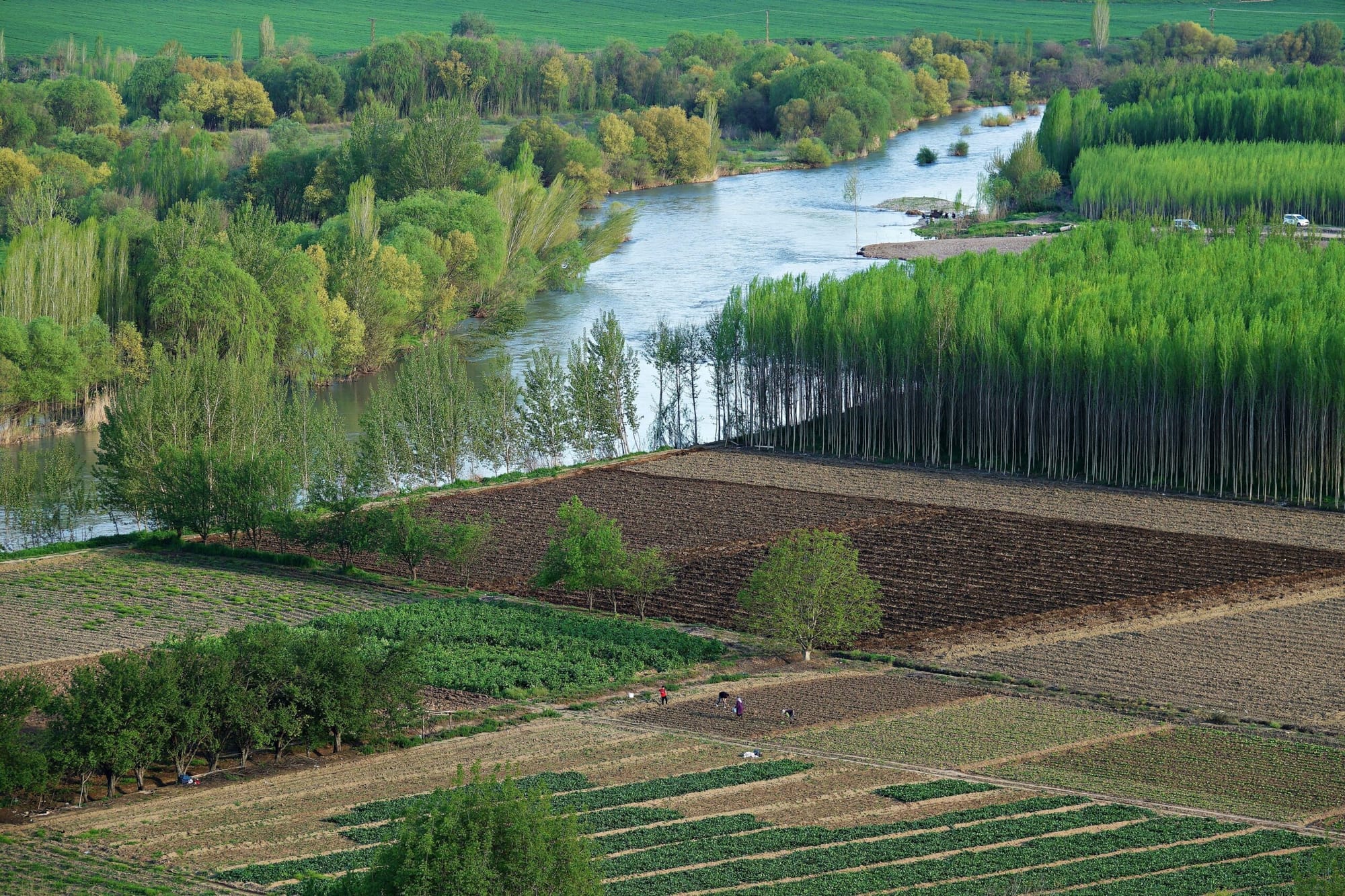
The Tigris river passing through the Hevsel gardens of the World Cultural Heritage site in Diyarbakir. Mehmet Masum Suer/SOPA Images/LightRocket via Getty Images
Neighborhoods I had been visiting since 2004 were now, twenty years later, wiped off the map, only to be replaced by a low intensity tourist park connecting newly built concrete apartment villas and mansions awaiting restoration.
These development projects are one consequence of the 2015–2016 urban war between the Turkish state and the Kurdistan Workers’ Party (PKK). In July 2015, the peace process between Turkey and the PKK came to an end. The operations that followed ended in 2016, but the sieges continued into 2017\. The district of Sur survived this period with tectonic demographic and spatial scars: Half of the district’s inhabitants were displaced and six neighborhoods in its eastern quarter were permanently evicted through anti-terrorist decrees, which led to the further securitization of the area by control units and the development of new concrete blocks of flats.
But even before the 2015–2016 siege, urban redevelopment projects in Sur beginning in 2009 by the Kurdish municipalities had displaced the Kurdish urban poor, dispossessing them of their homes and gardens. And stretching back even further, to the 1990s, during the war between the Turkish state and the PKK that engulfed the Kurdish countryside, Kurdish inhabitants were forcibly evicted from their rural homes, pushing Kurdish civilians, most of whom were farmers, into the nearest provincial capitals and districts like Sur, which have seen their populations double since the 1990s.
This pattern of counterinsurgency violence against the environment fits into a longer, multilayered history of Turkish rule, stretching back to the rubble of the Armenian genocide. A decolonial ecological approach reveals the connections between low-intensity wars and larger historical efforts to reform or destroy the land. In the context of an increasing awareness of these links between ecocide and colonial violence, Kurdish activists are engaging in contemporary struggles over ancestral land claims and ecological initiatives that counteract mass political violence. Kurdish ancestral claims intersect with those of non-Muslim non-Turkish communities, especially the Armenians, who once farmed these lands.
## **Kurdish Autonomy and the Land**
A decolonial ecological approach exposes how the Turkish state has debilitated and contained the Kurdish geography through interventions such as dams, mining, urban renewal and military campaigns. These technologies frame both the built environment and ecological life as the property of the Turkish sovereign state and as commodifiable resources to pave the way for the containment of the Kurdish region. The approach further draws attention to the ecological rubble of colonized Kurdish territories, highlighting how peoples’ alliances with more-than-human beings including fields, gardens and orchards, indigenous seeds, trees, medicinal herbs and plants and animals have been destroyed and scarred.
> **The Kurdish regions of Syria and Turkey offer strikingly different yet overlapping materials for understanding the structural effects of mass violence as well as ecological responses to such violence within the larger context of global environmental activism.**
The Kurdish regions of Syria and Turkey offer strikingly different yet overlapping materials for understanding the structural effects of mass violence as well as ecological responses to such violence within the larger context of global environmental activism. Agricultural modernization has historically been a racialized issue in Syria. Access to water and land rights, and the establishment of state farms with large Arab landholdings, were used in the service of Arabization policies.[\[1\]](#%5Fedn1) After the fall of the Assad regime and the containment of ISIS, the Kurdish region’s agricultural policy in Rojava involved securing local food supplies by supporting subsistence agriculture.
In Turkey too, agricultural modernization was a racialized and bureaucratic affair. The aim was Turkification, centrally planned by Turkish technocrats, who sought regional alliances with Kurdish confederations and Kurdish landlords.[\[2\]](#%5Fedn2) This process included instituting a comprehensive annual plan with targets for key crops, establishing acreage for each crop and providing instructions on which crops could be grown, including how to use seeds, fertilizer and other inputs.
Kurdish local ecological collectives have sought to survive and subvert these intertwined yet distinct processes of racialization.[\[3\]](#%5Fedn3) The food cooperatives and farming initiatives in the Kurdish autonomous confederal system in northeastern Syria, as well as a quasi-autonomous network of environmental activists in southeastern Turkey, have intervened in discussions on environmental politics. They put forth the decolonial ecological model as a solution to entangled environmental destruction by war, climate change and disasters, like the 2023 earthquake.
New collective forms of participation, including the Ecological Councils in Kurdistan and the Mesopotamia Ecological Movement (Tevgera Ekolojiyêya Mezopotamyayê), which was founded as a network of local ecological associations in 2011, reflect contemporary Kurdish political praxis. Their commitment to environmental protection is based on the principles of democratic confederalism in early 2005, which marked a shift in political organizations in the Kurdish regions of Turkey toward a program of decolonial self-government based on autonomy rather than state capture.
Horizontal and collective forms of participation, like the Ecological Councils, have been used by eco-activists to organize for the more active involvement of the larger Kurdish movement in environmental protection. These Ecological Councils have campaigned against the militarization of the region through the development of new high-security police stations, against fracking for shale gas and for protecting cultural and natural heritage sites.
The Kurdish movement’s emphasis on autonomy is intimately tied to the land through training and educational seminars on food sovereignty, ancestral land rights and decolonial heritage. The Amed branch of the Agriculture, Seeds and Food Commission, for instance, campaigns for food sovereignty and the collection of ancestral seeds native to Kurdistan.
Slowly emerging, contested and still in progress, agricultural initiatives and food cooperatives working on the basis of food sovereignty in the Kurdish autonomous confederal system in Rojava have coexisted, albeit separated by borders, with a quasi-autonomous network of environmental activism and initiatives in Kurdistan in Turkey.
## **An Ecological Renaissance**
Before the siege, Amed witnessed an ecological renaissance, embodied by the city’s urban gardens and orchards.[\[4\]](#%5Fedn4) Their very existence, as eco-activists explain, was meant to short circuit and push back against the racialized and violent alliances between the Turkish state, industrialized cash-crop business and collaborating Kurdish landlords and contractors. They also challenged the industrialized policies of monoculture that took control of food sovereignty away from small farmers, most of whom were forcibly displaced for the second or third time.
> **While in the camp, which they saw as a staging post on their way to Germany via Bulgaria on the Balkan route, Yezidi families worked with eco-activists to create an urban forest consisting of urban gardens tended by refugee families.**
New alliances formed between the Ecological Councils, small farmers, environmental activists, municipal workers, urban dwellers and sometimes refugees who fled the Syrian civil war in 2011 and the Yezidi genocide in Sinjar in 2014\. Yezidis had come to Amed with the help of a group of Kurdish guerillas after being taken in by a Kurdish village on the Iraq-Turkey border, their passage arranged by smugglers. They were then dispersed to Kurdish cities, like Amed, where their numbers steadily approached 5,000\. While in the camp, which they saw as a staging post on their way to Germany via Bulgaria on the Balkan route, Yezidi families worked with eco-activists to create an urban forest consisting of urban gardens tended by refugee families.
The produce from these orchards would be distributed at urban markets, sold at the municipality’s pop-up markets or sold directly to consumers. In some cases, the municipalities leased plots of land from Kurdish landowners. Municipal workers provided the seedlings and indigenous seeds and linked the farmers directly to local markets. This approach eliminated the need for male vendors and stallholders at the local markets and allowed women to capture more of the value of their produce. In Sur’s Hevsel Gardens, some Yezidi women worked as *asheftis* (women who collect herbs from gardens to sell at markets).
During the siege, pro-Kurdish municipalities run by the HDP were taken over by state-appointed administrators. Social and cultural associations and community centers were co-opted or closed. Amed’s political, social and cultural workers were arrested, including the provincial mayor and co-mayors, or forced to resign.
In 2016, shortly after the arrival of municipal trustees appointed by the Turkish state, cultivation on the plots was banned. The remaining produce, which the displaced farmers could not take home, was left to rot. Since, all signs of prior community work and cultivation have been erased. Eco-activists who collaborated with Yezidi families to design and cultivate urban orchards in 2014 underscore the difficulties of practicing decolonial ecological principles in the state’s sporadic spiral of military sieges, where “war is the climate,” as one common refrain goes.
## **Catastrophic layers, Decolonial Claims**
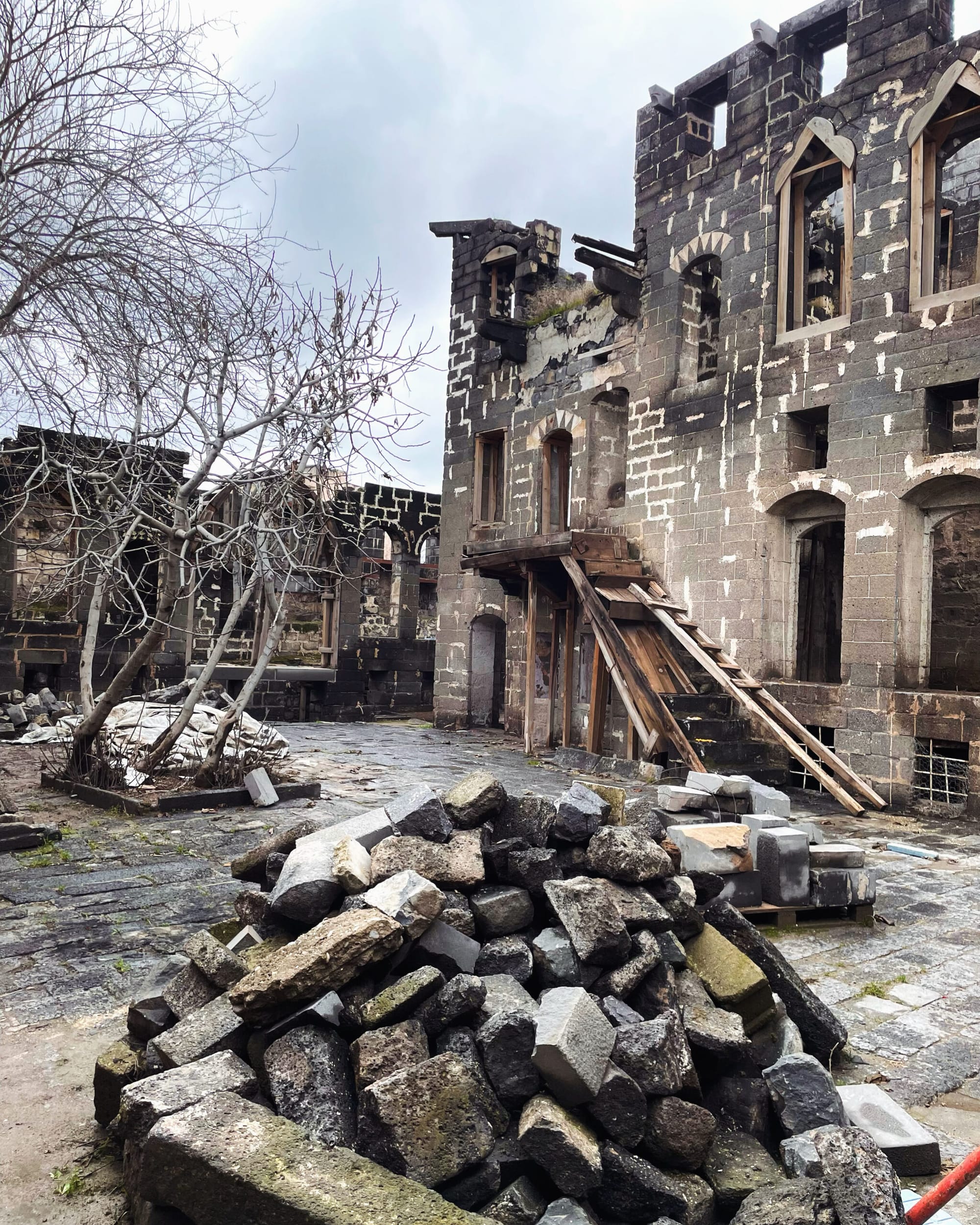
A destroyed mansion in the Dabanoğlu neighborhood in 2024, courtesy of the author.
In 2024, almost all of my friends, committed movement builders, declared that they had no choice but to criticize themselves in the face of the fall of Sur and the deaths of young people defending the city’s neighborhoods. Their self criticism turned into a ceaseless call for political accountability, sometimes to the point of self-recrimination.
Some of them were involved in preparing inventories for various international organizations, seeking to document the damage done to the built environment during the siege. In 2019, I learned from them, and from interviews with Kurdish contractors managing agricultural plots in the ancient gardens of Hevsel, that the contractors’ hopes of obtaining building permits to develop the gardens were partially dashed by the UNESCO World Heritage Program. UNESCO had arrived in the city prior to the siege. It was Kurdish cultural heritage experts and municipal-level politicians who, by liaising with academics and UNESCO experts, had placed the old town center and the gardens on the World Heritage list. But according to project managers and field workers who have been on the ground in Amed as data collectors and administrators for UNESCO—and are well versed in the Kurdish movement’s environmental campaigns against the counter-insurgency—the organization has failed to pressure the state to stop Kurdish landlords, developers and contractors allied with the Turkish government from expropriating Sur and the gardens adjacent to the city walls.
Refusing to witness defeat, my friends no longer go to the old city, where they had worked as social workers and municipal-level politicians in the early 2000s. Nevertheless, these ex-movement builders continue to self-identify as revolutionaries despite now being involved in the political life of the city mainly during elections. With the exception of the thousands who were imprisoned by counterterrorist decrees during and following the siege and those who were able to flee Turkey, most former movement members are resigned to the city’s newly formed middle-class districts, with blocks of high-rise residential buildings, many 20–30 stories tall.
These spaces contain a vibrant social life with gated blocks, cafes and restaurants. Some businesses are named after the toponymy of the Kurdish landscape, including the PKK training camps in the mountains. Though the city is currently experiencing a development standstill after years of heyday, construction is continuing, producing new market relations that intertwine Turkish contractors from the Black Sea region and Kurdish businessmen with diverse portfolios. Some members of this new elite business class self-identify as partisans, dropping the names of PKK commanders and fighters into conversations as they remember them as glorious markers of a revolutionary struggle.
> **Low-intensity wars are not only about destruction. They thrive on construction, immobilizing and defying the spirit of street politics and disrupting the social buoyancy of the Kurdish urban poor.**
On my recent visit to the city, walking was difficult in the old Christian neighborhood of Xançepek in Sur. The old neighborhood, razed to the ground during the siege, was now squeezed between a frenzy of concrete villas and restoration. Before being forced to flee during the war of the 1990s, and again during the recent siege, residents had created a vibrant street culture here in the face of hardship. Now, however, the neighborhood has been transformed into a giant shopping mall. Desecrated old churches of various denominations, Armenian Apostolic, Chaldean Catholic, Syrian Orthodox, are tourist attractions. Designer boutiques and souvenir shops abound. Low-intensity wars are not only about destruction. They thrive on construction, immobilizing and defying the spirit of street politics and disrupting the social buoyancy of the Kurdish urban poor.
In Xançepek, I walked from the city walls toward the Grand Mosque, past concrete villas and the remains of old mansions waiting to be restored. Among the old mansions here, one building still stands; according to the newly erected plaque on its entrance door, it is the Hasırlı Masjid, and it is likely that the building’s first owners were Armenians. A young Muslim woman, an intern with a restoration company, approached me and we walked together. We passed the Chaldean church, which has been confiscated to be transformed into a hybrid space functioning as both a church and an art center for Dicle University—a model they are considering for other restored buildings. She showed me the new concrete villas, lined up one after the other in what used to be Xançepek. In her view, the villas destroy the soul of the city—they don’t reflect the historical reality of its urban past. Instead of offering me a mental image of the reconstruction work, built on the ghostly rubble of entire neighborhoods as a sign of the Turkish state’s victory, she bequeathed the area by linking it to a history with only Kurdish features. With her distinction between conscientious restoration and soul-destroying reconstruction, she offered a glimpse of a new generational political position that has matured since the current regime consolidated its power during the siege: culturally Kurdish, politically Islamic, socially committed and sensitive to Kurdish urban heritage.
I continued my walk towards the city walls. It was a sunny winter day, and I saw families of mostly women resting on the benches set up in the well-kept gardens along the old city walls. Displaced a second time in the same city, homesick for their destroyed homes and lives, former residents of Sur often come here during the day to smell the air of their old neighborhoods, one woman told me. She was unhappy with the new buildings erected by the Turkish Administration for Collective Housing (TOKI) to house people like her, who were forcibly displaced during the last siege.
Another young woman I spoke to was from Melikahmet with extended family in Dabanoğlu, two adjoining neighborhoods. The first of these neighborhoods is still alive—its streets are full of children, women chat in the alleyways and laughter erupts from coffeehouses. The second was partially destroyed during the siege and through legal expropriation of the land by the same state that had destroyed it. Like the other five neighborhoods in Sur, it has fallen prey to low intensity planning.
After a long chat, we realized we had mutual acquaintances. “When do you think they will destroy Melikahmet?” she asked me, knocking on wood. Before I could answer, she added, “First the bombs will come.” She gestured to her old neighborhood, which sits on the ruins of mansions destroyed during the Armenian pogroms, or possibly the Armenian genocide, and has seen subsequent periods of sieges against the Kurdish population. Restoration is continuing in these mansions, their courtyards filled with the rubble of basalt stone and uprooted trees. “The state will destroy, the youth will defend and die, and we will always return,” she told me.
Seen through a longer historical lens, this zeal for restoring confiscated property began with the Armenian pogroms of 1895, leading to the Armenian genocide of 1915, long before Turkey began its low-intensity eradication of the Kurdish countryside and the cities to terraform the land. Taken together, the layer-upon-layer of restoration suggests that there is not just one single claim to decoloniality in this frontline geography.
Editor's note: *This piece initially appeared under a different title. In April 2025, the title was modified and the opening section of the text amended at the request of the author.*
\[**Umut Yıldırım** is an assistant professor of anthropology at the Geneva Graduate Institute.\]
> **Read the[previous](https://merip.org/2024/07/routes-to-disruption-supply-chain-sabotage-and-israels-war-on-gaza) article.**
> **Read the[next](https://merip.org/2024/07/energy-politics-and-african-futurism-a-conversation-with-nnedi-okorafor) article.**
**This article appears in** [**MER issue 311**](https://merip.org/magazine/311/) **“Post-Fossil Politics.”**
---
### **Endnotes**
[\[1\]](#%5Fednref1) Miriam Ababsa, “The end of a world: drought and agrarian transformation in Northeast Syria (2007–2010),” in *Syria: from Reform to Revolt, Volume 1*, eds. Raymond Hinnebusch Tina Zintl (Syracuse University Press, 2015), pp. 199–222.
[\[2\]](#%5Fednref2) Begum Adalet, “Agricultural infrastructures: Land, race, and statecraft in Turkey,” *Environment and Planning D: Society and Space* 40/6 (2022), pp. 975–993.
[\[3\]](#%5Fednref3) Stephen E. Hunt and John P. Clark (eds), *Ecological solidarity: thought, practice, challenges, and opportunities* (Lexington Books, 2021).
[\[4\]](#%5Fednref4) Umut Yıldırım, “Resistant breathing: ruined and decolonial ecologies in the Middle East,” *Current Anthropology* 65/1 (2024), pp. 123–149.
### Routes to Disruption—Supply Chain Sabotage and Israel's War on Gaza
URL: https://www.merip.org/2024/07/routes-to-disruption-supply-chain-sabotage-and-israels-war-on-gaza/
Last updated: 2025-08-22T18:36:13.000Z
Since October 7, at least three shipments of military-grade jet fuel (JP-8) have reached Israel from the United States, powering the fighter jets and Apache helicopters that have, for more than nine months now, continued to decimate Gaza.
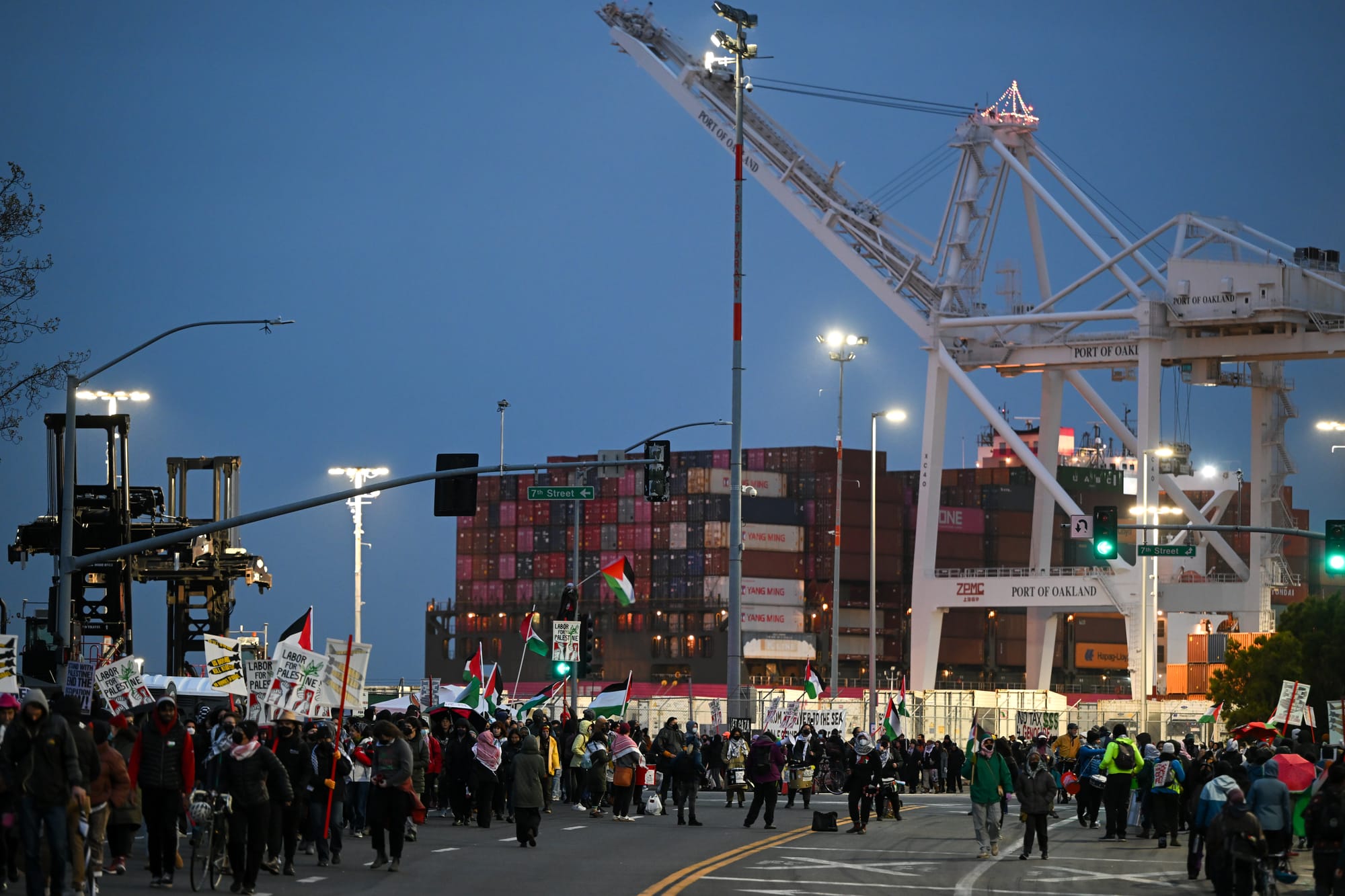
Hundreds of protesters gathered at the Port of Oakland to demand an end to US support of Israel's actions in Gaza and to oppose US aid to Israel, January 13, 2024 in Oakland, CA. Tayfun Coskun/Anadolu via Getty Images
Each shipment carried 30,000 barrels of fuel—enough to refuel a fighter jet 12,000 times. The shipments were part of a $3 billion contract issued by the US Defense Logistics Energy Agency in 2020 for 1 billion liters of JP-8 fuel, covering several years of supply to Israel. In March of this year, an [investigative report](https://priceofoil.org/2024/03/14/new-research-exposes-countries-and-companies-supplying-the-oil-fueling-palestinian-genocide/) by Oil Change International and [DataDesk](https://docs.datadesk.eco/public/976ce7dcf00743dc/) found the holder of the contract was Valero Energy, a US corporation with 15 oil refineries worldwide and [a top supplier](https://dsm.forecastinternational.com/2023/02/22/top-100-defense-contractors-2022/) of jet fuel and diesel to the US military. The report traced the fuel’s transport routes from Valero Energy’s refinery in Corpus Christi, Texas, across the Atlantic, through Gibraltar, Crete, Sicily and Cyprus, before finally docking at the Ashkelon oil terminal in Israel. The tankers it was shipped on fly the US flag, effectively making them extensions of US sovereignty at sea.
JP-8 is the [military equivalent](https://www.somo.nl/fuelling-the-flamesin-gaza/) of civilian jet fuel, with corrosion inhibitors and anti-icing additives. It is produced by oil and gas companies through a specific refinement process. Not all states have refineries capable of producing it, although Israel does: In 2022 alone, two refineries located in Haifa Bay and Ashdod [produced 1.248 million tons](https://www.somo.nl/fuelling-the-flamesin-gaza/) of jet fuel. But despite this capacity, Israel still depends on US-based oil and gas companies, like Valero Energy and (in the past) Exxon Mobil, for its primary supply of jet fuel.
> **Indeed, supply chain sabotage and worker blockades have historically created strategic chokepoints in the flow of material, capital and people that sustain repressive regimes and imperial projects.**
Israel’s dependency on JP-8 imports renders transnational fuel shipments an obvious point of leverage against the Israeli war machine. Indeed, supply chain sabotage and worker blockades have historically created strategic chokepoints in the flow of material, capital and people that sustain repressive regimes and imperial projects. Popular movements against the apartheid regime in South Africa, for instance, frequently targeted energy corporations and infrastructure. Following the 1970s oil sanctions by countries of the Global South, the South African apartheid government turned to oil companies like British Petroleum and Shell to maintain their oil imports. In response, the Anti-Apartheid Movement targeted Shell garages with pickets, petrol stations with blockades and Shell general shareholder meetings with banners demanding: “[No Fuel for Apartheid](https://dc.library.northwestern.edu/items/f2ce3926-004c-48e4-a86c-63bb3748e98d).” In 1962, the San Francisco Bay Area’s longshore workers adopted a stance in solidarity with Black South Africans, refusing to unload any cargo from the country for 11 days.
Palestinian activists have learned from these tactics. In [2014](https://inthesetimes.com/article/oakland-activists-block-the-boat-for-three-days) and [2021](https://oaklandvoices.us/2021/06/10/lara-kiswani-on-the-successful-blocking-of-the-zim-cargo-ship-at-the-port-of-oakland/), the Block the Boat movements on the Pacific coast of the United States brought together Palestinian activists, Black Lives Matter protesters and longshoremen’s unions to blockade the Israeli shipping company Zim. Also in 2021, South African and Genovese dockworkers refused to unload Israeli Zim ships.
Moreover, the Middle East has its own rich history of disrupting imperial supply chains, especially those involving oil and its critical infrastructure. Throughout the 1960s, dockworkers in the Arabian Peninsula refused to unload cargoes that had passed through Israel. In 1965, the dismissal of hundreds of workers from the Bahrain Arab Petroleum Company (Bapco) sparked subversive acts, from blowing up oil pipelines to burning oil company buses and stoning European cars. [In 2011](https://www.merip.org/content/files/sites/default/files/public/Research/Middle-East/pr0912pelham.pdf), Bedouin activists in the Sinai torched the trans-Sinai gas pipeline, set up blockades to prevent Egyptian security forces from re-opening it and cut supplies for 45 days. Similar actions hobbled the Egyptian Natural Gas Company (GASCO) pipeline from North Sinai to Jordan and Israel over the next four years.
In Palestine, direct action against energy infrastructures has been a method of anti-colonial struggle since the mandate period. During the Arab Revolt of 1936–1939 against the British Mandate, followers of the Red Hand guerrilla group blew up sections of the Kirkuk-Haifa pipeline, which belonged to the British-owned Iraq Petroleum Company, on a regular basis. The pipeline was eventually dismantled in 1948\. A prominent member of the Red Hand, Ali Khulqi, recalled the group meeting in his home in Irbid during the second world war and deciding to [strike the oil pipelines and cut the telephone wires](https://www.facebook.com/naseershaher/photos/a.1083377601700996.1073742996.142044769167622/1612131555492262/?type=3&theater&fbclid=IwAR1CfxxLswt%5FhNT595xiT12ela9T8YuaBdp7zzIB-kuIBl98ssYDCfB6QA4&%5Frdc=1&%5Frdr).[\[1\]](#%5Fedn1) The Red Hand inspired later Palestinian groups, including guerrillas from the Popular Front for the Liberation of Palestine (PFLP), who targeted Israeli pipelines in Haifa and the Naqab (Negev), and Aramco’s Trans-Arabian Pipeline through Golan after the 1967 War.
> **The global fossil fuel industry cannot be abstracted from Israel’s ability to carry out its genocidal campaign, nor from ongoing and unequivocal US support for Israel.**
Today’s transnational energy routes require transnational responses. The global fossil fuel industry cannot be abstracted from Israel’s ability to carry out its genocidal campaign, nor from ongoing and unequivocal US [support](https://www.tni.org/en/article/framing-palestine) for Israel. As Adam Hanieh has written, Israel as a settler colony has played a crucial role in maintaining US imperial interests in the Middle East.[\[2\]](#%5Fedn2) US hegemony over who purchases the region’s oil, at what price and in what currency is critical to sustaining its global power—as is the maintenance of Israel as an outpost and fuel conduit. It is clear, then, that the struggle for Palestinian Liberation is a struggle for climate justice and the overhaul of fossil fuel capitalism.
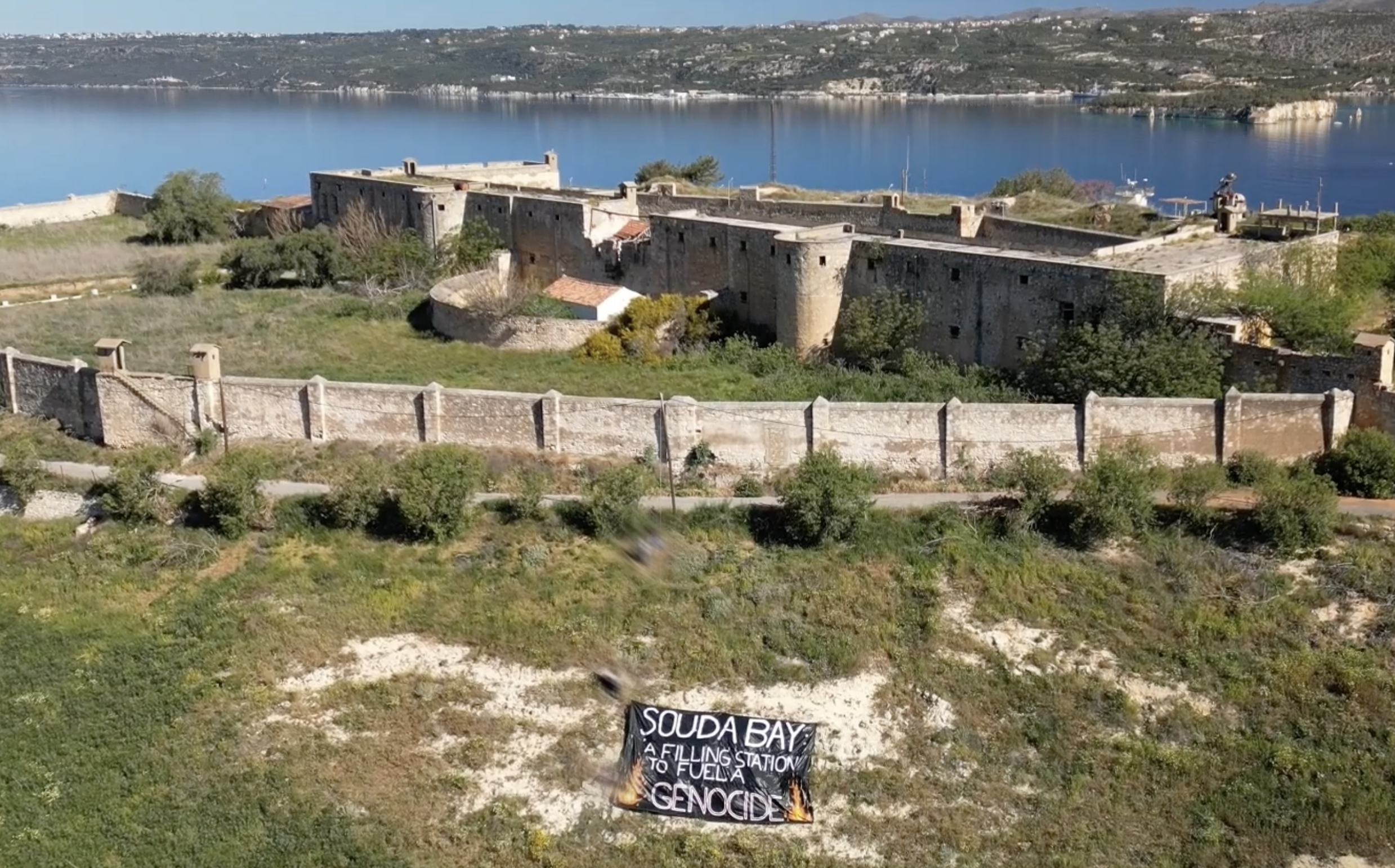
Activists installed a banner at Souda Bay, 2024\. Courtesy the authors.
The inextricable links between fossil fuels and Palestine have motivated new Palestinian-led campaigns to emerge in the wake of October 7, such as [the Global Energy Embargo for Palestine](https://progressive.international/wire/2024-02-26-global-energy-embargo-to-end-the-genocide-in-gaza/en), which both writers work with. The campaign argues that energy in all forms—coal, crude oil, jet fuel and gas—plays an active role in fueling Israel’s campaign of genocide and funding its settler colonial occupation of Palestine. It has called on workers, unions, climate justice and pro-Palestine groups to block and disrupt the deadly flow of energy, like military jet fuel, in and out of Israel.
On February 9, 2024, Valero Energy’s MT Overseas Sun Coast had set off from Corpus Christi, with its cargo of JP-8 jet fuel and was on its way to Ashkelon, Israel. Its Automatic Identification System did not disclose its destination on departure to avoid detection by activists. After crossing the Atlantic, it stopped in the Spanish port Algeciras, before continuing to Souda Bay, a NATO military base in Crete. The ship turned off its transponder en route, an act illegal under international maritime law. This evasion of regulations allows Israel to create a black hole of operations in European waters with full European complicity. Once alerted to the presence of a tanker carrying jet fuel to Israel, activists in Crete hurriedly planned activities against the ship. A nearby demonstration against a squat eviction and police brutality was diverted to Souda Bay where activists dropped banners decrying Souda Bay as a “filling station to fuel a genocide.”
Such mobilizations are, for now, awareness-raising efforts. Yet, they remain vital for the emergence of a broader campaign that connects activists across the transit route of jet fuel. These tactics might deviate from the strategies of pipeline sabotage advanced by activist scholars like Andreas Malm in [*How to Blow Up a Pipeline*](https://www.versobooks.com/products/2649-how-to-blow-up-a-pipeline) (Verso, 2021). But transnational activities offer greater scope for engagement and participation precisely because they are lower-risk. They provide workers with opportunities to mobilize along the supply chain and a possible plan for a grassroots energy embargo from below.
\[**Elia El-Khazen** is an organizer and a researcher at Disrupt Power and the Global Energy Embargo for Palestine. **Charlotte Rose** is an organizer and researcher with Disrupt Power, WeSmellGas and the Global Energy Embargo for Palestine. Her research focuses primarily on the fossil gas industry and the Eastern Mediterranean's infrastructural politics.\]
> **Read the[previous](https://merip.org/2024/07/extractive-agribusinesses-guaranteeing-food-security-in-the-gulf) article.**
> **Read the[next](https://merip.org/2024/07/decolonial-ecologies-and-low-intensity-war-in-kurdistan) article.**
**This article appears in** [**MER issue 311**](https://merip.org/magazine/311/) **“Post-Fossil Politics.”**
---
### **Endnotes**
[\[1\]](#%5Fednref1) "Reading the Papers of Ali Khulqi Al-Shurari," *Dirasat* 14/10 (1987), p. 297 \[in Arabic\].
[\[2\]](#%5Fednref2) Adam Hanieh, "[Framing Palestine: Israel, the Gulf states, and American power in the Middle East](https://www.tni.org/en/article/framing-palestine)," tni, June 13, 2024.
### Extractive Agribusinesses—Guaranteeing Food Security in the Gulf
URL: https://www.merip.org/2024/07/extractive-agribusinesses-guaranteeing-food-security-in-the-gulf/
Last updated: 2025-08-22T18:36:14.000Z
The 2022 Food and Agriculture Organization [report ](https://www.merip.org/content/files/server/api/core/bitstreams/c0f548e0-06ae-4788-8a18-56fc3bcb807a/content.pdf)on food security and nutrition in the Arab region makes for bleak reading.
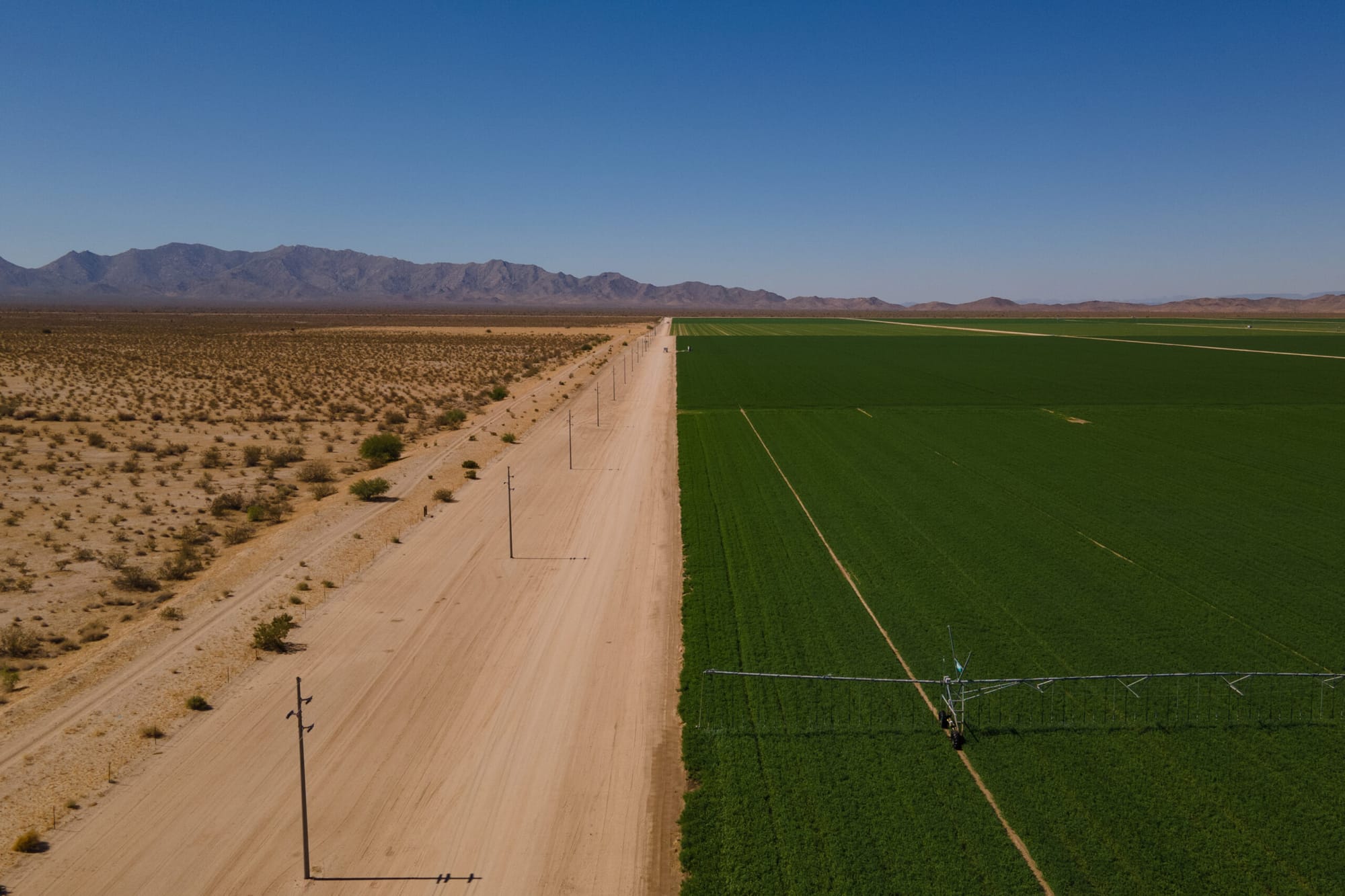
An irrigation system waters an alfalfa field in Butler Valley, Arizona belonging to Fondomonte, a subsidiary of the Saudi dairy company Almarai, 2023\. Caitlin O'Hara for The Washington Post via Getty Images
Between 2014 and 2021, the total number of Arabs suffering from moderate to severe food insecurity increased from 120 million to 154 million.[\[1\]](#%5Fedn1) This insecurity, however, was not distributed evenly across the region. In the same period, the Gulf states saw a decline in food insecurity, from 11.3 million to 10.3 million people.
Today GCC states—which import around [90 percent](https://www.arabnews.com/node/986406/middle-east) of their food—[rank among](https://impact.economist.com/sustainability/project/food-security-index/explore-countries) the world’s highest in terms of food security and affordability, on par with many OECD states. Their citizens spend a relatively low share of their income on food. In Qatar, for example, the population devotes an average of 12 percent of their pay to food—similar to Germany, the Netherlands and Australia.[\[2\]](#%5Fedn2)
These regional disparities speak to longstanding efforts of Gulf states to manage a stable and affordable food supply. Below ground the prodigious reserves of oil in the Gulf have allowed rapid growth and development. But above ground, these states are poor in agro-ecological resources. The amount of arable land is low and rainfall is minimal. The booming cities, vast commercial real estate projects, tourism sectors and service economies thus all depend on the import of diverse low-cost foods.
In recent years, Gulf economies have tackled their food dependencies not just by importing foodstuffs but through land enclosures, or the purchasing of agricultural land abroad, particularly in the Middle East, North and East Africa (but also as far as the United States and Australia). They have also increasingly invested in food value chains: using their purchasing power to buy raw goods from other countries for production and export. Mainstream economic policy proposes that such trade between the Gulf states and other Arab countries is mutually beneficial. International finance institutions, like the World Bank, encourage poor countries to pursue growth by liberalizing their agricultural markets, expanding food exports and increasing foreign investment in their agribusiness sectors. They tout these policies as a way to resolve food security, rural development and trade imbalances.
Amid rising concerns about the environment, policy makers also argue that such trade can resolve ecological scarcity. Countries with arable land and water can meet the food demand of countries that are not endowed with such resources. One article in *The Lancet* in 2014, captures this view, arguing that more amalgamation between states in the Middle East could address crucial shortages: “regional ecological integration around exchange of water, energy, food, and labour, though politically difficult to achieve, offers the best hope to improve the adaptive capacity of individual Arab nations.”[\[3\]](#%5Fedn3)
But this framework fails to account for the environmental aspect of agricultural commodity production. Agricultural extraction might ensure cheaper food prices in the Gulf states, but it has an ecological cost in the growing country. Indeed, rather than a panacea, the acquisition of cheap land and water to grow raw materials for export to the Gulf fits into broader efforts of more aggressive Gulf states, like the UAE, to expand extractivist circuits into Africa. The GCC states, through agribusiness and food, thus play a role in [the reproduction of peripheries](https://monthlyreview.org/2015/07/01/imperialism-in-the-era-of-globalization/) in the Middle East and Africa.
## **Buying Land Abroad**
As far back as the 1970s, wealthier Gulf countries have been acquiring land in foreign locales for farming. But the exhaustion of water reserves in the Gulf combined with the 2007–2008 food crisis accelerated this strategy.
According to the [Land Matrix database](https://landmatrix.org/), between 2000–2022, Gulf states acquired more than two million hectares of agricultural land abroad.[\[4\]](#%5Fedn4) Over a third of it was in other Arab countries. Saudi Arabia, the UAE, Qatar and Kuwait acquired some half a million hectares in Sudan. Egypt is another site of significant Gulf purchases at 157,851 hectares.
> **These purchases are characterized by their industrial scale, the social and ecological rupture they engender and their extractivist nature.**
These purchases are characterized by their industrial scale, the social and ecological rupture they engender and their extractivist nature. For example, in Toshka, an area in southern Egypt, Emirati and Saudi agribusiness companies like Al Dahra and Jenaan, own around 120,000 hectares of land. Toshka has a large allocation of Nile River water. The pump that transfers water to the site from Lake Nassar, was, at the time of its construction in the 1990s, among the largest in the world. Here, land is transformed into industrial agricultural space through the intense application of chemicals, fertilizers and technologically advanced machinery.
Fields in Toshka are irrigated by [automated booms](http://www.youtube.com/watch?v=g6TnYgba3yA) that can cover 120 acres in a single rotation, while tractors and other machinery use GPS devices to ensure the precise application of chemicals and water. The site itself is the legacy of dispossession from native land users, including more than [40 Nubian villages](http://www.madamasr.com/en/2016/10/19/feature/politics/nubians-turn-to-international-courts-to-guarantee-return-to-their-lands/) that were evicted in the 1960s prior to the construction of the High Dam. These enclosures supply raw commodities such as cattle feed for processing in Egypt and for export to the Gulf states.
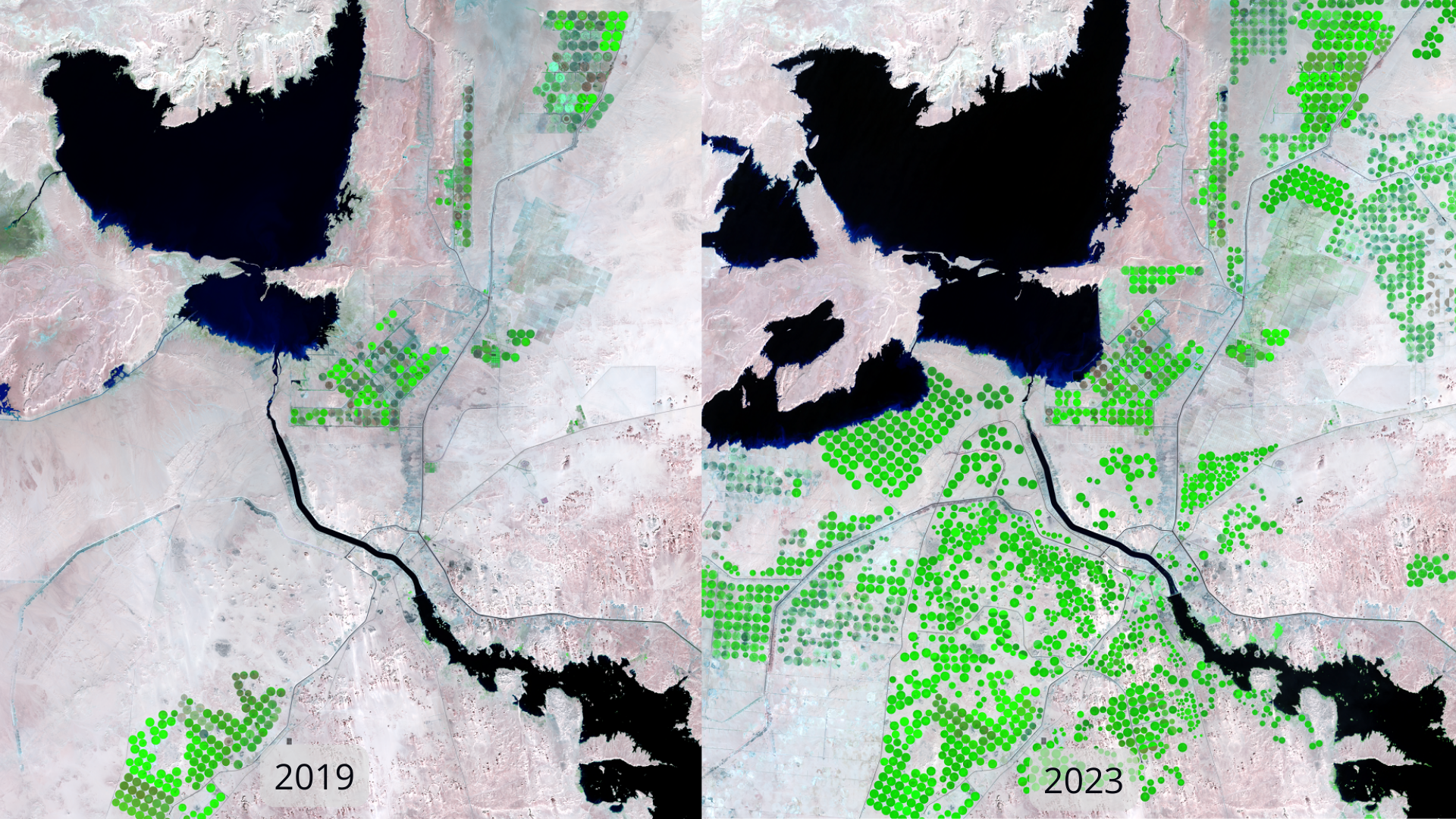
Satellite images show the expansion of irrigated land in the Toshka lakes area of Egypt from 2019 to 2023\. Images sourced from the USGS Earth Resources Observation and Science Center.
In Ethiopia, Saudi Star, a company owned by a Saudi-Ethiopian businessman, acquired 14,000 hectares in the state of Gambela. Though its success has been limited, the project is emblematic of the violence that accompanies these enclosures. The land belongs to the ethnic minority Anuak people, who were cleared as part of Ethiopia’s so-called villagization policy, a scheme introduced in 2010 to compel rural inhabitants to vacate their land and move to new settlements.
Because many held no formal legal title to their land, it was classified as unpopulated and sold to investors without compensation to the indigenous inhabitants. Their dispossession led to considerable unrest. In 2012 armed men attacked the project, killing a number of the company’s guards. Ethiopian troops responded by assaulting the villages near the farm. The soldiers [reportedly](https://www.hrw.org/news/2012/08/28/ethiopia-army-commits-torture-rape) killed and tortured men and raped women—violence that forced hundreds of villagers to flee to neighboring South Sudan.
## **Ecologically Unequal Exchange**
One of the most common crops grown on Gulf-owned land enclosures is cattle fodder such as alfalfa. Its regional trade encapsulates the dynamic of ecologically unequal exchange.
Alfalfa is a water-intensive crop that is costly to grow in the arid environment of the GCC. But it thrives in regions like the Nile Valley. Dairy operations established in many Gulf countries, including Al-Safi of Saudi Arabia—one of the largest dairy farms in the world—depend on it. As a result, livestock feed has become a regular regional trade, with one [UAE company](http://www.jenaan.com/about-us/) sending weekly shipments of alfalfa and other forage crops from Egypt and Sudan.
> **Also Read: ["Land, Livestock and Darfur’s ‘Culture Wars’"](https://www.merip.org/land-livestock-and-darfurs-culture-wars-310/) in MER issue 310, Spring 2024**
Granting large areas of land to investors to grow and export cattle feed crops back to the Gulf is questionable given the high levels of food insecurity in many African countries. The arable land and inputs like water and fertilizer that are given over to such feed crops are directly removed from the production of subsistence crops for human consumption. Instead, this land is used to [produce livestock feed](https://www.dw.com/en/with-vast-arable-lands-why-does-africa-need-to-import-grain/a-62288483) for the Gulf, while domestic populations rely overwhelmingly on imported grains. The result is acute food insecurity. In Sudan, for example, an estimated 12 million people, out of a total population of 44 million, face acute food insecurity, a crisis partly caused by the country’s civil war.
This underconsumption takes place as Gulf plantations continue to extract value from the country. Company documents I examined during the course of research predicted that one farm of 88,000 hectares in Sudan’s Wad Hamid would produce an annual revenue of $86 million—profit created through the extraction of water and soil wealth, the national resources of Egypt and Sudan.
The full cost of scarce water, soil nutrients, pollution from fertilizer and pesticide use and other natural matter are not included within the commodity price. Recognizing the full cost of agricultural commodities gives a more accurate depiction of the real value accrued to the Gulf states through food trade and the acquisition of agricultural land. The transfer of value that is facilitated by this trade is a significant feature of the Gulf’s states’ economic growth.
## **Making Regional Peripheries**
The scale of the Gulf’s food trade is substantial. In 2018 the entire Middle East and North Africa region (all Arab states, Israel and Iran) imported food that had a value of $103 billion. Of this amount around half went to the Gulf states, even though these states account for only 11 percent of the region’s population.[\[5\]](#%5Fedn5) The same imbalance is clear in the weight of food imported. For example, the GCC states account for half of the region’s yearly imports of meat, which is primarily consumed by the middle and upper classes.
These figures attest to the way that the Gulf states have used their purchasing power to manage their import dependence. Increasingly, they are not just using their wealth to import food for consumption but importing raw commodities for food production and even export.
Importing raw commodities and exporting refined products concentrates capital in the already capital-rich Gulf States. As a result, over the past two decades, some of these states have become exporters of food as well as importers. In 1991, the total food exports from the UAE were $9.4 million. By 2021 this number had grown to $14.9 billion, the highest in the Arab region. In 1991 Saudi Arabia’s foodstuff exports were $325 million. By 2021 they had risen to $4.1 billion.
> **The UAE, a country with almost no ecological base for large-scale agriculture, has a value of agriculture exports that is now greater than that of Egypt.**
The scale of these exports relative to the major agrarian economies of the region is striking. The UAE, a country with almost no ecological base for large-scale agriculture, has a value of agriculture exports that is now greater than that of Egypt. This accumulation is the outcome of the Gulf’s position at the top of value chains. The ecological and social cost of food is paid for in the grower states, while processing, packaging and marketing ensures profit in the Gulf states.
The growth of the Gulf agribusiness sector has given the UAE and Saudi Arabia large shares of food markets in other Arab countries. For example, the value of Saudi Arabia’s dairy and cheese exports in 2018 was $1.4 billion.[\[6\]](#%5Fedn6) In the same year, the UAE’s dairy product exports were almost $900 million. In 2020 the value of cooking oil, flour and sugar exports from the UAE was almost $700 million.[\[7\]](#%5Fedn7)
Some of the poorer countries to which these exports are sent are themselves producers of the very same raw commodities—yet they buy the processed form from producers in the Gulf. For example, Sudan is a producer of raw sugar: In 2022 it exported $751 million in raw sugar to Spain. The same year it imported 25 percent of its sugar from the UAE.[\[8\]](#%5Fedn8)
Land enclosures are a spatial fix that push the negative consequences of production onto one society while ensuring value can be accrued in another. The rupture of this land, its productive use value and in some cases spiritual and cultural significance is a deprivation. The extraction of agricultural resources from societies that suffer from malnutrition and high levels of food price inflation reflects the acute imbalance within the global economy and its manifestation in core-peripheral relations at the regional scale.
Aside from the immediate experience of dispossession and violence, these schemes also have secondary consequences that take their toll on society. These corollaries include food insecurity, high commodity prices and the cost of government food subsidies required for social stability.
\[**Christian Henderson** is a lecturer in international relations and modern Middle East studies at Leiden University.\]
> **Read the[previous](https://merip.org/2024/07/off-the-grid-why-solar-wont-solve-lebanons-electricity-crisis) article.**
> **Read the[next](https://merip.org/2024/07/routes-to-disruption-supply-chain-sabotage-and-israels-war-on-gaza) article.**
**This article appears in** [**MER issue 311**](https://merip.org/magazine/311/) **“Post-Fossil Politics.”**
---
### **Endnotes**
[\[1\]](#%5Fednref1) Report: "[Near East and North Africa – Regional Overview of Food Security and Nutrition 2022,](https://www.fao.org/family-farming/detail/en/c/1635567/#:~:text=This%20year's%20report%20presents%20evidence,insecurity%2C%20and%20malnourishment%20are%20increasing.)" FAO, 2023.
[\[2\]](#%5Fednref2) Global Food Security Index 2022: "[Qatar](https://impact.economist.com/sustainability/project/food-security-index/explore-countries/qatar)," Economist Impact.
[\[3\]](#%5Fednref3) Abbas El-Zein, Samer Jabbour, Belgin Tekce, Huda Zurayk, Iman Nuwayhid, Marwan Khawaja, Tariq Tell, Yusuf Al Mooji, Jocelyn De-Jong, Nasser Yassin, Dennis Hogan, “Health and ecological sustainability in the Arab world: A matter of survival,” *The Lancet* 383/1 (2014), p. 458.
[\[4\]](#%5Fednref4) Data available at the [Land Matrix Database](https://landmatrix.org/) for 2023.
[\[5\]](#%5Fednref5) Report: "[Near East and North Africa – Regional Overview of Food Security and Nutrition 2022,](https://www.fao.org/family-farming/detail/en/c/1635567/#:~:text=This%20year's%20report%20presents%20evidence,insecurity%2C%20and%20malnourishment%20are%20increasing.)" FAO, 2023.
[\[6\]](#%5Fednref6) World Bank: "[United Arab Emirates Food Exports to World in US$ Thousand 1991-2021](https://wits.worldbank.org/CountryProfile/en/Country/ARE/StartYear/1991/EndYear/2021/TradeFlow/Export/Indicator/XPRT-TRD-VL/Partner/WLD/Product/Food)," World Integrated Trade Solutions (WITS).
[\[7\]](#%5Fednref7) Ibid.
[\[8\]](#%5Fednref8) Ibid.
### Off the Grid—Why Solar Won't Solve Lebanon’s Electricity Crisis
URL: https://www.merip.org/2024/07/off-the-grid-why-solar-wont-solve-lebanons-electricity-crisis/
Last updated: 2025-08-22T18:36:14.000Z
For years, Lebanon’s daily electricity cuts have dictated the rhythms and patterns of everyday life.
A technician controls an electric switch board connecting homes to electricity generators in a suburb of Beirut, 2021\. Joseph Eid/AFP via Getty Images
In Beirut, these cuts used to last a few hours and were predictable enough for people to time their daily activities around them, avoiding elevators near the time of an expected blackout, waiting to do laundry until the national grid power came back on. But by 2021, images of Lebanon’s complete, country-wide electricity blackout were broadcast across the world. One Lebanese resident described the rolling blackouts as akin to “being cut off from life itself.”[\[1\]](#%5Fedn1)
The collapse was caused by successive, interacting crises. In 2019 Lebanon endured [one of the severest](https://www.worldbank.org/en/country/lebanon/overview) economic downturns worldwide since the mid-nineteenth century. The August 2020 Beirut port explosion, the covid-19 pandemic and the war in Ukraine compounded economic insecurity and precarity, leading to a significant rise in the prices of commodities, particularly fuel. The increase in fuel prices reduced the state’s electricity availability and placed additional strain on private generator suppliers.
While Lebanon’s fragile and inconsistent power network has posed problems for decades, addressing it has grown urgent in the face of these developments. One possible solution—touted by some energy experts in Lebanon—is to introduce more renewable energy technologies, like solar, to the grid.[\[2\] ](#%5Fedn2)In theory, solar energy could help alleviate energy poverty, improve access and remake Lebanon politically. Decentralized renewable energy would shift access away from the entrenched political networks that dominate the national grid (as well as backup diesel generator networks). It could allow for new forms of citizen organizing to emerge, especially since decentralization does not necessarily mean privatization.
In reality, the future of renewable energy and its ability to remake the political system in Lebanon remains uncertain. Decentralization initiatives are not always democratic. The global off-grid solar industry is big business, with $1.28 billion invested in sub-Saharan Africa alone—as private companies are reimagined as agents of development to meet the United Nations [sustainable development strategy goals](https://www.un.org/sustainabledevelopment/energy/) to provide electricity to those off the grid. Many of these companies provide off-grid solar through microfinance schemes that have been criticized for the forms of debt and dispossession they impose through inclusion into the global market.[\[3\]](#%5Fedn3) These projects can also forge deeply unequal relationships between energy consumers and companies: For example, solar equipment might be repossessed if customers fail to repay loans.
While possibilities remain for remaking Lebanon’s energy system through these emerging technologies, for many residents, solar off-grid systems have increasingly served as stop-gap measures to patch together electricity supply through their own individual household or building-wide workarounds. Increased uptake of residential renewable energy technologies has not—or not yet—ameliorated energy inequality and energy poverty.
## **Before the Blackout**
Today, Lebanon no longer has a functioning public grid, and individuals and communities are often left to sort out their own energy needs. But Lebanon has never had a history of seamless grid power service, [even before](https://www.jadaliyya.com/Details/32518) the 1975–1990 civil war. Lebanon’s state-owned electricity company, Electricité du Liban (EDL), was founded in 1964\. Electrification in Lebanon, like in many places, started as a series of smaller grids: individual concessions that were eventually joined under a state company. From its earliest days, the utility was a site of contestation, as workers and consumers mobilized against uneven access and pricing.
> **People across the country are heavily reliant on diesel-fueled generators, either individually owned or through shared subscription systems, functionally operating as microgrids, called *ishtirak*.**
In recent decades, problems with Lebanon’s national public grid have created various forms of fragmentation and inequality of service in a largely carbon-based energy framework. People across the country are heavily reliant on diesel-fueled generators, either individually owned or through shared subscription systems, functionally operating as microgrids, called *ishtirak*. EDL has faced challenges with network inefficiencies stemming from inadequate maintenance, high operational expenses and other systemic problems. Before the crisis in 2019, the company supplied 1,500 to 2,000 megawatts of electricity at a low tariff of $0.095/kWh, despite having an installed capacity of 3,000 megawatts. Peak demand was around 3,500 megawatts, with the shortfall met by private diesel generators charging $0.3/kWh.[\[4\]](#%5Fedn4)
The number of hours on the national grid varies by location. Many parts of Lebanon have never received 24/7 power. Historically, the capital city of Beirut has the most hours on grid, whereas those living in suburbs or outside of urban areas have far less. While some municipalities regulate diesel generator *ishtirak* microgrids to ensure consistent pricing, not all of them do (depending on the municipality, planning decisions can be made out of [narrow sectarian political](https://press.princeton.edu/books/hardcover/9780691168968/everyday-sectarianism-in-urban-lebanon) interests). Moreover, while diesel fueled generators might allow people to keep refrigerators running, they are a major source of air pollution and came with a significant environmental cost.
This fragmented and patchwork system represents the carbon-fueled, unsystematic and messy decentralization of energy, carried out through fuel and generator networks that were neither democratic nor collectively managed and owned.
## **Enduring Blackouts**
EDL’s service declined rapidly at the end of 2020, when supply chain disruptions and rising fuel prices prompted the company to reduce the number of hours of electricity per day. The reduction happened without prior notice and varied by region, with power supply dwindling to between one and four hours.
Private generator companies were also caught off guard. Now tasked with bridging a wider power gap using the same infrastructure, these companies had to ration electricity. They attempted to establish schedules and anticipated downtime but frequently fell short of expectations. In [October 2021](http://www.npr.org/2021/10/10/1044911779/power-lebanon-outages-economic-crisis-fuel-shortages), EDL ran out of fuel, plunging the country into darkness for 24 hours after resuming with only a few hours of electricity per day.
> **These outages also created major financial strain: From November 2021 to January 2022, households, on average, spent 44 percent of their monthly salaries to cover generator costs.**
For several months, the total daily power supply remained under eight hours, with far-reaching consequences for businesses and households alike. Many eateries, small markets and supermarkets were forced to temporarily suspend operations to prevent food spoilage and foodborne illnesses. Others continued functioning with limited product variety, sometimes jeopardizing consumer safety. In households, refrigerators became storage units. The intermittent electricity supply could not ensure proper food preservation, and substantial amounts of food had to be thrown out. Dietary patterns shifted, as they do in times of war, moving away from perishable items, like dairy and meats, to non-perishable options as well as more vegetarian and vegan choices. These outages also created major financial strain: From November 2021 to January 2022, households, on average, spent 44 percent of their monthly salaries to cover generator costs.[\[5\]](#%5Fedn5)
Many companies either temporarily shut down or adopted remote work arrangements because they could not guarantee consistent power availability. Simultaneously, employees struggled to access fuel due to widespread gasoline shortages. Ensuring a stable internet connection and maintaining sufficient charge on laptops and phones for remote work became increasingly challenging. The summer of 2021 marked a pinnacle, as people were forced to endure sweltering heat without air conditioning. With rising fuel costs and shortages and increased demand for 24/7 service, private generator companies and *ishtirak* generator subscription services became an unreliable source of power. Individuals had no choice but to assume control over their household electricity supply.
One strategy involved reducing household energy use through the availability of small, consumer technologies like 12-volt LED lights that connected to car batteries or small charging devices. Many started relying on UPS (Uninterruptible Power Supply) devices, which are meant to provide emergency backup power and surge protection to electronic equipment during power outages or fluctuations. Depending on the number of batteries added to the UPS, individuals could illuminate their homes more brightly or even operate a small functional fridge. These UPS systems were typically charged during brief periods of government-provided electricity, day or night.
Until [mid-2022](https://www.bbc.com/future/article/20230517-how-solar-power-is-keeping-lebanons-lights-on), EDL was still able to supply between one to four hours of electricity per day, depending on the region. In November of that year, it announced an increase in its tariff amounts. According to [comments made](https://www.thenationalnews.com/mena/lebanon/2022/11/02/lebanon-raises-electricity-tariff-raising-hopes-of-increased-power-supply/#:~:text=The%20tariff%20rise%20%E2%80%9Cis%20in.) at the time by the caretaker minister of energy, Walid Fayad, the increase was supposed to support reforms in the electricity sector and improvements to the grid to supply more power. While the aim was to increase the power supplied to [ten hours per day](https://www.reuters.com/world/middle-east/lebanon-raises-cost-electricity-first-time-since-1990s-spokesperson-2022-11-01/), by 2023, EDL still only supplied 200 to 250 megawatts of power, only around 6.5 percent of the demand.[\[6\]](#%5Fedn6)
## **Solar Energy in the Wake of the Blackout**
As months dragged on, renewable energy became an increasingly attractive investment for many households and businesses.
> **According to Pierre El-Khoury, General Director of the Lebanese Center for Energy Conservation, Lebanon’s total solar power generating capacity has increased eight-fold since 2020.**
Solar panels were available before 2019, but few people opted to install them, since electricity supplied by EDL and private generator providers was cheaper. In the aftermath of the blackout of 2021, however, the use of solar systems surged. According to Pierre El-Khoury, General Director of the Lebanese Center for Energy Conservation, Lebanon’s total solar power generating capacity has increased eight-fold since 2020\. As of last year, around 4 percent of households (about 50,000) relied on rooftop solar power for their energy needs.[\[7\]](#%5Fedn7) The number of registered businesses installing solar power at residential and commercial sites has increased from around 150 to 800.[\[8\]](#%5Fedn8)
In addition to local efforts, several international organizations have initiated projects and invested in renewable infrastructure, including the Country Entrepreneurship for Distributed Renewables Opportunities—a United Nations Development Program initiative that has facilitated [150 renewable energy projects](https://climatepromise.undp.org/news-and-stories/green-future-lebanon-climate-finance-for-mitigation-and-adaptation). USAID, meanwhile, has [created](https://lb.usembassy.gov/u-s-ambassador-shea-announces-20-million-energy-fund-to-help-lebanese-entities-finance-renewable-energy-solutions/#:~:text=U.S.%20Ambassador%20to%20Lebanon%20Dorothy,Acting%20Mission%20Director%20Nicholas%20Vivio%2C) a Solar and Renewable Energy Fund of $20 million to incentivize private sector investments in the installation of solar panels.[\[9\]](#%5Fedn9) Other projects in Lebanon are being financed by the European Union, the Republic of Korea and the United Nations Human Settlements Program.
The “solar boom” peaked as the energy crisis continued, but it came with its own problems: As new companies rushed to get in on the market, many of the installations were poorly implemented.[\[10\]](#%5Fedn10) Furthermore, even for small-scale solar systems, installation costs per household are considerable and at times prohibitive. While the Lebanese government [offers loans for solar](https://www.sapiens.org/culture/lebanon-solar-power/) power in Lebanese lira, people are reluctant to use the unstable currency. These loans are also [difficult to access](https://thepublicsource.org/lebanon-solar-privatization), and owing to the overall dysfunction of state institutions and processes, relatively few have been processed.
Even after installing solar panels many households and businesses could not achieve complete independence from private generator suppliers or government-generated electricity without also investing in storage. Consequently, diesel generators remain in use and continue emitting carbon. A more robust vision for decentralization would allow for interconnection between these distributed energy resources. But that would require a level of state or local government coordination that has yet to emerge.
## **State and Local Responses to the Electricity Crisis**
Over the past year, the central government has announced multiple initiatives attempting to advance renewable development across Lebanon, including through distributed net metering systems, which enable households and businesses with solar systems to sell power back to the grid.
> **Also Read: '[Competing Visions for Rebuilding Lebanon’s Collapsing Energy Sector](https://www.merip.org/competing-visions-for-rebuilding-lebanons-collapsing-energy-sector/)' by Zachary Cuyler.**
In [May 2023](https://today.lorientlejour.com/article/1336776/lebanon-finally-signs-contracts-to-build-11-solar-farms.html#:~:text=After%20a%20six%2Dyear%2Dlong,solar%20energy%20throughout%20the%20country), the Energy Ministry established agreements with several private companies to construct 11 private solar farms that will sell electricity directly to EDL. But the private companies will be required to finance construction of these solar farms, which could prove [challenging](https://today.lorientlejour.com/article/1413635/experts-weigh-in-why-is-lebanons-solar-boom-no-longer-booming.html) given the ongoing financial crisis and difficulties in obtaining bank loans.
The Lebanese Parliament also enacted the Distributed Renewable Energy Production Law, in December of 2023, which allows private entities to sell up to [10 megawatts](https://www.lcps-lebanon.org/en/articles/details/4853/regulating-the-energy-transition-lebanon’s-new-law-on-distributed-renewable-energy#:~:text=The%20Distributed%20Renewable%20Energy%20law%20is%20a%20step%20in%20the,losses%20from%20damages%20and%20inefficiencies) of renewable power back to the grid. Net metering is not necessarily a panacea, however, as evidenced in the [criticism leveled](https://www.tni.org/es/article/the-energy-sector-in-jordan?translation=en) at similar initiatives in Jordan. While net metering has allowed for the proliferation of renewables into Jordan’s grid, the compensation scheme for selling power, according to critics, has meant that mostly wealthy and commercial participants in these programs benefit, while the state operates at a loss. By this logic, net metering could enable the upward redistribution of wealth through renewable energy.
As the crisis in Lebanon drags on, utility-scale private power generation projects also continue to operate in chaotic conditions, spurred, in part, by currency concerns. In 2022 and 2023, Primesouth Lebanon, a company responsible for the operation and maintenance of power plants, [responded](https://today.lorientlejour.com/article/1346555/primesouth-threatens-to-cease-work-at-deir-ammar-zahrani-power-plants-over-unpaid-edl-dues.html) to the government repeatedly stalling payments by taking the drastic step of shutting down two of EDL’s major power plants, cutting off the entire state power supply. A total shutdown is catastrophic, not only to individual residents but also potentially to [critical infrastructures](https://today.lorientlejour.com/article/1346691/cabinet-secures-an-end-to-power-plants-blackout.html) like the airport and even water distribution facilities that rely on the grid.
> **The Lebanese government's longstanding practice of withdrawing from public service provision or channeling resources through sectarian political organizations places a heavy burden on individuals and NGOs to fill the gaps.**
In the face of these risks, Lebanon’s entrenched political class has made it difficult to achieve any kind of systemic change to the energy sector. The Lebanese government's longstanding practice of withdrawing from public service provision or channeling resources through sectarian political organizations places a heavy burden on individuals and NGOs to fill the gaps.
Collective community-level projects implemented on the municipal level might be a better way forward, despite concerns around the entrenchment of political patronage within municipal governance. On this front, and despite the many challenges of recent years, some are actively imagining these potential futures on the ground in Lebanon. One notable example is the [Citizens’ Assembly project](https://www.ucl.ac.uk/bartlett/igp/publications/2022/feb/pilot-citizens-assembly-electricity-and-energy-justice-hamra-lebanon), which seeks to re-envision what energy justice could look like and create more channels for people to advocate outside of the usual forms of technocratic expertise. Such experiments are incredibly important, not just for Lebanon, but for a world facing renewable energy transition along uncertain terrain.
\[**Danielle Fheili** holds a master’s degree in Public Policy from the Josef Korbel School of International Studies at the University of Denver. **Joanne Nucho** is an associate professor of anthropology at Pomona College.\]
> **Read the[previous](https://merip.org/2024/07/fossil-fueled-comfort-the-history-and-cost-of-air-conditioning-in-bahrain) article.**
> **Read the[next](https://merip.org/2024/07/extractive-agribusinesses-guaranteeing-food-security-in-the-gulf) article.**
**This article appears in** [**MER issue 311**](https://merip.org/magazine/311/) **“Post-Fossil Politics.”**
---
### **Endnotes**
[\[1\]](#%5Fednref1) Lena Simet, “‘[Cut off from Life Itself](https://www.hrw.org/report/2023/03/09/cut-life-itself/lebanons-failure-right-electricity#:~:text=The%20127%2Dpage%20report%2C%20%E2%80%9C,living%20includes%20the%20right%20of.),’” Human Rights Watch Report, October 27, 2023.
[\[2\]](#%5Fednref2) Zachary Cuyler, “[Competing Visions for Rebuilding Lebanon’s Collapsing Energy Sector](https://www.merip.org/competing-visions-for-rebuilding-lebanons-collapsing-energy-sector/),” MERIP, June 8, 2022.
[\[3\]](#%5Fednref3) Jamie Cross and Tom Neumark, “Solar Power and Its Discontents: Critiquing Off-Grid Infrastructures of Inclusion in East Africa,” *Development and Change* 52/4 (2021), pp. 902–26.
[\[4\]](#%5Fednref4) “[Lebanon Power Sector Emergency Action Plan](https://www.merip.org/content/files/curated/en/500281593636676732/lebanon-power-sector-emergency-action-plan.pdf),” World Bank Group, 2020.
[\[5\]](#%5Fednref5) Laure Delacloche, “[How Solar Power Is Keeping Lebanon’s Lights On](https://www.bbc.com/future/article/20230517-how-solar-power-is-keeping-lebanons-lights-on),” BBC, May 17, 2023.
[\[6\]](#%5Fednref6) Adam Rasmi, “[Why Lebanon Is Having a Surprising Solar Power Boom](https://time.com/6257557/lebanon-solar-power-boom/),” *Time*, March 2, 2023.
[\[7\]](#%5Fednref7) Laure Delacloche, “[How Solar Power Is Keeping Lebanon’s Lights On](https://www.bbc.com/future/article/20230517-how-solar-power-is-keeping-lebanons-lights-on),” BBC, May 17, 2023.
[\[8\]](#%5Fednref8) Adam Rasmi, “Why Lebanon Is Having a Surprising Solar Power Boom,” *Time*, March 2, 2023.
[\[9\]](#%5Fednref9) U.S. Embassy Beirut, “[U.S. AMBASSADOR SHEA ANNOUNCES $20 MILLION ENERGY FUND TO HELP LEBANESE ENTITIES](https://lb.usembassy.gov/u-s-ambassador-shea-announces-20-million-energy-fund-to-help-lebanese-entities-finance-renewable-energy-solutions/#:~:text=U.S.%20Ambassador%20to%20Lebanon%20Dorothy,Acting%20Mission%20Director%20Nicholas%20Vivio%2C),” U.S. Embassy in Lebanon, March 17, 2023.
[\[10\]](#%5Fednref10) Sally Abou AlJoud, “[Experts weigh in: Why is Lebanon’s solar ‘boom’ no longer booming?](https://today.lorientlejour.com/article/1413635/experts-weigh-in-why-is-lebanons-solar-boom-no-longer-booming.html),” *L'Orient Today*, May 13, 2024.
### Fossil Fueled Comfort—The History and Cost of Air Conditioning in Bahrain
URL: https://www.merip.org/2024/07/fossil-fueled-comfort-the-history-and-cost-of-air-conditioning-in-bahrain/
Last updated: 2026-02-10T17:43:37.000Z
The first air conditioner to operate in the Gulf was in Bahrain, in the oil town of Awali.
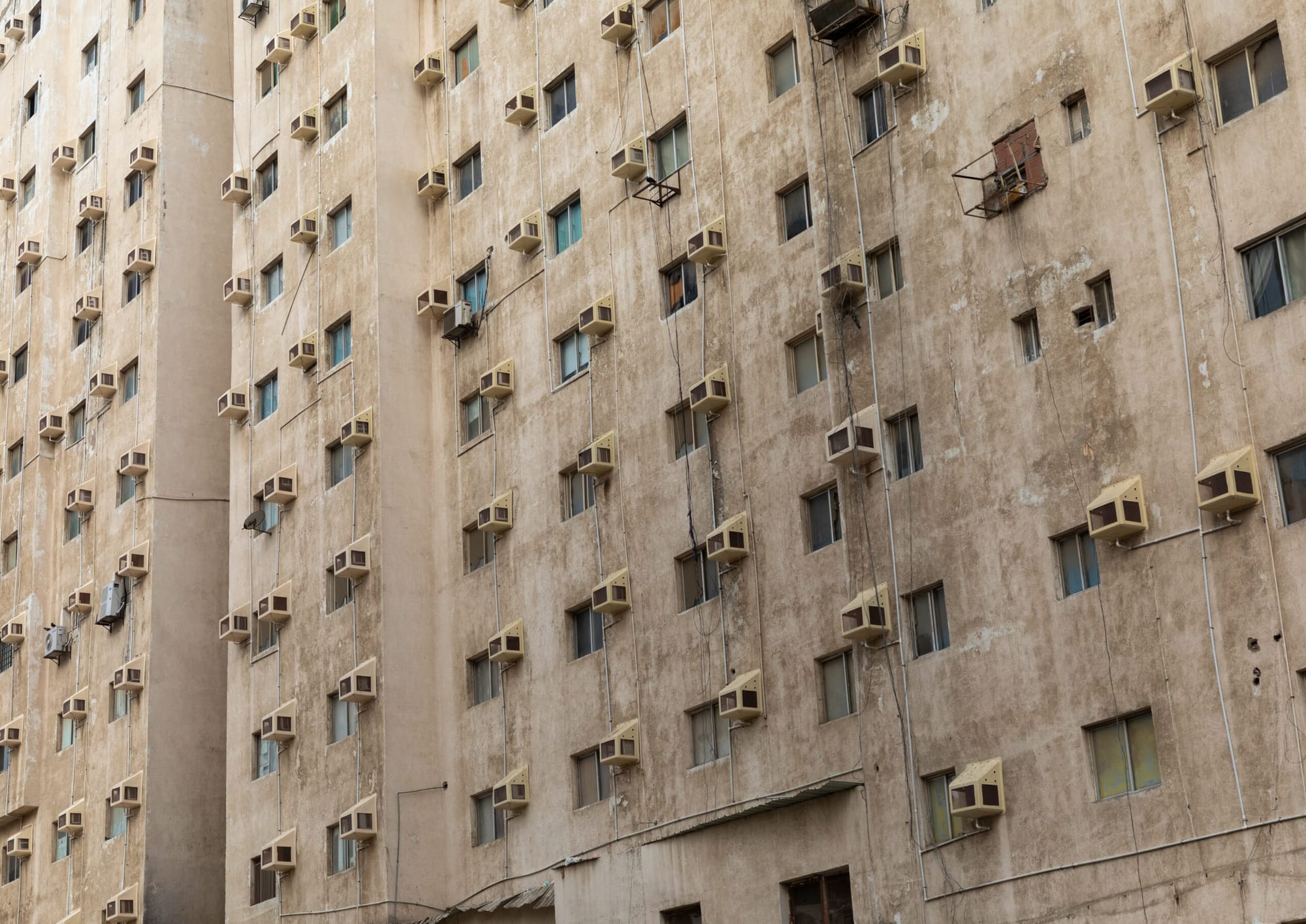
A building with many air conditioners, Jeddah, Saudi Arabia, 2018\. Eric Lafforgue/Art in All of Us/Corbis via Getty Images
The town had been built by Bahrain Petroleum Company (Bapco)—a creation of the Standard Oil Company of California—after it discovered the Awali oil field in 1932\. Initially a temporary settlement, by 1934 the town extended across a plateau north of Jabal Dukhan, where oil was first discovered in the region. As the nearby oil refinery picked up speed, oil specialists from the United States and Britain moved to Awali with their families.
For these newcomers, Awali’s combination of working and living quarters and its public and leisure facilities symbolized the technological advances promised by the oil industry. Air conditioning—which not only cooled but also dehumidified air—was a hallmark of this new, oil-driven lifestyle. Awali’s residents enjoyed air conditioning as early as 1937, even as the technology was not yet common in US households, where the first modern air conditioning system was invented.
In the 1950s, as the town continued to expand, it also featured a centralized cooling system that serviced multiple buildings at once, possibly [the first](https://whc.unesco.org/en/tentativelists/6397/) in the world. But behind this story of technological progress is a tale of inequality and ecological degradation, one that continues to haunt Bahrain and the Gulf region today.
## **Early Inequalities in Awali’s Air Conditioning**
For many British and US specialists in Awali, air conditioning did not simply represent the daily luxuries associated with the arrival of the oil industry, it also reflected their deep-seated anxieties about Bahrain’s climate.
These anxieties were rooted in colonial ideas that [viewed Middle Eastern](https://academic.oup.com/ahr/article-abstract/118/1/296/46318) environments as abnormal, degraded and in need of improvement. Some worried about how the heat would affect their physical and mental well-being and that of their families. Bapco and British officials feared discontent among the British workers arising, among other things, from Bahrain’s climate. In the early 1940s, the Political Resident in Bahrain even warned Britain’s Foreign Office that, if Bapco did not give its employees summer breaks, there might be a “general exodus” that would majorly disrupt oil production in Bahrain.[\[1\]](#%5Fedn1) Such anxieties help explain why air conditioning was so quickly provided to Awali’s US and European residents.
While Europeans and Americans in Awali enjoyed air-conditioned villas and offices, Bahraini workers labored in the heat. Bapco's administration justified withholding ice or cool water from them on the grounds that these workers were used to the heat. Most workers were transported daily from villages and towns in what were known as “coolie buses.” The rest were housed just outside the oil camp in palm-frond huts that were not serviced with electricity, fans or air conditioning.
> **As political scientist Robert Vitalis explains, when constructing oil towns in the Gulf, oil companies adopted segregationist urban plans informed by the US Jim Crow era.**
These inequalities triggered labor strikes among Bahraini workers as early as 1938 and reflected an urban scheme of racial segregation. As political scientist Robert Vitalis explains, when constructing oil towns in the Gulf, oil companies adopted segregationist urban plans informed by the US Jim Crow era.[\[2\]](#%5Fedn2) Bapco, for example, divided Awali constructions into “Class I” for European and US workers, “Class II” for South Asian workers and “Class III” for Bahraini and other Arab workers. Within this scheme of racial segregation, air-conditioned buildings were solely available to Class I employees, who also had exclusive access to an air-conditioned parlor, cinema, school and a commissary.
British administrators in Bahrain followed suit, adopting a similar strategy as part of the urban reforms they introduced in Bahrain in the early twentieth century. The reforms, supervised primarily by Charles Belgrave, the British advisor to the Bahraini ruler from 1926 to 1957, included a plan for air conditioning private and public buildings in the rest of the country. Influenced by Bapco's segregationist agendas, Belgrave, in coordination with the Electric Department, ensured that air-conditioning remained a privilege of the few.
At the government hospital, for example, only the ward dedicated to receiving patients from Europe or the United States was air conditioned. The Electric Department also introduced special air conditioning rates that made each unit of electricity eight times cheaper for British and wealthy residents than for the general public. With that pricing formula in place, most Bahrainis could not afford an air conditioner.[\[3\]](#%5Fedn3)
## **Upending Vernacular Cooling Practices**
Contrary to colonial assumptions that Bahrain’s climate was uninhabitable, people in Bahrain had thrived in its weather for centuries. They relied on behavioral and architectural adaptations to the heat that were accessible to all.
> **Everyone—regardless of social class—had access to certain cooling mechanisms: sleeping on rooftops, taking afternoon siestas, resting in the shade of airy courtyards and cooling themselves in natural springs and communal pools.**
Everyone—regardless of social class—had access to certain cooling mechanisms: sleeping on rooftops, taking afternoon siestas and resting in the shade of airy courtyards. Bathing in communal pools and natural springs was also part of people’s daily cooling routines. In an oral history interview conducted in 2019, a former resident of Muharraq recalled frequenting the springs in her early youth: “We used to go to *Al-Jalahma* spring in Muharraq, and it was divided by a wall, a section for men and another for women and everyone would go. From the wall extended faucets that gushed cold, fresh water. I remember always trying to go close to the faucets because I liked feeling the water pressure. It was so refreshing.”
In addition to these behavioral adaptations, people built houses that were well-adapted to the climate. They used thermally resistant building materials: coral stones fetched from the sea, gypsum made from burned limestone and palm fronds. They further adopted designs such as the courtyard model, which created a central courtyard for shade and enhanced air circulation. Some wealthier households featured wind towers that could funnel air even on a still day. Other elite families and colonial administrates would escape the summer to more temperate climates, for example, Shimla in India (where many British administrators in India would spend their summers). Those of more limited means might make seasonal migrations to the coast, living in temporary, palm-frond huts during the hot season.
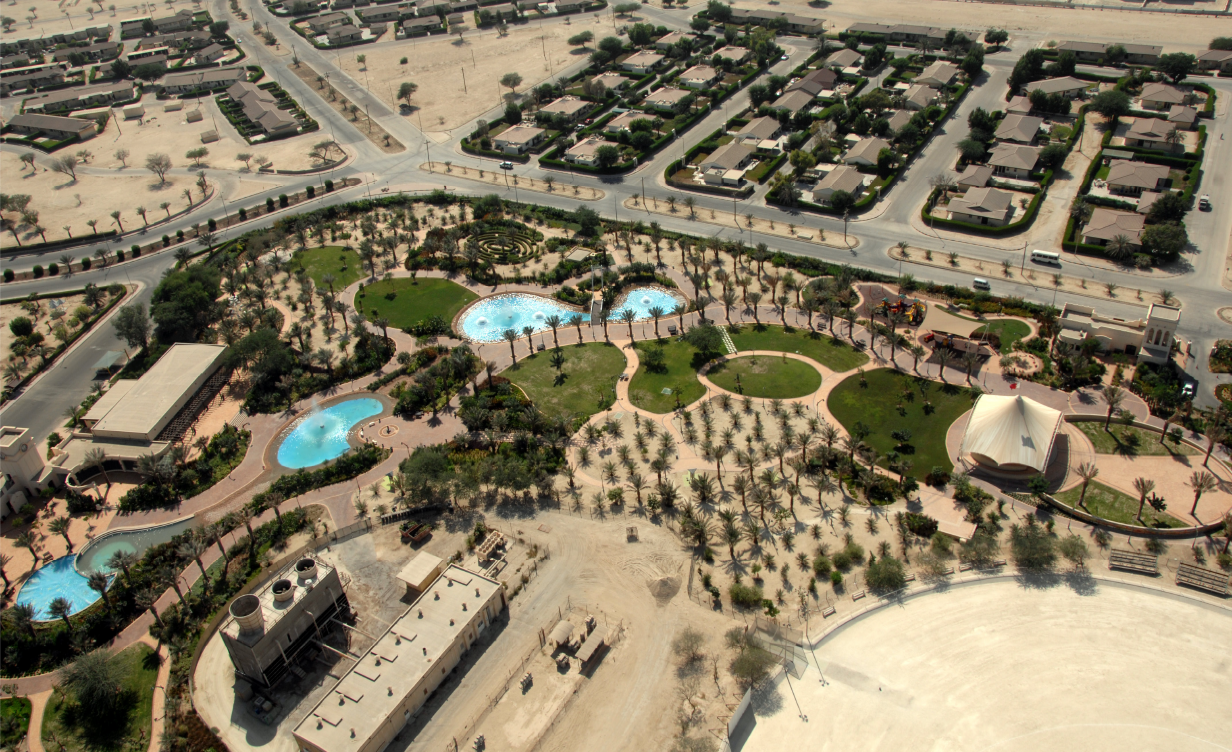
An aerial view of Awali, Bahrain. Official image from Bapco's website. Date unknown.
Awali broke away with these architectural and behavioral practices. In place of courtyard houses, the planners of Awali favored villas oriented outwards and surrounded by private gardens. They used materials like cement, steel and iron frames. Asphalt, a byproduct of oil, was also used to level roads for gas-guzzling cars. Daily activities were no longer organized according to climatic conditions but based on a fixed work schedule. As such, the afternoon siesta that was part of people’s daily routines was replaced by rigid work timing. At the same time, the drilling work that Bapco conducted in search for oil had adverse effects on Bahrain’s underground water. With urban development projects picking up speed in the aftermath of oil, Bahrain’s natural springs would soon dry up, depriving people of one of the major sources of thermal comfort. These changes came together as an expression of the new modern lifestyle that oil promised to Bahrain.
All of these transformations came at a cost, resulting in a new built environment that was increasingly maladaptive. With cement, concrete and asphalt absorbing and retaining heat, Bahrain would soon experience what became known in the late 1960s as the “urban heat islands” effect.
Belgrave’s urban reforms aligned with this new vision of a modern concrete-and-asphalt city. In 1937, for instance, he approved of a ban on palm-frond huts, which had long provided people with accessible, cool spaces. For British administrators, the huts were considered unsightly, as they contrasted with the new concrete buildings, and they also presented a fire hazard. British officials further introduced setback regulations that prohibited inhabitants from building their homes on the entire land plot. This restriction impeded the construction of airy, courtyard homes, and the villa layout soon emerged as archetypical housing style in the Gulf.
The gradual displacement of older architectural and behavioral adaptations to the climate locked people in Bahrain into a reliance on energy-intensive and often unaffordable air conditioning.
## **The Costs of Cooling Today**
Almost a century after Awali’s creation, air conditioning has become a taken-for-granted reality in Bahrain and elsewhere in the Gulf. Its social and ecological burden, however, still looms large.
> **While most Bahrainis today enjoy uninterrupted cooling, many migrant workers and limited-income Bahrainis are excluded from the benefits of air conditioning as they labor in the heat: washing cars, selling produce during the summer months, working in factories and, particularly with migrant workers, laboring in the construction industry.**
Indeed, rather than providing universal comfort, air conditioning in Bahrain reflects inequities along new socio-economic lines. While most Bahrainis today enjoy uninterrupted cooling, many migrant workers and limited-income Bahrainis are excluded from the benefits of air conditioning as they labor in the heat: washing cars, selling produce during the summer months, working in factories and, particularly with migrant workers, laboring in the construction industry.
With temperatures rising due to climate change, heat threatens not simply comfort, but survival. In a study on migrant workers in Qatar, Natasha Iskander [documents](https://www.merip.org/the-politics-of-unskilled-labor-in-qatar-an-interview-with-natasha-iskander/) how extreme climate conditions represent the most dangerous threat that workers said they faced. Exposure to thermal stress affects physical and cognitive abilities and leads to chronic conditions, such as kidney and heart failures. These chronic illnesses are not typically recognized as work injuries and instead are designated as natural developments. Spikes in kidney disease among Nepalese workers returning to their home towns from work in Qatar, for example, has prompted medical facilities to partner with dialysis centers in Katmandu.[\[4\]](#%5Fedn4)
Responding to these heat considerations, many Gulf states have instituted bans on construction work during the summer months. In Bahrain, work is prohibited from 12 pm to four pm during the months of July and August. But since they are set according to a fixed calendar, these bans, do not take into account actual climate conditions in the rest of the year, when temperatures and humidity levels can still reach unsafe and extreme levels. Moreover, during resting hours, workers might not be provided with comfortable shelters. Many, instead, languish in the heat, seeking shade under trees or against the sides of buildings, depending on the time of day.
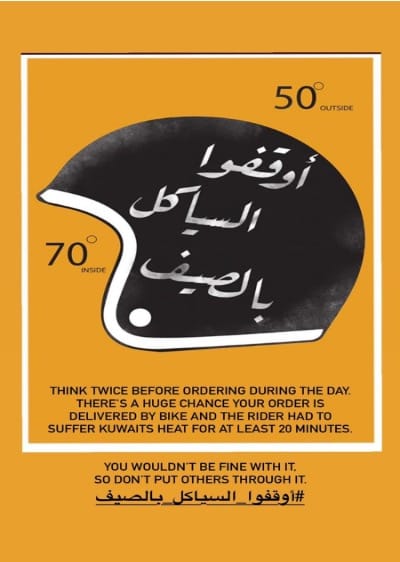
A Kuwaiti campaign to raise awareness of the risk delivery people face during the summer. By artist Talal Al-Maian, 2019.
The working hour bans are also inadequate as they only address the construction industry, excluding other workers who must labor outside, like security guards, petrol station servicemen and delivery persons.
As the social inequities associated with air conditioning have grown, so too has its ecological cost. While air conditioning offers a cooling solution, it is also heating up the climate through its intensive energy use and reliance on potent refrigerants that contribute to greenhouse gas emissions. This cycle of air conditioning dependency has become difficult to break, especially given the Gulf region’s access to cheap energy. Today, in some Gulf cities, air conditioning accounts for more than 60 percent of domestic electricity consumption during peak usage time in the summer.[\[5\]](#%5Fedn5)
In light of these rising energy and environmental concerns, Bahrain, along with other Gulf states, has pushed for more energy-efficient air conditioning solutions, most notably district cooling and solar air conditioning. But these solutions are not without their problems. District cooling—a system that provides chilled water to multiple buildings via underground pipes—relies on the provision of water in a region already facing a water scarcity crisis. Solar air conditioning, meanwhile, is limited by the heavy accumulation of dust on the panels and the large size of panels required.
While Gulf states continue to center air conditioning as the ultimate cooling solution, there are [efforts on the ground](https://newlinesmag.com/argument/architects-in-the-gulf-imagine-life-after-air-conditioning/) to move beyond it. Some Gulf architects, for instance, are reintroducing past cooling solutions into their designs, such as the courtyard. Others are experimenting with novel designs that would enhance the thermal performance of buildings without requiring air conditioning, for example using the earth’s cooling capacity by building underground.
Residents in the Gulf have also started to question the future of air conditioning. As one Bahraini resident told me in an interview in 2019, “This cannot last forever. Sometimes, I deliberately try to withstand the discomfort. It’s like I’m training myself to be without air conditioning for the day when we would have to give up this technology.”
Whether this day will ever come remains to be seen. But such conversations reveal a lost faith in the air-conditioned comfort once promised by Awali and the need for more ecologically sustainable and socially just ways of staying cool.
\[**Marwa Koheji** is a postdoctoral researcher in the Humanities Fellowship in the Study of the Arab World at New York University Abu Dhabi.\]
---
### **Endnotes**
[\[1\]](#%5Fednref1) Coll 30/212 “[Essential undertakings in: BAHREIN PETROLEUM COMPANY, etc. Proposed grant of passages to wives & fiancées of employees of B.P.C. Visas for same. And other undertakings](https://www.qdl.qa/archive/81055/vdc%5F100061658119.0x0000bf),” \[193r\] (388/406), British Library: India Office Records and Private Papers, IOR/L/PS/12/3955, available in Qatar Digital Library.
[\[2\]](#%5Fednref2) Robert Vitalis, *America's Kingdom: Mythmaking on the Saudi Oil Frontier* (Stanford University Press, 2006).
[\[3\]](#%5Fednref3) 'File 6/13 “[Enquiry into the affairs of the State Power House](https://www.qdl.qa/archive/81055/vdc%5F100000000241.0x00037d),” British Library: India Office Records and Private Papers, IOR/R/15/2/1222, available in the *Qatar Digital Library*.
[\[4\]](#%5Fednref4) Natasha Iskandar, *Does skill make us human?: Migrant workers in 21st-century Qatar and beyond* (Princeton University Press, 2021), p. 191.
[\[5\]](#%5Fednref5) Mohamed H Elnabawi, "Evaluating the Impact of Energy Efficiency Building Codes for Residential Buildings in the GCC," *Energies* 14/23 (2021), p. 1.
### Desert Solar—A Spectacular Fiction, Not a Spectacular Future
URL: https://www.merip.org/2024/07/desert-solar-a-spectacular-fiction-not-a-spectacular-future/
Last updated: 2025-08-22T18:36:16.000Z
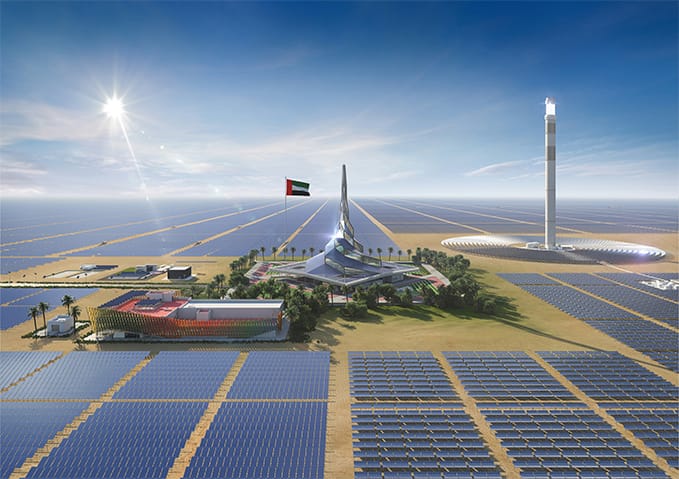
Rendering of the Al Maktoum Solar Park distributed for official publications by the Dubai Electricity and Water Authority.
Far from the skyscrapers of urban Dubai, the solar panels of Mohammed bin Rashid Al Maktoum Solar Park shine in the seemingly pristine desert.
Stretching over 30 square miles, this spectacular solar installation offers the image of green energy production that the UAE wants to showcase to the world. Writing in *Time* magazine last November, journalist Justin Worland [described](https://time.com/6335225/sultan-al-jaber-cop28-interview/) the scene from a helicopter tour arranged by Emirati officials. From one window, he could see a vista of desert sand dunes, from the other, “a sciencefiction-like array of solar panels, covering an area larger than Manhattan.”[\[1\]](#%5Fedn1)
In neighboring Abu Dhabi, Emirati leaders have [touted](https://energy.economictimes.indiatimes.com/news/renewable/worlds-largest-single-site-solar-power-plant-in-abu-dhabi/80378200) a similar megaproject, the Noor Abu Dhabi park, as the “world's largest single-site solar power plant.”[\[2\]](#%5Fedn2) And hypermodern images of solar power [bombarded](https://www.washingtonpost.com/climate-environment/2023/11/21/uae-dubai-cop28-oil-solar/) anyone who attended COP28, the United Nations climate talks controversially held in Dubai in 2023.
Sparkling solar technologies figure prominently in the UAE’s [official efforts](https://www.mbrsic.ae/en/about/mohammed-bin-rashid-al-maktoum-solar-park/) to advertise its [sustainability credentials](https://www.tandfonline.com/doi/full/10.1080/09644016.2022.2127481) and affirm its commitment to tackling climate change. The UAE’s [National Energy Strategy 2050](mailto:https://u.ae/en/about-the-uae/strategies-initiatives-and-awards/strategies-plans-and-visions/environment-and-energy/uae-energy-strategy-2050) promises to triple its minuscule [4.2 percent](mailto:https://www.iea.org/countries/united-arab-emirates) renewable energy capacity by 2050, and solar projects are a large focus of this plan.
But although large-scale solar energy projects may seem like a move toward a greener energy future, celebratory images of solar power in the desert obscure the problems of utility-scale parks. From [California](mailto:https://www.theguardian.com/us-news/2023/may/21/solar-farms-energy-power-california-mojave-desert) to [China](mailto:https://www.bloomberg.com/graphics/2023-china-solar-wind-power-cop28/), large-scale solar projects stress water supplies, divert resources from local communities and threaten local habitats. Energy megaprojects across the Middle East and Northern Africa offer some of the most poignant lessons about why desert solar is a spectacular fiction rather than a spectacular future.
## **Wastelanding the Desert**
The most impressive solar photos are often set in the desert, which functions as a synecdoche for today’s climate crisis. A patch of parched soil has become one the most cliched icons of climate change and environmental collapse, evoking fears of a warming planet, water scarcity and future challenges of securing food in a changing environment. But the desert as an icon of a looming climate apocalypse is not new. The desert has long [circulated as a trope](https://newbooksnetwork.com/arid-empire) in European and US imaginaries and is not understood in its full human and ecological complexity.
Reducing the desert to a barren and lifeless place is part of a process that historian Traci Voyles has called “[wastelanding](https://www.upress.umn.edu/book-division/books/wastelanding).”[\[3\]](#%5Fedn3) Symbolically relabeling certain places as a waste rather than inherently valuable makes it easier to justify violence to physical landscapes and transforms the wasteland into a self-fulfilling prophecy. Wasteland stories also depopulate arid landscapes, erasing the human and nonhuman life that call the desert home.
> **Symbolically relabeling certain places as a waste rather than inherently valuable makes it easier to justify violence to physical landscapes and transforms the wasteland into a self-fulfilling prophecy.**
When solar panels are applied to the apocalyptic scene of a parched desert landscape, the wasteland image is suddenly transformed into a vision of prosperity and optimism. The message of the iconic desert solar image is both persistent and consistent: a brilliant and inarguably good solution to the climate crisis.
Cover of the Middle East Solar Industry Association’s Solar Outlook Report 2019, with a view of Morocco’s Noor Laayoune Solar PV Park.
Yet, the solar-as-salvation message has several flaws. Arid environments pose many challenges for solar operations. [Dust](https://www.thenationalnews.com/uae/science/dust-can-dramatically-reduce-effectiveness-of-solar-panels-in-arabian-peninsula-us-study-finds-1.664896) and [sandstorms](https://www.mei.edu/publications/middle-easts-worsening-dust-storms-are-making-it-harder-deploy-solar-energy) mean that utility-scale parks, like those in the Dubai desert, require substantial water inputs to clean solar panels that regularly grow coated with [dust](mailto:https://www.mei.edu/publications/middle-easts-worsening-dust-storms-are-making-it-harder-deploy-solar-energy). In the Arabian Peninsula, this process usually involves the use of desalinated seawater, which itself has a [huge carbon footprint](mailto:https://www.energy.gov/sites/default/files/2019/09/f66/73355-7.pdf) as it is powered by burning oil or natural gas. Utility-scale solar parks also require the construction of new transmission lines and road networks, not to mention regular technology replacements due to the degrading effects of [extreme temperatures](https://theconversation.com/as-the-world-heats-up-solar-panels-will-degrade-faster-especially-in-hot-humid-areas-what-can-we-do-221990).
Another notable feature of the solar-as-salvation images is they never include humans: The iconic cracked desert ground is always depopulated ground. But, of course, [deserts are not empty](https://www.archpaper.com/2023/04/deserts-are-not-empty-edited-by-samia-henni-explores-the-contested-politics-of-supposedly-empty-terrain/), and solar projects can adversely impact local communities and their livelihoods. For example, in Morocco, solar power megaprojects at the Noor-Ouarzazate complex have involved [massive land grabs](https://www.merip.org/life-in-the-vicinity-of-moroccos-noor-solar-energy-project-2/) and [threatened local water supplies](https://www.merip.org/global-aspirations-and-local-realities-of-solar-energy-in-morocco/). The Moroccan Agency for Sustainable Energy initially promised the project would create thousands of jobs for surrounding communities. But this promise has remained [unfulfilled](https://magazine.zenith.me/en/society/noor-power-station-ouarzazate). Instead, local residents find themselves struggling with economic insecurity, severe drought, fires and the [near collapse of traditional oasis farming](https://www.jadaliyya.com/Details/43606)—all while the [solar power plant draws down](https://imes.elliott.gwu.edu/public-outreach-and-educator-resources/impop/moroccan-farmers-battle-with-solar-complexes-for-access-to-dwindling-water-resources/) their precious water resources.
The neat and tidy image of solar panels in the desert also hides the question of what—and who—the solar energy is for*.* In the case of Morocco, the Noor solar megaproject is largely hoped to produce energy for export to Europe. Moroccan elites have disregarded local concerns and instead leveraged the European Union’s desperation for green energy to [position Morocco](https://www.merip.org/global-aspirations-and-local-realities-of-solar-energy-in-morocco/) as a vital partner in the EU’s energy transition. As a result, large-scale solar projects can deepen authoritarianism by concentrating more financial and political capital into the hands of government leaders at the expense of local communities.
Similar processes of [authoritarian energy transitions](https://www.tni.org/en/article/facilitating-energy-flows-containing-humans) are happening across the region.
## **Desert Solar as Extractivism**
In 2015, the [BBC](https://www.bbc.com/news/science-environment-34987467) posed a question: “Should we solar panel the Sahara desert?” Several researchers, three from Europe and one from Africa, weighed in on whether it was a viable “solution to climate change.”[\[4\]](#%5Fedn4) In 2019, a researcher based in Britain asked the same question in a piece for [*The Conversation*](https://theconversation.com/should-we-turn-the-sahara-desert-into-a-huge-solar-farm-114450): “Should we turn the Sahara Desert into a huge solar farm?”[\[5\]](#%5Fedn5)
These questions serve as a shorthand for justifying an extractive energy relationship between Europe and Africa through solar power. They imply a “we”—residents of European countries—that possess the capital and expertise to export solar technology but simply need the energy that Africa’s largest desert can provide. They also imply that since Africans are not tapping the energy potential of the Sahara Desert, they must not need it.
> **In this extractive vision, deserts in the Middle East and Northern Africa play the same role for solar power as they do for oil: The deserts are barren and unproductive but hide extravagant wealth beneath their sands—wealth that is only accessible if subjected to the right technological tools.**
The idea of sending solar power from deserts in the Middle East and North Africa to Europe is not new. The Trans-Mediterranean Renewable Energy Cooperation “[Desertec](https://newint.org/features/2015/03/01/desertec-long)” (first proposed in 2003 by a consortium of mostly European power companies) is perhaps the best-known example in recent years. As Algerian activist and public intellectual Hamza Hamouchene has argued, these European-facing schemes are built on a distinctly [neo-colonial logic](https://www.tni.org/en/article/the-energy-transition-in-north-africa) of extractivism. In this extractive vision, deserts in the Middle East and Northern Africa play the same role for solar power as they do for oil: The deserts are barren and unproductive but hide extravagant wealth beneath their sands—wealth that is only accessible if subjected to the right technological tools.
In the fossil fuel era, the celebrated technologies were the drills and rigs that could extract oil from underground. In the post-oil era, the celebrated technologies are the gleaming photovoltaic panels and concentrated solar power parabolic troughs and towers. Once again, the Global North is positioning itself as the bearer of technology. Now, they have the added moral sheen of good-willed environmentalists on a mission to stop a climate crisis—one that they created—by importing energy from elsewhere to sustain their own [unsustainable energy demands](https://www.rosalux.de/en/news/id/50178). The depoliticized image of sparkling solar panels in the desert is a key tool in such moral posturing.
Masdar Future Energy display at COP28\. Author’s photo, December 2023.
Europeans aren’t the only foreigners interested in the solar potential of the Middle East and Northern Africa. Political and economic elites from the Arabian Peninsula have also been active in the sector. As opposed to their European counterparts, the Gulf actors are less interested in importing renewable energy for their own consumption. They are instead aiming to [green their oil money](https://doi.org/10.1016/j.erss.2022.102833) and extract the [financial rewards](https://www.cnbc.com/2017/01/12/arab-gulf-firms-set-sights-on-growing-market-for-solar-power.html) of owning the infrastructure of the renewable energy transition. In part, Gulf leaders recognize the physical limits of renewable energy projects in the Arabian Peninsula, but the increasing trend in the region is for Gulf-based companies (state-owned, parastatal and private) to invest overseas instead of at home. Saudi [state-backed](https://www.power-technology.com/features/saudi-arabian-solar-how-the-state-has-invested-in-overseas-solar-projects/) ACWA power has [assets](https://www.acwapower.com/en/projects/assets/) across the Gulf, the broader Middle East and parts of Africa.
Abu Dhabi’s Masdar Future Energy, a subsidiary of its Mubadala sovereign wealth fund, now boasts a remarkable [portfolio](https://masdar.ae/en/renewables/our-projects) of renewable energy investments well beyond its early reach in the Middle East. Private Emirati elites like the Abu Dhabi-based AlNowais family’s AMEA Power are also investing in the industry. Since receiving significant new funding from Japan’s SoftBank in 2023, the company has become one of Africa’s fastest-growing renewable energy developers, with [projects](https://www.ameapower.com/projects/) across the entire continent.
> **In the Gulf as in Europe, supporting spectacular sustainability projects gives moral license to leaders who perpetuate the fossil energy system that they still wholly rely upon.**
But similar to their European counterparts, they also seek the symbolic capital of high-profile solar projects, allowing them to globally broadcast their supposed climate virtues and financially profit from the post-oil energy transition. In the Gulf as in Europe, supporting spectacular sustainability projects gives moral license to leaders who perpetuate the fossil energy system that they still wholly rely upon.[\[6\]](#%5Fedn6)
The strategic use of solar spectacles is evident to differing degrees across the Arabian Peninsula. In some cases, these projects are announced solely to grab headlines and then scrapped when the media moves on. In March 2018, for example, Saudi Arabia’s Crown Prince Mohammed bin Salman signed a $200 billion deal with the Japanese investment giant SoftBank to create the world’s largest solar power project. Loudly hailed across the global media landscape, Prince Mohammed [told the press](https://www.arabnews.com/node/1275416): “It’s a huge step in human history. It’s bold, risky and we hope we succeed.”[\[7\]](#%5Fedn7) The plan, however, [was canceled](https://www.reuters.com/article/us-saudi-softbank-group-solar-idUSKCN1MA0X6/) only six months later—a development that was ignored by the same international outlets that had breathlessly celebrated it.
## **Beyond Solar Fetishism**
The fanciful images of desert solar are just that: fancies. But they can be dangerous ones.

Portrait of Mustapha, the man responsible for the distribution of water in the oasis. January 2021, Tighmert, Morocco. By artist Seif Kousmate, from his project Waha about the relationship of humans to the environment in oases. Mixed technique using fire on a paper print.
As Ozzie Zehner argues, a fundamental challenge of sustainability spectacles, like the massive solar farms in the desert, is that they are presented as inarguably good and flawless. More than a decade after his 2012 book [*Green Illusions*](https://www.nebraskapress.unl.edu/nebraska-paperback/9780803237759/) was published, people still ignore “the limitations of alternative energy as we drop to our knees at the foot of the clean energy spectacle, gasping in rapture.”[\[8\]](#%5Fedn8)
In the frenzied rush to promote the renewable energy transition, few stop to ask what the energy is actually being used for and whether it is even necessary. The colonial idea of solar-paneling the Sahara for Europe’s benefit is only deemed necessary because European leaders are unwilling to countenance a shift away from energy-intensive industry and capitalist systems of endless production.
Some groups have proposed alternative approaches, such as the [“degrowth” movement](https://www.nature.com/articles/d41586-022-04412-x) that is gathering momentum in Europe. For these advocates, climate change demands a move away from energy-intensive capitalism and a wholesale reorganization of modern economies to scale down industry, production and consumption. In the Middle East and North Africa, by contrast, anti-growth climate solutions are rarely broached. But as the degrowth advocates argue, a major shift in economic values is essential for any meaningful impact on the climate crisis since infinite growth cannot be sustained on today’s warming planet.
A degrowth approach would challenge the symbolic economy around renewable energy—particularly desert solar. From a perspective that critiques rather than celebrates capitalist expansion, desert solar would instead be recognized for what it is: A spectacle that many people and companies are now manipulating to excuse their energy-intensive lifestyles, while wastelanding socially and ecologically precious desert landscapes around the world.
> **For these advocates, climate change demands a move away from energy-intensive capitalism and a wholesale reorganization of modern economies to scale down industry, production and consumption.**
But more than a simple issue of physical geography, the renewable energy transition is fundamentally tied to questions of political geography: Who gets what, when, where and how? Solar power may be good for some people and in some contexts—but not everywhere and for everyone. Whatever the renewable energy source may be, better than fossil fuels does not automatically equal good.
Today’s environmental challenges extend beyond the abstract numbers of greenhouse gas emissions and rising temperatures. Communities in deserts across the world understand the need to conserve water, grow food, protect cultural sites and livelihoods and keep ecosystems intact. Yet their voices are drowned out by the deluge of solar spectacles that draw critical attention away from key political decisions about how to imagine just futures in the desert. For those who see the desert as, not a wasteland, but [home](https://www.jadaliyya.com/Details/45782), desert solar is a spectacular fiction, not a spectacular future.
\[**Natalie Koch** is Professor of Geography at Syracuse University’s Maxwell School of Citizenship and Public Affairs.\]
> **Read the[previous](https://merip.org/2024/07/laundering-carbon-the-gulfs-new-scramble-for-africa) article.**
> **Read the[next](https://merip.org/2024/07/fossil-fueled-comfort-the-history-and-cost-of-air-conditioning-in-bahrain) article.**
**This article appears in** [**MER issue 311**](https://merip.org/magazine/311/) **“Post-Fossil Politics.”**
---
### **Endnotes**
[\[1\]](#%5Fednref1) Justin Worland, “[What Happens When You Put a Fossil Fuel Exec in Charge of Solving Climate Change](https://time.com/6335225/sultan-al-jaber-cop28-interview/),” *Time Magazine*, November 15, 2023.
[\[2\]](#%5Fednref2) “[World's largest single-site solar power plant in Abu Dhabi](https://energy.economictimes.indiatimes.com/news/renewable/worlds-largest-single-site-solar-power-plant-in-abu-dhabi/80378200),” *Economic Times*, January 21, 2021.
[\[3\]](#%5Fednref3) Traci Brynne Voyles, *Wastelanding: Legacies of Uranium Mining in Navajo Country* (Minneapolis: University of Minnesota Press, 2015).
[\[4\]](#%5Fednref4) *BBC News*, “[Should we solar panel the Sahara desert?](https://www.bbc.com/news/science-environment-34987467)” December 30, 2015.
[\[5\]](#%5Fednref5) *The Conversation*, “[Should we turn the Sahara Desert into a huge solar farm?](https://theconversation.com/should-we-turn-the-sahara-desert-into-a-huge-solar-farm-114450)” April 24, 2019.
[\[6\]](#%5Fednref6) Natalie Koch, “[Scientific Nationalism and Museums of the Future in Germany and the UAE](https://doi.org/10.1016/j.polgeo.2024.103144.),” *Political Geography* 113 (2024): p. 103144.
[\[7\]](#%5Fednref7) Quoted in Frank Kane , “[Saudi solar energy comes of age at the stroke of midnight in New York](https://www.arabnews.com/node/1275416),” *Arab News,* March 29, 2018.
[\[8\]](#%5Fednref8) Ozzie Zehner, *Green Illusions The Dirty Secrets of Clean Energy and the Future of Environmentalism* (Lincoln: University of Nebraska Press, 2012), p. 149.
### Laundering Carbon—The Gulf’s ‘New Scramble for Africa’
URL: https://www.merip.org/2024/07/laundering-carbon-the-gulfs-new-scramble-for-africa/
Last updated: 2025-08-22T18:36:16.000Z
In early November 2023, shortly before the COP28 summit opened in Dubai, a hitherto obscure UAE firm attracted significant media attention around news of their prospective land deals in Africa.
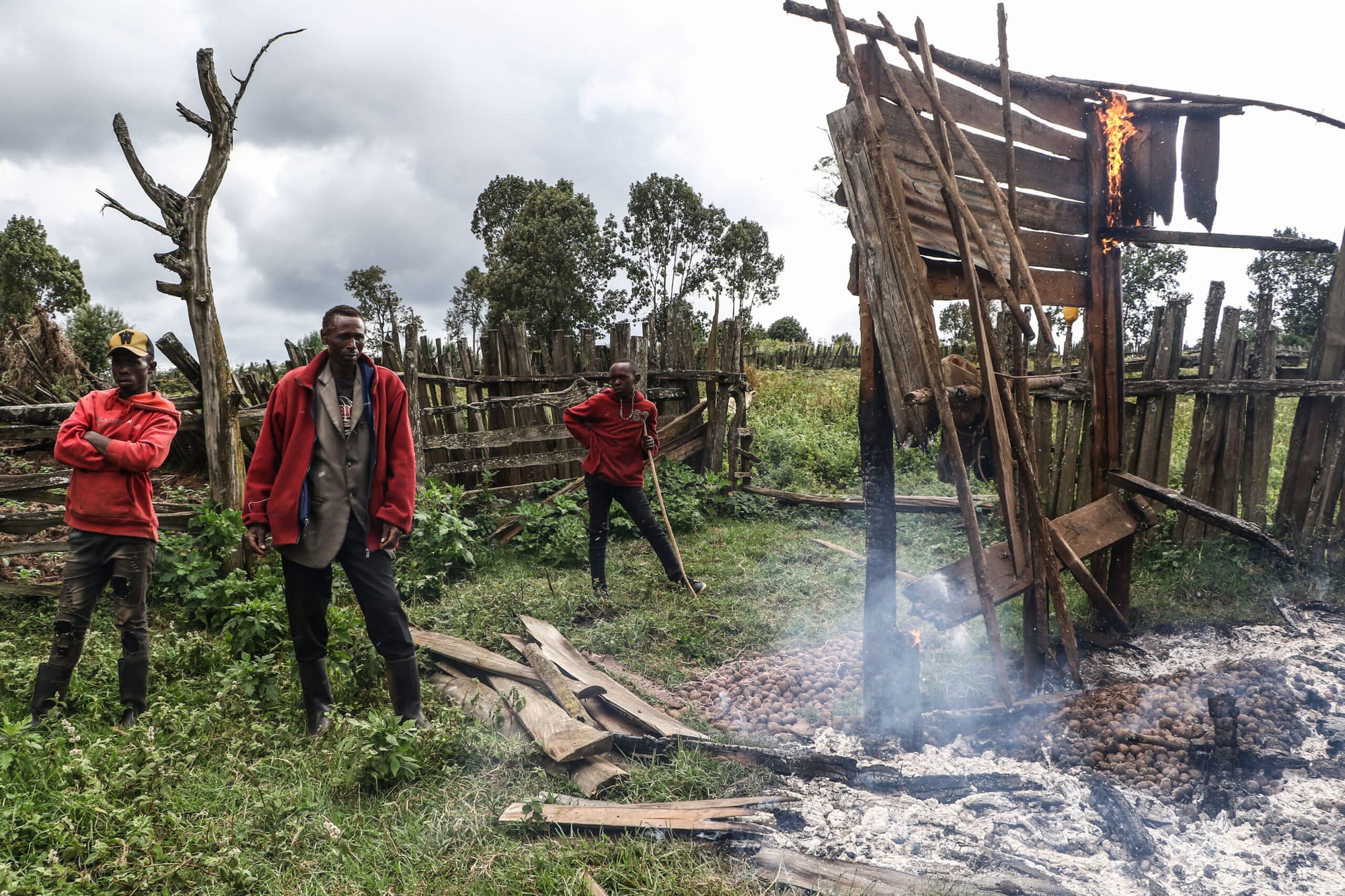
Kenyatta Ngusilo (C), a member of the Ogiek community, watches as his storehouse burns in Sasimwani Mau Forest, 2023\. Hundreds of Ogiek people were left homeless after the Kenyan government evicted alleged encroachers. James Wakibia/SOPA Images/LightRocket via Getty Images
Reports suggested that Blue Carbon—a company privately owned by Sheikh Ahmed al-Maktoum, a member of Dubai’s ruling family—had [signed deals](https://www.source-material.org/dubai-uae-cop28-blue-carbon-offsetting-forest-liberia/) promising the firm control over vast tracts of land across the African continent. These deals included an astonishing 10 percent of the landmass in Liberia, Zambia and Tanzania, and 20 percent in Zimbabwe. Altogether, the area equalled the size of Britain.
Blue Carbon intended to use the land to launch carbon offset projects, an increasingly popular practice that proponents claim will help tackle climate change. Carbon offsets involve forest protection and other environmental schemes that are equated to a certain quantity of carbon “credits.” These credits can then be sold to polluters around the world to offset their own emissions. Prior to entering into the negotiations of the massive deal, Blue Carbon had no experience in either carbon offsets or forest management. Nonetheless the firm stood to make billions of dollars from these projects.
Environmental NGOs, journalists and activists quickly condemned the deals as a new [“scramble for Africa”](https://www.theguardian.com/environment/2023/nov/30/the-new-scramble-for-africa-how-a-uae-sheikh-quietly-made-carbon-deals-for-forests-bigger-than-uk)—a land grab enacted in the name of climate change mitigation. In response, Blue Carbon insisted the discussions were merely exploratory and would require community consultation and further negotiation before formal approval.
Regardless of their current status, the land deals raise concerns that indigenous and other local communities could be evicted to make way for Blue Carbon’s forest protection plans. In Eastern Kenya, for example, the indigenous Ogiek People were driven out of the Mau Forest in November 2023, an expulsion that lawyers [linked](https://www.bbc.co.uk/news/world-africa-67352067) to ongoing negotiations between Blue Carbon and Kenya’s president, William Ruto. Protests have also followed the Liberian government’s closed-door negotiations with Blue Carbon, with [activists claiming](https://apnews.com/article/carbon-credits-africa-communities-protests-92f99dfd488c80e1b5a4cae69c07e6fd) the project violates the land rights of indigenous people enshrined within Liberian law. Similar cases of land evictions elsewhere have led the UN Special Rapporteur on the Rights of Indigenous Peoples, Francisco Calí Tzay, to [call](https://www.amnesty.org/en/latest/news/2024/04/global-un-special-rapporteur-is-right-to-raise-human-rights-concerns-about-carbon-markets/) for a global moratorium on carbon offset projects.
Beyond their potentially destructive impact on local communities, Blue Carbon’s activities in Africa point to a major shift in the climate strategies of Gulf states. As [critics](https://manchesteruniversitypress.co.uk/9781526162632/) have shown, the carbon offsetting industry exists largely as a greenwashing mechanism, allowing polluters to hide their continued emissions behind the smokescreen of misleading carbon accounting methodologies while providing a profitable new asset class for financial actors. As the world’s largest exporters of crude oil and liquified natural gas, the Gulf states are now positioning themselves across all stages of this new industry—including the financial markets where carbon credits are bought and sold. This development is reconfiguring the Gulf’s relationships with the African continent and will have significant consequences for the trajectories of our warming planet.
## **False Accounting and Carbon Laundering**
There are many varieties of carbon offset projects. The most common involves the avoided deforestation schemes that make up the bulk of Blue Carbon’s interest in African land. In these schemes, land is enclosed and protected from deforestation. Carbon offset certifiers—of which the largest in the world is the Washington-based firm, Verra—then assess the amount of carbon these projects prevent from being released into the atmosphere (measured in tons of CO2). Once assessed, carbon credits can be sold to polluters, who use them to cancel out their own emissions and thus meet their stated climate goals.
Superficially attractive—after all, who doesn’t want to see money going into the protection of forests?—such schemes have two major flaws. The first is known as “permanence.” Buyers who purchase carbon credits gain the right to pollute in the here and now. Meanwhile, it takes hundreds of years for those carbon emissions to be re-absorbed from the atmosphere, and there is no guarantee that the forest will continue to stand for that timeframe. If a forest fire occurs or the political situation changes and the forest is destroyed, it is too late to take back the carbon credits that were initially issued. This concern is not simply theoretical. In recent years, [California wildfires](https://www.independent.co.uk/climate-change/news/carbon-offsets-microsoft-bp-forests-wildfires-b1897012.html) have consumed millions of hectares of forest, including offsets purchased by major international firms such as Microsoft and BP. Given the increasing incidence of forest fires due to global warming, such outcomes will undoubtedly become more frequent.
> **Again, this estimate depends on an unknowable future, opening up significant profit-making opportunities for companies certifying and selling carbon credits.**
The second major flaw with these schemes is that any estimation of carbon credits for avoided deforestation projects rests on an imaginary counterfactual: How much carbon would have been released if the offset project were not in place? Again, this estimate depends on an unknowable future, opening up significant profit-making opportunities for companies certifying and selling carbon credits. By inflating the estimated emissions reductions associated with a particular project, it is possible to sell many more carbon credits than are actually warranted. This scope for speculation is one reason why the carbon credit market is so closely associated with repeated scandals and corruption. Indeed, according to [reporting in the *New Yorker*](https://newyorker.com/magazine/2023/10/23/the-great-cash-for-carbon-hustle), after one massive carbon fraud was revealed in Europe, “the Danish government admitted that eighty per cent of the country’s carbon-trading firms were fronts for the racket.”[\[1\]](#%5Fedn1)
These methodological problems are structurally intrinsic to offsetting and cannot be avoided. As a result, most carbon credits traded today are fictitious and do not result in any real reduction in carbon emissions. Tunisian analyst Fadhel Kaboub [describes](https://www.middleeasteye.net/news/uae-kenya-concedes-millions-hectares-firm-carbon-offset-deal) them as simply “a licence to pollute.”[\[2\]](#%5Fedn2) One [investigative report](https://www.theguardian.com/environment/2023/jan/18/revealed-forest-carbon-offsets-biggest-provider-worthless-verra-aoe) from early 2023 found that more than 90 percent of rainforest carbon credits certified by Verra were likely bogus and did not represent actual carbon reductions. Another [study](https://carbonmarketwatch.org/2017/04/18/press-statement/) conducted for the EU Commission reported that 85 percent of the offset projects established under the UN’s Clean Development Mechanism failed to reduce emissions. A recent academic study of offset projects across six countries, meanwhile, found that most did not reduce deforestation, and for those that did, the reductions were significantly lower than initially claimed. Consequently, the [authors conclude](https://www.science.org/doi/10.1126/science.ade3535), carbon credits sold for these projects were used to “offset almost three times more carbon emissions than their actual contributions to climate change mitigation.”[\[3\]](#%5Fedn3)
Despite these fundamental problems—or perhaps because of them—the use of carbon offsets is growing rapidly. The investment bank Morgan Stanley predicts that the market will be worth $250 billion by 2050, up from about $2 billion in 2020, as large polluters utilize offsetting to sanction their continued carbon emissions while claiming to meet net zero targets. In the case of Blue Carbon, one estimate found that the amount of carbon credits likely to be accredited through the firm’s projects in Africa [would equal](https://www.source-material.org/dubai-uae-cop28-blue-carbon-offsetting-forest-liberia/) all of the UAE’s annual carbon emissions. Akin to carbon laundering, this practice allows ongoing emissions to disappear from the carbon accounting ledger, swapped for credits that have little basis in reality.
## **Monetizing Nature as a Development Strategy**
For the African continent, the growth of these new carbon markets cannot be separated from the escalating global debt crisis that has followed the COVID-19 pandemic and the war in Ukraine. According to a new database, [*Debt Service Watch*](https://www.merip.org/content/files/files/debt%5Fservice%5Fwatch%5Fbriefing%5Ffinal%5Fword%5Fen%5F0910.pdf), the Global South is experiencing its worst debt crisis on record, with one-third of countries in Sub-Saharan Africa spending over half their budget revenues on servicing debt. Faced with such unprecedented fiscal pressures, the commodification of land through offsetting is now heavily promoted by international lenders and many development organizations as a way out of the deep-rooted crisis.
The African Carbon Markets Initiative (ACMI), an alliance launched in 2022 at the Cairo COP27 summit, has emerged as a prominent voice in this new development discourse. ACMI brings together African leaders, carbon credit firms (including Verra), Western donors (USAID, the Rockefeller Foundation and Jeff Bezos’ Earth Fund) and multilateral organizations like the United Nations Economic Commission for Africa. Along with practical efforts to mobilize funds and encourage policy changes, ACMI has taken a lead role in advocating for carbon markets as a win-win solution for both heavily indebted African countries and the climate. In the words of the organization’s [founding document](https://www.seforall.org/publications/africa-carbon-markets-initiative-roadmap-report), “The emergence of carbon credits as a new product allows for the monetization of Africa’s large natural capital endowment, while enhancing it.”[\[4\]](#%5Fedn4)
ACMI’s activities are deeply tied to the Gulf. One side to this relationship is that Gulf firms, especially fossil fuel producers, are now the key source of demand for future African carbon credits. At the September 2023 African Climate Summit in Nairobi, Kenya, for example, a group of prominent Emirati energy and financial firms (known as the UAE Carbon Alliance) committed to purchasing $450 million worth of carbon credits from ACMI over the next six years. The pledge immediately confirmed the UAE as ACMI’s biggest financial backer. Moreover, by guaranteeing demand for carbon credits for the rest of this decade, the UAE’s pledge helps create the market today, driving forward new offset projects and solidifying their place in the development strategies of African states. It also helps legitimize offsetting as a response to the climate emergency, despite the numerous scandals that have beset the industry in recent years.
Saudi Arabia is likewise playing a major role in pushing forward carbon markets in Africa. One of ACMI’s steering committee members is the Saudi businesswoman, Riham ElGizy, who heads the Regional Voluntary Carbon Market Company (RVCMC). Established in 2022 as a joint venture between the Public Investment Fund (Saudi Arabia’s sovereign wealth fund) and the Saudi stock exchange, Tadawul, RVCMC has organized the world’s two [largest carbon auctions](https://xpansiv.com/rvcmc-selects-xpansiv-to-launch-carbon-credit-exchange-in-saudi-arabia/), selling more than 3.5 million tons worth of carbon credits in 2022 and 2023\. 70 percent of the credits sold in these auctions were sourced from offset projects in Africa, with the 2023 auction taking place in Kenya. The principal buyers of these credits were Saudi firms, led by the largest oil company in the world, Saudi Aramco.
> **Beyond simply owning offset projects in Africa, the Gulf states are also positioning themselves at the other end of the carbon value chain: the marketing and sale of carbon credits to regional and international buyers.**
The Emirati and Saudi relationships with ACMI and the trade in African carbon credits illustrate a notable development when it comes to the Gulf’s role in these new markets. Beyond simply owning offset projects in Africa, the Gulf states are also positioning themselves at the other end of the carbon value chain: the marketing and sale of carbon credits to regional and international buyers. In this respect, the Gulf is emerging as a key economic space where African carbon is turned into a financial asset that can be bought, sold and speculated upon by financial actors across the globe.
Indeed, the UAE and Saudi Arabia have each sought to establish permanent carbon exchanges, where carbon credits can be bought and sold just like any other commodity. The UAE set up the first such trading exchange following an investment by the Abu Dhabi-controlled sovereign wealth fund, Mubadala, in the Singapore-based AirCarbon Exchange (ACX) in September 2022\. As part of this acquisition, Mubadala now owns 20 percent of ACX and has established a regulated digital carbon trading exchange in Abu Dhabi’s financial free zone, the Abu Dhabi Global Market. ACX claims the exchange is the first regulated exchange of its kind in the world, with the trade in carbon credits beginning there in late 2023\. Likewise, in Saudi Arabia the RVCMC has partnered with US market technology firm Xpansiv to establish a permanent carbon credit exchange set to launch in late 2024.
Whether these two Gulf-based exchanges will compete or prioritize different trading instruments, such as carbon derivatives or Shariah-compliant carbon credits, remains to be seen. What is clear, however, is that major financial centers in the Gulf are leveraging their existing infrastructures to establish regional dominance in the sale of carbon. Active at all stages of the offsetting industry—from generating carbon credits to purchasing them—the Gulf is now a principal actor in the new forms of wealth extraction that connect the African continent to the wider global economy.
## **Entrenching a Fossil-Fuelled Future**
Over the past two decades, the Gulf’s oil and especially gas production has grown markedly, alongside a [substantial eastward shift](https://www.tni.org/en/article/a-transition-to-where-the-gulf-arab-states-and-the-new-east-east-axis-of-world-oil) in energy exports to meet the new hydrocarbon demand from China and East Asia. At the same time, the Gulf states have expanded their involvement in energy-intensive downstream sectors, notably the production of petrochemicals, plastics and fertilizers. Led by Saudi Aramco and the Abu Dhabi National Oil Company, Gulf-based National Oil Companies now rival the traditional Western oil supermajors in key metrics such as reserves, refining capacity and export levels.
> **Rather, much like the big Western oil companies, the Gulf’s vision of expanded fossil fuel production is accompanied by an attempt to seize the leadership of global efforts to tackle the climate crisis.**
In this context—and despite the reality of the climate emergency—the Gulf states are doubling down on fossil fuel production, seeing much to be gained from hanging on to an oil-centered world for as long as possible. As the Saudi oil minister [vowed](http://bloomberg.com/news/features/2021-07-22/saudi-prince-abdulaziz-bin-salman-seeks-to-tame-oil-prices-opec-russia) back in 2021, “every molecule of hydrocarbon will come out.”[\[5\]](#%5Fedn5) But this approach does not mean the Gulf states have adopted a stance of head-in-the-sand climate change denialism. Rather, much like the big Western oil companies, the Gulf’s vision of expanded fossil fuel production is accompanied by an attempt to seize the leadership of global efforts to tackle the climate crisis.
One side to this approach is their heavy involvement in flawed and unproven low carbon technologies, like hydrogen and carbon capture. Another is their attempts to steer global climate negotiations, seen in the recent UN climate change conferences, COP27 and COP28, where the Gulf states channelled policy discussions away from effective efforts to phase out fossil fuels, turning these events into little more than corporate spectacles and networking forums for the oil industry.
The carbon offset market should be viewed as an integral part of these efforts to delay, obfuscate and obstruct addressing climate change in meaningful ways. Through the deceptive carbon accounting of offset projects, the big oil and gas industries in the Gulf can continue business as usual while claiming to meet their so-called climate targets. The Gulf’s dispossession of African land is key to this strategy, ultimately enabling the disastrous specter of ever-accelerating fossil fuel production.
\[**Adam Hanieh** is a professor of political economy and global development at the University of Exeter’s Institute of Arab and Islamic Studies. His forthcoming book is [*Crude Capitalism: Oil, Corporate Power, and the Making of the World Market* ](https://www.versobooks.com/products/2760-crude-capitalism)(Verso, September 2024).\]
> **Read the[previous](https://merip.org/2024/07/the-uneven-politics-of-decarbonization-in-the-middle-east-and-north-africa) article.**
> **Read the[next](https://merip.org/2024/07/desert-solar-a-spectacular-fiction-not-a-spectacular-future) article.**
**This article appears in** [**MER issue 311**](https://merip.org/magazine/311/) **“Post-Fossil Politics.”**
---
### **Endnotes**
[\[1\]](#%5Fednref1) Heidi Blake, “[The Great Cash-for-Carbon Hustle](https://www.newyorker.com/magazine/2023/10/23/the-great-cash-for-carbon-hustle),” *The New Yorker*, October 16, 2023.
[\[2\]](#%5Fednref2) Katherine Hearst, “[Kenya concedes 'millions of hectares' to UAE firm in latest carbon offset deal](https://www.middleeasteye.net/news/uae-kenya-concedes-millions-hectares-firm-carbon-offset-deal),” Middle East Eye, November 5, 2023.
[\[3\]](#%5Fednref3) Thales A. P. West et al., “[Action needed to make carbon offsets from forest conservation work for climate change](https://www.science.org/doi/10.1126/science.ade3535#tab-citations),” *Science* 381/6660 (August 2023), p. 876.
[\[4\]](#%5Fednref4) "[Africa Carbon Markets Initiative (ACMI): Roadmap Report,"](https://www.merip.org/content/files/system/files/2022-11/acmi%5Froadmap%5Freport%5Fnov%5F16.pdf) ACMI, November 8, 2022, p. 12.
[\[5\]](#%5Fednref5) Javier Blas, "[The Saudi Prince of Oil Prices Vows to Drill ‘Every Last Molecule’](https://www.bloomberg.com/news/features/2021-07-22/saudi-prince-abdulaziz-bin-salman-seeks-to-tame-oil-prices-opec-russia)," Bloomberg, July 22, 2021.
### The Uneven Politics of Decarbonization in the Middle East and North Africa
URL: https://www.merip.org/2024/07/the-uneven-politics-of-decarbonization-in-the-middle-east-and-north-africa/
Last updated: 2025-08-22T18:36:17.000Z
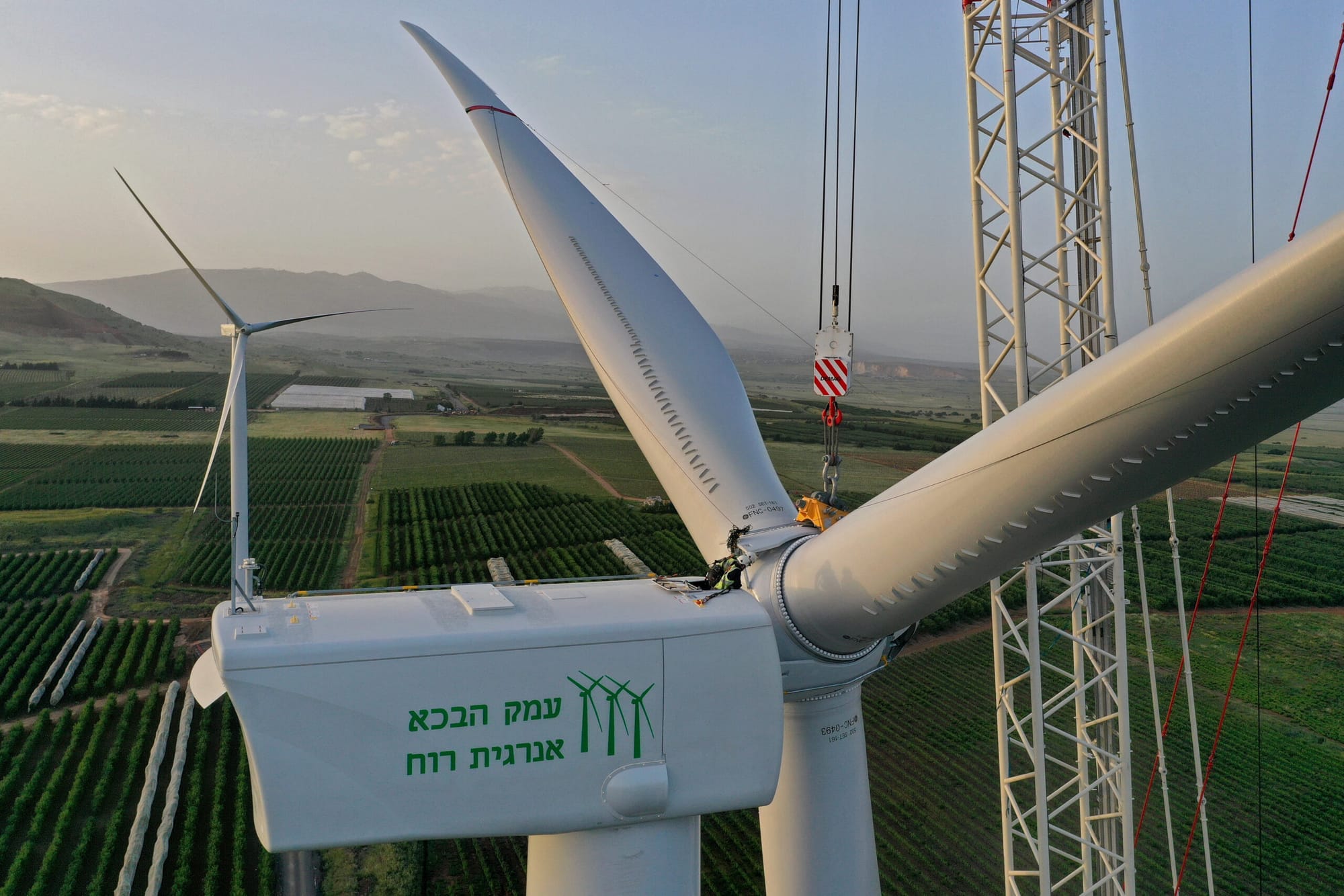
An aerial view of technicians completing the construction of a wind turbine in the Golan Heights, Israel, 2020\. (David Silverman/Getty Images)
According to Europe’s largest generator of renewable energy, Norway’s state-owned [Statkraft](https://www.statkraft.com/newsroom/news-and-stories/2022/more-renewable-energy-more-peace-and-democracy/), “A lesser known positive aspect of the green energy shift is that more renewable energy leads to more peace and democracy!”
It is tempting to formulate such grandiose arguments about the possibilities of a transition to renewables ushering in a period of egalitarian and democratic access to energy and a potential for peace. Coal, oil and gas are concentrated energy sources, unevenly distributed across the globe. Wind and solar, on the other hand, are highly distributed, albeit with different intensities.
In theory, this availability offers the promise of a less hierarchical and more inclusive energy politics: energy production that is less dependent on fixed reserves easily controlled by state and corporate actors. It also holds the potential for resource poor countries that rely heavily on fossil fuel imports to become more energy independent. They could possibly even transform into green energy exporters.
But recent initiatives to produce green energy in the Middle East and North Africa illustrate that previously existing dependencies and the predominance of private control over energy production are not often overcome—they are merely reconfigured. Transregionally connected authoritarian elites transform renewables’ distributed nature into concentrated forms of political and economic power. As such, a renewables-based energy system will neither be less prone to conflict, nor automatically marked by fewer socio-economic inequalities.
## **Green Colonial Dependencies**
Many countries in the Middle East and North Africa, including Morocco, Tunisia, Egypt, Jordan, Saudi-Arabia, the United Arab Emirates and Iran, are trying to turn themselves into renewable energy or regional electricity hubs. At first sight, these efforts seem like they hold the potential to level existing regional hierarchies between powerful hydrocarbon exporters and vulnerable and dependent importers. But electricity grid integration and energy decentralization do not automatically lead to more equality or less conflict.
> **But electricity grid integration and energy decentralization do not automatically lead to more equality or less conflict.**
As one example, Lebanon’s solar boom has [unfolded](https://thepublicsource.org/lebanon-solar-privatization) “as a hyper-individualized, privatized free-for-all shopping spree.”[\[1\]](#%5Fedn1) It exacerbates previously existing inequalities, between those who can afford installing a solar system on their rooftops, for instance, and those who are not homeowners to begin with.
At the international scale, the bigger and more interconnected the grid is both between and within states, the easier it is to integrate renewables without compromising grid stability.
Several projects currently underway, however, reproduce colonial logics of resource extraction and external control. For example, through the [Morocco-UK Power Project](https://xlinks.co/morocco-uk-power-project/), the British firm, X-Links, plans to eventually cover 7.5 percent of Britain’s electricity consumption through green electricity produced in Morocco. The project aims to build solar and wind farms, as well as huge batteries, in the region of Guelmim-Oued Noun on an area covering the equivalent of London (approximately 580 square miles). These energy plants are slated to produce the same amount of electricity as Morocco currently produces with its entire electricity production capacity. They will be linked to Devon in Southwest England via submarine interconnectors that, at upwards of 2,000 miles long, would be three times longer than the longest submarine interconnector currently under construction. (Considering the resources needed for the production of the batteries and the facilities required for the submarine cables, it is highly questionable whether the project will ever come to fruition.)
Another example is the Great Sea interconnector (formerly known as the Euro-Asia interconnector), which, for the time being, is the longest submarine interconnection project. By 2028, it aims to connect Israel to the European grid via Cyprus and Greece. Once it becomes operational, the European grid, which is already connected to Morocco, will [not only connect](https://www.tandfonline.com/doi/pdf/10.1080/19436149.2023.2242108) with renewable energy plants in Moroccan-occupied Western Sahara, but also connect to wind and solar farms in Israeli-occupied Palestine and the Golan Heights. Expected European and Israeli gains in energy security and diversification stand in marked contrast to high electricity prices and low consumption in occupied Western Sahara and Palestine.
These efforts to facilitate the bidirectional flow of electrons through cables lying on the Mediterranean seabed also contrast harshly with the European Union’s violent suppression of migration. In this context, organizations such as [migration-control.info](https://migration-control.info/en/blog/fluechtlingsabwehr-und-klima-imperialismus/)—a transnational activist network that documents the externalization of European migration control—forcefully insist on making a direct link between the EU’s fight against migration and climate imperialism.
> **Also in this issue: [Carbon Credits and the Gulf’s ‘New Scramble for Africa,'](https://merip.org/2024/07/laundering-carbon-the-gulfs-new-scramble-for-africa) by Adam Hanieh.**
And it is not just former European colonial powers that use the field of renewables to promote neo-colonial dependencies. In the immediate run-up to the COP28 UN Climate Change Conference in Dubai, Emirati Blue Carbon, a private company owned by a member of Dubai’s ruling royal family, announced that it had struck carbon offset deals with Zimbabwe, Liberia, Zambia, Tanzania and Kenya. The deals are poised to limit the local population’s access to an area of land larger than Britain, while giving Blue Carbon the right to sell carbon credits. In so doing, it enables the UAE to postpone domestic efforts at energy transition.
In a similar vein, the gradual establishment of a global market for green carbon incentivizes the inefficient production of green hydrogen for export from countries in the Middle East and North Africa to places like Europe, Korea and Japan. Precious renewable capacity will thereby be diverted away from the more energy efficient direct decarbonization of still heavily hydrocarbon dependent local economies.
## **The Financialization of Renewables**
Despite the distributed nature of renewables, they require certain production, storage and transportation technologies that often inhibit the redistribution of power away from wealthier states and multinational corporations. Mega wind parks, mega photovoltaic and concentrated solar power plants and green hydrogen all require significant investment costs that deter community-owned structures.
> **In light of most Middle Eastern and North African countries’ high level of indebtedness, investing in renewables often means reproducing the power of transnational corporations from Europe, the Arab Gulf and China.**
For example, Morocco’s important role in Europe’s plans to transition to green energy increases its geopolitical power and the regime’s ability to pressure other countries into supporting its occupation of Western Sahara. Meanwhile, the Moroccan public loses out to transnational corporations, such as German Siemens, Danish Vestas or Saudi ACWA. In light of most Middle Eastern and North African countries’ high level of indebtedness, investing in renewables often means reproducing the power of transnational corporations from Europe, the Arab Gulf and China.
Morocco’s Noor solar plant, which is operated and managed by ACWA, currently accumulates annual losses of more than $80 million to the publicly-owned Moroccan Agency for Sustainable Energy (Masen).[\[2\]](#%5Fedn2) According to a long-term power purchase agreement (PPA), ACWA will transfer ownership of Noor to Masen after 25 years of operating. Until that time, Masen is locked into paying a contractually agreed upon price to the Saudi company, which is significantly higher than the price at which it sells the purchased electricity to Morocco’s national electricity company. Moreover, while effectively guaranteed a profit, this year ACWA faces an expected revenue loss of $47 million due to a forced outage of Noor’s concentrated solar power plant.
The inputs required for the production of renewable energy are also increasing China’s influence in the region, particularly in the Gulf states. Not only does China supply 66 percent of the world's Lithium-ion batteries.[\[3\]](#%5Fedn3) It also has a quasi-monopoly in the solar manufacturing industry (it is projected to hold 80 percent of the world’s capacity by 2026) as well as in the supply of rare earth elements, which are needed for the production of wind turbine generators.[\[4\]](#%5Fedn4)
When it comes to democratizing infrastructure, no country in the region is even close to exploiting the enormous potential of decentralized solar energy. In part, this failure is due to deliberate attempts by countries such as Saudi Arabia to drive up global demand for fossil fuels.[\[5\]](#%5Fedn5) But it is also due to the preference of existing energy utilities, transnational corporations and international financial institutions for utility-scale projects, as well as incoherent strategic planning, including inadequate transnational electricity grid interconnections. Existing electricity grids in the region still strongly reflect state-centric energy strategies and the priority of securing supplies. In Jordan, for example, renewable [energy projects over 1MW](https://www.merip.org/content/files/-/media/Files/IRENA/Agency/Publication/2021/Feb/irena%5Frra%5Fjordan%5F2021.pdf) were [put on hold in 2019](https://www.sciencedirect.com/science/article/pii/S0301421523002409#:~:text=However%2C%20while%20the%20Jordanian%20government,IRENA%2C%202021%3A%202%29.) and, [since 2022](https://www.jordannews.jo/Section-109/News/Ministry-announces-criteria-for-energy-projects-over-1MW-18979), are only implemented on a case-by-case basis so as not to jeopardize the stability of the inadequately interconnected grid.
Moreover, once built, renewable energy plants, arguably with the exception of concentrated solar power plants, require fairly little maintenance and offer few employment opportunities. Power purchase agreements, like that between Moroccan Masen and Saudi ACWA, use public funds to guarantee private profits. Instead of the populations hosting renewable energy plants, it is distant investment companies and transnational corporations that reap the rewards.
## **Contested Futures**
In November 2023, amid the intensifying Israeli bombardments of Gaza and growing public protests in Jordan against the country’s peace treaty with Israel, Jordan announced its cancellation of the Emirati-Israeli-Jordanian “Blue-Green prosperity projects.” These projects, for which an initial declaration of intent was signed in November 2021 at Expo 2020 Dubai, aimed to provide green electricity from Jordan to Israel through a mega solar plant, to be constructed by the Emirati firm, Masdar, in Jordan. In exchange, Jordan would import desalinated water from Israel. The protests showed the unrealistic expectations that renewable energy projects would bring about peaceful interdependence.
Recent events, like the above, or the protests at COP28 in Dubai, or [the counter-summit](https://attacmaroc.org/fr/2023/10/01/contre-sommet-face-a-lassemblee-annuelle-de-la-banque-mondiale-et-du-fmi-a-marrakech-venez-nous-rejoindre/) of Social Movements to the Annual Meetings of the World Bank Group and International Monetary Fund in Marrakech are a reminder of the fact that energy is not just a site of hegemony but also of contestation.
> **Recent events also illustrate how efforts at expanding renewables in the Middle East and North Africa are highly vulnerable to disruption given their dependence on supply chains stretching all around the globe.**
Recent events also illustrate how efforts at expanding renewables in the Middle East and North Africa are highly vulnerable to disruption given their dependence on supply chains stretching all around the globe. In December 2023, the Danish shipping company, Maersk, and the German, Hapag-Lloyd, announced the pausing of all journeys through the Red Sea. The decision came in direct response to Houthi attacks on ships heading to Israeli ports, which were intended to pressure Israel to halt its onslaught on Gaza. The attacks led to a drastic increase of container transport costs, including for renewable energy and solar products coming from China and heading to North Africa, Europe and the United States.
As Timothy Mitchell has written, “coal made possible mass democracy and oil set its limits.”[\[6\]](#%5Fedn6) Renewables bring with them questions about energy affordability, access and justice. Efforts at shifting to renewables enable energy democracy as much as they enable new forms of energy colonialism. These efforts do not turn entire states into geopolitical winners or losers. Instead, they lead to new interdependencies and reconfigure existing tensions and conflicts in ways that cut across conventional geopolitical formations, changing the scope of what is politically imaginable and possible.
**This article is available [in Arabic](https://alsifr.org/decarbonization-mena) at alsifr.org.**
\[**Benjamin Schuetze** is a fellow with the Young Academy for Sustainability Research at the Freiburg Institute for Advanced Studies and senior researcher at the Arnold Bergstraesser Institute.\]
> **Read the[previous](https://www.merip.org/a-note-on-the-cover-image-5/) article.**
> **Read the[next](https://merip.org/2024/07/laundering-carbon-the-gulfs-new-scramble-for-africa) article.**
**This article appears in** [**MER issue 311**](https://merip.org/magazine/311/) **“Post-Fossil Politics.”**
---
### **Endnotes**
[\[1\]](#%5Fednref1) Julia Choucair Vizoso and Yara El Murr, “[Privatizing the Sun: The Dark Side of Lebanon’s ‘Solar Revolution’](https://thepublicsource.org/lebanon-solar-privatization),” The Public Source, October 11, 2022.
[\[2\]](#%5Fednref2) Conseil Economique, Social et Environnemental, “Accélérer la transition énergétique pour
installer le Maroc dans la croissance verte,” Auto-saisine No. 45 (2020): 32, [/content/files/media/2020/11/av-transitionenergetique-f-1.pdf](https://www.merip.org/content/files/media/2020/11/av-transitionenergetique-f-1.pdf).
[\[3\]](#%5Fednref3) European Commission, “[Critical Raw Materials for Strategic Technologies and Sectors in the EU: A Foresight Study](https://www.merip.org/content/files/uploads/crms%5Ffor%5Fstrategic%5Ftechnologies%5Fand%5Fsectors%5Fin%5Fthe%5Feu%5F2020.pdf),” (Luxembourg, 2020), p. 11.
[\[4\]](#%5Fednref4) Reuters, “[China will dominate solar supply chain for years – Wood Mackenzie](https://www.reuters.com/world/china/china-will-dominate-solar-supply-chain-years-wood-mackenzie-2023-11-07/),” November 7, 2023.
[\[5\]](#%5Fednref5) Damian Carrington, “[Revealed: Saudi Arabia’s grand plan to ‘hook’ poor countries on oil](https://www.theguardian.com/environment/2023/nov/27/revealed-saudi-arabia-plan-poor-countries-oil),” The Guardian, November 27, 2023.
[\[6\]](#%5Fednref6) Timothy Mitchell, “[Power Switch: Building a just energy transition in an age of corporate and imperial power: interview by Nick Buxton with Tim Mitchell, Thea Riofrancos and Ozzi Warwick](https://www.tni.org/en/podcast/building-a-just-energy-transition-in-an-age-of-corporate-and-imperial-power),” Transnational Institute (TNI), February 21, 2024.
### Issue 311 (Summer 2024) Masthead
URL: https://www.merip.org/2024/07/issue-311-summer-2024-masthead/
Last updated: 2025-07-29T13:08:00.000Z
## ***Middle East Report*, “Post-Fossil Politics,” Summer 2024, No. 311, Vol. 53 No. 2**
### **Executive Director**
**James Ryan** jamesryan@merip.org
### **Executive Editor**
**Katie Natanel** katienatanel@merip.org
### **Managing Editor**
**Marya Hannun** maryahannun@merip.org
### **Photo Editor**
**Michelle Woodward** mwoodward@merip.org
### **Staff Editors**
**Alyssa Bivins** bivins@gwu.edu
**Michael Kaplan** kaplan\_m@gwu.edu
### **Board of Directors**
**Paul Silverstein(Board Chair)** *Reed College*
**Kaveh Ehsani** *DePaul University*
**Michael Hanna** International Crisis Group
**Adam Hanieh** *University of Exeter*
**Vickie Langohr** *College of the Holy Cross*
**Lee O'Brien** *Retired*
**Mary Sexton** *Consultant*
**James Ryan** *MERIP Executive Director (ex officio)*
### **Editorial Committee**
**Lisa Hajjar (Co-chair of the Editorial Committee)** *University of California, Santa Barbara*
**Muriam Haleh Davis (Co-chair of the Editorial Committee)** *University of California, Santa Cruz*
**Ayça Alemdaroğlu** *Stanford University*
**Sabiha Allouche** *University of Exeter*
**Gregory Brew** *Analyst at Eurasia*
**Stephen Gasteyer** *Michigan State University*
**Maziyar Ghiabi** *University of Exeter*
**Kanwal Hameed** *University of Exeter*
**Najib Hourani** *Michigan State University*
**Laleh Khalili** *University of Exeter*
**Reinoud Leenders** *King's College London*
**Shana Marshall** *George Washington University*
**Pascal Menoret** *Brandeis University*
**Jacob Mundy** *Colgate University*
**Maha Nassar** *University of Arizona*
**Hesham Sallam** *Stanford University*
**Kevin L. Schwartz** *Oriental Institute of the Czech Academy of Sciences*
**Deen Sharp** *London School of Economics*
**Sean Yom** *Temple University*
### **Format: Online**
### **ISSN 3065-744X**
### A Note on the Cover Image
URL: https://www.merip.org/2024/07/a-note-on-the-cover-image-5/
Last updated: 2025-07-30T04:05:45.000Z
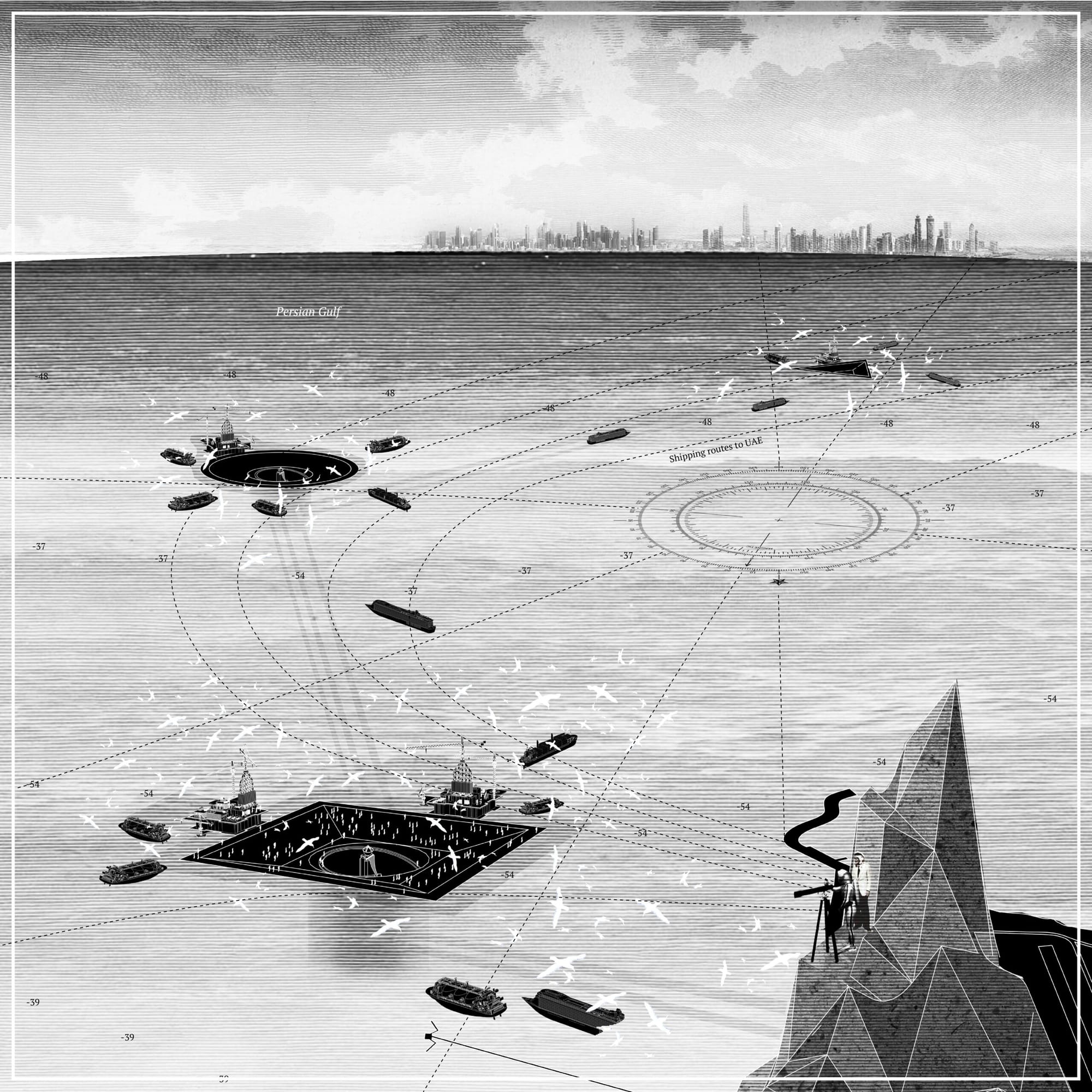
After Oil (Das Island/Das Crude) by DESIGN EARTH
The cover image for MER issue 311, "Post-Fossil Politics," is an inkjet on canvas print entitled “After Oil (Das Island/Das Crude).”
The image is part of the [“After Oil” series](https://design-earth.org/projects/after-oil/), first exhibited in 2016, by DESIGN EARTH: a [research project](https://design-earth.org/) founded by architects Rania Ghosn and El Hadi Jazairy to explore the climate crisis through speculative architecture.
The series itself speculates on the geography of the Gulf in a future after oil. But it equally attends to the present landscape of production, transit and consumption—as oil powers cities and destroys ecosystems. In the words of the artists, the images “stage and extrapolate critical issues of today’s oil landscape to make the public aware of the energy systems on which modern life is dependent and the long-term consequences of current fossil fuel regime.”[\[1\]](#%5Fedn1)
The current MER issue, like the “After Oil,” series, explores how the discourses and technologies emerging around a post-fossil future are in reality deeply embedded within the existing landscapes of fossil fuel extraction. The long-term effects of the fossil-driven climate crisis necessitate the use and dependence on more energy for humans to live comfortably—as [Marwa Koheji](https://merip.org/2024/07/fossil-fueled-comfort-the-history-and-cost-of-air-conditioning-in-bahrain) shows in her article on the history and cost of air-conditioned comfort in Bahrain. As contributions by [Ben Scheutze](https://merip.org/2024/07/the-uneven-politics-of-decarbonization-in-the-middle-east-and-north-africa) and [Adam Hanieh](https://merip.org/2024/07/laundering-carbon-the-gulfs-new-scramble-for-africa) argue, the industries of decarbonization are poised to reproduce rather than subvert existing hierarchies and prolong the extraction of oil. And as [Natalie Koch](https://merip.org/2024/07/desert-solar-a-spectacular-fiction-not-a-spectacular-future) poignantly illustrates, the use of fossil-fuel wealth to invest in solar and hydrogen technologies in the Gulf are a spectacular fiction that will not solve the climate crisis. There is nothing post about our post-fossil future.
The particular image chosen for the cover focuses on points of transit and extraction, recalling, for the editors, the inevitable role of these sites in shaping the geopolitics of decarbonization but equally their potential as [sites of disruption](https://merip.org/2024/07/routes-to-disruption-supply-chain-sabotage-and-israels-war-on-gaza). Das Island is an Emirati offshore industrial oil and gas facility that has helped fuel the urbanization of Abu Dhabi. The image foregrounds surveying and extraction, with cartographic routes of transit receding toward a distant cityscape. As Ghosn has said, “We will always imagine that there is possibly a faraway, distant, remote, uninhabited place that can still bear the costs of urbanization, while the city can only reap the most beautiful rewards. It's precisely that that After Oil wants to counteract. It wants us to reflect critically on the time and space that we occupy now.”[\[2\]](#%5Fedn2)
**Read the [first](https://merip.org/2024/07/the-uneven-politics-of-decarbonization-in-the-middle-east-and-north-africa) article** **in** [**MER issue 311**](https://merip.org/magazine/311/) **“Post-Fossil Politics.”**
---
### **Endnotes**
[\[1\]](#%5Fednref1) "[After Oil](https://design-earth.org/projects/after-oil/)," DESIGN EARTH website, 2016.
[\[2\]](#%5Fednref2) Rania Ghosn, "[Audio about After Oil (Das Island, Das Crude)](https://www.moma.org/collection/works/279883?artist%5Fid=70051&page=1&sov%5Freferrer=artist)," MoMA.
### Speculative Climate Futures in Arab Literature
URL: https://www.merip.org/2024/07/speculative-climate-futures-in-arab-literature/
Last updated: 2025-08-22T18:36:17.000Z

Beirut by Barrack Zaila Rima, Ibrahim Nasrallah’s The Second War of the Dog and The Solar Grid by Ganzeer.
There is a fixity to the boundaries of genre fiction in English, enforced within publishing as within scholarship, that is largely absent in Arabic.
While Anglophone publishing is intensely concerned with comparative titles and where a novel fits into the landscape, contemporary Arabic publishing largely is not. As such, there is no fixed terminology used for cli fi (climate fiction) in Arabic—though there is fiction that looks much like cli fi in English: works concerned with the consequences of anthropogenic climate change and more specifically with long-term shifts in weather patterns sparked by greenhouse gas emissions. It might be called *adab taghayyur al-manakh* (“literature of climate change”), *al-adab al-biʾi* (“environmental literature”) or even a transliterated *klaymat fikshun*.[\[1\]](#%5Fedn1)
The genre is not as popular in Arabic—[a fact which some critics](https://english.ahram.org.eg/NewsContentP/50/477688/AlAhram-Weekly/Analysis-Climate-change-and-Arabic-literature.aspx), like Egyptian journalist and short story writer, Ahmed al-Khamissi, have lamented. But [sci fi author Emad El-Din Aysha suggests](https://theliberum.com/double-trouble-moataz-hassaniens-2063-charting-course-today-world-tomorrow/) that the Western affection for dystopia could also be seen as a luxury. He writes that people grappling with “real-life anxieties around every corner” have less need to invent them.[\[2\]](#%5Fedn2) Generally, there seems to be more climate fiction in the form of graphic novels and animated short films. In part, these projects are more easily funded within international projects, but they are also forms that invite experimentation.
Taking a slightly broader view that moves beyond near-future speculation finds many Arabic fictions concerned with the consequences of human actions on the natural world: **[Abdelrahman Munif’s *Cities of Salt* (1984)](https://arablit.org/2018/03/26/teaching-with-arabic-literature-in-translation-abdelrahman-munifs-cities-of-salt/)** on the impact of oil; **[Ibrahim al-Koni’s *The Bleeding of the Stone* (2013)](https://www.simonandschuster.co.uk/books/The-Bleeding-of-the-Stone/Ibrahim-al-Koni/9781623710767)** and plenty of other novels, about the impact of humans on desert landscapes; and **[Ismail Fahd Ismail’s *The Old* *Woman and the River* (2017)](https://arablit.org/2019/10/28/a-wartime-novel-thats-tender-charming-and-donkeyphilic/)**, chronicling how war reshapes the natural environment.
When Omani writer Zahran Alqasmi won the 2023 International Prize for Arabic Fiction for his **[*The Water Diviner*](https://arabicfiction.org/en/node/2082)*,*** which is set in the present, several of the judges raised the issue of climate change. The novel itself doesn’t foreground climate disaster. But many readers seem to have read it into this novel, in which a village’s irrigation system is fundamental to social relationships and systems. Similarly, many of the books and short stories by Nubian writers chronicling the impact of the Aswan dam can be read as climate fiction, as Christine Anna Gilmore argues.[\[3\]](#%5Fedn3)
But for the sake of this MER issue, on the politics of a post-carbon future, below are a few titles from the Maghreb and Mashriq, largely written in Arabic, that line up more neatly with what readers typically mean by climate fiction in English.
## **Dystopias, Both Ugly and Beautiful**
Environmental catastrophe provides an essential origin story for many dystopias, including [**Ibrahim Nasrallah’s *The Second War of the Dog***](https://arablit.org/2018/04/24/ibrahim-nasrallahs-the-second-war-of-the-dog-wins-2018-international-prize-for-arabic-fiction/)*,* which won the International Prize for Arabic Fiction in 2018\. This near-future dystopia—by an author best-known for his historical fictions—focuses on the intersections of technological developments and the corruption of power, most prominently through “forged” copies of human beings: A machine can transform one person into the doppelgänger of another, accelerating our ability to manipulate and exploit one another and shrinking the space for individual identity. The backdrop to the novel is a climate catastrophe that has boxed humans into a corner, with changes in the atmosphere and agriculture and birds falling dead from the sky. Here, climate disaster acts as an intensifier of social and political horrors, as well as a commentary on the narrative of human progress.
> **Here, climate disaster acts as an intensifier of social and political horrors, as well as a commentary on the narrative of human progress.**

Utopia by Ahmed Khaled Towfik.
Several other near-future dystopias, such as [**Mohamed Rabie’s *Otared* (2016)**](https://mosaicrooms.org/product/otared/) and [**Ahmed Khaled Tawfiq’s *Utopia* (tr. Chip Rossetti, 2012)**](https://arablit.org/tag/ahmed-khaled-towfik/)*,* focus more on political systems, but the environment is close at hand. As [Teresa Pepe points out](https://www.tandfonline.com/doi/full/10.1080/1475262X.2023.2252774), in the latter of the two, economic and ecological disaster stand at the root of the novel’s dystopic vision.[\[4\]](#%5Fedn4) These catastrophes were brought on by the collapse of fossil fuel production, leading to a violent separation between the rich and the poor. The work is set in and around a future suburban compound that has as a border as militarized as a country’s*.* Within the walled-off compound, which is protected by US soldiers, the rich hoard virtually all of Egypt’s resources, leaving almost nothing for the Egyptians who still live in their old cities.

Iraq +100: Stories from a century after the invasion, edited by Hassan Blasim.
In [**Ahmed Naji’s *And Tigers to my Room* (2020)**](https://ahmednaji.net/), which is currently being adapted to film by Hamsa Production House in Brooklyn, the action ranges across thousands of years of history, from distant past to near future. The novel confronts how large-scale utopic architectural projects currently being planned—like Saudi Arabia’s floating industrial complex and linear city, NEOM—are the same sort of extractionist, authoritarian enclaves we find in *Utopia.* Rather than living in the cities that rose up over thousands of years, such as Cairo, people live in artificially crafted new cities that suck up resources in order to produce an artificial grandeur. When one of the [central characters](https://www.penopp.org/articles/excerpt-najis-novel-and-tigers-my-room?language%5Fcontent%5Fentity=en) arrives in NEOM, she sees, “great green pastures for the camels, greater ones yet for golf courses, shepherds each one taller than the next, three Magian stars, streets laid out in geometric grids like civilization, vast tracts of tropical garden beneath glass domes, art works and sculptures in huge laser-lit squares.”[\[5\]](#%5Fedn5) It is a bright and impossible promise of environmental and social idyll.
Notable climate fictions can also be found in the stories published as part of Comma Press’s “future past” series, in which authors are charged with setting their stories 100 years after a defining historical event. For [***Palestine + 100* (2019)**](https://commapress.co.uk/books/palestine-100)*,* it is the 1948 Nakba, while in [***Iraq + 100* (2016)**](https://commapress.co.uk/books/iraq-100)*,* it is the start of the US-led invasion in 2003\. In [**Saleem Haddad’s “Song of the Birds,”**](https://commapress.co.uk/authors/saleem-haddad) published in the anthology *Palestine + 100* (edited by Basma Ghalayini), a false utopia is plastered over the top of a climate dystopia to keep residents pacified. In [**Hassan Blasim’s “The Gardens of Babylon,”**](https://commapress.co.uk/authors/hassan-blasim) (translated by Jonathan Wright and published in *Iraq + 100*)*,* the city of Babylon must be supplied with water by “water trains” that come from central and northern Europe. In the story, the Water Rebels don’t like the way this resource is being shared. After all, “some people hardly seem to have enough e-credit to pay for their quota, while in rich areas you see special trucks filling swimming pools and fountains with the stuff.”[\[6\]](#%5Fedn6)
The latest collection [***Kurdistan + 100* (2023)**](https://commapress.co.uk/books/kurdistan-100), edited by Orsola Casagrande and Mustafa Gündoğdu, also has several notable fictions that highlight a future of biodiversity collapse—one in which Kurds are further marginalized and cut off from their pasts.
## **Happily Ever After—Stories that Fix the Climate**
Not all Arabic cli fi is gloom and dystopic doom. There are also wish-fulfillment stories in which the characters find a way to win out over destructive systems.
Lebanese novelist [**Ghassan Chebaro’s *2022***](https://www.mdpi.com/2410-9789/2/1/3)*,* published in 2009, is essentially a battle between climate activist Diana Faris and climate destroyer Mansour Qashush. In the end, Diana gets a seat in the Lebanon’s parliament from which she can pursue her environmental goals.
The ending paints a far brighter picture than most Lebanese writing on climate, including the darkly comic [**“Wasting Away” by Lina Mounzer**](https://thebaffler.com/latest/waste-away-mounzer)—a story about Lebanon’s trash that was published in the anthology [*Tales of Two Planets* (2020)](https://www.penguinrandomhouse.com/books/599674/tales-of-two-planets-by-edited-by-john-freeman/). Barrack Zaila Rima’s time-traveling [***Beirut* trilogy of graphic novels (2017)**](https://wordswithoutborders.org/read/article/2020-02/february-2020-graphic-novel-beirut-trilogy-rima-calarge-gueydan-turek/), translated by Carla Calargé & Alexandra Gueydan-Turek, also features a Lebanon in which trash is relentless. Yet another unhappily-ever-after view of Lebanon’s garbage crisis comes in [**Mounia Akl’s 2016 film** ***Submarine***](https://www.mouniaakl.com/submarine), where one young woman attempts to hold off the apocalypse by creating beauty in her own home and refusing to evacuate in the face of environmental collapse. Although the film is speculative fiction, Akl [said in an interview with Joey Ayoub](https://hummusforthought.com/2018/07/18/conversation-with-mounia-akl-director-of-submarine/) that they “mixed production design locations and relocations to work on that thin line between dystopia and present reality,” showing, for instance, a real dump in Nahr Beirut.[\[7\]](#%5Fedn7)
> **Genetic engineering has enabled the creation of the good “green” human, heralding a kinder and gentler future without genocide or colonial plunder.**
But Chebaro is not the only author attempting to craft a better fictional future. Like *2022*,** Jordanian novelist [**Subhi Fahmawi’s *Alexandria 2050* (2009)**](https://search.worldcat.org/title/iskandariyah-2050-riwayah/oclc/436944016) also presents a fixed-up climate. Set in an Alexandria that has not disappeared beneath the rising sea, this novel presents a positive future where technology brings real pleasure. In it, an old Palestinian engineer returns to Alexandria from Dubai in the year 2050 to meet his son, Burhan, who specializes in genetic engineering, and Kanaan, his “green” (genetically engineered) grandson. Genetic engineering has enabled the creation of the good “green” human, heralding a kinder and gentler future without genocide or colonial plunder.
In [**Maria Dadouch**’s *I Want Golden Eyes* (2019)](https://www.japublishers.com/i-want-golden-eyes/), technology increases the chasm between the haves and the have-nots. But in [***The Mystery of the Glass Ball***](https://frankfurtrights.com/Books/Details/the-mystery-of-the-glass-ball-19047773)*,* published in 2021 and catered toward somewhat younger readers, the story takes place in a future where humans have managed to preserve the deserts of the Arabian Peninsula thanks to good stewardship and the use of technology. In the novel, a boy comes across two criminals who want to ruin this beautiful future by poisoning an oasis and killing off animals in a desert sanctuary. Naturally, he doesn’t let them get away with it.
## **Experiments in the Graphic Novel, Photography and Animated Film**

Inside the Giant Fish by Rawand Issa.
Some of the most interesting approaches to climate change in Arabic literature have come in graphic novels and other hybrid forms. [**Rawand Issa’s *Inside the Giant Fish***](https://www.tcj.com/reviews/inside-the-giant-fish/)*,* translated by Amy Chiniara (2023), like Rima’s *Beirut* trilogy, melds contemporary documentary and magical form.
Climate change is also one of the background movers in Ahmed Naji’s experimental 2016 hybrid graphic novel [***Using Life***](https://utpress.utexas.edu/9781477314807/)*,* illustrated by Ayman Al-Zorkany and translated to English by Ben Koerber. In the work, a tsunami-like sandstorm buries Cairo, after which come the earthquakes. Here, with historic Cairo largely destroyed and a “new Cairo” springing up on its outskirts, Naji crafts both a portrait of intimate relationships in the shadow of dystopia and a satire of global power.
> **The collection of intertwined stories maintains a broad, internationalist view, interested not just in one segment of society but in what punishingly extractive relationships might mean for the future of the rich and the poor, the Global North and South**
[***The Solar Grid***](https://thesolargrid.net/)*,* a serialized graphic novel written and illustrated by the Egyptian artist known as [**Ganzeer**](https://ganzeer.com/), is another wild and wide-ranging futuristic gambol, this time firmly centered on corporate-fueled climate apocalypse. Instead of a sandstorm it is a flood that submerges the majority of the world, including Egypt. Afterwards, a catastrophic tech solution is put in place: the titular solar grid. The ensuing entangled narratives take readers across space and time, revealing both human resilience and also the Sisyphean insistence that more technology, and more corporate capital, will surely solve humanity’s climate disasters. The collection of intertwined stories maintains a broad, internationalist view, interested not just in one segment of society but in what punishingly extractive relationships might mean for the future of the rich and the poor, the Global North and South.

Poster for the film "Kenopsia" by Mohamed Omar.
[**Seif Kousmate’s photography and poetry project *Waha***](https://www.rencontres-arles.com/en/expositions/view/1058/seif-kousmate) (“oasis”)—which, in 2022, he [announced](https://www.arabculturefund.org/News/190) he was turning into a book—offers an essential exploration of water, one that observes, in real time, as this essential resource evaporates. As part of *Waha*, Kousmate has not only been photographing the changes to Morocco’s oases but also gathering poetry and testimonies from residents, in a project he [calls](https://www.arabculturefund.org/News/190) “poetic documentary photography.”[\[8\]](#%5Fedn8)
[**Mohamed Salah’s “8 Minutes”**](https://theoffingmag.com/art/8-minutes/) *is a comic created for an exhibition on climate change in* collaboration between the Swedish institute in Alexandria and the Mazg Foundation. Set in Alexandria, the work focuses on rising sea levels, taking a much bleaker look at the future than Subhi Fahmawi’s *Alexandria 2050*. In Salah’s world, rising sea levels have ushered in a violent, opportunistic lawlessness. Against this backdrop, Salah searches for a moment of beauty to depict and finds a man and woman who risk venturing out into this dangerous world for eight minutes to watch the sunset.
Tenderness and wonder amid the climate ravaged future are also at the heart of [**Mohamed Omar’s animated short film** **“Kenopsia,”**](https://www.filmmydesign.com/kenopsia) which is set in an empty Cairo, to which an old man returns in search of his childhood home. The film offers a bleak vision: Tahrir Square is full of abandoned camps that were used to shelter refugees from Alexandria after it was flooded. One must wear a mask in order to breathe. In the quiet landscape, the viewer joins the main character in his nostalgia for the semi-breathable chaos of today’s Cairo.
\[**Marcia Lynx Qualey** is the founding editor of [ArabLit](https://arablit.org/) and *ArabLit Quarterly*.\]
---
### **Endnotes**
[\[1\]](#%5Fednref1) Teresa Pepe, “[Climate Change and the Future of the City: Arabic Science Fiction as Climate Fiction in Egypt and Iraq](https://www.tandfonline.com/doi/full/10.1080/1475262X.2023.2252774),” *Middle Eastern Literatures* 26/1 (2023), p. 100.
[\[2\]](#%5Fednref2) Emad El-Din Aysha, "[Double Trouble: Moataz Hassanien’s ‘2063’, charting a course for today, from the world of tomorrow!](https://theliberum.com/double-trouble-moataz-hassaniens-2063-charting-course-today-world-tomorrow/)," *Liberum*, January 15, 2019.
[\[3\]](#%5Fednref3) Christine Anna Gilmore, “Dams, Displacement and Development in Narratives of the Nubian Awakening,” PhD Thesis, The University of Leeds, June 2016.
[\[4\]](#%5Fednref4) Teresa Pepe, “[Climate Change and the Future of the City: Arabic Science Fiction as Climate Fiction in Egypt and Iraq](https://www.tandfonline.com/doi/full/10.1080/1475262X.2023.2252774),” *Middle Eastern Literatures* 26/1 (2023), pp. 99–118.
[\[5\]](#%5Fednref5) Ahmed Naji, “[Excerpt from Naji's Novel And Tigers to my room](https://www.penopp.org/articles/excerpt-najis-novel-and-tigers-my-room?language%5Fcontent%5Fentity=en)” (translated by Robin Moger), Pen/Opp, February 25, 2022.
[\[6\]](#%5Fednref6) *Iraq + 100: Stories from a Century after the Invasion*, ed. Hassan Blasim (Comma Press, 2016), p. 13.
[\[7\]](#%5Fednref7) Elia J. Ayoub, "[In Conversation with Mounia Akl, Director of 'Submarine](https://hummusforthought.com/2018/07/18/conversation-with-mounia-akl-director-of-submarine/),'” Hummus for Thought, July 17, 2018.
[\[8\]](#%5Fednref8) "[Degradation through Aesthetics and Poetry: An Encounter with Seif Kousmate on 'Waha'](https://www.arabculturefund.org/News/190)," AFAC Arab Fund for Arts and Culture, June 10, 2022.
### A Deadly Trade—Refugee Labor in Turkey and Europe's Plastic Waste
URL: https://www.merip.org/2024/06/a-deadly-trade-refugee-labor-in-turkey-and-europes-plastic-waste/
Last updated: 2025-10-31T14:42:51.000Z
In May 2021, at just 13-years old, Hayat found himself wandering aimlessly on the streets of Istanbul, dazed and a little terrified.
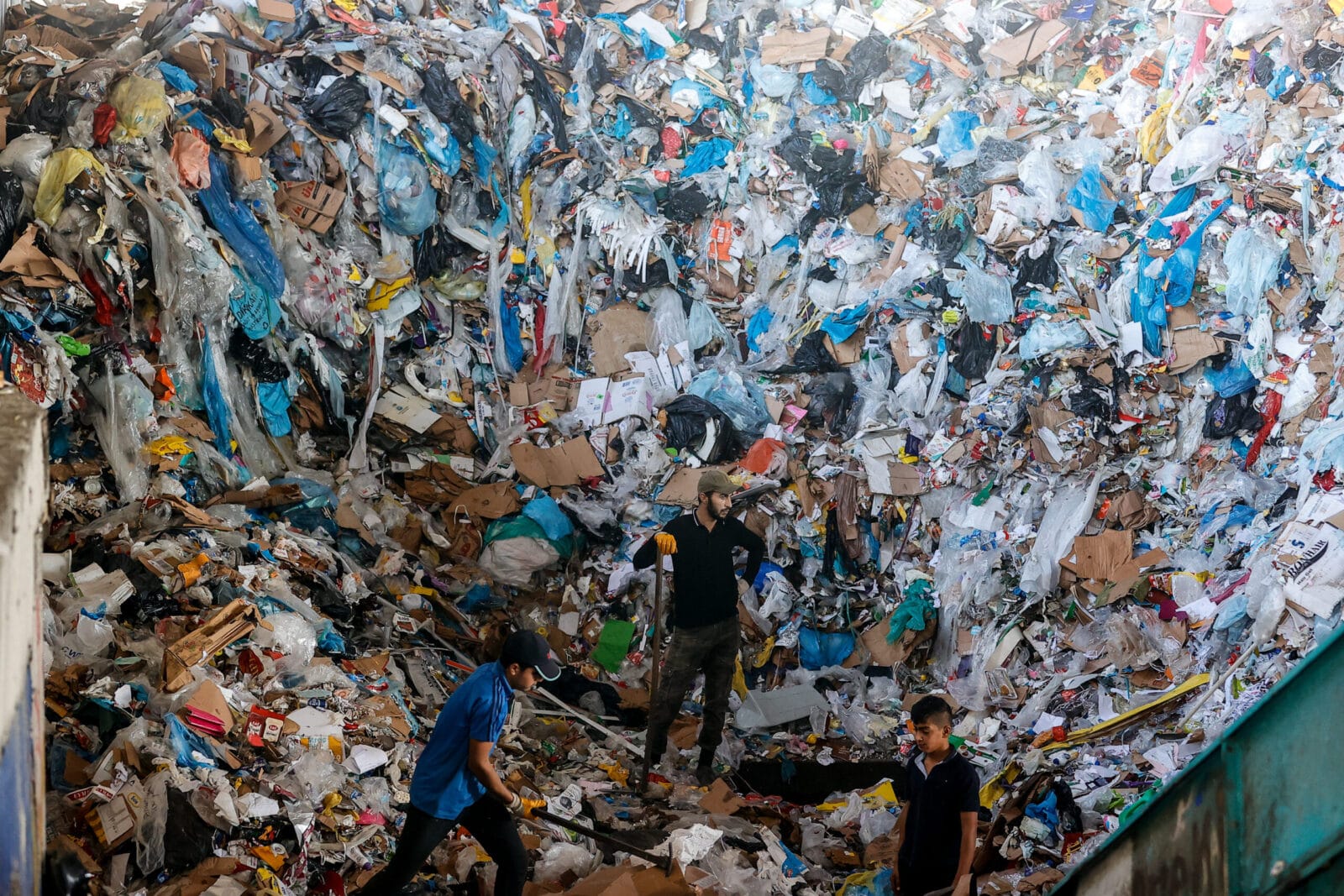
Workers separate waste at a recycling factory, Antalya, Turkey, 2021\. Mustafa Ciftci/Anadolu Agency via Getty Images
A slight, fine-boned child, he cut a fragile figure amid the hard-edged city. Born into a farming family from the rural Khogyani district of Afghanistan’s Nangarhar province, Hayat had never experienced a metropolis on the scale of Istanbul. Bombarded by the sights, the sounds, the endless crowds and anarchic traffic, he was overwhelmed.
“It was like I was dreaming,” he told me in early 2023\. “On that first day, I walked around for hours and hours, just staring at everything.”
Like millions of refugees, Hayat had escaped war and poverty to seek out a better life for himself and the family he’d left behind in Afghanistan. His story was familiar: His mother and two sisters were now depending on him after his father, a soldier in the Afghan army, had died. Thousands of Afghan refugees in Turkey could recount similarly tragic stories.
Nearly two years later, in the six-square meter concrete storage closet Hayat shared with two other Afghan refugees, Naseem and Khalid, that childlike wonder was gone. The storage closet was a dingy space set in the back of a plastic recycling factory in the Cebeci neighborhood, far out on Istanbul’s northwestern outskirts.
Over the three months I’d been visiting them—every Sunday, when their boss was away—Hayat, Naseem and Khalid had remained mostly stoic. None of the “boys,” as I’d begun to call them, had expected to be in Istanbul for so long. Their goal was Europe. And they certainly never expected to be living in a plastic recycling factory. But their predicament was common in Istanbul. Afghans have become the most vulnerable refugee population in Turkey, demonized by the Turkish media and targeted for arrest and deportation. In [2022 alone](https://www.hrw.org/report/2022/11/18/no-one-asked-me-why-i-left-afghanistan/pushbacks-and-deportations-afghans-turkey), nearly 50,000—mostly young men and boys—had been sent back to Taliban-governed Afghanistan.[\[1\]](#%5Fedn1) To escape arrest, many Afghan men had gone underground.
What was a dire situation for them was a boon for the owners of small recycling factories in industrial districts like Cebeci. Plastic recycling has become a big business in Turkey after China banned plastic waste imports in late 2017\. Prior to the ban, China was the primary destination for plastic waste from the world’s wealthy nations, taking in as much as 8.8 million tonnes a year.[\[2\]](#%5Fedn2)
In the immediate aftermath of the ban, imports into Turkey spiked, jumping by more than 150 percent in 2018 compared to 2017\. By 2023, the last year of available data, they were up nearly 250 percent.[\[3\]](#%5Fedn3) Plastic waste imports into nations in Southeast Asia, including Indonesia, Malaysia and Vietnam, shot up even more dramatically.
None of these countries had the industrial capacity to deal with the influx. But they did have one thing that made them ideal plastic waste dumping grounds: a ready supply of cheap, easily exploitable labor. In Southeast Asia, that labor was mostly poor locals. In Turkey, it was refugees.
## **The Shifting Trade in Recycled Waste**
China’s ban came at an ideal time for Turkey’s plastic recyclers. Less than two years before it was implemented, the European Union had signed [a controversial migration deal with the Turkish government](https://www.rescue.org/eu/article/what-eu-turkey-deal). Turkey was promised six billion euros, among other political guarantees, to keep refugees from crossing into Europe. At the same time, funding for Frontex, the EU’s border protection agency, had soared, swelling to [over 754 million euros in 2022](https://www.merip.org/content/files/assets/Key%5FDocuments/Budget/budget%5F2016.pdf), an increase of nearly 300 percent since the deal was signed.
> **Much of the waste Turkey receives consists of low quality and contaminated plastics, dirty trash that often arrives in the country illegally.**
The results were predictable: refugee numbers in Turkey spiked from nearly [2.8 million](https://reporting.unhcr.org/operational/operations/t%C3%BCrkiye?year=2015) at the end of 2015 to nearly [3.8 million](https://reporting.unhcr.org/operational/operations/t%C3%BCrkiye?year=2017) by the end of 2017\. The availability of cheap refugee labor has been key to sustaining Turkey’s burgeoning recycling sector. Much of the waste Turkey receives consists of low quality and contaminated plastics, dirty trash that often arrives in the country illegally. “The only way to make money out of these types of plastics,” Yeo Bee Yin, the former Malaysian Minister for Environment and Climate Change, pointed out in October last year during a [webinar](https://www.youtube.com/watch?v=Tc25wlMRHnk&t=12s) on the illicit waste trade, “is to be an illegal factory.”[\[4\]](#%5Fedn4)
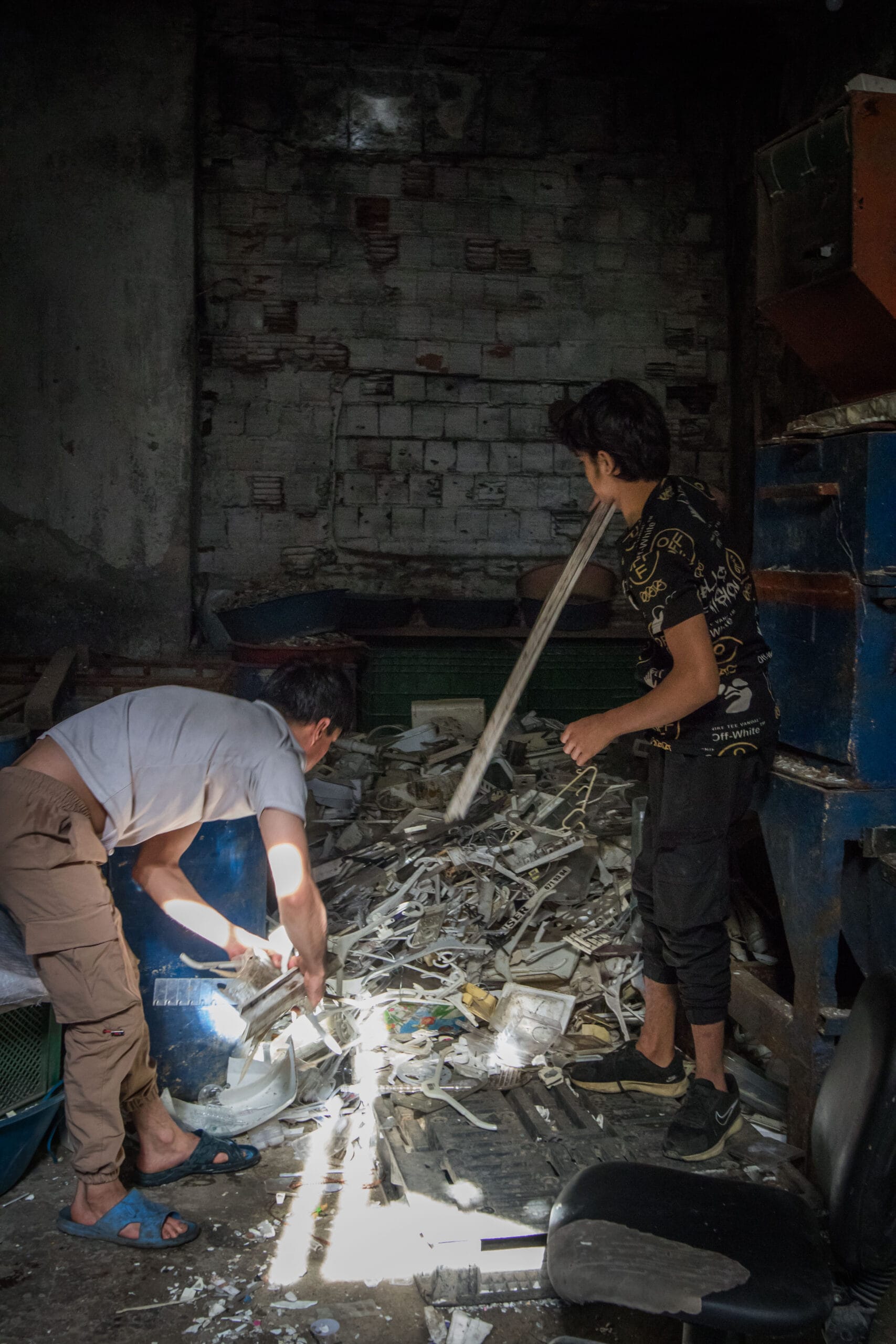
Hayat and Khalid load plastic into a dilapidated shredder at the plastic recycling factory where they live and work in the Cebeci industrial district of Istanbul. Photo courtesy of the author.
China’s decision to ban plastic waste imports, despite the economic windfall they brought, was responding to similar concerns. [For years](https://resource-recycling.com/recycling/2018/02/13/green-fence-red-alert-china-timeline/), the Chinese Communist Party had tried to clean up the trade, placing limits on the types of plastic it would take and demanding exporting countries do their part to reduce the levels of contamination. None of it was working. The lack of regulatory oversight at European ports failed to reduce the traffic in contaminated waste. Domestically, China’s vast supply of labor—and profit-obsessed factory owners willing to exploit it—made it an ideal destination, despite the massive damage it inflicted on China’s environment and human health.
When trade shifted to other countries in 2018, these problems shifted with it. In Cebeci, none of the refugee workers I spoke to knew, or really cared, where the plastic waste was coming from or how dirty it was. The factory where Hayat and his companions worked was a dark, dingy place. Tattered insulation dangled precariously from the ceilings; dirty rainwater leaked through cracks onto cinderblock walls, leaving behind mouldy stains and a musty stench. Any patches of the floors not covered by piles of plastic trash were encrusted with a layer of powder—a by-product of the shredder, which, when turned on, would belch out fine plastic particulates that filled the air with a toxic mist. Cebeci was packed with such factories: crumbling concrete and rusted metal siding surrounded by toxic waste dumping grounds where the worst of Europe’s plastic trash lay buried.
Hayat, Naseem, and Khalid, the factory’s only workers, toiled fourteen-hour days, six days a week under conditions that fit the [UN definition of modern-day slavery](https://www.ohchr.org/en/special-procedures/sr-slavery#:~:text=Article%204%20of%20the%20Universal,prohibited%20in%20all%20their%20forms'.). Their work was noxious and potentially fatal. Plastic waste would arrive on trucks, which the three would unload and divide into what was recyclable and what was not. They would hand feed the recyclable pile into an old, dilapidated shredder that spat out jagged, shark tooth-sized flakes. The flakes would then be washed in drums of putrid water and dumped into an industrial dryer. When turned on, the dryer would heat up and spin rapidly, emitting acrid fumes that invaded the lungs and settled on the skin like a sticky film. For their work, they were paid around 70 euros a month—low, even in Turkey’s economy. But their status as refugees meant there wasn’t much they could do. Whenever they complained, their boss threatened to call the police and have them deported. Besides, the boss told them, they were living in his factory for free. That should count for something.
The storage closet where they lived had no heating and was too small to accommodate all three of them. They took turns sleeping: one on the couch, one on the floor, the third crouched in a corner, waiting his turn. There was no proper toilet—just a hole in the ground connected to a sewage pipe—and no running water. They bathed once a week, on Sundays, when they could sneak over to another factory and fill up jugs of clean water.
## **The Myth of Plastic Recycling**
If you believe the [information videos](https://www.youtube.com/watch?v=g1WTgGyirDw) put out by the recycling industry, plastic recycling is a neatly organized process: Plastic waste arrives in tidy bundles at sparkling clean factories where smiling workers deftly put it through a high-tech recycling process, producing gemstone-like plastic pellets ready to be shipped off to join what the industry euphemistically refers to as the circular economy.
According to a February 2024 [report](https://climateintegrity.org/plastics-fraud) published by the US-based Center for Climate Integrity, the myth of plastic recycling is the product of “a decades-long campaign of fraud and deception about the recyclability of plastic” perpetrated by petrochemical companies. In much the same way the tobacco industry lied about the health effects of smoking, the plastic industry has actively obscured the fact that their products cannot be sustainably recycled.[\[5\]](#%5Fedn5) “These efforts have effectively protected and expanded plastic markets,” the report concluded, “while stalling legislative or regulatory action that would meaningfully address plastic waste and pollution.”[\[6\]](#%5Fedn6)
The report’s conclusions paint a disturbing picture of Europe’s recycling efforts. [According to the European Parliament](https://www.eumonitor.eu/9353000/1/j9vvik7m1c3gyxp/vkufaw0m3zy4?ctx=vjxzjv7ta8z1), less than a third of plastic waste produced in Europe is recycled and, as the Center for Climate Integrity’s researchers showed, most of it can only be recycled once. Half of all European waste enters the global trade in plastic waste, packed into bales, loaded onto shipping containers and sent off to ports in Rotterdam and Antwerp. It is a massive industry, generating billions of dollars a year. It’s also a dirty business, filled with profiteers and small-scale operations that are almost impossible to regulate. Attempts to clean it up have mostly failed. Meanwhile, Europe’s garbage continues to pile up in some of the world’s poorest countries.
After China’s exit, attempts were made to introduce more oversight within the plastic waste trade: In May 2019, for instance, plastic waste was added to the Basel Convention on the Control of Transboundary Movements of Hazardous Wastes and their Disposal. The new measures included “a set of actions for preventing and minimizing the generation of plastic waste, improving its environmentally sound management and controlling its transboundary movement; reducing the risk from hazardous constituents in plastic waste; and public awareness, education and information exchange.”[\[7\]](#%5Fedn7)
> **While they did set up a regulatory framework for exporting plastic waste—one set of rules for exports to non-OECD countries and another, looser set for OECD countries—the rules were poorly enforced.**
It sounded nice on paper but in reality, the amendments were little more than window dressing. While they did set up a regulatory framework for exporting plastic waste—one set of rules for exports to non-OECD countries and another, looser set for OECD countries—the rules were poorly enforced. What China’s near monopoly on the plastic waste trade had obscured was just how big and lucrative it was. The potential profits incentivized bad behavior, while industrialized nations’ desire to somehow get rid of their trash disincentivized oversight.
The result, according to Shanna Mehlbaum, was a trade environment dominated by “cowboys who don’t care about regulations and just want to make money.” Mehlbaum is an independent criminologist and doctoral candidate at Tilburg University studying the international trafficking of waste from the Netherlands—the largest exporter of plastic waste in the EU in 2021 and, per capita, the largest in the world.[\[8\]](#%5Fedn8)
In her experience, Mehlbaum told me, there are just too many ways to get around the regulations. Fraudsters can, for instance, import waste into the Netherlands and then re-classify it as a reusable commodity, like processed plastic pellets. “Then you can sell it as a secondary raw material and you fall into another regime,” she said. “It wouldn’t be traced at all in the same system or leave a paper trail in the waste management system.”
The only way to prevent such fraudulent activity is a robust monitoring regime, she added. But [according](https://www.ilent.nl/documenten/leefomgeving-en-wonen/afval/afvalinzameling-en--preventie/factsheets/hoogwaardige-grondstoffen-naar-verre-landen-door-geringe-vraag-in-eu) to the Netherlands’ Human Environment and Transport Inspectorate (ILT)— responsible for monitoring the transportation of waste materials in the Netherlands—customs officials only carried out a total of 624 inspections on plastic waste exports in 2022.[\[9\]](#%5Fedn9) This number is not nearly enough, Mehlbaum said, to bring illegal trafficking under control.
One of the ILT’s own senior inspectors, Huib van Westen, [noted](https://www.youtube.com/watch?v=Tc25wlMRHnk&t=12s) that the scale of waste exports from the Netherlands—in the range of 1.5 million shipments a year—makes it almost impossible to monitor how much hazardous waste is being illegally trafficked. “To be honest,” he said, “if no one is informing us, we have no idea what is being shipped.” What’s needed are more physical inspections, but that would require massive resources.
The ILT, for its part, [claims](https://www.ilent.nl/documenten/leefomgeving-en-wonen/afval/afvalinzameling-en--preventie/factsheets/hoogwaardige-grondstoffen-naar-verre-landen-door-geringe-vraag-in-eu) that more than 80 percent of plastic waste exports to countries like Indonesia and Turkey consist of “easily recyclable waste film.” But the figure is hard to verify. When I asked the ILT how it came up with the number, it was vague, saying it is “based on customs data” and inspections. The logic, though, is perplexing. The customs data, as Mehlbaum said, is unreliable. And as van Westen, the ILT’s own senior inspector pointed out, the number of inspections is not nearly sufficient to provide a clear picture of what’s really going on. In addition, the regulatory regime for plastic waste exports allows for [two percent contamination](https://environment.ec.europa.eu/system/files/2022-02/MS%20threshold%20values%20-%20contaminants%20in%20green-listed%20wastes%20REV2022.pdf) in any shipment of waste.
Dr. Delphine Lobelle—an expert in physical oceanography who has [researched](https://journals.sagepub.com/doi/10.1177/0734242X231180863) plastic waste flows in the Netherlands—told me it is impossible to know if the two percent rule is being followed without opening up a significant number of shipping containers and testing the plastic waste they contain. Large amounts of contaminated waste, or mixed plastics that are difficult to recycle, can easily be hidden in what the ILT classifies as “valuable raw materials.”
“This is the basic problem,” Mehlbaum told me. “There is money to be made and the regulations are difficult to enforce. The system is not working. I’ve been studying this for years and I just keep coming back to this point: We have all of these regulations but it’s so easy to commit fraud.”
## **A Dangerous Industry**
On a Sunday in November 2022, early on during my weekly meetings with the Afghan refugees at the plastic recycling factory, we were seated around a heater I had purchased for the storage closet, warming our hands and talking. Hayat was tucked away in a corner, as he usually was, scrolling through his mobile phone.
Hayat takes a rest from shredding plastic waste to call his mother in Afghanistan at the plastic recycling factory where he lives and works in the Cebeci industrial district of Istanbul. Photo courtesy of the author.
Suddenly, he looked up. “Did you hear about what happened to Arifullah Fazli?” he asked. “He worked at a different factory, just around the corner from us. He died in September. He climbed into a shredder to pull out something that got stuck in the blades. Someone accidentally turned the machine back on while he was still inside. I have pictures. Do you want to see?”
Without waiting for me, he began scrolling rapidly through his mobile phone. He stopped and stared momentarily, blank-faced, before turning the screen to me.
On it was a scene from what looked to be some kind of industrial yard. In the foreground was a pile of plastic waste—mostly single-use plastic bags. In the center of the frame stood a young man, hair closely cropped, wearing a black t-shirt and black jeans, holding a metal rod with a hook on one end. He appeared to be gesturing to someone outside the frame. Behind him was the body of Arifullah Fazli, two bloodied stumps where his legs used to be.
“The owner of the recycling factory tried to throw the body out with the trash,” Hayat said, turning the phone and looking at the image one more time, “but other refugees managed to call the police before he could.”
The image was jarring, not only because of its gruesome contents but because of its moral implications. After months of investigation, working with a Turkish lawyer, I was finally able to confirm in September of 2023 that a case had been filed against Cemil Onemli, the factory owner, but it was sitting untouched at the prosecutor’s office. Fazli’s body, Yuksel Yilmaz, the president of the Istanbul Recyclers Association told me, had been returned to Afghanistan. “The case is ongoing so we cannot comment on it,” he said.
According to the case file, Onemli denied Fazli worked at his factory, claiming one of his Turkish employees had found a dead body in the trash and called him. The lawyer, who requested anonymity because of the sensitivity of the case, told me the file was still at the forensic institution for investigation, a full year after Fazli’s death. “The prosecutor cannot close the file because there’s definitely a crime here, at the very least the crime of neglect,” she said. “I’m working with the bar association to make sure they don’t close the case.”
In early February, I received word from the lawyer that a court case was proceeding against Onemli on charges of involuntary manslaughter, but it faced an uphill battle. According to the lawyer, the case lacked evidence. The fact that the body had been returned to Afghanistan, even as the forensic investigation was ongoing, did not bode well. A proper investigation had not been conducted into how Fazli had died, and at this point, more than a year later with the factory still operating, the odds of finding any new evidence were next to none.
> **"You look at the conditions people like Hayat, Khalid and Naseem are working in and you have to wonder: How is that impacting their health? How many years of life have they lost because of the toxins their bodies are absorbing?"**
Accidents like the one that claimed Fazli’s life are only the tip of the iceberg, according to Jeroen Dagevos, Head of Programs at the Plastic Soup Foundation. “The impacts of plastic waste on human health are only now beginning to be understood,” he told me. “You look at the conditions people like Hayat, Khalid and Naseem are working in and you have to wonder: How is that impacting their health? How many years of life have they lost because of the toxins their bodies are absorbing? Now multiply that by the hundreds of thousands of people—possibly millions—doing that kind of work, or living in toxified environments like Cebeci, and you begin to understand the scale of the tragedy.”
A [2022 Human Rights Watch report](https://www.hrw.org/report/2022/09/21/its-if-theyre-poisoning-us/health-impacts-plastic-recycling-turkey) documented the litany of health issues faced by workers in Turkey’s plastic recycling facilities, as well as families living in the surrounding areas, ranging from chest pains and shortness of breath to headaches and body rashes. The report warned that the situation is only going to get worse. “\[P\]lastic production is projected to triple from 2015 to 2060,” it said, “largely driven by the world’s largest oil and gas producing companies, alongside fast-moving consumer goods companies.” [\[10\]](#%5Fedn10)
Dagevos worries that these figures, combined with the growing number of refugees in the world, will lead to greater human catastrophe in places like Turkey, as well as other countries with substantial refugee populations.
## **Interrupting the Circular Economy**
In November 2023, the European Commission adopted changes to the Waste Shipment Regulation (WSR) that will ban all exports of plastic waste to non-OECD countries by 2026.
The measures, however, fail to get to the core of the problem. They contain loopholes that allow for the eventual resumption of exports under certain conditions. Considering how hard it is to regulate the illegal waste trade, leaving a backdoor open that experienced fraudsters can exploit could spell a return to the status quo. More worryingly, the new regulations do little to curb the export of plastic waste to OECD countries like Turkey.
Indeed, Turkey was not the only OECD country to experience a spike in plastic waste exports after the 2017 China ban. Exports to Mexico, another country wealthy nations have paid off to house refugees (in this case the United States) jumped 300 percent.[\[11\]](#%5Fedn11)
Dagevos, Mehlbaum and Lobelle all agree that any system that continues to treat plastic waste as a tradeable commodity is ultimately doomed to fail. What’s needed instead, they say, is a total ban on plastic waste exports outside the EU. That option was available to the European Commission when it was formulating changes to the WSR, but it faced stiff opposition from some European countries, including the Netherlands.
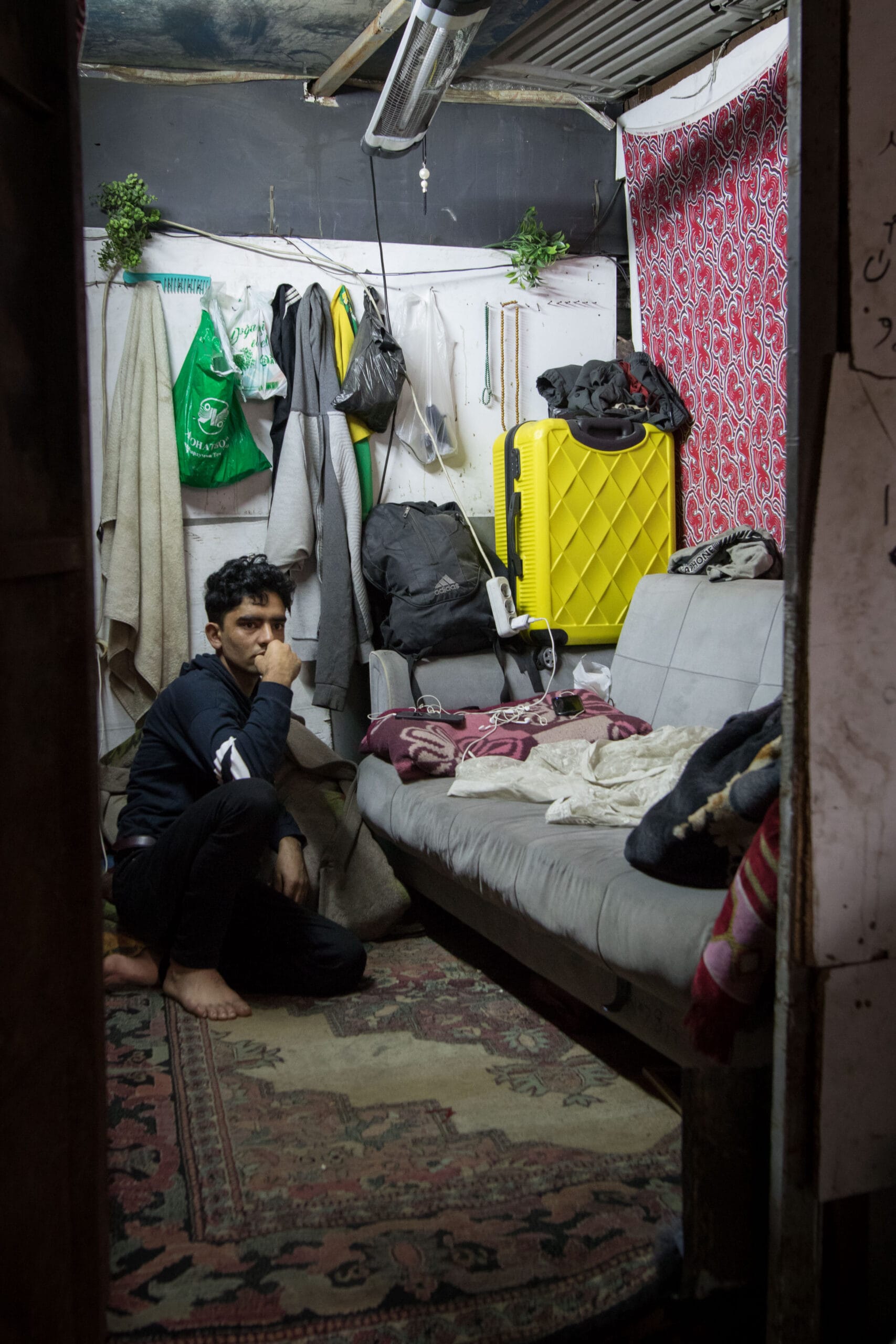
Naseem in the converted storage closet he shared as a bedroom with Hayat and Khalid. Naseem has managed to leave Turkey, arriving in Europe in the summer of 2023 after more than a year living and working in the factory. Photo courtesy of the author.
“Listen, we all say we want a sustainable economy but it’s hypocritical,” Ben Kras, CEO of Kras Recycling, a Netherlands-based plant, told me. “We are recycling but no one is buying our materials because it is too expensive. People prefer raw materials coming from anywhere else in the world because it is cheap. This is all really about money.”
On that point, Dagevos agrees. Plastic recycling companies in wealthy countries like the Netherlands simply can’t compete against cheap recycled plastics from countries like Turkey, even virgin plastic from China. “They’re all going bankrupt,” he said. “Virgin plastic is still cheaper than recycled plastic or biodegradable plastic alternatives. This is a petroleum-based product, and if oil prices stay low, it will always be cheaper to produce new plastic in places like China.”
China, ironically—though perhaps unsurprisingly—leads the virgin plastic industry. After banning plastic waste exports, it proceeded to increase its virgin plastic production capacity by 7.5 million tonnes between 2019 and 2021, with plans to continue increasing capacity for at least the next five years.[\[12\]](#%5Fedn12) Single-use plastics produced from fossil fuels are expected to rise by 17 million tonnes to 148 million tonnes over the next three years, according to the 2023 [Plastic Waste Makers Index](https://www.minderoo.org/plastic-waste-makers-index), published by Australia’s Minderoo Foundation. Plastics from recycled sources, meanwhile, are expected to reach 4.7 million tonnes in 2027, an increase of three million tonnes compared to 2021, far from the goal of circularity promised by the petrochemical industry.[\[13\]](#%5Fedn13)
Regulations are the only way to reverse virgin plastic’s momentum, Dagevos, Kras and the authors of the Minderoo Foundation’s report all say. Banning plastic waste exports, for instance, would force EU nations to increase their own recycling capacity and accelerate the transition to recyclables. Increasing tariffs on imported virgin plastic, making the price of biodegradable alternatives more competitive, would also have a positive impact. But the latest round of changes to the WSR focus instead on the waste trade itself, punishing bad behavior and rewarding the good, an approach that has, in the past, failed to produce results.
In the meantime, the victims of the trade continue to suffer. As more barriers go up and the refugee population grows, the pool of cheap, exploitable labor is growing along with it. Migration experts are already [sounding the alarm bells ](https://www.antislavery.org/what-we-do/migration-and-trafficking/)over of the burgeoning number of refugees being trafficked for cheap labor, including in the plastic recycling industry.
The last time I spoke to Hayat, in late December last year, he and Khalid were still working and living at the factory in Cebeci. The situation was tense. Police raids were on the rise and, fearing the loss his cheap workers, their boss had transferred the recycling operation to the factory’s basement, an even dingier space with no ventilation whatsoever.
But there was also some positive news: Naseem had left Turkey and successfully crossed into Europe. Hayat and Khalid were also relieved that at least a case had been brought against the factory owner involved in Fazli’s death, whatever the outcome might be. As for the debates over the plastic waste trade playing out in Europe, they were less sanguine. Hayat just laughed. “Maybe I’ll end up recycling something Naseem throws out,” he mused.
Khalid was more fatalistic. “I don’t think the people in Europe really care about us,” he said. “If they did, they wouldn’t leave us to suffer in a place like Turkey.”
*A* [*version of this article*](https://www.groene.nl/artikel/geen-idee-wat-er-wordt-verscheept) *was originally published in Dutch for* De Groene Amsterdammer*.*
\[**Adnan Khan** is a freelance journalist based between the Netherlands and Turkey.\]
---
### **Endnotes**
[\[1\]](#%5Fednref1) "['No One Asked Me Why I Left Afghanistan' Pushbacks and Deportations of Afghans from Turkey](https://www.hrw.org/report/2022/11/18/no-one-asked-me-why-i-left-afghanistan/pushbacks-and-deportations-afghans-turkey)," HRW Report, November 18, 2022.
[\[2\]](#%5Fednref2) Based on data reported by the Chinese government to the UN Comtrade database, commodity code 3915 (waste, parings, scrap, of plastics); , accessed May 30, 2024.
[\[3\]](#%5Fednref3) Based on import data reported by Turkish authorities to Comtrade.
[\[4\]](#%5Fednref4) "[Illegal Waste Trade: What are we wasting our time on?](https://www.youtube.com/watch?v=Tc25wlMRHnk&t=12s)," YouTube, October 20, 2023.
[\[5\]](#%5Fednref5) "[The Fraud of Plastic Recycling](https://climateintegrity.org/plastics-fraud)," Center for Climate Integrity, February 2024.
[\[6\]](#%5Fednref6) Ibid.
[\[7\]](#%5Fednref7) "[Basel Convention: Controlling transboundary movements of hazardous wastes and their disposal](https://www.basel.int/Implementation/Plasticwaste/Overview/tabid/8347/Default.aspx)," May 2019.
[\[8\]](#%5Fednref8) "[Netherlands Pivotal in Global Export of Plastic Waste to Non-Western Countries Report Finds,"](https://www.plasticsoupfoundation.org/en/2022/09/netherlands-pivotal-in-global-export-of-plastic-waste-to-non-western-countries-report-finds/) Plastic Soup Foundation, September 2022.
[\[9\]](#%5Fednref9) "[Hoogwaardige grondstoffen naar verre landen door geringe vraag in EU](https://www.ilent.nl/documenten/leefomgeving-en-wonen/afval/afvalinzameling-en--preventie/factsheets/hoogwaardige-grondstoffen-naar-verre-landen-door-geringe-vraag-in-eu)," Netherlands’ Human Environment and Transport Inspectorate, December 7, 2023.
[\[10\]](#%5Fednref10) "['It’s As If They’re Poisoning Us' The Health Impacts of Plastic Recycling in Turkey](https://www.hrw.org/report/2022/09/21/its-if-theyre-poisoning-us/health-impacts-plastic-recycling-turkey)," Human Rights Watch, September 21, 2022.
[\[11\]](#%5Fednref11) See UN Comtrade.
[\[12\]](#%5Fednref12) "[Plastic Waste Maker Index: Key Findings](https://www.minderoo.org/plastic-waste-makers-index)," February 2023, Minderoo.
[\[13\]](#%5Fednref13) Ibid.
### MERIP Statement on the Arrest of Steve and Sandra Tamari
URL: https://www.merip.org/2024/05/merip-statement-on-the-arrest-of-steve-and-sandra-tamari/
Last updated: 2024-05-01T17:54:41.000Z
*The following statement is being issued on behalf of MERIP’s Board of Directors, the co-chairs of the Editorial Committee, the Editorial Staff and the Executive Director.*
On April 27, Professor Steve Tamari was [brutally beaten by police](https://twitter.com/prem%5Fthakker/status/1785397144515469402) on the campus of Washington University at St. Louis (WashU) while supporting the Gaza encampment. He and his partner, Sandra Tamari, were arrested and Steve was hospitalized with multiple broken ribs and a broken hand. Footage of his arrest shows the violence of the police assault, including repeated full-body blows and strikes to the head before he is dragged toward a police vehicle.
Steve and Sandra Tamari are long-time friends of MERIP. Steve has served as a member of the editorial committee, and Sandra sat on our development committee for numerous years. We were horrified and angered to learn of the assault and arrests. Police violence against peaceful protesters on college campuses has become an alarming trend in the last two weeks, but Steve’s ordeal was extreme even by these standards.
MERIP stands with Steve, Sandra and the students and faculty everywhere who are calling on universities to [divest from companies linked to Israel](https://bdsmovement.net/Palestinians-Salute-Student-Uprising-Worldwide) by putting their bodies and their futures on the line. We denounce police brutality and the militarization of campuses sanctioned by institutional leaders. This moment of principled unrest, motivated by support for Palestinians and demands for a permanent ceasefire in Gaza, is evident throughout the United States and elsewhere across the globe.
On this May Day, we are reminded of our strength as workers and activists. Today is a [day of solidarity with Palestine](https://www.workersinpalestine.org/news/strike-for-palestine). Our commitment must remain sharp and deep, just as our anger and horror must never be dulled by the repetition of violent scenes, whether in Gaza, New York, Los Angeles or St. Louis.
The campus protests began as a means of expressing opposition to the horrific war Israel is waging in Gaza and the exorbitant toll on Palestinian lives. As the protesters and organizers are telling us, our eyes must remain on Gaza.
——–
CORRECTION: The initial statement incorrectly noted the date of the incident as April 30 rather than April 27, when the incident occurred. We regret the error.
### Recommended Reading—Atar
URL: https://www.merip.org/2024/04/recommended-reading/
Last updated: 2025-07-30T04:05:46.000Z
The contributors for MER Issue 310 have relied on their own experiences in Sudan, their personal networks and a few important news sources to inform their grounded analyses.
Atar issue 12
One of these sources that drew the editors' attention is *[Atar](https://twitter.com/atarnetwork):* a Sudanese publication started six months after the war began. *Atar* has managed to put out near weekly publications in Arabic (and now has an English periodical as well). Its grounded perspective and focus on political economy makes it an important resource for MERIP's writers and readers alike. Read a bit about the publication from its lead editor, Amar Jamal.
**MERIP:** When did you start publication in Arabic and English?
**Amar Jamal:** The first Arabic issue (weekly) was published on October 12, 2023, while the English edition (bi-monthly) began on March 25, 2024\. We intentionally stopped the publication for three weeks after issue 10 for assessments and also this week, as we are working on a special issue for April 15 to mark the year of war.
**MERIP:** How would you describe the publication? What is unique about it, and what are the key themes you explore?
**Amar:** I think the question of truth is what concerns all journalism. The truth is a prominent victim of war propaganda. But truth is also dynamic. For example, in the first issues of *Atar* magazine, we wanted to highlight people's courage in facing the repercussions of war: How they eat, drink and sleep. The Sudanese have shown unique courage in this regard, especially through collective action. What was unique about *Atar* was to highlight this courage. But seeking truth requires talking not only about agency but also structures. Here, the broader picture of *Atar* and how it uses OSINT (open source intelligence) is key. While addressing the many dimensions of current events, the magazine tries to engage in three questions: the day before the war (how did we reach here?), what happened the day following the war and what should happen the day after the war? Perhaps this is what all war journalism should do.
**MERIP:** Who are your writers and editors, and where are they based?
**Amar:** The magazine started with four correspondents, three of whom were inside Sudan, and three editors in East Africa. The company is registered in Nairobi. We currently have 24 reporters and seven editors. We will start our third fellowship program in the coming weeks, for which we have selected five young people who want to start their media careers, out of more than seventy applicants. The fellowship, which will be every six months, is one of our plans to expand and improve our publications with more and better quality editors, reporters, data analysts and visual artists. In addition to the magazine, we have released a number of podcasts that are available on our platforms. Finally, the magazine's website will be launched next week.
Atar issue 20
**MERIP:** What are the main challenges in getting the weekly issues out? How do you do it?
**Amar:** The most important challenge is protecting our resources and correspondents. Two of the first three correspondents had to leave Sudan due to security harassment. Accessing and fact-checking information also are a major challenge for the press working in Sudan now, which is made more difficult by the interruption in communications and internet.
**MERIP:** What are a few of the important pieces you've published?
**Amar:**
- [The Courage of Despair on the Routes to Survival in the North.](https://drive.google.com/file/d/1pVL-KGTvG6PKTFhhk30SpgOwWm%5FilpOP/view) This piece tells the stories of those fleeing the war through smuggling to Egypt and what they discovered during the trip. How do people endure the hardships of long, unsafe travel to save their children from an unknown fate? (Issue no. 13, January 18, 2024).
- [How did Sabreen Market Survive?](https://drive.google.com/file/d/1qncXK1YwUhsa%5FkYyv8eKVmmpHYaqxOQA/view) Sabreen market in Karari locality was the only market that continued to supply the residents of North Omdurman. How did it escape looting? How do merchants face the obstacles, from both sides of the war, in delivering food to the neighborhoods of a city controlled by the army and the Rapid Support Forces? (Issue no. 18, February 22, 2024)
- [Nertiti: The City of Oranges](https://drive.google.com/file/d/1DytWnkn5MRPw3YeLutR5eKhaky-VWuKT/view). About the orange economy in the Marrah Mountains. How does the orange fruit reach Sudan’s markets? How has its business been affected by the war? And what do farmers and merchants do in the face of these circumstances? (Issue no. 23, March 28, 2024)
- [A War on the Sheep Shanks.](https://drive.google.com/file/d/1-IJqxYPczfPgnreBDAkIGXwY3HU9D-AD/view) This story follows the fierce competition to control the region's livestock sector across its resources, ports and key players.
- [Sudan's Foreign Trade: The Day Following the War.](https://drive.google.com/file/d/1Irn8qSJELiqvnhnfjDCRMBGSXU56kw-a/view) This article monitors Sudan's foreign trade movement since the beginning of the war, in light of the closure of domestic markets and international conflicts in the Red Sea, which presented a double threat to Sudan's foreign trade. (Issue no. 2, October 19, 2023).
**Read the [previous](https://merip.org/2024/04/the-scent-of-human-barbecue) article in** [**MER issue 310**](https://merip.org/magazine/310/) **“The Struggle for Sudan.”**
### ‘The Scent of Human Barbecue!’—A Poem by Al-Saddiq Al-Raddi
URL: https://www.merip.org/2024/04/the-scent-of-human-barbecue/
Last updated: 2025-08-22T18:36:18.000Z
Al-Saddiq Al-Raddi. Photo from Traces Project website.
Born and raised in Omdurman Khartoum, Al Saddiq Al-Raddi is one of the leading African poets writing in Arabic today. Al-Raddi served as the cultural editor of *Al-Sudani* newspaper from 2006 until 2012, when he was stripped of his position during an uprising against Omar Al-Bashir due to his principled opposition to Sudan’s dictatorship. He now lives and writes from exile in London, maintaining contact with audiences in Sudan through social media. Geographical distance prompted Al-Raddi to develop an innovative dialogical approach to writing, using Facebook as a forum in which readers can reflect on and respond to his works-in-progress. Inspired by the Dadaists’ collaborative fiction, his writing process is open to the public and encourages audiences to share their ideas across continents. During the September 2019 revolution, his daily posts and poems circulated among supporters, becoming rallying cries and communicating their messages.
Al-Raddi has authored three poetry collections in Arabic: *Songs for Solitude* (1996), *The Sultan’s Labyrinth* (1996) and *The Far Reaches of the Screen* (1999/2000). In 2009, these works were published as a single volume, *Collected Poems*. His English-language books include, *He Tells Tales of Meroe* (Poetry Translation Centre, 2015) and *A Monkey at the Window* (Bloodaxe Books, 2016), both translated collaboratively by Atef Alshaer, Rashid El Sheikh, Sabry Hafez, Hafiz Kheir, Sarah Maguire and Mark Ford, and *A Friend’s Kitchen* (Poetry Translation Centre, 2023), translated by Bryar Bajalan and Shook.
His poem, “The Scent of Human Barbecue!,” published below in Arabic and in English (translated by Bryar Bajalan and Shook) was born from the present war in Sudan. Using lyric intensity, Al-Raddi imbues scenes of the everyday with power and politics, compelling readers to ask what animates and sustains violence. At the same time, his poetry draws attention to how people experience and respond to brutality. Through these themes, Al-Raddi speaks not only to Sudan but also to the genocides unfolding in Palestine and Congo, connecting communities and struggles in a critical moment.
\[su\_row\]\[su\_column size="1/2" center="no" class\]
## **The Scent of Human Barbecue!**
The world is not a big house filled with the supposed kindness of humanity!
It’s not a small village thanks to technology and the brutality of capital!
…. …. ….
The world is the world–since time immemorial
An actual world and a fictitious one, by necessity!
A dwelling place for personal myths that treasure images and idols
A world swept up in its need for idol and image
The need for trickery and money
The constant need for the scent of human barbecue!
…. …. ….
Faces that age a hundred years in a single second!
In a world whose origins are a psychiatric hospital
The imprisonment of childhood is proof of perpetual innocence!
…. …. ….
In the street
It’s terrifying: not knowing where the bullet is coming from!
In the hospital
It’s terrifying: not knowing where your laughter comes from!
In the grave
It’s terrifying: to be barren
With a tongue outpaced by words
To be without a tongue
Without music
Without the colors that once embraced you!
\-July 27, 2023
\[/su\_column\]
\[su\_column size="1/2" center="no" class\]
## **!رائحةُ الشّواء البشر**
!العالمُ ليس بيتاً كبيراً بلطف الإنسانية المُفترض
!ليس قريةً صغيرةً بفضل التكنولوجيا ووحشية رأس المال
…. …. ….
العالمُ هو العالمُ- منذ أزلٍ بعيدٍ
!عالمٌ حَيٌّ ومُفترضٌ بالضرورة
مَسْكَنٌ لأساطيرَ شخصيةً تكنُز الصّورةَ والمِثَالْ
تَكْنُسُه الحاجةُ للمِثَالِ والصّورةِ
الحاجةُ للحِيلَةِ والمال
!الحاجةُ الدائمةُ لرائحة الشّواء البشريّْ
…. …. ….
!وجوهٌ تشيخُ مائةَ سنةٍ في ثانية ٍ واحدةْ
في عالمٍ أصلُهُ مستشفى أمراضَ نفسية وعقلية
!سجنُ الطفولة فيه وصْمَةُ البرآءة المستديمْ
…. …. ….
في الشَّارعِ
!مرعبٌ جداً: أن لا تعرف من أين تأتيك الطلقة
في المستشفى
!مرعبٌ جداً: أن لا تعرف من أين تأتيكَ الضحكة
في القبر
مرعبٌ جداً: أن تكون مْجْرَّدَاً
بلسانٍ تُعْجُزُهُ الكَلِمَةُ
أن تكون بلا لسانْ
بلا موسيقى
!بلا ألوانَ أحبَّتْكَ على وجه الخصوص
27 يوليو 2023م-
\[/su\_column\] \[/su\_row\]
\[**Bryar Bajalan** is a writer, translator and filmmaker currently pursuing a PhD in Arabic and Islamic Studies at the University of Exeter. **Shook** is a poet, translator and filmmaker on unceded Coast Miwok land in Northern California.\]
> **Read the[previous](https://www.merip.org/interview-with-william-carter-nrc/) article.**
> **Read the[next](https://www.merip.org/recommended-reading/) article.**
**This article appears in** [**MER issue 310**](https://merip.org/magazine/310/) **“The Struggle for Sudan.”**
### An Interview with William Carter, Sudan Country Director for the Norwegian Refugee Council
URL: https://www.merip.org/2024/04/interview-with-william-carter-nrc/
Last updated: 2025-11-06T22:06:34.000Z
*The war in Sudan that began in April 2023 has led to a reckoning among humanitarian aid organizations.*
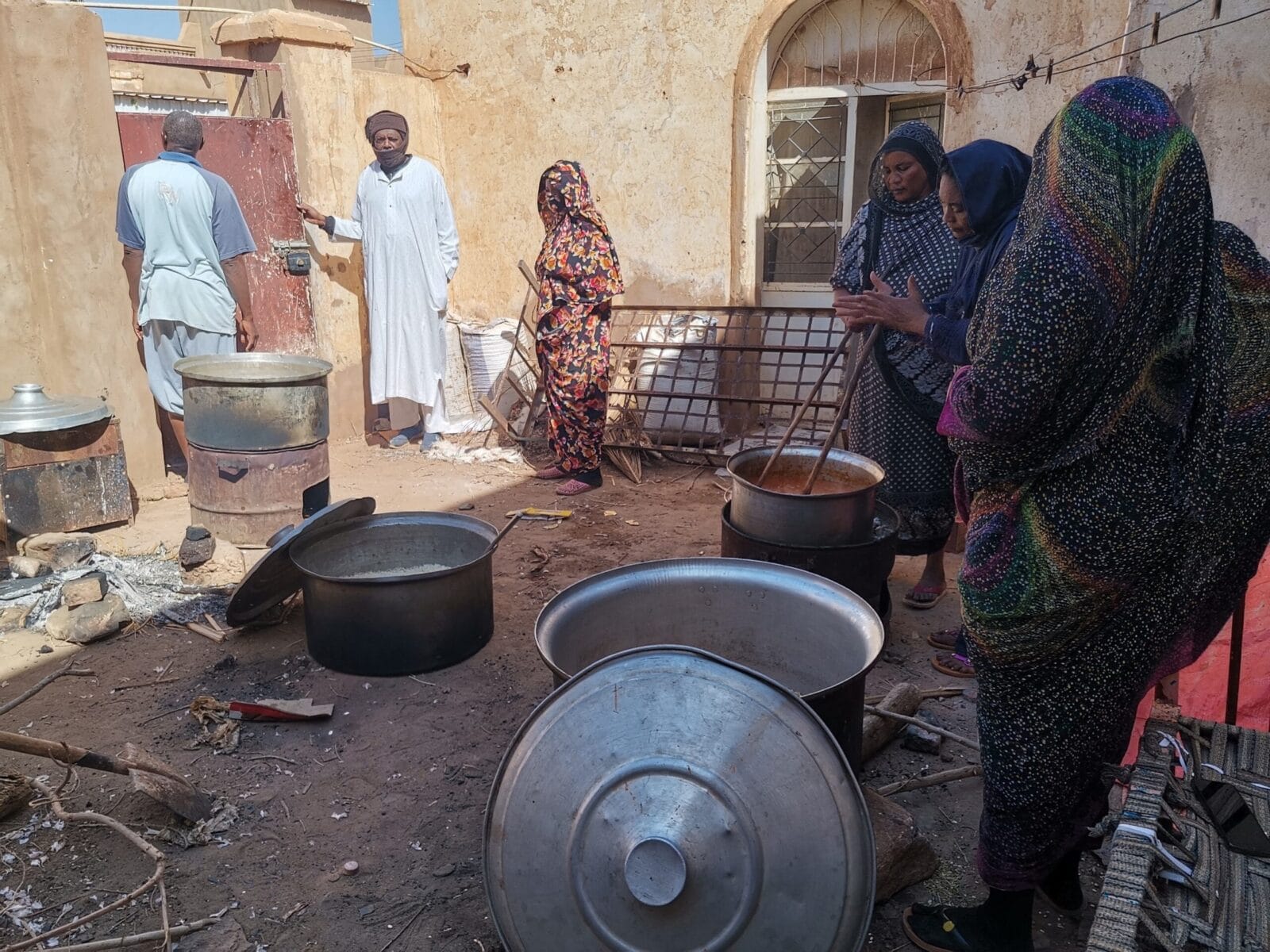
Volunteers cook food for free distribution in Omdurman, Sudan, Feb. 5, 2024\. Mohamed Khidir/Xinhua via Getty Images.
*As international organizations have struggled to alleviate the diverse, complex crises facing people across the country, locally led initiatives and mutual aid organizations have sprung up at the grassroots level. To speak about humanitarian work in Sudan, Nisrin Elamin, assistant professor at the University of Toronto, and Deen Sharp,* MER *editor and visiting fellow at the London School of Economics and Political Science, spoke with William Carter, the Country Director of the Norwegian Refugee Council (NRC). In their conversation, which took place in December 2023, they discussed the work of the NRC in Sudan, the wide-ranging challenges facing different parts of the country and the need for an updated relationship between the international aid regime and the numerous locally led relief efforts. The interview has been edited for length and clarity.*
**Deen Sharp:** Can you provide some background information on the Norwegian Refugee Council, its work in Sudan and your own role?
**Will Carter:** The Norwegian Refugee Council is an independent NGO working in about 40 countries, mostly for people affected by armed conflicts, refugees, internally displaced people and, in some areas, people that cannot flee at all. We returned to Sudan in 2020 after the civilian-led revolution \[having been [expelled along with 12 other international NGOs](https://www.merip.org/the-hazy-path-forward-in-sudan/) working in Darfur in 2009\]. Our initial aim was to help provide solutions for displaced people, mostly in Darfur. But different refugee emergencies from Ethiopia and South Sudan required us to focus on emergency response.
Then, in December 2020, the end of the African Union-United Nations Hybrid Operation in Darfur (UNAMID) led to what is called a “civilian protection crisis.” People, especially displaced people, were targeted in brutal violence. This was followed by the military coup in Sudan in 2021\. The coup radically changed the political and donor landscape, with donors less inclined to provide support given the leadership. It also raised ethical dilemmas and complexities for us and how we were positioned in relation to government authorities and the UN system, increasing the security and political risks of our operations. The current conflict, which began in April of 2023, has resulted in us shifting to an emergency response. We now have about 300 Sudanese colleagues and 30 international staff in Sudan, funded mostly from different European governments, USAID and some UN agencies.
**Nisrin Elamin:** Could you reflect on your last visit to Sudan and give us some grounded insights from your visits to Darfur and Madani?
**Will:** When the war broke out in April 2023, I happened to be outside the country. To reenter Sudan, we had to fly into South Sudan and drive up across the border into White Nile State where we'd moved our country office. I spent the first few months working there, from early May 2023\. We then set up new offices in Madani, Gedaref and finally in Port Sudan. The White Nile office was initially focused primarily on refugee response, as there was a huge internal displacement crisis coming from Khartoum. We had to push past the shock of the fact that banking stopped working, telecommunication stopped working, we were out of fuel. At the same time, the numbers were overwhelming: within a few weeks the number of displaced people rose from a few hundred thousand to a few million. We were concerned at how overcrowded conditions were and that the rainy season was about to start. The terrain was already becoming waterlogged. The refugee numbers were overwhelming, and the living standards were low.
Then, we saw the locally-led, unregistered relief efforts. In the past, we had tried to work with formally registered local NGOs, but many of them had also been affected by the conflict in Khartoum. We ended up working largely with these unregistered groups that had initially sprung to action to run local shelters, evacuation initiatives and other critical services. We saw that we could assist by making sure they could continue and slightly improve their operations. We persuaded the local Humanitarian Aid Commission in White Nile to allow us to give them grants. In Gedaref State, there was a more restrictive environment in the beginning. There was clearly some local and federal politicking, which was not to the advantage of local relief efforts.
> **We ended up working largely with these unregistered groups that had initially sprung to action to run local shelters, evacuation initiatives and other critical services.**
In late September 2023, I went to eastern Chad, where there was also a huge refugee situation as people fled from killings in parts of Darfur. A campaign described by authorities as ethnic cleansing had killed thousands of people in Darfur over a number of days. While many people had fled into Chad, some stayed in Darfur, but the places where we were providing services in Darfur were being burned down to the ground. It was clear that massacres had happened and only half of the racist graffiti on the walls had been scrubbed off by the time we had returned. Some neighborhoods were completely abandoned, but there were whole neighborhoods of people who didn’t or couldn’t leave (some who had been displaced before). There were war widows, who had been abused and were now pregnant, people with family members who had a disability, older people and couples that didn’t see the point of going to a refugee camp and of course children who had seen violence. They were people in very vulnerable conditions who also did not have much to eat as the food systems aren’t working there. There are no supplies getting to Darfur from Port Sudan.
So how do we respond to these multiple crises: the protection of civilians crisis, food security crisis, failing state in eastern Sudan and completely failed state in Darfur? Even if there’s a ceasefire or peace agreement, banks won’t reopen properly in West Darfur, people won’t get paid anytime soon and the social fabric will not be easily repaired. I should also say, the crises in these places are distinct. In eastern Sudan there is staggering internal and urban displacement and all the deprivations and disease that comes with that, while in Darfur there is clearly serious ethnic violence, probably genocidal violence against, Black African Darfurians, a civilian protection crisis and a probable famine. At the same time, there is clear local goodwill in action. People are still trying to get hot meals to survivors, people are still finding shelter solutions and people are trying to attend to the leftover communities in Darfur. We needed a different humanitarian approach that worked with these local efforts.
**Nisrin:** Could you speak more about what local efforts look like on the ground and how you partnered with people?
**Will:** Before we set up our response, communities were already pulling out beds and starting communal kitchens. For every collective shelter, there were also hundreds of homes hosting three or four families each. We heard stories of ambulance services, evacuation systems and other diverse community-led efforts. That was eye-opening. Usually, we have these images of displacement crises as savannahs of UN tents in huge camps. In some ways, these are more manageable, and we kind of know what we’re dealing with. But in the case of Sudan since last year, it was an urban displacement crisis and communities had pulled together: for example, 20-something year-olds running collective shelters for 200 people, including for disabled children, pregnant women and people with medical complications. It is a huge stress on these community organizers and something that they hadn’t been trained in or supported to do. Our team looked for ways to give these local initiatives some resources and to offer support. In White Nile, we were focused mostly on the displacement emergency, so we identified those running collective shelters and tried to figure out ways to help them. It was really just seeing who was already there and trying to give them some funds and find other ways to support them if we could.
**Deen:** How did these locally led relief efforts (and NRC’s support for them) sit with the established political authorities?
**Will:** At the beginning, the community response was celebrated by local governors. But we soon realized that there was a political aspect and there were growing issues with official and conservative local authorities, as some of the community initiative members came from resistance committee backgrounds \[the neighborhood resistance committees that had [mobilized politically](https://www.merip.org/the-evolution-of-sudans-popular-political-forces/) across Sudan during the 2018–2019 uprising\]. I arrived in Gedaref State to find the governor (*wali*) visiting an emergency response-run collective shelter with TV cameras and handshakes. But a week or two later, when we tried to give grants to them, different authorities said, “Actually, this is not how we want this to go. The municipal authorities will be taking over. So, thank you, but no thanks.” We fought with those authorities for a month or so, but ultimately we couldn’t overturn the way that the formal authorities wanted to play this. So, we decided to change the approach.
> [the politics of aid in wartime Sudan](https://www.merip.org/leveraging-humanitarian-aid-in-wartime-sudan/)
In the northern states there are almost no international NGOs, including us, and people had almost no assistance. We have tried to help remotely, but we are not winning great favors with federal authorities. They are still cautious of this approach because they like regulating things. But I feel, at this point in Sudan, if there are people on the frontlines trying to help people, then we are going to have to take the risk of upsetting the federal authorities and continue helping them as much as we can. That was part of the premise for the Sudan Humanitarian Crisis Conference in Cairo in November 2023, which focused on locally led relief efforts.
**Nisrin:** Can you talk more about the Cairo conference and what it meant to center grassroots organizers from neighborhood resistance committees and emergency response rooms \[community-led initiatives that provide rapid assistance\]. This hadn't been the case with other forums. For example, the [October 2023](https://www.france24.com/en/video/20231027-sudanese-civil-society-peace-talks-in-addis-ababa-aimed-at-establishing-united-front) Sudanese civil society talks in Addis Ababa might have included hand-picked representatives from the resistance committees, but it really centered civilian elites. How did centering these groups change the dynamic of the event? What were the tangible outcomes? And were there outcomes that would hold international NGOs and UN agencies accountable?
**Will:** The Cairo conference came about because a Sudanese civil society organization, [Fikra for Studies and Development](https://www.fikrasd.com/), had pushed for a conference convening local responders and the international community. The conference was led by an organizing committee of multiple Sudanese civil society organizations. It was based on the premise that the international system is not working as it should be to help people in Sudan, and we often don't see much support for locally led action. It brought together over 400 people, mostly from locally led efforts: I think over 100 from inside Sudan, some of the Sudanese civil society who had sought refuge in Cairo and some who could travel. It also brought international organizations, embassies, international NGOs and UN agencies. The organizing committee specifically requested not to have the participation of either of the warring parties—the Sudanese armed forces-led government or the Rapid Support Forces (RSF). They intended to have a follow up meeting with the warring parties separately afterwards to communicate the recommendations from the conference.
Graphic for the Sudan Humanitarian Crisis Conference in Cairo, November, 2023.
The expressed goals of the conference were to enable frontline responders to help set the humanitarian agenda and outline their needs. But there was also a value in helping people network: having frontline responders from one part of the country meet frontline responders from a different part; having people from embassies—even ambassadors—meet directly with people coming from the frontlines; and having a space where we could actually interact with people in formal discussions and on the sidelines to know what can be done, what is being done, what we can build on and what makes sense on the ground. The conference also helped to raise the profile of what was happening in Sudan.
Sudan is a very neglected humanitarian crisis in terms of media coverage, political and diplomatic attention and funding. There exists within Sudan feelings of desperation and feelings within the international community that this is an impossible crisis to work in. Donors may think: Well, if responders don’t even have access there, why give another few hundred million dollars of humanitarian aid to Sudan for it to go nowhere or get captured by military elites? The Cairo conference was a message to say, actually, there is a huge amount of work being done in some of the worst parts of the country. There's a conversation happening right now about how to capitalize on this and help scale it up, improve it and strengthen it. And there is clearly a different way for local responders and international efforts to work better together.
**Nisrin:** If you had the ability to change things in the humanitarian realm, what would you do?
**Will:** I think the situation in Sudan is the final nail in the coffin for an outdated international humanitarian system. It just clearly isn’t working in Sudan, not on the scale that it needs to be, not in the places it needs to be and not with the approaches it needs to have. But there’s a very vibrant, locally led response going on, more so than I have seen in other conflict contexts. I think the challenge ahead of us is whether and how institutions, operations and donors will adjust to this in the face of a system which is very rigid and does not necessarily reward taking risks. This is a pivotal point, not just for Sudan, but for an international humanitarian system to reform how it relates to, and ideally supports, locally led relief and mutual aid. Some of the worst things in history are happening or about to happen in Sudan, things that the whole international system was supposed to prevent—famine, genocide, state collapse—but we are seeing a weak and muted response in spite of the hard efforts of everyday people and everyday heroes in different parts of Sudan. To me, the Cairo conference was helpful for raising the profile of the local responders, but it's also a bit like a starting pistol. Now it should be a race to who can be the best supporter of local responders and who can help transform the system to embrace these efforts. Of course, we still need international efforts, solidarity and organizations. We can't just leave it to local responders to take all the risk and work as volunteers forever. That's also not a great solution in the grand scheme of things. But it's an abject failure if we continue to ignore local responders, if we do not fund them substantially and if we do not enable them in different ways. We have not done our job unless we help local people do the work that we are trying to do ourselves.
> **Read the**[**previous**](https://merip.org/2024/04/leveraging-humanitarian-aid-in-wartime-sudan) **article.**
> **Read the**[**next**](https://merip.org/2024/04/the-scent-of-human-barbecue) **article.**
**This article appears in** [**MER issue 310**](https://merip.org/magazine/310/) **“The Struggle for Sudan.”**
### Leveraging Humanitarian Aid in Wartime Sudan
URL: https://www.merip.org/2024/04/leveraging-humanitarian-aid-in-wartime-sudan/
Last updated: 2025-08-22T18:36:19.000Z
The war has imposed gut-wrenching choices on the Sudanese people.
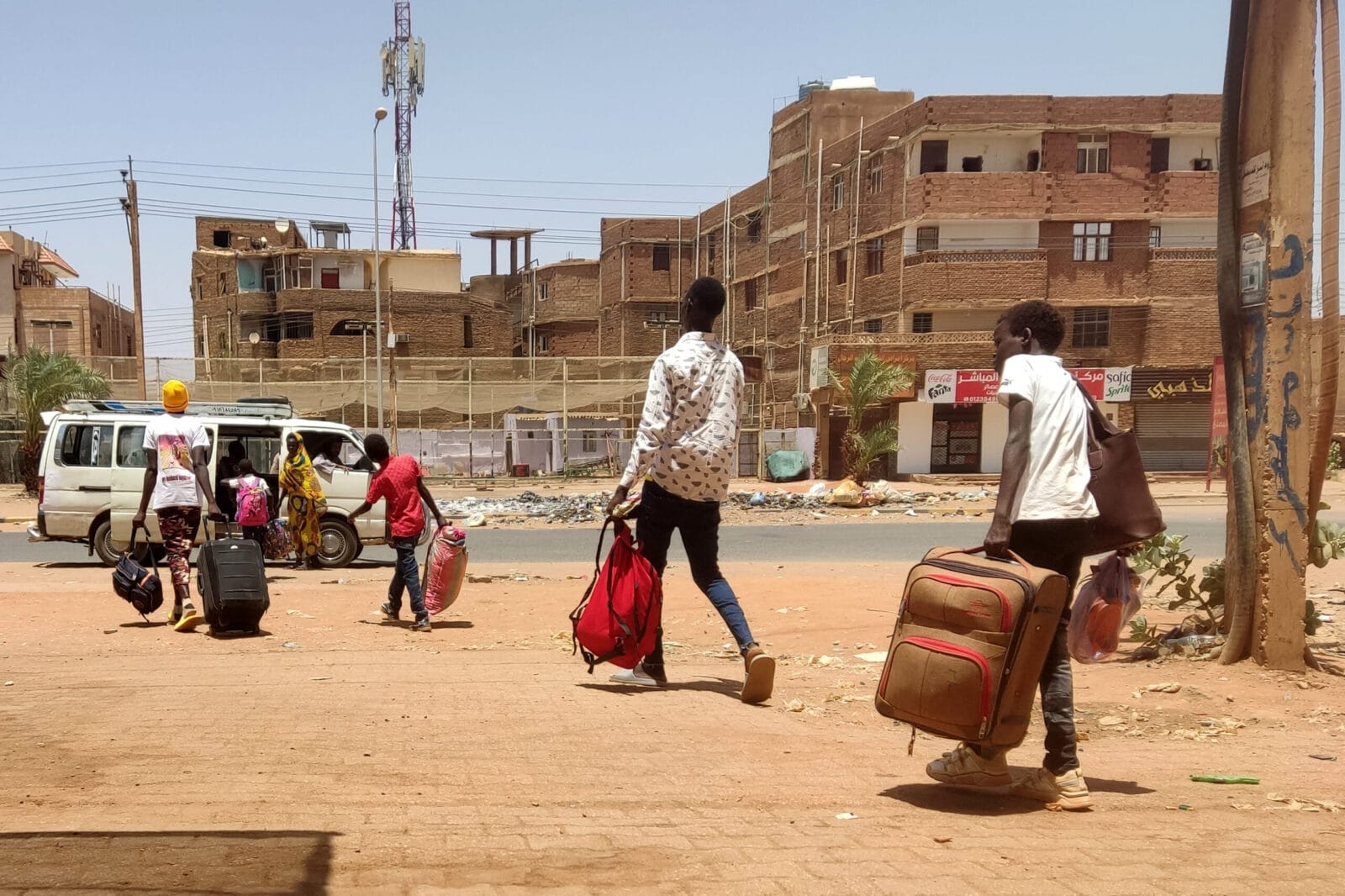
People board a minibus as they evacuate southern Khartoum, on May 14, 2023\. Photo by -/AFP via Getty Images.
Since the fighting broke out, millions have fled the capital city to different states within Sudan. Over 1.5 million have escaped the country altogether. Their patterns of movement reflect socio-economic disparities, as those hailing from less wealthy segments of society remained in Greater Khartoum.
The cityscape quickly became a site of contestation, with the Rapid Support Forces (RSF) dominating Khartoum and significant parts of Khartoum North, while the SAF maintained control of Karrari locality (north west Omdurman). City dwellers in Greater Khartoum had to cope with fierce fighting between the two armies.
Those who fled to other states of Sudan were confronted with expensive rents, a limited labor market and a compromised agricultural season. The states were overwhelmed with staggering numbers of internally displaced persons, hosted in overcrowded mosques and rundown schools that had been forced to close due to the war. People also faced a deliberately weakened public sector, a legacy of the Islamist state’s policies (1989–2019). For example, the over-centralization of medical services and their frenzied privatization in Khartoum has impacted [their availability](https://www.peaceofsudan.space/post/the-future-of-sudan-s-shattered-health-system) and capacity across the rest of the country.[\[1\]](#%5Fedn1)
Following the outbreak of conflict, I remained in the country for eight months. During this time, I observed how the adverse humanitarian situation mediated peoples’ experiences of the war and its economies of life and death, poverty and wealth. In the current context, humanitarian activity is profoundly intertwined with the two state structures that have emerged in the country. They are led, respectively, by the Sudanese Armed Forces (SAF)—with headquarters in Port Sudan—and the RSF in the areas under its control: all of Darfur, excluding North Darfur, and Gezira state.
## **The Governmental Legacies of Aid and Humanitarianism**
The privatization of social services under the Islamist state created space for international and local humanitarian interventions to proliferate.
International and local NGOs and UN agencies targeted aid toward alleviating acute crises, such as malnutrition, and offered small-scale income generation efforts. In contrast, non-crisis-driven development aid was largely prohibited by international development donors, in an attempt to put pressure on the authoritarian regime.[\[2\]](#%5Fedn2)
The Humanitarian Aid Commission (HAC) was established in 1985, initially, as a response to the drought of the mid 1980s to manage and organize humanitarian work within Sudan in conjunction with the Ministry of Humanitarian Affairs. With the arrival of the Islamists to power in 1989, all aid was mediated through the HAC. The unit was nestled in its own separate building, becoming part of the National Intelligence Service of the Ministry of the Interior and not, as might be expected, the Ministry of Social Development.
> **The Islamist state used the HAC to place humanitarian activity under the auspices of the intelligence services...**
The Islamist state used the HAC to place humanitarian activity under the auspices of the intelligence services, allowing the state to control civil society activity that could otherwise undermine its grasp on power. Humanitarian work was politicized.
The HAC applied draconian and obstructive measures, designed to advance the political ideology of the state. Aid provision became a secondary goal. For example, it enacted surveillance on the activities of local and international humanitarian organizations and oversaw their access to local populations. In March 2009, it arbitrarily suspended the work of 13 international NGOs and three national ones.
After almost 30 years in power, the Islamist regime under Omar Al-Bashir was overturned by a peaceful revolution on April 11, 2019\. At first, the SAF and the RSF supported the revolutionary breakthrough. Their reluctance to relinquish power, however, quickly became clear. On June 3, both parties alongside security services violently dispersed the sit-in in front of the army headquarters, where protesters were demanding full civilian rule (*madaniya*), resulting in a massacre of revolutionaries. In the aftermath of this traumatic event, the civilian-led Forces for Freedom and Change (FFC) (a disparate alliance of political parties and civil society bodies based among Sudan’s elite) agreed to a compromise, bringing about their uneasy partnership with the SAF and the RSF
## **Leveraging Aid for Power**
As the war between the SAF and RSF has progressed, each party has manipulated aid in different parts of the country to enhance its position within a bifurcated state structure. Moreover, the HAC continues to control access to much aid outside the capital city.
On August 13, 2023, the commander of the RSF, Lieutenant General Mohamed Hamdan Dagalo (commonly known as Hemedti) established the Sudan Agency for Relief and Humanitarian Operations (SARHO) to facilitate humanitarian relief within areas held by his forces. His aim was to eventually rehabilitate productive sectors, like agriculture, in order to minimize dependency on humanitarian assistance.
SARHO evokes the past modus operandi of HAC and its efforts to use humanitarian aid to control and neutralize democratic and civilian opponents to the Islamist regime. For example, the RSF allowed Doctors Without Borders (MSF) to operate within Al Ban Jadeed hospital in Sharg El Nil (Khartoum North) in October 2023\. But they have interfered with the free movement of youth members of the Emergency Response Rooms—grassroots offshoots of the revolutionary resistance committees formed as a response to the war—that were delivering medication and food aid to families within different parts of Khartoum. Through the institutional edifice of SARHO, the RSF also challenges the integrity of the single state under the hegemony of the SAF
During my time in the country, a demographic shift had taken place in Sudan due to the flight of people en masse. Affluent areas such as Manshia (a neighborhood in Khartoum) were, by August, inhabited by people from poorer areas of the city. The RSF provided food aid and medical care to these vulnerable groups as well as to the small number of wealthier families that had not fled. In other lower middle-class and working-class zones, the RSF provided diesel to mosques to mitigate the extensive power cuts which compromised the water supply that relies on electrical pumps. The RSF’s efforts to gain popular support echo earlier episodes, for example, when it provided free transport in Khartoum within a month of participating in the June 3rd sit-in massacre.
> **In Khartoum, the RSF’s tactics alternated between seeking to gain popular approval and instilling fear through the use of violence.**
In Khartoum, the RSF’s tactics alternated between seeking to gain popular approval and instilling fear through the use of violence. They exercised their ability to intercept people on the streets arbitrarily, especially young men. In mosque sermons, imams vociferously condemned the excesses of Israel in Gaza, while refraining from uttering a single word condemning the RSF troops’ destruction, theft of civilian property and failure to prevent looting sprees. RSF commanders did, at times, direct RSF military police to condemn and control looting and theft by both RSF troops and civilian urban gangs. But looted goods continued to feed markets, which came to be known as Dagalo markets as a tribute to RSF leader, Hemedti.
Meanwhile, the widely legitimized state government, now controlled by SAF leader General Abdel Fatah Burhan, moved to Port Sudan, the capital of Red Sea state. By August social media posts accused the SAF of tolerating corruption in the distribution of medical and food aid in the city on the part of Islamists. Accusations proliferated that aid arriving in the city was not being distributed but instead was being sold in local markets.
The fact that the Minister of Finance, Jibreel Ibrahim, was a self-declared Islamist within the Justice and Equality Movement drew attention to government humanitarian practices. In October, a photo-shopped image depicting Ibrahim smiling and rubbing his hands while receiving aid circulated on social media. The image was accompanied by the caption, “Aid coming to the Sudanese people in God’s hands, the magician Jibreel.”
The HAC had been dismantled by the transitional government, following the 2018–2019 revolution. But former Islamist HAC operatives regained their government posts after the October 2021 coup by the SAF and the RSF. After the outbreak of war, I joined volunteers making food for internally displaced persons in Dongola, the capital of Northern State. In May, a member of the Sudanese Red Crescent warned us not to engage in any political discussions supporting the revolution. The Northern State was under Islamist control by this time, and state officials now providing aid were partisans of the National Congress Party: the Islamist party in power until 2019.
While it took international organizations time to start operating after the war broke out, those that eventually started working by October were subject to the approval of HAC in the states where it maintained a presence. In Port Sudan, the HAC obstructed the work of international aid practitioners and local organizations by denying them direct access to beneficiaries or confiscating material aid with no justification. In an effort to delegitimize the RSF as a political alternative, the HAC has made access to vulnerable populations in areas it operates conditional on organizations withholding aid from the areas of Darfur under RSF control.
## **Scrutinizing International Humanitarian Action**
During a symposium convened by Bergen University in October 2023, one of the panels addressed the challenges to humanitarian aid in Sudan. Among the speakers was Dr. Sarah Abdel Jalil, a pediatrician practicing in Britain. Discussing the medical care provided at Al Buluk children’s hospital in Thawra harra 4 (Karrari locality) by local doctors, Jalil warned that the $2 million response, driven by diaspora initiatives, was not sustainable or adequate to deal with the already fragile Sudanese health infrastructure. She highlighted the increased need to support states that had not yet been affected by active fighting by providing digital access and solar energy. Though she commended the coordinated response by UNICEF, she argued that widespread delays to aid delivery by the international humanitarian community constituted an infringement on human rights.
> [Rethinking International Aid in Sudan](https://merip.org/2024/04/rethinking-international-aid-in-sudan)
When it comes to international humanitarian aid, the general perception in Sudan is that the country has been abandoned. But as of November 2023, the Norwegian Refugee Council was operating in Darfur, MSF in Khartoum, the UNDP in Port Sudan and UNICEF in Port Sudan, Kassala and Gadaref. The problem is not so much their absence but their ability to confront a range of issues, including social tensions, obstructive local political agendas, logistical challenges on the ground for aid delivery and donor agendas.
In August, for example, a friend in Kosti told me that the situation in the city was dire even though a number of international NGOs were present. Support from local and international organizations for internally displaced people arriving from Khartoum was severely lacking, and tensions were running high due to perceptions by some Sudanese citizens that South Sudanese refugees were receiving better medical care.
In September, I conducted an interview with a seasoned international humanitarian practitioner, Ivan Deret, head of operations for the French NGO [Triangle Generation Humanitaire](https://www.trianglegh.org/index%5Fen.php) (TGH), which has been working for almost 20 years in Darfur, South Kordofan, Gedaref and the suburbs of Khartoum. Deret reported that the scope of their current work had been severely impacted by the violence. TGH was unable to offer the technical support to field staff that would meet the formal standards of their donors. He suggested certain donor standards, such as time-consuming audits, were anachronistic in the current context, but the humanitarian sector has nonetheless been forced to operate within strict limits.
Back in Bergen, meanwhile, the Norwegian diplomatic representative defended his country’s right to choose the sectors it would support: “Of course we are going to insist on certain priorities because it is our money." At the time, Norwegian humanitarian diplomacy favored funding sectors involving “women and youth.” Moreover, while the international humanitarian community widely identified the HAC as obstructive in the past, during the current war some international NGOs have failed to readily fund aid initiatives, like the delivery of medicines and food by Emergency Response Rooms now operating within Khartoum, because they were not registered through the HAC.
As these examples and others show, the control of aid at both the local and international level makes disparities within the Sudanese landscape tangible. It determines which subjects should benefit from aid and how quickly. In the context of war, such determinations bolster authoritarian forms of power. Both of the warring parties have used aid to quash the revolutionary ambitions of Sudanese citizens and to keep international actors at bay.
\[**Azza Ahmed Abdel Aziz** holds a PhD from the Department of Anthropology and Sociology at SOAS.\]
> **Read the[previous](https://merip.org/2024/04/dispatch-from-nyala-sudans-second-city) article.**
> **Read the[next](https://www.merip.org/interview-with-william-carter-nrc/) article.**
**This article appears in** [**MER issue 310**](https://merip.org/magazine/310/) **“The Struggle for Sudan.”**
---
## **Endnotes**
[\[1\]](#%5Fednref1) Edward Thomas, “[The Future of Sudan’s Shattered Health System](https://www.peaceofsudan.space/post/the-future-of-sudan-s-shattered-health-system),” Peace of Sudan, October 1, 2023.
[\[2\]](#%5Fednref2) Jeremy Loveless, *Displaced Populations in Khartoum: a study of social and economic conditions* (Coppenhagen: Save the Children, 1999)
### Dispatch from Nyala, Sudan’s Second City
URL: https://www.merip.org/2024/04/dispatch-from-nyala-sudans-second-city/
Last updated: 2025-08-22T18:36:20.000Z
The battle for Nyala—Sudan’s second largest city and the capital of South Darfur state—was a turning point in the current war between the Sudanese Armed Forces (SAF) and the Rapid Support Forces (RSF).
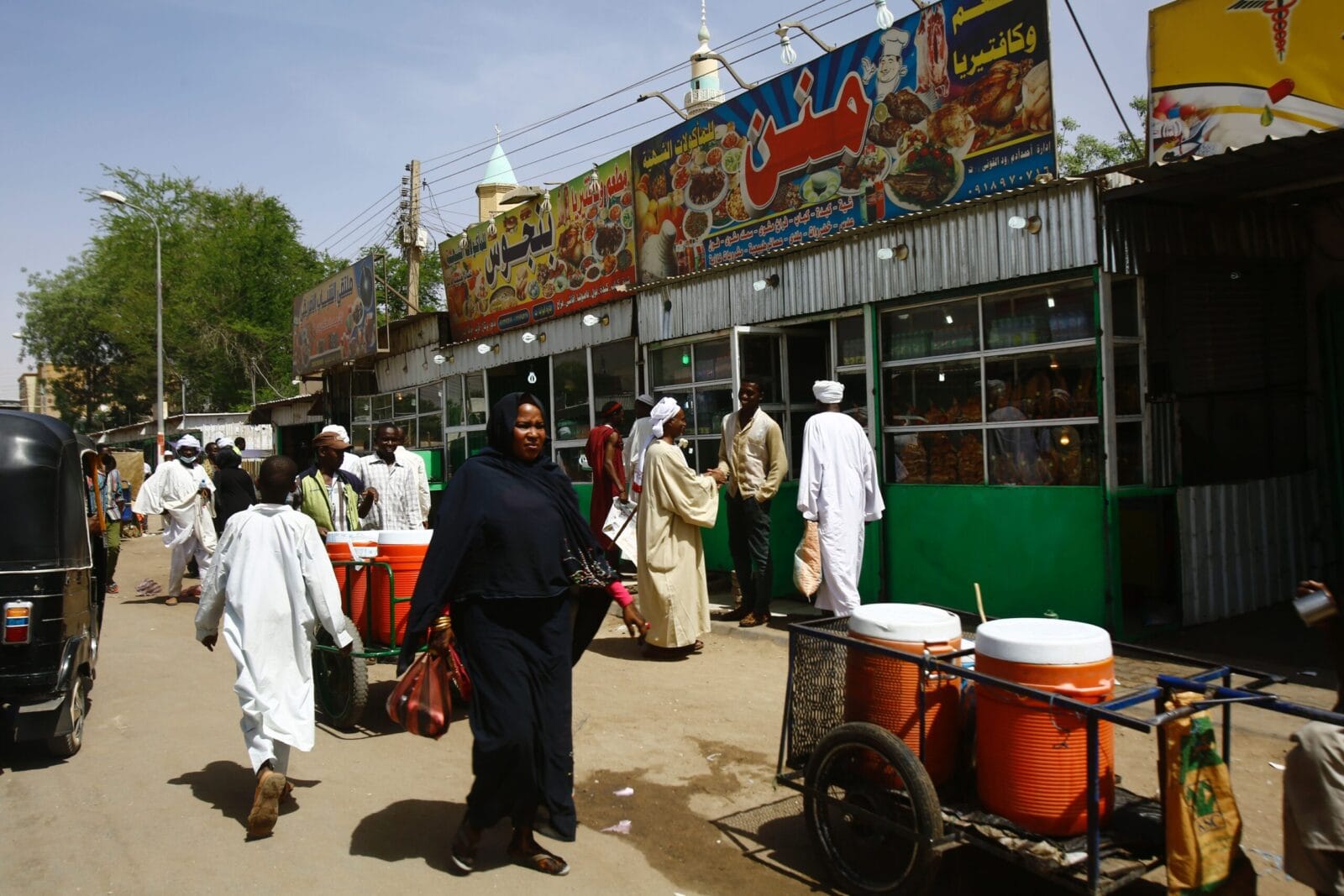
Nyala, in south Darfur, 2016\. Ashraf Shazly/AFP via Getty Images
When the SAF’s garrison in Nyala fell to the RSF on October 26, 2023, it prefigured the Sudanese army's collapse of across Darfur. The next four weeks witnessed the fall of SAF garrisons in Zalingei, El Geneina and El Daein—the capitals of Central, West and East Darfur states.
For the warring armies, Nyala is a strategically positioned city. South Darfur state holds a significant share of Sudan’s livestock and accounts for about a third of the region’s production of grain and ground-nuts and more than half of its sesame.[\[1\]](#%5Fedn1) About 120 miles to the city’s southwest, the [Sungo gold mine](https://www.darfur24.com/en/2020/04/18/deadly-gold-mines-in-sudans-darfur-region/), operated by the RSF, supplies gold across the border to the Central African Republic, where it then makes its way to Russian and Gulf markets. Arms flow into South Darfur from Central African Republic, some reportedly supplied to the RSF by the United Arab Emirates. In turn, the Gulf state is [the main market](https://www.nytimes.com/2023/09/29/world/africa/sudan-war-united-arab-emirates-chad.html) for the RSF’s gold as well as its mercenary services.
The city itself lies along trade routes that link Khartoum to north and west Africa. Its souq—located near the SAF garrison—reflects its status as an Afro-cosmopolitan hub and regional center of trade. In addition to local livestock and agricultural products, merchants sell cars and electronics from Libya, cosmetics from Chad, textiles from Nigeria and medicine from Khartoum.
Before the twenty-first century, Nyala was a place of social mixing. Clubs and educational institutions brought people together across social divides. They used Arabic as a lingua franca. But this cohesion began to fray with Darfur’s wars of the mid-1990s to 2000s. Newcomers, many of them farmers, sought refuge in Nyala, having been displaced from their lands by so-called Arab militias—pastoralists armed by the state under the regime of former dictator Omar al-Bashir.
Al-Bashir’s Arabization policies deliberately pitted these pastoralist groups, who spoke a Chadian or Baggara dialect of Arabic, against speakers of the indigenous, Nilo-Saharan languages of Darfur, who were mostly settled people. The displaced in Nyala identified as non-Arabs, as Africans or Black. They settled in displacement camps or neighborhood enclaves, where they increasingly avoided Arabic in favor of Fur and other local languages.
Nyala’s social divisions were a microcosm of the crisis in Darfur, even before the recent battle for the city that killed hundreds and displaced thousands.
As the war has unfolded, the city continues to be on the front lines of Darfur’s evolving culture wars. The struggle for the city reflects the pitched battled between warring parties to control military, civil administration and economic life in the region.
## **South Darfur State and the Origins of the RSF**
The RSF has its roots in the south in the dirty wars of the 1990s, when Sudanese intelligence—facing an insurgency—outsourced fighting to predominantly pastoralist militias.
These so-called Arab militias (at the time known as *Hagana* or *Al Fersan*) were recruited from herding communities increasingly susceptible to Omar al-Bashir’s Arab supremacist ideologies as the climate crisis shriveled their pastures. Beginning in 2003, these militias formed into the *Janjaweed*, used to fight al-Bashir’s counterinsurgency.
RSF commander Mohamed Hamdan Daglo (known by the nickname Hemedti) was one of these recruits. He comes from Umm al-Qura’ in Mershing locality, which sits about 50 miles to the north of Nyala. His origins are controversial, but one account holds that he belonged to a sub-group of the Mahariya group of Rizeigat camel-pastoralists, who began migrating from Chad to Darfur in the early twentieth century. During the droughts of the 1980s, they settled around an old Fur village called Dogi, near Mershing, on the southern slopes of South Darfur. They renamed it Umm al-Qura’ (“the mother of villages”), an Arabic name for Mecca.
> **When the Native Administration swore allegiance to the RSF in July of 2023, it was an unprecedented shift.**
Hemedti’s rumored origins among the Mahariya Rizeigat camel-pastoralists have helped the RSF gain influence over other pastoralists in the region, also part of the Rizeigat. The Rizeigat are among the largest groups in East Darfur and part of a wider confederation of Sahelian herders sharing a common Arabic dialect, which sets them apart from urban Arabic speakers.
Some of these groups had kept their distance in previous rounds of conflict in Darfur. Thus, when the Native Administration swore allegiance to the RSF in July of 2023, it was an unprecedented shift.
The Native Administration is a colonial-era political unit comprised of traditional leadership from seven cattle-pastoralist groups that was resurrected by al-Bashir in the 1990s. When the current war had first reached Nyala, it initially helped broker a political agreement that included a ceasefire and a division of the city into SAF and RSF areas of control. The agreement envisaged the eventual transfer of control to whichever party won the battle for Khartoum. Their decision to ally with the RSF in July not only undermined this ceasefire and partition agreement, it also deepened the polarization between groups identified as Arab and those regarded as African.
The Native Administration promised to supply Hemedti with recruits. These armed irregulars—most of whom are identified as Arabs—have given the RSF a decisive military advantage in Darfur.
## **Ruling and Dividing**
The RSF’s narrow ethnic base may give it a military advantage, but it has not helped the militia when it comes to governance.
The RSF controlled most of the city well before the fall of the SAF garrison. To date, however, it has not established government units capable of maintaining order, civil protection or even collecting taxes. In the first week of the war, Hemedti’s forces looted the state ministries, removing everything from desks to chairs to computers, which stripped the RSF of the capacity to tax Nyala’s market. The RSF, instead, finances its operations by sheep-stealing, checkpoint extortion and illicit trade. Rather than managing a treasury, its gold and other businesses are controlled by Hemedti’s family. Its looters convert stolen goods into cash in the markets of Darfur and the countries bordering it.
The existing governor of South Darfur state, Musa Mahdi Ishaq (from the Habbaniya cattle-pastoralist group) fled Nyala at the start of the war. Although the RSF guaranteed civilian administration in the city, it did not replace the governor. Instead, the RSF commander in Nyala, Major-General Ahmed Barakatallah, assumed control (he remained in charge until his recent replacement by Salah al-Fouthi). Barakatallah is a maternal cousin of Hemedti. Not formally educated, he has risen through the ranks due to his family ties and his fighting experience.
Barakatallah has eschewed the city’s courts and other apparatuses of civil administration. For example, early in the conflict, the Native Administration raised the case of a youth squad selling drugs and guns around the livestock market. They were mostly from pastoralist communities in Niger and Chad and appeared to be seasoned fighters. Barakatallah dismissed the Native Administration’s concerns, noting that the troublemakers were not real RSF but mere pastoralists. He claimed he was trying to deal with them but was reluctant to resolve disputes through judicial decisions, courts or armed confrontation.
The Native Administration, composed of Arab tribes, has been unable to influence a change in Nyala’s governance, in part because their alliance with the RSF has narrowed their base of popular support from tribes who identify as African. When they pledged allegiance to the RSF in July, they asked Hussein Goudat, the deputy commander of the SAF’s division in Nyala, to defect with his troops to the RSF. In return, he would replace Barakatallah as the RSF commander in Nyala. Goudat, who is from the Misseriya pastoralist group, neighbors to the Rizeigat, rejected the offer. He insisted that he was a man of the state, that his tribe is the army and that he would only leave in a coffin.
Across the country, Hemedti has tried to position himself as a force for change. He has even attracted elements from the Forces for Freedom and Change—Khartoum politicians who led the civil-military government that took over after the 2019 ouster of al-Bashir. But the RSF’s weak administrative capacities and lack of financial institutions make it difficult for them to manage payroll or prevent their forces from looting, blackmailing and engaging in gender-based and sexual violence, a practice which compounds the difficulties of political support in places like Nyala.
> **Their perceptions are part of a broader and deeper set of fears about the RSF and its allied Arab militias, now spread across Nyala’s urban neighborhoods...**
Moreover, the RSF’s legacy of genocide and human rights violations further undermines its ability to build civil support. In areas under its influence, the culture clash is escalating. Some observers, including Abdu Elaziz Juma, a former representative of the Sudan Liberation Movement/Army, reduce what they call the RSF’s “booty culture” to its fighters’ pastoralist backgrounds or their crude Arab supremacism. Their perceptions are part of a broader and deeper set of fears about the RSF and its allied Arab militias, now spread across Nyala’s urban neighborhoods whose pluralism and complexity they do not understand or respect. Many in Nyala believe RSF units in Darfur are less politically aware than those in Khartoum.
The RSF operates detention centers in Nyala, believed to be located in municipal buildings—places like the malaria hospital near the airport, the Daman Hotel and within the education and agriculture ministry buildings and the government health insurance office. Fighters detain those suspected of being SAF soldiers as well as those who are not carrying their identity papers (which identify individuals as soldiers or civilians). Although unconfirmed, it is rumored that those inflicting torture are not professionals, but they administer severe beatings. They have also carried out executions with no clear process or regulatory framework. In the street outside of my brother’s house, the RSF shot and killed an SAF soldier who was surrendering. The victim was neither an officer nor was he associated with the National Congress Party of former dictator Omar al-Bashir (although banned in 2019, the party is regarded as the SAF’s main political backer).
## **Nyala’s Political Alternatives**
In Nyala, as is the case elsewhere in Darfur, the destruction of civil politics over the last two to three decades is reaching a culmination point of sorts. Beyond the Native Administration, other forces, armed movements and political parties are being drawn into the battle between the two generals and thus into Darfur’s militarized politics and culture wars.
In contrast to the RSF's narrowing base, the SAF has attempted to improvise an alliance across multiple ethnic groups (including members of Hemedti’s Rizeigat)—and even between factions that previously fought one another.
One of these factions is the old guard of the Sudanese intelligence. The SAF has recruited Musa Hilal from a northern section of the Rizeigat group. Hilal led the government’s counter-insurgency in Darfur two decades ago. At the time, he was responsible for arming the Janjaweed. But the SAF has also courted the leaders of the rebel movements that the Janjaweed militias were created to fight: the different factions of the Sudan Liberation Army (SLA) and the Justice and Equality Movement (JEM), drawn mostly from the Fur, Masalit and Zaghawa groups.
From their emergence in the 1990s, the SLA and JEM presented a political vision in which justice, equality and liberation would be achieved through insurgency. When they were defeated by the RSF in 2016, many JEM and SLA fighters and leaders ended up as mercenaries in Libya. They only managed to return to Sudan after the 2018–2019 revolution toppled al-Bashir. After his ouster, their leadership joined the military-backed government in 2021, sharing power with the RSF and SAF. When Sudan’s two big armies turned against each other in April of 2023, the former rebels tried to keep their tiny forces out of the conflict. But by November, most of them had declared their support for the SAF.
> **Absent from the warring sides are Nyala’s resistance committees: youth-led, decentralized and democratic neighborhood associations that were active during the revolution.**
Absent from the warring sides are Nyala’s resistance committees: youth-led, decentralized and democratic neighborhood associations that were active during the revolution. They explicitly rejected the notion that militias could provide a shortcut to democracy. They organized public services in a city where education and health care had been turned into commodities, cleaning hospitals, arranging treatment days and raising community awareness on health and education. They trained activists in Nyala’s neighborhoods and its university, using a strategy of social support to buttress their political message around the need for a democratic transition.
When the RSF and the SAF joined forces with JEM and factions of the SLA in October of 2021 to abort the democratic transition and remilitarize politics, Nyala’s resistance committees responded to the coup with alacrity. They organized massive demonstrations on the city streets and outside the state parliament, demanding that the military return to the barracks.
But the war that began in April of 2023 created a new set of daunting challenges. The resistance committees, notable for their non-violent rejection of militarized politics, have found the new level of violence difficult to counter. Their weaknesses became apparent: lacking experienced tacticians and negotiators, they were outperformed by the patriarchs of the Native Administration when temporary truces were still possible. Largely opposed to the SAF, the RSF and the war, the resistance committees have not been able to muster the political guile needed to deal with the two armies.
Nyala’s resistance committees have faced internal conflicts too. Some members are linked to political parties and stick to party lines from Khartoum rather than local decisions. But they are still not militarized and have avoided being drawn into Nyala’s culture wars. Indeed, unlike other political forces in Darfur, their internal divisions are political, rather than ethnic, and their commitment to peace is unwavering.
Across Sudan, like in Nyala, the resistance committees remain the political actors with popular support. They offer an alternative to the militarized politics that have engulfed the country and the wider region.
\[**Raduan Abdallah M. Ali** is an academic, political analyst and peacebuilding activist currently based in Juba, South Sudan.\]
> **Read the[previous](https://merip.org/2024/04/land-livestock-and-darfurs-culture-wars-310) article.**
> **Read the[next](https://merip.org/2024/04/leveraging-humanitarian-aid-in-wartime-sudan) article.**
**This article appears in** [**MER issue 310**](https://merip.org/magazine/310/) **“The Struggle for Sudan.”**
---
### **Endnotes**
[\[1\]](#%5Fednref1) "[Special Report - 2022 FAO Crop and Food Supply Assessment Mission (CFSAM) to the Republic of Sudan](https://www.merip.org/content/files/3/cc5009en/cc5009en.pdf)," FAO, March 20, 2023.
### Land, Livestock and Darfur’s 'Culture Wars'
URL: https://www.merip.org/2024/04/land-livestock-and-darfurs-culture-wars-310/
Last updated: 2025-08-22T18:36:20.000Z
In November 2023, members of Sudan’s Rapid Support Forces (RSF) and their allied militias went house-to-house in Ardamata on the outskirts of El Geneina, the capital of West Darfur. They looted property and rounded men up for execution. A community Facebook page, [El Geneina Darndouka](https://www.facebook.com/100063768105119/posts/pfbid03yNBq435WYqc7TL3AELcu9sLhTpg7q4t1cdeQa3hCpNCoVUEA1TeQwtWqGANRhCxl/), estimated the death count to be as high as 2,000 people. Among the dead was [Muhammad Arbab](https://www.dabangasudan.org/en/all-news/article/prominent-darfur-leader-killed-by-rsf-in-el-geneina), an 85-year-old Masalit leader, who was killed along with his son and eight grandchildren in an attack on their home.
Sudanese who had been forced off of their land in Darfur and were living on the outskirts of El Fasher in Abu Shuk Camp begin farming again, 2007\. Carolyn Cole/Los Angeles Times via Getty Images.
Sudan’s civil war broke out in Khartoum in April 2023\. The RSF, Sudan’s most powerful militia force, seized the airfields and palaces of its erstwhile patron, the Sudan Armed Forces (SAF). The war quickly spread to West Darfur, where civilians from different social groups had been arming themselves against each other and against the violent systems of governance and resource extraction that had bolstered the RSF. Initially, fighting erupted between social groups rather than between armies. By May, the first mass graves were found, and hundreds of thousands of people fled across the Chadian border, 20 kilometers from El Geneina. In June, footage of the spectacular assassination of Khamis Abbakr, the governor of West Darfur and a leading figure in Masalit politics, circulated on social media. Hours before his death, Abbakr described the situation in El Geneina as genocide in what would become his last TV interview.
The violence recalled the intense, genocidal violence in Darfur that began in the mid-1990s and reached its height in the early 2000s. Darfur’s system of governance at the time was dominated by the militias that would form the roots of the RSF, to whom the SAF outsourced security. The militias supported communities that practiced mobile pastoralism and those that had moved from mobile pastoralism into a new looting-based economy. Armed Masalit groups, first organized by Abbakr, fought against them. The system thrived off intercommunal violence among the ethnically diverse populations that lived in El Geneina, with the farms and pastures of West Darfur at the frontline of this violence.
Having come to rely on the RSF and its allied militias for security in the region, the SAF struggled to maintain control over garrisons in major cities when the current war first reached Darfur. By October, the SAF’s capacity to maintain garrisons all but collapsed. In November, the SAF withdrew from their base in Ardamata, a garrison and airfield where many displaced Masalit people had settled, setting off another round of devastating violence against the Masalit population.
The Masalit describe the events of 2023 as a second genocide. Observers of Sudan often interpret this violence—intended to destroy national, ethnic, racial or religious groups—through culturalist explanations. But behind the racialized violence in Darfur is a decades-long history of climate migration, austerity politics and export-led growth that has significantly altered the region’s relationship to land and livestock and people’s relations to one another.
## **Dar Masalit and the Afro-Arab Divide**
El Geneina, the capital of the West Darfur state, has long been the political center of Dar Masalit—the homeland of the Masalit people, straddling the border between Chad and Sudan. This region, which was an independent sultanate in the late nineteenth and early twentieth centuries, was incorporated into Sudan in 1924 under British colonial administration.
For much of the twentieth century, Dar Masalit was a destination for mobile pastoralists from the west and north. Today, many Darfurians, as well as outsiders, draw a stark distinction between herding and farming across the Sahel. Mobile pastoralists are often categorized as Arabs, while farmers—many of whom speak Nilo-Saharan languages as well as Arabic, Darfur's lingua franca—are classed as Africans. But this racialized Afro-Arab binary does not capture the interconnectedness of these two livelihoods. Historically, herding communities lived in stationary or semi-mobile clusters of *farayg* (tents), typically with access to fields and watercourses. The most mobile groups moved across fairly narrow and predictable circuits, traveling from wetter to drier pastures. Meanwhile, farmers often kept animals, sending them to nearby pastures, and people from these farming communities would sometimes adopt more mobile herding livelihoods.[\[1\]](#%5Fedn1)
> **Mobile pastoralists are often categorized as Arabs, while farmers—many of whom speak Nilo-Saharan languages as well as Arabic, Darfur's lingua franca—are classed as Africans.**
In the 1970s, an influx of migrants arrived from neighboring Chad, a Cold War frontier at the time that was aligned with France and Libya. In 1973, a massive drought wiped out as much as 70 percent of the country’s cattle, prompting Chadian cattle and camel herders to flee east through Dar Masalit, where many settled.[\[2\]](#%5Fedn2) Drought in North Darfur also led many mobile pastoralists, along with their livestock, to move to the wadis (seasonal river pastures) south of El Geneina. Many switched from camel to cattle herding, as the pastures were more suitable, while others moved from herding to farming.
Further droughts in the 1980s crowded even more people into the fertile Dar Masalit, as pastures deteriorated and pastoral routes shifted due to desertification and climate change. This new influx of people intensified pressures on communal relations, and by the 1990s, conflicts began to emerge between the Masalit people and the pastoralists.
The escalating tensions were not solely the result of climate migration and the Cold War militarization of Chadian politics. Neoliberal policies also placed new pressures on rural pastoralists. In the 1970s, governments across Africa ramped up borrowing from international creditors to finance development strategies and consolidate newly independent states. By the early 1980s, global oil shocks and the collapse of the gold-based currency system led to a long-running financial crisis. In many African states, this crisis marked a shift to export-led growth strategies.
Export-led growth began to upend the pastoralist societies of western Sudan. In the 1970s, most families in Darfur kept cattle or sheep as a reliable way of saving up farming wealth, with a few wealthy families holding about half the cattle. Herding stock in a village was cared for by farmers in a few bush camps or manuring fields or entrusted to mobile pastoralists. Farmers supplied meat to El Geneina, and itinerant livestock traders sometimes bought large male animals, keeping prices high.[\[3\]](#%5Fedn3)
The shift to livestock exports was not due to government intervention; the state regarded herding and farming systems in western Sudan as “subsistence activities,” and they barely featured in the five-year plans of the period. Rather, a host of cash pressures beset populations living at the margins of markets as they were forced to cope with new patterns of climate, migration and accumulation. Beginning in the 1980s, demand for live sheep for Eid al-Adha and camels in Saudi Arabia and Egypt put increased pressure on producers and pastures. Over the course of the 1990s, Sudanese sheep exports went up sevenfold, and camel exports rose a hundredfold.[\[4\]](#%5Fedn4)
At the same time, the drought and climate crisis pushed some groups in Darfur away from pastoralism. To the north of El Geneina, some pastoralist systems collapsed entirely. Yet, the fertile wadi lands around El Geneina continued to attract pastoralists. Pressure on these lands intensified, and relationships between already-arrived farming groups and newcomer herding groups became increasingly tense.
The global financial crisis of the 1980s, and the austerity that came in its wake, radically destabilized the already frayed relationships.
## **The Racialized Politics of Austerity**
Under Omar al-Bashir, Sudan’s longstanding dictator who came to power in 1989, the state adopted a neoliberal response to the multidimensional crisis caused by climate change, debt overload and the failure of debt-funded development policies aimed at fostering national unity. He imposed austerity policies that involved replacing government investment in social services with user fees that were unaffordable for much of the population. In Darfur, rather than building schools or water points to help Masalit people and their neighbors, his security forces exacerbated local disputes over boundaries and political representation. The security forces deepened polarization between Masalit groups and their neighbors, crystallizing pre-existing cultural and linguistic differences into a racialized Afro-Arab binary. These new divisions cast Masalit people as Black/African and pastoralists as Arab, despite both groups living in Africa, speaking Arabic, intermarrying and sharing lands.
The politics of representation became a key arena for state intervention. In colonial times, rural governance in Darfur and Kordofan was structured around the Native Administration—leaders who had the power to collect taxes, administer justice, oversee land tenure and mediate between communities. Many of these leaders came from prominent families whose authority predated the colonial state and was rooted in the control of land and custom. The Islamist government repurposed the Native Administrations, inventing a new chiefly title, *amir*, the Arabic word for “commander,” which also carries Islamic significance. In the mid-1990s, al-Bashir’s governor in West Darfur created eight amir*\-*chieftaincies along supposedly tribal lines, with all but one assigned to groups identified as Arab. The newly appointed amirs posed a threat to Masalit land governance, exacerbating the tensions that already existed as a result of climate-driven migration.
In 1995, these tensions led to the outbreak of violence in Darfur. Following the announcement of administrative reforms in August, raiders identified as Arab attacked Masalit villages to the east of El Geneina, killing 75 people. The government began supplying these raiding groups with weapons, and toward the end of the 1990s, armed groups, led by amirs, conducted raids across West Darfur. The first major violence in El Geneina took place in 1999, when tit-for-tat shootings between farmers and herders turned into a rampage through villages to the south and east of the capital. Masalit sources suggest that as many as 2,000 people were killed.
> **Responding to the growing insurgency, the government outsourced security to both militias and irregular forces drawn from land-poor Arab groups led by amirs.**
Masalit, Fur and Zaghawa people were all identified as African, according to the racialized Afro-Arab binary emerging in media, popular consciousness and the calculations of the security forces. By 2003, leaders from these groups had formed rebel armies to counter the spread of Arab militias and the new pressures on land that impelled them. Responding to the growing insurgency, the government outsourced security to both militias and irregular forces drawn from land-poor Arab groups led by amirs.
The militias were run by intelligence officers based in military garrisons belonging to the Sudan Armed Forces (SAF), located in Darfur’s towns. The mobile counter-insurgency militias, run by the intelligence officers, were known as Janjaweed. After 2013, with the rebel forces weakened, the counter-insurgency militias unified into a new force, the RSF, under the command of Muhammad Hamdan Daglo, known by his nickname Himedti. The RSF eventually pushed nearly all insurgent militias out of Darfur and into Libya and South Sudan. Outsourcing security to these militias aligned with the privatization agenda of the Bashir government. It was intended to keep costs down, given that militia soldiers were paid less than regular soldiers. Emboldening these militias, however, turned out to be a fateful move, creating a dual military structure divided between aggressive, mobile militias and static, garrison forces.
Amirs led the pro-government militias that attacked the Masalit villages. Masalit and other groups continued to form rebel armies, which their enemies described as *zurga* or Black/African. With the consolidation and militarization of the Arab/African binary, violence intensified. Human rights investigators chronicled the racial slurs that counterinsurgency militias used during village burnings, rapes and murders. This violence was mostly targeted against the settled population, identified as African. Millions of Sudanese were forced into displacement camps, most of them around cities like El Geneina, where the presence of the RSF and groups of armed civilians belonging to different ethnolinguistic communities meant that petty confrontations would often morph into street massacres.
In 2010, when the International Criminal Court first indicted al-Bashir for genocide, it built its case around these events. Following a protracted period of half-implemented peace deals and insecurity, a military campaign led by RSF leader Himedti between 2014 and 2016 defeated most of the armed groups in Darfur. Many of the insurgents were pushed towards dirty war jobs in Libya and South Sudan. Himedti, meanwhile, was welcomed into the center of state and regional politics.
## **Taking Stock of Darfur’s Livestock**
As the conflict in Darfur stalemated, Sudan’s sheep exports to Saudi Arabia shot up.
Sheep exports helped mitigate the long economic crisis that began after South Sudan’s independence in 2011\. During the 2000s, southern oil wealth transformed Sudan’s economy and its balance of payments. With South Sudan’s independence, however, Sudan could no longer balance its books. Livestock exports became vital, amounting to roughly a quarter of Sudan’s total foreign currency earnings by 2012\. In 2017, Sudan and Somalia together accounted for 80 percent of Gulf imports of livestock. [\[5\]](#%5Fedn5) But these earnings still could not cover the consumption requirements of Sudan’s cities—whose populations were expanding due to rural violence.[\[6\]](#%5Fedn6) Moreover, Gulf demand for livestock continued to place pressures on land and pastures in Darfur, contributing to communal tensions that sporadically erupted into violence.
> **Gulf demand for livestock continued to place pressures on land and pastures in Darfur, contributing to communal tensions that sporadically erupted into violence.**
The uprisings that started in 2018 and eventually overthrew al-Bashir were fueled, in part, by the confluence of urban migration—spurred by rural violence—and Sudan’s economic crisis. In cities, protestors took to the streets demanding bread and freedom. Under Himedti’s leadership, the RSF initially cracked down violently on protestors. Ultimately, however, it joined forces with the Sudanese army to oust al-Bashir.
The protestors forced the creation of a new civil-military government under Abdullah Hamdok. But the new government prioritized making peace between rebel and government-outsourced militias over meeting the popular demands of the Sudanese people. Himedti, the de facto vice president, was sent to make peace with Darfurian armed groups fighting in Libya or South Sudan.
Former Darfurian rebel groups, including the faction led by Abbakr, signed the Juba Peace Agreement with Himedti in October 2020\. Under the agreement, many Darfurian armed groups returned from Libya to Sudan. Some rebel leaders, including Abbakr, were given posts in the Hamdok government. Over the ensuing months, however, a number of these former rebel groups allied with the SAF and RSF against the civilians, ultimately joining the October 2021 coup against Hamdok’s government.
Even during the relatively peaceful years that preceded the coup, the Juba agreement did not end violence in Darfur. Many local groups held on to their weapons, and many young men moved out of pastoralism and farming into looting and land-grabbing. Violence occasionally broke out in Dar Masalit between local groups of armed civilians, now straitjacketed into the racialized Afro-Arab binary.
The military coup also failed to lead to a lasting entente between Sudan’s two armies. In April of 2023, large-scale violence erupted when the RSF and SAF turned on each other. After years of outsourcing the SAF lacked the capacity for mobile warfare. Meanwhile, the RSF excelled at street battles but struggled to dislodge the SAF from their fixed positions in garrisons and airfields, leaving both armies in a stalemate.
Starting in May of 2023, as the RSF swept through Darfur, they allied with the Arab militias led by the amirs, some of whom seized on the outbreak of war to push Masalit people out of El Geneina. In El Geneina, the RSF and its allies expelled up to 70 percent of the Masalit population.
The RSF and its allies came to control much of Darfur, while the SAF defended its garrisons in the five Darfurian state capitals: El Geneina, Zalingei, Nyala, El Fasher and El Daein. In November 2023, however, the SAF’s 15 Division in Ardamata appeared to surrender its position without a fight. The collapse of the garrison at Ardamata, one of West Darfur’s largest Internally Displaced Persons (IDP) camps, led to large-scale attacks on Masalit groups. Initial reports suggest that thousands of women fled from Ardamata to the Chadian border, as hundreds of men were rounded up and killed.
Amid these mass atrocities and displacements, the livestock trade appears to be expanding. Although Sudan no longer produces foreign trade statistics, *Atar*, a new Sudanese online publication that monitors shipping from Port Sudan, reports that most ships departing Port Sudan are carrying livestock bound for Saudi Arabia.[\[7\]](#%5Fedn7) In March, Sudan’s [finance minister announced](https://www.aleqt.com/2024/03/15/article%5F2709091.html) that 4.7 million head of livestock had been exported in 2023, compared to less than 2 million heads the year prior.
The civilian government failed to follow through on its promise to conduct an animal census for Sudan. But such a census would likely reveal that most of the country’s livestock is in the west of the country, now under Himedti’s control. This data would also likely find that mobile pastoralists’ livestock-rearing practices are more efficient than others, suggesting there is an economic rationale for turning the stressed wadis around El Geneina into pastureland. According to Sudanese academic Magdi el Gizouli, the Janjaweed spearheaded an agrarian transition that liquidated subsistence farming and herding in western Sudan, replacing it with commercial livestock systems that the war and national economy now depend on.[\[8\]](#%5Fedn8) The genocide in El Geneina is part of this transition.
One of the factors behind Himedti’s success has been his ability to gain control over key sectors of rural production, including gold, sesame and livestock. The militarization of rural governance has allowed him to extract or extort wealth from producers. Indeed, his access to resources appears to be key to his ability to resupply his vast army, spread out across the country. Some observers question the RSF’s ability to tax markets and producers.
But if the war turns out to be a long one, control over rural production and militias will determine the ability of Himedti—and the neoliberal militia he commands—to control Darfur.
\[**Edward Thomas** has worked in Sudan for many years as a teacher, human rights worker and researcher.\]
> **Read the** [**previous**](https://merip.org/2024/04/khartoums-women-street-vendor-cooperatives-and-the-politics-of-care) **article.**
> **Read the** [**next**](https://merip.org/2024/04/dispatch-from-nyala-sudans-second-city) **article.**
**This article appears in** [**MER issue 310**](https://merip.org/magazine/310/) **“The Struggle for Sudan.”**
---
### **Endnotes**
[\[1\]](#%5Fednref1) Hartmut Lang and Uta Holier, “Arab Camel Nomads in the North West Sudan: The Northern Mahria from a Census Point of View,” *Anthropos* 91/1-3 (1996).
[\[2\]](#%5Fednref2) J. Millard Burr and Robert O. Collins, *Darfur: The Long Road to Disaster* (Princeton, NJ: Markus Wiener Publishers, 2008)
[\[3\]](#%5Fednref3) Dennis Tully, *Culture and Context in Sudan: The Process of Market Incorporation in Dar Masalit* (Albany, NY: State University of New York Press, 1988), p. 132-138
[\[4\]](#%5Fednref4) World Bank (2003) “Sudan Stabilization and Reconstruction: Country Economic Memorandum,” Washington, DC: World Bank, vol 2, p.46
[\[5\]](#%5Fednref5) Mark Duffield and Nicholas Stockton, “How capitalism is destroying the Horn of Africa: sheep and the crises in Somalia and Sudan,” *Review of African Political Economy* (2023)
[\[6\]](#%5Fednref6) Edward Thomas and Alex de Waal “Hunger in Sudan’s Political Marketplace,” *World Peace Foundation Occasional Paper* (Somerville, MA: Tufts University, 2022).
[\[7\]](#%5Fednref7) Atar Network Team, 'Tijārat al-sūdān al-khārijīya: al-yawm al-thānī baᵓd al-ḥarb \[Sudan’s foreign trade: the day after the war\]’ October 19, 2023, vol. 2.
[\[8\]](#%5Fednref8) Magdi el Gizouli (2023) ‘ḥarb ᵓla sīqān al-ḍān \[A war on the sheep shanks\]’ *Atar* 23 Nov 2023, vol 7.
### Khartoum's Women Street Vendor Cooperatives and the Politics of Care
URL: https://www.merip.org/2024/04/khartoums-women-street-vendor-cooperatives-and-the-politics-of-care/
Last updated: 2025-08-22T18:36:20.000Z
The war in Sudan has hit street vendors in general, and women street vendors in particular, in a harsh and distinct way.
Awadiya Mahmoud hands out free tea to protesters on May 3, 2019 in Khartoum, Sudan. Awadiya started selling tea in 1983 and by 2013 she had organized numerous community groups for tea sellers and a union to organize them. David Degner/Getty Images.
For the women who sell beverages like tea and coffee, handicrafts and beauty products in different parts of greater Khartoum, their livelihoods depend on being on the street on a daily basis. When the war first broke out in the city, they were forced to continue their work in areas that had become battlefields. Many lacked savings and other resources that would have let them leave the capital. While some managed to join their extended families or to find make-shift IDP camps in Gezira, White Nile and Northern states, many were stranded in the outskirts of Khartoum. They were exposed to violence and exploitation at the hands of both the Rapid Support Forces (RSF) and Sudan’s armed forces (the SAF). The RSF reportedly abducted women street vendors and forced them to cook, wash clothes and serve them in other ways.
The story of Asil (not her real name) is one of many examples of the violence that women street vendors and their families face. The daughter of a street vendor, Asil went missing shortly after the start of the war. Her family, and leaders of women cooperatives, launched a search for her but were unable to find her. Finally, a leader of a cooperative located her when she resurfaced in October 2023\. Asil told her community that RSF soldiers forced her to live and work with a woman who made alcohol in greater Khartoum and that she was only allowed to leave after she fell ill. Many of the abducted women faced sexual violence and exploitation. Street vendors who are forced to serve RSF soldiers are often accused by the army, and at times by the general population, of collaborating with the RSF, exposing them to retaliation and further violence at the hands of the Sudanese army.
Yet despite the hardships they face, women organized into street vendor cooperatives, some of which were established as early as the 1980s, have responded to the war by continuing to engage in a community-wide politics of care that has been crucial for the survival of individuals and communities affected by war. With their intimate knowledge of and connections to their membership and communities, leaders and members of women’s cooperative have been able to identify and address some of the Sudanese people’s most pressing and urgent needs.
## **Street Vendors and the Outbreak of War**
Many of the leaders and members of women’s cooperatives left Khartoum during the early days of the war.
A number of them had been displaced to Khartoum with their families to escape earlier wars in the 1980s, 1990s and in the early 2000s. They knew very well that the sooner they left the city the better. Shortly after fleeing, they started seeking ways to support their communities who remained in greater Khartoum as well as the members of their cooperatives and other displaced persons in the areas they moved to. Given the absence of a rapid humanitarian response, these women sought in-kind and financial support, which they used to evacuate women in their communities and to provide urgently needed food, clothes, hygiene and medicine.
> **Given the absence of a rapid humanitarian response, these women sought in-kind and financial support, which they used to evacuate women in their communities and to provide urgently needed food, clothes, hygiene and medicine.**
The stories and experiences of the leaders and members of women’s cooperatives are varied. Awadiya Mahmoud Koko and Rahma Mahmoud (not her real name) are two leaders who played key roles in the survival of their communities before the war and continue to do so until today.
Koko is a well-known figure within and outside of Sudan. She started selling food and tea on the road in Khartoum in the late 1970s and early 1980s. In 1989, she founded the Tea and Food Sellers’ Cooperative Union (a multi-purpose cooperative, known as *Kul al-Mihen*). Through the cooperative, she organized other street vendors around their needs and interests. For example, the cooperative provided support to women who had failed to pay back money they borrowed. Without this support, the indebted women (the majority of whom headed low-income households) would have faced imprisonment. She herself spent [four years](https://www.madamasr.com/en/2019/05/21/feature/politics/awadeya-mahmoud-koko-from-tea-seller-to-union-leader-to-mother-of-the-revolution/) in prison for a debt she accrued in her efforts to support the cooperative.
During the 2018–2019 popular uprising, Koko played an important role. Among other actions, she coordinated food preparations to sustain the protestors taking part in a sit-in at the Sudanese Army headquarters, which lasted until June of 2019.
When the war erupted on April 15, I sent messages to Koko and several other leaders of cooperatives, whom I had interviewed and visited in 2021 and 2022\. I wanted to know how they and their communities were doing, and whether I or others could be of any help. Because the war started during Ramadan, Koko and her daughter—also a leader of a cooperative—were in Khartoum North, preparing iftar meals for people in need. It was an annual 30-day program that the organization *Kullana Qiyam* (“we are about values”) ran in greater Khartoum. Before the war, the organization and its volunteers served about one thousand meals each day to mitigate food insecurity in the city. It relied mainly on donations from the Sudanese diaspora, especially in the United States and Europe, as well as from immigrants in Gulf countries.
It was not safe for Koko to return to her home in Mayo, a residential area in the south of Khartoum. The following day, she sent a message telling me she was on her way to Gezira state. I started receiving messages from other women in the cooperatives telling me they were safe, sharing their plans for evacuations or explaining their decisions to stay in Khartoum.
From April to December of 2023, Koko coordinated food preparations for an IDP camp in Hantoub, Gezira state, that Kullana Qiyam ran. At the time, a relative hosted her along with many of her extended family members. In the early weeks of the war, she identified the needs of displaced persons in her relative’s household and beyond, using funds donated through a GoFundMe campaign to meet their needs. In November of 2023, she attended a meeting for civil society organizations, where she shared information about the impact of war on women in Sudan. A few days after returning to Gezira in December 2023, violence broke out there, and she was forced to flee to Port Sudan in the east of the country. She continues to organize women food and tea sellers in the area.
## **Care in the Absence of Humanitarian Aid**
Another leader who continues to play a key role in supporting women and families displaced by war is Rahma Mahmoud (not her real name).
Mahmoud founded a cooperative in her neighborhood in Khartoum and organized women in the informal economy: those who, like her, made and sold handicrafts. She had previously held a position in the office of Kul al-Mihen but is not as well known a figure as Awadiya. I first met her in Khartoum in the Summer of 2021 at a lecture I gave in one of the women’s centers in Khartoum. Over three years, along with Koko and other women who are active in the cooperative movement, Mahmoud and I grew to be friends.
Her story is another example of how heads of cooperatives have supported their communities since the start of the war. Mahmoud's extended family lives in White Nile state, but when I met her, she lived in the south of Khartoum. Shortly after the war broke out, she was displaced to a town in White Nile state, where she resided with her family. She continued, however, to maintain immediate contact with most cooperative leaders and members, enabling her to respond to the most urgent needs of women in her community at a time when humanitarian assistance was non-existent. She helped support South Sudanese families on their way back to South Sudan. Braving the violence, she traveled to Khartoum several times. She would deliver in-kind or cash support to cooperative leaders and members who were not able to leave the city.
Mahmoud helped evacuate over forty families from Khartoum to Gezira state when she and other residents of the area witnessed warning signs of impending violence. As they expected, the army bombed the area within 48 hours of the group’s departure. A few days after they arrived in a town near Wad Medani, she obtained permission from the state-level authorities to use an abandoned school, working with other leaders of cooperatives to turn it into a makeshift IDP camp. The group used donations to purchase food, medicine, blankets, clothes and hygiene necessities. They even obtained mattresses for the pregnant women in the group.
> **It was not until the second week of August 2023, almost four months after the start of the war, that women and families in this IDP camp began receiving humanitarian assistance in the form of cooking oil, lentils, peas and salt.**
Within days, and with support from other women representing different cooperatives, Mahmoud had established a system and meticulously prepared a list of residents, disaggregated by gender and age. She mapped the needs of different groups within the camp and worked on mobilizing and distributing resources.
It was not until the second week of August 2023, almost four months after the start of the war, that women and families in this IDP camp began receiving humanitarian assistance in the form of cooking oil, lentils, peas and salt. Even with support, however, the camp remained among the least resourced. A local organization offered to provide food and water consistently but insisted that, if they did so, the women street vendors must leave the administration of the camp to the organization and focus on cooking and running the kitchen. Mahmoud and the other women refused this collaboration. No longer being able to participate in decision-making around how the camp was run, they felt, would disempower them. Instead, they continued to run the camp until they were forced to flee the area in December 2023, when the RSF extended its fighting to Gezira state.
## **Sustaining Communities**
For most street vendors in greater Khartoum it was not feasible financially to leave the city at the outbreak of war. Many were forced to continue to sell beverages and food on the street, the survival of their families depending on their meager daily earnings. Working in the streets exposed them to violence and exploitation. Some were killed while on the street. Moreover, like other residents of the city, during the early weeks of the war, women street vendors and their communities needed food, clothes, medicine, sanitary towels, toothpaste, soap and medicine.
It took local organizations several weeks and larger humanitarian agencies much longer to set up support for the displaced and others affected by war. Together with members of neighborhood committees and small local organizations, leaders of cooperatives were able to address some of these urgent needs. These leaders were in direct contact with most members of their cooperatives as well as with other street vendor cooperatives. They knew exactly what their community in greater Khartoum needed as well as the needs of those who were able to escape to Gezira and White Nile States and to eastern Sudan. They took action to raise and offer support: from material necessities to the evacuation of individuals and communities.
The experiences of women street vendors in and outside greater Khartoum point to how not just financial resources but resourcefulness, unconditional solidarities and a politics of care sustain communities during wartime. While it is important not to romanticize their role, their work is crucial and should be centered in any consideration of Sudan’s present and future. Feminist frameworks highlight the importance of focusing on and supporting women’s strategic interests of working toward achieving gender equality and transforming power relations in the long run. But survival, and the priorities that women leaders of cooperatives and other grassroots organizations set, are equally significant.
Moreover, women street vendors, organized in cooperatives, played key roles in sustaining activists and communities even before the war began: in the context of economic and political crises and during the 2018–2019 uprising. What if the transitional government and its partners had invested more effort into strengthening and expanding the capacity of women’s cooperatives as community leaders? What if the voices, experiences and contributions of these leaders had informed Sudan’s transition? What would engaging them in a post-conflict setting mean for Sudan’s transition to democracy? These questions should be front and center in any effort to end the war, address its consequences and rebuild the country.
\[**Nada Mustafa Ali** teaches in the Women’s, Gender, and Sexuality Studies Department at the University of Massachusetts Boston.\]
> **Read the[previous](https://www.merip.org/a-conversation-with-rabab-elnaiem/) article.**
> **Read the[next](https://merip.org/2024/04/land-livestock-and-darfurs-culture-wars-310) article.**
**This article appears in** [**MER issue 310**](https://merip.org/magazine/310/) **“The Struggle for Sudan.”**
### The Struggle for Sudan
URL: https://www.merip.org/the-struggle-for-sudan/
Last updated: 2026-02-02T15:12:16.000Z
On April 15, 2023, an alliance between General Abdelfatih Burhan of the Sudanese Armed Forces (SAF) and Mohamed Hamdan Dagalo (“Hemedti”), the leader of the Rapid Support Forces (RSF), collapsed, catapulting the country into an unprecedented war. The war initially began around the capital city of Khartoum, but it quickly spread to other parts of Sudan, including Darfur, Port Sudan and by December 2023 the previously peaceful Gezira state, the country’s agricultural heartland situated at the meeting point of the Blue and White Nile rivers.
The nature of the fighting—spanning both rural and urban settings—and its scale, has led to a severe humanitarian crisis. As many as 9 million Sudanese have fled, more than one million of them across the country’s borders. Human Rights Watch has [reported](https://www.hrw.org/news/2023/11/26/sudan-new-mass-ethnic-killings-pillage-darfur) ethnic cleansing in Khartoum and Darfur and the targeting of thousands of civilians and villages. The crisis has been compounded by food insecurity, affecting some 60 percent of the population, as fighting disrupts agricultural production across much of the country. The [WFP](https://www.wfp.org/news/sudans-war-risks-creating-worlds-largest-hunger-crisis-warns-wfp-chief) recently warned that the country is facing “the world’s largest hunger crisis.”[\[1\]](#%5Fedn1)
On the ground humanitarian delivery has been hampered by bureaucratic blockages, including the denial of travel permits to aid organizations and their inability to enter areas in need due to active fighting. What assistance has been delivered, meanwhile, is at risk of being captured or redirected by both the army and the RSF, as part of the war effort and to penalize civilian opposition to the war. Both warring parties have targeted medical facilities. [70 percent](https://www.unicef.org/sudan/press-releases/unicef-and-who-warn-further-attacks-disruptions-health-and-nutrition-services-sudan) of hospitals and medical facilities are not functional, and people are dying from the spread of curable diseases and operable injuries.
The present is both a stark contrast to and the direct result of late 2018–2019, when the world watched Sudan with admiration as a popular uprising toppled the Islamist-militant regime of President Omar al-Bashir. The revolution promised to usher in a new, albeit fragile, era of democracy after three decades of authoritarian rule. Instead, the current protracted conflict in Sudan is threatening the very foundation of the Sudanese state and hence the stability of the Sahel and the Horn of Africa.
## **Economic Crisis and the Roots of Popular Protest**
To a large extent the war in Sudan is a direct result of the sheer strength and scale, across social, regional and ethnic divides, of what Sudanese term the “Glorious Revolution” of 2018.
One of the key factors behind the popular protests that ultimately toppled Omar al-Bashir’s authoritarian regime was the secession of South Sudan on July 9, 2011\. After more than a decade of relative economic growth, South Sudan’s secession cut off much of the state’s oil revenues (two thirds of Sudan’s oil resources are in the South), leading to a deepening economic crisis. Between 2000 and 2009, oil accounted for 86 percent of Sudan’s export earnings.[\[2\]](#%5Fedn2) The South’s secession led to the loss of 75 percent of Khartoum’s oil revenues.[\[3\]](#%5Fedn3)
The absence of oil revenues eroded the former regime’s patronage networks, strengthening the rivalries among al-Bashir’s ruling National Congress Party’s (NCP) leadership. It also exacerbated social and economic grievances across a wide spectrum of Sudanese society in both urban and rural areas, laying the groundwork for the popular uprising of December 2018.
> **During the oil boom period, although Sudan's formal economy was expanding, the benefits were unequally distributed.**
The protests began in the working-class city of Atbara in River Nile state, approximately 200 miles north of Khartoum—led by secondary school students, who were very quickly joined by thousands of the city’s residents. The initial spark was a three-fold increase in the price of bread. But in the peripheries where the uprising started, economic grievances had preceded the state’s loss of oil revenues. During the oil boom period, although Sudan's formal economy was expanding, the benefits were unequally distributed. The allocation of services, employment and infrastructure projects remained concentrated in Khartoum state and were designed to appease urban constituencies. As one study noted, during the two decades prior to the revolution, approximately five major projects in the central triangle in the North accounted for 60 percent of development spending.[\[4\]](#%5Fedn4)
As of 2009 (a decade before the uprising) the incidence of poverty among the rural population was 58 percent, compared to 26 percent among the urban population. Moreover, figures in this period show that poverty levels were far higher in Darfur and in the east than in Khartoum and the central states.[\[5\]](#%5Fedn5) The inequality across regions and between the center and the peripheries of the country partially explain why the initial protests that led to the 2018 popular uprising erupted, for the first time in Sudan’s history, in the periphery of the country rather than in the capital.
Within days, however, anti-government demonstrations spread across a wide range of cities and towns throughout the northern region and in the capital city of Khartoum. Protestors chanted slogans, such as the well-known chant from the Arab uprisings: *al-sha’ab yurid isqat al-Nizam,* “the people want the fall of the Regime”.
## **New Networks of Popular Mobilization**
Following the lead of cities in the periphery, demonstrations in Khartoum also began as protests against a deep economic crisis associated with the rise in bread and fuel prices and a severe liquidity crisis. But their demands quickly evolved into calls for al-Bashir’s ouster.
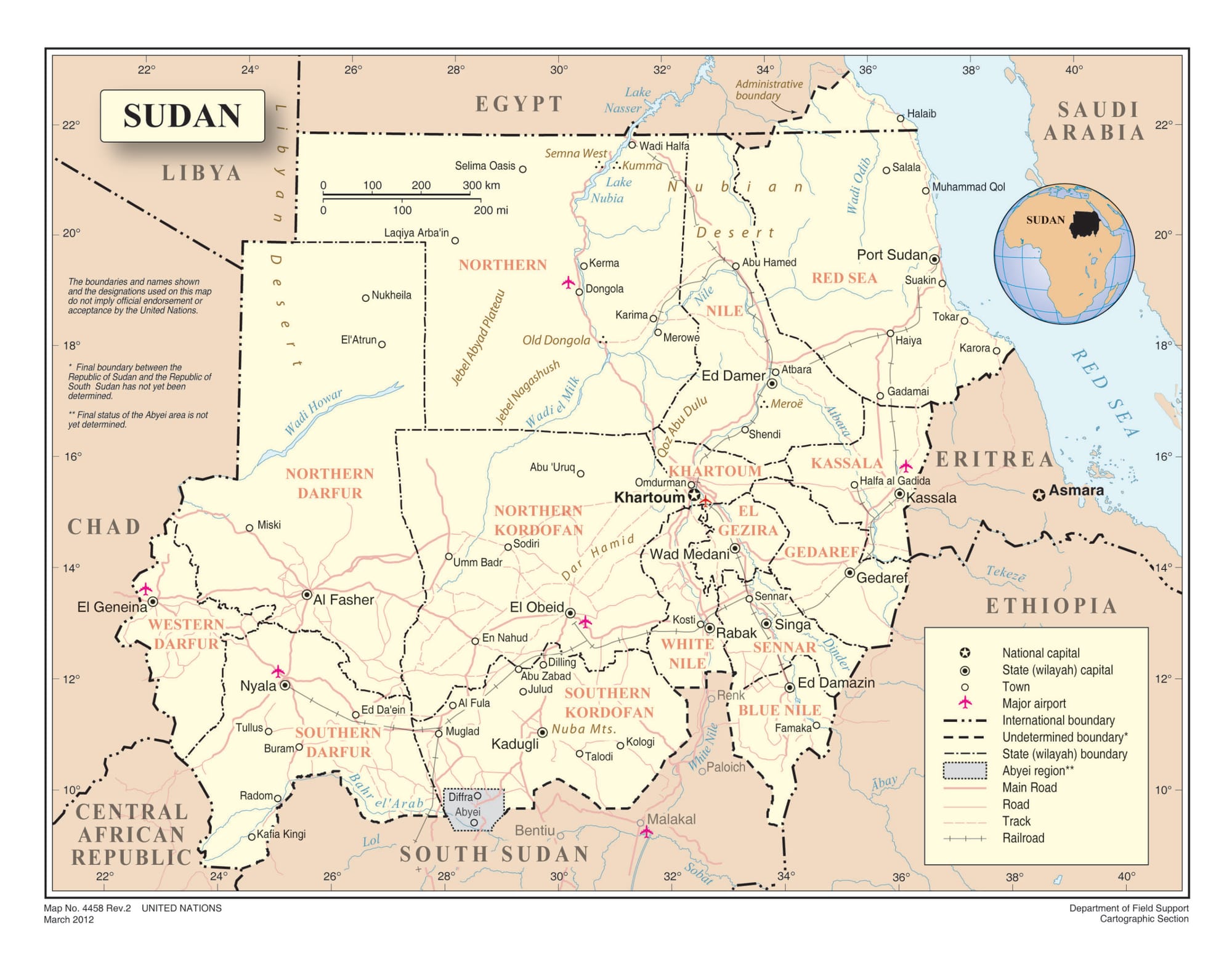
United Nations map of Sudan, March 2012.
In the run up to the revolution, Sudan’s youth leaders linked up with the unions of physicians, pharmacists, lawyers and secondary school teachers. The Sudanese Professional Association (SPA)—a network of parallel (or unofficial) trade and professional unions composed of doctors, engineers and lawyers among others—took the lead in organizing and scheduling the protests. In late December 2018, they called for a march to the parliament in Khartoum, demanding the government raise public sector wages and legalize the informal professional and trade unions. After security forces used violence against peaceful protests, their demands escalated into the call for the removal of the ruling National Congress Party (NCP), the structural transformation of governance in Sudan and a transition to democracy.
Their demands echoed those of previous popular protests, including in 2011, 2012 and 2013\. But the 2018–19 protests were unprecedented in terms of their length and geographic breadth. They also followed a remarkably new, innovative and sustained process. Demonstrators learned from the mistakes of previous protests, which were highly centralized, mostly limited to middle class Sudanese and lacking in strategies for confronting the state’s ubiquitous security forces.
Led by the SPA and organized at the level of the street by youth-led neighborhood resistance committees (NRCs), the demonstrations were coordinated, scheduled and essentially designed to emphasize sustainability over sheer numbers. The protests were also spread throughout middle class, working class and poor neighborhoods, and there was coordination with protestors in regions far from Khartoum, including the states on the Red Sea, to the east, and Darfur, to the far west of the country.
Beyond the regional scale, the protests were also distinguished by never-before-seen levels of solidarity across class and ethnic lines. Youth activists and members of professional associations not only challenged the political discourse of the Islamist state, they played a significant role in engineering cross-class alliances in the context of these demonstrations. The slogans they used were designed to resonate and mobilize support across ethnic, racial and regional divides.
Over the course of the six-month long protests, strikes, work stoppages and sit-ins were held, not only on university campuses and secondary schools, but also among private sector and public sector workers. Among the most important examples were the strikes by workers of Port Sudan on the Red Sea, demanding the nullification of the sale of the southern Port to a foreign company, and several work stoppages and protests led by employees of some of the country's most important banks, telecom providers and other private firms.
While much focus is rightly placed on the central role of the street protestors, resistance committees and the SPA, Sudanese opposition parties also played a role: not only in organizing protests but also by providing the ideational support to the demands of the protests. The political parties took the lead in drafting the Declaration of Freedom and Change in January 2019 at the very height of the protests. Along with the SPA, Sudan’s main political party coalitions, most notably the National Consensus Forces and Sudan Call (*Nida al-Sudan*), drove the formation of the wide network of opposition, which was united under the banner of the Forces of Freedom and Change (FFC). The FFC was primarily responsible for coordinating across social classes, including those working in the informal sector.
> **...most importantly, the FFC engaged not only middle-class youth associations and groups but informally organized neighborhood resistance committees—some of which represented the poorer urban quarters.**
Indeed, and most importantly, the FFC engaged not only middle-class youth associations and groups but informally organized neighborhood resistance committees—some of which represented the poorer urban quarters. These NRCs had their roots in 2013 civil disobedience against al-Bashir and served as the foot soldiers of the protests. They took the lead in redirecting protestors away from the security forces and played a central role in sustaining the protests despite the great violence deployed by the security forces and militias to quell the uprising*.*
The relative strength and initial legitimacy of the main opposition parties, and their coordination with street protestors and informal unions, played the most crucial role in sustaining the protests that ousted al-Bashir. Following the revolution, resistance committees would assume a more direct political role, working to build a grassroots consensus around a blueprint for a legitimate and popular based transition to civilian democracy, consistent with the goals of the revolution.
## **Counterrevolutionary Violence**
After the fall of Omar al-Bashir in April 2019, however, Sudan remained a quintessentially hybrid authoritarian regime.
Initially, al-Bashir was replaced by a military junta in the form of the Transitional Military Council (TMC). The TMC was headed by General Burhan of the Sudanese army (SAF), and its deputy leader was Dagalo, the commander of the RSF. In response to the military’s assumption of power, sit-ins and protests continued, demanding a transition to full civilian rule. On June 3, 2019, security forces of the TMC, including the RSF militia, violently dispersed one of these sit-ins, killing hundreds and injuring thousands in what became known as the Khartoum “Sit-in Massacre.”
The civilian leadership, represented by the FFC, finally reached an agreement with the military in July. By August 2019, the parties had signed an ostensible power-sharing agreement in the form of a constitutional charter, and the FFC put forward Abdalla Hamdok as prime minister. This charter was amended with the 2020 Juba Agreement, signed between the transitional government and several opposition groups.
The transitional government, however, never established a clear separation of the branches of power: Through the constitutional charter, the military maintained the right to reject any items put forth by civilian leaders in the coalition. Moreover, they were granted immunity from investigation of past crimes (including the Sit-in Massacre) and wielded veto power over civilian ministerial appointments, like the chief justice and attorney general. The transitional government thus operated with a marked imbalance between the authority of the military and civilian leadership.
For their part, Sudan’s neighborhood resistance committees and the general protest movement continued (and does so even now) to push for five important priorities. The first is a transition to full civilian rule that is predicated on the rejection of another partnership with military leaders (captured by the ["three No's" slogan](no%20negotiations,%20no%20partnership,%20and%20no%20legitimacy%20for%20the%20military.): no negotiations, no partnership and no legitimacy for the military). Second, they are calling for the reformulation of the Juba Agreement to make it more inclusive of those directly impacted by war at the grassroots. Third, they are demanding constitutional reform discussions to prepare for a constitutional conference that takes full account of the structural and ethnic-based inequities of the past and would ultimately oversee free and fair elections. Fourth, they want accountability for the state actors involved in violence against civilians, including for the Sit-in Massacre. And finally, they seek the quick establishment of a legislative council following a cessation of hostilities.
> **Ultimately, the failure on the part of Hamdok and the civilian arm of the transitional government to incorporate the key demands and participation of the resistance committees undermined concrete progress when it came to popular demands for accountability and justice.**
Among this network of civil society organizations are groups that had thrown their support behind the civilian government, including the Sudanese Professional Association (SPA) and the two main youth organizations (Girifna and Sudan Change Now). Ultimately, the failure on the part of Hamdok and the civilian arm of the transitional government to incorporate the key demands and participation of the resistance committees undermined concrete progress when it came to popular demands for accountability and justice. It has limited the social base and support for the civilian leadership. The delay in establishing a legislative assembly to prepare for elections further undermined the popularity and legitimacy of Hamdok and the political parties more generally. The military leadership, under what was then a strong partnership between Burhan and Dagalo, deftly exploited these divisions, paving the way for the October coup.
On October 25, 2021, General Burhan of the SAF and RSF commander Dagalo jointly instigated a coup against Hamdok. Persistent widespread protests immediately followed, calling for a return to civilian rule. These protests, led by the popular resistance committees, forced the SAF and RSF to agree to negotiations with the civilian opposition. The negotiations paved the way for the now annulled framework agreement, which sparked fierce rivalry between Burhan and Dagalo. More specifically, the SAF and RSF bitterly disagreed over the issue of merging the latter into the regular national standing army. Moreover, both forces rejected attempts to dismantle their vast economic fortunes—a key objective of the revolution.
The disagreement between the two generals over security sector reform and their mutually held ambition to retain control over vast swaths of the country’s wealth are two of the most important factors that drove Sudan into war.
## **The Origins of the RSF**
If the rivalry between the Islamist-backed Sudanese army officers and the RSF militia now threatens to destroy the state, it is their long history of partnership that undergirds the present war.
The RSF’s emergence dates to the Darfur war of the early 2000s. Responding to an insurgency that began in Darfur in 2003, the Bashir regime executed a scorched earth counterinsurgency war that resulted in the death of over 200,000 civilians. The war was primarily waged by the so-called Janjaweed militias, which were created, financed and controlled by the regime in Khartoum. The current commander of the RSF, Dagalo, himself served as a commander of the Janjaweed during these years. (Burhan, too, was stationed in Darfur so that the SAF could coordinate counter-insurgency efforts on Khartoum’s behalf.)
> **Concerned over both the threat posed by insurgents in Darfur as well as repeated cycles of pro-democracy demonstrators in Khartoum, al-Bashir institutionalized the RSF as a counter-insurgency arm of the Sudanese army.**
In 2013, following the Islamist regime’s restructuring of the military, the Janjaweed were turned into the RSF under Dagalo’s leadership. Concerned over both the threat posed by insurgents in Darfur as well as repeated cycles of pro-democracy demonstrators in Khartoum, al-Bashir institutionalized the RSF as a counter-insurgency arm of the Sudanese army. In addition to deploying the militia against the insurgency and popular protests, a third aim was to weaken the national standing army so as to prevent any attempts by mid-ranking officers to oust al-Bashir’s party (the NCP regime) through a military coup. Al-Bashir famously gave Dagalo his nickname, Hemedti, “my protector.” In 2017, the ruler legalized the RSF via executive decree, formally establishing the militia as an independent security force, thereafter, more aptly categorized as a state-paramilitary militia.
Following the revolution in 2019, Burhan allowed and promoted the expansion of the RSF throughout the residential areas of greater Khartoum, setting the stage for the capital city to become the epicenter of violence at the war’s onset.
It is a fatal irony of Sudanese history that the RSF—the ostensibly loyal militia arm of the former Islamist NCP regime—would, in April of 2023, take up arms against its former benefactor. Its primary reasons for doing so were twofold: its insistence on command-and-control autonomy and to realize Hemedti’s own rising ambition to gain economic and political dominance in the country.
## **A War Over the ‘Illicit’ economy**
The power of the Sudanese army, especially among its upper ranks, has its roots in the foundation of Sudan’s present deep state and the linking of the domestic economy to military and security interests.
After the coup in 1989 brought Bashir’s Islamist-backed military regime to power, the government ushered in an economic strategy of *tamkeen* (empowerment). This policy established political and economic hegemony in favor of the country’s Islamist elites, who were organized around the National Islamic Front (NIF) and later the National Congress Party (NCP). Under a policy of ostensibly neoliberal, pro-market reforms, state owned enterprises were sold off to the regime’s allies. Businessmen were coerced to grant shares of their companies to NCP loyalists, and tax reductions if not full exemptions were awarded to regime-friendly business.[\[6\]](#%5Fedn6)
In addition to buying regime loyalty, the state purged its rivals from the government and civil society. Upon assuming power, the Islamist regime dismissed thousands of members of the military and civil servants from the bureaucracy.[\[7\]](#%5Fedn7)
> **But if the economic policies of *tamkeen* resulted in the Islamists’ monopolization of both the formal and informal economic sectors in Sudan, they also expanded the role of the Sudanese army in the economy.**
In a pattern reminiscent of the present war, Islamist leaders began hoarding and selectively distributing commodities like wheat, flour and oil. Oil, in particular, played a central role in the regime’s Islamist-authoritarian durability until the South’s secession in 2011\. The Bashir regime, flush with a boom in oil revenue, which directly fed the state’s coffers, utilized this revenue to strengthen and expand its patronage networks throughout the country, channeling funds to loyalists and their home regions. But if the economic policies of *tamkeen* resulted in the Islamists’ monopolization of both the formal and informal economic sectors in Sudan, they also expanded the role of the Sudanese army in the economy.[\[8\]](#%5Fedn8) The creation of the Military Industrial Corporation (MIC) in the early 1990s granted the SAF control over a dozen companies that produced military hardware. Their economic activities later grew beyond the MIC to include a range of civilian industries.
It is against this backdrop that the economy became a key arena of political competition following the 2018–19 uprising. During the transition that followed the revolution, two elite factions emerged in the center: the remnants of the NIF’s Islamist coalition, linked to members of the NCP—who had been primarily responsible for building the deep state in the 1990s—and the Transitional Military Council (TMC) composed of leaders of the SAF and RSF militia.
Whereas in the past, Islamists represented a relatively coherent group, in the transition, fissures emerged between the military leaders heading the TMC and a resurgent Islamist ideological group, wielding significant control over the state’s security services, including the infamous and militant *kattayib al-zil*, or “shadow brigades.”[\[9\]](#%5Fedn9) In response, the TMC assumed control over many large Islamist-owned businesses and curtailed the power of Sudan’s intelligence services. They even worked toward dismantling several militia forces by confiscating their assets and closing bank accounts. Following the coup of October 25, 2021, however, Burhan found himself increasingly isolated with no significant constituency or legitimacy in civil society. He quickly mended relations with the Islamists, reinstating their leaders in the bureaucracy and state’s security apparatus. Both are now fighting the RSF.
Military leaders, backed by Islamist hardliners, are struggling to retain and revive the vast financial wealth and political advantages they enjoyed because of their monopoly over a deep state. Burhan’s objectives in the current war are thus driven by SAF companies and investments as well as the long history of SAF and Islamist manipulation of the informal economy, which enabled their hold over the state. The fact that, together, they are intent on realizing this objective by any military means necessary and regardless of the human cost partially explains the logic of the mass-scale violence in the ongoing civil war and, in particular, the targeting of the civilian population—most of whom have struggled to dismantle the legacy of the deep state. Indeed, one of the central aims of the revolution from it outset was: *tafkeek al-nizam wa izalat al-tamkeen* (dismantling the regime and removing its “empowerment” policies).[\[10\]](#%5Fedn10)
## **From Oil to Gold**
The policies of empowerment (*tamkeen*) along with the oil boom fueled the rise of an Islamist-dominated deep state. In the current war, however, it is mining gold for export that is fueling Hemedti’s parallel militia and generating political violence.
Following the loss of oil revenue with South Sudan’s secession in 2011, al-Bashir turned to gold to bolster his weakened patronage networks. Between 2012–2017, gold production increased by an astronomical 141 percent.[\[11\]](#%5Fedn11) In 2018, one year before the revolution, the country was the world’s twelfth largest producer.
A gold trading business in Atbara, Sudan, 2021\. Simon Marks/Bloomberg via Getty Images.
But unlike oil, the benefits from this new gold boom have been distributed in a far more decentralized fashion. Most gold exports are [smuggled illegally](https://www.theguardian.com/global-development/2020/feb/10/militia-strike-gold-to-cast-a-shadow-over-sudans-hopes-of-prosperity) out of the country, mainly to markets in the UAE. The bulk of the value of gold thus escapes the battered formal economy, undermining the state’s ability to generate revenue and allocate resources to its civilian population. A recent study found that the gap between Sudan’s reported gold exports and the imports recorded by trading partners equaled $4.1 billion.[\[12\]](#%5Fedn12) The discrepancy suggests an astronomical 47.7 percent of Sudan’s gold revenues end up in private hands.
While the military and the Islamist dominated security apparatus are fighting to control companies involved in oil, gum Arabic, sesame, weapons, fuel, wheat, telecommunications and banking, Hemedti is monopolizing gold (and to a lesser extent livestock and real estate), to expand his war effort. The violence underpinning the war is directly related to his personal wealth, which he amassed, in large part, from his participation in the illicit gold trade.
In 2015, a [report](https://reliefweb.int/report/sudan/un-panel-experts-reveals-gold-smuggling-and-cluster-bombs-darfur) released by the UN Security Council found that Hemedti’s forces were generating $54 million a year from control of the Jebel Amer goldmine.[\[13\]](#%5Fedn13) This revenue [enabled him](https://www.reuters.com/article/idUSKBN1Y01DQ/) to recruit poor and unemployed youths from across the Sahel to the RSF, including from Libya, Chad, Mali and Niger, who are the main perpetrators of the violence in Darfur, Khartoum and central Sudan. His paramilitary force currently numbers an estimated 40,000\. Compared to their counterparts in the SAF, its rank and file enjoy great access to financial resources and training from outside actors.
The emergence of gold as Sudan’s most lucrative commodity helps to explain the decentralized nature of the war and the high levels of violence meted out by the RSF militia, particularly in the gold rich regions of Darfur and Kordofan.
## **Fueling a Proxy War**
While the primary dynamics driving the war in Sudan are internal, regional powers and others further afield are playing influential roles. Chief among them are the countries of the Gulf, especially Saudi Arabia and the United Arab Emirates.
Here too the emergence of gold as Sudan’s most lucrative commodity is significant. Unlike oil, gold is a lootable resource, motivating external actors, like the UAE, to intervene on the side of the RSF, regardless of the consequences in terms of violence against civilians. The UAE is reportedly supporting Hemedti and his RSF with arms shipments through Chad and Libya.
Beyond the illicit trade in gold, Hemedti has also benefited from the Gulf countries’ regional interests and concerns over the Red Sea. Saudi Arabia and the UAE have long worried about Iranian encirclement through the Strait of Hormuz and Bab el-Mandeb. These concerns were strengthened by Iranian support for the Houthi movement in Yemen, which led to military intervention by a Saudi-led coalition in 2015\. Hemedti received millions of dollars from both Saudi Arabia and the UAE for sending his militia forces to fight in the war.
While the majority of RSF soldiers have returned from Yemen, the recent escalation of violence in the Red Sea due to [Houthi attacks on commercial shipping](https://www.merip.org/the-houthis-sovereign-solidarity-with-palestine/) vessels in response to Israel’s war on Gaza, has fueled the concerns of Saudi Arabia, in particular. Riyadh, along with the United States, has taken the lead in attempting to broker a cease-fire agreement between the two warring parties with a strategic view to retaining a strong alliance with whichever post-war regime emerges in Khartoum.
Both Saudi Arabia and the UAE have successfully established military bases in the Horn of Africa—Saudi in Djibouti and the UAE in Eritrea. The UAE is also seeking to establish similar facilities in northern Somalia. But competition over influence in the Red Sea region is not limited to these states. Qatar, Turkey and Russia have all increased their engagement in the region and made overtures about establishing miliary bases off Sudan’s Red Sea coast.
While in part strategic, Gulf states’ interest in Sudan also stems from longer term economic objectives. They see investment in Africa as a means to diversify their economies and are eager to expand trade in the resource rich continent, to which Sudan is a gateway. The UAE has vigorously pursued a port development project off Sudan’s Red Sea coast. In 2022, it [was reported](https://www.reuters.com/world/middle-east/exclusive-uae-build-red-sea-port-sudan-6-billion-investment-package-2022-06-20/) that Khartoum formally awarded a contract to the UAE to operate part of Port Sudan, in which the UAE would invest $6 billion.
> **In Sudan’s agricultural heartland the Gezira, for example, investments by Gulf countries (totalling an estimated $8 billion) were facilitated by neoliberal policies that plunged small farmers into debt and decimated the small-scale agricultural sector.**
Sudan’s agricultural lands are also crucial to helping the Gulf states meet the skyrocketing demand of food imports. In Sudan’s agricultural heartland the Gezira, for example, investments by Gulf countries (totalling an estimated $8 billion) were facilitated by neoliberal policies that plunged small farmers into debt and decimated the small-scale agricultural sector. Much of the land leased by Gulf investors has been transformed into large-scale agribusiness projects that have cut through herding routes and absorbed plots once used for rain-fed subsistence farming. Incidentally, the pauperization of Sudanese farmers and rural workers has helped fuel the success of the RSF’s militia recruitment, with fighters hailing from now dispossessed rural populations.
Egypt, for its part, supports General Burhan and the SAF. Not only is Cairo concerned over a revitalized Islamist influence along its southern flank, it is also worried about the Nile River basin. In 2020, Ethiopia started filling the Grand Ethiopian Renaissance Dam, a $4.8 billion hydroelectric dam on the Blue Nile, which Cairo views as an existential threat to its own water resources. Hemedti has close ties to Ethiopia as well as to the UAE, which despite being a major benefactor of Egypt is also a regional rival for influence. As such, Egypt views an RSF dominated Sudan as a threat to its national interests.
One result of these competing rivalries is an array of “peace” efforts operating at cross-purposes. At the time of writing a total of four different forums are operating simultaneously to seek a ceasefire and a peace agreement between the warring factions: The Riyadh Talks (led by the United States and Saudi Arabia), the IGAD-African Union initiative led by Djibouti, talks in Cairo attempting to forge an alliance between the civilian opposition and Egypt’s ally, the SAF, and a more recent initiative led by the UAE but held under the auspices of the government of Bahrain.
These initiatives reflect the interests of the states behind them and their relationships with the respective warring parties rather than efforts to support the Sudanese people and civil society in finding a workable framework for a cease fire.
## **The Enduring Promise of the Revolution**
In contrast to other civil wars in Sudan’s history, the warring parties in Sudan at present have no significant constituency or legitimacy in civil society. Both parties are waging a war against the Sudanese people precisely because, in the wake of the wide-scale pro-democracy revolution of 2018, Sudanese civil society overwhelmingly rejected a future dominated by autocratic military leaders.
> **...the 2018–19 revolution clearly showed, and the present devastating war has affirmed, that prospects for peace and democracy lie in Sudan’s enduring civil society of professional associations, trade unions and its youth and women’s organizations.**
Indeed, the 2018–19 revolution clearly showed, and the present devastating war has affirmed, that prospects for peace and democracy lie in Sudan’s enduring civil society of professional associations, trade unions and its youth and women’s organizations. The war has only affirmed the importance of these networks. Even now, the youth-led resistance committees, despite their differences, agree that the priority is to end the war and restore peace by addressing the root causes of Sudan’s conflicts as the revolution intended.
During a devastating war and in the face of mass displacement, an influential grassroots youth-led movement has shown significant capacity to collaborate across ethnic, gender and social divides for democratic objectives. In the absence of adequate international aid, for example, youth-led emergency response rooms have mobilized mutual aid across the country.
Amid the waning legitimacy of political elites in Sudanese civil society, youth leaders continue to enjoy strong support among a wide spectrum of Sudanese. Leaders of the youth movement, women’s organizations, independent scholars, artists and millions of Sudanese in the diaspora are near unanimous in meeting the present challenge of the war by working toward strengthening civil society in ways that rebuild trust, resolve conflict and build a sustainable peace.
**Read the** [**previous**](https://www.merip.org/a-note-on-the-cover-image-4/) **article. Read the** [**next**](https://www.merip.org/a-conversation-with-rabab-elnaiem/) **article.**
**This article appears in** [**MER issue 310**](https://merip.org/magazine/310/) **“The Struggle for Sudan.”**
\[**Khalid Mustafa Medani** is associate professor of political science at McGill University.\]
---
### **Endnotes**
[\[1\]](#%5Fednref1) "[Sudan crisis sends shockwaves around the region as displacement, hunger, and malnutrition soar](https://www.wfp.org/news/sudan-crisis-sends-shockwaves-around-region-displacement-hunger-and-malnutrition-soar)," WFP, February 19, 2024.
[\[2\]](#%5Fednref2) The National Population Council, Ministry of Social Welfare and Security, “[Sudan Millennium Development Goals Progress Report, 2010](https://www.undp.org/arab-states/publications/sudan-national-millennium-development-goals-report),” July 23, 2012, p. 67.
[\[3\]](#%5Fednref3) IMF Country Report No. 13/318: "[Sudan: Interim Poverty Reduction Strategy Paper](https://www.merip.org/content/files/external/pubs/ft/scr/2013/cr13318.pdf)," (October 2013), p. 6.
[\[4\]](#%5Fednref4) “[Sudan: Public Expenditure Review, Synthesis Report](https://hdl.handle.net/10986/7672),” World Bank, Report no. 41840-SD. Washington DC. December 2007.
[\[5\]](#%5Fednref5) World Bank: "[The Sudan Interim Poverty Reduction Strategy Paper Status Report](https://www.merip.org/content/files/curated/en/980991479985933855/110503-wp-sudanflipbookenglish-public.pdf)," (October 2016), p. 1.
[\[6\]](#%5Fednref6) Ahmed Gallab, *The First Islamic Republic: Development and Disintegration of Islamism in Sudan* (Surrey: Ashgate, 2008).
[\[7\]](#%5Fednref7) Anne L. Bartlett, “Dismantling the ‘Deep State’ in Sudan,” *Australisian Review of African Studies*, 41/1, (2020), pp. 51-57.
[\[8\]](#%5Fednref8) Harry Verhoeven, “The rise and fall of Sudan’s Al-Ingaz Revolution: The Transition from Militarised Islamism to Economic Salvation and the Comprehensive Peace Agreement,” *Civil Wars* 15/2 (2013), pp. 118-140.
[\[9\]](#%5Fednref9) “[Burhan lets the Islamists back in](https://www.africa-confidential.com/article/id/13935/Burhan%5Flets%5Fthe%5FIslamists%5Fback%5Fin),” *Africa Confidential* 62/10 (May 12, 2022).
[\[10\]](#%5Fednref10) “[Al-Burhan forms committee to dissociate al-Bashir’s regime in Sudan](https://www.middleeastmonitor.com/20191211-al-burhan-forms-committee-to-dissociate-al-bashirs-regime-in-sudan/),” *Middle East Monitor*, December 11, 2019.
[\[11\]](#%5Fednref11) "[Analyzing Trade, Oil and Gold: Recommendations to Support Trade Integrity in Sudan](https://www.merip.org/content/files/wp-content/uploads/2020/05/sudan-policy-brief-final.pdf)," Global Financial Integrity, May 2020, p. 3.
[\[12\]](#%5Fednref12) "[Analyzing Trade, Oil and Gold: Recommendations to Support Trade Integrity in Sudan](https://www.merip.org/content/files/wp-content/uploads/2020/05/sudan-policy-brief-final.pdf)," Global Financial Integrity, May 2020, p. 3.
[\[13\]](#%5Fednref13) "[U.N. Panel of Experts Reveals Gold Smuggling and Cluster Bombs in Darfur](https://reliefweb.int/report/sudan/un-panel-experts-reveals-gold-smuggling-and-cluster-bombs-darfur)," Relief Web, April 12, 2016.
### Issue 310 (Spring 2024) Masthead
URL: https://www.merip.org/2024/04/issue-310-spring-2024-masthead/
Last updated: 2025-07-29T13:07:48.000Z
## ***Middle East Report*, “The Struggle for Sudan,” Spring 2024, No. 310, Vol. 53 No. 1**
### **Executive Director**
**James Ryan** jamesryan@merip.org
### **Executive Editor**
**Katie Natanel** katienatanel@merip.org
### **Managing Editor**
**Marya Hannun** maryahannun@merip.org
### **Photo Editor**
**Michelle Woodward** mwoodward@merip.org
### **Staff Editors**
**Alyssa Bivins** bivins@gwu.edu
**Michael Kaplan** kaplan\_m@gwu.edu
### **Board of Directors**
**Paul Silverstein(Board Chair)** *Reed College*
**Kaveh Ehsani** *DePaul University*
**Michael Hanna** International Crisis Group
**Adam Hanieh** *University of Exeter*
**Vickie Langohr** *College of the Holy Cross*
**Lee O'Brien** *Retired*
**Mary Sexton** *Consultant*
**James Ryan** *MERIP Executive Director (ex officio)*
### **Editorial Committee**
**Lisa Hajjar (Co-chair of the Editorial Committee)** *University of California, Santa Barbara*
**Muriam Haleh Davis (Co-chair of the Editorial Committee)** *University of California, Santa Cruz*
**Ayça Alemdaroğlu** *Stanford University*
**Sabiha Allouche** *University of Exeter*
**Gregory Brew** *Analyst at Eurasia*
**Stephen Gasteyer** *Michigan State University*
**Maziyar Ghiabi** *University of Exeter*
**Kanwal Hameed** *University of Exeter*
**Najib Hourani** *Michigan State University*
**Laleh Khalili** *University of Exeter*
**Reinoud Leenders** *King's College London*
**Shana Marshall** *George Washington University*
**Pascal Menoret** *Brandeis University*
**Jacob Mundy** *Colgate University*
**Maha Nassar** *University of Arizona*
**Hesham Sallam** *Stanford University*
**Kevin L. Schwartz** *Oriental Institute of the Czech Academy of Sciences*
**Deen Sharp** *London School of Economics*
**Sean Yom** *Temple University*
### **Format: Online**
### **ISSN 3065-744X**
### A Note on the Cover Image
URL: https://www.merip.org/2024/04/a-note-on-the-cover-image-4/
Last updated: 2025-07-30T04:05:50.000Z
The cover image for MER issue 310 features an ink on paper drawing from Galal Yousif’s “Forgotten Crisis Series 2024.”
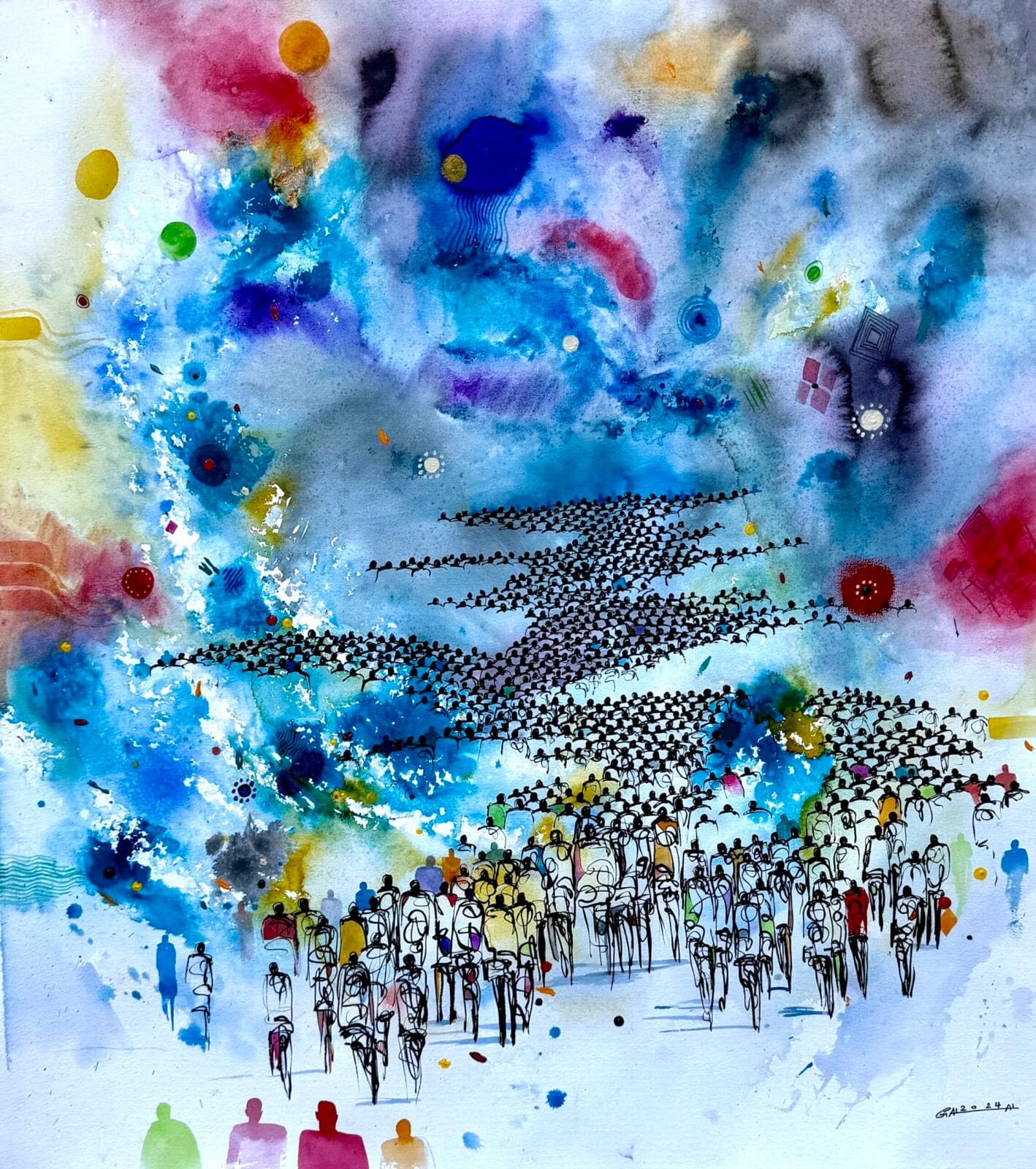
A drawing by Sudanese artist Galal Yousif to raise awareness about the war in Sudan. The Forgotten Crisis series, 2024, ink on paper.
Galal Yousif is a Sudanese artist who lived and worked in Khartoum until June 2023 when, like many others, he was forced to flee. As of the date of this publication—one year after the alliance between two Sudanese generals collapsed into war—the number of people displaced both inside and outside Sudan has reached [8.2 million](https://reports.unocha.org/en/country/sudan/).
The series’ title captures the frustration and fear shared by many Sudanese activists: that the staggering humanitarian crisis has been largely ignored globally. Sudan, a country of 50 million people, is currently on the brink of the world’s largest famine. As Khalid Medani discusses in his [primer](https://www.merip.org/the-struggle-for-sudan/) for this issue, the war is not only disrupting trade with Sudan but impacting agricultural production in the country’s breadbasket. Fighting has rendered the country’s health infrastructure dysfunctional. Moreover, the politicization of aid by both warring parties, chronicled in Azza Abdel Aziz's [contribution](https://merip.org/2024/04/leveraging-humanitarian-aid-in-wartime-sudan), hampers crucial support. The articles in this issue also capture the [popular responses](https://www.merip.org/a-conversation-with-rabab-elnaiem/) to war: how individuals and [communities](https://merip.org/2024/04/khartoums-women-street-vendor-cooperatives-and-the-politics-of-care) are mobilizing amid [massive displacement](https://www.merip.org/interview-with-william-carter-nrc/) and loss.
Yousif’s vivid drawing of a multitude of individuals walking away as one group that disappears into the horizon reflects the scale of the crisis and its human dimension. He explained to MERIP that he felt compelled to create this series to raise awareness about what is happening in Sudan. On his [Instagram](https://www.instagram.com/p/C3xahe6oLfp/?hl=en) page, where he displays his artwork, he writes, “People have lost so much...These are not only numbers, they are people, they have #life to live, they deserve a better life.”
The swirling colors and small, intricate designs that hover around the people in the drawing poignantly suggest the beauty and vitality of life that is now beyond reach. As the figures recede into the distance their color vanishes but does not disappear from the picture.
As an artist in exile currently living and making art in Nairobi, Yousif reflects that the “experience of war has changed me and changed my art as well. It’s a heavy experience, but we have to go through it.”
**Read the [first](https://www.merip.org/the-struggle-for-sudan/) article in [MER issue 310](https://merip.org/magazine/310/) “The Struggle for Sudan.”**
### Beirut and the Birth of the Fortress Embassy
URL: https://www.merip.org/2024/04/beirut-and-the-birth-of-the-fortress-embassy/
Last updated: 2025-08-22T18:36:22.000Z
On a late July day in 2023, amid the pine tree hills overlooking the Bay of Beirut, 14 bright yellow tower cranes and thousands of workers toiled over the construction site of the third US embassy in Lebanon.
The new US embassy under construction in Awkar with a view of Beirut in the distance. Photo courtesy of the US Embassy in Beirut's X feed, May 5, 2023.
At over 40 acres, the new Beirut embassy, a 19-structure ziggurat that dwarfs any government facility in Lebanon, is the second largest in the world after Baghdad’s. Its billion-dollar estimated budget rivals the cost of the US embassy in London, and it is about four times its size, despite Britain having ten times Lebanon’s population and 130 times its GDP.
No specific reason has been offered for building such a massive compound in Lebanon. According to the State Department’s website, the “primary purpose” of any US Embassy is to “assist American citizens,” visiting or living in the host country.[\[1\]](#%5Fedn1) But such explanations are belied by Lebanon’s relative size and economic status. Rather, the new embassy, like that of Baghdad, speaks to longstanding US military interests and activity in Lebanon and the wider region.
For decades, the United States has been heavily involved with the Lebanese military, serving as principal trainer and weapons supplier. The United States has disbursed [$3 billion](https://www.state.gov/u-s-security-cooperation-with-lebanon/) to Lebanese security forces since 2006, as part of $10 billion overall aid to the country, according to a 2020 congressional [hearing](https://twitter.com/habib%5Fb/status/1310610140152893446). The figures rival Iran’s [reported](https://www.thenational.ae/world/the-americas/iran-pays-hezbollah-700-million-a-year-us-official-says-1.737347) multi-billion dollar investment push into Lebanon over the same period, largely in support of Hezbollah. In addition to a steady flow of ammunition and hardware, in January of 2023, Washington announced a [plan](https://www.lemonde.fr/en/international/article/2023/01/25/washington-to-pay-lebanon-army-police-salaries-for-six-months%5F6013047%5F4.html) to[ pay](https://www.washingtonpost.com/business/us-reroutes-72m-in-aid-for-wages-for-lebanese-army-police/2023/01/25/6c420260-9ca4-11ed-93e0-38551e88239c%5Fstory.html) the majority of all Lebanese army salaries in US dollars, some $72 million, as the country’s currency continues to plummet. Although it has not been covered much in the press, US troops are currently stationed at two Lebanese military air strips just an hour’s drive from the embassy hill, where local residents have reported hearing large C130 style military planes periodically landing. Even lesser known is the secretive Pentagon program that works with the Lebanese military to wage [covert proxy battles](https://theintercept.com/2022/07/01/pentagon-127e-proxy-wars/), according to reporting by The Intercept.[\[2\]](#%5Fedn2)
Since October 2023, US involvement in and around Lebanon has escalated dramatically as a result of Israel’s ongoing war on Gaza and its regional reverberations. The Pentagon has reported over 250 attacks on bases in Syria and Iraq since October, illuminating a wide array of US military outposts across remote areas of the two countries, despite the announcement of a US troop withdrawal from Iraq in 2021\. With increasing calls from Baghdad for a more complete withdrawal of US forces from the country, the massive new embassy complex in Beirut could become the closest US political and intelligence hub for far-flung bases. The Pentagon claims these desert bases were established in the war against ISIS. But military sources[ told](https://theintercept.com/2024/02/09/us-base-jordan-tower-22-troops-iran-backed-militias/) the Intercept in early February that the mission has shifted to targeting Iran and Iranian backed groups.[\[3\]](#%5Fedn3) In February of 2024, US President Biden ordered airstrikes on both Iran-backed groups in Iraq and Syria as well as Iran-backed Houthi fighters in Yemen, who have launched attacks on US and British ships in solidarity, the Houthis say, with the people of Gaza.
In line with other Iran-allied groups, Hezbollah has launched near daily [attacks](https://www.pbs.org/newshour/world/israeli-strikes-inside-lebanon-kill-at-least-2-hezbollah-members) against Israeli military bases and troops along the Lebanon-Israel border since October 2023, inflicting significant damage at Israeli surveillance posts that monitor southern Lebanon and [downing](https://www.haaretz.com/israel-news/security-aviation/2024-04-08/ty-article/.premium/israeli-army-confirms-in-a-first-hezbollah-shoots-down-advanced-hermes-900-uav/0000018e-bd86-d92b-adaf-ffe63fde0000) sophisticated Israeli drones over Lebanese territory. Israel has in turn launched dozens of strikes on what it describes as Hezbollah targets, reportedly [killing](https://www.reuters.com/world/middle-east/israel-strikes-deeper-into-lebanon-hezbollah-downs-drone-2024-02-26/) 200 of its fighters and at least 50 Lebanese civilians, including three journalists covering the conflict.
Less than 60 miles south of the new embassy, the Lebanon-Israel border region is also home to major European military interests, namely, the sprawling multinational military base at Naquora hosting the over 10,000-strong United Nations Interim Force in Lebanon (UNIFIL), led by France, Italy and Germany. Asian nations, too, have become increasingly large stakeholders in Lebanon. China is building its own sprawling cultural center, comprising an opera house and music conservatory on the new marina harbor front north of Beirut. Turkey and several Arab Gulf states have also been vying for Lebanese hearts and minds with soft power cultural projects, including plans to fund museums and cultural spaces.
The global competition over Lebanon extends to its natural resources, as exploration of gas fields buried under the eastern Mediterranean Sea is rapidly progressing. The United States arbitrated a long-standing dispute over demarcation and ownership of the fields in 2022, resulting in a historic maritime border deal between Israel and Lebanon after years of uncertainty and even threats of war. A consortium involving French, Italian and Qatari oil firms began drilling exploratory wells in 2023, and although no significant reserves have been tapped, the process is set to [continue](https://www.reuters.com/world/africa/lebanon-wants-totalenergies-consortium-drill-second-well-gas-block-9-2023-10-24/) in 2024\. Israel on the other hand, has already begun extraction.
The newest embassy arrives amid these major regional and global developments. But the questions it raises are far from new. Since the mid 20th century, successive US embassies in Lebanon tell the story of US commercial and strategic interest in the country and how the space of the embassy has increasingly blurred the lines between militarization and diplomacy.
## **Before the Fortress Embassy**
In many ways, Beirut is at the heart of what has come to be known as the "fortress embassy": the hardened bunker-like mega projects now being built across the globe, from Guatemala to Thailand, at the cost of billions.
In 1983 and 1984, truck bomb attacks demolished both the first and second US embassies of Beirut as well as the US Marines compound. The 1983 attack—at the time the world’s greatest nonnuclear explosion—was carried out by a pro-Iran militia (though a US court later found Hezbollah responsible). Killing more than 300 embassy staff and US soldiers, including high level diplomats and veteran CIA operatives, it sparked a radical change in embassy architecture. In 1984, then Secretary of State George Shultz formed the Advisory Panel on Overseas Security–known as the Inman report. Among its recommendations were that embassies be built far from city centers and on lots of at least 15 acres.
> **At the time of its construction in the early 1950s, downtown Beirut was a hub for regional US intelligence and economic activities.**
By contrast, before the attacks, the embassy had operated from the heart of the Lebanese capital. Situated next to the verdant campus of the American University of Beirut, it occupied three conjoined towers on the seafront. Staff could walk to work along the corniche. At the time of its construction in the early 1950s, downtown Beirut was a hub for regional US intelligence and economic activities. US companies like Pan Am, then the world’s biggest airline, Chase Manhattan Bank and American Life Insurance all had iconic administrative buildings in the city. US Navy ships regularly docked at Beirut’s port for fleet week, and US sailors strolled the streets. “This embassy is the finest listening post in the whole region,” a CIA agent, played by disco-era hero “Shaft” (Richard Roundtree) leans back in his chair and tells the US ambassador to Lebanon in the 1972 film, *The Embassy.* (The film—one of several cinematic depictions of the US Embassy in Beirut—is notable for having actually been shot in the city.)
US embassy officials meeting with Lebanese President Camille Chamoun (in a dark suit with cigarette) at his residence in Jiyyeh, 1959\. Photo courtesy of Hanna Farha.
Lebanon’s pre civil war economic boom was made possible in no small part by a fossil fuel economy. The US firm Tapline and Britain's IPC operated pipelines that brought oil from the Arabian Gulf to ship terminals off Lebanon’s coast. After World War II, at the height of the Marshall Plan, the two firms [supplied](https://www.synaps.network/post/lebanon-oil-fossil-economy) more than a third of western Europe’s petroleum supply. At the peak of their operations in Lebanon, they employed some 40,000 locals. The oil business, however, came at a price for local sovereignty, as it did elsewhere. Not only did the United States prop up successive Lebanese regimes with weapons and US troop deployments, the US embassy published thousands of columns of anti-union propaganda in Lebanese newspapers and even vetted cabinet appointments.
In his [review](https://bidayatmag.com/node/1267) of [*Notes from the Minefield*](https://cup.columbia.edu/book/notes-from-the-minefield/9780231140119)—Irene Grendzier’s exhaustive study of US diplomatic relations with Lebanon (originally published in 1997)—Nathaniel George recounts how the US government rejected Kamal Jumblatt as a cabinet minister. Jumblatt’s leftist socialism made the United States fear he would become “a potential Lebanese Mossadeq bent on nationalizing the oil infrastructure,” writes George, referring to the Iranian prime minister who was ousted in 1953 by a joint US-British backed coup after he nationalized Iran’s oil.[\[4\]](#%5Fedn4)
The Beirut embassy was also a staging ground for US-led intel and military operations across the region, including involvement in efforts to support a coup against the government of Syria in 1957, which the US believed to be Soviet leaning. Much of this lesser-known history is documented in diplomatic cables, accessed by George for his dissertation, "A Third World War: Revolution, Counterrevolution, and Empire in Lebanon, 1967–1977.”
During the 1960s and 1970s, west Beirut was a hub for the Arab left, and the embassy and diplomatic staff attempted to work with various factions. The Palestine Liberation Organization (PLO), for example, agreed to provide security assistance to the US embassy, as detailed in the 2014 biography of Robert Ames, [*The Good Spy*](https://www.penguinrandomhouse.com/books/212908/the-good-spy-by-kai-bird/), by Kai Bird.[\[5\]](#%5Fedn5) A former Lebanese embassy staff member recalled being “annoyed” that Palestinians were standing guard with US Marines. Although the Reagan administration publicly labeled the PLO a terrorist organization, according to Ames’ biography, Beirut’s CIA station, which was based out of the embassy, had covertly been training Yasser Arafat’s elite security force, Force 17.[\[6\]](#%5Fedn6)
One of the force’s members, Imad Mughniyeh would later be [blamed](https://www.cnn.com/2008/WORLD/meast/02/13/hezbollah/) for both the 1983 attack on the embassy and the attack on the US Marine Barracks later that year. After an alleged botched attempt in the 1980s that led to a high number of civilian deaths in Beirut, the CIA, in association with the Mossad, [assassinated](https://www.politico.com/magazine/story/2015/02/mughniyeh-assassination-cia-115049/) Mughniyeh in Damascus in 2008.
## **Awkar**
On October 17, 2023, the bombing of Al Ahli hospital in Gaza killed hundreds of Palestinians, spurring protests at US embassies and diplomatic missions across the world, including in Beirut.
Major western media outlets, Arab news channels and even pro-Hezbollah Twitter [accounts](https://twitter.com/habib%5Fb/status/1714447198241362347) [falsely reported](https://www.newsnationnow.com/video/u-s-embassy-in-lebanon-set-on-fire-by-demonstrators-morning-in-america/9093309/) that protestors had tried to penetrate the embassy compound, scaling its walls or setting the building aflame.
In reality, protestors could not even get within eyesight of embassy walls.
> **While the original embassy served as a prominent US outpost, the embassy of the last 40 years boasts prison-style watchtowers, multiple rings of electric steel fences, giant loops of concertina wire and commando-outfitted security guards.**
While the original embassy served as a prominent US outpost, the embassy of the last 40 years boasts prison-style watchtowers, multiple rings of electric steel fences, giant loops of concertina wire and commando-outfitted security guards. During the October protest, Lebanese security forces used tear gas, water cannons and eventually, a shield-wielding platoon of military police, to keep protestors at bay. Video of a blazing building displayed by media outlets was actually a furniture store less than a mile down the hill from the embassy. The fence that was briefly scaled to erect a Palestinian flag was actually a temporary Lebanese police barricade.
The old Beirut embassy is now redeveloped as a luxury residential apartment tower. From its location on the corniche, the current embassy’s location is an almost invisible speck. Following the recommendations of the Inman report, the embassy sits at a comfortable distance from the capital in the hamlet of Awkar: a predominantly Christian part of the country, whose factions have traditionally worked with the United States. It is buffered by a large body of water, the Bay of Beirut, and several northern suburbs of the city.
Inside, it consists largely of stacks of old shipping containers, converted into windowless offices and waiting rooms decorated with faded posters of New York City and mug shots of alleged local terrorists on the FBI’s most wanted list. Miniature US flags sit atop cramped desks behind glass walls so thick they require an intercom just to speak to consular staff—many of whom are Lebanese, including a small private army that handles security. A Lebanese army base is just down the road from the front gate and several of its cannon-mounted APCs line the streets.
During the 2006 Lebanon-Israel war, marked by Israel’s devastating cluster bombing campaign, the Awkar embassy played a pivotal role in coordination with a major contingent of the US Navy and special forces. A week into the fighting, the embassy along with the US Department of Defense executed one of the largest evacuations in US history: A human bridge of 15,000 US citizens ferried over dozens of military ships and helicopters around the clock for over a week. Following the pause in fighting, to allow for the evacuation, Israel resumed bombardments on civilian infrastructure with heightened intensity, crippling all of Lebanon’s major roadways and bridges, bombing the airport runways and enforcing a naval and air space blockade of the country. Entire blocks of apartment buildings in Beirut were leveled and villages across south Lebanon reduced to rubble.
Yet Awkar continued to function throughout the dropping of earth-shattering US-supplied munitions. The embassy became a meeting place for high level US diplomats such as then Secretary of State, Condoleeza Rice, who was flown in to meet Lebanese warlords and politicians opposed to Hezbollah—one of whom even offered advice to embassy staff on where to bomb, according to a leaked [cable](https://www.haaretz.com/2010-12-03/ty-article/lebanon-defense-minister-offered-invasion-advice-for-israel/0000017f-dc58-df9c-a17f-fe588aa80000). Following the war, Hezbollah and several of its allied political parties led months of street protests calling for the downfall of the government, accusing it of taking orders from the US embassy—what it sometimes [refers](https://www.naharnet.com/stories/9108-nasrallah-slams-u-s-embassy-as-den-of-spies-2-hizbullah-members-confessed-to-spying-for-cia/print) to as the “spies of Awkar.”[\[7\]](#%5Fedn7)
The new US embassy complex under construction in Awkar. Photo courtesy of the US Embassy in Beirut's X feed, May 5, 2023.
The US Embassy in Lebanon continues to hold significant geopolitical and local influence. The nightly news closely follows the meetings of the US ambassador with various political groups, whether old clients or those closer to Hezbollah. News outlets also document the Ambassador’s efforts to bolster US soft power, from visits to the port to unload fresh shipments of US weapons and observing military training exercises, to the embassy’s funding of US-chartered schools and universities in Beirut. Some even run embassy-sponsored TV segments. US support extends beyond the headlines: to municipal works, tree planting, agricultural projects and even USAID-branded garbage cans in some villages.
The prominent position of the embassy—and the lack of transparency with which it operates—raises questions about US respect for Lebanon’s sovereignty. In 2011, Hezbollah[ alleged](https://www.wired.com/2011/11/pizza-cia/) the US embassy was recruiting assets at Pizza Hut and [Starbucks](https://www.bbc.com/news/world-middle-east-16153756) branches in Lebanon (allegations that US intelligence officials appeared to tacitly [confirm](https://abcnews.go.com/Blotter/cia-spies-caught-fear-execution-middle-east/story?id=14994428)).
More recently, in March 2020, a US special forces Osprey [landed](https://www.theguardian.com/world/2020/mar/19/us-citizen-accused-of-torture-flees-lebanon-in-helicopter) at the embassy to extract Amer Fakhoury: a dual Lebanese US-citizen and former member of the South Lebanese Army, a Christian-dominated militia. The mission was flouting local courts, where he is wanted and charged with overseeing torture of prisoners while collaborating with the Israelis during the civil war. Ironically, early [renderings](https://www.blharbert.com/projects/u-s-embassy-compound-2/) of the embassy under construction, which is located just a few meters behind the current one, featured an Osprey parked on one of two helipads. (It has since been airbrushed out of images on the US embassy [website](https://lb.usembassy.gov/our-relationship/policy-history/new-embassy-beirut-compound/).)
In June 2020, a Lebanese judge put a gag order on then Ambassador Dorothy Shea, [banning](https://www.nbcnews.com/news/world/lebanese-judge-bans-media-talking-u-s-ambassador-after-hezbollah-n1232501) local media from speaking to her following unsubstantiated allegations she made on a major TV channel that Hezbollah was [stealing](https://www.washingtonpost.com/world/the%5Famericas/lebanon-ambassador-hezbollah-shea-media-ban/2020/06/28/15adec2a-b89f-11ea-9a1d-d3db1cbe07ce%5Fstory.html) billions of dollars of Lebanese state revenue. The judge claimed she violated diplomatic protocol and incited sectarian strife—an order the ambassador simply ignored, as she continued to give television interviews to US friendly Lebanese news outlets.
Just a few blocks from the embassy compound in Awkar is a newly minted sign announcing the headquarters of the security branch of the former Christian-militia, the Lebanese Forces. Today a political party backed by Saudi Arabia, in the 1980s, during the height of the civil war, they controlled much of the predominantly Christian territories of the country (including the current US embassy site) in cooperation with Israel and its proxy militias.
> **According to former staff interviewed for this piece on condition of anonymity, former Christian militiamen have reportedly been recruited to serve in the US embassy guard as have former members of other sectarian militias.**
According to former staff interviewed for this piece on condition of anonymity, former Christian militiamen have reportedly been recruited to serve in the US embassy guard as have former members of other sectarian militias. In October 2021, the deadliest street [clashes](https://www.jpost.com/middle-east/article-754326) since the civil war broke out between Hezbollah and some members of the Lebanese Forces. In [2022](https://www.presstv.ir/Detail/2021/10/17/668682/Lebanon-Beirut-sniper-US-embassy-), the Iranian state-affiliated, Press TV, alleged that among those who participated in the October clashes was a US embassy bodyguard. While still unsubstantiated, these allegations underscore the embassy's outsized influence within Lebanon's fragmented political system, where many see the US role as strengthening divisions rather than working toward postwar reconciliation.
US Undersecretary of State Victoria Nuland, who happened to be visiting Beirut during the four-hour street battle in 2021, gave a live press conference at the airport just minutes after the shooting ceased. Addressing the Lebanese public on television before any of the country’s leaders, she condemned the violence and voiced support for widespread public protests at the time calling for the ouster of the country’s political class. Yet later that evening, she [tweeted](https://twitter.com/UnderSecStateP/status/1448750457472552969) photos touting successful meetings with Lebanon’s top leaders, including parliament speaker, Nabih Berri, who heads Amal, a political party (and close ally of Hezbollah). Nuland would not be the first or last US official to provide mixed messages to “the Lebanese people.”[\[8\]](#%5Fedn8)
Indeed, several past US ambassadors have made media spectacles out of their visits to natural and historic sites, encouraging tourism, while remaining conspicuously silent on Washington’s embargo on US passenger flights to the country. A former ambassador went so far as to don a bomb-proof suit to promote US aid efforts to help [remove landmines](https://lb.usembassy.gov/ambassador-shea-celebrates-a-mine-free-arsal-and-ras-baalbek/) that have killed dozens of Lebanese citizens, without mentioning that much of those munitions were made in the United States and supplied to Israel.
The new embassy compound—currently entering its seventh year of construction—only adds to the confusion about the US role in Lebanon.
## **The New Embassy Compound**
On a sunny April day in 2017, then US ambassador Elizabeth Richard approached a podium during a groundbreaking ceremony. She was flanked by two bulldozers overlooking the hazy jumbled skyline of Beirut. While the old embassy looked out to the sea from the capital, the new one looks upon it from a strategic height with a panoptical view.
“Our New Embassy Compound is a strong message to the Lebanese people that we are with you for the long term,” Richard said on the occasion.[\[9\]](#%5Fedn9) Seven years later, with its labyrinth of megalithic blast walls emerging from deep excavation pits, this bunker of diplomacy may well outlive even Lebanon’s 5,000-year-old Phoenician and Bronze age world heritage sites.
The centerpiece of the project, the Chancery, is a dome-like megastructure visible from towns and villages across the Lebanese mountains. Its small, deep-set windows are reminiscent of arrow slits in Lebanon’s crusader castles.
> **Many of the architectural features, like pedestrian access and recreational facilities, will face inward, contained within the surrounding buildings, presumably intended as a bulwark to insulate embassy staff from projectiles.**
The embassy compound was envisioned as “a small village,” an architect from the Pritzker-prize winning firm Morphosis, said in an embassy-produced video shared to [Facebook](https://www.facebook.com/USEmbassyBeirut/videos/917002921979845), featuring sketches of lively piazzas and garden cafes.[\[10\]](#%5Fedn10) The other 18 buildings flow seamlessly down from the Chancery’s commanding position like tentacles of an octopus straddling an entire hillside. A multi-silo batch plant located on site produces the immense volume of concrete needed for the project. Many of the architectural features, like pedestrian access and recreational facilities, will face inward, contained within the surrounding buildings, presumably intended as a bulwark to insulate embassy staff from projectiles.
A buffed marble will run the length of the compound’s interior courtyard. It will be [lined](https://www.facebook.com/USEmbassyBeirut/videos/3076780412339635) with slabs of stone carved from various mountains across the country to, in the words of the architect, “help preserve Lebanese heritage.”[\[11\]](#%5Fedn11) Rock quarrying is among the most unregulated and environmentally [destructive](https://www.undp.org/lebanon/press-releases/ministry-environment-and-undp-publish-study-quarrying-sectors-dues-national-treasury-lebanon) industries in the heavily polluted country. Yet the new embassy claims to have been certified by the US Green Buildings Council, owing to its use of solar panels and rainwater collectors, which will supposedly cover a portion of its energy costs.
During the early years of construction, hundreds of workers from South Asia lived on site, performing much of the underground work. Indeed, neighborhood residents speculate that locals were only brought in after the sensitive underground floors were completed by foreigners. Now, however, hundreds of local workers are bussed out of the worksite. A crossing guard holding a standard English language “SLOW” sign helps navigate the busy Lebanese roads, an incongruous sight in the country.
The main contractor for the site is the Alabama-based firm, BL Halbert. The firm, which has been tasked with building dozens of massively fortified multi-million dollar embassies across the world, is implicated in [labor scandals](https://www.labornotes.org/blogs/2022/09/workers-building-new-us-embassy-honduras-strike-over-severed-fingers-illegal-contracts) at embassy construction projects in Ghana, Namibia, Turkey and Honduras. In 2012, the company agreed to pay a $47 million settlement to the US government, following corruption [allegations](https://www.justice.gov/opa/pr/harbert-companies-agree-pay-47-million-resolve-false-claims-act-allegations) of rigging bids for USAID projects in Egypt.
In Lebanon, the potential liabilities of the built environment may reach far beyond the construction phase. But beyond disbelief at its size, many neighborhood residents and shopkeepers I spoke to—at least as of summer 2023—seemed upbeat about the embassy compound, viewing it as a sign of investment, amid the deep economic depression the country faces.
I did hear a few lavish conspiracy theories about what is being built inside: tunnels to the sea or a deep underground military base. Residents’ suspicions reflect the incongruous scale of the embassy. They also speak to the longer history and lack of transparency surrounding US involvement in the country. Others are taking the news in true Lebanese entrepreneurial stride. A fast-food joint called Wachicken DC has just opened its doors outside the new embassy’s front gates, still under construction.
The owner assures me that DC has no political connection and only stands for Delightful Chicken.
\[**Habib Battah** is an independent journalist and founder of BeirutReport.com. He teaches Global Studies at St. Lawrence University in New York. Find him on X [@habib\_b](https://twitter.com/habib%5Fb?lang=en)\]
---
### **Endnotes**
[\[1\]](#%5Fednref1) "[What is a US Embassy?](https://diplomacy.state.gov/what-is-a-u-s-embassy/)" US State Department: National Museum of American Diplomacy.
[\[2\]](#%5Fednref2) Nick Turse, Alice Speri, "[How the Pentagon Uses a Secretive Program to Wage Proxy Wars](https://theintercept.com/2022/07/01/pentagon-127e-proxy-wars/)," The Intercept, June 1, 2022.
[\[3\]](#%5Fednref3) Ken Klippenstein, "['Logistics' Outpost in Jordan Where 3 U.S. Troops Died is Secretly a Drone Base](https://theintercept.com/2024/02/09/us-base-jordan-tower-22-troops-iran-backed-militias/)," The Intercept, February 9, 2024.
[\[4\]](#%5Fednref4) Nate George, "[Empire in a Minefield: American Military Intervention in Lebanon in 1958](https://bidayatmag.com/node/1267)," *Bidayat* 28–29 (2020). \[Arabic\].
[\[5\]](#%5Fednref5) Kai Bird, *The Good Spy: The Life and Death of Robert Ames* (New York: Broadway Books, 2014).
[\[6\]](#%5Fednref6) Ibid.
[\[7\]](#%5Fednref7) “[Nasrallah Slams U.S. Embassy as 'Den of Spies': 2 Hizbullah Members Confessed to Spying for CIA](https://www.naharnet.com/stories/9108-nasrallah-slams-u-s-embassy-as-den-of-spies-2-hizbullah-members-confessed-to-spying-for-cia/print),” Naharnet, June 24, 2011.
[\[8\]](#%5Fednref8) “[Lebanon National Day. Press Statement: Antony J. Blink](https://www.state.gov/lebanon-national-day-3/)," US Department of State, November 22, 2023.
[\[9\]](#%5Fednref9) "[New Embassy Beirut Compound](https://lb.usembassy.gov/new-embassy-beirut-compound/),” US Embassy in Lebanon Website.
[\[10\]](#%5Fednref10) U.S. Embassy Beirut, “[Welcome to our Construction Site!](https://www.facebook.com/USEmbassyBeirut/videos/917002921979845),” Facebook (June 18, 2019).
[\[11\]](#%5Fednref11) Ibid.
### Land, Livestock and Darfur’s 'Culture Wars'
URL: https://www.merip.org/2024/04/land-livestock-and-darfurs-culture-wars/
Last updated: 2025-08-22T18:36:23.000Z
In November 2023, members of Sudan’s Rapid Support Forces (RSF) and their allied militias went house-to-house in Ardamata on the outskirts of El Geneina, the capital of West Darfur. They looted property and rounded men up for execution. A community Facebook page, [El Geneina Darndouka](https://www.facebook.com/100063768105119/posts/pfbid03yNBq435WYqc7TL3AELcu9sLhTpg7q4t1cdeQa3hCpNCoVUEA1TeQwtWqGANRhCxl/), estimated the death count to be as high as 2,000 people. Among the dead was [Muhammad Arbab](https://www.dabangasudan.org/en/all-news/article/prominent-darfur-leader-killed-by-rsf-in-el-geneina), an 85-year-old Masalit leader, who was killed along with his son and eight grandchildren in an attack on their home.

Sudanese who had been forced off of their land in Darfur and were living on the outskirts of El Fasher in Abu Shuk Camp begin farming again, 2007\. Carolyn Cole/Los Angeles Times via Getty Images.
Sudan’s civil war broke out in Khartoum in April 2023\. The RSF, Sudan’s most powerful militia force, seized the airfields and palaces of its erstwhile patron, the Sudan Armed Forces (SAF). The war quickly spread to West Darfur, where civilians from different social groups had been arming themselves against each other and against the violent systems of governance and resource extraction that had bolstered the RSF. Initially, fighting erupted between social groups rather than between armies. By May, the first mass graves were found, and hundreds of thousands of people fled across the Chadian border, 20 kilometers from El Geneina. In June, footage of the spectacular assassination of Khamis Abbakr, the governor of West Darfur and a leading figure in Masalit politics, circulated on social media. Hours before his death, Abbakr described the situation in El Geneina as genocide in what would become his last TV interview.
The violence recalled the intense, genocidal violence in Darfur that began in the mid-1990s and reached its height in the early 2000s. Darfur’s system of governance at the time was dominated by the militias that would form the roots of the RSF, to whom the SAF outsourced security. The militias supported communities that practiced mobile pastoralism and those that had moved from mobile pastoralism into a new looting-based economy. Armed Masalit groups, first organized by Abbakr, fought against them. The system thrived off intercommunal violence among the ethnically diverse populations that lived in El Geneina, with the farms and pastures of West Darfur at the frontline of this violence.
Having come to rely on the RSF and its allied militias for security in the region, the SAF struggled to maintain control over garrisons in major cities when the current war first reached Darfur. By October, the SAF’s capacity to maintain garrisons all but collapsed. In November, the SAF withdrew from their base in Ardamata, a garrison and airfield where many displaced Masalit people had settled, setting off another round of devastating violence against the Masalit population.
The Masalit describe the events of 2023 as a second genocide. Observers of Sudan often interpret this violence—intended to destroy national, ethnic, racial or religious groups—through culturalist explanations. But behind the racialized violence in Darfur is a decades-long history of climate migration, austerity politics and export-led growth that has significantly altered the region’s relationship to land and livestock and people’s relations to one another.
## **Dar Masalit and the Afro-Arab Divide**
El Geneina, the capital of the West Darfur state, has long been the political center of Dar Masalit—the homeland of the Masalit people, straddling the border between Chad and Sudan. This region, which was an independent sultanate in the late nineteenth and early twentieth centuries, was incorporated into Sudan in 1924 under British colonial administration.
For much of the twentieth century, Dar Masalit was a destination for mobile pastoralists from the west and north. Today, many Darfurians, as well as outsiders, draw a stark distinction between herding and farming across the Sahel. Mobile pastoralists are often categorized as Arabs, while farmers—many of whom speak Nilo-Saharan languages as well as Arabic, Darfur's lingua franca—are classed as Africans. But this racialized Afro-Arab binary does not capture the interconnectedness of these two livelihoods. Historically, herding communities lived in stationary or semi-mobile clusters of *farayg* (tents), typically with access to fields and watercourses. The most mobile groups moved across fairly narrow and predictable circuits, traveling from wetter to drier pastures. Meanwhile, farmers often kept animals, sending them to nearby pastures, and people from these farming communities would sometimes adopt more mobile herding livelihoods.[\[1\]](#%5Fedn1)
> **Mobile pastoralists are often categorized as Arabs, while farmers—many of whom speak Nilo-Saharan languages as well as Arabic, Darfur's lingua franca—are classed as Africans.**
In the 1970s, an influx of migrants arrived from neighboring Chad, a Cold War frontier at the time that was aligned with France and Libya. In 1973, a massive drought wiped out as much as 70 percent of the country’s cattle, prompting Chadian cattle and camel herders to flee east through Dar Masalit, where many settled.[\[2\]](#%5Fedn2) Drought in North Darfur also led many mobile pastoralists, along with their livestock, to move to the wadis (seasonal river pastures) south of El Geneina. Many switched from camel to cattle herding, as the pastures were more suitable, while others moved from herding to farming.
Further droughts in the 1980s crowded even more people into the fertile Dar Masalit, as pastures deteriorated and pastoral routes shifted due to desertification and climate change. This new influx of people intensified pressures on communal relations, and by the 1990s, conflicts began to emerge between the Masalit people and the pastoralists.
The escalating tensions were not solely the result of climate migration and the Cold War militarization of Chadian politics. Neoliberal policies also placed new pressures on rural pastoralists. In the 1970s, governments across Africa ramped up borrowing from international creditors to finance development strategies and consolidate newly independent states. By the early 1980s, global oil shocks and the collapse of the gold-based currency system led to a long-running financial crisis. In many African states, this crisis marked a shift to export-led growth strategies.
Export-led growth began to upend the pastoralist societies of western Sudan. In the 1970s, most families in Darfur kept cattle or sheep as a reliable way of saving up farming wealth, with a few wealthy families holding about half the cattle. Herding stock in a village was cared for by farmers in a few bush camps or manuring fields or entrusted to mobile pastoralists. Farmers supplied meat to El Geneina, and itinerant livestock traders sometimes bought large male animals, keeping prices high.[\[3\]](#%5Fedn3)
The shift to livestock exports was not due to government intervention; the state regarded herding and farming systems in western Sudan as “subsistence activities,” and they barely featured in the five-year plans of the period. Rather, a host of cash pressures beset populations living at the margins of markets as they were forced to cope with new patterns of climate, migration and accumulation. Beginning in the 1980s, demand for live sheep for Eid al-Adha and camels in Saudi Arabia and Egypt put increased pressure on producers and pastures. Over the course of the 1990s, Sudanese sheep exports went up sevenfold, and camel exports rose a hundredfold.[\[4\]](#%5Fedn4)
At the same time, the drought and climate crisis pushed some groups in Darfur away from pastoralism. To the north of El Geneina, some pastoralist systems collapsed entirely. Yet, the fertile wadi lands around El Geneina continued to attract pastoralists. Pressure on these lands intensified, and relationships between already-arrived farming groups and newcomer herding groups became increasingly tense.
The global financial crisis of the 1980s, and the austerity that came in its wake, radically destabilized the already frayed relationships.
## **The Racialized Politics of Austerity**
Under Omar al-Bashir, Sudan’s longstanding dictator who came to power in 1989, the state adopted a neoliberal response to the multidimensional crisis caused by climate change, debt overload and the failure of debt-funded development policies aimed at fostering national unity. He imposed austerity policies that involved replacing government investment in social services with user fees that were unaffordable for much of the population. In Darfur, rather than building schools or water points to help Masalit people and their neighbors, his security forces exacerbated local disputes over boundaries and political representation. The security forces deepened polarization between Masalit groups and their neighbors, crystallizing pre-existing cultural and linguistic differences into a racialized Afro-Arab binary. These new divisions cast Masalit people as Black/African and pastoralists as Arab, despite both groups living in Africa, speaking Arabic, intermarrying and sharing lands.
The politics of representation became a key arena for state intervention. In colonial times, rural governance in Darfur and Kordofan was structured around the Native Administration—leaders who had the power to collect taxes, administer justice, oversee land tenure and mediate between communities. Many of these leaders came from prominent families whose authority predated the colonial state and was rooted in the control of land and custom. The Islamist government repurposed the Native Administrations, inventing a new chiefly title, *amir*, the Arabic word for “commander,” which also carries Islamic significance. In the mid-1990s, al-Bashir’s governor in West Darfur created eight amir*\-*chieftaincies along supposedly tribal lines, with all but one assigned to groups identified as Arab. The newly appointed amirs posed a threat to Masalit land governance, exacerbating the tensions that already existed as a result of climate-driven migration.
In 1995, these tensions led to the outbreak of violence in Darfur. Following the announcement of administrative reforms in August, raiders identified as Arab attacked Masalit villages to the east of El Geneina, killing 75 people. The government began supplying these raiding groups with weapons, and toward the end of the 1990s, armed groups, led by amirs, conducted raids across West Darfur. The first major violence in El Geneina took place in 1999, when tit-for-tat shootings between farmers and herders turned into a rampage through villages to the south and east of the capital. Masalit sources suggest that as many as 2,000 people were killed.
> **Responding to the growing insurgency, the government outsourced security to both militias and irregular forces drawn from land-poor Arab groups led by amirs.**
Masalit, Fur and Zaghawa people were all identified as African, according to the racialized Afro-Arab binary emerging in media, popular consciousness and the calculations of the security forces. By 2003, leaders from these groups had formed rebel armies to counter the spread of Arab militias and the new pressures on land that impelled them. Responding to the growing insurgency, the government outsourced security to both militias and irregular forces drawn from land-poor Arab groups led by amirs.
The militias were run by intelligence officers based in military garrisons belonging to the Sudan Armed Forces (SAF), located in Darfur’s towns. The mobile counter-insurgency militias, run by the intelligence officers, were known as Janjaweed. After 2013, with the rebel forces weakened, the counter-insurgency militias unified into a new force, the RSF, under the command of Muhammad Hamdan Daglo, known by his nickname Himedti. The RSF eventually pushed nearly all insurgent militias out of Darfur and into Libya and South Sudan. Outsourcing security to these militias aligned with the privatization agenda of the Bashir government. It was intended to keep costs down, given that militia soldiers were paid less than regular soldiers. Emboldening these militias, however, turned out to be a fateful move, creating a dual military structure divided between aggressive, mobile militias and static, garrison forces.
Amirs led the pro-government militias that attacked the Masalit villages. Masalit and other groups continued to form rebel armies, which their enemies described as *zurga* or Black/African. With the consolidation and militarization of the Arab/African binary, violence intensified. Human rights investigators chronicled the racial slurs that counterinsurgency militias used during village burnings, rapes and murders. This violence was mostly targeted against the settled population, identified as African. Millions of Sudanese were forced into displacement camps, most of them around cities like El Geneina, where the presence of the RSF and groups of armed civilians belonging to different ethnolinguistic communities meant that petty confrontations would often morph into street massacres.
In 2010, when the International Criminal Court first indicted al-Bashir for genocide, it built its case around these events. Following a protracted period of half-implemented peace deals and insecurity, a military campaign led by RSF leader Himedti between 2014 and 2016 defeated most of the armed groups in Darfur. Many of the insurgents were pushed towards dirty war jobs in Libya and South Sudan. Himedti, meanwhile, was welcomed into the center of state and regional politics.
## **Taking Stock of Darfur’s Livestock**
As the conflict in Darfur stalemated, Sudan’s sheep exports to Saudi Arabia shot up.
Sheep exports helped mitigate the long economic crisis that began after South Sudan’s independence in 2011\. During the 2000s, southern oil wealth transformed Sudan’s economy and its balance of payments. With South Sudan’s independence, however, Sudan could no longer balance its books. Livestock exports became vital, amounting to roughly a quarter of Sudan’s total foreign currency earnings by 2012\. In 2017, Sudan and Somalia together accounted for 80 percent of Gulf imports of livestock. [\[5\]](#%5Fedn5) But these earnings still could not cover the consumption requirements of Sudan’s cities—whose populations were expanding due to rural violence.[\[6\]](#%5Fedn6) Moreover, Gulf demand for livestock continued to place pressures on land and pastures in Darfur, contributing to communal tensions that sporadically erupted into violence.
> **Gulf demand for livestock continued to place pressures on land and pastures in Darfur, contributing to communal tensions that sporadically erupted into violence.**
The uprisings that started in 2018 and eventually overthrew al-Bashir were fueled, in part, by the confluence of urban migration—spurred by rural violence—and Sudan’s economic crisis. In cities, protestors took to the streets demanding bread and freedom. Under Himedti’s leadership, the RSF initially cracked down violently on protestors. Ultimately, however, it joined forces with the Sudanese army to oust al-Bashir.
The protestors forced the creation of a new civil-military government under Abdullah Hamdok. But the new government prioritized making peace between rebel and government-outsourced militias over meeting the popular demands of the Sudanese people. Himedti, the de facto vice president, was sent to make peace with Darfurian armed groups fighting in Libya or South Sudan.
Former Darfurian rebel groups, including the faction led by Abbakr, signed the Juba Peace Agreement with Himedti in October 2020\. Under the agreement, many Darfurian armed groups returned from Libya to Sudan. Some rebel leaders, including Abbakr, were given posts in the Hamdok government. Over the ensuing months, however, a number of these former rebel groups allied with the SAF and RSF against the civilians, ultimately joining the October 2021 coup against Hamdok’s government.
Even during the relatively peaceful years that preceded the coup, the Juba agreement did not end violence in Darfur. Many local groups held on to their weapons, and many young men moved out of pastoralism and farming into looting and land-grabbing. Violence occasionally broke out in Dar Masalit between local groups of armed civilians, now straitjacketed into the racialized Afro-Arab binary.
The military coup also failed to lead to a lasting entente between Sudan’s two armies. In April of 2023, large-scale violence erupted when the RSF and SAF turned on each other. After years of outsourcing the SAF lacked the capacity for mobile warfare. Meanwhile, the RSF excelled at street battles but struggled to dislodge the SAF from their fixed positions in garrisons and airfields, leaving both armies in a stalemate.
Starting in May of 2023, as the RSF swept through Darfur, they allied with the Arab militias led by the amirs, some of whom seized on the outbreak of war to push Masalit people out of El Geneina. In El Geneina, the RSF and its allies expelled up to 70 percent of the Masalit population.
The RSF and its allies came to control much of Darfur, while the SAF defended its garrisons in the five Darfurian state capitals: El Geneina, Zalingei, Nyala, El Fasher and El Daein. In November 2023, however, the SAF’s 15 Division in Ardamata appeared to surrender its position without a fight. The collapse of the garrison at Ardamata, one of West Darfur’s largest Internally Displaced Persons (IDP) camps, led to large-scale attacks on Masalit groups. Initial reports suggest that thousands of women fled from Ardamata to the Chadian border, as hundreds of men were rounded up and killed.
Amid these mass atrocities and displacements, the livestock trade appears to be expanding. Although Sudan no longer produces foreign trade statistics, *Atar*, a new Sudanese online publication that monitors shipping from Port Sudan, reports that most ships departing Port Sudan are carrying livestock bound for Saudi Arabia.[\[7\]](#%5Fedn7) In March, Sudan’s [finance minister announced](https://www.aleqt.com/2024/03/15/article%5F2709091.html) that 4.7 million head of livestock had been exported in 2023, compared to less than 2 million heads the year prior.
The civilian government failed to follow through on its promise to conduct an animal census for Sudan. But such a census would likely reveal that most of the country’s livestock is in the west of the country, now under Himedti’s control. This data would also likely find that mobile pastoralists’ livestock-rearing practices are more efficient than others, suggesting there is an economic rationale for turning the stressed wadis around El Geneina into pastureland. According to Sudanese academic Magdi el Gizouli, the Janjaweed spearheaded an agrarian transition that liquidated subsistence farming and herding in western Sudan, replacing it with commercial livestock systems that the war and national economy now depend on.[\[8\]](#%5Fedn8) The genocide in El Geneina is part of this transition.
One of the factors behind Himedti’s success has been his ability to gain control over key sectors of rural production, including gold, sesame and livestock. The militarization of rural governance has allowed him to extract or extort wealth from producers. Indeed, his access to resources appears to be key to his ability to resupply his vast army, spread out across the country. Some observers question the RSF’s ability to tax markets and producers.
But if the war turns out to be a long one, control over rural production and militias will determine the ability of Himedti—and the neoliberal militia he commands—to control Darfur.
\[**Edward Thomas** has worked in Sudan for many years as a teacher, human rights worker and researcher.\]
---
### **Endnotes**
[\[1\]](#%5Fednref1) Hartmut Lang and Uta Holier, “Arab Camel Nomads in the North West Sudan: The Northern Mahria from a Census Point of View,” *Anthropos* 91/1-3 (1996).
[\[2\]](#%5Fednref2) J. Millard Burr and Robert O. Collins, *Darfur: The Long Road to Disaster* (Princeton, NJ: Markus Wiener Publishers, 2008)
[\[3\]](#%5Fednref3) Dennis Tully, *Culture and Context in Sudan: The Process of Market Incorporation in Dar Masalit* (Albany, NY: State University of New York Press, 1988), p. 132-138
[\[4\]](#%5Fednref4) World Bank (2003) “Sudan Stabilization and Reconstruction: Country Economic Memorandum,” Washington, DC: World Bank, vol 2, p.46
[\[5\]](#%5Fednref5) Mark Duffield and Nicholas Stockton, “How capitalism is destroying the Horn of Africa: sheep and the crises in Somalia and Sudan,” *Review of African Political Economy* (2023)
[\[6\]](#%5Fednref6) Edward Thomas and Alex de Waal “Hunger in Sudan’s Political Marketplace,” *World Peace Foundation Occasional Paper* (Somerville, MA: Tufts University, 2022).
[\[7\]](#%5Fednref7) Atar Network Team, '[Tijārat al-sūdān al-khārijīya: al-yawm al-thānī baᵓd al-ḥarb \[Sudan’s foreign trade: the day after the war\]](https://drive.google.com/file/d/1Irn8qSJELiqvnhnfjDCRMBGSXU56kw-a/view),' *Atar* 2, October 19, 2023, p. 4.
[\[8\]](#%5Fednref8) Magdi el Gizouli, "[ḥarb ᵓla sīqān al-ḍān \[A war on the sheep shanks\]"](https://drive.google.com/file/d/1-IJqxYPczfPgnreBDAkIGXwY3HU9D-AD/view) *Atar 7,* November 23, 2023.
### Jordan’s Syrian Refugee Response and Discriminatory Development Aid
URL: https://www.merip.org/2024/03/jordans-syrian-refugee-response-and-discriminatory-development-aid/
Last updated: 2025-08-22T18:36:23.000Z
In June 2023, [eight farm workers died](https://www.thenationalnews.com/mena/2023/06/08/jordan-syrian-refugees-crash/) in a traffic collision in Jordan. The workers were Syrian refugees who were being transported from an agricultural work site in Mafraq on the back of an overcrowded truck.
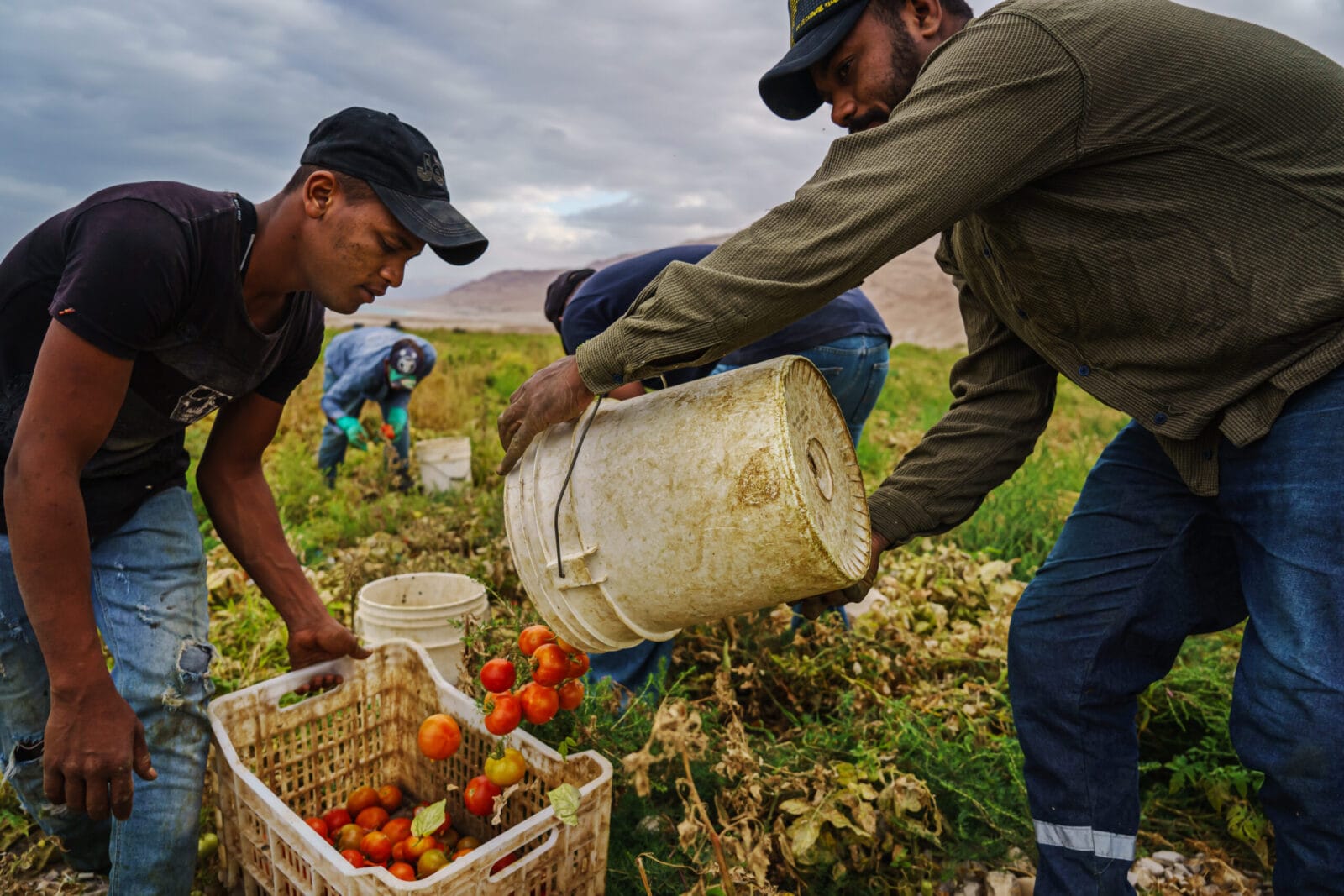
Workers harvest tomatoes in Ghor Haditha, Jordan, 2021\. Marcus Yam/Los Angeles Times via Getty Images
Dangerous commutes are a daily reality for farm workers in Jordan, where the lives of migrant laborers from Syria, Egypt, Sudan and elsewhere intersect with those of poor Jordanians. During these commutes, workers are often [packed into pickup trucks](https://www.solidaritycenter.org/jordan-agricultural-workers-win-rights-in-landmark-legislation/) in groups of twenty or more and driven along rough back roads to avoid police because the trucks are unlicensed, or only licensed for the transport of crops and other goods.
While the conditions are equally unsafe for all precarious workers regardless of their national origin, programs like the agricultural work site are part of a refugee response that has increasingly focused on national origin and access to labor, pitting Syrian refugees against other refugee and migrant worker populations.
Jordan currently hosts some 2.9 million refugees and asylum seekers, including those registered with UNHCR and UNRWA. International donors and Jordan’s allies, like the United States, have long supported the monarchy’s security interests in exchange for its containment of refugee populations. Around 2015, the European Union entered the scene as a key player. Following the largescale movement of migrants and refugees, especially Syrians, to Europe, EU governments—in an effort to keep migrants away from their own borders—provided increased aid and incentives to Jordan for its cooperation in containment.
Containment was presented as a win-win situation: Jordan, a relatively small country in need of human capital could attract the support of EU governments in exchange for hosting populations and adding them to its workforce.
Notably, however, the policies that emerged from these negotiations with Jordan—embodied by the Jordan Compact, an agreement reached in 2016—focused only on Syrian refugees and their Jordanian hosts. In creating jobs and support for Syrian refugees, they have created distinct classes of refugees whose benefits are based largely on their national origin. Other vulnerable groups in Jordan, including long-standing refugee populations from Palestine and Iraq as well as migrant workers from Egypt, had no place in the newly reconfigured refugee response.
## **The Jordan Compact**
In 2016, more than 70 heads of state met at the “Supporting Syria and the Region” conference in London hosted by Britain, Germany, Kuwait, Norway and the United Nations. Together, they developed the “Jordan Response Plan for the Syria Crisis”—an aid funding tool, co-led by the Jordanian government and UN agencies and first designed in 2015 to support refugee "self-reliance.”[\[1\]](#%5Fedn1)
The 2016 conference culminated in a new approach to containing migrants in Jordan. The so-called Jordan Compact, which emerged from these negotiations, claimed to be centered on broader structural issues like economic development and the long-term impacts of migration on major host countries, such as Jordan, which, in the 2000’s and 2010’s saw acute episodes of inflation and social tensions following large refugee inflows.
Put simply, the [agreement](https://reliefweb.int/report/jordan/jordan-compact-new-holistic-approach-between-hashemite-kingdom-jordan-and) stated that in exchange for monetary aid and improved trade relations with European countries, Jordan would help create 200,000 [economic opportunities](https://www.worldbank.org/en/country/jordan/brief/economic-opportunities-for-jordanians-and-syrian-refugees-questions-and-answers) for Syrian refugees: mostly low-wage jobs in the manufacturing sector. The relaxed terms of trade would apply to [52 product categories](https://www.eeas.europa.eu/jordan/european-union-and-jordan%5Fen?s=201) produced in factories in 18 designated industrial areas, or “special economic zones" (zones designated for factories that benefit from a special tax status with reduced rates). The European Union would make it easier for these factories to export goods in an aim to improve Amman’s trade imbalance.
> **Indeed, for the first time, and backed by European donors, multilateral development banks including the IMF granted Jordan, a middle-income country, access to concessional financing at no interest, typically only made available to very poor countries.**
In addition to humanitarian agencies, the World Bank and International Monetary Fund also helped implement the Jordan Compact. Indeed, for the first time, and backed by European donors, multilateral development banks including the IMF granted Jordan, a middle-income country, access to concessional financing at no interest, typically only made available to very poor countries. All Jordan had to do in order to receive some [$1.9 billion in loans](https://reliefweb.int/report/jordan/jordan-compact-new-holistic-approach-between-hashemite-kingdom-jordan-and) was to meet benchmarks set for the economic, social and educational inclusion of Syrian refugees.
Initially, UN agencies and humanitarian organizations greeted the Jordan Compact with considerable [fanfare](https://www.unhcr.org/news/latest/2016/4/57162b0a6/work-permit-boost-gives-hope-syrian-refugees-jordan.html) and [support](https://www.rescue.org/report/search-work-creating-jobs-syrian-refugees). But criticism quickly mounted over its approach, implementation and exclusivity. Scholars noted the transactional [neoliberal](https://research.manchester.ac.uk/en/publications/the-humanitarian-development-nexus-and-the-jordan-compact-tension) nature of the program: Donor support for refugees was made conditional on their employment and containment in Jordan. Within Jordan, refugees were awarded clearer refugee status in exchange for their employment and potential economic gains from the Jordan Compact. In other words, refugees earned protection only in exchange for their economic productivity. Moreover, its emphasis on manufacturing and agricultural labor meant it focused on men largely to the exclusion of women despite the fact that in 2016, 23 percent of Syrian refugee households in Jordan were headed by women.[\[2\]](#%5Fedn2)
## **Excluding Non-Syrian Workers**
In an ironic twist, the compact was approved just two months after Jordan enacted a mass deportation of Sudanese refugees. This episode speaks to another major problem with the Jordan Compact: its failure to meaningfully incorporate non-Syrian refugees and other vulnerable groups. Jordan agreed to the compact amid rising unemployment, which jumped from 12.2 percent in 2012 to 17.9 percent in 2023.[\[3\]](#%5Fedn3) Over this time, the government has continued to engage in active [deportation and regularization campaigns](https://en.ammonnews.net/article/19356) aimed at reducing the use of migrant labor, even as it created more opportunities for Syrians.
> **Organizations have anonymously reported that their projects would be rejected if they included non-Syrian refugees only to be approved later by the Jordan Ministry of Planning and International Cooperation once these groups were removed from their proposals.**
From the beginning, the initial Jordan Compact press release only referred to two populations: Syrians and their native Jordanian hosts. Indeed, when other migrant groups are mentioned in the official documents around the compact, it is only to highlight the scope of Jordan’s existing burden, not to lay out actions to address their deprivation. World Bank loans, too, could only be acquired if conditions linked to Syrians were met, incentivizing the government to concentrate its efforts at assistance and inclusion programs strictly for this group.
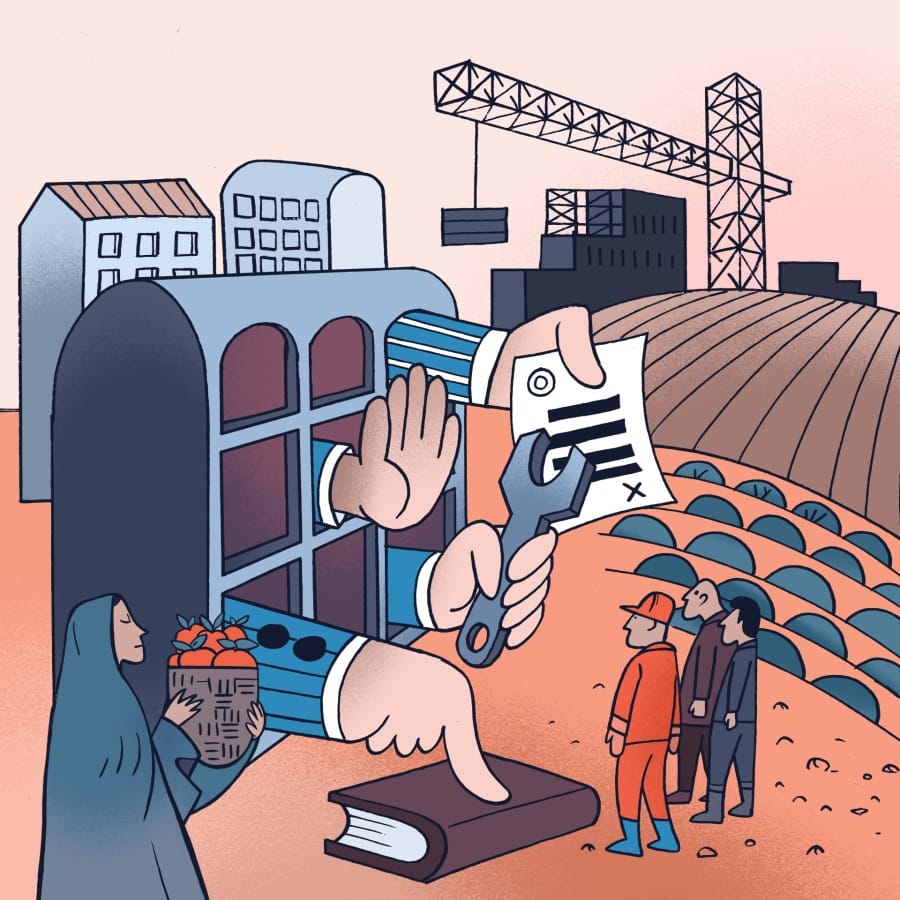
The landscape of laws and regulations governing refugee assistance and access to work is convoluted and difficult to navigate. Image by cartoonist Othman Selmi.
This focus left non-Syrian minority refugees outside of the mainstream aid response. For example, the [Jordan Information Management System for the Syria Crisis (JORISS)](http://www.jrp.gov.jo/Files/JRPExecutiveSummaryFinal.pdf), an information management and project approval system for humanitarian and development sector funding, has only two possible beneficiaries under its data entry system: vulnerable Jordanian host communities and Syrian refugees. Non-Syrian refugees have no parallel system for project registration. Organizations have anonymously reported that [their projects would be rejected](https://odi.org/en/publications/inclusion-and-exclusion-in-urban-refugee-displacement-in-jordan/) if they included non-Syrian refugees only to be approved later by the Jordan Ministry of Planning and International Cooperation once these groups were removed from their proposals.
Their exclusion also extends to “cash-for-work” programs. These programs are led by NGOs and offer short-term employment opportunities across many public works projects, including the construction of [reservoir dams](https://www.giz.de/en/worldwide/102719.html), [tourism infrastructure](https://reliefweb.int/report/jordan/cash-work-activities-petra-benefit-community-support-unesco-gizbmz) and [sanitation facilities](https://www.acted.org/en/vulnerable-women-expand-economic-opportunities-with-cash-for-work-program/). [Obstacles](https://www.merip.org/content/files/sites/default/files/document/1405/irc-syrianrefugeeemployment-72dpi-041117.pdf), such as hidden fees, employer-anchored permits and occupational restrictions made it difficult for refugees to access more permanent work or jobs in the private sector. These constraints, combined with major economic slowdown starting in 2011, made cash-for-work projects a vital source of employment. Yet non-Syrian refugees are excluded from these programs in practice because grants awarded to NGOs organizing cash-for-work are issued under the structure of the Jordan Response Plan’s [livelihoods](https://www.merip.org/content/files/Files/jrp-2020-2022-web.pdf) funding, which applies only to Syrian refugees and Jordanian host communities.
In mid-2020 Jordanian authorities went one step further, requiring that workers obtain permits even for cash-for-work programs. While Syrian workers were able to retain status as asylum seekers while obtaining permits, non-Syrian refugees were required to surrender their asylum seeker status before they could apply for legal work—a difficult trade-off many were not willing to make. As a result of these policies, only 47 percent of non-Syrian refugee households report a working household member compared to 65 percent of Syrian households.[\[4\]](#%5Fedn4) The average non-Syrian refugee holds more than twice the amount of debt compared to the average Syrian refugee. Somali populations in Jordan are particularly vulnerable: 99 percent have reported engaging in negative coping mechanisms, including but not limited to taking dangerous jobs, engaging in child labor and child marriage and withdrawing children from schools in order to make ends meet.[\[5\]](#%5Fedn5)
## **Transforming the *Kafala* System**
The Jordan Compact’s emphasis on bringing Syrians into the Jordanian labor market was a significant departure when it comes to the country’s migrant labor policies.
With the exception of [Palestinians](https://www.merip.org/content/files/globalassets/guidelines/guide-to-employment-rights/jordan-employment-rights-guide.pdf), right to work has historically been limited for refugees. Many of Jordan’s migrant workers labor under the infamously exploitative *kafala,* or sponsorship system. Although *kafala* is not explicitly mentioned in Jordanian labor law, the country’s reliance on *kafeel* (sponsors) makes its labor policy, de facto, an example of *kafala.* Employers, or sponsors, control a worker’s ability to seek other employment as well as their entry into and exit from the country. This system essentially subcontracts migrant control to private employers and [ties](https://www.cfr.org/backgrounder/what-kafala-system) a worker’s residency to their job status. Moreover, sponsors frequently force workers to reimburse them for the cost of obtaining the permit.
The largest group that holds such work permits in Jordan are Egyptians, who labor formally and informally across the agriculture, services and construction sectors and have represented a significant portion of labor migration to Jordan, beginning as early as the 1970s.
> **It initially opened up work permits for Syrians across a number of sectors, primarily agriculture, manufacturing and construction—all of which already had a high level of migrant work participation through the kafala system.**
The work permit program introduced by the Jordan Compact bypassed this long-standing migrant employment system. It initially opened up work permits for Syrians across a number of sectors, [primarily](https://www.unhcr.org/news/press/2022/1/61effaa54/jordan-issues-record-number-work-permits-syrian-refugees.html) agriculture, manufacturing and construction—all of which already had a high level of migrant work participation through the *kafala* system.
The Jordanian government de-linked work permits in the agriculture sector from employers, allowing Syrians to acquire work permits independently. This new category of non-employer specific work permit for Syrian refugees freed workers from the authority of their employers. Moreover, employers received a reduction in the processing fee they paid to the government when sponsoring Syrian employees. As a result, in 2016, about one third of the [36,790 permits](https://data.unhcr.org/en/documents/details/98709) issued to Syrian refugees were for agricultural work.[\[6\]](#%5Fedn6) The same policy measure was [implemented](https://reliefweb.int/report/jordan/new-regulations-syrian-refugee-access-non-employer-specific-work-permits-jordan-s) in the construction sector in mid-2017, nearly tripling the number of construction sector work permits for Syrians.
Humanitarian agencies like the International Labor Organization [praised ](https://www.ilo.org/beirut/media-centre/news/WCMS%5F568722/lang--en/index.htm)Amman for introducing non-employer specific permits and for pushing measures to reduce exploitation of Syrian refugees. But non-Syrian refugees did not benefit from these changes. Indeed, the agriculture sector has the highest rate of worker permits for migrant labor, making it a target of the Jordanian government for curbing migrant work.
In 2016, the same year the agriculture sector was open to Syrian refugees, the Jordanian government [imposed a ban](https://jordantimes.com/news/local/recruitment-foreign-workers-agricultural-sector-resumes) on all non-Syrian foreign recruitment in the sector. Jordanian farmers objected to the ban given their dependency on foreign workers, and the decision was [reversed](https://jordantimes.com/news/local/recruitment-foreign-workers-agricultural-sector-resumes). In 2017, however, Jordanian authorities [more than doubled](http://jordantimes.com/news/local/unifying-guest-worker-fees-could-be-harmful-agriculture-sector-labourers-activists-warn) the permit fees farmers must pay to employ non-Syrian workers, essentially reinstating some of the burden they had previously lifted. Farmers often illegally force workers to repay these fees.
The new fees also came with a requirement for employers to provide a bank guarantee of 5,000 Jordanian Dinars if recruiting between six and 20 foreign workers—an amount unaffordable to most small farmers. Work permit fees were amended in the years following and have since increased again. They [now cost](http://jordantimes.com/news/local/govt-decision-reduce-work-permit-fees-comes-force) 850 Dinars ($1198) for all non-Syrian workers. Egyptian workers, in particular, have suffered as a result of these new regulations. In 2015, Egyptians made up [61 percent](https://mol.gov.jo/ebv4.0/root%5Fstorage/ar/eb%5Flist%5Fpage/2015.pdf) of the formal migrant workforce, with the bulk of their work permits issued in the agriculture sector.[\[7\]](#%5Fedn7)
## **The Labor-Oriented Model Beyond Jordan**
Despite grandiose promises from the donor class, support for refugees and migrants in Jordan has been surprisingly zero-sum: While the Jordanian government promoted more inclusive measures for Syrian refugee labor and the expansion of aid programs, the landscape has become more restrictive for non-Syrians, leading to the creation of distinct classes of workers based on national origin.
After five years of advocacy from civil society organizations and volunteer groups, aid programs finally began to consider non-Syrian refugees. For example, non-Syrian refugees were added to the World Food Program’s flagship food voucher distribution program in Jordan after being included—for the first time—in a 2019 “Comprehensive Vulnerability Assessment” report. Previously, the program was restricted to Syrian beneficiaries.
Notwithstanding these small gains, in recent years, donor fatigue has set in and the Jordanian government’s incentive to expand support to all refugee populations has declined: The Jordan Response Plan is the least funded it has ever been. Following a peak of [64.85 percent](https://www.merip.org/content/files/Files/jrpfinancialupdate%5Fyear2017.pdf) of requested funds in 2017, it was only [33.4 percent](https://jordantimes.com/news/local/jrp-shortfall-measured-151b-2022) funded in 2022.[\[8\]](#%5Fedn8)
> **Yet, European donors continue to rely on a labor-oriented development aid approach in other crises, despite its uneven effects on the host country.**
Across the region (and indeed the entire globe) the racialization and targeting of certain populations of migrants and refugees—as seen [recently in Tunisia](https://www.france24.com/en/africa/20230304-hundreds-of-west-african-migrants-flee-tunisia-after-president-saied-s-controversial-crackdown)—is a sign of increasingly volatile politics and desperate governments. Yet, European donors continue to rely on a labor-oriented development aid approach in other crises, despite its uneven effects on the host country. Today, as in Jordan, there are nationality-based refugee policy approaches in Turkey.[\[9\]](#%5Fedn9) The implementation of the UNHCR’s Comprehensive Refugee Response Framework in Ethiopia have also been limited mostly to Eritrean refugees.
While the longer-term effects of these transformations remain unclear due to the comparatively smaller scale of refugee work permit uptake, if Jordan’s experience is any indication, these interventions will have unintended consequences, especially for the populations they overlook.
*This article is part of [IMPOP](https://imes.elliott.gwu.edu/public-outreach-and-educator-resources/impop/discriminatory-development-aid-a-look-at-jordan-syria-refugee-response/), a MERIP collaboration with George Washington University's Institute for Middle East Studies.*
\[**Shaddin Almasri** is a postdoctoral researcher at the University for Continuing Education Krems with a background in labor and refugee governance in MENA and East Africa.\]
---
### **Endnotes**
[\[1\]](#%5Fednref1) "[The Jordan Compact: Three Years on, Where Do We Stand?](https://reliefweb.int/report/jordan/jordan-compact-three-years-where-do-we-stand)," Relief Web, March 11, 2019.
[\[2\]](#%5Fednref2) Caroline Krafft, Maia Sieverding, Colette Salemi and Caitlyn Keo, "[Syrian Refugees In Jordan: Demographics, Livelihoods, Education, and Health,](http://erf.org.eg/publications/syrian-refugees-in-jordan-demographics-livelihoods-education-and-health/)" Economic Research Forum Working Paper Series, no. 1184 (2018), p. 13.
[\[3\]](#%5Fednref3) "[Jordan Unemployment Rate 1991-2024,](https://www.macrotrends.net/countries/JOR/jordan/unemployment-rate)" (Data source: World Bank), macrotrends.net.
[\[4\]](#%5Fednref4) "[Population Survey of Refugees Living in Host Communities: Jordan 2022,](https://data.unhcr.org/en/documents/details/93754)" UNHCR, June 20, 2022, p. 154.
[\[5\]](#%5Fednref5) Ibid, p. 14.
[\[6\]](#%5Fednref6) "[WP figures as of 31 Dec 2022,](https://data.unhcr.org/en/documents/details/98709)" UNHCR Operational Data Portal, December 31, 2022.
[\[7\]](#%5Fednref7) "[Annual Report 2015,](https://mol.gov.jo/ebv4.0/root%5Fstorage/ar/eb%5Flist%5Fpage/2015.pdf)" Jordanian Ministry of Labor, p. 42.
[\[8\]](#%5Fednref8) “[2017 Financial Status,](https://www.merip.org/content/files/Files/jrpfinancialupdate%5Fyear2017.pdf)” Ministry of Planning and International Cooperation; "[JRP shortfall measured $1.51b in 2022,](https://jordantimes.com/news/local/jrp-shortfall-measured-151b-2022)" *The Jordan Times*, February 9, 2023.
[\[9\]](#%5Fednref9) “[Why is Syria a War but Not Afghanistan? Nationality-based Aid and Protection in Turkey’s Syria Refugee Response](https://academic.oup.com/rsq/article/42/1/29/6961582),” *Refugee Survey Quarterly*, February 20, 2024
### Calling Erdogan's Bluff on Palestine
URL: https://www.merip.org/2024/02/calling_erdogans_bluff/
Last updated: 2025-08-22T18:36:24.000Z
In December, the funeral for Turkish parliament member Hasan Bitmez brought together opposition leaders at the Fatih Mosque in Istanbul.
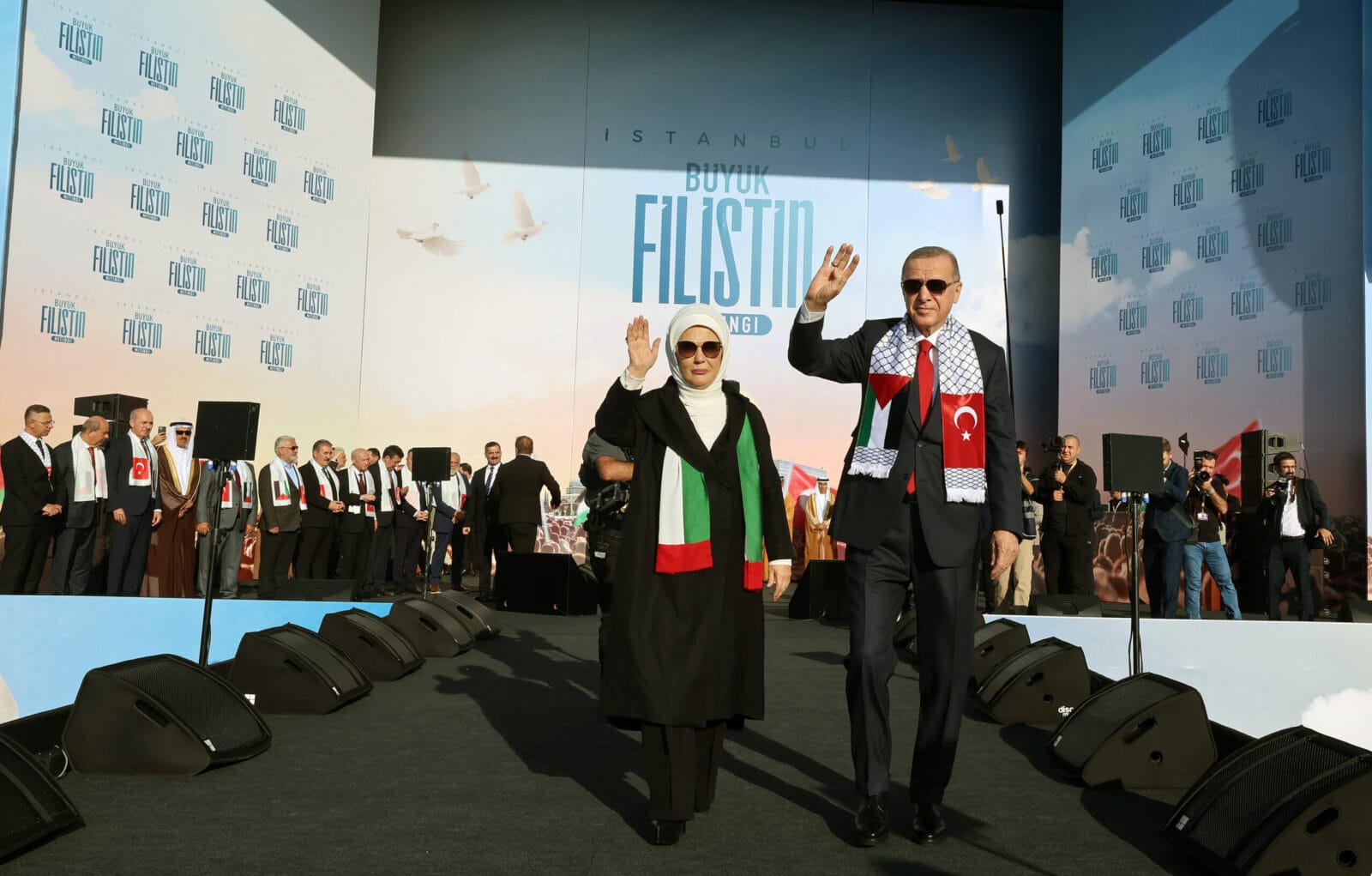
Turkish President Recep Tayyip Erdogan and his wife Emine Erdogan at the ''Great Palestine Meeting'' at Ataturk Airport in Istanbul on October 28, 2023\. TUR Presidency / Murat Cetinmuhurdar / Handout / Anadolu via Getty Images
Bitmez, a lawmaker with the conservative opposition Saadet Party, had died on December 14 from a heart attack sustained at the podium on the floor of Parliament as he wrapped up a fiery speech lambasting the ruling Justice and Development Party (AKP) for their dealings with Israel. “You have the blood of Palestinians on your hands, you are collaborators. You contribute to every bomb Israel drops on Gaza,” he said just before collapsing on the floor.[\[1\]](#%5Fedn1)
At his funeral, Bitmez was hailed as a martyr for challenging President Recep Tayyip Erdoğan’s handling of the Gaza war. Former President Abdullah Gül, who co-founded the AKP but later parted ways with Erdoğan, squeezed his way past Istanbul’s mayor Erkem İmamoğlu as the country’s top opposition figures jostled for room in the front row of the Fatih Mosque’s courtyard. The crowd chanted, “Murderer Israel, collaborator AKP.”[\[2\]](#%5Fedn2) Their anger was not only directed at Israel but also at the lack of serious action by the AKP.
The Gaza war has rekindled an emotionally charged issue among the Turkish public and Erdoğan's base, but Erdoğan's government has yet to take meaningful political action. Instead, Ankara has continued to trade billions of dollars in goods with Israel and has maintained its security communication channels, even as Erdoğan [denounces Israeli actions](https://www.reuters.com/world/middle-east/turkeys-erdogan-says-israeli-pm-netanyahu-no-different-hitler-2023-12-27/) as amounting to genocide and compares the Israeli premier to Adolf Hitler. Opposition leaders have seized on this relative inaction, accusing the president of doing little more than holding protest rallies to pander to one of the few issues that still unifies an otherwise deeply divided public. The weeks following the outbreak of war saw [rare protests](https://medyascope.tv/2023/10/19/leftists-and-islamists-appear-side-by-side-in-protest-in-front-of-israels-istanbul-consulate/) at which leftist groups, including some of the country’s largest labor unions, held rallies at the Israeli consulate in Istanbul alongside conservatives and AKP supporters.
While criticisms from smaller Islamist parties like the Saadet Party may be expected, the widespread support for Palestine across a diverse coalition of opposition parties, including the main opposition People’s Republican Party (CHP), signifies a change in the political landscape. Erdoğan’s success at dethroning the historically assertive and secular military, which for decades enforced cooperative relations with Israel, has opened avenues for confronting Israel that were not available to earlier leaders. Support for Palestine is now a matter of consensus that transcends the political and secular-religious divide. But this new space for criticizing Israel could also work against Erdoğan.
Since October 7, opposition leaders have increasingly sought to leverage the issue of Palestine against Erdoğan, accusing him of exploiting the cause for political expediency. In so doing, they have called into question Erdoğan’s self-proclaimed status as *davanin* *sahibi* (guardian of the cause) and have simultaneously asserted themselves as stronger advocates for the Palestinians. Addressing a public that is watching closely as disturbing videos and images continue to flow out of Gaza, the opposition is framing their critique of Erdoğan not only in relation to foreign policy but also domestic governance. They have mobilized an emotionally powerful and unifying issue to articulate broader grievances over Erdoğan’s ostensible hypocritical and corrupt rule—and, ultimately, to position themselves as better suited to lead Turkey.
## **Erdogan’s Balancing Act**
From early in his presidency, Erdoğan has attempted to project himself as a force in the region by assuming a leadership role in the Israel-Palestine conflict. Following his landslide electoral success in 2002, he positioned Turkey as a potential mediator in the conflict, even visiting Tel Aviv in 2005 to tighten diplomatic relations. The strategy aligned with successive Turkish leaders, who favored leveraging their foothold in the Middle East to foster Turkey’s ascension into the European Union. As joining the European Union grew further out of reach, however, in his second term, Erdoğan began to orient his attention toward building alliances and [growing his stature in the Middle East](https://www.atlanticcouncil.org/blogs/turkeysource/turkey-is-seeking-a-fresh-start-with-israel/), which meant distancing himself from Israel and doubling down on his solidarity with Palestine.
If a single moment marked Erdoğan’s transformation into a leader who would stand squarely in solidarity with Palestinians, it was at a panel discussion during the 2009 World Economic Forum in Davos. Set against Israel’s bombardment of Gaza during Israel’s “Operation Cast Lead,” which killed 1,200 Palestinians, Erdoğan challenged Israeli President Shimon Peres’ assertion that Israel was committed to peace and that Hamas was to blame for the war. As the exchange wrapped up, with Peres granted double the time to speak, a slighted Erdoğan vied for an extra minute and the final word. “When it comes to killing, you know well how to kill,” Erdoğan told Peres, before walking off the stage, vowing not to return to the forum due to the unequal time allotment.[\[3\]](#%5Fedn3) The video quickly went viral across the Middle East, assuring many in Turkey and across the region that Erdoğan was willing to speak boldly for Palestinians where others were not.
The Davos exchange catapulted Erdoğan’s popularity across the region. His role as an advocate for Palestine complemented his broader efforts to frame Turkey as a bulwark against Western imperialism. This positioning was further cemented when, in 2010, Israeli commandos stormed the Mavi Marmara, killing 10 Turkish nationals. The ship, leading a larger flotilla, was meant to break the Israeli siege on Gaza by delivering humanitarian aid, and the Israeli attack set off a major diplomatic rift between Erdoğan and Israel.
The Turkey-Israel relationship remained strained until 2013, when Netanyahu apologized for the raid. Full ties were restored in 2016 after Tel Aviv paid $20 million in compensation to the victims’ families. In response, Erdoğan’s government [suppressed protests and quashed a set of court cases](https://www.al-monitor.com/originals/2016/12/turkey-how-erdogan-wins-with-losing-hand.html) raised by families of those killed on the ship, who were suing Israel. Just as Erdoğan had neutralized his political opponents, jailing Kurdish leaders and launching a wide crackdown against critics amid an intensifying authoritarian turn, the victims of the Mavi Marmara raid—arguably the most fervent supporters of Palestine in Turkey—were no longer supported by the state.
Erdoğan’s bold statements in favor of Palestinian self-determination were not new to Turkish politics, but his diplomatic actions—such as expelling the Israeli ambassador following the Mavi Marmara attack—set a new norm and underlined the weakening of the Turkish military. [Going back decades,](https://www.merip.org/content/files/wp-content/uploads/2016/06/usturkeyisrael-trianglefinal.pdf) to the mid-1990s, as a NATO-member, Turkey helped train Israeli fighter pilots. Since then, [Israel has provided](https://theintercept.com/2019/05/14/turkey-second-drone-age/) reconnaissance drones and critical military hardware updates to Turkey. The countries also cooperate closely on security and, at times, have shared intelligence on Iran’s activities, including threats its agents pose to Israeli tourists. Historically, the military has confronted any serious threats to this arrangement. Erdoğan’s political mentor, the Islamist Necmettin Erbakan, from whose party the AKP splintered, was forced from power in a so-called “soft coup” in 1997\. Erbakan’s outspoken support for Palestine, which included rallies praising Hamas and Hezbollah and fiery speeches by Iranian diplomats, were cited as a reason by the military to force his government from power.
> **Under Erdoğan’s tenure, Turkey has been one of Israel’s biggest buyers of advanced military technologies, and Israel imports around $6 billion each year from Turkey.**
Despite overturning the military’s foreign policy influence, however, Erdoğan has largely protected the status quo in terms of trade and defense—to the disappointment of skeptical Islamists who have consistently accused him of aiding Zionism. Under Erdoğan’s tenure, Turkey has been one of Israel’s biggest buyers of advanced military technologies, and Israel imports around [$6 billion each year](https://www.al-monitor.com/originals/2016/12/turkey-how-erdogan-wins-with-losing-hand.html) from Turkey. While Turkey exports less than $1 million worth of direct defense-related goods to Israel, its [largest exports are in steel](https://tradingeconomics.com/turkey/exports/israel), which likely contributes to Israel’s defense industry. Since 2022, the countries have been working to [smooth over their diplomatic tensions](https://www.reuters.com/world/middle-east/israeli-turkish-leaders-hold-first-meeting-since-2008-2022-09-21/), fitting Turkey within a larger regional bloc of countries, like Saudi Arabia, that have sought to normalize ties with Israel.
When it comes to Erdoğan’s outspokenness on behalf of Palestine, while it may be remarkable on the world stage, his government’s actions are not unique compared to other countries in the region. Like Qatar, Turkey allows Hamas leaders to live in the country, albeit discreetly, and Erdoğan has publicly refused to partake in sanctions against the group or declare it a terrorist organization. Like Egypt, Turkey brings some Palestinians from Gaza to the country for medical treatment they cannot find in the Gaza Strip. And like a long list of countries, including those outside the region, Erdoğan has called for holding Israel accountable in the international arena by ending veto powers in the UN Security Council and supporting South Africa’s genocide case against Israel at the International Court of Justice.
## **Palestine and the Opposition**
Weeks after the war began, on October 28, the ruling AKP organized a massive rally in Istanbul to celebrate the 100th anniversary of the founding of modern Turkey, re-tooling it as a protest against Israel. Kemal Kılıçdaroğlu, the head of the CHP and a candidate for president who narrowly lost to Erdoğan in May 2023 elections, pointed out the unusual nature of a government-led protest against Israel. "Blood is flowing in Palestine,” Kılıçdaroğlu said, responding to Erdoğan’s rally. “You are the government, not the opposition. What are you doing at the rally?”[\[4\]](#%5Fedn4) His remarks were particularly cutting given how Erdoğan’s government had treated other [unsanctioned public rallies against Israel](https://www.youtube.com/watch?v=TIHFjBXaAeg): protests at Israeli diplomatic missions, along with an attempt by a crowd to overrun Incirlik air base—a critical base used by the United States—have been dispersed by riot police.
> **The criticisms are framed not only as stemming from concern for Palestine—traditionally a cause of Islamists and left-wing movements—but also in relation to domestically rooted grievances over Erdoğan’s ostensible hypocritical, corrupt and divisive style of rule.**
Parties like Saadet, which emerged from Erbakan’s movement, have long pointed out the inconsistencies in Erdoğan’s treatment of Israel, but now the larger opposition is joining in. The criticisms are framed not only as stemming from concern for Palestine—traditionally a cause of Islamists and left-wing movements—but also in relation to domestically rooted grievances over Erdoğan’s ostensible hypocritical, corrupt and divisive style of rule. While Erdoğan has repeatedly touted his support for Palestine to justify his leadership, the opposition now has the opportunity to call him on his bluff, going so far as to accuse his family of [benefiting financially](https://bianet.org/haber/fidan-a-gore-israil-ile-iliskiler-filistin-davasina-zarar-vermiyor-288904) from the Israel-Turkey alliance.
In December, Mahmut Tanal, a lawmaker from the CHP, questioned foreign minister Hakan Fidan in Parliament in response to news reports that members of the AKP continued to be involved in lucrative trade with Israel. “Will diplomatic relations with the State of Israel be suspended?” Tanal asked. “Are there any sanctions that your ministry has imposed or intends to impose in response to Israel’s inhumane treatment of Palestine? If no decision on sanctions has been taken, what is the reason for this?”[\[5\]](#%5Fedn5) Fidan, the former head of the country’s national intelligence agency, held firm to the party line: that Turkey’s relationship with Israel—which long predated the AKP’s existence—does not contradict its support for the Palestinians. The opposition, however, has remained unconvinced. They are demanding greater accountability, including reviewing trade relations with Israel and taking a more central role in [challenging Israel’s actions](https://www.youtube.com/watch?v=PJRP8MMn77g) through international forums like the United Nations.
The opposition has seized the moment to criticize Erdoğan’s divisive style of rule as counterproductive to both national unity and the Palestinian cause. Kilicdaroglu’s successor as the CHP’s leader, Özgür Özel, called on Erdoğan to join him and other political leaders to visit Gaza. “I have made my own application to go to Palestine and raise our voice about the massacres committed to the world,” he told party members at a CHP meeting. “But I have a call on Erdoğan. Let’s go to Palestine altogether with the leaders of all political parties. Let’s demonstrate the stance of all of Turkey.”[\[6\]](#%5Fedn6)
By framing support for Palestine as an issue on which the nation should stand united, Özel and other leaders are able to criticize Erdoğan’s attempts to monopolize the issue to gain political points and sideline his opponents. From challenging his [handling of Turkey’s crippling financial crisis](https://www.hurriyetdailynews.com/we-are-in-the-middle-of-a-grave-economic-crisis-chp-136846) to the [post-earthquake recovery](https://twitter.com/kilicdarogluk/status/1623100338910769156?s=20&t=dSARZ8wsrQ8QJZYDA2waAw), Palestine has become the latest issue through which the opposition has challenged Erdogan’s paternalistic control over the country and found cracks in his divisive approach to politics.
## **Turning Erdoğan’s Rhetoric Against Him**
Palestine has remained among the few issues that unify the Turkish public as well as one of the issues where Turkish public opinion aligns with public sentiment across the Middle East. It only seemed natural, then, that Erdoğan—whose political roots trace through transnational Islamist movements of the 1980s and 1990s—would take up the region’s cause celebre. By removing the military and a staunchly secular Kemalist elite from the picture, Erdoğan opened space for previously unallowed forms of solidarity, including aggressively anti-Israel rhetoric and alliances with groups like Hamas. While such positions were perhaps always popular among the population, especially Erdoğan’s conservative base, he managed to shift the boundaries of acceptable discourse and entrench criticism of Israel as an inevitable component of Turkish politics.
> **If European powers and the United States refuse to sanction Israel for its actions in Gaza, how then can they challenge Turkey for its own human rights record?**
Siding with the Palestinians has [another domestic benefit](https://www.economist.com/europe/2023/12/26/in-turkey-erdogans-charges-of-western-hypocrisy-stick) for Erdoğan: By pointing out the hypocrisy of Western powers in applying human rights standards, he can challenge the universality of such notions and open space for his own government’s controversial actions, including [military operations](https://www.al-monitor.com/originals/2024/01/turkeys-operation-syria-could-happen-upcoming-months-erdogan) in Syria and Iraq. Even as Erdoğan criticizes Israel for its indiscriminate airstrikes in Gaza, the Turkish military carries out airstrikes that kill Kurdish civilians in northern Syria and Iraq. If European powers and the United States refuse to sanction Israel for its actions in Gaza, how then can they challenge Turkey for its own human rights record? Erdoğan’s charges against the Western double standards have become a hallmark of his public speeches, working to drum up anger at the United States and Europe in ways that temper and deflect criticisms against his own government.
Yet, the inconsistency between rhetoric and action has not gone unnoticed by Erdoğan’s opponents, who have fired back with their own accusations of hypocrisy. Other Islam-oriented politicians—many of whom have split from the AKP, such as [Ahmet Davutoglu](https://www.youtube.com/watch?v=PJRP8MMn77g)—have leveled these same allegations against Erdoğan for some time now. But parties like the CHP, founded by Mustafa Kemal Ataturk, the founder of Turkey, are also beginning to turn the issue back at Erdoğan.
For now, Erdoğan seems unlikely to lose a significant number of votes over the backlash, as it has primarily emboldened those already critical of his rule. Furthermore, amid surging inflation and [a major economic crisis](https://apnews.com/article/why-is-turkeys-currency-falling-erdogan-1faf7d58144fc84479c251c3fdeabe2a), issues of foreign policy have largely been placed on the back burner. But with a passionate segment of the public and the opposition connecting his inconsistency on Palestine with broader concerns over corruption, the standards he has set and the possibilities he has forged in terms of standing up for Palestine might end up working against him. Against his own best interests, Erdoğan has inadvertently shown that greater action is possible and that Turkey can, in fact, play a role in advancing the Palestinian cause. After more than two decades in power, Erdoğan is no longer the boldest politician holding the microphone.
\[**Umar Farooq** has worked as a correspondent covering Turkey and other parts of Asia and as an investigative journalist with ProPublica. **Michael Kaplan** is a PhD candidate in sociocultural anthropology at The George Washington University.\]
---
### Endnotes
[\[1\]](#%5Fednref1) *Reuters,* [“Turkish MP dies after suffering heart attack in parliament,”](https://www.reuters.com/world/middle-east/turkish-mp-dies-after-suffering-heart-attack-parliament-2023-12-14) December 14, 2024.
[\[2\]](#%5Fednref2) [“Saadet Partili Merhum Hasan Bitmez, Fatih Cami'de dualarla Hakk’a uğurlandı,”](https://www.youtube.com/watch?v=5szM3badA0M) Youtube, December 15, 2023.
[\[3\]](#%5Fednref3) [“Gaza: The Case for Middle East Peace | Davos Annual Meeting 2009,”](https://www.youtube.com/watch?v=cR4zRbPy2kY) Youtube, January 29, 2009.
[\[4\]](#%5Fednref4) *Hürriyet Daily News,* [“CHP leader promises aid to Gaza,”](https://www.hurriyetdailynews.com/chp-leader-promises-aid-to-gaza-187508) October 31, 2023.
[\[5\]](#%5Fednref5) *Bianet*, [“Fidan’a göre, İsrail ile ilişkiler Filistin davasına zarar vermiyor,”](https://bianet.org/haber/fidan-a-gore-israil-ile-iliskiler-filistin-davasina-zarar-vermiyor-288904) December 5, 2023.
[\[6\]](#%5Fednref6) *Hürriyet Daily News*, [“CHP calls on Erdoğan to go to Palestine with all party leaders,”](https://www.hurriyetdailynews.com/chp-calls-on-erdogan-to-go-to-palestine-with-all-party-leaders-188189) November 29, 2023.
### Michael Tanzer
URL: https://www.merip.org/2024/01/michael-tanzer/
Last updated: 2025-08-25T16:06:34.000Z
## TRIBUTE: MICHAEL TANZER (July 1935 – January 2024)
Mike Tanzer, writer, scholar and activist intellectual, was a great friend of MERIP’s from its early days. He was always generous to and supportive of the publication as a donor and occasional [contributor](https://www.merip.org/opecs-decade/) to our pages. Sometimes his support took the most practical forms. When desktop computers became available, they were still expensive in relation to MERIP’s finances. Mike loaned MERIP the funds that enabled us to purchase a system, bringing great relief to our small staff now freed from the seemingly endless retyping of manuscripts!
Mike’s early career as an economist included a stint with the Asia affiliate of what was then Standard Oil of New Jersey, an experience which informed his first book, *The Political Economy of International Oil and the Underdeveloped Countries*. This pathbreaking analysis detailed how political power shaped the dominant role of giant Western-based companies with oil-producing and consuming countries. His was a perspective that we in MERIP learned from and shared. It influenced the magazine’s analysis of the power dynamics underlying the oil embargo during the October 1973 Arab-Israeli war, which became MERIP’s first book, [*Middle East Oil and the Energy Crisis*](https://merip.org/books/middle-east-oil-and-the-energy-crisis/).
Mike’s friendship, like his writing, reflected his lifelong commitment to truth-telling, social justice and non-dogmatic politics. We will miss him and we salute his life.
**Read the [previous](https://merip.org/2024/01/dream-my-grandchild-an-interview-with-sara-abu-ghazal) article in** [**MER issue 309**](https://merip.org/magazine/309/) **“Palestine—Before and After October 7.”**
### 'Dream, My Grandchild'—An Interview with Sara Abu Ghazal
URL: https://www.merip.org/2024/01/dream-my-grandchild-an-interview-with-sara-abu-ghazal/
Last updated: 2025-08-22T18:36:24.000Z
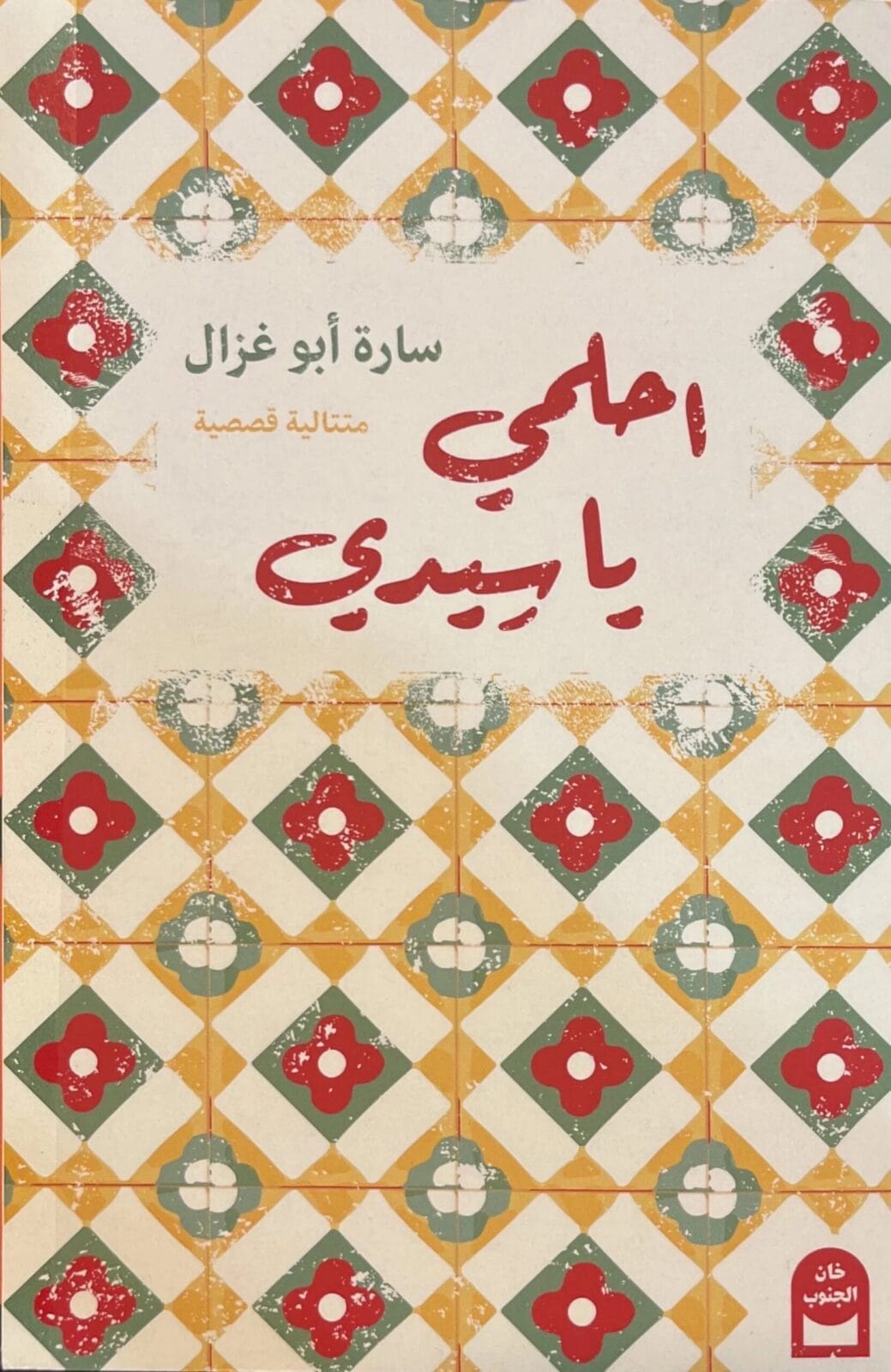
The cover of Dream, My Grandchild by Sara Abu Ghazal.
*\[su\_dropcap style="simple" size="4"\]*I*\[/su\_dropcap\]n September of 2023, Roba AlSalibi interviewed Sara Abu Ghazal, a Palestinian writer and feminist activist about her Arabic short story collection,* [Dream, My Grandchild](https://www.goodreads.com/ar/book/show/61336999)*.* *The book uses multiple voices to chronicle the story of the Abu Sukkar family, originally from the north of Palestine. Following the killing of Mohammed (the patriarch) and the Zionists' theft of their village, Zahra and her son Zain are forced into exile, leading the family to Beirut. Beginning in Shatila camp, the narrative moves between Lebanon and Palestine, the past and present—with their initial displacement serving as the narrative’s cornerstone. The interview was conducted in Arabic. It has been translated by AlSalibi and edited for length and clarity.*
**Roba AlSalibi**: Your short story collection *Dream, My Grandchild* follows the Abu Sukkar family who were exiled from Palestine in 1948 and lived in Lebanon as refugees. You brilliantly employ different narrative voices to talk about what the Nakba and exile mean for Palestinians and how they shape our relationship to the past, present and future. My first question is about time in your stories. Each narrative unfolds in a non-linear yet interconnected manner, woven through the experiences of the Abu Sukkar family's members. Can you say more about this?
**Sara Abu Ghazal**: Time is central to us as Palestinians because the Nakba did not only steal our land and our homes but our future. It’s something that I have never been able to get over on a personal level: how a whole nation was born with the possibilities for their future already confiscated.
It was important to me while working on the story’s characters, like Zain, Nidal and Zahra, who represent different political eras of Palestinians’ existence as refugees in Lebanon, to go back in time to the grandparents—to the dream or the time of possibilities. I wanted to write about how Palestinian refugees in Lebanon have been deceived. We are fed big slogans from childhood in the camps, but when we leave the camps, it all fades away. It’s like we are stuck in a time others have moved on from. We try to romanticize our experience and our struggle, but the experience reveals a catastrophe. And so many political changes have happened in Lebanon. It is a post-post-post-civil war to the point Palestinians appear as ghosts of history. I wanted to reflect on our time in the refugee camps in Lebanon. How, first, people lived on the grass, then in tents and homes with asbestos roofs and later in homes made with cement. All these things are about time.
**Roba**: Another theme that appears in the collection is that of space and belonging. Shatila camp in southern Beirut is a central place in the Abu Sukkar family’s story. Zahra and her son, Zein Al Abdeen, lived as refugees there until Zein’s marriage, when the family moves to the New Road in Beirut city. Shatila camp and Beirut have a relationship fraught with tensions and contradictions, which you allude to throughout the collection. Would you speak a bit about this?
> **The camp is an enduring presence in Beirut, but what changes is the city’s relationship to it.**
**Sara**: It is a strange relationship. Beirut is, I don’t want to say cosmopolitan, but an Arab city that had a certain historical and political role in our region, in which Lebanese and non-Lebanese were invested. It had a margin of freedom. It is now a different city. I also don’t like to say that Palestinians’ relationship to Beirut started with the Palestinian resistance in the 1960s. Rather, it started when Palestinians built the Shatila refugee camp in 1949 on the lot of Shatila in Beirut. The camp was controlled by the state, but Palestinians created a space for themselves there. They also did this in the Mar Elias and Burj al-Barajneh camps. These camps came to be part of the broader landscape of Beirut. Look at Palestinians’ relationship to the neighborhoods surrounding Shatila camp, like Sabra market, for example, which occupies a whole street. There were always deep relations between us. But things changed during the 1990s, and these relations were deliberately targeted. Increasingly, a link was drawn between Palestinians and crime, disease, laziness—a systemic demonization of us. After Hariri was killed in 2005, they said that a Palestinian did it. It’s actually impressive how many relations remained as strong as they were in the face of this demonization. People lived together through a civil war, and some got married to each other. Today, the Lebanese state is collapsing, and because of the scarcity of resources, divisions between Beirut city and the camp have grown deeper. The camp is no longer part of the everyday life of the city. The camp is an enduring presence in Beirut, but what changes is the city’s relationship to it.
**Roba:** You have also described *Dream, My Grandchild* as a feminist literary work. What defines feminist literature for you? How did you employ your own understanding and experience of feminism in writing the book?
**Sara:** I think of *Dream* as a feminist work because it articulates things that are prohibited and exposes patriarchal power. Patriarchy lacks both ethics and logic. It only wants to maintain its existence. I made a conscious decision to collude with the female characters against patriarchy and write in a subtle way about the sense of solidarity among them. As the author of the story, I wanted to show the complications of family relations and of power dynamics in the small details and battles of everyday life. I wanted to portray a specific image of the father that amplifies how patriarchy refuses to acknowledge different narratives, through having the same story and moment re-told by different characters. I also think of Salim’s character as a way for me to portray how masculinity approaches solidarity and liberation.
**Roba**: I have a question on the role that memory plays in the life of the characters, especially Salwa (Zain’s daughter). Salwa sees her grandfather, Mohammed Abd Wahab, in her dream, and he tells her about their home in Palestine and the story of their displacement. He wants her to remember and dream of Palestine because memory is “\[the Zionists\] first enemy. They know we continue to exist through it.” (100) As a Palestinian refugee in Lebanon, what does memory and remembering mean to you?
> **Each of us could tell our story of the Nakba, and we would understand our collective experience of a moment that fragmented and ripped us apart.**
**Sara**: The question of memory for Palestinians is a question of who we are. We always go back to the Nakba and remember it because it is the moment that explains why we do not live where we are supposed to live. Memory is an individual history of a home, land and social relations. These histories shape our individual trajectories but also our collective memory and how we understand ourselves as a nation. Each of us could tell our story of the Nakba, and we would understand our collective experience of a moment that fragmented and ripped us apart. There is something empty inside us as a result of this fragmentation. We call ourselves a nation, but we do not have an experience of a nation. We have collective memories and an ambition and a longing to be one.
**Roba**: The Palestinian collective memory, centered on the Nakba, holds forms of tension and silences that makes remembering a difficult process. For example, the cases of sexual violence against Palestinian women is not something that is widely spoken about in our collective narrative of the ethnic cleansing of Palestinians by Zionists. How do we recognize the multiplicity and diversity of Palestinian experiences in 1948?
**Sara**: Collective memory is about what we are allowed to remember. Sexual violence is alluded to only in whispers in my work. Some prominent work has been done recently on sexual violence and where it stands in our collective memory and narrative like Adania Shibli’s [*Minor Detail*](https://www.nationalbook.org/books/minor-detail/). The question is to what extent are we allowed to remember. For women, we carry the memory of what is not spoken about. I think there is a collective memory and a clandestine one, which includes shame. When I think about my grandfather—I don’t know if we will ever meet in the afterlife—but if I could speak with him, I would tell him that I know he felt shame but that it wasn’t his fault. All that happened to us does not say anything about us. We are not the problem. It was violence that we have been subjected to.
**Roba**: Speaking of the afterlife, through the voice of the grandfather, Mohammed Abd Wahab, you narrate the story of the Nakba from the perspective of those who were killed at the hands of the Zionist militias. He tells the story from the afterlife to say that the dead are still part of the Nakba, that the sky “cannot force us to have a life after death as if nothing had happened…because all of these things cannot be forgotten.” (119) This narration of the afterlife is something that I have not come across before in Palestinian literature. Can you tell us more about what you were hoping to say through the voice of the grandfather?
**Sara:** I wanted to say that the Nakba was a tragedy to the extent that the earth will not revolve again in a normal way until Palestine is liberated. I wanted to say that our death does not mean our absence or an end to our story, as if nothing had happened. We do not disappear. I also wanted to say that, from our ancestors to the generation that will return, we are united. The fragmentation imposed upon us will not remain.
> **Read the**[ **previous**](https://merip.org/2024/01/urban-planning-and-spatial-domination) **article.**
> **Read the**[ **next**](https://www.merip.org/michael-tanzer/) **article.**
**This article appears in** [**MER issue 309**](https://merip.org/magazine/309/) **“Palestine—Before and After October 7.”**
### Urban Planning and the Struggle Against Israel's Spatial Domination
URL: https://www.merip.org/2024/01/urban-planning-and-spatial-domination/
Last updated: 2025-08-22T18:36:25.000Z
Located in Wadi Ara within the Green Line, Kufr Qara is a Palestinian town of 20,000 residents.
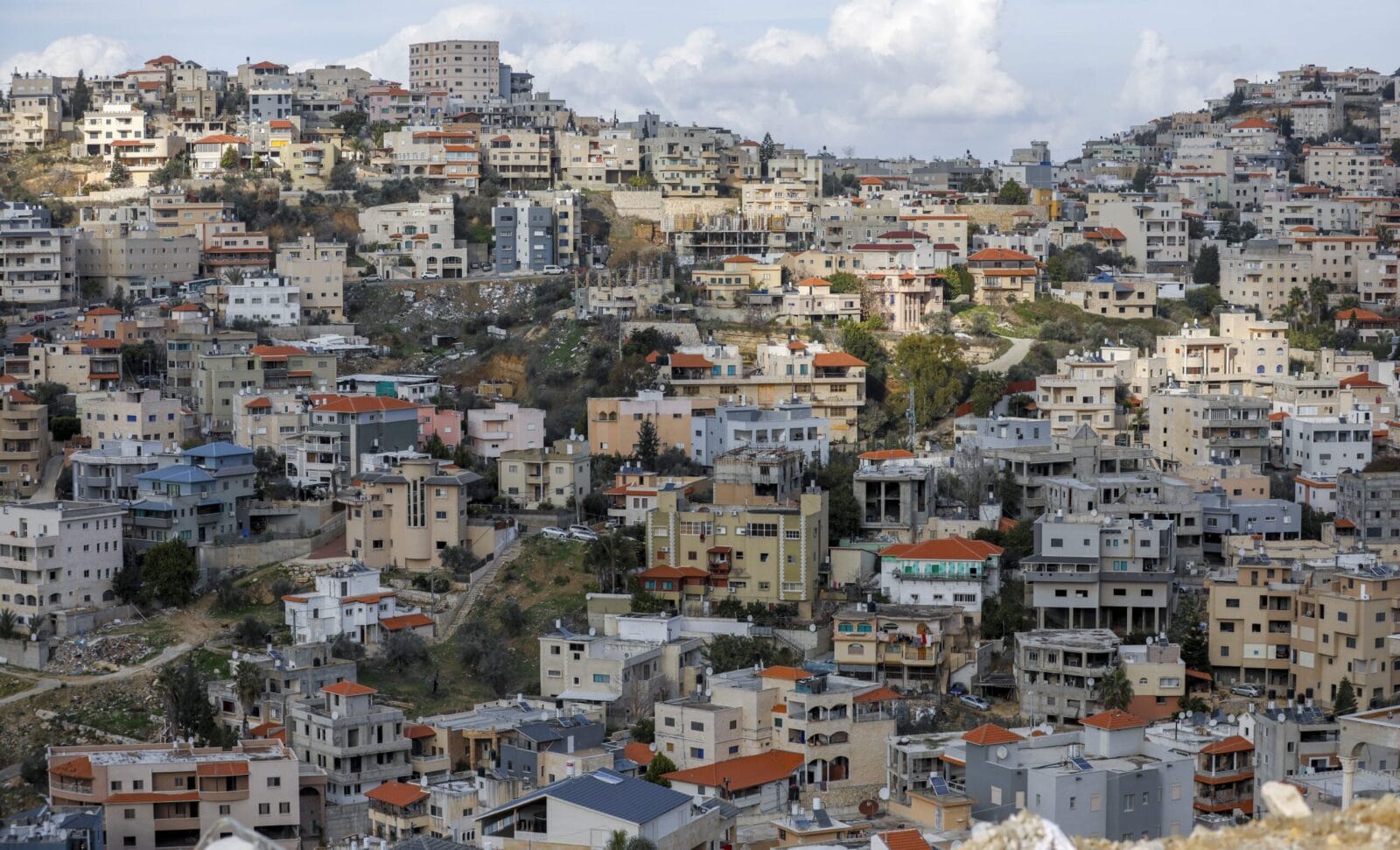
A view of Wadi Ara in 2020\. Ahmad Gharabli/AFP via Getty Images
Before the Nakba, its land spanned 28,000 dunums (roughly 7,000 acres), but today, Israel has left it with less than 8,000 dunums (fewer than 2,000 acres).
The town is encircled by Route 6 (a highway stretching north to south), an Israeli military camp and the Jewish settlements of Menashe Regional Council. Like many ’48 Palestinian towns, it faces a significant planning crisis. Its last master plan was approved in 1982 and allows for development on only 2,300 dunums, leaving most of the town's land designated strictly for agricultural use. As a result, over several decades, residents have constructed more than 2,000 unlicensed buildings, which lack connection to the formal electrical grid and other essential infrastructure.[\[1\]](#%5Fedn1)
In recent years, the grave and mounting repercussions of the housing and planning crisis in ’48 Palestinian towns and villages have compelled Israel to recognize the problem. After decades of strategic neglect that has turned these towns into ghettos dotting the Israeli map, the state began initiating and funding a wave of master plans for these towns, including Kufr Qara’, framing its efforts as a solution to the shortage in housing and urban development. One of the Israeli urban planners responsible for planning in Kufr Qara’ captured this view in a conversation we had in 2022: “Isn’t this current planning considered a fair solution to historical dispossession?” He asked. “Instead of thousands of dunums of agricultural land that today hold no real estate value, the people of Kufr Qara’ will receive residential, industrial and commercial lands valued at hundreds of millions. So what if it’s only a quarter of the historical area?”
His question, and the planning situation in Kufr Qara’ more broadly, speak to the deeper injustices at the heart of the current urban planning wave in ’48 Palestine. This “fair solution,” has been imposed by the Israeli government and works to shape and limit professional and political trajectories for Palestinian urban planning. As such, it is an extension of a longer colonial project—an arc beginning with the first Zionist spatial planning strategies during the British Mandate and including the hundreds of plans that Israel suggests as solutions today.
## **Israel’s Colonial Urban Planning**
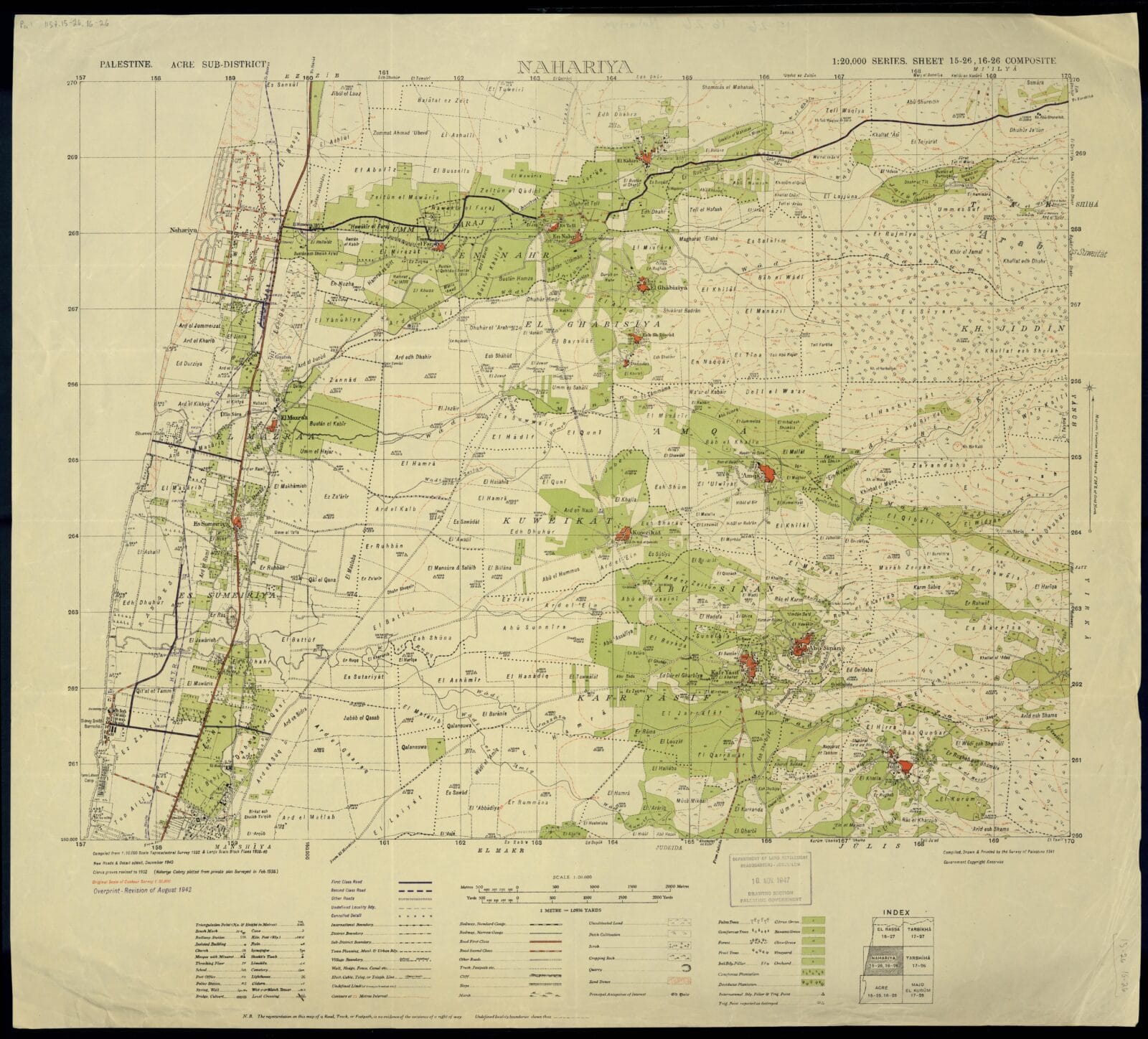
Regional map of Nahariya, Acre Sub-District, Palestine, indicating present and planned land use; Survey of Palestine, 1941\. Revised in 1942 to include new second-class roads (in blue, see legend) bypassing previous route through Palestinian villages. Map also includes Palestinian villages that were later depopulated (e.g., Ghabsiyye, Um Al Faraj, Kueikat, En Nahr and Al Kabri). \[To view details, see the map's Wikipedia page.\] The Eran Laor Cartographic Collection, National Library of Israel.
Within a few years of the Nakba, Israel had claimed ownership over 93 percent of the pre-1967 territory. Enacting the “Absentee Law,” the state confiscated the lands of Palestinians who had been driven out and, in accordance with British Mandatory laws, took control of all unregistered lands. It also transferred property controlled by Zionist organizations, like the Jewish National Fund, to state ownership. The high percentage of state-owned land enabled the Israeli government to tightly regulate urban planning and implement its national strategic objectives. In an exercise of colonial mapping, the new Zionist state looked at Palestine from above and literally reshaped the map.
Key to the state’s spatial domination was a planning policy that dispersed Jewish immigrants across vast swaths of land. The goal was to preempt efforts of Palestinian refugees to reclaim the land and prevent a return to the 1947 UN partition lines. Beginning under the British Mandate and continuing with partition, hundreds of new low-density agricultural settlements and “development towns” were built in nationally strategic areas like the border regions, the Galilee and the southern desert of the Naqab (or Negev, as it is called by the state today). Israel used appropriated lands to establish industrial zones, plant forests, extend roads and build facilities to provide water, electricity, gas, construction materials and other resources for developing the newly established state.
> **On the margins of the developing and flourishing Zionist project, Palestinian villages were confined, under military rule, to less than 2.5 percent of the newly declared state.**
On the margins of the developing and flourishing Zionist project, Palestinian villages were confined, under military rule, to less than 2.5 percent of the newly declared state.[\[2\]](#%5Fedn2) Settlements, infrastructure and natural reserves surrounded them, leaving these villages as isolated enclaves. As a result of these confines, ’48 Palestinians were forced to build on agricultural lands and open spaces. In most cases, this kind of building occurred on an individual level, with little prior organization and without official planning to meet population needs.
The number of ’48 Palestinians has increased 11-fold since the Nakba. 90 percent live in Palestinian-only towns, which have been deliberately neglected by Israeli planning. As a result, rural villages have come to resemble overcrowded residential slums, with tens of thousands of homes built without permits and facing demolition orders. They suffer from a severe lack of infrastructure, open spaces, public services and employment opportunities. At the same time, Palestinians are barred from living in hundreds of Jewish-Israeli “community towns”—settlements built on state land and run as cooperatives—due to racist admission policies that were recently expanded by the government to apply to larger towns. Moreover, the lack of necessary social and educational services in Arabic prevents Palestinians from living in other Israeli Jewish cities.
## **A ‘Burden’ on Israel**
The boundaries of Palestinian villages within Israel are well-defined and carefully maintained—the Israeli demolition machine efficiently prevents the construction of even a single room beyond the stipulated limits. But the crises that have persisted for decades in these villages were bound to escape their confines and become an issue for the Israeli state.
In 2007, when Israel first attempted to join the Organization for Economic Cooperation and Development (OECD), it was forced to pay attention to the conditions faced by ’48 Palestinians. The OECD has released several reports highlighting substantial disparities between Palestinians and Jews in various sectors, including the economy, education, employment, infrastructure, budgets, industrial zones and transportation. A 2009 report, for example, highlighted that 50 percent of Palestinians live below the poverty line.[\[3\]](#%5Fedn3) The OECD warned that these disparities would impact the Israeli economy given that Palestinians make up about a fifth of the population.
> **The OECD warned that these disparities would impact the Israeli economy given that Palestinians make up about a fifth of the population.**
The lack of economic opportunities and restrictions on building in Palestinian towns—which causes an annual housing shortage of 5,000 units—have driven many young Palestinians to seek housing and employment in Jewish cities like Nof Hagalil, Ma'alot, Karmiel and Harish.[\[4\]](#%5Fedn4) As a result, settlements that were initially established to disperse the Jewish population and Judaize the Naqab, Galilee and central Israel, have become a refuge for Palestinians and a perceived threat to the Jewish character of these cities.
In 2020, a magistrate court rejected a lawsuit on behalf of two Palestinian children in Karmiel whose families had requested transportation services to the Arab school in a neighboring village. In his statement, the judge who ruled on the case wrote, “Karmiel is a Jewish city built to promote Jewish settlement in the Galilee. Funding transportation for Arab students may change the demographic balance in it and alter its Jewish character.”[\[5\]](#%5Fedn5) The judge grounded his decision in the 2018 Basic Law, which declared Israel as the Nation-State of the Jewish People and which prioritizes the development of Jewish settlements as a supreme national value.
In Nof Hagalil, a Jewish settlement near Nazareth, Palestinians are expected to make up 40 percent of the population by the end of this decade.[\[6\]](#%5Fedn6) In response, the city administration has continuously incited hostility against Palestinian residents. In 2013, for example, its mayor won with the slogan to keep the city is Jewish “now and forever.”[\[7\]](#%5Fedn7) The city’s street signs are not in Arabic. Only one community center offers activities in Arabic for the youth, and over the years the administration has refused requests to open an Arab school. The administration has also joined forces with various settler organizations to actively encourage ultra-Orthodox Jews to move to the city. These efforts have paid off. In the first six months of 2023, the city granted approval for the construction of an ultra-Orthodox Jewish neighborhood, comprising 3,300 housing units.
At the 2022 International Institute for Counter-Terrorism conference, Ronen Bar, the director of the Israeli Intelligence Agency, stated, “Israel is transforming from a state with mixed cities to a mixed state, posing a major challenge to the public.”[\[8\]](#%5Fedn8) His words underscore how ’48 Palestinians, and their movement to Jewish towns, present not just a social but a security challenge to the Jewish state. In this context, the recent governmental urban planning initiatives in Palestinian towns should be understood, critically, as a strategy to reinforce segregation while reducing Palestinians’ economic burden on the state.
## **Israel’s Urban Planning ‘Solutions’**
In December of 2014, the Israeli government formed a working group to develop a plan to address the housing crisis in minority towns. The group put forward a number of practical recommendations related to planning and construction, including expanding building areas in Palestinian towns, establishing local planning committees, training engineering teams in local government and easing bureaucratic obstacles to land registration and small-scale plan submissions. They also suggested the government encourage intensive construction on private lands. A government economic plan for the years 2016–2020 set aside funds explicitly for implementing these recommendations, and in 2021, funds were expanded for another five years.
These steps are a marked shift. In contrast to past decades, when the Israeli government primarily influenced Palestinian towns through restrictions and neglect, it now acts as a major player in financing and planning within them. Israel is now drawing lines on the remaining scarce lands that were off limits to urban planners before. Crucially, however, in its efforts to “solve” the housing crisis, the state is using the very same planning system, maps, pens and laws that were instrumental to Palestinian dispossession.
At the top of the state’s planning hierarchy are the National Outline Plans (NOP). The first of these plans was established in 1951\. They cover the entire state’s territory and hold the highest legal authority. NOPs specify everything from the locations of cities and towns, their population densities, the open areas around them, the various infrastructures, future development boundaries, coastlines, airports, basic public institutions and other structures that Israel strategically develops with the long-term vision of the state. These plans are discussed by the National Planning and Building Council—the highest planning institution in the country—and are approved by the Israeli government. Under the umbrella of the NOPs, smaller-scale plans are formed to address local districts or regions and provide detailed plans to achieve the basic vision set by the NOPs.
> **Yet, when it comes to the broader questions of “Where do we want to live?” or even "How do we want to live in these towns?" Israel has consequentially predetermined the answers for us.**
Palestinian towns in Israel fall under these NOPs and are affected by them at all levels. A Palestinian town does not determine its borders, its population density, transportation and street standards or other strategic decisions. As such, Palestinians cannot plan according to our own visions for the space in which we live. Even if the new wave of plans is approved (itself not a guarantee) the decision-making space they offer is limited. These plans may slightly organize the space and allow residents to obtain building permits for their houses, while providing necessary infrastructure. Yet, when it comes to the broader questions of “Where do we want to live?” or even "How do we want to live in these towns?" Israel has consequentially predetermined the answers for us.
On the question of where Palestinians can build, it is almost impossible to find available state lands for construction. They are either located outside the municipal jurisdiction of Palestinian towns—making it difficult to annex and plan on them—or they are not designated for development and construction by the NOPs. Any new planning for Palestinian towns is therefore likely to be implemented on private (primarily agricultural) land. Most ’48 Palestinians do not own agricultural lands and so will be dependent on landowners’ decisions to invest and sell. This dependency—by converting landowners into potentially wealthy investors—could work to solidify existing social and material disparities. It also links housing and development solutions to the free market and individuals, thereby shifting responsibility from the state that generated the crisis to us, the victims of this crisis.
Moreover, for landowners, development will not be a straightforward process. These privately owned agricultural lands have historically been registered through a communal ownership system (*Musha\`*), whereby each large parcel of land is owned collectively by many individuals from different families and passed down intergenerationally through inheritance. As this land gains real estate value, people will be forced to re-divide the shared properties in order to obtain permissions for construction—a process fraught with bureaucratic, legal and social obstacles.
On the question of how Palestinians can build, again the answer comes from the NOPs and the needs of the Israeli state. In 2006, with the approval of NOP 35/4, Israel has shifted from an approach centered on dispersing its Jewish population at a low density throughout the land to a national policy of densifying existing cities by prioritizing building in existing neighborhoods over developing new ones. For Palestinians, these changes mean that the plans, if approved, will inflate the number of housing units per parcel of land. The units themselves are unlikely to be built. In addition to bureaucratic obstacles, many of the current plans for more units involve constructing them on top of existing buildings that cannot accommodate additions, and many of the land owners are not willing to turn their lots into housing projects.
The use of private lands to address the housing crisis calls into question the state's claims to be solving the problem—as does the state’s ongoing demolitions of Palestinian homes. In 2017, the “Kaminitz Law” was ratified. The amendment grants planning institutions the power to issue demolition orders and monetary fines for unauthorized construction, threatening tens of thousands of unlicensed houses in Palestinian towns. In areas undergoing a planning process, this law is particularly intensely enforced, meaning houses are at higher risk of demolitions or fines. Even in the absence of demolitions, the law requires a complete freeze on construction in these areas until the final plan is approved—a process that takes years.
Notwithstanding these many obstacles and incongruities, if the free market manages to build and sell these units successfully due to high demand, what kind of spaces await us? Towns that have distortedly developed from villages into densely populated areas without adequate infrastructure will have more crowded zones added to them. Meanwhile, existing built environments and social configurations will be eroded. What quality of life can be expected in such towns?
## **Questions for Building a Future**
Perhaps the clearest success of Israel’s urban planning project has been in transforming the political crisis facing ’48 Palestinians into a problem of numbers and a shortage of properties.
At the professional planning level, as well as at the general political level, our vision for our future has become confined to the tools provided by the Israeli state. Too many of us are only asking questions such as, “How many housing units do we want?” Or “how many new dunums have we added?” As for the deeper questions about how and where we want to live, the shape of our neighborhoods, parks and social life—they remain foreclosed to us.
Returning to the question that the Israeli urban planner put to me: Is Israel’s current planning a “fair solution” to its historic dispossession of Palestinian land? It is not a fair solution. It is not a solution at all. Even as Israel claims to advance the interests of Palestinian communities, the state simultaneously pushes forward colonial planning strategies aimed at preempting Palestinian challenges to its domination. For example, following the Unity Intifada in May of 2021, the Israeli army extended 994 miles of roads for its use during times of unrest, preempting Palestinians from blocking roads in protest. This strategy is reminiscent of the bypass roads built for settlers in the West Bank. At the same time, the state is advancing plans to establish five new Jewish settlements in the Naqab.
The struggle against Israel’s spatial domination of Palestinians does not only require asking new questions. It also requires planning beyond the borders of Palestinian towns and villages. Palestinian planners must envision our professional work within a broader political framework oriented toward a communal Palestinian horizon rather than narrow and technical solutions. We should create new approaches to planning that help us reclaim authority and decision-making over our land: through community organizing, non-governmental initiatives and funds, new planning toolkits and broader Palestinian collective work with organizations from the West Bank and Gaza. Such collective work will enable us to build resilient and sustainable Palestinian communities rather than accepting desperate, crisis-driven solutions.
\-- Translated by Maha Nassar
\[**Lama Shehadeh** is an architect and urban planner who graduated from Cornell University. She currently works in planning for '48 Palestinian towns.\]
> **Read the**[ **previous**](https://merip.org/2024/01/britain-palestine-solidarity-and-political-repression) **article.**
> **Read the**[ **next**](https://merip.org/2024/01/dream-my-grandchild-an-interview-with-sara-abu-ghazal) **article.**
**This article appears in** [**MER issue 309**](https://merip.org/magazine/309/) **“Palestine—Before and After October 7.”**
---
### Endnotes
[\[1\]](#%5Fednref1) "[Planning and Regulation in the Arab Settlements,](https://www.merip.org/content/files/wp-content/uploads/2022/07/hasdara%5Fheb-1.pdf)" The Arab Center for Alternative Planning & Sikkuy-Aufoq, May 2022\. \[Hebrew\]
[\[2\]](#%5Fednref2) Oren Yiftachel, “[Lands, planning and inequality: the division of space between Jews and Arabs in Israel](https://www.merip.org/content/files/wp-content/uploads/2014/09/karkaot-tihnun-e-shivion.pdf),” Adva Center Position Paper, November 2000, p. 15\. \[Hebrew\]
[\[3\]](#%5Fednref3) OECD: “[OECD Economic Surveys: Israel 2009](https://www.oecd-ilibrary.org/economics/oecd-economic-surveys-israel-2009%5Feco%5Fsurveys-isr-2009-en).”
[\[4\]](#%5Fednref4) “[Annual Report](https://www.mevaker.gov.il/sites/DigitalLibrary/Pages/Publications/194.aspx),” State Comptroller's Office and Public Complaints Commission, 2019.
[\[5\]](#%5Fednref5) Noa Shpigel, "[The High Court approved the deletion of the claim of Arab children from Karmiel through the Nationality Law,](https://www.haaretz.co.il/news/law/2020-11-30/ty-article/.premium/0000017f-f4f0-d044-adff-f7f9f0c30000)” *Haaretz*, November 30, 2020\. \[Hebrew\]
[\[6\]](#%5Fednref6) Guy Nardi, “[Roof agreement in Nof HaGalil for the construction of 7,000 apartments - the state will invest NIS 2.3 billion,”](https://www.calcalist.co.il/real-estate/article/s1cbtrisi) Calcalist, November 7, 2022\. \[Hebrew\].
[\[7\]](#%5Fednref7) William Booth and Ruth Eglash, "[High above Nazareth, an Israeli mayor wants to keep his city Jewish 'now and forever,’](https://www.washingtonpost.com/world/high-above-nazareth-an-israeli-mayor-wants-to-keep-his-city-jewish-now-and-forever/2013/09/19/1a3fd172-2157-11e3-ad1a-1a919f2ed890%5Fstory.html)" *Washington Post*, September 20, 2013.
[\[8\]](#%5Fednref8) Amir Bohbot, “Head of the Shin Bet: The violent discourse on social networks encourages terrorists,” *Walla News*, September 11, 2022\. \[Hebrew\]
### Palestine, Popular Will and Political Repression in Britain
URL: https://www.merip.org/2024/01/britain-palestine-solidarity-and-political-repression/
Last updated: 2025-08-22T18:36:25.000Z
On November 11, 2023, the largest demonstration in support of Palestinian rights in Britain’s history took place in London.
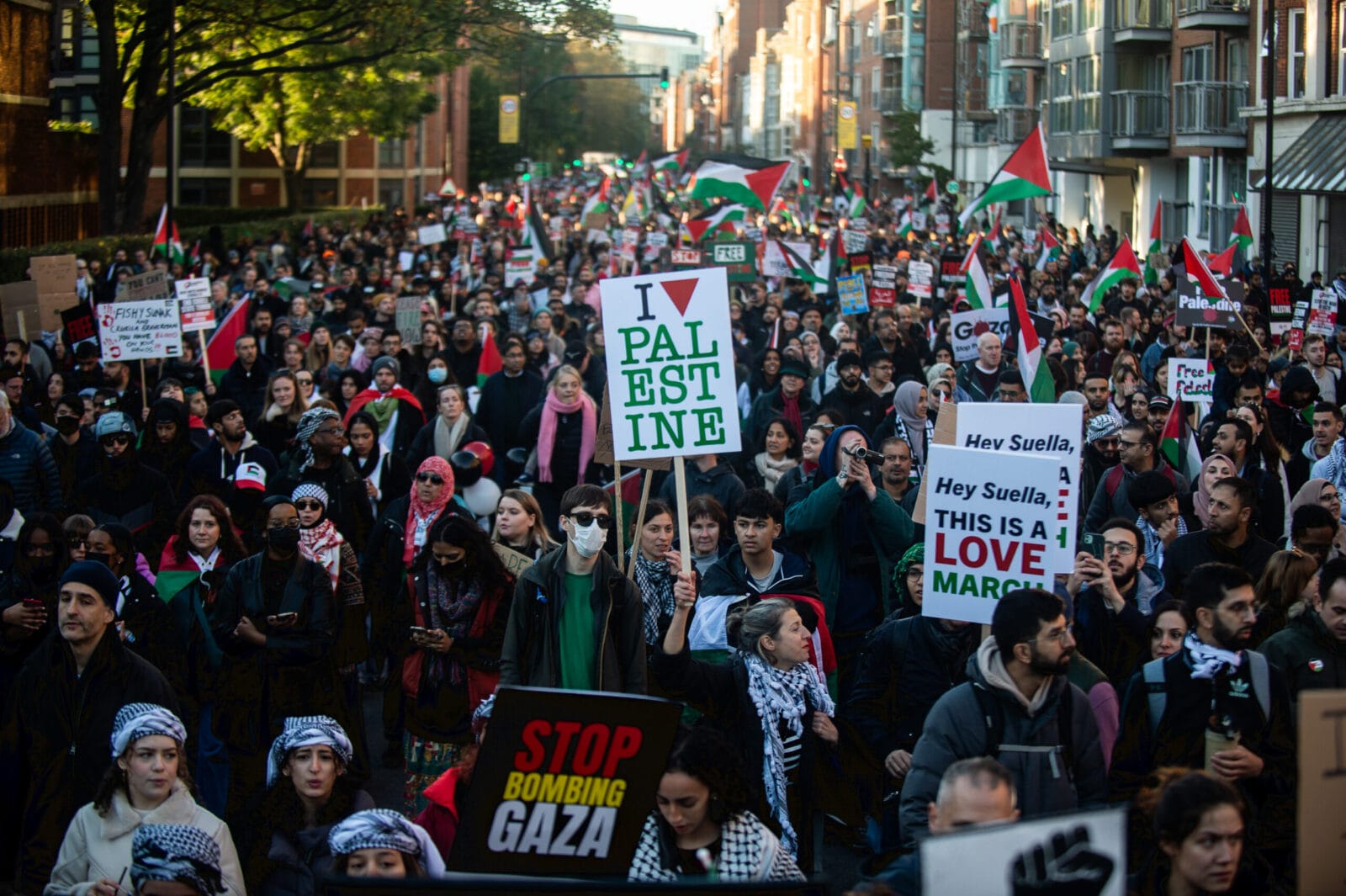
Marchers on Vauxhall bridge road on November 11, 2023 in London, England. Guy Smallman/Getty Images
People of all genders, ages, ethnicities and religions marched together from Hyde Park to the US Embassy in Vauxhall demanding a ceasefire in Gaza. Banners and placards were colorful and inventive, the chanting was loud and the march was enormous. The organizers—a coalition of Palestine solidarity, Muslim and anti-war groups—reported that 800,000 people took part. The demonstration filled the whole 2.5-mile route, with the last marchers departing the assembly point five hours after the first ones left. Along the route, people cheered out of their windows in solidarity as the wave of protestors, wearing keffiyehs and waving Palestine flags, passed through the streets.
The date was a significant one to hold a march calling for a ceasefire in Gaza. Britain commemorates November 11 as Armistice Day, when the truce was reached to end the fighting of World War I. Government ministers, including prime minister Rishi Sunak, some media outlets and right-wing commentators criticized the anti-war demonstration as “disrespectful” to the annual remembrance event held at the Cenotaph in London.[\[1\]](#%5Fedn1) The home secretary, Suella Braverman, branded it a “hate march” and accused the Metropolitan Police of being “biased” in favor of pro-Palestine protestors.[\[2\]](#%5Fedn2) Her words helped to provoke a small counterdemonstration from the far-right English Defence League. Amid chants of “England ‘til I die,” this group provoked stand-offs with the police and attempted to attack the Palestine solidarity demonstration. Days later, Braverman was fired from her ministerial position, albeit for violating the ministerial code not for her criticisms of the police or demonstrators.
> **The demonstration was a stark example of the increasing disconnect between the British establishment and the public when it comes to Palestine over the past few decades.**
The demonstration was a stark example of the increasing disconnect between the British establishment and the public when it comes to Palestine over the past few decades. This change can be seen in the popularity of activities such as the “[Big Ride for Palestine](https://www.thebigride4palestine.com/),” growing support for the Palestinian Boycott, Divestment, Sanctions (BDS) movement within trade unions, universities and local authorities as well as in the growing number of people at demonstrations. Polls also [indicate](https://www.merip.org/content/files/documents/results%5Fmap%5F231221%5Fw.pdf) a shift in public opinion, especially among those under the age of thirty.
In response, the British government has introduced several laws and principles aiming to criminalize and intimidate supporters for Palestinian rights. In 2016, it endorsed the International Holocaust Remembrance Alliance (IHRA) working definition of antisemitism—widely criticized for conflating criticism of Israel with antisemitism—and insisted that all British institutions adopt it. In December 2017, it announced a bill to criminalize BDS by barring public institutions, such as local authorities and universities, from introducing boycotts or divestments. On January 10, 2024, amid the ongoing bombardment of Gaza, it was passed by the House of Commons and will now be debated and voted on by the House of Lords. The Bill echoes the Local Government Act of 1988, passed by the Conservative government of Margaret Thatcher, which blocked the boycott efforts of local councils to support the South African Anti-Apartheid Movement. Notably, the act failed to stop the swell of UK public support to end apartheid in South Africa.
These measures have further enabled pro-Israel groups—such as UK Lawyers for Israel, the British Israel Communications and Research Centre and the Community Security Trust—to intimidate individuals and organizations critical of Israel and supportive of Palestinian rights. They have created a chilling effect and provoked fierce battles in many sectors of British public life. The most prominent example that has continued to have an impact on the Labour party was the scandal surrounding its former leader, Jeremy Corbyn, in which charges of antisemitism were weaponized by the right-wing of the party to discredit Corbyn and undermine the party’s left, as exposed in Al Jazeera’s documentary, [*The Labour Files*](https://www.aljazeera.com/news/2022/9/23/unprecedented-leak-exposes-inner-workings-of-uk-labour-party). Disturbingly, [many](https://www.middleeasteye.net/news/uk-labour-party-accused-discrimination-expelling-jewish-members) of the Labour members who were accused of antisemitism and expelled from the party are Jewish. Nonetheless, amid increasing efforts to discourage criticism of Israel, May 2023 opinion polls showed support for Palestinians was higher than support for Israel, particularly among young people.[\[3\]](#%5Fedn3)
> **In the first week of the war, an overwhelming majority, 76 percent, favored a ceasefire in Gaza—a number that remained constant over the first three months.**
October 7 and what followed has accelerated these dynamics. Despite initial sympathy with Israel after the Hamas attacks, outrage has grown among a British public that is increasingly horrified at the scale and violence of Israel’s ongoing military action in Gaza. In the first week of the war, an overwhelming majority, 76 percent, favored a ceasefire in Gaza—a number that remained constant over the first three months.[\[4\]](#%5Fedn4) In addition to regular large-scale demonstrations, there have been sit-ins of railway stations and other civic spaces, walk-outs and occupations at schools and universities, solidarity statements, trade union motions, fundraising events and boycott activities. Artists and actors have used award ceremonies to make statements in support of a ceasefire and for Palestinian self-determination. And there have been various forms of direct action outside the factories and offices of Israeli arms company, Elbit Systems. Local solidarity groups have grown and new ones have sprung up, in addition to the high-profile national organizations, such as the Palestine Solidarity Campaign.
In stark opposition to the public displays of support for Palestine, the Conservative government and the main opposition Labour party have voiced unequivocal support for Israel. Most MPs, for example, toed their party’s line and voted against a ceasefire motion in parliament on November 15, 2023\. While the devolved governments of Scotland and Wales support a ceasefire, Britain’s foreign policy is the sole responsibility of the Westminster government. On the international stage, Britain has opposed or abstained on ceasefire motions at the UN Security Council and the UN General Assembly and is sending military assistance to Israel.
The government’s partisan position has set the tone in workplaces, where activists and supporters of Palestine have encountered hostility. There have been investigations, censorship, vilification on media (particularly doxing), suspension or termination of employment contracts, offers of jobs or consultancies rescinded, arrests under the [Prevention of Terrorism Act](https://www.merip.org/content/files/files/2023-11/amnesty-uk-prevent-report-%5F281%5F29.pdf) and the revocation of visas for foreign nationals. The policing of political attitudes and erosion of freedom of speech is undeniably racist, with these actions disproportionately impacting Palestinians, Arabs, Muslims and people of color.[\[5\]](#%5Fedn5) While it is not possible to provide details about these incidences due to confidentiality issues related to ongoing investigations and legal cases, the British Society for Middle East Studies (BRISMES) and the European Legal Support Center have reported receiving a large number of requests for assistance and are charting the impacts on the academic profession.[\[6\]](#%5Fedn6) Along with several colleagues, I have written letters for lawyers defending people being investigated or deported.
Despite these repressive measures, the British government and pro-Israel groups will find it difficult to prevent the further erosion of support for Israel among the wider public. Palestine solidarity groups are reporting a surge of interest in their work and predict a large increase in membership. The demonstration of November 11 and other acts of solidarity with Palestinians since October 7 show that people in Britain will no longer ignore Israel’s injustices against Palestinians nor its own government’s support for Israel’s war crimes and apartheid regime—no matter how much censorship or repression is applied.
\[**Mandy Turner** is a senior researcher with *Security in Context*.\]
> **Read the**[ **previous**](https://www.merip.org/the-houthis-sovereign-solidarity-with-palestine-2/) **article.**
> **Read the**[ **next**](https://merip.org/2024/01/urban-planning-and-spatial-domination) **article.**
**This article appears in** [**MER issue 309**](https://merip.org/magazine/309/) **“Palestine—Before and After October 7.”**
---
### **Endnotes**
[\[1\]](#%5Fednref1) Adriana Elgueta and Oliver Slow, “[Planned Protest on Armistice Day Would be Disrespectful, says Sunak](https://www.bbc.com/news/uk-england-london-67305535)”, *BBC News*, November 4, 2023.
[\[2\]](#%5Fednref2) Suella Braverman, “Police Must Be Even-handed with Protests”, *The Times*, London, November 8, 2023.
[\[3\]](#%5Fednref3) [YouGov Poll](https://www.merip.org/content/files/f096idtopm/internal%5Feurotrack%5Fisrael-palestine%5F230516.pdf), May 2023.
[\[4\]](#%5Fednref4) [YouGov Poll](https://yougov.co.uk/topics/travel/survey-results/daily/2023/10/19/e363e/1), October 19, 2023.
[\[5\]](#%5Fednref5) Institute of Race Relations, “[Anti-Palestinian, Suspect Communities, and Racist Backlash](https://irr.org.uk/article/anti-palestinianism-suspect-communities-and-the-racist-backlash-time-to-take-a-stand/),” October 27, 2023.
[\[6\]](#%5Fednref6) BRISMES, “[The Gaza War and Academic Freedom](https://www.brismes.ac.uk/news/recording-of-the-gaza-war-and-academic-freedom-available-to-watch),” November 29, 2023.
### The Houthis’ ‘Sovereign Solidarity’ with Palestine
URL: https://www.merip.org/2024/01/the-houthis-sovereign-solidarity-with-palestine-2/
Last updated: 2025-11-06T22:02:27.000Z
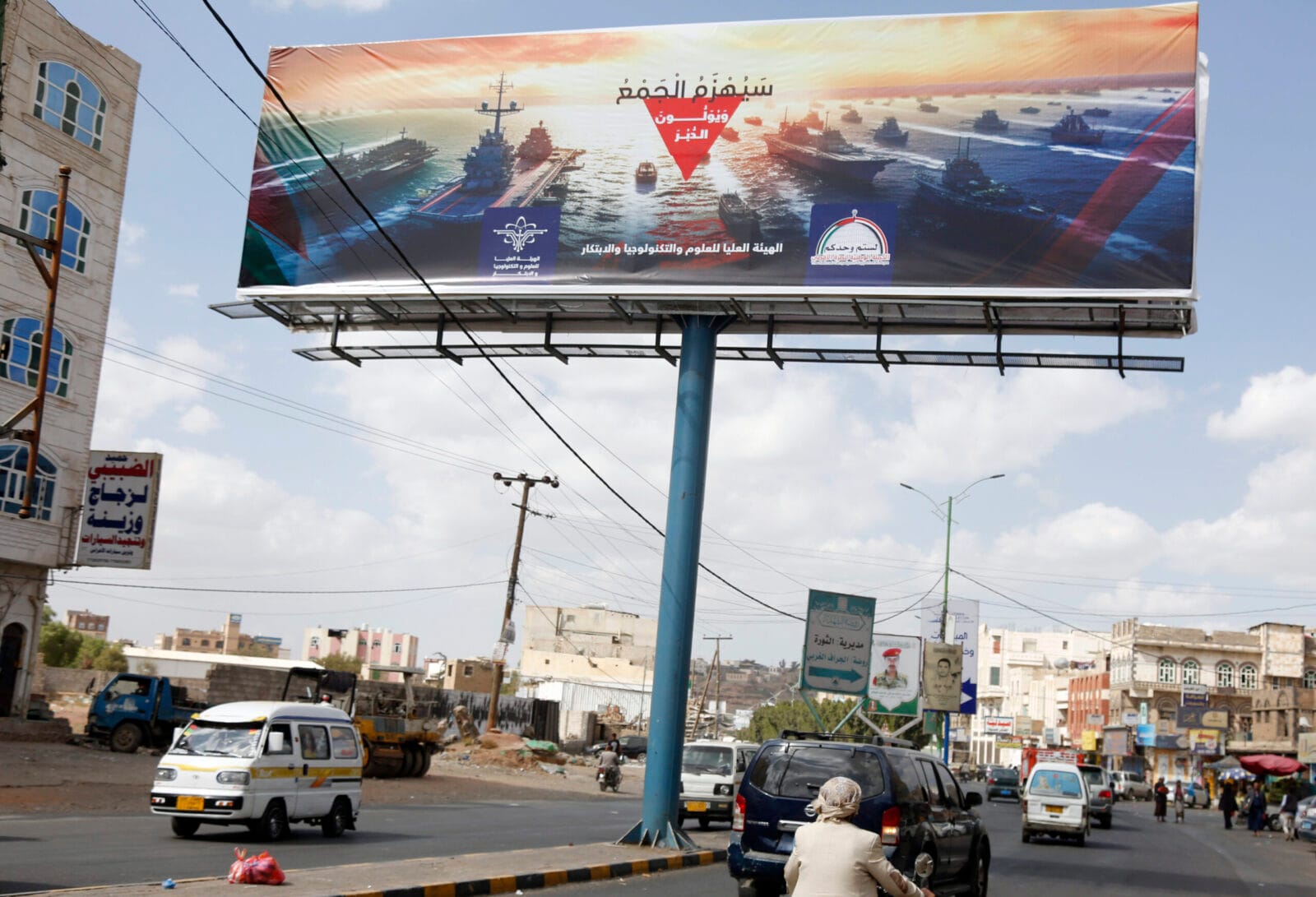
Yemenis drive past a large billboard with a picture depicting the navy destroyers of foreign countries including the US and UK, and the words "Navy coalition will be defeated," December 31, 2023, in Sana'a, Yemen. Mohammed Hamoud/Getty Images
Since October 7, Yemen has made an unexpected return from the margins of global attention.
The Houthi movement’s seemingly ad hoc seizure of shipping vessels in the Red Sea, which began in early November in response to Israel’s bombardment of Gaza, quickly became a concerted campaign to [disrupt global shipping](https://www.reuters.com/markets/commodities/how-are-red-sea-attacks-impacting-shipping-suez-canal-2023-12-18/) and supply chains dependent on access to the Suez Canal. After assembling a coalition of states to prevent attacks on shipping and issuing warnings to Houthi leaders, on January 11, US and British forces launched the first in a series of airstrikes on Houthi military sites in Yemen.
US mainstream media has largely framed the Houthis’ actions in terms of a regional proxy war with Iran, amplifying claims that the group (Ansar Allah, as it designates itself) is “taking their marching orders from Tehran.”[\[1\]](#%5Fedn1) Understanding Houthi actions in the Red Sea in these terms, however, fails to capture the popularity of the Palestinian cause in Yemen that has guided successive Yemeni governments’ relations with the wider region—or Ansar Allah’s effort to claim a place in this legacy of sovereign solidarity from its non-sovereign position amid Yemen’s ongoing civil war.
Popular and official support for Palestine in Yemen predates the creation of the state of Israel and spans Yemen’s many political configurations. In 1947, Yemeni representatives to the United Nations vocally opposed the plan to partition Palestine. Their continuing solidarity was reflected in the policies of both the People’s Democratic Republic of Yemen (South Yemen) and the Yemen Arab Republic (North Yemen) before their unification. In 1971, [for example](https://carnegieendowment.org/sada/84558), South Yemen allowed a Palestinian militant organization to attack an Israeli ship from its territory. During the 1973 October War, it closed the Bab al-Mandab strait to fuel bound for Israel.[\[2\]](#%5Fedn2) After the 1982 Israeli invasion of Lebanon, the two Yemens hosted more than one thousand displaced Palestine Liberation Organization (PLO) fighters and established military camps for them in Sana’a and Aden. Following the unification in 1990, the Republic of Yemen also pressed the United States for diplomatic recognition of the PLO and continued to extend the same rights and resources to Palestinian refugees as they did to Yemeni citizens.[\[3\]](#%5Fedn3)
> **Palestine—and Gaza, in particular—has long mobilized mass support across Yemen’s political divisions, even in the context of civil unrest and violence.**
At a popular level, protests in Yemen against the current Israeli campaign in Gaza have reached an unprecedented size. But Palestine—and Gaza, in particular—has long mobilized mass support across Yemen’s political divisions, even in the context of civil unrest and violence. When Israel launched Operation Cast Lead in the winter of 2008–09, I vividly recall seeing Houthi signs and slogans amid a varied crowd of protesters in Sana’a. At the time, the Houthis were laying low, having just survived several rounds of insurgent warfare in Saada and other parts of northern Yemen, but their supporters risked visibly coming to the streets for Gaza. Then, as now, the ideological and organizational mix on display at protests illustrates how Palestine is an issue on which Yemenis set aside otherwise sharp antagonisms.
At the same time, where and with whose authority protests take place today reflect the increasing political fragmentation in Yemen in which the Houthis’ Red Sea campaign needs to be understood. Nearly ten years into a protracted civil war, different parts of the country experience very different day-to-day political conditions, none of which are consistent with free expression. While leaders of every major political faction have pledged their sympathies with the Palestinian people, their embrace of street protests have been more uneven. Ansar Allah has actively encouraged large crowds in areas under its control, including Sana’a, which they have controlled entirely since early 2015 along with much of the northern part of the country. The Southern Transitional Council, on the other hand, which exercises de facto control in Aden and its periphery and is materially supported by the United Arab Emirates, has largely prohibited protests. Meanwhile, the internationally-recognized government, supported by Saudi Arabia and composed of a fractious collection of parties, lacks a uniform approach in the areas it controls.
For many years, representatives of Ansar Allah have sought to bolster their claims to sovereignty by resisting negotiations with the internationally-recognized government of Yemen in favor of direct talks with Saudi Arabia, which leads a coalition of states working to restore Yemen’s displaced government. Talks began in 2022 as backchannel negotiations during a brief ceasefire. Notably, they advanced along the same timeline as Saudi-Israeli normalization, a policy unpopular not only with the Houthis but across Yemeni society. In this context, the group undoubtedly hopes that its Red Sea campaign—by more starkly positioning it as part of the Axis of Resistance to Israel—will improve its position in regional and domestic negotiations over the future of Yemen.
Houthi solidarity with Palestine also helps them carve out a distinct place in the eyes of a watching Yemeni public. Onlookers have celebrated as, in contrast to the relative inaction of other states in the region, the Houthis have managed to cause significant disruption: Over the past two months, international firms have faced the choice of re-routing around Africa—adding about ten days to the trip from Asia to Europe—or paying increasingly steep insurance premiums to continue transiting through the Red Sea.
> **In the longer term, however, whether it leads to wider regional conflict or not, this act of sovereign solidarity could push an inclusive and sustainable peace in Yemen even further from reach.**
In the short term, Houthi attacks in the Red Sea are boosting the group’s popularity and discrediting Arab states associated with normalization with Israel. In the longer term, however, whether it leads to wider regional conflict or not, this act of sovereign solidarity could push an inclusive and sustainable peace in Yemen even further from reach. The United States, invested in supporting Israel and in protecting global shipping, initially responded to the disruption by putting together a coalition of ten states to deter attacks (notably absent were the two Gulf states most directly involved in different arenas of the conflict in Yemen, Saudi Arabia and the UAE). Following continued disruption to the supply chain, the United States and Britain have escalated to striking Houthi military targets in Yemen.
Houthi-Saudi negotiations are on hold and will be difficult to restart. Meanwhile, advocates of a political settlement that includes the Houthis are likely to find a chillier reception from international organizations, including the UN, particularly in light of the Biden administration’s decision on January 17 to add Ansar Allah back to the Specially Designated Global Terrorist List (SDGT). The group was [removed](https://www.state.gov/revocation-of-the-terrorist-designations-of-ansarallah/) from both the SDGT and Foreign Terrorist Organization (FTO) list in 2021 after international organizations mobilized in the face of humanitarian collapse. These changes could also encourage the Saudi-led coalition to reconsider its shelved campaign to retake the port city of Hodeidah.
Most at risk from recent developments is the civilian population of Yemen. Even before October 7, several major aid organizations had started to rethink their operations in Houthi-held areas of Yemen, and the current crisis is exacerbating these tensions. In [December 2023](https://www.reuters.com/world/middle-east/world-food-programme-pauses-distribution-north-yemen-funds-limited-2023-12-05/), World Food Programme negotiations with the Houthis over aid distribution broke down, with the organization announcing an official pause. The military escalation of the conflict, and the terrorist designation, may hasten an even wider humanitarian retreat.
\[**Stacey Philbrick Yadav** is professor and chair of International Relations at Hobart and William Smith Colleges.\]
> **Read the**[ **previous**](https://www.merip.org/lebanon-after-october-7/) **article.**
> **Read the**[ **next**](https://merip.org/2024/01/britain-palestine-solidarity-and-political-repression) **article.**
**This article appears in** [**MER issue 309**](https://merip.org/magazine/309/) **“Palestine—Before and After October 7.”**
---
### **Endnotes**
[\[1\]](#%5Fednref1) “[What’s Behind the Attacks on Shipping Vessels in the Red Sea?](https://www.npr.org/2023/12/19/1220210907/whats-behind-the-attacks-on-shipping-vessels-in-the-red-sea)” Morning Edition, Nation Public Radio, December 19, 2023.
[\[2\]](#%5Fednref2) Ammar al-Ashwal, "[Yemen and the Curse of Geography: Bab al-Mandab Disputed by Great Power Rivalries,](https://carnegieendowment.org/sada/84558)” Carnegie Endowment for International Peace, May 18, 2021.
[\[3\]](#%5Fednref3) Helen Lackner, “[Yemen Has a Long Tradition of Solidarity with the Palestinian People](https://jacobin.com/2023/12/yemen-israel-palestine-houthis-ships-red-sea-solidarity),” *Jacobin,* December 8, 2023.
### Listening to the Camps' Walls—Lebanon Since October 7
URL: https://www.merip.org/2024/01/lebanon-after-october-7/
Last updated: 2025-08-22T18:36:26.000Z
There has been no shortage of worry in Lebanon following the Hamas attacks on October 7 and the ensuing Israeli declaration of all-out war on Gaza. Israel has made it clear that war with Hezbollah will lead to devastating consequences for the whole of Lebanon. “What we’re doing in Gaza, we can also do in Beirut,” the Israeli defense minister has warned.[\[1\]](#%5Fedn1)
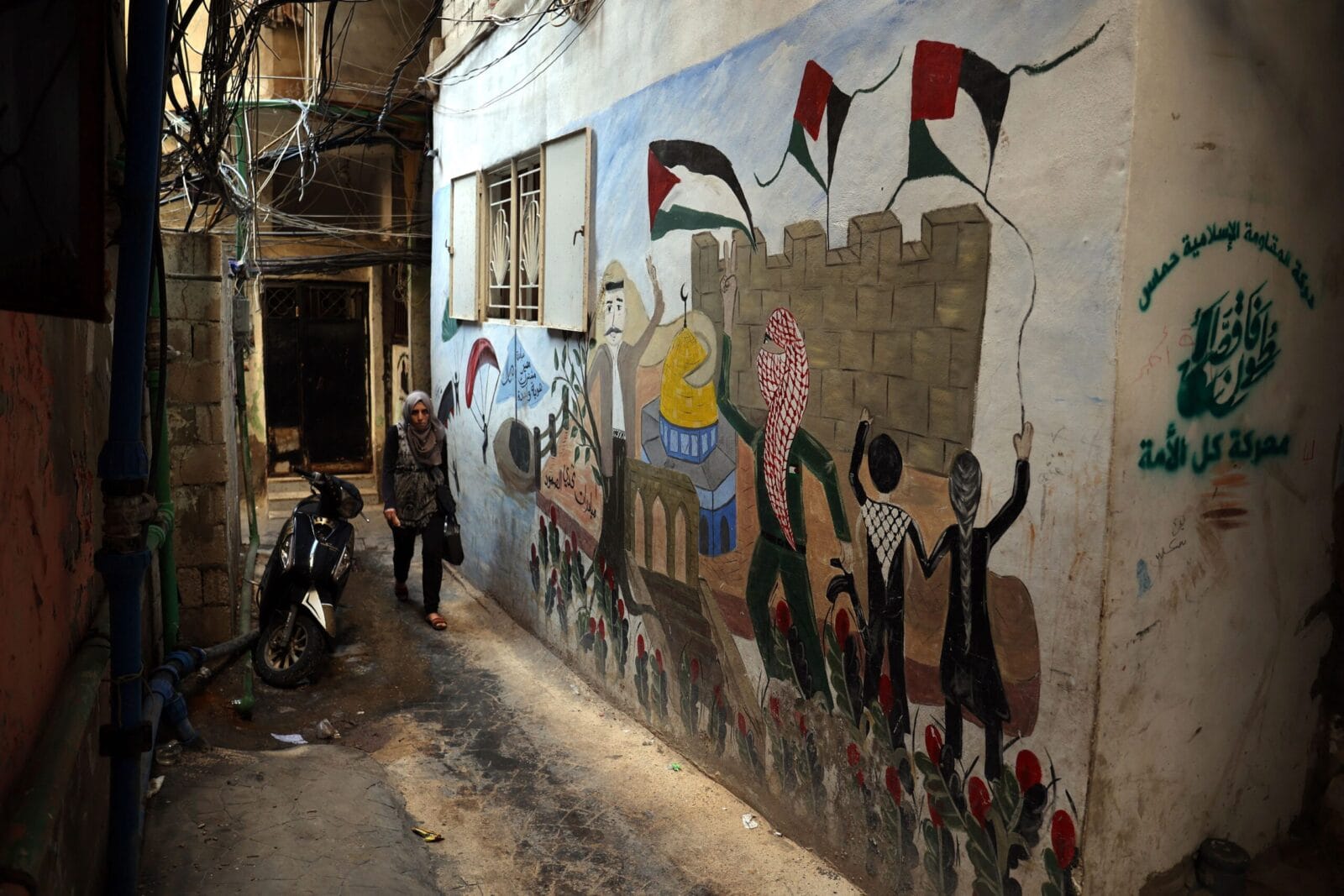
A mural in an alley in the Burj al-Barajneh Palestinian camp south of Beirut on November 15, 2023\. Anwar Amro/AFP via Getty Images
The echoes of the past are strong—the destruction of the 1980s and 2006 still vivid in the experience and memories of many. Since October 7, Israel has bombed villages and fields in proximity to the border, using white phosphorous in civilian areas in violation of international humanitarian law. In the first week of January 2024, it carried out assassinations of Hamas deputy chairman Saleh Al-Arouri in Beirut’s southern district of Dahiyeh and senior commander of Hezbollah’s Radwan special forces, Wissam Tawil, in the Marjeyoun District in Southern Lebanon. Tens of civilians and at least four journalists have been killed in Israeli airstrikes since October 7.
Some places worry more than others. Beirut’s Dahiyeh district, the Junub (South) and Nabatiyyeh Governorate along the border with Israel remain in a state of permanent war. The South does not only represent the geographical line between Lebanon and Israel. It is also the line of community mobilization under the umbrella of Hezbollah and the Resistance (*al-Muqawama*) within Beirut’s suburbs and well into Lebanon’s hinterland. The front is long and military operations by the Hezbollah-led resistance are daily and calculating, though also escalatory as exemplified by repeated targeting of the Israeli Air Force intelligence base on Mount Meron, the highest peak in Israel (excluding the Occupied Golan Heights). Hezbollah is cognizant of the delicate balance between its domestic publics and priorities within Lebanon and its commitment to the broader front of the Resistance. The latter is under the umbrella of Iran’s military, intelligence and ideological compass and includes Ansar Allah (the Houthis) in Yemen, the Popular Mobilization Units (al-Hashd al-Sha‘abi) in Iraq and Bashar al-Asad in Syria.
> **The tenor of Hezbollah’s media statements differs from the July 2006 war. The semantics of martyrdom and sacrifice are still there, but they are not front and center.**
The tenor of Hezbollah’s media statements differs from the July 2006 war. The semantics of martyrdom and sacrifice are still there, but they are not front and center. Instead, pro-Resistance channels such as al-Mayadeen and Hezbollah’s official channel al-Manar have been filled with reports from Hebrew-language newspapers and Israeli media being translated, shared and discussed. In the virtual chats on Telegram channels and street corner cafes, Hebrew has become, not a language of fear or rejection, but an indispensable tool to follow updates about the enemy’s strategy and the direction of the war as well as to validate the Resistance’s claims of success. Reports of damages and casualties from Israeli news channels are shared as a testament to Hezbollah’s effectiveness and to Secretary General Hassan Nasrallah’s promise of deterrence against the IDF. That said, hard talk of geopolitics stands against the pressures on everyday livelihoods across Lebanese society and the reality of Lebanon’s military inferiority vis-a-vis Israel and the West. Many remain fearful of the collapse of Lebanon’s already tired economic recovery in the wake of an all-out war with Israel.
For Palestinian refugees in Lebanon the cruel spectacle of Israel’s genocidal war in Gaza is set against the memory of Sabra and Shatila. Listening to the camps’ walls reveals the new organizational and affective dynamics that have followed from October 7.
Reflecting on his childhood in Miyah wa Miyeh camp in the 1970s, Salem Yassin writes of the importance of reading and listening to the camps’ walls—what he calls “the people’s free newspaper.”[\[2\]](#%5Fedn2) The messages they convey, Yassin suggests, are part of a dialogue with world events and history as much as they are about internal dialogues within the camp. They are written by the “organic” intellectuals: ordinary Palestinians who reside in the camps. They convey critical reflections on their world, foster engagement with the world beyond the camp and call for liberatory or solidarity actions. These days, their writings transcend the physical walls and find their way into the digital realm, prominently featured on Facebook walls and other social media platforms.
Since October 7, the walls of most Palestinian refugee camps in Lebanon have been adorned with murals, posters and pictures commemorating the attacks as well as images of martyrs and Abu Obeida—the spokesperson for Hamas’ Al-Qassam Brigades. This visual tapestry reinforces the enduring commitment to armed resistance within the community and attempts to minimize the burning distance between Palestine and the camps in Lebanon. On the surface, Hezbollah and its Palestinian allies in the camps, Hamas and the Islamic Jihad, restrict and oversee how and when people can engage in armed struggle against Israel—the post-1991 equilibrium between the Palestinian liberation struggle and Lebanese sovereignty having found a solution in Hezbollah’s control over the resistance. But this arrangement leaves many unhappy: Palestinian groups who feel they are subordinates to the Islamic Resistance as well as opponents of Hezbollah who argue that the party has taken over the Lebanese state’s prerogative and acts as a proxy of Iran.
A Facebook post by the media outlet Jouzour reads, "How can you directly support the people of Gaza?" The flyer suggests companies to boycott.
Following October 7, there has also been a resurgent call for boycott echoing across the camp walls. Extending beyond the confines of the camp, this call for boycott has reverberated across the Arab world and into Muslim-majority countries, as well as several countries in the global South. It differs from those sponsored by the international BDS campaign and its national working groups. In Lebanon, grassroots and individual efforts propel boycotts autonomously, driven by a collective desire to take meaningful action against violence in Gaza and across the Occupied West Bank. One new grassroots initiative emerging from the camps, for example, [*Qati' Tishtrish*](https://www.facebook.com/people/%D9%82%D8%A7%D8%B7%D8%B9-%D8%AA%D8%B4%D8%AA%D8%B1%D9%8A%D8%B4/61553252016641/) organizes school visits and prints flyers detailing the impact of boycott actions.
A Facebook live, hosted in early November by two Palestinian activists from Burj al-Barajneh and Shatila camps, featured a conversation and a Q&A session on boycott as a tool of resistance. The host started by defining boycott and explaining that it is not an action triggered only at times of war. Rather, it is an ongoing effort, one whose influence should not be underestimated. He exhorted his listeners to note the drop of prices in imported goods that followed the rise in boycott calls in the region.
A Facebook post by Jouzour reads, "How can you directly support the people of Gaza?" The graffiti reads, "Do not pay the price of their bullets."
Boycott thus not only has the potential to affect Israel’s economy. It also prompts organic reflections on imperialism, class and political action. When prices drop, people realize the power they hold over the market. Boycotts of Western products complicit in aiding the genocide in Palestine often involve advocating for their substitution with local (or non-Western) products, which are reviewed and promoted by those participating in the boycott through their social media feeds. A [picture](https://www.facebook.com/100003171988042/posts/6816214111827587/?mibextid=WC7FNe) depicting two young girls checking the labels of products recently went viral on social media. “This time, we have won a generation we feared might forget,” reads the caption. Boycott actions pave the way for Palestinian refugees across generational and gender divides to reclaim their part in the struggle. It allows them to defy the hegemony of Palestinian factions and their top-down approach.
When looking across the border from Lebanon, Israel—with the support of the United States and Britain—seems to have a great appetite for war, driven by grief metabolized into conquest and revanchism along mythological, Biblical lines. In Lebanon, the fears and desires of the recent past echo in the walls of the camps and the burning borders of the south. Proposals of a mutual agreement between Israel and Hezbollah through US mediation—which have been reported in the news—are met with skepticism or derided. After all, US president Joe Biden appointed Amos Hochstein as his special envoy to the Middle East. Hochstein was born in Israel and served in the IDF as a tank crewman before moving to the United States. The few who thought peace with Israel might be possible, or that the United States was an impartial mediator in the conflict, are reminded by those who have long been skeptical: “We told you, it \[Israel\] is not just against the South \[the Resistance\]. It is against the whole of us \[Lebanon\].”[\[3\]](#%5Fedn3)
\[**Rami Rmeileh** is a doctoral student at the University of Exeter’s Institute of Arab and Islamic Studies. **Maziyar Ghiabi** is a senior lecturer at the University of Exeter's Institute of Arab and Islamic Studies.\]
> **Read the**[ **previous**](https://merip.org/2024/01/jordan-palestine-and-permissible-protest) **article.**
> **Read the**[ **next**](https://www.merip.org/the-houthis-sovereign-solidarity-with-palestine-2/) **article.**
**This article appears in** [**MER issue 309**](https://merip.org/magazine/309/) **“Palestine—Before and After October 7.”**
---
## **Endnotes**
[\[1\]](#%5Fednref1) "[‘What we’re doing in Gaza, we can also do in Beirut,’ says Israeli defense minister,"](https://english.alarabiya.net/News/middle-east/2023/11/11/-What-we-re-doing-in-Gaza-we-can-also-do-in-Beirut-says-Israeli-defense-minister) AlArabiya News, November 11, 2023.
[\[2\]](#%5Fednref2) Salem Yassin, “Graffiti from a Time Gone by,” in Muhammad Ali Khalidi (editor and translator), *11 lives: Stories from Palestinian Exile* (New York: OR Books New York), pp. 6-21.
[\[3\]](#%5Fednref3) Conversation with Beirut interlocutor (originally from Nabatiyeh), Dec 2023.
### Palestine and the Limits of Permissible Protest in Jordan
URL: https://www.merip.org/2024/01/jordan-palestine-and-permissible-protest/
Last updated: 2025-08-22T18:36:27.000Z
Since October 7, 2023, Jordanians have staged ongoing protests against Israel’s war on Gaza.
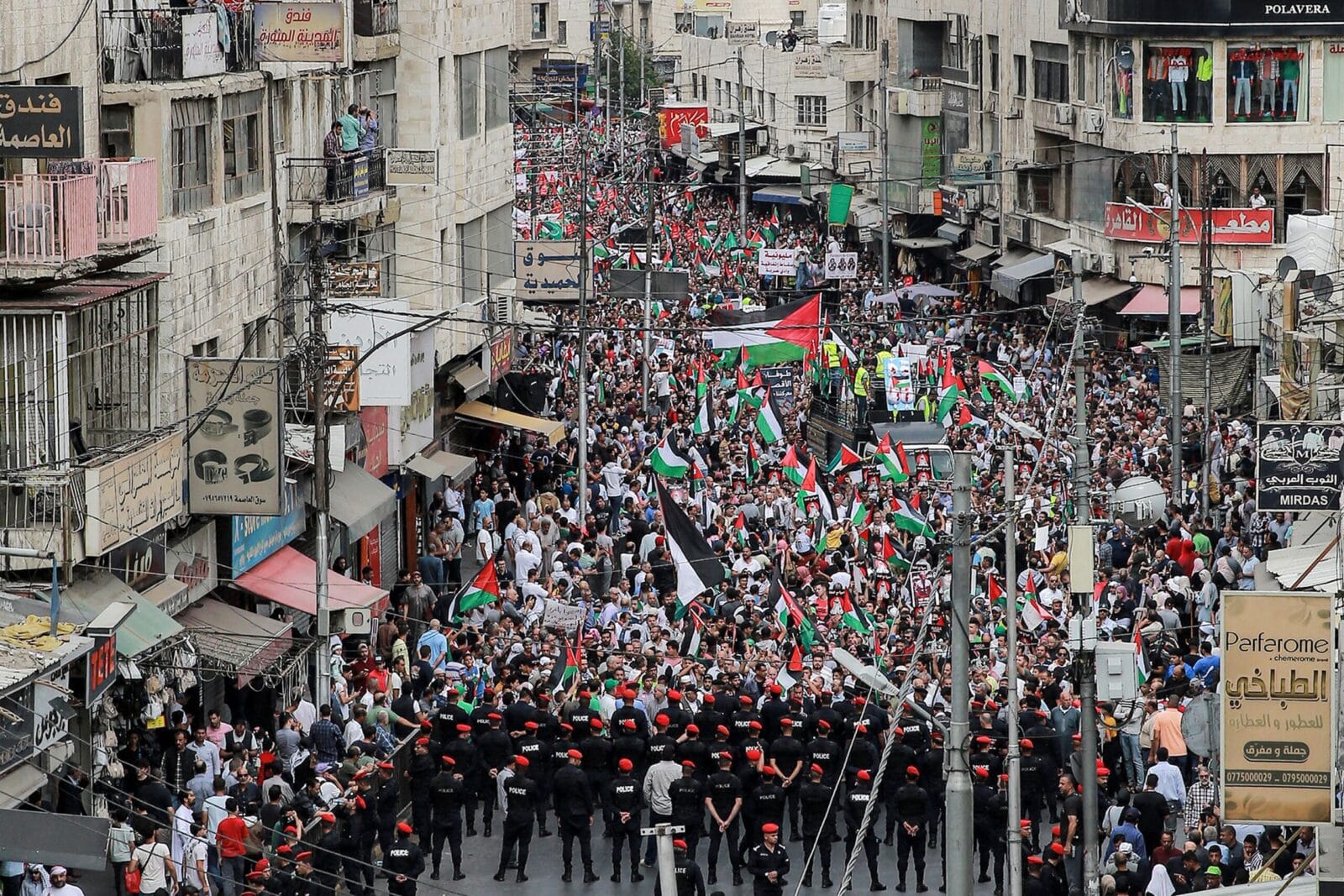
Members of Jordan's Darak forces (gendarmerie) stand on guard as protesters gather for a rally in solidarity with Palestinians in the Gaza Strip in Amman on October 27, 2023\. Khalil Mazraawi/AFP via Getty Images
The largest protests have taken place in northern cities with sizable Palestinian refugee populations, such as Amman and Irbid. In the capital, protesters have gathered almost weekly in the city center and near various foreign embassies, particularly those of Israel and the United States.
As numerous Israeli officials openly [discuss plans to depopulate Gaza](https://arabcenterdc.org/resource/jordan-sees-the-war-on-gaza-in-existential-terms/), and the Arabic news and social media broadcasts images of daily devastation, Jordan’s government and citizens alike fear that Israel and the United States will pressure the country to accept another large wave of Palestinian refugees. Jordanians are watching closely to see whether King Abdallah II, already deeply unpopular, will be able to resist pressure from Israel and the United States, which provides the kingdom with some $1.5 billion in annual aid. They are also raising larger grievances against the monarchy’s normalization with Israel.
In the context of the exceptional violence unfolding in Palestine, many observers are tempted to read the current protests as exceptional and potentially threatening to the regime. But as I document in my recent book, *[Protesting Jordan: Geographies of Power and Dissent](https://www.sup.org/books/title/?id=15881)*, very little of what has been happening deviates from patterns established over the past quarter century.
The issue of Palestine has, for decades, driven Jordanians to push the limits of permissible protest. At the outbreak of the First Intifada in 1987 thousands defied martial law to demonstrate in the streets. When Jordan signed a peace treaty with Israel in 1994, political parties, activists and members of the professional associations joined with a few prominent former government officials—notably Ahmad Obeidat, a former head of the General Intelligence Directorate, or *mukhabarat*—to form an anti-normalization committee opposed to the normalization of political and economic relations with Israel. That committee has coordinated hundreds of protests since the mid-1990s, scoring an early major success when thousands turned out to [protest the first Jordanian-Israeli trade fair](https://doi.org/10.1080/14742830500191410) outside of Amman in 1997 and effectively shut down the event’s opening day.
> **With the start of the Second Intifada in the fall of 2000, Jordanians began to establish routines and patterns for anti-Israeli protests nationwide, gathering in familiar locations like downtown Amman.**
With the start of the Second Intifada in the fall of 2000, Jordanians began to establish routines and patterns for anti-Israeli protests nationwide, gathering in familiar locations like downtown Amman. One frequently repeated protest routine that emerged at the time is to demonstrate near the Israeli embassy at the Kalouti Mosque in the Rabia neighborhood of West Amman. Framed as marches on the Israeli embassy, these protests follow a familiar routine in which demonstrators meet a line of riot police (the Darak Forces, or gendarmerie) along a given street but do not actually try to reach the embassy.
In the years since the Second Intifada, with every subsequent major Israeli incursion into the West Bank or Gaza, tens of thousands turn out nationwide. Before the current war on Gaza, the most recent example was the Sheikh Jarrah protests in 2021\. The massive crowds and roadblocks bring traffic to a standstill. After weeks or months, the large crowds inevitably subside. But the Kalouti protests typically continue for many months more, often with only a few dozen committed anti-normalization activists.
Aside from the large protests around Israeli military campaigns, Jordanian activists have also taken other actions to target Israel and the Jordanian regime’s relations with it. A [campaign against Jordan’s gas deal with Israel](https://www.merip.org/exposing-jordans-gas-deal-with-israel/) in 2014, for example, sparked a focused movement drawn from anti-normalization activists under the slogan “The Gas of the Enemy Is Occupation.” Despite the campaign gaining support from parliamentarians, however, the government went ahead with the gas deal, which went into effect on January 1, 2020.
The current Gaza protests are a continuation of this longer activist tradition. More than a rupture, they speak to an evolving dynamic between the regime and popular protest on the question of Palestine. Like the Sheikh Jarrah protests, they are happening in the context of a severe [crack down](https://dawnmena.org/jordan-authorities-expand-arrests-of-hirak-activists-to-silence-criticism-of-king-abdullah/) on protesters and activists since the [anti-tax and anti-austerity protests](https://www.merip.org/the-fiscal-politics-of-rebellious-jordan/) in 2018\. In late 2019, for example, just a few months after a series of [large-scale national protests](https://www.merip.org/resurgent-protests-confront-new-and-old-red-lines-in-jordan/) in support of teachers’ demands for higher wages, the regime [raided the offices of the teachers’ union](https://www.merip.org/resurgent-protests-confront-new-and-old-red-lines-in-jordan/) seizing its assets and arresting its governing board.
> **More than a rupture, they speak to an evolving dynamic between the regime and popular protest on the question of Palestine.**
But protests against the war on Gaza, although not welcome by the regime, are largely tolerated because they align with its opposition to Israel’s actions. Indeed, the regime has been openly critical of Israel’s war, even while it continues to do business with it. On November 1, Jordan recalled its ambassador from Israel and expelled the Israeli ambassador from Amman. Such largely symbolic actions bely the maintenance of economic and military cooperation with Israel and the United States. This hypocrisy is not lost on activists, but the loud condemnations in speeches by the king and foreign minister are often met with cheers from ordinary Jordanians.
The vast majority of protests since October 7 have reproduced familiar protest routines. One activist wrote me to express his frustrations that at the Kalouti protests near the Israeli embassy, people were unwilling to break from the established routines. At one protest, he even chatted with a police officer about how predictable they were, despite the swelling numbers.
When recent protests have pushed the limits, they have met with swift resistance from the police. In mid-October, some protesters tried to [reach the border between Jordan and Israel](https://www.al-monitor.com/originals/2023/10/jordan-faces-mass-rallies-marches-toward-israel-west-bank-border) in the Jordan River Valley, but police stopped them before they could get close. Notably, during the 2021 Sheikh Jarrah protests, some had managed to breach a border fence but did not come close to reaching the Jordan River, which forms the actual border. On October 17, following the strike on Al Ahli hospital that was at first attributed to Israel, hundreds gathered at a new location near the Chinese embassy and [tried to march on the Israeli embassy](https://www.voanews.com/a/analysis-mass-protests-rock-jordan-key-us-ally-in-mideast/7317716.html). Whereas the protesters who followed the established route near the Kalouti Mosque did not encounter police violence, those at the new location were confronted by several hundred police officers using tear gas and heavy barricades to turn back the marchers.
Since November, the size and frequency of protests have fluctuated, and tensions among some of the familiar groups at anti-Israeli protests have increased. In one protest in downtown Amman in November, for example, some leftist activists clashed with Muslim Brotherhood protesters over whether the flags of political parties should be carried alongside Palestinian and Jordanian flags.
The war on Gaza has also reenergized communities with longer histories of political activism that had become subdued in recent years. One particularly notable protest was organized by residents of the Hayy Tufaylah neighborhood in Amman, where many have roots in the southern mountain town of Tafileh. As in other towns, such as Karak and Ma\`an, Tafileh residents are proud of their long history of resistance to Ottoman, British and Jordanian authorities and their lack of fear in criticizing the regime. But after an anti-austerity protest in Hayy Tufaylah in 2018, when police beat protesters with batons, the neighborhood had been relatively quiet until hundreds of residents marched in support of Gaza in November.
The recent wave of protests, while widespread and sustained, does not directly threaten the Hashemite regime or challenge the king’s rule. In many ways, the king’s position is aligned with the protesters. But the escalated crackdown on activists in recent years, combined with [the long-term house arrest of the popular Prince Hamzeh](https://www.washingtonpost.com/politics/2021/04/05/jordan-detained-prince-governments-determined-squash-political-dissent/) for his outspoken criticism of the regime, suggests that the king is increasingly worried about political opposition to his rule. Another massive transfer of Palestinians out of their historic homeland—even if not into Jordan—would likely escalate dissatisfaction with the regime’s rule, even if the king cannot stop a Gaza Nakba.
\[**Jillian Schwedler** is professor of politics at Hunter College and the Graduate Center of the City University of New York.\]
> **Read the**[ **previous**](https://merip.org/2024/01/the-gulf-from-the-oil-weapon-to-popular-boycott) **article.**
> **Read the**[ **next**](https://www.merip.org/lebanon-after-october-7/) **article.**
**This article appears in** [**MER issue 309**](https://merip.org/magazine/309/) **“Palestine—Before and After October 7.”**
### From the Oil Weapon to Boycott, Mobilizing in Support of Palestine in the Gulf
URL: https://www.merip.org/2024/01/the-gulf-from-the-oil-weapon-to-popular-boycott/
Last updated: 2025-08-22T18:36:27.000Z
On October 17, 2023 *Kuwait News* issued an Instagram [post](https://www.instagram.com/reel/CyffAnHo851/?igsh=MnlhMXA2aDU1NG10) commemorating another October 17, 50 years before.
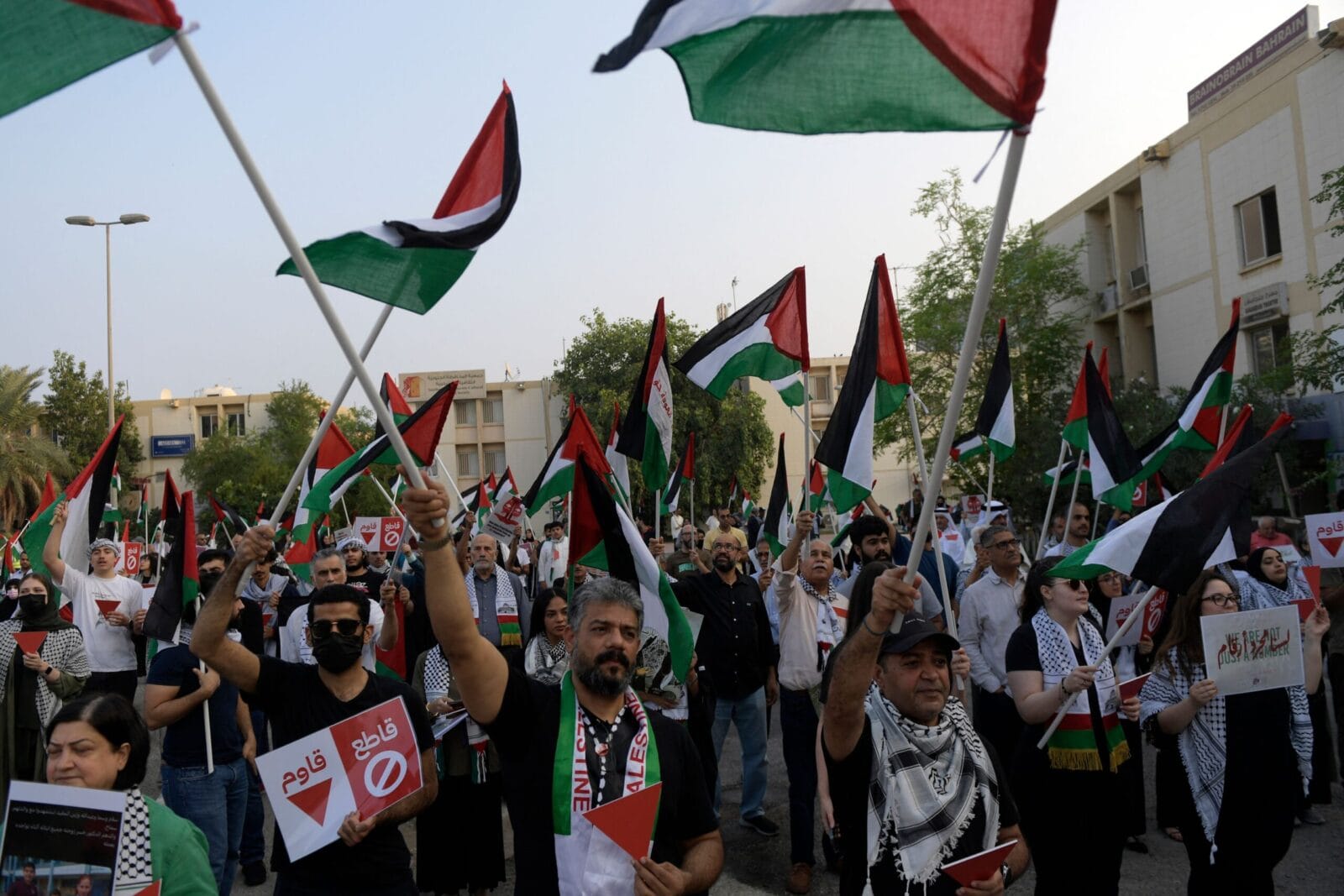
Protesters during a solidarity sit-in with the Gaza Strip, in Manama, Bahrain, on November 17, 2023\. Mazen Mahdi/AFP via Getty Images
In 1973, members of the Organization of Arab Petroleum Exporting Countries (OAPEC) led an oil embargo against countries that supported Israel during the October War. Following the start of Israel's genocidal war on Gaza, this history has also been invoked several times on Gulf Twitter (now X). On October 31, a [commentator](https://x.com/Sara%5FAlshammari/status/1719327551573615058?s=20) from Kuwait wrote, “10 Arab countries have oil, ten countries that have not yet agreed on a single word in favor of Gaza.”[\[1\]](#%5Fedn1) On November 14, a resident of Qatar asked in a since deleted post, “Why are the Gulf countries not using oil and gas as a tool to stop the genocide in Palestine?” The uncomfortable [laughter](https://x.com/tunigate/status/1722602256590131238?s=46&t=E%5F0Syf7evT947IEXmC-ggA) of the Saudi Oil Minister, Khalid al Falih, in response to a question on the use of oil as an economic tool was met on the website with declarations of shame and outrage.
There are certain essential characteristics of the oil weapon, however, that have been muted as they echoed across the short history between the October 1973 oil action and October 2023\. The first is that workers from the oil industry were the instigators of past Gulf oil embargoes. For example, in 1956, during the British, French and Israeli Suez war against Egypt, a clandestine organization of oil workers known as the Kuwaiti Democratic League, took part in a call by the Movement of Arab Nationalists in Kuwait, and refused to load oil onto British and French tankers.
> **More often than not, Gulf leaders were reluctantly, cautiously responding to the sustained pressure from organized workers and politicized local populations and from powerful anti-colonial and anti-Zionist states in the region.**
The second, related, characteristic that has been largely erased from the annals of official and popular history is that the control of oil supplies was linked to the demands of local political movements for the end of colonialism, for an end to post-independence political, economic and military relations with Britain, for the right of political participation, the right for workers to unionize and the nationalization of oil companies.[\[2\]](#%5Fedn2) More often than not, Gulf leaders—even those valorized in popular history—were reluctantly, cautiously responding to the sustained pressure from organized workers and politicized local populations and from powerful anti-colonial and anti-Zionist states in the region.
Third, European powers and the United States were more dependent on oil from Arab states in the 1970s than they are in 2023\. Today, the nationalized oil companies of the Gulf are part of a “new hydrocarbon axis” in Asia, and most of their exports flow toward China, Japan, India and Singapore, among other states.[\[3\]](#%5Fedn3) Finally, since the 1970s, counter-revolutionary regimes in the Gulf have effectively destroyed their workers' movements and invested in the production of a precarious labor force made up of deportable non-citizens with poor working conditions and limited labor rights.
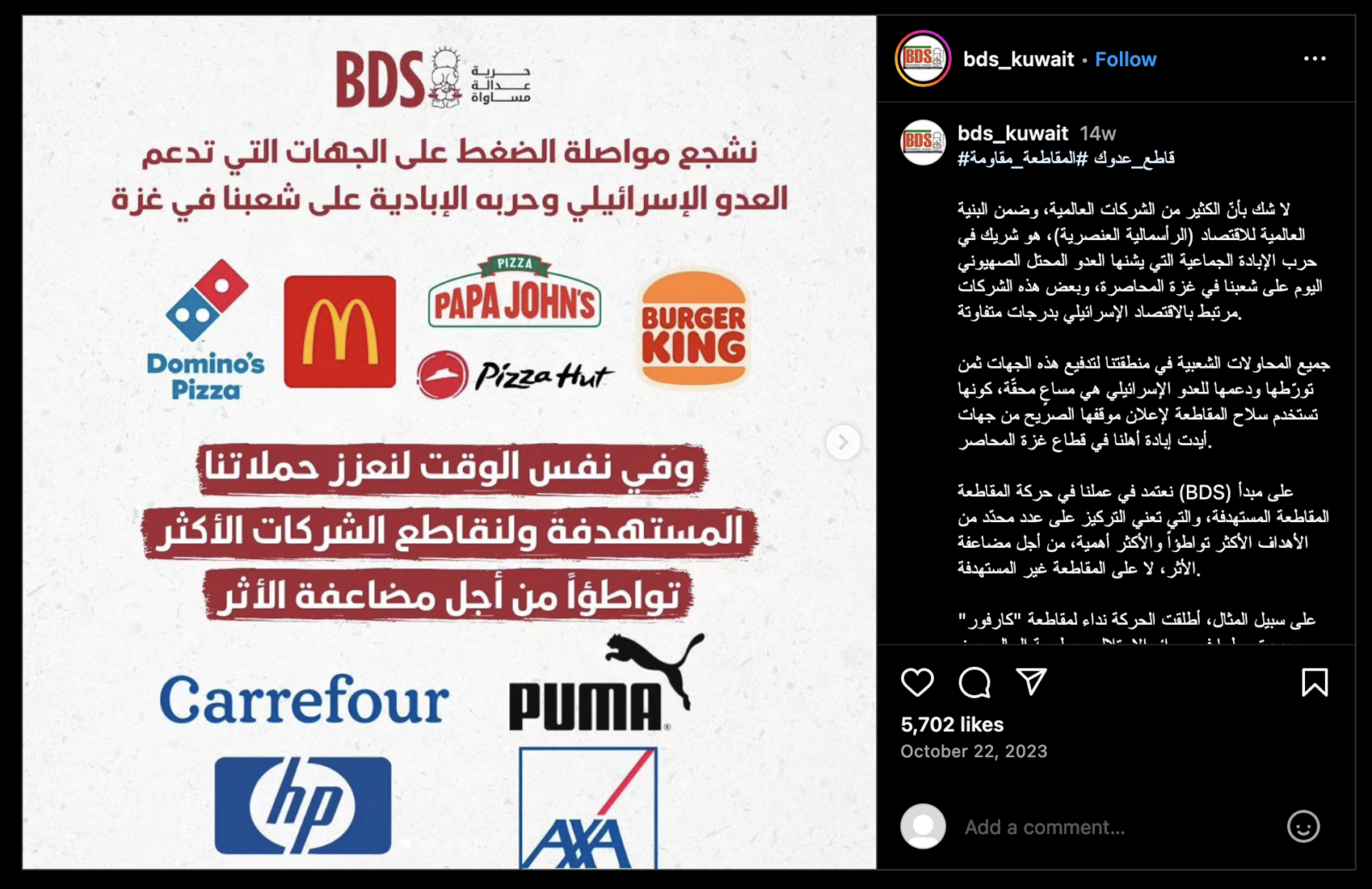
An Instagram post by BDS Kuwait calling on people in the region to use the “weapon of boycott” against global companies enabling Israel’s war on Gaza.
In today’s post-2011 and post-Abraham Accords Gulf, popular measures against Israel’s war in Gaza and its mounting violence across historic Palestine have centered largely around boycott. Anti-normalization groups in [Bahrain](https://www.instagram.com/bsaz.bahrain/) and groups affiliated with the Boycott, Divestment, Sanctions (BDS) movement in [Kuwait](https://www.instagram.com/bds%5Fkuwait/), [Qatar](https://www.instagram.com/guqsjp/) and [the Gulf](https://www.instagram.com/gulf.can/) in general have galvanized campaigns to boycott companies that support Israel or that profit from Palestinian oppression. Today’s popular boycotts include the targeted boycotts proposed by the BDS movement but extend beyond them. Households are changing their grocery purchases and [suppliers](https://bdsmovement.net/boycott-carrefour). Information is being circulated across social media about companies that have established ties to Israel, following the 2021 [normalization deals](https://www.aljazeera.com/news/2023/9/17/three-years-on-how-have-the-abraham-accords-done-for-the-uae) signed by Bahrain and the UAE. The website [bdnaash](https://bdnaash.com/) allows users to type company names into a search engine to find out whether they are on the boycott list (the box turns red) or not (the box turns green).
In Bahrain, Kuwait, Oman and Qatar, authorities have granted permission for pro-Palestine and anti-war protests, and they have taken place. Some analysts [speculate](https://www.youtube.com/watch?v=UKQL6Wl--0U) that large scale protests in Oman have forced its government to shift to a more critical stance in its political relations with the Israeli state. But overall, the response feels subdued. In Dubai and Bahrain, boycotts against Israel are carried out without being named as such for fear of repercussions. In Bahrain, political activist [Ebrahim Sharif](https://www.theguardian.com/world/2016/feb/24/bahrain-jails-ibrahim-sharif-national-democratic-action-society) Al Sayed was detained for seven days, pending an investigation on the [charge](https://x.com/ghassantheother/status/1737806730988314777?s=46&t=E%5F0Syf7evT947IEXmC-ggA) of “spreading false news during wartime.”[\[4\]](#%5Fedn4) Human Rights Watch has [documented](https://www.hrw.org/news/2023/12/22/bahrain-repression-pro-palestine-protests) the arrest and questioning in custody of more than 50 others, including minors, for participating in unlicensed protests, which have been taking place in Bahrain’s villages.
At the same time, authorities in a few Gulf states have instrumentalized a semblance of solidarity with Palestine. In the UAE, Sharjah [banned](https://www.msn.com/en-ae/news/national/sharjah-bans-new-years-eve-firework-displays-in-support-of-gaza/ar-AA1m3TRj) its New Year’s eve celebrations in solidarity with Gaza. In Kuwait, two non-citizen nurses were also fired and [deported](https://www.middleeastmonitor.com/20231030-kuwait-deports-second-indian-nurse-for-supporting-israel-bombing-of-gaza/) for violating Kuwaiti law by expressing support for Israel. In the private sector, a hospital in Bahrain [dismissed](https://www.indiatoday.in/world/story/israel-hamas-war-indian-origin-doctor-in-bahrain-fired-from-hospital-over-anti-palestine-tweets-2451398-2023-10-20) a non-citizen worker from his job for tweeting support for Israel’s war on Gaza. Incidentally, he was retweeting a Saudi [influencer](https://twitter.com/T%5FA%5Fbackup/status/1714718964276773349/photo/1).
50 years after the oil embargo in 1973—and the national demonstrations and oil workers strikes of the two decades before—citizens in the Gulf seem to express political power largely through their consumption. The boycott itself is not new to the Gulf. Kuwaiti historian Talal Al Rashoud has written about a [boycott office](https://x.com/tsalrashoud/status/1295010561504292871?s=20) that opened in Kuwait in 1958 as a result of popular pressure to boycott Israel within the Customs Department. While there are many questions to be asked about the possibilities of its longevity, tactics and political potentials, for now, across the Gulf and beyond, many branches of McDonalds and Starbucks remain empty due to boycotts.
Those engaging in the boycott and local protests are part of a multi-faceted global movement in solidarity with Palestine. In various parts of the Gulf participants in solidarity actions with Palestine are also engaging in the local political scene, often chafing against the restrictions and imperatives of domestic powers. How these dynamics will play out in the long term remains to be seen.
\[**Samar Alwan**, a pseudonym, is an activist and writer from the Gulf.\]
> **Read the**[ **previous**](https://merip.org/2024/01/sisi-the-egyptian-public-and-the-war-on-gaza) **article.**
> **Read the**[ **next**](https://merip.org/2024/01/jordan-palestine-and-permissible-protest) **article.**
**This article appears in** [**MER issue 309**](https://merip.org/magazine/309/) **“Palestine—Before and After October 7.”**
---
### **Endnotes**
[\[1\]](#%5Fednref1) [Post on X](https://twitter.com/Sara%5FAlshammari/status/1719327551573615058?s=20), October 31, 2023.
[\[2\]](#%5Fednref2) Ahmad Al-Khatib*,* *Al-Kuwait: Min al-Imara ila al-Dawla, Dhikrayat al-ʿAmal al-Watani wa-l-Qawmi (Kuwait, from Emirate to State: memories of Patriotic and National Action*) (Casablanca: al-Markaz al- Thaqafi al-ʿArabi, 2007). Laleh Khalili, *Sinews of War and Trade*, *Shipping and Capitalism in the Arabian Peninsula.* (London: Verso: 2020).
[\[3\]](#%5Fednref3) Hamza Hamouchene and Katie Sandwell, eds. *Dismantling Green Colonialism: Energy and Climate Justice in the Arab Region* (Pluto Press, 2023), p. 19.
[\[4\]](#%5Fednref4) “[Bahrain arrests activist for criticising Red Sea Taskforce](https://www.newarab.com/news/un-security-council-vote-delayed-again-gaza-bleeds),” The New Arab, December 21, 2023.
### The Egyptian Public and the War on Gaza
URL: https://www.merip.org/2024/01/sisi-the-egyptian-public-and-the-war-on-gaza/
Last updated: 2025-11-06T22:00:35.000Z
We are the youth of January 25, and we will not abandon you, Palestine!” thousands of protesters chanted at Palestine solidarity rallies in Cairo on October 20, 2023.[\[1\]](#%5Fedn1)
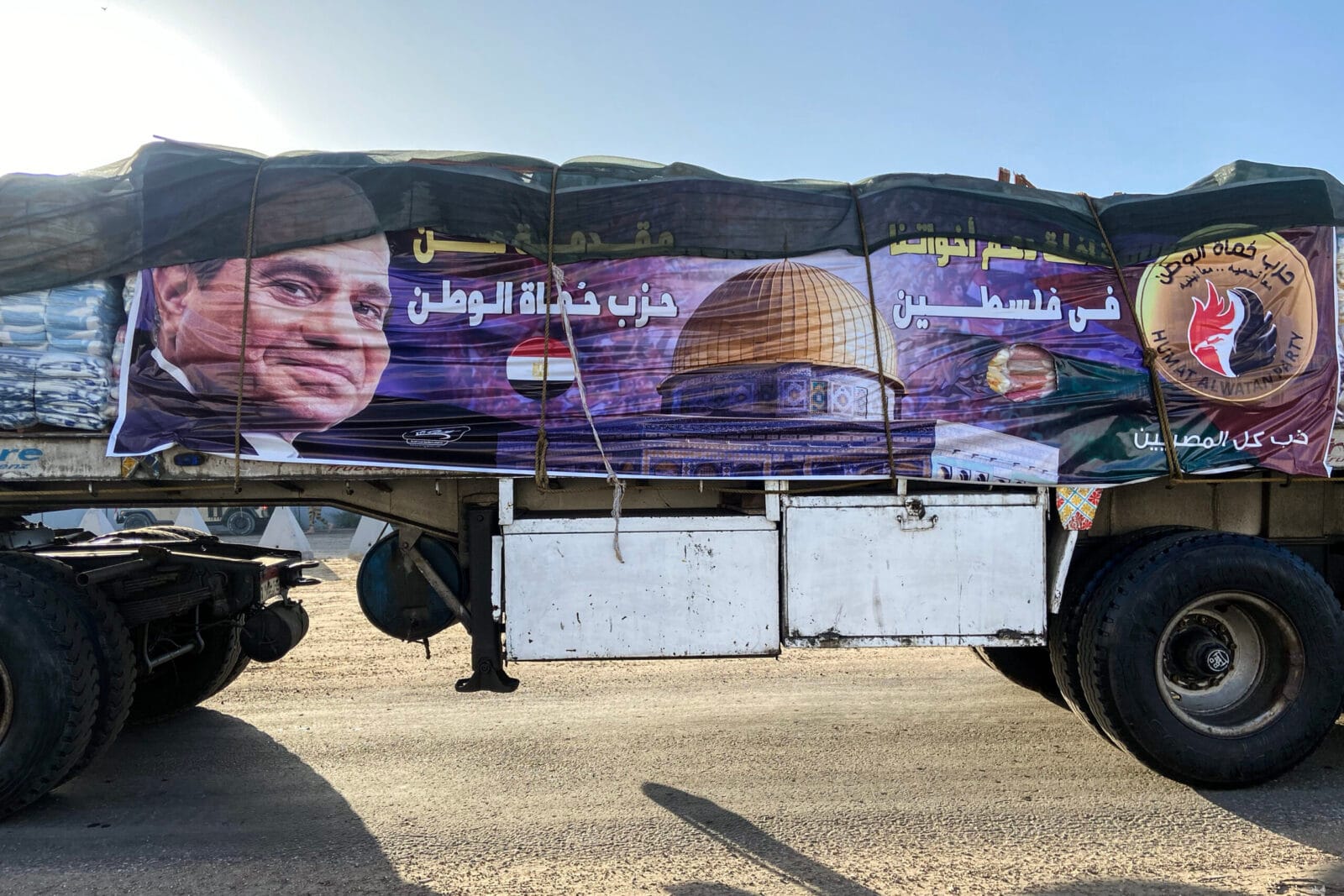
President Abdel Fattah El-Sisi's image on the side of an aid truck crossing the Rafah border from the Egyptian side into Gaza on November 6, 2023\. Mahmoud Khaled/Getty Images
Days earlier, groups allied with the ruling establishment had called for public rallies in support of President Abdel Fattah El-Sisi’s handling of the war in Gaza. They pressed the public to grant Sisi a “popular mandate” (*tafwid*) just weeks before he faced re-election for a third term in office. Seeking to capitalize on widespread outrage at Israel’s indiscriminate attacks on Palestinians, Sisi’s allies had hoped the rallies would bolster his popularity and drown out public discontent at the deteriorating economy. October 20, however, did not turn into the hoped-for Sisi lovefest.
Many demonstrators dismissed calls to support the president and instead centered their chants on the plight of Palestinians. “This is a real demonstration, not a popular mandate for anyone,” [yelled](https://www.youtube.com/watch?v=LUz80rwcbMg) the crowds.[\[2\]](#%5Fedn2) Although the mobilization was largely contained, it evoked the spirit of the January 25 Uprising, which ended Hosni Mubarak’s 30-year rule in 2011, and the subversive energy that animated the period between 2011 and 2013\. At one point, protestors defied orders to steer clear of Tahrir Square, gathering in a space that has been off limits to demonstrators due to its symbolic connection with the 2011 Revolution.
The events of October 20 reflect a longstanding challenge facing Egypt’s political leadership, exacerbated by the onset of the Gaza war. The government must strike a balance between two competing goals: One is respecting the fundamentals of Egypt’s foreign policy since the 1970s, namely its close alliance with Washington and its cooperation with Israel under the framework of the 1979 Camp David Accords. The other is absorbing and managing the overwhelming sense of public outrage at Israel’s aggression and the US role in aiding the ongoing violence.
> **The pro-regime** [**media**](https://www.alaraby.co.uk/entertainment%5Fmedia/خريطة-احتكار-المخابرات-لسوق-الإعلام-في-مصر) **has tried to identify with popular sentiment, providing a stream of coverage highlighting the grave humanitarian catastrophe and suffering Israel’s war has inflicted on Palestinians.**
Hoping to avoid the public’s wrath, the ruling establishment has shifted course in important ways. The pro-regime [media](https://www.alaraby.co.uk/entertainment%5Fmedia/خريطة-احتكار-المخابرات-لسوق-الإعلام-في-مصر) has tried to identify with popular sentiment, providing a stream of coverage highlighting the grave humanitarian catastrophe and suffering Israel’s war has inflicted on Palestinians. After a decade of demonizing Hamas and portraying it as a terrorist organization scheming to destabilize Egypt, leading talk show hosts have veered off script on multiple occasions since October 7\. Some have gone so far as to speak in celebratory language about “Palestinian resistance” and its agility and steadfastness on the battlefield in the face of the “Zionist enemy.”[\[3\]](#%5Fedn3) This rhetoric is a marked contrast to the 2014 Gaza War, when expressions of solidarity with Palestinians were [relatively muted](https://www.madamasr.com/ar/2014/07/16/feature/%D8%B3%D9%8A%D8%A7%D8%B3%D8%A9/%D9%84%D9%85%D8%A7%D8%B0%D8%A7-%D8%BA%D8%A7%D8%A8-%D8%AA%D8%B6%D8%A7%D9%85%D9%86-%D8%A7%D9%84%D9%85%D8%B5%D8%B1%D9%8A%D9%8A%D9%86-%D9%85%D8%B9-%D8%A7%D9%84%D9%81%D9%84%D8%B3%D8%B7%D9%8A%D9%86%D9%8A/), partly due to media campaigns portraying the Palestinian movement as complicit in acts of terrorism in Egypt. Today, commentators have an unusual degree of leeway and are voicing strongly worded criticism of Israel and its war.
News show hosts and anti-regime analysts have also [emphasized](https://www.youm7.com/story/2023/10/13/%D9%82%D9%84%D8%A8-%D9%85%D8%B5%D8%B1-%D8%A7%D9%84%D8%B1%D8%B3%D9%85%D9%89-%D9%88%D8%A7%D9%84%D8%B4%D8%B9%D8%A8%D9%89-%D9%85%D8%B9-%D9%81%D9%84%D8%B3%D8%B7%D9%8A%D9%86/6336406) that the government’s stance on the war aligns with public sentiment, [reminding their audiences](https://www.elwatannews.com/news/details/6881284) that official policies reflect popular support for Palestine. Yet, critical observers are not buying it. Protests at the Journalists Syndicate have [urged the government](https://www.madamasr.com/en/2023/12/13/news/politics/journalists-syndicate-protests-palestinians-forced-displacement-demands-humanitarian-aid-entry/) to do more to keep the Rafah Crossing open to allow for aid delivery to Gaza and for injured Palestinians to access medical treatment in Egypt. Unsettled by the accusation of being soft on Israel, the regime’s allies in the media were quick to [attack these protests](https://www.madamasr.com/en/2024/01/16/news/u/protestors-face-backlash-over-criticism-of-egypts-role-in-aiding-gaza/) and dismiss their calls as pro-Israeli propaganda.
Contrary to a widely held view in mainstream US international media that Israel’s war on Gaza will throw Sisi a lifeline by [distracting the Egyptian](https://www.reuters.com/world/africa/egypts-sisi-poised-third-term-gaza-distracts-economic-troubles-2023-12-07/) public from rising prices and the deteriorating state of the economy, the war has thus far kept the president and his government on their toes. Forced to explain themselves to the Egyptian people, state officials and their affiliated media have expended significant energy updating the public about government support for Palestinians, including their diplomatic efforts and support for aid delivery to Gaza. They have responded unusually quickly to every rumor or potentially damaging allegation about the government’s role in the conflict. Notably, President Sisi has adopted measured and careful language in his public addresses, in contrast to the often improvised and on-the-fly style of speaking he tends to employ even when discussing critical policy files. In other words, Palestine has created a rare moment of public accountability for a government that often seems indifferent to popular sentiments.
Meanwhile, some analysts have framed the war as Sisi’s ticket out of economic decline and mounting debts. The political leadership, they [speculate](https://www.bnnbloomberg.ca/egypt-needs-cash-and-gaza-war-gives-world-new-reasons-to-help-out-1.2008353#:~:text=Egypt%20Needs%20Cash%20and%20Gaza%20War%20Gives%20World%20New%20Reasons%20to%20Help%20Out,-Mirette%20Magdy%2C%20Paul&text=%28Bloomberg%29%20%2D%2D%20Two%20months%20ago,has%20put%20Egypt%20center%2Dstage.), may ultimately choose to trade debt relief in return for cooperating with Israel’s [rumored plans](https://carnegieendowment.org/sada/90869) to force the resettlement of a large population of Palestinians from Gaza into northern Sinai. Despite the president’s vocal opposition to this purported plan—which can only be described as a second Nakba for the Palestinian people—political commentators have, nonetheless, continued discussing whether Sisi would eventually relent if the right offer were made.
This analysis, however, ignores the challenges such a scenario would pose to Egypt’s security establishment and the destabilizing impact it could have on an already delicate security situation in Sinai, where the state has been fighting an insurgency for much of the last decade. In 2013, the state [began displacing](https://www.hrw.org/report/2015/09/22/look-another-homeland/forced-evictions-egypts-rafah) residents of Rafah and Sheikh Zuweid in order to establish security zones on the border of Gaza. Many displaced residents have been [demanding](https://www.newarab.com/news/egypt-seeks-prevent-protests-displaced-sinai) to return to their homes and [mobilizing](https://cihrs.org/egypt-authorities-must-stop-security-violence-against-civilians-in-northeastern-sinai-and-allow-the-displaced-to-return-to-their-lands/?lang=en) to this end, making the prospective displacement of Palestinians to Sinai even more politically volatile.
> **The question of Palestinian rights has been central in numerous waves of political mobilization in Egypt in the last several decades and has often moved otherwise politically apathetic segments of society.**
This viewpoint also overlooks the Egyptian people. When it comes to Palestine, popular will matters in Egypt, even in such a closed political environment. The question of Palestinian rights has been central in numerous waves of political mobilization in Egypt in the last several decades and has often moved otherwise politically apathetic segments of society. In fact, activism and demonstrations organized in solidarity with the second Palestinian Intifada (2001–2005) helped [create the space](https://spectrejournal.com/from-palestine-to-tahrir-square/) for the January 25 Uprising to emerge. The political leadership is aware of this history, and thus Sisi and his allies continue to do everything in their power to avoid becoming the target of public outrage at Israel’s war in Gaza.
The recent tensions between the Egyptian government and its people over Palestine are by no means unique. For the last several years, a host of Arab leaders have used their unchecked powers to advance US-brokered normalization agreements with Israel under the banner of the Abraham Accords. Following October 7, people throughout the region are challenging these longstanding efforts. They are putting a dent in the Abraham Accords order by mobilizing in solidarity with the plight of Palestinians and signaling to their governments their rejection of any policy undercutting the voice of Palestinians or their right to self-determination. They are refusing to defer to the pacts their leaders have negotiated with Israel behind closed doors and are demanding their voices be heard. The wielders of power may try to ignore them, but people have yet to accept defeat.
\[**Hesham Sallam** is a senior research scholar at Stanford's Center on Democracy, Development and the Rule of Law (CDDRL), where he serves as the associate director for research.\]
> **Read the**[ **previous**](https://www.merip.org/gaza-is-a-crime-scene/) **article.**
> **Read the**[ **next**](https://merip.org/2024/01/the-gulf-from-the-oil-weapon-to-popular-boycott) **article.**
**This article appears in** [**MER issue 309**](https://merip.org/magazine/309/) **“Palestine—Before and After October 7.”**
---
### **Endnotes**
[\[1\]](#%5Fednref1) ["Mustafa Mahmoud Square"](https://www.youtube.com/watch?v=cqzuj5ZfKqM), YouTube, October 22, 2023\. \[Arabic\]
[\[2\]](#%5Fednref2) [“This is a real demonstration, not a popular mandate for anyone. How did Egyptians thwart Sisi’s mandate?”](https://www.youtube.com/watch?v=LUz80rwcbMg) Youtube, October 21, 2023\. \[Arabic\]
[\[3\]](#%5Fednref3) The New Arab, [“How does Egyptian media cover the offensive aggression on Gaza?”](https://www.alaraby.co.uk/entertainment%5Fmedia/%D9%83%D9%8A%D9%81-%D9%8A%D8%BA%D8%B7%D9%8A-%D8%A7%D9%84%D8%A5%D8%B9%D9%84%D8%A7%D9%85-%D8%A7%D9%84%D9%85%D8%B5%D8%B1%D9%8A-%D8%A7%D9%84%D8%B9%D8%AF%D9%88%D8%A7%D9%86-%D8%B9%D9%84%D9%89-%D8%BA%D8%B2%D8%A9) October 25, 2023\. \[Arabic\]
### Gaza Is a Crime Scene
URL: https://www.merip.org/2024/01/gaza-is-a-crime-scene/
Last updated: 2025-08-22T18:36:28.000Z
What is happening to Palestinians in the occupied Gaza Strip bears some gruesome similarities to the Cambodian killing fields of the 1970s.
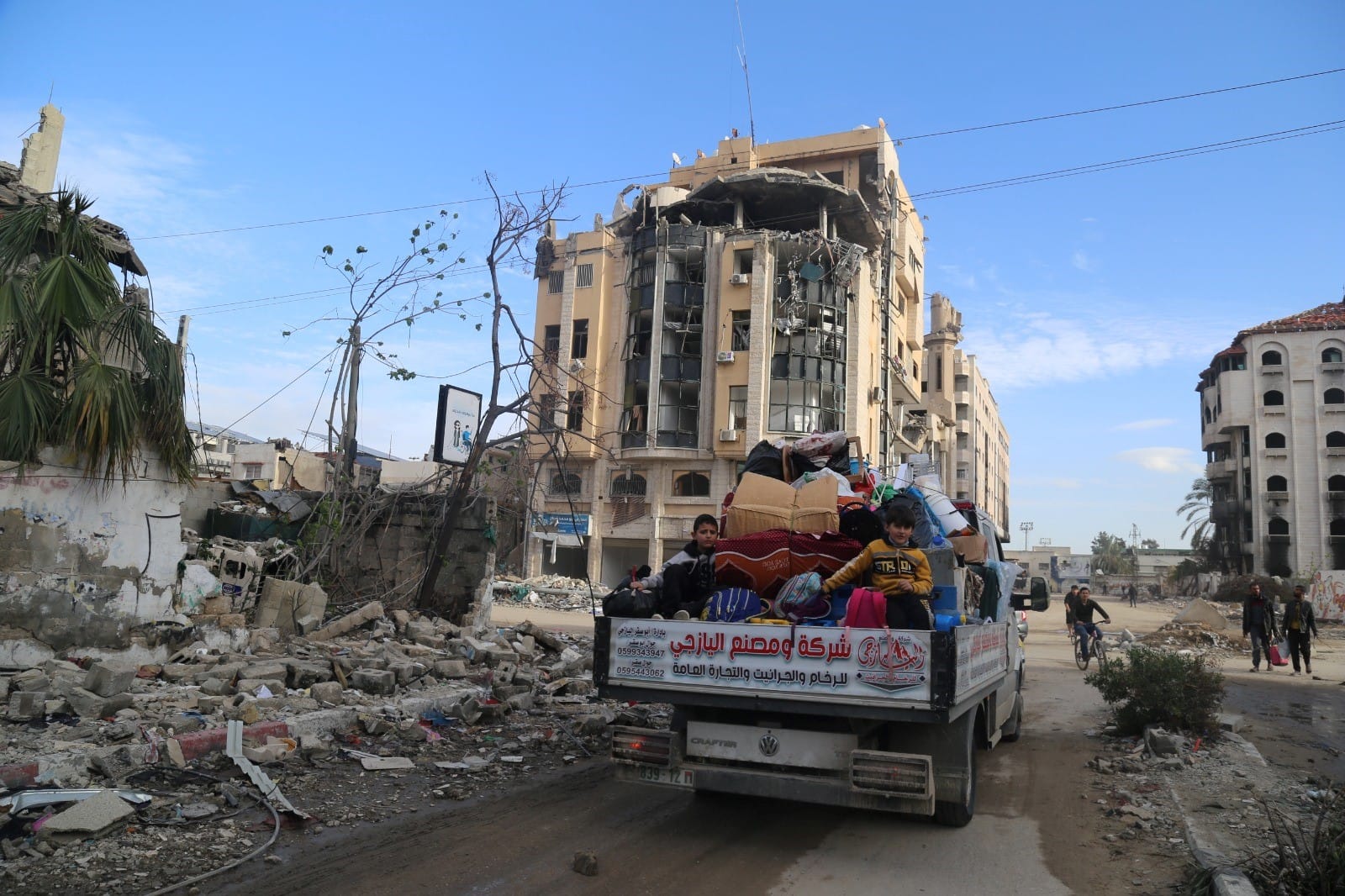
Gaza City on January 15, 2024\. Abdul Rahman Salama/Xinhua via Getty Images
“To keep you is no benefit, to destroy you is no loss,” was the Khmer Rouge slogan when they seized power in war-torn Cambodia in April 1975\. Declaring the start of their reign “Year Zero,” they set in motion a policy to transform the country into an agrarian communist utopia. The first step was to empty the cities, a "cleansing" process bathed in blood. Anyone associated with the overthrown government, ethnic minorities, religious adherents, college educated professionals, property owners and merchants were executed. Their extended families were not spared. The zero-fication also involved the destruction of schools, universities, hospitals, factories and, indeed, any institutional or infrastructural entity that did not comport with the Khmer Rouge vision for Kampuchea, as the country was renamed. Urbanites were forced to march to rural areas where they were put to backbreaking work on collective rice farms and subjected to intensive reeducation. The regime was guided by the presumption that hard labor and ideological conformity would create a classless society of “New People.” Over the next four years, one-quarter of the country’s population died. One million people were executed or tortured to death and a further million perished from starvation, disease or exhaustion.
Since the start of Israel’s current bombing campaign on October 7, the Gaza Strip has become an enclave of death, displacement and destruction. An estimated 33,000 people have been killed, including 12,660 children and 7,000 missing and presumed dead beneath the rubble. More than 65,000 Palestinians have been wounded, many with lost limbs and other permanent disabilities. The IDF has targeted doctors, humanitarian workers, artists, scientists and professors, along with their families. Entire [family lines](https://www.972mag.com/mass-assassination-factory-israel-calculated-bombing-gaza/) have been obliterated. More journalists have been killed in three-and-a half months—an estimated 125 so far—than during any other war, irrespective of length.
The scope, scale and speed of Israel’s bombing campaign constitutes the [most intense](https://www.irishtimes.com/world/middle-east/2023/12/06/israels-gaza-attack-one-of-historys-heaviest-conventional-bombing-campaigns/#:~:text=The%20campaign%20group%20Amnesty%20International,Gaza%20that%20killed%2043%20people.) assault anywhere since World War II. There is no reciprocal high-intensity violence because Gaza has no army. Large portions of the 141-square-mile Strip have been “cleansed” of their inhabitants.[\[1\]](#%5Fedn1) Almost 85 percent of the population—1,955,000 people—has been displaced. Over a quarter million homes have been totally or partially destroyed in what may constitute [“domicide”](https://www.nytimes.com/interactive/2024/01/29/opinion/destruction-of-homes-crime-domicide.html)—a newly emerging crime against humanity which pertains to massive destruction of housing and basic infrastructure in residential areas. The destruction includes schools (326), hospitals and clinics (208), mosques (247), churches (3), heritage sites (199), factories (1,690), libraries, archives and cultural centers. All of Gaza’s universities have been leveled.[\[2\]](#%5Fedn2) Even the dead are not safe. Military bulldozers have [destroyed](https://euromedmonitor.org/en/article/6083/Israeli-army-defiles-hundreds-of-graves-in-the-Gaza-Strip,-steals-dead-bodies#:~:text=Geneva%20%E2%80%93%20Israel's%20army%20has%20attacked,Monitor%20said%20in%20a%20statement) cemeteries and soldiers have desecrated graves.
At the start of this war, Israel exploited its capacity to exercise necropolitical control over aid-dependent Palestinians by cutting off Gaza’s access to food, medicine, fuel, electricity and telecommunications. Three months in, the food system, like the healthcare system and the infrastructure for clean water and sanitation, has completely collapsed. Man-made famine conditions have reached the [catastrophic](https://sites.tufts.edu/reinventingpeace/2024/01/03/gazas-famine-warning-in-perspective/) phase. Four out of every five starving people in the world are Palestinians in Gaza.
Unlike the Khmer Rouge, the Israeli government’s exterminationist policy is not fueled by an ideological vision to remake Gaza anew. Total destruction is the goal.
## **From Open-Air Prison to Crime Scene**
Life in Gaza was a chronic humanitarian crisis of impoverishment, deprivation and suffocating siege long before Israel launched its latest full-scale war, the fifth in this century. In 2005, Israel unilaterally “disengaged” from Gaza by withdrawing its military presence and evacuating Jewish settlers. The boundaries of Gaza were sealed, enwalling Palestinians within. But the occupation [did not end](https://www.jadaliyya.com/Details/27557) because Israel continued to exercise effective control over the people, the airspace and the borders.
In 2007, Israel declared Gaza a “hostile entity” and tightened its siege. The transfer of food was limited to a “humanitarian minimum” based on a calculation of the caloric intake people need to survive.[\[3\]](#%5Fedn3) Further evidence of Israel’s continuous control was the ongoing capacity to invade Gaza and arrest people who were then transferred to prisons inside the Green Line.
> **Also Read:**[Gaza as an Open Air Prison](https://www.merip.org/gaza-as-an-open-air-prison/)
For seventeen years, Gaza was the world’s largest open-air prison. This fact belies efforts to frame the events of October 7 in ahistorical terms as inexplicable. On October 7, armed fighters from Hamas and Islamic Jihad breached the securitized boundary surrounding the Gaza Strip, attacked nearby Israeli communities and military bases, committed atrocities that warrant independent investigation, and took 240 hostages back to Gaza. Between the actions of Palestinian militants and Israel’s frantic and intelligence-blind [counter-attacks](https://www.globalresearch.ca/israeli-army-ordered-mass-hannibal-directive-7-oct-media/5845998), 1,139 people were killed.
Initially, Israeli security officials declared their military objective was the destruction of Hamas. The timing clearly was a reprisal for the surprise dawn attack. But the claim that Israel was waging a war of national self-defense against Hamas, with the rescue of hostages as a priority, was immediately contradicted by the nature of the ensuing campaign. From the start, and as several Israeli politicians have made clear, this campaign was a [total war](https://mondoweiss.net/2023/11/a-paradigm-shift-in-the-hundred-years-war-on-palestine/) on the 2.3 million Palestinians of Gaza, half of whom are children. In the past three months, Israel has committed a staggering number and variety of crimes under international law.
On October 13, after a week of relentless bombing, the Israeli military issued the first round of evacuation orders. Over a million people living in the north were admonished to run or die. Hundreds of thousands heeded the call, hoping to survive the indiscriminate onslaught by relocating to areas the military claimed would be safe. But the so-called “safe corridors” and designated [safe zones](https://www.aljazeera.com/opinions/2024/1/6/safe-zones-israels-technologies-of-genocide) where displaced people concentrated were [bombed](https://www.972mag.com/gaza-salah-al-din-road/). The death and destruction accelerated following Israel’s ground invasion on October 27\. Cities, refugee camps and villages were transformed into cratered wastelands. Hospitals, clinics and ambulances were subjected to unrelenting attacks. A new acronym entered the lexicon: [WCNSF](https://www.theguardian.com/world/2023/dec/22/the-plight-of-gazas-wcnsfs-wounded-child-no-surviving-family)—wounded child, no surviving family. Deliberate attacks on civilians are war crimes, and forced displacement can be a war crime and a crime against humanity.
[Not for the first time](https://www.merip.org/israel-as-innovator-in-the-mainstreaming-of-extreme-violence/), Israel used white phosphorous munitions, unguided (“dumb”) bombs and 2,000-pound US-made large-capacity “[bunker busters](https://www.theguardian.com/world/2023/dec/27/gaza-war-puts-us-extensive-weapons-stockpile-in-israel-under-scrutiny#:~:text=Gaza%20war%20puts%20US's%20extensive%20weapons%20stockpile%20in%20Israel%20under%20scrutiny,-Israel%20appears%20to&text=Their%20precise%20location%20is%20classified,owned%20by%20the%20US%20government.).” Failure to distinguish between military targets and civilian sites, the use of non-discriminating weapons and disproportionate use of force are war crimes.
On December 7, more than 660 Palestinian men and boys were detained in Gaza, stripped to their underwear and then [transferred](https://972mag.com/israel-torture-camp-gaza-detainees/) to prisons inside Israel. An additional unknown number [were taken](https://reliefweb.int/report/occupied-palestinian-territory/revealing-horrific-conditions-faced-palestinian-detainees-euro-med-monitor-calls-immediate-international-delegation-inspect-israeli-detention-camps-enar) to military bases where degradation and abuse are rampant and systematic. On December 19, soldiers raided a building in Gaza City where three families were sheltering. They separated the men from women and children and then summarily [executed](https://www.un.org/unispal/document/unlawful-killings-in-gaza-city-ohchr-press-release/) eleven men in front of their relatives. Torture, cruel and inhumane treatment, and extrajudicial executions of captive people in the context of war are war crimes.
At the end of December, the United Nations reported that one quarter of Gaza’s population was on the brink of starvation. Save the Children has warned that deaths from starvation and disease could soon outpace those caused by bombs.[\[4\]](#%5Fedn4) The situation continues to worsen as Israel impedes the transfer of food and other humanitarian aid by restricting the number of convoys permitted to enter the Strip. At the Rafah crossing, miles of trucks loaded with aid are stalled as they wait for clearance by Israeli inspectors during which they are unloaded and reloaded multiple times. If the cargo includes a single “forbidden” item—an [arbitrary](https://apnews.com/article/israel-gaza-rafah-aid-us-senators-2bc2a3c5e5f8af8e2d3f0b7242c1a885) and inhumane designation that includes certain medical supplies, oxygen cylinders, gas generators and tents—the truck is turned away. Siege warfare and intentionally starving a population are war crimes and crimes against humanity.
Palestinians of Gaza are being killed, wounded and displaced in unprecedented numbers. By mid-January, 978,000 people were crammed into UN-run shelters in the southern town of Rafah, with hundreds of thousands more unregistered.[\[5\]](#%5Fedn5) Yet Israel continued to [issue orders](https://www.theguardian.com/world/2024/jan/19/alarm-as-israeli-forces-move-closer-to-crowded-areas-in-southern-gaza) for already-displaced people to make way as ground operations expanded into southern areas. The people have nowhere else to run because the boundaries are sealed, and no area is safe from bombs or snipers.
Does this criminality rise to the level of genocide? That is a question the International Court of Justice (ICJ) was asked to answer. (The ICJ, a UN body based in The Hague, deals with disputes between states and provides advisory opinions on matters of international law.) On December 29, the government of South Africa filed an application with the ICJ alleging that Israel’s conduct violates the Genocide Convention and asked for an expedited hearing and provisional measures, including an order for the immediate cessation of military operations.
## **The Crime of Crimes**
Genocide often is referred to as the crime of crimes because, as per its definition, an intent to destroy groups of people is an exceptionally egregious wrong. History is replete with mass killing of people on the basis of their collective identities and the total destruction of societies. Israeli prime minister Benjamin Netanyahu invoked one such example when he exhorted soldiers to smite Palestinians, analogizing the people of Gaza to the ancient Israelites’ mortal enemy, the Amalekites. But it was the German Nazis’ industrialized extermination of millions of Jews and other “undesirable” peoples during the Holocaust that created the incentive to define and criminalize such practices as genocide. In 1948, the United Nations, then three years old, passed the Convention on the Prevention and Punishment of the Crime of Genocide. This was the first international human rights law. It imbued people with the right not to be willfully destroyed, at least not because of their race, ethnicity, nationality or religion.
> **In the decades after 1948, the Genocide Convention functioned largely as a moral standard rather than an enforceable international criminal law.**
In the decades after 1948, the Genocide Convention functioned largely as a moral standard rather than an enforceable international criminal law. Even when plausible allegations were leveled against a government, the requirement for proof of intent to destroy a people “as such” was exploited as a loophole because, if there was “any other discernible goal—to subjugate, dispossess, or enslave, or even to lash out and take revenge—states have a potential alibi against the charge of genocide.”[\[6\]](#%5Fedn6) In one telling example, the Iraqi state under Saddam Hussein killed anywhere between 180,000 and 350,000 Iraqi Kurds during the Anfal campaign in 1988\. It dodged accusations of genocide by claiming that Kurdish people were killed not for ethnic or national reasons but because they were dangerous enemies and traitors of the state.
A watershed moment occurred in 1993 in the context of the violence attending the disintegration of Yugoslavia, when Bosnia submitted an application to the ICJ accusing Serbia of genocide. Within weeks, [the Court instructed Serbia](https://www.un.org/law/icjsum/9328.htm) “to take all measures within its power to prevent commission of the crime of genocide.” Fourteen years later, the Court issued its [final ruling](https://www.icj-cij.org/sites/default/files/case-related/91/091-20070226-JUD-01-00-EN.pdf) in *Bosnia v Serbia*. Despite voluminous documentation of criminality and intent provided by the UN Ad Hoc International Criminal Tribunal for the Former Yugoslavia (ICTY), the ICJ determined that the only incident that rose to the level of genocide was the 1995 Srebrenica massacre. The Serbian government got a pass because the ICJ decided that it had no command responsibility for Republika Srpska forces who committed this genocide.
In 2019, The Gambia submitted an application to the ICJ accusing Myanmar of perpetrating genocide against the Rohingya, a Muslim minority group within the country. The Gambia, which was not in conflict with Myanmar, invoked its duties as a signatory to the Genocide Convention to prevent and punish this crime, and the ICJ [accepted](https://www.icj-cij.org/sites/default/files/case-related/178/178-20191111-APP-01-00-EN.pdf) the case. (South Africa modeled its application along these lines of signatory duty to enforce the law as well as Israel’s signatory duty to obey the law.) In 2022, Ukraine submitted an application against Russia to the ICJ, accusing Russia of falsely accusing Ukraine of genocide to justify its invasion and aggressive war. The ICJ hastily issued [provisional measures](https://www.icj-cij.org/sites/default/files/case-related/182/182-20220316-ord-01-00-en.pdf) calling on Russia to “immediately suspend” its military operations within Ukrainian territory and decided to expedite its consideration of the case.
One month before the South African application was filed, Britain, Canada, Denmark, France, Germany and The Netherlands submitted a[ joint declaration](https://www.icj-cij.org/sites/default/files/case-related/178/178-20231115-wri-01-00-en.pdf) supporting The Gambia’s allegations against Myanmar, which contained an expansive interpretation of genocide and endorsement of the applicability of the Convention to Myanmar’s deadly and destructive actions against Rohingya.
## **South Africa Charges Genocide**
The [South African application to the ICJ](https://www.icj-cij.org/sites/default/files/case-related/192/192-20231228-app-01-00-en.pdf) is an 84-page masterclass for understanding the Genocide Convention and its applicability to what Israel is doing in Gaza. The document contains abundant details of the cumulatively genocidal consequences of Israel’s military actions since October 7 to kill and make life impossible. It situates these charges in the “broader context of Israel’s conduct towards Palestinians during its 75-year-long apartheid, its 56-year-long belligerent occupation of Palestinian territory and its 16-year-long blockade of Gaza.”[\[7\]](#%5Fedn7)
Anticipating the outraged responses of Israel and its supporters that the genocide allegations were pro-Hamas and/or antisemitic and failed to recognize Israel’s right of self-defense, the first paragraph states: “South Africa unequivocally condemns all violations of international law by all parties, including the direct targeting of Israeli civilians and other nationals and hostage-taking by Hamas and other Palestinian armed groups. No armed attack on a State’s territory no matter how serious—even an attack involving atrocity crimes—can, however, provide any possible justification for, or defence to, breaches of the 1948 Convention…”
In submitting this application to the ICJ, South Africa was not obligated to prove genocide. That will be decided when *South Africa v Israel* moves to the trial phase. Rather, the application was designed to persuade the Court of the possibility that genocide is being perpetrated on Palestinians. The [evidence](https://www.youtube.com/watch?v=4f%5Fyoal4gx8.) put forward to demonstrate Israel’s genocidal intent is a damning collection of statements by political and military officials, including Israel’s president and prime minister, to support or justify the way the war was being waged and the toll it was exacting. The evidence of intent includes the oft-cited quote by Defense Minister Yoav Gallant, uttered in the context of his October 9 order of a complete siege: “We are fighting human animals and we are acting accordingly.”[\[8\]](#%5Fedn8) It also includes Gallant’s statements to troops the following day that he had released all constraints on their actions, adding, “Gaza won’t return to what it was before. We will eliminate everything.”[\[9\]](#%5Fedn9) Minister of Agriculture Avi Dichter described the eliminationist project: “We are now actually rolling out the Gaza Nakba.”[\[10\]](#%5Fedn10)
> **One after another, the representatives narrated elements of the application, from the horrific human toll of the ongoing assault to the abundant examples of Israeli intent to destroy Palestinians to the legal requirements of the Convention to prevent and punish this crime.**
On January 11, a team of lawyers representing South Africa, including John Dugard who had served as UN Special Rapporteur on the Situation of Human Rights in the Palestinian Territories Occupied since 1967, [presented their case](https://www.youtube.com/watch?v=4f%5Fyoal4gx8) in The Hague. People around the world tuned in to witness this somber and tremendous defense of Palestinian lives and society. One after another, the representatives narrated elements of the application, from the horrific human toll of the ongoing assault to the abundant examples of Israeli intent to destroy Palestinians to the legal requirements of the Convention to prevent and punish this crime. Irish attorney Blinne Ní Ghrálaigh, who was part of the South African team, invoked the victims of previous genocides, including those exterminated in the killing fields of Cambodia, who were failed by the international community. Not again, not now was the message she conveyed when she implored the court to issue provisional measures “that are so urgently required to prevent further irreparable harm to the Palestinian people in Gaza, whose hopes, including for their very survival, are now vested in this court.”
The following day, representatives of Israel [presented the state’s response](https://www.youtube.com/watch?v=H6CEKVSjg7o). While formal courtesies were observed, some derided the South African application as “absurd,” characterized the allegations as unfounded and insensitive to Israel’s right of self-defense and blamed Hamas for the toll of Palestinian casualties. In stark contrast to South Africa’s presentations, the legal arguments were weak, seemingly designed less to persuade impartial jurists than to reinforce Israeli hasbara (nationalist propaganda) that the United States, Germany and some other western governments have echoed by blasting the genocide charge. The most legally specious claim was that the ICJ lacks jurisdiction to hear this case, since there is no conflict between Israel and South Africa. This contention ignores the meaning of “prevent” in the title of the Genocide Convention and the fact that prevention is an obligation for signatories.
## **A Fateful Moment for International Law**
South Africa’s application to the ICJ on behalf of stateless Palestinians—like the war on Gaza that it addresses—is taking political shape as an epic contestation between the Global South and the Global North over the efficacy of international law to protect formerly and currently colonized peoples. The rights of Palestinians are once again a global litmus test.
> **Also Read:**[Israel and the Laws of War—A Conversation with Neve Gordon.](https://www.merip.org/israel-and-the-laws-of-war-a-conversation-with-neve-gordon/)
Before the ICJ issued its decision, the countries and organizations that lined up in support of the South African application include Malaysia, Mexico, Chile, Jordan, Turkey, the 120-member Non-Aligned Movement and the Organization of Islamic Cooperation. Bangladesh and Jordan filed declarations of intervention with the ICJ backing South Africa’s claims. China joined the Arab League in calling for an immediate ceasefire. No Western government sided with South Africa, but Belgium vowed to support any ICJ decision.
Namibia is the present-day country where the first genocide of the twentieth century (1904–1908) occurred when colonial Germany exterminated 75 percent of the Ovaherero and half of the Nama populations. In a media statement issued on January 13, Namibian president Hage Geingob [condemned](https://aljazeera.com/news/2024/1/14/namibia-condemns-germany-for-defending-israel-in-icj-genocide-case) Germany for its rankly hypocritical denial that Israel is perpetrating genocide against Palestinians in Gaza and its criticism of South Africa. Britain was [accused](https://www.theguardian.com/law/2024/jan/07/uk-accused-of-hypocrisy-in-not-backing-claim-of-genocide-in-gaza-before-icj) of hypocrisy for not maintaining the position it took on The Gambia’s charges in the genocide case against Israel.
The US government is deeply implicated in Israel’s deadly and destructive onslaught in Gaza. The Biden administration, in addition to vetoing a UN Security Council resolution for a ceasefire, side-stepped Congress to escalate the transfer of high-intensity weapons to Israel. Providing support and resources that facilitate genocide can be a form of complicity, which is equally illegal to genocide.
On January 26, the ICJ [presented its decision](https://www.youtube.com/watch?v=1niAwMbBC6g). The Court found plausible evidence that Israel is perpetrating and inciting genocide in Gaza. Although not ordering an immediate ceasefire as South Africa had requested, an overwhelming majority of judges endorsed six provisional measures, including to refrain from and prevent any acts that violate the Convention, to preserve evidence of genocide and to submit a report in one month about compliance with these orders. Even the Israeli ad hoc judge, Aharon Barak, voted with the majority on the measures to prevent and punish incitement and to take effective measures to ensure the provision of humanitarian assistance. Only one judge, Uganda’s Julia Sebutinde, voted no across the board.
This decision triggers obligations for every one of the 153 countries that are party to the Genocide Convention, especially those like the United States that have been supporting and abetting what the ICJ ruled to be plausible genocide. Politically, this interim finding has the potential to further galvanize and empower the global movement that has been demanding a ceasefire. It presents an opportunity to put international pressure in the service of Palestinian rights for a change and to redeem international law, which so often and consistently has failed to protect people from state violence. As Blinne Ní Ghrálaigh so eloquently stated during the South African presentation, “Some might say that the very reputation of international law, its ability and willingness to bind and to protect all people equally hangs in the balance.”
\[**Lisa Hajjar** is chair of the sociology department at the University of California, Santa Barbara\].
> **Read the**[ **previous**](https://www.merip.org/lessons-from-48-2/) **article.**
> **Read the**[ **next**](https://merip.org/2024/01/sisi-the-egyptian-public-and-the-war-on-gaza) **article.**
**This article appears in** [**MER issue 309**](https://merip.org/magazine/309/) **“Palestine—Before and After October 7.”**
---
### **Endnotes**
[\[1\]](#%5Fednref1) Mouin Rabbani, “[Two Months that Shook the World: The First Phase of the Gaza War,](https://theintercept.com/2023/12/02/intercepted-gaza-war-israel-hamas/#:~:text=Photos%3A%20Getty%20Images-,Two%20Months%20That%20Shook%20the%20World%3A%20The%20First%20Phase%20of,battles%20between%20Hamas%20and%20Israel)” *Intercepted* (podcast), December 2, 2023.
[\[2\]](#%5Fednref2) Shree Paradkar, “[How Israel’s ‘Scholasticide’ Denies Palestinians Their Past, Present, and Future,](https://www.thestar.com/news/world/how-israels-scholasticide-denies-palestinians-their-past-present-and-future/article%5F8f52d77a-b648-11ee-863d-f3411121907b.html)” *Toronto Star*, January 21, 2024.
[\[3\]](#%5Fednref3) Sherene Seikaly, “[Counting Calories and Making Lemonade in Gaza,](https://www.jadaliyya.com/Details/27390)” *Jadaliyya*, November 12, 2012.
[\[4\]](#%5Fednref4) “[Deaths by Starvation and Disease May Top Deaths by Bombs as Families Squeezed into ‘Safe Zones,’ Two Months into Gaza Crisis](https://www.savethechildren.org.uk/news/media-centre/press-releases/deaths-by-starvation-and-disease-may-top-deaths-by-bombs-in-gaza),” Save the Children, December 9, 2023.
[\[5\]](#%5Fednref5) Leanne Abraham and Zach Levitt, “[See the Rapid Expansion of Tent Camps in Southern Gaza,](https://www.nytimes.com/interactive/2024/01/18/world/middleeast/gaza-displaced-tent-camps-rafah.html)” *New York Times*, January 18, 2024.
[\[6\]](#%5Fednref6) Darryl Li, “[The Charge of Genocide,](https://www.dissentmagazine.org/online%5Farticles/the-charge-of-genocide/)” *Dissent Magazine*, January 18, 2024.
[\[7\]](#%5Fednref7) "[Application instituting proceedings and request for the indication of provisional measures,](https://www.icj-cij.org/node/203394)" International Court of Justice, December 29, 2023.
[\[8\]](#%5Fednref8) Mark Landler, “[‘Erase Gaza’: War Unleashes Incendiary Rhetoric in Israel](https://www.nytimes.com/2023/11/15/world/middleeast/israel-gaza-war-rhetoric.html),” *New York Times*, November 15, 2023.
[\[9\]](#%5Fednref9) Jessica Buxbaum, “['Erase Gaza': How genocidal rhetoric became normalised in Israel](https://www.newarab.com/analysis/erase-gaza-how-genocidal-rhetoric-normalised-israel),” The New Arab, November 30, 2023.
[\[10\]](#%5Fednref10) Sanjana Karanth, "[Israeli Minister Admits Military Is Carrying Out ‘Nakba’ Against Gaza’s Palestinians](https://news.yahoo.com/israeli-minister-admits-military-carrying-233151647.html?guccounter=1&guce%5Freferrer=aHR0cHM6Ly93d3cuZ29vZ2xlLmNvbS8&guce%5Freferrer%5Fsig=AQAAAF4SW5taRfPBpYZYsQnmrOf%5FPUcAVw0YTC3tjdVuNlDgYtlr%5FWXsqLNTlVh2adVBkAIugmL7yj668mcFjcbntmzH95mJuTsMLumrPkaPimeRlSMVaSq4%5FsvZ718iyqXjheXgS3Ca2I1QJQp0Q7FwHDgWXAU-sVim6LbPwSxtC-1q)," Huffpost, November 12, 2023.
### Lessons from '48
URL: https://www.merip.org/2024/01/lessons-from-48-2/
Last updated: 2025-11-06T22:00:03.000Z
*Israel*’*s extreme escalation of violence against Palestinians in Gaza following the Hamas attacks of October 7 has sparked an unprecedented wave of global solidarity with Palestine.*
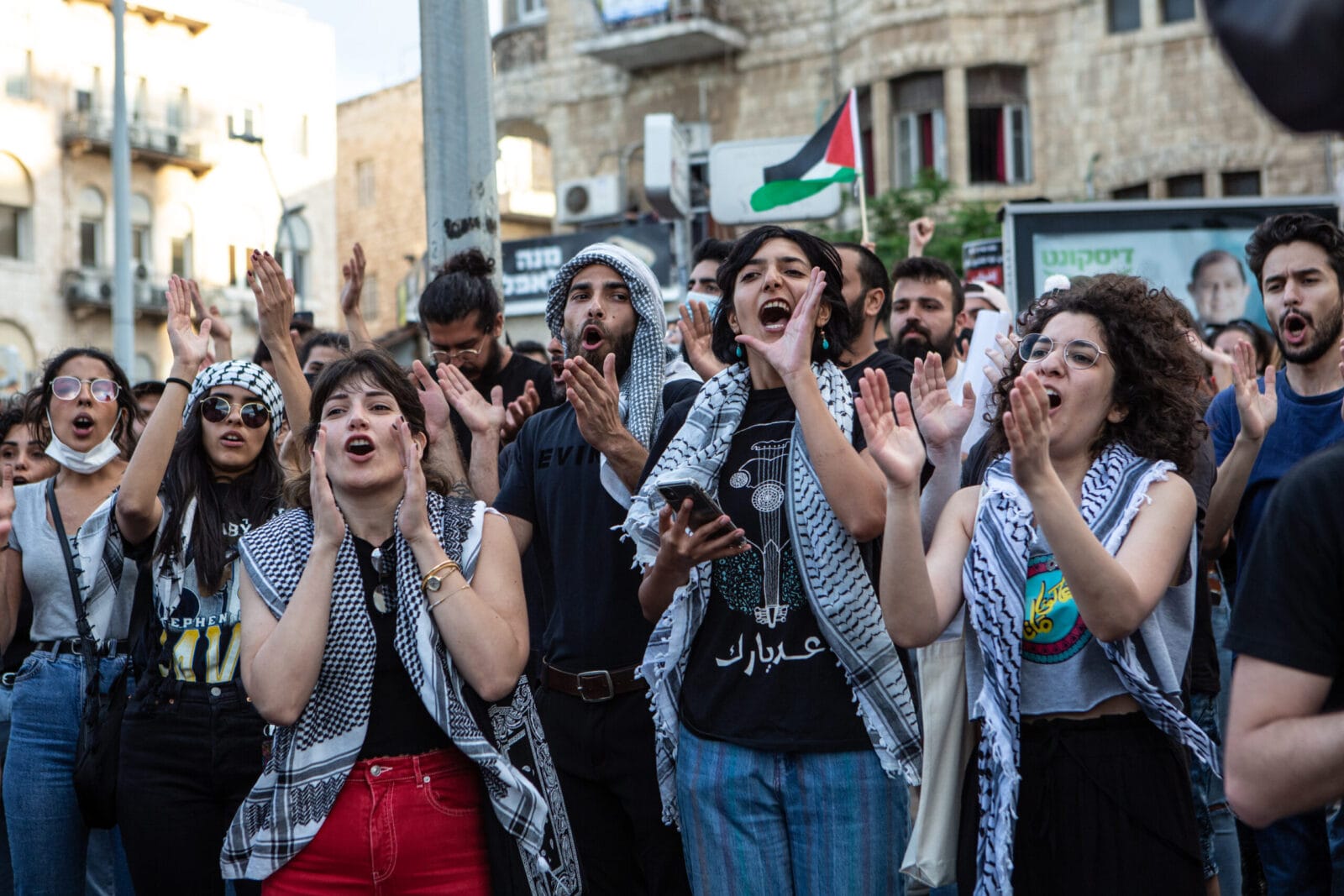
Palestinian citizens of Israel demonstrate in Haifa on May 18, 2021, to mark a nationwide general strike expressing solidarity for Palestinians. Mati Milstein/NurPhoto via Getty Images
*For two months, protesters have taken to the streets in mass demonstrations around the world. Workers have declared their refusal to transport arms. Activists have occupied offices of political representatives and blocked entrances to Israeli and international arms companies. Students have led walkouts, and businesses have closed their doors in answer to calls for international strike actions. In the context of this global social movement with Palestine at its center, the comparative lack of political mobilization among* ’*48 Palestinians, commonly referred to as Palestinian citizens of Israel, is conspicuous.*
*To reflect on this silence, the dynamics underpinning it and the prospect for building a sustained movement for Palestinian liberation within* ’*48, Riya Al’Sanah—a political organizer from the Naqab and a PhD candidate at the University of Exeter—interviewed Soheir Asaad, a Palestinian feminist, political organizer and human rights advocate. Soheir is currently an advocacy team member of* [*Rawa*](https://www.rawa.ps/en-home)*—for liberatory, resilient Palestinian community work. She also co-directs the “Funding Freedom” project. Their conversation was conducted over Zoom on December 4, 2023 and has been edited for length and clarity.*
**Riya:** Soheir, can you speak about the general situation in Haifa, where you’re based, and across ’48 since October 7?
**Soheir:** Since October 7, we’ve seen unprecedented levels of silence and fear in Haifa and across ’48 as well as a real lack of political action. This silence is markedly different from previous wars—the 2006 war on Lebanon, the many previous wars on Gaza. And this silence comes during what is not just another war but a period of unbelievable violence. It comes at a time when it’s not only Israel that is engaging in genocidal war. We’re seeing laid bare the complicity of the whole global structure and system of oppression, the whole capitalist system that profits from and experiments on the bodies of Palestinians in Gaza. At the same time, it comes in the context of unprecedented global solidarity. Gaza, faced with all this horror, is radicalizing the world. Gaza’s resilience and resistance is inspirational. It’s a manifestation of what oppressed people can do, while the racism and the high levels of persecution against those standing in solidarity with Palestine is a reminder of the degree of revenge and persecution that is unleashed the moment you challenge the basis for this establishment of power. Within this whole unprecedented scene, ’48 is not there.
**Riya:** Looking back to May 2021, during the Unity Intifada, the scene in ’48 was very different. Palestinians there joined others across historic Palestine in a struggle against Israeli settler-colonialism. How do you understand both the heightened levels of mobilization we saw in 2021 and then this shift to deafening silence?
**Soheir:** I think much of what we saw during the Unity Intifada was a manifestation of processes that were already unfolding. Namely, the official Palestinian political leadership was growing increasingly irrelevant and the modes of organizing in Palestine and ’48 had gradually been shifting from political party-oriented organizing to decentralized organizing. These processes began in the decade before the Unity Intifada. What we saw in the Unity Intifada that we hadn’t seen before was a different social class entering into the scene as leaders. They claimed agency over what it meant to mobilize politically in ’48 and in a way redefined for us what a revolutionary moment could be. We saw the writing and distribution of anonymous political [manifestos and statements](https://mondoweiss.net/2021/05/the-manifesto-of-dignity-and-hope/), the spontaneous and communally-organized delivery of food and supplies to besieged communities in Lyd (where a [state of emergency was declared](https://www.aljazeera.com/features/2021/10/4/october-2000-vs-may-2021-how-palestinians-defied-fragmentation) and a military curfew was imposed) and other acts of mutual aid across ’48\. And of course, we saw the [general strike](https://notesfrombelow.org/article/report-general-strike-palestine) that was called across historic Palestine on May 18—a popular demand from below that was subsequently adopted by official political parties.
> **What we saw in the Unity Intifada that we hadn’t seen before was a different social class entering into the scene as leaders. They claimed agency over what it meant to mobilize politically in ’48...**
Israel’s violence and oppression in response was extreme. The military was mobilized to disperse demonstrations, soldiers fired live ammunition at crowds, curfews were imposed and there was a campaign of mass arrests. [More than 2,000](https://www.merip.org/content/files/uploads/uploads/may-2021-report.pdf) people were arrested. [545](https://www.taylorfrancis.com/chapters/oa-edit/10.4324/9781003176619-11/criminalization-racialization-palestinian-resistance-settler-colonialism-adan-tatour-lana-tatour) were indicted.[\[1\]](#%5Fedn1) The vast majority of them were prosecuted using laws to combat terrorism and laws against racially-motivated crimes—often both. The terrorism charges, as Adan and Lana Tatour have recently observed, are a racialized designation intended to rationalize harsher punishments against political mobilization and criminalize resistance. Meanwhile, the charges of racially-motivated crimes play into Israel’s growing attempts to conflate anti-colonial political action with antisemitism. In an attempt to further criminalize resistance, Israel linked the uprisings to growing crime rates in Palestinian society, which also had the effect of erasing the anti-colonial underpinnings that mobilized people.[\[2\]](#%5Fedn2) And it was really the most marginalized who ended up paying the highest price. Palestinian researcher and academic Khaled Anabtawi analyzed the data around arrests and found that the average income of the families of those indicted was 30 percent lower than the average Palestinian family in ’48\. 31 percent of those arrested were from single-parent, woman-led households and almost 64 percent were from families receiving social services and benefits.[\[3\]](#%5Fedn3) At the same time, the organizational structures that emerged in the Unity Intifada—the amazing solidarity and mutual aid—all collapsed extremely quickly, and so these already vulnerable families have been left to deal with the aftermath of the uprising on their own since 2021.
This ongoing violent repression combined with the absence of a sustained political infrastructure and feelings of abandonment have been a real deterrence to mobilizing in the present moment.
**Riya:** Right, following May 2021 we saw an aggressive Israeli campaign to stifle any Palestinian political action that is framed as part of an anti-colonial struggle, and the simplest displays of Palestinian political identity, like the Palestinian flag, are being [banned](https://www.theguardian.com/world/2023/jan/09/israel-security-minister-bans-palestinian-flag-flying-in-public).
**Soheir:** Yes. It’s hard to describe just how paranoid the Israeli state has become around any sign of popular political mobilization in ’48 following the Unity Intifada. For example, two years later, in May of this year, Diar Omari, a 19-year-old Palestinian man, was shot by a settler on the road leading to the gated settlements next to his village, Sandala. After his killing, the whole village stood in an amazing display of revolutionary support for the family, demanding justice for Diar. His family and the village rejected attempts by Israel and Palestinians (like [Mansour Abbas](https://www.alarab.co.il/Article/1063843), the leader of the Arab United List) to frame Diar’s killing as stemming from a criminal case of road rage. The steps Israel took to stop the mobilization in Sandala—a small village of 1,700 people—were unbelievably severe. The village where people were demonstrating was attacked with helicopters, border police and pre-dawn raids. There was a systematic arrest campaign targeting Diar’s friends and the village’s youth. And, like you said, even the Palestinian flag was a target. Almost every night, the Israeli police would raid the village to remove the Palestinian flag from its streets and would even raid the cemetery and remove the Palestinian flag from Diar’s grave. Then his friends and family would put it back, and after a few hours, the Israeli military would come back and remove it, and it would be put back on, and so on. Basically, after the Unity Uprising, Israel couldn’t tolerate any kind of mobilizing in a framework that is Palestinian. If people had stood for Diar without calling him a martyr or without rallying under a political Palestinian framework—had they not insisted on defining his death as a political death—I don’t think Israel would have minded a commemoration or even protests. The support of ’48 political leaders for the family was timid, which is also telling. This was precisely because the family insisted on defining Diar as a martyr and in doing so, situating his killing within the broader struggle against Israeli colonization. An acceptance of such a framing would have pushed them into a clash with the Israeli system.
This is consistent with a longer-term trend to delink political mobilizations in ’48, moments like the Unity Intifada and before that the Second Intifada, from the broader struggle against Israeli settler-colonialism. Our political leadership, but also ’48 Palestinian civil society organizations, are complicit in this process. For example, after May 2021, the New Israel Fund threw money at Palestinian and mixed (Israeli-Palestinian) civil society organizations under the guise of supporting ’48 Palestinian detainees, but at the same time they were framing their support—and the Unity Intifada as a whole—in terms of a narrow struggle for greater democratic rights for ’48 Palestinians. This worked to disconnect May 2021 from a broader Palestinian liberation framework and reconfigure it as part of the pro-democracy Israeli protests.
**Riya:** One key difference in 2021 seems to be in the social class of ’48ers who took the lead. With the weakening of formal political structures, a new organic leadership emerged that put forward a political analysis explicitly connecting local socio-economic conditions and police repression to Israel’s settler-colonial rule. This framing challenged the one advanced by most political parties in ’48, who, following Oslo, have re-oriented the struggle in ’48 away from broader Palestinian liberation to being a struggle for equal rights or “citizens’ rights.” Can you talk about how this focus on citizenship came to be so central and its consequences for political organizing in ’48?
**Soheir:** Since Oslo and, more acutely, following the Second Intifada, our political leadership in ’48 has been stuck within the framework of citizenship. Of course, the situation wasn’t better before Oslo. But Oslo cemented the fragmentation of the Palestinian people and marked the Palestine Liberation Organization’s abandonment of ’48 Palestinians, rendering their fate an Israeli issue. In this context, the nationalist political voices in ’48 were left trying to create a framework for struggle and did so largely within the narrow framework of citizenship. There have been differences between different political parties in the way they have dealt with the issue: Some of them, like the United Arab List, went to extreme coexistence. Others, like Tajammu (Balad), wanted to work within the democratic order to challenge the Zionist core of the Israeli, Jewish state by promoting a state for all of its citizens regardless of national group rights and Palestinian identity. Others still, such as Al-Jabhah (Hadash)—Ayman Odeh’s political organization—have advanced a discourse of shared Arab-Jewish working-class interests, which has served to whitewash colonial power relations under the guise of Israeli-Palestinian coexistence. But I think the general commitment to this framework across parties led to what we’re seeing today: Complete defeat, the continued shrinking of the “liberal” margins of what Israel has allowed and the compliance of political leadership in the interest of avoiding any clash with the system.
> **Since Oslo and, more acutely, following the Second Intifada, our political leadership in ’48 has been stuck within the framework of citizenship.**
This orientation toward inclusion within the Israeli regime escalated in 2015 with the establishment of the Joint List. The Joint List was an electoral coalition bringing together the different Palestinian political parties and a Jewish Arab party. The formation of a united electoral block has been a longstanding Palestinian popular demand. We, Palestinians, conflate the lack of political agency with the lack of unity, but unity can defuse important political differences. In practice, the “unity” of the Joint List led to greater complicity with the Israeli regime. Under the leadership of Ayman Odeh, the Joint List project advanced a shift in political orientation towards what they called “impact policies.” This was an approach that suggested Palestinians in ’48 should focus on building power by integrating into the Israeli state’s ministries and other institutions connected to the state, like governmental companies and the courts. They also placed an emphasis on gaining economic power through individual advancement in the Israeli private sector.
Ayman Odeh excluded three ministries from Palestinian integration: the foreign ministry, the Ministry of Defense and the Ministry of Aliya and Integration (the ministry that regulates Jewish immigration to Israel) because, in his framing, these three ministries were the manifestation of the Jewish nature of the state. Odeh knows full well that the Zionist, violent core of the Israeli state is not limited to three ministries. It is manifested in every single arm of the state, including the courts, the police, social services, everything. Why then did he claim that these are the only problematic ministries? I think this illustrates the fantasy behind the vision for Palestinian integration.
Odeh embodies the individualist aspiration to be part of an Israeli development process, which Israel has fostered heavily since the Second Intifada through the initiation of governmental plans for greater economic integration. A Palestinian being a head of a bank or a head of a governmental company—which are not only complicit in Israeli colonialism but are also complicit in a very harsh capitalist, neoliberal economic policy that disproportionately impacts Palestinians—was celebrated. [\[4\]](#%5Fedn4) This celebration presented individual successes as collective achievements. It also ignored the fact that integration is according to the needs of the Israeli economy, not the needs of Palestinians. While leaders like Odeh point to the greater presence of Palestinian workers in the medical or high-tech sector as collective achievements, the reality on the ground tells a different story. These policies have failed to close the socio-economic gap, not just between Palestinians and Israelis, which is widely recognized, but also the gap between ’48 Palestinians themselves, which the Unity Intifada brought to the fore. In 1997, some 38 percent of families in ’48 lived in poverty. The number was 45 percent in 2018 (compared to 13 percent of Jewish families).[\[5\]](#%5Fedn5)
Odeh and others who supported these policies also upheld the notion that Palestinians can integrate into these systems and maintain our identity as a cultural identity. And I really think Gaza today has shaken these foundations just as the Unity Intifada did. Efforts at integration are not working because they’re clashing with Palestinian political identity, which is being represented by a resistance that political leaders like Odeh want nothing to do with.
**Riya:** Over the same period, we’ve also seen Israel undermine Palestinian Knesset members by empowering local councils. Can you speak about this, and how it fits into the project you described of Israel engineering a Palestinian class whose political and economic interests are aligned with the interests of the Israeli state?
**Soheir:** Much of the work of Palestinian Knesset members—beyond their vocal demands for equality or the end to occupation, which really operate at the slogan level—has been at what they view as the service level, work that in theory should be carried out by ministries: if there’s a post office lacking in that village or a road that needs work, etc. In effect, parliamentarians became the messenger for these services and tried to justify their role within the framework of dignity and equal rights.
In recent years, Israel has increasingly tried to empower local councils—a more technical, less political leadership—instead of Knesset members. These councils are not political parties. They operate at the level of the locality and are elected mostly on a family basis. They don't give Israel a headache by raising issues related to the occupation. Along with some NGOs, who are very close to the liberal Zionist sphere, they have become a bridge between the Palestinian community and the Israeli government for service delivery. As a result, political power and weight has shifted from the old classic political parties and the High Follow-up Committee (an extra-parliamentary umbrella organization that represents ’48 Palestinians) to these councils and NGOs. They became a vessel through which Israel channeled investments into ’48 Palestinian communities, leading to the gradual development of a Palestinian capitalist class whose whole material existence is dependent on “developmental” state funding. The main root of all evil is Israel’s fragmentation of Palestinians geographically, politically, at the level of legal frameworks, all of that, of course, but I do think we need to talk about ourselves more and how these efforts at integration have set us back collectively.
**Riya:** You’ve laid out how we got to this point, but in this moment of unfolding colonial violence on steroids and in a landscape of fear, of silencing, of the lack of vision towards collective Palestinian liberation, where do we look to build, and how do we do so?
**Soheir:** Before I speak to your bigger question, I want to say a word about fear. We cannot ignore that what Israel is doing in ’48, now, is an attack. You could be arrested for showing sympathy with the Gaza resistance or even putting a [verse from the Quran](https://www.anews.com.tr/world/2023/11/06/israel-police-charge-palestinian-that-shared-quran-verses-on-whatsapp-with-terrorism) on social media or analyzing the military invasion. Now, if we look at the numbers of arrests in ’48 since October 7, they’re low compared to the Unity Intifada. We’re speaking of 200 arrests, compared to thousands during May 2021.[\[6\]](#%5Fedn6) Of course, the circumstances are different. Back then, there were clashes. It was a different revolutionary moment. Now it’s just people sitting on their screens and getting arrested for posts, most of them posted on the day of October 7.
These arrests are accompanied by new repressive legislation. On November 8 the Israeli Knesset passed the [consumption of terrorist material bill](https://www.aljazeera.com/news/2023/11/8/knesset-introduces-consumption-of-terrorist-publication-as-offense#:~:text=The%20%E2%80%9Cconsumption%20of%20terrorist%20materials%E2%80%9D%20offence%20carries%20a%20maximum%20penalty,of%20individuals%20through%20media%20consumption.), which criminalized consumption of materials by Hamas or ISIS (notice that they put Hamas and ISIS together in this legislation, which is very deliberate). Israel has also threatened to [revoke citizenship](https://www.timesofisrael.com/minister-rolls-out-bill-to-strip-citizenship-from-terror-supporters-in-wartime/) for those who’ve expressed sympathy with what they deem terrorism and [tried to introduce](https://www.adalah.org/en/content/view/10894) new legislation that would make it permissible to shoot at people if they block streets that serve as roads for military supplies, which basically could be any road. These bills are meant to deter Palestinians in ’48 from distracting or confronting Israel during its ongoing genocidal campaign in Gaza. Even though these two bills didn’t pass, they are fixed in people’s minds. In a way, this fear is a circle fed by Israeli repression and the political discourse of politicians in ’48\. If there were political will and infrastructure committed to breaking this circle of fear, I think people would have greater confidence to engage in mobilization, and it would open up a new process.
> **The task today in ’48, but also in the West Bank...is to work towards building what I would call a liberatory or liberation infrastructure.**
The task today in ’48, but also in the West Bank (because Gaza doesn’t need our lessons. Gaza consistently teaches us a lesson. Despite the extreme isolation that Gaza suffered under the blockade, we see different frameworks for organizing there, resilience and mutual aid, that we didn’t see anywhere else) is to work towards building what I would call a liberatory or liberation infrastructure. This would involve the building of infrastructure that allows for disengagement from complicity with Israel, politically and economically. It would also center the re-articulation of the emancipation of ’48’s most marginalized communities as one that is linked to the broader struggle for Palestinian liberation. While complete economic disengagement is impossible under colonialism, I don’t believe sustained liberatory work is possible without the development of a new infrastructure that can maintain revolutionary action. I don’t mean here the development of NGOs but of community-led structures of mutual aid that break away from the framework of individual growth and development under a colonial state and enable sustained revolutionary action. I’m speaking about food sovereignty, union organizing, protecting detainees, community safety to deal with crime and other issues. This is not an easy task, but it is essential we start thinking in such ways, seriously and creatively.
**Riya:** Otherwise, like you described of the Unity Intifada where we saw the rapid collapse of infrastructure, we will be left with perpetual spikes of revolutionary mobilization without cumulative gains. You’ve worked in the field of international advocacy for over 15 years. Can you speak to the solidarity movement now and whether you see these same dynamics playing out beyond ’48?
**Soheir:** For so long, the solidarity movement was occupied with challenging Israel, and I think that’s great. Please challenge Israel, but also, we want you to challenge your own establishment. We’re seeing some of this now. People interrupting everyday life in global capitals, interrupting arms manufacturers, interrupting parliaments, interrupting media, interrupting academia, everyone who is complicit. But I wonder, if there is a ceasefire, will this all end? Are we rallying around a very specific limited framework? Or are we aspiring to build actual material global solidarity? Because if we look at the streets now, even though the protests are in Europe and in the United States—and of course there are a lot of protests in the Global South and in our region—but even in Europe and in the US, you see a lot of oppressed communities showing up for Palestine: people who are part of the Black liberation struggle, indigenous struggles, Latin American struggles, struggles against economic exploitation, feminist queer organizers, other people really mobilizing. We are seeing solidarity from people who get it, people who see the violence against Gaza as a manifestation of extreme colonial punishment and revenge. But my great fear is that this growing and fast and large-scale solidarity will be limited to a certain slogan and to a certain time, that it will collapse if we don't build lasting infrastructure, by which I mean material power that can disrupt the enormous power held by Israel and its allies—and when I say allies, it’s not only the United States. It’s a global economic system. We don’t want it only for Gaza and Palestine. We want to be able to have something beyond transactional solidarity and beyond these slogans.
When we speak about the future, I do believe, honestly, first of all and most importantly, in the agency of the Palestinians to struggle to free ourselves. But I also really truly and honestly believe in global solidarity, especially solidarity of the oppressed, solidarity of the global south. We’ve been putting a lot of effort into building that solidarity, and it’s important. But we’ve been doing a bad job in creating a lasting infrastructure, and this is what we need.
> **Read the**[ **previous**](https://merip.org/2024/01/four-reflections-on-political-action-and-palestine) **article.**
> **Read the**[ **next**](https://www.merip.org/gaza-is-a-crime-scene/) **article.**
**This article appears in** [**MER issue 309**](https://merip.org/magazine/309/) **“Palestine—Before and After October 7.”**
---
### **Endnotes**
[\[1\]](#%5Fednref1) Adan Tatour and Lana Tatour, “[The criminalization and racialization of Palestinian resistance to settler colonialism](https://www.taylorfrancis.com/chapters/oa-edit/10.4324/9781003176619-11/criminalization-racialization-palestinian-resistance-settler-colonialism-adan-tatour-lana-tatour),” in Chris Cunneen, Antje Deckert, Amanda Porter, Juan Tauri, and Robert Webb eds., *The Routledge International Handbook on Decolonizing Justice* (Routlede, 2023), pp. 91-102.
[\[2\]](#%5Fednref2) Ibid.
[\[3\]](#%5Fednref3) Khaled Anabtawi, "[Uprising Amidst Liminality: A Study of the 2021 Karameh (Dignity) Uprising of Palestinians inside the Green Line](https://www.merip.org/content/files/ar/046/Documents/omran-46-2023-anabtawi.pdf)," *Omran* 12/46 (Fall 2023), p. 133.
[\[4\]](#%5Fednref4) Majd Kayyal, “[48 Capitalism: The Future](https://assafirarabi.com/ar/27119/),” *As-Safir Al-Arabi*, September 14, 2019.
[\[5\]](#%5Fednref5) Nasreen Haddad Haj-Yahya, Muhammed Khalaily and Arik Rudnitzky, "[Statistical Report on Arab Society in Israel 2021](https://en.idi.org.il/publications/39557)," The Israel Democracy Institute (2022), p. 31.
[\[6\]](#%5Fednref6) “[Data since 7 October 2023: Interrogations, Arrests and Indictments of Palestinian Citizens of Israel over the last month](https://www.merip.org/content/files/uploads/uploads/criminal%5Fproceedings%5Freport%5Feng%5Fnov%5F13.pdf),” Adalah, November 13, 2023.
### Reflections from the Present on the Future of Political Action for Palestine
URL: https://www.merip.org/2024/01/four-reflections-on-political-action-and-palestine/
Last updated: 2025-11-06T22:07:00.000Z
*Following October 7, 2023, the world has witnessed an unprecedented assault on Gaza and across historic Palestine. At the same time, these months have given rise to an unprecedented surge of global solidarity. New meanings and modes of struggle are animating public protest and political action, from Kuala Lumpur to Grand Central Terminal. In an effort to grasp what can be learned from this moment, we asked four scholars and activists to reflect, in brief, on these unfolding events and dynamics. All responses were drafted independently in December 2023 and January 2024 and brought together by the editors.*
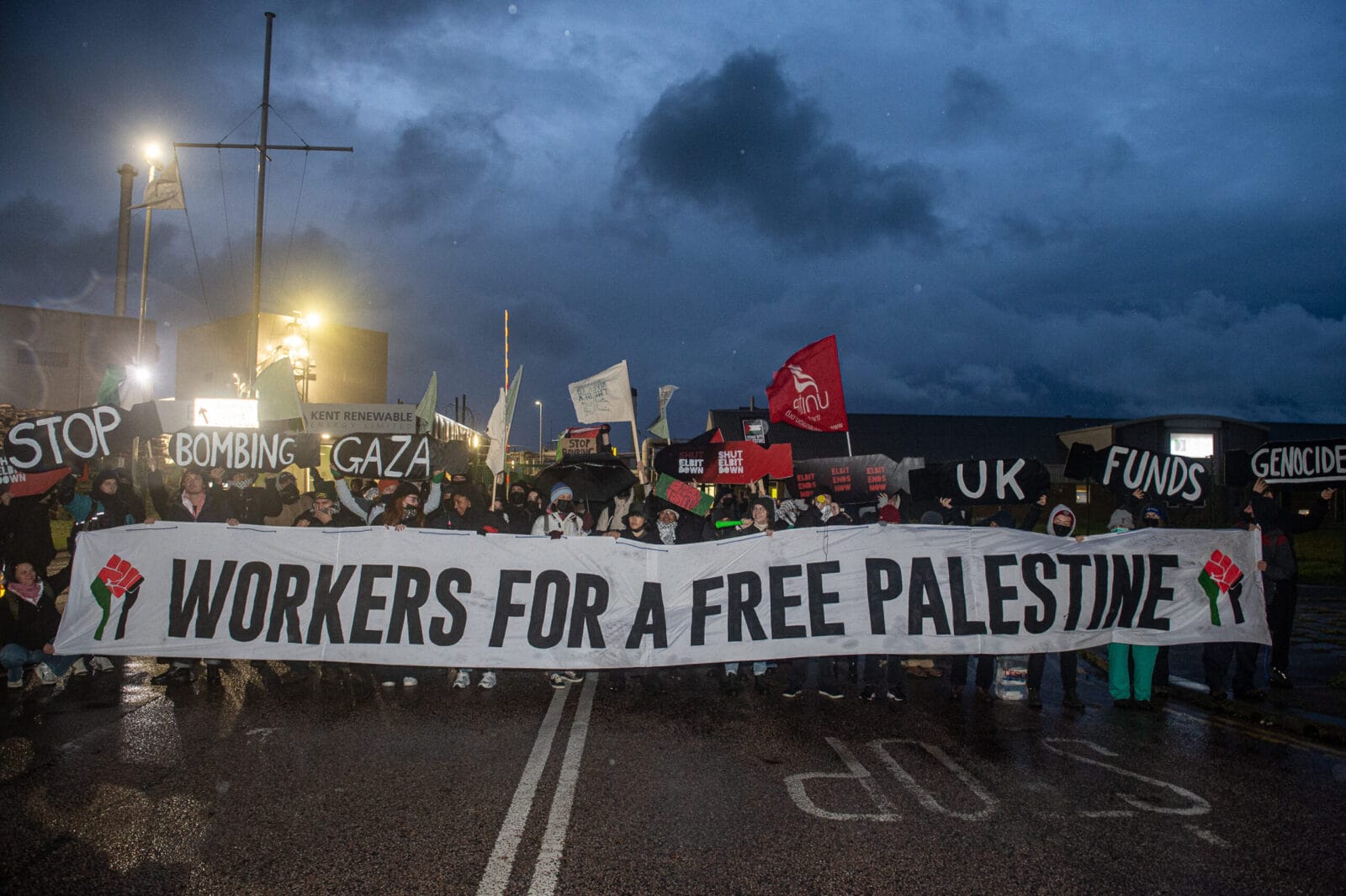
Activists protesting against the bombing of Gaza blockade the entrance to the Instro Precision factory, a subsidiary of the Israeli military contractor Elbit systems, on October 26, 2023, in Sandwich, England. Guy Smallman/Getty Images
[**Noura Erakat**](https://merip.org/writers/noura-erakat/)
By 2021, progressive organizations, individuals and human rights groups increasingly viewed Israel as a settler colonial apartheid state in which a matrix of civil, administrative and military law worked to dispossess, remove and concentrate Palestinians for the sake of maintaining Jewish supremacy. Alliances were growing between Palestinian, anti-racist and indigenous movements in the United States, as was a shared conviction that any progressive agenda must include Palestine. The events of October 7 and their immediate aftermath threatened to unravel this foundation. Politicians in the United States and across western governments, framed Israel as a victim of fanatical Muslim terrorism. Media amplified the call for revenge against Hamas and the Palestinians in the name of self-defense, repeating Israeli talking points that likened [Hamas to ISIS](https://www.nytimes.com/2023/11/03/opinion/isaac-herzog-israel-hamas-gaza.html) and October 7 to “Israel’s 9/11.”[\[1\]](#%5Fedn1) It seemed as if the Palestinian liberation struggle was going to be wholly and irreversibly subsumed into a renewed Global War on Terror.
The ferocity of Israel’s military response against 2.3 million besieged Palestinians in Gaza, however, almost immediately began to change public opinion. More than three months into Israel’s campaign, as the Palestinian death toll has passed 26,000, that change in opinion has only consolidated. Survivors are being denied safe haven, food, adequate shelter, water, electricity and medical care. Israel faces charges of genocide at the International Court of Justice, the International Criminal Court and in the eyes of millions marching in the streets of Tokyo, Seoul, London, Dublin, Cairo, Amman, Sydney, Chicago, San Francisco, New York, Toronto and other cities around the world. It is an unprecedented demonstration of robust solidarity with Palestinian liberation and pointed critiques of Israel that far exceed what existed before October 7.
Youth and racialized minorities who, for the past 20 years, have led movements for racial justice, gun reform and climate action are at the forefront of these tectonic shifts. They have been primed to distrust government and the adults who have failed them. They see Israel together with white supremacy and capitalism as a threat to their future. In recent [polling](https://news.gallup.com/poll/545045/americans-back-israel-military-action-gaza.aspx), 67 percent of respondents under 35 and 64 percent of respondents of color opposed Israel’s actions in Gaza[.](https://news.gallup.com/poll/545045/americans-back-israel-military-action-gaza.aspx)[\[2\]](#%5Fedn2) High school students around the United States have organized walkouts demanding a ceasefire in Gaza. Politicians now want to [ban TikTok](https://www.aljazeera.com/news/2023/11/10/tiktok-faces-renewed-calls-for-a-ban-amid-pro-hamas-anti-israel-claims), a popular platform used by youth in the United States to share information and to express their political opinions about Palestine.
Hundreds of teach-ins, Instagram slide decks, X threads, podcasts, organizing meetings, articles and disruptive actions build on decades of Palestinian intellectual and political traditions to make three related points. First, colonialism is an enduring system of global governance. Zionist settler sovereignty in Palestine is part of that colonial order and, as such, is bereft of moral authority. Second, Zionism relies on coercive force in and outside of Palestine, as has been laid bare in the unprecedented repression across universities, online forums as well as in public streets and chambers of law. Third, the livestreamed genocide of Palestinians in Gaza is an extreme example of the world order made by European supremacist civilization and the violent repression on which it depends. Rising calls around the world for a “Free Palestine” voice more than commitment to ethical solidarity with Palestinians. “Free Palestine” has become a rallying call for collective liberation around the world.
This dramatic shift marks a generational change. It may not bring immediate improvement to the material conditions of Palestinians in Gaza, but it signals a commitment to the future of humanity. The question of Palestine will likely be at the center of that commitment as it is being reshaped forever by this rebellious, new generation. And that is a very good thing.
[**Rafeef Ziadeh**](https://merip.org/paupress/profile/21345/)
In the face of Israel's ongoing genocide in Gaza, Palestinians are tirelessly working to raise awareness, garner support and advocate for concrete actions. As part of a strategic approach, there is a concerted effort to transition worker and trade union solidarity from symbolic gestures into tangible actions that can potentially halt Israel’s war machine.
In an urgent appeal on October 16, 2023, Palestinian trade unions and professional associations [called on international unions](https://www.workersinpalestine.org/the-calls-languages/english) to "Stop Arming Israel," citing the immense military and diplomatic support extended to Israel by the United States and the European Union. The plea urged workers and trade unions worldwide to refrain from engaging in the manufacturing, transportation and handling of weapons and surveillance technology destined for Israel. The group [Workers in Palestine](https://www.workersinpalestine.org/) brings together Palestinian trade unionists with international allies to build support and organize around this call—one that is especially crucial now, as the voices of Palestinian workers, who have courageously been on the front lines in Gaza, saving lives and rescuing communities amid relentless bombardment, are frequently marginalized on the international stage.
Despite the formidable challenges, many rank-and-file organizers have [heeded the call](https://www.workersinpalestine.org/news-updates) and pockets of inspiration continue to emerge within the trade union movement. In November of 2023, Port of Barcelona workers [refused to transport weapons to Israel](https://www.workersinpalestine.org/news/ustp-port-de-barcelona-statement), demanding an immediate ceasefire. 14 Spanish unions and 200 civil society organizations launched a campaign urging the government [to cease arms trade with Israel](https://finalcomerciodearmasconisrael.org/). In Belgium, transportation unions called on their members to refuse [transporting weapons by air](https://www.reuters.com/world/europe/belgian-unions-refuse-handling-arms-shipments-israel-hamas-conflict-2023-10-31/) after reports of shipments being sent to Israel. On November 10, dockworkers in Italy at the Port of Genoa, led by the Colletivo Autonomo Lavoratori Portuali union, blocked cargo movement onto an Israeli-operated ship. In a coordinated action across nine ports, the European Dockworkers Council called for protests and work stoppages. In Britain, the group Workers for a Free Palestine has blockaded arms factories with impressive pickets, working to halt F-35 fighter jet component production. In the US context, the United Auto Workers (UAW), one of North America's largest unions, has called for a ceasefire, and a rank-and-file working group within the union is actively mobilizing support for the Palestinian Trade Union's call for Boycott, Divestment and Sanctions (BDS). These actions demonstrate a powerful act of solidarity and underscore the potential impact that collective labor actions can have on arms supplies to and from Israel.
In their call for solidarity, Palestinian unions have drawn inspiration from historical moments in the global trade union movement against apartheid in South Africa and injustice in Ethiopia and Chile. While the initial focus of the call was on the arms trade, the ultimate objective is to build lasting and strong support for Palestinian workers. These grassroots initiatives help recover a tradition of labor internationalism that is not reliant on governments, trade union bureaucracies or the corridors of power. As such, solidarity with Palestine has the potential to rebuild a trade union movement based on worker actions from below. The difficulty, however, lies in the urgency of building for the long term while simultaneously pushing for an immediate ceasefire. This challenge did not arrive with October 7\. It mirrors the Palestinian experience of seventy-five years: consistent resistance against an ongoing Nakba, contemplating the long term amid a continuous onslaught and envisioning a better world with others.
[**Ilan Pappé**](https://merip.org/writers/ilan-pappe/)
When the current Israeli assault on Gaza ends, the devastation currently being unleashed on Palestinians will ensure that their condition is worse than it was under the 17 years of siege that came before. The fundamental realities in historic Palestine are likely to remain intact: Israel will still occupy the West Bank, using the systems of collaboration and repression that have served it since the second Intifada, Palestinian refugees will be prevented from returning to their homes and lands and Palestinian citizens of Israel will continue to live under quasi-apartheid conditions. More than 100 days of brutal siege will deepen injustice and expand control.
At the same time, the internal divides that threatened to tear Jewish Israeli society apart before October 7 linger. On one side of the spectrum are liberal Jews, primarily Ashkenazi, who largely represent the state’s financial and technological elites. While not opposing the oppression of Palestinians, they are willing to concede a portion of the occupied territories. On the other side are the settlers who envisage a theocratic and racist Israel, seeking to reduce the number of Palestinians living in historic Palestine by any means possible. The struggle between these two camps, which can be framed, respectively, as “the state of Israel” and “the state of Judea,” became visible when they clashed during the November 2022 elections, which catalyzed a judicial revolution and widespread protests.
While “the state of Judea” won that election, it is difficult to know who would triumph today. But perhaps that is not an important question. That both adhere to an apartheid model—either liberal or theocratic—indicates little hope for change from within Jewish Israeli society. In the decades to come, the same processes rifting Israeli society are likely to continue with even greater intensity. The lack of cohesion and disintegration will accelerate the demise of the Zionist settler colonial project.
Meanwhile, the political elites of the global north and some governments of the global south continue to provide Israel with exceptional immunity for its policies on the ground even as civil societies across the globe increasingly support the Palestinian cause with various degrees of activism and commitment. This support—as we have seen in the past months—will continue to grow hand-in-hand with Israel’s extreme violence, especially among younger generations.
The potential twin catalytic developments—one pushing foreign governments to impose sanctions on Israel, the other being the disintegration of Israeli Jewish society from within—will provide the Palestinian national liberation movement with an opening. Looking forward, then, what is needed and what in many ways has already begun is a re-organization and re-orientation of the Palestinian liberation movement: an attempt to replace existing national institutions with more democratic ones and to find a way to overcome Israel’s colonial fragmentation of the Palestinian people and their political movements. The indicators for the end of the Zionist project, of which the global solidarity movement is one, will create a vacuum that a newly reorganized Palestinian liberation movement can fill with a vision of the future that benefits Palestinians and Jews who are willing to share a state based on equality and democracy.
[**Amahl Bishara**](https://merip.org/writers/amahl-bishara/)
In this vicious chapter of Palestinians’ ongoing Nakba, the structure of settler colonialism and the event of military assault fuel each other. During Israel’s genocidal bombardment of Gaza—carried out with US bombs and [US vetoes](https://research.un.org/en/docs/sc/quick)—Palestinians have lost not only entire families crushed in their [homes](https://www.ohchr.org/en/press-releases/2023/11/gaza-destroying-civilian-housing-and-infrastructure-international-crime) but also [hospitals](https://news.un.org/en/story/2024/01/1145317#:~:text=Hospitals%20and%20other%20vital%20medical,health%20agency%20said%20on%20Friday.), [schools and universities](https://euromedmonitor.org/en/article/6108/Israel-kills-dozens-of-academics,-destroys-every-university-in-the-Gaza-Strip). The biggest Palestinian city, Gaza City, has been reduced to rubble, as has one of the largest refugee camps, Jabalia. Some of the smallest Palestinian places—rural and Bedouin communities in the West Bank—have also been [destroyed](https://www.btselem.org/settler%5Fviolence/20231019%5Fforcible%5Ftransfer%5Fof%5Fisolated%5Fcommunities%5Fand%5Ffamilies%5Fin%5Farea%5Fc%5Funder%5Fthe%5Fcover%5Fof%5Fgaza%5Ffighting) and depopulated by Israeli settlers and the military under the “cover of Gaza fighting.”[\[3\]](#%5Fedn3)
Unlike previous Israeli wars on Gaza, Palestinian protest in the West Bank and Israel’s 1948 territories has been attenuated due to atmospheres of [intense](https://www.adalah.org/en/content/view/10926) [threat](https://www.972mag.com/administrative-detention-palestinian-citizens/). When Israel’s military campaign stops, Palestinians in Gaza will still have to contend with ongoing [disease](https://www.lrb.co.uk/blog/2024/january/starvation-as-a-method-of-warfare) and [famine](https://www.bostonreview.net/articles/the-war-on-hospitals/) as well as [environmental](https://www.972mag.com/gaza-israel-water-weapon/) and infrastructural destruction. The devastation, the entrenchment of the Israeli far right and the longstanding failures of Palestinian leadership present a catastrophe for Palestinians that demands revitalized collective [political](https://al-shabaka.org/focuses/whats-required-to-revive-the-plo/) envisioning of liberation.
There is much to learn from the present, however. Today, brave Palestinian journalists—professional and amateur—are doing vital work in Gaza amid the constant threat of [death](https://cpj.org/2024/01/journalist-casualties-in-the-israel-gaza-conflict/). A renewed [circulation](https://lithub.com/a-palestinian-meditation-in-a-time-of-annihilation/) of [Palestinian](https://lareviewofbooks.org/article/mosab-abu-tohas-gaza-notebook/) [poetry](https://www.jadaliyya.com/Details/45606) on social media has tapped into the gravity of grief and outrage but also the persistence of Palestinian lifeways and hopes. Worldwide protest, including in the United States led by Palestinian diasporic and Jewish organizations for justice, and mass mobilizations on college campuses, have transformed discourse. Solidarity work with Black and Indigenous movements against racist state violence and dispossession are building new modes of [political pressure](https://www.nytimes.com/2024/01/28/us/politics/black-pastors-biden-gaza-israel.html) for Palestinian rights. The global tools of international law have placed the Palestinian case on new stages in recent years and especially over the last few weeks: South Africa’s historic [charges of genocide](https://www.pbs.org/newshour/world/read-the-full-application-bringing-genocide-charges-against-israel-at-un-top-court) at the International Court of Justice and the court’s [decision](https://www.youtube.com/watch?v=aLWF5U%5FfGhQ) to pursue the case and announce provisional measures against Israel’s violence represent a crack in Israel’s longstanding [impunity](https://www.latimes.com/opinion/story/2024-01-27/icj-israel-south-africa-gaza-genocide-court-ruling) in the international legal arena.
One pernicious instrument of the ongoing Nakba is geopolitical fragmentation, including through the blockade of Gaza. Having different political statuses and manifold restrictions on movement and expression renders political deliberation and cultural interchange extremely difficult. But this fragmentation does not excuse corrupt, collaborationist or destructive politics. After this war ends, Palestinians must continue attending to each other in ways that challenge settler colonial fragmentation. The principles of the [Boycott, Divestment, Sanctions movement](https://bdsmovement.net/what-is-bds) offer an important starting point of demanding the right to return, the end of military occupation and equality. Our strategies must be grounded in Palestinian traditions of resistance and dignity, [including](https://www.plutobooks.com/9781783711857/captive-revolution/) [Palestinian](https://anthrosource.onlinelibrary.wiley.com/doi/full/10.1002/fea2.12109) [feminist](https://www.rethinkingiran.com/feminist-futures/resistance-love-paths-to-palestinian-liberation-amahl-bishara) [mobilization](https://www.plutobooks.com/9780745347479/greater-than-the-sum-of-our-parts/). We must respect the voices of those who are most marginalized by Palestinian and world politics, in particular refugees and prisoners—especially since the last months have seen the [displacement](https://www.ochaopt.org/) of the vast majority of people in Gaza, most of whom are refugees, and a staggering rise in the [numbers](https://www.aljazeera.com/news/2023/11/29/jailed-without-charge-how-israel-holds-thousands-of-palestinian-prisoners) of and [torture](https://www.972mag.com/israel-torture-camp-gaza-detainees/) of Palestinian prisoners and captives. But most urgently, we must work to save Gaza as a Palestinian place and to support the survival of the Palestinians of Gaza, including by mobilizing for ceasefire, for adequate aid and against attacks on vital humanitarian work.
> **Read the**[ **previous**](https://www.merip.org/a-note-on-the-cover-image-3/) **article.**
> **Read the**[ **next**](https://www.merip.org/lessons-from-48-2/) **article.**
**This article appears in** [**MER issue 309**](https://merip.org/magazine/309/) **“Palestine—Before and After October 7.”**
---
## **Endnotes**
[\[1\]](#%5Fednref1) "[Israel Faces Its 9/11,](https://www.wsj.com/articles/israel-faces-its-9-11-80cca24e)" The Wall Street Journal, October 8, 2023.
[\[2\]](#%5Fednref2) Lydia Saad, "[Americans Back Israel's Military Action in Gaza by 50% to 45%](https://news.gallup.com/poll/545045/americans-back-israel-military-action-gaza.aspx)," Gallup, November 30, 2023.
[\[3\]](#%5Fednref3) "[Forcible transfer of isolated Palestinian communities and families in Area C under cover of Gaza fighting,](https://www.btselem.org/settler%5Fviolence/20231019%5Fforcible%5Ftransfer%5Fof%5Fisolated%5Fcommunities%5Fand%5Ffamilies%5Fin%5Farea%5Fc%5Funder%5Fthe%5Fcover%5Fof%5Fgaza%5Ffighting)" B'Tselem, October 19, 2023.
### Issue 309 (Winter 2023) Masthead
URL: https://www.merip.org/2024/01/issue-309-winter-2023-masthead/
Last updated: 2025-07-29T13:07:34.000Z
## ***Middle East Report*, “Palestine–Before and After October 7,” Winter 2023, No. 309, Vol. 52 No. 4**
### **Executive Director**
**Mandy Terc** mandyterc@merip.org
### **Executive Editor**
**Katie Natanel** katienatanel@merip.org
### **Managing Editor**
**Marya Hannun** maryahannun@merip.org
### **Photo Editor**
**Michelle Woodward** mwoodward@merip.org
### **Staff Editors**
**Michael Kaplan** kaplan\_m@gwu.edu
**Alyssa Bivins** bivins@gwu.edu
### **Social Media Coordinator**
**Khelil Bouarrouj** socialmedia@merip.org
### **Board of Directors**
**Paul Silverstein(Board Chair)** *Reed College*
**Kaveh Ehsani** *DePaul University*
**Michael Hanna** International Crisis Group
**Adam Hanieh** *University of Exeter*
**Vickie Langohr** *College of the Holy Cross*
**Lee O'Brien** *Retired*
**Mary Sexton** *Consultant*
**Mandy Terc** *MERIP Executive Director (ex officio)*
### **Editorial Committee**
**Lisa Hajjar (Co-chair of the Editorial Committee)** *University of California, Santa Barbara*
**Muriam Haleh Davis (Co-chair of the Editorial Committee)** *University of California, Santa Cruz*
**Ayça Alemdaroğlu** *Stanford University*
**Lori Allen** *SOAS University of London*
**Sabiha Allouche** *University of Exeter*
**Mona Atia** *George Washington University*
**Elif Babül** *Mount Holyoke College*
**Jessica Barnes** *University of South Carolina*
**Gregory Brew** *Analyst at Eurasia*
**Najib Hourani** *Michigan State University*
**Mohammad Ali Kadivar** *Boston College*
**Reinoud Leenders** *King's College London*
**Shana Marshall** *George Washington University*
**Pete Moore** *Case Western Reserve University*
**Jacob Mundy** *Colgate University*
**Maha Nassar** *University of Arizona*
**Curtis Ryan** *Appalachian State University*
**Hesham Sallam** *Stanford University*
**Kevin L. Schwartz** *Oriental Institute of the Czech Academy of Sciences*
**Deen Sharp** *London School of Economics*
### **Format: Online**
### **ISSN 3065-744X**
### A Note on the Cover Image
URL: https://www.merip.org/2024/01/a-note-on-the-cover-image-3/
Last updated: 2025-07-30T04:05:55.000Z
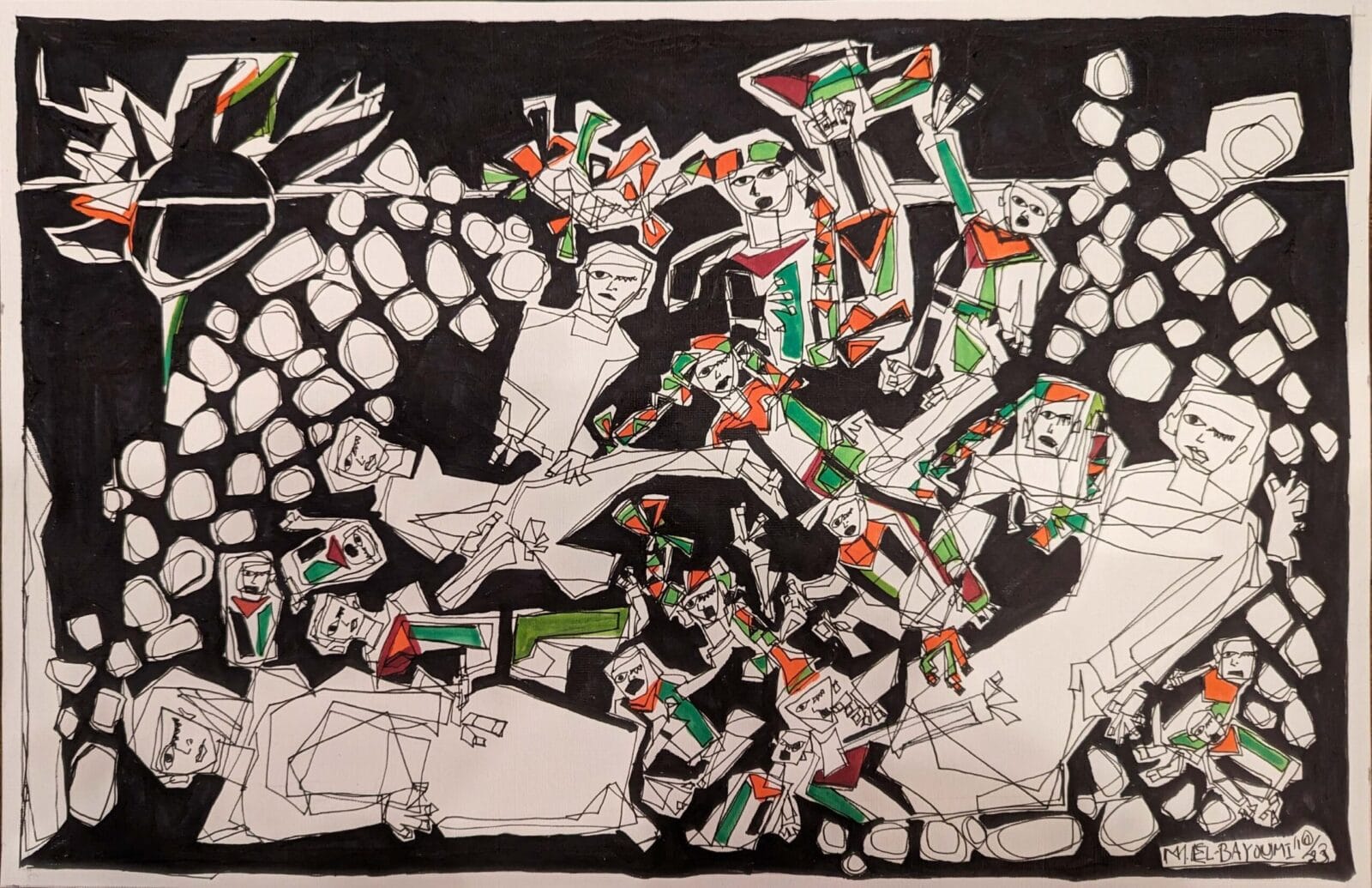
"Under the Rubble" by Mona El-Bayoumi.
The cover image for MER issue 309 features “Under the Rubble, Gaza”—a print designed by Washington, DC-based visual artist Mona El-Bayoumi.
The work’s title brings to mind the casualties of Israel’s war on Gaza, which continue to mount daily. At the time of publication, the war has reached its 117th day. More than [26,000](https://www.ochaopt.org/) are confirmed dead, and [several thousand](https://www.ohchr.org/en/stories/2024/01/gaza-massive-human-rights-crisis-and-humanitarian-disaster) remain missing, presumed dead, under the rubble. The rubble also speaks to the totalizing nature of destruction in the Gaza Strip since October 7, 2023 and the machinery required to enact it. In her [article](https://www.merip.org/gaza-is-a-crime-scene/) for this issue, “Gaza Is a Crime Scene,” Lisa Hajjar discusses the 2,000-pound US-made “bunker busters” that Israel’s army has used to level Gaza’s infrastructure. [Two thirds](https://www.theguardian.com/world/2024/jan/08/the-numbers-that-reveal-the-extent-of-the-destruction-in-gaza) of built structures in the north of Gaza have been demolished and [more than half](https://www.bbc.co.uk/news/world-middle-east-68006607) of all buildings throughout the enclave destroyed or damaged, many of them reduced to rubble.
The image itself, though, rejects the reduction of lost Palestinian lives to passive statistics testifying to Israel’s violence. Over the past 117 days, these death tolls have been [publicly disputed](https://www.reuters.com/world/middle-east/despite-bidens-doubts-humanitarian-agencies-consider-gaza-toll-reliable-2023-10-27/) by US President Biden and qualified by some western media through the continued framing of Gaza’s health ministry as “Hamas-run.” They have been cited by aid agencies, commentators and human rights organizations in their appeals for a ceasefire and by South Africa’s legal team in their genocide case against Israel at the International Court of Justice. These numbers have captioned countless images, TikToks and reels documenting the war and its devastating effects to a watching world. Depicting them with one eye open, the artist transforms the dead from the witnessed into expectant observers. As El-Bayoumi wrote to MERIP, their gaze is on the viewer, “watching the fight for Liberation.”
El-Bayoumi, who drew the image in October of 2023, wrote that the work is equal parts memorialization and a call to action. This framing fits with the perspective of many of our contributors, Palestinian activists and others who are struggling to bear witness and build in the face of ongoing destruction. El-Bayoumi noted, for example, the prominence of children in the image, holding Palestinian flags and rising to the surface. “This is a piece to give respect for those ‘Under the Rubble’—but, just as importantly, to represent the struggle for a Free Palestine will go on.”
**Read the [first](https://merip.org/2024/01/four-reflections-on-political-action-and-palestine) article in [MER issue 309](https://merip.org/magazine/309/) “Palestine—Before and After October 7.”**
### The Houthis’ ‘Sovereign Solidarity’ with Palestine
URL: https://www.merip.org/2024/01/the-houthis-sovereign-solidarity-with-palestine/
Last updated: 2026-03-09T12:54:48.000Z
Since October 7, Yemen has made an unexpected return from the margins of global attention.
The Houthi movement’s seemingly ad hoc seizure of shipping vessels in the Red Sea, which began in early November in response to Israel’s bombardment of Gaza, quickly became a concerted campaign to [disrupt global shipping](https://www.reuters.com/markets/commodities/how-are-red-sea-attacks-impacting-shipping-suez-canal-2023-12-18/) and supply chains dependent on access to the Suez Canal. After assembling a coalition of states to prevent attacks on shipping and issuing warnings to Houthi leaders, on January 11, US and British forces launched the first in a series of airstrikes on Houthi military sites in Yemen.
US mainstream media has largely framed the Houthis’ actions in terms of a regional proxy war with Iran, amplifying claims that the group (Ansar Allah, as it designates itself) is “taking their marching orders from Tehran.”[\[1\]](#%5Fedn1) Understanding Houthi actions in the Red Sea in these terms, however, fails to capture the popularity of the Palestinian cause in Yemen that has guided successive Yemeni governments’ relations with the wider region—or Ansar Allah’s effort to claim a place in this legacy of sovereign solidarity from its non-sovereign position amid Yemen’s ongoing civil war.
Popular and official support for Palestine in Yemen predates the creation of the state of Israel and spans Yemen’s many political configurations. In 1947, Yemeni representatives to the United Nations vocally opposed the plan to partition Palestine. Their continuing solidarity was reflected in the policies of both the People’s Democratic Republic of Yemen (South Yemen) and the Yemen Arab Republic (North Yemen) before their unification. In 1971, [for example](https://carnegieendowment.org/sada/84558), South Yemen allowed a Palestinian militant organization to attack an Israeli ship from its territory. During the 1973 October War, it closed the Bab al-Mandab strait to fuel bound for Israel.[\[2\]](#%5Fedn2) After the 1982 Israeli invasion of Lebanon, the two Yemens hosted more than one thousand displaced Palestine Liberation Organization (PLO) fighters and established military camps for them in Sana’a and Aden. Following the unification in 1990, the Republic of Yemen also pressed the United States for diplomatic recognition of the PLO and continued to extend the same rights and resources to Palestinian refugees as they did to Yemeni citizens.[\[3\]](#%5Fedn3)
> **Palestine—and Gaza, in particular—has long mobilized mass support across Yemen’s political divisions, even in the context of civil unrest and violence.**
At a popular level, protests in Yemen against the current Israeli campaign in Gaza have reached an unprecedented size. But Palestine—and Gaza, in particular—has long mobilized mass support across Yemen’s political divisions, even in the context of civil unrest and violence. When Israel launched Operation Cast Lead in the winter of 2008–09, I vividly recall seeing Houthi signs and slogans amid a varied crowd of protesters in Sana’a. At the time, the Houthis were laying low, having just survived several rounds of insurgent warfare in Saada and other parts of northern Yemen, but their supporters risked visibly coming to the streets for Gaza. Then, as now, the ideological and organizational mix on display at protests illustrates how Palestine is an issue on which Yemenis set aside otherwise sharp antagonisms.
At the same time, where and with whose authority protests take place today reflect the increasing political fragmentation in Yemen in which the Houthis’ Red Sea campaign needs to be understood. Nearly ten years into a protracted civil war, different parts of the country experience very different day-to-day political conditions, none of which are consistent with free expression. While leaders of every major political faction have pledged their sympathies with the Palestinian people, their embrace of street protests have been more uneven. Ansar Allah has actively encouraged large crowds in areas under its control, including Sana’a, which they have controlled entirely since early 2015 along with much of the northern part of the country. The Southern Transitional Council, on the other hand, which exercises de facto control in Aden and its periphery and is materially supported by the United Arab Emirates, has largely prohibited protests. Meanwhile, the internationally-recognized government, supported by Saudi Arabia and composed of a fractious collection of parties, lacks a uniform approach in the areas it controls.
For many years, representatives of Ansar Allah have sought to bolster their claims to sovereignty by resisting negotiations with the internationally-recognized government of Yemen in favor of direct talks with Saudi Arabia, which leads a coalition of states working to restore Yemen’s displaced government. Talks began in 2022 as backchannel negotiations during a brief ceasefire. Notably, they advanced along the same timeline as Saudi-Israeli normalization, a policy unpopular not only with the Houthis but across Yemeni society. In this context, the group undoubtedly hopes that its Red Sea campaign—by more starkly positioning it as part of the Axis of Resistance to Israel—will improve its position in regional and domestic negotiations over the future of Yemen.
Houthi solidarity with Palestine also helps them carve out a distinct place in the eyes of a watching Yemeni public. Onlookers have celebrated as, in contrast to the relative inaction of other states in the region, the Houthis have managed to cause significant disruption: Over the past two months, international firms have faced the choice of re-routing around Africa—adding about ten days to the trip from Asia to Europe—or paying increasingly steep insurance premiums to continue transiting through the Red Sea.
> **In the longer term, however, whether it leads to wider regional conflict or not, this act of sovereign solidarity could push an inclusive and sustainable peace in Yemen even further from reach.**
In the short term, Houthi attacks in the Red Sea are boosting the group’s popularity and discrediting Arab states associated with normalization with Israel. In the longer term, however, whether it leads to wider regional conflict or not, this act of sovereign solidarity could push an inclusive and sustainable peace in Yemen even further from reach. The United States, invested in supporting Israel and in protecting global shipping, initially responded to the disruption by putting together a coalition of ten states to deter attacks (notably absent were the two Gulf states most directly involved in different arenas of the conflict in Yemen, Saudi Arabia and the UAE). Following continued disruption to the supply chain, the United States and Britain have escalated to striking Houthi military targets in Yemen.
Houthi-Saudi negotiations are on hold and will be difficult to restart. Meanwhile, advocates of a political settlement that includes the Houthis are likely to find a chillier reception from international organizations, including the UN, particularly in light of the Biden administration’s decision on January 17 to add Ansar Allah back to the Specially Designated Global Terrorist List (SDGT). The group was [removed](https://www.state.gov/revocation-of-the-terrorist-designations-of-ansarallah/) from both the SDGT and Foreign Terrorist Organization (FTO) list in 2021 after international organizations mobilized in the face of humanitarian collapse. These changes could also encourage the Saudi-led coalition to reconsider its shelved campaign to retake the port city of Hodeidah.
Most at risk from recent developments is the civilian population of Yemen. Even before October 7, several major aid organizations had started to rethink their operations in Houthi-held areas of Yemen, and the current crisis is exacerbating these tensions. In [December 2023](https://www.reuters.com/world/middle-east/world-food-programme-pauses-distribution-north-yemen-funds-limited-2023-12-05/), World Food Programme negotiations with the Houthis over aid distribution broke down, with the organization announcing an official pause. The military escalation of the conflict, and the terrorist designation, may hasten an even wider humanitarian retreat.
\[**Stacey Philbrick Yadav** is professor and chair of International Relations at Hobart and William Smith Colleges.\]
---
### Endnotes
[\[1\]](#%5Fednref1) “[What’s Behind the Attacks on Shipping Vessels in the Red Sea?](https://www.npr.org/2023/12/19/1220210907/whats-behind-the-attacks-on-shipping-vessels-in-the-red-sea)” Morning Edition, Nation Public Radio, December 19, 2023.
[\[2\]](#%5Fednref2) Ammar al-Ashwal, "[Yemen and the Curse of Geography: Bab al-Mandab Disputed by Great Power Rivalries,](https://carnegieendowment.org/sada/84558)” Carnegie Endowment for International Peace, May 18, 2021.
[\[3\]](#%5Fednref3) Helen Lackner, “[Yemen Has a Long Tradition of Solidarity with the Palestinian People](https://jacobin.com/2023/12/yemen-israel-palestine-houthis-ships-red-sea-solidarity),” *Jacobin,* December 8, 2023.
### Lessons from '48—A Conversation on Silence, Complicity and Popular Mobilization of Palestinians in Israel
URL: https://www.merip.org/2023/12/lessons-from-48/
Last updated: 2025-08-22T18:36:30.000Z
*\[su\_dropcap style="simple" size="4"\]*I*\[/su\_dropcap\]srael*’*s extreme escalation of violence against Palestinians in Gaza following the Hamas attacks of October 7 has sparked an unprecedented wave of global solidarity with Palestine.*

Palestinian citizens of Israel demonstrate in Haifa on May 18, 2021, to mark a nationwide general strike expressing solidarity for Palestinians. Mati Milstein/NurPhoto via Getty Images
*For two months, protesters have taken to the streets in mass demonstrations around the world. Workers have declared their refusal to transport arms. Activists have occupied offices of political representatives and blocked entrances to Israeli and international arms companies. Students have led walkouts, and businesses have closed their doors in answer to calls for international strike actions. In the context of this global social movement with Palestine at its center, the comparative lack of political mobilization among* ’*48 Palestinians, commonly referred to as Palestinian citizens of Israel, is conspicuous.*
*To reflect on this silence, the dynamics underpinning it and the prospect for building a sustained movement for Palestinian liberation within* ’*48, Riya Al’Sanah—a political organizer from the Naqab and a PhD candidate at the University of Exeter—interviewed Soheir Asaad, a Palestinian feminist, political organizer and human rights advocate. Soheir is currently an advocacy team member of* [*Rawa*](https://www.rawa.ps/en-home)*—for liberatory, resilient Palestinian community work. She also co-directs the “Funding Freedom” project. Their conversation was conducted over Zoom on December 4, 2023 and has been edited for length and clarity.*
**Riya:** Soheir, can you speak about the general situation in Haifa, where you’re based, and across ’48 since October 7?
**Soheir:** Since October 7, we’ve seen unprecedented levels of silence and fear in Haifa and across ’48 as well as a real lack of political action. This silence is markedly different from previous wars—the 2006 war on Lebanon, the many previous wars on Gaza. And this silence comes during what is not just another war but a period of unbelievable violence. It comes at a time when it’s not only Israel that is engaging in genocidal war. We’re seeing laid bare the complicity of the whole global structure and system of oppression, the whole capitalist system that profits from and experiments on the bodies of Palestinians in Gaza. At the same time, it comes in the context of unprecedented global solidarity. Gaza, faced with all this horror, is radicalizing the world. Gaza’s resilience and resistance is inspirational. It’s a manifestation of what oppressed people can do, while the racism and the high levels of persecution against those standing in solidarity with Palestine is a reminder of the degree of revenge and persecution that is unleashed the moment you challenge the basis for this establishment of power. Within this whole unprecedented scene, ’48 is not there.
**Riya:** Looking back to May 2021, during the Unity Intifada, the scene in ’48 was very different. Palestinians there joined others across historic Palestine in a struggle against Israeli settler-colonialism. How do you understand both the heightened levels of mobilization we saw in 2021 and then this shift to deafening silence?
**Soheir:** I think much of what we saw during the Unity Intifada was a manifestation of processes that were already unfolding. Namely, the official Palestinian political leadership was growing increasingly irrelevant and the modes of organizing in Palestine and ’48 had gradually been shifting from political party-oriented organizing to decentralized organizing. These processes began in the decade before the Unity Intifada. What we saw in the Unity Intifada that we hadn’t seen before was a different social class entering into the scene as leaders. They claimed agency over what it meant to mobilize politically in ’48 and in a way redefined for us what a revolutionary moment could be. We saw the writing and distribution of anonymous political [manifestos and statements](https://mondoweiss.net/2021/05/the-manifesto-of-dignity-and-hope/), the spontaneous and communally-organized delivery of food and supplies to besieged communities in Lyd (where a [state of emergency was declared](https://www.aljazeera.com/features/2021/10/4/october-2000-vs-may-2021-how-palestinians-defied-fragmentation) and a military curfew was imposed) and other acts of mutual aid across ’48\. And of course, we saw the [general strike](https://notesfrombelow.org/article/report-general-strike-palestine) that was called across historic Palestine on May 18—a popular demand from below that was subsequently adopted by official political parties.
> **What we saw in the Unity Intifada that we hadn’t seen before was a different social class entering into the scene as leaders. They claimed agency over what it meant to mobilize politically in ’48...**
Israel’s violence and oppression in response was extreme. The military was mobilized to disperse demonstrations, soldiers fired live ammunition at crowds, curfews were imposed and there was a campaign of mass arrests. [More than 2,000](https://www.merip.org/content/files/uploads/uploads/may-2021-report.pdf) people were arrested. [545](https://www.taylorfrancis.com/chapters/oa-edit/10.4324/9781003176619-11/criminalization-racialization-palestinian-resistance-settler-colonialism-adan-tatour-lana-tatour) were indicted.[\[1\]](#%5Fedn1) The vast majority of them were prosecuted using laws to combat terrorism and laws against racially-motivated crimes—often both. The terrorism charges, as Adan and Lana Tatour have recently observed, are a racialized designation intended to rationalize harsher punishments against political mobilization and criminalize resistance. Meanwhile, the charges of racially-motivated crimes play into Israel’s growing attempts to conflate anti-colonial political action with antisemitism. In an attempt to further criminalize resistance, Israel linked the uprisings to growing crime rates in Palestinian society, which also had the effect of erasing the anti-colonial underpinnings that mobilized people.[\[2\]](#%5Fedn2) And it was really the most marginalized who ended up paying the highest price. Palestinian researcher and academic Khaled Anabtawi analyzed the data around arrests and found that the average income of the families of those indicted was 30 percent lower than the average Palestinian family in ’48\. 31 percent of those arrested were from single-parent, woman-led households and almost 64 percent were from families receiving social services and benefits.[\[3\]](#%5Fedn3) At the same time, the organizational structures that emerged in the Unity Intifada—the amazing solidarity and mutual aid—all collapsed extremely quickly, and so these already vulnerable families have been left to deal with the aftermath of the uprising on their own since 2021.
This ongoing violent repression combined with the absence of a sustained political infrastructure and feelings of abandonment have been a real deterrence to mobilizing in the present moment.
**Riya:** Right, following May 2021 we saw an aggressive Israeli campaign to stifle any Palestinian political action that is framed as part of an anti-colonial struggle, and the simplest displays of Palestinian political identity, like the Palestinian flag, are being [banned](https://www.theguardian.com/world/2023/jan/09/israel-security-minister-bans-palestinian-flag-flying-in-public).
**Soheir:** Yes. It’s hard to describe just how paranoid the Israeli state has become around any sign of popular political mobilization in ’48 following the Unity Intifada. For example, two years later, in May of this year, Diar Omari, a 19-year-old Palestinian man, was shot by a settler on the road leading to the gated settlements next to his village, Sandala. After his killing, the whole village stood in an amazing display of revolutionary support for the family, demanding justice for Diar. His family and the village rejected attempts by Israel and Palestinians (like [Mansour Abbas](https://www.alarab.co.il/Article/1063843), the leader of the Arab United List) to frame Diar’s killing as stemming from a criminal case of road rage. The steps Israel took to stop the mobilization in Sandala—a small village of 1,700 people—were unbelievably severe. The village where people were demonstrating was attacked with helicopters, border police and pre-dawn raids. There was a systematic arrest campaign targeting Diar’s friends and the village’s youth. And, like you said, even the Palestinian flag was a target. Almost every night, the Israeli police would raid the village to remove the Palestinian flag from its streets and would even raid the cemetery and remove the Palestinian flag from Diar’s grave. Then his friends and family would put it back, and after a few hours, the Israeli military would come back and remove it, and it would be put back on, and so on. Basically, after the Unity Uprising, Israel couldn’t tolerate any kind of mobilizing in a framework that is Palestinian. If people had stood for Diar without calling him a martyr or without rallying under a political Palestinian framework—had they not insisted on defining his death as a political death—I don’t think Israel would have minded a commemoration or even protests. The support of ’48 political leaders for the family was timid, which is also telling. This was precisely because the family insisted on defining Diar as a martyr and in doing so, situating his killing within the broader struggle against Israeli colonization. An acceptance of such a framing would have pushed them into a clash with the Israeli system.
This is consistent with a longer-term trend to delink political mobilizations in ’48, moments like the Unity Intifada and before that the Second Intifada, from the broader struggle against Israeli settler-colonialism. Our political leadership, but also ’48 Palestinian civil society organizations, are complicit in this process. For example, after May 2021, the New Israel Fund threw money at Palestinian and mixed (Israeli-Palestinian) civil society organizations under the guise of supporting ’48 Palestinian detainees, but at the same time they were framing their support—and the Unity Intifada as a whole—in terms of a narrow struggle for greater democratic rights for ’48 Palestinians. This worked to disconnect May 2021 from a broader Palestinian liberation framework and reconfigure it as part of the pro-democracy Israeli protests.
**Riya:** One key difference in 2021 seems to be in the social class of ’48ers who took the lead. With the weakening of formal political structures, a new organic leadership emerged that put forward a political analysis explicitly connecting local socio-economic conditions and police repression to Israel’s settler-colonial rule. This framing challenged the one advanced by most political parties in ’48, who, following Oslo, have re-oriented the struggle in ’48 away from broader Palestinian liberation to being a struggle for equal rights or “citizens’ rights.” Can you talk about how this focus on citizenship came to be so central and its consequences for political organizing in ’48?
**Soheir:** Since Oslo and, more acutely, following the Second Intifada, our political leadership in ’48 has been stuck within the framework of citizenship. Of course, the situation wasn’t better before Oslo. But Oslo cemented the fragmentation of the Palestinian people and marked the Palestine Liberation Organization’s abandonment of ’48 Palestinians, rendering their fate an Israeli issue. In this context, the nationalist political voices in ’48 were left trying to create a framework for struggle and did so largely within the narrow framework of citizenship. There have been differences between different political parties in the way they have dealt with the issue: Some of them, like the United Arab List, went to extreme coexistence. Others, like Tajammu (Balad), wanted to work within the democratic order to challenge the Zionist core of the Israeli, Jewish state by promoting a state for all of its citizens regardless of national group rights and Palestinian identity. Others still, such as Al-Jabhah (Hadash)—Ayman Odeh’s political organization—have advanced a discourse of shared Arab-Jewish working-class interests, which has served to whitewash colonial power relations under the guise of Israeli-Palestinian coexistence. But I think the general commitment to this framework across parties led to what we’re seeing today: Complete defeat, the continued shrinking of the “liberal” margins of what Israel has allowed and the compliance of political leadership in the interest of avoiding any clash with the system.
> **Since Oslo and, more acutely, following the Second Intifada, our political leadership in ’48 has been stuck within the framework of citizenship.**
This orientation toward inclusion within the Israeli regime escalated in 2015 with the establishment of the Joint List. The Joint List was an electoral coalition bringing together the different Palestinian political parties and a Jewish Arab party. The formation of a united electoral block has been a longstanding Palestinian popular demand. We, Palestinians, conflate the lack of political agency with the lack of unity, but unity can defuse important political differences. In practice, the “unity” of the Joint List led to greater complicity with the Israeli regime. Under the leadership of Ayman Odeh, the Joint List project advanced a shift in political orientation towards what they called “impact policies.” This was an approach that suggested Palestinians in ’48 should focus on building power by integrating into the Israeli state’s ministries and other institutions connected to the state, like governmental companies and the courts. They also placed an emphasis on gaining economic power through individual advancement in the Israeli private sector.
Ayman Odeh excluded three ministries from Palestinian integration: the foreign ministry, the Ministry of Defense and the Ministry of Aliya and Integration (the ministry that regulates Jewish immigration to Israel) because, in his framing, these three ministries were the manifestation of the Jewish nature of the state. Odeh knows full well that the Zionist, violent core of the Israeli state is not limited to three ministries. It is manifested in every single arm of the state, including the courts, the police, social services, everything. Why then did he claim that these are the only problematic ministries? I think this illustrates the fantasy behind the vision for Palestinian integration.
Odeh embodies the individualist aspiration to be part of an Israeli development process, which Israel has fostered heavily since the Second Intifada through the initiation of governmental plans for greater economic integration. A Palestinian being a head of a bank or a head of a governmental company—which are not only complicit in Israeli colonialism but are also complicit in a very harsh capitalist, neoliberal economic policy that disproportionately impacts Palestinians—was celebrated. [\[4\]](#%5Fedn4) This celebration presented individual successes as collective achievements. It also ignored the fact that integration is according to the needs of the Israeli economy, not the needs of Palestinians. While leaders like Odeh point to the greater presence of Palestinian workers in the medical or high-tech sector as collective achievements, the reality on the ground tells a different story. These policies have failed to close the socio-economic gap, not just between Palestinians and Israelis, which is widely recognized, but also the gap between ’48 Palestinians themselves, which the Unity Intifada brought to the fore. In 1997, some 38 percent of families in ’48 lived in poverty. The number was 45 percent in 2018 (compared to 13 percent of Jewish families).[\[5\]](#%5Fedn5)
Odeh and others who supported these policies also upheld the notion that Palestinians can integrate into these systems and maintain our identity as a cultural identity. And I really think Gaza today has shaken these foundations just as the Unity Intifada did. Efforts at integration are not working because they’re clashing with Palestinian political identity, which is being represented by a resistance that political leaders like Odeh want nothing to do with.
**Riya:** Over the same period, we’ve also seen Israel undermine Palestinian Knesset members by empowering local councils. Can you speak about this, and how it fits into the project you described of Israel engineering a Palestinian class whose political and economic interests are aligned with the interests of the Israeli state?
**Soheir:** Much of the work of Palestinian Knesset members—beyond their vocal demands for equality or the end to occupation, which really operate at the slogan level—has been at what they view as the service level, work that in theory should be carried out by ministries: if there’s a post office lacking in that village or a road that needs work, etc. In effect, parliamentarians became the messenger for these services and tried to justify their role within the framework of dignity and equal rights.
In recent years, Israel has increasingly tried to empower local councils—a more technical, less political leadership—instead of Knesset members. These councils are not political parties. They operate at the level of the locality and are elected mostly on a family basis. They don't give Israel a headache by raising issues related to the occupation. Along with some NGOs, who are very close to the liberal Zionist sphere, they have become a bridge between the Palestinian community and the Israeli government for service delivery. As a result, political power and weight has shifted from the old classic political parties and the High Follow-up Committee (an extra-parliamentary umbrella organization that represents ’48 Palestinians) to these councils and NGOs. They became a vessel through which Israel channeled investments into ’48 Palestinian communities, leading to the gradual development of a Palestinian capitalist class whose whole material existence is dependent on “developmental” state funding. The main root of all evil is Israel’s fragmentation of Palestinians geographically, politically, at the level of legal frameworks, all of that, of course, but I do think we need to talk about ourselves more and how these efforts at integration have set us back collectively.
**Riya:** You’ve laid out how we got to this point, but in this moment of unfolding colonial violence on steroids and in a landscape of fear, of silencing, of the lack of vision towards collective Palestinian liberation, where do we look to build, and how do we do so?
**Soheir:** Before I speak to your bigger question, I want to say a word about fear. We cannot ignore that what Israel is doing in ’48, now, is an attack. You could be arrested for showing sympathy with the Gaza resistance or even putting a [verse from the Quran](https://www.anews.com.tr/world/2023/11/06/israel-police-charge-palestinian-that-shared-quran-verses-on-whatsapp-with-terrorism) on social media or analyzing the military invasion. Now, if we look at the numbers of arrests in ’48 since October 7, they’re low compared to the Unity Intifada. We’re speaking of 200 arrests, compared to thousands during May 2021.[\[6\]](#%5Fedn6) Of course, the circumstances are different. Back then, there were clashes. It was a different revolutionary moment. Now it’s just people sitting on their screens and getting arrested for posts, most of them posted on the day of October 7.
These arrests are accompanied by new repressive legislation. On November 8 the Israeli Knesset passed the [consumption of terrorist material bill](https://www.aljazeera.com/news/2023/11/8/knesset-introduces-consumption-of-terrorist-publication-as-offense#:~:text=The%20%E2%80%9Cconsumption%20of%20terrorist%20materials%E2%80%9D%20offence%20carries%20a%20maximum%20penalty,of%20individuals%20through%20media%20consumption.), which criminalized consumption of materials by Hamas or ISIS (notice that they put Hamas and ISIS together in this legislation, which is very deliberate). Israel has also threatened to [revoke citizenship](https://www.timesofisrael.com/minister-rolls-out-bill-to-strip-citizenship-from-terror-supporters-in-wartime/) for those who’ve expressed sympathy with what they deem terrorism and [tried to introduce](https://www.adalah.org/en/content/view/10894) new legislation that would make it permissible to shoot at people if they block streets that serve as roads for military supplies, which basically could be any road. These bills are meant to deter Palestinians in ’48 from distracting or confronting Israel during its ongoing genocidal campaign in Gaza. Even though these two bills didn’t pass, they are fixed in people’s minds. In a way, this fear is a circle fed by Israeli repression and the political discourse of politicians in ’48\. If there were political will and infrastructure committed to breaking this circle of fear, I think people would have greater confidence to engage in mobilization, and it would open up a new process.
> **The task today in ’48, but also in the West Bank...is to work towards building what I would call a liberatory or liberation infrastructure.**
The task today in ’48, but also in the West Bank (because Gaza doesn’t need our lessons. Gaza consistently teaches us a lesson. Despite the extreme isolation that Gaza suffered under the blockade, we see different frameworks for organizing there, resilience and mutual aid, that we didn’t see anywhere else) is to work towards building what I would call a liberatory or liberation infrastructure. This would involve the building of infrastructure that allows for disengagement from complicity with Israel, politically and economically. It would also center the re-articulation of the emancipation of ’48’s most marginalized communities as one that is linked to the broader struggle for Palestinian liberation. While complete economic disengagement is impossible under colonialism, I don’t believe sustained liberatory work is possible without the development of a new infrastructure that can maintain revolutionary action. I don’t mean here the development of NGOs but of community-led structures of mutual aid that break away from the framework of individual growth and development under a colonial state and enable sustained revolutionary action. I’m speaking about food sovereignty, union organizing, protecting detainees, community safety to deal with crime and other issues. This is not an easy task, but it is essential we start thinking in such ways, seriously and creatively.
**Riya:** Otherwise, like you described of the Unity Intifada where we saw the rapid collapse of infrastructure, we will be left with perpetual spikes of revolutionary mobilization without cumulative gains. You’ve worked in the field of international advocacy for over 15 years. Can you speak to the solidarity movement now and whether you see these same dynamics playing out beyond ’48?
**Soheir:** For so long, the solidarity movement was occupied with challenging Israel, and I think that’s great. Please challenge Israel, but also, we want you to challenge your own establishment. We’re seeing some of this now. People interrupting everyday life in global capitals, interrupting arms manufacturers, interrupting parliaments, interrupting media, interrupting academia, everyone who is complicit. But I wonder, if there is a ceasefire, will this all end? Are we rallying around a very specific limited framework? Or are we aspiring to build actual material global solidarity? Because if we look at the streets now, even though the protests are in Europe and in the United States—and of course there are a lot of protests in the Global South and in our region—but even in Europe and in the US, you see a lot of oppressed communities showing up for Palestine: people who are part of the Black liberation struggle, indigenous struggles, Latin American struggles, struggles against economic exploitation, feminist queer organizers, other people really mobilizing. We are seeing solidarity from people who get it, people who see the violence against Gaza as a manifestation of extreme colonial punishment and revenge. But my great fear is that this growing and fast and large-scale solidarity will be limited to a certain slogan and to a certain time, that it will collapse if we don't build lasting infrastructure, by which I mean material power that can disrupt the enormous power held by Israel and its allies—and when I say allies, it’s not only the United States. It’s a global economic system. We don’t want it only for Gaza and Palestine. We want to be able to have something beyond transactional solidarity and beyond these slogans.
When we speak about the future, I do believe, honestly, first of all and most importantly, in the agency of the Palestinians to struggle to free ourselves. But I also really truly and honestly believe in global solidarity, especially solidarity of the oppressed, solidarity of the global south. We’ve been putting a lot of effort into building that solidarity, and it’s important. But we’ve been doing a bad job in creating a lasting infrastructure, and this is what we need.
---
### **Endnotes**
[\[1\]](#%5Fednref1) Adan Tatour and Lana Tatour, “[The criminalization and racialization of Palestinian resistance to settler colonialism](https://www.taylorfrancis.com/chapters/oa-edit/10.4324/9781003176619-11/criminalization-racialization-palestinian-resistance-settler-colonialism-adan-tatour-lana-tatour),” in Chris Cunneen, Antje Deckert, Amanda Porter, Juan Tauri, and Robert Webb eds., *The Routledge International Handbook on Decolonizing Justice* (Routlede, 2023), pp. 91-102.
[\[2\]](#%5Fednref2) Ibid.
[\[3\]](#%5Fednref3) Khaled Anabtawi, "[Uprising Amidst Liminality: A Study of the 2021 Karameh (Dignity) Uprising of Palestinians inside the Green Line](https://www.merip.org/content/files/ar/046/Documents/omran-46-2023-anabtawi.pdf)," *Omran* 12/46 (Fall 2023), p. 133.
[\[4\]](#%5Fednref4) Majd Kayyal, “[48 Capitalism: The Future](https://assafirarabi.com/ar/27119/),” *As-Safir Al-Arabi*, September 14, 2019.
[\[5\]](#%5Fednref5) Nasreen Haddad Haj-Yahya, Muhammed Khalaily and Arik Rudnitzky, "[Statistical Report on Arab Society in Israel 2021](https://en.idi.org.il/publications/39557)," The Israel Democracy Institute (2022), p. 31.
[\[6\]](#%5Fednref6) “[Data since 7 October 2023: Interrogations, Arrests and Indictments of Palestinian Citizens of Israel over the last month](https://www.merip.org/content/files/uploads/uploads/criminal%5Fproceedings%5Freport%5Feng%5Fnov%5F13.pdf),” Adalah, November 13, 2023.
### Israel and the Laws of War—A Conversation with Neve Gordon
URL: https://www.merip.org/2023/11/israel-and-the-laws-of-war-a-conversation-with-neve-gordon/
Last updated: 2025-11-06T22:05:31.000Z
*Israel’s current war on Gaza, waged in the wake of Hamas’ October 7 attack, has been the most violent and destructive in its history of campaigns there.*
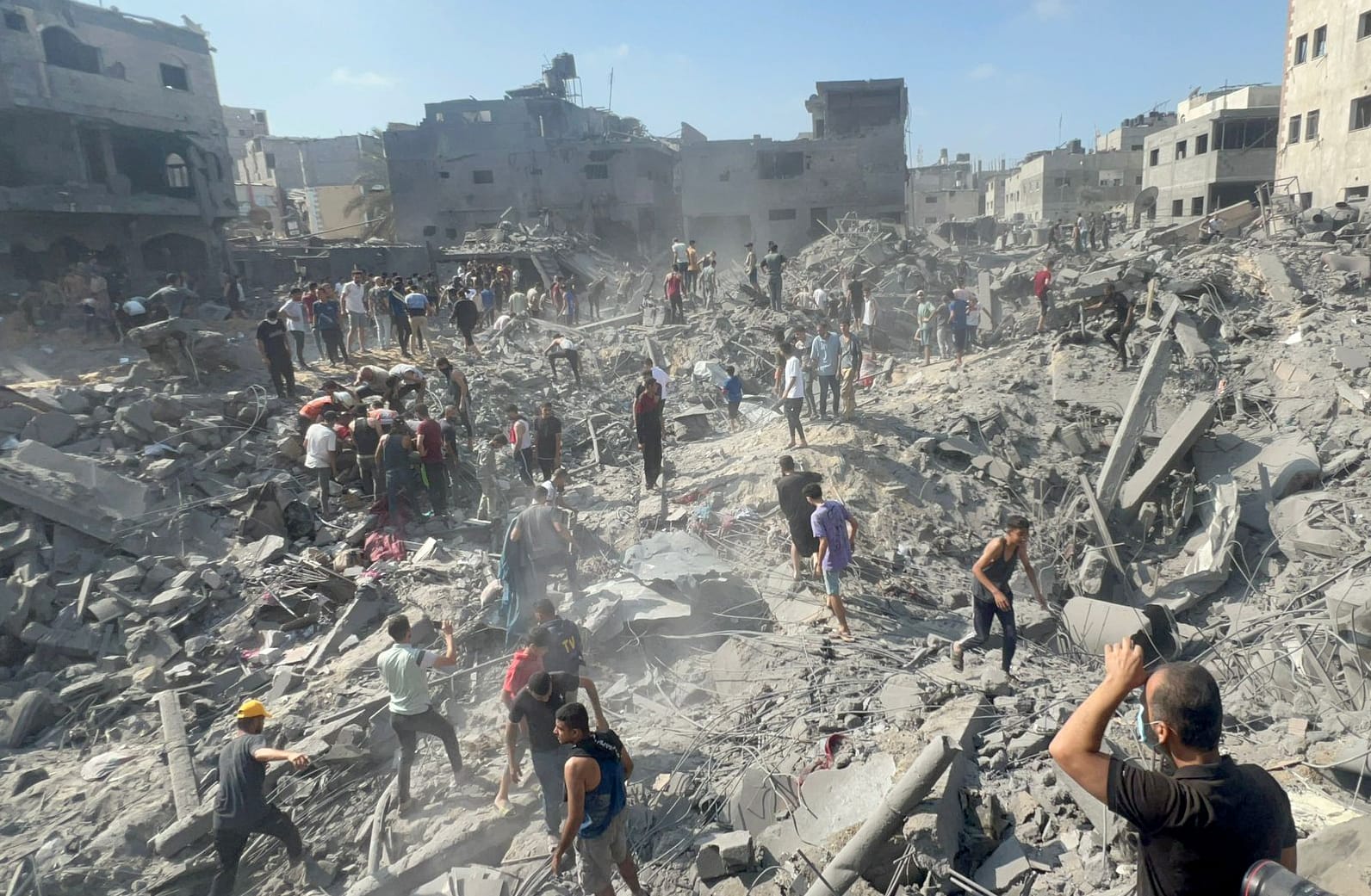
Palestinians conduct a search and rescue operation after the second bombardment of the Israeli army in 24 hours at Jabalya refugee camp in Gaza, on November 1, 2023\. Fadi Alwhidi/Anadolu via Getty Images
*In less than one month, Israel has dropped* [*more than*](https://euromedmonitor.org/en/article/5908/Israel-hit-Gaza-Strip-with-the-equivalent-of-two-nuclear-bombs) *25,000 tons of explosives on Gaza, demolishing the urban landscape and killing over 10,000 Palestinians. Given the sheer scale of violence and its leveling of homes, hospitals, schools and the civilians in them, the laws of war (also known as International Humanitarian Law, IHL) have become a renewed source of debate and scrutiny—most recently* [*following*](https://www.npr.org/2023/11/03/1198908980/is-israel-breaking-the-laws-of-war-in-gaza) *the bombing of the Jabalia refugee camp on October 31, in which Israeli airstrikes killed at least 50 people in* [*an attack*](https://www.reuters.com/world/middle-east/hamas-says-it-fires-israeli-troops-pressing-gaza-ground-assault-2023-10-31/) *that was allegedly targeting a single Hamas commander.*
*Writing in these pages in 2016, Lisa Hajjar noted Israel’s role as innovator when it comes to pushing the limits of international humanitarian law and challenging the law’s protections of civilians (the* [*article*](https://www.merip.org/israel-as-innovator-in-the-mainstreaming-of-extreme-violence/)*, from MER issue 279, is worth reading in full). At the time, Hajjar speculated that Israel’s new interpretations might alter legal norms, mainstreaming extreme state violence. The piece is important for moving beyond the question of whether violence is legal to underscore the unevenness of humanitarian law as powerful states maneuver within it. To discuss these and other facets of the law as it is being mobilized in Israel’s ongoing campaign on Gaza, MERIP’s managing editor, Marya Hannun, spoke to Neve Gordon, professor of international law and human rights at Queen Mary University in London and co-author (with Nicola Perugini) of* Human Shields: A History of People in the Line of Fire (University of California Press, 2020). *Their conversation has been edited for length and clarity.*
**Marya Hannun:** Before we get into the context of the October 7 Hamas attacks on Israel and the Israeli-declared war on Gaza that has followed, could you begin by talking about the basic differences between human rights law and the laws of war?
**Neve Gordon:** There are two bodies of law that in the popular conception are often conflated, but they are very different. One is human rights law. The other is humanitarian law—also known as laws of armed conflict or laws of war—which are all the same and refer to another body of law. Contrary to human rights law, which recognizes the right to life as a basic right, the laws of war allow killing of military targets.
The bedrock of international humanitarian law, or the laws of war, is the principle of distinction. This principle calls on warring parties to distinguish between civilians and combatants: It permits the targeting of combatants and military sites, and it protects civilians and civilian sites.
But in addition to a legal fiat regulating what is allowed and what is prohibited, one thing that I and many others before me have shown is how the laws of war produce a civilizational divide between those who ostensibly make distinctions and are cast as “civilized” and those who do not. If an individual or group does not recognize or abide by the principle of distinction then that person or group is cast as uncivilized or barbaric. In this way, the laws of war participate in a dehumanizing process of warring parties. Historically, those accused of barbarism have often been non-state actors. This divide often works according to the color line.
**Marya:** We’ve certainly seen that mobilized recently by the US administration under President Biden in his support of Israel’s ongoing bombing campaign—an us vs. them divide. On October 10, already three days into the campaign that had cut off fuel and electricity, and as Israel was actively killing civilians, the president remarked that unlike Hamas, “we \[Israel and the United States\] uphold the laws of war… It matters.”[\[1\]](#%5Fedn1)
> ...in the popular imagination it is conceived as limiting violence or regulating violence. But the laws of war also legitimize and morally justify violence and they can, at times, even facilitate violence.
**Neve:** Right. The law distinguishes between the civilized and uncivilized because in the popular imagination it is conceived as limiting violence or regulating violence. But the laws of war also legitimize and morally justify violence and they can, at times, even facilitate violence. If the other side is not abiding by the principle of distinction, turning them into ['barbarians](https://www.theatlantic.com/ideas/archive/2023/10/barbarism-israel-gaza-hamas-russia-war/675613/),' as many are now asserting Hamas are, then that provides a certain moral justification for unleashing violence against them.
**Marya:** Regarding the attacks by Hamas on Israeli military and civilian sites and the taking of more than 200 hostages and the relentless bombing campaign on Gaza, in which hospitals, schools and ambulances have been targeted, how are you seeing the laws of war being applied?
**Neve:** It is obvious to anyone who studies the laws of war that Hamas violated the principle of distinction on October 7 by targeting civilian populations through the use of heinous violence. These are clearly war crimes, and those responsible should be held accountable. It is also obvious that Israel has committed war crimes in Gaza since October 7: There is the collective punishment through the stopping of water and electricity, the compelled movement of populations and then the unleashing of eruptive violence that is killing thousands of civilians while destroying the very infrastructure of existence in the Gaza Strip.
But I think we can identify a change in how the Hebrew press has discussed the question of the laws of war since October 7, 2023\. This is the fifth round of intense bombing on Gaza since 2008, and in all of the previous rounds, it was very important for Israel to carry out legal acrobatics to prove that it was not committing war crimes—that it was abiding by the laws of war. Whether the international community and legal scholars abroad agreed or not is a different question. For example, in 2012 and 2014, as the fighting was still going on, Israel’s spokespeople used various legal arguments to justify bombing hospitals and killing civilians. While that is certainly happening now too, a different kind of refrain is voiced on Israeli TV and the Hebrew press. I’m seeing a regular claim that the law and the Supreme Court have been limiting and have not allowed Israel to go far enough, and that this time, we're not going to let the law hold us back. In English, I haven't seen this disregard for the law by Israel’s official commentators, but in Hebrew commentator after commentator is [saying](https://www.haaretz.co.il/opinions/2023-11-02/ty-article-opinion/.premium/0000018b-8aab-d35b-a5af-feeb08c00000) this. That is a difference.
> **Also Read: "**[**Israel as Innovator in the Mainstreaming of Extreme Violence**](https://www.merip.org/israel-as-innovator-in-the-mainstreaming-of-extreme-violence/)**"MER issue 279, Summer 2016.**
You also see a difference on the ground. In the past, there were usually warnings when the Israeli army was attacking residential buildings, which served a legal function. This was not done only or necessarily to save civilians—often, in the time between the so-called “[roof knock](https://www.merip.org/another-war-zone/)” warning and the time of the air strike, it was not possible for civilians, especially the sick or the disabled to move out of the house. So, it's clearly done also as part of a legal defense. In Israel’s bombing campaign following October 7, however, Israel has largely [dispensed](https://www.nytimes.com/2023/10/12/world/europe/israel-gaza-and-the-laws-of-war.html) with these warnings, except, at times, when striking hospitals. Israel perhaps realizes that hospitals have a different kind of symbolic value beyond their meaning as regular civilian safe spaces, which are also protected spaces according to international law. But it seems obvious that both on the ground and in Hebrew public discourse there is a difference in the current Israeli leadership’s relationship to international law.
**Marya:** Is this shift that you’re describing related to the recent judicial overhaul in Israel, in which Netanyahu’s government has been trying to push through legislation limiting the Supreme Court’s oversight?
**Neve:** Absolutely. The refrain that this has to be a war without the Supreme Court very clearly feeds into the desires of those pushing the judicial overhaul. Israel’s far right sees liberal law as a threat to what they want to accomplish. As an aside, it might be worth saying that the ultimate objective of Netanyahu’s government is to change the meaning of democracy. The judicial overhaul is part of an effort to undo the link between democracy and liberalism and to introduce the notion of apartheid democracy—namely, that a democracy can also be an apartheid regime.
**Marya:** But as you noted, there are still efforts to convince the international community that Israel is upholding the laws of war, and in English we’re seeing a lot of this discourse around questions of intentionality and proportionality. You’ve quoted a tweet by Israeli jurist Yaniv Roznai, published on October 24 telling readers to stop comparing the casualties between Israelis and Palestinians: “The death of civilians is awful. However, there is a huge difference between intentionally killing civilians—which is a prohibited war crime, and the unintentional and proportionate killing of civilians when attacking a military target, which the LOAC \[Laws of Armed Conflict\] allow. That’s the whole story. One side targets civilians and wants to kill as many civilians as possibe \[sic\] while the other does efforts and takes precautions to minimize civilian casaulties \[sic\] while striking legitimate military targets.”[\[2\]](#%5Fedn2)
Screen shot of the Tweet by Yaniv Roznai from October 24, 2023.
**Neve:** Let’s untangle this a bit. There are two legal ideas that are used here to suggest that even though Israel has killed many more civilians than Hamas did, it did not necessarily commit war crimes. Let’s begin by looking at intentionality. About a month ago, the American CBS news program 60 Minutes interviewed Shira Etting, an Israeli pilot who had been active in the protests against Netanyahu’s government.
“If you want pilots to be able to fly and shoot bombs and missiles into houses knowing they might be killing children,” she said, “they must have the strongest confidence in the \[politicians\] making those decisions.”[\[3\]](#%5Fedn3) Etting nowhere admits to any intention of killing children. Yet she does acknowledge that when she and her fellow pilots set off on a mission over Gaza, they understand that the missiles they fire may very well—and often do—end up killing noncombatants.
Intention and knowledge are different according to the laws of war, and therefore when pilots drop bombs, even if they know they are bombing one of the most densely populated places in the world and will kill many civilians by doing so, they have not necessarily carried out a war crime. In other words, if the pilots know they were killing civilians but did not intend to (whatever that might mean), other factors like the principles of proportionality and military necessity have to be weighed in order to determine if it was a war crime.
**Marya:** How does this relate to the principle of proportionality?
**Neve:** Many of these principles, and particularly the principle of proportionality, are very ambiguous, which leaves much room for interpretation. On the face of it, the principle is simple. It says that when one attacks a legitimate military target, the expected military advantage must outweigh the anticipated harm to civilians. There's a lot of things going on here.
> **...the current claims that Shifa and Al Quds hospitals are located on top of Hamas’s headquarters are preparing the public for attacks, testing the ground, while also preparing a legal defense based on proportionality and military necessity.**
First, what is the military advantage? That, of course, is open to interpretation and the side that wants to justify the attack can readily inflate the value of the military target. Following Israel’s bombing of densely populated residential buildings in Jabalia refugee camp on October 31, it [claimed](https://www.reuters.com/world/middle-east/hamas-says-it-fires-israeli-troops-pressing-gaza-ground-assault-2023-10-31/) that a formidable Hamas leader was hiding there, and now we hear that Hamas headquarters [are located](https://www.nytimes.com/2023/10/28/world/middleeast/gaza-al-shifa-hospital-israel.html) under Shifa hospital, which can be understood as a preemptive legal defense in case Israel decides to go ahead and bomb the hospital. The idea in both cases is to underscore that the value of the target is extremely high and therefore that Israel is abiding by the principle of proportionality even if many civilians die. Secondly, the value of the target is not weighed against the harm done to protected people and sites, it's weighed against the *anticipated* harm done. This then becomes the playground of lawyers. Those who want to justify the bombing argue that the target was legitimate, that its value was very high and that the number of civilians it anticipated would be killed was reasonable in comparison to the target's value. If many civilians were killed and it seems that harm caused by their death outweighs the military advantage, like the recent bombing in Jabalia refugee camp, the lawyers can argue that Israel did not anticipate such a level of harm. Accordingly, we need to understand that the current claims that Shifa and Al Quds hospitals are located on top of Hamas’s headquarters are preparing the public for attacks, testing the ground, while also preparing a legal defense based on proportionality and military necessity.
Simultaneously, we see here the mobilization of a civilizational discourse which characterizes the civilians who are killed and the civilian sites that are destroyed as “collateral damage.” It's a term I would not use, ever, except in quotation marks. It is a term used to render all those that were killed as statistics, as numbers, as people who do not have parents, or children or a family that cares for them; they have no relationships, aspirations and dreams. This is part of the [politics of grievability](https://www.versobooks.com/blogs/news/2339-judith-butler-precariousness-and-grievability) that distinguishes between people who are grievable and others who are not and ends up facilitating the deployment of violence.
**Marya:** Another IDF talking point [repeated](https://news.sky.com/video/hamas-uses-people-as-human-shields-says-us-secretary-of-state-antony-blinken-12982714) by US Secretary of State Antony Blinken [and](https://www.whitehouse.gov/briefing-room/speeches-remarks/2023/10/10/remarks-by-president-biden-on-the-terrorist-attacks-in-israel-2/) President Joe Biden in their support of Israeli aggression is that Hamas uses civilians as human shields. What legal work does this claim do?
**Neve:** Modern warfare in general but particularly in the context of Gaza is urban warfare. Gaza, as mentioned, is one of the most densely populated places in the world today, and half the population there are children. The laws of war were first developed when fighting typically occurred between two armies confronting each other in an open field. But what happens when the fighting is taking place in an urban context? And when one of the warring parties is a non-state actor in a situation of warfare that is so asymmetrical? This is a staggeringly asymmetric conflict: You have a nuclear power with access to the most advanced weapons in the world, the most advanced intelligence, and then you have the fighters who are using tunnels, machine guns, rockets and maybe some drones. The way they are going to hide is in city spaces since they have no chance to survive in open terrain. Now, the laws of war were not really created to deal with this kind of warfare. And yet, there's the principle of distinction. If the principle of distinction applies, and you have to distinguish between combatants and civilians, then those who want to bomb a city in order to kill combatants have to justify doing so, and they can justify it in a number of ways.
One way is to frame thousands of civilians as human shields. When a person in a battlefield is defined as a human shield—a vulnerable civilian body that willingly or not becomes a tool of warfare whose function is to render a military target immune—he or she loses some of the protections assigned to civilians by the laws of war and an ethical quandary surfaces. What many legal commentators say is that once a warring party uses human shields, lethal forms of violence that might otherwise be prohibited in a civilian setting can be used. There are limitations about killing human shields relating to the principles of proportionality, precaution and military necessity, but in general, one can cast whole populations as human shields and this relaxes the limits on the repertoires of lethal violence that can be used.
This has been playing out in Gaza both in relation to large populations and to hospitals, schools, universities and other protected sites. For instance, on October 13, Israel [instructed](https://www.aljazeera.com/news/2023/10/13/israel-orders-1-1-million-people-in-gaza-to-move-south-what-to-know) 1.1 million civilians to flee from the north to the south. Judging from the instructions soldiers received in 2014, Israel assumes that those who remain in the north are either civilians who are participating in hostilities and therefore can be killed according to the laws of war, or they are human shields, and therefore, the repertoires of violence can be relaxed and they too become killable subjects. What Israel can claim and will claim is that the deaths of all civilians killed in the north after it told them to leave are, legally speaking, the responsibility of Hamas because it used them as human shields.
Nicola Perugini and I have [shown](https://www.ucpress.edu/blog/52375/author-interview-neve-gordon-and-nicola-perugini-discuss-human-shields/) how hundreds of thousands of people have been framed as human shields in recent asymmetric wars between state and non-state actors in places like Mosul, Sri Lanka and Gaza. In these instances the human shield argument can be used to justify an elimination project. It's not being used to justify the killing of 20 civilians but to legitimize a Nakba-esque logic. These are instances in which the laws of war are mobilized to facilitate the use of lethal violence against civilian populations.
**Marya:** Since October 7, there have been a number of attacks on healthcare facilities in Gaza. 23 hospitals have received [evacuation](https://www.reuters.com/world/middle-east/gaza-hospital-evacuation-orders-put-hundreds-patients-risk-who-2023-11-02/#:~:text=%22Twenty%2Dthree%20hospitals%20have%20been,chief%20Tedros%20Adhanom%20Ghebreyesus%20said.) orders. Israel has targeted medical facilities in the past, if not at this scale. How does the shield argument get deployed here?
**Neve:** Perugini and I have studied the “hospital shield” argument quite extensively in several contexts. It is still not entirely clear who is responsible for the bombing of Al Ahli hospital on October 17, but hospital and health care facilities have been systematically bombed since October 7 and the attacks have increased to an unprecedented level in this round of fighting. As of October 30, the World Health Organization documented 82 attacks against medical units in the Gaza Strip. The attacks have so far affected 36 health care facilities (including 21 hospitals damaged) and 28 ambulances. 71 percent (51 of 72) of primary care facilities no longer function, while 12 out of 35 hospitals are not functioning due to damage from the bombing and/or lack of fuel, electricity or basic medicines, and these numbers continue to rise.[\[4\]](#%5Fedn4) This in itself has a clear eliminationist drive to it because hospitals are not only “protected sites,” they are a fundamental part of the infrastructure of existence, responsible for saving and sustaining the lives of Gaza’s inhabitants, including the sick and the wounded.
> **Medical lawfare. We coined this phrase to describe a strategy repeatedly deployed by the Israeli military and government to legitimize attacks on life-sustaining and saving infrastructures by shifting the blame for these attacks onto the Palestinians themselves**
How do human shields serve as justification for the attacks against medical units? The laws of armed conflict state that medical units “must be protected and respected in all circumstances.”[\[5\]](#%5Fedn5) But the law immediately qualifies this categorical injunction and introduces two exceptions in which a medical unit may lose its protections: if it shields combatants or harbors weapons and if it is located near a military target. Israel has exploited these exceptions and made them the rule. So, returning to Al Ahli, we saw an immediate—and one might even say reflexive—reaction sent on X (formerly Twitter) by Hananya Naftali, a social media influencer who has worked as a media adviser for Netanyahu, which reveals Israel’s playbook: Shortly after the news broke (in a since-deleted tweet), Naftali claimed Israel had “struck a Hamas terrorist base inside a hospital.”[\[6\]](#%5Fedn6) This is meant as a legal defense and is part of what Perugini and I call medical lawfare. We coined this phrase to describe a strategy repeatedly deployed by the Israeli military and government to legitimize attacks on life-sustaining and saving infrastructures by shifting the blame for these attacks onto the Palestinians themselves. All of the ingredients making up the medical lawfare argument are crystalized in Naftali’s tweet: lie about what actually happened; immediately blame the victim for the casualties and destruction by claiming the hospital was used as a shield; produce a civilizational divide by intimating the other side does not adhere to the principle of distinction; and emphasize this divide with terms like “heartbreaking” to suggest that Israel’s military cares about protecting Palestinian civilians. This kind of justification is by no means new and can be traced back to the way Israel justified the Nakba by shifting the blame from the perpetrator to the victim. As Edward Said observed, one of the main mechanisms through which Israel has concealed the human costs of its successes is through the dissemination of a series of myths that have cast the Palestinians as guilty for their own misfortunes. There is a whole trove of infographics that Israel has used in the past to blame Palestinians for Israel’s bombing of medical facilities. Israel’s military has a social media unit, who I assume are working with lawyers who tell them how to frame acts of violence in order to render them legal.
**Marya:** So to conclude, in light of this conversation, I am curious about your overall assessment of humanitarian law. Who do the laws of war ultimately benefit? Can they be an effective tool to protect people?
**Neve:** Can we trust the laws of war to protect people from state violence? I don't think we can. First, we need to keep in mind that the law knows no history and focuses solely on regulating the fighting. The context in which a war is taking place and particularly the asymmetry of power do not really matter. This narrow framing already puts the weak at a disadvantage when using the laws of war. Second, the laws of war have little if anything to say about structural violence and only deal with eruptive violence—violence that is agent-driven and deployed for a certain period of time before it recedes. We need to keep in mind that it could be the case that more people will die in Gaza in the aftermath of the war due to structural violence than those who have been and will be killed due to eruptive violence. The laws of war have nothing to say about that.
Third, it’s important to remember that the laws of war were created by state parties and were drafted to regulate violence between states. As international legal scholar Antony Anghie has shown us, the laws of war were always implicated within the imperial and colonial project and helped advance this project. The colonized were never conceived as a state party. The law helped cast them as barbarians, and when they resisted the colonizer, the laws of war were deemed inapplicable and the colonizer did not have to abide by them when repressing resistance. Non-state actors have a clear disadvantage in the international arena; they did not participate in the drafting of the 1949 Geneva Conventions, and therefore their views and interests are not necessarily articulated in the Conventions. The 1977 Additional Protocols to the Geneva Conventions were drafted after decolonization and included several state parties that had formerly been colonized. They managed to introduce a single clause that allows non-state actors to use arms when resisting colonial domination, alien occupation or racist regimes. But in a war between a state party and a non-state actor, the laws of war definitely favor state parties. Non-state combatants tend to be considered unlawful combatants and therefore lose the protections and rights bestowed on state combatants. Moreover, the laws in general benefit the strong. You can see that in the international arena in many ways—for example, the production of landmines is banned because they're indiscriminate. But landmines are also a cheap weapon. Nuclear weapons and large bombs that can kill 1,000 or several hundred civilians are not banned, even though they too are indiscriminate. The law also lags behind technological developments, so what we see now in war is how cutting-edge high-tech states can carry out large parts of their work remotely. They have surgical weapons, and they can always claim that they did not intend to kill. This muddies the issue of intentionality.
The law is the master’s tool, to use Audre Lorde’s framing, and you cannot use the master’s tools to destroy the master’s house. I therefore do not think they can be used as a tool of emancipation or liberation, but at the same time, war crimes and crimes against humanity still have cachet in public. The law matters in setting public opinion, which is what we're seeing now: It is less about their impact in a court of law and more about their impact in the court of public opinion. And in the court of public opinion the role of the laws of war is to produce the ethics of violence. They are used to frame the fighting and expose either the morality or immorality of the violence. In certain instances, then, we can definitely use them strategically to criticize forms of eruptive violence, and we might be able to influence the opinions of those in power, but to rely on them within legal forums is probably misguided.
---
### **Endnotes**
[\[1\]](#%5Fednref1) "[Remarks by President Biden on the Terrorist Attacks in Israel,"](https://www.whitehouse.gov/briefing-room/speeches-remarks/2023/10/10/remarks-by-president-biden-on-the-terrorist-attacks-in-israel-2/) Whitehouse Website, October 10, 2023.
[\[2\]](#%5Fednref2) Yaniv Roznai on X on October 24, 2023: https://x.com/roznaiy/status/1716862775832588474?s=20
[\[3\]](#%5Fednref3) Philip Weiss, “[’60 Minutes’ says Israeli pilots who kill Palestinian children are ‘moral’ defenders of ‘democracy,’](https://mondoweiss.net/2023/09/60-minutes-says-israeli-pilots-who-kill-palestinian-children-are-moral-defenders-of-democracy/)” *Mondoweiss,* September 18, 2023.
[\[4\]](#%5Fednref4) “[Hostilities in the Gaza Strip and Israel | Flash Update #25](https://ochaopt.org/content/hostilities-gaza-strip-and-israel-flash-update-25#:~:text=Since%207%20October%2C%2037%20health,killed%20and%20another%2030%20injured.),” OCHA Report, October 31, 2023.
[\[5\]](#%5Fednref5) “[Customary IHL-Rule 28\. Medical Units](https://ihl-databases.icrc.org/en/customary-ihl/v1/rule28),” International Committee of Red Cross.
[\[6\]](#%5Fednref6) "[Dispute over Gaza hospital strike: what we know](https://factcheck.afp.com/doc.afp.com.33YR32Z)," AFP, October 20, 2023.
### Orhan Veli's Poetry and the Struggle to Preserve Istanbul's Green Spaces
URL: https://www.merip.org/2023/11/orhan-velis-poetry-and-the-struggle-to-preserve-istanbuls-green-spaces/
Last updated: 2025-08-22T18:36:34.000Z
In late November 1999, the Austrian Broadcasting Corporation (ABC) aired a special episode of *The Listening Room* on the subject of Istanbul's soundscape.
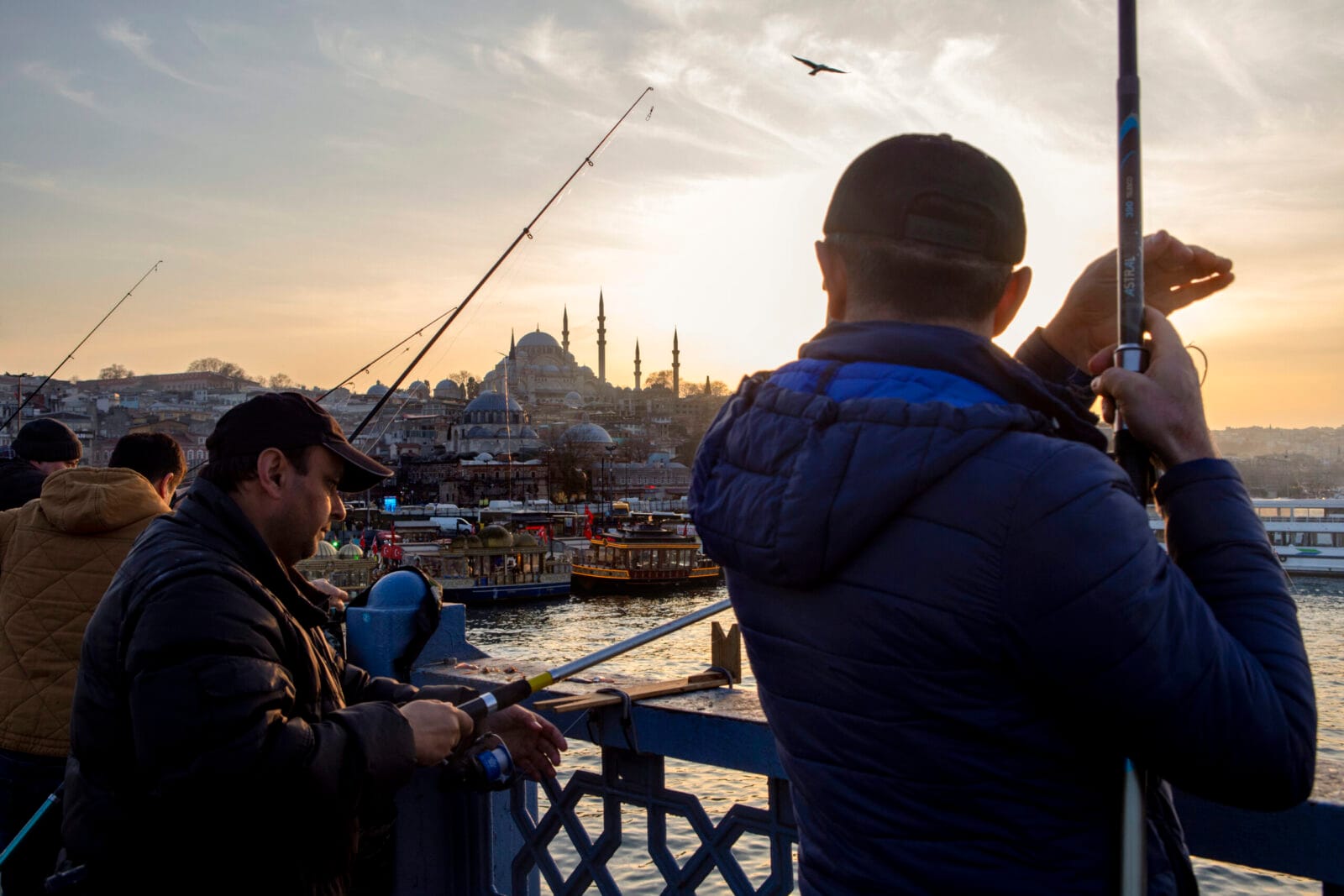
Turkish men supplement their income by fishing off Istanbul's Galata Bridge, which spans the Golden Horn waterway, with the 16th-century Ottoman Suleymaniye Mosque in the background. March 2023\. David Silverman/Getty Images
Correspondent Harvey Broadbent had traveled through Istanbul recording the call to prayer, the waves of the Bosporus, the bustling hallways of the Grand Bazaar, random street musicians and even the concerns of a dissident Turkish intellectual. The recordings were all taken on a single Sunday on the assumption that a weekend would allow local residents to be modestly contemplative. Interwoven with the eavesdropped sounds of Istanbul was a melancholic recitation of *Istanbul’u Dinliyorum* (“I am Listening to Istanbul”). The poem by Orhan Veli (1914–1950) is one of the Turkish language’s most enduring. The work is well known for its voyeurism and informal language that appealed to the near-universal love for the city. As George Messo's 2016 English translation renders it:
I'm listening to Istanbul, my eyes closed.
First a gentle breeze
Slowly swaying
Leaves on the trees,
Far off, very far off
The water seller's unceasing bells.
I'm listening to Istanbul, my eyes closed.[\[1\]](#%5Fedn1)
By anchoring all six stanzas with a corresponding urban recording, the episode was an admirable reflection on Istanbul's soundscape with brief digressions into the socio-political controversies of the 1990s. But the pairing of text and sound, perhaps unintentionally, also highlighted the radical transformation the city had experienced since Veli's lifetime. If “I am Listening to Istanbul” leans into the natural and urban sounds of metropolitan life—the presumed auditory veil for your average early republic pedestrian—Broadbent's episode was often overwhelmed with sounds of traffic and unidentifiable cacophony.
In the two decades since Broadbent’s recording, congestion has only intensified as a legion of small and large-scale government projects—some of which themselves claim to be in the name of Turkey’s green spaces—have collectively increased traffic and consumed the city’s nature. With October 29, 2023 marking the Turkish Republic’s 100-year anniversary, Veli’s voice endures as a persistent challenge to the city’s unfettered urbanization and commodification. “I am Listening to Istanbul” and Veli’s wider oeuvre preserve the memory of a metropolis at ease with nature.
## **Orhan Veli, the "Hedonist"**
Born in 1914, midway into the Second Constitutional Era, and educated during the early republic years of the 1920s and 1930s, Veli was raised in a politically turbulent yet intellectually experimental period. Various bureaucratic hegemons rose and fell, censorship laws relaxed and tightened and traditional ideologies publicly quarreled with state secularism. Meanwhile, European intellectual trends gradually permeated Turkish artistic discourse.
Poetry, Veli's object of devotion from a young age, also transformed with the times. Ottoman poetry had once been defined by traditional composition and perplexing metaphors, dealing with metaphysical observations that often involved panegyric proclamations or abstract commentaries on love. But with French modernism and nascent Turkish free verse making inroads, young poets like Veli began exploring a wider range of aesthetic expression, challenging the style, meter and topics of the literary establishment. To Veli and a group of like-minded contemporaries, traditional poetry also seemed aesthetically divorced from an average Turk's everyday sensory and emotional experience. In a controversial 1941 manifesto, they declared their intention to explore "people's tastes, to determine them, and to make them reign supreme over art."[\[2\]](#%5Fedn2) Veli aspired, through his verse, "to speak of and for the man in the street," as one biographer noted, inaugurating a new era in Turkish poetry.[\[3\]](#%5Fedn3) Veli’s short-lived literary career would later delve into personal existential concerns and reintroduce certain elements of traditional composition, but he continued to examine what he saw as the average Turk's sense of place until his untimely death in 1950.
> **To Veli and a group of like-minded contemporaries, traditional poetry also seemed aesthetically divorced from an average Turk's everyday sensory and emotional experience.**
It is not entirely clear why Veli became a scandalous self-appointed literary advocate for the working class. His irritation with the intellectual milieu did coincide with his exposure to the leftist politics of the socialist playwright Nazim Hikmet (1902–1963) and the short stories of Sait Faik Abasiyanik (1906–1954) that explored the harsh realities of the Turkish underclass. But Veli was rarely overtly political, nor did he demonstrate an abiding interest in highlighting brutal working conditions or unemployment hopelessness. Rather, much of his poetry was grounded in the monotony of urban life. He was admittedly an educated “hedonist,” as he once referred to himself, largely isolated from the socio-economic conditions of the working-class.[\[4\]](#%5Fedn4) But much of his poetry seems to reference aspects of their lives he could empathize with. As a result, Veli's corpus is brimming with household chores, brushes with love, gossip, alienation and, of course, the experience of traversing a metropolitan landscape teeming with nature. The second and third stanzas of “I am listening to Istanbul” are particularly interested in a pedestrian's irregular yet panoramic view of Istanbul's urban scenery:
I'm listening to Istanbul, my eyes closed.
Birds are passing by,
High up, in flocks, screeching,
Nets are being drawn from fish traps,
A woman dips her feet in water
I'm listening to Istanbul, my eyes closed.
I’m listening to Istanbul, my eyes closed.
The cool air of the Grand Bazaar,
The bustle of Mahmutpaşa,
Courtyards full of pigeons,
Hammer blows from dockyards,
Smell of sweat in a sweet summer breeze.
I’m listening to Istanbul, my eyes closed.
## **Istanbul’s Urban Transformation**
In the late Ottoman and early years of the Republic, Istanbul’s lush green spaces enveloped a typical resident's weekly routine. While individual households tended to small gardens, local farming enclosures known as *bostan* grew an assortment of fruits, vegetables and nuts for their local communities. Often managed by Istanbul's minority communities—Bulgarian, Albanian, Armenian—each region's soil and climate yielded unique produce. The famous Yedikule *bostan* that once ran along the city's western walls produced soft and fatty lettuce. Arnavutköy—a rural neighborhood locals affectionately referred to as “the hill”—was famous for its extremely fragrant pink strawberries, while gardens from the north yielded Kavak figs with thin edible skins. Natural springs, artificial fountains, mosque wells and tall cypress trees randomly dotted individual neighborhoods in conjunction with the natural topography.
European artificial grids were quite rare in most Turkish cities. It seems unimaginable now, but certain districts were also defined by their vast plots of greenery that often seeped into the banks of the Bosphorus, used by locals as informal recreational spaces. The banks themselves were full of meadows alongside parks, gardens and cemeteries, giving the impression that the city was submerged in large pockets of groves. Formal public parks with panoramic views and German-designed imperial gardens filled with exotic trees, sculptures, pools and bird baths, led one Iranian traveler to refer to the city as a "second Paris."[\[5\]](#%5Fedn5)
By the time Broadbent was recording the sounds of Istanbul, the city had undergone a series of drastic urban transformations that completely reshaped its landscape and soundscape. Intense industrialization following World War II led to decades of rural-urban migration, rapidly accelerating the city's population density. Due to government corruption and negligence, migrants were forced to build densely packed and poorly constructed shacks known as *gecekondus* on the outskirts of the city. Simultaneously, from the 1950s onward, buildings and green spaces were torn down to build new roads or widen existing ones to accommodate, if not encourage, the use of motor vehicles. “Let traffic flow like water" became a popular infrastructure slogan, as a city of 20,000 vehicles in the late 1940s ballooned into a modernizing metropolis of over 100,000 by 1960.[\[6\]](#%5Fedn6)
The rapid globalization and privatization of the 1980s ushered in a new era of large-scale construction and gentrification that aggressively pushed Istanbul's green space to the city's periphery. The municipal government prioritized the construction of high-rise offices over affordable housing. Traffic jams were routine and Istanbul’s population exploded. Between 1980 and 1985, Istanbul’s residents doubled from 3 to 6 million, and by the time Recep Tayyip Erdoğan first became Prime Minister in 2003, the population had reached nearly 12 million.
> **Also Read: "[The Destructive Dreams of AKP Urbanism](https://www.merip.org/the-destructive-dreams-of-akp-urbanism/)"MER issue 287, Summer 2018.**
These trends have only intensified during Erdoğan’s tenure as head of state. By the 2000s, public land had been largely commodified after decades of unresolved complications related to titles, title deeds, inheritance and cadastral operations, allowing Erdoğan’s newly empowered Justice and Development Party (AKP) to push for an even more aggressive top-down market economy.[\[7\]](#%5Fedn7) Development initiatives included everything from the controversial Housing Development Administration (TOKI) from the 2000s onward, which forced multiple working-class families out of their residential spaces, to a government plan that aimed to build an Ottoman-style barracks and shopping mall over a prominent park—a failed venture that initiated the 2013 Gezi Park protests. Subsequent megaprojects, such as the construction of the Yavuz Sultan Selim Bridge (2016), the new Istanbul Airport (2018) and the ongoing Istanbul Canal project, have further endangered, if not jeopardized, Istanbul's northern forestry and water basin.
Even before the construction of these megaprojects, the [World Cities Culture Forum](http://www.worldcitiescultureforum.com/data/of-public-green-space-parks-and-gardens) concluded in 2015 that Istanbul maintained only 2.2 percent of its green space, falling far below London (33 percent) and trailing the much criticized urban development of Tokyo, which retains 7.5 percent of its green space. A 2020 report by the [Istanbul Planning Agency](https://www.cumhuriyet.com.tr/haber/ibbnin-hazirladigi-raporda-istanbula-iliskin-carpici-tespitler-yer-aldi-ne-orman-var-ne-kiyi-1763040) estimated accessible green space in Istanbul to be a mere 2.67 square meters per person. The [TomTom Traffic Index](https://www.duvarenglish.com/istanbul-becomes-most-congested-city-in-the-world-in-2021-news-60433) has recently deemed the metropolis the most congested in the world, and recent surveys by Pinar Yelmi—who curates a website dedicated to [Istanbul’s urban soundscape](https://soundsslike.com/)—suggest most Istanbul residents associate it with traffic, crowds and construction.[\[8\]](#%5Fedn8)
For caretakers of the few remaining *bostans*, Istanbul's rapid urbanization is existential, threatening their livelihoods and decades of agricultural knowledge. Whether they are recent immigrants from the Black Sea province of Kastamonu or ethnic minorities still toiling on the lands of their ancestors, these gardeners take great pride in specialized techniques that factor in each region's soil and climate. Almost 20 years ago, geologist Paul J. Kaldjian conducted interviews with Istanbul’s gardeners. One, named Cafer, told him, “The most important thing is that there shouldn't be any construction in the places that are good for agriculture.” Another, Yaşar, echoed this sentiment: “Building is good, but you shouldn't destroy the landscape."[\[9\]](#%5Fedn9)
> **In 2016, one city official referred to gardening activities as "visual pollution that can be seen by anyone passing by,” in order to justify the construction of new recreational spaces, often on top of these ancient gardens.**
During the past decade, what remains of the Yedikule *bostans* has been targeted for development by the AKP and municipal governments. In 2016, one city official referred to gardening activities as "visual pollution that can be seen by anyone passing by,” in order to justify the construction of new recreational spaces, often on top of these ancient gardens.[\[10\]](#%5Fedn10) In June of 2018, when running for reelection, Erdoğan began to tout his own set of green development projects, including plans to establish new, curated public green spaces, or *millet bahçeleri* (people’s parks)—a deliberate reference to Istanbul’s first official parks of the late Ottoman period. In a ceremony accompanying the establishment of five new gardens in December of 2018, Erdoğan harkened back to Gezi, "those who wreck and destroy in the name of environmentalism, the perpetrators of Gezi events...should check out these gardens of the nation and see what real environmentalism is."[\[11\] ](#%5Fedn11)Even with the election of opposition mayor Ekrem İmamoğlu in 2019, which reprioritized Istanbul to construct parks that could function as emergency shelters and pushed back against the creation of these *millet bahçeleri*, Erdoğan's hold on the presidency has allowed the AKP's green initiatives to continue.
In response, urban activists and local farmers—who describe the new parks as over-curated and hyper-regulated—have developed a phrase known as [*yaşam alanı*](https://www.jadaliyya.com/Details/32233) (life space). Connoting urban areas that provide refuge from both commodification and hyper-development, the term gained noticeable traction during the 2013 Gezi Protests, quickly establishing itself as a popular slogan for Turkish environmentalism. Professional organizations such as the Union of Chambers of Turkish Engineers and Architects (Türk Mühendis ve Mimar Odaları Birliği, or TMMOB) have adopted the expression, framing it as an alternative to a system that “turns cities and the nature surrounding them” into marketable goods.[\[12\]](#%5Fedn12)
## **Nostalgia for the Past**
Read while contemplating a contemporary Istanbul overwhelmed with concrete and cacophony, much of Veli's poetry seems to unassumingly present nature as bleeding into the urban. For example, his 1949 poem, "For Free," is undergirded by a structure that leads our eyes from the air and clouds to the valleys and hills, through the rain and mud and finally to car bodies, cinema doors and display windows. This interwoven urban-nature backdrop, which works to draw attention to the poverty and lack of political freedom of the early republic, seems almost frisky:
We're living for free, for free;
Air is free, clouds are free
Valleys and hills are free;
Rain and mud are for free;
Car bodies
Cinema doors
Display windows are free;
Not so for bread and cheese
But saltwater's free;
Freedom costs you your head;
Slavery is free;
We're living for free, for free.
Viewed through the lens of the city’s hundreds of displaced working-class residents, *bostan* gardeners or the memories of an earlier urban landscape, the poem is somber. But when contemplating the strain of Istanbul's current food inflation rate, or pressure of the Directorate of Communications, which controls roughly 90 percent of newsrooms and suppresses oppositional media, Veli's words are almost prophetic.
In his famous "Galata Bridge," a reference to the then-beloved floating bridge in Istanbul, Veli goes a step further. According to Ian Almond, the largely "secular" poet exhibits a Sufi-inspired "urban pantheism," where Istanbul itself resides in the various facets of urban life:[\[13\]](#%5Fedn13)
Planted on Galata Bridge
I happily watch you all.
Some are pulling on oars,
Some scrape mussels off pontoons,
Some hold the rudders of barges,
Some are coiling ropes,
Some are birds, flying, like poems,
Some are fish, glittering
Some are ferries, some are buoys,
Some are clouds up high
...
But all of them are you, you...
Busy with the pull and thrust of life.
Am I the only hedonist here?
As Veli strolls along the famed Galata Bridge, he peers into the seemingly mundane and overlooked segments of the city—workers, birds, boats, clouds—observing them as manifestations of the city itself: "But all of them are you, you..." One doesn't have to subscribe to his metaphysical outlook to appreciate the fact Istanbul was once a city where its inhabitants drank from springs, bought produce from the local *bostan*, sought blessings from Sufi shrines and labored along the banks of the Bosphorus.
> **Despite the dwindling green space and increasing urban clamor, Istanbul is still a city whose inhabitants seek to indulge in their natural surroundings, evidenced by communal efforts to maintain urban gardens and individual attempts to find refuge from the obtrusive sounds of the city.**
Despite the dwindling green space and increasing urban clamor, Istanbul is still a city whose inhabitants seek to indulge in their natural surroundings, evidenced by communal efforts to maintain urban gardens and individual attempts to find refuge from the obtrusive sounds of the city. Older locals still remember the taste of Arnavutköy strawberries and Kavak figs, while musicians such as [Emre Yucelen](https://www.middleeasteye.net/fr/node/66292.) record less urbanized parts of the city for personal relaxation and meditation. Recitations of “I am Listening to Istanbul” itself [can be heard from the Aşiyan Asri Cemetery](https://www.guernicamag.com/the-road-to-alpullu/), a stunning green space known for its view of the Bosphorus. It also happens to be the burial ground where Veli and other literary luminaries have been laid to rest.
Urban development itself also seems to be losing support. When asked in a [2020 Istanbul Metropolitan Municipality survey](https://bianet.org/bianet/ekoloji/229925-istanbullularin-64-2-si-kanal-istanbul-u-desteklemiyo), “Who do you think needs the Istanbul Canal Project?” 62.3 percent of respondents replied either land speculators, construction companies or the government’s lenders, while only 35 percent responded with “the people of Istanbul.”[\[14\]](#%5Fedn14)
It would be a mistake to romanticize Veli’s Istanbul. Class, ethnic and gender segregation were often enforced in late Ottoman/early republican parks, and there were legitimate crime-related concerns when it came to unregulated recreational areas. The socio-political instability of the early republican period also witnessed the involuntary flight of Istanbul's minority population, resulting in the state's expropriation of their properties and the weakening of each community's respective political clout. The construction of modern green spaces such as the famed Gezi Park was possible in part because Istanbul's municipality of the 1930s was able to force the Armenian Patriarchate to relinquish its claim on an ancient cemetery. Yet, Veli's poetry upholds an aesthetic, if not moral, commitment that elevates the perspective of an average Istanbul resident, making their tastes “reign supreme.” By defining Istanbul as urban life bleeding into nature, “I am Listening to Istanbul” and his other poems have helped preserve a sensibility that continues to push up against the concrete and cacophony.
\[**Niels Lee** holds an MA in Religion from Yale University, where Lee studied Ottoman history and religion.\]
---
### **Endnotes**
[\[1\]](#%5Fednref1) All of Veli's poems are from Messo's translation. Orhan Veli, "I'm listening to Istanbul" in George Messo, trans. and ed. *Orhan Veli: Complete Poems* (Bristol: Shearsman Books, 2016), pp. 105–106.
[\[2\]](#%5Fednref2) Talat S. Halman, "'I am listening to Istanbul': Orhan Veli Kanik," in Jayne L. Warner, ed. *Rapture and Revolution: Essays on Turkish Literature* (Syracuse: Syracuse University Press, 2007), p. 343.
[\[3\]](#%5Fednref3) Ibid., p. 345.
[\[4\]](#%5Fednref4) Orhan Veli, "Galata Bridge" in George Messo, trans. and ed. *Orhan Veli: Complete Poems*. (Bristol: Shearsman Books, 2016), p. 108.
[\[5\]](#%5Fednref5) Güllü Yıldız, "Gardens of Istanbul in Persian hajj travelogues," in Ines Aščerić-Todd, Sabina Knees, Janet Starkey and Paul Starkey, eds. *Travellers in Ottoman Lands: The Botanical Legacy* (Oxford: Archaeopress Publishing, 2018), pp. 60–66.
[\[6\]](#%5Fednref6) Elvan Altan Ergut, İpek Yada Akpınar, and Zafer Akay, ["Architecture in Istanbul in the Republican Period,"](https://istanbultarihi.ist/716-architecture-in-istanbul-in-the-republican-period.) *History of Istanbul*, 2019.
[\[7\]](#%5Fednref7) Umut Z. Türem, “The State of Property: From the Empire to the Neoliberal Republic,” in Fikret Adaman, Murat Arsel, and Bengi Akbulut, eds. *Neoliberal Turkey and its Discontents* (London, New York: IB Tauris, 2017), pp. 29–36.
[\[8\]](#%5Fednref8) Pinar Yelmi, "The Soundscape of Istanbul: Exploring the Public Awareness of Urban Sounds," *International Journal of Social Science and Humanity* 7/5 (May 2017), p. 260–268.
[\[9\]](#%5Fednref9) Paul J. Kaldjian, "Istanbul's Bostans: A Millennium of Market Gardens," *Geographical Review* 94/3 (July 2004), p. 287.
[\[10\]](#%5Fednref10) Stephen Starr, ["Shadow of progress falls on Istanbul's historic vegetable gardens,"](https://www.reuters.com/article/us-turkey-istanbul-landrights-feature/shadow-of-progress-falls-on-istanbuls-historic-vegetable-gardens-idUSKBN16M20N) *Reuters*, March 15, 2017.
[\[11\]](#%5Fednref11) Sinan Erensü, Barış İne, and Yaşar Adnan Adanalı, “From the Occupied Parks to the Gardens of the Nation: Politics and Aesthetics of Urban Greenery in the Post-Gezi Istanbul”, *Social Text* 40/1 (March 2022), pp. 116.
[\[12\]](#%5Fednref12) [“‘Çevre Mücadelesi’ Küresel Ölçekte ‘Yaşam Alanı Mücadelesi’dir,”](http://www.spo.org.tr/genel/bizden%5Fdetay.php?kod=6768) TMMOB Chamber of City Planners, June 5, 2015.
[\[13\]](#%5Fednref13) Ian Almond, "Sufism, Secularism and Communism in Modem Turkish Poetry: The Persistence of the Mystical in the Work of Nazim Hikmet and Orhan Veli," *Journal of Turkish Literature* 11 (2014), pp. 45–49.
[\[14\]](#%5Fednref14) “[64.2 percent of İstanbulites do not support canal project, shows survey](https://bianet.org/haber/64-2-percent-of-istanbulites-do-not-support-canal-project-shows-survey-229938),” *Bianet*, August, 31, 2020.
### Palestinian Trade Unions Call for an End to Arming Israel
URL: https://www.merip.org/2023/10/palestinian-trade-unions-call-for-an-end-to-arming-israel/
Last updated: 2025-07-30T04:05:56.000Z
On Monday October 16, 2023, Palestinian trade unions [released](https://twitter.com/workersinpales1/status/1713908923848130880?s=46&t=E%5F0Syf7evT947IEXmC-ggA) an urgent call for international trade unions to take action to halt the arms trade to Israel. The call comes amid a ruthless bombing campaign of Gaza, following Hamas’ October 7 offensive into Israel, and as Israel prepares for a ground invasion into the territory.
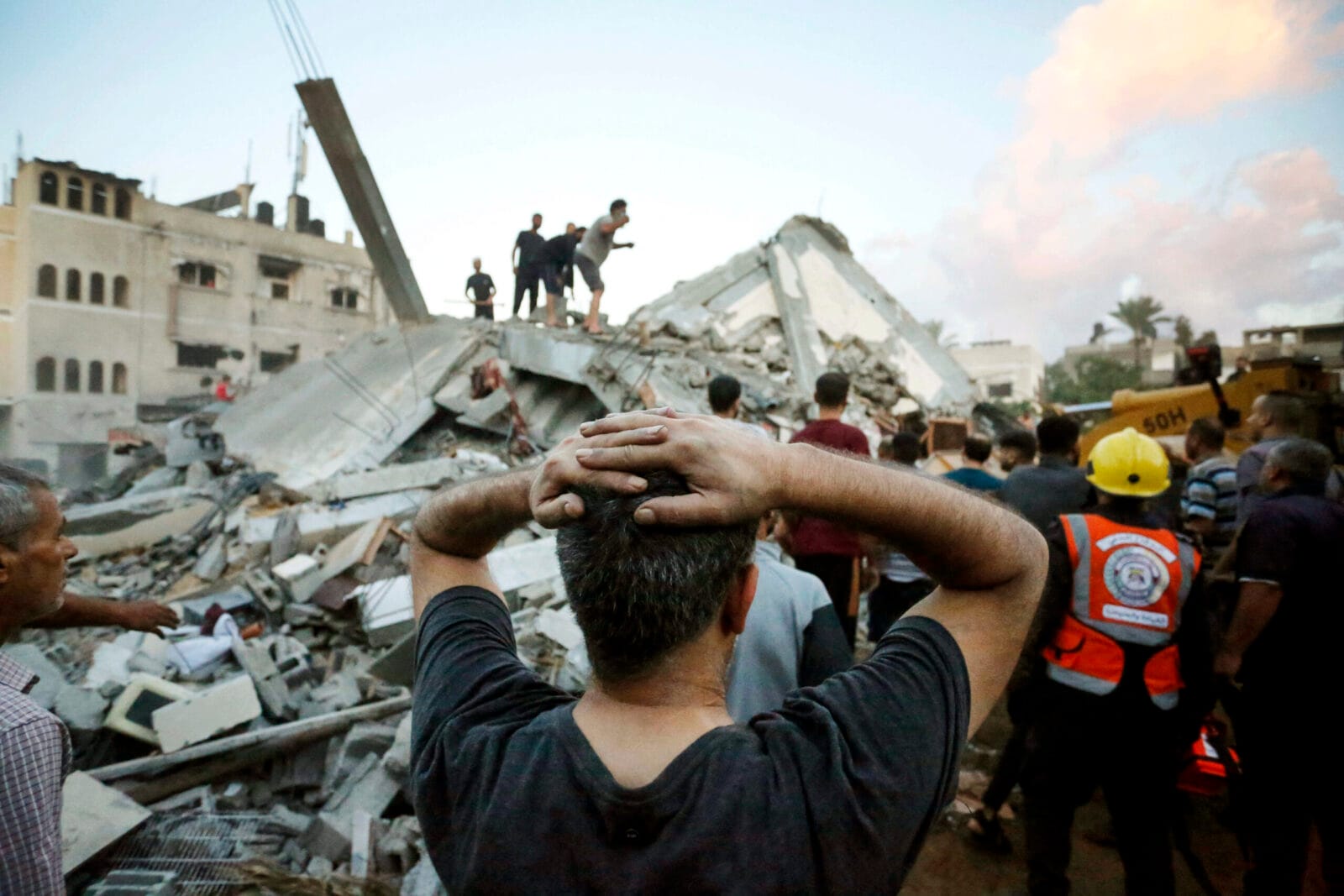
A man reacts as he watches rescuers and civilians remove the rubble of a home destroyed following an Israeli attack on the town of Deir Al-Balah, in the central Gaza Strip, on October 15, 2023\. Mohammed Faeq/AFP via Getty Images
In the week following October 7, the full force of the Israeli military-industrial apparatus was put on display. Over just six days, Israel dropped more than 6,000 bombs onto Gaza. Human Rights Watch [verified](https://www.hrw.org/news/2023/10/12/israel-white-phosphorus-used-gaza-lebanon) videos documenting Israel’s use of the lethal chemical white phosphorous in Gaza and Southern Lebanon. Meanwhile, Israel’s far-right National Security Minister Itamar Ben-Gvir[ announced](https://www.middleeastmonitor.com/20231011-far-right-israel-mk-to-distribute-10000-rifles-to-settlers/) the ministry was purchasing 10,000 rifles, body armor and helmets to distribute to settler militias for use in the West Bank.
As Israeli politicians called for retaliation, using genocidal language that likened Gazans to “human animals,” leaders in Britain and the United States in the week following October 7, dispensed with even the fig leaf of “restraint” that usually accompanies Israeli bombing campaigns of Gaza.[\[1\]](#%5Fedn1) The United States, in addition to[ dispatching](https://apnews.com/article/israel-hamas-military-navy-carrier-e648c53dc53a46e2e12950784ea5e8d2) two aircraft carriers laden with F-18 fighter jets to the region has instructed US defense companies to expedite munitions to Israel, causing an immediate $30 billion[ surge](https://www.forbes.com/sites/dereksaul/2023/10/11/us-defense-stocks-surge-nearly-30-billion-after-hamas-attack-dont-count-on-it-lasting-analysts-say/?sh=ec956e3100ee) in US defense stocks.
During the May 2021 Unity Intifada, a collective of Palestinian trade unions [called](https://twitter.com/workersinpales1/status/1396034862432260099?s=46&t=79hwzWYljz2wrmrnb8MpTA) for international solidarity from international unions, urging them to divest their pensions from companies implicated in the occupation and release statements of solidarity. The latest call—which is reprinted in full below—focuses on the weapons industry and infrastructure of the blockade and occupation.
## **'An Urgent Call from Palestinian Trade Unions—End all Complicity, Stop Arming Israel'**
Graphic designed during the Unity Intifada in May 2021, courtesy of Workers in Palestine.
Israel has demanded that 1.1 million Palestinians evacuate the northern half of Gaza, whilst subjecting them to constant bombardment. This ruthless move is part of Israel’s plan, backed by unwavering support and active participation from the US and majority of European states, to carry out unprecedented and heinous massacres against 2.3 million Palestinians in Gaza and to ethnically cleanse it altogether. Since Saturday Israel has indiscriminately and intensively bombarded Gaza, and cut off fuel, electricity, water, food, and medical supplies. Israel has killed more than 2,600 Palestinians—including 724 children—leveling whole neighbourhoods, wiping out entire families and injuring more than 10,000 people. Some international law experts have begun warning of Israel’s genocidal acts.
Elsewhere, Israel’s far-right government has distributed more than 10,000 rifles to extremist settlers in ‘48 Palestine and the occupied West Bank to facilitate their escalating attacks and pogroms against Palestinians. Israel’s actions, massacres, and rhetoric point to its intention to implement its long promised second Nakba, expelling as many Palestinians as possible and creating a ‘New Middle East’ in which Palestinians live in perpetual subjugation.
The response by Western states has been one of complete and total support for the State of Israel, without even a cursory nod towards international law. This has amplified Israel impunity, giving it carte blanche to carry out its genocidal war without limit. Beyond diplomatic support, Western states are supplying Israel with armament, sanctioning the operation of Israeli weapons companies within their borders.
As Israel escalates its military campaign, ***Palestinian trade unions call on our counterparts internationally and all people of conscience to end all forms of complicity with Israel’s crimes—most urgently halting the arms trade with Israel, as well as all funding and military research.*** The time for action is now—Palestinian lives hang in the balance.
This urgent, genocidal situation can only be prevented by a mass increase of global solidarity with the people of Palestine and that can restrain the Israeli war machine. We need you to take immediate action—wherever you are in the world—to prevent the arming of the Israeli state and the companies involved in the infrastructure of the blockade. We take inspiration from previous mobilisations by trade unions in Italy, South Africa and the United States, and similar international mobilisations against the Italian invasion of Ethiopia in the 1930s, the fascist dictatorship in Chile in the 1970s and elsewhere where global solidarity limited the extent of colonial brutality.
**We are calling on trade unions in relevant industries:**
1. To refuse to build weapons destined for Israel.
2. To refuse to transport weapons to Israel.
3. To pass motions in their trade union to this effect.
4. To take action against complicit companies involved in implementing Israel’s brutal and illegal siege, especially if they have contracts with your institution.
5. Pressure governments to stop all military trade with Israel, and in the case of the US, funding to it.
We make this call as we see attempts to ban and silence all forms of solidarity with the Palestinian people. We ask you to speak out and take action in the face of injustice as trade unions have done historically. We make this call in the belief that the struggle for Palestinian justice and liberation is not only a regionally and globally determined struggle. It is a lever for the liberation of all dispossessed and exploited people of the world.
**Palestinian General Federation of Trade Unions, Gaza.**
General Union of Public Service and Trade Workers
General Union of Municipal Workers
General Union of Kindergarten Workers
General Union of Petrochemicals Workers
General Union of Agricultural Workers
Union of Palestinian Women’s Committees Generation
Union of Media and Print Workers
**Palestinian General Federation of Trade Unions (PGFTU)**
**General Union of Palestinian Teachers**
**General Union of Palestinian Women**
**General Union of Palestinian Engineers**
**Palestinian Accountants’ Association**
**Professional Associations Federation including:**
Palestinian Dental Association—Jerusalem center
Palestinian Pharmacists Association—Jerusalem Center
Medical Association—Jerusalem Center
Engineers Association—Jerusalem Center
Agricultural Engineers Association—Jerusalem Center
Veterinarians Syndicate—Jerusalem Branch.
**Palestinian Journalists’ Syndicate**
**Palestinian Bar Association**
**Palestinian Nursing and Midwifery Association**
**Union of Kindergartens Workers**
**Palestinian Postal Services Workers Union**
**Federation of Unions of Palestinian Universities Professors & Employees**
**The General Federation of Independent Trade Unions, Palestine**
**The Palestine New Federation of Trade Unions**
**Palestinian General Union of Writers**
**Palestinian Contractors Union**
**Federation of Health Professionals Syndicates**
**Palestinian Union of Psychologists and Social Workers**
---
### Endnotes
[\[1\]](#%5Fednref1) Alice Speri, “[Israel Responds to Hamas Crimes by Ordering Mass War Crimes in Gaza](https://theintercept.com/2023/10/09/israel-hamas-war-crimes-palestinians/)," *The Intercept*, October 9, 2023.
### A Day as Ordinary as Any Other
URL: https://www.merip.org/2023/10/a-day-as-ordinary-as-any-other/
Last updated: 2025-08-22T18:36:35.000Z
**A Review of Nathan Thrall, *A Day in the Life of Abed Salama: Anatomy of a Jerusalem Tragedy* (Metropolitan Books, 2023)**
On a “cold, wet, and dreary day” in February 2012, a jack-knifed semi-trailer truck collided with a school bus carrying small children on the Jaba road, encircling the Palestinian city of the same name.
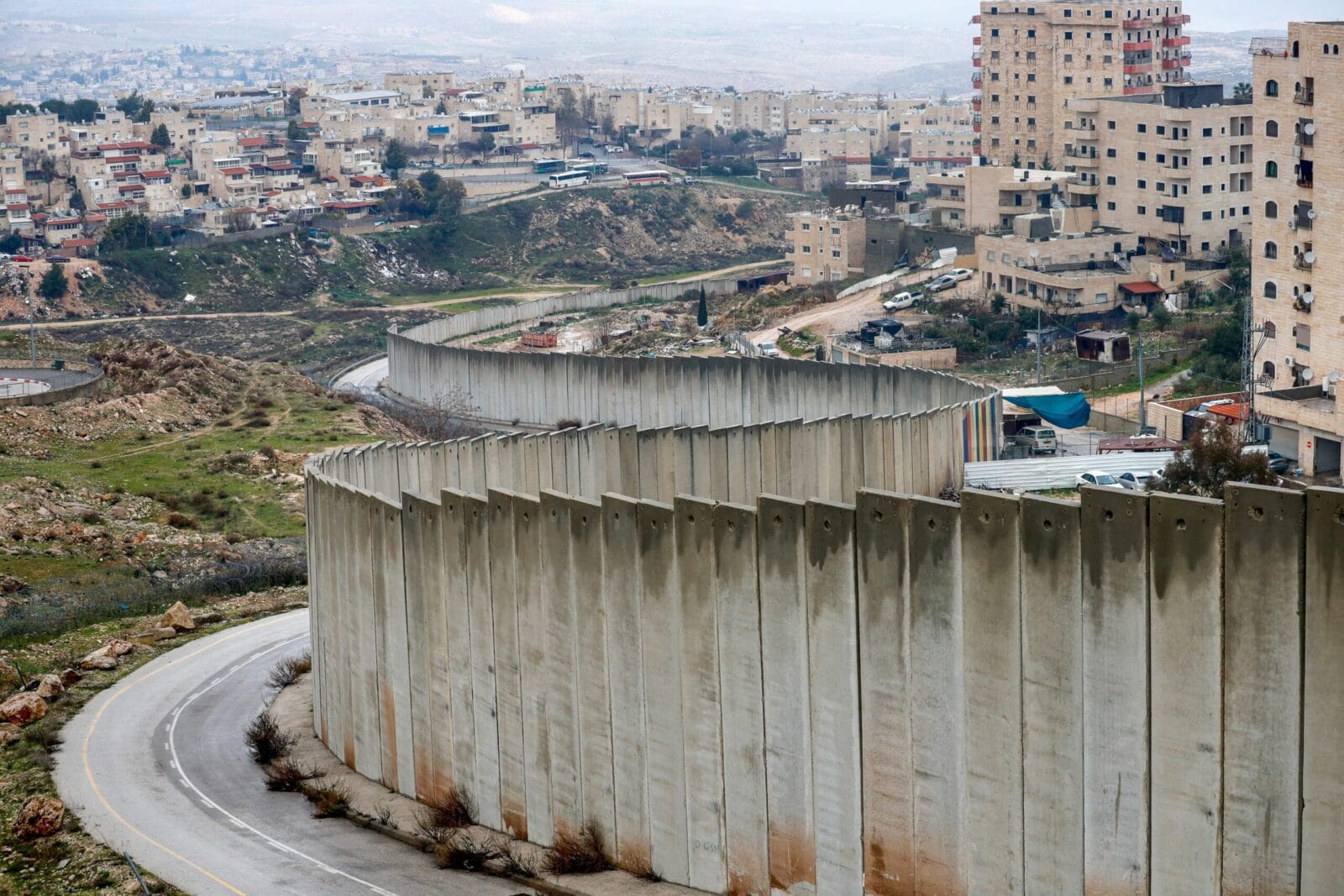
The Israeli settlement of Pisgat Zeev (L), built in a suburb of East Jerusalem, and the Palestinian Shuafat refugee camp (R) behind Israel's separation wall, 2020\. Ahmad Gharabli/AFP via Getty Images
Originally a “bypass” road for Jewish settlers wanting to avoid Palestinian roads and populated areas, the Jaba road has become a vital throughway for Palestinians between the West Bank and Jerusalem after Israel built a bigger and better settler bypass. It winds its way just outside the Jerusalem municipal boundaries in what is known, under the Oslo Accords, as Area C—the 61 percent of the West Bank over which Israel has full control. As such, it falls under the jurisdiction of the Israeli traffic police and emergency services as well as the Israeli army. The Palestinian Authority, which nominally governs the West Bank, and its police and emergency services have no right of access to Area C without explicit permission from the Israeli military authorities.
The horrific accident, and the circumstances surrounding it, form the substance of Nathan Thrall’s new book, *A Day in the Life of Abed Salama,* named for the father of one of the children involved in the accident. The book (published October 3 by Metropolitan Books) is an elaboration of his much-lauded 2021 piece in *The New York Review of Books*. The full-length treatment, which is based on later, additional interviews with Abed Salama, his relatives and first-responders and takes instructive context-setting detours into the history of violence against Palestinians, is more ambitious and more clarifying. Thrall pulls off the difficult trick of distilling the extended tragedy of the Israeli occupation into this horrific event, compelling the large readership this book will likely generate, to reflect on the moral cost of our collective responsibility in allowing this indefensible situation to continue unabated.
“At rush hour, the Jaba road was clogged with a long line of Palestinian buses, trucks, and cars,” Thrall writes. As drivers approached a particular bottleneck, “some would overtake slow-moving vehicles by veering into a lane of opposing traffic. This had caused so many accidents that the artery came to be called ‘the death road.’”
A team of Palestinian health professionals on their way to work were the first to arrive on a scene they could initially barely comprehend: “a school bus flipped on its side, its doors against the ground, its front engulfed in flames.” Israeli soldiers at a nearby checkpoint were called upon to help by those present on the scene, but they stayed put. In a daze, Huda, a doctor on the team—who did not feature in Thrall’s original article—made her way to the burning vehicle and with the help of a bystander began pulling out whoever they could reach: the driver, teachers and children. They then provided first aid. Palestinian drivers rushed the injured to hospitals in Ramallah or, for those who had permission to enter, Jerusalem. Thrall recounts, “They were soaked and bone weary and there was nothing more for them to do. When a Palestinian ambulance finally arrived, most of the injured children had already been evacuated. Huda didn’t even notice it. The bus was still crackling with flames and there was much shouting and commotion. Not a single firefighter, police officer, or soldier had come.”
None would come until after Palestinians had already evacuated all the victims in their private cars. A Palestinian interior ministry official who happened to be passing by pled with two Israeli commanders he knew from previous interactions, seeking permission for Palestinian security personnel to take control of the area. He also requested West Bank families of the dead and injured be allowed entrance to Jerusalem and its hospitals. They granted his request, exceptionally, due to the severity of the accident and their acquaintance with him. Palestinian fire trucks arrived soon after and started putting out the fire. No ambulances or fire trucks from surrounding Jewish settlements showed up, and Israeli ambulances and fire trucks came only after the end of the fire and rescue operations. As one Palestinian rescuer ruefully noted, if Palestinian kids had been throwing stones, the place would have been swarming with Israeli soldiers within minutes.
The accident left six children and one teacher dead (the teacher having heroically saved the lives of several children). 46 more children were injured, as was the driver, who lost both of his legs. Most of the kids were from Shuafat—a refugee camp located inside annexed East Jerusalem but outside of Israel’s separation barrier, which residents working in Israel or East Jerusalem must pass through to get in and out of the camp.
Thrall uses this intimately recalled tale of tragedy and loss to expose the devastating impact on Palestinian lives of the vast infrastructural changes Israel has wrought in and around Jerusalem, which render the prospect of two states for two peoples, in his words, increasingly [delusional](https://www.lrb.co.uk/the-paper/v43/n02/nathan-thrall/the-separate-regimes-delusion). Indeed, [elsewhere](https://jacobin.com/2021/05/israel-palestine-occupation-gaza-nathan-thrall), Thrall has laid out his criticism of the two-state solution on both [moral and practical](https://email.nybooks.com/t/ViewEmail/y/04E55BC0FE06A45A2540EF23F30FEDED/F3987CF81D314D9884E5AAD5A6C37FC6) grounds.
## **Beyond a Single Day**
If Thrall’s account were a musical composition, it would perhaps be a requiem but fashioned in the form of a fugue, in which various interweaving threads take us deep into the lives of some of the principal characters. Yet Thrall always returns the reader to that one scene of a burning vehicle turned over on the side of a curvy two-lane highway slick from a heavy winter rain.
The cover of the US edition.
The reader learns about the accident and surrounding events only in fragments, as Thrall repeatedly delves into the lives of some of the dramatis personae: most prominently the title character, a man named Abed Salama, who Thrall came to know through his middle child’s babysitter, a cousin of Abed’s niece. (Thrall—who I have known for several years—is a US journalist based in Jerusalem and has covered political violence in Palestine/Israel for years, including for almost a decade as a senior analyst and project director for my organization, the International Crisis Group.)
Abed’s four-year-old son, Milad, was on the bus that crashed on a school trip. His family lives next to Shuafat camp in Anata, a town that is split in half, divided between the occupied West Bank and annexed East Jerusalem. Because Abed is a West Bank resident, he is not permitted to enter Jerusalem. But since the wall is located outside of town, enclosing its Palestinian population in the West Bank, he crosses daily into Israel simply by going to a nearby store.
The morning of the accident, Abed was at the butcher’s when he heard about a terrible crash involving a school bus. Not knowing whether his son was on it, but fearing the worst, he was immediately overcome by guilt over an unrelated event in his past: His decision years earlier to abruptly divorce his first wife, whom he had married, unhappily, after he could not wed his high school sweetheart. In his feverish imagination, he now cast his child’s possible fate as a kind of retribution for this self-ascribed misdeed. Details such as these, which were not included in Thrall’s original article, bring the story to life in a way that an exposition of events alone never could.
Thus, riding with him on his memories, the reader suddenly finds themself in an entirely different frame. It is the world of Palestinian society, like any ordinary society with all its friendships, romances, jealousies, family feuds and reconciliations. The situation is, of course, not ordinary, as Palestinian society labors under an Israeli military occupation, which generates daily, often highly antagonistic interactions between Palestinians and their Israeli occupiers.
Indeed, the story of Abed’s life is also the story of the countless ways Israel has incrementally pushed Palestinians out of Jerusalem and restricted their access to the city, for example to visit the Aqsa Mosque or go for treatment at Makassed Hospital. Abed has learned to navigate this labyrinthine system of domination-through-separation.
> **...the story of Abed’s life is also the story of the countless ways Israel has incrementally pushed Palestinians out of Jerusalem and restricted their access to the city...**
Abed Salama’s was born in 1969 in Anata. He came of age with the outbreak of the first Palestinian intifada in late 1987 and was recruited in one of the resistance groups, the Democratic Front for the Liberation of Palestine. As a member, he organized protests, recruited new members and distributed *bayanat*. In that capacity, he repeatedly faced off with people, including relatives from the neighborhood, active in other groups, especially Fatah—the main constituent of the Palestine Liberation Organization. By digging deeply into the principal character’s past, Thrall is able to provide a historical background to his story and show how the evolving violence structures everyday occurrences in ways big and small. Through Abed, he describes the major changes wrought in and around annexed East Jerusalem by international politics and Israeli strategies of dispossession, Palestinian resistance to the occupation and intra-Palestinian rivalries. He also captures the tensions between Palestinian families expelled from their land, now living in Shuafat camp, and those who were able to stay, for example in adjacent Anata; Abed and his friends viewed the camp, which was rife with drug-related crime, as a prime target for Israel’s recruitment of collaborators, the bane of the national resistance movement.
A second life Thrall explores belongs to Huda, the Palestinian doctor who happened upon the road accident with her colleagues. Through Huda, Thrall takes the reader to the 1948 *Nakba* and its aftermath, when her family was driven from their Haifa home into a Syrian refugee camp. From there, readers get a snapshot view of the history of the Palestinian national movement and its transnational reach: from a Syrian refugee camp to the PLO’s heyday in, then expulsion from, Beirut, to Israel’s bombing of the PLO’s Tunis headquarters in 1985 and on to Ramallah, where surviving Palestinian leaders moved after the signing of the Oslo Accords. Each of these episodes is based on what Huda has heard from her parents or personally experienced. Her recounting of the aftermath of the 1985 Tunis bombing is particularly striking as it foreshadows the horrible fire she will witness at the site of the bus crash almost three decades later. Fresh out of medical school, Thrall writes, she rushed to the scene, where she found “a hellscape of wreckage, ash, and bodies… The putrid smell of death was everywhere.” More than sixty Palestinians and Tunisians were killed in the attack.
## **A Day in Jerusalem**
Ultimately, where the stories, lives and perspectives converge is in Jerusalem itself. And Thrall highlights the many techniques the Israel state has used to increase its presence in Jerusalem to strengthen its claim to the city.
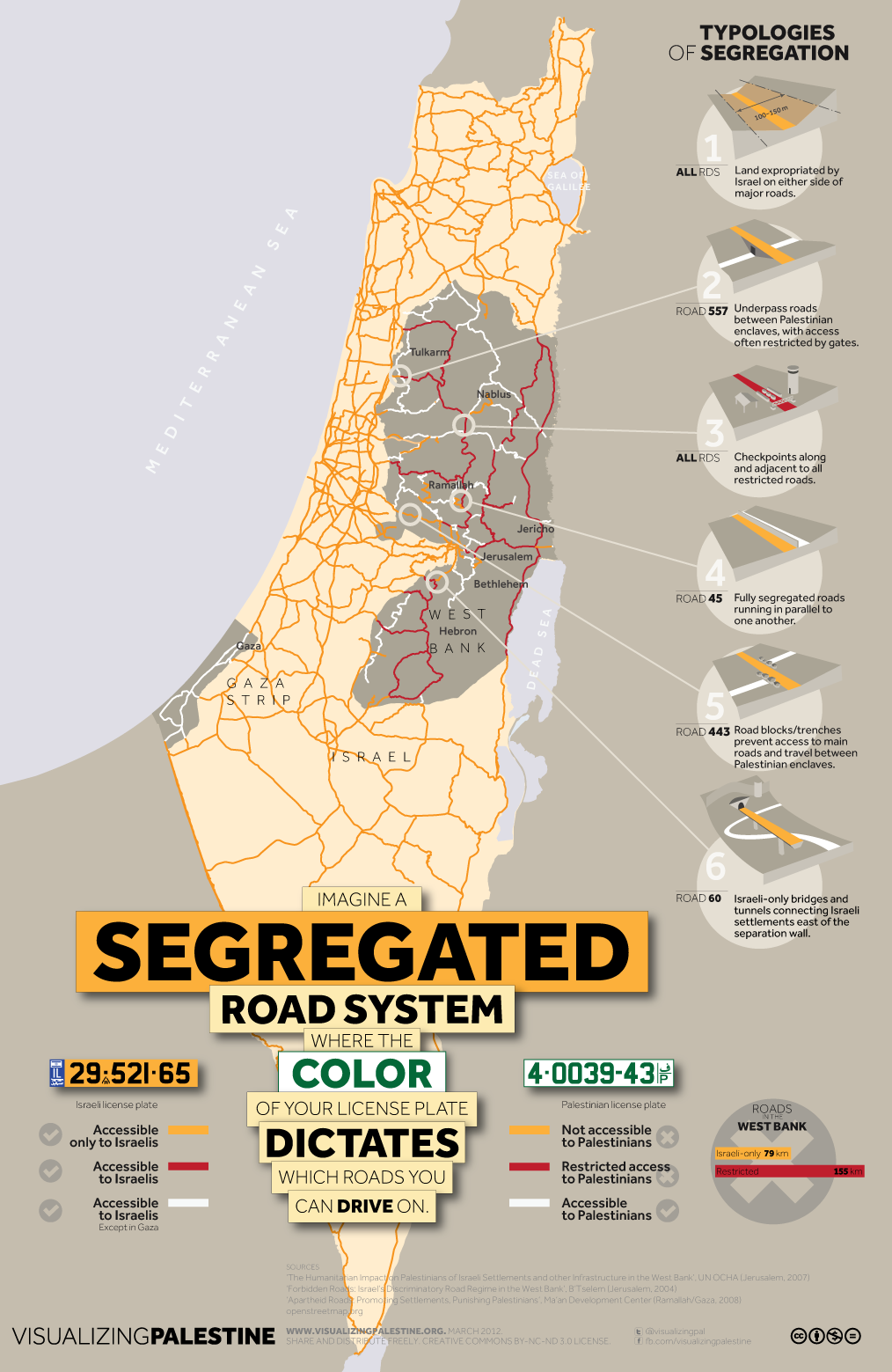
Israel's System of Segregated Roads in the Occupied Palestinian Territories. Courtesy Visualizing Palestine, Creative Commons license BY-NC-ND 3.0.
Abed’s brother, Nabeel, for example, holds a green identity card, marking him as a resident of the West Bank and rendering him unable to live in the areas annexed to Jerusalem. As a result, he and his wife reside in Anata. Nabeel’s wife, however, holds a blue ID, as a Jerusalem Palestinian. In order to retain this ID, the couple has to maintain an apartment in Dahiyat a-Salaam (a neighborhood in annexed East Jerusalem). Thrall, whose writing is suffused with an unshakeable humanity, brings out the cruelty of it all: “For the crime of living with her husband just down the road, she could be cut off from the rest of her family and the city in which she had been born and raised.”
Added to the use of differential identity cards are the different license plates, movement restrictions through checkpoints, settler bypass roads, home demolitions and an intricate permit system that allows for Palestinian construction in ever-diminishing restricted areas or gives selected West Bank Palestinian workers temporary access to Jewish settlements to perform manual labor. And, of course, there is the separation barrier itself, which not only divides Palestinians but also expropriated a large chunk of their land when it was erected.
The situation is enormously complex. But, as Thrall’s book illustrates, its complexity is the point. The more difficult to successfully navigate it, the greater the chance that Palestinians will simply give up, pack their bags and seek a better life elsewhere, forfeiting their right of residence in their homeland in the process. Indeed, the book has several other threads, offering the perspectives of Palestinians and Israelis who play roles in this tale. Together these combine into a story of great political import.
*A Day in the Life* takes its start from a day as ordinary as any other. But it ends up recounting events that are extraordinary mainly because of what they say about the extreme nature of Israel’s longstanding effort to confine and dispossess Palestinians. The book arrives at a particularly pertinent moment, namely Israel’s steady drift toward the far-right of the political spectrum and the ensuing escalation of this effort. (Between writing this review and its publication, this escalation has exploded into an Israeli declaration of all-out war against Hamas in Gaza in the wake of the October 7 attack by Hamas inside Israel.) Thrall crystallizes these developments as part of a long and at times violently banal trajectory, showing how the dehumanization of Palestinians holding onto their land extends to providing no aid when ordinary people are caught up in a horrible, but not particularly unusual, highway crash.
\[**Joost Hiltermann** is the Middle East & North Africa Program Director at the International Crisis Group.\]
### The Kurdish Women's Movement and Turkey's Transnational 'Feminicide'
URL: https://www.merip.org/2023/09/the-kurdish-womens-movement-and-turkeys-transnational-feminicide/
Last updated: 2025-08-22T18:36:35.000Z
*\[su\_dropcap style="simple" size="4"\]*O*\[/su\_dropcap\]n January 9, 2023,* [*thousands of demonstrators*](https://www.aljazeera.com/news/2023/1/7/thousands-kurds-march-in-paris-over-unresolved-activists-murders) *from across Europe gathered in Paris to participate in marches organized by Kurdish groups.*
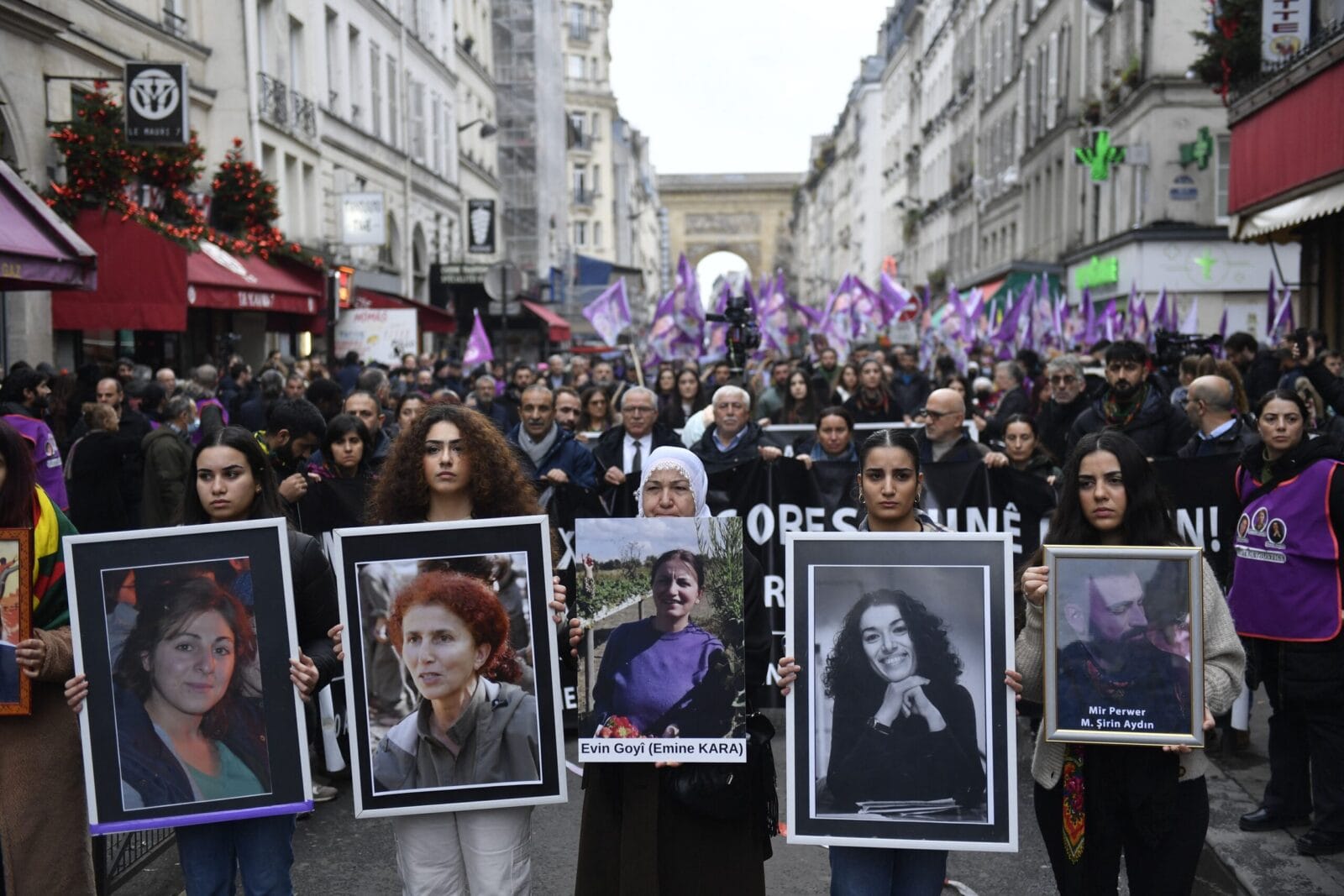
Demonstrators hold portraits of victims of the December 23, 2022 Enghien Street shooting in Paris, as well as those of the La Fayette street murders in 2013, to express solidarity with the Kurdish community, Paris, December 26, 2022\. Julien De Rosa/AFP via Getty Images
*Demonstrators were mourning a triple killing of Kurdish activists that occurred in Paris just two weeks before the march. The day also marked the ten-year anniversary of the still unresolved murder of three Kurdish women activists in the French capital, in an armed attack that took place in the Kurdistan Information Center. Activists suspect the Turkish state’s intelligence service was in some way behind the assassinations, though Ankara has denied involvement. The case exemplifies a trend noted by Kurdish activists in diaspora: that the Turkish state’s repression of the Kurdish movement has increasingly, over the last decade, occurred beyond Turkey’s borders. Recent events—like Sweden’s extradition of members of the PKK to Turkey as part of a bid to secure NATO membership—illustrate the geopolitical dimensions of this repression. The increasingly transnational reach also extends to tech companies, such as Facebook and Twitter, which have censored or shut down certain accounts and voices that are supportive of the Kurdish movement or* [*critical*](https://www.cbsnews.com/news/twitter-censoring-content-recep-tayyip-erdogan-turkish-presidential-election/#:~:text=In%20order%20to%20keep%20the,before%20the%20start%20of%20voting.) *of the Turkish state.*
*Anna Özbek* *is a multimedia journalist and filmmaker, a member of the artist-activist collectives Chinatown Art Brigade and The Illuminator and an assistant professor in journalism at Purchase College. She interviewed Elif Genç, a Kurdish women’s movement activist and PhD candidate in political science at the New School on May 9, 2023\. Their conversation explores the shape of the Kurdish movement in this age of transnational repression and the gendered dimensions of the Turkish state’s targeting of activists. It has been edited for length and clarity.*
**Anna Özbek:** Let’s start with the [assassinations](https://www.theguardian.com/world/2013/jan/10/kurdish-activists-shot-dead-paris) of three prominent Kurdish women activists in 2013\. All three were executed, shot in the head, at the Kurdish Information Center in Paris. A Turkish national was later arrested for the murders but died of illness in police custody. Could you describe the legacy of these activists’ work and the impact of their murders?
**Elif Genc:** The assassinations of Sakine Cansız (Sara), Fidan Doğan (Rojbin) and Leyla Şaylemez (Ronahî) is such a traumatic moment in the history of the Kurdish women's movement because it hit the movement on three levels: Sakine Cansız was a [legendary figure](https://www.theguardian.com/world/2013/jan/10/sakine-cansiz-pkk-kurdish-activist) in the Kurdish women’s movement and was one of the founders of the Kurdistan Workers Party (PKK), Fidan Doğan worked on international relations and Leyla Şaylemez was involved with the youth movement. Turkey is engaged in the feminicide of Kurdish women guerrillas (“feminicide” is the term used by the Kurdish women’s movement and other women’s movements, globally, to emphasize the state’s role in violence against women). And what the state considers a Kurdish woman guerrilla is very vast—within that fall activists and sympathizers. Kurdish women guerillas are the ultimate state enemy of Turkey. They're Kurdish, which they despise already, and women, whom they also despise.
We see so many examples of horrific feminicide within Turkey, for example with Kevser Eltürk (Ekin Wan), [when they displayed her naked dead body](https://www.vice.com/en/article/xw3yyw/kurds-fighting-the-islamic-state-enraged-at-turkey-over-brutal-killing-of-female-fighter) in the Varto district in Muş province. This happened in 2015 during the “self-defense wars” (a period from [2015–2017](https://www.ohchr.org/en/statements/2017/03/un-report-details-massive-destruction-and-serious-rights-violations-july-2015?LangID=E&NewsID=21342) after residents in some Kurdish cities formed autonomous municipalities and were besieged by the Turkish military, resulting in more than [3,000 dead](https://www.crisisgroup.org/content/turkiyes-pkk-conflict-visual-explainer), at least 355,000 displaced and massive destruction of urban residential areas from shelling). It’s a practice of the Turkish state to sexually violate dead Kurdish women guerrilla bodies and display them naked. It's meant to have this horrible connotation about her chastity and her being a woman. It's just sick. I want to make it clear that this kind of violence is not just exclusive to Kurdish women guerrillas and activists. Kurdish men are also killed with impunity, as with the [2015 killing](https://www.nytimes.com/2015/10/06/world/europe/turkey-to-investigate-images-of-dead-kurdish-man-being-dragged.html) of the 24-year-old Kurdish male protestor Hacı Lokman Birlik, whose body was dragged through the streets by a police vehicle in Şırnak. I believe that in the eyes of the Turkish state, Kurdish women revolutionaries are not human. They are inhuman and therefore dispensable. They can be assassinated. That's ultimately what the Turkish state is doing because of course, these women suffer extreme violence under that patriarchal state on many systemic levels.
> [Where Will You Find That Many Women?](https://www.merip.org/where-will-you-find-that-many-women/)
Outside of Turkey, there’s also the case of politician and civil engineer Hevrîn Xelef. In 2019, she was [abducted](https://www.bbc.com/news/av/world-middle-east-51068522) and brutally assassinated by Turkey and their jihadist proxies in Rojava, which is the Autonomous Administration of North and West Syria. She was the newly elected Secretary General of the Future Syria Party after having spent years working in economic committees in Rojava. So, this goes across countries and across borders. Another recent example is the 2022 assassination of scholar Nagihan Akarsel (Zîlan), who was one of the editors of [Jineolojî](https://www.jineolojidergisi.com/) magazine, which is a very well-known feminist publication. She was [assassinated](https://rsf.org/en/feminist-journalist-turkish-origin-gunned-down-iraqi-kurdistan) in Slemani (Sulaymaniyah) in Başȗr (Iraqi Kurdistan). She was killed just weeks before the Kurdish women’s movement conference in Berlin, [Women Weaving the Future](https://womenweavingfuture.org/), which she had helped organize.
**Anna:** In December 2022, there was another triple murder of Kurdish activists in front of a Kurdish cultural center in Paris. More than 20,000 protestors marched to commemorate both these murders and the 2013 assassinations that we discussed previously.
**Elif:** First and foremost, no one considered this to be an isolated incident. The fact that it was almost ten years to the day after the Kurdish women’s assassinations is obviously no coincidence. Emine Kara, or Evîn Goyî, which was her Kurdish name, was a prominent member of the Kurdish women's movement and, I believe, more so the target of this assassination than either Mîr Perwer, who was a singer, and Abdurrahman Kızıl, who was a local sympathizer to the cause. The protests that erupted out of it were a gut reaction to the fact that once again, in the heart of Paris, there was an assassination. And the alleged motivations of the person that they pinned it on (William Malet) were nonsense. They made it look like some sort of racist attack against Muslims or immigrants. The reason why the youth ran out into the streets and started protesting, ripping up the sidewalk, was out of pure frustration and outrage because, to a degree, France and French president Emmanuel Macron would have to exercise a certain amount of complicity to allow something like this to happen in the middle of the city in broad daylight twice within ten years. Right to the same community, with the same target.
> **I believe that in the eyes of the Turkish state, Kurdish women revolutionaries are not human. They are inhuman and therefore dispensable.**
**Anna:** You yourself were physically assaulted while protesting a state visit from Turkish president Recep Tayyip Erdoğan in Washington, DC in May 2017 along with dozens of other protestors. At least two dozen Turkish security agents and their civilian supporters were filmed beating protestors and Erdoğan was filmed personally watching the attack. What happened that day?
**Elif:** We thought it would be like any other protest. If Erdoğan is coming, of course we're going to go to Washington and show up and counter-protest, right? So, there were two aspects to this attack: the first wave and the second wave. And the first wave I wasn't involved with because I lagged quite a bit behind with a friend of mine who was with her kid, not really paying that much attention to what was going on around us. So, I go there and I grab my big Selahattin Demirtaş poster, and I joined the ranks (Demirtaş is a former co-leader of the pro-Kurdish Peoples’ Democratic Party, HDP, and has been imprisoned in Turkey since 2016). I did not realize that there had already been this other attack with the first wave, so I was completely flabbergasted when I looked across the street and there were these G.I. Joe-looking Turkish security guards who were threatening us. And next thing I know, I’m on the ground. It was like a wave just hit me. It wasn't until I saw the footage of being kicked and punched and also them grabbing my arm and pulling me down to the ground that I realized exactly how I was attacked. If you’re getting beaten by four or five people, you can’t tell what's happening.
By some miracle of adrenaline, I managed to cling onto the leg of this American police officer and hoisted myself up and ran. I remember feeling the pain of it all, and I knew in my mind, I’ve got to get out of here. But I didn't realize the extent of how bad it was, so I made my way back to get my hat, and I had a scarf, and then I start looking around me and there are all these elderly men and they've got blood streaming down their faces and people having been kicked in the face, and one of my friends is having a seizure on the ground. And there was this injured uncle-type man, and I gave him my scarf, and the scarf just got soaked with blood. It was really shocking. There were about nine of us that were badly injured. And there were other incidents, like my friend, they basically tried to kidnap her, and this harkens back to the Gendarmerie Intelligence Organization’s practice of disappearing people. The fact that Turkey thinks they can do these things in broad daylight in Washington is just insane.
**Anna:** One of the things that makes this violent attack so remarkable is that there were legal consequences for some of the Turkish attackers. Can you talk about the process that led up to this?
**Elif:** Once we went to the hospital, the investigations started about what actually happened. I believe right away Erdoğan’s security guards and diplomatic types and also some civilians were detained, but they all got out of there quickly. I think they were gone within half an hour.
**Anna:** Right, [declassified US state department documents](https://www.theguardian.com/world/2019/nov/12/erdogan-visit-washington-bodyguards-assaulted-protesters) showed that Erdoğan’s security guards were released after being held by the United States for only half an hour and they immediately flew back to Turkey.
**Elif:** I returned to Toronto a couple of weeks later and I was sitting in a restaurant, which I normally wouldn't go to, as it was a fascist Turkish restaurant, but we had just come from the Kurdish Community Center, and I was starved. And I ran into one of the guys that had beat us up in Washington. Three of the civilians that were involved in the attacks are from Toronto. That was quite a shock when I saw him right in front of me in Toronto, so I took some pictures and sent them to the American police. About a month later the arrest warrants came out for two civilians in Toronto, two civilians in the US who were arrested and jailed and then 12 arrest warrants for the Turkish security personnel, but they weren't in the country anymore. And that night, the two guys who were charged in Toronto, Ahmet Dereci and Mahmut Ellialti, escaped to Turkey.
What ended up happening is that there was some press surrounding this arrest. I did an interview for CBC about the attack, and I said that I helped the American police. The next day my picture was in a Turkish newspaper, with them alleging that I'm a PKK member or sympathizer and that I beat these guys up, that I broke this guy’s nose. Once I was profiled, obviously, with Turkey, I became a target as well. I guess I should have expected as much, but it was a little shocking. But forget me, all of my friends here have had their families in Turkey taken in for interrogation about where they are. Turkish fascists in the US created petitions to try to get some of the protestors deported from the US, and they had to move to different states because of the harassment. None of us can go back to Turkey, which means people can’t see their families again. Some even had to apply for asylum and become refugees. It has really remarkably changed a lot of people’s lives.
**Anna:** Did these attacks and their visibility change anything for the Kurdish women’s movement?
**Elif:** In Turkey, no one ever has to answer for the brutality and torture and the straight up annihilation of the Kurdish people. This is something that we can hold Turkey responsible for, and we’re pushing for it to be recognized as hate crimes, not just assault. This is still going on, and there is both a criminal and civil court case. It turns out that the Turkish security guards beat up a bunch of US State Department people that day as well, which was the icing on the cake. Even though many of us were not US citizens, the case garnered a lot of support in the US. Interestingly, our biggest supporter was the late Senator John McCain, and he actually said that day that we have to kick the Turkish ambassador out of the US.
**Anna:** How do you see these attacks as part of what you’ve identified as a feminicide against the Kurdish women’s movement?
**Elif:** Yes, to bring it back to that whole context of being inhuman in their eyes, I also feel this whole attack falls within that category. While the guy was beating me, what I do remember is someone saying in Turkish, “I’m going to kill you, bitch.” And I really believed they would kill me, and they would kill all of us. We forget their objective is to annihilate us if they could. I hadn't heard all my fellow colleagues’ accounts until recently, but one recalled an attacker that day saying, “Oh bitch, come back here. You haven't had enough.” That has really horrific sexual violence connotations.
**Anna:** You organize with Kurdish communities in Toronto and New Jersey. Can you talk about how Turkish state violence can materially impact Kurdish people a continent away? Does this sometimes lead to self-censorship and a broader culture of fear?
> **Almost the entire population of the Kurdish community that's coming to Toronto and also New York and New Jersey in recent years are refugees...they fear that if they get involved with supporting the Kurdish movement, which some of them do, that it will affect their case here as a refugee.**
**Elif:** Almost the entire population of the Kurdish community that's coming to Toronto and also New York and New Jersey in recent years are refugees, so there's that aspect where they fear that if they get involved with supporting the Kurdish movement, which some of them do, that it will affect their case here as a refugee. I know that recently with the presidential elections in Turkey, there was a lot of hesitation by members of our community to go and vote, even though they can as they’re Turkish citizens, because they were afraid they were going to get arrested at the Turkish consulate.
**Anna:** In Turkey last month, another few hundred people were arrested in a supposed “anti-terrorism” sweep in the lead up to the May elections, and these arrests were mostly in Kurdish provinces.
**Elif:** Yes, I had some friends here who signed up to be election watchdogs or witnesses and they pulled out because their lawyer said, “you know, it's going to affect a case back home as well.” There are a lot of people that still have things back home that are very dicey. A lot of the ones that want to get involved have a certain relationship to the Kurdish movement. We have people whose brothers, sisters, mothers, fathers, have been jailed or martyred. Some people come to protests and take pictures because they really want to show that they do not want to go back to Turkey. But then there's also that hesitation, and there absolutely is a fear of displaying PKK flags.
In 2019, when the US pulled out of Rojava, and Turkey immediately attacked, there was a lot of international attention, probably the most we've ever had. I went to New Jersey Senator Cory Booker's Office of International Relations and said we should delist the PKK. If I can do that in the senator's office, I’m pretty sure you can do it in the streets. But I get that back in Turkey if you have a PKK flag then you're going to jail. This self-censorship, I think the only way to actually get through it is to legalize it. And the only way you're going to legalize anything is to normalize it.
**Anna:** You're talking about normalizing the PKK in the United States by removing the PKK from the designated foreign terrorist organization list?
**Elif:** Yes, I think we need to delist. I've been in diplomatic relations in the Kurdish movement for the last ten years and everything ties to delisting. Kurdish movement activism is criminalized using that as a pretext. The fear that comes from this stigma often deters members of the community from becoming involved with Kurdish activism.
**Anna:** We’ve seen that the reach of the Turkish state extends beyond physical violence into digital censorship. Within the country, Turkey has blocked YouTube and Wikipedia for years at a time. Access to social media like Twitter is routinely blocked during large protests and public emergencies, [most recently](https://www.reuters.com/world/middle-east/anger-over-turkeys-temporary-twitter-block-during-quake-rescue-2023-02-09/) after the massive earthquakes that left more than 50,000 people dead. Twitter also [recently announced](https://www.cbsnews.com/news/twitter-censoring-content-recep-tayyip-erdogan-turkish-presidential-election/) it would comply with Turkey’s demands to censor specific accounts in the days leading up to the election. You helped organize a Facebook group in solidarity with Rojava, and you’ve said this group has been subject to censorship. Can you describe what you’ve seen happen with Kurdish digital organizing in the United States and Canada?
**Elif:** So obviously we live in a digital world, and social media is very essential for organizing even though we're dealing with a lot of people who are not using the most advanced technology. We've mostly been using Facebook. But I've been banned from Facebook for months. In fact, I was lucky to get my account back. A lot of my friends did not. The Toronto Kurdish Community Center account has been shut down three or four times. Just recently the Instagram page was shut down again. It's constant. Anything even mentioning the PKK is shut down. But it’s also for things you wouldn't expect. There was a sweep of all the Rojava-affiliated Facebook groups. Supporting Rojava is not illegal. There's nothing illegal about it. The armed forces of Rojava, the People’s Protection Units (YPG) are not illegal, and they’re not on any list. But still there was this big sweep and even groups that have nothing to do with the Kurdish movement, like the Institute for Social Ecology, were also shut down. That prompted us to ask who was doing this, because it was on such a mass scale.
**Anna:** A [ProPublica](https://www.propublica.org/article/sheryl-sandberg-and-top-facebook-execs-silenced-an-enemy-of-turkey-to-prevent-a-hit-to-their-business) investigation found that in early 2018, Facebook secretly agreed to Turkey’s demand to censor the People’s Protection Units (YPG) Facebook page and “geo-blocked” it within Turkey. Sheryl Sandberg, then chief operating officer of Facebook, personally approved the action, writing “I am fine with this” in an email shown as part of that investigation.[\[1\]](#%5Fedn1) This is despite the fact that, as you said, the YPG is not considered a terrorist organization by the United States or by Facebook. On the contrary, the US military worked closely with the YPG for years in their war against ISIS. The result was that all the posts that the YPG made documenting the casualties of the Turkish military invasion of Syria and Rojava could not be seen by anyone within Turkish borders.
> **It’s not just the YPG that Turkey demanded be blocked on Facebook, there was a long list of groups that are persona non grata, and we are seeing how these fascist practices are not limited to the borders of the Turkish state.**
**Elif:** What I can deduce from that is there's a line of fascism and Turkey is within the line of acceptable fascism. So, you've got Zuckerberg, or whoever is in charge now, and I don't think he cares at all about the PKK or Kurdistan or Rojava or any of that. But he is very concerned about the 80 plus million Facebook users in Turkey. To keep access to that market, Turkey has made Facebook complicit in upholding state censorship. It’s not just the YPG that Turkey demanded be blocked on Facebook, there was a long list of groups that are persona non grata, and we are seeing how these fascist practices are not limited to the borders of the Turkish state.
**Anna:** We've discussed issues of Turkey’s transnational violence from murder and physical violence to censorship and fear, but the resistance to this is also international. What is the importance of transnational and solidarity organizing to the movement?
**Elif:** I think the Kurdish women’s movement is a transnational movement. I don’t even know it in any other context. I’m an activist of the Kurdish women’s movement, but I'm only in North America and to some extent Europe. Because of the level of censorship and because of the draconian measures that are taken in Turkey against the movement, the solidarity falls on us to be there in those spaces. I also think that diplomacy has started to play a huge part in the movement. The armed aspect of this movement is out of complete necessity and self-defense. But I think the movement is coming to realize that this is a reflection of the century that we're in. Fighting now also means diplomacy. Gains for us are getting interviews with senators or creating solidarity networks with like-minded people. Transnational solidarity, I think it's absolutely essential.
> **Read the**[ **previous**](https://merip.org/2023/09/exiled-women) **article.**
> **Read the**[ **next**](https://www.merip.org/major-labels-2/) **article.**
**This article appears in** [**MER issue 307/308**](https://merip.org/magazine/307-308/) **"Frontlines—Journalism and Activism in an Age of Transnational Repression."**
---
### Endnotes
[\[1\]](#%5Fednref1) Jack Gillum and Justin Elliot, "[Sheryl Sandberg and Top Facebook Execs Silenced an Enemy of Turkey to Prevent a Hit to the Company’s Business](https://www.propublica.org/article/sheryl-sandberg-and-top-facebook-execs-silenced-an-enemy-of-turkey-to-prevent-a-hit-to-their-business),” *Pro Publica,* Feb. 24, 2021.
### Major Labels—Reviewing Andrew Simon's 'Media of the Masses'
URL: https://www.merip.org/2023/09/major-labels-2/
Last updated: 2025-08-22T18:36:36.000Z
The Egyptian entrepreneur Mansur ʿAbd al-ʿAl Mansur was well-versed in the latest technology and the most powerful machines.
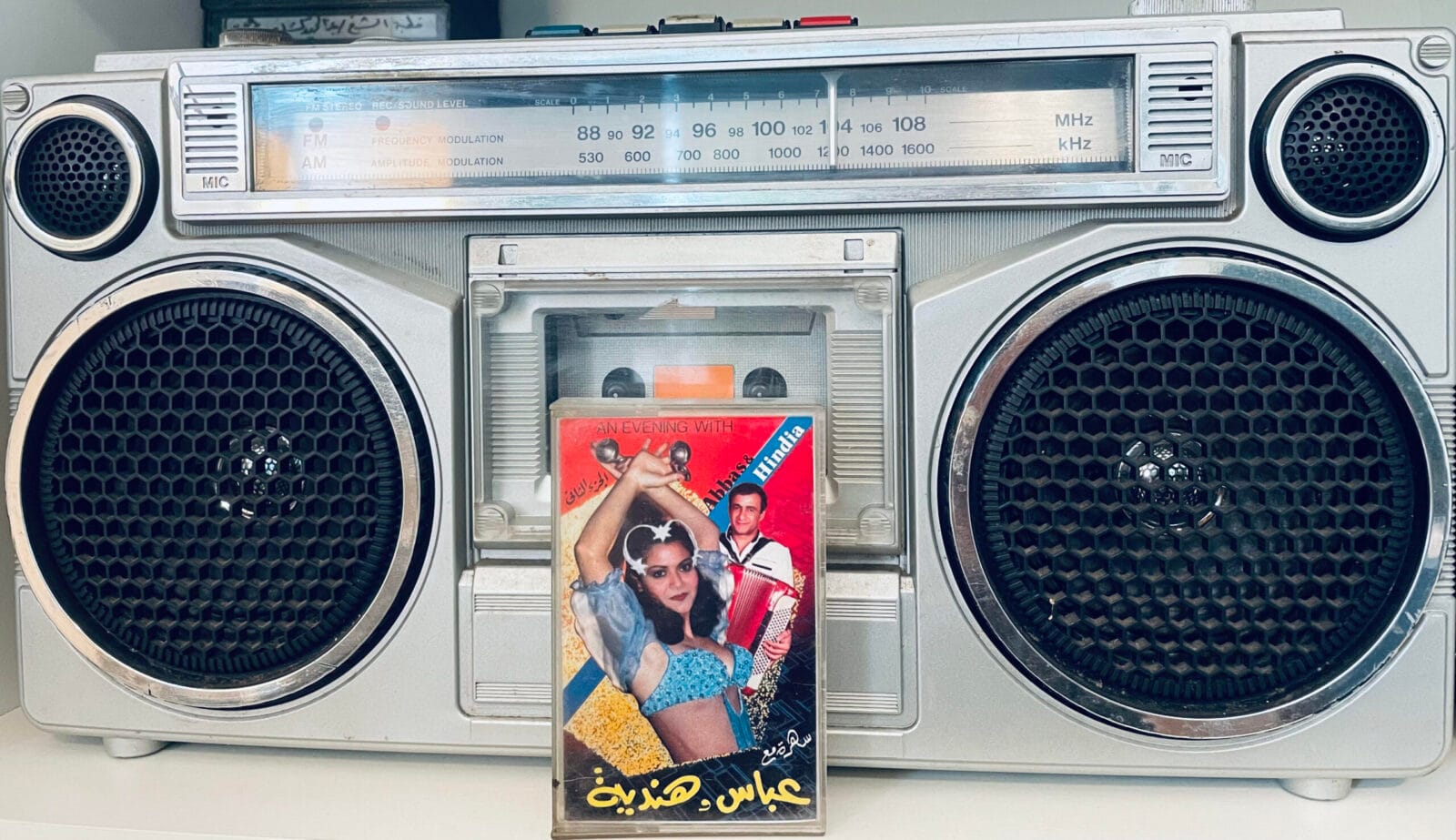
The cassette of An Evening with Abbas & Hindia Part 2\. Photo by Andrew Simon.
After a stint in Saudi Arabia working in aluminum production, Mansur returned to Egypt in the 1980s with roughly 1,000 cassette tapes in tow. Not content with distribution alone, Mansur soon pivoted to A&R (Artists and repertoire), focusing on the search for and development of artistic talent. From Shubra, a northern Cairo neighborhood with a rich history of producing culture stretching back to the turn of the twentieth century, he launched the record label “Egyptphon.” The choice of name pointed to the fact that Mansur understood his endeavor in national terms. It also harkened back to an earlier era of the recording industry, when “phone” or “phon” (from phonograph) often served as a suffix for company names, such as Gramophone, Polyphon and Baidaphon.
Rather quickly, Mansur grasped what his largely working-class customers were after: the frenetic energy of wedding acts like “Abbas & Hindia.” The accordionist Abbas and the well-known belly dancer Hindia, who regularly graced Cairo’s hotel ballrooms, stood in stunning contrast to the staid balladeering of state-sanctioned musicians. Promoting the duo, in and of itself, was an act of subversion, one that Mansur carried out with ingenuity. To steer clear of the radio censor, Mansur avoided radio altogether, passing along Egyptphon releases free of charge to microbus drivers so that their sounds might be amplified for passengers-turned-prospective customers, without the required art license from the Ministry of Culture. Indeed, as long as the Egyptian state has sought to control cultural production, impresarios, artists and audiences have endeavored to challenge censorship in creative ways.
> **Click below to hear the opening of *An Evening with Abbas & Hindia Part 2,* from Simon's digital archive in the making:**
Andrew Simon’s [*Media of the Masses: Cassette Culture in Modern Egypt* ](https://www.sup.org/books/title/?id=31649)(Stanford University Press) offers both a history of “technology-in-use” and a musical biography. The book nimbly narrates Egyptian history in the last third of the twentieth century by zeroing in on the format used by Mansur and so many others during this period: the cassette. Making its debut in 1963, the compact cassette radically changed who and what could be heard, musically and otherwise, around the globe. With tapes, production was inexpensive, requiring little setup to record. The cost and size of the medium likewise made for easy distribution. Further, tapes were re-recordable, theoretically rendering them blank slates and, therefore, canvases. All of this meant that cassettes could conceal and be concealed, and a host of actors gained entry to an industry largely closed to them in the past. While the revolution may not have been televised, it was certainly carried on tape. Consider the rise of hip-hop, spread through the circulation of cassette tapes in the United States, in the mid- to late 1970s or the recorded sermons of Ayatollah Khomeini which fanned out across Iran. Simon’s book firmly adds Egypt to the historiographical mix.
## **Consuming Cassettes**
Simon’s monograph is divided into an A side and a B side, although some of its most compelling material emanates from the flip.
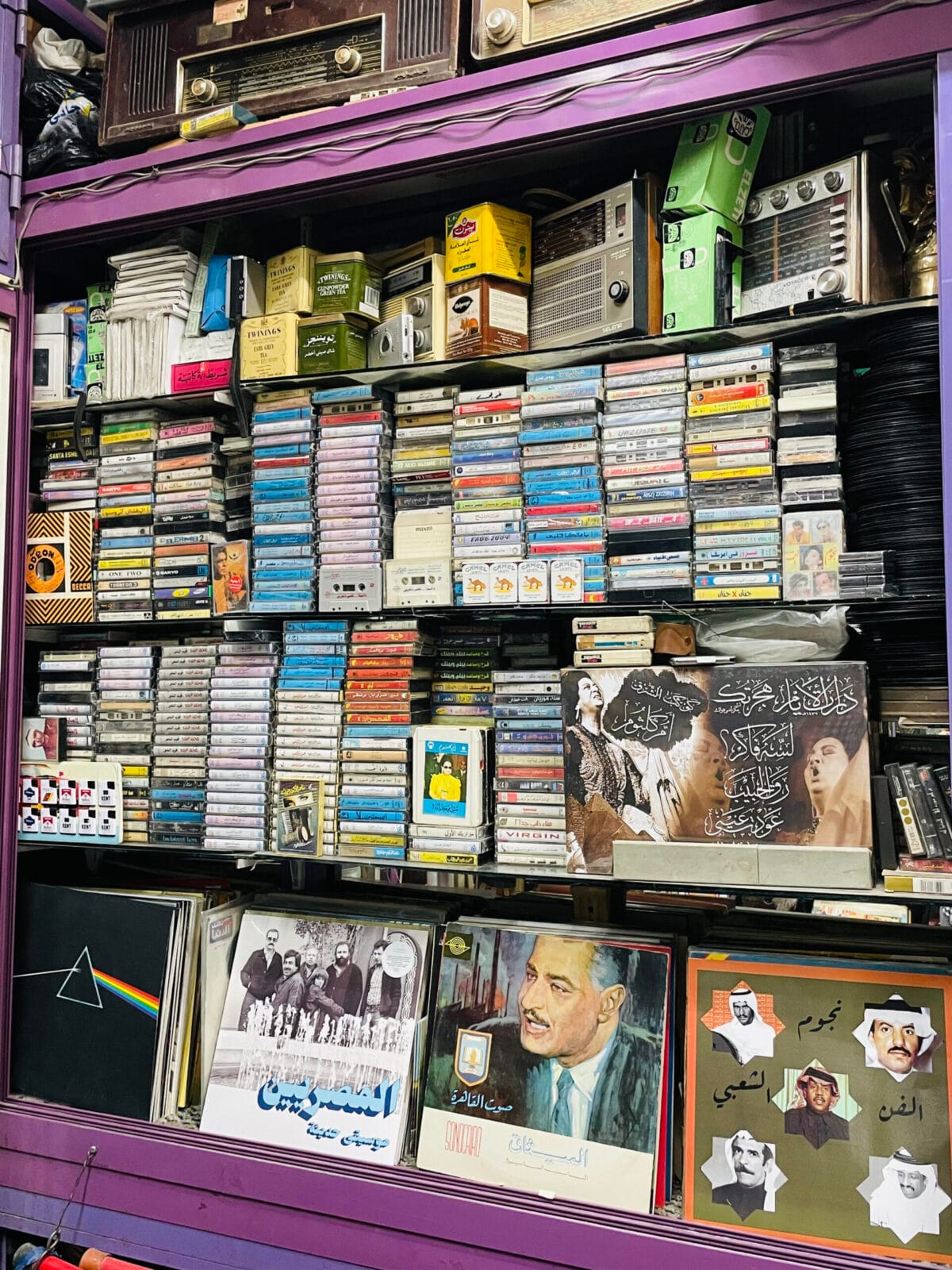
Inside the Cairo music shop Mazzika Zaman. Photo by Andrew Simon.
Chapter 1 outlines how cassettes first came to dominate the Egyptian media marketplace and the soundscape in the mid-1970s, a period when the country’s economy shifted aggressively toward capitalism and privatization under President Anwar Sadat’s *infitah* (“opening up”) policy. What Simon refers to as “cassette culture” was buoyed by a culture of consumption that first developed under Sadat and later ballooned under Husni Mubarak.
By the early 1980s, millions of kilograms of commercial goods were transiting through Cairo International Airport and other ports of entry––a sharp turn from the state of affairs under Egypt’s previous president, Gamal Abdel Nasser. Amid the refrigerators and washers and dryers were cassette players, which political elites eagerly adopted. They were also taken up by established musicians like ʿAbd al-Halim Hafiz, ʿAli Ismaʿil and Farid al-Atrash. Indeed, initially, cassette players were associated with these public figures rather than “the masses.” Images of cassette players displayed prominently in the salons and on the terraces of the well-heeled were broadcast to the public through state-controlled periodicals, helping to define the “modern” Egyptian home. As prices on the machines dropped, middle- and even working-class Egyptians found themselves able to obtain that ideal.
Of course, as the demand increased for cassette players, certain savvy individuals employed surreptitious means to supply them. In chapter 2, Simon pays careful attention to what he calls the “criminal biography” of the cassette player. Mining the censored Egyptian press for popular crime reports, he provides a sense of the sometimes boundless quality of the black market for commercial goods that grew during the infitah. Many engaged in theft and smuggling also maintained above board day jobs. Through their example, Simon captures the severity of the struggle of ordinary Egyptians attempting to navigate shortsighted economic policies. At the same time, that citizens were willing to risk run-ins with an authoritarian state to obtain machines for playing music reveals the high regard in which sound objects were initially held.
## **Recording and Circulation**
Simon’s B side and chapter 3 deal more directly with the heart of *Media of the Masses*: Egypt’s recording industry of the 1970s and 1980s, the type of popular music (*sha*ʿ*bi*) that grew alongside it and the censorship apparatus erected by the state in response.
Over a 15-year period, cassette labels proliferated at a staggering pace. In 1975, around 20 outfits operated. By 1990, there were some 500 (86). One of the major beneficiaries was Ahmad ʿAdawiya, the then-30-something-year-old, who, among others, pioneered *sha*ʿ*bi* music. This expansive, often faster-paced genre drew on musical influences from around the globe as well as local rhythms. Themes of love (and sex) and class reigned supreme.
Though not conservatory trained, ʿAdawiya nonetheless had an enviable musical background and was gifted with a powerful voice. He learned his trade on Muhammad ʿAli Street—long an incubator for popular music—and through his connections to the vocalist Sharifa Fadil and lyricist Maʿmun al-Shinawi, also the artistic director for the major label Sawt al-hubb. In 1973, ʿAdawiya released his first major song, “al-Sah al-Dah Ambu,” which, as Walter Armbrust has written, “seem\[ed\] designed to do nothing more than urge young people to dance.”[\[1\]](#%5Fedn1)
And dance young people did. An estimated 1 million copies were sold, provoking critics to slam ʿAdawiya and his popular cassette cohort as “vulgar.” With his emerging success, they decried, in Simon’s evocative turns of phrase, “the downfall of music, the end of high culture, and the death of taste” (80).
In several ill-fated attempts to reverse course, state-controlled Radio Cairo established multiple screening committees to prevent the likes and sounds of ʿAdawiya from ever appearing on air. The government set up an Office of Art Censorship to filter out “impurities” carried on tapes, and the state-operated label, Sawt al-Qahira, appealed to the Ministry of Culture to go against the offensive music—although to little effect.
The “re-recordability” of cassettes, as Simon elucidates in chapter 4 (“Copying”), posed a problem not only to the unadulterated spread of the “vulgar,” but equally to regimes of copyright. While “home taping” (recording from tape to tape or from radio to tape) was pervasive among ordinary Egyptians, the issue of infringement came to affect a number of more prominent figures. In a court case surfaced by Simon, legendary establishment artists ʿAbd al-Halim Hafiz and Muhammad ʿAbd al-Wahhab engaged in a protracted legal battle with Sayyid Ismaʿil, another legendary establishment artist, over the unauthorized reproduction of their music on his Randa Phone label. Egyptian authorities, sometimes encouraged by musicians themselves, proposed more forceful measures, including creating a cassette police unit and new laws to mete out fines and prison time. As for the stakes of “copying sounds,” Simon argues that, “this mundane activity, at a more fundamental level, radically altered the very movement of cultural material by empowering anyone with a tape recorder to become a cultural distributor at a time when recording labels reigned, mass media was state-controlled, and elite artists enjoyed great power in Egypt” (20).
Chapter 5 places the elusive protest singer and composer Shaykh Imam (1918–1995) at center stage to decenter journalistic accounts of Richard Nixon’s official visit to Cairo in 1974\. His iconic and searing song, “Nixon Baba” (Father Nixon), made clear that not all Egyptians greeted the arrival of the fledgling US politician with the fanfare and excitement depicted in the press. This chapter demonstrates how a single recording can help to surface an untapped fount of archival material. Chapter 6 is a broader consideration of the “material traces of tapes past.” Here, Simon brings what he calls the “shadow archive” out of the shadows. To do so, he consults the often unsung historical actors who, against all odds, preserved the sounds of Egypt’s recent past. Among them is the enterprising Mansur ʿAbd al-ʿAl Mansur (of Egyptphon fame) and other intrepid archivists in all but name.
Along the way, Simon raises questions about cassette archives that once existed, about the provenance of collections that are still accessible, about approaches to cataloging, about informal assemblages on rotating shelves in kiosks––and sadly, about disappearing ones.
## **Listening to the Past**
Simon’s *Media of the Masses* is a valuable and engaging addition to a growing literature demanding that readers listen for and to Egypt’s past to better understand the diverse array of actors who inhabited and shaped it. Given that rich historiographical sounding board, the book would have benefitted from more direct engagement with a range of scholars who have studied musical media in Egypt: from A.J. Racy on the [origins of the Egyptian recording industry](https://books.google.com/books/about/Musical%5FChange%5Fand%5FCommercial%5FRecording.html?id=RRfMngEACAAJ) to Charles Hirschkind on Islamic revival [carried on cassettes](http://cup.columbia.edu/book/the-ethical-soundscape/9780231138192).
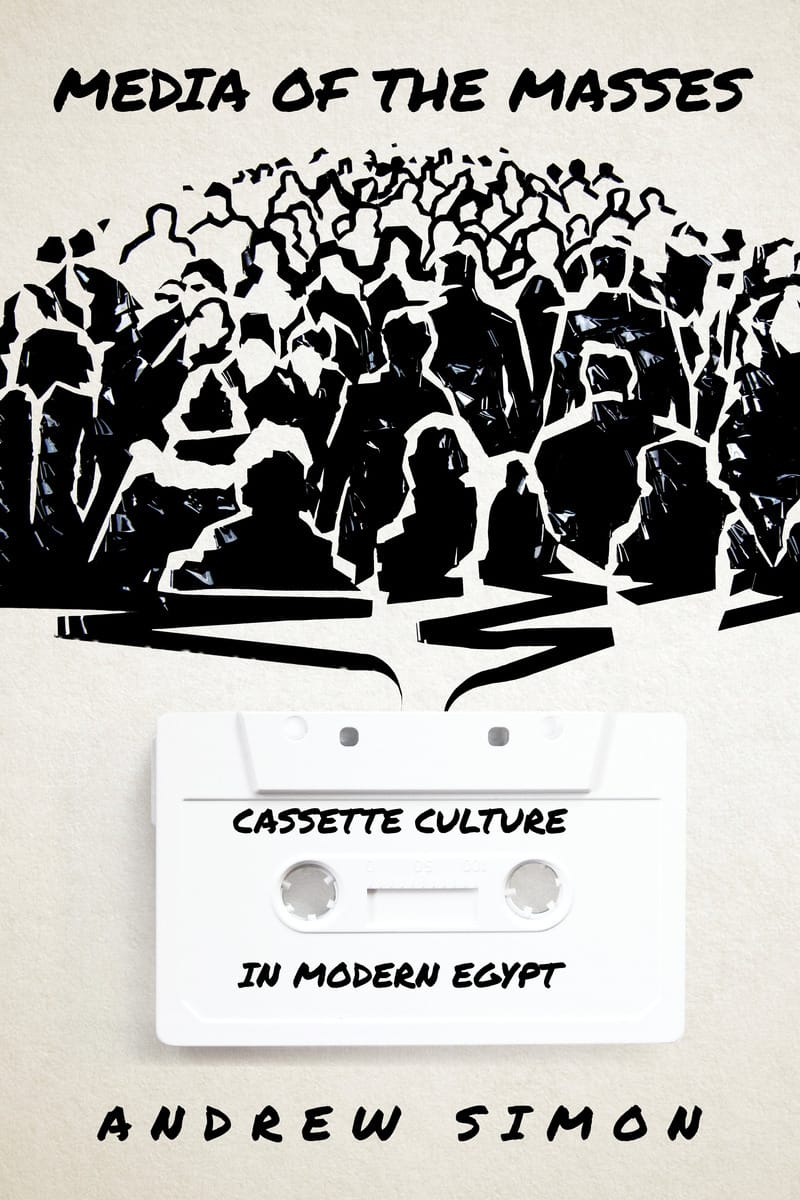
Cover of Media of the Masses by Andrew Simon.
Simon, at times, seems primarily concerned with providing a history of media decentralization that predates and therefore provincalizes the rise of satellite channels like Al Jazeera and the internet. But what about the music and technology that preceded and often ran in parallel to cassettes? Earlier twentieth-century media forms, like records, were also sold, desired, censored and even copied. They, too, served to subvert. Older but still new styles of popular music, especially the interwar offerings by female artists, were also decried as vulgar. Cassettes undoubtedly made a unique contribution to Egyptian society and sound, but the format is part of a longer historical trajectory.
What made tapes stand out in Egypt, as Simon asserts, was their scale, which was indebted to both widespread sharing among peers and piracy. Yet, vastness did not necessarily “democratize sound” (11), nor did it permit “anyone with a tape recorder” to become a “cultural producer” or “cultural distributor” (20). Almost all the figures explored in the book were men with connections to the establishment or the industry. Even Shaykh Imam, for example, released multiple LPs on commercial labels. The cassette may have made his music far more accessible, but one is left wondering how the technology preserved or propagated regional traditions, female repertoires or zar—the musical healing complex that Shaykh Imam saw fit to condemn in “Nixon Baba.” As for Mansur ʿAbd al-ʿAl Mansur, while his brief biography offers a glimpse of what a music industry in transition afforded outsiders, it is clear that he was far from just “anyone.” Mansur was a visionary with an ear for good music who, thanks to his acumen, now had a chance.
One cannot help but see parallels between the moment Simon addresses and the twenty-first-century transformations wrought by streaming services like Spotify. Such sites have changed how music is produced and consumed, albeit with their own considerable set of costs. Now home to one of the world’s largest music catalogs, the algorithmic models that Spotify employs reward a select few despite promises of democratization. The vast majority, including many smaller labels and artists, find the musical economy that once sustained them destroyed. Moreover, if multitudes can be platformed, not everyone can be heard. Millions of songs on the platform have never enjoyed even a single stream.
In his sonorous history of the MP3—the format that gave rise to the peer-to-peer sharing system later co-opted by Spotify—Jonathan Sterne writes that, “unauthorized duplication and circulation have certainly deflated the profitability of recordings, but they are not the antimarket practices we have been led to believe.”[\[2\] ](#%5Fedn2)Whether in the case of the cassette or its successors, profit remains concentrated at the top and gatekeeping persists, even if following the money has become increasingly difficult.
Nonetheless, the crisis that almost always accompanies the introduction of new technologies to music, as Sterne suggests, “affords an opportunity to rethink the social organization of music.”[\[3\]](#%5Fftn3) In cupping an ear to an earlier Egyptian iteration of this phenomenon, Simon provides readers just that opportunity and even supplies a format for doing so.
\[**Christopher Silver** is the Segal Family Assistant Professor in Jewish History and Culture at McGill University\]
**Read the**[ **previous**](https://merip.org/2023/09/the-kurdish-womens-movement-and-turkeys-transnational-feminicide) **article in** [**MER issue 307/308**](https://merip.org/magazine/307-308/) **"Frontlines—Journalism and Activism in an Age of Transnational Repression."**
---
### Endnotes
[\[1\]](#%5Fednref1) Walter Armbrust, *Mass Culture and Modernism in Egypt* (Cambridge: Cambridge University Press, 1996), p. 180.
[\[2\]](#%5Fednref2) Jonathan Sterne, *MP3: The Meaning of a Form* (Durham : Duke University Press, 2012), p. 28.
[\[3\]](#%5Fednref2) Ibid, p. 27.
### Transnational Repression Against Exiled Women Activists
URL: https://www.merip.org/2023/09/exiled-women/
Last updated: 2025-08-22T18:36:36.000Z
In Spring 2011, as the uprising against Bashar Al-Assad erupted in Syria, Sana, the daughter of Syrian exiles living in Canada, began engaging in online activism.
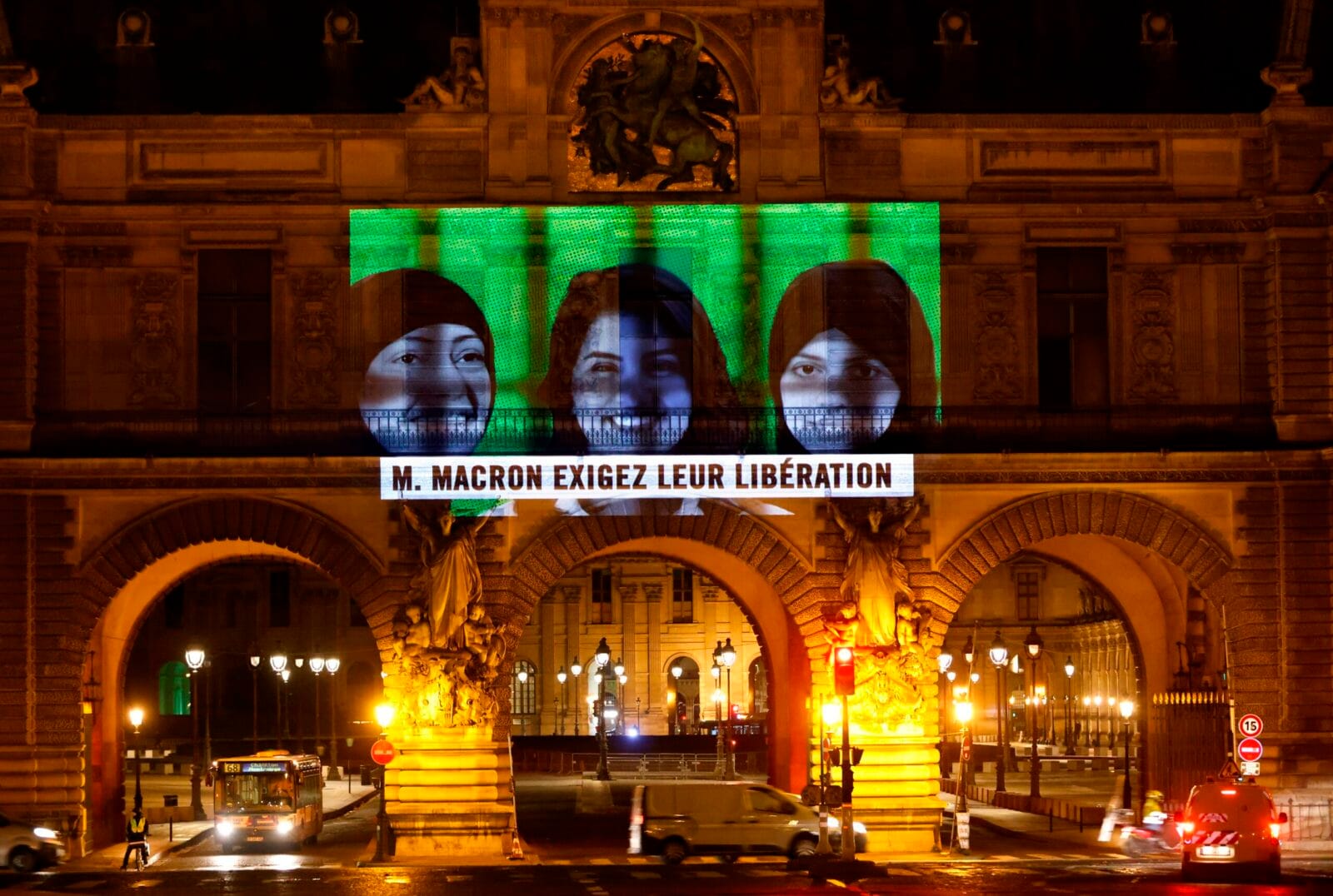
A projection on the Louvre Museum in Paris by Amnesty International depicts jailed Saudi human rights activists including Loujain Al-Athloul (C) and reads "Mr Macron, demand their release," ahead of the virtual G20 summit in November 2020\. Thomas Coex/AFP via Getty Images
Her support for the revolution rapidly gained traction among fellow Syrians and a widening global audience. But as her voice grew louder, she found herself the target of a sinister backlash. About one year after the start of the revolution, her Facebook profile—which she had used to connect with like-minded activists—was flooded with violent threats. Photoshopped nude photos of Sana began circulating, and profiles mimicking her identity popped up on the platform. Google sent her repeated warnings that state-sponsored actors were attempting to hack her email account. The various online campaigns she had organized against the Syrian regime were shut down as Facebook responded to false reports lodged against her pages. Sana believed she was the target of a pro-regime cyber militia known as the Syrian Electronic Army, which has attacked anti-regime activists globally.
“I stopped putting anything personal on social media posts,” she recalled in an interview with Citizen Lab—part of two research projects: one on digital transnational repression in Canada, conducted between 2020 and 2021, and the other an ongoing study of gender-based digital transnational repression against exiled women activists and journalists in various countries. Along with other interviewees, Sana’s real name and identifying information have been changed for this article. “I would never post about my children or where I was exactly. And my family also requested that I don’t post anything about them or my children. There were definitely a lot of worries and fears.”
Sana’s parents had fled Syria in the 1990s, and she had grown up with strained ties to her home country. In her experience, Syrians in the diaspora did not speak out much and feared contacting their loved ones still in Syria. With the 2011 uprising against Bashar al-Assad, this apprehension dissolved. Syrians overseas, like Sana, threw themselves into political activism amid an atmosphere of excitement for change. Their optimism was quickly undermined, however, as the regime brutally cracked down on protests with widescale arrests and torture and reduced entire cities to rubble. Cyber militias like the Syrian Electronic Army showed that Assad’s counterrevolution extended well beyond Syria's borders, carrying repression globally through the internet.
Sana’s experiences reflect those of countless activists and journalists from across the Middle East and North Africa living abroad, who have found themselves on the receiving end of state-sponsored repression. With the Arab uprisings of 2011, exiled human rights defenders and diaspora activists used technology to mobilize international attention for social movements in their countries, while journalists working for international media helped circumvent censorship and propaganda. In these transnational online spaces, the women we interviewed—journalists and activists in exile or from diaspora communities with ties to the region—discovered channels to voice their opinions, connect with other like-minded women and gain visibility.
But digital technologies also allowed regimes to drastically extend their political controls over the diaspora, overcoming geographical distance and jurisdictional borders. Governments increasingly relied on the internet—using intrusive surveillance, malware attacks and disinformation campaigns—to punish and silence dissent outside of their territories. While many activists in diaspora are confronted with these threats, women face particular, gendered forms of digital transnational repression. Attacks take aim at their female identity, often in sexualized and misogynistic ways, to intimidate and shame, discredit and discourage them from speaking out.
## **Intimidating Activists Online**
Aabir, a human rights defender from the Gulf, recalls receiving an email from a journalist she had previously communicated with. At first glance, the email appeared genuine. But the journalist asked her to review the case of a close associate who had just been released from prison. She wondered how the journalist could have known about the case. After re-checking the email, Aabir realized that the address closely resembled the official domain of the media outlet but was actually hosted on Gmail. She forwarded it to a digital security expert who confirmed her suspicion: Had she opened the attachment, spyware would have been installed on her device, giving attackers access to her confidential communications and contacts.
Digital technologies are increasingly aiding states to target dissidents in covert ways, minimizing the risk of detection or retaliation. Aabir believes that the attacks are intended not only to access information but equally to frighten activists from using their devices. “I live all of my waking minutes and hours and days anxious that my devices have spyware on them, that I am being listened to, recorded and tracked,” she says. “No matter where I am, what I am saying or whom I am with.”
Regime supporters also target women activists by attacking their reputations and raising questions about their sexuality to stir outrage, particularly among audiences with conservative social values. When Aabir speaks at conferences in European or North American cities, for example, the events’ associated Twitter hashtags invariably become flooded with tweets from pro-government trolls. Not only do they simultaneously portray her as an agent for the CIA, Mossad or Iran, they also spread rumors about her and her parents’ promiscuity. Recently, a government official in her home country posted an Instagram video alleging Aabir’s involvement in sexual affairs. They subsequently published her private phone number, inciting viewers to call her for more information.
“When they target a woman, it’s sexually explicit,” Aabir says of the online campaigns aimed at smearing women activists. “There is always something about sexual affairs, abortion, getting pregnant, having a boyfriend. And especially because I am Muslim, that’s the way they target.”
Shirin, an Iranian journalist working in Europe, has also been the target of sexually explicit attacks. In the fall of 2022, as the Women, Life, Freedom protests brought Iranians worldwide into the streets, Shirin found herself on the receiving end of a wave of online abuse and violent hate speech. It started after someone—she suspects Iranian government agents—managed to access and leak confidential communications between her and contacts inside Iran. The framing of the leaked information tapped into existing conflicts in the Iranian diaspora at a time when tensions were running high. As a result, online trolls flooded her email address and social media profiles, accusing her of being a “traitor” and “regime agent.” Beyond vilifying her for her work as a journalist in exile, Shirin was attacked specifically as a woman. Endless messages denigrated her as a “whore” and threatened her with rape. As Shirin explains, the messages included “a type of vocabulary that you can’t use for men.” Feeling as though her journalism career was falling apart, she says, “I had suicidal thoughts. For weeks I couldn’t get out of bed.”
While it remains difficult to directly tie state actors to the attacks against Shirin, other high-profile cases have shown regimes to be involved in similar operations. In the [summer of 2020](https://www.nbcnews.com/tech/social-media/i-will-not-be-silenced-women-targeted-hack-leak-attacks-n1275540), private photos of *Al Jazeera* journalist Ghada Oueiss—who regularly reported critically on Saudi Arabia and the UAE—were posted on social media. The images showed her in a bikini emerging from a Jacuzzi. The smear campaign against Oueiss, amplified by high-profile public figures and pro-Saudi influencers with millions of followers, insinuated that Oueiss had built her career through sexual favors.
> **In addition to weaponizing their gender to silence critical journalists like Oueiss, the rulers of the UAE and Saudi Arabia appear to have conspired to use their advanced surveillance capabilities against women’s rights defenders in both monarchies.**
Around the same time, Oueiss was among the targets of a hacking campaign against more than 30 *Al Jazeera* staff members, which used the Israeli-exported Pegasus spyware and was attributed to Saudi Arabia and the United Arab Emirates. Both countries were clients of the Israeli surveillance company NSO Group, which had built the software to exploit rare vulnerabilities in popular applications and give attackers access to all content and functions, effectively turning a smartphone into a “spy in your pocket.”[\[1\]](#%5Fedn1) In a lawsuit she filed in Florida in December 2020, Oueiss accused the rulers of both countries of having used the technology to access her private information and circulate it online in a coordinated campaign to intimidate and taint her reputation as a journalist.
In addition to weaponizing their gender to silence critical journalists like Oueiss, the rulers of the UAE and Saudi Arabia appear to have conspired to use their advanced surveillance capabilities against women’s rights defenders in both monarchies. Loujain Alhathloul, a prominent Saudi women’s rights advocate, claims that in 2017, while she was living in the Emirates, operatives of the Abu Dhabi-based cybersecurity company DarkMatter used sophisticated surveillance techniques to hack her iPhone. The company had recruited cyberintelligence specialists from the national security establishment of the United States and the Israel Defense Force for a surveillance unit called Project Raven, which engaged in operations against a number of dissidents, journalists and foreign government officials in different countries. They also closely cooperated with UAE authorities, gaining lucrative government contracts.
The breach of Alhathloul’s phone likely allowed the UAE authorities to monitor her movements as well as her interactions with other human rights advocates, including organizations in the United States. Eventually, in March of 2018, Alhathloul was captured by Abu Dhabi police and forcibly returned to Saudi Arabia, where she was imprisoned, tortured and sexually harassed.
In May of 2023, she filed a [lawsuit](http://eff.org/document/alhathloul-v-darkmatter-group-first-amended-complaint) against DarkMatter, in which she alleges that during the interrogations agents mentioned details of her communications that had become available through hacking her device. Her arrest came as part of a broader crackdown against prominent women’s rights defenders opposing the kingdom’s driving ban on women and other restrictions. Saudi Arabia and the UAE [regularly cooperate](https://www.hrw.org/news/2014/04/26/gcc-joint-security-agreement-imperils-rights) in the persecution of their respective dissidents based on broad agreements like the 2013 Gulf Cooperation Council joint security agreement, which allowed for the sharing of personal information across borders, institutionalizing transnational repression.
## **Silencing Effects**
Through digital threats, authoritarian states spread uncertainty, mistrust and paranoia among dissidents abroad. Shirin, the Iranian journalist who became the target of a massive online defamation campaign during the Women, Life, Freedom protests, limited calls with close relatives in Iran to small talk and severed relations with all but a handful of her most trusted Iranian friends. Mentally exhausted and suffering anxiety attacks, she ultimately quit her work. Researchers focused on the security and well-being of human rights defenders in high-risk contexts have described responses like Shirin’s as “emotional attrition.”[\[2\]](#%5Fedn2) This distinct lever of repression works by subjecting activists to continuous threats and attacks, leading to exhaustion and disengagement, particularly when family or friends are affected.
> **'emotional attrition'...works by subjecting activists to continuous threats and attacks, leading to exhaustion and disengagement, particularly when family or friends are affected**
Fearing the digital attacks could translate into physical harm, Shirin started to feel unsafe in her home. She installed better lighting around the house and a security camera. At the time—during the Women, Life, Freedom protests in the fall of 2022—police in the United Kingdom warned of [credible threats](https://www.washingtonpost.com/world/2022/12/01/iran-kidnapping-assassination-plots/) to the lives of journalists in the Iranian diaspora. In Berlin, Iranians demonstrating support for the protests were [assaulted](https://www.washingtonpost.com/world/2023/03/06/iran-revolutionary-guard-attacks-germany/) by individuals, who likely had the support of the Islamic Republic’s embassy. The summer before the protests began, law enforcement in New York had arrested a man armed with a loaded assault rifle near the house of prominent women’s rights advocate Masih Alinejad, who was the target of a foiled kidnapping plot just one year earlier. An [indictment](https://www.justice.gov/usao-sdny/pr/us-attorney-announces-charges-and-new-arrest-connection-assassination-plot-directed) of the United States Attorney charged that Alinejad’s attempted murderer belonged to an Eastern European criminal organization with ties to the Iranian government.
As an activist who has advocated for human rights for more than a decade, Aabir has also grown concerned for her physical safety. Once, when she was speaking at a public briefing in Washington, DC, a man who was a leading editor with a government newspaper in her home country interrupted the event and shouted insults at her. At another event in Geneva, she was stalked by state media journalists trying to provoke her and catch her anger on camera. Whenever Aabir meets a new person from the region, she wonders if they could be working for the government. Whenever she stays at a new hotel, she scans the room for listening devices. Because of several judicial cases pending against her and an arrest warrant issued by her home country’s government, Aabir carefully considers her travel itinerary to avoid being arrested in transit and extradited. Human rights organizations wanting to work with her must do extensive risk assessments, and not all of them have the resources and willingness to do so.
Meanwhile, like Shirin, Sana also left behind her activism, feeling that the pre-2011 environment of fear that once stunted political action among the Syrian diaspora has returned.
## **Host States and Big Tech**
Viyan is a Kurdish activist based in Germany. Like other women activists we spoke to, she has received violent threats and harassment, including emails with photos and videos showing female Kurdish fighters being tortured, raped or mutilated after being killed.
In 2021, Viyan filed a legal complaint against a persistent attacker who stalked and threatened her on social media for months, espousing a pan-Turkist racist ideology and support for the government of Azerbaijan. The case was taken over by Germany’s Staatsschutz, a police section tasked with handling politically motivated crimes. After some time, the police identified the individual, who had other complaints against him, and searched his house in a town near Frankfurt. The action reassured Viyan that the police would protect her. Since then, however, she has not received any updates about her case and wonders if, after her reporting, the perpetrator might be even more motivated to attack.
> **Also Read:**[The Kurdish Women's Movement and Turkey's Transnational 'Feminicide'—An Interview with Elif Genç](https://www.merip.org/the-kurdish-womens-movement/)
More frustrating was her short exchange with one of the police officers. The officer told her bluntly that threats against Kurdish activists—who often find themselves in the crossfire from governments like Turkey, Iran and Azerbaijan—and their supporters, were simply not a priority. Some prominent Turkish and Iranian journalists in Germany have received police protection, but authorities there and elsewhere are often unaware of the extent of transnational repression and the variety of tactics. As a result, the activists we interviewed were generally skeptical about the usefulness of reporting threats to the police.
Much like reporting to state authorities, reporting online abuse and smear campaigns to social media companies like X (formerly Twitter), Meta and Instagram is a cumbersome process that most of the time has little impact. To systematically document the attacks and report the involved accounts, victims of online abuse must sift through heaps of violent messages and provide detailed descriptions, including links and screenshots, prompting them to relive the trauma of being singled out for attack.
For activists devoting all of their focus and energy to speaking up against a repressive regime, this process can seem overwhelming, as Maha, a women rights defender from Saudi Arabia points out. Notifying Twitter of an attack against her would take an extra effort that she simply cannot afford. “Unless it was from a public account with an obvious identity and enough followers, then I would try to document this. And I did raise it to Twitter but I don't know what they did. You never know how to track that complaint,” she says.
So far, the most effective way to get support from social media platforms is to have inside contacts at the companies, which some activists and organizations have built over the years but which is inaccessible to most of the targeted community.
At X—which remains a central platform for activists from the region—the profound changes since Elon Musk’s takeover in October 2022 have disrupted such essential ties. Massive layoffs included staff crucial to countering and moderating disinformation and hate speech. Shirin remembers trying to report attacks that were happening against her shortly after Musk’s takeover. “I reported it internally to Twitter,” she said. “And they didn’t remove it. I reported it again. It just stayed.” Following the overhaul of the platform’s policies under Musk, groups like the Center for Countering Digital Hate have [observed](https://www.nytimes.com/2022/12/02/technology/twitter-hate-speech.html) an overall sharp increase in racist, homophobic and misogynistic hate speech. Twitter’s parent company X Corp. subsequently sued the Center for this research.
## **Resistance Against Organized Repression**
Social media platforms’ content moderation policies and practices have repeatedly proven insufficient in addressing online abuse and digital violence against women. Digital threats against diaspora communities introduce another layer of complexity. Addressing these threats requires people with the language skills and political knowledge to detect and flag attacks.
The proliferation of sophisticated “zero-click” surveillance tools, which can compromise devices without requiring action from the targeted individuals, is another growing threat. The Israeli NSO Group, which sold Pegasus to Saudi Arabia and a number of other authoritarian governments, is but one household name on a shadowy market for mercenary spyware. Globally, private businesses offering intelligence gathering, surveillance, hacks-for-hire and dark Public Relations—firms that will discredit the adversaries of paying customers—are [thriving](https://www.journalofdemocracy.org/articles/subversion-inc-the-age-of-private-espionage/).
Over time, activists living in exile and within diaspora communities have learned to take security precautions and build resilience in their networks. They regularly change phones and SIM cards, promptly update device software to patch newly discovered security vulnerabilities and do not click on links or attachments in emails or text messages. They employ anonymity where necessary online and are diligent in separating work and personal email and social media accounts. Activists have also built solidarity networks that provide an important source of strength and information-sharing in the face of threats from their home country’s governments.
> **Also Read:**[Digital Optimism? Organizing for Digital Rights in the Middle East](https://merip.org/2023/09/digital-optimism/)
In addition to rapid response helplines set up by organizations like Access Now or Frontline Defenders to support activists in cases of digital attack, the women we interviewed typically mention friends and tech experts in their close circles as their primary point of contact in digital emergencies.
But leaving activists to fend for themselves in a rapidly changing technological environment gives authoritarian regimes free rein to continue engaging in digital transnational repression. Western European and North American states only gradually take note of the problem and have yet to come up with a firm response. The US government has taken first steps against the proliferation and abuse of commercial spyware. It has also introduced the “Khashoggi-Ban,” allowing for visa restrictions to be imposed on perpetrators.
Yet only three years after Khashoggi’s gruesome murder, President Biden publicly fist-bumped with Saudi Crown Prince Mohammad Bin Salman, who likely ordered this brazen act of transnational repression. European governments, for their part, remain reluctant to take decisive action against commercial spyware such as Pegasus as they shield their national security interests and the surveillance capabilities of their own intelligence agencies.
The reality for now is that technology moves quickly and perpetrators constantly update their arsenal of digital threats. Activists like Shirin, Aabir, Maha and Viyan—unsure of where the next attack will come from—are left exposed to digital spying, abuse and harassment of authoritarian power holders, who turn their identity as women into a political tool for silencing dissent.
\[**Noura Aljizawi** is a senior researcher at the Citizen Lab. **Siena Anstis** is a senior legal advisor with the Citizen Lab, based at the University of Toronto's Munk School of Global Affairs and Public Policy. **Marcus Michaelsen** is a senior researcher at the Citizen Lab.\]
> **Read the**[ **previous**](https://www.merip.org/transnational-repression/) **article.**
> **Read the**[ **next**](https://merip.org/2023/09/the-kurdish-womens-movement-and-turkeys-transnational-feminicide) **article.**
**This article appears in** [**MER issue 307/308**](https://merip.org/magazine/307-308/) **"Frontlines—Journalism and Activism in an Age of Transnational Repression."**
---
### Endnotes
[\[1\]](#%5Fednref1) Laurent Richard and Sandrine Rigaud, *Pegasus: How a Spy in Your Pocket Threatens the End of Privacy, Dignity, and Democracy* (New York: MacMillan Publishers, 2023).
[\[2\]](#%5Fednref2) Alejandro M. Peña, Larissa Meier and Alice M. Nah, "Exhaustion, Adversity, and Repression: Emotional Attrition in High-Risk Activism,” *Perspectives on Politics* 21/1 (2023), pp. 27–42.
### The Legal Webs of Transnational Repression
URL: https://www.merip.org/2023/09/transnational-repression/
Last updated: 2025-08-22T18:36:37.000Z
On October 2, 2018, Saudi journalist Jamal Kashoggi was killed in the Saudi embassy in Istanbul. Intelligence services quickly determined his death to be a targeted assassination ordered by the Saudi crown prince.
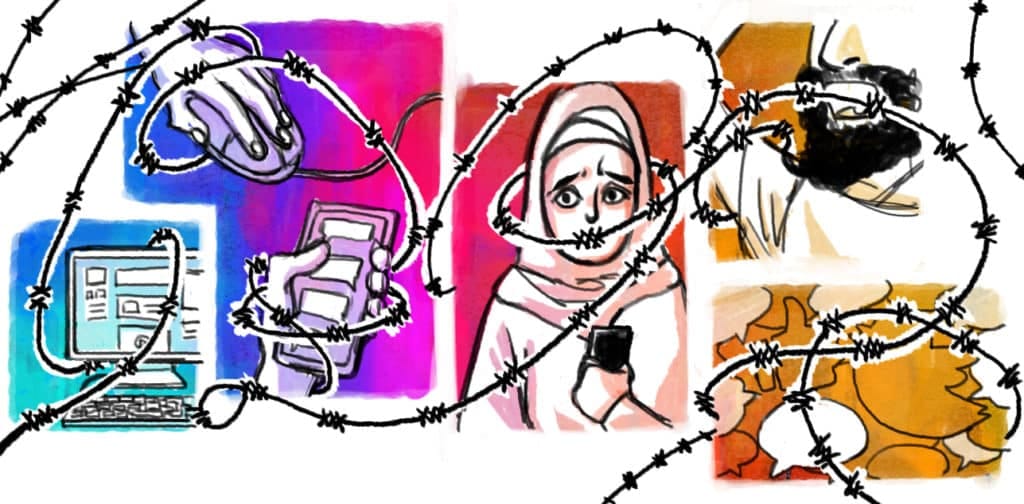
Graphic by Access Now. Licensed under Creative Commons Attribution (CC BY) 4.0 International License.
The instance was a brazen act of transnational repression: the process by which regimes attempt to silence or intimidate critics beyond their borders.
Notorious cases, like Kashoggi’s assassination, play an outsized role in deterring activists and journalists living in exile. But many repressive acts are more covert, accomplished through surveillance, threats, intimidating family members, enforced disappearances and forced return.
With the digital age, such extraterritorial repression has become increasingly pervasive, particularly among authoritarian states. Governments in the Middle East and North Africa are no exception in their attempts to cling to power by silencing critical voices and activities, even beyond their borders. A [recent report](https://freedomhouse.org/report/transnational-repression;%20https:/www.dw.com/en/germany-arrests-moroccan-citizen-for-alleged-espionage/a-63757177) by Freedom House on transnational repression lists Turkey, Egypt and Iran as among the worst offenders.[\[1\]](#%5Fedn1) But the method is widespread in the region.
These governments depend on the law—not only domestic legislation but international legal frameworks—as a way to legitimize transnational repression and decrease backlash. While the exact relationship of transnational repression and law depends on the forms of repression applied, as often as not, repression across borders occurs outside of and in contradiction to ratified legal frameworks.
## **Legal Targets**
Since the Arab Uprisings in 2011, many states in the Middle East and North Africa have revisited their legal foundations for repression in an attempt to control and regulate dissent.
For example, over the past decade countries have introduced comprehensive anti-terrorism legislation with vague definitions of terrorism, which can be used as a tool for silencing opposition. Jordan’s 2014 anti-terrorism law criminalizes such opaque offences as “disturbing” Jordan’s bilateral relations. The law has become an efficient tool for the monarchy to silence critical voices, used to target not only those who speak out against Jordanian rule but those who criticize other authoritarian regimes. In 2020, the prominent Jordanian cartoonist Emad Hajjaj was [arrested](https://www.hrw.org/news/2020/08/28/jordan-release-prominent-cartoonist) in Jordan for a cartoon mocking the de facto ruler of the UAE, Mohammed bin Zayed.
At times, states use these laws to target critics in the diaspora who are convicted in absentia or surveilled on the basis of domestic legislation. Again in 2020, an Egyptian terrorism court sentenced Bahey el-Din Hassan, a prominent human rights defender in exile in France, for “disseminating false news” and other fabricated charges.[\[2\]](#%5Fedn2)
States in the region have also introduced new cybercrime laws that similarly rely on vague definitions to criminalize open expression. The UAE passed a cybercrime law in September 2021 that criminalizes any digital platform opposing the ruling regime. The law also prohibits the spreading of “false rumours” that contradict “what has been officially announced” by the state.[\[3\]](#%5Fedn3)
> **The language of these laws reflects global trends in media and censorship, where “fake news” and morality are criminalized alongside terrorism and defamation.**
In 2018, Egypt passed a cybercrime law banning content that “violates Egyptian family values”—a law that has since been used to target a number of women TikTok influencers.[\[4\]](#%5Fedn4) Between 2017 and 2019, a broad coalition of Jordanian civil society successfully protested against a Cybercrimes Law that [defined](https://www.freiheit.org/naher-osten-und-nordafrika/cybercrime-laws-arab-world) hate speech as any statement that incites conflict. It also punished the broadcasting of false rumors. But in the summer of 2023, Jordan introduced a new Draconian cybercrime law with a similar scope and intent (the [new law](https://www.aljazeera.com/news/2023/7/28/rights-groups-opposition-slam-proposed-cyber-crime-law-in-jordan) also prohibits anonymously access the internet). The language of these laws reflects global trends in media and censorship, where “fake news” and morality are criminalized alongside terrorism and defamation.
Another way regimes use the law to silence voices both within and beyond their borders is through restrictive anti-NGO regulations. For example, the UAE in 2017 and Egypt in 2019 each introduced new restrictions on the foreign funding of NGOs. Such laws undermine one of the critical links between the diaspora and domestic civil society.
## **Bending International Law**
This domestic legislation often contradicts international law, even laws these countries have ratified. For example, defamation law in Tunisia, Libya and Algeria considers defamation offenses under criminal law. Doing so contradicts the African Charter on Human and Peoples' Rights, which generally holds that defamation offenses should fall under civil law. All three states have ratified the charter.
States also rely on their embassies and foreign missions to implement repressive measures across borders. Services like getting one’s passport renewed become prime entry points for states to target critics in the diaspora. For instance, in 2023 Human Rights Watch reported that Egyptian missions in Turkey and Qatar now require people applying for passports to fill out so-called “security clearance” forms with information about their social media, a practice that is not stipulated by laws.[\[5\]](#%5Fedn5) Turkey, meanwhile, has [abused](https://www.justsecurity.org/79161/abuse-of-interpol-for-transnational-repression-assessing-the-fy22-ndaas-provisions-for-prevention/) Interpol’s Stolen and Lost Travel Document database—a database that exists to help catch criminals using fraudulent travel documents. Turkey has used the service instead to cancel passports of critics, rendering them stateless.
> **Unless perpetrator states’ access to this unified biometric data bank is controlled strictly, their capacities to repress political opponents are likely to increase.**
Interpol’s red notices—alerts issued by member states ordering the detention of wanted individuals with a view to extradition—have also been abused by certain states to get hold of dissidents abroad or in transit. For example, in 2022, Bahraini labor activist Ahmed Jaafar was extradited from Serbia to Bahrain following his arrest due to a red notice issued against him by Bahrain. Another feature of Interpol, the so-called I-CORE project, cross links its data banks and digitizes border policing and control. Unless perpetrator states’ access to this unified biometric data bank is controlled strictly, their capacities to repress political opponents are likely to increase.
Not all repression that crosses borders happens through legal means. Journalists and activists living in exile are harassed and assaulted. Their family members back home are threatened, confined or refused permission to travel. Digital surveillance, too, operates beyond the law. Israel’s Pegasus spyware grants the Pegasus customer full access to a phone’s data and can even monitor a victim’s microphone without their knowledge. Despite their denial, Morocco, Saudi Arabia and the UAE have all been implicated in using the software to spy on activists, journalists, lawyers and politicians around the world, including the relatives of Khashoggi and the Turkish prosecutor who investigated his death.
## **Targeting Transnational Repression**
Over the last four years, governments in Europe and the United States have grown increasingly vocal on the issue of transnational repression. Efforts to address it, however, have largely focused on issuing statements and drafting bills denouncing its use. Meanwhile, continued US support of authoritarian regimes in the Middle East, not to mention Europe’s xenophobic anti-migration policies, raise questions about how effective these efforts to target transnational repression will be.
The US National Defense Authorization Act in 2022, for example, took on board suggestions of the US Helsinki Commission—which exists to push for compliance with the Helsinki Final Act and other OSCE commitments—to hold perpetrators of transnational repression accountable. The Helsinki commission has also recommended reforms to Interpol’s red notices, and the US Department of State has begun publishing biannual reports evaluating the abuse of Interpol’s mechanisms.
In March of 2023, the governments of Australia, Germany, Estonia, Kosovo, Latvia, Lithuania, Slovak Republic, Chile and the United States signed a “Declaration of Principles to Combat Transnational Repression.” The signatory states are also [calling](https://freedomhouse.org/2023/summit-for-democracy-transnational-repression) for a reform of Interpol alerts as well as for the passage of national laws that would allow officials to prosecute perpetrators of transnational repression.
> **This document concluded that the European Court of Human Rights—despite having never used the term in its judgements—has sufficient case law to guide it when determining a state’s responsibility for transnational repression.**
Moreover, in May of this year, the Committee on Legal Affairs and Human Rights of the Council of Europe adopted a [draft resolution](https://www.merip.org/content/files/transnational-repression-as-a-growing-threat-to-the-rule-of-law-and-hu/1680ab5b07.pdf) on “Transnational repression as a growing threat to the rule of law and human rights.” This document concluded that the European Court of Human Rights—despite having never used the term in its judgements—has sufficient case law to guide it when determining a state’s responsibility for transnational repression. The resolution proposes establishing a jurisdictional link between an act of transnational repression and the persecuting state. These steps allow the court to apply the European Convention on Human rights and to clarify the obligations of European states to protect victims of transnational repression.
The next months and years will reveal the extent to which this increasing awareness will lead to new international legislation and meaningful changes in law enforcement practices. In the meantime, alongside efforts to protect dissidents in exile, the populist and xenophobic sentiment that has spread across Europe and elsewhere provides a significant obstacle to combatting transnational repression. In the EU, right-wing positions dominate negotiations on migration and asylum policies. The draft on the Common European Asylum System, which passed the Council of the European Union in June of 2023 and is now under discussion in parliament, limits the rights of refugees to access legal assistance in Europe.
The new system strives to expand the cooperation with so-called third countries, such as Algeria, Morocco and Tunisia, declaring them safe countries to which asylum seekers can be pushed back. But as [Amnesty International](https://www.amnesty.de/informieren/aktuell/gemeinsames-europaeisches-asylsystem-geas-statement-fluechtlingsschutz), and other organizations advocating for migrants’ rights have pointed out, this policy will likely increase the risk of chain deportations, making it harder for dissidents to evade the reach of repressive regimes.
\[**Mirjam Edel** is senior lecturer at the Institute of Political Science at University of Tuebingen.\]
> **Read the**[ **previous**](https://merip.org/2023/09/how-a-tree-became-a-voice) **article.**
> **Read the**[ **next**](https://merip.org/2023/09/exiled-women) **article.**
**This article appears in** [**MER issue 307/308**](https://merip.org/magazine/307-308/) **"Frontlines—Journalism and Activism in an Age of Transnational Repression."**
---
### Endnotes
[\[1\]](#%5Fednref1) Yana Gorokhovskaia, Nate Schenkkan, and Grady Vaughan, "[Still Not Safe: Transnational Repression in 2022](https://freedomhouse.org/report/transnational-repression)," Freedom House, April 2023.
[\[2\]](#%5Fednref2) “[Egypt: Human rights defender Bahey el-Din Hassan handed outrageous 15-year prison sentence](https://www.amnesty.org/en/latest/press-release/2020/08/egypt-human-rights-defender-bahey-eldin-hassan-handed-outrageous-15-year-prison-sentence/),” Amnesty International, August 25, 2020.
[\[3\]](#%5Fednref3) “[United Arab Emirates: New cybercrime and anti-rumour law violates rights](https://www.article19.org/resources/united-arab-emirates-new-cybercrime-and-anti-rumour-law-violates-rights/),” *Article 19*, January 24, 2022.
[\[4\]](#%5Fednref4) Basil El-Dabh, “[Egypt’s TikTok Crackdown and ‘Family Values‘](https://timep.org/2020/08/13/egypts-tiktok-crackdown-and-family-values/#:~:text=Family%20Values%20and%20the%20Cybercrime%20Law&text=Article%2025%2C%20which%20prohibits%20the,%28roughly%20%243%2C100%E2%80%93%246%2C200%29.),“ TIMEP, August 13, 2020.
[\[5\]](#%5Fednref5) Amr Magdi, “[Exile or Prison: Egypt’s Offer to Critics Abroad](https://www.hrw.org/news/2023/03/28/exile-or-prison-egypts-offer-critics-abroad),” *Human Rights Watch,* March 28, 2023.
### How a Tree Became a Voice—A Collective Reflection on the Iraqi Media Platform, Jummar
URL: https://www.merip.org/2023/09/how-a-tree-became-a-voice/
Last updated: 2025-08-22T18:36:37.000Z
We launched the Iraqi independent media platform, *Jummar*, in October of 2022 with the goal of serving as “an independent Iraqi media initiative that seeks to pave the way for creative and ethical journalism in and about Iraq.”[\[1\]](#%5Fedn1)
The publication of this collective piece, co-authored by five members of the *Jummar* team, coincides with the first anniversary of the website’s launch. It also marks the fourth anniversary of the Tishreen (October) uprising that swept through much of Iraq in 2019\. Inspired by the 2019 uprisings, *Jummar* emerged with the aim of amplifying the voices of the young generation in Iraq*.*
Inspired by Jawad Selim's painting "Siesta" (1950). Designed by Atef Al-Jaffal/Jummar.
## **What’s in a Name**
In our effort to choose a name for the website, we engaged in lengthy discussions, poured through poetry collections and dictionaries, consulted with colleagues, friends and family. We came across countless names only to quickly realize that they were already taken or didn’t feel quite right.
In the next round of brainstorming, we focused on terms that were uniquely Iraqi, taken from Iraqi society. That is when we thought of *Jummar*. It refers to the heart of a date palm tree in Iraqi dialect. This name was chosen with the aim of establishing *Jummar* as a media platform on and for Iraqi society, especially one that would delve deep into the core of the issues affecting it. We were enthusiastic about the name and felt there could be no term more apt than this.
Then we began imagining the reactions of different groups to the name we had chosen: Would it be appropriate to assign a name of something that is eaten to a respectable media platform? If a journalist from *Jummar* were to contact a government official and say that she is from *Jummar*, a media platform, would she be taken seriously, especially in a country where those in power already do not regard the press or journalists with seriousness? We then wondered, since the palm tree in Iraq is facing the threat of extinction, would everyone know the meaning of *Jummar*? Especially the younger generation or the generation of Iraqis who were born outside Iraq who may not know such colloquially used terms. What about those Arab readers, too, who are unfamiliar with the word’s meaning or even its correct pronunciation?
We reassured ourselves by reaffirming our intention to have a uniquely Iraqi name and hoped that by keeping this name, we would add a beautiful word to the lexicon of our readers. We understood that journalists would eventually get accustomed to the name and so would the public and press sources.
It was now important that the design of the name and the visual identity of the website, including the logo, be complementary to the meanings we envisioned the name to convey. In other words, *Jummar* should serve as a platform which emanates from the heart of Iraqi society and speaks to it. We selected the current logo from the various designs that we considered, inspired by modern Baghdadi architecture.
From November 2021 until September 2022, while we were engrossed in preparing the institution and the website’s infrastructure, we began simultaneously searching for writers who would form the initial nucleus of the platform—women and men from our network of writers within Iraq and from the Iraqi diaspora. We gave free rein to our journalists to suggest topics. What followed was many conversations and discussions to explain the editorial line of *Jummar*: journalism for society.
The launch was delayed for months due to technical reasons. But from our side, the work continued as if we had already gone public. Our team began to grow steadily.
The adrenaline kept steadily building. One week after another would pass, and with each week, we would tell ourselves, “Definitely, it will happen this week!” It turned into a joke among ourselves to keep up with the growing anticipation.
We eventually realized that there was no such thing as a perfect launch date, and we decided to take off and see. Finally, we launched on October 2, 2022—the third anniversary of the Tishreen uprising.
## **Writing and Editing Within and For Iraqi Society**
Before the launch, the editorial team spent several months finding early career writers in addition to more experienced writers to contribute articles to the platform. Everything from the topic of articles to our editorial policy were all in place and ready for the launch. The articles varied, but they all leaned towards one common purpose: “highlighting the issues affecting the people and places of Iraq, be they major issues or day-to-day affairs…and to also break the geographic centrality common in the media coverage of Iraq.”[\[2\]](#%5Fedn2)
We decided not to specify topics and instead opened the field to our writers. The topics could be social, political or economic. They could be issues that have already been covered or not, in the form of a report or even a journal chronicling day-to-day affairs. The crucial thing was to ensure that the perspectives were not repetitive or lacking a social story or voice.
The pitches that poured in from the writers revolved around various issues, for example [drug](https://jummar.media/en/2912) smuggling and how its infiltration into cities is affecting youth and children. Other topics included discussions about the [smuggling of Iraqis through perilous routes to Europe](https://jummar.media/en/category/features) and even more sensitive topics like the [harassment of minors](https://jummar.media/en/2864) and [queer women in Iraq](https://jummar.media/en/2889). There were subjects drawn from everyday life, such as [walking routes](https://jummar.media/3639) in Iraq, [green spaces](https://jummar.media/3020) for the population and the country’s [environmental future](https://jummar.media/en/3784). Where we could, we also decided to include a balanced analysis of breaking news and events. But the time at our disposal before the launch was not the same as the time that followed it.
Time constraints are inevitable in any media organization, especially one that operates in a country with a population of over 40 million, teeming with events every day. The pace of production must remain swift. Herein lies the great challenge for every media organization: to strike a balance between speed and the quality of our content, which needs to uphold the principles we had set for ourselves, to be creative and ethical.
We did not want *Jummar* to become restricted by confining itself to the voices of a few specific writers. Our editorial directive to journalists was simple: to identify the questions that occupy the minds of Iraqis wherever they may be and then scrutinize and analyze possible answers.
We discovered that the greater challenge was in emboldening the writers and getting them used to addressing societal issues in light of the tumultuous political and security reality, which suffocates the youth and erases their horizons. All of this kills the imagination!
> **We realized that if we want *Jummar* to remain distinct and diverse, we must start from there, from the social imagination of the journalists, who harbor a deep eagerness to write.**
We realized that if we want *Jummar* to remain distinct and diverse, we must start from there, from the social imagination of the journalists, who harbor a deep eagerness to write. They were the driving force behind *Jummar,* as were those who had a passion for writing but were unable to leave their homes: women who were prevented from completing their education or venturing out without a male guardian, differently abled individuals who were unable to navigate their wheelchairs due to the crumbling infrastructure, women fearing to engage with journalistic sources, men afraid of losing their jobs and queer people who have endured painful experiences. All of this eagerness in a country that is paralyzed with security fears where nobody is safe from retaliation…
While the eagerness of our journalists is inspiring, it demands immense efforts, most importantly obtaining accurate information. Amid the multitude of rumors, allegations, hidden agendas and the near absence of any reliable official statements—which themselves contribute to this chaos—Iraqi journalists must obtain precise information with minimal margin for error and without jeopardizing themselves or their sources. Any minor lapse from the journalists and from us can feel like stepping into a minefield. Therefore, from the very outset at *Jummar*, it has been crucial for us to integrate a fact-checking methodology as part of the editorial process.
All of this work requires a significant amount of time, and we are operating with only a small team and a demanding schedule to produce articles. We decided that it was better to progress slowly and steadily, rather than being hasty, faltering and quitting in between.
## **Sailing Toward the Sun**
Just like the stories we publish, the story of our visuals is also worth telling. We make sure to pay attention to each detail however small it may be. Some of us, when describing our work, would say, “*Jummar* consists of two halves. One half involves editing while the other half is designing.”
At times, the emphasis on design by those working on it may seem excessive. But we believe that journalism can co-exist with all forms of writing and the arts as well. Consequently, every design should be the result of contemplation and a whole lot of effort.
Jummar explains that the small sun represents hope in general. In this specific design, it represents the people of al-Miqdadiyah (a city in the Diyala Governorate of Iraq). The city is historically known for its religious diversity and cultural harmony, as it is inhabited by Sunnis, Shiites, Kurds and Turkmen. Designed by Atef Al-Jaffal/Jummar.
When we decided to use collage designs to accompany our articles instead of the press photos of traditional journalism, our goal was to provide a vivid reflection of the story and capture the imagination of our readers.
Within each text lies a narrative, individuals and a topic that is explored, requiring our designers to condense, recreate or even incorporate supplementary elements as needed. Sometimes the images have to go further by indirectly hinting at what was deleted from the text due to the self-censorship that journalists, unfortunately, have to impose on themselves.
The designs accompanying our articles enhance readability and make them shareable and memorable for readers of all ages, particularly among the youth. Our designers, like our writers, are equally appreciated for their contributions.
Within our design department, we adopted "Al-Shamisah," (the small sun) as a pivotal component of our visual identity. It symbolizes an intimate relationship between the bright sun in all seasons and the palm tree.
The sun for us is symbolic. It represents hope. Some in our audience perceive us as pessimistic. In reality, we aren't pessimistic, but the pervasive state of devastation throughout Iraq compels us to amplify our critique with the belief that our circumstances will eventually improve.
## **Knowing Our Audience**
Naturally, social media is a platform where *Jummar* must strive to establish its presence and actively engage with its audience. But crafting content for these platforms without falling into the trap of oversimplification is a challenge.
Many of us came from journalistic, research and artistic backgrounds. And we did not have much experience previously working with social media. While we received a wealth of advice, much of it did not resonate with our editorial direction, community engagement policies or the specificities of the virtual landscape of the Iraqi context: What is happening in the Iraqi public space extends to the virtual space, as there is threat and surveillance by political parties and their armed factions. But, at the same time there is also a society striving to engage and take part in public debates.
> **What is happening in the Iraqi public space extends to the virtual space, as there is threat and surveillance by political parties and their armed factions...at the same time there is also a society striving to engage and take part in public debates.**
And so, we started experimenting with templates in writing and design for social media. We wanted to reach the widest possible audience, but we did not want to be sensationalist and present topics merely to provoke emotions.
Our goal was to present information in a way that allows readers and followers to form their own opinions about a certain issue rather than us imposing a specific viewpoint on them. This desire, of course, does not mean that we are neutral. The founders, the staff, the writers, all of us write about social and human issues from a critical perspective. We stay well away from prevailing narratives established by the sectarianism and regressive structures that took root in Iraq even before 2003 and which were exacerbated after the US invasion.
Our steadily growing audience consistently validates our work with messages on Instagram and Facebook, providing words of encouragement, constructive criticism as well as pointing out our errors.
The biggest challenge for *Jummar* is to ensure that it does not drown in the vast expanse of the virtual realm by sacrificing journalistic content merely to capture an audience. We work hard to abide by our principle of placing creative and ethical journalism before all else—including in the way we function on social media.
## **Managing Across Space and Time**
What remains hidden behind the scenes, hiding behind the content we publish on our website or social media, is our institution and the team responsible for production and management.
Each of us operates from different countries, cities, time zones, facing different life situations and at a rhythm which is unique to each.
Nonetheless, we must ensure that we operate at a steady rhythm and keep up with the demanding pace the work entails. At the same time, we must also ensure that we work toward developing our platform and ourselves, learning new skills, which may not have been required at our previous places of work. Everything from designing to writing content, from archiving to managing the finances and the workflow, were all skills we had to learn and continue to learn. We understand that if our institution demands creativity from its journalists, then the institution should also adopt creativity as a basis and a motivating factor for its staff.
Administrative work takes a lot of our energy away from the journalism that we want to write. We are essentially writers and journalists before anything else, so we try to steal as much of our time as possible for investigating and writing.
The greater challenge—and one that every media organization faces—is funding and financial viability, and our organization is no exception. We are currently supported completely by international civil society organizations based in the Global North. Independence is a term that can naturally create some confusion. How can we be independent when we are dependent on the funding of specific entities? This question is one our audience poses to us. It is a very important question especially in the Iraqi context, where corruption has spread to every aspect of the state and society, including the media.
> **We consistently strive to explain that independence lies within the content itself. In other words, donors do not have control or the right to interfere with the content we produce.**
We consistently strive to explain that independence lies within the content itself. In other words, donors do not have control or the right to interfere with the content we produce. This principle is something we greatly stress and implement in our dealings with donors right from the outset.
For a media institution operating with a high standard of professionalism, it is necessary that our staff and network of contributors receive reasonable pay. There also must be sufficient financial resources for the development of the website. We are in a constant struggle to ensure the sustainability of our organization by seeking funding and putting forth ideas and proposals in the absence of any other viable profit-based income models at this stage.
In spite of all these challenges, *Jummar* is an attempt that is absolutely necessary. It is an accumulation of experiences across generations that must be passed on to future generations.
And in spite of these challenges, our bet is on its success because of the importance and the need for a media institution like *Jummar*, which is proven every day and by every writer—woman or man—who researches, writes, analyzes and strives to explore their social imagination so that it may open new horizons for them. With them and us on this journey, are our readers, our audience, who are ultimately the essence of the society we write for and about.
*This piece has been translated into English by Tariq Huq, an MA candidate at the University of Exeter’s Institute of Arab and Islamic Studies.*
> **Read the**[ **previous**](https://www.merip.org/reporting-from-tunis/) **article.**
> **Read the**[ **next**](https://www.merip.org/transnational-repression/) **article.**
**This article appears in** [**MER issue 307/308**](https://merip.org/magazine/307-308/) **"Frontlines—Journalism and Activism in an Age of Transnational Repression."**
---
### Endnotes
[\[1\]](#%5Fednref1) “[Who are we?](https://jummar.media/en/who-are-we),” *Jummar.*
[\[2\]](#%5Fednref2) Ibid.
### Reporting from Tunis
URL: https://www.merip.org/2023/09/reporting-from-tunis/
Last updated: 2025-08-22T18:36:38.000Z
In the aftermath of the 2011 revolution, Tunisian journalist Bassam Bounenni published an [article](https://nawaat.org/2011/03/23/tunisie-media-road-map/) on the dissident digital news site, *Nawaat*. In it, he criticized the media’s practices under fallen dictator Zine el-Abidine Ben ‘Ali (1987-2011).
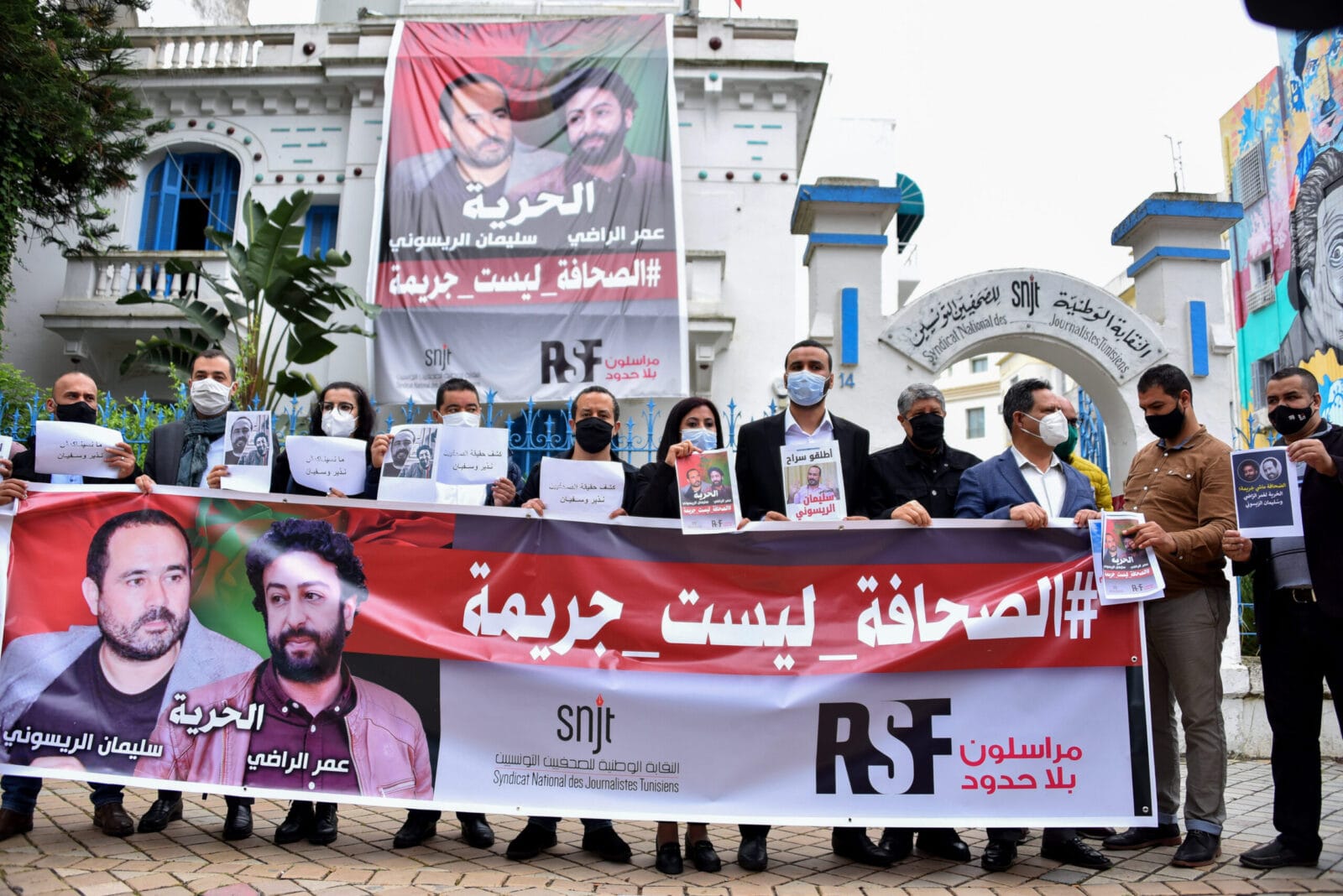
Members of the Tunisian Journalists Union support imprisoned Moroccan journalists Omar Radi and Souleimane Raissouni, on World Press Freedom Day, 2021\. Jdidi Wassim/SOPA Images/LightRocket via Getty Images
For the media to play a role in the new political order, he argued, the issues of the past would need to be addressed. “Press criminals”—pro-Ben ‘Ali journalists—should be prosecuted, a new legal framework adopted for the profession and new programs established to train aspiring journalists.
Bounenni’s article captured a prevailing sentiment that emerged in the wake of the revolution. At the time, state development agencies, foreign media companies and international organizations alike were focused on transforming Tunisia’s media sector. The European Union—which had already been active under Ben ‘Ali with a media support program that began in 2008—expanded the program twice in the years after the uprising. Other large international organizations, like UNESCO, opened offices in its aftermath. These bodies contributed to a burgeoning media scene. They encouraged journalists operating in the region and Europe to relocate to Tunis.
Between 2020 and 2022, I interviewed several Tunisia-based reporters connected to the transnational media scene about the challenges of navigating local realities as they intersect with foreign influences. The growth of Tunisia’s transnational media sector has reproduced the shortcomings of transnational democracy promotion. So-called experts imported their standardized understanding of media modernization. They pursued lofty objectives, like strengthening democracy and the market economy at the regional level, overlooking the struggles of local journalists amid ongoing political and socioeconomic precarity.
Meanwhile, Gulf states, most notably the UAE, have also tried to [influence](https://orientxxi.info/magazine/la-tunisie-un-champ-d-affrontement-entre-les-pays-du-golfe,2387) Tunisian mainstream and social media to promote their own political agendas, attempting to sway North African public opinion in the context of their military involvement in Libya and regional competition with Qatar.
Following president Kais Saied’s July 2021 constitutional coup, press freedoms in Tunisia have faced new threats, exposing the contradictions and divides that continue to shape the sector more than a decade after the revolution.
## **A Hub for Maghrebi Journalism**
The revolution and its aftermath turned Tunis into a highly attractive city for aspiring journalists around the Mediterranean.
In contrast to neighboring Algeria, which implements strict exchange controls, local reporters could be paid in foreign currencies without risking prosecution. Tunis provided a relatively welcoming environment for women. Moreover, it was possible for foreign journalists to obtain a visa on arrival, unlike in Algeria or Libya. Tunisia’s professional climate was also less marked by policing and suspicion. Compared to the threat of repression in Algeria, Morocco or Egypt, or the civil conflicts that have ravaged Libya since 2011, newly arrived reporters told me that relocating to Tunisia came with a promise of relative safety. Notably, the infamous External Communications Agency that used to supervise foreign journalists was dismantled in 2012.
Public authorities did still impose [restrictions](https://carnegieendowment.org/2012/07/10/tunisian-media-in-transition-pub-48817) on journalists, who continued to face occasional [violence](https://rsf.org/en/tunisian-police-attack-reporter-during-demonstration) at the hands of the police. But overall, at least according to the barometer published by [Reporters without Borders](https://rsf.org/en/index?year=2012), press freedoms in the country continued to grow until 2021—the year of Kais Saied’s constitutional coup.
Testifying to their feeling of increased liberty over the past decade, Tunisian journalists have often spoken up for their colleagues who are victims of state abuse in neighboring countries. In 2016, for instance, the National Union of Tunisian Journalists published a communiqué on Facebook [denouncing](https://www.facebook.com/snjt.tunisie/posts/1692940964313258) the Egyptian government for its attacks on press freedoms.
As a result of its friendlier press environment, Tunis offered job opportunities for journalists from around the Mediterranean. After the revolution, several international media and news agencies opened offices in the capital, such as Anadolu and Al Jazeera. Moreover, [local associative radios](https://journals.openedition.org/radiomorphoses/1100) emerged thanks to a more open regulatory framework and active support by European backers such as the European Union or the Swiss government.
> **Though pioneering dissident outlets already existed...after the 2011 revolution, the number of these sites expanded in both form and number, often with foreign support.**
Citizen-journalism using Facebook or blogs also increased dramatically following the uprisings, as have websites dedicated to in-depth investigations. Though pioneering dissident outlets already existed, including the short-lived [*TUNeZINE*](https://www.wired.com/2002/06/tunisian-net-dissident-jailed/) (established in 2001) and the still active [*Nawaat*](https://nawaat.org/) (created in 2006), after the 2011 revolution, the number of these sites expanded in both form and number, often with foreign support.
New digital magazines, such as [*Al-Qatiba*](https://alqatiba.com/) and [*Inkyfada*](https://inkyfada.com/en/), combine investigation with visual journalism and rely on a relatively young pool of reporters. Some of their initial recruits included journalists who left Europe to find jobs in Tunis after the revolution. Tabiha, a Tunisian-French investigative reporter, for example, explained her desire to contribute to a form of slow journalism that offers a more accurate depiction of her parents’ country of origin, in contrast to the clichés propagated by foreign media.[\[1\]](#%5Fedn1)
The content these publications produce is often multilingual, including publications in Arabic, English and French. Their investigations are not limited to Tunisia, and *Al-Qatiba* in particular has worked with the Organized Crime and Corruption Reporting Project (a transnational network of investigative journalists) to unearth transnational embezzlement and corruption schemes.
These outlets benefit from outside recognition, particularly in the Global North. *Nawaat,* for example, has received multiple international prizes after 2011\. Their activities have influenced similar publications in neighboring countries, such as the Algerian digital magazine [*Twala*](https://twala.info/fr/), which also cooperates with the Organized Crime and Corruption Reporting Project.
Former journalist now turned media executive Messaoud—who moved to Tunis in the mid-2000s—saw the capital as an ideal place to foster regional collaboration and develop his vision of independent pan-Maghreb journalism.[\[2\]](#%5Fedn2) Tunis is conveniently placed within driving distance of both Algeria and Libya, with direct flights to Middle Eastern and European capitals. Journalists holding a Maghrebi passport could easily organize short trips to cover events in neighboring countries.
Yet, even before the pandemic-related border closures of 2020, journalists based in Tunis and working for the foreign press have been frustrated in their attempts to report on the region. On the one hand, international media outlets and news agencies minimize travel for investigative journalism in an effort to limit their costs. On the other, freelance journalists tend to reduce their own production expenses to be able to sell their stories. Moreover, foreign (particularly European) media outlets tend to prioritize familiar topics, such as Islamism, traditional practices, women & LGBT rights, over investigative work.[\[3\]](#%5Fedn3)
## **Professional Networks and Social Divides**
The transformation of Tunis into a hub for journalists covering the broader Maghreb is intrinsically linked to the massive influx of international organizations dedicated to development and democratization after 2011.
Under Ben ‘Ali, Tunisia had already acquired a reputation as a relatively welcoming homeport for international institutions and development aid, particularly following the relocation of the African Development Bank to the capital in 2003\. With the revolution, international organizations focused on human rights and democracy promotion flocked to the scene.
For example, the Cairo Institute for Human Rights Studies relocated its activities to Tunis in 2014\. Around the same time, organizations fleeing Libya also migrated to Tunis. NGOs defending the freedom of the press, such as Article 19 and Reporters Without Borders, followed a similar path and opened offices in the country after the revolution.
In the Tunisian capital, the lines between transnational democracy promoters, technicians of development and media professionals are often blurred. For instance, Hichem Snoussi, a former TV journalist and one of the first local representatives of Article 19, was later appointed as a member of the High Independent Authority of Audiovisual Communication (HAICA)—an independent regulatory body created by the 2014 constitution, which itself [benefited](https://www.coe.int/fr/web/tunis/haica-ica) from European technical and financial support.
Professional networks spanning the media and governance sectors have shaped the careers of many binational and/or bilingual journalists throughout the decade, in turn influencing the news that is produced.
Desk journalists in need of a quote to complete an article in time rely on connections with political, economic and transnational elites, who tend to live in the wealthy northern suburbs of the Tunis governorate. These connections also help journalists secure financial resources and opportunities for professional development. Binational or bilingual reporters who were able to monetize their language skills and hybrid identity gained access to the “world of press conferences,” as one of my interviewees put it, and its short or long-term gigs.
Tania, a French-Algerian journalist who had been residing in Tunis on and off since 2014, eventually left her job at a news agency to join an NGO defending human rights. Other journalists I spoke to found temporary or lasting employment working in communications with the African Development Bank or the EU Delegation in Tunisia.[\[4\]](#%5Fedn4)
In late 2022, Nasser, a Tunisian journalist freelancing for English-speaking media, told me that Tunis was a great space to connect with a selection of key local players and foreign organizations. But in his view, the increasing access of Tunisian journalists to transnational spaces has come with a cost.
> **This connectivity results in redundant international coverage, limited to a handful of prominent figures fluent in French, English or both.**
This connectivity results in redundant international coverage, limited to a handful of prominent figures fluent in French, English or both. As he put it, the “world of La Marsa,” the suburban beach town favored by expatriates living in Tunis, is lightyears from the daily challenges facing Tunisian society. He also saw this elite bubble as shamelessly extractive. Foreign reporters and researchers often rely on easily accessible Tunisian informants and knowledge-producers, who speak multiple languages, without crediting them for their insights and analyses.[\[5\]](#%5Fedn5)
In many ways, the transnational dynamics shaping the media sector reproduce existing social divides in Tunisia. For example, a freelance reporter employed by a European magazine or a foreign NGO can be paid in euros and earn twice the average monthly Tunisian salary by writing a couple of short articles or contributing to a report. Working with local media outlets, on the other hand, means economic vulnerability, especially in the eyes of those who have experience abroad or with international media. Foreign media organizations nonetheless tend to demand greater flexibility, turning many journalists into economically privileged yet unstable gig workers.[\[6\]](#%5Fedn6)
This flexibility offers less physical security than full-time work. During a trip as a freelance reporter embedded with Libyan militias in 2011, Tabiha was left behind as a battle raged nearby. Her colleagues employed by a major European broadcaster, however, were swiftly evacuated.[\[7\]](#%5Fedn7) Fixers used by foreign reporters are especially precarious. [Paid](https://inkyfada.com/fr/2023/05/14/stouchi-shelby-photoreporter-journaliste/) as locals, they also lack a legal framework regulating their profession. Fixers network and serve as interpreters and drivers, effectively performing most of the actual reporting for foreign journalists while not receiving recognition through bylines.
More generally, the sector itself is marked by a political and economic divide. Mainstream Tunisian media are still often controlled by national elites who were previously associated with Ben ‘Ali and routinely use these outlets to gain influence.
Meanwhile, more critical and innovative media outlets are largely dependent on foreign donors interested in promoting democracy and who may see media as form of soft power. For instance, *Al-Qatiba*—a project of the Tunisia-based regional media initiative Taqallam, which supports freedom of expression and creativity—received funding from the European Endowment for Democracy. Such dependence incentivizes these outlets to publish in French or in English rather than Arabic to make their work visible to their backers. It also raises questions about the [sustainability](https://larevuedesmedias.ina.fr/tunisie-medias-independants-presse-nawaat-inkyfada-alqatiba) of their business model. Ultimately, the support granted by foreign liberal technocratic organizations cannot replace a local base of readers and backers in the long term.
## **Reaction, Resistance and Exile**
In January of 2023, more than a dozen local and foreign journalists were attacked by the Tunisian police as they covered a protest, held on the anniversary of the 2011 revolution, to denounce Kais Saied’s power-grab.
The moment marked a significant escalation in the government’s offensive against independent media. Elected in 2019 on the promise of transforming the political system to give power back to the people, Saied has grown increasingly intolerant of public criticism since his constitutional coup de force in July 2021.
Tunisia’s intensifying economic crisis has led to a growing reliance on foreign financial support, notably from the Gulf Cooperation Council and Algeria. As the political crisis between Ennahdha—the dominant party in the parliament—and the presidency escalated in 2020, the UAE and Saudi Arabia supported the release of hostile media coverage. They likely [orchestrated](https://www.middleeasteye.net/news/tunisia-uae-libya-ghannouchi-coups-fake-footage-and-proxy-parties-accused-meddling-affairs) online disinformation to discredit the party, helping enable Saied’s takeover.
Following the 2021 suspension of parliament, several national media outlets were banned from broadcasting. The HAICA notably suspended Nessma TV—a channel that had been founded by the controversial businessman Nabil Karoui in 2007 with the financial backing of European investors, including Silvio Berlusconi’s Mediaset. Karoui also happened to be Saied’s main challenger during the 2019 presidential election. Eventually, Nessma was allowed to resume its broadcasting under a new name in 2022\. The pressure on the media sector has nevertheless continued, leading the HAICA itself to [denounce](https://www.tap.info.tn/en/Portal-Politics/16312123-haica-denounces) the government’s repressive stance.
> **The current crackdown on opponents and independent media outlets seems to be inspired, in part, by the Algerian playbook.**
The current crackdown on opponents and independent media outlets seems to be inspired, in part, by the Algerian playbook. Decree 54—the law introduced by Saied in September 2022 aiming to control critical voices through the penalization of disinformation—mirrors the reforms of the Algerian penal code adopted in 2020 and 2021\. The March 2023 arrest of Noureddine Boutar—the CEO of the most prominent private radio station in Tunisia, Mosaïque FM—and his subsequent indictment for money laundering and conspiracy against the state recalls the strategy used by the Algerian government to silence Ihsane El Kadi, the founder of Radio M. Both radio stations had launched popular talk shows, which commonly criticized their respective governments.
These similarities point to the growing security cooperation between the two countries. The Algerian security services have worked hard to silence the community of opponents living in Tunisia. For instance, Amazigh activist [Slimane Bouhafs](https://www.amnesty.org/en/documents/mde28/7149/2023/en/) was abducted in the center of Tunis and brought back to Algiers in August 2021\. More recently, Tunis-based researcher and co-founder of *Twala* [Raouf Farrah](https://globalinitiative.net/announcements/charges-against-raouf-farrah-and-his-father-without-basis/) was arrested while visiting his family in Annaba and indicted for allegedly releasing confidential information and illegally financing Algerian news organizations. Meanwhile, [Nabil Karoui](https://www.reuters.com/world/africa/algeria-arrest-tunisias-former-presidential-candidate-nabil-karoui-media-2021-08-29/) and his brother Ghazi were arrested in Algiers and fled in extremis to Barcelona before their scheduled deportation to Tunisia.
Transnational democracy promoters have responded to this reactionary wave, supplementing their usual tools of awards, training and funding with increasingly alarmed communiqués. Since 2021, a number of organizations have denounced the worsening situation of the press in Tunisia, including the [Federation of Arab Journalists](https://northafricapost.com/65508-federation-of-arab-journalists-raises-alarm-over-freedom-of-press-in-tunisia.html), [the International Federation of Journalists](https://www.aa.com.tr/en/middle-east/global-journalists-body-to-file-complaint-against-tunisia-over-crackdown-on-protests/2829446), and [Reporters without Borders](https://rsf.org/en/tunisian-journalism-threatened-decree-criminalising-rumours-and-fake-news).
These organizations support the National Union of Tunisian Journalists (SNJT), which is leading the on-the-ground mobilization against the repressive turn. Along with two US-based organizations, the Committee to Protect Journalists and the Tahrir Institute for Middle East Policy, the SNJT [co-published](https://www.merip.org/content/files/wp-content/uploads/2022/05/upr-tunisia-2022-cpj-snjt-timep-final-1.pdf) an appeal to the UN Human Rights Council documenting a “steady rise in incidents of assaults against journalists,” “restrictions to information access,” and “the leveraging of a number of \[Ben ‘Ali\]-era laws to restrict freedom of expression.”[\[8\]](#%5Fedn8) But such denunciations are unlikely to turn the tide in the face of an effort led by nation-states across the region. Furthermore, Saied’s supporters often [portray](https://www.aljazeera.net/news/2023/3/21/%D9%85%D8%AE%D8%A7%D9%88%D9%81-%D8%A3%D9%88%D8%B1%D9%88%D8%A8%D9%8A%D8%A9-%D9%85%D9%86-%D8%A7%D9%86%D9%87%D9%8A%D8%A7%D8%B1-%D8%AA%D9%88%D9%86%D8%B3-%D9%82%D9%8A%D8%B3-%D8%B3%D8%B9%D9%8A%D8%AF) foreign criticism as a form of neocolonial interference, allowing the president to position himself as the guardian of national sovereignty and independence.
The current media environment has forced many of the journalists interviewed for this article to make career-defining choices. Some have already left Tunisia. Others are thinking of doing so, following a trend visible among human rights NGOs. But not everyone is able to move. In many ways, the ability to relocate away from Tunisia underscores the disconnect of those who are embedded in the transnational field of democracy promotion. It is the struggles of local journalists, their ability to navigate a precarious economic situation and resist state pressure, that will ultimately determine the future of Tunisian media.
\[**Thomas Serres** is an assistant professor of politics at UC Santa Cruz.\]
> **Read the**[ **previous**](https://merip.org/2023/09/the-abraham-accords-cybersecurity) **article.**
> **Read the**[ **next**](https://merip.org/2023/09/how-a-tree-became-a-voice) **article.**
**This article appears in** [**MER issue 307/308**](https://merip.org/magazine/307-308/) **"Frontlines—Journalism and Activism in an Age of Transnational Repression."**
---
### Endnotes
[\[1\]](#%5Fednref1) Interview with Tabiha (pseudonym), Tunisian-French investigative journalist, 2022.
[\[2\]](#%5Fednref2) Interview with Messaoud (pseudonym), Algerian-French former journalist now media executive, 2021.
[\[3\]](#%5Fednref3) Interviews with Tania (pseudonym), Algerian-French journalist working for a news agency, 2020; Jamil (pseudonym), Algerian freelance journalist, 2021; and Lamine (pseudonym), Tunisian journalist working with local and foreign magazines, 2022.
[\[4\]](#%5Fednref4) Interviews with Tania, Algerian-French journalist working for a news agency, 2020; with Messaoud, Algerian-French former journalist now media executive, 2021; and with Saif (pseudonym), Tunisian-French journalist working for a regional magazine, 2021.
[\[5\]](#%5Fednref5) Informal discussion with Nasser (pseudonym), Tunisian freelance journalist, Fall 2022.
[\[6\]](#%5Fednref6) Interviews with Interviews with Saif, Tunisian-French journalist working for a regional magazine, 2021 and Lamine, Tunisian journalist working with local and foreign magazines, 2022.
[\[7\]](#%5Fednref7) Interview with Tabiha, Tunisian-French investigative journalist, 2022.
[\[8\]](#%5Fednref8) Committee to Protect Journalists, National Syndicate for Tunisian Journalists, and The Tahrir Institute for Middle East Policy, "Joint Stakeholder Submission to the UN Human Rights Council Universal Periodic Review – Republic of Tunisia—State of Freedom of Expression and Press Freedom in Tunisia," November 2022.
### Normalizing the Surveillance State—Cybersecurity Cooperation and the Abraham Accords
URL: https://www.merip.org/2023/09/the-abraham-accords-cybersecurity/
Last updated: 2025-08-22T18:36:38.000Z
On February 3, 2023 at the Cybertech conference in Tel Aviv, the US Department of Homeland Security announced an expansion of the Abraham Accords. The normalization deals would now include an agreement on cybersecurity between Israel, Bahrain, Morocco and the United Arab Emirates.

Under Secretary Silvers on a panel February 3, 2023 with Israel National Cyber Directorate Director General Gaby Portnoy, Head of the UAE Cyber Security Council Mohamed Al Kuwaiti, CEO of the Bahrain National Cyber Security Center Shaikh Salman bin Mohamed bin Abdulla al-Khalifa and Director General of Morocco’s General Directorate of Information Systems Security El Mostafa Rabii. Photo by DHS, public domain.
The US Under Secretary of Homeland Security, Robert Silvers, [touted](https://www.washingtonpost.com/politics/2023/01/31/abraham-accords-expand-with-cybersecurity-collaboration/) the expanded agreement as “a piece of diplomatic history, a piece of cybersecurity history and a wonderful opportunity to deepen security partnerships.”[\[1\]](#%5Fedn1) His statement was reminiscent of the original 2020 accords, which were [packaged and promoted](https://2017-2021.state.gov/the-abraham-accords/) as a historic breakthrough that would bring forward peace, prosperity and stability to the region.
But three years after their inception, the Abraham Accords have brought [neither peace nor security](https://arabcenterdc.org/resource/assessing-the-abraham-accords-three-years-on/). Instead, the deal has worked to normalize Israel’s military occupation of Palestine and expand authoritarian control regionally, in part, by formalizing the pre-existing, covert military and intelligence cooperation channels between the signatory countries.
The joint foray into cybersecurity will likely usher in a new wave of tech-enabled transnational repression in the name of national security. The original Abraham Accords brought together one of the world’s top spyware exporters with states that are serial abusers of cyberweapons and surveillance technologies. This latest expansion—lacking transparency, accountability and oversight—will facilitate smoother transfers of surveillance technologies and know-how across the region and, as a result, more human rights abuses.
## **(Cyber)security Cooperation between Israel and Arab states**
Following the signing of the Abraham Accords on September 15, 2020, Israel and the respective Arab states (initially the UAE and Bahrain) moved to cement their security and military cooperation through a number of bi-lateral diplomatic agreements.
In February of 2022, Israel and Bahrain [signed a security cooperation](https://www.aljazeera.com/news/2022/2/3/israel-bahrain-sign-security-cooperation-agreement-in-manama) agreement, the first between Israel and a Gulf country. The agreement was intended to [support](https://www.reuters.com/world/middle-east/israel-defence-minister-visits-us-navy-base-bahrain-2022-02-03/) an expansive range of collaborations from the military, industrial to intelligence arenas.
One year later, the Israeli Police Commissioner, Kobi Shabtai, [made](https://www.timesofisrael.com/israeli-police-chief-holds-first-visit-to-uae-to-advance-security-cooperation/) an official visit to the UAE to promote security cooperation between the two countries. This trip was coordinated by the Israeli Police Foreign Affairs unit. During it, Shabtai met with senior officials in the Emirati Ministry of Interior and the chiefs of Abu Dhabi and Dubai police forces—notably, both forces have [carried out](https://www.state.gov/wp-content/uploads/2023/02/415610%5FUNITED-ARAB-EMIRATES-2022-HUMAN-RIGHTS-REPORT.pdf) torture and mistreatment of detainees. According to reporting at the time, an Israeli police official was also to be appointed in a permanent position at the Israeli embassy in the UAE to coordinate “all police activity in the UAE, Africa, and the Middle East.”[\[2\]](#%5Fedn2)
Morocco signed a similar security agreement with Israel in 2021, and the same year, it became the first of the Abraham Accords cohort [to sign](https://www.timesofisrael.com/israel-morocco-sign-accord-for-cybersecurity-cooperation/) its own bi-lateral cyber defense agreement. Security cooperation between the two states expanded to include air defense and electronic warfare in January of 2023\. In exchange, Israel officially recognized Morocco’s sovereignty over Western Sahara in July, and the first Israeli military attaché was appointed to Morocco.
Following the normalization deals in 2020, investment in Israeli cybersecurity technologies has skyrocketed. According to the Israel National Cyber Directorate, the Israeli cyber industry [raised](https://www.gov.il/en/departments/news/2021cyber%5Findustry) $8.8 billion in over 100 different deals in 2021—triple the amount from the previous year. While that increase might not be a direct outcome of the Abraham Accords, they have undoubtedly opened the gates for Israeli cyber companies eager to enter the high-demand markets of the Gulf. Indeed, trade between the UAE and Israel alone [reached $2 billion](https://english.almayadeen.net/news/politics/uae-inches-closer-to-israel-with-100-million-tech-sector-inv) in 2020, a significant jump from an annual $250 million before normalization.
> **...trade between the UAE and Israel alone reached $2 billion in 2020, a significant jump from an annual $250 million before normalization.**
For instance, Rafael Advanced Defense Systems is an Israeli company that was originally established to develop weapons and military technologies for the Israeli army and now exports them abroad. Since 2021, it has been [heading a consortium](https://en.globes.co.il/en/article-former-mossad-chiefs-cybersecurity-company-to-operate-in-gulf-1001383248) of Israeli cybersecurity companies in Dubai to help secure contracts with the UAE.
In the same year, Israel's defense electronics company Elbit Systems—[notorious](https://bdsmovement.net/Striking-Back-Against-Elbit-Systems) for its role in border militarization from Europe to the United States—[established](https://elbitsystems.com/pr-new/elbit-systems-establishes-a-company-in-the-united-arab-emirates/#:~:text=2021-,Elbit%20Systems%20Establishes%20a%20Company%20in%20the%20United%20Arab%20Emirates,Elbit%20Systems%20Emirates%20%28ESE%29.) a subsidiary in the UAE. The following year, it was [awarded](https://www.defensenews.com/industry/2022/01/07/israeli-subsidiary-inks-first-public-deal-with-uae-for-work-on-a330-aircraft/) a $53 million public contract to supply defense systems to the UAE air force. In return, Abu Dhabi’s sovereign wealth fund, Mubdala Investment Company, [has invested](https://english.almayadeen.net/news/politics/uae-inches-closer-to-israel-with-100-million-tech-sector-inv) up to $20 million in six venture capital companies from the tech sector in Israel.
In addition to bi-lateral deals, the signatories of the Abraham Accords have engaged in joint cybersecurity exercises and strategy meetings. In 2021, for instance, Morocco took part in a cybersecurity attack simulation organized by the Israel National Cyber Directorate at its pavilion in Expo 2020 Dubai. Israel has helped the UAE [fend off](https://www.fdd.org/analysis/2023/07/05/cooperation-between-israel-and-its-neighbors-can-defeat-shared-cyber-threats/) a major distributed denial of service (DDoS) attack. And in 2022, the cyber leaders of Morocco, Israel, the UAE and Bahrain held the first [interregional cyber conference](https://www.gov.il/en/departments/news/meeting%5Funion) in Bahrain to discuss their defense strategies and collaboration against “common enemies” in the Middle East.[\[3\]](#%5Fedn3)
## **Less Barriers, More Surveillance**
In 2016, Abu Dhabi proudly announced the launch of a new emirate-wide surveillance system, Falcon Eye. The emirate was less public about the [ties between](https://www.opendemocracy.net/en/north-africa-west-asia/abu-dhabi-announces-launch-of-israeli-installed-mass-surveillance-system/) this mass surveillance system and Israel. The contract for the surveillance system was held by the Swiss-based consulting firm AGT International—a company led by former Israeli intelligence agent Moti Kochavi. In [2008](https://circuit.news/2022/09/04/uae-israel-cyber-intelligence-firm-grows-with-its-perch-in-the-gulf/), after receiving its first lucrative surveillance contract from the UAE, the company’s Israeli affiliate reportedly flew dozens of engineers from Israel to Abu Dhabi each week on an unmarked charter plane.
> **Bahrain, Morocco and the UAE have all been loyal clients of the Israeli cyber mercenary, NSO Group, for many years and have used Pegasus spyware to hack journalists, activists and political dissidents at home and in exile.**
The absence of diplomatic relations between Israel and Arab states before normalization did not prevent the sale and transfer of Israeli spyware and surveillance technologies to these authoritarian regimes. Bahrain, Morocco and the UAE have all been loyal clients of the Israeli cyber mercenary, NSO Group, for many years and have used Pegasus spyware to hack journalists, activists and political dissidents at home and in exile.
Cellebrite is a leading Israeli firm that specializes in mobile phone cracking technology. Its popular Universal Forensic Extraction Device technology (UFED) is a forensic hardware that can penetrate a mobile phone and extract all of its data, including call logs, SMS messages and browsing history. This technology [was used](https://theintercept.com/2016/12/08/phone-cracking-cellebrite-software-used-to-prosecute-tortured-dissident/) in Bahrain to crack the phone of political activist Mohammed al-Singace. In 2013, al-Singace was detained, tortured and sentenced to 10 years in prison. According to documents shared by *The* *Intercept*, evidence used against him in his trial acquired from Cellebrite’s software included 20 pages of his private conversations on WhatsApp.
As security agreements and intelligence sharing between Israel and the Arab states become official, fewer barriers stand between the export and sale of Israeli surveillance technologies to these regimes. While there were reports that the UAE may have been a client of Cellebrite as early as 2011 through its Ministry of the Interior, in 2020, Cellebrite [signed a $3 million deal](https://en.globes.co.il/en/article-cellebrite-1001346762) with a government agency in Abu Dhabi.
Simply put, the Abraham Accords are making it easier for spyware peddlers to do their work. Another example can be found in the joint Israeli-Emirati company, [Black Wall Global](https://www.blackwall.global/), which specializes in the secret dealing of cyberweapons between Israel and countries that cannot officially do business with the Israeli government or companies. Its board includes Abdulla Baqer—the co-president of the UAE-Israel Business Council in Dubai—along with a group of Israeli intelligence veterans and computer scientists, including former Shin Bet agent, Asher Ben Artzi, acting as chair.
After the normalization deal, the company began publicly boasting of its role in bolstering the cyberdefense industry across the region. In the words of Baqer, “There are a lot of countries that don’t allow Israeli companies to set up shop. They can always come to the UAE, partner with a UAE company and basically go out and be sold as an Emirati company.”[\[4\]](#%5Fedn4)
## **Transferring Knowledge**
Beyond the sale of invasive surveillance technologies to authoritarian Arab regimes, these cybersecurity agreements also facilitate the transfer of dangerous knowledge and capacity building. The UAE, in particular, has strong ambitions to build its own homegrown surveillance technologies and has, in the past, attempted to recruit former Israeli and US military and intelligence officers for this purpose.
Directly after the normalization deal was signed, the Abu Dhabi-based tech company Group 42 (G42) [established a subsidiary](https://gulfbusiness.com/abu-dhabis-group-42-becomes-first-uae-company-to-announce-international-office-in-israel/) in Israel, making it the first Emirati company to open an office in the country. The chair of G42 is the UAE’s National Security Advisor, Tahnoun bin Zayed Al Nahyan. According to [reporting](https://apnews.com/general-news-67165c626c35ab0cca1ef9cbf6cea274) by the Associated Press, the company was the sole registered shareholder of the messaging, video and voice-calling mobile application, ToTok, which emerged in 2019\. Promoted as a “fast and secure” messaging app, it was downloaded millions of times. But only months after its release, Google and Apple deleted it from their app stores after a [New York Times investigation](https://www.nytimes.com/2019/12/22/us/politics/totok-app-uae.html) revealed that it was developed as a surveillance tool, "used by the government of the United Arab Emirates to try to track every conversation, movement, relationship, appointment, sound and image of those who install it.”[\[5\]](#%5Fedn5)
Furthermore, the CEO of G42, Peng Xiao, was formerly the CEO of Pegasus—a division of the Emirati surveillance firm DarkMatter (not to be confused with the Israeli NSO spyware of the same name). Among other acts of transnational repression, DarkMatter is implicated in the hacking of prominent Saudi woman human rights defender, Lujain Al-Hathloul, and has hired former CIA and NSA officials to spy on foreigners, dissidents and political opposition.
The UAE’s Department of Projects [has also created](https://www.cybersecurityintelligence.com/blog/uae-creates-a-cyber-security-company-with-israeli-partners-5401.html) a joint venture company and a defensive Cyber Security and Cyber Academy in partnership with a group of Israeli businessmen from the former intelligence community and the Israeli elite army unit, Unit 8200.
Some of these collaborations are already bearing fruit. In February of 2023, the UAE and Israel revealed their [first jointly created unmanned vessel](https://www.france24.com/en/live-news/20230220-uae-israel-unveil-joint-naval-vessel-as-military-ties-grow), which has advanced sensors and imaging systems and can be used for surveillance, reconnaissance and detecting mines. Emirati and Israeli defense firms are also working to develop an autonomous counter-drone system, raising the question of what new surveillance companies or tools will be innovated in the future.
## **The US Role in Transnational Repression**
When asked about the UAE’s surveillance history after the announcement of the new cybersecurity deal, Under Secretary Silvers [responded](https://www.washingtonpost.com/politics/2023/01/31/abraham-accords-expand-with-cybersecurity-collaboration/): “When we have concerns, we have frank conversations.”[\[6\]](#%5Fedn6) Regulating and holding accountable an unruly and secretive surveillance industry, however, will require more urgent and firmer action than “frank conversations.”
> **Also Read: "[Big Tech’s Partnership with Authoritarianism](https://merip.org/2023/09/big-techs-partnership-with-authoritarianism)," MER issue 307/308, Summer/Fall 2023**
Despite welcome steps to combat spyware—including [blacklisting](https://www.commerce.gov/news/press-releases/2021/11/commerce-adds-nso-group-and-other-foreign-companies-entity-list) Israeli spyware outfits NSO Group and Candiru for their role in facilitating human rights abuses and transnational repression—Washington has historically and systematically [turned a blind eye](https://foreignpolicy.com/2023/09/13/saudi-arabia-mbs-biden-ethiopia-refugees/) to, and in fact enabled, human rights abuses when they are perpetrated by its close allies. The United States continues distributing [$3.8 billion in annual military aid](https://www.merip.org/content/files/crs/mideast/rl33222.pdf) to Israel’s military occupation—the incubator of Israel’s many surveillance technologies, including NSO Group.
Following the United States’ blacklisting of NSO Group, the Israeli Ministry of Defense claimed to have revoked the company’s export license to several countries with records of human rights abuses. And according to [recent reporting](https://www.haaretz.com/israel-news/security-aviation/2023-05-23/ty-article/.premium/israel-torpedoed-morocco-spyware-deal-and-nso-competitor-quadream-shut-down/00000188-425a-d805-a7c9-dbdbd7f50000), NSO Group did not obtain a license to renew its contract with Morocco. Similarly, QuaDream, a now defunct Israeli spyware company, was negotiating a large deal with Morocco that was halted.
But given the deep entanglements between Israeli cyber mercenaries and authoritarian regimes—even preceding the Abraham Accords—there is ample reason to doubt the Israeli government’s concerns over the Moroccan government’s human rights violations. Indeed, the timing of the reversal suggests Israel is more worried about a potential diplomatic crisis: In 2021, it [was revealed](https://www.reuters.com/technology/french-prosecutor-opens-probe-after-pegasus-spyware-complaint-2021-07-20/) that Morocco had phone numbers of senior French officials, including French President Emanuel Macron and a few members of his cabinet, on its target list.
Now, with the US brokered cybersecurity upgrade to the Abraham Accords, it is difficult to imagine what will deter the proliferation of surveillance tools and their abuse by authoritarian states. Given the signatories’ history of cyber surveillance to attack journalists and political opponents—not to mention the mushrooming of the cyber tech trade and investment between Israel, Morocco, Bahrain and the UAE—the cybersecurity agreement will likely entrench transnational repression under the pretext of preserving national security and fighting terrorism.
\[**Marwa Fatafta** is the Middle East and North Africa policy manager at Access Now.\]
> **Read the**[ **previous**](https://merip.org/2023/09/india-israel-and-the-coordination-of-control-2) **article.**
> **Read the**[ **next**](https://www.merip.org/reporting-from-tunis/) **article.**
**This article appears in** [**MER issue 307/308**](https://merip.org/magazine/307-308/) **"Frontlines—Journalism and Activism in an Age of Transnational Repression."**
---
### Endnotes
[\[1\]](#%5Fednref1) Tim Starks and Ellen Nakashima, “[The Abraham Accords expand with cybersecurity collaboration](https://www.washingtonpost.com/politics/2023/01/31/abraham-accords-expand-with-cybersecurity-collaboration/),” *The Washington Post,* January 31, 2023.
[\[2\]](#%5Fednref2) “[Israeli police chief holds first visit to UAE to advance security cooperation](https://www.timesofisrael.com/israeli-police-chief-holds-first-visit-to-uae-to-advance-security-cooperation/),” *Times of Israel*, February 6, 2022.
[\[3\]](#%5Fednref3) “[The First Regional Cyber Summit: Israel, Morocco, Bahrain and the United Arab Emirates gather in a first of its kind meeting](https://www.gov.il/en/departments/news/meeting%5Funion),” Israel National Cyber Directorate, December 14, 2022.
[\[4\]](#%5Fednref4) Jonathan H. Ferziger, “[UAE-Israel cyber intelligence firm grows with its perch in the Gulf](https://circuit.news/2022/09/04/uae-israel-cyber-intelligence-firm-grows-with-its-perch-in-the-gulf/),” *The Circuit,* September 4, 2022.
[\[5\]](#%5Fednref5) Mark Mazzetti, Nicole Perlroth and Ronen Bergman, "[It Seemed Like a Popular Chat App. It’s Secretly a Spy Tool](https://www.nytimes.com/2019/12/22/us/politics/totok-app-uae.html)," *The New York Times*, December 22, 2019.
[\[6\]](#%5Fednref6) Tim Starks and Ellen Nakashima, “[The Abraham Accords expand with cybersecurity collaboration](https://www.washingtonpost.com/politics/2023/01/31/abraham-accords-expand-with-cybersecurity-collaboration/),” *The Washington Post,* January 31, 2023.
### India, Israel and the Coordination of Control
URL: https://www.merip.org/2023/09/india-israel-and-the-coordination-of-control-2/
Last updated: 2025-08-28T16:51:59.000Z
In January of 2022, a UK-based independent investigative firm called Stoke White Investigations [revealed](https://www.swiunit.com/post/india-s-war-crimes-in-kashmir-violence-dissent-and-the-war-on-terror) that one of its clients, Karim, had been tortured while in detention in Kashmir.
A municipal worker cleans the road ahead of a visit by Israeli Prime Minister Benjamin Netanyahu to Ahmedabad, India, January 15, 2018\. Amit Dave/Reuters
Reports of arbitrary detentions and torture by the Indian military against Kashmiris are not uncommon in the Indian-occupied region. But Karim’s description of his interrogators was peculiar: They were not of Indian origin, he alleged, but white and spoke with US accents. They seemed to show little interest in his activities in Kashmir or his stances on domestic issues. They were instead curious about his views on global politics and especially the Palestinian struggle.
“I think they were trying to see if I associated myself with the struggles in Palestine and Afghanistan,” Karim testified, in the report. “One of the officers specifically asked me about Hamas, but I was shocked because they have nothing to do with Kashmir. I told them I have a problem with the Indian occupation of Kashmir, but they were trying to force me to say that I have a global agenda.”[\[1\]](#%5Fedn1)
According to Karim, the men were candid about their identities. They expressly told him they were working with the Israeli intelligence agency, Mossad, “on research” in Kashmir. Karim’s session of torture-laced interrogation continued for three days at Srinagar’s Sheikh Ul Alam International Airport, before he was moved to a different location, where he would remain for two and a half months.
Karim’s experience is the product of an evolving strategic partnership between India and Israel, where an increasingly overt convergence of interests and ideology has led to both states tangibly supporting one another in working towards their respective political and economic ambitions. Through this partnership, state repression in Indian-occupied territories is not an exclusively Indian project. It has become part of a broader network, linking India to the Israeli state and its own colonial project.
## **The Evolving Relationship between India and Israel**
Although India and Israel only established formal relations in 1992, the link between the two states predates their respective establishments in 1947 and 1948\. Both states were connected to one another by the British Empire, which previously ruled over both historic Palestine and the majority of South Asia. A striking example of this shared legacy can be found in their legal systems. For instance, both Israel and India [adapted British wartime laws](https://journals.sagepub.com/doi/10.1177/0257643020953553) to take control over dispossessed refugees’ property through implementing the Israeli Absentee Property Law and the analogous Indian Evacuee Property Law.
In the early twentieth century, a fascination with Zionism emerged among Hindu nationalist figures such as V.D. Savarkar and M.S. Golwalkar. They regarded the settler colonial project in Palestine as a source of inspiration for Akhand Bharat, their vision of an undivided South Asia (and some surrounding regions) under Hindu supremacy. This affinity for Zionism still exists within the most powerful Hindu nationalist institutions, such as Modi’s ruling Indian People’s Party (BJP). Through these influential institutions, it continues to inform both India’s domestic and foreign policy today, as well as popular opinion in large parts of BJP’s stronghold states.
Beyond explicitly Hindu nationalist circles, Jawaharlal Nehru, India’s purportedly secular first Prime Minister, also bore an admiration for the Zionist movement and its state-building project.[\[2\]](#%5Fedn2) Nehru believed, however, that establishing formal relations between his country and Israel would hinder his ability to gain international support for India’s policies in Kashmir and impede his ambition of gaining a leadership position in the decolonising world. Nonetheless, India officially recognised Israel in 1950, with an Israeli consulate in Bombay opening in 1953.
Prior to the establishment of formal relations in 1992, Indian-Israeli relations largely developed through backchannel communication between the Israeli Mossad and India’s Research and Analysis Wing (RAW), the foreign intelligence agency created by Indira Gandhi in 1968\. These secret defense relations, which ranged from the transfer of technology and expertise to covert diplomatic visits, were developed to counter Pakistan’s increasingly close relationship with China and North Korea.[\[3\]](#%5Fedn3) Between the establishment of the RAW-Mossad backchannel and the normalization of relations between the two states, India also laid the foundations for a strong defense partnership with the Soviet Union. At the time of its collapse in late 1991, the Soviet Union counted India as its largest purchaser of defense products.
> **Prior to the establishment of formal relations in 1992, Indian-Israeli relations largely developed through backchannel communication between the Israeli Mossad and India’s Research and Analysis Wing (RAW), the foreign intelligence agency created by Indira Gandhi in 1968.**
The beginning of the 1990s represented a pivotal moment in the history of the Indian-Israeli relationship. The relationship transitioned from one rooted in a calculus of geopolitical defense considerations to one influenced by the entrenchment of authoritarian practices in India and its occupied territories. The collapse of the Soviet Union meant that India lost its largest supplier of arms. With pressure mounting from within and without to liberalize its economy, India sought a closer partnership with the United States. Significantly, this period also coincided with the breaking out of an armed insurgency in Kashmir in late 1989, catalyzed by a controversial election two years prior, allegedly rigged in favor of the pro-India National Conference party.
In June 1991, as Narasimha Rao assumed the Indian premiership following then-Prime Minister Rajiv Gandhi’s assassination at the hands of a member of the Liberation Tigers of Tamil Eelam one month earlier, Kashmiri militants kidnapped eight tourists in Srinagar. Seven of the hostages were Israelis—[held on suspicion](https://www.washingtonpost.com/archive/politics/1991/06/28/israeli-tourist-battles-with-kashmiri-captors/059fb732-528a-49d8-acc6-dfebba3bc449/) of being sent to stir dissent among militant organizations in Kashmir. As Indian and Israeli diplomats worked together to secure their release and evacuate the remaining Israeli tourists from the region, a growing chorus of voices in the Indian press called on their government to normalize relations with Israel.[\[4\]](#%5Fedn4) With the vocally pro-Israel BJP ascendent in Indian politics and the Palestinian leadership putting up little resistance to the strengthening relations between the two states, the Rao government decided to pursue normalization with Israel.
While India intensified its siege in Kashmir, Israel was in the midst of suppressing Palestinian resistance following the outbreak of the first Intifada. With growing challenges to the Israeli government, the state undertook its own project of economic liberalization. Part of this process entails what the Israeli economist Shir Hever has called “the privatization of Israeli security.”[\[5\]](#%5Fedn5) In this evolving, security-oriented economy, Israel and India moved beyond a relationship focused on defense toward a partnership forged around the constant preparation to preemptively prevent threats, whether real or imagined.
## **India, Israel and the Global War on Terror**
Throughout the 1990s, Israel’s security industry began to emphasize the importance of what security companies and the government often referred to as the “Israeli experience.” The Israeli academic Neve Gordon identifies the “Israeli experience” as “a pervasive trope” used when marketing Israeli homeland security products and services globally.[\[6\]](#%5Fedn6) The September 11 attack on the World Trade Center in 2001 rendered Israel’s security sector all the more desirable for states like India, which sought to profit politically from the US-led “War on Terror” by casting itself as a powerful force against terrorism and extremism.
The Kashmiri scholar Mohamed Junaid has written that “the crude and one-dimensional polemic of ‘War on Terror’ gave the Indian state almost a carte blanche to crush the long-standing movement for self-determination” in Kashmir.[\[7\]](#%5Fedn7) According to Junaid, commentators, both Indian and foreign, were quick to reduce the Kashmiri liberation struggle to being part of a global jihad. Exploiting the War on Terror rhetoric, Indian officials linked their repression in Kashmir to efforts by other states to suppress national liberation struggles, such as those in Palestine and Chechnya. The Indian defense minister at the time, Jaswant Singh, claimed that the 1999 hijacking of an Indian plane was a “dress rehearsal” for the events of September 11, 2001.[\[8\]](#%5Fedn8)
Offering credibility to this perspective, a few months after September 11, individuals linked to the Pakistan-based groups Lashkar-e-Taiba and Jaish-e-Mohammed carried out an attack on the Indian parliament building in New Delhi. Following this attack, the Indian government started working with an Israeli surveillance company, Nice Systems—a new partnership that underscored the shift in the India-Israel relationship toward a focus on homeland security threats.
> **In this evolving, security-oriented economy, Israel and India moved beyond a relationship focused on defense toward a partnership forged around the constant preparation to pre-emptively prevent threats, whether real or imagined.**
This trend escalated sharply in the wake of the events of November 2008—known to some as “India’s 9/11”—in Mumbai. Ten men connected to Lashkar-e-Taiba attacked 12 sites in affluent parts of the city. The victims of the attacks included nine Israeli citizens. Israel was, according to Azad Essa—who has written a book on the twenty-first-century alliance between Israel and India—“now forever tethered to an Indian tragedy.”[\[9\]](#%5Fedn9) As Essa observes, the Israeli security industry saw a “business opportunity” in India’s response to the attack.
Responding to calls from the Indian media for the country to adopt a more militarist approach to security, in July 2009, the government of the western Indian state of Maharashtra [sent a delegation to Israel](https://indianexpress.com/article/news-archive/web/no-2611-repeat-maharashtra-shops-for-israe/) to learn from the so-called Israeli experience. The first tangible change that followed was the creation of Israeli-trained commando units and their deployment in Mumbai. The city’s police commissioner, Dhanushkodi Sivanandan, at the time stated publicly that India needed a more militarist approach and should emulate Israel’s “killer instinct” and its unapologetic attitude to external criticism. “Israel never keeps quiet. Israelis go on their flights, bombard the fellows (enemies), come back and keep quiet. But when we become aggressive, we face international pressure,” he remarked just six months after Israel’s deadly bombing campaign in Gaza in 2008–2009\. [\[10\]](#%5Fedn10) India, he complained, had “been passively witnessing terror attacks” for “thousands of years.”[\[11\]](#%5Fedn11)
In the years following the attack, a provisioning system known as the Central Monitoring System (CMS) was implemented throughout India. To set up this system—which facilitated mass surveillance over almost all electronic communications— India enlisted the help of Israeli security firms, such as [Verint Systems](https://thehackernews.com/2013/07/israels-verint-systems-get-contract.html). The CMS, marked a demonstrable shift in Indian security priorities from monitoring convicted criminals to surveilling all private communications based on the possibility of locating potential threats. The new surveillance system could operate without the use of court orders and allowed the state to access the communication data of practically any individual with access to a telephone or internet connection. Furthermore, the system did not include an appeals process whereby those erroneously targeted by it could defend themselves. Beyond the involvement of Israeli firms in the process, the introduction of the CMS also points to the Indian state’s valorization of Israeli security approaches.
## **A Strategic Partnership**
India’s adoption of this so-called “hard” approach to internal security, influenced by public and institutional fascination with Israeli methods and technologies, predates the arrival of Narendra Modi and his BJP government. In fact, India’s usage of Israeli technology—such as the [purchase of Israeli-manufactured drones](https://economictimes.indiatimes.com/news/politics-and-nation/govt-to-deploy-drones-for-recce-along-red-corridor/articleshow/5776820.cms?from=mdr) to fly over areas in Chhatisgarh, Orissa and Andhra Pradesh held by Naxalite Maoist rebels—began under the supposed liberal government of Manmohan Singh and the Indian National Congress-led United Progressive Alliance from 2004–2014.
The arrival of the BJP government in 2014 laid the groundwork for upgrading the Indian-Israeli bilateral relationship to the level of a [“strategic partnership”](https://timesofindia.indiatimes.com/india/india-israel-elevate-their-ties-to-strategic-partnership/articleshow/59461930.cms) –as the two states declared in a joint statement following a visit by Modi to Israel in 2017.[\[12\]](#%5Fedn12) During Modi’s visit, he and Israeli Prime Minister, Benjamin Netanyahu, signed several agreements to facilitate cooperation in areas ranging from water management, agriculture and technological innovation.
NSUI activists protest against Modi's government for using military-grade, Israeli spyware Pegasus to monitor political opponents, journalists and activists. New Delhi, India, August 2, 2021\. Mayank Makhija/NurPhoto via Getty Images
Indeed, the morbidly fraternal relationship between the two leaders has contributed to Israel becoming one of India’s primary partners in Modi’s flagship Make in India campaign—launched in September 2014\. This program invites foreign companies to manufacture goods in India. Unsurprisingly, Israeli security and defense products, such as missiles and drones, are among the most significant goods that commenced manufacturing in India. A handful of large Indian conglomerates, such as the [Adani Group](https://www.adanidefence.com/newsroom/media-release/adani-defence-and-aerospace-and-elbit-systems-inaugurate-india-first-private-unmanned)—headed up by the long-term Modi financier Gautam Adani—benefited from the new contracts with Israel. Other significant partners, particularly in defense manufacturing, included both [Russia](https://economictimes.indiatimes.com/news/defence/deeper-defence-security-cooperation-with-russia-enhances-indias-strategic-choices/articleshow/62200689.cms), which was involved in manufacturing Brahmos missiles and other defense products, and the United States, largely through the involvement of [Lockheed Martin](https://www.lockheedmartin.com/en-us/who-we-are/international/india.html). Beyond military technology, Israeli firms have also committed to the Make in India campaign in other key areas, [including](https://energy.economictimes.indiatimes.com/news/oil-and-gas/indian-oil-corporation-enters-into-joint-venture-with-israeli-company-phinergy/81561055?redirect=1) renewable energy. Israel has also courted Indian investment into its own economy. In January of 2023, the Adani group purchased the Haifa Port for $1.2 billion. When the CEO [announced](https://www.outlookindia.com/business/adani-group-acquires-israeli-port-of-haifa-for-1-2-billion-netanyahu-lauds-deal-as-enormous-milestone--news-258396) the purchase alongside Netanyahu, he heralded the long relationship between the two countries and billed it as part of a larger effort to invest in Israel.
During this time, India also became the world’s biggest purchaser of Israeli military technology. The two states signed a defense deal worth approximately $2 billion during Modi’s 2017 trip to Israel. The deal, one of the largest in Israeli history, became a source of scrutiny in 2021, when reporting by *The Wire* [revealed](https://thewire.in/government/rahul-gandhi-pegasus-spyware-target-2019-polls) that around the BJP’s electoral victory in 2019, the Israeli company NSO’s Pegasus spyware was potentially installed on mobile phones belonging to opposition leader Rahul Gandhi. A *New York Times* report from January 2022 revealed that Pegasus was a [central part](https://www.nytimes.com/2022/01/28/magazine/nso-group-israel-spyware.html) of the 2017 deal. The Modi Government denies it ever purchased Pegasus. But import documents accessed by the Organised Crime and Corruption Reporting Project confirm that India has bought hardware from NSO that “matches the description of equipment used elsewhere to deploy the company’s flagship Pegasus software.”[\[13\]](#%5Fedn13)
> **The Modi Government denies it ever purchased Pegasus. But import documents accessed by the Organised Crime and Corruption Reporting Project confirm that India has bought hardware from NSO that “matches the description of equipment used elsewhere to deploy the company’s flagship Pegasus software.”**
Beyond targeting Modi and the BJP’s political challengers, a leak revealed [by the Pegasus Project](https://www.theguardian.com/news/2021/jul/19/key-modi-rival-rahul-gandhi-among-indian-targets-of-nso-client) in 2021 suggests that hundreds of individuals were “selected for possible surveillance” with the Israeli software. Lending further weight to the scale of the surveillance, a report released by the [Legal Forum for Kashmir](https://www.merip.org/content/files/wp-content/uploads/2023/02/report-lfk-report.pdf) in 2023 lists several important Kashmiri figures known to have been targeted by Pegasus.
Empowered by Israel’s repressive tactics, the BJP implemented a host of other measures and policies to confront dissent within the country. The journalist Swati Chaturvedi, for example, documents the development of a “digital army” of troll accounts loyal to the BJP that mobilizes against critical voices through social media.[\[14\]](#%5Fedn14) Beyond bearing a noticeable resemblance to a similar project undertaken by the Israeli Ministry of Strategic Affairs to [“flood the internet”](https://electronicintifada.net/blogs/asa-winstanley/meet-spies-injecting-israeli-propaganda-your-news-feed) by targeting pro-BDS voices online, the [BJP’s digital army](https://www.haaretz.com/israel-news/2018-01-15/ty-article/indias-internet-hindus-are-in-love-with-israel/0000017f-e496-d7b2-a77f-e797799b0000) routinely coordinates campaigns to express their admiration for Israel and dislike for Palestinians, often echoing Hindu Nationalist and Philo-Zionist tropes and rhetoric.
The Kashmir Valley has been under particularly intense surveillance since emerging from a seven-month-long media blackout in 2020\. The Indian government imposed the blackout in August 2019 after revoking Articles 370 and 35a of the Indian Constitution, which guaranteed Kashmir’s semi-autonomous statehood under the Indian Union. The revocation included the bifurcation of the former State of Jammu and Kashmir into the two union territories of Jammu and Kashmir and Ladakh. Many Kashmiri activist groups, particularly those in exile, have accused India of imposing the [“Israeli model”](https://tribune.com.pk/story/2379529/india-replicating-israeli-model-in-kashmir-speakers) on Kashmir as a result of new laws that have opened the region up to Indian settlement in the wake of the revocation.[\[15\]](#%5Fedn15) Lending these accusations credibility are Indian state officials like Sandeep Chakravorty who, during his tenure as the Indian consul general in New York, called explicitly for the emulation of an “Israeli model” in Kashmir.[\[16\]](#%5Fedn16)
Israel’s position on India’s revocation of Articles 370 and 35a, articulated by its then-ambassador to India, Ron Malka, consisted of recycled rhetoric from its own oppression of Palestinians. In support of India’s actions, Malka stated that “as we see it, it's within Indian borders, something that is internal in India, an Indian issue.”[\[17\]](#%5Fedn17) Malka also referred to India as the “biggest democracy in the world,” mirroring Israel’s invocation of its own status as a supposedly exceptional democracy when defending its transgressions. His statement concluded by affirming India as a “friend” of Israel.
## **Kashmir and Palestine, A Shared Struggle**
In addition to Israel seeking to suppress pro-Palestine activism in countries near and far, India also has its own history of suppressing pro-Palestine and anti-Israel activism in Kashmir. While the PLO leadership, and especially Yasser Arafat, historically regarded India as a supporter of its cause, Kashmiris have long recognized parallels between the Israeli occupation of Palestine and the Indian occupation of their land. These shared struggles have led to the formation of a strong bond of solidarity between Kashmiris and Palestinians, who, at the [grassroots level](https://newint.org/blog/2014/08/19/kashmir-palestine-solidarity), have maintained a clear position of supporting the aspirations of the Kashmiri liberation struggle.
India and its security agencies have used this solidarity between Palestinians and Kashmiris as a pretext for authoritarian intervention, targeting pro-Palestine activism as if it were a form of anti-India dissent. In 2014, for example, the Indian police forces killed Kashmiri teen [Suhail Ahmad](https://www.aljazeera.com/news/2014/7/20/kashmir-teen-killed-during-anti-israel-rally) at a demonstration in Kashmir against Israel’s bombardment of Gaza. In May of 2021 during the “unity intifada,” as Palestinians protested widely against Israeli settler colonialism, authorities in Kashmir [arrested](https://www.thequint.com/news/india/jandk-police-arrests-21-after-pro-palestine-demonstrations-sheikh-jarrah) 21 individuals for protesting in solidarity with Palestinians. Later, the [Kashmir Zone Police](https://www.outlookindia.com/website/story/india-news-religious-preacher-arrested-two-days-after-praying-for-palestine/382848) took to social media to warn Kashmiris against “attempting to leverage the unfortunate situation in Palestine to disturb public peace and order in the Kashmir valley.”[\[18\]](#%5Fedn18)
> Noting these parallels of repression, Palestinian and Kashmiris activists have started to identify interconnections between their respective struggles and the how the technologies that oppress them relate to their oppressors’ strategic partnership.
Noting these parallels of repression, Palestinian and Kashmiris activists have started to identify interconnections between their respective struggles and the how the technologies that oppress them relate to their oppressors’ strategic partnership. In 2021, for example, Palestine Action, a network of pro-Palestine activists in Britain, mobilized against Elbit Systems, an Israeli arms manufacturer with production facilities in the country. On their [website](https://www.palestineaction.org/why-we-shut-elbit-down/), Palestine Action state that their motivation for taking direct action against Elbit Systems includes the fact that their technologies are used by India in Kashmir.
Another example of Palestinian and Kashmiri activists organizing together can be seen in the response to India, in its capacity as president of the G20, electing to hold G20 and Y20 meetings in Kashmir in May 2023\. A [coalition](https://www.instagram.com/p/CsENhbFOElx/?img%5Findex=10) of eight civil society organisations from around the world came together to call for a boycott of the meetings, including [Within Our Lifetime](https://wolpalestine.com/), a Palestinian-led campaigning group based in New York City.
Like Karim’s interrogation at the hands of Israeli Mossad agents, the ever-increasing acts of co-resistance such as those undertaken by Palestinians and Kashmiris in their homelands and in exile speaks to the current nature of the India-Israel relationship. The convergence of interests and ideology between the two states has allowed a relationship between them to flourish. The flows of arms, capital and shared rhetoric across their respective borders further entrenches the growing repression and authoritarianism in each.
\[**Abdulla Moaswes** is a PhD Candidate at the University of Exeter’s Institute of Arab and Islamic Studies.\]
> **Read the**[ **previous**](https://www.merip.org/digital-organizing/) **article.**
> **Read the**[ **next**](https://merip.org/2023/09/the-abraham-accords-cybersecurity) **article.**
**This article appears in** [**MER issue 307/308**](https://merip.org/magazine/307-308/) **"Frontlines—Journalism and Activism in an Age of Transnational Repression."**
---
### Endnotes
[\[1\]](#%5Fednref1) “[India’s War Crimes in Kashmir: Violence, Dissent and the War on Terror](https://www.swiunit.com/post/india-s-war-crimes-in-kashmir-violence-dissent-and-the-war-on-terror),” Stoke White Investigations Report, 2022, p.28.
[\[2\]](#%5Fednref2) P.R. Kumaraswamy, “India's Recognition of Israel, September 1950,” *Middle Eastern Studies* 31/1 (1995).
[\[3\]](#%5Fednref3) Azad Essa. *Hostile Homelands: The New Alliance Between India and Israel* (London: Pluto Press, 2023).
[\[4\]](#%5Fednref4) Ibid, p. 34.
[\[5\]](#%5Fednref5) Shir Hever. *The Privatisation of Israeli Security* (London: Pluto Press, 2018).
[\[6\]](#%5Fednref6) Neve Gordon. “The Political Economy of Israel’s Homeland Security/Surveillance Industry,” The New Transparency Project, Working Paper III (2009), p.3.
[\[7\]](#%5Fednref7) Mohamed Junaid, “From a Distant Shore to the War at Home: 9/11 and Kashmir,” *South Asian Review* 42/4 (2021), p. 417.
[\[8\]](#%5Fednref8) Ibid, p. 419.
[\[9\]](#%5Fednref9) Azad Essa, *Hostile Homelands: The New Alliance Between India and Israel* (London: Pluto Press, 2023), p.47.
[\[10\]](#%5Fednref10) “['India lacks killer instinct'](https://timesofindia.indiatimes.com/city/mumbai/india-lacks-killer-instinct/articleshow/4809345.cms),” The Times of India, July 23, 2009.
[\[11\]](#%5Fednref11) Ibid.
[\[12\]](#%5Fednref12) Indrani Bagchi, “[India, Israel elevate their ties to strategic partnership](https://timesofindia.indiatimes.com/india/india-israel-elevate-their-ties-to-strategic-partnership/articleshow/59461930.cms),” The Times of India, July 16, 2017.
[\[13\]](#%5Fednref13) Sharad Vyas & Jurre van Burgen. “Indian Spy Agency Bought Hardware Matching Equipment Used for Pegasus”, *Organized Crime and Corruption Reporting Project*, October 20, 2022.
[\[14\]](#%5Fednref14) S. Chaturvedi, *I am a Troll: Inside the Secret World of the BJP’s Digital Army* (New Delhi: Juggernaut Books, 2016).
[\[15\]](#%5Fednref15) “[India replicating Israeli model in Kashmir: speakers](https://tribune.com.pk/story/2379529/india-replicating-israeli-model-in-kashmir-speakers),” *The Express Tribune*, October 1, 2022.
[\[16\]](#%5Fednref16) "[Anger over India’s diplomat calling for ‘Israel model’ in Kashmir](https://www.aljazeera.com/news/2019/11/28/anger-over-indias-diplomat-calling-for-israel-model-in-kashmir),” *Al Jazeera*, November, 28, 2019.
[\[17\]](#%5Fednref17) Muhammad Saleh Zaafir, “[Israel announces support to India on IHK](https://www.thenews.com.pk/print/523149-israel-announces-support-to-india-on-ihk)”, *The News*, September 7, 2019.
[\[18\]](#%5Fednref18) “[Religious Preacher Arrested Two Days After ‘Praying For Palestine’](https://www.outlookindia.com/website/story/india-news-religious-preacher-arrested-two-days-after-praying-for-palestine/382848),” *Outlook India*, May 15, 2021.
### Organizing for Digital Rights—An Interview with Mohamad Najem of SMEX
URL: https://www.merip.org/2023/09/digital-organizing/
Last updated: 2025-11-06T22:05:19.000Z
Bread and Net is SMEX's yearly conference. Design courtesy of SMEX.
*For the summer/fall issue on journalism and activism in an age of transnational repression, MERIP’s managing editor, Marya Hannun, spoke to Mohamad Najem—executive director of the Beirut-based digital rights organization SMEX. Their conversation, which took place on July 31, 2023, touches on the landscape of digital rights in the Middle East, the role of Big Tech in the region and the major challenges facing organizers today. It has been edited for length and clarity.*
**Marya Hannun:** So, I guess we should start at the beginning. Could you talk about what you mean by digital rights and what these rights include?
**Mohamad Najem:** Basically, the term digital rights used to mean copyrights, but in the last decade, gradually, digital rights is a term that we are using for everything that intersects between human rights and online space. It’s human rights, digitally. It's the freedom of expression online. It is privacy issues, surveillance, the role of tech companies, content moderation. Everything that we do online has consequences. It depends on the laws and regulations where we are. It depends on the tech companies' practices. And all of this falls under digital rights.
**Marya:** How did you first enter this space of organizing around digital rights in the Middle East?
**Mohamad:** Back in 2006, during the Israeli war against Lebanon, I decided to leave my job. I was a techie and interacting with new tools in the online space. I left my job in hotel management and started working in the south of Lebanon, where I come from, volunteering with NGOs and working with an NGO that was focused on distributing water. After the Israeli bombing, there was a lack of water in so many regions in the south, and the NGO helped repair water towers in different villages and distributed water tanks. I met my partner, who was a journalist/photographer, and we started focusing on using technology to train journalists and later different civil society groups, and this is how SMEX started in 2008\. A few years along the line, our focus shifted to be more in line with what we now call “digital rights,” since there were more threats on the backbone of the internet and support for online activists.
**Marya:** You’re currently based in Beirut. Can you talk about the legal environment around digital rights in Lebanon as it might intersect with the current political situation?
**Mohamad:** In Lebanon, until now, we don't have a lot of digital rights laws. We don't have a lot of laws that affect internet users, which is not a bad thing, to be honest—because in our region any kind of regulation that happens often brings more closure of the civic space and threats on users. For example, look at what is happening now in Jordan. There is a new cybercrime law that is copy/pasted from the UAE. There are several articles within this law that are vaguely defined. There is a reference to fake news, anything that promotes fake news or incites immorality. Consider all of these vague descriptions like inciting immorality, online assassination of personality, provoking strife, undermining national unity. All these vague terminologies that have been put into the law, they have very harsh punishments, like 20,000 dinar ($65), or 50,000 dinar ($170)—which is a lot of money for many Jordanians.
> **Lebanon, with all its problems, has a lot of freedom that we are using to actually be active and be supportive for other entities and other issues within our region.**
Article 33, for example, restricts people's ability to express their opinion online, and if they fail to comply, the authorities can block the website. So, at any time the public prosecutor can order the website to remove the content, and if they don't do that, they will just block the website. We know right now that platforms like TikTok are blocked inside Jordan. So yeah, it's going to be very bad for freedom of expression, and it's going to be bad for businesses as well. Lebanon, with all its problems, has a lot of freedom that we are using to actually be active and be supportive for other entities and other issues within our region.
**Marya:** Basically, what you’re saying is, many of the things that make the situation in Lebanon difficult, political inertia or the lack of a unified central government, is actually working in your favor because regulations can be more oppressive than helpful—as you’ve seen in other parts of the Middle East.
**Mohamad:** Yes, something we started working on in 2012 is called [cyrilla.org](https://cyrilla.org/en/)—a collaborative digital rights project. It is now a huge database that aggregates all the laws affecting internet users, including aggregating case laws around this issue. Laws, unfortunately, particularly in our region, have been designed, especially after the Arab Spring, with a thirst to attack and regulate everything around the internet. All these regulations target free speech and control over the narrative and over free press—abusing the free press so they can control the narrative, breaching privacy, doing more surveillance, etc. We live in a place where the civic space online is shrinking more and more because of all these oppressive regulations and practices.
**Marya:** What do you see as the solution to shrinking civic space on the internet? That's a big question, but how do you expand civic space, digitally, given the many constraints that you've already alluded to?
**Mohamad:** It's a very good question. This is exactly what we're trying to discover. It's what we're trying to do on a daily basis. It's trial and error. We need to look at new tactics, new partners, and we need to always talk to the tech companies because they have a big role. We need to try to shake everything that we have around us to push things forward. We also need to build the community around us—the network—and build the movement to be more critical about the usage of the internet in our communities.
**Marya:** Can technology play a role to create safer civic spaces for people on the internet?
**Mohamad:** Definitely, this is happening, but also there are all these big investments that are happening from authoritarian regimes in our region to control these technologies, to control tech companies and to invest in these companies. I mean, in what was called the Arab Spring, back in 2010/2011, Big Tech had a big role in providing the technology and the services people used. But since 2014, these companies have moved more into the region and normalized their presence with these regimes to make more profits. They have locations in the Gulf, and they have been in partnership with authoritarian regimes.
> **Back in 2010/2011, Big Tech had a big role in providing the technology and the services people used. But since 2014, these companies have moved more into the region and normalized their presence with these regimes to make more profits.**
Saudi Arabia currently holds $1.9 billion in Twitter shares and $2.3 billion in Uber. They have had a person [on the board](https://www.theguardian.com/technology/2016/jun/01/uber-investment-saudi-arabia-royal-government-tech) at Uber. An [article](https://www.theguardian.com/technology/2023/jun/04/snapchat-social-media-saudi-arabia-authorities) I read a few days ago about Snapchat, discusses how they are tweaking policies inside Snapchat to push only good images of Prince Mohammed bin Salman.[\[1\]](#%5Fedn1) Of course, there are always ways that people can be creative, but these regimes have a lot of money, a lot of power. They can regulate laws. They can put people in jail. As I'm talking to you, there are [two Saudis who work at Wikipedia](https://www.theguardian.com/technology/2023/jan/05/saudi-arabia-jails-two-wikipedia-staff-in-bid-to-control-content) who are in jail—who were sentenced to 32 and eight years each in jail, respectively. This is an issue—that people are expressing their minds, expressing their critical thinking, and they are in jail.
**Marya:** It’s interesting because censorship and imprisonment of dissidents is not a new phenomenon. But there are also ways of using technologies, at least when we think of print media as circulating technologies, that bypass censorship. In some ways, that's harder with the internet. It's harder to erase your digital footprint, and it requires a particular kind of skill and knowledge. It's not so simple, which brings me to another question. Do you see part of your strategy as organizing and working offline to educate people, to get people to think about ways of communicating that wouldn't fall into the online sphere?
**Mohamad:** Yeah, of course. We focus on the online space, but we do a lot of things in the physical space because both worlds connect together. One of the things that we do every year is Bread & Net. We're doing it this November for the sixth time in as many years. The goal of [Bread & Net](http://breadandnet.org) is to bring people together from the region and globally to discuss, share experiences and critique each other's work or look at each other's work with a critical eye, and try to build networks, to expand the community that exists and try to support each other if we can. We are having around 80 sessions this year over three days. Many people come to this event.
**Marya:** When it comes to your organizing work and where you put your energy, do you think it can be helpful to raise awareness about the kinds of bedfellows that Big Tech is making in terms of investments from and in authoritarian states?
**Mohamad:** This is always a struggle. How can we reach out more to Big Tech? How can we involve them in the work that we're doing? It's not working because these companies care more about making money. Also, geopolitics doesn't help. There is some pressure from the US government on these tech companies to invest in the Gulf because they don't want the Gulf to go to Chinese companies. So, you have this geopolitical angle that exists, which at times seems to give a blank check to these tech companies to be like, “Okay, whatever we're going to do in the Gulf, on some level, we're protected by the governments here.”
**Marya:** Going back to the legal issues, I saw a [short interview](https://www.facebook.com/watch/?v=1100417830548506) in which you talked about the copy-pasting of legal frameworks from the United States, from Europe, into the region, and how that's not the most effective approach. Could you expand on that?
> **I think the issue is that we don't see democratic regimes teaching authoritarian regimes to be more democratic. We are witnessing the opposite and more authoritarian regimes teaching democratic regimes.**
**Mohamad:** I think the issue is that we don't see democratic regimes teaching authoritarian regimes to be more democratic. We are witnessing the opposite and more authoritarian regimes teaching democratic regimes. So, the democratic regimes are getting authoritarianized. There are so many countries that are supposed to be democratic countries that have all these oppressive laws around the internet nowadays. This is affecting all the health of the internet. It's not affecting only Europeans or the country that they are coming from. It's giving the thumbs up for all these authoritarian regimes to keep doing what they're doing. There is no pressure on them. This is also another issue, that authoritarian regimes are teaching each other, and they are learning from the mistakes of democratic states.
**Marya:** I recall something I read about NSO Group's Pegasus technology that, if authoritarian regimes are using this technology, there's some power in its use. If so-called democratic regimes don't want to be left out of this technological advancement, even if it is a damaging one like all weapons are, there's a desire to keep up with these technologies that are weapons against citizens. If someone's using it, then everybody wants to at least have some access to it.
**Mohamad:** Yeah, absolutely. You mentioned Pegasus, there are the Cybercrime laws, then there is surveillance. When we talk about surveillance, there's really no fighting surveillance for anyone. Nobody's safe. There are no regulations. There is nothing in place that actually can protect anyone. It's actually the opposite. What has happened in the last two years, even with all these leaks that we've seen—like the [Pegasus Project](https://www.occrp.org/en/the-pegasus-project/?%5Fgl=1%2A1lng0pm%2A%5Fga%2ANTA2MjQ1NDg3LjE2OTE3NDE1OTQ.%2A%5Fga%5FNHCZV5EYYY%2AMTY5MzgzNTAzNi4yLjAuMTY5MzgzNTAzNi42MC4wLjA)—we are sure that this is going to lead us to more surveillance. This is going to take us to more authoritarian regimes using more and more surveillance because they can get away with it. No one is going to question what they're doing, and they can do whatever they want.
**Marya:** Your organization's mission statement talks about the free and open internet without restrictions set by governments or private corporations. But in the United States there is currently a lot of discussion about the internet being too free of a space. The short question is, how does this sit with questions of content moderation and the spreading of disinformation?
**Mohamad:** We can talk a little bit about the United States because this is also an issue. In the US, it's the opposite to here. There's really a lack of regulation, and there should be more regulations in the US. What's happening in the US is a result of the power of tech companies' lobby groups. We need to know what these tech companies are. Are they publishers, are they tech companies, are they media entities? We need to understand their role because they are controlling speech, not only in the US but also globally. But since they are based in the US, there should be some regulation of these tech companies and there should be some protection for the users, which does not exist. There's no single federal online privacy law in the US. There should be one. We need something like the GDPR (the EU general data protection regulation). There should be a data protection law inside the US that does not only apply to the US but also applies globally. In that way, we can protect users from all the abuse of their data breaches when it comes to these tech companies’ work.
**Marya:** SMEX plays an important role, but could you describe more broadly digital rights activism that you see in the Arab world? You mentioned a shrinking civic space, but I imagine the activism around digital rights is growing?
> **One of the projects that we are working on is a Help Desk that offers support for all the activists, civil society groups, journalists and lawyers when they have threats against them online.**
**Mohamad:** Yeah, we can call it activism. One of the projects that we are working on is a [Help Desk](https://smex.org/helpdesk/) that offers support for all the activists, civil society groups, journalists and lawyers when they have threats against them online. We receive maybe 60 requests a month from around the region. We try to support them with security tips. We try to do some forensic audits on their phones. Not only us but different small groups are trying to do so as well. So, this is also a kind of activism that we are trying to do to protect the civic space online because we know that threats are increasing, and we need to increase the capacity for supporting these activists.
Another thing our team is trying to do is we are trying to publish a lot of content about digital rights in the region. We try to cover new countries, themes, issues, groups. On the website, we try to publish 15 times a month. We translate pieces into Arabic or English. And we try to invite all these communities to Bread & Net. So, we are trying to build this space and bring all the communities together.
**Marya:** You have people even from the United Kingdom or Australia contacting you through the digital help desk. Is it to help navigate their own legal climates? Are they Arabic-speaking? Is that how they found you or are they just looking for help in general?
**Mohamad:** I think it's a word of mouth, or it's Arabic-speaking folks who are living in these countries.
**Marya:** One of the reports SMEX published recently was on [artificial intelligence](https://smex.org/a-brief-overview-of-ai-use-in-wana/), and it's definitely a growing source of concern in the United States. Policymakers are really racing to catch up with the technology. Are you seeing similar conversations in the Middle East and North Africa? I'm wondering how states and policymakers are thinking of this technology. What are your major concerns given the work that you do?
**Mohamad:** This is something that we are still discovering. We want to try to make sure that what we cover is different than the Western narrative. So many people are pushing it forward because it's an agenda coming from the West: AI, ChatGPT, etc. We are trying to see how this is relevant for us and how this is different in our region. There will be some threats in our region when it comes to AI, but we're still trying to look at it deeply. This is one of the topics that we will also discuss at Bread & Net this year: Where are we on AI? What are the things that governments around us are using? What will they adopt?
**Marya:** Finally, this MERIP issue is obviously focused on journalism and activism in an age of transnational repression. You've mentioned this a little bit, particularly around the Middle East and North Africa, but I'm wondering how the transnational fits into the work you are doing, even beyond the Arab world. Are you working with a more global or Global South set of people and organizations? If so, what does that work look like? Are you optimistic about the future of organizing?
**Mohamad:** Yes, actually, we just started talking about it. We focus on the Arab region, but we are actually expanding more to discuss all these issues with individuals and groups in Turkey, Pakistan, Iran. All the countries around us. We see the transnational repression, so there should be transnational coalitions or networks that actually challenge these threats. This is happening now. There is so much work to be done. Authoritarian regimes have a lot of resources, and we have very minimal resources. Unfortunately, they control the media. We control nothing. They can buy politicians. Even the US government is very weak when it comes to the Gulf or authoritarian regimes around us. There are a lot of issues to think about how to deal with. Despite all this, I am optimistic because I think what we have and they don't have is this: We have logic. We have critical thinking, and we have the right to protect users and their rights in controlling their narrative. So, we want to keep doing it.
> **Read the**[ **previous**](https://merip.org/2023/09/big-techs-partnership-with-authoritarianism) **article.**
> **Read the**[ **next**](https://merip.org/2023/09/india-israel-and-the-coordination-of-control-2) **article.**
**This article appears in**[ **MER issue 307/308**](https://merip.org/magazine/307-308/) **"Frontlines—Journalism and Activism in an Age of Transnational Repression."**
---
### **Endnotes**
[\[1\]](#%5Fednref1) "[Saudi Arabia warns Snapchat users that ‘insulting’ regime is a criminal offense](https://www.theguardian.com/technology/2023/jun/04/snapchat-social-media-saudi-arabia-authorities)," *The Guardian*, June 5, 2023.
### Big Tech’s Partnership with Authoritarianism
URL: https://www.merip.org/2023/09/big-techs-partnership-with-authoritarianism/
Last updated: 2025-08-22T18:36:40.000Z
During the run-up to the May 2023 elections in Turkey, X (formerly Twitter) [agreed](https://arstechnica.com/tech-policy/2023/05/musk-defends-enabling-turkish-censorship-on-twitter-calling-it-his-choice/) to censor a number of accounts at the request of the Turkish government.
Crown Prince of Saudi Arabia Mohammed bin Salman Al Saud poses for a photo with one of the Google co-founders Sergey Brin (R) and Google CEO Sundar Pichai (L) during his visit to Silicon Valley on April 5, 2018\. Bandar Algaloud/Saudi Kingdom Council/Handout/Anadolu Agency/Getty Images
Elon Musk, the richest man in the world and, as of 2022, the owner of what he has [called](https://fivethirtyeight.com/features/why-twitter-is-unlikely-to-become-the-digital-town-square-elon-musk-envisions/) the world’s “digital town square,” agreed to flip the proverbial kill switch on accounts critical of Turkish president Recep Tayyip Erdoğan.[\[1\] ](#%5Fedn1)Musk [claimed](https://www.vanityfair.com/news/2023/05/twitter-musk-censors-turkey-election-erdogan#:~:text=ELON%20MUSK-,Twitter's%20Elon%20Musk%20Defends%20Decision%20To%20Limit%20Tweets%20in%20Turkey,Turkish%20government%20to%20silence%20criticism.) that this act of censorship was for the greater good. As the company’s Global Government Affairs account [explained](https://twitter.com/GlobalAffairs/status/1657219168863756288) in a tweet, it was better to restrict a handful of accounts than to have the site closed down in Turkey in the weeks before an election.
Such kowtowing of tech companies to autocrats is neither singular nor new. Indeed, X did the same [in India](https://www.theguardian.com/world/2023/apr/05/twitter-accused-of-censorship-in-india-as-it-blocks-modi-critics-elon-musk) in April of 2023—blocking prominent journalists, activists and a member of parliament at the request of the populist Modi government.
Musk’s actions serve as a potent reminder that Big Tech companies, and not just states, are active players in transnational repression across the globe. In the Middle East, particularly in the wealthy authoritarian GCC states, high digital penetration rates offer alluring markets for exploitation.
Authoritarian regimes and tech companies possess a striking similarity: an appetite for information about their populations. While Big Tech leverages this data for advertising profits, authoritarian states use it to tighten their grip on their populations.
## **The Big Tech Behemoth**
Social media companies like Facebook and X (Twitter), have long tried to position themselves as the vanguard of revolutionary movements, especially during the Arab uprisings. But as Tunisian writer and critic Haythem Guesmi has argued, it is more accurate to say they’ve been instrumental in the counter-revolutions.[\[2\]](#%5Fedn2)
With trust in corporations [higher](https://www.axios.com/2023/01/16/edelman-trust-employers-government-survey) than in governments, some may find the emphasis on the role of Big Tech specious. But that would be a mistake. Corporations are not simply subservient to the state. History is littered with examples of how corporations—in the words of William Dalrymple writing of the East Indian Company—“can run amok...and become more powerful, and sometimes more dangerous, than nations or even empires.”[\[3\]](#%5Fedn3)
> **Given their sheer wealth, global reach and monopoly of international markets, these tech giants, according to Mike Hynes are “more powerful than most countries on the planet.”**
In 2023, tech companies, including Microsoft, Meta, Google, Amazon and Apple (The so-called Big Five), make up [eight of the top ten](https://www.investopedia.com/biggest-companies-in-the-world-by-market-cap-5212784) largest companies by market capitalization in the world. Given their sheer wealth, global reach and monopoly of international markets, these tech giants, according to Mike Hynes are “more powerful than most countries on the planet.”[\[4\]](#%5Fedn4)
Transnational repression in a digital age often results from the interaction between tech corporations, governments and social movements. These entities form the "supply chains” of digital repression, where private companies sell products to states who then use them in repression. Political consultancies, governments and Public Relations firms use digital technology to carry out surveillance and harassment or spread disinformation and propaganda.
Big Tech may not always be the warhead, but these companies are the rocket carrying the payload. They have engineered the technology that has helped create the digital datafied subject, whereby our digital selves become heavily surveilled commodities through internet and smart phone use, sold to advertisers and others for profit. This model, along with the ubiquity of internet-connected digital technology, has helped contribute to one of “the most comprehensive system of surveillance ever created.”[\[5\]](#%5Fedn5)
## **The Drive for Profit**
Tech companies are corporations, not charities. They exist to make money. These companies seek to maximize profit by expanding audiences and preserving access to authoritarian state revenue.
The regimes themselves are repressive in their own right, but tech companies provide useful tools of surveillance and intimidation. Moreover, companies like Meta are hesitant to address transnational repression if it hurts the bottom line. As one example, curation algorithms designed to limit hate speech or what Meta has called “bad for the world content,” were tempered when it was found they reduced the amount of time people opened Facebook.[\[6\]](#%5Fedn6)
The drive for profit is also the drive to minimize expenditure. Digital and transnational repression is enabled by the proliferation of hate speech and disinformation, which tech companies do not always allocate resources to combatting. Hate speech on Facebook helped [fuel](https://www.reuters.com/article/us-myanmar-facebook-rohingya-idINKBN1L1066) the genocide in Myanmar, in part, because there was a dearth of content moderation in the Burmese language. Content moderators cost money, and while Myanmar was a market ripe for exploitation and profit through users, it was not a market deemed important enough for investment. Nick Couldry and Ulises A. Mejias have called this ethos of companies in the global north exploiting data in the global south with minimal responsibility “data colonialism.”[\[7\]](#%5Fedn7)
> **As whistleblowers have revealed, social media companies like Facebook are less vigilant in monitoring (dis)information in countries where they are less likely to encounter negative publicity or where it may not serve their political interests to do so.**
Such exploitation is not born of Silicon Valley’s ignorance of these regions. On the contrary, it is calculated indifference. As whistleblowers have revealed, social media companies like Facebook are less vigilant in monitoring (dis)information in countries where they are less likely to encounter negative publicity or where it may not serve their political interests to do so. For example, one former Facebook employee, Sophie Zhang—a data scientist who was fired from the company in 2020—publicly spoke out against the way Facebook prioritized certain countries when it came to disinformation attempts and repression, primarily the United States, western Europe and their own foreign policy adversaries like Russia and Iran. “A strategic response manager told me that the world outside the US/Europe was basically like the wild west,” she has said. “With me as the part-time dictator in my spare time.” [\[8\]](#%5Fedn8)
In Zhang’s experience, digital repression was only really a problem when it came from the United States’ enemies and not its allies. On the flipside, social media companies can facilitate repression when it comes to countries the United States considers strategic allies, like Israel. Facebook’s curation algorithms, for example, have [suppressed](https://www.washingtonpost.com/technology/2022/09/22/facebook-censorship-palestinians/) content supportive of Palestine, reducing the exposure of Palestinians online.
Meanwhile, companies like Google and Amazon have been criticized for supporting the occupation, for example, by participating in Project Nimbus, a $1.2 billion agreement to supply Israel and its occupying forces with artificial intelligence and other technological services. In August of 2022, Ariel Koren, a marketing manager at Google quit after facing internal retaliation for organizing against the company’s role in Project Nimbus. At the time she wrote, “Google systematically silences Palestinian, Jewish, Arab and Muslim voices concerned about Google’s complicity in violations of Palestinian human rights—to the point of formally retaliating against workers and creating an environment of fear.”[\[9\]](#%5Fedn9)
Also in 2022, Google, which forbids political advertising on its platforms, [allowed](https://www.middleeasteye.net/opinion/israel-amnesty-apartheid-report-google-ads-whitewash) Israel’s Ministry for Foreign Affairs to pay for ads attacking and smearing Amnesty International after they published a report documenting Israel’s apartheid treatment of Palestinians.
Similarly, X prohibits paid political advertising. Yet, citing local context as a reason, the platform allows political propaganda that [supports](https://dawnmena.org/profit-for-propaganda-twitter-still-complicit-in-whitewashing-the-murder-of-jamal-khashoggi/) autocrats in countries with human rights violations, like Saudi Arabia. With [around $1.89 billion dollars of shares,](https://www.aljazeera.com/news/2022/10/28/saudis-kingdom-holding-company-to-maintain-twitter-stake#:~:text=Saudi%20Arabia's%20Kingdom%20Holding%20Company,a%20statement%20released%20by%20the) Saudi Arabia’s Kingdom Holding Company (KHC) and the private office of Prince Alwaleed bin Talal, are the second largest shareholders in the company.
## **A Bleak Horizon**
The problem of digital repression and digital authoritarianism is often framed as something done exclusively by states like China, Iran or Russia. But this framing is a misconception. Authoritarian regimes across the world and US-based Big Tech converge in transnational repression through a combination of content control, surveillance and data collection. Driven by profits, Big Tech platforms often selectively moderate content, amplifying certain narratives while suppressing others based on corporate interests or geopolitical alignments. These tech giants, with their vast reach and influence, exceed or complement the power of states, enabling a broader scope for repression.
By forming alliances or complying with state demands, Big Tech becomes a tool for these regimes, influencing global discourse and furthering digital authoritarianism. The relationship facilitates a digital ecosystem where free expression is jeopardized, and the digital space becomes an extension of state control.
The future is bleak. Despite some rhetoric about attempting to combat aspects of digital repression such as hate speech and disinformation, tech companies are also [spending](https://www.politico.com/newsletters/morning-tech/2022/01/24/tech-spent-big-on-lobbying-last-year-00001144) a lot of money lobbying and funding research against measures that could protect citizens, such as tougher privacy legislation and antitrust measures. Elon Musk’s takeover of X has [prompted](https://www.washingtonpost.com/technology/2023/08/25/political-conspiracies-facebook-youtube-elon-musk/) other tech companies, like Meta and YouTube, to roll back their own commitments to tackling hate speech, disinformation and other forms of harmful content. Moreover, tech companies continue to vie for audiences and capital from authoritarian states in the Middle East and North Africa. This expansion into the region may be accelerated if tech companies seek to plug financial gaps left as a result of stricter privacy laws in big markets like the European Union.
\[**Marc Owen Jones** is an associate professor of Middle East studies at Hamad bin Khalifa University.\]
> **Read the [previous](https://www.merip.org/a-note-on-the-cover-image-2/) article.**
> **Read the [next](https://www.merip.org/digital-organizing/) article.**
**This article appears in [MER issue 307/308](https://merip.org/magazine/307-308/) "Frontlines—Journalism and Activism in an Age of Transnational Repression."."**
---
### Endnotes
[\[1\]](#%5Fednref1) Monica Potts and Jean Yi, "[Why Twitter Is Unlikely To Become The ‘Digital Town Square’ Elon Musk Envisions](https://fivethirtyeight.com/features/why-twitter-is-unlikely-to-become-the-digital-town-square-elon-musk-envisions/)," *Five Thirty Eight*, April 29, 2022.
[\[2\]](#%5Fednref2) Haythem Guesmi, “[The social media myth about the Arab Spring](https://www.aljazeera.com/opinions/2021/1/27/the-social-media-myth-about-the-arab-spring),” *Al Jazeera*, January 27, 2021.
[\[3\]](#%5Fednref3) William Dalrymple, “[On the Lessons of the East India Company](https://www.ft.com/content/0f1ec9da-c9a6-11e9-af46-b09e8bfe60c0),” *The Financial Times*, August 30, 2019.
[\[4\]](#%5Fednref4) Mike Hynes, "The Digital Behemoths", *The Social, Cultural and Environmental Costs of Hyper-Connectivity: Sleeping Through the Revolution*, Emerald Publishing Limited (2022), pp. 19-37.
[\[5\]](#%5Fednref5) Paul Starr, “[How Neoliberal Policy Shaped the Internet—and What to Do About It Now](https://prospect.org/power/how-neoliberal-policy-shaped-internet-surveillance-monopoly/),” *The American Prospect*, October 2, 2019.
[\[6\]](#%5Fednref6) Kevin Roose, Mike Isaac and Sheera Frenkel, “[Facebook Struggles to Balance Civility and Growth](https://www.nytimes.com/2020/11/24/technology/facebook-election-misinformation.html),” *The New York Times*, November 24, 2020..
[\[7\]](#%5Fednref7) Nick Couldry and Ulises A. Mejias, “Data Colonialism: Rethinking Big Data’s Relation to the Contemporary Subject,” *Television & New Media* 20/4 (2018), pp. 336–349.
[\[8\]](#%5Fednref8) Julia Carrie Wong, “[How Facebook let fake engagement distort global politics: a whistleblower’s account](https://www.theguardian.com/technology/2021/apr/12/facebook-fake-engagement-whistleblower-sophie-zhang),” *The Guardian*, April 12, 2021.
[\[9\]](#%5Fednref9) Nico Grant, “[Google Employee Who Played Key Role in Protest of Contract With Israel Quits](https://www.nytimes.com/2022/08/30/technology/google-employee-israel.html),” *The New York Times*, August 30, 2022.
### Issue 307/308 (Summer/Fall 2023) Masthead
URL: https://www.merip.org/2023/09/issue-307-308-summer-fall-2023-masthead/
Last updated: 2023-09-27T13:08:23.000Z
## ***Middle East Report*, “Frontlines–Journalism and Activism in an Age of Transnational Repression,” Summer/Fall 2023, No. 307/308, Vol. 52 No. 2-3**
### **Executive Director**
**Mandy Terc** mandyterc@merip.org
### **Executive Editor**
**Katie Natanel** katienatanel@merip.org
### **Managing Editor**
**Marya Hannun** maryahannun@merip.org
### **Photo Editor**
**Michelle Woodward** mwoodward@merip.org
### **Staff Editors**
**Michael Kaplan** kaplan\_m@gwu.edu
**Alyssa Bivins** bivins@gwu.edu
### **Social Media Coordinator**
**Khelil Bouarrouj** socialmedia@merip.org
### **Board of Directors**
**Paul Silverstein(Board Chair)** *Reed College*
**Kaveh Ehsani** *DePaul University*
**Adam Hanieh** *University of Exeter*
**Vickie Langohr** *College of the Holy Cross*
**Lee O'Brien** *Retired*
**Mary Sexton** *Consultant*
**Mandy Terc** *MERIP Executive Director (ex officio)*
### **Editorial Committee**
**Lisa Hajjar (Co-chair of the Editorial Committee)** *University of California, Santa Barbara*
**Muriam Haleh Davis (Co-chair of the Editorial Committee)** *University of California, Santa Cruz*
**Ayça Alemdaroğlu** *Stanford University*
**Lori Allen** *SOAS University of London*
**Sabiha Allouche** *University of Exeter*
**Mona Atia** *George Washington University*
**Elif Babül** *Mount Holyoke College*
**Jessica Barnes** *University of South Carolina*
**Gregory Brew** *Analyst at Eurasia*
**Najib Hourani** *Michigan State University*
**Mohammad Ali Kadivar** *Boston College*
**Reinoud Leenders** *King's College London*
**Shana Marshall** *George Washington University*
**Pete Moore** *Case Western Reserve University*
**Jacob Mundy** *Colgate University*
**Maha Nassar** *University of Arizona*
**Curtis Ryan** *Appalachian State University*
**Hesham Sallam** *Stanford University*
**Kevin L. Schwartz** *Oriental Institute of the Czech Academy of Sciences*
**Deen Sharp** *London School of Economics*
### **Format: Online**
### **ISSN 3065-744X**
### A Note on the Cover Image
URL: https://www.merip.org/2023/09/a-note-on-the-cover-image-2/
Last updated: 2025-07-30T04:06:00.000Z
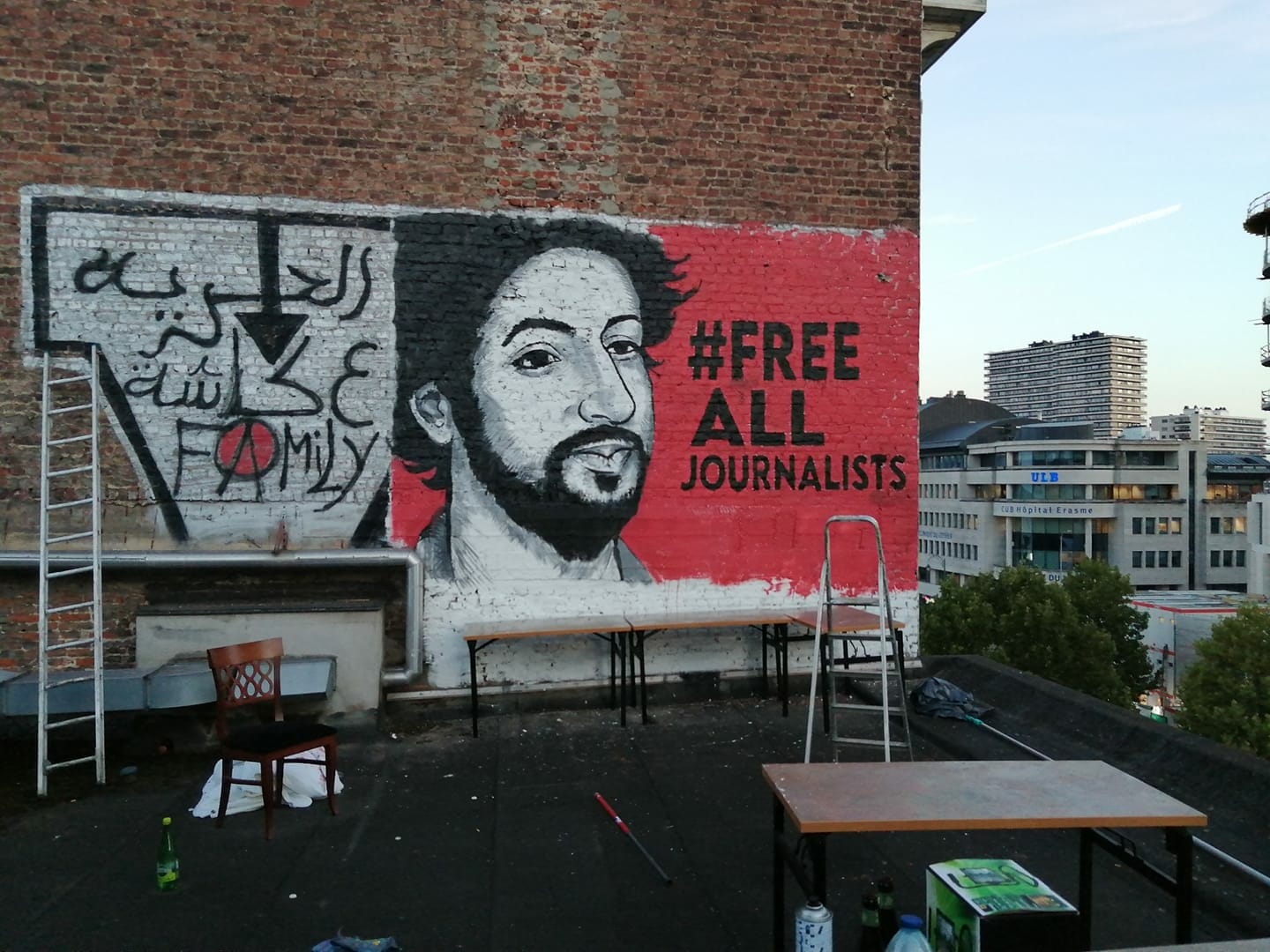
A mural of jailed Moroccan investigative journalist Omar Radi, painted by artist Mirra Markhaeva in Brussels. Photo by Mouad Belrhouat.
The cover image for MER issue 307/308 features a mural of jailed Moroccan investigative journalist, Omar Radi. The words “Free All Journalists” are emblazoned next to him.
Radi was first detained in Casablanca in December of 2019 for “[insulting a judge](https://www.reuters.com/article/us-morocco-court-idUSKBN2142Z5)”—a charge that was leveled against him based on a series of tweets in which he criticized the heavy sentencing of protestors. On July 29, 2020, following [an investigation](https://www.theguardian.com/technology/2020/jun/21/journalist-says-he-was-targeted-by-spyware-from-firm-despite-its-human-rights-policy) by Amnesty International, which revealed that the Moroccan government had used Israel’s Pegasus spyware to hack his phone, Radi was jailed for espionage charges and sexual assault. Notably, the state has used similar charges against several other journalists and regime critics, including Soulaimane Raissouni and Taoufik Bouachrine. In December of 2020, a trial for Radi was held lasting only 15 minutes, in which he was found guilty. Several international observers, including [Human Rights Watch](https://www.hrw.org/news/2021/11/25/morocco-journalist-prison-after-unfair-trial), have deemed the trial unfair for failing to grant Radi due process. The court, for example, ignored evidence and denied his legal team access to the case file. In March of 2022, in an appeal, he was sentenced to six years in prison, where he remains until today.
Radi’s case is one of many that speak to how authoritarian states are using new surveillance technologies and legal regimes to further carceral systems and silence their critics within and across borders. The mural, like the issue cover, is a plea to recognize the human stakes of these webs of power and to continue calling for the freedom of all political prisoners.
The project was organized in August of 2020 by a group of artists, including Mouad Belrhouat. Belrhouat is a Moroccan rapper who goes by the name l7a9ed and who has also been [imprisoned](https://www.nytimes.com/2012/01/19/world/africa/trial-puts-moroccos-new-charter-under-spotlight.html) by the Moroccan state. The mural itself was painted on the side of a building in the Brussels city center by Brussels-based visual artist Mirra Markhaeva. Markhaeva says of the work, "It was a very urgent and reactionary piece to show that the world reacts and transforms even visually when such injustice occurs." The photograph of its construction was taken by Belrhouat, who shared the image with MERIP for the issue's cover.
**Read the [first](https://merip.org/2023/09/big-techs-partnership-with-authoritarianism) article in [MER issue 307/308](https://merip.org/magazine/307-308/) "Frontlines—Journalism and Activism in an Age of Transnational Repression."**
### The Kurdish Women's Movement and Turkey's Transnational 'Feminicide'
URL: https://www.merip.org/2023/09/the-kurdish-womens-movement/
Last updated: 2025-08-22T18:36:40.000Z
*\[su\_dropcap style="simple" size="4"\]*O*\[/su\_dropcap\]n January 9, 2023,* [*thousands of demonstrators*](https://www.aljazeera.com/news/2023/1/7/thousands-kurds-march-in-paris-over-unresolved-activists-murders) *from across Europe gathered in Paris to participate in marches organized by Kurdish groups.*

Demonstrators hold portraits of victims of the December 23, 2022 Enghien Street shooting in Paris, as well as those of the La Fayette street murders in 2013, to express solidarity with the Kurdish community, Paris, December 26, 2022\. Julien De Rosa/AFP via Getty Images
*Demonstrators were mourning a triple killing of Kurdish activists that occurred in Paris just two weeks before the march. The day also marked the ten-year anniversary of the still unresolved murder of three Kurdish women activists in the French capital, in an armed attack that took place in the Kurdistan Information Center. Activists suspect the Turkish state’s intelligence service was in some way behind the assassinations, though Ankara has denied involvement. The case exemplifies a trend noted by Kurdish activists in diaspora: that the Turkish state’s repression of the Kurdish movement has increasingly, over the last decade, occurred beyond Turkey’s borders. Recent events—like Sweden’s extradition of members of the PKK to Turkey as part of a bid to secure NATO membership—illustrate the geopolitical dimensions of this repression. The increasingly transnational reach also extends to tech companies, such as Facebook and Twitter, which have censored or shut down certain accounts and voices that are supportive of the Kurdish movement or* [*critical*](https://www.cbsnews.com/news/twitter-censoring-content-recep-tayyip-erdogan-turkish-presidential-election/#:~:text=In%20order%20to%20keep%20the,before%20the%20start%20of%20voting.) *of the Turkish state.*
*Anna Özbek* *is a multimedia journalist and filmmaker, a member of the artist-activist collectives Chinatown Art Brigade and The Illuminator and an assistant professor in journalism at Purchase College. She interviewed Elif Genç, a Kurdish women’s movement activist and PhD candidate in political science at the New School on May 9, 2023\. Their conversation explores the shape of the Kurdish movement in this age of transnational repression and the gendered dimensions of the Turkish state’s targeting of activists. It has been edited for length and clarity.*
**Anna Özbek:** Let’s start with the [assassinations](https://www.theguardian.com/world/2013/jan/10/kurdish-activists-shot-dead-paris) of three prominent Kurdish women activists in 2013\. All three were executed, shot in the head, at the Kurdish Information Center in Paris. A Turkish national was later arrested for the murders but died of illness in police custody. Could you describe the legacy of these activists’ work and the impact of their murders?
**Elif Genc:** The assassinations of Sakine Cansız (Sara), Fidan Doğan (Rojbin) and Leyla Şaylemez (Ronahî) is such a traumatic moment in the history of the Kurdish women's movement because it hit the movement on three levels: Sakine Cansız was a [legendary figure](https://www.theguardian.com/world/2013/jan/10/sakine-cansiz-pkk-kurdish-activist) in the Kurdish women’s movement and was one of the founders of the Kurdistan Workers Party (PKK), Fidan Doğan worked on international relations and Leyla Şaylemez was involved with the youth movement. Turkey is engaged in the feminicide of Kurdish women guerrillas (“feminicide” is the term used by the Kurdish women’s movement and other women’s movements, globally, to emphasize the state’s role in violence against women). And what the state considers a Kurdish woman guerrilla is very vast—within that fall activists and sympathizers. Kurdish women guerillas are the ultimate state enemy of Turkey. They're Kurdish, which they despise already, and women, whom they also despise.
We see so many examples of horrific feminicide within Turkey, for example with Kevser Eltürk (Ekin Wan), [when they displayed her naked dead body](https://www.vice.com/en/article/xw3yyw/kurds-fighting-the-islamic-state-enraged-at-turkey-over-brutal-killing-of-female-fighter) in the Varto district in Muş province. This happened in 2015 during the “self-defense wars” (a period from [2015–2017](https://www.ohchr.org/en/statements/2017/03/un-report-details-massive-destruction-and-serious-rights-violations-july-2015?LangID=E&NewsID=21342) after residents in some Kurdish cities formed autonomous municipalities and were besieged by the Turkish military, resulting in more than [3,000 dead](https://www.crisisgroup.org/content/turkiyes-pkk-conflict-visual-explainer), at least 355,000 displaced and massive destruction of urban residential areas from shelling). It’s a practice of the Turkish state to sexually violate dead Kurdish women guerrilla bodies and display them naked. It's meant to have this horrible connotation about her chastity and her being a woman. It's just sick. I want to make it clear that this kind of violence is not just exclusive to Kurdish women guerrillas and activists. Kurdish men are also killed with impunity, as with the [2015 killing](https://www.nytimes.com/2015/10/06/world/europe/turkey-to-investigate-images-of-dead-kurdish-man-being-dragged.html) of the 24-year-old Kurdish male protestor Hacı Lokman Birlik, whose body was dragged through the streets by a police vehicle in Şırnak. I believe that in the eyes of the Turkish state, Kurdish women revolutionaries are not human. They are inhuman and therefore dispensable. They can be assassinated. That's ultimately what the Turkish state is doing because of course, these women suffer extreme violence under that patriarchal state on many systemic levels.
> [Where Will You Find That Many Women?](https://www.merip.org/where-will-you-find-that-many-women/)
Outside of Turkey, there’s also the case of politician and civil engineer Hevrîn Xelef. In 2019, she was [abducted](https://www.bbc.com/news/av/world-middle-east-51068522) and brutally assassinated by Turkey and their jihadist proxies in Rojava, which is the Autonomous Administration of North and West Syria. She was the newly elected Secretary General of the Future Syria Party after having spent years working in economic committees in Rojava. So, this goes across countries and across borders. Another recent example is the 2022 assassination of scholar Nagihan Akarsel (Zîlan), who was one of the editors of [Jineolojî](https://www.jineolojidergisi.com/) magazine, which is a very well-known feminist publication. She was [assassinated](https://rsf.org/en/feminist-journalist-turkish-origin-gunned-down-iraqi-kurdistan) in Slemani (Sulaymaniyah) in Başȗr (Iraqi Kurdistan). She was killed just weeks before the Kurdish women’s movement conference in Berlin, [Women Weaving the Future](https://womenweavingfuture.org/), which she had helped organize.
**Anna:** In December 2022, there was another triple murder of Kurdish activists in front of a Kurdish cultural center in Paris. More than 20,000 protestors marched to commemorate both these murders and the 2013 assassinations that we discussed previously.
**Elif:** First and foremost, no one considered this to be an isolated incident. The fact that it was almost ten years to the day after the Kurdish women’s assassinations is obviously no coincidence. Emine Kara, or Evîn Goyî, which was her Kurdish name, was a prominent member of the Kurdish women's movement and, I believe, more so the target of this assassination than either Mîr Perwer, who was a singer, and Abdurrahman Kızıl, who was a local sympathizer to the cause. The protests that erupted out of it were a gut reaction to the fact that once again, in the heart of Paris, there was an assassination. And the alleged motivations of the person that they pinned it on (William Malet) were nonsense. They made it look like some sort of racist attack against Muslims or immigrants. The reason why the youth ran out into the streets and started protesting, ripping up the sidewalk, was out of pure frustration and outrage because, to a degree, France and French president Emmanuel Macron would have to exercise a certain amount of complicity to allow something like this to happen in the middle of the city in broad daylight twice within ten years. Right to the same community, with the same target.
> **I believe that in the eyes of the Turkish state, Kurdish women revolutionaries are not human. They are inhuman and therefore dispensable.**
**Anna:** You yourself were physically assaulted while protesting a state visit from Turkish president Recep Tayyip Erdoğan in Washington, DC in May 2017 along with dozens of other protestors. At least two dozen Turkish security agents and their civilian supporters were filmed beating protestors and Erdoğan was filmed personally watching the attack. What happened that day?
**Elif:** We thought it would be like any other protest. If Erdoğan is coming, of course we're going to go to Washington and show up and counter-protest, right? So, there were two aspects to this attack: the first wave and the second wave. And the first wave I wasn't involved with because I lagged quite a bit behind with a friend of mine who was with her kid, not really paying that much attention to what was going on around us. So, I go there and I grab my big Selahattin Demirtaş poster, and I joined the ranks (Demirtaş is a former co-leader of the pro-Kurdish Peoples’ Democratic Party, HDP, and has been imprisoned in Turkey since 2016). I did not realize that there had already been this other attack with the first wave, so I was completely flabbergasted when I looked across the street and there were these G.I. Joe-looking Turkish security guards who were threatening us. And next thing I know, I’m on the ground. It was like a wave just hit me. It wasn't until I saw the footage of being kicked and punched and also them grabbing my arm and pulling me down to the ground that I realized exactly how I was attacked. If you’re getting beaten by four or five people, you can’t tell what's happening.
By some miracle of adrenaline, I managed to cling onto the leg of this American police officer and hoisted myself up and ran. I remember feeling the pain of it all, and I knew in my mind, I’ve got to get out of here. But I didn't realize the extent of how bad it was, so I made my way back to get my hat, and I had a scarf, and then I start looking around me and there are all these elderly men and they've got blood streaming down their faces and people having been kicked in the face, and one of my friends is having a seizure on the ground. And there was this injured uncle-type man, and I gave him my scarf, and the scarf just got soaked with blood. It was really shocking. There were about nine of us that were badly injured. And there were other incidents, like my friend, they basically tried to kidnap her, and this harkens back to the Gendarmerie Intelligence Organization’s practice of disappearing people. The fact that Turkey thinks they can do these things in broad daylight in Washington is just insane.
**Anna:** One of the things that makes this violent attack so remarkable is that there were legal consequences for some of the Turkish attackers. Can you talk about the process that led up to this?
**Elif:** Once we went to the hospital, the investigations started about what actually happened. I believe right away Erdoğan’s security guards and diplomatic types and also some civilians were detained, but they all got out of there quickly. I think they were gone within half an hour.
**Anna:** Right, [declassified US state department documents](https://www.theguardian.com/world/2019/nov/12/erdogan-visit-washington-bodyguards-assaulted-protesters) showed that Erdoğan’s security guards were released after being held by the United States for only half an hour and they immediately flew back to Turkey.
**Elif:** I returned to Toronto a couple of weeks later and I was sitting in a restaurant, which I normally wouldn't go to, as it was a fascist Turkish restaurant, but we had just come from the Kurdish Community Center, and I was starved. And I ran into one of the guys that had beat us up in Washington. Three of the civilians that were involved in the attacks are from Toronto. That was quite a shock when I saw him right in front of me in Toronto, so I took some pictures and sent them to the American police. About a month later the arrest warrants came out for two civilians in Toronto, two civilians in the US who were arrested and jailed and then 12 arrest warrants for the Turkish security personnel, but they weren't in the country anymore. And that night, the two guys who were charged in Toronto, Ahmet Dereci and Mahmut Ellialti, escaped to Turkey.
What ended up happening is that there was some press surrounding this arrest. I did an interview for CBC about the attack, and I said that I helped the American police. The next day my picture was in a Turkish newspaper, with them alleging that I'm a PKK member or sympathizer and that I beat these guys up, that I broke this guy’s nose. Once I was profiled, obviously, with Turkey, I became a target as well. I guess I should have expected as much, but it was a little shocking. But forget me, all of my friends here have had their families in Turkey taken in for interrogation about where they are. Turkish fascists in the US created petitions to try to get some of the protestors deported from the US, and they had to move to different states because of the harassment. None of us can go back to Turkey, which means people can’t see their families again. Some even had to apply for asylum and become refugees. It has really remarkably changed a lot of people’s lives.
**Anna:** Did these attacks and their visibility change anything for the Kurdish women’s movement?
**Elif:** In Turkey, no one ever has to answer for the brutality and torture and the straight up annihilation of the Kurdish people. This is something that we can hold Turkey responsible for, and we’re pushing for it to be recognized as hate crimes, not just assault. This is still going on, and there is both a criminal and civil court case. It turns out that the Turkish security guards beat up a bunch of US State Department people that day as well, which was the icing on the cake. Even though many of us were not US citizens, the case garnered a lot of support in the US. Interestingly, our biggest supporter was the late Senator John McCain, and he actually said that day that we have to kick the Turkish ambassador out of the US.
**Anna:** How do you see these attacks as part of what you’ve identified as a feminicide against the Kurdish women’s movement?
**Elif:** Yes, to bring it back to that whole context of being inhuman in their eyes, I also feel this whole attack falls within that category. While the guy was beating me, what I do remember is someone saying in Turkish, “I’m going to kill you, bitch.” And I really believed they would kill me, and they would kill all of us. We forget their objective is to annihilate us if they could. I hadn't heard all my fellow colleagues’ accounts until recently, but one recalled an attacker that day saying, “Oh bitch, come back here. You haven't had enough.” That has really horrific sexual violence connotations.
**Anna:** You organize with Kurdish communities in Toronto and New Jersey. Can you talk about how Turkish state violence can materially impact Kurdish people a continent away? Does this sometimes lead to self-censorship and a broader culture of fear?
> **Almost the entire population of the Kurdish community that's coming to Toronto and also New York and New Jersey in recent years are refugees...they fear that if they get involved with supporting the Kurdish movement, which some of them do, that it will affect their case here as a refugee.**
**Elif:** Almost the entire population of the Kurdish community that's coming to Toronto and also New York and New Jersey in recent years are refugees, so there's that aspect where they fear that if they get involved with supporting the Kurdish movement, which some of them do, that it will affect their case here as a refugee. I know that recently with the presidential elections in Turkey, there was a lot of hesitation by members of our community to go and vote, even though they can as they’re Turkish citizens, because they were afraid they were going to get arrested at the Turkish consulate.
**Anna:** In Turkey last month, another few hundred people were arrested in a supposed “anti-terrorism” sweep in the lead up to the May elections, and these arrests were mostly in Kurdish provinces.
**Elif:** Yes, I had some friends here who signed up to be election watchdogs or witnesses and they pulled out because their lawyer said, “you know, it's going to affect a case back home as well.” There are a lot of people that still have things back home that are very dicey. A lot of the ones that want to get involved have a certain relationship to the Kurdish movement. We have people whose brothers, sisters, mothers, fathers, have been jailed or martyred. Some people come to protests and take pictures because they really want to show that they do not want to go back to Turkey. But then there's also that hesitation, and there absolutely is a fear of displaying PKK flags.
In 2019, when the US pulled out of Rojava, and Turkey immediately attacked, there was a lot of international attention, probably the most we've ever had. I went to New Jersey Senator Cory Booker's Office of International Relations and said we should delist the PKK. If I can do that in the senator's office, I’m pretty sure you can do it in the streets. But I get that back in Turkey if you have a PKK flag then you're going to jail. This self-censorship, I think the only way to actually get through it is to legalize it. And the only way you're going to legalize anything is to normalize it.
**Anna:** You're talking about normalizing the PKK in the United States by removing the PKK from the designated foreign terrorist organization list?
**Elif:** Yes, I think we need to delist. I've been in diplomatic relations in the Kurdish movement for the last ten years and everything ties to delisting. Kurdish movement activism is criminalized using that as a pretext. The fear that comes from this stigma often deters members of the community from becoming involved with Kurdish activism.
**Anna:** We’ve seen that the reach of the Turkish state extends beyond physical violence into digital censorship. Within the country, Turkey has blocked YouTube and Wikipedia for years at a time. Access to social media like Twitter is routinely blocked during large protests and public emergencies, [most recently](https://www.reuters.com/world/middle-east/anger-over-turkeys-temporary-twitter-block-during-quake-rescue-2023-02-09/) after the massive earthquakes that left more than 50,000 people dead. Twitter also [recently announced](https://www.cbsnews.com/news/twitter-censoring-content-recep-tayyip-erdogan-turkish-presidential-election/) it would comply with Turkey’s demands to censor specific accounts in the days leading up to the election. You helped organize a Facebook group in solidarity with Rojava, and you’ve said this group has been subject to censorship. Can you describe what you’ve seen happen with Kurdish digital organizing in the United States and Canada?
**Elif:** So obviously we live in a digital world, and social media is very essential for organizing even though we're dealing with a lot of people who are not using the most advanced technology. We've mostly been using Facebook. But I've been banned from Facebook for months. In fact, I was lucky to get my account back. A lot of my friends did not. The Toronto Kurdish Community Center account has been shut down three or four times. Just recently the Instagram page was shut down again. It's constant. Anything even mentioning the PKK is shut down. But it’s also for things you wouldn't expect. There was a sweep of all the Rojava-affiliated Facebook groups. Supporting Rojava is not illegal. There's nothing illegal about it. The armed forces of Rojava, the People’s Protection Units (YPG) are not illegal, and they’re not on any list. But still there was this big sweep and even groups that have nothing to do with the Kurdish movement, like the Institute for Social Ecology, were also shut down. That prompted us to ask who was doing this, because it was on such a mass scale.
**Anna:** A [ProPublica](https://www.propublica.org/article/sheryl-sandberg-and-top-facebook-execs-silenced-an-enemy-of-turkey-to-prevent-a-hit-to-their-business) investigation found that in early 2018, Facebook secretly agreed to Turkey’s demand to censor the People’s Protection Units (YPG) Facebook page and “geo-blocked” it within Turkey. Sheryl Sandberg, then chief operating officer of Facebook, personally approved the action, writing “I am fine with this” in an email shown as part of that investigation.[\[1\]](#%5Fedn1) This is despite the fact that, as you said, the YPG is not considered a terrorist organization by the United States or by Facebook. On the contrary, the US military worked closely with the YPG for years in their war against ISIS. The result was that all the posts that the YPG made documenting the casualties of the Turkish military invasion of Syria and Rojava could not be seen by anyone within Turkish borders.
> **It’s not just the YPG that Turkey demanded be blocked on Facebook, there was a long list of groups that are persona non grata, and we are seeing how these fascist practices are not limited to the borders of the Turkish state.**
**Elif:** What I can deduce from that is there's a line of fascism and Turkey is within the line of acceptable fascism. So, you've got Zuckerberg, or whoever is in charge now, and I don't think he cares at all about the PKK or Kurdistan or Rojava or any of that. But he is very concerned about the 80 plus million Facebook users in Turkey. To keep access to that market, Turkey has made Facebook complicit in upholding state censorship. It’s not just the YPG that Turkey demanded be blocked on Facebook, there was a long list of groups that are persona non grata, and we are seeing how these fascist practices are not limited to the borders of the Turkish state.
**Anna:** We've discussed issues of Turkey’s transnational violence from murder and physical violence to censorship and fear, but the resistance to this is also international. What is the importance of transnational and solidarity organizing to the movement?
**Elif:** I think the Kurdish women’s movement is a transnational movement. I don’t even know it in any other context. I’m an activist of the Kurdish women’s movement, but I'm only in North America and to some extent Europe. Because of the level of censorship and because of the draconian measures that are taken in Turkey against the movement, the solidarity falls on us to be there in those spaces. I also think that diplomacy has started to play a huge part in the movement. The armed aspect of this movement is out of complete necessity and self-defense. But I think the movement is coming to realize that this is a reflection of the century that we're in. Fighting now also means diplomacy. Gains for us are getting interviews with senators or creating solidarity networks with like-minded people. Transnational solidarity, I think it's absolutely essential.
---
### Endnotes
[\[1\]](#%5Fednref1) Jack Gillum and Justin Elliot, "[Sheryl Sandberg and Top Facebook Execs Silenced an Enemy of Turkey to Prevent a Hit to the Company’s Business](https://www.propublica.org/article/sheryl-sandberg-and-top-facebook-execs-silenced-an-enemy-of-turkey-to-prevent-a-hit-to-their-business),” *Pro Publica,* Feb. 24, 2021.
### India, Israel and the Coordination of Control
URL: https://www.merip.org/2023/09/india-israel-and-the-coordination-of-control/
Last updated: 2025-08-28T16:51:39.000Z
In January of 2022, a UK-based independent investigative firm called Stoke White Investigations [revealed](https://www.swiunit.com/post/india-s-war-crimes-in-kashmir-violence-dissent-and-the-war-on-terror) that one of its clients, Karim, had been tortured while in detention in Kashmir.

A municipal worker cleans the road ahead of a visit by Israeli Prime Minister Benjamin Netanyahu to Ahmedabad, India, January 15, 2018\. Amit Dave/Reuters
Reports of arbitrary detentions and torture by the Indian military against Kashmiris are not uncommon in the Indian-occupied region. But Karim’s description of his interrogators was peculiar: They were not of Indian origin, he alleged, but white and spoke with US accents. They seemed to show little interest in his activities in Kashmir or his stances on domestic issues. They were instead curious about his views on global politics and especially the Palestinian struggle.
“I think they were trying to see if I associated myself with the struggles in Palestine and Afghanistan,” Karim testified, in the report. “One of the officers specifically asked me about Hamas, but I was shocked because they have nothing to do with Kashmir. I told them I have a problem with the Indian occupation of Kashmir, but they were trying to force me to say that I have a global agenda.”[\[1\]](#%5Fedn1)
According to Karim, the men were candid about their identities. They expressly told him they were working with the Israeli intelligence agency, Mossad, “on research” in Kashmir. Karim’s session of torture-laced interrogation continued for three days at Srinagar’s Sheikh Ul Alam International Airport, before he was moved to a different location, where he would remain for two and a half months.
Karim’s experience is the product of an evolving strategic partnership between India and Israel, where an increasingly overt convergence of interests and ideology has led to both states tangibly supporting one another in working towards their respective political and economic ambitions. Through this partnership, state repression in Indian-occupied territories is not an exclusively Indian project. It has become part of a broader network, linking India to the Israeli state and its own colonial project.
## **The Evolving Relationship between India and Israel**
Although India and Israel only established formal relations in 1992, the link between the two states predates their respective establishments in 1947 and 1948\. Both states were connected to one another by the British Empire, which previously ruled over both historic Palestine and the majority of South Asia. A striking example of this shared legacy can be found in their legal systems. For instance, both Israel and India [adapted British wartime laws](https://journals.sagepub.com/doi/10.1177/0257643020953553) to take control over dispossessed refugees’ property through implementing the Israeli Absentee Property Law and the analogous Indian Evacuee Property Law.
In the early twentieth century, a fascination with Zionism emerged among Hindu nationalist figures such as V.D. Savarkar and M.S. Golwalkar. They regarded the settler colonial project in Palestine as a source of inspiration for Akhand Bharat, their vision of an undivided South Asia (and some surrounding regions) under Hindu supremacy. This affinity for Zionism still exists within the most powerful Hindu nationalist institutions, such as Modi’s ruling Indian People’s Party (BJP). Through these influential institutions, it continues to inform both India’s domestic and foreign policy today, as well as popular opinion in large parts of BJP’s stronghold states.
Beyond explicitly Hindu nationalist circles, Jawaharlal Nehru, India’s purportedly secular first Prime Minister, also bore an admiration for the Zionist movement and its state-building project.[\[2\]](#%5Fedn2) Nehru believed, however, that establishing formal relations between his country and Israel would hinder his ability to gain international support for India’s policies in Kashmir and impede his ambition of gaining a leadership position in the decolonising world. Nonetheless, India officially recognised Israel in 1950, with an Israeli consulate in Bombay opening in 1953.
Prior to the establishment of formal relations in 1992, Indian-Israeli relations largely developed through backchannel communication between the Israeli Mossad and India’s Research and Analysis Wing (RAW), the foreign intelligence agency created by Indira Gandhi in 1968\. These secret defense relations, which ranged from the transfer of technology and expertise to covert diplomatic visits, were developed to counter Pakistan’s increasingly close relationship with China and North Korea.[\[3\]](#%5Fedn3) Between the establishment of the RAW-Mossad backchannel and the normalization of relations between the two states, India also laid the foundations for a strong defense partnership with the Soviet Union. At the time of its collapse in late 1991, the Soviet Union counted India as its largest purchaser of defense products.
> **Prior to the establishment of formal relations in 1992, Indian-Israeli relations largely developed through backchannel communication between the Israeli Mossad and India’s Research and Analysis Wing (RAW), the foreign intelligence agency created by Indira Gandhi in 1968.**
The beginning of the 1990s represented a pivotal moment in the history of the Indian-Israeli relationship. The relationship transitioned from one rooted in a calculus of geopolitical defense considerations to one influenced by the entrenchment of authoritarian practices in India and its occupied territories. The collapse of the Soviet Union meant that India lost its largest supplier of arms. With pressure mounting from within and without to liberalize its economy, India sought a closer partnership with the United States. Significantly, this period also coincided with the breaking out of an armed insurgency in Kashmir in late 1989, catalyzed by a controversial election two years prior, allegedly rigged in favor of the pro-India National Conference party.
In June 1991, as Narasimha Rao assumed the Indian premiership following then-Prime Minister Rajiv Gandhi’s assassination at the hands of a member of the Liberation Tigers of Tamil Eelam one month earlier, Kashmiri militants kidnapped eight tourists in Srinagar. Seven of the hostages were Israelis—[held on suspicion](https://www.washingtonpost.com/archive/politics/1991/06/28/israeli-tourist-battles-with-kashmiri-captors/059fb732-528a-49d8-acc6-dfebba3bc449/) of being sent to stir dissent among militant organizations in Kashmir. As Indian and Israeli diplomats worked together to secure their release and evacuate the remaining Israeli tourists from the region, a growing chorus of voices in the Indian press called on their government to normalize relations with Israel.[\[4\]](#%5Fedn4) With the vocally pro-Israel BJP ascendent in Indian politics and the Palestinian leadership putting up little resistance to the strengthening relations between the two states, the Rao government decided to pursue normalization with Israel.
While India intensified its siege in Kashmir, Israel was in the midst of suppressing Palestinian resistance following the outbreak of the first Intifada. With growing challenges to the Israeli government, the state undertook its own project of economic liberalization. Part of this process entails what the Israeli economist Shir Hever has called “the privatization of Israeli security.”[\[5\]](#%5Fedn5) In this evolving, security-oriented economy, Israel and India moved beyond a relationship focused on defense toward a partnership forged around the constant preparation to preemptively prevent threats, whether real or imagined.
## **India, Israel and the Global War on Terror**
Throughout the 1990s, Israel’s security industry began to emphasize the importance of what security companies and the government often referred to as the “Israeli experience.” The Israeli academic Neve Gordon identifies the “Israeli experience” as “a pervasive trope” used when marketing Israeli homeland security products and services globally.[\[6\]](#%5Fedn6) The September 11 attack on the World Trade Center in 2001 rendered Israel’s security sector all the more desirable for states like India, which sought to profit politically from the US-led “War on Terror” by casting itself as a powerful force against terrorism and extremism.
The Kashmiri scholar Mohamed Junaid has written that “the crude and one-dimensional polemic of ‘War on Terror’ gave the Indian state almost a carte blanche to crush the long-standing movement for self-determination” in Kashmir.[\[7\]](#%5Fedn7) According to Junaid, commentators, both Indian and foreign, were quick to reduce the Kashmiri liberation struggle to being part of a global jihad. Exploiting the War on Terror rhetoric, Indian officials linked their repression in Kashmir to efforts by other states to suppress national liberation struggles, such as those in Palestine and Chechnya. The Indian defense minister at the time, Jaswant Singh, claimed that the 1999 hijacking of an Indian plane was a “dress rehearsal” for the events of September 11, 2001.[\[8\]](#%5Fedn8)
Offering credibility to this perspective, a few months after September 11, individuals linked to the Pakistan-based groups Lashkar-e-Taiba and Jaish-e-Mohammed carried out an attack on the Indian parliament building in New Delhi. Following this attack, the Indian government started working with an Israeli surveillance company, Nice Systems—a new partnership that underscored the shift in the India-Israel relationship toward a focus on homeland security threats.
> **In this evolving, security-oriented economy, Israel and India moved beyond a relationship focused on defense toward a partnership forged around the constant preparation to pre-emptively prevent threats, whether real or imagined.**
This trend escalated sharply in the wake of the events of November 2008—known to some as “India’s 9/11”—in Mumbai. Ten men connected to Lashkar-e-Taiba attacked 12 sites in affluent parts of the city. The victims of the attacks included nine Israeli citizens. Israel was, according to Azad Essa—who has written a book on the twenty-first-century alliance between Israel and India—“now forever tethered to an Indian tragedy.”[\[9\]](#%5Fedn9) As Essa observes, the Israeli security industry saw a “business opportunity” in India’s response to the attack.
Responding to calls from the Indian media for the country to adopt a more militarist approach to security, in July 2009, the government of the western Indian state of Maharashtra [sent a delegation to Israel](https://indianexpress.com/article/news-archive/web/no-2611-repeat-maharashtra-shops-for-israe/) to learn from the so-called Israeli experience. The first tangible change that followed was the creation of Israeli-trained commando units and their deployment in Mumbai. The city’s police commissioner, Dhanushkodi Sivanandan, at the time stated publicly that India needed a more militarist approach and should emulate Israel’s “killer instinct” and its unapologetic attitude to external criticism. “Israel never keeps quiet. Israelis go on their flights, bombard the fellows (enemies), come back and keep quiet. But when we become aggressive, we face international pressure,” he remarked just six months after Israel’s deadly bombing campaign in Gaza in 2008–2009\. [\[10\]](#%5Fedn10) India, he complained, had “been passively witnessing terror attacks” for “thousands of years.”[\[11\]](#%5Fedn11)
In the years following the attack, a provisioning system known as the Central Monitoring System (CMS) was implemented throughout India. To set up this system—which facilitated mass surveillance over almost all electronic communications— India enlisted the help of Israeli security firms, such as [Verint Systems](https://thehackernews.com/2013/07/israels-verint-systems-get-contract.html). The CMS, marked a demonstrable shift in Indian security priorities from monitoring convicted criminals to surveilling all private communications based on the possibility of locating potential threats. The new surveillance system could operate without the use of court orders and allowed the state to access the communication data of practically any individual with access to a telephone or internet connection. Furthermore, the system did not include an appeals process whereby those erroneously targeted by it could defend themselves. Beyond the involvement of Israeli firms in the process, the introduction of the CMS also points to the Indian state’s valorization of Israeli security approaches.
## **A Strategic Partnership**
India’s adoption of this so-called “hard” approach to internal security, influenced by public and institutional fascination with Israeli methods and technologies, predates the arrival of Narendra Modi and his BJP government. In fact, India’s usage of Israeli technology—such as the [purchase of Israeli-manufactured drones](https://economictimes.indiatimes.com/news/politics-and-nation/govt-to-deploy-drones-for-recce-along-red-corridor/articleshow/5776820.cms?from=mdr) to fly over areas in Chhatisgarh, Orissa and Andhra Pradesh held by Naxalite Maoist rebels—began under the supposed liberal government of Manmohan Singh and the Indian National Congress-led United Progressive Alliance from 2004–2014.
The arrival of the BJP government in 2014 laid the groundwork for upgrading the Indian-Israeli bilateral relationship to the level of a [“strategic partnership”](https://timesofindia.indiatimes.com/india/india-israel-elevate-their-ties-to-strategic-partnership/articleshow/59461930.cms) –as the two states declared in a joint statement following a visit by Modi to Israel in 2017.[\[12\]](#%5Fedn12) During Modi’s visit, he and Israeli Prime Minister, Benjamin Netanyahu, signed several agreements to facilitate cooperation in areas ranging from water management, agriculture and technological innovation.

NSUI activists protest against Modi's government for using military-grade, Israeli spyware Pegasus to monitor political opponents, journalists and activists. New Delhi, India, August 2, 2021\. Mayank Makhija/NurPhoto via Getty Images
Indeed, the morbidly fraternal relationship between the two leaders has contributed to Israel becoming one of India’s primary partners in Modi’s flagship Make in India campaign—launched in September 2014\. This program invites foreign companies to manufacture goods in India. Unsurprisingly, Israeli security and defense products, such as missiles and drones, are among the most significant goods that commenced manufacturing in India. A handful of large Indian conglomerates, such as the [Adani Group](https://www.adanidefence.com/newsroom/media-release/adani-defence-and-aerospace-and-elbit-systems-inaugurate-india-first-private-unmanned)—headed up by the long-term Modi financier Gautam Adani—benefited from the new contracts with Israel. Other significant partners, particularly in defense manufacturing, included both [Russia](https://economictimes.indiatimes.com/news/defence/deeper-defence-security-cooperation-with-russia-enhances-indias-strategic-choices/articleshow/62200689.cms), which was involved in manufacturing Brahmos missiles and other defense products, and the United States, largely through the involvement of [Lockheed Martin](https://www.lockheedmartin.com/en-us/who-we-are/international/india.html). Beyond military technology, Israeli firms have also committed to the Make in India campaign in other key areas, [including](https://energy.economictimes.indiatimes.com/news/oil-and-gas/indian-oil-corporation-enters-into-joint-venture-with-israeli-company-phinergy/81561055?redirect=1) renewable energy. Israel has also courted Indian investment into its own economy. In January of 2023, the Adani group purchased the Haifa Port for $1.2 billion. When the CEO [announced](https://www.outlookindia.com/business/adani-group-acquires-israeli-port-of-haifa-for-1-2-billion-netanyahu-lauds-deal-as-enormous-milestone--news-258396) the purchase alongside Netanyahu, he heralded the long relationship between the two countries and billed it as part of a larger effort to invest in Israel.
During this time, India also became the world’s biggest purchaser of Israeli military technology. The two states signed a defense deal worth approximately $2 billion during Modi’s 2017 trip to Israel. The deal, one of the largest in Israeli history, became a source of scrutiny in 2021, when reporting by *The Wire* [revealed](https://thewire.in/government/rahul-gandhi-pegasus-spyware-target-2019-polls) that around the BJP’s electoral victory in 2019, the Israeli company NSO’s Pegasus spyware was potentially installed on mobile phones belonging to opposition leader Rahul Gandhi. A *New York Times* report from January 2022 revealed that Pegasus was a [central part](https://www.nytimes.com/2022/01/28/magazine/nso-group-israel-spyware.html) of the 2017 deal. The Modi Government denies it ever purchased Pegasus. But import documents accessed by the Organised Crime and Corruption Reporting Project confirm that India has bought hardware from NSO that “matches the description of equipment used elsewhere to deploy the company’s flagship Pegasus software.”[\[13\]](#%5Fedn13)
> **The Modi Government denies it ever purchased Pegasus. But import documents accessed by the Organised Crime and Corruption Reporting Project confirm that India has bought hardware from NSO that “matches the description of equipment used elsewhere to deploy the company’s flagship Pegasus software.”**
Beyond targeting Modi and the BJP’s political challengers, a leak revealed [by the Pegasus Project](https://www.theguardian.com/news/2021/jul/19/key-modi-rival-rahul-gandhi-among-indian-targets-of-nso-client) in 2021 suggests that hundreds of individuals were “selected for possible surveillance” with the Israeli software. Lending further weight to the scale of the surveillance, a report released by the [Legal Forum for Kashmir](https://www.merip.org/content/files/wp-content/uploads/2023/02/report-lfk-report.pdf) in 2023 lists several important Kashmiri figures known to have been targeted by Pegasus.
Empowered by Israel’s repressive tactics, the BJP implemented a host of other measures and policies to confront dissent within the country. The journalist Swati Chaturvedi, for example, documents the development of a “digital army” of troll accounts loyal to the BJP that mobilizes against critical voices through social media.[\[14\]](#%5Fedn14) Beyond bearing a noticeable resemblance to a similar project undertaken by the Israeli Ministry of Strategic Affairs to [“flood the internet”](https://electronicintifada.net/blogs/asa-winstanley/meet-spies-injecting-israeli-propaganda-your-news-feed) by targeting pro-BDS voices online, the [BJP’s digital army](https://www.haaretz.com/israel-news/2018-01-15/ty-article/indias-internet-hindus-are-in-love-with-israel/0000017f-e496-d7b2-a77f-e797799b0000) routinely coordinates campaigns to express their admiration for Israel and dislike for Palestinians, often echoing Hindu Nationalist and Philo-Zionist tropes and rhetoric.
The Kashmir Valley has been under particularly intense surveillance since emerging from a seven-month-long media blackout in 2020\. The Indian government imposed the blackout in August 2019 after revoking Articles 370 and 35a of the Indian Constitution, which guaranteed Kashmir’s semi-autonomous statehood under the Indian Union. The revocation included the bifurcation of the former State of Jammu and Kashmir into the two union territories of Jammu and Kashmir and Ladakh. Many Kashmiri activist groups, particularly those in exile, have accused India of imposing the [“Israeli model”](https://tribune.com.pk/story/2379529/india-replicating-israeli-model-in-kashmir-speakers) on Kashmir as a result of new laws that have opened the region up to Indian settlement in the wake of the revocation.[\[15\]](#%5Fedn15) Lending these accusations credibility are Indian state officials like Sandeep Chakravorty who, during his tenure as the Indian consul general in New York, called explicitly for the emulation of an “Israeli model” in Kashmir.[\[16\]](#%5Fedn16)
Israel’s position on India’s revocation of Articles 370 and 35a, articulated by its then-ambassador to India, Ron Malka, consisted of recycled rhetoric from its own oppression of Palestinians. In support of India’s actions, Malka stated that “as we see it, it's within Indian borders, something that is internal in India, an Indian issue.”[\[17\]](#%5Fedn17) Malka also referred to India as the “biggest democracy in the world,” mirroring Israel’s invocation of its own status as a supposedly exceptional democracy when defending its transgressions. His statement concluded by affirming India as a “friend” of Israel.
## **Kashmir and Palestine, A Shared Struggle**
In addition to Israel seeking to suppress pro-Palestine activism in countries near and far, India also has its own history of suppressing pro-Palestine and anti-Israel activism in Kashmir. While the PLO leadership, and especially Yasser Arafat, historically regarded India as a supporter of its cause, Kashmiris have long recognized parallels between the Israeli occupation of Palestine and the Indian occupation of their land. These shared struggles have led to the formation of a strong bond of solidarity between Kashmiris and Palestinians, who, at the [grassroots level](https://newint.org/blog/2014/08/19/kashmir-palestine-solidarity), have maintained a clear position of supporting the aspirations of the Kashmiri liberation struggle.
India and its security agencies have used this solidarity between Palestinians and Kashmiris as a pretext for authoritarian intervention, targeting pro-Palestine activism as if it were a form of anti-India dissent. In 2014, for example, the Indian police forces killed Kashmiri teen [Suhail Ahmad](https://www.aljazeera.com/news/2014/7/20/kashmir-teen-killed-during-anti-israel-rally) at a demonstration in Kashmir against Israel’s bombardment of Gaza. In May of 2021 during the “unity intifada,” as Palestinians protested widely against Israeli settler colonialism, authorities in Kashmir [arrested](https://www.thequint.com/news/india/jandk-police-arrests-21-after-pro-palestine-demonstrations-sheikh-jarrah) 21 individuals for protesting in solidarity with Palestinians. Later, the [Kashmir Zone Police](https://www.outlookindia.com/website/story/india-news-religious-preacher-arrested-two-days-after-praying-for-palestine/382848) took to social media to warn Kashmiris against “attempting to leverage the unfortunate situation in Palestine to disturb public peace and order in the Kashmir valley.”[\[18\]](#%5Fedn18)
> **Noting these parallels of repression, Palestinian and Kashmiris activists have started to identify interconnections between their respective struggles and the how the technologies that oppress them relate to their oppressors’ strategic partnership.**
Noting these parallels of repression, Palestinian and Kashmiris activists have started to identify interconnections between their respective struggles and the how the technologies that oppress them relate to their oppressors’ strategic partnership. In 2021, for example, Palestine Action, a network of pro-Palestine activists in Britain, mobilized against Elbit Systems, an Israeli arms manufacturer with production facilities in the country. On their [website](https://www.palestineaction.org/why-we-shut-elbit-down/), Palestine Action state that their motivation for taking direct action against Elbit Systems includes the fact that their technologies are used by India in Kashmir.
Another example of Palestinian and Kashmiri activists organizing together can be seen in the response to India, in its capacity as president of the G20, electing to hold G20 and Y20 meetings in Kashmir in May 2023\. A [coalition](https://www.instagram.com/p/CsENhbFOElx/?img%5Findex=10) of eight civil society organisations from around the world came together to call for a boycott of the meetings, including [Within Our Lifetime](https://wolpalestine.com/), a Palestinian-led campaigning group based in New York City.
Like Karim’s interrogation at the hands of Israeli Mossad agents, the ever-increasing acts of co-resistance such as those undertaken by Palestinians and Kashmiris in their homelands and in exile speaks to the current nature of the India-Israel relationship. The convergence of interests and ideology between the two states has allowed a relationship between them to flourish. The flows of arms, capital and shared rhetoric across their respective borders further entrenches the growing repression and authoritarianism in each.
\[Abdulla Moaswes is a PhD Candidate at the University of Exeter’s Institute of Arab and Islamic Studies.\]
---
### Endnotes
[\[1\]](#%5Fednref1) “[India’s War Crimes in Kashmir: Violence, Dissent and the War on Terror](https://www.swiunit.com/post/india-s-war-crimes-in-kashmir-violence-dissent-and-the-war-on-terror),” Stoke White Investigations Report, 2022, p.28.
[\[2\]](#%5Fednref2) P.R. Kumaraswamy, “India's Recognition of Israel, September 1950,” *Middle Eastern Studies* 31/1 (1995).
[\[3\]](#%5Fednref3) Azad Essa. *Hostile Homelands: The New Alliance Between India and Israel* (London: Pluto Press, 2023).
[\[4\]](#%5Fednref4) Ibid, p. 34.
[\[5\]](#%5Fednref5) Shir Hever. *The Privatisation of Israeli Security* (London: Pluto Press, 2018).
[\[6\]](#%5Fednref6) Neve Gordon. “The Political Economy of Israel’s Homeland Security/Surveillance Industry,” The New Transparency Project, Working Paper III (2009), p.3.
[\[7\]](#%5Fednref7) Mohamed Junaid, “From a Distant Shore to the War at Home: 9/11 and Kashmir,” *South Asian Review* 42/4 (2021), p. 417.
[\[8\]](#%5Fednref8) Ibid, p. 419.
[\[9\]](#%5Fednref9) Azad Essa, *Hostile Homelands: The New Alliance Between India and Israel* (London: Pluto Press, 2023), p.47.
[\[10\]](#%5Fednref10) “['India lacks killer instinct'](https://timesofindia.indiatimes.com/city/mumbai/india-lacks-killer-instinct/articleshow/4809345.cms),” The Times of India, July 23, 2009.
[\[11\]](#%5Fednref11) Ibid.
[\[12\]](#%5Fednref12) Indrani Bagchi, “[India, Israel elevate their ties to strategic partnership](https://timesofindia.indiatimes.com/india/india-israel-elevate-their-ties-to-strategic-partnership/articleshow/59461930.cms),” The Times of India, July 16, 2017.
[\[13\]](#%5Fednref13) Sharad Vyas & Jurre van Burgen. “Indian Spy Agency Bought Hardware Matching Equipment Used for Pegasus”, *Organized Crime and Corruption Reporting Project*, October 20, 2022.
[\[14\]](#%5Fednref14) S. Chaturvedi, *I am a Troll: Inside the Secret World of the BJP’s Digital Army* (New Delhi: Juggernaut Books, 2016).
[\[15\]](#%5Fednref15) “[India replicating Israeli model in Kashmir: speakers](https://tribune.com.pk/story/2379529/india-replicating-israeli-model-in-kashmir-speakers),” *The Express Tribune*, October 1, 2022.
[\[16\]](#%5Fednref16) "[Anger over India’s diplomat calling for ‘Israel model’ in Kashmir](https://www.aljazeera.com/news/2019/11/28/anger-over-indias-diplomat-calling-for-israel-model-in-kashmir),” *Al Jazeera*, November, 28, 2019.
[\[17\]](#%5Fednref17) Muhammad Saleh Zaafir, “[Israel announces support to India on IHK](https://www.thenews.com.pk/print/523149-israel-announces-support-to-india-on-ihk)”, *The News*, September 7, 2019.
[\[18\]](#%5Fednref18) “[Religious Preacher Arrested Two Days After ‘Praying For Palestine’](https://www.outlookindia.com/website/story/india-news-religious-preacher-arrested-two-days-after-praying-for-palestine/382848),” *Outlook India*, May 15, 2021.
### Major Labels
URL: https://www.merip.org/2023/08/major-labels/
Last updated: 2025-08-22T18:36:41.000Z
The Egyptian entrepreneur Mansur ʿAbd al-ʿAl Mansur was well-versed in the latest technology and the most powerful machines.

The cassette of An Evening with Abbas & Hindia Part 2\. Photo by Andrew Simon.
After a stint in Saudi Arabia working in aluminum production, Mansur returned to Egypt in the 1980s with roughly 1,000 cassette tapes in tow. Not content with distribution alone, Mansur soon pivoted to A&R (Artists and repertoire), focusing on the search for and development of artistic talent. From Shubra, a northern Cairo neighborhood with a rich history of producing culture stretching back to the turn of the twentieth century, he launched the record label “Egyptphon.” The choice of name pointed to the fact that Mansur understood his endeavor in national terms. It also harkened back to an earlier era of the recording industry, when “phone” or “phon” (from phonograph) often served as a suffix for company names, such as Gramophone, Polyphon and Baidaphon.
Rather quickly, Mansur grasped what his largely working-class customers were after: the frenetic energy of wedding acts like “Abbas & Hindia.” The accordionist Abbas and the well-known belly dancer Hindia, who regularly graced Cairo’s hotel ballrooms, stood in stunning contrast to the staid balladeering of state-sanctioned musicians. Promoting the duo, in and of itself, was an act of subversion, one that Mansur carried out with ingenuity. To steer clear of the radio censor, Mansur avoided radio altogether, passing along Egyptphon releases free of charge to microbus drivers so that their sounds might be amplified for passengers-turned-prospective customers, without the required art license from the Ministry of Culture. Indeed, as long as the Egyptian state has sought to control cultural production, impresarios, artists and audiences have endeavored to challenge censorship in creative ways.
> **Click below to hear the opening of *An Evening with Abbas & Hindia Part 2,* from Simon's digital archive in the making:**
>
>
>
Andrew Simon’s [*Media of the Masses: Cassette Culture in Modern Egypt* ](https://www.sup.org/books/title/?id=31649)(Stanford University Press) offers both a history of “technology-in-use” and a musical biography. The book nimbly narrates Egyptian history in the last third of the twentieth century by zeroing in on the format used by Mansur and so many others during this period: the cassette. Making its debut in 1963, the compact cassette radically changed who and what could be heard, musically and otherwise, around the globe. With tapes, production was inexpensive, requiring little setup to record. The cost and size of the medium likewise made for easy distribution. Further, tapes were re-recordable, theoretically rendering them blank slates and, therefore, canvases. All of this meant that cassettes could conceal and be concealed, and a host of actors gained entry to an industry largely closed to them in the past. While the revolution may not have been televised, it was certainly carried on tape. Consider the rise of hip-hop, spread through the circulation of cassette tapes in the United States, in the mid- to late 1970s or the recorded sermons of Ayatollah Khomeini which fanned out across Iran. Simon’s book firmly adds Egypt to the historiographical mix.
## **Consuming Cassettes**
Simon’s monograph is divided into an A side and a B side, although some of its most compelling material emanates from the flip.

Inside the Cairo music shop Mazzika Zaman. Photo by Andrew Simon.
Chapter 1 outlines how cassettes first came to dominate the Egyptian media marketplace and the soundscape in the mid-1970s, a period when the country’s economy shifted aggressively toward capitalism and privatization under President Anwar Sadat’s *infitah* (“opening up”) policy. What Simon refers to as “cassette culture” was buoyed by a culture of consumption that first developed under Sadat and later ballooned under Husni Mubarak.
By the early 1980s, millions of kilograms of commercial goods were transiting through Cairo International Airport and other ports of entry––a sharp turn from the state of affairs under Egypt’s previous president, Gamal Abdel Nasser. Amid the refrigerators and washers and dryers were cassette players, which political elites eagerly adopted. They were also taken up by established musicians like ʿAbd al-Halim Hafiz, ʿAli Ismaʿil and Farid al-Atrash. Indeed, initially, cassette players were associated with these public figures rather than “the masses.” Images of cassette players displayed prominently in the salons and on the terraces of the well-heeled were broadcast to the public through state-controlled periodicals, helping to define the “modern” Egyptian home. As prices on the machines dropped, middle- and even working-class Egyptians found themselves able to obtain that ideal.
Of course, as the demand increased for cassette players, certain savvy individuals employed surreptitious means to supply them. In chapter 2, Simon pays careful attention to what he calls the “criminal biography” of the cassette player. Mining the censored Egyptian press for popular crime reports, he provides a sense of the sometimes boundless quality of the black market for commercial goods that grew during the infitah. Many engaged in theft and smuggling also maintained above board day jobs. Through their example, Simon captures the severity of the struggle of ordinary Egyptians attempting to navigate shortsighted economic policies. At the same time, that citizens were willing to risk run-ins with an authoritarian state to obtain machines for playing music reveals the high regard in which sound objects were initially held.
## **Recording and Circulation**
Simon’s B side and chapter 3 deal more directly with the heart of *Media of the Masses*: Egypt’s recording industry of the 1970s and 1980s, the type of popular music (*sha*ʿ*bi*) that grew alongside it and the censorship apparatus erected by the state in response.
Over a 15-year period, cassette labels proliferated at a staggering pace. In 1975, around 20 outfits operated. By 1990, there were some 500 (86). One of the major beneficiaries was Ahmad ʿAdawiya, the then-30-something-year-old, who, among others, pioneered *sha*ʿ*bi* music. This expansive, often faster-paced genre drew on musical influences from around the globe as well as local rhythms. Themes of love (and sex) and class reigned supreme.
Though not conservatory trained, ʿAdawiya nonetheless had an enviable musical background and was gifted with a powerful voice. He learned his trade on Muhammad ʿAli Street—long an incubator for popular music—and through his connections to the vocalist Sharifa Fadil and lyricist Maʿmun al-Shinawi, also the artistic director for the major label Sawt al-hubb. In 1973, ʿAdawiya released his first major song, “al-Sah al-Dah Ambu,” which, as Walter Armbrust has written, “seem\[ed\] designed to do nothing more than urge young people to dance.”[\[1\]](#%5Fedn1)
And dance young people did. An estimated 1 million copies were sold, provoking critics to slam ʿAdawiya and his popular cassette cohort as “vulgar.” With his emerging success, they decried, in Simon’s evocative turns of phrase, “the downfall of music, the end of high culture, and the death of taste” (80).
In several ill-fated attempts to reverse course, state-controlled Radio Cairo established multiple screening committees to prevent the likes and sounds of ʿAdawiya from ever appearing on air. The government set up an Office of Art Censorship to filter out “impurities” carried on tapes, and the state-operated label, Sawt al-Qahira, appealed to the Ministry of Culture to go against the offensive music—although to little effect.
The “re-recordability” of cassettes, as Simon elucidates in chapter 4 (“Copying”), posed a problem not only to the unadulterated spread of the “vulgar,” but equally to regimes of copyright. While “home taping” (recording from tape to tape or from radio to tape) was pervasive among ordinary Egyptians, the issue of infringement came to affect a number of more prominent figures. In a court case surfaced by Simon, legendary establishment artists ʿAbd al-Halim Hafiz and Muhammad ʿAbd al-Wahhab engaged in a protracted legal battle with Sayyid Ismaʿil, another legendary establishment artist, over the unauthorized reproduction of their music on his Randa Phone label. Egyptian authorities, sometimes encouraged by musicians themselves, proposed more forceful measures, including creating a cassette police unit and new laws to mete out fines and prison time. As for the stakes of “copying sounds,” Simon argues that, “this mundane activity, at a more fundamental level, radically altered the very movement of cultural material by empowering anyone with a tape recorder to become a cultural distributor at a time when recording labels reigned, mass media was state-controlled, and elite artists enjoyed great power in Egypt” (20).
Chapter 5 places the elusive protest singer and composer Shaykh Imam (1918–1995) at center stage to decenter journalistic accounts of Richard Nixon’s official visit to Cairo in 1974\. His iconic and searing song, “Nixon Baba” (Father Nixon), made clear that not all Egyptians greeted the arrival of the fledgling US politician with the fanfare and excitement depicted in the press. This chapter demonstrates how a single recording can help to surface an untapped fount of archival material. Chapter 6 is a broader consideration of the “material traces of tapes past.” Here, Simon brings what he calls the “shadow archive” out of the shadows. To do so, he consults the often unsung historical actors who, against all odds, preserved the sounds of Egypt’s recent past. Among them is the enterprising Mansur ʿAbd al-ʿAl Mansur (of Egyptphon fame) and other intrepid archivists in all but name.
Along the way, Simon raises questions about cassette archives that once existed, about the provenance of collections that are still accessible, about approaches to cataloging, about informal assemblages on rotating shelves in kiosks––and sadly, about disappearing ones.
## **Listening to the Past**
Simon’s *Media of the Masses* is a valuable and engaging addition to a growing literature demanding that readers listen for and to Egypt’s past to better understand the diverse array of actors who inhabited and shaped it. Given that rich historiographical sounding board, the book would have benefitted from more direct engagement with a range of scholars who have studied musical media in Egypt: from A.J. Racy on the [origins of the Egyptian recording industry](https://books.google.com/books/about/Musical%5FChange%5Fand%5FCommercial%5FRecording.html?id=RRfMngEACAAJ) to Charles Hirschkind on Islamic revival [carried on cassettes](http://cup.columbia.edu/book/the-ethical-soundscape/9780231138192).

Cover of Media of the Masses by Andrew Simon.
Simon, at times, seems primarily concerned with providing a history of media decentralization that predates and therefore provincalizes the rise of satellite channels like Al Jazeera and the internet. But what about the music and technology that preceded and often ran in parallel to cassettes? Earlier twentieth-century media forms, like records, were also sold, desired, censored and even copied. They, too, served to subvert. Older but still new styles of popular music, especially the interwar offerings by female artists, were also decried as vulgar. Cassettes undoubtedly made a unique contribution to Egyptian society and sound, but the format is part of a longer historical trajectory.
What made tapes stand out in Egypt, as Simon asserts, was their scale, which was indebted to both widespread sharing among peers and piracy. Yet, vastness did not necessarily “democratize sound” (11), nor did it permit “anyone with a tape recorder” to become a “cultural producer” or “cultural distributor” (20). Almost all the figures explored in the book were men with connections to the establishment or the industry. Even Shaykh Imam, for example, released multiple LPs on commercial labels. The cassette may have made his music far more accessible, but one is left wondering how the technology preserved or propagated regional traditions, female repertoires or zar—the musical healing complex that Shaykh Imam saw fit to condemn in “Nixon Baba.” As for Mansur ʿAbd al-ʿAl Mansur, while his brief biography offers a glimpse of what a music industry in transition afforded outsiders, it is clear that he was far from just “anyone.” Mansur was a visionary with an ear for good music who, thanks to his acumen, now had a chance.
One cannot help but see parallels between the moment Simon addresses and the twenty-first-century transformations wrought by streaming services like Spotify. Such sites have changed how music is produced and consumed, albeit with their own considerable set of costs. Now home to one of the world’s largest music catalogs, the algorithmic models that Spotify employs reward a select few despite promises of democratization. The vast majority, including many smaller labels and artists, find the musical economy that once sustained them destroyed. Moreover, if multitudes can be platformed, not everyone can be heard. Millions of songs on the platform have never enjoyed even a single stream.
In his sonorous history of the MP3—the format that gave rise to the peer-to-peer sharing system later co-opted by Spotify—Jonathan Sterne writes that, “unauthorized duplication and circulation have certainly deflated the profitability of recordings, but they are not the antimarket practices we have been led to believe.”[\[2\] ](#%5Fedn2)Whether in the case of the cassette or its successors, profit remains concentrated at the top and gatekeeping persists, even if following the money has become increasingly difficult.
Nonetheless, the crisis that almost always accompanies the introduction of new technologies to music, as Sterne suggests, “affords an opportunity to rethink the social organization of music.”[\[3\]](#%5Fftn3) In cupping an ear to an earlier Egyptian iteration of this phenomenon, Simon provides readers just that opportunity and even supplies a format for doing so.
\[Christopher Silver is the Segal Family Assistant Professor in Jewish History and Culture at McGill University\]
---
### Endnotes
[\[1\]](#%5Fednref1) Walter Armbrust, *Mass Culture and Modernism in Egypt* (Cambridge: Cambridge University Press, 1996), p. 180.
[\[2\]](#%5Fednref2) Jonathan Sterne, *MP3: The Meaning of a Form* (Durham : Duke University Press, 2012), p. 28.
[\[3\]](#%5Fednref2) Ibid, p. 27.
### The AnthroBoycott Collective and Organizing Against Apartheid—An Interview with Daniel Segal and Jessica Winegar
URL: https://www.merip.org/2023/08/anthroboycottinterview/
Last updated: 2025-08-22T18:36:42.000Z
*\[su\_dropcap style="simple" size="4"\]*B*\[/su\_dropcap\]etween June 15 and July 24, 2023, the membership of the American Anthropological Association (AAA) voted on a resolution to boycott Israeli academic institutions. The resolution was part of a nearly decade-long campaign organized by members of the AAA as part of the larger Boycott Divestment and Sanctions (BDS) campaign against Israeli apartheid. On July 24, the results of the vote were announced with 71 percent voting in favor of the referendum. To speak about this historic resolution,* MERIP *editor and boycott organizer Lori Allen interviewed Daniel Segal, a member of the organizing committee of the [US Campaign for the Academic and Cultural Boycott of Israel](https://usacbi.org/) and an activist with [Jewish Voice for Peace](https://www.jewishvoiceforpeace.org/), and Jessica Winegar, a former* MERIP *editor and founding member of the [AnthroBoycott Collective](https://www.anthroboycott.org/home). Lori Allen is also a member of the collective and the author of* [A History of False Hope: Investigative Commissions in Palestine](https://www.sup.org/books/title/?id=30374) *(2020). Their exchange has been edited for length and clarity.*
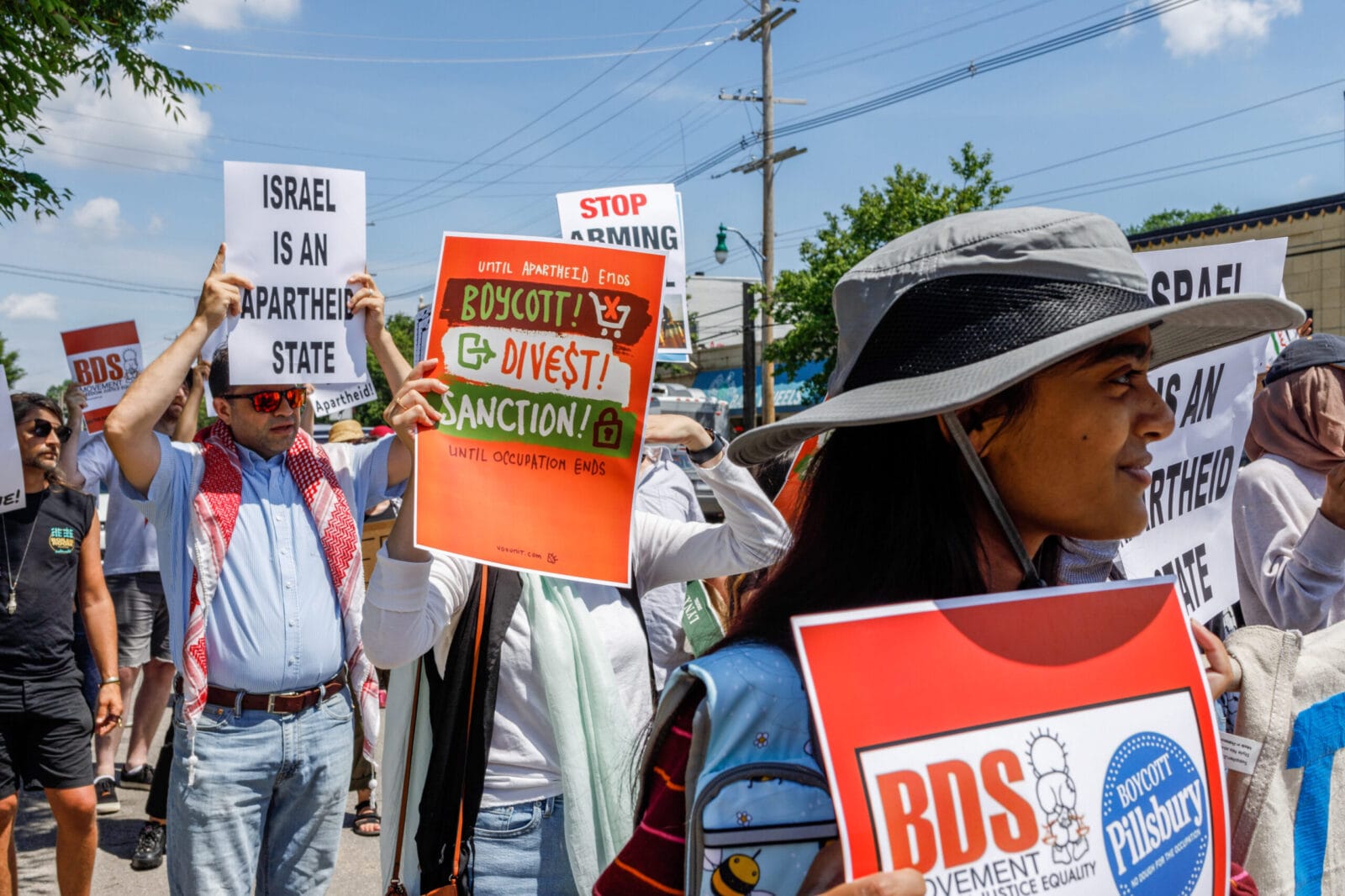
Protesters supporting the Boycott Divestment and Sanctions campaign. Columbus, Ohio, June 2021\. Stephen Zenner/SOPA Images/LightRocket via Getty Images
**Lori Allen:** This is the second time that [AnthroBoycott](https://www.anthroboycott.org/home), the collective of anthropologists that you and I are members of, has brought a [resolution](https://www.anthroboycott.org/the-resolution) to boycott Israeli institutions to the membership of the American Anthropological Association (AAA). After that first campaign in 2015–2016 was unsuccessful—by just 39 votes (less than 1 percent of ballots cast)—what prompted this second campaign at this juncture? Why do you think that the vote was successful this time?
**Daniel Segal:** A loss by less than 1 percent is an electoral loss but also, and importantly, a statistical tie. In the broader society and on our campuses, there is more honest information circulating about the Israeli apartheid state and its abuses of the human rights of Palestinians. So, a second campaign, with an expectation of victory, was always on the horizon.
Many things contribute to the increasing recognition of the truth about the Israeli state. On our campuses, one crucial factor nationally has been the activist work done by [Students for Justice in Palestine](https://www.nationalsjp.org/). A second factor has been the increase in the number of faculty who teach honestly about Palestine and Israel, many of them anthropologists. In the broader society, another crucial element has been the impact of Jewish Voice for Peace (JVP). JVP’s solidarity with the Palestinian cause has exposed the lie that it is antisemitic to criticize Israel and support the Palestinian struggle for freedom and equality.
These and other factors have led to a steady increase in support for the Palestinian struggle outside and inside of academia. The AnthroBoycott Collective understood this context and the opportunity it provided but also understood that opportunities do not harvest themselves. The Collective organized, organized and organized. It also took stock of its previous campaign and assessed where it could do better. One area was in canvassing as many AAA members as possible.
**Jessica Winegar:** A major shift in the demographics of the discipline, along with a renewed emphasis on decolonizing anthropology, also played a significant role in the success of the vote in this round. Younger generations of US anthropologists are significantly more ethnically and racially diverse than their predecessors. This demographic shift precipitated a rejection of the white liberal “dialogue” politics and a rejection of the colonial presumption to know better what the path to liberation should be—two frameworks that had prevented a full appreciation of the Palestinian struggle in anthropology over the decades. Younger generations of anthropologists are also much more committed to intersectional analyses and activist alliances, which enabled us to build solidarities across constituencies in the AAA. The youngest anthropologists also entered the profession at a time when criticisms of the Israeli state and Zionism were not verboten, in part due to the work of the organizations Dan mentioned. Also, public opinion on Israel in the Unites States is shifting, making it less risky for white anthropologists to adopt the boycott.
> ****This demographic shift precipitated a rejection of the white liberal “dialogue” politics and a rejection of the colonial presumption to know better what the path to liberation should be—two frameworks that had prevented a full appreciation of the Palestinian struggle in anthropology over the decades.**
**Lori:** What were the stumbling blocks and kinds of pushback that the campaign faced this time and last? The AAA leadership promoted a narrative about the “divisiveness” of this campaign to scare the membership, for example. How did you work to overcome these challenges?
**Jessica:** We built upon our years of work educating the AAA membership on the issues and on the boycott. And we had a carefully crafted campaign that involved webinars, media appearances, social media outreach and targeted outreach to the AAA membership through emails and the Association’s community board. In each of these channels, we had a persistent, clear message that really counteracted the specious “divisiveness” claim.
**Daniel:** Last time we faced three primary obstacles. One was a number of Zionist members of the AAA, whose attachment to Israel was typically rooted in early childhood socialization. Their deeply emotional attachments to Israel—a toxic love, in my judgment—often made them refractory to reason and evidence. A second obstacle was a widespread discomfort among academics with boycotting academic institutions and, related to this, a concern for academic freedom that was not assuaged by the distinction between an institutional boycott and a boycott of individuals. Some of this resistance was legitimate but, at some point, its intensity reflected an uncritical faith in academia, often of the privileged, mistakenly extended to Israeli academic institutions. A final obstacle was the large number of anthropologists, generally those with no connection to the region, whose response was to do whatever they could to avoid the issue completely, whether because they feared being called antisemitic if they supported the boycott or because they wanted to avoid conflict.
In 2023, by contrast, the greater visibility and recognition of the cruel inhumanity of the Israeli state did a lot to diminish these obstacles. And the changes internal to the discipline that Jessica discussed contributed to and reinforced this. Finally, the AnthroBoycott Collective was persistent and disciplined in responding to criticisms and deflections from anti-boycott voices, especially in countering the claim that the boycott targets individuals and violates academic freedom.
An important strength of this year’s campaign was the even more effective centering of Palestinian voices. This included the great contributions to the campaign of Palestinian anthropologists [Rami Salameh](https://www.anthroboycott.org/resources/support-for-bds-is-a-message-of-hope) and Ala Alazzeh and also, Omar Barghouti’s [essay](https://www.thenation.com/article/activism/bds-divisiveness-ethics/) in *The Nation.*[\[1\]](#%5Fedn1) These voices were crucial for establishing that the question before AAA members was not what they, as first-world scholars, thought was best for Palestinians but whether they would or would not respect what Palestinians were asking of us, in terms of supporting their struggle for freedom and equality.
And finally, but certainly not least, as the campaign unfolded, the endorsement from the Association of Black Anthropologists proved a key and powerful moment. Speaking from a Critical Israeli Studies perspective, I would say that what the Israeli state most fears from US society is support for the Palestinian cause from African Americans and anti-Zionist Jews. A racial supremacist state based on hyper-essentialism simply cannot bear solidarity.
**Lori:** Although the AAA, with its membership of nearly 12,000 people, is the largest US academic association to pass a boycott, this is not a very big proportion of the US public. Why do you think that this vote was significant? Does the AAA represent something larger than itself?
**Daniel:** Scholars have real impact on the broader US public first and foremost by teaching undergraduates. So yes, the AAA and other learned societies matter when they adopt a boycott of Israeli institutions. These boycotts of Israeli universities erode the legitimacy of the Israeli state for our undergraduates and in the broader US society. And for Israeli society—again bringing in a Critical Israeli Studies perspective—higher education and scholarship retain considerable stature and authority. So, in the Israeli context also, the AAA boycott matters.
**Jessica:** I think the AAA membership is on the spectrum from liberal to leftist. This victory suggests that even the liberal US public is in the process of shifting its perspective on Israel and hopefully recognizing that two-sides-ism and calls for more dialogue have gotten nowhere. The significance of this win is clear. The hyperbolic negative coverage in the Zionist media shows the symbolic power of the vote on the Israeli state. The Palestinian Federation of Unions of University Professors and Employees (PFUUPE) and the Palestinian Campaign for the Academic and Cultural Boycott of Israel expressed tremendous support of this boycott resolution. The PFUUPE [confirmed](https://www.anthroboycott.org/yes) that this “decisive vote conveys to Palestinians that our concerns, our rights, and our dignity matter.”[\[2\]](#%5Fedn2)
**Lori:** For individual citizens who oppose Israel’s treatment of Palestinians, who oppose the Jewish supremacist premise of the settler-colonial regime, it can be frustrating that their political representatives seem so [out of touch](https://time.com/6295703/israel-herzog-visit-washington/) with the [shift](https://news.gallup.com/poll/472070/democrats-sympathies-middle-east-shift-palestinians.aspx) in public opinion, including [among Jews](https://www.merip.org/awakening-to-the-politics-of-israel-an-interview-with-sonya-meyerson-knox-of-jewish-voice-for-peace/). It’s frustrating that they continue to support Israel, right or wrong. One recent example is the [tepid response](https://www.reuters.com/world/middle-east/us-calls-israel-parliament-vote-unfortunate-urges-work-toward-consensus-2023-07-24/) of the US government to Israel’s passage of a judicial overhaul bill that will curb the Supreme Court's powers and the Biden government’s unwillingness to reconsider the nearly $4 billion in funding that the US hands over to Israel annually. Do you think that boycott actions like this can make a dent in politicians’ knee-jerk support of Israel? What else is needed?
**Daniel:** The movement needs a great many complementary elements. Both Jewish Voice for Peace and [American Muslims for Palestine](https://www.ampalestine.org/) now have sibling organizations— 501C.4s—that do meaningful congressional advocacy and electoral work. Academic boycotts bolster that work, and I think our broader movement must now build this electoral dimension in order to push our elected officials to catch up with public opinion, especially among Democratic voters and young Jewish voters. We need social movement work to lead, but we also need elected officials, pushed and led by movement work, in order to change US policy. The struggle against apartheid in South Africa supports this view. And given how far behind mainstream elected officials are on Palestine—including mainstream Democratic leaders—it’s important to support the few electeds who are with us, notably Cori Bush, Ilhan Omar, Betty McCollum and Rashida Tlaib. We also should recognize those who are, to various degrees, joining them, including Jamaal Bowman, Andre Carson, Summer Lee and Ayanna Pressley. But at the same time, we must be vigilant and be prepared to criticize these electeds if they do not increase their support for Palestine and, especially, if they backtrack. Ultimately, electoral and congressional victories for liberatory causes—such as Palestinian freedom—are always dependent on movement work to change public knowledge and understanding and to create a different calculus for political candidates.
To further the Palestinian cause in US electoral politics, it is crucial that activists make accepting AIPAC donations politically toxic for Democratic candidates. Only this can end AIPAC’s massive funding for pro-apartheid Democrats. Here it is important to publicize that AIPAC backs and funds the Trump Republican party, including House members who voted against certifying the 2020 election. No Democrat should take AIPAC dollars, and as long as it is acceptable for them to do so, the Democratic party will remain the pro-Israeli apartheid and settler colonialism party it is today.
**Lori:** The resolution that AAA members passed is similar to resolutions that other academic associations—including The Middle East Studies Association—have passed. What are the most salient points of this resolution? How will its passage affect the actions of the AAA and its membership?
> **Calling out Israel as an apartheid regime, and describing its tactics as a form of ethnic cleansing, is a clear statement from anthropologists that they understand the Israeli state’s methods.**
**Jessica:** The AAA resolution is the first one by a major academic organization to explicitly name what Israel is doing as apartheid. Calling out Israel as an apartheid regime, and describing its tactics as a form of ethnic cleansing, is a clear statement from anthropologists that they understand the Israeli state’s methods. The resolution also calls attention to the fact that the Israeli state uses anthropological methods and frameworks to further its project of apartheid and ethnic cleansing. And it reminds anthropologists of their association’s Declaration on Anthropology and Human rights, which confirms: “Anthropology as a profession is committed to the promotion and protection of the right of people and peoples everywhere to the full realization of their humanity” and “the AAA has an ethical responsibility to protest and oppose… deprivation….”[\[3\]](#%5Fedn3) It is our hope that the membership will implement the boycott in their individual scholarly practice, while the Association itself severs ties with Israeli academic institutions.
**Lori:** Tell us about the AnthroBoycott Collective. How did this group of about 20 people come together? What lessons have you learned about organizing in general and organizing academics in particular from this experience? What advice can you offer to other groups who want to support the BDS movement?
**Jessica:** The core group that began organizing for the 2015–2016 campaign stayed in touch. We came together again for this campaign and brought in new people rather organically. We are a very diverse group across academic rank, race/ethnicity, gender, generation and national heritages. This diversity was incredibly useful for generating different ideas and perspectives and allowed us to take advantage of everyone’s different skill sets and connections. It helped us conduct a truly intersectional campaign, which was critical for its success. It also helped that everyone in the collective is a hard worker and humble. We had none of the ego problems that often plague organizing as well as academia. Other groups wanting to support the BDS movement would benefit from ensuring that their core organizing group has these features and also to seek advice from those who have successfully organized in other organizations.
**Lori:** After this resounding victory in the AAA, what’s next for academic boycotts? I mean boycotts for Palestinian liberation and—given what’s happening in US higher education in places like Florida—boycotts for other people’s rights, too.
**Jessica:** I would encourage anyone who wants to support the BDS movement for Palestinian rights to educate members of their academic association through panels, workshops and other means. Achieving a boycott victory, even in a discipline that perceives itself to be left of center and on the side of the oppressed like anthropology, took many years of education and organizing. The blowback can scare people, and a failure to adopt the boycott can send the movement back. Education is key, and this fact holds for boycotts more generally. The word “boycott” can elicit knee jerk negative reactions, but with careful education those can be overcome.
**Daniel:** We need to build on the recent victories in both MESA and the AAA with campaigns for boycott resolutions in other strategically selected learned societies. We won’t always win the first time, and we do not need to. The education work of each campaign can itself undermine the normalization of Israeli oppression of Palestinians, and if we have an initial loss, as we did in the AAA, the movement will come back stronger. It’s time also to contest and overturn the American Association of University Professors' (AAUP) robotically absolutist stance against academic boycotts, which was rooted in a rear-guard Zionist effort, earlier in this century, to support the Israeli state. And finally, on our campuses, we need campaigns targeting study abroad programs at Israeli universities. Very importantly, such campaigns require and enable pro-Palestinian organizing by students as well as faculty.
---
### Endnotes
[\[1\]](#%5Fednref1) Omar Barghouti, “[We Shouldn’t Fear Being ‘Divisive’ in Pursuit of Justice](https://www.thenation.com/article/activism/bds-divisiveness-ethics/),” *The Nation,* June 16, 2023.
[\[2\]](#%5Fednref2) “[Letters of Support](https://www.anthroboycott.org/yes),” AnthroBoycott.org, July 24, 2023.
[\[3\]](#%5Fednref3) American Anthropological Association, “[Declaration on Anthropology and Human Rights](https://americananthro.org/about/declaration-on-anthropology-and-human-rights/),” americananthro.org, June 1999.
### At Any Cost—The War in Sudan and Europe’s Flawed Migration Policies
URL: https://www.merip.org/2023/07/at-any-cost-the-war-in-sudan-and-europes-flawed-migration-policies/
Last updated: 2025-08-22T18:36:42.000Z
On April 15, 2023, fighting broke out between the Sudanese Armed Forces and the Rapid Support Forces in Khartoum and quickly spread across Sudan. In the three months since, more than 3 million people have been displaced.[\[1\]](#%5Fedn1) The majority of the displacement—approximately 2.4 million people—has been internal. The rest have crossed into neighboring countries.
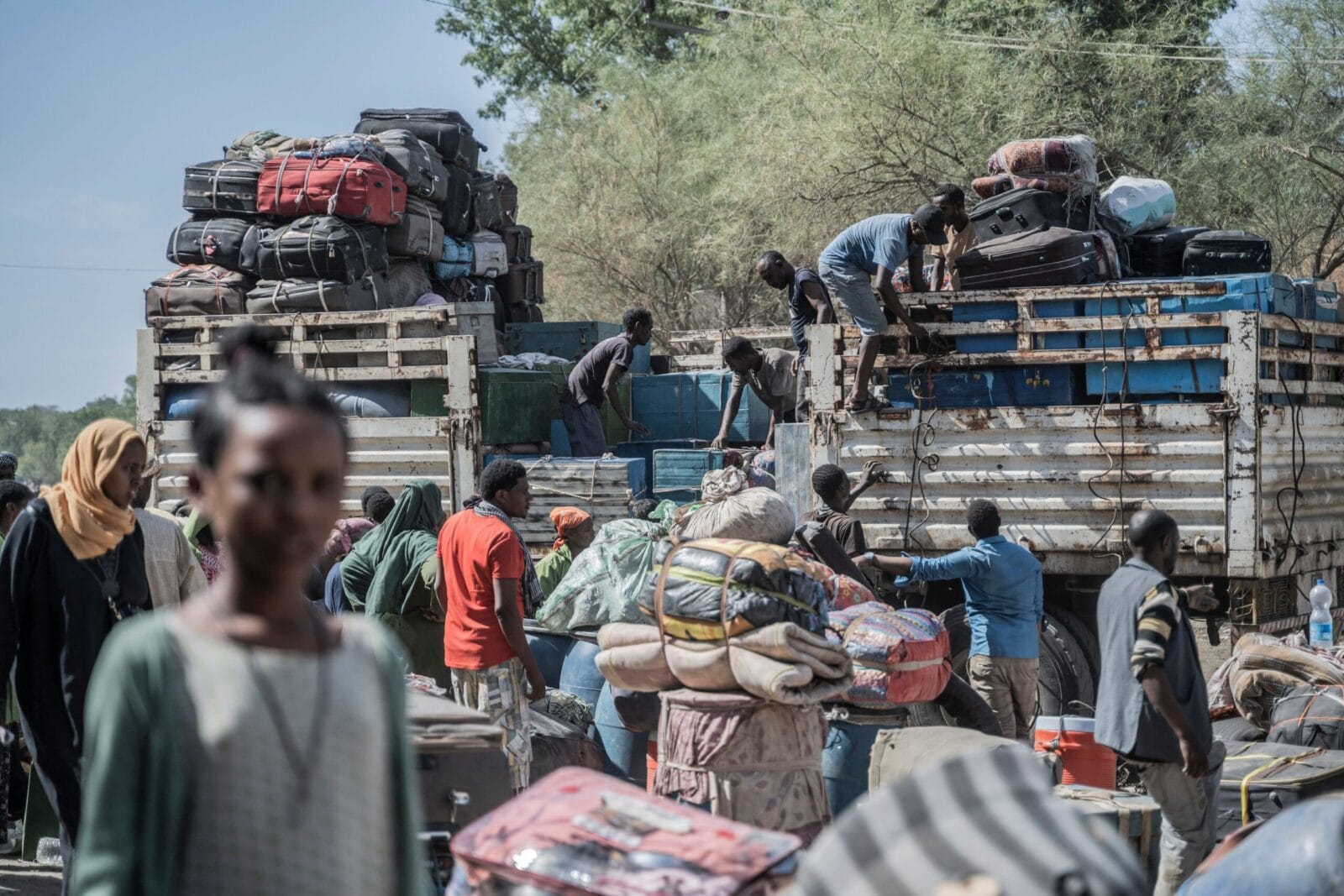
Workers in Metema, Ethiopia, load luggage that belongs to refugees from Sudan who fled the fighting in Khartoum, May 5, 2023\. Amanuel Sileshi/AFP/Getty Images
Even before the recent violence, Sudan had among the [highest numbers](https://www.internal-displacement.org/countries/sudan) of internally displaced persons in the world and is one of the largest refugee-producing countries. Sudan has also been a host country to many refugees. Due to its location next to Libya and Egypt, as well as its porous borders, it serves as a major transit hub for refugees and migrants from the Horn of Africa, and more recently Syria, hoping to reach Europe.
For this reason, Sudan has been critical to the European Union’s efforts, particularly over the past ten years, to reduce the number of migrants to Europe through a policy of so-called border externalization. That is, shifting the responsibility for preventing irregular migration onto the countries of departure and transit. While these EU policies claim to be targeting the unscrupulous practices of smugglers and traffickers and intending to save lives, their real purpose is to block migrants as far away from EU borders as possible at any cost, helping them evade their formal obligations under international law to protect the rights of refugees and migrants.
The dearth of legal pathways for migration to Europe compels many to travel “irregularly”— often by attempting to cross the Mediterranean. These crossings can end tragically: In the first six months of 2023 alone, nearly 2,000 migrants have died trying to cross the Mediterranean. As EU members grow more assertive in pushing back migrants across the Mediterranean and the death toll continues to rise from boats sinking, the latest conflict in Sudan raises important questions about the role of EU migration policies in making migration less humane and fueling conflict that contributes to displacement.
### **The Khartoum Process**
Sudan first became a crucial partner in EU border externalization measures in 2014, following the launch of the European Union Horn of Africa Migration Route Initiative, better known as the “Khartoum Process.” Calling itself a “platform for political cooperation amongst the countries along the migration route between the Horn of Africa and Europe,” the Khartoum Process brought together 28 EU member states and ministers from Eritrea, Ethiopia, Somalia, South Sudan, Sudan, Djibouti, Kenya, Egypt and Tunisia.[\[2\]](#%5Fedn2) In a November 2014 meeting in Rome, they signed a declaration agreeing to “undertake concrete actions to prevent and tackle the challenges of human trafficking and smuggling of migrants between the Horn of Africa and Europe, in a spirit of partnership, shared responsibility and cooperation.”[\[3\]](#%5Fedn3)
The language of humanitarianism, particularly the focus on smugglers and trafficking, is a common feature of EU declarations. But it sits in tension with the continued loss of lives at sea, the interdictions, the pushbacks, the detentions and the increasing spending on border control measures. This nominal focus on humanitarianism is further undermined by the willingness of the EU to partner with states known to disregard international legal obligations under human rights and refugee law.
Indeed, from the first, the Khartoum Process’s focus on the Horn of Africa raised concerns among refugee rights activists, academics and human rights organizations about how the partnership model could function in the context of a region marked by authoritarian regimes, protracted armed conflicts and socio-economic instability and insecurity. The scant publicity it garnered raised speculation that the EU did not want to bring attention to its partnership with states known for widespread human rights violations. Through the Khartoum Process and other initiatives, the EU began engaging with former Sudanese president Omar al-Bashir, even though the long-time autocrat had been indicted by the [International Criminal Court](https://www.c-cpi.int/darfur/albashir) for committing crimes against humanity in Darfur.
For its part, Sudan eagerly embraced the Khartoum Process as a means of [gaining ](https://foreignpolicy.com/2016/07/31/europes-new-best-friend-in-africa-is-an-indicted-genocidal-war-criminal/)political and financial capital and ending its international isolation. Sudan had long been asking for the lifting of sanctions, debt relief and its removal from the list of states sponsoring terrorism, and hoped that cooperation with the EU on migration issues would help bring it out of isolation. Just as the EU had been willing to [overlook](https://www.theguardian.com/world/2010/sep/01/eu-muammar-gaddafi-immigration) the egregious human rights record of former Libyan president Muamar Qaddafi who warned that Europe would “turn black,” unless he received European aid to stem to tide of migrants, Sudan became a partner in the EU’s migration framework.[\[4\]](#%5Fedn4) Notably, what did eventually get Sudan removed from the state sponsor of terror list was Sudan’s entry into the Abraham Accords in January 2021—mediated by the United States—toward normalization with Israel. This deal also included its own migration component: easing the [repatriation of the thousands](https://www.haaretz.com/israel-news/2020-10-25/ty-article/.premium/normalization-with-sudan-will-ease-deportation-of-asylum-seekers-sources-say/0000017f-dc74-db5a-a57f-dc7e4cee0000) of Sudanese asylum seekers who arrived in Israel via Egypt.
> **Sudan had long been asking for the lifting of sanctions, debt relief and its removal from the list of states sponsoring terrorism, and hoped that cooperation with the EU on migration issues would help bring it out of isolation.**
The EU has also lacked transparency around who receives the funding meant for border externalization policies and how these funds are dispersed. Following the Valletta Summit—convened in Malta in November of 2015 for EU and African leaders to discuss what was being labeled as Europe’s “migrant crisis” in response to the record number of asylum seekers heading to Europe—an [Emergency Trust Fund for Africa](https://trust-fund-for-africa.europa.eu/index%5Fen) was launched. Funds in this 2-billion-euro trust, which was intended to address the causes of irregular migration to Europe, were dispersed to a number of initiatives in the Horn of Africa according to the Khartoum Process.
The EU has [persistently claimed](EU%20actions%20on%20Migration%20in%20Sudan%20|%20EEAS%20%28europa.eu%29) that it does not provide any direct financial support to the government of Sudan or its military forces but rather channels all funds through EU Member States’ development agencies, international organizations or Non-Governmental Organizations. There is reason to doubt this claim, however, given the tight control the central government in Sudan has wielded over NGOs. NGOs must register with the Humanitarian Aid Commission, which, under Al-Bashir, fell under the control of the Sudanese Intelligence Service and, under the transitional government, continues to be closely monitored by military. International organizations, like the International Organization for Migration, that are among the main implementing partners of the Khartoum Process work directly with Sudanese government agencies. Although the International Organization for Migration frames its activities using the depoliticized language of “migration management,” in practice, it offers trainings to and works closely with government ministries, especially the Ministry of Interior.
As a partnership, the Khartoum Process is asymmetrical. It is driven and shaped primarily by European interests. Most of the money allocated to it goes toward projects designed to discourage migration through containment and control.[\[5\]](#%5Fedn5) Especially criticized is the Better Migration Management initiative, a years-long regional program led by the German Agency for International Cooperation (GIZ) and implemented through numerous bodies and agencies, including the International Organization for Migration, the UNHCR and the interior ministries of various EU member states.
In 2016, the EU Trust Fund allocated 40 million Euros to this program, toward, in part, drafting national legislation and policies on migration management and human trafficking.[\[6\]](#%5Fedn6) Even more controversial has been the use of these funds to further empower police and security forces in the form of “training, technical assistance and provision of relevant equipment, for judiciary and border management authorities to better address migration and border management.”[\[7\]](#%5Fedn7) Another consortium led by Civipol—a semi-public company with majority ownership by the French Interior Ministry—executed a [5 million euro project](https://www.merip.org/content/files/sites/default/files/2018-09/multilateral-damage.pdf) for a regional operational center in Khartoum to share police intelligence among Horn of Africa states.
### **EU Migration Initiatives and the RSF**
In 2015, the Bashir regime in Sudan charged the Rapid Support Forces (RSF) with patrolling and controlling borders. The RSF is the paramilitary force that is today fighting for power against the Sudanese Armed Forces. Its origins go back to militias drawn from the Abbala and Baggara tribes of north and western Sudan and deployed by the central government to quell the uprising in Darfur in 2003, just as successive governments since the 1980’s have relied on militias to fight wars in the peripheries. The militias fighting in Darfur came to be known as the Janjaweed and were infamous for the atrocities they committed during that conflict. In 2013, to address a fraying alliance with the Janjaweed, Bashir shuffled around the militias, drawing from border guards and former Janjaweed fighters, and called them the Rapid Support Forces. The were placed under the command of Sudan’s National Intelligence and Security Service, and its members were given NISS identity cards and granted immunity under the National Security Services Act of 2010\. General Mohamed Hamdan Dagalo, also known as “Hemedti”, (himself a commander during the Darfur conflict) was appointed as its head. Soon after forming, the RSF was [quashing protests](https://www.hrw.org/report/2014/04/21/we-stood-they-opened-fire/killings-and-arrests-sudans-security-forces-during) in Khartoum as well as [countering uprisings](https://www.aljazeera.com/news/2023/4/16/sudan-unrest-what-is-the-rapid-support-forces) in South Kordofan and Blue Nile states.
> **Hemedti, the same man who led a militia allegedly responsible for war crimes in Darfur, began publicly announcing the numbers of migrants he arrested, boasting that the EU needed him because he was doing their “dirty work.”**
The RSF violently took up its role of patrolling and controlling Sudan’s borders. Hemedti, the same man who led a militia allegedly responsible for war crimes in Darfur, began publicly announcing the numbers of migrants he arrested, boasting that the EU needed him because he was doing their “dirty work.”[\[8\]](#%5Fedn8) Migrants have [described](https://www.clingendael.org/pub/2018/multilateral-damage/3-effects-of-eu-policies-in-sudan/) being detained by RSF members who held them for ransom before turning them over to other smugglers. Before the Khartoum Process and after, human rights groups criticized the Sudanese government’s treatment of refugees and migrants, documenting cases of refugees being deported or detained in inhumane conditions, beaten, abused or shaken down at the hands of smugglers.
Regardless of how much EU money is disbursed and through what channels, those charged with border control are known for readily violating human rights. Moreover, the RSF has amassed riches through a variety of sources, including controlling gold mines in western Sudan and providing mercenaries to allies. Even more than the funds, then, the EU migration policy grants them a veneer of legitimacy and emboldens them.
During and since the popular uprising that led to Al-Bashir’s ouster in 2019, the RSF have continued to be involved in quashing internal dissent. Equipment like the cameras and sensors that were originally provided to surveille traffickers were [used against](https://www.cmi.no/publications/7174-irregular-migration-or-human-trafficking) protesters during the uprisings. Only after the RSF violently dispersed a peaceful sit-in demanding civilian rule on June 3, 2019, killing [over 186](https://www.hrw.org/report/2019/11/18/they-were-shouting-kill-them/sudans-violent-crackdown-protesters-khartoum) protestors, did the EU under pressure [halt some](https://www.dw.com/en/eu-suspends-migration-control-projects-in-sudan-amid-repression-fears/a-49701408) of its programs in Sudan. Specifically, an EU spokesperson informed the German news agency *Deutsche Welle* that the GIZ-led project providing training and equipment to Sudanese border police had been stopped.
### **The EU’s Flawed Migration Policy**
Events in Sudan today reveal the deep flaws of EU migration policy toward Africa, beginning with the assumption that the primary way to address migration is to enhance the state’s capacity for surveillance and coercion. This approach fails to recognize, or deliberately ignores, how the state itself contributes to and is complicit in creating violent conflict that drives people from their homes.
> **This approach fails to recognize, or deliberately ignores, how the state itself contributes to and is complicit in creating violent conflict that drives people from their homes.**
In Sudan, migration control was put in the hands of a proxy militia that had itself been responsible for mass displacement. As the current situation shows, these policies are not just cynical but short-sighted. Although these policies may initially lead to a drop in migrant arrivals, as alternative routes are used, the numbers almost always rise again. The alternative routes are often longer or more dangerous—for which smugglers charge even more money—and fuel more human rights violations. The fact that these violations occur outside EU territory allows the EU to turn a blind eye. Containment also stifles the free movement of people within the region, as states are incentivized to stop the movement of people. Finally, it undermines and diverts other development priorities, placing the emphasis on securitization and control.
Alleviating “irregular” migration requires addressing its root causes and creating legal pathways for migration. Although the Khartoum Process pays lip service to the creation of legal channels for migration, only 3 percent of the EU Trust Fund was allocated to this end. As long as western migration policies prioritize keeping people out at any cost rather than the free and safe movement of people, conflicts like the current war in Sudan will continue the cycle of violence and instability, resulting in more displacement and refugees.
**\[Parastou Hassouri** is a Cairo-based consultant on refugee law and migration policy who has taught international refugee law at the American University in Cairo.\]
---
### **Endnotes**
[\[1\]](#%5Fednref1) OCHA: "[Sudan: Situation Report](https://reports.unocha.org/en/country/sudan/%20UN)," (July 25, 2023).
[\[2\]](#%5Fednref2) EU Horn of Africa Migration Route Initiative, "The Khartoum Process,"
[\[3\]](#%5Fednref3) EU Horn of Africa Migration Route Initiative, "[Declaration of the Ministerial Conference of the Khartoum Process](rome-declaration-2014-khartoum-process.pdf)," November 28, 2014.
[\[4\]](#%5Fednref4) Ian Traynor, “[EU keen to strike deal with Muammar Gaddafi on immigration](https://www.theguardian.com/world/2010/sep/01/eu-muammar-gaddafi-immigration),” The Guardian, September 1, 2010.
[\[5\]](#%5Fednref5) OXFAM Briefing Note: "[An Emergency for Whom? The EU Emergency Trust Fund for Africa --migratory routes and development aid in Africa](https://www.merip.org/content/files/system/files/bp-emergency-for-whom-eutf-africa-migration-151117-summ-en%5F1.pdf)," November 2017, p. 5.
[\[6\]](#%5Fednref6) Lutze Oette and Mohamed Abdelsalem Babiker, "Migration Control à la Khartoum: EU External Engagement and Human Rights Protection in the Horn of Africa," *Refugee Survey Quarterly* 36/4 (2017), pp. 71-72.
[\[7\]](#%5Fednref7) European Parliament: “[Resolution on Sudan](europarl.europa.eu/doceo/document/B-8-2016-1071%5FIT.html)” (B8-1071/2016).
[\[8\]](#%5Fednref8) Caitlin Chandler, "[Inside the EU's flawed $200 million migration deal with Sudan](https://www.thenewhumanitarian.org/special-report/2018/01/30/inside-eu-s-flawed-200-million-migration-deal-sudan)," The New Humanitarian, January 30, 2018.
### 'A Place Without a Door' and 'Uncle Give me a Cigarette'—Two Essays by Palestinian Political Prisoner, Walid Daqqah
URL: https://www.merip.org/2023/07/a-place-without-a-door-and-uncle-give-me-a-cigarette-two-essays-by-palestinian-political-prisoner-walid-daqqah/
Last updated: 2026-10-07T15:14:22.000Z
*For a long time whenever Milad asked me on the phone, 'Daddy, where are you?' I avoided using the word 'prison.' I feared that it might be too much for her at her tender age to begin to live with this word and its weighty implications,” writes Walid Daqqah in his essay, “A Pace without a Door.”*
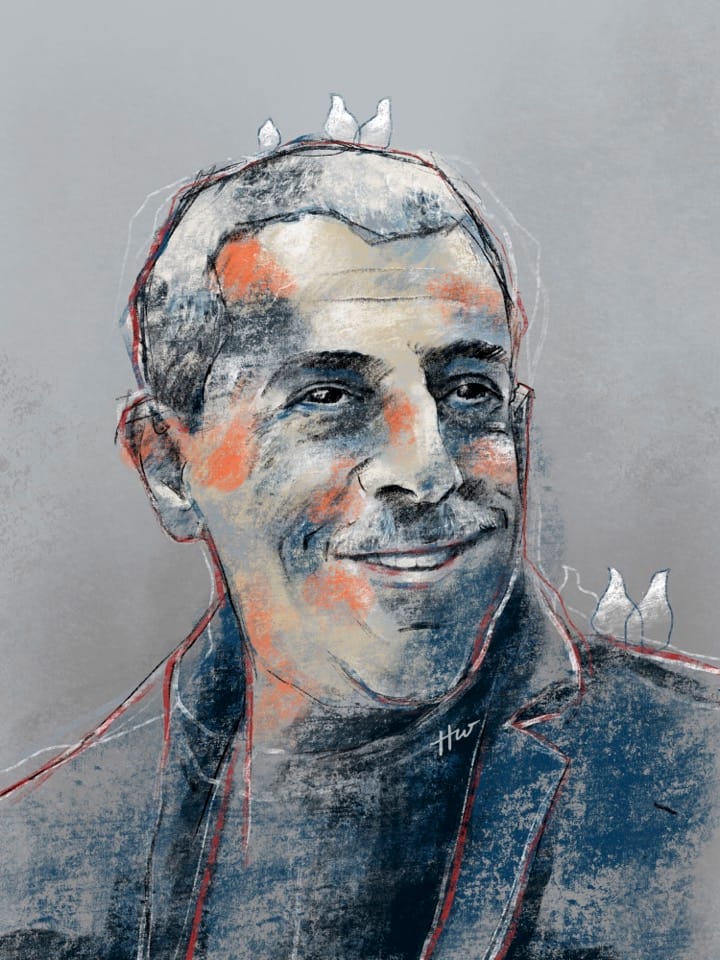
Portrait of Walid Daqqah by artist and architect Hazem Abutawila.
*The 61-year-old Palestinian political prisoner and writer was arrested in 1986 and sentenced to a 37 years in Israeli prison. His sentence should have come to an end in 2023 but was extended by Israeli authorities for two years over the smuggling of mobile phones. As Sana' Salameh, Daqqah’s wife, whom he married in 1999 while in prison, recently* [*wrote*](https://mondoweiss.net/2023/05/free-walid-daqqah-and-all-political-prisoners/)*, “In other, similar cases, such offenses were punished with a few days of solitary confinement. In Walid’s case they added two years.” Salameh and other activists* [*view*](https://www.aljazeera.com/news/2023/5/24/israel-postpones-parole-session-for-writer-walid-daqqa?traffic%5Fsource=KeepReading) *Daqqah’s continued detainment as, in actuality, punishment for his defiance, most prominently the smuggling of his sperm to conceive the couple's daughter, Milad—born in 2020—after Israeli authorities illegally prohibited them from conjugal visitations.*
*In December of 2022, Daqqah was diagnosed with terminal bone marrow cancer. Despite the severity of his diagnosis, he continues to be denied release as well as vital, life-prolonging treatments. "They have in the past delayed transferring him to the hospital, until it’s almost too late," writes Salahmeh. "This policy of medical neglect is well known. We call it a policy of slow killing.”*[*\[1\]*](#%5Fftn1)
*In March of 2023, his family launched a social media* [*campaign*](http://www.facebook.com/profile.php?id=100091256805982&mibextid=ZbWKwL)*,* #FreeWalidDaqqa*. As part of the campaign for his release, a handful of his essays have been translated from Arabic into English by Dalia Taha, a Palestinian poet and playwright. These essays, smuggled out of prison, include the two below: "A Place without a Door" and “Uncle, Give Me a Cigarette.” Other works by Daqqah include,* Parallel Time *(later adapted as a play),* Dissolving Consciousness, or: Redefining Torture *and his children's novel,* The Tale of the Oil’s Secret.
## **A Place without a Door**
Once, after she had returned from a trip to the ocean, I promised Milad on the phone that I would take her there next time. She paused for a few seconds, hesitant to respond, as if she didn’t want to shock me before finally saying, "No, you don't have a door."
For a long time whenever Milad asked me on the phone, "Daddy, where are you?" I avoided using the word "prison." I feared that it might be too much for her at her tender age to begin to live with this word and its weighty implications. Torn, I grappled with the question of whether I should nevertheless tell my daughter the truth? Or should I hide the bitter reality, to prevent the connotations of the word prison from lodging in her imagination?
Through her visits, Milad came to understand what a prison is, long before she learned the meaning of the word. To her it was a place without a door. Where her father was confined, which he was unable to leave. And for her, if there was no door, then there could be no visit to the ocean. No breakfast to share. And no chance for me to accompany her to the nursery she fondly referred to as "school."
Protesters gather to hold a demonstration demanding the release of Walid Daqqa in Bethlehem, West Bank on June 7, 2023\. His wife and daughter appear in the poster behind him. Wisam Hashlamoun/Anadolu Agency via Getty Images
From the earliest moments of their lives our children come to understand the reality of walls, barriers and checkpoints. They do so long before they are introduced to the word "occupation." So we ask ourselves a vexing question, one that is of the utmost importance to their education: How do we turn the oppressive feeling created by this reality into a force for positive action, which could contribute to the constructive growth of their young and developing personalities?
While thinking about whether I should use the word “prison” with Milad, memories from my years of captivity began to play in my mind. During these years, I found myself living alongside not just one but three generations of prisoners: the Father, the Son, and the Grandson. Perhaps it is the pervasiveness of prisons in the lives of children, through their frequent visits to incarcerated family members, which brings them back to the confines of the prison as prisoners themselves. In one of my stories from life in prison, entitled "Uncle, Give Me a Cigarette," a 12-year-old child prisoner asked me for a cigarette. In normal circumstances, outside the walls of the prison, I would have said no. We don’t want children to smoke. But in this environment, it struck me that the child wanted by this request to grow up quickly so that he could better confront the years of confinement that now loomed before him or perhaps recover from the violence of his arrest. By the act of smoking, he seemed to proclaim "behold me, an adult." So I handed the child a cigarette. And in the presence of Milad, I finally spoke the word "prison." In the end, I followed Milad's own cue to me. She had taught me the importance of honesty and truthfulness when raising children. In the end, it did not matter if she heard me use the word "prison." In her heart she had already felt what it meant. It is a place without a door.
## **"Uncle, Give Me a Cigarette"**
It is morning and I hear the jangling of two sets of handcuffs as the prison guard approaches us. He throws them to the ground, clanging against the concrete floor, and a sense of calm settles over the room. There’s one bundle to tie the hands, and another, with longer chains, to tie the legs. Eight pairs of handcuffs of each kind, for seven prisoners.
I stand with the others in the middle of a small yard, ringed by holding cells, and try to lean against the wall. I am tired of being moved between prisons since we started the open hunger strike. I gather my energy and try to take in as much air as possible in preparation for a journey that will last hours inside an iron box that in this heat quickly turns into an unbearable furnace.
Once he is finished handcuffing us, the guard heads off for the prisoner transport truck. And then I hear a voice emanating out of the cell behind me...
“Uncle, give me a cigarette.” I peer into the cell’s darkness but cannot see anyone, and for a moment I think I am delirious. Then the voice issues out of the cell again, this time louder and more desperate. “Uncle, my uncle, give me a cigarette!” I stare into the cell again and call to the voice.
"Where are you?!"
"I'm here, down here!".
Hunching down, I peer through the slot in the bottom of the door through which prisoners receive their food and have their hands tied before being let out of the cell, and I see a child, not older than twelve years old. A child asking for a cigarette.
I didn’t know how to respond to him. Should I give him a cigarette, I wondered, or should I educate him about the dangers of smoking in the way that adults do with children outside prison? Adults, adults…and then I am struck by the fact I am including myself in this category. By the fact that he called me "uncle." Am I so old already?
I was suddenly terrified by being addressed in this manner. It was the first time during my 26 years of imprisonment that I have met someone speaking to me across such a distance of age. In prisons we are used to not addressing each other in this way, with social honorifics marking our age. Regardless of what our age differences may be, we all address each other as “my brother” or “comrade” and, more recently, “fighter.”
> **The craving is not for the rush of nicotine but for what the cigarette connotes. Frightened, a mere child in the harsh world of the prison, he wanted to become a man quickly.**
I considered the child, empathizing with his craving for the cigarette. The craving is not for the rush of nicotine but for what the cigarette connotes. Frightened, a mere child in the harsh world of the prison, he wanted to become a man quickly. Meanwhile, it is now my desire to turn back time so that I can again become a child, at least a young man, the way I was when I entered prison more than a quarter of a century ago.
Both of us were fearful. I was fearful for the time that had passed and he was fearful of what had not yet passed. I was afraid of the past and he was afraid of the future. I was afraid of having lived a life that had burnt out in prison, and he was afraid of what the cigarette that was now lodged between his lips could not burn away. The cigarette became something else after he had exhaled and so did he, standing tall now on his toes, appearing now older than his age. The ember glow became a lantern in his hand, chasing away the darkness of the cell, dispelling his fear and loneliness.
He was not smoking but trying to dispel the image of a child that so incontrovertibly clung to him. In the world of the prison, in the face of the cruelty of its guards, childhood is a burden. Knowing that he was to face years of imprisonment, he was seeking to rid himself of his vulnerability and innocence, for which he clearly had no further use–it having made no difference to the judge that had sentenced him to four years.
The guard came back for us, picked the eighth pair of handcuffs up from the concrete floor, and barked at the child to push his hands through the slot in the door. So the child pushed them through still holding the cigarette between his fingers. The guard shouted at him to drop the cigarette and then muttered to himself in Hebrew, bemoaning the sight of a child smoking. Nevertheless he proceeded with the handcuffing, remaining unmoved by the sight of those small hands in handcuffs. Because the child’s wrists were too small, however, he struggled several times to secure the handcuffs, and finally decided to use them to chain the boy’s legs.
When he was moved out of the cell, in preparation for the transportation, I looked at him and imagined that he was my own son, such as fate had not yet wanted to bring into the world. I wanted with every strain of my being to hug him and as these paternal feelings surged through me, I felt an overwhelming desire to cry. But I hid my feelings. I did not want to shatter the image of the man that he wanted now to become. I walked over to him, so as to shake his hand as a comrade, and a rival, asking
“How are you, fighter?”
---
### **Endnotes**
[\[1\]](#%5Fftnref1) Sana' Salameh, "[Free Walid Daqqah and all political prisoners](https://mondoweiss.net/2023/05/free-walid-daqqah-and-all-political-prisoners/)," *Mondoweiss* (March 29, 2023).
### 'Undesirables' and the Mediterranean Graphic Novel
URL: https://www.merip.org/2023/05/undesirables-and-the-mediterranean-graphic-novel/
Last updated: 2025-08-22T18:36:43.000Z
The cover of Aomar Boum and Nadjib Berber's book "Undersirables."
*\[su\_dropcap style="simple" size="4"\]*T*\[/su\_dropcap\]he recently published graphic novel,* [Undesirables: A Holocaust Journey to North Africa](https://www.sup.org/books/title/?id=35024) *(Stanford University Press, 2023), chronicles the lesser-known events surrounding the internment of political opponents and Jews in seven camps throughout Vichy North Africa during World War II. The protagonist is a Spanish-German Jewish journalist and activist named Hans Frank. The reader accompanies Hans on a journey from Nazi Germany, at the rise of the Third Reich, through Spain during the Civil War, France and Norway during the Nazi invasion, and finally to Algeria and Morocco as they fall under the control of Vichy France. Along the way, deep connections between oppression under colonialism, fascism, and anti-Semitic regimes are illuminated while the work also retraces an international network of militants working against these forces. To bring this historical ethnography to life, Aomar Boum, a historical anthropologist and Maurice Amado Chair in Sephardic Studies at UCLA, collaborated with Nadjib Berber (Nad), a well-known cartoonist from Algeria. In March of 2023, Elizabeth Perego, historian and author of* [Humor and Power in Algeria, 1920 to 2021](https://iupress.org/9780253067616/humor-and-power-in-algeria-1920-to-2021/) *(Indiana University Press, forthcoming), interviewed Boum to discuss how this project came together and its significance as a form of historical narration. Sadly, in the process of preparing for this interview, Nadjib Berber passed away. This conversation about one of his final projects is dedicated to his memory.*
**Elizabeth Perego:** You delve into this story briefly in the afterward but how did the idea to create the first graphic novel about the Holocaust in North Africa initially come about?
**Aomar Boum:** The idea was born in the archives of Holocaust Museums around the world and developed in conversation with Holocaust and North African studies. In 2006–2007 I joined the United States Holocaust Memorial Museum as the Judith B. and Burton Resnick Fellow, where I researched the circulation of antisemitic discourse in French Algeria after the Crémieux decree and its reproduction in colonial settlers’ newspapers especially between the 1880s–1890s. During my residency, I was introduced for the first time to an embryonic debate about World War II, North Africa and the Holocaust. The conversation was mostly around a recent publication of Robert Satloff’s book *Among the Righteous: Lost Stories from the Holocaust's Long Reach into Arab Lands* (PublicAffairs, 2006). While this was not the first time that the question of the Holocaust and the status of North African Jews under Vichy was invoked, Satloff's argument for Yad Vashem’s need to commemorate Arabs and Muslims who protected Jews during World War II was a new proposal in the field of North African and Holocaust Studies.
I joined the museum for the second time as a postdoctoral fellow during the academic year 2012–2013 to work on post-Holocaust political debates in Morocco, especially in the aftermath of a growing debate in Morocco around the role of Sultan Sidi Mohammed ben Youssef in saving Moroccan Jews during World War II. During that year, I discovered a set of documents about labor camps in the archives of the International League Against Racism and Anti-Semitism that dealt with topics such as labor camps, the relationship between Jews and Muslims, Nazi and Vichy anti-Semitic propaganda in North Africa, Vichy racial policies in the Maghreb and Muslim responses to ant-Semitism and racism. I was able to unearth a large corpus of documents that pictured the stories of refugees and their internment in labor camps throughout the region. I thought it was important to translate this academic research into a comic story for general readership. At the end of 2015, I talked to Nadjib Berber (Nad), who had just been diagnosed with kidney cancer, about the possibility of collaborating on a graphic novel on European Jewish refugees in North African labor camps during World War II. He welcomed the idea, and we started our collaboration in 2016.
**Elizabeth:** Could you say a bit about how you collaborated with Berber (known to Algerian and Tunisian readers as Nad) for the graphic novel? What were your goals for the work?
**Aomar:** Before I answer your question, it’s important for me to say why my collaboration with Nad was a perfect fit. Nad was born on October 16, 1952 in Tlemcen, Algeria and began drawing as an amateur in 1980s. He represents a second generation of Algerian artists who follow in the footsteps of Slim and Mohamed Dorbhane. In 1986 he published his first comics, *La Poudre Magique (Magic Powder)* and *Les Pillards du Desert (Desert Raiders)*. Our collaboration was perfect because he had a strong understanding of North African history, Algerian society, World War II history, European history, French society and even the Holocaust. His father Sid-Ahmed Berber had been drafted into the French army as an Algerian *tirailleur* (infantry) and served on the Maginot Line. His uncles were wounded in the campaign to liberate Provence. He was a well-read artist with an excellent understanding of the French, American and North African schools of comics and graphic novels. Our objective was to track the journey of European refugees during World War II into our home countries of Algeria and Morocco. We were lucky because we were neighbors in Westwood, Los Angeles. We met regularly in person in cafés and our homes. Every week and sometimes every day we met to discuss and agree on sections of the plot before Nad worked on the panels and drawings. As we discussed the characters’ development, we researched carefully the social as well as the urban contexts, matching it with archival material that I had collected over 14 years. We knew from the beginning that a project about the North African camps would offer something different than the better-known stories of World War II camps in Europe and the United States.
**Elizabeth:**A good portion of the work’s beginning highlights relations between Muslims and Jews in France and North Africa. Why did you and Berber decide to use this space to address those relations?
**Aomar:** In the archives I encountered conversations between Jews and Muslims. These intellectual conversations partly revolved around the importance of a Muslim-Jewish partnership against anti-Semitism, racism and Islamophobia. Based on this fact, Nad and I strongly believed that in their labor, disciplinary and internment camps, Vichy authorities saw Muslims and Jews as “undesirables.” North African and West African indigenous groups were also defined as undesirables by Philippe Pétain’s collaborationist government. We wanted readers to see the impact of the Nazi and Vichy racial, political and economic policies on larger populations in Europe and the Mediterranean region. We see our graphic novel as part of what I call Mediterranean bande dessinée (comics) of mobility and migration (MED-BDM): an organic multinational artistic project with an educational orientation to evaluate colonial pasts and postcolonial relations between both sides of the Mediterranean landscape. As I conceptualize it, MED-BDM has the capacity to challenge deceptive, unrepresentative photographic reportage and journalistic writing of colonial photography.
**Elizabeth:**The beginning of the *Undesirables* brilliantly shows the intricate connections that existed between communities from different areas in Western Europe and North Africa. Why did you feel that it was important to start the work this way and in Germany in particular?
**Aomar:** Hans, the main character of the graphic novel, was a German Jew with Mediterranean connections. Through Hans, and relying on an archival thread of narratives and stories, Nad and I made an effort to retroactively create these social relations that start in Munich and take us to Berlin, Paris, northern Spain, Algeria and Morocco. By underscoring these connections, we make the case for what we see as a Mediterranean humanistic approach to war. Instead of focusing on the debate of whether the Holocaust took place in North Africa or not, we follow the trails of refugees across the Mediterranean to port cities in North Africa and then labor camps. By starting in and with Germany, we establish the fact that these human displacements were the result of racial and anti-Semitic policies drafted in Munich and Berlin and used to force Jews and other “undesirables” out of Europe.
**Elizabeth:** How do you convey what is in the archive through artwork and a narrative story that includes dialogue, which, while informed, does have to be imagined at least in its word-for-word format? Were there any points in the work where you had to speculate a bit as to how events occurred?
> **We see our graphic novel as part of what I call Mediterranean bande dessinée (comics) of mobility and migration... an organic multinational artistic project with an educational orientation to evaluate colonial pasts and postcolonial relations between both sides of the Mediterranean landscape.**
**Aomar:** We used the medium of the graphic novel to reconstruct the narratives of undesirables held in Saharan Vichy camps by retrieving their written histories from various archives, rearranging them in the format of vignettes, panels and horizontal sequences. This mode allowed for the inclusion of direct speech of subjects taken from the archives and adapting them to the rounded speech balloons. Ethnographic commentary is included in square text boxes that highlight narrative voice-overs used to relay information to the reader. We contend that in the larger context of an anthropology of genocide and the Holocaust, a style of a Mediterranean graphic memoir connecting Europe and North Africa could be seen as a retroactive ethnographic account where witnessing takes place through seeing guided by the archive.
**Elizabeth:**Some of the characters in the work who speak or are mentioned like Si Kaddour Benghabrit (the first rector of the Grand Mosque of Paris) were actual historical figures while others are composite figures. How did you decide which voices should be included, and how did you go about trying to merge different voices and experiences from the archives into these characters?
**Aomar:** Every character in the book is a historical figure. The only difference is that some are known like Si Kaddour Ben Ghabrit and Bernard Lecache and others were not, like Hans and Nessim ben Nessim. That’s why our graphic work tries to give them an ethnographic voice while imagining how they looked. Even a composite character like Hans is in a large part real. Nad and I gave ourselves the license to imagine how the characters looked, behaved, acted and smelled. But our visual imagination is inspired by what it is in the archives. Therefore, it is not a novel; it is historical ethnography.
**Elizabeth:**The work does a fantastic job of demonstrating that, as in Europe, individuals of varying backgrounds ended up in the camps together as “undesirables.” Was it a challenge to develop characters or depictions that represent these diverse groups? Was it important to you and Berber to depict this diversity?
**Aomar:** We want to stress the point that Vichy’s undesirables were Jews, Muslims, Spanish Republicans, Communists, political dissidents, North African nationalists and West Africans. This was never a challenge to us because we followed their traces in the archives, which led us to this choice of representation. The archives we consulted (Yad Vashem, the US Holocaust Memorial Museum, family archives in Tata, southern Morocco and other private troves around the world) were full of these narratives and individual stories. We found out that in their colonial policies Vichy authorities did not make a distinction between Spanish Republicans and European Jews or North African nationalists and West Africans. While North African Jews were not included in the list of “undesirables” sent to labor camps, Vichy racial policies excluded them for education and other economic occupations and called for their return to their traditional neighborhood. Undesirables became a marker of distinction of anyone who did not fit what Vichy saw as real French.
**Elizabeth:** In *Undesirables*, we see nationalist activists being detained alongside Jewish and political prisoners in Algeria. Do we see evidence from the archives of these communities discussing their experiences of oppression or what relations were like between them?
**Aomar:** During and after World War II, prisoners and refugees, who were interned in many detention centers throughout the world, published memoirs about their daily lives behind barbed wire. In North Africa, refugees and prisoners who fled to French North African colonies following the German occupation of France were not allowed by Vichy guards to record the daily events of Saharan camps. For example, Max Aub, a well-known internee in the camp of Djelfa, wrote the entire *Diario de Djelfa* on the front and back of an 8.5cm x 13.4cm notecard because he was prohibited from writing during his internment in the labor camp. Others tried, but their notes were confiscated and destroyed by camp guards. In his memoir on the detention and disciplinary camp of Djenien-Bou-Rezg in south Oran between 1940 and 1943, Mohamed Arezki Berkani, who wrote the only surviving Muslim memoir about a Vichy camp in Algeria and Morocco, states that during their imprisonment they were not authorized to take notes about their lived experiences and the activities of the police force in the camps. Some militants took notes in Arabic or French, but they were forced to burn them later. This shortage of autobiographies written during the war could also be attributed to what Claudine Kahan terms the “shame of eyewitness.” Psychological studies argue that survivors of traumatic events struggle to report the sadistic treatments of their guards and torturers. Despite all these challenges I was also able to collect stories from native North African Muslims like my father who experienced the war. My colleague Sarah A. Stein and I were able to write about these diverse Muslim narratives in [*Wartime North Africa: A Documentary History: 1934-1950*](https://www.sup.org/books/title/?id=32119) (Stanford University Press, 2022).
**Elizabeth:** How was the experience of working on this graphic novel different from writing nonfiction scholarship?
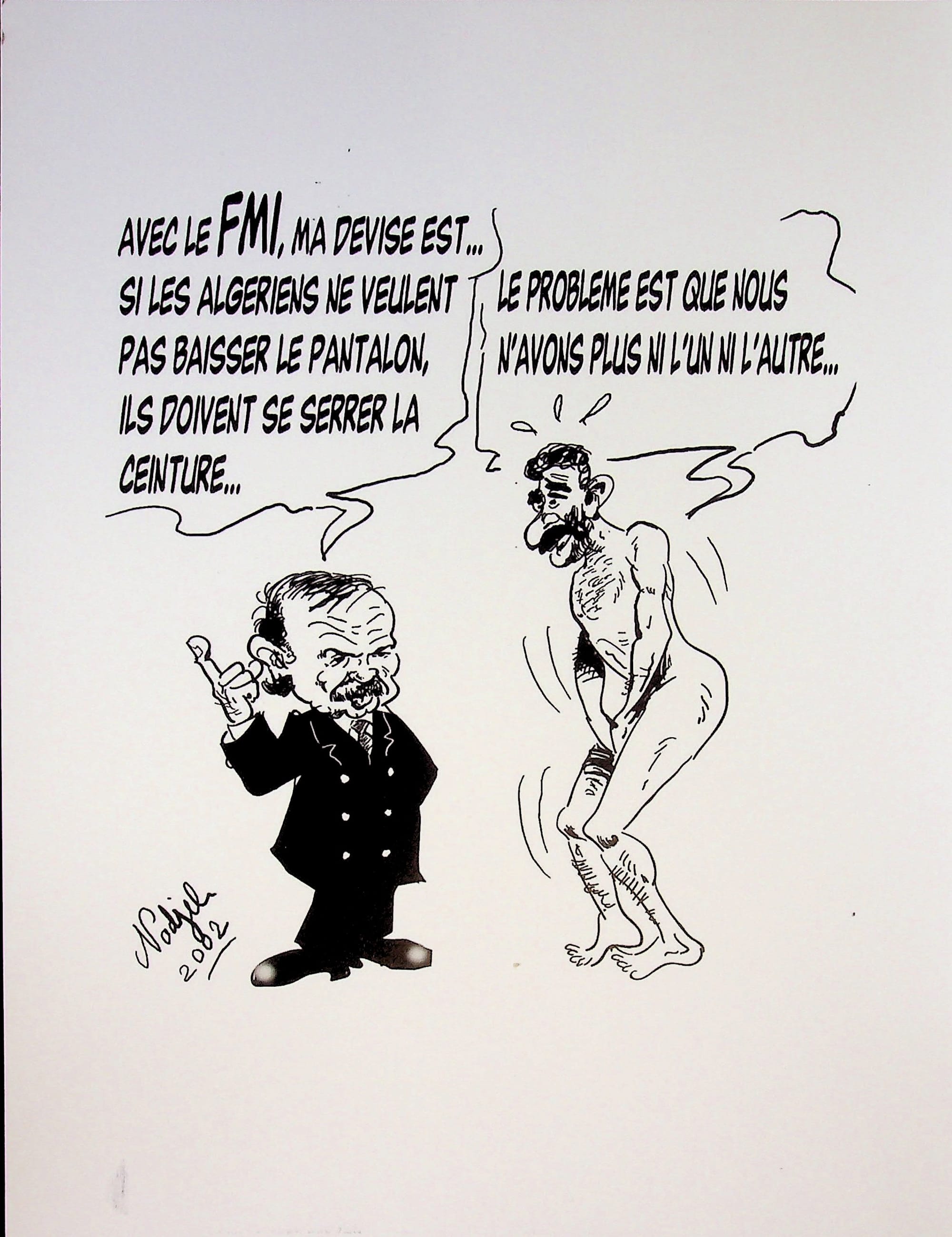
A 2002 political cartoon by Nadjib Berber sharply criticizing IMF policies in Algeria. The man in the suit says, "With the IMF, my motto is... if the Algerians don't want to drop their pants, they have to tighten their belts." To which the other man replies, "The problem is we have neither one nor the other." Courtesy of Susan Slyomovics.
**Aomar:** Working on this graphic novel was as labor intensive as any nonfiction scholarship if not more. We had to consult thousands of documents. We had to check the stories to make sure that they communicated the ethnographic dimension of the graphic novel that we wanted to communicate. At the same time, we had to think like a scriptwriter treading carefully around the borders of fiction. We wanted to make sure that the frame we present is different from traditional frames of previous Holocaust comics and graphic novels. As a historical anthropologist, I had to adjust to Nad’s artistic vision. I was fortunate because I had an undergraduate background in directing and scriptwriting. I was able to draft the script based on suggestions from Nad.
**Elizabeth:** I have looked more at Berber’s art when he produced caricatures and albums under the name of Nad in Algeria and Tunisia, and his style here diverges from his earlier style and appears to mirror artwork from the 1930s and 1940s (one reviewer of the book also noted its resemblance to *noir* cartoons of the period). Was this a deliberate choice?
**Aomar:** Yes, the choice we made here was a very conscious decision to produce a graphic history close to realism. We wanted to take readers back to the period between the 1920s–1940s. We wanted it to feel like we are reporting the journey of Hans in real times as ethnographers do.
**Elizabeth:**As someone who frequently teaches the history of the Holocaust in Maghribi and world history courses, I was excited to hear about the work’s publication and to have a new tool for teaching students about this critical subject. While students often come to the table with a solid understanding of the Holocaust in Europe, very few are aware that it also took place in North Africa. Would you have any advice for instructors who plan to use *Undesirables* in their classes?
**Aomar:** I would make sure that students are introduced to the complex colonial structures in North Africa before I assign the book. Once Students understand the dynamics and nature of French, Spanish and Italian colonialisms in North and West Africa, then they will be able understand why it is important to read World War II through these Mediterranean connections. Our graphic novel will make it easy for any classroom on Holocaust Studies or World War II to visualize the theoretical and conceptual notions of race.
**Elizabeth:** What are you working on at the moment? Do you have any plans for additional graphic novels in the future?
**Aomar:** I am currently collaborating with Daniel Schroeter on a historical and ethnographic manuscript that deals with the story of Mohammed V saving Jews during World War II. In the last few years, I have carefully watched my daughter and her friends’ reading habits. Comics and bande dessinées dominated their choice. I am planning a number of short graphic novels in the future about topics related to my North and West African research. Also, Nadjib left an incomplete project based on the history of the Assassins that he requested that I finish in the coming years. This incomplete graphic historical novel traces the history of inter-religious conflict through the case of the Assassins. My collaborative project with Nadjib is a testimony of his strong belief in the possibility of a North African school of bande dessinée which includes artists and social scientists. *Undesirables* is a testimony of Nadjib’s North African collaborations, which started with Tunisians in the 1980s and continued with Moroccans such as Abdelaziz Mouride and myself in the 2000’s.
### Remembering Jamila Debbech Ksiksi—An Interview with the Late Tunisian Lawmaker and Anti-Racist Activist
URL: https://www.merip.org/2023/05/remembering-jamila-debbech-ksiksi/
Last updated: 2025-08-22T18:36:43.000Z
*\[su\_dropcap style="simple" size="4"\]*J*\[/su\_dropcap\]amila Debbech Ksiksi, Black Tunisian activist and ex-member of parliament, died on December 19, 2022 in a traffic accident on the Tunis-Sfax highway, an accident which also killed her sister, Amel Debbech.*
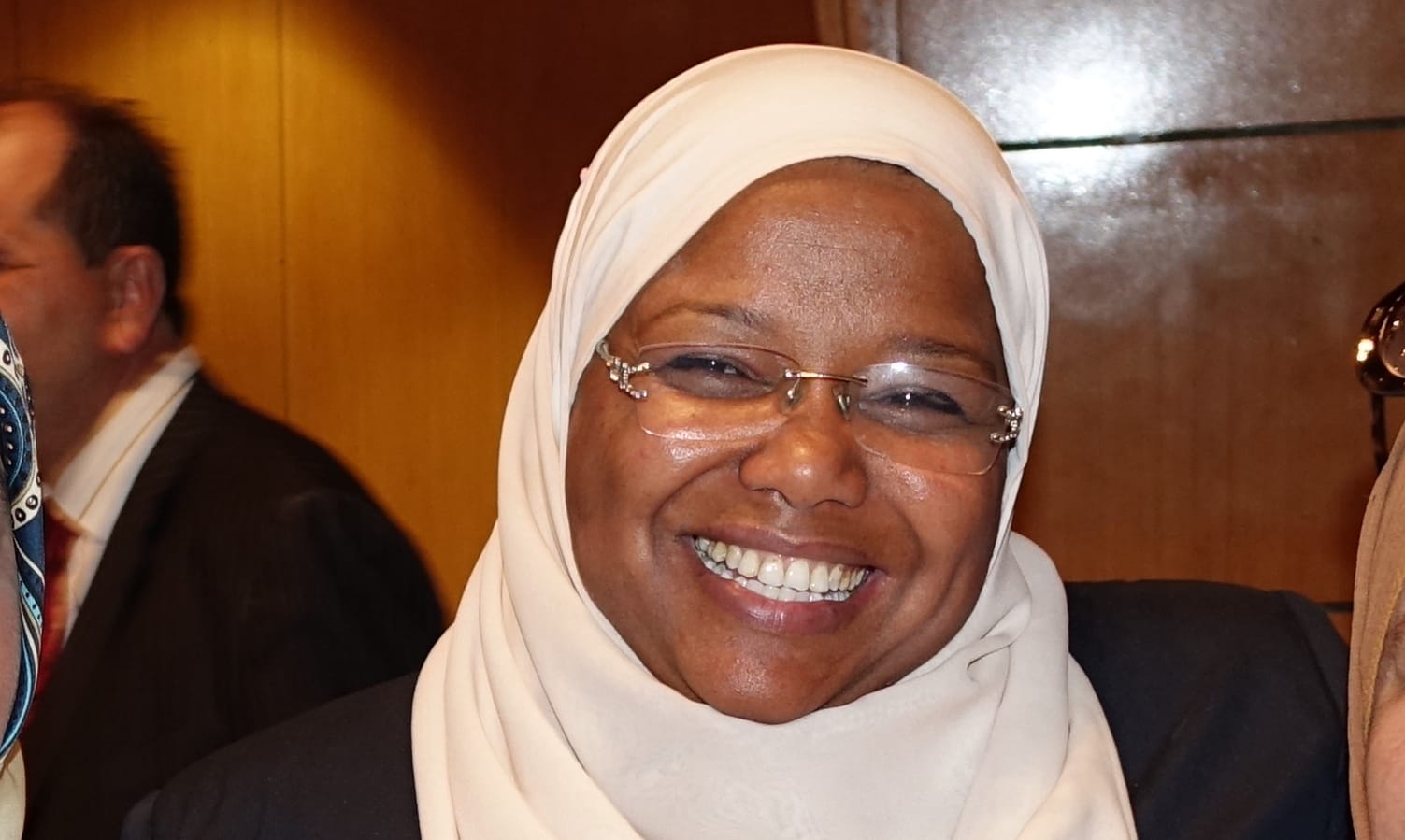
Jamila Debbech Ksiksi, 2014\. Photo courtesy of Ennahda party.
*Ksiksi was a key figure in the anti-racism movement in Tunisia. In collaboration with Black Tunisian and sub-Saharan civil society members, she helped mobilize against anti-Black racism following the revolution in 2011.*
*Ksiksi and I met twice in Tunis in November of 2022 to talk about her political activism, past and present. Since we spoke, these interviews have taken on a new gravity, not only due to her untimely departure just a few weeks later but also due to recent events in Tunisia. Tunisian president Kais Saied’s anti-sub-Saharan migrant* [*speech*](http://roape.net/2023/03/01/making-tunisia-non-african-again-saieds-anti-black-campaign/)*, delivered on February 21, 2023, has led to an escalation of violence against people in Tunisia racialized as “African”—a term used to denote bodies seen as Black, foreign and culturally and economically poor in the Tunisian social imagination. While contesting this state and civilian supported racist language and violence, Black Tunisian civil society members have invoked* [*Law 50, passed in 2018,*](https://www.merip.org/the-limits-of-confronting-racial-discrimination-in-tunisia-with-law-50/) *which criminalizes racial discrimination. As a member of parliament Ksiksi was one of the leading forces in the passage of this landmark law.*
*Ksiksi was born in 1968 in Médenine, the capital of the governorate of the same name that borders Libya in the south of Tunisia. She undertook her* [*university education*](https://efile.fara.gov/docs/6227-Informational-Materials-20200430-15.pdf) *in Tunis, first, at the Higher Institute for Management and later, at the Higher Institute for Business Studies of Carthage. Before the revolution in 2011, she was* [*employed*](https://majles.marsad.tn/fr/person/jamila-debbech) *as a high-ranking official in the public sector, working for the National Social Security Fund and later for the National Health Insurance Fund. Following the revolution, Ksiksi ran for election as a member of the Ennahda Movement party, and in 2014 she became the first Black Tunisian woman to be elected as a member of parliament. As she mentions in the interview, this win was also a first in the wider Middle East and North Africa region (which Ksiksi characterizes as “white”). During this time, Ksiksi also served as a member of the Pan-African Parliament, the legislative body of the African Union, presiding over its Women’s Caucus. She remained active in politics until President Kais Saied froze and later dissolved the parliament on July 25, 2021.*
*While serving in parliament, Ksiksi advocated for legal reforms to the Tunisian migration regime that exposes sub-Saharan migrants to legal, social and economic violence. The country’s migration regime is governed by an outdated legal framework dating back to* [*1968*](https://legislation-securite.tn/law/45206) *along with more recent policies signed non-transparently with European Union countries. Today, ad-hoc administrative practices in obtaining visas and residence permits and the impossibility of obtaining necessary documents force sub-Saharan migrants to overstay their visa-limits and become undocumented. As Ksiksi described at our meeting, Saied’s dissolution of the parliament halted her push for necessary reforms to Tunisia’s migration laws. Mahmoud Rassaa—then the Deputy Mayor of Raoued municipality in Tunis—was also present at our meeting. Both Ksiksi and Rassaa had left the Ennahda Movement in June 2022 to join the newly formed Amal wa Enjaz (Work and Achievement) party, a conservative party headed by ex-Ennahda members. The interviews, recorded on November 4 and November 30, 2022, were conducted in French and Tunisian Arabic. They have been translated into English and edited for length and clarity.*
**Shreya Parikh:** What led you to become a member of parliament after the 2011 revolution?
**Jamila Ksiksi:** I came to politics through activism in civil society. Before joining the workforce, I was part of \[Mouvement de\] La Tendence Islamique, a student association. Beginning in the 1990s, there was repression of all forms of political and associative activities. After I started working, I joined UGTT (Tunisian General Labor Union) as a trade union member and found refuge in union activities since associations could no longer exist.
I always had the intention of presenting myself as a candidate to the parliament. After the revolution, many political parties asked me to be a candidate for legislative elections. Finally, I chose to be with Ennahda Movement because it represented my values. It was a continuation of my work with Tendence Islamique. I was a candidate with Ennahda Movement in 2014\. I was elected a member of the assembly, and I became the first Black woman \[to be in parliament\] in the whole white Arab world, meaning the Arab-region countries with the exception of Sudan and Mauritania because they are countries which are all-Black. I was re-elected in 2019\. At the same time, I was always active in civil society. I defended the cause of anti-racism, the gender question and the question of Africanity. I also worked a lot on parliamentarian transparency and the role of civil society in the legislative process and the functioning of parliament.
Jamila Debbech Ksiksi with some of her colleagues in Ennahda, September 2014\. Photo courtesy Ennahda party.
**Shreya:** Many activists and civil society actors talk about the importance of your role, especially as a politician, in the passage of the landmark Law 50 in 2018 that criminalized racial discrimination. How did this law come about?
**Jamila:** I joined with civil society \[movements to combat racism\] starting in late 2012 or early 2013\. It was the first time that we were speaking about racism in Tunisia. Before, no one was speaking about this subject! But unfortunately, there was a hate campaign back then: They accused us of dividing Tunisian society, of aborting the revolution, of receiving money from abroad to influence the trajectory of the revolution. We were stigmatized!
It wasn’t easy for us to get \[an article criminalizing racial discrimination\] in the constitution when the constitution of 2014 was being drafted. So, we decided that we would limit ourselves to the recognition of human rights in the constitution. In the constitution of 2014, a few articles use the word “discrimination,” but that’s it. So, after that, we decided to work on a law that bans racism and racial discrimination.
I was elected to parliament \[in 2014\], and I used this position to bring the question of racism to higher levels: at the level of the government, at the level of the parliament. Before this, it was a debate among civil society groups but hadn’t been taken up by those making the \[political\] decisions. All this wasn’t easy. I started by speaking with \[Ennahda\] members in the parliament, but many would say, “We are all Tunisians, and we are all Muslims and in Islam there is equality!” Many also said that speaking about anti-Black racism risked dividing the society and creating tensions. I said “There are people who are being marginalized and who are suffering violence! So, if you really want social cohesion and cohabitation based on justice and equality, we need to protect the rights of the minorities.” A democracy is established when it succeeds in defending the rights of minorities and representing them. I started to speak with \[Tunisian\] members of parliament living abroad, who were elected to represent the Tunisian community abroad. I received a lot of support from them because they had lived in Europe and they had themselves faced racism.
Then I decided to speak up publicly about the cases of racial violence. In 2015, there was a [wave of racism](https://www.africatopsports.com/2015/02/01/can-2015-racisme-les-noirs-de-tunisie-payent-le-prix-fort-de-lelimination-des-aigles/) after a Tunisia-\[Equatorial\] Guinea [football match](https://www.businessnews.com.tn/article,520,53228,1) where the \[Black, non-Tunisian\] referee was accused of being biased against Tunisians \[who lost the match\]. The racist commentaries were everywhere, including on Facebook and social media. It was shameful! So, I spoke in front of the parliament and said: “You told me that we aren’t racist and that we are all Muslims! So how do you understand this behavior?” Everyone shared the video of my three-minute speech, even abroad. For the first time in Tunisian history, someone had spoken about racism during a plenary session. Since then, every time there was \[racist\] violence, I would speak at the parliament and invite journalists.
> **I spoke in front of the parliament and said: “You told me that we aren’t racist and that we are all Muslims! So how do you understand this behavior?”**
This process of convincing people took me three years, from 2016 until 2018, when the law \[50\] was adopted. Civil society continuously supported me. They defended anti-racism. They organized marches. They made protest signs and created Facebook groups and pages. They brought in media and organized conferences, fieldwork and other activities. During this time, I was always with them. They say that it was because of my presence in the parliament that the bill was passed in three years, which is really fast in the context of the total denial of racism in our society. But, in truth, the law was a result of my work as well as the efforts of civil society.
**Shreya:** In your view, what was the key moment in the making of Law 50?
**Jamila:** Along with civil society members, [EuroMed](https://euromedrights.org/) \[Rights\] group—a human rights organization—had also drafted a bill \[on the criminalization of racial discrimination\], presented it to the parliament and gotten the necessary signatures from the parliamentarians. At the same time, in December 2016, there was the case of violence against [Congolese students](https://observers.france24.com/fr/20161226-tunisie-agression-etudiants-congolais-africains-couteau-gorge-racisme-hopital) after which then-Prime Minister Youssef Chahed made a speech supporting the bill. Chahed presented the bill as a governmental bill, and a governmental bill has priority over a parliament-supported bill, and so we decided to support the governmental bill. Finally, the law passed a vote on October 9, 2018 after a long fight, and it was published in [JORT](https://www.ilo.org/dyn/natlex/docs/ELECTRONIC/112205/140111/F-524842249/TUN-112205.pdf) \[Official Journal of the Republic of Tunisia\] on October 23, 2018.
**Shreya:** You've mentioned before that during the COVID-19 pandemic, which further marginalized the sub-Saharan community, you worked with various municipalities to organize donations for these migrants. What struck you the most during your work?
**Jamila:** During the distribution of donations, I spoke a lot with sub-Saharan migrants. I noticed that sub-Saharan migrant women suffer from many problems. These women would tell me that they have three or more children, the oldest six years, and I asked them, “where is their father?” They told me that the father came with them to Tunisia but then left for Europe and that they no longer have any contact with him. These women are responsible for three, sometimes four, children and they have no resources. They cannot work, and even if they find work where are they going to leave their children? It is a terrible situation. There are children above the age of six years who have never been to school.
Back then, I invited the then-minister of education to show him the situation of these migrant children. The problem is that these children don’t even go to kindergarten, and so they do not learn Arabic and they miss the first step of schooling. When the migrant children join the Tunisian public schools, they realize that it is all in Arabic and they cannot follow the classes because their mothers don’t speak Arabic, their fathers don’t speak Arabic, the people in their social environment don’t speak Arabic. The integration of sub-Saharan migrants into Tunisian society is a big challenge, and we are not really aware that there is a whole generation born in Tunisia who are Tunisians because they were born on the Tunisian territory and who are deprived of their rights. They cannot access education and health and other public services.
> [The Limits of Confronting Racial Discrimination in Tunisia with Law 50](https://www.merip.org/the-limits-of-confronting-racial-discrimination-in-tunisia-with-law-50/)
**Shreya:** During my interviews with sub-Saharan migrants in Tunisia be they students or workers or of other status, the biggest challenge they mentioned was getting legal documentation or the carte de séjour (residence permit). Most of them apply to get these residence permits, but these requests never materialize. How do you explain this?
**Jamila:** The migration laws we have in Tunisia date from 1968\. Back in 1968, there were only a few elites who would come to study, but today that is not the case. There is no political desire to reform \[the migration laws\]. The documents needed to get the residence permit are impossible to get, for example, housing and work contracts. Tunisians don’t want to rent houses to migrants. In addition, most people including Tunisians are employed without contracts. Hence, the large majority cannot apply for residence permits. For migrant workers, work contracts must be signed by the ministry \[of employment and professional training\]. In Tunisia, migrants need to fulfill a legal condition. They need to prove that the work cannot be done by a Tunisian. This legal condition blocks everyone from getting residence permits, including migrants with diplomas.
It is terrible that there are thousands of sub-Saharan migrants who are circulating without \[legal documentation\]. When I was in the parliament, I opened a file to discuss these issues. There are also migrants who come here for medical procedures and find themselves becoming undocumented. Sometimes, medical procedures require them to stay past the expiration date of their visas, so they find themselves forced to pay the \[visa overstay\] penalty charges of 20 dinars per week (around $6.50 per week).
Today, migrants have become an integral part of the Tunisian economy. They saved the olive and wheat cultivation. All agricultural cultivation that needs a large labor force was saved by sub-Saharan migrants. The sector of tourism, in restaurants and in cafés, they work everywhere. They work in garages, in domestic work. They are everywhere. But in spite of this, the Tunisian state doesn’t recognize the importance of these migrants to the economy, and it pretends that problems don’t exist.
> **Today, migrants have become an integral part of the Tunisian economy. They saved the olive and wheat cultivation. All agricultural cultivation that needs a large labor force was saved by sub-Saharan migrants.**
**Shreya:** What do you think is the reason for this lack of recognition?
**Jamila:** I think it is culture.
**Mahmoud Rassaa:** I think it is political!
**Jamila:** In 2019, there was a bill on reforms to the refugee law, but it wasn’t transferred to the parliament.
**Mahmoud:** The bill became a political controversy because people were scared that Tunisia would become a camp for the refugees. It was everywhere in the media and so \[the state\] stopped the whole procedure.
Mahmoud Rassaa, Jamila Debbech Ksiksi and Shreya Parikh on November 30, 2022, during their interview.
**Jamila:** At that time, there was a meeting with an Italian minister. He said that a lot of people are coming \[to Lampedusa\] from Tunisia. The bill was blocked because \[many politicians were\] fearful of the European Union agenda. This was political. Regarding the migration law, this is a cultural problem because there is a racial element to it. For example, we don't treat those from Europe the same way we treat those from sub-Saharan countries. The African states do not have the same power as European states. And the status-quo \[of not recruiting migrants formally\] is favorable for Tunisian employers because they are not obligated to pay social security protections and taxes for them. This migrant labor force is less expensive.
It takes a lot of time to arrive at reforms linked to rights for migrants and refugees. I worked a lot to have a legal text on the reform of migration laws, but unfortunately my mandate \[in the parliament\] ended. So now I try to mobilize civil society and a few activists along with the sub-Saharan community and organizations working on migration. We wanted to start brainstorming together on the question of legal reforms on migration and present a bill to amend \[the current migration law\]. We also wanted to bring up the question of asylum because we do not have a law that regulates asylum in Tunisia, but now the whole process is blocked because the parliament is blocked.
*At the time of writing, violence against sub-Saharan migrants in Tunisia continues. On April 11, 2023, a camp of sub-Saharan asylum-seekers in front of UNHCR in Tunis was* [*violently dismantled*](https://www.infomigrants.net/fr/post/48143/a-tunis-violent-demantelement-dun-camp-de-migrants-devant-le-hcr?fbclid=IwAR0Ef%5F-Tc8XD5Sd1bdK9LgYVsN6OQspvzj83gNoTrcsGBlt6EtGSzFerXJ4) *by the Tunisian police force. Around 80 of these migrants were arrested. Most sub-Saharan migrants are trying to flee the country amid escalating state and civilian violence. Many are risking their lives, taking clandestine sea-routes to Italy.* [*Between*](Found%20the%20primary%20source%20and%20added%20that%20https:/www.tap.info.tn/en/Portal-Politics/16227229-210-migrant-bodies) *April 18 and April 28, 210 bodies of drowned sub-Saharan migrants were* [*recovered*](https://www.tap.info.tn/en/Portal-Politics/16227229-210-migrant-bodies) *on the coast of Sfax governorate by Tunisian Coast Guard units. At the same time, the economic crisis that fuels the anti-migrant hatred in the form of ideas that migrants are “taking away Tunisians’ jobs” or “eating away Tunisian food” continues. Italy has* [*pledged financial support*](https://www.arabnews.com/node/2272836/middle-east) *to Tunisia with the hope that Tunisia will act as a border control to both Tunisian and sub-Saharan migrants attempting to cross the border by sea without visas. The importance of legal reforms in migration laws that Jamila Ksiksi had set out to achieve has become clear, as has the fact that these reforms will be impossible to achieve if anti-migrant sentiments continue to be politically employed to gain both local and international support in the midst of economic crisis.*
\[**Shreya Parikh** is a dual PhD candidate in sociology at CERI-Sciences Po Paris and the University of North Carolina at Chapel Hill.\]
### Animating Sudanese History—An Interview with Leila Aboulela, Author of River Spirit
URL: https://www.merip.org/2023/05/animating-sudanese-history-an-interview-with-leila-aboulela-author-of-river-spirit/
Last updated: 2025-08-22T18:36:44.000Z
*Leila Aboulela’s latest novel* [River Spirit](https://saqibooks.com/books/saqi/river-spirit/) (Saqi Books, March 2023) *takes place amid the backdrop of the Mahdist Revolution in the 1880s and the Sudanese struggle for independence.*
The cover of Leila Aboulela's new book, River Spirit.
*The story, grounded in archival research and based on real characters and events, centers around Akuany, an orphan who later becomes enslaved, and her brother, who is taken in by a merchant family. The narrative shifts between several characters and perspectives as they navigate these turbulent years. Historian Marie Grace Brown, author of* [Khartoum at Night: Fashion and Body Politics in Imperial Sudan](https://www.sup.org/books/title/?id=25840) (Stanford University Press, 2017), *spoke to Leila Aboulela about the process of bringing intimate and everyday histories to life. Their conversation took place on March 15, 2023 and has been edited for length and clarity.*
**Marie Grace Brown**: The novel is set in the turbulent years of the Mahdist Revolution (1881-1898), which some scholars refer to as Sudan's first nationalist movement. Why did you want to tell a story about this period?
**Leila Aboulela:** I grew up with this story. We studied it at school and again in university. My parents were fond of the book *The White Nile* by Alan Moorhead, which was a very racy, colonial take on the whole story. The Hollywood take in the 1960s was awful, with Charlton Heston as Charles Gordon (the British Governor-General of Sudan) and Laurence Olivier in blackface as The Mahdi. It was full of inaccuracies. It wasn't even filmed in Khartoum. I wanted to write the story from the Sudanese point of view. At the same time, once I started researching, I also felt that what we were taught at school and university was too nationalistic, too patriotic. It was a bit sugar-coated. I wanted to give a balance or show it in a more realistic way.
**Marie:** I wanted to talk a little bit about genre because historical fiction is having this critical moment. There seems to be a lot of energy and excitement around the genre. Why do you think historical fiction is so compelling?
**Leila:** I think from an African point of view it's exciting because these stories haven't been told before. They're not really in the mainstream. The mainstream story has always been Eurocentric. We've had the young man, the young African man going to Europe as in *Season of Migration to the North*. Then I came and did the woman in my book *The Translator*. Now we want to do something different. The history opens up incredible possibilities, rich possibilities of stories that haven't been told before from this particular perspective. I find myself excited about reading African historical fiction more than other genres because it feels to me that this is actually new and exciting.
**Marie:** In reading your acknowledgments, you say that you found the enslaved woman, Zamzam (her name changes from Akuany when she's enslaved), in the archive. Can you describe the moment of discovery? What do we know about this historical figure she's based on?
**Leila:** I went to Durham, in the United Kingdom, to the Sudan archives, and I was looking through the archives. One of the items that came up was a bill of sale. The same bill of sale is mentioned in the wonderful thesis written by Heather Sharkey. She wrote about domestic slavery, and she also mentioned this particular bill of sale. It had the sum of money, the names of the people involved, and it was quite startling to see. I mean, I knew that slavery existed, but to see it like that was quite shocking. Then there was a petition: One man raising a petition against another man saying that this enslaved woman ran off with a piece of cloth that she stole from her mistress, and she went back to the former master. That intrigued me, because I thought, “why would she do that? Why doesn't she just escape and go back to her people?” It inspired the story of the attachment of Zamzam to Yaseen. But, also, I have to be honest, I grew up in Sudan knowing people who had slave ancestry. I think it's something people in Sudan don't really want to talk about now. It's considered a shameful subject that they don't want to talk about. They don't want to talk about grandmothers who were in these situations. But it does tell us something about how the society was shaped.
**Marie:** So, from what you're saying, it also sounds like you believe that historical fiction or speculation is really critical when we want to honor the experiences of black and brown women in particular.
> **In all the research I did I never found a first-person narration from a woman. I just never came across that. They are mentioned in footnotes.**
**Leila:** Yes. In all the research I did I never found a first-person narration from a woman. I just never came across that. They are mentioned in footnotes. The prologue of *River Spirit* starts off with this real historical character, Rabiha from the Kinana tribe. She's mentioned in every single account of the history as a footnote. Again and again, the historians are interested in why the movement of the Mahdi didn't fizzle out at the beginning. He still had a limited number of followers, and the government was sending out armies to get him—how come they weren't able to just nip this in the bud? She becomes part of the explanations: that this governor set out to destroy him, but then this woman was herding her goats and she overheard the conversation and she ran through the night. To me that was so exciting. Let me just stop now, pause, and just go with her on this adventure, running up the mountain through the night. When it comes to the other characters, I had to really search for them, reading and reading and picking up a little bit here, a little mention there.
**Marie:** The perspectives in your chapters shift so that some characters’ chapters are written from the first person some are written in third person. Zamzam’s chapter is actually a third person perspective. I was just curious about your logic behind that.
**Leila:** I wanted to have the reading experience be a little bit different for each character. So that people are feeling that they are now with a different character—sometimes to have a first person and third person sometimes to have it in the past tense or in the present tense. Also, it had to do with my ability to flow, to generate the words. I tried with Zamzam (whose name before she became enslaved was Akuany). Her chapter starts off when she's 11 years old. She’s standing in the river and she's inside the water. I tried writing that as the first person, and the words kind of petered out after a paragraph. I just couldn't sustain it. I couldn't carry the voice. I'm going to carry it from an 11-year-old up until she's a mature woman…It didn't work. I switched to the third person and then it worked, so I kept going.
**Marie:** I think one of the most startling breaks in the reading experience is when you get to the Charles Gordon chapter. Just a bit of explanation for those reading the interview: Each of your chapters is headed by the name of a character, so Yaseen, Zamzam, Fatima, Musa. Then, the single chapter for Charles Gordon is also headed simply, "Charles," which has this wonderful effect of reducing Gordon's importance and equalizing his experience with that of so-called marginal characters or people that we don't know. His chapter is also written in second person, so there was this real arresting presumption of the reader aligning with Charles Gordon, which made for a really interesting reading experience.
**Leila:** Yes, so Gordon was the opposite of the other characters. There is so much written about him and also his journals are available, which are so good. You can do so much with them, and of course people have. I just didn't know what to do with him. Having him in the first person would just be an echo of the journals. I was like, “How am I going to pull this off?” Then, suddenly, the line came to my mind, "you like how the Sudanese say your name." It just took off from then. I thought, oh, okay, that fit, I could do the second person. I just went on: you, you, you, you. I wasn't sure whether it was me talking to him or whether it was him talking to himself, and I didn't care.
**Marie:** We should probably mention for readers that you and I have met. We met in the Sudan Archive at Durham, each consulting the same collection but for different purposes: myself to produce an academic text and you to write a novel. What would you say is the value of fiction or speculation for historians?
> **To me, reading history feels very quick. “The Mahdi took Omdurman as his capital.” What does that actually mean? What does that mean for the people living there?**
**Leila:** It's almost like an animation, isn't it? I mean, you're animating the facts. To me, reading history feels very quick. “The Mahdi took Omdurman as his capital.” What does that actually mean? What does that mean for the people living there? What does that mean in day-to-day life? What was that like? Writing fiction, I have to slow down and see, well, these people move from Khartoum to Omdurman, and there was no bridge. They had to take boats. I had to go to the primary sources. For example, the Babikr Badri’s autobiography during the Mahdist era, which is just a goldmine. He's writing about the politics and the war and everything, then suddenly, he's like, “Well, you know, my wife ran out of oil for her hair, and we had to go everywhere looking for it.” Suddenly, that becomes a domestic issue and a problem for him and his wife. It's just amazing. It's so cool. These were the things that for me were so valuable. I'm looking for these details that I could use in the fiction to get the texture of life for the people at the time. I do think that is of value to historians.
**Marie:** I really like what you've said about how fiction or speculation gives us the chance to slow down. Something I've been playing with in my own work is thinking about time and chronology and the difference between calendar time and felt time or lived time. So certainly, crossing from Khartoum to Omdurman is different whether there's a bridge or a boat, but also being in times of stress feels different as you are counting down the resources that you are losing. If there’s not oil for hair, then subsequently there isn’t oil for cooking. That kind of timekeeping is much different than marking days on a calendar.
**Leila:** It's fascinating. I loved reading about the people from the west moving towards Omdurman. They had never seen the river before. So, they came and they saw this river, and they were just amazed. There are all these descriptions of them. As they were going along, they were seeing new things. It was really beautiful to live part of that journey.
**Marie:** I can imagine. Relatedly, I have always appreciated your attention to the body and physical sensations felt by your characters. This is how I've used your fiction in my historical work. There's a moment in which Akuany, now Zamzam, is observing Yaseen's wife, Salha, and says her feet are beautifully hennaed, she's moisturized, her hair is beautifully braided. Zamzam says, this is a body that has never been struck, that has not been sexually assaulted. There's this wonderful description of one woman looking at another and saying, there's certainly beauty in this other body but also perhaps—ignorance isn't the right word—but a body that has been completely sheltered and has not felt the experiences, has not felt the trauma and the pain that Zamzan's body has absorbed.
**Leila:** Yes, she sees Salha as being protected, which she has been. I'm glad you mentioned that paragraph because it meant a lot to me and nobody has mentioned it. I think that makes what happens to Salha afterwards so significant. She does lose this protection. She does lose something. I actually based Salha on my father's doctor. My father had a doctor when he was very ill. In his last days, he had dementia, and his doctor had specialized in the UK. She'd come back to Khartoum, and she had this lovely voice. My father was very happy with her voice. A lot of Salha to me is like a typical Sudanese woman of the north given that she's got this kind of education and this confidence. I enjoyed writing her.
**Marie:** Also, maybe because of her education she seems to be a promise of the next generation, one who, in the right circumstances of an independent Sudan, might have had great opportunity. I think the novel in general really explores the vulnerability of Sudanese women across races and across classes. But you do a nice job of not turning them into victims so that they are vulnerable without being just victims. Can you talk a little bit about what you believe made their lives so precarious at the end of the 19th century?
Leila Aboulela in 2019\. Photo by Judy Laing (CC BY-SA 3.0)
**Leila:** It's the wars and the instability. As soon as they lose their father figure or their brother figure then they are vulnerable. If you’re reading about slavery in Africa even before the Europeans, it was about people. It was about the raids and the prisoners of war. But it was also about somebody who is lost in the desert, or orphans. It's vulnerable people without the support of a tribe, without the support of a family figure, they were then vulnerable to exploitation. Women were very vulnerable in that way.
**Marie:** Right. We see this so much with Akuany, this slippage from orphan to not quite enslaved. She's in this very liminal space. The dark skin is setting her apart, but, notably, it's not just her skin color. It is precisely because she is without family. This distinguishes her experience from that of her brother, who is also orphaned and then taken into the same household, but he is then fully adopted into the family. It is being without the familial protections that really seem to place women's lives in danger or make them precarious.
**Leila:** That's very true. What happens to her brother we could then see it as a positive way that the society dealt with orphans at the time. He was fully integrated into the family. He was fully accepted. He was even given the daughter in marriage when he grew up. They looked after him all the way through. There was a full love and full acceptance.
**Marie:** One of the characters in *River Spirit* that may surprise readers is Robert, a struggling Scottish painter. He's this unexpected addition. I confess, I wasn't always quite sure what to make of him or what to do with him. Why was it important to you to include his perspective or character in this story?
**Leila:** He was one of the first characters I thought of. I initially had this idea of a novel of an artist going to Sudan and linking the two countries together, Scotland and Sudan. That he would go and make a sketch or paint a woman and then get into trouble for it. As I went into the research, the woman became more important than him, so he kind of shrunk. The same as Charles Gordon, he also kind of shrunk. I think one of the reviews felt that he was disconnected from the novel. They didn't get the point about the Orientalist paintings. I was inspired to write about that because I saw lots of photos—maybe the photos were taken a little bit later when the British came in—a lot of photos where a lot of the women don't look comfortable. They look unhappy. You can tell from their physical expressions on their face that they're not happy with being photographed. I thought, yeah, I get that. This camera pointed at you, you feel something uncomfortable, suspicious. Part of what historical research is showing is that these orientalist portraits depicted women in North Africa in kind of middle/upper class, luxurious surroundings. They're the women of the harem, and they'd be lying down and they'd be with their hookah pipes and all that stuff. But for painters to paint these women they were likely either enslaved or they were sex workers. These beautiful, Orientalist nudes, well, they're not really as lovely as we thought they were. I wanted to make that point. Also, in wanting to go over the history, the way the baton was passed on from one character to the other, Robert was helpful. He gave the Khartoum perspective, he did one of the battles and he was with the army at some point. He gave us another perspective on Gordon. So it was that. Then this idea of making use of and exploiting the colonies. People like Robert, they got something out of it. It's not just a matter of him working on the boats that were carrying the ivory and the gum, and it was all going out of Sudan. He was also using the landscape to further his painting career. At the end, he ends up being a very successful artist.
**Marie:** When I say I wasn't quite sure what to make of him, it was because I wasn't sure how sympathetic he was supposed to be. Because he's certainly complicit in the beginnings of this imperial system, but he enters it unintentionally.
**Leila:** Exactly. He's complicit in the system. Maybe I should, but I don't worry about whether the character is sympathetic or not. I just want them to be real. I just want people to say to me, these are real characters. Then I'm happy. It doesn't matter whether it's sympathetic or not.
**Marie:** There's really a significant amount of mobility in *River Spirit*, as characters move across the territory, as they move in and out of households and families. Again, this may surprise some readers who are familiar with the strict north-south binary or histories that seem to just take place in one spot. What should we be taking away from this fluidity, mobility and intimacy that your characters are experiencing?
> **Then when you read other accounts, like Babikr Badri, you learn there weren't these boundaries and borders at the time. South and north were kind of open space. There's so much that is fluid.**
**Leila:** I think this is one of the stereotypes pushed through particularly during the colonial encounter: There was no dynamic movement between tribes unless they were squabbling, as they call it, or fighting. Then when you read other accounts, like Babikr Badri, you learn there weren't these boundaries and borders at the time. South and north were kind of open space. There's so much that is fluid. I mean, Rabiha came from the Kinana tribe, which is called an Arab tribe. Yet this Arab tribe was quite deep in the south. The way she's described in the narrations, the way she dressed, she was very African. These tribes were not so divided as in “this is Arab, and this is African, and this is Muslim, and this is not Muslim.” There was a merging of all of these things. That's why I use a map at the beginning that doesn't have the borders. My own ancestors came from the south of Egypt.
**Marie:** On the individual level, again, thinking about women and orphans and the enslaved, as they are brought into households they moved with the households. And again, the ease with which Akuany’s brother was adopted into the family and taken care of also plays with our expectations about racial boundaries. Who's in and who's out and who's an other and who's not. This is a real strength of the novel because when we tell these stories from a colonial perspective, it is only characters like Robert and Charles Gordon who move anywhere. They just encounter people stuck in place. You've created a full cast of characters across different classes who are moving in all sorts of different ways on multiple levels.
**Leila:** Yes, and the women moved with the army. That was also very interesting to me, that the women moved with the Mahdi's army. Every time the army camps somewhere, the women are setting up stalls, they're selling eggs and they're doing all sorts of things. It was families moving. It wasn't really this stereotype we've got of the women at home and then the men going out to war. It didn't happen like that. That was one of the details that I didn't know and that was interesting. The women were actually part of these movements.
### Perspective—Recognizing and Repairing the Harm to Iraq’s Minority Communities
URL: https://www.merip.org/2023/04/perspective-recognizing-and-repairing-the-harm-to-iraqs-minority-populations/
Last updated: 2025-08-22T18:36:44.000Z
As the [Costs of War project](https://watson.brown.edu/costsofwar/2022/IraqWarCosts) has documented, the US invasion of Iraq and its aftermath (including interventions, the rise of militant groups and terror attacks) resulted in more than three hundred thousand deaths due to direct violence.
Displaced Iraqis from the Yezidi community at a camp for internally displaced persons in Khanke, in Dohuk province, January 20, 2023\. Safin Hamed/AFP/via Getty Images
Twenty years later, the knock-on effects of war on Iraq’s environmental and public health, not to mention national and regional stability, are still mounting. The 20-year anniversary of the US invasion also provides an occasion to reflect on the fate of Iraq’s minority populations, particularly over the last decade, and the culpability of international actors in the processes of ethnic cleansing and minority flight.
While Assyrians, Yezidis and Shabaks were spared the worst of the aerial bombardments in 2003 and later from 2014–2019, these communities endured other forms of devastation that led to the disproportionate displacement and emigration of, especially, Iraq’s Christian populations. Nearly three-quarters of Christians (including Chaldean Christians, Syrian Orthodox Christians, Armenian Catholic and Apostolic Christians and Greek Orthodox Christians, as well as Assyrian Church of the East Christians and Assyrian/Syrian Catholics) fled the country in two separate waves, first in 2003–2010 and then in 2014–2019.[\[1\]](#%5Fedn1)
The political balance created under the US-led occupation of Iraq often worked against the interests of Iraq's smallest minorities, such as the Assyrians, Mandaeans, Shabaks, Turkmen and Yezidis. State institutions in Iraq proper and its Kurdistan region were corrupted from their proclaimed functions and were used to bolster support for majority parties. In 2005, the United Nations High Commissioner for Refugees [released a report](https://www.refworld.org/pdfid/4371cf5b4.pdf) on Iraq’s non-Muslim religious minorities, detailing the discrimination against Iraq’s Christian populations—particularly in central and southern Iraq—as well as targeted persecution against Iraq’s Christian, Mandean and Yezidi communities, as early as 2004.[\[2\]](#%5Fedn2)
The targeted killings of Iraq’s non-Muslim minorities following the rise of ISIS has garnered more sustained attention, but persecution occurred in waves, intensifying during the height of the occupation and insurgency. Some of these targeted attacks on minority communities amounted to ethnic cleansing in their scale of devastation. In 2007, for example, the bombing of two Yezidi [villages](https://www.aljazeera.com/news/2010/10/24/how-suicide-bombings-shattered-iraq) left almost 800 people dead and thousands injured. During this period, the governorate of Nineveh was [heavily affected](https://tinyurl.com/meripfebf) by internal displacement. [In 2006–2008](https://archive.ph/20120707100451/http:/articles.cnn.com/2008-10-16/world/iraq.christians.mosul%5F1%5Fmosul-christian-families-northern-iraqi-city), thousands of Assyrians and Chaldeans, seeking refuge from a wave of death threats, killings and attacks on churches left Mosul—the capital of Nineveh—for surrounding towns and villages, from which many of them would be displaced again by ISIS. According to a report published in 2008 by the International Organization for Migration, 40 percent of displaced persons in Nineveh were Christian Assyrians, 12 percent were Christian Chaldeans and another 12 percent were Sunni Turkmen. The latter, according to the report, found themselves “caught between two unwelcoming environments,” as local authorities in Mosul tried to force their return to Telafar.[\[3\]](#%5Fedn3) The same report estimated that nine in ten displaced persons reported being targeted for their religion or sect.
> **Read: "[On ISIS—Behind](https://www.merip.org/on-isis/) the Rise of the Islamic State" from MER issue 276**
The summer of 2014— only a few years after both regional and global powers had intervened in the Syrian civil war—witnessed the rapid expansion of ISIS into northern Iraq. Armed with US-made tanks from Mosul and advanced weaponry looted from government bases in Syria or imported from Turkey and the Gulf states, ISIS swept through Fallujah, Mosul, the Sinjar and Nineveh Plains regions and parts of the Baghdad and Erbil governorates. The Yezidis suffered several large massacres, especially at [Kocho](https://tinyurl.com/meripfeb6). About [300,000 Yezidis](https://www.dw.com/en/yazidis-still-displaced-in-their-own-country/a-59725928), [200,000 Christians](https://us.gov.krd/en/issues/isis-genocide-of-yezidis-and-christians/#:~:text=The%20UN%20estimates%20that%20around,ISIS%20seized%20their%20homes.) and hundreds of thousands of other persons took refuge in displaced person camps, acquaintances’ homes or unfinished buildings or fled abroad seeking asylum or visas. Some cities and towns, such as [those](https://www.assyrianpolicy.org/iraq) in the Nineveh Plains, were reduced to ruins in ISIS-led plunder and cultural destruction operations or, as with [parts](https://edition.cnn.com/2017/03/29/politics/congress-isis-war-vote-mattis/index.html) of Mosul, in NATO-backed coalition strikes against people living in areas where ISIS had bases. Several years later, Sinjar town and some surrounding areas, as well as parts of the Nineveh Plains and parts of the city of Mosul, still lacked clean water, reliable electricity, functioning hospitals and schools and other services.
In 2021, the Iraq parliament passed the “Yezidi Survivor’s Law,” which drew on a reparations framework, earmarking funds from its Emergency Food Security and Development law for Yezidis and other minorities who file criminal complaints and provide documentation of ISIS destruction. But two years on, the scheme has [benefited a tiny fraction of victims](https://reliefweb.int/report/iraq/two-years-after-passage-yezidi-survivors-law-seed-calls-government-honor-its-obligations-protect-and-serve-survivors-isis-conflict-iraq#:~:text=At%20the%20time%20of%20its,of%20conflict%2Drelated%20sexual%20violence.). Moreover, due to economic [sanctions](https://tinyurl.com/douhanetal) in place against Syria and Turkey's ongoing military operations in Kurdistan and in northern Iraq and Syria more broadly, the prospect of reconstruction in the northern governorates seems remote without major international funding. The scope of the need is vast: Not only do villages and neighborhoods need to be restored but so do public goods such as trust, a feeling of security, thriving trade along transnational roads and rivers, a robust educational system, access to sacred sites and hope for the future. A US effort to devote $380 million to these needs has proceeded slowly amid continuing insecurity and militia activity and possibly also corruption, political infighting and the Covid-19 pandemic’s impacts.
More needs to be done. The International Criminal Court (ICC) exists, on paper, to promote human security by criminally prosecuting the persons most responsible for the worst international crimes. The International Court of Justice (ICJ) is an arm of the United Nations that oversees compliance with international treaties and legal principles in both state-to-state (contentious) and advisory cases. When it comes to Iraq, however, both the ICC and ICJ have failed to offer meaningful justice. The United States has rejected the jurisdiction of the ICJ in unlawful use of force cases, and the ICC initially [found](https://www.icc-cpi.int/iraq) that not enough willful killings could be blamed on Britain to examine Iraq's case (the United States not having submitted to the ICC).
> **In February of 2022, Iraq paid the last of the reparations it owed for the first Gulf War...In the years since 2003, no such accountability has emerged for Iraqis as a result of the US invasion and occupation. Nor has there been accountability for Iraq’s minorities.**
While there could be a specific legal case to make around the complicity of foreign states in the targeting of Iraq’s minority communities, one has failed to materialize. The ICJ could provide a forum for Iraq to seek reparations for damage caused by other states’ failures to stop their citizens’ support for al-Qaeda and ISIS. Iraq has not pursued this route, perhaps disheartened by difficulties encountered by Nicaragua in its proceedings against the United States, by the Republic of Bosnia and Herzegovina in its proceedings against Serbia and Montenegro and by the Democratic Republic of the Congo in its proceedings against Uganda.[\[4\]](#%5Fedn4) Meanwhile, the ICC has a Trust Fund for Victims that could support medical and psychological care for atrocity victims, but the ICC has declined to prosecute those persons (nationals of countries ratifying the court’s statute) who joined terrorist organizations in Iraq, Libya, Syria or Yemen and then targeted local people. In 2015, the ICC Office of the Prosecutor [announced](https://tinyurl.com/bensouda2015) that while several thousand “foreign fighters” had joined ISIS from member states of the ICC, the court had no practical ability to prosecute them.
In February of 2022, Iraq paid the last of the reparations it owed for the first Gulf War. The payment of $52.4 billion was brokered through the United Nations Compensation Commission to individuals, corporations and governments that could prove damages due to Iraq’s 1990 invasion of Kuwait. In the decades following the US invasion, no entity has been held sufficiently accountable for the harm caused to Iraqis or to Iraq’s minorities. At the very least, there should be a “preliminary examination” of the international wrong upon their people and lands facilitated by foreign states, including member states of the ICC from which ISIS members emerged.
\[**Hannibal Travis** is a professor of law at Florida International University.\]
**Read the [previous](https://merip.org/2023/04/the-political-logic-behind-iraqs-fragmented-armed-forces) article in[ MER issue 306](https://merip.org/magazine/306) “The State of Iraq–20 Years After the Invasion.”**
---
### **Endnotes**
[\[1\]](#%5Fednref1) "[Country Report Iraq](https://www.dfat.gov.au/sites/default/files/country-information-report-iraq.pdf)," Australian Government Department of Foreign Affairs and Trade (January 16, 2023), p. 19.
[\[2\]](#%5Fednref2) UNHCR: "[Background Information on the Situation of Non-Muslim Religious Minorities in Iraq](https://www.refworld.org/pdfid/4371cf5b4.pdf)," (October 2005), pp. 2-7.
[\[3\]](#%5Fednref3) International Organization for Migration: “Iraq: Kirkuk, Ninewa, Salah Al-Din Governorate profiles post-2006 IDP needs assessments,” (Jun 2008), pp. 3-5.
[\[4\]](#%5Fednref4) Hannibal Travis, *Genocide in the Middle East: The Ottoman Empire, Iraq, and Sudan* (Carolina Academic Press, 2010), p. 568.
### The Political Logic Behind Iraq’s Fragmented Armed Forces
URL: https://www.merip.org/2023/04/the-political-logic-behind-iraqs-fragmented-armed-forces/
Last updated: 2025-08-22T18:36:45.000Z
On the cusp of losing power following a poor performance in the October 2021 election, Iraq’s Fateh Alliance and its Popular Mobilization Forces—a coalition of armed factions under the umbrella of the Iraqi state—sent protesters to occupy parts of Baghdad’s heavily fortified Green Zone.
Iraqi Security forces are heavily deployed on the Jumhuriya (Republic) bridge leading to Baghdad's Green Zone, during a demonstration by supporters of Iraq's influential Shi'i cleric Muqtada al-Sadr on September 28, 2022, in conjunction with the parliament's first session in two months. Ameer Al-Mohammedawi/dpa via Getty Images
The winner of the election, Shi’i populist cleric Muqtada al-Sadr, was intent on forming a “majority government” that excluded several leaders from the Fateh Alliance and its allies. As the government formation process progressed, networks from the Popular Mobilization Forces (PMF) escalated their show of violence, launching rocket attacks on al-Sadr’s Sunni allies in Anbar province and Kurdish allies in Erbil. Tit-for-tat attacks also mounted between PMF groups and Sadrists in southern Iraq. This violence was not necessarily aimed at killing opponents but rather at sending a message: PMF-aligned groups would not be removed from Iraqi politics.
Iraq’s year-long government formation process following the October 2021 elections marked the most significant post-election violence in the country since 2003\. Al-Sadr wanted to replace the consensus-based system developed after the US-led invasion and occupation. The PMF used its display of violence to protect it. Ultimately, they successfully stifled al-Sadr’s majority government allowing all Fateh leaders to remain in power.
Having failed to form al-Sadr’s majoritarian government, the Sadrists withdrew their members from parliament. A new governing coalition emerged, and the Sadrists were now the ones left out. In response, they sent their own armed protesters to invade and occupy the Green Zone in August 2022\. As the violence escalated and casualties mounted—leaving over 30 killed in less than 24 hours—they quickly withdrew their forces. They too were not looking for an armed conflict that would result in significant casualties.
This drawn-out episode of violence following the elections in 2021 reflected deeper divisions in post-2003 Iraq, where distrustful political factions have depended on private paramilitary groups to maintain their power and influence. Returning to Baghdad after decades in exile, Iraq’s new leaders in 2003—the Kurdish nationalist and Shi‘i Islamist parties—worked with the US-led Coalition Provisional Authority to develop a consensus-based power sharing political system. Fearful that a strongman like former president Saddam Hussein could re-emerge from the military and distrustful of each other, the new elite refused to surrender their direct access to violence. Instead, they built a state where two sectors—government and security—operated in parallel. By design, coercive power remained in the private realms of the political parties and not exclusively in the government.
During the US invasion and occupation of Iraq, the United States and its allies spent hundreds of billions of dollars attempting to integrate armed groups into the Iraqi government under a centralized command structure. Between 2003 and 2011, the US-led efforts to rebuild the country’s armed forces cost $24.49 billion. A 2009 [Special Report by the United States Institute for Peace](https://www.merip.org/content/files/sites/default/files/special-report-223%5Fthe-interior-ministry%5Fs-role.pdf) argued that so-called security sector reform was “the key to security and to establishing the legitimacy of the state.”[\[1\] ](#%5Fedn1)Yet these efforts—which were promoted by a range of think tanks and international institutions—run against a founding principle of the post-2003 state: Iraq’s political elite kept their paramilitary forces separate from the government as an insurance policy. This private and direct access to violence has become an important tool to negotiate state power, especially when challenged, as occurred following the October 2021 elections. At the same time, these elites have sought to capture the government’s security apparatuses from policing to defense and intelligence. This parallel development of violence and politics is at the core of Iraq’s security paradox.
## **Privatizing Violence**
In 2003, Iraq’s new elite, wary of laying down their arms, negotiated a state in which coercive power was spread out across society and paramilitary groups allowed to flourish. The new ruling elite in Baghdad refused to give up their armed groups to the new government. Instead, they have maintained private control over arms, weakening the government security sector. Although the PMF was legally incorporated into Iraq’s armed forces by parliament in 2016 and placed under the National Security Council, its major leadership and decision makers often sat outside of these institutions. For instance, Abu Mahdi al-Muhandis served as the de facto leader of the PMF but was not the official head of the PMF commission. Other PMF leaders with decision-making powers also led from outside of this formal structure.
> **Through these moves, al-Maliki gained personal and unaccountable control over parts of the Counter Terrorism Service’s “Golden Divisions”— a highly specialized Iraqi force trained and supported by the United States.**
The Dawa Party, without its own military wing, initially stood out as the exception in Iraqi politics. Dawa leader and Prime Minister Nouri al-Maliki, however, eventually needed private access to coercive power. In 2007 he established the office of the commander in chief and brought brigades from the Ministry of Defense under his command. As prime minister, he took personal control over the [Counter Terrorism Service](https://www.washingtonpost.com/world/middle%5Feast/the-force-leading-the-iraqi-militarys-fight-against-isis-went-from-dirty-division-to-golden-boys/2016/07/25/8e6b0164-389e-11e6-af02-1df55f0c77ff%5Fstory.html), which had been established in 2003 by the US Secretary of Defense and Central Command (CENTCOM). Through these moves, al-Maliki gained personal and unaccountable control over parts of the Counter Terrorism Service’s “Golden Divisions”— a highly specialized Iraqi force trained and supported by the United States. He also gained access to several armed groups that would eventually make up the PMF, which he created in 2014 in response to the ISIS capture of Mosul. His Dawa Party even established a PMF brigade, Quwat al-Shaheed al-Sadr, or Brigade 15.
In the Kurdistan Region, the two ruling Kurdish parties—the Kurdistan Democratic Party and the Patriotic Union of Kurdistan—agreed that the federal government could not provide their security. They therefore pushed for articles in the [2005 Iraqi Constitution](https://iq.parliament.iq/%D8%A7%D9%84%D8%AF%D8%B3%D8%AA%D9%88%D8%B1-%D8%A7%D9%84%D8%B9%D8%B1%D8%A7%D9%82%D9%8A/) to safeguard their political autonomy, ensuring that the Peshmerga’s chain of command would be firmly with the regional government. Article 117-122 stated that federal regions, like Kurdistan, would be responsible for “the establishment and organization of the internal security forces for the region such as police, security forces and guards of the region.”[\[2\]](#%5Fedn2) In 2009, the Kurdistan Regional Government (KRG) established a Ministry of Peshmerga Affairs, which sought to integrate 14 brigades from the two Kurdish parties. Like in Baghdad, however, the decision makers often sat outside the ministry and in the senior echelons of the two parties.
## **Capturing Government Institutions**
After de-Baathification, the Coalition Provisional Authority's second act was to disband Iraq’s military, security and intelligence apparatuses, as proclaimed on May 23, 2003 in their “Order Number 2.” The new elite installed their loyal allies across senior positions in the Ministries of the Interior, Defense and the National Security Council. The new police and security officials often catered to the interests of powerful personalities rather than the government institutions they served.
> **From the Archives: "[Castles Built of Sand: US Governance and Exit Strategies in Iraq](https://www.merip.org/castles-built-of-sand-us-governance-and-exit-strategies-in-iraq/)," in MER issue 232.**
One example is the Badr Organization—a paramilitary group formed in Iran as the armed wing of the Supreme Council of the Islamic Revolution in Iraq, which would later be a leading force in the PMF. Since 2004, it has prioritized its influence over the Ministry of the Interior. Early on, Minister Bayan Jabr al-Saulagh, who was a senior Badr member, worked to hire thousands of Badr members to control the police and government security services.[\[3\]](#%5Fedn3) Ironically, in doing so, al-Saulagh took advantage of a call stemming from the United States to “integrate” militias into the government.[\[4\] ](#%5Fedn4)Rather than strengthening the ministry, the new elite turned it into yet another arena of competition. The other ruling parties quickly followed Badr’s lead in sending fighters and members to gain positions in the ministry, creating an opportunity to acquire influence over the state and to generate revenue from lucrative contracts.
Meanwhile, as the ruling Kurdish parties built their state structure under the KRG, they also wanted to maintain private control over coercive power in the new state. As such, they too refused to integrate their Peshmerga forces into the regional government’s ministry, instead keeping them as their private forces. A 2018 Clingendael [report](http://clingendael.org/pub/2018/fighting-for-kurdistan) found that the “command structure of the Ministry of Peshmerga Affairs’ integrated brigades remains structured according to party affiliation as each brigade is equipped with a commander from one party and a deputy from the other. In addition, the majority of Peshmerga forces has not yet been institutionalised.”[\[5\]](#%5Fedn5) A lack of trust between the two parties meant that each needed access to security forces in case tensions flared up in the future.
## **The Paradox of Reforming Iraq’s Security Sector**
In post-2003 Iraq, US and international policymakers emphasized the establishment of the state’s monopoly over legitimate violence. They pushed to integrate the various paramilitaries into the central and Kurdistan Regional governments. But this logic contradicted the foundations of the post-2003 Iraqi state as it emerged. Iraq’s new rulers built a political system that served elite interests, not those of the Iraqi people. This system has proven resilient for 20 years. It will likely continue to muddle through, in part because the diffusion of violence ensures that bottom-up reform movements, such as the *Tishreen* protests of 2019, cannot easily undo the system. As such, although the disbanding of the military after 2003 and the subsequent proliferation of private armies appears to show a weak and incoherent Iraqi state, looking into the nature of violence, as designed, reveals that it has enabled the new elite to acquire and keep their seats in power.
\[**Renad Mansour** is a senior research fellow at Chatham House.\]
> **Read the [previous](https://merip.org/2023/04/the-rise-and-fall-of-kurdish-power-in-iraq) article.**
> **Read the [next](https://merip.org/2023/04/perspective-recognizing-and-repairing-the-harm-to-iraqs-minority-populations) article.**
**This article appears in [MER issue 306](https://merip.org/magazine/306) "The State of Iraq–20 Years After the Invasion."**
---
### **Endnotes**
[\[1\]](#%5Fednref1) Robert M. Perito, [The Interior Ministry's Role in Security Sector Reform](https://www.merip.org/content/files/sites/default/files/special-report-223%5Fthe-interior-ministry%5Fs-role.pdf), USIP: Special Report (May 2009), p. 16.
[\[2\]](#%5Fednref3) Author interview with an official in Baghdad, Fall 2021.
[\[3\]](#%5Fednref4) Ibid.
[\[5\]](#%5Fednref5) Feike Fliervoet, "[Fighting for Kurdistan? Assessing the nature and functions of the Peshmerga in Iraq](https://www.clingendael.org/pub/2018/fighting-for-kurdistan/)," Clingendael Report (March 2018), p. 16.
### The Rise and Fall of Kurdish Power in Iraq
URL: https://www.merip.org/2023/04/the-rise-and-fall-of-kurdish-power-in-iraq/
Last updated: 2025-08-22T18:36:45.000Z
If the 1991 Gulf War led to the birth of the Kurdistan Regional Government, the US invasion in 2003 propelled it into the future.
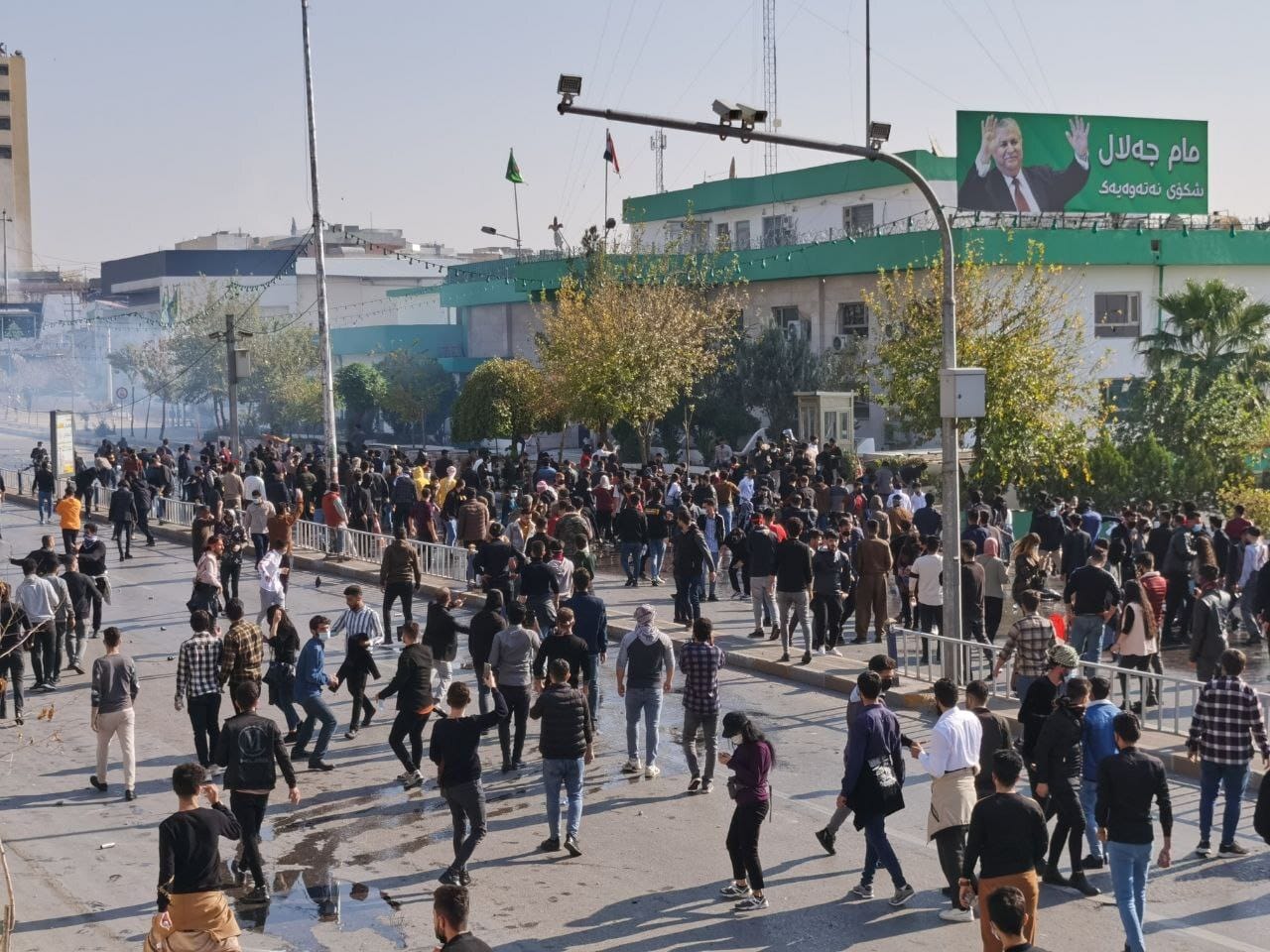
Security forces intervene in a demonstration by university students as they protest the failure of the Kurdistan Regional Government to increase the financial allowances allocated to complete their education. (Later photos show they set fire to the Patriotic Union of Kurdistan building in the background.) Sulaymaniyah, November 23, 2021\. Fariq Faraj Mahmood/Anadolu Agency via Getty Images
At the start of the invasion, Iraqi Kurdistan served as the northern front of the war, elevating the status of the Kurdistan Regional Government (KRG). The destruction of President Saddam Hussein's Baathist regime buttressed Kurdish rights and enabled their political and economic power to grow. Compared to the violence and sectarian strife that befell the rest of the country under the US-led occupation, the Kurdistan Region of Iraq was held up by the US pundit class as a “safe haven” and “island of decency”—a narrative the KRG encouraged with a public relations campaign describing Kurdistan as “the Other Iraq.” [\[1\]](#%5Fedn1)
2003 brought with it a unity of purpose among Iraq’s Kurdish parties. They capitalized on their longstanding relationship with the United States and Britain, the primary enforcers of the no-fly zone following the first Gulf War and the two major proponents of regime change in 2003\. Although differences persisted, Kurdish parties spoke in unison in Baghdad, particularly in the early years following the invasion. They worked to enshrine their new powers and rights into Iraq’s 2005 constitution, which recognized Kurdistan as an official region and granted the KRG power to govern largely independently of Baghdad. Kurdish parties also fully supported the 2005 parliamentary elections. As a result of these efforts, they gained a significant influence within the Iraqi state. Kurdish members of parliament form a significant block that often makes or breaks governments and legislations. In the *muhassasa* system— the informal but persistent practice of ethno-sectarian division of top jobs—Iraq has only had Kurdish presidents since 2006\. Ethnic Kurds have on occasion served as deputy parliament speakers and led key ministries such as finance and foreign affairs.
But working within the state apparatus has confused the Kurdish role in Baghdad. On the one hand, the KRG has sought the greatest possible share of the state’s powers and revenues. On the other, given historical Kurdish fears of a strong central government, they have also invested in their ability to secede, exemplified by the referendum for independence in 2017\. Today, Iraqi Kurdistan faces external challenges, most notably a legal and financial squeeze by Baghdad’s federal government and threats of Iranian and Turkish attacks. The real threat to the KRG is not external, however. Thirty years after its founding and 20 years on from the US invasion, the KRG—as if going through a mid-life crisis—lacks a clear vision for its future. Amid the threat of losing relevance, it stares at implosion due to economic uncertainties, chronic internal divisions and weak institutions.
## **Finding Wealth**
Kurds in Iraq have long based their struggle for self-rule on their grievances as a persecuted ethnic minority. Kurdish rulers gained legitimacy by standing up for Kurdish rights. Following the first Gulf War and the 1992 elections, however, such revolutionary credit gave way to democratic legitimacy. The elections gave birth to the KRG and brought two parties, the Patriotic Union of Kurdistan (PUK) and the Kurdistan Democratic Party (KDP), to formal political power. Since then, each of the two major Kurdish parties have remained inextricably associated with a family—the Talabani family lead the PUK, and the Barzani family the KDP (their second and third generations, respectively, are currently at the helm of power).
> **Also Read: "[The Elusive Quest for a Kurdish State](https://www.merip.org/the-elusive-quest-for-a-kurdish-state/)," in MER issue 295.**
The civil war in Iraqi Kurdistan between 1994 and 1998 discredited both parties, dividing the region into two single-party fiefdoms that persist until today. Meanwhile, over the course of the past two decades, as a new generation of each ruling family took on the mantle of leadership, their legitimacy has lacked both revolutionary and democratic standing. Economic development emerged as an alternative.
Indeed, between 2004 and 2014, the KRG translated post-invasion opportunities into an economic boom. A construction frenzy in this period caused the capital city of Erbil to more than double in size. The KRG says it has rebuilt [65 percent](https://www.theotheriraq.com/images/FactSheet.pdf.) of rural Kurdistan that was destroyed during the Anfal campaign of ethnic cleansing in 1988\. Two of Iraq’s three national cell phone companies are headquartered in Kurdistan, and the region is also home to a slew of hotels, gated communities and private schools, including two American-style universities.
By 2005, the KRG had built two international airports, in Sulaymaniyah and Erbil, unshackling the landlocked region. Foreign visitors could obtain visas upon arrival, a policy that the Iraqi government did not adopt until 2021\. Mass public hiring decreased unemployment, although foreign laborers filled much of the skills gap. Furthermore, a [2006 investment law](https://gov.krd/boi-en/why-kurdistan/investment-law/general-provisions/), which offered investors perks such as land ownership, tax holidays and profit repatriation, helped the KRG attract significant local and foreign capital. Today, there are over 3,000 foreign companies registered in the region. On the diplomatic front, the KRG hosts 42 consulates and maintains 14 representation offices around the world.
Making the most of its geographic location and security, Iraqi Kurdistan has become an important regional trade route and destination. Turkey, whose only land border with Iraq goes through the Kurdistan region, is the KRG’s largest trading partner. [In 2017](https://www.hurriyetdailynews.com/turkeys-trade-with-krg-business-as-usual-despite-referendum-says-economy-minister-118427), the volume of trade between Turkey and Iraqi Kurdistan was $2.5 billion, representing nearly one third of Ankara’s overall trade with Iraq.[\[2\]](#%5Fedn2) Similarly, one third of Iraq’s imports from Iran—an estimated $2.4 billion a year—are to Iraqi Kurdistan.[\[3\]](#%5Fedn3) Moreover, [50 percent of Iran’s](https://www.rudaw.net/english/business/09082020) exports to Iraq pass through border crossings controlled by the KRG.
## **From Foreign Aid to Oil Federalism**
The federal system proposed in the 2005 constitution granted the KRG a significant role in managing the oil and gas resources of the region. These provisions served as a safeguard: Should the new Iraq fail, it would be possible for an economically independent Kurdistan to take the next step toward statehood, the penultimate nationalist dream.
The constitution envisioned a system of petro-federalism, in which the federal Iraqi government and the KRG would share responsibility over oil policy and revenue. But in the years since its ratification, the Iraqi parliament has consistently failed to pass a national hydrocarbon law that would regulate the energy sector and define these joint roles.
Acting proactively, the Kurdish parliament passed its own natural resources law in 2007 and started inking some 55 contracts with international oil companies. While the federal government maintained that this law was unconstitutional and the oil contracts illegal, the KRG pushed ahead. It adopted production-sharing contracts, an industry favorite, which allowed international oil companies a stake in the region’s petroleum assets. This “smaller, faster, lighter” approach, as Deputy Prime Minister Qubad Talabani put it, helped jumpstart the Kurdish energy industry.[\[4\]](#%5Fedn4) Small firms, or wildcatters, came first, but Big Oil soon followed. In 2011 and 2012 ExxonMobil and Chevron each signed exploration contracts with the KRG, materially boosting the legal standing of its energy industry.
The KRG asked for neither permission nor forgiveness from Baghdad, an approach that in many ways paid off. By mid-2022, the KRG was producing nearly 450,000 barrels of oil per day, most of it exported via the region’s independent pipeline through Turkey. In the second quarter of 2022 alone, Iraqi Kurdistan’s oil sales earned $3.77 billion in gross revenues. While only 41 percent of these revenues made it into KRG coffers (the rest was dedicated to paying the oil sector’s costs as well as servicing its debts) the KRG still reaped $1.57 billion. As for natural gas, the KRG’s marketed natural gas production stood at about 5.3 billion cubic meters per year in 2021.[\[5\]](#%5Fedn5)
> **Intent on more independence from Baghdad, the KRG has grown dependent on other entities and factors beyond its control, including global oil prices, the dollar-dinar exchange rate and Turkey, through which its pipeline passes.**
The payoffs, however, have come with a cost. The federal government’s claim on Kurdish oil has forced the KRG to sell at a political risk discount. Furthermore, disputes between Erbil and Baghdad over oil and customs revenues boiled over in 2014, leading Baghdad to cut off the KRG’s share of the national budget. In 2022, the Iraqi Federal Supreme Court formally ruled that the KRG’s natural resource law was unconstitutional and its oil contracts and exports illegal. The Iraqi government had also sued Turkey in international arbitration courts over allowing the KRG to use the Iraq-Turkey pipeline without Baghdad’s approval. At the time of writing, the court favored Iraq’s position, compelling Turkey to halt the KRG’s oil exports. The future of the KRG’s independent energy industry remains uncertain.
Intent on more independence from Baghdad, the KRG has grown dependent on other entities and factors beyond its control, including global oil prices, the dollar-dinar exchange rate and Turkey, through which its pipeline passes. The vulnerabilities of this system started to show in 2014, when the expansion of ISIS caused international oil companies to either withdraw or suspend planned developments. The KRG made up for the losses by taking over Kirkuk’s oil fields following the Iraqi army’s retreat, which doubled the KRG’s crude exports to 550,000 barrels per day. But these gains were hampered by falling oil prices. Per barrel, oil prices fell from a peak of $115 in June 2014 to $70 in December and to $35 by February 2016\. Deputy Prime Minister Qubad Talabani described the KRG’s dire financial situation at the time as an “economic tsunami.”[\[6\]](#%5Fedn6) A telling manifestation of lost confidence in the KRG has been a [renewed wave of migration](https://www.aljazeera.com/news/2021/12/2/why-thousands-of-iraqi-kurds-risk-their-lives-to-reach-europe) to Europe. As a result of these factors, among others, by [2021](https://pukmedia.com/EN/Details/67582) the KRG faced a debt of $31.6 billion.
## **Internal Divisions and Institutional Weakness**
In recent years, fissures have cropped up among Iraqi Kurdistan's ruling families, who have grown in prominence as the region's political parties have weakened. After PUK founder Jalal Talabani passed away in 2017 his eldest son and nephew together took the reins of the party as co-presidents. In 2021, a feud broke out between the cousins, Bafel and Lahur Talabni, and the former ousted the latter. Meanwhile, on the Barzani side a power struggle is brewing between two Barzani cousins, which has the potential to disrupt not only the cohesion of the KDP but the entire regional government. These internecine struggles reflect broader institutional weaknesses and democratic regression in the Kurdistan region.
> **KRG institutions were brittle and completely unprepared to weather the “economic tsunami” that began in 2014.**
As an example, KRG institutions were brittle and completely unprepared to weather the “economic tsunami” that began in 2014\. The last time the KRG parliament had passed a budget was in 2012\. The public sector had swelled uncontrollably, crowding out private sector jobs. By 2017, the KRG was the largest employer in Kurdistan, employing half of the labor force, roughly 1.4 million people, to the tune of $750 million a month.[\[7\]](#%5Fedn7) Corruption and inefficiency have marred public sector employment, with thousands of ghost employees, double dippers and undeserved pensioners, while the budding private sector owes its existence to holding companies owned or controlled by members of Kurdistan’s ruling families. To avoid showing its hand to Baghdad, the KRG energy industry has become increasingly [opaque](https://blogs.lse.ac.uk/mec/2018/04/25/selective-transparency-things-you-cant-see-about-krg-oil/) and unaccountable.
The Peshmerga enjoy influence and prestige and have continued to garner significant public and political support, especially during their partnership with the US-led anti-ISIS coalition, but the cavernous political rift between the PUK and KDP has decreased the Kurdistan region’s value to the United States as a partner and diminished Kurdish leverage in Baghdad. There is no accurate accounting available, but the number of Peshmerga fighters is estimated to range between 160,000 to double that number. Prime Minister Masrour Barzani admitted that the Peshmerga forces have more generals among their ranks than either the US or Chinese military. Ever since the war against ISIS, the United States has provided stipends and training to Peshmerga units in exchange for the promise that the Peshmerga will be unified under the command of the KRG rather than its ruling parties. But the KDP and PUK refuse to surrender control of their respective units—a stance that Iraq’s Popular Mobilization Forces have cited in their own snubbing of national authority.
Overall, the KRG’s reputation for valuing democracy and human rights has eroded in the years since 2003\. Due to civil war and internal divisions in the 1990s, the region’s second parliamentary elections were not held until 2005, 13 years after the first election. Subsequent elections have taken place only following significant delays. Electoral victory and power are increasingly out of sync in the region. When the unarmed opposition party, Gorran, came in second in the 2009 elections, ahead of the PUK, the two ruling parties did not allow Gorran to share in power. Although President Masoud Barzani's term ended in 2015, he only left office in 2017, effectively shutting down the Kurdish parliament for two years in order to extend his tenure. No wonder turnout has been steadily declining at Kurdish elections.
## **The KRG’s Future**
Despite a persistent narrative of grievances and victimhood, Iraqi Kurds have exercised significant power and agency during the past three decades. KRG leaders continue to seek more power and autonomy, but to what end? Although they rebounded after decades of war, genocide and neglect, post-invasion Kurdish politics has not managed to shake off chronic internal divisions. The region’s most advanced institutions that could potentially support an independent Kurdistan remain its economy and Peshmerga forces.
> **Also Read: "[Securitizing Citizenship and Politicizing Security in Iraqi Kurdistan](https://www.merip.org/securitizing-citizenship-and-politicizing-security-in-iraqi-kurdistan/)" in MER issue 295.**
While the KRG has wielded economic policy to shift toward political independence, they have yet to produce a viable economic model. Indeed, despite 30 years of successfully managing a regional economy, the endless quest for economic independence has only ended up shifting dependency from Iraq to Turkey or from foreign aid to oil revenues. The ad hoc economic policy that has slowly emerged, like a Polaroid photo, over the past two decades displays traits of socialism, free markets and kleptocracy. Access to power and wealth, meanwhile, remains anchored to politics not to economic activity.
The 2017 independence referendum, called for by then-President Barzani, tested the Kurdistan region’s military and economic assets. Neither the international community nor the KRG’s neighbors could stomach redrawing the borders of the Middle East, and the KRG was not ready to withstand the economic and political costs of its push to secede from Iraq. The referendum and its aftermath cost the KRG the gains it had made following the ISIS invasion of 2014, including Kirkuk and its oilfields, which were reclaimed by Iraqi military and Popular Mobilization Forces after an armed encounter with the Peshmerga. Most damaging, however, was the clarity it bestowed on a hitherto ambiguous question: Can the KRG become an independent state?
As Kurdish divisions deepen and security in the rest of Iraq improves, the balance of power that once favored the KRG is shifting in Baghdad’s favor. Since the referendum, KRG leaders disagree on visions for their position within Iraq and on plans to save their embattled energy sector. Should the Kurdish economy remain hinged on foreign aid, oil and budget transfers from Baghdad, or can it build a robust economy through reform and diversification? These are among the questions raised over the past 20 years. Whether and how they are answered will determine the Kurdistan Region’s future.
\[**Bilal Wahab** is a fellow at the Washington Institute of Near East Policy.\]
> **Read the [previous](https://merip.org/2023/04/two-decades-of-uneven-federalism-in-iraq) article.**
> **Read the [next](https://merip.org/2023/04/the-political-logic-behind-iraqs-fragmented-armed-forces) article.**
**This article appears in [MER issue 306](https://merip.org/magazine/306) "The State of Iraq–20 Years After the Invasion."**
---
### **Endnotes**
[\[1\]](#%5Fednref1) Thomas L. Friedman, “[Opinion | The Kurdish Secret,](https://www.nytimes.com/2007/09/02/opinion/02friedmancolumn.html)” *The New York Times*, September 2, 2007.
[\[2\]](#%5Fednref2) Serkan Demirtaş, “[Turkey’s Trade with KRG ‘Business as Usual’ despite Referendum, Says Economy Minister](https://www.hurriyetdailynews.com/turkeys-trade-with-krg-business-as-usual-despite-referendum-says-economy-minister-118427),” *Hürriyet Daily News*, September 27, 2017.
[\[3\]](#%5Fednref3) Michael Georgy, “[Defiant Kurds Shrug off Risk of Trade War after Independence Vote](https://www.reuters.com/article/uk-mideast-crisis-iraq-kurds-economy-idUKKBN1CN0Z5),” *Reuters*, October 18, 2017.
[\[4\]](#%5Fednref4) Author interview, 2012.
[\[5\]](#%5Fednref5) “[Opportunities to Strengthen the Natural Gas Sector in the Iraq Kurdistan Region](https://www.merip.org/content/files/sites/default/files/qamar-energy---the-natural-gas-sector-in-the-iraq-kurdistan-region---september-2021.pdf),” Qamar Energy Report, September 2021, p. 5.
[\[6\]](#%5Fednref6) Isabel Coles, “[Economic 'tsunami' undermines war against Islamic State in Iraq-Kurdish deputy PM](https://www.reuters.com/article/uk-mideast-crisis-iraq-kurds-interview/economic-tsunami-undermines-war-against-islamic-state-in-iraq-kurdish-deputy-pm-idUKKCN0UU0GQ),” Reuters, January 16, 2016.
[\[7\]](#%5Fednref7) “[Biometric Payroll System Unveils Widespread Fraud in Iraqi Kurdistan](https://ekurd.net/biometric-system-fraud-kurdistan-2017-02-01),” *Ekurd Daily*, February 1, 2017.
### Two Decades of Uneven Federalism in Iraq
URL: https://www.merip.org/2023/04/two-decades-of-uneven-federalism-in-iraq/
Last updated: 2025-08-22T18:36:46.000Z
Transforming the centralized Iraqi state into a federal state was one of the most pressing political goals for the engineers and so-called nation builders behind the US invasion of Iraq in 2003.
A bridge over the Shatt al-Arab river, formed by the confluence of the Euphrates and Tigris Rivers, in the southern Iraqi city of Basra. (Hussein Faleh/AFP via Getty Images)
Proponents of federalism, like the Kurdistan Democratic Party (KDP) and the Patriotic Union of Kurdistan (PUK), saw it as a panacea that would resolve the crisis of public services and protect sub-national identities. Its opponents, however, believed it would deepen divisions in an already fragmented country and serve as a tool of separation.
Supporters of federalism won, at least on paper. In 2005, it was enshrined in Iraq’s constitution. But 20 years on, the system has proven stagnant.
Today Iraq is comprised of 18 governorates. But only three of them—Duhok, Erbil and Sulaymaniyah—are incorporated into an autonomous region, Iraqi Kurdistan, with its own parliament, sub-national ministries and a regional president. The other 15 governorates maintain a centralized relationship with Baghdad, although each has a governor and a provincial council. Those governorates that attempted to form their own region over the past two decades have faced various obstacles from both the central government and Iraqi Kurdistan, ensuring that any promises of federalism remain uneven and unfulfilled.
## **Making Iraq Federal**
The push for Iraqi federalism predates 2003\. In 1991, the nine Shi'i majority governorates south of Baghdad, plus the governorates of Iraqi Kurdistan and Kirkuk, rebelled against President Saddam Hussein and his ruling Baath Party. The uprisings were sparked by the defeat of the Iraqi army in the Gulf War and the accumulated economic and political grievances within the Shi’i and Kurdish communities, who were persecuted under Baathist rule. The northern no-fly zone established by the United States over the Kurdish governorates enabled a degree of political autonomy, and the region was able to establish independent political institutions. Despite a southern no-fly zone, Iraq’s Shi'a continued to live under Baathist repression and reprisals for 12 more years.[\[1\]](#%5Fedn1)
Federalism continued to be an important issue for many of Iraq’s exiled opposition leaders, like Jalal Talabani and Ahmed Chalabi, after 1991\. They repeatedly addressed the issue in conferences organized in the United States and Iraqi Kurdistan.[\[2\] ](#%5Fedn2)Saddam Hussein’s campaign of ethnic cleansing against Iraq’s Kurds bolstered their drive for statehood. Surrounded by countries that have contentious relationships with their own Kurdish populations, however, Iraqi Kurds were only able to push for self-governance within the parameters of a federal Iraq. The United States, in the lead up to the 2003 invasion and afterwards, also prioritized a one Iraq policy, in part to appease their NATO ally Turkey.
In January 2005, elections were held to select members of a committee to write a new constitution. The Iraqi political parties who were engaged in the process acknowledged a special status for Iraqi Kurdistan and agreed to carve out a distinct federal entity within Iraq that would have constitutional recognition. But they could not agree on whether the remaining governorates should be allotted similar status.
Most of the Shi'i opposition parties, for example, did not support federalism outside of Iraqi Kurdistan. These parties believed that centralized democracy afforded the Shi'a, Iraq’s demographic majority, the assurance that they would not be oppressed by minority rule again, as had been the case under Baathist rule. One exception was the Supreme Council for the Islamic Revolution in Iraq (SCIRI)—an Islamist party that was established in exile in Iran and was able to forge close ties to Kurdish parties. In 2005, SCIRI proposed the establishment of one region encompassing the nine Shi’i majority governorates south of Baghdad, an effort that was ultimately unsuccessful.
Meanwhile, Kurdish parties, like the KDP and PUK, also influenced the drafting of the constitution. These parties supported a federal Iraqi state that would recognize Iraqi Kurdistan as a region but also leave the possibility open for other governorates (except for Baghdad) to become regions.
> **The final constitutional document—ratified in October 2005—established a federal system “made up of a decentralized capital, regions, and governorates, as well as local administrations.”**
Sunni political parties, such as the Iraqi Islamic Party—which had initially boycotted the constitutional committee election—were later included in the drafting process. These parties opposed the language of federalism in favor of a traditional centrist state, with Baghdad as the capital. In the 2005 referendum, three Sunni majority governorates, Anbar, Nineveh and Salahuddin, voted to reject the new constitution, but their votes were not sufficient to prevent its adoption.
The final constitutional document—ratified in October 2005—established a federal system “made up of a decentralized capital, regions, and governorates, as well as local administrations.”[\[3\]](#%5Fedn3) Article 117 recognized Kurdistan as an official region but only within the nation of Iraq. The constitution also provided for the creation of new regions. Article 119 established two methods for a governorate to hold a referendum on becoming a region—gather signatures from 10 percent of the governorate’s voting population or get the approval of one-third of the provincial council members. In both cases, the Independent High Electoral Commission—a body established in 2004—must be involved in the referendum and in coordinating the collection of signatures.
## **No New Regions**
Several governorates attempted to regionalize during former Prime Minister Nouri al-Maliki’s eight years in office between 2006 and 2014, but none of these efforts met with success.
In 2008, for example, the most serious effort to regionalize Basra was led by its former governor, Wael Abdul Latif. By then it was clear to the citizens of Basra that although their governorate produced most of Iraq’s oil wealth, it was underdeveloped, especially in contrast to Iraqi Kurdistan (also rich in oil as well as an autonomous region). Many citizens and local leaders believed that federalism would empower Basra to use its resources to improve its residents’ standard of living by providing better services and governance. But the effort was met with resistance from the Independent High Electoral Commission, which Abdul Latif accused of employing tactics to discourage people from supporting a referendum. For example, the Commission opened only a fraction of the voting centers needed for a governorate as large as Basra.
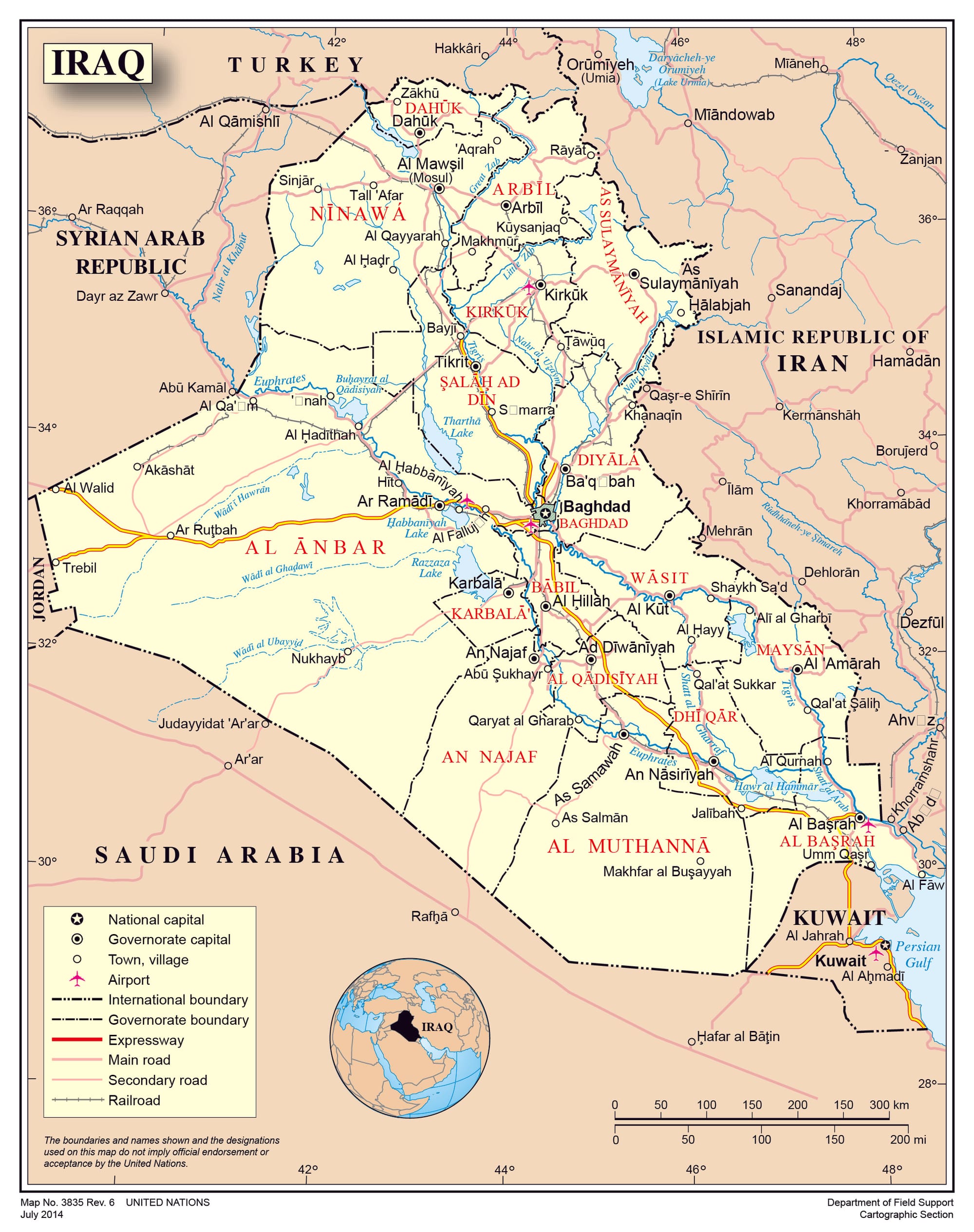
Iraq with governorate boundaries. Map by the United Nations.
Abdul Latif believes the Commission was influenced by politicians in Baghdad who feared that increased autonomy in Basra would hinder Baghdad’s ability to govern.[\[4\] ](#%5Fedn4)Baghdad was wary of losing fiscal resources if the Basra region were to control its own oil revenues, as has been the case at times in Iraqi Kurdistan.
At present, Basra continues to push for federalism, sometimes as its own region and other times in coordination with the southern governorates of Maysan and Thi Qar. Those calling for regionalism in Basra have made it clear that they oppose the breakup of Iraq and are not looking to replace Baghdad.
Other governorates like Diyala and Salahuddin in central Iraq were also prevented from holding a referendum during Maliki’s time in office—even after more than a third of their provincial council members voted for one in 2011.[\[5\] ](#%5Fedn5)The major Shi’i political parties, including Maliki’s Islamic Dawa Party, opposed the regionalization of these governorates even though one of the parties, the Islamic Supreme Council of Iraq, formerly SCIRI, had itself tried to form a region. Political leaders in Baghdad claimed that the push for a region in Diyala and Salahuddin would weaken the federal government. They also [rejected](https://www.aljazeera.com/features/2011/12/22/the-breakup-more-iraqis-bid-for-autonomy) holding a referendum on the grounds that it was motivated by sectarianism (the two governorates are majority Sunni). Salahuddin’s vote against adopting the constitution in 2005, followed by its attempt to utilize Article 119 to push for a region six years later, only added to this impression.
Another obstacle preventing Diyala and Salahuddin from holding a referendum was that both governorates include territory considered to be disputed between the Kurdistan Regional Government (KRG) and the federal Iraqi government. While the constitution only names Kirkuk among the disputed territories, the KRG considers parts of Nineveh, Diyala and Salahuddin to belong to Iraqi Kurdistan, citing historical claims that predate Baath displacement policies. These claims are contested by local non-Kurdish populations who have struggled to maintain balance between Baghdad and the KRG.[\[6\]](#%5Fedn6)
The issue of disputed territories has been a thorn in relations between the federal government and the KRG. The 2005 constitution stipulated that a referendum be held by December 31, 2007, to determine the status of Kirkuk and other disputed territories. But as of March 2023, no such vote has taken place. Indeed, Iraqi policymakers are caught up in a legal debate on whether this issue still needs to be resolved at all, or whether the fact the deadline has passed means it is no longer relevant.
Disputed areas like Kirkuk, the Nineveh Plains and Sinjar have suffered over the years due to neglect from both the federal government and the KRG. Meanwhile, pathways to change are limited. Kurdish parties fear that, if given the choice, these disputed territories would form a separate region rather than join Iraqi Kurdistan. For the larger districts, like Sinjar or Talafar, the first step is to become a governorate, which requires cabinet and parliament approval. In the case of Kirkuk, which is a governorate, it can legally form its own region through Article 119, but it too is likely to face pushback similar to that experienced by Diyala, Salahuddin and Basra.
## **The Future of Iraqi Federalism**
Despite the push for federalism from the KDP, PUK and ISCI, there have been no changes to Iraq’s federal composition other than the enshrinement of Iraqi Kurdistan as a region in the constitution.
> **Although it was rejected by Baghdad and the KRG later claimed the referendum to be non-binding, it nevertheless cemented the belief among many Iraqis that becoming a region is the first step toward independence.**
Those who fear federalism view it as being one step away from separatism. These concerns were reinforced by the independence referendum in Iraqi Kurdistan on September 25, 2017, which was also held in the disputed territories. Although it was rejected by Baghdad and the KRG later claimed the referendum to be non-binding, it nevertheless cemented the belief among many Iraqis that becoming a region is the first step toward independence.
Beyond the political obstacles and resistance by the central government to give up control over revenue-generating resources, Iraq lacks the institutions for decentralized governance. Even when Iraq’s prime ministers have pushed to decentralize certain federal ministries—as did Haider Al-Abadi with several ministries between 2014–2018—either the governorates struggled with the responsibility or the ministries in Baghdad refused to delegate power.[\[7\]](#%5Fedn7) Moreover, until the relationship between Baghdad and Iraqi Kurdistan is stable and long-standing disputes are resolved, it is unlikely that other regions will be able to form.
\[**Hamzeh Hadad** is an adjunct fellow at the Center for a New American Security and a visiting fellow at the European Council on Foreign Relations.\]
> **Read the [previous](https://merip.org/2023/04/water-oil-and-iraqs-climate-future-2) article.**
> **Read the [next](https://merip.org/2023/04/the-rise-and-fall-of-kurdish-power-in-iraq) article.**
**This article appears in [MER issue 306](https://merip.org/magazine/306) "The State of Iraq–20 Years After the Invasion."**
---
### **Endnotes**
[\[1\]](#%5Fednref1) Marsin Alshamary & Hamzeh Hadad, “The Collective Neglect of Southern Iraq: Missed Opportunities for Development and Good Governance,” *International Peacekeeping*, February 2023.
[\[2\]](#%5Fednref2) United States Department of State, “[The Future of Iraq Project](https://nsarchive.gwu.edu/),” November 2002.
[\[3\]](#%5Fednref3) [Iraq’s Constitution of 2005](https://www.merip.org/content/files/constitution/iraq%5F2005.pdf). Available in English at constituteproject.org.
[\[4\]](#%5Fednref4) Author interview with Dr. Wael Abdul Latif in Baghdad, April 18, 2022.
[\[5\]](#%5Fednref5) Joel Wing, “[Push To Make Iraq’s Diyala Province An Autonomous Region Fades](https://ekurd.net/mismas/articles/misc2011/12/kurdsiniraq146.htm),” *Ekurd Daily*, December 30, 2011.
[\[6\]](#%5Fednref6) Shamiran Mako, “[Negotiating Peace in Iraq’s Disputed Territories: Modifying the Sinjar Agreement](https://www.lawfareblog.com/negotiating-peace-iraqs-disputed-territories-modifying-sinjar-agreement.),” *Lawfare,* January 17, 2021.
[\[7\]](#%5Fednref7) Ali Al-Mawlawi and Sajad Jiyad, *“*[Confusion and contention: understanding the failings of decentralisation in Iraq](http://eprints.lse.ac.uk/108534/)*,”* *LSE Middle East Centre*, 2021.
### Water, Oil and Iraq’s Climate Future
URL: https://www.merip.org/2023/04/water-oil-and-iraqs-climate-future-2/
Last updated: 2026-02-02T15:10:27.000Z
*This article is available in* [*Arabic*](https://jummar.media/3145) *as part of a* *collaboration between* MER *and the independent Iraqi media initiative* Jummar.
Iraq’s ecological devastation was set in motion years before the 2003 invasion.
For 40 years, the Iraqi state has lurched from crisis to crisis as wars and domestic conflicts have devastated the country's infrastructure and institutions. The Iran-Iraq war was followed by 13 years of punishing economic sanctions, which began in the 1990s. The 2003 Anglo-US invasion of Iraq has left the state, 20 years later, in political and economic disarray.
These shocks have taken tolls on the environment by displacing water resources, eroding infrastructure that could mitigate climate damage and enabling the unfettered extraction of oil. They have rendered Iraq—a country that has always faced occasions of extreme heat and aridity—among the more vulnerable countries in the Middle East to climate change.
From drought to sand storms to chronic illnesses related to the toxic pollution emanating from oil fields in the south, it is clear that climate conditions in Iraq have noticeably worsened in recent years. This trend is especially damaging when combined with the general decline in state and institutional capacity after 2003.
Yet, the same political and social upheavals that make the climate crisis so pressing have also led to the neglect of climate research in favor of what are perceived as more immediate threats, despite the interconnectedness of these predicaments. Indeed, rather than separate issues, the state of the Iraqi government and its economic and geopolitical entanglements are the main drivers of Iraq’s climate vulnerability today, as exemplified by its two most important resources: water and oil.
## **The Rise and Fall of Iraq’s Wetlands**
Over the past two years, Iraq has experienced its driest seasons in decades, with temperatures frequently surpassing 120 degrees Fahrenheit. As temperatures continue to soar, water supplies decline, triggering one of the worst droughts in 40 years. Iraqi officials [estimate](https://www.atlanticcouncil.org/blogs/menasource/iraqs-sandstorms-are-threatening-life-in-the-fertile-crescent-its-time-the-iraqi-government-takes-a-stance/) that water reserves have decreased by half this year, due in part to changes in weather patterns but also to the action of neighboring countries, like Turkey, where several dam projects limit the water flowing from the Euphrates and Tigris rivers. For example, the operation of Turkey’s Ilisu Dam, a mile-wide [mega-construction](https://e360.yale.edu/features/turkeys-dam-building-spree-continues-at-steep-ecological-cost) on the Tigris river, has reduced Iraq’s share of the river’s water by an [estimated](https://www.arabnews.com/node/1977746) 60 percent. As a result of these declining water flows, a significant portion of Iraq’s wetlands [dried out](https://www.wired.com/story/the-mesopotamian-marshes-are-disappearing-again/) this year, [leaving behind](https://www.independent.co.uk/news/iraq-ap-turkey-saddam-hussein-ankara-b2231105.html) dead buffalo and displacing communities.
> [Iraq's Water Woes—A Primer](https://www.merip.org/iraqs-water-woes/)
The same wetlands that are now disappearing were targeted by Saddam Hussein following the Iran-Iraq war and the 1991 mass uprising against his government. Hussein accused the marsh Arabs—communities dwelling in the riparian land that forms the estuary of the Tigris and Euphrates rivers—of aiding rebels fleeing the Iraqi army. In addition to bombing the area during the war, the government attempted to drain the wetlands. The ostensible reason was to convert these territories into irrigated farmland by constructing dams and levees. But canals like the Prosperity River, the Mother of Battles Canal and the Loyalty to the Leader Channel punitively limited water supply to these historical communities, draining the marshes and displacing local residents that had lived on this land for generations.
As a result of rising temperatures and severe droughts, recent years have also seen an increase in the frequency and intensity of sand and dust storms. According to the Iraqi Ministry of Environment, established after 2003, sand and dust storms [have increased](https://www.rudaw.net/english/middleeast/iraq/29052022#:~:text=Iraq's%20environment%20ministry%20in%20April,days%20per%20year%20in%202050.) from 243 to 272 days per year between 2022 and the prior decade. Over just two months of 2022, Iraq experienced ten sandstorms, compared to averages of one to two storms a year in previous decades.[\[2\]](#%5Fedn2)
> **...the combination of climate conditions and obsolete infrastructure has led to increasing desertification, which already impacts around** [**39 percent of Iraq's**](http://ft.com/content/60369043-8534-4d73-9c48-1c08288064eb) **surface area. As a result, the country loses about** [**100 square kilometers**](https://www.lemonde.fr/en/international/article/2022/05/17/in-iraq-desertification-leads-to-multiple-sandstorms%5F5983823%5F4.html) **of arable land each year.**
With climate conditions worsening over time, Iraq’s economy will suffer, especially in the agricultural sector. Food production in Iraq is based on smallholder agriculture. Farmers depend on outdated irrigation methods centered around rain-fed systems, leaving many farmers vulnerable to droughts as rainfall levels decline. In addition, the combination of climate conditions and obsolete infrastructure has led to increasing desertification, which already impacts around [39 percent of Iraq's](http://ft.com/content/60369043-8534-4d73-9c48-1c08288064eb) surface area. As a result, the country loses about [100 square kilometers](https://www.lemonde.fr/en/international/article/2022/05/17/in-iraq-desertification-leads-to-multiple-sandstorms%5F5983823%5F4.html) of arable land each year.
Desertification is [forcing](https://www.climatecentre.org/9545/cop27-through-desertification-searing-temperatures-and-dying-land-climate-crisis-intensifies-struggle-of-iraqs-farmers-says-icrc/) farmers to abandon their land and migrate to overpopulated urban centers, where they find limited employment opportunities in the bloated public sector, driving many into the illegal and informal economy.
The rise in frequency and severity of sand and dust storms has also increased long-term respiratory illnesses among the population. In 2022, according to the health ministry as many as [10,000 people](https://www.france24.com/en/live-news/20220523-iraq-sandstorm-grounds-flights-sends-1-000-to-hospitals) were hospitalized as a result of sandstorms. These numbers are likely higher on the ground, and the true magnitude of the crisis is not fully captured due to a shortage of official numbers and research.
## **Iraq’s Oil Dependency and Climate Vulnerability**
The story of Iraq’s environmental vulnerability is not just about the scarcity of water but the abundance of oil. As the main source of income and wealth for Iraq’s political elites, the oil industry has contributed to the de-prioritizing of climate issues, in general, and water infrastructure in particular.
Read this article in Arabic at Jummar. Image designed by Atef Al-Jaffal/Jummar.
Iraq’s economy depends on oil. Over the past decade, the oil sector has [accounted for](https://www.worldbank.org/en/country/iraq/overview) more than 99 percent of Iraq’s exports and 42 percent of GDP. Oil dependency increases Iraq’s climate vulnerability due in large part to gas flaring—the burning of natural gasses associated with oil extraction, which releases a highly polluting mix of carbon dioxide, methane and black soot into the environment.
The sector captures and processes only around half of the 3 million cubic feet of gas produced per day from oil extraction, making Iraq the second-largest gas flaring country after Russia. Iraq releases around 30 million tons of carbon dioxide a year, [accounting](https://www.nytimes.com/2020/07/16/world/middleeast/iraq-gas-flaring-cancer-environment.html) for 10 percent of the greenhouse gasses emitted globally due to flaring.[\[3\]](#%5Fedn3)
By failing to develop its gas capturing infrastructure, Iraq is not only contributing to global carbon emissions. Flared gas also releases toxic chemicals like benzene, contributing to the increased formation of poisonous clouds and acid rains, which seep into the ground and dissolve essential nutrients like magnesium and calcium. These nutrients are necessary for agricultural development and the maintenance of arable land. Acid rain is further responsible for releasing aluminum into the soil, limiting the growth of healthy plants. Oil-tainted water and other toxins also drain directly into natural water sources, polluting them in the process. Iraq's southern cities and towns—like Nahran Omar in the province of Basra—where most of the country's oil fields are located, are particularly vulnerable to these environmental disasters.
In Nahran Omar, around 6 percent of the population of 1,500 has either died from or currently suffers from cancer or related health complications, and most of those with health complications are under the age of 25.[\[4\]](#%5Fedn4) Thus, beyond the environmental risk, oil production and gas flaring as well as petrochemical plants and uranium from degraded weapons are all associated with a heightened risk of illnesses—such as asthma, hypertension and some cancers—especially among those who live near these oil fields.
Additionally, once the wells are built, companies infrequently hire locals to work in the fields, which means the population suffers from ecological and health consequences without access to economic benefits. According to [reporting](https://www.tareeqashaab.com/index.php/sections/economy/321-100) on the ground by *Tareek Alshaab*, oil companies are more likely to hire foreign workers. Around 100,000 foreign workers are working in the oil industry, and they are often paid higher wages than Iraqi workers.[\[5\]](#%5Fedn5)
Iraqi government officials often downplay the number of pollution-related illness clusters around the country, limiting access to accurate numbers and data.[\[6\]](#%5Fedn6) The limitation in data access is the product of both the state’s lack of capacity to develop the tools for capturing data as well as limited transparency of information when it comes to the energy sector and environmental concerns.
> **The sector captures and processes only around half of the 3 million cubic feet of gas produced per day from oil extraction, making Iraq the second-largest gas flaring country after Russia.**
Despite the harmful impact of oil dependency, the state has been unwilling or unable to address the problem. Oil’s importance as the primary source of state revenue contributes mightily to maintaining the existing political system and power players. The revenues from oil exporting are controlled by the state, and political actors who benefit from the resources they pocket through corruption and oil exports seek to maintain the political and economic system that benefits them the most.
This limited political will combines with decades of declining infrastructure and institutional capacity to prevent meaningful progress. For example, if Iraq were to successfully invest in infrastructure to capture and use flared gas, it would both minimize the climate impact and potentially power up to 3 million houses, easing the country's chronic electricity shortage. But investing in gas infrastructure would also mean Iraq weaning itself from dependence on Iran's gas for electricity generation, especially during the hot summer months. Since 2018, Iraq has been receiving US sanctions waivers to import Iranian gas. This dependence is a lifeline for Iran’s struggling economy. Thus, neither Iran nor its proxies in Iraq are interested in developing better infrastructure.
Even when efforts have been made to minimize the negative impact of oil production and gas flaring, outdated infrastructure and limited state capacity have prevented real progress. For example, Iraq’s Environment Ministry—which five years ago merged with the health ministry—has documented the harmful impact of oil dependency and gas flaring on ecological conditions and the population's well-being. The ministry has attempted to impose fines on the Basra Oil Company due to its multiple violations of gas flaring beyond the legal limits. But the state lacks the capacity to either enforce these rules or provide the necessary tools and resources to modernize oil production. Indeed, Basra Oil Company’s chief engineer [acknowledged](http://nytimes.com/2020/07/16/world/middleeast/iraq-gas-flaring-cancer-environment.html) that it was cheaper to pay the penalty than invest in new infrastructure that could process flared gas.
The Basra Oil Company is not alone. Other international oil corporations, such as British Petroleum (BP), have for decades taken advantage of loopholes in emission reporting rules to save millions of dollars while releasing deadly gases into the atmosphere. For example, since 2009, BP has been the main contractor in the Rumaila Oil Field. One of the largest oil fields in the world, it is responsible for about one third of Iraq’s total oil production. According to a [Greenpeace report](https://projects.unearthed.greenpeace.org/big-oil-iraq/), in 2021, Rumaila flared around 3.39 billion cubic meters of gas, emitting 9.5 million tons of carbon dioxide. Despite earning roughly [$358 million](https://projects.unearthed.greenpeace.org/big-oil-iraq/) of post-tax profit from this field, BP does not include Rumaila emissions in its annual emission report because it classifies the field as a "non-operated asset"—meaning the assets are operated by any person other than the company entities. But BP was the field's official operator until June 2022, when BP and PetroChina established the Basra Energy Company to take over operations, and the company remains the main point of contact. If the company were to include Rumaila in its reports, its annual emissions for 2021 would be doubled.
In 2021, the World Bank and Iraq's state-owned South Gas Company of Iraq, Shell and Mitsubishi signed a [$360 million](https://www.spglobal.com/commodityinsights/en/market-insights/latest-news/natural-gas/062921-iraq-to-receive-360-mil-world-bank-loan-to-help-expand-gas-flaring-reduction-from-south) deal to help Iraq control its gas flaring crisis in its southern fields, but minimal progress has been made. Similarly, in September 2021, Iraq agreed on a $27 billion deal with France's Total Energies. The deal would allow France to invest in Basra's oil field for 25 years and develop several infrastructure projects targeting cleaner energy production and gas flaring control, but bureaucratic obstacles and political crises—such as the [deadlock](https://www.aljazeera.com/news/2022/5/30/iraqi-deadlock-continues-with-elites-unable-to-form-government) following the 2021 elections—have [delayed](https://www.reuters.com/business/energy/exclusive-iraqs-27-bln-total-deal-stuck-over-contract-wrangling-2022-02-14/) the deal’s finalization.
## **Moving Forward**
Since 2003, Iraq has faced several crises, but environmental conditions have often been deprioritized in favor of the country’s economic and political situation. Twenty years later, the country is in a more vulnerable position on its environmental front than perhaps any time before.
Iraq's climate crisis is playing out in the drinking water, arable land and public health of those who live in Iraq. But it is also a regional and global crisis. Any effective response must consider the interconnected nature of climate issues with other social institutions, the role of civil and local communities and the need for effective geopolitical climate diplomacy. For the country to mitigate the impact of the structural weaknesses-climate change-instability nexus, Iraq must diversify its economy away from oil dependency, invest in decarbonization efforts and cleaner energy infrastructure and address the fiscal and political implications of this transition. Another important first step would be to center the interests and knowledge of local communities most impacted by climate change.
\[**Zeinab Shuker** is an assistant professor of sociology at Sam Houston State University\].
> **Read the** [**previous**](https://merip.org/2023/04/iraqi-womens-activism-20-years-after-the-us-invasion) **article.**
> **Read the** [**next**](https://merip.org/2023/04/two-decades-of-uneven-federalism-in-iraq) **article.**
**This article appears in** [**MER issue 306**](https://merip.org/magazine/306) **"The State of Iraq–20 Years After the Invasion."**
---
### **Endnotes**
[\[1\]](#%5Fednref1) World Bank Report: “[Iraq Country Climate and Development Report](https://openknowledge.worldbank.org/handle/10986/38250),” (2022), p. xi.
[\[2\]](#%5Fednref2) Muhammad Baqir Muhyedeen, “[Iraq's sandstorms are threatening life in the Fertile Crescent. It's time the Iraqi government takes a stance](https://www.atlanticcouncil.org/blogs/menasource/iraqs-sandstorms-are-threatening-life-in-the-fertile-crescent-its-time-the-iraqi-government-takes-a-stance/)," The Atlantic Council, June 23, 2022.
[\[3\]](#%5Fednref3) Alissa J. Rubin and Clifford Krauss, “[Southern Iraq’s Toxic Twilight: Burning Gas and Poisoning the Air](https://www.nytimes.com/2020/07/16/world/middleeast/iraq-gas-flaring-cancer-environment.html),” *The New York Times*, July 16, 2020.
[\[4\]](#%5Fednref4) Ibid.
[\[5\]](#%5Fednref5) Abdullah Latif, “[100,000 foreigners work in the oil fields outside of regulations](https://www.tareeqashaab.com/index.php/sections/economy/321-100),” *Tareek Alshaab,* January 24, 2021.
[\[6\]](#%5Fednref6) This information is based on author interviews.
### Iraqi Women’s Activism—20 Years After the US Invasion
URL: https://www.merip.org/2023/04/iraqi-womens-activism-20-years-after-the-us-invasion/
Last updated: 2025-08-22T18:36:47.000Z
No, no, your voice is not shameful, your voice is a revolution!”
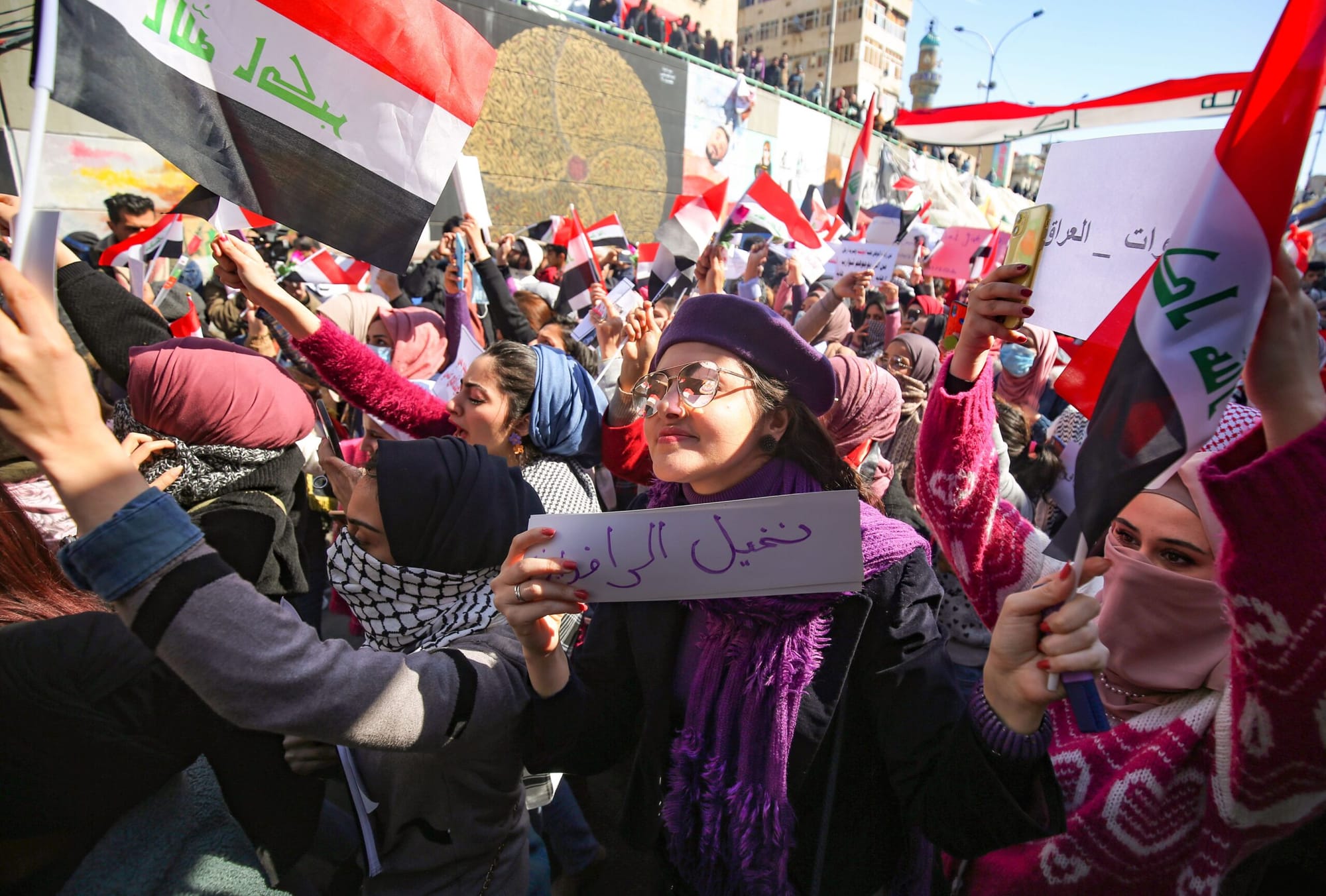
Iraqi women take to the streets in a Tishreen demonstration in Baghdad's Tahrir Square on February 13, 2020\. (Ahmad Al-Rubaye/AFP via Getty Images)
Thousands of Iraqi women shouted these words in Baghdad’s Tahrir Square in October 2019\. The unprecedented scale of women’s participation helped turn what could have been just another wave of popular protests, which had grown more common over the past decade, into an uprising. Thawra Tishreen (the October Revolution) saw ordinary people demonstrating against the political class and the system that had been put in place following the US-led invasion in 2003.
Women’s participation and visibility in Tishreen highlights the dynamism of women-led grassroots movements today. Groups like the Organization of Women’s Freedom in Iraq, Iraqi Women Network as well as informal women’s networks have emerged in the past 20 years. As wider protest movements have developed in Iraq, particularly in the past decade, these women-led groups have also broadened their scope to include social and political issues. A new generation of young women protesters has emerged. The nature of their demands speaks to the daily challenges they face amid economic crises, the collapse of state institutions and services, waves of violence and militarization and the rise of heteropatriarchal conservatism. The politicization of both gender and sect has had disproportionate consequences for women—jeopardizing their legal rights and control over their mobility and bodily freedom. Women have also endured the repression of a regime supported by various armed groups, one that rules through armed violence. Women activists are fighting back in the limited social and political space they have left.
## **Sectarian Politics and Women’s Rights**
The US-led invasion and occupation administration put political groups in power that attempted to undo one of the most important legacies for Iraqi women: the Personal Status Code.
Prominent feminist groups such as the Iraqi Women’s League, as well as the anti-imperialist, secular left, had championed the 1959 Personal Status Code to protect women’s rights. It established a minimum marriage age of 18 and guaranteed the right to divorce and inheritance. The law was a product of the Iraqi women’s movement, and the first woman minister in Iraq and the Arab world, Naziha al-Dulaimi, helped write it. It united the rights of Iraq's Sunnis and Shi’as under one law and openly challenged the conservative political elite installed during the former British mandate.
> **From the Archives: "[Conspiracy of Near Silence—Violence Against Iraqi Women](https://www.merip.org/conspiracy-of-near-silence/)," in MER issue 258.**
In 2003, however, political groups linked to Shi'i Islamist political parties (largely in exile) proposed to completely abolish Iraq’s Personal Status Code. When this attempt failed, thanks in part to protests by women’s groups, Shi'i parties proposed an alternative: to establish a sectarian-based Personal Status Code. Their proposal marked a significant break with the code’s political legacy, reflecting instead the nature of the system put in place by the US administration in 2003\. Commonly called the *muhasasa* system, it defined political representation based on communal belonging through ethnic (such as Arab or Kurd), sectarian (Sunni, Shi’a) and religious (Muslim, Christian and other) affiliations.
Along these lines, some Shi'i political forces have been pushing for the Iraqi parliament to adopt a code based on Shi'i jurisprudence commonly referred to as “Jaafari Law.” This law—which would apply to Iraq’s Shi’as—could permit marriage for girls as young as nine and allow unions with no legal protection for women. It would also weaken the power of the previously state-appointed judges in determining whether cross-sectarian marriages are possible, instead granting this power to sectarian religious authorities.
If the Jaafari Law was adopted by the Iraqi parliament, it would render women second-class citizens and provide a further legal foundation for the marriage of minors, which has proliferated in the last two decades in the absence of functioning state institutions and services and [widespread poverty](https://www.merip.org/content/files/sites/default/files/pubs/multidimensional%5Fpoverty%5Fin%5Firaq%5F1.pdf). Women’s rights groups like the Baghdad Women’s Association have launched campaigns over the years to combat child marriage, advocate for a welfare state and fight to preserve legal protections for women.
In the past decade, women’s rights groups have also fought to adopt a law that would criminalize domestic violence and provide shelters for women victims of abuse and trafficking. Instead of supporting these campaigns, however, Iraqi authorities have repressed some of the groups. The Organization of Women’s Freedom in Iraq, for example, the only organization that runs shelters in the country outside of Iraqi Kurdistan, has been criminalized for its advocacy. In 2020, the Iraqi government filed a lawsuit [attempting](https://www.madre.org/press-publications/article/organization-women%E2%80%99s-freedom-iraq-prevails-winning-year-long-court-battle) to strip the organization of its legal right to operate. Meanwhile, its leader Yanar Mohammed has faced death threats.
## **Women and the Collapse of the Welfare State**
The US-led invasion is one node in a longer story of Iraq’s eroding welfare state and its outsized impact on Iraqi women. In 2003, Iraq was already in survival mode. Still not recovered from the Iraq-Iran war and the US-led coalition bombings during the first Gulf War, it had also faced over a decade of UN sanctions, some of the most drastic ever imposed on a country. Sanctions constituted what philosopher [Joy Gordon](https://www.merip.org/the-enduring-lessons-of-the-iraq-sanctions/) has called “the invisible war.”[\[1\]](#%5Fedn1)
> **Read Joy Gordon on "[The Enduring Lessons of the Iraq Sanctions](https://www.merip.org/the-enduring-lessons-of-the-iraq-sanctions/)," from MER issue 294.**
Sanctions altered the social fabric of Iraqi society, destroyed the middle class and plunged the majority of the population into poverty. The Iraqi state, historically a major employer, could no longer rely on its main source of revenue, oil sales. It cut employees’ salaries as well as essential public services. As has been well-documented, sanctions also played a central role in the development of everyday corruption and in the formation of mafia-like groups connected to the Baath regime.
Prior to the sanctions, Iraqi women were among the most educated in the region and worked in almost all sectors, although predominantly in the public sector. They took advantage of strong state services, such as higher education, health care, childcare and public transportation. Since 2003, however, public services have been mostly privatized, which has left them dysfunctional or absent. The dire conditions in post-invasion Iraq are not the result simply of neoliberalism, where aggressive privatization is often related to public land grabbing and violent dispossession. Iraq used to have robust and functioning infrastructure before it was destroyed by US-led wars. Women can no longer rely on universal health care and supported childcare. Every aspect of life in Iraq is costly, including access to running water, electricity, childcare and basic health care. Women’s employment has plummeted with the collapse of the public sector. These changes have impacted all Iraqis, but it is women who are disproportionately affected and who are already facing challenges from legal discrimination and heteropatriarchal societal norms.
## **The Everydayness of Violence**
Despite all the rhetoric claiming that the US-led invasion and occupation of Iraq would support or “save" Iraqi women, 20 years later the so-called War on Terror continues to shape women’s everyday experiences of insecurity.
> **The spatial political economy of the post-2003 regime is materialized in T-walls...Together with razor wire, sandbags and a maze of checkpoints, they form the pattern of everyday life in the capital.**
The limitations on women’s social and spatial mobility are particularly visible in Baghdad, a city divided by concrete walls and checkpoints. The spatial political economy of the post-2003 regime is materialized in T-walls—reinforced, blast proof concrete slabs, commonly referred to as "Bremer walls," after the head of the Coalition Provisional Authority during the early years of US occupation, Paul Bremer. Together with razor wire, sandbags and a maze of checkpoints, they form the pattern of everyday life in the capital. Women have to go through these checkpoints guarded by armed male soldiers on a daily basis.
In many ways, cities like Baghdad and Basra have experienced what Stephen Graham, in his reflection on military capitalism, has labeled an “urbicide,” a form of political violence intended to kill cities by pushing away the urban poor, maintaining ethnic and class separation through armed violence and privatizing public goods for the benefit of corporate interests and big business.[\[2\]](#%5Fedn2)
In Baghdad, ethno-sectarian separation has a very concrete spatial, bodily and material reality, determined by the US administration’s decision to divide areas of the city according to sect, religion and ethnicity. Class divisions are in turn connected to political divisions since access to resources and wealth is often conditional upon being part of a network with strong ties to the political elite.[\[3\]](#%5Fedn3)
Political clashes between armed groups result in yet more roadblocks and T-walls and thus more social control for people who circulate. Of course, such mechanisms of control impact everyone, but their effects on women are particularly pronounced.[\[4\] ](#%5Fedn4)In Baghdad, armed groups associated with the political elite police the streets in ways that reinforce a heteropatriarchal social order.
Since 2003, Iraqi women’s rights activists have been caught between fighting to preserve their existing legal rights—under threat from conservative social forces—and demanding their basic rights to security and dignity—under siege from the violent social, political and ethno-sectarian crisis provoked by the invasion and occupation.
## **"Your Voice is a Revolution"**
The pretense of “saving" Iraqi women was a dimension of the neocolonial narrative of democracy building leveraged by the US administration to invade and occupy Iraq. “Saving” implies that US imperial domination is superior and even necessary and inherently good for women. Iraqi women are perceived as an ahistorical homogenous object, portrayed as essentially voiceless victims. Even 20 years after the destructive and devastating invasion and occupation, the gendering of the democracy narrative on the Middle East remains.
> **Also read: "[The Challenges for Women Working at Iraqi Universities](https://www.merip.org/the-challenges-for-women-working-at-iraqi-universities/)," from MER issue 266.**
The 2005 Iraqi Constitution adopted a 25 percent quota for women in parliament. Women have since been visible and present in parliament and on candidate lists in elections. United Nations Women and many non-governmental women’s groups have insisted on the importance of such achievements for women’s political participation. Yet, if the quota has allowed some significant women figures to enter parliament, it has also facilitated the presence of party line women, who follow certain political groups even to the detriment of their gender-related interests. The focus on women’s political participation and visibility is a central dimension of the democracy narrative that has dominated the US discourse on Iraq: the idea that Iraq now runs free elections, has women in its parliament and therefore the country is a democracy. In reality, Iraqis have turned away from the polls—the 2021 elections had the [lowest voter turnout](https://www.chathamhouse.org/2021/10/explaining-iraqs-election-results) in Iraq post-2003—and many have decided to take to the streets to voice their political vision outside of the democratic façade.
In the context of the militarization and widespread violence that followed the invasion and occupation, Iraqi intellectuals, writers and activists have been targeted by armed groups, assassinated, threatened or forced into exile. Specific legal mechanisms have also been adopted that limit freedom of expression. For example, a draft of a 2023 “content regulation” law was leaked. If passed, [Iraqi activists warn](https://www.article19.org/resources/iraq-drop-draft-digital-content-legislation-protect-free-speech-online/), this law would give the authorities broad control to determine what speech is permissible and shut down speech they oppose. Additionally, a number of Baath-era laws are still used to stifle freedom of expression.
These oppressive conditions have led hundreds of intellectuals, journalists, judges and activists—including women’s rights activists—to speak back against the post-2003 political order. On June 3, 2022, they released a “Statement for Freedom of Expression,” which [openly criticized](https://docs.google.com/forms/d/e/1FAIpQLSdpMS4N8sZHBjODDE5kpF9K6nJ9Z7gxrMAUKxDfMEGxUDGbmA/viewform) the Iraqi regime’s intensification of repression against any form of political dissent. Since October 2019, at least 540 peaceful protesters have been killed, 20,000 injured and many forcibly disappeared.[\[5\] ](#%5Fedn6)The repression has been carried out by various entities from the state’s security forces—using stun grenades, anti-riot tanks and military-grade teargas as bullets—as well as by paramilitary groups and mercenaries using live ammunition and machine guns. The Iraqi government has imposed media, internet and telecommunication blackouts as well as curfews. Many protesters have been threatened, intimidated, arrested, beaten, kidnapped and even assassinated.
While most of the protesters killed during the uprising were young men on the front lines of confrontation with the Iraqi security forces during protests, women protesters were also targeted. Protesters like Saba Mahdawi and Mari Mohammed were kidnapped. In Basra, Sara Taleb and her husband ‘Adel and Reham Yacoob were killed by armed groups as was Zahraa Ali in Baghdad.
The main slogan at the heart of the 2019 uprising, *Enrid watan* (we want a country), expresses what so many Iraqis have lost: A functioning, livable country with robust infrastructure and services as well as the possibility of living without fear of being killed by a vast network of armed groups affiliated with the Iraqi establishment for simply expressing their demands. The struggle against restrictions on women’s rights, the silencing of their voices and the erosion of their bodily autonomy are poignantly reflected in the protesters’ chants. “Your voice is not shameful, your voice is a revolution,” is a rallying battle cry for freedom and dignity, especially for women.
\[**Zahra Ali** is an assistant professor in sociology at Rutgers University, Newark.\]
> **Read the [previous](https://merip.org/2023/04/perpetual-protest-and-the-failure-of-the-post-2003-iraqi-state-2) article.**
> **Read the [next](https://merip.org/2023/04/water-oil-and-iraqs-climate-future-2) article.**
**This article appears in [MER issue 306](https://merip.org/magazine/306) "The State of Iraq–20 Years After the Invasion."**
---
### **Endnotes**
[\[1\]](#%5Fednref1) Joy Gordon, *Invisible War: The United States and the Iraq Sanctions* (Cambridge University Press, 2010).
[\[2\]](#%5Fednref2) Stephan Graham, *Cities Under Siege: The New Military Urbanism* (London/New York: Verso, 2010).
[\[3\]](#%5Fednref3) Omar Sirri & José Ciro Martinez, “Of Bakeries and Checkpoints: Stately affects in Amman and Baghdad,” *EPD: Society and Space* 38/5 (2020), p. 849.
[\[4\]](#%5Fednref4) Renad Mansour, “[More Than Militias: Iraq’s Popular Mobilization Forces Are Here to Stay](https://warontherocks.com/2018/04/more-than-militias-iraqs-popular-mobilization-forces-are-here-to-stay/),” *War on the Rocks*, April 3, 2019.
[\[5\]](#%5Fednref6) "[Human Rights Violations and Abuses in the Context of Demonstrations in Iraq October 2019 to April 2020](https://www.merip.org/content/files/sites/default/files/Documents/Countries/IQ/demonstrations-iraq-unami-ohchr-report.pdf)," UNAMI and OHCR Report, August 2020, p. 15.
### Perpetual Protest and the Failure of the post-2003 Iraqi State
URL: https://www.merip.org/2023/04/perpetual-protest-and-the-failure-of-the-post-2003-iraqi-state-2/
Last updated: 2026-02-02T15:08:42.000Z
*This article is available* [*in Arabic*](https://jummar.media/3077) *as part of a* *collaboration between* MER *and the independent Iraqi media initiative* Jummar.
In October of 2019, Iraq witnessed what was likely the largest popular protest in its modern history. Two relatively minor events—a heavy-handed response to a small protest of university graduates and the demotion of a popular general—triggered long-standing discontent at the political system that had periodically led to mass protest in the past.
Tens of thousands of Iraqis took to the streets in the capital and across the provinces of the south. Protesters occupied public squares for six months, in some cases longer. What became known as the *Tishreen* (Arabic for October) protests were widely celebrated in Iraq and abroad for their tenacity, their commitment to peaceful means, their espousal of civic nationalism and their rejection of the political system and ethno-sectarian politics. The protests were also mourned, not just for ultimately failing to alter the fundamentals of the political system, but for the 600–800 young Iraqis who lost their lives in the ensuing [government crackdown](https://www.amnesty.org/en/latest/news/2020/01/iraq-protest-death-toll-surges-as-security-forces-resume-brutal-repression/), particularly between October and January.
Since 2019, protest culture has become ubiquitous in Iraq, especially in Baghdad and the other Shia-majority areas of the country that were the site of the Tishreen protests. Demonstrations are regularly organized for a variety of reasons. Some seek to keep the spirit of 2019 alive. Others are for government jobs. Some protests are responses to specific political or economic issues (the devaluation of the dinar, gender violence, the arrest of political activists or the burning of the Quran in Sweden—to name a few recent examples). Others are shows of force organized by political elites. The last in particular has become more common since 2019, with the political classes appropriating protest culture in order to blunt the effect of anti-systemic protest activism and as a tactic in intra-elite competition.
The scale of the protests of 2019 narrates the failure, in Iraq, to build a functioning and representative state from the wreckage of 2003\. Yet the survival of the system and the deflation of what, at the time, seemed like unstoppable popular momentum reflects the resilience of the political system that has emerged over the course of the last two decades.
## **The Tishreen Protests**
Since 2011, and more so since 2015, mass protests in Iraq have been a near yearly occurrence.
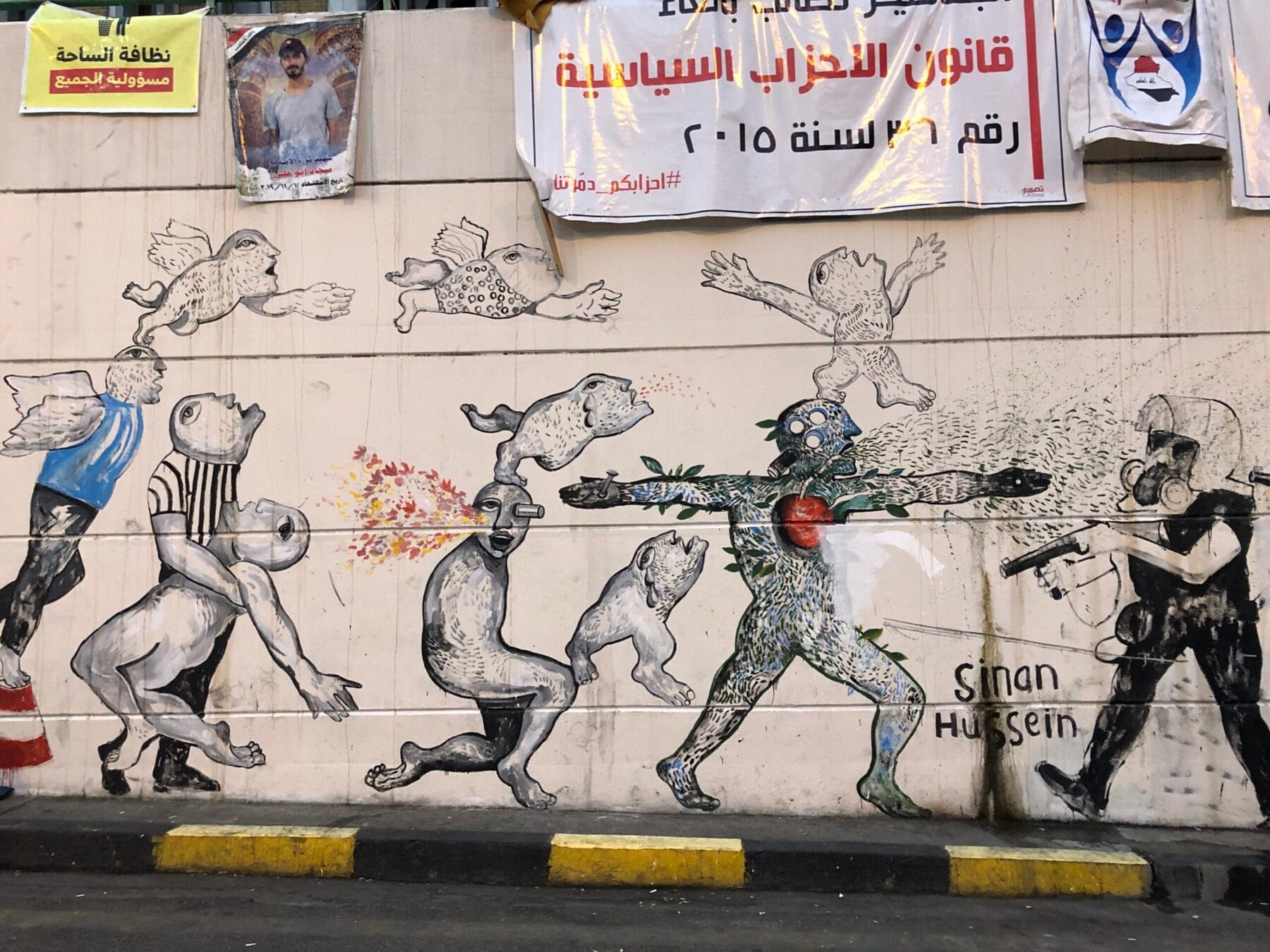
A Tishreeni mural from Tahrir Square, Baghdad. Photograph by author.
The reasons why are well known to observers: anger at the looting of the state by the political classes and their affiliates, anger at widespread economic and political disenfranchisement, anger at the Iraqi state’s subservience to foreign interests, anger at the failures of public services and state institutions and anger at having to suffer seemingly inescapable poverty in what on paper should be a rich country. Beginning in 2015, these grievances, rather than identity based or sect-specific grievances, became the primary basis for protest mobilization.[\[1\]](#%5Fedn1) With the exception of 2011, protests prior to 2015 had often had a basis in identity politics [as was the case](https://foreignpolicy.com/2013/01/07/can-a-sunni-spring-turn-into-an-iraqi-spring/) with the mass mobilizations in Sunni-majority provinces in 2012–2013.
The most significant protest outbursts since 2015 have been in Shia majority parts of Iraq. Other parts of Iraq have followed different protest cycles. Protests in the Kurdistan Region of Iraq have been chiefly concerned with the failings of the Kurdistan Regional Government and have faced severe [crackdowns](https://www.hrw.org/news/2022/08/28/kurdistan-region-iraq-arrests-deter-protest) by regional security forces.[\[2\]](#%5Fedn2) There have been sporadic protests in Sunni areas, including a few symbolic demonstrations of solidarity with Tishreen in 2019.[\[3\]](#%5Fedn3) But a combination of intimidation, fatigue and, for some, a view that Tishreen is an intra-Shia affair, restricted the 2019 protests to Shia-majority areas of Iraq, thereby preventing the Shia political classes—the dominant actor in Iraqi politics—from playing the sectarian card to shore up the political system. This tactic, which was used during the protests of 2012–2013, is one employed by regimes across the region when confronted by protests that are susceptible to sectarian othering as was vividly demonstrated by regime responses to the uprisings of 2011 in Syria, Bahrain and Saudi Arabia.
A Tishreeni mural from Tahrir Square, Baghdad. Photograph by author.
As the cumulative result of protest activism since 2015 (if not 2011), what emerged in 2019 was unprecedented in scale. In addition to their size and longevity, the Tishreen protests crossed ideological lines and transcended boundaries of class, age, profession and gender. Though the bulk of the protesters were young working-class Shia men, broadly reflecting the demography of the regions involved, women’s groups, student activists, non-Shias and a variety of age groups demonstrated alongside them. In that sense, these protests happened to be Shia-majority rather than being sect-coded Shia protests. Indeed, the protests embodied an explicit rejection of the system in its entirety and particularly of ethno-sectarian politics and foreign interference. The result was a remarkable, and in some cases beautiful, articulation of the ideals that previous protests had championed and that Tishreen perfected.
The protests of 2019 achieved some victories. The government, led by Prime Minister Adil Abd al-Mahdi, was forced to resign and a new election law drafted. The law, and in particular its expansion of electoral constituencies, helped diminish the electoral fortunes of many established political actors, particularly the Iran-affiliated wing of the Shia political establishment. The new law also provided some modest electoral openings in the October 2021 elections for first-time candidates, including some affiliated with the protest movement.
## **Protest after Tishreen—Between Appropriation and Memorialization**
Another of Tishreen’s successes was its creation of a new protest culture. But the ubiquity of protest has blunted its effect, sowing doubt in public opinion as to which protests are genuine and which are orchestrated by political elites for their own ends or as a show of force. For example, in December 2022 protests broke out in the southern city of Nasiriyah over the imprisonment of an activist, resulting in two deaths. In the aftermath, accusations quickly arose online and in Iraqi media that the protests were staged for private gain. Specifically, it was alleged that people with no relation to Tishreen had taken to the streets pretending to be Tishreenis who had been wounded in 2019 in order to claim government compensation. Others [claimed](https://twitter.com/3eGbAeByX4hxd1b/status/1600750054121574400) that provocateurs had been paid by [political factions](https://twitter.com/alsharqiyatv/status/1601144895598624770) to escalate unrest during the protests.
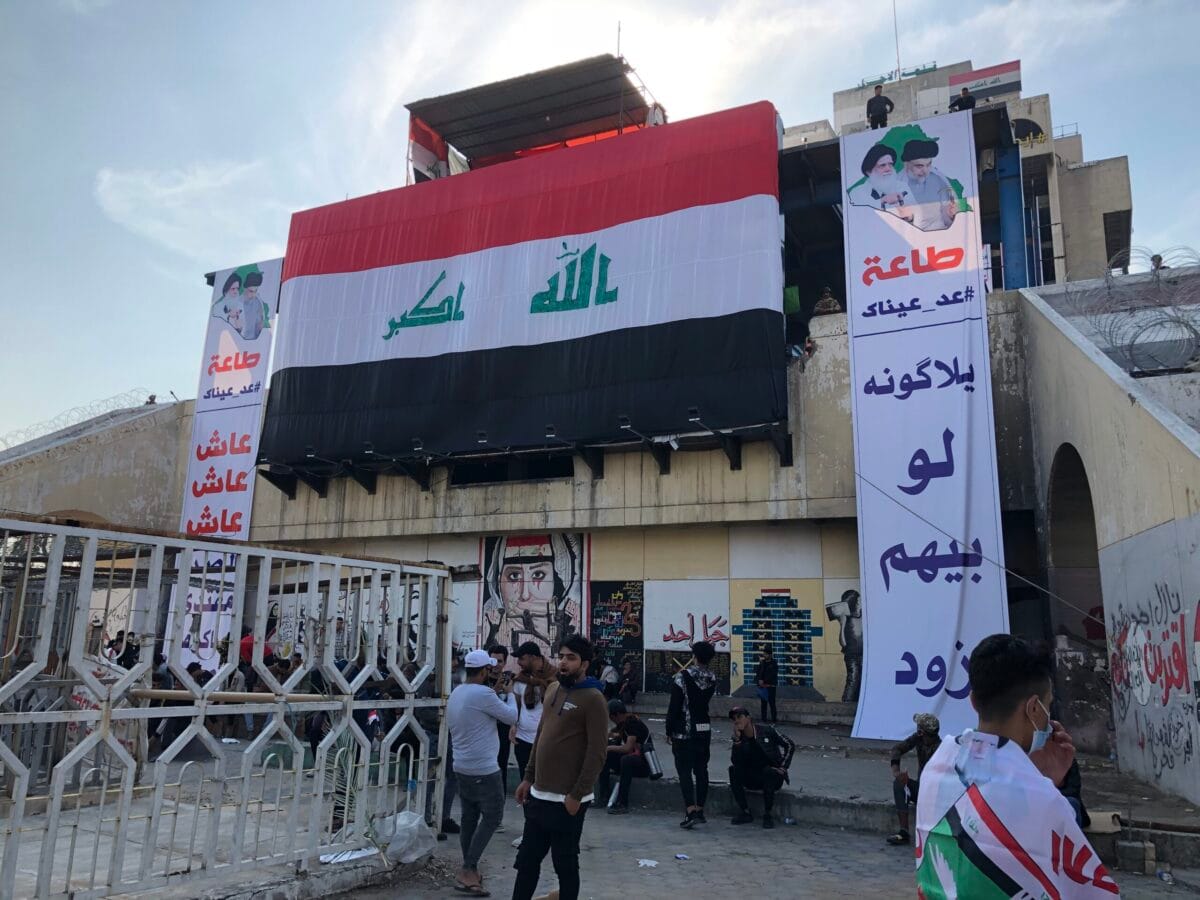
The November 2020 Sadrist demonstration at the Turkish restaurant. Photograph by the author.
The fact that so many now claim to speak in the name of Tishreen complicates Iraqi public opinion toward protest activism. This problem is compounded by the political classes’ appropriation of protest culture. Members of the political elite mobilize supporters or simply use rent-a-mobs to undermine their rivals and to mount shows of force. Long a tactic of the Sadrists who routinely mobilized their unparalleled political base to assert their will, in recent years this practice has been employed by other political factions including the Sadrists’ rivals.
For example, since 2019, political actors aligned with Iran have repeatedly staged demonstrations of their own. They did so in 2020 after the assassinations of Qasim Suleimani, the Iranian Quds Force commander, and Abu Mahdi al-Muhandis, the Deputy Chief of the Popular Mobilization Units (PMU—the umbrella organization of parastatal units led by Iran-leaning political actors). In 2021 they protested again to challenge unfavorable election results, and the assembled protesters spoke in language similar to that of Tishreen: reclaiming stolen rights, honoring martyred protesters and railing at the political system. Similarly, in the summer of 2022, Tishreeni symbolism was on display at Sadrist protests against rival Shia actors as the two sides fought over the government formation process. Pictures were held up of Safaa Al Saray, a young activist whose image turned into a Tishreeni icon after he was killed by security forces in October 2019.
Safaa Al Saray
The blurring of the distinction between elite-driven and popular protest has proven highly effective for political actors wishing to penetrate protest movements and sow doubts about their credibility. It was a tactic witnessed early on in Tishreen. As one former protest activist put it in an interview, the Tishreen protests had three types of protester: There were, in his eyes, the “genuine” Tishreen protesters, people who were not getting paid to protest and had no ulterior motives; the political fronts established by the ruling political parties and embedded in protest sites to monitor and distort the course of events; and the opportunists—protesters who offered their services to the highest bidder. This proliferation of protester types blunts the efficacy of protest as a vehicle for effecting meaningful change.
In many ways, the Tishreen protesters have become victims of their own renown. The immense symbolic significance generated in 2019 has often been counterproductive thereafter, with protest activism at times prioritizing memorialization over the development of political action. This feature has been particularly evident at the annual commemorations of Tishreen and in the anchoring of much oppositional discourse in the events of October 2019\. Memorialization is a natural concomitant to events such as Tishreen especially given the lives that were lost, but a fixation on memorialization can arguably serve to freeze a movement in a hallowed moment, preventing forward momentum. Put another way, does memorialization in and of its own pose a challenge to the system? Unless it inspires further action—new protest repertoires, new forms of organization and the like—memorialization will remain an act of symbolic and emotional significance with little political potential. Iraqi history is replete with momentous, painful and emotionally significant events. Memorialization ensures that Tishreen is added to the dimly remembered list alongside the Amriyah massacre, the rebellions of 1991, the Battles of Fallujah or the carnage that swept through Baghdad in 2006, to name just a few examples. Alone, it promises little else.
## **The Turkish Restaurant**
The Turkish restaurant during Tishreen. Photograph by the author.
The excessive focus on memorialization also opens up circuitous debates as to the true owners of an event and encourages the appropriation of its symbols for political gain. At Tahrir Square, the epicenter of Tishreen, stands one of Baghdad’s few high-rises, a derelict 14-story building referred to by locals as the Turkish restaurant (it once housed a Turkish restaurant). At the start of Tishreen in October 2019, government surveillance and snipers (most likely from state-affiliated paramilitary groups) used the Turkish restaurant to suppress protesters. In mid-October protest activism was suspended due to a religious festival. When the protests resumed in late October, protesters were quick to occupy the Turkish restaurant to deny the government the strategic use of the building. In doing so, the protesters transformed the Turkish restaurant into an emblematic icon of Tishreen. Draped with protest banners and artwork expressing the ideals of the gathering protest movement, it effectively turned into the most visible billboard for the expression of protest sentiment.
Some of the protesters’ artwork remains on the building today, but for the most part it has returned to being a nondescript part of Baghdad’s drab skyline. It is currently occupied by official and Sadrist security forces to prevent it from reverting to a protest site in the future. The building has also become part of the contested symbolic landscape of Baghdad’s urban space. Political elites have sought to enlist the symbolic significance that it acquired in 2019 in their rivalries with one another and to assert their own power. For example, in November 2020, shortly after the final clearing of protesters from Tahrir Square, followers of Muqtada al-Sadr were [mobilized](https://www.aljazeera.com/news/2020/11/27/tens-of-thousands-of-sadr-supporters-rally-in-baghdad) by their leader to assert Sadrist dominance in protest squares formerly affiliated with Tishreen. In doing so, and true to the precedent set by Tishreen, Sadrists draped the Turkish restaurant with giant banners displaying their own iconography (see photo in previous section). By helping to evict the protesters and by appropriating the Turkish restaurant in this manner, the Sadrists were signaling their street power and attempting to claim ownership of mass mobilization.
Hashd commemoration in Tahrir Square of the first anniversary of the assassination of Abu Mahdi al Muhandis and Qasim Suleimani. January 2021\. Khalid Al-Mousily/Reuters
In another example of the appropriation of Tishreen’s protest repertoires by other political actors, including Tishreen’s adversaries, in January 2021 the PMU used the Turkish restaurant to commemorate the one-year anniversary of the assassination of Abu Mahdi al-Muhandis and Qasim Suleimani. The building’s 14 stories were covered, in Tishreeni fashion, with images of Muhandis, Suleimani and other fallen figures alongside a number of Iraqi flags.
The former Prime Minister of Iraq, Mustafa al-Kadhimi also sought to enlist the symbolic value of the Turkish restaurant and of Tishreen itself. In mid-2021 the ever-changing facade of the Turkish restaurant was adorned with a billboard announcing the forthcoming transformation of the building into the Tishreen Museum, “with the support and sponsorship of the Prime Minister Mustafa al-Kadhimi.” The message was one of solidarity and sympathy with Tishreen, an attempt by the Kadhimi government to articulate and draw legitimacy from the now discredited notion that it was a product of the 2019 protests.
Banner on the Turkish restaurant announcing the forthcoming Tishreen Museum. Photograph by the author.
The Tishreen Museum announcement was met with objections from protest activists and their affiliates. One organization affiliated with Tishreen, al-Bayt al-Watani, protested that, “the demands of the political uprising and of the people have not been fulfilled, and it is too early to speak of establishing a museum to eternalize Tishreen because Tishreen has not ended.”[\[4\]](#%5Fedn4)
The museum never saw the light of day and the banner was eventually removed. The [official reason](https://jummar.media/1749) given for the project’s abandonment was that the building is the subject of ongoing legal proceedings between the Baghdad Mayoralty and private investors and that nothing can be done with it until the matter is settled. But its appropriation and the backlash it generated illustrate the complications inherent to the politics of memory.
## **A State of Perpetual Protest**
For all that was impressive and admirable about the 2019 protests, there has been a tendency for supporters to overly romanticize them. The fact remains that 2019 failed to alter the fundamentals of the Iraqi political system. Indeed, it is these fundamentals that allowed the system to weather the storm of 2019\. To understand the decline of Tishreen is therefore to understand the nature of the Iraqi state.
The destruction of the Iraqi state, beginning with the sanctions regime in 1990 and culminating with the invasion of 2003, was not followed by a coherent state building process. Rather, what was billed as the new Iraq was pieced together from the detritus of the former regime. A new political elite, various political entrepreneurs and economic predators, in addition to foreign interests, grafted themselves onto the broken structures of the Baath-era state. What emerged was a hybrid entity riddled with contradictions and governed by an oligarchy of formal and informal actors who collectively make up the state. The visage of the Weberian state—ministries, state institutions and so forth—conceals a reality of political penetration and capture of state institutions by the principal powerbrokers of Iraq. The relations of power and vested interests that underpin the system make it incapable of reforming itself. It is this reality that the promise of the protests of 2019 crashed against. The system’s ostensible tools for reform—its judiciary, its institutions and its bureaucracy—are subject to the same logic and to the same relations of power that the protesters were targeting.
> **The relations of power and vested interests that underpin the system make it incapable of reforming itself. It is this reality that the promise of the protests of 2019 crashed against.**
The lack of meaningful change following 2019 showed that in the face of mass mobilization, the political system’s individual sources of weakness can be collectively a source of strength. Its oil-dependent rentier economy means that a critical mass of Iraqis are dependent on the system and therefore tolerant of it. That power is diffused through multiple patronage networks amplifies this dependence and makes revolutionary change all the more difficult: with no leading party to overthrow, no king to dethrone, no statue of Dear Leader to topple. Moreover, the elite collusion that underpins this diffusion of power naturally works to the system’s advantage. There is no formal parliamentary opposition and the political classes’ desire to maintain the empires they have built with state resources and through state institutions—the need for self-preservation—outweighs their incessant internecine squabbles.
Beyond elite networks, the flaws in Iraq’s electoral system render the ballot box ineffective as a tool for systemic change.[\[6\]](#%5Fedn6) The weakness of Iraq’s institutions, its broken sovereignty and the weakness of the rule of law likewise work to the system’s advantage as it facilitates the use of extra-legal violence and external support. Indeed, elements of the Iranian Revolutionary Guard, including Quds Force commander Qasim Suleimani, are believed to have [helped quell](https://ultrairaq.ultrasawt.com/%D8%A8%D8%B3%D8%A8%D8%A8-%D8%BA%D8%B1%D9%81%D8%A9-%D8%B9%D9%85%D9%84%D9%8A%D8%A7%D8%AA-%D9%82%D8%AA%D9%84-%D8%A7%D9%84%D9%85%D8%AA%D8%B8%D8%A7%D9%87%D8%B1%D9%8A%D9%86-%D9%82%D9%86%D8%A7%D8%A9-%D8%A7%D9%84%D9%85%D9%8A%D8%A7%D8%AF%D9%8A%D9%86-%D8%AA%D9%86%D9%83%D8%A3-%D8%AC%D8%B1%D8%AD-%D8%A7%D9%84%D8%B9%D8%B1%D8%A7%D9%82%D9%8A%D9%8A%D9%86/%D8%A7%D9%84%D8%AA%D8%B1%D8%A7-%D8%B9%D8%B1%D8%A7%D9%82/%D8%B1%D8%A7%D8%B5%D8%AF) the uprising of 2019\. In these and other ways, the Iraqi system creates strength through weakness when confronted by outbursts of popular discontent.
As predicted by many in 2019, the system was likely to endure and protest was likely to recur. Today, protest has become a permanent fixture of the political landscape, but it is no longer unidirectional. Protests are mounted against the system, against the government of the day, in pursuit of government jobs, by political elites and by their opponents. How long this state of affairs can continue is an open question. It is fashionable to declare that iniquitous contexts are unsustainable. Yet the post-2003 system has repeatedly demonstrated its resilience. Until the sources of that resilience are exhausted or otherwise made redundant, there is no reason to assume that fundamental change is on the horizon. Venezuela and Lebanon have suffered far worse without succumbing to systemic collapse, and Iraq still has some way to go before it finds itself in a comparable situation to either. Iraq’s vast resources and the international buy-in it enjoys sustain the fundamentals of Iraq’s political economy, even if occasional alterations and improvements are achieved in certain areas, as has happened in Iraq’s security and foreign relations over the past decade.
The prospect of perpetual protest, both elite-driven and popular, alongside persistent state failure is a damning indictment of the post-2003 state-building enterprise. It recalls former Finance Minister Ali Allawi’s summation of the Iraqi state in his [lengthy resignation letter](https://www.merip.org/content/files/media/arcella%5Ffiles/1660672630695%5F20220816192053.pdf) of 2022\. He describes a state that exists in form but not in substance, one that is capable of recreating itself despite its numerous contradictions. It is these contradictions, underpinning the hybridity, the opacity and the dysfunction of the system, that paradoxically lend it resilience:
> [\[7\]](#%5Fedn7)
\[**Fanar Haddad** is assistant professor of Arabic Studies at the University of Copenhagen.\]
> **Read the** [**previous**](https://merip.org/2023/04/iraqs-cultural-heritage-between-2003-and-2023) **article.**
> **Read the** [**next**](https://merip.org/2023/04/iraqi-womens-activism-20-years-after-the-us-invasion) **article.**
**This article appears in** [**MER issue 306**](https://merip.org/magazine/306) **"The State of Iraq–20 Years After the Invasion."**
---
### **Endnotes**
[\[1\]](#%5Fednref1) Faleh A. Jabar, “The Iraqi Protest Movement: From Identity Politics to Issue Politics,” *LSE Middle East Centre papers series* 25, 2018.
[\[2\]](#%5Fednref2) Murat Sofuoglu, “Why protests are raging across Iraq’s Kurdish region,” *TRT World*, 14 December, 2020,
[\[3\]](#%5Fednref3) Balsam Mustafa, “All About Iraq: Re-Modifying Older Slogans and Chants in Tishreen \[October\] Protests,” *Journal of Asian and African Studies*, https://journals.sagepub.com/doi/10.1177/00219096211069644.
[\[4\]](#%5Fednref4) Shahad Musa, “Mathaf Tishreen, mashru’ tawthiq intifadha intaha bi lafita mutahari’ah,” *Jummar*, 01 October 2022, https://jummar.media/1749 .
[\[5\]](#%5Fednref5) Ibid.
[\[6\]](#%5Fednref6) Victoria Stewart-Jolley, “Iraq’s Electoral System,” *Chatham House*, Middle East and North Africa Programme, October 2021.
[\[7\]](#%5Fednref7) Ali Allawi’s Resignation Letter is available at *Shafaq* ( [1660672630695()20220816192053.pdf (shafaq.com)](https://www.merip.org/content/files/media/arcella%5Ffiles/1660672630695%5F20220816192053.pdf)
### Interview—The Past, Present and Future of Iraq’s Cultural Heritage
URL: https://www.merip.org/2023/04/iraqs-cultural-heritage-between-2003-and-2023/
Last updated: 2026-02-02T15:03:05.000Z
*March 2023 marked the 20-year anniversary of the US invasion and occupation of Iraq. The war, violence and reconstruction efforts that followed have had an impact on Iraq’s tangible and intangible cultural heritage. Following the collapse of the government, looting occurred at an unprecedented scale. The most well-publicized instance was the looting of the national museum of Iraq (founded one hundred years ago, in March of 1923, as a single room in a government building housing artifacts curated by the British Orientalist Gertrude Bell). Over a period of 36 hours in April of 2003, 15,000 artifacts were stolen from the museum. Meanwhile, displacement and violence following the expansion of ISIS in 2014 led not only to the destruction of heritage sites but to the targeting of minority cultures. Hannah Parsons-Morgan, a PhD candidate in archaeology at the University of Exeter interviewed archaeologists Mark Altaweel at University College London and Jaafar Jotheri at the University of Al-Qadisiyah. Parsons-Morgan spoke with Altaweel on March 16, 2023\. Jotheri subsequently contributed to their conversation over email. Their conversation—which explores the crises and opportunities of Iraq’s cultural heritage since 2003—has been edited for length and clarity. This interview is also available in* [*Arabic*](https://jummar.media/3399) *as part of a collaboration between* MER*and the independent Iraqi media initiative* Jummar*.*
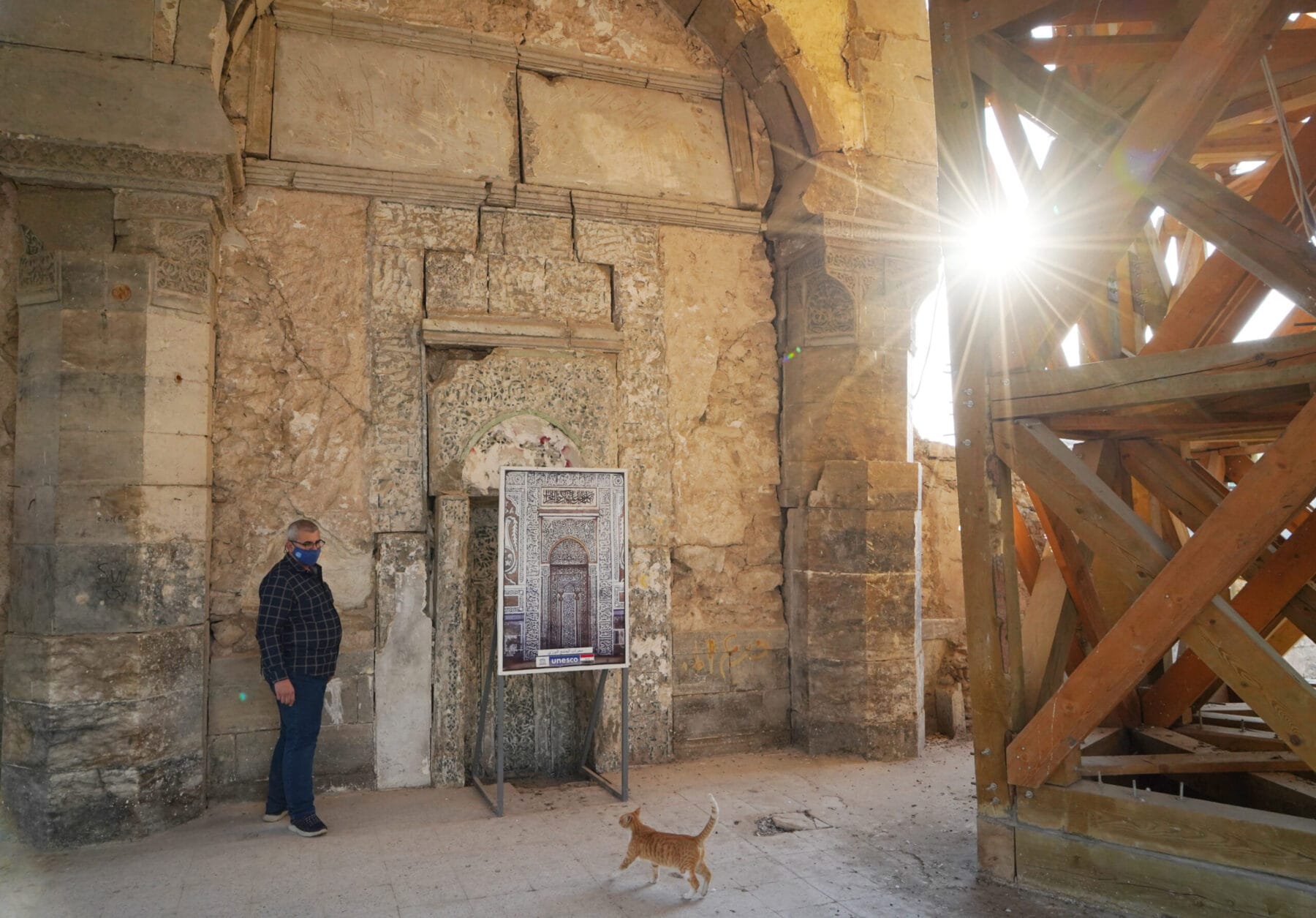
In the complex of the Great Mosque of al-Nuri and al-Habda Minaret, destroyed by ISIS in 2017\. An earlier prayer hall and ablution rooms, dating to the 12th century, were discovered during the preparations for reconstruction. Mosul, Iraq, 2022\. Ismael Adnan Yaqoob/Anadolu Agency via Getty Images
**Hannah Parsons-Morgan:** To begin, can you describe the immediate impact on Iraq’s cultural heritage of the US invasion of Iraq in 2003?
**Mark Altaweel:** The immediate impact, of course, was the looting to the national museum in Baghdad. That happened before Baghdad had fallen to American soldiers and continued for some days after. I think that was the initial immediate shock or trauma to Iraq’s cultural heritage. But, with the US invasion there was also a significant increase in looting of archaeological sites in southern Iraq, places like Umma—a site dating back to the Sumerians—as the government authority had more or less collapsed.
**Jaafar Jotheri:** Yes, it’s worth mentioning that the period between 2003 and 2008 was the worst in Iraq’s history for illegal digging. Many archaeological sites were virtually destroyed by the scale of looting. Smuggling routes became more developed through places such as Baghdad and Iraqi Kurdistan with items ending up in Turkey, Iran and the Gulf states. The vast majority of items looted from these sites have never been found, even while a few publicized items from the Iraq National Museum and illegally excavated sites (such as the famous [Warka Mask](http://edition.cnn.com/2003/WORLD/meast/09/23/sprj.nilaw.warka.mask/) or smuggled tablets purchased by Hobby Lobby) were eventually returned to Iraq.
**Hannah:** Why specifically was southern Iraq so vulnerable to looting?
**Mark:** This goes back to pre-2003\. Obviously looting didn’t begin in 2003\. In southern Iraq, especially, looting had been increasing substantially in the 1990’s as a response to poverty caused by the economic sanctions that hit this area particularly hard. So, by 2003, there were already fairly well-organized looters in that part of the country. The government had tried to limit looting in the late 1990’s through targeted excavations, which had some success. But it still was a recurring problem. With the invasion, as the economy and society effectively collapsed, this facilitated moving artifacts. These artifacts had a big market in places like the United States, as evidenced by the [Hobby Lobby scandal](https://www.npr.org/2018/06/28/623537440/hobby-lobbys-illegal-antiquities-shed-light-on-a-lost-looted-ancient-city-in-ira). There was an appetite for a lot of objects from Iraq's pre-Islamic and pre-Christian periods.
There was also some damage to other areas but relatively minor: some looting in Mosul Museum, a bit of targeted looting in places like Nimrud, but that damage was much more minor, far less extensive than in Baghdad and southern Iraq. In those areas, what we saw in the early 2000’s was a general insecurity, even before the arrival of ISIS, which caused a halt in archaeological work. Archaeologists working in Mosul felt routinely threatened and work was only done on a limited scale. Excavations and heritage conservation efforts in the provinces of Salahaddin, Nineveh, Kirkuk and Diyala were almost nonexistent or very small scale. Again, some looting occurred, but it was far less extensive.
**Hannah:** What efforts were made to prevent looting and have they been successful?
**Jaafar:** To prevent looting, in 2008 the government established a new department in the Interior Ministry called “the Archaeology Protection Forces” in each province, which began recruiting Iraqi archaeologists to serve as “commanders.” At the same time, this was a period when the internet was becoming more accessible, and local community members grew more engaged in Iraq’s cultural history through social media, which aided in efforts for its protection. Religious authorities in Najaf and Karbala also became engaged with safeguarding and raising awareness about the importance of Iraq’s wider heritage. Leaders like Ayatollah Ali al-Sistani have issued fatwas forbidding the smuggling of artifacts. Local and international conferences and workshops have even been organized in Najaf and Karbala around the themes of heritage. For example, the first [International Conference for the Enhancement of the Archaeological Heritage in Iraq](https://site.unibo.it/eduu/en/meetings/iceahi-1st-international-conference-on-the-enhancement-of-the-archaeological-heritage-in-iraq) (ICEAHI) was held in Kufa in 2018\. All of this has had the effect of slowing looting in southern Iraq, although it still persists at a reduced level.
**Hannah:** What about the looting that happened with the emergence of ISIS in Iraq, particularly following 2014?
**Mark:** What happened in 2014 was very different. By then looting in the south had diminished substantially. With the conquest of Mosul, ISIS basically took the practice of organized looting they had been doing in Syria and more or less applied it to Iraq. We saw organized looting in a few key places, like Nineveh, but also organized destruction for propaganda purposes. This included the destruction of the Prophet Jonah Mosque, believed to be the burial site of Jonah, which had been revered not only by Muslims but also Christians and Jews. Other sites destroyed include the Mausoleum of Imam Awn al-Din, a 13th century Shia shrine that had survived the Mongol sack of Mosul and Saint Elijah's Monastery, a 6th century Christian monastery that was one of Iraq’s oldest Christian structures. Yezidi sites were destroyed, and Iraq’s ancient heritage was also targeted, again, for propaganda videos that could circulate on social media and grab headlines. But there was also targeted looting to sell objects to Western markets (buyers in Europe and the United States), which was a means to finance their operations.
> **a key goal for ISIS was to use looted antiquities to finance its operations. After oil smuggling, it’s possible the smuggling of cultural property was the second highest revenue generator for the group.**
**Jaafar:** Although the destruction is what grabbed headlines, as Mark said, a key goal for ISIS was to use looted antiquities to finance its operations. After oil smuggling, it’s possible the smuggling of cultural property was the second highest revenue generator for the group. By some estimates, it amounted to [billions of dollars](https://www.govinfo.gov/content/pkg/CHRG-114hhrg23891/html/CHRG-114hhrg23891.htm) in generated revenue. We don’t know the true extent of sales of cultural objects, but certainly cultural property was a cornerstone of the ISIS-supporting economy.
**Hannah:** Can you describe what’s been done subsequently to preserve the cultural heritage in these particular regions?
**Mark:** There's actually a lot of work now in the area once ruled by ISIS, which is being done by various aid agencies from UNESCO to smaller agencies. A team from the University of Pennsylvania, sponsored by the US government, is working inside of Nimrud. In Mosul, there has been rebuilding of some of the old churches and mosques funded again largely from international donors. I think there's been neglect in Yezidi heritage and reconstruction in northern Iraq, particularly after ISIS. Even compared to other minorities in Iraq, Yezidi heritage preservation has very little attention from the outside compared to Christian groups who might have more connections, not only to a diaspora, but also to external funding sources. But I think in some ways the current threat is potentially more to the intangible heritage (languages, cultural memory, communal identity) because a lot of the minorities that were targeted and displaced do not necessarily feel safe enough to return in mass.
> **Through this project the more intangible heritage becomes a way to preserve the tangible. People in Mosul still talk about meeting at this bridge even though it no longer exists.**
**Hannah:** Speaking of intangible cultural heritage, one of my colleagues, Bryar Bajalan, here at Exeter has worked on [Mosul Lives](http://www.kashkul.com/#/Projects), a project focused on recording the oral history of Mosul, particularly daily life. He recalls hearing about how people, including lovers, used to meet under one specific bridge, which was blown up by ISIS. Through language the bridge remains in the city’s consciousness. The more intangible heritage becomes a way to preserve the tangible. People in Mosul still talk about meeting at this bridge even though it no longer physically exists. Other projects elsewhere are working on similar kinds of intangible heritage. Can you speak about how archaeology addresses or works with both the tangible and intangible? Is there a desire for that in Iraq?
**Mark:** I think there is. I noticed on my last trip to Mosul in 2022 there's a real hunger by people to understand and preserve their heritage in part provoked by the traumas of ISIS. There is something to be said for trying to bring in the sort of recent trauma to Iraq’s intangible heritage to the tangible. One example that speaks to this: The University of Heidelberg was asked by the Iraqi antiquities authority to excavate ruins dating back to the Assyrian empire, which were found under the Prophet Jonah Mosque—the biblical site that was blasted by ISIS, who then dug tunnels underneath. When the mosque is rebuilt, they are hoping to also preserve the ancient items that they had found because of the destruction. Basically, they’re trying to merge this reconstruction with the opportunity to learn something about the deeper past as a way to potentially bring the population together.
**Jaafar:** It’s also worth mentioning when speaking about intangible heritage that some types of intangible heritage have thrived after 2003 while other types have declined. The reason behind that is that when Iraq was under economic sanctions (1990–2003), people depended on the local resources and crafts. In 2003, when the Iraqi markets opened up and started filling with Chinese, Turkish, Iranian and Syrian products, local Iraqi products lost out to competition with the foreign products. As a result, the skills to produce traditional crafts have declined rapidly since 2003\. Some examples are the traditional boatbuilding, textile of men’s *Abaya* and women’s accessories, goldsmith, horse saddles, coffee preparation, the production of reed oboes and agricultural and farming tools. However, oral traditions, performing arts, social practices, rituals and festive events have thrived as restrictions that existed preceding 2003 lifted.
**Hannah:** One of this *MER* issue’s editors raised the following point, which I want to put to you, Mark: There’s a trope that certain groups like Assyrians and Yezidis have been more supported by the west, one that has led to their targeting. At the same time, external reconstruction funds do not always meet local needs as conveyed by local community organizations and their counterparts in the diaspora. For example, many Yezidis and Assyrians might note the emphasis on rebuilding churches has overshadowed other needs of local populations. Do you see this playing out?
**Mark:** Yes, possibly. There is a lot of general poverty and lack of opportunity, which is made worse by corruption. Perhaps providing for more general opportunities for work could help all of the population. There should be assistance to everyone so envy and strife does not become a potential problem.
**Hannah:** Speaking of reconstruction, Mark, you've spoken before about a “renaissance” in cultural heritage in Iraq's Kurdish regions. Can you speak more about this and why specifically in this region?
**Mark:** I think a combination of factors contributed to this. The Kurdish region of Iraq was an area that hadn't been explored very much, especially by international archaeologists as it was kind of a no-go zone during the Saddam years. Particularly around 2009–2010, foreign archaeologists started to come to the Kurdish region. Then the war in Syria began in 2011, and this indirectly benefited the Kurdish region in terms of archaeology because a lot of archaeologists who couldn't work in Syria instead went to the Kurdish region. Now the entire country has become safer, but the Kurdish region was relatively safe at the time, and corruption was also relatively limited unlike in other parts of Iraq; the biggest project was the Erbil Citadel. Since 2014, however, the region has suffered from a major financial crisis and increasing corruption, which has limited local Kurdish research and work.
**Hannah:** In 2022, the [Chatham House Report on Cultural Predation](https://www.chathamhouse.org/2022/03/cultural-heritage-predation-iraq) suggested that the *muhasasa* system has been a key factor in cultural heritage issues. They write that due to this ethno-sectarian system, “income and other resources derived from cultural heritage increasingly accrue not to the Iraqi state but to subnational institutions that actively promote ethno-nationalism, sectarianism and religious objectives.” How do you see this playing out in archaeology?
**Mark:** The main problems I see in terms of predation is that you have corruption, which is pervasive at multiple scales following 2003\. For example, things might not get done at the ministry levels without some bribe effectively, or development is happening without permissions. Iraq’s antiquities laws that are already in place are actually pretty good. But unfortunately, they're often not followed. All of this means that people are doing things in regards to heritage that may not be addressing the needs of certain communities, for one. Insofar as the political system contributes to corruption, I think that is one of the biggest threats. For instance, I was hearing a recent story from Samarra. A lot of houses were being built on the site, which is completely illegal, but there was not much anyone could do because a local government official was corrupt. It creates a situation where the authorities who are interested in protecting the heritage are not able to do their job.
Meanwhile, it’s worth mentioning, you have regions that are woefully neglected particularly south of Mosul and north of Baghdad for reasons related to mistrust and belief that everyone there had belonged to ISIS. That area in general is the most neglected part of Iraq. Over the past 20 years, it has also been among the most violent areas. There's not much activity, very little archaeology, very little heritage building and there's very little news about it. Even in the central government there's almost no mention or funding to the area. I only know of one project effectively working in that area.
**Jaafar:** I think the system mismanaged all the sectors in Iraq after 2003, not only the archaeology sector. For example, look at the mismanagement in water resources, agriculture, manufacturers, housing and education. As for the ancient archaeological sites, they cannot be considered based on ethno-nationalism. In other words, the archaeological sites have been treated as national assets (belonging to the central government in Baghdad) rather than regional or local assets.
**Hannah:** We’ve obviously talked a lot about “manmade” issues, what about the impact of environmental or climatic factors on Iraq’s cultural heritage?
**Mark:** Climate change is also something that's increasingly a threat. Iraq is one of the most vulnerable countries to climate change in the world. Rivers are drying up. Places that were green not long ago, when I was there recently, are now desert. These are massive threats both in terms of buildings being affected but also to people being displaced and the landscape changing, which presents new threats to the tangible and intangible heritage.
> **the impact of climate change on the natural and cultural heritage of the Iraqi southern desert serves as an essential baseline of historical climate change in the region against which to assess the viability of a more climate-resilient future.**
**Jaafar:** Yes, the impact of climate change on the natural and cultural heritage of the Iraqi southern desert serves as an essential baseline of historical climate change in the region against which to assess the viability of a more climate-resilient future. According to the latest figures based on my own fieldwork, more than five lakes, 20 oases and 100 springs have dried up, and the lives of people, animals and wild plants have changed. For example, 30 wild plants have disappeared from the desert during the last 20 years, and about 16 wild animals have also vanished. Moreover, the list of endangered species in Iraq is increasing. Climate change thus threatens Iraqi tangible heritage in the southern desert and the intangible heritage that wraps around it.
**Hannah:** Do you think that efforts to mitigate climate change can work hand-in-hand with efforts to preserve cultural heritage?
**Mark:** I think learning from the past can be quite effective as a lot of Iraq's built heritage, historically, was constructed around climate. For instance, ancient irrigation practices in Iraq included the *Qanat* systems—these underground irrigation systems, which helped to preserve water by preventing evaporation. Much of Iraq’s irrigation today is just in ditches above the surface. Why not try to use underground systems? Another example is in the construction of homes. Mudbrick homes may seem like a bad idea, but actually this material prevents a house from getting too hot in the summertime. We can learn from the traditional heritage in architecture in Iraq, using technology that works together with the environment.
**Hannah:** This discussion of centering local knowledge practices recalls some of the work Jaafar is doing. Jaafar, I was reading a [blog post you did for UCL](https://blogs.ucl.ac.uk/nahrein/2021/12/08/decolonising-the-excavation-licence-in-iraq/) with recommendations of how to “decolonize” archaeology within Iraq. Can you talk more here about what you mean by decolonizing archaeology?
**Jaafar:** By decolonizing archaeology I mean that international teams should encourage local Iraqi scholars and ordinary people to celebrate and promote Iraqi heritage. Rather than selecting areas to work in based on international interests, research based on Iraqi needs should be considered and prioritized. Involving local Iraqi experts in research, training more Iraqi archaeologists/heritage specialists (including in conservation) are also critical. Iraqis have stated that conferences and exhibitions about Iraq should be held more in the country and results should be published in Arabic and other local languages and Iraqi journals. Foreign teams should also help develop local museums and promote their work with local populations as part of their wider project efforts.
**Hannah:** On that note, I wonder if we could bring everything to a close by looking at the future as all archaeologists should. What is training like for the heritage disciplines in Iraq today and what opportunities exist for the future generation?
**Jaafar:** Over the past two decades, there has been a lot of investment at the university level. Iraqi historians and archaeologists in Baghdad, Mosul, Al-Qadisiyah and Babylon universities campaigned to establish more archaeology departments and even expand their departments to become faculties. In 2008, for example, Mosul University expanded the Department of Archaeology to become a Faculty of Archaeology. Samarra and Kufa established new faculties in 2010 and 2011, respectively, while Al-Qadisiyah, ThiQar and Al-Muthanna have done similar things after 2014\. Two new scientific journals specializing in Iraqi heritage were founded: one by Mosul University and the other by Al-Qadisiyah University. Similar expansion of archaeological programs has been seen in the Kurdish region, though it has faced difficulties with funding since 2014.
**Mark:** I think investing in youth especially in a country like Iraq, which has such a young population, is critical. There's so much eagerness to know about the heritage in Iraq, in part, thanks to social media. But while there might be investment in universities, students don't find jobs easily after they graduate when they study heritage or archaeology. Increasing training opportunities is important but also increasing employment opportunities. For this, creativity is needed. For example, in the tourism sector, which in Iraq is so connected to cultural heritage, I have seen people with startups developing tourism in the marshes of Iraq or other heritage sites in central or southern Iraq. Some foreigners might think of Iraq as a no-go zone, but actually many visitors come to Iraq from Iran and Pakistan as part of Shi'i festivals like Ashura to visit religious heritage sites. There's also emerging Western tourism, particularly after Pope Francis visited Ur in 2021\. As a result of the pope’s visit, the Iraqi government launched a large project to rehabilitate Ur and provide local tourist infrastructure, and in 2021 the government also started granting visas upon arrival to most European countries, Canada and the United States. It's obviously still limited in numbers, but there are [tour groups](https://www.middleeasteye.net/discover/iraq-tourists-return-after-decades-war-pictures) now going to Iraq quite regularly.
\[**Mark Altaweel** is a professor of Near East archaeology at University College London. **Jaafar Jotheri** is an archaeology professor at the University of Al Qadisiyah in Iraq. **Hannah Parsons-Morgan** is a PhD candidate in archaeology at the University of Exeter.\]
> **Read the** [**previous**](https://merip.org/2023/04/a-note-on-the-cover-image) **article.**
> **Read the** [**next**](https://merip.org/2023/04/perpetual-protest-and-the-failure-of-the-post-2003-iraqi-state-2) **article.**
**This article appears in** [**MER issue 306**](https://merip.org/magazine/306) **"The State of Iraq–20 Years After the Invasion."**
### Issue 306 (Spring 2023) Masthead
URL: https://www.merip.org/2023/04/issue-306-spring-2023-masthead/
Last updated: 2025-07-29T13:07:24.000Z
## ***Middle East Report*, “The State of Iraq–20 Years After the Invasion,” Spring 2023, No. 306, Vol. 52 No. 1**
### **Executive Director**
**Mandy Terc** mandyterc@merip.org
### **Executive Editor**
**Katie Natanel** katienatanel@merip.org
### **Managing Editor**
**Marya Hannun** maryahannun@merip.org
### **Photo Editor**
**Michelle Woodward** mwoodward@merip.org
### **Staff Editors**
**Michael Kaplan** kaplan\_m@gwu.edu
**Alyssa Bivins** bivins@gwu.edu
### **Social Media Coordinator**
**Khelil Bouarrouj** socialmedia@merip.org
### **Board of Directors**
**Paul Silverstein(Board Chair)** *Reed College*
**Kaveh Ehsani** *DePaul University*
**Adam Hanieh** *University of Exeter*
**Vickie Langohr** *College of the Holy Cross*
**Lee O'Brien** *Retired*
**Mary Sexton** *Consultant*
**Mandy Terc** *MERIP Executive Director (ex officio)*
### **Editorial Committee**
**Lisa Hajjar (Co-chair of the Editorial Committee)** *University of California, Santa Barbara*
**Muriam Haleh Davis (Co-chair of the Editorial Committee)** *University of California, Santa Cruz*
**Nabil al-Tikriti** *University of Mary Washington*
**Ayça Alemdaroğlu** *Stanford University*
**Lori Allen** *SOAS University of London*
**Sabiha Allouche** *University of Exeter*
**Mona Atia** *George Washington University*
**Elif Babül** *Mount Holyoke College*
**Jessica Barnes** *University of South Carolina*
**Gregory Brew** *Analyst at Eurasia*
**Najib Hourani** *Michigan State University*
**Mohammad Ali Kadivar** *Boston College*
**Reinoud Leenders** *King's College London*
**Shana Marshall** *George Washington University*
**Pete Moore** *Case Western Reserve University*
**Maha Nassar** *University of Arizona*
**Curtis Ryan** *Appalachian State University*
**Jacob Mundy** *Colgate University*
**Atef Said** *University of Illinois at Chicago*
**Hesham Sallam** *Stanford University*
**Deen Sharp** *London School of Economics*
### **Format: Online**
### **ISSN 3065-744X**
### A Note on the Cover Image
URL: https://www.merip.org/2023/04/a-note-on-the-cover-image/
Last updated: 2025-07-29T13:07:23.000Z
*\[su\_dropcap style="simple" size="4"\]*T*\[/su\_dropcap\]he cover art for* MER *issue 306 is part of a collaboration with the independent Iraqi media initiative,* [Jummar](https://jummar.media/)*. The image was designed by Atef Al Jaffal, an Iraqi visual artist based in Baghdad and* Jummar’s *graphic designer. The prompt was to design a cover that speaks to the issue’s theme: the state of Iraq 20 years on from the US invasion. What does this state evoke for the artist? Al Jaffal describes the symbolism behind the image he designed, “Iraq’s Crying Child.” His text, shared below, has been translated into English and edited, slightly, for clarity:*
> طفلة العراق الباكية تُمثّل المقهورين والمقهورات في المجتمع العراقي، الذين نالت الحروب والحصار الاقتصادي والفساد السياسي منهم. جسدها، بذلك، يُمثّل العراق جغرافياً ومعنوياً الذي تشقه دموعها، كما نهري دجلة والفرات، علها تعوض الجفاف الحاصل. أما القطع الغارقة في دموعها، فتلك هي المصبوبات البرونزية الأربع عشر التي تشكل "نصب الحرية" للفنان جواد سليم، وتُمثّل كل واحدة منها فرداً وتروي قصة ومرحلة. النصب الواقع في ساحة التحرير وسط بغداد منذ 1961، يرمز لحقب سياسية وثورات وأحداث مهمة في تاريخ العراق، وكان عرضة -أسوة بشخوصه- للأخطار والتهميش الذي لاقاه العراق على مدى الأعوام، وتحديداً بعد الغزو الأميركي عام 2003 ومع الغزو أيضاً طَبَعَتِ الدبابات الامريكية آثار عجلاتها على أراضي العراق، واستخدمت هذه العربات الثقيلة تحديداً لأنها تستطيع المرور على الوحل والطين والأرض الوعرة على حد سواء، بيد أنها كانت تدهس المدنيين والملكيات العامة في طريقها. آثار العجلات ما زالت محفورة في ذاكرة أجيال ما بعد 2003، كما في تصميم طفلة العراق الباكية
Cover Image for MER issue 306 designed by Atef Al Jaffal.
## **"Iraq's Crying Child"**
Iraq’s crying child symbolizes the oppressed in Iraqi society—those who have been affected by wars, sanctions and political corruption. Her body represents Iraq geographically and metaphorically. Her tears cut through it like the Tigris and Euphrates rivers. Perhaps they can make up for the country's current drought.
Drowning in her tears are the fourteen bronze castings that comprise Baghdad’s iconic “Freedom Monument,” designed by the artist Jewad Selim (1919-1961). The monument was erected in 1961 in Tahrir Square in central Baghdad. It depicts the political eras, revolutions and significant events in the history of Iraq. Each individual casting narrates its own story and stage. Like its characters, the monument has been exposed to the dangers and marginalization that Iraq has faced over the years, particularly after the US invasion in 2003.
With the invasion, US tanks also left their tracks on the territory of Iraq. These heavy vehicles were used specifically because they are able to pass through dirt, mud and rough terrain alike. Yet, they also trampled over civilians and public property in their path. The tracks continue to be etched in the memory of generations after 2003 as they are in the design of Iraq's crying child.
**Read the [first](https://merip.org/2023/04/iraqs-cultural-heritage-between-2003-and-2023) article in[ MER issue 306](https://merip.org/magazine/306) "The State of Iraq–20 Years After the Invasion."**
### Water, Oil and Iraq’s Climate Future
URL: https://www.merip.org/2023/03/water-oil-and-iraqs-climate-future/
Last updated: 2025-11-06T22:04:20.000Z
Iraq’s ecological devastation was set in motion years before the 2003 invasion.
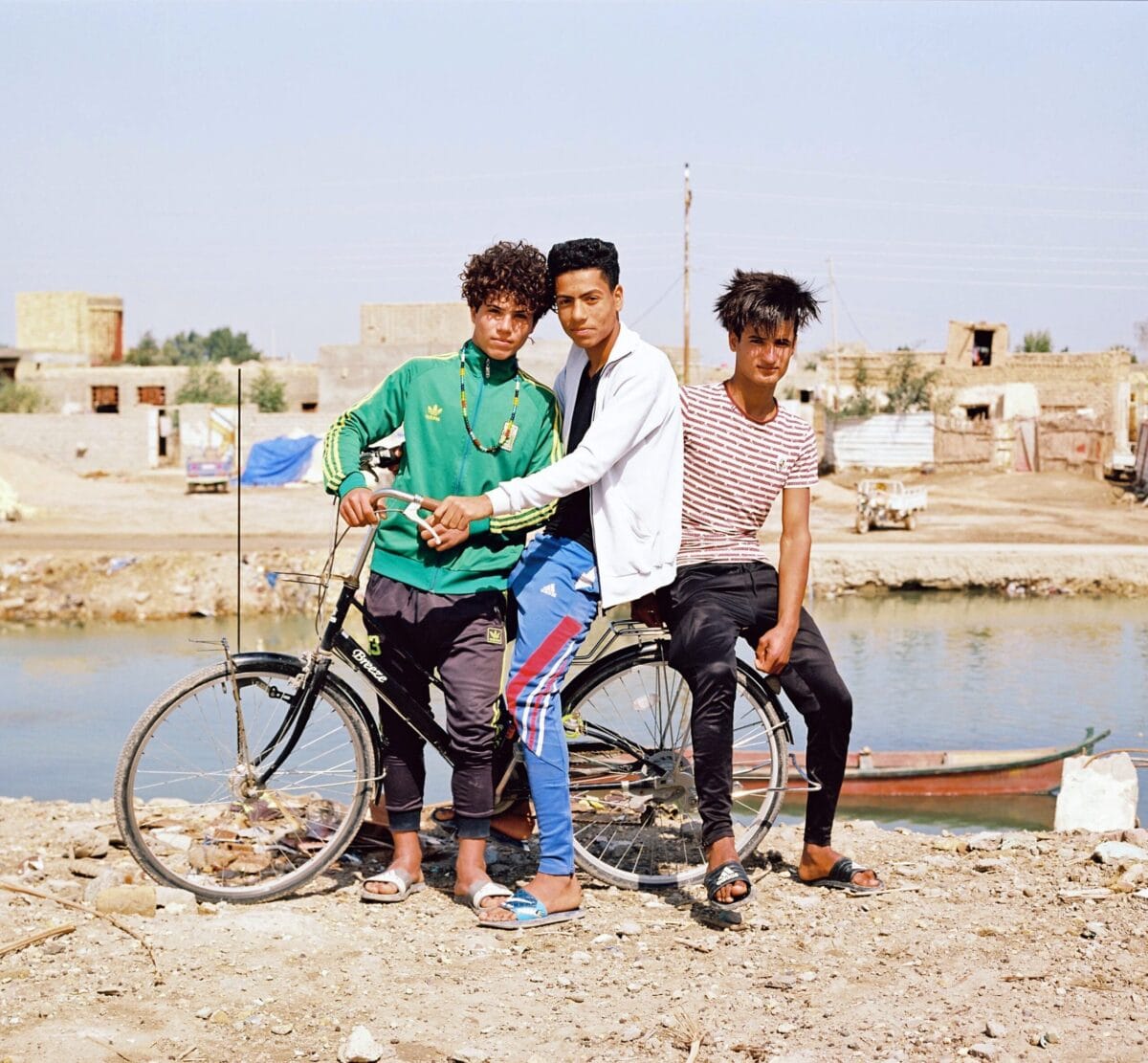
Mehdi, Abbas and Eidan hanging out after school in the town of Chibayish, near the Iraqi Marshlands, 2018\. Tamara Abdul Hadi
For 40 years, the Iraqi state has lurched from crisis to crisis as wars and domestic conflicts have devastated the country's infrastructure and institutions. The Iran-Iraq war was followed by 13 years of punishing economic sanctions, which began in the 1990s. The 2003 Anglo-US invasion of Iraq has left the state, 20 years later, in political and economic disarray.
These shocks have taken tolls on the environment by displacing water resources, eroding infrastructure that could mitigate climate damage and enabling the unfettered extraction of oil. They have rendered Iraq—a country that has always faced occasions of extreme heat and aridity—among the more vulnerable countries in the Middle East to climate change.
From drought to sand storms to chronic illnesses related to the toxic pollution emanating from oil fields in the south, it is clear that climate conditions in Iraq have noticeably worsened in recent years. This trend is especially damaging when combined with the general decline in state and institutional capacity after 2003.
Yet, the same political and social upheavals that make the climate crisis so pressing have also led to the neglect of climate research in favor of what are perceived as more immediate threats, despite the interconnectedness of these predicaments. Indeed, rather than separate issues, the state of the Iraqi government and its economic and geopolitical entanglements are the main drivers of Iraq’s climate vulnerability today, as exemplified by its two most important resources: water and oil.
## **The Rise and Fall of Iraq’s Wetlands**
Over the past two years, Iraq has experienced its driest seasons in decades, with temperatures frequently surpassing 120 degrees Fahrenheit. As temperatures continue to soar, water supplies decline, triggering one of the worst droughts in 40 years. Iraqi officials [estimate](https://www.atlanticcouncil.org/blogs/menasource/iraqs-sandstorms-are-threatening-life-in-the-fertile-crescent-its-time-the-iraqi-government-takes-a-stance/) that water reserves have decreased by half this year, due in part to changes in weather patterns but also to the action of neighboring countries, like Turkey, where several dam projects limit the water flowing from the Euphrates and Tigris rivers. For example, the operation of Turkey’s Ilisu Dam, a mile-wide [mega-construction](https://e360.yale.edu/features/turkeys-dam-building-spree-continues-at-steep-ecological-cost) on the Tigris river, has reduced Iraq’s share of the river’s water by an [estimated](https://www.arabnews.com/node/1977746) 60 percent. As a result of these declining water flows, a significant portion of Iraq’s wetlands [dried out](https://www.wired.com/story/the-mesopotamian-marshes-are-disappearing-again/) this year, [leaving behind](https://www.independent.co.uk/news/iraq-ap-turkey-saddam-hussein-ankara-b2231105.html) dead buffalo and displacing communities.
> **Also Read:**[Iraq's Water Woes—A Primer](https://www.merip.org/iraqs-water-woes/)
The same wetlands that are now disappearing were targeted by Saddam Hussein following the Iran-Iraq war and the 1991 mass uprising against his government. Hussein accused the marsh Arabs—communities dwelling in the riparian land that forms the estuary of the Tigris and Euphrates rivers—of aiding rebels fleeing the Iraqi army. In addition to bombing the area during the war, the government attempted to drain the wetlands. The ostensible reason was to convert these territories into irrigated farmland by constructing dams and levees. But canals like the Prosperity River, the Mother of Battles Canal and the Loyalty to the Leader Channel punitively limited water supply to these historical communities, draining the marshes and displacing local residents that had lived on this land for generations.
As a result of rising temperatures and severe droughts, recent years have also seen an increase in the frequency and intensity of sand and dust storms. According to the Iraqi Ministry of Environment, established after 2003, sand and dust storms [have increased](https://www.rudaw.net/english/middleeast/iraq/29052022#:~:text=Iraq's%20environment%20ministry%20in%20April,days%20per%20year%20in%202050.) from 243 to 272 days per year between 2022 and the prior decade. Over just two months of 2022, Iraq experienced ten sandstorms, compared to averages of one to two storms a year in previous decades.[\[2\]](#%5Fedn2)
> **...the combination of climate conditions and obsolete infrastructure has led to increasing desertification, which already impacts around** [**39 percent of Iraq's**](http://ft.com/content/60369043-8534-4d73-9c48-1c08288064eb) **surface area. As a result, the country loses about** [**100 square kilometers**](https://www.lemonde.fr/en/international/article/2022/05/17/in-iraq-desertification-leads-to-multiple-sandstorms%5F5983823%5F4.html) **of arable land each year.**
With climate conditions worsening over time, Iraq’s economy will suffer, especially in the agricultural sector. Food production in Iraq is based on smallholder agriculture. Farmers depend on outdated irrigation methods centered around rain-fed systems, leaving many farmers vulnerable to droughts as rainfall levels decline. In addition, the combination of climate conditions and obsolete infrastructure has led to increasing desertification, which already impacts around [39 percent of Iraq's](http://ft.com/content/60369043-8534-4d73-9c48-1c08288064eb) surface area. As a result, the country loses about [100 square kilometers](https://www.lemonde.fr/en/international/article/2022/05/17/in-iraq-desertification-leads-to-multiple-sandstorms%5F5983823%5F4.html) of arable land each year.
Desertification is [forcing](https://www.climatecentre.org/9545/cop27-through-desertification-searing-temperatures-and-dying-land-climate-crisis-intensifies-struggle-of-iraqs-farmers-says-icrc/) farmers to abandon their land and migrate to overpopulated urban centers, where they find limited employment opportunities in the bloated public sector, driving many into the illegal and informal economy.
The rise in frequency and severity of sand and dust storms has also increased long-term respiratory illnesses among the population. In 2022, according to the health ministry as many as [10,000 people](https://www.france24.com/en/live-news/20220523-iraq-sandstorm-grounds-flights-sends-1-000-to-hospitals) were hospitalized as a result of sandstorms. These numbers are likely higher on the ground, and the true magnitude of the crisis is not fully captured due to a shortage of official numbers and research.
## **Iraq’s Oil Dependency and Climate Vulnerability**
The story of Iraq’s environmental vulnerability is not just about the scarcity of water but the abundance of oil. As the main source of income and wealth for Iraq’s political elites, the oil industry has contributed to the de-prioritizing of climate issues, in general, and water infrastructure in particular.

Read this article in Arabic at Jummar. Image designed by Atef Al-Jaffal/Jummar.
Iraq’s economy depends on oil. Over the past decade, the oil sector has [accounted for](https://www.worldbank.org/en/country/iraq/overview) more than 99 percent of Iraq’s exports and 42 percent of GDP. Oil dependency increases Iraq’s climate vulnerability due in large part to gas flaring—the burning of natural gasses associated with oil extraction, which releases a highly polluting mix of carbon dioxide, methane and black soot into the environment.
The sector captures and processes only around half of the 3 million cubic feet of gas produced per day from oil extraction, making Iraq the second-largest gas flaring country after Russia. Iraq releases around 30 million tons of carbon dioxide a year, [accounting](https://www.nytimes.com/2020/07/16/world/middleeast/iraq-gas-flaring-cancer-environment.html) for 10 percent of the greenhouse gasses emitted globally due to flaring.[\[3\]](#%5Fedn3)
By failing to develop its gas capturing infrastructure, Iraq is not only contributing to global carbon emissions. Flared gas also releases toxic chemicals like benzene, contributing to the increased formation of poisonous clouds and acid rains, which seep into the ground and dissolve essential nutrients like magnesium and calcium. These nutrients are necessary for agricultural development and the maintenance of arable land. Acid rain is further responsible for releasing aluminum into the soil, limiting the growth of healthy plants. Oil-tainted water and other toxins also drain directly into natural water sources, polluting them in the process. Iraq's southern cities and towns—like Nahran Omar in the province of Basra—where most of the country's oil fields are located, are particularly vulnerable to these environmental disasters.
In Nahran Omar, around 6 percent of the population of 1,500 has either died from or currently suffers from cancer or related health complications, and most of those with health complications are under the age of 25.[\[4\]](#%5Fedn4) Thus, beyond the environmental risk, oil production and gas flaring as well as petrochemical plants and uranium from degraded weapons are all associated with a heightened risk of illnesses—such as asthma, hypertension and some cancers—especially among those who live near these oil fields.
Additionally, once the wells are built, companies infrequently hire locals to work in the fields, which means the population suffers from ecological and health consequences without access to economic benefits. According to [reporting](https://www.tareeqashaab.com/index.php/sections/economy/321-100) on the ground by *Tareek Alshaab*, oil companies are more likely to hire foreign workers. Around 100,000 foreign workers are working in the oil industry, and they are often paid higher wages than Iraqi workers.[\[5\]](#%5Fedn5)
Iraqi government officials often downplay the number of pollution-related illness clusters around the country, limiting access to accurate numbers and data.[\[6\]](#%5Fedn6) The limitation in data access is the product of both the state’s lack of capacity to develop the tools for capturing data as well as limited transparency of information when it comes to the energy sector and environmental concerns.
> **The sector captures and processes only around half of the 3 million cubic feet of gas produced per day from oil extraction, making Iraq the second-largest gas flaring country after Russia.**
Despite the harmful impact of oil dependency, the state has been unwilling or unable to address the problem. Oil’s importance as the primary source of state revenue contributes mightily to maintaining the existing political system and power players. The revenues from oil exporting are controlled by the state, and political actors who benefit from the resources they pocket through corruption and oil exports seek to maintain the political and economic system that benefits them the most.
This limited political will combines with decades of declining infrastructure and institutional capacity to prevent meaningful progress. For example, if Iraq were to successfully invest in infrastructure to capture and use flared gas, it would both minimize the climate impact and potentially power up to 3 million houses, easing the country's chronic electricity shortage. But investing in gas infrastructure would also mean Iraq weaning itself from dependence on Iran's gas for electricity generation, especially during the hot summer months. Since 2018, Iraq has been receiving US sanctions waivers to import Iranian gas. This dependence is a lifeline for Iran’s struggling economy. Thus, neither Iran nor its proxies in Iraq are interested in developing better infrastructure.
Even when efforts have been made to minimize the negative impact of oil production and gas flaring, outdated infrastructure and limited state capacity have prevented real progress. For example, Iraq’s Environment Ministry—which five years ago merged with the health ministry—has documented the harmful impact of oil dependency and gas flaring on ecological conditions and the population's well-being. The ministry has attempted to impose fines on the Basra Oil Company due to its multiple violations of gas flaring beyond the legal limits. But the state lacks the capacity to either enforce these rules or provide the necessary tools and resources to modernize oil production. Indeed, Basra Oil Company’s chief engineer [acknowledged](http://nytimes.com/2020/07/16/world/middleeast/iraq-gas-flaring-cancer-environment.html) that it was cheaper to pay the penalty than invest in new infrastructure that could process flared gas.
The Basra Oil Company is not alone. Other international oil corporations, such as British Petroleum (BP), have for decades taken advantage of loopholes in emission reporting rules to save millions of dollars while releasing deadly gases into the atmosphere. For example, since 2009, BP has been the main contractor in the Rumaila Oil Field. One of the largest oil fields in the world, it is responsible for about one third of Iraq’s total oil production. According to a [Greenpeace report](https://projects.unearthed.greenpeace.org/big-oil-iraq/), in 2021, Rumaila flared around 3.39 billion cubic meters of gas, emitting 9.5 million tons of carbon dioxide. Despite earning roughly [$358 million](https://projects.unearthed.greenpeace.org/big-oil-iraq/) of post-tax profit from this field, BP does not include Rumaila emissions in its annual emission report because it classifies the field as a "non-operated asset"—meaning the assets are operated by any person other than the company entities. But BP was the field's official operator until June 2022, when BP and PetroChina established the Basra Energy Company to take over operations, and the company remains the main point of contact. If the company were to include Rumaila in its reports, its annual emissions for 2021 would be doubled.
In 2021, the World Bank and Iraq's state-owned South Gas Company of Iraq, Shell and Mitsubishi signed a [$360 million](https://www.spglobal.com/commodityinsights/en/market-insights/latest-news/natural-gas/062921-iraq-to-receive-360-mil-world-bank-loan-to-help-expand-gas-flaring-reduction-from-south) deal to help Iraq control its gas flaring crisis in its southern fields, but minimal progress has been made. Similarly, in September 2021, Iraq agreed on a $27 billion deal with France's Total Energies. The deal would allow France to invest in Basra's oil field for 25 years and develop several infrastructure projects targeting cleaner energy production and gas flaring control, but bureaucratic obstacles and political crises—such as the [deadlock](https://www.aljazeera.com/news/2022/5/30/iraqi-deadlock-continues-with-elites-unable-to-form-government) following the 2021 elections—have [delayed](https://www.reuters.com/business/energy/exclusive-iraqs-27-bln-total-deal-stuck-over-contract-wrangling-2022-02-14/) the deal’s finalization.
## **Moving Forward**
Since 2003, Iraq has faced several crises, but environmental conditions have often been deprioritized in favor of the country’s economic and political situation. Twenty years later, the country is in a more vulnerable position on its environmental front than perhaps any time before.
Iraq's climate crisis is playing out in the drinking water, arable land and public health of those who live in Iraq. But it is also a regional and global crisis. Any effective response must consider the interconnected nature of climate issues with other social institutions, the role of civil and local communities and the need for effective geopolitical climate diplomacy. For the country to mitigate the impact of the structural weaknesses-climate change-instability nexus, Iraq must diversify its economy away from oil dependency, invest in decarbonization efforts and cleaner energy infrastructure and address the fiscal and political implications of this transition. Another important first step would be to center the interests and knowledge of local communities most impacted by climate change.
\[**Zeinab Shuker** is an assistant professor of sociology at Sam Houston State University\].
*This article is available in* [*Arabic*](https://jummar.media/3145) *as part of a* *collaboration between* MER *and the independent Iraqi media initiative* Jummar.
---
### Endnotes
[\[1\]](#%5Fednref1) World Bank Report: “[Iraq Country Climate and Development Report](https://openknowledge.worldbank.org/handle/10986/38250),” (2022), p. xi.
[\[2\]](#%5Fednref2) Muhammad Baqir Muhyedeen, “[Iraq's sandstorms are threatening life in the Fertile Crescent. It's time the Iraqi government takes a stance](https://www.atlanticcouncil.org/blogs/menasource/iraqs-sandstorms-are-threatening-life-in-the-fertile-crescent-its-time-the-iraqi-government-takes-a-stance/)," The Atlantic Council, June 23, 2022.
[\[3\]](#%5Fednref3) Alissa J. Rubin and Clifford Krauss, “[Southern Iraq’s Toxic Twilight: Burning Gas and Poisoning the Air](https://www.nytimes.com/2020/07/16/world/middleeast/iraq-gas-flaring-cancer-environment.html),” *The New York Times*, July 16, 2020.
[\[4\]](#%5Fednref4) Ibid.
[\[5\]](#%5Fednref5) Abdullah Latif, “[100,000 foreigners work in the oil fields outside of regulations](https://www.tareeqashaab.com/index.php/sections/economy/321-100),” *Tareek Alshaab,* January 24, 2021.
[\[6\]](#%5Fednref6) This information is based on author interviews.
### Perpetual Protest and the Failure of the post-2003 Iraqi State
URL: https://www.merip.org/2023/03/perpetual-protest-and-the-failure-of-the-post-2003-iraqi-state/
Last updated: 2025-11-06T22:03:36.000Z
In October of 2019, Iraq witnessed what was likely the largest popular protest in its modern history. Two relatively minor events—a heavy-handed response to a small protest of university graduates and the demotion of a popular general—triggered long-standing discontent at the political system that had periodically led to mass protest in the past.
Image of a protester and the Turkish restaurant building in Tahrir Square, Baghdad, designed by Atef Al-Jaffal/Jummar.
Tens of thousands of Iraqis took to the streets in the capital and across the provinces of the south. Protesters occupied public squares for six months, in some cases longer. What became known as the *Tishreen* (Arabic for October) protests were widely celebrated in Iraq and abroad for their tenacity, their commitment to peaceful means, their espousal of civic nationalism and their rejection of the political system and ethno-sectarian politics. The protests were also mourned, not just for ultimately failing to alter the fundamentals of the political system, but for the 600–800 young Iraqis who lost their lives in the ensuing [government crackdown](https://www.amnesty.org/en/latest/news/2020/01/iraq-protest-death-toll-surges-as-security-forces-resume-brutal-repression/), particularly between October and January.
Since 2019, protest culture has become ubiquitous in Iraq, especially in Baghdad and the other Shia-majority areas of the country that were the site of the Tishreen protests. Demonstrations are regularly organized for a variety of reasons. Some seek to keep the spirit of 2019 alive. Others are for government jobs. Some protests are responses to specific political or economic issues (the devaluation of the dinar, gender violence, the arrest of political activists or the burning of the Quran in Sweden—to name a few recent examples). Others are shows of force organized by political elites. The last in particular has become more common since 2019, with the political classes appropriating protest culture in order to blunt the effect of anti-systemic protest activism and as a tactic in intra-elite competition.
The scale of the protests of 2019 narrates the failure, in Iraq, to build a functioning and representative state from the wreckage of 2003\. Yet the survival of the system and the deflation of what, at the time, seemed like unstoppable popular momentum reflects the resilience of the political system that has emerged over the course of the last two decades.
## **The Tishreen Protests**
Since 2011, and more so since 2015, mass protests in Iraq have been a near yearly occurrence.

A Tishreeni mural from Tahrir Square, Baghdad. Photograph by author.
The reasons why are well known to observers: anger at the looting of the state by the political classes and their affiliates, anger at widespread economic and political disenfranchisement, anger at the Iraqi state’s subservience to foreign interests, anger at the failures of public services and state institutions and anger at having to suffer seemingly inescapable poverty in what on paper should be a rich country. Beginning in 2015, these grievances, rather than identity based or sect-specific grievances, became the primary basis for protest mobilization.[\[1\]](#%5Fedn1) With the exception of 2011, protests prior to 2015 had often had a basis in identity politics [as was the case](https://foreignpolicy.com/2013/01/07/can-a-sunni-spring-turn-into-an-iraqi-spring/) with the mass mobilizations in Sunni-majority provinces in 2012–2013.
The most significant protest outbursts since 2015 have been in Shia majority parts of Iraq. Other parts of Iraq have followed different protest cycles. Protests in the Kurdistan Region of Iraq have been chiefly concerned with the failings of the Kurdistan Regional Government and have faced severe [crackdowns](https://www.hrw.org/news/2022/08/28/kurdistan-region-iraq-arrests-deter-protest) by regional security forces.[\[2\]](#%5Fedn2) There have been sporadic protests in Sunni areas, including a few symbolic demonstrations of solidarity with Tishreen in 2019.[\[3\]](#%5Fedn3) But a combination of intimidation, fatigue and, for some, a view that Tishreen is an intra-Shia affair, restricted the 2019 protests to Shia-majority areas of Iraq, thereby preventing the Shia political classes—the dominant actor in Iraqi politics—from playing the sectarian card to shore up the political system. This tactic, which was used during the protests of 2012–2013, is one employed by regimes across the region when confronted by protests that are susceptible to sectarian othering as was vividly demonstrated by regime responses to the uprisings of 2011 in Syria, Bahrain and Saudi Arabia.

A Tishreeni mural from Tahrir Square, Baghdad. Photograph by author.
As the cumulative result of protest activism since 2015 (if not 2011), what emerged in 2019 was unprecedented in scale. In addition to their size and longevity, the Tishreen protests crossed ideological lines and transcended boundaries of class, age, profession and gender. Though the bulk of the protesters were young working-class Shia men, broadly reflecting the demography of the regions involved, women’s groups, student activists, non-Shias and a variety of age groups demonstrated alongside them. In that sense, these protests happened to be Shia-majority rather than being sect-coded Shia protests. Indeed, the protests embodied an explicit rejection of the system in its entirety and particularly of ethno-sectarian politics and foreign interference. The result was a remarkable, and in some cases beautiful, articulation of the ideals that previous protests had championed and that Tishreen perfected.
The protests of 2019 achieved some victories. The government, led by Prime Minister Adil Abd al-Mahdi, was forced to resign and a new election law drafted. The law, and in particular its expansion of electoral constituencies, helped diminish the electoral fortunes of many established political actors, particularly the Iran-affiliated wing of the Shia political establishment. The new law also provided some modest electoral openings in the October 2021 elections for first-time candidates, including some affiliated with the protest movement.
## **Protest after Tishreen—Between Appropriation and Memorialization**
Another of Tishreen’s successes was its creation of a new protest culture. But the ubiquity of protest has blunted its effect, sowing doubt in public opinion as to which protests are genuine and which are orchestrated by political elites for their own ends or as a show of force. For example, in December 2022 protests broke out in the southern city of Nasiriyah over the imprisonment of an activist, resulting in two deaths. In the aftermath, accusations quickly arose online and in Iraqi media that the protests were staged for private gain. Specifically, it was alleged that people with no relation to Tishreen had taken to the streets pretending to be Tishreenis who had been wounded in 2019 in order to claim government compensation. Others [claimed](https://twitter.com/3eGbAeByX4hxd1b/status/1600750054121574400) that provocateurs had been paid by [political factions](https://twitter.com/alsharqiyatv/status/1601144895598624770) to escalate unrest during the protests.

The November 2020 Sadrist demonstration at the Turkish restaurant. Photograph by the author.
The fact that so many now claim to speak in the name of Tishreen complicates Iraqi public opinion toward protest activism. This problem is compounded by the political classes’ appropriation of protest culture. Members of the political elite mobilize supporters or simply use rent-a-mobs to undermine their rivals and to mount shows of force. Long a tactic of the Sadrists who routinely mobilized their unparalleled political base to assert their will, in recent years this practice has been employed by other political factions including the Sadrists’ rivals.
For example, since 2019, political actors aligned with Iran have repeatedly staged demonstrations of their own. They did so in 2020 after the assassinations of Qasim Suleimani, the Iranian Quds Force commander, and Abu Mahdi al-Muhandis, the Deputy Chief of the Popular Mobilization Units (PMU—the umbrella organization of parastatal units led by Iran-leaning political actors). In 2021 they protested again to challenge unfavorable election results, and the assembled protesters spoke in language similar to that of Tishreen: reclaiming stolen rights, honoring martyred protesters and railing at the political system. Similarly, in the summer of 2022, Tishreeni symbolism was on display at Sadrist protests against rival Shia actors as the two sides fought over the government formation process. Pictures were held up of Safaa Al Saray, a young activist whose image turned into a Tishreeni icon after he was killed by security forces in October 2019.

Safaa Al Saray
The blurring of the distinction between elite-driven and popular protest has proven highly effective for political actors wishing to penetrate protest movements and sow doubts about their credibility. It was a tactic witnessed early on in Tishreen. As one former protest activist put it in an interview, the Tishreen protests had three types of protester: There were, in his eyes, the “genuine” Tishreen protesters, people who were not getting paid to protest and had no ulterior motives; the political fronts established by the ruling political parties and embedded in protest sites to monitor and distort the course of events; and the opportunists—protesters who offered their services to the highest bidder. This proliferation of protester types blunts the efficacy of protest as a vehicle for effecting meaningful change.
In many ways, the Tishreen protesters have become victims of their own renown. The immense symbolic significance generated in 2019 has often been counterproductive thereafter, with protest activism at times prioritizing memorialization over the development of political action. This feature has been particularly evident at the annual commemorations of Tishreen and in the anchoring of much oppositional discourse in the events of October 2019\. Memorialization is a natural concomitant to events such as Tishreen especially given the lives that were lost, but a fixation on memorialization can arguably serve to freeze a movement in a hallowed moment, preventing forward momentum. Put another way, does memorialization in and of its own pose a challenge to the system? Unless it inspires further action—new protest repertoires, new forms of organization and the like—memorialization will remain an act of symbolic and emotional significance with little political potential. Iraqi history is replete with momentous, painful and emotionally significant events. Memorialization ensures that Tishreen is added to the dimly remembered list alongside the Amriyah massacre, the rebellions of 1991, the Battles of Fallujah or the carnage that swept through Baghdad in 2006, to name just a few examples. Alone, it promises little else.
## **The Turkish Restaurant**

The Turkish restaurant during Tishreen. Photograph by the author.
The excessive focus on memorialization also opens up circuitous debates as to the true owners of an event and encourages the appropriation of its symbols for political gain. At Tahrir Square, the epicenter of Tishreen, stands one of Baghdad’s few high-rises, a derelict 14-story building referred to by locals as the Turkish restaurant (it once housed a Turkish restaurant). At the start of Tishreen in October 2019, government surveillance and snipers (most likely from state-affiliated paramilitary groups) used the Turkish restaurant to suppress protesters. In mid-October protest activism was suspended due to a religious festival. When the protests resumed in late October, protesters were quick to occupy the Turkish restaurant to deny the government the strategic use of the building. In doing so, the protesters transformed the Turkish restaurant into an emblematic icon of Tishreen. Draped with protest banners and artwork expressing the ideals of the gathering protest movement, it effectively turned into the most visible billboard for the expression of protest sentiment.
Some of the protesters’ artwork remains on the building today, but for the most part it has returned to being a nondescript part of Baghdad’s drab skyline. It is currently occupied by official and Sadrist security forces to prevent it from reverting to a protest site in the future. The building has also become part of the contested symbolic landscape of Baghdad’s urban space. Political elites have sought to enlist the symbolic significance that it acquired in 2019 in their rivalries with one another and to assert their own power. For example, in November 2020, shortly after the final clearing of protesters from Tahrir Square, followers of Muqtada al-Sadr were [mobilized](https://www.aljazeera.com/news/2020/11/27/tens-of-thousands-of-sadr-supporters-rally-in-baghdad) by their leader to assert Sadrist dominance in protest squares formerly affiliated with Tishreen. In doing so, and true to the precedent set by Tishreen, Sadrists draped the Turkish restaurant with giant banners displaying their own iconography (see photo in previous section). By helping to evict the protesters and by appropriating the Turkish restaurant in this manner, the Sadrists were signaling their street power and attempting to claim ownership of mass mobilization.

Hashd commemoration in Tahrir Square of the first anniversary of the assassination of Abu Mahdi al Muhandis and Qasim Suleimani. January 2021\. Khalid Al-Mousily/Reuters
In another example of the appropriation of Tishreen’s protest repertoires by other political actors, including Tishreen’s adversaries, in January 2021 the PMU used the Turkish restaurant to commemorate the one-year anniversary of the assassination of Abu Mahdi al-Muhandis and Qasim Suleimani. The building’s 14 stories were covered, in Tishreeni fashion, with images of Muhandis, Suleimani and other fallen figures alongside a number of Iraqi flags.
The former Prime Minister of Iraq, Mustafa al-Kadhimi also sought to enlist the symbolic value of the Turkish restaurant and of Tishreen itself. In mid-2021 the ever-changing facade of the Turkish restaurant was adorned with a billboard announcing the forthcoming transformation of the building into the Tishreen Museum, “with the support and sponsorship of the Prime Minister Mustafa al-Kadhimi.” The message was one of solidarity and sympathy with Tishreen, an attempt by the Kadhimi government to articulate and draw legitimacy from the now discredited notion that it was a product of the 2019 protests.

Banner on the Turkish restaurant announcing the forthcoming Tishreen Museum. Photograph by the author.
The Tishreen Museum announcement was met with objections from protest activists and their affiliates. One organization affiliated with Tishreen, al-Bayt al-Watani, protested that, “the demands of the political uprising and of the people have not been fulfilled, and it is too early to speak of establishing a museum to eternalize Tishreen because Tishreen has not ended.”[\[4\]](#%5Fedn4)
The museum never saw the light of day and the banner was eventually removed. The [official reason](https://jummar.media/1749) given for the project’s abandonment was that the building is the subject of ongoing legal proceedings between the Baghdad Mayoralty and private investors and that nothing can be done with it until the matter is settled. But its appropriation and the backlash it generated illustrate the complications inherent to the politics of memory.
## **A State of Perpetual Protest**
For all that was impressive and admirable about the 2019 protests, there has been a tendency for supporters to overly romanticize them. The fact remains that 2019 failed to alter the fundamentals of the Iraqi political system. Indeed, it is these fundamentals that allowed the system to weather the storm of 2019\. To understand the decline of Tishreen is therefore to understand the nature of the Iraqi state.
The destruction of the Iraqi state, beginning with the sanctions regime in 1990 and culminating with the invasion of 2003, was not followed by a coherent state building process. Rather, what was billed as the new Iraq was pieced together from the detritus of the former regime. A new political elite, various political entrepreneurs and economic predators, in addition to foreign interests, grafted themselves onto the broken structures of the Baath-era state. What emerged was a hybrid entity riddled with contradictions and governed by an oligarchy of formal and informal actors who collectively make up the state. The visage of the Weberian state—ministries, state institutions and so forth—conceals a reality of political penetration and capture of state institutions by the principal powerbrokers of Iraq. The relations of power and vested interests that underpin the system make it incapable of reforming itself. It is this reality that the promise of the protests of 2019 crashed against. The system’s ostensible tools for reform—its judiciary, its institutions and its bureaucracy—are subject to the same logic and to the same relations of power that the protesters were targeting.
> **The relations of power and vested interests that underpin the system make it incapable of reforming itself. It is this reality that the promise of the protests of 2019 crashed against.**
The lack of meaningful change following 2019 showed that in the face of mass mobilization, the political system’s individual sources of weakness can be collectively a source of strength. Its oil-dependent rentier economy means that a critical mass of Iraqis are dependent on the system and therefore tolerant of it. That power is diffused through multiple patronage networks amplifies this dependence and makes revolutionary change all the more difficult: with no leading party to overthrow, no king to dethrone, no statue of Dear Leader to topple. Moreover, the elite collusion that underpins this diffusion of power naturally works to the system’s advantage. There is no formal parliamentary opposition and the political classes’ desire to maintain the empires they have built with state resources and through state institutions—the need for self-preservation—outweighs their incessant internecine squabbles.
Beyond elite networks, the flaws in Iraq’s electoral system render the ballot box ineffective as a tool for systemic change.[\[6\]](#%5Fedn6) The weakness of Iraq’s institutions, its broken sovereignty and the weakness of the rule of law likewise work to the system’s advantage as it facilitates the use of extra-legal violence and external support. Indeed, elements of the Iranian Revolutionary Guard, including Quds Force commander Qasim Suleimani, are believed to have [helped quell](https://ultrairaq.ultrasawt.com/%D8%A8%D8%B3%D8%A8%D8%A8-%D8%BA%D8%B1%D9%81%D8%A9-%D8%B9%D9%85%D9%84%D9%8A%D8%A7%D8%AA-%D9%82%D8%AA%D9%84-%D8%A7%D9%84%D9%85%D8%AA%D8%B8%D8%A7%D9%87%D8%B1%D9%8A%D9%86-%D9%82%D9%86%D8%A7%D8%A9-%D8%A7%D9%84%D9%85%D9%8A%D8%A7%D8%AF%D9%8A%D9%86-%D8%AA%D9%86%D9%83%D8%A3-%D8%AC%D8%B1%D8%AD-%D8%A7%D9%84%D8%B9%D8%B1%D8%A7%D9%82%D9%8A%D9%8A%D9%86/%D8%A7%D9%84%D8%AA%D8%B1%D8%A7-%D8%B9%D8%B1%D8%A7%D9%82/%D8%B1%D8%A7%D8%B5%D8%AF) the uprising of 2019\. In these and other ways, the Iraqi system creates strength through weakness when confronted by outbursts of popular discontent.
As predicted by many in 2019, the system was likely to endure and protest was likely to recur. Today, protest has become a permanent fixture of the political landscape, but it is no longer unidirectional. Protests are mounted against the system, against the government of the day, in pursuit of government jobs, by political elites and by their opponents. How long this state of affairs can continue is an open question. It is fashionable to declare that iniquitous contexts are unsustainable. Yet the post-2003 system has repeatedly demonstrated its resilience. Until the sources of that resilience are exhausted or otherwise made redundant, there is no reason to assume that fundamental change is on the horizon. Venezuela and Lebanon have suffered far worse without succumbing to systemic collapse, and Iraq still has some way to go before it finds itself in a comparable situation to either. Iraq’s vast resources and the international buy-in it enjoys sustain the fundamentals of Iraq’s political economy, even if occasional alterations and improvements are achieved in certain areas, as has happened in Iraq’s security and foreign relations over the past decade.
The prospect of perpetual protest, both elite-driven and popular, alongside persistent state failure is a damning indictment of the post-2003 state-building enterprise. It recalls former Finance Minister Ali Allawi’s summation of the Iraqi state in his [lengthy resignation letter](https://www.merip.org/content/files/media/arcella%5Ffiles/1660672630695%5F20220816192053.pdf) of 2022\. He describes a state that exists in form but not in substance, one that is capable of recreating itself despite its numerous contradictions. It is these contradictions, underpinning the hybridity, the opacity and the dysfunction of the system, that paradoxically lend it resilience:
> [\[7\]](#%5Fedn7)
\[**Fanar Haddad** is assistant professor of Arabic Studies at the University of Copenhagen.\]
*This article is available* [*in Arabic*](https://jummar.media/3077) *as part of a* *collaboration between* MER *and the independent Iraqi media initiative* Jummar.
---
### **Endnotes**
[\[1\]](#%5Fednref1) Faleh A. Jabar, “The Iraqi Protest Movement: From Identity Politics to Issue Politics,” *LSE Middle East Centre papers series* 25, 2018.
[\[2\]](#%5Fednref2) Murat Sofuoglu, “Why protests are raging across Iraq’s Kurdish region,” *TRT World*, 14 December, 2020,
[\[3\]](#%5Fednref3) Balsam Mustafa, “All About Iraq: Re-Modifying Older Slogans and Chants in Tishreen \[October\] Protests,” *Journal of Asian and African Studies*, https://journals.sagepub.com/doi/10.1177/00219096211069644.
[\[4\]](#%5Fednref4) Shahad Musa, “Mathaf Tishreen, mashru’ tawthiq intifadha intaha bi lafita mutahari’ah,” *Jummar*, 01 October 2022, https://jummar.media/1749 .
[\[5\]](#%5Fednref5) Ibid.
[\[6\]](#%5Fednref6) Victoria Stewart-Jolley, “Iraq’s Electoral System,” *Chatham House*, Middle East and North Africa Programme, October 2021.
[\[7\]](#%5Fednref7) Ali Allawi’s Resignation Letter is available at *Shafaq* ( [1660672630695()20220816192053.pdf (shafaq.com)](https://www.merip.org/content/files/media/arcella%5Ffiles/1660672630695%5F20220816192053.pdf)
### The Everyday Politics of Authoritarian Rule in Jordan
URL: https://www.merip.org/2023/03/the-everyday-politics-of-authoritarian-rule-in-jordan/
Last updated: 2025-08-22T18:36:50.000Z
This is a review of Jillian Schwedler, *Protesting Jordan: Geographies of Power and Dissent* (Stanford University Press, 2022), José Ciro Martínez, *States of Subsistence: The Politics of Bread in Contemporary Jordan* (Stanford University Press, 2022) and Jessica Watkins, *Creating Consent in an Illiberal Order: Policing Disputes in Jordan* (Cambridge University Press, 2022).
\[su\_dropcap style="simple" size="4"\]**F**\[/su\_dropcap\]or Western policymakers, the Hashemite Kingdom of Jordan looks like a progressive and stable Arab country. Its ruling monarchy is doggedly pro-American, having long decided to support Western strategic interests in the Middle East in return for generous dollops of foreign aid and military assistance. Since taking power in 1999, King Abdallah II has often appeared on global English-language news programs to present Jordan as an island of moderation—a country pressured by economic downturns, regional wars and refugee influxes but which stands resilient in the face of all these crises. Jordan appears as an oasis of stability without revolutions or conflicts, a placid society happy to host tourists at the glittering five-star hotels of Amman before shuttling them to famed touristic sites like Wadi Rum and Petra.
Such manicured imagery might fill global media, but it says little about Jordan’s domestic politics. The Hashemite monarchy and its repressive institutions, the military and security forces, grip tightly to power in what has long been an authoritarian system. It is this duopoly—rather than the elected but toothless parliament—that appoints the government, while a bloated bureaucracy carries out its policies and laws. The Hashemite state suppresses speech, stifles the media, arrests dissidents and ensures that no real opposition movement threatens its fiat.
The small community of Jordanian specialists within academia and think tanks are aware of the kingdom’s autocratic structure. Yet, uncovering the carapace of Jordan’s authoritarian rule speaks little to the intricacies of social life within the Hashemite Kingdom. Three superlative recent books from Jillian Schwedler, José Ciro Martínez and Jessica Watkins address this gap to reveal an easily ignored reality: Life under autocratic rule is predicated not solely on fear or violence but on the creative accommodation of state power. The Hashemite regime’s writ touches Jordanians not just through repression but through mundane experiences.
> **Three superlative recent books from Jillian Schwedler, José Ciro Martínez and Jessica Watkins... reveal an easily ignored reality: Life under autocratic rule is predicated not solely on fear or violence but on the creative accommodation of state power.**
These three important ethnographies capture the everyday politics of authoritarian rule by focusing on common scenes of daily life—street protests for Schwedler, buying bread for Martínez and interacting with the police for Watkins. All three venues hold vast symbolic and political importance, as they represent sites where citizens and state confront one another, sometimes productively and sometimes contentiously. Two shared themes about Jordanian politics and authoritarianism emerge from these works. First, citizens experience the authoritarian state in the quotidian rhythms of everyday life. They watch as officials build fences around public squares to discourage protests, as inspectors fine bakeries that charge more than the government-mandated price and as police officers settle tribal disputes through informal mediation. These slices of governance demonstrate that the state exists not just in institutions or violence but through the often stunningly banal practices that flourish within the sinews of daily social life.
Second, authoritarian rule does not produce an obeisant citizenry denuded of autonomy. Jordanians frequently question their king or government’s judgments when its policies clash with their own sense of justice. They protest corruption and unemployment on streets and highways, criticize the rising cost of bread and gas due to vanishing government subsidies and complain about police ineptitude, particularly when crimes like domestic abuse are ignored. They demure not as rebels but as social voices pining to make sense of their government, one that they agree to obey most of the time but which elicits dissonance as well. The supremacy of the state is never absolute, even in a country whose autocratic stability has become a Western talking point. People find messy, creative ways to sabotage its reach or accommodate its demands.
## **Seeing the State through Protests**
In *[Protesting Jordan](https://www.sup.org/books/title/?id=15881),* Schwedler shows that protests are integral to understanding the relationship between the Hashemite regime and its population. Jordanians make protests, and protests make the state. As she notes, most observers only care about protests—“people assembling in public to express some form of claim-making” (7)—when they explode into mass crowds and attract global headlines. In Jordan, however, protests tend to be small and isolated. They seldom produce significant political change because they are easily ignored or contained. Even Jordan’s largest demonstrations during the Arab Spring, which drew tens of thousands, were eclipsed in size by the national uprisings of Tunisia, Egypt and Syria.
Schwedler admonishes readers to focus not on the outcomes of protests but on their internal processes. Within the act of protest, the “flows, practices, affinities, understandings, and histories” of the national state become visible (14). Historically, Jordanians have mobilized in public spaces to demand all sorts of things, such as political rights, land and jobs. The responses of authorities, meanwhile, have ranged from targeted arrests to minor reforms designed to defuse tensions. There is seldom bloodshed, and most protests are forgotten. But repeat this scene tens of thousands of times over the past century, involving any sector of Jordanian society—workers, tribes, Islamists, students, refugees—and the result is a cauldron of social contestation. Both citizens and the state intermingle in protest sites to assert their identity, envision the future and lay out diverse claims about what the government should do.
Jillian Schwedler, Protesting Jordan: Geographies of Power and Dissent (Stanford University Press, 2022)
Through historical documentation, interpretive analysis and decades of fieldwork observing protests, Schwedler describes how protests have shaped Jordan’s citizenry, spatial landscape and state institutions. Chapters two and three illustrate how protests molded the country’s historical political development. Many Western histories of Jordan gloss over the period between the 1920s and the 1940s, the colonial decades in which the British-backed Hashemite monarchy supposedly forged a stable political order in this scrubby expanse on the Jordan River’s east bank. In reality, as Schwedler elucidates, colonial state-building was haunted by “acts of resistance and rebellion” (61). Tribes across the newly created Emirate of Transjordan rejected Hashemite rule, much as they had rebuffed Ottoman governance before World War I.
Local tribes initially rebuffed the Hashemite state’s “spatial imaginary” and its new laws, which suddenly territorialized what had been a borderless hinterland (28). In response to major disturbances, the burgeoning state disciplined and absorbed its new subjects. For instance, it utilized military employment and rural welfare to tie the economic fates of some tribes to its own survival. Fear of protests even shaped Jordan’s urban geography. The monarchy picked tiny Amman as its capital because it was sparsely settled—an easy place to lock down if unrest erupted. Subsequent urban development schemes in the capital followed “European modernist ways of seeing and ordering urban spaces” (89). From the layout of roads to the organization of neighborhoods, authorities designed Amman to constrict the flow of people, the dual result: chronic traffic but also few wide-open spaces that could host mass protests.
Indeed, protests involve space as much as people. As Schwedler convincingly argues, in Jordan, protests share a synergetic relationship with their built environment. Spaces such as streets, lots and roundabouts serve as sites for demonstrations, also influencing how and why citizens protest in the first place. Chapters four through six impart this vital insight by exploring how issues of space and spatiality factored into major uprisings from the 1940s through the Arab Spring and the 2018 wave of anti-austerity demonstrations.
These middle chapters brim with powerful observations. For example, Schwedler notes that protests develop “spatial routines” or rules of behavior tailored to match the physical surrounding (125). Tribal demonstrators outside of Amman burn tires on rural highways, while the Muslim Brotherhood inside of the capital specializes in Friday marches: Each group leverages a tactical repertoire that makes the best use of their respective environments. Protests also come in astonishing varieties, from overtly “transgressive” events—think rowdy rallies insulting the king—to “nontransgressive” gatherings that are so orderly and regular as to become almost ritualistic, such as demonstrations against the Israeli occupation (143). While transgressive protests tend to occupy more public space, not all protests have similar political meanings. Where protestors come from and what they do matter immensely. A tribal community with historically close ties to the monarchy that sends 50 jobless activists to Amman to protest at the royal palace has far more significance for the regime than a weekly gathering of Islamists that attracts 500 peaceful marchers.
> **Where protestors come from and what they do matter immensely. A tribal community with historically close ties to the monarchy that sends 50 jobless activists to Amman to protest at the royal palace has far more significance for the regime than a weekly gathering of Islamists that attracts 500 peaceful marchers.**
In the final two chapters, Schwedler argues that authoritarian regimes fear the consequences of uncontained protests. How the Hashemite monarchy and its repressive institutions repress protests depends “on not only the claims being made, who is making them, and how they are being expressed, but in what spaces they are located” (210). Jordan’s regime shrewdly protects its Western-friendly image by tolerating many large protests, but it operates with its own repertoire of effective containment tactics to ensure they do not escalate. For instance, authorities know how to precisely position police and gendarmerie forces around a crowd to intimidate protesters while discouraging bystanders from joining. In Amman, officials have also disemboweled public spaces by enclosing them with “foreboding fences, caging, and military vehicles” (240). An infamous example can be found at the Fourth Circle, a traffic roundabout near the Prime Ministry, where tall fencing and gendarmerie posts make it difficult for the large crowds that gathered here during the Arab Spring to return.
Throughout the work, Schwedler challenges readers to rethink the politics of modern protests by interrogating their meaning under Jordan’s authoritarian power structure. Protests are not static attacks on normality; they are frequent and normal expressions of commonplace struggles. They enable Jordanians to assert claims and challenge their regime’s rules, but they also elicit autocratic responses. Protests represent frontiers where state power is exerted and negotiated and where the state itself becomes seen.
## **The Politics of Bread**
Jordanians do not need to protest to feel the imprint of Hashemite authority. Bread subsidies, the topic of Martínez’s [*States of Subsistence*](https://www.sup.org/books/title/?id=32034), provide one of the most prominent examples of how social policies, too, represent a nexus of state-society interaction. Many political scientists study food through the mechanism of prices, since rising food costs can instigate popular discontent. Yet, food matters in another way: It commands cultural and political importance by revealing how a society relates to its government, particularly one that promises to subsidize food to bolster its legitimacy.
In Jordan, as Martínez notes, no other consumable item influences casual chatter and political debates as much as bread (*khubz ‘arabi*). For nearly 50 years, government-funded subsidies enabled even poor Jordanians to purchase bread at their local bakery. Bread represents not just a dietary cornerstone but also a state practice—a “social object” through which the Hashemite regime performs its role as caretaker to “manage life at the level of the population” (11). Bread is, therefore, an ideal foil for national politics, and bakeries serve as flashpoints where the state and its citizenry see one another. Unpacking this “charged force field of experiences, promises, and obligations” (19) propels Martínez’s study, which combines historical observations of Jordan’s political economy with ethnographic analyses gleaned from fieldwork, including many months spent working at Jordanian bakeries.
José Ciro Martínez, States of Subsistence: The Politics of Bread in Contemporary Jordan (Stanford University Press, 2022)
Martínez shows that autocratic rule must be performed through policies that make it appear sensible to its beneficiaries. Subsidizing bread embodies one such performative practice for the Hashemite monarchy whose welfarist logic drives chapter one and parts of subsequent chapters. In 1974, the government began subsidizing bread through a complex scheme of grain imports, flour distribution and price controls in response to hyperinflation and an army mutiny. What followed was the state’s “wholesale expansion of centralized intervention” into public life (49). Subsidies for bread and other goods like fuel accompanied the enlargement of the civil service and military, which began hiring more tribal Jordanians to lower unemployment—as opposed to Jordanians of Palestinian origin, who had represented a demographic majority since 1948.
By the time King Abdallah II took power in 1999, the Jordanian state had inculcated a distinctive model of governance—what Martínez terms “Hashemitism,” meaning the promotion of “order, stability, national unity, and monarchical rule” as the basis of Jordanian identity (211). Subsidizing bread was a pillar of this system.
The value placed on bread subsidies makes it easy to understand why Jordanians have protested so vociferously against the neoliberal economic policies championed by Abdallah II and his technocrats. One such policy was the 2018 replacement of the subsidy with a US-inspired system of targeted cash payments to low-income families. That the government justified its slashing of universal social benefits in the name of fiscal responsibility meant little to Jordanians. Their distaste for means-tested welfarism had been sculpted by the performative practice of subsidizing bread, which for two generations turned “citizens into consumers and entitlements into commodities” (222).
Martínez also shows that Jordanian bakeries are more than humdrum commercial establishments. He provocatively suggests in chapters two through four that bakeries are cultural institutions that channel government power. Inside of every bakery resides the shadow of the monarchy and the literal scent of the state: For individual customers, the fragrant smells and sounds of fresh bread being made every morning represent a “stately sensation” (77)—a sensory experience that reminds Jordanians about the social impact and political presence of their regime. The constant scheduling of official inspections, likewise, brings workers into close and often ritualistic contact with the government. Bakers and inspectors play an elusive game around the “imprecise mandates” of food safety standards (106). Inspectors are told to punish bakeries that violate the Ministry of Industry’s standards, but bakers know shuttering too many bakeries will leave local families hungry. Corners are cut and wry smiles exchanged as these actors reach unspoken agreements to maintain the status quo for the sake of public interest.
> **Inside of every bakery resides the shadow of the monarchy and the literal scent of the state: For individual customers, the fragrant smells and sounds of fresh bread being made every morning represent a “stately sensation”...**
Such interactions feed into the industrial system of bread production, “the result of ordinary people exercising practical skills and tacit knowledge” (131). Yet this system also incubates internal tensions. As chapters five and six show, social policies under authoritarian rule are always unfinished projects. Its participants flit between obeisance and disobedience when convenient. For instance, some bakers bribe officials to secure flour that exceeds their quota lest they fail to meet local demand. Martínez sees such actions indicating not political opposition but social responsiveness: Local bakeries enable “moral and effective economic action,” and bakers often violate the technical rules while fulfilling their public charge (175). Bakeries, in essence, are paradoxical places. They substantiate the capacity of Hashemite rule, but they also provide space and sustenance for citizens to question, and sometimes resist, that rule.
Much as Schwedler filters political struggle between citizens and the state through the act of protesting, Martínez sees the consumption and production of bread as a microcosm for how Jordanians coexist with authoritarian power. There is no other book about the politics of subsidizing bread in Jordan, certainly none that bestows such a memorable conclusion. An authoritarian state does not exist in a vacuum. It must perform certain practices to make its presence felt among a population. Still, even autocratic power that looks stable and secure from the outside can seem contingent and pliable from within.
## **Penetrating the Police**
The Jordanian state makes its presence felt in social life by penetrating protests and bakeries. Where citizens experience its authority most viscerally, however, is through everyday policing. While the Hashemite regime wields other coercive organs, such as the military, gendarmerie and intelligence directorate, the civil police (Public Security Directorate, or PSD) and its nearly 60,000 personnel embody governmental power. The PSD participates in repression by arresting dissidents or containing protests, but these actions represent relatively rare interjections into public life. In more routine ways, Jordanians encounter the police everywhere else—at traffic circles, public buildings, government offices, urban hotels, rural municipalities, touristic sites and the airport.
Watkins’ [*Creating Consent*](https://www.cambridge.org/core/books/creating-consent-in-an-illiberal-order/9581145C9C98F090F88A3EE21798B9A4) examines this ubiquity of the PSD to make a potent point: Policing produces autocratic rule, as the day-to-day grind of law enforcement leaves the deepest impact on how Jordanians see their state. The “low policing” of non-political crimes, such as theft, speeding, assaults and murder, allows the PSD to extract “integral hegemonic consent” (18). The police shape popular narratives of justice—as agents of the state, they solve crimes, uphold the law and deliver public trust to the monarchy. The PSD also intervenes within tribal communities to resolve personal disputes, resorting to informal mediation rather than applications of criminal law to ensure peace. For many citizens, such practices make the Hashemite state appear both legible and judicious.
Jessica Watkins, Creating Consent in an Illiberal Order: Policing Disputes in Jordan (Cambridge University Press, 2022)
Employing historical research, local documents and qualitative interviews in the field, Watkins shows how the PSD has obtained such weighty influence. Chapters two and three trace how policing helped forge the tribal-state bond that underlay Jordan’s political development. The tribal-state alliance, which gave the monarchy a favorable base of tribal supporters from the 1930s onwards, revolved around not just giving patronage to the largest tribes but also the cultural privileging of tribalism as a “defining feature of order” and national identity (44). Only tribal Jordanians were authentic Jordanians. Policing enshrined this conflation. Rural tribal communities provided the manpower for the police, and the police, in turn, reflected these origins by adopting a conservative stance that saw any public disturbance as an intolerable threat. After the PSD was created in 1956, this pattern continued: Palestinian-Jordanians were excluded from its ranks, while the new agency enjoyed the untrammeled license “to take a pervasive and intensive approach towards security” (89).
Security, however, is a fuzzy term. During Jordan’s martial law period (1957–1989), many officials interpreted security to mean arresting protesters, students and other critics in order to clear the public sphere of opposition. But Watkins shows, in chapters four through six, that security also came to mean ensuring a subjective sense of equilibrium in tribal communities, so that crimes are quickly resolved and conflicting groups do not spiral into escalating retaliation. This form of security requires legal pluralism or the deliberate non-enforcement of criminal laws, enabling local parties—individuals, families and tribes—to settle their grievances informally rather than through the police or court system. Instead of the absolute force of criminal law, authoritarian policing requires “discretion in intervention” (112).
Such fluidity operates in varied ways. Watkins’ discussion of blood crimes, or offenses causing physical harm, in tribal communities offers one example. Although the Jordanian government abolished tribal courts in 1976, the PSD still promotes “customary traditions for dispute management” (119). After traffic accidents, personal assaults and even murders, the police aim to prevent tit-for-tat violence between parties by engaging local shaykhs, who in turn begin the process of negotiating a truce or compensation. What outsiders see as atavistic tribal justice serves as an efficient way for the police to restore peace among feuding Jordanians. These resolutions bring parties into intimate and binding arrangements and “are often far quicker to conclude than criminal court cases” (135). A similar recourse to informality shapes the policing of domestic violence. The Family Protection Department, a specialized PSD unit, prefers to deal with marital abuse by encouraging victims to attend government-run “reconciliation committees” with their husbands, rather than press legal charges (162). Such mishandling persists, given the gendered taboo against public discussion of domestic abuse. Adherence to social codes trumps enforcement of legal codes.
> **More than guardians of autocratic power, the police are social agents who embed that power into society by operating within its trenches. Low policing, not just larger exercises of repression and violence, makes that power visible.**
Finally, Watkins argues that, like all practices of authoritarian rule, policing has evolved to keep pace with the Hashemite state’s changing strategies. For all its conservative, tribal-oriented reputation, the PSD can change course when necessary. For instance, in the 2010s, the Jordanian police applied a Western-funded standard of community policing in Syrian refugee camps with modest success. Eager to preserve Jordan’s reputation as a humanitarian haven worthy of foreign aid, the government ordered the PSD to align itself with new principles of “accessible and approachable policing” (191). In some areas, police liaisons treated refugees not as objects of control but instead as stakeholders. They replicated tribal dispute resolution strategies through the mediating efforts of local wardens rather than re-traumatizing refugees with heavy-handed tactics of arrests or detentions.
The results of community policing were much the same as tribal dispute resolutions, where public order and lawfulness coalesced through informal practices and relationships. This observation echoes in Watkins’ concluding supposition: More than guardians of autocratic power, the police are social agents who embed that power into society by operating within its trenches. Low policing, not just larger exercises of repression and violence, makes that power visible. But in doing so, it also renders that power contestable. Like Schwedler and Martínez, Watkins shows that by “analytically privileging the everyday over the dramatic,” readers can witness how Jordanians see, perceive and interact with the Hashemite state (26). Resolving crimes may attract less attention than arresting the opposition, but it fulfills an important role in crafting authoritarian rule in Jordan.
## **Asking New Questions**
These three books are not conventional works of mainstream political science. They offer insightful, rich and unparalleled accounts of social life under authoritarian rule by borrowing heavily from other disciplines, such as critical theory, cultural and legal anthropology and political geography. Their eclectic concepts reflect this interdisciplinarity. Furthermore, they ignore the usual questions that preoccupy political scientists—questions of whether the Hashemite state will collapse, or alternatively, whether it will ever democratize. These grand inquiries about the future of Jordanian stability have been asked countless times already by other analysts, and there is precious little to add. Instead, these books accomplish another urgent, essential task: They ponder how the power of an autocratic state can seem imposing yet limited at the same time. In doing so, Schwedler, Martínez and Watkins illustrate that everyday politics can be found everywhere—in forgotten protests, neighborhood bakeries and even traffic law enforcement. Such are the enduring lessons that Jordan provides.
\[**Sean Yom** is associate professor of political science at Temple University. He is currently completing a book on Jordan entitled *Politics in an Accidental Crucible*.\]
### The Ukraine War, Grain Trade and Bread in Egypt
URL: https://www.merip.org/2023/02/the-ukraine-war-grain-trade-and-bread-in-egypt/
Last updated: 2025-08-22T18:36:50.000Z
Russia’s invasion of Ukraine on February 24, 2022 sent shockwaves through the global grain industry.
Wheat grain cascades from cut sacks on a delivery truck at a government-operated mill in central Fayoum, Egypt, May 2022\. Islam Safwat/Bloomberg via Getty Images
Russia is the world’s largest exporter of wheat and Ukraine the world’s fifth largest. As grain piled up in silos and cargo ships were halted at ports, alarm rippled through countries of the Middle East and North Africa that depend on wheat from this region. Although grain started to move again through the Black Sea after the United Nations and Turkey brokered an agreement in July, exports remain lower than before. With the grain deal set to expire next month and the ongoing conflict disrupting agricultural production in Ukraine, uncertainties remain about grain flows from this region.
For Egypt, this conflict has stirred deep anxieties. Egypt depends on imported wheat, and in recent years the vast majority of these imports have come from Russia and Ukraine. Imported grain provides half the flour that goes into a subsidized bread program which feeds some 72 million Egyptians on a daily basis. This staple is a cornerstone of Egyptian diets. It is readily available, filling and for as long as most can remember reliably cheap, having been subsidized since the 1940s.
To the governing regime, the maintenance of Egypt’s bread subsidy is a matter of national security. Egyptian politicians often invoke the possibility of a bread riot to explain why the provision of cheap bread is a “red line” that cannot be crossed. Frequently, they refer back to 1977 when, under pressure from the International Monetary Fund, the government sought to increase the price of *fino*, a soft white roll, which was at that time subsidized, resulting in two days of riots in which at least 77 people were killed and 214 wounded.[\[1\]](#%5Fedn1) Although this uprising was also a response to the government cutting other subsidies and freezing state wages (so-called bread riots are seldom about bread alone), the common reference to the bread riot illustrates how this staple food figures in the Egyptian political imagination.
Thus, when war in a country far removed disrupts the global grain supplies on which subsidized bread production depends, the specter of unrest looms. It takes 9 million tons of wheat a year to produce the five daily loaves to which most Egyptians are entitled. Small-scale, privately-owned bakeries are responsible for baking and selling this bread, but it is up to the government to ensure that these bakeries have sufficient flour and to make up the difference between the cost at which the bread is sold (5 piasters a loaf, or one fifth of one US cent) and the cost of production (currently estimated to be around 80 piasters).
The government buys some wheat from Egyptian farmers, most of whom grow this crop during winter months, producing a domestic harvest of 8.5 to 9 million tons.[\[2\]](#%5Fedn2) But even though the government is the sole purchaser—having prohibited exports and sale to the private sector— just a fraction of the harvest goes into subsidized bread; most farmers keep some of their wheat to make homemade bread. As a result, during the domestic procurement season, which lasts from April through June, the government typically buys only enough wheat to provide flour for about five months of subsidized bread production. The remainder, it has to import.
Long before the war on Ukraine, Egypt’s reliance on grain imports was a source of concern. Newspaper articles often comment on this vulnerability. “He who does not own his food does not own his freedom,” remarked one journalist, writing in *Al-Wafd* newspaper in 2016.[\[3\]](#%5Fedn3) It also comes up in everyday conversations. In 2015, when chatting with a woman in the village in western Fayoum where I was conducting fieldwork, she commented out of the blue, “You know, Egypt has to import wheat,” going on to suggest the country should reclaim more desert land for wheat cultivation, “so we’d produce enough wheat for ourselves.” Political leaders are always seeking to reassure the public that the nation’s wheat supply is secure, praising harvest totals, issuing press releases about every grain shipment that arrives at Egyptian ports and broadcasting the number of months worth of grain stored in silos. It is not surprising, therefore, that the outbreak of a conflict between two countries that have been major sources of imports for Egypt in recent years is provoking considerable anxiety, both for government officials and on the streets.
## **Maximizing Domestic Wheat Procurement**
In response to the Russian invasion of Ukraine, President Sisi issued a directive asking the government to maximize its purchase of the 2022 Egyptian harvest, [setting a goal](https://www.egypttoday.com/Article/1/115132/Egypt-seeks-to-increase-strategic-wheat-reserve-capacity-to-5) of 5.5 to 6 million tons. This was significantly more than the 3.6 million tons it had purchased the previous year. [\[4\]](#%5Fedn4)
In pursuit of this goal, the government introduced measures to encourage Egyptian farmers to sell rather than keep their wheat. It increased the price it would pay for grain and created an additional monetary incentive for every 150 kilograms of wheat delivered to the government. It also set a requirement that farmers sell a minimum of 1.7 tons of wheat per *feddan*, an area of land roughly the size of an acre. Such delivery quotas, along with mandatory crop area allocations, were a hallmark of Egypt’s centralized agricultural system in the 1950s through the 1980s. But they go against the grain of the neoliberal reforms introduced from the late 1980s, which removed most government controls on agricultural production.
With average yields being 2.7 tons of grain per feddan, most farmers would have been able to meet this requirement while keeping some grain for household use. But in marginal lands—like those of western Fayoum—yields are typically closer to 1.8 tons per feddan. For farmers in these areas, the government requirement to sell 1.7 tons per feddan undoubtedly had a major impact on their household provisioning. By the end of the 2022 procurement season, the government reported having purchased 4.2 million tons of Egyptian wheat, falling short of its goal and suggesting that its efforts may have met some resistance.
> **The setting of high wheat procurement prices to encourage farmers to act in a particular way is a technique that the government has used since agricultural liberalization, when it stopped dictating cropping patterns.**
Prior to the fall 2022 planting season, the Egyptian government announced that it would once again procure wheat at a good price in order to incentivize farmers to plant the crop with a view to selling it. The setting of high wheat procurement prices to encourage farmers to act in a particular way is a technique that the government has used since agricultural liberalization, when it stopped dictating cropping patterns. But there is reason to question the efficacy of this move. The smallholders I conducted ethnographic research with grow wheat primarily for household use and only secondarily for sale. Price is not, therefore, their main motivating factor. When seeking high profits, they plant other crops, like onions.
In addition, the government has made bold claims about the potential for wheat cultivation in the desert. Officials suggest a solution to Egypt’s agricultural dilemmas might be found in the Toshka Scheme, for example, a reclamation project west of Lake Nasser begun in the late 1990s but largely stalled until recently. They also point to new projects inaugurated by President Sisi, such as the “Egyptian Countryside” project in the Western Desert and “Egypt’s Future” initiative west of the Nile Delta. Despite the fact that a series of large-scale efforts to reclaim the desert since the 1950s have failed to meet their targets—hampered by poor soils, limited water and the logistical challenges of farming remote areas—politicians confidently tout the hundreds of thousands of tons of wheat soon to be grown on these lands. Whether or not these plans are realized, the inauguration of large projects and publicizing of figures for wheat that will be grown do important work, reassuring the public that the government is striving to secure the nation’s wheat supply.
## **Exploring Alternative Foreign Sources of Wheat**
At the same time as the Egyptian government has expanded its domestic purchase of wheat, it has sought to diversify its foreign sources. The government has long been aware of the vulnerabilities that come from overreliance on particular countries for its wheat imports. But it is unwilling to import from just anywhere around the world. The General Authority for Supply Commodities—the government agency responsible for imports—has an approved list of the countries from which it will purchase based on their ability to meet its criteria for quality. Over the past year, Egypt has imported wheat from France, Romania, Bulgaria and Germany, in addition to the shipments from Russia and Ukraine that managed to get through after the grain deal was signed. It has also explored new sources, signing an agreement to import wheat from India.
As the government looks to more distant countries, one of its concerns is the increased transportation costs. Indeed, proximity is a primary reason why countries of the Black Sea have become such dominant sources for Egypt’s wheat. Historically the United States, [for example](https://www.merip.org/the-language-of-food/), was a major source, due in part to the P.L.480 Food for Peace program—a program designed to address US agricultural surpluses and further foreign policy goals—through which subsidized grain was shipped to Egypt. But higher shipping costs have rendered US wheat largely uncompetitive.
> **According to projections by the World Bank, the cost of importing wheat for Egypt’s subsidized bread program may nearly double, from an annual expenditure of $3 billion to $5.7 billion.**
The government therefore faces the prospect of increased expenses as it continues to source flour for subsidized bread, partly due to freight costs and partly due to rising global wheat prices. According to projections by the World Bank, the cost of importing wheat for Egypt’s subsidized bread program may nearly double, from an annual expenditure of $3 billion to $5.7 billion.[\[5\]](#%5Fedn5) This change is putting pressure on the budget: For the 2022-2023 fiscal year, the government raised its budget allocation for bread and food subsidies by EGP 3 billion, reaching EGP 90 billion.[\[6\]](#%5Fedn6)
## **The Future of the Bread Subsidy**
It is difficult to imagine a future scenario in which Egypt runs out of wheat. Bread is just too important. But what will be the costs of meeting Egyptians’ high demand for this staple food?
One option the government is exploring for reducing reliance on wheat is the addition of other things, like sweet potatoes, to the bread. Past efforts to add maize and rice flour to wheat bread, however, faced technical challenges and generated complaints about taste, calling into question the feasibility of such initiatives.
> **From the Archive: "[The Language of Food—PL 480 in Egypt](https://www.merip.org/the-language-of-food/)" in MER issue 145 (March/April 1987)**
The government has also changed its specifications for the subsidized loaves, shifting to a less refined, slightly darker flour by raising the extraction rate. The extraction rate refers to the amount of flour extracted from the grain; it is an indicator of how much bran and germ are removed during the milling process. Whole wheat flour, for instance, has an extraction rate of 100 percent, whereas highly refined white flour has an extraction rate of around 70 percent. The higher the extraction rate, the more flour can be produced from a given quantity of grain. By raising the requirement for subsidized bread from an 82 percent flour to an 87.5 percent flour, the government will be able to reduce imported wheat requirements by about 10 percent (500,000 tons) in the coming year.[\[7\]](#%5Fedn7) Implemented in July 2022, this change has not received prominent coverage in the media, suggesting that the impact on the color and taste of the bread has been sufficiently subtle as to not have sparked outrage.
In addition, the government has taken provisional steps to reduce demand, using the electronic ration card system that it introduced in 2015\. Under this system, only those with ration cards can get bread at the subsidized price. In an incentive to limit their consumption below the allotted five loaves per day, they are able to exchange unused bread points for other subsidized goods, such as tea, cooking oil and sugar. In 2019, the government tightened the eligibility criteria for obtaining a ration card, removing some people from the program. But the vast majority of Egyptians—about 70 percent of the population—remain eligible and further efforts to reduce access would be controversial. Even among middle-class Egyptians, who may be living above the poverty line but are far from affluent, bread is highly valued as a form of sustenance that is reliably inexpensive, whatever the fluctuations in other market prices. It is a food that can be turned to when times are tough.
As the conflict in Ukraine becomes protracted, a key question is how the government copes with the cost of purchasing grain either from farther away, with larger freight costs, or at higher prices due to an uptick in global grain markets. In June 2022, the Egyptian government signed a $500 million loan agreement with the World Bank to help finance its grain imports. This project—specifically designed to support the subsidy and ensure the uninterrupted supply of subsidized bread—represents a notable turnaround from bank officials’ [previous critiques](https://documents.worldbank.org/en/publication/documents-reports/documentdetail/126581468026382278/egypt-arab-republic-of-food-subsidies-benefit-incidence-and-leakages) of the subsidy for being overly costly, inefficiently operated and poorly targeted. The bank’s openness to supporting the program suggests that the recent reforms have addressed at least some of officials’ concerns about the subsidy getting to those who need it the most.
> **That the government chose to reduce expenditures on fuel subsidies rather than on defense or the new capital city illustrates that while the poor benefit from cheap bread, they also bear the brunt of the other cuts required to maintain its ongoing supply.**
Even given this assistance, the government may still have to cut other costs to help pay for grain. Notably, in July 2022 when the prime minister announced an increase in diesel prices, he justified this decision by saying the government needed to save resources to cover costs associated with the war in Ukraine. That the government chose to reduce expenditures on fuel subsidies rather than on defense or the new capital city illustrates that while the poor benefit from cheap bread, they also bear the brunt of the other cuts required to maintain its ongoing supply.
A critical concern among the poor is that the budgetary pressure could lead the government to raise the price of bread, which has been 5 piasters since 1989\. Although the government has reduced the size of the loaves over the years, the five piaster price has become the marker of an affordable staple and a valuable symbol, one wielded by the government to proclaim its support for the people. Under pressure from international financial institutions to reduce expenditures and reform the economy, the government has shown its willingness to whittle away other forms of social support, but it has, thus far, refused to raise the price of bread, fearful of the instability such a move might produce.
Recent indications suggest, though, that political leaders may be contemplating a change. During a press conference in 2021, President Sisi expressed skepticism about the feasibility of maintaining this price, commenting that “It’s incredible to sell 20 loaves for the price of a cigarette.”[\[8\]](#%5Fedn8) Since then, officials have stated that they are looking into different options, though they have yet to announce any further steps. With high rates of inflation and the spiraling of other costs of living generating considerable hardship and discontent—conditions that were also seen in the run up to the 2011 revolution—the government is no doubt wary of what an increase in bread prices might mean for internal stability. Indeed, despite [reports](https://www.middleeastmonitor.com/20220825-egypt-in-final-stages-of-securing-3bn-imf-loan/) that IMF officials pressed for a complete lifting of the bread subsidy during recent loan negotiations, when the $3 billion loan agreement was signed in December 2022 it contained no stipulation for a change in the bread program (fuel subsidies, on the other hand, were targeted for further cuts).
As policy makers and international experts continue to consider various options for reforming the bread subsidy and conflict in a major area of wheat production and exports continues, it is important to appreciate what is at stake. Subsidized bread is not just an object of policy. It is something that enters into the homes and bodies of tens of millions of Egyptians, which satiates their hunger and makes their meals whole. It is part of their lived experience of security.
\[**Jessica Barnes** is Associate Professor in the department of geography at the University of South Carolina.\]
---
### **Endnotes**
[\[1\]](#%5Fednref1) Timothy Mitchell, *The Rule of Experts: Egypt, Technopolitics, Modernity* (Berkeley: University of California Press*,* 2022), p. 249.
[\[2\]](#%5Fednref2) Data on Egypt’s domestic grain harvest can be found in [FAOSTAT](https://www.fao.org/faostat/en/#home), the database of the Food and Agriculture Organization of the United Nations.
[\[3\]](#%5Fednref3) I. Al-Gindi, “Al-qamh nuqtat diʿf al-falah al-misri,” *Al-Wafd*, March 6, 2016.
[\[4\]](#%5Fednref4) USDA FAS Report, [Grain and Feed Annual Import Challenges and High Prices Reduces Egypt’s Wheat and Corn Imports,](https://www.merip.org/content/files/newgainapi/api/Report/downloadreportbyfilename.pdf) March 28, 2022.
[\[5\]](#%5Fednref5) World Bank Report: “Project Appraisal Document: Egypt—Emergency Food Security and Resilience Support Program,” (June 13, 2022), p. 10.
[\[6\]](#%5Fednref6) USDA Foreign Agriculture Service Report: “[Egypt Grain and Feed Update](https://www.merip.org/content/files/newgainapi/api/Report/downloadreportbyfilename.pdf),” October 4, 2022.
[\[7\]](#%5Fednref7) Ibid.
[\[8\]](#%5Fednref8) Omar Fahmy, “[Egypt’s Sisi Calls for First Bread Price Rise in Decades](https://www.reuters.com/world/middle-east/egypts-sisi-calls-first-bread-price-rise-decades-2021-08-03/),” *Reuters*, August 3, 2021.
### Farha in the “Unfocused Feelings of the Citizenry”
URL: https://www.merip.org/2023/02/farha-in-the-unfocused-feelings-of-the-citizenry/
Last updated: 2025-12-16T22:54:11.000Z
F*arha*, a film recently released on Netflix, tells one harrowing story of the 1948 war in Palestine. In so doing, it has inserted live wires of emotion and memory into the waters of public debate.
Still from the 2021 film Farha, directed by Darin J. Sallam.
The film has kicked up questions of historical fact that professional historians of Palestine and Israel resolved long ago: Israel was a settler-colonial project, as Zionists before the state’s founding [named it](https://us.macmillan.com/books/9781627798556/thehundredyearswaronpalestine). The Nakba (meaning Catastrophe), which caused approximately 750,000 Palestinians to flee the fighting and become refugees, was the outcome of an [explicit](https://www.jstor.org/stable/2537591#metadata%5Finfo%5Ftab%5Fcontents) [plan of ethnic cleansing](https://www.jstor.org/stable/10.1525/jps.2006.36.1.6). Palestinians were [not instructed](https://www.haaretz.com/opinion/2022-12-04/ty-article-opinion/.highlight/whos-afraid-to-reveal-the-palestinian-secrets-of-1948/00000184-dc86-d305-adae-dfffa17a0000) to run away by Arab leaders. During the Arab-Jewish fighting that lasted between 1947 and 1949, Zionist forces [committed](https://www.jstor.org/stable/pdf/1559295.pdf?refreqid=excelsior%3A8bebd71ef538b57b44275740d66c15cd&ab%5Fsegments=&origin=) atrocities.
Alongside the countless academic books and articles are the novels, memoirs, archival projects and story-telling traditions that have preserved the chrysalis of evidence, recording, commemorating and analyzing the Nakba. They pin and fix the narratives of life in “*al-bilad*,” splaying the multi-colored joys of existence “back in the home country”—the taste of oranges and plenty—for the hungry consumption of those younger generations who did not get to experience it. The truths are there for anyone who wants them.
Yet, because Israel has so successfully propagated narratives contrary to evidence, the facts—and the lived experiences behind them—remain obscured, distorted and denied. In an attempt to generate international support for the Zionist project, the massacres (war crimes in today’s categories) that were committed against Palestinians during Israel’s war of independence were long hidden from view. Now and then, the realities of how Zionist forces conducted that war break into wider public view. And when they do, those who want to grasp onto fantasies of Israel’s army as a moral force scramble to tamp down the facts by any means necessary. It is a representational tug-of-war that may not be settled until one side falls all the way down. *Farha* gives another little tug. Conversation around the movie is showing again that historical proof takes a long time to convince.
## **More Than a Coming-of-Age Movie**
*Farha* is not a documentary but an artistic production, one billed (inadequately) in the language of timeless human themes as a “coming of age story,” and “a powerful film of survival and lost innocence*.*”[\[1\]](#%5Fedn1) It tells the story of a bookish 14-year-old village girl, eager to explore the world beyond her literary imagination. Farha’s father, a respected village leader, is eventually persuaded to let her go to school. But the disruptions of war halt the forward march of Farha and her society.
The action builds slowly. When Palestinian rebels first come through the village seeking support and arms to repel the Zionist forces, Farha’s father dismisses them. But when the war’s heat grows impossible to ignore, the villagers begin to flee. Farha’s father refuses to leave, and she, in an act of solidarity, stays with him. To protect her, he locks her in a pantry while he goes off, promising to return for her soon. Days pass. The viewer sits with Farha in her solitary confinement, and we wait. After witnessing a savage attack by Zionist forces against a Palestinian family that had returned seeking shelter for a pregnant woman to give birth, Farha eventually manages to bust out. Her hope, the creativity of her survival and the spark of potential in the mother’s delivery of an infant are all smothered by Israel’s violence. The film ends with Farha walking along a dusty road, the isolation of her confinement unrelieved by the world outside.
*Farha* reflects something of the multidimensional nature of Palestinian society and the conflict with Israel. A scene featuring a Palestinian collaborating with Zionist forces and another showing reticence toward armed resistance hint at nationalist taboos, showing that individual fears and self-regard were—and remain—in tension with what a nationalist struggle demands of personal sacrifice. In real life, most people are not pure heroes. More clumsily portrayed is one Zionist soldier’s difficulty in killing a baby. Watching from the bottom edge of an open window, Farha sees that, for some, evil acts require effort. But the excuse of “just following orders” does not erase responsibility.
The film has a contemplative pace. Shot from within a few meters of space, it demands viewers’ slow concentration, inviting us not only to look, but to witness. Through Farha’s big eyes the layers of existential disruption and dispossession that the Nakba has wrought on the lives of millions of people are not only seen but felt. The viewer experiences Farha’s joy at the prospect of going to school, the warmth of her father’s love for her. The relief when she drinks three cups of water after days of thirst is visceral. The film wants us to be made edgy by the claustrophobia of her dark confinement, horrified by what she witnesses.
> **Through Farha’s big eyes the layers of existential disruption and dispossession that the Nakba has wrought on the lives of millions of people are not only seen but felt.**
And yet, public reaction among Israel’s defenders as well as supporters of the Palestinian cause has tended to focus on the film’s veracity. These reactions, like opposite poles of a magnet coming near, are particularly intense because of the film’s tempo and subject. *Farha* makes us feel, or feel again, or feel in a new way. Or it makes us want not to feel, but to look away, to deny, to escape. It has something to unsettle everyone.
Many Palestinians I have spoken to have not been able to bring themselves to watch the film, hesitant to sit amid the charnel house of emotion that it might produce. Some who watched it could not sleep afterwards. A Palestinian woman I know watched *Farha* at her family’s urging. Now in her eighties, she was 13 years old when the Nakba ended the Palestine she knew. When I asked her what she thought of the film, she grew silent and still for a long moment. Her typically friendly gaze dropped to her hands, thick with arthritis, telling me something of what she felt.
In an interview, the director and co-writer Darin J. Sallam, who describes herself as a Jordanian of Palestinian descent, observed, “it’s every Palestinian who sees themself in this story.”[\[2\]](#%5Fedn2) She may be right on that score. But I think that Sallam is [wrong in claiming](https://ca.finance.yahoo.com/news/why-director-netflix-farha-depicted-170053985.html?guccounter=1&guce%5Freferrer=aHR0cHM6Ly93d3cuZ29vZ2xlLmNvbS8&guce%5Freferrer%5Fsig=AQAAAIMebOCy5cUfCIXScxBSHvOxWvV4QQFQLrdJOovfUwSCBZ783QUWXsM8pDEbLX4Mk1IRtUImUWubPdPK1AJUBGQS0e%5FXbMxTir0VBWix%5F3klAknXHVbTnx-%5FtZ5RBbV3YYsvJKH0ZE9xuxCRIU6CxBahP8GavkiNSzbEpTVtb%5Fvk) that her film tells “a universal and timeless story that could happen anywhere, anytime.” Palestinians’ dispossession was enabled by a specific history of colonialism that nurtured the Zionists’ settler-colonial project, by the Nazis’ maniacal antisemitism that shook liberals’ faith in a universal humanism and by the antisemitism of the United States and Europe that denied Jewish Holocaust survivors a refuge. It may be unhelpful to view Israel’s settler-colonial project and Palestinians’ resistance to it as exceptional, as Brenna Bhandar and Rafeef Ziadah have [explained](https://www.jadaliyya.com/Details/32857/Acts-and-Omissions-Framing-Settler-Colonialism-in-Palestine-Studies). But it was these particular conditions that excused and justified the establishment of a new ethno-nationally exclusive state for the Jewish people.
In the same interview Sallam said, “I’m not a politician, but I decided to stay loyal to this story.” I think that it is this loyalty to the broad and the specific meanings of the Nakba, a representation of one character’s life that suggests a bigger but distinct phenomenon, that has stirred so much in viewers. To see that conveyed in the mainstream media is especially significant because the reality of Palestinians’ history and ongoing dispossession has been so regularly ignored and denied. Watching *Farha* is a political act, whether a viewer intends it as such or not.
## ***Exodus* and Myth as Fact**
The narrative work that has gone into justifying Israel’s settler-colonial overtake of Palestine as the moral recovery of an ancient people’s land is as specific as it is vast.
Original movie poster by Saul Bass for Exodus, 1960.
One prominent example is the 1960 film *Exodus*, based on Leon Uris’s novel of the same name. Starring Paul Newman, *Exodus* popularized and lionized Israel’s founding through a revised retelling of the story of 4,500 Jewish displaced persons on the *SS Exodus*, who were trying to breach the British blockade of Palestine. The journey of the real ship ended with three dead crew members and its Jewish passengers deported back to Europe. In contrast, Uris’s best-selling “nationalist saga” and the popular movie it inspired landed the Jewish refugees (portrayed as child orphans, not as the mostly adult passengers on the historical ship) safely on the shores of the Promised Land.[\[3\]](#%5Fedn3) The unjust mass suffering of Jewish children is resolved in collective national triumph. The movie overwrote historical failure with fictional success.
Instead of offering victory, *Farha*—a word which means joy in Arabic—is lachrymose. The stellar cinematic qualities and remarkable acting of *Farha’s* lead, Karam Al-Taher who plays Farha, have not been mobilized to produce a happy false ending. Where *Farha* and *Exodus* do converge is on the field of historical debate, though they’re playing with different referees. Despite its clear operation in the realm of the mythical, audiences spoke of *Exodus*, the film and the novel, as “living, documented history,” writes English professor Amy Kaplan in her book, *Our American Israel*—a study of Americans’ dedication to the Jewish state.[\[4\]](#%5Fedn4) Hailed by reviewers as a “powerful instrument of contemporary truth,” *Exodus* portrayed Israel’s founding as justice rising up.[\[5\]](#%5Fedn5)
Whereas *Exodus* instantiated myth as fact, the truths in *Farha* are bone on bone reality. Like early audiences of *Exodus*, Palestinian supporters of *Farha* see in it a document of atrocities committed by Zionist militaries against Palestinian civilians. Randa Abdel-Fattah’s [review in *The New Arab*](https://www.newarab.com/opinion/netflix-farha-challenges-israels-cultural-propaganda) begins with five paragraphs listing the facts of Palestinian history and ends by insisting: “The Nakba is fact, always fact, forever fact, unfolding fact, no matter Zionists’ denials, obfuscations, smears, intimidation or fantasies. The Farhas of the past and the present will not be silenced.”[\[6\]](#%5Fedn6) Another viewer [tweeted](https://twitter.com/AmirSajeda/status/1600473154148630528?s=20&t=TrQlgYXiMeUQm9gk-HZg0w): “the film is so important in portraying the lived truth of those persecuted in the 1948 catastrophe.”
> **Whereas *Exodus* instantiated myth as fact, the truths in *Farha* are bone on bone reality.**
Unsurprisingly, rebukes of the movie’s truth-value by Israeli politicians and others were quick to follow the film’s release on the major streaming platform. In social media campaigns some Israelis [called](https://twitter.com/LauraBenDavd/status/1598081620225196034?s=20&t=nSbFe31vG%5FO4HSAXYGVJhA) on their followers to end their Netflix subscriptions because it was airing this “false and anti-Israel film.” The “Iron Lion Zion” team—a group claiming to combat BDS and antisemitism—[circulated](https://actionnetwork.org/letters/netflix-removfe-the-antisemitic-blood-libel-film-farha) a petition to Netflix to drop the film, accusing the filmmakers of “Blood Libel” and calling it a “total lie.” Hundreds of thousands signed on. In an [apparently coordinated smear campaign](https://www.middleeasteye.net/discover/netflix-farha-israel-palestine-campaign-targets-film), others were called on to give the movie a low rating on IMDB. Sallam received violent and hateful messages from strangers. In [response](https://www.youtube.com/watch?v=z6tZbfMgevk) to an interview with the director on the closing night of the Toronto Palestinian Film Festival shared online, one poster wrote: “the only truth is that this whole film is a LIE. If your history is true then you’d be able to make a film based on facts.”
## **Narratives Are Imposed, Not Permitted**
Anthropologist Michel-Rolph Trouillot’s work has become a popular reference for the idea that much of the past, even documented historical truth preserved in records, gets "silenced" by politics. In his book, [*Silencing the Past*](https://www.penguinrandomhouse.com/books/246609/silencing-the-past-20th-anniversary-edition-by-michel-rolph-trouillot/), Trouillot explained how the uneven power of facts enabled western ignorance of the most successful slave revolt in history, the Haitian Revolution. Both history as material process and history’s narration are at every stage marked by power. In blunter words, history is written by the victors.
Edward Said captured the quandary of history-writing for the non-victors as it relates to Palestine in his 1984 essay on the “permission to narrate,” published in the *London Review of Books*. He begins with a discussion of the commission headed by Sean MacBride—an international commission of six jurists, tasked with investigating Israeli violations of international law during the 1982 invasion of Lebanon. In his calm and courtly style, Said observed:
> [\[7\]](#%5Fedn7)
The MacBride report stood in a long row of such reports—the result of tens of commissions of inquiry that have investigated the Palestinian issue. Beginning with the King-Crane Commission of 1919, jurists and other experts have been recording Israel’s mistreatment of Palestinians and listing the panoply of international legal agreements that they have broken in the process. The most recent such commission, “The United Nations Independent International Commission of Inquiry on the Occupied Palestinian Territory, including East Jerusalem, and in Israel,” was established in 2021 and is significant for including the conditions of Palestinian citizens of Israel within its remit and for its designation as “ongoing.” [A history](https://www.sup.org/books/title/?id=30374) of these commissions points to the weird and relentless expectations so many have that the facts can change things. But the facts alone cannot. The facts of Israel’s torture, murder, demolition, incarceration without trial, repression, censorship, dispossession have not moved those who could end the conditions producing these facts. It is, as Said says, the “unfocused feelings of the citizenry” that provide the fertilized soil in which political dynamics take root and strangle others.
*Farha* comes to a major streaming platform forty years after Said’s essay. The shape of power’s echo chambers has changed somewhat. Many of the gatekeepers manning the information barricades are different—as is the speed and means by which information moves—but influential outlets and western politicians still [mostly refuse to name Israel as the perpetrator](https://twitter.com/jvplive/status/1524453488679301121) of its crimes. The UN has generated more investigative commission reports to establish, again, the facts of international law’s obliteration by Israel. But these reports continue to provide little grip against those tugging the rope toward the fantasy of Israel’s unique morality as a state. While supporters of Palestinian liberation multiply in [solidarity](http://www.blackforpalestine.com/read-the-statement.html) with allied anti-racist struggles, so to do efforts to silence Israel’s critics. They now involve not only claims of antisemitism but also “[the new](https://jacobin.com/2023/01/israel-new-antisemitism-anti-zionism-ihra-definition-antony-lerman) [antisemitism](https://jacobin.com/2022/09/antisemitism-zionism-israel-palestine-corbyn),” wherein certain criticisms of Israel (for example those that draw parallels between Zionism and racism) are defined as antisemitic.
> **It is, as Said says, the “unfocused feelings of the citizenry” that provide the fertilized soil in which political dynamics take root and strangle others.**
What stands out as distinct from the context in which Edward Said penned his essay is the rapidly growing power of governments to silence research and dissent across liberal North America and Europe, including in [Germany](https://www.youtube.com/watch?v=mH6MmpPmmzo), France, Canada, the United States and Britain. The [Palestine exception](https://palestinelegal.org/the-palestine-exception) to freedom of speech is the thin edge of a wedge allowing fascist tendencies to control the political arena. [In the United States](https://justvision.org/boycott/legislation-tracker), what began as laws preventing boycotts of Israel among public sector employees in several states, has rapidly morphed into laws targeting political action in the public sector against fossil fuels, guns and denying reproductive care. In Britain, the “[Prevent duty](https://www.merip.org/what-is-prevent/)” that requires surveillance and reporting of possible vulnerability “to being drawn into terrorism” by public bodies such as universities and schools has targeted Muslims and pro-Palestine activists. In this context of government-sanctioned Islamophobia, the Tory government continues its assaults against the basic freedom of expression, the [right to strike](https://www.ituc-csi.org/great-britain-right-to-strike) and the right to [boycott](https://www.gov.uk/government/news/government-confirms-commitment-to-preventing-public-institutions-setting-up-their-own-international-boycotts).
Meanwhile, amid an Israel that is lurching ever further [rightwards](https://al-shabaka.org/op-eds/washington-wont-admit-the-full-danger-of-israels-far-right/), western politicians are criticized and [disciplined](https://www.theguardian.com/politics/2023/feb/01/labour-mp-apologises-to-commons-after-calling-israeli-government-fascist) for naming its fascism and apartheid. While the [serial killing](https://www.btselem.org/firearms/20230112%5Flethal%5Froutine%5Fisraeli%5Fforces%5Fkill%5F19%5Fpalestinians%5Fin%5Fone%5Fmonth) of Palestinians is mostly ignored or excused, Palestinian reprisals are [immediately](https://www.eeas.europa.eu/eeas/israel-statement-high-representative-terror-attacks-jerusalem%5Fen) [condemned](https://www.timesofisrael.com/biden-calls-netanyahu-to-denounce-horrific-jerusalem-terror-attack/). This relentless imbalance of care and recognition among western politicians seems to demand the repetition of the facts, as if the pile of proof can balance the scales. Yet as the scholar of fascism [Robert Paxton](https://doi.org/10.1086/235001) identified, authoritarianisms do not depend on the truth but on “mobilizing passions.” In other words, the facts of the matters might be crucial, but they are not enough in the face of these many writhing tentacles of repression.
\[**Lori Allen** is a Reader in Anthropology at SOAS University of London\]
---
### **Endnotes**
[\[1\]](#%5Fednref1) Beatrice Loayza "[‘Farha’ Review: A Most Brutal Coming-of-Age Story](https://www.nytimes.com/2022/12/01/movies/farha-review.html)," *New York Times* (December 1, 2022); “[Closing Night: Farha](https://www.tpff.ca/program-guide-2022/farha-znmyp),” Toronto Palestine Film Festival website.
[\[2\]](#%5Fednref2) Armani Syed, "[Why the Director of Netflix's Farha Depicted the Murder of a Palestinian Family](https://ca.finance.yahoo.com/news/why-director-netflix-farha-depicted-170053985.html?guccounter=1&guce%5Freferrer=aHR0cHM6Ly93d3cuZ29vZ2xlLmNvbS8&guce%5Freferrer%5Fsig=AQAAAIMebOCy5cUfCIXScxBSHvOxWvV4QQFQLrdJOovfUwSCBZ783QUWXsM8pDEbLX4Mk1IRtUImUWubPdPK1AJUBGQS0e%5FXbMxTir0VBWix%5F3klAknXHVbTnx-%5FtZ5RBbV3YYsvJKH0ZE9xuxCRIU6CxBahP8GavkiNSzbEpTVtb%5Fvk)," TIME (December 7, 2022).
[\[3\]](#%5Fednref3) Amy Kaplan, *Our American Israel: The Story of An Entangled Alliance* (Cambridge: Harvard University Press, 2018), p. 59.
[\[4\]](#%5Fednref4) Ibid., p. 60.
[\[5\]](#%5Fednref5) Ibid., p. 60.
[\[6\]](#%5Fednref6) Randa Abdel-Fattah, "[Netflix' Farha challenges Israel's cultural propaganda](https://www.newarab.com/opinion/netflix-farha-challenges-israels-cultural-propaganda)," *The New Arab* (December 7, 2022).
[\[7\]](#%5Fednref7) Edward Said, "[Permission to Narrate](https://www.lrb.co.uk/the-paper/v06/n03/edward-said/permission-to-narrate)," *London Review of Books* 6/3 (February 16, 1984).
### Dispatch from Taiz—Yemen’s Passage to Peace
URL: https://www.merip.org/2023/01/dispatch-from-taiz/
Last updated: 2025-08-22T18:36:51.000Z
Since the war in Yemen began in 2015, many close observers have recognized the importance of the governorate of Taiz and the eponymous city at its center.
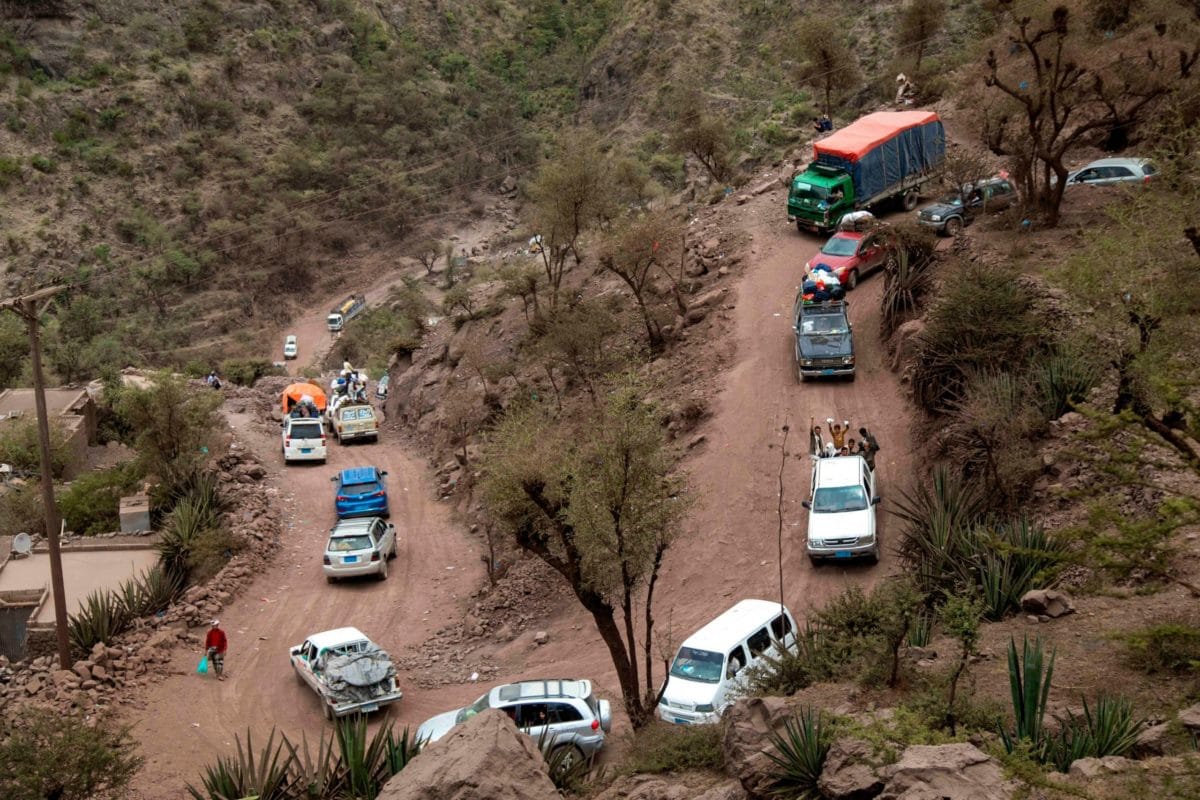
Traffic on a heavily damaged narrow road that serves as a lifeline between Taiz and the southern port of Aden, 2022\. Ahmad al-Basha/AFP via Getty Images
Located between the better-known cities of Sana’a and Aden, Taiz has long served as both a geographical and cultural gate to Yemen’s south and particularly Aden. During the years of Yemen’s civil war, the governorate has been a Houthi stronghold. Houthis control the roads leading into and out of the region and effectively controlled the movement of people and essential goods for nearly eight years. Meanwhile, the city itself is bisected by armed checkpoints manned by a range of conflict actors.
Despite the clear centrality of Taiz to the ongoing conflict in Yemen, policymakers have routinely dismissed the view that this city will be key to any military effort to alter the balance of power. The Saudi-led coalition of former president Abd Rabbuh Mansour Hadi and his cabinet, who governed from 2011 until April 2022, paid minimal attention to Taiz. They offered only occasional aid to the city, as it defended the internationally-recognized government’s legitimacy and bore the brunt of the Houthi military campaign.
Taiz—and the fate of its people—has also remained largely peripheral to the peace process. In the UN-led [Stockholm Agreement of 2018](https://www.merip.org/content/files/sites/default/files/stockholm%5Fagreement.pdf), the city featured only as an afterthought. The parties agreed to a nominal “[statement of understanding](https://www.merip.org/content/files/sites/default/files/taiz%5Fagreement%5F0.pdf)” regarding the need for a committee to address the impasse in Taiz. It was not until 2021 that Hans Grundberg, the latest in a string of UN Special Envoys, finally visited Taiz and began to address the siege of the city as a substantive entry point to wider confidence-building measures between the warring parties.
In the truce brokered by the Special Envoy between Houthi forces and the Saudi-backed Coalition in early April of 2022, the easing of restrictions on Sana’a airport and Hodiedah port by the Saudi-led Coalition was conditional on the Houthis opening the roads to Taiz city. The truce, however, is currently in limbo, and the roads have not been reopened for trade or transit.
Today, for the first time in history, the president of the newly-constituted Presidential Leadership Council, the prime minister and the speaker of parliament are all Taizis, yet none of them has prioritized reopening the roads to Taiz in peace negotiations. This impasse leaves the civilian population—itself an engine of Yemeni civil society and an untapped resource for peace—entirely at the mercy of militias in their efforts to access essential services.
## **Locating Taiz in Yemen’s Past and Present**
It was not surprising that Taiz played a central role in the uprising against the regime of former President ‘Ali ‘Abdullah Saleh in 2011\. Even before the unification of the two Yemens, Taiz served as the epicenter of civic and political activism in Yemen. It is the most populated governorate in the country with a skilled and educated workforce. Many civil society organizations, trade unions and historical political movements were born in Taiz, and some of Yemen’s most widely-recognized political figures, including important nationalists like Ahmed Mohammed Noman, have longstanding ties to Taiz.
> **In 2011, Taizis were at the helm of protests both in the governorate and across Yemen. Indeed, the “Change Revolution” was described in some circles as the “revolt of the Taizis”—an acknowledgement that cuts both ways...**
Taizis were instrumental in the 26 September Revolution against the Imamate in North Yemen in 1962\. They also coordinated intellectually and materially, and offered shelter to, forces that staged the 14 October Revolution against British colonial rule that began one year later in South Yemen. In 2011, Taizis were at the helm of protests both in the governorate and across Yemen. Indeed, the “Change Revolution” was described in some circles as the “revolt of the Taizis”—an acknowledgement that cuts both ways: Taizis are at once credited with leading the revolution, and at the same time, particularly in the North, they are blamed for the devastating consequences that have followed.
In April 2015, as Houthi forces pressed southward from Taiz toward Aden, previously non-violent protesters against Houthi control in Taiz took up arms. In the eight years since, Taiz has remained the southernmost reach of Houthi power, enforced through brutal violence and remaining under siege.
Surrounded by Houthi control, the city itself serves as a stronghold for the Saudi-supported Islah party, but this party is as much a rival of the UAE-backed Southern Transitional Council as it is an adversary of the Houthis. Meanwhile, Tariq Saleh’s National Resistance Forces—which, like the Southern Transitional Council, enjoy the patronage of the Emiratis—has established a presence along Taiz governorate’s west coast in and around the strategic port city of Mocha. Given the strained relations between Islah and the UAE, it has been difficult for the Coalition-backed government to coordinate any kind of uniform command in Taiz, even as armed groups flock there.
The city’s current predicament is not simply a function of the Houthis’ exploitation. It also reflects the failure of Taiz’s local authorities and of the forces loyal to the Islah party to protect citizens from unruly gunmen and general disorder. Young men like Ghazwan al-Mikhlafi and others—so-called “mufaseen” who disregard the law and wave weapons around to take what they like by threat or use of force—harass and blackmail the local population. Though some initially participated in the fight against the Houthis, efforts by local security forces to [rein in their lawlessness](https://eu01.z.antigena.com/l/AgEBtysm8kdwD5A%5F0zT69Ztm1izJ18xes6PkO4owpRTnTQr3e0Tx71aKl1n%5FCbNegQVCMo2R3XzyH3gQYjeCnymgw4Md7lB22juh-uDSgy3o~qJG59TGsVhSd8YgOiBFzcigdUsttsFVCldDwF7U9O%5FDGi~8vylF-EEWFCD-3wUd) have largely failed.
## **The Many Roads to Taiz**
Taiz’s physical location in Yemen has given the city and wider governorate strategic importance in the conflict. Its roads are key battlegrounds in the fight for economic and political supremacy between Houthis forces keen to institutionalize their control and forces at least nominally loyal to the internationally-recognized government who seek to wrest control from them.
> **Taizis wishing to travel must rely on a single outlet to the southwest, opened only after a series of deadly battles in 2016 between the Houthis and groups aligned with the internationally-recognized government.**
The Houthis control the main highway between Taiz city and Sana’a. They also have control over the major roads connecting to Aden and Hodeidah as well as other roads to the east, north and west. Taizis wishing to travel must rely on a single outlet to the southwest, opened only after a series of deadly battles in 2016 between the Houthis and groups aligned with the internationally-recognized government. The road, al-Dhabab, is constantly under the threat of closure and has continued to witness fighting, even after the UN-brokered truce of 2022.
During the years-long siege, and particularly while the Sana’a airport was closed from August 2016 to May 2022, this road and the city of Taiz, more generally, has been a lifeline for many northerners, who must transit through the governate to access Aden airport for medical treatment or other essential business.
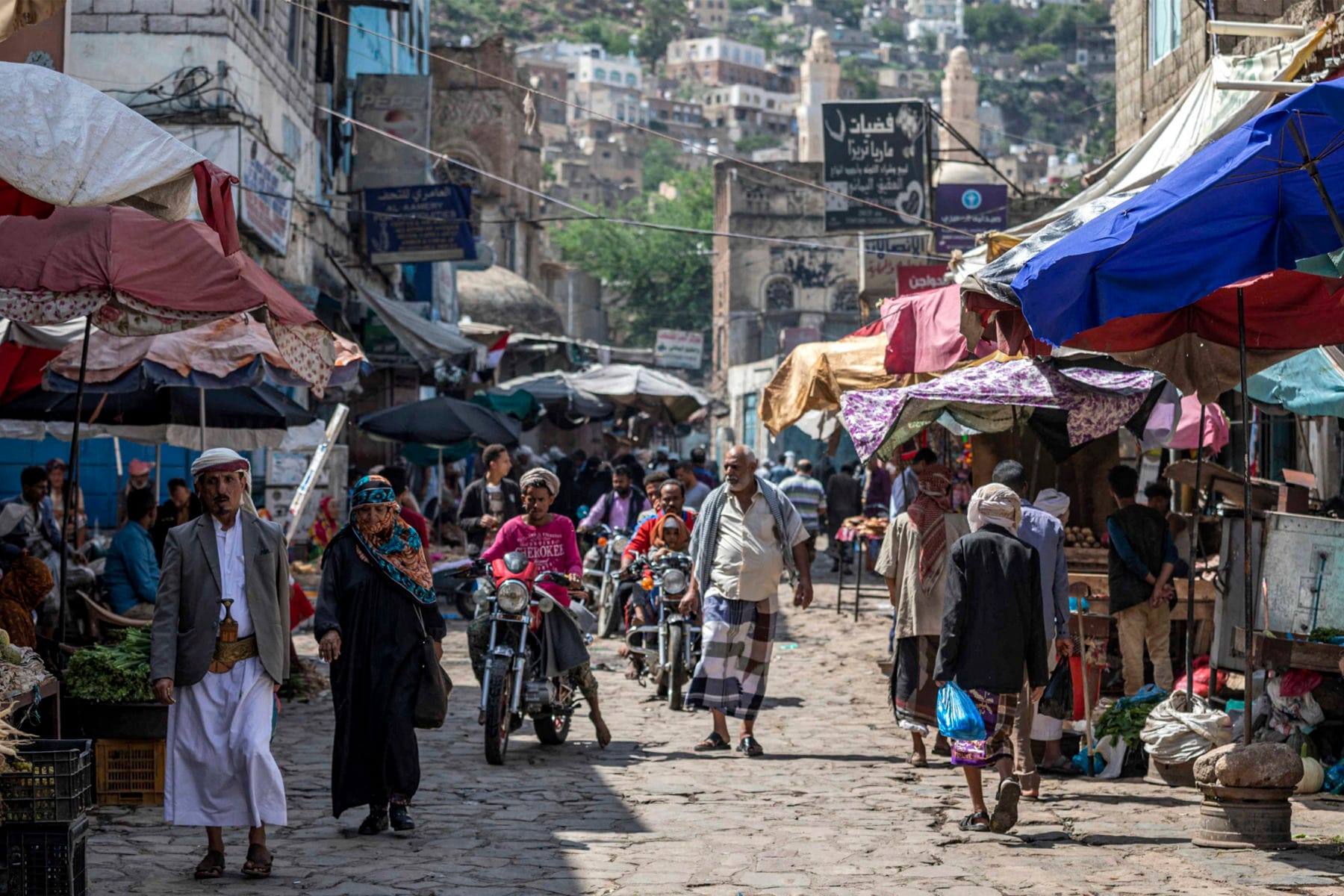
An open-air market in Taiz, Yemen, 2022\. Ahmad al-Basha/AFP via Getty Images
The city of Taiz itself is a commercial hub and a site of Yemen’s most important factories owned by the Hayel Saeed Anam Group—a powerful business conglomerate with factories throughout al-Hawban to the east of Taiz. These factories, which produce everything from basic foodstuffs to cigarettes, are more profitable than the city center and currently represent a significant source of income for the Houthis, who have worked hard to keep this area under their control. They have established an effective blockade that compels residents to travel several hours at high risk along zigzagging roads to reach al-Hawban, rather than the 10 minutes it would ordinarily take by car.
The truce between the Houthis and the government, which was extended twice between April and October 2022, remains at the time of writing neither renewed nor broken, but lapsed. Despite the terms of the truce being conditional on the roads to Taiz opening, neither the government, the Saudi-led coalition nor the UN has been able to secure concessions from the Houthis in Taiz and reopen the roads for any durable period of time. Without any tangible progress toward reopening the roads that connect the city of Taiz to the rest of Yemen, there will be neither peace nor prosperity for millions of people. Depriving the citizens of Taiz—millions of people—of basic mobility prevents them from enjoying the fruits of any temporary peace agreement or ceasefire.
## **The Road to Peace**
Throughout the war, Taizis have repeatedly demonstrated that they are not waiting for a nationwide peace agreement. Rather, they are already doing the work of rebuilding their city on their own terms.
> **Covering Taiz from 2015 to 2019 for international media outlets, I observed time and again the zealous way Taizis rushed to reopen their shops, repairing what they could of the damage to their property in areas recovered from the Houthis.**
The city has a longstanding business culture, epitomized by small enterprises. Covering Taiz from 2015 to 2019 for international media outlets, I observed time and again the zealous way Taizis rushed to reopen their shops, repairing what they could of the damage to their property in areas recovered from the Houthis. As much a city of activists as a city of enterprise, the destruction has not stopped many civil society organizations from stepping in to meet short-term needs. In the context of the ongoing conflict, even the most minor repairs have symbolic significance, showing that Taizis cannot wait until the end of the war to resume essential work. Such reconstruction in the face of ongoing conflict provides a sharp contrast to other areas of Yemen, where damaged buildings have often remained untouched and conflict actors have limited the reach of civic activism.
Since the expiration of the UN-brokered truce in October of 2022, Taiz has remained hostage to a negotiation process that overemphasizes the political and military priorities of Aden and Sana’a. But Taiz—on the periphery of each—might hold the key to the peace process, not merely in its present form as a city divided, but also in its future promise as a crucial passage to recovery. Under the right political circumstances, Taiz could transform from an emblem of the horrors of war to an engine of successful demobilization and post-conflict recovery. Indeed, rather than marginalizing Taiz in the peace process, starting the demobilization process in a city like Taiz, which has a demonstrated appetite for a shift away from conflict, is a promising road to conflict recovery.
\[*Mohammed al-Qadhi is a Yemeni journalist who has reported for several media outlets, including Sky News Arabia TV, Bloomberg News, The Washington Post, The National and France 24\. He was based in the city of Taiz from 2015–2019 and currently works as a senior political advisor for the Centre for Humanitarian Dialogue in Geneva.*\]
**Read the [previous](https://merip.org/2023/01/the-maghrebs-peripheral-centers-in-permanent-crisis) article in**[ **MER issue 305**](https://merip.org/magazine/305) **"Peripheries and Borderlands."**
### The Maghreb’s Peripheral Centers in Permanent Crisis
URL: https://www.merip.org/2023/01/the-maghrebs-peripheral-centers-in-permanent-crisis/
Last updated: 2025-08-22T18:36:51.000Z
When it comes to trade, there are two North Africas.
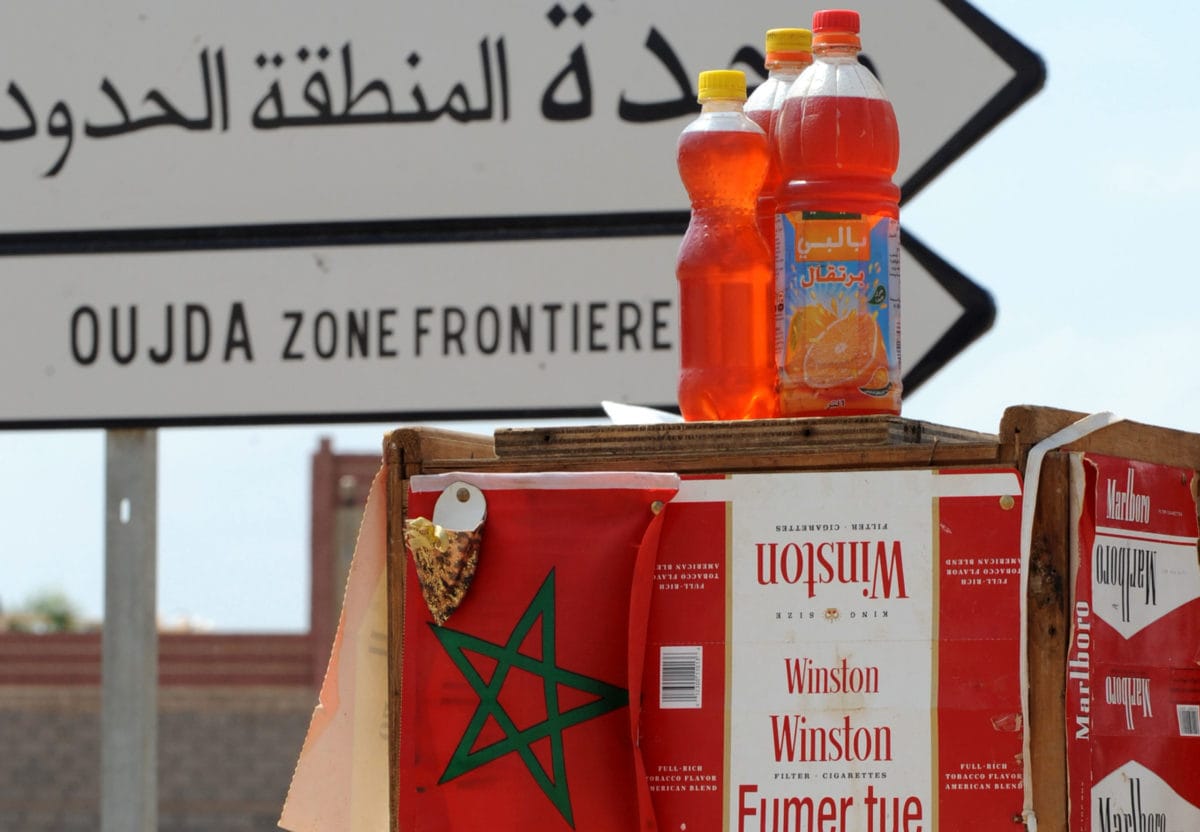
Bottles of smuggled fuel for sale on the side of the road in Oujda, Morocco, near the Algerian border, 2013\. Fadel Senna/AFP via Getty Images
Most accounts of North Africa’s economic centers focus on the region’s capital cities, Tunis, Cairo or Algiers, or its large port cities, Port Said and Bizerte. The trade through these centers largely maps onto a North-South direction, one that integrates the region into global markets. But these accounts tend to miss an alternative, more subtle network of economic centers located in the region’s geographic peripheries. For as long as North Africa has had borders, it has had trade across these borders that exists outside official legal frameworks. Call it “informal cross-border trade.” Call it “smuggling.” Many in the region’s borderlands have just called it “trade.”
Borderlands like Medenine in Tunisia or the “Oriental” in Morocco, though marginalized economically and politically, have long served as vibrant centers of commerce, largely through the wholesale smuggling of consumer goods and hydrocarbons. Informal cross-border trade connects these borderlands to local, regional and global networks and supply chains, creating centers of wholesale distribution and employment for hundreds of thousands of workers. These peripheral centers of commerce have a complicated relationship with states in the region. Smuggling networks have not just been tolerated but actively regulated and structured with the involvement of political elites and governments.
Over the past decade, however, a slew of crises has fractured many existing arrangements, leading to the collapse of smuggling networks and income opportunities. The relationship between smuggling and states is entering a new phase in which states are setting out to “remake the borderlands,” with limited success.
## **Alternative Trade Routes**
Informal trade across North Africa’s borderland regions has its own centers and hubs. There is Ben Guerdane in Tunisia and Zuwara in Libya, Tamanrasset in Algeria, Oujda in Morocco. Within these alternative trade routes, dozens of medium-sized cities have grown into long-established nodes, benefiting from their proximity to a border to establish themselves as places of commerce, finance, wholesale or storage for informal cross-border traders.
> **While drugs and arms often get most of the attention, the vast majority of goods that move across these routes are far more mundane, including everything from eggs to Hello Kitty backpacks to tea and microwaves.**
When it comes to trade links within the region, the Maghreb has been referred to as the most [poorly integrated region](https://www.imf.org/en/Publications/Departmental-Papers-Policy-Papers/Issues/2019/02/08/Economic-Integration-in-the-Maghreb-An-Untapped-Source-of-Growth-46273) in the world. But the goods exchanged through informal trade across its borders provide a glimpse at alternative forms of regional economic integration. While drugs and arms often get most of the attention, the vast majority of goods that move across these routes are far more mundane, including everything from eggs to Hello Kitty backpacks to tea and microwaves. Until recently, gasoline from Libya and Algeria dominated informal cross-border trade. In 2013, approximately one-quarter of the gasoline consumed in Tunisia was estimated to have been smuggled in from one of its hydrocarbon-rich neighbors.[\[1\] ](#%5Fedn1)Moreover, tracing the informal movement of goods reveals that North Africa’s peripheral centers are not just regionally integrated. They are [connected to global value chains](https://carnegie-mec.org/2021/05/27/hidden-face-of-informal-cross-border-trade-in-tunisia-after-2011-pub-84621.) that reach from the free trade zones in the Gulf to production centers in China. For global producers, these trade routes have presented a way to get their goods into North African markets, bypassing customs and domestic monopolies.[\[2\]](#%5Fedn2)
Informal trade has substantially shaped life in the region’s borderlands. In many regions, it has dominated local labor markets, offering easily accessible employment in times of high youth unemployment. It has also offered opportunities for wealth accumulation for larger traders and financers. Yet it has also brought high economic inequality and little knock-on development. Larger traders typically diversify their resources by buying real estate and lavish cafes, either locally or in the countries’ capitals. Production and formal employment opportunities, meanwhile, have remained limited and trade booms have moved labor out of agriculture. Through the decades, the people who live in North Africa’s peripheral centers and their surrounding borderlands have become highly economically dependent on trade—a fact that fundamentally shapes their relationship with their respective states.
## **Stability and Crisis**
Due to their relationship with smuggling and their proximity to the border, peripheral centers are easy targets for a recycled Ibn Khaldunian narrative that pits the periphery against the central state: If not kept in close check, the periphery threatens to undermine or destabilize the state. This narrative has proven productive for political elites, helping them to justify centralized power and to court foreign funding for security infrastructure.
> **While cross-border movements have, at times, presented real security challenges, for decades, their smuggling economies have also served as an arguably stabilizing feature of the region’s political and economic structure.**
While cross-border movements have, at times, presented real security challenges, for decades, their smuggling economies have also served as an arguably stabilizing feature of the region’s political and economic structure. They provided employment in regions that were largely ignored in the economic plans of post-independence political elites and gave a wider population access to affordable goods. While cross-border movements have, at times, presented real security challenges, for decades, their smuggling economies have also served as an arguably stabilizing feature of the region’s political and economic structure. Moreover, informal trade did not always occur beneath the radar of the region’s states. States and political elites have frequently been complicit in the regulation of the smuggling economy.[\[3\]](#%5Fedn3) Regulations—from informal deals providing access to certain routes, to explicit rules of what can be smuggled through a border crossing and at what price—have benefited political elites in the center. They have allowed dictators from Muammar al-Qaddafi in Libya to Zine El Abidine Ben Ali in Tunisia to strategically insert political allies into profitable positions in smuggling networks or protect their businesses from informal competition.
The smuggling economy has also given the state a convenient rationale for securitizing the region’s borderlands. While the opportunities for income generation among otherwise economically marginalized groups is likely the most significant political function of smuggling economies, elite interests have been crucial to maintaining their development. Local elites, political entrepreneurs, traders and civil society activists have all sought to shape, transform or take advantage of the relationship between peripheral centers and the region’s states—though not always with similar goals. Local trade councils, for example, might have a different perspective on what development in the borderlands should look like than youth organizations. Meanwhile, traditional leaders look with skepticism at the political machinations of those made rich by the smuggling booms.
In the past decade, international civil society and development organizations have become active in the region’s borderlands. Some, like the Danish Demining Group or International Alert in Southern Tunisia, have focused on borderland perspectives on security, accountability and livelihoods. Other organizations, such as the International Organization for Migration, have focused on migration through and from these borderlands, especially in Libya and Northern Morocco.
But the existing mode through which North Africa’s borderlands were integrated into the region’s political economy is growing increasingly untenable. A series of crises has had substantial impacts on the region’s smuggling economies. The civil war in Libya and the expanded presence of armed groups in some border regions, geopolitical tensions within the region, the European concern over migration and related investment in border infrastructure, the Covid-19 pandemic and ongoing economic crises have all worked to undermine the global value chains in which informal trade networks were embedded. Amid these crises, the region has experienced a massive expansion of border infrastructure. New border walls, fencing and ditches and [increasingly sophisticated](https://carnegieendowment.org/sada/77053.) electronic surveillance equipment has disproportionately hit smaller and more localized smuggling networks.
As a consequence, critical sources of income have diminished in many borderlands across the region. While the timing and extent of these crises have not been homogeneous—North-Eastern Morocco, for example, began feeling these effects some years earlier due to an expansion of border fortifications—the wider patterns are visible across the region. Unemployment in many borderlands has increased, as has petty crime. [Outward migration](https://issafrica.org/research/north-africa-report/divided-they-fall-frontiers-borderlands-and-stability-in-north-africa) from these peripheral centers, both towards domestic urban centers and towards Europe, is one of the main ways younger workers in particular are coping with changes.
## **Remaking the Borderlands**
Changes in recent years highlight the fragility that has always undergirded the relationship between peripheral centers and North Africa’s states. Beneath the talk of unruliness and subversion was a dependency on decisions made far away from the borderlands. A number of factors suggest the current crisis in these peripheral centers will outlast the effects of Covid or the current cost of living crisis.
> **As the region’s smuggling economies enter an increasingly permanent state of crisis, a paradigm of “remaking the borderlands” is likely to take over: with state investment and new development projects designed to replace the smuggling economy’s role in local livelihoods.**
For one, many recent changes are structural. Infrastructure that has been built up around borders, both physical and in terms of personnel, is unlikely to disappear. Elites in the national capitals have started to adapt and diversify their incomes. Some now own formal gas stations, others wedding spaces or cafes in the fancier suburbs of Tunis. As a result, they are growing less dependent on maintaining labor-intensive smuggling practices in the borderlands. Meanwhile, the impact that years of hardship have had on livelihoods and opportunities for young people is deep and difficult to reverse. As their savings have depleted, many lack both the opportunities and capital to start anew locally and will look for work elsewhere. As the region’s smuggling economies enter an increasingly permanent state of crisis, a paradigm of “remaking the borderlands” is likely to take over: with state investment and new development projects designed to replace the smuggling economy’s role in local livelihoods. Recent years have already seen some indications of this approach. Morocco, for example, has established new development plans for Oujda and Nador—two cities hit hard by the collapse of informal trade across the border with Algeria and with the Spanish enclave of Melilla.
There is reason to welcome a search for economic alternatives for the region’s borderlands. The smuggling economy provided incomes, but it also created deep dependencies and vulnerabilities. Even if it was somewhat regulated, it still contained a risk of violence, harm and indignity. Alternative development models are a common demand of borderland communities. But so far, attempts to establish economic alternatives are raising serious doubts about the success of providing alternative livelihoods. Some initiatives focused on building free trade zones and special economic zones across the region have yet to show that they can generate the kind of large-scale employment and low barriers to entry that smuggling economies did. Other projects, built around setting up agricultural cooperatives in the borderlands, have struggled to be economically viable and to generate genuine buy-in especially among younger former smugglers.
A key difficulty is the scope of the challenge. Re-developing the region’s borderlands means addressing decades of sustained and deep state neglect—a project that will require substantive infrastructure development, political cross-border cooperation and an investment strategy that is holistic, sustained and not subsumed in the economic interests of the center. This task is unlikely to be tackled with the seriousness and scope it deserves in a time of budgetary anxieties across the region. In the context of highly centralized states and an international community that views them primarily through a security and migration lens, peripheral centers have struggled to find a lobby or build up united coalitions for such demands.
In the absence of alternatives that are effective at scale, North Africa’s borderlands will likely enter a phase of permanent crisis—one that will continue to be marked by high unemployment and outward migration, ongoing low-level protest and a cross-border economy increasingly dominated by trade in illicit goods. In terms of their political role, peripheral centers are likely to remain a space in which both real and imagined anxieties around the intersection of poverty, mobility, radicalization and illegality play out. In this sense, they will continue to serve one of their key political functions to the region’s states: providing a narrative justification for centralization and securitization. As informal borderland economies lose their economic footing, North Africa’s economies will likely be further centralized. With the old order in a state of permanent crisis, whether the center can hold will depend on its ability to re-fashion an equitable role for its peripheries.
\[Max Gallien is a political scientist at the Institute of Development Studies and University of Sussex.\]
> **Read the [previous](https://merip.org/2023/01/illicit-flows-to-the-uae-take-the-shine-off-african-gold-2) article.**
> **Read the [next](https://www.merip.org/dispatch-from-taiz/) article.**
**This article appears in**[ **MER issue 305**](https://merip.org/magazine/305) **"Peripheries and Borderlands."**
---
### **Endnotes**
[\[1\]](#%5Fednref1) Ayadi et. al, "Estimating informal trade across Tunisia's land borders," [World Bank](https://documents.worldbank.org/en/publication/documents-reports/documentdetail/856231468173645854/estimating-informal-trade-across-tunisias-land-borders), no. WPS6731 (2013), p. 7.
[\[2\]](#%5Fednref2) Adeel Malik and Max Gallien, "Border Economies of the Middle East: Why Do They Matter for Political Economy?," *Review of International Political Economy* 27/ 3 (May 2020).
[\[3\]](#%5Fednref3) Max Gallien, "Informal Institutions and the Regulation of Smuggling in North Africa," *Perspectives on Politics* 18/2 (June 2020).
### Illicit Flows to the UAE Take the Shine off African Gold
URL: https://www.merip.org/2023/01/illicit-flows-to-the-uae-take-the-shine-off-african-gold-2/
Last updated: 2025-08-22T18:36:52.000Z
Kankan Musa, ruler of the Mali Empire, famously visited Cairo in 1324 en route to the Hajj. Leading a caravan of sixty thousand men and women, Emperor Musa lavishly gifted his hosts with gold. As Howard French recounts in his book, [*Born in Blackness*](https://wwnorton.com/books/born-in-blackness), the emperor dispensed so much gold that its price remained depressed in Cairene markets for a decade after his departure.
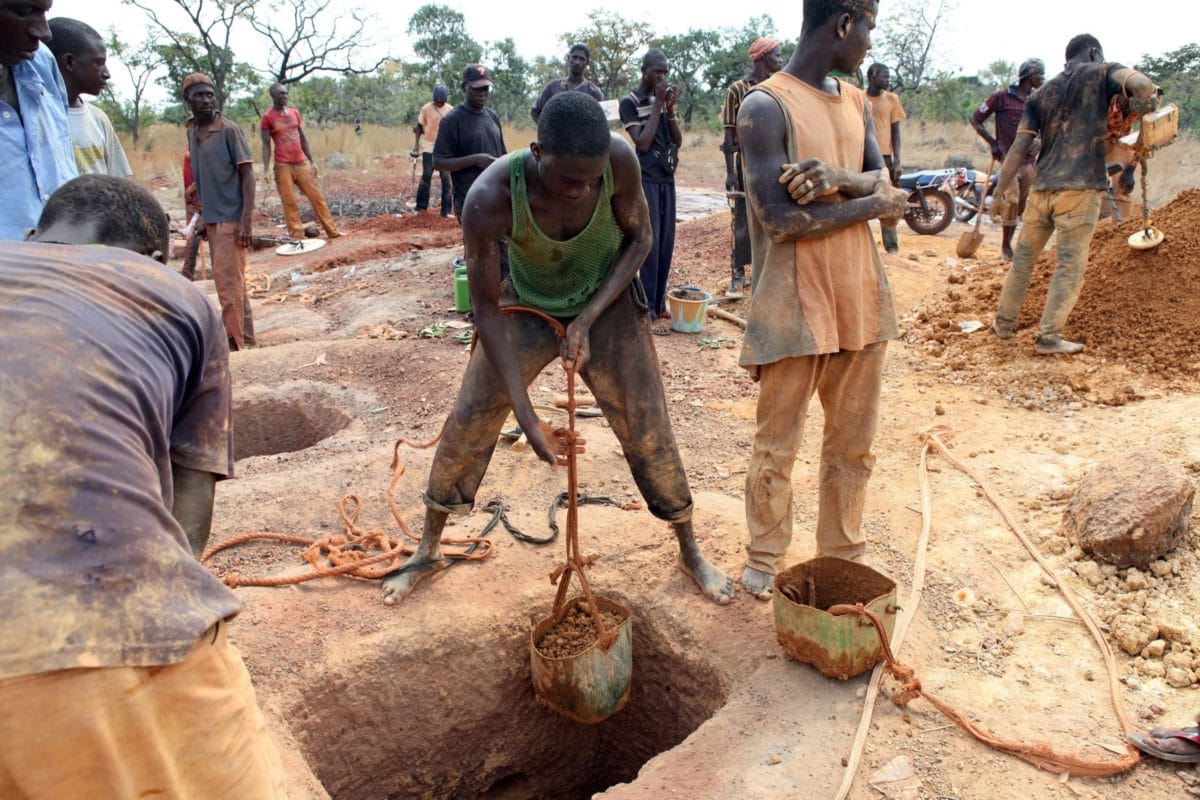
Gold miners empty containers of earth removed from a mining shaft in Koflatie, Mali, 2014\. Sebastien Rieussec/AFP via Getty Images
Seven centuries later, Mali is again experiencing a boom in gold exports. World market gold prices have nearly doubled over the past decade, as has Mali’s industrial output. It is now approaching [seventy tons annually](https://www.bloomberg.com/news/articles/2021-11-02/africa-s-crackdown-on-informal-gold-miners-spreads-to-mali). Gold has replaced cotton as Mali’s leading export, and Mali has become Africa’s [third-largest gold producer](https://eiti.org/countries/mali).
While these trends have the potential to translate into growing revenues for the cash-strapped Malian government, an enormous share of Mali’s gold vanishes from the country through illicit flows. There is the gold produced by global industrial firms in Mali, which is taxable and traceable. But gold is also produced by artisanal miners, much of whose output flows from the country through clandestine networks that escape state regulatory or fiscal controls.
The primary destination of artisanal gold seems to be the United Arab Emirates. By all evidence, the gold that shines in the souks of Dubai is the product of a complex web of criminal networks, terrorist groups and internationally sanctioned regimes, who use this artisanally mined gold to launder their money. The same forces that are transforming Mali into a hub for the gold trade are ensuring this peripheral country straddling the Sahara and Sahel regions remains precarious in the global economy.
## **Disparate Figures**
According to official Malian statistics, the majority of Mali’s gold is produced by industrial firms located in 13 sites across the country’s southern and western regions. As Mali lacked the capital to develop these sites, they are operated by a small number of multinational mining companies headquartered in Canada, Australia, South Africa and the United Kingdom that have permits from the Malian government to extract their ore. In 2020, industrial firms reported producing [65.2 metric tons](https://www.reuters.com/article/mali-gold/mali-gold-production-hits-fresh-high-in-2020-idUSL8N2K83VU) of gold, accounting for roughly ten percent of the country’s gross domestic product.
Mali’s [Mining Code](http://www.ilo.org/dyn/natlex/docs/ELECTRONIC/109970/136614/F-752897896/MLI-109970.pdf) requires the operations and finances of these firms to be monitored by the Malian government. Firms must pay 20–25 percent of their proceeds to the Malian treasury. A much smaller share goes to a development fund that was set up in 2012 to benefit the communities that host mining operations. In 2021 alone, Mali’s Ministry of Mines reportedly collected the equivalent of [nearly $1 billion in taxes](http://news.abamako.com/h/271461.html) from industrial gold production.
In addition to these industrial sites, hundreds of smaller-scale “artisanal” mines are scattered throughout the country. Artisanal mines—which have seen a dramatic upswing since the early 2000s—entail more labor, less capital and less oversight.[\[1\]](#%5Fedn1) Unlike industrial mines, artisanal mines are as old as Mali itself and generate livelihoods for a large number of local communities. By some estimations, these mines employ or support one in ten inhabitants of the central Sahel region.[\[2\]](#%5Fedn2)
> **Unlike industrial mines, artisanal mines are as old as Mali itself and generate livelihoods for a large number of local communities. By some estimations, these mines employ or support one in ten inhabitants of the central Sahel region.**
According to official figures, the role artisanal mines play in the country’s gold production is minor—over the past several years, the Malian government has [recorded](https://www.reuters.com/article/mali-gold-idCNL1N2UL1XW) a scant four to six tons of artisanal gold mined annually, less than ten percent of Mali’s annual industrial output. But there are reasons to believe artisanal gold production in Mali is far higher. Malian officials have [privately estimated](https://www.merip.org/content/files/assessment-of-the-supply-chains-of-gold-produced-in-burkina-faso-mali-niger.pdf) the figure to be between 30–50 tons, while recent investigative journalism from [France 24](https://www.france24.com/en/tv-shows/reporters/20220715-from-the-sahel-to-dubai-on-the-trail-of-dirty-gold) reckoned that at least half of Mali’s gold, over 60 tons, comes from artisanal mines.
The most compelling reason to doubt official Malian figures for artisanal production is that other countries claim to import a great deal more gold from Mali than Mali claims to produce. According to the [UN Comtrade Database](https://comtrade.un.org/data)—an online aggregator of international trade statistics—the UAE purchased nearly 81 tons of gold from Mali in 2019\. By comparison, the same year, the Malian government reported exporting a mere half ton to the UAE. Similar discrepancies pervade recent trade statistics between the two countries. The production and export of Mali’s industrial gold is tightly controlled—most of this output goes to Switzerland, whose import figures largely match Mali’s export figures. It is Mali’s artisanal production and exports, then, that far exceed official estimates.
Among African gold producers, Mali is no exception. Since 2016, the UAE registered more gold shipments from several African countries, including Libya, Ghana, Sudan and Tanzania, than those countries reported exporting. Gold from conflict zones in East and Central Africa has recently begun [flooding](https://www.merip.org/content/files/wp-content/uploads/2020/11/conflictgoldadvisory-thesentry-nov2020.pdf) Dubai’s markets, and the smuggling of gold from Africa’s Sahara and Sahel regions is believed to be [far greater](https://www.merip.org/content/files/sites/default/files/raineri.pdf) than from the continent’s other regions.
## **Moving Artisanal Gold**
Much of the gold that departs Mali for the UAE originates outside of the country’s borders. Over the past decade, Mali’s capital Bamako [has become](https://www.merip.org/content/files/wp-content/uploads/2017/09/2016-jan-the-west-african-el-dorado-mapping-the-illicit-trade-of-gold-in-cote-divoire-mali-and-burkina-faso.pdf) the regional hub for illicit precious metal transshipment from West Africa to the Persian Gulf. While most of this gold probably comes from artisanal mines in neighboring states of Senegal, Burkina Faso, Guinea and Sierra Leone, the [ENACT Network](https://enactafrica.org/enact-observer/mali-west-africas-hub-for-illegal-gold-trade-with-dubai) on transnational crime has reported gold in Bamako originating from as far as Venezuela.
Buyers in Bamako, often prefinanced with foreign capital, acquire gold nuggets from artisanal miners and smugglers. At the city’s various refining facilities, they melt these nuggets into bars and ship them abroad. By paying off local customs and airport officials, their couriers can easily leave Bamako for Dubai with bars of artisanal gold stowed in their hand luggage.
> **Buyers in Dubai prize low-grade bars of African gold since they can keep the other precious metals that are separated out during the refining process—metals such as silver, palladium and platinum can compose ten percent of a bar’s original mass.**
In Dubai, couriers and their buyers face few legal or regulatory obstacles in bringing their gold into global markets. Neither customs officials nor banks nor gold buyers in the UAE [require](https://www.researchgate.net/profile/Victoria-Reichel/publication/328939569%5FCommerce%5Fillicite%5Fde%5Fl'or%5Fartisanal%5Fen%5FAfrique%5Fsubsaharienne/links/5bec44154585150b2bb5f4e1/Commerce-illicite-de-lor-artisanal-en-Afrique-subsaharienne.pdf) gold importers to provide certificates of origin or receipts of export tax payments.[ As a ](https://youtu.be/7N36tvYz2J0)[2020 report](https://www.merip.org/content/files/wp-content/uploads/2020/11/conflictgoldadvisory-thesentry-nov2020.pdf) by the Sentry found, the Emirates have weak customs controls for hand-carried gold, no limits on untraceable cash transactions and little oversight of local gold souks and refiners. [Buyers in Dubai](https://www.youtube.com/watch?v=7N36tvYz2J0) prize low-grade bars of African gold since they can keep the other precious metals that are separated out during the refining process—metals such as silver, palladium and platinum can compose ten percent of a bar’s original mass.
The Emirates have long been a global hub for transnational African merchants, who [travel to Dubai](https://www.taylorfrancis.com/chapters/edit/10.4324/9780203397930-11/dubai-global-city-transnational-hub-roland-marchal) to purchase imported goods such as Japanese-made auto parts or Chinese-made garments. Emirati authorities and commercial players are now exploiting their country’s existing commercial status to make the UAE an important node for the trade in precious metals, especially gold. These buyers are actively financing associates in Mali and throughout the Sahel and Sahara regions, driving the expansion of artisanal mining into new areas.
## **A Proliferation of Blind Eyes**
By law, gold exporters in Mali must pay a three-percent tax on the value of their exports. If Mali is, in fact, producing as much artisanal as industrial gold, it should be earning over $100 million each year from taxes on artisanal exports alone. Even the state’s earnings from above-board artisanal exports, however, are [undermined](https://www.researchgate.net/profile/Victoria-Reichel/publication/328939569%5FCommerce%5Fillicite%5Fde%5Fl'or%5Fartisanal%5Fen%5FAfrique%5Fsubsaharienne/links/5bec44154585150b2bb5f4e1/Commerce-illicite-de-lor-artisanal-en-Afrique-subsaharienne.pdf) by loopholes and exemptions. This permissive regulatory environment works to lure gold buyers and exporters from neighboring countries, depriving other states in the region of their own revenue streams. Some of Mali’s political elites, it seems, have chosen to capitalize on their country’s position on the global periphery by turning it into a modest regional hub.
Legal loopholes and regulatory arbitrage are just the tip of the iceberg when it comes to missing state revenues. Throughout Mali and the wider region, most exports of artisanal gold escape official government notice and taxation altogether, partly due to the state’s limited capacity to police its territory and enforce its laws and partly to the efforts by Malian economic and political elites to circumvent them. Apart from the fees paid to local authorities at the mining sites and bribes paid to gatekeepers in Bamako, the proceeds from the informal production and export of gold bypass the Malian state apparatus.
> **Throughout Mali and the wider region, most exports of artisanal gold escape official government notice and taxation altogether, partly due to the state’s limited capacity to police its territory and enforce its laws and partly to the efforts by Malian economic and political elites to circumvent them.**
In some cases, the scale of an artisanal mining operation is too large to escape the attention of authorities in Bamako. Bigger extraction sites, such as the [Intahaka mine](https://www.france24.com/en/tv-shows/reporters/20220715-from-the-sahel-to-dubai-on-the-trail-of-dirty-gold) in the northern Gao region, are several kilometers wide and employ thousands of workers as well as bulldozers and other heavy equipment. Like much of northern Mali, Intahaka falls outside of central government control due to the complex and increasingly violent conflict that, since 2012, has pitted various local non-state actors and militias against state security forces, UN peacekeepers, foreign troops and most recently private military contractors.
As with other artisanal mines, the gold from northern Malian sites like Intahaka attracts interest and capital from abroad. Buyers from the UAE, as well as Turkey and Russia, have been [reported](https://youtu.be/7N36tvYz2J0) there. In these zones, local authorities have succeeded in imposing some regulations on artisanal mining operations. A coalition of rebel groups whose leaders signed a peace accord with the Malian government has reportedly begun levying taxes on gold extracted from the areas under their control. Jihadi groups affiliated with Al Qaeda and the Islamic State, however, have signed no treaties, and as they continue to mount deadly attacks on Malian civilians, security forces and peacekeepers, they are [also](https://www.merip.org/content/files/atf/cf/%7B65BFCF9B-6D27-4E9C-8CD3-CF6E4FF96FF9%7D/s%5F2020%5F785.pdf) [reportedly](https://www.merip.org/content/files/atf/cf/%7B65BFCF9B-6D27-4E9C-8CD3-CF6E4FF96FF9%7D/s%5F2019%5F636.pdf) taking their cut of the gold proceeds. Transnational [narcotics traffickers](https://enactafrica.org/research/research-papers/drug-trafficking-in-northern-mali-a-tenuous-criminal-equilibrium) too are using northern Mali’s artisanal mines to expand and launder their capital.
In southern and western Mali, where rebel and jihadi groups have yet to gain a strong foothold, Bamako theoretically has a greater ability to control, regulate and tax artisanal mines. But aside from selling permits to miners, until recently, the Malian government has paid little attention to this increasingly lucrative sector, despite the many problems it has generated for the inhabitants of mining zones. Not only has the gold boom fueled an [exodus of agricultural labor](https://www.cambridge.org/core/services/aop-cambridge-core/content/view/54800B8FF4F338F809B32065D6B95C7B/S0002020617000117a.pdf/div-class-title-the-minimalist-state-and-donor-landscapes-livelihood-security-in-mali-during-and-after-the-2012-2013-coup-and-rebellion-div.pdf) from many communities, it has [contaminated soil and rivers](https://www.agenceecofin.com/mines/0209-91110-mali-la-pollution-sur-les-sites-d-extraction-de-l-or-inquiete-les-autorites) and exacerbated insecurity.
As for the UAE, as imports of dubious provenance have skyrocketed and reports of money laundering have proliferated, Emirati authorities have taken no steps to stem the illicit flow of precious metals into the country from African conflict zones.
## **Gold’s Dimming Luster**
More than a decade into Mali’s gold boom, industrial mines in the country are encountering their own problems and constraints. As several existing operations reach the end of their productive lives, large firms may be reluctant to search for new sites amid increasing insecurity and political instability in the country. Meanwhile, the Malian government has shown interest in monitoring the finances of industrial mines more closely after a 2019 report by its auditor-general claimed there were hundreds of millions of dollars worth of irregularities in the sector and accused industrial firms of environmental destruction.[\[3\]](#%5Fedn3) In May 2022, Mali’s ruling military junta announced its [intention to audit](https://www.studiotamani.org/104684-mali-le-gouvernement-annonce-un-audit-des-mines-dor) the industrial mining sector.
Authorities in Bamako have typically shown little corresponding interest in increasing regulations of artisanal mining. But political winds may be shifting. In November 2022, Mali’s Ministry of Mines [announced](http://news.abamako.com/h/278400.html) that authorities arrested hundreds of foreign gold prospectors, confiscated heavy equipment and dismantled at least two illegal mining sites in the south of the country. The government has also [established](https://www.zonebourse.com/actualite-bourse/Le-Mali-cree-une-nouvelle-societe-pour-obtenir-une-plus-grande-part-de-la-richesse-miniere--42354216/) a new state-owned company for the exploration and development of new industrial mining sites—activities from which the state has, in the past, been absent.
It remains to be seen whether the Malian state will confront its own citizens who are involved in draining the country of its most precious resource. Those who benefit from illicit gold exports are pleased to maintain the status quo. By resisting the regularization of resource and financial flows, they also ensure that the central government will continue to lack both the capacity and the political will to control its territory, enforce its laws, protect its natural resources or invest in its own future. Mali’s economic precarity will increase with the complicity of entrepreneurs and officials in other countries, most notably the UAE.
Seven hundred years ago, the gold carried by Kankan Moussa’s caravan brought lasting renown to an empire. Today’s illicit flows enrich only the few individuals whose hands they pass through. One day in the not-too-distant future, Mali’s gold boom will be over. It is unclear whether the Malian state and its people will have anything to show for it.
\[Bruce Whitehouse is an Associate Professor of Anthropology at Lehigh University.\]
> **Read the [previous](https://merip.org/2023/01/exit-france) article.**
> **Read the [next](https://merip.org/2023/01/the-maghrebs-peripheral-centers-in-permanent-crisis) article.**
**This article appears in**[ **MER issue 305**](https://merip.org/magazine/305) **"Peripheries and Borderlands."**
---
### **Endnotes**
[\[1\]](#%5Fednref1) William G. Moseley, "The Minimalist State and Donor Landscapes: Livelihood Security in Mali during and after the 2012–2013 Coup and Rebellion," *African Studies Review* 60/1 (2017).
[\[2\]](#%5Fednref2) Luca Raineri, “Gold Mining in the Sahara-Sahel: The Political Geography of State-making and Unmaking,” *The International Spectator* 55/4 (2020), p. 104.
[\[3\]](#%5Fednref3) "[Bureau du Vérificateur Général - Rapport Annuel 2019](http://www.bvg-mali.org/images/Rapports/annuels/RAPPORT%5FANNUEL%5F2019%5FRED.pdf)" (Government of Mali2020), pp. 71-72.
### Exit France—The Influence of External Actors in the Sahel Region
URL: https://www.merip.org/2023/01/exit-france/
Last updated: 2025-08-22T18:36:52.000Z
On August 15, 2022, the last French armed forces withdrew from their main base in Gao, northern Mali.
French soldiers patrol the streets of the village of Guintou near Gao on December 4, 2021\. Thomas Coex/AFP via Getty Images
Hours later, men in military uniform believed to belong to the Wagner Group—the Russian paramilitary organization with close ties to the Kremlin—landed an L-39 Albatros ground attack aircraft at the Gao military airport. After unloading equipment, the group of men settled in for an indeterminate duration. By now, it was a well-established pattern, one that had repeated itself in Menaka in June, Gossi in April and Timbuktu in January. The French would hand the keys to the bases over to the Malians, who would immediately pass them on to Russian paramilitary forces.
As Mali shuffles its partners, there has been much catastrophizing in Western media and analysis surrounding the Wagner Group. While not misplaced, the concerns serve as a useful distraction that helps to brush over other actors’ mistakes. The rapid-fire replacement of French forces by Russian mercenaries marked a decade of failed efforts to shore up stability in Mali. The Mali that French troops were leaving was far worse off than the country they had flown into to help steady. It had lost much of its vast north and breadbasket center to armed groups with militant ethnic and ideological agendas. Thousands of civilians were dead and almost one million displaced. State institutions had grown weaker than ever. Coups d’etat in 2020 and 2021 swept military leaders into power who regarded the candid Russian model of authoritarian rule and violent repression as more appealing than the confused Western approach, which mixed murdering terrorists with preaching about human rights.
As a once-unified French-led coalition continues to falter, and Algerian efforts to promote peace stagger along, disparate actors within and outside of Europe, including Russia, are staging their own Sahel interventions. Meanwhile, the intervention model deployed by the French remains deeply rooted elsewhere in the Sahel and is firmly expanding southwards toward the Atlantic in response to perceived threats emerging in the Gulf of Guinea states of Benin, Ghana, Ivory Coast and Togo.
## **French Intervention in the Sahel**
French military interventions in Libya and Mali over the past decade have quietly pit France and Algeria against one another around questions of conflict mediation in the region. In January of 2013, Paris deployed counterterror forces at the request of Mali’s unelected interim authorities to respond to a complex emergency that witnessed political-military rebellion by northern armed groups, the occupation of the North by jihadist coalitions and the toppling of political rule in the capital.
> **Also read:** **"[Illicit Flows to the UAE Take the Shine off African Gold](https://merip.org/2023/01/illicit-flows-to-the-uae-take-the-shine-off-african-gold-2)" in MER issue 305.**
While the French accomplished their first task of recapturing northern cities from jihadist groups with relative ease, dealing with the other crises proved more challenging. Algeria, for its part, offered a political strategy for stabilizing its southern neighbor. In 2015, Algiers hosted negotiations between the warring parties and eventually strong-armed three groups (the Platform, the Coordination of Azawad Movements and the Malian government) into signing a peace deal. Despite the glaring omissions of jihadist groups and issues of trafficking, the [Algiers Agreement for Peace and Reconciliation in Mali](https://www.peaceagreements.org/viewmasterdocument/1365) aimed to address some of the fundamental underlying drivers of rebellion and instability in the north, including insecurity, underdevelopment and political representation. The deal froze fighting between northern armed groups and the state and created a framework for hashing out political and security issues.
In the years that followed, France led Europe in a flurry of foreign-led state-building initiatives. On paper, France espoused a [strategy](https://www.diplomatie.gouv.fr/en/country-files/africa/the-international-coalition-for-the-sahel/) that relied upon four pillars: the fight against armed terrorist groups, capacity building for the armed forces, support for the return of the state and development coordination. In reality, counterterrorism was the focal point of the intervention while the other three pillars made no notable progress. Indeed, by most metrics, each backslid considerably.
> **This response reduced the complex, layered crises in Mali—predatory state-rural relations, violent competition between and among ethnic, caste, economic and regional interest groups and climate change-linked transformation of the natural environment—into a simple one that could be eradicated by special forces.**
Animating the intervention was the belief that a terrorist problem called for a military solution. This response reduced the complex, layered crises in Mali—predatory state-rural relations, violent competition between and among ethnic, caste, economic and regional interest groups and climate change-linked transformation of the natural environment—into a simple one that could be eradicated by special forces. The approach also repeatedly ignored or dismissed strong local calls for political dialogue with armed groups. New regional and multilateral mechanisms formulated and financed with French support only added more armed men to the mix without addressing the political drivers of the crisis. The 15,000-strong UN Multidimensional Integrated Stabilisation Mission in Mali (MINUSMA)—a peacekeeping force that quickly became the deadliest UN mission in the world—provided key logistical support to the French counter-terrorist mission, Operation Barkhane.[\[1\]](#%5Fedn1)
In 2014, the French also supported the heads of state of Mali, Chad, Burkina Faso, Mauritania and Niger in creating the Group of Five for the Sahel. The joint force was meant to foster regional military cooperation, especially around shared borders, and to provide a way to channel development funding. It officially launched in July of 2017, but its operations made no dent in the rising insecurity. And soon enough, its forces were linked to abuses against civilians. Mali’s withdrawal from the Group of Five in May of 2022 cemented the irrelevance of an organization that received billions of euros in funding from the European Union, Saudi Arabia and the United States and made no notable improvements to development or security landscapes.
## **Between French Arms and Algerian Peace**
As fighting spread from northern Mali into its more densely populated central regions, counterterror operations further enflamed the dynamics they were allegedly meant to resolve. In 2017 and 2018, French counterterror forces [teamed up](https://www.mediapart.fr/journal/international/291118/la-frontiere-entre-le-niger-et-le-mali-l-alliance-coupable-de-l-armee-francaise) with Tuareg and Daosahak community-based militias in the Ménaka region bordering Niger. The violent offensives they led against rival civilians from the Peul ethnic group backfired, sending recruitment numbers soaring for an Islamic State chapter that offered protection, training and weapons.
In central Mali, communal militarization inspired the Dogon and Bambara community-based militias. In 2019, they began staging their own counterterror attacks, often embracing whole-scale assaults on Peul civilians. The bloodiest assault occurred in March 2019, when a militia attacked the Peul village of Ogossagou, killing 157 villagers, including 46 children. Eleven months later, armed men returned to the devastated village and massacred 35 more people.
> **Casting its southern neighbor as a high-risk periphery whose insecurity had serious consequences for its own territory, Algiers put itself in a position where it was both required and yet fundamentally unable to help steady Mali.**
Around this time, an inward turn in Algiers left the overly militarized French strategy for stabilizing Mali largely uncontested. The Algiers Agreement—which had compared favorably to the French strategy insofar as it framed Mali’s security challenges in more achievable, practical terms than the nebulous “forever war” goal of defeating terrorism—four years later, had still failed to get off the ground. In 2019, as popular protests challenged the succession of Algeria’s longest-reigning ruler, former president Abdelaziz Bouteflika, Algiers sank into domestic struggles and was less adept at projecting power. Casting its southern neighbor as a high-risk periphery whose insecurity had serious consequences for its own territory, Algiers put itself in a position where it was both required and yet fundamentally unable to help steady Mali.
Expectations sank and many came to perceive the Algiers-led process [as doomed](https://www.csis.org/analysis/why-mali-needs-new-peace-deal) or a parody of itself. It lacked popular buy-in, ignored major facets of the evolving crisis and was led by actors who lacked the political will to implement it. Its three signatory groups appeared more interested in preening and feuding than in implementing its provisions. Meanwhile, northern armed groups negotiated power-sharing arrangements among themselves, portioning out different regions and enjoying the autonomy that accompanied the delay in the return of state forces while complaining bitterly about the ongoing closures of schools and public functions.
From 2019 to early 2020, as violence against civilians rose sharply and European and US partners began voicing doubts, France doubled down on its militarized intervention model in Mali. At a January summit held in the French city of Pau, President Emmanuel Macron insisted on the soundness of the militarized strategy, flouting the popular support that was growing in Mali for dialogue with jihadists. The following month, France committed a 600-man “surge” to the triborder region between Mali, Niger and Burkina Faso. By August, however, a coup in Bamako confirmed growing suspicions that the Malian state, the intervention’s main partner, was increasingly untenable. The events set Paris and Bamako on a collision course that resulted in the rapid souring of relations in 2021 and, ultimately, the withdrawal and expulsion of French troops and their replacement by Wagner mercenaries.
Constant suspicion between Mali’s two most influential partners played no small part in the failures of both. Algiers, deeply unsettled by the stationing of French troops on its southern border, was convinced France was supporting secessionist Tuareg tendencies and undermining the peace deal. Paris, finding terrorist groups far more resilient than expected, believed Algeria was sheltering Iyad Ag Ghali, the leader of Jama'at Nasr al-Islam wal Muslimin, and otherwise providing support to these groups. Fragile, war-torn Mali paid the heaviest price.
## **Enter the Wagner Group**
In 2021, as relations between France and Mali broke down, multiple external entrants, each with its own agenda, set off a new round of after-shocks. The warming of relations with Russia and the arrival of Wagner mercenaries has received the most attention. While Russia claims its intentions are to be a post-colonial partner to African nations like Mali, it has largely followed in France’s footsteps, adopting the counterterrorist intervention model and relying on communal militarization for short-term gains that do little to conceal longer-term losses.
> **...the partnership between the Malian Armed Forces and the Wagner group embraced ruthless techniques of violence in central Mali—some of which, like the frequent targeting of civilians in extrajudicial killings, especially among the Peul, would not have been attempted in the presence of European partners.**
In December 2021, backed by paramilitary forces belonging to the Kremlin-linked Wagner Group, Mali’s transitional authorities launched a new military offensive in central Mali called Operation Keletigui. This offensive was noteworthy on several counts. It marked a shift in thinking for the Malian authorities. In preceding years, as violence spread deeper into Segou and Mopti, military and political authorities in Bamako had come to believe that military victory was not possible in central Mali, in part due to the high cost that military actions would carry for civilians. By 2020, Malian security forces were still present in the region but had adopted a chiefly defensive posture, retreating into their camps. The new offensive reversed this course, making it clear that if the state had abandoned central Mali over the past few years, it now intended to return with a vengeance. Wagner operatives enlisted in this effort have relied on alliances with Donso community-based armed groups in central Mali prone to passing off economic and ethnic vendettas as counterterror operations.
The Russian partnership meant that the gloves were now off. Over the next six months, the partnership between the Malian Armed Forces and the Wagner group embraced ruthless techniques of violence in central Mali—some of which, like the frequent targeting of civilians in extrajudicial killings, especially among the Peul, would not have been attempted in the presence of European partners. In a joint raid on Moura, hundreds of civilians were killed and dozens of women raped. Near Diabaly, a town in central Mali’s Segou region, a former MINUSMA camp was converted into a Wagner-run [torture camp](https://www.lemonde.fr/afrique/article/2022/03/13/ce-camp-est-devenu-un-centre-de-torture-au-mali-l-armee-et-wagner-accuses-d-exactions-sur-des-civils%5F6117368%5F3212.html) that has been linked to dozens of summary executions. Elsewhere, Wagner operatives were implicated in the first recorded episodes of Malian forces booby-trapping dead bodies for use in military operations.[\[2\]](#%5Fedn2)
The Pretorian aims of this intervention were to beat back jihadists by striking at their rural strongholds and to strengthen the Malian state’s presence in a key contested region. These goals appear more targeted and attainable than the sweeping architectural ambitions of the French, even as their pursuit has reinforced several trends that picked up momentum under the partnership with France, like community-based militia mobilization and the persecution of Peul civilians.
But the brutality and inefficiency of the Russian/Wagner approach is more likely to speed up than to reverse the Malian state’s rapid loss of territory in the country’s central regions, while [providing](https://ctc.westpoint.edu/how-the-wagner-group-is-aggravating-the-jihadi-threat-in-the-sahel/) Jama'at Nasr al-Islam wal Muslimin with a new source of propaganda and recruitment. In the early months of the Ukraine war, a flurry of media reports that Wagner fighters in Mali were unpaid and unsupported in the field and could be redeployed to Ukraine raised hopes among many in Western Europe and the United States that they would not be around for much longer. But signs increasingly suggest Wagner is not leaving Mali anytime soon and indeed may be looking to expand its regional presence into neighboring Burkina Faso.
## **New Actors, New Approaches**
As French influence waned, another external actor, Italy, has taken greater liberties in Mali.
In May 2021, the Rome-based NGO Arapacis and Italian foreign minister Luigi Di Maio hosted the two main rival coalitions of northern Malian Tuaregs in Rome. The Coalition des Mouvements de l'Azawad (CMA) and Plateforme signed a declaration pledging to work together within a common structure known as the Permanent Strategic Framework (CSP). Two months later, the groups formally launched the CSP in Kidal with the attendance of a high-level delegation from the transitional government authorities following the second coup. It was a hopeful moment of unity for two Tuareg-led groups that had lost years and perhaps hundreds of young men to intra-communal fighting, and it had support from a government whose preceding leaders had often played one camp against the other.
> **Italy’s claims to have supported peace and stability in Mali are belied by the self-interest and cruelty of funding militias with poor human rights records to intercept and detain migrants. In doing so, it has set back an already fragile peace process by nearly a year.**
But the hope proved short-lived. According to diplomatic sources, Italy had pledged roughly $100 million directly to the CMA and Plateforme in order to recruit their militias into its vast regional efforts to detain and deter migrants.[\[3\]](#%5Fedn3) The armed groups may have welcomed plans to create jobs and spur economic growth by building a migrant detention facility in Kidal. The Malian government, however, was less pleased with the establishment of a funding stream that bypassed it altogether and began demanding a leadership role in the CSP. The dispute that erupted between the three signatory groups derailed the already fragile peace process, resulting in a ten-month long suspension of meetings. Italy’s claims to have supported peace and stability in Mali are belied by the self-interest and cruelty of funding militias with poor human rights records to intercept and detain migrants. In doing so, it has set back an already fragile peace process by nearly a year.
A final external actor of note is Turkey. In July 2020, at a time when Ankara was increasing its military engagement in Somalia and Libya, Turkey signed a defense pact with Niger, raising fears—especially in France and among its Gulf rivals—of [Turkish military ambitions](https://www.crisisgroup.org/africa/sahel/turkey-sahel) in the Sahel. In 2022, sales of Turkey’s Bayraktar TB2 drones to Niger and Burkina Faso suggested this engagement could take the form of air support and training for use by partner state forces in counterterror operations. It is therefore likely to add a new layer of risk for civilians, increasing states’ technical capacities to strike in volatile regions without making any progress on the political front. In spite of these risks, Sahelian elites and populations tend to see Turkey—which is primarily interested in developing new export markets—as a fellow Islamic country, one that is less overbearing than the European Union or France and has crafted a well-tailored offer of support, including infrastructure projects, education and healthcare.
It is important not to exaggerate the role or agency of external actors in the Sahel crisis. But over the past decade, foreign partners have compounded the region’s problems. They have encouraged and empowered military operations that lack political aims in contested areas and promoted the use of community-based armed groups, multiplying their force and, therefore, the weight of their damages. The worsening situation sheds light on how foreign-assisted counterterrorism enables rather than diffuses inter- and intra-ethnic fighting and military and paramilitary violence against civilians. Moreover, it provides a warning to those who are reheating the same intervention narratives, techniques and policies in response to perceived threats emerging in the Gulf of Guinea states of Benin, Ghana, Ivory Coast and Togo. The Accra Initiative—a regional counter-terrorism mechanism aimed at securitizing peripheralized border zones—was launched by these states in 2017 with support from France and Germany. This initiative, along with associated counterterror campaigns in northern Benin and Togo, seems poised to lead coastal West African countries down similar dangerous trajectories.
\[Hannah Rae Armstrong is a writer and adviser on peace and security with over a decade of field-based experience in North Africa and the Sahel.\]
> **Read the [previous](https://www.merip.org/rebuilding-douma/) article.**
> **Read the [next](https://merip.org/2023/01/illicit-flows-to-the-uae-take-the-shine-off-african-gold-2) article.**
**This article appears in**[ **MER issue 305**](https://merip.org/magazine/305) **"Peripheries and Borderlands."**
---
### **Endnotes**
[\[1\]](#%5Fednref1) United Nations, Security Council Resolution 2100, April 25, 2013.
[\[2\]](#%5Fednref2) Interviews with security sources in Bamako, Mali, June 2022.
[\[3\]](#%5Fednref3) Interviews with diplomatic sources in Kidal, Mali, July 2021.
### Rebuilding Douma—Syria's Reconstruction from Below
URL: https://www.merip.org/2023/01/rebuilding-douma/
Last updated: 2025-08-22T18:36:53.000Z
Before the war, Douma was a city on the rise.
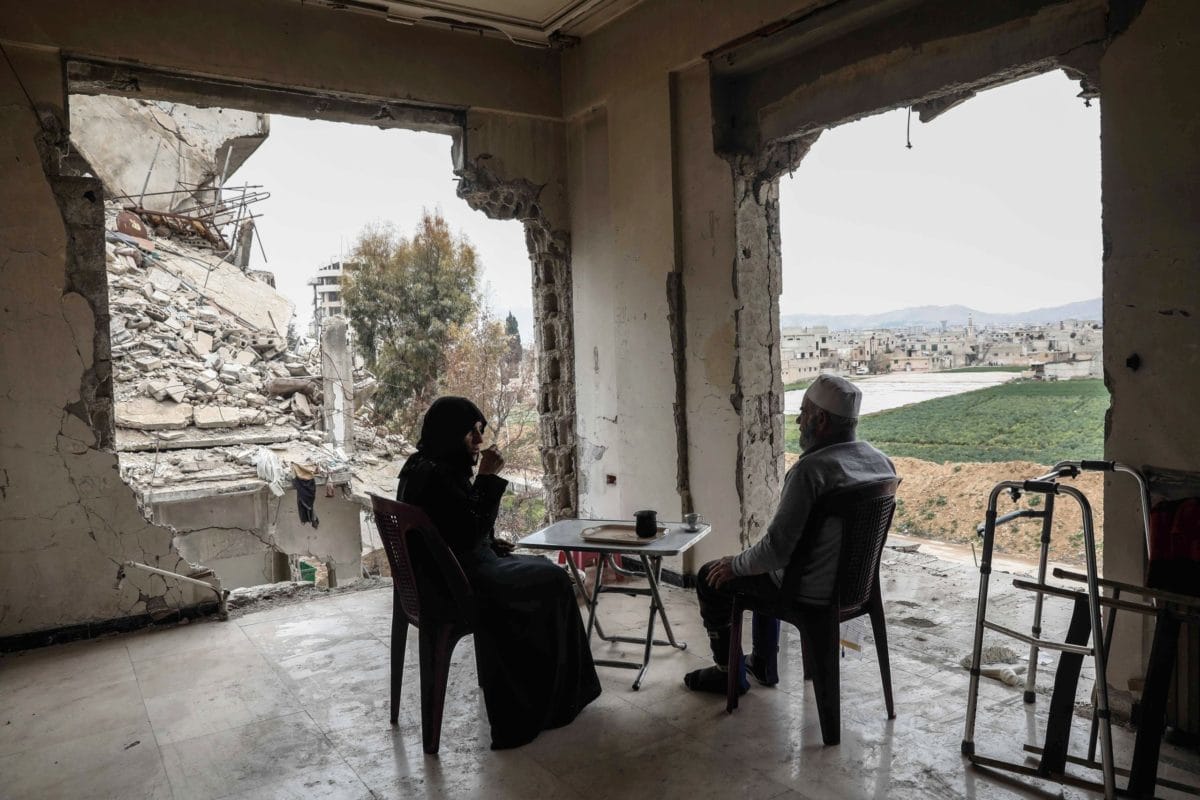
Umm Mohammed and her husband drink coffee at their destroyed home in Douma, March 23, 2017\. She raises chickens as a source of food and income. Sameer Al-Doumy/AFP via Getty Images
A district seat in the Governorate of the Damascus Countryside (*Muhafizat Rif Dimashq*) and a market town, it served as a bridge, of sorts, between the agricultural areas of Ghouta and Damascus and was famous for its grape production. In the 1990s, increasing numbers of Damascenes seeking relief from rising costs in the capital began moving to the city—part of the broader trend of urban to rural migration that was accelerated by the growth of small manufacturing and agricultural processing. Between the censuses of 1981 and 2004, the population doubled to more than 110,000 people. By the onset of the war, in 2011, Douma’s residents were almost equally divided between the formal, planned neighborhoods of Douma proper and the ring of informal settlements that had grown around it since the early 1970s.
In 2011, Douma became an opposition center to the Assad Regime. The following year, it came under siege. As a growing number of residents fled the violence, the Saudi-supported Jaysh al-Islam consolidated military control of the city, while a local council representing the various factions maintained municipal and central government functions. In early 2018, the Syrian regime’s Operation Damascus Steel subjected Douma to near-constant indiscriminate bombardment, including the chemical weapons attack that forced the city’s surrender in April of that year. A Russian-brokered agreement to evacuate some 20,000 fighters, their families and supporters left around 40,000 civilians remaining in the rubble.
By all accounts, the siege was horrific and the scale of the destruction shocking. “It was like a wild place,” says Abu H, recalling his visit to his hometown two years ago. “I didn’t see a single building without damage.” Those who dared to return joined the people left behind in a city occupied by hostile government forces and associated militias. Checkpoints marked the main roads into the city, and security services regularly arrested people suspected of belonging to opposition groups or evading compulsory military service. Those who returned took up residence in precarious houses. Where possible, they rehabilitated rooms and fashioned makeshift kitchens. Plastic sheets patched or replaced roofs and blankets covered windows to maintain privacy and keep out the cold. Politically connected “mafias” distributed government-rationed gas cannisters (one per household each month), water and just a few hours of electricity each day, and food was scarce. The government-subsidized bread, produced by two local bakeries that had been restored by the government, “was inedible,” as Abu H recalls, “but we ate it.” Other than the bakeries, little had been rebuilt save for a government building and the military conscription office, both of which were funded by a wealthy local parliamentarian.
Today, despite ongoing insecurity, things are improving. Satellite images show most of the rubble has been cleared from the formal neighborhoods. In informal areas, roads are open. Fields surrounding the city are being planted again. Private donors have subsidized the restoration of schools, a technical college and a small local hospital with the help of local contracting firms that have donated their services. The local youth soccer program has also been revived, and life is haltingly returning to the souk. With the economic crisis, however, prices remain high, and people have little money to meet basic needs, much less rebuild their homes and neighborhoods. The question remains, for many like Abu H, of who should be responsible for reconstruction: The problem, he said, is that today the state is “made up of individuals, not institutions,” and they are not interested in rebuilding, at least not for the average citizen.
## **Neoliberal Reconstruction**
Covering over 2,149,000 square meters of expropriated properties, the Marota City project on Damascus’ southern periphery encapsulates the Syrian government’s approach to reconstructing cities in the wake of the war. The project—intended to symbolize and propel Damascus’ entrance into a world of networked globalizing cities—is the culmination of a series of pre-war and wartime legal transformations that have sought to reorganize the Syrian economy around finance, real estate and tourism. The government’s neoliberal approach to reconstruction—in which government units, ranging from municipalities to military corporations, invest in Public Private Partnerships alongside private capital—ensures that the regime and associated businessmen control the post conflict political economy. [Publicity materials](http://marotacity.sy/en) put out by Damascus Cham Holding, which is itself a product of these new regulations, promise a world-class urban space of wide boulevards, a shopping mall, luxury apartment towers and globally networked office spaces meant to serve local, regional and global elites.
Artist's rendering of one of many building plans for Marota City as seen on their website and Facebook page.
According to the company, Marota City builds on Damascus’ history and carries it into the future. Plans for the area, however, suggest a space severed from its historical context and surroundings. They celebrate connectivity not with Syria or its capital but with the global, touting its proximity to an airport, high-speed communications infrastructure and highways to neighboring countries.
Marota is a planner’s city. Its historical imagination extends only as far back as the 1950s, the heyday of modernist urbanism. Large, standardized building envelopes populate standardized development blocks, all arrayed in a rigid geometry. It is, at the same time, an architect’s city. The planned towers, disconnected from each other and their surroundings, are standalone monuments seeking architectural distinction. As such, they become barely distinguishable from one another. The plan provides ample green spaces, but they remain largely distinct from the built-up areas. The wide boulevards suggest a lifeless street reminiscent not of old Damascus but of Doha.
Marota and other projects modeled on it, for example [in the suburb of Qaboun](https://www.theguardian.com/global-development/2022/mar/23/its-a-kind-of-revenge-damascus-suburb-demolished-as-assad-builds-a-new-syria), are displacing thousands of Syrians whose properties are being forcibly expropriated and transformed into shares in public-private partnerships. Owners are faced with the options of holding onto them, selling them for cash or putting the value toward acquiring property in the new development or in “alternative housing” developments nearby. Renters, meanwhile, receive cash subsidies to rent properties elsewhere in the city. For supporters, the transformation of value into abstract shares constitutes protection of property rights. Moreover, the requirement that developers provide “alternative housing” for those displaced, especially from informal neighborhoods, reflects a commitment to the improvement of urban space and the lives of citizens.
But many Syrians are skeptical of the Marota model—whose legal and administrative framework has, since 2018, governed reconstruction across the country. Their objections revolve around its crony capitalist nature and the government’s zeal to attract Gulf based capital and contractors to profit from reconstruction. They are also skeptical of the government’s plans to provide housing, either itself, or through the Marota model, which requires redevelopment projects to provide alternative housing to those they displace.
## **Views from Below**
Prior to the neoliberalization of urban development that began in the 1990s and accelerated after Bashar al-Asad’s ascendance to power in 2000, the government managed a range of programs to provide apartments at below-market prices. These programs—aimed at specific populations, including public employees, the military, the youth or workers near industrial cities—assembled land to build clusters of uniform, low-rise apartment buildings or taller towers. Depending on the program, after paying 30 or 50 percent of the price through monthly installments, the subscriber received a guarantee of an apartment to be delivered upon completion of the project. They would not know, until delivery, the apartment’s precise location in the development, the details of its finishing or, in many cases, its final cost.
In addition to, and often more effective than, the government’s social housing efforts were the semi-governmental cooperatives. Cooperatives were able to purchase inexpensive state land developments, often on the planned outskirts of cities and towns, where they benefitted from special permitting procedures and building materials at below-market cost. Here, too, members would subscribe to a project and receive a guarantee of an apartment after a certain percentage of the price was paid.
> **In Douma, when the municipality developed a new master plan in 1983 that included cooperative housing, the governorate simply refused to approve it, opting instead to end state provision of land for new developments and forcing the societies to purchase expensive, privately held properties.**
According to the [*Syria Report*,](https://hlp.syria-report.com/hlp/the-housing-crisis-in-syria-do-social-housing-and-housing-cooperatives-still-have-a-role/) while the cooperatives provided some 220,000 units from their inception in the early 1950s, the sector was plagued with difficulties. Debt-induced financial crises shook the region and the Lebanon Civil War drained resources in the 1980s, leading government retrenchment to starve the cooperative sector of support. In Douma, when the municipality developed a new master plan in 1983 that included cooperative housing, the governorate simply refused to approve it, opting instead to end state provision of land for new developments and forcing the societies to purchase expensive, privately held properties. These policies raised costs and put new projects out of reach of subscribers. As a result, no cooperatives have been built in Douma since the 1990s.
Dowamni we spoke with had little respect for these government housing projects. They were perpetually behind schedule—often by ten to 15 years or more—and typically produced small, standardized apartments, usually with low-grade materials. When provided, finishing such as flooring, tiles or countertops was often so poor as to require residents to invest their own money to remove and replace it. Their dissatisfaction extended beyond bureaucratic and quality control issues. Programs neglected the socio-spatial organization of life in Douma. For Abu M—a Doumi now living with his family in East Amman—home was much more than the house. “I remember Ramadan when I was still living in my old house. In addition to the meal my mother had prepared, there were always several plates from our neighbors. This is what I call home. It is you, your memories and your neighbors.” In his view, these programs were destructive of the notion of home and undermined community. “They ‘peel off’ people from their neighborhoods… and place them… God knows where! They don’t provide ‘homes.’”
## **Flexible Housing**
The pre-war programs, much like the alternative housing being provided today, denied peoples’ agency in organizing their own housing and community. Historically, such agency manifested in self-help, with individual families and property owners working together or with small contractors to produce housing in existing and new neighborhoods. In Douma, as elsewhere, families arranged with contractors to demolish their homes, especially the mud-brick courtyard houses in older parts of the city, and replace them with apartment buildings. As payment, the contractor would claim a percentage of the apartments and/or ground floor shops in the new building (usually 50 percent), while the remainder would be divided among family members.
> **Also read: "[The Urbanization of Power and the Struggle for the City](https://www.merip.org/the-urbanization-of-power-and-the-struggle-for-the-city/)," from MER issue 287.**
This small-scale urban development accelerated with the onset of neoliberalization in the 1990s, as Damascenes priced out of the capital began to arrive in Douma, driving up housing costs. Some families viewed this development as a boon. The increasing value of their homes drew increased interest from contractors eager to help them redevelop. But in other cases, familial transitions—newly married sons requiring room in the family home, for example, or disputes over inheritance—forced family members to move from the formal city into less expensive, informal neighborhoods. There, they would formally purchase shares in agricultural property and incrementally build new homes through self-help and against urban regulations. These homes were often small courtyard houses consisting of four buildings constructed as a rectangle within a three- to four-meter-high exterior wall with a courtyard (*ard al-dar)* in the center. Those with fewer resources built a variant, *Bayt Arabi-Frangi*, in which two buildings were arranged in an L-shape, leaving the outer wall to complete the courtyard.
> **Informal housing districts in Syria...are working or middle-class solutions, devised at the intersection of cultural practices, market logic and the failure of the state to provide alternatives to a growing population**
Informal housing districts in Syria are not to be confused with slums. They are working or middle-class solutions, devised at the intersection of cultural practices, market logic and the failure of the state to provide alternatives to a growing population. Their incremental nature indicates the degree to which, in contrast to the government’s approach, for many Dowamni, housing is a process marked by flexibility, not a pre-planned product. Over time, the initial structure might be fortified with new support columns or mud brick walls and wooden roofs replaced with cinder block and cement. The houses expand within these walled compounds as funds become available or family needs change. In some instances, the layout of the existing house will change with the addition of rooms. Depending on the materials and the structural supports, an additional floor might be built—again, incrementally—atop part or all of the house to create a new living space, for newly married sons or other relatives.
Nor are the interiors of the home fixed. Rather, they shift with the household’s daily routine and gendered practices. For example, while parents sometimes have a dedicated bedroom, children rarely do. Instead, they sleep in the rooms that make up the living quarters on mattresses that are picked up as the day begins. As the day progresses, and the women of the house complete their chores, their attention often turns to making goods for the market. Prior to the war, they made the embroidery for which Douma was historically famous, *Aghabani*, produced on special sewing machines stored in the corner of the main room. When the husband and children returned to the house, the machine would be returned to the corner and the space reverted to a sitting room. The family might have dinner and tea in the same room, sitting on cushions on the floor around a low table or a cloth spread. At the day’s end, the mattresses reappear as the family prepares for bed. The arrival of guests, too, changes the uses of the rooms. In summer months, male guests gather in the courtyard. Spouses, daughters or female friends socialize in the sitting room. In the winter months, the men utilize that room while the women used the kitchen or another interior space.
The courtyard is, for many, the most important part of the house. Open to the sky, it allows for sunlight and a breeze to permeate the house, providing relief on a hot summer day. In the summer months, it becomes a place for socializing, drying laundry and preparing food on gas stoves. Often, especially in larger homes, it contains a garden shaded by orange or lemon trees tended by the women of the family, who grow herbs and flowers for beauty and for making herbal tea.
## **Return to Incrementalism**
The government’s neoliberal approach to reconstruction is not simply about the production of high-end spaces. It is also about imposing a rationalist spatial order upon society. The war has provided cover for the imposition of a new round of laws and regulations targeting pre-war informal districts for demolition and redevelopment. Indeed, municipalities are now expected to pursue reconstruction through public-private partnerships and plan space in line with a disciplinary modernism.
> **While the laws technically provide compensation and “alternative housing” to those displaced by redevelopment, only those who can demonstrate formality are eligible...the alternative housing they are offered is not free.**
While the laws technically provide compensation and “alternative housing” to those displaced by redevelopment, only those who can demonstrate formality are eligible. The many Dowamni who owned the land upon which they built are entitled to small compensation for lost property rights. Because their buildings were built informally, they are entitled to only two years of rental support as well as the possibility, if space remains once formal claims are satisfied, of a place in an alternative housing development. Here, too, compensation requires documentary evidence of ownership. Those who cannot document ownership are cruelly entitled only to the rubble.
Moreover, the alternative housing they are offered is not free. Rather, they must purchase it on the failed subscription model used by social housing programs of decades past at prices far out of reach of an increasingly impoverished population. When asked whether they would accept an arrangement, if affordable, to abandon their claim to their pre-war homes in exchange for an apartment in a yet-to-be-developed project, most Dowamni said no. Um Z, whose family had lived in Douma for generations, needed less than a moment’s thought, “I would not accept it. I want to stay in Douma.” Although her son is pressuring her to sell the home to fund his own business venture, she refuses. “My memories are in that house. I gave birth to my daughters there. My memories with my husband are in that house,” she said. It was not simply a matter of nostalgia but also about how she and her family related to the space of the home and its surroundings in the informal area of Douma. “We can’t live in a closed apartment,” she said. In Amman, her family had rented a top floor apartment so they could use the roof. Like the courtyard of her home in Douma, it served as a private space that remained open to the sky and nature. The balcony, in contrast, was a public space she and her daughters felt uncomfortable using for reasons of piety and privacy. Her son transformed it into a garden, using planters to grow herbs, flowers and small trees. “We brought Douma here with us,” her daughter chimed in, laughing.
Others, such as Abu M, welcomed the possibility of a new municipal plan for his family’s neighborhood, even at the cost of losing square meters of his land. Access to proper public roads and utilities, a school and a health clinic would be worth it, but only if the people of the neighborhood were able to build their homes themselves on land they owned. As he saw it, if the government subsidized building materials, there was no need for the Marota model. Indeed, there was no need to look outside Douma and its history of self-help for solutions. Even on a smaller plot, a deal could be made with a contractor to build a formal apartment building with rentable ground floor retail space, as people had done before the war. Noting that there are few large contractors able to build on the scale the Marota model pre-supposes, for Abu M, the return to incrementalism is the key.
As did others, he strongly rejected the government’s approach of creating public-private partnerships that would force property owners to exchange their land for shares in a shareholding company or accept living in “alternative housing” towers. Like Um Z, Abu M wanted to return to Douma and gather with family and friends scattered by a decade of conflict. The government’s present approach “is not reconstruction,” he said. Leaning forward in his chair, he rested his elbows on his thighs, looked down at his hands. “Was it not enough what we have been through?” he asked quietly. “The humiliation, the bombing and the hunger? All of this was not enough? And so now a new war over land will start?”
\[**Najib Hourani** is an Associate Professor of Anthropology and Global Urban Studies at Michigan State University. **Safa Rawashdeh** holds an MS in Spatial Planning from the School of Architecture and Built Environment at the German-Jordanian University in Amman.\]
> **Read the [previous](https://merip.org/2023/01/the-jaziras-long-shadow-over-turkey-and-syria) article.**
> **Read the [next](https://merip.org/2023/01/exit-france) article.**
**This article appears in**[ **MER issue 305**](https://merip.org/magazine/305) **"Peripheries and Borderlands."**
### The Jazira’s Long Shadow over Turkey and Syria
URL: https://www.merip.org/2023/01/the-jaziras-long-shadow-over-turkey-and-syria/
Last updated: 2025-08-22T18:36:53.000Z
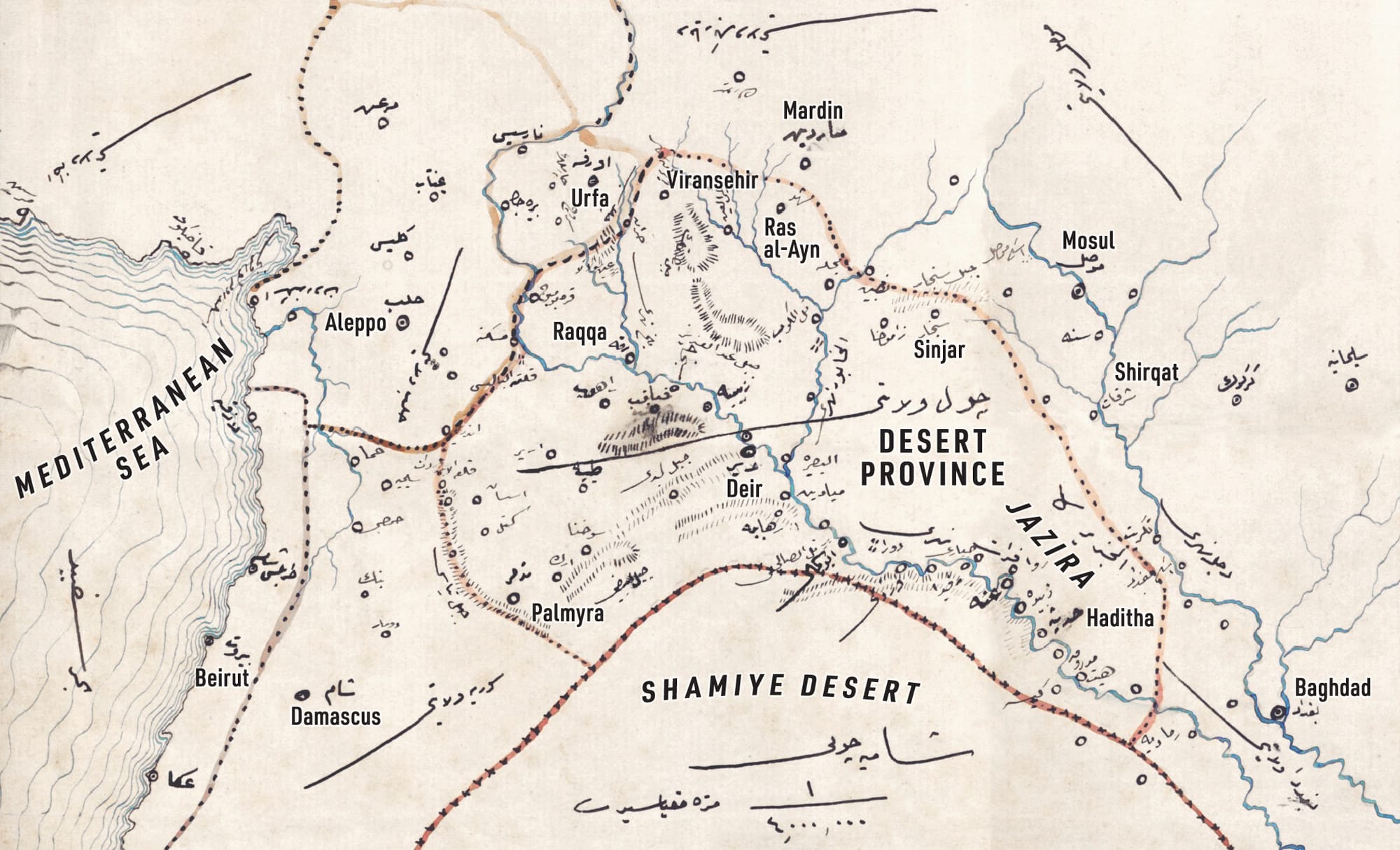
Map courtesy of Devlet Arşivleri Başkanlığı Osmanlı Arşivi.
In September of 2019, Turkish president Recep Tayyip Erdoğan called for the United Nations to establish a security zone in northern Syria east of the Euphrates. If the line extended south to Raqqa and Deir ez-Zor, [he suggested](https://bianet.org/kurdi/dunya/213502-erdogan-bm-genel-kurulu-nda-konustu-hicbirimiz-guvende-degiliz), some 3 million Syrian refugees could be resettled not only from Turkey but also from Europe. The following month, American forces withdrew from parts of northern Syria and the Turkish military invasion—dubbed “Peace Spring”—began. In late October, the state news agency TRT featured Erdoğan speaking beside a map of the operation all across northern Syria. The president argued that Arabs belonged there and Kurds did not, “because it is a desert.”[\[1\]](#%5Fedn1)
The statement invited several questions, among them, what does being Arab have to do with the desert? Is northern Syria—arid, to be sure, but also the most agriculturally productive Syrian lands—really a desert? And is the land all that different from the area just to the north of the border in Turkey? Behind these dizzying misrepresentations, however, was a clear aim: to send Syrian refugees in Turkey back while also neutralizing the Autonomous Administration of North and East Syria (also known as Rojava), which Turkey views as being dangerously close with the Kurdistan Workers' Party (PKK).
In referring to the desert and invoking the environment and borders, Erdoğan, perhaps inadvertently, was connecting the ongoing Turkish occupation of northern Syria to a much longer legacy featuring these borders. Also known as the Jazira—Arabic for “island” or “peninsula”—this arid yet fertile space stretching between the Tigris and the Euphrates at the foot of the Anatolian plateau has historically been home to mobile people in northeast Syria, southeast Turkey and northwest Iraq. Amid nomadic settlement campaigns, the Armenian genocide and post-Ottoman borders, the region was not so much a center or a periphery but both at once.
Repeated efforts to draw borders to better encapsulate the region and its desert environment—to resituate the periphery as a center, as it were—actually had the effect of establishing new peripheries and providing new openings for mobile people in the region. In this back and forth between center and periphery, the Jazira has persisted, a shadow geography haunting the broader region to this day.
## **Nature of Reform**
The nineteenth-century Ottoman reforms known as the *Tanzimat* attempted to pave the path from soil to state coffers through wide-ranging changes, including a land code as well as new structures of provincial administration. These processes occurred in a period of foreign encroachment from without and nationalist agitation from within. At the same time, the empire was becoming home to hundreds of thousands of Muslim refugees of various ethnicities fleeing ethnic cleansing on its borders with the Russian Empire and in the Balkans.
In this context, the Jazira appeared as a possible solution both for expanding cultivation and settling refugees. An environment at once dry and potentially productive, it had been home to extensive cultivation in the past. All across the region, mounds known as *tell*—accumulations of dirt on ruins of erstwhile agricultural plenty—attested to the land’s previous use. In the time of these bygone settlements, the Jazira had been a well-known geographical unit, appearing, for example, in medieval Muslim geographies alongside more familiar toponyms like Iraq and Egypt.[\[2\]](#%5Fedn2)
> **At the center of the effort to create Zor as a unit of governance was the perception, held by Ottoman officials, of a mismatch between the environment and the way Ottoman provinces divided it up** **.**
By the late 1860s, the name had receded as a unit of Ottoman administration, with the space divided between provinces of Aleppo, Diyarbekir and Baghdad. Across these borders, large populations of Arabic- and Kurdish-speaking pastoralists raised sheep and camels on the region’s rich grasses and engaged in commerce with merchants in the cities on its outskirts. The Jazira, then, was a space of divided connection. It wired circuits of trade and nomadic pastoralism. At the same time, it occupied the periphery of various provinces.
How was one to manage an arid region stretching across different provincial borders inhabited largely by mobile populations? Again and again over the course of the empire’s final half century, the Ottomans attempted to manage the Jazira by drawing borders around the desert. They tried to fortify these borders through the settlement of nomads and, more fitfully, refugees. Nearly 150 years before Erdoğan linked the desert, Arabs and refugees, the Ottomans established the special administrative district of Zor, in 1871, with its capital city at Deyr on the Euphrates. The region is more commonly known today as Deir ez-Zor.
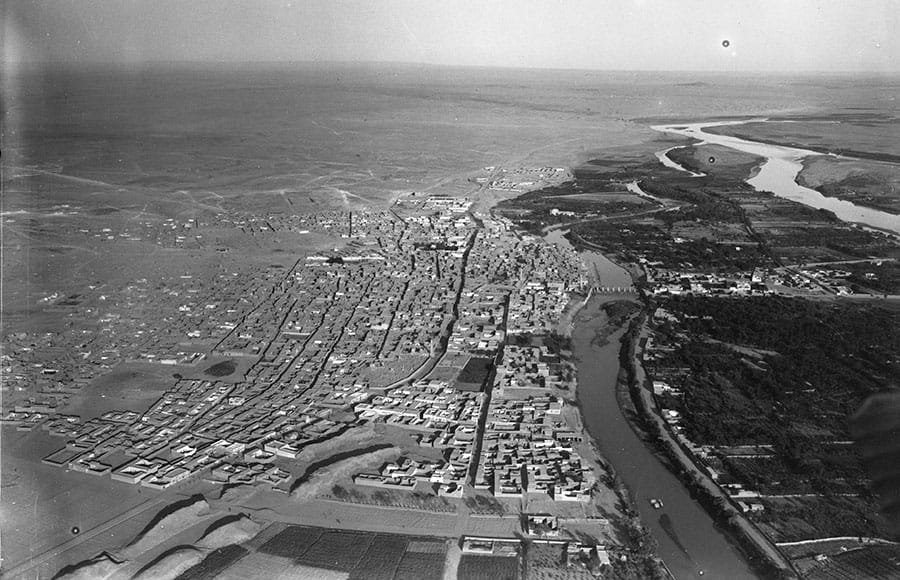
Aerial view of Deir ez-Zor, 1934, by the French 39th Artillery Regiment. Source: IFPO.
At the center of the effort to create Zor as a unit of governance was the perception, held by Ottoman officials, of a mismatch between the environment and the way Ottoman provinces divided it up. If threatened with punishment from a governor in Diyarbekir province for some infraction, nomadic pastoralists could simply slip away into Aleppo province, leaving squabbling officials in their wake. Zor would bring together both the desert and the people who moved in it, even if it did not totally encompass the broader Jazira.
Following Zor’s creation, the Shammar led a revolt against the new district. The rebellion was violently suppressed by the Ottomans. But the mismatch between political and environmental borders proved harder to resolve. Revenue collection on mobile populations was a perpetual challenge.[\[3\]](#%5Fedn3) In some cases, pastoralists continued to disappear, not only across the borders of Diyarbekir province into the special administrative district of Zor, but also from cultivated regions into the desert. In other cases, it was the Ottoman officials themselves who ended up in disputes, often over which sheep should be counted for taxes in which province. One observer of these arguments between Aleppo province and the district of Zor referred to the situation as “border chaos.”[\[4\]](#%5Fedn4) In the late 1870s, the administration of Zor even shifted back to that of Aleppo province, before it was once against restored as an independent administrative district in 1880.
In the eyes of one British observer, the dimensions of a district that was somehow close to Aleppo, Urfa and Sinjar (places today located in Syria, Turkey and Iraq, respectively), were nothing short of “absurd.”[\[5\]](#%5Fedn5) But where some saw absurdity, many saw logic. Ottoman officials conceived of Zor as the “natural” place to rule the “midpoint of the deserts of four provinces.”[\[6\]](#%5Fedn6) In one unrealized proposal to expand Zor as part of what would be called Desert province, several officials called the region “a natural governing point.”[\[7\]](#%5Fedn7)
## **Shifting Landscapes**
As Ottoman policies in the region shifted under Abdülhamid II, the borders, which were intended to contain the desert and seasonal migrations of nomadic pastoralists, became a flashpoint for a new set of confrontations. In 1891, the empire established mounted paramilitaries in southeast Anatolia known as Hamidiye Light Cavalry Brigades. These units ostensibly functioned as a means to co-opt Kurdish populations into state service as well as to protect against Armenian revolutionaries and Russian encroachment. In the Jazira, however, they had another task: to push south into the districts of Zor, home to branches of the Shammar confederation.
> **Far from wandering with no regard for borders or state officials, nomadic pastoralists knew precisely where the borders were and which administrators they could supplicate...**
The foremost figure in this endeavor was Ibrahim Pasha of the Milli confederation, based in Viranşehir, located right on the border of Diyarbekir province and Zor. Sources depict Ibrahim Pasha crossing from Diyarbekir province into the district of Zor to encroach on grazing lands of the Shammar, recruit local groups to his Hamidiye Brigades and evade taxes on sheep. The situation became so dire that the district governor of Zor worried Ibrahim’s actions would cause “the destruction and disappearance of a district.”[\[8\]](#%5Fedn8)
The border did not simply enclose a space. It shaped the space. Far from wandering with no regard for borders or state officials, nomadic pastoralists knew precisely where the borders were and which administrators they could supplicate and savvily used both to advance their interests. In doing so, they at once reacted to borders and, as the fears of the district governor of Zor underscored, threatened to erase peripheries altogether and transform them into something else.
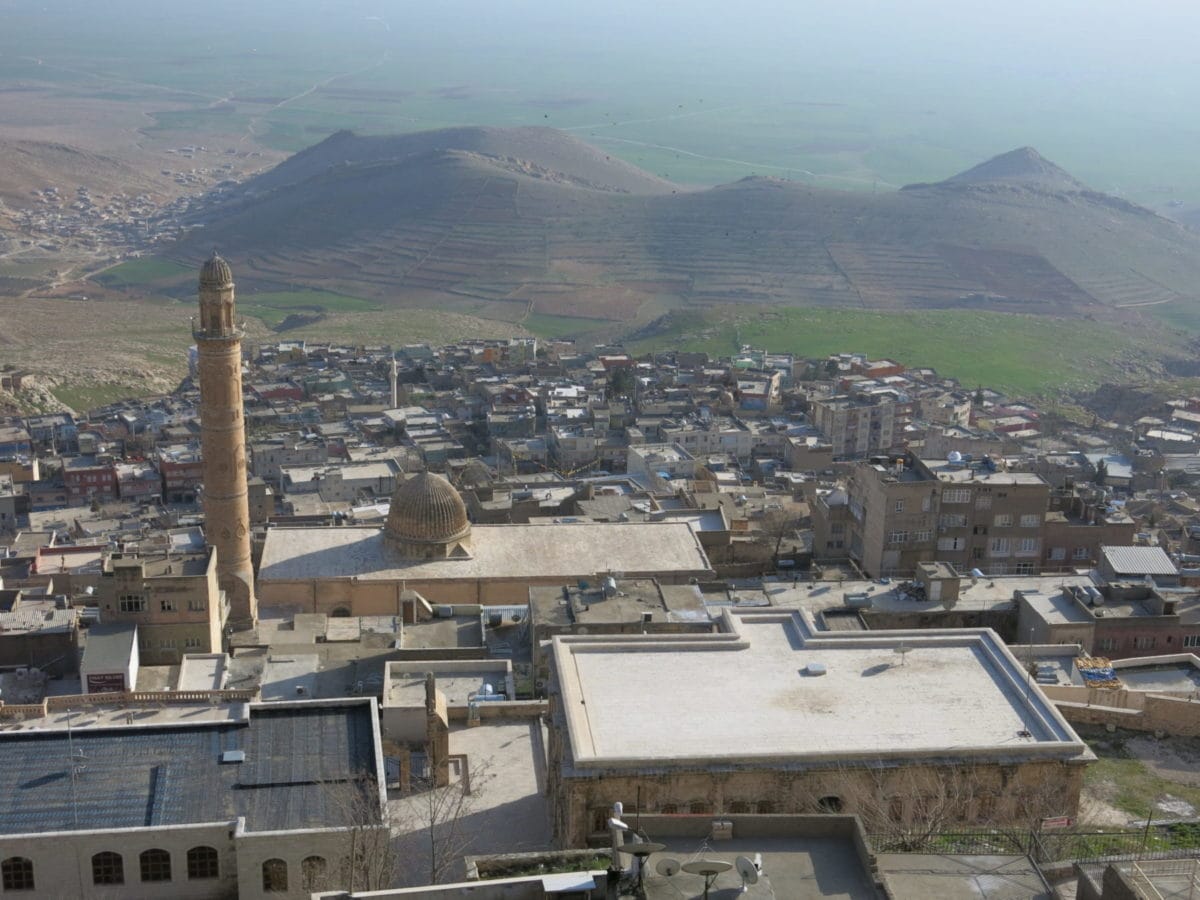
Mardin, Turkey, looking south toward the Jazira. Photo courtesy of Chris Gratien.
Those in cities on the edge of the Jazira imagined new spatial connections across the region. In the city of Mardin, famous for its limestone buildings perched on a hill overlooking the expanses of the Jazira, notables requested their city be detached from Diyarbekir province and combined into a new province with the district of Zor as well as the Zakho district of Mosul—a territory encompassing present-day Iraq, Syria and Turkey. They did so on two grounds. First, the most commonly spoken language in the city was Arabic, as opposed to Kurdish and Ottoman Turkish in the rest of Diyarbekir province. Second, the notables claimed that their city was “the most important ruling point of the region of the Jazira.”[\[9\]](#%5Fedn9) They saw their connections with the nomadic pastoralists in the “wandering grounds” to the south, near al-Hasakah, as evidence of their shared regional identity.
The proposal to remove Mardin from the “eastern provinces” and attach it to the “Arab lands,” as one official phrased it, never materialized.[\[10\]](#%5Fedn10) One of the arguments formulated against the plan by the governor of Diyarbekir was that the populace of the region under Mardin’s control was in fact more Kurdish than Arab.
More than a century before Erdoğan’s call for Syrians to be sent out of Turkey and the Turkish occupation of portions of northern Syria, people were declaring connections in the opposite direction: They wanted Mardin, a city that is now part of Turkey, to be connected to the deserts to the south, part of present-day Syria. The geography of the Jazira played a central role in these deliberations, haunting the proposals of notables while never an administrative unit of its own.
## **Natural Violence**
In World War I, the landscape of Zor came to serve a new, more lethal purpose. No longer an object of transformation, it became an instrument of violence in its own right.
With concerns about the loyalties of Armenian citizens amid the advance of the Russian army in the east, the Ottoman state began the deportations that initiated the Armenian genocide. The borders of Zor, created over forty years earlier for the purpose of containing nomadic migration, became the destination for many of the Armenians who were systematically marched out of their hometowns all across the empire. Many were robbed, sexually assaulted and killed along the way, and those who managed to survive the gauntlet of deportation faced more violence in the deserts of Zor.
> **For Armenians, the borders of Zor and the bounds of the desert it encompassed became a site of massacre, disease and starvation. Yet, in a reminder of the malleable nature of the desert, the region also became a center of survival..** **.**
The wartime interior minister, Talat Pasha, did not describe the space in terms of provincial borders but rather in terms of environmental ones. As he told American ambassador Henry Morgenthau of the Armenians, “they can live in the desert but nowhere else.”[\[11\]](#%5Fedn11) For Armenians, the borders of Zor and the bounds of the desert it encompassed became a site of massacre, disease and starvation. Yet, in a reminder of the malleable nature of the desert, the region also became a center of survival for some, primarily children who lived among nomadic groups in a range of roles from beloved family member to enslaved laborer.
All the while, Ottoman officials continued to discuss the question of the region’s provincial borders. In May of 1915, as the deportation regime ramped up, the infamous governor of Diyarbekir, Dr. Reşid, was asked by the Interior Ministry whether Viranşehir—now part of Turkey—ought to be considered part of Diyarbekir province or the district of Zor. Reşid neglected to answer, writing that he had “been busy with very important matters,” presumably matters connected to the large-scale massacres of Armenians in Diyarbekir province that began by late May and early June.[\[12\]](#%5Fedn12)
In the waning days of World War I, the Ottoman parliament once again became consumed with questions of borders and the Jazira. As in the past, the promise of the region’s fertility made many want to redeem the space. As one deputy put it, if Cairo were rich thanks to the Nile, the Jazira could well be twice as rich given that it had two mighty rivers, the Tigris and the Euphrates.[\[13\]](#%5Fedn13) A new provincial administration for the region, explicitly called “the Jazira” by parliamentary deputies, could make this dream into a reality. Others derisively commented that if one were “to consider the places in which one tribe wanders a province,” it would be laughably large, including “Basra, Baghdad, Mesopotamia, Urfa, Aleppo and Syria.”[\[14\]](#%5Fedn14) Laugh though some may have, by the spring of 1918 reports discussing these regions were circulated. They revealed a clear tension between center and periphery. “For days and days,” one report noted, “the only thing visible is space and sky.”[\[15\]](#%5Fedn15) Pastoralists “wandered like swarms of locusts on the edge of cultivated regions.” As if this wasn’t threatening enough, they even reportedly ate watermelons along with the rind.
## **Imperial Ghosts**
The colonial dismemberment of the Ottoman Empire following World War I brought with it dilemmas and discourses familiar from the late Ottoman periphery. Maps of a Jazira state appeared during discussions at Versailles, alongside other states for Armenians, Assyrians and Kurds that never came to be. [\[16\]](#%5Fedn16) The Jazira was ultimately divided once again.
Nusaybin—long located on the border between Zor and Diyarbekir province—found itself on the border between Turkey and Syria thanks to a faulty map mistakenly depicting the city north of the railway line that formed a large part of the new border in the Ankara Agreement of 1921.[\[17\]](#%5Fedn17) The broader region extending from Nusaybin was also divided, no longer into separate Ottoman provinces, but rather between British Iraq, French Syria and the Republic of Turkey.
As in the Ottoman period, the movement of pastoralists across these borders allowed them to carve out some autonomy for themselves, albeit alongside newly violent forms of colonial rule brutally utilizing airpower and shrouded in the paternalistic rhetoric of the League of Nations. In the urban centers of Iraq, Syria and Turkey, far removed from the Jazira, various nationalist groups articulated their territorial claims to the region by relying on the phrase “natural borders.”[\[18\]](#%5Fedn18) In a landscape where the desert had long shaped questions about borders, the environment and governance intersected once again. Or at least so it seemed.
> **Over the years, the Jazira continued to pop up as a territorial entity, whether as a possible French protectorate in the late 1930s or as a site for resettling Palestinian refugees in the wake of 1948** **.**
Sometimes “natural borders” meant a call for an environmentally coherent state, but more readily the phrase referred to economic connections or even conventional wisdom: a Syria that extended from the Mediterranean all the way east to the Khabur River, for example (notably excluding large parts of the Jazira). The border schemes also largely contradicted one another—Turkey to include Aleppo, Iraq to include Diyarbekir and Zor districts—and were not implemented by the post-Ottoman colonial regimes.
Over the years, the Jazira continued to pop up as a territorial entity, whether as a possible French protectorate in the late 1930s or as a site for resettling Palestinian refugees in the wake of 1948.[\[19\]](#%5Fedn19) The post-Ottoman states, however, maintained the Ottoman dynamic in which the Jazira functioned as a periphery of multiple centers, this time rooted in nation-states rather than Ottoman provinces.
Due to its continued status as periphery, the Jazira has retained a sense of integrity even as it has largely disappeared from the consciousness of those living outside of it. Building on the expansion of cultivation that occurred in the late Ottoman period along rivers and beside cities, over the twentieth century, the region transformed into an agricultural heartland—if still a political periphery—in Syria and Iraq. Connections across the region persisted because of differential customs regimes and cross-border ties of kinship, which fueled a robust smuggling trade.[\[20\]](#%5Fedn20) Indeed, these commercial links were the primary reason for the placement of mines along the border between Syria and Turkey in the 1950s (Despite plans to remove them during the 2010s, many remain).
> [On Blaming Climate Change for the Syrian Civil War](https://www.merip.org/on-blaming-climate-change-for-the-syrian-civil-war/)
In recent years, this geography, so often unnamed on maps, has suddenly appeared once again. In the midst of the Syrian Civil War, the autonomous region of Rojava emerged, hugging the border with Turkey in northeastern Syria. Other parts of the Jazira fell under the rule of ISIS, in 2014, as the group rapidly conquered territory from Raqqa to Mosul. Like the region itself, these developments have longer histories. Rojava is the product of the colonial denial of a Kurdish state and subsequent refugee flight south from the Republic of Turkey into Syria. ISIS, meanwhile, appeared not in an empty space—despite what breathless media accounts might have suggested. Rather, it emerged in a landscape reeling from the US destruction of Iraq, subsequent cross-border networks and the unraveling architecture of agrarian development caused by historic drought and cuts to fuel and fertilizer subsidies in Syria.
Today different portions of the Jazira—notably including the region’s oil fields—are controlled by forces of Russia, the Syrian Arab Army, Syrian Democratic Forces, Turkey, the United States and other factions. Amid this contention, as Erdoğan’s words suggest, the dream of political and environmental alignment retains its allure, with a sense that the desert of the Jazira ought to be home to Arabs rather than Kurds.
In the 2017 novel *Disquiet* by Zülfü Livaneli, a different kind of image of the environment and the border appears. The narrator recalls how as a child in Mardin in southeast Turkey, the dusty winds from the “deserts of Syria” would leave him struggling to breathe and “would paint all of us a red of the hot desert.”[\[21\]](#%5Fedn21) A symbol of blowback, Livaneli’s image also attests to the environmental connections across borders that have been at play in various attempts to manage mobile people in the Jazira from the late Ottoman period into the present. The red dirt of the peripheral Jazira blows across borders and gets on people’s skin.
\[Samuel Dolbee is Assistant Professor of History at Vanderbilt University. His book *Locusts of Power* will be out in 2023 with Cambridge University Press.\]
> **Read the [previous](https://merip.org/2023/01/nation-making-on-the-razors-edge-in-the-egyptian-libyan-borderland) article.**
> **Read the [next](https://www.merip.org/rebuilding-douma/) article.**
**This article appears in [MER issue 305](https://merip.org/magazine/305) "Peripheries and Borderlands."**
---
### **Endnotes**
[\[1\]](#%5Fednref1) “Erdoğan: Oralara en uygun olan Araplardır, çünkü çöl,” [*BirGün*](https://www.birgun.net/haber/erdogan-oralara-en-uygun-olan-araplardir-cunku-col-273862), October 25, 2019.
[\[2\]](#%5Fednref2) Zayde Antrim, *Routes and Realms: The Power of Place in the Early Islamic World* (New York: Oxford University Press, 2012), p. 97.
[\[3\]](#%5Fednref3) Devlet Arşivleri Başkanlığı Osmanlı Arşivi (BOA), ŞD 2213/29, 13 Recep 1289 (September 16, 1872).
[\[4\]](#%5Fednref4) BOA, ŞD 2214/20, 28 Eylül 1290 (October 10, 1874).
[\[5\]](#%5Fednref5) The National Archives-United Kingdom, FO 424/123, Earl of Dufferin to Granville, July 29, 1881, Inclosure: Report by Captain Stewart on the Deir Sandjak and on Some of the Neighboring Districts, July 14, 1881.
[\[6\]](#%5Fednref6) BOA, ŞD 2424/69, 3 Nisan 1296 (April 15, 1880).
[\[7\]](#%5Fednref7) BOA, Y.A.RES 55/38, 25 Teşrinievvel 1306 (November 6, 1890).
[\[8\]](#%5Fednref8) BOA, DH.TMIK.M 38/39, 14 Teşrinievvel 1313 (October 26, 1897).
[\[9\]](#%5Fednref9) BOA, DH.İD 144/2-26, 17 Mayıs 1329 (May 30, 1913).
[\[10\]](#%5Fednref10) BOA, DH.İD 144/2-26, 3 Haziran 1329 (June 16, 1913).
[\[11\]](#%5Fednref11) Henry Morgenthau, *Ambassador Morgenthau’s Story* (Garden City: Doubleday, 1918), p. 232.
[\[12\]](#%5Fednref12) BOA, DH.İ.UM 46-2/211, 27 Nisan 1331 (May 10, 1915); Uğur Ümit Üngör, *The Making of Modern Turkey: Nation and State in Eastern Anatolia, 1913-1950* (New York: Oxford University Press, 2012).
[\[13\]](#%5Fednref13) Meclis-i Mebusan Zabıt Ceridesi (MMZC), İ:29, C: 1, 7 Kanunusani 1334 (January 7, 1918), p. 518.
[\[14\]](#%5Fednref14) MMZC, İ:32, C: 1, 12 Kanunusani 1334 (January 12, 1918), p. 575.
[\[15\]](#%5Fednref15) BOA, DH.İ.UM 10-1/2/58.
[\[16\]](#%5Fednref16) Zayde Antrim, *Mapping the Middle East* (London: Reaktion Books, 2018), pp. 169-171.
[\[17\]](#%5Fednref17) Centre des archives diplomatiques de Nantes, Syrie 298, Weygand to Poincaré, June 13, 1923.
[\[18\]](#%5Fednref18) James Gelvin, *Divided Loyalties: Nationalism and Mass Politics in Syria at the Close of Empire* (Berkeley: University of California Press, 1998), p. 152; Eliezer Tauber, ‘The Struggle for Dayr al-Zur: The Determination of Borders between Syria and Iraq,” *International Journal of Middle East Studies* 23 (1991), p. 379; Seda Altuğ, “The Turkish-Syrian Border and Politics of Difference in Turkey and Syria (1921-1939)” in Matthieu Cimino, ed. *Syria: Borders, Boundaries, and the State* (Cham: Palgrave Macmillan, 2020), p. 60.
[\[19\]](#%5Fednref19) Jordi Tejel, *Syria’s Kurds: History, Politics, and Society*, trans. Emily Welle and Jane Welle (London: Routledge, 2009), pp. 29-33; Avi Shlaim, *Israel and Palestine: Reappraisals, Revisions, Refutations* (New York: Verso, 2009), pp. 62-64.
[\[20\]](#%5Fednref20) Ramazan Aras, *The Wall: The Making and Unmaking of the Turkish-Syrian Border* (Cham: Palgrave Macmillan, 2020).
[\[21\]](#%5Fednref21) Ömer Zülfü Livaneli, *Huzursuzluk* (Istanbul: Doğan Kitap, 2017), p. 18.
### Nation-Making on the “Razor’s Edge” in the Egyptian-Libyan Borderland
URL: https://www.merip.org/2023/01/nation-making-on-the-razors-edge-in-the-egyptian-libyan-borderland/
Last updated: 2025-08-22T18:36:54.000Z
In 1908, the British lord and arch-imperialist George Curzon published a short treatise on the unique role of frontiers in modern history. “Frontiers,” he wrote, “are indeed the razor’s edge on which hang suspended the modern issues of war or peace, of life or death of nations.”[\[1\]](#%5Fedn1)
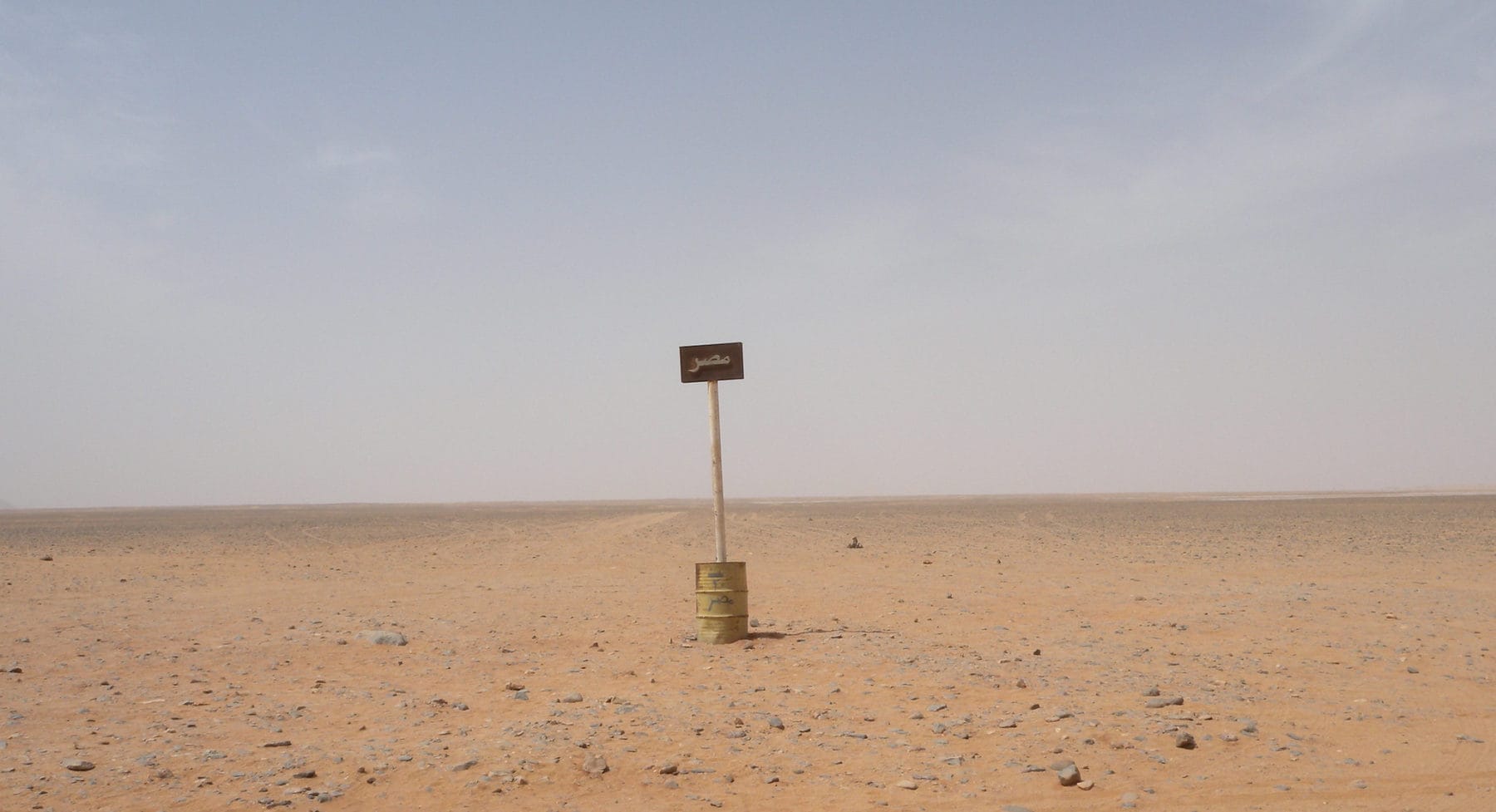
Egypt sign along the Egypt-Libya border. Photo by Paul Robinson (Creative Commons License BY-NC-SA 2.0)
Curzon had recently returned from six years of service as Viceroy of India. In his view, well-defined borders had become the very “condition of existence” for the modern state in the nineteenth century. In his role as British Foreign Secretary between 1919–1924, Curzon would go on to play an active part in bringing a new world of bordered nation-states into fruition. With the piecemeal dissolution of the Ottoman Empire after World War I, the Middle East emerged as his primary canvas. Curzon spearheaded negotiations for the Treaty of Lausanne in 1923, which established the borders of the Republic of Turkey as well as those of Iraq and Syria—with Iraq under British colonial stewardship and Syria under the French. He also oversaw the creation of the kingdom of Jordan out of the British Mandate for Palestine.
Curzon’s career—and the heavy hand of the colonial powers in drawing the borders of the post-Ottoman Middle East—reflect themes that have grown entrenched in Western discourse on Middle Eastern geopolitics. The notion that the so-called “unnatural,” colonial provenance of Middle Eastern borders has rendered them especially artificial or fragile has [long been used](https://www.merip.org/content/files/crown/publications/middle-east-briefss/101-200/meb103.pdf) to explain moments of political turmoil. It surfaced as a popular journalistic [trope](https://www.theatlantic.com/international/archive/2013/09/stop-blaming-colonial-borders-for-the-middle-easts-problems/279561/) during the US-led invasion of Iraq and again during the fallout of the 2011 uprisings. A second related theme is that the Middle East is particularly resistant to borders and thus somehow unfit for modern nation-statehood—at least without outside supervision. Curzon went so far as to attribute this attitude to the “dislike of precise arrangements that is typical of the oriental mind.”[\[2\]](#%5Fedn2)
Yet, for all their obsession with drawing new international borders, what colonial statesmen like Curzon failed to understand—and what many contemporary observers still miss—is that borderlands are never finished products. They are not set in stone, even once a borderline is officially demarcated and recognized in international law. In this regard, national maps are deceptive. While they ostensibly depict a fixed and stable territorial enclosure, they obscure how national communities are forged on the ground—especially in borderlands, which state powers myopically view from their vantage point at the center as merely peripheral. Social identities in borderlands are continually negotiated, contested and refashioned as they come into contact with different, often competing manifestations of state power.
Modern Middle Eastern and North African history is rife with examples of how centralizing states have attempted to transform social and political dynamics in borderland spaces, converting entire local or regional geographies into national peripheries. Recently, however, scholars have been attending to borderlands as generative spaces, which shape state-building projects as much as they are shaped by them. As historians Michel Baud and Willem van Schendel have argued, borderland histories are unique in illuminating “ways of conceptualizing social space and local identity, and the roles these have played in promoting or thwarting the development of modern states.”[\[3\]](#%5Fedn3) Adopting the view from borderlands, understood as centers in their own right, is a necessary corrective to more conventional top-down, state-centric narratives of territorial expansion, conquest and enclosure.
## **A Peripheral Center**
Many in the Egyptian government and academy alike remain deeply invested in upholding a narrative of Egypt’s timeless geographic unity and territorial integrity across the country’s expansive domains. Yet, Egypt’s history actually illustrates the active role of peripheries in territorial nation-state formation. The country’s western borderland consistently mediated centralizing state power in the late-nineteenth and early-twentieth century, when Libya was under direct Ottoman rule and Egypt was still nominally Ottoman territory.
> **Read Samuel Dolbee on "[The Jazira’s Long Shadow over Turkey and Syria](https://merip.org/2023/01/the-jaziras-long-shadow-over-turkey-and-syria)," for MER issue 305.**
Though sparsely inhabited, the borderland between Egypt and Libya in the decades before World War I was home to a rich tapestry of local denizens, ranging from nomadic pastoralist tribes, to itinerant merchants operating along the Mediterranean coast, to agricultural communities settled for centuries in the various oases dotting the desert interior. To these populations, the desert borderland was not marginal, as it would have appeared from the seats of state authority in Cairo or Istanbul, but rather the locus of their spatial identity. This geographic sensibility is visible in the names of two of Egypt’s Western Desert oases: *Dakhla*, meaning “inside” or “inner,” and *Kharga*, which means “outside” or “outer.” Dakhla is located west of Kharga, farther from the Nile Valley and thus deeper inside the Sahara. For the people of the oases, the desert, not the Nile Valley, was the vantage point from which they defined the center.
Beginning in the mid-nineteenth century, the borderland became the homebase of the Sanusiyya—a Sufi brotherhood that grew rapidly in the ensuing decades, galvanizing a striking proportion of the region’s population. By the turn of the twentieth century, the Sanusiyya functioned as a pseudo territorial state of its own, and its headquarters in the oasis of Jaghbub emerged as an alternate sovereign center. The basic building block of Sanusi authority was the *zawiya* (plural: *zawaya*), an institution often translated as “lodge” but which, in the Sanusi system, could also serve as a court of law, guesthouse, caravanserai, storehouse and information hub. The establishment of an expansive network of Sanusi *zawaya* helped the brotherhood exercise sovereignty along multiple axes throughout the desert borderland: On the north/south axis, the Sanusis had effective control over the lucrative caravan route linking the easternmost Libyan province, Cyrenaica, to the kingdom of Wadai in modern-day Chad.[\[4\]](#%5Fedn4)
> **To these populations, the desert borderland was not marginal, as it would have appeared from the seats of state authority in Cairo or Istanbul, but rather the locus of their spatial identity** **.**
The Sanusiyya also exercised considerable authority to the east of Jaghbub, throughout Egypt’s expansive western domains, and were especially powerful in the oasis of Siwa. Their encounter with the centripetal pull of both the Egyptian and Ottoman states in the two decades before World War I only strengthened their territorial authority in the borderland. When the Egyptian state attempted to reconquer Siwa in the last years of the nineteenth century, it had to enlist the help of local Sanusi notables, who harnessed the intensified Egyptian presence in the oasis to take more power and formalize their own customary authority.
The Sanusi shadow state notwithstanding, this stretch of the Eastern Sahara was not easy to define politically. For most of its history there had been no clear border marking off Egyptian and Libyan territorial domains. During the expansion of the Ottoman Empire throughout the Middle East and North Africa in the sixteenth century, Ottoman authorities refrained from delineating any formal boundaries within the empire. As a result, the frontier between Egypt and Cyrenaica represented a transitional zone between two provinces lying within the wider sphere of Ottoman imperial sovereignty. In 1841, following the Egyptian governor Muhammad Ali’s expansionist gambit, Egypt became an autonomous province, but the Ottoman government still refused to acknowledge the legitimacy of any formal border for Egypt. The Ottomans chose instead to refer to Egypt’s western border as a “line of distinction” or “line of separation,” marking off the domain of Egypt’s status as a “privileged province” (*eyalet-i mümtaze*)—and thus not an official boundary line.
The political indeterminacy of the region continued after the British occupation of Egypt in 1882\. Britain and the Ottoman Empire (technically sovereign over Egypt until 1914) conspired not to define the border, lest it provoke unnecessary legal or diplomatic controversy—a stance that became particularly thorny during the first decade of the twentieth century, when the Italian government, seeking to lay the groundwork for its impending colonial occupation of Libya, repeatedly pressured the British to draw a western border for Egypt. The Italians’ protests fell on deaf ears. The British, in defiance of the rationalizing geopolitical spirit of the age, agreed with the Ottomans that it was better policy to leave the border ambiguous. A bona fide border between Egypt and Italian-controlled Libya would not be defined until 1925\. Even then, it would do little to disrupt the fluid social identity of the region’s inhabitants.
## **Borderland Mobility between Egypt and Libya**
Throughout the second half of the nineteenth century, the Egypt-Cyrenaica borderland gradually emerged as a nebulous zone of overlapping Egyptian and Ottoman sovereignty, where the parallel centralization projects of the Egyptian state and its imperial suzerain came into uneasy contact. The continuous mobility of the region’s Bedouin tribes posed a challenge to the centralization efforts of both states. As tribes repeatedly crossed the invisible border, typically to evade tax collection or punitive justice at the hands of local Ottoman officials, both governments felt compelled to re-examine the scope of their territorial definition in the region.
Bedouin mobility was the key catalyst forcing the Ottoman government to confront the limits of its own sovereign jurisdiction vis-à-vis Egypt, which gradually came to represent an entirely different legal-political climate to that of the local inhabitants of the region. This burgeoning mindset of territorial rivalry with Egypt prompted the Ottoman government to establish a new military and administrative outpost in the border town of Sollum in 1902\. Their intention was to make overtures to the local tribal population, while trying to keep them from falling into Egypt’s orbit.
> **Bedouin mobility was the key catalyst forcing the Ottoman government to confront the limits of its own sovereign jurisdiction vis-à-vis Egypt, which gradually came to represent an entirely different legal-political climate to that of the local inhabitants of the region.**
Over the next decade, the Ottomans’ more assertive regional strategy would be severely tested. In response to a series of violent conflicts that erupted between the Shihabat, ‘Awaqir and Awlad ‘Ali tribes on both sides of the putative border, the Ottoman and Egyptian governments began to negotiate over affairs in the borderland. For the first time, negotiations took place with a view toward protecting their own tribesmen, to whom they had previously given little consideration as potential national subjects. In this period of prolonged border crisis, even Lord Cromer, the British consul-general of Egypt since 1882, began to refer to such groups as “Turkish Bedouin” and “Egyptian \[our\] Bedouin.”[\[5\]](#%5Fedn5)
The Egyptian and Ottoman officials were following the lead of the Bedouins themselves, who strategically invoked a sense of political belonging to Egypt or Libya to serve their own local interests. In 1905, for example, two separate groups of Awlad ‘Ali petitioned the Egyptian Coast Guard for protection by claiming that they were “Bedouins…belonging to the Egyptian government.”[\[6\]](#%5Fedn6) Such strategic maneuvers were also found in late-Ottoman Jazira, where pastoralist nomads knew the precise contours of local administrative borders and regularly made savvy use of that knowledge.
Borderland affairs would continue to exert a strong pull on the Ottoman and Egyptian centers for years to come. In 1909, when the Ottoman government attempted to resolve the longstanding feud between the ‘Awaqir and Shihabat by convening a Bedouin summit, it was clear that there was much more at stake than backwater tribal politics. For the local official in charge of the hapless Ottoman delegation, the summit was “a matter of life or death” for the Empire. Unlike their Egyptian counterparts, who arrived in an impressive steamship and appeared to be “governed according to the British rules of punctuality,” the Ottomans failed to compel “their” Bedouin, the ‘Awaqir, to attend. This failure, the official feared, was a fatal blow to Ottoman prestige and a surefire sign that Egypt was now flexing its muscles as a nascent independent nation-state, in defiance of Ottoman suzerainty.[\[7\]](#%5Fedn7)
If Egypt and Libya finally started to come into sharper territorial focus by World War I, it was not due to the imposition of central power onto the periphery but to the ways that local actors shrewdly harnessed political contestation between the Egyptian, Ottoman and (later) Italian states. Although it is unclear if the region’s Bedouin tribes ever truly saw themselves as Egyptian or Ottoman or Libyan during this period, they acted with a heightened awareness of their Eastern Saharan homeland as a peripheral center—a point of convergence between two distinct political spheres, bearing different sovereign capabilities and thus offering distinct advantages in terms of protection and justice. Throughout the process, the tribes were typically in the driver’s seat, leaving the three competing state powers desperate to curry favor with them.
## **New Lessons from Old Borderlands**
All too often, border disputes in the Middle East or North Africa are taken as proof that the region’s geopolitical divisions—primarily a legacy of the colonial era—are inherently artificial and thus especially prone to violent collapse. Reflected in the narratives glibly bandied about in the wake of the 2003 Iraq war and eventual rise of the Islamic State, these views presuppose that a more [authentic blueprint](https://www.jadaliyya.com/Details/32140) for slicing up the region can be found—one theoretically more in sync with the region’s mosaic of ethnic and religious identities.
The historical example of the territorialization of the Egyptian-Libyan borderland offers a useful antidote to such wishful thinking. Throughout modern Middle Eastern and North African history, the drawing of borders did not wantonly trap the wrong groups of people within the wrong national enclosures. Instead, nation-state formation in the Middle East and North Africa, as elsewhere, entailed a complex and ongoing set of interactions between centralizing sovereign powers and the local geographies they encountered at their margins.
Borderland histories throw these dynamics into high relief, showing how state powers can be fundamentally reactive to local and regional spatial practices, such as tribal mobility, which operate under a distinctive territorial logic that typically long predated the onset of modern state centralization. Curzon might have been right in believing that borders are the pivot of modern history—not, as he would have it, for the ways they decisively enclose modern states, but for how they continuously challenge what is meant by the center in the first place.
\[Matthew H. Ellis is a Professor of History at Sarah Lawrence College.\]
> **Read the [previous](https://merip.org/2023/01/black-markets-in-sudan-an-interview-with-khalid-mustafa-medani) article.**
> **Read the [next](https://merip.org/2023/01/the-jaziras-long-shadow-over-turkey-and-syria) article.**
**This article appears in [MER issue 305](https://merip.org/magazine/305) "Peripheries and Borderlands."**
---
### **Endnotes**
[\[1\]](#%5Fednref1) George Curzon, *Frontiers* (Oxford: Clarendon Press, 1908), p. 7.
[\[2\]](#%5Fednref2) Ibid., p. 49.
[\[3\]](#%5Fednref3) Michel Baud and Willem van Schendel, “Toward a Comparative History of Borderlands,” *Journal of World History* 8/2 (1997).
[\[4\]](#%5Fednref4) Dennis D. Cordell, “Eastern Libya, Wadai, and the Sanusiya: A Tariqa and a Trade Route,” *Journal of African History* 18/1 (1977).
[\[5\]](#%5Fednref5) Matthew H. Ellis, *Desert Borderland: The Making of Modern Egypt and Libya* (Palo Alto, CA: Stanford UP, 2018), p. 155.
[\[6\]](#%5Fednref6) Ibid., p. 154.
[\[7\]](#%5Fednref7) Ibid., pp. 168-69.
### Black Markets in Sudan—An Interview with Khalid Mustafa Medani
URL: https://www.merip.org/2023/01/black-markets-in-sudan-an-interview-with-khalid-mustafa-medani/
Last updated: 2025-08-22T18:36:54.000Z
*\[su\_dropcap style="simple" size="4"\]*I*\[/su\_dropcap\]n September 2022, Khalid Mustafa Medani, a former contributor to* Middle East Report*, received the Best Book prize from the American Political Science Association’s Middle East and North African Politics section for his 2021 release*, [Black Markets and Militants: Informal Networks in the Middle East and Africa](https://www.cambridge.org/core/books/black-markets-and-militants/8C7CE1BFFBE59EE246354403126B7F58)*. In many ways, Medani’s work speaks to the themes of MER issue 305\. It asks readers to rethink where and how “centers” are constituted in areas and among people often characterized as peripheral to power, examining the practices and flows that connect these areas to the region’s recognized centers. Medani speaks with Noora Lori, who served on the prize committee, and whose own book on the impermanence of citizenship in the Gulf states,* [Offshore Citizens: Permanent Temporary Status in the Gulf](https://www.cambridge.org/core/books/offshore-citizens/E5C614AE7864BC6EB19846498CD8C1BB) (2019)*, likewise poses powerful questions about the practices of peripheralization. Their conversation has been edited for length and clarity.*
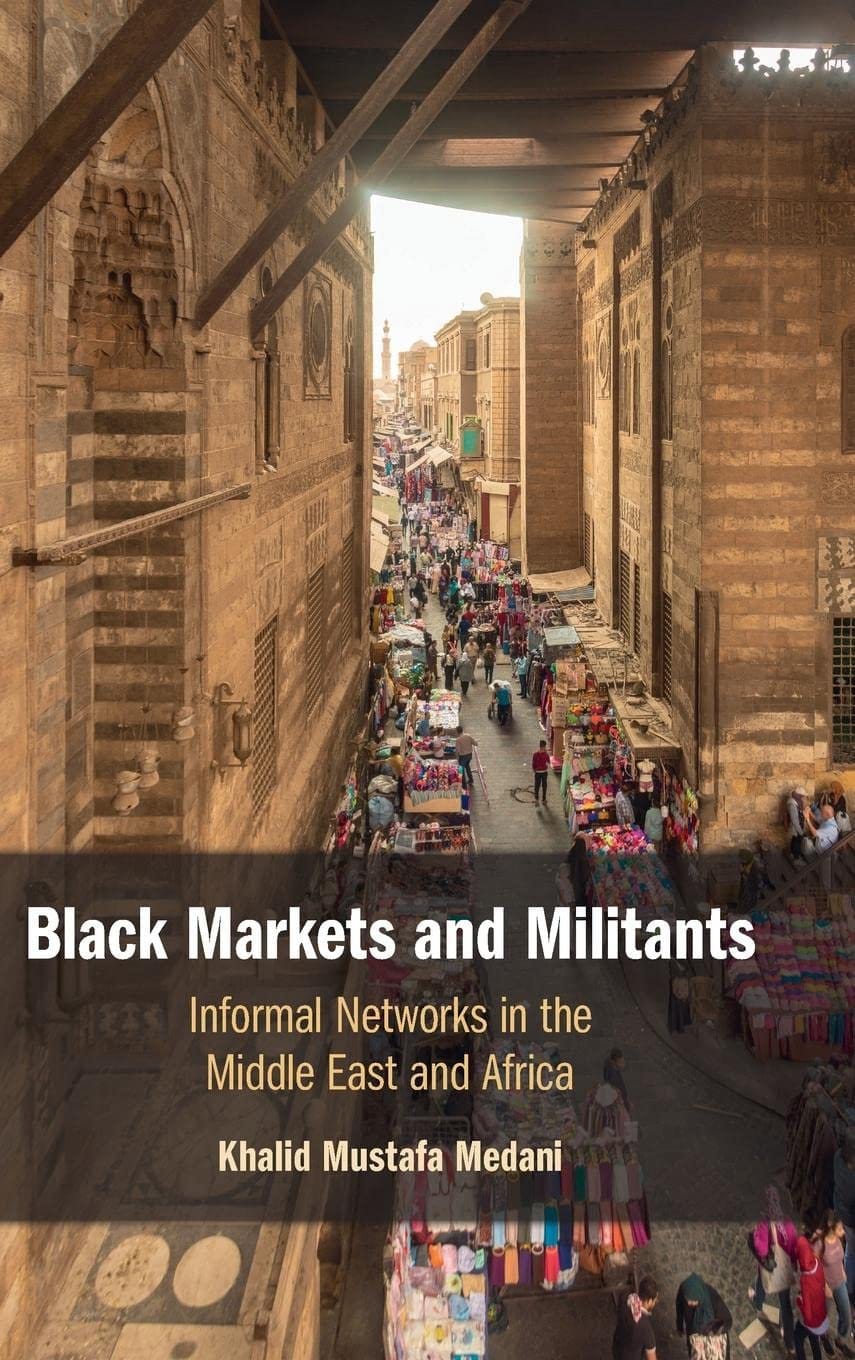
The cover of Medani's book.
**Noora Lori:** For those who haven’t had the chance to read the work yet, I want to start by explaining why the prize committee commended *Black Markets and Militants* as an exemplar in the field of comparative politics. Your highly original account explains how economic globalization, particularly labor remittances originating in the Gulf states, has impacted social, religious and political communities in Egypt, Sudan and Somalia. You show how boom and bust cycles of capital inflows interacted with underlying levels of state capacity and local political cultures to construct divergent social and political outcomes across these cases. Despite robust scholarly literatures focused on migration, Islamist militant groups, informal networks and political economy, your breakthrough account links these diverse subjects in a single, coherent narrative.
So, first, congratulations. Coming to this issue of MERIP and the idea of “peripheral centers,” I would like to start by asking about your novel way of bringing together different domains and literatures that aren't often in conversation. I'm thinking especially of how you combine an analysis of labor remittances and political Islam. How did you come to see these connections across time and space between the remittances coming out of the Gulf and then the impact that they're having in Egypt, Sudan, Somalia? What was the “aha” moment?
**Khalid Medani:** Well, first of all, thank you so much for that acknowledgment. You can imagine how gratifying it is for me to be able to tell all the people I interviewed over the course of researching this book, “look, you know, we did this together and some people found it informative.” So that's really important to me and, hopefully, to them.
In terms of the “aha moment,” it was very much an inductive process. It started with observing violence against actors working in the informal economy at the very micro level in Sudan. Since members of the Islamist elite were themselves generating profits from speculation in informal financial exchanges, they perceived others operating in the informal economy as a threat to their own commercial interests. As a result, the Islamist regime not only imprisoned but executed individuals they alleged were operating in the “black market” in foreign exchange. That was puzzling to me. Why would state elites find these kinds of informal markets so threatening?
I mention this as the “aha moment” because I want to emphasize two things. First, the idea behind this book did not originate with a focus on the subject of political Islam as the outcome to be explained. Hopefully, readers will see that it’s really about local communities and how they struggle with the exigencies not only of state repression but also with a particular form of economic globalization or internationalization. Economic and commercial transactions in the “black market” are not only linked to the state, which most scholars acknowledge. They are linked to something larger. They're linked to regional and global economic forces. And given that remittances are the most important source of foreign exchange for the majority of Middle Eastern and North African countries, “black markets” are also linked to labor markets. In this way, labor remittances are not only significant at the level of community and the household, but, as Charles Tilly argued, they are big business for national and regional economies.[\[1\]](#%5Fedn1) I realized almost immediately that this was not just a story about local communities in Sudan.
The second point is that there’s nothing peripheral about these countries, and I'm really happy about the theme of this MERIP issue, given that MERIP is where I first began exploring some of these themes years ago. I think what this book has shown—in rich empirical detail, I hope—is that no country in the region is peripheral because they're so interconnected, not only culturally and linguistically, but through decades of labor migration and large volumes of capital inflows in the form of labor remittances. If you read the book closely, it also speaks to the receiving countries, to the Gulf countries themselves, whose economies would not have looked the way they do without the huge amount of labor migration addressed in the book.
> **Economic and commercial transactions in the “black market” are not only linked to the state...They're linked to regional and global economic forces. And given that remittances are the most important source of foreign exchange for the majority of Middle Eastern and North African countries, “black markets” are also linked to labor markets.**
The book connects the micro-foundational aspects of how people in local communities deal with their own involvement in both the formal and informal economy. It explores how they relate to the state and, very importantly, how communities, in Karl Polanyi’s terms, establish new rules of conduct and obligations based on networks of social solidarity and trust. Rather than economic transactions governed by a “self-regulating market” based on supply and demand principles, these rules of conduct are subject to non-economic controls such as locally specific cultural, religious or ethnic norms. I link economic globalization, variations in state capacities in the different countries and how this results in changing societal practices in local communities. I believe this kind of model and framework is applicable elsewhere, whether it's Morocco, Yemen, Nigeria or other countries that are big labor remittance economies.
**Noora:** Often, when we think about which migrants pose a greater threat, the narrative is one of cultural distance: They can't integrate and, therefore, they're threatening. But, I think, from the perspective of the Gulf States, what we see in a lot of cases is that the threat of migrants from other parts of the Middle East was precisely their cultural proximity—this idea of shared language and, therefore, possible organizing. In the Gulf States, we know that especially with the rise of Arab nationalism, with labor strikes and unionization, there was a real fear of other Arab migrants, especially after the 1960s. I wonder how this plays out in your research. Particularly, what were the implications of changing demographic flows once fewer people from the Middle East were able to go? Does anything about this strategic shift away from Arab labor come into your findings?
**Khalid:** In fact, this question that you posed is so central to my book’s argument that I actually open the first chapter on Egypt with a story from an Egyptian return migrant in the 1980s. His narrative is illustrative of the fate of millions who migrated to the Gulf to seek better opportunities and one that speaks directly to the dramatic impact of changing labor policies in the Gulf on the sending countries. This young man, a plumber by profession, went first to Libya, and then ended up in Saudi Arabia before having to return to Egypt in great part as a result of new emigration policies that favored Asian over Arab labor. His trajectory fits with the way the book is divided. The first part deals with the period of the oil boom for Egypt, Sudan and Somalia. That is, the era in which all three countries witnessed a boom in expatriate remittances fueling the expansion of informal markets that came to be regulated by religious or ethnic networks. The second part of the book addresses the impact of the dramatic decline in remittances and how these generated severe economic crises and the imposition of economic austerity policies. It is here that I turn to the dramatic political and social impact of return migration and the recessionary downturn in the region.
> **Read "[The Imperious Rise of Gulf Capitalism: A review of Adam Hanieh, *Money, Markets, and Monarchies*](https://www.merip.org/the-imperious-rise-of-gulf-capital/)."**
Among the consequences of the boom were the rising fortunes of Islamist movements in Egypt and Sudan, which gained popularity in part by providing the kind of services that previously were not available, such as social welfare provisioning, the disbursement of financial loans to Islamist loyalists based, ostensibly, on Islamic principles and the securement of employment and forms of social protection to workers in the informal labor market. But the cycle of boom-and-bust also changed the economic policies of the state. Egypt, for example, had encouraged out-migration of labor during the boom as a safety valve in order to implement neoliberal reforms without risking political instability. Out-migration tampers factors that increase economic and social grievances that underpin popular protests and insurgency against the state. It does so by decreasing the labor pool in the sending country, helping to alleviate unemployment and may also increase the incomes of the remaining workers. Moreover, expatriate workers often send money back home, enhancing their families’ standards of living and contributing positively to the sending nation’s trade balance. Taken together, these factors significantly reduce political instability in the home country. Alternatively, the interruption or slowing down of emigration adversely affects political stability. Indeed, by the 1990s, the Egyptian state, realizing that it could no longer rely on out-migration to the Gulf, shifted policy. This is where you see the implementation of financial liberalization and, I would argue, increasing state repression.
As the opportunities of securing prosperity by migrating to the Gulf have dwindled, young activists that I have interviewed in the region recently understand that their fate—their economic and life chances—are now predicated on employment at home. These changes in the regional economy have influenced mobilization around national economic policies and calls to address local issues, particularly with respect to unemployment and underemployment. I emphasize this because it shows that the recent popular protests, particularly in the labor exporting countries, like Egypt and Sudan, are a partial consequence of changes in policies originating in the Gulf.
**Noora:** I love that this project has a connection to MERIP from the beginning, and I wonder if you can say something more about that.
**Khalid:** One of the things I wanted to do with this book was link these countries to the international economy and address the impact of economic globalization at the level of local communities. Most of the political science literature on the Middle East and Africa at the time was focused on state-civil society relations as the primary unit of analysis in ways that exceptionalized these regions. It was MERIP that took a wonderful, I wouldn't say risk, because all the work published is rigorously reviewed, but MERIP has long supported scholarship that is committed to a critical political economy perspective and that situates the countries in the region in a larger global economic landscape. In contrast, much of the literature in political science on economic globalization was almost exclusively applied to the advanced industrialized countries. I was really perplexed by the fact that we were not applying the framework of Karl Polanyi or other theorists of economic globalization and marketization to the Middle East and Africa. It didn't seem to me that this was a fruitful or generative kind of omission. So it was very important that MERIP supported not only my research but other work which likewise builds on those connections in both theoretically and empirically grounded ways.
**Noora:** This speaks to peripheral centers in a different way—centers of knowledge production, both in terms of political science and, specifically, Middle East political science. We know that now*,* for example, everyone is interested in discussing migration and how migration is connected to security, etc. Migration matters for political outcomes. But with the exception of Ari Zolberg and Myron Weiner’s work, that’s a post-Cold War realization. Prior to the 1990s, migration was somewhat peripheral to political science, especially international relations, because it was seen as a “low politics” question, not the “high politics” of national interest and diplomacy. Analysis of labor remittances or labor migration often used the push/pull frameworks from economics as if they're completely detached from political systems. Even when I was doing my PhD, I remember getting pushback that maybe this was too niche of a topic.
On top of the concept of migration being in some ways “peripheral” to other concepts in political science, there’s also the question of the peripheries of the Middle East in terms of what academics have historically considered the center(s) of the region. Egypt, Syria, Iraq, but not the Gulf states, right? Those were seen as not key power brokers in this region, there was less production of knowledge around those areas. And I think that that's true also for Sudan and Somalia—these cases raise the question of “does this fit into the Middle East?” What’s interesting in this book is that you're bringing together these interactions between the peripheries of the Middle East in multiple ways, not only in terms of how we imagine the region but in terms of the production of knowledge about what constitutes this part of the world.
**Khalid:** I empathize with your journey in terms of working on labor migration, and migration in general, in the discipline of political science. Yes, it's been neglected in political science, historically, though sociologists and economists have looked at it in different ways. For my part, I always focus on the research question itself above all else rather than evaluate or even consider seriously what is peripheral and what is not peripheral. By which I mean if the outcome of interest has to do with understanding the geopolitical role of Iran and Saudi Arabia, naturally, I have absolutely no problem with the centering of these in terms of the primary research question. However, I have always been apprehensive about Somalia or Sudan being considered as peripheral because this not only obscures their respective contributions to important political issues in the region, such as those addressed in my book, but also because this blinds us to the integral linkages these and other countries have to the wider region.
> **I have always been apprehensive about Somalia or Sudan being considered as peripheral because this not only obscures their respective contributions to important political issues in the region...this blinds us to the integral linkages these and other countries have to the wider region.**
The book begins with a Somali proverb that profoundly speaks to this problem of designating certain countries or communities as “peripheral.” The proverb is “abundance and scarcity are never far apart. The rich and the poor frequent the same houses.” This proverb encapsulates the entire framework of the book and situates Somalia at the very center of some of the most important developments throughout the Middle East and Africa—that is, the boom-and-bust cycles that link regional politics together and which have resulted, as I note in the book, in the dramatic transformation of the economic and political landscape of the entire region. No country exemplifies the wages of boom-and-bust cycles and their political consequences as clearly as Somalia does. I should point out that by working on Somalia, I was able to generate some key insights in the course of my research in the informal housing areas of Imbaba in Cairo. In particular, my observations and analysis of the role of traditional justice institutions, clan networks and conflict over land among rural migrants to Imbaba were generated from my work in Somalia where I first observed the importance of these informal networks for our understanding of national and transnational level politics.
Somalia was also important at a larger theoretical level. This book builds on some insights from Polanyi. It is based on a historical institutional framework that takes seriously the relationship between state policy and the political consequences of a variety of socially and politically constructed formal and informal markets. In this respect, the case of Somalia is analytically central because Somalia provides the clearest example of the erosion of historically weak formal institutions that, in the context of economic globalization, dissolved in ways that ushered in what Polanyi famously termed the “rise of market society.” That is, a state of affairs wherein public goods such as education, health care, social security and the right to earn a livelihood are subject to market principles, resulting in major economic, social and humanitarian crises.[\[2\]](#%5Fedn2) Observing these dramatic consequences and their horrible impact on Somali communities made me curious about what effects similar processes might have in Egyptian communities, albeit in different ways. As I discuss in the book, I observed that informal financial networks played a key role in inter-clan conflict in Somalia, while in Cairo, I found that informal markets in labor and housing provided important contexts for the recruitment of young men to militant organizations. My point here is that my analysis of the politics of informal markets in Egypt built upon my research on Somalia as well as Sudan, where I first observed the truly dramatic relationship between state action, informalization and political violence.
In my view, the terminology of “peripherality” does a great disservice. It obscures our understanding of each other’s countries as well as important insights that are at the heart of the analytical advantage of comparative political analysis. As another example, the last chapter on the global War on Terror tackles the issue of informal financial networks and the global war against terrorist finance. Building on survey research in Somalia, I show that informal banking systems do not finance terrorist organizations for a variety of social and political reasons. So, the question is, what can Somalia teach us about this global issue? No Middle Eastern country is unburdened by the consequences of the global War on Terror. Somalia’s experience, then, contributes to our understanding of the impact of the War on Terror globally and, importantly, at the level of the community, and it is one that affects all the countries in the Middle East, including the “central” countries of the region.
**Noora Lori:** Well, what a poignant way to end, I think, with a plug for the comparative method and a reminder to de-exoticize these different parts of the region and to think about commonalities and connections on a global scale. So, thank you, Khalid.
> **Read the [previous](https://merip.org/2023/01/peripheries-and-borderlands) article.**
> **Read the [next](https://merip.org/2023/01/nation-making-on-the-razors-edge-in-the-egyptian-libyan-borderland) article.**
**This article appears in [MER issue 305](https://merip.org/magazine/305) "Peripheries and Borderlands."**
---
### **Endnotes**
[\[1\]](#%5Fednref1) Charles Tilly, “Trust Networks in Transnational Migration,” *Sociological Forum* 22/1 (March 2007), p. 3.
[\[2\]](#%5Fednref2) Fred Block and Margaret R. Somers, *The Power of Market Fundamentalism* (Cambridge, MA: Harvard University Press, 2016).
### Issue 305 (Winter 2022) Masthead
URL: https://www.merip.org/2023/01/issue-305-winter-2022-masthead/
Last updated: 2026-04-28T00:25:15.000Z
## ***Middle East Report*, “Peripheries and Borderlands,” Winter 2022, No. 305, Vol. 51 No. 4**
### **Executive Director**
**Mandy Terc** mandyterc@merip.org
### **Executive Editor**
**Katie Natanel** katienatanel@merip.org
### **Managing Editor**
**Marya Hannun** maryahannun@merip.org
### **Photo Editor**
**Michelle Woodward** mwoodward@merip.org
### **Staff Editor**
**Michael Kaplan** kaplan\_m@gwu.edu
### **Website Assistant**
**Karisa Gingerich**
### **Social Media Coordinator**
**Khelil Bouarrouj**
### **Board of Directors**
**Paul Silverstein(Board Chair)** *Reed College*
**Kaveh Ehsani** *DePaul University*
**Adam Hanieh** *University of Exeter*
**Vickie Langohr** *College of the Holy Cross*
**Shana Marshall** *George Washington University*
**Lee O'Brien** *Retired*
**Mary Sexton** *Consultant*
**Nabil Al-Tikriti** *University of Mary Washington*
**Mandy Terc** *MERIP Executive Director (ex officio)*
### **Editorial Committee**
**Shana Marshall (Chair of the Editorial Committee)** *George Washington University*
**Nabil al-Tikriti (Vice-Chair of the Editorial Committee and MERO/Current Analysis Editor)** *University of Mary Washington*
**Ayça Alemdaroğlu** *Stanford University*
**Lori Allen** *SOAS University of London*
**Mona Atia** *George Washington University*
**Elif Babül** *Mount Holyoke College*
**Jessica Barnes** *University of South Carolina*
**Graham Cornwell** *George Washington University*
**Muriam Haleh Davis** *University of California, Santa Cruz*
**Lisa Hajjar** *University of California, Santa Barbara*
**Waleed Hazbun** *University of Alabama*
**Najib Hourani** *Michigan State University*
**Mohammad Ali Kadivar** *Boston College*
**Reinoud Leenders** *King's College London*
**Pete Moore** *Case Western Reserve University*
**Curtis Ryan** *Appalachian State University*
**Jacob Mundy** *Colgate University*
**Atef Said** *University of Illinois at Chicago*
**Hesham Sallam** *Stanford University*
**Deen Sharp** *London School of Economics*
**Sophia Stamatopoulou-Robbins** *Bard College*
**Stacey Philbrick Yadav** *Hobart and William Smith Colleges*
### **Format: Online**
### **ISSN 3065-744X**
### Peripheries and Borderlands of North Africa and the Middle East
URL: https://www.merip.org/2023/01/peripheries-and-borderlands/
Last updated: 2025-07-29T13:07:12.000Z
A curious thing about so-called peripheries is they tend to encompass the lived experience of most of the people in the world today. It is only through a hegemonic perspective—one emanating from and enacted in “centers” of power by the Lord Curzons of a century ago and the President Erdoğans of today—that populations and spaces are deemed to live outside of an imagined core.
Jebel Dahar mountain chain in the Medenine Governorate, Tunisia. Tasnim Nasri/Anadolu Agency via Getty Images
In his 2005 book, [*Planet of Slums*](https://www.versobooks.com/books/2293-planet-of-slums), the late historian and social theorist Mike Davis pointed out a simple fact. Improvised urban settlements (slums, shanty towns, squatting, etc.) are far from a negligible side effect of modern capitalist development. Such spaces have become the prevailing environment in which most humans construct their livelihoods. More recently, geographer Teo Ballvé, drawing on his extensive fieldwork in Colombia, has argued that peripheral borderlands are not pre-given spaces. The “frontier” is made at the intersection of local, state and global practices and flows. If intellectual and physical labor is required to make and maintain margins, peripheries, borderlands and frontiers, then rethinking these spatial and material conditions is required to upend and unmake them as well.
The contributions to the winter issue of *Middle East Report* take up this challenge by critically examining a range of ostensible peripheries and borderlands within North Africa and the Middle East. Indeed, this region as a whole—what Edward Said understood as an “imaginative geography”— has itself been variously framed and treated as both central and peripheral to world affairs since its inception as an imperial idea in the late nineteenth and early twentieth centuries. As Matthew Ellis examines in his contribution to this issue, an enduring trope in political analyses of the region is one of chronic instability rooted in the alleged artificiality of borders drawn by the hands of Europeans. But looking to the actual histories and struggles of the people living along borderlands, such as the emergent frontier between Egypt and Libya during the collapse of the Ottoman empire, reveals a more intricate story. Local stakeholders—not just central states or foreign empires—were a driving force in the elaboration of new lines in the sand.
The centrality of peripheries in the making of modern states, markets and identities could equally be witnessed in the Ottoman Empire’s ambivalence toward the region of the Jazira in the waning imperial decades. Samuel Dolbee traces Ottoman administrators in the Jazira as they struggled to tame what they viewed as ungovernable spaces (deserts) and the people who dwelled there (nomads). Their efforts to centralize a periphery were often undermined by their social and geographical preconceptions of the region—preconceptions that continue to inform Turkish foreign policy toward Syria today.
Historically and in the present, peripheries and borderlands call into question the seeming totality and power of the state as well as the myth of separate-but-equal sovereignty imposed globally after World War II. As Max Gallien argues, looking to North and West Africa, the Maghrib’s resistance to neoliberal pressures to integrate politically and economically in recent decades has fostered a rich political-economy of informal trade across and within its countries. But in the post-9/11 and post-2011 eras, the center has begun to falter. States across North Africa feel they can no longer afford to turn a blind eye to their peripheries, whether internal peripheries or those at the margins of their international frontiers. New discourses and practices of counterterrorism and border security have severely disrupted established livelihoods across the region, setting into motion a permanent crisis of mutually reinforcing economic dispossession and coercive state penetration. These dynamics—and resistance to them—are scalar, appearing at the regional but also the neighborhood level, as Najib Hourani and Safa Rawashdeh document in their analysis of displacement from and reconstruction of the Syrian city of Douma.
The Sahel region—the belt of savanna lands on the southern edge of the Sahara Desert— offers perhaps the most vivid demonstration of how these dynamics have played out in recent decades. The US-led securitization of the Sahel, starting in 2003, disrupted local economies of survival and legitimized otherwise insignificant Islamist insurgents seeking to create a new front of resistance to regional tyranny and North Atlantic global dominance. Having embedded themselves in informal trans-Saharan economic networks, these insurgents received a boost in materiel and personnel following the collapse of the Libyan state in 2011 at the behest of NATO-backed rebels, with arms flooding the Sahara. Regional disruptions intersected explosively with long-standing patterns of discontent and rebellion in Northern Mali. Soon the whole of Northern Mali fell under the grip of an “Islamic State,” triggering a French military intervention in early 2013 to rescue Paris’s client regime in Bamako. Fast forward a decade and those French soldiers have seemingly been replaced by Russian military contractors from the infamous Wagner Group. This changing of the guard in the Sahel, Hannah Armstrong writes, has as much to do with the increasing presence of Russian security interests in the region as with the adamant failure of French troops and Algerian diplomats to do anything but exacerbate intercommunal tensions.
The peripheralizing effects of the global “War on Terror”—from Somalia to the Sahel—can likewise be witnessed in the war in Yemen, where journalist Mohammed Al-Qadhi sketches a portrait of Taiz. This city, located far from either of the county’s historical capitals, has been the most protracted center of conflict in the eight years of war. As Al-Qadhi argues, despite its continued peripheralization, the struggle over Taiz remains a central—if not the central—barrier to peacemaking.
The contributions to this issue also look beneath the surface of so-called cores and peripheries to examine the movement of people and goods from the bottom up. Following the pathways of gold from artisanal mines in Mali—some of which are located in the transnationally securitized regions discussed above—to jewelry shops in Dubai, Bruce Whitehouse shows how a confluence of UN peacekeepers, mercenaries, narcotraffickers, gold smugglers, climate change, international regulations and non-existent state enforcement mechanisms result in the continued impoverishment of the Sahel periphery. Discussing his award-winning book [*Black Markets and Militants: Informal Networks in the Middle East and Africa*](https://www.cambridge.org/core/books/black-markets-and-militants/8C7CE1BFFBE59EE246354403126B7F58), Khalid Mustafa Medani similarly takes a bottom-up approach to an analysis of the micro-practices of Sudanese migrant laborers in Egypt. Medani’s conversation with Noora Lori touches on the everyday involvement of workers in informal and illegal markets, how Islamist movements have been embedded in these networks and the resultant reinforcement of regional and global neoliberal systems of production and domination.
Foregrounding the agency of populations at the periphery, as well as efforts of states and “centers” to control these spaces, sheds light on evolving power relations within and beyond the Middle East and North Africa.
**Read the [first](https://merip.org/2023/01/black-markets-in-sudan-an-interview-with-khalid-mustafa-medani) article in [MER issue 305](https://merip.org/magazine/305) "Peripheries and Borderlands."**
### Illicit Flows to the UAE Take the Shine off African Gold
URL: https://www.merip.org/2023/01/illicit-flows-to-the-uae-take-the-shine-off-african-gold/
Last updated: 2025-08-22T18:36:55.000Z
Kankan Musa, ruler of the Mali Empire, famously visited Cairo in 1324 en route to the Hajj. Leading a caravan of sixty thousand men and women, Emperor Musa lavishly gifted his hosts with gold. As Howard French recounts in his book, [*Born in Blackness*](https://wwnorton.com/books/born-in-blackness), the emperor dispensed so much gold that its price remained depressed in Cairene markets for a decade after his departure.

Gold miners empty containers of earth removed from a mining shaft in Koflatie, Mali, 2014\. Sebastien Rieussec/AFP via Getty Images
Seven centuries later, Mali is again experiencing a boom in gold exports. World market gold prices have nearly doubled over the past decade, as has Mali’s industrial output. It is now approaching [seventy tons annually](https://www.bloomberg.com/news/articles/2021-11-02/africa-s-crackdown-on-informal-gold-miners-spreads-to-mali). Gold has replaced cotton as Mali’s leading export, and Mali has become Africa’s [third-largest gold producer](https://eiti.org/countries/mali).
While these trends have the potential to translate into growing revenues for the cash-strapped Malian government, an enormous share of Mali’s gold vanishes from the country through illicit flows. There is the gold produced by global industrial firms in Mali, which is taxable and traceable. But gold is also produced by artisanal miners, much of whose output flows from the country through clandestine networks that escape state regulatory or fiscal controls.
The primary destination of artisanal gold seems to be the United Arab Emirates. By all evidence, the gold that shines in the souks of Dubai is the product of a complex web of criminal networks, terrorist groups and internationally sanctioned regimes, who use this artisanally mined gold to launder their money. The same forces that are transforming Mali into a hub for the gold trade are ensuring this peripheral country straddling the Sahara and Sahel regions remains precarious in the global economy.
## **Disparate Figures**
According to official Malian statistics, the majority of Mali’s gold is produced by industrial firms located in 13 sites across the country’s southern and western regions. As Mali lacked the capital to develop these sites, they are operated by a small number of multinational mining companies headquartered in Canada, Australia, South Africa and the United Kingdom that have permits from the Malian government to extract their ore. In 2020, industrial firms reported producing [65.2 metric tons](https://www.reuters.com/article/mali-gold/mali-gold-production-hits-fresh-high-in-2020-idUSL8N2K83VU) of gold, accounting for roughly ten percent of the country’s gross domestic product.
Mali’s [Mining Code](http://www.ilo.org/dyn/natlex/docs/ELECTRONIC/109970/136614/F-752897896/MLI-109970.pdf) requires the operations and finances of these firms to be monitored by the Malian government. Firms must pay 20–25 percent of their proceeds to the Malian treasury. A much smaller share goes to a development fund that was set up in 2012 to benefit the communities that host mining operations. In 2021 alone, Mali’s Ministry of Mines reportedly collected the equivalent of [nearly $1 billion in taxes](http://news.abamako.com/h/271461.html) from industrial gold production.
In addition to these industrial sites, hundreds of smaller-scale “artisanal” mines are scattered throughout the country. Artisanal mines—which have seen a dramatic upswing since the early 2000s—entail more labor, less capital and less oversight.[\[1\]](#%5Fedn1) Unlike industrial mines, artisanal mines are as old as Mali itself and generate livelihoods for a large number of local communities. By some estimations, these mines employ or support one in ten inhabitants of the central Sahel region.[\[2\]](#%5Fedn2)
> **Unlike industrial mines, artisanal mines are as old as Mali itself and generate livelihoods for a large number of local communities. By some estimations, these mines employ or support one in ten inhabitants of the central Sahel region.**
According to official figures, the role artisanal mines play in the country’s gold production is minor—over the past several years, the Malian government has [recorded](https://www.reuters.com/article/mali-gold-idCNL1N2UL1XW) a scant four to six tons of artisanal gold mined annually, less than ten percent of Mali’s annual industrial output. But there are reasons to believe artisanal gold production in Mali is far higher. Malian officials have [privately estimated](https://www.merip.org/content/files/assessment-of-the-supply-chains-of-gold-produced-in-burkina-faso-mali-niger.pdf) the figure to be between 30–50 tons, while recent investigative journalism from [France 24](https://www.france24.com/en/tv-shows/reporters/20220715-from-the-sahel-to-dubai-on-the-trail-of-dirty-gold) reckoned that at least half of Mali’s gold, over 60 tons, comes from artisanal mines.
The most compelling reason to doubt official Malian figures for artisanal production is that other countries claim to import a great deal more gold from Mali than Mali claims to produce. According to the [UN Comtrade Database](https://comtrade.un.org/data)—an online aggregator of international trade statistics—the UAE purchased nearly 81 tons of gold from Mali in 2019\. By comparison, the same year, the Malian government reported exporting a mere half ton to the UAE. Similar discrepancies pervade recent trade statistics between the two countries. The production and export of Mali’s industrial gold is tightly controlled—most of this output goes to Switzerland, whose import figures largely match Mali’s export figures. It is Mali’s artisanal production and exports, then, that far exceed official estimates.
Among African gold producers, Mali is no exception. Since 2016, the UAE registered more gold shipments from several African countries, including Libya, Ghana, Sudan and Tanzania, than those countries reported exporting. Gold from conflict zones in East and Central Africa has recently begun [flooding](https://www.merip.org/content/files/wp-content/uploads/2020/11/conflictgoldadvisory-thesentry-nov2020.pdf) Dubai’s markets, and the smuggling of gold from Africa’s Sahara and Sahel regions is believed to be [far greater](https://www.merip.org/content/files/sites/default/files/raineri.pdf) than from the continent’s other regions.
## **Moving Artisanal Gold**
Much of the gold that departs Mali for the UAE originates outside of the country’s borders. Over the past decade, Mali’s capital Bamako [has become](https://www.merip.org/content/files/wp-content/uploads/2017/09/2016-jan-the-west-african-el-dorado-mapping-the-illicit-trade-of-gold-in-cote-divoire-mali-and-burkina-faso.pdf) the regional hub for illicit precious metal transshipment from West Africa to the Persian Gulf. While most of this gold probably comes from artisanal mines in neighboring states of Senegal, Burkina Faso, Guinea and Sierra Leone, the [ENACT Network](https://enactafrica.org/enact-observer/mali-west-africas-hub-for-illegal-gold-trade-with-dubai) on transnational crime has reported gold in Bamako originating from as far as Venezuela.
Buyers in Bamako, often prefinanced with foreign capital, acquire gold nuggets from artisanal miners and smugglers. At the city’s various refining facilities, they melt these nuggets into bars and ship them abroad. By paying off local customs and airport officials, their couriers can easily leave Bamako for Dubai with bars of artisanal gold stowed in their hand luggage.
> **Buyers in Dubai prize low-grade bars of African gold since they can keep the other precious metals that are separated out during the refining process—metals such as silver, palladium and platinum can compose ten percent of a bar’s original mass.**
In Dubai, couriers and their buyers face few legal or regulatory obstacles in bringing their gold into global markets. Neither customs officials nor banks nor gold buyers in the UAE [require](https://www.researchgate.net/profile/Victoria-Reichel/publication/328939569%5FCommerce%5Fillicite%5Fde%5Fl'or%5Fartisanal%5Fen%5FAfrique%5Fsubsaharienne/links/5bec44154585150b2bb5f4e1/Commerce-illicite-de-lor-artisanal-en-Afrique-subsaharienne.pdf) gold importers to provide certificates of origin or receipts of export tax payments.[ As a ](https://youtu.be/7N36tvYz2J0)[2020 report](https://www.merip.org/content/files/wp-content/uploads/2020/11/conflictgoldadvisory-thesentry-nov2020.pdf) by the Sentry found, the Emirates have weak customs controls for hand-carried gold, no limits on untraceable cash transactions and little oversight of local gold souks and refiners. [Buyers in Dubai](https://www.youtube.com/watch?v=7N36tvYz2J0) prize low-grade bars of African gold since they can keep the other precious metals that are separated out during the refining process—metals such as silver, palladium and platinum can compose ten percent of a bar’s original mass.
The Emirates have long been a global hub for transnational African merchants, who [travel to Dubai](https://www.taylorfrancis.com/chapters/edit/10.4324/9780203397930-11/dubai-global-city-transnational-hub-roland-marchal) to purchase imported goods such as Japanese-made auto parts or Chinese-made garments. Emirati authorities and commercial players are now exploiting their country’s existing commercial status to make the UAE an important node for the trade in precious metals, especially gold. These buyers are actively financing associates in Mali and throughout the Sahel and Sahara regions, driving the expansion of artisanal mining into new areas.
## **A Proliferation of Blind Eyes**
By law, gold exporters in Mali must pay a three-percent tax on the value of their exports. If Mali is, in fact, producing as much artisanal as industrial gold, it should be earning over $100 million each year from taxes on artisanal exports alone. Even the state’s earnings from above-board artisanal exports, however, are [undermined](https://www.researchgate.net/profile/Victoria-Reichel/publication/328939569%5FCommerce%5Fillicite%5Fde%5Fl'or%5Fartisanal%5Fen%5FAfrique%5Fsubsaharienne/links/5bec44154585150b2bb5f4e1/Commerce-illicite-de-lor-artisanal-en-Afrique-subsaharienne.pdf) by loopholes and exemptions. This permissive regulatory environment works to lure gold buyers and exporters from neighboring countries, depriving other states in the region of their own revenue streams. Some of Mali’s political elites, it seems, have chosen to capitalize on their country’s position on the global periphery by turning it into a modest regional hub.
Legal loopholes and regulatory arbitrage are just the tip of the iceberg when it comes to missing state revenues. Throughout Mali and the wider region, most exports of artisanal gold escape official government notice and taxation altogether, partly due to the state’s limited capacity to police its territory and enforce its laws and partly to the efforts by Malian economic and political elites to circumvent them. Apart from the fees paid to local authorities at the mining sites and bribes paid to gatekeepers in Bamako, the proceeds from the informal production and export of gold bypass the Malian state apparatus.
> **Throughout Mali and the wider region, most exports of artisanal gold escape official government notice and taxation altogether, partly due to the state’s limited capacity to police its territory and enforce its laws and partly to the efforts by Malian economic and political elites to circumvent them.**
In some cases, the scale of an artisanal mining operation is too large to escape the attention of authorities in Bamako. Bigger extraction sites, such as the [Intahaka mine](https://www.france24.com/en/tv-shows/reporters/20220715-from-the-sahel-to-dubai-on-the-trail-of-dirty-gold) in the northern Gao region, are several kilometers wide and employ thousands of workers as well as bulldozers and other heavy equipment. Like much of northern Mali, Intahaka falls outside of central government control due to the complex and increasingly violent conflict that, since 2012, has pitted various local non-state actors and militias against state security forces, UN peacekeepers, foreign troops and most recently private military contractors.
As with other artisanal mines, the gold from northern Malian sites like Intahaka attracts interest and capital from abroad. Buyers from the UAE, as well as Turkey and Russia, have been [reported](https://youtu.be/7N36tvYz2J0) there. In these zones, local authorities have succeeded in imposing some regulations on artisanal mining operations. A coalition of rebel groups whose leaders signed a peace accord with the Malian government has reportedly begun levying taxes on gold extracted from the areas under their control. Jihadi groups affiliated with Al Qaeda and the Islamic State, however, have signed no treaties, and as they continue to mount deadly attacks on Malian civilians, security forces and peacekeepers, they are [also](https://www.merip.org/content/files/atf/cf/%7B65BFCF9B-6D27-4E9C-8CD3-CF6E4FF96FF9%7D/s%5F2020%5F785.pdf) [reportedly](https://www.merip.org/content/files/atf/cf/%7B65BFCF9B-6D27-4E9C-8CD3-CF6E4FF96FF9%7D/s%5F2019%5F636.pdf) taking their cut of the gold proceeds. Transnational [narcotics traffickers](https://enactafrica.org/research/research-papers/drug-trafficking-in-northern-mali-a-tenuous-criminal-equilibrium) too are using northern Mali’s artisanal mines to expand and launder their capital.
In southern and western Mali, where rebel and jihadi groups have yet to gain a strong foothold, Bamako theoretically has a greater ability to control, regulate and tax artisanal mines. But aside from selling permits to miners, until recently, the Malian government has paid little attention to this increasingly lucrative sector, despite the many problems it has generated for the inhabitants of mining zones. Not only has the gold boom fueled an [exodus of agricultural labor](https://www.cambridge.org/core/services/aop-cambridge-core/content/view/54800B8FF4F338F809B32065D6B95C7B/S0002020617000117a.pdf/div-class-title-the-minimalist-state-and-donor-landscapes-livelihood-security-in-mali-during-and-after-the-2012-2013-coup-and-rebellion-div.pdf) from many communities, it has [contaminated soil and rivers](https://www.agenceecofin.com/mines/0209-91110-mali-la-pollution-sur-les-sites-d-extraction-de-l-or-inquiete-les-autorites) and exacerbated insecurity.
As for the UAE, as imports of dubious provenance have skyrocketed and reports of money laundering have proliferated, Emirati authorities have taken no steps to stem the illicit flow of precious metals into the country from African conflict zones.
## **Gold’s Dimming Luster**
More than a decade into Mali’s gold boom, industrial mines in the country are encountering their own problems and constraints. As several existing operations reach the end of their productive lives, large firms may be reluctant to search for new sites amid increasing insecurity and political instability in the country. Meanwhile, the Malian government has shown interest in monitoring the finances of industrial mines more closely after a 2019 report by its auditor-general claimed there were hundreds of millions of dollars worth of irregularities in the sector and accused industrial firms of environmental destruction.[\[3\]](#%5Fedn3) In May 2022, Mali’s ruling military junta announced its [intention to audit](https://www.studiotamani.org/104684-mali-le-gouvernement-annonce-un-audit-des-mines-dor) the industrial mining sector.
Authorities in Bamako have typically shown little corresponding interest in increasing regulations of artisanal mining. But political winds may be shifting. In November 2022, Mali’s Ministry of Mines [announced](http://news.abamako.com/h/278400.html) that authorities arrested hundreds of foreign gold prospectors, confiscated heavy equipment and dismantled at least two illegal mining sites in the south of the country. The government has also [established](https://www.zonebourse.com/actualite-bourse/Le-Mali-cree-une-nouvelle-societe-pour-obtenir-une-plus-grande-part-de-la-richesse-miniere--42354216/) a new state-owned company for the exploration and development of new industrial mining sites—activities from which the state has, in the past, been absent.
It remains to be seen whether the Malian state will confront its own citizens who are involved in draining the country of its most precious resource. Those who benefit from illicit gold exports are pleased to maintain the status quo. By resisting the regularization of resource and financial flows, they also ensure that the central government will continue to lack both the capacity and the political will to control its territory, enforce its laws, protect its natural resources or invest in its own future. Mali’s economic precarity will increase with the complicity of entrepreneurs and officials in other countries, most notably the UAE.
Seven hundred years ago, the gold carried by Kankan Moussa’s caravan brought lasting renown to an empire. Today’s illicit flows enrich only the few individuals whose hands they pass through. One day in the not-too-distant future, Mali’s gold boom will be over. It is unclear whether the Malian state and its people will have anything to show for it.
\[Bruce Whitehouse is an Associate Professor of Anthropology at Lehigh University.\]
---
### **Endnotes**
[\[1\]](#%5Fednref1) William G. Moseley, "The Minimalist State and Donor Landscapes: Livelihood Security in Mali during and after the 2012–2013 Coup and Rebellion," *African Studies Review* 60/1 (2017).
[\[2\]](#%5Fednref2) Luca Raineri, “Gold Mining in the Sahara-Sahel: The Political Geography of State-making and Unmaking,” *The International Spectator* 55/4 (2020), p. 104.
[\[3\]](#%5Fednref3) "[Bureau du Vérificateur Général - Rapport Annuel 2019](http://www.bvg-mali.org/images/Rapports/annuels/RAPPORT%5FANNUEL%5F2019%5FRED.pdf)" (Government of Mali2020), pp. 71-72.
### Awakening to the Politics of Israel—An Interview with Sonya Meyerson-Knox of Jewish Voice for Peace
URL: https://www.merip.org/2023/01/awakening-to-the-politics-of-israel-an-interview-with-sonya-meyerson-knox-of-jewish-voice-for-peace/
Last updated: 2025-08-22T18:36:58.000Z
*In the second of a* [*two-part series*](https://www.merip.org/changing-attitudes-towards-zionism-among-american-jews-an-interview-with-zachary-lockman/) *of interviews on changing American Jewish attitudes towards Israel and Zionism, Lori Allen, member of the MERIP editorial board, spoke with Sonya E Meyerson-Knox, Communications Director of Jewish Voice for Peace. Their conversation, which took place in July 2022, has been edited for length and clarity.*
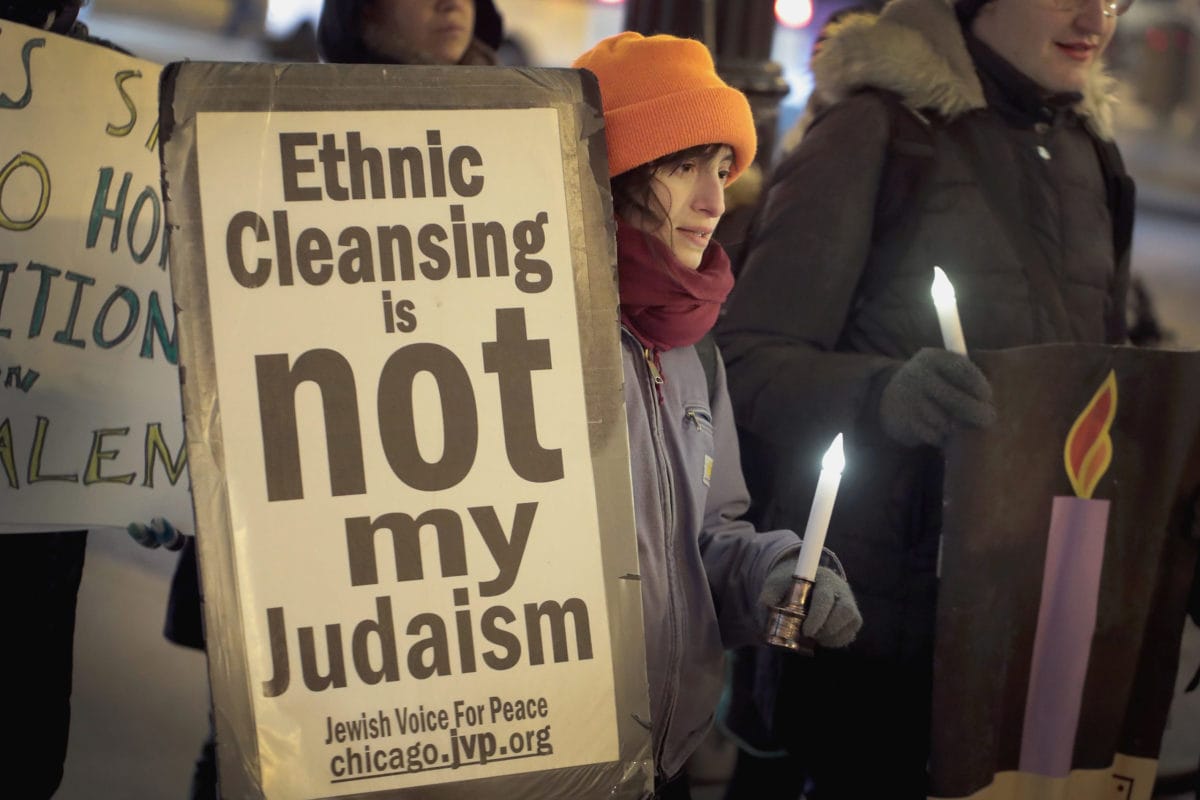
Demonstrators with Jewish Voice for Peace Chicago protest President Trump's decision to recognize Jerusalem as the capital of Israel on December 14, 2017\. Scott Olson/Getty Images
**Lori Allen:** What do people get wrong about the history of Jews in the US and Zionism?
**Sonya Meyerson-Knox:** Almost everything. The general understanding about the American Jewish community and its positions towards Israel, like so many of the narratives involving Israel and Palestine, has been completely co-opted. As long as there has been a Zionist movement, there have been anti-Zionist Jews leading opposition to it. A lot of that history has been completely eradicated, and only now are we seeing a revived interest in different aspects of diaspora-ism and diaspora culture, including anti-Zionism, from the younger generations, Gen-X, millennial and onward. We’ve seen a return to Yiddish, and the radical history tied up in progressive and international causes, some which were very clearly anti-Zionist.
Most American synagogues did not have Israeli flags in them before 1967\. The Reform Movement, the largest Jewish organization in America, was anti-Zionist initially. All of that history has been erased by this other version of history told as a direct marching line from endemic persecution of Jews for being Jews, culminating in the Holocaust, and finally to safety in Israel. There are elements of truth and there are grave inaccuracies. It is a story that has been manipulated and propagandized. The claim is, if you’re Jewish, you support Israel because it’s the only place you’ll ever be safe. But more and more people are questioning this sort of false logic. AIPAC claims that if AIPAC had existed, the Holocaust wouldn’t have happened. That was never the case.
**Lori:** Moving to how things have been shifting, I’m curious how you date the shift away from a homogenous narrative about Israel. Where has that come from and when?
**Sonya:** My thoughts on this reflect my own story. By the time the second intifada began in Palestine, which was September 2000, there was already intentional intersectionality between social justice movements. I remember very clearly the protests that were happening against the World Trade Organization in Seattle and in DC and globally. They included Palestinians marching, and people in support of Palestinian liberation. There was this understanding that if you were going to be anti-globalization then you also had to support environmental rights, workers’ rights, and indigenous rights and eventually, also Palestinian rights. I think that was an early shift. It was not a broader Jewish American shift, although there’s always been a large portion of American Jews involved.
> **There was this understanding that if you were going to be anti-globalization then you also had to support environmental rights, workers’ rights, and indigenous rights and eventually, also Palestinian rights. I think that was an early shift. It was not a broader Jewish American shift, although there’s always been a large portion of American Jews involved.**
Another indicator of that shift is the growth of Jewish Voice for Peace (JVP). We really grew in membership and impact during Israel’s assault on Gaza in 2014, which followed Israel’s earlier attacks in 2009 and 2012\. This was also during the growth of social media use and the development of citizen journalism. Leading up to the Israeli military’s onslaught on Gaza in 2014, we had the Arab Spring. You had all of these journalists and an audience that was used to thinking about this part of the world in a way they never had before. Then we see this stark disparity of power by the Israeli military and the reprehensible killing of civilians. And it’s all being transmitted almost live.
Mainstream media had done a very good job of telling only one side of the story. Ten Palestinians may have died, but the lede was about the one Israeli. It became much harder to do that when you had so much media attention from different sources. Especially social media accounts that don’t adhere to mainstream media narratives. It was Palestinians with their phones in front of their building that has just been destroyed, unfiltered.
I think that was shocking for quite a lot of American Jews. A shocking challenge to the story that they had been told and had clung to for all of these years—the line of Israel as the most moral army in the world, defending itself and hated for no good reason. That’s when JVP numbers shift from a dozen chapters to become really national. Other organizations doing incredibly important work like [IfNotNow](https://www.ifnotnowmovement.org/) also began. That’s when a lot of Jewish organizations that didn’t want to talk about Palestine, but did want to work on social justice, were forced to start recognizing that you can’t do one without the other.
**Lori:** I was reading an essay by Rabbi Michael Davis, who sees the old tropes of the Holocaust and “Israel, right or wrong,” as becoming increasingly irrelevant to young Jews, and I wonder if you have also observed a similar kind of shift.
**Sonya:** Broadly I agree with this, but I would take it one step further. The same generations that are more than 60 years removed from the Holocaust are also the ones that are now facing increasingly prevalent anti-Semitism, which is taking violent forms. We had a president who used anti-Semitic tropes and dog whistles with regularity, who brought white nationalists to the White House and defended the people that were in Charlottesville chanting with their tiki torches, “Jews will not replace us.” And yet we have Israel. Something doesn’t add up. The mainstream Jewish institution doctrine that “the next Holocaust could be around the corner, and we’re going to protect you, and Israel is the reason we can”—none of that’s holding water anymore. If the argument is that Israel will protect us from the Holocaust, how is Israel protecting us from antisemitism right now? It’s always been a false argument, and the hollowness of that claim is being brought home to all of these young Jews who at the same time are becoming more politically active. Once they start questioning that, they also start asking about the way the state of Israel treats Palestinians, about apartheid, about the real history of Zionism, about the Nakba. And then they start listening to Palestinians.
We are also seeing Netanyahu becoming best friends with anti-Semites like Viktor Orbán in Hungary. And when the attack at the Tree of Life Synagogue in Pittsburgh happened, this was white nationalism enabled, emboldened and encouraged by then-President Trump.
We saw the “Never Again” protests a couple of summers ago, in which young Jews were getting arrested, protesting the way that ICE and Border Patrol were rounding up and separating refugee and immigrant families on the border. “Never again.” What is that referring to? The Holocaust. They’re defending other people who aren’t Jewish and not through their synagogue, but through other organizations.
**Lori:** So, you’re noticing an awakening to the politics of Israel? Is this part of what is allowing younger generations to take a different attitude, both towards Judaism and towards Israel?
**Sonya:** Yes that, but I think it’s also the way that the left is shaping itself now, the attention to intersectionality of movements. Every progressive movement that is happening right now emphasizes safety through solidarity. I am not free if you are not free. And, certainly, young progressive American Jews are not isolated from that. American Jews are three times more likely to be liberal and progressive than the rest of the American population—until recently, except for Palestine. But even that is changing somewhat. They want to be part of the movements that are connected to social justice. It’s hard to hold the double think: “Black lives matter and you’re not safe from cops if I’m not safe from cops” and “I’m never safe unless Israel protects me.” The equation doesn’t add up.
> **They want to be part of the movements that are connected to social justice. It’s hard to hold the double think: “Black lives matter and you’re not safe from cops if I’m not safe from cops” and “I’m never safe unless Israel protects me.” The equation doesn’t add up.**
**Lori:** Could you talk a little bit more about what you mean by the intentional intersectionality of these movements?
**Sonya:** America is reckoning with its original sins. We are deep in that reckoning—since Ferguson, since Michael Brown, since the advent of a generalized awareness of Black Lives Matter. Also, with movements like Standing Rock and indigenous rights, and even with the anti-WTO protests of 1999 in Seattle. You had the unions with the environmentalists and workers. There is this growing understanding that how the left used to function doesn’t work anymore. We can’t have civil liberties organizations being led only by white people if they’re talking about black and brown rights. And we can’t have women’s organizations that are not going to be queer- and trans-friendly. If I don’t want to live in a police state, then I have to make sure that the cops are not militarized and attacking my brown and black neighbors. That’s what is meant by intersectionality.
The old-school Jews who espoused “Israel, right or wrong,” the liberal Zionist Jews, who talk about marching on the bridge with Dr. King, they haven’t walked away from caring and believing that Black people deserve to live in dignity and justice. It’s just that their children have a much harder time believing that and not believing that Palestinians also deserve those rights.
**Lori:** Can you illustrate how you see that happening or becoming mainstream?
**Sonya:** There is a clear shift among younger Jews, evident in Pew polls. The younger you are, [the less likely](https://streaklinks.com/BPP7lCyNTZtHvp3p4QJ0u%5FBi/https%3A%2F%2Fwww.pewresearch.org%2Freligion%2F2021%2F05%2F11%2Fjewish-americans-in-2020%2F?email=maryahannun%40merip.org) you are to be anti-Palestinian, the more likely you are to think the US is too supportive of Israel. More than 20 percent of millennial American Jews challenge the very basis of Zionism by supporting the idea of [one democratic state](https://www.ajc.org/Jewish-Millennial-Survey-2022/American-Jewish-Millennials) in Palestine/Israel. And more than 30 percent of Jews under 40 think [Israel is an apartheid state](https://electronicintifada.net/blogs/ali-abunimah/third-young-us-jews-see-israel-genocidal-poll-finds). When you see a poll that says 80 percent of American Jews think Israel should be supported by America, right or wrong, but then you break it down by generation, the numbers go way down.
**Lori:** What do you think these younger generations have been influenced by?
**Sonya:** I think social media played a large role because it offers us the opportunity to hear from Palestinians. There is a reason that social media platforms are continually trying to silence Palestinian speech directly at the behest of the Israeli government and its supporters. It can’t be done because social media is still actually a result of people on the ground saying things and showing things. When Shirin Abu Akleh was killed and the *New York Times* published that horrible story with the headline: “Palestinian journalist, 53 dies,” JVP fixed the [headline](https://www.instagram.com/p/CdbWMOepl2U/), pointing out that she was murdered by an Israeli sniper. That post got almost 300,000 likes and well over 1,000 comments.
In May and June 2021, when the Israeli military bombed Gaza, and the Israeli government attempted the mass expulsion of Palestinian families from Sheikh Jarrah, and then the Unity Intifada followed, JVP posted on Facebook calling on our members to join the Palestinian protests in the US across the country, carrying signs that were explicitly anti-Zionist. It wasn’t the first time that anti-Zionists have been public, but it was a very intentional leveling up. We’re not just going to say that Jews support Palestine, we’re going to say we’re anti-Zionists doing this. Those posts had a reach of over 8 million people. When Mohammed al-Kurd or Mona al-Kurd were doing livestreams, the numbers were astronomical!
This is a narrative shift, right? There were all sorts of campaigns about the skewed news coverage of Shireen Abu Akleh’s murder. And then what do we see? We see news outlet after news outlet, starting with [CNN](https://edition.cnn.com/2022/05/24/middleeast/shireen-abu-akleh-jenin-killing-investigation-cmd-intl/index.html), reporting on Israel’s killing of a Palestinian journalist. Mainstream media execs realized that, despite all the pressure of the Israeli lobby and the advertisers and all the pressure that comes from an editorial board that’s stacked with people sympathetic toward Zionism, they actually have to tell the truth.
**Lori:** Do you think that there is some danger in the fact that so much of this progress has relied on social media, given that there’s so much potential for censorship?
**Sonya:** Absolutely. And not just for the Palestinian liberation movement, but for all social justice movements that have to work around the mainstream media, because mainstream media are companies with advertising interests and political blinders. The Israeli government employs its bots and troll armies and has its large budgets to counter BDS, including on social media. But as long as anybody can open an account, they’re going to keep telling their stories. And we have witnessed very successful campaigns to have accounts unblocked. When Facebook repeatedly shut down the Ministry of Health in Gaza, that was called out successfully. We helped stall the implementation of the very problematic IHRA definition of anti-Semitism becoming part of Facebook’s community standards and launched a campaign around it called “[Facebook, we need to talk](https://facebookweneedtotalk.org/).”
**Lori:** Do you have any final thoughts?
**Sonya**: The American Jewish community that’s progressive and anti-Zionist is learning that it’s not just all about “my pain” and the Holocaust. It’s not all about me feeling betrayed that I was raised to believe Israel’s one thing when it is behaving another way. It’s really: “Now that I know what Israel does to Palestinians, how do I stand in alignment? How do I best support Palestinian rights?” And that means that maybe I don’t get to speak so much. It’s intentionally changing the focus to where the Palestinian liberation movement is going and asking how can we help. And I do think this is a shift that is going to allow the movement to grow and be more successful in the long run.
### Simply Sportswashing?—A Perspective on the 2022 World Cup in Qatar
URL: https://www.merip.org/2022/11/simply-sportswashing-a-perspective-on-the-2022-world-cup-in-qatar/
Last updated: 2025-08-22T18:36:58.000Z
As students of Middle Eastern origin/s living in Britain, we are no strangers to the effects of Orientalism and xenophobia in a Western society. One of our defense mechanisms is to stay in tight circles and create our own bubbles, most importantly the institute where we met each other and study at the University of Exeter. Habibi FC, an intramural football team, blossomed out of these circles.
An Argentina supporter takes photos in Doha ahead of the Qatar 2022 FIFA World Cup football tournament. Giuseppe Cacace/AFP/Getty Images
Playing on the team is just one way we are brought together by football, a sport that has the power to unify people, globally, like nothing else. From Birmingham to Bamako, Beirut to Brasilia, it is football you see children playing on the streets. It is football shirts that are most recognizable and it is football players who can spark a sense of commonality among people around the world. But the world of international football also contains hierarchies and divisions.
Our team has spoken at length about the upcoming 2022 World Cup in Qatar. It is the first World Cup tournament hosted by an Arab country and has been described by the British newspaper, *The Times,* as the “the most controversial World Cup of all time.”[\[1\]](#%5Fedn1) This controversy stems, in part, from the charges of bribery levelled at Qatar and FIFA when it gained the bid to host the tournament, and even more so, from Qatar’s human rights record and dependence upon the *kafala* system of labor migration that enables forced labor, human trafficking and indefinite detention.
Along with the controversy, we have noticed the regular appearance of the term “sportswashing”—the use of sporting events to cleanse the reputations of states or corporations tarnished by human rights violations, violence and repression. In the world of contemporary sporting events, this term only seems to be used when describing the actions of countries based outside of Europe and North America.
Rather than deny sportswashing as a phenomenon or the importance of highlighting human rights abuses in Qatar, in this essay, we call for a more nuanced and critical analysis of the sportswashing discourse, one that leaves space for a clearer picture of how power operates in international sporting events. In its current uneven application, the framing of sportswashing, particularly in the media, reproduces Orientalist binaries between the West and the rest and ignores the complicity of states in the West—often the hosts of international tournaments—in perpetuating violence and repression in their home countries or abroad.
> **Read an interview with Natasha Iskander on the [Politics of "Unskilled" Labor in Qatar](https://merip.org/2022/11/the-politics-of-unskilled-labor-in-qatar-an-interview-with-natasha-iskander-2) for MER issue 304.**
In the case of the 2022 World Cup, framing Qatar’s actions as sportswashing suggests Qatar’s intention in hosting the tournament has been to deflect attention from human rights abuses that occur within its territory. Hosting the World Cup, however, has placed the country and its labor conditions under an unprecedented spotlight, generating regular and sustained media focus on Qatar’s exploitative and dangerous migration system.
The reality of Qatar’s dependence on labor exploitation to execute the tournament and the media scrutiny it has drawn point to a more complex story behind the tournament than simplistic sportswashing critiques leave room for. Instead of cleansing its image, at least in the short term, by hosting the tournament Qatar has risked its moral image in a strategic calculation to project competence and gain global influence. This trade-off seems to be at the heart of Qatar’s World Cup bid.
## **Sportswashing in the “West versus the Rest”**
The term sportswashing did not appear in wide use before the 2010s, though the label has been retroactively applied to international sporting competitions like the 1936 Olympic Games in Nazi Germany. Despite concerns over Nazi Germany’s targeting of Jews and Romas, other states conferred legitimacy upon Germany in the international arena by agreeing to its hosting of the event and their participation in it. In the same era, Mussolini hosted the 1934 World Cup, another example of a fascist state using an international sporting event to gain legitimacy.
In more contemporary sporting events, countries accused of sportswashing are almost exclusively non-Western. Recent examples that have been widely covered in the British media include Saudi Arabia’s [takeover](https://www.theguardian.com/world/2021/oct/07/saudi-backed-newcastle-takeover-as-much-about-status-as-sportswashing) of Newcastle United Football Club and [China’s hosting](https://www.theguardian.com/sport/2022/jan/05/sportswashing-winter-olympics-world-cup) of the 2022 Winter Olympics. At the time of writing, the[ English-language Wikipedia page](https://en.wikipedia.org/wiki/Spanish%5FGrand%5FPrix) details more than one hundred instances of sportswashing by host nations. Of these, less than ten are states in western Europe or North America—the most recent example being the 1975 Formula One Grand Prix held during General Francisco Franco’s rule in Spain.
When it comes to Israel, activists have campaigned to [label](https://bdsmovement.net/news/sportswashing-associated-with-certain-countries-%E2%80%93-why-not-israel) its hosting of tournaments, like the first stage of the 2018 Giro d’Italia cycling competition, as sportswashing. Yet, unlike Qatar, China or Saudi Arabia, this label did not seem to gain widespread traction or media coverage despite Israel’s settler-colonial policies and prolonged occupation of the Palestinian territories.
> **By refracting human rights violations through the prism of individual states situated in the non-West, sportswashing—as it is often applied—obscures the complicity of international systems, placing Western states in a realm of moral superiority.**
Taken in this light, talk of sportswashing participates in a larger discourse of “the West vs. the rest,” positioning Western states and societies as moral, democratic and respectful of human rights, while non-Western states are the opposite. Moreover, by refracting human rights violations through the prism of individual states situated in the non-West, sportswashing—as it is often applied—obscures the complicity of international systems, placing Western states in a realm of moral superiority. In so doing, this discourse legitimizes existing power relations and global hierarchies between states.
Indeed, a critical approach to sportswashing should ask what this label does and does not succeed in doing. While a simple usage of the label does reproduce power relations that place the West above the rest, it does not typically lead to actions being taken by states against the accused country. During the 2018 World Cup in Russia, for example, claims of sportswashing—while not as prevalent as they are with the upcoming Qatar World Cup—were still levelled against the host country, particularly due to Russia’s annexation of Crimea. Countries and athletes were called on to boycott, but none did. Similarly, with the Qatar World Cup, no national football team has expressed an intention to boycott the tournament (although some municipalities in Europe have enacted their own versions of boycotting the World Cup, for example, by [refusing to screen](https://www.euronews.com/my-europe/2022/10/06/brussels-bar-owner-joins-others-in-qatar-world-cup-boycott-over-ethical-concerns) matches in public spaces).
In part, the relative inaction when it comes to boycotting the tournament might stem from the fact that states across the world and their governing sports bodies have a say in voting on host nations, making the responsibility more entangled than nationalist deployments of the sportswashing label leave room for. FIFA, too, is an international body that bears responsibility over the tournament and its locale. Just a few weeks before the tournament was set to begin, FIFA President Gianni Infantino wrote a letter urging the 32 participating teams to focus on the sport and “not allow football to be dragged into every ideological or political battle that exists.”[\[2\]](#%5Fedn2) This inaction also hints at the limitations of sportswashing as a discourse in the absence of wider, sustained on-the-ground movements, like the ANC boycott in South Africa, which demanded a widespread rejection of any sporting engagements with the apartheid state.
## **Trading Moral Capital for Regional Influence**
In the lead up to the tournament, hosting the World Cup seems be serving the opposite function to sportswashing: placing Qatar’s migration system, human rights violations and electoral system under a harsh global spotlight. It remains to be seen whether Qatar’s global moral image will be dealt a lasting blow from holding the tournament, but, so far, it has increased the visibility and scrutiny of issues that a focus on sports is supposed to hide.
Perhaps, then, rather than an attempt at sportswashing, Qatar’s aim in hosting the tournament is an attempt to build other kinds of capital that matter more in the current world order than a clean human rights record, such as projecting an image of competence. In 2006, when Qatar hosted the Asian Games—an inter-Asian multi-sport tournament—the current Emir, Tamim Bin Hamad Al Thani, described the games as a chance to demonstrate the “skill” and “ambitions,” of the small state.[\[3\]](#%5Fedn3) Mahfoud Amara has written that the 2006 games were an attempt to “break free from the old ‘Orientalist’ stereotypes about the Arab people described in the Western imagination as irrational, lazy and lacking a sense of responsibility and punctuality.”[\[4\]](#%5Fedn4)
> **Rather than an attempt at sportswashing, Qatar’s aim in hosting the tournament is an attempt to build other kinds of capital that matter more in the current world order than a clean human rights record.**
Qatar’s 2022 World Cup can be read as a continuation of the Gulf state’s agenda to demonstrate competency by hosting large-scale or international sports events. This is the view of Paul Brannagan and Richard Giulianotti, who conducted interviews with Qatari officials on what they hoped to achieve with the tournament. Officials explicitly mentioned wanting to counter “misconceptions and prejudice from the West about the Middle East.”[\[5\]](#%5Fedn5) One interviewee, for example, described the desire to show that Qatar, and the region more generally, “is capable of handling such a massive responsibility.”[\[6\]](#%5Fedn6)
Viewed in this light, the Gulf state looks to have decided to host the World Cup to generate soft power by enhancing its competence image at the expense of losing soft power through its moral one. Put differently, Qatar has left its human rights record vulnerable to scrutiny in favor of bettering perceptions of its capability of executing grand events despite the odds.
Trading off moral image for competence is a tactical choice and part of a broader strategy aimed at securing Qatar’s regional and global importance through the accumulation of soft power. Other forms of Qatari soft power are generated through the state’s global investments, particularly from its sovereign wealth fund—the ninth largest in the world and worth $450 billion.[\[7\]](#%5Fedn7) Notable investments from the fund include Harrods in London and Paris Saint-Germain Football Club in France. The state also owns the renowned and impactful Al Jazeera media network.
Regionally, Qatar enjoys deep strategic and investment relations with [Turkey](https://www.dailysabah.com/politics/diplomacy/turkey-qatar-move-toward-strategic-partnership). The state has also provided overt and covert [economic and political](https://www.washingtoninstitute.org/policy-analysis/will-qatars-relationship-muslim-brotherhood-change-after-gulf-reconciliation) support for Muslim Brotherhood factions across the Middle East and played a key role in the negotiations between the United States and the Taliban preceding the US withdrawal from Afghanistan. In the wake of the Taliban’s resurgence to power, Doha has continued to serve as a mediator between the United States and the Taliban government.
Such sources of soft power accumulation assist Qatar in generating an image of a competent state with noteworthy regional and global influence, helping to safeguard the militarily vulnerable Gulf state by encouraging vested interests in its stability among beneficiaries of its foreign policy. During the 2017 Saudi-led blockade of Qatar, the benefits of this soft power accumulation played out in real time when states such as Turkey, France, Britain and eventually the United States spoke out for the blockade to end. Today, both Turkey and the United States retain military bases in Qatar.
## **Looking to 2026**
Rather than cleansing Qatar’s moral image, the World Cup has shined a light on the ongoing labor abuses built into the country’s migration system. Where Qatar has gained is in its significance as a regional and global actor. This trade-off between negative publicity and increased geopolitical status began with Qatar’s initial bid to host the tournament, which embroiled FIFA in controversy and jeopardized the whole organization's reputation. In spite of this controversy, in winning the bid, Qatar secured a notable victory over the larger and more established contenders of Australia, Japan, the United States and South Korea. It also proved itself powerful enough to break the 92-year global tradition of summer World Cups, which historically prevented states in hot climates from hosting—a move that will impact the scheduling of prominent footballing tournaments worldwide, including the South American leagues, the European Champions League and the English Premier League.
> **While human rights groups and media have condemned the treatment of migrants at the US-Mexico border as inhumane due to lengthy detentions, family separation and mass deportation, we have not seen this linked to the impending World Cup tournament.**
In 2026, the World Cup will be held collectively by Canada, the United States and Mexico. Unlike Qatar, the national football federations responsible for executing the 2026 World Cup are not state-owned. Nonetheless, this tournament can still serve as an instrument of soft power by its host nations, a point underscored by some of the early media coverage and [policy papers](https://www.brookings.edu/blog/order-from-chaos/2017/04/19/a-nafta-world-cup-just-the-thing-to-improve-relations/) on the joint tournament and its importance to struggling US-Mexico relations.
We are left pondering whether the North American states will be scrutinized with the language of sportswashing in the same way as Qatar and non-Western states are. So far, this has not been the case. While human rights groups and media have [condemned](https://www.amnesty.org/en/latest/news/2022/05/usa-dangerous-immigration-policy-will-harm-people/) the treatment of migrants at the US-Mexico border as inhumane due to lengthy detentions, family separation and mass deportation, we have not seen this linked to the impending World Cup tournament. This may change as the tournament nears. So far, however, the lack of attention to the US migration system and its human rights violations in coverage of the 2026 World Cup highlights a double standard. In order for sporstwashing to be effective as a critique, it has to be applied critically and carefully in ways that do not reinforce global hierarchies, acknowledging the parallel, and often overlapping, forms of violence that states enact.
\[**Jamal Abu Eisheh** is a doctoral student at the University of Exeter’s Institute of Arab and Islamic Studies. **Ali Alsayegh** is a doctoral student at the University of Exeter’s Institute of Arab and Islamic Studies. **Samuel Munayer** is currently pursuing a master's degree at the Institute of Arab and Islamic Studies. **Rami Rmeileh** is a doctoral student at the University of Exeter’s Institute of Arab and Islamic Studies. **Zachariah Zahid** is a Strategy Analyst based in Jeddah, Saudi Arabia. He received his B.A. from the University of Exeter’s Institute of Arab and Islamic Studies.\]
**Read the [previous](https://merip.org/2022/11/constructing-qatari-citizenship-in-the-shadow-of-the-world-cup-2) article in [MER issue 304](https://merip.org/magazine/304) "Football—Politics and Passions."**
---
### **Endnotes**
[\[1\]](#%5Fednref1) John Alridge, “[Qatar 2022: inside the most controversial World Cup ever](https://www.thetimes.co.uk/article/qatar-2022-inside-the-most-controversial-world-cup-ever-9kp3vst6v),” *The Times,* January 4, 2022.
[\[2\]](#%5Fednref2) Rob Harris, “[Qatar World Cup: FIFA writes to teams and says 'focus on the football... not ideological or political battle that exists,’](https://www.skysports.com/football/news/11095/12737790/qatar-world-cup-fifa-writes-to-teams-and-says-focus-on-the-football-not-ideological-or-political-battle-that-exists)” *Sky News*, November 4, 2022.
[\[3\]](#%5Fednref3) Mahfoud Amara, “2006 Qatar Asian Games: A ‘Modernization’ Project from Above?” *Sport in Society* 8/3 (2005), p. 506.
[\[4\]](#%5Fednref4) Ibid.
[\[5\]](#%5Fednref5) Paul Michael Brannagan and Richard Giulianotti, “Soft power and soft disempowerment: Qatar, global sport and football’s 2022 World Cup finals,” *Leisure Studies* 34/6 (2015), p. 705.
[\[6\]](#%5Fednref6) Ibid., p. 709.
[\[7\]](#%5Fednref7) Hazar Kilani, "[Qatar plans to boost its ‘$450bn sovereign wealth fund](https://dohanews.co/qatar-plans-to-boost-its-450bn-sovereign-wealth-fund/)," *Doha News*, April 27, 2022
### Constructing Qatari Citizenship in the Shadow of the World Cup
URL: https://www.merip.org/2022/11/constructing-qatari-citizenship-in-the-shadow-of-the-world-cup-2/
Last updated: 2025-08-22T18:36:59.000Z
On April 4, 2022, fans around the world started their online shopping frenzy to secure the best seats for the 2022 FIFA World Cup in Qatar.
The Qatari capital Doha as the Gulf emirate prepares for the FIFA 2022 football World Cup. Giuseppe Cacace/AFP/Getty Images
The same day, Qatari media outlets [quietly reported](https://dohanews.co/ticketless-fans-not-allowed-qatar-entry-during-world-cup-over-accommodation-concerns/) an overnight policy change. Anyone unable to obtain a match ticket would not be allowed entry into the country during the tournament. Fans wanting to enter Qatar now needed a pre-approved “Hayya Card,” a new visa tied to the purchase of a FIFA ticket that doubles as a transportation pass and provides entry into stadiums. While Qatar has since softened this stance—allowing ticketed fans to bring up to three companions—throughout the tournament these hayya cards will still serve as the only foreign entry permit issued.
Since winning the bid to host the tournament in 2010, Qatar has invested billions of dollars in its tourist infrastructure. In addition to reconstructing several parts of Doha and installing a metro system, it has developed an entirely new twin city, Lusail, on the capital’s outskirts. Yet at the much-anticipated kickoff to the World Cup, in an unprecedented move, the state abruptly started limiting the number of visitors by denying access to less financially-capable auxiliary fans.
Official justifications for this brisk change in policy by the Qatari government were slim, referring to generic safety and “capacity” concerns around tourist accommodation. With a national citizenry of around 300,000, and overall ticket sales exceeding 2.4 million, there is likely basis to these concerns.
Local Qatari news outlets, however, also [cited](https://dohanews.co/all-you-need-to-know-about-travelling-in-and-out-of-qatar-during-the-world-cup/) the menace of crowds trying to break into stadiums, referring to the Euro 2020 Final at Wembley Stadium in Britain. Such security concerns bely a deeper unease about the state’s ability to maintain control over the established social hierarchy at a critical juncture, particularly given the international media attention accompanying the tournament. For similar reasons, Qatar has already moved ahead with devising “purposely ambiguous” legislation intended to restrict foreign film crews' freedom of coverage during the tournament.[\[1\]](#%5Fedn1)
It is no coincidence that World Cup soccer fans are now finding themselves allotted into haves and have nots. The sudden curb on ticketless soccer fans reflects Qatar’s long tradition of using ambiguous legislation to differentiate and socially divide resident groups so as to retain as much control as possible over local and global public opinion as well as the political status quo inside the country.
Similar dynamics of bureaucratic engineering through ambiguous migration and citizenship policies regulate not only the migrant worker community in Qatar but also, increasingly, the local citizenry, changing what it means to be Qatari. Qatar’s ambiguous and last minute policy maneuverings in relation to FIFA sports fans—whether pertaining to ticketless fans or the rights of the attending [LGTBQ+ community](https://www.theguardian.com/football/2022/jun/29/qatar-fails-to-offer-world-cup-safety-guarantees-to-lgbtq-fans)—are no ad hoc deviations. Rather, they are part of a larger state- and nation-building project in which migration and citizenship policies form a central node.
## **Making a Mega Event**
In December 2010, Qatar won the bid to host the 2022 FIFA World Cup, becoming the first Arab country to organize the tournament in 93 years. This win was not without controversy, much of it centering on Qatar’s contentious record of migrant workers’ rights. Qataris make up an elite demographic within the country, constituting around 12 percent of the total population. The great majority of residents in Qatar are low-wage workers from the Indian subcontinent and Southeast Asia whose presence is tightly regulated by the country’s infamous *kafala* sponsorship system.
> **Read an interview with Natasha Iskander on the [Politics of "Unskilled" Labor in Qatar](https://www.merip.org/the-politics-of-unskilled-labor-in-qatar-an-interview-with-natasha-iskander/) for MER issue 304.**
In its current form across GCC countries, the *kafala* system operates as a mode of production that allows local citizens to serve as migrant sponsors and profit as a shadow rentier class. This state-endorsed patronage system directly and indirectly allows Qatari sponsors to appropriate an asymmetric proportion of the surplus value generated by migrant labor. Despite noteworthy policy reforms in Qatar in recent years, [Human Rights Watch](https://www.hrw.org/news/2020/01/20/qatar-end-abusive-exit-permits-most-migrant-workers) accurately points out that the “*kafala* (visa sponsorship) system, which facilitates the abuse and exploitation of migrant workers, remains intact.”[\[2\]](#%5Fedn2)
Even with the many controversies over workers’ rights, the World Cup has succeeded in putting Qatar on the map. Qatari authorities have mobilized this mega event as their poster child for a futuristic development push known as the Vision 2030 project meant to usher in massive transformation and bring Qatar’s industrialization on par with the UAE.
In addition, the World Cup serves Qatar in making itself known to the world as a state separate from its powerful and much larger Gulf neighbors. Indeed, the FIFA tournament not only boosts the state’s legitimacy inside the country but equally affirms its territorial integrity within the inter-state complex of the Arabian Peninsula, particularly in the face of Saudi Arabia’s historically expansionist ambitions. Such concerns of the Qatari political elite, which have long been shared by their counterparts in Abu Dhabi and Oman, took on new urgency in the face of the 2017 Blockade leveled against Qatar by Saudi Arabia, the UAE, Bahrain and Egypt.
> **While it is common to frame large sports events as a form of cultural diplomacy, soft power and “sportswashing,” Qatar’s hosting the World Cup also marks an urgent consolidation of national sovereignty on the part of its state authorities.**
While it is common to frame large sports events as a form of cultural diplomacy, soft power and “sportswashing,” Qatar’s hosting the World Cup also marks an urgent consolidation of national sovereignty on the part of its state authorities. For a country that was only founded in 1971, the World Cup functions alongside other major events, like the 2017 Blockade, as an important unifying force.
In a conversation with one 22-year-old Qatari woman who works at a government ministry, she described how, after the blockade, the differences between Qataris of various geographical or tribal origins have grown less prominent, a change she also attributed to the World Cup tournament. As she put it, “Nowadays, you would rarely find people identifying Qataris in that \[tribal\] sense … it is slowly becoming less important. The same goes for the World Cup: it will always keep doing what it did ever since we won the bid, which is bringing people together.” Alongside the 2017 Blockade and the 2022 World Cup, Qatari nationalism is coming of age.
## **Qatar’s “Second-Generation Expats”**
The World Cup might be uniting some Qatari citizens in unprecedented ways. Yet, as Qatar pushes ahead with its ambitious Vision 2030 development plan, the country seems to be pushing out a segment of loyal human capital long invested in its overall development.
Many so-called “second-generation expats”—often the children or grandchildren of doctors, engineers or merchant business families—seem to be experiencing increasing precarity in terms of their employment and residency outlook. In the aftermath of the 2017 Blockade, a number of long-term Egyptian residents in Qatar received overnight deportation orders or simply had their work visas cancelled and residency permits revoked.[\[3\]](#%5Fedn3) Families that had called Doha home for generations, many with no particular political affiliation, were arbitrarily disposed of in a tit-for-tat political showdown between states.
Flagpoles of World Cup competitors in Doha, featuring the FIFA 2022 digital countdown timer, located at the Corniche Waterfront Promenade. Courtesy J. Alloul.
In another example of the ongoing devaluation of non-GCC Arab citizenship in Qatar, young Arab professionals with European or American university degrees are increasingly finding themselves thwarted from taking advantage of professional opportunities.
Take Farid, a Jordanian national of Palestinian origin who was born and raised in Qatar. Growing up, he considered himself Qatari. He wore the local national dress, the *thawb,* to work and prided himself on speaking with a Qatari Arabic accent. In 2021, he was shocked when the immigration department of the Ministry of Interior denied his request to change jobs despite his former and future employees both endorsing his move. To Farid, the only discernible motive he could see for this form of direct state intervention into his career development was that he was Jordanian.
Like many Arab residents in Qatar, Farid had believed himself part of a privileged group that was above the vicissitudes of the *kafala* system. When his request was denied, he had already signed up for his new job and handed in his resignation to his former employer. He suddenly found himself without a sponsor. Unlike unmarried women, unemployed men over the age of 25 cannot revert their sponsorship back to their father. Farid was suddenly faced with the reality that he could at any time be deported from the country he had always called home.
> **The glass ceiling Farid encountered shows that being Arab, Muslim and “skilled” is no longer enough to ensure belonging in contemporary Qatar.**
The glass ceiling Farid encountered shows that being Arab, Muslim and “skilled” is no longer enough to ensure belonging in contemporary Qatar. There is no special birthright for people like him in Qatar’s expanding state and nation-building project, where an increased nationalization of the workforce (“Qatarization”) has now been built into the structure of the economy. Fed up with this extreme legal precarity, Farid decided on emigrating to Canada in search of more secure citizenship. Over the course of several conversations, he made it clear that the very restricted Permanent Residency scheme that Qatar introduced in September 2018, which grants long-term residency rights to a handful of qualifying non-Qataris per year, would not suffice. Only full citizenship rights would convince him to stay in Doha.
Farid’s case highlights a sophisticated migration and citizenship policy characterized by methodically segmenting resident populations along ambiguous categories with strikingly divergent tiers of entitlement. Indeed, the same policy of differential inclusion is playing out, albeit in different ways, amid the Qatari national soccer team, which has [controversially included foreign-born athletes](https://www.vice.com/en/article/z4ayz5/does-qatars-football-policy-put-players-at-risk-of-exploitation) who have been naturalized in order to play for Qatar. The so-called “mission passports” granted to foreign-born athletes are in fact temporary documents with a legal time limit, meaning that most naturalized “Qatari” athletes remain citizens of their country of origin. Only those performing extraordinary achievements in their field of competition have the chance to receive permanent Qatari citizenship at a later stage, indicating that the overall institution of Qatari citizenship will likely remain very restrictive and increasingly racialized around ever-narrowing notions of ethno-nationalism.
## **The 2021 Elections and Internal Dissent**
Speaking at the World Economic Forum in Davos [in May 2022](http://youtube.com/watch?v=w0oIh6EkSq4), Qatar’s leader, Sheikh Tamim bin Hamad Al Thani, hailed hosting the World Cup as a transformative vehicle for national development. He credited the tournament and the spotlight it placed on Qatar for the implementation of a series of progressive reforms—reforms like the nation’s first ever elections held in 2021 after years of stalled attempts. In reporting on these elections, English [language media](https://www.ft.com/content/cfec9c71-98af-4b6d-aa74-66cef1cf3794) [outlets](https://www.bloomberg.com/news/articles/2021-10-02/qatar-votes-in-first-election-with-world-cup-spotlight-ahead) were also quick to draw a direct line between the attention on the World Cup and the timing of electoral reform in Qatar.
Yet, Qatari state policies limited just how transformative these elections would be. Succession in the Gulf Arab states is largely premised on hereditary rule rather than representative electoral politics. In the elections held in October 2021, 30 seats of the 45-member Shura Council were up for vote, while the last 15 members of this proto-parliament were still appointed directly by the emir.
Immediately prior to these elections, Qatari citizens staged a rare set of protests in Doha against electoral restrictions put into place in July 2021 that barred thousands of Qataris from running or voting. Like the sudden cap on World Cup fans slated to enter the country, the Qatari state enacted a similar last minute policy, creating a new electoral law that drew on older divisions within Qatari society in order to limit electoral participation.
> **Like the sudden cap on World Cup fans slated to enter the country, the Qatari state enacted a similar last minute policy, creating a new electoral law that drew on older divisions within Qatari society in order to limit electoral participation.**
The restrictions in the new electoral law were based on Qatar’s controversial 2005 Nationality Law. The 2005 law had divided Qatari citizens into three nationality tiers. Qataris who could trace their lineage back to 1930s were labeled as “native” and thus fell into the first tier. A second tier of “naturalized” citizens were those who could trace ancestry to a post-1930s date. Those unable to formally document their earlier presence—the case for certain prominent Bedouin Arab tribes—were also labelled as “naturalized” and were obliged to request a special decree from the emir. The process of obtaining such a decree is arbitrary and resembles a grand symbolic bargain initiated by the Arab clans who dominate the state.
Between these three groups, the difference in the allocation of state benefits is considerable, including the right to work in certain public institutions, access to land and housing purchases and loans, protection from the state revoking one’s citizenship and, as of the new electoral law, the ability to run and vote in legislative elections. Compounding the arbitrary nature of this policy, government information on these internal categories is not public and Qatari passports display no visual documentation of the legal category of “Qatariness.” Some citizens only find out what citizen tier their specific family unit belongs to when an application for particular government services is denied.
The recent July electoral law barred “naturalized” citizens from running in the 2021 Shura Council elections. Moreover, only those who could prove their grandfathers were born in Qatar could vote. As with other entitlements, many only learned of their exclusion when their voting registration was denied, leading to public outcry and daily sit-ins by Qatari citizens across Doha. Shortly after, arrests started taking place, restricting protest and polemics to the online domain. In late 2021, heated debates among Qataris were still ongoing on Twitter, which has become a key space for public debate in the Gulf as well as for state surveillance and propaganda.[\[4\]](#%5Fedn4)
These internal contentions in Qatar highlight how the Gulf state’s tiered model of rights allocation does not only concern differently positioned migrant worker groups—whose accrual of benefits may diverge greatly based on attributed skill levels, citizenship and racialized status—but also encompasses the local citizenry. This dynamic is often overlooked by outside reportage on the region, which typically focuses, as the World Cup scrutiny has shown, on the condition of low-wage workers, conjuring the conveniently neo-colonial image that such toiling bodies “require saving by liberal whiteness.”[\[5\]](#%5Fedn5)
## **Generational Change in Qatar?**
FIFA ticketholders who make it into Qatar for the tournament will be able to visit the recently built Bin Jelmood House, a museum dedicated to the history of slavery in the context of the region’s maritime past. Located in the heart of new Doha, the museum features whole sections about “Slavery in Modern Pearling and Date Cultivation” and “The Faces of Modern Slavery.” Walking through the latter exhibition, you will find images of Qatar’s migrant workers with captions describing the *kafala* system along with information about “bonded and forced labor.”
Certain textual elements of the museum’s overall narrative seem to relegate responsibility for the abuse of workers’ rights to private-sector subcontractors and “traffickers,” rather than tackling head-on the systemic nature of state-condoned labor exploitation in the Gulf. Other elements, however, [like the video testimonials by African-descent Qataris](https://www.merip.org/remembering-slavery-at-the-bin-jelmood-house-in-qatar/) about racism in the Gulf, render the Bin Jelmood House “a potentially subversive space.”[\[6\]](#%5Fedn6)
While the museum was undoubtedly meant to showcase a self-critical canvas for incoming soccer crowds visiting Qatar during the tournament, this venue also reflects some of the changes among a new generation of Qatari citizens. In conversations with several young Qataris, a number have confided that they are in favor of abolishing the *kafala* system, with some even likening it to “a modern form of slavery.”
> **These developments signal the need to distinguish between the power exerted by the state and the attitudes and practices of Qatari citizens writ large, hinting at the emerging space for everyday solidarity between Qatari citizens and migrant communities of all sorts.**
In one of these conversations, another young female employee of a state ministry voiced a comprehensive critique of the state’s approach to how citizenship is determined. “What I would also like to see is the ability to have \[proper\] Permanent Residency here, or even the ability to become Qatari,” she said. She added, “there is not a lot of transparency about these policies and laws. How do you become a citizen? I think it is something like 25-50 people who become Qatari citizens per year, so what is the actual process behind it? How can you become Qatari if you are not Qatari, and if you would become Qatari, would you be treated equally?”
These blunt deliberations underscore subterranean developments in Qatari society that are seldom reported on. The modernization discourses accompanying the FIFA World Cup are spurring social and cultural transformations, especially among Qatar’s younger generations. These developments signal the need to distinguish between the power exerted by the state and the attitudes and practices of Qatari citizens writ large, hinting at the emerging space for everyday solidarity between Qatari citizens and migrant communities of all sorts.
Today, a new Qatari generation is coming of age: women set on joining the workforce are increasingly enrolling in universities, strongly supported by their parents and quickly overtaking men in terms of performance. At the same time, a growing number of Qatari students venture abroad on government scholarships for specialized academic training in Europe and the US. Yet others can now make use of the branch campuses of renowned Anglo-American universities in Doha’s massive “Education City,” a prestigious development which noticeably engenders a more liberal habitus among elite students slated to enter the Qatari state bureaucracy.
The FIFA World Cup has served as a top-down instrument to construct and fortify a distinctly Qatari nationalism, overlaying potentially contentious tribal and ethnic cleavages present among the Qatari citizenry. At the same time, the tournament has not erased the underlying tensions and inequities in Qatar’s migration system and citizenship policies. State authorities in Qatar are clearly anxious about the extent to which the World Cup—if left to its own dynamism—may come to challenge the established social contract, which favors and insulates a demographic minority of the total resident population.
The sudden curb in the number of soccer fans during the immediate run-up to the World Cup is a testament to the sophisticated and highly securitized Qatari migration and citizenship regime, one which has long been devised to maintain the political status quo in Doha. That said, in Qatar, as in other Gulf countries like the UAE or Saudi Arabia, a lot more is moving on the ground than meets the eye. It is imperative therefore to take stock of how complex social transformation continues to affect the Gulf region’s younger generations in the wake of the 2022 FIFA World Cup.
\[**Jaafar Alloul** is a Postdoctoral Research Fellow in Sociology at Nanyang Technological University (NTU) Singapore, and a Visiting Scholar in Residence at Georgetown University Qatar. **Laavanya Kathiravelu** is Associate Professor in Sociology at Nanyang Technological University, Singapore.\]
> **Read the [previous](https://merip.org/2022/11/the-re-politicization-of-palestinian-soccer) article.**
> **Read the [next](https://merip.org/2022/11/simply-sportswashing-a-perspective-on-the-2022-world-cup-in-qatar) article.**
**This article appears in [MER issue 304](https://merip.org/magazine/304) "Football—Politics and Passions."**
---
### **Endnotes**
[\[1\]](#%5Fednref1) Shanti Das, "[Qatar World Cup accused of imposing ‘chilling’ restrictions on media](https://www.theguardian.com/football/2022/oct/15/qatar-world-cup-tv-reports-restrictions?CMP=Share%5FiOSApp%5FOther)," *The Guardian* (October 15, 2022).
[\[2\]](#%5Fednref2)“Qatar: End of Abusive Exit Permits for Most Migrant Workers,” *Human Rights Watch* (January 20, 2020).
[\[3\]](#%5Fednref3) Nada Soudy, “Home and Belonging: A Comparative Study of 1.5 and Second-Generation Egyptian ‘Expatriates’ in Qatar and ‘Immigrants’ in the U.S.,” *Journal of Ethnic and Migration Studies* 43/9 (2017).
[\[4\]](#%5Fednref4) Andrew Leber and Alexei Abrahams, “A Storm of Tweets: Social Media Manipulation During the Gulf Crisis,” *Review of Middle East Studies* 53/2 (2019).
[\[5\]](#%5Fednref5) Zahra Babar and Neha Vora, “The 2022 World Cup and Migrants’ Rights in Qatar: Racialised Labour Hierarchies and the Influence of Racial Capitalism,” *The Political Quarterly* 93/3 (2022).
[\[6\]](#%5Fednref6) Nidhi Mahajan, “Remembering Slavery at the Bin Jelmood House in Qatar,” *Middle East Report* 299 (Summer 2021).
### The Beautiful Game between Algeria and France
URL: https://www.merip.org/2022/11/the-beautiful-game-between-algeria-and-france-2/
Last updated: 2025-08-22T18:36:59.000Z
The Algerian writer, Kateb Yacine, famously referred to the French language as Algeria’s “butin de guerre*”* (spoils of war). Upon independence in 1962, Algerians were free to use French not as a bequeathal but as their own.
Football fans in Paris, France celebrate Algeria's victory in the 2019 Africa Cup of Nations on July 19, 2019\. Benoit Tessier/Reuters.
The same might be said of football as it has been taken up in Algeria and by Algerians in France. Algeria won independence from France in 1962, but [legacies of colonialism and decolonization](https://www.merip.org/france-a-settler-postcolony-2/) have long shaped, and continue to influence, what football means to the large shared population of binational citizens between these two places. One in every ten people in France has a direct familial connection to Algeria, complicating any distinction of national belonging and clouding footballing loyalties. Fans decide which national side to back, or opt to support both, in international tournaments. In the case of professional footballers, they must choose which nation to play for.
Riyad Mahrez, the current captain of the Algerian national team, is also a winger for the British club Manchester City. Mahrez was born to working-class Algerian parents in the diverse Parisian periphery town of Sarcelles, now home to a stadium named after him that hosts one of the *Coupe d’Afrique des nations locale.* These competitions are local spin-offs of the Africa Cup of Nations, in which non-professional footballers residing in France represent their countries of origin.
Mahrez’s choice to play for Algeria contrasts with that of Karim Benzema, a star striker for Real Madrid, who grew up outside of Lyon also to working-class Algerian parents, and who recently won the most coveted prize for the world’s greatest players, the [Ballon d’Or](https://www.bbc.co.uk/sport/football/63288656), which he dedicated to “le peuple” (the people), recalling perhaps the most powerful symbol in Algerian politics: *ash-sh’ab*. The professional careers of these two players reflect the broader and longer entanglements between France and Algeria when it comes to the sport of football. They also point to the increasingly central role of global capital, particularly from the Gulf, in setting the terms for the French and Algerian sporting scenes.
## **The Rise of the “Association” in Colonial Algeria**
At the turn of the twentieth century, French lawyer, sports activist and Christian Democrat, Jules Rimet, was at the helm of the mission to “civilize” the world through sport. In 1904 Rimet founded the Federation Internationale de Football Association (FIFA) in Paris and later went on to help organize the first World Cup. The creation of FIFA occurred in parallel to, and was no doubt impacted by, the process of secularization in France. The *laïcité* law, which subordinated church to state, was established just one year after FIFA. It drew on the earlier 1901 Law of Associations, which suppressed most religious orders, establishing the legal basis for civic organizations called “associations.” Perhaps the backbone of French and, at the time, imperial civic life, associations remain the key institutional structure for the organization of sporting and leisure activities in France today. There are currently more than 1.5 million associations in the country, representing a staggering three percent of France’s GDP.
In both the colonial periphery and the metropole, football served to link French ideologies of secular universalism with imperialist expectations of social cohesion and mobility through cultural assimilation. Rimet’s early-twentieth-century views on sport and social cohesion underscored the beliefs of the time in a supposedly seamless progression from colonization to immigration to assimilation. Such views were bolstered by increasing class mobility in colonial France. Rimet, himself, was the son of a farmer. Before founding FIFA, he had initiated France’s first working man’s football club, Red Star, in 1897\. Through Red Star, Rimet sought to realize his ideals regarding the emancipation of the working classes and improve French social cohesion through sports. From the 1920s onwards, he sought to further this project by making football a “means of understanding and friendship among peoples.”[\[1\]](#%5Fedn1) A clear racial superiority underpinned this philosophy, and the subsequent years would see the imposition of a discourse on the civilizing value of sport upon indigenous subjects of the French Empire wishing to play.
> **In both the colonial periphery and the metropole, football served to link French ideologies of secular universalism with imperialist expectations of social cohesion and mobility through cultural assimilation.**
As football clubs grew more widespread in France in the 1920s, the universalist ethos underwriting French associations came to affect sporting and cultural life in French Algeria, particularly in the heavily populated urban capitals of Algiers and Oran. The secular universalist ideals of football and other civic organizations stood in tension with an incipient North African *nahda* (renaissance) and its anti-colonial politics, which built on and connected to wider late Ottoman and emergent Arab nationalist projects. Algerois Jews, too, began to feel the influence of transnational Jewish associational life in the 1920s, particularly through the Istanbul Maccabi sports club network—part of a broader international Jewish sports organization founded by Jewish athletes who had been refused membership from other social sport clubs.
Notwithstanding these local and transnational links, young Algerian footballers found themselves on the front line of French psychological indoctrination. Associations were a site of language inculcation, and French was the medium with which to express and assimilate secular and universalist values. Beyond football, the new national pastime of cinema served as a vehicle for the promotion of the French language, and the Muslim Boy Scout movement modeled itself after the *éclaireurs* (French scouts), maintaining elements of imperial French civic education.
Unlike local Algerian Jews, Muslims were excluded from political citizenship and denied rights of free speech and assembly, including the right to create associations. Nonetheless, many local Algerian Muslim dignitaries and sports enthusiasts pushed back against the exclusion of “indigenous” Algerians from French republican freedoms and formed their own sporting clubs. They often used the designation *club musulman* or *union sportive musulmane*.[\[2\]](#%5Fedn2) Mouloudia Club d’Alger (MCA) was the first of these clubs to form, in 1921\. It was a multi-sport club and situated itself, not in a universalist secularism tied to French linguistic and cultural assimilation, but rather a universalist Islamic ethics associated with a burgeoning clerical (‘*ulama*) movement.
## **Algerian Footballers between France and the FLN**
As the Algerian indigenous football scene grew, so too did the economic migration of Algerian footballers to France. Before independence, Algeria was legally part of France and Algerians were granted freedom of circulation between France and Algeria. From the 1940s onward Algerian footballers went to France alongside, but in greater numbers than, their Moroccan, Tunisian and Senegalese counterparts.
The youth of Algiers looked up to players like Moustapha Zitouni, who transferred to AS Monaco in 1954, and Rachid Mekhloufi, who transferred to Saint-Etienne the same year. These players had traversed the Mediterranean, first leaving “Muslim” clubs for wealthier and more famous “European” ones in Algeria, and then moving to metropolitan France. By playing first for European clubs in Algeria and then French clubs, footballers adapted to a French lifestyle, achieved social mobility and often internalized meritocratic sporting values. Their influence upon youths back in Algeria was one way that the soft power of French imperialist ideology permeated the relationship between European and indigenous football in Algeria.
The tangible prize of economic advancement ensured that many talented Muslim players ended up in France or were drafted into the larger, wealthier European clubs in Algeria. Often less politicized upon departure for France, these players, after finding recognition for their sporting talent in France, also came to realize the degree of racial discrimination in colonial Algeria.[\[3\]](#%5Fedn3)
> **The Algerian anti-colonial movement was retooling French universalist ideas of sport to assert national sovereignty.**
Indeed, at the national level, the *Front de Libération Nationale* (FLN, National Liberation Front) brought many Algerian players back to Algeria from France. In April 1958, responding to a covert plan by the FLN hatched by Algerian professional footballers in France, ten Algerian players including Mekhloufi and Zitouni slipped out of France to convene in Tunis. These players formed the core of the team, which, in a communiqué on April 15, 1958, the FLN proclaimed would further the emergence of an “Algerian national identity.”[\[4\]](#%5Fedn4) The FLN team played over one hundred exhibition matches between 1958-1962 against nations favorable to Algerian self-determination, such as China, Vietnam, the Soviet Union, Cuba and many decolonized African countries. Any national team hosting the FLN team agreed to fly the Algerian flag and play the anthem.
France pushed back against these symbolic matches, vetoing FIFA recognition of the FLN team and even threatening economic sanctions against nations that hosted the FLN in matches.[\[5\]](#%5Fedn5) Such gestures met with little success. It was growing increasingly clear that Algeria would achieve independence and that France would eventually have to play against the newly established Algerian nation-state. The Algerian anti-colonial movement was retooling French universalist ideas of sport to assert national sovereignty. Organizing their own indigenous Algerian civic associations through sports—whether the FLN team of 1958 or the Mouloudia Club d’Alger of 1921—was a step towards self-determination. With this historical context in mind, it is perhaps of little wonder that history sits heavy on the shoulders of players like Mahrez and Benzema, whose familial trajectories are rooted in a past of conflict and subversion.
## **Football and the *Banlieue***
The social and affective ties between France and Algeria were not severed by the war of independence. If anything, the initial decades after independence brought the destinies of Algeria and France even closer. Between 1963 and the late 1970s—when the president Valérie Giscard d’Estaing put a stop to family unification policies—France remained the most popular destination for Algerian immigration.
Algerians were often concentrated in the French urban peripheries and shantytowns, where suburban (*banlieue*) housing projects were built adjacent to the factories in which Maghrebi immigrants worked. The *banlieue* would produce many of France’s greatest football stars, including Benzema and Mahrez, the latter of whose parents moved to Sarcelles in the 1970s.
The Maghrebi (and particularly Algerian) presence has had a decisive influence on postcolonial France and the evolution of its national project and politics. French anxieties around immigration, security, national identity and social cohesion, tend to focus on the *banlieue*. Events like the [2005 Clichy-sous-Bois](https://www.merip.org/urban-violence-in-france/) youth mobilizations against police brutality, following the deaths of two French teenagers of immigrant descent who were running from the police on the way home from a neighborhood football match, have been accompanied by a shift in the French political scene to the right. The perpetual concern for urban and national “security” in the form of policing the peripherical *banlieue* intensified further in the wake of the 2015 Charlie Hebdo and Bataclan attacks.
> **Football figures into contemporary social dynamics in France through the youth system and its emphasis on lifting up postcolonial youth from the *banlieue* to acculturate them into the values of the French Republic.**
Security discourse and differential policing has created a racialized dichotomy between a “violent” periphery (the *banlieue*) and a “civilized” city center with significant colonial undertones. Echoing the idea behind the earlier football associations—that they would shape indigenous Algerian Muslim subjects through good citizenship and sportsmanship—football figures into contemporary social dynamics in France through the youth system and its emphasis on lifting up postcolonial youth from the *banlieue* to acculturate them into the values of the French Republic. In the run up to *Les Bleus*’ famous victory in the 1998 World Cup, the French Football Federation set up perhaps the world’s most efficient youth academy system. This system, stretches right into the heart of the associational dynamics of French civil society life, organizing football for French *banlieue* youth, whom, as Paul Silverstein has put it, are considered “a problem to be managed.”[\[6\]](#%5Fedn6)
At the heart of this impressive machinery for the promotion of footballing excellence is the National Centre for Football in Clairefontaine. Benzema and Mahrez, who came from the *banlieue*, are both products of the Clairefontaine academy system. On the one hand, the Centre serves as a testimony to the deepening relationship between science and sport, with its embracing of psychological methodologies and statistical technologies. On the other, the academy system has replaced France’s colonial organization of footballing with the postcolonial management of generations of French-born footballers whose parents or grandparents came from the colonies. Clairefontaine and the French Federation, which recruit heavily from the *banlieue*,draw on the language of “social cohesion” to discipline players. For example, Patrice Evra, the Senegalese-born fullback and France’s team captain at the start of the 2010 World Cup, led the players in a boycott of what he saw as institutional racism on the team following the dismissal of a teammate. The French Federation’s response was to bench Evra during the tournament, blaming the player for undermining France’s national unity.[\[7\]](#%5Fedn7)
## **Transnational Capital Enters the Game**
Over the last several decades, three French professional football clubs have dominated the domestic scene and transformed sport’s “civilizing mission” into an investment instrument of global capital. Significant financial clout first came to the French game via Olympique de Marseille (OM), particularly under the directorship of business tycoon Bernard Tapie between 1986-1993\. The club notably won its very first Champions League final in 1991-1992 then subsequently found itself at the center of multiple corruption scandals concerning match-rigging and the bribery of referees.
> **Read Mahfoud Amara on "[Football in Algeria from the Black Decade to the Hirak](https://merip.org/2022/11/football-in-algeria-from-the-black-decade-to-the-hirak)" in MER issue 304.**
These scandals allowed Olympique Lyonnais (OL) to rise to the top of French football under the watchful eye of director Jean-Michel Aulas between 1987-2009\. While Olympique de Marseille had put its youth academy to the side during the club’s downturn, Olympique Lyonnais shrewdly invested locally, particularly in players from socio-economically disadvantaged *banlieues* such as Bron-Terraillon, where Benzema grew up.

Karim Benzema, during an interview in 2021\. Real Madrid Youtube Channel, CC 3.0.
The third of these clubs is Paris Saint-Germain, which was founded in 1970, and since 2011 has become a domestic and global powerhouse with a massive investment in players’ salaries and transfer fees. The club is owned by Nasser Al-Khelaifi via Qatar Sports Investments group (QSI), a national sovereign wealth fund that is also behind the 2022 Qatar World Cup. Al-Khelaifi is the chairman of beIN Media Group, one of the world’s largest sports broadcasters with a global reach in multiple languages across France, Spain, Turkey, North Africa and the Middle East in addition to partnerships with British and US-American studios and media groups.
The transnational business interests in sports media and merchandising (Tapie chaired Adidas from 1990 to 1993) have brought French football onto the international scene. Beyond the sporting success of individual domestic clubs, France has become a leading exporter of seemingly endless footballing talent, propelling particular individuals from some of France’s poorest peri-urban towns—such as Sarcelles or Bron-Terraillon, in which Mahrez and Benzema grew up—to super stardom at the greatest European clubs.
The footballing trajectories of these two players reflect how the legacies of French colonial ideology and investments, which sought in previous times to bind indigenous Algerian football players to France, are being replaced by increasingly nebulous transnational capital. Manchester City, the club Mahrez plays for, is owned by Abu Dhabi's sovereign wealth fund. The team has become a global brand and Mahrez himself a key part of their investment strategy.
## **Entangled Presents**
Branding stretches beyond club and country into the international arena. Despite playing for two different national teams, Algeria and France, Mahrez and Benzema are connected through the multibillion-dollar global World Cup tournament—a tournament that throws into relief the complex space occupied by French-Algerian footballers.
Riyad Mahrez at a friendly match between Algeria and Armenia in May 2014\. CC 3.0.
The period between France’s close loss in the 2006 World Cup finals in Germany—made famous by Zinedine Zidane’s head butt—and their 2018 victory at the World Cup in Russia was portrayed as one of relative crisis for French national football. When Les Bleus under-performed in South Africa and Brazil, players were blamed for putting their personal and political identities above their subservience to the greater national good. They were criticized for fasting during Ramadan, or, as in the case of Patrice Evra, for publicly accusing the French Football Federation of institutional racism. It was at this time too that Benzema became the object of far-right scorn.
The same period coincided with Algeria’s sensational foray into the FIFA top 20\. They lost narrowly to Germany in the second round of the 2014 World Cup tournament—the first time in Algeria’s history the team had made it past the group stage. The Algerian team strongly identifies as Muslim and projects this identity on the pitch, partaking in collective prostration after scoring a goal. Les Fennecs (the Desert Foxes), as the team is affectionately known, also shows great pride in national symbols, even as almost half of the team was born in France and many of its players came up through the official French youth system.
In 2018, one year before Algeria won the African Cup of Nations with Mahrez as team captain, in France, the seemingly best choice striker, Benzema, was not selected for the national team. Benzema’s exclusion by the French federation was due to accusations of bribery and extortion by his then teammate Mathieu Valbuena. Head coach Didier Deschamps defended the decision, reiterating on multiple occasions the view that cohesion is the key to success. In addition to the leitmotif of cohesion, former French coach Raymond Domenech used the word “exemplariness” (*exemplarité*) to further justify the decision to sideline Benzema.[\[8\]](#%5Fedn8) Vikash Dhorasso, a member of the French team that won the 1998 World Cup, raised the question of whether such a national outcry would have prompted the decision to sideline Benzema, and whether the French Federation would have made such an example of the player, had he not been of Algerian descent and an observant Muslim.
Algeria did not qualify for the 2022 Qatar World Cup, and both Benzema and Mahrez are reaching the end of their careers. Nonetheless, their contrasting stories as French-Algerians playing for different national sides and European clubs parallels the developments in French and Algerian football over the past half century. Rooted in Algerian migration to France in the shadow of independence, the footballing trajectories of both players are now tied to greater capitalist dynamics in places like Madrid and Manchester, as well as the Arab Gulf states.
Yet, despite playing for different national teams, and for different international clubs, both players remain connected to their *quartiers*—the term they use for their neighborhoods instead of the much-stigmatized *banlieue.* Benzema’s ongoing sense of belonging to his neighborhood can be seen in projects like his significant investments in the local mosque. Meanwhile the Sarcelles stadium carrying Mahrez’s name—and hosting tournaments for France’s immigrant populations—is a testament to the player’s enduring connection to the French suburb and its connection to the former French imperial world.
\[**Sami Everett** is a Research Fellow in Asian and Middle East Studies at the University of Cambridge and the Max Planck Institute for the study of Religious & Ethnic Diversity.\]
> **Read the [previous](https://merip.org/2022/11/the-re-politicization-of-palestinian-soccer) article.**
> **Read the [next](https://merip.org/2022/11/constructing-qatari-citizenship-in-the-shadow-of-the-world-cup-2) article.**
**This article appears in [MER issue 304](https://merip.org/magazine/304) "Football—Politics and Passions."**
---
### **Endnotes**
[\[1\]](#%5Fednref1) La Fabrique de l'Histoire, “[Épisode 4/4: Jules Rimet, du Red Star FC à la Coupe du monde,” ](https://www.radiofrance.fr/franceculture/podcasts/la-fabrique-de-l-histoire/jules-rimet-du-red-star-fc-a-la-coupe-du-monde-2561168)*radiofrance,* April 25, 2019.
[\[2\]](#%5Fednref2) Mahfoud Amara and Ian Henry, “Between Globalization and Local ‘Modernity’: The Diffusion and Modernization of Football in Algeria,” *Soccer & Society* 5/1 (2004).
[\[3\]](#%5Fednref3) Stanislas Frenkiel, “Les footballeurs du FLN: des patriotes entre deux rives,” *Migrations Société* 110/2 (2007).
[\[4\]](#%5Fednref4) Mohamed Amine Azzouz, “La glorieuse équipe de football du FLN: fierté de tout un people,” *El Moudjahid* 14655 (November 2012), p. 18.
[\[5\]](#%5Fednref5) Josh Sippie, “[Algeria’s Équipe FLN: The Movement That Used Football to Fight for Freedom](https://thesefootballtimes.co/2017/11/21/algerias-equipe-fln-the-movement-that-used-football-to-fight-for-freedom/),” *These Football Times,* November 21, 2017.
[\[6\]](#%5Fednref6) Paul Silverstein “[World Cup Summer in Postcolonial France](https://www.plutobooks.com/blog/world-cup-postcolonial-france-football/),” *Pluto Press-*blog, July 3, 2018.
[\[7\]](#%5Fednref7) Paul Silverstein, *Postcolonial France: Race, Islam, and the Future of the Republic* (Pluto Press, 2018), p. 112.
[\[8\]](#%5Fednref8) Julien Ricotta “[Domenech sur Benzema: ‘La cohésion du groupe est plus importante](https://www.europe1.fr/sport/domenech-sur-benzema-la-cohesion-du-groupe-est-plus-importante-2719099)," *Europe 1,* April 13, 2016.
### The Re-Politicization of Palestinian Soccer
URL: https://www.merip.org/2022/11/the-re-politicization-of-palestinian-soccer/
Last updated: 2025-08-22T18:37:00.000Z
In early December of 2021, the Israeli Ministry of Economy moved to shut down the Doha Stadium, home field of the flagship Arab soccer team, Ittihad Abna Sakhnin.
Palestinian icon Handala waved by fans of Sakhnin. Date unknown. Image from the official Ultras Sakhnin 03 Facebook page.
This decision—prompted by a police accusation that the stadium had sold more tickets than was allotted by a pre-approved quota—brought to the surface deep rooted grievances over dispossession and discrimination among Sakhnin fans and their relationship to Israeli state authorities. Following the stadium’s closure, Ultras Sakhnin, the team’s major fan organization, released a new song on social media. Its melody was adopted from North African soccer fans, particularly of the Egyptian al-Ahly and the Moroccan Raja Athletic Club, who are known for their pro-Palestinian orientation. The song, “Crazy Soldier,” was quickly embraced by supporters in the stadium. The lyrics read, in part:
Oh - There is no law
I would sacrifice my life for you, Sakhnin, I am a crazy soldier
No matter how long the injustice lasts
Your victory, Sakhnin, would ease my distress
No matter how oppressive they are, and how they rule this country
No matter what they do, my love to the team will never fade
Even if they closed the Doha Stadium in Sakhnin
While forgetting that behind you there are thousands – from here up to China.
\[….\]
All my life I am with you, in victories and defeats
My soul, I would sacrifice my life for you, this is a duty – not a choice,
Even if the world is against you –
We have the Kuffiya and the dark skin
They forget that we are behind you
An audience all fired up.
The lyrics, imbued with militant and unapologetic Palestinian national symbolism of protest and struggle, reflect an emerging trend over the past 15 years: the collapse of the invisible wedge separating sports fandom and athletes from political protest in Israel.
The relatively recent efforts at explicit protest by Palestinian athletes and fans in Israel stands in sharp contrast to the arguments I made in my 2007 book, [*Arab Soccer in a Jewish State*](https://www.cambridge.org/core/books/arab-soccer-in-a-jewish-state/928EFD4395C16AC9C1466EE6383B13AF). The book’s arguments went as follows: Arab-Palestinian citizens of Israel are overrepresented in the soccer sphere as players and as fans. In the highest professional levels of soccer, their achievements go far beyond those in most other competitive fields of Israeli public life. For most Palestinian fans in Israel, soccer has been an opportunity for displaying a common ground with Jewish citizens. Actions that emphasized Palestinian nationalism or political protest threatened the potential for rapprochement and therefore were excluded from the stadium. One of my interviewees in the book, a devoted fan of Sakhnin, summed up this approach with the following words: ‘‘What I want is that when a soccer team comes to Sakhnin, people will know that we are not violent. This is the image of Sakhnin in particular, and the image of the entire Arab sector.’’
Since the book was published, the achievements of Palestinian soccer players and clubs have become even more pronouncedIttihad Abnaa Sakhnin, now a flagship team for Palestinians in Israel, has only missed one season in the Israeli Premier League since 2007\. The percentage of Israeli citizens playing in the Premier League who are Arab increased from 9.7 percent in the 2000s to 15.4 percent between 2011–2016, and their relative share in goals scored increased from 6.5 percent to 16.7 percent.[\[1\]](#%5Fedn1) Meanwhile, the number of Arab players on the Israeli national team has risen from 3 in the 1990s to 10 between 2010–2017.[\[2\]](#%5Fedn2) The 2022–2023 season will see two Arab teams playing in the Israeli Premier League (Sakhnin and Reine) for the first time since 2004\. A third team (Kafr Qasim) was only one penalty kick away from making the league.
As Palestinian players and teams have continued to build momentum over the past decade, political protest and Palestinian national identity have grown more present in the stadium. This development stems from several interrelated local, regional and global factors. For one, the failure of Palestinians in Israel to achieve equality has led to disillusionment with sports as an exceptional arena for equality. Moreover, the emergence of social media has been accompanied by the globalization of fan culture. Palestinians have found particular inspiration in the model of politicized soccer that fans provided during the Arab uprisings.
## **The Myth of Sports as an Apolitical Sphere**
The insincere demand to “separate sports from politics” is common in racially stratified societies and tends to surface when the oppressed group is attempting to use sports as a platform for protest. In South Africa, the demand to segregate politics from sports went hand in hand with continued support for racial segregation among white South Africans. A survey conducted among white South Africans in 1989, at the end of the apartheid era, found that only four percent supported a system in which “all vote for one parliament and the majority determine the laws.”[\[3\]](#%5Fedn3) Yet, a clear majority, 69 percent, was ready to support complete racial mixing in sport in order to get South Africa back into the international sporting arena. Similarly, a survey conducted by the Israel Democracy Institute in 2018 found that half of Jewish citizens look unfavorably towards Arabs living in the same building as them, but only 15 percent were bothered by Arab soccer players representing Israel on the national team.[\[4\]](#%5Fedn4) These polls betray a lack of fear among their respondents that integration based on equal opportunity in the sports field will spill over into other social fields and a corresponding sense that sports can be detached from the political arena. Recent developments, however, have undermined the taken-for-granted status of this perspective.
> **These polls betray a lack of fear among their respondents that integration based on equal opportunity in the sports field will spill over into other social fields and a corresponding sense that sports can be detached from the political arena.**
Until recent years, most Palestinian athletes who starred in Israeli sports, as well as their fans, tended to avoid making clear political statements. The most pronounced exception only emphasizes the general pattern. At the beginning of the first intifada, in early 1988, female runners in a delegation from a high school in Sakhnin representing Israel in an international competition in Luxembourg refused to wear Israel's uniform. The Hebrew press called their behavior "disgraceful" and "shameful," while the Ministry of Education punished them with suspension from international competitions and national finals.[\[5\]](#%5Fedn5) This largely forgotten episode was exceptional in the 1980s. Moreover, it took place in a relatively marginal sport involving women track and field athletes who had no clear pathway for turning their hobby into a professional livelihood. For male soccer players, even if the chance of becoming a professional was slim, in the 1980s there were already examples of what could be gained from obedience to the expectations of the establishment.
Rif’at Turk and Zahi Armeli, who began playing for the Israeli national team in 1976 and 1983, respectively, tried their best to stay away from controversial political issues and gained the full support of the soccer establishment. In 1985, when a Jewish player for the national team, Shlomo Kirat, told the press that Arabs should not represent the Jewish state in international soccer, the Israeli Football Association excluded him from the national team, signaling the inclusive orientation of Israeli soccer at the time.
A temporary alliance of interests formed between Palestinian soccer players and the Hebrew media. Athletes, who regularly suffered racial slurs in the stadium, did not publicly challenge the regime of Jewish supremacy. In return, they received recognition and praise from the media, granting them a way to the national team, exposure to international clubs and a successful career.
## **Failing to Achieve Equality Off the Pitch**
In a society where the idea that the state belongs to all of its citizens sounds like an apocalyptic vision, sport has been given extra-territorial status. Through soccer, the Hebrew media and its consumers have, for decades, engaged in the illusion of normalcy, despite the occupation, killing, discrimination, dispossession and humiliation faced by Palestinians. Soccer is seemingly an arena of liberal equal opportunity in which Arab players can represent the State of Israel and Arab teams can win the State Cup. Yet the relative equality in the soccer sphere has been conditioned on the readiness of athletes and fans to avoid explicit political statements. The "separation" between sports and politics in Israel was in fact providing legitimacy for social separation and the regime of Jewish supremacy.
In 2004, when Sakhnin won the National Cup, Palestinian Knesset Member, Ahmad Tibi, wrote, “the message sent from the field will perhaps open doors that were slammed shut and locked in the face of Sakhnin, Umm al-Fahm, Taybeh, Rahat and Nazareth. These victories have their own dynamic.”[\[6\]](#%5Fedn6) On the same day, the Arab broadcaster Zuheir Bahlul averred, “sports in particular overcomes historic obstacles, eradicating stereotypes and prejudices.”[\[7\]](#%5Fedn7)
> **The "separation" between sports and politics in Israel was in fact providing legitimacy for social separation and the regime of Jewish supremacy.**
Despite the premature optimism apparent in the remarks of Tibi and Bahlul—not to mention the aspirations of Palestinian soccer players and fans who were careful not to bring overt politics into the game—there is no evidence yet that integration in the sphere of soccer contributes to the acceptance of Arabs by Jewish Israelis as citizens with equal rights. In fact, a recent study has shown that Jewish soccer fans express the same level of exclusionary attitudes toward Palestinian citizens as other Jewish citizens.[\[v8\]](#%5Fedn8) Furthermore, since 2000, the gradual extension of Palestinian citizenship rights in Israel that characterized the Rabin government era (1992–1995) has been reversed.
In March 2011, Israel’s Knesset approved what became known as the Nakba Law, authorizing the Minister of Finance to halt public funding for organizations (read: Arab municipalities) who support the commemoration of “Israel’s Independence Day or the day of its establishment as a day of mourning.” In the same year, Jewish Knesset members initiated a Basic Law, proclaiming Israel as the “Nation-State of the Jewish People.” This law, which downgraded the status of Arabic as an official language and lent greater legitimacy to discriminatory policies against Palestinians’ constitutional status, was approved in 2018\. Recent developments, combined with frustration over the failed emancipatory process of the 1990s, have pushed many Palestinians in Israel to reconsider their aspirations for integration, and with them, their stance on bringing overt political symbols into the soccer arena.[\[9\]](#%5Fedn9)
## **The Global Context of Re-politicization**
The last decade has seen a dramatic politicization of the sports sphere in different countries, including in Israel—a change that the Hebrew media and its consumers do not yet know how to digest. In Egypt, fans of the al-Ahly soccer team took an active role in the protests against the Mubarak regime that led to its toppling, providing a model for mobilizing the sport for political purposes.[\[10\]](#%5Fedn10) In my conversations with Sakhnin Ultras, they explicitly mentioned the Ahly Ultras fanbase as a source of inspiration. In Syria, soccer goalkeeper Abdul Baset al-Sarout joined the rebels against Assad. His voice—as a player and a singer—became a symbol of the revolution, enduring even after his death in combat in 2019.
> **Read Carl Rommel on "[Morocco’s Marginalized Youth and the Rise of Football Ultras](https://merip.org/2022/11/moroccos-marginalized-youth-and-football-ultras)" in MER issue 304.**
In the United States, for the past eight years Black players in multiple sports and leagues have challenged the management of their teams in political protest. In November 2014, five St. Louis Rams players stepped onto the field making the "Hands up, don't shoot" gesture in support of the protesters in Ferguson, Missouri over the death of Michael Brown. This incident heralded a new era of anti-racist activism among athletes in the US. Its most famous manifestations include the NFL players who “take the knee” during the national anthem, which began in 2017, and the NBA playoff strike in 2020\. These regional and global examples have made overcoming the barriers between sport and political protest a more tangible possibility.
A crucial element in the politicization of soccer among Palestinian and Arab citizens of Israel was the emergence of Ultras Sakhnin. Originally a Brazilian, Serbian and Italian phenomenon, “Ultras” are informal fan organizations consisting of young, typically working-class men who usually share an anti-establishment orientation and transgressive tendencies. While Ultras Sakhnin was established in 2003, their adoption of social media one decade later opened a new and significant path for spreading their ideas and mobilizing fans.
In my book, I distinguished between Arabic-language sports journalists—who emphasized the Arab identity of players and teams, and used martial metaphors with specific references to Arab military successes against Israel—and mainstream fans, who tended to avoid the politicization of the soccer stadium and persisted in defining a soccer game between Arab and Jewish clubs as a struggle between two Israeli sport teams. The appearance of social media has undermined these old hierarchies of knowledge production and dissemination, blurring the line between journalists and fans. Fans now report live from the game with their own voice and own interpretation. As a result, public displays of Arab and Palestinian national pride and overt political mobilization around soccer, which was before only evident in the Arabic press, is now presented by fans themselves.
## **From Social Media to the Stadium**
On March 17, 2015, an election day in Israel, Sakhnin Ultras uploaded a [clip to their Facebook page](https://www.facebook.com/449652898510232/videos/551869641621890/) in support of the Joint List. Often referred to as the “Joint Arab List,” this unprecedented political initiative, which saw four Arab parties joining forces for the first time, raised hope for Arab unity and increased political power. The clip featured a series of impressive goals the team had scored against Beitar Jerusalem—Sakhnin’s nemesis, known for its unapologetically racist stands of hard-core fans. These triumphant moments on the pitch were set to the music of the Joint List’s campaign song, “In the People’s Name.” At the end of the video, as the song continues to play, text paraphrasing a famous poem by Palestinian poet Mahmoud Darwish, reads: “Write down: I am an Arab / and my vote is WD’AM \[the letter symbol of the Joint List in the elections\] / we make history.” Darwish’s poem, “Raqam Hawiyya”—written in the 1950s under the military government endured by Palestinian Citizens between 1949–1966—highlights the proud stance of the Arab citizen in the face of the Israeli state’s attempt to undermine his identity. By using it in 2015, the Ultras were following the path of an Arab sports journalist who, years earlier, had used the same poem to promote a sense of Arab national pride around successful Arab teams.[\[11\]](#%5Fedn11)
At the Doha Stadium, Hebrew, although in decline, remains prominent in chants, slogans and curses. Conversely, the Sakhnin Ultras’ Facebook page operates almost exclusively in Arabic. Social media has created a public sphere in which Jewish Israeli fans are becoming less relevant. Though social media is under surveillance in Israel, and Palestinians have been arrested and convicted for content published online, the Ultras social media content has so far been tolerated. Social media, however, is not isolated from the stadium and the more radical content has a tendency to spill over into the physical world.
> **...building off of their strong presence online, fans have started coming to the stadium bearing unequivocal symbols of political protest like the Palestinian national flag and banners decorated with the Dome of the Rock or with slogans protesting specific government policies against Palestinian citizens.**
Beyond social media, and building off of their strong presence online, fans have started coming to the stadium bearing unequivocal symbols of political protest like the Palestinian national flag and banners decorated with the Dome of the Rock or with slogans protesting specific government policies against Palestinian citizens. For example, in June 2013 the Knesset approved the “Prawer Plan,” sanctioning the forced displacement of some 40,000–70,000 Negev/Naqab Bedouin. A series of demonstrations in November 2013 forced the government to reconsider, and on December 17, 2013, at the beginning of a game between Sakhnin and Beitar Jerusalem in the Doha Stadium, Ultras deployed a giant banner with the slogan: “One voice, one people, steadfastly for Naqab.” Underneath the text, they drew a face covered with a Palestinian kaffiyeh and a hand holding a slingshot. This explicit visualization of physical resistance in the stadium would have been unimaginable one decade earlier.
Palestinian soccer stars on the Israeli national team have also started to publicly express their Palestinian identity and make explicit political statements using social media. For example, amid the May 2021 Israeli assault on the Gaza Strip, following clashes between Palestinian worshippers and Israeli police in Jerusalem, Mu'nas Dabbur—a striker for the 1899 Hoffenheim club at the German Bundesliga and the Israeli national team—protested the behavior of the Israeli police on his Instagram account. Three other professional Palestinian players, including one on the national team, “liked” his post. Dabbur faced harsh criticism in the Hebrew media and from Jewish fans of the national team. In July 2022 he decided to leave the team, but this show of activism, and the support of Dabbur’s Palestinian teammates, signals a shift in the *modus operandi* of Palestinian soccer players.
Despite far-reaching changes in the field, Israeli and international media still frequently present soccer as the embodiment of a desirable model for Arab-Jewish co-existence. In the conclusion of my book, I wrote that the soccer arena holds the potential for blurring ethnic/national distinctions between Jews and Palestinians, not insignificant in a country where resources are divided in large part according to this distinction. For decades, while soccer served as an enclave in which relative equality did exist, this equality did not go beyond the pitch, and its symbolic power was exploited to distract attention from the dispossession and discrimination that continued to rule in most other spheres of life. In reality, soccer was never going to play an equalizing role in the absence of structural political changes aimed at eliminating ethnic hierarchy. A gap has always existed between the role politics plays in soccer and the public denial of this role. In a sense, the recent politicization of soccer, by exposing this gap, mitigates the danger of using the sport as a tool for distraction.
\[**Tamir Sorek** is a Liberal Arts Professor of History at Pennsylvania State University.\]
> **Read the [previous](https://www.merip.org/moroccos-marginalized-youth-and-the-rise-of-football-ultras/) article.**
> **Read the [next](https://merip.org/2022/11/the-beautiful-game-between-algeria-and-france-2) article.**
**This article appears in [MER issue 304](https://merip.org/magazine/304) 'Football—Politics and Passions.'**
---
### **Endnotes**
[\[1\]](#%5Fednref1) Tsviqa Na’im, “[Kavod la-migzar](https://www.ynet.co.il/articles/0,7340,L-4899583,00.html),” *Y-net*, December 28, 2016.
[\[2\]](#%5Fednref2) Tsviqa Na’im, “[Ha-aviv ha-Arvi](https://www.ynet.co.il/articles/0,7340,L-5034020,00.html),” *Y-net*, October 26, 2017.
[\[3\]](#%5Fednref3) Jan Hofmeyr, *The Impact of Sanctions on South Africa: Whites’ Political Attitudes* (Washington: Investor Responsibility Research Center, 1990), pp. 13-14.
[\[4\]](#%5Fednref4) “Quick Survey: Jewish Israeli attitudes toward ‘The Other’ - Arab Israelis, December 2018," (N=581), conducted by Panels LTD. Data provided by the Viterbi Center for Public Opinion and Policy Research and processed by the author.
[\[5\]](#%5Fednref5) Yonatan Hallei, “Bnot sakhnin hurhaku le-shnatayim mi-yitsug Yisrael,” *Maariv*, April 26, 1988.
[\[6\]](#%5Fednref6) *Ma‘ariv*, May 19, 2004, p. 13.
[\[v7\]](#%5Fednref7) *Yediot Aharonot*, May 19, 2004.
[\[8\]](#%5Fednref8) Tamir Sorek, "Sports and boycott: Attitudes among Jewish Israelis," *International Review for the Sociology of Sport* (2021).
[\[9\]](#%5Fednref9) Sammy Smooha, *Still Playing by the Rules: Index of Arab-Jewish Relations in Israel 2017* (Jerusalem: The Israel Democracy Institute and University of Haifa, 2018) \[Hebrew text\].
[\[10\]](#%5Fednref10) Carl Rommel, *Egypt’s Football Revolution: Emotion, Masculinity, and Uneasy Politics* (Austin: University of Texas Press, 2021).
[\[11\]](#%5Fednref11) Maher ‘Awawde, *Kul al-‘Arab*, February 25, 2000.
### Morocco’s Marginalized Youth and the Rise of Football Ultras
URL: https://www.merip.org/2022/11/moroccos-marginalized-youth-and-the-rise-of-football-ultras/
Last updated: 2026-07-20T15:51:11.000Z
With Morocco’s youth reeling from bleak educational and job prospects following two years of strict COVID lockdowns, football clubs offer unique outlets for expressing frustration, anger and opposition to the authoritarian status quo. The stadium has become one of the few public spaces relatively free of state control where citizens feel they can express their grievances.
Moroccan security forces stand guard as supporters of Raja Club Athletic chant slogans and wave flags at a Moroccan Botola football match between Raja and Mouloudia Oujda in Casablanca on January 22, 2020\. Fadel Senna/AFP/Getty Images
“Ultras”—associations of a team’s most ardent fans—have grown increasingly visible as political actors within these spaces. Although traditionally known for their rivalries with other clubs, ultras have, over the past ten years, developed into quasi-social movements, facing off against authorities to demand greater economic opportunities and political inclusion.
The connection between ultras and socio-political contestation is an emerging trend across the region, where governing regimes have failed to address unemployment, social welfare insecurity and a lack of access to healthcare and education. In Egypt, prominent ultras like Zamalek SC’s “White Knights” and Al-Ahly SC’s “Ultras Ahlawy” played key roles in the 2011 Revolution and the mass-demonstrations that followed, especially in clashes with military authorities.[\[1\]](#%5Fedn1)
The Moroccan kingdom—while maintaining nominally free and fair elections—showcases strong top-down governance centered around the monarchy and palace-aligned elites, usually termed *al-makhzen*. Many youths aged 16–30 feel particularly disenfranchised in this authoritarian system and view political parties and state institutions as averse to their engagement and interests. In the wake of the 2011–2012 popular uprisings, the *makhzen* bolstered repressive measures, curbing protests and online activism and constricting outlets for citizens to vent frustrations.
Amid crackdowns on street protests and press freedoms, disgruntled youth have turned to football as one of the few remaining avenues to articulate their grievances. Ultras’ actions in recent years illustrate their growing socio-political engagement. The regime’s efforts to regain control of the stadiums have only compounded these trends, setting ultras and the authorities further at odds. In the face of increasing youth marginalization from more formal realms of political contestation, Moroccan ultras may soon mirror their Egyptian counterparts of the past decade as major challengers to the state.
## **The "King’s Team”**
Football’s origins in Morocco date back to the French and Spanish Protectorates (1912–1956) when many of today’s clubs emerged. Following independence, football continued to prosper as the nation’s main sport with the creation of professional leagues and the annual Throne Cup tournament, which is overseen by the Royal Moroccan Football Federation (FRMF).
> **During the post-independence period, the regime steered and tightly controlled the sport’s development. King Hassan II, who ruled the country from 1962 to 1999, took a strong interest in football, directly intervening in both the FRMF and the management of individual clubs.**
During the post-independence period, the regime steered and tightly controlled the sport’s development. King Hassan II, who ruled the country from 1962 to 1999, took a strong interest in football, directly intervening in both the FRMF and the management of individual clubs. Many officials were either directly appointed or approved by the palace, and the king’s allies and friends were bestowed ownership of major clubs. For example, former intelligence head Driss Basri served as president of Nahdat Settat, while the king’s former personal security guard, Mohamed Mediouri, presided over Kawkab Marrakech.
Hassan II created the Royal Armed Forces Sports Association club (ASFAR), which has become one of the two main teams in Rabat. Nicknamed the “king’s team,” it was established as a military sports initiative. The club has been suspected of receiving undue favors and lucrative contracts from the palace, government and business elites, especially during its golden years between 1960–1980, when it dominated Morocco’s Botola league, winning numerous Throne Cups. Palatial control over the FRMF helped facilitate the careers of referees favorable to ASFAR.
Moroccan football has also long been invested with monarchical iconography, as innumerable portraits of the king and other royal symbolism decorate the stadiums. The king himself often presided over award ceremonies and the opening of new sports facilities and spoke about the sport’s centrality to society. King Mohammed VI, although considered less autocratic than his father, retained monarchical oversight over the sport. ASFAR remains “his” team, and the palace’s hold over the FRMF continues largely unabated.
## **The Emergence of the Ultras**
The first ultras to emerge on the scene in Morocco were the “Green Boys,” who arose around the football club Raja Casablanca in 2005\. Their crosstown rivals, Wydad, later formed their own association, calling themselves the “Winners.” From 2005 to 2011, the ultra scene more or less mirrored hardcore fan traditions of Europe and Latin America. Ultra members rallied and led chants and displays to support their team from the stands. They organized grandiose club-colored flare shows and displayed immense artistic pieces known as “tifos” that covered the stands—sometimes extending over 100 square feet—to showcase team pride and assert physical dominance over the stadium.
Before the Champions League Final between Al-Ahly and Wydad Casablanca at Mohammed V Stadium, Casablanca, Morocco, May 30, 2022, fans raise a tifo inside the stadium. Juan Medina/Reuters
With equal fervor, they constructed signs and chants to taunt and intimidate opponents, going so far as to call their opponents’ mothers and sisters prostitutes. Particularly noteworthy were the big derby days in Casablanca, when the competitive displays of tifos, chanting, pyrotechnics and goading between the Green Boys and Winners became matches in and of themselves. While ultras, unlike so-called “hooligans,” are driven by club support rather than violence, serious episodes of violence did occur.[\[2\]](#%5Fedn2)
The 2011 popular uprisings marked the beginning of a palpable transition toward greater political engagement among ultras. As with many other regional countries, large swathes of Morocco’s citizenry took part in demonstrations across major cities and towns to press for political, social and economic changes. These demands, which included greater democratization and social justice, coalesced under the banner of the February 20th Movement (Feb20), an umbrella social movement comprising many sub-groups, including youth activists, human rights campaigners, Amazigh rights groups and labor movements.
Unlike leaders in Tunisia and Egypt, Mohammed VI quickly responded by pledging socio-economic reforms, [drafting a new constitution](https://www.merip.org/weighing-moroccos-new-constitution/) and initiating fresh elections to be held the following November. Although limited, some of the ultras participated in the mass demonstrations. For example, the Green Boys proudly marched in rallies and joined sit-ins sporting their club’s banners and insignia while attacking politicians’ corruption and calling them villains and thieves.
Overall, the Moroccan ultras’ role in Feb20 was a far cry from the violent confrontations between Egypt’s ultras and security forces. Even such limited experiences, however, brought them greater socio-political capital. Indeed, since 2011, Moroccan ultras have received substantial media and academic attention as an emerging socio-political force.
> **Outside of traditional rivalries, some ultras have taken up social causes and participated in activist campaigns. The Green Boys, for example, launched a drive to make stadiums safer for women following national media attention on sexual violence at football matches in 2018.**
Outside of traditional rivalries, some ultras have taken up social causes and participated in activist campaigns. The Green Boys, for example, launched a drive to make stadiums safer for women following national media attention on sexual violence at football matches in 2018\. After the Moroccan navy killed Hayat Belkacem, a 19-year-old college student trying to cross the border into the Spanish enclave of Ceuta in 2018, Moghreb Tetouan fans and its ultra group Los Matadores marched to the stadium in black, chanting, “We will avenge Hayat!” They also shouted at police overseeing the match and booed the national anthem, resulting in arrests. More significantly, ultras at Chabab Rif Al-Hoceima played prominent roles in organizing the mass protests of the [Hirak al-Rif social movement](https://www.merip.org/moroccos-palestinian-politics/), which mobilized in 2016–2017 to press for greater civil rights and economic development in the historically marginalized northern Rif region.
In 2017, a prominent song, written by a band of self-professed Green Boys, became prominent at stadiums and on social media. Entitled “Fbladi Dalmouni” (“In my country I suffer from injustice”), the lyrics attacked those in power for corruption and for depriving them of opportunities to live successful and meaningful lives. The song has become a leading chant of Raja Casablanca’s supporters with Green Boys orchestrating in the stands. Other ultra groups have adopted the song as well. While protesting the death of Belkacem in 2018, fans of Moghreb Tetouan chanted it against match authorities. By sharing strategies and songs, Moroccan ultras challenge the dominant narrative that their football associations are mutually hostile and inherently opposed to each other.
Such songs and chants are increasingly present around the pitch. The ultras at [Kenitra AC](https://www.youtube.com/watch?v=-OlSOhkUZYY), who call themselves Helala Boys, can often be heard shouting, “This message is for the police and for the government, from its injustice we are already fed up \[…\] We hate you all.”[\[3\]](#%5Fedn3) Meanwhile, the Winners composed their own song entitled “[Free and Unbowed](https://sports.yahoo.com/north-africa-football-stadiums-double-political-arenas-014934670--sow.html?guccounter=1&guce%5Freferrer=aHR0cHM6Ly93d3cudmFyc2l0eS5jby51ay8&guce%5Freferrer%5Fsig=AQAAAM7FtU05WrxYayjb2713pjNyDmlRusr3psL6r3E3nfa8PlZkbJCOw0emmJp2RKL4m1XarTMgPam9J4LZ6B5-aAM4w-FB7b0bd80smA1rUqx5kHh3cI6xP4T8X0kzsXyxOTcB5NMTAj9Z6tSA3XSGL3k-juFanf6j9Ae9HGym6n8z),” which also draws attention to youth unemployment and corruption.
## **The Regime’s Response**
Stadiums have witnessed aggressive police responses, and the state-owned media has blamed ultras for violence, stigmatizing them as “hooligans,” but the regime has struggled to dampen the increasing politicization of ultras and football generally.
> **By sharing strategies and songs, Moroccan ultras challenge the dominant narrative that their football associations are mutually hostile and inherently opposed to each other.**
In 2016, the Moroccan state attempted to ban ultras in response to “Black Sunday,” when three people were killed and over 80 injured following a match between Raja and Al-Hoceima. The ban had the opposite effect, however, further politicizing and uniting the ultras. Many ultras joined one another in actively campaigning against the ban, protesting outside of stadiums, picketing at the sports federation, voicing their disapproval across social media and sneaking into and demonstrating at matches. When police met ultras with heavy-handed responses, ejecting them from stadiums, it only served to boost ultras’ counter-narrative that it was the authorities who perpetrated violence. In 2018, fearing a further backlash, the authorities stopped enforcing the ban and ultras returned to the stands.
Ultras stood united, not only in their opposition to the ban but also against the palace-aligned elites*.* ASFAR, or the “king’s team,” has long served as a lightning rod for ultra anger, and many supporter groups consider it a primary rival. Chants attack ASFAR’s history, accusing the club of corruption and its fans of being submissive to elites.[\[4\]](#%5Fedn4) The Green Boys position Raja as emerging from Casablanca’s poorer, working class in contrast to ASFAR’s reputation for undue wealth and favoritism.
While the *makhzen* has historically dominated key footballing institutions, supporter organizations are independent with grassroots bases. Ultras are not affiliated with their clubs’ owners or management and often clash and conflict with them. Beyond their occasional conflicts with match authorities, some ultra groups, like the Winners and Green Boys, have mobilized in protests against club owners and governing boards in response to perceived mismanagement, poor team performances and corruption.
More generally, ultras have benefited from the development of social media, which provides regular access to alternative information and forums, facilitating dialogue among citizens. As historian Shawki El-Zatmah argues, such a critical perspective dovetails with the ultras’ inherent “anti-authority” tendencies.[\[5\]](#%5Fedn5) Ultras style themselves and their activities as being “pro-freedom” in terms of their efforts to control the stadium as their space and oppose forces who seek to regulate or restrict their autonomy.
The 2016–2019 ultra ban exacerbated such anti-status quo sentiments, as state-induced violence fueled ultra anger and even retaliatory violence. For instance, throughout 2017, the Winners regularly brandished tifos outlining their hostility toward authorities and chanting, “We came to clash with the government!” Helala Boys [held letters in the stands](https://www.facebook.com/watch/?v=10153856802572466) that read “PHILOTIMO” (Latin for “love of honor”), expressing their defiance of the ban as they roared anti-government songs. Meanwhile, Green Boys have been known to showcase tifos displaying Che Guevara, with chants exclaiming they are “rebels” like him.
## **Morocco’s Ultras and Youth Activism**
Moroccan ultras’ increasing engagement in social and political matters is directly related to the situation of Morocco’s youth. Most ultra members in Morocco are between 13 and 33 years old. The *kapos*, the leaders and lieutenants who rally and lead the others in activities, are also predominantly under the age of 35.[\[6\]](#%5Fedn6)
> **Read Tamir Sorek on "**[**The Re-Politicization of Palestinian Soccer**](https://merip.org/2022/11/the-re-politicization-of-palestinian-soccer)**" for MER issue 304.**
As elsewhere across the region, Morocco has witnessed a youth bulge over the last several decades, with around 51 percent of the [population under the age of 30](https://www.indexmundi.com/morocco/age%5Fstructure.html#:~:text=Definition%3A%20This%20entry%20provides%20the,years%20and%20over%20%28elderly%29.). Years of neoliberal economic reforms have resulted in reduced welfare and public-sector job opportunities, dampening employment outlooks for young people entering the job market. Many want to avoid Morocco’s expansive informal job sectors—like street vending, tourism and manual labor—where job and wage security and career advancement remain precarious. Public education standards have also been sliding, further disadvantaging those who have to compete with privately educated students for jobs and university places. Overall, the period of “youth”—understood as a transitory phase in life towards independence and self-reliance—has extended over recent years.
Amid these concerns and issues, young people in Morocco have few places to turn. Many youth activists I interviewed between 2017 and 2020 perceived political parties as corrupt and non-inclusive. Despite the democratic reforms pledged in 2011, they felt little had changed and questioned the point of engaging with the formal political arena. Electorally, youth voter registration and participation has continued to decline over the past decade and remains the lowest of all demographics, reflecting an aversion towards participatory politics.
Even the “informal” sphere, where youth political engagement has been concentrated, faces growing limitations. Participation in human rights organizations, discussion and debate forums and cultural and social associations, as well as protesting and online activism, have been increasingly subject to repressive measures. For example, the Interior Ministry has actively monitored and created licensing obstacles for associations, deterring youth participation in civic organizations. One interviewee from a Rabat-based youth social forum argued that the authorities’ regulation and oversight over topics of discussion for his association’s events dissuaded many from joining and encouraged others to leave.[\[7\]](#%5Fedn7)
> **Ultra songs and chants testify to the plight of being young in Morocco. Fbladi Dalmouni, for instance, directly references the feelings of abandonment, hopelessness and being “orphaned”—and broadcasts the widely shared desire to emigrate.**
In contrast, the stadium setting and ultra culture provide spaces of relative autonomy. The stadium offers safety in numbers, where passionate collective displays and expressions will sometimes dissuade match authorities from singling out individuals and ejecting or arresting them. Individuals feel more secure, energized and united in expressing their true feelings and frustration alongside their broader passion for their team. In 2020, a youth activist who supported Raja told me in an interview, “We are kept out \[of formal politics\], but at the stadium we feel we are in power and control; we are free to express how we feel.”[\[8\]](#%5Fedn8) Ultra songs and chants testify to the plight of being young in Morocco. Fbladi Dalmouni, for instance, directly references the feelings of abandonment, hopelessness and being “orphaned”—and broadcasts the widely shared desire to emigrate.
It should come as little surprise that stadiums have emerged as sites for expressing grievances. After all, football clubs have long been sites for class, regional and cultural identification. In addition to Raja’s working-class origins, professional clubs based in cities like Tetouan and Al-Hoceima are intimately linked to the historically poor and marginalized Rif region. Since 2011, youth activists have broadly shifted their engagement from nationwide political actions like Feb20 towards more locally concentrated campaigns, including the Hirak al-Rif (2016–2017) and similar civic [protests](https://www.merip.org/protest-camp-as-counter-archive-at-a-moroccan-silver-mine/) in Jerada (2017–2018) and Zagora (2017). As local focal points, football clubs represent important auditoriums for community-specific matters.
Stadiums likewise provide a space for young Moroccans to develop as individuals. A Green Boy noted how proud he felt when leading chants in the stands, rallying others and writing club posts on social media. He also said he knew of others who developed their interests in the arts and graphic design through creating match tifos.
## **The Covid-19 Pandemic and the Return of Spectators**
Young people suffered substantially under Morocco’s strict lockdowns, losing out on education and jobs while sacrificing their social lives. Though the economy is now rebounding, youth unemployment [remains high](https://tradingeconomics.com/morocco/youth-unemployment-rate#:~:text=Youth%20Unemployment%20Rate%20in%20Morocco%20is%20expected%20to%20be%2030.30,according%20to%20our%20econometric%20models) at 33.4 percent in March 2022\. Forecasts are further tempered by the global rise in living costs, a prolonged drought affecting the country’s agricultural sector and food insecurity from the ongoing war in Ukraine.
Parties closely aligned to the palace roundly trounced the Justice and Development Party (PJD) in the 2021 general election, with the new government headed by prominent billionaire businessman and ally of the king, Aziz Akhannouch. [Youth turnout dropped](https://carnegieendowment.org/sada/85855) from approximately 9 percent in 2016 to 8.35 percent, despite an overall increase among the wider electorate. The newly elected prime minister had previously been the target of youth discontent. In 2018, many young people participated in a social media-organized boycott of basic goods like bottled water, milk and gasoline that targeted large companies and business figures, including Akhannouch himself. While the boycott was generally aimed at the cost of living and magnates perceived as enriching themselves, Akhannouch was a main target given his title as the richest Moroccan businessman and his position, at the time, as Agriculture Minister in the government.
The victory of Akhannouch and pro-palace parties in the elections signals a firm, decisive shift back to a government and parliament favorable to the regime after ten years of “opposition”-led governance by the PJD, which rode in on the back of the 2011 mass protests. In early 2021, the regime used the public health emergency to increase repressive measures, including banning or further curbing protests in the capital and major cities, such as the [demonstrations by teachers](https://www.merip.org/precarious-teachers-strike-for-public-education-in-morocco/) who, since 2019, had demanded greater employment security. Security forces have increasingly arrested and detained journalists critical of state policies and harassed social media users.
> **Since the pandemic, football and the stadium have become even more critical bastions for public expression.**
The narrowing of venues for expression is not lost on ultras who have once again been flexing their muscles after two years of relative obscurity. The pandemic resulted in a two-year suspension of spectators from attending matches. Despite FRMF President Fouzi Lekjaa’s pleas for a peaceful restart in late February 2022, incidents of violence ensued both among ultra groups themselves, and between ultras and authorities. Beginning in March, several in-game and post-match violent episodes broke out between rival fans and with authorities, resulting in hundreds of injuries, numerous arrests and the death of one 17-year-old.
Authorities and media outlets were quick to blame ultras. Many, however, including the ASFAR’s Black Army, the so-called “king’s team,” countered with accusations of heavy-handedness and instigation by state authorities. They argued that the [“failing state”](https://www.middleeasteye.net/news/morocco-football-ultras-blame-state-violence)—by not providing sufficient education and opportunities for youth—was responsible for the violence.
Since the pandemic, football and the stadium have become even more critical bastions for public expression. The regime has few options left to fight back. Renewed restrictions or bans on ultras will likely fail and result only in uniting the opposition, as was the case with the 2016 ban, which remains fresh in ultras’ memories. Violence and repression by authorities only exacerbates the situation, pushing even ultras of the “king’s team” to become more vocal against the status quo.
Unlike their counterparts in Egypt, ultras in Morocco have been relatively subtle in their confrontations with the state, preferring to avoid violent or aggressive encounters. This light-handed approach may soon change, however, as Moroccan youth seek avenues to confront increasing marginalization, socio-economic precarity and state violence.
\[**Christopher J. Cox** is a PhD candidate at the Institute of Arab & Islamic Studies, University of Exeter.\]
> **Read the** [**previous**](https://merip.org/2022/11/the-challenge-in-sudanese-womens-football-2) **article.**
> **Read the** [**next**](https://merip.org/2022/11/the-re-politicization-of-palestinian-soccer) **article.**
**This article appears in** [**MER issue 304**](https://merip.org/magazine/304) **"Football—Politics and Passions."**
---
### **Endnotes**
[\[1\]](#%5Fednref1) Carl Rommel, *Egypt’s Football Revolution: Emotion, Masculinity and Uneasy Politics* (Austin: University of Texas Press, 2021).
[\[2\]](#%5Fednref2) Abderrahim Bourkia, “Ultras in the City. A Sociological Inquiry on Urban Violence in Morocco,” *The Philosophical Journal of Conflict and Violence* 2/2 (2018).
[\[3\]](#%5Fednref3) “[THE BEST CHANT OF THE WORLD (Kenitra AC - TODAY 13.12 AND FOREVER With Translation)](https://www.youtube.com/watch?v=-OlSOhkUZYY),” YouTube, March 1, 2021.
[\[4\]](#%5Fednref4) Hamza Mekouar, “[North African football stadiums double as political arenas](https://www.yahoo.com/video/north-africa-football-stadiums-double-political-arenas-014934670--sow.html),” *AFP*, February 3, 2020.
[\[5\]](#%5Fednref5) Shawki El-Zatmah, “From Terso into Ultras: the 2011 Egyptian revolution and the radicalization of the soccer’s Ultra-Fans,” *Soccer & Society* 13/5–6 (2013),” p. 805.
[\[6\]](#%5Fednref6) Mamer Alomari, [“Political Activists or Violent Fans? Understanding the Moroccan Ultras Perspective through Social Media Discourse Analysis,”](https://digitalcollections.sit.edu/capstones/3161/) *Capstone Collection* 3161 (2019), pp. 35-36.
[\[7\]](#%5Fednref7) Interview with a youth activist, March 13, 2020.
[\[8\]](#%5Fednref8) Interview with a youth activist, March 5, 2020.
---
SUPPORT MERIP
All of MERIP's articles are published without paywalls! Please consider a donation today to make sure it stays that way.
[DONATE NOW ](https://www.merip.org/donate/)
### The Challenge in Sudanese Women’s Football
URL: https://www.merip.org/2022/11/the-challenge-in-sudanese-womens-football-2/
Last updated: 2025-08-22T18:37:01.000Z
In the 2019 documentary film *Khartoum Offside*, directed by Marwa Zein, a young Sudanese girl sits at a table talking about how hard she kicked a ball. “So hard I almost screamed, but I didn’t,” she says. “Because you love football?” someone asks her. “Yes,” she replies. “More than anything.”
Players vie for the ball during the Sudanese Women Football League match between Tahadi (green) and Difaa (yellow), in Khartoum on September 30, 2019\. Ashraf Shazly/AFP/Getty Images
Zein’s film exposes viewers to the enthusiasm of Sudanese girls and women for football, a sport that has grown significantly for women in the country since the 2000s. It also captures the challenges and political battles women have waged to play football in Sudan. Notably, one of Khartoum’s first women’s football teams, officially established in 2001, is called Al-Tahadi (“the challenge”).
Sudanese women footballers have faced religious condemnation, social stigmatization, police harassment and even arrest. Their experiences, however, vary greatly between different regions. In the South, local governments encouraged women to play freely both before and after South Sudan’s independence in 2011\. In the West, girls are also encouraged to play football in public spaces. In the North—the focus of this article—women were largely discouraged from playing football under the conservative Islamist regime of Omar al-Bashir. Even after the 2019 Revolution, women’s football remains socially contentious.
To get a sense of these challenges and the way Sudanese women are navigating them amid a changing political backdrop, we conducted interviews in Khartoum, Sudan, with two prominent women footballers: the first, Azhaar Sholgami, is a midfielder who has played for the team Al-Difaa. The second is Sara Edward, a former player and now coach at Al-Tahadi, who we spoke with over zoom. We also spoke with 12 other players who are active in women’s football teams in Khartoum during a focus group. The interviews took place between May and July 2022\. Women described a series of challenges related to the Islamist regime and state in Sudan, which has actively sought to prevent women from playing football. They also pointed to the role of the Sudanese Football Association (SFA), an organization that has inhibited the formation of the women’s game while simultaneously taking money from international bodies to promote it.
In 2019, women’s football in Sudan received a major boost with the establishment of the first official national league. This development occurred in the same year as the revolution that successfully deposed Omar al-Bashir, only to be thwarted by the military coup in October 2021\. Women’s football has a complex relationship with these political developments. Some of the footballers we interviewed believed the revolution positively impacted the women’s game. Others, however, were more skeptical. One player argued it was pure coincidence that the women’s national league was established the same year as the revolution and insisted that cultural attitudes toward women’s football have not changed. Their responses highlight the broader uncertainties about the present and future of women’s football in Sudan and their tenacity in pursuing the beautiful game.
## **Women’s Football and the Islamist Regime**
Since its introduction in both North and South Sudan, football has been linked to colonial, gender, ethnic and religious politics. When it comes to the men's sport, however, Islam has not historically been framed in opposition to football. Indeed, the SFA was first established in 1936, and over the following decade, prominent teams in northern Sudan began to adopt names influenced by Islamic history. The Khartoum North club was called “Kawther,” after the holy river in paradise, and one Omdurman-based team was named “Abbassia”—a neighborhood in Omdurman and a reference to Abbas, the Prophet’s uncle.[\[1\]](#%5Fedn1) As Christopher Tounsel argues, borrowing from Islamic history in the naming of football teams “points to the use of football as a means to celebrate symbols of anti-British resistance and inject Islam into the public sphere through sport.”[\[2\]](#%5Fedn2)
> **Along with Egypt, Ethiopia and South Africa, Sudan was a founding member of the Confederation of African Football (CAF), and Khartoum served as the site of its first headquarters.**
Following Sudan’s independence in 1956, men’s football continued to flourish and occupy a central place in the development of football in Africa. Newly independent Sudan hosted the first-ever Africa Cup of Nations in 1957\. Along with Egypt, Ethiopia and South Africa, Sudan was a founding member of the Confederation of African Football (CAF), and Khartoum served as the site of its first headquarters. Under the Islamist regime of Omar al-Bashir (1989–2019), the number of registered football teams and stadiums continued to grow across the country. The rivalry between the two main men’s clubs, Al-Merrikh and Al-Hilal, became a central spectacle in Sudan, the games between the two clubs regularly resulting in over-capacity crowds.
In the 1990s, both the CAF and FIFA began pressuring football associations across Africa to establish female football teams, and from the early 2000s, the sport started to grow significantly. Unlike the men’s game, women’s football faced several direct attempts of suppression by al-Bashir’s Islamic authorities. The Islamic Fiqh Council in Sudan issued a series of fatwas in 2006, 2012 and 2016 targeting women’s football. The 2012 fatwa, issued directly in response to women requesting the establishment of a football league for women in Sudan, stated that "the permissible sport for a woman is one that protects her health. As for football, it should only be for men, and it does not suit women, and we must beware of everything that leads to the abolition of differences between men and women... and therefore we conclude to prevent the establishment of a women's football league."[\[3\]](#%5Fedn3)
In addition to these official fatwas, imams in various neighborhoods also condemned and suppressed women’s football. Sara Edward described an incident in which an imam had watched a game her team played in the Ibad Alrahman neighborhood south of Khartoum. Displeased by the support of onlooking community spectators, the imam, in her words, “publicly declared his opposition against women playing football, encouraging the community to refuse such practices, as it opposes the Islamic *shari‘a* principles.”
The women footballers we spoke with challenged these interpretations and cited what they saw as a double standard particular to football. “Frankly, there is no verse or evidence from the *sunna* that prohibits women from playing football,” one told us. The players pointed out that the authorities and general public encouraged female gymnasts in Sudan, celebrating them as heroes: “Their issue is with playing football because football is generally known as a masculine sport. They ask you to play tennis or volleyball, because it’s a more feminine sport. They say those activities suit you more.”
The state under al-Bashir also tried to prevent women from playing football through legal means, using the [Public Order law](https://democracyfirstgroup.org/2018/01/03/the-framework-of-the-public-order-laws-in-sudan-tools-for-repression-and-totalitarian-domination/) that included several provisional articles on citizens’ general appearance and dress code as well as their individual and social behavior. Edward and the other players told us about a game they played in 2009 against a male football team in the popular Khartoum neighborhood of Bahri. The next day, some of the women footballers received subpoenas stating that playing with males is *haram* (forbidden) under the Public Order law. Notably, according to the women, the men who played against them did not receive subpoenas. Following the revolution in 2019, the Public Order law and its designated police force were abolished, a welcome victory for the women footballers. The players we interviewed suggested that external pressure on the SFA from international sporting bodies like FIFA also greatly contributed to the establishment of a women’s league in Sudan.
## **FIFA and the Sudan Football Association (SFA)**
On May 25, 2001, the establishment of the first Sudanese women’s team, Al-Tahadi, took place on the grounds of the Catholic Comboni College in Khartoum, known then as the “Olympics Club.” Initially, Al-Tahadi was led by SFA member Joseph Escobar and acted as an informal national team. Until 2019, women’s football teams remained unofficial and unrecognized by FIFA due to complications presented by the SFA and the Islamic regime. Throughout the years, the Islamic Fiqh Council in Sudan aggressively condemned FIFA's requests to create a national team.
A still from Zein's 2019 documentary 'Khartoum Offside.' ORE Productions-Marwa Zein.
Although the SFA supported the creation of Al-Tahadi, women players view the organization as an obstacle to the development of the game. In our conversations, they described the SFA as actively engaging in what we identify as “gender washing,” using the women’s team to gain status with international sporting bodies even as it misappropriated funds or followed the Fiqh Council in preventing the establishment of a national team. In 2021, [FIFA President Gianni Infantino](https://www.infobae.com/aroundtherings/federations/2021/07/12/fifa-support-for-sudan-discussed-in-landmark-visit/) visited Khartoum and stressed the importance of the women’s game to football’s development in Sudan. During the visit, he also attended a women’s football training session. Women footballers viewed this incident with cynicism. One player told us, “The SFA only contacts the female players if there is a show game. And in their reports, they mention fake activities to FIFA to ensure the continuity of receiving financial support.” Another player added, “The SFA doesn’t mind taking dedicated funds for women footballers from FIFA and then agrees with the prohibition of women from playing inside or outside Sudan for religious reasons.
[In May 2022](https://web.archive.org/web/20221103100945/https:/www.altaghyeer.info/ar/2022/05/11/%D8%A7%D9%84%D8%B3%D9%88%D8%AF%D8%A7%D9%86-%D9%8A%D9%86%D8%B3%D8%AD%D8%A8-%D9%85%D9%86-%D8%A8%D8%B7%D9%88%D9%84%D8%A9-%D8%B3%D9%8A%D9%83%D8%A7%D9%81%D8%A7-%D9%84%D9%84%D8%B3%D9%8A%D8%AF%D8%A7%D8%AA/), the SFA withdrew the national women’s football team from the Council for East and Central Africa Football Associations’ (CECAFA) league due to a lack of proper training and resources. This move angered women players, who stressed that they received no support from the SFA for their development or practice. They had trained and purchased necessary equipment on their own and paid to use private parks for practice. Players described how, in the past, a women’s union within the SFA had provided monetary funds to the Academy Ground (a private sports club) to host female teams and allow them to play for free. New management at the Academy Ground ended their agreement with the women’s union, which meant women players were now required to pay the fees themselves. The administration has recently cut funding further, despite the recent growth of the women’s game. “It is clear that the current administration clearly doesn't want the girls to play nor to be watched playing,” one player told us. “They also kick us out of the ground whenever male players come. They prioritize the male footballers over the female.”
> **In our conversations, they described the SFA as actively engaging in what we identify as “gender washing,” using the women’s team to gain status with international sporting bodies even as it misappropriated funds**
In addition to the lack of investment, the SFA has also inhibited the women’s league through poor planning. One player described a tournament in 2022 that had been scheduled to take place at eight o’clock in the morning during the summer months. She explained, “The eight o’clock time slot attracts a very minimal audience, not to mention that the heat is unbearable and the players have actual jobs and schools to attend.” When the women asked about switching to a later hour, they were told the evening hours were usually reserved for male players.
The lack of formal representation for women footballers at the SFA poses another formidable issue. Women footballers have no credible, official and responsive platform to voice their experiences. Edward recalled, “The SFA appointed many people with no experience or relevance to the sport itself, nor any knowledge about the challenges in the field to leading women's football in Sudan. They had no clear plan of how to proceed and develop the players or the field.”
## **The State of Women’s Play Today**
Despite the many challenges facing the sport, in 2019, the same year as the revolution that toppled Omar al-Bashir, the first formal women’s football league was created in Sudan. The first national women’s team was founded shortly after. These events gained significant exposure in the national media and social media, furthering the growth and visibility of the women's game in the country. As a result, increasing numbers of women players are joining the league. [According to current estimates](https://www.reuters.com/article/us-sudan-football-women-idUSKBN1WH23S), there are 720 women players and 21 participating teams from all over Sudan. Sholgami and Edward both stressed the positive impact of the revolution, which they credit for enabling the creation of the long-awaited league.
Other players dispute the extent to which the revolution contributed to the establishment of the league, suggesting the timing was a coincidence. One player explained, “There is no link between the revolution and the current scene of women's football in Sudan. The SFA is bound to establish the tournaments due to the continuous pressure and threats from FIFA to freeze their activities in the country."
Their skepticism might stem from the wider cynicism about women’s status in the wake of the revolution. As one player put it, “Both before and after the revolution, we are being harassed by the society. This is not an issue that would change by a revolution.” The Islamic authorities, like the fiqh council and some sheikhs, have continued their disapproval of women’s football and issued anti-football fatwas. Women’s matches are still played in closed areas for fear of social stigmatization. Further complicating matters, even Islamic figures associated positively with the revolution have come out against women playing football. Two “revolutionary” sheikhs, for instance, condemned the establishment of the first women's football league. Sheikh Abdelhai Yousif publicly accused women players and their supporters in the civilian government of "threatening to divide Islam."[\[4\]](#%5Fedn4)
> **In September 2021, the national team made its first appearance in the Arab Women’s Cup. The game was unsuccessful in terms of performances on the pitch—the Sudanese team lost 10-0 to host-country Egypt. For Sudanese women footballers, however, their participation was a major victory.**
In September 2021, the national team made its first appearance in the Arab Women’s Cup. The game was unsuccessful in terms of performances on the pitch—the Sudanese team lost 10-0 to host-country Egypt. For Sudanese women footballers, however, their participation was a major victory. One month later, on October 25, 2021, a military coup ousted the revolutionary government. Due to the coup, the national team froze its registration in the Arab Women’s League. The insecure political situation following the coup and the return of suppression changed the course for women footballers. As one player phrased it, “After the coup, it all fell down; the national team split up, and in order to play any international match again we should start from scratch to create a new national team.”
The impact of the revolution and the coup on women’s football, much like on society more broadly, is still playing out in the streets of Sudan. Despite the many obstacles it continues to face, Sudanese women’s football boasts a growing national league and continued presence on the football scene with the potential to make an impact regionally and perhaps even internationally. Women in Sudan have shown they can overcome the challenges placed in front of them to play football competitively, but they are also clear about the negative impact the challenges have had on their ability to play at a regional and international level. They all agreed on a fundamental claim, one they will not compromise on: their right to play football freely.
\[**Sara Al-Hassan** is an Urban researcher from Sudan and is currently a postgraduate student at the LSE. **Deen Sharp** is a Fellow in Human Geography in the department of geography and environment at the London School of Economics.\]
> **Read the [previous](https://www.merip.org/football-in-algeria-from-the-black-decade-to-the-hirak/) article.**
> **Read the [next](https://www.merip.org/moroccos-marginalized-youth-and-the-rise-of-football-ultras/) article.**
**This article appears in [MER issue 304](https://merip.org/magazine/304) "Football—Politics and Passions."**
---
### **Endnotes**
[\[1\]](#%5Fednref1) Christopher Tounsel, "Before the Bright Star: football in the Anglo-Egyptian Sudan,” *Journal of Eastern African Studies* 12/4 (August 2018), p. 735–753.
[\[2\]](#%5Fednref2) ibid., p. 739.
[\[3\]](#%5Fednref3) “[Women Football in Sudan, Between People of Desires and People of Fatwas](https://web.archive.org/web/20221103094046/https:/www.sudaress.com/alintibaha/10165),” *Alintibaha*, February 15, 2012.
[\[4\]](#%5Fednref4) “[What did Sheikh Abdulhai Yousif say about the opening of women’s football in Sudan](https://www.youtube.com/watch?v=qsT1fuaDl9Q),” YouTube, October 4, 2019.
### Football in Algeria from the "Black Decade" to the Hirak
URL: https://www.merip.org/2022/11/football-in-algeria-from-the-black-decade-to-the-hirak/
Last updated: 2025-08-22T18:37:02.000Z
In 2019, Algeria defied the odds to win the Africa Cup of Nations, beating out Senegal 1–0 after a dramatic semi-final win over Nigeria. Many Algerians heralded the moment as a victory for more than just football.
Algerian demonstrators with a placard that reads "civilian state, not military" over pictures of their football team's players, protest in the streets of Algiers against the ruling class, July 19, 2019\. Ryad Kramdi/AFP/Getty Images
Before 2019, the previous (and only) time Algeria had won a major international tournament was also at the Africa Cup in 1990—a victory followed by a decade of civil unrest that ended with the election of president Abdelaziz Bouteflika in 1999\. The 2019 football victory came on the heels of the revolution ousting Bouteflika after nearly 20 years in power. Algeria, it seemed, had come full circle.
After winning the FIFA Arab Cup in 2021, however, Algeria lost in the initial round of the 2021 Africa cup of Nations and later failed to qualify for the 2022 World Cup in Qatar.
Over the same period of swinging fortunes for Algeria’s national football team, the country has seen significant social and political upheaval. The months-long [Hirak protests](https://www.merip.org/from-protesta-to-hirak-to-algerias-new-revolutionary-moment/) in 2019 and the resignation of Bouteflika and his administration, as well as the arrest of several key figures within his circle, have been followed by a period of mounting tensions between Algeria and Morocco over normalization with Israel.
The [COVID-19 pandemic restrictions](https://www.merip.org/voices-from-the-middle-east-the-future-of-the-hirak-movement-in-algeria/) and, more recently, the economic and political consequences of the war in Ukraine have placed additional strains on Algerians and impacted the broader geopolitical situation in the region. Algerian football mirrors these tensions and transformations, and the national team’s performance on various international stages has provided a key site where social and identity politics have played out.
## **Football Between the “Black Decade” and the Charter for Reconciliation**
When Algeria, as the host nation, defeated Nigeria in the 1990 Africa Cup of Nations, the moment marked the pinnacle of the so-called “golden generation” in Algerian football. Shortly after the 1990 victory, the country entered the bloodiest era in its history since the seven years of armed struggle for independence from France between 1954 and 1962\. During the “black decade” of the 1990s, Algerians fought one another. Armed groups, including those sympathetic to the Islamic Salvation Front (FIS), faced off against the government backed by the army and the secular coalition. The war affected all spheres of society, including sports.
Algeria, which had qualified for both World Cups in the 1980s, did not qualify for the tournament again until 2010\. They edged out rival Egypt to make the tournament in South Africa in a tight playoff match that represented an important moment for the domestic leadership in both countries, particularly for former Egyptian President Hosni Mubarak, who was preparing his son to inherit the presidency. The match was held on November 18, 2009, on ostensibly neutral grounds at the Um Darman stadium in Sudan. Both governments mobilized their fans, among them Egyptian artists and the two sons of Mubarak. In a large operation, the Algerian military deployed airplanes to transport thousands of Algerian fans from different parts of the country to the match. These flights were provided free of charge and included food and tents.
> **Read Carl Rommel on [national football masculinities in Egypt](https://merip.org/2022/11/national-football-masculinities-in-egypt) for MER issue 304.**
The match finished with a score of 1**–**0 for Algeria, and the team ended up being the only one from an Arabic-speaking country to qualify for the tournament in South Africa. Incidentally, the match marked the end of a golden era for the Egyptian national team. The “emotional-political effects” of the defeat, according to Carl Rommel, contributed to the fall of Mubarak’s regime two years later.[\[1\]](#%5Fedn1)
For Algerians, the win came at an equally crucial time. The qualification for the 2010 FIFA World Cup happened in the context of President Bouteflika’s [Charter for Peace and National Reconciliation](https://www.merip.org/bouteflikas-triumph-and-algerias-tragedy/), which put an end to a decade of violence in Algeria. The charter, approved in a referendum on September 29, 2005, stipulated the staying of prosecution cases and the commuting of sentences for anyone who had committed an act of violence between 1992 and 2006 and had turned themselves in to authorities before the end of August 2006, excluding insurgent groups who committed acts of mass murder or rape.
Furthermore, the charter legislated compensation for the victims of the national tragedy, thereby attempting to turn the proverbial page on the prior decade of violence. The raucous celebrations across Algeria and the diaspora at the national team’s victory over Egypt to qualify for the World Cup after 24 years of absence symbolically closed a decade of political violence, unifying Algerians around their country and their flag. In their celebrations, Algerians reclaimed with their rejoicing bodies the very public spaces that had been the scenes of car bombs and targeted assassinations in the 1990s.
> **The raucous celebrations across Algeria and the diaspora at the national team’s victory over Egypt to qualify for the World Cup after 24 years of absence symbolically closed a decade of political violence**
The fact that the 2010 tournament was the first World Cup on the African continent and took place in the land of Nelson Mandela also held political significance for Algerians. Both countries are synonymous with African struggles for independence from occupation and oppression, and their anti-colonial movements intersected. A point of pride among Algerians, Mandela secretly trained with the Algerian National Liberation Front (FLN). While on a 1961 visit to an FLN military camp in Oujda, Morocco, he proclaimed that “the situation in Algeria was the closest model to our own in that the rebels faced a large white settler community that ruled the indigenous majority.”[\[2\]](#%5Fedn2) Both countries similarly supported Western Sahara’s self-determination from Spanish and later Moroccan rule, with formal diplomatic relations established between South Africa and Sahrawi Arab Democratic Republic (SADR) in 2004.
The 2010s also proved a favorable time for Algerian football in terms of securing investment. With the price of oil surging in the international markets, the Algerian government had more money to invest. Football clubs also garnered private sponsorships, particularly from regional telecommunication operators, Djezzy, then under Egyptian ownership, and the Qatari-owned Nedjma, which was later rebranded as Oreedoo. These companies understood the significance of football in their branding, even as they saw the high passions and emotions that surround the sport as a risk, which could lead to violence.[\[3\]](#%5Fedn3) The money funneled into national football helped to attract players from the Algerian diaspora playing in European leagues, even drawing players who had trained with the youth squads of European national teams.
Alongside these efforts, entrepreneurial brothers Kheireddine and Hassen Zetchi established the Paradou Athletic Club academy in 2007\. They followed the model of other successful football academies in Africa, like the Ivory Coast’s ASEC Mimosas academy that had produced a golden generation of Ivorian football players in the early 2000s. Starting around 2015, the few domestic players who were selected to play for the Algerian national team, otherwise dominated by players from the Algerian diaspora in Europe (and France in particular), were all graduates from Paradou AC academy. Selection for the national team in turn served as an opportunity for these players to gain international visibility and sign professional contracts in more prestigious and remunerative leagues, particularly in Tunisia, the Arabian Peninsula, Turkey, France and Germany.
## **The 2019 Africa Cup of Nations and the Fall of Bouteflika**
Algeria’s victory at the Africa Cup of Nations in July 2019 coincided with a period of domestic turmoil and transition. Just a few months prior, on April 2, President Bouteflika had been forced to resign after almost 20 years as president, following mass protests against his nomination for a fifth term in office.
The protest movement, known as [the Hirak](https://www.merip.org/the-algerian-hirak-between-mobilization-and-imprisonment-an-interview-with-hakim-addad-2/), included the participation of different strata of Algerian society, both men and women, young and old, from all regions. In response, the Algerian army under chief of staff General Ahmed Gaid Salah took charge, much as they had in 1991 after the FIS-won election, ostensibly to manage the transition period and the re-election of a new president and parliament. Conceding to Hirak demands, the army jailed and put on trial many from Bouteflika’s close circle (popularly known as *al-‘isaba*, “the gang”), a group that included his brother and chief advisor, Said Bouteflika, as well as influential members of the government, security forces and business oligarchies.
> **Football chanting played an important role during the Hirak protests, as the new mode of expression carried from the stadium to the streets.**
Football chanting played an important role during the Hirak protests, as the new mode of expression carried from the stadium to the streets. Protestors pioneered a new musical genre, collaborating with bands originating from the ultras, or super fans, surrounding Algerian football groups. For example, Soolking, an Algerian rapper based in France, collaborated with the Ouled El Bahdja, an ultra group of the club Union Sportive de la Médina d'Alger (USMA), to produce the [song](https://www.youtube.com/watch?v=CTAH-AqYm48&ab%5Fchannel=SoolkingOfficiel%20Since%20its%20release%20on%20YouTube%20has%20been%20viewed%20more%20than%20300%20million%20times.%20See%20) “La Liberté” (Freedom). The lyrics, highlighting youth disenchantment with dominant political discourse and calling for a better future and destiny, served as an anthem of the Hirak:
“Forgive me for existing, forgive my feelings. Give me back my freedom I ask you nicely. Freedom, freedom, is to be found in our hearts. The freedom, the freedom, we are not afraid of it. They thought we were dead, they said goodbye. They thought we were afraid of the dark past \[a reference to the civil war in the 1990s\].”
The National soccer team’s victory in the 2019 Africa Cup of Nations offered an occasion to celebrate the end of Bouteflika’s era and the purge of *al-‘isaba* (the gang). For example, the Deputy Minister of National Defense, Lieutenant General Ahmed Gaïd Salah, called the football victory “a strong and clear response to the band \[referring to the previous regime\] and its acolytes and all those who dare to doubt the unity of this people."[\[4\]](#%5Fedn4)
The period of celebration was short-lived. The election of President Abdelmadjid Tebboune and a new parliament drew fewer than 40 percent of voters, among the lowest turnout ever recorded in an Algerian election. The Hirak movement ended due to the COVID-19 outbreak and the [mounting coercive measures](https://www.merip.org/voices-from-the-middle-east-the-future-of-the-hirak-movement-in-algeria/) by the new decision makers who believed they had conceded enough to protestors. The protests, however, reopened important debates over the nature and future of Algeria’s political system.
Ongoing public debates include the freedom of the press, the democratic openness of civil society and the freedom to form political parties, the politics of language (the relative status of Arabic, French and Tamazight, alongside the increasing [influence of English](https://www.middleeastmonitor.com/20220621-algeria-to-start-teaching-english-language-at-primary-school-level/)), questions of identity and Amazigh culture and the future political role of the military.[\[5\]](#%5Fedn5)
## **The 2021 Arab Cup**
The 2021 Arab Cup, held in Qatar, was the first Arab Cup to be overseen by FIFA, which had been reluctant to endorse the tournament in the past. The tournament provided FIFA with an opportunity to test Qatar’s readiness and its newly built stadiums for hosting the 2022 World Cup finals. National teams from North Africa, Algeria, Egypt, Morocco and Tunisia dominated the tournament, which took on a life of its own on social media. Debates over questions of identity and leadership raged on Twitter, Facebook and YouTube as online commentators crafted historical and political narratives while watching the game.
These debates were fueled by celebrity commentators on the Qatari-owned beIN Sports network, specifically the Tunisian anchor, Issam Chaouali, and the Algerian anchor, Hafid Derradji. Both are notorious for their commenting style, mixing football with history and geopolitics. In a given match, they can be heard reflecting on anything from team tactics on the pitch, to the private lives of football superstars, to the current problems in the region and the Palestinian struggle, to historical figures of Arab nationalism like Habib Bourguiba, Houari Boumediene and Gamal Abdul Nasser, to the Islamic golden ages in Andalusia—the last, during Spanish La Liga matches.
Algerian and Moroccan supporters in the Doha Metro during the 2021 Arab Cup in Qatar. Mahfoud Amara.
The quarter-final match between Algeria and Morocco represented a highlight of the 2021 competition. This game occurred in the context of a political crisis between the two countries whose borders have been closed since 1994, following a bombing of a tourist hotel in Marrakech that Morocco blamed on the Algerian security services. In the buildup to the match, tensions had been mounting over the normalization of relations between Morocco and Israel under the framework of the Abraham Accords and Morocco’s declaration of support for self-determination in the Kabylia region in Algeria (a retaliation for Algeria’s long-standing support for an independent Sahrawi Arab Democratic Republic in the Western Sahara). Algeria cut diplomatic ties with Morocco on August 24, 2021, after it was revealed that Morocco had used the Israeli Pegasus spyware to monitor the mobile phones of over 6,000 Algerians, including government officials and military personnel.
Concerned about the tensions between the two countries and a potential spillover onto the football grounds, the organizing committee of the Arab Cup separated supporters of Algeria and Morocco—most of them residents of Qatar—into opposite sides of the stadium. The contest, however, took place mainly on the pitch. Algeria beat Morocco to progress to the semi-final against host country Qatar and proceeded to win the title against Tunisia.
The massive interest the competition generated surprised even FIFA. Football analysts in the region started to debate the relevance of other regional tournaments, seeing in this new version of the Arab Cup—under the patronage of FIFA—an opportunity to raise football’s stature in Arab countries and to attract more public and private funds.
## **The 2022 World Cup and the “New Algeria”**
As with the 2019 Africa Cup trophy, the Arab Cup was celebrated with a street parade featuring the national football team in Algiers. The parade ended at the presidential palace. The traditional photograph with the president was taken in the presence of the new army chief of staff, General Saïd Chengriha. The occasion served to reiterate the discourse of *al-jaza‘ir al-jadida* (the new Algeria) as a break with the Bouteflika era.This new era was to be characterized by sporting (particularly football) victories, a modern, strong and united army and renewed diplomatic engagement on the international scene under Foreign Minister Ramtane Lamamra, himself a holdover from the Bouteflika era, having served between 2013 and 2017.
The Algerian national football team is currently managed by Algerian-French trainer Djamel Belmadi, who was appointed on August 2, 2018\. Belmadi, a former player for global footballing giants Olympique de Marseille and Manchester City, appeared in 20 international fixtures for the Algerian team. He finished his professional career in Qatar, where he began his coaching career with clubs in the Qatari league and the Qatari national team. As Algeria’s head coach, Belmadi oversaw the 2019 Africa Cup and 2021 Arab Cup victories, as well as a record of 35 undefeated matches. Algerian supporters have nicknamed him the “Minister of Happiness,” pointing to football’s role in providing emotional relief amid the COVID-19 pandemic and ongoing internal tensions.
The momentum of the Algerian national team was halted in the 2021 African Cup of Nations, held in early 2022 in Cameroon, when they were eliminated in the tournament’s first round. The greater blow, however, came in March of 2022, when Algeria missed out on qualifying for the World Cup in a devastating home turf match that saw Cameroon score the winning goal in minute 124—the last minute of extra time. The Algerian National Federation formally filed complaints against the Gambian referee for being biased in favor of Cameroon, but Algeria will not be among the five African nations competing in Qatar.
Adding to the injury, rivaling national team Morocco qualified for the tournament under the management of Bosnian Vahid Halilhodžić, who had coached the Algerian national team during the 2014 World Cup—the first and only time they made it to the round 16\. Morocco’s qualification and Algeria’s exclusion have ignited social media platforms. Algerian supporters accused the African Football Confederation of being under the influence of Fouzi Lakjaa, president of the Royal Moroccan Football Federation and vice president of the African Football Federation and member of FIFA. They allege he deliberately selected the referee who was partial to Cameroon for the qualifying match.
> **The rivalry between Morocco and Algeria on and off the football pitch, exasperated by state-controlled and social media, has moved more recently to the domain of sports marketing and retail.**
The rivalry between Morocco and Algeria on and off the football pitch, exasperated by state-controlled and social media, has moved more recently to the domain of sports marketing and retail. The Moroccan Ministry of Culture described the new Algerian National team’s Adidas 2022–2023 pre-match shirt, inspired by Morocco’s “zellige” mosaic, as "an attempt to steal a form of Moroccan cultural heritage and use it outside its context.” They demanded it be removed within two weeks. Adidas decided to keep the design, acknowledging that “it was inspired indeed by the 'zellige' mosaics pattern, and was at no time intended to offend anyone."[\[6\]](#%5Fedn6)
Like everywhere, football represents more than just a sport in Algeria. It involves a complex social phenomenon that reflects tense power relations, regional rivalries and competing narratives over Algeria’s history and future. Over the past decade, football has been a site for political and social contestations where Algerians express their discontent and challenge official political discourse. Football fans and their chanting played an important role during the Hirak protests, when other forums for political expression were closed and formal political parties were in crisis or delegitimized. The new political deciders who have taken over from Bouteflika continue to view football, the most popular and emotionally significant sport in Algeria, as a political tool to foster Algerian unity in the face of external adversity, using the sport to project a new, ostensibly progressive Algeria. From the perspective of the fans, football continues to be a privileged space for contestation and protest against symbols of power in Algeria.
\[**Mahfoud Amara** is Associate Professor of Sport Management and Social Sciences in the College of Education, Qatar University.\]
> **Read the [previous](https://merip.org/2022/11/the-gulf-and-the-british-regional-divide) article.**
> **Read the [next](https://merip.org/2022/11/the-challenge-in-sudanese-womens-football-2) article.**
**This article appears in [MER issue 304](https://merip.org/magazine/304) "Football—Politics and Passions."**
---
### **Endnotes**
[\[1\]](#%5Fednref1) Carl Rommel, *Egypt’s Football Revolution: Emotion, Masculinity, and Uneasy Politics* (Austin: University of Texas Press, 2021).
[\[2\]](#%5Fednref2) Abdeldjalil Larbi Youcef, “The Algerian Army Made Me a Man,” *Transition* 116 (2014), p. 67–79.
[\[3\]](#%5Fednref3) Mahfoud Amara, “Football, the New Battlefield of Business in Algeria: Djezzy and Nedjma …RANA MĀK YA AL-KHDRA,” *The Journal of North African Studies* 16/3 (2011).
[\[4\]](#%5Fednref4) “[La position des Algériens lors de la CAN-2019 une ‘réponse forte à la bande,’](https://www.aps.dz/algerie/92289-gaid-salah-la-position-des-algeriens-lors-de-la-can-2019-une-reponse-forte-a-la-bande-et-a-ceux-qui-osent-douter-de-l-unite-de-ce-peuple)” *Algerian Press Service*, July 22, 2019.
[\[5\]](#%5Fednref5) Mahfoud Amara, “[Why football matters in Algeria](https://www.redpepper.org.uk/why-football-matters-in-algeria/),” *red pepper*, January 20, 2022.
[\[6\]](#%5Fednref6) Areeb Ullah, “[Qatar World Cup 2022: Adidas admits it used Morocco's zellige design on Algeria top](https://www.middleeasteye.net/news/qatar-world-cup-2022-adidas-morocco-algeria-zellige-top-admits),” *Middle East Eye*, October 15, 2022.
### The Gulf and the British Regional Divide
URL: https://www.merip.org/2022/11/the-gulf-and-the-british-regional-divide/
Last updated: 2025-08-22T18:37:02.000Z
On October 7, 2021, thousands of Newcastle United football fans gathered at the entrance of St. James’ Park. Across a sea of black and white Newcastle shirts, several supporters waved green flags bearing the Islamic testimony of faith: “there is no God but God. Muhammad is his prophet*.*”

Newcastle supporters prior to the Premier League match between Newcastle United and Tottenham Hotspur at St. James Park on October 17, 2021 in Newcastle upon Tyne, England. Daniel Chesterton/Offside/Getty Images
Fans had called this impromptu party to celebrate the controversial retail magnate Mike Ashley’s [departure as owner](https://www.fourfourtwo.com/features/newcastle-united-mike-ashley-worst-moments-owner-fan-supporter-relationship-joe-kinnear-alen-pardew-alan-shearer) after he sold the club to Saudi Arabia’s sovereign wealth fund. A new era under Saudi Arabia’s Public Investment Fund had begun. Newcastle now boasted the world’s wealthiest owners. Ecstatic [supporters danced and drank](https://www.bbc.com/news/uk-england-tyne-58841152) long into the night. Some even wore tea towels on their heads in an apparently friendly imitation of the Saudi-style keffiyeh.
Not everyone was overcome with optimism over the club’s future under Saudi ownership. Critical commentators speculated that Riyadh was seeking to launder its reputation and erase negative stories by harnessing a prestigious sports team—a practice known as [“sportswashing.”](https://politicstoday.org/saudi-takeover-of-newcastle-united-is-sportswashing/) Many fans, however, viewed the Saudis as their saviors.
Like all English football clubs, Newcastle is a vital source of local pride, pleasure and often frustration. From Manchester to Sunderland, the roars of spectators reverberate across rooftops, often far beyond the football stadium. These teams not only carry strong emotional significance but also represent core social and economic institutions within typically faltering English local economies. Football clubs draw national and sometimes international tourists into regional towns and cities, filling pubs and restaurants on match days. Indeed, the promotion or relegation of a team—and thus the rise and fall of its reputation—often has multiple and compounding socioeconomic impacts on entire cities. Newcastle’s local businesspeople and politicians hoped their team’s new owners would transform the club into a global brand, helping lift the entire North East out of post-industrial decline.
From a British perspective, Gulf investments in Northern England are bound up within the so-called “levelling up agenda”—a conservative government policy program intended to reduce economic inequality between the South East and the English peripheries. From its inception in 2019, under the premiership of Boris Johnson, the agenda has been criticized for technical hollowness and failure, as crisis after crisis has consumed the conservative government. Yet, through the levelling-up agenda an economic relationship has solidified between the North of England and the Gulf petrostates. These capital flows will likely serve as a key strategy by which the British government [hopes to claim](https://www.cityam.com/government-drafts-in-saudi-arabia-to-help-with-levelling-up-investment-push/) “levelling up success.”
For their part, the oil sheikhdoms are willing to buy Northern Football clubs, either directly through the Saudi sovereign wealth fund or through private investors with strong links to governing regimes. While such investments may help remedy the Gulf’s international image, these clubs also represent “undervalued assets” and therefore potentially strategic long-term investments. Gulf states act as rational investors who can build world-class club teams with lucrative sales of kits, tickets and merchandise. The clubs’ advertising opportunities, in turn, help bolster the images of these countries, for example, positioning the UAE as a luxury tourist destination with a world-leading airline, or Gulf investors as excellent potential business partners. Thus, while owning a club is a high-risk investment, with enough time and resources, a team can be turned into a revenue-generating machine.
Considered in and of themselves, clubs like Newcastle are worthy of long-term investments. Long-standing regional inequality has rendered labor and property distinctly undervalued in the English North. Moreover, by generating success and goodwill among decision-makers in austerity-hit areas, clubs can act as springboards for Gulf investors to ease their move into other assets and industries. Turning a club around and boosting the local economy can translate into political influence and an ability to shape policy agendas favorably for Gulf capital investment and wealth extraction, thus fulfilling GCC's strategic objectives to diversify away from oil.
## **Britain’s Economic Divide**
Critics of Boris Johnson’s “levelling-up” agenda suggested it was both “confusing” and “meaningless”—an assessment difficult to shake.[\[1\]](#%5Fedn1) Many worried that, without tangible points of action, his program was set to join an extensive list of similar proposals that had tried and failed to reverse widening regional inequality in Britain. Since the 1980s, these inequalities have shaped Britain’s political geography, with politicians and journalists characterizing places like Northern England—once Britain’s heartland for coal, steel, shipping and manufacturing—as regions “left behind.”
Taken as a statistical whole, the North—meaning Yorkshire, the North East and the North West—suffers from high levels of poverty, poor public health and rapidly decaying infrastructure. The South East, by contrast, suffers from what economists might call a problem of “overvalued assets.” The extreme concentration of economic activity in the South East feeds the region’s housing crisis, exorbitant rents and house price bubbles.[\[2\]](#%5Fedn2) The North-South divide—while perhaps better characterized as a “toxic relationship”—remains a [broad statistical reality](https://www.merip.org/content/files/ipprnorth.pdf), observable in a vast array of datasets, from life expectancy to educational attainment. This [divide has grown](https://www.theweek.co.uk/news/uk-news/955457/is-the-north-south-divide-getting-worse) to the point where it is comparable to post-reunification Germany, and unfulfilled pledges to “fix it” are almost as old as the gap itself.
> **This divide has grown to the point where it is comparable to post-reunification Germany, and unfulfilled pledges to “fix it” are almost as old as the gap itself.**
Boris Johnson’s levelling up platform grew out of his campaign in the 2019 general election. That year, the Conservative Party made significant inroads across the North and the Midlands, winning big in what has since become known as the “red wall”—red being the color of the Labour Party, which had for generations dominated across this chain of post-industrial constituencies. Because these same constituencies had generally voted to leave the European Union during the 2016 referendum on Britain leaving the European Union, segments of British media tried to sell the conservative turn in the 2019 election as entirely determined by Brexit. Such arguments, however, betray a Westminster-centric conception of politics, neglecting how seriously those in Britain’s “left behind” regions take regional inequality.
Stressing Brexit as a singular explanation leaves unanswered why so many post-industrial Northern areas voted for Brexit in the first place. Even if many voters had specific objections to Brussels, the vote could equally be seen as an expression of frustration at Westminster’s reluctance to address various forms of widening inequality, including, but not limited to, the North-South divide. Boris Johnson’s pledge to “Get Brexit Done” is thus not necessarily distinct from the demand to “level up” the country and drive money back into Britain’s “Rust Belt.” It is the same reason the government is keen to support high-profile investments like the Newcastle takeover.
Since 2019, GCC investments in North England have notably increased. The Bank of London and the Middle East, Europe’s largest Islamic bank, credits the levelling up agenda with boosting regional infrastructure and connectivity with the Gulf.[\[3\]](#%5Fedn3) As a result, the Bank notes, “regional investments now offer the prospect of stronger returns.”[\[4\]](#%5Fedn4) The North of England is emerging as an enticing prospect for state investors, especially those with enough capital and an eye for long-term profit extraction. Wages, rents and land costs are substantially lower in the North of England, often coming second only to Wales in terms of affordability. For the GCC’s wealthy financiers willing to spend across various sectors, the North presents potentially fertile ground for wealth extraction.
## **Entangled Histories**
The fates of England’s North and the Arabian Peninsula are deeply entwined. The rise and fall of their prospects mirror each other within the economic history of the twentieth century. The collapse of British manufacturing and coal mining—the pinnacles of the Northern economy—coincided directly with the age of high oil prices and the rise of OPEC. As Britain rapidly de-industrialized in the 1970s, the Gulf was reaping the super profits of that decade’s oil crisis, consolidating ownership of its resources and amassing foreign currency that required urgent re-investment.
> **Read David Wight on "[The Financial Ties that Bind the Arab Gulf Monarchies and the United States](https://www.merip.org/the-financial-ties-that-bind-the-arab-gulf-monarchies-and-the-united-states/)" for MER issue 303.**
Anglo-Gulf relations go beyond straightforward energy dependency. Although Britain is currently importing large amounts of GCC oil due to the war in Ukraine, the nation has historically remained relatively cushioned from overt reliance on the Gulf thanks to Russian, Norwegian and North Sea oil. Britain is also an important export partner for the Gulf and, since the 1980s, has served as a zone for oil wealth investment. More substantial direct Gulf involvement in the British economy first materialized in the British banking sector under Margret Thatcher's premiership. Skyrocketing oil prices during the 1970s had coincided with the beginnings of financial liberalization in the City of London. During the 1980s, the Saudi Arabian Monetary Agency consolidated Gulf investments in London by creating a branch of the Arab Bankers’ Association.
Gulf expansion into petrochemicals was, in part, supported by a $300 million credit package guaranteed by Barclays Bank International. Soon, cheap Saudi petrochemicals began to out-compete British petrochemical industries in Manchester and Scotland. In turn, factories in Manchester, Chester, Lostock, Warton, Preston and Salesbury began producing Tornado fighters for Saudi Arabia and Oman. By the mid-1990s, BAE systems, the British multinational security and arms company, had secured several key arms export contracts to Saudi Arabia. Gulf capital had found a safe haven in British capital markets and a way to harness its burgeoning weapons industry.
> **In the early 2000s, GCC investors began to expand their focus beyond the purchasing of weapons produced in Northern arms factories and toward British sports teams.**
In the early 2000s, GCC investors began to expand their focus beyond the purchasing of weapons produced in Northern arms factories and toward British sports teams. In 2003, the *Manchester Evening News* reported that a mega-rich consortium from Saudi Arabia, Russia and Europe was planning to purchase Manchester United.[\[5\]](#%5Fedn5) While the sale never materialized, GCC interest in the North persisted. In 2006, a delegation of Saudi politicians visited Manchester to “forge closer business links.”[\[6\]](#%5Fedn6) The prospective Saudi investors attended a dinner at Manchester United, where they were hosted by the city council, who aimed to showcase the city’s readiness to receive investment. During the New Labour era under Tony Blair, Saudi investments were further buoyed by Blair’s decision to abandon a corruption investigation into a Saudi-British arms deal. If deregulation under Thatcher opened the door for Gulf capital, Blair’s diplomatic manoeuvrings further smoothed these flows.
In 2008, Saudi Telecom, the Saudi state’s telecommunication services provider, signed a long-term cooperation agreement with Manchester United. The five-year agreement would allow the company to use Manchester United’s logo in its promotional materials. A decade later, the Saudi state formalized its cooperation with Manchester United, when the state’s General Sports Authority signed a memorandum of understanding with the club as part of the Saudi government’s 2030 vision—a partnership that would result in Manchester United lending its expertise to Saudi Arabia’s football teams. In 2019, [*Arabian Business*](https://www.arabianbusiness.com/gcc/saudi-arabia/430924-saudi-crown-prince-has-new-39bn-bid-for-manchester-united-rejected-reports) reported that Mohammed bin Salman’s $3.9 billion bid to buy Manchester United had been rejected. Saudi interest in the football club was partly a marketing strategy, but it also aimed to enrich Saudi Arabia’s own sports teams.
## **Branding Exercises**
GCC investments in Northern football feed into a symbiotic relationship, wherein reputation management, “sportswashing,” complements the money-making potential of football itself. Moreover, by owning emotionally resonant and culturally prized Northern assets, GCC investors can seek to further shape broader regional politics in ways favorable to future GCC portfolio expansion. This point is made well in “Manchester Off-Shored,” a new research paper by scholars at Sheffield University, which demonstrates how the UAE’s initial investment in Manchester City Football Club saw Abu Dhabi build a strong relationship with the city’s Labour-run council. This partnership culminated in “Manchester Life,” a £1 billion real estate corporation that came at a high cost to public finances. Despite the city's housing crisis, the council also dropped its regulatory requirements, and the UAE was allowed to forgo affordable housing obligations. Manchester Life is a highly extractive venture, with rental and sales income from the project flowing back into the UAE via a Jersey-based holding company.[\[7\]](#%5Fedn7)
> **GCC investments in Northern football feed into a symbiotic relationship, wherein reputation management, “sportswashing,” complements the money-making potential of football itself.**
Saudi Arabia’s Newcastle purchase might likewise be framed as an attempt to generate goodwill with local decision-makers, allowing Riyadh to shape the local and regional regulatory environment to further capital diversification and [wealth extraction](https://tribunemag.co.uk/2021/10/newcastles-saudi-takeover-is-just-the-latest-chapter-in-football-capitalism). Indeed, five months after the Newcastle takeover, then British Prime Minister Boris Johnson boarded a plane to Riyadh, a visit that was immediately mired in controversy. Earlier that week, Saudi Arabia had executed 81 individuals accused of crimes ranging from murder to membership in banned militant groups. The day Johnson’s jet touched down on the tarmac, the kingdom killed three more. Maya Foa, director of the anti-death penalty organization, Reprieve, declared,
“carrying out these executions while the leader of a western power is on Saudi soil was a provocative act designed to flaunt the crown prince’s power and impunity to the world.”[\[8\]](#%5Fedn8)
The sheer scale of the killings was difficult to ignore. The last time the kingdom had carried out a similar mass execution was in 1980, after 63 militants had seized control of the Grand Mosque. With disquiet brewing back home, British Foreign Office minister James Cleverly was sent out to defend his boss. “We need to recognize that Saudi is an incredibly influential country in the region \[and\] it is a significant oil and gas producer,” he told the press.[\[9\]](#%5Fedn9) Against the backdrop of the ongoing Ukraine war, he continued, “it is absolutely right that the Prime Minister seeks to alleviate some of the pressure that Putin’s invasion \[…\] has put on oil and gas prices.” For anyone questioning the apparent hypocrisy in strengthening a relationship with a regime accused of suppressing human rights and committing war crimes while simultaneously initiating a deep tranche of sanctions against Russia, Cleverly retorted, “equating any country with the behavior of Vladimir Putin is ridiculously distasteful.”[\[10\]](#%5Fedn10)
While Cleverly concentrated his response on energy security, this factor is but one strand in a complicated and entangled set of British-Gulf relations that long preceded the invasion of Ukraine. According to the investigative journalism outfit, Declassified UK, “five highly repressive Gulf states—Bahrain, Kuwait, Saudi Arabia, Qatar and the United Arab Emirates— have been able to invest at least £140bn in Britain,” which is five times more than what Russia has invested in the country.[\[11\]](#%5Fedn11)
> **Read "[Simply Sportswashing?—A Perspective on the 2022 World Cup in Qatar](https://merip.org/2022/11/simply-sportswashing-a-perspective-on-the-2022-world-cup-in-qatar)" in MER issue 304**
Boris Johnson’s trip to Riyadh coincided with an announcement by Saudi Arabia’s Al-Fanar group, one of the country’s largest conglomerates, that they would be making a £1 billion investment in sustainable aviation fuel production in Teesside, close to Newcastle. This announcement followed news that Saudi Basic Industries Corporation (SABIC) planned to invest £850 million to reopen a hydrocarbon “cracker” in the North East and decarbonize its operations. While in Saudi Arabia, Boris Johnson reportedly visited SABIC’s innovation center in Riyadh and met with representatives from Al-Fanar.
## **An Uncertain Future**
It is not only their access to oil that makes GCC countries crucial to the British economy but also their willingness to act as domestic investors. As Britain moves into a post-Boris Johnson period, from Liz Truss to Rishi Sunak, it seems unlikely that any successors will seek to stem the petrodollar flow. Instead, this troubling symbiotic relationship will likely strengthen further, with an intensified confluence of interests between cash-strapped post-industrial Northern English towns and cities, on the one hand, and Gulf investment diversification, on the other. Within this mix, football clubs—important local assets with emotional power and cultural significance—are perfect platforms for Gulf investors to shape local policy environments. This has already begun to play out in Manchester, where ownership and association with the city’s football club helped smooth regulatory attitudes in a way more favorable to capital diversification and wealth extraction. Whether these investments will succeed in reversing the North-South divide—and at what cost—remains to be seen.
\[**Philip Proudfoot** is an anthropologist at the Institute for Development Studies. **Ali Reda**, a pen name, is a Lebanese activist and writer.\]
> **Read the [previous](https://merip.org/2022/11/national-football-masculinities-in-egypt) article.**
> **Read the [next](https://www.merip.org/football-in-algeria-from-the-black-decade-to-the-hirak/) article.**
**This article appears in [MER issue 304](https://merip.org/magazine/304) "Football—Politics and Passions."**
---
### **Endnotes**
[\[1\]](#%5Fednref1) Caroline Wheeler, "[Boris Johnson’s ‘Confusing and Meaningless’ Levelling-up Slogan Faces Axe](https://www.thetimes.co.uk/article/boris-johnsons-confusing-and-meaningless-levelling-up-slogan-faces-axe-38j9w0tlq)," *The Times*, July 17, 2022.
[\[2\]](#%5Fednref2) Sam Bright, *Fortress London: Why We Need to Save the Country From Its Capital* (Manchester: Harper North, 2022), pp. 264–85.
[\[3\]](#%5Fednref3) "[Built to Last: Why Gulf investment in UK real estate will endure and expand](https://www.blme.com/media/1968/built-to-last-why-gulf-investment-in-uk-real-estate-will-endure-and-expand-final.pdf)," BLME, March 2022, p. 6.
[\[4\]](#%5Fednref4) “[Gulf investment in UK real estate set to increase, predicts BLME](https://www.zawya.com/en/press-release/companies-news/gulf-investment-in-uk-real-estate-set-to-increase-predicts-blme-vd5kyy9r),” ZAWYA, July 12, 2022.
[\[5\]](#%5Fednref5) "MANCHESTER United fans are plotting a Red revolution to stop the club falling into the hands of a Chelsea- style tycoon," *Manchester Evening News*, September 18, 2003.
[\[6\]](#%5Fednref6) "City’s Saudi Mission," *Manchester Evening News*, January 19, 2006.
[\[7\]](#%5Fednref7) Richard Goulding, Adam Leaver and Jonathan Silver, [*Manchester Off-Shored*](https://www.sheffield.ac.uk/crafic/research/manchester-centripetal-city#Academic%20Research%20outputs.) (Sheffield: Centripetal Cities; Urban Institute; CRAFIC, 2022), p. 7.
[\[8\]](#%5Fednref8) Alexander MacDonald, “[Rights Groups Condemn Boris Johnson’s Trip to Saudi Arabia Following Mass Execution](https://www.middleeasteye.net/news/uk-boris-johnson-saudi-arabia-trip-human-rights-condemn),” *Middle East Eye*, March 16, 2022.
[\[9\]](#%5Fednref9) Kevin Schofield, "[James Cleverly: It’s 'Ridiculously Distasteful' To Compare Russia With Saudi Arabia](https://uk.finance.yahoo.com/news/james-cleverly-ridiculously-distasteful-compare-083920784.html)," Yahoo finance, March 17, 2022.
[\[10\]](#%5Fednref10) Ibid.,
[\[11\]](#%5Fednref11) Molly Antigone Hall and Mark Curtis, “[While Media Focuses on Russian Money UK Ministers Allow Gulf Tyrannies to Invest £140bn In Britain](https://declassifieduk.org/while-media-focuses-on-russian-money-uk-ministers-allow-gulf-tyrannies-to-invest-140bn-in-britain/),” Declassified UK (April 9, 2021).
### National Football Masculinities and the Game in Egypt
URL: https://www.merip.org/2022/11/national-football-masculinities-in-egypt/
Last updated: 2025-08-22T18:37:03.000Z
As Qatar gets ready to host the FIFA World Cup—a spectacle of nation branding through modern, capitalist sports—it is worth remembering that football has long constituted an arena for nation building elsewhere in the Middle East.
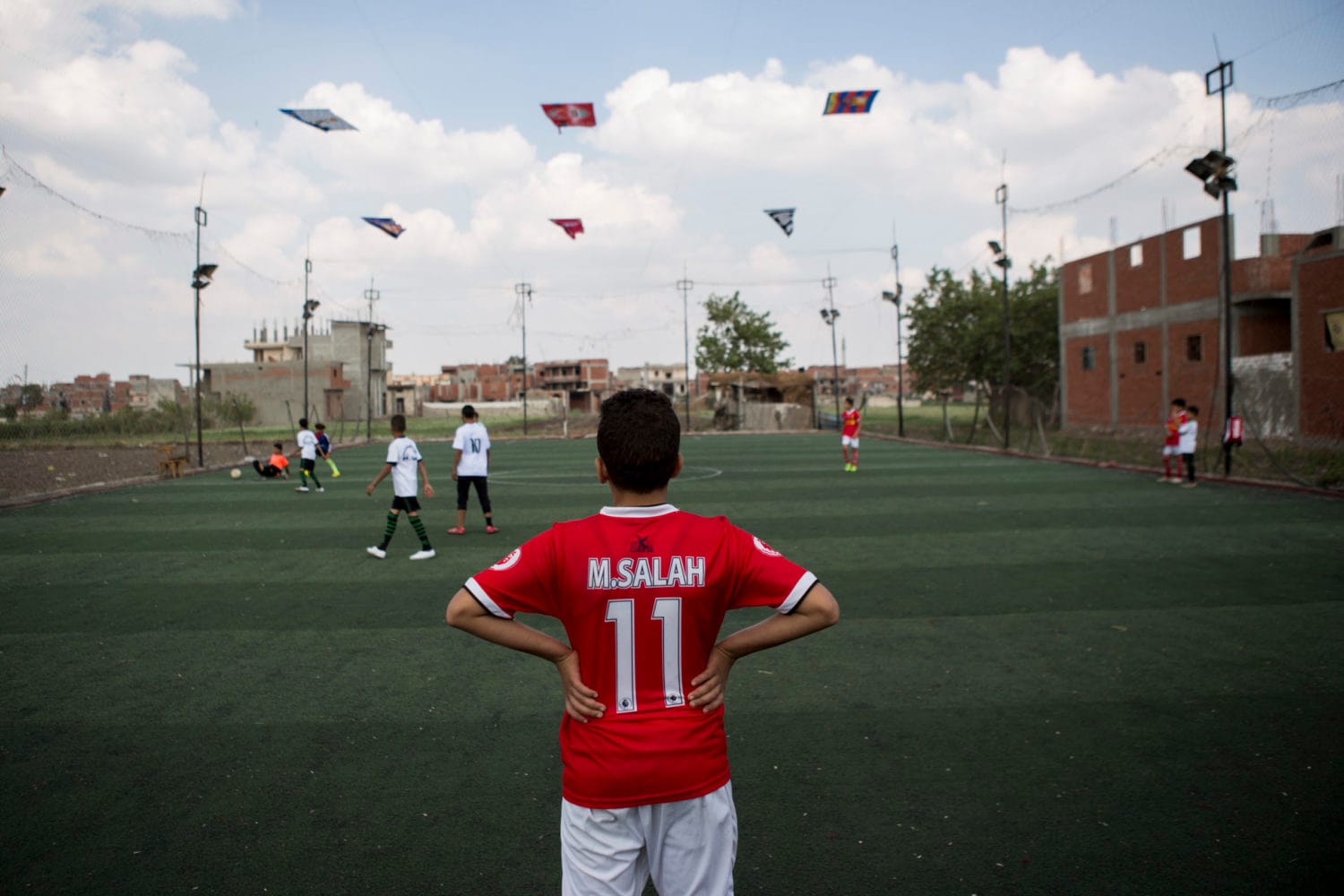
An Egyptian boy, wearing the jersey of Liverpool's Mohamed Salah, practicing football at a field in the Egyptian star's home village of Nagrig, Egypt, May 13, 2018\. Gehad Hamdy/dpa/Getty Images
One prime example is Egypt, where the game since the early twentieth century has facilitated a powerful and often politicized stage for national self-projection, identification and reflection. In my book, [*Egypt’s Football Revolution: Emotion, masculinity, and uneasy politics*](https://utpress.utexas.edu/9781477323175/egypts-football-revolution/), I provide a detailed ethnographic and historical account of such processes between the 1990s and 2019.
The book shows that the late Mubarak era was a period of Egyptian history when football played a particularly active role in the national project. In the 2000s, the nation was swept away by a heady football hysteria as the male national football team achieved unprecedented success. The sport became an important avenue through which Egyptian men learned how to act, talk, behave and feel. Attuned to the growing influence of football on the national stage—and to how the sport shaped masculinity in particular—the Mubarak family exploited the sport as an efficient instrument to be one with the people, and shore up legitimacy and popularity.
In 2011, however, the government’s interest in football came to an abrupt end. The 25 January revolution not only ended Hosni Mubarak’s 30-year reign but also pushed many Egyptian citizens to question the political role that football had played under the old regime. At the same time, a new kind of young supporter—the so-called “Ultras”—developed a novel and more radical style of football fandom that posed a serious challenge to the establishment’s ideals, aesthetics and gender roles.
In the past few years, the army-led counterrevolution has crushed the revolution inside Egypt’s national game. The Ultras’ project has been devastated, and football’s ability to epitomize the nation and shape its masculinities is not what it used to be. As football fans around the world tune in to the World Cup in Qatar, President Abd al-Fattah al-Sisi’s regime is rather turning its back on the game, which used to constitute a centerpiece of Egyptian nation building.
## **The Egyptian Football Man**
Although football has long been Egypt’s most popular spectator sport, the final years of Mubarak’s presidency represented its peak. Especially after the 2006 Africa Cup of Nations, which Egypt both hosted and won, the nation was swept away by a football hype with wide-ranging ramifications well outside stadiums and training grounds.
The sports boom resulted from several interlinked factors. Strong advertising revenue and the ownership of clubs by state institutions—including the army, police and gas and oil companies—contributed to the professional league’s financial success, turning it into the wealthiest league in Africa. A growing number of private satellite television channels allotted an increasing percentage of their programming to broadcasting, discussing and analyzing the national league and the national team. Football played an essential part in the plots of several Egyptian movies, including *Ana mish ma‘hum* (2007) and *Wahid sifr* (2009). Mega stars like Nancy Ajram and Sherine Abdel Wahab released hit songs that more or less explicitly addressed Egypt’s football heroes. In those years, it was difficult to delineate the precise boundaries of the game’s reach: actors, artists and politicians mingled in the VIP sections of stadiums, while football players and coaches frequented celebrity parties and events featuring politicians and regime-associated businessmen.
In the years before the 2011 Revolution, an unprecedented string of victories brought the brew of money, media, fame and football to a boiling point. In 2006, 2008 and 2010, the Egyptian national team won three consecutive Africa Cup of Nations, and the biggest Cairo club, al-Ahly, took home as many African Champions League titles between 2005 and 2008\. These successes incited nationwide popular celebrations. After each continental triumph, tens of thousands of citizens gathered in streets and squares in cities and towns across the country. Sometimes the festivities—a unique expression of collective affect in public space during an era otherwise dominated by severe police repression—continued for days.
The football craze also brought to the fore particular masculinities built around national passions. To pass as a “normal” man in Egypt in the late 2000s, it was crucial to love football feverishly, rejoice in the national team’s victories, display passion when one’s favorite club was playing and show fanatical animosity toward opponents. Egyptian movies from the era illustrate how a normalized establishment masculinity was tied to support for football, as the sport was time again cast as followed by “everyone.” By the same logic, the movies portrayed men who do not like football as marginal, suspect or even dangerous figures. The stern Islamist and the elite intellectual constituted two recurring stereotypes. Neither of these figures ever truly represented the football nation that was taking shape.
> **the movies portrayed men who do not like football as marginal, suspect or even dangerous figures. The stern Islamist and the elite intellectual constituted two recurring stereotypes.**
Satellite television presented another sphere for portraying the character of the Egyptian football man in this era. In particular, the hosts and pundits of Egypt’s daily football talk shows—a rampantly popular genre combining sports, gossip, politics and light entertainment—embodied many of this figure’s typical traits. The masculinity on display in these shows deviated markedly from the ideals of respectability, education and meritocracy that, according to anthropologist Walter Armbrust, had been promoted in nationalist popular culture from the late nineteenth century until the 1980s.[\[1\]](#%5Fftn1) The television hosts’ popularity and fame rather stemmed from a mixture of pugnacity, nouveau riche taste and an ethic of victory at all costs—emblematic, in Armbrust’s analysis, of a turn to “vulgarity” that began in the late 1980s and early 1990s. Such shows showcased the Egyptian football man as someone who liked to win, boast, banter and have fun. He embodied a somewhat vulgar and chauvinist masculinity that defined the late Mubarak era.
Whether incidentally or not, this masculinity happened to align with the public personae of Hosni Mubarak and his two sons, Gamal and Alaa. Unlike his predecessors, Gamal Abdul Nasser and Anwar al-Sadat, Mubarak did not primarily build legitimacy and popularity on performances of respectability or elaborate speeches. Especially in the final decade of his presidency, nepotism and corruption became rampant. Gamal Mubarak and his businessmen friends dominated the political and economic spheres. Few citizens would praise the ruling family’s ethics or integrity. What every Egyptian knew, however, was that the president and his sons were truly passionate football fans. In the stadium or in front of the television, they came across as typical Egyptian men, cheering for their team just like any other citizen. In this way, the victorious football boom provided the presidential family with a unique and timely chance to be one with a successful, slightly vulgar but by all means normalized version of the Egyptian nation and its people. In the socioeconomically and politically dire years that preceded the 2011 uprisings, the national sport presented a rare social field where the Mubarak family enjoyed popularity, luster and legitimacy.
## **Revolutionary Football Masculinities**
The 2011 revolution not only terminated Mubarak’s 30-year-long presidency. It also dismantled the peculiar national football frenzy and the national football man that had given Mubarak’s kleptocratic regime popular appeal. Cracks began to show at least a year before demonstrations started in Tahrir Square on January 25, 2011\. In November 2009, Egypt played two highly anticipated World Cup qualifiers against Algeria—the first in Cairo and the second in Omdurman in Sudan. Football fans with whom I conduct research in Cairo have often described these two games as the peak of Egypt’s nationalist football hysteria. The coverage of football in the media was extremely intense. Aggressive anti-Algerian rhetoric and supporter violence surrounded the matches, triggering a serious diplomatic crisis between the two countries.
> **Read Christopher Cox on "[Morocco’s Marginalized Youth and the Rise of Football Ultras](https://merip.org/2022/11/moroccos-marginalized-youth-and-football-ultras)" in MER issue 304.**
The event also prompted a distinct shift in the public debate. In the weeks after Egypt lost the decisive second match to Algeria and missed qualifying for the World Cup, voices critical of the nation’s football obsession began to emerge. In the press, many commentators argued that the Egyptian people’s obsession with football was breeding “fanaticism” (*ta‘assub*) and harmful political divisions. Notably, the figures criticizing football in this moment were often precisely those Islamists and intellectuals previously marginalized by the establishment model of masculinity associated with football. In the wake of the devastating defeat, those who claimed to represent a more “respectable” (*muhtaram*) masculinity seemed to strike back against a football nation they saw as dominated by vulgarity and masculine chauvinism. In this sense, November 2009 anticipated transformations that would take place after January 2011\. During Egypt’s revolutionary years, football-skeptical Islamists and secular intellectuals dominated politics and public debates. Now, it was the Mubarak era’s vulgar football men who had found themselves marginalized.[\[2\]](#%5Fftn2)
The 2011 revolution also coincided with a revolt inside Egypt’s national game. The key players in this football revolution were members of new kinds of supporter organizations that first appeared in Egyptian football stadiums in 2007\. The “Ultras,” as the new fans were called, introduced a more dedicated and orchestrated way of cheering for the country’s most popular clubs. Taking inspiration from existing Ultras groups in southern Europe and the Maghrib, they brought together a more international style of football fandom markedly different from what generally occurred in Egyptian stadiums.[\[3\]](#%5Fftn3) The Ultras dressed in a specific manner; their songs had elaborate lyrics; they used flags, pyrotechnical flares and graffiti excessively; they sang and danced for 90 minutes without interruption; they insisted that football should be watched live at the stadium, not on television. By 2009, Ultras Ahlawy (supporting the Cairo powerhouse al-Ahly) and Ultras White Knights (supporting arch-rival al-Zamalek) were able to mobilize tens of thousands of young men in their teens and early 20s at Cairo Stadium. Unsurprisingly, this booming supporter phenomenon precipitated a backlash from the football establishment and the security state. In the media, the Ultras were portrayed as troublemakers and thugs. They frequently clashed with security forces inside and outside the stadium.
> **By 2009, Ultras Ahlawy (supporting the Cairo powerhouse al-Ahly) and Ultras White Knights (supporting arch-rival al-Zamalek) were able to mobilize tens of thousands of young men in their teens and early 20s at Cairo Stadium.**
Although refusing to take an official political stance, the Ultras played an important role from the very beginning of the 2011 revolution. The groups’ sheer size, strict organization and experience defending themselves against the police proved invaluable during clashes and street fights. Time and again, the Ultras’ characteristic aesthetics—flags, t-shirts, flares—were visible on the battlefront at and around Cairo’s Tahrir Square as well as in cities in the provinces. Their provocative songs with lyrics mocking the faltering police state became a central part of the revolutionary repertoire.
The Ultras’ revolutionary prowess also resulted from their unorthodox way of cheering at the stadium. Their young and radical manner of football fandom contrasted distinctly with the establishment-aligned fan practices and aesthetics of the late-Mubarak era. In a stark contrast to the older, more media-centered fan practices that used to dominate, some Ultras interlocutors depicted the stadium as a space of “fun and freedom.”[\[4\]](#%5Fftn4) Challenging the establishment’s emotional-national football masculinity from the inside, the Ultras embodied and lived a new way of being an Egyptian football fan and, to some extent, an Egyptian man.
Throughout 2012, the Ultras’ aesthetics and emotions spilled from stadiums and into the streets. This shift was initiated on February 1, when 72 members of Ultras Ahlawy were killed in a gruesome massacre at a stadium in Port Said. Although no conclusive evidence has established exactly what transpired, many Egyptians believe that the army and/or police organized the attack, either by infiltrating the home fans who stormed the visiting Ahly supporters’ stadium section or by hiring *baltagiya* (“thugs”) to carry out the violence. Television [footage](https://www.youtube.com/watch?v=Btu6jAFMWd4) from the match seems to support this supposition, showing the police who were present doing little to intervene. After the Port Said tragedy, the Egyptian government canceled domestic football matches for a full year. Instead of attending football games, Ultras Ahlawy embarked on a protracted campaign for justice for those killed as well as for far-reaching reforms of Egypt’s notoriously corrupt football organizations. They organized demonstrations and sit-ins, covered Cairo’s walls with graffiti honoring the Port Said martyrs, interrupted training sessions and television shows and ransacked the Egyptian Football Association’s headquarters.
For about a year, this activist push for justice, retribution and reforms gathered significant popular support. In a revolutionary period when many former football fans felt ambivalent about the game they used to love because it seemed too associated with violence and the dirty politics of the Mubarak regime, the Ultras came across as one of few football actors in sync with the national zeitgeist. The groups’ principled actions, their fight against corruption and for the rights of the families of those killed and the way they used violence in a bold yet purposeful and ordered way impressed many outsiders.
That al-Ahly and the national team’s immensely popular playmaker, Mohamed Aboutrika, actively backed the Ultras’ campaign contributed to their popular standing. Arguably the brightest star of his generation, Aboutrika was one of very few players who had kept a distance from the Mubarak regime during the boom years. He is widely known for his morals, respectability and integrity, and he actively backed the Muslim Brotherhood-affiliated president Muhammad Mursi before and after the June 2012 elections. In 2011 and 2012, it was difficult to find anyone in Egypt who did not love Aboutrika. When he expressed his unreserved support for the Ultras, his unquestionable respectability spilled onto the supporter movement, increasing their appearance as revolutionary role models.[\[5\]](#%5Fftn5)
## **Even a Counterrevolution Cannot Turn Back Time**
In 2013, Egypt’s revolutionary momentum was defeated by an army-led counterrevolution. The football revolution was no exception. Already in the beginning of the year, the Ultras had begun to lose their status as revolutionary role models. The intricate balance between violent action and respectability that had rendered their masculinity so well in tune with the revolution’s ideals and ambiance proved impossible to uphold. Following a [widely criticized public](https://www.youtube.com/watch?v=mqOPodxq1bM) demonstration by Ultras Ahlawy celebrating the death sentences of 21 fans from Port Said for their involvement in the previous year’s massacre, and a series of violent attacks on public property, increasing numbers of citizens began to perceive Ultras as thuggish troublemakers. That winter was also a moment of deep polarization between the Islamist Mursi regime and the secular opposition—the backing of the outspoken Mursi supporter Mohamed Aboutrika, which had previously rendered the fans almost untouchable, was no longer an obvious asset.[\[6\]](#%5Fftn6)
After the military coup in July 2013, the situation went from bad to worse. As the Egyptian security state regrouped, the Ultras—like most revolutionary factions—faced a [relentless wave of repression](https://www.merip.org/the-battle-of-egyptian-football-fans-against-dullness/). Taking revenge for the years that Ultras’ visions had dominated public discourses about the game, the football media and the Football Association smeared the fans ruthlessly, associating them with the demonized Mursi government. The police and the judiciary also joined forces, arresting and prosecuting hundreds of Ultra leaders and rank-and-file members. Other members of the fan groups decided to leave Egypt, often ending up in a prolonged exile. By 2018, Egypt’s biggest Ultras group, Ultras Ahlawy, formally conceded and dissolved the group. The second biggest group, Ultras White Knights, is still formally active, yet its activities are scattered and erratic at best.
> **A decade has passed since Egypt’s football revolution reached its zenith. Over those years, the Ultras’ revolutionary football masculinity has been marginalized and their push for change crushed, but that does not mean that Egyptian football is back where it used to be before January 2011.**
A decade has passed since Egypt’s football revolution reached its zenith. Over those years, the Ultras’ revolutionary football masculinity has been marginalized and their push for change crushed, but that does not mean that Egyptian football is back where it used to be before January 2011\. Undoubtedly, the national game remains an enormously popular pastime. When al-Ahly or al-Zamalek play, millions of Egyptians watch anxiously on television, while memes, commentary and banter fill social media. The Egyptian winger Mohamed Salah has developed into one of the highest-ranked players internationally, with millions of Egyptians tuning in to Liverpool FC games to cheer him on each week. And yet, attachments, especially to the national team, are not what they used to be. During recent research trips to Cairo, I have often heard fans speak of disenchantment and ambivalence, even at ostensibly momentous occasions such as the 2018 World Cup or when Egypt hosted the 2019 Africa Cup of Nations.
One recent example of popular disenchantment occurred when Egypt narrowly lost a decisive World Cup qualifier to Senegal in March 2022, thus missing out on the upcoming tournament in Qatar. Without a doubt, many Egyptians were hugely disappointed after the setback. As I walked home through Cairo that night, the city was unusually silent, marked by defeat, and yet, most fans shrugged it off surprisingly quickly. A day or two later, football was no longer the main talking point in the media or in cafes. Some friends even argued that it was better that Egypt had lost: the team was playing poor and boring football—sending this group of players to the World Cup could only end in embarrassment. Compared to the intense shock and public outcry that engulfed the nation after the November 2009 defeat to Algeria, the loss to Senegal seemed like a non-event. The contrast between the two defeats and two missed World Cups suggests a palpable shift in football’s centrality in the national consciousness.
As the world’s eyes look to Qatar, the headiest days of Egypt’s football politics seem to belong to the past. At least for the moment, the national game has lost its previously unmatched ability to capture the nation’s attention and trigger truly national passions and debates. Consequentially, football no longer delineates normative national gender roles. Few films produced in 2022 would use football to illustrate who is and who is not a normal Egyptian man. Pop stars rarely sing about football players these days.
This marginalization of football in the national project provides a clue as to why the current political elite does not seem to care much about the sport, despite relatively good results. At first blush, the last five years might appear to be a very successful period in Egyptian football history. The national team reached the final of the Africa Cup of Nations in 2017 and 2022, and qualified for its first World Cup in 28 years in 2018\. Al-Ahly has reached the final of the African Champions League five times in the last six years (winning the tournament twice), and al-Zamalek won the second major African club tournament, the Confederation Cup, in 2019.
Despite these successes, the Sisi regime has made surprisingly few attempts to associate itself with the country’s football teams. The president neither talks about the sport with the same frequency or intensity as Mubarak nor makes the same efforts to come across as a passionate football fan. Discerning the chicken from the egg in this process is challenging, but clearly, the relative disregard for football among the country’s rulers relates to the game’s decreased significance to the nation. The sport is still omnipresent throughout Egypt and may still be a fertile breeding ground for masculine subject formation. Yet, at present, the Egyptian football man no longer embodies the Egyptian nation.
\[**Carl Rommel** is a Researcher in the Department of Anthropology and Ethnology at Uppsala University.\]
> **Read the [previous](https://merip.org/2022/11/the-politics-of-unskilled-labor-in-qatar-an-interview-with-natasha-iskander-2) article.**
> **Read the [next](https://merip.org/2022/11/the-gulf-and-the-british-regional-divide) article.**
**This article appears in [MER issue 304](https://merip.org/magazine/304) "Football—Politics and Passions."**
---
### **Endnotes**
[\[1\]](#%5Fftnref1) Walter Armbrust, *Mass Culture and Modernism in Egypt* (Cambridge: Cambridge University Press: 1996).
[\[2\]](#%5Fftnref2) Carl Rommel, *Egypt’s Football Revolution: Emotion, Masculinity, and Uneasy Politics* (Austin: University of Texas Press, 2021), 59-81.
[\[3\]](#%5Fftnref3) James Montague, *Among the Ultras: A Journey with the World’s Most Extreme Fans* (London: Penguin, 2020). Muhammad Gamal Bashir, *Kitab al-Ultras: ‘Andama Tata‘adda al-Jamahir al-Tabi‘a* (Cairo: Dar Dawwin, 2011)
[\[4\]](#%5Fftnref4) Carl Rommel, *Egypt’s Football Revolution: Emotion, Masculinity, and Uneasy Politics* (Austin: University of Texas Press, 2021), 94–98.
[\[5\]](#%5Fftnref5) Ibid., 109-137.
[\[6\]](#%5Fftnref6) Ibid., 139-148.
### The Politics of “Unskilled" Labor in Qatar—An Interview with Natasha Iskander
URL: https://www.merip.org/2022/11/the-politics-of-unskilled-labor-in-qatar-an-interview-with-natasha-iskander-2/
Last updated: 2025-08-22T18:37:03.000Z
*\[su\_dropcap style="simple" size="4"\]*N*\[/su\_dropcap\]atasha Iskander is professor of Urban Planning and Public Service at New York University. She is the author of* [Does Skill Make Us Human?: Migrant Workers in 21st-Century Qatar and Beyond](https://press.princeton.edu/books/hardcover/9780691217574/does-skill-make-us-human) *(Princeton University Press, 2021) and* [Creative State: Forty Years of Migration and Development Policy in Morocco and Mexico](https://www.cornellpress.cornell.edu/book/9780801475993/creative-state/#bookTabs=1) *(Cornell University Press, 2010). Arang Keshavarzian, associate professor of Middle Eastern and Islamic Studies at New York University, spoke to Iskander in July 2022 about the politics of "unskilled" labor behind the World Cup in Qatar.*
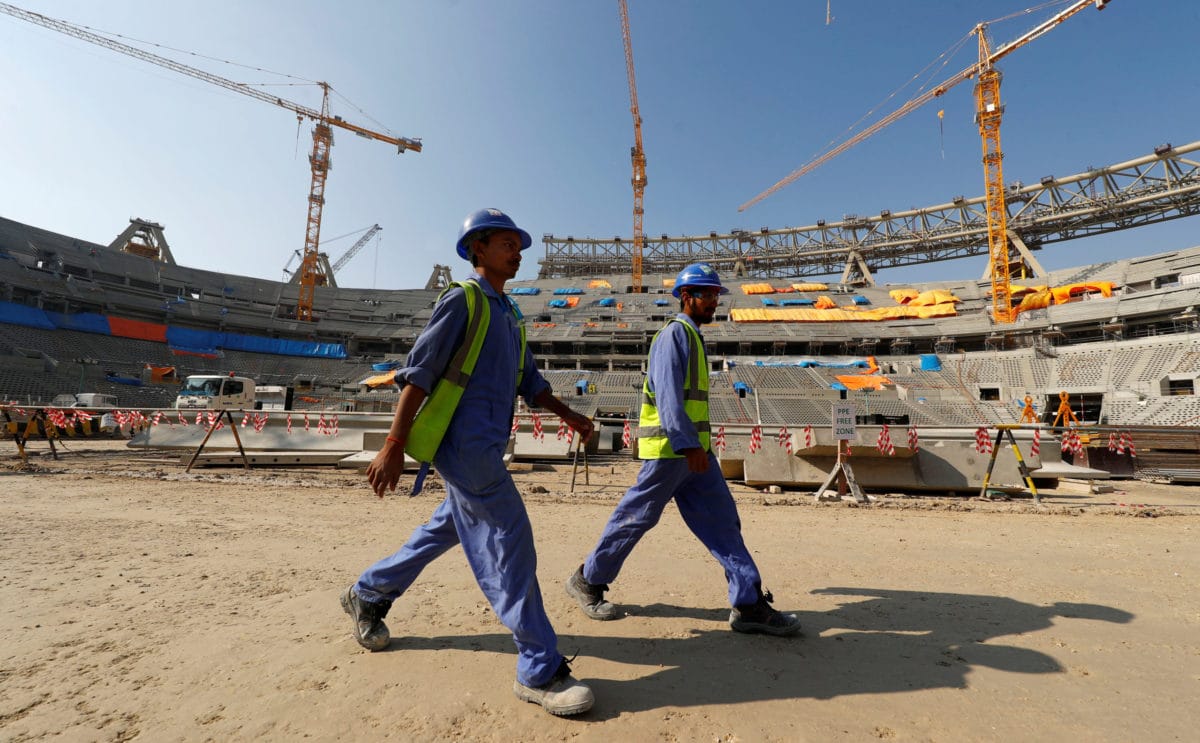
Workers inside the Lusail stadium, constructed for the 2022 World Cup, Doha, Qatar, 2019\. Kai Pfaffenbach/Reuters
**Arang Keshavarzian**: Your book *Does Skill Make Us Human?* forces the reader to contemplate a tension and discrepancy. On the one hand, the stadiums and some of the infrastructure necessary to host the 2022 World Cup in Qatar are some of the technologically most cutting edge and sophisticated feats of engineering. On the other hand, the people who have labored and built them are defined as “unskilled” and come with little or no experience either working in the Gulf region or on such massive construction sites. Why is it important to grapple with this tension to understand the politics of labor in Qatar and beyond?
**Natasha Iskander**: I am not sure I would call it a tension. I think it’s much more instrumental than that, in Qatar and elsewhere. The description of migrant workers as unskilled, irrespective of their actual ability, is absolutely core to the politics that dehumanizes them, deprives them of their freedom and denies them their bodily autonomy. These politics are the mechanism by which migrant workers are stripped of their personhood.
But the reason the politics of skill appear as a tension—as the discrepancy you describe, for example, between pathbreaking architecture and an unskilled workforce—is that skill masquerades as a technical issue. While there has been substantial scholarship highlighting bias in the measurement of skill, by gender or race or other social categories, the notion of skill itself (defined as competence and expertise) passes as a concept that is politically neutral.
In fact, in embarking on this project, I didn’t set out to grapple with skill and its politics. Instead, I wanted to understand how the politics of labor were different in a place that was the opposite of the typical migration story. Much of the scholarship on migrant labor looks at settings where immigrants or migrants are only a small fraction of the population and labor force. They are thus defined as an exceptional political case against a backdrop where the norm is full citizenship, with all the rights that entails. In Qatar, as has been the case for half a century, close to 95 percent of all workers are migrants. The rights, the belonging and the individual agency associated with citizenship are only afforded to the tiny minority of the population that are Qatari nationals. After Qatar won the World Cup hosting rights in 2010—amid a hurricane of whispers about [kickbacks and bribes](https://www.nytimes.com/2020/04/06/sports/soccer/qatar-and-russia-bribery-world-cup-fifa.html)—migrant laborers’ working conditions began to receive an unprecedented level of scrutiny for a country in a region largely overlooked in migration scholarship and policy circles. Human rights and labor organizations began documenting labor abuses faced by migrant construction workers, which ranged from wage theft to abysmal living conditions in labor camps to injury and death. I wanted to understand how these exploitative patterns grew out of the fact that the political status of almost the entire population was co-equal with—and confined to—their economic function as workers.
These questions set off a six-year exploration, with research in five countries and eight languages. No matter which direction I turned, which research path I followed, my findings kept drawing me to the question of skill and its politics. These were so pronounced in Qatar that they bled into international press coverage of the country’s architectural reinvention. The images that ran in the media toggled between photos of futuristic and hyper-designed stadiums and photos of migrant workers, most in nondescript construction overalls, many with their faces covered, anonymous, racialized, looking wretched and somewhat flippantly described as unskilled. In the breach between those two types of images was an untold story. To build those stadiums, but also Qatar’s luxury developments, its new smart city, artificial islands, museums, cultural centers and new and expanded liquid natural gas extraction and processing centers, workers had to use the most advanced construction techniques anywhere in the world.
The workers who built those structures were recruited from all over the Global South—South Asia, the Middle East and sub-Saharan Africa—and as you note, almost all arrived without relevant construction experience. To bridge this gap, companies turned their construction sites into vast and accelerated training systems. Companies organized their entire workflows to promote learning. All building practices, absolutely every single task, doubled as on-the-job training. These processes were intensively managed. Companies measured the progress of their workers in acquiring new skill very closely, sometimes several times a day, tracking workers’ productivity gains down to the fraction of an hour. This training was only effective because workers were heroic in their approach to learning. They tackled new and difficult tasks with dedication, commitment and even bravery. They developed informal teaching and mentoring practices to undergird the formal training systems on site. These were so intensive and intimate that workers came to regard each other as family through the learning process, cultivating a skill-based kinship system where more experienced workers were called “uncle” or “big brother” teaching their “sons” and “little brothers.”
> **They were not describing ability—or lack thereof—but instead were shunting their workers into a subordinate political category, divesting workers of their political personhood and redefining them as labor inputs that were disposable and readily replaceable.**
And yet, despite the industry’s intensive investment in training and its complete dependence on the advanced skill that workers developed, employers and managers I spoke with routinely and uniformly described their workers as “unskilled,” “unproductive” or sometimes just “bodies.” Very quickly, it became clear to me that they were using the term “unskilled” to refer to something other than skill. They were not describing ability—or lack thereof—but instead were shunting their workers into a subordinate political category, divesting workers of their political personhood and redefining them as labor inputs that were disposable and readily replaceable.
Labeling someone as unskilled is essentially a denial of their capacity to learn. Learning is fundamentally an act of freedom, one that cannot be compelled. It is a deeply intimate process that requires imagination, volition, desire, aspiration. And because learning depends on teaching, it also needs the cultivation of trust, social connection and empathy between teacher and student. In labeling workers as unskilled, employers and managers were also denying that workers had the capacity to access those registers of human experience that learning requires. The jump to dehumanizing workers was very small.
The label unskilled also has political significance beyond the worksite. Unskilled workers have been banned, as a matter of policy, from most parts of Doha and its new satellites, confined to labor camps in the desert. They are subject to intensive surveillance and police controls. In the early days of the coronavirus pandemic, being labeled unskilled became a matter of life and death. The Qatari government drew a [cordon sanitaire](https://anthrosource.onlinelibrary.wiley.com/share/A9N8Q9HMYXU2XCUB2II4?target=10.1111/maq.12625) around the tracts in the desert where workers are housed and prohibited them, with police force, from crossing it to receive medical care or [to purchase food](https://www.merip.org/no-good-options-for-migrant-workers-in-gulf-covid-19-lockdown/).
While these consequences of skill politics may seem acute, they are dissimilar only in degree from the effects that we see in other economies. Workers described as unskilled have their freedom denied, their bodies controlled, their desires and ambitions for dignity suppressed—whether in an [Amazon fulfillment center](https://journals.sagepub.com/doi/abs/10.1177/00197939221110097), a [meatpacking plant](https://pubmed.ncbi.nlm.nih.gov/33355943/) or an [immigrant detention facility](https://journals.sagepub.com/share/Y22HITJIHB2E5IGGDQAT?target=10.1177/0002764219835257).
**Arang**: Your research uncovers a host of tactics and methods adopted by laborers to negotiate and challenge their employers. How do these forms of resistance and disobedience directly evoke and deploy “skill” as well as the various spaces and practices set up by management to control them?
**Natasha**: Worker organizing and labor protests are illegal in Qatar. They can result in imprisonment and deportation. Still, wildcat, spontaneous strikes were very common (as well as in other Arab Gulf states). Every single site I was on saw a strike at one point or another. Employers tolerated these strikes so long as they hewed to a very specific script: they had to be short, a day or two; workers had to stay in their labor camps; no protests or challenges were tolerated on the construction site (as one supervisor explained, “\[worker defiance\] is like a spark that can set the whole place on fire”), and they had to be limited to one nationality. If protests stayed within these parameters, the health and safety staff charged with managing them gave them “a day to blow off steam and get their heads back on right,” as one of them described it to me. Any protest that deviated from these rules resulted in immediate deportation. Especially threatening to managers were protests organized across nationality because it meant that workers were no longer “blowing off steam” as Bangladeshis or Nepalis or Egyptians, but rather that they were organizing as *workers*, developing solidarity across nationality and based on a class consciousness. As I document in the book, any protest that broke with management’s script did not and could not exist because as soon as it coalesced, it was quashed by the expulsion of protestors from the country.
> **Especially threatening to managers were protests organized across nationality because it meant that workers were no longer “blowing off steam” as Bangladeshis or Nepalis or Egyptians, but rather that they were organizing as *workers*, developing solidarity across nationality and based on a class consciousness.**
But workers still found ways to resist, and the most powerful strategies were those that drew on skill and learning. Workers invoked their expertise to challenge unsafe practices on site, which were often the product of managerial pressure to meet accelerated construction deadlines. In order for their expertise to matter in making skill-based claims for safety, workers had to back it up with concerted action that ran through the relationships they built in teaching and learning. For example, at one stadium site, management ordered scaffolders to work double shifts—16 hours at a stretch. Because such long work hours did not allow sufficient time between shifts for a night’s sleep, especially given the hour-long commute back to the labor camp, workers were told that they could nap between workdays in a hanger onsite. The scaffolders refused, saying it was dangerous to work such long shifts with insufficient rest and dangerous to work at night when the floodlights used to illuminate their workspace, some 20 stories above ground, cast shadows that were confusing and disorienting. Workers anchored their refusal in the expertise they had developed as scaffolders, invoking the company training that their employers were now insisting they violate. But their resistance was effective because they stood together as tradesmen. Not as Nepalis or Pakistanis or Kenyans, but as scaffolders. The workers’ ties across nationality, religion and ethnicity, forged through teaching and learning from one another—ties as deep and resilient as kinship relationships—were the backbone of their solidarity. That stadium site relied on half a dozen subcontractors to complete the scaffolding work the project required, but not a single scaffolder from any of those companies climbed the ladder to begin a 16-hour shift. The general contractor for the site had no choice but to scale back to 10-hour days.
To be sure, workers’ use of skill as a form of resistance was not unalloyed. Workers’ invocation of their expertise faced skepticism and hostility from management. Their wages never matched their contribution and the benefits of the teaching and learning flowed to management. Nevertheless, skill-based resistance was powerful because workers used it to express a form of personhood denied by the label of unskilled.
**Arang**: The past decade has seen a proliferation of news articles about labor conditions and abuses in the Middle East. The term *kafala* system, the [prevailing guest worker program in the Gulf](https://www.merip.org/keeping-migrant-workers-in-check/), is now known to many around the [world](https://www.merip.org/understanding-race-and-migrant-domestic-labor-in-lebanon/). How has Qatar responded to this unwanted coverage? To what extent have they adopted reforms and addressed demands made by labor organizations and laborers themselves?
**Natasha**: The *kafala* system is nothing more than the legal framework governing guest workers in the Gulf. Although the system is often represented as a cultural or Islamic brand of jurisprudence, it shares basic features with the global governance systems to regulate temporary migrant workers, including systems in the United States and Europe. Among the countries of the Gulf Cooperation Council, each one has implemented a slightly different version of the *kafala* system. When Qatar was awarded the World Cup hosting rights in 2010, its iteration was the most restrictive in the Middle East. As in many neighboring countries, workers were legally bound to their employer and prohibited from changing jobs. But Qatar also made it illegal for workers to withhold their labor for any reason. They could not quit under any circumstances, even in response to abuse or wage theft. Workers were in Qatar at the pleasure of their employer, and although they could be deported for any reason, without notice, they needed their employer’s permission to leave the country and had to show an exit visa at passport control to depart. Qatar’s legal system gave employers control over their workers’ future even after the employment relationship was terminated. Workers were not permitted to return to Qatar to fill a new job without their prior employer’s assent. Employers generally withheld this permission because, as they explained to me, they were leery of their competitors benefiting from the training investments they had made. Taken together, these restrictions amounted to a formal system of bonded labor, backed often quite ruthlessly by Qatar’s security services, which even issued an app allowing employers to notify the Ministry of the Interior, with the swipe of a finger, that their worker had absconded.
Human rights organizations, labor organizations and the international press were correct to call this system out as a form of modern slavery, and the catalogue of labor abuses they documented was devastating to Qatar’s international reputation and to its strategy of sports diplomacy. Qatar invested heavily to expand its natural gas production, and the World Cup was part of its push to develop the soft power to manage the geopolitical implications of being one of the leading global suppliers of natural gas. Qatar initially treated labor violations as a public relations problem that it could resolve without changing its laws. At its most cloying, the damage control effort featured an interview with the Emir of Qatar, Sheikh Tamim, on [CNN](http://edition.cnn.com/TRANSCRIPTS/1409/25/ampr.01.html) in 2014, where he confessed that he was “personally hurt by the situation.”[\[1\]](#%5Fedn1)
But that same year, the International Labour Organization (ILO) registered a [formal complaint](https://www.ilo.org/dyn/normlex/en/f?p=NORMLEXPUB:50012:0::NO::P50012%5FCOMPLAINT%5FPROCEDURE%5FID,P50012%5FLANG%5FCODE:3188310,en) identifying Qatar as abetting forced labor. The Qatari government found itself compelled to respond to avoid the fallout of the formal sanction the ILO threatened to issue. With technical assistance from the UN agency, the Qatari government instituted a variety of reforms to its labor laws. These included an electronic payment system to prevent wage theft, permission to terminate employment and leave the country at will, a minimum wage (now about $250) and some ability to change jobs. These reforms look good on paper and satisfied the ILO, which marked the complaint against Qatar resolved in 2017\. They have also done wonders for Qatar’s public image. The international press has run headline after headline, since as early as 2015, proclaiming that Qatar abolished the *kafala* system, and previously staunch worker advocates (most notably the International Trade Union Confederation) have gone from excoriating Qatar for its labor violations to celebrating the regime for its enlightened changes.
In practice, however, the reforms have done little to ameliorate the conditions of workers and to curb labor abuses. Not only has enforcement been scandalously lax, implementation of the reforms has reproduced the same administrative logic and power structures woven into the earlier version of the *kafala* system. To access the new labor rights specified in the reforms, such as the right to change jobs, workers still need their employer’s consent along with the registered approval of the Ministry of Administrative Development, Labor and Social Affairs. These constraints bind workers to their employers, but now as a matter of bureaucratic procedure rather than formal law. Additionally, the array of policies and practices that surrounded the earlier *kafala* system remains in place. Workers are still banned from residing and even circulating in most areas of the cities they built. They remain subject to summary deportation and are pursued for absconding and are still prohibited from protesting or even voicing concerns about their working conditions on social media.
It is important to note that all foreign workers regardless of occupation, class or nationality are regulated by the same legal framework, whether the earlier *kafala* system or the reformed administrative management of labor. A British architect in an executive suite is governed by the same basic framework as a Nepali street sweeper. But it is the workers who are classified as unskilled who suffer the most exploitative consequences of this system. They are still forced to work overtime, still have their wages stolen, are still dying from work-related injuries. The letter of the law may have been rewritten, but its spirit, articulated in Qatar through skill politics, remains unchanged and very much in force.
**Arang**: Qatar’s ability to win the bid to host the World Cup as well as its ability to quickly construct the massive infrastructure necessary to host it has depended on its revenues from the export of fossil fuels. Nonetheless, Qatar claimed that this would be a “[carbon neutral](https://www.theguardian.com/football/2022/may/31/qatar-world-cup-criticised-for-problematic-carbon-footprint-promises)” World Cup. To what extent has the World Cup abided by this aspiration?
**Natasha**: From the moment Qatar entered its bid to host the soccer tournament, it has marketed its World Cup as the world’s first “carbon neutral” global games, but in fact, they are more accurately described as the first—but certainly not the last—"climate damage” games. It is not an overstatement to say that climate damage has been core to the World Cup’s business model. Hydrocarbon revenues have bankrolled the games. Construction of the stadiums and infrastructure for the games has involved significant carbon emissions, and heavily polluting match-day shuttle flights from cities in neighboring countries will transport spectators into Qatar because there is a shortage of local hotels. In addition, the stadiums themselves have fallen far short of their claims of being climate neutral, claims based on flimsy carbon offset schemes and some creative accounting.
But the tournament’s climate damage has fallen hardest on migrant workers, bearing down on their bodies and on their communities. And here again, the politics of skill come into play. The political representation of workers as unskilled has made them the target of the worst climate effects of the games. Let me point out two ways the politics of skill has amplified climate change pressures.
> **Not only are employers exposing workers to the effects of climate damage in Qatar, but I also discovered that they are developing labor recruitment strategies that enable them to capitalize on exposure to climate damage around the world.**
Qatar is not just hot. For weeks at a time, its temperatures rise past the threshold that makes heat life-threatening to a body at rest. One of the fastest warming places on the planet because of an accident of geography, Qatar has already warmed by half a degree Celsius since it was awarded the World Cup in 2010\. Construction workers are compelled to work in these extreme temperatures, and they suffer high rates of injury and death as a result. Heat wreaks devastating and permanent damage on kidneys, hearts and other vital organs. But heat attacks the neurocognitive system first. Early symptoms of heat stress are confusion, disorientation and the loss of ability to move one’s body. For a scaffolder hanging 30 stories up in the air, or a cladder craning a huge panel of glass and aluminum against the desert’s wind shear, this loss of neurocognitive ability can very quickly become a matter of life and death. The political description of workers as unskilled allows employers and the Qatari government to shift culpability to workers for the injuries they suffer. The alibi provided by the politics of skill goes as follows: it is not the heat and its damage to cognition that exposes workers to injury. Rather, it is that unskilled workers simply do not have the desire or the capacity to use their skill to protect themselves.
Not only are employers exposing workers to the effects of climate damage in Qatar, but I also discovered that they are developing labor recruitment strategies that enable them to capitalize on exposure to climate damage around the world. In their search for workers, they are seeking out once relatively prosperous places that have been wiped out by typhoons, shriveled by drought or flooded by sea level rise. Slow and fast-moving climate disasters have made those communities newly poor and turned migration into a necessary strategy for economic survival for Bangladeshis, Nepalis and many others. Qatari companies look for recruits in these places because people have benefited from the investments in education, nutrition and health that their communities made in better days. As a result, the migrants who recruiters find there have what employers call the “absorptive capacity” to become highly skilled. They have the foundations necessary for learning, but their poverty means that employers can classify them, permanently, as “unskilled.”
Qatari companies are actively restructuring recruitment networks in countries of origin to take advantage of the business opportunity that climate damage offers them. In this way, they are creating a closed loop of climate damage. Bankrolled by revenues from Qatar’s hydrocarbon production, they recruit migrants from communities that fossil fuel use has helped damage for low-wage work where they will be exposed to the extreme dangers of global warming. Qatar offers a stark view of the ways that climate damage and worker exploitation compound one another and points to how the politics of labor—in this case, the politics of skill—is shaping people’s experience of climate change and climate damage. The 2022 World Cup is not carbon neutral. Instead, these games reveal how profoundly carbon emissions and climate change are already defining the future of work, livelihoods and dignity.
> **Read the [previous](https://merip.org/2022/11/the-politics-and-passions-of-football) article.**
> **Read the [next](https://merip.org/2022/11/national-football-masculinities-in-egypt) article.**
**This article appears in [MER issue 304](https://merip.org/magazine/304) "Football—Politics and Passions."**
---
### **Endnotes**
[\[1\]](#%5Fednref1) “[CNN’s Amanpour: Key Coalition Partner Qatar on ISIS War](http://edition.cnn.com/TRANSCRIPTS/1409/25/ampr.01.html),” *CNN*, September 25, 2014.
### Issue 304 (Fall 2022) Masthead
URL: https://www.merip.org/2022/11/issue-304-fall-2022-masthead/
Last updated: 2025-07-29T13:07:01.000Z
## ***Middle East Report*, “Football**—**Politics and Passions,” Fall 2022, No. 304, Vol. 51 No. 3**
### **Executive Director**
**Mandy Terc** mandyterc@merip.org
### **Executive Editor**
**Katie Natanel** katienatanel@merip.org
### **Managing Editor**
**Marya Hannun** maryahannun@merip.org
### **Photo Editor**
**Michelle Woodward** mwoodward@merip.org
### **Staff Editor**
**Michael Kaplan** kaplan\_m@gwu.edu
### **Website Assistant**
**Karisa Gingerich**
### **Social Media Coordinator**
**Khelil Bouarrouj**
### **Board of Directors**
**Paul Silverstein(Board Chair)** *Reed College*
**Kaveh Ehsani** *DePaul University*
**Adam Hanieh** *University of Exeter*
**Vickie Langohr** *College of the Holy Cross*
**Shana Marshall** *George Washington University*
**Lee O'Brien** *Retired*
**Mary Sexton** *Consultant*
**Nabil Al-Tikriti** *University of Mary Washington*
**Mandy Terc** *MERIP Executive Director (ex officio)*
### **Editorial Committee**
**Shana Marshall (Chair of the Editorial Committee)** *George Washington University*
**Nabil al-Tikriti (Vice-Chair of the Editorial Committee and MERO/Current Analysis Editor)** *University of Mary Washington*
**Ayça Alemdaroğlu** *Stanford University*
**Lori Allen** *SOAS University of London*
**Mona Atia** *George Washington University*
**Elif Babül** *Mount Holyoke College*
**Jessica Barnes** *University of South Carolina*
**Graham Cornwell** *George Washington University*
**Muriam Haleh Davis** *University of California, Santa Cruz*
**Lisa Hajjar** *University of California, Santa Barbara*
**Waleed Hazbun** *University of Alabama*
**Najib Hourani** *Michigan State University*
**Mohammad Ali Kadivar** *Boston College*
**Reinoud Leenders** *King's College London*
**Pete Moore** *Case Western Reserve University*
**Curtis Ryan** *Appalachian State University*
**Jacob Mundy** *Colgate University*
**Atef Said** *University of Illinois at Chicago*
**Hesham Sallam** *Stanford University*
**Deen Sharp** *London School of Economics*
**Sophia Stamatopoulou-Robbins** *Bard College*
**Stacey Philbrick Yadav** *Hobart and William Smith Colleges*
### **Format: Online**
### **ISSN 3065-744X**
### The Politics and Passions of Football
URL: https://www.merip.org/2022/11/the-politics-and-passions-of-football/
Last updated: 2025-07-30T04:06:12.000Z
Whether we call the sport football, soccer, *calcio*, *kurat al-qadam* or by any other name, the World Cup moves us.
Al-Ahly fans at the African Champions League game between Al-Ahly and Mamelodi Sundowns at Cairo International Stadium, Cairo, Egypt, February 26, 2022\. Amr Abdallah Dalsh/Reuters
The tournament relies on the mobility of hundreds of thousands of laborers, athletes, supporters and other professionals to build stadiums, provide infrastructure, enact a spectacle and broadcast it to the world. It transfers unimaginable financial resources among corporate entities, private investors, para-state agencies and sovereign wealth funds. It shifts geopolitical lines of influence, centering host nations and peripheralizing those countries that fail to qualify. It spreads ideas of freedom and fairness, of merit and muscle, of individual self-reliance and collective solidarity—ideas springing from nineteenth century imperial sporting ideologies with indelibly liberal and racist roots.
The 2022 World Cup in Qatar—the first sporting event of such magnitude to be hosted in the Middle East—has drawn disproportionate international scrutiny and controversy. Ruled by the powerful Al Thani family, the tiny state of Qatar hosting one of the world’s largest spectacles has raised eyebrows across the world. Media attention has focused on a range of issues beginning with the circumstances of the host country’s gaining the bid and the corruption charges against the FIFA officials involved. Climate factors and the exceptional scheduling of the tournament for November, in the midst of the European professional football calendar, have also elicited commentary. The majority of the media scrutiny, however, has focused on the living conditions and social rights of migrant workers constructing the tournament venues and on Qatar’s laws regulating alcohol, sexual expression and public behavior—critics accuse the tournament of “sportswashing” authoritarian rule and human rights violations.
Accusations of sportswashing, the practice of using sport to improve a country’s image, have gained currency to explain why Qatar has spent an [estimated $220](https://finance.yahoo.com/news/world-cup-economics-qatar-record-105500060.html) billion readying the country to host the tournament. In their [contribution to this issue](https://merip.org/2022/11/simply-sportswashing-a-perspective-on-the-2022-world-cup-in-qatar), the authors from the collective Habibi FC take up the all-too-easy and one-sided explanation of sportswashing, observing it is most frequently applied to (non-white) countries from the Global South and partakes in a larger discourse of the “West vs. the rest.” They call for a more critical use of the term, one that does not depend on Orientalist binaries and attends to how soft power and diplomatic logics drive countries to host mega sporting events.
In one set of contributions, Natasha Iskander, Jaafar Alloul, Laavanya Kathiravelu, Philip Proudfoot and Ali Reda approach the domestic and international political economies in and through which Qatar and other Gulf countries invest in the international sporting scene. They trace a range of effects that the global capital at the heart of football has on different lives. Hosting a World Cup opens up certain avenues for employment and mobility and forecloses others. It privileges some categories of “expertise” and bolsters the ambitions of particular elite classes at the expense of rivals. Purchasing a professional football club, and its brand, like Manchester City, Paris Saint-Germain or Newcastle United, may constitute a spatial fix for petro-capital, but it may not actually help those who live along the Britain’s post-industrial periphery to “level up.” Who benefits from the international attention these ventures invariably bring? Ruling elites, global investors, local reformers, marginalized groups or some unexpected combination of bedfellows?
Yet, the World Cup is never solely about the host country. The tournament calls forth passions and politics that resonate across space and time. Mahfoud Amara, Chris Cox, Sami Everett, Carl Rommel, Tamir Sorek, Sara Al-Hassan and Deen Sharp track how footballing dreams inspire women and men, athletes and spectators from the Maghreb to Egypt, Palestine, Sudan and beyond. As football matches are in the public eye, they can become salient battlegrounds in the fight for gender equity and ethnoracial inclusion in national projects. Some players become outspoken icons in political struggles, while others carefully navigate a fraught political landscape to preserve their professional employment. When it comes to the fans, organizational dynamics and protest scripts innovated by young male ultras in stadiums have spilled into the streets, inspiring demonstrations and national uprisings for dignity, democracy and social justice. Most football supporters, and most street protesters, are not ultras. Yet the passions remain real, with victories inspiring patriotic sentiment and failures taken as a national reckoning. Such affects transcend individual nation-states, calling forth diasporic identifications and transnational solidarities.
Taken together, the articles in this issue capture how football moves individuals and systems, calls on people to identify with a particular team and what it represents and to align their hopes and dreams with its successes and failures. The 2022 World Cup might be physically taking place in Qatar, but for many around the world, life will stop, or start, when the ball is kicked.
**Read the [first](https://merip.org/2022/11/the-politics-of-unskilled-labor-in-qatar-an-interview-with-natasha-iskander-2) article in [MER issue 304](https://merip.org/magazine/304) "Football—Politics and Passions."**
### The Challenge in Sudanese Women’s Football
URL: https://www.merip.org/2022/11/the-challenge-in-sudanese-womens-football/
Last updated: 2025-08-22T18:37:04.000Z
In the 2019 documentary film *Khartoum Offside*, directed by Marwa Zein, a young Sudanese girl sits at a table talking about how hard she kicked a ball. “So hard I almost screamed, but I didn’t,” she says. “Because you love football?” someone asks her. “Yes,” she replies. “More than anything.”

Players vie for the ball during the Sudanese Women Football League match between Tahadi (green) and Difaa (yellow), in Khartoum on September 30, 2019\. Ashraf Shazly/AFP/Getty Images
Zein’s film exposes viewers to the enthusiasm of Sudanese girls and women for football, a sport that has grown significantly for women in the country since the 2000s. It also captures the challenges and political battles women have waged to play football in Sudan. Notably, one of Khartoum’s first women’s football teams, officially established in 2001, is called Al-Tahadi (“the challenge”).
Sudanese women footballers have faced religious condemnation, social stigmatization, police harassment and even arrest. Their experiences, however, vary greatly between different regions. In the South, local governments encouraged women to play freely both before and after South Sudan’s independence in 2011\. In the West, girls are also encouraged to play football in public spaces. In the North—the focus of this article—women were largely discouraged from playing football under the conservative Islamist regime of Omar al-Bashir. Even after the 2019 Revolution, women’s football remains socially contentious.
To get a sense of these challenges and the way Sudanese women are navigating them amid a changing political backdrop, we conducted interviews in Khartoum, Sudan, with two prominent women footballers: the first, Azhaar Sholgami, is a midfielder who has played for the team Al-Difaa. The second is Sara Edward, a former player and now coach at Al-Tahadi, who we spoke with over zoom. We also spoke with 12 other players who are active in women’s football teams in Khartoum during a focus group. The interviews took place between May and July 2022\. Women described a series of challenges related to the Islamist regime and state in Sudan, which has actively sought to prevent women from playing football. They also pointed to the role of the Sudanese Football Association (SFA), an organization that has inhibited the formation of the women’s game while simultaneously taking money from international bodies to promote it.
In 2019, women’s football in Sudan received a major boost with the establishment of the first official national league. This development occurred in the same year as the revolution that successfully deposed Omar al-Bashir, only to be thwarted by the military coup in October 2021\. Women’s football has a complex relationship with these political developments. Some of the footballers we interviewed believed the revolution positively impacted the women’s game. Others, however, were more skeptical. One player argued it was pure coincidence that the women’s national league was established the same year as the revolution and insisted that cultural attitudes toward women’s football have not changed. Their responses highlight the broader uncertainties about the present and future of women’s football in Sudan and their tenacity in pursuing the beautiful game.
## **Women’s Football and the Islamist Regime**
Since its introduction in both North and South Sudan, football has been linked to colonial, gender, ethnic and religious politics. When it comes to the men's sport, however, Islam has not historically been framed in opposition to football. Indeed, the SFA was first established in 1936, and over the following decade, prominent teams in northern Sudan began to adopt names influenced by Islamic history. The Khartoum North club was called “Kawther,” after the holy river in paradise, and one Omdurman-based team was named “Abbassia”—a neighborhood in Omdurman and a reference to Abbas, the Prophet’s uncle.[\[1\]](#%5Fedn1) As Christopher Tounsel argues, borrowing from Islamic history in the naming of football teams “points to the use of football as a means to celebrate symbols of anti-British resistance and inject Islam into the public sphere through sport.”[\[2\]](#%5Fedn2)
> **Along with Egypt, Ethiopia and South Africa, Sudan was a founding member of the Confederation of African Football (CAF), and Khartoum served as the site of its first headquarters.**
Following Sudan’s independence in 1956, men’s football continued to flourish and occupy a central place in the development of football in Africa. Newly independent Sudan hosted the first-ever Africa Cup of Nations in 1957\. Along with Egypt, Ethiopia and South Africa, Sudan was a founding member of the Confederation of African Football (CAF), and Khartoum served as the site of its first headquarters. Under the Islamist regime of Omar al-Bashir (1989–2019), the number of registered football teams and stadiums continued to grow across the country. The rivalry between the two main men’s clubs, Al-Merrikh and Al-Hilal, became a central spectacle in Sudan, the games between the two clubs regularly resulting in over-capacity crowds.
In the 1990s, both the CAF and FIFA began pressuring football associations across Africa to establish female football teams, and from the early 2000s, the sport started to grow significantly. Unlike the men’s game, women’s football faced several direct attempts of suppression by al-Bashir’s Islamic authorities. The Islamic Fiqh Council in Sudan issued a series of fatwas in 2006, 2012 and 2016 targeting women’s football. The 2012 fatwa, issued directly in response to women requesting the establishment of a football league for women in Sudan, stated that:
"… the permissible sport for a woman is one that protects her health. As for football, it should only be for men, and it does not suit women, and we must beware of everything that leads to the abolition of differences between men and women... and therefore we conclude to prevent the establishment of a women's football league."[\[3\]](#%5Fedn3)
In addition to these official fatwas, imams in various neighborhoods also condemned and suppressed women’s football. Sara Edward described an incident in which an imam had watched a game her team played in the Ibad Alrahman neighborhood south of Khartoum. Displeased by the support of onlooking community spectators, the imam, in her words, “publicly declared his opposition against women playing football, encouraging the community to refuse such practices, as it opposes the Islamic *shari‘a* principles.”
The women footballers we spoke with challenged these interpretations and cited what they saw as a double standard particular to football. “Frankly, there is no verse or evidence from the *sunna* that prohibits women from playing football,” one told us. The players pointed out that the authorities and general public encouraged female gymnasts in Sudan, celebrating them as heroes: “Their issue is with playing football because football is generally known as a masculine sport. They ask you to play tennis or volleyball, because it’s a more feminine sport. They say those activities suit you more.”
The state under al-Bashir also tried to prevent women from playing football through legal means, using the [Public Order law](https://democracyfirstgroup.org/2018/01/03/the-framework-of-the-public-order-laws-in-sudan-tools-for-repression-and-totalitarian-domination/) that included several provisional articles on citizens’ general appearance and dress code as well as their individual and social behavior. Edward and the other players told us about a game they played in 2009 against a male football team in the popular Khartoum neighborhood of Bahri. The next day, some of the women footballers received subpoenas stating that playing with males is *haram* (forbidden) under the Public Order law. Notably, according to the women, the men who played against them did not receive subpoenas. Following the revolution in 2019, the Public Order law and its designated police force were abolished, a welcome victory for the women footballers. The players we interviewed suggested that external pressure on the SFA from international sporting bodies like FIFA also greatly contributed to the establishment of a women’s league in Sudan.
## **FIFA and the Sudan Football Association (SFA)**
On May 25, 2001, the establishment of the first Sudanese women’s team, Al-Tahadi, took place on the grounds of the Catholic Comboni College in Khartoum, known then as the “Olympics Club.” Initially, Al-Tahadi was led by SFA member Joseph Escobar and acted as an informal national team. Until 2019, women’s football teams remained unofficial and unrecognized by FIFA due to complications presented by the SFA and the Islamic regime. Throughout the years, the Islamic Fiqh Council in Sudan aggressively condemned FIFA's requests to create a national team.

A still from Zein's 2019 documentary 'Khartoum Offside.' ORE Productions-Marwa Zein.
Although the SFA supported the creation of Al-Tahadi, women players view the organization as an obstacle to the development of the game. In our conversations, they described the SFA as actively engaging in what we identify as “gender washing,” using the women’s team to gain status with international sporting bodies even as it misappropriated funds or followed the Fiqh Council in preventing the establishment of a national team. In 2021, [FIFA President Gianni Infantino](https://www.infobae.com/aroundtherings/federations/2021/07/12/fifa-support-for-sudan-discussed-in-landmark-visit/) visited Khartoum and stressed the importance of the women’s game to football’s development in Sudan. During the visit, he also attended a women’s football training session. Women footballers viewed this incident with cynicism. One player told us, “The SFA only contacts the female players if there is a show game. And in their reports, they mention fake activities to FIFA to ensure the continuity of receiving financial support.” Another player added, “The SFA doesn’t mind taking dedicated funds for women footballers from FIFA and then agrees with the prohibition of women from playing inside or outside Sudan for religious reasons.
[In May 2022](https://web.archive.org/web/20221103100945/https:/www.altaghyeer.info/ar/2022/05/11/%D8%A7%D9%84%D8%B3%D9%88%D8%AF%D8%A7%D9%86-%D9%8A%D9%86%D8%B3%D8%AD%D8%A8-%D9%85%D9%86-%D8%A8%D8%B7%D9%88%D9%84%D8%A9-%D8%B3%D9%8A%D9%83%D8%A7%D9%81%D8%A7-%D9%84%D9%84%D8%B3%D9%8A%D8%AF%D8%A7%D8%AA/), the SFA withdrew the national women’s football team from the Council for East and Central Africa Football Associations’ (CECAFA) league due to a lack of proper training and resources. This move angered women players, who stressed that they received no support from the SFA for their development or practice. They had trained and purchased necessary equipment on their own and paid to use private parks for practice. Players described how, in the past, a women’s union within the SFA had provided monetary funds to the Academy Ground (a private sports club) to host female teams and allow them to play for free. New management at the Academy Ground ended their agreement with the women’s union, which meant women players were now required to pay the fees themselves. The administration has recently cut funding further, despite the recent growth of the women’s game. “It is clear that the current administration clearly doesn't want the girls to play nor to be watched playing,” one player told us. “They also kick us out of the ground whenever male players come. They prioritize the male footballers over the female.”
> **In our conversations, they described the SFA as actively engaging in what we identify as “gender washing,” using the women’s team to gain status with international sporting bodies even as it misappropriated funds**
In addition to the lack of investment, the SFA has also inhibited the women’s league through poor planning. One player described a tournament in 2022 that had been scheduled to take place at eight o’clock in the morning during the summer months. She explained, “The eight o’clock time slot attracts a very minimal audience, not to mention that the heat is unbearable and the players have actual jobs and schools to attend.” When the women asked about switching to a later hour, they were told the evening hours were usually reserved for male players.
The lack of formal representation for women footballers at the SFA poses another formidable issue. Women footballers have no credible, official and responsive platform to voice their experiences. Edward recalled, “The SFA appointed many people with no experience or relevance to the sport itself, nor any knowledge about the challenges in the field to leading women's football in Sudan. They had no clear plan of how to proceed and develop the players or the field.”
## **The State of Women’s Play Today**
Despite the many challenges facing the sport, in 2019, the same year as the revolution that toppled Omar al-Bashir, the first formal women’s football league was created in Sudan. The first national women’s team was founded shortly after. These events gained significant exposure in the national media and social media, furthering the growth and visibility of the women's game in the country. As a result, increasing numbers of women players are joining the league. [According to current estimates](https://www.reuters.com/article/us-sudan-football-women-idUSKBN1WH23S), there are 720 women players and 21 participating teams from all over Sudan. Sholgami and Edward both stressed the positive impact of the revolution, which they credit for enabling the creation of the long-awaited league.
Other players dispute the extent to which the revolution contributed to the establishment of the league, suggesting the timing was a coincidence. One player explained, “There is no link between the revolution and the current scene of women's football in Sudan. The SFA is bound to establish the tournaments due to the continuous pressure and threats from FIFA to freeze their activities in the country."
Their skepticism might stem from the wider cynicism about women’s status in the wake of the revolution. As one player put it, “Both before and after the revolution, we are being harassed by the society. This is not an issue that would change by a revolution.” The Islamic authorities, like the fiqh council and some sheikhs, have continued their disapproval of women’s football and issued anti-football fatwas. Women’s matches are still played in closed areas for fear of social stigmatization. Further complicating matters, even Islamic figures associated positively with the revolution have come out against women playing football. Two “revolutionary” sheikhs, for instance, condemned the establishment of the first women's football league. Sheikh Abdelhai Yousif publicly accused women players and their supporters in the civilian government of "threatening to divide Islam."[\[4\]](#%5Fedn4)
> **In September 2021, the national team made its first appearance in the Arab Women’s Cup. The game was unsuccessful in terms of performances on the pitch—the Sudanese team lost 10-0 to host-country Egypt. For Sudanese women footballers, however, their participation was a major victory.**
In September 2021, the national team made its first appearance in the Arab Women’s Cup. The game was unsuccessful in terms of performances on the pitch—the Sudanese team lost 10-0 to host-country Egypt. For Sudanese women footballers, however, their participation was a major victory. One month later, on October 25, 2021, a military coup ousted the revolutionary government. Due to the coup, the national team froze its registration in the Arab Women’s League. The insecure political situation following the coup and the return of suppression changed the course for women footballers. As one player phrased it, “After the coup, it all fell down; the national team split up, and in order to play any international match again we should start from scratch to create a new national team.”
The impact of the revolution and the coup on women’s football, much like on society more broadly, is still playing out in the streets of Sudan. Despite the many obstacles it continues to face, Sudanese women’s football boasts a growing national league and continued presence on the football scene with the potential to make an impact regionally and perhaps even internationally. Women in Sudan have shown they can overcome the challenges placed in front of them to play football competitively, but they are also clear about the negative impact the challenges have had on their ability to play at a regional and international level. They all agreed on a fundamental claim, one they will not compromise on: their right to play football freely.
\[**Sara Al-Hassan** is an Urban researcher from Sudan and is currently a postgraduate student at the LSE. **Deen Sharp** is a Fellow in Human Geography in the department of geography and environment at the London School of Economics.\]
---
### **Endnotes**
[\[1\]](#%5Fednref1) Christopher Tounsel, "Before the Bright Star: football in the Anglo-Egyptian Sudan,” *Journal of Eastern African Studies* 12/4 (August 2018), p. 735–753.
[\[2\]](#%5Fednref2) ibid., p. 739.
[\[3\]](#%5Fednref3) “[Women Football in Sudan, Between People of Desires and People of Fatwas](https://web.archive.org/web/20221103094046/https:/www.sudaress.com/alintibaha/10165),” *Alintibaha*, February 15, 2012.
[\[4\]](#%5Fednref4) “[What did Sheikh Abdulhai Yousif say about the opening of women’s football in Sudan](https://www.youtube.com/watch?v=qsT1fuaDl9Q),” YouTube, October 4, 2019.
### COP27, Alaa Abd El-Fattah and the Dreams of the Revolution—A Conversation with Omar Robert Hamilton and Ashish Ghadiali
URL: https://www.merip.org/2022/11/cop27/
Last updated: 2025-08-22T18:37:04.000Z
*\[su\_dropcap style="simple" size="4"\]*O*\[/su\_dropcap\]n November 6, 2022, the 27th Conference of Parties to the United Nations Framework Convention on Climate Change (*[*COP27*](https://unfccc.int/cop27)*) will open in Sharm el-Sheikh, Egypt. Heads of state, climate scientists, environmental activists, corporations and civil society groups are invited to gather in “natural beauty" to “enhance and accelerate the implementation of climate action and follow up on our collective commitments and pledges.”[\[1\]](#%5Fedn1) Branded “the Implementation COP,” with an aim to deliver on* [*the 2015 Paris Agreement*](https://unfccc.int/process-and-meetings/the-paris-agreement/the-paris-agreement)*, Egypt has* [*declared*](https://www.reuters.com/business/environment/egypt-working-prioritize-loss-damage-cop27-2022-09-28/) *the issue of “Loss and Damage”—compensation by wealthy countries for irreparable climate harm—a priority.*
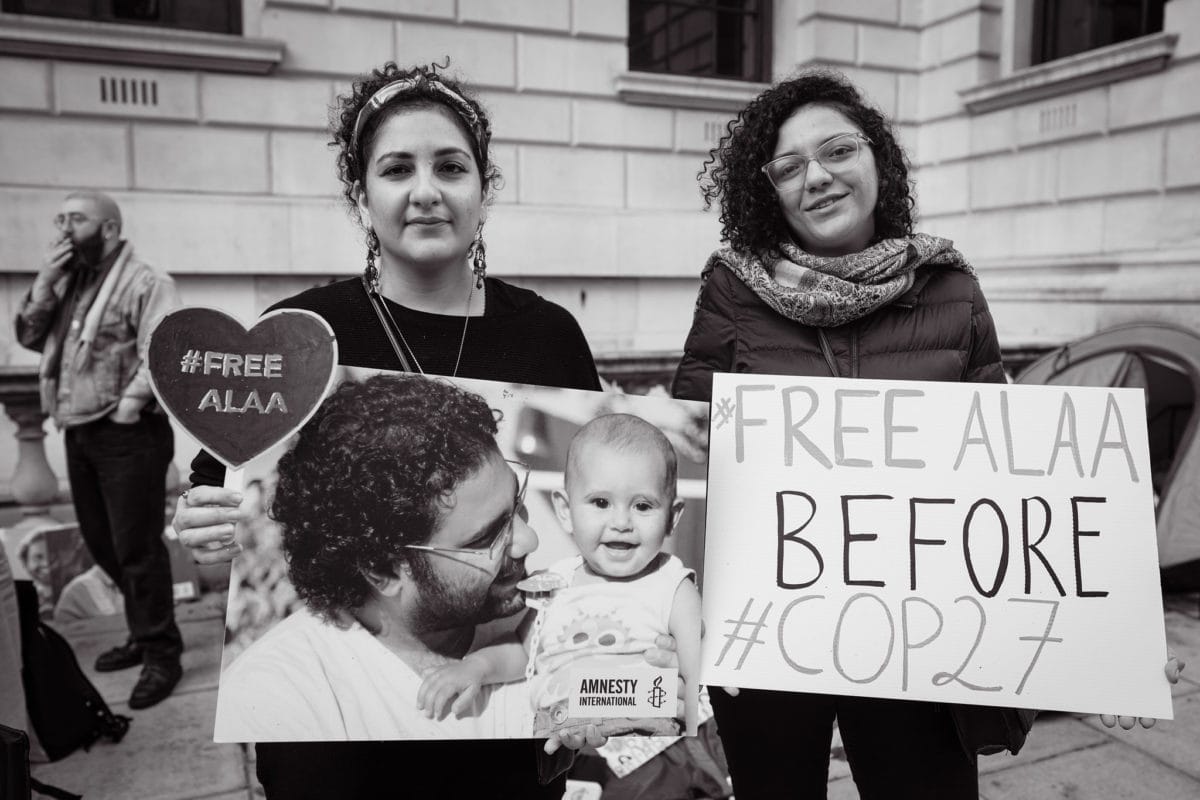
Alaa Abd El-Fattah's sisters, Mona and Sanaa Seif, at the sit-in outside of the UK Foreign Office on October 30, 2022\. Alisdare Hickson. CC 2.0.
*Alaa Abd El-Fattah, the British-Egyptian political prisoner and revolutionary activist, has declared that on the day the conference starts, he will take the final escalation in his over 200-day hunger strike and cease drinking water. In a letter to his mother from prison, Abd El-Fattah* [*wrote*](https://twitter.com/asoueif/status/1587153798895747073?s=20&t=HFlJnAAcM%5FUXUP5Rh7xFYw)*, “when the lights come on Sunday November 6, I shall drink my last glass of water. What will follow is unknown…I’ve taken a decision to escalate at a time I see as fitting for my struggle for my freedom and the freedom of prisoners of a conflict they've no part in, or they're trying to exit from; for the victims of a regime that's unable to handle its crises except with oppression, unable to reproduce itself except through incarceration.”*
*These two narratives—Egypt’s hosting of COP27 and the fate of its political prisoners—have been insistently linked by Egyptian civil society activists.* [*The Egyptian Human Rights Coalition on COP27*](https://copcivicspace.net/about-us/) *has mobilized around the assertion that climate justice cannot exist in the absence of open civic space, pointing to the* [*arrest*](https://copcivicspace.net/egypts-misuse-of-counter-terrorism-measures-casts-shadow-over-cop27/) *of environmental activists in Egypt and the* [*foreclosing*](https://www.hrw.org/news/2022/09/12/egypt-government-undermining-environmental-groups) *of independent research on the environment and emissions due, in part, to Egypt’s restrictive [NGO Laws](https://www.amnesty.org/en/documents/mde12/5154/2022/en/). Beyond this, they advance a more essential point about climate justice, one captured in recent remarks by Abd El-Fattah’s sister, Sanaa Seif, a human rights activist who has been imprisoned by Egyptian authorities three times, yet who will still be [traveling](https://twitter.com/FreedomForAlaa/status/1588211331756445697?s=20&t=agg7KgrX5oiMhfr1wuH33Q) to Egypt for COP27\. In her words, “The climate crisis is about life on the planet, and life right now in Egypt, as we speak, is very dangerous.”[\[2\]](#%5Fedn2)*
*As the lead-up to COP27 intensifies, commentators are weighing in on the tensions between political repression in Egypt and the notion of a “climate just” world espoused by campaigners and the UN. Moving beyond the narrower framework of boycotting the Egyptian state as host, activists have called for a show of international action. In part, their call is a simple recognition that climate justice cannot be achieved without confronting all forms of violence, including political repression. For Egyptian activists, this COP provides an opportunity to highlight the abuse of human rights and the plight of political prisoners as well as a chance to advance radical agendas within a binding international framework. The impending vote on* [*Loss and Damage*](https://unfccc.int/topics/adaptation-and-resilience/the-big-picture/introduction-to-loss-and-damage) *intersects with the work of the* [*Climate Vulnerable Forum*](https://thecvf.org/)*—a South-South cooperation platform established in 2009 ahead of COP15—in highlighting how particular countries are disproportionately affected by climate change*. *The call by Egyptian activists is also an appeal to our capacity to act beyond nations in the interest of life. As Naomi Klein put it, in an expansive essay on COP27 and Alaa, “if international solidarity is too weak to save Alaa—an iconic symbol of a generation’s liberatory dreams—what hope do we have of saving a habitable home?”[\[3\]](#%5Fedn3)*
*In advance of the conference, MERIP invited racial and environmental justice activist* [*Ashish Ghadiali*](https://www.ucl.ac.uk/racism-racialisation/ashish-ghadiali) *to speak with novelist, filmmaker and cousin of Alaa Abd El-Fattah,* [*Omar Robert Hamilton*](https://www.orhamilton.com/1677194-bio), *about the tensions underpinning COP27, with an eye to its setting in Egypt. Ashish and Omar share a history of working on the ground to document political organizing and upheaval, contributing to social movements in Egypt, Palestine and the UK by producing texts of and for the people.*
*When we invited this conversation, in early October 2022, we could not have anticipated how the velocity of political events would impact their dialogue and its implications for the coming COP. Speaking from the* [*protest camp established outside the UK Foreign Office by Sanaa Seif*](https://www.middleeastmonitor.com/20221018-sanaa-seif-to-begin-sit-in-outside-uk-foreign-office-to-pressure-govt-to-secure-alaas-release/)*, Omar was interrupted by the resignation of then-Prime Minister Liz Truss, meters from where he stood. Days later, Alaa Abd El-Fattah announced his resolve to go on a full hunger strike with the start of the conference. Their conversation has been edited, condensed and organized for clarity.*
## **Leveraging COP27**
\[Ashish and Omar spoke by phone on October 21, 2022 amid an extended sit-in at the UK Foreign Office, convened by Alaa Abd El-Fattah's sister, Sanaa Seif.\]
**Ashish:** So, let’s start with where you are right now.
**Omar:** I'm physically standing outside the Foreign Office in London. We've got a tent up here where Alaa's sister Sanaa has been camping out since Tuesday \[October 18, 2022\], Alaa's two hundredth day on hunger strike. The idea to start sitting here, we felt, would do two things: on the one hand, Alaa has a lot of friends and supporters and the campaign has picked up many along the road. And \[the camp\] would give a physical point at which people can come and stop in, take a photo or bring ideas. We were trying to think about what we could do, maybe little public events to just give a focal point to this thing that's been going on for years and has supporters and friends around the world. And hope that that also keeps you as high as possible on the agenda of the Foreign Office, which is the buildings surrounding us here. This is basically a final effort to make the government deliver on the thing that they say they're going to deliver in the build-up to COP.
**Ashish:** What did the British government say they would deliver?
**Omar:** Since December last year, the British government has been trying to get consular access to Alaa in prison. Alaa is a writer, he's a technologist. He was a prominent youth activist in the revolution in 2011 in Egypt and he has been in prison basically since General Abdel Fattah El Sisi came to power in a military coup in 2013\. He's thought of as a symbolic prisoner almost—one the regime is determined to keep in prison as a message to the revolutionary youth that he was part of: that the hopes and democratic dreams of the revolution will not come to pass.
> **They recognize that the COP process is very deeply flawed and has been used to greenwash corporations in various countries for a long time. But there is a sense that this is the first time that it will actually whitewash a regime of the level of authoritarianism and violence that we see from Egypt.**
**Ashish:** How does this campaign relate to COP27?
**Omar:** Egypt is under very intense scrutiny, and there are definite wings of the environmental movement concerned about what it means for Egypt to be hosting the conference. They recognize that the COP process is very deeply flawed and has been used to greenwash corporations in various countries for a long time. But there is a sense that this is the first time that it will actually whitewash a regime of the level of authoritarianism and violence that we see from Egypt.
**Ashish:** Something to really think about is what's at stake? Because the other framing of this COP isn't just about green hydrogen and capitalist co-optation. November the sixth, the first day of this COP, is also a provisional agenda vote on Loss and Damage, proposed by Pakistan as chair of the G77 plus China. It's taken since 1991 to get Loss and Damage this far, and it could become part of the formal negotiations moving forward, so there is such a complex balance of forces at play in this moment and this event, and we could be putting all our energy into saying boycott the COP.
**Omar:** Nobody in Egypt is saying boycott the COP. There was a big discussion about whether that should be the call, and it was decided that was not the call. The call that came out is outlined by [COP Civic Space](https://copcivicspace.net/), which is a coalition put together by Egyptian human rights groups. It's not to boycott, but to use COP as an opportunity. And that was definitely a conscious decision from within Egyptian society.
## **Connecting COP to the Revolution**
\[This strategic action on the part of civil society activists and supporters of Alaa Abd El-Fattah compels onlookers to view COP27, the Egyptian revolution and state repression as points along a shared axis. We cannot disconnect the work of documenting, archiving and making accessible the modes of protest in the 2011 uprisings from the conversation about to begin in Sharm el-Sheikh—Alaa’s plight draws them together. In their conversation, Ashish and Omar traced this trajectory through the work and experiences of Abd El-Fattah and Omar.\]
**Ashish:** You were part of that generation of revolutionary youth in Egypt. You moved to Cairo in 2011\. Why?
**Omar:** I'm British Egyptian. I was brought up in London, but I grew up going to Egypt and Egypt was part of my life. When the revolution of 2011 broke out, I decided to stay full-time.
I was working on a film and then I had the misfortune of having left three days before the revolution started because I had a job in Washington, D.C. And then I got back on a plane after January 28, which is the big day where they fought and beat the police. I got on a plane the day after. I was in Cairo from January 30, which was the fifth day of the revolution. Like everyone else involved, it totally transformed me and what I thought of the world and what I felt was important and what I thought I wanted to do in the future. I decided to stay there and worked as a filmmaker. Together with a group of friends, we set up a documentary collective, [Mosireen](https://www.youtube.com/mosireen), where we would film what was going on in the streets and then release videos on YouTube. We did street screenings, distributing images and videos about what was going on inside the revolution. Then I morphed into being a writer after the military coup made that kind of work impossible anymore. I spent two and a half years after the coup working on a [novel](https://us.macmillan.com/books/9781250182050/thecityalwayswins) about the revolution, following its rise and fall.
**Ashish:** Between these two big projects, there was the initial arrest and imprisonment of Alaa Abd El-Fattah. Was there some sense that you could have shared his fate?
**Omar:** I've always held an inside/outside position. Whereas Alaa is very much a leader inside the thing—that’s what makes him who he is. He's someone who is from totally inside the country, inside the language and the people. One of the first big things he did was in 2011, after the revolution, he was trying to set up a way to crowdsource input into the new constitution, or the constitution that would be written—following on from an example set by the ANC in South Africa. He would host things called #tweetnadwa, which were fora for discussion, a hybrid of people in real life but also people asking questions through Twitter. This was before hybrid events became totally normalized in the last couple of years. I think he's always had a very different position and trajectory.
**Ashish:** It's useful to understand that distinction and the context of Alaa's work that made him stand out in the way that he has. You started off the conversation by saying that you're standing outside the Foreign Office right now in order to urge the British government to do what they said they would do. What are your hopes?
**Omar:** Alaa's mother was born in London in 1956\. And that meant that her children had the right to acquire British citizenship. When it became clear that the Egyptians essentially intended for Alaa to die in prison, his family began to look at how to do the paperwork to get him his passport. And that came through in December 2021, from which point the British government has been involved in his case. We feel they've taken it up with interest.
We had James Cleverly, as Minister for Middle East and North Africa, who said that he was working urgently on consular access. And then when Liz Truss was Foreign Secretary, she told Parliament that she was working on it. That was June 21, 2022\. Then the government here collapsed. One of the last things that Boris Johnson did while in office was to put out a statement on August 25, saying that the matter of Alaa had been raised with President Sisi and that he had expressed his hope for swift and positive progress. You’ve got top-level engagement and the top levels of the government working on it, saying that they're working for release, but it hasn’t led to anything. And that's partly because the Egyptians are always tough customers and stubborn negotiators. And it's no doubt partly because they also are observing the chaos here and know that they can just keep stalling—the people they're negotiating with or against may not be around for much longer.
> **He's not going to break his hunger strike. This is the thing that's giving him strength and resilience and to be honest, that also means that he's the one leading his own campaign.**
But at the same time, Alaa continues to be on hunger strike, and you can't pack up and say, “Well, we'll come back to this in the spring, or come back to it once Labour is in power.” He's not going to break his hunger strike. This is the thing that's giving him strength and resilience and to be honest, that also means that he's the one leading his own campaign. As a prisoner, everything is taken away from you, all your agency is taken away from you, and your voice is taken away from you. But when he decided to go on hunger strike, we were following, and I think that gives him back some of the agency that they're trying to take from him. So we don't have any choice except to keep working or trying…to keep looking for some angle or some breakthrough. Some point of leverage.
**Ashish:** What you're bringing to the forefront is a tangible example of what political chaos means for livelihoods of people where government fails to function. In terms of engagement with the Foreign Office, there's chaos at the top, but there's also an entirely functioning civil service. Can you offer any insight through this very specific prism about what happens in a moment like this in terms of due process and decision making?
**Omar:** I get the sense that the civil service and the civil servants are working, that they're doing everything that they can and that they are genuinely supportive and engaged. The issue is that when it comes to any kind of negotiation with the Egyptians, it takes a level of political will and determination, and this level of political seriousness can only come at the ministerial or the prime ministerial level, in the end. The decision to keep Alaa in prison is a decision that is made at the very, very top. This is a decision that comes from Sisi, we believe, so it needs to come from the top on other sides as well. It needs a push from the very top and a push that the Egyptian state would take seriously.
## **Refusing Defeat**
\[With rain pouring down on the tent camp in London and reporters scrambling to digest the change in government leadership, Omar and Ashish brought their conversation to a close. As an editorial team, we were struck by the palpable tension that cut through this part of the recording, which was inflected by the question of defeat. Their final exchange compels us to ask how—and indeed whether—to measure the success of social movements when the cost of failure can be unimaginably high. This is where our transcript is least complete, as the moment continues to unfold.\]
**Ashish:** It feels very difficult to hold those two realities together. To hold what Sisi's regime means within the context of the revolution, and what it means to be a host government for COP27, talking the talk on hydrogen plants. I guess this speaks to a wider crisis of tactics, of how we continue to build meaningfully and effectively, towards a just future in the context of climate breakdown. Because what the counter-revolution in Egypt equates to is something that we've really seen all around the world. Egypt was iconic with the optimism of these networks and social movements, and we saw so many examples of the rise of left populist movements. There was an underlying belief that this was the future, and what we've seen across the board is that mode of politics has been continually threatened by techno-capitalist authoritarianism, of which there is something deeply symbolic in the COP conversation coming to Sharm el-Sheikh. Having lived through so much of that in your own organizing, where do we go next?
**Omar:** I don't know the answer right now, but I think you're very right. It is somehow finding its summation in Egypt hosting COP.
---
### **Endnotes**
[\[1\]](#%5Fednref1) "CPD Sameh Shoukry’s open letter to parties and observers’ days before COP27," [CBFP](https://pfbc-cbfp.org/news-partner/COP27-Sameh.html), November 3, 2022.
[\[2\]](#%5Fednref2) “Sanaa Seif addressing EP subcommittee on human rights,” [Youtube](https://www.youtube.com/watch?v=w22-fiyOk7k), October 29, 2022.
[\[3\]](#%5Fednref3) Naomi Klein, "From Blah, Blah, Blah to Blood, Blood, Blood," [The Intercept](https://theintercept.com/2022/10/07/egypt-cop27-climate-prisoners-alaa/), October 7, 2022.
### Constructing Qatari Citizenship in the Shadow of the World Cup
URL: https://www.merip.org/2022/11/constructing-qatari-citizenship-in-the-shadow-of-the-world-cup/
Last updated: 2025-08-22T18:37:05.000Z
On April 4, 2022, fans around the world started their online shopping frenzy to secure the best seats for the 2022 FIFA World Cup in Qatar.

The Qatari capital Doha as the Gulf emirate prepares for the FIFA 2022 football World Cup. Giuseppe Cacace/AFP/Getty Images
The same day, Qatari media outlets [quietly reported](https://dohanews.co/ticketless-fans-not-allowed-qatar-entry-during-world-cup-over-accommodation-concerns/) an overnight policy change. Anyone unable to obtain a match ticket would not be allowed entry into the country during the tournament. Fans wanting to enter Qatar now needed a pre-approved “Hayya Card,” a new visa tied to the purchase of a FIFA ticket that doubles as a transportation pass and provides entry into stadiums. While Qatar has since softened this stance—allowing ticketed fans to bring up to three companions—throughout the tournament these hayya cards will still serve as the only foreign entry permit issued.
Since winning the bid to host the tournament in 2010, Qatar has invested billions of dollars in its tourist infrastructure. In addition to reconstructing several parts of Doha and installing a metro system, it has developed an entirely new twin city, Lusail, on the capital’s outskirts. Yet at the much-anticipated kickoff to the World Cup, in an unprecedented move, the state abruptly started limiting the number of visitors by denying access to less financially-capable auxiliary fans.
Official justifications for this brisk change in policy by the Qatari government were slim, referring to generic safety and “capacity” concerns around tourist accommodation. With a national citizenry of around 300,000, and overall ticket sales exceeding 2.4 million, there is likely basis to these concerns.
Local Qatari news outlets, however, also [cited](https://dohanews.co/all-you-need-to-know-about-travelling-in-and-out-of-qatar-during-the-world-cup/) the menace of crowds trying to break into stadiums, referring to the Euro 2020 Final at Wembley Stadium in Britain. Such security concerns bely a deeper unease about the state’s ability to maintain control over the established social hierarchy at a critical juncture, particularly given the international media attention accompanying the tournament. For similar reasons, Qatar has already moved ahead with devising “purposely ambiguous” legislation intended to restrict foreign film crews' freedom of coverage during the tournament.[\[1\]](#%5Fedn1)
It is no coincidence that World Cup soccer fans are now finding themselves allotted into haves and have nots. The sudden curb on ticketless soccer fans reflects Qatar’s long tradition of using ambiguous legislation to differentiate and socially divide resident groups so as to retain as much control as possible over local and global public opinion as well as the political status quo inside the country.
Similar dynamics of bureaucratic engineering through ambiguous migration and citizenship policies regulate not only the migrant worker community in Qatar but also, increasingly, the local citizenry, changing what it means to be Qatari. Qatar’s ambiguous and last minute policy maneuverings in relation to FIFA sports fans—whether pertaining to ticketless fans or the rights of the attending [LGTBQ+ community](https://www.theguardian.com/football/2022/jun/29/qatar-fails-to-offer-world-cup-safety-guarantees-to-lgbtq-fans)—are no ad hoc deviations. Rather, they are part of a larger state- and nation-building project in which migration and citizenship policies form a central node.
## **Making a Mega Event**
In December 2010, Qatar won the bid to host the 2022 FIFA World Cup, becoming the first Arab country to organize the tournament in 93 years. This win was not without controversy, much of it centering on Qatar’s contentious record of migrant workers’ rights. Qataris make up an elite demographic within the country, constituting around 12 percent of the total population. The great majority of residents in Qatar are low-wage workers from the Indian subcontinent and Southeast Asia whose presence is tightly regulated by the country’s infamous *kafala* sponsorship system.
> **Read an interview with Natasha Iskander on the [Politics of "Unskilled" Labor in Qatar](https://www.merip.org/the-politics-of-unskilled-labor-in-qatar-an-interview-with-natasha-iskander/) for MER issue 304.**
In its current form across GCC countries, the *kafala* system operates as a mode of production that allows local citizens to serve as migrant sponsors and profit as a shadow rentier class. This state-endorsed patronage system directly and indirectly allows Qatari sponsors to appropriate an asymmetric proportion of the surplus value generated by migrant labor. Despite noteworthy policy reforms in Qatar in recent years, [Human Rights Watch](https://www.hrw.org/news/2020/01/20/qatar-end-abusive-exit-permits-most-migrant-workers) accurately points out that the “*kafala* (visa sponsorship) system, which facilitates the abuse and exploitation of migrant workers, remains intact.”[\[2\]](#%5Fedn2)
Even with the many controversies over workers’ rights, the World Cup has succeeded in putting Qatar on the map. Qatari authorities have mobilized this mega event as their poster child for a futuristic development push known as the Vision 2030 project meant to usher in massive transformation and bring Qatar’s industrialization on par with the UAE.
In addition, the World Cup serves Qatar in making itself known to the world as a state separate from its powerful and much larger Gulf neighbors. Indeed, the FIFA tournament not only boosts the state’s legitimacy inside the country but equally affirms its territorial integrity within the inter-state complex of the Arabian Peninsula, particularly in the face of Saudi Arabia’s historically expansionist ambitions. Such concerns of the Qatari political elite, which have long been shared by their counterparts in Abu Dhabi and Oman, took on new urgency in the face of the 2017 Blockade leveled against Qatar by Saudi Arabia, the UAE, Bahrain and Egypt.
> **While it is common to frame large sports events as a form of cultural diplomacy, soft power and “sportswashing,” Qatar’s hosting the World Cup also marks an urgent consolidation of national sovereignty on the part of its state authorities.**
While it is common to frame large sports events as a form of cultural diplomacy, soft power and “sportswashing,” Qatar’s hosting the World Cup also marks an urgent consolidation of national sovereignty on the part of its state authorities. For a country that was only founded in 1971, the World Cup functions alongside other major events, like the 2017 Blockade, as an important unifying force.
In a conversation with one 22-year-old Qatari woman who works at a government ministry, she described how, after the blockade, the differences between Qataris of various geographical or tribal origins have grown less prominent, a change she also attributed to the World Cup tournament. As she put it, “Nowadays, you would rarely find people identifying Qataris in that \[tribal\] sense … it is slowly becoming less important. The same goes for the World Cup: it will always keep doing what it did ever since we won the bid, which is bringing people together.” Alongside the 2017 Blockade and the 2022 World Cup, Qatari nationalism is coming of age.
## **Qatar’s “Second-Generation Expats”**
The World Cup might be uniting some Qatari citizens in unprecedented ways. Yet, as Qatar pushes ahead with its ambitious Vision 2030 development plan, the country seems to be pushing out a segment of loyal human capital long invested in its overall development.
Many so-called “second-generation expats”—often the children or grandchildren of doctors, engineers or merchant business families—seem to be experiencing increasing precarity in terms of their employment and residency outlook. In the aftermath of the 2017 Blockade, a number of long-term Egyptian residents in Qatar received overnight deportation orders or simply had their work visas cancelled and residency permits revoked.[\[3\]](#%5Fedn3) Families that had called Doha home for generations, many with no particular political affiliation, were arbitrarily disposed of in a tit-for-tat political showdown between states.

Flagpoles of World Cup competitors in Doha, featuring the FIFA 2022 digital countdown timer, located at the Corniche Waterfront Promenade. Courtesy J. Alloul.
In another example of the ongoing devaluation of non-GCC Arab citizenship in Qatar, young Arab professionals with European or American university degrees are increasingly finding themselves thwarted from taking advantage of professional opportunities.
Take Farid, a Jordanian national of Palestinian origin who was born and raised in Qatar. Growing up, he considered himself Qatari. He wore the local national dress, the *thawb,* to work and prided himself on speaking with a Qatari Arabic accent. In 2021, he was shocked when the immigration department of the Ministry of Interior denied his request to change jobs despite his former and future employees both endorsing his move. To Farid, the only discernible motive he could see for this form of direct state intervention into his career development was that he was Jordanian.
Like many Arab residents in Qatar, Farid had believed himself part of a privileged group that was above the vicissitudes of the *kafala* system. When his request was denied, he had already signed up for his new job and handed in his resignation to his former employer. He suddenly found himself without a sponsor. Unlike unmarried women, unemployed men over the age of 25 cannot revert their sponsorship back to their father. Farid was suddenly faced with the reality that he could at any time be deported from the country he had always called home.
> **The glass ceiling Farid encountered shows that being Arab, Muslim and “skilled” is no longer enough to ensure belonging in contemporary Qatar.**
The glass ceiling Farid encountered shows that being Arab, Muslim and “skilled” is no longer enough to ensure belonging in contemporary Qatar. There is no special birthright for people like him in Qatar’s expanding state and nation-building project, where an increased nationalization of the workforce (“Qatarization”) has now been built into the structure of the economy. Fed up with this extreme legal precarity, Farid decided on emigrating to Canada in search of more secure citizenship. Over the course of several conversations, he made it clear that the very restricted Permanent Residency scheme that Qatar introduced in September 2018, which grants long-term residency rights to a handful of qualifying non-Qataris per year, would not suffice. Only full citizenship rights would convince him to stay in Doha.
Farid’s case highlights a sophisticated migration and citizenship policy characterized by methodically segmenting resident populations along ambiguous categories with strikingly divergent tiers of entitlement. Indeed, the same policy of differential inclusion is playing out, albeit in different ways, amid the Qatari national soccer team, which has [controversially included foreign-born athletes](https://www.vice.com/en/article/z4ayz5/does-qatars-football-policy-put-players-at-risk-of-exploitation) who have been naturalized in order to play for Qatar. The so-called “mission passports” granted to foreign-born athletes are in fact temporary documents with a legal time limit, meaning that most naturalized “Qatari” athletes remain citizens of their country of origin. Only those performing extraordinary achievements in their field of competition have the chance to receive permanent Qatari citizenship at a later stage, indicating that the overall institution of Qatari citizenship will likely remain very restrictive and increasingly racialized around ever-narrowing notions of ethno-nationalism.
## **The 2021 Elections and Internal Dissent**
Speaking at the World Economic Forum in Davos [in May 2022](http://youtube.com/watch?v=w0oIh6EkSq4), Qatar’s leader, Sheikh Tamim bin Hamad Al Thani, hailed hosting the World Cup as a transformative vehicle for national development. He credited the tournament and the spotlight it placed on Qatar for the implementation of a series of progressive reforms—reforms like the nation’s first ever elections held in 2021 after years of stalled attempts. In reporting on these elections, English [language media](https://www.ft.com/content/cfec9c71-98af-4b6d-aa74-66cef1cf3794) [outlets](https://www.bloomberg.com/news/articles/2021-10-02/qatar-votes-in-first-election-with-world-cup-spotlight-ahead) were also quick to draw a direct line between the attention on the World Cup and the timing of electoral reform in Qatar.
Yet, Qatari state policies limited just how transformative these elections would be. Succession in the Gulf Arab states is largely premised on hereditary rule rather than representative electoral politics. In the elections held in October 2021, 30 seats of the 45-member Shura Council were up for vote, while the last 15 members of this proto-parliament were still appointed directly by the emir.
Immediately prior to these elections, Qatari citizens staged a rare set of protests in Doha against electoral restrictions put into place in July 2021 that barred thousands of Qataris from running or voting. Like the sudden cap on World Cup fans slated to enter the country, the Qatari state enacted a similar last minute policy, creating a new electoral law that drew on older divisions within Qatari society in order to limit electoral participation.
> **Like the sudden cap on World Cup fans slated to enter the country, the Qatari state enacted a similar last minute policy, creating a new electoral law that drew on older divisions within Qatari society in order to limit electoral participation.**
The restrictions in the new electoral law were based on Qatar’s controversial 2005 Nationality Law. The 2005 law had divided Qatari citizens into three nationality tiers. Qataris who could trace their lineage back to 1930s were labeled as “native” and thus fell into the first tier. A second tier of “naturalized” citizens were those who could trace ancestry to a post-1930s date. Those unable to formally document their earlier presence—the case for certain prominent Bedouin Arab tribes—were also labelled as “naturalized” and were obliged to request a special decree from the emir. The process of obtaining such a decree is arbitrary and resembles a grand symbolic bargain initiated by the Arab clans who dominate the state.
Between these three groups, the difference in the allocation of state benefits is considerable, including the right to work in certain public institutions, access to land and housing purchases and loans, protection from the state revoking one’s citizenship and, as of the new electoral law, the ability to run and vote in legislative elections. Compounding the arbitrary nature of this policy, government information on these internal categories is not public and Qatari passports display no visual documentation of the legal category of “Qatariness.” Some citizens only find out what citizen tier their specific family unit belongs to when an application for particular government services is denied.
The recent July electoral law barred “naturalized” citizens from running in the 2021 Shura Council elections. Moreover, only those who could prove their grandfathers were born in Qatar could vote. As with other entitlements, many only learned of their exclusion when their voting registration was denied, leading to public outcry and daily sit-ins by Qatari citizens across Doha. Shortly after, arrests started taking place, restricting protest and polemics to the online domain. In late 2021, heated debates among Qataris were still ongoing on Twitter, which has become a key space for public debate in the Gulf as well as for state surveillance and propaganda.[\[4\]](#%5Fedn4)
These internal contentions in Qatar highlight how the Gulf state’s tiered model of rights allocation does not only concern differently positioned migrant worker groups—whose accrual of benefits may diverge greatly based on attributed skill levels, citizenship and racialized status—but also encompasses the local citizenry. This dynamic is often overlooked by outside reportage on the region, which typically focuses, as the World Cup scrutiny has shown, on the condition of low-wage workers, conjuring the conveniently neo-colonial image that such toiling bodies “require saving by liberal whiteness.”[\[5\]](#%5Fedn5)
## **Generational Change in Qatar?**
FIFA ticketholders who make it into Qatar for the tournament will be able to visit the recently built Bin Jelmood House, a museum dedicated to the history of slavery in the context of the region’s maritime past. Located in the heart of new Doha, the museum features whole sections about “Slavery in Modern Pearling and Date Cultivation” and “The Faces of Modern Slavery.” Walking through the latter exhibition, you will find images of Qatar’s migrant workers with captions describing the *kafala* system along with information about “bonded and forced labor.”
Certain textual elements of the museum’s overall narrative seem to relegate responsibility for the abuse of workers’ rights to private-sector subcontractors and “traffickers,” rather than tackling head-on the systemic nature of state-condoned labor exploitation in the Gulf. Other elements, however, [like the video testimonials by African-descent Qataris](https://www.merip.org/remembering-slavery-at-the-bin-jelmood-house-in-qatar/) about racism in the Gulf, render the Bin Jelmood House “a potentially subversive space.”[\[6\]](#%5Fedn6)
While the museum was undoubtedly meant to showcase a self-critical canvas for incoming soccer crowds visiting Qatar during the tournament, this venue also reflects some of the changes among a new generation of Qatari citizens. In conversations with several young Qataris, a number have confided that they are in favor of abolishing the *kafala* system, with some even likening it to “a modern form of slavery.”
> **These developments signal the need to distinguish between the power exerted by the state and the attitudes and practices of Qatari citizens writ large, hinting at the emerging space for everyday solidarity between Qatari citizens and migrant communities of all sorts.**
In one of these conversations, another young female employee of a state ministry voiced a comprehensive critique of the state’s approach to how citizenship is determined. “What I would also like to see is the ability to have \[proper\] Permanent Residency here, or even the ability to become Qatari,” she said. She added, “there is not a lot of transparency about these policies and laws. How do you become a citizen? I think it is something like 25-50 people who become Qatari citizens per year, so what is the actual process behind it? How can you become Qatari if you are not Qatari, and if you would become Qatari, would you be treated equally?”
These blunt deliberations underscore subterranean developments in Qatari society that are seldom reported on. The modernization discourses accompanying the FIFA World Cup are spurring social and cultural transformations, especially among Qatar’s younger generations. These developments signal the need to distinguish between the power exerted by the state and the attitudes and practices of Qatari citizens writ large, hinting at the emerging space for everyday solidarity between Qatari citizens and migrant communities of all sorts.
Today, a new Qatari generation is coming of age: women set on joining the workforce are increasingly enrolling in universities, strongly supported by their parents and quickly overtaking men in terms of performance. At the same time, a growing number of Qatari students venture abroad on government scholarships for specialized academic training in Europe and the US. Yet others can now make use of the branch campuses of renowned Anglo-American universities in Doha’s massive “Education City,” a prestigious development which noticeably engenders a more liberal habitus among elite students slated to enter the Qatari state bureaucracy.
The FIFA World Cup has served as a top-down instrument to construct and fortify a distinctly Qatari nationalism, overlaying potentially contentious tribal and ethnic cleavages present among the Qatari citizenry. At the same time, the tournament has not erased the underlying tensions and inequities in Qatar’s migration system and citizenship policies. State authorities in Qatar are clearly anxious about the extent to which the World Cup—if left to its own dynamism—may come to challenge the established social contract, which favors and insulates a demographic minority of the total resident population.
The sudden curb in the number of soccer fans during the immediate run-up to the World Cup is a testament to the sophisticated and highly securitized Qatari migration and citizenship regime, one which has long been devised to maintain the political status quo in Doha. That said, in Qatar, as in other Gulf countries like the UAE or Saudi Arabia, a lot more is moving on the ground than meets the eye. It is imperative therefore to take stock of how complex social transformation continues to affect the Gulf region’s younger generations in the wake of the 2022 FIFA World Cup.
\[**Jaafar Alloul** is a Postdoctoral Research Fellow in Sociology at Nanyang Technological University (NTU) Singapore, and a Visiting Scholar in Residence at Georgetown University Qatar. **Laavanya Kathiravelu** is Associate Professor in Sociology at Nanyang Technological University, Singapore.\]
---
### **Endnotes**
[\[1\]](#%5Fednref1) Shanti Das, "[Qatar World Cup accused of imposing ‘chilling’ restrictions on media](https://www.theguardian.com/football/2022/oct/15/qatar-world-cup-tv-reports-restrictions?CMP=Share%5FiOSApp%5FOther)," *The Guardian* (October 15, 2022).
[\[2\]](#%5Fednref2)“Qatar: End of Abusive Exit Permits for Most Migrant Workers,” *Human Rights Watch* (January 20, 2020).
[\[3\]](#%5Fednref3) Nada Soudy, “Home and Belonging: A Comparative Study of 1.5 and Second-Generation Egyptian ‘Expatriates’ in Qatar and ‘Immigrants’ in the U.S.,” *Journal of Ethnic and Migration Studies* 43/9 (2017).
[\[4\]](#%5Fednref4) Andrew Leber and Alexei Abrahams, “A Storm of Tweets: Social Media Manipulation During the Gulf Crisis,” *Review of Middle East Studies* 53/2 (2019).
[\[5\]](#%5Fednref5) Zahra Babar and Neha Vora, “The 2022 World Cup and Migrants’ Rights in Qatar: Racialised Labour Hierarchies and the Influence of Racial Capitalism,” *The Political Quarterly* 93/3 (2022).
[\[6\]](#%5Fednref6) Nidhi Mahajan, “Remembering Slavery at the Bin Jelmood House in Qatar,” *Middle East Report* 299 (Summer 2021).
### The Politics of “Unskilled" Labor in Qatar—An Interview with Natasha Iskander
URL: https://www.merip.org/2022/10/the-politics-of-unskilled-labor-in-qatar-an-interview-with-natasha-iskander/
Last updated: 2025-08-22T18:37:05.000Z
*\[su\_dropcap style="simple" size="4"\]*N*\[/su\_dropcap\]atasha Iskander is professor of Urban Planning and Public Service at New York University. She is the author of* [Does Skill Make Us Human?: Migrant Workers in 21st-Century Qatar and Beyond](https://press.princeton.edu/books/hardcover/9780691217574/does-skill-make-us-human) *(Princeton University Press, 2021) and* [Creative State: Forty Years of Migration and Development Policy in Morocco and Mexico](https://www.cornellpress.cornell.edu/book/9780801475993/creative-state/#bookTabs=1) *(Cornell University Press, 2010). Arang Keshavarzian, associate professor of Middle Eastern and Islamic Studies at New York University, spoke to Iskander in July 2022 about the politics of "unskilled" labor behind the World Cup in Qatar.*

Workers inside the Lusail stadium, constructed for the 2022 World Cup, Doha, Qatar, 2019\. Kai Pfaffenbach/Reuters
**Arang Keshavarzian**: Your book *Does Skill Make Us Human?* forces the reader to contemplate a tension and discrepancy. On the one hand, the stadiums and some of the infrastructure necessary to host the 2022 World Cup in Qatar are some of the technologically most cutting edge and sophisticated feats of engineering. On the other hand, the people who have labored and built them are defined as “unskilled” and come with little or no experience either working in the Gulf region or on such massive construction sites. Why is it important to grapple with this tension to understand the politics of labor in Qatar and beyond?
**Natasha Iskander**: I am not sure I would call it a tension. I think it’s much more instrumental than that, in Qatar and elsewhere. The description of migrant workers as unskilled, irrespective of their actual ability, is absolutely core to the politics that dehumanizes them, deprives them of their freedom and denies them their bodily autonomy. These politics are the mechanism by which migrant workers are stripped of their personhood.
But the reason the politics of skill appear as a tension—as the discrepancy you describe, for example, between pathbreaking architecture and an unskilled workforce—is that skill masquerades as a technical issue. While there has been substantial scholarship highlighting bias in the measurement of skill, by gender or race or other social categories, the notion of skill itself (defined as competence and expertise) passes as a concept that is politically neutral.
In fact, in embarking on this project, I didn’t set out to grapple with skill and its politics. Instead, I wanted to understand how the politics of labor were different in a place that was the opposite of the typical migration story. Much of the scholarship on migrant labor looks at settings where immigrants or migrants are only a small fraction of the population and labor force. They are thus defined as an exceptional political case against a backdrop where the norm is full citizenship, with all the rights that entails. In Qatar, as has been the case for half a century, close to 95 percent of all workers are migrants. The rights, the belonging and the individual agency associated with citizenship are only afforded to the tiny minority of the population that are Qatari nationals. After Qatar won the World Cup hosting rights in 2010—amid a hurricane of whispers about [kickbacks and bribes](https://www.nytimes.com/2020/04/06/sports/soccer/qatar-and-russia-bribery-world-cup-fifa.html)—migrant laborers’ working conditions began to receive an unprecedented level of scrutiny for a country in a region largely overlooked in migration scholarship and policy circles. Human rights and labor organizations began documenting labor abuses faced by migrant construction workers, which ranged from wage theft to abysmal living conditions in labor camps to injury and death. I wanted to understand how these exploitative patterns grew out of the fact that the political status of almost the entire population was co-equal with—and confined to—their economic function as workers.
These questions set off a six-year exploration, with research in five countries and eight languages. No matter which direction I turned, which research path I followed, my findings kept drawing me to the question of skill and its politics. These were so pronounced in Qatar that they bled into international press coverage of the country’s architectural reinvention. The images that ran in the media toggled between photos of futuristic and hyper-designed stadiums and photos of migrant workers, most in nondescript construction overalls, many with their faces covered, anonymous, racialized, looking wretched and somewhat flippantly described as unskilled. In the breach between those two types of images was an untold story. To build those stadiums, but also Qatar’s luxury developments, its new smart city, artificial islands, museums, cultural centers and new and expanded liquid natural gas extraction and processing centers, workers had to use the most advanced construction techniques anywhere in the world.
The workers who built those structures were recruited from all over the Global South—South Asia, the Middle East and sub-Saharan Africa—and as you note, almost all arrived without relevant construction experience. To bridge this gap, companies turned their construction sites into vast and accelerated training systems. Companies organized their entire workflows to promote learning. All building practices, absolutely every single task, doubled as on-the-job training. These processes were intensively managed. Companies measured the progress of their workers in acquiring new skill very closely, sometimes several times a day, tracking workers’ productivity gains down to the fraction of an hour. This training was only effective because workers were heroic in their approach to learning. They tackled new and difficult tasks with dedication, commitment and even bravery. They developed informal teaching and mentoring practices to undergird the formal training systems on site. These were so intensive and intimate that workers came to regard each other as family through the learning process, cultivating a skill-based kinship system where more experienced workers were called “uncle” or “big brother” teaching their “sons” and “little brothers.”
> **They were not describing ability—or lack thereof—but instead were shunting their workers into a subordinate political category, divesting workers of their political personhood and redefining them as labor inputs that were disposable and readily replaceable.**
And yet, despite the industry’s intensive investment in training and its complete dependence on the advanced skill that workers developed, employers and managers I spoke with routinely and uniformly described their workers as “unskilled,” “unproductive” or sometimes just “bodies.” Very quickly, it became clear to me that they were using the term “unskilled” to refer to something other than skill. They were not describing ability—or lack thereof—but instead were shunting their workers into a subordinate political category, divesting workers of their political personhood and redefining them as labor inputs that were disposable and readily replaceable.
Labeling someone as unskilled is essentially a denial of their capacity to learn. Learning is fundamentally an act of freedom, one that cannot be compelled. It is a deeply intimate process that requires imagination, volition, desire, aspiration. And because learning depends on teaching, it also needs the cultivation of trust, social connection and empathy between teacher and student. In labeling workers as unskilled, employers and managers were also denying that workers had the capacity to access those registers of human experience that learning requires. The jump to dehumanizing workers was very small.
The label unskilled also has political significance beyond the worksite. Unskilled workers have been banned, as a matter of policy, from most parts of Doha and its new satellites, confined to labor camps in the desert. They are subject to intensive surveillance and police controls. In the early days of the coronavirus pandemic, being labeled unskilled became a matter of life and death. The Qatari government drew a [cordon sanitaire](https://anthrosource.onlinelibrary.wiley.com/share/A9N8Q9HMYXU2XCUB2II4?target=10.1111/maq.12625) around the tracts in the desert where workers are housed and prohibited them, with police force, from crossing it to receive medical care or [to purchase food](https://www.merip.org/no-good-options-for-migrant-workers-in-gulf-covid-19-lockdown/).
While these consequences of skill politics may seem acute, they are dissimilar only in degree from the effects that we see in other economies. Workers described as unskilled have their freedom denied, their bodies controlled, their desires and ambitions for dignity suppressed—whether in an [Amazon fulfillment center](https://journals.sagepub.com/doi/abs/10.1177/00197939221110097), a [meatpacking plant](https://pubmed.ncbi.nlm.nih.gov/33355943/) or an [immigrant detention facility](https://journals.sagepub.com/share/Y22HITJIHB2E5IGGDQAT?target=10.1177/0002764219835257).
**Arang**: Your research uncovers a host of tactics and methods adopted by laborers to negotiate and challenge their employers. How do these forms of resistance and disobedience directly evoke and deploy “skill” as well as the various spaces and practices set up by management to control them?
**Natasha**: Worker organizing and labor protests are illegal in Qatar. They can result in imprisonment and deportation. Still, wildcat, spontaneous strikes were very common (as well as in other Arab Gulf states). Every single site I was on saw a strike at one point or another. Employers tolerated these strikes so long as they hewed to a very specific script: they had to be short, a day or two; workers had to stay in their labor camps; no protests or challenges were tolerated on the construction site (as one supervisor explained, “\[worker defiance\] is like a spark that can set the whole place on fire”), and they had to be limited to one nationality. If protests stayed within these parameters, the health and safety staff charged with managing them gave them “a day to blow off steam and get their heads back on right,” as one of them described it to me. Any protest that deviated from these rules resulted in immediate deportation. Especially threatening to managers were protests organized across nationality because it meant that workers were no longer “blowing off steam” as Bangladeshis or Nepalis or Egyptians, but rather that they were organizing as *workers*, developing solidarity across nationality and based on a class consciousness. As I document in the book, any protest that broke with management’s script did not and could not exist because as soon as it coalesced, it was quashed by the expulsion of protestors from the country.
> **Especially threatening to managers were protests organized across nationality because it meant that workers were no longer “blowing off steam” as Bangladeshis or Nepalis or Egyptians, but rather that they were organizing as *workers*, developing solidarity across nationality and based on a class consciousness.**
But workers still found ways to resist, and the most powerful strategies were those that drew on skill and learning. Workers invoked their expertise to challenge unsafe practices on site, which were often the product of managerial pressure to meet accelerated construction deadlines. In order for their expertise to matter in making skill-based claims for safety, workers had to back it up with concerted action that ran through the relationships they built in teaching and learning. For example, at one stadium site, management ordered scaffolders to work double shifts—16 hours at a stretch. Because such long work hours did not allow sufficient time between shifts for a night’s sleep, especially given the hour-long commute back to the labor camp, workers were told that they could nap between workdays in a hanger onsite. The scaffolders refused, saying it was dangerous to work such long shifts with insufficient rest and dangerous to work at night when the floodlights used to illuminate their workspace, some 20 stories above ground, cast shadows that were confusing and disorienting. Workers anchored their refusal in the expertise they had developed as scaffolders, invoking the company training that their employers were now insisting they violate. But their resistance was effective because they stood together as tradesmen. Not as Nepalis or Pakistanis or Kenyans, but as scaffolders. The workers’ ties across nationality, religion and ethnicity, forged through teaching and learning from one another—ties as deep and resilient as kinship relationships—were the backbone of their solidarity. That stadium site relied on half a dozen subcontractors to complete the scaffolding work the project required, but not a single scaffolder from any of those companies climbed the ladder to begin a 16-hour shift. The general contractor for the site had no choice but to scale back to 10-hour days.
To be sure, workers’ use of skill as a form of resistance was not unalloyed. Workers’ invocation of their expertise faced skepticism and hostility from management. Their wages never matched their contribution and the benefits of the teaching and learning flowed to management. Nevertheless, skill-based resistance was powerful because workers used it to express a form of personhood denied by the label of unskilled.
**Arang**: The past decade has seen a proliferation of news articles about labor conditions and abuses in the Middle East. The term *kafala* system, the [prevailing guest worker program in the Gulf](https://www.merip.org/keeping-migrant-workers-in-check/), is now known to many around the [world](https://www.merip.org/understanding-race-and-migrant-domestic-labor-in-lebanon/). How has Qatar responded to this unwanted coverage? To what extent have they adopted reforms and addressed demands made by labor organizations and laborers themselves?
**Natasha**: The *kafala* system is nothing more than the legal framework governing guest workers in the Gulf. Although the system is often represented as a cultural or Islamic brand of jurisprudence, it shares basic features with the global governance systems to regulate temporary migrant workers, including systems in the United States and Europe. Among the countries of the Gulf Cooperation Council, each one has implemented a slightly different version of the *kafala* system. When Qatar was awarded the World Cup hosting rights in 2010, its iteration was the most restrictive in the Middle East. As in many neighboring countries, workers were legally bound to their employer and prohibited from changing jobs. But Qatar also made it illegal for workers to withhold their labor for any reason. They could not quit under any circumstances, even in response to abuse or wage theft. Workers were in Qatar at the pleasure of their employer, and although they could be deported for any reason, without notice, they needed their employer’s permission to leave the country and had to show an exit visa at passport control to depart. Qatar’s legal system gave employers control over their workers’ future even after the employment relationship was terminated. Workers were not permitted to return to Qatar to fill a new job without their prior employer’s assent. Employers generally withheld this permission because, as they explained to me, they were leery of their competitors benefiting from the training investments they had made. Taken together, these restrictions amounted to a formal system of bonded labor, backed often quite ruthlessly by Qatar’s security services, which even issued an app allowing employers to notify the Ministry of the Interior, with the swipe of a finger, that their worker had absconded.
Human rights organizations, labor organizations and the international press were correct to call this system out as a form of modern slavery, and the catalogue of labor abuses they documented was devastating to Qatar’s international reputation and to its strategy of sports diplomacy. Qatar invested heavily to expand its natural gas production, and the World Cup was part of its push to develop the soft power to manage the geopolitical implications of being one of the leading global suppliers of natural gas. Qatar initially treated labor violations as a public relations problem that it could resolve without changing its laws. At its most cloying, the damage control effort featured an interview with the Emir of Qatar, Sheikh Tamim, on [CNN](http://edition.cnn.com/TRANSCRIPTS/1409/25/ampr.01.html) in 2014, where he confessed that he was “personally hurt by the situation.”[\[1\]](#%5Fedn1)
But that same year, the International Labour Organization (ILO) registered a [formal complaint](https://www.ilo.org/dyn/normlex/en/f?p=NORMLEXPUB:50012:0::NO::P50012%5FCOMPLAINT%5FPROCEDURE%5FID,P50012%5FLANG%5FCODE:3188310,en) identifying Qatar as abetting forced labor. The Qatari government found itself compelled to respond to avoid the fallout of the formal sanction the ILO threatened to issue. With technical assistance from the UN agency, the Qatari government instituted a variety of reforms to its labor laws. These included an electronic payment system to prevent wage theft, permission to terminate employment and leave the country at will, a minimum wage (now about $250) and some ability to change jobs. These reforms look good on paper and satisfied the ILO, which marked the complaint against Qatar resolved in 2017\. They have also done wonders for Qatar’s public image. The international press has run headline after headline, since as early as 2015, proclaiming that Qatar abolished the *kafala* system, and previously staunch worker advocates (most notably the International Trade Union Confederation) have gone from excoriating Qatar for its labor violations to celebrating the regime for its enlightened changes.
In practice, however, the reforms have done little to ameliorate the conditions of workers and to curb labor abuses. Not only has enforcement been scandalously lax, implementation of the reforms has reproduced the same administrative logic and power structures woven into the earlier version of the *kafala* system. To access the new labor rights specified in the reforms, such as the right to change jobs, workers still need their employer’s consent along with the registered approval of the Ministry of Administrative Development, Labor and Social Affairs. These constraints bind workers to their employers, but now as a matter of bureaucratic procedure rather than formal law. Additionally, the array of policies and practices that surrounded the earlier *kafala* system remains in place. Workers are still banned from residing and even circulating in most areas of the cities they built. They remain subject to summary deportation and are pursued for absconding and are still prohibited from protesting or even voicing concerns about their working conditions on social media.
It is important to note that all foreign workers regardless of occupation, class or nationality are regulated by the same legal framework, whether the earlier *kafala* system or the reformed administrative management of labor. A British architect in an executive suite is governed by the same basic framework as a Nepali street sweeper. But it is the workers who are classified as unskilled who suffer the most exploitative consequences of this system. They are still forced to work overtime, still have their wages stolen, are still dying from work-related injuries. The letter of the law may have been rewritten, but its spirit, articulated in Qatar through skill politics, remains unchanged and very much in force.
**Arang**: Qatar’s ability to win the bid to host the World Cup as well as its ability to quickly construct the massive infrastructure necessary to host it has depended on its revenues from the export of fossil fuels. Nonetheless, Qatar claimed that this would be a “[carbon neutral](https://www.theguardian.com/football/2022/may/31/qatar-world-cup-criticised-for-problematic-carbon-footprint-promises)” World Cup. To what extent has the World Cup abided by this aspiration?
**Natasha**: From the moment Qatar entered its bid to host the soccer tournament, it has marketed its World Cup as the world’s first “carbon neutral” global games, but in fact, they are more accurately described as the first—but certainly not the last—"climate damage” games. It is not an overstatement to say that climate damage has been core to the World Cup’s business model. Hydrocarbon revenues have bankrolled the games. Construction of the stadiums and infrastructure for the games has involved significant carbon emissions, and heavily polluting match-day shuttle flights from cities in neighboring countries will transport spectators into Qatar because there is a shortage of local hotels. In addition, the stadiums themselves have fallen far short of their claims of being climate neutral, claims based on flimsy carbon offset schemes and some creative accounting.
But the tournament’s climate damage has fallen hardest on migrant workers, bearing down on their bodies and on their communities. And here again, the politics of skill come into play. The political representation of workers as unskilled has made them the target of the worst climate effects of the games. Let me point out two ways the politics of skill has amplified climate change pressures.
> **Not only are employers exposing workers to the effects of climate damage in Qatar, but I also discovered that they are developing labor recruitment strategies that enable them to capitalize on exposure to climate damage around the world.**
Qatar is not just hot. For weeks at a time, its temperatures rise past the threshold that makes heat life-threatening to a body at rest. One of the fastest warming places on the planet because of an accident of geography, Qatar has already warmed by half a degree Celsius since it was awarded the World Cup in 2010\. Construction workers are compelled to work in these extreme temperatures, and they suffer high rates of injury and death as a result. Heat wreaks devastating and permanent damage on kidneys, hearts and other vital organs. But heat attacks the neurocognitive system first. Early symptoms of heat stress are confusion, disorientation and the loss of ability to move one’s body. For a scaffolder hanging 30 stories up in the air, or a cladder craning a huge panel of glass and aluminum against the desert’s wind shear, this loss of neurocognitive ability can very quickly become a matter of life and death. The political description of workers as unskilled allows employers and the Qatari government to shift culpability to workers for the injuries they suffer. The alibi provided by the politics of skill goes as follows: it is not the heat and its damage to cognition that exposes workers to injury. Rather, it is that unskilled workers simply do not have the desire or the capacity to use their skill to protect themselves.
Not only are employers exposing workers to the effects of climate damage in Qatar, but I also discovered that they are developing labor recruitment strategies that enable them to capitalize on exposure to climate damage around the world. In their search for workers, they are seeking out once relatively prosperous places that have been wiped out by typhoons, shriveled by drought or flooded by sea level rise. Slow and fast-moving climate disasters have made those communities newly poor and turned migration into a necessary strategy for economic survival for Bangladeshis, Nepalis and many others. Qatari companies look for recruits in these places because people have benefited from the investments in education, nutrition and health that their communities made in better days. As a result, the migrants who recruiters find there have what employers call the “absorptive capacity” to become highly skilled. They have the foundations necessary for learning, but their poverty means that employers can classify them, permanently, as “unskilled.”
Qatari companies are actively restructuring recruitment networks in countries of origin to take advantage of the business opportunity that climate damage offers them. In this way, they are creating a closed loop of climate damage. Bankrolled by revenues from Qatar’s hydrocarbon production, they recruit migrants from communities that fossil fuel use has helped damage for low-wage work where they will be exposed to the extreme dangers of global warming. Qatar offers a stark view of the ways that climate damage and worker exploitation compound one another and points to how the politics of labor—in this case, the politics of skill—is shaping people’s experience of climate change and climate damage. The 2022 World Cup is not carbon neutral. Instead, these games reveal how profoundly carbon emissions and climate change are already defining the future of work, livelihoods and dignity.
---
### **Endnotes**
[\[1\]](#%5Fednref1) “CNN’s Amanpour: Key Coalition Partner Qatar on ISIS War,” [*CNN*](http://edition.cnn.com/TRANSCRIPTS/1409/25/ampr.01.html), September 25, 2014.
### The Beautiful Game between Algeria and France
URL: https://www.merip.org/2022/10/the-beautiful-game-between-algeria-and-france/
Last updated: 2025-08-22T18:37:06.000Z
The Algerian writer, Kateb Yacine, famously referred to the French language as Algeria’s “butin de guerre*”* (spoils of war). Upon independence in 1962, Algerians were free to use French not as a bequeathal but as their own.

Football fans in Paris, France celebrate Algeria's victory in the 2019 Africa Cup of Nations on July 19, 2019\. Benoit Tessier/Reuters
The same might be said of football as it has been taken up in Algeria and by Algerians in France. Algeria won independence from France in 1962, but [legacies of colonialism and decolonization](https://www.merip.org/france-a-settler-postcolony-2/) have long shaped, and continue to influence, what football means to the large shared population of binational citizens between these two places. One in every ten people in France has a direct familial connection to Algeria, complicating any distinction of national belonging and clouding footballing loyalties. Fans decide which national side to back, or opt to support both, in international tournaments. In the case of professional footballers, they must choose which nation to play for.
Riyad Mahrez, the current captain of the Algerian national team, is also a winger for the British club Manchester City. Mahrez was born to working-class Algerian parents in the diverse Parisian periphery town of Sarcelles, now home to a stadium named after him that hosts one of the *Coupe d’Afrique des nations locale.* These competitions are local spin-offs of the Africa Cup of Nations, in which non-professional footballers residing in France represent their countries of origin.
Mahrez’s choice to play for Algeria contrasts with that of Karim Benzema, a star striker for Real Madrid, who grew up outside of Lyon also to working-class Algerian parents, and who recently won the most coveted prize for the world’s greatest players, the [Ballon d’Or](https://www.bbc.co.uk/sport/football/63288656), which he dedicated to “le peuple” (the people), recalling perhaps the most powerful symbol in Algerian politics: *ash-sh’ab*. The professional careers of these two players reflect the broader and longer entanglements between France and Algeria when it comes to the sport of football. They also point to the increasingly central role of global capital, particularly from the Gulf, in setting the terms for the French and Algerian sporting scenes.
## **The Rise of the “Association” in Colonial Algeria**
At the turn of the twentieth century, French lawyer, sports activist and Christian Democrat, Jules Rimet, was at the helm of the mission to “civilize” the world through sport. In 1904 Rimet founded the Federation Internationale de Football Association (FIFA) in Paris and later went on to help organize the first World Cup. The creation of FIFA occurred in parallel to, and was no doubt impacted by, the process of secularization in France. The *laïcité* law, which subordinated church to state, was established just one year after FIFA. It drew on the earlier 1901 Law of Associations, which suppressed most religious orders, establishing the legal basis for civic organizations called “associations.” Perhaps the backbone of French and, at the time, imperial civic life, associations remain the key institutional structure for the organization of sporting and leisure activities in France today. There are currently more than 1.5 million associations in the country, representing a staggering three percent of France’s GDP.
In both the colonial periphery and the metropole, football served to link French ideologies of secular universalism with imperialist expectations of social cohesion and mobility through cultural assimilation. Rimet’s early-twentieth-century views on sport and social cohesion underscored the beliefs of the time in a supposedly seamless progression from colonization to immigration to assimilation. Such views were bolstered by increasing class mobility in colonial France. Rimet, himself, was the son of a farmer. Before founding FIFA, he had initiated France’s first working man’s football club, Red Star, in 1897\. Through Red Star, Rimet sought to realize his ideals regarding the emancipation of the working classes and improve French social cohesion through sports. From the 1920s onwards, he sought to further this project by making football a “means of understanding and friendship among peoples.”[\[1\]](#%5Fedn1) A clear racial superiority underpinned this philosophy, and the subsequent years would see the imposition of a discourse on the civilizing value of sport upon indigenous subjects of the French Empire wishing to play.
> **In both the colonial periphery and the metropole, football served to link French ideologies of secular universalism with imperialist expectations of social cohesion and mobility through cultural assimilation.**
As football clubs grew more widespread in France in the 1920s, the universalist ethos underwriting French associations came to affect sporting and cultural life in French Algeria, particularly in the heavily populated urban capitals of Algiers and Oran. The secular universalist ideals of football and other civic organizations stood in tension with an incipient North African *nahda* (renaissance) and its anti-colonial politics, which built on and connected to wider late Ottoman and emergent Arab nationalist projects. Algerois Jews, too, began to feel the influence of transnational Jewish associational life in the 1920s, particularly through the Istanbul Maccabi sports club network—part of a broader international Jewish sports organization founded by Jewish athletes who had been refused membership from other social sport clubs.
Notwithstanding these local and transnational links, young Algerian footballers found themselves on the front line of French psychological indoctrination. Associations were a site of language inculcation, and French was the medium with which to express and assimilate secular and universalist values. Beyond football, the new national pastime of cinema served as a vehicle for the promotion of the French language, and the Muslim Boy Scout movement modeled itself after the *éclaireurs* (French scouts), maintaining elements of imperial French civic education.
Unlike local Algerian Jews, Muslims were excluded from political citizenship and denied rights of free speech and assembly, including the right to create associations. Nonetheless, many local Algerian Muslim dignitaries and sports enthusiasts pushed back against the exclusion of “indigenous” Algerians from French republican freedoms and formed their own sporting clubs. They often used the designation *club musulman* or *union sportive musulmane*.[\[2\]](#%5Fedn2) Mouloudia Club d’Alger (MCA) was the first of these clubs to form, in 1921\. It was a multi-sport club and situated itself, not in a universalist secularism tied to French linguistic and cultural assimilation, but rather a universalist Islamic ethics associated with a burgeoning clerical (‘*ulama*) movement.
## **Algerian Footballers between France and the FLN**
As the Algerian indigenous football scene grew, so too did the economic migration of Algerian footballers to France. Before independence, Algeria was legally part of France and Algerians were granted freedom of circulation between France and Algeria. From the 1940s onward Algerian footballers went to France alongside, but in greater numbers than, their Moroccan, Tunisian and Senegalese counterparts.
The youth of Algiers looked up to players like Moustapha Zitouni, who transferred to AS Monaco in 1954, and Rachid Mekhloufi, who transferred to Saint-Etienne the same year. These players had traversed the Mediterranean, first leaving “Muslim” clubs for wealthier and more famous “European” ones in Algeria, and then moving to metropolitan France. By playing first for European clubs in Algeria and then French clubs, footballers adapted to a French lifestyle, achieved social mobility and often internalized meritocratic sporting values. Their influence upon youths back in Algeria was one way that the soft power of French imperialist ideology permeated the relationship between European and indigenous football in Algeria.
The tangible prize of economic advancement ensured that many talented Muslim players ended up in France or were drafted into the larger, wealthier European clubs in Algeria. Often less politicized upon departure for France, these players, after finding recognition for their sporting talent in France, also came to realize the degree of racial discrimination in colonial Algeria.[\[3\]](#%5Fedn3)
> **The Algerian anti-colonial movement was retooling French universalist ideas of sport to assert national sovereignty.**
Indeed, at the national level, the *Front de Libération Nationale* (FLN, National Liberation Front) brought many Algerian players back to Algeria from France. In April 1958, responding to a covert plan by the FLN hatched by Algerian professional footballers in France, ten Algerian players including Mekhloufi and Zitouni slipped out of France to convene in Tunis. These players formed the core of the team, which, in a communiqué on April 15, 1958, the FLN proclaimed would further the emergence of an “Algerian national identity.”[\[4\]](#%5Fedn4) The FLN team played over one hundred exhibition matches between 1958-1962 against nations favorable to Algerian self-determination, such as China, Vietnam, the Soviet Union, Cuba and many decolonized African countries. Any national team hosting the FLN team agreed to fly the Algerian flag and play the anthem.
France pushed back against these symbolic matches, vetoing FIFA recognition of the FLN team and even threatening economic sanctions against nations that hosted the FLN in matches.[\[5\]](#%5Fedn5) Such gestures met with little success. It was growing increasingly clear that Algeria would achieve independence and that France would eventually have to play against the newly established Algerian nation-state. The Algerian anti-colonial movement was retooling French universalist ideas of sport to assert national sovereignty. Organizing their own indigenous Algerian civic associations through sports—whether the FLN team of 1958 or the Mouloudia Club d’Alger of 1921—was a step towards self-determination. With this historical context in mind, it is perhaps of little wonder that history sits heavy on the shoulders of players like Mahrez and Benzema, whose familial trajectories are rooted in a past of conflict and subversion.
## **Football and the *Banlieue***
The social and affective ties between France and Algeria were not severed by the war of independence. If anything, the initial decades after independence brought the destinies of Algeria and France even closer. Between 1963 and the late 1970s—when the president Valérie Giscard d’Estaing put a stop to family unification policies—France remained the most popular destination for Algerian immigration.
Algerians were often concentrated in the French urban peripheries and shantytowns, where suburban (*banlieue*) housing projects were built adjacent to the factories in which Maghrebi immigrants worked. The *banlieue* would produce many of France’s greatest football stars, including Benzema and Mahrez, the latter of whose parents moved to Sarcelles in the 1970s.
The Maghrebi (and particularly Algerian) presence has had a decisive influence on postcolonial France and the evolution of its national project and politics. French anxieties around immigration, security, national identity and social cohesion, tend to focus on the *banlieue*. Events like the [2005 Clichy-sous-Bois](https://www.merip.org/urban-violence-in-france/) youth mobilizations against police brutality, following the deaths of two French teenagers of immigrant descent who were running from the police on the way home from a neighborhood football match, have been accompanied by a shift in the French political scene to the right. The perpetual concern for urban and national “security” in the form of policing the peripherical *banlieue* intensified further in the wake of the 2015 Charlie Hebdo and Bataclan attacks.
> **Football figures into contemporary social dynamics in France through the youth system and its emphasis on lifting up postcolonial youth from the *banlieue* to acculturate them into the values of the French Republic.**
Security discourse and differential policing has created a racialized dichotomy between a “violent” periphery (the *banlieue*) and a “civilized” city center with significant colonial undertones. Echoing the idea behind the earlier football associations—that they would shape indigenous Algerian Muslim subjects through good citizenship and sportsmanship—football figures into contemporary social dynamics in France through the youth system and its emphasis on lifting up postcolonial youth from the *banlieue* to acculturate them into the values of the French Republic. In the run up to *Les Bleus*’ famous victory in the 1998 World Cup, the French Football Federation set up perhaps the world’s most efficient youth academy system. This system, stretches right into the heart of the associational dynamics of French civil society life, organizing football for French *banlieue* youth, whom, as Paul Silverstein has put it, are considered “a problem to be managed.”[\[6\]](#%5Fedn6)
At the heart of this impressive machinery for the promotion of footballing excellence is the National Centre for Football in Clairefontaine. Benzema and Mahrez, who came from the *banlieue*, are both products of the Clairefontaine academy system. On the one hand, the Centre serves as a testimony to the deepening relationship between science and sport, with its embracing of psychological methodologies and statistical technologies. On the other, the academy system has replaced France’s colonial organization of footballing with the postcolonial management of generations of French-born footballers whose parents or grandparents came from the colonies. Clairefontaine and the French Federation, which recruit heavily from the *banlieue*,draw on the language of “social cohesion” to discipline players. For example, Patrice Evra, the Senegalese-born fullback and France’s team captain at the start of the 2010 World Cup, led the players in a boycott of what he saw as institutional racism on the team following the dismissal of a teammate. The French Federation’s response was to bench Evra during the tournament, blaming the player for undermining France’s national unity.[\[7\]](#%5Fedn7)
## **Transnational Capital Enters the Game**
Over the last several decades, three French professional football clubs have dominated the domestic scene and transformed sport’s “civilizing mission” into an investment instrument of global capital. Significant financial clout first came to the French game via Olympique de Marseille (OM), particularly under the directorship of business tycoon Bernard Tapie between 1986-1993\. The club notably won its very first Champions League final in 1991-1992 then subsequently found itself at the center of multiple corruption scandals concerning match-rigging and the bribery of referees.
These scandals allowed Olympique Lyonnais (OL) to rise to the top of French football under the watchful eye of director Jean-Michel Aulas between 1987-2009\. While Olympique de Marseille had put its youth academy to the side during the club’s downturn, Olympique Lyonnais shrewdly invested locally, particularly in players from socio-economically disadvantaged *banlieues* such as Bron-Terraillon, where Benzema grew up.

Karim Benzema, during an interview in 2021\. Real Madrid Youtube Channel, CC 3.0.
The third of these clubs is Paris Saint-Germain, which was founded in 1970, and since 2011 has become a domestic and global powerhouse with a massive investment in players’ salaries and transfer fees. The club is owned by Nasser Al-Khelaifi via Qatar Sports Investments group (QSI), a national sovereign wealth fund that is also behind the 2022 Qatar World Cup. Al-Khelaifi is the chairman of beIN Media Group, one of the world’s largest sports broadcasters with a global reach in multiple languages across France, Spain, Turkey, North Africa and the Middle East in addition to partnerships with British and US-American studios and media groups.
The transnational business interests in sports media and merchandising (Tapie chaired Adidas from 1990 to 1993) have brought French football onto the international scene. Beyond the sporting success of individual domestic clubs, France has become a leading exporter of seemingly endless footballing talent, propelling particular individuals from some of France’s poorest peri-urban towns—such as Sarcelles or Bron-Terraillon, in which Mahrez and Benzema grew up—to super stardom at the greatest European clubs.
The footballing trajectories of these two players reflect how the legacies of French colonial ideology and investments, which sought in previous times to bind indigenous Algerian football players to France, are being replaced by increasingly nebulous transnational capital. Manchester City, the club Mahrez plays for, is owned by Abu Dhabi's sovereign wealth fund. The team has become a global brand and Mahrez himself a key part of their investment strategy.
## **Entangled Presents**
Branding stretches beyond club and country into the international arena. Despite playing for two different national teams, Algeria and France, Mahrez and Benzema are connected through the multibillion-dollar global World Cup tournament—a tournament that throws into relief the complex space occupied by French-Algerian footballers.
The period between France’s close loss in the 2006 World Cup finals in Germany—made famous by Zinedine Zidane’s head butt—and their 2018 victory at the World Cup in Russia was portrayed as one of relative crisis for French national football. When Les Bleus under-performed in South Africa and Brazil, players were blamed for putting their personal and political identities above their subservience to the greater national good. They were criticized for fasting during Ramadan, or, as in the case of Patrice Evra, for publicly accusing the French Football Federation of institutional racism. It was at this time too that Benzema became the object of far-right scorn.

Riyad Mahrez at a friendly match between Algeria and Armenia in May 2014\. CC 3.0.
The same period coincided with Algeria’s sensational foray into the FIFA top 20\. They lost narrowly to Germany in the second round of the 2014 World Cup tournament—the first time in Algeria’s history the team had made it past the group stage. The Algerian team strongly identifies as Muslim and projects this identity on the pitch, partaking in collective prostration after scoring a goal. Les Fennecs (the Desert Foxes), as the team is affectionately known, also shows great pride in national symbols, even as almost half of the team was born in France and many of its players came up through the official French youth system.
In 2018, one year before Algeria won the African Cup of Nations with Mahrez as team captain, in France, the seemingly best choice striker, Benzema, was not selected for the national team. Benzema’s exclusion by the French federation was due to accusations of bribery and extortion by his then teammate Mathieu Valbuena. Head coach Didier Deschamps defended the decision, reiterating on multiple occasions the view that cohesion is the key to success. In addition to the leitmotif of cohesion, former French coach Raymond Domenech used the word “exemplariness” (*exemplarité*) to further justify the decision to sideline Benzema.[\[8\]](#%5Fedn8) Vikash Dhorasso, a member of the French team that won the 1998 World Cup, raised the question of whether such a national outcry would have prompted the decision to sideline Benzema, and whether the French Federation would have made such an example of the player, had he not been of Algerian descent and an observant Muslim.
Algeria did not qualify for the 2022 Qatar World Cup, and both Benzema and Mahrez are reaching the end of their careers. Nonetheless, their contrasting stories as French-Algerians playing for different national sides and European clubs parallels the developments in French and Algerian football over the past half century. Rooted in Algerian migration to France in the shadow of independence, the footballing trajectories of both players are now tied to greater capitalist dynamics in places like Madrid and Manchester, as well as the Arab Gulf states.
Yet, despite playing for different national teams, and for different international clubs, both players remain connected to their *quartiers*—the term they use for their neighborhoods instead of the much-stigmatized *banlieue.* Benzema’s ongoing sense of belonging to his neighborhood can be seen in projects like his significant investments in the local mosque. Meanwhile the Sarcelles stadium carrying Mahrez’s name—and hosting tournaments for France’s immigrant populations—is a testament to the player’s enduring connection to the French suburb and its connection to the former French imperial world.
\[Sami Everett is a Research Fellow in Asian and Middle East Studies at the University of Cambridge and the Max Planck Institute for the study of Religious & Ethnic Diversity.\]
---
### **Endnotes**
[\[1\]](#%5Fednref1) La Fabrique de l'Histoire, “[Épisode 4/4: Jules Rimet, du Red Star FC à la Coupe du monde](https://www.radiofrance.fr/franceculture/podcasts/la-fabrique-de-l-histoire/jules-rimet-du-red-star-fc-a-la-coupe-du-monde-2561168),” *radiofrance,* April 25, 2019.
[\[2\]](#%5Fednref2) Mahfoud Amara and Ian Henry, “Between Globalization and Local ‘Modernity’: The Diffusion and Modernization of Football in Algeria,” *Soccer & Society* 5/1 (2004).
[\[3\]](#%5Fednref3) Stanislas Frenkiel, “Les footballeurs du FLN: des patriotes entre deux rives,” *Migrations Société* 110/2 (2007).
[\[4\]](#%5Fednref4) Mohamed Amine Azzouz, “La glorieuse équipe de football du FLN: fierté de tout un people,” *El Moudjahid* 14655 (November 2012), p. 18.
[\[5\]](#%5Fednref5) Josh Sippie, “[Algeria’s Équipe FLN: The Movement That Used Football to Fight for Freedom](https://thesefootballtimes.co/2017/11/21/algerias-equipe-fln-the-movement-that-used-football-to-fight-for-freedom/),” *These Football Times,* November 21, 2017.
[\[6\]](#%5Fednref6) Paul Silverstein “[World Cup Summer in Postcolonial France](https://www.plutobooks.com/blog/world-cup-postcolonial-france-football/),” *Pluto Press-*blog, July 3, 2018.
[\[7\]](#%5Fednref7) Paul Silverstein, *Postcolonial France: Race, Islam, and the Future of the Republic* (Pluto Press, 2018), p. 112.
[\[8\]](#%5Fednref8) Julien Ricotta “[Domenech sur Benzema: ‘La cohésion du groupe est plus importante](https://www.europe1.fr/sport/domenech-sur-benzema-la-cohesion-du-groupe-est-plus-importante-2719099)," *Europe 1,* April 13, 2016.
### Iranians are Done Debating
URL: https://www.merip.org/2022/10/iranians-are-done-debating-the-nezam/
Last updated: 2025-08-22T18:37:06.000Z
On September 20, three days after the women-led protests erupted across Iran in response to the death of Mahsa (Jina) Amini, the state-run radio and television channels began airing a series of debate shows.
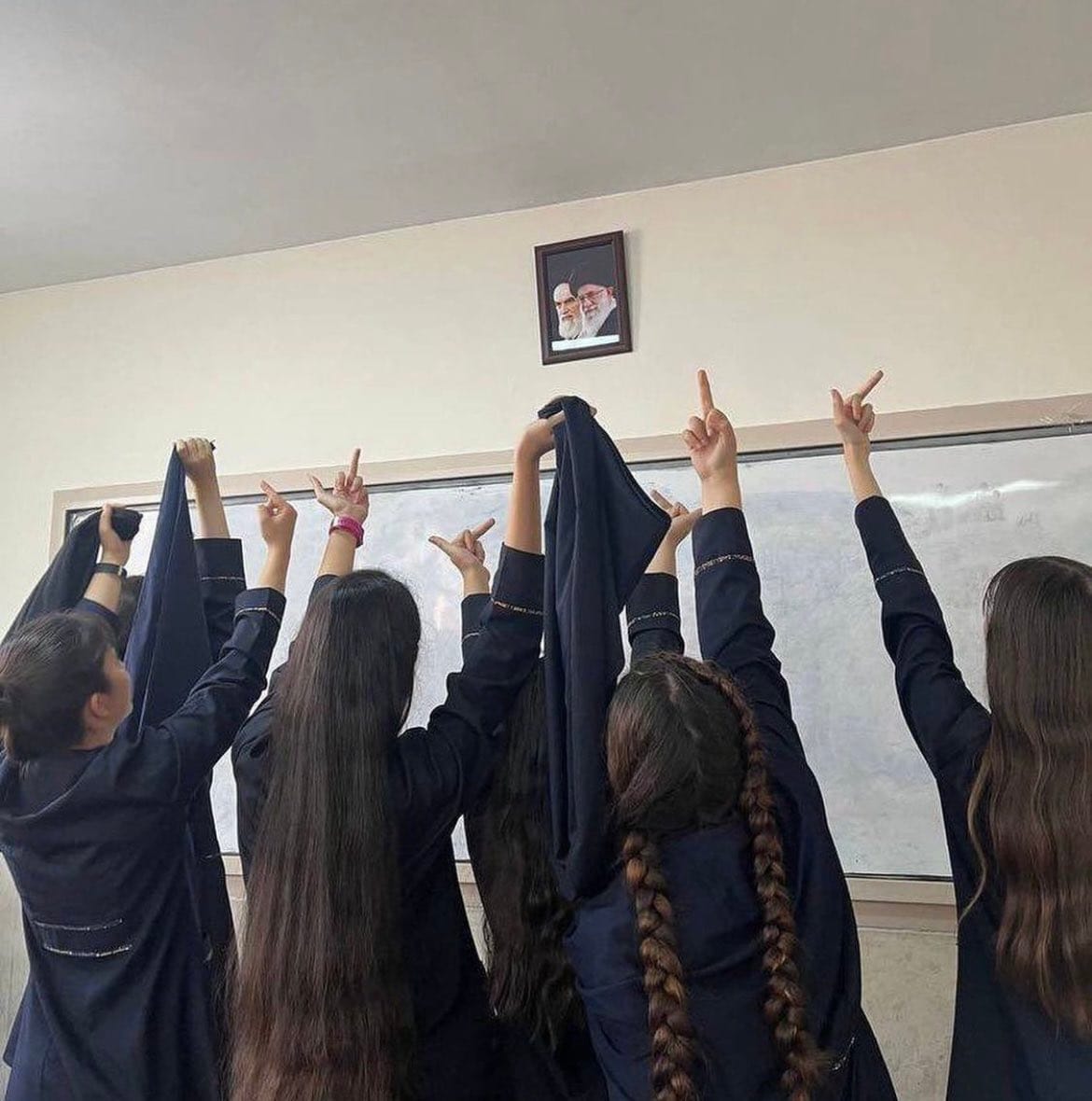
An image circulating on social media claiming to show Iranian schoolgirls protesting a picture of the supreme leader. Photograph: Twitter.
In them, men—yes! dozens of men—were featured discussing women’s bodies and grievances. Meanwhile, on the street, according to leaked documents published by [Amnesty International](https://www.amnesty.org/en/latest/news/2022/09/iran-leaked-documents-reveal-top-level-orders-to-armed-forces-to-mercilessly-confront-protesters/), state forces were being instructed to “mercilessly confront” demonstrators, even to the point of death.
Two days later, when more than 80 cities held simultaneous demonstrations across Iran, *Fars,* the news agency managed by the Iranian Revolutionary Guards’ security apparatus, equated the unrest to a normal “couple’s dispute.” The main headline on their landing page read, “Compatriot! Let’s Talk to Each Other!” (“*Hamvatan! Bia ba ham harf bezanim!*”). This invitation to national dialogue came across as farcical in the context of women being shot at or beaten for removing or burning veils on the streets. Thousands of interlocutors in the supposed “national dialogue,” including activists, artists and at least [40 journalists](https://cpj.org/2022/09/names-of-journalists-arrested-in-irans-anti-state-protests/) from across the country, are currently being interrogated in jail.
For over four decades, secular and Islamic feminists have argued against the mandatory hijab, often by appealing to the Islamic government’s permitted means of persuasion. Even those who were not believers largely abided by the codes of conduct when talking to the *nezam* (the Persian word for the “regime” used by the Islamic Government). There were, of course, exceptions like Homa Darabi, who in 1994 immolated herself in protest against coerced hijab. Today, women and young schoolgirls en masse are done debating with the regime over whether they can exert their bodily autonomy. They are doing it.
Recent protests mark a tectonic shift in the method and rhetoric of expressing dissent in the Islamic Republic of Iran. The [Green Movement](https://www.merip.org/the-green-movement-awaits-an-invisible-hand/) in 2009 argued with the *nezam*, largely on its terms and using its terminologies. Demonstrators appealed explicitly to Islamic signs and messages, invoked and appropriated the memory of Ruhollah Khomeini, cited the legal texts ratified by the regime’s institutions and begged for the support of the Shia *marja’*s to no avail. The 2022 protestor has not bothered herself with any of these. She doesn’t care anymore about persuading the *nezam*. In 2009, wearing the green scarf was a symbol of dissent, as demonstrators resisted within the regime’s codes of hijab. In 2022, removing and burning scarves has become the ultimate act of rebellion. If the Green Movement played jiu-jitsu by converting the regime’s own sources of power in discourse, the #Mahsa\_Amini movement is playing Karate: overwhelming the opponent by breaking his sacred discourse.[\[1\]](#%5Fedn1)
The old guard Reformists are cautioning protestors to avoid such “disruptive” acts. Hassan Khomeini, the grandson of Ruhollah Khomeini who [imposed](https://www.cambridge.org/core/books/abs/women-and-politics-in-iran/women-the-1979-revolution-and-the-restructuring-of-patriarchy/2DBAA5BFE88D74539660AC1BDF5F8290) Hijab with knives and clubs, has [stated](https://iusnews.ir/fa/news-details/445773/%D8%B3%DB%8C%D8%AF-%D8%AD%D8%B3%D9%86-%D8%AE%D9%85%DB%8C%D9%86%DB%8C:-%DA%AF%D9%81%D8%AA%DA%AF%D9%88-%D8%AA%D9%86%D9%87%D8%A7-%D8%B1%D8%A7%D9%87-%D8%A8%D8%B1%D9%88%D9%86-%D8%B1%D9%81%D8%AA-%D8%A7%D8%B2-%D8%A8%D8%AD%D8%B1%D8%A7%D9%86-%D9%87%D8%A7%DB%8C-%D8%A7%D8%AC%D8%AA%D9%85%D8%A7%D8%B9%DB%8C-%D8%A7%D8%B3%D8%AA/) that “dialogue is the only way forward.”[\[2\]](#%5Fedn2) It is, however, the failure of the conciliatory rhetoric staunchly employed by Reformists for the past three decades that has led to the confrontational rhetoric of protestors in the streets today.
## **Deliberation without Delivery**
The Islamic Republic elite, whether Reformist or Principlist, moderate or hardliner, has a long history of invoking dialogue and debate during periods of contentious collective action as well as during the repression that follows. A series of TV debates between the regime’s ideologues and opposition in the spring of 1981 was followed by a bloody purge and widespread crackdown on any dissenting speech the same summer. Throughout the 1980s, the *nezam* employed terms like “debate” (*munazereh*) and “free discussion” (*bahs-e azad*) to describe the interrogation sessions of political prisoners.
Some of these so-called “debates” between prisoners and their interrogators were broadcast on radio and television. One program, which was made in the spring of 1984 upon the request of the Mashhad prosecutor general, featured five Marxist prisoners sitting next to and debating the then-Minister of Heavy Industries, Behzad Nabavi. Nabavi went on to become a prominent Reformist figure and was sentenced to six years in prison after the 2009 Green Movement protests.
> **Throughout the 1980s, the *nezam* employed terms like “debate” (*munazereh*) and “free discussion” (*bahs-e azad*) to describe the interrogation sessions of political prisoners.**
The 1999 Student Protest was followed by a series of campus events. The Reformists introduced “Free Tribune” forums for disenchanted students to mildly express their criticism. Later, the Principlists (Iran's conservative political faction) followed with the formation of the “Free-Thinking Platforms,” to clarify the *nezam*’s positions in a dialogical manner. In 2010, amid the Green Movement protests, the state TV booked benign opposition figures—those who had not been imprisoned—to participate in a series of live debates.
In November 2019, only a few days after a brutal crackdown of mass protests and a nationwide internet shutdown, Iran’s then-President Hassan Rouhani [delivered a message](https://sccr.ir/news/7582/1/) at the closing ceremony of the annual Student Debate Tournaments stressing “the importance of public debate” and complaining about “the lack of constructive dialogue” in Iranian society.[\[3\]](#%5Fedn3) Rouhani’s successor, the hardline President Ebrahim Raisi, made similar [remarks](https://snn.ir/fa/news/1034471) on the twelfth day of the recent protests, inviting people who chant “Woman, Life, Liberty” to express their criticism in designated venues for dialogue and deliberation.
The Student Debate Tournaments were first conceived under the administration of Mahmoud Ahmadinejad as a means to release some of the pent-up frustration in universities after the Green Movement. They are managed by an organization dubbed “Academic Jihad,” which was initially established in order to curb public debate on university campuses as part of the regime’s Cultural Revolution of 1980\. The landing page of the tournament website displays a quote by the Supreme Leader, Ali Khamenei, in praise of freethinking. The website proclaims debate to be an Ancient Iranian tradition, not a western import, [citing](http://isdc.ir/معرفی-مسابقات/) a 2,500-year-old tale from the Achaemenid era which features seven Persian nobles debating the future form of their government. One makes a strong case for the benefits of democracy and the disadvantages of individual rule, another defends oligarchy. The debate ends when Darius, the soon-to-be supreme king of Persia, challenges all arguments and concludes that autocracy is the best form of government. The positive reference to this pre-Islamic tale was perhaps a Freudian slip for a regime that claims to embody Islamic values and boasts about abolishing the monarchy: neither authoritarians nor fundamentalists mind staging a dialogical exchange as long as, like for King Darius, they do not have to change their positions.
Since the start of Iran’s Student Debate Tournaments in 2012, time and again, variations of the resolution, “it is government duty to enforce hijab,” have been debated. Almost always, the team taking the negative side, that is, arguing against the government mandate to enforce hijab, has won—even when the players assigned to the role are pro-regime[*basiji*](https://streaklinks.com/BPjwHQQd3Stn67t-ywIpehWx/https%3A%2F%2Fen.wikipedia.org%2Fwiki%2FBasij) students. Refuting the *nezam*’s positions in these debate tournaments, where the space for speech is neither free nor inclusive, requires care and finesse. Before participating, students have to sign a commitment letter agreeing not to offend “Islam, the sacred *nezam* of the Islamic Republic and its authorities.” Yet, even in the face of ample argumentation against mandatory hijab articulated within its boundaries, the *nezam* has only doubled down on its position.
In 2019, Iran’s Supreme Leader Ali Khamenei [met](https://streaklinks.com/BPjwHQQ1tdkdz50qGglvoyvC/https%3A%2F%2Fweb.archive.org%2Fweb%2F20190624174610%2Fhttp%3A%2Faatinews.ir%2F1397%2F10%2F26%2F%D8%A8%DB%8C%D8%A7%D9%86%D8%A7%D8%AA-%D8%B7%D8%A8%D9%82%D9%87%25E2%2580%258C%D8%A8%D9%86%D8%AF%DB%8C-%D8%B4%D8%AF%D9%87-%D9%88-%D8%AE%DB%8C%D9%84%DB%8C-%D9%85%D8%AD%D8%B1%D9%85%D8%A7%D9%86%D9%87-%D8%B1%2F) with a number of hardline supporters of compulsory hijab, including Mohammad Reza Zibainejad. Zibainejad—who once infamously [commented](https://streaklinks.com/BPjwHQQoKCFRagr7WAUaCRC-/https%3A%2F%2Fwww.isna.ir%2Fnews%2F99121410674%2F%D8%A7%D8%B8%D9%87%D8%A7%D8%B1%D8%A7%D8%AA-%D8%AC%D9%86%D8%AC%D8%A7%D9%84%DB%8C-%D8%AF%D8%B1%D8%A8%D8%A7%D8%B1%D9%87-%D8%B2%D9%86%D8%A7%D9%86-%D8%AF%D8%B1-%D8%B1%D9%88%D8%B2%D9%87%D8%A7%DB%8C-%D8%A7%D8%AE%DB%8C%D8%B1) that domestic violence, a pressing crisis in Iran, would be resolved if women submit to men’s authority at home—raised concerns that the current policing of the hijab was hurting the *nezam*’s popular legitimacy. The Supreme Leader disagreed vehemently, “Do not back off,” he is reported to have said four times, adding that otherwise, “God’s command will be violated.”[\[4\]](#%5Fedn4)
## **Is Persuasion Possible?**
Iranian dissidents have long grappled with a tactical, strategic and existential question. Can a dogmatist repressive regime be persuaded? If so, how? What kind of rhetoric makes for persuasion without prosecution? One recourse classically offered by rhetoricians is speaking with the same vocabularies of motive. As literary theorist, Kenneth Burke, describes it, “You persuade a man only insofar as you can talk his language by speech, gesture, tonality, order, image, attitude, idea, identifying your ways with his.”[\[5\]](#%5Fedn5)
> **A keyword in Iran’s political lexicon encapsulates this approach: to persuade the *nezam*, first you have to be identified as a *khodi*—an insider, or part of the family.**
A keyword in Iran’s political lexicon encapsulates this approach: to persuade the *nezam*, first you have to be identified as a *khodi*—an insider, or part of the family.
To observe how figures in the establishment rhetorically perform *khodi*\-ness, you can tune into any one of the recent radio or television debates between Iranian Reformists and Principlists. These debates—which appear with increased frequency at times of popular unrest—tend to be aired on the less popular channels, like *Shabakeh 4*. In them, you will notice several rhetorical devices. Here is a cheat sheet should you ever get invited: Be implicit in the way you express criticism; cherry-pick and quote from Islamic texts and traditions (it helps to drop some phrases in classical Arabic); refer to the words and deeds of Ruhollah Khomeini; draw on the premises and promises of the 1979 Revolution; play the Othering game to prove where your ultimate loyalties lie (you can even throw random punches at the *nezam’*s excluded voices); insist that you only suggest reforming policies and not revising principles and that you do so because you deeply care for the wellbeing and sustainability of the “sacred *nezam*.”
The question of how to debate formidable dogmatists is not peculiar to Iran. In his book, [*How to Argue with Fundamentalists without Losing Your Mind*](https://www.chbeck.de/man-fundamentalisten-diskutiert-verstand-verlieren/product/28934361) (1997), Austrian philosopher Hubert Schleichert suggested a strategy he dubs “internal discussion.” It pretends to accept the assumptions, the basic convictions, of defenders of the faith and partakes in the reinterpretation and re-imagination of those convictions. In 2001, Schleichert’s book, already a bestseller in Germany, was [translated to Farsi](https://www.gisoom.com/book/1224283/), during the height of Iran’s Reform Era.
On many occasions, even the *nezam*’s secular opposition and non-believers have resorted to the available repertoire of persuasion, engaging in “internal discussion,” in the hopes of reducing the hazardous costs of their speech. In 1995, Abbas Maroufi, the prominent Iranian novelist, who died in exile in September of this year, was summoned to court for publishing a poem, “the Republic of Winter,” in his literary magazine. Though the poem dealt in imagery of nature, the prosecutor claimed Maroufi’s intentions were to “disseminate lies against the *nezam*.” In his [defense](https://www.gisoom.com/book/1322846), Maroufi explained to the judge that he was an ardent “defender of the Islamic Revolution’s values” and that he considered it a religious duty, a “*wājib*,” to respect the Supreme Leader.[\[6\]](#%5Fedn6)
Since its inception, the Islamic Republic has secured a form of obedience by compelling citizens to acquiesce to—if not believe in—the means of persuasion and modes of argumentation allowable by the regime. But paradoxically, it inserts a catch-22 condition. It does not allow defeat by its own tools and in its own game. Reformists positioned more closely to the regime have, for decades now, exchanged countless words debating fundamental issues, such as gender equality, popular sovereignty, secularism, human rights, freedom of thought and expression and normalizing Iran’s foreign policy. Monitoring these debates forms a major trend in Iranian Studies in the US and Europe. The debates have led to occasional intellectual metamorphosis, but institutional politics have largely remained intact. For those who push too hard, being on the inside, *khodi*, has not prevented repercussions.
Abdolkarim Soroush, a key member of the Cultural Revolution Council for the purge and Islamization of universities, who later transformed into a “[Martin Luther](https://www.csmonitor.com/1995/0420/20062.html)” of Reformists, is now in exile. Hussein-Ali Montazeri—whose aides conducted summary executions in Isfahan during the 1979 revolution and who later became known as the “Human Rights Ayatollah” for defending the lives of political prisoners—died under informal house arrest. Mehdi Nasiri, the hardline editor-in-chief of *Kayhan* newspaper, who caused harm to many dissident intellectuals during the 1990s but who recently publicly repented from his former deeds, was denied a government license to publish his book in 2020.
The fate of such reformers inside the regime demonstrates that resorting to admissible means of appeal remains largely futile in persuading the *nezam* to change position. Although they tried to tread carefully—to not appear as a threat to the established order—they were still cast out of the circle of insiders immune from retaliation. Despite applying a timid tone, implicit language and identifiable rhetoric, their conversations with the *nezam* were perceived as subversive.
## **Talking Is Not Always Therapeutic**
Perhaps it is a sign of occupational psychosis that the *nezam*’s Reformists still think they can urge the protestors to return home and give dialogue another chance. Their political imagination is trapped in the black hole of “internal discussions” from which no flicker can escape.
> **Neither Reformists nor the *nezam* seem to understand that it is precisely the accumulation of dialogue without persuasion—tried, tested and jammed for a generation—that has now ground to a halt and exploded.**
Neither Reformists nor the *nezam* seem to understand that it is precisely the accumulation of dialogue without persuasion—tried, tested and jammed for a generation—that has now ground to a halt and exploded. The prevailing dialogical impasse—and its attending sense of exhaustion, trepidation and desperation—has led to the construction of a new pathologic perception that considers the lack of proper dialogue as Iran’s great national malaise.
Schleichert warned about this very limitation of “internal discussion.” It may ceaselessly continue without any resolution while its ever-increasing subtleties drive the wider public to abandon it altogether. He proposed that sometimes the best one can do is to ridicule dogmatic principles and people—a method he calls “subversive laugh.”[\[7\]](#%5Fedn7)
Since 2010, everyone from high-ranking politicians to prominent public intellectuals has commented about the necessity of initiating a national dialogue to resolve conflicts and bring health and harmony back to society. But they are flogging a dead horse, and no one has understood this better than the thousands of teenage school girls who have been literally giving the finger to the *nezam* while chanting “get lost.” If there is one civil and honorable form of censorship, it is theirs, for they are putting a stop to the feeble conversation of timid men with stubborn men. For them, the failure to persuade the regime has brought the possibility of catharsis, not through discussion but through determination.
\[Ali Reza Eshraghi is Director of Programs at the Institute for War and Peace Reporting and a Visiting Scholar at the Center for Middle East and Islamic Studies at UNC-Chapel Hill.\]
---
### **Endnotes**
[\[1\]](#%5Fednref1) Charles Kurzman, “Cultural Jiu-Jitsu and the Iranian Greens,” in eds. Nader Hashemi and Danny Postel, *The People Reloaded: The Green Movement and the Struggle for Iran’s Future* (New York: Melville House, 2011), pp. 7-17.
[\[2\]](#%5Fednref2) “[Sayyid Hassan Khomeini: Guftgū tanhā rāh birūn raft az buḥrān-hā-yi ijtima’i ast](https://iusnews.ir/fa/news-details/445773/%D8%B3%DB%8C%D8%AF-%D8%AD%D8%B3%D9%86-%D8%AE%D9%85%DB%8C%D9%86%DB%8C:-%DA%AF%D9%81%D8%AA%DA%AF%D9%88-%D8%AA%D9%86%D9%87%D8%A7-%D8%B1%D8%A7%D9%87-%D8%A8%D8%B1%D9%88%D9%86-%D8%B1%D9%81%D8%AA-%D8%A7%D8%B2-%D8%A8%D8%AD%D8%B1%D8%A7%D9%86-%D9%87%D8%A7%DB%8C-%D8%A7%D8%AC%D8%AA%D9%85%D8%A7%D8%B9%DB%8C-%D8%A7%D8%B3%D8%AA/),” *IUSNEWS* (October 3, 2022).
[\[3\]](#%5Fednref3) “[Payyām ra’īs-i jumhur bi musābiqāt millī munāẓara dānishjūyān](https://sccr.ir/news/7582/1/),” S*SCR.IR News* (December 23, 2019).
[\[4\]](#%5Fednref4) “[Nagūfte-hā-yī az bayānāt rahbar mu’ẓam inqilāb darbāra ḥijāb wa ‘afāf](https://web.archive.org/web/20190624174610/http:/aatinews.ir/1397/10/26/%D8%A8%DB%8C%D8%A7%D9%86%D8%A7%D8%AA-%D8%B7%D8%A8%D9%82%D9%87%E2%80%8C%D8%A8%D9%86%D8%AF%DB%8C-%D8%B4%D8%AF%D9%87-%D9%88-%D8%AE%DB%8C%D9%84%DB%8C-%D9%85%D8%AD%D8%B1%D9%85%D8%A7%D9%86%D9%87-%D8%B1/),” *aatinews.ir* (June 24, 2019).
[\[5\]](#%5Fednref5) Kenneth Burke, *A Rhetoric of Motives* (Berkeley: University of California Press, 1969), p. 55.
[\[6\]](#%5Fednref6) *Asnād va Parvānde-hā-yī Matbū’ātī Irān*, Volumes 1-3, collected by Azra Farahani (Tehran: Ministry of Culture, 2005), pp. 180-188.
[\[7\]](#%5Fednref7) Hubert Schleichertm, *Baḥs bā Bunyādgariyān,* trans. Mohammadreza Nikfar (Tehran: Ṭarḥ-i Nau, 2001), p. 184.
### Changing Attitudes towards Zionism among American Jews—An Interview with Zachary Lockman
URL: https://www.merip.org/2022/10/changing-attitudes-towards-zionism-among-american-jews-an-interview-with-zachary-lockman/
Last updated: 2025-08-22T18:37:07.000Z
*\[su\_dropcap style="simple" size="4"\]*Z*\[/su\_dropcap\]achary Lockman is Professor of Middle Eastern studies and history at New York University and a long-time* MERIP *contributor and supporter. He has authored a number of books and articles, including* Workers on the Nile: Nationalism, Communism, Islam, and the Egyptian Working Class, 1882-1954*, with Joel Beinin (1987),*Comrades and Enemies: Arab and Jewish Workers in Palestine, 1906-1948 *(1996) and* [Contending Visions of the Middle East: The History and Politics of Orientalism](https://www.cambridge.org/core/books/contending-visions-of-the-middle-east/10B93E9DDCCCEEAE41E8DF8D0715A352)*(2004; second edition, 2010). Lori Allen is a reader in anthropology at SOAS University and author of* [A History of False Hope: Investigative Commissions in Palestine](https://www.sup.org/books/title/?id=30374) *(2020). Allen interviewed Lockman on the changing attitudes towards Zionism among American Jews. This is the first of a [two-part series](https://www.merip.org/awakening-to-the-politics-of-israel-an-interview-with-sonya-meyerson-knox-of-jewish-voice-for-peace/).*
A gathering of American Jews at the departure of the Train of Food Aid to Israel In 1949\. \[Keystone-France/Gamma-Keystone via Getty Images\]
**Lori Allen:** Why do you think the changing attitudes towards Zionism among American Jews is a topic worth talking about?
**Zachary Lockman:** It’s mainly younger American Jews who are shifting. I think there has been a sea change. Slow, much delayed, not as advanced as we might like it to be, but I think one can see it, and it shows up in opinion polls.
**Lori:** Maybe it would be useful to lay out what you see as the predominant attitudes among Jewish Americans towards Israel historically. Who slept better knowing there was a Jewish state in the world, as Peter Beinart sums up a certain kind of commitment?[\[1\]](#%5Fedn1)
**Zachary:** Many ancestors of today’s American Jewish community came during the period from 1880 until immigration was shut down in 1924\. Several million Jewish migrants came along with all the Poles, Italians, Ukrainians, Hungarians and everybody else in that mass outpouring from Europe. Most of these people were largely working class or lower middle class for the first generation or two. The Zionist project, which emerges in roughly the same period—1880s, 1890s—was not of great interest to them. The percentage of Jews leaving Europe who chose to go to Palestine was minute—one or two percent of that vast outpouring. The vast majority went to the United States, Latin America or Western Europe. For the first couple of generations, there were Zionists within the American Jewish community, but it was very much a minority camp. There may have been a vague sense of sympathy among some—especially as conditions in Europe got dramatically worse in the 1930s—but Zionism didn’t seem particularly relevant to the lives of most American Jews.
Segments of the American Jewish community were actively hostile to Zionism. Into the 1930s and 1940s, Reform Judaism was formally opposed to Zionism because it saw it as undermining the place of American Jews in the United States, which was still tenuous due to, among other issues, anti-Semitism and economic problems.
With the second, third, even fourth generations of descendants of these migrants, Zionism became more prominent. And of course, the Holocaust had an impact.
There was also an effort by the Zionist movement to appeal to American Jews. The Zionist movement understood—by the late 1930s and early 1940s—that their relationship with Britain was breaking down, that the United States would emerge as a superpower and that they needed to build support there. After the Second World War, the US had the world’s largest Jewish community by far, which was increasingly well established economically and politically.
There was a growing sympathy for Israel in the 1950s and 1960s, but it wasn’t very tangible. American Jews were donating money to Israel, buying Israel bonds and having a general sympathy, but it still seemed very distant to most American Jews who were coming into their own in America as a community. One measure of that is the fact that not many American Jews visited Israel, and the numbers emigrating there were very small. While there’s a sense of connection, a sense that Israel is an answer to the Holocaust, there was no sense of obligation that American Jews should go live there or do more than express support.
It’s only in the later 1960s that the United States becomes Israel’s main ally. Many (not all) American Jews understood the crisis leading up to the June 1967 War as another threat of annihilation, resulting in an outburst of support and donations. The Israeli victory, which was understood as a miracle, produced a surge of sympathy and connection deeper than what came before.
> **Many (not all) American Jews understood the crisis leading up to the June 1967 War as another threat of annihilation, resulting in an outburst of support and donations.The Israeli victory, which was understood as a miracle, produced a surge of sympathy and connection deeper than what came before.**
That was also fueled by a newfound ethnic assertiveness—American Jews now feel very much part of the American scene. There’s still anti-Semitism, but as with many other ethnic groups in the same period, there’s self-assertion, which for American Jews often comes in the form of identification with Israel, considered to be home to these tough Jews who defeated their enemies.
Identification with Israel became, for many American Jews, part of their identity. And at the same time, the United States, from the late 1960s, begins selling weapons and providing aid to Israel. Support for Israel and American Jewish identity comes to feel seamless, especially in the 1970s and 1980s, when Israel is seen as a valuable ally and “like us” in many ways—as opposed to the Arabs who were something different and threatening and so on.
The whole question of terrorism becomes central starting in the 1970s. People like the young Benjamin Netanyahu—future prime minister of Israel—were central to that enterprise of portraying terrorism as a threat by Muslims to both Israel and the United States. This provided an emotional and moral piece to the geostrategic alliance between the two countries.
**Lori:** This is quite a remarkable chronology. But when you’re talking about the 1940s and 1950s, I was struck by your assessment that American Jews may have been supportive, but the support wasn’t very deep. I was thinking about the Anglo-American Committee of Inquiry and how much work the American Zionist Emergency Committee did. They were really organized, able to get huge numbers of petitions sent to Truman and his government calling for opening up Palestine to Jewish immigration. So, do you think that’s just a specific moment? Or that was not very representative?
**Zachary:** That moment occurred in the immediate wake of revelations about what had happened to the Jews of Europe. These are people’s relatives they left behind when they immigrated some decades earlier. It did have a powerful impact. But it was understood as what can happen to European Jews, other Jews. The belief was, it’s not going to happen to us, but it will happen to fellow Jews unless they have a state and can defend themselves. Zionism was still a minority movement among American Jews. But as a result of the Second World War and its aftermath, Zionism could mobilize people to raise money, to send petitions, to put pressure on members of Congress. Truman wanted the Jewish vote in 1948 and he was sympathetic to Zionism as well.
I’m talking about the existence of an increasingly significant Zionist camp, allied to a range of organizations, which later we come to think of as the Israel lobby. AIPAC goes back to the early 1950s. It grew out of that American Zionist Emergency Committee. But it’s not all that influential early on. They couldn’t do anything about Eisenhower telling the Israelis to get out of Sinai in 1956, or about the Eisenhower administration saying: No, we’re not selling weapons to Israel, and we’re keeping Israel at arm’s length because we want good relations with our Arab friends. They protested, they argued, they had allies in Congress, but it’s nothing like the strength they would acquire in the 1970s when, for other kinds of reasons, Johnson and Nixon become very pro-Israel out of their own geostrategic understanding of things.
I think most American Jews in this period were supportive of the creation of Israel, but it didn’t affect their lives very directly. Some people donated money to mainstream philanthropic organizations. Jews in the United States were becoming increasingly affluent. They would become among the most affluent ethnic groups in the United States. They tended to be political liberals. Certainly, from the 1930s, they were all voting for the Democratic Party and loving Franklin Roosevelt. Those [Democratic leanings](https://www.pewresearch.org/religion/2021/05/11/u-s-jews-political-views/) remain in place down to the present. This is in part because there’s a historic memory of persecution, and the threat of extermination, and the status of being an outsider. People know that there are still anti-Semitic forces in American society who see the United States as a white Christian nation. And, that is not unjustified, as we know. They see alliances with other oppressed groups, with those who are discriminated against, as also being in the interest of Jews.
**Lori:** With exceptions such as people like [Meir Kahane](https://lareviewofbooks.org/article/an-ontology-of-hate-on-shaul-magids-meir-kahane-the-public-life-and-political-thought-of-an-american-jewish-radical/) \[founder of the right-wing Jewish Defense League and proponent of expulsion of Palestinians from Israel\], right?
**Zachary:** Yes, but. Kahane was a product of the 60s. Partly, he was imitating the Black Power movement in a moment of growing tensions, which come out of the race situation in the United States between Blacks and Jews. And he was an opportunist. He established a base of like-minded Jews. His message was: like the Black Panthers, we need to have a Jewish Defense League to protect Jews who are being attacked in certain neighborhoods in Brooklyn by Black people and to fight for the rights of Soviet Jews who are an oppressed minority. And that had some appeal for some American Jews. But he was condemned by all the mainstream groups, and eventually took his show to Israel.
**Lori:** According to Shaul Magid’s biography of Kahane, he was very appealing to some who were poor and marginalized.
**Zachary:** Of course, the Democrats are just one part of the American Jewish community. There’s also the religious sector, those we call the ultra-Orthodox, the Haredim, who have a different relation to the political system and have their own organizations. Their attitude towards Israel varies. In general, in earlier decades they don’t care that much.
**Lori:** Your chronology is fundamental for understanding where we are today. The 1970s and 80s were a period complicated by the civil war in Lebanon, which I think caused some people to think twice about Israel.
**Zachary:** But even before that, in the United States, among a generally liberal secular community at least, Israel is seen as a liberal secular place. Most Jews were not going to move to Israel, because “we’re Americans, we’re happy here.” At the same time, already in the 70s, some voices attuned to liberal Zionists in Israel were questioning Israeli state policies. These trends were inspired by the occupation of the West Bank and Gaza in 1967, the emergence of a religious-nationalist settler movement and the 1977 electoral victory of the Likud.
Already in the 70s, there were some little groups in the United States generating interest in and sympathy for the Palestinian cause. Some American Jews started paying attention to the Middle East and understood it in anti-imperialist terms, especially those radicalized by the movement against the war in Vietnam. One of these groups was [Breira](https://www.tabletmag.com/sections/news/articles/j-streets-forerunner), which means, “choice” or “alternative.” They began putting out a left Zionist critique of Israel and of the widely pro-Israel stance of the major Jewish American organizations.
> **Some American Jews started paying attention to the Middle East and understood it in anti-imperialist terms, especially those radicalized by the movement against the war in Vietnam. One of these groups was [Breira](https://www.tabletmag.com/sections/news/articles/j-streets-forerunner), which means, “choice” or “alternative.” They began putting out a left Zionist critique of Israel and of the widely pro-Israel stance of the major Jewish American organizations.**
They talked, at least a little bit, about Palestinian rights, the problem with the settlements and the need to end the occupation. No one can imagine that now—here we are 70 years later—but at that moment it seemed that this can be stopped and something different can happen. It parallels developments in Israel. The emergence of this critique was influenced tremendously by the rise of the new Palestinian national movement in the late 60s and 70s. There was the emergence of segments, mainly on the left, of younger generations saying, “the Palestinians are part of this story. And we have to take this seriously.” In Israel, these groups are marginal and small. But they’re there. Similar things were happening in the United States.
The American Jewish organizations came down very hard on critics of Israel, even the liberal Zionists, and they did their best to suppress these critiques. This is the heyday of AIPAC, with the US government now providing billions of dollars for Israel and encouraging it to do whatever it wants.
The invasion of Lebanon in 1982 freaked out some number of liberal, maybe especially younger, American Jews, who saw what the conquest of much of Lebanon and the siege of Beirut looked like and then the massacre at Sabra and Shatila. But that uneasiness existed only in certain limited circles.
Looking back, I think you can see some very big changes, albeit slow ones. People started talking about Palestine, and the question of Palestine increasingly was seen as central to this whole set of issues. But they understood a distinction between ‘48 and ‘67\. What’s happened since 1967 is still understood as an unfortunate aberration from the Golden Age of 1948 to 1967\. That vision is the core of the two states solution whose death occurs over a long process.
Support for Palestinian rights gathers momentum and becomes much more the norm in left liberal circles, especially on campuses. Momentum is with critics of Israel, or for supporters of Palestinian rights, and that’s why Israel, in the last decade, has launched a hasbara counteroffensive to punish critics and try to claw back support on campuses.
This counteroffensive is supported by student organization like the Maccabees and Stand With Us, and projects like Canary Mission. Some of them are funded by the Israeli government directly or indirectly, others by right-wing Israelis or right wing...we don’t often know.
**Lori:** As a professor, how have you seen this shift on campuses over time?
**Zachary:** The emergence of JVP \[Jewish Voice for Peace\], for example, as a sort of Palestine solidarity group has done really well in building a base. It would have been unimaginable 20 years ago for a Jewish group to explicitly define itself as anti-Zionist.
> **It would have been unimaginable 20 years ago for a Jewish group to explicitly define itself as anti-Zionist.**
Another example is the revolts against Hillel and the creation of Open Hillel. More broadly, polls show that a good chunk of the younger generation, especially the college educated, which is pretty much the norm for young American Jews, don’t feel much connection to Israel, or are critical of it, have no great desire to go visit. Birthright is a response to this. For donors, with the support of the Israeli government, to let anybody who can more or less claim to be Jewish and take them on a propaganda tour costs a lot. But it’s an investment that aims to make them feel the connection. Whether it’s successful or not is an interesting question. It’s not so clear. What is clear is that counter-Birthright projects have also emerged.
The assaults on Gaza horrify a lot of people. The asymmetry of power and violence and death is hard to miss. The American Jewish community is bifurcated. There are segments who are in the hardline right more than ever.
**Lori:** Peter Beinart is, himself, maybe an interesting case: a prominent liberal Zionist who has become increasingly critical of Israel. I don’t know if he’d describe himself as anti-Zionist now, but from earlier positions in which he believed that Israel could be the liberal democracy he thought Herzl promised[, he now recognizes the Palestinian right of return](https://jewishcurrents.org/teshuvah-a-jewish-case-for-palestinian-refugee-return/). How important do you think voices like Beinart’s are? Or another one-time liberal Zionist, Sylvain Cepel, who wrote [*The State of Israel vs. The Jews*](https://www.penguinrandomhouse.com/books/676055/the-state-of-israel-vs-the-jews-by-sylvain-cypel/)?
**Zachary:** Beinart is a great example. As you note, he was a liberal Zionist who always had some criticisms but basically believed that Israel should be a Jewish state and could be a Jewish and democratic state. And then he had a shift some years back. He said it’s contrary to what he understands by Jewish values and Judaism and the meaning of Jewish history. He’s very articulate and smart. And he demonstrates that it’s possible to say these things, and not be taken out and executed.
**Lori:** But there is a dynamic among American Jews and Israeli Jews where, if you voice something that’s too critical, and certainly, anti-Zionist, you can be excommunicated by a family, by a community. Look what happened to Richard Goldstone, who was smeared and threatened because of the [UN commission’s report](https://digitallibrary.un.org/record/666096?ln=en) on Gaza in 2009, a commission which he chaired. Do you see that kind of ploy—calling Jews anti-Semites and self-hating—as being stronger these days than in the past? Or has that always been a trope?
**Zachary:** I think this goes way back, but it’s actually less effective now than it once was. Again, the Jewish community—I’m talking about the organized, very Israeli-connected Zionist mainstream organizations—were very effective at shutting down criticism of Jews *as Jews*. And pushing them to the margins, delegitimizing them. I think that worked pretty effectively in the 70s and 80s. I think they don’t have as much power as they did because the community has changed. Younger American Jews don’t care about those big organizations. They may or may not belong to a local synagogue, but the synagogues themselves have changed. There are lots of liberal lefty rabbis who are, to varying degrees, critical of Israel. I think the antisemitism claim is still used, but it’s much less effective. Maybe I’m being overly optimistic.
**Lori:** I want to believe you, but...
**Zachary:** It’s still used, of course. But my sense is people take it a lot less seriously. They may or may not agree with a critique, but there is now room for critique. And it’s coupled with a much greater understanding of the question of Palestine broadly, and who the Palestinians are. The whole flow of revisionist history, some of it produced by Israeli scholars since the 1980s, has given people access to information previously unknown.
> **The whole flow of revisionist history, some of it produced by Israeli scholars since the 1980s, has given people access to information previously unknown.**
In the 70s and 80s, you had to struggle to find alternative histories, materials on refugees. Today, it’s widely taken for granted, even in Israel.
**Lori:** Does any of this suggest that maybe the shifting US public discourse doesn’t matter? Because Peter Beinart would say that those young American Jews are not engaging, critically or otherwise, with Israel at all. They’re leaving the playing field open to the very engaged orthodox and right-wing folks.
**Zachary:** I’m not that pessimistic, or not pessimistic in quite that way. Certainly, a lot of younger Americans, including Jews, are quite critical of Israel. The Palestinian question is slowly seeping into wider circles. Think about the election of the first Palestinian to Congress, Rashida Tlaib. A couple of members of Congress have raised the question of Israel’s treatment of [Palestinian children](https://mccollum.house.gov/HR-2590), and what happens to the kids in Gaza or elsewhere. They’re a minority, but it’s on the agenda in a different kind of way. And every year, at the California Democratic Party’s state convention, there are resolutions critical of US support for Israel and demanding an end to aid. Twenty years ago, if somebody had raised such an idea, they would have been gone in 20 seconds. Now in some quarters, these things have majority support. Still, you can ask, “How significant is this?” It’s a slow process of building up, which I like to hope is significant. It may take another twenty or thirty years to make a difference, which is a horrifying thought. But the configurations within the American Jewish community, as in the world, have shifted. Today Israel is allied with Saudi Arabia and the Emirates and they have their own bloc.
I’d like to take some heart from the fact that there is a pole of attraction in the community, in the United States more broadly, where people are aware of this issue and don’t see Palestine as different from anyplace else.
Think of the Tony Judt’s 2003 [essay](https://www.nybooks.com/articles/2003/10/23/israel-the-alternative/) in the *New York Review of Books*, and the impact it had. The fact that a respected public intellectual could ask if we need this ethno-national state that does these nasty things was a bombshell. He got very trashed. But it’s become a legitimate question in many circles. Stephen Walt and John Mearsheimer got very trashed for their 2006 [article](https://www.hks.harvard.edu/publications/israel-lobby-and-us-foreign-policy) criticizing the Israel lobby. Of course, the Republican Party has embraced the position of the Israeli right unequivocally, and that alliance is growing stronger, which tells you something about a common platform of right-wing racism, white or Jewish.
**Lori:** I want to hold on to and nurture your optimism. Your analysis that public discourse on Israel has shifted still assumes a liberal context. The arguments that folks in JVP and elsewhere are making are liberal arguments that don’t seem to matter to much of the Israeli right or any right-wing American.
**Zachary:** We’re in a very unhappy political situation at the moment, where the right has the momentum. How that battle will play out, we don’t know. But that makes politics matter all the more because we’re now engaged in a struggle to defend liberal democracy in some very basic way. At least an increasing number of the people who are engaged in the democratic side of things—small “d” democratic—are also full of contradictions. The people who will be critical of Israel, and especially an Israel which seems to embody the very things we’re fighting against here at home—an ethno-national conception of the polity—the American Jewish community, like all communities, will be divided on this.
I think the bifurcation will probably deepen and continue in various ways, so that the younger generation—I mean, the liberal left, secular segment of the American Jewish community—will chart its own course and see itself as an embattled minority in the United States that has to join the camp of democracy, for its own future, in alliance with other people. Others will go in a different direction.
*For more on Zionism and the history of Zionism, see* [*this documentary*](https://www.youtube.com/watch?v=TrUWHZgGaxk) *featuring Professor Lockman. For more on the politics of Israel and Palestine, see* MERIP’s [*Israel-Palestine Primer*](https://merip.org/palestine-israel-primer/)*.*
---
### **Endnotes**
[\[1\]](#%5Fednref1) Peter Beinart, *The Crisis of Zionism* (Melbourne: Melbourne University Publishing, 2012), p. 3
### An Anthem from the Iranian Protests
URL: https://www.merip.org/2022/10/an-anthem-from-the-iranian-protests/
Last updated: 2026-06-24T17:11:42.000Z
On September 27, 2022, a song by Iranian musician Shervin Hajipour ‘broke’ Persian social media. Hajipour posted a [video](https://www.youtube.com/watch?v=XrvpRb2jY1M) on Instagram of himself singing a song for the mass protests that began in Iran following the death of Jina (Mahsa) Amini. Its lyrics were composed of tweets from members of the Iranian Twittersphere explaining what the protests meant to them, what they were fighting for and what was at stake with the hashtag [#برای](https://www.facebook.com/hashtag/%D8%A8%D8%B1%D8%A7%DB%8C?%5F%5Feep%5F%5F=6&%5F%5Fcft%5F%5F%5b0%5d=AZVrBEM2YYu3fM-uL-WEElt3AI35KRUo2VED1ZUe9pf1ycIjwHryxnhyy0Npz3iSLHAobA6i9jRaTEQKohAh28F3UJGxmiCYtVL5K51E1erPtziC3BMquwvrFvaY5bcozxuYE%5FNXB%5Fmr9tVfuptiL8R1O-o7qcgb6nORyTxVD%5F8Nh0X9ELeTOxxGXv%5FtMMejrGc&%5F%5Ftn%5F%5F=%2ANK-R) (for the sake of)*.* They describe a litany of grievances, grief and rage over a range of issues, beginning with the demand for women’s rights that first galvanized the protests but also encompassing poverty, environmental disaster, economic mismanagement and corruption, religious repression and countless other traumas large and small.
The original tweets appeared in the video, giving context and resonance to the lyrics, which condensed and simplified them for the sake of rhythm and rhyme. The name “[Pirouz](https://www.hamshahrionline.ir/news/702123/%D9%BE%DB%8C%D8%B1%D9%88%D8%B2-%DB%B3-%D8%A8%D8%A7%D8%B1-%D8%AA%D8%A7-%D8%AF%D9%85-%D9%85%D8%B1%DA%AF-%D8%B1%D9%81%D8%AA-%D8%AA%D8%A7-%D8%A8%D9%87-%D8%B1%D9%88%D8%B2-%DB%8C%D9%88%D8%B2-%D8%B1%D8%B3%DB%8C%D8%AF-%D9%85%D8%B1%DA%AF-%D8%AA%D9%88%D9%84%D9%87-%DB%8C%D9%88%D8%B2)” refers to a plucky Asiatic cheetah cub, one of a critically endangered handful left in the country, who was born in captivity and captured the nation’s heart earlier in the year. The phrase “the image of a return to this moment” refers to a heartbreaking [snapshot](https://www.cbc.ca/news/canada/iran-plane-crash-victims-canadians-1.5419558) of a sweet, ordinary moment between a father and daughter, easily recognizable to Iranian netizens as Hamed and Reera Esmaeilion. Nine-year-old Reera died with her mother and 174 other passengers and crew when Ukraine International Airlines flight 752 was shot down by the Iranian Revolutionary Guard Corps on January 8, 2020.
Overnight, the video went viral. It was viewed 40 million times within 48 hours. It has been hailed as a masterpiece of protest art. In the words of poet and scholar Fatemeh Shams, who teaches Persian literature at the University of Pennsylvania, “We all cried with this song multiple times since it’s been released. What a genius idea, what a melody, what a voice. It comes right out of the heart of this revolution. It shakes the idea of how poetry is and should be written during revolutions.” Within days of the video’s release, BBC Persian [reported](https://twitter.com/bbcpersian/status/1575575051893710848?s=46&t=bn1eNGe9lyEaGDIq2zagyQ) that Shervin Hajipour had been arrested, and the original post was taken down. But like the Persian protest songs of the past, albeit in digital form, the video continues to circulate and resonate. It can be heard playing in cars and in the background of the [latest videos](https://twitter.com/bbcpersian/status/1576792742985965568) of protests and attacks by security forces. New artists are recording their own versions of the song to keep it and the revolutionary moment alive.
\-Zuzanna Olszewska
## **For the Sake of...**
For the sake of dancing in the alleys
Because of the fear you feel while kissing
For my sister - your sister - our sisters
To change the minds that have rotted away
Because of shame, because of being broke
Because of longing for a normal life
For the garbage-picking kid and his dreams
Because of this command economy
Because of this polluted air
For Valiasr Street and its worn-out trees
For Pirouz and his probable extinction
For innocent, forbidden dogs
Because of tears that never stop
For the image of a return to this moment
For the sake of a laughing face
For schoolkids, for the future
Because of this mandatory paradise
For imprisoned intellectuals
For Afghan children
Because of all of these becauses, no two the same
Because of all these empty slogans
Because of collapsing homes built on the cheap
For a feeling of peace
For the sun after long nights
Because of meds for depression and insomnia
For men, homeland, prosperity
For the girl that wished she was a boy
For women, life, freedom
For freedom For freedom For freedom
## **براى...**
برای توی کوچه رقصیدن
برای ترسیدن به وقت بوسیدن
برای خواهرم خواهرت خواهرامون
برای تغییر مغزها که پوسیدن
برای شرمندگی برای بی پولی
برای حسرت یک زندگی معمولی
برای کودک زباله گرد و آرزوهاش
برای این اقتصاد دستوری
برای این هوای آلوده
برای ولیعصر و درختای فرسوده
برای پیروز و احتمال انقراضش
برای سگ های بی گناه ممنوعه
برای گریه های بی وقفه
برای تصویر تکرار این لحظه
برای چهره ای که میخنده
برای دانش آموزان
برای آینده برای این بهشت اجباری
برای نخبه های زندانی
برای کودکان افغانی
برای این همه "برای" غیر تکراری
برای این همه شعارهای تو خالی
برای آوار خونه های پوشالی
برای احساس آرامش
برای خورشید پس از شبای طولانی
برای قرصای اعصاب و بی خوابی
برای مرد میهن آبادی
برای دختری که آرزو داشت پسر بود
برای زن زندگی آزادی
برای آزادی برای آزادی برای آزادی
\-Lyrics by Shervin Hajipour, translated by Zuzanna Olszewska
### Turkish Opposition Parties Grapple with the Kurdish Question
URL: https://www.merip.org/2022/09/turkish-opposition-parties-grapple-with-the-kurdish-question/
Last updated: 2025-08-22T18:37:07.000Z
It is increasingly clear that the Kurdish vote will be an important determinant of Turkey’s June 2023 national elections for president and parliament.
Turkey's main opposition parties, dubbed the "table of six," meet to announce their joint plan to slash presidential powers and strengthen the role of parliament if they win the next election, in Ankara, February 28, 2022\. Cagla Gurdogan/Reuters
There are also strong indications that the Kurdish question in general, and the pro-Kurdish Peoples’ Democratic Party (HDP) in particular, will occupy a critical place on the Turkish political agenda in the run up to the elections. In an early sign of this development, Kemal Kılıçdaroğlu, leader of Turkey’s main opposition party, the Republican People’s Party (CHP) publicly validated the beleaguered HDP as a legitimate political actor. [Kılıçdaroğlu’s statements](https://medyascope.tv/2021/09/23/main-opposition-leaders-comments-on-kurdish-question-reignite-debate-amongst-politicians-on-resolution-of-long-running-issue/), made in a September 2021 documentary film, are striking given that Kurdish political representation has been contained and delegitimized by state institutions and other political parties since the early 1990s. Over the past six years, the HDP and its members have also been severely repressed by the ruling Justice and Development Party (AKP) and its leader President Recep Tayyip Erdoğan in his drive to consolidate power. In June 2021, Turkey’s Constitutional Court ordered the [HDP to stand trial](https://www.aljazeera.com/news/2021/6/21/turkeys-top-court-puts-pro-kurdish-third-largest-party-on-trial) for its supposed links to the outlawed Kurdistan Worker’s Party (PKK) in an effort to close the party down.
Except for the HDP, Turkish opposition parties have been hesitant to comment on the state’s policies toward the large minority Kurdish population. They now find themselves forced back into the conversation about this critical political issue by new electoral realities. As polls show decreasing support for the ruling AKP, and there is increasing recognition that the HDP will be one of the key actors in the next elections, efforts to garner Kurdish votes are increasing. The main opposition parties, dubbed the “table of six,” seem to be [in search of common ground](https://www.ft.com/content/710bff84-db73-4785-8386-0bf34e3b8da8) on a variety of issues, including their presidential candidate for the 2023 elections. Since neither the ruling People’s Alliance—the AKP plus their partner the Nationalist Movement Party (MHP)—nor the opposition Nation Alliance are in a position to receive more than 50 percent of the votes without the [HDP’s support](https://bianet.org/english/politics/250869-hdp-wants-solution-to-kurdish-question-for-supporting-opposition-against-erdogan), the opposition is attempting to maintain a delicate balance between dialogue with the HDP and avoidance of [Erdoğan’s accusations](https://www.duvarenglish.com/turkeys-erdogan-accuses-opposition-of-acting-together-with-pkk-amid-dwindling-support-for-govt-news-59442) of complicity with the PKK.
## **The Unresolved Kurdish Question**
Turkey’s Kurdish question has its roots in the Kurdish population’s loss of their special status and autonomy during Ottoman rule. Several Kurdish rebellions took place first in response to late Ottoman policies of centralization and modernization and then in resistance to early Republican policies during the creation of the Turkish nation-state. After the founding of the Republic of Turkey in 1923, the state apparatus as well as the official state discourse turned a blind eye to the existence of a Kurdish ethnic identity. Beginning in the 1960s, however, Kurds began to express their political demands within leftist political parties and movements. The Workers Party of Turkey, established in 1961, was the first political party to acknowledge the existence of Kurds as a people and Kurdish ethnic identity in Turkey. Leftist and illegal revolutionary organizations proliferated among Turkey’s university youth in the 1970s, the PKK among them. Established in 1978 by Abdullah Öcalan, a Kurdish student at Ankara University’s Political Science Faculty, the PKK’s original goal was to create an independent Kurdish state in the region.
Turkey’s Kurdish question gained a new dimension when the PKK began armed attacks against Turkish targets in the early 1980s; military operations by the Turkish Armed Forces against the PKK continued through the 1990s. Later, between 1990 and 2008, several pro-Kurdish, left-wing political parties were founded that centered their agendas around the Kurdish question. Starting with the People’s Labor Party (HEP) in 1990 they took an ambiguous position regarding the PKK: They appealed to the same voter base as the PKK and condemned violence but they refused to label PKK attacks as terrorism. Eventually, most of these political parties were accused of supporting terrorism and closed by Turkey’s Constitutional Court.
The AKP government, after coming to office in 2002, attempted to resolve the Kurdish question through political means. The first effort was the Kurdish opening policy, which started in July 2009\. Turkish political leaders never fully revealed the details of this policy. Yet, it was [expected to involve measures such as](https://www.economist.com/europe/2009/08/27/peace-time) restoring the original Kurdish names of some villages in the Southeast, opening Kurdish language and literature departments at certain universities or removing all the remaining restrictions on broadcasting in Kurdish. The Kurdish opening, however, ended abruptly with [the Habur incident](https://t24.com.tr/haber/haburdan-diyarbakira-govde-gosterisi,58485) in October 2009, when 34 PKK members and their families entered Turkey from Iraq through the Habur border gate, wearing guerrilla clothes and making statements of no remorse for their previous acts.
The Resolution Process (2012–2015) lasted longer but brought no further success. This process involved direct talks between the PKK’s jailed leader Öcalan and Turkish state representatives. On March 21, 2013—in a message read out loud both in Turkish and Kurdish by two HDP members of parliament during the Nevruz/Newroz celebrations in the predominantly Kurdish city of Diyarbakır in Turkey—Öcalan declared a unilateral ceasefire and called on the PKK to withdraw from Turkish territory. He announced that [“a door has been opened from armed struggle to democratic struggle.”](https://www.hurriyetdailynews.com/ocalan-calls-on-kurdish-militants-to-bid-farewell-to-arms-for-a-new-turkey-43373) The Resolution Process aimed at disarming the PKK and reintegrating its members into society. Öcalan’s message was supposed to be the starting point of this process but instead [it fell apart](https://www.merip.org/the-failed-resolution-process-and-the-transformation-of-kurdish-politics/) after the 2015 general elections and gave way to the renewal of armed conflict between the state and the PKK. Since mid-2015, Turkish security forces have been successfully carrying out counterterrorism operations against the PKK, both inside and outside the country, weakening the PKK both militarily and organizationally.
> **The HDP's emergence in 2012 had been a turning point in the history of the Kurdish political movement because it was established to be a radical democratic party rather than an ethnically oriented party appealing only to Turkey’s Kurdish voters.**
The HDP’s strong performance in the 2015 elections was a watershed moment for Turkish politics. Its emergence in 2012 had been a turning point in the history of the Kurdish political movement because it was established to be a radical democratic party rather than an ethnically oriented party appealing only to Turkey’s Kurdish voters. The [HDP’s moderation](https://www.tandfonline.com/doi/abs/10.1080/14683849.2018.1483195) was especially apparent during the June 2015 parliamentary elections in their discourse of including all people and oppressed identities in Turkey. As a result, the party received [13.1 percent](https://www.atlanticcouncil.org/blogs/menasource/is-turkey-marching-towards-early-elections/) of the votes and obtained 80 seats (out of 550) in the Grand National Assembly of Turkey. The success of the HDP, however, also made it a target of the governing AKP because the latter perceived it as a stumbling block to its political appeal among conservative Kurdish voters.
With the end of the Resolution Process in summer 2015 and as Turkey’s Kurdish question was re-securitized in the face of an accelerating fight against the PKK, many HDP members were targeted by the state with investigations, some were imprisoned and several elected Kurdish mayors—accused of connections to the PKK—[were replaced with state-appointed trustees](https://www.al-monitor.com/originals/2020/05/turkey-oust-kurdish-mayors-southeast-hdp-igdir-siirt-erdogan.html). Thus, the HDP was criminalized to a significant extent and its previous efforts to cast itself as a party of all citizens of Turkey was considerably damaged in the aftermath of the June 2015 elections. The emerging conservative-nationalist alliance between the far-right MHP and the AKP significantly contributed to this changing atmosphere since it increased Turkish nationalist discourse and practice in politics.
The government took further steps to weaken the HDP as a legitimate political party in the following months. On May 20, 2016, the Grand National Assembly [passed a constitutional amendment](https://www.al-monitor.com/originals/2016/05/turkey-kurdish-hdp-lawmakers-lifts-immunities-arrest.html) that stripped members of parliament of their immunity mainly with the goal of prosecuting HDP representatives. Fearful of being cast as supporters of the PKK, several CHP members of parliament also voted in favor of the amendment. Although this legislation had an impact on different political parties, the HDP suffered the most since 53 out of 59 HDP representatives in the Grand National Assembly were the target of 206 cases connected to terrorism charges. HDP’s co-chairs at the time, Selahattin Demirtaş and Figen Yüksekdağ, also faced legal proceedings and were arrested during this process. Since 2016, thousands of HDP members and administrators have been [detained, prosecuted or jailed](https://www.al-monitor.com/originals/2019/10/turkey-replaces-seven-more-kurdish-hdp-mayors.html) based on terror-related charges while the party itself is now on trial for alleged links to the PKK and charged with acting as its political front.
## **The Shifting Role of the Opposition Parties**
Neither the Kurdish opening nor the Resolution Process included Turkey’s opposition parties, which was a major shortcoming of these initiatives. In both cases, there were, however, specific efforts to create societal acceptance. For example, in 2009, at the beginning of the Kurdish opening, then-Prime Minister Erdoğan met with diverse groups, such as journalists, writers and actors, to inform them about the state’s new policies. The AKP also published a booklet titled [*The Democratic Opening Process with Questions and Answers*](https://www.merip.org/content/files/2015/08/acilim220110.pdf) and posted it on the party’s website. In a similar manner, a few months after the beginning of the Resolution Process, [a delegation of Wise People](https://www.al-monitor.com/originals/2013/04/erdogan-wise-people-commission-peace-process.html)—including singers, businessmen and journalists—was created in April 2013 to convey the benefits of the process to the public in their respective regions and ease concerns about the peace efforts.
But the efforts to mobilize societal acceptance for the Kurdish opening and the Resolution Process stopped short of reaching out to the opposition parties. Their disagreements with the government’s policies, particularly within the CHP and MHP (which later formed the People’s Alliance with the AKP and became part of the governing bloc) had a negative impact on the fate of the peace efforts. Although the CHP is an important actor in Turkish politics (it has existed since the foundation of the Republic of Turkey and had been open to a possible political solution to the Kurdish question in the 1990s), it expressed strong opposition to the AKP’s Kurdish opening. The CHP portrayed this policy as an [irresponsible act](https://www.insightturkey.com/articles/the-chp-and-the-democratic-opening-reactions-to-ak-partys-electoral-hegemony) on the part of the government that might lead to the ethnic disintegration of Turkish society. The ultranationalist MHP, on the other hand, already had a very hardline approach to Turkey’s struggle against the PKK and has always been critical of the efforts to resolve the Kurdish question through political and peaceful means. In line with this position, MHP leader Devlet Bahçeli asserted that the Kurdish opening would legitimize ethnic separatism and he even labelled the Kurdish opening a [“PKK opening.”](https://www.jstor.org/stable/26331446?seq=1#metadata%5Finfo%5Ftab%5Fcontents)
> **But the efforts to mobilize societal acceptance for the Kurdish opening and the Resolution Process stopped short of reaching out to the opposition parties.**
The Resolution Process was not much different. Both the CHP and MHP were strongly opposed to it, albeit with different motivations. Similar to its stance on the Kurdish opening, the MHP identified the Resolution Process [as a threat to Turkey’s territorial integrity](https://www.merip.org/content/files/sites/default/files/gte%5Fwp%5F11.pdf). The CHP, however, whose leadership had changed in 2010, was mainly critical of the methods of the Resolution Process. More specifically, the CHP was primarily against the idea of initiating direct contacts and negotiations with the terrorist PKK and its jailed leader Öcalan. Thus, in the early stages of the process, leading CHP figures [argued](http://www.aljazeera.com.tr/gorus/chp-kurt-sorunu-ve-cozum-sureci) that since any effort to resolve Turkey’s Kurdish question would require societal consensus, the resolution process had to be conducted within the framework of the Grand National Assembly. Indeed, CHP leader Kılıçdaroğlu was not against the peace initiative as a whole and, as early as January 2013, he offered “conditional credit” to the AKP regarding the talks between the state representatives and Öcalan. This conditional support from the main opposition party was not welcomed by Prime Minister Erdoğan who [responded](https://www.hurriyetdailynews.com/chp-issues-akp-conditional-credit-38655), “What credit will you give? You, yourself, are in need of credit. What credit are you talking about?”[\[1\]](#%5Fedn1)
Although various internal and external circumstances eventually caused the failure of both processes, the absence of the opposition’s support was a major contributing factor. Crucially, as political scientist [Cuma Çiçek noted](https://www.merip.org/the-failed-resolution-process-and-the-transformation-of-kurdish-politics/) in 2018, the exclusion of the opposition groups both inside and outside of the Grand National Assembly during the Resolution Process prevented these groups from “monitor\[ing\] the two sides and build\[ing\] democratic pressure for peace building.” Former HDP co-chair Demirtaş [declared in September 2021](https://www.duvarenglish.com/erdogan-ended-resolution-process-just-10-days-before-planned-pkk-disarmament-says-demirtas-news-59228), “We have tried a lot to include the CHP in the \[Resolution\] process and take the issue to parliament; however, we have always faced obstacles, barriers.”[\[2\]](#%5Fedn2) It soon became apparent that it was not possible to build broad societal acceptance for the peace efforts without any support from the opposition parties.
Turkey’s six leading opposition actors, which make up the table of six—the CHP, Good Party (İYİ), Felicity Party (SP), Democracy and Progress Party (DEVA), Democrat Party (DP) and the Future Party (GP)—have now created a bloc against the ruling People’s Alliance. They banded together for the first time in October 2021 with the goal of [running a candidate](https://www.swp-berlin.org/en/publication/the-opposition-alliance-in-turkey-a-viable-alternative-to-erdogan) that can win the presidency and gaining a majority in parliament in order to initiate a process of transition back to a parliamentary system. Coming from different political traditions, members of the table of six have been trying to find common ground on various political issues. The Kurdish question is no exception. After Kılıçdaroğlu’s remarks in September 2021, these parties have openly conveyed their positions on the HDP and the Kurdish question. For example, the Good Party, which constitutes the Nation Alliance together with the CHP, [reiterated](https://www.haberturk.com/yazarlar/muharrem-sarikaya/3197538-muhalefet-acilimi) the legitimacy of the pro-Kurdish HDP and pointed to the latter’s representation in the Grand National Assembly as the basis of this legitimacy. In a similar manner, Felicity Party leader Temel Karamollaoğlu also identified the HDP as a legitimate political party and stated that [“legitimacy is key”](https://t24.com.tr/haber/karamollaoglu-ndan-kurt-sorunu-aciklamasi-mesruiyet-esastir-gayrimesru-bir-ise-hicbir-siyasi-parti-tesebbus-etmemeli,980706) in discussions and efforts about the resolution of the Kurdish question. Leader of the Future Party, Ahmet Davutoğlu developed a more comprehensive perspective and [identified](https://www.gazeteduvar.com.tr/davutoglu-muhatap-kurt-vatandaslarimizin-tumudur-haber-1537245) all of Turkey’s Kurdish citizens as the main interlocutor in the efforts to resolve the country’s Kurdish question. Finally, Ali Babacan, leader of the Democracy and Progress Party, confirmed the presence of the Kurdish question in Turkey and pointed to the political arena as the primary place to solve this issue. In response to Erdoğan’s statement about the absence of the Kurdish question in Turkey, [Babacan also stated:](https://www.duvarenglish.com/deva-leader-babacan-advises-mhp-leader-bahceli-to-visit-southeastern-turkey-to-understand-kurdish-issue-news-59069) “Mr. President needs to ask the question of ‘Is there a Kurdish problem in this country or not?’ to our Kurdish citizens. He needs to sit down with them and hear out their problems.”[\[3\]](#%5Fedn3)
Thus, Kılıçdaroğlu’s comments about the HDP last September provided a window of opportunity for the opposition parties of Turkey to clarify their positions about the Kurdish question, the HDP and the HDP’s role in Turkish politics. These political parties have not yet presented any clear plan about how they will address Turkey’s Kurdish question if they win the next elections. Their decision to be present in these debates is a welcome development considering their long absence from this arena. The opposition parties’ current need to establish a working relationship with the HDP still carries a number of political risks and challenges, however, especially for the CHP as the main opposition party and leading member of the table of six and for the centrist-nationalist Good Party.
> **The opposition parties’ current need to establish a working relationship with the HDP still carries a number of political risks and challenges, however, especially for the CHP as the main opposition party and leading member of the table of six and for the centrist-nationalist Good Party.**
The CHP has been making an important effort to appeal to Kurdish voters for the past few years through initiatives such as establishing an East Desk (albeit avoiding the term “Kurd”), [sending a senior delegation](https://www.al-monitor.com/originals/2021/09/turkish-opposition-courts-kurds-trip-erbil) to the Iraqi Kurdistan Regional Government and visiting the southeastern city of Diyarbakır where Kılıçdaroğlu [acknowledged](https://www.duvarenglish.com/main-opposition-chp-leader-kilicdaroglu-courts-kurdish-voters-in-southeastern-province-news-60575) that the party had not listened enough to Kurdish voters. Yet, its efforts remain limited due to fears of alienating its nationalist voter base as well as its main partner, the Good Party. The CHP is critical of several policies that the government has pursued vis-à-vis the Kurds, such as its [reluctance to release](https://www.turkeyanalyst.org/publications/turkey-analyst-articles/item/683-closing-down-democracy-%E2%80%93-the-prosecution-of-the-hdp.html) the former HDP co-chair Demirtaş in line with the rulings of the European Court of Human Rights and the replacement of the HDP mayors with trustees. But it has [supported](https://www.al-monitor.com/originals/2021/09/turkish-opposition-courts-kurds-trip-erbil) the government’s cross-border military operations in northeastern Syria and opposed the Iraqi Kurdish independence referendum in 2017\. As for the Good Party, despite its identification of the HDP as a legitimate political actor last year, leading Good Party figures—including the party chair Meral Akşener—have called on the HDP [to distance itself from the PKK](https://www.hurriyetdailynews.com/hdp-must-distance-itself-from-pkk-says-aksener-169102). Furthermore, when the CHP representative Gürsel Tekin recently [stated](https://www.al-monitor.com/originals/2022/09/cracks-turkeys-opposition-alliance-emerge-over-ties-hdp-kurds) that HDP lawmakers could act as ministers in a future government, Good Party officials reacted angrily and Akşener [declared](https://www.dailysabah.com/opinion/columns/the-main-dilemma-in-the-turkish-opposition), “\[w\]e won’t sit at any table where the HDP has a seat and the HDP cannot sit at any table where we have a seat.”[\[4\]](#%5Fedn4) It is unlikely that this ambivalent position and mixed messages will allow the two major parties of the opposition to establish a healthy relationship with the HDP for the 2023 elections.
## **The HDP in the Future of Turkish Politics**
CHP leader Kılıçdaroğlu’s 2021 comment that the HDP is a legitimate political actor, followed by supportive comments from other opposition parties, constituted an important development in Turkish politics. Controversy was immediately created by HDP member of parliament [Sezai Temelli’s rebuttal](https://medyascope.tv/2021/09/23/main-opposition-leaders-comments-on-kurdish-question-reignite-debate-amongst-politicians-on-resolution-of-long-running-issue/) to Kılıçdaroğlu—in which he identified the PKK leader Öcalan as the main interlocutor in the resolution of Turkey’s Kurdish question. He then had to acknowledge that these comments reflected [his personal views](https://yetkinreport.com/en/2021/09/22/chps-kurdish-pose-to-set-the-tone-of-the-turkish-elections/), and not those of the HDP. Indeed, both the HDP’s current co-chair Mithat Sancar and also the party’s imprisoned former leader Demirtaş (and its presidential candidate in the 2018 elections) [repudiated Temelli’s comments](https://yetkinreport.com/en/2021/09/22/chps-kurdish-pose-to-set-the-tone-of-the-turkish-elections/) and affirmed that the HDP constituted a legitimate interlocutor in any effort to resolve the Kurdish question. In a similar manner, while the HDP’s [11-article declaration](https://www.indyturk.com/node/416786/haber/hdp-tutum-belgesini-a%C3%A7%C4%B1klad%C4%B1-11-maddelik-deklarasyonda-ittifak-ve-k%C3%BCrt-sorunu) of September 27, 2021 for the upcoming 2023 elections framed the Kurdish question as “the most entrenched problem that Turkey needs to address,” it also reiterated that “the HDP was ready to play a constructive role for peace and a democratic solution \[of the Kurdish question\].”[\[5\]](#%5Fedn5)
Several challenges lie ahead for the HDP that are likely to constrain its freedom of political maneuvering. On one hand, the ruling People’s Alliance continues to equate the HDP with the PKK and points to the HDP as a hidden member of the opposition bloc in order to weaken and delegitimize the bloc in the eyes of the public. For this reason, the opposition avoids any public dialogue or negotiation with the HDP. On the other hand, the HDP has an ongoing closure case before the Constitutional Court and from time to time it receives [pressure from its political base](https://www.al-monitor.com/originals/2019/11/turkey-pro-kurdish-party-stuck-between-government-its-bas.html) (and [reportedly from the PKK](https://yetkinreport.com/en/2021/06/18/attack-on-hdp-turkish-govt-policy-to-oppress-opposition/)) to withdraw from the Grand National Assembly and local administrations to protest its repressive treatment in Turkish politics. Regardless of this pressure, the HDP seems determined to remain in the political arena for the time being. HDP representatives have openly declared that they are [not interested in being part of the table of six](https://m.bianet.org/english/politics/257875-excluding-hdp-from-opposition-alliance-against-erdogan-would-be-risky-warns-pollster), but that they are [open to collaboration](https://www.duvarenglish.com/hdp-slams-its-exclusion-from-opposition-meeting-says-cooperation-necessary-for-success-news-60364) with the opposition for a joint presidential candidate. The role of the HDP in the 2023 elections, as well as in any future effort to resolve the country’s Kurdish question, will be determined by the extent to which it handles these multiple pressures effectively and establishes itself as a party of Turkey and not only Kurds.
In the AKP’s previous efforts to resolve Turkey’s Kurdish question, the HDP and its predecessor parties confined their positions to a side role and left the stage mainly to Öcalan and the PKK. The recent developments show that this might be changing. Starting with the CHP, several opposition parties appear willing to grant the HDP a more central role in Turkish politics. The broader political atmosphere in the country is conducive to such a change, considering that all sides of the political spectrum need Kurdish votes—especially for a possible opposition victory in the 2023 elections. Both the opposition’s table of six and the HDP are under immense pressure, however, from the Turkish nationalists’ widespread conviction that the HDP constitutes the political front of the PKK. Thus, any public cooperation between the opposition parties and the HDP is likely to be harshly criticized by the People’s Alliance. This situation causes the major opposition parties to pursue at best an ambivalent attitude toward the HDP and toward any open dialogue and negotiation with it. Thus, the coming months present both important opportunities and challenges for the HDP to speed up its efforts to position itself as a party of Turkey and overcome the isolation and criminalization it has faced since 2015 as well as for the opposition’s table of six to establish a working relationship with the HDP.
\[Özlem Kayhan Pusane is associate professor of international relations at Işık University in Istanbul.\]
---
### **Endnotes**
[\[1\]](#%5Fednref1) [“CHP Issues AKP ‘Conditional Credit’,”](https://www.hurriyetdailynews.com/chp-issues-akp-conditional-credit-38655) *Hürriyet Daily News*, January 8, 2013.
[\[2\]](#%5Fednref2) [“Erdoğan Ended Resolution Process Just 10 Days Before Planned PKK Disarmament, says Demirtaş,”](https://www.duvarenglish.com/erdogan-ended-resolution-process-just-10-days-before-planned-pkk-disarmament-says-demirtas-news-59228) *Duvar English*, October 18, 2021.
[\[3\]](#%5Fednref3) [“Babacan Advises Bahçeli to Visit Southeastern Turkey to Understand Kurdish Issue,”](https://www.duvarenglish.com/deva-leader-babacan-advises-mhp-leader-bahceli-to-visit-southeastern-turkey-to-understand-kurdish-issue-news-59069) *Duvar English*, October 4, 2021.
[\[4\]](#%5Fednref4) Burhanettin Duran, [“The Main Dilemma in the Turkish Opposition,”](https://www.dailysabah.com/opinion/columns/the-main-dilemma-in-the-turkish-opposition) *Daily Sabah*, September 11, 2022.
[\[5\]](#%5Fednref5) [“HDP Tutum Belgesini Açıkladı: 11 Maddelik Deklarasyonda İttifak ve Kürt Sorunu Mesajları,”](https://www.indyturk.com/node/416786/haber/hdp-tutum-belgesini-a%C3%A7%C4%B1klad%C4%B1-11-maddelik-deklarasyonda-ittifak-ve-k%C3%BCrt-sorunu) *Independent Türkçe*, September 27, 2021\. \[Turkish\]
### The Lasting Significance of Egypt’s Rabaa Massacre
URL: https://www.merip.org/2022/08/the-lasting-significance-of-egypts-rabaa-massacre/
Last updated: 2025-08-22T18:37:08.000Z
In mid-August 2013, Egyptian news networks aired vivid, real-life scenes of police raids of a crowded sit-in, dramatically set to Hollywood action film soundtracks.
A polling station in Cairo's western Giza district on March 25, 2018, hung with giant privately-sponsored electoral posters depicting incumbent President Abd al-Fattah al-Sisi with the colors of the Egyptian flag. Mohamed El-Shahed/AFP via Getty Images
The top of the screen read, in English and Arabic, “Egypt Fights Terrorism.” The Egyptian military, however, was not fighting terrorists but [massacring](https://www.hrw.org/report/2014/08/12/all-according-plan/raba-massacre-and-mass-killings-protesters-egypt) nearly 1,000 supporters of former president of the republic and Muslim Brotherhood leader Muhammad Mursi in Cairo’s Rabaa al-Adawiyya Square on August 14, 2013\. In the wake of the military’s July 3 coup that ousted the democratically-elected Mursi, and just days after the largest mass killing in modern Egyptian history, the military led by then-field marshal Abd al-Fattah al-Sisi was working to take control of the narrative.
Nearly a decade since that fateful day, President Sisi’s regime continues to advance its version of events. For the past three years, Egyptian television has broadcast a glossy drama series during the month of Ramadan that aims to recreate the final days of Egypt’s revolutionary moment. Titled *Al-Ikhtiyar* (*The Choice*), the show follows the heroic efforts of Egypt’s security forces as they vie to wrest control of the country away from the tyrannical Muslim Brotherhood. Through a mixture of real-life footage and dramatized reenactments starring some of Egypt’s most popular actors, the second season of the series frames the events at Rabaa as a robust yet prudent military force attempting to avoid at all costs a deadly confrontation with a heavily armed mob of religious fanatics.
Now accompanied by an original score, the archival footage is seamlessly woven into choreographed scenes of the assault on the square to ensure that audiences cannot tell fact from fiction. Without a hint of irony, the “choice” being made, according to this narrative, is one of violence by protesters who would tear the nation apart to assert the claims of their leaders and the security forces’ grave decision to respond in kind in a desperate bid to hold the country together. In one particularly evocative scene, a member of the sit-in who implores the other protesters to abandon their fight and leave through the police “safety corridor” is suddenly struck down by a militant’s bullet. Elsewhere, a Muslim Brotherhood sniper who grumbles that he cannot see through the cloud of smoke is ordered to fire anyway, his shots landing on friend and foe alike. Even Rabaa’s martyrs, it would seem, are little more than victims of their own extreme intransigence.
> **The relentless show of force displayed that day was intended to discredit the notion of mass mobilization writ large in a country where a milyoniyya (million-person protest) had become a commonplace occurrence since the uprising first took root on January 25, 2011.**
Left out of official government and state media versions of events is the real goal of the military’s premeditated assault on the anti-coup sit-in, which extended far beyond silencing calls for Mursi’s reinstatement as president. The relentless show of force displayed that day was intended to discredit the notion of mass mobilization writ large in a country where a *milyoniyya* (million-person protest) had become a commonplace occurrence in the two and a half years since the uprising first took root on January 25, 2011\. Not content with crushing its historic foe, the Muslim Brotherhood, the armed forces seek to extinguish every last vestige of revolutionary ambition across the breadth of Egyptian society. The systematic killing of over 1,000 citizens in one day helped pave the way for extreme violence to become a permanent hallmark of this regime: large scale, indiscriminate arrests followed by mass death sentences with little pretense of judicial procedure; the use of torture, disappearances and extrajudicial killings; the widespread destruction of property, seizure of assets and the resulting decimation of social welfare provision.
## **A Tale of Two Brotherhoods**
In the leadup to the first post-coup election in 2014, presidential candidate Sisi famously declared that “there will be nothing called the Muslim Brotherhood under my tenure.”[\[1\]](#%5Fedn1) As the war of narratives over the Rabaa massacre has since demonstrated, in fact there are two Muslim Brotherhoods in Egypt today—a fictional one created by the Sisi government and the real-life opposition movement that is now a shadow of its former self.
The Sisi government has conjured a Muslim Brotherhood whose urge to install a totalitarian theocracy and dominate the transition after the fall of President Husni Mubarak in the 2011 popular uprising is the reason that democracy poses far too great a risk for Egyptians to enjoy. This Muslim Brotherhood has served as a convenient scapegoat, to be blamed for everything from the occasional surge in militant violence to the Egyptian national football team’s dreadful display at the 2018 FIFA World Cup in Russia.[\[2\]](#%5Fedn2) Carefully constructed and curated by the regime, this Muslim Brotherhood offers an omnipresent nemesis to justify the state’s continued repression of Egyptian society. In an unprecedented development, late last year Sisi lifted the national state of emergency only to push through [constitutional amendments](https://cihrs.org/egypt-new-amendments-ratified-by-president-entrench-permanent-state-of-emergency/?lang=en) that effectively enshrine previously exceptional security measures in the country’s legal system.
The actual Muslim Brotherhood is a shell of the organization that was a prominent fixture in Egyptian society for much of the previous 50 years. In its present form, it is defined primarily by its victimhood and its unyielding rejection of the regime it holds responsible for an aborted revolution. It is a movement concerned less with its own failures during its brief moment at the pinnacle of the Egyptian state than it is with the dashed hopes of what a full-term Mursi presidency could have achieved. It is a Muslim Brotherhood for whom the clock stopped on August 14, 2013.
## **A Movement in Crisis, Then and Now**
Despite the regime’s dogged efforts to whitewash the massacre, images from Rabaa spread quickly: heavily armed soldiers firing indiscriminately into crowds of unarmed civilians, family members searching for loved ones among the burnt corpses trapped beneath the rubble, the wounded being hauled away from the scattered debris of collapsed tents. On satellite television and on social media, these scenes traveled the world and back again. What was left of the anti-coup alliance transformed the images into symbols, most famously the black on yellow banner featuring the four raised fingers salute referring to Rabaa (meaning fourth in Arabic) that has been carried aloft by heads of state, global human rights activists and political prisoners.
The Rabaa symbol has become arguably more recognizable than the Muslim Brotherhood’s own historic logo, raising old questions about the long-term viability of an organization that appears far more comfortable as a perpetual victim of state repression than as the vanguard of meaningful political change. It is not the first time that the Muslim Brotherhood has found its experience with hardship useful. The movement’s production of a martyrology played a key role in its resurgence during the late 1970s following a two-decade absence from society. Those who challenged the abuses by the regime of President Gamal Abdul Nasser and paid for it with their lives or years of torture in prison were immortalized in memoirs, magazines and leaflets, which in turn were widely distributed to a new generation of youth activists confronting the excesses of state power. Many of them found meaning and legitimacy in the Muslim Brotherhood’s historic struggle, joining its ranks in droves and ushering in a new era of the movement’s activist mission.
But there are crucial differences between the current moment and past commemorations of suffering as an act of validation for the aims of the Islamist movement. In the past, the Muslim Brotherhood overcame internal divisions before it could attract a wider audience. The late 1960s were notable for the heated prison debates between movement traditionalists and followers of the writer and critic Sayyid Qutb, who promoted a radical break from the Muslim Brotherhood’s reformist approach in favor of a more confrontational mission. Under the leadership of general guides Hasan al-Hudaybi and ‘Umar al-Tilmisani, the organization disavowed the militancy of its wayward youth, reaffirmed its gradualist roots and reemerged with a unity of purpose.
By contrast, since 2013 the divisions within the Muslim Brotherhood have only deepened, the cracks exposed for all to see. With much of the imprisoned leadership in total isolation, effective control of the organization rests with a small handful of officials who formed a Guidance Bureau in exile—a historic first for a movement founded in 1928\. By 2016 members had formed two competing guidance bureaus in exile, each rejecting the legitimacy of the other. Many within the organization’s rank-and-file membership have [demanded accountability](https://drive.google.com/file/d/1nPVYBwWD5rQP4mUNVhK8GNw3vaFiA9zT/view) for the decisions made by the leadership during the critical two-year political opening that followed Mubarak’s removal. The exiled leaders deflect these calls, preferring to chart a path back to the Muslim Brotherhood’s familiar position as semi-legal opposition that defined it during the Mubarak years. Finding all avenues for a reconciliation with the Sisi regime blocked, however, the predicament has only worsened, with many younger members openly exhibiting a crisis of faith and movement elders doing little to restore belief in the viability, or even desirability, of a political project rooted in an Islamist vision.
> **Irrespective of the circumstances surrounding the Mursi government’s fall from grace, the Muslim Brotherhood’s inability to implement a coherent political project has left it not only incapable of eliciting broader support but facing some of the most pointed critiques from within its own ranks.**
The current crisis also comes on the heels of the failures of the movement’s short-lived and admittedly heavily constrained experiment in governance. For a movement that has claimed to have all the answers for the better part of the last century, this shortcoming is a significant obstacle that was not present in prior eras. During its reconstitution in the 1970s, the Muslim Brotherhood became the leading beneficiary of the collapse of Nasserism, with many youth activists looking to their Muslim faith to fill the void left by the failures of Arab socialism. In the face of economic stagnation, political subjugation and a cataclysmic military defeat at the hands of Israel, the Islamist movement advanced an ideological vision that promised solutions to the country’s most pressing problems. Irrespective of the circumstances surrounding the Mursi government’s fall from grace, the Muslim Brotherhood’s inability to implement a coherent political project has left it not only incapable of eliciting broader support but facing some of the most pointed critiques from within its own ranks.
Ammar Fayed, a critic within the movement, recently argued that an organizational model devised to endure heightened securitization under successive authoritarian rulers could not possibly thrive in a period of newfound political openness. The movement needed to undergo major internal structural changes before it could even begin to ponder a new political vision.[\[3\]](#%5Fedn3) Fayed described a crisis of confidence that has shaken large swaths of the movement’s base deflated by the organization’s inability to repel the military coup that overthrew Mursi’s presidency and to forge an adequate response to numerous challenges since.
Long before the events at Rabaa and their aftermath, however, longstanding movement figures left to join or form alternative political parties, while other members scaled back their participation, believing the Muslim Brotherhood’s strength lay in its role as a spiritual movement or in its provision of social services. Still others disagreed with political strategies it adopted throughout the transition period after the 2011 uprising, most notably the movement’s complete reversal of an earlier pledge not to contest the presidential elections.[\[4\]](#%5Fedn4) In the face of such organizational disarray, it is difficult for the movement to advance calls for justice for the victims of Rabaa, let alone to pose a credible challenge to the resurgent authoritarianism that has since taken hold in Egypt.
## **The New Authoritarian Playbook**
From the regime’s perspective, by undoing the Muslim Brotherhood’s popular appeal and decimating its organizational capacity Sisi has accomplished what no previous Egyptian authoritarian ruler could. But the zero-sum game against the country’s traditionally most organized opposition has left the regime in a precarious position too since its continued struggle for legitimacy is impeding its pursuit of stability. In firmly taking the reins of the state, the Egyptian military promised to deliver political stability and economic prosperity but has barely managed to produce either.
Over the past nine years, the Sisi government has curiously avoided following the typical playbook that authoritarian regimes resort to after an abrupt usurpation of power. It has not formed a mass political party like the National Democratic Party that Mubarak relied on to pacify the public and dole out benefits, particularly in the latter period of his presidency. On the contrary, Sisi has relied almost entirely on a personal style of politics: The only common feature of Egypt’s parliamentarians is their declared fealty to him. He has also appointed family members and close confidants to sensitive posts rather than expand his ruling coalition by drawing from the ranks of civilian and military elites.
> **The amount of the national budget now dedicated to repaying Egypt’s debt is double what it was just over a decade ago and far less of the nation’s limited income is dedicated to providing crucial services.**
Nor has the regime boosted public spending in sectors critical to the survival of most Egyptians. Rather, Sisi has transformed Egypt into a [“beggar state”](https://pomed.org/snapshot-follow-the-money-to-the-truth-about-al-sisis-egypt/) that relies heavily upon foreign loans to subsidize vanity megaprojects that offer little economic return. The amount of the national budget now dedicated to repaying Egypt’s debt is double what it was just over a decade ago and far less of the nation’s limited income is dedicated to providing crucial services. Less than 1.5 percent of Egypt’s gross national product (GNP) is spent on education, despite the fact that Sisi’s own constitution, passed in 2014, pledged 4 percent of GNP to education. As [educational standards in Egypt plummet](https://www.middleeasteye.net/opinion/egypt-public-education-neglected-backing-private-schools), private education has seen a massive surge in funding, although it remains limited to the elite in a country where nearly one-third of the population lives in poverty.[\[5\]](#%5Fedn5)
Yehia Hamed, who served as investment minister in the Mursi government, [recently warned](https://www.middleeasteye.net/opinion/egyt-crash-life-saving-plan-chaos-limit) that the regime’s financial mismanagement will likely lead to a crash. “Egypt urgently needs a lifesaving plan,” he warned, one “which radically breaks away from the self-serving and destructive strategies followed by the regime and its international backers over the last decade.”[\[6\]](#%5Fedn6) The regime’s systematic cuts to crucial subsidies are adding to the sense of urgency. Beginning in 2014, the state has repeatedly reduced spending across sectors such as energy, transportation and food. Despite intense pressure from international financial institutions, no previous Egyptian government could make significant cuts to food subsidies for fear of public outcry. How has Sisi managed to do so? Looking back at the massacre at Rabaa provides an answer.
In the days and weeks after the massacre, every sector of the state was enlisted in the service of normalizing regime violence. Beyond the military and police forces, this effort incorporated the judiciary, bureaucracy, religious officials and state media. In fact, the consolidation of Sisi’s iron grip rule has resulted in an alarming monopolization of state institutions. In 2016, the ministry of endowments [imposed a uniform weekly sermon](https://www.al-monitor.com/originals/2016/07/egypt-unified-text-friday-sermon-criticism-mosques.html) for all Egyptian mosques, effectively undercutting the autonomy of local preachers in a bid to curb the spread of what it considers extremist ideas. More recently, in a sign of the continued erosion of the civil state, a [military general was quietly appointed](https://carnegie-mec.org/diwan/87535) to the country’s highest judicial body, the Supreme Constitutional Court, which has never had a non-civilian member. The regime’s keen fixation on the role of propaganda has led Egyptian General Intelligence to reportedly help set up and manage United Group for Media Services, which includes Synergy, the company that produced *Al-Ikhtiyar*. This company owns at least [14 production studios and satellite networks](https://www.reuters.com/investigates/special-report/egypt-media/), suggesting that state intelligence agents have a direct hand in delivering more television drama series than any production house currently operating in Egypt. Elsewhere, even the country’s urban planning sector is being driven by security goals, as witnessed in the infrastructure updates to some of Cairo’s oldest neighborhoods. Additionally, the development of Sisi’s pet project—the New Administrative Capital, a $58 billion [fortified metropolis](https://worldcrunch.com/tech-science/egypt-new-capital/a-giant-and-costly-project) 40 miles east of Cairo—is deliberately designed to [insulate the regime](https://www.aljazeera.com/opinions/2021/7/5/why-is-egypt-building-a-new-capital) from future civil unrest.
## **Cracks in the Wall**
All of these troubling developments point to a singular fact: Nearly a decade on from the largest massacre of civilians on record in Egypt, the regime still relies first and foremost on naked coercion as the primary mode of imposing its political will. The 70,000 political prisoners who continue to languish in prison under horrendous conditions attest to the notion that Rabaa signaled the beginning—not the end—of this regime’s propensity for violence. The state’s continued vindictive torment of the imprisoned activist and writer Alaa Abd El-Fattah affirms that Sisi’s list of ideological foes extends far beyond his initially declared war on Islamists. Marking yet another death knell for independent civil society, the reputable Arab Network for Human Rights Information announced in early 2022 that it is shutting down due to ceaseless government harassment of its staff.
> **The 70,000 political prisoners who continue to languish in prison under horrendous conditions attest to the notion that Rabaa signaled the beginning—not the end—of this regime’s propensity for violence.**
A genuinely self-assured state would not need to resort to such tactics to assert its power over society. The continued reliance on brute force signals weakness, not strength, on the part of an authoritarian regime. Nor can the shock value of extreme violence on the order of Rabaa remain a deterrent forever. The sporadic protests in 2019, which broke out after videos released by regime [whistleblower Mohamed Ali](https://www.nytimes.com/2019/09/22/world/middleeast/egypts-protests-sisi-mohamed-ali.html) exposed corruption and cronyism, sent a clear message that no amount of repression could fully prevent popular mobilization. As most observers have noted, Sisi’s so-called [National Dialogue](https://arabcenterdc.org/resource/egypts-national-dialogue-real-change-or-merely-a-mirage/) announced earlier this year represents little more than a [desperate ploy](https://dawnmena.org/sisis-national-dialogue-in-egypt-is-just-more-regime-window-dressing/) to cover up regime failures and shore up more foreign lenders.
Ultimately, the Sisi government’s lack of a coherent and popularly supported political project means that there exists a perpetual void to be filled by alternative visions for Egypt. The state may have destroyed its most potent historical opposition in the Muslim Brotherhood, but in the absence of a successful political and socioeconomic model, there will always be a significant segment of Egyptians who advocate for a state built on Islamic principles. To guide how that demand manifests and what shape it will take going forward, the Muslim Brotherhood will need to invest in a process of intensive reconfiguration of traditional movement ideals and the creation of a new organizational model better able to package its vision and broaden its appeal. Perhaps most urgently, it will also need to make a strong commitment to healing social divisions, considering the alarmingly high number of Egyptians who cheered on the massacre. As Fayed noted in his critique of the movement, while the Muslim Brotherhood has been historically accustomed to being the enemy of the state, it cannot survive being the enemy of society.
\[Abdullah Al-Arian is associate professor of history at Georgetown University’s School of Foreign Service in Qatar.\]
---
### **Endnotes**
[\[1\]](#%5Fednref1) Louisa Loveluck, “Sisi Says Muslim Brotherhood Will Not Exist Under His Reign,” *The Guardian*, May 6, 2014.
[\[2\]](#%5Fednref2) Ibrahim Mansour, “Abu Rida: ‘We Did Not Force Salah to Meet Kadyrov and the Brotherhood are the Cause of the National Team’s Crisis,’” *El-Watan*, July 3, 2018\. \[Arabic\]
[\[3\]](#%5Fednref3) “Second Symposium: The Case of Egypt—Session 2,” *Center for Islam and Global Affairs*, Istanbul Sabahattin Zaim University, January 29, 2022.
[\[4\]](#%5Fednref4) Abdullah Al-Arian, *Answering the Call: Popular Islamic Activism in Sadat’s Egypt* (New York: Oxford University Press, 2014) p. 230–234.
[\[5\]](#%5Fednref5) “Poverty & Equity Brief: Arab Republic of Egypt.” World Bank, April 2021.
[\[6\]](#%5Fednref6) Yehia Hamed, “[Egypt is Going to Crash. We Must Act Now to Limit the Chaos](https://www.middleeasteye.net/opinion/egyt-crash-life-saving-plan-chaos-limit),” *Middle East Eye*, July 11, 2022.
### Issue 303 (Summer 2022) Masthead
URL: https://www.merip.org/2022/08/issue-303-summer-2022-masthead/
Last updated: 2025-07-29T13:06:51.000Z
## ***Middle East Report*, “Currencies of Power,” Summer 2022, No. 303, Vol. 51 No. 2**
### **Executive Director**
**Mandy Terc** mandyterc@merip.org
### **Executive Editor**
**Katie Natanel** katienatanel@merip.org
### **Managing Editor & Photo Editor**
**Michelle Woodward** mwoodward@merip.org
### **Staff Editor**
**Michael Kaplan** kaplan\_m@gwu.edu
### **Website Assistant**
**Karisa Gingerich**
### **Social Media Coordinator**
**Pádraigín O'Flynn**
### **Board of Directors**
**Paul Silverstein(Board Chair)** *Reed College*
**Kaveh Ehsani** *DePaul University*
**Adam Hanieh** *University of Exeter*
**Vickie Langohr** *College of the Holy Cross*
**Shana Marshall** *George Washington University*
**Lee O'Brien** *Retired*
**Mary Sexton** *Consultant*
**Nabil Al-Tikriti** *University of Mary Washington*
**Mandy Terc** *MERIP Executive Director (ex officio)*
### **Editorial Committee**
**Shana Marshall (Chair of the Editorial Committee)** *George Washington University*
**Nabil al-Tikriti (Vice-Chair of the Editorial Committee and MERO/Current Analysis Editor)** *University of Mary Washington*
**Ayça Alemdaroğlu** *Stanford University*
**Lori Allen** *SOAS University of London*
**Mona Atia** *George Washington University*
**Elif Babül** *Mount Holyoke College*
**Jessica Barnes** *University of South Carolina*
**Graham Cornwell** *George Washington University*
**Muriam Haleh Davis** *University of California, Santa Cruz*
**Lisa Hajjar** *University of California, Santa Barbara*
**Waleed Hazbun** *University of Alabama*
**Najib Hourani** *Michigan State University*
**Mohammad Ali Kadivar** *Boston College*
**Reinoud Leenders** *King's College London*
**Pete Moore** *Case Western Reserve University*
**Curtis Ryan** *Appalachian State University*
**Jacob Mundy** *Colgate University*
**Atef Said** *University of Illinois at Chicago*
**Hesham Sallam** *Stanford University*
**Deen Sharp** *London School of Economics*
**Sophia Stamatopoulou-Robbins** *Bard College*
**Stacey Philbrick Yadav** *Hobart and William Smith Colleges*
### **Format: Online**
### **ISSN 3065-744X**
### The Egyptian Legion
URL: https://www.merip.org/2022/08/the-egyptian-legion/
Last updated: 2025-08-22T18:37:08.000Z
During the First World War, innumerable imperial subjects were called into military service.
More than 600,000 Africans and Asians deployed to various European fronts. Approximately a million and a half Indians fought on behalf of the Allies.[\[1\]](#%5Fedn1) The Middle East, one of the principal non-European theaters, was a “veritable Tower of Babel” due to the diversity of forces there.[\[2\]](#%5Fedn2) The scale of contact across religion, race and nationality was unprecedented—and it left a mark.
In the early 1920s, the librarian of the Imperial War Museum in London compiled a series of glossaries of British wartime slang abounding with English derivatives of Arabic, Chinese, Persian and Hindustani.[\[3\]](#%5Fedn3) Just as much as any maps or orders of battle, these glossaries capture the profound internationalism of the war. Some words and phrases are still easily intelligible and clear, although in many instances crude. Others were so specific to the moment as to be enigmatic after more than a century.
Calm Laylas is a good example of the latter. The glossary published in November 1921 briefly notes that Calm Laylas refers to the Egyptian Labor Corps (ELC) and stems from an ELC song, “*Kam Layla, Kam Yawm?*” (“How many nights? How many days?”).[\[4\]](#%5Fedn4) But it is only through a new book by the historian Kyle J. Anderson that the reader can begin to appreciate the significance of this military organization (and the irony of its nickname).
In *The Egyptian Labor Corps: Race, Space, and Place in the First World War*, Anderson recounts the involvement of the ELC in the war and its effects on Egyptian politics, recasting both through the lens of race. The ELC was not only a site of imperial racism, Anderson contends, but also a spur to racial reckoning among the Egyptian elite. He collects and connects diverse sources—including official reports, personal diaries, YMCA documents and popular Egyptian songs—to substantiate these arguments, uncovering intriguing details about the ELC and its influence on the 1919 revolution. Far from being minor historical actors, Anderson understands the men of the ELC as central to the events that wrested Egyptian independence from Britain.
## **Crossing the “Global Color Line”**
The ELC was one of several colonial contingents in the First World War, but it dwarfed the others in size and perhaps even impact. Numbering in the hundreds of thousands at its peak, the ELC was indispensable to Britain, particularly on the Ottoman front. It was responsible for laying hundreds of miles of tracks and water pipelines across the unforgiving terrain of the Sinai Peninsula, facilitating rapid transport to Palestine and beyond. Because of the ELC, overland travel from al-Qantara (in northeast Egypt) to Jerusalem was drastically reduced from three weeks to 36 hours. In France, the men of the ELC worked in the strategic channel ports of Boulogne, Calais and Dunkirk, while in Italy they built docks and camps. ELC companies were stationed in Greece and sent to Ottoman territory, including Gallipoli, and when needed took on “emergency tasks” such as sanitation and law enforcement (89). Tested repeatedly over the course of the war, the ELC was a “tried-and-true source of labor” that strengthened the British position (34).
> **Numbering in the hundreds of thousands at its peak, the ELC was indispensable to Britain, particularly on the Ottoman front. It was responsible for laying hundreds of miles of tracks and water pipelines across the unforgiving terrain of the Sinai Peninsula, facilitating rapid transport to Palestine and beyond.**
Yet the mobilization of Egyptians for wartime labor was not always part of British strategy. Anderson revisits the early period of the war to demonstrate how geopolitical and cultural developments intervened to bring about the ELC. As of late 1914, Egypt was still legally part of the Ottoman Empire, notwithstanding a 30-year British occupation. British officials reasoned that any maneuvers against the caliph, even after he sided with the Central Powers, could arouse “\[p\]an-Islamic sentiment” among Egyptians and across the empire, including in India (24). So after declaring war on the Ottomans in early November, the commander of British forces in Cairo, John Maxwell, also pledged Egyptian non-involvement. But the muted response in Egypt to a subsequent Ottoman call for jihad “emboldened British authorities” (23). By the end of the year, Britain had imposed martial law, terminated Ottoman control and established a protectorate in Egypt. The formation of the ELC soon followed.
Anderson argues that this policy change was not merely pragmatic, but also the result of racial reclassification. Prior to the war, he explains, Egyptians were viewed as Muslims, but the juxtaposition of Ottoman belligerency with Egyptian quiescence shattered this perception. In its place, Egyptians were conceived in the “late-imperial imaginary” as one of the “subject races,” a classificatory shift with practical effect (38). If Egyptians were no longer distinct from the other “people of colour” over whom Britain ruled, then British officials could use Egyptian labor as they had done elsewhere, through various wars, for over 100 years (24). Egyptians, specifically the rural fellahin, or peasants, could now be incorporated into the British reserve army of labor.
## **Colonial Manpower**
To implement rural mobilization Britain first turned to labor contractors. These contractors had previously stepped in following the abolition of the corvée, or forced labor, in 1892\. They would supply laborers, often from the countryside, for public and private projects. But as the war carried on, labor shortages (and demand) increased, causing the British and Egyptian governments to devise a new approach: “administrative pressure” (45). This pressure took the form of empowering local village officials (*umad*)—who were integrated into the Ministry of Interior as a result of British reforms—“to encourage the rural folk to enroll themselves” in the ELC (46).
Members of the Egyptian Labor Corps with Indian Muleteers in background, December 1915, Lemnos, Greece. Photographer unknown. Australian War Memorial collection number A01420.
But pressure could only work for so long. The *umad* made the most of their new authority, resorting to violence and kidnapping all while shielding their own kin and property. Locals challenged officials, sometimes staging attacks, and also petitioned the government. The situation devolved such that, in July 1918, Sultan Hussein Kamel himself complained to the British high commissioner in Egypt, Reginald Wingate. The British ultimately reinstated the corvée in hopes of rationalizing the system and limiting the “arbitrary whims” of the *umad* (59–60). Yet even such a reversal failed to limit their power. Despite its preponderance of military strength, the British lacked the independent capability to requisition men for the war.
Anderson traces the multiple journeys of those who actively volunteered or could not evade enlistment: from village to city, fellah to corpsman and home to the front. Recruits were housed in cramped local prisons until they could undergo “sanitary inspection” (69). If cleared, the men signed a contract, a copy of which Anderson reproduces in full in the book, committing to a period of service (six months) and payment (5 piastres a day, more than double the salary of a soldier). The extent to which they were aware of the terms is debatable; around 90 percent of men at the time were illiterate.[\[5\]](#%5Fedn5) Drawing on the work of Egyptian historian Latifa Salim, Anderson explains that “those who refused to sign or put their seal on the contracts were beaten until they complied” (69).[\[6\]](#%5Fedn6) At distribution camps they were given two blankets and an overcoat. One of the blankets was used to wrap their belongings when they were being disinfected. The other “served as robes during their passage to the ‘bath-house,’ where they proceeded two at a time into a large bath of fluids including cresol, soft soap, paraffin, and sulfur” (73). They were then provided their new uniform. Altogether, it took 45 minutes for a “new recruit … \[to change\] into a fully equipped member of the Egyptian Labour Corps,” according to one British medical officer (73). From the cities, these men departed for war.
> **Anderson is just as evocative when detailing their travails: the dangerous conditions, rampant exploitation and structural racism.**
Anderson is just as evocative when detailing their travails: the dangerous conditions, rampant exploitation and structural racism. He quotes Ernest Venables, an ELC officer, who captures the desperation of one of his subordinates in Palestine: “*Ahsan amut*” (“It is better for me to die”) (93). But these experiences also fostered a sense of collective identity among the ELC and enabled resistance at multiple levels. In France and Italy, where the ELC endured “the most stringent segregation,” the men “responded with the most brutal force” in their protests, strikes and mutinies (156). While consequential, these episodes were exceptional, especially compared to the recurring resistance Anderson reveals throughout the book. The men of the ELC were able to carve out spaces of somewhat-free expression in an environment otherwise characterized by discipline and hierarchy, establishing a camaraderie common to military units. They would often join together in song, for example, to pass the time and motivate themselves. But they also took advantage of the language barrier between them and their officers to protest. The prominent song “*Kam Layla, Kam Yawm?*”—the source of Calm Laylas—was regularly modified to subvert those in command who “had little idea of what the men were actually saying” (127). That it made its way into English as a nickname for the ELC speaks volumes about imperial ignorance.
## **Race and Empire**
But no matter the depths of despair at war, it was the experiences of the ELC on the home front, the public brutality of recruitment, which resounded most severely and culminated in the 1919 Egyptian revolution. Anderson is not the first to make this connection, but he develops new explanations for it.[\[7\]](#%5Fedn7) The first is grounded in his concept of racial nationalism. The wartime scenes of fellahin “handcuffed in iron shackles,” to quote Saad Zaghlul, whose exile in March 1919 sparked the revolution, forced a reckoning among nationalists in Egypt (170). Domestic elite antagonism toward fellahin was displaced by a romanticized adulation. The fellah became “the cornerstone of ethnic identity” in Egypt, the eternal symbol of Egyptian-ness and the “biological and cultural” connection to the Pharaonic past (160–161). By equating the fellahin and the nation, Zaghlul could point to the sacrifices and mistreatment of the ELC to demand an end to the occupation and rally support for Egyptian independence.
> **The wartime scenes of fellahin “handcuffed in iron shackles,” to quote Saad Zaghlul, whose exile in March 1919 sparked the revolution, forced a reckoning among nationalists in Egypt.**
The second is tactical. ELC recruitment shaped not only revolutionary ideology but also militant action, which included attacks on the railways that carried men and materiel during the war. But whether the men of the ELC themselves backed these efforts is up for debate. “There is a good deal of evidence,” Anderson writes, “to indicate that actual ELC workers sometimes behaved and thought in ways that ran counter to the revolution and the postrevolutionary national project” (203–204). This behavior included establishing an ELC political party that was vocally opposed to a British withdrawal from Egypt.
The exploration of the dual processes of racial categorization—by the British and among Egyptians themselves—that animates this book takes it beyond simply a history of the ELC or Egypt to one of British imperialism itself. More than once, however, the evidentiary thread could be tighter, especially when Anderson invokes “racialization,” an organizing concept that is conspicuously missing a clear definition. Early on, for example, Anderson argues that material considerations (the opening of a new front with the Ottomans and labor shortages) insufficiently explain the reversal of the Maxwell Declaration in Egypt. He proposes instead that the war “cemented” a new racial identity for Egyptians, which inspired the policy change (38). But Anderson does not marshal adequate evidence from British archives to verify this claim. Nor does he convincingly demonstrate that British officialdom increasingly viewed Egyptians as part of the “Mohammedan race” rather than “an Ottoman-oriented ‘Islamic Civilization” (23). The only source speaking to the official mindset is a single letter from 1912, written by the consul general in Egypt, Herbert Kitchener (21–22). Kitchener was obviously larger than life, but the letter itself offers little in the way of concrete evidence.
Members of the Egyptian Labor Corps unloading supplies from surf boats at Jaffa for the British army, November 1917\. George Westmoreland/Imperial War Museum
Moreover, if policy in Egypt was overridingly motivated by “race” (i.e., Islam), then why were the British not similarly hesitant to deploy troops to Europe from India—which was also grouped as Muslim according to Anderson—as early as September 1914, before the Ottomans declared war on Britain?[\[8\]](#%5Fedn8) The more convincing answer, which Anderson raises and even seems sympathetic toward, is the fact that Egypt was still formally part of the Ottoman Empire when the war broke out, whereas India only maintained a religious link to it. But this would undercut his culturalist account. Race certainly shaped imperial policy, but its primacy is debatable.
These questions and takeaways reflect a general impression of *The Egyptian Labor Corps*: it could have benefited from more (and more apt) comparisons. There is a robust literature on minorities at war and imperial racial hierarchies, for example, much of which is left uncited. These sources could have been used to strengthen and potentially even broaden Anderson’s arguments. It is nevertheless well worth a read, especially for those interested in the legacies of empire in the Middle East.
\[Gilad Wenig is a PhD student in sociology at the University of California, Los Angeles.\]
---
### **Endnotes**
[\[1\]](#%5Fednref1) Christian Koller, “The Recruitment of Colonial Troops in Africa and Asia and Their Deployment in Europe During the First World War,” *Immigrants and Minorities* 26/1*–*2 (March/July 2008) p. 113.
[\[2\]](#%5Fednref2) Eugene Rogan, *The Fall of the Ottomans: The Great War in the Middle East* (New York: Basic Books, 2015), p. xvii.
[\[3\]](#%5Fednref3) Julie Coleman, *A History of Cant and Slang Dictionaries, Volume III: 1859–1936* (Oxford: Oxford University Press, 2008) pp. 250–252.
[\[4\]](#%5Fednref4) A. Forbes Sieveking, “English Army Slang as Used in the Great War,” *Notes and Queries* 187 (November 12, 1921) p. 383.
[\[5\]](#%5Fednref5) Neil Ketchley, “Infrastructures of Revolt: Mass Politics in the 1919 Egyptian Revolution” (Unpublished Manuscript, April 7, 2022) p. 4.
[\[6\]](#%5Fednref6) Latifa Muhammad Salim, *Misr fi al-Harb al-ʿAlamiyya al-Ula, 1914–1918* (Cairo: al-Hayʾa al-Misriyya al-ʿAmma lil-Kitab, 1984).
[\[7\]](#%5Fednref7) *Report of the Special Mission to Egypt* (London: His Majesty’s Stationary Office, 1921) p. 11.
[\[8\]](#%5Fednref8) Koller, p. 118.
### Sudanese Migrants’ Labor in Times of Economic Crisis and Revolution
URL: https://www.merip.org/2022/08/sudanese-migrants-labor-in-times-of-economic-crisis-and-revolution/
Last updated: 2025-08-22T18:37:09.000Z
\[su\_dropcap style="simple" size="4"\]**“I**\[/su\_dropcap\] have worked so much,” Hamze told me, laughing, “It’s all the same.”
Sudanese workers, who lost their jobs due to the deteriorating economic situation in Lebanon, protest outside their country's embassy in Beirut to demand repatriation, on July 2, 2020\. Joseph Eid/AFP via Getty Images
Hamze grew up working on his parents’ land in Gezira, two hours south of Sudan’s capital, Khartoum. Gezira is known for its fertile land and irrigation-based agrarian production but, like many subsistence farmers in Sudan, Hamze’s family struggles every harvest season to produce enough to sell on the market. To support his family, Hamze eventually sought out other opportunities in the area. In his 20s, he worked in gold mines and date farms in Sudan and on a farm in Ethiopia. To afford his tuition while studying business in college, he worked one summer in an artisanal gold mine in the north. He slept on the ground next to the well, searching for gold underground using a magnet but found nothing. When Hamze returned from the mine that summer, he dropped out of college. He reasoned that he could make better use of his time working abroad and so he went to Beirut in 2019.[\[1\]](#%5Fedn1)
Hamze summarized his past vocations—from gold mining and seasonal date farming in Sudan to working in a bakery in Lebanon—without ascribing any particular significance to them. For him and many others, migration in search of work is a job in its own right. What work he performs matters little, since it changes all the time. The goal of migrating is not to get a specific job but rather to return with enough savings to improve the lives of his family members. His movement from one insecure job to the next is part of a transnational, multi-scale economy through which subsistence farmers in Sudan become migrant workers in the Middle East. This economy extends beyond the waged work that migrants may or may not find abroad—it involves families waiting for remittances back home as well as brokers and border guards who profit from migrants’ aspirations and material investments in going abroad.
The economy of migration is cyclical; migrants go abroad, return home and leave again, often accruing debts along the way. Their labor and their debts are integrated with the transnational trade in agrarian produce and other goods that Sudanese farmers invest in to sustain their livelihoods. Hamze’s constant movement in search of income tells one story of this cyclical economy, but it also reveals the labor that is often overlooked as people and goods move from one place to another. For example, the primary export from Sudan to the Gulf—mainly the United Arab Emirates and Saudi Arabia—is gold, which Hamze was digging for in north Sudan, as well as groundnuts and sesame seeds, which his family is growing in Gezira. Born into this economy, where local production depends on transnational circulations and precarious jobs, Hamze has no choice but to migrate, again and again.
## **The Circular Economy of Migration**
Sudanese migrants have worked for Lebanese families and establishments for over half a century. Since the first generation migrated to Lebanon in the 1950s, they have built social and political communities in Beirut, despite being excluded from Lebanese politics and labor laws. Elderly Sudanese migrant workers in Lebanon typically came from the northern region, which has been privileged in Sudan’s postcolonial political and economic reforms. The younger generation of migrants, on the other hand, come from marginalized subsistence farming communities in the western and Nile River regions of Sudan.
In Sudan, labor migration is an intergenerational and gendered obligation; sons follow their fathers, uncles and grandfathers abroad and are often recruited into the same or similar work. The fact that men migrate for work more than women is a consequence of Sudanese law, which since the 1990s has forbidden women from traveling without the company of a male guardian. The resulting absence of men in especially subsistence farming communities has left women in charge of both the farming and household economies in many regions of Sudan. During the oil boom of the 1970s and 1980s, men from northern and western rural Sudan—like men from throughout the Middle East and North Africa—left to find work in the Gulf, Iraq and Libya. Back then migration paid off, and they returned with enough money to change not only their household economies but also their national economies.
> **During the oil boom of the 1970s and 1980s, men from northern and western rural Sudan—like men from throughout the Middle East and North Africa—left to find work in the Gulf, Iraq and Libya. Back then migration paid off, and they returned with enough money to change not only their household economies but also their national economies.**
Many from that generation of migrant laborers retired with enough savings to secure their care in old age and their families’ land tenure. In addition to buying property, many returnees became real estate speculators in Khartoum’s urban expansion. Their remittances also fueled the rise of a [new informal Islamic banking system](https://www.cambridge.org/core/books/black-markets-and-militants/8C7CE1BFFBE59EE246354403126B7F58) in the 1980s, which targeted small-scale farmers and migrant workers in the Gulf by offering them loans. Today, mobile banking in Sudan has enabled migrants to send money home with a click on their phones.
The nature of migration and the impetus to head to the Middle East has shifted since the 2000s. Young Sudanese men like Hamze still migrate with the aim of returning with enough to invest in a future at home, buy property, marry and settle. Yet they cross borders in much more precarious circumstances with far more tenuous prospects than did their fathers and uncles. One reason for this change is that a decade ago the European Union struck a deal with Sudan’s now-ousted president Omar al-Bashir, known as the “Khartoum Process,” which obligated the state to curb migration from the Horn of Africa. The criminalization of cross-border migration into Europe has, however, generated new regional and transregional routes linking Sudan to neighboring countries and the Middle East. Sudan is today not only a key transit point for transregional clandestine cross-border migration but also a destination in itself for labor migration, especially from Ethiopia, Eritrea and Central Africa.
The proliferation of [clandestine cross-border routes](https://onlinelibrary.wiley.com/doi/abs/10.1111/imre.12049) also enables more women to migrate. Prior to the mass exodus of migrants from Lebanon in 2020 due to the country’s economic collapse, thousands of Sudanese men and Ethiopian women arrived there every year, and migration has increased again this year. Due to the risks of sexual violence in border crossing, most single Sudanese women, like other African and South Asian migrant women who are headed to Lebanon, fly directly to Beirut on a *kafala*\-contracted work visa. This kind of contract, brokered in Khartoum before they begin the journey, limits them to domestic service jobs that are legal but also highly exploitative and physically exhausting. With the *kafala* contract, the Lebanese state outsources its responsibility for guest workers to the individual Lebanese *kafeel* (a citizen employer-sponsor), under whose “care” and, too often, their [abuse](https://www.merip.org/understanding-race-and-migrant-domestic-labor-in-lebanon-299/), migrant women labor.
Most migrants coming from Sudan, however, do not arrive in Lebanon on a *kafala* contract. Instead, they fly to Syria on a tourist visa and enter Lebanon by a clandestine smuggling route used by a transnational network of brokers in Khartoum, Damascus and Beirut. The journey across the mountain range bordering Syria and Lebanon is dangerous. Sudanese migrants in Beirut recounted leaving co-travelers to die on the side of the road while the smuggler hurried people on. Hamze, who traveled to Lebanon on this route, described being locked in a house “under the ground” at the border for two days while waiting for a safe passage. There were 18 people huddled together without food.
Once in Beirut, the migrants obtain work permits through an informal transaction with Lebanon’s General Security, referred to colloquially as “fixing the situation,” which can cost thousands of dollars and is often set arbitrarily by the individual officer. Most Sudanese migrant men in Beirut take this route, which many insisted is “not safe for women.” The difference between *kafala*\-contracted work and freelance migrant labor does not necessarily indicate a difference in physical and psychological duress. Yet Sudanese migrant men in Beirut often say that their *kafala*\-contracted female migrant colleagues, who are restricted to one employer, work under more precarious conditions. Like other migrants in Lebanon, Sudanese migrants work in the shadows and behind the scenes as domestic servants, private drivers, butlers, cooks, doormen and—more often today—dishwashers and cleaners in restaurants. To survive the rising cost of living in Beirut in 2022, migrants need to work double shifts, 18 hours a day, earning $500 per month if they are lucky. When I spoke to migrants in Beirut this June, however, they told me that their employers refused to hire them for double shifts, leaving them with only $200–250 to pay rent and food for the month. Few can send any money home.
Although differently positioned by their gender and sex in relation to Lebanese employers and households, Sudanese migrant men and women share legal status as so-called domestics, which denies them both reproductive rights and political rights, such as the right to unionize and strike. These factors position them as shadow workers who labor in Lebanon on condition of being temporary and non-political, remaining outside the (already meager) formal protections and institutional access Lebanese workers are given, at least on paper. But migrants in Beirut organize politically nonetheless and build intergenerational networks of mutual aid across gender and nationality.
## **Mutual Aid Amid Exclusion and Expulsion**
In the spring of 2020, Hamze was out of work and staying with friends in Beirut, who were themselves in and out of work. The Lebanese state was declared bankrupt in March of that year. The Covid-19 pandemic lockdown exacerbated the existing economic crisis marked by capital flight and the collapse of the Lebanese currency. The breakdown of Lebanon’s typically resilient restaurant and hospitality sector generated a crisis for everyone, not least for the thousands of migrant workers who were fired from their jobs cleaning, cooking and sweeping the city. Many domestic migrant workers also lost their homes, as their employers could no longer afford to house and feed them. Videos of Lebanese employers dumping their Ethiopian migrant domestic workers on the streets [circulated widely](https://www.france24.com/en/20200625-abandoned-by-employers-ethiopian-domestic-workers-are-dumped-on-lebanon-s-streets) in the media in the spring of 2020\. The mass expulsion of migrant laborers during the crisis revealed their status as expendable in Lebanon’s economy and underscored the historical and legally ingrained exclusion of migrant workers from Lebanese social and political life.
> **The crisis in Lebanon reversed the economic flows of migration. Instead of providing for their families by sending remittances back home, unemployed migrant workers had to borrow from their families’ scarce savings and resources to stay alive in Beirut.**
In response to the crisis, Ethiopian migrant women began a sit-in in front of their embassy in the Beirut neighborhood of Hazmieh in May 2020, demanding a “right of return” to Ethiopia. Their demand for citizen repatriation grew into a mass movement among migrant workers of different nationalities in Beirut. By June 2020, thousands of migrant workers and their children were sleeping in front of their embassies across the city. After the massive explosion at Beirut’s port on August 4, 2020, destroyed large swaths of the city and left hundreds of migrants and Lebanese citizens homeless, the sit-ins grew more desperate. To survive on the street without an income, migrants pooled their remaining funds while Lebanese and international activists supplied food and medical aid to support the sit-ins. The crisis in Lebanon reversed the economic flows of migration. Instead of providing for their families by sending remittances back home, unemployed migrant workers had to borrow from their families’ scarce savings and resources to stay alive in Beirut. The economic pressure on migrants and their families at home made return not only a political demand but also a material necessity.
Thousands of migrant workers, including at least 2,000 Sudanese, left Lebanon at the end of 2020\. But their departure was a compromise from their original demand. Instead of governments providing them with repatriation flights, the returnees relied on funds that Lebanese and international activists had raised on their behalf in the wake of the August 4 explosion. Most of those who returned to Sudan were young men in their 20s who, like Hamze, had become stuck in unemployment amid the economic crisis and political protests. They had borrowed funds from relatives to migrate, expecting to earn twice as much working abroad as they could at home. Instead, these migrants returned to their families with less than they had left with.
## **From Crisis Abroad to Crisis at Home**
The Sudanese migrants who returned home in 2020 may have left behind their liminal status as shadow workers in Lebanon, but they returned to Sudan as citizens without work. They also returned to a country undergoing its own significant transformation. In 2019, the Sudanese people mobilized a peaceful popular revolution that ended Bashir’s 30-year authoritarian rule. Their actions [inspired new hope](https://www.merip.org/the-evolution-of-sudans-popular-political-forces/) for civil, political and economic inclusion that resounded across and beyond the region—including among the Lebanese people during their own [uprising](https://www.merip.org/lebanons-thawra/) in the fall of 2019.
Yet, for the Sudanese working class and aspirational middle-class youth—including those who returned from Lebanon in 2020—the changing political landscape has not produced work opportunities. Sudan’s economy is marked by crony capitalism, in which economic opportunities, including stable jobs, are hard to get without political and social elite connections. The precarity of urban labor in Khartoum can be traced back to British colonial rule in Sudan, after the abolition of slavery, when [formerly enslaved people](https://utpress.utexas.edu/books/siksla) moved to the city in search of work. Faced with racialized stigma and colonial violence, they settled in informal housing in Khartoum, where they lived and worked alongside others who were stigmatized in the workforce. These social peripheries have since been incorporated into the city, but [urban expansion](https://www.berghahnbooks.com/title/FranckIn-Betweenness) has not been accompanied by the expansion of jobs or a network of state welfare supports. One such neighborhood is Kalakla, on the southern outskirts of Khartoum, where Hamze stayed with friends while looking for a job after he had returned from Lebanon. Like many other migrants who returned from Lebanon’s crisis to another crisis at home, Hamze soon learned that his mobility was his main resource. He invested in migrating again instead of selling his labor power for a wage in Sudan.
> **Like many other migrants who returned from Lebanon’s crisis to another crisis at home, Hamze soon learned that his mobility was his main resource. He invested in migrating again instead of selling his labor power for a wage in Sudan**
In August 2021, only seven months after returning from Lebanon, Hamze was on his way out of Sudan again. This time he was going to Saudi Arabia, where he had found a job as a private chauffeur through a local migrant broker. Hamze had borrowed the money from relatives to pay the broker’s fee, hoping that he could pay back the debt quickly and that his earnings could be used to expand his family’s crops for the next harvest season.
At the broker’s office in Khartoum’s *mughtaribiin* zone—meaning “expats” in reference to its many migrant agencies—he purchased a plane ticket and work visa to Saudi Arabia for $1,500\. When I joined Hamze on the morning of his purchase, the broker presented us with a speculative chart of the different destinations that weighed the risks and costs of migrating against the potential benefits. “In Saudi,” the broker said, “the work is stable and decently paid, but you can’t leave the employer’s house.” Hamze responded, “As long as the employer \[*kafeel*\] is nice.” Laughing, the broker replied, “Well, we can’t promise that.” Migrant brokers might be thought of as greedy middlemen skilled in lies and deception. Yet in this encounter with Hamze, the broker instead tempered the dream of migration with its potential to become a nightmare. When Hamze inquired with the broker about going to Libya, a key transit point for boat migration from Africa to Europe, the broker said, “Well, that’s *mughamara*; you don’t know what will happen.”
In Sudan, many describe migration itself as *mughamara,* which is Arabic for adventure, gamble or risk and implies in its root form the act of immersion. The term casts migration as a risk-taking act, throwing oneself into something without knowing the outcome. Like others before him, Hamze pursues migration as a *mughamara*. For him, the labor is contingent, as is the destination of his movement. He described his trajectory as an act of striving, laying the ground for the future, hoping for a better outcome. He did not go to Lebanon or Saudi Arabia out of a particular desire to live in those countries. He calculated the odds of earning money against the odds of losing more. Hamze did not expect to find happiness in Saudi Arabia; on the contrary, he expected that he would find life there empty and “without freedom.” But he said that one year’s loneliness is worth it if you can yield a future from it. He was going there for “one year only,” or long enough to earn the money he had intended to make in Lebanon in the first place. The migrant broker encouraged this form of speculation. The pros and cons he listed for the different destinations demonstrated a trained understanding of the migrant’s social reproductive needs and desires. He measured the risk of becoming lonely in migration against the security of a stable wage.
Perhaps the broker knew what Hamze wanted because he had been in the same position in a not-too-distant past. The migrant and the broker often overlap in the transregional economy of mobility that links Sudan to Lebanon. Migrant agencies in Khartoum operate as intergenerational family businesses that often employ younger relatives, many of whom later migrate. Migrant returnees who have become brokers make a business out of their own and others’ mobility. Migrants and migrant brokers alike use mobility as a survival mechanism in a transregional economy where mobility is precarious for some and profitable for others and where a person can be a peasant in Sudan and a domestic worker in Lebanon at the same time. The migration of labor is also integrated with the circulation of other cross-border trade. Migrants who cross the borders between Sudan and South Sudan or northern Sudan into Libya report traveling on trucks carrying agrarian produce as well as smuggled goods.
Migration is a labor that never ends and continues after one returns home. The economy of migration reproduces itself through cycles of returning and leaving again. Studying the returns of migrants with both their debts and remittances in tow can illuminate why, despite the risks involved, people continue to migrate. Migration takes a lifetime, and it can take lives, but the labor of migration also produces life. The debts, remittances and affective relations that migrants carry with them back home long outlive the transit time of migration.
Gathering with friends in Khartoum the night before his departure for Saudi Arabia, Hamze expressed a longing for the life and relations he had built in Beirut. “I don’t understand why people are returning to Sudan now, the situation here is very bad,” Hamze said. “I shouldn’t have left Lebanon. I was happy there, what was I thinking? There are no jobs here, Khartoum is shit, and our farm is poor. All the guys who left Beirut, none of them stayed \[here\] in Sudan. There is nothing here. It was a good life in Beirut.”
\[Anna Simone Reumert is a PhD candidate in sociocultural anthropology at Columbia University.\]
---
### **Endnotes**
[\[1\]](#%5Fednref1) The interviews for this article were conducted in Lebanon and Sudan in 2020, 2021 and 2022, as part of my doctoral dissertation research project. I met Hamze in Beirut in the fall of 2020, where he, alongside other Sudanese migrant workers, was organizing a sit-in in front of the Sudanese embassy. I met him again in Khartoum in August 2021, where I interviewed him and other returnees who agreed to participate in my research project. I have changed his name to ensure his safety and privacy.
### Rethinking Informal Labor Through the Lens of Film Production in Cairo
URL: https://www.merip.org/2022/08/rethinking-informal-labor-through-the-lens-of-film-production-in-cairo-2/
Last updated: 2025-08-22T18:37:09.000Z
During one long 28-hour workday in 2020, a crew from an Egyptian media production company was busy filming inside an old building and spilling into the narrow alleyways of a Cairo neighborhood already full of shops and pedestrians.
Technicians installing light defusing frames in preparation for filming, Egypt 2021\. Maged Nader
Although it seemed impossible that the massive equipment and actors’ caravans would fit, the crew was able to place the trucks snug against the buildings, leaving just enough room for one or two people to pass. High voltage cables from the generator truck extended to the third floor of the building, mingling with the festive, colorful flags that zigzagged between balconies. Residents peeked from their windows and balconies to watch the commotion. Thankfully on this set—where the crew was filming a Ramadan television series—there were only a few minor arguments with those living in the neighborhood, which the production manager and the local fixer managed to quell.
Filming on location, or in the real world, attracts people from all walks of life, creating intense zones of contact and sometimes conflict. There are stories of film crews being kicked out of neighborhoods and of tensions escalating to physical violence. Crews that convert streets from their usual functions as places of dwelling, work and transportation into “artistic” sites for filming (whether for cinema, television or advertising) must be constantly ready for conflict and always calculating the risks.
The arrangements required to secure a filming location outside the predictable space of the studio illuminate the entanglements between the media and the city—not only symbolically and aesthetically but also economically, socio-politically and physically. In addition to the multiple necessary permits from the Egyptian government, and the systematic logistical preparations standard for any media production such as script breakdowns and scouting, filming in Cairo requires complex yet seemingly informal agreements with the people who have immediate authority over their streets. These people include kiosk owners, doormen and low-ranking traffic officers, who can render the state-issued permits useless if they wish. Media producers need to skillfully collaborate, negotiate and work with this structure of informal authority.
> **Filming in Cairo requires complex yet seemingly informal agreements with the people who have immediate authority over their streets.**
Filmmakers still rely heavily on the aesthetic authenticity of Cairo’s streets, despite the availability of private and government-owned studios and backlots, including the massive Media Production City (established in 1986). The unique historic architecture of certain areas—like Heliopolis or Shubra, the dense ambiance of popular areas like Ein Al Sira or Boulaq or the inimitable mise-en-scène of the downtown—cannot be easily replicated. This reliance on the city as a set, however, is also based on financial calculations by the producers—sometimes it proves economically advantageous to rent parts of the city rather than build them.
Residents peak from their balconies to watch the filming. Shoubra, Egypt, 2020\. Mariz Kelada
Despite the substantial budgetary allocations for filming on location, production companies depend on a highly precarious and contingent labor force. Mohamed Serour, the late president of the Cinema Workers’ Trade Union, estimated that there were around 5,400 technical workers across the 18 professions he registered with the Egyptian Ministry of Labor in 2017, although the number may be much higher.[\[1\]](#%5Fedn1) The *usta* (Arabic for craft master) hires and manages most of these workers, who include lighting technicians, wardrobe assistants, set builders, location services personnel and hairstylists. Although the head of each crew is likely to have an employment contract, those working for him generally do not have any job security, such as accident insurance or a period of guaranteed employment. While production budgets for films and television series range between approximately $1.6 million and $5.5 million, workers’ pay is a minor fraction of these budgets. For example, at the high end, between 2019 and 2020 (prior to the recent waves of inflation), a production assistant could earn approximately $80 per week on a television series, while a lighting technician could be paid as little as $14 per week.[\[2\]](#%5Fedn2) Location expenses consume about 10–15 percent of the budget depending on the number of sites, criteria and the shooting duration. Peak employment in this sector corresponds with peak production for Ramadan television series, schools’ summer vacation and major holidays. These informal workers—predominately working-class men with a range of specialized skills—provide the foundational infrastructure for the film industry, but their status as seasonal workers without permanent contracts means that they fit the government category of “irregular labor.”
Policymakers and activists usually perceive informal labor as a problem. For policymakers, informal labor operates outside the state’s regulations and therefore cannot be taxed. For activists, informal laborers lack basic rights like health coverage, minimum wage and social security. Accordingly, informal laborers are either seen as evasive hustlers and stigmatized as criminals or as dispossessed victims of capitalism and failed welfare states. Although these characterizations may carry some truth, they also reduce the complexity of informal laborers’ lives. They obscure the dense processes, tactics and strategies of making a living in the contemporary neoliberal economy. Instead of the polarizing binary of formal versus informal labor, the case of Egyptian visual media—in particular filming in Cairo’s streets—shows that what is characterized as informal labor is not necessarily outside of the formal system. The seemingly informal exists in relation to the formal economy and sometimes even as integral to it. In particular, the system of film production in Egypt relies heavily on a complex network of individualized, informal arrangements and relationships between technical crews (who are themselves considered informal laborers), fixers and city residents.
## **On Location with Production Assistants and Neighborhood Fixers**
To use the city as a film set is no easy feat. “No crew can shoot a minute in Nasr City, for example, without having an agreement with Shabaan,” Hady, a media production assistant in his mid-20s, told me.[\[3\]](#%5Fedn3) Shabaan was a fruit seller in the area and had become a fixer over the years. Although not a formal part of the 10–15-person production crew, the fixer is the go-to person to secure a filming location in the city. Fixers maintain a semi-monopoly over shooting locations, whether apartments, shops or street corners. As Hady elaborated, “He \[Shabaan\] can take up to 10 percent commission from the production budget for locations. In the high season, he can have seven locations running. He wouldn’t be present; he’d still get a commission because his men will be facilitating things.” What Hady referred to as “his men” are the sub-fixers who are the middlemen between the primary fixer and even more localized areas. These sub-fixers enact the main fixer’s authority, but the fixer equally depends on the sub-fixers’ social connections within a particular neighborhood.
Mahmoud, in his mid-50s, has collaborated with Shabaan as a sub-fixer for about ten years. Mahmoud owns a kiosk on a side street in Nasr City and was approached by the production crew of a Vodafone commercial to use his kiosk as a filming location. Since then, this side job has become his primary source of income, and he has even roped his nephews into this line of work while they finished college. Mahmoud spoke about his experiences working as a sub-fixer for Shabaan in 2020:
> *shaa’bysayiessayiesb-yradina*
Placing lighting reflectors on top of the actor’s caravans saved the time and money it would have cost for a professional, more secure, setup. It was only possible because of good relations between the different crews. Heliopolis, Egypt, 2020\. Mariz Kelada
“*B-yradina*” (to appease or make us content) is a striking verb when talking about labor and money. In colloquial Egyptian Arabic, *“yeradi”* signals a mix of “compensating for something” and “buying agreeability,” and can signify a form of charity. The root of the verb is *reda*, which, depending on the context, can suggest satisfaction, contentment, goodwill and gratification. In this case, Mahmoud speaks about informal monetary transactions that are estimated by the payer and then assessed by the receiver as an acceptable amount or not. It is not a tip, although it bears a resemblance because the receiver is someone who facilitates minor tasks as services that are not obligatory. *El meradia* as a form of compensation for doing minor business, is laden with hierarchies of power. Since the verb also connotates “buying agreeability,” it signifies that the payer has more capital than the receiver yet still needs the receiver’s cooperation and help. Because it is a negotiated exchange and not a formal contractual agreement, there is always room for bargaining and even contestation by the receiver. In other words, in the case above, Shabaan (the person with money and monopoly) is also the person who needs the service that only Mahmoud (the person with immediate authority over his streets) can provide with his communitarian capital and his spatial embeddedness in the texture of the city.
The potential for contestation shows how securing permission to film on location includes more than just the exploitation of informal labor—of both the workers on the film crew and the fixers in the community—it requires a network of relationships with state agents acting on behalf of formal institutions. For example, Mahmoud clarified that he always held onto a copy of the shooting permissions so that no one would disrupt the shooting, including the police. Mahmoud lowered his voice and said: “Yes, they \[the police\] came this morning… but, you know, the local policemen know me well. Even if there is conflict and say we end up at the police station, I’d get us out of it. Everyone on the streets knows me. I know the owner of this nightclub you’re shooting in right now. I’ve been here since it was practically a desert with few buildings.” Mahmoud’s confidence in the strength of his relations with everyone in the area signals his dual capacity to both benefit media-makers by facilitating the filming and to ruin a filming day.
Like many sub-fixers of Cairo’s streets, Mahmoud’s example illustrates the importance of community relations, which are essential to successful filming. Although the fixer role might be viewed as informal and unskilled labor, it is the kind of “relationship management” work that corporations often highly compensate. Cairo’s residents who occupy key locations often manage to wring some money from the hands of fixers. And, in turn, expert fixers like Shabaan who have mastered the art of relationship management can develop a monopoly over certain areas and earn a decent income from the film industry.
## **Navigating the Relationship Between Film Crews and City Residents**
Maher, a veteran producer in his mid-50s, told me once in an interview: “*Kolo bel hob beyefok* \[everyone eases up with love\]. This is how you handle work correctly under this capitalist mania.” I asked, “So ‘love’ is what makes things work, and capitalism benefits from it in the end?” Maher’s very matter-of-fact reply was, “Of course*.”* The expression *bel hob* (with love) is widely used to signify a non-contractual business agreement, where one works without the expectation of payment or a rigid work system. It can be understood as a continuation of *el meradia*, or even that both forms of labor management call each other into existence. For example, if an independent filmmaker needs a cinematographer, they may say, “I do not have a budget so it’s *bel hob.”* Accordingly, the cinematographer would assess if they like the project and the person enough to take the job for free, with the expectation of flexibility and good treatment in exchange for the favor. Yet, the cinematographer expects to benefit as well, in this case from the exposure.
Crowds gather around to watch filming, downtown Cairo, 2019\. Mariz Kelada
On set, the lack of standard terms and rates of compensation for collaboration allows for the possibility of deceit. For example, Ahmed, a production manager in his mid-30s, embodies another articulation of *bel hob* because he is often praised for being fair and kind. A crewmate explained: “Ahmed makes everyone feel appreciated and more human because he does not try to trick people to save money for the producers like most production managers do.” This unique and recurring emphasis on *el hob* tells of the elusiveness of these relational practices that scaffold all the technical labor. Although the word translates to love and resembles a form of diplomacy or human resource management, it refuses the neat application of these terms—it carries a multitude of meanings.
Ahmed complicated the idea that *bel hob* is simply operationalizing niceness or being diplomatic. He emphasized that all the logistical preparations need to be supplemented with a substantive duration of hanging out in the location. He explained “You can’t just like a place and say, let’s film here. I must be in a place for at least a week so that people will get used to me and my face and my presence. You can’t just parachute into a place like that.” A film crew includes at least 120 people, who come with different mentalities and backgrounds. As Ahmed put it, they come “from the highest top to the lowest low of different classes and personalities.” The production crew members mediate and handle all transactions and altercations. I asked Ahmed if conflicts are always resolved with money. He replied with great intensity, “No, not at all. Even if very poor, some people refuse to take money to use their space. While other richer people can be super greedy, like: I want 20k if you want to film in front of my shop. We look like we are spending millions, and they want part of it, but it’s absurd! You must resolve things with them in whichever way. That the filming keeps going, that’s the most important thing.”
In that sense, different types of productions produce different kinds of problems. Bigger productions with famous superstars bring more unwanted attention to the set and require the production crew to fend off more intrusions and higher monetary demands. Karim, another production manager who works mainly in commercials, told me that if you are filming with a big star, “You virtually have to hide them, if you’re shooting for Vodafone \[which for the past ten years has always featured a number of superstars\], you’d say you’re shooting a Pampers or a pasta commercial.”
While trouble-shooting problems on set, film crews also rely on the notion of *bel hob* to find ways to rapidly build rapport with, and gain sympathy from, total strangers on the street to get a task done, such as making a driver wait to pass by until the shot is done. Another way of using *bel hob* is invoking and using personally shared connections, such as people one worked with in the past or even the city or area one is from, to find a middle ground in a disagreement or secure alliances on set. For example, I overheard a colleague on the production crew bragging about how he resolved a parking issue: “I asked him where he is from. He said I’m from Sayeda Zainab. I told him do you know this and that person, and he said yes. I told him, then we’re relatives—and everything worked out.” Another incident that exemplifies the expression in a filming location was when Mostafa, a lighting technician, burst out at the end of a workday from exhaustion and long hours almost yelling: “We’re not counted as humans in this occupation—we’re slaves!” I was walking towards him when I heard this and instantaneously, Abdo, my colleague on the production crew who was standing with Mostafa, called to me half-jokingly, “Come here doctor! Sign off on this,” to defuse the technician's frustration by making him feel heard and validated. When we asked why he endures all this hardship, he paused a second, either hesitating or contemplating, then said: “because my boss is a good character, I can’t possibly let him down or act up and cause problems.”
> **While trouble-shooting problems on set, film crews also rely on the notion of bel hob to find ways to rapidly build rapport with, and gain sympathy from, total strangers on the street to get a task done, such as making a driver wait to pass by until the shot is done.**
These examples point to the multiple factors that are central to understanding how the city uses the film industry but also how the film industry uses the city. The ability to quickly recognize class distinctions and potential points of conflict becomes a profitable skill for production workers and, by proxy, for the film industry at large. They profit off the production workers’ ability to mediate the demands of city inhabitants without incurring the potentially higher cost of recourse to formal mediating institutions, like getting the police to set up professional barricades to block off roads or paying fines to municipal authorities for blocking access to a shopping center. Sometimes these formal state entities do have to be involved and paid, or paid off, especially if filming is occurring in a state-owned or run location like a mosque, touristic sites or a metro station.
On another level, production workers profit from the relationships they develop for the purpose of facilitating filming since it adds to the expert knowledge that elevates their status as good production crews and ensures their promotion. The people of the area may also profit from whatever small compensation they receive in exchange for acquiescing to being filmed, moving their laundry off the line or allowing a microphone to be mounted on their balcony—compensation they might never see if they relied on municipal authorities to distribute it after the fact. There are stark differences between the profits at the different levels of film production and the power attached to them, but each should be understood on their own terms. With that recognition, all the tactics by film crews and residents to benefit from filming on location reveal that the “urban poor” are not simply hustlers operating haphazardly or victims exploited helplessly.
## **Beyond the Binary of Formal and Informal Labor**
Although filming in Cairo’s streets might appear informal and unruly, the processes of using the city as a set to make movies, television shows and commercials rely on the workings of multiple structures, such as class, state, industry, culture and social relations. More significantly, an analysis of media production shows how the people of the city and media-makers resource their knowledge of the city, society and the industry to get their jobs done by forging their own organizing systems. In this case, the experiences of laborers are more dynamic than in poverty discourses that associate informality with backwardness or exploitation. Examining media production practices reveals how an entire industry is dependent on informal precarious labor. This precarity stems not only from insufficient income, security and benefits but also from how the job requires constant recalibrations of risk and reward, personal and professional attitudes and tactics of relationship management.
Filming in Cairo’s streets offers a micro-study of precarious urban labor in Egypt as it moves across different city geographies, from the slums to the elite gated communities and everywhere in between. The production crews, primarily young male precarious workers, interface with diverse communities across the city to make a living. Each of these city areas is semi-autonomous and relies on the authorities of its inhabitants, despite the constant specter of the state’s presence. What can be called “informal labor” has a deeply ingrained legible system of operation that commands considerable authority. These ties are intricately multilayered, yet not completely haphazard, as they can appear at face value. Within these intricate ties, economic transactions happen unconventionally and proliferate, albeit unequally. These transactions defy the binary of formal versus informal as they retain their communal dependencies and simultaneously create alternative circuits of livelihood.
\[Mariz Kelada is a Cairene cultural worker, a PhD candidate in anthropology and an MA student at the Department of Modern Culture and Media at Brown University.\]
---
### **Endnotes**
[\[1\]](#%5Fednref1) The trade union is different from the cinematic occupational union, which houses workers such as directors, scriptwriters and cinematographers.
[\[2\]](#%5Fednref2) The ethnographic work and interviews for this article were conducted while I was a production assistant in training between 2019–2021 and working on location during the filming of a Ramadan television series.
[\[3\]](#%5Fednref3) All names of individuals and areas were changed for the purpose of research confidentiality.
### Bitcoin Cannot Free Palestine
URL: https://www.merip.org/2022/08/bitcoin-cannot-free-palestine-2/
Last updated: 2025-08-22T18:37:10.000Z
“If you leave this panel with one thing about Palestine,” Fadi Elsalameen instructed the attendees of the [Bitcoin April 2022](https://www.youtube.com/watch?v=cR4sMsI8z7U) conference in Miami, “I want you to replace in your minds the ‘Free Palestine’ slogan with ‘Bitcoin Palestine.’”
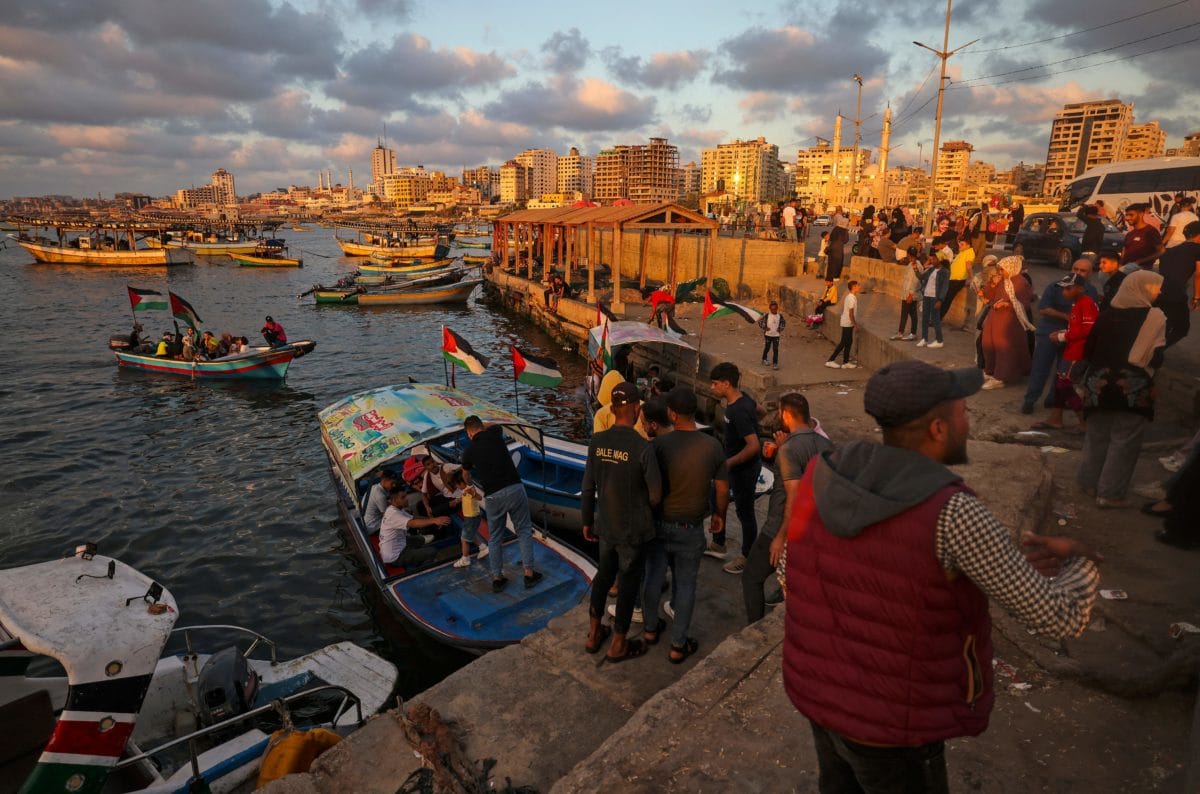
Palestinians gather at Gaza City's sea port at sunset, July 2022\. Mahmud Hams/AFP via Getty Images
\[su\_dropcap style="simple" size="4"\]**E**\[/su\_dropcap\]lsalameen is a senior fellow at the American Security Project and a protégé of Bitcoin maximalist Alex Gladstein of the Human Rights Foundation. Elsalameen, Gladstein and other proponents of Bitcoin claim that the blockchain technology of cryptocurrencies can provide economic independence and empowerment to Palestinians. They argue that Bitcoin, the oldest and most widely held among thousands of cryptocurrencies, could be used to subvert Israeli sanctions and financial control of the money supply, give an occupied and isolated people a means to transact financially with the outside world and allow individual Palestinians a means to save in cyberspace. In Gaza, a [Palestinian](https://bitcoinmagazine.com/culture/can-bitcoin-bring-palestine-freedom) told Gladstein, Bitcoin is like a “checkpoint that’s always open.”
At the heart of Bitcoin’s appeal is the urgent and necessary pursuit of Palestinian financial independence. After all, the strangulation of the Palestinian economy has gone hand in hand with Israel’s ongoing oppression and colonization of the Palestinian people. Political economist Tariq Dana explains that after the occupation of the West Bank and Gaza in 1967, “Israel replaced all Arab and local banks with its own financial system. The Bank of Israel became the supreme authority in charge of all monetary arrangements and imposed the Israeli currency as legal tender in the OPT \[Occupied Palestinian Territories\].”[\[1\]](#%5Fedn1) The 1994 “Protocol on Economic Relations” (the Paris Protocol)—part of the so-called peace process initiated by the Oslo Accords—established the Palestine Monetary Authority (PMA) as a central bank. The PMA, however, was not given the power to issue its own currency, set interest rates and manage the money supply. The Israeli state also maintains the authority to impose taxes on Palestinian workers and import duties on trade flowing into the Occupied Territories. The revenue drawn from these taxes and duties is theoretically transferred from Israel to the Palestinian Authority each month but is repeatedly withheld and subject to Israel’s political and military whims.
The necessity of economic and fiscal independence for the Palestinian national struggle is indisputable. For Palestinians to attain self-determination, they must be able to build a functioning economy. Crypto’s adherents argue that the decentralization of digital currencies, and the privacy mechanisms built into their technology, shield them from control by any state authority. These qualities, it is argued, could provide Palestinians with a new means of financial resistance and independence, allowing them to raise funds globally and conduct internal transactions without interference from the Israeli state. What this independence means concretely ranges from large-scale possibilities, such as Hamas skirting sanctions to raise funds in bitcoin, to more mundane benefits, such as freelancers receiving international payments for their work.
But to what extent individual Palestinians see cryptocurrencies as a means to achieve financial independence is questionable. Since [local crypto transactions](https://www.coindesk.com/markets/2019/08/22/in-palestine-civilians-are-using-bitcoin-more-than-hamas/) in Gaza and the West Bank do not connect directly to banks or major crypto exchanges, it remains unclear how many Palestinians have engaged with crypto at all. In fact, most crypto proponents admit that the use of Bitcoin and other cryptocurrencies is limited to small numbers of tech freelancers.
Nevertheless, discussions among Palestinians about the utility and viability of cryptocurrencies have begun to emerge. Most recently, Al-Shabaka hosted a [roundtable discussion](https://al-shabaka.org/roundtables/cryptocurrencies-and-palestinian-resistance-an-al-shabaka-debate/) between political economists Tariq Dana and Ibrahim Shikaki. Dana argues that cryptocurrencies, and Bitcoin in particular, could play a positive role in developing “new economic and financial means of resistance.”[\[2\]](#%5Fedn2) Decentralized cryptocurrencies, he continues, can help Palestinians get around the barriers of Israel’s control of financial institutions and activities. Shikaki is more skeptical, pointing out that cryptocurrencies are speculative assets, not viable currencies. Yet both Dana and Shikaki are hopeful that the technology that powers cryptocurrencies—decentralized blockchain databases—could provide useful tools to facilitate the growth of a global Palestinian solidarity movement.
> **Within the global cryptocurrency community, murmurings that digital currencies can be wielded as anti-colonial tools or provide an escape valve from oppression are growing.**
Within the global cryptocurrency community, murmurings that digital currencies can be wielded as anti-colonial tools or provide an escape valve from oppression are growing. It is perhaps a convenient pivot of the narrative at a time when conversations about cryptocurrency—their wild volatility, inbuilt inequalities, environmental consequences and associations with criminal activity—have turned increasingly negative. Alex Gladstein, for example, has penned a series of lengthy articles in Bitcoin Magazine, offering the cryptocurrency as the solution to every variety of global injustice. In his article “[Can Bitcoin be Palestine’s Currency of Freedom?](https://bitcoinmagazine.com/culture/can-bitcoin-bring-palestine-freedom)” Gladstein berates the left for not throwing in with the Bitcoin revolution:
> [\[3\]](#%5Fedn3)
“Perhaps,” he ponders, “the world’s largest open-source money project can help, where everything else has failed.” But even assuming that the lofty claims of crypto enthusiasts are inspired by the best intentions for Palestine, there is a yawning chasm between the far-reaching promises made by Gladstein and others and the actual technological capabilities of cryptocurrencies. Further, the economic analysis used to justify crypto-based solutions misunderstands the roots of the problem. Gladstein claims that “money lies at the very root of \[Palestinians’\] struggles.” But in fact, the monetary relationship between Israel and the Palestinians reflects a more fundamental political asymmetry of power. Israeli policy has long sought to prevent the emergence of a viable Palestinian state or movement. The sabotaging of the Palestinian economy is an outgrowth of this political reality, which cannot be skirted via cyberspace.
At best, the faux-humanitarian promises made by crypto’s cheerleaders to the Palestinian movement naively peddle an unattainable escape from deeper geopolitical ills. At worst, it cynically uses Palestinians’ experiences of persecution and domination to advance an external agenda—one that benefits crypto millionaires but only offers Palestinians dangerous economic and political risks.
## **Crypto’s Track Record**
The track record of crypto entrepreneurs in places that suffer under the boot of imperial and economic oppression should give supporters of Palestine pause. [Thousands of crypto-millionaires](https://www.thetimes.co.uk/article/why-are-cryptocurrency-evangelists-flocking-to-puerto-rico-5pcfhsfnc) have swarmed Puerto Rico, for instance, taking advantage of tax incentives and beach resorts, buying up properties and experimenting with energy-intensive crypto projects on an island plagued by power shortages. Meanwhile, blockchain startups have partnered with non-governmental organizations in the Pacific Islands to produce complicated technical programs for aid and development, but which are often incompatible with local infrastructure or governance. For example, Oxfam’s [Unblocked Cash](https://www.oxfam.org/en/unblocked-cash-project-using-blockchain-technology-revolutionize-humanitarian-aid) project in Vanuatu found itself at odds with the population’s limited technological literacy, as well as the Vanuatu Reserve Bank’s crypto prohibition.
> **Most infamously, El Salvador, the first country in the world to accept bitcoin as legal tender, is heavily invested in a now-crashing asset that was originally pitched as a means to help a struggling economy.**
Most infamously, El Salvador, the first country in the world to accept bitcoin as legal tender, is heavily invested in a now-crashing asset that was originally pitched as a means to help a struggling economy. Jack Mallers, the founder of Strike, a cryptocurrency “digital wallet” company, [played a key role](http://www.dollarsandsense.org/archives/2022/0122thier.html) in introducing Bitcoin to El Salvador. At last summer’s Bitcoin conference, an emotional Mallers shared his experiences visiting an impoverished El Salvador and meeting with unbanked Salvadorans. “It was sad,” he reported. “There just wasn’t a lot of hope. I gave talks, I talked to kids. I told them, ‘Man, we’ve got this. Bitcoin’s here, we’ve got this.’”[\[4\]](#%5Fedn4) One year later, very few Salvadorans use Bitcoin, but the government’s investments in Bitcoin have thus far lost tens of millions of dollars’ worth of public funds. For a country with relatively high public debt, investment in such a volatile asset could further strain the state’s budget and leave the country vulnerable to defaulting on its debt obligations.
Olivier Jutel, a researcher and lecturer at the University of Otago, has written about how “the developing world has emerged as a key testing ground for blockchain governance solutions.”[\[5\]](#%5Fedn5) Jutel explains, “blockchain undermines the developing world state’s ability to control its own resources,” and seeks to “shape developing world governance systems for data production and platform dependence.”[\[6\]](#%5Fedn6)
## **Putting the Cart Before the Horse**
To make the case for Bitcoin in Palestine, Gladstein relies heavily on the work of political economist and scholar Sara Roy, who has studied and analyzed the Palestinian economy for over 35 years. Gladstein discusses Roy’s widely accepted framework of “de-development” in her description of the “deliberate, systematic and progressive dismemberment” of the Palestinian economy by the Israeli state.[\[7\]](#%5Fedn7)
I spoke to Roy about Gladstein’s article. She strenuously disagreed with the notion that “cryptocurrency is somehow impervious to the political reality in which Palestinians and Israelis reside” or that it could “give dispossessed Palestinians parity with empowered Israelis, eliminating the gross asymmetries of power between them and granting Palestinians economic sovereignty.”[\[8\]](#%5Fedn8)
Roy’s economic analysis is not confined to questions of currency. Rather she describes the political imperatives of colonial power to confiscate land, expel and replace the Palestinian population, then dominate and pacify those that remain. Economic domination aims to stunt the development of an autonomous capitalist class that can invest in local businesses and employ Palestinian labor. Instead, in Roy’s analysis, the Palestinian economy has been transformed “into an auxiliary of the state of Israel” through the “erosion of its own internal economic base and its resulting dependency on Israel.”
> **As Roy explained, “the issue for the majority of Palestinians is not primarily a lack of control over their money, but their inability to generate money because their economy has been devastated."**
An independent Palestinian economy will not arise magically out of a sovereign currency, digital or otherwise. It can only come about through the capacity to produce and trade goods and services, which has been systematically undermined through the destruction of physical infrastructure and the elimination of a geographical basis on which Palestinian capital accumulation could effectively take place. As Roy explained, “the issue for the majority of Palestinians is not primarily a lack of control over their money, but their inability to generate money because their economy has been devastated… The fundamental issue is the devastation of the economy, the impoverishment of Palestinians and the disablement of people in their ability to work and to generate income.”
In 2007, Israel imposed a closure of Gaza’s border crossings, preventing the transfer of raw materials for industry and—in the [first three years of the blockade](https://gisha.org/en/three-years-of-gaza-closure-by-the-numbers/)—resulting in the closing or reduced capacity of about 90 percent of factories. In Gaza today, the unemployment rate is upward of 50 percent. Politically and economically separated from the West Bank, blockaded by the Israeli government and financially squeezed through Israeli withholding of Palestinian tax revenue, the economy of Gaza has all but collapsed.
The Israel Defense Forces (IDF) assault on Gaza in May 2021 again decimated physical infrastructure and debilitated productive sectors, leaving the economy of Gaza in even more dire straits. The IDF’s targets included clinics, banks, educational facilities, cultivated fields and factories. Gaza’s power grid was attacked, reducing the electricity supply to three to four hours a day and impairing the functioning of the water and sewage systems. As Israeli journalist Amira Hass [wrote at the time](https://www.haaretz.com/israel-news/2021-05-20/ty-article/.premium/gazas-destruction-an-unbearable-humanitarian-and-financial-toll/0000017f-f542-d887-a7ff-fde67f150000): “Due to the lack of power, three main desalination plants providing services for more than 400,000 people have suspended operations, and more than 100,000 cubic meters of untreated or partially treated wastewater are being discharged to the sea daily. In total, about 800,00 people now have no regular access to water.”[\[9\]](#%5Fedn9) According to Hamas’ information office, the estimated material damage amounted to about a quarter of a billion dollars. The long-term consequences of impaired electricity, water, banking and agriculture will, of course, be even greater.
The situation in the West Bank—physically fragmented, economically squeezed and impoverished—is only moderately better. According to a [report](https://www.merip.org/content/files/system/files/official-document/a76d309%5Fen%5F0.pdf) by the United Nations Conference on Trade and Development, the cumulative economic opportunity cost of Israeli closure policies and military operations in the West Bank since the Second Intifada began in 2000 is estimated at $57.7 billion—some $2.9 billion per annum on average. The unemployment rate in the West Bank is lower than in Gaza, but at 18 percent, it remains high by any standard. In large part, the relatively lower rate reflects the number of jobs Palestinians in the West Bank hold within Israel and the settlements. Without these jobs, the report estimates that the unemployment rate could sit 16 percentage points higher. This dependency on employment in Israel not only undermines the development of an independent Palestinian economy, but also leaves those Palestinians vulnerable to the Israeli state’s security whims.
Given the level of economic distress, it is unlikely that many Palestinians will use cryptocurrencies. Most do not have the resources to do so. In a best-case scenario, some individuals from the Palestinian middle class—nearly non-existent in Gaza and small and struggling in the West Bank—could benefit from receiving international payments or remittances in bitcoin. But given the wild volatility in the value of cryptocurrencies, it will more likely harm those taking on the risk. This year, bitcoin lost half its value from mid-November to mid-May. Since then, it has plummeted even further.
Beyond the impact of using cryptocurrencies on the small number of Palestinians who do take the risk of investing, the systemic power asymmetries of Palestinian society at large cannot be skirted or equalized in cyberspace. Indeed last summer, when Hamas attempted to raise finances through bitcoin and other digital currencies, the Israeli state responded by [seizing their cryptocurrency wallets](https://www.businessinsider.com/israel-hamas-crypto-wallet-seizure-order-palestinian-militant-gaza-strip-2021-7). Hamas had raised over $7 million worth of crypto assets. The Israeli National Bureau for Counter Terror Financing traced 84 digital wallets and their private keys believed to be controlled by Hamas and transferred their contents out of the wallets. If they can seize crypto assets from Hamas, they can certainly do the same to Palestinian investors.
## **A Technological Mismatch**
The seizing of Hamas’ crypto wallets raises another question: Does the technology behind cryptocurrencies stack up? Perhaps the most compelling argument to embrace cryptocurrency in Palestine is the possibility that Palestinian individuals and organizations could bypass Israel’s devastating sanctions and economic controls. This strategy is exactly what Hamas attempted last summer by raising money through donations of mostly bitcoin and tether tokens. Neither Gladstein nor others in the crypto community are willing to say that they support Hamas in doing so because it further implicates blockchain technology as a conduit for skirting illegality.
Molly White, a vocal critic of cryptocurrencies, is a software engineer and creator of the [Web3 Is Going Just Great](https://web3isgoinggreat.com/) website. She explained to me: “Crypto folks choose the argument that best fits their narrative at a given point.”[\[10\]](#%5Fedn10) In the case of Russia, for instance, many crypto proponents celebrated when Russian oligarchs were thwarted from using crypto to bypass sanctions or raise new money, seeing it as an example of cryptocurrencies as “legitimate money.” On the other hand, “if they’re talking about oppressive sanctions that we don’t like, then those ones we’ll be able to bypass. How could both of those things be true at the same time?”
Whether it is Hamas, local community organizations or Palestinian investors trying to raise funds from abroad, the roadblocks will be similar. The first challenge is converting any cryptocurrency raised into fiat money—traditional government-backed currency—a significant barrier since major cryptocurrency exchanges do not operate in Palestine. Second, as White put it, raising money outside the purview of the state at any significant scale becomes harder and harder. “The more money that’s changing hands, the more that governments have an interest in seeing what’s going on there.” Indeed, Israel’s seizure of several millions of dollars’ worth of crypto assets last summer supports White’s assertion.
> **Whether it is Hamas, local community organizations or Palestinian investors trying to raise funds from abroad, the roadblocks will be similar. The first challenge is converting any cryptocurrency raised into fiat money—traditional government-backed currency—a significant barrier since major cryptocurrency exchanges do not operate in Palestine.**
There is, in fact, no technological runaround to the state. Proponents of crypto like to extol contradictory virtues of blockchain technology, claiming that it is both extremely private and secure but also public and transparent. The transparency is built into the fact that everyone can see the chain of financial transactions going from place A to place B. Privacy is introduced in the ability of individuals or organizations to maintain private electronic wallets, such that you don’t know who owns the wallets in place A or place B.
But the logistics of keeping that privacy in place is enormously difficult. There are complicated ways to protect your wallet from being easily traceable, but as White put it, traceability “gets easier the more money you have and the more power that you have.” For large governments, for instance, “that have the resources and motivation to figure who someone is, it’s substantially easier to figure that out,” she explained. Many new software companies have popped up to provide tracing technology and are selling their services to governments, the FBI and other powerful interests. The US government, for instance, has [multimillion dollar contracts](https://www.coindesk.com/business/2020/02/10/inside-chainalysis-multimillion-dollar-relationship-with-the-us-government/) with Chainalysis, a cryptocurrency surveillance company. “Maybe it looks really private to you,” White said, “but it doesn’t look really private to the state.”
Distributing aid from organizations that are not on Israel’s growing terror watch list still runs up against overwhelming challenges. First are problems of technological and financial infrastructure. Cryptocurrencies require widespread internet and reliable electricity. Access to both is regularly withheld and purposefully destabilized by Israel. If organizations manage to operate despite those obstacles, they will still need to convert their funds to fiat currencies to buy food, clothing, building materials and other goods that people need. Thus when Oxfam partnered with blockchain startups to roll out its Unblocked Cash project in Vanuatu, their system [proved of limited value](https://journals.sagepub.com/doi/full/10.1177/2053951720985249) and ultimately relied on the physical transfer of cash to vendors who accepted crypto payments.
Lastly, the more limited promise of easier transmission of remittances from Palestinians in the diaspora is also flawed. First are the barriers to sending remittances, which in most instances require a bank account and identification, as well as often high fees. Then the wildly fluctuating value of bitcoin and other digital assets means that what might start as $100 worth of bitcoin could result in $50 by the time it is withdrawn, provided the recipient finds a way to convert the bitcoin to cash.
## **Innovation or Desperation?**
When I spoke to Sara Roy, she worried that the move toward cryptocurrencies was an option “born of desperation, not innovation.” Are we asking Palestinians, already vulnerable physically and economically, “to enter yet another realm with no protection or safety net?” The narrative that crypto can provide a means of liberation in Palestine is abstract and ahistorical at best—removed from any meaningful political understanding of how colonial domination works—and dangerously risky to Palestinians at worst.
The realm of cryptocurrencies has reinforced and deepened existing economic inequalities. The top 10,000 bitcoin investors hold about a third of cryptocurrency in circulation, an almost 100-fold increase in inequality compared to the dollar economy. But it also reinforces political asymmetries, such that a well-resourced state like Israel has the technological and military means for surveillance and control.
A popular saying among Bitcoin advocates is that if you “fix the money, you fix the world.” Not so, Roy responded, “when the world is trying to erase you. True freedom and independence, financial and otherwise does not lie in cyberspace. It lies in lived space.” If there is an easy shortcut to Palestinian liberation, we should take it. Every day under the boot of Israeli domination more lives are lost, harmed and impoverished. But ultimately, there is no replacement for a political resolution to end the colonization of Palestinians. It is a movement we must support in real life, not on a digital blockchain.
\[Hadas Thier is the author of *A People’s Guide to Capitalism: An Introduction to Marxist Economics*.\]
---
### **Endnotes**
[\[1\]](#%5Fednref1) Tariq Dana, “Dominate and Pacify: Contextualizing the Political Economy of the Occupied Palestinian Territories Since 1967,” in Alaa Tartir, Tariq Dana and Timothy Seidel, eds., *Political Economy of Palestine Critical, Interdisciplinary, and Decolonial Perspectives* (Palgrave Macmillan, 2021) p. 29.
[\[2\]](#%5Fednref2) Tariq Dana and Ibrahim Shikaki, “[Cryptocurrencies and Palestinian Resistance: An Al-Shabaka Debate](https://al-shabaka.org/roundtables/cryptocurrencies-and-palestinian-resistance-an-al-shabaka-debate/),” *Al-Shabaka*, May 23, 2022.
[\[3\]](#%5Fednref3) Alex Gladstein, “[Can Bitcoin be Palestine’s Currency of Freedom?](https://bitcoinmagazine.com/culture/can-bitcoin-bring-palestine-freedom)” *Bitcoin Magazine*, July 22, 2021.
[\[4\]](#%5Fednref4) Quoted in Hadas Thier, "Cryptocurrency Will Not Liberate Us," *Dollars & Sense,* January/February 2022.
[\[5\]](#%5Fednref5) Olivier Jutel, “[Blockchain Imperialism in the Pacific](https://journals.sagepub.com/doi/full/10.1177/2053951720985249),” *Big Data & Society* (February 2021) p. 2.
[\[6\]](#%5Fednref6) Ibid., p. 3.
[\[7\]](#%5Fednref7) Sara Roy, *Failing Peace: Gaza and the Palestinian-Israeli Conflict*. (London: Pluto Press, 2006) p. 33.
[\[8\]](#%5Fednref8) Interview with Sara Roy, May 9, 2022.
[\[9\]](#%5Fednref9) Amira Hass, “Gaza’s Destruction: An Unbearable Humanitarian and Financial Toll,” *Haaretz*, May 20, 2021.
[\[10\]](#%5Fednref10) Interview with Molly White, April 30, 2022.
### The Shifting Politics of Debt in Turkey
URL: https://www.merip.org/2022/08/the-shifting-politics-of-debt-in-turkey-2/
Last updated: 2025-08-22T18:37:10.000Z
When the first wave of the Covid-19 pandemic in 2020 triggered widespread economic hardship, Turkish President Recep Tayyip Erdoğan’s administration reacted quickly with the offer of cheap loans through state-owned banks.
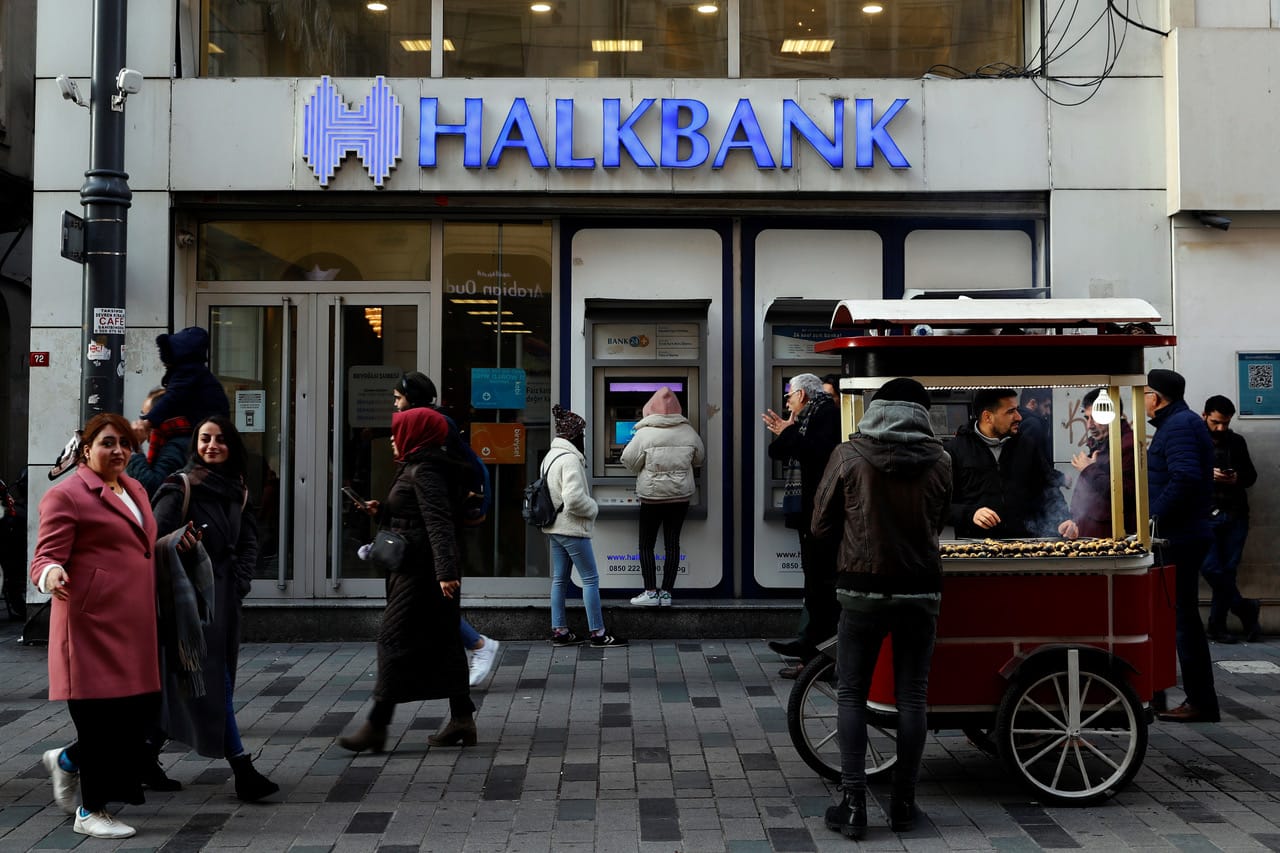
People walk past by a branch of the Turkish Halkbank in central Istanbul, 2020\. Murad Sezer/Reuters
In the first two months of the pandemic, these financial institutions extended low-interest consumer loans to almost 7 million people to provide financial support and mitigate the economic slump. Around 1.8 million of those were first-time borrowers and, although the official figures are not known, the number of applicants far exceeded the number of loans made.
The cheap loans of 2020 were not a new strategy. Following the failed coup in 2016, Turkish policymakers responded with a state-sponsored credit campaign. The government’s strategy was to stimulate the economy ahead of the April 2017 referendum to amend the constitution, which led to the establishment of a presidential rather than parliamentary system. They also implemented a similar approach after the economic downturn resulting from the 2018 currency crisis. The volume of credit expansion during the first months of the pandemic, however, surpassed those previous years’ campaigns. Other [upper-middle income countries](https://www.imf.org/en/Topics/imf-and-covid19/Fiscal-Policies-Database-in-Response-to-COVID-19) took different measures. For example, Brazil and Argentina were more generous in providing direct cash transfers and targeted assistance to those in need. Extending cheap loans rather than providing direct financial support or beefing up low-income assistance programs typifies the Turkish government’s approach to managing the economy in the last six years. It partly builds on the previous popularity of “financial inclusion” programs in the 2010s that portrayed access to credit and financial services as a solution to endemic poverty, but which also led to the growth of household debt.[\[1\]](#%5Fedn1)
Financial inclusion programs typically entail the expansion of financial education and microcredit campaigns. They are designed to remove the barriers that hinder access to financial institutions for lower-income borrowers. States adopting financial inclusion policies invite previously excluded social segments into the financial system, using campaigns or nudging techniques, with the help and contributions of financial institutions. Microcredit institutions quickly provide new borrowers with small loans as they require less paperwork and no collateral (aside from the necessary credibility in group lending). Using credit to substitute for income, however, can result in the over-indebtedness of newcomers or the transfer to the creditors of a significant part of the current and future income of low-income groups. In other words, converting those groups previously excluded from the financial system into bank customers and small entrepreneurs does not always produce the outcomes desired by international financial institutions such as the World Bank. In [Bosnia](https://blogs.lse.ac.uk/lsee/2014/04/08/a-new-balkan-tragedy-the-case-of-microcredit-in-bosnia/), for example, almost 60 percent of microcredit users had debt payments that surpassed their disposable income. In [Kenya](https://blogs.lse.ac.uk/africaatlse/2020/01/20/fin-tech-kenya-poverty-financial-inclusion-gambling-mpesa/), steps taken to advance branchless banking resulted in at least half of the population losing significant parts of their income due to late payment fees. Since lenders had set three-digit interest rates (annualized) for the overdue fines, financial inclusion carried predatory characteristics for many people.
Inviting masses into the financial sector, organizing financial literacy programs amid stagnating or declining real wages and expecting people to reinvent themselves as entrepreneurs or small-scale investors were the main pillars of the financial inclusion agenda. It did not solve the problems faced by low-income groups, women and minorities. Instead, these groups’ increased access to credit resulted in heightened credit dependency, further aggravated during the Covid-19 pandemic. This toxic brew of indebtedness and crisis pushed low-income groups to increasingly resort to consumer loans, a move facilitated by the state, while the banking sector supplied both the discourse and official action plans. The primary beneficiaries have been the banking sector and the social bloc built around Erdoğan, which maintained its strength despite economic turbulence and deepened inequalities.
## **Credit Frenzy**
In the late twentieth century, like their counterparts in much of the Global South, Turkish policymakers saw financial liberalization as the remedy to insufficient domestic savings and the unwillingness of the owners of capital to invest their money inside Turkey. But financial liberalization—including the lifting of policies that imposed restrictions on those moving capital out of Turkey—created a cyclical pattern of booms and busts that continues. The dependency of the economy on imports and the Turkish governments’ difficulties in managing monetary and fiscal policy contributed to these cycles. When the economy experienced high growth rates, accompanied by higher current account deficits under favorable global financial circumstances, it was easier for corporations to access credit in US dollars. Much like other countries of the Global South, fragility in the financial system and large accumulated debt levels then created economic turbulence, triggering capital outflows and resulting in dramatic crises.
Eventually, these crises were followed by a new cycle—one stimulated by capital inflows. This included capital that flowed to corporations, lured by the government’s high interest rates for foreign investors (relative to rates in the Global North), as well as increasing domestic consumption facilitated by the deepening of domestic financial markets. With the ability of corporations to access new financial resources, Turkey’s economy grew at a rate of 7.3 percent on average from 2003 to 2008\. This growth was accompanied by an expansion in household debt levels driven by government policy choices that were themselves shaped by extended International Monetary Fund surveillance that discouraged state spending on public goods and services.
> **Turkey’s economy grew at a rate of 7.3 percent on average from 2003 to 2008\. This growth was accompanied by an expansion in household debt levels driven by government policy choices that were themselves shaped by extended International Monetary Fund surveillance that discouraged state spending on public goods and services.**
Many consumers in Global South countries expanded their borrowing to cope with similar contractions in government spending. Turkey, which offered handsome returns to foreign investors while lowering the interest rate for domestic borrowers, was no exception. Buoyed by the high levels of global liquidity and easy money that characterized the early 00’s, opening the gates of finance provided not only temporary financial stability but also immense profit opportunities for different groups of capitalists.
Under these circumstances, Turkey’s Central Bank followed the path of reserve accumulation like other central banks in the Global South. This political choice was less costly than it would have been, as the unprecedented levels of foreign direct investment and portfolio flows created an abundance of US dollars, which in turn propped up a relatively high value for the Turkish lira. Accessing cheap foreign currency credits and lending more and more to domestic consumers amid relative appreciation of the domestic currency generated enormous revenues for the newly restructured banking sector. The Central Bank’s strategy did not channel the banking sector funds to long-term credit provision for new investment but rather to short-term loans aimed at stimulating consumption in the face of stagnant real wages and an increased cost of living, all of which drove households to increase their borrowing.
There were two main actors in this period of rapid household debt growth between 2002 and 2013—the state and the private banks. In 2001–2002, the state spent almost 25 percent of GDP to bail out the banking sector and in the ensuing years was forced to allocate primary budget surpluses to controlling public debt levels. At the same time, the austerity programs succeeded in imposing an unprecedented fiscal discipline on the state, and the borrowing of the public sector declined rapidly. Without a heavily indebted public sector to lend money to, these financial institutions saw household consumers as their new market. In the ensuing decade, the ratio of consumer loans to GDP jumped from around 2 percent to 13 percent.[\[2\]](#%5Fedn2) Though the ratio remained low compared to some other countries in the Global South, the pace of increase was notable as it occurred alongside high overall growth rates, except for the 2008–2009 collapse around the global financial crisis.
The ruling Justice and Development Party succeeded in controlling public debt and increasing social expenditures: The ratio of public social spending to GDP increased from around 5 percent to about 10 percent in the early 2000s. Despite this positive metric, the gradual commodification of essential public services and the stagnation of real wages in many sectors limited its beneficial impact on the working class. The consumption capacity of low-income groups increased not because of increased real wages but due to expanded credit opportunities.
As an official strategy, financial inclusion was adopted in the Turkish context in 2014, much later than the global push that characterized the 00’s. The financial transformation affiliated with inclusion was, however, evident in the integration of millions of households into the financial sector in the early twenty-first century. By the time financial inclusion became a widely cited development tool and officially declared a target, Turkish state managers were already attempting to deal with the ramifications of its negative effect—accumulated household debt.
## **The Predatory Characteristics of Financial Inclusion**
Turkey’s official financial inclusion strategy (drafted in 2013 and implemented until 2018) envisioned the growth of household savings and the emergence of millions of fiscally prudent borrowers working in lockstep with the state and private banks. The only non-governmental actors that contributed to the policymaking process were the financial sector representatives and their affiliated associations. Indeed, the financial inclusion strategy was merely a compilation of those representatives’ proposals rounded out with some inclusive-sounding rhetoric borrowed from international financial circles. The absence of organizations representing the interests of the working-class borrowers meant there was no critical discussion of the potential pitfalls of a massive expansion of borrowing, such as the enormous burden that the financial sector fees and commissions would place on debtors.
The state’s strategy explicitly emphasized the strength of Turkey's banking sector and financial infrastructure. The policymakers saw no problems with the supply of financial services, only the need for financial education that would transform the population into suitable consumers of these services. The financial education promoted by the authorities included financial literacy programs sponsored by private banks as well as household budgeting courses organized through the cooperation of the state, financial institutions and the non-governmental organizations that worked closely with the banks. While organizations such as the Association of Financial Literacy or networks such as TurkishWIN partnered with private banks (or payment processors such as Mastercard) to promote financial literacy programs, the absence of a structural critique that connected the need for borrowing to persistent low wages and the rising cost of basic services meant these campaigns were mostly window dressing.
Predictably, the Turkish financial inclusion process worked to deepen social inequalities just as the country was drifting toward a crisis in the late 2010s. The proponents of financial inclusion, however, heavily emphasize two counterexamples. One specific characteristic of Turkey’s financial inclusion program is the state’s central role in the microcredit sector. Despite the initiatives of some associations, the Turkish microcredit sector remains mainly state-organized and controlled by a *wakf* (foundation). The most extensive program is Turkey Grameen Microfinance Program. In collaboration with the Grameen Bank, Turkey Waste Reduction Foundation provided most of the microcredit in the 2010s. The program extended credit to over 50,000 women annually in the mid-2010s. Since the credits were not securitized and the foundation is a non-profit, this fact has been put forth as a positive example by policymakers. Nevertheless, the markup rates of the program were not low, with nominal interest rates of 15 percent and real interest rates revolving around 6 to 9 percent in the early to mid-2010s. There is more than enough fieldwork documenting that many women used microcredit to smooth their consumption and remained dependent on credit.[\[3\]](#%5Fedn3)
The second example touted by supporters of financial inclusion is the 2012 pension fund regulations, which matched 25 percent of the pensioner’s contribution with funds from the state. Though it is perceived as a successful effort to increase savings, these funds are concentrated in the upper-level income groups with salaries sufficient to generate savings. Unregistered workers, who comprise one-third of the workforce, as well as the laborers who receive the minimum wage (around 50 percent of the workforce in the 2010s according to the calculations of trade union confederations) would not have been recipients of these new state contributions.
> **While interest rates were rising in the post-2013 period, there was no significant improvement in real wages, and people were being pushed in growing numbers into the financial system to make ends meet. Under these circumstances, banks’ lending practices revealed predatory characteristics.**
While interest rates were rising in the post-2013 period, there was no significant improvement in real wages, and people were being pushed in growing numbers into the financial system to make ends meet. Under these circumstances, banks’ lending practices (though monitored by the Banking Regulation and Supervision Agency) revealed predatory characteristics. While workers were increasingly [relying on credit cards](https://academic.oup.com/cje/article-abstract/39/3/751/1715400?redirectedFrom=fulltext) to supplement their low wages and resorting to late payments, banks set higher overdue fees and commissions in a coordinated manner. These actions violated the law according to Turkey’s Competition Board, which notably issued [fines to 12 banks](https://www.merip.org/content/files/karar.pdf) for coordinated action against consumers in 2013 and launched new investigations in the 2010s. The average rate of interest on consumer loans doubled the inflation rate during this period according to Central Bank data. The inability of the masses to roll over debt amid increasing interest rates in the mid-2010s pushed the number of orders waiting on court bailiff desks higher, nearing [20 million](https://www.sozcu.com.tr/2018/ekonomi/turkiyede-icra-dosyasi-20-milyona-dayandi-2714010/) during the 2018 currency crisis. By the end of the same year, [debt collectors](https://www.cumhuriyet.com.tr/haber/batik-kredi-pazari-41-milyara-ulasti-1167179) had a portfolio consisting of 3.5 million separate loans previously extended to around 1.5 million people.
The outcome of the financial inclusion strategy of 2014–2018 is not well documented. Elements of the strategy were repeated in the new five-year plan published by the Erdoğan administration after the country’s transition to a presidential system in 2018\. Still, there has been no comprehensive evaluation of the successes and failures of the program. The Global Findex data from 2011 to 2017 suggests that the Turkish population became more integrated into the financial system. More people use financial services despite the stagnation of household indebtedness as a ratio to GDP in the mid-to-late 2010s. The ratio of account owner women to the total adult female population jumped from 32 percent in 2011 to 54 percent in 2017\. As a result of the pension regulations, more people have savings in the banks, but the data also shows that at the same time, more people than ever are in debt.
## **From Currency Crisis to Pandemic**
Increased dependency on credit became a more acute problem for Turkish citizens as the tightening of global finance slowed the country’s economic performance in 2018, triggering a severe currency crisis and subsequent recession. The state’s rhetoric of the early 2010s that encouraged borrowers to take personal responsibility for their own economic circumstances and financial future was converted into a new discourse about economic warfare against Turkey’s enemies. For example, at the height of the 2018 currency crisis, policymakers launched a new campaign offering cheap credit rates through public banks to home buyers in state-selected projects. Its objectives were to simultaneously mitigate the financial losses of the urban middle classes and to support the construction sector. In this way, the state mobilized its financial capacity to bail out some construction companies and provide favorable borrowing conditions for a minuscule and wealthy segment of society. The state, however, presented this campaign as a vital protection of a primary sector for the country’s future. At the campaign’s [press conference](https://csb.gov.tr/turkiye-icin-kazanc-vakti-bakanlik-faaliyetleri-25281), "Time for Investment in Turkey" held on August 28, 2018, the then Urban and Environment minister supported the new credit campaign with the statement: “Today is not about gaining; it is about sacrifice.”
Various state-sponsored credit expansion attempts provide examples of the Erdoğan administration sticking to the debt-led growth strategy of the 2000s and supporting further borrowing. Yet they also demonstrate that the Turkish financial inclusion process diverged in recent years from the dominant approach of most of the international financial community, which centers on deploying new technologies to increase borrowing and deepen financial markets. When the currency crisis struck, the images of financially literate and business savvy borrowers participating in the growth of the Turkish economy quickly gave way to those of a benevolent state helping those in need through increasing loans. Turkey’s state-owned banks became the engines of credit expansion in these times of financial volatility since private banks restricted their lending to safer bets where they could ask for more collateral and ration their credits.
The story of debt expansion and financial inclusion in Turkey also sheds new light on the state’s pandemic-era response, revealing how the credit growth of the early 2000s left a stark imprint on subsequent policy responses. Each time the economy stagnated, or incoming capital dried up, the Justice and Development Party governments (and later the Erdoğan administration) pushed for new credit campaigns allowing households and small and medium enterprises to roll over their debts. The pandemic-era response was the same: policymakers used public financial institutions to postpone or attempt to manage severe economic challenges. This willingness to deploy public institutions and assets to mitigate damage is at least partly responsible for the ruling party’s ability to maintain the broad alliance they built in the early 2000s.
> **Each time the economy stagnated, or incoming capital dried up, the Justice and Development Party governments (and later the Erdoğan administration) pushed for new credit campaigns allowing households and small and medium enterprises to roll over their debts.**
Turkish policies of financial inclusion also revealed a subtle gender discourse based on a joining of conservative and patriarchal values with the image of female entrepreneurialism. The implication is that the neoliberal marketplace—being supposedly devoid of politics—is an acceptable zone of female engagement and empowerment. As the gendered inequalities in wage, status and working conditions in Turkish labor markets were never a concern for the ruling party or the banking sector, the financial transformation likely intensified women’s relative indebtedness. Although official statistics are not available over a sufficient period to make a conclusive argument, providing financial literacy programs for women in distressed economic conditions and with stagnating wages probably just produces more indebted women. And it stands as a microcosm of capitalism’s broader forces that continue to innovate new methods to extract value from the marginalized and working classes to drive accumulation and expansion.
Recurrent currency shocks during the Covid-19 pandemic led to renewed state activism in Turkey and the promotion of an economic model that relies on cheaper labor and depreciated domestic currency. This orientation has not yet produced the results expected by the Erdoğan administration, such as the minimization of current account deficits, lower unemployment ratios and rapidly increased export volume. The erosion of [central bank capacity](https://aliriza.substack.com/p/how-did-turkeys-central-bank-get?utm%5Fsource=%2Fprofile%2F16078761-ali-riza-gungen&utm%5Fmedium=reader2) in the aftermath of the 2018 crisis and the pandemic made it harder to slow down currency depreciation, resulting in further price hikes. In 2022, the highest inflation rates of the twenty-first century were recorded in the country, raising concerns also among conservatives who now face growing challenges in presenting the last two decades as a remarkable success story. The social bloc built around the Justice and Development Party and the president, though maintaining its disharmonious unity, is facing challenges in [controlling the working-class neighborhoods](https://www.merip.org/manufacturing-the-akp-in-turkey/). The endurance of the Erdoğan administration partly depends on its ability to avoid new economic turmoil and postpone problems through new credit campaigns. Policies of financial inclusion, however, generated an unsustainable pattern and the previously accumulated household debt—which at the time supported the success narrative of the Justice and Development Party—now seems to limit the future options of state managers.
\[Ali Rıza Güngen is a MESA Global Academy Fellow for 2021–2023.\]
---
### **Endnotes**
[\[1\]](#%5Fednref1) For a detailed account of financial transformation in Turkey in recent decades and the crisis management during 2018–2019, see Ü. Akçay and A. R. Güngen, “[Dependent Financialisation and Its Crisis: The Case of Turkey](https://academic.oup.com/cje/article-abstract/46/2/293/6554722?redirectedFrom=fulltext),” *Cambridge Journal of Economics*, 46/2 (2022).
[\[2\]](#%5Fednref2) Similar data and detailed tables on household indebtedness and the financial inclusion process are available in my previous works: A. R. Güngen, (2018) “[Financial Inclusion and Policy Making: Strategy, Campaigns and Microcredit *a la Turca*,](https://www.tandfonline.com/doi/abs/10.1080/13563467.2017.1349091)” *New Political Economy*, 23/3 (2018) and A. R. Güngen, [*Politics of Debt: Financial Inclusion in Turkey*](https://iletisim.com.tr/kitap/borclandirma-siyaseti/10015), (Istanbul: İletişim, 2021) \[Turkish\]
[\[3\]](#%5Fednref3) T. Bulut and F. Adaman, *Diyarbakır’dan İstanbul’a 500 Milyonluk Umut Hikâyeleri: Mikrokredi Maceraları* (İstanbul: İletişim 2007); S. Arı, *Batman’da Mikro Kredi Deneyimleri*, Kadir Has Üniversitesi Sosyal Bilimler Enstitüsü (unpublished MA thesis, 2011).
### The Financial Ties that Bind the Arab Gulf Monarchies and the United States
URL: https://www.merip.org/2022/08/the-financial-ties-that-bind-the-arab-gulf-monarchies-and-the-united-states/
Last updated: 2025-08-22T18:37:10.000Z
In July 2021, former President Donald Trump’s son-in-law and advisor Jared Kushner obtained a [$2 billion investment](https://www.nytimes.com/2022/04/10/us/jared-kushner-saudi-investment-fund.html.) for his newly formed private equity firm, Affinity Partners, from Saudi Arabia’s sovereign wealth fund.
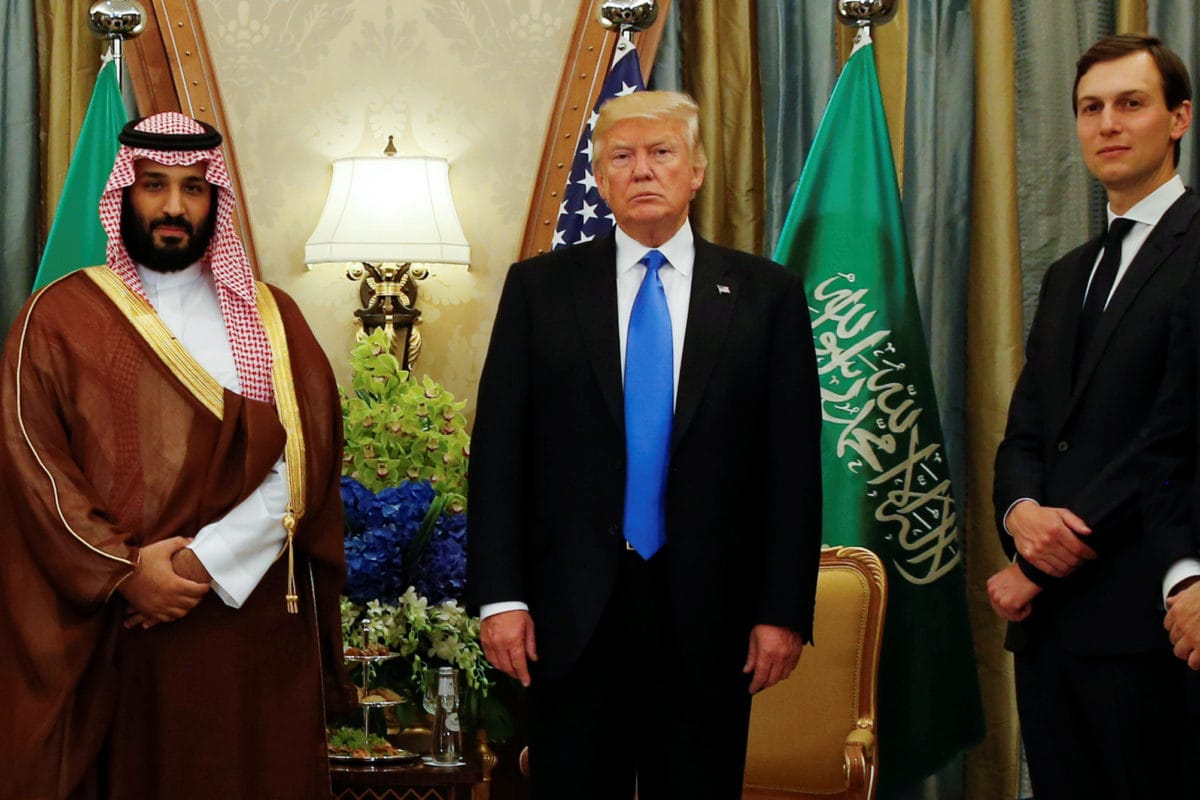
President Donald Trump, flanked by White House senior advisor Jared Kushner, meets with Saudi Arabia's Deputy Crown Prince Mohammed bin Salman at the Ritz Carlton Hotel in Riyadh, Saudi Arabia May 20, 2017\. Jonathan Ernst/Reuters
Notably, the deal was approved despite opposition from the Saudi fund’s investment screening panel. According to the minutes of the panel, objections to the investment plan included a major fee that “seems excessive,” the “inexperience of the Affinity Fund management” and a due diligence determination that the firm’s operations were “unsatisfactory in all aspects.” The panel was overruled, however, by the sovereign wealth fund’s board, controlled by Crown Prince Mohammed bin Salman, the de facto ruler of Saudi Arabia.[\[1\]](#%5Fedn1)
The circumstances of the deal led many to surmise that Mohammed bin Salman did not pursue Affinity Partners’ offer due to Kushner’s savvy in private equity, a field in which he has little experience. Instead, it appeared to be a payoff for Kushner’s support of Saudi policies within the Trump administration or as an attempt to purchase influence within the Republican Party and a possible second Trump presidency. While in the White House, Kushner supported the billions of dollars of US arms sales contracted to Saudi Arabia for the kingdom’s ongoing war in Yemen and military posture against Iran. He also defended the Saudi-US relationship from bipartisan congressional criticism after Mohammed bin Salman was implicated in ordering the assassination of *Washington Post* columnist Jamal Khashoggi in 2018\. There is little doubt that Mohammed bin Salman also seeks to maintain his influence within the Trump-dominated GOP. While President Joe Biden has authorized some US arms sales to Saudi Arabia, his public criticisms and tepid support for the Saudi war in Yemen have angered the crown prince, who seems hopeful that [Trump or another Republican](https://www.theguardian.com/us-news/2022/apr/24/saudi-arabia-kushner-trump-biden-mohammed-bin-salman) will replace Biden in the Oval Office in 2025.
Mohammed bin Salman’s decision to invest Saudi state funds in a financially dubious enterprise like Affinity Partners may seem unusual, but the Arab Gulf monarchies and the United States have long understood foreign capital investments as serving economic and geopolitical objectives. For American and Arab political classes, these geopolitical objectives include advancing perceived national security interests and preserving their control over state institutions. The scale and nature of these capital flows have reshaped the economic and geopolitical orders of their respective countries and the entire world. Washington, the private finance industry, oil companies and the Arab Gulf monarchies have all dramatically increased their power in the process. Investments of capital continue to bind the economic and geopolitical strategies of the Arab Gulf monarchies and the United States, despite the rising challenges to that order.
## **The History of Investing for Influence**
In the 1920s and 1930s, US oil companies invested substantially in the Arab Gulf monarchies of Iraq, Kuwait and Saudi Arabia, helping to establish or expand their petroleum industries. The monarchs welcomed these corporations and the new revenues, which funded the military and security services that would safeguard their rule and the economic development projects that provided for their domestic legitimacy. As petroleum production expanded, however, the Gulf monarchs (like the leaders of other extractivist states in the Global South) sought a greater share of profits for their governments, which the US oil companies resisted.
In 1950 the US government intervened in the oil-profit sharing dispute in an effort to strengthen allied Arab monarchies. By the dawn of the Cold War, Gulf oil exports had become vital to reconstructing Western Europe from the destruction of World War II, underscoring for many US strategists the need to secure the allegiance and stability of Arab governments through financial assistance. The Truman administration decided that increasing profit sharing with the Arab monarchies was preferable to relying on congressional approval for ongoing US government aid. Washington thus successfully pressed US oil companies in Saudi Arabia to increase their profit sharing to 50 percent. The reduction in revenue was offset with an equivalent federal tax deduction, in effect clandestinely subsidizing Saudi Arabia at the expense of American taxpayers.[\[2\]](#%5Fedn2) The US government subsequently negotiated the same deal with US oil companies with direct investments in the other major oil-rich Arab Gulf countries. These agreements, and the US investments tied to them, entrenched Arab Gulf oil as a key energy source of the post-war era, fueling the resurgence of global capitalism in much of the world. Higher oil revenues also strengthened the Western-aligned monarchies in Kuwait and Saudi Arabia, although they did not prevent the overthrow of the monarchy in Iraq in 1958.
> **Whereas the expansion of US capital flows into the oil-rich Arab Gulf countries marked the 1920s to the 1950s, the 1970s witnessed the reverse when a much greater magnitude of Arab Gulf capital started flowing into the United States.**
Whereas the expansion of US capital flows into the oil-rich Arab Gulf countries marked the 1920s to the 1950s, the 1970s witnessed the reverse when a much greater magnitude of Arab Gulf capital started flowing into the United States. This process began when the 1973 oil shock quadrupled the price of Persian Gulf oil. Global petroleum prices remained high for the following decade. During this period, some of the world’s largest oil exporters, including Saudi Arabia, Kuwait and the United Arab Emirates, enjoyed an unprecedented windfall of petrodollars. In 1970, the 2018 constant value of the oil revenues of the three kingdoms totaled $29.2 billion; by 1980 the total had risen to $426.2 billion.[\[3\]](#%5Fedn3) With relatively small populations, limited infrastructure and only basic banking systems, these countries suddenly found themselves accumulating vast sums of capital far exceeding what they could productively invest domestically.
Under ordinary circumstances, the Gulf Arabs would have deposited a significant portion of their petrodollars into US banks on favorable terms, given the size and strength of the country’s financial sector. The onset of the petrodollar boom in 1973, however, coincided with one of the lowest points in Arab-US relations. US aid to Israel during the 1973 Arab-Israeli War had outraged many regional leaders, prompting a retaliatory oil embargo against the United States, infuriating Americans in turn. Fearful that the US government might attempt to seize their assets, Arab lenders either deposited their capital in rival European banks or kept their money in US banks in short-term deposits. The former choice starved US firms of capital, while the latter put US banks at risk of default if Arab creditors chose to quickly withdraw their sizeable funds.
US officials in President Richard Nixon’s administration determined that convincing the Gulf Arab monarchies to invest sizable sums of petrodollars in long-term deposits and other investments in US institutions was not just an economic matter but a national security issue as well. While the Arab Gulf monarchies’ support for the oil embargo and higher petroleum prices aggravated US officials, the Arabs’ increased power in global finance and energy increased both the costs of conflict and the benefits of cooperation. The Nixon administration thus sought to return the Arab Gulf monarchies to the US fold by securing large, long-term investments of petrodollars that would tie their fortunes to the well-being of the US economy. Arab investors could then only harm the US economy if they were willing to sustain their own heavy financial losses. Safeguarding their capital in the United States would therefore encourage the Arab monarchies to end the oil embargo and moderate oil prices, alleviating pressures that threatened both the Western economic order and the unity of NATO. The same calculus would discourage the Arab monarchies from supporting another Arab-Israeli war—a high priority for US officials, who feared a repeat (or worse) of the 1973 war, where Moscow and Washington’s support for opposing sides had led to a dangerous nuclear standoff.
For these reasons, an internal US Department of Treasury memo in January 1974 declared it a top objective to “achieve major Middle Eastern Countries’ investment in the United States, utilizing dollars earned by oil exports; and develop a national program for attracting such investments to the United States.”[\[4\]](#%5Fedn4) Or, as Secretary of State Henry Kissinger put it, “we should absorb as much of their \[Arab\] money as we possibly can… our principal objective should be to maximize their \[the Arab oil-exporting countries\] dependence on us.”[\[5\]](#%5Fedn5) The US government focused on winning over Saudi Arabia, promising the kingdom access to advanced US weapons, diplomatic efforts to resolve the Arab-Israeli conflict and US financial and development expertise in modernizing the Saudi economy. Saudi King Faisal bin Abdulaziz Al Saud and his successors, still eager for US protection from Soviet-backed neighbors like Iraq and technological support for economic development, soon agreed. In March 1974, Riyadh negotiated an end to the oil embargo. The next month, the United States announced joint military and economic cooperation programs with the kingdom. In the following months, reassured Saudi, Kuwaiti and Emirati investors placed billions of petrodollars into US banks and investments for long-term holding (meaning they could not be easily liquidated and trigger volatility in US markets). While available data collection makes estimates imprecise, from 1974 to 1976, the net increase in OPEC members’ foreign investments and loans—the majority of which came from the Arab Gulf monarchies—totaled roughly $125 billion. Of this total, approximately 25 percent went to domestic US banks, government obligations and investments, with more going to US international banks.[\[6\]](#%5Fedn6)
> **These petrodollar investments into the United States profoundly impacted the global economic and political orders taking shape in the 1970s and 1980s. During the mid-1970s, the Arab Gulf monarchies were the largest source of new credit for the United States.**
These petrodollar investments into the United States profoundly impacted the global economic and political orders taking shape in the 1970s and 1980s. During the mid-1970s, the Arab Gulf monarchies were the largest source of new credit for the United States. Flush with Arab deposits, the US financial sector lent large sums to the Global South, which was itself struggling to adapt to new high oil prices. These loans set the stage for the 1980s Third World debt crisis, which led much of Latin America and Africa to accept neoliberal reforms and austerity programs in exchange for debt rescheduling. Saudi [purchases of US Treasury securities](https://www.treasury.gov/resource-center/data-chart-center/tic/Pages/ticsec2.aspx) during the first two years of the Reagan administration covered roughly 10 percent of federal deficit spending for the same period, providing significant funding for Reagan’s tax cuts and military buildup against the Soviet Union. Arab investments in the United States likewise bolstered Washington’s support for rapidly growing arms sales to the Arab monarchies. Here again, the Saudi treasury proved an asset to the US military industry, generating demand for some of its most advanced weapons, including F-15 fighter jets in 1978 and AWACS surveillance planes in 1981\. Initially aimed at deterring Soviet-backed Arab states, US arms sales to the Gulf states were increasingly justified as a defense against the power of Iran after the revolution of 1979.
## **Strains on a Century-Long Relationship**
During the mid-1980s, global oil prices sharply declined and remained relatively low for 20 years, leading to a significant decrease in Arab investments in the United States. In the last two decades, however, oil prices have generally trended far higher, and the Arab Gulf monarchies are once again among the major sources of foreign capital inflows into the United States. These investments, along with those of China and Japan, have enabled the United States to continue its debt-driven economic growth. And while US capital flows into the Arab Gulf in recent decades remain smaller in comparison, Saudi Arabia has [sought US direct investment](https://www.state.gov/reports/2021-investment-climate-statements/saudi-arabia/) in its effort to diversify its economy in sectors like communications and entertainment.
The Arab monarchies’ investments in the United States also continue to support their US arms purchases, which ballooned during President Barack Obama’s and Trump’s administrations, in part due to the joint Saudi and Emirati invasion and war on Yemen starting in 2015\. [From 2015 to 2019](https://www.sipri.org/media/press-release/2020/usa-and-france-dramatically-increase-major-arms-exports-saudi-arabia-largest-arms-importer-says), Saudi Arabia received a quarter of all US arms exports, while the United Arab Emirates gained significant ground as a major consumer of US weapons in its own right. In the wake of public outcry over the assassination of Khashoggi, Trump defended a continuation of US arms sales to Saudi Arabia in part by linking these sales with continued Arab investment in the United States. He stated that “the Kingdom \[had\] agreed to spend and invest $450 billion in the United States,” which would bring “tremendous economic development, and much additional wealth for the United States.”[\[7\]](#%5Fedn7)
The Biden administration, on the other hand, has thus far had a far worse relationship with the Saudi monarchy due to Biden’s public condemnations of the crown prince regarding Khashoggi’s assassination and the introduction of partial restrictions on US arms sales in light of the continued war in Yemen. While UAE-US relations have not fallen quite as low, Emirati leaders have also expressed growing frustration with the Biden administration over its policies toward Iran and Yemen—and its reluctance to approve the export of certain weapons technologies.
> **Saudi Arabia and the United Arab Emirates provide the majority of investments flowing out of the region, which can sometimes be used as political footballs to influence electoral outcomes and individual political fortunes.**
These geopolitical disputes could impact the nature of Arab capital in US institutions. Saudi Arabia and the United Arab Emirates provide the majority of investments flowing out of the region, which can sometimes be used as political footballs to influence electoral outcomes and individual political fortunes. One such investment is Saudi Prince Al-Waleed bin Talal bin al-Saud’s nearly $2 billion stake in Twitter. [Al-Waleed has pledged](https://www.washingtonpost.com/business/2022/05/05/musk-twitter-financing-ellison/) to convert his current Twitter shares into an investment in the private entity proposed by tech billionaire Elon Musk. If successful in acquiring Twitter and reversing its status as a publicly traded company, Musk has promised to loosen content rules on the platform and reinstate Trump’s account, permanently suspended after he incited the attack on the US Capitol on January 6, 2021\. These measures would arguably aid the spread of far-right misinformation targeting Democrats, specifically Biden, which Mohammed bin Salman would surely relish. There is evidence that Saudi and Emirati internet misinformation campaigns have already [targeted US congresspeople](https://foreignpolicy.com/2018/12/11/saudi-arabia-declares-war-on-americas-muslim-congresswomen/) critical of the two monarchies, including Democratic representative Ilhan Omar. If Musk acquires Twitter, Saudi and Emirati leaders may calculate that they have even more leeway to engage in such tactics—including in the 2024 US presidential election if Saudi or Emirati leaders consider their personal rule or regional security strategies seriously endangered by Biden.
To date, Emirati and Saudi investments in the United States remain high. Saudi investments alone are formally around $800 billion, although possibly much higher once accounting for undisclosed funds. In March 2022, however, Mohammed bin Salman told the state-run Saudi Press Agency that Saudi Arabia could decrease its investments in the United States. “In the same way we have the possibility of boosting our interests, we have the possibility of reducing them,” the crown prince said.[\[8\]](#%5Fedn8) Mohammed bin Salman is likely just sending a warning to Washington. But if he found US policy sufficiently threatening to his rule or national security, he could implement a reversal of the economic interdependence established under Nixon and Faisal in the 1970s.
Growing ties between the Arab Gulf states and Russia and China may also impact Arab-US financial and strategic relations. Collaboration between the oil-exporting Arab countries and Russia to prop up oil prices—even after Russia invaded Ukraine—has frustrated Washington. The Arab Gulf monarchies have also significantly increased their economic and political ties with China, the country the Biden administration has characterized as the United States’ biggest geopolitical challenge. China has surpassed the United States as the primary trade partner of the Arab Gulf states, and Chinese investments with and arms sales to the Arab kingdoms are on the rise. The United Arab Emirates has reportedly [put on hold](https://www.cnn.com/2021/12/14/middleeast/uae-weapons-deal-washington-china-intl/index.html) its efforts to purchase F-35 fighter jets from the United States due to Washington’s insistence that the Emiratis first cancel a deal with the Chinese tech giant Huawei to install its 5G network in their kingdom.
In March 2022, [reports](https://www.wsj.com/articles/saudi-arabia-considers-accepting-yuan-instead-of-dollars-for-chinese-oil-sales-11647351541) emerged that Beijing and Riyadh were in active talks to sell Saudi oil to China priced in yuan rather than dollars, the latter being the only currency the Saudis accept for payment. Such a move would have far-reaching implications, not only encouraging Saudi investments in China and its holdings of the yuan as a reserve currency but also strengthening the yuan in global capital markets as other countries acquired the currency to finance their own oil imports. These developments would come at the expense of the US dollar and investments in the US economy. [Other countries](https://www.bloomberg.com/news/articles/2022-04-20/israel-adds-yuan-to-206-billion-reserves-in-philosophy-change#xj4y7vzkg) might then follow Saudi Arabia’s lead, though a rapid shift is unlikely as this move would lead to a depreciation of their existing dollar-denominated assets. Over time, however, the Arab oil exporters might shift to yuan-denominated assets, either due to the continued growth of Arab-Chinese trade, worsening Arab-US relations or a combination of both. This shift would slowly but steadily chip away at the current global dominance of the dollar and US financial firms and, ultimately, the economic structures that undergird US geopolitical dominance.
From their beginnings to the present, the Arab Gulf monarchies and the United States have understood capital investments to involve both economic and geopolitical considerations. Foreign investments between the Arab Gulf kingdoms and the United States have greatly increased the wealth and power of both parties and helped shape the course of the world’s economic and political orders. Given this history, large-scale Arab-US investments may continue well into the future, weathering and even helping to overcome periodic disputes within the Arab-US relationship. Recent overtures by the White House, including Biden’s visit to Saudi Arabia in July 2022 and Vice President Kamala Harris’ visit to the United Arab Emirates in May 2022, speak to the economic and geopolitical entanglements binding the Arab Gulf monarchies and the United States. Enduring antagonism, however, particularly between Mohammed bin Salman and the US Democratic Party, coupled with China and Russia’s rising economic and geopolitical importance to the Arab Gulf states, could shake the foundation of the existing order—for better or worse.
\[David Wight is visiting assistant professor of history at University of North Carolina at Greensboro.\]
---
### **Endnotes**
[\[1\]](#%5Fednref1) David D. Kirkpatrick and Kate Kelly, “[Before Giving Billions to Jared Kushner, Saudi Investment Fund Had Big Doubts](https://www.nytimes.com/2022/04/10/us/jared-kushner-saudi-investment-fund.html),” *New York Times*, April 10, 2022.
[\[2\]](#%5Fednref2) David S. Painter, *Oil and the American Century: The Political Economy of U.S. Foreign Oil Policy, 1941–1954* (Baltimore: Johns Hopkins University Press, 1986) p. 165–171.
[\[3\]](#%5Fednref3) Organization of the Petroleum Exporting Countries, *Annual Statistical Bulletin* (Vienna, 2018).
[\[4\]](#%5Fednref4) David M. Wight, *Oil Money: Middle East Petrodollars and the Transformation of US Empire, 1967–1988* (Ithaca: Cornell University Press, 2021) p. 69.
[\[5\]](#%5Fednref5) Ibid., p. 84.
[\[6\]](#%5Fednref6) David E. Spiro, *The Hidden Hand of American Hegemony: Petrodollar Recycling and International Markets* (Ithaca, NY: Cornell University Press, 1999) 57–58.
[\[7\]](#%5Fednref7) Trump White House Archives, “[Statement from President Donald J. Trump on Standing with Saudi Arabia](https://trumpwhitehouse.archives.gov/briefings-statements/statement-president-donald-j-trump-standing-saudi-arabia/),” November 20, 2018.
[\[8\]](#%5Fednref8) Reuters, “[Saudi crown prince says kingdom could reduce U.S. investments -SPA](https://www.reuters.com/world/saudi-crown-prince-says-kingdom-could-reduce-us-investments-spa-2022-03-03/),” March 3, 2022.
### The Networks, Strategies and Implications of Chinese Industrial Cooperation in the Middle East
URL: https://www.merip.org/2022/08/the-networks-strategies-and-implications-of-chinese-industrial-cooperation-in-the-middle-east/
Last updated: 2025-08-22T18:37:11.000Z
Special economic zones are fast becoming the instrument of choice for African countries looking to attract mobile capital and increase their integration into global markets. Among the many initiatives planned or in operation on the continent are a series of economic cooperation zones in six African countries, all established with financial and technical support from China. The Suez Economic and Trade Cooperation Zone (SETC-Zone) in Egypt, established in 2008, is a flagship of Chinese zone-based cooperation in participating African countries and an important example of the impact Chinese industrial zones have on the development pathways of host locations.
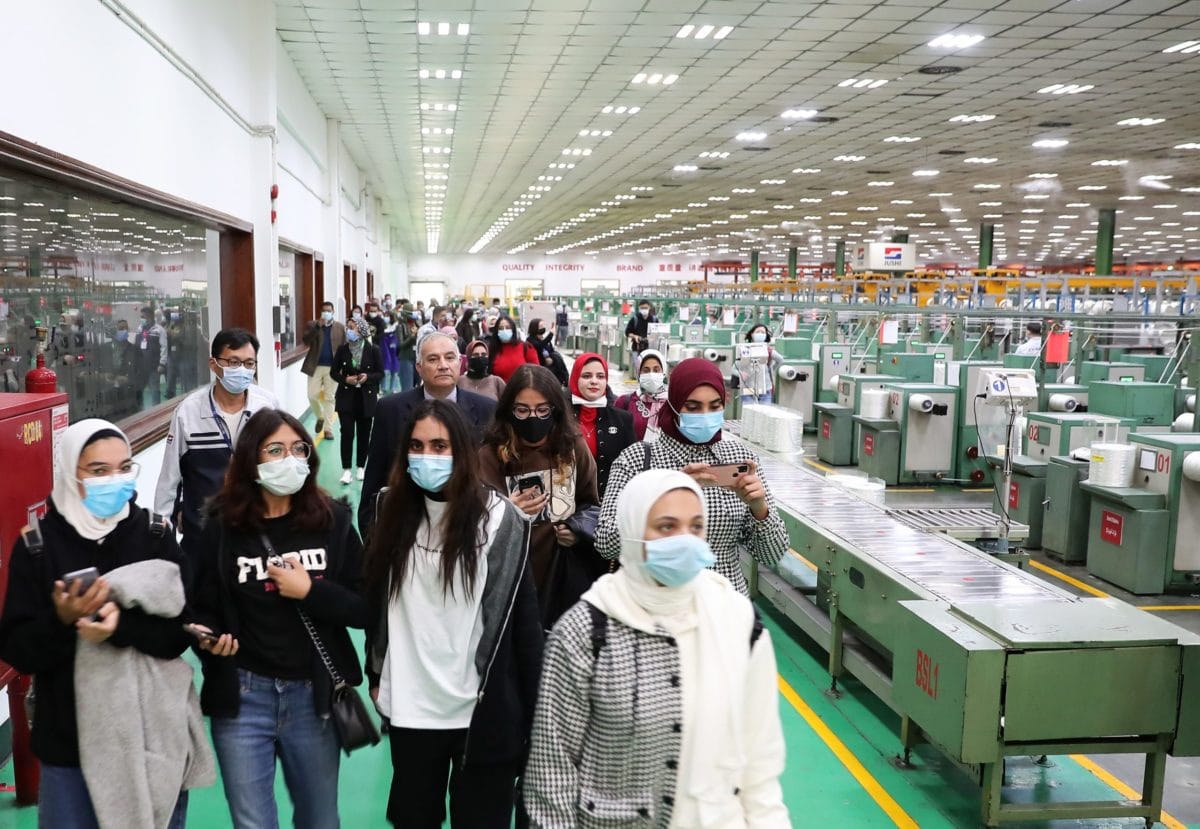
Egyptian students visit the factory of China's fiberglass manufacturer Jushi Egypt, located in China-Egypt TEDA Suez Economic and Trade Cooperation Zone, Egypt, December 2021\. Wang Dongzhen/Xinhua via Getty Images
Similar in many ways to conventional zone models backed by Western donors, the SETC-Zone is a geographically delimited area that offers fiscal and regulatory incentives to Chinese investors to stimulate their overseas production. And yet it also displays unique features that shed light on China’s particular approach to overseas zone-based development, chief among which is the central role of Chinese regional governments in developing and operating these ventures.
Chinese policymakers argue that regional cooperation has the potential to promote industrialization and development in host economies by allowing domestic firms to strategically couple with Chinese-led production networks in similar industries. As platforms for initiating cross-border regional relations, economic zones are supposed to encourage the development of links between firms and facilitate the diffusion of economic activity, thus improving standards of living in host regions. This vision has been scaled up in the emerging plans for connectivity and cooperation under China’s Belt and Road Initiative, with several countries in the Middle East and Africa slated to construct additional industrial cooperation zones.
The SETC-Zone has succeeded in creating an open trading environment in Egypt for the operation of Chinese firms. Yet its roadmap and the provisions that govern its operation do not accommodate the types of proactive policies required to develop domestic linkages, promote capabilities and generate broad-based development. After 15 years in operation, the dynamics between firms that have emerged indicate that the SETC-Zone model maintains global, free-market patterns of production, as opposed to promoting domestic industrial development. These dynamics have allowed firms to expand globally in search of markets and resources while constraining host economies to a limited position in the international division of labor.
## **Egyptian-Chinese Cooperation in the Suez Zone**
Economic zones are one of the primary tools that helped drive job creation and growth in post-reform China, a period in the late 1970s when Chinese policymakers began leading the country away from a planned economy and opened it to foreign trade and investment. By facilitating the transfer of development resources and productive investments to strategically located regions inside China, the government’s economic zone strategy catalyzed domestic industrialization. Its implementation helped to increase value-added in the manufacturing sector, enhance capabilities and gradually transition production from labor-intensive activities to knowledge-intensive innovative manufacturing, thus enabling the economy to achieve extraordinary structural impacts.[\[1\]](#%5Fedn1)
According to Chinese policymakers and advocates of China-Africa cooperation, overseas zones spearheaded by Chinese companies provide host countries with the opportunity to replicate the Chinese development experience.[\[2\]](#%5Fedn2) The relocation of Chinese enterprises into these zones can potentially help build up industries in the same value chains, boosting local economies and creating the conditions for initial industrialization. China’s Suez Economic and Trade Cooperation Zone in Egypt offers a unique perspective on the development outcomes of Chinese zone initiatives and the implications of Chinese industrial cooperation initiatives in the Middle East and North Africa region more broadly. With a capital intensity level of $700 per square meter, the SETCzone is regarded as a success story of China’s Africa economic zone program for the significant amount of investment capital it has attracted, motivating plans for a 6km expansion of the zone’s starting area.[\[3\]](#%5Fedn3)
The SETC-Zone was launched in 2008 as a joint venture between Chinese zone developer Tianjin Economic-Technological Development Area (TEDA) Investment Holdings—a subsidiary of the Tianjin municipal government—and the Egyptian Chinese Company for Investment, which holds a minority stake and is a consortium of Egyptian state-owned enterprises (that also includes TEDA as a minority shareholder). TEDA established Egypt TEDA Investment Company, a country-based affiliate to develop the SETC-Zone on a 1.34 km square plot of land in the third sector of Egypt’s then 223 km square special economic zone in the Suez Canal area, directly adjacent to the port facility of Ain el Sokhkna along the Red Sea coast.
Egypt TEDA invested a majority of the capital in the zone. The local partner Egyptian Chinese Company for Investment provided the land—obtained at below market cost—and acted as a contract partner with the role of providing external and off-site infrastructure such as link roads, and services such as extending water, electricity and power lines. Egypt TEDA, however, took on construction of the zone’s infrastructure, buildings and roads, as well as the provision of sanitation and utilities through public private partnerships and build-operate-transfer contractual arrangements. Masterplans and development strategies were provided by the Chinese partner with limited local participation in zone planning and high-level management. Together with the China-Africa Development Fund, a venture capital instrument of the central government of China, Tianjin Investment Holdings controls 75 percent of Egypt TEDA’s shares. Along with a further 5 percent owned by a company controlled by Tianjin TEDA, the SETC-Zone is effectively a Chinese state-run project.
From the Chinese perspective, establishing the zone was meant to provide a secure environment and standardized management for offshoring Chinese enterprises in a space designed around their needs. In doing so, China hoped to facilitate its strategy of what some scholars have called “going global in groups” in reference to both the internationalization of Chinese firms and the formation of agglomeration economies in host locations.[\[4\]](#%5Fedn4) This plan is consistent with the broader objective that motivated the launch of the economic and trade cooperation zone program and justified heavy capital investment by the Chinese state. But the strategic location of the Suez region at the heart of global trade routes provided a particularly strong incentive for the relocation of Chinese manufacturing firms into the area, and it granted the SETC-Zone unique status among other economic zone initiatives.
For Chinese companies engaging in trade in the Middle East and also in transatlantic trade with West African and North American markets, locating production near the Suez Canal significantly reduces the distance to consumer markets, thus saving time and operational costs associated with long-distance transport. Egypt has implemented a series of preferential policies directed at Chinese investors to further lower costs for Chinese producers and encourage export firms currently operating in China to relocate into the zone. To attract Chinese investment, Egypt enacted selective trade liberalization and investment facilitation measures that include regulatory and fiscal incentives, administrative support, tailored infrastructure and a range of other services. Production elements like labor, land, energy and transportation are also made available at a reduced cost.
But perhaps one of the most important strategic advantages of the SETC-Zone is a provision in its regulatory framework that gives foreign exporters access to Egyptian Certificates of Origin. These documents permit companies to claim their products are Egyptian, thus allowing firms to make use of Egypt's preferential trade agreements and international trade deals. Obtaining Egyptian certificates guarantees Chinese firms access to markets in the United States, European Union, Turkey and other Middle Eastern markets free of custom duties and other non-tariff barriers, as well as allowing Chinese firms to bypass barriers and quotas on exports from China. Such access is crucial for enabling the expansion of China’s international trade, rendering the SETC-Zone a key instrument in supporting China’s export policy and core interests in the region and beyond.
For domestic government actors the primary advantage offered by the zone appears to be increased opportunities for rent-seeking and assured access by state-owned enterprises to infrastructure contracts. Since it provided the land, the Egyptian Chinese Company for Investment receives a portion of the profits from its sale to investors once the land is fully developed according to its share of the original investment. As the main developing company it also benefits from privileged access to contracts for initial infrastructure provision. Proceeds from taxes and Suez Canal transit fees are directly accrued by state authorities overseeing the Suez Canal region.
> **Contrary to China’s own developmental approach, where central state institutions play an important role in supporting industry and developing the export capacity of local firms, local Egyptian authorities have done little to support the emergence of firm linkages that would help develop the export industries of the Suez region.**
Contrary to China’s own developmental approach, where central state institutions play an important role in supporting industry and developing the export capacity of local firms, local Egyptian authorities have done little to support the emergence of firm linkages that would help develop the export industries of the Suez region. Such linkages are crucial if the zone is to act as a developmental spearhead and contribute to the area’s growth and development. Similarly, neither the zone’s top (Chinese) managers nor the Chinese Ministry of Commerce, which oversees the economic zone program, put forward plans to connect Egyptian firms with the zone.
On one hand, the way the SETC-Zone has operated thus far replicates the rentierism of Egypt’s political economy.[\[5\]](#%5Fedn5) On the other hand, the policy space available to domestic authorities to promote such cooperation is extremely limited. Weak domestic leadership coupled with heavy Chinese capital investment has allowed Chinese actors to monopolize zone planning, management and investment promotion. Each of these aspects (and indeed the zone’s general orientation) prioritize trade liberalization and investment facilitation in the interest of enabling the free flow of Chinese goods and capital over state-centered solutions that target domestic Egyptian industry. Such measures are not driven simply by the market-oriented goal of profit maximization. Rather, they can be viewed as part of a wider Chinese government agenda that uses commercial entities for strategic purposes related to internal development.[\[6\]](#%5Fedn6)
## **The History of China’s Economic Zone Program**
China’s overseas economic zone program was launched in 2006 as part of its “Going Global” campaign. Building upon 20 years of growing international engagement, this initiative aimed to increase Chinese manufacturing investments abroad and find new markets for Chinese goods and services. Announced during the Third Forum on China-Africa Cooperation, the gradual rollout of the global zone program began with the development of six zones in Africa to serve as a cornerstone of China-Africa cooperation: two in Nigeria and one each in Egypt, Zambia, Mauritius and Ethiopia.
The program was launched at a time when Chinese industry was beginning to shift toward knowledge-intensive innovative manufacturing. Departing from an overseas direct investment strategy oriented solely toward natural resource extraction, Chinese policymakers adopted a new approach of relocating China’s manufacturing industries to boost domestic restructuring and to gain access to additional markets abroad. Overseas zones provided a means to facilitate industrial relocation, while introducing industrial cooperation as a new component of China’s relationships in Africa and beyond.
The logic behind the planning and design of economic zones also reflects conceptual and material shifts in the contemporary global economy. The spatial paradigm underpinning the economic zones model is consistent with global trends of using open trading environments to facilitate the cross-border flow of goods and capital. Their mode of delivery fits within an emerging global consensus focused on international cooperation to ensure the provision of tailored facilities for cross-border production and trade and that jointly finance the infrastructure gap present in the world economy.[\[7\]](#%5Fedn7) Finally, an assessment of the common features of Africa’s economic zones reveals that the development approach they engender converges with mainstream development practices that are focused on deregulating key sectors in host economies and on global market integration and free trade. This approach stands in contrast to the more state-centered solutions that characterized China’s own growth path.
But it is not enough to make broad assertions about the reproduction of free-market ideas and practices in China’s overseas development projects. On the ground and in development scholarship and practice little is known about the actors and processes that enable concrete operations integrating China deeper into the world economic system. African economic zones offer crucial insights into the particular spatial strategies and relevant agencies involved in the implementation of China’s proliferating economic zones.
## **The Role of Subnational Regional Agency in China’s Overseas Initiatives**
While multiple stakeholders are involved in economic zone initiatives, the central role of Chinese provinces and regions is key to understanding how China’s internationalization is planned and realized, and for assessing the likely outcomes for host countries. Chinese economic zone planning has adopted a unique model in which the government delegates the development and operation of overseas initiatives to Chinese companies at the municipal or provincial level.[\[8\]](#%5Fedn8) The devolution of responsibility to subnational actors is rooted in a domestic Chinese planning agenda centered on regional development and reflects an emerging trend of regional cooperation between China and its development partners.[\[9\]](#%5Fedn9)
> **Chinese economic zone planning has adopted a unique model in which the government delegates the development and operation of overseas initiatives to Chinese companies at the municipal or provincial level.**
The construction and development of each of the six economic zones relied on seed money provided by a different Chinese company. These developers are either direct subsidiaries of local Chinese governments or large provincial firms (either private or state owned). Developers (such as TEDA) were expected to generate enough revenue to support the development phase—the physical build-up of zones, including infrastructure, warehousing facilities, administrative buildings and housing as well as future expansions. Additional sources of financing were made available by Chinese government bodies to ensure the successful implementation of economic zones. For example, the Chinese Ministry of Commerce provided monetary assistance to subsidize pre-construction and implementation costs and state banks and venture capital funds offered low-cost finance and equity participation. All of this support is indicative of the guidance provided by the central government and the strong links between the zone programs and policymaking on the national level.
\]Nevertheless, from their inception the aim was for zones to eventually operate independently of central government support, following a domestic Chinese Special Economic Zone institutional system where subnational regional actors take the lead on expanding fixed asset investments to facilitate economic activity. The practice of fiscal and administrative decentralization was inscribed in the main criteria set by the central government in selecting overseas zone developers. The criteria required proof of financing capacity by the developer and a proven track record in implementing a major construction engineering project as a means of ensuring independence from the central state.
In cases where the developer is affiliated with a municipal Chinese government the latter is the main shareholder in the zone. There are varying arrangements for infrastructure delivery in partnership with domestic governments, but in most cases regional Chinese developers are responsible for on-site infrastructure delivery and, due to heavy capital expenditure, own majority shares in economic zones. As an example, the initial investment in the SECT-Zone was made by Tianjin TEDA, a subsidiary of the regional Tianjin government, using its own capital with only a small participatory stake by the domestic partner Egyptian Chinese Company for Investment. Similarly, the sole developer of the Mauritius Jinfei Economic and Trade Cooperation Zone is Shanxi province Tianli Group, a provincial state-owned enterprise active in trade, construction, real estate and textiles.[\[10\]](#%5Fedn10)
In cases where the zone developer is a private enterprise, regional state-owned enterprises will act as technical partners on the project as a way of maintaining links to regional authorities. Ethiopia’s Eastern Industrial Park, for example, is fully owned and run by Jiangsu Qiyuan Group, a private Chinese enterprise based in Zhangjiagang city in Suzhou municipality that is active in steel pipe and aluminum production. The Ethiopian industrial park is modeled on and receives support from the regional government-led Suzhou Zhangjiagang Free Trade Zone, however, maintaining a key role for regional Chinese actors in its operations.
## **Globalization with Chinese Characteristics**
The economic zone program’s financing mechanism and model of engagement is underpinned by a strategy designed to deepen the global economic integration of China’s regions. China is redefining globalization with its own characteristics, which can be better understood by examining China’s domestic development processes and the variety of actors involved in their implementation.
A globalization strategy based on international regional integration emerged from the context of China’s domestic regional planning and development policies. In the late 1970s during the early years of China’s market reforms, regions were positioned by the central government as engines of growth for the national economy. Regional development interventions were concentrated in eastern coastal areas during this phase but later a more comprehensive strategy of coordinated regional development was launched to close the gap between the more and less developed regions. At the turn of the century, government statements on regional coordination and development began featuring an emphasis on developing international regional linkages with the rest of Asia and beyond, signaling a new phase in the evolution of China’s regional policy.[\[11\]](#%5Fedn11)
International regional integration would allow local governments to pursue their particular commercial interests within a broader national strategy of rebalancing China’s economy by exporting surplus capital overseas.[\[12\]](#%5Fedn12) Critically, a strategy focused on promoting a diverse range of trajectories would enable Chinese regions to pursue and maximize their specific competitive advantages, leveraging different segments in the Chinese economy. Companies winning bids to develop economic zones will therefore have assessed the market potential, local industrial base and geographical advantages of the host countries where their proposed zones would be located, also ensuring its compatibility with their home region’s production structure and the priorities of local manufacturing investors.
The sectoral orientation of the African zones reflects the imperative of pursuing diverse regional development pathways. The Zambia-China Economic and Trade Cooperation Zone/Chambishi multi-facility economic zone, for example, was established by China Nonferrous Mining Company and focuses on raw material extraction and processing in the value chain of copper and cobalt, allowing the firm to optimize its advantages. The Egyptian SETC-Zone on the other hand hosts enterprises from the Tianjin region that specialize in industries compatible with the local industrial base, including textiles and garments, drilling machinery and electrical transmission equipment, and which can capitalize on the Suez Canal’s locational advantage.
China’s strategy of opening up thus builds on the country’s decades-long development trajectory, in which investment and trade liberalization is combined with controlled decentralization of state power to regional authorities. It also suggests a vision for economic globalization under Chinese leadership based on the idea of developing cross-border regional linkages on a global scale.[\[13\]](#%5Fedn13) The economic zone program was among the first endeavors aimed at realizing this broadly envisioned geography, providing a means to accelerate the opening up of China’s regions and serving a bridging function between Chinese and other localities. In a way, the economic zone program acted as a pilot for cross-border regional cooperation, globalizing China’s subnational regional policy model to facilitate international regional cooperation and help Chinese regions achieve strategic economic advantage.
In recent years Chinese policymakers have increasingly framed the country’s overseas cooperation zone program in the context of the Belt and Road Initiative, which has come to be the overarching framework for China’s international integration. Launched in 2013 by President Xi Jinping, the initiative encompasses over 100 countries along a maritime road and territorial belt. The aim of the project is to enhance Chinese-centric global connectivity by linking “core cities along the Belt and Road and using key economic industrial parks as cooperation platforms,” according to its vision document.[\[14\]](#%5Fedn14) Specific development plans build on various existing initiatives launched within the China-Africa cooperation framework, including economic zones in Egypt and Ethiopia, and separate projects in Kenya, Tanzania and South Africa. The Belt and Road Initiative thus seeks to elevate preexisting ideas and practices implemented at the subnational level, leveraging the benefits of existing zone initiatives while deepening and diversifying ties and business opportunities for relocating Chinese firms.[\[15\]](#%5Fedn15)
## **The Opportunities and Constraints of Chinese Regional Development Cooperation**
The SETC-Zone project was established with the aim of supporting the export of excess Chinese industrial capital, opening new markets for Chinese products and increasing international demand for Chinese manufactured goods. After the announcement of the Belt and Road Initiative in 2013 and a concurrent announcement in 2015 by the Egyptian government of an urban and economic regeneration project in Suez, the SETC-Zone assumed a new level of importance as a flagship for Egyptian-Chinese cooperation.
The SETC-Zone’s operational framework and track record thus far provides insights into the types of outcomes that can be expected from enhanced cooperation with China. A key claim of the SETC-Zone is that it is modeled on the domestic variant of Chinese cooperation zones and guided by the same rationale. Early Chinese zones were similarly marked by labor-intensive manufacturing, provided broad incentives and were expected to play the same role of expanding investments, generating employment and stimulating growth. From their inception, however, and contrary to what has happened in the SETC-Zone, the focus of domestic Chinese zones went beyond the aim of attracting foreign investments. Domestic Chinese manufacturing zones were underpinned by a staged vision for development that entailed shifting the comparative advantage of regional economies from low to high value-added production. This vision relied on establishing connections with foreign firms to facilitate the transfer of knowledge and technology to domestic firms while also creating the conditions for the development of backward linkages to the local economy—a necessary condition for regional regeneration and the long-term structural change they facilitated.[\[16\]](#%5Fedn16)
In contrast, after almost two decades in operation, the SETC-Zone remains an enclosed space for the relocation of offshoring Chinese firms, relying heavily on incentives with no substantial backward linkages to the local economy. Chinese enterprises remain the dominant, and in some sectors the exclusive, providers of component parts and services to zone-based firms while the participation of Egyptian producers in the value-adding process is either restricted or heavily controlled. This situation leaves minimal opportunity for the transfer of knowledge and technology to local firms. Data on production gathered directly from six SETC-Zone investment projects in the heavy industry and textiles sectors reveals that the exclusion of the domestic private sector from zone-based activity arises from zone-based firms systematically engaging Chinese rather than domestic input suppliers. This tendency appears to be linked to a broader imperative by Chinese firms to retain control of all stages of labor-intensive manufacturing chains rather than outsourcing operations to domestic firms.
> **Chinese enterprises remain the dominant, and in some sectors the exclusive, providers of component parts and services to zone-based firms while the participation of Egyptian producers in the value-adding process is either restricted or heavily controlled.**
The vertical integration of Chinese value chains is a feature that cuts across the different industrial sectors present in the SETC-Zone, despite considerable variation in strategies adopted within each sector. In the heavy industry sector, for example, firms are upstream suppliers directing their product flow of component parts to regional markets. Among the largest enterprises in this sector is International Drilling Material Manufacturing, which produces casing and tubing used in drilling and pipeline equipment and sells its merchandise to large international oil companies operating in the Suez Canal and the Mediterranean deepwater ports.
Other zone-based firms are downstream suppliers, importing unfinished products from their parent firm in China and assembling them for distribution in local and regional markets. Small and midsized enterprises in the textile sector, for example, provide assembly services to the main manufacturing supplier factories in China, importing all the primary commodities used in production such as fabrics and yarn and directing finished products such as scarves and blankets to the local market.
In both patterns of cross-border production the key organizing principle is intrafirm collaboration, where lead firms retain control of all stages of the value-adding process rather than disaggregate production to local suppliers. In rare cases where production of component parts is localized (the production of transformers used in the development of power plants for example), the inputs sourced from local vendors are typically low in complexity with few standard requirements, keeping buyer-seller coordination requirements and hence learning opportunities, relatively low. According to supply chain logic, in chains characterized by such relationships, the prospects for upgrading manufacturing processes or expanding the customer base to additional purchasing firms are lower. The absence of domestic linkages has allowed the zone to develop as an exclusionary node for value creation in China’s unbundled value chains. The zone’s near complete administrative autonomy enhances its enclave structure and reflects a core emphasis by the zone operator, Egypt TEDA, to create an open trading environment linked to Chinese regions but isolated from the rest of the Egyptian economy.
The strategies of offshored Chinese firms provide useful insights and a strong basis for evaluating the impact of Chinese zone cooperation on the development pathways of host regions. While broad conclusions cannot be drawn from the particular context of a single economic zone project, mounting evidence suggests that Chinese zones elsewhere display similar features, with many developing as enclaves segregated from their host regions. A deliberate strategy of setting up economic zones to function independently of their local setting enhances their separation and decreases the capacity of national-level institutions to intervene in their operations. The concept of enclave development stands in opposition to the dominant narrative about what Chinese zones aim to achieve. Without channels for domestic firms to create strategically beneficial global connections, Chinese zone initiatives may create limited jobs and perhaps even generate a degree of economic growth. But they will have limited capacity to initiate the type of long-term structural change that will allow host economies to gradually climb up the development ladder.
Significantly, the SETC-Zone and similar cases point to common features and outcomes of Chinese-led production relations and regional cooperation. Such initiatives appear to engender the same uneven power relations that have typically characterized relationships between host countries and their industrialized partners in the Global North. The logic that underpins and animates them is linked to the idea of improving the competitive performance of offshoring firms with the expectation that the benefits of firm-led development will trickle down to surrounding communities.[\[17\]](#%5Fedn17)
If this situation reveals anything, it is that Chinese manufacturing zones reproduce free-market patterns in production organization; they facilitate the flow of capital and goods from Chinese regions to world markets, supporting the internationalization of Chinese regions while ultimately consigning host economies to a dependent position in an emerging international division of labor led by China.
\[Safa Joudeh is a doctoral candidate at the Department of Development Studies, SOAS, University of London.\]
---
### **Endnotes**
[\[1\]](#%5Fednref1) Xiangming Chen, "Change and Continuity in Special Economic Zones: A Reassessment and Lessons from China," *Transnational Corporations Journal* 26/2 (2019).
[\[2\]](#%5Fednref2) Fantu Cheru and Arkebe Oqubay, "Catalysing China-Africa Ties for Africa’s Structural Transformation: Lessons from Ethiopia," in Arkebe Oqubay and Justin Lifu Yin, eds. *China-Africa and an Economic Transformation* (Oxford, UK: Oxford University Press, 2019).
[\[3\]](#%5Fednref3) Egypt TEDA 2016 Development Report.
[\[4\]](#%5Fednref4) Deborah Bräutigam and Xiaoyang Tang, "’Going Global in Groups:’ Structural Transformation and China’s Special Economic Zones Overseas," *World Development* 63 (2014).
[\[5\]](#%5Fednref5) Yezid Sayigh, "Owners of the Republic: An Anatomy of Egypt’s Military Economy," Carnegie Middle East Center (2019).
[\[6\]](#%5Fednref6) Deborah Bräutigam and Tang Xiaoyang, "Economic Statecraft in China's New Overseas Special Economic Zones: Soft Power, Business or Resource Security?" *International Affairs* 88/4 (2012).
[\[7\]](#%5Fednref7) Zhigao Liu, Seth Schindler and Weidong Liu, "Demystifying Chinese Overseas Investment in Infrastructure: Port Development, the Belt and Road Initiative and Regional Development," *Journal of Transport Geography* 87 (2020).
[\[8\]](#%5Fednref8) Deborah Bräutigam and Tang Xiaoyang, “China’s Investment in Special Economic Zones in Africa: Overview and Initial Lessons,” In Thomas Farole and Gokhan Akinci, eds, *Special Economic Zones: Progress, Emerging Challenges, and Future Directions* (Washington, DC: The World Bank, 2011).
[\[9\]](#%5Fednref9) Tomasz Kamiński, Adrianna Skorupska and Justyna Szczudlik, *The Subnational Dimension of EU-China relations* (Polish Institute of International Affairs, 2019).
[\[10\]](#%5Fednref10) Brautigam, “China’s Investment in Special Economic Zones in Africa.”
[\[11\]](#%5Fednref11) Tim Summers, "China’s ‘New Silk Roads’: Sub-National Regions and Networks of Global Political Economy," *Third World Quarterly* 37/9 (2016).
[\[12\]](#%5Fednref12) Lee Jones and Jinghan Zeng, “Understanding China’s ‘Belt and Road Initiative’: Beyond ‘Grand Strategy’ to a State Transformation Analysis,” *Third World Quarterly* 40/8 (2019).
[\[13\]](#%5Fednref13) Summers, "China’s ‘New Silk Roads’: Sub-National Regions and Networks of Global Political Economy."
[\[14\]](#%5Fednref14) “[Vision and Actions on Jointly Building Belt and Road](http://2017.beltandroadforum.org/english/n100/2017/0410/c22-45.html),” National Development and Reform Commission, Ministry of Foreign Affairs, and Ministry of Commerce of the People's Republic of China, 2015.
[\[15\]](#%5Fednref15) Summers, "China’s ‘New Silk Roads’: Sub-National Regions and Networks of Global Political Economy."
[\[16\]](#%5Fednref16) Chen, "Change and Continuity in Special Economic Zones: A Reassessment and Lessons from China."
[\[17\]](#%5Fednref17) Thierry Pairault, "[China in Africa: Phoenix Nests Versus Special Economic Zones](https://hal.archives-ouvertes.fr/hal-01968812)," Working Papers, hal-01968812, HAL (2019).
### Currencies of Power
URL: https://www.merip.org/2022/08/currencies-of-power/
Last updated: 2025-08-28T15:25:53.000Z
The summer 2022 issue of *Middle East Report, “*Currencies of Power,” examines the contemporary global economy to highlight how global capital is suffocating the region’s working classes.
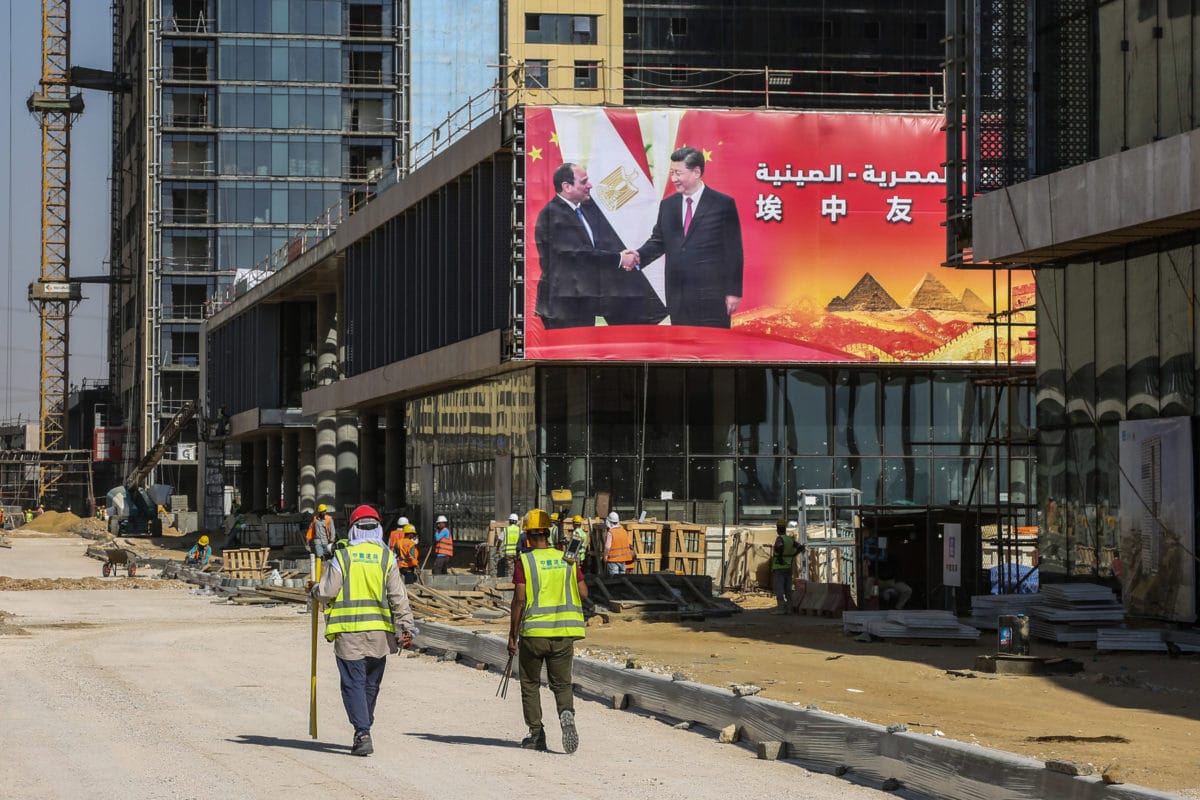
A billboard displays an image of Egyptian President Abd al-Fattah al-Sisi and Chinese President Xi Jinping in the central business district of Egypt's New Administrative Capital under construction east of Cairo, July 27, 2022\. Islam Safwat/Bloomberg via Getty Images
MERIP has always been dedicated to issues of justice in the Middle East and North Africa—in Palestine, for gay and trans people and for victims of US imperialism and its dependent dictatorial regimes. But when it began in 1971 MERIP was also committed to a materialist political economy perspective and Marxist frames of analysis. Articles covered regional relations with the Soviet bloc and the (often largely symbolic) socialist features of the postcolonial Arab governments.
The emphasis on material conditions is especially visible in the 1986 [Wealth & Power](https://merip.org/magazine/142/) issue, which profiled the rise of a new bourgeoisie that siphoned wealth from the dismantling of state assets and capitalized on financial inflows from the United States and international banks. By this time the region’s post-independence experimentation with “land to the tiller” redistribution programs and sizable investments in social infrastructure were being reversed, catalyzing its slide into greater and greater levels of inequality. The increasing divide between the beneficiaries of surplus capital and those who produce it is, of course, not restricted to the Middle East. The imperative to grasp the global nature of capitalism’s evolution and how its modes of exploitation emerge in geographically specific ways suggests, however, that the region should be more central to how these processes are understood.
The authors of issue 303 make a significant contribution to the understanding of these regional specificities and how they inform our current capitalist moment. Among their topics is the role played by the unprecedented flood of Arab Gulf petrodollars into US and European banks in the 1970s that drove the development of exotic financial instruments at the heart of contemporary financial crises. The almost-but-not-quite-mutually assured destruction that now characterizes US and Gulf financial entanglements is the subject of David Wight’s article in this issue. Financialization enabled many forms of socially un-productive development in the region, notably through mega-projects like Egypt’s Media Production City. Mariz Kelada’s article demonstrates that although these projects offer opportunities for land speculators and investors to accumulate capital, it is the subcontracted, precarious and so-called informal labor operating outside this sphere that produces the authenticity critical to the cinema and film industry.
Anna Simone Reumert writes of Sudanese laborers forced to trace and re-trace the erratic and unpredictable flows of regional capital, another form of precarity experienced by workers throughout the region. The speed and ease with which huge sums of capital can move (in this case, out of Lebanon) stands in stark contrast to the laborious relocation that migrant workers must constantly negotiate in both space and social position. Their movement creates new channels for extraction and accumulation in existing centers of capital, becoming part of the work itself, and perhaps suggesting new dimensions for defining labor in the twenty-first century.
Capital’s need to intensify the rate of exploitation and widen its field of extraction continues to produce novel and disturbing arrangements that generate seemingly endless returns to holders of capital and worsening conditions and declining wages for labor. Grotesquely, these novelties are often peddled as emancipatory innovations that will empower workers, but in fact they are vehicles for intensifying inequality. Ali Rıza Güngen examines how “financial inclusion,” a development strategy to assist the poor by increasing their access to formal financial institutions, has unfolded in Turkey. Technocratic calls for “banking the un-banked,” establishing financial literacy programs and expanding consumer lending mostly just generates revenue for financial services firms and professional NGOs that purport to deliver these services to the poor. The underlying problems of widespread stagnant wages, wage theft, exploitation and the erosion of public safety nets will require formal schemes for wealth redistribution and social provision, not farming out service contracts to banks and private firms.
Grandiose claims of economic liberation and populist utopia are perhaps strongest in discussions of cryptocurrencies (Bitcoin, Ethereum, Terra and thousands of others), although this narrative has deflated as the values of these speculative assets continue their steep decline. Author Hadas Thier pushes back against crypto advocates who claim these products can liberate populations cut off from the broader financial system (Palestinians and Iranians in particular). Any emancipatory potential would require decentralized ownership of crypto reserves, but the vast majority are held by so-called whales that use them as a speculative investment asset to earn revenues based on global economic volatility. They only rarely function as actual currencies—and even then, the major sanctioning entities (intelligence agencies, global financial institutions, insurance companies) often have unacknowledged access to the encrypted blockchain technologies, ensuring that cryptocurrencies are subject to the same imperial checks as the traditional financial system.
Like alternative currencies, we also see the limitations that capitalism places on non-Western development models, specifically China’s activities in Egypt and throughout the African continent. Safa Joudeh demonstrates that although Beijing is praised for its less extractive forms of overseas investment, the underlying motivation is to accommodate the capitalist imperatives that are putting pressure on China’s own economy. As it seeks to increase the levels of technology involved in its domestic production processes, and to establish supply chain links that give it faster access to global markets, China is outsourcing the simplest phases in the production process to enclave zones in Egypt and elsewhere. The linkages that mainstream economists claim will organically emerge from these forms of overseas investment—bringing more jobs and diversified production—remain unrealized.
This issue also includes a review by Gilad Wenig of Kyle Anderson’s new book *The Egyptian Labor Corps: Race, Space, and Place in the First World War.* Anderson’s book investigates the wide array of coercive forms of labor control that made possible the expansion of capitalism in the Middle East, specifically the extent to which racial classifications were central to imperial British policies in Egypt during the First World War. The book also shows how, in turn, these policies helped produce a form of racial nationalism in the country, one that pronounced itself in the 1919 Revolution and efforts to resist British control.
All the pieces in this issue highlight the ways that our current iteration of capitalism shapes (and is shaped by) the political economy of the Middle East. Despite its contributions to understanding empire, the Middle East is rarely considered a locus for the development of ideas about material political economy, much less histories of capitalism. But the near-incomprehensible rise in global inequality and proximate ecological collapse caused by capitalism has prompted a return to class analysis and the agents that drive inequality. We should take advantage of this moment to expand scholarship that addresses the unique capital formations and working class struggles that define the region. A better understanding of how the political economy of the Middle East and North Africa is central to the forms and dynamics of global capitalism will not only help observers theorize the end of capitalism but can also lead to greater solidarity with the people whose lives are most at risk in this revolutionary process.
\[The editors of issue #303, “Currencies of Power,” are Shana Marshall, Najib Hourani and Hesham Sallam with Guest Editor Kevan Harris.\]
### Rethinking Informal Labor Through the Lens of Film Production in Cairo
URL: https://www.merip.org/2022/07/rethinking-informal-labor-through-the-lens-of-film-production-in-cairo/
Last updated: 2025-08-22T18:37:11.000Z
During one long 28-hour workday in 2020, a crew from an Egyptian media production company was busy filming inside an old building and spilling into the narrow alleyways of a Cairo neighborhood already full of shops and pedestrians.

Technicians installing light defusing frames in preparation for filming, Egypt 2021\. Maged Nader
Although it seemed impossible that the massive equipment and actors’ caravans would fit, the crew was able to place the trucks snug against the buildings, leaving just enough room for one or two people to pass. High voltage cables from the generator truck extended to the third floor of the building, mingling with the festive, colorful flags that zigzagged between balconies. Residents peeked from their windows and balconies to watch the commotion. Thankfully on this set—where the crew was filming a Ramadan television series—there were only a few minor arguments with those living in the neighborhood, which the production manager and the local fixer managed to quell.
Filming on location, or in the real world, attracts people from all walks of life, creating intense zones of contact and sometimes conflict. There are stories of film crews being kicked out of neighborhoods and of tensions escalating to physical violence. Crews that convert streets from their usual functions as places of dwelling, work and transportation into “artistic” sites for filming (whether for cinema, television or advertising) must be constantly ready for conflict and always calculating the risks.
The arrangements required to secure a filming location outside the predictable space of the studio illuminate the entanglements between the media and the city—not only symbolically and aesthetically but also economically, socio-politically and physically. In addition to the multiple necessary permits from the Egyptian government, and the systematic logistical preparations standard for any media production such as script breakdowns and scouting, filming in Cairo requires complex yet seemingly informal agreements with the people who have immediate authority over their streets. These people include kiosk owners, doormen and low-ranking traffic officers, who can render the state-issued permits useless if they wish. Media producers need to skillfully collaborate, negotiate and work with this structure of informal authority.
> **Filming in Cairo requires complex yet seemingly informal agreements with the people who have immediate authority over their streets.**
Filmmakers still rely heavily on the aesthetic authenticity of Cairo’s streets, despite the availability of private and government-owned studios and backlots, including the massive Media Production City (established in 1986). The unique historic architecture of certain areas—like Heliopolis or Shubra, the dense ambiance of popular areas like Ein Al Sira or Boulaq or the inimitable mise-en-scène of the downtown—cannot be easily replicated. This reliance on the city as a set, however, is also based on financial calculations by the producers—sometimes it proves economically advantageous to rent parts of the city rather than build them.

Residents peak from their balconies to watch the filming. Shoubra, Egypt, 2020\. Mariz Kelada
Despite the substantial budgetary allocations for filming on location, production companies depend on a highly precarious and contingent labor force. Mohamed Serour, the late president of the Cinema Workers’ Trade Union, estimated that there were around 5,400 technical workers across the 18 professions he registered with the Egyptian Ministry of Labor in 2017, although the number may be much higher.[\[1\]](#%5Fedn1) The *usta* (Arabic for craft master) hires and manages most of these workers, who include lighting technicians, wardrobe assistants, set builders, location services personnel and hairstylists. Although the head of each crew is likely to have an employment contract, those working for him generally do not have any job security, such as accident insurance or a period of guaranteed employment. While production budgets for films and television series range between approximately $1.6 million and $5.5 million, workers’ pay is a minor fraction of these budgets. For example, at the high end, between 2019 and 2020 (prior to the recent waves of inflation), a production assistant could earn approximately $80 per week on a television series, while a lighting technician could be paid as little as $14 per week.[\[2\]](#%5Fedn2) Location expenses consume about 10–15 percent of the budget depending on the number of sites, criteria and the shooting duration. Peak employment in this sector corresponds with peak production for Ramadan television series, schools’ summer vacation and major holidays. These informal workers—predominately working-class men with a range of specialized skills—provide the foundational infrastructure for the film industry, but their status as seasonal workers without permanent contracts means that they fit the government category of “irregular labor.”
Policymakers and activists usually perceive informal labor as a problem. For policymakers, informal labor operates outside the state’s regulations and therefore cannot be taxed. For activists, informal laborers lack basic rights like health coverage, minimum wage and social security. Accordingly, informal laborers are either seen as evasive hustlers and stigmatized as criminals or as dispossessed victims of capitalism and failed welfare states. Although these characterizations may carry some truth, they also reduce the complexity of informal laborers’ lives. They obscure the dense processes, tactics and strategies of making a living in the contemporary neoliberal economy. Instead of the polarizing binary of formal versus informal labor, the case of Egyptian visual media—in particular filming in Cairo’s streets—shows that what is characterized as informal labor is not necessarily outside of the formal system. The seemingly informal exists in relation to the formal economy and sometimes even as integral to it. In particular, the system of film production in Egypt relies heavily on a complex network of individualized, informal arrangements and relationships between technical crews (who are themselves considered informal laborers), fixers and city residents.
## **On Location with Production Assistants and Neighborhood Fixers**
To use the city as a film set is no easy feat. “No crew can shoot a minute in Nasr City, for example, without having an agreement with Shabaan,” Hady, a media production assistant in his mid-20s, told me.[\[3\]](#%5Fedn3) Shabaan was a fruit seller in the area and had become a fixer over the years. Although not a formal part of the 10–15-person production crew, the fixer is the go-to person to secure a filming location in the city. Fixers maintain a semi-monopoly over shooting locations, whether apartments, shops or street corners. As Hady elaborated, “He \[Shabaan\] can take up to 10 percent commission from the production budget for locations. In the high season, he can have seven locations running. He wouldn’t be present; he’d still get a commission because his men will be facilitating things.” What Hady referred to as “his men” are the sub-fixers who are the middlemen between the primary fixer and even more localized areas. These sub-fixers enact the main fixer’s authority, but the fixer equally depends on the sub-fixers’ social connections within a particular neighborhood.
Mahmoud, in his mid-50s, has collaborated with Shabaan as a sub-fixer for about ten years. Mahmoud owns a kiosk on a side street in Nasr City and was approached by the production crew of a Vodafone commercial to use his kiosk as a filming location. Since then, this side job has become his primary source of income, and he has even roped his nephews into this line of work while they finished college. Mahmoud spoke about his experiences working as a sub-fixer for Shabaan in 2020:
> *shaa’bysayiessayiesb-yradina*

Placing lighting reflectors on top of the actor’s caravans saved the time and money it would have cost for a professional, more secure, setup. It was only possible because of good relations between the different crews. Heliopolis, Egypt, 2020\. Mariz Kelada
“*B-yradina*” (to appease or make us content) is a striking verb when talking about labor and money. In colloquial Egyptian Arabic, *“yeradi”* signals a mix of “compensating for something” and “buying agreeability,” and can signify a form of charity. The root of the verb is *reda*, which, depending on the context, can suggest satisfaction, contentment, goodwill and gratification. In this case, Mahmoud speaks about informal monetary transactions that are estimated by the payer and then assessed by the receiver as an acceptable amount or not. It is not a tip, although it bears a resemblance because the receiver is someone who facilitates minor tasks as services that are not obligatory. *El meradia* as a form of compensation for doing minor business, is laden with hierarchies of power. Since the verb also connotates “buying agreeability,” it signifies that the payer has more capital than the receiver yet still needs the receiver’s cooperation and help. Because it is a negotiated exchange and not a formal contractual agreement, there is always room for bargaining and even contestation by the receiver. In other words, in the case above, Shabaan (the person with money and monopoly) is also the person who needs the service that only Mahmoud (the person with immediate authority over his streets) can provide with his communitarian capital and his spatial embeddedness in the texture of the city.
The potential for contestation shows how securing permission to film on location includes more than just the exploitation of informal labor—of both the workers on the film crew and the fixers in the community—it requires a network of relationships with state agents acting on behalf of formal institutions. For example, Mahmoud clarified that he always held onto a copy of the shooting permissions so that no one would disrupt the shooting, including the police. Mahmoud lowered his voice and said: “Yes, they \[the police\] came this morning… but, you know, the local policemen know me well. Even if there is conflict and say we end up at the police station, I’d get us out of it. Everyone on the streets knows me. I know the owner of this nightclub you’re shooting in right now. I’ve been here since it was practically a desert with few buildings.” Mahmoud’s confidence in the strength of his relations with everyone in the area signals his dual capacity to both benefit media-makers by facilitating the filming and to ruin a filming day.
Like many sub-fixers of Cairo’s streets, Mahmoud’s example illustrates the importance of community relations, which are essential to successful filming. Although the fixer role might be viewed as informal and unskilled labor, it is the kind of “relationship management” work that corporations often highly compensate. Cairo’s residents who occupy key locations often manage to wring some money from the hands of fixers. And, in turn, expert fixers like Shabaan who have mastered the art of relationship management can develop a monopoly over certain areas and earn a decent income from the film industry.
## **Navigating the Relationship Between Film Crews and City Residents**
Maher, a veteran producer in his mid-50s, told me once in an interview: “*Kolo bel hob beyefok* \[everyone eases up with love\]. This is how you handle work correctly under this capitalist mania.” I asked, “So ‘love’ is what makes things work, and capitalism benefits from it in the end?” Maher’s very matter-of-fact reply was, “Of course*.”* The expression *bel hob* (with love) is widely used to signify a non-contractual business agreement, where one works without the expectation of payment or a rigid work system. It can be understood as a continuation of *el meradia*, or even that both forms of labor management call each other into existence. For example, if an independent filmmaker needs a cinematographer, they may say, “I do not have a budget so it’s *bel hob.”* Accordingly, the cinematographer would assess if they like the project and the person enough to take the job for free, with the expectation of flexibility and good treatment in exchange for the favor. Yet, the cinematographer expects to benefit as well, in this case from the exposure.

Crowds gather around to watch filming, downtown Cairo, 2019\. Mariz Kelada
On set, the lack of standard terms and rates of compensation for collaboration allows for the possibility of deceit. For example, Ahmed, a production manager in his mid-30s, embodies another articulation of *bel hob* because he is often praised for being fair and kind. A crewmate explained: “Ahmed makes everyone feel appreciated and more human because he does not try to trick people to save money for the producers like most production managers do.” This unique and recurring emphasis on *el hob* tells of the elusiveness of these relational practices that scaffold all the technical labor. Although the word translates to love and resembles a form of diplomacy or human resource management, it refuses the neat application of these terms—it carries a multitude of meanings.
Ahmed complicated the idea that *bel hob* is simply operationalizing niceness or being diplomatic. He emphasized that all the logistical preparations need to be supplemented with a substantive duration of hanging out in the location. He explained “You can’t just like a place and say, let’s film here. I must be in a place for at least a week so that people will get used to me and my face and my presence. You can’t just parachute into a place like that.” A film crew includes at least 120 people, who come with different mentalities and backgrounds. As Ahmed put it, they come “from the highest top to the lowest low of different classes and personalities.” The production crew members mediate and handle all transactions and altercations. I asked Ahmed if conflicts are always resolved with money. He replied with great intensity, “No, not at all. Even if very poor, some people refuse to take money to use their space. While other richer people can be super greedy, like: I want 20k if you want to film in front of my shop. We look like we are spending millions, and they want part of it, but it’s absurd! You must resolve things with them in whichever way. That the filming keeps going, that’s the most important thing.”
In that sense, different types of productions produce different kinds of problems. Bigger productions with famous superstars bring more unwanted attention to the set and require the production crew to fend off more intrusions and higher monetary demands. Karim, another production manager who works mainly in commercials, told me that if you are filming with a big star, “You virtually have to hide them, if you’re shooting for Vodafone \[which for the past ten years has always featured a number of superstars\], you’d say you’re shooting a Pampers or a pasta commercial.”
While trouble-shooting problems on set, film crews also rely on the notion of *bel hob* to find ways to rapidly build rapport with, and gain sympathy from, total strangers on the street to get a task done, such as making a driver wait to pass by until the shot is done. Another way of using *bel hob* is invoking and using personally shared connections, such as people one worked with in the past or even the city or area one is from, to find a middle ground in a disagreement or secure alliances on set. For example, I overheard a colleague on the production crew bragging about how he resolved a parking issue: “I asked him where he is from. He said I’m from Sayeda Zainab. I told him do you know this and that person, and he said yes. I told him, then we’re relatives—and everything worked out.” Another incident that exemplifies the expression in a filming location was when Mostafa, a lighting technician, burst out at the end of a workday from exhaustion and long hours almost yelling: “We’re not counted as humans in this occupation—we’re slaves!” I was walking towards him when I heard this and instantaneously, Abdo, my colleague on the production crew who was standing with Mostafa, called to me half-jokingly, “Come here doctor! Sign off on this,” to defuse the technician's frustration by making him feel heard and validated. When we asked why he endures all this hardship, he paused a second, either hesitating or contemplating, then said: “because my boss is a good character, I can’t possibly let him down or act up and cause problems.”
> **While trouble-shooting problems on set, film crews also rely on the notion of bel hob to find ways to rapidly build rapport with, and gain sympathy from, total strangers on the street to get a task done, such as making a driver wait to pass by until the shot is done.**
These examples point to the multiple factors that are central to understanding how the city uses the film industry but also how the film industry uses the city. The ability to quickly recognize class distinctions and potential points of conflict becomes a profitable skill for production workers and, by proxy, for the film industry at large. They profit off the production workers’ ability to mediate the demands of city inhabitants without incurring the potentially higher cost of recourse to formal mediating institutions, like getting the police to set up professional barricades to block off roads or paying fines to municipal authorities for blocking access to a shopping center. Sometimes these formal state entities do have to be involved and paid, or paid off, especially if filming is occurring in a state-owned or run location like a mosque, touristic sites or a metro station.
On another level, production workers profit from the relationships they develop for the purpose of facilitating filming since it adds to the expert knowledge that elevates their status as good production crews and ensures their promotion. The people of the area may also profit from whatever small compensation they receive in exchange for acquiescing to being filmed, moving their laundry off the line or allowing a microphone to be mounted on their balcony—compensation they might never see if they relied on municipal authorities to distribute it after the fact. There are stark differences between the profits at the different levels of film production and the power attached to them, but each should be understood on their own terms. With that recognition, all the tactics by film crews and residents to benefit from filming on location reveal that the “urban poor” are not simply hustlers operating haphazardly or victims exploited helplessly.
## **Beyond the Binary of Formal and Informal Labor**
Although filming in Cairo’s streets might appear informal and unruly, the processes of using the city as a set to make movies, television shows and commercials rely on the workings of multiple structures, such as class, state, industry, culture and social relations. More significantly, an analysis of media production shows how the people of the city and media-makers resource their knowledge of the city, society and the industry to get their jobs done by forging their own organizing systems. In this case, the experiences of laborers are more dynamic than in poverty discourses that associate informality with backwardness or exploitation. Examining media production practices reveals how an entire industry is dependent on informal precarious labor. This precarity stems not only from insufficient income, security and benefits but also from how the job requires constant recalibrations of risk and reward, personal and professional attitudes and tactics of relationship management.
Filming in Cairo’s streets offers a micro-study of precarious urban labor in Egypt as it moves across different city geographies, from the slums to the elite gated communities and everywhere in between. The production crews, primarily young male precarious workers, interface with diverse communities across the city to make a living. Each of these city areas is semi-autonomous and relies on the authorities of its inhabitants, despite the constant specter of the state’s presence. What can be called “informal labor” has a deeply ingrained legible system of operation that commands considerable authority. These ties are intricately multilayered, yet not completely haphazard, as they can appear at face value. Within these intricate ties, economic transactions happen unconventionally and proliferate, albeit unequally. These transactions defy the binary of formal versus informal as they retain their communal dependencies and simultaneously create alternative circuits of livelihood.
\[Mariz Kelada is a Cairene cultural worker, a PhD candidate in anthropology and an MA student at the Department of Modern Culture and Media at Brown University.\]
---
### **Endnotes**
[\[1\]](#%5Fednref1) The trade union is different from the cinematic occupational union, which houses workers such as directors, scriptwriters and cinematographers.
[\[2\]](#%5Fednref2) The ethnographic work and interviews for this article were conducted while I was a production assistant in training between 2019–2021 and working on location during the filming of a Ramadan television series.
[\[3\]](#%5Fednref3) All names of individuals and areas were changed for the purpose of research confidentiality.
### Bitcoin Cannot Free Palestine
URL: https://www.merip.org/2022/07/bitcoin-cannot-free-palestine/
Last updated: 2025-08-22T18:37:12.000Z
“If you leave this panel with one thing about Palestine,” Fadi Elsalameen instructed the attendees of the [Bitcoin April 2022](https://www.youtube.com/watch?v=cR4sMsI8z7U) conference in Miami, “I want you to replace in your minds the ‘Free Palestine’ slogan with ‘Bitcoin Palestine.’”

Palestinians gather at Gaza City's sea port at sunset, July 2022\. Mahmud Hams/AFP via Getty Images
\[su\_dropcap style="simple" size="4"\]**E**\[/su\_dropcap\]lsalameen is a senior fellow at the American Security Project and a protégé of Bitcoin maximalist Alex Gladstein of the Human Rights Foundation. Elsalameen, Gladstein and other proponents of Bitcoin claim that the blockchain technology of cryptocurrencies can provide economic independence and empowerment to Palestinians. They argue that Bitcoin, the oldest and most widely held among thousands of cryptocurrencies, could be used to subvert Israeli sanctions and financial control of the money supply, give an occupied and isolated people a means to transact financially with the outside world and allow individual Palestinians a means to save in cyberspace. In Gaza, a [Palestinian](https://bitcoinmagazine.com/culture/can-bitcoin-bring-palestine-freedom) told Gladstein, Bitcoin is like a “checkpoint that’s always open.”
At the heart of Bitcoin’s appeal is the urgent and necessary pursuit of Palestinian financial independence. After all, the strangulation of the Palestinian economy has gone hand in hand with Israel’s ongoing oppression and colonization of the Palestinian people. Political economist Tariq Dana explains that after the occupation of the West Bank and Gaza in 1967, “Israel replaced all Arab and local banks with its own financial system. The Bank of Israel became the supreme authority in charge of all monetary arrangements and imposed the Israeli currency as legal tender in the OPT \[Occupied Palestinian Territories\].”[\[1\]](#%5Fedn1) The 1994 “Protocol on Economic Relations” (the Paris Protocol)—part of the so-called peace process initiated by the Oslo Accords—established the Palestine Monetary Authority (PMA) as a central bank. The PMA, however, was not given the power to issue its own currency, set interest rates and manage the money supply. The Israeli state also maintains the authority to impose taxes on Palestinian workers and import duties on trade flowing into the Occupied Territories. The revenue drawn from these taxes and duties is theoretically transferred from Israel to the Palestinian Authority each month but is repeatedly withheld and subject to Israel’s political and military whims.
The necessity of economic and fiscal independence for the Palestinian national struggle is indisputable. For Palestinians to attain self-determination, they must be able to build a functioning economy. Crypto’s adherents argue that the decentralization of digital currencies, and the privacy mechanisms built into their technology, shield them from control by any state authority. These qualities, it is argued, could provide Palestinians with a new means of financial resistance and independence, allowing them to raise funds globally and conduct internal transactions without interference from the Israeli state. What this independence means concretely ranges from large-scale possibilities, such as Hamas skirting sanctions to raise funds in bitcoin, to more mundane benefits, such as freelancers receiving international payments for their work.
But to what extent individual Palestinians see cryptocurrencies as a means to achieve financial independence is questionable. Since [local crypto transactions](https://www.coindesk.com/markets/2019/08/22/in-palestine-civilians-are-using-bitcoin-more-than-hamas/) in Gaza and the West Bank do not connect directly to banks or major crypto exchanges, it remains unclear how many Palestinians have engaged with crypto at all. In fact, most crypto proponents admit that the use of Bitcoin and other cryptocurrencies is limited to small numbers of tech freelancers.
Nevertheless, discussions among Palestinians about the utility and viability of cryptocurrencies have begun to emerge. Most recently, Al-Shabaka hosted a [roundtable discussion](https://al-shabaka.org/roundtables/cryptocurrencies-and-palestinian-resistance-an-al-shabaka-debate/) between political economists Tariq Dana and Ibrahim Shikaki. Dana argues that cryptocurrencies, and Bitcoin in particular, could play a positive role in developing “new economic and financial means of resistance.”[\[2\]](#%5Fedn2) Decentralized cryptocurrencies, he continues, can help Palestinians get around the barriers of Israel’s control of financial institutions and activities. Shikaki is more skeptical, pointing out that cryptocurrencies are speculative assets, not viable currencies. Yet both Dana and Shikaki are hopeful that the technology that powers cryptocurrencies—decentralized blockchain databases—could provide useful tools to facilitate the growth of a global Palestinian solidarity movement.
> **Within the global cryptocurrency community, murmurings that digital currencies can be wielded as anti-colonial tools or provide an escape valve from oppression are growing.**
Within the global cryptocurrency community, murmurings that digital currencies can be wielded as anti-colonial tools or provide an escape valve from oppression are growing. It is perhaps a convenient pivot of the narrative at a time when conversations about cryptocurrency—their wild volatility, inbuilt inequalities, environmental consequences and associations with criminal activity—have turned increasingly negative. Alex Gladstein, for example, has penned a series of lengthy articles in Bitcoin Magazine, offering the cryptocurrency as the solution to every variety of global injustice. In his article “[Can Bitcoin be Palestine’s Currency of Freedom?](https://bitcoinmagazine.com/culture/can-bitcoin-bring-palestine-freedom)” Gladstein berates the left for not throwing in with the Bitcoin revolution:
> [\[3\]](#%5Fedn3)
“Perhaps,” he ponders, “the world’s largest open-source money project can help, where everything else has failed.” But even assuming that the lofty claims of crypto enthusiasts are inspired by the best intentions for Palestine, there is a yawning chasm between the far-reaching promises made by Gladstein and others and the actual technological capabilities of cryptocurrencies. Further, the economic analysis used to justify crypto-based solutions misunderstands the roots of the problem. Gladstein claims that “money lies at the very root of \[Palestinians’\] struggles.” But in fact, the monetary relationship between Israel and the Palestinians reflects a more fundamental political asymmetry of power. Israeli policy has long sought to prevent the emergence of a viable Palestinian state or movement. The sabotaging of the Palestinian economy is an outgrowth of this political reality, which cannot be skirted via cyberspace.
At best, the faux-humanitarian promises made by crypto’s cheerleaders to the Palestinian movement naively peddle an unattainable escape from deeper geopolitical ills. At worst, it cynically uses Palestinians’ experiences of persecution and domination to advance an external agenda—one that benefits crypto millionaires but only offers Palestinians dangerous economic and political risks.
## **Crypto’s Track Record**
The track record of crypto entrepreneurs in places that suffer under the boot of imperial and economic oppression should give supporters of Palestine pause. [Thousands of crypto-millionaires](https://www.thetimes.co.uk/article/why-are-cryptocurrency-evangelists-flocking-to-puerto-rico-5pcfhsfnc) have swarmed Puerto Rico, for instance, taking advantage of tax incentives and beach resorts, buying up properties and experimenting with energy-intensive crypto projects on an island plagued by power shortages. Meanwhile, blockchain startups have partnered with non-governmental organizations in the Pacific Islands to produce complicated technical programs for aid and development, but which are often incompatible with local infrastructure or governance. For example, Oxfam’s [Unblocked Cash](https://www.oxfam.org/en/unblocked-cash-project-using-blockchain-technology-revolutionize-humanitarian-aid) project in Vanuatu found itself at odds with the population’s limited technological literacy, as well as the Vanuatu Reserve Bank’s crypto prohibition.
> **Most infamously, El Salvador, the first country in the world to accept bitcoin as legal tender, is heavily invested in a now-crashing asset that was originally pitched as a means to help a struggling economy.**
Most infamously, El Salvador, the first country in the world to accept bitcoin as legal tender, is heavily invested in a now-crashing asset that was originally pitched as a means to help a struggling economy. Jack Mallers, the founder of Strike, a cryptocurrency “digital wallet” company, [played a key role](http://www.dollarsandsense.org/archives/2022/0122thier.html) in introducing Bitcoin to El Salvador. At last summer’s Bitcoin conference, an emotional Mallers shared his experiences visiting an impoverished El Salvador and meeting with unbanked Salvadorans. “It was sad,” he reported. “There just wasn’t a lot of hope. I gave talks, I talked to kids. I told them, ‘Man, we’ve got this. Bitcoin’s here, we’ve got this.’”[\[4\]](#%5Fedn4) One year later, very few Salvadorans use Bitcoin, but the government’s investments in Bitcoin have thus far lost tens of millions of dollars’ worth of public funds. For a country with relatively high public debt, investment in such a volatile asset could further strain the state’s budget and leave the country vulnerable to defaulting on its debt obligations.
Olivier Jutel, a researcher and lecturer at the University of Otago, has written about how “the developing world has emerged as a key testing ground for blockchain governance solutions.”[\[5\]](#%5Fedn5) Jutel explains, “blockchain undermines the developing world state’s ability to control its own resources,” and seeks to “shape developing world governance systems for data production and platform dependence.”[\[6\]](#%5Fedn6)
## **Putting the Cart Before the Horse**
To make the case for Bitcoin in Palestine, Gladstein relies heavily on the work of political economist and scholar Sara Roy, who has studied and analyzed the Palestinian economy for over 35 years. Gladstein discusses Roy’s widely accepted framework of “de-development” in her description of the “deliberate, systematic and progressive dismemberment” of the Palestinian economy by the Israeli state.[\[7\]](#%5Fedn7)
I spoke to Roy about Gladstein’s article. She strenuously disagreed with the notion that “cryptocurrency is somehow impervious to the political reality in which Palestinians and Israelis reside” or that it could “give dispossessed Palestinians parity with empowered Israelis, eliminating the gross asymmetries of power between them and granting Palestinians economic sovereignty.”[\[8\]](#%5Fedn8)
Roy’s economic analysis is not confined to questions of currency. Rather she describes the political imperatives of colonial power to confiscate land, expel and replace the Palestinian population, then dominate and pacify those that remain. Economic domination aims to stunt the development of an autonomous capitalist class that can invest in local businesses and employ Palestinian labor. Instead, in Roy’s analysis, the Palestinian economy has been transformed “into an auxiliary of the state of Israel” through the “erosion of its own internal economic base and its resulting dependency on Israel.”
> **As Roy explained, “the issue for the majority of Palestinians is not primarily a lack of control over their money, but their inability to generate money because their economy has been devastated."**
An independent Palestinian economy will not arise magically out of a sovereign currency, digital or otherwise. It can only come about through the capacity to produce and trade goods and services, which has been systematically undermined through the destruction of physical infrastructure and the elimination of a geographical basis on which Palestinian capital accumulation could effectively take place. As Roy explained, “the issue for the majority of Palestinians is not primarily a lack of control over their money, but their inability to generate money because their economy has been devastated… The fundamental issue is the devastation of the economy, the impoverishment of Palestinians and the disablement of people in their ability to work and to generate income.”
In 2007, Israel imposed a closure of Gaza’s border crossings, preventing the transfer of raw materials for industry and—in the [first three years of the blockade](https://gisha.org/en/three-years-of-gaza-closure-by-the-numbers/)—resulting in the closing or reduced capacity of about 90 percent of factories. In Gaza today, the unemployment rate is upward of 50 percent. Politically and economically separated from the West Bank, blockaded by the Israeli government and financially squeezed through Israeli withholding of Palestinian tax revenue, the economy of Gaza has all but collapsed.
The Israel Defense Forces (IDF) assault on Gaza in May 2021 again decimated physical infrastructure and debilitated productive sectors, leaving the economy of Gaza in even more dire straits. The IDF’s targets included clinics, banks, educational facilities, cultivated fields and factories. Gaza’s power grid was attacked, reducing the electricity supply to three to four hours a day and impairing the functioning of the water and sewage systems. As Israeli journalist Amira Hass [wrote at the time](https://www.haaretz.com/israel-news/2021-05-20/ty-article/.premium/gazas-destruction-an-unbearable-humanitarian-and-financial-toll/0000017f-f542-d887-a7ff-fde67f150000): “Due to the lack of power, three main desalination plants providing services for more than 400,000 people have suspended operations, and more than 100,000 cubic meters of untreated or partially treated wastewater are being discharged to the sea daily. In total, about 800,00 people now have no regular access to water.”[\[9\]](#%5Fedn9) According to Hamas’ information office, the estimated material damage amounted to about a quarter of a billion dollars. The long-term consequences of impaired electricity, water, banking and agriculture will, of course, be even greater.
The situation in the West Bank—physically fragmented, economically squeezed and impoverished—is only moderately better. According to a [report](https://www.merip.org/content/files/system/files/official-document/a76d309%5Fen%5F0.pdf) by the United Nations Conference on Trade and Development, the cumulative economic opportunity cost of Israeli closure policies and military operations in the West Bank since the Second Intifada began in 2000 is estimated at $57.7 billion—some $2.9 billion per annum on average. The unemployment rate in the West Bank is lower than in Gaza, but at 18 percent, it remains high by any standard. In large part, the relatively lower rate reflects the number of jobs Palestinians in the West Bank hold within Israel and the settlements. Without these jobs, the report estimates that the unemployment rate could sit 16 percentage points higher. This dependency on employment in Israel not only undermines the development of an independent Palestinian economy, but also leaves those Palestinians vulnerable to the Israeli state’s security whims.
Given the level of economic distress, it is unlikely that many Palestinians will use cryptocurrencies. Most do not have the resources to do so. In a best-case scenario, some individuals from the Palestinian middle class—nearly non-existent in Gaza and small and struggling in the West Bank—could benefit from receiving international payments or remittances in bitcoin. But given the wild volatility in the value of cryptocurrencies, it will more likely harm those taking on the risk. This year, bitcoin lost half its value from mid-November to mid-May. Since then, it has plummeted even further.
Beyond the impact of using cryptocurrencies on the small number of Palestinians who do take the risk of investing, the systemic power asymmetries of Palestinian society at large cannot be skirted or equalized in cyberspace. Indeed last summer, when Hamas attempted to raise finances through bitcoin and other digital currencies, the Israeli state responded by [seizing their cryptocurrency wallets](https://www.businessinsider.com/israel-hamas-crypto-wallet-seizure-order-palestinian-militant-gaza-strip-2021-7). Hamas had raised over $7 million worth of crypto assets. The Israeli National Bureau for Counter Terror Financing traced 84 digital wallets and their private keys believed to be controlled by Hamas and transferred their contents out of the wallets. If they can seize crypto assets from Hamas, they can certainly do the same to Palestinian investors.
## **A Technological Mismatch**
The seizing of Hamas’ crypto wallets raises another question: Does the technology behind cryptocurrencies stack up? Perhaps the most compelling argument to embrace cryptocurrency in Palestine is the possibility that Palestinian individuals and organizations could bypass Israel’s devastating sanctions and economic controls. This strategy is exactly what Hamas attempted last summer by raising money through donations of mostly bitcoin and tether tokens. Neither Gladstein nor others in the crypto community are willing to say that they support Hamas in doing so because it further implicates blockchain technology as a conduit for skirting illegality.
Molly White, a vocal critic of cryptocurrencies, is a software engineer and creator of the [Web3 Is Going Just Great](https://web3isgoinggreat.com/) website. She explained to me: “Crypto folks choose the argument that best fits their narrative at a given point.”[\[10\]](#%5Fedn10) In the case of Russia, for instance, many crypto proponents celebrated when Russian oligarchs were thwarted from using crypto to bypass sanctions or raise new money, seeing it as an example of cryptocurrencies as “legitimate money.” On the other hand, “if they’re talking about oppressive sanctions that we don’t like, then those ones we’ll be able to bypass. How could both of those things be true at the same time?”
Whether it is Hamas, local community organizations or Palestinian investors trying to raise funds from abroad, the roadblocks will be similar. The first challenge is converting any cryptocurrency raised into fiat money—traditional government-backed currency—a significant barrier since major cryptocurrency exchanges do not operate in Palestine. Second, as White put it, raising money outside the purview of the state at any significant scale becomes harder and harder. “The more money that’s changing hands, the more that governments have an interest in seeing what’s going on there.” Indeed, Israel’s seizure of several millions of dollars’ worth of crypto assets last summer supports White’s assertion.
> **Whether it is Hamas, local community organizations or Palestinian investors trying to raise funds from abroad, the roadblocks will be similar. The first challenge is converting any cryptocurrency raised into fiat money—traditional government-backed currency—a significant barrier since major cryptocurrency exchanges do not operate in Palestine.**
There is, in fact, no technological runaround to the state. Proponents of crypto like to extol contradictory virtues of blockchain technology, claiming that it is both extremely private and secure but also public and transparent. The transparency is built into the fact that everyone can see the chain of financial transactions going from place A to place B. Privacy is introduced in the ability of individuals or organizations to maintain private electronic wallets, such that you don’t know who owns the wallets in place A or place B.
But the logistics of keeping that privacy in place is enormously difficult. There are complicated ways to protect your wallet from being easily traceable, but as White put it, traceability “gets easier the more money you have and the more power that you have.” For large governments, for instance, “that have the resources and motivation to figure who someone is, it’s substantially easier to figure that out,” she explained. Many new software companies have popped up to provide tracing technology and are selling their services to governments, the FBI and other powerful interests. The US government, for instance, has [multimillion dollar contracts](https://www.coindesk.com/business/2020/02/10/inside-chainalysis-multimillion-dollar-relationship-with-the-us-government/) with Chainalysis, a cryptocurrency surveillance company. “Maybe it looks really private to you,” White said, “but it doesn’t look really private to the state.”
Distributing aid from organizations that are not on Israel’s growing terror watch list still runs up against overwhelming challenges. First are problems of technological and financial infrastructure. Cryptocurrencies require widespread internet and reliable electricity. Access to both is regularly withheld and purposefully destabilized by Israel. If organizations manage to operate despite those obstacles, they will still need to convert their funds to fiat currencies to buy food, clothing, building materials and other goods that people need. Thus when Oxfam partnered with blockchain startups to roll out its Unblocked Cash project in Vanuatu, their system [proved of limited value](https://journals.sagepub.com/doi/full/10.1177/2053951720985249) and ultimately relied on the physical transfer of cash to vendors who accepted crypto payments.
Lastly, the more limited promise of easier transmission of remittances from Palestinians in the diaspora is also flawed. First are the barriers to sending remittances, which in most instances require a bank account and identification, as well as often high fees. Then the wildly fluctuating value of bitcoin and other digital assets means that what might start as $100 worth of bitcoin could result in $50 by the time it is withdrawn, provided the recipient finds a way to convert the bitcoin to cash.
## **Innovation or Desperation?**
When I spoke to Sara Roy, she worried that the move toward cryptocurrencies was an option “born of desperation, not innovation.” Are we asking Palestinians, already vulnerable physically and economically, “to enter yet another realm with no protection or safety net?” The narrative that crypto can provide a means of liberation in Palestine is abstract and ahistorical at best—removed from any meaningful political understanding of how colonial domination works—and dangerously risky to Palestinians at worst.
The realm of cryptocurrencies has reinforced and deepened existing economic inequalities. The top 10,000 bitcoin investors hold about a third of cryptocurrency in circulation, an almost 100-fold increase in inequality compared to the dollar economy. But it also reinforces political asymmetries, such that a well-resourced state like Israel has the technological and military means for surveillance and control.
A popular saying among Bitcoin advocates is that if you “fix the money, you fix the world.” Not so, Roy responded, “when the world is trying to erase you. True freedom and independence, financial and otherwise does not lie in cyberspace. It lies in lived space.” If there is an easy shortcut to Palestinian liberation, we should take it. Every day under the boot of Israeli domination more lives are lost, harmed and impoverished. But ultimately, there is no replacement for a political resolution to end the colonization of Palestinians. It is a movement we must support in real life, not on a digital blockchain.
\[Hadas Thier is the author of *A People’s Guide to Capitalism: An Introduction to Marxist Economics*.\]
---
### **Endnotes**
[\[1\]](#%5Fednref1) Tariq Dana, “Dominate and Pacify: Contextualizing the Political Economy of the Occupied Palestinian Territories Since 1967,” in Alaa Tartir, Tariq Dana and Timothy Seidel, eds., *Political Economy of Palestine Critical, Interdisciplinary, and Decolonial Perspectives* (Palgrave Macmillan, 2021) p. 29.
[\[2\]](#%5Fednref2) Tariq Dana and Ibrahim Shikaki, “[Cryptocurrencies and Palestinian Resistance: An Al-Shabaka Debate](https://al-shabaka.org/roundtables/cryptocurrencies-and-palestinian-resistance-an-al-shabaka-debate/),” *Al-Shabaka*, May 23, 2022.
[\[3\]](#%5Fednref3) Alex Gladstein, “[Can Bitcoin be Palestine’s Currency of Freedom?](https://bitcoinmagazine.com/culture/can-bitcoin-bring-palestine-freedom)” *Bitcoin Magazine*, July 22, 2021.
[\[4\]](#%5Fednref4) Quoted in Hadas Thier, "Cryptocurrency Will Not Liberate Us," *Dollars & Sense,* January/February 2022.
[\[5\]](#%5Fednref5) Olivier Jutel, “[Blockchain Imperialism in the Pacific](https://journals.sagepub.com/doi/full/10.1177/2053951720985249),” *Big Data & Society* (February 2021) p. 2.
[\[6\]](#%5Fednref6) Ibid., p. 3.
[\[7\]](#%5Fednref7) Sara Roy, *Failing Peace: Gaza and the Palestinian-Israeli Conflict*. (London: Pluto Press, 2006) p. 33.
[\[8\]](#%5Fednref8) Interview with Sara Roy, May 9, 2022.
[\[9\]](#%5Fednref9) Amira Hass, “Gaza’s Destruction: An Unbearable Humanitarian and Financial Toll,” *Haaretz*, May 20, 2021.
[\[10\]](#%5Fednref10) Interview with Molly White, April 30, 2022.
### The Shifting Politics of Debt in Turkey
URL: https://www.merip.org/2022/07/the-shifting-politics-of-debt-in-turkey/
Last updated: 2025-08-22T18:37:12.000Z
When the first wave of the Covid-19 pandemic in 2020 triggered widespread economic hardship, Turkish President Recep Tayyip Erdoğan’s administration reacted quickly with the offer of cheap loans through state-owned banks.

People walk past by a branch of the Turkish Halkbank in central Istanbul, 2020\. Murad Sezer/Reuters
In the first two months of the pandemic, these financial institutions extended low-interest consumer loans to almost 7 million people to provide financial support and mitigate the economic slump. Around 1.8 million of those were first-time borrowers and, although the official figures are not known, the number of applicants far exceeded the number of loans made.
The cheap loans of 2020 were not a new strategy. Following the failed coup in 2016, Turkish policymakers responded with a state-sponsored credit campaign. The government’s strategy was to stimulate the economy ahead of the April 2017 referendum to amend the constitution, which led to the establishment of a presidential rather than parliamentary system. They also implemented a similar approach after the economic downturn resulting from the 2018 currency crisis. The volume of credit expansion during the first months of the pandemic, however, surpassed those previous years’ campaigns. Other [upper-middle income countries](https://www.imf.org/en/Topics/imf-and-covid19/Fiscal-Policies-Database-in-Response-to-COVID-19) took different measures. For example, Brazil and Argentina were more generous in providing direct cash transfers and targeted assistance to those in need. Extending cheap loans rather than providing direct financial support or beefing up low-income assistance programs typifies the Turkish government’s approach to managing the economy in the last six years. It partly builds on the previous popularity of “financial inclusion” programs in the 2010s that portrayed access to credit and financial services as a solution to endemic poverty, but which also led to the growth of household debt.[\[1\]](#%5Fedn1)
Financial inclusion programs typically entail the expansion of financial education and microcredit campaigns. They are designed to remove the barriers that hinder access to financial institutions for lower-income borrowers. States adopting financial inclusion policies invite previously excluded social segments into the financial system, using campaigns or nudging techniques, with the help and contributions of financial institutions. Microcredit institutions quickly provide new borrowers with small loans as they require less paperwork and no collateral (aside from the necessary credibility in group lending). Using credit to substitute for income, however, can result in the over-indebtedness of newcomers or the transfer to the creditors of a significant part of the current and future income of low-income groups. In other words, converting those groups previously excluded from the financial system into bank customers and small entrepreneurs does not always produce the outcomes desired by international financial institutions such as the World Bank. In [Bosnia](https://blogs.lse.ac.uk/lsee/2014/04/08/a-new-balkan-tragedy-the-case-of-microcredit-in-bosnia/), for example, almost 60 percent of microcredit users had debt payments that surpassed their disposable income. In [Kenya](https://blogs.lse.ac.uk/africaatlse/2020/01/20/fin-tech-kenya-poverty-financial-inclusion-gambling-mpesa/), steps taken to advance branchless banking resulted in at least half of the population losing significant parts of their income due to late payment fees. Since lenders had set three-digit interest rates (annualized) for the overdue fines, financial inclusion carried predatory characteristics for many people.
Inviting masses into the financial sector, organizing financial literacy programs amid stagnating or declining real wages and expecting people to reinvent themselves as entrepreneurs or small-scale investors were the main pillars of the financial inclusion agenda. It did not solve the problems faced by low-income groups, women and minorities. Instead, these groups’ increased access to credit resulted in heightened credit dependency, further aggravated during the Covid-19 pandemic. This toxic brew of indebtedness and crisis pushed low-income groups to increasingly resort to consumer loans, a move facilitated by the state, while the banking sector supplied both the discourse and official action plans. The primary beneficiaries have been the banking sector and the social bloc built around Erdoğan, which maintained its strength despite economic turbulence and deepened inequalities.
## **Credit Frenzy**
In the late twentieth century, like their counterparts in much of the Global South, Turkish policymakers saw financial liberalization as the remedy to insufficient domestic savings and the unwillingness of the owners of capital to invest their money inside Turkey. But financial liberalization—including the lifting of policies that imposed restrictions on those moving capital out of Turkey—created a cyclical pattern of booms and busts that continues. The dependency of the economy on imports and the Turkish governments’ difficulties in managing monetary and fiscal policy contributed to these cycles. When the economy experienced high growth rates, accompanied by higher current account deficits under favorable global financial circumstances, it was easier for corporations to access credit in US dollars. Much like other countries of the Global South, fragility in the financial system and large accumulated debt levels then created economic turbulence, triggering capital outflows and resulting in dramatic crises.
Eventually, these crises were followed by a new cycle—one stimulated by capital inflows. This included capital that flowed to corporations, lured by the government’s high interest rates for foreign investors (relative to rates in the Global North), as well as increasing domestic consumption facilitated by the deepening of domestic financial markets. With the ability of corporations to access new financial resources, Turkey’s economy grew at a rate of 7.3 percent on average from 2003 to 2008\. This growth was accompanied by an expansion in household debt levels driven by government policy choices that were themselves shaped by extended International Monetary Fund surveillance that discouraged state spending on public goods and services.
> **Turkey’s economy grew at a rate of 7.3 percent on average from 2003 to 2008\. This growth was accompanied by an expansion in household debt levels driven by government policy choices that were themselves shaped by extended International Monetary Fund surveillance that discouraged state spending on public goods and services.**
Many consumers in Global South countries expanded their borrowing to cope with similar contractions in government spending. Turkey, which offered handsome returns to foreign investors while lowering the interest rate for domestic borrowers, was no exception. Buoyed by the high levels of global liquidity and easy money that characterized the early 00’s, opening the gates of finance provided not only temporary financial stability but also immense profit opportunities for different groups of capitalists.
Under these circumstances, Turkey’s Central Bank followed the path of reserve accumulation like other central banks in the Global South. This political choice was less costly than it would have been, as the unprecedented levels of foreign direct investment and portfolio flows created an abundance of US dollars, which in turn propped up a relatively high value for the Turkish lira. Accessing cheap foreign currency credits and lending more and more to domestic consumers amid relative appreciation of the domestic currency generated enormous revenues for the newly restructured banking sector. The Central Bank’s strategy did not channel the banking sector funds to long-term credit provision for new investment but rather to short-term loans aimed at stimulating consumption in the face of stagnant real wages and an increased cost of living, all of which drove households to increase their borrowing.
There were two main actors in this period of rapid household debt growth between 2002 and 2013—the state and the private banks. In 2001–2002, the state spent almost 25 percent of GDP to bail out the banking sector and in the ensuing years was forced to allocate primary budget surpluses to controlling public debt levels. At the same time, the austerity programs succeeded in imposing an unprecedented fiscal discipline on the state, and the borrowing of the public sector declined rapidly. Without a heavily indebted public sector to lend money to, these financial institutions saw household consumers as their new market. In the ensuing decade, the ratio of consumer loans to GDP jumped from around 2 percent to 13 percent.[\[2\]](#%5Fedn2) Though the ratio remained low compared to some other countries in the Global South, the pace of increase was notable as it occurred alongside high overall growth rates, except for the 2008–2009 collapse around the global financial crisis.
The ruling Justice and Development Party succeeded in controlling public debt and increasing social expenditures: The ratio of public social spending to GDP increased from around 5 percent to about 10 percent in the early 2000s. Despite this positive metric, the gradual commodification of essential public services and the stagnation of real wages in many sectors limited its beneficial impact on the working class. The consumption capacity of low-income groups increased not because of increased real wages but due to expanded credit opportunities.
As an official strategy, financial inclusion was adopted in the Turkish context in 2014, much later than the global push that characterized the 00’s. The financial transformation affiliated with inclusion was, however, evident in the integration of millions of households into the financial sector in the early twenty-first century. By the time financial inclusion became a widely cited development tool and officially declared a target, Turkish state managers were already attempting to deal with the ramifications of its negative effect—accumulated household debt.
## **The Predatory Characteristics of Financial Inclusion**
Turkey’s official financial inclusion strategy (drafted in 2013 and implemented until 2018) envisioned the growth of household savings and the emergence of millions of fiscally prudent borrowers working in lockstep with the state and private banks. The only non-governmental actors that contributed to the policymaking process were the financial sector representatives and their affiliated associations. Indeed, the financial inclusion strategy was merely a compilation of those representatives’ proposals rounded out with some inclusive-sounding rhetoric borrowed from international financial circles. The absence of organizations representing the interests of the working-class borrowers meant there was no critical discussion of the potential pitfalls of a massive expansion of borrowing, such as the enormous burden that the financial sector fees and commissions would place on debtors.
The state’s strategy explicitly emphasized the strength of Turkey's banking sector and financial infrastructure. The policymakers saw no problems with the supply of financial services, only the need for financial education that would transform the population into suitable consumers of these services. The financial education promoted by the authorities included financial literacy programs sponsored by private banks as well as household budgeting courses organized through the cooperation of the state, financial institutions and the non-governmental organizations that worked closely with the banks. While organizations such as the Association of Financial Literacy or networks such as TurkishWIN partnered with private banks (or payment processors such as Mastercard) to promote financial literacy programs, the absence of a structural critique that connected the need for borrowing to persistent low wages and the rising cost of basic services meant these campaigns were mostly window dressing.
Predictably, the Turkish financial inclusion process worked to deepen social inequalities just as the country was drifting toward a crisis in the late 2010s. The proponents of financial inclusion, however, heavily emphasize two counterexamples. One specific characteristic of Turkey’s financial inclusion program is the state’s central role in the microcredit sector. Despite the initiatives of some associations, the Turkish microcredit sector remains mainly state-organized and controlled by a *wakf* (foundation). The most extensive program is Turkey Grameen Microfinance Program. In collaboration with the Grameen Bank, Turkey Waste Reduction Foundation provided most of the microcredit in the 2010s. The program extended credit to over 50,000 women annually in the mid-2010s. Since the credits were not securitized and the foundation is a non-profit, this fact has been put forth as a positive example by policymakers. Nevertheless, the markup rates of the program were not low, with nominal interest rates of 15 percent and real interest rates revolving around 6 to 9 percent in the early to mid-2010s. There is more than enough fieldwork documenting that many women used microcredit to smooth their consumption and remained dependent on credit.[\[3\]](#%5Fedn3)
The second example touted by supporters of financial inclusion is the 2012 pension fund regulations, which matched 25 percent of the pensioner’s contribution with funds from the state. Though it is perceived as a successful effort to increase savings, these funds are concentrated in the upper-level income groups with salaries sufficient to generate savings. Unregistered workers, who comprise one-third of the workforce, as well as the laborers who receive the minimum wage (around 50 percent of the workforce in the 2010s according to the calculations of trade union confederations) would not have been recipients of these new state contributions.
> **While interest rates were rising in the post-2013 period, there was no significant improvement in real wages, and people were being pushed in growing numbers into the financial system to make ends meet. Under these circumstances, banks’ lending practices revealed predatory characteristics.**
While interest rates were rising in the post-2013 period, there was no significant improvement in real wages, and people were being pushed in growing numbers into the financial system to make ends meet. Under these circumstances, banks’ lending practices (though monitored by the Banking Regulation and Supervision Agency) revealed predatory characteristics. While workers were increasingly [relying on credit cards](https://academic.oup.com/cje/article-abstract/39/3/751/1715400?redirectedFrom=fulltext) to supplement their low wages and resorting to late payments, banks set higher overdue fees and commissions in a coordinated manner. These actions violated the law according to Turkey’s Competition Board, which notably issued [fines to 12 banks](https://www.merip.org/content/files/karar.pdf) for coordinated action against consumers in 2013 and launched new investigations in the 2010s. The average rate of interest on consumer loans doubled the inflation rate during this period according to Central Bank data. The inability of the masses to roll over debt amid increasing interest rates in the mid-2010s pushed the number of orders waiting on court bailiff desks higher, nearing [20 million](https://www.sozcu.com.tr/2018/ekonomi/turkiyede-icra-dosyasi-20-milyona-dayandi-2714010/) during the 2018 currency crisis. By the end of the same year, [debt collectors](https://www.cumhuriyet.com.tr/haber/batik-kredi-pazari-41-milyara-ulasti-1167179) had a portfolio consisting of 3.5 million separate loans previously extended to around 1.5 million people.
The outcome of the financial inclusion strategy of 2014–2018 is not well documented. Elements of the strategy were repeated in the new five-year plan published by the Erdoğan administration after the country’s transition to a presidential system in 2018\. Still, there has been no comprehensive evaluation of the successes and failures of the program. The Global Findex data from 2011 to 2017 suggests that the Turkish population became more integrated into the financial system. More people use financial services despite the stagnation of household indebtedness as a ratio to GDP in the mid-to-late 2010s. The ratio of account owner women to the total adult female population jumped from 32 percent in 2011 to 54 percent in 2017\. As a result of the pension regulations, more people have savings in the banks, but the data also shows that at the same time, more people than ever are in debt.
## **From Currency Crisis to Pandemic**
Increased dependency on credit became a more acute problem for Turkish citizens as the tightening of global finance slowed the country’s economic performance in 2018, triggering a severe currency crisis and subsequent recession. The state’s rhetoric of the early 2010s that encouraged borrowers to take personal responsibility for their own economic circumstances and financial future was converted into a new discourse about economic warfare against Turkey’s enemies. For example, at the height of the 2018 currency crisis, policymakers launched a new campaign offering cheap credit rates through public banks to home buyers in state-selected projects. Its objectives were to simultaneously mitigate the financial losses of the urban middle classes and to support the construction sector. In this way, the state mobilized its financial capacity to bail out some construction companies and provide favorable borrowing conditions for a minuscule and wealthy segment of society. The state, however, presented this campaign as a vital protection of a primary sector for the country’s future. At the campaign’s [press conference](https://csb.gov.tr/turkiye-icin-kazanc-vakti-bakanlik-faaliyetleri-25281), "Time for Investment in Turkey" held on August 28, 2018, the then Urban and Environment minister supported the new credit campaign with the statement: “Today is not about gaining; it is about sacrifice.”
Various state-sponsored credit expansion attempts provide examples of the Erdoğan administration sticking to the debt-led growth strategy of the 2000s and supporting further borrowing. Yet they also demonstrate that the Turkish financial inclusion process diverged in recent years from the dominant approach of most of the international financial community, which centers on deploying new technologies to increase borrowing and deepen financial markets. When the currency crisis struck, the images of financially literate and business savvy borrowers participating in the growth of the Turkish economy quickly gave way to those of a benevolent state helping those in need through increasing loans. Turkey’s state-owned banks became the engines of credit expansion in these times of financial volatility since private banks restricted their lending to safer bets where they could ask for more collateral and ration their credits.
The story of debt expansion and financial inclusion in Turkey also sheds new light on the state’s pandemic-era response, revealing how the credit growth of the early 2000s left a stark imprint on subsequent policy responses. Each time the economy stagnated, or incoming capital dried up, the Justice and Development Party governments (and later the Erdoğan administration) pushed for new credit campaigns allowing households and small and medium enterprises to roll over their debts. The pandemic-era response was the same: policymakers used public financial institutions to postpone or attempt to manage severe economic challenges. This willingness to deploy public institutions and assets to mitigate damage is at least partly responsible for the ruling party’s ability to maintain the broad alliance they built in the early 2000s.
> **Each time the economy stagnated, or incoming capital dried up, the Justice and Development Party governments (and later the Erdoğan administration) pushed for new credit campaigns allowing households and small and medium enterprises to roll over their debts.**
Turkish policies of financial inclusion also revealed a subtle gender discourse based on a joining of conservative and patriarchal values with the image of female entrepreneurialism. The implication is that the neoliberal marketplace—being supposedly devoid of politics—is an acceptable zone of female engagement and empowerment. As the gendered inequalities in wage, status and working conditions in Turkish labor markets were never a concern for the ruling party or the banking sector, the financial transformation likely intensified women’s relative indebtedness. Although official statistics are not available over a sufficient period to make a conclusive argument, providing financial literacy programs for women in distressed economic conditions and with stagnating wages probably just produces more indebted women. And it stands as a microcosm of capitalism’s broader forces that continue to innovate new methods to extract value from the marginalized and working classes to drive accumulation and expansion.
Recurrent currency shocks during the Covid-19 pandemic led to renewed state activism in Turkey and the promotion of an economic model that relies on cheaper labor and depreciated domestic currency. This orientation has not yet produced the results expected by the Erdoğan administration, such as the minimization of current account deficits, lower unemployment ratios and rapidly increased export volume. The erosion of [central bank capacity](https://aliriza.substack.com/p/how-did-turkeys-central-bank-get?utm%5Fsource=%2Fprofile%2F16078761-ali-riza-gungen&utm%5Fmedium=reader2) in the aftermath of the 2018 crisis and the pandemic made it harder to slow down currency depreciation, resulting in further price hikes. In 2022, the highest inflation rates of the twenty-first century were recorded in the country, raising concerns also among conservatives who now face growing challenges in presenting the last two decades as a remarkable success story. The social bloc built around the Justice and Development Party and the president, though maintaining its disharmonious unity, is facing challenges in [controlling the working-class neighborhoods](https://www.merip.org/manufacturing-the-akp-in-turkey/). The endurance of the Erdoğan administration partly depends on its ability to avoid new economic turmoil and postpone problems through new credit campaigns. Policies of financial inclusion, however, generated an unsustainable pattern and the previously accumulated household debt—which at the time supported the success narrative of the Justice and Development Party—now seems to limit the future options of state managers.
\[Ali Rıza Güngen is a MESA Global Academy Fellow for 2021–2023.\]
---
### **Endnotes**
[\[1\]](#%5Fednref1) For a detailed account of financial transformation in Turkey in recent decades and the crisis management during 2018–2019, see Ü. Akçay and A. R. Güngen, “[Dependent Financialisation and Its Crisis: The Case of Turkey](https://academic.oup.com/cje/article-abstract/46/2/293/6554722?redirectedFrom=fulltext),” *Cambridge Journal of Economics*, 46/2 (2022).
[\[2\]](#%5Fednref2) Similar data and detailed tables on household indebtedness and the financial inclusion process are available in my previous works: A. R. Güngen, (2018) “[Financial Inclusion and Policy Making: Strategy, Campaigns and Microcredit *a la Turca*,](https://www.tandfonline.com/doi/abs/10.1080/13563467.2017.1349091)” *New Political Economy*, 23/3 (2018) and A. R. Güngen, [*Politics of Debt: Financial Inclusion in Turkey*](https://iletisim.com.tr/kitap/borclandirma-siyaseti/10015), (Istanbul: İletişim, 2021) \[Turkish\]
[\[3\]](#%5Fednref3) T. Bulut and F. Adaman, *Diyarbakır’dan İstanbul’a 500 Milyonluk Umut Hikâyeleri: Mikrokredi Maceraları* (İstanbul: İletişim 2007); S. Arı, *Batman’da Mikro Kredi Deneyimleri*, Kadir Has Üniversitesi Sosyal Bilimler Enstitüsü (unpublished MA thesis, 2011).
### Competing Visions for Rebuilding Lebanon’s Collapsing Energy Sector
URL: https://www.merip.org/2022/06/competing-visions-for-rebuilding-lebanons-collapsing-energy-sector/
Last updated: 2025-08-22T18:37:13.000Z
In [April 2022](https://today.lorientlejour.com/article/1295501/protesters-barge-into-and-vandalize-energy-ministry.html), protestors stormed Lebanon’s Ministry of Energy and Water and smashed a portrait of President Michel Aoun in an echo of the country’s 2019 [popular uprising](https://www.merip.org/lebanons-thawra/) against the status quo. Demonstrators in both cases were responding to widespread political corruption and the failures of the government to provide essential public services amid the country’s rapid economic decline, which has left most of the population without reliable or affordable electricity or fuel.
Beirut during a partial blackout in August 2021\. Issam Abdallah /Reuters
The catastrophic state of the energy sector is central to, and emblematic of, Lebanon’s broader economic and political collapse. The Lebanese government and international partners have cobbled together short-term responses to the sector’s deterioration but have thus far failed to put into place any measures that could stabilize it, much less resuscitate it in the longer term. A plan released by the previous government offered a hazy vision for what an overhauled power sector might look like, while reformists have offered much more technically detailed plans for how the sector could be remade. Although these competing visions focus primarily on ostensibly technical matters, the stakes are deeply political since each proposes its own distinct distribution of resources, costs and decision-making power.
The surprisingly strong showing of independent and opposition candidates in Lebanon’s May parliamentary elections—the first vote since the 2019 uprising—might offer a narrow opportunity to rebuild Lebanon’s rotting, fossil-based energy system in a way that weakens the stranglehold of the country’s elite over its kleptocratic, spoils-based political and economic system. Whether the sector remains under the thumb of the political class, or if technocratic officials, private capital or local communities manage to seize control of all or part of it, will shape the contours of Lebanon’s political economy for years to come.
## **Running on Fumes**
Lebanon’s energy regime is built almost entirely around fossil fuels, which generate the country’s electricity, fuel its automobiles, run its factories and provide heat for basic needs like cooking. Although Lebanon once refined its own petroleum products and produced enough electricity to export surplus power to Syria, the 1975–1990 civil war witnessed the large-scale physical destruction of infrastructure. Postwar reconstruction did not deliver functional refineries or reliable electricity. Residents of Beirut became accustomed to three-hour daily blackouts and paying for private generators to fill the gap. While some villages and municipalities managed to provide 24-hour electricity by establishing their own grids, many others in Lebanon’s peripheries made do with much less. Electricity demand consistently outstripped supply at a national level, and [by 2018](https://www.power-technology.com/comment/lebanon-energy-plan/), power generation met less than 60 percent of peak demand.
> **Despite its inefficiencies, this energy regime produced a set of interlocking vested interests that helped it endure.**
Despite its inefficiencies, this energy regime produced a set of interlocking vested interests that helped it endure: politicians who profited for years from [kickbacks](https://www.alarabiya.net/aswaq/economy/2021/05/06/%D9%84%D8%A8%D9%86%D8%A7%D9%86-%D9%8A%D8%AD%D8%AA%D8%AC%D8%B2-%D8%A8%D9%88%D8%A7%D8%AE%D8%B1-%D9%84%D9%84%D8%B7%D8%A7%D9%82%D8%A9-%D9%81%D9%8A-%D8%A7%D8%B7%D8%A7%D8%B1-%D8%B4%D8%A8%D9%87%D8%A7%D8%AA-%D9%81%D8%B3%D8%A7%D8%AF) on the purchase of electricity at exorbitant costs from Turkish mobile power barges, fuel importers who formed a [tight knit cartel](https://legal-agenda.com/%D8%AE%D8%A7%D8%B1%D8%B7%D8%A9-%D8%A7%D8%AD%D8%AA%D9%83%D8%A7%D8%B1%D8%A7%D8%AA-%D8%A7%D9%84%D9%86%D9%91%D9%81%D8%B7-%D9%81%D9%8A-%D9%84%D8%A8%D9%86%D8%A7%D9%86-%D9%82%D9%88%D9%91%D8%A9-%D8%A7/) and politically connected private generator owners whose wealth and power grew in the gaps formed by the state’s failures. The electricity sector has also been a drain on state finances for decades. In 2020, advances to Electricité du Liban (EDL), Lebanon’s public power utility, amounted to around 1.5 trillion Lebanese lira (LL), or roughly $1 billion—a significant figure next to total state expenditures of 20.5 trillion LL in the same year. Until recently, [fuel subsidies](https://www.reuters.com/world/middle-east/lebanese-cbank-says-can-no-longer-subsidise-fuel-report-2021-08-11/) cost the country around $3 billion per year out of an [annual subsidy bill](https://timep.org/commentary/analysis/the-weight-of-lebanons-unsustainable-subsidies-program/) of about $6 billion. The electricity sector accounted for around 40 percent of government debt accrued since 1992, and [Lebanon’s sovereign debt](https://www.reuters.com/world/middle-east/lebanon-creditors-could-face-75-haircut-narrow-recovery-path-goldman-sachs-2021-09-23/) now stands among the highest in the world at 300 percent of GDP.[\[1\]](#%5Fedn1)
The outflow of foreign currency to import fuel and pay off this debt burden contributed to the financial collapse that began in 2019 when the value of the lira came unglued from its official exchange rate of around 1500 LL to the US dollar. The state’s system for setting fuel prices caused the Central Bank to hemorrhage foreign currency as it continued to finance the importation of fuel at the official exchange rate even as the lira’s black-market value fell by more than 90 percent. By keeping fuel relatively affordable for a few months, the state temporarily prevented the cost to consumers from rising at the same rate that the currency depreciated. But it also rapidly drained foreign currency reserves, which [fell](https://www.reuters.com/world/middle-east/lebanese-cbank-says-can-no-longer-subsidise-fuel-report-2021-08-11/) from around $40 billion in 2016 to [less than $13 billion](https://twitter.com/lorienttoday/status/1438772336728100865?s=27) by mid-2021\. As a result, the lira’s value was pushed ever lower, widening the price gap, intensifying the outflow of foreign exchange reserves and thus accelerating the downward spiral of the energy sector and state finances.
The state’s system of setting fuel prices finally shuddered and collapsed in the summer of 2021, producing [gas lines](https://storage.ghost.io/c/9b/45/9b45c1a1-9179-4ea6-9cac-2e14c9ea334d/content/images/resizer/z5wOjX3TI-LlH%5FTilTAts2fIvHk=/960x0/filters:quality%2880%29/cloudfront-us-east-2-images-arcpublishing-com/reuters/ko3x6ouyk5pyfamumhxvqhlpvq.jpg) and [darkened skylines](https://www.washingtonpost.com/world/middle%5Feast/lebanons-rising-power-cuts-add-to-gloom-of-economic-crisis/2020/07/07/95498db4-c05f-11ea-8908-68a2b9eae9e0%5Fstory.html). A combination of hoarding, rationing and disputes over subsidies between the government, the Central Bank and importers led to a recurring scarcity of basic fuels. In order to stanch the bleeding and disincentivize fuel hoarding, the Lebanese government [began setting domestic fuel prices](https://www.reuters.com/world/middle-east/lebanese-cbank-says-can-no-longer-subsidise-fuel-report-2021-08-11/) that matched international price levels in August 2021\. While this move helped ensure that fuel was physically available, it also made it extraordinarily expensive for the vast majority of the population that still receives wages, salaries and other fixed incomes like pensions in a currency that has lost most of its value. For most people the price of gasoline has increased almost ten-fold from December 2019 to September 2021.
> **EDL now provides only a few hours of power per day to customers in Beirut, even less in peripheral locales like Tripoli, and as of May 2022 may be reduced to running a single power plant in the entire country.**
Electricity generation has also been sharply curtailed. EDL now provides only a few hours of power per day to customers in Beirut, even less in peripheral locales like Tripoli, and as of May 2022 may be reduced to running a [single power plant](https://today.lorientlejour.com/article/1300013/edl-power-production-will-alternate-between-north-and-south-plants-until-fuel-arrives.html) in the entire country. In the absence of state electricity, consumers compete on the black market for scarce and expensive diesel supplies to run private generators or purchase electricity from generator operators. The collapse of the power sector also has [knock-on effects](https://news.trust.org/item/20210820140602-6xyah/) that seriously affect daily life, disrupting refrigeration in homes and commercial establishments, impeding the operation of hospitals during the Covid-19 pandemic and the supply of essential medicines, interrupting telecommunications and even threatening the supply of tap and drinking water.
In the fall of 2021, the [United Nations estimated](https://www.aljazeera.com/news/2021/10/1/un-lebanon-reforms-extreme-poverty-economic-crisis#:~:text=conference%20on%20Friday.-,The%20UN%20estimates%20that%2078%20percent%20of%20the%20Lebanese%20lives,population%20living%20in%20extreme%20poverty.) that 78 percent of Lebanese now live below the poverty line. The impoverishment of most of the population has been accompanied by a sharp increase in energy poverty—the absence of the electricity and liquid fuels needed for light, heating, cooling, refrigeration, cooking, work and mobility. The heavy reliance on omnipresent private diesel generators has also [dramatically worsened air pollution in Beirut](https://www.youtube.com/watch?v=OooRafO144o), further burdening residents with health hazards and medical expenses.
## **Far-fetched and Piecemeal Solutions**
The political class has long regarded the prospect of developing Lebanon’s potential offshore natural gas resources as a panacea for the country’s energy and economic woes. Domestically produced gas seemingly promises cheap energy, a new source of government revenue and possibly foreign currency from exports. An offshore gas discovery would represent a cheap and efficient fuel source that is compatible with existing power plants, generating more electricity and saving EDL—and the state treasury—money. Gas production, even for domestic consumption, would create another revenue stream for the state. And if a hypothetical find turns out to be large enough to export, it could provide an important source of ever-scarce foreign currency. As the Lebanese economy faltered in 2020, President Aoun declared that Lebanese hydrocarbons would form the basis for a newly [“productive economy.”](https://www.youm7.com/story/2020/2/26/%D8%A7%D9%84%D8%B1%D8%A6%D9%8A%D8%B3-%D8%A7%D9%84%D9%84%D8%A8%D9%86%D8%A7%D9%86%D9%89-%D8%A7%D9%86%D8%B7%D9%84%D8%A7%D9%82-%D8%A7%D9%84%D8%AA%D9%86%D9%82%D9%8A%D8%A8-%D8%B9%D9%86-%D8%A7%D9%84%D9%86%D9%81%D8%B7-%D9%88%D8%A7%D9%84%D8%BA%D8%A7%D8%B2-%D9%85%D8%AD%D8%B7%D8%A9-%D8%AA%D8%AD%D9%88%D9%84-%D8%A5%D9%84%D9%89/4648251)
But Lebanese energy experts have been much less sanguine. They point out that a wide array of obstacles militates against the development of these resources in the near term. According to Diana Kaissy—an advisory board member of the Lebanese Oil and Gas Initiative (LOGI), an independent non-governmental research organization—the massive Beirut port explosion of August 2020 destroyed the necessary supply base for the foreign oil companies (Total, ENI and Novatek) searching for offshore gas reserves. Likewise, Lebanon’s steady political and infrastructural deterioration have made the country a very challenging setting in which to operate. Global market conditions and Total’s growing (but still woefully insufficient) climate ambitions have imposed limits on the amount of capital that the company is willing to invest in new oil and gas fields.[\[2\]](#%5Fedn2) Slow progress on delineating Lebanon’s maritime boundary with Israel represents another obstacle. Israel’s [recently announced intention](https://twitter.com/GebeilyM/status/1533410952040824833) to begin developing a potentially disputed offshore gas field called Karish, and Hezbollah’s [warnings](https://twitter.com/GebeilyM/status/1533442594067341312) that it would target any such Israeli incursion on Lebanon’s maritime resources, complicate matters further. Beyond all these constraining factors, it is far from certain that any discovery in Lebanon’s territorial waters would yield enough resources—or have a large enough market—to merit foreign investment.
Even if offshore hydrocarbons are eventually discovered, their impact on the electricity crisis would be delayed and limited, at least in the short term. Marc Ayoub, an energy researcher affiliated with the American University of Beirut’s Issam Fares Institute (IFI) estimates that such resources could take six to eight years to develop, at best.[\[3\]](#%5Fedn3) Another estimate places the start of production “sometime in the 2030s—if production ever starts.”[\[4\]](#%5Fedn4) Moreover, no potential discovery can reasonably be expected to provide enough revenue to rescue the country financially. The value of any find is unlikely to exceed one to two percent of Lebanon’s GDP, and tax income might optimistically peak at 3 percent of state revenues for a short period more than a decade in the future.[\[5\]](#%5Fedn5)
In the absence of any such panacea, the government has turned to a series of tenuous, largely short-term deals with foreign powers and international organizations, including emergency funding from the United Nations for fuel purchases and a complicated arrangement by which Lebanon would provide medical services to Iraq in exchange for Emirati fuel. In the summer of 2021, Hezbollah generated [significant controversy](https://www.nytimes.com/2021/09/16/world/middleeast/lebanon-hezbollah-iran-fuel.html) and press attention by reaching an agreement with Iran to deliver relatively small amounts of fuel by tanker for distribution by the party’s militia and its affiliates. The shipments were routed through the Syrian port of Baniyas to circumvent US sanctions that could result from a direct Iranian fuel delivery to a Lebanese port.
> **Following Hezbollah’s delivery of Iranian fuel, President Joe Biden’s administration and the US State Department began working to reactivate the Arab Gas Pipeline (AGP), defunct for nearly a decade, to carry natural gas from Egypt through Jordan and Syria to Lebanon.**
Following Hezbollah’s delivery of Iranian fuel, President Joe Biden’s administration and the US State Department began working to reactivate the Arab Gas Pipeline (AGP), defunct for nearly a decade, to carry natural gas from Egypt through Jordan and Syria to Lebanon. The use of this pipeline could allow Lebanon’s power plants to provide four additional hours of electricity per day and save money by burning natural gas.[\[6\]](#%5Fedn6) In parallel, the United States encouraged [an agreement](https://www.annahar.com/arabic/section/111-%D8%A3%D8%AD%D8%AF%D8%AB-%D8%A7%D9%84%D8%A3%D8%AE%D8%A8%D8%A7%D8%B1/25012022065646166) that would allow Jordan to provide Lebanon with around two hours of electricity per day via transmission connection with Syria. The World Bank is currently in talks with the Lebanese government, aiming to extract economic reforms in exchange for hundreds of millions of dollars in financing for these deals.
Significant obstacles to arrangements with neighboring countries remain. For example, these deals are [politically sensitive](https://warontherocks.com/2021/11/lights-on-in-lebanon-limiting-the-fallout-from-u-s-sanctions-on-syria/) because they require extensive engagement with President Bashar al-Asad’s Syria and would likely provide the Syrian government with in-kind compensation in gas and electricity for its role as a transit state. These arrangements could also run afoul of US sanctions on Syria, although the Biden administration has indicated that these deals fall under an “international organizations” exemption, making [World Bank approval essential](https://www.almodon.com/economy/2022/4/23/%D8%A7%D9%84%D8%A8%D9%86%D9%83-%D8%A7%D9%84%D8%AF%D9%88%D9%84%D9%8A-%D9%8A%D8%B9%D9%84%D9%82-%D9%82%D8%B1%D8%B6-%D8%A7%D9%84%D9%83%D9%87%D8%B1%D8%A8%D8%A7%D8%A1-%D9%86%D9%84%D8%AA%D9%82%D9%8A-%D8%A8%D8%B9%D8%AF-%D8%A7%D9%84%D8%A7%D9%86%D8%AA%D8%AE%D8%A7%D8%A8%D8%A7%D8%AA-%D9%88%D8%A7%D9%84%D8%A5%D8%B5%D9%84%D8%A7%D8%AD-%D8%A7%D9%84%D8%B4%D8%A7%D9%85%D9%84) to their implementation. Also, since Egypt relies on its own gas resources for power generation, it can only export additional natural gas if it increases its gas imports from Israel. This scenario means that Lebanon’s energy supply would ultimately be tied to a country that routinely violates its sovereignty and with which it remains formally at war. Acts of sabotage against the long, transnational Arab Gas Pipeline could also threaten this project’s viability. Indeed, the AGP initially fell into disuse following [dozens of attacks](https://www.youm7.com/story/2014/10/14/%D9%84%D9%84%D9%85%D8%B1%D8%A9-%D8%A7%D9%84%D9%8026-%D8%AA%D9%81%D8%AC%D9%8A%D8%B1-%D8%AE%D8%B7-%D8%A7%D9%84%D8%BA%D8%A7%D8%B2-%D8%AC%D9%86%D9%88%D8%A8-%D8%B4%D8%B1%D9%82-%D8%A7%D9%84%D8%B9%D8%B1%D9%8A%D8%B4-%D8%A8%D8%B4%D9%85%D8%A7%D9%84-%D8%B3%D9%8A%D9%86%D8%A7%D8%A1/1906339#.VD7KqvmSzkI) by militants between 2011 and 2014\. Fighters apparently affiliated with the Islamic State attacked a natural gas pipeline in the Sinai in 2020 and hit a section of pipeline near Damascus following the initiation of negotiations to revive the AGP in September 2021\. While Egyptian gas and Jordanian electricity might offer the best chance of reviving Lebanon’s grid in the short term, this effort still faces serious obstacles.
## **The Previous Government’s Plan**
In February 2022, the Ministry of Energy and Water (MOEW)—led by Walid Fayyad, a former international management consultant [aligned with](https://today.lorientlejour.com/article/1295501/protesters-barge-into-and-vandalize-energy-ministry.html) President Aoun—and EDL launched a long-awaited power sector reform plan called “[Setting Lebanon’s Electricity Sector on a Financially Sustainable Growth Path](https://www.merip.org/content/files/mediafiles/articles/doc-100778-2022%5F03%5F31%5F10%5F22%5F46.pdf).” The plan echoes longstanding expert recommendations but emphasizes ongoing economic rescue efforts spearheaded by international organizations and the United States. In brief, it aims to salvage the power sector by overhauling it: reworking how electricity is generated and supplied, how it is distributed and transmitted, how it is paid for and the institutional, legislative and regulatory frameworks that govern it.
In the short term—within one year—EDL and the MOEW aim to provide eight to ten hours of power per day using electricity from Jordan and natural gas from Egypt. This increase in supply would require the successful implementation of the US-backed plan to revive the AGP connecting Egypt, Jordan and Syria to Lebanon, and the transmission of Jordanian electricity to Lebanon via the Syrian grid. It also depends on the success of Lebanon and partner countries in securing $600 million in loans from the World Bank. According to Sibylle Rizk—a member of LOGI’s board and Director of Public Policies for [Kulluna Irada](https://kulluna-irada.org/news-96), an organization that lobbies the government for reformist causes and coordinates opposition electoral campaigns—most of the reform plan is mere “décor,” intended to convince the World Bank to provide the loan needed to finance the deals. Rizk argues that the plan is meant “to satisfy one objective, which is to import electricity from Jordan and gas from Egypt…It is as if the whole plan has been put on the table to satisfy the World Bank, which needs a commitment in order to move forward on the loan concerning Egypt and Jordan…My deep conviction is that all of this is just ink on paper.”[\[7\]](#%5Fedn7) The World Bank may not be convinced, as indicated by the stall in talks before the parliamentary elections and rumors that the bank is concerned about the [“political seriousness”](https://www.annahar.com/arabic/section/111-%D8%A3%D8%AD%D8%AF%D8%AB-%D8%A7%D9%84%D8%A3%D8%AE%D8%A8%D8%A7%D8%B1/21042022102543861) of the AGP deal.
One key aspect of the government’s plan is the establishment of the Electricity Regulatory Authority (ERA), an independent body that would be responsible for planning, technical oversight and licensing in the sector following the unbundling of EDL into separate entities—measures that have been awaiting implementation since 2002\. A cornerstone of many reformers’ visions for the sector’s future, the ERA would be a key tool for dismantling an inefficient public utility and vesting politically independent technocrats with responsibility for the sector’s governance. The government’s reform plan, however, includes the stipulation that the law calling for the formation of the ERA, Law No. 462 of 2002, be amended. Ayoub [warns](https://www.annahar.com/arabic/section/140-%D8%B1%D8%A3%D9%8A/22032022120324771) that previously proposed amendments to this law were designed to neuter the ERA as an autonomous institution by leaving it subject to the “whims of the political establishment”—that is, to the influence of elected officials more interested in divvying up spoils than in rebuilding the sector.[\[8\]](#%5Fedn8)
> **The plan’s proposed adjustments to electricity distribution and pricing provide another glimpse into the form the sector—and state power in Lebanon—could ultimately take, with much of the burden of reform falling on consumers, especially those who are too poor to pay.**
The plan’s proposed adjustments to electricity distribution and pricing provide another glimpse into the form the sector—and state power in Lebanon—could ultimately take, with much of the burden of reform falling on consumers, especially those who are too poor to pay. Although the plan makes a few broad statements regarding the need to invest in infrastructure to reduce physical electricity losses, it places more emphasis on the “losses” to consumers who fail to pay for their usage. To that end, it seeks to cut illegal connections to the grid, improve bill collection and eventually install smart meters to accurately measure the electricity consumption of individual consumers as well as Palestinian and Syrian refugee communities.
Simultaneously, it proposes raising the cost of electricity to match the international market price of fuel oil and the true dollar price of the Lebanese lira. Although the proposed tariff structure carves out lower rates for those in lower income brackets, the envisioned price increases are dramatic. The lowest bracket, presumably encompassing the poorest households, would see the price of electricity jump from 35 LL to 800 LL per kilowatt-hour, while the highest bracket would see an increase from 200 LL to 6,000 LL per kilowatt-hour. The plan foresees the lowest-consumption households spending around one million LL per month—almost twice the minimum wage of 675,000 LL per month—for only 16 hours of daily electricity. A key aspect of this plan is therefore to substantially increase the burden of energy costs on the poorest strata of Lebanon’s population. The progressive structure of electricity tariffs will matter little to those who simply cannot afford to power their homes.
Most importantly, the MOEW/EDL plan aims to provide 24/7 electricity nationwide in the longer term, primarily through investments in new fossil fuel-burning thermal plants and a smattering of wind and solar facilities. [Ayoub notes](https://www.annahar.com/arabic/section/140-%D8%B1%D8%A3%D9%8A/22032022120324771) several wasteful and ill-considered aspects of the plan: It proposes that Lebanon rent a mobile power plant for several years (an expensive but familiar prospect in the Lebanese context); it favors a type of thermal plant that can run diesel (a model that trades reduced generating capacity for the ability to run this costly and polluting fuel); and it foresees the establishment of a possibly superfluous gas import terminal at Zahrani. It also gestures toward meeting Lebanon’s Paris Climate Agreement goal of achieving 30 percent renewable energy by 2030 but remains vague on just how this objective might be reached. With the state in fiscal crisis and in the absence of a predictable investment climate, [it is unclear](https://www.annahar.com/arabic/section/140-%D8%B1%D8%A3%D9%8A/22032022120324771) where the requisite capital would come from for long-term investment in the sector, beyond that provided by the World Bank for the plan’s first phase. The EDL and MOEW plan treats macroeconomic stabilization as a main desired outcome of the reforms they propose, but Rizk argues that any progress in the power sector requires that the Lebanese state first resolve its macroeconomic woes.[\[9\]](#%5Fedn9)
Wresting control of this sector away from the political class with its powerful vested interests will be a serious challenge for newcomers in parliament. For now, EDL and the MOEW remain important spoils in the semi-competitive patronage system that defines contemporary Lebanese politics. The sector’s inefficiencies have also created lucrative opportunities for graft. For example, politicians extracted wealth from the exorbitantly priced electricity provided by the Turkish power barges for a decade. Lebanon’s fuel cartel also profits from the continued importation of the expensive, dirty and inefficient fuel oil and diesel used to generate most of the country’s electricity. Lebanon’s entrenched stratum of [private power generators](https://www.annaharar.com/arabic/news/arab-world/lebanon/20102021055016461) has also become accustomed to reaping massive profits since the collapse of the state grid. Given that members of this group are known to enjoy [political connections](https://www.dw.com/en/opinion-lebanons-worst-enemy-is-its-own-government/a-54499161) and to employ coercion to quash competition, it is unclear why it would consent to simply fading away, assuming the state could ever provide reliable 24/7 electricity. Whether generator owners would try to formalize their participation in the sector once a framework for private investment exists, or whether they would simply attempt to derail reforms to preserve monopoly profits, remains an open question.
## **Electoral Wins and Visions of Reform**
Lebanon’s May 2022 parliamentary elections saw surprising gains for political forces ranging from genuine opposition parties and candidates to independents to quasi-independents with links to traditional parties. The group of opposition MPs is relatively small, by most counts claiming only 13 out of parliament’s 128 seats. But it could play an important role in governance given that neither Hezbollah nor the Lebanese Forces, now the two largest parties in parliament, control enough seats to dominate legislation or government formation.
> **These new MPs could represent a conduit to the government for energy experts who hope to reform the sector as part of a broader effort to transform Lebanon’s political and economic systems.**
These new MPs could represent a conduit to the government for energy experts who hope to reform the sector as part of a broader effort to transform Lebanon’s political and economic systems. Laury Haytayan, for instance, is general coordinator of Taqaddom, a political party whose [two candidates](https://taqaddomlb.org/our-candidates-%7C-%D9%85%D8%B1%D8%B4%D8%AD%D9%8A%D9%86%D8%A7), Mark Daou and Najat Aoun Saliba, won seats in the Chouf and Aley on a [liberal reformist platform](https://www.merip.org/content/files/content/uploads/files/lebanon%5Fe2%5F80%5F99s-political-alternatives-report.pdf). In addition to their links to political movements and parties, groups like Taqaddom and Kulluna Irada are also deeply integrated into the ecosystem of Global North NGOs and political foundations that operate in Lebanon: Haytayan is Middle East and North Africa Director of the Natural Resource Governance Institute for example, and LOGI’s partners include the National Democratic Institute and two of Germany’s center-left foundations: the social democratic Friedrich-Ebert-Stiftung and the green Heinrich-Böll-Stiftung.
The reports, plans and policy recommendations that these experts produce cover a diverse and abundant array of technical, economic, legislative and regulatory subjects. They converge around a core objective that dovetails with reformists’ political aims: removing the energy sector from the hands of Lebanon’s kleptocratic political class and placing its component pieces under the control of politically independent technocratic state bodies, private capital and local communities. These represent three distinct—although in some instances potentially complementary—approaches to remaking the energy sector.
For example, a [paper published by the Issam Fares Institute](https://www.merip.org/content/files/ifi/Documents/publications/research%5Freports/2020-2021/20211020%5Funbundling%5Flebanon%5Felectricity%5Fsector%5Fresearch%5Fpaper.pdf) in September 2021 focuses on the process of unbundling EDL into separate entities responsible for generating, transmitting and distributing electricity, including the establishment of private and municipal companies. It calls for public-private partnerships to take over the generation and distribution of electricity while leaving transmission in the hands of a fully public utility. It also calls for the formation of the ERA, which the Ministry of Energy and Water and EDL included in their February 2022 plan. The paper contends that “political interference has always been the main obstacle impeding any solution or root change from taking place” in the power sector, and regards EDL as too completely dominated by the political class to be salvaged in its current form.[\[10\]](#%5Fedn10) This domination stems from EDL’s lack of autonomy vis-à-vis the Ministry of Energy and Water and the Ministry of Finance, the delayed implementation of legislation to reform how the sector is regulated and political preferences in hiring at EDL. In short, the authors argue that the transition from a politically subordinate public utility to a properly regulated ecosystem of public and private entities is a means of breaking the political class’s stranglehold over key infrastructures and institutions.
Some experts also see the transition to renewable energy as a means of achieving reformist aims. In mid-2019, IFI, the Lebanese Foundation for Renewable Energy and a subsidiary of international management consulting firm PwC published a paper called [“Lebanon’s Electricity Sector—Leapfrogging to Higher Penetration of Renewables.”](https://www.merip.org/content/files/static/5d80f7c51d0ebc135e8dfd66/t/5e5c324d55dd0836544463ec/1583100556399/strategy-aub-lfre%5Ffinal%5Freport%5Fleapfrog%5Fmay%5F2019.pdf) This report proposes that Lebanon pursue a rapid energy transition by encouraging foreign investment in renewable energy. It recommends reducing EDL’s role to managing the transmission of electricity. It also suggests that a separate entity should be created to tender competitive bids for renewable power projects and deliver this power to the grid as well as enable the establishment of private renewable energy companies. Under this scenario, the green transition would loosen the grip of EDL as a public utility—and the political class over the energy sector—in favor of private capital.
Haytayan and Aaron Sayne’s pessimistic 2021 report, “[Oil and Gas in Lebanon: Time to Rethink Expectations](https://resourcegovernance.org/analysis-tools/publications/oil-and-gas-lebanon-time-rethink-expectations),” for the Natural Resource Governance Institute on the dim prospects for domestic gas production likewise argues that there is an opening for a green transition that would align with reformists’ aspirations. They suggest a mix of price increases, tax breaks, the establishment of an independent electricity regulatory authority and mechanisms for selling electricity outside of EDL to attract private investment in renewables. Triangle, a think tank-cum-consulting firm that partners with the Friedrich-Ebert-Stiftung, has [proposed a green transition](https://www.thinktriangle.net/power-to-the-people-its-time-for-renewable-energy-to-transform-lebanon/) that would fully circumvent EDL and the political status quo that it embodies by encouraging municipalities to invest in renewable generating capacity. It also regards this municipal green transition as a means of remaking Lebanon politically:
> [\[11\]](#%5Fedn11)
## **A Still Uncertain Future**
The plan to import Egyptian gas and Jordanian electricity could provide essential power, but it could also help Lebanon’s kleptocracy reproduce itself through an infusion of international aid. The domestic production of natural gas, which once seemed poised to resolve Lebanon’s crises on behalf of the political establishment through an infusion of cheap energy, government revenue and foreign currency, is now a distant prospect. The February 2022 reform program formulated by EDL and the MOEW makes symbolic gestures toward some of the key reforms proposed by Lebanese and international experts but could extend the life of the country’s political class and its rotting energy regime.
> **The February 2022 reform program formulated by EDL and the MOEW makes symbolic gestures toward some of the key reforms proposed by Lebanese and international experts but could extend the life of the country’s political class and its rotting energy regime.**
Whether or not this program is successfully implemented is highly consequential since reliable electricity and a balanced fuel budget would substantially mitigate Lebanon’s ever-worsening economic, political and social collapse.
On the other hand, Lebanese experts have proposed an array of visions for decentralizing, privatizing, greening and reforming the power sector to remove it from the establishment’s grasp and place its component pieces in the hands of independent technocrats, local communities and private capital. The victory of a small group of independent and opposition MPs in May’s parliamentary elections represents a narrow opportunity to bring these visions closer to reality.
In the very optimistic case that the energy sector can in fact be rebuilt, critical questions remain as to whether it would be defined by community ownership or foreign investment and whether it would be democratically or technocratically run. Unfortunately, the Lebanese ruling class’s proposed solution to the energy crisis sounds all too familiar: It would privatize public assets and offload economic costs and environmental harms on the most vulnerable under the cover of empty gestures toward technocracy, transparency and international best practices.
\[Zachary Davis Cuyler is a PhD candidate in History and Middle Eastern and Islamic Studies at New York University.\]
---
### **Endnotes**
[\[1\]](#%5Fednref1) Carol Ayat, Jessica Obeid, Laury Haytayan and Marc Ayoub, “Keeping the Lights On: A Short-Term Action Plan for Lebanon's Electricity Sector,” Issam Fares Institute for Public Policy and International Affairs at the American University of Beirut (March 2021) p. 3.
[\[2\]](#%5Fednref2) Interview with Diana Kaissy, October 15, 2021.
[\[3\]](#%5Fednref3) Interview with Marc Ayoub, October 5, 2021.
[\[4\]](#%5Fednref4) Laury Haytayan and Aaron Sayne, “Oil and Gas in Lebanon: Time to Rethink Expectations,” Natural Resource Governance Institute (November 2021).
[\[5\]](#%5Fednref5) LOGI, “Lebanon’s Offshore Gas Sector: Shifting Towards Domestic Growth” (May 2020).
[\[6\]](#%5Fednref6) Ministry of Energy and Water and Electricité du Liban, “Setting Lebanon’s Electricity Sector on a Financially Sustainable Growth Path” (February 2022) p. 4.
[\[7\]](#%5Fednref7) Interview with Sibylle Rizk, March 29, 2022.
[\[8\]](#%5Fednref8) Email correspondence with Marc Ayoub, April 22, 2022.
[\[9\]](#%5Fednref9) Interview with Sibylle Rizk, March 29, 2022.
[\[10\]](#%5Fednref10) Marc Ayoub, Pamela Rizkallah and Christina Abi Haidar, “Unbundling Lebanon’s Electricity Sector,” Issam Fares Institute for Public Policy and International Affairs at the American University of Beirut (September 2021) pp. 4–5.
[\[11\]](#%5Fednref11) Alex Ray, “Power to the People: It’s Time for Renewable Energy to Transform Electricity in Lebanon,” Triangle (October 2021) pp. 8–12.
### Multiculturalism, Democracy and Turkification in Netflix’s The Club
URL: https://www.merip.org/2022/05/multiculturalism-democracy-and-turkification-in-netflixs-the-club/
Last updated: 2025-08-22T18:37:13.000Z
Gökçe Bahadir as Matilda Aseo in ''The Club.'' Mehmet Ali Gök/Netflix
Turkish popular culture has struggled with representations of Turkey’s multiethnic and multicultural present and past since the founding of the republic in 1923\. Once the seat of a vast multiethnic empire, Istanbul’s cosmopolitan makeup has diminished following various government campaigns of genocide, ethnic cleansing and Turkification over the last century. Cultural producers at certain points along the way, however, have made a strong effort to represent what was lost or repressed in those bloody histories. Cultural and academic interest in Turkey’s ethnic minorities increased in the early 2000s as the new Justice and Development Party (AKP) government, led by current President Recep Tayyip Erdoğan, pursued European Union (EU) accession and closer ties with international organizations that promote multiculturalism. State involvement in these efforts largely faded as the process to join the EU broke down and the AKP regime turned increasingly authoritarian at the start of the last decade. Scholar Aslı Iğsız has appropriately criticized the instrumentalization of multiculturalism in the early years of the AKP and pointed out how this approach reified ethnic and cultural differences rather than transcended them.[\[1\]](#%5Fedn1)
Recently, however, interest in Turkey’s multiethnic past has been renewed with the appearance of *The Club* (*Kulüp*), the second Turkish dramatic series produced by Netflix and released in two parts in Fall 2021 and Winter 2022\. The show is set in the mid-1950s among the cast, crew and management of a trendy nightclub, Istanbul Club (Kulüp İstanbul), in the Beyoğlu district of the city, which had historically been home to non-Muslim populations and housed most of the foreign consulates. The show, directed by Zeynep Günay Tan and Seren Yüce, is typical in some respects of the now globally popular Turkish *dizi* genre. The plot is thick with melodrama and focused on themes of family and kinship in the context of a period piece. It is atypical, however, in its centering of non-Muslim characters and its depiction of a polyglot subset of society whose dialogue often switches between Turkish and Ladino, as well as Greek, English and Hebrew. The use of Ladino, the language of Turkey’s Jewish population, in the show marks the first time it has appeared in a Turkish film or television production. Ladino is a syncretic language based on Spanish with vocabulary that draws from Turkish, Hebrew, Greek, Italian and other Balkan languages spoken by Sephardic Jews who emigrated to the Ottoman Empire following their expulsion from Spain in the fifteenth century. In many respects, Ladino represents the Sephardic/Ottoman counterpart to Yiddish, and like Yiddish it is spoken by an ever-dwindling number of Jews, most of whom are part of the small community that remains in Istanbul.
> **Evident in the storyline of The Club is the paradox at the heart of Turkish history—its remarkable pattern of development, modernization and democratization that has gone hand in hand with regimes that have punished and marginalized its ethnic and religious minority communities.**
Evident in the storyline of *The Club* is the paradox at the heart of Turkish history—its remarkable pattern of development, modernization and democratization that has gone hand in hand with regimes that have punished and marginalized its ethnic and religious minority communities. Historians, policymakers, and cultural figures have been attempting to square this circle for generations, often with infelicitous results. For example, in his sweeping history, *The Emergence of Modern Turkey,* Bernard Lewis wrote of the notorious 1942 tax that crippled minority communities across the country, “The capital levy was a sad affair…Its effects should not, however, be exaggerated. In a Europe dominated by Hitler’s Germany, Republican Turkey’s one essay in persecution was a mild and gentle affair.”[\[2\]](#%5Fedn2) This levy, known in Turkish as the Varlık Vergisi, exacted largely expropriative taxes on Turkey’s non-Muslim populations of Greeks, Jews, Armenians and *dönme* (descendants of a sect of Sabbataean Jews who had converted to Islam more than a century prior). Hundreds of individuals unable to pay the exploitative tax were sent to work camps, and not all returned alive. Although Lewis did acknowledge and detail the extent of the prejudice inherent in this sordid episode, the fact that Turkey avoided full cooperation with the belligerent autocracies on its doorsteps and its ensuing progress toward democracy and Westernization was, in his estimation, allowance enough to place this episode in a historical parenthesis. While the Varlık Vergisi has received ample attention in recent years in historical scholarship, Lewis’ general attitude has persisted in the popular imagination of scholars and policymakers alike, both in Turkey and in the West. That attitude may change for viewers of *The Club* as the experiences of Istanbul’s Jewish and other minority communities are brought vividly to life.
## ***The Club*’s Politics of Representation**
The plot of *The Club* centers around the character of Matilda Aseo, played by Gökçe Bahadır. Matilda, newly released from prison following a general amnesty in the early 1950s, attempts to reconnect with her daughter, Raşel (Asude Kalebek), who was orphaned following Matilda’s imprisonment for murdering Raşel’s father. After an encounter with the gruff and mysterious club manager Çelebi (Fırat Tanış) at the police station, Matilda decides to accept a semi-indentured position in the laundry of the club—rather than a one-way ticket to Israel—in hopes of maintaining relations with her troubled daughter. Matilda quickly ascends the backstage hierarchy as she grows close to the club’s sensational new star, Selim Söngür (Salih Bademci), whose character is a thinly disguised homage to the legendary Turkish vocalist of the same era, Zeki Müren. Müren’s flamboyance and obvious but unspoken queer identity is mirrored closely in Bademci’s performance as much as it is in the script. Söngür’s stardom ultimately brings a whole new set of pressures onto the community of the club as its owner, Orhan Şahin (Metin Akdülger), is increasingly pressured by Turkish business organizations and mafioso figures to fire his non-Muslim staff and replace them with “real” Turks—a move Şahin is loath to undertake as, it turns out, he himself is secretly Greek.
Over the course of the show, we learn that Matilda’s family suffered greatly from the Varlık Vergisi*.* The tax not only impoverished her family’s shipping business, but resulted in the death of her father in the Aşkale work camp, ruined the otherwise cordial relations the company had with Muslim Turkish customers and staff and drove her to murder her then-boyfriend, a Muslim, for having sold out her family to local henchmen. Viewers see intercommunal tensions at the club spiral and the climate of Turkification intensify as Turkey democratizes in the late 1940s and 1950s. The show reaches its climax with an event that is better known in popular histories and serves as a grim bookend to the Varlık Vergisi—a pogrom unleashed against Istanbul’s non-Muslim communities on September 6–7, 1955\. A fake news story claiming that the ancestral home of Mustafa Kemal Atatürk, Turkey’s founding figure, was bombed in Thessaloniki, Greece, sparked the violence. With the tacit approval of local authorities, the pogroms included massive destruction of Greek-held properties, desecration of Greek and Armenian churches and widespread, gory violence resulting in at least a dozen deaths in the Beyoğlu neighborhood and on Büyükada, then a largely Greek and Jewish enclave in the Marmara Sea. These scenes are depicted at length in the series finale, interspersed with historical photographs of the events, which, while powerful, briefly alters the show’s tenor from soapy melodrama to documentary and historical reenactment.
> **The politics of representation in The Club is its most immediate, affecting and laudable quality. The series not only presents Jews as its main characters but also brings to life a culture and lifeworld that until now has largely been consigned to distant memory and historical scholarship.**
The politics of representation in *The Club* is its most immediate, affecting and laudable quality. The series not only presents Jews as its main characters but also brings to life a culture and lifeworld that until now has largely been consigned to distant memory and historical scholarship. It is, of course, still possible to hear Ladino in Istanbul, among the 10,000 or so Jews who remain there and elsewhere in Turkey. Yet, to hear it on screen, to be immersed in a world where code-switching between Turkish and Ladino happens effortlessly and to hear newly produced Ladino music in the soundtrack evokes quite a different feeling, particularly for those, like myself, who have studied this history. No doubt, the authentic feeling of this production is the result of close cooperation with the extant Jewish community in Istanbul, who served as consultants and appear as minor characters in the show and accounts for its positive reception by the community thus far.[\[3\]](#%5Fedn3) This deep a dive into a minority culture is new for the genre of the Turkish *dizi*. Presumably this unique direction was made possible largely due to the backing from Netflix. Other *diziler* usually receive support from state affiliated or regime friendly production houses, which typically favor heavy handed epics centered on the Ottoman and other Turkish dynasties that serve blunt ideological and revisionist purposes.
## **The Past and Present Costs of Turkification**
The show’s tragic storyline also undercuts an otherwise rosy popular narrative about Turkey in the 1950s. The election of the Democrat Party in 1950 and the peaceful transition from three decades of rule by the Republican People’s Party came as a shock to nearly every foreign observer and many within Turkey. It is rightly remembered as the originating moment of democracy in Turkey, and along with the signing of the Marshall Plan documents with the United States in 1947 and Turkey’s entry into NATO in 1952, as a key step leading to Turkey’s acceptance as a partner to Western democracies. As several recent studies of the period have shown, this opening of both democracy and Westernization brought with it an explosion in art, film, music and pop culture inspired by contemporary high modernist movements across both Europe and the Global South. *The Club* gives us a taste of this cultural explosion through the musical stylings of Selim Söngür, whose act is meant to blend the proto-rock and roll and jazz of the time with traditional Anatolian folk music.
> **The Club gives us a taste of this cultural explosion through the musical stylings of Selim Söngür, whose act is meant to blend the proto-rock and roll and jazz of the time with traditional Anatolian folk music.**
The uninitiated American viewer would be right to pick up notes of Dave Brubeck or early surf rock in Söngür’s upbeat tunes. The prosperity that went hand in hand with this cultural flowering and Marshall Plan-led development, however, ran parallel with a campaign of Turkification that antagonized Turkey’s ethnic and religious minorities. The character of Orhan Şahin, the club owner, sums this up as he addresses the press before a preview of Söngür’s show in episode two: “It’s time that Istanbul’s nightlife and entertainment venues are rebuilt by Turkish entrepreneurs… I’m not merely giving you more colorful entertainment—I’m telling you that in five years the clubs of London and Paris will be following this example.”
*The Club* also appears at a moment when the character of Beyoğlu’s neighborhoods is yet again being deeply contested by the state and state-aligned business interests. Some of the last architectural vestiges of the era depicted in *The Club* have undergone wholesale destruction and awkward remodeling as the district has increasingly invited in shopping malls and touristic enterprises, especially along the main artery of İstiklal Caddesi, that cater more directly to tourists from the Arab world. While tourism has driven the local economy in Beyoğlu for nearly two centuries, as Kyle Olson has recently pointed out, “today, heritage sites have become assets in a more directly financialized sense. Their commercial value has become primary, while their heritage value recedes into the background.”[\[4\]](#%5Fedn4) Changes to Beyoğlu’s neighborhoods have, in turn, raised a whole new round of questions regarding to whom the district belongs. As Kenan Sharpe has noted, the calls to “take Beyoğlu back” (presumably from Gulf Arabs and Syrian refugees) have come largely from the secular Turkish middle class—the same class that came to dominate Beyoğlu’s cultural scene in the decades following the 1955 pogrom. These calls ignore the district’s deep history as a refuge for Istanbul’s historically marginalized groups—not only ethnic and religious minorities but also the queer community, sex workers and dispossessed classes of the contemporary moment that have been “completely left out of the conversation” about who belongs in this space.[\[5\]](#%5Fedn5)
Equally relevant, *The Club* arrives at a time when the battle lines of Turkey’s next electoral cycle, slated for June 2023, are beginning to be drawn. The collapse of the lira this past fall and the government’s seemingly obstinate refusal to take conventional measures to ameliorate the pain as prices for basic goods skyrocketed have called into question whether Erdoğan will be able to secure another electoral victory. The leading opposition voices—who have yet to unite around a presidential challenger—have held to a nationalist rhetoric, while also promising to reverse the centralizing changes to Turkey’s constitution that cemented Erdoğan’s extraordinary powers in the last decade. So far, the opposition has promised greater democratization if elected, which could result in expanded rights and protections for minorities. Yet, if democratization is won with a currency of nationalist politics, there will remain plenty of reasons for concern for Turkey’s marginalized groups.
In this way, *The Club*’s final scenes—where members of the cast and crew huddle for a candlelit dinner in the club as an escape from the carnage wrought by the pogrom—are a not-so-subtle plea to remember the neighborhood’s history, and present, as a place of refuge that has persevered across Turkey’s several authoritarian and democratic transitions.
\[James Ryan is Associate Director of the Hagop Kevorkian Center for Near Eastern Studies at New York University.\]
---
### **Endnotes**
[\[1\]](#%5Fednref1) Aslı Iğsız, “From Alliance of Civilizations to Branding the Nation: Turkish Studies, Image Wars and the Politics of Comparison in an Age of Neoliberalism” *Turkish Studies* 5/4 (2014) and Aslı Iğsız, *Humanism in Ruins: The Entangled Legacies of the Greek-Turkish Population Exchange* (Stanford: Stanford University Press, 2018).
[\[2\]](#%5Fednref2) Bernard Lewis, *The Emergence of Modern Turkey* Second Edition (London: Oxford University Press, 1968) p. 301.
[\[3\]](#%5Fednref3) Nesi Altaras, “[The Club Recreates the Ladino-Speaking World of Jewish Istanbul,” ](https://jewishcurrents.org/how-the-club-recreates-the-ladino-speaking-world-of-jewish-istanbul)*Jewish Currents*, January 21, 2022.
[\[4\]](#%5Fednref4) Kyle Olson, “[The Past, Present, and Future of Beyoğlu](https://anamedblog.com/post/676887643302379520/the-past-present-and-future-of-beyo%C4%9Flu),” *ANAMED Blog.*
[\[5\]](#%5Fednref5) Kenan Behzat Sharpe, “[Beyoğlu is Dead, Long Live Beyoğlu](https://www.duvarenglish.com/beyoglu-is-dead-long-live-beyoglu-article-59034),” *Duvar.English*, October 1, 2021.
### Issue 302 (Spring 2022) Masthead
URL: https://www.merip.org/2022/05/issue-302-spring-2022-masthead/
Last updated: 2025-07-29T13:06:39.000Z
## ***Middle East Report*, “Settler Colonialism's Enduring Entanglements,” Spring 2022, No. 302, Vol. 51 No. 1**
### **Executive Director**
**Mandy Terc** mandyterc@merip.org
### **Executive Editor**
**Katie Natanel** katienatanel@merip.org
### **Managing Editor & Photo Editor**
**Michelle Woodward** mwoodward@merip.org
### **Staff Editor**
**Michael Kaplan** kaplan\_m@gwu.edu
### **Website Assistant**
**Karisa Gingerich**
### **Social Media Coordinator**
**Pádraigín O'Flynn**
### **Board of Directors**
**Paul Silverstein(Board Chair)** *Reed College*
**Kaveh Ehsani** *DePaul University*
**Adam Hanieh** *University of Exeter*
**Vickie Langohr** *College of the Holy Cross*
**Shana Marshall** *George Washington University*
**Lee O'Brien** *Retired*
**Mary Sexton** *Consultant*
**Nabil Al-Tikriti** *University of Mary Washington*
**Mandy Terc** *MERIP Executive Director (ex officio)*
### **Editorial Committee**
**Shana Marshall (Chair of the Editorial Committee)** *George Washington University*
**Nabil al-Tikriti (Vice-Chair of the Editorial Committee and MERO/Current Analysis Editor)** *University of Mary Washington*
**Ayça Alemdaroğlu** *Stanford University*
**Lori Allen** *SOAS University of London*
**Mona Atia** *George Washington University*
**Elif Babül** *Mount Holyoke College*
**Jessica Barnes** *University of South Carolina*
**Graham Cornwell** *George Washington University*
**Muriam Haleh Davis** *University of California, Santa Cruz*
**Lisa Hajjar** *University of California, Santa Barbara*
**Waleed Hazbun** *University of Alabama*
**Najib Hourani** *Michigan State University*
**Mohammad Ali Kadivar** *Boston College*
**Reinoud Leenders** *King's College London*
**Pete Moore** *Case Western Reserve University*
**Curtis Ryan** *Appalachian State University*
**Jacob Mundy** *Colgate University*
**Atef Said** *University of Illinois at Chicago*
**Hesham Sallam** *Stanford University*
**Deen Sharp** *London School of Economics*
**Sophia Stamatopoulou-Robbins** *Bard College*
**Stacey Philbrick Yadav** *Hobart and William Smith Colleges*
### **Format: Online**
### **ISSN 3065-744X**
### A Suggested Reading List on Settler Colonialism
URL: https://www.merip.org/2022/05/a-suggested-reading-list-on-settler-colonialism/
Last updated: 2025-07-30T04:06:20.000Z
To complement MERIP’s special issue on settler colonialism, this reading list includes books and articles that map the burgeoning field of settler colonial studies. Although the practices of theorizing, teaching and activism are entwined, we broke the list into sections to aid readers who wish to explore settler colonialism and decolonization from slightly different angles.
The first set of texts, “For the Scholar,” theorizes settler colonialism as a force that continues to structure legal systems and hierarchies today. These texts explore both the particularities of specific settler-colonial endeavors, as well as trace settler colonialism as a transnational form of control.
The second set of texts, “For the Classroom,” includes widely read and influential sources that provide overviews of settler colonial studies. These texts may be useful for introducing pertinent questions and theories within the field to students.
The final list, “For the Organizer,” explores indigenous forms of activism and critique, highlighting the agency of Indigenous peoples. These texts map paths forward for engaged scholarship.
## **For the Scholar**
*[An Oral History of the Palestinian Nakba](https://www.bloomsbury.com/us/oral-history-of-the-palestinian-nakba-9781786993502/)* edited by Nahla Abdo and Nur Masalha.
*[Genocide in Libya: Shar, a Hidden Colonial History](https://www.routledge.com/Genocide-in-Libya-Shar-a-Hidden-Colonial-History/Ahmida/p/book/9780367468897)* by Ali Abdullatif Ahmida.
[“Introduction: Settler Colonialism and French Algeria”](https://www.tandfonline.com/doi/full/10.1080/2201473X.2016.1273862) by Fiona Barclay, Charlotte Ann Chopin and Martin Evans.
*[Neoliberal Apartheid: Palestine/Israel and South Africa after 1994](https://chicago.universitypressscholarship.com/view/10.7208/chicago/9780226430126.001.0001/upso-9780226429922-chapter-007)* by Andy Clarno.
["'A Structure, Not an Event:' Settler Colonialism and Enduring Indigeneity”](https://csalateral.org/issue/5-1/forum-alt-humanities-settler-colonialism-enduring-indigeneity-kauanui/) by J. Kēhaulani Kauanui.
*[The Hundred Years’ War on Palestine](https://us.macmillan.com/books/9781627798556/thehundredyearswaronpalestine)* by Rashid Khalidi.
*[Neither Settler nor Native: The Making and UnMaking of Permanent Minorities](https://www.hup.harvard.edu/catalog.php?isbn=9780674987326)* by Mahmood Mamdani.
*[Architecture and Tourism in Italian Colonial Libya: An Ambivalent Modernism](https://uwapress.uw.edu/book/9780295741413/architecture-and-tourism-in-italian-colonial-libya/)* by Brian McLaren.
*[Making Algeria French: Colonialism in Bône, 1870–1920](https://www.cambridge.org/tr/academic/subjects/history/regional-history-after-1500/making-algeria-french-colonialism-bone-18701920?format=PB&isbn=9780521531283)* by David Prochaska.
[*Race, Space, and the Law: Unmapping a White Settler Society*](https://btlbooks.com/book/race-space-and-the-law) edited by Sherene Razack.
[*Religion as Resistance: Negotiating Authority in Italian Libya* ](https://oxford.universitypressscholarship.com/view/10.1093/oso/9780190673796.001.0001/oso-9780190673796)by Eileen Ryan.
*[Citizen Strangers: Palestinians and the Birth of Israel's Liberal Settler State](https://www.sup.org/books/title/?id=21669)* by Shira Robinson.
[“Past is Present: Settler Colonialism in Palestine”](https://www.tandfonline.com/doi/pdf/10.1080/2201473X.2012.10648823) by Omar Jabary Salamanca, Mezna Qato, Kareem Rabie and Sobhi Samour.
*[Fourth Shore: The Italian Colonization of Libya](https://www.cambridge.org/core/journals/american-political-science-review/article/abs/fourth-shore-the-italian-colonization-of-libya-by-claudio-g-segre-chicago-the-university-of-chicago-press-1975-pp-237-1500/858ABF7AF7FC2E0C391245F2CDC97D27)* by Claudio G. Segrè.
[“Citizenship as Domination: Settler Colonialism and the Making of Palestinian Citizenship in Israel”](https://papers.ssrn.com/sol3/papers.cfm?abstract%5Fid=3533490) by Lana Tatour.
[“The Nation-State Law: Negotiating Liberal Settler Colonialism”](https://read.dukeupress.edu/critical-times/article/4/3/577/294170/The-Nation-State-LawNegotiating-Liberal-Settler) by Lana Tatour.
[“Theorising Gender, Sexuality and Settler Colonialism: An Introduction](https://www.tandfonline.com/doi/abs/10.1080/2201473X.2012.10648839)” by Scott Morgensen.
[“Historylessness: Australia as a Settler Colonial Collective”](https://www.tandfonline.com/doi/abs/10.1080/13688790701488155?journalCode=cpcs20) by Lorenzo Veracini.
*[Ethnocracy: Land and Identity Politics in Israel/ Palestine](https://www.pennpress.org/9780812239270/ethnocracy/)* by Oren Yiftachel.
## **For the Classroom**
[“Locating Settler Colonialism”](https://muse.jhu.edu/article/491173#:~:text=Understanding%20settler%20colonialism%20by%20definition,conceptual%20as%20it%20is%20material.) by Adam Barker.
*[Empire of the People: Settler Colonialism and the Foundations of Modern Democratic Thought](https://kansaspress.ku.edu/978-0-7006-2607-6.html)* by Adam Dahl.
*[American Settler Colonialism: A History](https://link.springer.com/book/10.1057/9781137374264)* by Walter Hixson.
[“What Is Settler Colonialism? (For Leo Delano Ames Jr.)”](https://meridian.allenpress.com/aicrj/article-abstract/37/2/23/210853/What-Is-Settler-Colonialism-for-Leo-Delano-Ames-Jr?redirectedFrom=fulltext) by Maya Mikdashi.
“[Settler Colonialism in Early American History: Introduction](https://www.jstor.org/stable/10.5309/willmaryquar.76.issue-3)” by Jeffrey Ostler and Nancy Shoemaker.
[“Introducing: Settler Colonial Studies”](https://www.tandfonline.com/doi/abs/10.1080/2201473X.2011.10648799#:~:text=settler%20colonial%20studies%20aims%20to,manifestations%20of%20colonialism%20at%20large.) by Lorenzo Veracini.
["'Settler Colonialism': Career of a Concept”](https://www.tandfonline.com/doi/abs/10.1080/03086534.2013.768099#:~:text=In%20a%20necessarily%20selective%20way,main%20passages%20in%20its%20development.) by Lorenzo Veracini.
*[The Settler Colonial Present](https://link.springer.com/book/10.1057/9781137372475)* by Lorenzo Veracini.
[“Settler Colonialism and the Elimination of the Native](https://www.tandfonline.com/doi/full/10.1080/14623520601056240)” by Patrick Wolfe.
[“Settler Colonialism or Colonies with Settlers?”](https://www.tandfonline.com/doi/abs/10.1080/00083968.2018.1429868?journalCode=rcas20) by Chris Youé.
[Standing Rock Syllabus](https://nycstandswithstandingrock.wordpress.com/standingrocksyllabus/), by The NYC Stands with Standing Rock Collective.
## **For the Organizer**
[“Imagining Palestine’s Alter-natives: Settler Colonialism and Museum Politics”](https://www.journals.uchicago.edu/doi/abs/10.1086/710906) by Lila Abu-Lughod.
[“Decolonial Queering: The Politics of Being Queer in Palestine”](https://www.tandfonline.com/doi/abs/10.1525/jps.2018.47.3.29) by Walaa Alqaisiya.
[“Decolonising Feminism: Challenging Connections between Settler Colonialism and Heteropatriarchy”](https://muse.jhu.edu/article/504601) by Maile Arvin, Eve Tuck and Angie Morrill.
[“Who Will We be When We are Free? On Palestine and Futurity”](https://thefunambulist.net/magazine/24-futurisms/will-free-palestine-futurity-sophia-azeb) by Sophia Azeb.
[“Writing/Righting Palestine Studies: Settler Colonialism, Indigenous Sovereignty and Resisting the Ghost(s) of History”](https://www.tandfonline.com/doi/abs/10.1080/2201473X.2017.1300048?journalCode=rset20) by Rana Barakat.
*[The Transit of Empire: Indigenous Critiques of Colonialism](https://www.upress.umn.edu/book-division/books/the-transit-of-empire)* by Jodi Byrd.
*[High Stakes: Florida Seminole Gaming and Sovereignty](https://read.dukeupress.edu/books/book/1315/High-StakesFlorida-Seminole-Gaming-and-Sovereignty)* by Jessica Cattelino.
[“Cultural and Land-Based Palestinian Resistance](https://thefunambulist.net/podcast/daily-podcast-21-chandni-desai-cultural-and-land-based-palestinian-resistance)” by Chandni Desai, a podcast from “A Moment of True Decolonization, A Daily Podcast Series by The Funambulist in Confinement.”
*[Between Indigenous and Settler Governance](https://www.routledge.com/Between-Indigenous-and-Settler-Governance/Ford-Rowse/p/book/9781138793972#:~:text=Between%20Indigenous%20and%20Settler%20Governance%20addresses%20the%20history%2C%20current%20development,Zealand%20and%20the%20United%20States.)* by Lisa Ford and Tim Rowse.
*[Grounded Authority: The Algonquins of Barriere Lake Against the State](https://www.upress.umn.edu/book-division/books/grounded-authority)* by Shiri Pasternak.
*[Indigenous Heterogeneity](https://www.tandfonline.com/doi/abs/10.1080/1031461X.2014.946523?journalCode=rahs20)* by Tim Rowse.
*[Mohawk Interruptus: Political Life Across the Borders of Settler States](https://www.dukeupress.edu/mohawk-interruptus)* by Audra Simpson.
*[Theorizing Native Studies](https://www.dukeupress.edu/theorizing-native-studies)* edited by Audra Simpson and Andrea Smith.
[“The Collaborative Struggle and the Permeability of Settler Colonialism”](https://www.tandfonline.com/doi/abs/10.1080/2201473X.2014.911649?journalCode=rset20) by Marcelo Svirsky.
### Genocide, Historical Amnesia and Italian Settler Colonialism in Libya—An Interview with Ali Abdullatif Ahmida
URL: https://www.merip.org/2022/05/genocide-historical-amnesia-and-italian-settler-colonialism-in-libya-an-interview-with-ali-abdullatif-ahmida-2/
Last updated: 2025-08-22T18:37:14.000Z
*\[su\_dropcap style="simple" size="4"\]*I*\[/su\_dropcap\]n the late 1920s, the Italian fascist regime implemented a campaign of ethnic cleansing in eastern Libya to create more land for Italian settlers and quell armed resistance to colonization. Ali Abdullatif Ahmida’s new book,* Genocide in Libya: Shar, a Hidden Colonial History*, examines this forgotten case of settler-colonial violence and the processes that led to the forced relocation of over 100,000 Libyans to special camps, resulting in the deaths of tens of thousands. Ali Abdullatif Ahmida is founding chair and professor of political science at the University of New England. Jacob Mundy, associate professor of Peace and Conflict Studies at Colgate University and a member of MERIP’s editorial committee, interviewed him in February 2022.*
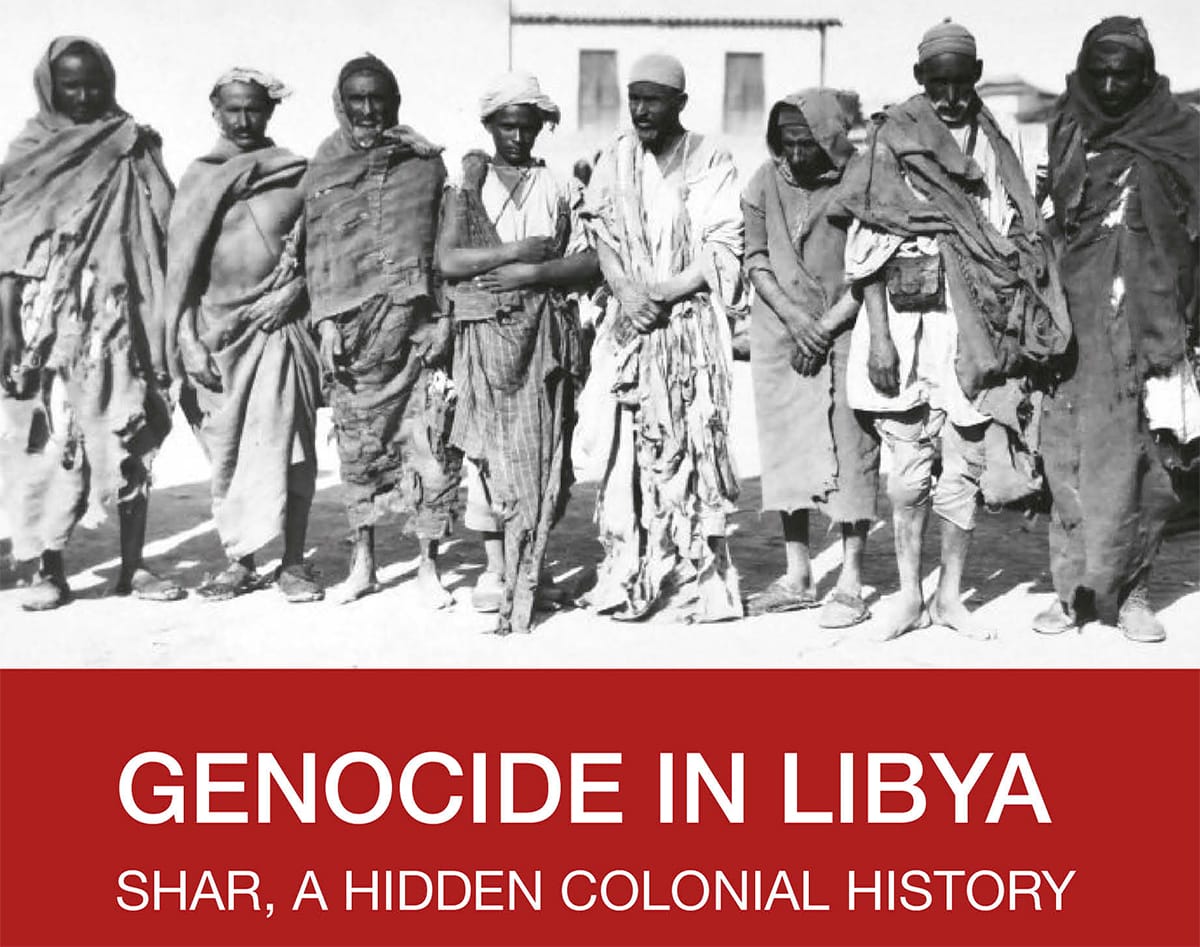
Part of the cover of Ali Abdullatif Ahmida’s new book, "Genocide in Libya: Shar, a Hidden Colonial History," published by Routledge, 2021.
**Jacob Mundy:** The project of Italian settler colonialism in Libya is not well known, even among regional specialists. Can you provide a short sketch based on your work? You describe it as brief but intense.
**Ali Abdullatif** **Ahmida**: Italy looked at Libya as the “fourth shore,” an extension of Italy like the French treated Algeria—the same mentality. It was a shorter period of colonization (1911–1943) but very brutal. The dream was designed by the so-called liberal colonial state in 1911\. The goal was to settle between 500,000 and 1 million Italians, especially the landless peasants from southern and central Italy. They were supposed to be settled mainly in eastern Libya, in the fertile Green Mountain area. The Italian settlers also thought that they would be welcomed by the local population, assuming the Libyans had resented Ottoman rule (1551–1911). That was a big miscalculation. The Libyan resistance to Italian occupation continued for a long time.
When the fascists under Benito Mussolini arrived in 1922, they came with an even more vicious, more brutal plan—they decided to clear the land of Indigenous people. The concentration camps are, as I argue in the book, linked to the clearing of the land for the settlers and especially to defeating the resistance in eastern Libya. The draconian Italian policy was to move the native civilian population that supported the anti-colonial resistance—between 100,000–110,000 people with their herds—to the deserts of Sirte. Two-thirds of them perished there. The first wave of settlers, a major wave of 20,000, arrived in 1938.
The other myth among the Italian elite was that Italian immigrants were mistreated in South America, North America and other places. The settlers believed that since Libya had been part of the Roman Empire they were simply reclaiming it so they could have a place of their own. The idea of reviving Roman Africa was a very integral part of the propaganda to justify colonization. And after that, more settlers came. Although the Italian fascist experiment in colonialism ended in 1943, when they were defeated by the Allies in World War II, many settlers stayed until 1970.
**Jacob**: Libya’s population was roughly 1.5 million at independence in 1951, so the ethnic cleansing campaign may have targeted upwards of 10 percent of the population. Why has settler colonialism in Libya, particularly the violence that made it possible, received so little scrutiny?
**Ali**: Libya is least known in Western scholarship—and even among scholars of North Africa—for historical reasons. Settler colonialism in French North Africa—Algeria, Tunisia and Morocco—is very well known because of its long domination and control. There is a whole body of literature, and we are still dealing with its legacies. Even the definition of the Maghrib often excludes Libya. And you know, after 1969, Libya was not open to Western scholars. Only a small number of scholars were let in—Lisa Anderson, Dirk Vanderwalle and a few others. This situation was very different from other countries. I spent 15 years investigating and researching the genocide because nobody knew about it. When I published [*Forgotten Voices*](https://www.routledge.com/Forgotten-Voices-Power-and-Agency-in-Colonial-and-Postcolonial-Libya/Ahmida/p/book/9780415949873), I was invited to Yale, UCLA, Columbia and other major institutions in North America and Europe, and the first thing I would ask is “Have you guys heard about the concentration camps in Libya?” No one knew about them, which confirmed for me that the Libyan case had dropped out of modern scholarship.
**Jacob**: In genocide studies, there are always references to the Namibian (Herero-Nama) and Armenian genocides as a precursor to the Holocaust. How did the case of the Italian genocide in Libya also become an important predecessor to the World War II genocides in Europe?
**Ali**: I was reading an Italian journal published in Libya, and I read about a visit by \[the Nazi military leader Hermann\] Goering that was reported as a glorious visit to the colony. When I pursued that lead I discovered, according to a German historian, that Nazi leaders—not just Goering but Heinrich Himmler and others—visited Libya because they thought that Italian Fascism was the most successful example of clearing the land and paving the way for settling, which went along with the Nazi dream of settling 15 million people in Eastern Europe. And that was an incredibly horrific discovery.
> **I discovered, according to a German historian, that Nazi leaders—not just Goering but Heinrich Himmler and others—visited Libya because they thought that Italian Fascism was the most successful example of clearing the land and paving the way for settling, which went along with the Nazi dream of settling 15 million people in Eastern Europe.**
I hope my book will start a new debate, a new paradigm shift: that we begin to pay attention to the fact that the Libyan case, even more alongside the German colonial experience, is linked to European history and genocide studies. The Libyan case is the most glaring and the most powerful example of colonial genocide in North Africa, but, at the same time, it has been ignored for 70, 80 years. I hope that this book will be a real turning point—that we begin to dig more, ask new questions and see the linkages. And that we place more pressure on the Italian state to open currently closed archives.
**Jacob**: I was really struck by your discussion of the Italians’ use of Eritrean auxiliaries—*askaris*—as a security force. That fact exposes the weakness of analyses rooted in neatly enclosed nation states or regions like “Europe,” “the Maghrib” and “the Mediterranean.”
**Ali**: Mediterranean studies, to me, is a noble idea, but it's also quaint and ahistorical and misses the real social history, the interconnections, the contradictions, the linkages and the ability to ask the hard questions. My book is asking hard questions. I try to confront two dominant paradigms—the old nationalist paradigm that I was brought into as a youngster coming from my family that was involved directly in Libyan anti-colonial resistance and by my whole education. And secondly, the area studies paradigm. I edited a book in 2000 called *Beyond Colonialism and Nationalism in the Maghrib* to question these things, and it was published in Arabic after a lot of reluctance because they didn't like my critique of nationalism.
The *askaris* are very important because Eritrea became a source of poor peasant labor for Italy just like North Africa was a source of poor peasants who tried to make ends meet by becoming colonial soldiers in the World Wars. The *askaris* and Libyans who collaborated with the Italians open a whole can of worms because of that complexity. That history we’re talking about is in eastern Africa, in northern Africa and in Italy. The terrain is very, very complex. And it's not just an area, this country or that country. We also have to deal with postcolonial conflicts over who became a Libyan citizen, who became an eminent personality, who was deported and the legacies of these institutions and boundaries that still echo around the region.
This book \[*Genocide in Libya*\] is not meant to be conclusive, but to bring out Libya and Libya's brutal, genocidal colonial history. And to get rid of that common and really absurd way of thinking that goes “I don't know anything about Libya, so I'm going to talk about tribalism, I'm going to talk about \[Muammar\] al-Qaddafi, about regionalism or religion.” Who doesn't have regions? Who doesn't have these social complexities?
**Jacob**: What was the process that led you, as a political scientist, to explore alternative archival sources, particularly given the Italian policy of colonial amnesia surrounding these atrocities? This genocide has been an open secret in Italian history. How did it become one of those things that is known but not talked about?
**Ali**: Yes, it's almost like a secret unless you go through with the work. Otherwise, you don't understand—you are not even aware of it.
I was guided by a group of terrific Jewish American professors \[in political science\] at the University of Washington. My late mentor was Daniel Lev, who was not interested in typical political science models and quantifying, so he pushed me and my classmates to understand the historical, the theoretical, the comparative and the critical. And then Daniel Chirot and our beloved Ellis Goldberg. They all pushed me to do the comparative work and go beyond area studies but also to take social history very seriously. Michel Foucault said that we need to investigate the history of the present. So, in that sense, I was really lured into doing historical sociology—not just historical sociology of the Middle East but also Africa and Europe—as well as anthropology. I took four courses in anthropology to prepare for archival and oral history. And so, for my dissertation, I did archival research and oral interviews because most of it was about the nineteenth century and early twentieth century.
So what happened? I learned Italian and I went to Italy to do archival research. And I went to Libya and Egypt to do archival research. The problem was that they kicked me out of the archives. It turned out that some officials at the Italian archives were ex-colonial officers and somewhat fascist. Later I realized that many fascist officials were rehabilitated by the Allies and Italy never confronted its fascist past, especially in the colonies. The second important thing is that Italian society, with a few exceptions, still refuses to confront the horrors of the colonial period, especially in Libya. Angelo del Boca, Giorgio Rochat and Eric Salerno have written on these issues, but the Libyan genocide was otherwise completely ignored. It was then I discovered that the secrecy in Italy is really an issue. If you don't understand this as a researcher, your work is really doomed.
> **But then Angelo del Boca told me, “Ali, don't even bother. I spent 40 years in the archives. There is nothing there. They manipulated the archives.” Del Boca—a fine historian, a giant standing against the silence and amnesia—advised me to go talk to Libyan survivors.**
But then Angelo del Boca told me, “Ali, don't even bother. I spent 40 years in the archives. There is nothing there. They manipulated the archives.” Del Boca—a fine historian, a giant standing against the silence and amnesia—advised me to go talk to Libyan survivors. And I went to Libya and asked Libyan scholars of Italy who told me the same thing. And that was the best thing I have done—to go to eastern Libya every summer for ten years to try to find the survivors. I interviewed some people three times to make sure that the stories were correct. And then, after that, I went with my camera to the location of the concentration camps, and I took photos and did fieldwork. What I discovered was more shocking than I had expected, especially when I came face to face with the cemeteries and the mass graves. That was the most painful experience in the whole decade and a half of doing research.
Why should we assume the archive has facts? It reflects certain secrets of a state, a certain narrative, a certain language. And unless we really contextualize it, we become part of the problem. We need to look very carefully at archives, and the archive is sometimes a part of the problem. And the fact that we can't find something doesn't mean that we cannot do history or analyze institutions or tragedies like genocide.
**Jacob**: What do you have to say to scholars who question the evidentiary status of oral testimony and poetry, which is so central to this book?
**Ali**: If you take seriously the humanity and the agency of ordinary people and the way they express themselves, they are very articulate. But to listen and comprehend what they are saying, and how they're saying it, we need to be reflexive. Like the anthropologists for the last 40 years, when they began to say, “Gee, our discipline was invented by the colonial state as colonial knowledge, and we need to confront that.” I'm not saying that the postcolonial turn is the solution, but I was educated in independent Libya and also in Egypt, in college where modernization was the dominant paradigm. It dismissed ordinary peasants and ordinary folks; everything had to be a formal document.
What I did \[in *Genocide in Libya*\] was what the anthropologist did—to look, pay attention with respect and take the agency of the ordinary survivors very seriously. And then understand the language, their metaphor, their style and their mode of communication, and how they express themselves through a very incredible memory of what happened in the camps. They composed poetry to express the agony, the trauma, the grieving. So I had to, at the beginning, overcome my own modern education. And I began to understand a language within a language or culture within the culture; most of them were semi-nomads and I had to understand that to comprehend the ways they express themselves—they were articulate, they were brilliant. I think I find that my previous attitude, and forgive me, some of my colleagues who dismiss \[oral testimony\] as not evidence, it's very arrogant and very patronizing.
> **You see that they clearly remember the fascist officers and generals who tried to get rid of them—all the agonies, all the moments of despair, of the horrors that happened to them.**
Yes, you do interrogate the evidence. Yes, you verify the interviews. Yes, you compare with the written evidence, and you do all of that. But when you treat ordinary folks with respect, take them as equal human beings expressing themselves with their own creative, cultural way, it really opens a new horizon. You see that they clearly remember the fascist officers and generals who tried to get rid of them—all the agonies, all the moments of despair, of the horrors that happened to them. That's really the story of millions of peasants and ordinary folks all over the globe who were victims of genocide. And I think that's why elitist dismissal really, I'm afraid, reproduces racist attitudes.
**Jacob**: The final part of the book, where you link colonial violence to Libya’s troubled present, reminded me of debates about Algeria in the 1990s and the extent to which the violence of the civil war was (or was not) rooted in the colonial experience. You raised this question with respect to what has happened in Libya since 2011\. How do you make those historical linkages?
**Ali**: Well, I'm glad you asked. That question is very significant. Algerian and Libyan history are probably the most brutal; they went through the most brutal settler-colonial experiences in North Africa. No wonder they are similar in many ways, and I think it’s something the postcolonial state and societies still grapple with.
What I tried to do after excavating and interrogating what happened in the camps and the genocide is to ask myself, how does it directly impact the postcolonial period? We had so much pain and so many wounds, so many people who collaborated, people who resisted, people who were murdered, people who were hanged, people who were pushed into exile. Under the monarchy and Qaddafi’s Jamahiriya State, in many ways, there were efforts to try to break the silence \[on the genocide\], but in a really top-down way. But then some of the violence used against opponents echoed some of the violence of the colonial state. I don't say that so bluntly in the book, but I feel like this way of dismissing critics, opposition and rivals in society has really impacted Libya.
> **Under the monarchy and Qaddafi’s Jamahiriya State, in many ways, there were efforts to try to break the silence \[on the genocide\], but in a really top-down way. But then some of the violence used against opponents echoed some of the violence of the colonial state.**
The Qaddafi regime and the monarchy made a choice as the leaders of Libyan independence to focus on moving forward. But I think it was wishful thinking. The state was built, and the modernization and education were spectacular. But the Qaddafi regime also built its legitimacy on populism. “Nobody cared about you!”—that's what Qaddafi used to shout all the time to Libyans. He began to make that part of his legitimacy and that of the revolutionary government, a so-called populist government, that it was giving you justice and a voice after what had happened under the Italians. Then, the 2011 uprising came, which unfortunately turned into a civil war, taken over by militias and mercenaries and foreign groups and tremendous, unprecedented corruption. At the early stage \[of the uprising\], the young men and women who protested in eastern Libya took the anti-colonial resistance heroes, Omar Mukhtar and others, away from the regime.
The repression of memory and collective amnesia that exists until today is really the challenge of the future. This book is not just a scholarly book; I wanted to do a thorough investigation. I saw myself as investigating collective crime, and therefore I had to be thorough, I had to be really patient, and I had to follow the trails. But in Libya, people say, “Professor, this is good what you did, but tell us how to resolve our current problems.” They are referring to the civil war, fragmentation, infighting, the collapse of the police and the army and the blocking of rebuilding. I say, first of all, Libya is big, and regionalism is a fact. But it's not unusual for large countries to have problems with regionalism. Secondly, what country that has 20 million pieces of arms and weaponry, and had its police, its army, security operatives and borders completely dismantled—wouldn't be fragmented? They are looking for a simple recipe, a book to provide the solution, but history and postcolonial cultures are complex and contradictory.
### How the Fishing Industry Strengthened Morocco’s Occupation of Western Sahara
URL: https://www.merip.org/2022/05/how-the-fishing-industry-strengthened-moroccos-occupation-of-western-sahara/
Last updated: 2025-08-22T18:37:14.000Z
The United Nations considers Western Sahara to be the last African colony.
Fishermen unload boxes of fish from their boat in the harbor of the Moroccan-controlled Western Sahara's main city of Laayoune, 2018\. Fadel Senna/AFP via Getty Images
Until 1975 it was a non-self-governing territory legally recognized as being administered by the European colonial power of Spain. Instead of achieving independence when Spain withdrew, Western Sahara and its offshore waters were seized by Morocco in what many observers view as a settler-colonial occupation. Moroccan control, which is considered illegal under international law, has lasted for more than 40 years. The recognition by President Donald Trump’s administration of full Moroccan sovereignty over the territory in December 2020 precipitated a new phase of the conflict, characterized by an escalation of pressure from Moroccan diplomats to secure continued international support. US recognition also attracted foreign investment to the occupied territories. These recent changes have reinforced the occupation and further marginalized the Indigenous Sahrawi population, whose mother tongue is Hassaniya and who belong to some of the tribes that inhabited the Western Sahara during the Spanish colonial period (1884–1975).
Long before 2020, the Moroccan regime consolidated control over Western Sahara by facilitating the arrival and establishment of a settler population. The development of the fisheries sector in Western Sahara’s cities has particularly strengthened its occupation. Private and public investments and tax advantages enabled the sector’s rapid development, which in turn boosted other economic activities. The settler population, which moved from Moroccan cities to meet the new demand for manpower, often settled in shantytowns, creating a feeling of injustice when their expectations of finding a better life in Western Sahara were not satisfied. After the Moroccan regime changed its approach to settlement in the territory with the implementation of a new housing policy in early 2010, the settler population went from feeling marginalized to forming a critical part of the occupation strategy. This shift in settlers’ living conditions has ensured their definitive settlement in the colony and their involvement in the conflict.
## **The Occupation of the Sea**
The fisheries sector in the Sahrawi coastal cities was practically non-existent during the first years of Morocco’s occupation of Western Sahara. The armed conflict between Morocco and the Polisario Front that began after Spain left the territory in 1975 did not cease until 1991 (three years after the signing of the Houston Agreement) when the parties agreed to hold a self-determination referendum organized by the United Nations. Initially, the Moroccan authorities had opted for the strategic development of deep-sea fishing, using large vessels capable of freezing their products at sea. The government gave significant public assistance and fishing permits to Moroccan operators hailing from powerful families—including the royal family itself—through the creation of Marona, a subsidiary of the Omnium Nord-Africain (ONA) holding company, and to senior military officers. Since factions within the Moroccan military had led two attempts to dethrone the monarch in 1971 and 1972, the “recovery” of Western Sahara—framed in a discourse of Moroccan irredentism—formed part of a strategy to re-legitimize the monarchy and redefine the relationship between the monarchy and the military.
> **The government gave significant public assistance and fishing permits to Moroccan operators hailing from powerful families—including the royal family itself—through the creation of Marona, a subsidiary of the Omnium Nord-Africain (ONA) holding company, and to senior military officers.**
Morocco’s annexation of Western Sahara ensured a Moroccan presence in its territorial waters with these large vessels. In fact, in 1996 the number of freezer vessels dedicated to octopus—a highly profitable species on the international market found primarily in the waters adjacent to Western Sahara—had risen to 273 out of a total of 331 active boats.[\[1\]](#%5Fedn1) As this data shows, the development of Moroccan deep-sea fishing along with the annexation of Western Sahara paved the way for the occupation of the sea.
It was not until the mid-1990s that the fisheries sector truly began to develop, with the two main Sahrawi coastal cities of Dakhla and Laayoune specializing in different species. An important artisanal octopus sector developed in Dakhla thanks to the city’s proximity to one of the richest fishing grounds for this coveted species. Laayoune is home to a significant industry for the fishing of pelagic species, mostly sardines, which are caught from vessels that can remain at sea for a number of days but have almost no freezing capacity. The development of both sectors was possible thanks to private Moroccan and Sahrawi investments, as well as foreign joint ventures, that enabled the acquisition of vessels and establishment of industrial facilities for processing and freezing. Financing was provided by semi-public banks that benefited from Moroccan tax benefits. These investments, in turn, created an important demand for manpower that could not be met by the native Sahrawi population.
## **The Rapid Development of the Fisheries Sector**
The proliferation of industrial octopus freezing facilities in Dakhla required technicians who specialize in refrigeration, as well as electricians and plumbers, and stimulated the demand for artisanal fishermen who catch the octopus from small motorboats. None of these jobs are performed by the native population, instead they created an employment niche for the Moroccan settlers. Inspired by the image of a Sahara that offered vast economic opportunities—as portrayed by the Moroccan mass media—these new settlers went to Western Sahara for jobs that did not exist in their native cities.[\[2\]](#%5Fedn2) The Moroccan authorities also facilitated these relocations by authorizing professional fishermen to work in Dakhla using licenses provided by other coastal cities. As the number of boats operating in the Sahrawi octopus fishing grounds multiplied, Moroccan shipowners with large freezer vessels began to consider it a problem. Growing numbers of fishermen led to a crisis in the octopus stock in 2002 and, consequently, increased competition over access to resources.
In Laayoune, on the other hand, the emerging fisheries sector specialized in sardines. Workers in this field need additional training and experience because the work involves larger, complex vessels that spend more time at sea than artisanal octopus crafts. The crews are mostly made up of Moroccan workers, although in the early days the captain was often Spanish. The need for skilled and unskilled workers to operate the sardine processing industry (including facilities for producing fish meal and ice) was met by Moroccans living in Laayoune or by companies located in Agadir. The proximity to the Moroccan border and traditional fishing cities like Tan-Tan and Sidi Ifni expedited the relocations to Western Sahara encouraged by the authorities, who were focused on designing the census of eligible voters for the agreed-upon referendum.[\[3\]](#%5Fedn3)
> **The highest population growth in the Sahrawi cities occurred during the years when the fisheries sector emerged and developed, between 1994 when the first octopus freezing unit was built in Dakhla and 2004 when some 90 companies linked to octopus freezing were registered.**
In both cities, investment in the fishing industry was made not only by Sahrawi and Moroccan entrepreneurs, but also by the Moroccan authorities that financed the construction of ports and markets and the establishment of fishery and investment institutions like the National Fisheries Office and Regional Investment Center. Foreign transnational corporations also contributed through the creation of fish processing and freezing companies using mixed capital. As a result, the local fisheries sector in Dakhla and Laayoune developed very quickly and attracted Moroccan workers by creating jobs that the native population shunned since they were held in low esteem in the collective imagination (going to sea), due to the low pay for industrial operators or because they were largely filled by the Moroccan population. In fact, the highest population growth in the Sahrawi cities occurred during the years when the fisheries sector emerged and developed, between 1994 when the first octopus freezing unit was built in Dakhla and 2004 when some 90 companies linked to octopus freezing were registered. During that time, the population of the Dakhla-Oued Ed-Dahab region grew by 170 percent and increased by 34 percent in Laayoune.[\[4\]](#%5Fedn4) The difference in growth between Laayoune and Dakhla lies in the fact that the type of fishing done in Laayoune does not require the same number of workers as artisanal fishing, which is more labor intensive. In both cases, but particularly in Dakhla, the development of the fishing industry paralleled significant demographic changes, to the point that the ratio of Moroccan settlers to native Sahrawis reversed. Today, the Sahrawis are a minority in Western Sahara.
## **Settlers and Colonization**
In violation of Article 49 of the Fourth Geneva Convention, which states that “the Occupying Power shall not deport or transfer parts of its own civilian population into the territory it occupies,” the Moroccan government has gradually strengthened its occupation through policies that draw in settlers. During the first decades of the occupation, the Moroccan government distributed a monthly stipend to residents of Western Sahara equal to the minimum wage (about 1,250 dirhams or 150 euros), as well as a house, through the National Promotion Card. These government policies spread resources among Sahrawi families as part of a strategy to influence the self-determination referendum.[\[5\]](#%5Fedn5) After Mohamed VI acceded to the throne in 1999 this practice changed, and the Moroccan regime prioritized the settler population by implementing a national housing policy in the main cities of Western Sahara that aimed to eliminate the settler shantytowns.
The growth of the settler population in Western Sahara resulted in the proliferation of new economic activity especially in the form of small grocers, hairdressers and other shops mostly run by settlers. At the same time, rapid population growth led to greater demand for housing by people largely crowded into shantytowns on city outskirts. According to official Moroccan data, in 2010 the percentage of shanty housing out of the total urban housing in the Dakhla-Oued Ed-Dahab region was 33.1 percent, which surpassed the Moroccan average of 8.2 percent.[\[6\]](#%5Fedn6) According to the same source, during the first decade of 2000, there were 6,024 shanties in Dakhla and 9,815 in Laayoune.
In Dakhla, the “City Without Slums” policy that began in the mid-2000s manifested itself as the allocation of land, building material and money to the residents of the shantytown known as Wahda (“unity”), the first neighborhood that appeared during the ceasefire of the 1990s. Residents of the neighborhood called Lahrait (“gardens”) received land. The plots, located in an extension of the city of Dakhla, were equipped with basic infrastructure for construction such as sewage systems, power lines and water pipes. The policy was financed by the Moroccan Ministry of Housing, Planning, and Urban Development and, to a lesser extent, the Agency for the Development of the Southern Provinces. The latter institution, created on the initiative of the monarchy, took responsibility for the project in the early days. In fact, the first phase of the new construction, the Hay El Hassani neighborhood, is called Wakala (“development”) by the residents of Dakhla, because of the role of that agency. Currently, the new neighborhood houses a large number of Moroccan settlers, who have their own land and, depending on the case, a two- or three-story house.
> **The decision to focus on new beneficiaries for public assistance was positively received by the settler population, which up to that point had felt discriminated against by the authorities. As a result, Morocco has ensured that the settlers feel a greater sense of attachment to the national cause.**
The decision to focus on new beneficiaries for public assistance was positively received by the settler population, which up to that point had felt discriminated against by the authorities. As a result, Morocco has ensured that the settlers feel a greater sense of attachment to the national cause. In fact, Moroccan civilians participated in the violent confrontations with the authorities during the Gdeim Izik social mobilization of around 15,000 to 20,000 Sahrawi protesters that took shape on the outskirts of Laayoune in October and November 2010\. After these events, and for the first time since the beginning of the occupation, there were several clashes between young Sahrawis and Moroccans in Dakhla.[\[7\]](#%5Fedn7) The civil unrest associated with the Gdeim Izik mobilization, combined with a palpably charged atmosphere, are signs of a change in perception among the settler population, whose good living conditions would be impossible to reproduce in their home cities. Now more than ever they feel like natives of Dakhla and as settlers they reinforce the occupation. In contrast, the now minority Sahrawi population, which views the settler neighborhoods as dangerous, has seen its mobility restricted and fears the outbreak of civil hostilities.
The study of settler colonialism focuses on understanding the structures of domination and the relationships established between settlers and natives, while paying special attention to the behavior of the settler colonists and how their project is imposed in the territory. This project of domination would not be possible in Western Sahara without the mass arrival of settlers and their integration into the labor market in Sahrawi cities, which is a direct result of the development of the local fisheries sector. The government’s economic and housing policies have enabled the settler population to remain by linking their livelihoods to the occupied territory. While the Moroccan elite, Sahrawi elite and foreign investors occupy the more profitable positions on the value chains, the working class—Moroccan fishermen and laborers in the processing industries—gains much less from the exploitation of Sahrawi fish resources. For these settlers, however, the possibilities for employment and owning a house have given the colonizing project staying power, making them a powerful force in Morocco’s occupation strategies. Left on the sidelines are the Sahrawis, who do not directly benefit from the exploitation of the fisheries resources. Those Sahrawis who demand jobs so they can participate in the exploitation of the resources they consider their own do not benefit and neither do the militant Sahrawis who link this exploitation to the continuity of the occupation.
\[Victoria Veguilla is professor of political science at Pablo de Olavide University in Spain. This research was co-financed by the European Regional Development Fund (ERDF), the Regional Government of Andalusia and the Pablo de Olavide University, under the auspices of the Andalusia ERDF 2014-20 Operational Programme.\]
---
[\[1\]](#%5Fednref1) Government of Morocco, “La Mer en Chiffres” (Rabat: Ministry of Agriculture, Maritime Fisheries, Rural Development and Waters and Forests, 2016).
[\[2\]](#%5Fednref2) Victoria Veguilla, *Politiques du poulpe à Dakhla. Action publique, ressources naturelles et dynamiques sociales*. PhD manuscript (Institut d’etudes politiques d’aix-en-provence, Université Paul Cezanne, 2011).
[\[3\]](#%5Fednref3) Jacob Mundy, “Moroccan Settlers in Western Sahara: Colonists or Fifth Column?” *The Arab World Geographer*, 15/2, 2012.
[\[4\]](#%5Fednref4) Data from the Higher Planning Commission, Government of Morocco. In 2002, there were 90 licensed octopus freezing units in Dakhla.
[\[5\]](#%5Fednref5) Victoria Veguilla, “Social Protest and Nationalism in Western Sahara: Struggles Around Fisheries and Housing in El Ayun and Dakhla,” *Mediterranean Politics*, 21/3, 2017.
[\[6\]](#%5Fednref6) Report issued by the delegation from the Ministry for Housing, Planning, and Urban Development, Oued Ed-Dahab-Lagouira Region, January 2010.
[\[7\]](#%5Fednref7) Victoria Veguilla, “À l’ombre de la *khayma*. Résistance culturelle et politique des jeunes sahraouis à Dakhla,” in Laurent Bonnefoy and Myriam Catusse, eds., *Jeunesses arabes. Du Maroc au Yémen: loisirs, cultures et politiques* (Paris: La Découverte, 2013).
### The Question of Palestinian Statehood and the Future of Decolonization
URL: https://www.merip.org/2022/05/the-question-of-palestinian-statehood-and-the-future-of-decolonization/
Last updated: 2025-08-22T18:37:15.000Z
Is statehood the desired end goal of decolonization struggles or is it instead a useful tool along the way to achieving national liberation? The answer to this question has been at the heart of many national liberation movements since the twentieth century.
Israeli and Palestinian activists take part in the weekly protests in support of Palestinian families at the East Jerusalem neighborhood of Sheikh Jarrah, January 2022\. Ilia Yefimovich/Picture Alliance via Getty Images
Most struggles for decolonization have pursued the creation of a sovereign independent nation state as a right that is enshrined in international law with the 1960 United Nations General Assembly Resolution 1514, which [defined colonialism as a crime](https://www.ohchr.org/EN/ProfessionalInterest/Pages/Independence.aspx) and specified that “all people have an inalienable right to complete freedom, the exercise of their sovereignty and the integrity of their national territory.” This resolution granted colonized people the internationally recognized right to political independence and self-determination. But for some anti-colonial theorists, like Frantz Fanon and Aimé Césaire, the right to self-determination does not entail necessarily the creation of a nation state, since there is no guarantee that such a state would liberate its people.[\[1\]](#%5Fedn1) For these theorists, self-determination requires the establishment of accountable and inclusive political systems that can take various forms.[\[2\]](#%5Fedn2) Most anti-colonial movements, however, have considered the nation state necessary for liberation, given that it affirms people’s right to have rights, as Hannah Arendt argued, and thus actualize their sovereignty.
For the last 50 years, the Palestinian national movement has debated the question of whether the attainment of a Palestinian state would mark the end of Palestine’s colonization by the Zionist movement. Palestinians have long considered Zionism a European settler-colonial project and resisted it from the moment that Britain endorsed the Jewish national movement in 1917\. But ideas have changed over time about the best means to liberate Palestinians from colonialism and what precise form self-determination and freedom should take. Many Palestinians today argue that the pursuit of a state in the West Bank and Gaza Strip within the confines of the international consensus on the two-state solution has compromised their rights, such as the right of return, and increasingly fragmented the Palestinian people and weakened their national movement. Others maintain that a Palestinian state, even within these limits, is a necessary, if insufficient, step toward achieving Palestinian liberation. Many, however, now reject the two-state solution as a failed project and Palestinian debates about decolonization revolve instead around the models of a one-state solution, a binational state or a process that transcends the nation-state structure.
## **The History of Statehood as a First Step Toward Liberation**
Throughout the three decades of British Mandatory rule, Palestinian nationalists called for a sovereign democratic state with equal rights for all citizens living in Palestine.[\[3\]](#%5Fedn3) This demand was overshadowed in 1948 by the sheer need for survival following Israel’s displacement of most of the Palestinian population who lived in the 78 percent of the country that Jewish settlers conquered. The magnitude of the dislocation, coupled with the political repression that Palestinian refugees now faced across the multiple Arab countries where they lived in destitution, explain why the Palestine Liberation Organization’s founding mission statement in 1964 called for the return of the refugees (a right enshrined by [UN Resolution 194](https://unispal.un.org/UNISPAL.NSF/0/C758572B78D1CD0085256BCF0077E51A) in 1949) and the liberation of their homeland from Zionist “occupation and colonialism” (including the exodus of all Jews that had immigrated to Palestine after 1917). It did not focus on the creation of a sovereign independent state as a defined goal.
In 1967, Israel’s resounding victory over Egypt, Jordan and Syria and its occupation of the West Bank and Gaza Strip—the remaining 22 percent of Palestine that Israel failed to conquer in 1948—resurrected the demand for statehood and revived the national movement. The Palestinian National Council (PNC), which is the legislative body of the PLO, voted unanimously in 1971 to support a resolution specifying that the goal of the national liberation struggle was the establishment of “a democratic Palestinian state” in historic Palestine, where “all \[Muslims, Christians and Jews\] who wish will be able to live in peace there with the same rights and the same duties.”[\[4\]](#%5Fedn4) But the 1971 proposal was not a mere rehashing of the movement’s pre-Nakba demands. It also served as a rejection of three alternative outcomes. The first, UN Security Council Resolution 242, which was issued as a diplomatic framework to resolve the Arab-Israeli conflict in the shadow of the 1967 war, denied the political existence of the Palestinian people. The PNC’s proposal to establish a “democratic Palestinian state” also provided a more just alternative to the UN Partition Plan of 1947, which would have reduced the scope of a Palestinian state to 45 percent of the country and deprived it of most of its economic resources. Critically, the PNC’s proposal explicitly denounced the handful of ideas that had been floated since the 1967 war to establish a much smaller “statelet” in the occupied West Bank and Gaza Strip.[\[5\]](#%5Fedn5)
> **As Edward Said put it in 1979, the PLO never resolved “the question of whether it is really a national independence or a national liberation movement.” Would the acceptance of sovereignty over a small part of historic Palestine undermine the dream of dismantling settler colonialism—the legal, economic and institutional pillars of Jewish supremacy—in all of it?**
The PLO’s hard rejection of a Palestinian state located only in the 1967 territories softened in the aftermath of the 1973 war. The prospect of negotiations between Israel and Egypt over a “land for peace” agreement threatened to further remove the question of Palestine from the diplomatic framework for peace and triggered intense debate among the PLO’s various political factions. The result was a new, vaguely worded, PNC resolution that called for the establishment of “a national authority on any part of Palestine liberated.” Adopted in October 1974, what came to be known as the the PLO’s “Ten-Point Transitional Program,” underscored the interim nature of this “national authority” and affirmed that it would constitute only the first phase in “the struggle for a democratic Palestinian state” in Palestine as a whole.[\[6\]](#%5Fedn6) Nonetheless, it signaled for the first time the provisional willingness of the national leadership to consider the idea of establishing a Palestinian state alongside Israel. This shift paved the way for PLO Chairman Yasser Arafat’s invitation to speak before the UN General Assembly, a historic event followed by the passage of UNGA Resolution 3236, which affirmed the inalienable rights of the Palestinian people to “self determination….national independence and sovereignty.”
Despite the long-sought international recognition of Palestinian national rights won by the “Ten-Point Program,” the ambiguity of its language continued to hover over the Palestinian national movement through the rest of the 1970s and most of the 1980s. As Edward Said put it in 1979, the PLO never resolved “the question of whether it is really a national independence or a national liberation movement.” [\[7\]](#%5Fedn7) Would the acceptance of sovereignty over a small part of historic Palestine undermine the dream of dismantling settler colonialism—the legal, economic and institutional pillars of Jewish supremacy—in all of it?
Once again, developments on the ground would reframe the debate. In November 1988, a year into the first Palestinian Intifada against Israel’s occupation of the West Bank and Gaza Strip, most of the PLO leadership surrendered its aspiration to create a single democratic state in all of Palestine and acquiesced to the international consensus on partition as the only viable basis for peace. Israel’s war on Lebanon, which ended in September 1982 with the expulsion of the PLO and the slaughter of between 2,000 and 3,500 people in the Palestinian refugee camps of Sabra and Shatila, had marked the failure of armed struggle. These losses were compounded by the peace initiative adopted that month by the Arab League, which called for the establishment of a Palestinian state in the 1967 territories.
With its symbolic Declaration of Independence in 1988, the PLO accepted the idea that national liberation was attainable only by negotiating with Israel, rather than by defeating Zionism. In 1993, its decision to sign the Oslo Accords with Israel and establish a Palestinian National Authority (PA) in the West Bank and Gaza Strip further signaled the leadership's conclusion that partition of Palestine was the only means to materialize the Palestinian right to self-determination. Despite their awareness that the text of the accords made no mention of the creation of a Palestinian state as the end goal, the leadership insisted that the creation of a Palestinian nation state was achievable. Their claim was bolstered by the support of the international community, as expressed in the 2002 [Arab Peace Initiative](https://www.merip.org/content/files/documents/268421/268470/7%5Ffile%5Fstorage%5Ffile%5F3659%5F1-pdf/9e869fab-4352-2a63-5795-a662f1139ad3.pdf) and the 2003 [Quartet Road Map to Peace](https://2001-2009.state.gov/r/pa/ei/rls/22520.htm). The quest for diplomatic recognition, however limited, was advanced in 2012 when the United Nations recognized Palestine as “a non-member observer State” following a three-year campaign waged by Palestinian Authority president and PLO chairman Mahmoud Abbas.
> **Paradoxically, the PLO’s singular focus on statehood has served to undermine Palestinian liberation. Rather than advancing the unity of the Palestinian people, its limited statist project has reinforced the geographic and political barriers between them.**
Paradoxically, the PLO’s singular focus on statehood has served to undermine Palestinian liberation. Rather than advancing the unity of the Palestinian people, its limited statist project has reinforced the geographic and political barriers between them by excluding those living outside the West Bank and Gaza: The Palestinian citizens of Israel and Palestinian refugees, who constitute the crux of the Palestinian question. Meanwhile, the “statehood-first” agenda has also proven unable to stop Palestinian dispossession, let alone protect citizens’ rights and political freedom. Responsibility for this failure lies first and foremost with Israel, which ensured that the Oslo process reformulated rather than ended Zionist colonization. In particular, Israel’s continuous war on and siege of Gaza, the presence of over 650,000 Israeli Jewish settlers in the West Bank (including East Jerusalem) and the construction of the 437-mile-long separation wall have destroyed the territorial viability of a future Palestinian state in the Occupied Territories.
The Palestinian political class also bears responsibility. One of the key components of the Oslo Accords was the establishment of the PA, which has undermined, and *de facto* superseded, the authority of core national Palestinian political institutions, such as the PLO and its Palestinian National Council, which historically represented Palestinians both inside and outside the West Bank and Gaza Strip. The entrenchment of the PA’s authoritarian regime and its refusal since 2005 to hold elections have further emptied the state project of any emancipatory potential, whether for the Palestinians living within the confines of the Occupied Territories or outside it. The Palestinian body politic is thus fractured at every level, while Palestinians living in the West Bank and Gaza endure a one-state colonial reality with Israel as the only sovereign.
## **The Future of Decolonization in Palestine: Three Models**
The fact that Palestinian national sovereignty has not been achieved within the framework of a two-state solution is unsurprising. Since the early twentieth century partition plans have divided populations and undermined their rights rather than dismantled structures of colonial domination or resolved national conflicts.[\[8\]](#%5Fedn8) Therefore, in any attempt to change the status quo and exercise their right to self-determination, Palestinians will need to reject the partition paradigm. Moreover, it will be necessary to confront the colonial structure of Zionism, rather than accommodate it.
The Oslo peace process and the partition paradigm are premised on the principle that the only way to affirm Palestinian political existence is to acknowledge Israel’s. This principle has proven to be a trap for the Palestinians, given Israel’s insistence since 2011 on being recognized as a Jewish state in any final status agreement and not a democratic state of all its citizens. The Palestinians, including the PA, cannot agree to such a demand for it would deny the Palestinians their collective history, national identity and their right to all of the land under Israeli sovereignty. Palestinians today are debating what kind of political strategy they should adopt to decolonize their present reality and whether it requires giving up the pursuit of statehood altogether. This debate revolves primarily around three different approaches, or models, for moving beyond the two-state solution.
### *Redefining the Democratic Palestinian State*
Most Palestinians, particularly those living in the West Bank and Gaza Strip and many in the diaspora, believe that statehood is the best model for protecting the rights of citizens and affirming the sovereignty of the nation. They assert that the only way to decolonize Palestine is by establishing a single state encompassing all of historic Palestine. Most one-state advocates argue that because the Zionist movement (represented by the Israeli state since 1948) supports an exclusively Jewish right to self-determination at the expense of Palestinians’ Indigenous rights—rather than in tandem with them—decolonization would require the dismantling of all Zionist institutions.
The supporters of a one-state solution are thus seeking to reformulate the PLO’s 1971 democratic state platform by emphasizing a civic, rather than an ethnic, definition of Palestinian nationality as protected by international law, one that was introduced by the Treaty of Lausanne and implemented during the British Mandate.[\[9\]](#%5Fedn9) This state would extend equal rights to Jewish citizens as individuals but not as a group, maintaining that only Palestinians have the right to self-determination by virtue of their Indigeneity.[\[10\]](#%5Fedn10) Defenders of the democratic state idea do not see the inequality inherent in denying Jewish citizens their collective political rights; they maintain that a single Palestinian state would provide the only ethical solution to the Israeli-Palestinian conflict since it would dismantle the native/settler binary by “de-dichotomizing” political identities in the country.[\[11\]](#%5Fedn11)
### *A Binational State*
Many Palestinians, however, find the proposal for a single democratic Palestinian state ethically wrong and unrealistic for its failure to acknowledge the collective political rights and right to self-government of those who do not define themselves as Palestinians or Arabs. They propose instead a binational state in Israel-Palestine as an alternative, one that would be similar to Belgium or Switzerland. Such a binational state acknowledges that both Israeli Jews and Palestinians have a right to self-determination while maintaining that this right cannot be fulfilled through partition or in a single nation state. Instead, it is protected only through a democratically inclusive process of constitutional self-creation, one that includes Palestinians and Israelis working together to establish a state that is not ethnically defined. The underpinning assumption here is that the state is a juridical order, one that relies on democratic engagements to establish a robust constitution. Such a constitution would guarantee the creation of democratic and accountable political structures that would protect the equality of all citizens, including their individual and collective rights.[\[12\]](#%5Fedn12)
> **In the binationalists vision, decolonization will require centering Arab-Jewish relations, allowing “for the narration of Palestinian and Jewish experience in the Middle East alongside each other,” rather than at the expense of each other.**
Binationalists recognize that decolonization will necessitate structural changes and tend to focus as much on the process as the outcome. In their vision, decolonization will require placing Arab-Jewish relations at the center of the decolonization process, allowing “for the narration of Palestinian and Jewish experience in the Middle East alongside each other,” rather than at the expense of each other.[\[13\]](#%5Fedn13) They argue that such an approach would force Palestinians and Israeli Jews to engage rather than avoid each other—that unraveling the intertwined history of the settler and the native will require both groups to work through their mutual histories of national trauma. It will also require them to engage together in addressing questions of transitional justice and reparations.
### *Sovereignty Through a Bottom-up Approach*
For a small cohort of intellectuals and activists, particularly in the diaspora and also inside Israel, the state should not be an aspiration for political liberation for it is a site of inherent violence and thus bound to be oppressive. It is to be rejected on the grounds that sovereignty should lie with the people, or the nation, not with the state *per se*. Partisans of this view do not consider the state as the only political construct that can protect people’s rights, especially given how globalization has undermined the importance of territorial sovereignty. Advocates of this approach challenge the PA’s attempt to monopolize the definition of who belongs to the Palestinian collective and want to restore a more inclusive sense of the Palestinian nation.[\[14\]](#%5Fedn14) For activists, such as those in the groups Ibna’ al Balad, Musawa and Al-Manar, the focus must be on the Indigeneity of the Palestinian people and on decolonizing Israel from within its boundaries. They seek to do so by challenging Israel’s control of the land by affirming Palestinian presence and counter-narrative agency.[\[15\]](#%5Fedn15) They insist that the only path to liberation for all Palestinians requires the national movement to shift its focus away from the telos of a delimited nation state and toward a more inclusive understanding of liberation and equality.
## **Moving Forward**
Engaging in a decolonization process that would include a future democratic state will not be easy. For most Palestinians, especially for those living under Israel’s continuous assault in the 1967 territories and those living in refugee camps in the diaspora, a process of this kind would be unrealistic, if not defeatist, given the privileges and international immunities that Israeli Jews continue to enjoy and the political disarray of the Palestinian national movement today. In the meantime, Palestinians everywhere have shown that there are multiple ways to work toward decolonization, which vary depending on their circumstances.
> **Palestinians everywhere have shown that there are multiple ways to work toward decolonization, which vary depending on their circumstances.**
For many inside Palestine and Israel, the focus remains on the politics of *sumud*, the daily bottom-up acts of resistance such as the recurring March of Return against the Israeli wars on Gaza, mass resistance against house demolitions in Jerusalem and challenges to Israeli courts in their assaults on the Palestinian citizens of Israel. For other activists and politicians, the priority should be on combating the tribalism and corruption of the PA, as much as on reviving the PLO or creating representative platforms that can reunite the Palestinian body politic and articulate a new political strategy of liberation.
Whatever modes of resistance Palestinians adopt, their success in decolonizing Palestine will inevitably hinge on developments taking place regionally and internationally. The Cold War provided an opportunity for Third World countries to advance the cause of their anti-colonial struggles and legitimize their quest for national independence. The collapse of the Soviet Union, the end of South African apartheid and the emergence of the unipolar world under the United States in the 1990s has shifted the world’s attention away from decolonization and toward nation building and democratization. But the failures of democratization—as seen for example in the aftermath of the US wars on Iraq and Afghanistan and in the defeat of the Arab uprisings of 2011—have shown that redefining the state is neither easy nor always inclusive. The signing of the Abraham Accords in 2020 normalizing Israel’s relationships with Bahrain and the United Arab Emirates, and the latest Russian war on Ukraine, are meanwhile highlighting the perseverance of colonial and authoritarian systems of domination even in the face of challenges by average citizens. At a time when the world order seems to be shifting, the liberation of Palestine cannot be divorced from the larger struggle—within the Arab region and outside it—for freedom and independence. It is also clear that the state cannot be transcended. Instead, citizens must work to contain it and hold it accountable. They must affirm the state’s obligation to represent rather than oppress them, to honor rather than crush their ethnic, religious and political diversity and to acknowledge that the acceptance of differences is what forms the basis of any democratic polity that can ensure equality for all.
\[Leila Farsakh is associate professor and chair of the political science department at the University of Massachusetts Boston.\]
---
### **Endnotes**
[\[1\]](#%5Fednref1) Gary Wilder, *Freedom Time: Negritude, Decolonization and the Future of the World* (Durham: Duke University Press, 2015). Adom Getachew, *Worldmaking after Empire: The Rise and Fall of Self-Determination* (Princeton: Princeton University Press, 2019).
[\[2\]](#%5Fednref2) These forms can include federal political structures made of democratically accountable and autonomous political entities like the European Union today or as seen in the incorporation of Martinique and Guadeloupe into France based on a referendum that rejected separate statehood for these two French speaking islands. For more details see Wilder and Getachew.
[\[3\]](#%5Fednref3) Lori Allen, *A History of False Hope: Investigative Commissions in Palestine* (Stanford: Stanford University Press, 2020).
[\[4\]](#%5Fednref4) Alain Gresh, “The PLO and the Naksa: The Search for a Palestinian State,” *Electronic* *Journal of Middle Eastern Studies*, 8 (Spring 2008) p. 48.
[\[5\]](#%5Fednref5) Sabri Jiryis, “On Political Settlement in the Middle East: The Palestinian Dimension,” *Journal of Palestine Studies* 7/1 (Autumn 1997), p. 5.
[\[6\]](#%5Fednref6) Leila Farsakh, ed., *Rethinking Statehood in Palestine: Self-Determination and Decolonization Beyond Partition* (Berkeley, CA: University of California Press, 2021), pp. 4–5.
[\[7\]](#%5Fednref7) Edward Said, *The Question of Palestine* (New York: Vintage Books, 1979) p. 134.
[\[8\]](#%5Fednref8) Arie Dubnov and Laura Robson, eds., *Partition: A Transnational History of Twentieth-Century Separatism* (Stanford: Stanford University Press, 2019).
[\[9\]](#%5Fednref9) Susan Akram, “Palestinian Nationality and ‘Jewish’ Nationality: From Lausanne Treaty to Today”, in Farsakh, ed., *Rethinking Statehood in Palestine*.
[\[10\]](#%5Fednref10) Ali Abunimeh, *The Battle for Justice in Palestine* (Chicago: Haymarket Press, 2014). Bashir Bashir, “The Strengths and Weaknesses of Integrative Solutions for the Israeli-Palestinian Conflict,” *The Middle East Journal* 70/4 (2016). Hani A. Faris, ed., *The Failure of the Two-State Solution: The Prospects of One State in the Israel-Palestinian Conflict* (London: I.B. Tauris, 2013).
[\[11\]](#%5Fednref11) Omar Barghouti, “The Secular Democratic State is the Only Possible and Ideal Solution,” *Journal of Palestine Studies* 76 (2008). \[Arabic\]
[\[12\]](#%5Fednref12) Israel has a bill of rights but no constitution or defined borders. The Palestinian authority in the West Bank and Gaza has failed to produce a constitution endorsed by the Palestinian parliament or the Palestinian National Council.
[\[13\]](#%5Fednref13) Bashir Bashir and Rachel Busbridge, “The Politics of Decolonization and Bi-Nationalism in Israel/Palestine,” *Political Studies* 67/2 (2019) pp. 388-405.
[\[14\]](#%5Fednref14) Ruba Salih and Sophie Richter-Devroe, “Palestine Beyond National Frames: Emerging Politics, Cultures and Claims,” *South Atlantic Quarterly* 117/1 (2018). Barakat, “Writing/Righting Palestine Studies: Settler Colonialism, Indigenous Sovereignty and Resisting the Ghost(s) of History,” *Settler Colonial Studies* 8/3 (2018).
[\[15\]](#%5Fednref15) Ilan Pappe, “Indigeneity as Resistance” in Farsakh, ed., *Rethinking Statehood in Palestine.*
### Indigenous Wine and Settler Colonialism in Israel and Palestine
URL: https://www.merip.org/2022/05/indigenous-wine-and-settler-colonialism-in-israel-and-palestine/
Last updated: 2025-07-30T04:06:21.000Z
"As settlers are non-indigenous, they are forever indigenising. . . The question then is how to be efficient self-indigenisers."[\[1\]](#%5Fedn1)
In 2008 the first Palestinian wine made from indigenous grapes was released, introducing a discourse of primordial place-based authenticity into the local wine field. Six years later, Israeli wineries started marketing a line of indigenous wines. Since then, a growing number of Palestinian and Israeli winemakers and scientists have been using the research, production and marketing of indigenous wines to bolster their historical claims to the land. These producers have emerged in a global era in which terroir—defined as an idiosyncratic combination of soil, climate, culture and history that gives food its distinct taste—shapes economic and cultural value. Against the dominance of international grape varieties, the indigenous turn in the wine world is mobilizing genetics, enology and ancient texts to rewrite the Israeli and Palestinian landscapes.
The trilingual Marawi label on the Recanati Winery’s “ancient wines” series. Daniel Monterescu, 2018.
Already available on the local market, the first Palestinian indigenous wine made its international debut in 2013 at a special tasting of wines from the Holy Land in London. The globally renowned Master of Wine Jancis Robinson conducted the baptismal ritual and awarded the highest score, 16.5, to the Cremisan Winery’s Star of Bethlehem Hamdani Jandali 2011, a blend of two indigenous grape varieties (hamdani and jandali). Later she confessed it was the first time she had tasted Palestinian wine.
After this success, the Israeli Recanati Winery launched Marawi 2014, produced from the hamdani (also known as marawi) grapes of an anonymous Palestinian vintner in the Bethlehem area. In October 2015, shortly after the beginning of the Hebrew calendar year, *Haaretz* named Recanati’s Marawi 2014 the “Most Important Wine of the Year.” The paper’s wine critic admitted that his selection was chosen not for its exceptional quality but for its cultural and historical uniqueness. “The Marawi 2014 is the first commercial Israeli wine produced from a local, indigenous variety with roots in antiquity,” he wrote. “As such, it will eventually be recorded in the annals of Israeli wine.”[\[2\]](#%5Fedn2)
Tellingly, it was not the Palestinian wine but the Israeli newcomer that won broad attention in the international press. “Israel Aims to Recreate Wine That Jesus and King David Drank,” declared the *New York Times*.[\[3\]](#%5Fedn3) Channel 7, an Israeli national religious news station, claimed that research on indigenous grapes “will restore the wines of the Holy Temple.”[\[4\]](#%5Fedn4) The *China Daily*, covering a master class in Beijing, referred (inaccurately) to the marawi grape as “the first indigenous grape re-created with DNA technology, thanks to preserved samples of grape tissue at least 2,000 years old.”[\[5\]](#%5Fedn5)
Far from being an innocent drink, Israelis use indigenous wine to help refute the claim that they are settlers and to claim ancestral Jewish ties to the land. Israeli winemakers have, however, adopted the grape varieties that Palestinians have been growing for centuries in an unbroken Christian village tradition of winemaking. Dire economic conditions due to the ongoing Israeli occupation of the West Bank oblige Palestinian vintners to rely on uncooperative Israeli authorities to export their wines and has pushed many to sell their grapes to winemakers in Israel and in Jewish settlements. Despite these difficulties, some Palestinian wineries are succeeding in producing indigenous wine and in the process are strengthening their traditional connections to the land. The experiences of both Israeli and Palestinian winemakers’ use of endemic grape varieties illustrates the power of science, craft and taste to reconfigure the human and nonhuman politics of settler colonialism.
## **The Power of Food and Wine**
Settler colonialism is primarily about seizing land and maintaining the power to use it. Controlling agricultural production, distribution and marketing, the dominant group appropriates indigenous lands to produce food to sustain its own polity. Food, however, is not merely about consumption and sustenance, it is also a marker of identity: Certain foods are widely recognized as national icons. Some are regulated by authorities (such as the European Union) and can only be produced in a specific location with a “protected designation of origin,” such as some cheeses or wines like Parmesan and Champagne. As part of patriotic traditions, food expresses power relations and sometimes exposes dark aspects of national culture, such as xenophobia and racism. In extreme cases, gastronationalism, or the assertion of cultural ownership of types of food by a particular nation, may lead to border disputes, trade wars and reciprocal attempts to limit production and to control labeling rights.[\[6\]](#%5Fedn6)
Elyashiv Drori walks across his research vineyard at Ariel University. The signpost acknowledges the financial support of Ariel University, the Jewish National Fund, the Samaria Region and the Jordan Valley Research and Development Center for his “Israeli grapevine varieties.” Daniel Monterescu 2018
The global wine economy’s central concept of uniqueness is that of terroir. In contrast to modern conceptions of territory as an abstract legal and political entity, terroir conjures images of an organic connection between people and land, producing a distinct character and “typicity.” To capture the French notion of *goût de terroir*, food anthropologist Amy Trubek characterizes terroir as the “taste of place.”[\[7\]](#%5Fedn7) The discourse of terroir has seeped into Israeli and Palestinian wine culture since boutique wineries first emerged in the 1990s and plays a major role in narratives about the special history of the land. Terroir has thus become a political project of establishing a space of unique quality that enhances the capitalist logic of the consumer market.[\[8\]](#%5Fedn8)
The Zionist claim, which can be described as “a terroir without people for a people without terroir,” seeks to write out non-Jewish narratives. In contrast to the production of other agricultural commodities, such as olives, wheat and tomatoes, wine production is framed in the Israeli discourse exclusively in terms of Jewish history. The omnipresence of wine in the Bible and in Jewish tradition, coupled with the Muslim prohibition against drinking alcohol, perfectly pairs the teleological story of local wine with hegemonic Zionist motifs: from ancient sovereignty, exile and return to modern sovereignty, creation and innovation. The marawi or hamdani grape plays a role in this quest for the holy grail of indigenous authenticity in a colonial space inhabited by two populations fighting over the question of who was there first.
When winemakers connect indigenous grapes to the wine that Jesus drank at the last supper—as advertised when the wine is marketed internationally to non-Jewish customers—or to the wines served at King David’s table, the local varieties become emblematic of political place and historical roots. Ultimately, for both Jewish Israelis and Palestinians, reconstructing indigenous wines is also a practice of reviving national identity and inventing tradition.
Elyashiv Drori (left), a molecular biologist, at work in his research winery at Ariel University in the West Bank. An assistant winemaker removes a tasting sample from a barrel. Daniel Monterescu, 2018.
For example, Elyashiv Drori, a molecular biologist at Ariel University (an Israeli university attached to an illegal settlement in the West Bank) set up a research laboratory and experimental vineyard with a grant from the Jewish National Fund to find the connections between indigenous grapes and Jewish history. For Drori, a Jewish settler and a major player in the scientific project of mapping and recovering native species, the goal of his project is no less than to “create an identity.” He explains that,
> [\[9\]](#%5Fedn9)
Following the indigenous turn in the local wine field, Israeli and Palestinian scientists and winemakers compete over the singular value of the grape as an object that is both natural and biological as well as human and cultural. This project combines different types of knowledge. Scientists use DNA analysis and genetic mapping to scientifically prove biological continuity. Scholars collect local and indigenous knowledge through the oral testimonies of elderly Palestinian farmers. Historians analyze ancient Arabic and Hebrew texts to identify taste, color, alcohol concentration and ancient winemaking techniques. Practitioners of modern enology re-create and market wines with a story to tell. Professional wine experts hold tastings, write reviews in leading journals and participate in international competitions to secure the product’s marketing success.
Describing the indigenous wine field therefore involves exploring the chemistry, biology and distribution of the cultivar, as well as scrutinizing the history and political economy of its production. Ultimately, such an examination sheds light on the paradox inherent in the settler-colonial situation in Israel and Palestine, which subordinates Palestinian indigeneity to the Israeli quest for rooted identity.
## **Reverse Engineering the Indigenous Vine**
Although the Israeli wine industry presents itself as the pioneer of native wine research and marketing, Palestinian experimentation with indigenous varieties has a long history. Today, Palestinian winemakers exemplify two fundamental aspects of the process of reverse engineering the native vine: precedent and continuity. Cremisan Winery, located in the Salesian Monastery on the outskirts of Beit Jala (just outside Bethlehem), has produced wine since 1885; that is, earlier than the winery established by Baron Edmund de Rothschild, the Jewish Zionist philanthropist who planted vineyards in Palestine with French varieties in the 1890s. Cremisan set a precedent by launching its indigenous wine series first, six years before Recanati produced wine with marawi grapes in 2014\. Another Palestinian wine producer, Taybeh Winery, located northeast of Ramallah, emphasizes historical continuity in its reliance on local knowledge and varietal terroir to continue an uninterrupted Christian tradition that requires no “reconstruction.”
In the northern hills of the West Bank, winemaker Fadi Batarseh points across the Cremisan Valley at the Israeli settlement Har Gilo, south of Jerusalem and close to Bethlehem. Daniel Monterescu, 2017.
Under the supervision of renowned Italian winemaker Riccardo Cotarella, Cremisan features a portfolio of three native wines: baladi, dabouki and jandali-hamdani. The winery identifies itself as Palestinian. Israeli restrictions on movement and control over the Palestinian economy, however, make it difficult to export goods from Palestine, forcing its owners to cooperate with Jewish Israeli partners. At Cremisan since 2013, winery manager and chief agronomist Fadi Batarseh laments the need to export to Europe and the United States via Israel, but he must comply to survive economically.
Cremisan is leading the Palestinian enological efforts to revive endemic varieties, predominantly used as table grapes during the Islamic era. Seeking to identify the molecular character of local grapes, the winery strives for the perfect fit between terroir and cultivar. Like its Jewish Israeli rivals, Cremisan emphasizes its local identity and heritage. Trained in enology in Udine, Italy, Batarseh was part of an international research team working on “Molecular Identification and Genetic Relationships of Palestinian Grapevine Cultivars.”[\[10\]](#%5Fedn10) These attempts mark the new frontiers of Palestinian wine science in its search for place-based authenticity.
Amer Karadosh, Cremisan’s sales manager, stresses the Palestinian provenance of indigenous grapes and calls out Israeli cultural appropriation: “As usual in Israel, they declare that falafel, tahini, tabouleh, hummus and now Jandali grapes are an Israeli product. I would like to inform you that these types of grapes are totally Palestinian grapes grown on Palestinian vineyards.”[\[11\]](#%5Fedn11) During our stay in the winery, Batarseh concluded bitterly, “Israel can do whatever it wants. Nobody can stop them. But for me it does not matter. We do our work, and we’re glad we have the opportunity to do it. I leave the politics to them. I make my wine.” Yet, like all industrial enterprises in the West Bank, Cremisan does not have the luxury to ignore the political reality of Israeli colonization. Batarseh is deeply concerned with the construction of the separation barrier, approved by the Israeli Supreme Court in July 2015 despite papal opposition, which will cut through the Cremisan valley. “It hasn’t affected us yet, but it will very soon,” Batarseh said, pointing at the settlement Har Gilo across the valley. Local grassroots groups, legal activists and religious leaders have resisted the barrier, but so far they have been unable to stop its construction.
The Israeli separation barrier cuts through the Cremisan monastery’s fields in the West Bank. Daniel Monterescu, 2017.
The second major player in the Palestinian wine field is Taybeh Winery, established in 2013\. Unlike Cremisan’s publicity materials, which hardly mention the political situation in the West Bank, Taybeh Winery refers to the Israeli occupation as an integral part of its terroir narrative. According to Taybeh’s chief winemaker, Canaan Khoury, “It is impossible to be apolitical. You must be political.” Israeli confiscation of Palestinian lands, the disparities in water access between Palestinians and Jewish settlers, the military checkpoints that prevent grape transport and wine export and ultimately Israeli attempts to erase their indigenous ties to Palestine—all of these realities are part of the brand’s story and identity. These conditions also affect Taybeh’s brewery. In competition with international beer brands, its local billboards bear the slogan “Drink Palestinian: Taste the Revolution.”[\[12\]](#%5Fedn12) Despite the marketing challenges, the company also makes sure to add the name Palestine on the label. (Cremisan’s label mentions only West Bank to comply with US import requirements.) While the Palestinian origins of its products have become part of his marketing strategy, Khoury insists that politics are not Taybeh’s main selling point: “I can sell wine or beer in America as a Palestinian product,” he says, “but if it’s not a quality drink, they will not continue to buy it, and it’s not sustainable.”
Taybeh’s decision to cultivate indigenous varieties began as a result of constraints in transporting grapes across the West Bank during the Second Intifada (2000–2005). This challenge led the winery to focus on local native cultivars. Only later did it evolve into a philosophy of authentic winemaking and a marketing strategy. “When internationals come and I say, ‘We make indigenous wines;’ they don’t want to try a chardonnay from Palestine,” Khoury says. “Most of them want to try the zeini.” Khoury guided us through his repeated failures to list local species (such as zeini, bitouni and balouti) as Palestinian grape varieties, referring to what he perceives as an absurdity: In the European Union’s certified grape variety database, the staff at Ariel University has registered a grape variety called Hebroni as an Israeli species.
Under the banner “We live and exist here,” Bethlehem-area Christians and solidarity activists celebrate Mass to protest the Israeli separation wall that will cut off the Cremisan monastery and winery from nearby Palestinian communities. Ryan Rodrick Beiler, 2011.
Khoury studied enology at the University of California, Davis after graduating with a degree in engineering from Harvard. He defines himself as a “man of science” and reiterates throughout our encounters that terroir is about not only physical conditions (topography, climate, soil) but also traditional viticultural practices, which he tries to preserve and improve. Taybeh is an ancient Christian village with a long winemaking tradition. “I want to see how my grandma used to make wine,” he says, “and how her grandmother used to make wine. And so that’s part of my personal journey.”
Cremisan and Taybeh are part of a proliferating movement of Palestinian wineries in Palestine and Israel. Questions of indigeneity and politics accompany all their enological and marketing decisions. In Taybeh Winery’s narrative, Jewish settlers cannot go native merely by mastering the technical means of wine production. Khoury is outraged that “a settler who came from New York, a lawyer who started a winery \[in the West Bank\], will tell me he wants to make a terroir wine when he knows nothing about the culture or the history or the way they produced it.” At Philokalia Winery, Sari Khoury makes wine from a 90-year-old vineyard that was destroyed by the Israeli military to pave a road to a Jewish settlement in the Bethlehem Governorate. The settlers used large stone boulders to crush the vines and then paved over them with asphalt. “Miraculously,” he [says](https://www.opendemocracy.net/en/north-africa-west-asia/palestinian-winemaking-under-occupation/), “the vines grew back between the rocks, so I called the wine we made from them ‘grapes of wrath.’”[\[13\]](#%5Fedn13) Other winemakers, such as Adam Kassis of Latroun Winery near Jerusalem and the small Domaine Kassis in Birzeit, are also exploring the potential of indigenous Palestinian varieties. Centering his attention on the dabouki (Arabic for “sticky”) cultivar, he is confident that he has found the perfect fit between the “true expression of terroir” and “the very ancient identity of the place:”
> [\[14\]](#%5Fedn14)
In a settler-colonial setting, the Israeli side is “forever indigenizing,” while the Palestinians are thrown into an uneven competition that forces them to prove their own relationship to the land. In this context, indigenous wine has become a vehicle for mobilizing and stabilizing territorial claims. Palestinian and Israeli winemakers and scientists of various disciplines combine wine research and development, production and marketing with the aim of creating a new identity for the wine industry—and to a large extent, also for themselves. Indigenous wine is thus a contested site where gastronationalism, science and political economy meet. The terroir discourse embodies a passion for value, meaning and locality. Wine helps Jewish Israeli settlers imagine themselves as indigenous inhabitants of the land, even as it allows Palestinians to reclaim their own threatened traditions.
\[Daniel Monterescu is associate professor of urban anthropology and food studies at the Central European University, Vienna. Ariel Handel is a researcher with the *Lost Cities* project (*Cities Lost and Found: The Social Life of Ruins in Israel/Palestine, 1882 to the Present*). Research for this article was made possible by the generous support of the Gerda Henkel Foundation.\]
---
### **Endnotes**
[\[1\]](#%5Fednref1) Lorenzo Veracini, “What Can Settler Colonial Studies Offer to an Interpretation of the Conflict in Israel-Palestine?” *Settler Colonial Studies* 5/3 (2015) pp. 268–71.
[\[2\]](#%5Fednref2) Itay Gleitman, “Is the New Marawi Wine, Made in Samaria from a Unique Local Variety, a Revelation for the Wine Industry?” *Haaretz*, October 23, 2015.
[\[3\]](#%5Fednref3) Judi Rudoren, “[Israel Aims to Recreate Wine That Jesus and King David Drank,](https://www.nytimes.com/2015/11/30/world/middleeast/with-indigenous-grapes-israel-breaks-new-ground-in-wine-industry.html)" *New York Times*, November 29, 2015.
[\[4\]](#%5Fednref4) Shimon Cohen, “[The Study That Will Reconstruct the Wines of the Holy Temple](https://www.inn.co.il/News/News.aspx/273393),” Channel 7, March 26, 2014.
[\[5\]](#%5Fednref5) Mike Peters, “[The Toast of Israel](http://usa.chinadaily.com.cn/life/2017-05/05/content%5F29220444%5F2.htm),” *China Daily,* May 5, 2017.
[\[6\]](#%5Fednref6) Daniel Monterescu, “Border Wines: Terroir across Contested Territory,” *Gastronomica* 17/44 (Winter 2017).
[\[7\]](#%5Fednref7) Amy Trubek, *The Taste of Place: A Cultural Journey into Terroir* (Berkeley: University of California Press, 2008).
[\[8\]](#%5Fednref8) Ariel Handel, Galit Rand and Marco Allegra, “Wine-Washing Colonization, Normalization, and the Geopolitics of Terroir in the West Bank’s Settlements,” *Environment and Planning A* 47/6 (June 2015).
[\[9\]](#%5Fednref9) Fieldwork for this project took place in 2015–2017 in wineries across Israel and Palestine. The interview with Drori was conducted at Ariel University’s molecular biology department in February 2017.
[\[10\]](#%5Fednref10) Rezq Basheer-Salimia, Silvia Lorenzi, Fadi Batarseh, Paula Moreno-Sanz, Francesco Emanuelli and M. Stella Grando, “Molecular Identification and Genetic Relationships of Palestinian Grapevine Cultivars,” *Molecular Biotechnology* 56/6 (June 2014).
[\[11\]](#%5Fednref11) Judi Rudoren, 2015.
[\[12\]](#%5Fednref12) Anne Meneley, “Resistance Is Fertile!” *Gastronomica* 14/4 (Winter 2014).
[\[13\]](#%5Fednref13) For Sari Khoury, grapes of wrath is a reference to John Steinbeck’s 1939 novel, *Grapes of Wrath*. Anya Evans, "[Palestinian Winemaking Under Occupation](https://www.opendemocracy.net/en/north-africa-west-asia/palestinian-winemaking-under-occupation/)," *Open Democracy*, October 19, 2017.
[\[14\]](#%5Fednref14) "[Domaine Kassis Dabouki Story](https://www.linkedin.com/pulse/domaine-kassis-dabouki-story-domaine-kassis/)," LinkedIn, September 5, 2020.
### “But if I don’t steal it, someone else is gonna steal it” – Israeli Settler-Colonial Accumulation by Dispossession
URL: https://www.merip.org/2022/05/but-if-i-dont-steal-it-someone-else-is-gonna-steal-it-israeli-settler-colonial-accumulation-by-dispossession/
Last updated: 2025-08-22T18:37:15.000Z
In a video clip widely shared on social media platforms in late April 2021, Mona al-Kurd (a Palestinian resident of East Jerusalem’s Sheikh Jarrah neighborhood) is seen confronting [Jacob Fauci](https://www.middleeasteye.net/news/yaakov-fauci-israeli-settler-new-york-sheikh-jarrah) (an Israeli Jewish settler from Long Island) in the yard of her family home.[\[1\]](#%5Fedn1)
Mona al-Kurd speaking with Yaakov Fauci in Sheikh Jarrah, Jerusalem, April 2021 (Screen shot from video posted to Instagram.)
“Yaakov, you know this is not your house?” she said. “Yes,” he replied, “but if I go you don’t go back \[either\]. So, what’s the problem? Why are you yelling at me? I didn’t do this. I didn’t do this...It’s easy to yell at me but I didn’t do this,” he categorically responded. “You are stealing my house,” al-Kurd continued, to which Fauci countered, “Yes, but if I don’t steal it, someone else is gonna steal it.” In a subsequent interview, Fauci elaborated on why he bore no personal responsibility:
> [\[2\]](#%5Fedn2)
The video of the confrontation between al-Kurd and Fauci likely garnered wide public attention because Fauci, with his thick New York accent, embodies the privileges of a settler so plainly and nonchalantly. He calmly illuminates the complexities of settler colonization: how it is a deeply entrenched political structure and yet the actual work of colonization is carried out by settlers—individuals on the ground. His words also reflect the logic of settler colonial displacement and replacement. Indeed, Fauci was a familiar face to al-Kurd. For over a decade he has been living, without the family’s permission, in a standalone section of their compound located on the other side of the yard from where al-Kurd confronted him.
The interaction between Fauci and al-Kurd, between settler and native, is representative of a wider pattern of settlement and replacement at the local and national levels. In nineteenth-century Palestine, the residents of the Sheikh Jarrah neighborhood were primarily members of Jerusalem’s Muslim elite, along with some Jewish and Christian families. Most of the families there now, however, trace their origins to Palestinian refugees who were displaced during the Nakba from their previous homes mostly in western Jerusalem and Haifa in what is now Israel and were resettled in the neighborhood by the Jordanian government and the United Nations Relief and Works Agency in the 1950s.[\[3\]](#%5Fedn3) Five years after Israel’s 1967 occupation of the eastern part of Jerusalem, the Supreme Court tacitly recognized the ownership claims of a group of descendants of earlier Jewish owners of six houses in Sheikh Jarrah when it granted “protected tenant status” to those homes’ Palestinian inhabitants. (Recognition was formalized in 2008 by the Jerusalem District Court.) From 2001, religious Jewish settlers like Fauci began to occupy Palestinian buildings while more legal battles paved the way for them to settle in Palestinian neighborhoods. In 2003, [Nahalat Shimon](https://forward.com/news/470181/the-money-trail-jerusalem-sheikh-jarrah-seymour-braun-shomrim/) (a company registered in Delaware) purchased the six houses, including the entire al-Kurd home, from the descendants of the pre-1948 Jewish owners. Ever since, Nahalat Shimon has been waging a legal battle to evict the Palestinian families and replace them with Jewish settlers—part of a broader Israeli campaign to alter the demographics of Jerusalem and the West Bank more broadly.
Palestinians and a small cohort of allied Jewish Israelis have protested settlement activity in Sheikh Jarrah for nearly two decades amid this creeping Israeli encroachment. When the threat of dispossession resurfaced in 2021 with additional attempts by settler organizations to evict Palestinians during the month of Ramadan, Palestinians across the world mobilized a popular protest in response (called the May Uprising, Dignity Uprising or Unity Intifada). Despite this resistance, settlement activity continues.
The severe asymmetry in the capacity of Israeli Jews and Palestinians to claim territorial belonging and sovereignty is replicated not only in the urban frontier of Jerusalem, but also across so-called “mixed cities” in Israel, in the Naqab (Negev) region and in Israeli settlement blocs and outposts in the occupied West Bank. These processes of settlement and replacement—ongoing since Zionists arrived in late nineteenth-century Ottoman Palestine—take different shapes and often produce different outcomes but can be analyzed through the setter-colonial paradigm.
The analytical framework of settler colonialism has increasingly been adopted in scholarly and popular media to understand the dynamics between settler colonizers and Indigenous populations. For example, Mona al-Kurd’s brother, the writer and poet Mohammed al-Kurd, stated in a televised [CNN interview](http://www.cnn.com/TRANSCRIPTS/2105/11/cnr.18.html) on May 11, 2021: “\[T\]his is my second time being dispossessed from my family, should they go ahead and do it to me. It's scary, but it also has a name. It's settler colonialism, and it's apartheid. And it's a fact that the settler organizations are working together with the state to exploit the law, to dispossess Palestinians.” Two days later, the Palestinian-American legal scholar Noura Erakat joined Christiane Amanpour in a CNN [interview](http://edition.cnn.com/TRANSCRIPTS/2105/13/ampr.01.html) and said, “\[Palestinians\] are an Indigenous people who have been subject to a regime of settler colonization that seeks to remove them from their homes and to replace them with Jewish Zionists.” Scholars and activists interested in the past and future of Palestine and Israel can use the language of settler colonialism productively to undo prevailing misconceptions, such as the belief that the roots of the conflict lie in ethnic, religious or purely national identity. Moreover, scholars and activists can also engage this framework in political strategies of decolonization, for example by showing how undoing the processes of settler colonialism can lead to resolution of the conflict.
## **The Paradigm of Settler Colonialism**
The settler-colonial paradigm—a somewhat disjointed set of analytic discourses that emerged in the mid-twentieth century—has taken various forms and embraced different political ends over time. Current social scientific and historical scholarship has coalesced around an understanding of settler colonialism as a sequence of events beginning when a group of immigrant settlers makes permanent claims to territory that, generally, is already inhabited by natives. Settlers reconstitute the social order of the colony by introducing new hierarchies and institutions through incursion, appropriation, redistribution, exploitation, extermination, erasure and/or violence. They transform land and society while rejecting Indigenous claims to territory and sovereignty. These changes lead to various outcomes for the native population such as dispossession, displacement, forced labor, ethnic cleansing and genocide. Practices of colonization may become routinized or “baked in” as structures that privilege settler colonizers over the Indigenous in ways that further entrench Indigenous groups as non-sovereign.
Some critics refute the idea that the Zionist movement is akin to a settler colonial movement. They claim that Jews in the diaspora always maintained a religious connection to “Eretz Israel,” that beginning in the 1880s their settlement was merely ethnic return and that no metropole or mother country sponsored Zionism like in other settler-colonial cases. Some Palestinians caution that labeling the Palestinians as an Indigenous group dismisses their national aspirations, as if they are only seeking cultural rights and not national territorial sovereignty. Some scholars also criticize what they see as the outsized emphasis on the settler side of colonization, which further erases the role of the Indigenous population in shaping society and reinforces their subordinated status.
Palestinian and Arab scholars like Fayez Sayegh, George Jabbour, Ibrahim Abu-Lughod and Baha Abu-Laban, Edward Said and Jamil Hilal adopted settler colonialism as a comparative category, some as early as the mid-twentieth century.[\[4\]](#%5Fedn4) They likened the practices of mostly European Zionist settlers to those of other European settlers, such as those who came to dominate South Africa or Rhodesia, and highlighted the violence of dispossession and replacement. Even so, Palestinians have not always been in complete consensus about settler colonialism and its comparative perspective. For instance, Palestine Liberation Organization Chairman Yasser Arafat once announced: “They can’t demolish five million Palestinians. They can’t annihilate them. We are not the Red Indians.”[\[5\]](#%5Fedn5) Using “Red Indians” as a proxy for Indigenous people wiped out by colonization, Arafat denied the utility of the comparison between Native Americans and Palestinians.
Despite the differences among scholars utilizing the framework of settler colonialism, they emphasize that certain characteristics of the processes of settler colonization are distinct from other forms of colonialism. In the past two decades particularly, there has been a surge in scholarly work employing the settler-colonial paradigm, which can be traced in part to the comparative framework of Australian scholar Patrick Wolfe. Unfortunately, the adoption of knowledge paradigms is inseparable from racialized patterns of legitimacy wherein scholars of marginalized groups are often given less credit and attention for their theoretical and empirical contributions. It is incumbent upon scholars not to efface the earlier comparative thinking on settler colonialism, especially by Palestinians about the violence of Zionist colonization and apartheid (to which numerous Palestinian refugee scholars related decades before such a category took on popular usage). When someone like Mohammed al-Kurd—who knows first-hand what it feels like to have the spaces of his home and community gradually encroached upon—employs the terminology of settler colonialism, he is offering up what sociologists might call a “category of practice,” or a term laced with the meanings of everyday experience.[\[6\]](#%5Fedn6) Scholars do not necessarily need to adopt his category as an analytical one. But it does mean that his encounters with violence add to his insights and meaning-making in ways that can allow for a better understanding of the processes produced by such violence.
## **Settler Colonialism and the Zionist-Palestinian Conflict**
What makes the analytic category of settler colonialism useful when discussing Israel and Palestine? When considering the history of Israel by way of its emergence through a project of vast territorial redistribution and support from imperial powers, it becomes clear how Israel has been shaped by certain hierarchies established before the founding of the Israeli state in 1948\. The analytic category of settler colonialism provides a framework for thinking about what happens, how it happens and why it happens without resorting to essentialist and erroneous explanations such as the clash of incommensurate cultures (or religious or ethnic groups), the superiority of Zionist developmentalism or a nationalist conflict between two equal parties. At the same time, the paradigm of settler colonialism encourages an analysis of how discrete events, processes and structures are connected to broader social and political forces. This framework also provides the opportunity to examine the relationships between colonizer and colonized, who take on these roles only in interaction with the other in the context of an enduring frontier zone. Then it becomes possible to analyze the interaction between individual settler-colonial actions, state institutional and military practices, legal norms, imperial support and foreign capital that have shaped and continue to condition the contours of settler colonialism vis-à-vis Indigenous mobilizations of resistance.
> **The analytic category of settler colonialism provides a framework for thinking about what happens, how it happens and why it happens without resorting to essentialist and erroneous explanations such as the clash of incommensurate cultures (or religious or ethnic groups), the superiority of Zionist developmentalism or a nationalist conflict between two equal parties.**
From its inception, the Zionist movement used the terminology of colonization, envisioning permanent settlement and the creation of a settler society as a core goal of collective action. This fact highlights how Zionism came about as a response to, but also as the instantiation of, the major currents of European modernity, including nationalism, ethno-racial categorization, imperialism and colonialism.[\[7\]](#%5Fedn7) The Zionist project entailed the relocation of a group of settlers from Europe to a territory already populated by native Palestinians, the accumulation of native land and properties and the marginalization of these natives. Initially, the project was based on land acquisition that was accelerated by the British Empire’s conquest of Palestine in 1917\. Land acquisition was a violent process that the largely peasant Palestinian laborers resisted, which in turn sparked further violence. The Zionist project was thus shaped at every moment by the nature of Palestinian resistance, meaning that the process of land colonization and replacement was dialectical and not a one-way dynamic. Up until 1948 the Zionist movement had acquired less than ten percent of the territory of Mandatory Palestine. The violence of the war, along with the establishment of Israeli state sovereignty, was a critical juncture that allowed Zionist institutions to claim more territory, expel the resisting Palestinian population from it and institutionalize domination in the form of a settler state apparatus.[\[8\]](#%5Fedn8)
With the establishment of the State of Israel, the new government imposed military rule on the remaining Palestinian population until 1966.[\[9\]](#%5Fedn9) This act supported government goals to secure contiguous land presence and to prevent the return of internally displaced persons and refugees. At the same time, the Indigenous Palestinians who remained within the State of Israel were granted citizenship and qualified civic rights, creating an unequal form of settler colonial citizenship amid a period of military rule.[\[10\]](#%5Fedn10) Thus, even though it granted citizenship, the state did not recognize the Palestinians as an Indigenous national collective but rather as a remaining obstacle and demographic threat. The Israeli occupation of the West Bank, the Gaza Strip, East Jerusalem and the Syrian Golan Heights in 1967 accelerated and transformed the settler-colonial process by opening up a new frontier for expansion and settlement, accompanied by a further round of displacement and dispossession. This time the process was conducted under the auspices of the State of Israel, which became akin to a mother or sponsor state promoting settler-colonial expansion.
Colonization—that is, most basically, the seizure of land and property—has continued since 1967 in full force, both beyond the 1949 armistice boundaries (in the Occupied Territories) and within them (in Israel). Today, Jerusalem and the Naqab are primary targets. Violence by numerous national and municipal Israeli state actors and by private individual settlers includes spatial encroachment, dispossession and the continued marginalization of Palestinians. For instance, in [January 2022](https://www.adalah.org/en/content/view/10524) the Jewish National Fund attempted to plant forests in order to grab land from the Palestinian Bedouins of the Al-Araqib village in the Naqab region of what is now southern Israel. Afforestation has a long history of being used by Zionist and Israeli institutions to permanently nationalize once-Palestinian land and replace Indigenous Palestinians with Israeli citizen-settlers.
> **Afforestation has a long history of being used by Zionist and Israeli institutions to permanently nationalize once-Palestinian land and replace Indigenous Palestinians with Israeli citizen-settlers.**
The Basic Law passed by the Knesset in 2018 called “[Israel—the Nation-State of the Jewish People](https://www.merip.org/content/files/EN/activity/Documents/BasicLawsPDF/basiclawnationstate.pdf)” is a culmination of the entrenchment of colonial political hierarchies that prioritize Jewish Israeli access to rights, space and power.[\[11\]](#%5Fedn11) This law is one reaction by the Israeli state to the shifting forms of Palestinian political mobilization and organization that are challenging the identification of Israel as a Jewish state. A prominent example of these challenges is the project of the National Democratic Assembly political party, which advocates decolonizing the state by transforming it into a “state for all of its citizens.”
The settler-colonial paradigm challenges conventional misconceptions that relations between Israelis and Palestinians are conditioned by an exceptional ethno-national conflict. Indeed, the strategies employed by Israeli settlers and governmental agencies to claim land and marginalize or erase those Palestinians on it have been used by settler colonizers in numerous places around the world to achieve similar goals of claiming exclusive rights to space and power. The settler-colonial paradigm offers a long-term, comparative and historical perspective that transcends the narrow focus on the events of 1948 or 1967 and does not limit colonization to the past. By viewing the history of the Yishuv (the Jewish community in Palestine dating back to the 1880s) through the settler-colonial framework, it becomes clear that it was a settler colony that institutionalized the replacement of Indigenous Palestinians by Zionist settlers. The settler-colonial category does not negate the nationalist component of the conflict but rather seeks to explore the ways in which nationalism becomes intertwined in settler-colonial processes.
## **Settler Colonialism and Decolonization**
The settler-colonial paradigm has never been confined to the scholarly academy, but rather has been enlivened by and itself has animated political thought and activism. As an analytical framework, it can be indispensable to the struggle for liberation from colonial occupation because it provides a language through which to articulate the conditions of structural domination and supremacy as well as the relationship between discrete events and broader processes. For instance, in the case of Sheikh Jarrah and the political protests of May 2021, many Palestinians and supporters employed the language of settler colonialism to both historicize the dispossession of Palestinians from their land and property and to critique how a single state rules over Palestinians who have been fractured into separate populations with differentiated rights. While it is political action that so often influences changes in intellectual paradigms, scholarship can also propel political action. In Palestine and Israel one example of this dynamic is the ways in which Palestinian and some Jewish non-Zionist and anti-Zionist activists are increasingly using the concept of decolonization. In adopting a settler-colonial framework, they suggest (if implicitly) that the way to reverse entrenched processes of violence and inequality is decolonization, or the restoration of Indigenous national self-determination and the transformation of the colonial relationship between Palestinians and Jewish Israelis to a democratic and non-hierarchical one wherein Jewish Israeli supremacy is dismantled.
Decolonization, however, is a fuzzy concept that, like settler colonialism, requires disaggregation and specification. In strategizing the way out of present conditions—which look different for West Bankers, Gazans, Palestinians in Israel, Jerusalemites and refugees in the diaspora—scholars and activists in Palestine and Israel often look to lessons from other cases. One lesson Palestinians should take from the case of South Africa is that political decolonization is not necessarily commensurate with material decolonization. For instance, while the cognitive, or symbolic, significance of the end of Apartheid was crucial for the political liberation of the majority non-white South Africans, their precarious economic conditions resemble those of their parents and grandparents under Apartheid.[\[12\]](#%5Fedn12) Furthermore, the bloodshed that took place in Algeria during decolonization serves for many as a cautionary tale, requiring activists to pose an alternative process of decolonization without further displacement or violence. Paying attention to other cases like these and to history when undoing settler-colonial relations means contemplating the challenges and constraints of a decolonization that transforms lived realities in ways that do not perpetuate violence or supremacy. For example, careful decolonization should pay attention to the problems of economic stratification, reconcile both Jewish and Palestinian national claims, prevent the displacement or transfer of populations and rectify the Zionist seizure of property and land.
> **Careful decolonization should pay attention to the problems of economic stratification, reconcile both Jewish and Palestinian national claims, prevent the displacement or transfer of populations and rectify the Zionist seizure of property and land.**
If scholars and activists use the theoretical lens of settler colonialism and decolonization, it is incumbent upon them to fill these concepts with real content. For instance, in the 2000s, Palestinian citizens of Israel organized multiple forums for imagining what a just decolonization that preserves the national claims of both Jews and Palestinians entails practically. This work culminated in “future vision” documents that outline models for a new sociality of decolonized cohabitation, where the supremacy of the colonizer and both political and socio-economic hierarchies are dismantled and redressed. Such efforts are in favor of democratic forms of interaction and governance.[\[13\]](#%5Fedn13) These documents are a testament to the power of analytical concepts. By diagnosing the Israeli-Palestinian case as one of settler colonialism and its constitutive production of violence, these efforts of political and intellectual organizing have begun the work not only of theorizing but also of introducing into political discourse a language that can express the radical potential of equal social life. These conversations have continued more recently in forums like [Palestine Forum/Multaqa Falastin](https://www.facebook.com/groups/762867863915916/), the [Academia for Equality coalition](https://en.academia4equality.com/) and the [One Democratic State Campaign](https://onestatecampaign.org/en/). Such initiatives indicate that the boundary between scholarship and political practice is, indeed, quite blurred.
The Palestinian dignity uprising in May 2021, complete with a large strike, street protests and other mobilizations, represented a political moment that renewed possibilities for diagnosing settler colonialism and prognosing decolonization. Scholars and activists can take the lessons of decades of domestic and international organizing and scholarly theorizing to envision new forms of political life in Palestine and Israel. While historically unique, the Jewish Question (how can Jews survive in the face of exclusion and eliminatory violence) and the Palestinian Question (how can Palestinians survive in the face of exclusion, violence and erasure) collide through settler colonialism, are intertwined and can only be solved together through decolonization.
\[Areej Sabbagh-Khoury is assistant professor of sociology and anthropology, Hebrew University of Jerusalem.\]
---
### **Endnotes**
[\[1\]](#%5Fednref1) Tamer Makalda, “[It is not enough that you are an occupier and a thief, and also rude](https://www.instagram.com/p/COTVu25Hr5T/)!!!” *Socialist Zionism*
[\[2\]](#%5Fednref2) “[Inside the Battle for Jerusalem](https://www.youtube.com/watch?v=ZiSRCPiklhI),” VICE News, May 19, 2021.
[\[3\]](#%5Fednref3) Joel Beinin, “Mixing, Separation, and Violence in Urban Spaces and the Rural Frontier in Palestine,” *The Arab Studies Journal* 21/1 (2013).
[\[4\]](#%5Fednref4) Fayez Sayegh, *Zionist Colonialism in Palestine* (Beirut: Research Center, Palestine Liberation Organization, 1965); George Jabbour, *Settler Colonialism in Southern Africa and the Middle East* (Beirut: Palestine Liberation Organization Research Center, 1970); Ibrahim Abu-Lughod and Baha Abu-Laban, eds., *Settler Regimes in Africa and the Arab World: The Illusion of Endurance* (Wilmette, IL: Medina University Press International, 1974); Edward Said, “Zionism from the Standpoint of Its Victims,” *Social Text* 1 (1979); Jamil Hilal, “Imperialism and Settler Colonialism in West Asia: Israel and the Arab Palestinian Struggle,” *Utafiti: Journal of Arts & Social Studies & Social Sciences* 1/1 (1976). For a more thorough historical overview see Areej Sabbagh-Khoury, “Tracing Settler Colonialism: Genealogy of a Paradigm of Knowledge Production in Israel,” *Politics and Society* 50/1 (2022). The category did not take hold among scholars until later in the twentieth century. See Baruch Kimmerling, *Zionism and Territory: The Socio-Territorial Dimension of Zionist Politics* (Institute of International Studies, University of California, 1983); Gershon Shafir, *Land, Labor and the Origins of the Israeli-Palestinian Conflict, 1882–1914* (Cambridge University Press, 1989).
[\[5\]](#%5Fednref5) Scott McLeod, “[An Interview with Yasser Arafat](https://www.nybooks.com/articles/1987/06/11/an-interview-with-yasser-arafat),” *New York Review of Books* (June 1987).
[\[6\]](#%5Fednref6) Rogers Brubaker and Frederick Cooper, “Beyond ‘Identity’” *Theory and Society* 29/1 (2000).
[\[7\]](#%5Fednref7) See Amnon Raz-Krakotzkin, “Jewish Peoplehood, ‘Jewish Politics,’ and Political Responsibility: Arendt on Zionism and Partitions,” *College Literature* 38/1 (2011).
[\[8\]](#%5Fednref8) Areej Sabbagh-Khoury, *Socialist Zionism, Settler Colonial Memory and Practices, and the Palestinian Nakba in the Jezreel Valley* (Stanford, CA: Stanford University Press, forthcoming).
[\[9\]](#%5Fednref9) Sabri Jiryis, *The Arabs in Israel* (Monthly Review Press, 1976).
[\[10\]](#%5Fednref10) Nadim Rouhana and Areej Sabbagh-Khoury, “Settler-Colonial Citizenship: Conceptualizing the Relationship between Israel and Its Palestinian Citizens,” *Settler Colonial Studies* 5/ 3 (2014).
[\[11\]](#%5Fednref11) Hassan Jabareen and Suhad Bishara, “The Jewish Nation-State Law,” *Journal of Palestine Studies* 48/2 (February 2019).
[\[12\]](#%5Fednref12) Andy Clarno, *Neoliberal Apartheid: Palestine/Israel and South Africa After 1994* (University of Chicago Press, 2017).
[\[13\]](#%5Fednref13) Adalah, *Future Vision of the Palestinian Arabs in Israel* (Nazareth: National Committee for the Heads of the Arab Local Authorities); *The Haifa Declaration by Mada al-Carmel: Arab Center for Applied Social Research* (Haifa: May 15, 2007); and Yousef T. Jabareen, *An Equal Constitution for All* (Haifa: Mossawa–Advocacy Center for Arab Citizens in Israel, 2007).
### Settler Entanglements from Citrus Production to Historical Memory
URL: https://www.merip.org/2022/05/settler-entanglements-from-citrus-production-to-historical-memory-2/
Last updated: 2025-08-22T18:37:16.000Z
All architects of settler colonies have been obsessed with land: who occupies it, how it is cultivated and what forms of labor are required to make it productive.
Poster by Henri Dormoy in 1930 for the centennial anniversary of French colonization of Algeria. Credit Coll. Galdoc-Grob/Kharbine-Tapabor.
In the nineteenth century the issue of how to manage colonized lands led imperial powers to introduce various economic and legal structures and construct new racial hierarchies in response to the unique challenges of each territory. Colonists introduced (or transformed) conceptions of racial difference, contended with specific environmental obstacles borne of local ecologies and navigated competing metropolitan ideas about colonization. Sometimes studying a single commodity such as citrus can shed light on how a common set of tropes and strategies structured these disparate approaches. By introducing new forms of agriculture, settlers often expressed a drive to remake the landscape and promised moral as well as economic advancement to the subjects they colonized—even though the possibility of physical or cultural elimination of Indigenous groups was an ever-present threat.
Individuals who participated in fashioning settler colonies, along with their metropolitan supporters, often lay claim to a form of exceptionalism. The United States couched its supposed uniqueness in terms of a city on a hill, the Zionist movement points to the status of Jews as a “chosen people” and France boasted the promises of the civilizing mission. Settler colonial regimes past and present have devised rhetorical strategies to distinguish their own system of rule from others, to disavow the structural violence of settlement that is common to them all and to obscure a set of broader relationships.
They are, however, not exceptional. Disparate settler colonial regimes are entangled with each other; they continue to be established and sustained by ideological, economic and political strategies that developed in a transnational framework. Ignoring these connections or examining settler-colonial regimes as discrete case studies has political consequences. This approach undermines the analysis of settler colonialism as a structure that was developed across national borders and allows contemporary debates to focus on settler colonialism as a discrete event, rather than historical structure. For historian Patrick Wolfe, settler colonialism is a structure, not an event, meaning that the project should be defined by long-term contests for land rather than the initial violence of conquest.[\[1\]](#%5Fedn1) It is perhaps unsurprising, therefore, that communities fighting against settler colonialism often deliberately highlight the commonalities between regimes as a tool to build solidarity.
## **Shared Ideological Tropes**
The settlers, politicians and planners who were invested in the project of colonization participated in a global discussion on race, land and political economy. They viewed their activities through a common set of ideological tropes, making sense of their policies in a comparative framework. For example, as French colonial planners and politicians debated various possibilities for what to do with the Algerians following the conquest in 1830—including extermination, resettlement and assimilation—they often referenced the United States. Eugène Bodichon, a progressive republican who wrote frequently on Algerian policy in the 1830s, believed that the Algerians would experience a fate similar to the “auto-genocide” of the American Indians. This theme was popularized in French literary narratives in the first half of the nineteenth century.[\[2\]](#%5Fedn2) Similarly, early Zionists in Palestine saw manual labor and agriculture as having a redemptive value and modeled their settlements on France’s colonization of Algeria.[\[3\]](#%5Fedn3)
> **The settlers, politicians and planners who were invested in the project of colonization participated in a global discussion on race, land and political economy.**
Different settler colonial projects drew upon similar concepts to sustain the myths of their own indigeneity and self-sufficiency. By the end of the nineteenth century, close to 700,000 Europeans lived in Algeria. These new arrivals not only took most of the fertile land for their own use, they also claimed the moniker of “Algerian” for themselves. (Actual Algerians were pejoratively referred to as “natives,” Muslims or Jews.) European Algerians’ self-ascribed identity as hardy pioneers bore similarities to identities common in the Yishuv, the Zionist movement’s name for the Jewish settler community in Palestine before Israel’s establishment in 1948\. In the late nineteenth century, many Jews who settled in Ottoman Palestine after fleeing antisemitism in Eastern Europe were fascinated by the figure of the cowboy, that mythical figure who embodied the virtues of chivalry and generosity and bore traces of rebellion and rugged individualism. William Frederick Cody (known as Buffalo Bill) drew enormous crowds in Paris at the 1889 *Exposition Universelle* and inspired articles in Algerian newspapers. Theodor Herzl himself compared Jewish riders in Palestine to cowboys during an 1898 visit to the region.[\[4\]](#%5Fedn4) This pioneer identity underpinned the fantasy of self-sufficiency held by the Europeans who settled in Algeria even as the colonial state provided the credit, land and infrastructure required for the large-scale industrialized agriculture they needed to prosper.
## **Citrus and Settlement**
In the nineteenth century, citrus (in addition to wine) came to symbolize the landscapes of settler colonies. Large-scale citrus production in the United States, Palestine and Algeria informed settler identity, shaped discourses about the land and created connections between settler colonies established by different countries. The development of a citrus industry required extensive state investment in credit and the construction of dams. It also relied on a host of technologies that ensured the standardization, preservation and shipping of delicate fruit—processes that were made possible by global capitalist integration in the late nineteenth century.
Settlers in California, Algeria and Palestine intensified the cultivation of this typically Mediterranean commodity upon their arrival. In the 1830s, citrus farms occupied just 420 acres of the Algerian countryside. By the 1950s that figure had reached 61,750.[\[5\]](#%5Fedn5) While Palestinian citriculture pre-dated the arrival of Jewish settlers, especially around Jaffa, the rapid development of dams and the expansion of European markets caused Jewish citrus production to increase exponentially under the British Mandate (1920–1948). Similarly, California experienced a “citrus rush” from 1890 to 1945 that generated more income than the better-known gold rush.
> **Colonial planners in all three territories drew connections between citriculture and what they called “Mediterranean civilization”—not only through physical transformation of the landscapes, but also by participating in creating the idea of a new Mediterranean race.**
Colonial planners in all three territories drew connections between citriculture and what they called “Mediterranean civilization”—not only through physical transformation of the landscapes, but also by participating in creating the idea of a new Mediterranean race. In both Algeria and the Yishuv, intellectuals proclaimed a local vernacular of Mediterranean identity from the 1930s to the 1950s—such as Albert Camus’ “Mediterranean humanism” or the notion of a “Mediterranean option” that was invoked by Israeli artists and writers to naturalize their presence on the land.[\[6\]](#%5Fedn6) In the United States, it is still possible to read tourist guides in California boasting of how oranges “transformed the deserts of Southern California into a Mediterranean Oasis.” [\[7\]](#%5Fedn7)
Despite these ideological renderings, citrus production was less a sign of a new mode of (mythical) Mediterranean co-existence than the product of a racialized system of labor. In California, Chinese, Japanese and Indigenous men provided cheap labor from the mid-1890s through 1914, though they were replaced by Mexican laborers after World War I.[\[8\]](#%5Fedn8) Jewish citrus farmers in Palestine continued to employ low-paid native Palestinian Arabs even after the birth of the Labor Zionist campaign to “conquer” Palestine’s labor market for Jewish immigrants. This racial capitalist logic also underpinned citriculture in Algeria, where Muslim laborers carried out many of the manual tasks and helped keep costs down on French orchards.
French government map depicting the similarities between California and Algeria featured in a study on fruit production published in 1933\. Bibliothèque Nationale de France (BNF)
Commonalities among labor practices, and the use of racial categories as an organizing principle for recruitment, are not the only ways in which citrus offers a window into how settler colonial regimes employed similar tactics. Discrepant settler colonial projects were also enmeshed through their citrus industries’ promotion and circulation of scientific knowledge. Agronomists in the Yishuv and Algeria (as well as Morocco) studied California’s experience with citrus from the interwar period through decolonization in the late 1950s. French and Zionist planners visited the Golden State, bringing back technical ideas and political optimism. As one French planner who traveled to the United States wrote in 1932, thanks to irrigation the government could hope for an “influx of French farmers, of workers, of small capitalists, \[all\] attracted by the new evolution of Algeria that will be populated by more French nationals and that will become a real extension of France.”[\[9\]](#%5Fedn9)
In the early years after the 1948 Nakba—the expulsion of Palestinians from their land and homes by Zionist forces—and the establishment of Israel, citrus became a venue for French cooperation with the nascent state. When the National School of Agriculture in Algiers sent students to Israel to study citrus farming in 1958, the official report noted that despite the country’s “isolation in the midst of a hostile world that unites its forces \[planning\] for future attacks,” Israel “knows what it wants and has faith in its future.”[\[10\]](#%5Fedn10) This description was clearly meant as a partial explanation of why Israel had been chosen as the site for this visit. The report also invoked Herzl and his belief that a “new race of Jews” would emerge from the soil.[\[11\]](#%5Fedn11) These shared imaginaries continued during decolonization, as some French politicians in the 1950s viewed Israel as a model for partitioning Algerian territory into separate French and “Arab” states. Later in the decade, Israeli officials depicted Palestinian citizens who agitated against the state’s restrictions on their movement, employment and political rights (and who analyzed these policies in a broader settler-colonial context) as would-be Algerian rebels.[\[12\]](#%5Fedn12)
## **Settler Fantasies of Reconciliation**
The large-scale production of citrus is just one example of the myriad links—both economic and ideological—that bound different settler-colonial projects. These ties were multiple; they included a common set of cultural imaginaries, economic practices and geographical commitments. Yet despite these similarities, some observers continue to depict their own national history of settler colonialism as singular. This focus on the exceptional nature of a particular settler colony serves to obscure the transcolonial reality of empire as it developed in the nineteenth and early twentieth centuries.
The question of whether settler colonies should be studied in isolation or across space and time is not an arcane matter of academic methodology. Contemporary commentators on colonial history (especially those with links to the state) are not merely demonstrating a lack of curiosity or historical myopia in insisting on a national frame. Instead, the assertion of exceptionality can be read as a particular kind of settler fantasy that promises an easier path to reconciliation.[\[13\]](#%5Fedn13) Reconciliation can be defined as an attempt to make discrepant views of history compatible, therefore ending acrimonious debates surrounding historical memory. A second definition, of restoring amicable relations between colonial perpetrators and their victims, is also relevant. In both cases, settler-colonial states are keen to “move on” from debates on colonial crimes, seeking ways to avoid the messy work of introducing social justice in the wake of decolonization. By insisting that the history of France (or Israel or the United States) is entirely unique, analysts obscure the broader structural questions at the heart of settlement. Observers should understand contemporary analyses of settler colonialism that focus on the event (rather than structure) of decolonization in light of the fantasy that reconciliation is possible, or even desirable.
> **Contemporary commentators on colonial history (especially those with links to the state) are not merely demonstrating a lack of curiosity or historical myopia in insisting on a national frame. Instead, the assertion of exceptionality can be read as a particular kind of settler fantasy that promises an easier path to reconciliation.**
In recent years French President Emmanuel Macron has initiated an official policy that seeks a “reconciliation of memories” with Algeria in order to “calm” (*apaiser*) the relationship between the two countries. In January 2021, the government released a [report](https://www.vie-publique.fr/rapport/278186-rapport-stora-memoire-sur-la-colonisation-et-la-guerre-dalgerie) it commissioned to study France’s colonial history in Algeria and recommend a series of measures to address the effects of ongoing historical grievances (relating, for example, to the question of nuclear testing in the Sahara, the repatriation of archives and the cemeteries of Europeans in Algeria). Entitled “France-Algeria: Painful Passions,” it was authored by Jewish and Algerian-born historian Benjamin Stora. The document is a strange mix of historiography—covering recent trends in scholarship—and political history, delineating France’s official attempts to come to terms with its colonial past over the last two decades. Stora focuses narrowly on the War of Independence (1954–1962), an eight-year conflict whose brutality serves to substantiate his claim about the “singularity” of French Algeria. Echoing a common discourse in France, he presents the colonization of Algeria (condensed in the War of Independence) as incommensurate with other histories of settlement: as an event, rather than a structure. Algeria is also rendered exceptional by an account told through the lens of pathology and emotional attachments. This framing obscures the commonalities between Algeria and California (or Israel) that informed colonial policies (see the map above).
Cartoon by the Algerian artist Dilem, December 6, 2021\. Algerian President Abdelmajid Tebboune walks alongside Palestinian President Mahmoud Abbas who asks, “What is it like living next to an Israeli colony,” with the Moroccan flag flying prominently in the background. The heading reads: “The Palestinian President on an official visit to Algeria.” Available on the artist's Facebook page.
An example of a common framework that shaped settler-colonial experiences in Israel and French Algeria is the role of religion. In both cases, religion worked as a form of “racial amnesty”—in the sense that Algerian and Israeli Jews fared better than the Muslim inhabitants of these lands.[\[14\]](#%5Fedn14) Jews in Algeria received French citizenship in 1870 (something unavailable to Muslims until 1958), and Israel continues to grant citizenship to Jews anywhere in the world. As the scholar Ariella Azoulay has argued, both French and Israeli settlement thus relied on a fabricated “Judeo-Christian tradition,” in which Judaism was included in “Western civilization” while Muslims were excluded as foreign.[\[15\]](#%5Fedn15)
Stora’s report prompted some commentators to write about anti-Jewish sentiment in Algeria without considering the role of Israeli and French government policies in shaping Algerian public opinion. In a recent essay in the *New York Review of Books,* literary critic Alice Kaplan attributes the outcry against the Algerian President Abdelaziz Bouteflika’s invitation of the Constantine-born Jewish musician Enrico Macias to visit his native city in 2000 to a resurgence in Algerian antisemitism.[\[16\]](#%5Fedn16) Kaplan’s analysis overlooks Macias’ vocal support for the state of Israel and its military. She also fails to mention that his visit was supported by future French president Nicolas Sarkozy, a close friend who was eager to promote a new initiative for Mediterranean (i.e., European) cooperation with Algeria. Instead of reflecting on how religious identities in both Algeria and Israel have been used to divide Indigenous communities, Kaplan seems to lay the blame squarely on Muslim intolerance. These omissions and inconvenient truths present another example of how ignoring tangled settler-colonial relationships and common structures can lead to a myopic view of the present. Indeed, support for Israel by French Jews has been a reoccurring obstacle to the formation of a united front against Islamophobia and antisemitism in France since the 1980s.
While metropolitan intellectuals close to the state tend to focus on their settler-colonial history as an exception, expressions of Third Wordlist solidarity often take the opposite tack, purposefully highlighting the commonalities among their colonial experiences. For example, during the final match of the 2021 FIFA Arab Cup, Algerian fans chanted “Filastin *shuhada*” in honor of Palestinian “martyrs.” Once the final whistle was blown, players ran onto the pitch carrying both Algerian and Palestinian flags. The Algerian media presented the team’s success as a victory not only for the Fennecs (as the national team is called) but also for Palestine. One Algerian sports journalist explained the bond between Algeria and Palestine in terms of the fact that “Algerians understand the devastation of settler colonialism.”[\[17\]](#%5Fedn17) Algerian cartoonists have also drawn parallels between the continued occupation of the Western Sahara by Morocco and Israel’s occupation of the Palestinian territories.
Algerians have invoked their own revolutionary legacy to militate for the liberation of Palestine, including during the [Hirak](https://www.merip.org/from-protesta-to-hirak-to-algerias-new-revolutionary-moment/), the popular protest movement that began in February 2019\. While colonial (and ex-colonial) voices insist on the singularity and exceptionalism of each settler-colonial regime, formerly colonized people embrace the legacy of entanglement and connections to make more radical claims. Depicting settler colonialism as a structure with connections across time and space, rather than an event, continues to be fundamental in fashioning anti-colonial solidarities.
\[Muriam Haleh Davis is assistant professor in the history department at the University of California, Santa Cruz.\]
---
### **Endnotes**
[\[1\]](#%5Fednref1) Patrick Wolfe, “Settler Colonialism and the Elimination of the Native,” *Journal of Genocide Research* 8/4 (December 2006).
[\[2\]](#%5Fednref2) Benjamin Brower, “Rethinking Abolition in Algeria. Slavery and the ‘Indigenous Question’,” *Cahiers d’études africaines* 195 (2009).
[\[3\]](#%5Fednref3) Gerson Shafir, *Land, Labor and the Origins of the Israeli-Palestinian Conflict, 1882-1914* (Cambridge: Cambridge University Press, 1989).
[\[4\]](#%5Fednref4) Liora R. Halperin, *The Oldest Guard : Forging the Zionist Settler Past* (Stanford: Stanford University Press, 2021).
[\[5\]](#%5Fednref5) ANOM 81F/2302, Documents Algériens, Série Économique, no. 49, July 15, 1948, “La Culture des Agrumes en Algérie.”
[\[6\]](#%5Fednref6) See Susan Slyomovics, "Who and What is Native to Israel? On Marcel Janco’s Settler Art and Jocqueline Shohet Kahanoff’s 'Levantinism'," *Settler Colonial Studies* 4/1 (2014).
[\[7\]](#%5Fednref7) City of Montclair, *Montclair* (Mount Pleasant, CA: Arcadia Publishing, 2005), p. 9.
[\[8\]](#%5Fednref8) Jared Farmer, *Trees in Paradise: A California History* (New York: W.V. Norton & Company, 2012).
[\[9\]](#%5Fednref9) Antoine Bernard de Raymond, “Une ‘Algérie Californienne’? L’économie politique de la standardisation dans l’Algérie coloniale (1930-1962),” *Politix* 95 (2011), p. 33.
[\[10\]](#%5Fednref10) Ibid.
[\[11\]](#%5Fednref11) BNF 8-O2F-1645, École Nationale d’Agriculture d’Alger, “Voyage d’études en Israël de la Promotion 1955-1958,” March-April 1958.
[\[12\]](#%5Fednref12) Shira Robinson, *Citizen Strangers: Palestinians and the Birth of Israel’s Liberal Settler State* (Stanford: Stanford University Press, 2013).
[\[13\]](#%5Fednref13) Eve Tuck and K. Wayne Yang, “Decolonization is not a metaphor,” *Decolonization: Indigeneity, Education & Society* 1/1 (2012).
[\[14\]](#%5Fednref14) Patrick Wolfe*, Traces of History, Elementary Structures of Race* (London and New York: Verso, 2016).
[\[15\]](#%5Fednref15) Ariella Azoulay, “[Algerian Jews Have not Forgotten France’s Colonial Crimes,”](https://bostonreview.net/articles/ariella-aisha-azoulay-benjamin-stora-letter/) Boston Review, February 10, 2021.
[\[16\]](#%5Fednref16) Alice Kaplan, “[War and Memory in France and Algeria](https://www.nybooks.com/articles/2021/11/18/war-and-memory-in-france-and-algeria/),” *New York Review of Books,* November 18, 2021.
[\[17\]](#%5Fednref17) Linah Alsaafin and Ramy Allahoum, “[What is Behind Algeria and Palestine’s Footballing Love Affair](https://www.aljazeera.com/news/2021/12/20/algeria-palestine-football-arab-cup-2021?fbclid=IwAR1lmpK35O8M-kG6PqcfGrhhEdeqEsyJK0Psy2Fp3ILXoLdDYT2znIpGKLc)?” Aljazeera, December 20, 2021.
### France, a Settler Postcolony?
URL: https://www.merip.org/2022/05/france-a-settler-postcolony-2/
Last updated: 2025-08-22T18:37:16.000Z
Sixty years after French colonial rule ended in Algeria, the idea of decolonization has gained new traction among French anti-racist activists seeking to dismantle the colonial vestiges that still buttress the Republic, from statues and monuments to legal and penitentiary regimes.
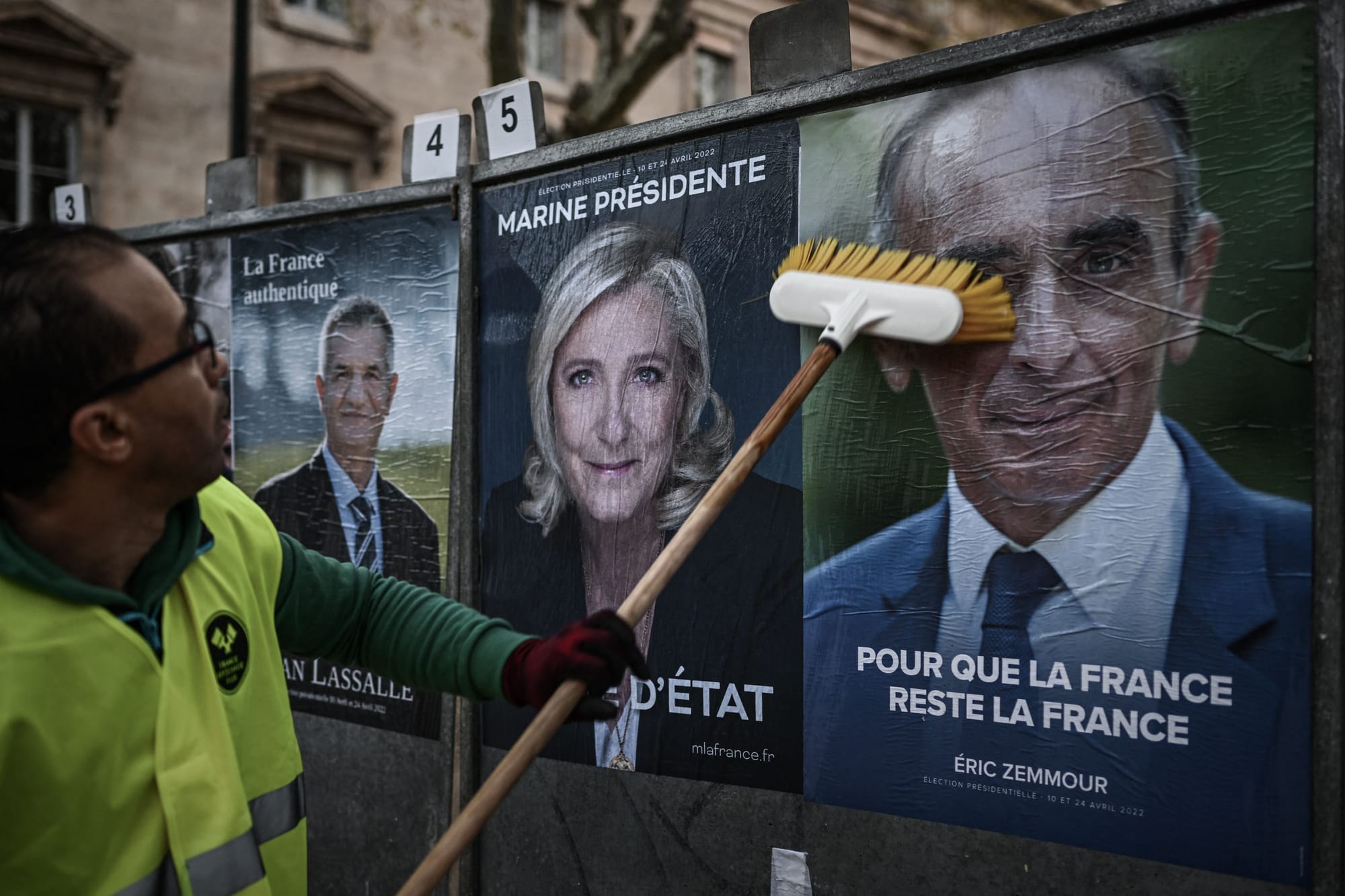
The official campaign posters of French presidential candidates Jean Lassalle of the Resistance party, Marine Le Pen of the far-right National Rally and Eric Zemmour of the far-right Reconquest party (with his slogan "So that France remains France"), March 28, 2022\. Philippe Lopez/AFP/Getty Images
But decolonization has also become a buzzword in the arsenal of nativist right-wing groups who have recast it as the right to ethnonational self-determination. In this perverse upending of the very meaning of decolonization, to decolonize France is to rid the nation of the immigrants who are “colonizing” it. Paradoxically, the most vocal advocates of decolonization today are not formerly colonized subjects, but the nativist guardians of the borders of France against the purported invasion of immigrants. This view of immigrants as foreigners or strangers (*étrangers*) is not the preserve of the xenophobic right alone. The image of the “immigrant as guest”—unwanted or welcome, depending on one’s political persuasions—is ubiquitous across the political spectrum. And the label sticks. The children and grandchildren of colonized subjects recruited to rebuild France after World War II continue to be dubbed *issus de l’immigration* (of immigrant descent) as if migration were a hereditary condition. Immigrants in France have become foreigners, and their French-born children are still seen as strangers to the country. Nativist discourses have managed to delink migration from its colonial roots.
Scholars in settler colonial and Indigenous studies have developed important tools to analyze and critique former settler colonies (such as Algeria, South Africa and Rhodesia) and ongoing settler colonial projects (Israel, the United States and the British Commonwealth countries). These frameworks fail, however, to account for the recuperation of decolonization within anti-immigrant discourses in the former metropoles of Europe. To understand the transformation of immigrants into foreigners, it is necessary to first understand the development of settler-colonial paradigms in the “settler postcolony” of France. Indeed, the history of anti-immigrant nativism hews closely to the “invention of decolonization” in France.[\[1\]](#%5Fedn1)
Unlike the United States, France itself is not a settler colony. But France was once the proud metropole of a settler colony, Algeria. Although decolonization was meant to ensure that after 1962 Algeria and France were two separate and sovereign nation states, the reality is messier. President Emmanuel Macron acknowledged as much when he invited the historian Benjamin Stora—a French Algerian Jew born in Constantine—to produce a report on the “wars of memory” that continue to play out in and between both countries.[\[2\]](#%5Fedn2) That it took 60 years for France to initiate such an effort is a testament to the lasting effects of colonial and postcolonial violence, both physical and epistemic. Naming France a settler postcolony acknowledges the central role that the history and memory of French Algeria continue to play in French politics, culture and society. The term also points to the colonial genealogy of anti-immigrant nativism in postcolonial France.
## **Toward a Colonial Genealogy of Nativism**
The nativist recuperation of decolonization has been decades in the making. Writing in the wake of the Algerian War of Independence, New Right theorist Alain de Benoist invoked nineteenth-century racial supremacist Arthur de Gobineau (author of *The Inequality of Human Races*) to advocate for “mutual respect and *reciprocal* decolonization.”[\[3\]](#%5Fedn3) The subtext of Benoist’s call for the so-called decolonization of France is clear: we (French settlers) left Algeria, now you (immigrants) leave France. Indeed, the French experience in Algeria played an outsized role in the emergence of nativist discourses in the 1970s. These discourses track closely with the fraught history of decolonization, including the Algerian state’s nationalization of oil production in 1971 and its suspension of emigration in 1973 in response to a sharp uptick in racist crimes targeting Algerians. In the face of increasingly unapologetic calls for remigration—the proposed deportation of immigrants to their countries of origin—it is more urgent than ever to identify the permutations of settler-colonial discourse in the postcolonial metropole.
The case of France is singular, but it is also exemplary. The recent transformations of nativist discourse in the United States, which likewise seeks to delink migration from centuries of US imperial entanglements in the Global South, point in a similar direction. As scholars of comparative colonial studies have shown, settler colonialism has always been a “transcolonial” process involving multiple imperial interests.[\[4\]](#%5Fedn4) The settlement of the United States, for example, served as an explicit model, and sometimes foil, for the conquest of Algeria, as did other settler-colonial projects. French parliamentarian Alexis de Tocqueville, fresh from his expedition to gauge the workings of “democracy in America,” warned against replicating what he euphemistically called the “destruction” of the American Indians in France’s first African colony—even as he advocated tactics taken straight from the US playbook, including mass displacement, “forced expropriation,” burning and looting.[\[5\]](#%5Fedn5) Other French politicians and settlers were less circumspect about taking on “the role of the pioneers in America, the English in Oceania and Southern Africa” to advocate for all-out “extermination.”[\[6\]](#%5Fedn6)
Settler-colonial fantasies of replacing the indigenous populations never materialized in Algeria. The native’s labor proved too useful for the settler. But the fantasy endured in the face of anti-colonial resistance. More than a century after Tocqueville wrote his “Report on Algeria,” anti-colonial theorist Frantz Fanon ventriloquized the settler’s fear of being replaced: “they \[the natives\] want to take our place.”[\[7\]](#%5Fedn7) The irony of the possessive (“our place”) is inherent to settler colonialism, founded, as Patrick Wolfe and others have shown, as a “project of replacement.”[\[8\]](#%5Fedn8) But the project is never complete. In Ranajit Guha’s apt phrase, the settler is “not at home in empire.”[\[9\]](#%5Fedn9) This paradox lies at the heart of Fanon’s postmortem on settler colonialism: “Despite the success of pacification, in spite of his appropriation, the settler always remains a foreigner. … The ruling species is first and foremost the one from elsewhere, different from the autochthonous population, ‘the others.’”[\[10\]](#%5Fedn10)
Notwithstanding Tocqueville’s fantasy of “taking…the place of the vanquished,” Europeans never formed a statistical majority in Algeria.[\[11\]](#%5Fedn11) The project to replace the Indigenous population gave way to what Achille Mbembe calls the “‘indigenization’ of the colonist.”[\[12\]](#%5Fedn12) Stranded in enemy territory, the lonesome settler had to legitimate his presence through conquest, settlement and agriculture (etymologically, linked to colonization). The settler became Algerian (until 1962, the settlers, not the colonized, were called “Algerians”), and Algeria became France (*l’Algérie, c’est la France*). The natives (*indigènes*), for their part, were subjects but not citizens of France, governed by a separate penal code, the infamous “Code de l’indigénat.”
> **The re-indigenization of settlers into France—many of whom were born in Algeria and had never set foot in the metropole—and the sudden transformation of colonial migrants into immigrant nationals of newly sovereign nation states also opened a new chapter in the story of French nativism.**
In Algeria, the process of indigenizing French settlers—what colonial advocates dubbed the “implantation” of settlers in Africa—took more than a century. France invaded the city of Algiers in 1830 and set about the slow and arduous process of military conquest, culminating in the annexation of the Ottoman province in 1834 and the administrative “departmentalization” of the territory in 1848\. Equally slow and arduous, settlement soon followed, with the aim of creating a new France in Africa. By 1862, when colonial apologist and convert to Islam Ismayl Urbain published his essay *French Algeria, Natives and Immigrants*, French, Spanish, Italian and Maltese settlers numbered 200,000 across Algiers, Oran and Constantine, referred to as the three “centers of European colonization.”[\[13\]](#%5Fedn13) Those the French called *indigènes* (Muslim and Jewish Arabs and Berbers/Amazighs) were at least twice as numerous with 400,000 urban dwellers and countless more living in the countryside, despite the policies of extermination adopted during the conquest. By the time Algeria achieved independence from France a century later, the balance was one settler for nine *indigènes*. The repatriation to France of close to 1 million settlers in 1962 (and Algerian Jews, who had acquired full French nationality by decree in 1870) was the first chapter in the messy story of decolonization unfolding across the new border separating France and Algeria. The re-indigenization of settlers into France—many of whom were born in Algeria and had never set foot in the metropole—and the sudden transformation of colonial migrants (including *indigènes* from Algeria and France’s other colonies) into immigrant nationals of newly sovereign nation states also opened a new chapter in the story of French nativism. Paradoxically, one of the consequences of decolonization was the transformation of settlers into natives of France and *indigènes* into immigrants.[\[14\]](#%5Fedn14)
## ***Indigènes* Into Immigrants**
Of course, not all nativists are former settlers. But it is not a coincidence that many think tanks, parties and organizations that have advanced a nativist agenda in postcolonial France originated in the battle to keep Algeria French. Benoist, co-founder in 1968 of the principal think tank of the New Right, the Group for the Research and Study of European Civilization (GRECE), was an ardent supporter of the Secret Armed Organization (OAS), which carried out terrorist attacks against Algerians and French partisans of Algeria’s right to self-determination. He was also an outspoken advocate for apartheid and white minority rule in South Africa and Rhodesia. Jean-Marie Le Pen, co-founder of the National Front (FN) in 1972, was a veteran of the Algerian War and an apologist for the French army’s systematic use of torture during the war. Eric Zemmour, the son of Jewish Algerian migrants to France, has become the most ardent apologist for the “reconquest” of France. The Algerian war continues to inform nativist and anti-immigrant discourses in France decades after decolonization. Several nativist right figureheads have explicitly invoked the example of the Algerian War of Independence in their plea for remigration, including Jean Raspail, author of *The Camp of the Saints* (1973), and Renaud Camus, creator of the so-called “Great Replacement” theory, which suggests that immigrants from the Global South are replacing European (read: white) people. Raspail and Camus are nostalgic for an era when ethnic cleansing was acceptable collateral damage in the pursuit of a just war of decolonization.[\[15\]](#%5Fedn15) Today, the argument goes, France should have the right to deport the immigrants settling France.
> **Decades in the making, French nativism has taken on a pioneering role in the “Eurocolonial” war against immigration. France’s former settler colony, Algeria, is one of the unacknowledged anchors of this trans-settler-colonial imaginary.**
In their wistful account of a deportation that can no longer be, Raspail and Camus gloss over the fact that the mass repatriation of settlers and Algerian Jews was an unexpected and unwelcome development for both parties to the Evian Accords that ended the Algerian War of Independence. Nonetheless, their arguments have gained traction in France and beyond. Jean-Marie Le Pen’s daughter Marine Le Pen, who recently stepped down from her role as leader of the newly rebranded National Rally (RN) to run for president for the second time, is not afraid to tout Raspail’s unapologetically racist dystopia of the submersion of Europe by immigrants as required reading. Steve Bannon, an aficionado of Western movies narrating the conquest of the American West, is also a [fan of Raspail’s novel](https://www.politico.com/magazine/story/2017/04/23/what-a-1973-french-novel-tells-us-about-marine-le-pen-steve-bannon-and-the-rise-of-the-populist-right-215064/). As is Renaud Camus, of course, whose Great Replacement theory has [inspired real-world disciples](https://www.thenation.com/article/archive/renaud-camus-great-replacement-brenton-tarrant/), from the violent Unite the Right rally in Charlottesville to Brenton Tarrant’s mass shooting rampage in Christ Church, New Zealand. That these disciples invoke Camus’s Great Replacement fantasy to protest immigration in a settler-colonial context—the United States, Australia and New Zealand—is not surprising. Anti-immigrant nativism has roots in anti-native racism. Decades in the making, French nativism has taken on a pioneering role in the “Eurocolonial” war against immigration.[\[16\]](#%5Fedn16) France’s former settler colony, Algeria, is one of the unacknowledged anchors of this trans-settler-colonial imaginary.
## **A Transcolonial Approach to Settler Colonial Studies**
Can it be a coincidence that the migrant hordes that wash up on the shores of France in Raspail’s novel are Indian? Raspail originally planned to make his migrant invaders North African but settled for migrants from the subcontinent to signal his “refusal to enter the sham debate on racism and anti-racism in France” (unsuccessfully: it is impossible to read his novel as anything but a racist screed). But his second choice for the figure of the migrant unwittingly reveals the colonial genealogies of anti-immigrant discourses in postcolonial France. *Indien.ne.s* is still the most common designation for Indigenous Americans in French. It is, in this sense, a cognate for *indigène* or native, the term Europeans used to “define and rule” the populations they conquered.[\[17\]](#%5Fedn17) In Raspail’s novel, “Indian” is also a metaphor for the colonized. No surprise, then, that one of the politicians involved in managing the migrant crisis in the novel half-jokingly proposes placing the migrant ships under the protection of the United Nations Relief and Works Agency (UNRWA). “It’s hardly a new idea,” he says. “Remember Palestine?”[\[18\]](#%5Fedn18)
> **To think of France as a settler postcolony is to acknowledge the messy history of decolonization as an unfinished project. It also places France on the map of the settler-colonial projects that continue to structure our purportedly postcolonial present.**
One of the solutions proposed by the French during the protracted negotiations leading to the 1962 Evian Accords was the “Israelization of Algeria.” Under this plan, independent Algeria would be partitioned into three territories: one fully sovereign, another for settlers and Algerians who wished to remain French and a third, the Sahara, a neutral territory designed to protect France’s oil fields and nuclear testing sites. If the nineteenth-century conquistadores of Algeria looked to the United States for a model of conquest and settlement, the politicians in charge of decolonization saw Israel as a model for a continued settler-colonial future in the twentieth century. That this partition project never materialized does not disprove Léopold Lambert’s thesis about the [“colonial continuum”](https://thefunambulist.net/editorials/summer-1961-france-considering-creating-french-israel-algeria) that blurs the overly neat timelines of colonization and decolonization. It also shows that settler colonialism has always been a transcolonial venture.
To think of France as a settler postcolony is to acknowledge the messy history of decolonization as an unfinished project. It also places France on the map of the settler-colonial projects that continue to structure our purportedly postcolonial present. Most importantly, calling France a settler postcolony offers one way to track the colonial genealogy of nativist discourses and the colonial production of the migrant crisis. The figure of the migrant-as-guest is a legacy of decolonization, then as now. If migrants continue to wash up on the shores of Eurocolonial nations, it is because they constitute the “detritus of ‘settled’ nations.”[\[19\]](#%5Fedn19) In the words of migrant activists, we are here (in France) because you were there (in the colonies).[\[20\]](#%5Fedn20)
\[Olivia C. Harrison is associate professor of French and comparative literature at the University of Southern California.\]
---
### **Endnotes**
[\[1\]](#%5Fednref1) Todd Shepard, *The Invention of Decolonization: The Algerian War and the Remaking of France* (Ithaca: Cornell University Press, 2006).
[\[2\]](#%5Fednref2) I borrow the expression “wars of memory” from Pascal Blanchard and Isabelle Veyrat-Masson, eds., *Les guerres de mémoires. La France et son histoire: Enjeux politiques, controverses historiques, stratégies médiatiques* (Paris: La Découverte, 2008). All translations are my own unless otherwise noted.
[\[3\]](#%5Fednref3) Alain de Benoist, *Vu de droite: Anthologie Critique des Idées Contemporaines* (Paris: Labyrinthe, 2001 \[1978\]) p. 263\. Italics in the original.
[\[4\]](#%5Fednref4) Françoise Lionnet and Shu-mei Shih, *Minor Transnationalism* (Durham: Duke University Press, 2005).
[\[5\]](#%5Fednref5) Alexis de Tocqueville, *Democracy in America and Two Essays on America* (London: Penguin, 2003) p. 376\. Alexis de Tocqueville, *Writings on Empire and Slavery*, trans. Jennifer Pitts (Baltimore: The John Hopkins University Press, 2001) p. 89.
[\[6\]](#%5Fednref6) Eugène Bodichon, *Etudes sur l’Algérie et l’Afrique* (Algiers: Eugène Bodichon, 1847) p. 150\. Olivier Le Cour Grandmaison, *Coloniser, exterminer: Sur la guerre et l’état colonial* (Paris: Fayard, 2005), p. 18*.*
[\[7\]](#%5Fednref7) Frantz Fanon, *The Wretched of the Earth*, trans. Richard Philcox (New York: Grove Press, 2004) p. 5.
[\[8\]](#%5Fednref8) Patrick Wolfe, *Traces of History: Elementary Structures of Race* (London: Verso, 2016) p. 33.
[\[9\]](#%5Fednref9) Ranajit Guha, “Not at Home in Empire,” *Critical Inquiry* 23/3 (1997).
[\[10\]](#%5Fednref10) Fanon, *The Wretched of the Earth*, p. 5\. Translation modified.
[\[11\]](#%5Fednref11) Tocqueville, *Writings on Empire and Slavery*, p. 19\. Translation modified.
[\[12\]](#%5Fednref12) Achille Mbembe, *Critique of Black Reason*, trans. Laurent Dubois (Durham: Duke University Press, 2017) p. 57.
[\[13\]](#%5Fednref13) Ismayl Urbain, *L’Algérie française, indigènes et immigrants* (Paris: Séguier, 2002 \[1862\]) p. 59–60.
[\[14\]](#%5Fednref14) I borrow this formulation from Emmanuelle Comtat, who analyzes “the persistence of settler colonial culture following the end of colonisation and the removal of the settler population” in her sociological study of *pied-noir* communities (repatriated settlers) in postcolonial France. Comtat, “*Indigènes* to Immigrant workers: *Pied-Noir* Perceptions of Algerians and People of Algerian Origin in Postcolonial France,” *Settler Colonial Studies* 8/2 (2018) p. 263.
[\[15\]](#%5Fednref15) Jean Raspail, *Le camp des saints* (Paris: Robert Laffont, 2001 \[1973\]). Renaud Camus, *2017 dernière chance avant le Grand Remplacement. Changer de peuple ou changer de politique?* (Paris: La Maison d’Edition, 2017).
[\[16\]](#%5Fednref16) Wolfe, *Traces of History*.
[\[17\]](#%5Fednref17) Mahmoud Mamdani, *Define and Rule: Native as Political Identity* (Cambridge: Harvard University Press, 2012).
[\[18\]](#%5Fednref18) Jean Raspail, *The Camp of the Saints* (New York: Charles Scribner’s Sons, 1975) p. 63\. “Remember Palestine?” is added in the translation. Raspail apparently felt the reference would be transparent for a French audience. I’m grateful to Mehammed Mack for drawing my attention to this passage.
[\[19\]](#%5Fednref19) Jean Genet, *Prisoner of Love*, trans. Barbara Bray (New York: New York Review of Books, 2003) p. 15.
[\[20\]](#%5Fednref20) Houria Bouteldja, “Si nous sommes ici c’est que vous étiez là-bas…,” *Montray Kréyol*, July 16, 2018.
### Settler Colonialism in the Middle East and North Africa: A Protracted History
URL: https://www.merip.org/2022/05/settler-colonialism-in-the-middle-east-and-north-africa-a-protracted-history/
Last updated: 2025-08-22T18:37:17.000Z
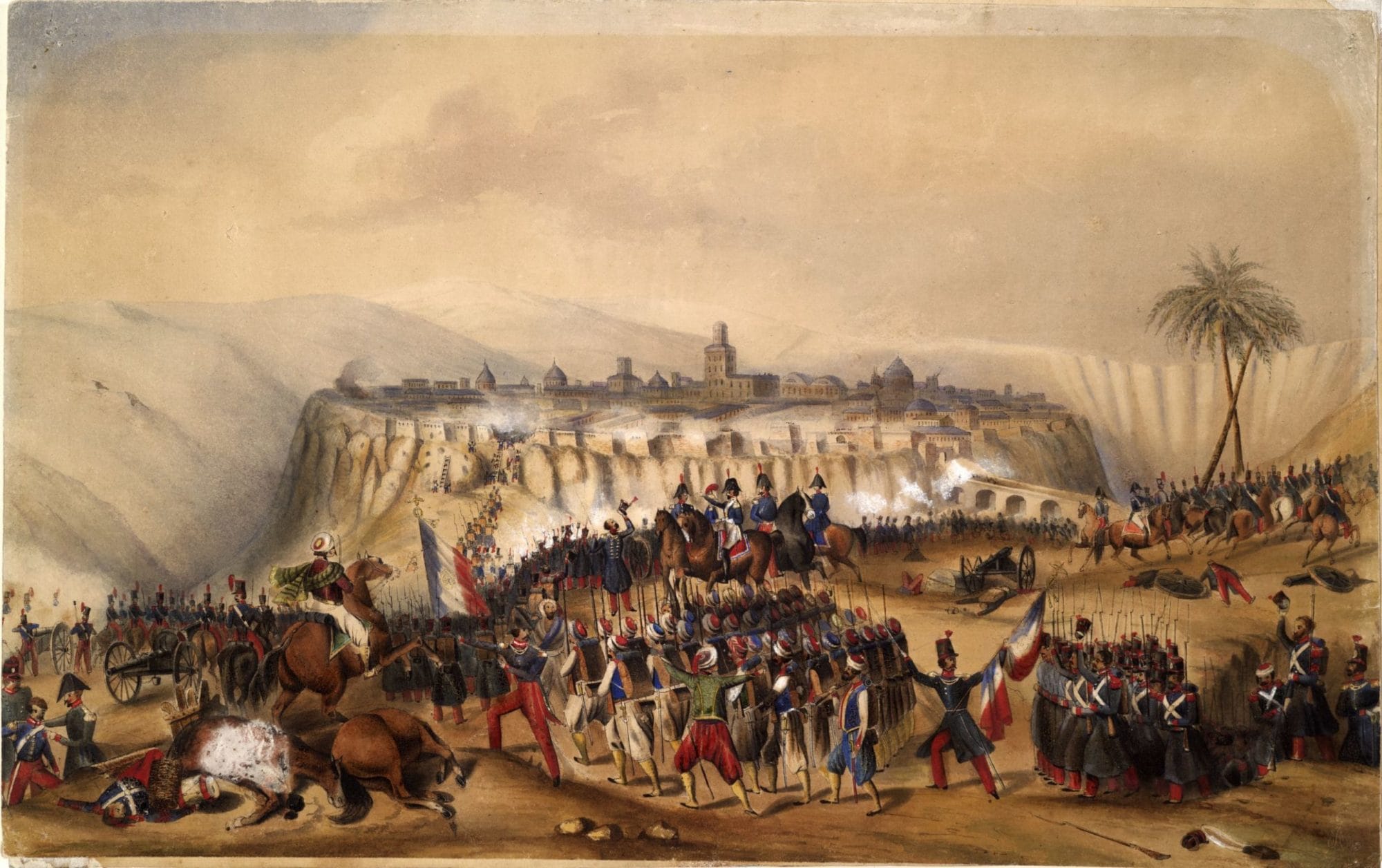
An 1837 watercolor depicts French forces advancing across cliffs and through a breach in the wall of the fortified city of Constantine in Algeria. Artist possibly Jean-Louis Gaspard of the 31st Regiment of Infantry. Anne S.K. Brown Military Collection at the Brown University Library/Library of Congress
Settler colonial studies developed as a distinct field of research to address the particular circumstances of settler societies. Since its advent in the 1990s, this field has only marginally considered the Middle East and North Africa, focusing instead on the Anglophone settler societies of North America and Australasia. And yet, this neglect is unjustified. Settler colonialism targeted countries throughout the Middle East and North Africa, and these endeavors were crucial to developing a transnational network of settler-colonial ideas and practices. Rather than marginal to the global history of settler colonialism, the Middle East and North Africa were crucial to the long-term evolution of settler colonies around the globe.
More than other forms of colonialism, settler colonialism is characterized by a “logic of elimination.” This form of domination contrasts with exploitative or extractive colonialisms, where the ongoing subordination of colonized populations is a requirement for the viability of colonial domination. In settler colonies, the very presence of an Indigenous population is sometimes targeted through expulsion or physical elimination. Alternately, settler-colonial powers can undermine the resilience of Indigenous political sovereignty and autonomy. If settler-colonial regimes do not display a uniform investment in outright native elimination, it is because settler colonialism and other types of colonialism routinely mix with one another. Conflicting demands for subsumption and elimination can coexist even if they respond to distinct and, to a certain extent, antithetical colonial logics; all colonial regimes are marked by contradiction. Settlers also respond flexibly to conditions on the ground and to Indigenous resistance and agency. Nevertheless, the objective of a non-settler-colonial regime is the ongoing domination of a colonized collective, whereas the aim of a settler-colonial regime is the reproduction of a settler polity in place of an Indigenous one.
## **The Settler-Colonial Paradigm and its Blind Spots**
Indigenous scholars and militants had been concerned with settler colonialism for decades by the time the field first emerged in the 1990s; no one knew this mode of domination better than them. Rather than initiate the conversation about settler-colonial formations, scholars provided a more global analysis. In truth, however, the field’s initial purview was circumscribed. With the exception of Israel-Palestine, settler-colonial studies focused primarily on Anglophone settler societies—Australia, Canada, New Zealand, the United States and to some extent South Africa. Researchers compared these Anglophone settler societies productively in terms of their past and present: they looked at the shared legal traditions and histories of Indigenous dispossession, elimination and forced assimilation. They also shed light on the parallel processes of Indigenous “renaissance” that began in the 1970s, a period that witnessed increased Indigenous militancy, political organizing and increased demands for land and language rights, self-determination, sovereignty and constitutional recognition.
From its inception, settler colonial studies also focused extensively on Israel-Palestine. Here, too, there was a pre-existing tradition of comparative analysis of settler colonialism as a distinct mode of domination. Building on earlier popular Palestinian critiques of Zionism that date back to the turn of the twentieth century, Palestinian intellectuals began to denounce Zionism explicitly as a settler-colonial movement starting in the mid-1960s.[\[1\]](#%5Fedn1) Around the same time, a small group of anti-Zionist Jewish leftists in Israel, alongside Palestinian citizens, began to echo the same charge. (The fact that their critique emerged toward the end of the war in Algeria—another settler colony—is not coincidental.) The development of a settler-colonial paradigm as a viable lens for interpreting the ongoing conflict in Israel-Palestine began in the 1980s but expanded significantly at the turn of the twenty-first century. This lens has become particularly compelling as an avenue for understanding within a single frame the multiple questions that scholars and activists long treated in isolation: the long history of Zionism as a political movement and the range of political arrangements Palestinians experience, whether as citizens of Israel, denizens of East Jerusalem, occupied subjects in the West Bank and Gaza or refugees in the diaspora. The settler-colonial paradigm has enabled scholars to offer a unifying interpretation of the Zionist movement’s (and later Israel’s) deployment of diverse forms of subjection and political fragmentation across time and space.
> **From an emphasis on the importance of “Third World” solidarity, many Palestinians began to focus on “Fourth World” Indigenous internationalism—the politics of transnational Indigenous opposition to settler colonialism as a specific mode of domination.**
The growing application of the settler-colonial paradigm to Israel-Palestine evolved alongside a shift in how many Palestinians understood their liberation struggle within the broader arena of anti-colonial politics. From an emphasis on the importance of “Third World” solidarity, many Palestinians began to focus on “Fourth World” Indigenous internationalism—the politics of transnational Indigenous opposition to settler colonialism as a specific mode of domination. This political shift brought the United States, with its own legacy as a settler colony, into the frame—not as an imperialist power located abroad and acting locally through an intermediary, but as a polity directly involved in Israel’s settler project.
Israel and supporters of its policies have followed the diffusion of the paradigm in academia and public culture, and in recent years they have responded to it with an updated counter frame. In the 1950s and 1960s, Israeli officials typically disavowed the charge of settler colonialism on the grounds that Zionism had in their reconstructions been an anti-colonial movement and that the violence that had accompanied the state’s birth in 1948 was in fact an anti-colonial war of liberation against the British Empire. But if the charged debate over Israel’s settler-colonial status became relatively more muted in subsequent decades, its recent growing prevalence has spawned the circulation of [more pointed claims](https://www.jimena.org/jewish-indigeneity-to-israel/) about [Jewish indigeneity](https://jewishcurrents.org/when-settler-becomes-native) to the land. (These assertions remain unconvincing; one cannot proclaim a right to the Promised Land from elsewhere, as the Biblical text and Zionist claims equally do, and at the same time argue that one was always there. Jews may be “returning” to the land but are unable to do so as Indigenes.) These counterclaims often appear alongside arguments about the racial diversity of Jews and their status as “people of color”—a response to the growing linkages between the Movement for Black Lives and Palestinian solidarity activists, as well as to charges that Zionism and the state of Israel are rooted in the principles and practices of white supremacy.
## **Central Nodes in a Settler-Colonial Network**
Aside from Israel-Palestine, scholars in settler colonial studies have tended to overlook settler colonies in the Middle East and North Africa. This relative neglect has left unexplored the region’s crucial contributions to the global diffusion and development of settler colonialism as a historical phenomenon. Scholars have largely ignored how, at least between the 1830s and the 1930s, European settlement in North Africa was seen as a more favorable prospect than establishing colonies further away. (In the early twentieth century, the Zionist leaders who fatefully decided to focus on Palestine rather than pursue potential opportunities in Argentina and Angola, among other places, drew the same conclusions.) In contrast to European settlers elsewhere, those in North Africa were ultimately expelled, and therefore failed to survive as communities. This does not mean that settler colonialism as a distinct mode of domination was never significant there. Indeed, the modern comparative distinction between different modalities of domination that eventually underpinned the field’s emergence was first offered regarding French Algeria between 1830 and 1962\. Once again, local analyses prefigured the paradigm. In his book, *Vocation de l’Islam,* which appeared in 1954, Algerian intellectual Malek Bennabi offered an early definition of settler colonialism as distinct from other forms of colonialism. Bennabi explicitly distinguished conquered, or occupied, countries from “colonized” countries (a distinction that replicated the “colonie d’exploitation”/“colonie de peuplement” opposition that characterized French colonial traditions).[\[2\]](#%5Fedn2) The latter would now be understood as settler colonies.
The shape of France’s settler colonization of Algeria was itself the fruit of transnational comparisons. In 1831 parliamentarian and scholar Alexis de Tocqueville visited America and approved of what he understood as a successful model of nonrevolutionary republicanism. He later imagined that Algeria, conquered one year earlier, could become the cradle of a similar republican project. After visiting the French colony in 1841, Tocqueville espoused the necessary role of violence—as well as the need to suspend political liberties—to complete the state’s colonial project. The ensuing years of violent conquest culminated with the defeat of the anti-colonial leader Emir Abdelkader. In the wake of these events, progressive Saint-Simonian principles became central in redefining the French civilizing mission, ushering in a brief period of liberal associationism between colonizer and colonized. This governing approach came to an end in 1870, when the architects of France’s Third Republic pressed for the legal assimilation of Algerian and colonial institutions and deepened inequalities between the European and Indigenous inhabitants.[\[3\]](#%5Fedn3) Later, the colony remained a testing ground for the implementation of policies that could be introduced to the metropole.
> **French republican traditions in the nineteenth and twentieth century extolled the colonization of Algeria as an opportunity for national regeneration and a laboratory for political experimentation.**
French republican traditions in the nineteenth and twentieth century extolled the colonization of Algeria as an opportunity for national regeneration and a laboratory for political experimentation. While French settlement was crucial to the political evolution of the metropole, aspiring settler leaders and movements elsewhere studied the events as an example they might follow. In the mid-1840s, educator, writer and future Argentinian president Domingo Faustino Sarmiento visited Algeria as part of a broader tour of Europe. As with the French mission in North Africa, Argentina faced the predicament of dealing with restive Indigenous populations as it sought to welcome peasant immigrant-settlers from a variety of southern European countries rather than from a single “motherland.” Upon his return, Sarmiento expressed his admiration for how the remorseless repression of Indigenous insurgents helped transform peasants into small proprietors. If, as Sarmiento famously noted, “to govern is to populate,” he found what he understood as best practice in Algeria.[\[4\]](#%5Fedn4) The settler colonization of Argentina proceeded in ways that departed from what he saw as the Algerian example but was informed, no less, by a transnational network of ideas about colonialism.
Decades later, the Zionist movement in Palestine would also think comparatively about French Algeria. The philanthropists who bankrolled its early agricultural colonies in the late nineteenth century sought to adopt the Algerian model by creating a Jewish planter class that would survive by relying on low-wage Indigenous Arab workers. In the early 1900s, a new generation of European Jewish settlers realized that the conditions that had enabled the French settler minority to sustain itself and flourish under this arrangement were not transferable to Palestine. Without the coercive economic and political power of a metropole, these younger and more militant settlers warned that adopting a “mixed” labor force would spell the end of their movement. This prognosis would give birth to the creation of a separate and closed Jewish economy. Decades later, the Algerian war would re-emerge in Israeli representations as a specter: decolonization.

The governor of Italian Libya, Italo Balbo, welcomes arriving Italian colonists in Tripoli in 1938\. Courtesy of State Treasury of Poland, image in the public domain.
> **Rather than focusing exclusively on the political and economic exigencies of Italy’s colonial settlers, Mussolini’s vision was rooted in broader aims of racial purification and the production of the “New \[and White\] Fascist Man.”**
Algeria was not the only North African colony that became a crucial site of settler-colonial experimentation. In the 1930s, following Italy’s murderous “pacification” efforts in Libya over the previous two decades, Mussolini sought to establish a new type of colony on appropriated Indigenous land. Rather than focusing exclusively on the political and economic exigencies of Italy’s colonial settlers, Mussolini’s vision was rooted in broader aims of racial purification and the production of the “New \[and White\] Fascist Man.” Libya’s history as a former settler colony of the Roman Empire, and the dream of organizing Italy’s “return” to North Africa, loomed large in his mind. To this end, the government built entire settler villages prior to the arrival of Italian farmers and their families, stocked with furnished homes and institutions of social, cultural and political life that replicated those of the mainland. These preparations would lay the groundwork for Italian settlers to enact a new kind of conquest: they called it the conquest of labor, or “*impero del lavoro*” (which echoes the Yishuv’s parlance but is probably unrelated).
If Mussolini aimed to showcase Italy’s settler enterprise in Libya, he found a particularly receptive audience in Germany’s Third Reich. Some Nazis were so impressed with Italy’s “achievements” and its emphasis on racial regeneration that they set out to replicate its policies in the areas of central and eastern Europe that fell under their control since the late 1930s—although defeat at the hands of the Soviet Union’s Red Army discontinued their plans.[\[5\]](#%5Fedn5) Significantly, the Italian settler community would be expelled only in the late 1960s, more than two decades after Libya gained its independence. Many believed, somehow, that their settlements could survive the demise of the colonial regimes that had underpinned their establishment and privilege. A young colonel named Muammar al-Qaddafi thought differently.
Zionist and German planners were not alone in their search for models of settlement in the Middle East and North Africa. Further away, Jewish colonization strategies in 1930s Palestine would themselves serve as an example to emulate. In Imperial Japan, bureaucrats and intellectuals endeavored to adapt these strategies in Manchuria, where they sought to settle Japanese communities on lands that were already densely populated by relatively impoverished peasants.[\[6\]](#%5Fedn6) (Japanese authorities promoted the settlement of Korea and Taiwan too, but in these cases, their models were respectively British and French.) Like the Italian settlers in Libya and the *Pied Noirs* of Algeria*,* who would be “repatriated” in the 1960s, the Japanese settlers would return to the metropole in a protracted and tragic counter-migration after their country’s defeat in World War II.
> **But if the Pied Noirs had “returned” to a homeland that in many cases they had never seen and to which they lacked ancestral links, the Spaniards whose ancestors had populated the cities of Melilla and Ceuta since the fifteenth and seventeenth centuries, respectively, did not.**
But if the *Pied Noirs* had “returned” to a homeland that in many cases they had never seen and to which they lacked ancestral links, the Spaniards whose ancestors had populated the cities of Melilla and Ceuta since the fifteenth and seventeenth centuries, respectively, did not. Located on Morocco’s Mediterranean coast, both areas are officially considered an integral part of the Spanish metropole. Unlike the settlements in Algeria, the end of the Spanish Protectorate in Morocco in 1956 did not involve their disestablishment or retrocession. Instead of slating them for decolonization, Spain administratively excised the cities from their surrounding hinterlands. Today, they constitute the only remaining European enclaves in North Africa, surrounded by secure fences and highly militarized from within. All of their Christian and most of their Muslim inhabitants are citizens of the European Union; they dwell in the African continent, but they are not of it. The very existence of these “villas in the jungle”—the legacy of a colonial settlement predicated on the expulsion of colonized populations—underscores the distinction between settler colonialism and other modes of imperial domination.
Though Morocco demands that Spain return Ceuta and Melilla, its stance stands in tension with the Kingdom’s simultaneous view of the disputed Western Sahara territory as a site for its own settlement project. In 1975, following two years of a nationalist uprising against the territory’s nearly century-long occupation by Spain, the Western Sahara became the site of competing sovereignty claims by its Moroccan and Mauritanian neighbors. That year, the International Court of Justice ruled that neither country’s historical ties to the territory lent international legal legitimacy to their contemporary claims. Morocco quickly launched a controversial settlement movement in the Western Sahara, unilaterally annexing it in 1979\. The United States only reversed its longstanding refusal to recognize the annexation in 2020\. Morocco agreed to join the Abraham Accords in a quid pro quo, which extended formal US recognition of Morocco’s settler-colonial occupation of the Western Sahara in return for Morocco’s normalization of relations with Israel. Morocco understands the Western Sahara as a southern extension of itself, but most of its Indigenous peoples understand it as their occupied homeland. Morocco’s policies represent a new kind of settler colonialism, in which a postcolonial polity undertakes the demographic transformation of another territory through expulsion, exile and the systematic settlement of its own nationals. The logic of elimination prevails.
## **The Future of Settler Colonialism**
Settler colonialism is not only relevant to the history of the Middle East and North Africa but also to the way the region’s future is imagined. Today, Turkey is considering whether to turn the Kurdish-majority northeast Syrian region of Afrin, which it has occupied since 2018, into a new settlement project, albeit with Syrian Arab refugees instead of Turkish nationals. The proposed resettlement of these refugees, which could build on decades of Turkey’s experience of occupying Northern Cyprus, falls within the parameters of settler colonialism as a distinct mode of domination. If carried out, Afrin would become a new and alternative Syria—permanently separated from the rest of the country and supported by a foreign power. As demonstrated by Britain’s imperial sponsorship of the Zionist colonization of Palestine, a state does not need to be settling its own nationals to pursue a settler-colonial project.
> **Increasingly, countries around the globe demand the sophisticated technologies of containment and control that Israel has developed and “battle tested” in the West Bank and Gaza Strip over the last 30 years.**
Still, the future of global settler colonialism emanates from the Middle East in other ways. Palestine remains a global laboratory of settler domination through containment, a repressive practice that pursues the logic of elimination by targeting the links that a specific community maintains with the wider world. Increasingly, countries around the globe demand the sophisticated technologies of containment and control that Israel has developed and “battle tested” in the West Bank and Gaza Strip over the last 30 years. The occupation is increasingly marketable around the world. India, for example, has borrowed from Israeli strategies and purchased some of its technologies for its emerging settlement project in occupied Kashmir. The [Pegasus spyware](https://tspace.library.utoronto.ca/handle/1807/95391) has been acquired and used widely by autocrats in the region and beyond. The United States has also provided an eager market; in 2019 the [FBI purchased](https://www.nytimes.com/2022/01/28/world/middleeast/israel-pegasus-spyware.html) and tested Pegasus to consider its potentials for domestic use, and a growing body of evidence has pointed to the Israel Defense Force’s contribution to the increased militarization of US policing. In short, we are witnessing the convergence and globalization of technologies of domination and modes of settler-colonial domination. As in the past, the region remains a crucial node in transnational networks of colonialist ideas and repressive practices.
\[Lorenzo Veracini is associate professor in history and politics at Swinburne University of Technology, Melbourne.\]
---
### **Endnotes**
[\[1\]](#%5Fednref1) Rana Barakat, “Writing/righting Palestine Studies: Settler Colonialism, Indigenous Sovereignty and Resisting the Ghost(s) of History,” *Settler Colonial Studies* 8/3 (2018).
[\[2\]](#%5Fednref2) Malek Bennabi, *Islam in History and Society* (Islamabad: Islamic Research Institute, International Islamic University, 1988).
[\[3\]](#%5Fednref3) Osama Abi-Mershed, *Apostles of Modernity: Saint Simonians and the Civilizing Mission in Algeria* (Stanford: Stanford University Press, 2010).
[\[4\]](#%5Fednref4) Ricardo Cicerchia, “Journey to the Centre of the Earth: Domingo Faustino Sarmiento, a Man of Letters in Algeria,” *Journal of Latin American Studies* 36/4 (2004).
[\[5\]](#%5Fednref5) Patrick Bernhard, “Hitler’s Africa in the East: Italian Colonialism as a Model for German Planning in Eastern Europe,” *Journal of Contemporary History* 51/1 (2016).
[\[6\]](#%5Fednref6) John C. De Boer, “Circumventing the Evils of Colonialism: Yanaihara Tadao and Zionist Settler Colonialism in Palestine,” *Positions: East Asia Cultures Critique* 14/3 (2006).
### Settler Colonialism’s Enduring Entanglements
URL: https://www.merip.org/2022/05/settler-colonialisms-enduring-entanglements/
Last updated: 2025-07-30T04:06:23.000Z
The spring 2022 issue of *Middle East Report*, “Settler Colonialism’s Enduring Entanglements,” brings together a wide range of geographic and disciplinary perspectives on settler colonialism from the Middle East, North Africa and the metropole.
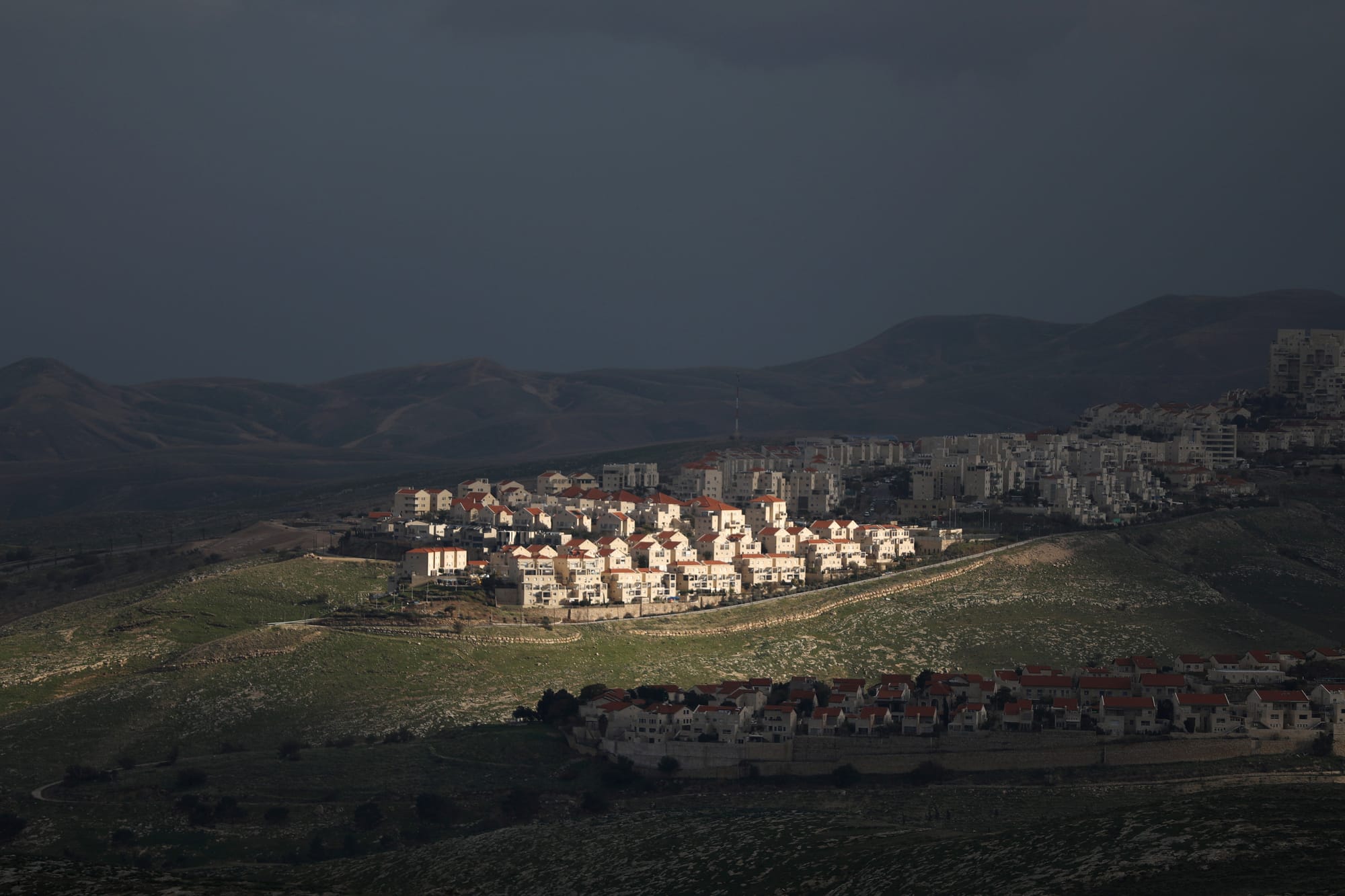
The Israeli settlement of Maale Adumim in the Israeli-occupied West Bank, February 25, 2020\. Ammar Awad/Reuters
While there are rich literatures that deal with the two most well-known instances of settler colonialism in the region, French Algeria and Israel and Palestine, these cases have been surprisingly peripheral to the field of settler colonial studies as well as to broader definitions of settler colonialism and understandings of how its legacies shape politics and social life today.
The establishment of settler colonies dates to the eighteenth and nineteenth centuries when Europeans displaced Indigenous people in a host of locations including (but not limited to) the United States, Canada and Algeria. European powers legitimated the seizure of these lands through their liberal regimes of property ownership and racial hierarchies. They claimed that their own capacities for cultivation and improvement, rather than Indigenous histories of land use, granted the right of ownership. Moreover, in places like Algeria and Israel, the “ethnonational imperatives” of creating European outposts in the Middle East and North Africa trumped the classic structures of capitalist rationality.
Settler colonialism became a framework for studying specific examples of colonization in the 1990s when scholars looked to the past to understand how specific forms of domination continued to influence contemporary politics, notably the neoliberal multiculturalism that reproduced the erasure of Indigenous groups. This analytical paradigm thus emphasizes an enduring institutional tendency to supplant the Indigenous population rather than focusing on the initial violence of conquest (giving rise to historian Patrick Wolfe’s now famous phrase that settler colonialism is a “structure and not an event”). For many scholars, the colonial fantasy of “cleansing” the body politic of the Indigenous population means that settler colonies were (and are) fundamentally different from other instances of imperial domination since the underlying rationale was the replacement (rather than exploitation) of Indigenous inhabitants.
And yet, as Lorenzo Verancini notes in the opening essay of this issue, even the examples of Algeria and Palestine have been largely marginalized in the field of a settler colonial studies that has focused primarily on Anglophone colonies in North America, Australia and South Africa. Perhaps the uniqueness of the two primary Middle East and North Africa examples makes them difficult cases for comparison. With Algeria, the departure of millions of settlers and their return to France after Algerian independence in 1962 certainly sets it apart from other settler-colonial societies. In Israel and Palestine, there are complex and ongoing contestations about who can claim Indigeneity: How can a settler also be Indigenous? Additionally, there are the more technical (and tedious) debates around Israel’s lack of a metropole that have served, strategically, to hive it off from comparisons. Beyond Algeria and Palestine, the region has experienced other instances of settler colonialism, and these less studied examples, too, have much to say about the broader field.
We recognize from the outset that settler colonialism is an inherently messy thing to pin down. It is both a process and a concept. There is no pure application or perfect example. In practice, settler colonialism often operates in conjunction with other processes that can effectively mask it, such as nationalism, Indigeneity and sovereignty, to name a few. This issue of *Middle East Report* seeks to pull apart some of those entanglements.
In developing this issue, we identified two goals. First, in expanding the geographic scope of scholarly analysis, we hoped to go beyond Algeria and Palestine to explore other, lesser-known sites of settler colonialism in the region, both past and present. Ali Abdullatif Ahmida, in an interview with Jacob Mundy, sheds light on the forgotten history of Italian settler colonialism in interwar Libya, with its explicit aims of removal and genocide. Victoria Verguilla shows how, beginning in the 1990s, the fishing industries of the Western Sahara shaped the informal settlement of Moroccans in key port cities. As this population grew in the early 2000s, the Moroccan state intervened with housing policies that helped to formalize these settlements as a way of strengthening its hold on the territory.
In addition to Verguilla, other authors underscore the importance of coming to grips with the everyday, often material, structures and practices that undergird settler colonialism. Muriam Haleh Davis explores links between citrus production in Algeria, Palestine and California as a way to reveal the often-overlooked transnational dimensions of settler economies and the racial capitalism they produce. Moving to the present, Daniel Monterescu and Ariel Handel investigate how both Israeli and Palestinian vintners work to rehabilitate indigenous grape varieties to buttress their historic claims to Israeli-occupied land.
Our second goal was to explore the contested meanings and understandings of decolonization in different contexts. As Olivia Harrison shows, the recent appropriation of the term “decolonization” by the nativist right in France has its origins in colonial Algeria. Harrison’s characterization of France as a “settler postcolony” highlights the way that the history and memory of France’s settler past continue to animate its politics, culture and society. Of course, there is nothing “post” about settler colonialism in Palestine and Israel. Since the end of the Oslo process and the second Intifada, the Israeli government has further formalized its policies of Jewish supremacy throughout historic Palestine. Under these circumstances, the form that decolonization might, or should, take remains uncertain. Leila Farsakh takes up this question and considers whether the pursuit of statehood in and of itself may restrict Palestinians’ political imagination and may push for ends that are not ultimately emancipatory. Similarly, Areej Sabbagh-Khoury insists on the importance of employing the settler-colonial lens to see through erroneous claims that the Israeli-Palestinian conflict is about ethnicity, religion or nationalism. Both authors also point to decolonization as a critical framework for peace: What political and social processes will allow Palestinians and Israeli Jews together to dismantle the structures of domination that perpetuate Palestinian dispossession and disenfranchisement?
There is one other significant challenge to studying and analyzing settler colonialism in the Middle East and North Africa: temporality. Settler colonialism in the Middle East has a long past, continues to shape the present and is likely to continue into the future. As early as 1415, Ceuta and Melilla on the Moroccan Mediterranean coast were occupied and settled by the Portuguese. They became Spanish settler colonies in the sixteenth century and have remained Spanish enclaves since, despite Moroccan demands for return. The settler population of French Algeria may have left after independence, but their memory remains a potent force on both sides of the Mediterranean. And in Palestine, settler colonialism continues, expands and transforms. Much of this issue deals with current entanglements, but contestations over the past remain ever present.
\[The editors of issue #302, "Settler Colonialism's Enduring Entanglements," are Mona Atia, Graham Cornwell and Muriam Haleh Davis with Guest Editor Shira Robinson.\]
### Genocide, Historical Amnesia and Italian Settler Colonialism in Libya—An Interview with Ali Abdullatif Ahmida
URL: https://www.merip.org/2022/05/genocide-historical-amnesia-and-italian-settler-colonialism-in-libya-an-interview-with-ali-abdullatif-ahmida/
Last updated: 2025-08-22T18:37:17.000Z
*\[su\_dropcap style="simple" size="4"\]*I*\[/su\_dropcap\]n the late 1920s, the Italian fascist regime implemented a campaign of ethnic cleansing in eastern Libya to create more land for Italian settlers and quell armed resistance to colonization. Ali Abdullatif Ahmida’s new book,* Genocide in Libya: Shar, a Hidden Colonial History*, examines this forgotten case of settler-colonial violence and the processes that led to the forced relocation of over 100,000 Libyans to special camps, resulting in the deaths of tens of thousands. Ali Abdullatif Ahmida is founding chair and professor of political science at the University of New England. Jacob Mundy, associate professor of Peace and Conflict Studies at Colgate University and a member of MERIP’s editorial committee, interviewed him in February 2022.*

Part of the cover of Ali Abdullatif Ahmida’s new book, "Genocide in Libya: Shar, a Hidden Colonial History," published by Routledge, 2021.
**Jacob Mundy:** The project of Italian settler colonialism in Libya is not well known, even among regional specialists. Can you provide a short sketch based on your work? You describe it as brief but intense.
**Ali Abdullatif** **Ahmida**: Italy looked at Libya as the “fourth shore,” an extension of Italy like the French treated Algeria—the same mentality. It was a shorter period of colonization (1911–1943) but very brutal. The dream was designed by the so-called liberal colonial state in 1911\. The goal was to settle between 500,000 and 1 million Italians, especially the landless peasants from southern and central Italy. They were supposed to be settled mainly in eastern Libya, in the fertile Green Mountain area. The Italian settlers also thought that they would be welcomed by the local population, assuming the Libyans had resented Ottoman rule (1551–1911). That was a big miscalculation. The Libyan resistance to Italian occupation continued for a long time.
When the fascists under Benito Mussolini arrived in 1922, they came with an even more vicious, more brutal plan—they decided to clear the land of Indigenous people. The concentration camps are, as I argue in the book, linked to the clearing of the land for the settlers and especially to defeating the resistance in eastern Libya. The draconian Italian policy was to move the native civilian population that supported the anti-colonial resistance—between 100,000–110,000 people with their herds—to the deserts of Sirte. Two-thirds of them perished there. The first wave of settlers, a major wave of 20,000, arrived in 1938.
The other myth among the Italian elite was that Italian immigrants were mistreated in South America, North America and other places. The settlers believed that since Libya had been part of the Roman Empire they were simply reclaiming it so they could have a place of their own. The idea of reviving Roman Africa was a very integral part of the propaganda to justify colonization. And after that, more settlers came. Although the Italian fascist experiment in colonialism ended in 1943, when they were defeated by the Allies in World War II, many settlers stayed until 1970.
**Jacob**: Libya’s population was roughly 1.5 million at independence in 1951, so the ethnic cleansing campaign may have targeted upwards of 10 percent of the population. Why has settler colonialism in Libya, particularly the violence that made it possible, received so little scrutiny?
**Ali**: Libya is least known in Western scholarship—and even among scholars of North Africa—for historical reasons. Settler colonialism in French North Africa—Algeria, Tunisia and Morocco—is very well known because of its long domination and control. There is a whole body of literature, and we are still dealing with its legacies. Even the definition of the Maghrib often excludes Libya. And you know, after 1969, Libya was not open to Western scholars. Only a small number of scholars were let in—Lisa Anderson, Dirk Vanderwalle and a few others. This situation was very different from other countries. I spent 15 years investigating and researching the genocide because nobody knew about it. When I published [*Forgotten Voices*](https://www.routledge.com/Forgotten-Voices-Power-and-Agency-in-Colonial-and-Postcolonial-Libya/Ahmida/p/book/9780415949873), I was invited to Yale, UCLA, Columbia and other major institutions in North America and Europe, and the first thing I would ask is “Have you guys heard about the concentration camps in Libya?” No one knew about them, which confirmed for me that the Libyan case had dropped out of modern scholarship.
**Jacob**: In genocide studies, there are always references to the Namibian (Herero-Nama) and Armenian genocides as a precursor to the Holocaust. How did the case of the Italian genocide in Libya also become an important predecessor to the World War II genocides in Europe?
**Ali**: I was reading an Italian journal published in Libya, and I read about a visit by \[the Nazi military leader Hermann\] Goering that was reported as a glorious visit to the colony. When I pursued that lead I discovered, according to a German historian, that Nazi leaders—not just Goering but Heinrich Himmler and others—visited Libya because they thought that Italian Fascism was the most successful example of clearing the land and paving the way for settling, which went along with the Nazi dream of settling 15 million people in Eastern Europe. And that was an incredibly horrific discovery.
> **I discovered, according to a German historian, that Nazi leaders—not just Goering but Heinrich Himmler and others—visited Libya because they thought that Italian Fascism was the most successful example of clearing the land and paving the way for settling, which went along with the Nazi dream of settling 15 million people in Eastern Europe.**
I hope my book will start a new debate, a new paradigm shift: that we begin to pay attention to the fact that the Libyan case, even more alongside the German colonial experience, is linked to European history and genocide studies. The Libyan case is the most glaring and the most powerful example of colonial genocide in North Africa, but, at the same time, it has been ignored for 70, 80 years. I hope that this book will be a real turning point—that we begin to dig more, ask new questions and see the linkages. And that we place more pressure on the Italian state to open currently closed archives.
**Jacob**: I was really struck by your discussion of the Italians’ use of Eritrean auxiliaries—*askaris*—as a security force. That fact exposes the weakness of analyses rooted in neatly enclosed nation states or regions like “Europe,” “the Maghrib” and “the Mediterranean.”
**Ali**: Mediterranean studies, to me, is a noble idea, but it's also quaint and ahistorical and misses the real social history, the interconnections, the contradictions, the linkages and the ability to ask the hard questions. My book is asking hard questions. I try to confront two dominant paradigms—the old nationalist paradigm that I was brought into as a youngster coming from my family that was involved directly in Libyan anti-colonial resistance and by my whole education. And secondly, the area studies paradigm. I edited a book in 2000 called *Beyond Colonialism and Nationalism in the Maghrib* to question these things, and it was published in Arabic after a lot of reluctance because they didn't like my critique of nationalism.
The *askaris* are very important because Eritrea became a source of poor peasant labor for Italy just like North Africa was a source of poor peasants who tried to make ends meet by becoming colonial soldiers in the World Wars. The *askaris* and Libyans who collaborated with the Italians open a whole can of worms because of that complexity. That history we’re talking about is in eastern Africa, in northern Africa and in Italy. The terrain is very, very complex. And it's not just an area, this country or that country. We also have to deal with postcolonial conflicts over who became a Libyan citizen, who became an eminent personality, who was deported and the legacies of these institutions and boundaries that still echo around the region.
This book \[*Genocide in Libya*\] is not meant to be conclusive, but to bring out Libya and Libya's brutal, genocidal colonial history. And to get rid of that common and really absurd way of thinking that goes “I don't know anything about Libya, so I'm going to talk about tribalism, I'm going to talk about \[Muammar\] al-Qaddafi, about regionalism or religion.” Who doesn't have regions? Who doesn't have these social complexities?
**Jacob**: What was the process that led you, as a political scientist, to explore alternative archival sources, particularly given the Italian policy of colonial amnesia surrounding these atrocities? This genocide has been an open secret in Italian history. How did it become one of those things that is known but not talked about?
**Ali**: Yes, it's almost like a secret unless you go through with the work. Otherwise, you don't understand—you are not even aware of it.
I was guided by a group of terrific Jewish American professors \[in political science\] at the University of Washington. My late mentor was Daniel Lev, who was not interested in typical political science models and quantifying, so he pushed me and my classmates to understand the historical, the theoretical, the comparative and the critical. And then Daniel Chirot and our beloved Ellis Goldberg. They all pushed me to do the comparative work and go beyond area studies but also to take social history very seriously. Michel Foucault said that we need to investigate the history of the present. So, in that sense, I was really lured into doing historical sociology—not just historical sociology of the Middle East but also Africa and Europe—as well as anthropology. I took four courses in anthropology to prepare for archival and oral history. And so, for my dissertation, I did archival research and oral interviews because most of it was about the nineteenth century and early twentieth century.
So what happened? I learned Italian and I went to Italy to do archival research. And I went to Libya and Egypt to do archival research. The problem was that they kicked me out of the archives. It turned out that some officials at the Italian archives were ex-colonial officers and somewhat fascist. Later I realized that many fascist officials were rehabilitated by the Allies and Italy never confronted its fascist past, especially in the colonies. The second important thing is that Italian society, with a few exceptions, still refuses to confront the horrors of the colonial period, especially in Libya. Angelo del Boca, Giorgio Rochat and Eric Salerno have written on these issues, but the Libyan genocide was otherwise completely ignored. It was then I discovered that the secrecy in Italy is really an issue. If you don't understand this as a researcher, your work is really doomed.
> **But then Angelo del Boca told me, “Ali, don't even bother. I spent 40 years in the archives. There is nothing there. They manipulated the archives.” Del Boca—a fine historian, a giant standing against the silence and amnesia—advised me to go talk to Libyan survivors.**
But then Angelo del Boca told me, “Ali, don't even bother. I spent 40 years in the archives. There is nothing there. They manipulated the archives.” Del Boca—a fine historian, a giant standing against the silence and amnesia—advised me to go talk to Libyan survivors. And I went to Libya and asked Libyan scholars of Italy who told me the same thing. And that was the best thing I have done—to go to eastern Libya every summer for ten years to try to find the survivors. I interviewed some people three times to make sure that the stories were correct. And then, after that, I went with my camera to the location of the concentration camps, and I took photos and did fieldwork. What I discovered was more shocking than I had expected, especially when I came face to face with the cemeteries and the mass graves. That was the most painful experience in the whole decade and a half of doing research.
Why should we assume the archive has facts? It reflects certain secrets of a state, a certain narrative, a certain language. And unless we really contextualize it, we become part of the problem. We need to look very carefully at archives, and the archive is sometimes a part of the problem. And the fact that we can't find something doesn't mean that we cannot do history or analyze institutions or tragedies like genocide.
**Jacob**: What do you have to say to scholars who question the evidentiary status of oral testimony and poetry, which is so central to this book?
**Ali**: If you take seriously the humanity and the agency of ordinary people and the way they express themselves, they are very articulate. But to listen and comprehend what they are saying, and how they're saying it, we need to be reflexive. Like the anthropologists for the last 40 years, when they began to say, “Gee, our discipline was invented by the colonial state as colonial knowledge, and we need to confront that.” I'm not saying that the postcolonial turn is the solution, but I was educated in independent Libya and also in Egypt, in college where modernization was the dominant paradigm. It dismissed ordinary peasants and ordinary folks; everything had to be a formal document.
What I did \[in *Genocide in Libya*\] was what the anthropologist did—to look, pay attention with respect and take the agency of the ordinary survivors very seriously. And then understand the language, their metaphor, their style and their mode of communication, and how they express themselves through a very incredible memory of what happened in the camps. They composed poetry to express the agony, the trauma, the grieving. So I had to, at the beginning, overcome my own modern education. And I began to understand a language within a language or culture within the culture; most of them were semi-nomads and I had to understand that to comprehend the ways they express themselves—they were articulate, they were brilliant. I think I find that my previous attitude, and forgive me, some of my colleagues who dismiss \[oral testimony\] as not evidence, it's very arrogant and very patronizing.
> **You see that they clearly remember the fascist officers and generals who tried to get rid of them—all the agonies, all the moments of despair, of the horrors that happened to them.**
Yes, you do interrogate the evidence. Yes, you verify the interviews. Yes, you compare with the written evidence, and you do all of that. But when you treat ordinary folks with respect, take them as equal human beings expressing themselves with their own creative, cultural way, it really opens a new horizon. You see that they clearly remember the fascist officers and generals who tried to get rid of them—all the agonies, all the moments of despair, of the horrors that happened to them. That's really the story of millions of peasants and ordinary folks all over the globe who were victims of genocide. And I think that's why elitist dismissal really, I'm afraid, reproduces racist attitudes.
**Jacob**: The final part of the book, where you link colonial violence to Libya’s troubled present, reminded me of debates about Algeria in the 1990s and the extent to which the violence of the civil war was (or was not) rooted in the colonial experience. You raised this question with respect to what has happened in Libya since 2011\. How do you make those historical linkages?
**Ali**: Well, I'm glad you asked. That question is very significant. Algerian and Libyan history are probably the most brutal; they went through the most brutal settler-colonial experiences in North Africa. No wonder they are similar in many ways, and I think it’s something the postcolonial state and societies still grapple with.
What I tried to do after excavating and interrogating what happened in the camps and the genocide is to ask myself, how does it directly impact the postcolonial period? We had so much pain and so many wounds, so many people who collaborated, people who resisted, people who were murdered, people who were hanged, people who were pushed into exile. Under the monarchy and Qaddafi’s Jamahiriya State, in many ways, there were efforts to try to break the silence \[on the genocide\], but in a really top-down way. But then some of the violence used against opponents echoed some of the violence of the colonial state. I don't say that so bluntly in the book, but I feel like this way of dismissing critics, opposition and rivals in society has really impacted Libya.
> **Under the monarchy and Qaddafi’s Jamahiriya State, in many ways, there were efforts to try to break the silence \[on the genocide\], but in a really top-down way. But then some of the violence used against opponents echoed some of the violence of the colonial state.**
The Qaddafi regime and the monarchy made a choice as the leaders of Libyan independence to focus on moving forward. But I think it was wishful thinking. The state was built, and the modernization and education were spectacular. But the Qaddafi regime also built its legitimacy on populism. “Nobody cared about you!”—that's what Qaddafi used to shout all the time to Libyans. He began to make that part of his legitimacy and that of the revolutionary government, a so-called populist government, that it was giving you justice and a voice after what had happened under the Italians. Then, the 2011 uprising came, which unfortunately turned into a civil war, taken over by militias and mercenaries and foreign groups and tremendous, unprecedented corruption. At the early stage \[of the uprising\], the young men and women who protested in eastern Libya took the anti-colonial resistance heroes, Omar Mukhtar and others, away from the regime.
The repression of memory and collective amnesia that exists until today is really the challenge of the future. This book is not just a scholarly book; I wanted to do a thorough investigation. I saw myself as investigating collective crime, and therefore I had to be thorough, I had to be really patient, and I had to follow the trails. But in Libya, people say, “Professor, this is good what you did, but tell us how to resolve our current problems.” They are referring to the civil war, fragmentation, infighting, the collapse of the police and the army and the blocking of rebuilding. I say, first of all, Libya is big, and regionalism is a fact. But it's not unusual for large countries to have problems with regionalism. Secondly, what country that has 20 million pieces of arms and weaponry, and had its police, its army, security operatives and borders completely dismantled—wouldn't be fragmented? They are looking for a simple recipe, a book to provide the solution, but history and postcolonial cultures are complex and contradictory.
### Settler Entanglements from Citrus Production to Historical Memory
URL: https://www.merip.org/2022/04/settler-entanglements-from-citrus-production-to-historical-memory/
Last updated: 2025-08-22T18:37:18.000Z
All architects of settler colonies have been obsessed with land: who occupies it, how it is cultivated and what forms of labor are required to make it productive.

Poster by Henri Dormoy in 1930 for the centennial anniversary of French colonization of Algeria. Credit Coll. Galdoc-Grob/Kharbine-Tapabor.
In the nineteenth century the issue of how to manage colonized lands led imperial powers to introduce various economic and legal structures and construct new racial hierarchies in response to the unique challenges of each territory. Colonists introduced (or transformed) conceptions of racial difference, contended with specific environmental obstacles borne of local ecologies and navigated competing metropolitan ideas about colonization. Sometimes studying a single commodity such as citrus can shed light on how a common set of tropes and strategies structured these disparate approaches. By introducing new forms of agriculture, settlers often expressed a drive to remake the landscape and promised moral as well as economic advancement to the subjects they colonized—even though the possibility of physical or cultural elimination of Indigenous groups was an ever-present threat.
Individuals who participated in fashioning settler colonies, along with their metropolitan supporters, often lay claim to a form of exceptionalism. The United States couched its supposed uniqueness in terms of a city on a hill, the Zionist movement points to the status of Jews as a “chosen people” and France boasted the promises of the civilizing mission. Settler colonial regimes past and present have devised rhetorical strategies to distinguish their own system of rule from others, to disavow the structural violence of settlement that is common to them all and to obscure a set of broader relationships.
They are, however, not exceptional. Disparate settler colonial regimes are entangled with each other; they continue to be established and sustained by ideological, economic and political strategies that developed in a transnational framework. Ignoring these connections or examining settler-colonial regimes as discrete case studies has political consequences. This approach undermines the analysis of settler colonialism as a structure that was developed across national borders and allows contemporary debates to focus on settler colonialism as a discrete event, rather than historical structure. For historian Patrick Wolfe, settler colonialism is a structure, not an event, meaning that the project should be defined by long-term contests for land rather than the initial violence of conquest.[\[1\]](#%5Fedn1) It is perhaps unsurprising, therefore, that communities fighting against settler colonialism often deliberately highlight the commonalities between regimes as a tool to build solidarity.
## **Shared Ideological Tropes**
The settlers, politicians and planners who were invested in the project of colonization participated in a global discussion on race, land and political economy. They viewed their activities through a common set of ideological tropes, making sense of their policies in a comparative framework. For example, as French colonial planners and politicians debated various possibilities for what to do with the Algerians following the conquest in 1830—including extermination, resettlement and assimilation—they often referenced the United States. Eugène Bodichon, a progressive republican who wrote frequently on Algerian policy in the 1830s, believed that the Algerians would experience a fate similar to the “auto-genocide” of the American Indians. This theme was popularized in French literary narratives in the first half of the nineteenth century.[\[2\]](#%5Fedn2) Similarly, early Zionists in Palestine saw manual labor and agriculture as having a redemptive value and modeled their settlements on France’s colonization of Algeria.[\[3\]](#%5Fedn3)
> **The settlers, politicians and planners who were invested in the project of colonization participated in a global discussion on race, land and political economy.**
Different settler colonial projects drew upon similar concepts to sustain the myths of their own indigeneity and self-sufficiency. By the end of the nineteenth century, close to 700,000 Europeans lived in Algeria. These new arrivals not only took most of the fertile land for their own use, they also claimed the moniker of “Algerian” for themselves. (Actual Algerians were pejoratively referred to as “natives,” Muslims or Jews.) European Algerians’ self-ascribed identity as hardy pioneers bore similarities to identities common in the Yishuv, the Zionist movement’s name for the Jewish settler community in Palestine before Israel’s establishment in 1948\. In the late nineteenth century, many Jews who settled in Ottoman Palestine after fleeing antisemitism in Eastern Europe were fascinated by the figure of the cowboy, that mythical figure who embodied the virtues of chivalry and generosity and bore traces of rebellion and rugged individualism. William Frederick Cody (known as Buffalo Bill) drew enormous crowds in Paris at the 1889 *Exposition Universelle* and inspired articles in Algerian newspapers. Theodor Herzl himself compared Jewish riders in Palestine to cowboys during an 1898 visit to the region.[\[4\]](#%5Fedn4) This pioneer identity underpinned the fantasy of self-sufficiency held by the Europeans who settled in Algeria even as the colonial state provided the credit, land and infrastructure required for the large-scale industrialized agriculture they needed to prosper.
## **Citrus and Settlement**
In the nineteenth century, citrus (in addition to wine) came to symbolize the landscapes of settler colonies. Large-scale citrus production in the United States, Palestine and Algeria informed settler identity, shaped discourses about the land and created connections between settler colonies established by different countries. The development of a citrus industry required extensive state investment in credit and the construction of dams. It also relied on a host of technologies that ensured the standardization, preservation and shipping of delicate fruit—processes that were made possible by global capitalist integration in the late nineteenth century.
Settlers in California, Algeria and Palestine intensified the cultivation of this typically Mediterranean commodity upon their arrival. In the 1830s, citrus farms occupied just 420 acres of the Algerian countryside. By the 1950s that figure had reached 61,750.[\[5\]](#%5Fedn5) While Palestinian citriculture pre-dated the arrival of Jewish settlers, especially around Jaffa, the rapid development of dams and the expansion of European markets caused Jewish citrus production to increase exponentially under the British Mandate (1920–1948). Similarly, California experienced a “citrus rush” from 1890 to 1945 that generated more income than the better-known gold rush.
> **Colonial planners in all three territories drew connections between citriculture and what they called “Mediterranean civilization”—not only through physical transformation of the landscapes, but also by participating in creating the idea of a new Mediterranean race.**
Colonial planners in all three territories drew connections between citriculture and what they called “Mediterranean civilization”—not only through physical transformation of the landscapes, but also by participating in creating the idea of a new Mediterranean race. In both Algeria and the Yishuv, intellectuals proclaimed a local vernacular of Mediterranean identity from the 1930s to the 1950s—such as Albert Camus’ “Mediterranean humanism” or the notion of a “Mediterranean option” that was invoked by Israeli artists and writers to naturalize their presence on the land.[\[6\]](#%5Fedn6) In the United States, it is still possible to read tourist guides in California boasting of how oranges “transformed the deserts of Southern California into a Mediterranean Oasis.” [\[7\]](#%5Fedn7)
Despite these ideological renderings, citrus production was less a sign of a new mode of (mythical) Mediterranean co-existence than the product of a racialized system of labor. In California, Chinese, Japanese and Indigenous men provided cheap labor from the mid-1890s through 1914, though they were replaced by Mexican laborers after World War I.[\[8\]](#%5Fedn8) Jewish citrus farmers in Palestine continued to employ low-paid native Palestinian Arabs even after the birth of the Labor Zionist campaign to “conquer” Palestine’s labor market for Jewish immigrants. This racial capitalist logic also underpinned citriculture in Algeria, where Muslim laborers carried out many of the manual tasks and helped keep costs down on French orchards.

French government map depicting the similarities between California and Algeria featured in a study on fruit production published in 1933\. Bibliothèque Nationale de France (BNF)
Commonalities among labor practices, and the use of racial categories as an organizing principle for recruitment, are not the only ways in which citrus offers a window into how settler colonial regimes employed similar tactics. Discrepant settler colonial projects were also enmeshed through their citrus industries’ promotion and circulation of scientific knowledge. Agronomists in the Yishuv and Algeria (as well as Morocco) studied California’s experience with citrus from the interwar period through decolonization in the late 1950s. French and Zionist planners visited the Golden State, bringing back technical ideas and political optimism. As one French planner who traveled to the United States wrote in 1932, thanks to irrigation the government could hope for an “influx of French farmers, of workers, of small capitalists, \[all\] attracted by the new evolution of Algeria that will be populated by more French nationals and that will become a real extension of France.”[\[9\]](#%5Fedn9)
In the early years after the 1948 Nakba—the expulsion of Palestinians from their land and homes by Zionist forces—and the establishment of Israel, citrus became a venue for French cooperation with the nascent state. When the National School of Agriculture in Algiers sent students to Israel to study citrus farming in 1958, the official report noted that despite the country’s “isolation in the midst of a hostile world that unites its forces \[planning\] for future attacks,” Israel “knows what it wants and has faith in its future.”[\[10\]](#%5Fedn10) This description was clearly meant as a partial explanation of why Israel had been chosen as the site for this visit. The report also invoked Herzl and his belief that a “new race of Jews” would emerge from the soil.[\[11\]](#%5Fedn11) These shared imaginaries continued during decolonization, as some French politicians in the 1950s viewed Israel as a model for partitioning Algerian territory into separate French and “Arab” states. Later in the decade, Israeli officials depicted Palestinian citizens who agitated against the state’s restrictions on their movement, employment and political rights (and who analyzed these policies in a broader settler-colonial context) as would-be Algerian rebels.[\[12\]](#%5Fedn12)
## **Settler Fantasies of Reconciliation**
The large-scale production of citrus is just one example of the myriad links—both economic and ideological—that bound different settler-colonial projects. These ties were multiple; they included a common set of cultural imaginaries, economic practices and geographical commitments. Yet despite these similarities, some observers continue to depict their own national history of settler colonialism as singular. This focus on the exceptional nature of a particular settler colony serves to obscure the transcolonial reality of empire as it developed in the nineteenth and early twentieth centuries.
The question of whether settler colonies should be studied in isolation or across space and time is not an arcane matter of academic methodology. Contemporary commentators on colonial history (especially those with links to the state) are not merely demonstrating a lack of curiosity or historical myopia in insisting on a national frame. Instead, the assertion of exceptionality can be read as a particular kind of settler fantasy that promises an easier path to reconciliation.[\[13\]](#%5Fedn13) Reconciliation can be defined as an attempt to make discrepant views of history compatible, therefore ending acrimonious debates surrounding historical memory. A second definition, of restoring amicable relations between colonial perpetrators and their victims, is also relevant. In both cases, settler-colonial states are keen to “move on” from debates on colonial crimes, seeking ways to avoid the messy work of introducing social justice in the wake of decolonization. By insisting that the history of France (or Israel or the United States) is entirely unique, analysts obscure the broader structural questions at the heart of settlement. Observers should understand contemporary analyses of settler colonialism that focus on the event (rather than structure) of decolonization in light of the fantasy that reconciliation is possible, or even desirable.
> **Contemporary commentators on colonial history (especially those with links to the state) are not merely demonstrating a lack of curiosity or historical myopia in insisting on a national frame. Instead, the assertion of exceptionality can be read as a particular kind of settler fantasy that promises an easier path to reconciliation.**
In recent years French President Emmanuel Macron has initiated an official policy that seeks a “reconciliation of memories” with Algeria in order to “calm” (*apaiser*) the relationship between the two countries. In January 2021, the government released a [report](https://www.vie-publique.fr/rapport/278186-rapport-stora-memoire-sur-la-colonisation-et-la-guerre-dalgerie) it commissioned to study France’s colonial history in Algeria and recommend a series of measures to address the effects of ongoing historical grievances (relating, for example, to the question of nuclear testing in the Sahara, the repatriation of archives and the cemeteries of Europeans in Algeria). Entitled “France-Algeria: Painful Passions,” it was authored by Jewish and Algerian-born historian Benjamin Stora. The document is a strange mix of historiography—covering recent trends in scholarship—and political history, delineating France’s official attempts to come to terms with its colonial past over the last two decades. Stora focuses narrowly on the War of Independence (1954–1962), an eight-year conflict whose brutality serves to substantiate his claim about the “singularity” of French Algeria. Echoing a common discourse in France, he presents the colonization of Algeria (condensed in the War of Independence) as incommensurate with other histories of settlement: as an event, rather than a structure. Algeria is also rendered exceptional by an account told through the lens of pathology and emotional attachments. This framing obscures the commonalities between Algeria and California (or Israel) that informed colonial policies (see the map above).

Cartoon by the Algerian artist Dilem, December 6, 2021\. Algerian President Abdelmajid Tebboune walks alongside Palestinian President Mahmoud Abbas who asks, “What is it like living next to an Israeli colony,” with the Moroccan flag flying prominently in the background. The heading reads: “The Palestinian President on an official visit to Algeria.” Available on the artist's Facebook page.
An example of a common framework that shaped settler-colonial experiences in Israel and French Algeria is the role of religion. In both cases, religion worked as a form of “racial amnesty”—in the sense that Algerian and Israeli Jews fared better than the Muslim inhabitants of these lands.[\[14\]](#%5Fedn14) Jews in Algeria received French citizenship in 1870 (something unavailable to Muslims until 1958), and Israel continues to grant citizenship to Jews anywhere in the world. As the scholar Ariella Azoulay has argued, both French and Israeli settlement thus relied on a fabricated “Judeo-Christian tradition,” in which Judaism was included in “Western civilization” while Muslims were excluded as foreign.[\[15\]](#%5Fedn15)
Stora’s report prompted some commentators to write about anti-Jewish sentiment in Algeria without considering the role of Israeli and French government policies in shaping Algerian public opinion. In a recent essay in the *New York Review of Books,* literary critic Alice Kaplan attributes the outcry against the Algerian President Abdelaziz Bouteflika’s invitation of the Constantine-born Jewish musician Enrico Macias to visit his native city in 2000 to a resurgence in Algerian antisemitism.[\[16\]](#%5Fedn16) Kaplan’s analysis overlooks Macias’ vocal support for the state of Israel and its military. She also fails to mention that his visit was supported by future French president Nicolas Sarkozy, a close friend who was eager to promote a new initiative for Mediterranean (i.e., European) cooperation with Algeria. Instead of reflecting on how religious identities in both Algeria and Israel have been used to divide Indigenous communities, Kaplan seems to lay the blame squarely on Muslim intolerance. These omissions and inconvenient truths present another example of how ignoring tangled settler-colonial relationships and common structures can lead to a myopic view of the present. Indeed, support for Israel by French Jews has been a reoccurring obstacle to the formation of a united front against Islamophobia and antisemitism in France since the 1980s.
While metropolitan intellectuals close to the state tend to focus on their settler-colonial history as an exception, expressions of Third Wordlist solidarity often take the opposite tack, purposefully highlighting the commonalities among their colonial experiences. For example, during the final match of the 2021 FIFA Arab Cup, Algerian fans chanted “Filastin *shuhada*” in honor of Palestinian “martyrs.” Once the final whistle was blown, players ran onto the pitch carrying both Algerian and Palestinian flags. The Algerian media presented the team’s success as a victory not only for the Fennecs (as the national team is called) but also for Palestine. One Algerian sports journalist explained the bond between Algeria and Palestine in terms of the fact that “Algerians understand the devastation of settler colonialism.”[\[17\]](#%5Fedn17) Algerian cartoonists have also drawn parallels between the continued occupation of the Western Sahara by Morocco and Israel’s occupation of the Palestinian territories.
Algerians have invoked their own revolutionary legacy to militate for the liberation of Palestine, including during the [Hirak](https://www.merip.org/from-protesta-to-hirak-to-algerias-new-revolutionary-moment/), the popular protest movement that began in February 2019\. While colonial (and ex-colonial) voices insist on the singularity and exceptionalism of each settler-colonial regime, formerly colonized people embrace the legacy of entanglement and connections to make more radical claims. Depicting settler colonialism as a structure with connections across time and space, rather than an event, continues to be fundamental in fashioning anti-colonial solidarities.
\[Muriam Haleh Davis is assistant professor in the history department at the University of California, Santa Cruz.\]
---
### **Endnotes**
[\[1\]](#%5Fednref1) Patrick Wolfe, “Settler Colonialism and the Elimination of the Native,” *Journal of Genocide Research* 8/4 (December 2006).
[\[2\]](#%5Fednref2) Benjamin Brower, “Rethinking Abolition in Algeria. Slavery and the ‘Indigenous Question’,” *Cahiers d’études africaines* 195 (2009).
[\[3\]](#%5Fednref3) Gerson Shafir, *Land, Labor and the Origins of the Israeli-Palestinian Conflict, 1882-1914* (Cambridge: Cambridge University Press, 1989).
[\[4\]](#%5Fednref4) Liora R. Halperin, *The Oldest Guard : Forging the Zionist Settler Past* (Stanford: Stanford University Press, 2021).
[\[5\]](#%5Fednref5) ANOM 81F/2302, Documents Algériens, Série Économique, no. 49, July 15, 1948, “La Culture des Agrumes en Algérie.”
[\[6\]](#%5Fednref6) See Susan Slyomovics, "Who and What is Native to Israel? On Marcel Janco’s Settler Art and Jocqueline Shohet Kahanoff’s 'Levantinism'," *Settler Colonial Studies* 4/1 (2014).
[\[7\]](#%5Fednref7) City of Montclair, *Montclair* (Mount Pleasant, CA: Arcadia Publishing, 2005(, p. 9.
[\[8\]](#%5Fednref8) Jared Farmer, *Trees in Paradise: A California History* (New York: W.V. Norton & Company, 2012).
[\[9\]](#%5Fednref9) Antoine Bernard de Raymond, “Une ‘Algérie Californienne’? L’économie politique de la standardisation dans l’Algérie coloniale (1930-1962),” *Politix* 95 (2011), p. 33.
[\[10\]](#%5Fednref10) Ibid.
[\[11\]](#%5Fednref11) BNF 8-O2F-1645, École Nationale d’Agriculture d’Alger, “Voyage d’études en Israël de la Promotion 1955-1958,” March-April 1958.
[\[12\]](#%5Fednref12) Shira Robinson, *Citizen Strangers: Palestinians and the Birth of Israel’s Liberal Settler State* (Stanford: Stanford University Press, 2013).
[\[13\]](#%5Fednref13) Eve Tuck and K. Wayne Yang, “Decolonization is not a metaphor,” *Decolonization: Indigeneity, Education & Society* 1/1 (2012).
[\[14\]](#%5Fednref14) Patrick Wolfe*, Traces of History, Elementary Structures of Race* (London and New York: Verso, 2016).
[\[15\]](#%5Fednref15) Ariella Azoulay, “[Algerian Jews Have not Forgotten France’s Colonial Crimes,”](https://bostonreview.net/articles/ariella-aisha-azoulay-benjamin-stora-letter/) Boston Review, February 10, 2021.
[\[16\]](#%5Fednref16) Alice Kaplan, “[War and Memory in France and Algeria](https://www.nybooks.com/articles/2021/11/18/war-and-memory-in-france-and-algeria/),” *New York Review of Books,* November 18, 2021.
[\[17\]](#%5Fednref17) Linah Alsaafin and Ramy Allahoum, “[What is Behind Algeria and Palestine’s Footballing Love Affair](https://www.aljazeera.com/news/2021/12/20/algeria-palestine-football-arab-cup-2021?fbclid=IwAR1lmpK35O8M-kG6PqcfGrhhEdeqEsyJK0Psy2Fp3ILXoLdDYT2znIpGKLc)?” Aljazeera, December 20, 2021.
### France, a Settler Postcolony?
URL: https://www.merip.org/2022/04/france-a-settler-postcolony/
Last updated: 2025-08-22T18:37:21.000Z
Sixty years after French colonial rule ended in Algeria, the idea of decolonization has gained new traction among French anti-racist activists seeking to dismantle the colonial vestiges that still buttress the Republic, from statues and monuments to legal and penitentiary regimes.

The official campaign posters of French presidential candidates Jean Lassalle of the Resistance party, Marine Le Pen of the far-right National Rally and Eric Zemmour of the far-right Reconquest party (with his slogan "So that France remains France"), March 28, 2022\. Philippe Lopez/AFP/Getty Images
But decolonization has also become a buzzword in the arsenal of nativist right-wing groups who have recast it as the right to ethnonational self-determination. In this perverse upending of the very meaning of decolonization, to decolonize France is to rid the nation of the immigrants who are “colonizing” it. Paradoxically, the most vocal advocates of decolonization today are not formerly colonized subjects, but the nativist guardians of the borders of France against the purported invasion of immigrants. This view of immigrants as foreigners or strangers (*étrangers*) is not the preserve of the xenophobic right alone. The image of the “immigrant as guest”—unwanted or welcome, depending on one’s political persuasions—is ubiquitous across the political spectrum. And the label sticks. The children and grandchildren of colonized subjects recruited to rebuild France after World War II continue to be dubbed *issus de l’immigration* (of immigrant descent) as if migration were a hereditary condition. Immigrants in France have become foreigners, and their French-born children are still seen as strangers to the country. Nativist discourses have managed to delink migration from its colonial roots.
Scholars in settler colonial and Indigenous studies have developed important tools to analyze and critique former settler colonies (such as Algeria, South Africa and Rhodesia) and ongoing settler colonial projects (Israel, the United States and the British Commonwealth countries). These frameworks fail, however, to account for the recuperation of decolonization within anti-immigrant discourses in the former metropoles of Europe. To understand the transformation of immigrants into foreigners, it is necessary to first understand the development of settler-colonial paradigms in the “settler postcolony” of France. Indeed, the history of anti-immigrant nativism hews closely to the “invention of decolonization” in France.[\[1\]](#%5Fedn1)
Unlike the United States, France itself is not a settler colony. But France was once the proud metropole of a settler colony, Algeria. Although decolonization was meant to ensure that after 1962 Algeria and France were two separate and sovereign nation states, the reality is messier. President Emmanuel Macron acknowledged as much when he invited the historian Benjamin Stora—a French Algerian Jew born in Constantine—to produce a report on the “wars of memory” that continue to play out in and between both countries.[\[2\]](#%5Fedn2) That it took 60 years for France to initiate such an effort is a testament to the lasting effects of colonial and postcolonial violence, both physical and epistemic. Naming France a settler postcolony acknowledges the central role that the history and memory of French Algeria continue to play in French politics, culture and society. The term also points to the colonial genealogy of anti-immigrant nativism in postcolonial France.
## **Toward a Colonial Genealogy of Nativism**
The nativist recuperation of decolonization has been decades in the making. Writing in the wake of the Algerian War of Independence, New Right theorist Alain de Benoist invoked nineteenth-century racial supremacist Arthur de Gobineau (author of *The Inequality of Human Races*) to advocate for “mutual respect and *reciprocal* decolonization.”[\[3\]](#%5Fedn3) The subtext of Benoist’s call for the so-called decolonization of France is clear: we (French settlers) left Algeria, now you (immigrants) leave France. Indeed, the French experience in Algeria played an outsized role in the emergence of nativist discourses in the 1970s. These discourses track closely with the fraught history of decolonization, including the Algerian state’s nationalization of oil production in 1971 and its suspension of emigration in 1973 in response to a sharp uptick in racist crimes targeting Algerians. In the face of increasingly unapologetic calls for remigration—the proposed deportation of immigrants to their countries of origin—it is more urgent than ever to identify the permutations of settler-colonial discourse in the postcolonial metropole.
The case of France is singular, but it is also exemplary. The recent transformations of nativist discourse in the United States, which likewise seeks to delink migration from centuries of US imperial entanglements in the Global South, point in a similar direction. As scholars of comparative colonial studies have shown, settler colonialism has always been a “transcolonial” process involving multiple imperial interests.[\[4\]](#%5Fedn4) The settlement of the United States, for example, served as an explicit model, and sometimes foil, for the conquest of Algeria, as did other settler-colonial projects. French parliamentarian Alexis de Tocqueville, fresh from his expedition to gauge the workings of “democracy in America,” warned against replicating what he euphemistically called the “destruction” of the American Indians in France’s first African colony—even as he advocated tactics taken straight from the US playbook, including mass displacement, “forced expropriation,” burning and looting.[\[5\]](#%5Fedn5) Other French politicians and settlers were less circumspect about taking on “the role of the pioneers in America, the English in Oceania and Southern Africa” to advocate for all-out “extermination.”[\[6\]](#%5Fedn6)
Settler-colonial fantasies of replacing the indigenous populations never materialized in Algeria. The native’s labor proved too useful for the settler. But the fantasy endured in the face of anti-colonial resistance. More than a century after Tocqueville wrote his “Report on Algeria,” anti-colonial theorist Frantz Fanon ventriloquized the settler’s fear of being replaced: “they \[the natives\] want to take our place.”[\[7\]](#%5Fedn7) The irony of the possessive (“our place”) is inherent to settler colonialism, founded, as Patrick Wolfe and others have shown, as a “project of replacement.”[\[8\]](#%5Fedn8) But the project is never complete. In Ranajit Guha’s apt phrase, the settler is “not at home in empire.”[\[9\]](#%5Fedn9) This paradox lies at the heart of Fanon’s postmortem on settler colonialism: “Despite the success of pacification, in spite of his appropriation, the settler always remains a foreigner. … The ruling species is first and foremost the one from elsewhere, different from the autochthonous population, ‘the others.’”[\[10\]](#%5Fedn10)
Notwithstanding Tocqueville’s fantasy of “taking…the place of the vanquished,” Europeans never formed a statistical majority in Algeria.[\[11\]](#%5Fedn11) The project to replace the Indigenous population gave way to what Achille Mbembe calls the “‘indigenization’ of the colonist.”[\[12\]](#%5Fedn12) Stranded in enemy territory, the lonesome settler had to legitimate his presence through conquest, settlement and agriculture (etymologically, linked to colonization). The settler became Algerian (until 1962, the settlers, not the colonized, were called “Algerians”), and Algeria became France (*l’Algérie, c’est la France*). The natives (*indigènes*), for their part, were subjects but not citizens of France, governed by a separate penal code, the infamous “Code de l’indigénat.”
> **The re-indigenization of settlers into France—many of whom were born in Algeria and had never set foot in the metropole—and the sudden transformation of colonial migrants into immigrant nationals of newly sovereign nation states also opened a new chapter in the story of French nativism.**
In Algeria, the process of indigenizing French settlers—what colonial advocates dubbed the “implantation” of settlers in Africa—took more than a century. France invaded the city of Algiers in 1830 and set about the slow and arduous process of military conquest, culminating in the annexation of the Ottoman province in 1834 and the administrative “departmentalization” of the territory in 1848\. Equally slow and arduous, settlement soon followed, with the aim of creating a new France in Africa. By 1862, when colonial apologist and convert to Islam Ismayl Urbain published his essay *French Algeria, Natives and Immigrants*, French, Spanish, Italian and Maltese settlers numbered 200,000 across Algiers, Oran and Constantine, referred to as the three “centers of European colonization.”[\[13\]](#%5Fedn13) Those the French called *indigènes* (Muslim and Jewish Arabs and Berbers/Amazighs) were at least twice as numerous with 400,000 urban dwellers and countless more living in the countryside, despite the policies of extermination adopted during the conquest. By the time Algeria achieved independence from France a century later, the balance was one settler for nine *indigènes*. The repatriation to France of close to 1 million settlers in 1962 (and Algerian Jews, who had acquired full French nationality by decree in 1870) was the first chapter in the messy story of decolonization unfolding across the new border separating France and Algeria. The re-indigenization of settlers into France—many of whom were born in Algeria and had never set foot in the metropole—and the sudden transformation of colonial migrants (including *indigènes* from Algeria and France’s other colonies) into immigrant nationals of newly sovereign nation states also opened a new chapter in the story of French nativism. Paradoxically, one of the consequences of decolonization was the transformation of settlers into natives of France and *indigènes* into immigrants.[\[14\]](#%5Fedn14)
## ***Indigènes* Into Immigrants**
Of course, not all nativists are former settlers. But it is not a coincidence that many think tanks, parties and organizations that have advanced a nativist agenda in postcolonial France originated in the battle to keep Algeria French. Benoist, co-founder in 1968 of the principal think tank of the New Right, the Group for the Research and Study of European Civilization (GRECE), was an ardent supporter of the Secret Armed Organization (OAS), which carried out terrorist attacks against Algerians and French partisans of Algeria’s right to self-determination. He was also an outspoken advocate for apartheid and white minority rule in South Africa and Rhodesia. Jean-Marie Le Pen, co-founder of the National Front (FN) in 1972, was a veteran of the Algerian War and an apologist for the French army’s systematic use of torture during the war. Eric Zemmour, the son of Jewish Algerian migrants to France, has become the most ardent apologist for the “reconquest” of France. The Algerian war continues to inform nativist and anti-immigrant discourses in France decades after decolonization. Several nativist right figureheads have explicitly invoked the example of the Algerian War of Independence in their plea for remigration, including Jean Raspail, author of *The Camp of the Saints* (1973), and Renaud Camus, creator of the so-called “Great Replacement” theory, which suggests that immigrants from the Global South are replacing European (read: white) people. Raspail and Camus are nostalgic for an era when ethnic cleansing was acceptable collateral damage in the pursuit of a just war of decolonization.[\[15\]](#%5Fedn15) Today, the argument goes, France should have the right to deport the immigrants settling France.
> **Decades in the making, French nativism has taken on a pioneering role in the “Eurocolonial” war against immigration. France’s former settler colony, Algeria, is one of the unacknowledged anchors of this trans-settler-colonial imaginary.**
In their wistful account of a deportation that can no longer be, Raspail and Camus gloss over the fact that the mass repatriation of settlers and Algerian Jews was an unexpected and unwelcome development for both parties to the Evian Accords that ended the Algerian War of Independence. Nonetheless, their arguments have gained traction in France and beyond. Jean-Marie Le Pen’s daughter Marine Le Pen, who recently stepped down from her role as leader of the newly rebranded National Rally (RN) to run for president for the second time, is not afraid to tout Raspail’s unapologetically racist dystopia of the submersion of Europe by immigrants as required reading. Steve Bannon, an aficionado of Western movies narrating the conquest of the American West, is also a [fan of Raspail’s novel](https://www.politico.com/magazine/story/2017/04/23/what-a-1973-french-novel-tells-us-about-marine-le-pen-steve-bannon-and-the-rise-of-the-populist-right-215064/). As is Renaud Camus, of course, whose Great Replacement theory has [inspired real-world disciples](https://www.thenation.com/article/archive/renaud-camus-great-replacement-brenton-tarrant/), from the violent Unite the Right rally in Charlottesville to Brenton Tarrant’s mass shooting rampage in Christ Church, New Zealand. That these disciples invoke Camus’s Great Replacement fantasy to protest immigration in a settler-colonial context—the United States, Australia and New Zealand—is not surprising. Anti-immigrant nativism has roots in anti-native racism. Decades in the making, French nativism has taken on a pioneering role in the “Eurocolonial” war against immigration.[\[16\]](#%5Fedn16) France’s former settler colony, Algeria, is one of the unacknowledged anchors of this trans-settler-colonial imaginary.
## **A Transcolonial Approach to Settler Colonial Studies**
Can it be a coincidence that the migrant hordes that wash up on the shores of France in Raspail’s novel are Indian? Raspail originally planned to make his migrant invaders North African but settled for migrants from the subcontinent to signal his “refusal to enter the sham debate on racism and anti-racism in France” (unsuccessfully: it is impossible to read his novel as anything but a racist screed). But his second choice for the figure of the migrant unwittingly reveals the colonial genealogies of anti-immigrant discourses in postcolonial France. *Indien.ne.s* is still the most common designation for Indigenous Americans in French. It is, in this sense, a cognate for *indigène* or native, the term Europeans used to “define and rule” the populations they conquered.[\[17\]](#%5Fedn17) In Raspail’s novel, “Indian” is also a metaphor for the colonized. No surprise, then, that one of the politicians involved in managing the migrant crisis in the novel half-jokingly proposes placing the migrant ships under the protection of the United Nations Relief and Works Agency (UNRWA). “It’s hardly a new idea,” he says. “Remember Palestine?”[\[18\]](#%5Fedn18)
> **To think of France as a settler postcolony is to acknowledge the messy history of decolonization as an unfinished project. It also places France on the map of the settler-colonial projects that continue to structure our purportedly postcolonial present.**
One of the solutions proposed by the French during the protracted negotiations leading to the 1962 Evian Accords was the “Israelization of Algeria.” Under this plan, independent Algeria would be partitioned into three territories: one fully sovereign, another for settlers and Algerians who wished to remain French and a third, the Sahara, a neutral territory designed to protect France’s oil fields and nuclear testing sites. If the nineteenth-century conquistadores of Algeria looked to the United States for a model of conquest and settlement, the politicians in charge of decolonization saw Israel as a model for a continued settler-colonial future in the twentieth century. That this partition project never materialized does not disprove Léopold Lambert’s thesis about the [“colonial continuum”](https://thefunambulist.net/editorials/summer-1961-france-considering-creating-french-israel-algeria) that blurs the overly neat timelines of colonization and decolonization. It also shows that settler colonialism has always been a transcolonial venture.
To think of France as a settler postcolony is to acknowledge the messy history of decolonization as an unfinished project. It also places France on the map of the settler-colonial projects that continue to structure our purportedly postcolonial present. Most importantly, calling France a settler postcolony offers one way to track the colonial genealogy of nativist discourses and the colonial production of the migrant crisis. The figure of the migrant-as-guest is a legacy of decolonization, then as now. If migrants continue to wash up on the shores of Eurocolonial nations, it is because they constitute the “detritus of ‘settled’ nations.”[\[19\]](#%5Fedn19) In the words of migrant activists, we are here (in France) because you were there (in the colonies).[\[20\]](#%5Fedn20)
\[Olivia C. Harrison is associate professor of French and comparative literature at the University of Southern California.\]
---
### **Endnotes**
[\[1\]](#%5Fednref1) Todd Shepard, *The Invention of Decolonization: The Algerian War and the Remaking of France* (Ithaca: Cornell University Press, 2006).
[\[2\]](#%5Fednref2) I borrow the expression “wars of memory” from Pascal Blanchard and Isabelle Veyrat-Masson, eds., *Les guerres de mémoires. La France et son histoire: Enjeux politiques, controverses historiques, stratégies médiatiques* (Paris: La Découverte, 2008). All translations are my own unless otherwise noted.
[\[3\]](#%5Fednref3) Alain de Benoist, *Vu de droite: Anthologie Critique des Idées Contemporaines* (Paris: Labyrinthe, 2001 \[1978\]) p. 263\. Italics in the original.
[\[4\]](#%5Fednref4) Françoise Lionnet and Shu-mei Shih, *Minor Transnationalism* (Durham: Duke University Press, 2005).
[\[5\]](#%5Fednref5) Alexis de Tocqueville, *Democracy in America and Two Essays on America* (London: Penguin, 2003) p. 376\. Alexis de Tocqueville, *Writings on Empire and Slavery*, trans. Jennifer Pitts (Baltimore: The John Hopkins University Press, 2001) p. 89.
[\[6\]](#%5Fednref6) Eugène Bodichon, *Etudes sur l’Algérie et l’Afrique* (Algiers: Eugène Bodichon, 1847) p. 150\. Olivier Le Cour Grandmaison, *Coloniser, exterminer: Sur la guerre et l’état colonial* (Paris: Fayard, 2005), p. 18*.*
[\[7\]](#%5Fednref7) Frantz Fanon, *The Wretched of the Earth*, trans. Richard Philcox (New York: Grove Press, 2004) p. 5.
[\[8\]](#%5Fednref8) Patrick Wolfe, *Traces of History: Elementary Structures of Race* (London: Verso, 2016) p. 33.
[\[9\]](#%5Fednref9) Ranajit Guha, “Not at Home in Empire,” *Critical Inquiry* 23/3 (1997).
[\[10\]](#%5Fednref10) Fanon, *The Wretched of the Earth*, p. 5\. Translation modified.
[\[11\]](#%5Fednref11) Tocqueville, *Writings on Empire and Slavery*, p. 19\. Translation modified.
[\[12\]](#%5Fednref12) Achille Mbembe, *Critique of Black Reason*, trans. Laurent Dubois (Durham: Duke University Press, 2017) p. 57.
[\[13\]](#%5Fednref13) Ismayl Urbain, *L’Algérie française, indigènes et immigrants* (Paris: Séguier, 2002 \[1862\]) p. 59–60.
[\[14\]](#%5Fednref14) I borrow this formulation from Emmanuelle Comtat, who analyzes “the persistence of settler colonial culture following the end of colonisation and the removal of the settler population” in her sociological study of *pied-noir* communities (repatriated settlers) in postcolonial France. Comtat, “*Indigènes* to Immigrant workers: *Pied-Noir* Perceptions of Algerians and People of Algerian Origin in Postcolonial France,” *Settler Colonial Studies* 8/2 (2018) p. 263.
[\[15\]](#%5Fednref15) Jean Raspail, *Le camp des saints* (Paris: Robert Laffont, 2001 \[1973\]). Renaud Camus, *2017 dernière chance avant le Grand Remplacement. Changer de peuple ou changer de politique?* (Paris: La Maison d’Edition, 2017).
[\[16\]](#%5Fednref16) Wolfe, *Traces of History*.
[\[17\]](#%5Fednref17) Mahmoud Mamdani, *Define and Rule: Native as Political Identity* (Cambridge: Harvard University Press, 2012).
[\[18\]](#%5Fednref18) Jean Raspail, *The Camp of the Saints* (New York: Charles Scribner’s Sons, 1975) p. 63\. “Remember Palestine?” is added in the translation. Raspail apparently felt the reference would be transparent for a French audience. I’m grateful to Mehammed Mack for drawing my attention to this passage.
[\[19\]](#%5Fednref19) Jean Genet, *Prisoner of Love*, trans. Barbara Bray (New York: New York Review of Books, 2003) p. 15.
[\[20\]](#%5Fednref20) Houria Bouteldja, “Si nous sommes ici c’est que vous étiez là-bas…,” *Montray Kréyol*, July 16, 2018.
### Not Lost in Translation—An Interview with Jordanian Author and Activist Hisham Bustani
URL: https://www.merip.org/2022/04/not-lost-in-translation-an-interview-with-jordanian-author-and-activist-hisham-bustani/
Last updated: 2025-08-22T18:37:21.000Z
*\[su\_dropcap style="simple" size="4"\]*H*\[/su\_dropcap\]isham Bustani is an award-winning writer and poet and the author of five collections of poetry and fiction, including* Of Love and Death *(2008) and T*he Perception of Meaning *(2012), which received the University of Arkansas Arabic Translation Award. In 2017, he was awarded a Bellagio residency for writers by the Rockefeller Foundation. In addition to his literary and artistic achievements, Bustani is also a prominent activist in the Hashemite Kingdom of Jordan. His latest work,* [The Monotonous Chaos of Existence](http://masonjarpress.com/chapbooks-1/monotonous-chaos)*, translated from Arabic by Maia Tabet, has just been published by Mason Jar Press. Curtis Ryan, professor of political science at Appalachian State University in North Carolina and a member of MERIP's editorial committee, interviewed him in March 2022.*
**Curtis Ryan:** Congratulations on your new book, [*The Monotonous Chaos of Existence*](http://masonjarpress.com/chapbooks-1/monotonous-chaos). This book is your second in English translation from a total of five literary works in Arabic. The inclusion of vintage photos and even graphic novel elements is unique and innovative. Can you tell us about these different styles and why you chose to include them in this collection?
**Hisham Bustani:** I am a writer who thinks literary writing is a collaborative work done in partnership with readers; I therefore opt for writing forms that enable such a collaboration, and give ample space for a reader’s reflection, creation, manipulation and even subversion. Comics is an immediately observable reinterpretation done by one reader, the artist, of the written word in a different medium, so other readers can become more involved, as the text further opens up in another dimension: visually.
Archival photographs tend to blur the borders between fiction and reality or, more precisely, reorient fiction to be viewed as a product of reality. Everything an artist uses and expresses, even in the most abstract or surreal of forms and concepts is, or represents, a part of the physical world and each impression, emotion or interpretation an observer/reader will experience, is part of experiences derived from the physical world. We can’t imagine anything that is not based on elements of the observable universe. Salvador Dali painted an elephant with long giraffe-like legs carrying a city on its back, an entirely unrealistic being, yet all of its constituent elements are repositioned or manipulated parts of the real world. A person watching a Mark Rothko painting will imagine a sky or the smell of cinnamon or recall the warm feelings once felt in the company of a lost loved one or a complex combination of those and other elements. Again, all those are part of the physical world and our experiences in it, the same goes for Rothko’s experiences, emotions and motivations that lead to his abstract painting.
Art steps in to unearth new and deeper perceptions and visions, establish new connections and formations, or inflict organic emotional experiences, revealing what otherwise might pass unnoticed. This is a function of the artistic tool itself. It is something that is very difficult to do without the involvement of the reader when we’re talking about literary art.
Another angle on this topic stems from the fact that literary writing is a very individual, selfish endeavor, I often say that when I write literature, I don’t write for “an audience” or with an audience in mind, I write for my own artistic, literary fulfillment. The audience comes in only once the piece is published. Literary writing that engages the reader creatively is one attempt to counteract the individual-selfish aspect of writing, democratizing and “socializing” the resulting text.
**Curtis:** Your work is known for being innovative and even experimental and daring, in both your short stories and your poetry. Do you lean more toward one or the other medium or are these perhaps complementary in your writing?
**Hisham:** I tend to look at short fiction and poetry as different tools, or brushes, to paint the finished canvas, which is the text. You’ll find both the short story form and poetry in the same book, sometimes in the same piece, sometimes you’ll feel that this text is a short story, but it will also work as poetry. I often play around with the concept of a genre by submitting a “short story” as a poem or a “poem” as a piece of short fiction to relevant editors in literary journals. So far, no one (including myself) can establish a concrete difference. One example is “[Orchestra](https://arablit.org/2022/01/18/short-fiction-orchestra-from-hisham-bustanis-the-monotonous-chaos-of-existence/),” a hybrid piece from *The Monotonous Chaos of Existence* that can be considered both poetry and fiction. Another example is “[Voices Within](https://humag.co/prose/voices-within),” a piece from the yet-to-be published *Preludes to an Inevitable Demise.* A personal favorite of mine as a poem, it will be published as a piece of fiction. I see my book [*The Perception of Meaning*](https://press.syr.edu/supressbooks/425/perception-of-meaning-the/) (Syracuse University Press, 2015) as a book of prose-poetry hybrids, but it was published as a book of flash fictions, which is also what it is.
> **I often play around with the concept of a genre by submitting a “short story” as a poem or a “poem” as a piece of short fiction to relevant editors in literary journals. So far, no one (including myself) can establish a concrete difference.**
The genre of writing is not my concern, and I don’t think it should be the concern of any writer. Writers’ concern should be focused on the artistic, literary angle: is this literary/artistic writing or not? How can we develop the artistic side of writing? This is a question of form and of perspective.
The problem here (as in many other contexts in our contemporary world) is that publishing, in its mainstream commercial side, is a capitalist industry, and books—like other commodities—are encouraged to be “easier” to digest in order for them to succeed on the level of mass consumption, that puts a lot of pressure on writers to supply “what the public demands” (basically: what the publisher thinks will sell). So, today literary writing is being pushed to the margins.
If you add other complicating factors: the experimental nature of my writing and the fact that it is in translation from a marginalized language and culture (as seen through a Euro-US-centric vantage point) you can appreciate how compounded the challenge becomes for a writer like me. So, I’m happy that there are still organizations out there like Mason Jar Press, the wonderful publisher of *The Monotonous Chaos of Existence*. Indie presses and literary journals are the ones keeping literary writing alive and kicking, they should be highly valued for that service.
Hisham Bustani
**Curtis:** “Faysali and Wehdat” is one of your most powerful stories, and one that really underscores the dark side of identity politics in Jordan. How did you approach writing this story, what is its meaning for you and how has it been received in Jordan? (Note: Faysali and Wehdat are the two main rival teams in Jordan’s premier football league, known for the intensity of their fans. The former’s fan base is heavily East Bank Jordanian and the latter is heavily Palestinian Jordanian.)
**Hisham:** This story was the result of a bewilderment I had and still have about how a relatively new set of fabricated identities are taken for granted at face value among many sectors of society, despite all the contrary historical, societal, economic and even political facts that are still evident and alive today. These identities are the direct product of colonialist division of the region following World War I, which were then adopted and fiercely promoted by corrupt, subordinate regimes as part of their legitimizing propaganda and pseudo-historical narratives. For example, the residents of towns and villages along the border regions in northern Jordan and southern Syria are the same families, displaced into two separate nation states with two separate national identities by an arbitrary border set up by British and French mandate authorities. Part of the farming land on this side of the border belongs to people living on the other side, and vice versa, and to this day, both access their land across the border via special permits. Another example is the natural roaming lands of Bedouin tribes in the south of Jordan, which extends into the northern and northwestern parts of Hijaz and Najd (now Saudi Arabia).
The story also taps into other important subjects, namely, the employment of sports as a tool within a politics of control, in addition to the use of racist and nationalist narratives to mask the unbalanced power relations between the ruling and the ruled.
“Faysali and Wehdat” has almost caused the book to be censored in Jordan. You can read about it in detail in the essay “[A Bouquet of Subversive Ideas, Dedicated to Censorship](http://barricadejournal.org/vol1issue1/a-bouquet-of-subversive-ideas/),” published in *Barricade*. The regime in Jordan was definitely not so happy about it. The censors were especially occupied with and persistent about one question: who among the characters that appear under the subtitle “New Salvador Dalí Painting” represent the Jordanian monarch? Back when the Arabic version was published in 2010, that subject was a major “red line” no one was supposed to cross, even through literary nuances.
After a month-long push and pull with the Department of Press and Publication (the official name of the censoring authority in Jordan), they allowed the book to be distributed in Jordan. A couple of months later, a friend who went to borrow *The Monotonous Chaos of Existence* from the public library of one of the main independent cultural organizations in Jordan, the Abdul Hameed Shoman Foundation, told me that it was banned from being publicly available on their shelves.
> **When I argued that the book was not officially banned, the library director disclosed that they have their own censorship committee!**
When I went to ask for it there myself, I was told it was held in the “Banned Books Room,” a special room stipulated in article 33 of the [Jordanian Press and Publication Law](https://al-bab.com/documents-section/jordan-press-and-publications-law), which excludes libraries of governmental institutions, universities and scientific research centers from censorship but instructs them to place officially banned books in “special places” accessed only by a special procedure. A person who gains access via this special procedure is to read the book only inside the room and is not allowed to photocopy any of its pages. When I argued that the book was not officially banned, the library director disclosed that they have their own censorship committee!
I’ve expounded on these details related to the story to illustrate how so-called independent cultural organizations in Jordan, proclaiming themselves to be carriers of the torch of enlightenment and promoters of artistic liberties and critical thinking, practice censorship as well, sometimes more vehemently than the regime.
**Curtis:** You’ve been very fortunate in your choice of translators, such as Thoraya El-Rayyes and Maia Tabet. How hard is it to make your stories and poetry available to English-speaking audiences while retaining the original import and meaning?
**Hisham:** I am indeed fortunate to have worked with magnificent and very knowledgeable literary translators. Thoraya is a writer herself and a brilliant political scientist currently finishing her PhD on Middle East politics at the London School of Economics; Maia, in addition to being an excellent literary translator, is also the associate editor at the Journal of Palestine Studies, so both translators are deeply knowledgeable about the Arab region, not just from the aspects of language and culture, but also politically and socially, so they are able to detect and relay undertones, nuances and the different layers present in my writing, and in particular words or phrases used in special, local contexts. My knowledge of the English language helps me discuss the different drafts with the translators, point out missed embedded meanings or moods and discuss ways of relaying flow and musicality. I also learn a lot from the translators, sometimes introducing edits into the original Arabic version of the stories because of this interaction.
I think translation is an independent creative process, the translated text is an independent text altogether and (if we want to talk about genres) is one true literary genre, a recreation. If transforming a text into a visual medium (comics) is a direct application of extending the creative power to the reader, then translation is definitely another application. There is surely a power relation involved in translation, especially when the target language is globally dominant and the translator is only bilingual but not bicultural, but the process we adopt neutralizes this discrepancy, I hope.
I should also note that I’m currently working with yet another brilliant literary translator, Alice Guthrie, who is bringing my book *A Last Breath Before It All Ends*, into English. Three pieces from her translation were recently featured in a number of literary reviews; “[Packing for a Trip to the Sea](https://www.nereview.com/vol-42-no-3-2021/packing-for-a-trip-to-the-sea/)” was featured in the *New England Review*, “[Suspended in midair, one-third flexion in the knee joints](https://massreview.org/sites/default/files/11%5F62.1Bustani.pdf)” was featured in the *Massachusetts Review* and “[Settling: Towards an Arabic translation of the English word ‘Home’](https://themarkaz.org/settling-towards-an-arabic-translation-of-the-english-word-home/)” was featured in *The Markaz Review*. Another piece in Alice’s translation, “Shooting at a Handcuffed City,” is forthcoming in *Guernica*, so stay tuned!
**Curtis:** You have long been one of Jordan’s most well-known writers, recognized internationally by multiple awards, but you are also an activist. Can you tell us how your art and your activism interact? And it is hard at times to balance these or are they intertwined and complementary?
**Hisham:** The activist part of me definitely informs the writer part, provides it with depth and enriches it with experiences and interactions. If a scientist always stands on the shoulders of his predecessors, then writers and artists stand on the shoulders of their surroundings: friends, society, region, the world, other artists and writers, experiences and the interactions that result from all of those elements. This network of existence is what makes a writer—being involved with matters related to my society, my region, and humanity and the world in general gives me wider access and understanding and humbles me.
Writers and artists are always involved with the elements of the world, whether they declare it or not; they cannot write or produce art otherwise. The difference is that I practice my involvement. I believe that this practice gives me a richer experience, makes my existence much more useful, to avoid using the word meaningful. Searching for “meaning” is centered on the individual and is selfish; being useful conveys a sense of continuity with society and nature.
**Curtis:** You were a big part of the Jordanian [national campaign](https://www.merip.org/reviving-activism-in-jordan/) against the [gas deal with Israel](https://www.merip.org/exposing-jordans-gas-deal-with-israel/), which included some innovative forms of activism. Can you discuss the influence of that campaign and perhaps where you see activism going in Jordan today?
**Hisham:** The campaign was, and still is, a landmark in Jordan’s history of popular political participation, which is often highly restricted and discouraged by the Jordanian regime. As you mentioned, the campaign used innovative and novel techniques, tactics and modalities of protest: It staged a popular tribunal for the regime, complete with officially summoning the government to the peoples’ court and delivery of the court’s decision to the Prime Minister’s office; it used performance and art in many of its sit-ins and demonstrations; it created the largest banner in Jordan’s protest history (33 by 115 feet) and was carried in several locations in Amman; it lobbied the Parliament and managed to get, on two separate occasions, a massive majority vote the first time, and a unanimous vote the second time, against the gas deal, both completely disregarded by our “democratic” government. The campaign also utilized graffiti, implemented a successful national black-out (turn off your lights) protest, extended itself across the country—beyond the capital Amman and reintroduced cross-ideological collaboration between political parties that had turned against each other following the Arab uprisings in 2010–2013, which had further fragmented the already weak political scene in Jordan. The campaign also introduced new media like infographics, information booklets and heavily researched public statements (with references and footnotes) to disseminate credible information about the deal (and alternatives to it), as well as its impact on Jordan’s sovereignty and economy, the magnitude of support it provides for Israel, its occupation and wars.
> **A world without protest is a dream that authority often has. Involved people who care about justice, equality, humanity and nature should keep that authoritarian dream in check, and work to change the current situation in the world. Impossible? Well, if this world is possible, then any other world is too.**
Yet, the campaign, as is the case with all participatory initiatives in Jordan, has a very narrow space to maneuver. Laws are very restrictive and the many recent constitutional “reforms” concentrated more and more power in the hands of the king who (according to the same constitution) is immune from any liability and responsibility. Add to that the influence and interventionist power of the *mukhabarat* (the intelligence department), which has a deep reach throughout the country, and the role recently taken-up by the Diwan (Royal Court) by establishing several platforms to absorb and co-opt what remains of the actively engaged individuals through a series of never-ending discussion groups designed to consume enthusiasm and energy and yield nothing. Looking at all these developments you can get a sense of the political desertification the regime in Jordan is sponsoring. Those who are still dissenting outside those circles and beyond specific “red lines” are arrested and prosecuted.
The situation is grim, especially in a world that has moved in the past years to become more authoritarian, more security-based, more involved in surveillance and control. However, that does not mean that the people will yield to such a situation. If history was a physical field, then people and their movements would be the fluctuation that amasses change, eventually. A world without protest is a dream that authority often has. Involved people who care about justice, equality, humanity and nature should keep that authoritarian dream in check, and work to change the current situation in the world. Impossible? Well, if *this* world is possible, then any other world is too.
### The Challenges of Palestinian Solidarity in Amman’s Street Art Scene
URL: https://www.merip.org/2022/03/the-challenges-of-palestinian-solidarity-in-ammans-street-art-scene/
Last updated: 2025-08-22T18:37:22.000Z
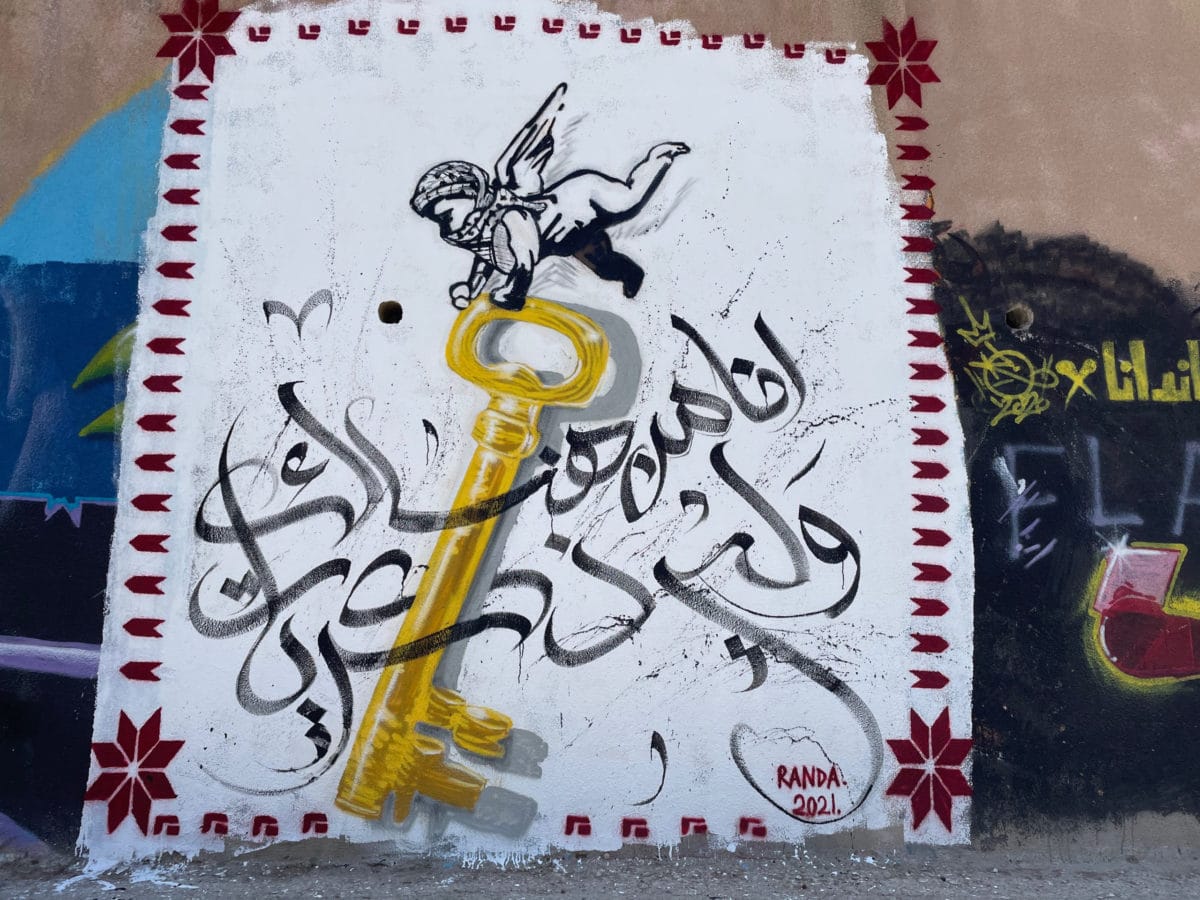
Randa Abu Rahmeh's mural references the Palestinian struggle for the right to return. A line from Palestinian poet Mahmoud Darwish states, “I come from there and I have memories.” The border of the mural is inspired by Palestinian embroidery. Photo by the author.
During the spring and summer of 2021, street artists in Amman, Jordan participated in worldwide demonstrations against Israel’s brutal eviction and dispossession of Palestinians in Jerusalem and bombing campaign of the besieged Gaza Strip. In addition to [daily protests](https://www.al-monitor.com/originals/2021/05/jordan-tacitly-approves-anti-israel-protests) in front of the Israeli embassy in Amman and at the Israeli border during this time, many local street artists responded to the constant stream of headlines about Palestine by producing pro-Palestine graffiti and murals. Many street art practitioners and influencers also posted announcements on social media that offered free paint to artists expressing solidarity with Palestinians enduring violence and resisting Israeli settler colonialism.
What seemed like a concerted movement of art activism in a country where more than half the population identify as Palestinian was a sharp departure from the usual dynamics of public art in Amman. Up until the events of May and June 2021, a vast majority of young street artists, primarily between 20–30 years old, staunchly rejected any association of their work with politics despite their personal frustrations with the ruling order and structural issues such as rampant unemployment. They also avoided controversy or arrest by not crossing the country’s “[red lines](https://www.merip.org/resurgent-protests-confront-new-and-old-red-lines-in-jordan/)”—criticism of the government (especially the Hashemite monarchy and King Abdallah II) and its political allies, references to religion aside from abstract celebrations of coexistence between Muslims and Christians, references to social justice issues such as class inequality or the status of LGBTQ communities and expressions of non-Jordanian nationalism. Many artists instead endeavor to enhance positive communal relations and daily life by facilitating group painting sessions and by adding color to what many describe as a boring monochromatic city.[\[1\]](#%5Fedn1) In their attempts to build careers, street artists also regularly collaborate with municipal authorities, non-governmental organizations and international governments on commissioned murals in the service of these institutions’ urban development, humanitarian and diplomatic agendas. These agendas include urban beautification, boosting cultural tourism, encouraging water conservation and preventing youth from joining fundamentalist political movements.
When public murals breach the red lines, authorities swiftly delete them. Their method of haphazardly covering the work with black spray paint so that it remains partially visible makes an example out of the offending street art for passersby rather than concealing it outright. While some artists say that it is possible to make street art about Palestine if the work does not advocate violence, state policing tells a slightly different story. Throughout my fieldwork, I encountered numerous instances of the police and intelligence services harassing people who produce pro-Palestine art. One street artist placed works about Palestine across the city between 2015 and 2016\. Much of it commented on the experiences of children living under occupation and criticized Israel’s practice of child detentions by satirically depicting a toddler being photographed for a mugshot. Other pieces consisted of portraits of Palestinian elders juxtaposed with the Jerusalem cityscape and the word Palestine in Arabic. These works were all erased or defaced by state authorities. When I last spoke to the artist in 2018, they were still facing harassment from Jordan’s intelligence services and police despite not painting anything on a wall in years. According to this artist, authorities accused them of filling Amman’s walls with “visual pollution” and attempting to politicize Jordan’s youth.[\[2\]](#%5Fedn2)
While most artists are careful not to attract the attention of the authorities, the events of 2021 united many people around shared feelings of anger and responsibility to act. The atmosphere of the time helped reduce artists’ fears of state retribution and mobilized some to temporarily abandon their positions as self-described apolitical cultural producers. As a muralist in her mid-twenties commented to me in mid-May 2021: “There’s energy around Palestine right now. It’s less scary to make art about these things when you’re not alone.”[\[3\]](#%5Fedn3) Once headlines about Palestine tapered off in mid-summer, however, prior concerns about Jordanian state censorship, the agendas of fund-granting institutions and the aspirations of making a career from street art once again took precedence and artists largely returned to the highly institutionalized and regulated street art scene and its market.
The brief pivot away from what many describe as Amman’s depoliticized street art scene illuminates the role of art in 2021’s global expressions of solidarity with Palestinians in the Occupied Territories. The temporary change in artists’ practices also sheds light on the increased entanglements between artists, the state and institutional art patrons, which are shifting the dynamics of political expression in contemporary cities of the Middle East. In the past decade there has been a major uptick in scholarly and journalistic appreciation for Middle East arts and cultural production as a constitutive element of politics and political economy. This welcome change is in no small part due to the important role of protest art such as graffiti, music, dance and poetry in bolstering collective energies of dissent and political reimagination during the 2011 regional uprisings. With notable exceptions, such as Sonali Pahwa and Jessica Winegar’s 2012 *Middle East Report* essay, “[Culture, State, and Revolution](https://www.merip.org/culture-state-and-revolution/),” much of the scholarship in the immediate wake of 2011 emphasized the youthfully antagonistic and anti-regime qualities of Middle East arts and culture. More recent research from Hanan Toukan, Rayya El Zein and others seeks to challenge assumptions about art as inherently grassroots and oppositional to the high politics of the state and its allies while also avoiding binary thinking about art as either resistant to or complicit with the status quo. This approach to studying art worlds is critical for tracing how Amman’s street artists creatively work within and outside state institutions and regulations in ways that both reveal and constitute new dynamics of political expression in the post-2011 period.
## **Spatialized Aesthetics**
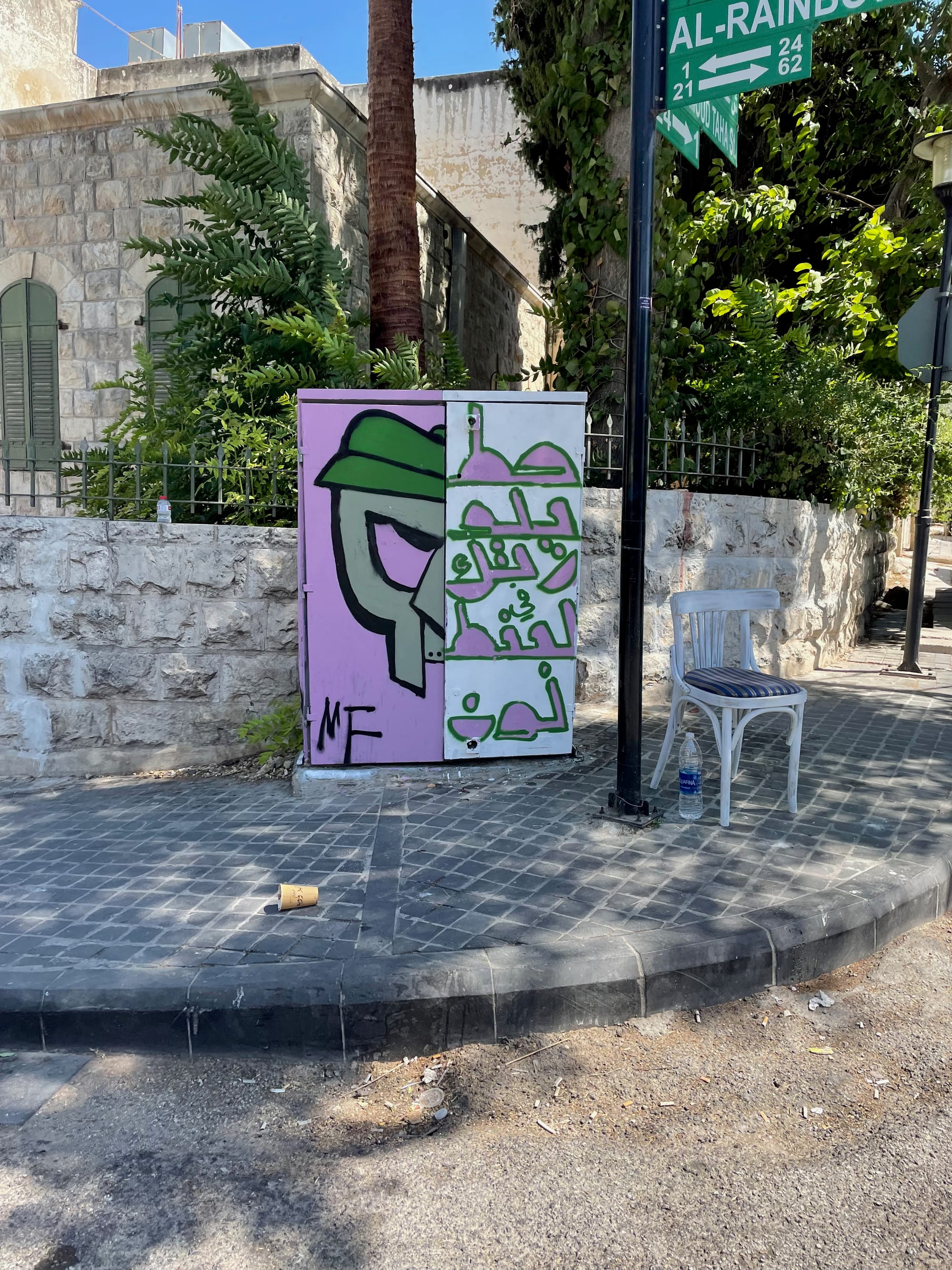
An artist who goes by the name wawi9\_1 painted an electrical box with a tribute to the late British-American rapper MF Doom. The other half contains a line from the Palestinian rapper Muqata‘a that reads, “tuck your shirt into your pants,” referring to Palestinians showing Israeli soldiers they are not hiding a weapon. Photo by the author.
Artists in Amman expressed solidarity with Palestine during the spring and summer of 2021 through several different genres. One prominent mode consisted of simple messages and slogans that transgressed regulations on public aesthetics through the defacement of state and private property. For example, residents painted Israeli flags on the sides of garbage cans and on the ground in front of entrances to express easily legible sentiments of anger at the Israeli government by linking its national symbol with trash and the dirt from one’s shoes. Pro-Palestine slogans written quickly and covertly with a single can of spray paint were also prevalent. One street artist who usually paints commissioned murals snuck into a building under construction in the city’s Abdali district and wrote “until the last beat in our veins, we will resist,” a line inspired by Palestinian Druze poet Samih al-Qasim.
Most artists, however, publicly created medium-scale murals in the artist-friendly and rapidly gentrifying neighborhoods of Jabal Amman and Jabal al-Weibdeh—the locus of the city’s street art scene. These murals typically drew on popular symbols of pan-Palestinian identity and nationalism that were much less likely to appear on the walls of these neighborhoods even a few months earlier. Randa Abu Rahmeh created a work inspired by the famous British street artist Banksy’s stencil art on Israel’s separation wall, which restricts the movement of Palestinians in the West Bank. Her mural depicts a cherub wearing a Palestinian keffiyeh and holding a key. The key represents the struggle for Palestinians’ right to return to the homes from which Israel displaced them in 1948 and 1967, as does the line from Palestinian poet Mahmoud Darwish on the mural stating, “I come from there and I have memories.” The border of the mural is inspired by the Palestinian cross-stitching or *tatreez* embroidery created by the artist’s grandmother. Artworks celebrating Palestinian identity and culture are part of Palestinian resistance to the Zionist project that downplays or denies their existence as a people. These murals are, however, distinct from the quick graffiti works since they are not produced on surfaces marked off-limits by state authorities or property owners and they do not emphasize Israel as a perpetrator of anti-Palestinian violence or announce a duty to resist that violence. This genre of solidarity murals points to a shift in the political expressions of Amman’s street artists and their sustained care to avoid the consequences of more overt aesthetic and political transgressions.
Some street artists subtly highlighted Palestinian struggles against Israeli occupation by adopting art practices that convey messages legible to a select audience but illegible to state authorities, a technique that anthropologist Elizabeth Derderian terms “conspicuous omission.”[\[4\]](#%5Fedn4) An artist who goes by the name wawi9\_1 painted an electrical box with a tribute to the late British-American rapper MF Doom, who passed away in 2020\. Half of the box depicts MF Doom’s iconic mask. The other half contains a line from the Palestinian rapper Muqata‘a (boycott in English) that reads, “[tuck your shirt into your pants](https://youtu.be/8eCfATqH9EY%20https:/youtu.be/8eCfATqH9EY),” referring to Palestinians tucking in their shirts before crossing Israeli checkpoints to show soldiers they are not hiding a weapon. The artist did not utilize colors associated with Palestine, and the words do not on their own bear any explicit references to Palestine or Israel. The artist thus forces audiences to do substantial interpretation to understand the work as a reference to Palestinian life under Israeli occupation and is less likely to catch the eyes of Jordanian authorities or disapproving residents.
In a different piece, an artist and calligraffiti writer (someone who blends Arabic calligraphy and graffiti) painted late Palestinian political cartoonist Naji al-Ali’s iconic character representing the plight of Palestinian refugees, Handala. The mural is accompanied by the Arabic words for love, peace, freedom and an Arabic transliteration of a Hebrew word meaning chaos. This Hebrew word gained widespread popular use in the Arabic-speaking Middle East after it was featured in the song “[Inn Ann](https://arabicpost.net/%25D9%2581%25D9%2586-%25D9%2588%25D9%2585%25D8%25B4%25D8%25A7%25D9%2587%25DB%258C%25D8%25B1/2021/06/04/%25D9%2585%25D8%25B9%25D8%25A7%25D9%2586%25D9%258A-%25D8%25A3%25D8%25BA%25D9%2586%25D9%258A%25D8%25A9-%25D8%25A7%25D9%2584%25D8%25B1%25D8%25A7%25D8%25A8-%25D8%25A7%25D9%2584%25D9%2581%25D9%2584%25D8%25B3%25D8%25B7%25D9%258A%25D9%2586%25D9%258A%25D8%25A9-%25D8%25A5%25D9%2586-%25D8%25A3%25D9%2586/)” by Palestinian rappers Daboor and Shabjdeed. The artists originally intended to write resistance as the fourth word but were concerned that doing so might get them into trouble.[\[5\]](#%5Fedn5) Like wawi9\_1, their strategy was to draw inspiration from the lyrics of Palestinian rappers to simultaneously address their work to a select audience familiar with this musical genre and to limit the legibility of their art for the Jordanian authorities.
## **Competing State Agendas and Inconsistent Censorship**
Palestinian solidarity art in 2021 underscored how state officials struggle to maintain a public image of Jordan’s capital city as modern, culturally rich and progressive while at the same time curtailing expressions of dissent. During an interview in summer 2021, an official of the Greater Amman Municipality (GAM) complained that people painting Israeli flags on trash cans tarnish Jordan’s image for visitors and political allies and remarked:
> *aljabha as-shabiyya*[\[6\]](#%5Fedn6)
*Al-jabha as-shabiyya* refers to the Popular Front for the Liberation of Palestine (PFLP), a Palestinian political movement that engaged in armed struggle against the Jordanian government in the 1970 conflict known as Black September. The conflict culminated in the expulsion of Palestinian political groups from Jordan and an intensified mistreatment of Palestinians as an internal threat to security and national identity. Currently, Jordanians’ attitudes about the government’s policies on Palestine are conflicted. While many praised King Abdallah’s rejection of the so-called Deal of the Century proposed by former US President Donald Trump's administration that caved to Israeli demands, the government’s plan to buy 1.6 trillion cubic feet of [natural gas from Israel](https://www.merip.org/exposing-jordans-gas-deal-with-israel/) over 15 years draws accusations that Jordan is normalizing relations. In regular demonstrations against this deal, protesters chant a slogan originating from the country’s chapter of the Palestinian Boycott, Divestment and Sanctions (BDS) movement: “The enemy’s gas is occupation.”
The Jordanian government also works hard to fashion an international reputation as an oasis of stability and hospitality amidst regional unrest to, among other things, bolster the country’s tourist economy, attract foreign investment and maintain good relations with diplomatic allies. Amman’s street art scene is one arena where the government’s goals of asserting the Hashemite regime’s dominance and boosting Jordan’s international image intersect. Street art can help energize mass mobilizations against the state and ruling elites. At the same time, public art also helps the city brand itself as a hub for cultural tourism. Thus, state agencies such as GAM provide material and symbolic support for public art initiatives while the state works to prevent and censor street art perceived as threatening to the social and political orders.
During the spring and summer of 2021, however, the state had at times relatively muted and other times confounding reactions to pro-Palestine street art. In May, a group of youth volunteers with a local community organization painted the Jordanian and Palestinian flags side-by-side on a shipping container in a public park. The next day, GAM contacted the head of the organization, told her that it is prohibited to display flags other than Jordan’s in public parks, and demanded she place a white star in the red triangle of the Palestinian flag to turn it into a Jordanian flag. The official called the center a second time when one of the youth volunteers repainted the Palestinian flag. After a short back-and-forth, the white star remained.
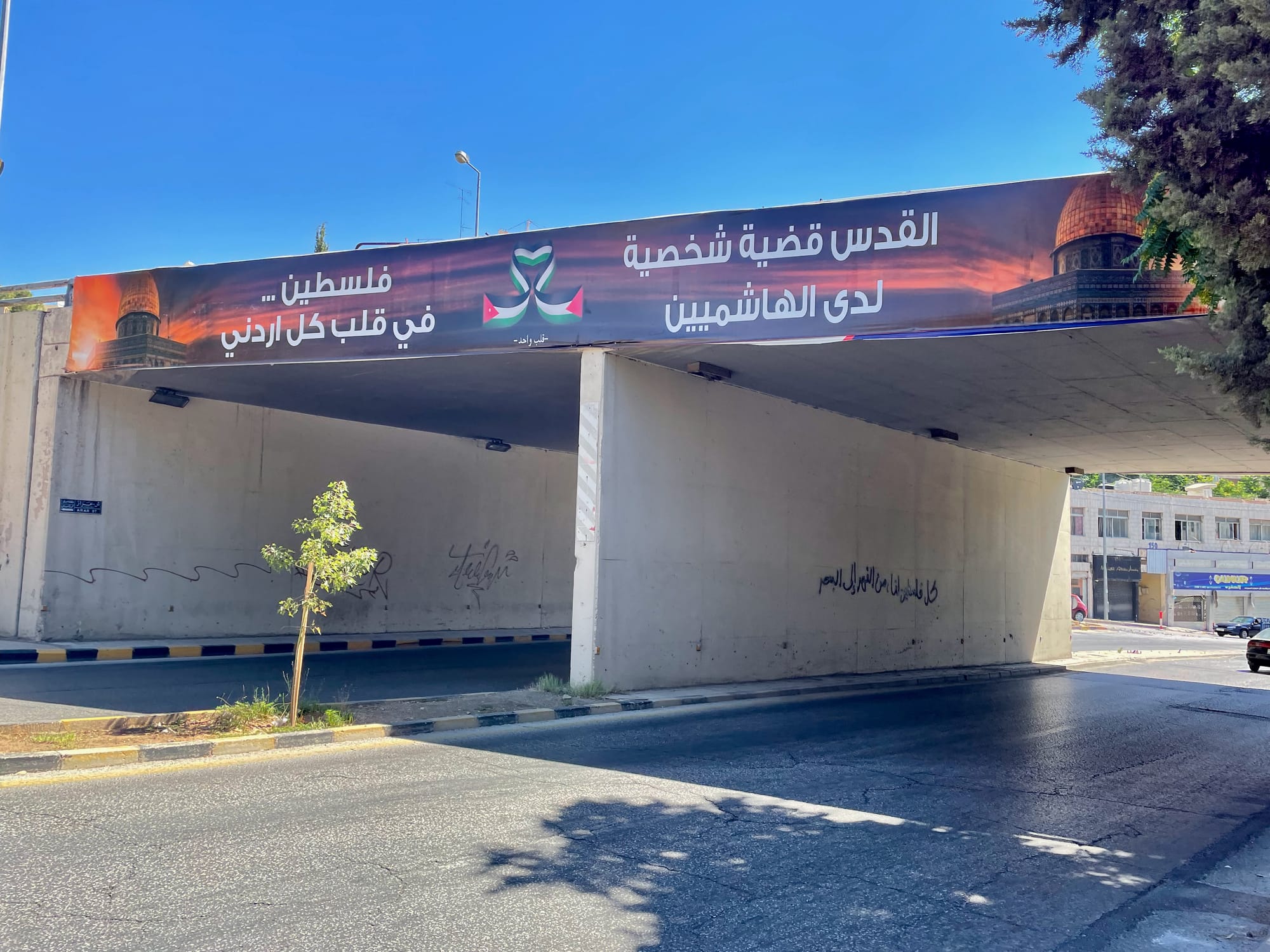
A government banner in Amman depicts Jerusalem’s Dome of the Rock Mosque along with the words, “Jerusalem is a personal issue for the Hashemites” and “Palestine is in the heart of every Jordanian,” with a Palestinian flag interlinked with a Jordanian one. On the tunnel wall is spray painted, “All of Palestine is ours from the river to the sea.” Photo by the author.
Near the park, the government placed a banner on an overpass with the image of Jerusalem’s Dome of the Rock Mosque and the words, “Jerusalem is a personal issue for the Hashemites” and “Palestine is in the heart of every Jordanian.” In the center of the banner is a Palestinian flag interlinked with a Jordanian one—an identical expression of solidarity and unity that the volunteers painted in the park. In other words, one of the few incidents of state censorship during this time was of a work that mirrored abstract state positions on Israel and Palestine, which suggests that authorities are not solely focused on questions of content, but also authorship and how to monopolize control over when and where such content is displayed.
While the state censored general expressions of solidarity, they also permitted street art that celebrated popular revolution. In Jabal al-Weibdeh, a muralist and calligraffiti artist painted a masked person holding a Palestinian flag in one hand and a Molotov cocktail in the other—aesthetic qualities that evoke iconic images of young Palestinians using simple handmade weapons against the heavily armed Israeli military forces. After finishing the mural, the artist—who is from one of Amman’s Palestinian refugee camps—told me he had never painted any “political” works and was nervous the mural would bring him problems.[\[7\]](#%5Fedn7) Yet, the mural remained untouched even after it was widely circulated by fans on social media. Furthermore, an artist of a different mural with a similar message told me that the day after he finished his piece, municipal authorities called him to ask why he did not obtain official permission for the painting.[\[8\]](#%5Fedn8) Rather than deface the work like they had so many others, GAM requested a photograph of it and retroactively granted the artist official permission.
The disparity in these state responses could be due to a number of factors. The popularity of the artist and their relationship to municipal authorities could help them subvert those rules around public artistic expression that apply to them. The figure within the municipality who demanded the removal of the Palestinian flag in the park perhaps did so independently after randomly encountering the mural, a reminder that state governance is sometimes messy and unmethodical. Much of the politics of public art, however, derive from the responses it generates in those with power, and in this instance, the state asserted its authority by flipping the script about what does and does not count as resistance against its rule. These government responses underline the ways street art complicates the state’s attempts to implement several political agendas that are in contradiction with one another: showing public support for Palestine without doing so in a way that could threaten its dominance internally and supporting the expressions of young artists while tightly regulating what they can and cannot say.
> **Artists may try to work creatively within the limits of permissible speech only to find authorities treating mundane messages of solidarity as acts of transgression while officially sanctioning artworks crossing widely recognized red lines.**
This inconsistent state censorship also calls into question common-sense notions of artistic agency. Like one’s art practices and aspirations, finished artworks are also entangled in a web of state power and institutional regimes of evaluation that shift their meanings across contexts. Artists may try to work creatively within the limits of permissible speech only to find authorities treating mundane messages of solidarity as acts of transgression while officially sanctioning artworks crossing widely recognized red lines. Ambiguous censorship also illuminates a shifting political landscape in which the limits of permissible speech are constantly in flux.
Throughout my fieldwork artists explained how this ambiguity shapes an atmosphere of anxiety. The uncertainty about which seemingly innocuous art practices could have consequences later is one reason many artists focus on the communal joys of painting non-controversial street art while pursuing artistic careers. Rather than paint covertly and at risk of arrest, many artists cultivate an ambivalence about politics, choosing instead to paint for fun during all-day sessions among friends and take on commissions from the state and other institutions to make some income in a country with a near 50 percent youth unemployment rate. In other words, artists’ practices and aspirations in Amman take form in relation to the authoritarian governance of public aesthetics as well as their own goals and the opportunities, albeit minimal, provided by commissioned art.
## **Co-optation and its Discontents**
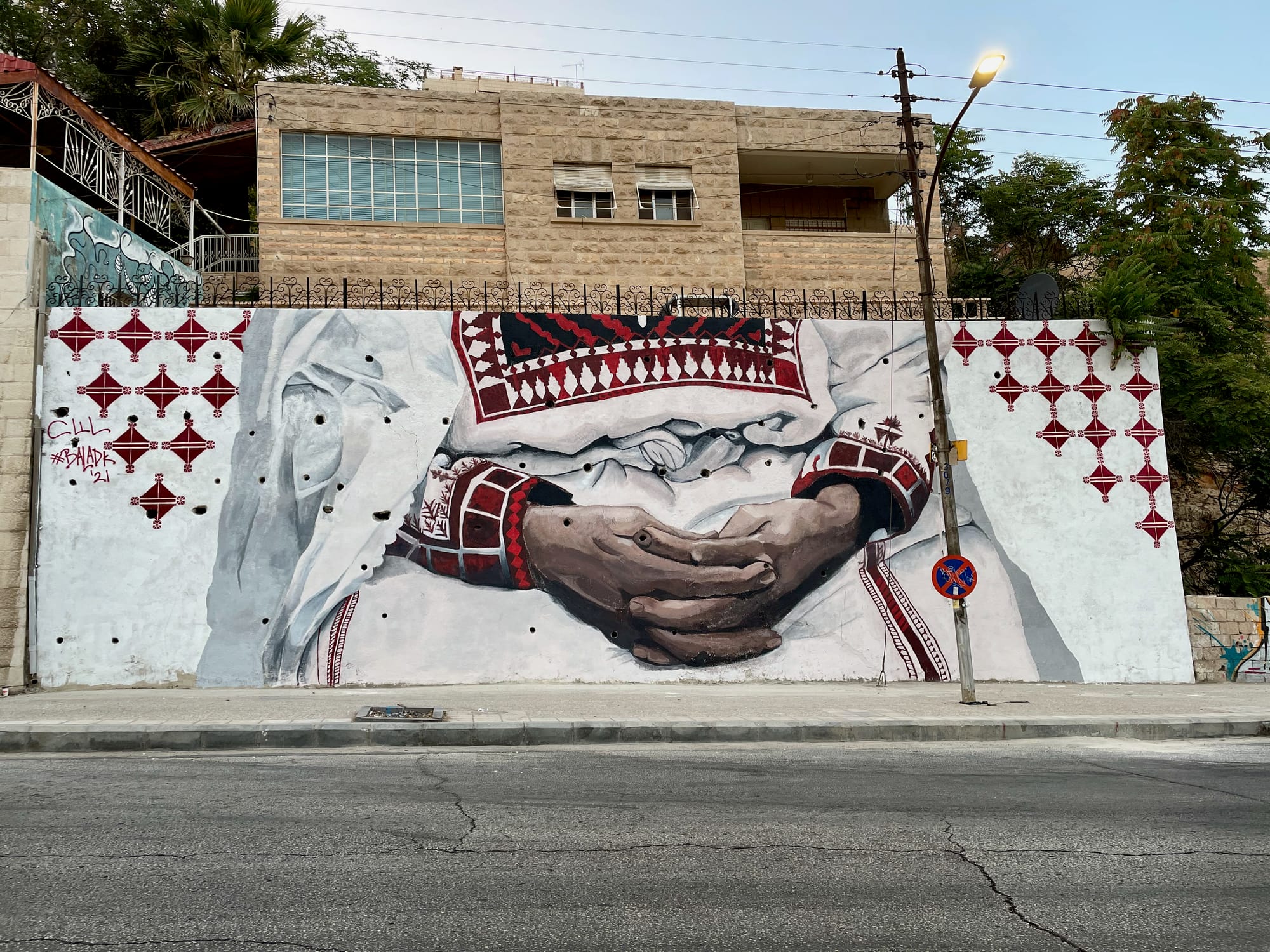
Dalal Mitwally's mural for an arts festival in Amman. According to Mitwally’s Instagram, the mural honors the stories passed down from older generations and, along with them, a sense of identity and “revolutionary resistance.” Photo by the author.
One of the final murals produced in response to the spring and summer 2021 protests brings the interconnected power relations between street artists, the state and institutional art patrons further into focus. In August, Dalal Mitwally, an early-career artist, created the mural for Baladk (a bespoke transliteration of “Your Country” in Arabic), an annual street art festival sponsored by GAM and various non-governmental organizations and international embassies. By this time, most artists had stopped creating Palestine solidarity art. Other artists I spoke with at the beginning of this period never got around to painting their planned solidarity murals because income-generating and career-boosting work took precedence. Located in Jabal al-Weibdeh, Mitwally’s mural is based on a photograph of Halimeh al-Dajani, a Palestinian woman from Jaffa who was displaced to al-Hussein refugee camp in Jordan in 1948\. The work—produced in collaboration with [Tiraz Centre](http://www.tirazcentre.org/en/centre), a museum and educational institution in Amman dedicated to the clothing of the Levant—depicts Halimeh’s torso wearing a Palestinian dress or thobe adorned with *tatreez* cross-stitching. According to [Mitwally’s Instagram](https://www.instagram.com/p/CSJvVnMsFLe/), the mural honors the stories passed down from older generations and, along with them, a sense of identity and “revolutionary resistance.”
Audiences widely celebrated Mitwallly’s mural as an act of rebellion, not always for its pro-Palestine message, but for containing aesthetic qualities that represent “our society” when much Amman street art consists of images like cartoon characters and graffiti-style lettering that many residents malign as “foreign.” The head of GAM’s cultural department, Shima Al Tal, stopped by the mural for a photo-op. The GAM official I mentioned earlier, who expressed anxieties about the PFLP dictating the city’s public aesthetics, said this mural is an exemplary representation of “our heritage” while eliding the work’s connection to Palestine and Palestinians. While Mitwally’s mural is not as direct as an Israeli flag on a trash can or a line from Samih al-Qasim’s resistance poetry, it—along with the artist’s commentary about the work—offers multiple avenues of reflection and discussion about the forced displacements of 1948 and 1967 and the experiences of Palestinian refugees in Jordan. This mural is one example of how artists’ efforts to work within the limits of the system while building careers comes with the risk of the state and other prominent institutions co-opting their aspirations and practices. The more they work within the limits of expression enforced by the government, the easier it is for art to serve as tools for smoothing out the contradictions between the state’s public image as forward-thinking and actual state restrictions on political participation in practice.
> **Mitwally's mural is one example of how artists’ efforts to work within the limits of the system while building careers comes with the risk of the state and other prominent institutions co-opting their aspirations and practices.**
At the same time, state attempts to control narratives about art are often frustrated when artworks circulate to diverse audiences. On March 7, 2022, GAM [posted a photo](https://www.facebook.com/cityofamman/posts/334771858689025) of Mitwally’s mural on its social media pages in recognition of “Amman City Day.” The text accompanying the posts describes the mural as an “expression of pride” in *tatreez* as a form of heritage without mentioning Palestine or the background of the artwork. The post sparked a controversy online, with dozens of people commenting “this is not our heritage” and accusing GAM of “degrading Jordan’s identity” and attempting to turn Jordan into the alternative Palestinian homeland. Many respondents made jokes that the Greater Ramallah or Greater Jaffa Municipality controls Amman’s street art scene. People also responded to GAM’s posts with the hashtag [#erase\_the\_mural](https://twitter.com/hashtag/%D8%A7%D9%85%D8%B3%D8%AD%D9%88%D8%A7%5F%D8%A7%D9%84%D8%AC%D8%AF%D8%A7%D8%B1%D9%8A%D9%87?src=hashtag%5Fclick). In this instance, anger at the presence of Palestinian aesthetics on Amman’s walls was augmented by the municipality’s promotion of the mural as an official representation of the city, despite (or due to) efforts to downplay its connection to Palestine and Palestinians. This episode demonstrates that there is no singular actor or entity that draws the boundaries of political struggles waged through art practices and objects.
## **Deepening Entanglements**
Since the events of the spring and summer of 2021, there have been numerous protests against the Israeli government’s policies of settler colonialism and apartheid, as well as against ties between Jordan and Israel. In November, [hundreds took to the streets of Amman](https://www.aljazeera.com/news/2021/11/26/hundreds-protest-in-amman-against-water-energy-deal-with-israel) to voice their opposition to an agreement for Jordan to provide Israel with 600 megawatts of electricity generated from a UAE-funded solar energy plant in Jordan in exchange for 200 cubic meters of desalinated water from Israel. The continuously growing and institutionalized street art scene, however, has not responded to headlines about Palestine or participated in these protests as they did a few months earlier, in the same way that mobilizations in Palestine and globally have also not reached the scale of May and June.
This brief period of Palestine solidarity in Amman’s street art scene is not so much emblematic of opportunistic or inauthentic art activism, but rather underlines what many scholars of protest movements in the Middle East and beyond have long argued: predicting when and how popular mobilizations occur is difficult and usually undertaken by those who seek to quash struggles for liberation and freedom. The spring and summer 2021 events in Amman do, however, provide a unique window into the strategies and cultural policies that artists, states and their allied institutions are adopting in the post-2011 Middle East. Indeed, local and international politics continue to pose “major challenges as well as unprecedented opportunities to the culture industries” in the region.[\[9\]](#%5Fedn9) Closely following the nuances in networks of art production and circulation is essential for seeing how those politics play out on the ground in everyday contexts.
\[Kyle Benedict Craig is a PhD candidate in the department of anthropology at Northwestern University.\]
---
### **Endnotes**
[\[1\]](#%5Fednref1) Between 2015–2021 I conducted a combined 15 months of ethnographic fieldwork in Amman for my doctoral dissertation. I also conducted remote fieldwork during this time, particularly since 2020 due to the coronavirus pandemic. Throughout my fieldwork, I attended art exhibitions; observed graffiti and street art painting sessions; conducted neighborhood walks and spoke with people living near street art; participated in walking tours of Amman’s public art scene and conducted semiformal interviews with artists, curators, NGO and embassy employees, and figures within the Greater Amman Municipality (GAM). This essay mostly draws from three months of fieldwork I conducted in Amman from May to August 2021.
[\[2\]](#%5Fednref2) Interview in Amman, Jordan, July 19, 2018.
[\[3\]](#%5Fednref3) Interview in Amman, Jordan, May 20, 2021.
[\[4\]](#%5Fednref4) Elizabeth Derderian, “The Art of Critique: Contemporary Artists and Conspicuous Omission in the UAE” (unpublished manuscript, September 17, 2021), typescript.
[\[5\]](#%5Fednref5) Interview in Amman, Jordan, June 18, 2021.
[\[6\]](#%5Fednref6) Interview in Amman, Jordan, August 5, 2021.
[\[7\]](#%5Fednref7) Interview in Amman, Jordan, June 25, 2021.
[\[8\]](#%5Fednref8) Interview in Amman, Jordan, July 1, 2021.
[\[9\]](#%5Fednref9) [Sonali Pahwa](https://merip.org/paupress/profile/14997), [Jessica Winegar](https://merip.org/paupress/profile/15045), "[Culture, State and Revolution](https://www.merip.org/culture-state-and-revolution/)," *Middle East Report* 263 (Summer 2012).
### Balancing Ideology and Responsibility in Iran’s Battle Against COVID-19
URL: https://www.merip.org/2022/03/balancing-ideology-and-responsibility-in-irans-battle-against-covid-19/
Last updated: 2025-08-22T18:37:22.000Z
An Iranian man takes a selfie with his vaccination card at a vaccination center in Tehran, Iran September 20, 2021\. Majid Asgaripour/WANA/Reuters
Navigating political fault lines amidst an unfolding and dynamic health crisis like the COVID-19 pandemic is a challenge for all governments. Pandemics, after all, are not simply events of biological contagion, but have political effects that require governments to address public discontent and economic crises without jeopardizing those ideological positions that legitimize their claim to power. The Islamic Republic of Iran is no exception. From the outset of the pandemic, the Iranian government has attempted to mitigate and manage the public health crisis without appearing to sacrifice its core ideological prerogatives. Since the founding of the Islamic Republic in 1979, the regime has cultivated notions of self-reliance, resistance to “the West” and solidarity as key elements of the state’s ideology. Successive governments have used these principles to frame their responses to some of the country’s most critical crises, from the Iran-Iraq War (1980–1988) to the imposition of international sanctions over the development of a domestic nuclear program. (Fig. 1)
During the early stages of the coronavirus pandemic in 2020, the ideological prescriptions of self-reliance and resistance were presented by the government within a discourse of responsibilization, which is the process where responsibility for certain tasks is shifted from the state to individuals. Although the state imposed restrictions on travel and gatherings and implemented closures like most governments, it framed efforts to defeat the virus primarily in terms of individual actions, behaviors and sacrifices to be carried out by [members of society](https://www.merip.org/going-to-war-with-the-coronavirus-and-maintaining-the-state-of-resistance-in-iran/), not the state. In March 2020, for example, the government encouraged universities and private companies to combine forces to develop and [produce](https://www.irna.ir/news/83704872/%D9%87%D9%85%DA%A9%D8%A7%D8%B1%DB%8C-%D8%B5%D9%86%D8%B9%D8%AA-%D9%88-%D8%AF%D8%A7%D9%86%D8%B4%DA%AF%D8%A7%D9%87-%D8%B1%D8%A7%D9%87%DA%A9%D8%A7%D8%B1%DB%8C-%D8%A8%D8%B1%D8%A7%DB%8C-%D9%85%D9%82%D8%A7%D8%A8%D9%84%D9%87-%D8%A8%D8%A7-%DA%A9%D8%B1%D9%88%D9%86%D8%A7) health care products like masks and disinfectants.
Fig. 1 Health advocates confronting COVID-19 juxtaposed with Iranian soldiers. ISNA
Referencing the history, memories and experiences of past moments of crisis when members of society demonstrated resistance and self-reliance–most notably during the Iran-Iraq War, government messaging focused on the agency and acts of individuals as the most important means for confronting the virus.
As the dynamics of the pandemic shifted, however, and the most widely recognized solution to the virus’s spread became the acquisition and disbursement of vaccines, the promotion of well-trodden state narratives of self-reliance and resistance couched in terms of individual agency was no longer sufficient. In a health crisis like COVID-19, the job of procuring, producing and distributing vaccines is one left mainly to governments. Notions of self-reliance and resistance continue to feature heavily in regime messaging around its coronavirus response, but now that the onus of responsibility has fallen squarely on the government to distribute a vaccine, the balancing act with political ideology has become more tense and confused.
## **Resistance, Solidarity and Society**
When COVID-19 first appeared in Iran in February 2020, the government response was plagued by attempts to conform long-standing ideological positions with crisis mitigation policies to combat the spread of the virus. The championing of the country’s resistance to the West dictated important government actions, like [declining medical equipment](https://en.radiofarda.com/a/iran-expels-medical-team-sent-by-doctors-without-borders-to-fight-coronavirus/30505858.html) from foreign sources. This type of government response was further compounded by the circulation of [misleading and false information](https://www.mei.edu/publications/irans-covid-19-pandemic-response-mission-critical) about the origins and spread of the virus, while political in-fighting, factionalism and competition among centers of civilian, military and clerical power within the state led to contradictory statements by government officials. International sanctions on Iran hindered the acquisition of medical supplies and access to international financial instruments, which amplified the dire health impacts of the pandemic and hampered the government response.[\[1\]](#%5Fedn1) Government corruption, an ongoing problem, has impacted decisions regarding vaccine production and reportedly led to [regime insiders cashing in](https://www.dw.com/en/irans-patriotic-vaccination-policy-is-making-some-people-rich/a-59342029) on the development of home-grown vaccines.
> **These images—displayed in public and circulated through state entities and affiliated media—were used to mobilize citizens in the collective struggle with COVID-19 by suggesting that the experiences of life in Iran as a country under threat were no different now than during the war with Iraq.**
In the early months of 2020, the regime sought to promote its handling of the crisis by focusing on the competency and agency of its own citizens to adapt to new social and behavioral realities. As [Maziyar Ghiabi](https://www.merip.org/mutual-aid-and-solidarity-in-iran-during-the-covid-19-pandemic/) describes, Iranians independently engaged in acts of solidarity and trust at the pandemic’s outset. State actors highlighted this societal competence and self-reliance as an already present characteristic of an idealized Islamic society and one in line with the teachings of the Supreme Leader Ayatollah Ali Khamenei. The government created narratives and visual iconography that strengthened these claims of individual sacrifice. These images—displayed in public and circulated through state entities and affiliated media—were used to mobilize citizens in the collective struggle with COVID-19 by suggesting that the experiences of life in Iran as a country under threat were no different now than during the war with Iraq, and by popularizing terms like “Health Defenders.”[\[2\]](#%5Fedn2) Notions of solidarity and unity dominated the messaging campaigns. One of the most prevalent regime-sponsored slogans during the early days of the pandemic was “Jihadists of Yesterday, Today and Tomorrow,” a clear effort to connect the contributions of individuals during the present crisis to those of the past. The overall message was clear: As a society we have been here before and persevered through the sacrifice of individual citizens. By shifting responsibility to citizens, the government was able to deflect questions about its own handling of the crisis.
Fig. 2 “For protecting our health, spend this year’s holiday at home.” Tasnim News
Even when the government imposed rules such as home quarantine or partial lockdowns, thereby curtailing freedom of movement and restricting communal solidarity, the measures were not presented as a form of isolation but cast as the re-implementation of togetherness. For example, a billboard at the Vali Asr intersection in Tehran in March 2020 proclaimed that Iranian-Islamic society, and its individual members, were well-equipped for these measures that relied on family cohesion.[\[3\]](#%5Fedn3) (Fig. 2)
Fig. 3 The difference between Islamic-Iranian culture and the materialism of the West. Office of the Supreme Leader
Reflecting in May 2020 on several months of lockdown, Khamenei was pleased with its positive impacts on family life, a central theme in his writings concerning the healthy functioning of society.[\[4\]](#%5Fedn4) “During this time, the role and place of the family in Islamic-Iranian culture became more apparent,” he [stated](https://farsi.khamenei.ir/news-content?id=45558), “while in countries where the family doesn't have the proper foundation and meaning, the period of home quarantine was not tolerated and comprehended in this way.” The latter was a clear reference to the societies of the West.
With the entire world facing the nearly identical and simultaneous need to enact social-distancing measures, quarantines and lockdowns, Khamenei argued that individuals in the West were ill-equipped to handle the crisis due to the social and behavioral norms endemic to their societies.
In a poster released by the Office of the Supreme Leader in the spring of 2020, the perceived differences between Iranian and Western responses to the pandemic were made abundantly clear. (Fig. 3) While stating that Iranian society responded with collective sacrifice and solidarity, it suggested that Western societies hoarded medical supplies and stockpiled toilet paper, groceries and guns. The individualism and materialism of the West, exemplified by a depiction of President Donald Trump as a stick ‘em up outlaw of the American West ready to take what he wanted by force, was contrasted with a generic frontline worker in Iran, at the ready to serve society by taking the temperature of another. The strength of Islamic-Iranian culture, according to Khamenei, lies in the capacity of its individual members to retreat to family unity and express societal solidarity, as opposed to Wild West capitalism. (Fig. 4)
## **The Travails of Self-Reliance**
The Iranian government could not meet the unfolding challenges of the health crisis solely by calling upon ideological norms and ingrained state narratives. The government’s attempts to construct and promote a vaccination campaign—whose success largely depends on relying on other countries for vaccine acquisition—illustrates the state’s dilemma. Advocating self-sufficiency and self-reliance under these conditions directly challenges the relevance and credibility of regime ideology and exposes government incompetency.
Fig. 4 “Cowboy Trump” stealing masks. Office of the Supreme Leader
The exposed fault line between maintaining a hardened ideological stance and confronting the uncompromising reality of the coronavirus crisis has led to contradictory and mixed messages. In January 2021, in a televised speech, Khamenei declared that American and British vaccines were banned from entering Iran. In a tweet, subsequently [hidden by Twitter](https://www.newsweek.com/amid-coronavirus-fears-shoppers-throw-punches-over-toilet-paper-1491220) for violating its rules on vaccine misinformation, the Supreme Leader claimed the United States and Britain may seek “to contaminate other nations'' through the distribution of vaccines. Various Iranian government officials responded in [support of Khamenei’s proclamation](https://ir.voanews.com/a/persiannewsiran%5Fexperts-views-khamenei-banning-western-vaccines/6129942.html), including Ebrahim Raisi, then head of Iran’s judiciary and currently the country’s president, who emphasized the benefits of pursuing a domestic vaccine. Minister of Health Saeed Namaki framed the Supreme Leader’s decision as stemming from his responsibility to protect the population just like “[the father of a family](https://www.bbc.com/persian/iran-55609726),” a role which the Supreme Leader is often considered to fulfill.[\[5\]](#%5Fedn5) Grand Ayatollah Makarem-Shirazi, a frequent supporter of conservative policies, offered his opinion by noting that American and British vaccines should be avoided if fears exist over potential “[damage and contamination](https://makarem.ir/ahkam/fa/home/istifta/268035/%d8%ae%d8%b1%db%8c%d8%af-%d9%88%d8%a7%da%a9%d8%b3%d9%86-%da%a9%d8%b1%d9%88%d9%86%d8%a7-%d8%a7%d8%b2-%d8%a2%d9%85%d8%b1%db%8c%da%a9%d8%a7-%d9%88-%d8%a7%d9%86%da%af%d9%84%db%8c%d8%b3).” Khamenei’s ban led many relatives of those who died from COVID-19 to blame him for the death of their loved ones, even causing some in the government to [backpedal ](https://ir.sputniknews.com/20210825/%D9%85%D8%B9%D8%A7%D9%88%D9%86-%D8%AF%D9%81%D8%AA%D8%B1-%D9%86%D8%B4%D8%B1-%D8%A2%D8%AB%D8%A7%D8%B1-%D8%B1%D9%87%D8%A8%D8%B1-%D8%A7%DB%8C%D8%B1%D8%A7%D9%86-%D8%B1%D9%87%D8%A8%D8%B1-%D8%A7%D9%86%D9%82%D9%84%D8%A7%D8%A8-%D8%AA%D8%A7%DA%A9%D9%86%D9%88%D9%86-%D9%88%D8%A7%DA%A9%D8%B3%D9%86-%D8%AE%D8%A7%D8%B5%DB%8C-%D8%B1%D8%A7-%D9%85%D9%85%D9%86%D9%88%D8%B9-%D9%86%DA%A9%D8%B1%D8%AF%D9%87%D8%A7%D9%86%D8%AF-8206737.html)and claim the ban was misunderstood. Blocking the importation of Western vaccines was not, however, simply an ideological matter of self-reliance but was partially dictated by the political clout of regime insiders hoping to score a financial windfall from domestic vaccine development and distribution. Vaccine importation was also delayed so that [domestic organizations](https://roozarooz.com/posts/590/%DA%86%DA%AF%D9%88%D9%86%D9%87-%D9%88%D8%A7%DA%A9%D8%B3%D9%86-%D8%A8%D8%B1%DA%A9%D8%AA-%D8%A7%D9%88%D9%84-%D8%B4%D8%AF) could profit, with some receiving advanced payments from the government but failing to deliver a product.
> **Blocking the importation of Western vaccines was not, however, simply an ideological matter of self-reliance but was partially dictated by the political clout of regime insiders hoping to score a financial windfall from domestic vaccine development and distribution.**
Despite the claims that reliance on Western vaccines would not be allowed, Iran was already purchasing 4.2 million doses of the British-Swedish AstraZeneca vaccine as soon as a month later. Officials [justified ](https://www.mei.edu/publications/iran-plays-vaccine-politics-pandemic-rages)the purchase by noting that the vaccines were not manufactured in the West, but rather in South Korea, offering the government an important loophole around Khamenei’s ban. Between February and October of 2021, Iran imported close to [93 million doses](https://iranprimer.usip.org/blog/2021/oct/13/how-world-aids-iran-covid-19) of the COVID-19 vaccine. Most of the doses came from China, but other countries, such as Austria, Japan, India and Russia, provided vaccines too, either directly or through the UN-backed COVAX program.
Fig. 5 The winding road of technological achievements. Office of the Supreme Leader
The production of several homegrown vaccines provided the Iranian government with one possible route for bringing the ideology of self-sufficiency and self-reliance into closer alignment with the actual praxis of its vaccination program. In March 2021, the government claimed that at least three [homegrown vaccines](https://apnews.com/article/tehran-clinical-trials-iran-coronavirus-pandemic-fde9601ee7d3dabc381dbff67b057d3d) had reached the phase of clinical trials, including the Fakhra vaccine, named after the assassinated nuclear scientist Mohsen Fakhrizadeh. But despite attempts to drum up support for the vaccine by touting it as an example of national self-reliance and through the use of Fakhrizadeh’s name and status as a national martyr, the vaccine was [discontinued](https://www.rferl.org/a/iran-covid-homegrown-vaccine-setbacks/31523285.html) in October 2021 due to a lack of volunteers for trials. Only one of the domestic vaccines—the CoVIran Barakat, developed by the parastatal organization Setad controlled by the Office of the Supreme Leader—has reached mass production. Nonetheless, close to [ten vaccines](https://www.nature.com/articles/d41586-021-02216-z) are reported to be in development in Iran.
The regime has faced increasing opposition and unrest over its mismanagement and handling of the crisis, even resorting to [jailing ](https://www.nytimes.com/2021/12/17/world/middleeast/iran-covid-trial-khamenei.html)several Health Defenders in December 2021 who sought to sue the Supreme Leader and the government over its pandemic response. Insufficient vaccination rates, skepticism toward domestically-produced vaccines and the flocking of Iranians to neighboring [Armenia](https://apnews.com/article/lifestyle-middle-east-business-health-travel-27030daf0c5a460f1f2859e3d1a613f2) or the [black market](https://apnews.com/article/middle-east-health-iran-pandemics-coronavirus-pandemic-33a0bf3247ffdc072f8579c9dd53c71b) to get vaccinated, led to an about-face concerning vaccine acquisition. Amidst a fifth wave of the pandemic in August 2021, President Ebrahim Raisi ordered the government to set aside resources to import vaccines, while [Khamenei declared](https://www.hrw.org/news/2021/08/19/iran-government-mismanagement-compounds-covid-19-crisis) in a televised address that vaccines “whether through import or domestic production” must be supplied “in every way possible.” Several days earlier, while receiving his first dose of the CoVIran Barakat vaccine, Raisi had already [recognized](https://www.farsnews.ir/news/14000517000678/%D8%B1%D8%A6%DB%8C%D8%B3%E2%80%8C%D8%AC%D9%85%D9%87%D9%88%D8%B1-%D8%A7%D9%88%D9%84%DB%8C%D9%86-%D8%AF%D8%B2-%D9%88%D8%A7%DA%A9%D8%B3%D9%86-%D8%A7%DB%8C%D8%B1%D8%A7%D9%86%DB%8C-%DA%A9%D8%B1%D9%88%D9%86%D8%A7-%D8%B1%D8%A7-%D8%AF%D8%B1%DB%8C%D8%A7%D9%81%D8%AA-%DA%A9%D8%B1%D8%AF-%D8%B1%D8%A6%DB%8C%D8%B3%DB%8C-%E2%80%8C-) that the circumstances of the pandemic trumped political ideology: Domestic vaccines would be relied upon as much as possible, but to the extent they proved insufficient, other vaccines would be imported.
Khamenei too[ admitted](https://abcnews.go.com/International/iran-facing-deadliest-coronavirus-surge-banning-import-us/story?id=79406699) much the same by stating that vaccines “must be accessible for all people from any possible way, be it domestic production or through importing.” During this time, Khamenei offered a [legal opinion](https://www.mashreghnews.ir/news/1265710/%D8%A7%D8%B3%D8%AA%D9%81%D8%AA%D8%A7%D8%A1-%D8%A7%D8%B2-%D8%B1%D9%87%D8%A8%D8%B1-%D9%85%D8%B9%D8%B8%D9%85-%D8%A7%D9%86%D9%82%D9%84%D8%A7%D8%A8-%D8%AF%D8%B1%D8%A8%D8%A7%D8%B1%D9%87-%D9%88%D8%A7%DA%A9%D8%B3%D9%86-%DA%A9%D8%B1%D9%88%D9%86%D8%A7) in response to a question about the necessity of the vaccine, by noting that, “If the Islamic government announces regulations in the public interests of the country, then everyone must act.” The vaccination issue was no longer framed as one that must cohere with the ideology of self-reliance and self-sufficiency, but one of government authority. The epidemiological crisis of COVID-19 had forced the authorities to concede. The struggle over formulating a successful vaccine campaign reveals the tension of attempting to safeguard society while still articulating a national narrative of self-reliance.
## **The Pursuit of a Healthy Regime**
As early as March 2021, just before the Iranian New Year, a group of parliamentarians put forth a plan to establish the “Organization of Islamic-Iranian Medicine.” Among the [aims of the organization](https://www.tasnimnews.com/fa/news/1399/12/27/2471723/%D8%B7%D8%B1%D8%AD-%D8%AC%D8%AF%DB%8C%D8%AF-%D9%86%D9%85%D8%A7%DB%8C%D9%86%D8%AF%DA%AF%D8%A7%D9%86-%D9%85%D8%AC%D9%84%D8%B3-%D8%A8%D8%B1%D8%A7%DB%8C-%D8%AA%D8%B4%DA%A9%DB%8C%D9%84-%D8%B3%D8%A7%D8%B2%D9%85%D8%A7%D9%86-%D8%B7%D8%A8-%D8%A7%DB%8C%D8%B1%D8%A7%D9%86%DB%8C-%D8%A7%D8%B3%D9%84%D8%A7%D9%85%DB%8C-%D9%85%D8%AA%D9%86-%DA%A9%D8%A7%D9%85%D9%84) would be to “use Islamic teachings and instruction in Iranian (traditional) medicine in the fields of prevention, treatment and health” and “to promote a healthy lifestyle in accordance with Islamic teachings.” In recognizing Iran as “one of the \[historical\] centers in Islamic and traditional medicine and medical knowledge,” the proposal sought to incorporate Iranian-traditional and Islamic knowledge in the health and medical infrastructure of present-day Iran alongside modern medicine. The proposed plan, as well as a subsequent version made public in the fall of 2021, garnered opposition from medical professionals and academics in Iran for being “[unethical](https://www.rfi.fr/fa/%D8%A7%DB%8C%D8%B1%D8%A7%D9%86/20210910-%DB%B5%DB%B7-%D8%A7%D9%86%D8%AC%D9%85%D9%86-%D9%BE%D8%B2%D8%B4%DA%A9%DB%8C-%D8%A7%DB%8C%D8%B1%D8%A7%D9%86-%D8%A8%D8%A7-%D8%AA%D8%B4%DA%A9%DB%8C%D9%84-%D8%B3%D8%A7%D8%B2%D9%85%D8%A7%D9%86-%D8%B7%D8%A8-%D8%A7%D8%B3%D9%84%D8%A7%D9%85%DB%8C-%D9%85%D8%AE%D8%A7%D9%84%D9%81%D8%AA-%DA%A9%D8%B1%D8%AF%D9%86%D8%AF)” and “[not only wrong, but dangerous](https://behdasht.gov.ir/%D8%AF%DB%8C%D8%AF%DA%AF%D8%A7%D9%87-%D9%87%D8%A7/-%D9%86%D9%87-%D8%A8%D9%87-%D8%B7%D8%B1%D8%AD-%D8%AA%D8%B4%DA%A9%DB%8C%D9%84-%D8%B3%D8%A7%D8%B2%D9%85%D8%A7%D9%86-%D8%B7%D8%A8-%D8%A7%DB%8C%D8%B1%D8%A7%D9%86%DB%8C-%D8%A7%D8%B3%D9%84%D8%A7%D9%85%DB%8C-%D8%AF%D8%B1-%D9%85%D8%AC%D9%84%D8%B3).” As of early 2022, at least one parliamentarian serving on the Majlis’ Health Commission [opposed the plan](https://www.isna.ir/news/1400072517520/%D8%A8%D8%A7-%D8%AA%D8%B4%DA%A9%DB%8C%D9%84-%D8%B3%D8%A7%D8%B2%D9%85%D8%A7%D9%86-%D8%B7%D8%A8-%D8%A7%D8%B3%D9%84%D8%A7%D9%85%DB%8C-%D8%A7%DB%8C%D8%B1%D8%A7%D9%86%DB%8C-%D9%85%D8%AE%D8%A7%D9%84%D9%81%D9%85) for the danger it posed in upstaging and possibly superseding the role already played by the Ministry of Health.
Fig. 6 “Heroic Nation.” Khattmedia Telegram channel
The fate of the organization is uncertain, and along with it the extent to which the government will strive to favor notions of self-reliance and resistance during the pandemic, in this instance the promotion of an indigenous form of “Islamic-Iranian” medical knowledge. It is another example of the tension created by government attempts to forge solutions to an unfolding health crisis in a way that adheres to the regime’s longstanding political ideology. The story of COVID-19 in Iran, like elsewhere, continues to be written. But what is emerging with greater clarity is how the regime will include the memory and experience of the pandemic era in the official narration of life in the Islamic Republic. This period seems likely to be memorialized as another critical juncture on the path of crisis and survival winding its way into the future—charted by domestic successes achieved through self-reliance and resistance and defined by the actions and sacrifices of a heroic nation. (Fig. 5 and 6)
\[Kevin L. Schwartz is a research fellow and Deputy Director at the Oriental Institute of the Czech Academy of Sciences in Prague, Czech Republic. Olmo Gölz is a lecturer in Islamic and Iranian Studies at the department for Oriental Studies, University of Freiburg, Germany.\]
---
### **Endnotes**
[\[1\]](#%5Fednref1) Zohreh Bayatrizi, Hajar Ghorbani, and Reza Taslimi Tehrani, “[Risk, Mourning, Politics: Toward a Transnational Critical Conception of Grief for COVID-19 Deaths in Iran](https://journals.sagepub.com/doi/full/10.1177/00113921211007153),” *Current Sociology* 69/4 (2021). Sima Shakhsari, “[Voices from the Middle East: Doctors, COVID-19 Patients and Dilemmas of Treatment under Sanctions in Iran](https://www.merip.org/voices-from-the-middle-east-doctors-covid-19-patients-and-dilemmas-of-treatment-under-sanctions-in-iran/),” *Middle East Report Online*, April 17, 2020.
[\[2\]](#%5Fednref2) Kevin L. Schwartz and Olmo Gölz, “[Going to War with the Coronavirus and Maintaining the State of Resistance in Iran](https://www.merip.org/going-to-war-with-the-coronavirus-and-maintaining-the-state-of-resistance-in-iran/),” *Middle East Report Online*, September 1, 2020.
[\[3\]](#%5Fednref3) Kevin L. Schwartz and Olmo Gölz, “[Visual Propaganda at a Crossroads: New Techniques at Iran’s Vali Asr Billboard](https://www.tandfonline.com/doi/abs/10.1080/1472586X.2021.1984292),” *Visual Studies* 36/4-5 (2021).
[\[4\]](#%5Fednref4) Ayatollah Sayyid Ali Khamenei, *The Compassionate Family* (AIM Foundation, 2017), pp. 29-33.
[\[5\]](#%5Fednref5) Shahram Khosravi, *Precarious Lives*: *Waiting and Hope in Iran* (University of Pennsylvania Press, 2017), p. 30.
### Wildfires Ignite Political Debate in Turkey
URL: https://www.merip.org/2022/02/wildfires-ignite-political-debate-in-turkey/
Last updated: 2025-08-22T18:37:23.000Z
In the summer of 2021, one of the largest wildfires in the history of Turkey destroyed over 333,000 acres (135,000 hectares) of forest and killed eight people along with thousands of animals.
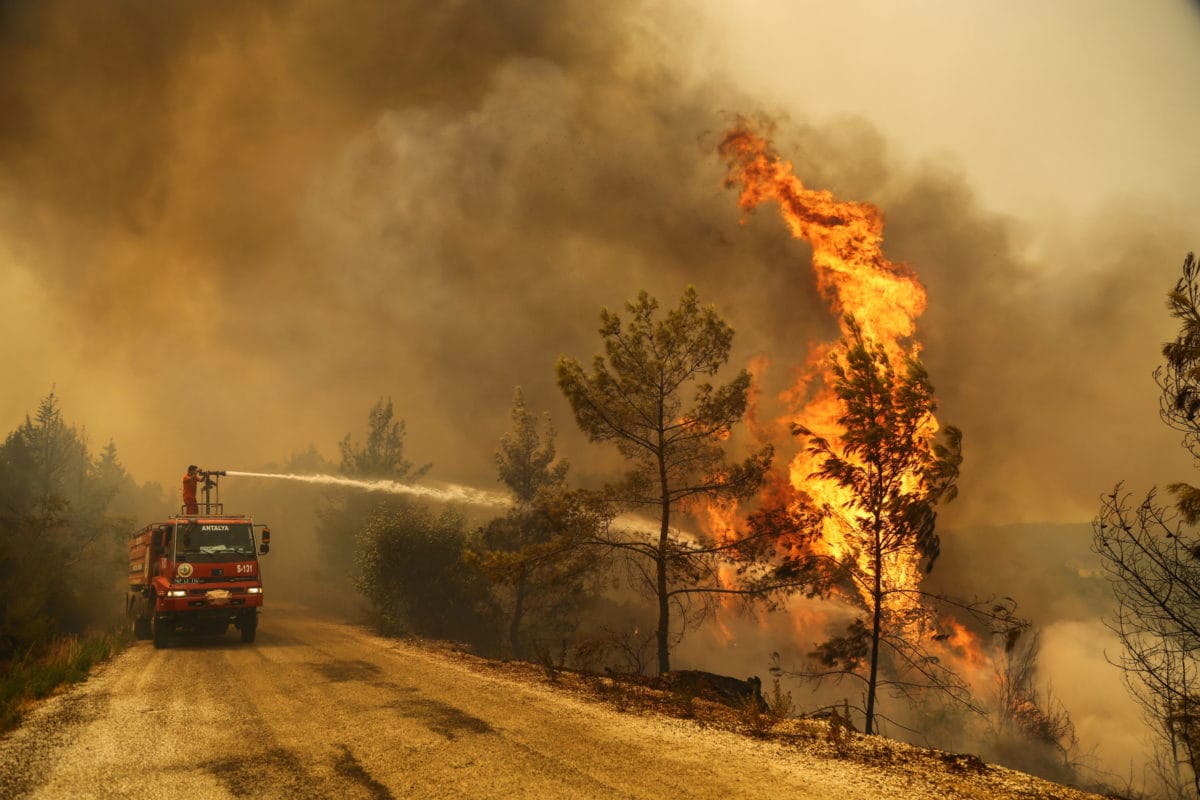
A firefighter extinguishes a forest fire near the town of Manavgat, Turkey, July 30, 2021\. Kaan Soyturk/Reuters
The conflagration was not unexpected. Mediterranean forests are ecologically prone to fire, and summer is fire season in this region. Weeks before the wildfire, the General Directorate of Meteorology forecast a heatwave for the end of July and the first days of August. In addition, extreme drought had been a major concern throughout the year. Given these conditions, forestry experts had been informing the public and state officials about the likelihood of large forest fires.
Fires are simultaneously social, political, historical and ecological phenomena that shed light on class struggles, discrimination and inequality, changing human-nature relationships and the politics of environmental knowledge production.[\[1\]](#%5Fedn1) As flames spread through the Mediterranean forests in Turkey, broader political fissures were revealed in the ethno-nationalist narratives that blamed fires on sabotage by members of the Kurdistan Workers’ Party (*Partiya Karkerên Kurdistanê*, PKK) and through public criticism of the state’s response to fires.
Last summer’s fires also ushered in a new, significant debate around the issue of post-fire forest restoration. Turkish forestry experts and the public are questioning conventional solutions, such as planting trees, that promise a quick and convenient recovery after wildfires. Political conflicts over the environment in Turkey thus do not solely focus on issues of destruction and degradation—problems that have been intensifying and expanding especially under Justice and Development Party (AKP) rule—but they also now revolve around questions of the restoration and recovery of damaged landscapes. Pushback by forestry experts and ecology scientists has challenged the government’s greening of its image. The new debates about ecological recovery also make space for a broader questioning of the dominant anthropocentric approach to nature as a passive object to be restored through intensive and quick human action.
## **The Politics of Wildfires and Forest Restoration**
Last summer’s wildfires started on July 28 in the Manavgat district of the southern province of Antalya, igniting the material and political landscapes simultaneously. It was the hottest week of the year, and extreme drought had been a vital concern since the winter months. In a few days, 299 fires were detected in 54 provinces, the largest of which raged through the Mediterranean and South Aegean regions. In the face of the expanding conflagration, one of the first narratives to circulate widely in social and traditional media was the possibility that the fires were deliberately set as sabotage or attack. These claims primarily referred to the long-running armed conflict between the PKK and the Turkish military.
In the early days of the fires, for instance, the former mayor of Ankara Melih Gökçek (from the ruling AKP) shared a popular video on Twitter that claimed to show forest fires being ignited by drones and wrote, “Traitors are starting fires with drones.” He quickly deleted his tweet after a fact-checking organization revealed that the video was not shot in Turkey and showed prescribed burning implemented as a forest management practice. Mainstream and pro-government media joined this wave of blaming the fires on “terrorist sabotage.” Demirören news agency, owned by a holding company openly supportive of the AKP government, reported that two PKK members had been arrested while exploring a forest with the goal of setting it on fire. When the relevant city governorship announced that there was no evidence of the suspects’ links to forest fires, the agency [withdrew](https://www.birgun.net/haber/dha-nin-orman-yakmak-icin-kesif-yapan-2-pkk-li-turgutlu-da-yakalandi-haberi-valilik-tarafindan-yalanlandi-353389) the news from its website.
Around the same time, the pro-government newspaper *Yeni Akit* published a [headline](https://www.yeniakit.com.tr/haber/iktidara-catan-da-yakan-da-ayni-kafa-1562108.html) that read, “Those who criticize the government and those who set fires share the same mentality.” While reproducing the attribution of wildfires to the PKK, this article raised the claims to another level by stating that those who criticize the government’s fire management intended to protect the actual culprits. Moreover, as political sociologist [Gülay Türkmen](https://www.wzb.eu/en/publications/wzb-mitteilungen/im-angesicht-der-klimakrise/when-wildfires-fan-the-flames-of-anti-immigrant-discourse) crucially points out, the nationalist, securitized approach to wildfires also targeted a new group, Afghan refugees who had recently arrived in Turkey in the wake of the US withdrawal and Taliban takeover of their country, by labeling them arsonists responsible for the summer fires.
> **The heated debates over Turkey’s aerial firefighting capacity mapped onto broader concerns about the dissolution of institutional capacities and effectiveness due to processes of neoliberalization and increasing authoritarianism in the country.**
Another political debate quickly escalated around the subject of Turkey’s firefighting capabilities and equipment, leading to criticism of the government’s level of preparedness in the face of intensifying and proliferating fires. Parliament members from the opposition party, the Republican People’s Party (CHP), were instrumental in bringing this issue to the center of public attention. Their critique revolved around the fact that the Ministry of Agriculture and Forestry does not have its own firefighting planes and helicopters but had to acquire them through a tender-based annual lease. The low number of planes was a hot topic from the very first day of the fires. On July 29, the Turkish Aeronautical Association—which has long been one of the ministry’s primary suppliers—declared that they had leased three planes and 17 helicopters to the General Directorate of Forestry to combat the fires. It soon became apparent, however, that those planes were ones that the Association had itself leased from Russia and that the planes belonging to the Association were kept unused in the hangars. While the government and state officials pointed to the Association’s planes’ inability to function properly, critical voices from opposition parties and the public questioned why proper maintenance and repair services were not provided for these planes. In short, the heated debates over Turkey’s aerial firefighting capacity mapped onto broader concerns about the dissolution of institutional capacities and effectiveness due to processes of neoliberalization and increasing authoritarianism in the country.
As these debates over how the fires started and the government’s lack of preparedness in fighting the fires continued, a new topic emerged—the regeneration of burnt forests. Since wildfires expand or retreat over the span of days, weeks, and sometimes, months, multifaceted discussions about how to prevent and combat fire take place at the same time as debates over post-fire restoration. Last summer’s debates brought to the public’s attention those forestry and ecology experts who question conventional post-fire restoration methods such as reforestation, which are based on the notion of nature as a passive object in need of quick and intensive human intervention to regenerate. In this dominant understanding, greening the burnt forests through tree planting is a matter of national pride and resilience and conveys a sense of state-led and publicly embraced environmental stewardship. By questioning the need for and the benefit of post-fire reforestation, forestry and ecology experts’ criticisms pointed to a radically different notion of recovery and restoration that foregrounds the complexity and vitality of ecological landscapes.
## **What Greening Campaigns Reveal and Conceal**
Image from the Geleceğe Nefes (Breath for the Future) campaign website during the 2021 wildfires. The text on the left reads "Our life is burnt" (a phrase that actually means "We are hurt"). The text on the right side reads "We will make it green." The two lines underneath them read "Adopt a plant, and give breath to the future of burnt areas." Source: https://gelecegenefes.com/
Only a few days after the beginning of the wildfires, on July 30, the nongovernmental Turkish Foundation for Combating Soil Erosion, Reforestation and the Protection of Natural Habitats (TEMA Foundation) launched a seedling donation campaign with the slogan, “We will make life green again.” It called for every citizen to donate a sapling and be part of the national effort to regenerate not only life but also collective hope for the future. Several other organizations and institutions announced their contribution to existing sapling donation campaigns or the organization of new ones. The Ministry of Agriculture and Forestry and the General Directorate of Forestry appealed to citizens to donate to the existing campaign Geleceğe Nefes (Breath for the Future). This campaign had been launched in 2019 with the announcement of a National Tree Planting Day, to be celebrated every November 11 with nationwide, state-led tree planting festivals. During the wildfires, a new pop-up window was added to the [campaign website](https://gelecegenefes.com/) that juxtaposed the picture of a forest engulfed in flames with lush green forest scenery. It invited citizens to donate and adopt a sapling to cultivate “breath for the future” in the areas affected by fire. Accordingly, the act of reforestation was seen as a way to revive not only the forests but also the patriotic hope and pride in environmental stewardship. In stark contrast to the nationwide reforestation campaigns, another collective effort—the social media campaign Help Turkey that called on the international community to send aerial firefighting equipment—was criminalized by the government as “humiliating the Turkish state.”
Sapling donation campaigns are important not only for what they reveal but also for what they conceal: They risk overshadowing the responsibilities of the government and state institutions and diverting attention from the structural problems that caused the wildfires in the first place. Governmental and institutional actors remain silent about—if not actively deny—the underlying political and socioeconomic issues that contribute to the increasing number of annual forest fires in Turkey. According to forestry professor Cihan Erdönmez, in a virtual meeting organized by the Green Party of Turkey in the aftermath of the summer 2021 wildfires, official forestry statistics show a considerable increase in the number of forest fires, which has risen from around 500 fires annually in 1937 to more than 3,000 in 2020\. Simultaneously, there was a decrease in the total area of forest burned annually. Since 2019, however, this decrease has been reversed. The phenomena that directly or indirectly affect the growing number and intensity of wildfires in Turkey include climate change; the lack of a budget, personnel and equipment dedicated to fire prevention and management; the depopulation of forest villages that led to overgrowth of highly flammable vegetation; the allocation of forests to extraction, tourism and construction sectors and forestry policies that prioritize timber production. All of these human activities are led by government policies and increase the risk of fire.
> **By foregrounding sapling donation campaigns, state and civil society organizations leverage the politically entangled past and present meanings of tree planting as a practice of modern nation-state building in Turkey to the advantage of the ruling party.**
By foregrounding sapling donation campaigns, state and civil society organizations obscure those structural issues that lie at the core of the problem. But they also leverage the politically entangled past and present meanings of tree planting as a practice of modern nation-state building in Turkey to the advantage of the ruling party. Reforestation festivals have been common occurrences since the foundation of the Turkish Republic. Borrowed from the late Ottoman period, they are meant to fight deforestation in Anatolia. These festivals were imbued with notions of modernization and progress; they became sites of articulating and performing nationalism, state authority and civilization through the act of greening the landscape and protecting the soil. [\[2\]](#%5Fedn2) The political legacy of casting forestation as part and parcel of modernization and nationalism has rendered tree planting one of the unquestioned environmental activities in Turkey. Despite this long legacy, last summer’s debates on how to restore the fire-affected forests piqued a critique of tree planting as the ultimate green act.
## **Rethinking Environmental Restoration**
While tree donation campaigns quickly gained popularity since they give people an easy way to participate in healing the wounded forests, forestry professors objected to the idea of planting saplings in the burned areas. On the day TEMA launched its sapling donation campaign, a newspaper interview with fire and plant ecologist Çağatay Tavşanoğlu was widely circulated on social media. The title of the [interview](https://www.gazeteduvar.com.tr/gundem/2019/08/26/doc-tavsanoglu-agac-dikme-seferberligi-ekolojik-felaket-getirir), originally published in 2019, reads: “Tree Planting Mobilization Leads to Ecological Disaster.” In the interview, Tavşanoğlu underlined the need to pay attention to the particular ecological characteristics of the burnt forests and to plan the restoration process carefully rather than quickly leap to popular but misguided practices such as tree planting.
> **Mediterranean forests have long been subjected to fires and have developed effective adaptation mechanisms that enable them to regenerate through and after fire.**
Mediterranean forests have long been subjected to fires and have developed effective adaptation mechanisms that enable them to regenerate through and after fire. For instance, Tavşanoğlu explained that the species *Pinus brutia* (Turkish red pine), native in the Mediterranean region, keeps some of its mature cones closed and in the upper parts of the branches, closer to the crown. In this way, the cones are protected during a fire. A few weeks later, the cones open—the fire-induced heat melts the resin that normally keeps them closed. The seeds protected inside the cones then fall on the soil, which now thanks to the fire is sun-filled and nutrient-rich, to germinate with the next rainfall.[\[3\]](#%5Fedn3) Moreover, some Mediterranean bushes and shrubs preserve their seeds or roots under the soil, which serves as a protective, insulating cover during a fire, and find the burned forest to be a suitable environment to sprout after the fire. Therefore, as Tavşanoğlu explained, in Mediterranean forests, plant diversity tends to increase significantly in the first couple of years following fires. All these adaptations show that, rather than a disaster to be extinguished, fire constitutes part of the Mediterranean forest ecology and stimulates regeneration—as long as climate change does not alter the frequency and intensity of fires. Tavşanoğlu, along with many other ecologists and foresters, emphasize that interventions such as tree planting interrupt and distort the fire-stimulated ecological recovery process in mature *Pinus brutia* forests (those more than 15 years old).
As warnings against sapling donation and tree planting campaigns gained traction across social and traditional media, the president of the TEMA foundation admitted that instead of leaving scorched areas to regenerate on their own, public pressure leads to the quick implementation of reforestation practices. This public pressure comes from citizens’ demands and expectations that the fire-affected areas be protected from the encroachment of development and extraction projects. In Turkey, where forests are one of the main frontier zones for the expansion of the mining, energy, construction and tourism sectors, immediate and intense reforestation of areas affected by fire is thus used to protect against state-supported neoliberal encroachment. A striking example that seems to confirm the legitimacy of the public’s concerns occurred when a [legal amendment](https://yetkinreport.com/2021/07/31/yanginlar-sonmeden-orman-ve-kiyilar-yeni-yagmaya-aciliyor/) published on the first day of the fires in 2021 gave the Ministry of Culture and Tourism the authority to allocate forests to tourism investment and construction. The law was enacted while fires continued to rage, provoking strong criticism about unrelenting state policies that pave the way for forest plunder even during the largest wildfires in its history. Especially in the last two decades, changes in laws and regulations have led to the increased allocation of forests to the energy, mining and tourism industries. In the first weeks of 2022, the hashtag #OrmanlardanEliniÇek (#GetYourHandsOffTheForests) circulated on Twitter to raise awareness about and protest a presidential decree that lifted the forest designation from a total of 1 million square meters of forest in four provinces.
> **In the first weeks of 2022, the hashtag #OrmanlardanEliniÇek (#GetYourHandsOffTheForests) circulated on Twitter to raise awareness about and protest a presidential decree that lifted the forest designation from a total of 1 million square meters of forest in four provinces.**
Forestry professor Cihan Erdönmez recognizes the reasons for public concern and distrust of the government since deforestation from industrial encroachment has been one of Turkey’s fundamental environmental problems. In a [podcast interview](https://www.youtube.com/watch?v=81%5FEljgD43s), however, Erdönmez assured listeners that fire-destroyed forests in Turkey are protected by the constitution, and that they cannot be used for any purposes other than reforestation—an article of the law that so far has not been violated. Hence, there is no need for the public to pressure the state to plant trees for the purposes of quick restoration to deter encroachment. He explained that allowing the necessary time and space for the self-regeneration of Mediterranean forests would not leave them exposed to an increased threat of industrial activities since in Turkey healthy forests are already subject to capitalist encroachment thanks to government policies that make forests available for mining and other activities. In fact, he argued, reforestation through tree planting may do more harm than good. Critical scholarship has delineated the failures of massive tree planting programs in realizing their social and ecological promises.[\[4\]](#%5Fedn4) Anthropologist Shannon Mattern writes that popular initiatives such as the One Trillion Tree Campaign, which encourages every person to plant a tree to fight the climate crisis, exemplifies “magical thinking, a crowd-sourced form of techno-vegetal solutionism—and as such a distraction from the large-scale, systemic transformations that are required to counter the impacts of global warming.”[\[5\]](#%5Fedn5)
Narratives of environmental degradation as well as proposed restoration practices are intimately political, often nested within processes of colonization and dispossession. Climate change and accelerating natural disasters are forcing scholars and the concerned public to rethink how restoration projects are developed, for whom and by whom restoration is conducted and whose lives and livelihoods are impacted. The politics of post-fire recovery in Turkey became evident, for example, when Cengiz Holding, a large company with close political ties to the government, announced their donation of 50,000 trees to TEMA’s campaign. The announcement was met with major backlash on social media, spearheaded by ecological activists and joined by ordinary citizens. They accused Cengiz Holding of ecocide—including severe deforestation—due to its numerous large-scale construction and extraction projects. TEMA’s later decision to refuse Cengiz Holding’s donation was a clear victory in the ecological movements’ long-standing fight, not only against environmental destruction but also against greenwashing.
While tree planting campaigns foreground the act of greening, they obscure the fact that forests are landscapes of life and livelihood beyond the mere existence of trees. The decreasing number of people living in and around forests is one factor contributing to the scale and frequency of wildfires. In most cases, forest villagers are the first to notice a fire and to intervene quickly and effectively, given their in-depth knowledge of the landscape. Also, the diminishing presence of people and livestock in and around forests leads to an increase in vegetation, especially vegetation that is highly flammable. Restoration plans that merely focus on the regeneration of trees disregard the forest as a complex ecosystem that is also inhabited by humans and their accompanying livestock, bees and other animals.
President Recep Tayyip Erdoğan declared on television last summer that villagers would be compensated monetarily for the loss of cattle and poultry, an approach that reduces the restoration of life after fire to a solely economic issue. The recent debates over forestry practices in Turkey also illustrate how seemingly green environmental restoration policies, such as tree planting, act as sites for the performance of political power and disregard the complex vitality of ecological landscapes.
\[Ekin Kurtiç is Neubauer Junior Research Fellow at the Crown Center for Middle East Studies at Brandeis University.\]
---
### **Endnotes**
[\[1\]](#%5Fednref1) Mike Davis, "The Case for Letting Malibu Burn," *Environmental History Review* 19/2 (1995). Timothy W. Collins, "The Political Ecology of Hazard Vulnerability: Marginalization, Facilitation and the Production of Differential Risk to Urban Wildfires in Arizona's White Mountains," *Journal of Political Ecology* 15/1 (2008). Marien González-Hidalgo, Iago Otero and Giorgos Kallis, "Seeing Beyond the Smoke: The Political Ecology of Fire in Horta de Sant Joan (Catalonia)," *Environment and Planning A* 46/5 (2014). Timothy Forsyth, *Critical Political Ecology: The Politics of Environmental Science* (Abingdon: Routledge, 2004).
[\[2\]](#%5Fednref2) Hande Özkan, “Cultivating the Nation in Nature: Forestry and Nation-Building in Turkey,” (Unpublished Dissertation: Yale University, 2013).
[\[3\]](#%5Fednref3) Çağatay Tavşanoğlu, “Kızılçam (*Pinus brutia*) Ormanlarının Yangın Sonrası Doğal Onarımı ve Ormanların Geleceği İçin Öneriler,” *Orman ve Av*, 4/99, (July/August 2021). \[Turkish\]
[\[4\]](#%5Fednref4) Eric A. Coleman et al., “Limited Effects of Tree Planting on Forest Canopy Cover and Rural Livelihoods in Northern India,” *Nature Sustainability*, (2021) and Forrest Fleischman et. al., “Pitfalls of Tree Planting Show Why We Need People-Centered Natural Climate Solutions,” *BioScience*, 70/11, November 2020.
[\[5\]](#%5Fednref5) Shannon Mattern, “[Tree Thinking](https://placesjournal.org/article/tree-thinking/),” *Places Journal*, September 2021.
### Revisiting MERIP Coverage of Israel as an Apartheid State
URL: https://www.merip.org/2022/02/revisiting-merip-coverage-of-israel-as-an-apartheid-state/
Last updated: 2025-07-30T04:06:25.000Z
[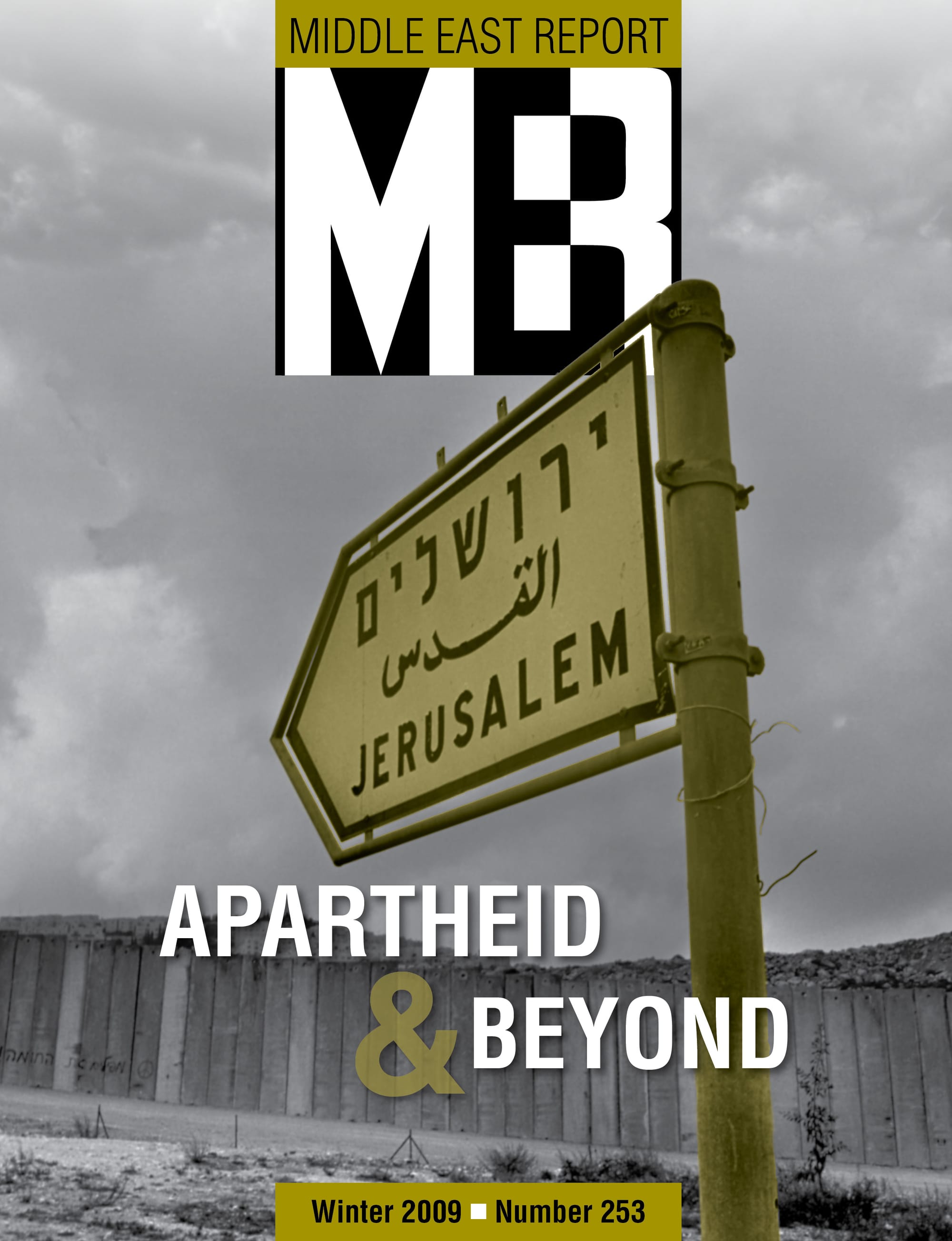](https://merip.org/magazine/253/)
A recent upsurge in analysis of Israel as an apartheid state has peaked again with Amnesty International’s February 2022 report, “[Israel’s Apartheid Against Palestinians: Cruel System of Domination and Crime Against Humanity](https://www.amnesty.org/en/documents/mde15/5141/2022/en/).” The willingness of mainstream non-governmental organizations to use the language of apartheid marks a shift in the terms of the debate—one that builds on a long history of analysis and activism. MERIP’s coverage of Palestine demonstrates how the South African struggle against apartheid has been an important reference point in that history. MERIP articles examine parallels—and distinctions—between Israel’s system of control and that of apartheid South Africa. They also illustrate how activists and those in solidarity with the Palestinian liberation struggle have recognized the similarities between South Africa’s racist regime and Israel’s settler-colonial project, and between modes of resistance to them.
\[Many more articles can be found on our website by using the [search page](https://merip.org/search/) or [browsing](https://merip.org/topics/) by topic. Click [here for a list of all articles about Palestine](https://merip.org/topics/palestine/) and [here for articles about the Israeli-Palestinian conflict](https://merip.org/topics/israeli-palestinian-conflict/).\]
**Ian Urbina, “[The Analogy to Apartheid](https://www.merip.org/the-analogy-to-apartheid/),” *Middle East Report* 223 (Summer 2002)**
Urbina describes how the Israeli state’s actions and policies resemble the South African apartheid regime and what Palestine activists can do to deploy the same anti-apartheid tactics of divestment and boycott, despite the “far more complicated financial scene” today.
“Nevertheless, the globalized economy offers potential points of grassroots pressure. Arms contractors always make good targets. Divestment from weapons manufacturers and popular pressure on governments to implement a freeze on military sales is a tactic that was used with good effect against apartheid South Africa. Many European countries are considering this approach toward Israel. After selling an estimated $170 million worth of military equipment to Israel in 2000, Germany announced that it will suspend further arms sales.”
**Monica Tarazi, “[Planning Apartheid in the Naqab](https://www.merip.org/planning-apartheid-in-the-naqab/),” *Middle East Report* 253 (Winter 2009)**
Tarazi explains the history of Israeli expropriation of Bedouin land in the Naqab (Negev), which continues to this day. She details how Israel’s discriminatory legal system and government planning policies have created a “desert apartheid” cementing shocking socio-economic gaps between Bedouins and Jews.
“Spatial planning can be a force for reform and emancipation or a mechanism of control and subordination. In Israel, national planning goals are rooted in Zionism’s agenda of nation building and ‘Judaization’ of territory. In the southern desert, known in Arabic as the Naqab and in Hebrew as the Negev, those priorities have led to the expropriation of more than 90 percent of the historical lands of the Palestinian Bedouin for the establishment of Jewish towns. The result is one of the clearest examples of apartheid in Israel.”
**Oren Yiftachel, “[’Creeping Apartheid’ in Israel-Palestine](https://www.merip.org/creeping-apartheid-in-israel-palestine/),” *Middle East Report* 253 (Winter 2009)**
Yiftachel describes, in historical and political detail, “the existence of legal and political differences between the various Arab areas under Israeli control.” He shows how the incremental process of cementing a system of rule has entrenched separate and unequal ethnic relations between Jews and Palestinians in Israel and the occupied Palestinian territory.
“In place of movement toward two states or one, there is a process of ‘creeping apartheid’—undeclared, yet structural—reordering the politics and geography of the country between the Jordan River and the Mediterranean Sea. The colonized West Bank, the besieged Gaza Strip and Israel proper, each with its own official set of rules, are in fact merging into one regime system, ultimately controlled by the Jewish state, which increasingly appears to bear the characteristics of apartheid, and inhabited by people with citizenship status akin to ‘blacks,’ ‘coloreds’ and ‘whites.’”
**Noura Erakat, “[BDS in the USA, 2001-2010](https://www.merip.org/bds-in-the-usa-2001-2010/),” *Middle East Report* 255 (Summer 2010)**
Erakat records the increasing influence of the boycott, divestment and sanctions (BDS) movement in the United States, a movement that draws inspiration from similar efforts aimed at apartheid South Africa in the 1980s.
“In the US, BDS is associated with the solidarity movement aimed at ending apartheid in South Africa. That movement is widely credited with helping to topple apartheid and free Nelson Mandela, a political prisoner for 27 years, who became the first Black president of South Africa. The African National Conference of which Mandela was a part called upon the world to boycott, divest from and sanction apartheid South Africa in 1958\. Due to the South African experience, BDS is seen as a grassroots strategy that works.”
**Loubna Qutami, “[Moving Beyond the Apartheid Analogy in Palestine and South Africa](https://www.merip.org/moving-beyond-the-apartheid-analogy-in-palestine-and-south-africa-trump/),” *Middle East Report Online*, February 3, 2020**
Qutami gives an account of a Palestinian youth delegation’s visit to South Africa and what they learned of the parallels and differences among the experiences of Black South Africans and their own. They explored the similar ways that colonialism, racial capitalism and apartheid functions in Palestine and South Africa and also discussed the crucial distinctions in the two struggles and their liberation strategies, including differences in the role of labor.
“Understanding the parallels between the Palestinian and South African liberation struggles has been galvanizing and productive for activists, but many Palestinians are questioning both the utility of the apartheid analogy and its limitations. They are not concerned with questions of whether or not apartheid currently exists in Palestine. They have accepted apartheid as a critical characteristic of Israeli occupation. Rather, they are examining whether or not apartheid adequately explains the Palestinian condition in its totality and if the analogy is helpful in mapping out the terms and strategies of their own liberation.”
**Nimrod Ben Zeev, “[Tracing the Historical Relevance of Race in Palestine and Israel](https://www.merip.org/tracing-the-historical-relevance-of-race-in-palestine-and-israel/),” *Middle East Report* 299 (Summer 2021)**
Ben Zeev provides a fascinating account of the history of racial thought among Palestinians and Zionists and their changing preoccupations with the color line as a theme of global politics.
**“**Against this backdrop \[of protests against the police killing of Michael Brown in Ferguson, Missouri\], activists in Palestine and in the United States increasingly began invoking each other’s struggles. This wave of solidarity, focused at first on Gaza and Ferguson, publicly reinvigorated a host of ongoing and deep historical ties between Black American and Palestinian struggles against oppression… It is perhaps fitting that one of the most reviled manifestations of the color line in the twentieth century, apartheid South Africa, remains one of Zionism’s most consistent demons to the present day. Indeed, even prior to the institutionalization of apartheid and Israel’s establishment, both in 1948, South Africa’s racial regime loomed large in the thinking of some Zionist figures.”
**Akram Salhab and Dahoud al-Ghoul, “[Jerusalem Youth at the Forefront of 2021’s Unity Intifada](https://www.merip.org/jerusalem-youth-at-the-forefront-of-2021s-unity-intifada/),” *Middle East Report Online*, November 10, 2021**
Reporting from Jerusalem, Salhab and al-Ghoul describe renewed efforts by Palestinians to creatively unite against Israeli policies of dispossession and to do so outside the traditional political structures that have failed to represent them.
“The Palestinian uprising of April, May and June 2021—known as the Unity Intifada—is part of a long tradition of revolutionary political activity in which Palestinians have organized, with great courage and creativity, to fight Israeli colonization and apartheid.”
**Zvi Schuldiner, “[Israel’s ‘National Unity,’](https://www.merip.org/israels-national-unity/)” *Middle East Report* 129 (January 1985)**
Schuldiner provides a snapshot of the state of Israeli politics around the elections for the eleventh Knesset in 1985, in which Meir Kahane’s fascist Kach movement secured a seat in the parliament, indicating increased support for his racist program to “expel the Arabs” who he accused of “taking jobs away from Jews.”
“On the other side of the spectrum there is the emergence of Kahane, with his ability to make even Eitan and Sharon look ‘moderate.’ This indicates how far the Israeli political spectrum has shifted to the right, and the dangers posed by the confluence of this growing chauvinism with the severe crisis of the economy.”
### Manufacturing the AKP in Turkey
URL: https://www.merip.org/2022/01/manufacturing-the-akp-in-turkey/
Last updated: 2025-08-22T18:37:23.000Z
Turkey now has the second longest uninterrupted Islamist government in the world, after Iran. But until the 1980s Islamism was a mostly marginal political movement in Turkey.
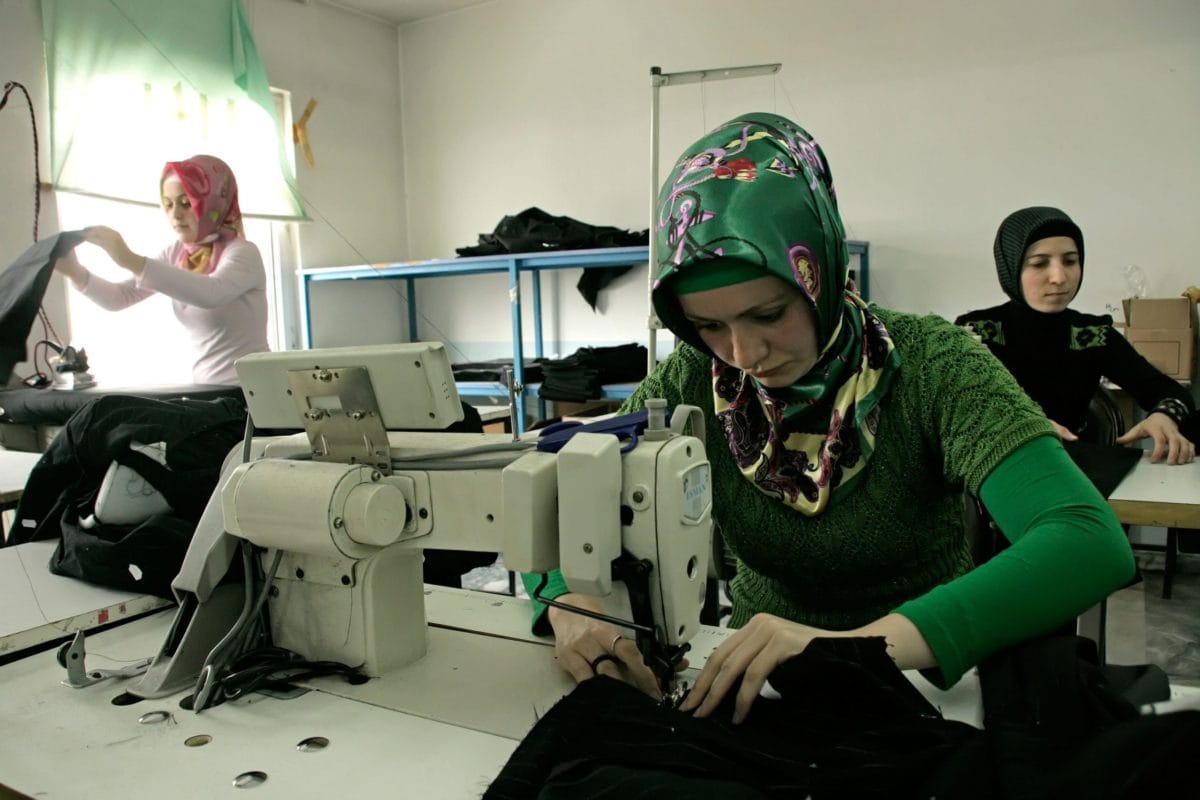
Textile workers at a sweatshop in Pendik, Istanbul, Turkey. Rebecca Erol/Alamy Stock Photo
Although Islamist parties ran in elections in the 1970s, their electoral base swiftly eroded from 8 percent in 1973 to 4 percent in 1984.[\[1\]](#%5Fedn1) Political circumstances drastically changed after the 1980s: Islamists won the mayorship in the two biggest cities in the country in 1994 and came to power in the national government in 2002 with the still-ruling Justice and Development Party (AKP).
Although there is no single answer to the question of why the Islamists’ fate changed, the bloody coup d’état of September 1980 played a role. The military junta overthrew the civilian government, ratified an undemocratic constitution and dismantled Cold War policies of developmentalism, which had facilitated the kind of industrialization that substituted imports with domestically produced goods. Islamic revivalism in Turkey coincided with this shift away from import-substitution to an export-led industrialization strategy. In fact, the voting share of the major Islamist parties of the period (the Welfare Party, Virtue Party and then AKP) tracks closely with the ups and downs of manufacturing output between 1987 and 2019\. (Figure 1)
Islamists followed the export-led industrialization strategy set by the secularist military junta. This shared approach to development at least partially explains why the tension between the Islamists and the (non-socialist, middle-class) secularists is limited to non-economic issues such as sartorial practices, the consumption of alcoholic beverages and the history of the early Republican period. A focus on this Islamist-secularist rift overlooks the connection between late industrialization and Islamic revivalism and overemphasizes the cultural and political causes of tensions between the secularists and the Islamists.
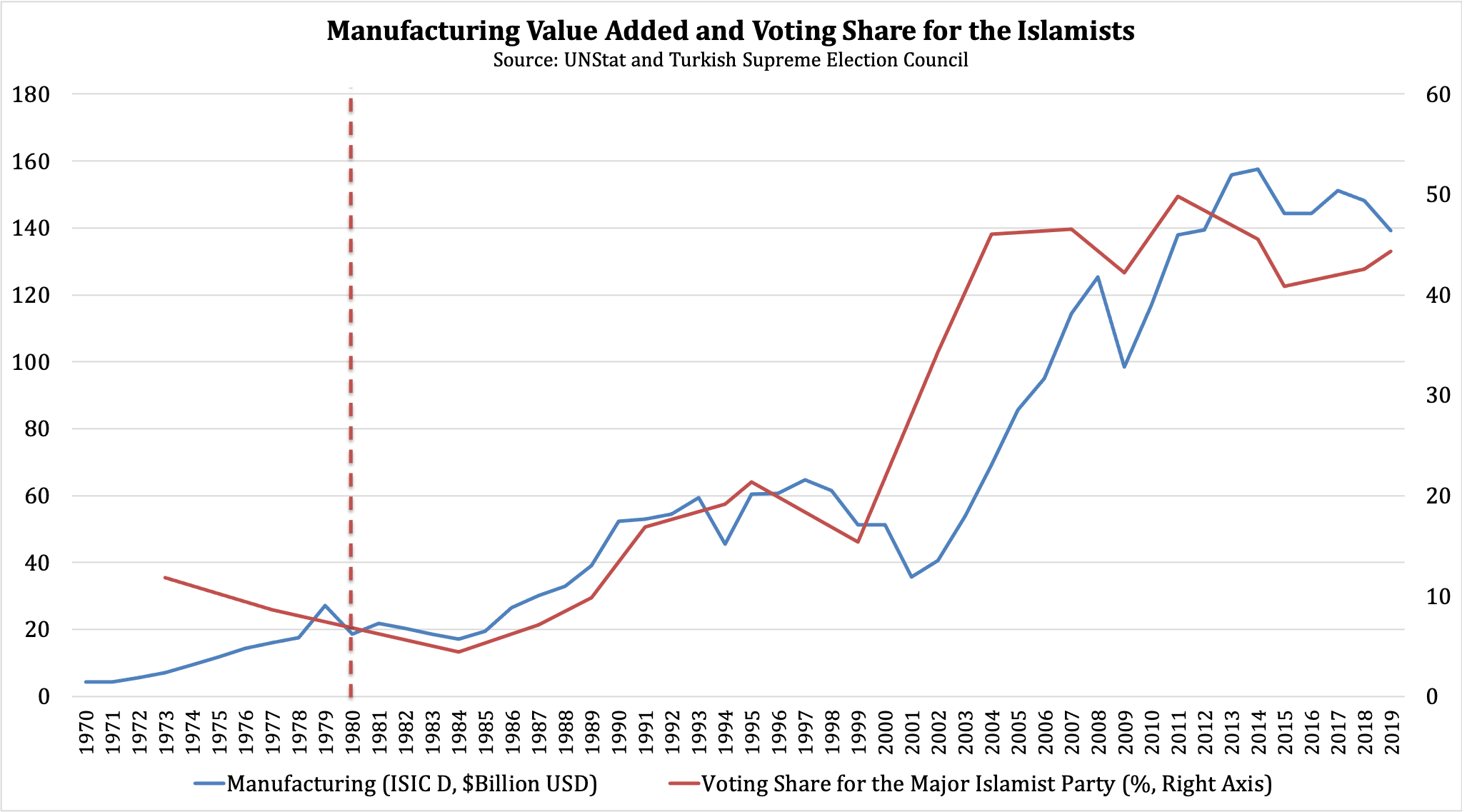
Figure 1\. Manufacturing output of the Turkish economy and the voting share of the major Islamist party in Turkey, 1973–2019\. Created by author with data from UN Stat and Turkish Supreme Election Council.
Looking at the Islamists’ alliances, rather than rifts, reveals that the owners of small and medium-sized manufacturing enterprises—the small industrialists—are one of their critical partners. The 1980s witnessed a boom in the number of small manufacturing facilities. These enterprises mostly operated in urban working-class communities and employed less than 50 workers. In total, over 140,000 small establishments, mostly in the ready-made apparel sector, began their operations between 1985 and 2001, according to the [Turkish Statistical Institute](https://data.tuik.gov.tr/Bulten/DownloadIstatistikselTablo?p=ahgf/jBw3HnA1jd9S/u3KDfe1iSncirIAxN34lKCZ6FHvgcUW61Ysa15F7TOvnCD) (TUIK). To put this figure in perspective, the Turkish economy had roughly 400,000 manufacturing establishments in [2019](https://data.tuik.gov.tr/Kategori/GetKategori?p=sanayi-114&dil=1). These sweatshops employed millions of recent rural-to-urban migrants, who were mostly unaware that before 1980 the urban and industrial landscape had been dominated by socialists and left-wing unions. Along with small construction contractors, slum lords and shopkeepers in working-class communities, these small industrialists make up a new middle class. The alliance between the Islamists and this middle class is a key factor behind their decades-long electoral success.
## **The Rise of the Small Industrialists**
Despite their importance to the success of the Islamists, the small industrialists have not received as much attention as they deserve. One reason they are overlooked by scholars is because of the tacit but enduring assumption that pious entrepreneurs have an intrinsic political tendency toward Islamism due to their religious beliefs. Thus, studies on Islamist entrepreneurs in Turkey do not look closely enough at the relationship between the particular sector and business size of pious entrepreneurs and their political affiliations.[\[2\]](#%5Fedn2) Pious entrepreneurs are generally presented as a united bloc competing against the older (and supposedly non-Islamist) business groups, regardless of the specific characteristics of their businesses. Viewing certain entrepreneurs as inherently Islamist makes it difficult to historically contextualize the evolution of alliances of business groups (such as the small industrialists) with Islamists or to understand the processes through which those alliances are formed.
> **Looking at the Islamists’ alliances, rather than rifts, reveals that the owners of small and medium-sized manufacturing enterprises—the small industrialists—are one of their critical partners.**
The history of this relationship during and after the collapse of Turkey’s industrialization strategy in the late 1970s provides a global perspective about Islamic revivalism. During the Cold War, developmentalism was adopted in many postcolonial countries by a coalition of government bureaucrats, state-supported industrialists and their domestic subsidiaries as a non-socialist way to achieve national prosperity. In the wake of the oil crises of the 1970s, these developmentalist establishments sought policy alternatives, sometimes successfully and sometimes not. The common post-developmentalist policy recipe called for limitations on government control of manufacturing and financial industries, export-led growth policies and cuts in social policy spending.[\[3\]](#%5Fedn3) In fact, the new and commonly used policies aimed at growth but not development per se. In addition to the adoption of this new set of policies, the timing and severity of the crisis of developmentalism, as well as the ensuing reactions by the developmentalist establishments, also facilitated the emergence of new economic interests.
Not coincidentally, Iran’s revolution occurred in 1979 and Turkey’s coup d’etat in 1980\. Both political incidents paved the way for Islamists to take power, albeit in different ways. According to the World Bank, Iran and Turkey were the most industrialized countries in the Muslim world as of 1980\. In Iran, the developmentalist regime was reluctant to use the growing oil income for redistributive policies and the ensuing discontent triggered social upheaval among the urban working class, which was eventually hijacked by the Islamists. It is not surprising that beyond Iran, Islamists in opposition failed to achieve this kind of success against the political elites in other oil-rich countries. Those elites had purposefully retarded the development of all industrial sectors except mineral extraction, thereby avoiding the emergence of a strong opposition. Similarly, but unlike in Turkey, the neoliberal reforms in other non-oil-rich Middle Eastern countries, such as Egypt and Tunisia, did not give strong new economic interests sufficient power to play a transformative role in politics, whether in an alliance with the Islamists or another movement. Islamists in these countries failed to effectively challenge their establishment.
Turkey expanded its industrial output faster than most of the other Muslim-majority and non-oil-rich countries in the postwar period, but the success came with a cost: Turkish manufacturing industries failed to decrease their dependency on foreign intermediate goods that, in return, created a chronic foreign currency shortage. In effect, rapid industrial growth since the 1960s increased the severity of the economic crisis in the late 1970s. Thus, the developmentalist establishment in Turkey had to initiate more expansive reforms than their counterparts in other Muslim-majority countries.
While short-lived governments were helpless against the ongoing recession, various socialist factions and parties gradually expanded their influence into working-class communities and provincial regions of the country. In response to the economic crisis and the political gains of the socialists, the military took over the government in 1980\. The military junta passed a new constitution in 1982 to recalibrate government institutions to serve a new export-led growth regime. Unions were closed. Hundreds of thousands of socialists were imprisoned and tortured. Dozens of them were executed. The 1980s was the decade with the highest rate of post-war urbanization: Declining agricultural subsidies and the liberalization of agricultural imports pushed people into cities.[\[4\]](#%5Fedn4) The urban population jumped from 43 to 60 percent in just one decade. Between 1980 and 1990, among countries with a population over 10 million, Turkey had the third highest urbanization rate, as well as the fourth fastest growth rate in [manufacturing value-added](https://data.worldbank.org/indicator/NV.IND.MANF.CD) and the third fastest growth in merchandise exports.
The 1980s was thus the decade of the small industrialist. They had a distinct class position: Employing on average a few dozen workers, these entrepreneurs’ earnings were roughly equivalent to a professional’s income. They were not “robber barons” but mere appendages to global commodity chains. Albeit limited, this revenue stream made them a respected elite in their working-class communities. In other words, their influence over the working-class electorate at the national level did not rest as much on the wealth they owned as on their privileged sociocultural access in everyday life. In many cases, they or their close relatives resided in the same neighborhoods as their workers. Often, they also owned tenements where workers lived. They had a visible presence in male-dominated public spaces such as mosques and coffee houses. Given their relatively high socioeconomic status, they influenced the political and cultural opinions of workers in these communities.
Despite this potential political power, small industrialists were also susceptible to the caprices of national policymaking. Changes in trade agreements or environmental regulations, as well as tougher enforcement of the labor code, could sink businesses overnight. With their economic fate tied to government policy, the small industrialists were in search of a reliable partner in national party politics. At the same time, Islamists were busy filling in the political void left by the socialists in the swiftly growing working-class neighborhoods, and they were also searching for a local partner.
## **The Small Industrialist—Islamist Alliance**
The alliance between the small industrialists and Islamist politicians that began to form in the 1980s bore fruit in 1994 with the Islamists’ narrow municipal election victories in Ankara and Istanbul, the two biggest cities in Turkey. Islamists increased their voting share in the 1990s almost exclusively in the cities where the growth of manufacturing output was above the national average. Furthermore, they received the largest share of their votes from poor working-class districts in these cities. Last but not least, Recep Tayyip Erdoğan made his debut in national politics with the 1994 election.
The increase in small industrial production continued for the rest of the 1990s. In 1997, more than one-third of Turkey’s exports were textile and ready-made apparel products. Small industrialists in these sectors were now collectively the biggest exporter and employer in the country. The economic crisis in 2001, at that time the worst in the history of the modern Turkish economy, devalued the Turkish currency drastically and boosted exports by small industrialists.
Further empowered by this crisis, the small industrialists’ support turned out to be critical for the opposition within the main Islamist party of the time, the Welfare Party. The party’s leadership had adopted an old developmentalist rhetoric that called for the construction of national heavy industries and included strong redistributive messages to appeal to the workers. But some party members, such as Erdoğan, realized that if the Islamists were to come to power nationally, they needed to alter their messages to solidify their alliance with small industrialists and to accommodate the new realities of the state’s export-led growth strategy. They addressed this need by breaking away from Welfare and founding the AKP in 2001\. The time had come for small industrialists to take over the Islamist movement, and Erdoğan rode the wave as the AKP swept to power in the 2002 elections.
Turkey’s export-led growth model crested in the late 2000s. Since this strategy was based on the suppression of wages in labor-intensive light manufacturing industries and the provision of limited social services for workers, the revaluation of the Turkish Lira progressively undermined export growth.[\[5\]](#%5Fedn5) China’s World Trade Organization membership in 2001 gradually ate up Turkey’s wage competitiveness. In this decade, Turkey began to expand energy- and resource-intensive sectors such as cable, laminated wood and carpet industries that were no longer desirable for European companies due to their low profitability. The downside of the growth of these hazardous sectors was the boom in machinery and equipment imports by small industrialists that triggered chronic current account deficits. In this tougher global environment, small industrialists grew dependent on government resources. Islamists encouraged informal employment practices at small industrial enterprises and created various subsidy programs such as the Credit Guarantee Fund. This fund provided collateral for over 840,000 small and medium-sized enterprises for a total loan volume of $82 billion between 2015 and 2020, which was 11 percent of the Turkish Gross Domestic Product for 2020.[\[6\]](#%5Fedn6) The AKP’s active support not only kept the small industrialists in metropolitan regions alive but also created new small and medium-sized industrialist cadres in provincial cities and towns, which adopted the urban Islamism of big cities only after industrial capital began to flow to these localities in the 2000s.
> **The AKP’s active support not only kept the small industrialists in metropolitan regions alive but also created new small and medium-sized industrialist cadres in provincial cities and towns, which adopted the urban Islamism of big cities only after industrial capital began to flow to these localities in the 2000s.**
This transformation also had repercussions for Turkey’s foreign policy in the 2010s. For example, Erdoğan and his minion, Ahmet Davutoğlu, intervened in the civil war in Syria as a remedy for the country’s growing economic problems. They [believed](https://www.hurriyet.com.tr/gundem/basbakan-erdoganin-konusmasinin-tam-metni-21388292) that the jihadists would soon overthrow President Bashar al-Asad and bring an end to the conflict. The expectation about a quick jihadist victory in Syria was so strong that government agencies continued publishing reports on investment opportunities in Syria even during the peak of the civil war. The initial grand plan by the Foreign Economic Relations Board of Turkey that aimed at the reconstruction of the entire country was replaced with a new scaled-down version that was one of the factors behind Turkey’s occupation (or control via proxies) of a large territory originally controlled by the Kurdish movement in northern Syria. These occupied regions now receive substantial investment from Turkish companies in infrastructure [projects](https://www.merip.org/turkish-intervention-in-syria-heightens-authoritarianism-in-turkey-and-fragmentation-in-syria/). In addition, small industrialists benefit from the millions of underpaid Syrian refugees who work today in hot and crowded sweatshops in all the major Turkish cities. Rather than employing them in Syria, small industrialists can now use this cheap labor source within Turkey.
In fact, the early 2010s was a crossroads for the Islamists. The AKP received twice as many votes as the main opposition Republican People’s Party (CHP) in the 2011 parliamentary elections and enjoyed the largest electoral support in its history. Thanks to AKP negotiations with the Kurdish movement, the three-decades-old civil strife had come to a halt. The influence of the military on Turkish politics was contained to a significant extent. In short, political circumstances were ideal for a new long-term growth strategy: Islamists at this point could have started to invest in the human capital of the country to avoid what some call “the middle-income trap.”[\[7\]](#%5Fedn7) They could also have worked to politically stabilize the Middle East. But if successful, this strategy would have eroded the small-scale manufacturing base in poor residential areas of big cities, endangering the alliance between the Islamists and small industrialists and shrinking the Islamists’ voting base in urban areas. Instead, the Islamists let the economy shrink. Many incumbent parties in [emerging economies](https://www.ft.com/content/ac77e331-8c17-46af-99a9-273d10e8eec5) such as the Workers’ Party in Brazil worked to reverse the economic slowdown but still lost the government in the 2010s. Islamists in Turkey, however, were some of the architects of the economic slowdown and benefited from it.
This strategy, which could be called “sustainable decline,” did not necessarily conflict with the modus operandi of export-led growth policies. In addition to government subsidies, declining real wages throughout the 2010s triggered a boom in new manufacturing enterprises. During the first ten years of the AKP government, the number of new manufacturing enterprises had dropped to roughly 3,000 per year because of the swift growth of the manufacturing output in China that cut the competitive edge of the small and medium-sized Turkish manufacturing enterprises. Nonetheless, the number of new manufacturing enterprises increased again during the 2010s and [reached 14,000](https://www.tobb.org.tr/BilgiErisimMudurlugu/Sayfalar/KurulanKapananSirketistatistikleri.php) in 2020\. Of these establishments, [97 percent](https://data.tuik.gov.tr/Kategori/GetKategori?p=sanayi-114&dil=1) were micro or small manufacturing enterprises employing less than 50 workers with an annual turnover less than 10 million Euros. The official statistics available since 1985 reveal that such rapid growth in the number of manufacturing enterprises occurred previously only in the 1990s when the Islamists won their first election victories.
## **Controlling Streets, Shop Floors and Minds**
The presence of small industrialists in urban areas has proved to be a crucial element of the continued electoral success of the Islamists. In the June 2019 election the Istanbul mayoral candidate from AKP received a voting share above the city average in districts where roughly 70 percent of the Istanbul Chamber of Commerce members were in the ready-made apparel industry. For instance, the AKP has been historically strong in the district of Bağcılar. In 2008, when I did my fieldwork there, it was the most populous district of Istanbul and had more than 9,000 manufacturing facilities located in residential buildings, which means that each street had on average 2.5 sweatshops. The AKP’s candidate received the [fifth highest voting share](https://www.ysk.gov.tr/tr/secim-arsivi/2612) in Bağcılar (56 percent) in the June 2019 election after four other districts that have a similarly high number of sweatshops (Sultanbeyli, Esenler, Arnavutköy and Sultangazi).
What makes this Islamist-small industrialist partnership successful is its capacity to regiment social interactions among the members of working-class communities. Their alliance sets social boundaries for those communities to isolate them from the “unwanted” sociocultural influences of the Islamists’ potential rivals and challengers—both within the community and without. Specifically, this alliance uses three interconnected social control technologies. The first one is based on surveillance by the neighborhood community. In Bağcılar, over 700,000 people live and socialize in an area of roughly 8 square miles, and more than 30 percent of the residential buildings had a grocery store, a coffee house or a sweatshop. The small industrialists and shopkeepers, who share similar interests in terms of their relationship with the workers, established a tremendously effective surveillance apparatus. Another control mechanism relies on overwork. Working 11 to 13-hour shifts, most of the workers lose their capacity to establish new social relations and solidarity networks that could bypass those controlled by the Islamist-small industrialist alliance. Lastly, Islamists develop a dynamic narrative to cater to the needs of small industrialists in their interactions with their working-class communities. This narrative includes guidelines about everyday life, sexual interactions, rituals and sartorial practices that, the members of these communities are told, will assure their religious purity. The narrative is dynamic because it responds to the new realities of social and political life such as the growing importance of social media.
> **What makes this Islamist-small industrialist partnership successful is its capacity to regiment social interactions among the members of working-class communities.**
The political milieu in working-class neighborhoods is a product of these methods of social control. Together with landlords, shopkeepers and small-scale construction contractors, the small industrialists economically dominate the communities through their manufacturing sweatshops. Workers depend on small industrialists for their livelihoods. In this environment, Islamists generate and disseminate a cosmology, which isolates the members of working-class communities from each other as well as those outside their communities. Social isolation makes it difficult, if not impossible, for workers and their families to organize collective action against their employers and religious leaders. In return, voting for the Islamist party becomes an act that helps the workers to justify the social pressure in the form of surveillance, overwork and regimentation of their self-perception as a constructive element of the social order, to establish an ascetic moral bond with—and overcome their anger against—their employers and to defend the community from external sources of spiritual corruption. Insofar as their rivals are demonized, Islamists have a distinct appeal in the eyes of the workers in these communities.
Islamists in Turkey play a risky game. On the one hand, declining wages frustrate the electorate: the average dollar income per person in Turkey [shrunk](https://www.imf.org/en/Countries/TUR#countrydata) roughly from $12,500 to $8,500 between 2013 and 2020\. On the other hand, each new small manufacturing facility means jobs for the urban working class and the continued (even if oppressive) presence of small industrialists in these communities as the allies of Islamists. Even though it is impossible to predict the results of the next election, this strategy has thus far proven its usefulness since the AKP has succeeded for the last decade in protecting its electoral base in urban working-class neighborhoods despite growing dissatisfaction with economic decline.
Although nepotism, cronyism and ineptitude play a role in the massive economic failure of Islamist governments, it is not the Islamists who pay the price for it. And while clientelist social welfare policies help the Islamists to buy votes, the poor now see such income transfers as more of a right than a favor. Finally, even though the rift between the secularists and the Islamists played an important role in the formation of the Islamist rhetoric, this cleavage is no longer the central issue of Turkish politics. The two rival election camps led by the AKP and the CHP now have both secularist and Islamist factions. The most violent political clash of the last decade occurred between two Islamist groups under the leadership of Erdoğan and Fethullah Gülen, a US-based Muslim cleric, rather than between Islamists and secularists. In fact, these are all relevant but not central dynamics that keep Islamists in power. The key factor behind the continued political success of the Islamists is their capacity to control the streets, shop floors and minds of the poor in working-class neighborhoods.
\[Utku Balaban teaches in the department of anthropology and sociology at Amherst College. He is a MESA Global Academy Fellow for the academic years 2020–2021 and 2021–2022.\]
---
### **Endnotes**
[\[1\]](#%5Fednref1) [Turkish Supreme Election Council](https://www.ysk.gov.tr/tr/secim-arsivi/2612), 2021
[\[2\]](#%5Fednref2) N. Balkan, E. Balkan, A. Öncü, eds. *The Neoliberal Landscape and the Rise of Islamist Capital in Turkey* (Berghahn Books, 2015). A. Buğra, O. Savaşkan, *New Capitalism in Turkey: The Relationship between Politics, Religion and Business* (Edward Elgar Publishing, 2014). Ö. Madi-Sisman, *Muslims, Money, and Democracy in Turkey: Reluctant Capitalists* (London: Palgrave MacMillan, 2017). D. Yankaya, *Yeni Islâmî Burjuvazi: Türkiye Modeli* (Istanbul: İletişim Yayınları, 2014).
[\[3\]](#%5Fednref3) V. Chibber, *Locked in Place: State-Building and Late Industrialization in India* (Princeton: Princeton University Press, 2011). S. Haggard, *Developmental States* (Cambridge, UK: Cambridge University Press, 2018).
[\[4\]](#%5Fednref4) Cameron Ballard-Rosa, *Democracy, Dictatorship, and Default: Urban-Rural Bias and Economic Crises across Regimes* (Cambridge, UK: Cambridge University Press, 2020).
[\[5\]](#%5Fednref5) N. Rudra, *Globalization and the Race to the Bottom in Developing Countries: Who Really Gets Hurt?* (Cambridge, UK: Cambridge University Press, 2008).
[\[6\]](#%5Fednref6) *2020 Faaliyet Raporu* (Kredi Garanti Fonu AŞ 2020) p. 34.
[\[7\]](#%5Fednref7) Indermit Singh Gill, Homi J. Kharas, *An East Asian Renaissance: Ideas for Economic Growth* (World Bank: 2007).
### Afghanistan’s Present Failure Lies in its Past Design
URL: https://www.merip.org/2022/01/afghanistans-present-failure-lies-in-its-past-design/
Last updated: 2025-08-22T18:37:24.000Z

British and Afghan officials at the signing of the Treaty of Gandamak (Major Cavagnari second from left, Amir Yakub Khan in the center), May 1879\. Photo by John Burke, public domain, British Library.
The spectacular collapse of the Afghan government to Taliban forces in mid-August 2021, followed by the shambolic withdrawal of the last American troops at the end of the month, took many by surprise. President Joe Biden’s administration was quick to blame its Afghan partners as rumors swirled that President Ashraf Ghani fled the country with suitcases full of cash. In the ruins of 20 years of American involvement in Afghanistan, there is a widespread belief in Washington that the corruption of multiple Afghan governments ultimately undermined them, leading to their downfall. Some, including Biden, have gone further, indicting not only the Afghan state but also more problematically the Afghan “nation,” or rather the supposed lack of one. In his remarks justifying the administration’s withdrawal, Biden stated, “I have never been of the view that we should be sacrificing American lives to try to establish a democratic government in Afghanistan—a country that has never once in its entire history been a united country, and is made up—and I don’t mean this in a derogatory—made up of different tribes who have never, ever, ever gotten along with one another.”[\[1\]](#%5Fedn1)
Such victim-blaming sentiments, while partially true, serve to deflect responsibility for the multitude of sins committed by the United States’ military and political intervention. On the one hand, faulting the now-deposed and never-very-popular Afghan president as the embodiment of a corrupt political class allows American policymakers to degrade a figure and institution that garners little sympathy either inside or outside Afghanistan. On the other hand, by insisting that American efforts crashed on the shoals of Afghan tribalism and lack of national unity Biden attempted to wash his hands of American responsibility, implying its imperial ambitions were no match for the forces of history. But the failure of the American project had little to do with Afghan corruption as understood in Washington, and even less to do with problems of the Afghan nation. Instead, it resulted from the historically constructed pathologies of the Afghan state.
Afghanistan’s fate—past, present and future—is fundamentally beholden to the conditions of its creation. While today those conditions—its dependence on foreign aid, lack of legitimacy among the population and inability to deliver the public good—are viewed as elements of state failure, they are in fact consciously constructed features of its original blueprint. These perversions of political design—or pathologies—embedded by outside imperial powers at the modern state’s inception have long determined Afghanistan’s political fortunes, both domestically and internationally. The re-incarnated Taliban, risen from the ashes like the phoenix, will be subject to similar vicissitudes, as will all future Afghan governments.
## **Problems of the Afghan Nation**
In the policy world and among the US public there is a common belief that Afghanistan is a land trapped in the past, ruled by ancient ties of kinship, primordial bonds of blood, and timeless traditions and cultural customs. Any coherent semblance of an Afghan nation is lacking in this stereotype. Its place is usurped by ethnic solidarities such as Pashtun and Tajik communities vying for dominance within the geographical space occupied by the Afghan state. The Taliban are understood not only as Islamic fundamentalists—a problematic caricature for other reasons—but also as Pashtun chauvinist-cum-nationalists. Their agenda is not only the establishment of Afghanistan as an Islamic emirate, but also as a Pashtun-dominated polity. These simplified views enable analysts to speak of the Afghan civil war as one of ethnic cleavages and foreign politicians to talk of the country as a tribal society where any idea of a shared national identity lacks traction.[\[2\]](#%5Fedn2)
Whereas the Afghan nation has increasingly been conceptualized in ethnically exclusive terms, the Afghan state has historically been actualized in ethnically inclusive terms. American policymakers, however, believed Afghanistan to be a Pashtun-dominated state and predicated their political calculations on this belief.[\[3\]](#%5Fedn3) Consequently, following the US-led restructuring of Afghanistan in the Bonn Process, the United States supported the construction of a highly centralized, ethnically delineated constitutional structure that institutionalized Pashtun power in a dominant executive. Such institutional architecture was both based on and facilitated an understanding of the Afghan nation not as a multiethnic mosaic but rather as one where the dominant ethnic group, the Pashtun, subordinated the other people of Afghanistan to their will. Historically though, this has not been the case. While a Pashtun has served as the political executive of the country since the establishment of the Durrani Empire in 1747, he has overseen a multiethnic, cosmopolitical state complex manned by Dari-speaking functionaries drawn from other ethnic groups, most notably the Shi‘a Qizilbash and Tajiks. Even the Pashtun king, and later president, has not been a “real” Pashtun. Instead, he has been an urban Dari-speaker, more at home and at ease in the ethnically mixed realm of Kabul than the tribal tracks of Khost.
> **Afghan nationalism is predicated on a horizontal solidarity between peoples. Absent, however, is a vertical solidarity linking people and the institutions of the state. As a consequence, Afghan nationalism is not identified with the state, creating a disconnect that partly explains the state’s relative fragility.**
Afghan nationalism is predicated on a horizontal solidarity between peoples. Absent, however, is a vertical solidarity linking people and the institutions of the state.[\[4\]](#%5Fedn4) As a consequence, Afghan nationalism is not identified with the state, creating a disconnect that partly explains the state’s relative fragility. That fragility is both a cause and consequence of its lack of penetration into society. The Afghan state, historically, has been both a conceptually and physically limited enterprise. In the former sense, its responsibilities have been narrowly construed, mainly restricted to taxation and security. For the most part, the state claimed authority without exercising it, knowing that any attempt would expose its weakness. In the latter sense, until the communist takeover with the Saur Revolution in April 1978, the ambition and ambit of state authority was circumscribed to the cities. The pretense of its sovereignty over the countryside was only respected so long as it was not exercised. When the communist government attempted to assert its authority in rural areas beginning in the summer of 1978, the disconnect between the cities and the countryside, or rather between the Afghan nation and the Afghan state, became painfully obvious. The assertion of state power in the name of the people was met with widespread resistance by those people, leading to the Soviet intervention in December 1979.
## **Pathologies of the Afghan State**
One of the most salient features of the relationship between the Afghan state and nation is the lack of linkage between the two, an issue the recent Taliban “victory” has failed to address. Before the Saur Revolution, the two sat juxtaposed to one another in a precariously balanced stasis, which was the basis of the Afghan political compact. Since then, they have drifted farther apart as both the state and the nation have radically changed. Today’s violence will not cease until a new political compact, with broad-based buy-in, has been constructed and enforced. The Taliban are unlikely to have either the political skill or the will to do so. Even if they overcome the disconnect between the Afghan nation and state, they still face the structural pathologies of that state. And herein lays the real challenge.
Following the collapse of the Ghani government and the American withdrawal in 2021, a chorus of punditry has decried these events as the outcome of the failure of the Afghan state. Indeed, this trope follows a well-trodden path of analysis when it comes to Afghanistan. For years the country ranked highly on *Foreign Policy*’s “Failed State Index.” When it was re-imagined as the “Fragile State Index,” Afghanistan’s ranking near the top slipped little, despite years of American investment in capacity building. This index reflects the international community’s expectations: that states be self-sufficient, ensure stability and security for their populaces and neighbors and deliver a discrete set of social goods for their citizenry. Yet this vision of the state poorly reflects the lived experience of many in the Global South. Further, it does not accord with the historical origins or trajectory of the state either as a generalized abstract concept or specific concrete reality. And it certainly has limited traction in Afghanistan itself.
> **The Afghan state was not designed to do any of the things now expected of a modern state.**
The Afghan state was not designed to do any of the things now expected of a modern state. Instead, it was built to address a wholly different set of concerns, a reality which conditioned its original architecture. When Afghanistan was constructed in the latter half of the nineteenth century, its central purpose was to serve as a buffer state between the expanding Russian Tsarist Empire and the British Indian Raj. The state was never intended to serve the needs of its people, including establishing security within its borders. Of paramount importance to the competing imperial powers was the idea that it constrained insecurity within its borders. Most importantly, the Afghan state was never meant to be self-sufficient. Instead, it was designed to be reliant on surrounding imperial powers, especially financially. Thus, the first pathology of the Afghan state—bequeathed it by its imperial architects—was that it would be a fiscal sink.
> **Most importantly, the Afghan state was never meant to be self-sufficient. Instead, it was designed to be reliant on surrounding imperial powers, especially financially.**
From its origins, modern Afghanistan was in effect envisaged as a fiscal colony of British India, enabling the Raj to exert influence without incurring the costs of outright control. The British attempted this latter course in the two Anglo-Afghan wars of the nineteenth century and found annexation and control—even in the relatively arms-length structure of the Indian princely states—provided an insufficient return on investment.[\[5\]](#%5Fedn5) Moreover, it was unnecessary. The Government of India could accomplish its objectives through the more economical policy of paying Afghan rulers to govern for them. The idea of the annual subsidy was thus born. While delivered on an ad-hoc basis since 1849, the subsidy was formalized with the Treaty of Gandamak in 1879\. From then onward, an annual treasure train of 600,000 silver rupees made its way from Peshawar to Jalalabad through the Khyber Pass. Even after Afghanistan secured its formal independence with the Treaty of Rawalpindi (1921), the subsidy continued—though for a time from the Bolsheviks rather than the British.[\[6\]](#%5Fedn6) Cognizant of their part of the bargain, Afghan rulers from Abdur Rahman Khan, the so-called Iron Amir, to Muhammed Zahir Shah, the last king of Afghanistan, used that money to build the Afghan state—particularly its security infrastructure.
The British retreat from the Indian subcontinent in 1947 both facilitated and required other international benefactors to pick up the bill for governing Afghanistan. During the Cold War, this responsibility was shared by the United States and the Soviet Union, who saw Afghanistan as a key field of competition in their ideological struggle. The superpowers effectively split the country in two, with the United States responsible for the south while the Soviets looked after the north.[\[7\]](#%5Fedn7) Many of their aid projects were dual use, serving both the needs of Afghan civilians and superpower militaries if required. The Soviet-built Salang tunnel through the Hindu Kush, connecting the north and south of the country, was designed to allow passage of T-62 tanks, a function it fulfilled in December of 1979\. Likewise, the American conglomerate Morrison-Knudsen constructed the Kandahar airport with a runway of sufficient length and weight-bearing capacity to service any plane in the arsenal of the US (and allied) air force, something which came in handy after 2001.
The civilian form of the subsidy was radically altered during the respective Soviet and American occupations, where those governments paid for the Afghan state directly. The [last public budget of the Ghani government](https://www.worldbank.org/en/country/afghanistan/publication/afghanistan-public-expenditure-update), from 2019, totaled approximately $11.5 billion, with nearly 75 percent of that funding provided directly by foreign governments. As with previous Afghan rulers, the People’s Democratic Party of Afghanistan (PDPA), supported by the Soviets, and the Hamid Karzai and Ghani administrations, supported by the Americans, dedicated most of this foreign largesse to building and buttressing the Afghan security state. The 300,000 strong Afghan National Army ate up half of Ghani’s 2019 budget. The size of the country’s security establishment is out of all proportion to its domestic fiscal resources—and always has been. It requires a foreign subsidy, the condition of which is a security apparatus meant to contain chaos within the country. Afghanistan is a money pit by intentional design. Its reliance on foreign aid is not a sign of state failure but rather a testament to how well it continues to function according to the precepts of its initial blueprint.
A second pathology conditioning the fortunes of the Afghan state since its construction in the latter part of the nineteenth century is political legitimacy. The key issue has been how the state has interfaced with and legitimated itself to a population that, for the most part, does not identify with it. For most of its modern history, the problem was limited because such interface was constrained both in time and space.
> **Historically, the Afghan state has been periodically, rather than permanently, manifest in peoples’ lives. Prior to 1978, it was notable for its absence rather than presence, especially in the countryside.**
Historically, the Afghan state has been periodically, rather than permanently, manifest in peoples’ lives. Prior to 1978, it was notable for its absence rather than presence, especially in the countryside. Consequently, the level of legitimacy required to keep the state in place was as diminished as its visibility. In such a scenario, the state needed to be seen less as legitimate in the eyes of most of the population and more simply less seen. Mass indifference, coupled with the consent of those closest to its centers of power—namely urban dwellers—was the winning formula. Given that the urbanization of Afghanistan before the Soviet invasion stood barely in the double digits, this was not a tall order.[\[8\]](#%5Fedn8)
Everything changed, however, with the advent of the Democratic Republic of Afghanistan under communist rule. As the state increasingly inserted itself into peoples’ lives, the old legitimating formula of mass indifference with limited consent no longer sufficed. It required greater sanction, which the PDPA attempted to secure through violence. That strategy led to a backlash against their rule, eventually resulting in the Soviet invasion, which itself led to further violence. Subsequent Afghan governments have been faced with this challenge of legitimacy and have likewise struggled to meet it. The first incarnation of the Taliban in the 1990s largely enforced its rule through violence before being deposed. The regime following the American intervention in 2001 ostensibly legitimated itself through elections, but no one fully believed it. Indeed, part of the reason for the seeming rapidity of the fall of the Ghani government was that many Afghans viewed it with contempt, and thus it lacked broad-based legitimacy within Afghan society.
> **While former Afghan governments could survive with indifference, present ones need legitimacy.**
While former Afghan governments could survive with indifference, present ones need legitimacy. The final, related pathology of the Afghan state is the expectations—both individual and collective—of the Afghan populace. More than half of the current population of Afghanistan was born after the American intervention in 2001\. Fully [three-quarters were born](https://worldpopulationreview.com/countries/afghanistan-population) after the Soviet intervention in 1979\. These people have very different experiences and expectations of the state than their predecessors. While imperial powers and Afghan rulers alike could design, construct and maintain a state largely indifferent and unresponsive to the people it nominally controlled, that changed with the dissolution of the old order as PDPA troops stormed the presidential palace in April 1978\. As the state became more invasive through the modernization projects of the Soviets and then the democratic one of the Americans, people’s expectations of the state’s obligations to them changed. No longer is it sufficient for the Afghan state to deliver a basic modicum of daily security (something it has largely failed at for the past 43 years) and, in return, tax the population. It is now incumbent on the state to provide for the public good, not just the public order.
## **The Past Is Prologue, and Epilogue**
Despite the protestations of Biden, the American failure in Afghanistan was not due to the past problems of the Afghan nation, but rather to the present pathologies of the Afghan state. Those pathologies—reliance on a foreign subsidy, the need for political legitimacy and the expectations of the populace—are both historically conditioned and currently manifest. They are the hard realities of rule for any candidate who wishes to govern Afghanistan. When the United States intervened in late 2001, it did so with little understanding of that state, or its fraught relationship with a well-established, though now strained, sense of national identity. Over time, US leaders have proved themselves indifferent students of Afghan history, culture and politics, enabling them to disingenuously blame Afghanistan’s failures both on the Afghans as well as the supposedly immutable forces of history.
But the pathologies of the state are as important for Afghans themselves as for Americans. The repeated failures of previous governments to come to grips with them led to their ultimate demise. And although history is a poor predictor of the future, it offers a prescient warning to current holders of power in Kabul. The Taliban seem as ill-equipped and uninterested today in the requirements of rule as they did in the 1990s. No doubt this disinterest in rule partly accounts for the Taliban’s keenness to win international recognition, for with it the spigots of international aid will once again be opened. Their welcoming attitude toward international NGOs, the aid community and the United Nations is simply an attempt to deflect the responsibilities of governance onto these bodies. It also reflects the reality that Afghanistan, despite their victory, remains a fiscal sink into which the [UN is looking to dump $5 billion](https://www.washingtonpost.com/national-security/un-humanitarian-appeal-afghanistan/2022/01/11/a2d77c26-72f0-11ec-bc13-18891499c514%5Fstory.html).[\[9\]](#%5Fedn9) The Taliban’s survival as a government is fundamentally dependent on their ability to woo a foreign backer—be it Pakistan, the Gulf states, Russia or potentially China. Regardless of their ultimate success in doing so, one thing is for sure: the pathologies of the Afghan state will outlast them, or likely any other government, in Afghanistan.
\[Benjamin D. Hopkins is a professor of history and international affairs at the George Washington University. He specializes in South Asian history, particularly that of Afghanistan.\]
---
### **Endnotes**
[\[1\]](#%5Fednref1) The White House, “[Remarks by President Biden on the Terror Attack at Hamid Karzai International Airport](https://www.whitehouse.gov/briefing-room/speeches-remarks/2021/08/26/remarks-by-president-biden-on-the-terror-attack-at-hamid-karzai-international-airport/),” August 26, 2021.
[\[2\]](#%5Fednref2) See for instance, Barnett Rubin, *The Fragmentation of Afghanistan: State Formation and Collapse in the International System,* Second edition (New Haven: Yale University Press, 2002).
[\[3\]](#%5Fednref3) For an academic example of this belief, see “[Afghanistan: The Problem of Pashtun Alienation](https://www.crisisgroup.org/asia/south-asia/afghanistan/afghanistan-problem-pashtun-alienation),” *International Crisis Group*, August 5, 2003.
[\[4\]](#%5Fednref4) David Edwards, *Heroes of the Age: Moral Fault Lines on the Afghan Frontier* (Berkeley: University of California Press, 1996).
[\[5\]](#%5Fednref5) For an argument that the Raj intended to construct Afghanistan as a princely state, see Francesca Fuoli, “Colonialism and State-Building in Afghanistan: Anglo-Afghan Co-Operation in the Institutionalisation of Ethnic Difference, 1869-1900,” *ProQuest Dissertations Publishing*, 2017.
[\[6\]](#%5Fednref6) Ibid., p. 248.
[\[7\]](#%5Fednref7) Nick Cullather, “Damming Afghanistan: Modernization in a Buffer State,” *The Journal of American history* 89/2 (2002). Timothy Nunan, *Humanitarian Invasion: Global Development in Cold War Afghanistan* (Cambridge, UK: Cambridge University Press, 2016).
[\[8\]](#%5Fednref8) Erwin Grötzbach, “Modern Urbanization and Modernization in Afghanistan,” *Encyclopædia Iranica*, V/6.
[\[9\]](#%5Fednref9) Karen DeYoung, “UN launches $5 billion appeal for Afghanistan, in largest ever for country in humanitarian distress,” *The Washington Post*, 11 January 2022.
### Generational Dislocation and Academic Solidarity—Aslı Bâli on MESA’s Global Academy
URL: https://www.merip.org/2021/12/generational-dislocation-and-academic-solidarity-asli-bali-on-mesas-global-academy/
Last updated: 2025-08-22T18:37:24.000Z
The last ten years have seen a precipitous decline in conditions for academics across the Middle East.
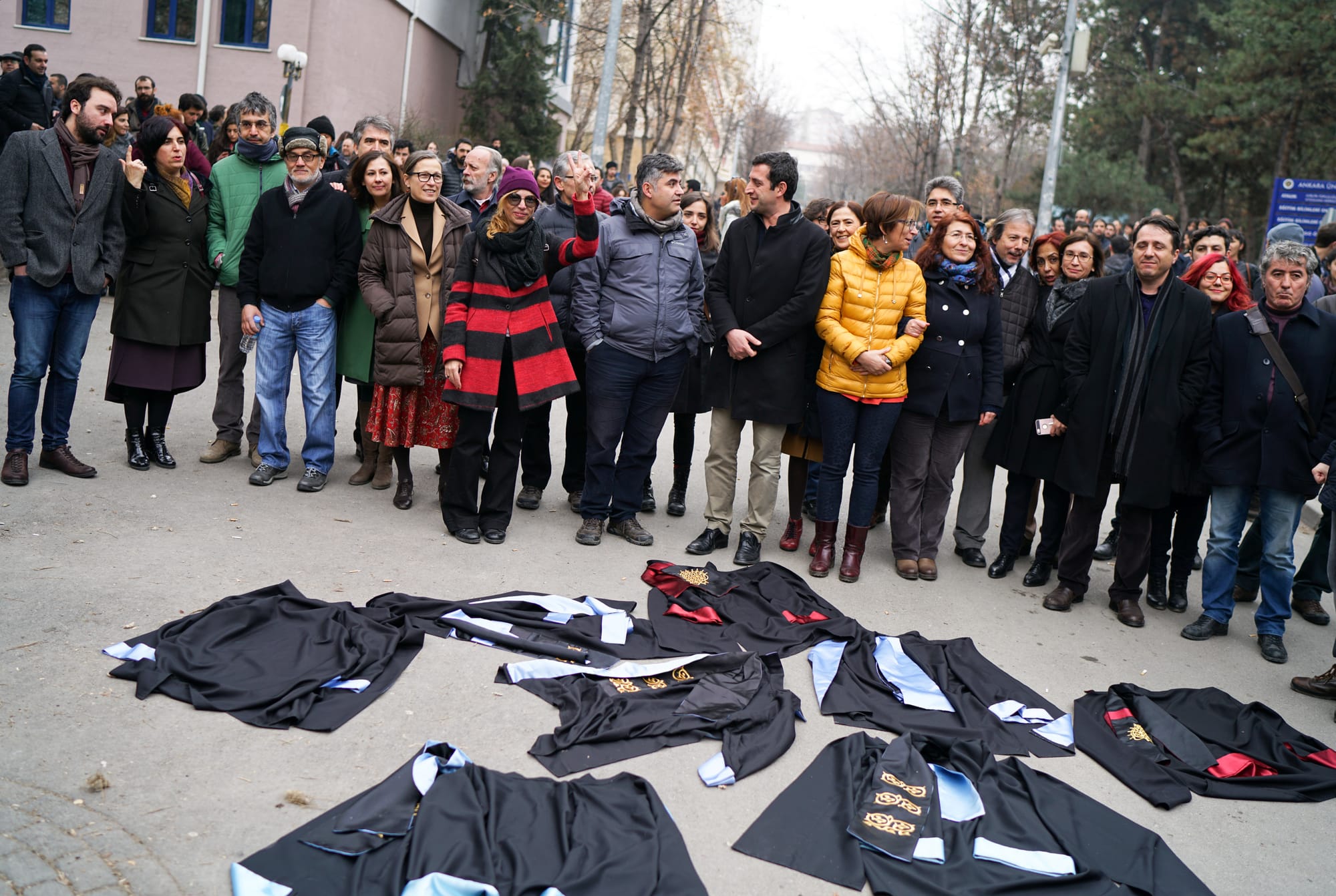
Academics lay down their gowns during a protest against the dismissal of colleagues from universities following a post-coup emergency decree, in the Cebeci campus of Ankara University in Ankara, Turkey, 2017\. Umit Bektas/Reuters
With campuses under literal fire in some places and extraordinary repression and authoritarian crackdowns in others, research, writing and teaching have become nearly impossible in many places. While there are no precise figures concerning the extent of academic displacement, dislocation and disruption, there has been a noticeable uptick of displaced scholars from the Middle East finding their way to North America.[\[1\]](#%5Fedn1) For those based outside the region, access to field sites and archives has been affected by the same conditions.
In response to the alarming increase in the numbers of scholars and academics from the region forced out of their home institutions, the Middle East Studies Association (MESA) [Global Academy](https://mesaglobalacademy.org/) initiative was developed in 2016 at the MESA annual meeting. Directors of university-based Middle East centers compared notes and realized that many of those who were dislocated were now seeking placements in North America at universities with strong Middle East programs. The shared frustration among center directors at not being able to do more to assist these displaced researchers was an expression of the deep solidarity experienced by most MESA members as colleagues from the region faced increasingly perilous circumstances.
With a common interest in serving this community of displaced scholars, a committee designed an initiative that leveraged MESA’s unique academic networks. The MESA Board authorized the committee to seek grants to create fully funded fellowship positions for displaced scholars to join MESA-affiliated university Middle East centers. While that remains a long-term goal of the project, pilot funding from the Carnegie Corporation is creating opportunities for scholarly collaboration, research partnerships and knowledge production that places displaced scholars from the region in conversation with each other and their colleagues in North America. The project takes advantage of MESA’s convening power and the breadth of its membership to rebuild connections that sustain and support social scientific and humanistic research by displaced scholars while offering seed funds and platforms that bring these scholars into the center of MESA’s academic community.
*Aslı Ü. Bâli is one of the founders of MESA’s Global Academy initiative and a past member of MERIP’s editorial committee. She is professor of law at UCLA School of Law and has previously served as the director of the UCLA Center for Near Eastern Studies and the founding faculty director of the Promise Institute for Human Rights. MERIP editor Arang Keshavarzian interviewed her in October 2021.*
**Arang Keshavarzian**: Many communities in the Middle East have been displaced in recent years and not all of them due to the Arab uprisings. While various humanitarian initiatives and aid projects are addressing immediate challenges, the material destruction or politicization of universities and research institutions have undermined scholarship on the struggles that are unfolding and ongoing. How did you and your colleagues at the Global Academy arrive at this project to focus on the research and expertise that was being destroyed by the fallout from civil wars, authoritarian backlash and displacement? Is the focus specifically on the humanities and social sciences because this is where collaborative knowledge production is less developed?
**Aslı Ü. Bâli**: The displacements of the last decade from the Middle East and North Africa have had many causes—some of them can be traced directly to the “Global War on Terror” and the aftermath of the invasion and occupation of Iraq (broadly construed to encompass the internal and transnational impacts), which have destabilized much of the region. Others have been a result of conflict and authoritarian retrenchment in the wake of the Arab uprisings, not only due to counterrevolutionary dynamics but also as a consequence of multiple external interventions. Syria, Bahrain, and Libya are just some of the cases in which all these factors have played out. The increasing exodus of [academics](https://www.merip.org/intellectual-traditions-and-the-academy-in-turkey-an-interview-with-evren-altinkas/) and scholars from [Turkey](https://www.merip.org/turkeys-purge-of-critical-academia/) is a different sort of example where a country at the periphery of many of these developments is still marked equally by region-wide dynamics and internally driven political transformation. Yet another context is that of Iran where the combination of increasing sanctions and internal repression have produced a steady brain drain from the country.
What is common across all these contexts is that they have damaged and disfigured higher education and reshaped the conditions for both research and cultural production. It is perhaps unsurprising that the 20 years since the attacks of September 11, 2001, have visited this kind of devastation on the region. But its consequences in terms of the sheer destruction of expertise, archives, scholarly careers and knowledge production in and about the Middle East remains vastly underappreciated. From Cairo to Beirut, from Damascus to Istanbul, vibrant centers for higher education have been all but crushed, for disparate reasons and to different extents, but the fallout is evident everywhere.
MESA Global Academy is an initiative by a set of colleagues to think through different models of academic solidarity in this context. Scholars of the Middle East based in North America have themselves been affected in different ways—cut off from archives in some instances, increasingly unable to maintain what had been thriving scholarly collaborations in others. For those who are originally from the region but did their graduate training abroad, witnessing these events from afar has been both professionally and personally debilitating. When the ripple effects on academia on this side of the Atlantic are added to the equation, the question of solidarity takes on some different dimensions.
> **The project avoids using an “at risk” framing in describing colleagues but embraces instead an understanding of how the entire field of study has become precarious due to the violence—material and political—inflicted on the region’s universities, research institutes and archives**
Working with displaced scholars to (re)build their intellectual networks, academic communities and research collaborations in their new locations is an investment in reciprocal benefits. The project avoids using an “at risk” framing in describing colleagues but embraces instead an understanding of how the entire field of study has become precarious due to the violence—material and political—inflicted on the region’s universities, research institutes and archives. Under these conditions, finding ways to bring displaced scholars back into our communities so that the field continues to benefit from their wealth of training, knowledge, expertise and productivity is a project that is at least as much about enriching our academic networks as it is about providing innovative platforms that assist displaced scholars. In short, we are fortunate to have these colleagues with us in North America and the least we owe them is to welcome and integrate them in our academic communities.
The MESA Global Academy focuses on the humanities and social sciences for three reasons: first, these are the disciplines that have been disproportionately affected by violence and authoritarian backlash. Training in medicine, engineering and the STEM fields often remains valued even by repressive governments while work in the humanities is treated as dispensable “luxuries” or dangerous to “the nation” and social science data collection is often subject to national security constraints. Moreover, scholars in the natural and applied sciences are often treated as having valued expertise in countries to which they are displaced in Europe or North America. The disinvestment that characterizes the humanities in the West poses a form of double jeopardy to displaced scholars in the humanistic social sciences who find shrinking departments and precarious forms of employment as the only available avenues once they arrive at a destination outside of their home institutions. Third, MESA’s own intellectual networks are, of course, disproportionately in the humanities and social sciences enabling us to leverage relationships with partner universities and dissemination platforms in these fields in ways that enhance our efforts.
**Arang:** Some researchers and institutions have been better positioned to withstand the political crises and maybe even tapped into some of the flows of funding on the “Arab Spring” or other topics of interest to international agencies and scholars. Given the large number of researchers, professors and graduate students seeking to leave Egypt, Syria, Yemen, Turkey, Lebanon and Iran, however, the research field is highly uneven. What are some of the factors that have made some groups more vulnerable and precarious than others? How do these factors shape who can leave their country and who may be eligible for the sorts of support that Global Academy offers? How does international law and US immigration policy shape the pathways available to researchers?
**Aslı:** One of the most significant factors that affects the ability of displaced scholars to find their way to North America is whether they have prior institutional ties to a North American university. Such ties may be a consequence of having done undergraduate or graduate training in this country or having served at an earlier time as a visiting scholar, researcher or fellow at a university in the United States or Canada or having a research collaboration with an established scholar based in North America who is able to use their institutional platform to assist their colleague. In many cases, scholars displaced from the Middle East do not arrive in North America through one of the formal programs like the Scholar Rescue Fund or the Scholars at Risk Network but rather through private efforts by communities at North American universities who identify an individual seeking to leave their country and find an institutional home and then cobble together the resources to invite them on a temporary or visiting basis.[\[2\]](#%5Fedn2)
Of course, US immigration laws pose a very high barrier to entry for most scholars, and those barriers have more recently become nearly insuperable due to pandemic-based entry restrictions.[\[3\]](#%5Fedn3) But the relevance of prior institutional affiliation also means that there are pronounced patterns in who is able to leave their country to come to the United States. It is worth noting that some European countries—particularly Germany—have been far more welcoming of displaced scholars from the Middle East and North Africa and have provided institutional affiliations to many who had no such prior ties. In addition, the German government has lowered immigration-related entry barriers for displaced scholars, while the US government has made no such accommodation.
To begin with, those with prior institutional ties—especially those who previously studied in the United States—often belong to socio-economic elites in their home countries and hold positions in the leading universities in the region. Scholars who enjoy these advantages are also unevenly distributed across the region. In practice, the sudden onslaught by the Turkish government against academics in 2016 and the relatively strong ties between Turkish universities and the United States has meant that those forced to flee Turkey may constitute the single largest community of displaced scholars in the field of Middle East studies to have arrived in this country in the last five years. But they are by no means the only such community—there are also many Kurdish scholars among those displaced from Turkey. Apart from Turkey, scholars from Egypt, Iran, Iraq, Lebanon, Syria and Yemen make up the bulk of those in the field of Middle East studies who have been displaced to North America. While few Afghan scholars have managed to arrive yet, we expect a massive new wave of academics forced to flee from Afghanistan in the coming year.
We have worked very hard at MESA Global Academy to find every possible avenue for our calls for applications and we hold them open for months while we reach out to relevant communities. This process has been challenging since individuals find their way to North America through an enormous variety of channels, many times involving the private efforts of their pre-existing networks to bring them to a university without any affiliation to formal programs of assistance for displaced scholars. Accessing the relevant networks to ensure that we contact as many eligible scholars as possible from a broad a range of backgrounds—national origin, ethnicity, gender, etc.—has been one of the most formidable puzzles with which we have grappled. To date we have funded nearly two dozen fellows from Iran, Israel/Palestine, Kurdistan, Lebanon, Syria, Turkey and Yemen and we are constantly striving to diversify our pool of candidates and awardees. Most recently we have been working with a range of partners to develop a program to assist displaced Afghan scholars who we hope will be able to arrive in North America in the coming months.
**Arang**: If we think of the Arab uprisings as a historical epoch, is it appropriate to describe the cohort of young researchers and graduate students as constituting a generation marked by both the hope and political energies of the time and its immense dislocations? And if so, do you see signs of this generation building transnational networks of solidarity now that some of them have been encountering one another and even collaborating outside of their national homes and political contexts?
**Aslı**: Yes, I absolutely believe that the various uprisings across the region—from the Green Movement in Iran to the Arab uprisings to the Gezi Park protests in Turkey—have been the expression of a generation unwilling to accept the status quo they have inherited but equally dislocated and disoriented by the sharp deterioration of conditions over the last decade. The reality of disrupted studies, research, academic careers and cultural production is in evidence across the region. This generation has seen opportunities to access or make careers in higher education foreclosed sometimes across an entire country wracked by war, and sometimes more selectively, making academia inaccessible to those viewed as dissidents who are excluded for their roles in the uprisings or in resistance movements. While many have kept faith with the principles that led them to express their dissent, their lives have been upended and the dispiriting experience of displacement has altered their own scholarly trajectories.
> **Dislocation can be at once destructive and generative—existing networks, scholarly identities and projects have been irreparably ruptured in many cases. But new communities in exile, novel diasporic cultural formations and unexpected research collaborations and fields of inquiry have also opened up as a consequence of these events.**
Needless to say, dislocation can be at once destructive and generative—existing networks, scholarly identities and projects have been irreparably ruptured in many cases. But new communities in exile, novel diasporic cultural formations and unexpected research collaborations and fields of inquiry have also opened up as a consequence of these events. In many ways, the MESA Global Academy project is designed to invest in and facilitate these generative possibilities even as our community recognizes the trauma associated with displacement and seeks to foster a network of scholarly solidarity to mitigate where possible the enormous harms that dislocations have wrought. I hope that our project is itself an innovative platform that exemplifies the experiments in transnational solidarity that the generation marked by both the hopes and displacements of the uprisings is creating. Of course, there are many others—including the Solidarity Academies formed by displaced scholars themselves in Europe and projects like the New University in Exile Consortium based in New York and the Open Society University Network (based in Berlin and at Bard College in the United States).
**Arang:** In terms of sustaining and extending collaborative scholarly support, how should we envision next steps? Should efforts focus more intensively on the region to draw in more institutions and networks of support or more extensively to link with efforts in other parts of the world? For those of us outside the region who might want to support the Global Academy, what work should we be doing?
**Aslı**: With events in Afghanistan as the most recent example, it is clear that as long as the toxic mix of external interventions and geopolitical support to authoritarian formations in the region persist (despite the “pivot to Asia,” these dynamics show no signs of slowing) the waves of destruction affecting scholars, research opportunities and academic networks will continue. We have been trying to be nimble in our response at MESA Global Academy. We have pivoted to working collaboratively with displaced scholars to design purpose-built platforms that offer seed funding for research and publication opportunities, new multi-media venues to showcase their work and creative strategies to (re)build networks that provide scholarly community and identity in a new context. But we are vastly under-resourced and unable to meet the needs that we have identified among displaced scholars, not to mention the crisis in academic communities in North America increasingly severed from the archives and field sites that were once essential to knowledge production in Middle East studies.
> **Parsing the politics (or political economy) of higher education in the region is fraught and highly context specific—only those with detailed knowledge of conditions on the ground and ties to the affected scholarly communities can fashion well-designed initiatives to support research and knowledge production in countries where authoritarian capture is the order of the day for universities.**
There remain many networks and institutions that continue to thrive in the region itself, despite the odds, that should benefit from ongoing and enhanced investments. On the other hand, there are also new sites of cultural production and scholarship that benefit from authoritarian patronage. Deciding how to engage with these sites requires careful consideration. In some cases, once-autonomous universities have been brought to heel and partnerships that were established under different conditions persist as zombie programs that may no longer serve the original goals of fostering productive scholarly partnerships. In other cases, resilient institutions have admirably withstood enormous pressures to protect their faculties and students and deserve utmost support. Parsing the politics (or political economy) of higher education in the region is fraught and highly context specific—only those with detailed knowledge of conditions on the ground and ties to the affected scholarly communities can fashion well-designed initiatives to support research and knowledge production in countries where authoritarian capture is the order of the day for universities.
For those of us outside the region and seeking avenues to form or join intellectual communities with our displaced colleagues, there are many ways to get involved with MESA Global Academy or the many other initiatives I have mentioned. At MESA Global Academy, we are always seeking partnerships with universities and individual faculty members who want to join our network. Our website includes information about the many events we sponsor that highlight the cutting-edge research being produced by our fellows. We are also eager to foster research collaborations between fellows and their North American counterparts in Middle East studies and would welcome anyone who would like to join such an endeavor or has ideas to foster new partnerships to contact us. You can also donate to our project through our website.
---
### Endnotes
[\[1\]](#%5Fednref1) While precise numbers on displacement are difficult to ascertain, over 1,000 displaced scholars have found placements in North America over the last 20 years, with a substantial majority from the Middle East. For a discussion of some of the numbers and patterns of displacement, see Elizabeth Redden, “The Long-Term Outlook for Displaced Scholars,” *Inside Higher Ed*, May 13, 2021.
[\[2\]](#%5Fednref2) The Scholar Rescue Fund is a project of the Institute of International Education that provides matching funds (to be matched by a host university) for fellowships to support threatened scholars. The Scholar at Risk (SAR) Network is a US-based, international network of institutions that work together to arrange temporary academic positions for scholars facing grave threats in their home countries. SAR does not offer fellowships but assists in connecting scholars with host institutions and also provides advice and support as these scholars make their transition.
[\[3\]](#%5Fednref3) The immigration restrictions put in place by the Trump administration and largely continued by the Biden administration began to be loosened somewhat by mid-fall 2021, too late for the 2021–22 academic year for most scholars and students. Similar border closings in Europe and beyond left scholars with few good options in the last 18 months. For an overview of these restrictions in the United States and beyond, see Mary A. Shiraef, “Closed borders, travel bans and halted immigration: 5 ways COVID-19 changed how—and where—people move around the world,” *The Conversation*, March 18, 2021.
### Reflections on Exile
URL: https://www.merip.org/2021/12/reflections-on-exile/
Last updated: 2025-08-22T18:37:25.000Z
One legacy of revolution and counterrevolution is the growing number of participants—some of whom identify as revolutionaries or activists—living outside of the Middle East and North Africa. Whether by choice or by compulsion, their plight is part of the bitter fruit of revolutionary struggle and counterrevolutionary intolerance. Interviews with Aslı Ü. Bâli and Oula Ramadan in this issue both speak to the possibilities and perils of displacement and exile in different ways. In addition, we asked others for brief reflections on “what it means to be exiled after revolution.” Their responses speak to experiences of belonging and loss in ways both quotidian and profound. If the events of 2011 contributed to the creation of a fundamentally revolutionary subjectivity, these reflections also remind us that revolutionary subjects are not fixed in time or space.
- The Editors
---
Exile is a violent experience. You will never understand it until it happens to you. I felt my roots were severed. The place where I grew up, fell in love, protested, got drunk and survived police violence was no longer there, along with the emotional registers, the smells and sounds that made up who I am. I never fancied living in Germany. I didn't desire to leave Egypt. In a couple of months my world was turned upside down.
Exile is punishment. A severe form of punishment as old as Adam's exile from Eden. But for what sin? Daring to rebel in the face of injustice. In exile, I grapple with questions of belonging and meaning. I also grapple with my voice. For a long time I felt silenced. Who do I speak to? My comrades back in Egypt or the ones in my own physical vicinity in Germany? Is there a way to reconcile both? When I lived in Cairo, a previous tenant left a quote from Adorno on the wall of the room I was renting: "The highest form of morality is not to feel at home in one's own home."
> **And we have to make the best of it, accept the gift of sharper vision that comes with exile, the ability of seeing through borders.**
Uprootedness is a universal truth. If you are queer, you have been exiled from your hometown, your family or from the straight paths to happiness. And we have to make the best of it, accept the gift of sharper vision that comes with exile, the ability of seeing through borders*.* When you lose it all you are truly free, and you can appreciate the little things. You can become friends with a falling leaf in November or the scribbles on tombstones in an old graveyard.
- Ahmed Awadallah, Egypt/Germany
---
My intended year in the United States as a Fulbright scholar has become ten years now in 2021\. One of the hardest decisions in my life was choosing between risking my life by returning to Syria and staying safe in the US and kissing my family a very long goodbye. To be exiled means to recreate one’s identity and fight back against the reductive notion of being only a refugee***.*** In Syria, I was someone’s son, nephew, friend, uncle, etc. In my new setting, all of that was being summarized in one new identity that I never experienced before nor expected.
> **To be exiled means to recreate one’s identity and fight back against the reductive notion of being only a refugee.**
To live in exile quickly taught me to appreciate the smallest of things like hugs and being invited to someone’s house for a coffee. I grew tired of always being a guest at someone’s house. I constantly dreamt of being at my family’s house, without the need for an invitation or to justify why I was there. Uncertainty and fear of the unknown future defined my life for the first six years. Nightmares of being deported dominated my days and nights.
Having extremely supportive friends, staying optimistic and striving to be the best version of myself gradually eased some of my pain. I wanted to recreate a new identity as someone worthy of respect, appreciation and kindness, regardless of my status as a refugee. I decided to work hard to become again the same successful, regular person I once was. I earned a master’s degree in literary translation and I’m working on my PhD in comparative literature. I got married in 2018 and expect to be father in December 2021.
- Mohammed Kadalah, Syria/United States
---
“Democracy is a bitter word.” This was the title that late Yemeni columnist and former parliamentarian, [Abdul-Habib Muqbel](https://www.taiztoday.net/2020/10/22/%D8%AA%D8%B9%D8%B1%D9%81-%D8%B9%D9%84%D9%89-%D8%A7%D9%84%D8%B5%D8%AD%D9%81%D9%8A-%D8%A7%D9%84%D9%8A%D9%85%D9%86%D9%8A-%D8%B5%D8%A7%D8%AD%D8%A8-%D8%A7%D9%84%D9%83%D9%84%D9%85%D8%A9-%D8%A7%D9%84%D9%85/) (1961–1995) used for the articles he wrote criticizing the state’s violations, abuses and destructive policies under Yemen’s former president, Ali Abdallah Salih. I find that sentence describes well the struggle for democracy, not only for Yemen but for all the Arab Spring generation across the Middle East and North Africa region.
> **I no longer see myself as an exiled political activist from Yemen but rather as a global citizen who should advocate for human rights everywhere.**
The fight for democracy is extremely difficult and dictatorships find it bitter and unacceptable. The Arab Spring was more than an opportunity for my Yemeni generation to step closer to a democratic state where equal citizenship could be achieved. It was not just one event: It was our life! For me, it shaped my life drastically because it led to me leaving home and living in exile.
Ten years on, though, I no longer see myself as an exiled political activist from Yemen but rather as a global citizen who should advocate for human rights everywhere. I am grateful for the life that I was gifted, with a level of resilience that enables me today to see the bigger picture of our humanity. I have grown into a human being who is keen and always ready to cooperate with anyone anywhere in the struggle for achieving goodness, truth, justice, freedom and equality.
- Afrah Nasser, Yemen/Sweden
---
As a queer Syrian Palestinian blogger who was based in Damascus during the popular uprising, exile took many forms in my life. Learning about Palestine from my grandfather’s memories, about *zaytoun* (olives) as an essential breakfast component, paved the way for a different belonging to Syria. I was already in part in a state of exile of not knowing what it means to be Syrian under military-carceral dictatorship on the one hand, and what it means to be Palestinian through my grandfather’s memories of Al Khalil’s *zaytoun*, on the other.
> **My exile is the loss of community and loss of people murdered by the state and those who are still detained and imprisoned.**
Syria and Palestine both induce a sense of my exile for two different personal and political reasons. After the revolution, exile shifted from feeling loss in between two homes that are stolen either by settler colonialism or by military authoritarianism, to the state of loss of hope that was once introduced by a potentiality of a revolution in Syria. Edward Said called Palestine his exile, citing memories as “inaccurate,” that they could be “slipping into vague memories of another” country.[\[1\]](#%5Fedn1)
In my case as a teacher-activist in exile since early 2014, my exile is the loss of community and loss of people murdered by the state and those who are still detained and imprisoned*.* The only hope for me from a location of exile in between the UK and the US today is to teach a pedagogy of nuanced exile that would complicate these interconnected histories in the hopes that they can provide alternative imaginings of futures and protest.
- Razan Ghazzawi, Palestine/Syria/United States/United Kingdom
---
### **Endnote**
[\[1\]](#%5Fednref1) Edward Said, *After the Last Sky: Palestinian Lives* (New York: Columbia University Press, 1998) p. 30.
_Truncated after 5 MiB. Use `/sitemap.xml` for the complete archive of public content._