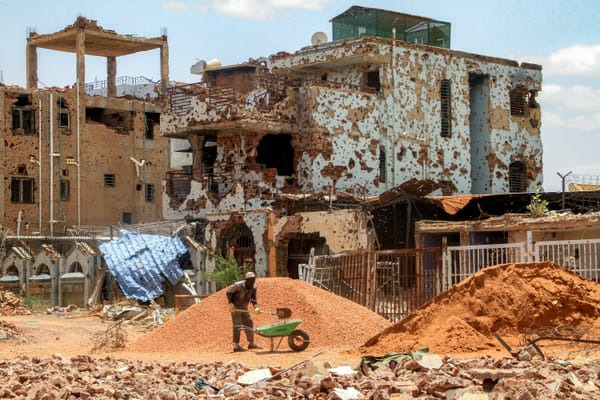
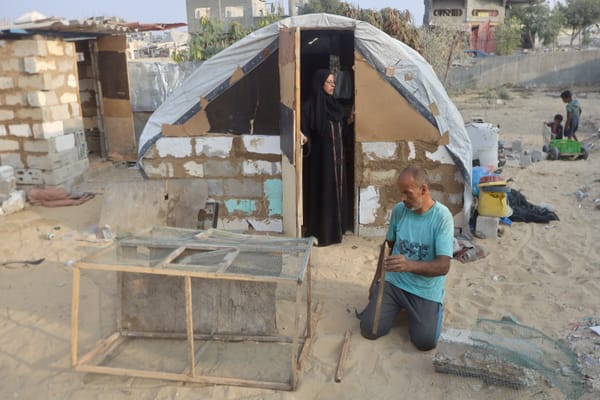
Repair Amid Ongoing Ruination—Rebuilding Dahiyeh Once More
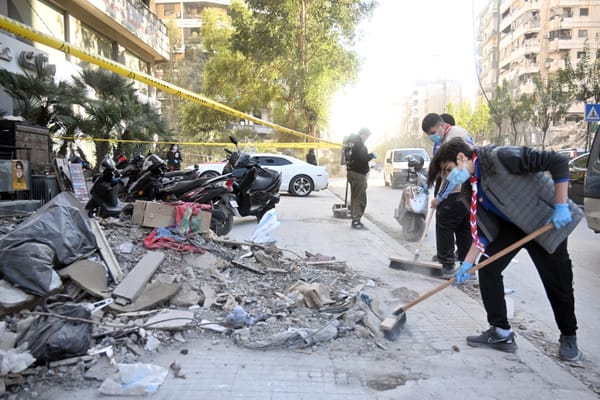

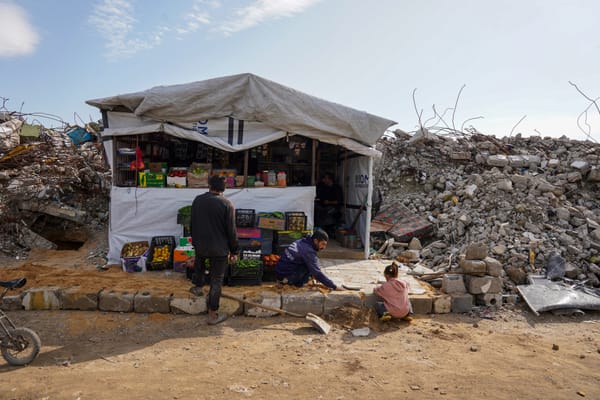
Standing beside a destroyed building in Dahiyeh in September 2025, a fruit seller said to me, “I want to bring Naim Qassem [Hizballah’s new secretary general] here. I want to show him the damage. Our people need to do better.” He knew that, like him, I was Shia, and “our people” meant Hizballah. Regardless of whether or not we agreed with Hizballah’s politics, he saw no way to separate our fate from theirs.
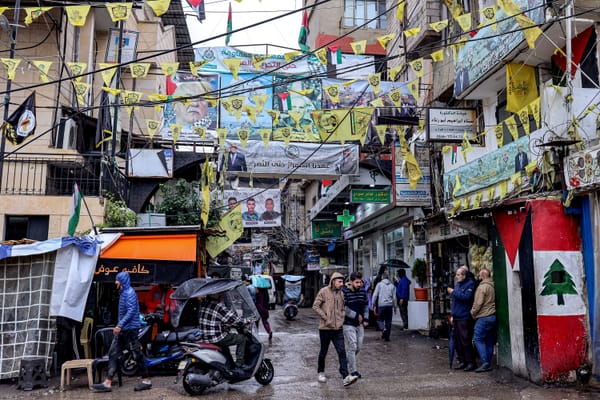
The Dahiyeh Al-Janoubiya (the Southern Suburbs), or simply al-Dahiyeh in common parlance, is home to more than 700,000 people spread across some 16 primarily Shi’i neighborhoods and includes the Burj al-Barajneh Palestinian refugee camp. Currently, significant portions of the suburb remain in ruins after the devastating Israeli bombing campaign across Lebanon that began one year earlier. War had been simmering since October 8, 2023, when Hizballah and Israel began exchanging fire after the Hamas-led attack on October 7. In Lebanon, some people refer to this period as al-Harb al-Isnad, the war of support, since Hizballah’s stated aim was to back Hamas in rising against Israel to break the nearly twenty-year long siege.
In September 2024, Israel began a full-scale attack on Lebanon that lasted until November and reached deep into Dahiyeh’s residential zones. Those 66 days saw near nightly bombings by Israel, targeting specifically Shi’i neighborhoods under the pretext of striking Hizballah positions. Dahiyeh remained full of residents who could not escape the constant bombardment from the air and sea. Beirut’s divided sectarian geography, decades in the making, made it difficult for internally displaced Shi’i residents to find shelter. While they were largely not welcome in predominantly Christian neighborhoods, in mixed and Shi’a-friendly neighborhoods rents skyrocketed. Landlords in neighborhoods such as Hamra and Ras Beirut asked double or triple what they would usually charge.
Those who could not afford to leave fled temporarily whenever Israel’s evacuation orders targeted their areas. Sousan, a woman from Chiyah, told me, “My nephew would take me to sit on the beach with thousands of other people at night, all of us waiting to return to our homes.” [1] Hours later they would return to streets filled with rubble and smoke, “but this was better than sleeping in a school with hundreds of other families.” Chiyah, a mostly Shi’i neighborhood dominated by the Amal party of Nabih Berri, the speaker of the parliament, borders Ain El Rammaneh, a Christian area. They meet but do not touch at Old Saida Road. The Christian neighborhood saw no destruction, no rubble. In contrast, once tall apartment blocks in Chiyah have been reduced to large piles of debris collapsing into layers like cake that threaten to fall further, endangering people who walk and live beside them.
In the aftermath of the war, most Lebanese Shi’a, like the fruit vendor, continue to identify with Hizballah and the resistance against Israeli aggression. Yet many debate whether this was their war to fight. Tensions are exacerbated by the Israeli military’s continued daily presence in the air, its re-occupation of lands in the south and the high death toll and infrastructural damage. According to the Lebanese Health Ministry, as of December 4, 2025, the war claimed the lives of 4,047, including Hizballah fighters and civilians, and wounded 16,638.[2] The death toll continues to rise due to Israel’s daily violations of the November 27, 2024, ceasefire agreement, as it carries out drone strikes against Hizballah members and civilians alike. As for infrastructure, the scale of destruction following the war is staggering. It is unknown exactly how many people have lost their homes as the final count remains inconclusive and the destruction continues. In Dahiyeh, it is estimated that at least 361 buildings had been completely demolished by the signing of the ceasefire, and recent reporting has put the number of damaged buildings at 490.[3]
The 2024 war was the most destructive and lethal since the Lebanese civil war (1975–1990), but it was not without precedent. In the summer of 2006, Hizballah captured two Israeli soldiers for use in prisoner exchanges, prompting Israel to attack. During the 33-day war that followed, Israel—aware of the social, political, and economic significance that Dahiyeh holds for Hizballah and its supporters—carried out what it would come to call the “Dahiya Doctrine.” The Doctrine calls for the destruction of an opponent’s military capacity and the use of disproportionate force against the broader population through the destruction of civilian housing and infrastructure, including schools, hospitals and utilities. Despite its name, the Dahiya Doctrine, underpinned Israel’s attacks throughout the country.
In 2006, Israel’s turned Dahiyeh, a crowded and busy civilian suburb into a war frontier. Today it has done the same. But, the political landscape for reconstruction now differs radically from the situation after 2006, making large-scale rebuilding far more difficult.
Unlike the current conflict, the war in 2006 had a clear beginning and end. Israel's attacks against Dahiyeh stopped with the ceasefire agreement. Standing in front of the ruins of a destroyed building in the suburb, Hizballah’s then-secretary general, Hassan Nasrallah, promised that Dahiyeh would be rebuilt, “more beautiful than it was before.” Thus began the “more beautiful promise” campaign for reconstruction largely funded by Iran, Hizballah’s main international backer. While Iran provided $200 million for Dahiyeh, many of the Arab Gulf countries provided significant aid to prop up the Lebanese economy and rebuild areas beyond Beirut’s southern suburbs. Saudi Arabia deposited $1 billion directly into Lebanese banks and Qatar provided $300 million in reconstruction aid for south Lebanon. The United States provided nearly $1 billion in aid to Lebanon, $230 million of which was for reconstruction and humanitarian aid conditioned upon its distribution outside of Hizballah institutions and networks.
The reconstruction process was a display of power not just to Israel and the United States, but to the Lebanese government of Fouad Siniora that sought—in cooperation with the United States—to isolate the party in the wake of the war.
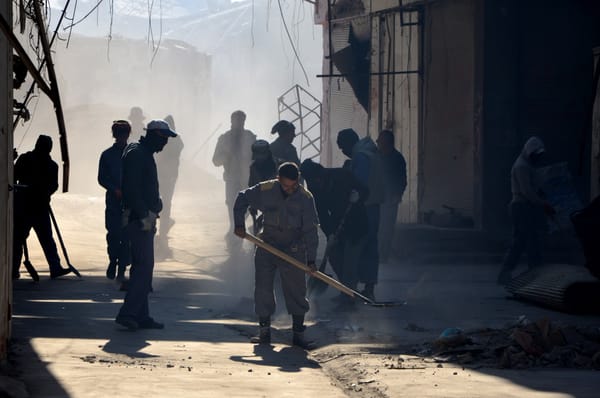
The clean-up and repair work was taken up by a newly created organization Wa’ad (Promise). Wa’ad is part of Jihad al-Bina, a Hizballah-run organization that deals with civilian infrastructure and agriculture in Lebanon. Teams from Jihad al-Bina and other party organizations worked with volunteers from across the sectarian spectrum to remove rubble and clean up the streets. Hizballah invited architects, consultants and contractors to participate in the planning and reconstruction process, albeit in line with its own vision for reconstruction.[4] The reconstruction process was a display of power not just to Israel and the United States, but to the Lebanese government of Fouad Siniora that sought—in cooperation with the United States—to isolate the party in the wake of the war. Destroyed buildings were quickly replaced by modernized high rise buildings. Haret Hreik, which before the war had become one of the most affluent neighborhoods within Dahiyeh, remained home to wealthier residents.
In May 2012, Hizballah held a festival celebrating the completion of reconstruction as the fulfillment of Nasrallah’s promise. In his speech during the festivities, Nasrallah praised the cross-sectarian efforts to restore Dahiyeh. For Nasrallah and Hizballah, reconstruction itself was seen as a victory connected to the larger victory of 2006: It retrieved its captives from Israel, carried out a 33-day war with Israel and remained standing. Ultimately, it took just six years and $400 million to rebuild.
In November 2024, the postwar conditions in Dahiyeh were starkly different from 2006. Hassan Nasrallah, a political and spiritual leader who was for many also a father figure, was now a martyr. The Israeli military assassinated him on September 27, 2024, when they dropped ten 2,000-pound bombs on Haret Hreik. The pager attack ten days earlier—a war crime in which Israel detonated booby trapped devices used by Hizballah members including medics, engineers and other civilians—along with other assassinations, had thinned the ranks of its leadership and social services organizations. Hizballah’s military force significantly weakened, the party has grown more politically isolated internally and externally: Internally, the human costs of the war added to those of its involvement in the Syrian civil war on behalf of Bashar al-Asad’s regime, amplifying criticisms of the party’s engagement in wars outside the country. Externally, the fall of al-Asad and US-Israeli attacks on Iran have weakened its key international allies. Israel’s continued attacks on Dahiyeh, the Bekaa Valley and South Lebanon, more than a year after the cease fire agreement, underscore the party’s inability to defend its constituents or the country.
At the time of writing, Jihad al-Bina estimates that $630 million is needed to rebuild Dahiyeh. But reconstruction is not simply a matter of money. Major political obstacles are preventing large-scale repair works. After the November 2024 ceasefire, a new Lebanese government was formed. The appointment of Nawaf Salam, a staunch opponent of Hizballah, as prime minister paved the way for a cabinet agreement that the state will gradually take control of all arms in the country. The agreement was passed in September 2025 without Hizballah and Amal ministers, and Hizballah insists that it will not disarm while Israel continues to occupy Lebanese land. The United States, meanwhile, has conditioned its reconstruction aid on the state successfully disarming the party’s militia by the end of 2025—a condition that, needless to say, has not been met.
As did the Siniora government in the wake of 2006, the Salam government has also sought to undermine Hizballah’s ability to rebuild. In January 2025, Israel claimed that Iran was shipping aid to Hizballah through Mahan flights to Beirut. The following month, the Lebanese government banned any further flights from Iran, sparking large protests on the road to the airport. For Lebanon’s Shi’a communities, this measure was rubbing salt into the wound. Their own government, which could not protect them from the Israeli onslaught, now barred them from acquiring the means to rebuild their homes. In their view, the government would decline crucial reconstruction funding from Iran, as it also did in October 2025 by rejecting $60 million in aid, to avoid displeasing Washington.
In the face of such policies, Shi’i communities increasingly view the state as oriented against them. On the ground, the people with whom I have spoken in Dahiyeh and South Lebanon do not support the disarmament of Hizballah, and I have yet to meet someone who has expressed confidence in the Lebanese government’s ability to protect them against Israel or to rebuild if Hizballah were to disarm. On the southern border, where Israel wiped out entire villages and continues to illegally enter and demolish homes, the Lebanese government is not allowing people to rebuild, on the pretext that their previous homes were illegal, in violation of building codes. For example, in Mays Al-Jabal and Kfar Kila, two border villages heavily destroyed by Israeli attacks, residents have been prevented from rebuilding because they lack reconstruction permits and have received no compensation. The Lebanese government has neither approved nor expedited border reconstruction permits, leaving many people internally displaced more than one year since the ceasefire, and the reasons for the delay remain unclear.
In September 2025, a report published by the Hizballah-affiliated Al-Akhbar news, claimed that the party would rebuild with $3 billion. In the first phase, according to the report, $1 billion would go toward rebuilding the southern suburbs and much of the south, excluding destroyed border villages. But since, there has been no official announcement from the party. In practice, Hizballah has continued to channel limited resources through Wa’ad, which has contracted private companies to clear rubble from damaged areas. These companies have profited from the process: Where possible, rubble has been reused locally to fill the large craters left by airstrikes, and salvaged metal and rubble has also been sold to foreign firms for recycling and resale. Those who have lost their homes have resorted to selling the metal scraps as a means for survival.
In Dahiyeh, those who lost their homes or apartments were promised $14,000 to cover one year of rent elsewhere in the city. Due to delays in obtaining the compensation, however, people have had to resort to their own limited funding to secure housing. There are multiple reasons for these delays. Before compensation can be granted, Jihad al-Bina must carry out damage inspections, but these inspections are often put off due to ongoing Israeli attacks. Compensation also hinges on residents’ ability to prove ownership or occupancy of homes, apartments and shops—a long and tedious process. Residents must provide documents, assuming that they were able to flee with relevant papers. Given the widespread informality of ownership and rental relations in the area, many never had them in the first place. Salma, for example, is part of a multi-generational home. Years ago, her family decided to merge two apartments into one. Despite the investment to purchase and merge the two apartments, Jihad al-Bina would only credit the family for one. Lacking documentary proof of the initial purchases and ownership, Salma’s family, for the time being, are at a loss.
As is often the case in post-conflict environments, such bureaucratic obstacles and delays combine with misinformation to breed suspicion and resentment. Salma suggested that some residents, unfairly advantaged by informal ties to the party and its institutions, have received more compensation than others. Although Salma, still waiting for promised rental support for the coming year, feels indignant for not being compensated for the two apartments she lost, she still identifies with the resistance and continues to align her political and personal beliefs with those of Hizballah.
If the goal is to distance people from the resistance, the stalled reconstruction has had the opposite effect: making the community feel the party is their only hope.
As I drive from the south into Beirut, I come across billboards that read, “one country united by its people, its army, and in its weapons.” Since the ceasefire agreement, there have been variations of such statements—the promises of unity an attempt to convince party supporters to fall in line with the US-Israeli-backed call to disarm Hizballah. If the goal is to distance people from the resistance, the stalled reconstruction has had the opposite effect: making the community feel the party is their only hope.
Ruination, both psychological and material, has become part of everyday life here in Dahiyeh. Since the signing of the ceasefire agreement, Israel continues to violate the terms daily, punctuated by four large-scale attacks on Dahiyeh as of late November 2025, twice with a warning and twice without.
At the time of writing, the Dahiyeh is still in ruins. The rubble that had blocked major arteries in the city was removed to make way for traffic. While some buildings have been completely cleared of their rubble, many others remain in a state of collapse. Still, life in the area continues, and people continue to live and work in the ruins that were once home.
I visited what is left of my own family’s home in Dahiyeh almost a year after the war erupted. As I stood amid the ruins, I saw something moving: a horde of big brown rats, each the size of a small cat, swarming around a discarded box. I shivered in disgust then turned around to see a young man smoking a cigarette outside the shop behind me. “It’wadana,” he told me, “We got used to it.” There is a numbness that is needed in living with ruins, a sort of defiant nonchalance that must be adopted to make do within the situation at hand.
If the current Lebanese government continues to block aid unless Hizballah—which many see as their sole protector—disarms, then the densely populated urban suburb of Beirut that is Dahiyeh, will remain in ruins until there is a solution to the larger national questions of if, how and when Hizballah and the Shi’a will be integrated or ousted from the post-conflict Lebanese nation and its increasingly dysfunctional state. The Israeli drones and warplanes that fly over Dahiyeh daily tie these national questions to regional powers and their reluctance to rein in Israel’s military, itself armed and protected by the United States. Without answers, residents wonder where they will go if, and when, war returns.
[Iman Ali is a doctoral candidate in anthropology at Cornell University.]
Editor's note: We use Dahiyeh when referring to the place itself, reflecting its common pronunciation in Lebanese Arabic, and Dahiya when referring to the so-called Dahiya Doctrine, the military strategy named after the area. As with many Arabic terms transliterated into English, spelling varies. Our usage prioritizes clarity and precision rather than rigid standardization.
Support MERIP in providing critical, grounded reporting and analysis without paywalls. Make a one-time or monthly donation today!
[1] Interview took place over the phone in November 2024.
[2] Ministry of Public Health (Lebanon), “Updated Total Toll of the Israeli Aggression: 4,047 Martyrs and 16,638 Injured,” press release, 4 December 2024. [In Arabic]
[3] Beirut Urban Lab, “Mapping Israeli Announced Strikes on Lebanon.”
[4] Mona Fawaz, "Hizballah as urban planner? Questions to and from planning theory," Planning Theory 8/4 (2009), pp. 323–334.