In August 2025, the Fatah movement began handing over truckloads of arms stored within Palestinian refugee camps to the Lebanese Army. It marked the first step in an ongoing campaign to disarm Palestinian militia groups in Lebanon.[1]

The process began after the head of the Palestinian Authority (PA) in the West Bank, Mahmoud Abbas, visited Lebanon the previous May. Together with Lebanese president Joseph Aoun, he made plans to start withdrawing weapons from the country’s Palestinian camps, which have remained outside of state control since 1969. In a statement, the two leaders said they had formed a committee to monitor the affairs of the camps and committed “to intensify joint meetings and communication to make the necessary arrangements to immediately begin implementing these directives at all levels."

Following the partial defeat of Hizballah in 2024, and with significant US and Israeli pressure, the current Lebanese government has worked hard to consolidate sovereignty and end a longstanding era of paramilitary groups operating beyond state control. Israel—which still retains troops in parts of southern Lebanon and continues periodic strikes—threatened to resume full-scale war unless Lebanon’s leadership “dismantled” Hizballah by the end of 2025. President Aoun stated in April 2025 that he aimed to transfer Hizballah's arms to the state through dialogue, insisting that 2025 “will be the year of state monopoly on all weapons.”

Yet few inside Lebanon expect Hizballah to be disarmed in the near term. The group remains deeply embedded in the country’s social and political system and frames its arsenal as a deterrent against ongoing Israeli aggression. In this context, the disarmament of smaller Palestinian militia groups is an attempt to establish a “normative precedent” to show that armed actors can be brought under state authority through negotiation rather than force, and without triggering internal conflict.

Despite these aspirations, the initiative remains fraught with tensions, marred by fundamental challenges: Can a disarmament of the Palestinian camps realistically be achieved during extreme external pressure, in the absence of unity between Palestinian exile leadership and without a Lebanese plan to address the basic needs of 200,000 Palestinian refugees living on the margins of the state?

A Palestinian State in Exile

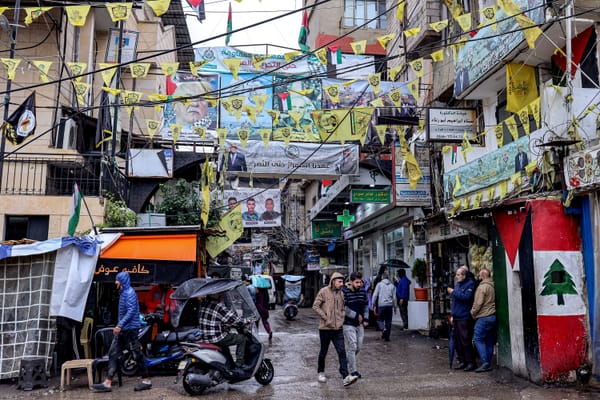
The country’s 12 present-day Palestinian refugee camps served as the primary base for the Palestine Liberation Organization (PLO) and a springboard for its armed struggle against Israel from the late 1960s until 1982. In 1969, PLO leader Yasser Arafat signed the so-called Cairo Accords with Lebanon, which granted the Palestinian guerrilla movements the right to wage their "Palestinian revolution" from Lebanese soil. The accords gave the PLO complete control over the refugee camps, where it continued to build a complex political and military infrastructure resembling a Palestinian state in exile.[2]

Although the PLO hoped to create a unified Arab front against Israel, Lebanon instead plummeted into civil war (1975–1990). During the war, a host of armed actors targeted the Palestinians, including Israel, which carried out extensive attacks against armed groups and civilian camp dwellers. In 1982, following the Israeli invasion and siege of Beirut, the PLO leadership was expelled to Tunisia and other Arab countries.

The war-ending Ta’if Accords of 1989 and a subsequent Amnesty Law in 1991 gave Lebanese militia leaders a chance to reshape their movements back into political parties. The Lebanese state was put under the custodianship of the Syrian Baath Party, which asserted itself as a guarantor for peace and would remain a significant presence in the country until 2005. The Cairo Accords that had paved the way for Palestinian autonomy in Lebanon were formally ended as early as 1987. But their nullification did little to alter the de facto relationship between the Lebanese state and the Palestinian camp leadership as the accords were not replaced by another treaty. Although the militias of the war were banned, Syria let its nascent ally, the Iranian-backed Hizballah, retain an armed presence by virtue of constituting “the resistance”—a useful deterrent to Israel. For the same reason, Syria did not make a priority out of disarming Palestinian groups that remained.

Because the Lebanese state mostly stuck to its self-imposed policy of not entering them, however, the camps also remained sites of political possibility and refugee agency...

The way that the camps continued to evolve presents a striking paradox. On the one hand, they emerged as “extraterritorial entities” subjected to stringent Lebanese restrictions and plunged into abject poverty. [3] Because the Lebanese state mostly stuck to its self-imposed policy of not entering them, however, the camps also remained sites of political possibility and refugee agency, where a complex “assemblage of political actors, organizations, agencies, religious leaders and the built environment fill the void abandoned by the state,” as Adam Ramadan writes.[4] The most important actors were the Palestinian factions who retained a key role in camp governance.

At the turn of the millennium, the PLO and its Fatah movement made a substantial effort to widen its presence within the camps of Lebanon, coinciding with the failure of the peace process with Israel. So too did Hamas, which went on to formalize its organization there by establishing a factional framework. To date, the camps remain deeply embedded in the political economy of a range of armed factions and political leaderships that compete relentlessly for hegemony and territorial control.

Whereas many Palestinians in Lebanon see the arms in the camps as symbols of their national liberation struggle and as integral to their self-determination and self-defense, others have come to deeply doubt their purpose in the present era. In the Shatila refugee camp in Beirut, community activist Majdi Majzoub expressed his support for the disarmament process. “If you asked me in the 70s or the 80s, during the days of revolution, my answer would be different,” he said.[5] In the intervening years, he claimed, things have changed. In his view, some of the factions have come to resemble armed gangs without a clear purpose, who serve mostly their own interests.

Only two weeks before our conversation took place, clashes between rival drug gangs in his camp left two dead and two injured. Like many other residents of Shatila, Majzoub holds the camp's political leadership responsible for ignoring the local drug economy. “If the factions are not capable of standing up against these thugs, why should they carry weapons? It’s time we gave up the guns. Maybe this way we can mend our relationship with the Lebanese state, and negotiate regarding our civil rights” he said.

An Earlier Disarmament Push

It is not the first time that Palestinian and Lebanese political elites have discussed the issue of demobilizing camp-based militia groups. After Syria’s departure from Lebanon in 2005, the Lebanese-Palestinian Dialogue Committee (LPDC) was established to negotiate a solution to contentious issues like the Palestinian refugees’ lack of civil rights on the one hand and the proliferation of illegal arms in and outside of the refugee camps on the other.

As the then-newly elected head of the Palestinian Authority, Mahmoud Abbas announced that Palestinian weapons in Lebanon did not have a political function and threw his support behind UN Security Council Resolution 1559, urging the Lebanese government to establish control over its territory and disarm all militias.[6]

Not only was the process hampered by Israel’s invasion of Lebanon in 2006 and the Lebanese Army’s destruction of the Nahr al-Barid camp in 2007, Abbas also faced opposition from militia commanders who did their utmost to undermine his authority in the camps, including members of his own Fatah movement. Some went on to form alliances with local militant Islamist groups when they learned that he intended to remove them from their positions of power.[7] Adding to the complexity of the matter, it gradually emerged that certain Lebanese parties were also funding allied Palestinian armed groups. In 2007, Hizballah began pouring substantial funds into the camps in order to revamp an older militia called Ansar Allah, which proceeded to recruit scores of young Palestinians particularly in the camps of South Lebanon.[8] The group worked to undermine the influence of Abbas’ Fatah movement and further discourage any discussion about disarmament.

Eventually, the Lebanese government lost interest in disarming Palestinian factions. In 2012, it instead gave Abbas the green light to bring the camps under the authority of the Palestinian National Security Forces

Eventually, the Lebanese government lost interest in disarming Palestinian factions. In 2012, it instead gave Abbas the green light to bring the camps under the authority of the Palestinian National Security Forces (PNSF): His US-supported security branch in the West Bank. By integrating unruly Fatah commanders into the structures of the PNSF, Abbas was able to quell the most substantial opposition, but he never gained full control. Consequently, the camps became umbilically tied to the PA’s political economy in the West Bank and intertwined with Fatah’s internal power struggles. Abbas’ insistence that Palestinian arms in Lebanon no longer played a political role seemed hollow.

The Post-October 7 Landscape

Hamas’s October 7, 2023 al-Aqsa Flood attacks against Israel radically altered the Palestinian political landscape, including in Lebanon. Israel’s relentless retaliatory onslaught against the Gaza Strip resulted in a multifaceted reaction by the refugees. As Marie Kortam observes, this response manifested as anxious anticipation and fear but also as solidarity with the people of Gaza—shown through marches, demonstrations, sit‑ins and boycott campaigns. The events also created openings for certain armed Palestinian factions to join the military struggle against Israel, thereby breaking a long-standing taboo among Palestinian groups against launching operations from Lebanese soil.

On October 10, 2023, The Hamas-linked Qassam Brigades claimed responsibility for having fired rockets against Israel from undisclosed sites in South Lebanon. Hamas also quickly announced that it had established what it called Vanguards of the al-Aqsa Flood, an initiative to recruit young Palestinians in Lebanon to “join the vanguards of the resistance fighters…” as a “continuation of what was achieved in the Al-Aqsa Flood operation.”[9]

Hamas’s popularity soared, and there appeared to be no shortage of young recruits willing to join its ranks—some even attempting to cross the Lebanese-Israeli border on foot with fatal consequences. But their optimism was short-lived. By November 2024, escalating Israeli attacks by air and ground had killed at least 3,000 Lebanese and displaced more than 1 million. During the war, most of Hizballah’s leadership was decimated and central Hamas leaders assassinated. The Iranian-backed Axis of Resistance, which included Hamas and Hizballah, was dealt another blow when Syria’s president Bashar al-Asad was ousted by rebels in December 2024.

While Lebanon’s leadership was hardly in a position to challenge Israel’s renewed occupation of strategic locations in the South, the collapse of the Axis removed important hurdles to its ambition of disarming militia groups. In late 2024, the Lebanese army took over three military bases previously manned by pro-Syrian Palestinian militias outside of the camps.

The turn of events shifted the momentum back to Mahmoud Abbas and the Fatah movement. Since the events of October 7, Abbas had attempted to sway the United States to let his Palestinian Authority assume control of the Gaza Strip after Hamas. Affirming support for the disarmament of the camps in Lebanon represented an opportunity for Abbas to show US President Trump that he is vital for achieving regional stability.[10]

Fatah Surrenders Heavy Arms, Hamas stalls

The disarmament plan agreed upon by the Lebanese government and the Abbas leadership took shape under the brokerage of a host of other authorities, ranging from the LPDC and civil society associations to local Palestinian faction officials.

Confusion about who was to be included delayed the process, which originally was set to begin in June 2025. PLO factions, like the Popular and Democratic Fronts for the Liberation of Palestine, appeared to disregard the calls for disarmament, lamenting that they had not been consulted by the Fatah leadership. Meanwhile, Hamas issued statements criticizing the plan, saying it only represented the Palestinian Authority. Some opposition leaders accused Abbas of “monopolizing” the process.[11] As before, similar sentiments were also heard within Fatah itself.

Certain Fatah leaders in Lebanon felt coerced into the disarmament process by PA officials and Abbas’ envoys flying in from Ramallah.

Certain Fatah leaders in Lebanon felt coerced into the disarmament process by PA officials and Abbas’ envoys flying in from Ramallah. Reportedly, they were especially upset that Abbas had tasked his own son—a person who, according to a source within Fatah, had never “set foot in any of the refugee camps”—with heading the talks with the Lebanese authorities.[12] The tensions escalated into a public showdown between the Abbas leadership and long-time ambassador to Lebanon, Ashraf Dabbour, who subsequently was accused of corruption by the PA and removed from his post. Fatah went on to dismiss several more dissidents within its ranks, actions that did little to resolve the tensions. In the southernmost Rashidiyye refugee camp, suspended members of the organization staged armed demonstrations against their own leadership, urging it to pay their salaries.

Between August 21 and September 13, 2025, Fatah surrendered close to 20 truckloads of weapons from the refugee camps of Beirut and the city of Tyre, as well as al-Baddawi in the north and Ain al-Hilweh in the south. Notably, what Fatah surrendered consisted primarily of heavy arms such as rockets, shells and landmines. In fact, the Lebanese government had not required the handover of medium and light weapons used in day-to-day security provision, raising questions about whether any actual change has occurred within the refugee camps.[13] “The whole operation is symbolic,” a resident of the Ain al-Hilweh camp claimed. “This is just a political theater orchestrated to put pressure on Hizballah.”[14]

Ultimately, the turbulence that followed these first stages of the handover initiative made it difficult for the Lebanese and Abbas leaderships to declare a decisive political victory. Above all, it exposed deep tensions within the Fatah movement. On one side was local leaders who were not committed to the process, some of whom sought to inflate their influence by derailing it. On the other, regional leaders aimed to assert their control by hurrying it along.

Following Fatah’s surrender of its heavy arms, the LPDC, along with Lebanese and Palestinian officials, have found themselves in negotiation with Hamas. Although both Hamas and its Iranian-backed colleagues of Palestinian Islamic Jihad have reiterated their commitment to Lebanese sovereignty, they insist that a disarmament process should not be rushed and can only take place with a strong Palestinian consensus.

Hamas has also asserted that it does not have any heavy weapons or military bases to surrender: According to sources familiar with the negotiations, Hamas claims that the artillery it used in the war against Israel belonged to Hizballah and is no longer in its possession.[15] At the moment, Hamas wants to buy time because it is not eager to lay down its weapons in Lebanon at a point when negotiations about its future armed presence in Gaza remains undecided.

The Lebanese government’s chance of reaching a diplomatic solution with Hamas also finds itself undermined by ongoing Israeli breaches of the ceasefire agreement. On November 18, 2025, an Israeli drone, allegedly targeting Hamas commanders in the Ain al-Hilweh camp, struck a sports compound next to the movement representative’s office, killing 13 including minors. While both the Trump administration and Israel are applying intense pressure on Lebanon to disarm non-state militias, such acts of aggression fundamentally challenge the government’s ability to provide security guarantees to the armed groups with which it negotiates.

Addressing Palestinian Civilian Rights

As a non-signatory of the 1951 Refugee Convention, Lebanon does not grant its Palestinian refugee population of about 200,000 the right to own property, inherit or join its workforce. Despite the lack of political progress, many are still hopeful that the disarmament plan could pave the way for a wider discussion about the status of the refugees and their place in the Lebanese republic.

Edward Kattoura shares this view. As a leader from the Democratic Reform Current of Fatah, a group that for well over a decade has operated in opposition to Abbas’s leadership, Kattoura has served as an important broker between Palestinian and Lebanese officials in the ongoing negotiations. In October 2025, he affirmed that he is a proponent of the disarmament initiative but wished the plan to be “bolder, more comprehensive, and to include a social dimension.”[16] He did not simply mean trading weapons for access to rights, but embarking on a process that feels politically meaningful for the refugees, given that the factions’ arms are connected to a history of national struggle and future aspirations of returning to a Palestinian homeland.

Kattoura has published a strategic document that includes recommendations of how to tackle prickly issues such as camp governance in a scenario where light and medium weapons are also removed from the camps.[17] One of these recommendations is to seek funding from international donors to purchase the weapons carried by armed individuals in the camps—a gesture that might encourage those operating outside of any established faction framework to comply. He also proposes the establishment of a vocational training program to rehabilitate armed faction members. Furthermore, the document outlines the formation of a Palestinian community police to patrol the camps in coordination with Lebanon’s Ministry of Interior and its Internal Security Forces. “This would ensure the civilian nature of the camps without bringing them under the authority of the army,” Kattoura said.

The last point is vital for many Palestinians, who feel that their host state treats them as a security threat. A stark example is the Nahr al-Barid camp near Tripoli. Since a devastating battle in 2007 that pitted a jihadi group against the Lebanese Armed Forces, the country’s northernmost camp has remained under heavy surveillance by the latter. To avoid a situation where the authoritarian and militarized governance model of Nahr al-Barid becomes the norm for the remaining camps, a holistic plan is needed. Kattoura contends that the handover process represents a “historic opportunity” to build trust and move toward a reconciliation between the Palestinian refugees and the Lebanese state.

The disarmament initiative that began in 2025 could potentially be the starting point of a process that restores Lebanese institutional credibility and reaffirms the state as the sole authority over the monopoly of violence. So far, it has not generated the political momentum the government perhaps had hoped for. Hampered by foreign pressure, fractured faction politics and the absence of a rights‑based program to absorb marginalized communities, the process has exposed systemic weaknesses that the state struggles to remedy. What is clear is that, in the long run, Lebanon cannot treat its search for sovereignty separately from the issue of Palestinian inclusion. Four decades after the nullification of the Cairo Accords, there is a pressing need for a new charter that defines the Palestinians' status as a part of the Lebanese republic, while acknowledging their right of return to their homeland.

[Erling Lorentzen Sogge is a senior lecturer in Middle East studies and Arabic language at the University of Oslo.]

SUPPORT MERIP

Support MERIP in providing critical, grounded reporting and analysis without paywalls. Make a one-time or monthly donation today!

DONATE NOW!

Endnotes

[1] I am grateful to Marie Kortam and an anonymous colleague in South Lebanon for thoughtful comments on earlier drafts.

[2] Erling Lorentzen Sogge, The Palestinian National Movement in Lebanon: A Political History of the ‘Ayn al-Hilwe Camp (London: I.B. Tauris, 2021).

[3] Michel Agier, Managing the Undesirables (Cambridge: Polity, 2011), p. 86

[4] Jonathan Rokem et al., “Interventions in Urban Geopolitics,” Political Geography 61 (November 2017), p. 16. Adam Ramadan, “Spatialising the Refugee Camp,” Transactions of the Institute of British Geographers 38/1 (January 2013), p. 67.

[5] Author’s interview, June 3, 2025.

[6] Nasir al-Asʿad, "على أبواب استئناف الحوار اللبناني الفلسطيني وفيما تربط الفصائل الموالية لسوريا سلاحها بالتنظيم لاستمرار الصراع مع إسرائيل," al-Mustaqbal, 5 (2005).

[7] Sogge, The Palestinian National Movement in Lebanon, 48.

[8] Fidaa Tani,  الجهاديون في لبنان من قوات الفجر إلى فتح الاسلا(Beirut: Dar al-Saqi): 128.

[9] Al-Mayadeen English, “Hamas Announces Establishment of Vanguards of Al-Aqsa Flood in Lebanon,” December 5, 2023.

[10] Author’s interview with Fatah official in Lebanon, June 6, 2025.

[11] Author’s phone interview with Palestinian opposition leader, June 15, 2025.

[12] Author’s interview by phone, June 6, 2025.

[13] Author’s interview with Edward Kattoura, a leader of Fatah’s Democratic Reform Wing in Lebanon, October 15, 2025.

[14] Author’s interview by phone, October 23, 2025.

[15] Author’s interview with Palestinian official in Lebanon, October 10, 2025.

[16] Author’s interview by phone, October 15, 2025.

[17] Edward Kattoura, رؤية إستراتيجية شاملة لمعالجة أوضاع اللاجئين الفلسطينيين في لبنان وتعزيز الحوار اللبناني الفلسطيني (Beirut 2025).

Share this post

Written by

Erling Lorentzen Sogge is a senior lecturer in Middle East studies and Arabic language at the University of Oslo.

This article was published in issue 317.


Palestinian Refugee First Responders Rush to Aid Beirut

Erling Lorentzen Sogge 10 min read

Repair Amid Ongoing Ruination—Rebuilding Dahiyeh Once More

Iman Ali 11 min read

The Struggle for the City—Urban Recovery and Dispossession in Mosul and Damascus

Craig Larkin 14 min read

Burri Under Siege—How War Remade Everyday Life in a Sudanese Neighborhood

Niema Alhessen 15 min read