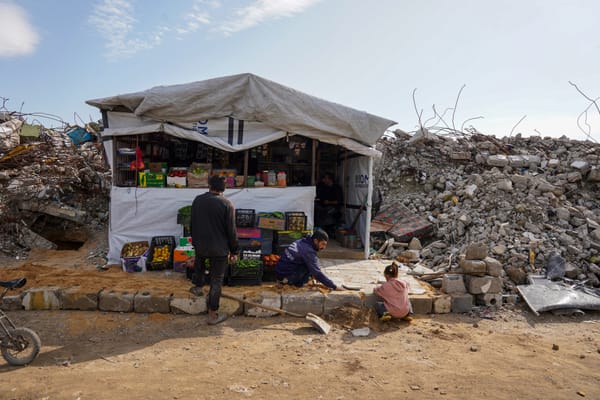
A Note on the Cover Image
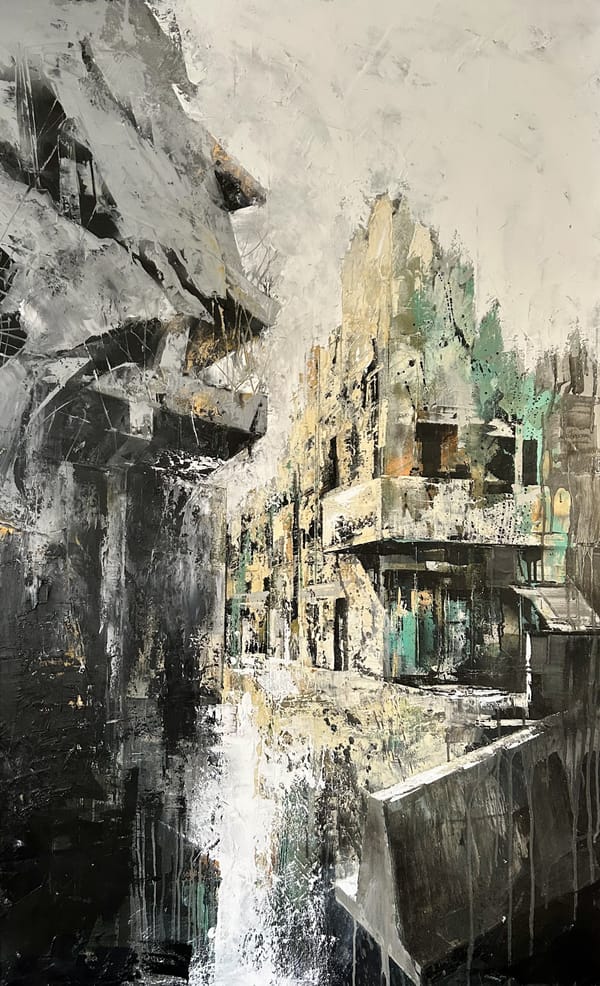

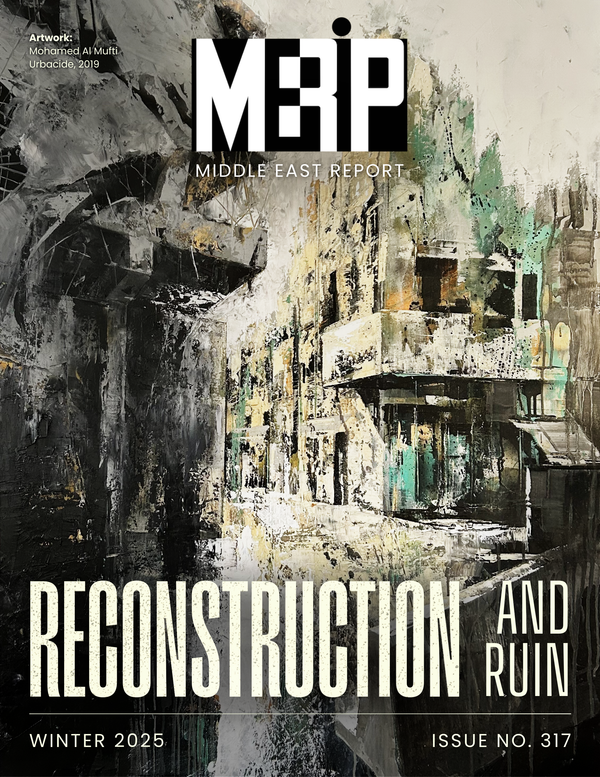
The cover of MER’s winter issue features an acrylic and oil on canvas painting by Syrian architect and artist Mohamed Al Mufti, from his series Urbacide.
Produced in 2019 during the counter-revolutionary war in Syria, the painting deploys texture and contrast to depict a damaged urban streetscape: A darkened, crumbling concrete building dominates one side, a T-wall barrier the other. Despite these obstacles, between them a brightly lit path leads to a lighter building, its speckled concrete surface flecked with greens and orange to create a focal point that recedes from view. The scene is not tied to a specific place. Instead, Mufti describes Urbacide as an exploration of “urban genocide”—“a way of dismantling geography, totally, to make a place an unhabitable, unlivable.” Although the series emerged from the Syrian war, he notes that since 2023, the work has taken on a broader resonance: “This is not only in Syria,” he says. “It became dramatically regional. It’s also what’s happening in Palestine, in Yemen, in Lebanon—in Dahiyeh or the South.” The painting is devoid of human figures, an absence Mufti describes as deliberate: Viewers are invited to imagine the lives that once animated these spaces and to confront what it means to return to a city after its social fabric has been violently undone.
It is a fitting cover for MER’s winter issue, Reconstruction and Ruin, which examines how the intertwined processes of urban destruction and reconstruction have become defining features of conflict across the contemporary Middle East. The issue documents how warfare renders urban space unlivable, and how people navigate return and rebuilding amid ongoing war or its persistent threat. The articles trace how international capital, geopolitical pressure and security regimes constrain and shape reconstruction efforts—from Beirut to Khartoum. Two interviews also reveal the challenges of documenting and chronicling destruction at radically different scales, from the systematic obliteration of Gaza to the devastation of Sudanese cities like El Fasher. At the same time, the issue examines efforts at social repair: grassroots initiatives and heritage projects that seek to sustain life and hope.
Mufti’s painting, by contrast, holds the viewer in a suspended moment before such rebuilding can fully commence. It deliberately confronts the ugliness of destruction rather than softening it, an insistence that, for Mufti, allows the image to provoke sustained attention in ways that breaking news and the fast pace of social media often cannot. He does, however, acknowledge the presence of hope, seen in the recurring light at the center of much of his artistic work: “I don't do it on purpose, but there's always, on the horizon, some source of light coming, a kind of hope.” As an architect, Mufti locates that hope in the possibility of rebuilding socially and materially: in taking what has been destroyed by war and creating projects that draw on collective memory and heritage while also reimagining them in contemporary, durable and sustainable forms. Yet he is explicit about the political conditions that foreclose complete reconstruction. In much of the region, war has not ended and wounds remain open. “We are not in a postwar situation,” he explains. “The wound is still there—and we don’t exhibit it, we live inside it.” As long as Israel’s wars continue, he suggests, rebuilding can only remain provisional. “As long as there is the threat of being bombed again,” he says, “we can only do the minimum.”