NEW: Dirty Work—The Hidden Machinery and Human Toll of Europe’s Broken Recycling Trade
By Adnan Khan

By Adnan Khan
Dear Friends and Comrades,
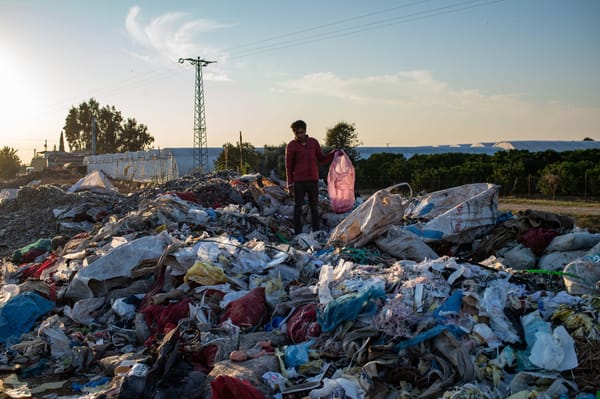
Today we published a new report from Adnan Khan, “Dirty Work – The Hidden Machinery and Human Toll of Europe’s Broken Recycling Trade,” that investigates how a dramatically increasing amount of illegal waste from European countries ends up in Turkey’s recycling factories. Khan’s investigation reveals that several major European recycling companies skirt and break rules around the classification of recycled waste in an effort to drive labor costs down and profits up. The end result is a system that recycles much less plastic than it claims, and a widening industry that traps Turkey’s most marginal workers in grinding, unlivable conditions.
This report is a follow up to Khan’s harrowing exposé published with us last year that detailed the waste economy in Turkey and how the industry is degrading life for its workers, most of whom are undocumented Afghan and Syrian migrants. Together, these two reports paint a bleak picture of the failed regulations, systemic corruption and worker exploitation that underpins Europe’s efforts to reduce and recycle plastic waste.
Since the first of these pieces was published, I’ve not been able to see plastic the same way. Khan’s latest provides a closer look at how a corrupt and broken system sustains itself and resists reform. We hope you read, share and let us know what you think.
In Solidarity,
James Ryan
Executive Director
Support MERIP during our year-end campaign! Make a one-time or monthly donation today!
Adnan Khan
Death—or at least the manner in which it occurs—is central to Aslı Odman’s understanding of life. For the past decade and a half, the 50-year-old lecturer at Mimar Sinan Fine Arts University’s department of urban and regional planning in Istanbul, Turkey, has spent much of her free time scanning local media reports and talking to her network of informants, tracking down people who have died in workplace accidents.
The list is long. Turkey, despite its inclusion in the G20 and membership in the Organization of Economic Cooperation and Development (OECD), ranks among the world’s worst places for such deaths. In 2024, 1,987 people died while engaged in activities related to their work, an average of more than five people per day, according to İSİG Meclisi, the Istanbul-based non-governmental organization of which Odman is a founding member. Statistics from the International Labour Organization paint an equally grim picture: 11.2 people died in Turkey for every 100,000 workers in 2024. In Britain, that number was 0.8.
Few who visit Istanbul see this dark underbelly, though its intimations are all over the city: in the raucous alleyways of the historic Pera district, with its bars, restaurants and boutique shops, where garbage pickers dig through bins for plastic scraps; in the many outlet malls selling discounted name brands cut and stitched in the garment factories scattered around the city; and slightly further afield in the booming suburban outskirts where the landscape bristles with construction cranes erecting shiny new residential towers advertising luxury lifestyles to a mostly international audience.
The recorded number of lives lost to these industries, as shocking as it is, only represents the “tip of the iceberg,” Odman says. The figures are based on what she and her fellow volunteers at İSİG Meclisi can find in public records or glean from their network of contacts. The worst cases sometimes break through into the Turkish media, like the 2023 death of Vezir Mohammad Nourtani, an undocumented Afghan laborer killed by his boss and five accomplices at an illegal coal mine in Zonguldak, on Turkey’s Black Sea coast. Most, however, go uncounted, especially when it comes to undocumented workers who lack family ties in Turkey, and in some cases even proper identification, like the case of Arifullah Fazli, the undocumented Afghan laborer whose death I stumbled into while investigating migrant labor exploitation in Turkey’s recycling sector in late 2022. Fazli died while attempting to dislodge plastic waste that had become stuck in an industrial compactor, and until today there has been no accountability. Deaths like Fazli’s quietly disappear into a legal and bureaucratic maze, their bodies either buried in the many Cemeteries of the Unnamed (Kimsesiz Mezarlığı) scattered around the country or quietly returned to their families back home.
Turkey’s rapid economic growth over the past quarter century under the leadership of the Justice and Development Party (AKP) has relied heavily on labor-intensive industries—mining, construction, textiles, recycling—all of which are top contributors to İSİG Meclisi’s list of workplace deaths. In this constellation, the recycling sector has been particularly deadly, Odman says. Like ship breaking—where she first began looking at such crimes—plastic recycling is a labor-intensive activity that processes highly toxic waste materials, much of them imported, in dangerous work environments. Both industries face tight profit margins and try to widen them by exploiting undocumented labor and bypassing regulations meant to keep humans as well as the environment safe. Unlike ship breaking, though, plastic recycling has enjoyed special treatment in Turkey in recent years.
In 2017, just as China was preparing to exit the global trade in plastic waste, the AKP launched its Zero Waste Project, led by Turkey’s First Lady, Emine Erdoğan. With the goal of making Turkey a world leader in waste management and recycling, the government showered both industries with tax exemptions and cheap loans, among other incentives. With China’s exit, wealthy nations, including those in Europe, scrambled to find new destinations for their trash. Exports to Turkey skyrocketed, jumping from under 100 million kilograms in 2017 to 425 million in 2024. The Zero Waste Project has been lauded by the United Nations, the World Bank and the Food and Agriculture Organization, and Turkey’s First Lady now chairs the UN’s High-Level Advisory Board on Zero Waste. In its eighth year, the pro-government newspaper Daily Sabah claims the project has helped raise the domestic recycling rate from 13 percent to 36 percent while adding 7.5 billion euros to the Turkish economy.
But behind the accolades are some sobering realities. Regulations to clean up Turkey’s recycling sector have failed. By its nature, the recycling industry is notoriously ineffective and unprofitable. In its entire 40-odd-year history, it has only managed to transform around 9 percent of plastic waste into new plastic products, and even that only in degraded forms, limiting the number of times it can be recycled. Like China before it, Turkey has struggled to bring the illicit trade in plastic waste under control, taking in hundreds of thousands of tons of dirty, often unrecyclable, waste from Europe every year. To turn a profit, the sector has relied on undocumented migrants, who provide a ready supply of cheap, disposable labor to sort, shred, bury and burn much of that waste. Odman’s data shows that starting in 2018, as exports of plastic waste to Turkey increased, so did the proportion of migrant deaths in Turkey’s recycling sector, more than doubling by 2022.
Each death traces the arc of two converging stories: On one side are the poor and desperate, arriving in Turkey from the east through a gauntlet of border guards, smugglers and criminals; on the other is a growing mountain of trash, the discarded remnants of voracious western lifestyles, slipping unaccounted through ports and past regulators to be bought, reclassified and resold by shady brokers.